Since the current of barbarian immigration
which overthrew the civilisation of Rome
in the West, probably no national movement of
the kind has more profoundly affected the general
course of history than the expansion of Scandinavia
which fills the ninth and tenth centuries.
Alike in their constructive and destructive work,
in the foundation of new communities on conquered
soil, as in the changes produced by reaction
in the states with which they came in contact,
the Northmen were calling into being the most
characteristic features of the political system of
medieval Europe. Their raids, an ever-present
danger to those who dwelt near the shores of the
narrow seas, wrecked the incipient centralisation of
the Carolingian Empire, and gave fresh impetus
to the forces which were already making for that
organisation of society which we describe as
feudalism; and yet in other lands the Northmen
were to preserve their own archaic law and social
custom longer than any other people of Germanic
2stock. The Northmen were to bring a new racial
element into the life of Western Europe, but
whether that element should adapt itself to the
conditions of its new environment, or whether
it should develop new forms of political association
for itself, was a question determined by the
pre-existing facts of history and geography.
For the geographical extent of Scandinavian
enterprise is as remarkable as its political influence.
At the close of the third quarter of the
tenth century it seemed likely that the future
destinies of northern Europe would be controlled
by a great confederation of Scandinavian peoples.
In the parent lands of Norway, Denmark, and
Sweden three strong kingdoms had been created
by Harold Fair Hair, Gorm the Old, and Eric of
Upsala; the Orkneys and Shetlands formed a
Norwegian earldom, and a number of vigorous
Norse principalities had been planted along the
east coast of Ireland. In the extreme north
Scandinavian adventurers were already settling
the inhospitable shores of Greenland, and lawless
chieftains from Norway had created the strange
republic of Iceland, whose stormy life was to
leave an imperishable memorial in the wonderful
literature of its sagas. Normandy was still the
“pirates’ land” to the ecclesiastical writers of
France, and the designation was correct in so
far that the duchy still maintained frequent
relations with the Scandinavian homeland and
had as yet received no more than a superficial
3tincture of Latin Christianity. England, at the
date we have chosen, was enjoying a brief respite
between two spasms of the northern peril, but
the wealthiest portion of the land was Scandinavian
in the blood of its inhabitants, and within
twenty years of the close of the century the whole
country was to be united politically to the Scandinavian
world.
The comparative failure of this great association
of kindred peoples to control the subsequent
history of northern Europe was due in the main
to three causes. In the first place, over a great
part of this vast area the Scandinavian element
was too weak in mere numbers permanently to
withstand the dead weight of the native population
into which it had intruded itself. It was
only in lands such as Iceland, where an autochthonous
population did not exist, or where it was
reduced to utter subjugation at the outset, as in
the Orkneys, that the Scandinavian element permanently
impressed its character upon the political
life of the community. And in connection
with this there is certainly to be noted a distinct
decline in the energy of Scandinavian enterprise
from about the middle of the eleventh century
onward. For fully a hundred years after this
time the Northern lands continued to send out
sporadic bodies of men who raided more peaceful
countries after the manner of the older Vikings,
but Scandinavia produced no hero of more than
local importance between Harold Hardrada and
4Gustavus Vasa. The old spirit was still alive in
the North, as the stories of the kings of Norway
in the Heimskringla show; but the exploits of
Magnus Bareleg and Sigurd the Jerusalem-farer
are of far less significance in general history
than the exploits of Swegen Forkbeard and Olaf
Tryggvasson, and trade and exploration more and
more diverted the energy which in older times
would have sought its vent in warlike adventure.
And of equal importance with either of the causes
which have just been described must be reckoned
the attraction of Normandy within the political
system of France. By this process Normandy
was finally detached from its parent states; it
participated ever more intimately in the national
life of France, and the greatest achievement of
the Norman race was performed when, under the
leadership of William the Conqueror, it finally
drew England from its Scandinavian connections,
and united it to the richer world of western
Europe. It was the loss of England which definitely
compelled Scandinavia to relapse into isolation
and comparative political insignificance.
But the Norman Conquest of England was a
many-sided event, and its influence on the political
destiny of Scandinavia is not its most important
aspect. The events of 1066 derive their peculiar
interest from the fact that they supply a final
answer to the great problem which underlies
the whole history of England in the eleventh
century—the problem whether England should
5spend the most critical period of the Middle Ages
in political association with Scandinavia or with
France. The mere fact that the question at
issue can be stated in this simple form is of itself
a matter of much significance; for it implies that
the continuance of the independent life of England
had already in 1000 become, if not an impossibility,
at least a very remote contingency. To explain
why this was so will be the object of the following
pages, for it was the weakness of the Anglo-Saxon
polity which permitted the success of William
of Normandy, as it gave occasion of conquest to
Cnut of Denmark before him, and the ill governance
on which their triumph was founded takes
its main origin from events which happened a
hundred years before the elder of them was born.
At the beginning of the third quarter of the
ninth century, England was in a state of utter
chaos under the terrible strain of the Danish
wars. Up to the present it has not been possible
to distinguish with any certainty between the
various branches of the great Scandinavian race
which co-operated in the attack on England, nor
is the question of great importance for our immediate
purpose. The same may be said of
the details of the war, the essential results of
which were that the midland kingdom of Mercia
was overrun and divided in 874 into an English
and a Danish portion; that England, north of the
Humber, became a Danish kingdom in or about
875; and that Wessex, after having been brought
6to the brink of ruin by that portion of the Northern
host which had not founded a permanent settlement
in the north, was saved by its King Alfred
in a victory which he won over the invaders at
Edington in Wiltshire, in 878. As a result of this
battle, and of some further successes which he
gained at a later date, Alfred was enabled to add
to his dominions that half of the old kingdom of
Mercia which the Danes had not already appropriated[4];
a district which included London and
the shires west of Buckinghamshire, Northamptonshire,
Leicestershire, and Derbyshire. For
the first half of the tenth century, the main interest
of English history centres round the relations
between the rulers of Wessex and its Mercian
dependency, and the people of the Danelaw.
As the final result of twenty years of incessant
warfare, the Danes had succeeded in establishing
three independent states on English soil. Guthrum,
the leader with whom Alfred had fought
at Edington, founded in East Anglia and the
eastern midlands a short-lived kingdom which
7had been reconquered by Edward the Elder before
his death in or about 924. To the north of
Guthrum’s kingdom came the singular association
of the Five Boroughs of Derby, Nottingham,
Lincoln, Leicester, and Stamford, whose territory
most probably comprised the shires to which the
first four of them have given name, together with
Rutland and north-east Northamptonshire. Apart
from its anomalous government, of which nothing
is really known, this district is distinguished from
Guthrum’s kingdom by the fact that the Danish
invaders settled there in great numbers, founded
many new villages, and left their impress upon
the administrative and fiscal arrangements of
the country. The Five Boroughs were occupied
by Edward the Elder and conquered by his
son Edmund, but their association was remembered
in common speech as late as the time of the
wars of Ethelred and Swegen, and the district,
as surveyed in Domesday Book, is distinguished
very sharply from the shires to its south and
west.[5]
Beyond the Humber the Northmen had founded
the kingdom of York, which maintained its independent
existence down to Athelstan’s time and
which was only connected with the south of
England by the slackest of political ties when
William the Conqueror landed at Pevensey. In
this kingdom, whose history is very imperfectly
8known, but of which abundant numismatic
memorials remain, the Norwegian element appears
to have predominated over the Danish and its
kings were closely connected with the rulers of
the Norse settlements in Ireland. But the peculiar
importance of this Northumbrian kingdom
lies in the persistent particularism which it continued
to display long after it had been nominally
merged in the kingdom of the English. Its
inhabitants were barbarous beyond the ordinary
savagery of the Anglo-Saxons, and bitterly resented
any attempt to make them conform to the
low standard of order which obtained elsewhere in
the land. Among so anarchical a people, it would
be useless to look for any definite political ideas,
and the situation was complicated by the union
of Scandinavian Yorkshire with English Bernicia
in one earldom, so that it is difficult to say
how far the separatist spirit of Northumbria was
due to the racial differences which distinguished
it from the rest of the land, how far to surviving
memories of the old kingdom which had existed
before the wars of the ninth century, and how far
to simple impatience of ordered rule by whomsoever
administered. But the existence of such a
spirit is beyond all doubt; it manifested itself in
957 when Northumbria joined with Mercia in
rejecting King Edwy of Wessex; it is strikingly
illustrated in the northern legend which represents
the sons of Ethelred the Unready as offering
Northumbria to Olaf of Norway as the price of
9his assistance in their struggle with Cnut; it came
to the front in 1065, when the northern men rebelled
against their southern earl, Tostig Godwinsson;
it culminated in the resistance which
they offered to William of Normandy, and was
finally suppressed in the harrying to which he
subjected their province in the winter of 1069.
For a century and a half the men of Northumbria
had persisted in sullen antagonism to the political
supremacy of Wessex.
But the fact remained that within fifty years of
Alfred’s death the house of Wessex had succeeded
in extending its sway, in name at least, over all the
Scandinavian settlers within the limits of England.
The “Rex Westsaxonum” had become the “Rex
Anglorum,” and Edmund and Edgar ruled over a
kingdom which to all appearance was far more
coherent than the France of Louis d’Outremer
and Hugh Capet. But the appearance was very
deceptive, and the failure of the kings of Wessex
was so intimately connected with the success of
William the Conqueror that its causes demand
attention here.
In the first place, the assimilation of the Scandinavian
settlers into the body of the English
nation should not hide from us the fact that a
new and disturbing element had in effect been
intruded into the native population. This amalgamation
was very far from resulting in a homogeneous
compound. The creation of the “Danelaw”
in its legal sense—that is, a district whose
10inhabitants obeyed a new law perfectly distinct
from that of any native kingdom—was an event of
the greatest consequence. It imposed a tangible
obstacle to the unification of the country which
was never overcome until the entire system of
old English law had become obsolete. The very
fact that the geographical area of the Danelaw did
not correspond with that of any English kingdom
or group of kingdoms makes its legal individuality
all the more remarkable. The differences of
customary practice which distinguished the east
from the west and south were a permanent witness
to the success of the Danes in England and
they applied to just those matters which concerned
most deeply the ordinary life of the common
people. A man of Warwickshire would realise the
fact that his limbs were valued at a higher or
lower rate than those of his neighbour of Leicestershire,
when he would be profoundly indifferent to
the actions of the ruler of both counties in the
palace at Winchester.
More important for our purpose than these
general legal peculiarities were the manifold
anomalies of the Old English land law. Were it
not for the existence of Domesday Book we should
be in great part ignorant of the main features of
this system; as it is we need have no hesitation in
carrying back the tenurial customs which obtained
in 1066 well beyond the beginning of the century.
So far as the evidence before us at present goes,
it suggests that for an indefinite period before the
11Norman Conquest the social structure of the
English people had remained in a condition of
unstable equilibrium; in a state intermediate
between the primitive organisation of Anglo-Saxon
society and the feudalism, though rudimentary,
of contemporary France. However
strong the tie of kindred may have been in drawing
men together into agrarian communities in former
days, by the eleventh century at latest its influence
had been replaced by seignorial pressure and the
growth of a manorial economy. Of itself this
was a natural and healthy process, but in England,
from a variety of causes it had been arrested at
an early stage. The relationship between lord and
man was the basis of the English social order,
but this relationship over a great part of the
country was still essentially a personal matter; its
stability had not universally acquired that tenurial
guarantee which was the rule in the Frankish
kingdom. The ordinary free man of inferior rank
was expected to have over him a lord who would be
responsible for his good behaviour, but the evidence
which proves this proves also that in numberless
cases the relationship was dissoluble at
the will of the inferior party. In the Domesday
survey of the eastern counties, for example, no
formula occurs with more striking frequency than
that which asserts that such and such a free man
“could depart with his land whither it pleased
him”; a formula implying clearly enough that
the man in question could withdraw himself and
12his land from the control of his temporary lord,
and seek, apparently at any time, another patron
according to the dictate of his own fancy. In such
a system there is room for few only of the ideas
characteristic of continental feudalism; it is clear
that the man in no effective sense holds his land
of his lord, nor is the former’s tenure conditional
upon the rendering of service to the latter. The
tie between lord and man was that of patronage
rather than vassalage; and its essential instability
meant that the whole of the English social order
was correspondingly weak and unstable. The Old
English state had accepted the principle that a
man must needs look for protection to someone
stronger than himself, but it had not advanced
to the further idea that, for the mere sake of
social cohesion, the relationship thus created
must be made certain, permanent, and, so far as
might be, uniform throughout the whole land.
On the whole it is probable that this result
was mainly due to the peculiar settlement which
the Danish question had received in the early tenth
century. Had the Danes conquered Wessex in
Alfred’s time, so that the whole of England had
been parcelled out among four or five independent
Scandinavian states, the growth of seignorial control
over free men and their land might have been
indefinitely postponed. Had Alfred’s successors
been able to effect the incorporation of the Danelaw
with the kingdom of Wessex, the incipient
manorialism of the south might have been extended
13to the east and a rough uniformity of custom in
this way secured, giving scope for the gradual
development of feudalism according to the continental
model. But the actual course of history
decided that the native kingdom of Wessex should
survive, assert its superiority over the Scandinavian
portion of the land, and yet be unable to
achieve the conformity of its alien subjects to its
own social organisation. Such at least is the
conclusion suggested to us by the evidence of
Domesday Book. Broadly speaking, Wessex and
its border shires had presented in 1066 social
phenomena which Norman lawyers were able to
co-ordinate with the prevailing conditions of their
native land. In Wessex each village would
probably belong to a single lord, its land would
fall into the familiar divisions of demesne and
“terra villanorum,” its men would owe labour
service to their master. But beyond the Warwick
Avon and the Watling Street, the Normans
encountered agrarian conditions which were evidently
unfamiliar to them, and to which they
could not easily apply the descriptive formula
which so admirably suited the social arrangements
of the south. They had no previous
knowledge of wide tracts of land whose inhabitants
knew no lord of lower rank than king, earl,
or bishop; of villages which furnished a meagre
subsistence to five, eight, or ten manorial lords;
of estates whose owner could claim service from
men whose dwellings were scattered over half a
14county. In twenty years the Normans, by conscious
alterations, had done more to unify the
social custom of England than had been accomplished
by the gradual processes of internal development
in the previous century; but it was the
social division, underlying the obvious political
decentralisation of the country, which had sent
down the Old English state with a crash before
the first attack of the Normans themselves.
But social evils of this kind do their work
beneath the surface of a nation’s history, and it is
the complete decentralisation of the Old English
commonwealth which first occurs to our minds
when we wish to explain the double conquest
which the land sustained in the eleventh century;
a decentralisation expressed in the creation of
the vast earldoms which controlled the politics of
England in the last years of its independence.
The growth of these earldoms is in many respects
obscure; to a limited extent they represent old
kingdoms which had lost their independence, but
in the main they are fortuitous agglomerations
of territory, continually changing their shape as
the intrigues of their holders or the political
sense of the king of Wessex might from time to
time determine. From the narrative of the
Danish war presented by the Anglo-Saxon Chronicle,
it seems certain that each county south of
Thames possessed an earl of its own in the ninth
century; but this arrangement appears to have
been modified by Edward the Elder, and it has
15been estimated that from the accession of Edward
to the close of the tenth century Wessex and
English Mercia were divided into a group of
earldoms whose number never exceeded eight,
a change which inevitably magnified the importance
of the individual earl. In the meantime,
Northumbria and the territory of the Five
Boroughs were being ruled by men of Scandinavian
blood, who claimed the title of earl but are very
rarely found in attendance at the courts of the
King of Wessex.[6] In the wars of Ethelred II. and
Edmund Ironside with Swegen and Cnut, the
issue of each campaign is decided by the attitude
of such men as Aelfric, ealdorman of Hampshire,
or Eadric of Mercia, to whom it belonged of
right to lead the forces of their respected earldoms,
and who seem to have carried their troops from
one side to the other without being influenced
in the smallest degree by any tie of allegiance
which would bind them permanently to either
the English or the Danish king. To Cnut himself
is commonly attributed a reorganisation of the
earldoms, in which their number was temporarily
reduced to four, and in which for the first time
Wessex as a whole was placed on an equality
with the other provincial governments. The simplicity
of this arrangement was soon distorted
by the occasional dismemberment of the West
Saxon and Mercian earldoms, and by the creation
of subordinate governments within their limits;
16but throughout the reign of Edward the Confessor
it is the earls of Wessex, Mercia, East
Anglia, and Northumbria who direct the policy
of the kingdom.
The privileges and powers inherent in the dignity
of an earl were very considerable. We have
already referred to his military authority, but he
also seems to have enjoyed a judicial prerogative
overriding the competence of the local assemblies
of the hundred. His wergild was seemingly fixed
at a higher rate than that of the ordinary noble,
and the fine paid to him for a breach of his peace
was half the amount which would be paid to the
king, and double the amount paid to the thegn on
account of a similar offence.[7] More important
from the standpoint of politics was the fact that
in every shire certain lands seem to have been
appurtenant to the comital office,[8] and these
lands formed a territorial nucleus around which
an unscrupulous man like Godwine could gather
the vast estates of which Domesday reveals him
to have been in possession. In practice, too, it
was the earls who seem to have gained more
than any other men of rank by the growth of that
system of patronage which has been described
in a preceding paragraph; the natural influence
of their position attracted to them the unattached
free men of their spheres of government, and they
became possessed of a body of personal retainers
17who might be expected to fight for them at any
crisis in their fortunes and who would not be
unduly scrupulous as to the causes of a quarrel in
which they might be called upon to take part.
Fortified by such advantages, the earls were able
at an early date to make their dignities hereditary
under all normal circumstances, and the attempt
of Ethelred to nominate an earl of his own choice
to Mercia in the person of Eadric Streona, and of
Edward the Confessor to displace the house of
Godwine in Wessex in 1051, led to disaster in
each case, though the occasion of the respective
disasters was somewhat different.
Just as the power of the great earls limited the
executive freedom of the monarchy, so in general
matters of policy the king’s will was circumscribed
by the opinion of the body of his counsellors, his
Witanagemot. Now and then a strong king might
perhaps enforce the conformity of his witan to his
personal wishes; but the majority of the later
Anglo-Saxon kings were not strong, and when,
on rare occasions, we obtain a glimpse into the
deliberations of the king and the wise men, it
is the latter who decide the course of action which
shall be pursued.[9] That this was a serious evil
cannot possibly be disputed. The political supremacy
of the Witanagemot bears no analogy to
constitutional government in the modern sense
of the term: the witan were not responsible to the
nation; they were not, in fact, responsible to
18anybody, for a king who tried to insist on their
obedience to his will might find himself, like
Ethelred II., deserted by his leading nobles at
some critical moment. Also, if we estimate the
merit of a course of policy by its results, we shall
not be disposed to rate the wisdom of the wise men
very highly. In 1066 England was found with
an obsolete army, a financial system out of all
relation to the facts on which it was nominally
based, and a social order lacking the prerequisites
of stability and consistency; that the country
had recently received a comprehensive restatement
of its ancient laws was due not to its wise men,
but to its Danish conqueror Cnut. The composition
of the Witanagemot—a haphazard collection
of earls, bishops, royal officials, and wealthy
thegns—afforded no security that its leading
spirits would be men of integrity and intelligence;
if it gave influence to men like Dunstan and Earl
Leofric of Mercia, men who were honestly anxious
to further the national welfare, it gave equal
influence to unscrupulous politicians like Eadric
Streona and Godwine of Wessex. The results of
twenty-five years of government by the Witanagemot
would supply a justification, if one were
needed, for the single-minded autocracy of the
Anglo-Norman kings.
The early history of the Witanagemot, like that
of so many departments of the Anglo-Saxon
constitution, is beset by frequent difficulties; but
it seems certain that the period following the
19middle of the tenth century witnessed a great
extension of its actual influence. In part, no
doubt, this is due to the increasing power of its
individual members, on which we have already
commented in the case of the earls, but we
certainly should not fail to take into account the
personal character of the kings of England during
this time. The last members of the royal house
of Wessex are a feeble folk. Their physical weakness
is illustrated less by the rapidity with which
king succeeded king in the tenth century—for
Edmund and Edward the Martyr perished by
violence—than by the ominous childlessness of
members of the royal house. Of the seven kings
whose accession falls within the tenth century,
four died without offspring. The average fertility
of the royal house is somewhat raised by the
enormous family of Ethelred the Unready; but
fifty years after his death his male line was solely
represented by an old man and a boy, neither of
whom was destined to leave issue. Nor do the
kings of this period appear in a much more
favourable light when judged by their political
achievements. Edward the Elder, Athelstan,
and Edmund make a creditable group of sovereigns
enough, though their success in the work they
had in hand, the incorporation of Scandinavian
England into the kingdom of Wessex, was, as
we have seen, extremely limited. Edred, the
next king, crippled as he was by some hopeless
disease, made a brave attempt to assert the
20supremacy of Wessex over the midlands and north,
but Edwy his successor was a mere child, and
under him the southern kingdom once more
becomes bounded by the Thames and Bristol
Avon. The reign of Edgar was undoubtedly
regarded by the men of the next generation as a
season of good law and governance, and the king
himself is portrayed as a model prince by the
monastic historians of the twelfth century; but
on the one hand the long misery of Ethelred’s
time of itself made men look back regretfully to
Edgar’s twenty years of comparative quiet, and
also there can be no doubt that the king’s association
with St. Dunstan gave him a specious
advantage in the eyes of posterity.[10] Nothing in
Edgar’s recorded actions entitles him to be regarded
as a ruler of exceptional ability. The short
reign of Edward the Martyr is fully occupied by
the struggle between the monastic party and its
opponents, in which the young king cannot be
said to play an independent part at all, and the
twenty years during which Ethelred II. misconducted
the affairs of England form a period which
for sheer wretchedness probably has no equal in
the national history. Had Ethelred been a ruler
of some political capacity, his title of “the Unready,”
in so far as it implies an unwillingness
on his part to submit to the dictation of the
Witanagemot, would be a most honourable mark
of distinction; but the series of inopportune
21acts[11] and futile expedients which mark the exercise
of his royal initiative were the immediate
causes of a national overthrow comparable only
to the Norman conquest itself. With Edmund
Ironside we reach a man who has deservedly won
for himself a place in the accepted list of English
heroes and we may admit his claim to be reckoned
a bright exception to the prevailing decadence
of the West Saxon house, while at the same time
we realise that the circumstances of his stormy
career left him no opportunity of showing how
far he was capable of grappling with the social and
political evils which were the undoing of his
country. And then, after twenty-five years of
Danish rule, the mysterious and strangely unattractive
figure of Edward the Confessor closes the
regnal line of his ancient dynasty. Of Edward
we shall have to speak at more length in the
sequel, noting here only the fact that under his
ineffective rule all the centrifugal tendencies which
we have considered received an acceleration which
flung the Old English state into fragments before
the first impact of the Norman chivalry.
It follows from all this that, according to whatever
standard of political value we make our
judgment, the England of the tenth and eleventh
centuries will be found utterly lacking in all
qualities which make a state strong and keep it
22efficient. The racial differences which existed
within the kingdom were stereotyped in its laws.
The principles which underlay its social structure
were inconsistent and incoherent. It possessed no
administrative system worthy of the name and
the executive action of its king was fettered
by the independence of his counsellors and rendered
ineffective by the practical autonomy of
the provincial governments into which the land
was divided. The ancient stock of its kings had
long ceased to produce rulers capable of rectifying
the prevailing disorganisation and was shortly
to perish through the physical sterility of its
members. Nor were these political evils counterbalanced
by excellence in other fields of human
activity. Great movements were afoot in the
rest of Europe. The Normans were revolutionising
the art of war. The Spanish kingdoms were
trying their young strength in the first battles
of the great crusade which fills their medieval
history; in Italy the great conception of the
church purified, and independent of the feudal
world, was slowly drawing towards its realisation.
England has nothing of the kind to show; her
isolation from the current of continental life was
almost complete, and the great Danish struggle
of the ninth century had proved to be the last
work undertaken by independent England for
the cause of European civilisation. In Alfred, the
protagonist of that struggle, the royal house of
Wessex had given birth to a national hero, but
23no one had completed the task which he left
unfulfilled.
On turning from the history of England between
950 and 1050 to that of Normandy during the
same period, one is conscious at once of passing
from decadence to growth; and this although the
growth of the Norman state was accompanied by
an infinity of disorder and oppression, and the
decadence of England was relieved by occasional
manifestations of the older and more heroic
spirit of the race. Nothing is more wonderful
in Norman history than the rapidity with which
the pirates’ land became transformed into a
foremost member of the feudal world of France,
and the extraordinary rapidity of the process
seems all the more remarkable from the sparseness
of our information with regard to it. The story
of the making of Normandy, as told by the Norman
historians, is so infected with myth that
its barest outlines can scarcely now be recovered.
We can, however, see that during the ninth
century the north and west coasts of France had
been subjected to an incessant Scandinavian
attack similar in character to the contemporary
descents which the Northmen were making upon
England. It is also certain that the settlement
of what is now Normandy did not begin until
thirty or forty years after the conquest of the
24English Danelaw, and that for a considerable, if
indefinite, term of years new swarms of Northmen
were continually streaming up the valleys which
debouch on the Channel seaboard. Of Rollo, the
traditional founder of the Norman state, nothing
is definitely known. The country from which
he derives his origin is quite uncertain. Norwegian
sagamen claimed him for one of their
own race, the Normans considered him to be a
Dane, and a plausible case has been made out for
referring him to Sweden.[12] His followers were
no doubt recruited from the whole of the Scandinavian
north, but it is probable that the great
mass of the originaloriginal settlers of Normandy were of
Danish origin, and therefore closely akin to the
men who in the previous century had found a
home in the valleys of the Yorkshire Ouse and
Trent. As in the case of Guthrum in East Anglia
the conquests of Rollo were defined by a treaty
made between the invading chief and the native
potentate of greatest consequence; and the agreement
known in history as the treaty of Claire sur
Epte is the beginning of Norman history. Great
obscurity overhangs the terms of this settlement,
and we cannot define with any approach
to certainty the extent of territory ceded by it to
the Northmen.[13] On the east it is probable
that the boundary line ran up the Epte, thence
to the Bresle, and so down that stream to the
port of Eu; but the extension of the original
25Normandy towards the west is very uncertain, and
with regard to its southern frontier there was still
room in the eleventh century for border disputes
in which William the Conqueror became engaged
at an early date. The succeeding history, however,
proves clearly enough that the Bessin,
Cotentin, and Avranchin formed no parts of
Normandy as delimited at Claire sur Epte, and
it was in this last quarter, peopled by an influx of
later immigrants, that the Scandinavian element
in the duchy presented the most obstinate resistance
to Romance influences.
The prince with whom Rollo had concluded this
memorable treaty was Charles III., king of the
West Franks, and the reputed descendant of
Charlemagne. The importance of the settlement
of Claire sur Epte lay in the future, and in its
immediate significance it was little more than
an episode in a struggle which had been carried
on for nearly half a century between the Carolingian
sovereign and the powerful house of the
counts of Paris, of which the head at this time
was Robert, the grandfather of Hugh Capet.
The conquests of Rollo had been made at the
expense of Count Robert, and Charles III. in his
session of Normandy, like Alfred in the treaty of
Wedmore, was abandoning to an invading host
a district which had never been under his immediate
rule. It was certain that the counts of
Paris would sooner or later attempt to recover the
valley of the lower Seine, and this fact produced an
26alliance between the first two dukes of Normandy
and their Carolingian overlords which lasted for
twenty years. The exact nature of the legal
tie which united the earliest dukes of Normandy
to the king of France is a disputed question, but
we may well doubt whether Rollo had done more
than commend himself personally to Charles III.,
and it is not even certain that the Viking leader
had received baptism at the time when he performed
the act of homage. As a final question
which still awaits settlement, we may note that
the date of the treaty of Claire sur Epte is itself
uncertain, but that 921 seems the year to which
with most probability it may be referred.
If this is so, the conclusion of this settlement
must have been the last event of importance in
the reign of Charles III., for in 922 he was overthrown
by his enemy Robert of Paris, and spent
the remaining eight years of his life in prison.
Robert thereupon assumed the title of king, but
was killed in 923; and the crown passed to Rudolph
of Burgundy, who held it until 936. On his
death the royal title was offered to Hugh, surnamed
the Great, count of Paris, but he preferred
to restore the Carolingian line, rather than
to draw upon himself the enemityenemity of all his
fellow-nobles by accepting the precarious throne
himself. Charles III. had married Eadgifu, one
of the many daughters of Edward the Elder of
Wessex, and Louis the Carolingian heir was
residing at Athelstan’s court when Hugh of Paris
27called on him to accept his inheritance. The
refusal of Hugh the Great to accept the crown
did not materially improve the relations existing
between the Carolingian house and the Parisian
county, and Louis “from beyond the sea” found
it expedient to maintain the alliance which his
father had founded with the Norman lords of
Rouen. But, long before the accession of Louis
d’Outremer, Rollo the old pirate had died, and
William Longsword, his son, felt himself less
vitally dependent on the support of the king
of the Franks. In the confused politics of the
period William was able to assert a freedom in
making and breaking treaties and in levying
external war no less complete than that which
was enjoyed by the other princes of France. In
general he remained true to the Carolingian friendship;
and at the close of his reign Normandy and
the French monarchy were jointly opposed to
the Robertian house, leagued with the counties
of Vermandois and Flanders. The latter county,
in particular, was directly threatened by the
growth of a powerful state within striking distance
of her southern borders; and in 943 William
Longsword was murdered by Arnulf of Flanders,
the grandson of Alfred of England.
We should naturally wish to know in what way
the foundation of Normandy was regarded by the
contemporary rulers of England. It is generally
assumed, and the assumption is reasonable
enough, that Athelstan feared the assistance which
28the Normans might give to the men of the Danelaw,
and that he endeavoured to anticipate any
movement on the part of the former by forming
a series of marriage alliances with powers capable
of forcing Normandy to remain on the defensive.
It is probable that Athelstan’s sister Eadhild
married Hugh the Great,[14] the natural enemy of
William Longsword, and we know that Athelstan
lent his support to Alan Barbetorte, who at this
time was struggling with indifferent success to
preserve Brittany from being overrun by Norman
invaders. On the other hand, it would be easy
to exaggerate the solidarity of feeling which
existed between the Northmen in Normandy and
in England; nor do our authorities countenance
the belief that the various continental marriages
of Athelstan’s sisters formed part of any consistent
scheme of policy. There is no evidence
that direct political intercourse existed at any
time between Athelstan and William Longsword;
although we know that the Englishmen who
were appointed by the king to negotiate for the
reception of Louis d’Outremer in France paid a
visit to the court of Rouen.
The murder of William Longsword was followed
by the first of the two minorities which occur
in Norman history, for Richard the illegitimate
heir of the late duke was only a child of ten on
his father’s death. The opportunity was too
29good to be missed, and Louis d’Outremer succeeded
for a brief period in making himself master of
Normandy, not improbably asserting as a pretext
for his intervention a claim to the guardianship
of the young duke. Whatever its legal foundation
Louis’s action outraged the political individuality
of the duchy, and when Richard came to years of
discretion he abandoned the traditional Carolingian
friendship and attached himself to the
Robertian house. He commended himself to
Hugh the Great, and thus began a friendship between
the lords of Paris and their Norman neighbours
which continued for nearly a century and
was not the least among the causes which enabled
the Robertian house in 987 to crown its existing
pre-eminence with the royal title. The reign
of Richard I. lasted for more than fifty years, and
the history of Normandy during this period is
extremely obscure, but there can be no question
that it witnessed the gradual consolidation of the
duchy, and its no less gradual absorption into
the political system of France.
The seventh year of the reign of Richard II.
was marked by an event of the first importance
for the history of both England and Normandy—the
marriage of Ethelred II. and Emma the
duke’s sister. England was at the time in the
very centre of the great Danish war which marks
the close of the tenth and the beginning of the
eleventh century, and it is distinctly possible that
the match may have been prompted by a desire
30on Ethelred’s part to close the Norman harbours
to his enemies’ ships. But, apart from all dubious
attributions of political motive, the importance
of the marriage lies in the fact that Normandy
remains thenceforward a permanent factor in
English politics. The marriage must have produced
an immediate immigration of Normans into
England; so early as 1003 we find a French reeve
of Queen Emma in charge of the city of Exeter.
The mere union of the dynasties—the marriage
of the representative of the ancient and decadent
royal house of Wessex to the great-granddaughter
of the pirate chief Rollo—was alone a sufficiently
striking event. But by chance it happened that
the strain of Norman blood in the offspring of the
marriage came of itself to produce political results
of the gravest consequence. No one in 1002 could
foresee that the new queen would bear a son whose
early life would be passed in exile in his mother’s
land, and who would return thence to his father’s
inheritance saturated with Norman ideas of the
art of government; still less could anyone foresee
that in virtue of this marriage a Norman duke
would one day claim the throne of England by
right of inheritance. But less striking results
of the new alliance would soon enough become
apparent. The ubiquitous Norman trader would
become a more frequent visitor to the English
ports, and Normandy would at once become a
friendly land to Englishmen crossing the Channel
for purposes of trade or pilgrimage. Nor should
31the marriage be considered exclusively from the
English standpoint. The reception of a Norman
princess as queen of England proved at least
that the Norman duke was no longer a barbarian
intruder among the higher nobility of France;
he might not be a sovereign prince as yet, but
he was certainly a ruler of greater consequence
beyond the borders of the French kingdom than
were any of his fellow-vassals of the French crown.
It is true that the alliance of 1002 marks no
immediate change in the French relations of the
duke of Normandy; his energies were still confined
to the petty struggles which he, like his
father and grandfather, carried on with varying
success against this neighbour or that. But
events were soon to prove how strong a state had
really been created in Normandy by the obscure
dukes of the tenth century, and the marriage
of Ethelred and Emma pointed to the quarter in
which the strength of Normandy would find
its field at last.
It must be owned that we can only describe
the internal condition of Normandy, as it existed
at the beginning of the eleventh century, in
very general terms. Normandy, like the rest
of the French kingdom, was passing through
a phase in which the legislative power of the
sovereign was in abeyance; and in default of
written laws we can only rely upon the incidental
information afforded by legal documents
or by the casual expressions of later
32chroniclers.[15] But the main features of Norman
feudalism at this time are fairly certain, and sufficient
to point a contrast with the contemporary
constitution of England in almost every particular
in which the details of the two systems are known
to us.[15]
In the first place, vassalage had become localised
in Normandy. The relationship between lord
and man would in most cases imply that the
latter held his land of the former. So far as we
can tell, the course of Norman feudalism started
from a point of departure different from that with
which the English system takes its origin. The
history of the terms employed to designate dependent
tenure seems to make this clear. At an
early date a great man’s vassal will hold of him
a precarium; he will be a tenant at will, his
tenure will be revocable at his lord’s instance.
To the precarium succeeds the beneficium; a
term which sufficiently expresses the fact that
the tenant’s rights over his land are derivable
from his lord, although it does not, like the older
word, imply their temporary character. In the
meantime, the hereditary principle in regard to
dependent tenure is continually securing a wider
extension, and the feudum, the fee, the term
which ultimately supplanted the precarium and
33beneficium, denotes an estate which will in the
normal course of things descend to a tenant’s
heir. Some such succession of ideas can distinctly
be traced in the Frankish kingdom, and the Anglo-Saxon
land books here and there contain words
and phrases which suggest that the English land
law would have followed a similar development,
had it not been arrested by the general dislocation
of society occasioned by the wars of the ninth
century. The wide estates with which the newly
converted kings of Wessex, the Hwicce and the
Middle Angles, endowed the churches founded in
their dominions afforded an excellent field for the
growth of dependent tenure, which was not neglected
by thegn and free man, anxious to participate
in the wealth of the saints by virtue of
discharging military obligations which monks and
clerks could not perform in person. But the
Danish wars stripped the eastern churches of
their possessions and peopled the eastern counties
with settlers of approximately equal rank; and
when in the century before the Norman Conquest
the land loan reproduces many of the features of
the continental precarium, it appears as an exotic
institution rather than as a normal development
of previous tenurial custom. It would be very
easy to exaggerate the distinction which exists
between England and Normandy in this matter;
the mass of our contemporary information about
Old English land tenure relates to ecclesiastical
estates; but with Domesday Book before us we
34cannot doubt that the distinction was very real
and of deep importance in connection with the
other divergent features of the Anglo-Saxon social
organisation.
Everything, then, seems to show that, for at
least a hundred years before 1086, dependent
tenure and the hereditary descent of fiefs had
been recognised features of the land system of
Normandy. We also know that these principles
had, long before the conquest of England, produced
their corollaries in the rights of wardship,
marriage, and relief, which a lord would enjoy
upon occasion with reference to his vassals.[16]
Women were capable of inheriting land and Norman
custom allowed at least to the duke the
privilege of choosing a husband for his female
vassal. The rights of assuming the guardianship
of a minor’s land, and of receiving a money payment
upon the succession of a new heir, were
obvious developments of the originally precarious
character of the fief, and we shall see that King
Henry of France exercised the former right
over Normandy itself upon the death of Duke
Robert in 1035. There does not seem to be any
direct evidence for the existence of the relief
as a Norman custom before 1066, but its appearance
in England immediately after the Conquest is
sufficient proof of its previous recognition by the
35feudal law of Normandy. None of these customs,
so far as we can tell, had found a place in the social
system of independent England.
Private jurisdiction was undoubtedly an essential
feature of Norman feudalism, though we
may well doubt whether the principles on which
it was based had ever been defined by Norman
lawyers. It is also clear that the duke possessed
upon occasion the power of overruling the judgment
of his barons, and that his exercise of this
power was applauded by all who were interested
in the welfare of the humbler classes of society.
The military character of feudalism made it
imperative that there should be some power in
the land capable of vindicating right by force, and
the stronger dukes of Normandy were not slow
in the assertion of their judicial supremacy. How
far the ubiquitous manorial court of Norman
England represents an imitation of continental
practice, and how far it is referable to the “sake
and soke” possessed by Anglo-Saxon thegns, is
a difficult question, and the explanation given
by the legal writers of the generation succeeding
the Conquest must be reserved for a later chapter.
It is, however, clear, that one custom which
to modern ideas would be ruinous to any social
order distinguishes Norman life from that of
England in the eleventh century. Private war
was a recognised custom in Normandy. For
obvious reasons this custom was fenced round
with stringent regulations; the duke’s license
36was necessary before a campaign could be opened
and its conduct was subject to his general supervision.
But private war is separated by no certain
barrier from anarchy, and under a weak duke
or during a minority the barons of Normandy
would take the law into their own hands. Herein
lay the real cause of the disorders which prevailed
during the minority of William the Conqueror;
and in the abeyance of state intervention the
church endeavoured with considerable success to
confine the practice within reasonable limits. The
Truce of God, in the limitations which it enforced
upon the operations of war, made life more
tolerable for peasant and burgess, but it was at
best an inefficient substitute for the hand of a
strong ruler. William the Conqueror made good
peace in Normandy, as well as in England, and
we may well doubt whether even private war, so
long as its legal sanctions were respected, was not
less harmful to the well-being of a community
than were the savage outbreaks of internal strife
which from time to time occurred under the
helpless government of Edward the Confessor.
The exact nature of the feudal tie which bound
the duke of Normandy to the king of France is a
very difficult question.[17] It undoubtedly comprised
all those obligations which were implied in
the performance of the act of homage, but these
would vary indefinitely in stringency according
to the status of the parties concerned. An oath
37of fealty and service was certain to be kept
only so long as the man to whom the oath was
sworn could compel its observance by the threat
of confiscation. When made between two parties
who were for effective purposes equal in power,
there was no certainty that the oath would imply
more than an assertion of dependence on the part
of the man who swore. On the other hand, it
would be an error to regard the homage which
a duke of Normandy paid to his overlord merely
as a ceremonial form. Even in the early feudal
times the sense of personal honour would generally
serve to prevent a man from wantonly attacking
his lord. William the Conqueror, whenever possible,
refrained from violating the fealty which he
had sworn to King Henry; and if put on his defence
for his conduct at Varaville, he would probably
have pleaded that the necessity of self-preservation
outweighed all other considerations. But in
earlier times the maintenance of feudal relations
between Normandy and France was less dependent
upon the personal loyalty of the reigning duke.
Occasionally, the king of France will confirm the
grants of land with which the duke of Normandy
endowed some religious house; he may, as we
have seen, claim the right of wardship over a duchy
during a minority. Also, it should not be forgotten
that in the case of the dukes between Richard
I. and Robert I. the traditional alliance between
Normandy and the Capetian dynasty disguised the
practical autonomy of the former. So long as the
38knights of Normandy were at the disposal of
the king of France for an attack upon Flanders
or Blois, the king would not be concerned to
argue the question whether they were furnished
to him in obedience to his claim to feudal service,
or merely in pursuance of the territorial interests
of his vassal.
Within the limits of his territory, the duke
of the Normans enjoyed an almost absolute sovereignty.
The external limitation of his authority—the
suzerainty of the king of France—was
at its strongest very ineffectual, and within the
duchy the barons were to an exceptional degree
subject to the ducal power. All the members
of the Norman baronage stood very much on a
level in regard to the extent of their fiefs, and the
political influence which any individual baron
might from time to time exercise depended
mainly on his personal favour with the duke.
Here and there among the mass of the Norman
nobility we meet with a family claiming a more
ancient origin and a purer descent than that of
the ducal house, and disposed towards insurrection
thereby; but such cases are highly exceptional,
and the names which are of most significance in
the history of William the Conqueror are those
of men who held official positions at his court,
or were personally related to his line. In Normandy
there were no baronies of the first rank, and
the number of counties was small; also most of
them, by the policy of dukes Richard I. and II.,
39had been granted on appanages to junior members
of the reigning family. One striking exception
to the territorial significance of the Norman
baronage existed in the great fief of Bellême,
which lay on the border between Normandy
and Maine, and was regarded as dependent on the
French crown.[18] The lords of Bellême in early
times are certainly found behaving as sovereign
princes, but it fortunately happened that the
male line of the family became extinct during
William’s reign, and a standing obstacle to the
centralisation of the duchy was removed when
Mabel, the heiress of this formidable house, carried
its vast possessions to her husband, the duke’s
loyal friend, Roger de Montgomery.
The ecclesiastical, like the lay, baronage of
Normandy had no members fitted by their territorial
influence to lead an opposition to the
ducal power. The greater abbeys of Normandy,
Fécamp, St. Wandrille, Jumièges, had been founded
or refounded by the dukes themselves, and the
restoration of the western bishoprics had mainly
been the pious work of Richard I. The re-establishment
of the Norman episcopate after the
disorder of the settlement could never have been
effected had it not been for the countenance
afforded to the movement by successive dukes,
and the connection between church and state
in Normandy was peculiarly intimate. The
40rights of patronage, elsewhere jealously guarded
by the king of the French, in Normandy belonged
to the duke, and his power of nominating the
official leaders of the church enabled him to
govern the whole ecclesiastical policy of the land.
Naturally, there occur from time to time gross
instances of nepotism, as when Odo, Duke William’s
brother, was thrust into the see of Bayeux at the
age of ten; but in general the dukes of Normandy
were at pains to select worthy candidates for
bishoprics and abbeys, and in 1066 the spiritual
quality of the Norman episcopate was extraordinarily
high. Over the independent ecclesiastical
jurisdiction which had arisen in the duchy
under the influence of the greatgreat Cluniac movement
the duke kept a steady control; when in
England the Conqueror is found insisting that no
ecclesiastical law shall be introduced into the
country without his sanction, he was but asserting
a principle which had governed his conduct
in regard to those matters in Normandy.
This intimate connection of church and state
had, even before the accession of William, produced
a powerful indirect result upon the ecclesiastical
culture of Normandy. In Normandy, as in
England, the Danish wars of the previous century
had been fatal to the monastic life of the districts
affected, and with monasticism perished such
elements of literary culture as the Carolingian
age could show. It was nearly a century after
the treaty of Claire-sur-Epte before monasticism
41revived in Normandy, and this revival was due
almost entirely to the importation of foreign
monks into the duchy under the patronage of
Richard II. and his successors. In connection
with the newly founded monasteries there arose
schools, some of which in a surprisingly short
time rivalled the older institutions of Chartres
and Tours, and participated to the full in the cosmopolitan
culture which underlay the development
of medieval scholasticism. Of these schools,
the most famous was undoubtedly that of Bec,
the rise of which well illustrates the character
of the revival of learning in Normandy.[19] The
abbey of Bec itself was only a recent institution,
having been founded in 1034 by an unlettered
knight, named Herlwin, who was desirous of
living a monastic life in association with a few
chosen companions. Nothing in any way distinguished
Bec from half a dozen other abbeys
founded during the same decade, and the house
owes its unique distinction to the circumstance
that in 1042 an able young Italian jurist and
grammarian, Lanfranc of Pavia, undertook the
direction of its school. As a logical and speculative
theologian Lanfranc is said to display small
original ability, but no one was better fitted than
he by nature to superintend the early development
of an institution to which we may conveniently,
if inaccurately, apply the designation of a
42university. In the eleventh and twelfth centuries
the reputation of the individual teacher was a
matter of much greater importance than were
the traditions of the school which he taught, and
the school of Bec, under Lanfranc’s guidance,
rapidly became the education centre of eastern
Normandy. Its fame was vastly increased by
the fact that its leader became involved in a
theological controversy in which the whole of the
Catholic Church was interested. A famous theologian,
Berengar, a teacher in the school of Tours,
had taken upon himself the task of controverting
the received opinion as to the nature of the
Eucharist, and Lanfranc stepped forward as the
leading controversialist on the conservative side.
In the dialectical struggle which followed, the
honours of debate fell to Lanfranc; Berengar’s
opinions were condemned both by a provincial
synod under Archbishop Maurilius, of Rouen,
and also by a general council held at Rome in
1056, and Lanfranc, to the men of his time, appeared
to be the foremost theologian in Normandy.
But wider duties than the charge of the school
of Bec rapidly devolved upon him as the friend
and intimate counsellor of the duke, and on his
translation to the newly founded abbey of St.
Stephen’s, at Caen, his place was taken by a man
of greater subtlety of mind if no less administrative
capacity. The career of Anselm of Aosta,
who succeeded Lanfranc in the priorate of Bec,
raises issues which lie beyond the life and reign
43of William the Conqueror, but reference should
certainly be made to the educational work which
Anselm performed in the days before his name
was famous as the champion of Hildebrandine
ideas in the ecclesiastical polity of England. As
a teacher, it is probable that Anselm had no rival
among the men of his time, and if his educational
efforts were solely directed at the production of
learned and zealous monks, this does not in the
least detract from the greatness of the work to
which the prime of his life was devoted. It is
under Anselm, rather than under Lanfranc, that
the influence of the school of Bec reaches its
height, and the gentle character and deep philosophical
insight of the monk from Aosta supply a
pleasant contrast to the practical and at times
unscrupulous activity of his predecessor at Bec
and Canterbury.
It must be owned that we possess very little
information as to the causes which towards
the close of the tenth century led to a revival
of the Scandinavian raids upon England. No
consistent tradition upon this matter was preserved
in the north, and the first descent of the
Vikings upon England in 981 provokes no especial
comment from the native chroniclers who have
recorded it. Now, as in the previous century,
the Danes had the command of the sea, and the
44settlements of the ninth-century Vikings in the
east of England offered to their descendants
an excellent base of operations in the heart of
the realm. For the first ten or twelve years after
980 the Danish and Norse raiders contented
themselves with plunder and tribute, and the
definite conquest of England was not achieved
before 1013, when Swegen Forkbeard, king of
Denmark, expelled Ethelred from his kingdom
and enjoyed a few months’ uncontested reign as
the uncrowned king of the land. The English
reaction under Edmund Ironside is a brief
although brilliant episode in the war, but the
superior numbers of the enemy told in the end,
and from 1016 to 1042 England remained politically
united to the Scandinavian world.
The rule of Cnut, Swegen’s son, met with no
opposition on the part of his English subjects.
But although Cnut ruled England with such strictness
and justice that on the eve of the Norman
Conquest his reign was still regarded as a model
of good government, his rule was nevertheless
that of a Scandinavian king.[20] All the surviving
sons of Ethelred met with death or banishment
at his hands, and his marriage with Ethelred’s
widow was much more probably the result of
passion than of policy. In the personnel of the
45local government of England his reign witnessed
a complete change. His earldoms were given
either to the companions of his early warfare, such
as Eric of Northumbria[21] and his son Hakon of
Worcestershire, or to new men, such as Godwine
of Wessex, whom he had raised from insignificance
and could depose at pleasure. So far as we know
only one native family of ancient rank received
favour from the foreign king. The earldom of
Mercia, which had been left vacant by the summary
execution of Eadric Streona early in 1017, was
given to Leofwine, a representative of a noble
midland family and the father of the more famous
Leofric, the wisest of the counsellors of Edward
the Confessor. Such Englishmen as received
secular promotion at Cnut’s hand received it
for the most part in Scandinavia, where the
honour which they enjoyed had apparently become
a cause of discontent to the Danes before
Cnut’s death. In general policy also Cnut’s
attention was directed towards the north rather
than towards the Romance lands, with which
Ethelred’s marriage had brought England into
contact. It is very probable that Cnut dreamed
of an empire which should include England and
the whole of Scandinavia, and it is certain that in
1028 he conquered Norway and claimed the submission
of the king of Sweden. In all this Cnut
was behaving as the heir of Harold Blue-tooth
46and Swegen Forkbeard, rather than as the successor
of Edgar and Ethelred. His rule brought
peace to England and Englishmen needed no
more to induce them to submit to it.
In the machinery of the English government,
it does not appear that Cnut’s reign marks any
changes of importance. He governed England,
as he governed Norway, through viceroys; and
if his earls bear more the character of royal
officials than did Ethelred’s ealdormen, this was
due rather to Cnut’s superior power than to any
fundamental change in the character of their
positions. Under Edward the Confessor the provincial
governments became again as autonomous
as ever. It was a matter of great importance
that Cnut ordered the compilation of a general code
of the law current at this time, a work which may
be held to earn for him the title of the greatest
legislator of the eleventh century.[22] When the
battle of Hastings was fought, Cnut’s code was
still the newest and most explicit statement of
Old English custom, and the additions which the
Conqueror made to it were few and for the most
part of minor importance.
Cnut’s death was followed by the immediate
disruption of his empire. Norway passed to
Swegen, his eldest son; and on his death after a
brief and troubled reign was rapidly conquered
by Magnus, the son of Cnut’s Norwegian rival
Olaf the Holy. Denmark was taken by Harthacnut,
47a son of Cnut and Emma of Normandy, and
Harold, the third surviving brother, secured England
and held it for five years. His short reign
was marked by a dramatic event which is of
importance as furnishing one of the ostensible
motives assigned by the Conqueror’s apologists
for his invasion of England. In 1036 the Etheling
Alfred, son of Ethelred and Emma, left his secure
exile in Normandy and came to England. His
object, we are told, was to visit his mother, the
lady Emma, and to take council with her how
he might best endeavour to gain the kingdom
for himself. He therefore landed with but few
companions, and before he had seen his mother
he was met by Godwine, the Earl of Wessex, who
received him peaceably and entertained him
with lavish hospitality at Guildford. Thereupon
Godwine’s name vanishes from the story, but the
same night the etheling and his party were
surrounded by King Harold’s men and taken
prisoners; Alfred was so horribly blinded that
he soon died from his injuries, and his companions
were mutilated, imprisoned, or sold as slaves
according to the king’s fancy. The whole affair
was clearly the result of foul treachery and it is
impossible to doubt that the surprise at Guildford
was Godwine’s work.[23] The traitorous earl, indeed,
48skilfully evaded the penalty of his crime, but
when William of Normandy was about to cross the
sea, he was careful to appear as the avenger of
the wrongs which his cousin had suffered thirty
years before.
At some time between the death of Cnut in
1035 and the death of Harold I. in 1040, the latter’s
brother Harthacnut, as king of Denmark, had
made a treaty with Magnus of Norway which
served as the pretext for twenty years of war
between the two states, and as the foundation of
the Norwegian claims on England which were
asserted by Harold Hardrada in the campaign
which ended at Stamfordbridge. The secession
of Norway under Magnus from the Danish connection
was not likely to pass uncontested, and
the host of both nations prepared to try the matter
in a great battle at the Elf in the winter following
Magnus’s succession. On both sides, however,
there was a strong party in favour of peace, and
a compromise was arranged by which the kings
swore brotherhood and promised that in the
event of either dying without a son to succeed
him his dominions should pass to the survivor
or his heir.[24] The succession of Harthacnut to
England in 1040 took place without protest from
Magnus, but on the former’s childless death in
1042 the treaty should have come into operation,
and Magnus was careful to claim the crown of
49England from Edward the Confessor. Edward
denied the Norwegian king’s right, and he was
so strongly supported by the leading men of the
land that Magnus deemed it best to let him reign
in peace, but the claim was undoubtedly present
to the mind of Magnus’s heir, Harold Hardrada,
when he started on his memorable expedition
in 1066,[25] and it accounts for the alarm which
noblemen of Scandinavian tendencies were able
to arouse in England during the earliest years of
Edward’s rule.
The man who had played the leading part in the
events which led to the acceptance of Edward
as king of England, was undoubtedly Earl Godwine;
and the chief interest of Edward’s reign
lies in the varying fortunes of the family of which
Godwine was the founder. With notable skill
the earl used the influence which he possessed
as King Edward’s protector to further the territorial
interests of his family, and within three
years of Edward’s accession Godwine and his
sons were in possession of a belt of earldoms
which extended without a break along the south
coast of England, from the Wash to the Bristol
Channel. By 1050 the whole of England was
divided between Godwine and his two eldest sons,
Swegen and Harold, Leofric of Mercia, Siward of
Northumbria, and Ralf of Mantes, a nephew of
King Edward, who had received from his uncle
the earldom of Hereford, and was making of that
50distant shire an outpost of Norman influence
already before the middle of the century.
In 1051 the power of the house of Godwine
was suddenly overthrown for a time by an unexpected
revolution. The immediate cause of the
catastrophe was very trivial, but there can be
little doubt that it was really due to the jealousy
which the king felt at the inordinate power
possessed by the Earl of Wessex. Godwine in
1042 had played the part of a king-maker; but,
like other king-makers, he found that the sovereign
whom he had created began to resent his influence.
In the summer of 1051 Count Eustace
of Boulogne, who had married King Edward’s
sister, paid a visit to his brother-in-law, and on his
return prepared to cross the Channel from Dover
to the capital of his own country. Arrived at
Dover, Eustace demanded from the citizens entertainment
for himself and his suite; a demand which
was seemingly quite in accordance with the
custom by which the inhabitants of a town in the
eleventh century were liable to find quarters for
the retinue of a king, or for persons whom the
king might send down to them.[26] On the present
occasion, however, the men of Dover showed
signs of disallowing the custom, and a fight
ensued in the streets of the town, in which each
side lost some twenty men. Eustace immediately
returned to the king’s court, and demanded the
51punishment of the citizens, which was granted
to him, and its execution entrusted to Godwine,
within whose earldom Dover lay. The earl flatly
refused to carry out the king’s orders, whether
through a magnanimous objection to the justice
of the sentence or through fear of incurring
local unpopularity by enforcing it. Thereupon,
Edward for once asserted his royal independence,
and events proved that for the moment
at least he had reserves of strength upon which
Godwine and his party cannot have counted.
The king summoned a meeting of the Witanagemot
to be held at Gloucester, at which, among
other charges, Godwine was to be accused of
complicity in the death of Alfred the Etheling,
fifteen years before. Godwine refused to stand
his trial, and proceeded to collect troops from all
the family earldoms, a move which was discovered
by a similar levy made on the king’s behalf by
the earls of Hereford, Mercia, and Northumbria.
Civil war was averted by the moderation of the
chiefs of the king’s party, who arranged a postponement
of the charges against Godwine until
the next Michaelmas, when a gemot was to be
held in London for their discussion. Godwine
agreed to this; and, that he might not be taken
unawares, he moved from the west country to
Southwark, where he took up his abode supported
by a great host drawn from his earldom. But
the delay was fatal to his cause: his troops lost
heart and deserted, and before long the king
52was able to decree summary banishment for the
earl and all the family. The earl fled to Flanders,
Harold to the Ostmen of Dublin,[27] and for a
year Edward remained the undisputed master of
his own realm.
The royalist party which had achieved this
memorable success was in the main recruited
from two sources. The hostility of Mercia and
Northumbria to the domination of a West Saxon
earl brought over to the king’s side a vast number
of supporters who were doubtless no more loyal
in reality to the king than were Godwine and his
men, but who welcomed so fair an opportunity of
striking a blow at the rule of the southern family.
On the other hand, it is clear that racial feeling
entered into the quarrel, and that the Norman
settlers whom Edward had invited to take land
and lordship in England were the avowed enemies
of Godwine and his party. It is only natural
to infer that Edward, in addition to the predilection
which he must have felt for men of the race
among which he had found shelter in the days
of his exile, should wish to find in them some
counterpoise to the power of the Earl of Wessex
and his associates. It is certain that there was
a powerful Norman element at court, and in the
country, which contributed very materially to
the king’s success in 1051. The archbishopric
of Canterbury and the sees of London and Dorchester
53were held by Norman priests, and in
Herefordshire, under the jurisdiction of Earl Ralf,
a flourishing Norman colony had been planted
on the Welsh border. Under this Norman influence
the art of castle-building was introduced
into England, to the infinite disgust of the country
folk in the neighbourhood of the new fortresses, and
the Earl of Hereford tried very unsuccessfully to
induce the local militia, of which he was the official
leader, to serve on horseback in their campaigns
against the Welsh. In another direction, the king’s
“chancery,” which was gradually becoming an
organised medium for the discharge of the king’s
legal business, was largely staffed by Norman
clerks, and the service of the royal chapel was
in part, at least, conducted by priests from across
the Channel. In the sphere of commerce the
connection between England and Normandy,
which can be traced already in the time of King
Ethelred, was steadily becoming closer and more
permanent; before 1066 at least five of the ports
of Sussex were in Norman hands, and Norman
merchants possessed a haven of their own in the
estuary of the Thames. We can never hope to
form an exact estimate of the extent of Norman
influence in the last days of the Anglo-Saxon
state, but there can be no doubt either of its general
significance or of its importance in lessening
the shock occasioned by the rapid Normanisation
of England after 1066.
For the present, however, the Normans in
54England were not strong enough permanently
to assume the direction of the commonwealth,
and in 1052 Godwine and his sons made a triumphant
return. The old earl had no difficulty
in recruiting a powerful force in Flanders, and
Harold in Danish Ireland found numbers of
adventurers only too eager to follow the fortunes
of a leader who could promise excitement and
booty. In the middle of 1052, Harold, acting
no doubt in concert with his father, set sail from
Ireland with nine ships, landed on the coast of
Somerset at Porlock, and there proceeded to slay
and harry in true Viking fashion, passing on
round the Land’s End and so along the Channel.
In the meantime Godwine with his Flemish
pirates had reached the Isle of Wight and plundered
it until the inhabitants were driven to pay
whatever ransom the earl might demand. Off
the Isle of Wight Harold joined forces with his
father, and the earls sailed on past Pevensey and
Hastings and along the Kentish shore, drawing
many volunteers from the friendly ports at
which they called, while their crews indulged
in sporadic devastation elsewhere. Without serious
opposition the exiles entered the Thames, and
sailed up the river as far as London Bridge; Godwine
disembarked at Southwark and the feeling
of the city declared itself unmistakably on his
side. The archbishop of Canterbury and the
bishop of Dorchester made a hurried escape from
the town and rode for their lives to the Essex
55coast, where they crossed to Normandy. The
king, powerless to protect his friends in the
moment of the reaction, had no option but to
restore Godwine and his family to all their honours
and offices, and he was forced to declare outlaw
“all Frenchmen who had raised disorder and
proclaimed bad law and had plotted evil against
the land.” He was, however, even allowed to retain
about his person such Normans as Godwine’s
party chose to consider loyal to the king and his
people; and indeed it does not appear that the
triumph of the nationalists in 1052 was followed
by any considerable exodus of foreign settlers
from the country.
Godwine had thus secured an unequivocal
victory, but he and his friends proceeded to make
a false move, the result of which was to throw
the whole influence of the church on to the side
of the Norman invader in 1066. The flight of
the archbishop of Canterbury had left the metropolitan
see at the mercy of Godwine’s party,
and it was immediately given to Stigand, bishop
of Winchester, the leading ecclesiastical partisan
of the earl of Wessex. The act was a gross violation
of law and decency, for the exiled archbishop
had been deposed by no clerical tribunal,
and Stigand did not improve his position by
continuing to hold the see of Winchester in plurality
with that of Canterbury. The Curia refused
to recognise him as metropolitan, and in 1058
Stigand aggravated his guilt by accepting the
56pallium, the badge of the archiepiscopal rank,
from an antipope, thereby in effect giving defiance
to that section of the church which represented
its highest ideals, and was destined to exercise
most influence in the coming years. Before long
Stigand’s political associates perceived the mistake
that had been made, and for the next fifteen
years the province of Canterbury was, in matters
of spiritual jurisdiction, left without a head.
Between 1058 and 1066 Stigand never consecrated
a bishop, and at ecclesiastical ceremonies of
especial importance his place was taken by
the primate of York. To all strict churchmen
the nominal head of the church in England was
a schismatic, disowned by his own suffragans and
banned by the Holy See; and it would be difficult
to overestimate the importance of this fact in
preparing the public opinion of Europe to support
the enterprise of William of Normandy in 1066.
Godwine survived his restoration for little more
than a year, and on his death in 1053 his earldom
of Wessex passed to Harold as his eldest surviving
son. For thirteen years it is probable that
Harold was the real head of the English government.
Until the very close of this period the
internal history of England is almost barren of
recorded events, and its significance lies in the
steady aggrandisement of the family of which
Harold was now the head. By the beginning
of 1065 the wealthiest and most warlike parts of
the country were divided into earldoms held by
57members of the house of Godwine. Wessex,
Harold kept under his own rule, with the addition
of the shires of Gloucester and Hereford; Leofwine,
his youngest brother, governed a province comprising
Essex, Hertford, Middlesex, Kent, Surrey,
and Sussex; Gyrth, a third brother, held East
Anglia; to which was added the midland shire
of Oxford.[28] Even Northumbria had been secured
by an earl of the family, for Tostig, the only one of
Godwine’s sons for whom King Edward seems
to have felt personal affection, had received the
government of that lawless land upon the death
of its native earl, Siward, in 1055. Less obvious,
but equally suggestive of the general trend of
Harold’s policy, is the enormous amount of land
of which he held direct possession at the Confessor’s
death. There was scarcely a shire in
which a certain number of estates were not held
by the earl of Wessex in 1066; and Domesday
Book, in recording the fact of his ownership, will
often also record that it had been acquired by
force or injustice. Harold, like his father, was
quite unscrupulous in the advancement of his
interests, and his greed for land and revenue is
one of the few traits in his character of which
we can be certain. Of his brothers, Gyrth and
Leofwine are very imperfectly known to us, although
in the Norman traditions of the twelfth
century the former is represented as the real
58hero of the campaign of Hastings on the English
side. But Tostig, the earl of Northumbria, was
a man of stronger character, and the circumstances
of his fall from power demand a brief account in
this place.
Tostig’s appointment in 1055 had been an experiment
and a rash one. From the overthrow
of the Northumbrian kingdom by Edred, down
to the last year of Harthacnut, a dynasty of
native earls had presided over the north. The
succession in the southern half of the earldom,
between Tees and Humber, had been broken
in the reign of Cnut, but the ancient family continued
to rule in Bernicia until in 1041 Ealdwulf
II., the last earl of the house, was murdered by
Siward the Danish ruler of Yorkshire. Siward
thereupon reunited the two halves of the Northumbrian
earldom, gaining in local eyes some title
to the government by his marriage with Aelflaed,
the niece of his victim Eadwulf; and for fourteen
years his ruthless severity kept his province in
comparative quiet. In Tostig, Siward’s successor,
the Northumbrians for the first time were expected
to obey a south-country stranger, and
hence there was no qualification to the hatred
which Tostig caused by his imitation of his predecessor’s
methods of government. As a personal
favourite of the king, Tostig was absent from his
province for long spaces of time, and it is not
easy to understand why the Northumbrians submitted
for ten years to the spasmodic tyranny
59of a stranger. But at last, in 1064, Tostig entrapped
and murdered two leading thegns of the
north, named Gamel the son of Orm, and Ulf;
and at Christmas time in the same year Gospatric,
the last male descendant of the ancient
earls of Bernicia, was slain at the king’s court
in Tostig’s interest.[29] For nine months there was
ominous peace in Northumbria, and then, very
unexpectedly, in October, 1065, a great revolt
burst out. Two hundred thegns marched to
York, held a meeting in which we may possibly
recognise a Northumbrian gemot, deposed Tostig,
and offered the earldom to Morcar, brother of
Edwin the reigning earl of Mercia, and grandson
of Leofric. These events were followed by a
general massacre of Tostig’s adherents in York,
and then the rebel army, with Morcar, the new earl,
at its head, rolled southwards to force a confirmation
of its revolutionary acts from the king.
At the moment of the outbreak Tostig was
absent in Hampshire, hunting with King Edward.
Events had now passed quite beyond his control;
Morcar had been joined by his brother Earl Edwin
with the fyrd of Mercia, and a contingent of
Welshmen, and the combined force had reached
Northampton, their line of advance being marked
with wholesale ravages which can be traced very
clearly in the pages of the Northamptonshire
60Domesday.[30] At Northampton the rebels were met
by Harold bearing a message from the king to
the effect that, if they were to disperse, their
charges against Tostig should be heard and decided
in lawful manner. They returned a blank refusal
to accept Tostig again as their earl, swept on down
the Cherwell Valley, and next appear in occupation
of Oxford. In the meantime Edward had called
a council at Bretford near Salisbury, at which
there was a long and angry debate, and Harold was
roundly accused of stirring up the present rising
for his own advantage. The earl cleared himself
of the charge with an oath, and the discussion
turned to the measures to be adopted to restore
order. Edward himself was for putting down
the revolt by force; but his counsellors urged the
difficulty of conducting a campaign in winter, and
the king was seized with a sudden illness which
left the immediate control of affairs in the hands
of Harold. Accordingly Harold paid a second
visit to the rebels’ camp, this time at Oxford, and
formally granted their demands. Tostig was outlawed,
Morcar was recognised as earl of Northumbria,
and Waltheof, the son of Siward, who might
consider himself aggrieved by this alienation of
his father’s earldom, was portioned off with the
midland shires of Northampton, Huntington, Bedford,
and Cambridge. Tostig himself, to the
king’s great regret, took ship for Flanders, and
spent the winter at St. Omer.
61The above course of events is clear, and attested
by good contemporary authority, but
there is evidently much beneath the surface
which is not explained to us. The revolt must
clearly have been planned and organised some
time before its actual outbreak, but who was
really responsible for it? It would be natural
enough to lay the blame on Edwin and Morcar,
and on any showing they can hardly be acquitted,
but it is at least doubtful whether the causes of
the rising do not lie deeper. It is hard to avoid
suspicion that the men who accused Harold in the
council at Bretford may have had knowledge
of the facts behind their accusation. It is quite
certain that Harold was forming plans for his
own succession to the throne upon Edward’s
death—would those plans be furthered by the
substitution of Morcar for Tostig as earl of Northumbria?
From this point we are in the region
of conjecture, but our authorities give us certain
hints which are significant. It was certain that
the last wishes of the king would be a most powerful
factor in determining the choice of his successor;
Tostig was Edward’s favourite, Harold might well
feel anxious about the manner in which the old
king would use his influence when the end came.
Then, too, there is evidence that Harold about
this time was trying to conciliate the great
Mercian family; and the suspicion is raised that
Edwin’s acquiescence in Harold’s schemes in
1066 was not unconnected with Morcar’s elevation
62in 1065. Lastly, Harold’s action in granting
the demands of the rebels, the moment that
Edward’s illness had given him a free hand, is itself
suggestive of some collusion with the authors of
the rising. If Harold’s policy had been strictly
honourable his conduct should hardly have
given rise to doubts like these; and if on the
evidence before us we may hesitate to condemn
him outright, we may at least acknowledge that
his contemporary accusers deserved a respectful
hearing.
More important and less conjectural than the
nature of Harold’s conduct is the picture given
by these events of the conditions of England in
1065. All the symptoms of political disorganisation
on which we have already commented—the
independence of the great earls, the importance
of the executive, the fatuity of the royal counsellors,
the personal weakness of the king—are
illustrated by the narrative of Tostig’s expulsion.
For just another year the Old English state was to
stand trembling to its fall, and then the final
test of political stability would be applied and a
conquering race would slowly rebuild the social
fabric which it had overthrown.
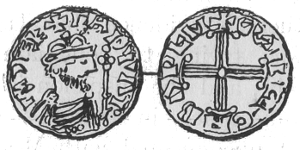
Penny of Edward the Confessor
CHAPTER I THE MINORITY OF DUKE WILLIAM AND ITS RESULTS
63
Among the famous stories which enliven the
history of the early dukes of Normandy
there stands out prominently the tale of the
romantic circumstances which led to the birth
of Duke William II., the greatest of his line. The
substantial truth of the legend has never been
called in question, and we may still read in safety
how Robert, the young count of the Hiesmois,
the Son of Duke Richard I. and the fourth in
descent from Rollo, was riding towards his capital
of Falaise when he saw Arlette, the daughter of
a tanner in the town, washing linen in a stream,
according to one account—dancing, according to
another; how he fell in love at first sight, and
carried her off straightway to his castle; and
how the connection thus begun lasted unbroken
until Robert’s death seven or eight years later.
The whole course of William’s early history
was determined by the fact of his illegitimacy,
and the main points of the story as we have it
must already have been known to the citizens of
Alençon when they cried out “Hides for the
tanner” as the duke came up to their defences in
the famous siege of 1049. In fact, the tale itself
64is thoroughly in keeping with the sexual irregularity
which was common to the whole house
of Rollo, with the single exception of the great
Conqueror himself, and we may admit that there
is a certain dramatic fitness in this unconventional
origin of the man who more than any other of
his time could make very unpromising conditions
the prelude to brilliant results.[31] The exact date
of William’s birth is not certain; it is very probable
that it fell between October and December, 1027,
but in any case it cannot be placed later than
1028, a fact which deserves notice, for even at the
latter date Robert himself cannot possibly have
been older than eighteen and may very well
have been at least a year younger.
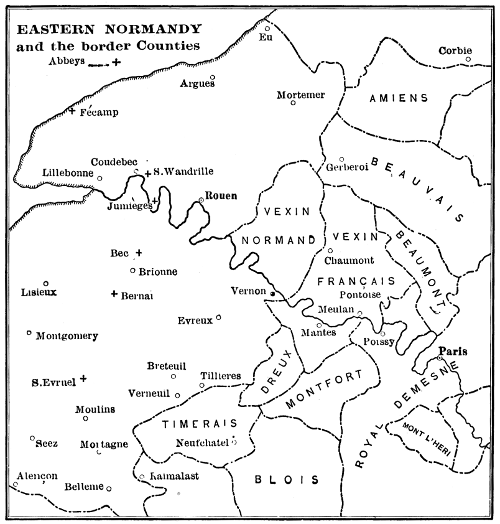
EASTERN NORMANDY
and the border Counties
The reign of Robert I., by some caprice of
historical nomenclature surnamed the Devil,
was a brilliant period of Norman history. Succeeding
to the ducal throne on the sudden, perhaps
suspiciously sudden, death of his brother Richard
III., in 1028, Robert, in the six years of his rule,
won for the duchy an unprecedented influence in
the affairs of the French kingdom. The first
duty of a Norman duke, that of keeping his
greater vassals in order, Robert seems to have
65performed very effectively; we may perhaps measure
the strength of his hand by the outburst of
anarchy which followed the news of his death.
And his intervention in the general feudal politics
of France, interesting enough in itself, gains in
importance when viewed with reference to the
history of his greater son. William the Conqueror
inherited the rudiments of a policy from his
father; throughout much of his reign he was
following lines of action which had been suggested
between 1028 and 1035.
This was so with reference to the greatest
of all his achievements, the conquest of England.
There seems no reason to doubt that Robert
had gone through the form of marriage with
Estrith, the sister of Cnut, and there is a strong
probability that he planned an invasion of England
on behalf of the banished sons of Ethelred.
The marriage of Robert’s aunt, Emma, first to
Ethelred and then to Cnut,[32] began, as we have
seen, that unbroken connection between England
and Normandy which culminated in the Norman
Conquest. Norman enterprise was already in
Robert’s reign extending beyond the borders of
the French kingdom to Spain and Italy; that
it should also extend across the Channel would
not be surprising, for Normandy was connected
with England by commercial as well as dynastic
ties. And William of Jumièges, writing within
fifty years of the event, has given a circumstantial
66account of Robert’s warlike preparations. According
to him the invasion of England was only
prevented by a storm, which threw the duke and
his cousin Edward, who was accompanying him,
on to the coast of Jersey. Robert does not seem
to have repeated the attempt, and before it was
made again England had suffered a more subtle
invasion of Norman ideas under the influence
of Edward the Confessor.
Nor was Norman intervention lacking at the
time beyond the western border of the duchy.
Robert had inherited old claims to suzerainty
over Brittany, and he tried to make them a
reality. For some time past Normandy and
Brittany had been drawing nearer to each other;
Robert was himself a Breton on his mother’s
side, and if one aunt of his was queen of England,
another was the dowager countess of Brittany.
Breton politics were never quite independent of
one or other of the great powers of north France,
Normandy, Anjou, or Blois, each of which could
put forward indeterminate feudal claims over
the peninsula. Anjou, under its restless, aggressive
counts, was here as elsewhere a formidable
rival to Normandy, and in face of its competition
Robert could not allow his claims on
Brittany to lapse. Hence, when Count Alan
repudiated his homage, a Norman invasion
followed, the result of which was a fresh
recognition of Robert’s overlordship, and the
establishment of still closer relations between
67the two states.[33] Alan is found acting as one
of the guardians of William’s minority—in fact he
died, probably from poison, while besieging
the revolted Norman castle of Montgomery in
his ward’s interest—and his successor Conan was
never really friendly towards Normandy. Yet,
notwithstanding his hostility, Norman influence
steadily gained the upper hand in Brittany
during William’s life. It is significant
that he drew more volunteers for his invasion of
England from Brittany than from any other
district not under his immediate rule.
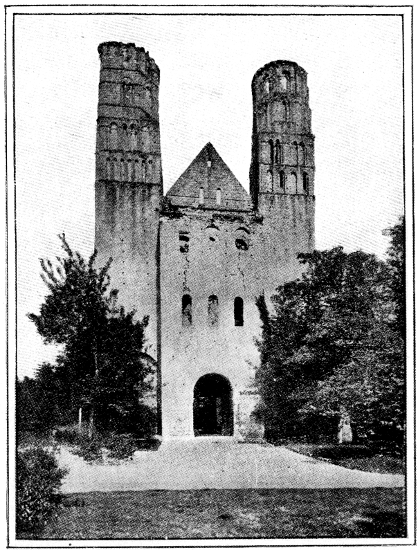
The relations of Robert with the French crown
were still more important. The ancient alliance
between the dukes of Normandy and the Capetian
dynasty which William inherited, and which was
to be his chief safeguard during the first fifteen
years of his reign, had been greatly strengthened
by the action taken by Robert in the internal
affairs of the Isle de France. One of the few
threads of consistent policy which run through
the complicated history of this period is the
persistent mistrust of successive kings of France
towards their formidable neighbours, the counts
of Blois. The possessions of the latter lay astride
the royal demesne in two great blocks, the
county of Blois, which bordered it on the west,
and the county of Troyes or Champagne, which
lay along its eastern frontier. The whole territorial
group far exceeded the royal possessions
68in extent and resources, and its geographical
position gave its lords the strategical advantage
as well. Accordingly, the French kings were
driven to seek countervailing support among
their greater vassals, and at this time they found
it in the duchy of Normandy. A similar alliance
had been formed in the tenth century against
the Carolingians; the traditional friendship was
readily adapted to new conditions.
Its value was clearly proved by the events which
followed the death of King Robert the Pious.
Henry, his eldest surviving son, had been associated
with him in the kingship and designated
as his successor, but Constance the queen dowager
intrigued against the eldest brother in favour
of her younger son Robert. Odo II., the able
and ambitious count of Blois, took the side of
the latter and drove Henry out of the royal
demesne. He fled to Normandy and was well
received by Robert; there exists a charter of the
latter to the abbey of St. Wandrille which Henry
attests as a witness in company with his fellow-exiles,
Edward, afterwards king and confessor,
and Edward’s unlucky brother the Etheling
Alfred.[34] Well supported with Norman auxiliaries
Henry returned and conquered the royal demesne
piecemeal; and, in return for Robert’s help, we are
told that the king ceded to him the Vexin Français,
the district between the Epte and the Oise.[35]
69The internal condition of Normandy at this
period might perhaps compare favourably with
that of any of the greater fiefs of north France.
A succession of able dukes had, for the time being,
reduced the Norman baronage to something like
order. Other countries also at this time offered
a fairer field for the exercise of superfluous activity;
the more unquiet spirits went off to seek their
fortune in Spain or Italy. But in Normandy, as
elsewhere, everything depended on the head of
the state. All the familiar features of feudal anarchy,
from the illicit appropriation of justice and
the right of levying taxes to simple oppression
and private war, were still ready to break out
under a weak ruler. And there existed an additional
complication in the large extent of territory
which was in the hands of members of the ducal
house. The lax matrimonial relations of the
early dukes had added a very dangerous element
to the Norman nobility in the representatives of
illegitimate or semi-legitimate lines of the reigning
family. They are collectively described
by William of Jumièges as the “Ricardenses,”
and he tells us with truth that it was these oblique
kinsmen of William who felt most aggrieved at,
and offered most opposition to, his accession.
They were especially formidable from the practice,
which had been followed by the early dukes, of
assigning counties to younger brothers of the
70intended heir. Duke Robert himself had before
his accession held the county of the Hiesmois. Of
the illegitimate sons of Richard I., Robert, archbishop
of Rouen, the eldest, held in his lay
capacity the county of Evreux; his next brother,
Malger, the county of Mortain; his youngest
brother, William, the county of Eu; while William,
the youngest son of Richard II., possessed the
county of Arques. It is noteworthy that each
of these appanages was, at one period or another
in the life of William, the scene of a real or suspected
revolt against him.
Such was the general condition of the Norman
state when Robert, in the winter of 1034, meditating
a pilgrimage to the Holy Land, held a
council at Fécamp to decide who should be his
successor in case of misadventure, and brought
with him in that capacity his seven-year-old son
William.[36] Notwithstanding the discreet reticence
of the later writers who describe the scene, we
can see that the proposal was intensely distasteful
to the Norman baronage. To any law-abiding
section of the assembly it must have meant
entrusting the welfare of the duchy to the most
doubtful of hazards, and it was a direct insult
to the family pride of the older Norman nobility.
Had there existed at this time any member
of the ducal house who combined legitimacy of
birth with reasonable proximity in the scale of
71succession, Duke Robert would undoubtedly have
had the greatest difficulty in carrying his point.
But among his many kinsmen there was not one
who did not labour under some serious disqualification.
Nicholas, the illegitimate son of Richard
III., would have been a possible claimant, but
Duke Robert had taken the precaution of compelling
him, child as he was, to become a monk,
and he was now safely bestowed in the ducal
monastery of Fécamp.[37] Guy of Brionne, the
son of Robert’s sister, was legitimate indeed, but
was younger than William, and would be counted
a member of a foreign house; Malger and William,
Robert’s two surviving brothers, were both illegitimate,
and the former was a churchman. Members
of the older line, descending from Richard
I., probably stood too far back from the line of
succession to admit of their appearance as serious
competitors, and after all there was a strong
probability that the question would not become
a matter of immediate importance. Pilgrimages
to Jerusalem were not infrequent events at
this time[38] and Robert’s age was considerably
under thirty. He had previously secured the
assent of his overlord King Henry to his proposed
heir, and the end of the deliberations at Fécamp
was the recognition of William by the Normans
as their future duke.
72As it happened, Duke Robert’s pilgrimage
turned out ill; he died on the homeward journey,
at Nicea, on the second of July, 1035, and the
government fell to William, or rather to the
guardians whom his father had provided for him
before his departure. Of these the highest in
rank was Count Alan of Brittany, William’s
cousin,[39] with whom were associated Count Gilbert
of Brionne, the ancestor of the mighty house of
Clare,[40] Osbern the seneschal of Normandy, and
a certain Thorold or Thurcytel de Neufmarché,
the latter having personal charge of the young
duke. It was an ominous circumstance that each
of these men came to a violent end within five
years of William’s accession. The house of
Montgomery alone accounted for two of them:
Osbern the seneschal was cut down in William’s
bedroom by William, son of Roger de Montgomery;
Count Alan met his death, as we have seen, during
the siegesiege of Montgomery Castle itself. The
assassins of Thurcytel de Neufmarché are not
recorded by name, and a certain amount of confusion
hangs over the end of Count Gilbert of
Brionne; but William of Jumièges, a good authority,
states that he fell a victim to murderers
hired by Ralf de Wacy, the son of Archbishop
Robert of Rouen. It is at least certain that
shortly after this last event Ralf de Wacy was
73chosen by William himself, acting, as is said, upon
the advice of his chief men, as his guardian and
the commander of the Norman army.
More important than this list of crimes is the
general question of the relations which existed
at this critical period between William and the
king of France. We have seen that Duke Robert
had secured the king’s consent to his nomination
of William as the heir of Normandy; and we have
good reason for believing that William after his
accession was, in the feudal sense of the phrase,
under the guardianship of his overlord. Weak as
the French monarchy seems to be at this time it
had not, thus early in the eleventh century, finally
become compelled to recognise the heritable character
of its greater fiefs. Its chances of interfering
with credit would vary with each occasion.
If a tenant in chief were to die leaving a legitimate
son of full age, the king in normal cases would
not try to change the order of inheritance; but
a dispute between two heirs, or the succession
of a minor, would give him a fair field for the
exercise of his legal rights. Now William of
Normandy was both illegitimate and a minor and
his inheritance was the greatest fief of north
France; by taking up the office of guardian
towards him the king would at once increase the
prestige of the monarchy, and also strengthen
the ancient friendship which existed between
Paris and Rouen. Nor are we left without direct
evidence on this point. William of Malmesbury,
74in describing the arrangements made at Fécamp,
tells us that Count Gilbert of Brionne, the only
one of William’s guardians whom he mentions
by name, was placed under the surveillance of
king Henry[41]; and Henry of Huntingdon incidentally
remarks that in 1035 William was residing
with the king of France and that the revenues
of Normandy were temporarily annexed to the
royal exchequer. In view of the statements of
these independent writers, combined with the
antecedent probability of the case, we may consider
it probable that William, on his father’s
death, became the feudal ward of his suzerain,[42]
and that very shortly after his own accession he
spent some time in attendance at the royal court.
It must be confessed that we know very little
as to the events of the next ten years of William’s
life. They were critical years, for in them William
was growing up towards manhood and receiving
the while a severe initiation into the art of government.
The political conditions of the eleventh
century did not make for quiet minorities; they
left too much to the strength and discretion of
the individual ruler. Private war, for instance,
might be a tolerable evil when duly regulated and
sanctioned by a strong duke; under the rule of a
child the custom merely supplied a formal excuse
75for the prevailing anarchy. Later writers give
various incidental illustrations of the state of
Normandy at this period. We read, for instance,
how Roger de Toeny, a man of most noble lineage,
on returning to Normandy from a crusade against
the Moors in Spain, started ravaging the land of
his neighbours in sheer disgust at the accession
of a bastard to the duchy, and was killed in the
war which he had provoked.[43] But such stories
only concern the history of William the Conqueror
in so far as they indicate the nature of the evils
the suppression of which was to be his first employment
in the coming years. To turn the
fighting energy inherent in feudal life from its
thousand unauthorised channels, and to direct it
towards a single aim controlled and determined
by himself, was to be the work which led to his
greatest achievements. In the incessant tumults
of the first ten years of his reign we see the aimless
stirring of that national force which it is William’s
truest glory to have mastered and directed to his
own ends.
We get one glimpse of William at this time
in a charter[44] which must have been granted before
1037, as it is signed by Archbishop Robert of
Rouen, who died in that year. The document is of
interest as it shows us the young duke surrounded
by his court, perhaps at one of the great church
76festivals of the year. Among the witnesses
we find Counts Waleran of Meulan, Enguerrand
of Ponthieu, and Gilbert of Brionne; the archbishop
of Dol, as well as his brother metropolitan
of Rouen; Osbern the seneschal, and four abbots,
including the head of the house of Fécamp, in
whose favour the charter in question was granted.
The presence of the count of Ponthieu and the
archbishop of Dol is important as showing that
even at this stormy time the connection between
Normandy and its neighbours to east and west
had not been wholly severed; and it is interesting
to see two of William’sWilliam’s unlucky guardians actually,
in attendance on their lord. It may also be noted
that at least one other charter[45] has survived,
probably a little later in date, but granted at
any rate in or before 1042, in which among a
number of rather obscure names we find the
signature of “Haduiardus Rex,” which strange
designation undoubtedly describes Edward of
England, then nearing the end of his long exile
at the court of Normandy.
To this difficult period of William’s reign must
apparently be assigned a somewhat mysterious
episode which is recorded by William of Jumièges
alone among our authorities. One of the strongest
border fortresses of Normandy was the castle of
Tillières, which commanded the valley of the
Arve and was a standing menace to the county
of Dreux. The latter was at this time in the
77hands of the crown, but in the tenth century it
had been granted to Richard the Fearless, duke
of Normandy. He had ceded it to Count Odo
of Blois as the marriage portion of his daughter
Mahaut, but on her speedy death without issue
Odo had refused to return it to his father-in-law;
and in the border warfare which followed, the
duke founded the castle of Tillières as a check
upon his acquisitive neighbour.[46] On Odo’s death
in 1018 the county of Dreux passed to his overlord
the king of France, but Tillières continued to
threaten this latest addition to the royal demesne.
We know very little as to what went on in the
valley of the Arve during the twenty years that
followed Odo’s death, but by the beginning of
William’s reign it seems certain that the Norman
claims on Dreux itself had been allowed to lapse,
and the present dispute centres round Tillières
alone. At some unspecified period in William’s
minority we find King Henry declaring that, if
William wished to retain his friendship, Tillières
must be dismantled or surrendered. The young
duke himself and some of his barons thought the
continued support of the king of France more
valuable than a border fortress and were willing
to surrender the castle; but its commander, one
Gilbert Crispin, continued to hold out against
the king. Tillières was thereupon besieged by a
mixed force of Frenchmen and Normans, and
William, possibly appearing in person, ordered
78Gilbert Crispin to capitulate. He obeyed with
reluctance and the castle was at once burned
down, the king swearing not to rebuild it within
four years, but within the stipulated period it
seems that the treaty was broken on the French
side. The king at first retired, but not long afterwards
he recrossed the border, passed across the
Hiesmois, burned Argentan, and then returning
rebuilt the castle of Tillières in defiance of his
oath, while at the same time it would appear that
the viscount of the Hiesmois, one Thurstan
surnamed “Goz,” was in revolt against William
and had garrisoned Falaise itself with French
troops. Falaise was at once invested, William
again appearing on the scene to support Ralf de
Wacy, the commander of his army, and it seemed
probable that the castle would be taken by
storm; but Thurstan Goz was allowed to come
to terms with the duke and was banished from
Normandy, his son Richard continuing in William’s
service as viscount of Avranches. The family
is of great interest in English history, for Hugh
the son of the latter Richard was to become the
first earl “palatine” of Chester. And so it may
be well to note in passing that the rebel Thurstan
is described by William of Jumièges as the son
of Ansfrid “The Dane,” a designation which is of
interest both as proving the Scandinavian origin
of the great house of which he was the progenitor,
and also as suggesting that a connection, of
which we have few certain traces, may have been
79maintained between Normandy and its parent
lands for upwards of a century after the treaty
of Claire-sur-Epte.
The above is the simplest account that we
can give of these transactions, which are not very
important in themselves, but have been considered
to mark the rupture of the old friendship
between the Capetian dynasty and the house of
Rollo.[47] But the whole subject is obscure. The
king’s action, in particular, is not readily explicable
on any theory, for there is good reason to
believe that at this time he was actually William’s
feudal guardian and certainly a few years later
he appears as fully discharging the duties of that
office on the field of Val-es-dunes; so that it is
not easy to see why on the present occasion he
should inflict gratuitousgratuitous injury on his ward by
sacking his towns and burning his castles. The
affair of Tillières would be quite intelligible if it
stood by itself: it was only natural that the king
should take advantage of his position to secure
the destruction or surrender of a fortress which
threatened his own frontier, and the fact that
William himself appears as ordering the surrender
would alone suggest that he was acting
under the influence of his overlord. But the
raid on Argentan is a more difficult matter. We
do not know, for instance, whether there was any
connection between the revolt of Thurstan Goz
80and the king’s invasion of the Hiesmois; the mere
fact that the rebel commander of Falaise took
French knights into his pay, by no means proves
that he was acting in concert with the French
king. The story as we have it suggests that there
may have been two parties in Normandy at this
time, one disposed to render obedience to the king
of France as overlord, the other maintaining the
independence of the Norman baronage; a state
of affairs which might readily lead to the armed
intervention of the king of France, half in his own
interest, half in that of his ward. But considering
the fact that we owe our knowledge of these
events to one chronicler only, and that he wrote
when the rivalry between Normandy and France
had become permanent and keen, we may not
improbably suspect that he antedated the beginning
of strife between these two great powers,
and read the events of William’s minority in the
light of his later history.
The revolt of western Normandy which took
place in the year 1047 marks the close of this
obscure and difficult period in William’s life; it
is in the crisis of this year that something of the
personality of the future Conqueror is revealed
to us for the first time. With the battle of Val-es-dunes
William attained his true majority and
became at last the conscious master of his duchy,
soon to win the leading place among the greater
vassals of the French crown. For ten years
more, indeed, he was to be confronted, at first by
81members of his own family, whose ill-will became
at times something more than passive disaffection,
and afterwards by his overlord made jealous by
his increasing power, but the final issue was
never again in serious doubt after his barons had
once tried conclusions with him in pitched battle
and had lost the game.
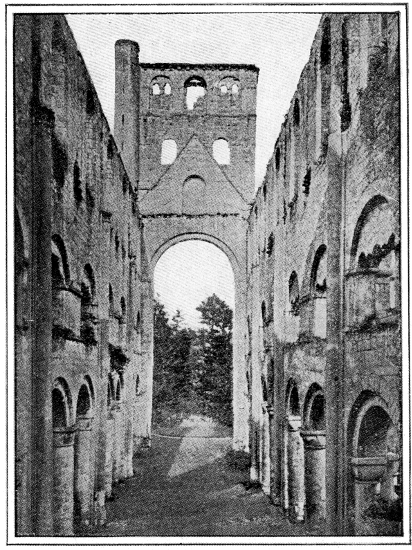
For all this, the revolt of 1047 came near putting
a summary close to William’s career and life.
Normandy at this time was far from being a
homogeneous state; apart from the general
tendency of feudalism towards the isolation of
individual barons, the greater divisions of the
duchy had as yet little real cohesion; and a line
of cleavage which is all-important in this revolt
is marked by the river Dive, which separates
Rouen and its territory, where the ducal power
might be expected to be at its strongest, from
the lands of the Bessin and Cotentin, which were
always predisposed to local independence. These
districts, as we have seen, formed no part of the
territory ceded to Rollo by the treaty of Claire-sur-Epte,
and it is quite possible that the course
of events in the present year may have been
affected by the distinction between the Gallicised
Northmen of the Rouennais and Evrècin and the
more primitive folk of the lands west of Dive.
At any rate it was from the latter quarter that
the main strength of the rising was drawn. The
BessinBessin and Cotentin revolted under their respective
viscounts, Randolf de Brichessart and
82Neel de Saint Sauveur, the latter being the most
prominent leader in the whole affair; and with
them were associated one Hamo, nicknamed
“Dentatus,” the lord of Thorigny and Creuilly,
and Grimbald the seigneur of Plessis. The nominal
head of the revolt was William’s cousin Guy,
son of Reginald, count of the Burgundian Palatinate
by Adeliz, daughter of Duke Richard II. of
Normandy, a young man, who up to this time
had been the constant companion of William,
and had received from him Brionne and Vernon,
two of the most important castles of eastern
Normandy. Guy was one of the few legitimate
members of the ducal family, and he and his
confederates found a justification for their rising
in the stain which rested upon William’s birth.
We are told that their ultimate object was to
divide the duchy among themselves, and we may
suppose that Guy would have taken Rouen and
the surrounding country with the title of duke,
leaving the western lords in practical independence.
The latter took an oath to support his claims
and to depose William, and they put their castles
into a state of defence.
When the revolt broke out William was in
the heart of the enemies’ country at Valognes,
a town which seems to have been his favourite
hunting seat in the west of Normandy. The
opportunity was too good to be missed, and a
plot was laid for his capture which came within
an ace of success, and according to later tradition
83was only discovered, on the point of its execution,
by Gallet, William’s fool. The duke had gone to
bed when Gallet burst into his room and called
on him to escape for his life. Clad in such garments
as came to hand William sprang on horseback,
and rode away through the dead of night
eastwards towards his native and loyal town of
Falaise. He took the coast road, crossing the
estuary of the Vire at low water, and by day-break
he had covered the forty miles which
separate Valognes from Rye. It so chanced that
Hubert the lord of Rye was standing between
his castle mound and the neighbouring church
as the duke came riding by, and recognising his
lord he asked the reason of his haste. Upon
learning of his danger Hubert called three of his
sons and bade them escort the duke to Falaise;
but even in the capital of his native province
William made no delay, and hastened across the
borders of his duchy to ask help of his overlord
and guardian, King Henry of France.[48] The king
and the duke met at Poissy, and a French army
prepared to enter Normandy under the leadership
of the king in person, while on his part William
summoned the men of Rouen, Auge, Lisieux,
Evreux, and the Hiesmois, men, that is, from
all Normandy east of the Dive and from
the territory belonging to Falaise, west of that
84river. The Normans assembled in the latter
district and concentrated on the Meance near
Argences; the French army drew together on the
Laison between Argences and Mezidon. King
Henry heard mass and arranged his troops at
Valmeray, then crossed the Olne on to the plain
of Val-es-dunes and drew up his men on the bank
of the river. In that position he was joined by
William, who had crossed at the ford of Berangier,
and the combined force prepared for battle, the
Frenchmen forming the left wing and the Normans
the right.[49]
In the meantime the revolt had spread apace.
The rebels had seized the duke’s demesne and, it
would seem, were prepared to invade the loyal
country across the Dive, for they had reached
Val-es-dunes before the king and the duke had
arrived there. Like their opponents, they
drew up their army in two divisions, the men of
the Cotentin forming the right wing and those of
the Bessin the left. The battle seems to have
begun by a charge of the Cotentin men on the
French, but of the struggle which followed we
have only a confused and indefinite account; it
appears to have been a simple cavalry encounter,
calling for no special tactical skill in the leaders
of either side. Even in most of the Norman
accounts of the battle William plays a part distinctly
secondary to that of his overlord, although
the latter had the ill luck to be unhorsed twice
85during the day, once by a knight of the Cotentin
and once by the rebel leader Hamo “Dentatus.”
Before long the fight was going decisively in
favour of the loyal party. The rebel leaders
seem to have mistrusted each other’s good faith.
In particular Ralf of Brichessart began to fear
treachery; he suspected that Neel de Saint Sauveur
might have left the field, while one of his own
most distinguished vassals had been cut down
before his eyes, by the duke’s own hand as later
Norman tradition said. Accordingly, long before
the fight was over he left the field, but the western
men were still held together by Neel, who made
a determined stand on the high ground by the
church of St. Lawrence. At last he too gave way,
the flight became general, and it was at this point
that the rebel force suffered its heaviest losses, for
the broken army tried to make its way into the
friendly land of the Bessin, and the river Olne
lay immediately to the west of the plateau of
Val-es-dunes. Large numbers of the rebels perished
in the river and the rest escaped between
Alegmagne and Farlenay, while Guy himself, who
had been wounded in the battle, fled eastward
to his castle of Brionne.
The reduction of this fortress must have been
for William the most formidable part of the whole
campaign. Even in the middle of the eleventh
century the art of fortification was much more
fully developed than the art of attack, and at
Brionne the site of the castle materially aided
86the work of defence. The castle itself stood
on an island in the river Risle, which at that point
was unfordable, and it was distinguished from
the wooden fortifications common at the time
by the fact that it contained a stone “hall,”
which was evidently considered the crowning
feature of its defences.[50] Immediately, it would
seem, after the battle of Val-es-dunes King Henry
retired to France, while William hastened to the
siege of Brionne. A direct attack on the castle
being impossible, William built counterworks on
either bank of the Risle and set to work to starve
the garrison into surrender. By all accounts
the process took a long time,[51] but at last the
failure of supplies drove Guy to send and ask for
terms with William. These were sufficiently
lenient; Guy was required to surrender Brionne
and Vernon, but was allowed to live at William’s
court if he pleased. No very drastic measures
were taken with regard to the rebels of lower
rank, but William, realising with true instinct
where his real danger had lain, dismantled the
castles which had been fortified against him; and
with the disappearance of the castles the fear[52] of
87civil war vanished from Normandy for a while.
The capital punishment of rebellious vassals was
not in accordance with the feudal custom of the
time.[53] The legal doctrine of sovereignty, which
made the levying of war against the head of the
state the most heinous of all crimes, was the
creation of the revived study of Roman law in
the next century; and a mere revolt, if unaggravated
by any special act of treason, could still
be atoned for by the imprisonment of the leaders
and the confiscation of their lands. To this
we must add that William as yet was no king,
the head of no feudal hierarchy; the distance that
separated him from a viscount of Coutances was
far less than the distance that came to separate
a duke of Somerset from Edward IV. The one
man who was treated with severity on the present
occasion was Grimbald of Plessis, on whom was
laid the especial guilt of the attempt on William’s
life at Valognes. He was sent into perpetual
imprisonment at Rouen, where he shortly died,
directing that he should be buried in his fetters
as a traitor to his lord.[54] Guy of Burgundy seems
to have become completely discredited by his
88conduct in the war, life in Normandy became unbearable
to him, and of his own free will he retired
to Burgundy, and vanishes from Norman history.
The war was over, and William’s future in
Normandy was secured, but the revolt had indirect
results which extended far beyond the
immediate sequence of events. It was William’s
duty and interest to return the service which
King Henry had just done to him, and it was
this which first brought him into hostile relations
with the rising power on the lower Loire, the
county of Anjou. The history of Anjou is in
great part the record of a continuous process of
territorial expansion, which, even by the beginning
of the eleventh century had raised the
petty lordship of Angers to the position of a
feudal power of the first rank. Angers itself,
situated as it was in the centre of the original
Anjou, was an excellent capital for a line of
aggressive feudal princes, who were enabled to
strike at will at Brittany, Maine, Touraine, or
Saintonge, and made the most of their strategical
advantage. With Normandy the counts of Anjou
had not as yet come into conflict; the county of
Maine had up to the present separated the two
states, and the collision might have been indefinitely
postponed had not the events of 1047
compelled William of Normandy to bear his part
in a quarrel which shortly afterwards broke out
between the king of France and Count Geoffrey
II. of Anjou.
89The first five years of William’s minority had
coincided, in the history of Anjou, with the close
of the long reign of Count Fulk Nerra, who for
more than fifty years had been extending the
borders of his county with unceasing energy and
an entire absence of moral scruple, and has justly
been described as the founder of the Angevin
state. His son and successor Geoffrey, commonly
known in history, as to his contemporaries, under
the significant nickname of Martel, continued
his father’s work of territorial aggrandisement.
He had three distinct objects in view: to round
off his hereditary possessions by getting possession
of Touraine, and to extend his territory to the
north and south of the Loire at the expense of
the counts of Maine and Poitou respectively.
His methods, as described by Norman historians,
were elementary; his favourite plan was to
seize the person of his enemy and allow him to
ransom himself by the cession of the desired
territory. This simple device proved effective
with the counts of Poitou and Blois; from the
former, even before the death of Fulk Nerra,
Geoffrey had extorted the cession of Saintonge,
and from the latter, after a great victory at
Montlouis in 1044, he gained full possession of the
county of Touraine. The conquest of Touraine
was undertaken with the full consent of the king
of France; the counts of Blois, as we have seen,
were ill neighbours to the royal demesne, and
King Henry and his successors were always
90ready to ally themselves with any power capable
of making a diversion in their favour. On the
other hand their policy was not, and could not be,
consistent in this respect; the rudimentary balance
of power, which was all that they could hope to
attain at this time, was always liable to be overthrown
by the very means which they took to
preserve it; a count of Anjou in possession of
Saintonge and Touraine could be a more dangerous
rival to the monarchy than the weakened
count of Blois. Accordingly, less than four years
after the battle of Montlouis, we find King Henry
in arms against Geoffrey Martel, and William
of Normandy attracted by gratitude and feudal
duty into the conflict.[55]
When William, archdeacon of Lisieux, the Conqueror’s
first biographer, was living, an exile
as he styles himself, in Poitou shortly after this
time, the prowess of the young duke in this
campaign was a matter of current conversation.[56]
The Frenchmen, we are told, were brought to
realise unwillingly that the army led by William
from Normandy was greater by far than the
whole force supplied by all the other potentates
who took part in the war. We are also told that
King Henry had the greatest regard for his protégé,
took his advice on all military matters, and
remonstrated with him affectionately on his too
91great daring in the field. William seems in his
early days to have possessed a full share of that
delight in battle which is perhaps the main
motive underlying the later romances of chivalry,
and his reputation rose rapidly and extended far.
Geoffrey Martel himself said that there could
nowhere be found so good a knight as the
duke of Normandy. The princes of Gascony and
Auvergne and even the kings of Spain sent him
presents of horses and tried to win his favour.[57]
Also it must have been about this time that
William made overtures to Baldwin, count of
Flanders, for the hand of his daughter, while in
1051 we know that he made a journey, fraught
with memorable consequences, to the court of
Edward the Confessor. In fact, with the subjugation
of his barons and his first Angevin
war William sprang at a bound into fame; the
political stage of France lacked an actor of
the first order, and William in the flush of his
early manhood was an effective contrast to
the subtle and dangerous count of Anjou.
At some undetermined point in the war an
opportunity presented itself for Geoffrey Martel
to gain a foothold in Norman territory. On the
border between Normandy and Maine stand the
towns of Domfront and Alençon, each commanding
a river valley and a corresponding passage
from the south into Normandy. Domfront formed
part of the great border fief of Bellême, and at
92this time it was included in the county of Maine,
over which, as we shall see later, Geoffrey Martel
was exercising rights of suzerainty. Alençon
was wholly Norman, but its inhabitants found
William’s strict justice unbearable, and being
thus predisposed for revolt they admitted a
strong Angevin garrison sent by Geoffrey Martel.
William decided to retaliate by capturing Domfront,
leaving Alençon to be retaken afterwards.[58]
The plan was reasonable, but it nearly led to
William’s destruction, for a traitor in the Norman
army gave information as to his movements to
the men of Domfront, and it was only through
his personal prowess that William escaped an
ambush skilfully laid to intercept him as he was
reconnoitring near the city. The siege which
followed was no light matter. It was winter,
Geoffrey had thrown a body of picked men into
the castle, and, unlike Brionne, Domfront was
a hill fortress, accessible at the time only by
two steep and narrow paths. It would thus be
difficult to carry the place by sudden assault;
so William, as formerly at Brionne and later at
Arques, established counterworks and waited
for the result of a blockade, harassing the garrison
meanwhile by incessant attacks on their walls.
The counterworks, we are told, consisted of four
“castles,” presumably arranged so as to cover
the base of the hill on which Domfront stands,
and William contented himself for the present
93with securing his own supplies and preventing
any message being carried from the garrison to
the count of Anjou, in the meantime making use
of the opportunities for sport which the neighbouring
country offered. At last the men of
Domfort contrived to get a messenger through
the Norman lines and Geoffrey advanced to
the relief of his allies with a large army. What
followed may be told in the words of William
of Poitiers:
“When William knew this he hastened against
him [Geoffrey], entrusting the maintenance of the
siege to approved knights, and sent forward as scouts
Roger de Montgomery and William fitz Osbern, both
young men and eager, who learned the insolent
intention of the enemy from his own words. For
Geoffrey made known by them that he would beat
up William’s guards before Domfront at dawn the
next day, and signified also what manner of horse he
would ride in the battle and what should be the
fashion of his shield and clothing. But they replied
that he need trouble himself no further with the
journey which he designed, for he whom he sought
would come to him with speed, and then in their turn
they described the horse of their lord, his clothing
and arms. These tidings increased not a little the
zeal of the Normans, but the duke himself, the most
eager of all, incited them yet further. Perchance
this excellent youth wished to destroy a tyrant, for
the senate of Rome and Athens held such an act to
be the fairest of all noble deeds. But Geoffrey,
smitten with sudden terror, before he had so much as
94seen the opposing host sought safety in flight with
his whole army, and lo! the path lay open whereby
the Norman duke might spoil the wealth of his
enemy and blot out his rival’s name with everlasting
ignominy.”[59]
It is painful to pass from this rhapsody to what
is perhaps the grimmest scene in William’s life.
The retreat of Geoffrey, to whatever cause it is
to be assigned, exposed Alençon to William’s
vengeance. Leaving a sufficient force before
Domfront to maintain the siege, in a single night’s
march he crossed the water-parting of the Varenne
and the Sarthe, and approached Alençon as dawn
was breaking. Facing him was the fortified bridge
over the Sarthe, behind it lay the town, and above
the town stood the castle, all fully defended.
On the bridge certain of the citizens had hung
out skins, and as William drew near they beat
them, shouting “Hides for the tanner.”[60] With
a mighty oath the young duke swore that he would
prune those men as it were with a pollarding
knife, and within a few hours he had executed his
threat. The bridge was stormed and the town
taken, William unroofing the houses which lay
outside the wall and using the timber as fuel to
burn the gates, but the castle still held out.
Thirty-two of the citizens were then brought before
the duke; their hands and feet were struck off
and flung straightway over the wall of the castle
95among its defenders.[61] With the hasty submission
of the castle which followed William was free to
give his whole attention to the reduction of Domfront,
and on his return he found the garrison
already demoralised by the news of what had happened
at Alençon, and by the ineffective departure
of Geoffrey Martel. They made an honourable
surrender and Domfront became a Norman possession,[62]
the first point gained in the struggle
which was not to end until a count of Anjou
united the thrones of Normandy, Maine, and
England.
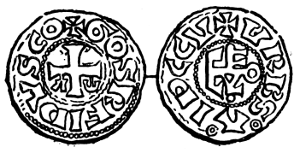
Denier of Geoffrey Martel
CHAPTER II REBELLION AND INVASION
96
Between the first Angevin war and the outbreak
of overt hostilities between Normandy
and France, there occurs a period of five or
six years the historical interest of which lies
almost entirely in the internal affairs of the Norman
state. It was by no means an unimportant
time; it included one external event of great importance,
William’s visit to England in 1051, but
its real significance lay in the gradual consolidation
of his power in Normandy and its results. On
the one hand it was in these years that William
finally suppressed the irreconcilable members of
his own family; on the other hand the gradual
dissolution of the traditional alliance between
Normandy and the Capetian house runs parallel
to this process and is essentially caused by it.
From the very time when William attained his
majority these two powers begin steadily to drift
apart; the breach widens as William’s power increases,
and the support given by the king of
France in these years to Norman rebels such as
William Busac and William of Arques is naturally
followed by his invasions of Normandy in 1054
and 1058. As compensation for this William’s
97marriage with Matilda of Flanders falls within
the same period, and events ruled that the alliance
thus formed was to neutralise the enmity of
the Capetian house at the critical moment of the
invasion of England. There is indeed a sense
in which we may say that it was William’s success
in these six years which made the invasion
of England possible; whether consciously or not,
William was making indispensable preparation
for his supreme endeavour when he was taking
the castles of his unquiet kinsmen and banishing
them from Normandy.
The first of them to go was William surnamed
“the Warling,” count of Mortain and grandson of
Duke Richard the Fearless. His fall was sudden
and dramatic. As we have only one narrative of
these events it may be given here at length:
“At that time William named the Warling, of
Richard the Great’s line, was count of Mortain. One
day a certain knight of his household, called Robert
Bigot, came to him and said, ‘My Lord, I am very
poor and in this country I cannot obtain relief; I will
therefore go to Auplia, where I may live more honourably.’
‘Who,’ said William, ‘has advised you thus?’
‘The poverty which I suffer,’ replied Robert. Then
said William, ‘Within eight days, in Normandy itself,
you shall be able in safety to seize with your own
hands whatever you may require.’ Robert therefore,
submitting to his lord’s counsel, bided his time,
and shortly afterwards, through Richard of Avranches
his kinsman, gained the acquaintance of the duke.
One day they were talking in private when Robert
98among other matters repeated the above speech of
Count William. The duke thereupon summoned the
count and asked him what he meant by talk of this
kind, but he could not deny the matter, nor did he
dare to tell his real meaning. Then said the duke in
his wrath: ‘You have planned to confound Normandy
with seditious war, and wickedly have you plotted
to rebel against me and disinherit me, therefore it is
that you have promised booty to your needy knight.
But, God granting it, the unbroken peace which we
desire shall remain to us. Do you therefore depart
from Normandy, nor ever return hither so long as I
live.’ William thus exiled sought Apulia wretchedly,
accompanied by only one squire, and the duke at once
promoted Robert his brother and gave him the county
of Mortain. Thus harshly did he abuse the haughty
kindred of his father and honourably exalt the humble
kindred of his mother.”[63]
The moral of the story lies in its last sentence.
The haughty kindred of the duke’s father were
beginning to show themselves dangerous, and
William threw down the challenge to them once
for all when he disinherited the grandson of
Richard the Great in favour of the grandson
of the tanner of Falaise. But, apart from the
personal questions involved, the tale is eminently
illustrative of William’s conception of his duty
as a ruler. By policy as well as prepossession
he was driven to be the stern maintainer of order;
the men who would stir up civil war in Normandy
99wished also to disinherit its duke, and from this
followed naturally that community of interest
between the ruler and his meaner subjects as
against the greater baronage which was typical
of the early Middle Ages in Normandy and England
alike. It is inadvisable to scrutinise too
narrowly the means taken by William to secure
his position; if on the present occasion he exiled
his cousin on the mere information of a single
knight, he had already been taught the wisdom
of striking at the root of a rebellion before it had
time to grow to a head. We must not expect
too much forbearance from the head of a feudal
state in his dealings with a suspected noble when
the banishment of the latter would place a dangerous
fief at the former’s disposal. Lastly, we
may notice the way in which Apulia is evidently
regarded as a land of promise at this time by all
who seek better fortune than Normandy can give
them. In the eleventh century, as in the fifteenth,
Italy was exercising its perennial attraction for
the men of the ruder north, and under the leadership
of the sons of Tancred of Hauteville a
new Normandy was rising on the wreck of the
Byzantine Empire in the West by the shores of
the Ionian Sea.
Probably about this time, and possibly not
without some connection with the disaffection of
William the Warling, there occurred another
abortive revolt, of which the scene was laid, as
usual, in one of the semi-independent counties
100held by members of the ducal house. In the
north-east corner of Normandy the town of Eu
with its surrounding territory had been given by
Duke Richard II. to his illegitimate brother
William. The latter had three sons, of whom
Robert, the eldest, succeeded him in the county,
Hugh, the youngest, subsequently becoming bishop
of Lisieux. The remaining brother, William, surnamed
Busac, is a mysterious person whose
appearance in history is almost confined to the
single narrative which we possess of his revolt.
The latter is not free from difficulty; William was
not his father’s eldest son, and yet at the period in
question he appears in possession of the castle
of Eu, and, which is much more remarkable, he is
represented as laying claim to the duchy of Normandy
itself. At present this is inexplicable,
but it is certain that the duke besieged and took
Eu and drove William Busac into exile. The place
of refuge which he chose is very suggestive. He
went to France and attached himself to King
Henry, who married him to the heiress of the
county of Soissons, where his descendants were
ruling at the close of the century.[64] It is plain that
the king’s opportunist policy has definitely turned
against William of Normandy, when we find a
Norman rebel received with open arms and given
an important territorial position on the border of
the royal demesne.[65]
101The third and last of this series of revolts can
be definitely assigned to the year 1053. It arose
like the revolt of William Busac in the land east of
Seine, and its leader was again one of the “Ricardenses,”
a member of a collateral branch of the
ducal house. William count of Arques was an
illegitimate son of Duke Richard II., and therefore
brother by the half blood to Duke Robert I., and
uncle to William of Normandy. With the object
of conciliating an important member of his family
the latter had enfeoffed his uncle in the county of
Arques, the district between Eu and the Pays de
Caux. Before long, however, relations between
the duke and the count became strained; William
of Arques was said to have failed in his feudal
duty at the siege of Domfront, and when a little
later he proceeded to fortify the capital of his
county with a castle, it was known that his designs
were not consonant with loyalty towards the
interests of his lord and nephew. In the hope of
anticipating further trouble the duke insisted
on his legal right of garrisoning the castle with
his own troops, but the precaution proved to be
quite futile, for the count soon won over the garrison,
defied his nephew, and spread destruction over
as wide an area as he could reach from his base of
operations. At this time, as at the similar crisis
of 1047, William seems to have been at Valognes;
he was certainly somewhere in the Cotentin
102when the news of what was happening at Arques
was brought to him.[66] Without a moment’s delay
he rode off towards the scene of the revolt, crossing
the Dive estuary at the ford of St. Clement and
so past Bayeux, Caen, and Pont Audemer to the
Seine at Caudebec, and then to Baons-le-Comte
and Arques, his companions dropping off one by
one in the course of his headlong ride until only
six were left. Near to Arques, however, he fell
in with a party of three hundred horsemen from
Rouen, who had set out with the object of preventing
the men of Arques from carrying supplies
into the castle. William had not yet outgrown
the impetuosity which called forth King Henry’s
admonitions in the campaign of 1048: he
insisted on delivering an instant attack, believing
that the rebels would shrink from meeting him
in person, and dashed on to the castle regardless
of the remonstrances of the Rouen men, who counselled
discretion. Charging up the castle mound
he drove the count and his men within the fortress
as he had anticipated, and we are given to understand
that but for their hastily shutting the gates
against him the revolt would have been ended
then and there.
The surprise assault having failed, nothing was
left but a blockade, and accordingly William
established a counterwork at the base of the castle
and entrusted it to Walter Giffard, lord of the
neighbouring estate of Longueville, while he himself
103went off, “being called by other business,” as
his panegyrist tells us. As a matter of fact it is
probable that he withdrew from a sense of feudal
propriety,[67] for no less a person than King Henry
of France was advancing to the relief of the garrison.
On all grounds it was desirable for William
to refrain from setting a bad example to his barons
by actually appearing in arms against his own
overlord, and so the operations against the king
were left to the direction of others. At the outset
they were fortunate. There were still a few
barons in the county of Arques who had not joined
the rebels, and one of them, Richard of Hugleville,
possessed a castle, a few miles from Arques itself,
at St. Aubin, which lay on the line of march of
the French king. Possibly it was this fact which
suggested to the besiegers the idea of intercepting
the king before he reached Arques; at any rate,
they formed a plan of the kind, which proved
successful and curiously anticipates one of the
most famous episodes in the greater battle of
Hastings. The king, who had been marching
carelessly with a convoy of provisions intended
for the garrison within Arques, halted near to
St. Aubin. In the meantime the Normans before
Arques had sent out a detachment which
they divided into two parts, the greater part
secreting itself not far from St. Aubin, while the
rest made a feint attack on the royal army. After
a short conflict the latter division turned in
104pretended flight, drew out a number of the king’s
army in pursuit, and enticed them past the place
where the trap was laid, whereupon the hidden
Normans sallied out, fell on the Frenchmen, and
annihilated them, slaying Enguerrand, count of
Ponthieu, and many other men of note. Notwithstanding
this check, the king hurried on to
Arques, and succeeded in throwing provisions into
the castle, and then, eager to avenge the disaster
at St. Aubin, he made a savage attack on the
counterwork at the foot of the hill. But its
defences were strong and its defenders resolute:
so the king, to avoid further loss, beat a hasty
retreat to St. Denis, and with his withdrawal Duke
William reappeared upon the scene.[68] Then the
blockade was resumed in earnest, and we are told
that its severity convinced the count of Arques of
his folly in claiming the duchy against his lord.
Repeated messages to King Henry begging for
relief found him unwilling to risk any further loss
of prestige, and at last hunger did its work. The
garrison surrendered, asking that life and limb
might be guaranteed to them, but making no
further stipulation, and William of Poitiers gleefully
describes the ignominious manner of their
exit from the castle.[69] Here, as after Val-es-dunes,
it was not the duke’s policy, if it lay in his
power, to proceed to extremities against the
beaten rebels, and William was notably lenient
105to his uncle, who was deprived of his county and
his too-powerful castle, but was granted at the
same time a large estate in Normandy. However,
like Guy of Burgundy, he declined to live in the
country over which he had hoped to rule and he
went into voluntary exile at the court of Eustace
of Boulogne.
One outlying portion of the duchy remained in
revolt after the fall of Arques. On the south-western
border of Normandy the fortress of Moulins
had been betrayed to the king by Wimund,
its commander, and had received a royal garrison
under Guy-Geoffrey, brother of the duke of Aquitaine.
The importance of this event lay in the
fact that Moulins in unfriendly hands threatened
to cut off communications between the Hiesmois
and the half-independent county of Bellême.
Fortunately for the integrity of the duchy, the
fate of Moulins was determined by the surrender
of Arques; the garrison gave up their cause as
hopeless, and retired without attempting to stand
a siege.[70]
At some indefinite point in the short interval
of peace which followed the revolt of William of
Arques, William of Normandy was married to
Matilda, daughter of Baldwin count of Flanders,
in the minster at Eu. On William’s part the
consummation of the marriage was an act of
simple lawlessness noteworthy in so faithful
a son of Holy Church, for in 1049 the General
106Council of Rheims had solemnly forbidden Count
Baldwin to give his daughter to William of Normandy,
and had simultaneously inhibited William
from receiving her.[71] A mystery which has not
been wholly solved hangs over the motives
which underlay this prohibition; for genealogical
research has hitherto failed to discover any tie
of affinity which might furnish an impediment,
reasonable or otherwise, to the proposed marriage,
while at the middle of the eleventh century the
provisions of the canon law on the subject of
the prohibited degrees were much less rigid and
fantastic than they subsequently became. Yet
the decree is duly entered among the canons of
the Council of Rheims, and it served to keep
William and his chosen bride apart for four years.
Early in 1053, however, Pope Leo IX. had been
taken prisoner by the Normans in Italy at the
battle of Aversa, and the coincidence of his captivity
with William’s defiance of the papal censure
has not escaped the notice of historians.[72]
By all churchmen of the stricter sort a marriage
celebrated under such conditions was certain to
be regarded as a scandal. Normandy was laid
under an interdict, and in the duchy itself the
opposition was headed by two men of very
different character. Malger, the archbishop of
Rouen at the time, was a brother of the fallen
count of Arques, and the excommunication which
107he pronounced against his erring nephews was
probably occasioned as much by the political
grievances of his family as by righteous indignation
at the despite done to the Council of Rheims.
William speedily came to an understanding with
the Pope by means of which he was enabled to
remove Malger from his archbishopric, but the
marriage was also condemned by the man who
both before and after that event held above all
others the place of the duke’s familiar friend.
The career of Lanfranc of Pavia, at this moment
prior of Bec, will be more fittingly considered
elsewhere, but his opposition to William’s marriage
was especially significant because of his
great legal knowledge and the disinterestedness
of his motives, and the uncompromising attitude
of his most intimate counsellor cut the duke to
the quick. In the outburst of his anger William
savagely ordered that the lands of the monastery
of Bec should be harried, and that Lanfranc himself
should instantly depart from Normandy. A
chance meeting between the duke and the prior
led to a reconciliation, and Lanfranc was thereupon
employed to negotiate with the papal court
for a recognition of the validity of the marriage.
Nevertheless five years passed before Pope
Nicholas II. in 1059 granted the necessary dispensation,
accompanied by an injunction that William
and his wife should each build and endow a
monastery by way of penance for their disobedience;
and the reasons for this long delay are
108almost as difficult to understand as are the grounds
for the original prohibition in 1049. But it is
probable that William, having once taken the
law into his own hands and gained possession of
his bride, was well content that the progress of his
suit at Rome should drag its slow length along,
trusting that time and the chances of diplomatic
expediency might soften the rigours of the canon
law, and bring the papal curia to acquiescence in
the accomplished fact.
The county of Flanders, with which Normandy
at this time became intimately connected, held a
unique position among the feudal states of the
north. Part only of the wide territory ruled by
Baldwin IV. owed feudal service to the king of
France, for the eastern portion of the county was
an imperial fief, and the fact of his divided allegiance
enabled the count of Flanders to play the
part of an international power. By contemporary
writers Count Baldwin is occasionally graced with
the higher title of Marquis,[73] and the designation
well befitted the man who ruled the wealthiest
portion of the borderland between the French
kingdom and the German empire. The constant
jealousy of his two overlords secured him in practical
independence, and in material resources it
is probable that no prince between the English
Channel and the Alps could compete with the
lord of Bruges and Ghent; for the great cities
109of Flanders were already developing the wealth
and commercial influence which in the next generation
were to give them the lead in the movement
for communal independence. For some
thirty years we find Baldwin cultivating the
friendship of England, as became a ruler whose
subjects were already finding their markets in
English ports; and as the political situation unfolded
itself, the part he chose to take in the strife
of parties across the Channel became a matter of
increasing concern for English statesmen. “Baldwin’s
land,” as the English chronicler terms it,
was the customary resort of political exiles from
England, and in 1066 it was the attitude of the
count of Flanders which, as we shall see, really
turned the scale in favour of William of Normandy.
At the early date with which we are dealing no
one could have foreseen that this would be so, but
the value of a Flemish alliance was already recognised
in England by the aggressive house with
which William was at last to come into deadly
conflict. In 1051, Tosig, son of Earl Godwine of
Wessex, wedded Judith, Count Baldwin’s sister,[74]
and this fact inevitably gave a political complexion
to William’s marriage to Matilda, two years later.
Godwine, as leader of the English nationalists,
and William as ultimate supporter of the Normans
in England, were each interested to secure the
alliance of a power which might intervene with
decisive effect on either side and could not be
110expected to preserve strict neutrality in the event
of war. William was too shrewd a statesman to
ignore these facts; yet after all he probably regarded
his marriage rather as the gratification of
a personal desire than as a diplomatic victory.
Long before the political results of William’s
marriage had matured themselves, the relations
between the duke of Normandy and the king of
France had entered upon a new phase. The event
of the war of 1053 had shewn that it was eminently
in the interests of the French monarchy that the
growth of the Norman power should be checked
before it could proceed to actual encroachment
on the royal demesne; and also that if this were
to be accomplished it would no longer suffice for
King Henry to content himself with giving support
to casual Norman factions in arms against their
lawful ruler. This plan had led to ignominious
failure, and it was clear that in future it would be
necessary for King Henry to appear as a principal
in the war and test whether the Norman duke
was strong enough to withstand the direct attack
of his suzerain. These considerations produced
a phenomenon rarely seen at this date, for the
king proceeded to collect an army in which,
through the rhetoric in which our one contemporary
writer veils its composition, we must
recognise nothing less than the entire feudal levy
of all France. So rarely does French feudalism
combine to place its military resources at the
disposal of its sovereign that the fact on this
111occasion is good evidence of the current opinion
as to the strength of Normandy under its masterful
duke. In the war which followed, the
territorial principles which found their fullest expression
in the policy of the dukes of Normandy
gained a signal victory over incoherent feudalism
represented by the king of France at the head of
the gathered forces of his heterogeneous vassals.
Not until successive kings had reduced the royal
demesne to such unity as had already been reached
by Normandy in the eleventh century, could the
French crown attempt successful aggressive war.
In addition to their feudal duty, certain of the
king’s associates in the forthcoming campaign
had their individual reasons for joining in an attack
on Normandy. The ducal house of Aquitaine
would naturally be attracted into the quarrel by
the failure of Guy-Geoffrey to hold Moulins in
the late war; Guy of Ponthieu had to avenge
his brother’s death at St. Aubin. Little as the
several feudal princes of France may have loved
their suzerain, their jealousy would readily be
roused by the exceptional power of one of their
own number, and the king seems to have found
little difficulty in collecting forces from every
corner of his realm. From the Midi the counts
of Poitou and Auvergne and the half-autonomous
dukes of Aquitaine and Gascony sent contingents;
north of the Loire, every state from Brittany to
the duchy of Burgundy was represented in the
royal army with one singular exception. Whatever
112the reason of his absence, Geoffrey Martel,
William’s most formidable rival, does not appear
in the list of the king’s associates as given by
William of Poitiers.[75] This may be due to a mere
oversight on the latter’s part, or more probably
it may be that Geoffrey was too independent to
take part in an expedition which, although directed
against his personal enemy, was commanded
by his feudal lord. But with or without his aid
the army which obeyed the king’s summons was
to all seeming overwhelmingly superior to any
force which the duke of Normandy could put into
the field.
With so great an army at his disposal, the
king could well afford to divide his forces and
make a simultaneous invasion of Normandy at two
different points. The lower course of the Seine
supplied a natural line of demarcation between
the spheres of operation of the two invading armies,
and accordingly the royal host mustered in
two divisions, one assembling in the Beauvoisis
to ravage the Pays de Caux, the other assembling
at Mantes, and directed at the territory of
113Evreux, Rouen, and Lisieux. The first division
was drawn from those lands between the Rhine
and the Seine, which owed allegiance to the
French crown, and was placed under the command
of Odo the king’s brother and Reginald of
Clermont. The army which gathered at Mantes
comprised the Aquitanian contingent, together
with troops drawn from the loyal provinces north
of Loire and west of Seine, and was led by the
king in person. The general plan of campaign is
thus intelligible enough, but its ultimate purpose
is not so clear, perhaps because the king himself
had formed no plans other than those which related
to the actual conduct of the war. On his
part William formed a scheme of defence corresponding
to his enemies’ plan of attack. He
took the field in person with the men of the Bessin,
Cotentin, Avranchin, Auge, and Hiesmois, the
districts, that is, which were threatened by the
king and his southern army, entrusting the defence
of the Pays de Caux to leaders chosen on
account of their local influence, Count Robert of
Eu, Hugh of Gournai, Hugh de Montfort, Walter
Giffard, and Gilbert Crispin, the last a great landowner
in the Vexin. William’s object was to
play a purely defensive game, a decision which
was wise as it threw upon the king and his
brother the task of provisioning and keeping
together their unwieldly armies in hostile territory.
The invading force moved across the country,
laying it waste after the ordinary fashion of feudal
114warfare, William hanging on the flank and rear
of the king’s army, cutting off stragglers and
foraging parties and anticipating the inevitable
devastation of the land by removing all provisions
from the king’s line of advance. The king had
penetrated as far as the county of Brionne when
disaster fell on the allied army across the Seine.
Thinking that William was retiring in front of the
king’s march the leaders of the eastern host ignored
the local force opposed to themselves in the
belief, we are told, that all the knights of Normandy
were accompanying the duke. But the
count of Eu and his fellow-officers were deliberately
reserving their blow until the whole of their
army had drawn together, and the French met little
opposition until they had come to the town of
Mortemer, which they occupied and used as their
headquarters while they ravaged the neighbourhood
in detail at their leisure. Spending the day
in plunder they kept bad watch at night, and this
fact induced the Norman leaders to try the effect
of a surprise. Finding out the disposition of the
French force through spies, they moved up to
Mortemer by night and surrounded it before
daybreak, posting guards so as to command all
the exits from the town; and the first intimation
which the invaders received of their danger was
the firing of the place over their heads by the
Normans. Then followed a scene of wild confusion.
In the dim light of the wintry dawn the
panic-struck Frenchmen instinctively made for
115the roads which led out of the town, only to be
driven in again by the Normans stationed at these
points. Some of course escaped; Odo the king’s
brother and Reginald of Clermont got clear early
in the day, but for some hours the mass of the
French army was steadily being compressed into
the middle of the burning town. The Frenchmen
must have made a brave defence, but they had
no chance and perished wholesale, with the exception
of such men of high rank as were worth
reserving for their ransoms. Among these last
was Count Guy of Ponthieu, whose brother Waleran
perished in the struggle, and who was himself
kept for two years as a prisoner at Bayeux
before he bought his liberty by acknowledging
himself to be William’s “man.” The victory was
unqualified, and William knew how to turn it to
fullest account.
He received the news on the night following
the battle, and instantly formed a plan, which,
even when described by his contemporary biographer,
reads like a romance. As soon as he
knew the result of the conflict he summoned one
of his men and instructed him to go to the French
camp and bring to the king himself the news of
his defeat. The man fulfilled his directions, went
off, climbed a high tree close to the king’s tent,
and with a mighty voice proclaimed the event
of the battle. The king, awakened by these
tidings of disaster from the air, was struck with
terror, and, without waiting for the dawn, broke
116up his camp, and made with what haste he might
for the Norman border. William, seeing that his
main purpose was in a fair way of achievement,
refrained from harassing the king’s disorderly
retreat; the French were anxious to end so unlucky
a campaign, and peace was soon made.
According to the treaty the prisoners taken at
Mortemer were to be released on payment of their
ransoms, while the king promised to confirm
William in the possession of whatever conquests
he had made, or should thereafter make, from the
territory of Geoffrey of Anjou.[76] Herein, no
doubt King Henry in part was constrained by
necessity, but in view of his defeat it was not
inappropriate that he should make peace for himself
at the expense of the one great vassal who
had neglected to obey the summons to his army.[77]
And it should be noted that William, though he
has the French king at so great a disadvantage,
nevertheless regards the latter’s consent to his
territorial acquisitions as an object worth stipulation;
King Henry, to whatever straits he might
be reduced, was still his overlord, and could alone
give legal sanction to the conquests made by his
vassals within the borders of his kingdom.
It would, however, be a mistake to regard this
treaty as marking a return to the state of affairs
which prevailed in 1048, when the king and the
duke of Normandy were united against the count
of Anjou in the war which ended with the capture
117of Alençon. The peace of 1054 was little more
than a suspension of hostilities, each party mistrusting
the other. The first care of the duke,
now that his hands were free, was to strengthen
his position against his overlord, and one of the
border fortresses erected at this time was accidentally
to become a name of note in the municipal
history of England. Over against Tillières, the
border post which King Henry had taken from
Normandy in the stormy times of William’s minority,
the duke now founded the castle of Breteuil,
and entrusted it to William fitz Osbern, his
companion in the war of Domfront.[78] Under the
protection of the castle, by a process which was
extremely common in French history, a group of
merchants came to found a trading community
or bourg. The burgesses of Breteuil, however,
received special privileges from William fitz Osbern
and when he, their lord, became earl of Hereford
these privileges were extended to not a few of
the rising towns along the Welsh border. The
“laws of Breteuil,” which are mentioned by name
in Domesday Book, and were regarded as a model
municipal constitution for two centuries after the
conquest of England, thus take their origin from
the rights of the burgesses who clustered round
William’s border fortress on the Iton.[79]
Another castle built at this time was definitely
118intended to mark the reopening of hostilities
against the count of Anjou. At Ambrières, near
the confluence of the Mayenne and the Varenne,
William selected a position of great natural
strength for the site of a castle which should command
one of the chief lines of entry from Normandy
into the county of Maine. The significance
of this will be seen in the next chapter, and for
the present we need only remark that in 1051,
on the death of Count Hugh IV., Geoffrey Martel,
by a brilliant coup d’état had secured his recognition
by the Manceaux as their immediate lord, and
was therefore at the present moment the direct
ruler of the whole county. On the other hand,
the widow of the late count had sought refuge at
William’s court, and her son Herbert, the last
male of the old line of the counts of Maine, had
commended himself and his territory to the Norman
duke. For three years, therefore, William
had possessed a good legal pretext for interference
in the internal affairs of Maine; and but for the
unquiet state of Normandy during this time, followed
by the recent French invasion, it is probable
that he would long ago have challenged his rival’s
possession of the territory which lay between
them. That the foundation of the castle of Ambrières
was regarded as something more than a
mere casual acquisition on William’s part, is shewn
by the action of Geoffrey of Mayenne, one of the
chief barons of the county of Maine, on hearing
the news of its intended fortification. With the
119punctiliousness which distinguishes all William’s
dealings with Geoffrey Martel, William had sent
word to the count of Anjou that within forty
days he would enter the county of Maine and
take possession of Ambrières. Geoffrey of Mayenne,
whose fief lay along the river Mayenne
between Ambrières and Anjou, thereupon went to
his lord and explained to him that if Ambrières
once became a Norman fortress his own lands
would never be safe from invasion. He received a
reassuring answer; nevertheless, on the appointed
day, William invaded Maine and set to work on the
castle according to his declaration; and, although
rumour had it that Geoffrey Martel would shortly
meet him, the days passed without any sign of
his appearance. In the meantime, however, the
Norman supplies began to run short, so that
William thought it the safest plan to dismiss
the force which he had in the field, and to content
himself with garrisoning and provisioning Ambrières,
leaving orders that his men should hold
themselves in readiness to reassemble immediately
on receiving notice from him. Geoffrey Martel,
who had probably been counting on some action
of the kind, at once seized his opportunity, and,
as soon as he heard that the Norman army had
broken up, he marched on Ambrières, having
as ally his stepson William, duke of Aquitaine,
and Éon, count of Penthievre, the uncle
of the reigning duke of Brittany. With William
still in the neighbourhood and likely to return at
120any moment, it was no time for a leisurely investment,
so Geoffrey made great play with his siege
engines, and came near to taking the place by
storm. His attack failed, however, and William,
drawing his army together again, as had been
arranged, compelled the count to beat a hasty retreat.
Shortly afterwards Geoffrey of Mayenne
was taken prisoner; and William, with a view to
further enterprises in Maine, seeing the advantage
of placing a powerful feudatory of that county
in a position of technical dependence upon himself,
kept him in Normandy until he consented to
do homage to his captor.[80] It is also probable that
on this occasion William still further strengthened
his position with regard to Maine by founding on
the Sarthon the castle of Roche-Mabille, which
castle was entrusted to Roger of Montgomery, and
derives its name from Mabel, the heiress of the
county of Bellême, and the wife of the castellan.
Three years of quiet followed these events,
about which, as is customary with regard to such
seasons, our authorities have little to relate to us.
In 1058 came the third and last invasion of Normandy
by King Henry of France, with whom was
associated once more Count Geoffrey of Anjou.
No definite provocation seems to have been given
by William for the attack, but in the interests of
the French crown it was needful now as it had
been in 1053 to strike a blow at this over-mighty
vassal, and the king was anxious to take his
121revenge for the ignominious defeat he had sustained
in the former year. Less formidable in appearance
than the huge army which had obeyed the king’s
summons in the former year, the invading force
of 1058 was so far successful that it penetrated
into the very heart of the duchy, while, on the
other hand, the disaster which closed the war
was something much more dramatic in its circumstances
and crushing in its results than the daybreak
surprise of Mortemer. This expedition is
also distinguished from its forerunner by the fact
that the king does not seem to have aimed at the
conquest or partition of Normandy: the invasion
of 1058 was little more than a plunder raid on a
large scale, intended to teach the independent
Normans that in spite of his previous failures their
suzerain was still a person to be feared. The
king’s plan was to enter Normandy through the
Hiesmois; to cross the Bessin as far as the estuary
of the Dive and to return after ravaging Auge and
the district of Lisieux. Now, as five years previously,
William chose to stand on the defensive;
he put his castles into a state of siege and retired
to watch the king’s proceedings from Falaise.
It was evidently no part of the king’s purpose to
attempt the detailed reduction of all the scattered
fortresses belonging to, or held on behalf of, the
duke[81]; and this being the case it was best for
122William to bide his time, knowing that if he could
possess his soul in patience while the king laid
waste his land, the trouble would eventually pass
away of its own accord. And so King Henry
worked his will on the unlucky lands of the Hiesmois
and the Bessin as far as the river Seule, at
which point he turned, crossed the Olne at Caen,
and prepared to return to France by way of Varaville
and Lisieux. William in the meantime was
following in the track of the invading army. The
small body of men by which he must have been
accompanied proves that he had no thought of
coming to any general engagement at the time,
but suddenly the possibilities of the situation seem
to have occurred to him, and he hastily summoned
the peasantry of the neighbourhood to come in
to him armed as they were. With the makeshift
force thus provided he pressed on down the valley
of the Bavent after the king, who seems to have
been quite unaware of his proximity, and came out
at Varaville at the very moment when the French
army was fully occupied with the passage of the
Dive. The king had crossed the river with his
vanguard[82]; his rearguard and baggage train had
yet to follow. Seizing the opportunity, which he
had probably anticipated, William flung himself
upon the portion of the royal army which was
123still on his side of the river and at once threw it
into confusion. The Frenchmen who had already
passed the ford and were climbing up the high
ground of Bastebourg to the right of the river,
seeing the plight of their comrades, turned and
sought to recross; but the causeway across the
river mouth was old and unsafe and the tide was
beginning to turn. Soon the passage of the river
became impossible, the battle became a mere
slaughter, and the Norman poet of the next century
describes for us the old king standing on the
hill above the Dive and quivering with impotent
passion as he watched his troops being cut to
pieces by the rustic soldiery of his former ward.
The struggle cannot have taken long; the rush of
the incoming tide made swimming fatal, and the
destruction of the rearguard was complete. With
but half an army left to him it was hopeless for
the king to attempt to avenge the annihilation of
the other half; he had no course but to retrace his
steps and make the best terms he could with his
victorious vassal. These terms were very simple—William
merely demanded the surrender of Tillières,
the long-disputed key of the Arve valley.[83]
With its recovery, the tale of the border fortresses
of Normandy was complete; the duchy had amply
vindicated its right to independence, and was now
prepared for aggression.
Thus by the end of 1058 King Henry had been
124definitely baffled in all his successive schemes for
the reduction of Normandy. With our knowledge
of the event, our sympathies are naturally
and not unfairly on the side of Duke William, but
they should not blind us to the courage and persistency
with which the king continued to face the
problems of his difficult situation. In every way,
of course, the weakest of the early Capetians suffers
by comparison with the greatest of all the dukes
of Normandy. The almost ludicrous disproportion
between the king’s legal position and his
territorial power, his halting, inconsistent policy,
and the ease with which his best-laid plans were
turned to his discomfiture by a vassal who studiously
refrained from meeting him in battle, all
make us inclined to agree with William’s panegyrical
biographer as he contemptuously dismisses
his overlord from the field of Varaville. And yet
the wonder is that the king should have maintained
the struggle for so long with the wretched
resources at his disposal. With a demesne far
less in area than Normandy alone, surrounded by
the possessions of aggressive feudatories and itself
studded with the castles of a restive nobility,
the monarchy depended for existence on the
mutual jealousy of the great lords of France and
on such vague, though not of necessity unreal,
respect as they were prepared to show to the successor
of Charlemagne. The Norman wars of
125Henry I. illustrated once for all the impotence
of the monarchy under such conditions, and the
kings who followed him bowed to the limitations
imposed by their position. Philip I. and Louis VI.
were each in general content that the monarchy
should act merely as a single unit among the
territorial powers into which the feudal world of
France was divided, satisfied if they could reduce
their own demesne to reasonable obedience and
maintain a certain measure of diplomatic influence
outside. Accordingly from this point a change
begins to come over the relations between Normandy
and France; neither side aims at the subjugation
of the other, but each watches for such
advantages as chance or the shifting feudal combinations
of the time may present. Within a
decade from the battle of Varaville the duke of
Normandy had become master of Maine and
England, but in these great events the French
crown plays no part.
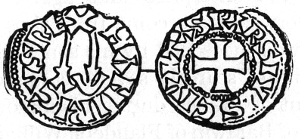
Denier of Henry I. of France
CHAPTER III THE CONQUEST OF MAINE AND THE BRETON WAR
126
By a curious synchronism both King Henry of
France and Count Geoffrey Martel died in
the course of the year 1060; and, with the disappearance
of his two chief enemies of the older
generation, the way was clear for William to attempt
a more independent course of action than
he had hitherto essayed. Up to this year his
policy had in great measure been governed by
the movements of his overlord and the count
of Anjou, both of them men who were playing
their part in the political affairs of France at the
time when he himself was born. From this date
he becomes the definite master of his own fortunes,
and the circumstances in which the king and the
count left their respective territories removed any
check to his enterprise and aggression which
might otherwise have come from those quarters.
The king was succeeded by his son Philip, at this
time a child of scarcely seven years old, and the
government of France during his minority was in
the hands of Baldwin of Flanders, William’s father-in-law.
In Anjou a war of succession broke out
which reduced that state to impotence for ten
years. Geoffrey Martel had left no sons, but had
127designated as his successor another Geoffrey, nicknamed
“le Barbu,” the elder son of his sister Hermengarde
by Geoffrey count of the Gatinais.[84]
The younger son, however, Fulk “le Rechin,” had
determined to secure the Angevin inheritance for
himself, and by the time that he had accomplished
his purpose most of the territorial acquisitions of
Geoffrey Martel had been torn from Anjou by the
neighbouring powers. Saintonge and the Gatinais
fell respectively into the possession of the
duke of Aquitaine and the king of France; and,
more important than all, the Angevin acquisition
of Maine, the greatest work of Geoffrey Martel,
was reversed when in 1063 William of Normandy
entered Le Mans and made arrangements for the
permanent annexation of the country.
The counts of Maine had never enjoyed such
absolute sovereignty over their territory as was
possessed by the greater feudatories of the French
crown.[85] In addition to the usual vague claims
which both Normandy and Anjou were always
ready to assert over their weaker neighbours, and
which nobody would take seriously when there was
no immediate prospect of their enforcement, the
suzerainty of the king of France was much more
of a reality over Maine than over Flanders or
Aquitaine. In particular the patronage of the
128great see of Le Mans rested with the king for the
first half of the eleventh century; and this was
an important point, for the bishops of the period
are prominent in the general history of the
county. For the most part they are good examples
of the feudal type of prelate, represented
in Norman history by Odo of Bayeux and Geoffrey
of Coutances; and several of them were drawn
from a house fertile in feudal politicians, that of
the counts of Bellême, whose great fief lay on the
border between Maine and Normandy. This connection
of the episcopate of Le Mans with a great
Norman family might be taken as itself implying
some extension of Norman influence over Maine
were it not that the house of Bellême, half independent
and altogether unruly, was quite as likely
to work against its overlord as in his favour. In
fact, it was largely through the Bellême bishops of
Le Mans that Angevin power came to be established
in Maine for a while; the bishops were
steadily opposed to the line of native counts, and
looked to Anjou for a counterpoise. In particular,
Bishop Gervase (1036–1058) brought it about that
King Henry made a grant of all the royal rights
over the see to Count Geoffrey Martel for the
term of his life, the bishop taking this step in
pursuance of an intrigue against the guardian
of the reigning count, who was at the time a
minor. Having served his turn Gervase quickly
fell into disfavour with Geoffrey and endured a
seven years’ imprisonment at his hands; but
129it was through his false step that Geoffrey first
secured a definite legal position in Mancel politics.
The counts of Maine themselves are rather
shadowy people, but it is necessary to get a clear
idea of their mutual relationships. Count Herbert,
surnamed “Eveille Chien,” the persistent
enemy of Fulk Nerra of Anjou and the last of his
line to play a part of his own in French affairs,
had died in 1035, leaving a son, Hugh IV., and a
daughter, Biota, married to Walter of Mantes,
count of the Vexin Français. Hugh, being under
age, was placed under the governance of his father’s
uncle, Herbert “Bacco,” the regent with whom
Bishop Gervase was at enmity. When the above-mentioned
grant of the patronage of the bishopric
of Le Mans to Geoffrey Martel had given the
latter a decent pretext for interference in the
quarrel, the expulsion of Herbert Bacco quickly
followed; and while the bishop was in captivity
Geoffrey ruled the country in the name of the
young count. Upon his death, in 1051, Geoffrey
himself, in despite of the claims of Hugh’s own
children, was accepted by the Manceaux as count
of Maine—for it should be noted in passing that
the Mancel baronage was always attached to
Anjou rather than to Normandy. The date at
which these events happened is also worthy of
remark, for it shows that during that rather
obscure war in the Mayenne valley which was
describeddescribed in the last chapter William of Normandy
was really fighting against Geoffrey Martel in his
130position as count of Maine. A legal foundation
for Norman interference lay in the fact, which we
have already noticed, that Bertha of Blois, the
widow of Hugh III., had escaped into Normandy,
and that by her advice her son Herbert, the heir
of Maine, had placed himself and his inheritance
under the protection of his host. William, seeing
his advantage, was determined to secure his own
position in the matter. He made an arrangement
with his guest by which the latter’s sister Margaret
was betrothed to his own son Robert, who here
makes his first appearance in history, with the
stipulation that if Hugh were to die without
children his claims over Maine should pass to his
sister and her husband. We do not know the
exact date at which this compact was made, but it
is by no means improbable that some agreement
of the kind underlay that clause in the treaty concluded
with King Henry after Mortemer by which
William was to be secured in all the conquests
which he might make from Geoffrey of Anjou.
On the latter’s death in 1060 Norman influence
rapidly gained the upper hand in Maine.[86] The
war of succession in Anjou prevented either of
the claimants from succeeding to the position of
Geoffrey Martel in Maine; and if Count Herbert
ruled there at all during the two years which
elapsed between 1060 and his own death, in 1062,
131it must have been under Norman suzerainty.
With his death the male line of the counts of
Maine became extinct, and there instantly arose
the question whether the county should pass to
Walter, count of Mantes, in right of his wife
Biota, the aunt of the dead Herbert, or to William
of Normandy in trust for Margaret, Herbert’s
sister, and her destined husband, Robert, William’s
son. In the struggle which followed, two parties
are clearly to be distinguished: one—and judging
from events the least influential—in favour of the
Norman succession, the other, composed of the
nationalists of Maine, supporting the claims of
Biota and Walter. The latter was in every way
an excellent leader for the party which desired
the independence of the county. As count of the
Vexin Français, Walter had been steadily opposed
to the Norman suzerainty over that district,
which resulted from the grant made by Henry I.
to Robert of Normandy in 1032. His policy
had been to withdraw his county from the
Norman group of vassal states, and to reunite it
to the royal demesne; he acknowledged the direct
superiority of the king of France over the Vexin,
and he must have co-operated in the great invasion
of Normandy in 1053; for it was at his capital
that the western division of the royal host assembled
before its march down the Seine valley.
Even across the Channel the interests of his house
clashed with those of William. Walter was himself
the nephew of Edward the Confessor, and
132his brother Ralph who died in 1057 had been earl
of Hereford. The royal descent of the Vexin
house interfered seriously with any claim which
William might put forward to the inheritance of
Edward the Confessor on the ground of consanguinity.
It is only by placing together a number
of scattered hints that we discover the extent of
the opposition to William which is represented by
Walter of Mantes and his house, but there can be
no doubt of its reality and importance.
In Maine itself the leaders of the anti-Norman
party seem to have been William’s own “man”
Geoffrey of Mayenne and the Viscount Herbert,
lord of Sainte-Suzanne. There is no doubt that
the mass of the baronage and peasantry of the
county were on their side, and this fact led William
to form a plan of operations which singularly anticipates
the greater campaign of the autumn of
1066. William’s ultimate objective was the city
of Le Mans, the capital of Maine and its strongest
fortress, the possession of which would be an
evident sanction of his claims over the county.
But there were weighty reasons why he should
not proceed to a direct attack on the city. Claiming
the county, as he did, in virtue of legal right,
it was not good policy for him to take steps which,
even if successful, would give his acquisition the
unequivocal appearance of a conquest; nor from a
military point of view was it advisable for him to
advance into the heart of the county with the castles
of its hostile baronage unreduced behind him.
133He accordingly proceeded to the reduction of the
county in detail, knowing that the surrender of the
capital would be inevitable when the whole country
around was in his hands. The initial difficulties of
the task were great, and the speed with which William
wore down the resistance of a land bristling
with fortified posts proves by how much his generalship
was in advance of the leisurely, aimless strategy
of his times. We know few particulars of the
war, but it is clear that William described a great
circle round the doomed city of Le Mans, taking
castles, garrisoning them where necessary with his
own troops, and drawing a belt of ravaged land
closer and closer round the central stronghold of
the county. By these deliberate measures the
defenders of Le Mans were demoralised to such
an extent that William’s appearance before their
walls led to an immediate surrender. From the
historical point of view, however, the chief interest
of these operations lies in the curiously
close parallel which they present to the events
which followed the battle of Hastings. In England,
as in Maine, it was William’s policy to gain
possession of the chief town of the country by
intimidation rather than by assault, and with the
differences which followed from the special conditions
of English warfare his methods were similar
in both cases. London submitted peaceably when
William had placed a zone of devastation between
the city and the only quarters from which help
could come to her; Le Mans could not hope to
134resist when the subject territory had been wasted
by William’s army, and its castles surrendered
into his hands. Nor can we doubt that the success
of this plan in the valleys of the Sarthe and
Mayenne was a chief reason why it was adopted
in the valley of the Thames.
At Le Mans, as afterwards at London, William,
when submission had become necessary, was
received with every appearance of joy by the citizens;
here, as in his later conquest, he distrusted
the temper of his new subjects, and made it his
first concern to secure their fidelity by the erection
of a strong fortress in their midst—the castle
which William planted on the verge of the precincts
of the cathedral of Le Mans is the Mancel
equivalent of the Tower of London. And, as afterwards
in England, events showed that the obedience
of the whole country would not of necessity
follow from the submission of its chief town; it
cost William a separate expedition before the
castle of Mayenne surrendered. But the parallel
between the Norman acquisition of Maine and
of England should not be pressed too far; it lies
rather in the circumstances of the respective conquests
than in their ultimate results. William was
fighting less definitely for his own hand in Maine
than afterwards in England; nominally, at least,
he was bound to respect the rights of the young
Countess Margaret, and her projected marriage with
Robert of Normandy proves that Maine was to be
treated as an appanage rather than placed under
135William’s immediate rule. And to this must be
added that the conquest of Maine was far less permanent
and thorough than the conquest of England.
The Angevin tendencies of the Mancel baronage
told after all in the long run. Before twelve years
were past William was compelled to compromise
with the claims of the house of Anjou, and after
his death Maine rapidly gravitated towards the
rival power on the Loire.
While the body of the Norman army was thus
employed in the reduction of Maine, William
despatched a force to make a diversion by ravaging
Mantes and Chaumont, the hereditary demesne
of his rival,—an expedition in its way also
anticipating the invasion which William was to
lead thither in person in 1087, and in which he
was to meet his death. Most probably it was this
invasion, of which the details are entirely unknown,
which persuaded Walter of Mantes to acquiesce
in the fait accompli in Maine; at least we are told
that “of his own will he agreed to the surrender
[of Le Mans], fearing that while defending what
he had acquired by wrong he might lose what belonged
to him by inheritance.” Within a short
time both he and his wife came to a sudden and
mysterious end, and there was a suspicion afloat
that William himself was not unconcerned in it.
It was one of the many slanders thrown upon
William by Waltheof and his boon companions at
the treasonable wedding feast at Exning in 1075
that the duke had invited his rival and his wife to
136Falaise and that while they were his guests he
poisoned them both in one night. Medieval
credulity in a matter of this kind was unbounded;
and a sinister interpretation of Walter’s death
was inevitably suggested by the fact of his recent
hostilities against his host.
One check to the success of William’s plans
followed hard on the death of Walter and
Biota. Margaret, the destined bride of Robert of
Normandy, died before the marriage could be
consummated. In 1063 Robert himself could not
have been more than nine years old; while, although
Margaret must have reached the age of twelve,
the whole course of the history suggests that she
was little more than a child, a fact which somewhat
tends to discount the pious legend, in which
our monastic informants revel, that the girl shrank
from the thought of marriage and had already
begun to practise the austerities of the religious
profession. She left two sisters both older than
herself, whose marriage alliances are important
for the future history of Maine[87]; but their claims
for the present were ignored, and William himself
adopted the title of count of Maine.
Somewhere about the time of these events
(the exact date is unknown) William was seized
with a severe illness, which brought him to the
point of death. So sore bestead was he that he
was laid on the ground as one about to die, and
in his extreme need he gave the reliquary which
137accompanied him on his progresses to the
church of St. Mary of Coutances. No chronicler
has recorded this episode, of which we should
know nothing were it not that the said reliquary
was subsequently redeemed by grants of land to
the church which had received it in pledge; yet
the future history of France and England hung
on the event of that day.[88]
It was probably within a year of the settlement
of Maine that William engaged in the last war undertaken
by him as a mere duke of the Normans,
the Breton campaign which is commonly assigned to
the year 1064. As in the earlier wars with Anjou,
a border dispute seems to have been the immediate
occasion of hostilities, though now as then there
were grounds of quarrel between the belligerents
which lay deeper. Count Alan of Rennes, William’s
cousin and guardian, had been succeeded
by his son Conan, who like his father was continually
struggling to secure for his line the suzerainty
of the whole of Brittany as against the rival
house of the counts of Nantes, a struggle which,
under different conditions and with additional
competitors at different times had now been
going on for more than a century. The county
of Nantes at this particular time was held by a
younger branch of the same family, and there are
some slight indications that the counts of Nantes,
perhaps through enmity to their northern kinsmen,
138took up a more friendly attitude towards Normandy
than that adopted by the counts of Rennes.
However this may be, Count Conan appears in the
following story as representing Breton independence
against Norman aggression; and when
William founded the castle of Saint James in the
south-west angle of the Avranchin as a check
on Breton marauders, Conan determined on an invasion
of Normandy, and sent word to William
of the exact day on which he would cross the
border.
By the majority of Frenchmen it would seem
that Brittany was regarded as a land inhabited
by savages; in the eleventh century the peninsula
stood out as distinct from the rest of France
as it stands to-day. Its inhabitants had a high
reputation for their courage and simplicity of life,
but they were still in the tribal stage of society,
and their manners and customs were regarded
with abhorrence by the ecclesiastical writers of the
time. Like most tribal peoples they had no idea
of permanent political unity; and the present war
was largely influenced by the fact that within the
county of Rennes a Celtic chief named Rhiwallon
was holding the town of Dol against his immediate
lord on behalf of the duke of Normandy.[89] Instead
of invading Normandy as he had threatened,
Conan was driven to besiege Dol, and it was
139William’s first object in the campaign to relieve
his adherent there.
What gives exceptional interest to the somewhat
unimportant expedition which followed is
the undoubted presence in William’s army of his
future rival for the crown of England, Harold
the earl of Wessex.[90] The reason for, and the
incidents connected, with, his visit to Normandy
will have to be considered in a later chapter, but
there cannot be any question as to its reality; and
in a famous section, the Bayeux tapestry, our best
record of this campaign, shows us Harold rescuing
with his own hand a number of Norman soldiers
who were being swept away by the Coesnon as the
army crossed the border stream of Brittany. On
the approach of the Norman army Conan abandoned
the siege of Dol and fell back on his capital
of Rennes; but relations soon seem to have become
strained between Rhiwallon and his formidable
ally, for we find Rhiwallon remarking to William
that it mattered little to the country folk around
Dol whether their substance were to be consumed
by a Norman or a Breton army. Possibly it may
have been the remonstrances of Rhiwallon which
140induced William to retire beyond the Norman
border, but we are told that as he was in the act
of leaving Brittany word was brought to him that
Geoffrey (le Barbu) count of Anjou had joined himself
to Conan with a large army and that both
princes would advance to fight him on the morrow.
It does not appear that William gave them the
opportunity, but the tapestry records what was
probably a sequel to this campaign in the section
which represents William as besieging Conan
himself in the fortress of Dinan. From the
picture which displays Conan surrendering the
keys of the castle on the point of his spear to
the duke it is evident that the place was taken,
but we know nothing of the subsequent fortunes
of the war nor of the terms according to which
peace was made. Within two years of these
events, if we are right in assigning them to 1064,
Conan died suddenly,[91] and was succeeded by his
brother-in-law Hoel, count of Cornouaille, who
united in his own person most of the greater
lordships into which Brittany had hitherto been
divided.
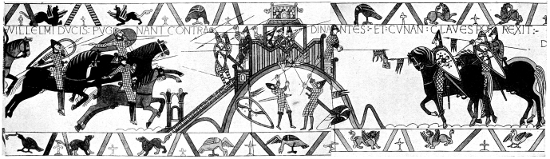
THE SIEGE OF DINANT FROM THE BAYEUX TAPESTRY
It may be well at this point briefly to review the
position held by William at the close of 1064.
With the exception of his father-in-law of Flanders,
141no single feudatory north of the Loire could for a
moment be placed in comparison with him. Anjou
and the royal demesne itself were, for different
reasons, as we have seen, of little consequence at
this time. The influence of Champagne under its
featureless rulers was always less than might have
been expected from the extent and situation of the
county; and just now the attention of Count Theobald
III. was directed towards the recovery of
Touraine from the Angevin claimants rather than
towards any rivalry with the greater power of
Normandy. Brittany indeed had just shown itself
hostile, but the racial division between Bretagne
Brettonante and the Gallicised east, which
always prevented the duchy from attaining high
rank among the powers of north France, rendered
it quite incapable of competing with Normandy
on anything like equal terms. With the feudal
lords to the east of the Seine and upper Loire
William had few direct relations, but they, like
the princes of Aquitaine, had received a severe
lesson as to the power of Normandy in the rout
of the royal army which followed the surprise
of Mortemer. On the other hand, Normandy,
threaded by a great river, with a long seaboard
and good harbours, with a baronage reduced
to order and a mercantile class hardly less
prosperous than the men of the great cities
of Flanders, would have been potentially formidable
in the hands of a ruler of far less power than
the future conqueror of England. Never before
142had Normandy attained so high a relative position
as that in which she appears in the seventh decade
of the eleventh century; and, kind as was fortune
to the mighty enterprise which she was so soon
to undertake, its success and even its possibility
rested on the skilful policy which had guided her
history in the eventful years which had followed
Val-es-dunes.
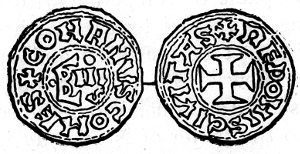
Denier of Conan II. of Brittany
CHAPTER IV THE PROBLEM OF THE ENGLISH SUCCESSION
143
The idea of a Norman conquest of England
was no new thing when the actual blow fell
in the autumn of 1066. The fateful marriage of
Ethelred and Emma, sixty years before, had
made it impossible that the politics of the island
and the duchy should ever again be independent
of each other; it led directly to the English expedition
of Robert of Normandy in 1034, and in Edward
the Confessor it gave England a king who
was half a Norman in blood, and whose ideas of
government were derived from the political conditions
of his mother’s land. To whatever aspect
of the history of this period we may turn, this
Norman influence will sooner or later become
apparent; in religion and commerce, as in the
narrower field of politics, the Norman is working
his way into the main current of English national
life.
All this, however, is somewhat apart from the
question as to the date at which Duke William
began to lay plans for carrying out the conquest
of England in his own person. There are two unknown
quantities in the problem: the date at
which it was generally recognised that Edward
the Confessor would leave no direct heir to the
144English throne, and the king’s own subsequent intentions
with respect to the succession. Had such
an heir been forthcoming in 1066 we may be sure
that his inheritance would have been undisturbed
from the side of Normandy, for William’s claim
to succeed his childless cousin by right of consanguinity
was something more than a matter of
form. Now Edward was married in 1045, being
then in the very prime of life, and we must certainly
allow for the passage of a reasonable period
of time before we can feel certain that the politicians
of England and Normandy were treating
the succession as an open question. In particular
it is difficult to be confident that in 1049, when
the negotiations for the marriage of William and
Matilda of Flanders were in progress, the ultimate
childlessness of Edward the Confessor was
known to be inevitable.[92]
A similar uncertainty hangs over the plans
which the Confessor formed in the latter event
for the future of his kingdom. His Norman blood,
his early residence in the duchy, and the marked
predilection which he showed for men of Norman
race, very naturally lead to the impression that,
in the earlier part of his reign at least, his desire
was to provide for the transmission of his inheritance
to his mother’s family. But even this conclusion
is not beyond question. Edward on his
145accession in 1042 occupied a most difficult position.
After twenty-five years of Danish rule a very
distinct party in the state wished to maintain
the Scandinavian connection. Edward’s recognition
as king was mainly the work of Earl Godwine
and his party, and the earl expected and
could enforce full payment for his services.
Edward would have shown less than the little
intelligence with which he is to be credited if he
had failed to see that some counterpoise to the
power of his overmighty subject might be found
by giving wealth and influence to strangers from
across the Channel. Hence arose that stream of
Norman immigration which distinguishes the reign
and the consequent formation of a royalist, non-national
party; for each individual settler must
have understood that all he might possess in the
island depended on the king’s favour. Such a
policy was bound sooner or later to produce a
reaction on the part of Godwine and his associates;
and thus arose the famous crisis of the
autumn of 1051. Godwine, trying to reassert his
influence in the state, fails to carry with him the
other earls of England in an attack on the king’s
favourites and is driven to flee the country. What
Godwine resented was clearly the existence of a
rival power at court, and the apathy in his cause
of such men as Leofric of Mercia and Siward of
Northumbria suggests that he was not recognised
by them as in any real sense the champion of
national as against foreign influences. With his
146flight the first period of the reign of Edward the
Confessor ends, and in the interval before his
restoration William of Normandy made his first
appearance on the shores of England.
Of this visit we know very little; the native
chronicler of Worcester simply tells us that “Earl
William came from over sea with a great company
of Frenchmen, and the king received him and as
many of his companions as pleased him and let
them go again.” The question at once presents
itself, did Edward at this time make any promise
of the English crown to William? If he ever did
make an explicit promise to this effect it can
scarcely be placed at any other date, for this was
the only occasion after Edward’s departure from
Normandy in 1042 on which the king and the
duke are known to have met in person. The fact
that such a promise forms an essential part of
the story of the Conquest as told by all Norman
writers is an argument in its favour which would
more than counterbalance the natural silence of
the English authorities, were they much better
informed upon matters of high policy than is
actually the case. But, after all, the question is
really of secondary importance, for in the next
year Godwine returned to power, and Edward
for the rest of his reign seems to have made no
serious attempt to disturb the ascendency of the
English party.
The death of Godwine in 1053 made little immediate
difference to the political situation in
147general nor to the existing relations between Normandy
and England. The succession of his son
Harold to the earldom of Wessex provokes no
comment on the part of the contemporary chroniclers;
the semi-hereditary character of the great
earldoms was by this time recognised for all
working purposes. Nevertheless, we can see that
the accession of Harold to a provincial government
of the first rank, and most probably to the unofficial
primacy in the state which had been held
by Earl Godwine, takes place among the chief
events in the sequence of causes which ended in
the great overthrow of 1066. On the other hand
we should not be led by the actual cause of the
history into the assumption that Harold’s designs
upon the crown had already begun at this
early date. With all his personal weakness, King
Edward’s own wishes were likely to be the decisive
factor in the choice of his successor, nor
have we any record that Harold opposed the candidate
whom we know to have received the king’s
favour shortly after this time.
This candidate, whose appearance in the field
with the king’s sanction was likely to prove fatal
to any aspirations to the throne in which either
William or Harold might have begun to indulge,
was Edward the Etheling, son of the famous
Edward Ironside, and therefore nephew by the
half-blood to the Confessor. He had been sent
by Cnut into remote exile, and the summons which
brought him back to England as its destined heir
148was the work of King Edward himself. By a
strange chance, immediately on his arrival in
1057, and before he had even seen the king, the
etheling fell ill and died,[93] and, although there was
something about his end which was rather mysterious,
there is nothing to suggest that it was accelerated
in the interest of any other pretender to
the crown. With his death there really passed
away the one promising chance of perpetuating
the old English dynasty, for Edgar, the son of the
dead etheling, who was to live until 1126 at
least, can only have been the merest child in
1057.
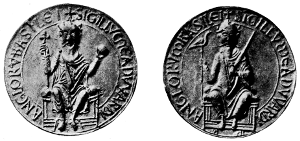
SEAL OF EDWARD THE CONFESSOR
It would seem then that 1057 is the earliest
possible year from which the rivalry of William of
Normandy and Harold Godwinson for the throne
of England can be dated. The recall of Edward
the Etheling suggests that it cannot be placed
earlier, while the state of preparedness in which
both parties are found at the beginning of 1066
shows that their plans must have been formed for
some years at least before the Confessor’s death.
And there is one mysterious episode which may
very possibly have some connection with the
change in the succession question caused by the
death of Edward the Etheling. In or about 1058
Earl Harold made a tour on the continent, reaching
as far as Rome, but also including Normandy
and North France generally, and we are told that
he made arrangements for receiving help from
149certain French powers if he should need it at any
time.[94] The passage in which we are told of these
negotiations is very obscure, but it is by no means
improbable that Harold, when the death of the
etheling had opened for him a possibility of succeeding
to the crown, may have tried to find allies
who would hamper the movements of his most
formidable rival when the critical time came.
Also it is not without significance that 1058 is the
year of Varaville, a date at which French jealousy
of Norman power would be at its height. At any
rate we may at this point stop to consider the
relative position occupied by the earl and the
duke respectively with respect to their chances of
succeeding to the splendid inheritance of the
oldest dynasty in Western Europe.
The first point which deserves discussion is the
nature of the title to the English crown. “Hereditary”
and “elective,” the words which one
naturally contrasts in this connection, are terms
of vague and fluctuating meaning in any case,
while it has always been recognised that neither
can be employed in relation to the tenure of the
crown at any period of English history without
due qualification. To say simply that the English
monarchy was “elective” at the period with
which we are dealing, is an insufficient statement
unless we also consider the limits within which the
choice lay on any given occasion, the process involved
in the act of election, and the body which
150exercised the elective right. With regard to the
first of these matters there undoubtedly existed
an ancient and deep-seated feeling that a king
should only be chosen from a kingly stock; in the
eleventh century the sentiment still survived with
which at an earlier period the nation had demanded
that its rulers should have sprung from the blood
of the gods. This idea was far older than any
feeling of nationality, to which it might from time
to time run counter—it helps, for instance, to
explain the ease with which the English had accepted
the royal Dane Cnut for their ruler—but
with this highly important reservation it is very
improbable that the succession was determined by
anything which could be called general principles.
The crown would naturally pass to the most
popular kinsman of the late ruler, and the question
of the exact relationship between the dead
king and his heir would be a secondary matter.
William of Normandy was of sufficiently noble
birth to satisfy the popular sentiment in the former
respect, for Rollo himself was the scion of
an ancient line of Norwegian chieftains. Harold
on his mother’s side inherited royal blood, for
Gytha, Earl Godwine’s wife, was descended from
the family of the kings of Sweden; but whereas
no writer near the time remarks on this feature
in Harold’s descent, the origin of the “jarls of
Normandy” was still a living memory in the
north. Far more important in every way, however,
was the undoubted kinship between William
151and King Edward, a fact which William made
the very foundation of his claim and which was
undoubtedly recognised by the men of the time as
giving him an advantage which could not be
gainsaid. At the present day, indeed, it is rather
difficult to understand the influence exercised by
the somewhat distant relationship which was all
that united William and Edward, especially in
view of the fact that Edgar, son of Edward the
Etheling, still continued the male line of the royal
house of Wessex. We can only explain it on the
ground that in 1066 Edgar was under the age at
which he would be competent to rule independently,
and that the public opinion of the time
would not accept a minor as king so long as there
existed another candidate connected with the
royal house and capable of taking up the reins of
government in his own hands. In fact, of the
three candidates between whom the choice lay
on the Confessor’s death William, after all, was
the one who combined the greatest variety of
desirable qualifications. Edgar was nearest to the
throne by order of birth, but his youth placed him
at a fatal disadvantage; Harold was a man of
mature years and of wide experience in the government,
but his warmest supporters could not
pretend that he was a kinsman of King Edward;
William was already a ruler whose fame had
spread far beyond the borders of his own duchy,
and in the third generation he could claim a common
ancestor with the dead king. Lastly, we
152should remember that the fact which under
modern conditions would outweigh all other considerations,
the fact that William was a foreigner,
was less important in the eleventh century than
at any later time. It was certainly a disadvantage,
but one which was shared in a less degree by
both William’s competitors: if he was a pure Norman,
Harold was half a Dane, Edgar was half
a German. The example of Cnut showed that
there was nothing to prevent a man of wholly
foreign blood from receiving general acceptance as
king of England; and if the racial differences which
existed in the country prepared the way for his
reception, something of the same work was done
for William by those Normans who had flocked
into England under King Edward’s protection.
In all those cases in which the late king had
left no single, obvious, heir to the throne, the
succession would naturally be settled by the great
men of the land—by that informal, fluctuating
body known as the “witan.” So far as we can
tell, the witan would be guided in part by the
prevailing popular opinion, but more effectually
by the known wishes of the dead sovereign with
respect to his successor; we know, for instance,
that both these influences contributed to the
election of Edward the Confessor himself.[95] It
is, however, probable that, so far from the elective
153nature of the monarchy having been a main
principle of English institutions from the earliest
date, the idea was really an importation of the
eleventh century. It has recently been suggested
that the action of the witan in early times with
regard to the choice of a new king was something
which would be much better described as “recognition”
than as election in any modern sense,
that there is no evidence to prove that the witan
behaved as a united body, and that it was the
adhesion of individual nobles to the most likely
heir which really invested him with the royal
power.[96] According to this account, such traces
of election in the wider sense as are discernible
in the eleventh century may with probability
be set down to Danish influence, for the three
Scandinavian nations had advanced much further
than other Teutonic peoples in the development
of their native institutional forms. But,
even so, there is much in the history of the year
1066 to suggest that the older ideas still prevailed:
William claimed the throne by hereditary right
and it was the submission of Stigand, Edwin,
Morcar, Edgar the Etheling, and the citizens of
London, not the vote of any set assembly, which
gave sanction to his claim.
In the light of this anticipation we may now
consider the most perplexing question in William’s
life, the truth underlying the famous story of
154Harold’s visit to Normandy and the oath which
he there swore to William. Unlike most questions
relating to the eleventh century, the difficulty in
the present case arises from the wealth of our
information on the subject; with the exception
of those purely English writers Florence of
Worcester and the authors of the Anglo-Saxon
chronicle, the significance of whose silence will
be seen shortly, every historical writer of the
fifty years succeeding the Conquest tells the story
at length, and no two writers tell the same
story. And yet we cannot safely reject the
tale as fabulous for two reasons: the silence of
those who wrote with native sympathies proves
that there was an element of truth in the Norman
story which they did not feel themselves at
liberty to deny, while the rapid diffusion of the
tale itself among writers widely separated in
point of place and circumstance would be unintelligible
if it were the result of sheer invention.
Nor is a story necessarily suspicious because its
details are romantic.
The skeleton of the tale is that Harold, happening,
for reasons diversely stated, to be sailing
in the Channel, was driven by a storm on to the
coast of Ponthieu, and that being thereby regarded
as the lawful prey of the count he was thrown
into prison at Beaurain, evidently to be held to
ransom. While Harold was in prison the Duke
of Normandy became apprised of the fact, and
sending to Count Guy, who had become his
155feudal dependant after the battle of Mortemer,
William had Harold brought with all honour
into the duchy. For an indefinite time the earl
stayed at the court of the duke, and even accompanied
him on the Breton expedition which was
described in the last chapter; but before his
departure he placed himself under some obligation
to his host, the nature of which is the
key to the whole matter, but with regard to which
scarcely any two writers are in unison. There
is no doubt that Harold became William’s man,
and it would seem certain that he took an oath
which bore some reference to the rivalry for the
English throne in which both were evidently
engaged. Most writers make the essence of the
oath to be a promise on the part of Harold to do
all in his power to secure the crown for William
upon Edward’s death, and there is a powerful
current of tradition which asserts that Harold
pledged himself to marry one of William’s daughters.
In other words, Harold undertook to recognise
William as king of England in due season,
and to secure for him the adhesion of such of the
English nobility as were under his influence; his
marriage with William’s daughter being doubtless
intended to guarantee his good faith when
the critical moment came. Such an agreement
would still leave Harold obviously the first man
in England; indeed the relationship which would
have been created between William and Harold,
if it had been carried into effect, would in some
156respects have reproduced the relationship in
which Edward the Confessor had stood with
regard to Earl Godwine in 1042. This fact makes
it difficult to believe that Harold was necessarily
acting under compulsion when he took the oath;
he had many rivals and enemies in England,
and it was well worth his while to secure his
position in the event of Edward’s death before
his own plans were mature.[97]
William on his part had everything to gain
by causing Harold to enter into such an engagement.
If the oath were kept William would have
turned a probable rival into an ally; if it were
broken he would secure all the moral advantage
which would accrue to him from the perjury of
his opponent. But there is no reason to believe
157that he insisted on Harold taking the oath merely
in order that he might break it, nor is there any
good authority for the famous story that William
entrapped Harold into taking a vow of unusual
solemnity by concealing a reliquary beneath
the chest on which the latter’s hand rested while
he swore. It was inevitable that an incident
of this kind should gather round it a mythical
accretion: but the whole course of the history
proves that some such episode really took place.
William’s apologists could put it in the forefront
of their narratives of the Conquest, and all subsequent
writers have dwelt upon it as a main
cause of the invasion; yet, although scepticism
is from time to time expressed upon this detail
or that, not one of the historians of the next
century, some of whom were possessed of distinct
critical powers, and had access to good
sources of information, has given a hint that the
whole story was a myth.
On January 5, 1066, King Edward died, and on
Thursday, January 6th, Earl Harold was chosen
as king by the Witan assembled at Westminster
for the Christmas feast, and crowned that same
day by Ealdred, archbishop of York. We possess
a circumstantial account of the last days
of Edward, written only a few years after these
events, which describes how the King, within an
hour of his death, had emphatically commended
his wife and his kingdom to the care of Harold.[98]
158With little debate, as it would seem, the last
wishes of the last king of the line of Egbert were
carried into effect; Harold was chosen king forthwith,
and on the same day the sanction of the
church made the step irrevocable. England was
now committed to the rule of a king whose title
to the crown depended solely upon the validity
of the elective principle, and whose success or
failure would depend upon the recognition which
this principle would obtain among foreign powers,
and upon the support which those who had
chosen to accept him as their lord were prepared
to extend to him, should his claim be challenged.
Under the circumstances the choice of Harold
was perhaps inevitable. The dying wish of Edward
could not with decency be disregarded; the
scene of the election lay in just that part of the
country where the interest of the house of Godwine
was at its strongest; and if traditional
custom were to be disregarded and the royal line
forsaken no stronger native candidate could have
been found. On the other hand, there could be
no doubt that the event of that memorable
Epiphany was fraught with danger on every
side. Even if it had not thrown defiance to the
most formidable prince in Europe, it founded an
ominous precedent, it showed that the royal
dignity was not beyond the grasp of an aspiring
subject, it exposed the crown to intrigues of a
class from which England, weak at the best as
was its political structure, had hitherto been
159exempt. The Norman Conquest was an awful
catastrophe; but at least it saved England from
the perils of an elective monarchy.
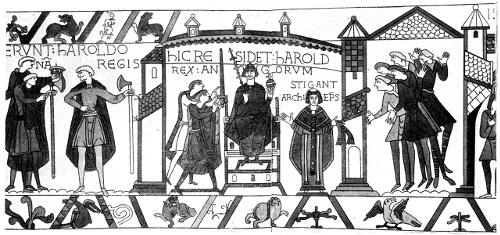
HAROLD ENTHRONED
FROM THE BAYEUX TAPESTRY
The impression which the coronation of
Harold made upon the politicians of Europe was
unmistakable. From Rome to Trondheim every
ruler to whom the concerns of England were a
matter of interest realised that a revolutionary
step had been taken. From the crude narrative
of the Latin historian of the Norwegian kings,
as from the conventional periods of the papal
chancery, we gather that the accession of Harold
was regarded as an act of usurpation, although
there is no unanimity as to the personality of
the rightful heir whom he had supplanted. Old
claims, long dormant, were revived; the kings
of Norway and Denmark remembered that England
had once belonged to the Scandinavian
world. Had Edgar the Etheling or William
of Normandy been elected, murmurings from
this quarter at least would no doubt have been
heard, but they would have lost half their force:
the former could have appealed to the prevailing
sentiment in favour of hereditary right; the latter
could in addition have poured at once into England
a military force sufficient to meet all possible
invaders on equal terms. Harold had neither
of these safeguards, and his oath to William had
given to the most powerful section of his opponents
an intelligible ground on which to base their
quarrel. Seldom in any country has a new
160dynasty been inaugurated under circumstances
so full of foreboding.
All this, of course, meant a corresponding
increase of strength to William. Vague as is our
knowledge of the negotiations with the several
powers whose good-will was desirable for his enterprise,
we can see that he brought them at
least into a general attitude of friendly neutrality.
We are told that the Emperor Henry IV. promised
the unqualified support of Germany if it
should be needed,[99] and also that Swegen Estrithson
of Denmark joined William’s side, though
our informant adds that the Danish king proved
himself in effect the friend of William’s enemies.
The French crown was, as we have seen, under
the influence of Baldwin of Flanders, William’s
father-in-law; and so long as a war of succession
distracted Anjou, William need fear no danger
from that quarter. Maine was a dependency
of the Norman duchy. Nothing, in fact, in William’s
history is more remarkable than the way
in which, at the very moment of his great attempt,
the whole political situation was in his favour. No
invasion of England would have been possible before
1060, when King Henry of France and Geoffrey
Martel were removed from William’s path, while the
growth of King Philip to manhood and the formation
of Flanders into an aggressive anti-Norman
state under Robert the Frisian would have increased
William’s difficulties a thousandfold if
161Edward the Confessor had lived for five years
longer. In great part William’s advantageous
position in 1066 was due to his own statesmanship;
in no small degree it resulted from the discredit
which the national cause of England suffered in
the eyes of Europe from the election of Harold;
but above all it must be set down to William’s
sheer good luck. William the Conqueror, like
Napoleon, might have believed in his star without
incurring the reproach of undue superstition.
Of all William’s negotiations that which was
most characteristic of the temper in which he
pursued his claim was an appeal to the head of
the church to decide between his right and that
of Harold:
“That no rashness might stain his righteous cause
he sent to the Pope, formerly Anselm, bishop of
Lucca, asserting the justice of the war he had undertaken
with all the eloquence at his command. Harold
neglected to do this; either because he was too
proud by nature, or because he mistrusted his own
cause, or because he feared that his messengers
would be hindered by William and his associates,
who were watching all the ports. The Pope weighed
the arguments of both sides, and then sent a banner
to William as an earnest of his kingdom.”[100]
The nature of this transaction should not be
misunderstood. By inviting the papal arbitration
William was in no sense mortgaging any of the
royal prerogatives in the island which he hoped
162to conquer. His action, that is, does not in any
way resemble the step which his descendent
John took a hundred and fifty years later, when
he surrendered his kingdom to Innocent III. to
be held thenceforward as a papal fief.[101] William
was simply submitting his cause to the court
which was the highest recognised authority in
all matters relating to inheritance, and which was
doubly competent to try the present case, involving
as it did all the questions of laesio fidei which
arose out of Harold’s oath. Nor need we doubt
that the verdict given represented the justice of
the case as it would be presented to the pope and
his advisers; we know at least, on the authority of
Hildebrand himself, that it was not without an
acrimonious discussion that judgment was given
in favour of William. It would seem, in fact, that
it required all the personal influence that Hildebrand
could exercise to persuade the leaders of
the church to commit themselves to the support
of claims which, if prosecuted, must inevitably
lead to bloodshed. And in later years Hildebrand
told William that his action had been governed
by his knowledge of the latter’s character, and by
the hope that when raised to a higher dignity he
would continue to show himself a dutiful subject
of the church.[102] Hildebrand added that he had
163not been disappointed; and in fact the attraction
of the great island of the west within the influence
of the ideas of the reformed papacy
was worth the suppression of a few scruples on
the part of the Curia.
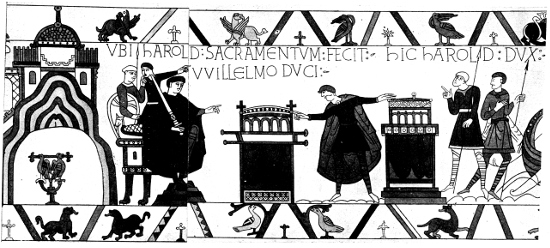
HAROLD’S OATH
FROM THE BAYEUX TAPESTRY
Seventy years afterwards the papal court was
again called upon to adjudicate in a dispute
relating to the succession to the English throne,
and this under circumstances which deserve
notice here as illustrating the nature of William’s
appeal. In 1136, immediately, it would seem,
after the coronation of Stephen, his rival, the
Empress Matilda sent envoys to Pope Innocent II.
to protest against the usurpation. Stephen,
wiser in his generation than Harold, replied by
sending his own representative, and the case was
argued in detail before a council specially convened
for the purpose by the pope. Just as in
the more famous episode of 1066, the point on
which the plaintiff’s advocates grounded their
case was the fact that the defendant had taken
an oath to secure the succession of his rival;
and it rested with the pope to decide whether
this oath were valid. It is with reference to this
last point that the parallel between the events
of 1066 and 1136 ceases: in the latter case the
pope by refusing to give judgment tacitly acquitted
Stephen of the guilt of perjury; in 1066
Harold’s neglect to lay a statement of his case
before the papal court produced its natural
result in the definite decision which was given
164against him.[103] In either case it will be seen that
what is submitted to the Curia is a question of
law, not of politics; the pope is not regarded as
having any right to dispose of the English crown;
he is merely asked to consider the respective
titles of two disputants.
Armed thus with the sanction of the church
there lay before William the serious task of
raising an army sufficiently large to meet the
military force at his rival’s command on something
like equal terms. Such an army could not
possibly be derived from Normandy alone, great
as was the strength of the duchy in comparison
with its area. However favourable the general
outlook might be for William’s plans, he cannot
have thought for an instant of staking the whole
resources of Normandy upon a single venture;
a venture of which the possible results might be
very brilliant but of which the immediate risk
was very great. Nor was it possible for William
by any stretch of feudal law to summon his vassals
and their men to follow him across the Channel
as a matter of right and duty; if he were to obtain
their support he was bound to place the expedition
before them as a voluntary enterprise. Thus
stated there can have been little doubt as to the
response which would be made to his appeal.
The Norman conquest of Naples and the Norman
exploits in Spain had proclaimed to the world
the mighty exploits of which the race was capable,
165nor need we believe that the Normans themselves
mistrusted their reputation. And although William’s
contemporary biographer, anxious to display
the magnanimity of his hero, has represented
the latter’s subjects as viewing the enterprise
with dismay,[104] it is not really probable that the
Norman knighthood was seriously deterred from
adventuring itself for unlimited gains in the rich
and neighbouring island by the prospect of having
to fight hard for them.
In the early part of 1066, but most probably
after the termination of William’s cause at Rome,
a council of the Norman baronage met at Lillebonne[105]
to discuss the proposed invasion of England.
It is plain that what most exercised the
minds of William and his barons was the difficulty
of building, equipping and manning a number of
ships sufficient for the transport of the army
within a reasonable time. In fact it seems probable
that one special purpose of the council was
to ascertain the number of ships which each baron
was prepared to contribute towards the fleet—a
matter which lay altogether outside the general
question of military service and could only be
solved by amicable agreement between the duke
and his vassals taken individually. William
stipulated that the ships should be ready within
the year; a demand which to some at least appeared
impossible of fulfilment; and, indeed, the
166creation of an entire fleet of transport vessels
within six months is a wonderful illustration of
the energy with which the Norman nobility
adopted the cause of the duke. Transport vessels
the ships were, and nothing else, as is evident
from the representation of them in the Bayeux
tapestry, and we are bound to conclude that it
was well for William that his passage of the Channel
met with no serious opposition on the part
of Harold. As might be expected, the number
of ships actually provided is very variously given
by different writers. Curiously enough the most
probable, because the lowest, estimate is made
by a very late authority, the Norman poet Wace,
who says that when he was a boy his father told
him that six hundred and ninety-six ships assembled
at St. Valery. There have also come down
to us several statements of the contribution which
the greater barons of Normandy made to the fleet,
which are probably true in substance although
the lists differ among themselves and the totals
which they imply exceed the modest figures presented
by Wace.[106] It would appear that William’s
two half-brothers headed the list; Robert of
Mortain giving a hundred and twenty ships, Odo
of Bayeux a hundred. The counts of Evreux and
Eu, both members of the ducal family, furnished
eighty and sixty ships respectively. William
Fitz Osbern, Roger de Beaumont, Roger de
167Montgomery, and Hugh d’Avranches gave sixty
ships each; Hugh de Montfort, fifty. Two men
who do not appear in the subsequent history,
a certain Fulk the Lame and one Gerald, who,
although styled the seneschal, is difficult to
identify at William’s court, gave forty ships each.
Thirty ships were given by Walter Giffard and by
Vulgrin, bishop of Le Mans; and Nicholas, abbot
of St. Ouen, and the son of Duke Richard III.
contributed twenty. An interesting figure in
the list is Remi, the future bishop of Lincoln,
who in 1066 was only almoner of Fécamp abbey,
but nevertheless provided a ship and manned
it with twenty knights. The Duchess Matilda
herself supplied the ship, named the Mora,
which was to carry her husband. One fact stands
out clearly enough on the surface of this list—the
great bulk of the fleet was supplied by William’s
kinsmen and by men whom we know to have
enjoyed his immediate confidence, and it is significant
that we can recognise in this brief account
just those men who received the greatest spoils
of the conquered land. Among these few names
the future earldoms of Kent, Shrewsbury, Hereford,
Chester, Buckingham, Warwick, and Leicester
are represented. Doubtless the rest of the
Norman nobility in one way or another contributed
in proportion to its wealth, but we
have just accounted for nearly eight hundred
vessels, and it is clear that in the all-important
matter of the fleet William found his fullest support
168among his relatives and personal friends.
How far this statement would hold good in
relation to the army of the Conquest is a question
which we have no detailed means of answering.
Doubtless the lords of Montfort, Longueville,
Montgomery, and their fellows brought the full
complement of their vassals to the duke’s muster,
but the essential fact in the composition of
William’s army lies in the width of the area from
which it was recruited. From every quarter
of the French kingdom, and from not a few places
beyond its borders, volunteers crowded in to
swell the Norman host. Brittany supplied the
largest number of such volunteers, and next to
Brittany came Flanders, but the fame of William’s
expedition had spread beyond the Alps, and the
Norman states in South Italy and Sicily sent
their representatives.[107] And this composite character
of the army which fought at Hastings
had deep and abiding results. A hundred years
after the Conquest, Henry II. will still be sending
out writs addressed to his barons and lieges
“French and English,” and the terminology
here expresses a fact of real importance. The
line of racial distinction which was all-important
in later eleventh-century England was not between
Englishmen and Normans, but between
Englishmen and Frenchmen. England fell, not
before any province, however powerful, of the
169French kingdom, but, in effect, before the whole of
French-speaking Europe, and, by her fall, she herself
became part of that whole. For nearly a hundred
years England had been oscillating between
the French and the Scandinavian world; the events
of 1066 carried her finally within the influence of
Southern ideas in religion, politics, and culture.
The French auxiliaries of William have often
been described as adventurers, and adventurers
in a sense no doubt they were. But the word
should not be pressed so as to imply that they
belonged to a social rank inferior either to their
Norman associates or to the English thegnhood
whom they were to displace,—there should be no
talk of “grooms and scullions from beyond the
sea”[108] in this connection. Socially there was
little to distinguish a knight or noble from Brittany
or Picardy from Normans like Robert d’Oilly
or Henry de Ferrers; nor, rude as their ideas of
comfort and refinement must seem to us, have
we any warrant for supposing that Wigod of
Wallingford or Tochi the son of Outi had been in
advance of either in this respect. Like the Normans
themselves the Frenchmen varied indefinitely
in point of origin. Some of them were the
younger sons of great houses, some belonged to
the lesser baronage, some to the greater; Count
Eustace of Bologne might by courtesy be described
as a reigning prince. Some of the most famous
names in the succeeding history can be traced
170to this origin—Walter Tirel was lord of Poix in
Ponthieu, Gilbert of Ghent was the ancestor
of the medieval earls of Lincoln. But the best
way of realising the prevalence of this non-Norman
element among the conquerors of England
is to work through one of the schedules
which the compilers of Domesday Book prefixed
to the survey of each county, giving the names of
its land-owners, and to note the proportion of
“Frenchmen” to pure Normans. In Northamptonshire,
for example, among forty-three lay
tenants there occur six Flemings, three Bretons,
and two Picards, and Northamptonshire in this
respect is a typical county.
At or about the time of the council of Lillebonne
there is reason to believe that messages
were passing between William and Harold concerning
the fulfilment of the fateful oath. It
is fairly certain that William demanded the surrender
of the crown and Harold’s immediate
marriage to his daughter, agreeing in return to
confirm him in his earldom of Wessex, which
last is probably what is meant when our rhetorical
informants tell us that William promised to grant
half the kingdom to his rival. Such negotiations
were bound to fall through; Harold had gone too
far to withdraw, even if he had been so minded,
and William’s object in making these proposals
could only have been to maintain in the eyes of the
world the appearance of a lawful claimant deprived
of his inheritance. Also we may be quite sure
171that the building of the fleet was not interrupted
during the progress of the negotiations.
The difficulties of Harold’s reign began early.
The weakness of his position was revealed at the
outset by the refusal of Northumbria to accept
him as king, a refusal very possibly prompted by
Earl Morcar, who could not be expected to feel
much loyalty towards the new dynasty. By
making a special journey to York, Harold succeeded
in silencing the opposition for the moment,
and his marriage with Ealdgyth, the sister of
Earls Edwin and Morcar, which may be dated with
probability to about this time,[109] was very possibly
intended to conciliate the great midland house.
It would certainly serve as a definite assertion
that Harold had no intention of fulfilling that
part of his oath to William which pledged him
to a marriage with the duke’s daughter, nor can
we doubt that Harold realised the expediency
of providing an heir to his crown with the least
possible delay. At any rate he seems to have
been enjoying a few weeks of tranquillity after
his visit to York when he received an unmistakable
intimation of the coming storm, which
was none the less ominous because its immediate
results were insignificant.
Tostig, the dispossessed earl of Northumbria,
had spent the winter of 1065–6, as we have seen,
with Baldwin of Flanders,[110] a fact which is
172suggestive when we remember the relations
between Baldwin and William of Normandy.
It is evident that Tostig was spending the period
of his banishment in forming schemes for his
restoration, and the fact that his brother on
becoming king dare not or would not recall him
made him inevitably a willing tool of William’s
policy. Accordingly, early in 1066 Tostig moved
from Flanders into Normandy, appeared at the
duke’s court, and urged him on to an invasion of
England. It is quite possible that he was present
at the assembly of Lillebonne; one writer goes so
far as to say that the arguments of Tostig contributed
largely to persuade the Norman nobility
to undertake the enterprise,[111] and William may
have derived some little advantage from the fact
that he could point to one man of high rank among
the English nation as an adherent. But it would
seem that Tostig was unwilling to await the
development of his host’s plans, and in May he
set off from the Cotentin on an expedition of
his own intended to ravage the English coasts.
He landed first in the Isle of Wight, where the
inhabitants bought him off with money and provisions,
and then sailed, ravaging the coast of
Sussex and Kent, until he came to Sandwich. At
Sandwich he raised a small force of sailors, but
at the same time the news of his expedition was
brought to his brother in London, who at once
set out for the Kentish coast. Before he could
173reach Sandwich, however, Tostig had started
northward again and finally entered the Humber
with sixty ships, harrying the coast of Lindsey.
Upon receiving the news Earls Edwin and Morcar,
having called out the local fyrd, marched
with it to the Humber and compelled Tostig to
take refuge in his ships. At this point Tostig
was deserted by the men of Sandwich whom he
had impressed, and, his fleet being now reduced
to twelve ships, he made his way to Scotland
and spent the summer, we are told, with King
Malcolm.[112]
Tostig’s futile raid has an interest of its own
in the glimpse which it gives us of the English
defences just before the Norman invasion. The
evidence of Domesday Book shows that an
Anglo-Saxon king had some sort of naval force
permanently at his disposal, and we know that
Harold built and manned a number of ships to
keep the Channel against his Norman rival, but,
from whatever cause, the English navy in this
critical year proved itself miserably ineffective.[113]
A mere adventurer, with no foreign aid of any
consequence and no local support in England,
Tostig could still spread devastation with impunity
along half the English coast. The story
174of Tostig’s expedition reads like a revival of one
of the Danish raids of the ninth century—the
enemy sacks a town, the fyrd are summoned and
hurry to the spot to find that the raiders have
just left to plunder the nearest unprotected
locality. Clearly the coast defences of England,
for all the bitter experience of the Danish wars,
had made no real advance since the days of
Alfred, and it is not unfair to remark that this
fact reflects little credit upon the statesmanship
of Harold. He had himself been an exile and
had made a bid for power by a piratical descent
upon England very similar to the present expedition
of Tostig’s. If he really possessed the power,
during the last ten years of the Confessor’s reign,
with which he is usually credited, it should not
have been impossible for him to create a naval
force strong enough to counteract such attempts
for the future. The events of 1066 are an excellent
illustration of the influence of sea power in
history; wind and weather permitting, an invader
could land an army in England at whatever
time and place best suited him. As for Tostig
himself, his expedition had been ignominious
enough, but before the year was out he was to
earn immortality by his association with the
last great Scandinavian invasion of England and
by the part which he is made to play in the
magnificent saga of Stamfordbridge.
The summer visit of Tostig to Scotland must
have been interrupted by another voyage of
175greater distance and followed by most momentous
consequences. Very possibly he was dissatisfied
with the amount of immediate support which his
claims had received from William of Normandy;
at all events he now made application to a prince
of higher rank, more restless spirit, and still more
varied experience in the art of war. Although
there are chronological difficulties in the story
which cannot be discussed here, there can be
little real doubt that Tostig in person sailed to
Norway, was received by Harold Hardrada,
and incited the most warlike king in Europe to
an invasion of England. As a matter of fact it
is probable that Harold Hardrada, like William
of Normandy, would have made his attempt
even if Tostig had never come upon the scene;
the passage of the English crown to a subject
house, coming at a time when there was a temporary
lull in the chronic warfare between the
three Scandinavian powers, might remind the
king of Norway that he could himself, if he chose,
put forward a decent pretext for an adventure
which would be certain to bring him fame and
might rival the exploits of Swegen and Cnut.[114]
The extent of the preparations which Harold
Hardrada had evidently made for his enterprise
would of itself suggest that they were independent
of the representations of the banished earl of
Northumbria, while on the other hand Tostig
plays too prominent a part in the Norwegian
176traditions of the expedition for us to reject his
voyage to Norway as mere myth, and his presence
may have had some influence in determining
the objective of the invaders when once they had
touched the shores of England.
After making his appeal to Harold Hardrada,
Tostig returned to Scotland and began to raise
a force of volunteers there on his own account.
Early in September the king of Norway set sail
from the Sogne Fiord near Bergen, due west to
the subject earldom of the Orkneys and Shetlands,
where he was joined by Paul and Erling,
the two joint earls, and by a large reinforcement
of the islanders.[115] From the Orkneys Harold
sailed on without recorded incident as far as the
Tyne, where he was joined, according to agreement,
by Tostig with his Scottish auxiliaries, and then
the combined force made for the Yorkshire coast
and began offensive operations by a harrying
of Cleveland. Passing southward the invaders
encountered an ineffectual resistance at Scarborough
and along the coast of Holderness, but
were able to round Spurn Head without any
opposition from the English fleet. The Humber
and the inland waters of Yorkshire lay open to
Harold, and it would seem that as the Norwegian
fleet sailed up the Ouse the English fleet retreated
up the Wharfe, for Harold chose to disembark
at Riccall, a village some five miles below the
confluence of these rivers. Riccall was chosen as
177the headquarters of the fleet, which could easily
block at this point any attempt on the part of
the English vessels to break out to the open sea
while Harold and his army marched straight
on York. At Fulford, two miles from the city,
the invaders met the fyrd of Yorkshire under
Earls Edwin and Morcar, and the defeat of the
local force led to the surrender of York four days
afterwards. The city was not put to the sack;
hostages[116] were exchanged between Harold and
the men of York, and it was very possibly to
await the delivery of further sureties from the rest
of the shire that the king moved out of his new
conquest to the otherwise undistinguished village
of Stamfordbridge.
On the following day King Harold of England
himself arrived at York. News of what was
happening in Yorkshire must have been brought
to London with extraordinary rapidity, for the
battles of Fulford and Stamfordbridge were
fought, as men remarked at the time, within
five days of each other. Harold possessed the
permanent nucleus of an army in the famous body
of “huscarles” who resided at his court, and with
them he dashed up the great road from London
to York, taking along with him so much of the
local militia of the counties through which he
passed as happened to fall in with his line of
march. At Tadcaster, where the north road
crosses the Wharfe, he found and inspected the
178English “fleet,” and on Monday, the 25th of
September, one day after Harold Hardrada had
entered the capital of Northumbria, it opened
its gates to Harold of England. At this time
Harold can have done scarcely more than pass
through the city for the same day he covered the
ten miles which separate York from Stamfordbridge
and fell unexpectedly upon the Norwegian
army scattered in utter unpreparedness along
either bank of the Derwent. The Norwegians on
the right, or York, bank of the Derwent were
driven into the river by the English attack, and
then occurred a strange incident of which the
record, curiously enough, is only preserved in the
chronicle of the distant monastery of Abingdon.
It was essential for the English to get possession
of the bridge which spanned the unfordable river
before the Norwegians on the left bank should
have time to form up in line of battle, and we are
told:
“There was one of the Norwegians who withstood
the Englishmen so that they could not climb over
the bridge and gain the victory. Then one of the
Englishmen shot with an arrow and that did nothing,
and then came another under the bridge and stabbed
him underneath his coat of mail, and then Harold
king of the English came over the bridge and his
army with him.”[117]
179We have no details of the struggle which must
have raged along the rising ground on which the
modern village of Stamfordbridge stands, nor do
we know with certainty how Harold Hardrada and
Tostig fell, but it is clear that the result of that
day’s fighting was an unequivocal victory for the
English; the men who had been left in charge
of the Norwegian fleet at Riccall were willing to
accept peace at Harold’s hands and were allowed
to depart with their ships to Norway. Harold
indeed in this great fight had proved himself a
worthy inheritor of the crown of the West Saxon
kings, and it was a strange destiny which ruled
that the last victory in the struggle of three centuries
between Englishman and Northman should
fall to no descendant of Egbert or Alfred, but to
an English king who was half a Northman himself
by blood. But a stranger destiny was it which
ruled that one week should see the overthrow of the
last great invader from the north and the opening
of a new era for England in the entry of the greater
invader from beyond the Channel. Harold Hardrada
fell at Stamfordbridge on Monday, William
of Normandy landed at Pevensey on Thursday.
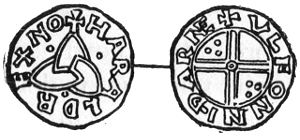
CHAPTER V THE PRELIMINARIES OF THE CONQUEST AND THE BATTLE OF HASTINGS
180
The spring and summer of 1066 must have
been a time of restless activity on the part
of William and of those who were associated with
him in the preparations for the great enterprise
of the autumn. The building of the fleet
was being pushed forward, and volunteers from
kindred states were continually arriving to be
incorporated in the Norman army; this much
we may infer from the fact that by August both
fleet and army were ready for the expedition,
but we know scarcely anything as to William’s
own movements in the interval. On the fifteenth
of June a council was held at Bonneville at which
Lanfranc was appointed abbot of William’s new
foundation of St. Stephen’s Caen, and three
days later Cicely, the eldest daughter of William
and Matilda, was formally dedicated to the religious
life at the consecration of her mother’s house,
the sister monastery of the Holy Trinity. The
motives which prompted the duke and duchess
to complete their religious undertakings were
widely felt among the Norman baronage. The
conquerors of England appear in a somewhat
unaccustomed light as we read the charters by
181which they gave or confirmed land, each to his
favoured monastery, “when Duke William was
setting out across the sea.” It was fully realised
that the enterprise might end in utter disaster;
the prudent abbot of Marmoutier, for
instance, in case of accidents, secured from Robert,
the heir of Normandy, at his father’s request,
a confirmation of all the grants which
the latter had made to the house during his
reign.[118]
The temporal affairs of Normandy were also
discreetly arranged at this time. Matilda was
appointed regent, and was supported by a council
presided over by Roger de Beaumont, a man of
age and experience, and a personal friend of the
duke. No doubt if William had perished in
England Robert would have succeeded him, but,
although he was now of sufficient age to make a
voluntary confirmation of his father’s grants of
land, he was clearly not old enough to undertake
the government of the duchy during an interregnum.
The fact that the expedition itself
provided employment for the great mass of the
fighting men of Normandy would promise a quiet
rule for Matilda and her advisers, nor indeed
do we hear of any disturbances taking place
in the duchy while William was across the
Channel.
Before the close of August the fleet was ready
182at last, and lay at the mouth of the Dive ready
to set sail at any moment.[119] The army also was
ready for embarkation, and the only thing which
was lacking to the expedition was a south wind
to carry the fleet to the Sussex coast. But for
six weeks at least that south wind refused to
blow, and every week of delay increased William’s
difficulties a hundredfold. Nothing could have
been more discouraging to an army of adventurers
than week after week of compulsory inaction;
and the fact that William was able to keep perfect
order, among a force part only of which owed
direct allegiance to him as feudal lord, suggests that
he possessed qualities of leadership which were
not very common among the captains of his day.
At more than one crisis in his life William had
already shown that he could possess his soul in
patience until the moment arrived at which it
was possible to strike, and he must have succeeded
in imparting something of this spirit to his troops
in their vigil by the Dive. In the more definite
work of commissariat we know that he proved
himself a master; for no shortage of provisions
was felt at any time during the unexpected delay,
and few eleventh-century armies could have remained
for a month in the same quarters without
being driven to find their own means of subsistence
in plunder. William’s biographer was justified
in remarking on the fact that the unarmed folk
of the neighbourhood could pass to and fro without
183trembling when they saw a body of soldiers;[120] and
before the task of provisioning the army by
regular means had become an impossibility, a
west wind served to carry the fleet to a point
which offered a shorter passage across into England
than that which was presented by its original
station on the Dive.
Within the county of Ponthieu, which had
become a member of the Norman group of vassal
states when Count Guy became William’s “man”
after the battle of Mortemer, the estuary of the
Somme supplied an excellent natural harbour
beneath the town of Saint Valery. The passage
from the mouth of the Dive seems to have been
accomplished without incident, and William and
his forces took possession of their new quarters
on the twelfth day of September. For more than
a fortnight the situation did not seem to have
improved in any way; the wind which was carrying
Harold Hardrada down the coast of Yorkshire
kept William locked in the mouth of the Somme.
The weather was cold and squally and we have
a contemporary description of the way in which
William kept watching the weathercock on the
church tower and of his joy if for a moment the
gale drove it to point northward.[121] The strain of
suspense was now beginning to tell upon the
army:
“The common soldiers, as frequently happens, began
184to murmur in their tents that the man must be mad
to wish to conquer a foreign country, that his father
had proposed to do the same and had been baffled
in the same way, that it was the destiny of the family
to try for things beyond their reach and to find God
for their enemy.”[122]
It was clearly necessary to do something to relieve
the prevailing tension, and the expedient
chosen was characteristic of the time; the relics
of the patron saint of the town were brought with
great solemnity out of the church, and the casket
which contained them was exhibited to receive
the prayers and offerings of the duke and his army.
The result was a convincing proof of the virtue
of the bones of St. Valery; without further delay
the south wind blew.[123]
The same day saw the embarkation of the
Norman army, the work being carried through
as quickly as possible in evident fear that the wind
might slip round again to its former quarter.
Night was falling before all was ready, and before
the duke, after a final visit to the church of St.
Valery, had given his last orders on the Norman
shore. It was important that the fleet should
be prevented from scattering in the darkness, so
each vessel was ordered to carry a light, a lantern
of special power adorning the masthead of the
duke’s own ship. With the same object it was
directed that the fleet should anchor as soon as
185it was clear of the estuary of the Somme, and
await further orders. Through the dead of night
the fleet hung outside the harbour, and it was still
dark when the expedition ventured out at last
into the open waters of the Channel. The great
body of the ships, each of which carried a heavy
load of horses in addition to its freight of men-at-arms,
was inevitably outstripped by the unimpeded
galley which bore William to his
destiny; and when the dawn began to break, the
duke found himself out of sight of the rest of the
fleet, and not yet within view of the English
shore. In these circumstances William cast
anchor and breakfasted “as it had been in his
own hall,” says one of his companions; and,
under the influence of the wine with which the
Mora was well supplied, his spirits rose, the prospects
of his enterprise seemed golden in the
morning light, and he spoke words of encouragement
to his companions. And at last the sailors
reported that the rest of the fleet began to come
in sight; the four ships which first appeared
together upon the horizon grew more and more
until the man on the look-out could be made by
our imaginative informant to remark that the
masts of the fleet showed like a forest upon the
sea.[124] Then the duke weighed anchor for the last
time, and the south wind still holding carried him
and his fleet into Pevensey bay at nine in the
morning; the day being St. Michael’s Eve—by
186an appropriate chance, for the archangel was
highly honoured in the Norman land.
William’s landing was entirely undisputed; the
good luck which, as we have noticed, waited on
his expedition in its diplomatic antecedents,
attended its military details also. During the
summer months, Harold, making what use he
could of the antiquated military system of England,
had called out the fyrd, and lined the south
coast with troops, which, however helpless they
might be in a pitched battle with the Norman
chivalry, might have brought considerable inconvenience
to William, if they had been in evidence
at the moment of his landing. From May to
September the Sussex coast in general, Hastings
and Pevensey in particular, were guarded by the
rural forces of the shire.[125] At last, about the time
when William was moving from the Dive to St.
Valery, the patience and provisions of the fyrd
gave out together; the rustics had been kept
away from their homes for four times the customary
period of service without anything happening,
and they refused to stay on guard any
longer. They probably would not have made
any difference to the ultimate result in any case,
nor need we blame Harold for being unable to
keep them together; but the fact is another
illustration of the hopeless inefficiency of the old
English state. And then, one week before William’s
landing, Harold had gathered the whole
187of such professional soldiers as England contained,
and had spent them in the life-and-death struggle
at Stamfordbridge. Harold Hardrada had fallen,
but his overthrow had gone far to exhaust the
military resources of England, and it was a
shattered, if victorious, army which was resting
with Harold Godwinson, at York, when a fugitive
from Sussex arrived to tell that William
of Normandy had landed, and that the south lay
at his mercy.
William’s first movements in England were
very deliberate. His immediate care was to
fortify his position at Pevensey and so protect
his fleet against surprise. At Pevensey, as
afterwards at Lincoln, a line of Roman walling
could be turned to account in the construction of
a castle,[126] which was run up in the course of the
day; and having thus, like his Scandinavian
ancestors, secured for himself a base of operations
if events turned out ill, William marched to
Hastings, which was to be his base of operations
for the rest of the campaign.[127] At Hastings, therefore,
another castle was thrown up, the building,
like nearly all the castles built during the twenty
years which followed the Conquest, consisting
merely of a mound, with wooden defences on the
top and a ditch and one or more outer works
188below. Hastings is a point of departure for many
roads; a fact which no doubt very largely accounts
for William’s choice of the town as his headquarters;
for it could easily be provisioned by supplies
from the neighbouring country, and it lay very
conveniently as a base for an attack on London.
The men of east Sussex were not long before
they felt the pressure of the invading army. Most
of the villages in the neighbourhood of Hastings
are recorded in Domesday to have been “waste”
at some period between the death of King Edward
and 1066, and the connection between these
signs of ravage and William’s camp at Hastings
is sufficiently obvious. But it is not probable
that William attempted any systematic harrying
of this district such as that which three years
afterwards he carried out with grim success in
the country beyond the Humber; the Sussex
villages, as a rule, had quite recovered their
former prosperity by the date of the great survey.
The passage of foraging parties over the land
demanding provisions, which would be none too
readily granted, and the other incidents of a
medieval war of invasion, are enough to account
for depreciation of the kind recorded. Harold
himself, as he drew towards Hastings, left traces
of his march in similar cases of temporary devastation,
and there is no reason to suppose that William
undertook a deliberate harrying of Sussex in order
to provoke Harold to a general engagement.[128]
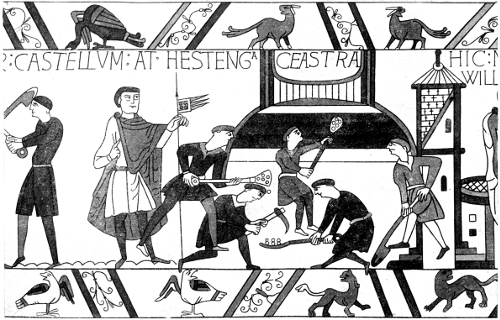
THE BUILDING OF HASTINGS CASTLE FROM THE BAYEUX TAPESTRY
189William, indeed, as yet can hardly have known
the result of Stamfordbridge with any degree of
certainty. Rumours of the great battle in the
north would no doubt gradually filter down into
Sussex during the week following the event, but
for some days after his arrival at Hastings William
cannot have ignored the possibility that it
might be a Norwegian host which would ultimately
appear upon the edge of the downs.
Definite news, however, at some unspecified date,
was brought to William by a message from an
unexpected quarter.[129] Robert, the son of Wymarc,
a Breton knight, who in some unknown way
could claim kindred with both William and
Edward, had been “staller” or master of the horse
to the latter, and had stood together with Harold
and Stigand by the king’s deathbed. Whether he
had actually been present at the battle of Stamfordbridge
is uncertain; but shortly after the
fight he sent a messenger to William to advise a
speedy withdrawal to Normandy before something
worse happened to him. The message ran that
Harold had destroyed the huge forces of the king
of Norway, himself the bravest man in the world,
and that now, inspired by victory, he was turning
upon the duke with a great and enthusiastic
army. Rather unwisely Robert went on to add
that the Normans were no match for the English,
either in numbers or bravery, and that William,
who had always shown himself discreet hitherto,
190would do well to retire at once, or at all events to
keep within his fortifications and avoid a battle
in the open field. To this well-meaning person
William replied that his one desire was to come
to blows with Harold, that although Robert’s
advice might have been better expressed yet he
thanked him for it, and that if he had with him
but ten thousand instead of sixty thousand men[130]
he would never retire without wreaking vengeance
on his enemy. It is not unlikely that Robert’s
message was really inspired by Harold himself,
and from one or two turns of expression in William’s
reply we may perhaps gather that he
suspected as much; although it might be thought
that Harold, who had seen something of his rival
in past years, cannot have had much hope of
getting rid of him by mere intimidation. However
this may be, it is interesting to find Robert, a
prominent member of a class which has suffered
much abuse because of an assumed lack of patriotism
towards its adopted country, playing a
part which so admirably saves his duty to his
king and his kinsman alike.
We have two poetical accounts of the way in
which the news of William’s landing was brought
to Harold at York. Wace, the Norman poet of
the twelfth century, tells how a Sussex “chevalier”
heard the shouting of the “peasants and villeins”
as the fleet drew in to the shore, and how, attracted
191by the noise, he came out, hid behind a hill and
lay there until the work of disembarkation was
over and the castle at Pevensey thrown up; then
riding off with lance and sword, night and day,
to York, to tell the king the news of what he had
seen.[131] Guy, bishop of Amiens, who wrote within
a short time of the event, makes the news of the
Norman arrival be borne by a rustic from Hastings,
not Pevensey; and the details which are told to
Harold relate to the devastation caused by the
invaders near Hastings, not to the landing itself.[132]
Perhaps these two stories are not quite incompatible
with each other; but we need not attempt
to reconcile them here, in view of the undoubted
fact that Harold was informed of William’s landing
within some three days of the event.
At this crisis Harold acted with astonishing
energy. Taking with him his faithful huscarles,
a body sadly thinned by the battle of a few days
before, he hurried southwards by way of Tadcaster,
Lincoln, Stamford, and Huntingdon, the
same route which in the reverse direction he had
followed in the previous week; now as then drawing
into his force the fyrd of the shires through which
he passed. Edwin and Morcar were directed to
raise the levies of their respective earldoms,
and in their expected absence the government
192of the north was entrusted to Marleswegen, the
sheriff of Lincolnshire,[133] an Englishman who remains
little more than a name in the narrative
of the Conquest, but who, if Harold had triumphed
at Hastings might probably have played an
important part in the history of the following
years. How far Harold really believed in the
fidelity of the northern earls is uncertain; they
had shown no overt signs of disaffection during
the last months since he had married their sister.
On the other hand, considering the long-standing
rivalry between his house and theirs, and their
probable share in the Northumbrian difficulties
at the beginning of his reign, Harold was perhaps
not altogether surprised that Edwin and Morcar,
in the words of Florence of Worcester, “withdrew
themselves and their men from the conflict.”
With the best intentions they would have found
it difficult to join him in time for the battle;
it would not have been easy for them to raise the
fyrd from all the shires between the Humber and
the Tweed on the one part and between the fens and
the Severn on the other, and to bring the troops to
London within the five days which Harold spent
there. For on October 11th,[134] a fortnight after the
battle of Stamfordbridge, Harold set out from London
on his last march towards the Sussex downs.
193It is an interesting, but not very profitable,
speculation how far Harold was justified in
staking his all upon the result of a single battle
with the invader. With our knowledge of what
happened it is natural to condemn him; he was
condemned by the general opinion of the historians
of the next generation, and very possibly their
sentence is right. On the other hand we cannot
but feel that we know very little of the real facts
of the case; even the essential question of the
relative numbers of the English and Norman
armies cannot be answered with any degree of
accuracy. It may be argued with much plausibility
that the wisest course for Harold would have
been to let William work his will upon the unfortunate
inhabitants of Sussex, trusting to time
and the national feeling likely to be aroused by
the ravages of an invader to bring an overwhelming
superiority in numbers over to his side. This,
we may be sure, would have been the course
taken by William himself in such a case, but
Harold was probably by nature incapable of
playing a waiting game of this kind. His ability,
so far as we can tell, lay in sudden assaults and
surprises; the more deliberate processes of generalship
were foreign to his temperament. And then
there remains the fact that the loyalty of Mercia
and Northumbria was at least doubtful; delay
on Harold’s part might only mean that Edwin
and Morcar with their forces would have time
to come over effectively to William’s side, while
194another great victory so soon after Stamfordbridge
would have placed Harold in a position from
which, for the time being, he could defy all rivals.
At any rate he took the step, and paid the penalty
of failure.
But, whatever we may think of the general
wisdom of Harold’s strategy, it is impossible to
deny that he showed a general’s appreciation of
the tactical possibilities of the ground on which
he chose to put the fate of England to the test.
After a forced march through the thick woods
which at that time covered the Sussex downs,
the king halted his army on a barren ridge of
ground seven miles north-east of the town of
Hastings. It is plain from all the narratives
of the forthcoming encounter that the ridge in
question was quite unoccupied at the time of the
battle; and when the English chroniclers wish to
describe its site they can only tell us that Harold and
William came together “by the hoar apple-tree.”[135]
The strength of the position was determined, not
so much by the general elevation of the ground,
which at no point reaches a greater height than
300 feet above sea level, as by the fact that it was
surrounded by country very hilly and much
broken by streams, and that its physical features
lent natural support to the disposition of an army
which relied for success on its capacity for stolid
resistance. The position was undoubtedly chosen
195by Harold with the object of forcing his enemy
to an immediate battle; for William could not
move either east or west from Hastings without
exposing his base to an English attack; and
Harold, who knew that the main strength of a
Norman army lay in its troops of mailed horsemen,
had been careful to offer battle on a site in
which the cavalry arm would be placed by the
ground at a natural disadvantage.[136]
From the nature of the case it has come about
that we possess very little information either as
to the numbers of the English army or as to the
details of its formation on the day of battle. The
Norman writers, on whom we are compelled to
rely, have naturally exaggerated the former, nor
did any survivor from the English army describe
the order of its battle array to the chroniclers
of Worcester or Peterborough. In recent studies
196of the great battle there is manifested a strong
unwillingness to allow to either the English or the
Norman host more than a small proportion of the
numbers which used to be assigned to it thirty
years ago.[137] It is very improbable that William
led more than 6000 men into action on October
15, 1066, and there is good reason for doubting
whether the knightly portion of his army can
have exceeded 5000. Small as this last number
may appear, every man included in it was an
efficient combatant; but the English force was
largely composed of rustics impressed from the
shires through which Harold had rushed on his
great march from York to London after the battle
of Stamfordbridge, and even so, it is far
from certain that the native force was materially
stronger than the army of invasion. With regard
to its distribution, we know that the English line
of battle seemed convex to the Normans on their
approach from the south-east,[138] and it is probable
that it ran for some 800 yards along the hill of
battle, the flanks being thrown well back so as to
rest upon the steep bank which bounds the ridge
towards the north. It is certain that the English
troops were drawn up in extremely close order,
and it is a natural assumption that Harold would
place the kernel of his army, the huscarles who
197had survived Stamfordbridge, in the front rank;
stationing his inferior troops in the rear so as to
support the huscarles in resisting the impact of the
Norman cavalry.[139] On the highest point of the
whole line, a spot now marked by the high altar
of the Abbey church of Battle, Harold planted
his standard; and it was round the standard that
the fight was most stoutly contested, and that,
after seven hours of struggle, the king at last fell.
In speaking of the generalship displayed by
Harold’s rival on this occasion, it is important
to beware of the associations aroused by modern
military terminology. At least if we speak of
him as a strategist or tactician, we should be
careful to remember that strategy and tactics
themselves had attained to but a rudimentary
stage of development in Northern Europe in the
eleventh century. Recent studies of the battle
of Hastings, the one fight of the period in regard
to which we possess a considerable amount of
detailed information, have brought out the fact
that William’s host was far too stiff and unwieldy
a body to perform the complicated evolutions by
which it used to be assumed that the day was
198won.[140] We should be committing a grave error
if we were to suppose that the Norman army
possessed that mobility and capacity for concerted
action among its several divisions which
belonged to the forces led by Turenne or Marlborough.
Feudal battles were determined more
by the event of simple collisions of large masses
of men than by their manœuvres when in the
field: the skill of a great feudal captain lay
chiefly in his ability to choose his ground so as to
give his side the preliminary advantage in the
shock of battle; apart from the example of his
personal valour he had but little influence upon
the subsequent fortunes of the day. On the
present occasion William was compelled to fight
on the ground of his opponent’s choice; and this
initial disadvantage cost the Norman leader an
indefinite number of his best troops, and, even
after the issue of the battle had been decided,
protracted the English resistance until nightfall
had put an end to the struggle. On the other hand,
there was one fatal weakness in the English host
which must have been recognised by the other
side already before the fight had begun. The
fact that Harold, for all effective purposes, was
totally unprovided with either archers or cavalry
exposed his army to a method of attack which he
199was quite unable to parry, and the arrangement
of the Norman line of battle shows that William
from the first relied for success on this advantage.
The battle of Hastings was won by the combination
of archery and cavalry against infantry whose
one chance of success lay in the possibility that
it might keep its formation unbroken until the
strength of the offensive had been exhausted.[141]
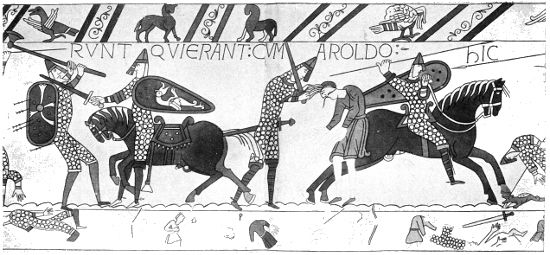
THE DEATH OF HAROLD
(FROM THE BAYEUX TAPESTRY)]
In the early morning of the 14th of October
the Norman army moved out of Hastings
and advanced across the seven miles of broken
country which lay between the English army and
the sea. The march must have been a toilsome
business, and the rapidity with which it was
accomplished is remarkable.[142] At the point
marked by the modern village of Telham, the
road from Hastings to Battle passes over a hill
which rises to some 350 feet above sea-level, and
commands a view of the English position. On
the far side of this hill it is probable that William
halted, waited for his scattered troops to come
together, and then drew them out in order of
battle. In his first line he placed his light-armed
infantry, who probably formed a very inconsiderable
portion of his army, and were unprovided
with defensive harness. To these inferior troops
succeeded infantry of a higher class, protected
200by armour, but, like the light-armed skirmishers
in the front rank, armed only with bows and
arrows and slings. The function of the infantry
in the coming encounter was to harass the English
with their missiles and tempt them to break their
ranks. Lastly came the main body of the Norman
army, the squadrons of cavalry, on whom it rested
to attack the English line after it had been shaken
by the missiles of the previous ranks.[143] The whole
army was further arranged in three great divisions,
the native Normans composing the centre, the
Bretons, under the command of Alan, son of
Count Éon of Penthievre, forming the left wing, and
the French volunteers the right.[144] In the centre
of the whole line of advance, the Norman counterpart
of the English standard, there was borne
the consecrated banner which William had received
from the pope.[145]
So quickly had the march from Hastings been
made that the actual fighting was opened at about
nine in the morning[146] by an advance of the Norman
foot. Galled by a heavy fire from the archers,
which could only be answered very ineffectively
by the spears and stones which were almost the
sole missile weapons of the English, numbers of
the native troops broke away from their line, in
201defiance of the strict orders issued by Harold to
the effect that no man should leave his post. In
the meantime, the Norman cavalry had been
steadily making its way to the front in order to
take immediate advantage of the disorder caused
in the English ranks by the fire of the archers.
But the knights could only move their horses
slowly up the hill; the solidity of the English
formation had not been seriously affected as yet,
and the cavalry were compelled to attack an
unbroken line. The result was disaster. The
Breton auxiliaries on the left fell back, the confusion
spread rapidly, and the English, seizing
their advantage, sallied forth and drove the
entire Norman line before them in headlong flight
down the hill.[147] Fortunately William had not
joined in this first attack in person, and when in
their panic the Normans believed that their
leader had fallen, they were soon recalled to their
senses by the sight of the duke with bared head,
laying about him with his spear, and shouting
words of reproof and encouragement.[148] Mounted
as they were, the flying knights could have but
little difficulty in outstripping their pursuers, but,
if we may trust the Bayeux tapestry, a number
of English and Normans perished together in the
course of the flight, by falling into a deep depression
202in the ground situated somewhere between
the base of the hill and the duke’s post. According
to the same authority, the bishop of Bayeux
did good service at this moment, restoring order
among the baggage-carriers and camp-followers,
who were apparently becoming infected with the
panic which had seized their masters.[149] Between
the duke and his brother, the flight was checked,
and then the knights, eager to avenge their disgrace,
rallied, turned, and cut off their pursuers
from their comrades on the hill, making a wholesale
slaughter of them.[150] Mainly through William’s
self-possession the Norman rout had ended after
all in a distinct success gained for his side.
As soon as the cavalry had re-formed, the attack
on the English position was resumed; this time
under the immediate leadership of the duke. The
struggle at the foot of the hill had given its
defenders time to close their ranks, and the
English continued to present an impenetrable
front to the Norman cavalry. All along the line
a desperate struggle raged for some hours, but of
its details no tale can be told, although it is
probable that it was at this point in the battle
that Gyrth and Leofwine, Harold’s brothers, fell,
and there is good reason for believing that the
former was struck down by the hand of the duke
himself. William, indeed, in all our authorities
203is represented as the life and soul of the attack,
“more often calling to his men to come on than
bidding them advance” says William of Poitiers;
he had three horses killed under him before the
day was over, and he did all that might be done
by a feudal captain to keep his troops together
and to inspire them by his example. But notwithstanding
his exertions it is evident that the
English were more than holding their own,[151] and
a second repulse suffered thus late in the day by
the Norman cavalry would almost certainly have
passed into a rout of the whole army. At this
crisis it occurred to some cunning brain, whether
that of the duke or another, that it might be
possible by feigning flight to tempt the English
troops to break their formation, and then, by
turning on suitable ground, to repeat the success
which had ended the real flight in the forenoon.
The movement was easily carried out; a body of
Normans rode away, and a crowd of Englishmen,
regardless of everything except the relief from
the immediate strain of keeping their ranks,
hurled themselves down the hill shouting curses
and cries of victory. No discipline could have
been kept under the circumstances, and when
the galloping knights suddenly spread out their
line, wheeled around their horses, and surrounded
the disordered mob of their pursuers
204the latter were ridden down and cut to pieces
by scores.[152]
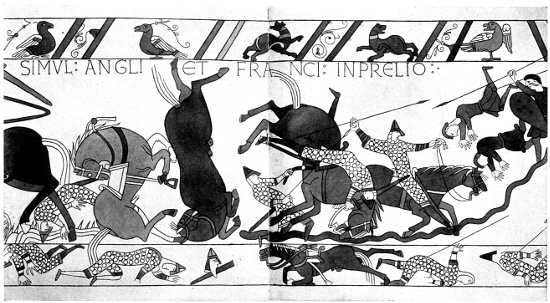
FOSSE DISASTER, BATTLE OF HASTINGS
FROM THE BAYEUX TAPESTRY
It is, of course, impossible to estimate the
actual extent of the loss which the English sustained
in the episode of the feigned flight, but
there can be little doubt that its success marks
the turning-point in the fortune of the day. No
incident in the great battle made a deeper impression
upon the historians who have described
it for us, and the tale of the feigned flight is told in
different narratives with great variety of circumstance
and detail. But from the writers who lived
nearest to the time we may infer with tolerable
certainty that the manœuvre in question was a
sudden expedient, devised and acted upon without
previous organisation, and also that it was a
simple, not a combined movement. The whole
business of decoying the English from the hill,
turning upon, and then surrounding them, was the
work of one and the same body of knights. On
the other hand, it is probably incorrect to speak
of the feigned flight in the singular, for our best
authority distinctly asserts that the same stratagem
was used twice[153]; fighting was going on along a
front of at least half a mile in length, and different
sections of the Norman army may very well have
carried out the movement at different times,
205and in complete independence of each other.
However this may be, the effect of the manœuvre
was soon apparent. The English line, though
shrunken in numbers, closed its ranks and kept
its formation, wedged together so tightly that the
wounded could not fall behind to the rear, nor
even the dead bodies drop to the ground. But
the superior endurance of the Norman troops was
beginning to tell; the English were rapidly
losing heart,[154] and the consummation of William’s
victory only waited for the destruction of King
Harold, and of the warriors who fought with
him round the standard.
The attack which finally beat down the resistance
of the English line seems to have been delivered
from some point to the south-east of the
hill.[155] The battle had already continued for seven
or eight hours, and twilight was beginning to fall,[156]
but its approach could only remind the shaken
remnant of the native host that the day was lost,
and the end of the great fight was now very near.
It was in the last confused struggle which raged
round the standard in the fading light that Harold
met his death; and then his companions, tired
out and hopeless of reinforcement, yielded the
ground they had defended for so long, and broke
away to the north-west along the neck of land
206which connects the hill of battle with the higher
ridges of the downs beyond it. The victors
followed in hot pursuit; but a strange chance
gave to Harold, in the very hour of his death,
a signal revenge over the men at whose hands he
had just fallen. A little to the west of the original
position of the English army one of the head-waters
of the Asten had cut a deep ravine, of
which the eastern face was so steep as to be a
veritable trap for any incautious horsemen who
might attempt to ride down it. In the gathering
darkness knight after knight, galloping after the
English fugitives in secure ignorance of the ground,
crashed down into this gully; and the name
Malfosse, borne throughout the Middle Ages by the
ravine in question, bears witness to the extent of
the disaster which the victorious army suffered
at this point.[157] Harold, after he had lost life and
kingdom, was still justified of the ground which
he had chosen as the place of battle.
Late in the night William returned to the
battlefield and pitched his tent there. There
could be no doubt that he had gained an unequivocal
victory; his rival was dead, the native army
annihilated; he could well afford to give his
troops the rest they needed. The early part of
the following day was spent in the burial of the
Norman dead; the work being carried out under
the duke’s immediate care. The English folk
of the neighbourhood soon came in numbers to
207the battlefield and begged for the bodies of their
fallen kinsfolk, which they were allowed to carry
away for burial; but the unclaimed corpses were
left strewn about the hill. Before long the bodies
of Harold, Gyrth and Leofwine were found lying
close together; but Harold’s corpse had been
horribly mangled, and, according to the later
romantic story, it was only identified by means
of certain marks upon the body which were known
and recognised by the dead man’s mistress,
Edith the Swan-necked. Towards the close of
the morrow of the battle, William returned to
his castle at Hastings, bearing Harold’s body with
him for burial upon the shore in unconsecrated
ground as befitted an excommunicate, and an
urgent message from Gytha, Godwine’s widow,
offering for her son’s body its weight in gold,
did nothing to shake his purpose.[158] With characteristic
irony William remarked that it was
but fitting that Harold in death should be appointed
guardian of the shore and sea, which he
had tried to defend in life; and the dead king’s
body, wrapped in a purple robe, was laid out of
sight somewhere among the rocks along the shore
of Hastings bay. Later tradition indeed asserted
that Harold before long was translated from this
unhallowed grave to a tomb in the minster of
the Holy Cross at Waltham, which he had founded
three years before[159]; but the authority on which
208this story depends is none of the best, and, for all
that we really know to the contrary, the last native
king of England is still the guardian of the Sussex
shore.
Harold, above all kings in English history
with the possible exceptions of Richard III. and
Charles I., was happy in the circumstances of his
death. He gained thereby an immediate release
from the performance of an impossible task, and
he was enabled to redeem the personal ambitions
which governed his past life by associating them
in the moment of his fall with the cause of the
national independence of England. It has been
possible for historians to regret the outcome of
the battle of Hastings only because it overthrew
Harold before he could prove the hopelessness
of the position in which he had placed himself.
What chance had he, a man of uncertain ancestry
and questionable antecedents, of completing the
work which had overcome every king before him:
the work of reconciling the antagonism of north
to south, of making the royal word supreme in
the royal council, of making the provincial
nobility of England and its dependents the
subjects of the king and of the king only? It may
well be that such a task would have proved
beyond the power of any native king, though
descended from the immemorial line of Cerdic;
how could it be completed by an ambitious earl,
209invested indeed with the royal authority, but
crippled in its exercise by the bitter rivalry of
men who had formerly been his fellow-subjects;
whose birth was more noble, whose wealth was
scarcely less, who, in opposition to his rule, could
rely upon endless reserves of local patriotism,
the one source of political strength which the
land contained? To genius, indeed, all things
are possible, but to ascribe genius to this commonplace,
middle-aged earl would be to do sheer
violence to the meaning of words. Harold will
always hold a noble place in the record of English
history; but he owes that place solely to the
events of his last month of life, when the terrible
necessity of straining every faculty he possessed
in the support of his trembling throne roused in
him a quickness of perception and a rapidity of
action which his uneventful career as earl of Wessex
could never have called into being. Harold was
undoubtedly the best captain that England had
seen since the death of Edmund Ironside, just
fifty years before the battle of Hastings; but
the work which Harold had undertaken would
have called for quite other powers than those
which he revealed so unexpectedly on the eve
of his death. William the Conqueror, endowed
as he was by nature with the faculties of a great
ruler to an extent perhaps without parallel in
English history; superior by the fact that he came
in by conquest to all the local jealousies which
distracted Anglo-Saxon politics; and with unique
210opportunities of recasting the social and tenurial
features of English life; could only create a strong
and uniform government in England after three
years of almost incessant war, the reduction of a
third of England to a wilderness, and the remodelling
in principle of the whole fabric of the English
administration, civil and military. When it is
remembered that the resistance to William was
made essentially on grounds not of national feeling,
but of local particularism, and that these
forces would undoubtedly have conspired against
Harold as they afterwards conspired against
his rival, we can only conclude that fate was kind
which slew Harold in the heat of battle in a noble
cause, instead of condemning him to witness the
disintegration of his kingdom, in virtual impotence,
varied only by spasmodic outbreaks of barren
civil war.
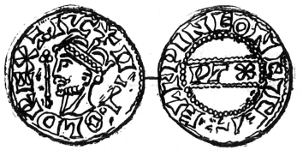
CHAPTER VI FROM HASTINGS TO YORK
211
Catastrophic as the battle of Hastings
seems to us now, in view of the later history,
its decisive character was not recognised at once
by the national party. The very incoherence of
the Anglo-Saxon polity brought a specious advantage
to the national cause, in that the defeat
of one part of the nation by an invader left
the rest of the country comparatively unaffected
by the fact. The wars of Edmund Ironside and
Cnut, fifty years before, show us groups of shires
one after the other making isolated attempts to
check the progress of the enemy, and few men
could already have realised that the advent of
William of Normandy meant the introduction of
new processes of warfare which would render
hopeless the casual methods of Anglo-Saxon
generalship. Neither side, in fact, understood
the other. William, on his part expecting that the
total overthrow of the English king with his
army would imply the immediate submission
of the whole land, took up his quarters at Hastings
on the day after the battle to receive the homage
of all those Englishmen who might come in person
to accept him as their lord. The passage of five
days without a single surrender taught him that
212the fruits of victory would not fall into his hands
without further shaking, and meanwhile the
English nobility began to form plans for a continued
resistance to his pretensions in the name
of another national king.
Who that king should be was the first question
which demanded settlement. There was no hope
of preserving the English crown in the house of
Godwine: the events of the past three weeks had
been fatal to all the surviving sons of the old earl,
with the exception of Wulfnoth the youngest, and
he was most likely a prisoner or hostage in Normandy.[160]
Harold’s one legitimate son was most
probably as yet unborn; he had at least three
illegitimate sons of sufficient age, but their candidature,
if any one had suggested it, would certainly
have been inacceptable to the churchmen
on whom it rested to give ultimate sanction to any
choice which might be made. Two alternatives
remained: either a return might be made to the
old West Saxon line in the person of Edgar the
Etheling, or a new dynasty might be started again
by the election of Edwin or Morcar. The one
advantage which the former possessed, now as
earlier in the year, was the fact that his election
would not outrage the local particularism of any
part of the country; it might not be impossible
213for Wessex, Mercia, and Northumbria to unite
round him in a common cause. Nor was it unnatural
that in this hour of crushing disaster men’s
minds should involuntarily turn to the last male
heir of their ancient kings. Apart from these
considerations, there was something to be said in
favour of the choice of one of the northern earls.
It must have been clear that Mercia and Northumbria
would have to bear the brunt of any
resistance which might subsequently be made to
the invader, whose troops were already occupying
the eastern shires of the earldom of Wessex, and
who would be certain before long to strike a blow
at London itself. But the success of Harold’s
reign had not been such as to invite a repetition
of the experiment of his election. Edgar the
Etheling was chosen king, and the two brother
earls withdrew to Northumbria, imagining in
their own minds, says William of Malmesbury,
that William would never come thither.[161]
This motive gives an interest to their withdrawal
which is lost if we regard it as a mere act of treachery
to the national cause. There can be little
doubt that what Edwin and Morcar intended
was a partition of the kingdom between themselves
and William, and it is at least questionable
whether such a plan had not a better prospect of
success than an attempt to recover the whole land
for a king who had no personal qualities of
leadership, and who could never hope to attach
214to himself any of that local sentiment in which
lay the only real strength of the national party.
The idea of a divided kingdom was by no means
chimerical. Old men still living could remember
the partition made by the treaty of Alney between
Edmund Ironside and Cnut, and it was not a
sign of utter folly for any man to suppose, within
a week of the battle of Hastings, that William,
having settled his score with Harold, might
content himself with his rival’s patrimonial
earldom of Wessex, leaving the north of England
to its existing rulers. No one at this date could
be expected to understand the extent to which
William’s political ideas differed from those of
Cnut; nor need we suppose that Edwin and Morcar
were mistaken as to the reality, though they may
have overestimated the military value, of the
feeling for local independence in their two great
earldoms. In the case of Northumbria, indeed,
even after William’s presence had been felt in
every part of the land, so acute an observer as
Archbishop Lanfranc insisted on the subordination
of the see of York to that of Canterbury on the
ground that an independent archbishop of York
might canonically consecrate an independent
king of the Northumbrians.[162] What was lacking
to the plan was not local separatism, but the
skill and consistency of purpose which alone could
turn it to account. Neither the ignominious
215failure of Edwin and Morcar, on the one hand, nor
the grandiose phrases of chancery clerks about
the “Empire of Britain,” on the other, should
blind us to the fact that England was united only
in name until the strong rule of its Norman
lords had made the king’s word as truly law in
Yorkshire as in Middlesex.
While the English leaders were disposing of
their crown William was pursuing his deliberate
course towards London by a route roughly parallel
with the coast of Kent and Sussex. His delay
at Hastings had not been time wasted; it allowed
his troops to recover from the strain and excitement
of the great battle, and it gave him the opportunity
of receiving badly needed reinforcements
from Normandy. On the 20th of October, six
days after the battle, the second stage of the
conquest began; William, with the main body
of his army, moved out of Hastings, leaving a
garrison in the newly built castle, and marched
across the border of Kent to Romney. The men
of the latter place had cut off a body of Norman
soldiers who had landed there by mistake before
the battle of Hastings; and the most famous
sentence written by the Conqueror’s first biographer
relates how William at Romney “took
what vengeance he would for the death of his
men.”[163] Having thus suggested by example the
impolicy of resistance, a march of fifteen miles
between the Kentish downs and the sea brought
216William to the greatest port and strongest fortress
in south England, the harbour and castle of
Dover. The foundation of the castle had probably
been the work of Harold while earl of Wessex,
and, standing on the very edge of the famous
cliffs overhanging the sea, the fortress occupied
a site which to Englishmen seemed impregnable,
and which was regarded as very formidable by
the Norman witnesses of this campaign.[164] The
castle was packed with fugitives from the surrounding
country, but its garrison did not wait
for a formal demand for its surrender. Very probably
impressed by what had happened on the previous
day at Romney, they met William half way
with the keys of the castle, and the surrender was
duly completed when the army arrived at Dover.
It was William’s interest and intention to treat a
town which had submitted so readily as lightly as
possible, but the soldiers, possibly suspecting that
the booty of the rich seaport was to be withheld
from them, got out of hand for once, and the
town was set on fire. William attempted to make
good the damage to the citizens, but found it
impossible to punish the offenders as he wished,
and ended by expelling a number of Englishmen
from their houses, and placing members of his
army in their stead.[165] Eight days were spent at
Dover, during which the fortifications of the
castle were brought up to an improved standard,
and then William set out again “thoroughly to
217crush those whom he had conquered.” But before
his departure he appointed the castle as a hospital
for the invalided soldiers; for dysentery, which
was set down at the time to over-indulgence in
fresh meat and strange water, had played havoc
with the army.[166]
With the surrender of Dover William’s communications
with Normandy were firmly secured,
and he now struck out directly towards his
destined capital, along the Roman road which
then, as at every period of English history, formed
the main line of communication between London
and the Kentish ports. Canterbury was the first
place of importance on the way, and its citizens
followed the prudent example of the men of Dover.
Before William had gone far from Dover, the
Canterbury men sent messengers who swore
fealty to him, and gave hostages, and—an act
which was a more unequivocal recognition of his
title to the crown—brought him the customary
payment due yearly from the city to the king.
From this point, indeed, William had little reason
to complain of the paucity of surrenders; the
Kentishmen, we are told, crowded into his camp
and did homage “like flies settling on a wound.”[167]
But the even course of his success was suddenly
interrupted. On the last day of October, he took
up his quarters at a place vaguely described by
William of Poitiers as the “Broken Tower,”
and was there seized by a violent illness, which
218kept him for an entire month incapable of moving
from the neighbourhood of Canterbury. But, if
we can trust the chronology of our authorities, it
was during this enforced delay that William
received the submission of the capital of Wessex.
Winchester at this time had fallen somewhat from
its high estate under the West Saxon kings; along
with certain other towns it had been given by Edward
the Confessor to his wife Eadgyth as part of
her marriage settlement, and it was now little more
than the residence of the dowager queen. On
this account, we are told that William thought it
would be unbecoming in him to march and take
the town by force and arms, so he contented
himself with a polite request for fealty and “tribute.”
Eadgyth complacently enough agreed,
took counsel with the leading citizens, and added
her gifts to those which were brought to William
on behalf of the city.[168] This ready submission
was a fact of considerable importance. Winchester
lay off the track of an invader whose
objective was London, and apart from his illness
William could scarcely have afforded to part with
a detachment of his small army sufficiently large
to make certain the capture of the town. Yet
the old capital was a most ancient and honourable
city, containing the hall of the Saxon kings, in
219which probably were deposited the royal treasure
and regalia; and its surrender with the ostentatious
approval of King Edward’s widow was a
useful recognition of William’s claim to be the
true heir of the Saxon dynasty. In his dealings
with Winchester the Conqueror’s example
was followed by William Rufus, Henry I.,
and Stephen, though the paramount necessity
for them of seizing the royal hoard at
the critical moment of their disputed successions
made them each visit the royal city in
person.[169]
On his recovery, at or near the beginning of
December, William resumed his advance on
London. Doubtless Rochester made a peaceful
surrender, but we have no information as to this,
nor as to any further details of the long march until
it brought the Conqueror within striking distance
of London. London, it is plain, was prepared for
resistance; and the narrow passage of the bridge,
the only means of crossing the river at this point,
made the city virtually impregnable from the
south. William was not the man to waste valuable
troops in a series of hopeless assaults when
a less expensive method might prevail, and on
the present occasion he merely sent out a body
of five hundred knights to reconnoitre. A detachment
of the English was tempted thereby
to make a sally, but was driven back across the
bridge with heavy loss, Southwark was burned to
220the ground,[170] and William proceeded to repeat
the plan which had proved so successful in Maine
three years before. Abandoning all attempt to
take the city by storm, he struck off on a great loop
to the west, and his passage can be traced clearly
enough in Domesday Book by the devastation
from which a great part of Surrey and Berkshire
had not fully recovered twenty years afterwards.
The Thames was crossed at last at Wallingford,
and it was there that William received the submission
of the first Englishman of high rank who
realised that the national cause was doomed.
Stigand, the schismatic archbishop of Canterbury,
did homage and swore fealty, explicitly renouncing
his allegiance to Edgar the Etheling, in whose ill-starred
election he had played a leading part.[171]
The weakness of Stigand’s canonical position,
which was certain to be called in question if
William should ever be firmly seated on the throne,
made it advisable for him to make a bid for
favour by an exceptionally early submission,
and it was no less William’s policy graciously to
accept the homage of the man who was at least
the nominal head of the church in England. Probably
neither party was under any misapprehension
as to the other’s motives; but in being suffered
to enjoy his pluralities and appropriated church
221lands for three years longer Stigand was not unrewarded
for his abandonment of the national
cause at the critical moment.
The exact time and place at which the remaining
English leaders gave in their allegiance are rather
uncertain. There is some reason, in the distribution
of the lands which Domesday implies to have
undergone deliberate ravage about this time, to
suppose that, even when William was on the
London side of the Thames, he did not march
directly on the city, but continued to hold a
north-easterly course, not turning southwards
until he had spread destruction across mid-Buckinghamshire
and south-west Bedfordshire.
The next distinct episode in the process of conquest
occurred at a place called by the Worcester
Chronicle “Beorcham,” where allegiance was
sworn to William on a scale which proved that
now at last his deliberate policy had done its
intended work, and that the party of his rival
had fallen to pieces without daring to contest the
verdict given at Hastings in the open field. Edgar
the king-elect, and Archbishop Ealdred of York,
with the bishops of Worcester and Hereford, and
a number of the more important citizens of
London “with many others met him [William],
gave hostages, made their submission, and swore
fealty to him.” And William of Poitiers tells us
that when the army had just come in sight of
London the bishop and other magnates came
out, surrendered the city, and begged William
222to assume the crown, saying that they were
accustomed to obey a king, and that they wished
to have a king for their lord. One is naturally
tempted to combine these two episodes, but this
can only be done by abandoning the old identification
of “Beorcham” with Great Berkhampstead,
thirty miles from London, and by assuming
the surrender to have taken place when the army
appeared on the edge of the Hertfordshire Chilterns
overlooking the Thames Valley, fifteen
miles away, from the high ground of Little
Berkhampstead near Hertford.[172]
Whatever the exact place at which the offer
of the crown was made to William, it was straightway
submitted by him to the consideration of the
chiefs of his army. Two questions were laid
before them: whether it was wise for William
to allow himself to be crowned with his kingdom
still in a state of distraction, and—this last rather a
matter of personal feeling than of policy—whether
he should not wait until his wife could be crowned
along with him. Apart from these considerations,
the assumption of the English crown was a step
which concerned William’s own Normans scarcely
less intimately than his future English subjects.
The transformation of the duke of the Normans
223into the king of the English was a process which
possessed a vital interest for all those Normans
who were to become members of the English
state, and William could not well do less than
consult them on the eve of such a unique event.
As to the ultimate assumption of the crown by
William, no two opinions were possible: Hamon,
viscount of Thouars, an Aquitanian volunteer
of distinction, in voicing the sentiments of the
army, began by remarking that this was the one
object of the enterprise; but he went on to advocate
a speedy coronation on the ground that were
William once crowned king resistance to him
would be less likely undertaken and more easily
put down. With quite unintentional irony he
added that the wisest and most noble men of
England would surely never have chosen William
for their king, unless they had seen in him a
suitable ruler and one under whom their own
possessions and honours would probably be
increased. To guard against any wavering on
the part of these “prudentissimi et optimi viri,”
William immediately sent on a detachment to
take possession of London and to build a castle
in the city, while he himself, during the few days
which had to pass before the Christmas feast for
which he had fixed his coronation, devoted himself
to sport in the wooded country of south
Hertfordshire.[173]
Of the deliberations within London which led
224to this unconditional surrender on the part of the
national leaders, we know little with any certainty,
but it is not improbable that at some stage in his
great march William had entered into negotiations
with some of the chief men in the etheling’s
party. Our most strictly contemporary account
of these events[174] makes the final submission the
result of a series of messages exchanged between
the duke and a certain “Esegar” the Staller, on
whom as sheriff of London and Middlesex fell
the burden of providing for the defence of the
city. We are given to understand that William
sent privately to “Esegar” asking that he should
be recognised as king and promising to be guided
in all things by the latter’s advice. On receiving
the message Esegar decided, rather unwisely, as
the event proved, to try and deceive William;
so he called an assembly of the eldest citizens
and, laying the duke’s proposal before them,
suggested that he should pretend to agree with
it and thus gain time by making a false submission.
We are not told the exact words of the reply
which was actually sent, but we are informed
that William saw through the plan and contrived
to impress the messenger with his own greatness
and the certain futility of all resistance to him to
such an extent that the messenger on his return,
by simply relating his experiences, induced the
men of London to abandon the etheling’s cause
straightway. The tale reads rather like an
225improved version of some simpler negotiations,
but that is no reason for its complete rejection,
and we may not unreasonably believe that, in
addition to intimidating the city by his ravages
in the open country, William tried to accelerate
matters by tampering with some at least of those
who were holding his future capital against him.
On Christmas day William was crowned King of
England in Westminster Abbey by Archbishop
Ealdred of York, a clear intimation that Stigand’s
opportunist submission would not avail to restore
to him all the prerogatives of the primacy. The
ceremony was conducted with due regard, as it
would seem, to all the observances which had
usually attended the hallowing of the Anglo-Saxon
kings, only on the present occasion it was
necessary to ask the assembled people in French
as well as in English whether they would accept
William as their king. The archbishop of York
put the question in English, Geoffrey, bishop of
Coutances, that in French, and the men of both
races who were present in the Abbey gave
a vociferous assent. Unfortunately the uproar
within the church was misunderstood by the
guard of Norman horsemen who were stationed
outside, and they, imagining that the new subjects
of their duke were trying to cut him down
before the altar, sought to relieve his immediate
danger by setting fire to the wooden buildings
around,[175] and so creating a diversion. In this
226they were quite successful; amid indescribable
confusion the congregation rushed headlong out
of the church, some to save their own property,
and some to take advantage of so exceptional an
opportunity of unimpeded plunder. The duke
and the officiating clergy were left almost alone;
and in the deserted abbey William, quivering
with excitement,[176] became by the ritual of unction
and coronation the full and lawful successor of
Alfred and Athelstan. But before the crown was
placed upon his head the Conqueror swore in
ancient words, which must have sounded ironical
amid the noise and tumult, that he would protect
God’s churches and their rulers, would govern all
the people subjected to him with justice, would
decree and keep right law, and would quite forbid
all violence and unjust judgments.[177] And so the
seal of the Church was set upon the work which
had been in fact begun on that morning, three
months before, when William and his army disembarked
on the shore of Pevensey.
The disorder which had attended the coronation
was actually the result of a misapprehension on
the part of William’s own followers, but he evidently
felt that the possibility of a sudden rising
on the part of the rich and independent city was a
danger which should not be ignored. Accordingly,
to avoid all personal risk, while at the same time
keeping in close touch with his capital, William
227moved from London to Barking, and stayed there
while that most famous of all Norman fortresses,
the original “Tower of London,” was being built.
Most probably it was during this stay at Barking
that William received the homage of such leading
Englishmen as had not been present at the submission
on the Hertfordshire downs. In particular
Edwin and Morcar would seem to have recognised
the inevitable at this time[178]; the coronation of
William as king of all England by the metropolitan
of York may have taught them that a division
of the kingdom no longer lay within the range of
practical politics. At any rate William did not
think that it would be well for him to let them out
of his sight for a season, and within a few days
of the New Year they are found accompanying
him as hostages into Normandy.
Our sole knowledge of the general state of the
country at this most critical time comes from
certain scattered writs which can be proved to
have been issued during the few weeks immediately
following the coronation. The information which
they give is but scanty; they were of course not
intended to convey any historical information at
all, but they nevertheless help us to answer the
important question how much of England
had really submitted for the time to William’s
rule by the end of 1066, and they do this in two
ways. On the one hand, they were witnessed by
some of the more important men, English as
228well as Normans, who were present in William’s
court; on the other hand, we may safely acquit
William of the folly of sending his writs into
counties in which there was no probability that
they would be obeyed. Foremost among the
documents comes a writ referring to land on
the border of Wiltshire and Gloucestershire,
which shows us King William, like King Edward
before him, sending his orders to the native
authorities of the shire—in the present case the
bishops of Ramsbury and Worcester, and two
thegns named Eadric and Brihtric, with whom,
however, Count Eustace of Boulogne is significantly
associated.[179] From the other side of the
country comes a more famous document in which
William, “at the request of Abbot Brand,” grants
to the said abbot and his monks of Peterborough
the free and full possession of a number of lands
in Lincolnshire and Nottinghamshire. Leofric,
abbot of Peterborough, had been mortally wounded
at the battle of Hastings, and on his death the
monks had chosen their provost Brand as his
successor. He, not discerning the signs of the
times, had gone and received confirmation from
Edgar the Etheling, of whose inchoate reign this
is the only recorded event; and it required the
mediation of “many good men” and the payment
229of ten marks of gold to appease the wrath of
William at such an insult to his claim. The
present charter is the sign of William’s forgiveness,
but for us its special interest lies in the fact
that it shows us the king’s word already current
by the Trent and Humber, while the appearance
among its witnesses of “Marleswegen the sheriff”
shows that the man to whom Harold had entrusted
the command of the north did not see fit to continue
resistance to the new king of England.[180]
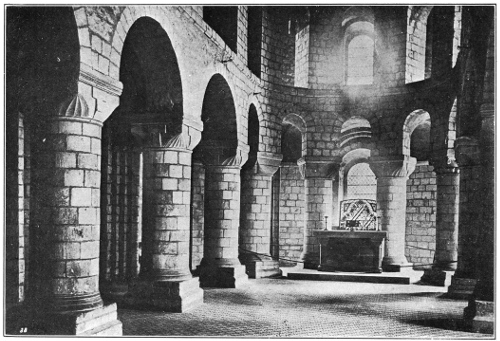
ST. JOHN’S CHAPEL, IN THE TOWER OF LONDON
Much more evidence, if we can trust it, pointing
in the same direction, can be derived from a
number of writs in English, which were apparently
granted at this time in favour of Westminster
Abbey.[181] Nothing could be more natural
than that William at this time should show
especial favour to the great religious house within
whose precincts he had so recently been crowned,
and although the language of these documents
is very corrupt, and the monks of Westminster
Abbey were practised and successful manufacturers
of forged charters, there is not sufficient
reason for us to condemn the present writs as
spurious. And if genuine, and correctly dated,
they add to the proof that William’s rule was
230accepted in many shires which had never yet seen
a Norman army. The king greets Leofwine,
bishop of Lichfield and Earl Edwin and all the
thegns of Staffordshire in one writ; Ealdred, archbishop,
and Wulfstan, bishop, and Earl William
and all the thegns of Gloucestershire and Worcestershire
in another; and if his rule was accepted
in these three western shires, and also in the eastern
counties represented by the Peterborough document,
the submission of the midlands and in fact
of the whole earldom of Mercia would seem to
follow as a matter of course. It is also worth noting
that no document relating to Northumbria,
the one part of the country which offered a really
protracted resistance to the Norman Conquest,
can be referred to this early period in William’s
reign.

CHARTER OF WILLIAM I. TO THE LONDONERS
(IN THE ARCHIVES OF THE CORPORATION)
All this, therefore, should warn us against underrating
the immediate political importance of
the battle of Hastings. It did much more than
merely put William into possession of the lands
under the immediate rule of the house of Godwine;
the overthrow of the national cause which
it implied brought about so general a submission
to the Conqueror that, with the possible exception
of the Northumbrian risings, all subsequent resistance
to him may with sufficient accuracy be described
as rebellion. William, it would seem, at
the time of his coronation, was the accepted king
of all England south of the Humber, and the
evidence which suggests this conclusion suggests
231also that at the outset of his reign he wished to
interfere as little as possible with the native
system of administration. Even in the counties
which had felt his devastating march, English
sheriffs continued to be responsible for the government
of their wasted shires. Edmund, the
sheriff of Hertfordshire, and “Sawold,” the sheriff
of Oxfordshire, may be found in other writs of the
Westminster series on which we have just commented.
The Norman Conquest was to be followed
by an almost complete change in the personnel of
the English administration, but that change was
first felt in the higher departments of government;
the sheriffs of Oxfordshire and Gloucestershire
were not displaced, but Earl William Fitz Osbern,
Count Eustace of Boulogne, and Bishop Odo of
Bayeux begin to be held responsible for the
execution of the king’s will in the shires where
they had influence.
To the close of 1066 or the beginning of 1067
must also be assigned a charter of exceptional
form and some especial constitutional interest
in which King William grants Hayling Island,
between Portsmouth and Chichester, to the monastery
of Jumièges. In this document William
is made to describe himself as lord of Normandy
and “basileus” of England by hereditary right, and
to say that, “having undertaken the government
of England, he has conquered all his enemies.”
One of these enemies, namely Earl Waltheof,
attests the charter in question, and is flanked in
232the list of witnesses by Bishop Wulfwig of
Dorchester, who died in 1067, and by one Ingelric,
a Lotharingian priest who is known to have
enjoyed William’s favour in the earliest years
of his reign.[182] But it is the phrase “hereditario
jure” which deserves particular attention.
Rarely used in formal documents in later years,
when the chancery formulas had become stereotyped,
the words have, nevertheless, a prospective
as well as a reflexive significance. They contain
not only an enunciation of the claims in virtue of
which King William had “undertaken the government
of England,” but also a statement of the
title by which that government would be handed
down to his descendants. For, whatever may
have been the title to the crown in the old English
state, from the Norman Conquest onwards it has
clearly become “hereditary” in the only sense in
which any constitutional meaning can be attached
to the word. Not a little of the evidence which
has been adduced in favour of an “elective”
tenure of the crown in Anglo-Norman and Angevin
times is really the creation of an arbitrary construction
of the terms employed. “Hereditary
right” is not a synonym for primogeniture; the
former words imply no more than that in any
case of succession the determining factors would
be the kinship of the proposed heir to the late
ruler and the known intentions of the latter with
233respect to his inheritance. Disputed successions
there were in plenty in the hundred and fifty
years which followed the Conquest, but the essence
of the dispute in each case was the question
which of two claimants could put forward the
best title which did not run counter to hereditary
principles. The strictest law of inheritance is
liable to be affected by extraneous complications
when the crown is the stake at issue, and the disqualification
which in 1100 attached to Robert
of Normandy as an incapable absentee, in 1135
to Matilda the empress as a woman and the
wife of an unpopular foreigner, in 1199 to
Arthur as an alien and a minor, should not be
allowed to mask the fact that in none of these
cases did the success of a rival claimant contravene
the validity of hereditary ideas. It was
inevitable that, where the very rules of inheritance
themselves were vague and fluctuating,
the application made of them in any given instance
should be guided by expediency rather than by a
rigid adherence to the strict forms of law; yet
nevertheless we may be sure that William Rufus
and Henry I., like William the Conqueror, would
claim to hold the throne of England not otherwise
than “hereditario jure.”
At Barking the submission of the leading
Englishmen went on apace. Besides Edwin and
Morcar, Copsige, a Northumbrian thegn, and
three other Englishmen called Thurkill, Siward,
and Ealdred, were considered by Norman writers
234men of sufficient importance to deserve mention
by name, and in addition to these shadowy
figures we are told that many other “nobles”
also came in at this time.[183] No apparent notice
was taken by William of the tardiness of their submissions;
all were received to favour, and among
them must very probably be included the victim of
the one great tragedy which stands out above all
the disaster of the Conquest, Waltheof, the son of
Siward. Waltheof was confirmed in his midland
earldom of Northampton, and received a special
mark of grace in being allowed to marry the Conqueror’s
niece Judith, daughter of Enguerrand,
the count of Ponthieu who had perished in the
ambuscade at St. Aubin in 1054, by Adeliz, the
daughter of Robert of Normandy and Arlette.
Nor was this an isolated measure of conciliation,
for one of William’s own daughters was promised
to Earl Edwin, and in general it would seem that
at this time any Englishman might look for
favour if he liked to do homage and propitiate
the new king with a money gift. The latter was
essential, and from an incidental notice in the
Anglo-Saxon Chronicle, and a chance expression
in the Domesday of Essex, it has been inferred that
a formal “redemption” of their lands on the
part of the English took place at this time.[184] The
direct evidence for so far-reaching an event is
235certainly slight, but it would fall in well with the
general theory of the Conquest if all Englishmen
by the mere fact of their nationality were held to
have forfeited their lands. William, it must always
be remembered, claimed the throne of England
by hereditary right. He had been defrauded
of his inheritance by the usurpation of Harold,
in whose reign, falsely so called according to the
Norman theory, all Englishmen had acquiesced,
and might therefore justly incur that confiscation
which was the penalty, familiar alike to both
races, for treason. Stern and even grotesque as
this theory may seem to us, it was something
more than a legal fiction, and we should be driven
to assume for ourselves some idea of the kind
even if we did not possess these casual expressions
of the Anglo-Saxon Chronicle and the Domesday
scribe. On the one hand, all Englishmen had
rejected William’s claim, and so many as could
be hurried down to Hastings in time had resisted
him in the open field; on the other hand, the number
of Englishmen who were still holding land of
the king twenty years after the Conquest was
infinitesimal in comparison with the number who
had suffered displacement. It would be natural
to connect these two facts, but nothing is more
probable in itself than that, before repeated
rebellions on the part of the English had sharpened
236the edge of the Norman theory, the conquered
race was given an opportunity of compounding
for its original sin by making a deprecatory payment
to the new lord of the land.
Nevertheless, it is to this period that we must
undoubtedly assign the initial stages of the process
which, before twenty years were over, was to
substitute an alien baronage for the native thegnhood
of England. It was clearly necessary that
William should give some earnest at least of the
spoils of war to his leading followers, and the
amount of land already at his disposal must have
been very considerable. The entire possessions of
the house of Godwine were in his hands, and the
one form of statecraft which that family had
pursued with consistency and success had been the
acquisition of landed property, nor do the dubious
methods by which much of that property
had been originally acquired seem to have invalidated
King William’s tenure of it. The battle of
Hastings, moreover, had been very fatal to the
land-owning class of the southern shires, and no exception
could be taken to William’s right to dispose
of the lands of men who had actually fallen
whilst in arms against him. Even in this simple
way, the king had become possessed of no small
territory out of which he could reward his followers,
and the complicated nature of the Anglo-Saxon
land-law assisted him still further in this respect.
If, for instance, a thegn of Surrey had “commended”
himself and his land to Harold as earl of
237Wessex, King William would naturally inherit all
the rights and profits which were involved in the
act of commendation: he could make a grant of
them to a Norman baron, and thus, without direct
injury being done to any man, the Norman would
become possessed of an interest in the land in
question, which, under the influence of the feudal
ideas which accompanied the Conquest, would
rapidly harden into direct ownership. In fact,
there exists a considerable quantity of evidence
which would suggest that a portion at least of
the old English land-owning class was not displaced
so much as submerged; that the Norman
nobility was superimposed upon it as it were, and
that the processes of thought which underlay
feudal law invested the newcomers with rights
and duties which made them in the eyes of the
state the only recognised owners of the lands they
held. We possess no detailed account of the
great “confiscation” earlier than the Domesday
Survey of twenty years after the battle of Hastings,
and apart from the changes which must have
occurred in the course of nature in that time,
the great survey is not the sort of authority to
which we should look for an accurate register
of the fluctuating and inconsistent principles of a
law of ownership which was derived from, and had
to be applied to, conditions which were unique in
Western Europe. But a priori it is not probable
that all the thousands of cases in which an English
land-owner has disappeared, and is represented
238by a Norman successor, should be explained by
exactly the same principle in every instance. In
one case the vanished thegn may have set out
with Harold to the place of battle, and his holding
have been given outright by the new king to some
clamorous follower; in another, a dependent of
the English earl of Mercia may have become
peaceably enough a dependent of the Norman
earl of Shrewsbury, and have sunk into the undifferentiated
peasant class before the time arrived
for Domesday to take cognisance of him; a
third Englishman may have made his way to the
court at Barking and bought his land of the Conqueror
for his own life only, leaving his sons to
seek their fortunes in Scotland or at Constantinople.
The practical completeness of the actual
transfer from the one race to the other should
not lead us to exaggerate the simplicity of the
measures by which it was brought about.[185]
One word should perhaps be said here about
the character of the Anglo-Saxon thegnhood, on
which the Conqueror’s hand fell so heavily. It was
far from being a homogeneous class. At one end
of the scale were great men like Esegar the Staller
or Tochi the son of Outi, whose wide estates formed
the bulk of the important Domesday fiefs of
Geoffrey de Mandeville and Geoffrey Alselin.
239But, on the other hand, a very large proportion
of the total number of men styled “thegns” can
have been scarcely superior to the great mass
of the peasantry whom the Norman lawyers
styled collectively “villeins.” When we find in a
Nottinghamshire village five thegns, each in his
“hall,” owning between them land worth only
ten shillings a year,[186] we see that we must beware
of the romantic associations aroused by the word
“thegn.” These men can have been distinguished
from the peasantry around them by little
except a higher personal status expressed in a proportionately
higher wergild, and their depression
into the peasant class would be rendered fatally
easy by the fact that the law of status was the first
part of the Anglo-Saxon social system to become
antiquated. When the old rules about wer and
wite had been replaced by the new criminal jurisprudence
elaborated by the Norman conquerors,
the one claim of these mean thegns to superior
social consideration vanished. And lastly, it should
be noted that where the Domesday Survey does
reveal members of the thegnly class continuing
to hold land directly of the king in 1086, it
shows us at the same time that the class is very
far from being regarded as on an equality with the
Norman baronage. The king’s thegns are placed
after the tenants in chief by military service, even
after the king’s servants or “sergeants” of Norman
birth; they are only entered as it were on
240sufferance, under a heading to themselves, at the
very end of the descriptions of the several shires
in which they are to be found.[187] They belonged
in fact to an order of society older than the Norman
military feudalism which supplanted them,
and by the date of the Domesday Survey they
were rapidly becoming extinct as a class in the
shires south of the Humber, but no financial
record like Domesday Book could be expected to
tell us what became of them. Mere violent dispossession
would no doubt be a great part of the
story if told, but much of the change would have
to be set down to the silent processes of economic
and social reorganisation.
There remains one other legal document, more
famous than any of these which we have considered,
which was most probably granted at or
about this time. The city of London had to be
rewarded for its genuine, if belated, submission,
and the form of reward which would be likely
to prove most acceptable to the citizens would
be a written security that their ancient customs
and existing property should be respected by the
new sovereign. And so “William the king greets
William the bishop and Geoffrey the port-reeve
and all the burghers, French and English, within
London,” and tells them that they are to enjoy
all the customs which they possessed in King
Edward’s time, that each man’s property shall
descend to his children, and that the king himself
241will not suffer any man to do them wrong.[188] Yet,
satisfactory as this document may have been as
a pledge of reconciliation between the king and
his capital, it nevertheless bears witness in its
formula of address to a significant change. Geoffrey
the port-reeve is a Norman; he is very probably
the same man as Geoffrey de Mandeville,
the grandfather of the turbulent earl of Essex of
Stephen’s day,[189] and his appearance thus early in
the place of Esegar the Staffer suggests that the
latter had gained little by his duplicity in the recent
negotiations. It was of the first importance for
William to be able to feel that London at least
was in safe hands; he could not well entrust his
capital and its new fortress to a man who had
so recently held the city against him.
William’s rule in England was by this time so
far accepted that he could afford to recross the
Channel and show himself to his old subjects
invested with his new dignities. The regency of
Matilda and her advisers had, as far as we know,
passed in perfect order, but it was only fitting
that William should take the earliest opportunity
of proving to the men of the duchy the perfect
success of the enterprise, the burden of which
they had borne with such notable alacrity. It
was partly no doubt as an ostensible mark of confidence
in English loyalty that, before crossing
the Channel, William dismissed so many of his
242mercenary troops as wished to return home[190]; but
their dismissal coincides in point of time with a general
foundation of castles at important strategic
points all over the south of England. The Norman
castle was even more repugnant than the Norman
man-at-arms to the Anglo-Saxon mind, and when
the native chronicler gives us his estimate of
William’s character and reign he breaks out into
a poetic declamation as he describes the castles
which the king ordered to be built and the oppression
thereby caused to poor men.[191] But deeper
than any memory of individual wrong must have
rankled the thought that it was these new castles
which had really rendered hopeless for ever the
national cause of England; that local discontent
might seethe and murmur in every shire without
causing the smallest alarm to the alien lords
ensconced in their stockaded mounds. The Shropshire-born
Orderic, writing in his Norman monastery,
gives us the true military reason for the
final overthrow of his native country when he
tells us that the English possessed very few of
those fortifications which the Normans called
castles, and that for this reason, however brave
and warlike they might be, they could not keep
up a determined resistance to their enemies. William
himself had learned in Normandy how slow
and difficult a task it was to reduce a district
243guarded by even the elementary fortifications
of the eleventh century; he might be confident
that the task would be impossible for scattered
bodies of rustic Englishmen, in revolt and without
trained leadership.
But for the present there seems to have been
no thought of revolt; the castles were built with a
view to future emergencies. No very elaborate
arrangements were made for the government of
England in William’s absence. It was entrusted
jointly to William Fitz Osbern, the duke’s oldest
friend, and Odo of Bayeux, his half-brother, who
were to be assisted by such distinguished leaders
of the army of invasion as Hugh de Grentmaisnil,
Hugh de Montfort, and William de Warenne.
The bishop of Bayeux was made primarily responsible
for the custody of Kent, with its all-important
ports, and the formidable castle of Dover.
Hugh de Grentmaisnil appears in command of
Hampshire with his headquarters at Winchester;
his brother-in-law, Humphrey de Tilleul, had
received the charge of Hastings castle when it was
built and continued to hold it still; William Fitz
Osbern, who had previously been created earl of
Hereford, seems to have been entrusted with the
government of all England between the Thames
and the earldom of Bernicia, with a possible priority
over his colleagues.[192] On his part, William
244took care to remove from the country as many
as possible of the men round whom a national
opposition might gather itself. Edgar the Etheling,
earls Edwin, Morcar, and Waltheof, with
Archbishop Stigand, and a prominent Kentish
thegn called Ethelnoth, were requested to accompany
their new king on his progress through his
continental dominions.[193] We cannot but suspect
that William must have felt the humour as well
as the policy of attaching to his train three men
each of whom had hoped to be king of the English
himself; but it would have been impossible for the
native leaders to refuse to grace the protracted
triumphs of their conqueror, and early in the year
the company set sail, with dramatic fitness, from
Pevensey.
In the accounts which we possess of this visit, it
appears as little more than a series of ecclesiastical
pageants. William was wisely prodigal of the
245spoils of England to the churches of his duchy.
The abbey church of Jumièges, whose building
had been the work of Robert, the Confessor’s favourite,
was visited and dedicated on the 1st of
July, but before this the king had kept a magnificent
Easter feast at Fécamp[194] where, thirty-two
years before, Duke Robert of Normandy
had prevailed upon the Norman baronage
to acknowledge his seven-year-old illegitimate
son as his destined successor. The festival at
Fécamp was attended by a number of nobles
from beyond the Norman border, who seem to
have regarded Edwin and Morcar and their
fellows as interesting barbarians, whose long
hair gave unwonted picturesqueness to a formal
ceremony. At St.-Pierre-sur-Dive, where William
had spent four weary weeks in the previous
autumn, waiting for a south wind, another great
assembly was held on the 1st of May, to witness
the consecration of the new church of Notre
Dame. Two months later came the hallowing
of Jumièges; and the death of Archbishop Maurilius
of Rouen, early in August, seems to have
given occasion for another of these great councils
to meet and confirm the canonical election of his
successor. The monks of Rouen cathedral had
chosen no less a person than Lanfranc of Caen as
their head, but he, possibly not without a previous
consultation with his friend and lord King
William, declined the office, and when on a
246second election John, bishop of Avranches, was
chosen, Lanfranc went to Rome and obtained the
pallium for him.[195] Whether Lanfranc’s journey
possessed any significance in view of impending
changes in the English Church, is unfortunately
uncertain for lack of evidence; but his refusal of
the metropolitan see of Normandy suggests that
already he was privately reserved for greater
things. In any case, he is the man to whom we
should naturally expect William to entrust such
messages as he might think prudent to send to
the Pope concerning his recent achievements and
future policy in England.
From his triumphal progress in Normandy,
William was recalled by bad news from beyond
the Channel. Neither of his lieutenants seems
to have possessed a trace of the more statesmanlike
qualities of his chief. William Fitz Osbern,
good soldier and faithful friend to William as we
may acknowledge him to have been, did not in
the least degree understand the difficult task of
reconciling a conquered people to a change of
masters, and Bishop Odo has left a sinister memory
on English soil. William’s departure for Normandy
was signalised by a general outbreak of
the characteristic vices of an army of occupation,
in regard to which the regents themselves, according
to the Norman account, were not a little to
blame. Under the stimulus of direct oppression,
and in the temporary absence of the dreaded
247Conqueror, the passive discontent of the English
broke out into open revolt in three widely separated
parts of the kingdom.
Of the three risings, that in the north was
perhaps the least immediately formidable, but the
most suggestive of future difficulties for the Norman
rulers. Copsige, the Northumbrian thegn
who had submitted at Barking, had been invested
with the government of his native province,
but the men of that district continued to acknowledge
an English ruler in Oswulf, the son of
Eadwulf, who had been subordinate earl of
Bernicia under Morcar. Copsige in the first instance
was able to dispossess his rival, but the
latter bided his time, collected around him a
gang of outlaws, and surprised Copsige as he
was feasting one day at Newburn-on-Tyne. The
earl escaped for a moment, and took sanctuary
in the village church; but his refuge was betrayed,
the church was immediately set on fire, and he
himself was cut down as he tried to break away
from the burning building.[196] The whole affair
was not so much a deliberate revolt against
the Norman rule as the settlement of a private
feud after the customary Northumbrian fashion,
and it may quite possibly have taken place before
William had sailed for Normandy. Oswulf was
able to maintain himself through the following
summer, but then met his end in an obscure
248struggle with a highway robber, and the province
was left without an earl until the end of the year,
when Gospatric, the son of Maldred, a noble who
possessed an hereditary claim to the title, came
to court and bought the earldom outright from
William.[197] In the meantime, however, the Northumbrians
were well content with a spell of uncontested
anarchy, and they made no attempt to
assist the insurgents elsewhere in the country.
The leader of the western rising was a certain
Edric, nicknamed the “Wild,” whom the Normans
believed to be the nephew of Edric Streona, the
famous traitor of Ethelred’s time. This man had
submitted to the Conqueror, but apparently refused
to accompany him into Normandy, and
the Norman garrison of Hereford castle began
to ravage his lands. In this way he was driven
into open revolt, and he thereupon invited
Bleddyn and Rhiwallon, the kings of Gwynedd
and Powys, to join him in a plundering expedition
over Herefordshire, which devastated that country
as far as the river Lugg, but cannot have done
much to weaken the Norman military possession
of the shire.[198] Having secured much booty, Edric
withdrew into the hills with his Welsh allies,
and next appears in history two years later, when
he returned to play a part in the general tumult
which disquieted England in 1069.
The most formidable of the three revolts which
249marked the period of William’s absence had for
its object the recovery of Dover castle from its
Norman garrison.[199] It is the one rising of the
three which has an intelligible military motive,
and it contains certain features which suggest
that it was planned by some one possessed of
greater political ability than can be credited to the
ordinary English thegn. Count Eustace of Boulogne,
the man of highest rank among the French
auxiliaries of the Conqueror, had already received
an extensive grant of land in England as the reward
for his services in the campaign of Hastings,
but he had somehow fallen into disfavour with the
king and had left the country. The rebel leaders
knowing this, and judging the count to be a
competent leader, chose for once to forget racial
differences in a possible chance of emancipation,
and invited him to cross the Channel and take
possession of Dover castle. Eustace, like Stephen
of Blois, a more famous count of Boulogne, found
it an advantage to control the shortest passage
from France to England; he embarked a large
force of knights on board a number of vessels
which were at his command, and made a night
crossing in the hope of finding the garrison within
the castle off their guard. At the moment of his
landing Odo of Bayeux and Hugh de Montfort
happened to have drawn off the main body of their
troops across the Thames; a fact which suggests
that the rebels had observed unusual secrecy
250in planning their movements. The count was
therefore able to occupy the town, and to lay
siege to the castle without hindrance, but failed
to take the garrison by surprise, as he had hoped,
and met a spirited resistance. The assault lasted
for some hours, but the garrison more than held
their own, and at last Eustace gave his troops
the signal to retire to their ships, although it was
known that a delay of two days would have
brought large reinforcements to the side of the
insurgents. It must also have been known that
the same time would have brought Odo of Bayeux
with his trained troops within dangerous proximity
to Dover; and the impossibility in the eleventh
century of successfully conducting a siege against
time is some excuse for Eustace’s rather ignominious
withdrawal. The first sign of retreat, however,
was turned to the advantage of the garrison,
who immediately made a sally and threw the
besiegers into a state of confusion which was
heightened by a false rumour that the bishop of
Bayeux was at hand. A large part of the Boulogne
force was destroyed in a desperate attempt to
reach the ships, a number of men apparently
trying to climb down the face of the cliffs on
which Dover castle stands. Count Eustace himself,
who knew the neighbourhood, became separated
from his men and escaped on horseback
to an unrecorded port, where he was fortunate
enough to find a ship ready to put out to sea.
The English, thus deprived of their leader, dispersed
251themselves over the country, and so
avoided the immediate consequences of their
rout, since the Norman force in Dover was not
strong enough to hunt down the broken rebels
along all their scattered lines of retreat.[200]
With his kingdom outwardly restored to order,
but simmering with suppressed revolt, William
set sail from Dieppe on the 6th of December,
and landed at Winchelsea on the following day.
Queen Matilda was still left in charge of Normandy,
but her eldest son, Robert, was now associated
with her in the government, and Roger
de Beaumont, who had been the leading member
of her council during her regency in 1066, on this
occasion accompanied his lord to England.[201] The
king kept his Christmas feast at Westminster; a
ceremony in which the men of both races joined on
an equal footing, and for the moment there may
have seemed a possibility that the recent disorders
had really been the last expiring efforts
of English nationalism. Yet the prospect for the
new year was in reality very threatening. The
political situation in England at this time is well
described by Ordericus Vitalis, who tells us that
every district of which William had taken military
possession lay at his command, but that
in the extreme north and west men were only
252prepared to render such obedience as pleased themselves,
wishing to be as independent of King
William as they had formerly been independent
of King Edward and his predecessors.[202] This attitude,
which supplies a partial explanation of the
overthrow of England in 1066, and a partial
justification of the harrying of Northumbria in
1069, supplies also a clue to the purpose underlying
William’s ceaseless activity during the next
two years. At Exeter, Stafford, and York, William
was, in effect, teaching his new subjects that he
would be content with nothing less than the
unqualified submission of the whole land; that
England was no longer to be a collection of semi-independent
earldoms, but a coherent state, under
the direct rule of a king identified with Wessex no
more than with Northumbria or East Anglia. The
union of England, thus brought at last into being,
was no doubt achieved almost unconsciously
under the dictation of the practical expediency
of the moment, but this does not detract from the
greatness of the work itself, nor from the strength
and wisdom of the Conqueror whose memorial it is.
Meanwhile, danger from a distant quarter was
threatening the Norman possession of England.
Events which were matters of very recent history
had proved that English politics were still an
object of interest to the rulers of Norway and
Denmark; and the present was an opportunity
which could not fail to attract any Scandinavian
253prince who would emulate the glory of the great
kings of the last generation. The death of Harold
Hardrada, which had thrown the Norwegian
claims on England into abeyance for a time, had
left Swegn Estrithson, king of Denmark, unquestionably
the most considerable personage in the
Scandinavian world; and to him accordingly the
English leaders, or such at least of them as were
at liberty, had appealed for help during the preceding
months.[203] As a Dane himself and the
nephew of Cnut, Swegn Estrithson could command
the particular sympathy of the men of
Northumbria and would not be unacceptable
to the men of the southern Danelaw; no native
claimant possessed similar advantages in respect
to anything like so large a part of England. Swegn
indeed, whose prevailing quality was a caution
which contrasts strangely with the character of
his Danish ancestors and of his great Norwegian
rival, had delayed taking action up to the present,
but it was the fear that a northern fleet might
suddenly appear in the Humber which had really
been the immediate cause of William’s return from
Normandy.
At this moment, with the imminent probability
of invasion hanging over the north and east of his
kingdom, William was called away from his head-quarters
at London by the necessity of suppressing
a dangerous rising in the extreme west. It is
254probable that William’s rule had not yet been
commonly recognised beyond the eastern border
of Devonshire, although on the evidence of
writs we know that Somerset was already showing
him ostensible obedience. But the main interest
of the following episode lies in the strangely
independent attitude adopted by the city of
Exeter. In the eleventh century the capital of
Devon could undoubtedly claim to rank with
York, Norwich, and Winchester among the half-dozen
most powerful cities in England. With its
strong fortifications which made it in a sense
the key of the Damnonian peninsula, commanding
also important trade routes between England,
Ireland, and Brittany, Exeter in English hands
would be a standing menace to the Norman rule
scarcely less formidable than an independent York.
The temper of the citizens was violently anti-Norman,
and they proceeded to take energetic
measures towards making good their defence,
going so far as to impress into their service such
foreign merchants within the city as were able
to bear arms. We are also told that they tried
to induce other cities to join them in resisting
the foreign king, and it is not impossible that
they may have drawn reinforcements from the
opposite shore of Brittany. It was of the first
importance for William to crush a revolt of this
magnitude before it had time to spread, but
before taking action, and probably in order to
test the truth of the reports which had come to
255him as to what was going on in Devonshire, he
sent to demand that the chief men of Exeter should
take the oath of allegiance to him. They in reply
proposed a curious compromise, saying that they
were willing to pay the customary dues of their
city to the king, but that they would not swear
allegiance to him nor admit him within their
walls. This was almost equivalent to defiance and
elicited from William the remark that it was
not his custom to have subjects on such terms.
Negotiations in fact ceased; Devonshire became
a hostile country, and William marched from
London, making the experiment, doubly bold
at such a crisis, of calling out the native fyrd to
assist in the reduction of their countrymen.
The men of Exeter, on hearing the news of
William’s approach, began to fear that they had
gone too far; and, as the king drew near, the chief
men of the city came out to meet him, bringing
hostages and making a complete capitulation. William
halted four miles from the city, but the envoys
on their return found that their fellow-citizens,
unwilling apparently to trust to the king’s mercy,
were making preparations for a continued resistance,
and they threw in their lot with their
townsmen. William was filled with fury on hearing
the news. His position was indeed sufficiently
difficult. It was the depth of winter; part of his
army was composed of Englishmen whose loyalty
might not survive an unexpected check to his
arms, and Swegn of Denmark might land in the
256east at any moment. Before investing the city
William tried a piece of intimidation, and when
the army had moved up to the walls, one of
the hostages was deliberately blinded in front
of the gate. But it would seem that the determination
of the citizens was only strengthened
by the ghastly sight, and for eighteen days William
was detained before the gates of Exeter, despite
his constant endeavours either to carry the walls
by assault or to undermine them.
At last, after many of his men had fallen in the
attack, it would seem that the Conqueror for
once in his life was driven to offer terms to the
defenders of a revolted city. The details of the
closing scene of the siege are not very clear; but it
is probable that the more important citizens were
now, as earlier in the struggle, in favour of submission,
and that they persuaded their fellows
to take advantage of King William’s offer of peace.
They had indeed a particular reason for trying to
secure the royal favour, for the chief burden of
taxation in any town fell naturally upon its
wealthier inhabitants, and on the present occasion
William seems to have given a promise that the
customary payments due to the king from the
town should not be increased. The poorer folk
of Exeter secured a free pardon and a pledge of
security for life and property, but the conduct
of their leaders undoubtedly implies a certain
lack of disinterested zeal for the national cause;
and the native chronicler significantly remarks
257that the citizens gave up the town “because the
thegns had betrayed them.” The other side of the
picture is shown by Ordericus Vitalis, who describes
how “a procession of the most beautiful
maidens, the elders of the city, and the clergy
carrying their sacred books and holy vessels”
went out to meet the king, and made submission
to him. It has been conjectured with great probability
that the real object of the procession was to
obtain from the king an oath to observe the
terms of the capitulation sworn on the said
“sacred books and holy vessels,” and in any case
the witness of Domesday Book shows that Exeter
suffered no fiscal penalty for its daring resistance.
To keep the men of Exeter in hand for the future
a castle was built and entrusted to Baldwin de
Meules, the son of Count Gilbert of Brionne, but
this was no mark of particular disfavour, for it
was universally a matter of policy for William
to guard against civic revolts by the foundation
of precautionary fortresses.[204]
One immediate consequence of the fall of
Exeter was the flight and final exile of one of the
two greatest ladies in England at this time.
Gytha, the niece of Cnut, and the widow of Earl
Godwine, through whom Harold had inherited a
strain of royal blood, had taken refuge in Exeter,
and now, before William had entered the city,
made her escape by water with a number of other
258women, who probably feared the outrages which
were likely to occur upon the entry of the northern
army. They must have rounded the Land’s
End, and sailed up the Bristol Channel, for they
next appear as taking up their quarters on a dismal
island known as the Flat Holme, off the coast of
Glamorgan. Here they stayed for a long while,
but at last in despair the fugitives left their
cheerless refuge and sailed without molestation
to Flanders, where they landed, and were hospitably
entertained at St. Omer. Nothing more
is recorded of the countess; but her daughter
Gunhild entered the monastic life and died in peace
in Flanders in 1087, some two months before the
great enemy of her house expired at Rouen.
It is likely enough that Gytha chose the Flat
Holme as her place of refuge with the hope of
joining in a movement which at this time was
gathering head among the English exiles in Ireland.
It is at least certain that, before the summer
was over, three of Harold’s illegitimate sons, who
had spent the previous year with the king of
Dublin, suddenly entered the Devon seas with
fifty-four ships. They harassed the south coast
of the Bristol Channel, and even made bold to
enter the Avon and attack Bristol itself, but were
driven off without much difficulty by the citizens
of the wealthy port, and sailing back disembarked
at some unknown point on the coast of
Somerset. Here they were caught and soundly
beaten by the Somersetshire natives under the
259leadership of Ednoth, an Englishman who had
been master of the horse to Edward the Confessor,
but who was clearly ready to do loyal
service to the new king. Ednoth was killed in the
battle, but the raiders were compelled to take
to their ships, and after a brief spell of desultory
ravage along the coast they sailed back to Ireland,
having done nothing to weaken the Norman grip
upon the south-west of England, but gaining sufficient
plunder to induce them to repeat their
expedition in the course of the following year.[205]
It was well for William that even at the cost
of some loss of prestige he had gained possession
of Exeter in the first months of 1068, for the
remainder of the year saw a general outburst
of revolt against the Norman rule. Before returning
to the east of England, William made an armed
demonstration in Cornwall; and it was very possibly
at this time that he established his half-brother,
Count Robert of Mortain, in a territorial
position in that Celtic land which shows that the
Conqueror was quite willing upon occasions to
create compact fiefs according to the continental
model. Count Robert was never invested with
any formal earldom of Cornwall, but in the western
peninsula he occupied a position of greater territorial
strength, if of lower official rank, than that
held by his brother, Bishop Odo, in his distant
shire of Kent. The revolt of Exeter had no
260doubt taught William that it would be advisable
to take any future rising in Devonshire in the
rear by turning Cornwall into a single Norman
estate, and his own presence with an army in
the west at this time would go far to simplify the
preliminary work of confiscation.
His Cornish progress over, King William marched
eastwards, disbanded the fyrd, and kept his Easter
feast (March 23d) at Winchester. For a few
weeks the land was at peace, and during this
breathing space the Duchess Matilda came across
into England, and was crowned at Westminster
on Whitsunday (May 11th), by Ealdred, archbishop
of York. The event was a clear expression
of William’s desire to reign as an English king,
for Matilda stayed in England, and her fourth
son, Henry, who was born early in the next year,
possessed in English eyes the precedence, which
by Anglo-Saxon custom belonged to the son of
a crowned king and his lady, born in the land.
Robert, the destined heir of Normandy, seems
to have remained in charge of the duchy, and
Richard, the Conqueror’s second son, probably
accompanied his mother across the Channel. By
a fortunate chance, we happen to know with
exactitude the names of those who were present
at the Whitsuntide festival,[206] and the list is significant.
Among the members of the clerical estate
261the Norman hierarchy supplied the bishops of
Bayeux, Lisieux, and Coutances, but the arch-bishops
of Canterbury and York and the bishops
of Exeter, Ramsbury, Wells, and London were all
of English appointment, although the last four of
them were of foreign birth, and the eight abbots
who were present were also men of King Edward’s
day. The laymen who attended the ceremony
formed a more heterogeneous group; Edwin,
Morcar, and Waltheof seem strangely out of place
side by side with the counts of Mortain and Eu;
with William Fitz Osbern, Roger de Montgomery
and Richard, the son of Count Gilbert of Brionne.
The company which came together in Westminster
Abbey on that Whitsunday supplies a striking
picture of the old order which was changing but
had not yet given place to the new, and it is a
notable thing that the ancestress of all Plantagenet,
Tudor, and Stuart kings should have been
crowned in the sight of men who had held the
highest place in the realm in the last days of
independent England.
This solemn inauguration of the new dynasty
can have been passed but a few weeks before
William had to resume the dreary task of suppressing
his irreconcilable subjects. After a year
and a half of acquiescence in the Norman rule,
Earls Edwin and Morcar suddenly made a spasmodic
attempt to raise the country against
the foreigners. Their position at William’s court
must have been ignominious at the best, and
262although, as we have seen, the king had promised
one of his daughters in marriage to Edwin, he had
withheld her up to the present in deference to the
jealousy which his Normans felt for the favoured
Englishman. Under the smart of their personal
grievances, Edwin and his brother broke away
from the court, and headed a revolt which, although
general in character, seems to have
received most support in Morcar’s earldom of
Northumbria. The rising is also marked by a
revival of the alliance between the house of
Leofric and the Welsh princes which had been
an occasional cause of disquiet during the Confessor’s
reign; for Bleddyn, the king of North Wales,
came to the assistance of Edwin and Morcar,[207] as
in the previous year he had joined the Herefordshire
raid of Edric the Wild. The rising was the
occasion for a general secession of the leading
Englishmen from William’s court, for Edgar the
Etheling and his mother and sisters, together
with Marleswegen and many prominent Northumbrians,
headed by Gospatric, their newly appointed
earl, probably fearing that they might be
held implicated in the guilt of Edwin and Morcar,
made a speedy departure for the north country.[208]
263The focus of disturbance was evidently the
city of York. It is not probable that William
had hitherto made any systematic attempt to
establish Norman rule beyond the Humber, but
we get a glimpse of the venerable Archbishop
Aldred making strenuous efforts to restrain the
violence of the men of his city. His protestations
were useless, and while the Northumbrians were
enthusiastically preparing for war after the manner
of their ancestors, William was taking steps which
brought the revolt to an end within a few weeks
without the striking of a single blow.
It is in connection with these events that
Orderic makes the observations which have
already been quoted about the part played by the
Norman castle in thwarting the bravest efforts
of insurgent Englishmen. Some of the greatest
fortresses of medieval England derive their origin
from the defensive posts founded by William
during the war of 1068. “In consequence of these
commotions,” said Orderic, “the King carefully
surveyed the most inaccessible points in the
country, and, selecting suitable places, fortified
them against the raids of the enemy.”[209] But
besides these “inaccessible points” we have seen
that William made it a matter of regular policy
to plant a castle in all the greater boroughs and
264along all the more important lines of road in the
country, and, the present campaign affords an
excellent example of his practice in this matter.
The first fortress recorded as having been built
at this time was the humble earthwork which
developed in the next two centuries into the
magnificent castle of Warwick. Henry de Beaumont,
son of the Roger de Beaumont who had
been Queen Matilda’s adviser in 1066, was placed
in command of it, and the Conqueror marched
northward; but, possibly before he had left the
Avon valley, Edwin and Morcar, now as ever
unable to follow a consistent course of action,
suddenly abandoned their own cause and made an
ignominious submission. The surrender of the
rebel leaders did not affect the king’s movements;
he continued his advance, probably harrying the
plain of Leicester as he passed across it, and at
Nottingham, on a precipitous cliff overhanging
the town, he placed another castle, commanding
the Trent valley at the point where the river
is crossed by one of the great roads from London
to the north of England. The march was resumed
without delay, and at some point on the road
north of Nottingham the army was met by the
citizens of York, bringing the keys of their city,
and offering to give hostages for their future good
behaviour. The defection of Edwin and Morcar
had deprived the rising of its nominal leaders,
and the military occupation of Nottingham had
threatened to isolate the revolted area; but it is
265also probable that William’s rapid movements
had surprised the defenders of the northern capital
before their preparations were completed. At
York itself a certain Archil, who was regarded by
the Normans as the most powerful man in Northumbria,
came in to William and gave his son as a
hostage, and on the line of the city walls, at the
junction of the rivers Ouse and Foss, there arose
the third castle of this campaign, now represented
only by the mound on which rests the famous
medieval keep known as “Clifford’s Tower.”
The fortress was garrisoned with picked men,
but its castellan, Robert Fitz Richard, is only
known to us through the circumstances of his
death in the next year.
Other matters than the fortifications of York
demanded King William’s attention at this time.
Danger was threatening from the side of Scotland,
for the rebels had sought the help of King Malcolm
Canmore, and a great army was gathering beyond
the Tweed. The northern frontier of England
was as yet unprotected by the castles of Berwick
and Carlisle, and on the west the possessions
of the king of Scots extended as far south as
Morecambe Bay. Also the best English authority
asserts that Edgar the Etheling and his friends
had already taken refuge with King Malcolm
on their flight from William’s court, and the marriage
of the etheling’s sister to the Scottish king
was very shortly to make the northern kingdom
a point d’appui for all unquiet nationalists in
266England. There was clearly good reason for
William to define his position with regard to the
king of Scots, and this the more as it would give
him an opportunity of claiming fealty as well as
submission at a moment when he was all-powerful
in the north. An ambassador was found in the
person of Bishop Ethelwine of Durham, who had
revolted with the rest of Northumbria, but had
made his peace with the Conqueror, and conducted
the present business to a successful issue. King
Malcolm sent representatives to York in company
with the bishop of Durham, and according to the
Norman account they swore fealty to William in
the name of their master. It was no part of the
Conqueror’s plan to engage in an unnecessary
war in Scotland, and, all the purposes of his northern
journey being for the present accomplished,
he turned south again by way of Lincoln, Huntingdon,
and Cambridge, at each of which places the
inevitable castle was raised and garrisoned.[210]
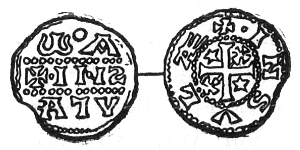
Denier of Baldwin of Lille
CHAPTER VII THE DANISH INVASION AND ITS SEQUEL
267
The year 1068 had closed under a specious
appearance of peace, and the only result
of the revolts of Exeter and York had been a
proof of the futility of isolated resistance to a
king who could strike with equal decision at the
west or north. The following year opened with
two north-country risings which formed an unconcerted
prelude to fifteen months of incessant
strife, in which the strength of the Norman hold
on England was finally tested and proved. The
flight of Gospatric in the previous summer had
vacated the Bernician earldom, and at the beginning
of 1069 the Conqueror tried the experiment
of appointing a NormanNorman baron to the command
of the border province. His choice fell on one
Robert de Comines, who immediately set out
for the north at the head of a force of five hundred
knights. The news of his appointment preceded
him, and the men of Northumbria, who had
enjoyed virtual independence for two years, were
not minded to submit quietly to the rule of a
foreign earl. A league was accordingly formed,
the members of which bound themselves either
to kill the stranger or to perish in the attempt.
268Bishop Ethelwine of Durham had evidently
heard rumours of the plot, for as the earl approached
Durham he was met by the bishop, who
warned him of the impending danger. Robert
took no heed, and his troops behaved badly as
they entered Durham, killing certain of the
bishop’s humbler tenants, but meeting no armed
opposition. The earl was entertained in a house
belonging to the bishop, and his men were quartered
all over the town, in open defiance of the
bishop’s warning. But during the night a large
body of Northumbrians moved up to the city,
and as dawn broke they burst through the gates
and began a deliberate massacre of the Frenchmen.
The surprise was complete, but the earl and his
immediate companions were aroused in time to
enable them to make a fight for their lives. They
could expect no quarter, and their defence was
so desperate that the rebels were unable to break
into the house, and at last set it on fire, the earl
and his men perishing in the flames. Of the five
hundred Normans in Durham, only one survivor
made his escape.[211]
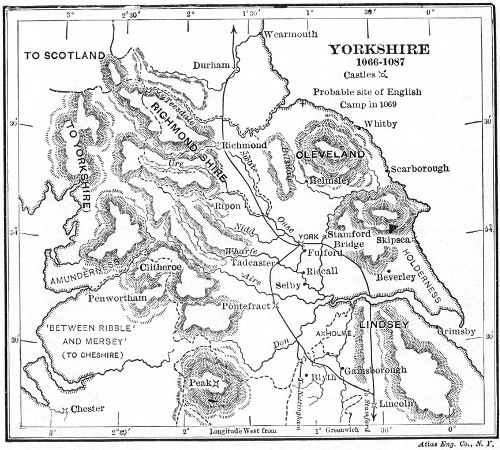
This episode was quickly followed by the death
of Robert Fitz Richard, the governor of York,
who perished with a number of his men in an
obscure struggle, which nevertheless left the castle
untaken in Norman hands. Encouraged by
these events, Edgar the Etheling, Marleswegen,
Archil, and Gospatric reappeared upon the scene,
269and made a determined attack upon the fortress,
so that William Malet, who would appear to have
become castellan on Robert Fitz Richard’s death,
sent an urgent message to the king, saying that
he must surrender at once unless he received
reinforcements. Upon receiving this appeal,
the Conqueror flew in person to York, scattered
the rebels with heavy loss, and planted a second
castle within a few hundred yards of the first,
but on the opposite bank of the Ouse. This
fortress, of which the mound, known as the
Baile Hill, still rests against the city wall, was
committed to the charge of no less a person than
Earl William Fitz Osbern, and the king after eight
days returned to Winchester to keep his Easter
feast there. His departure was followed by a
renewal of the English attack, now directed against
both the castles, but William Fitz Osbern and his
men gave a good account of themselves against
the insurgents.[212]
It was, however, apparent by this time that a
spirit of revolt was generally abroad, and Queen
Matilda was sent back into Normandy to assume
command of the duchy once more. No very
coherent narrative of the military events of this
year can be extracted from the confused tale
of Ordericus Vitalis or the jejune annals of the
270Anglo-Saxon Chronicle, but the outline of the
history is fairly plain. We seem to recognise
three distinct areas of revolt: Devon and Somerset,
Shropshire and Staffordshire, and, most dangerous
of all, Yorkshire and the north. We have no
reason to suppose that the English leaders had
any thought of uniting in common resistance to
the Norman rule; their plans extended to nothing
more than the destruction of single fortresses,
the execution of isolated revenge for local injuries.
On the other hand the dispersion of the centres
of revolt incidentally produced some of the effects
of combination; the Normans were compelled to
divide their forces, and the rapidity with which
King William dashed about the country from point
to point proved that he at least thought the situation
sufficiently precarious.
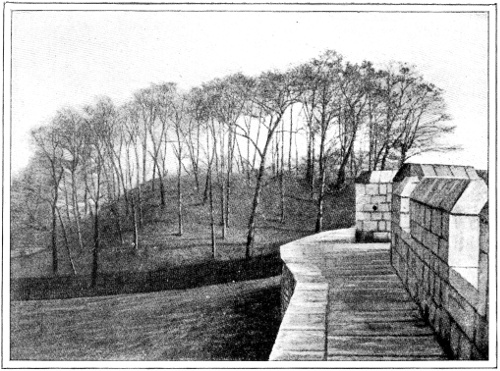
THE BAILE HILL, YORK
THE SITE OF WILLIAM I.’S SECOND CASTLE
Early in the summer the three sons of Harold
repeated their piratical excursion of the previous
year. They landed on the 24th of June in the
mouth of the Taw with sixty-six ships and
raided over a large part of Devonshire, but were
beaten off at last by Brian of Penthievre, and
vanish therewith from English history.[213] The
local forces were capable of dealing with an
unsupported raid of this kind, but the case was
otherwise with the powerful armament which at
this time was being prepared in the fiords of
Denmark. Swegn Esthrithson at last was about
to take action, and the news excited once more
271the unstable patriotism of the men of Northumbria.
The Danish army was recruited from a
wide area to the south of the Baltic; there were
numerous adventurers from Poland, Frisia, and
Saxony, and we read of a contingent of heathen
savages from Lithuania. The fleet was reported
to consist of two hundred and forty vessels; a
number capable, if each ship was fully laden, of
carrying a force considerably larger than any
army William could put into the field without
calling out the native militia. The expedition
was under the command of Harold and Cnut,
the sons of King Swegn, and Asbiorn, his brother,
and included many Danes of high rank, among
whom Christian, bishop of Aarhus, is mentioned
by name.[214]
The fleet set sail towards the end of August,
and must have hugged the shores of Frisia and
Holland, for it first touched the English coast at
Dover. The royal forces were strong enough to
prevent a landing both here and at Sandwich,
where the Danes repeated the attempt, but the
mouth of the Orwell was unguarded, and a body
of the invaders disembarked at Ipswich with the
intention of plundering the neighbourhood. We
are, however, told that the “country people,”
272by which phrase the English peasantry of the
district are probably meant, came out and, after
killing thirty of the raiders, drove the rest to
seek refuge in their ships. A similar descent on
Norwich was repulsed by Ralf de Wader, earl
of East Anglia and governor of Norwich castle, and
the Danes passed on towards the Humber. In the
meantime, news of these events was brought to
King William, who, we are told, was hunting at
the time in the forest of Dean away on the Welsh
border; and he, seeing where the key to the situation
really lay, instantly sent a messenger to
York to warn the garrison and to direct that
they should summon him in person if they were
hard pressed by the enemy. He received the
reassuring answer that they would require no
assistance from him for a year to come, and he
accordingly continued to leave the defence of the
north in the hands of his subordinates, while
the Danes were sailing along the coast of Lindsey.
It is an interesting question how far the men
of the English Danelaw may have been led by
a remembrance of their Scandinavian origin to
make common cause with the army of the king of
Denmark at this time. At the beginning of the
century Swegn Forkbeard had been welcomed
on this account by the men of the shires along
the lower Trent, and had fixed his headquarters
at Gainsborough in this district. So long as the
Anglo-Saxon legal system retained a semblance
of vitality a very definite barrier of customary
273law separated the Danelaw from the counties of
the eastern midlands, and the details of its local
organisation still preserved not a few peculiar
features, plainly referable to a northern origin.
On the other hand, in the names of the pre-Conquest
owners of land in this district as recorded
in Domesday Book the English element distinctly
preponderates, while the particularism of Northumbria
itself was perhaps rather political than
racial. It is probable that the men of Lincolnshire
would have preferred a Danish to either a
Norman or an English king, but they play no
distinctive part in the incidents of this campaign,
which centres round the city of York and its
approaches by land and water.
While the Danish fleet still hung in the Humber,
it was joined by the English exiles from Scotland,
Edgar the Etheling, Gospatric, and Marleswegen,
with whom Waltheof, the earl of Huntingdon, and
others of lesser fame now associated themselves.
Edgar, who had been raiding in Lincolnshire independently
of his Danish friends, had narrowly
escaped capture by the garrison of Lincoln castle;
but he reached the Humber in safety though with
only two companions, and the combined force,
like that of Harold Hardrada three years before,
passed on up the Ouse and disembarked for a direct
attack on York. Volunteers assembled from
all the neighbouring country, and in numbers
at least it was a formidable army which on the
21st of September appeared before the northern
274capital, the English forming the van, the Danish
host the rear. The Normans in York made no attempt
to hold the city wall, and concentrated their
defence on the two fortresses by the Ouse, setting
fire to the adjoining buildings, so that their
timber might not be used to fill up the castle
ditches. The flames spread, the city was gutted,
and, what was worse to the medieval mind, the
church of St. Peter was involved in the ruin. The
struggle which followed was soon over; on the
very day of the Danish arrival, while the city was
still burning, the garrison of the castles made a
sally, were outnumbered by the enemy within the
city walls and destroyed, after which the capture
of the actual fortifications was an easy matter.
The castles themselves were only wooden structures
planted on mounds of earth; their defenders
had been hopelessly weakened by the failure of
the sally, and later tradition recounted in verse
how Waltheof, Siward’s son, stood by the gate and
smote down the Normans one by one to the
number of a hundred with his axe as they tried to
break away.[215] The castles once taken, the English
hatred of these signs of bondage broke out with
275fury; the wooden buildings were instantly broken
up and hurled to the ground, and the luckless
William Malet, with his wife and children, a
prisoner, was one of the few Normans in York
who survived the day.
On the 11th of September, before the Danish
army had sighted the walls of York, Archbishop
Ealdred, one of the few Englishmen
of high rank who accepted the Norman Conquest
as irreversible, died, being worn out by
extreme age, and grief at the ruin which he foresaw
was about to fall on the men of his province.
The fall of York was the most serious check which
had hitherto crossed King William’s plans in
Normandy or England; it might easily lead to the
formation of a Danish principality beyond the
Humber; it was certain to give encouragement to
rebellious movements in the south. In his rage
at the news the king caused the fugitives who had
told the tale to be horribly mutilated as a warning
to his captains against possible treachery[216] and
then set out for the north. As he drew towards
the Northumbrian border, the Danes abandoned
their new conquest, and made for their ships,
crossing the Humber in them, and established
themselves among the marshes of the Isle of
Axholme. This movement diverted the king’s
march; he struck straight for Lindsey with a force
of cavalry and crushed sundry isolated bodies of
276the enemy which were dispersed among the fens.
The Danes, finding their position untenable, took
to their ships again and crossed over to the Yorkshire
bank, whither William had no means of
following them. He therefore left part of his
troops under the counts of Mortain and Eu, to
protect Lindsey, while he himself turned westwards
to suppress a local rising which had broken
out at Stafford.
We know nothing as to the persons who were
responsible for this last revolt, nor have we any
clue as to their objects, but it is quite possible
that they were acting in concert with the men
who at this time were laying siege to the new
castle of Shrewsbury. William in this year was
contending with men of Celtic as well as of Scandinavian
race; for Bleddyn, king of Gwynedd, for
the third time within three years, had taken arms
against the Normans on the Welsh border. To
the men of North Wales, Edric the Wild brought a
contingent from Herefordshire, and the citizens
of Chester, which, it would seem, had not as yet
been occupied by the Normans, joined in the
attack. The allies were successful in burning the
town of Shrewsbury and getting away before a
Norman force arrived in relief of the castle, but
the Staffordshire insurgents were less fortunate.
We are merely told that King William “wiped out
great numbers of the rebels with an easy victory
at Stafford,” but the Domesday survey of the
country, in the large proportion of land which it
277returns as “waste,” suggests that Staffordshire at
this time received at William’s hand some measure
of the doom which was to fall upon Yorkshire
before the year had closed.
In the meantime the revolt of the south-west
had run its course. Here as elsewhere the plans of
the revolted English do not seem to have extended
beyond the capture of individual castles; notably
the royal fortress which had been built in Exeter
after the the siege of the previous year, and
the private stronghold of Count Robert of Mortain
at Montacute in Somerset. The command
against the besiegers of Montacute was assumed
by Bishop Geoffrey of Coutances, who speedily
scattered the insurgents with an army drawn
from London, Winchester, and Salisbury, the chief
towns on the main road from the east to Devon
and Somerset. The situation at Exeter was
complicated by the attitude of the citizens themselves,
who must have been anxious not to forfeit
the privileges which they had obtained from
King William by the treaty which had so recently
concluded their own revolt. Accordingly, when
the new castle was beset by a host of Devonians
and Cornishmen, the townspeople took the Norman
side; and the garrison on making a sally threw
the rebels into a state of confusion which was completed
by the arrival of Brian of Penthievre, who
was advancing to the relief of the castle men.
Now that no further danger was to be apprehended,
from the lands between Trent and Severn
278King William’s hands were free to deal with
the Northumbrian difficulty. His lieutenants in
Lindsey had contrived to surprise a number of the
Danes as they were participating in the village
feasts with which the men of that district were
anticipating the customary orgies of midwinter
and to which they had apparently invited their
Danish friends. This, however, was a trivial
matter; there was a probability that the Danes
would return to take possession of York, and when
the Conqueror next appears after the battle of
Stafford, he is found at Nottingham on his way
to the northern capital. For fifty miles north of
Nottingham he followed the route by which he
had advanced on to York in the previous year,
but he received a sudden check at the point where
the road in question crosses the Aire near to the
modern town of Pontefract. The bridge was
broken, and the river, swollen most probably
by the winter’s rains, could neither be forded
nor crossed in boats, while the enemy lined the
opposite bank in force. On this last account it
was impossible to rebuild the bridge, and for three
weeks the army was kept inactive by this unexpected
obstacle. At last a knight called Lisois
de Monasteriis, after examining the river in search
of a ford for miles above and below the camp by
the broken bridge, discovered a practicable crossing
somewhere among the hills to the west of Leeds,
and forced a passage with sixty horsemen in
despite of the efforts of the enemy on the left
279bank. Having demonstrated the possibility of a
crossing at this point Lisois returned to Pontefract;
and under his guidance the whole army
passed the Aire, and then wheeled round towards
York through the difficult country which borders
the great plain of the Ouse. As the army drew
near to York, news came that the Danes had
evacuated the city, so the king divided his force,
sending one detachment to occupy and repair
the ruined castles, and another to the Humber to
keep the Danes in check. But he himself had
other work to do, and did not enter York at this
time.
It would seem that the Norman passage of the
Aire, hazardous as it had been, had really demoralised
the Northumbrian insurgents and their
Danish allies. The latter, as we have seen, fell
back on the Humber at once without striking a
blow; the mass of the native English under arms
would seem to have retired simultaneously among
the hills of western Yorkshire, for the Conqueror
now turned to their pursuit and to the definite
reduction of the inhospitable land. With grim
determination he worked his way along the wooded
valleys which intersect the great mountain chain
of northern England, and deliberately harried
that region so that no human being might find the
means of subsistence there. Resistance isolated
and ineffectual he must have met; but now for
once submission brought no favour, and those
who perished in the nameless struggles in which
280despairing men flung themselves hopelessly upon
the line of his inexorable march, underwent a
shorter agony than remained for those who survived
to see their homes, with all their substance,
smouldering in the track of the destroying army.
But the spirit was soon beaten out of the ruined
men, and without fearing surprise or ambush
William could divide his army still further and
quicken the dismal process of destruction. Soon
his soldiers were scattered in camps over an area
of a hundred miles, and the north and east of
Yorkshire underwent the fate which the Conqueror
in person had inflicted on the West Riding.
Before Christmas it is probable that the whole
land from the North Sea to Morecambe Bay had
become with the rarest exceptions a deserted
wilderness.
The harrying of Yorkshire is one of the few
events of the kind in regard to which the customary
rhetoric of the medieval chronicler is only
substantiated by documentary evidence. From
the narratives of Ordericus Vitalis and Simeon of
Durham alone, we should gain a fair impression
of the ghastly reality of the great devastation,
but a few columns of the Domesday survey of
Yorkshire, where the attempt is made to estimate
the result of the havoc for the purposes of the
royal treasury, are infinitely the more suggestive.
On page after page, with deadly iteration, manor
after manor is reported “waste,” and even in
the places where agricultural life had been re-instituted,
281and the burned villages rebuilt, the
men who inhabited them formed but pitiful
little groups in the midst of the surrounding
ruin. As to the fate of the individuals who
had fled before King William’s army, in the fatal
December, no certain tale can be told. Many sold
themselves into slavery in return for food, many
tried to make their way southward into the more
prosperous midland shires; the local history of
Evesham Abbey relates how crowds of fugitives
from the districts visited by the Conqueror in this
campaign thronged the streets of the little town,
and how each day five of six of them, worn
out by hunger and weariness, died, and received
burial by the prior of the monastery. Many no
doubt tried to keep themselves alive in the neighbourhood
of their old homes until the rigour of
the winter had passed away; but fifty years later
it was well remembered in the north how the
bodies of those who were now overtaken by
famine lay rotting by the roadsides. Even so late
as Stephen’s time, a southern writer, William
of Malmesbury, tells us how the fertile lands of
the north still bore abundant traces of what had
passed during the winter of 1069.
The festival of Christmas caused a short break
in the grim progress of King William. His work
was not by any means completed in the north;
the Danes were still in the Humber; Chester
remained in virtual independence. And so the
regalia and royal plate were brought from the
282treasury at Winchester, and the Christmas feast
was held at York with so much of the traditional
splendour as the place and occasion permitted.
The ceremony over, the campaign was resumed,
and in the New Year the Conqueror set out to hunt
down a body of Englishmen who seem to have
entrenched themselves among the marshes which
then lay between the Cleveland hills and the
estuary of the Tees.[217] The rebels, however, decamped
by night on hearing of the king’s advance,
and William spent fifteen days by the
Tees, during which time Earl Waltheof made
his submission in person and Gospatric sent envoys
who swore fealty on his behalf. Gospatric
was therefore restored to his earldom, and William
returned to York, keeping to the difficult country
of the East Riding in preference to the Roman
road which led southward from the Tees near
Darlington down the plain of the Ouse.[218] It is
probable that William chose this route with the
object of hunting down any scattered bands of
outlawed Englishmen which might have hung
together thus far in this inaccessible region; but
his force suffered severely through the cold,
many of the horses died, and on one occasion he
283himself lost his way and became separated from
his army with only six companions for an entire
night. York, however, was reached in safety
at last, and the reduction of Northumbria was
accomplished.
It was now possible to enter upon the final
stage of the campaign, and, after making the
arrangements necessary for the safety of York,
William set out on the last and most formidable
of the many marches of this memorable winter,
towards the one important town in England
which had never submitted to his rule. Chester
still held out in English hands, and apart from its
strategical importance the citizens of the great
port had definitely attracted King William’s attention
by the part which they had played in
the recent siege of Shrewsbury. His hold on the
north would never be secure until he had reduced
the town where Irish Vikings and Welsh mountaineers
might at any time collect their forces
for an attack upon the settled midlands. On the
other hand, the geographical difficulties in the
way of a direct march from York to Chester were
enormous. From the edge of the plain of York to
the Mersey Valley, the altitude of the ground
never descends to a point below 500 feet above
sea level; and, since the Roman highway from
York to Manchester had fallen into ruin, no
roads crossed this wild country except such
tracks as served for communication between
village and village. But a more serious cause of
284danger lay in the fact that the army itself now
began to show ominous symptoms which might
easily develop into actual mutiny. The strain of
the protracted campaign was telling upon the
men; and the mercenary portion of the army,
represented by the soldiers from Anjou, Brittany,
and Maine, began to clamour for their discharge,
complaining that these incessant marches were
more intolerable than even the irksome duty of
castle guard. The Conqueror in reply merely
declared that he had no use for the cowards who
wished to desert him,[219] and, trusting himself to
the loyalty of his own subjects in the army, he
plunged straightway into the hills which separate
the modern counties of Yorkshire and Lancashire.
Part at least of the route now followed at the
close of January must have lain through districts
which had been swept bare of all provisions in the
great harrying of December; and the army was at
times reduced to feed on the horses which had
perished in the swamps, that continually intercepted
the line of advance. The storms of rain
and hail which fell at this time were considered
worthy of mention in the earliest account of the
march which we possess, and we can see that
nothing but the example of King William’s own
courage and endurance held the army together
and brought it down in safety into the Cheshire
plain. Chester would appear to have surrendered
285without daring to stand a siege, and with its
submission, guaranteed as usual by the foundation
of a castle,[220] the Conqueror’s work was done
at last in the north. From Chester he moved to
Stafford, where another castle was raised and
garrisoned, and then marched directly across
England to Salisbury, at which place the army was
disbanded, with the exception of the men who
had protested against the present expedition and
were now kept under arms for forty days longer
as a mark of the king’s disfavour.
In the meantime, by a skilful piece of diplomacy,
William had been insuring himself against active
hostility on the part of the Danish fleet. Earl
Asbiorn and his associates had taken but little
gain as yet from their English adventure; and
the earl proved very amenable when a secret
embassy came to him from the king, promising
him a large sum of money and the right of provisioning
his men at the expense of the dwellers
along the coast for the remainder of the winter,
on the sole condition that he should keep the
peace towards the royal troops thenceforward
until his departure. The earl, thus made secure
of some personal profit, agreed to the terms, and
until the spring was far advanced, the Danish
ships still hung in the English waters.
286The harrying of Northumbria, the most salient
event of these twelve months of ceaseless activity,
was a measure which it would be impossible to
justify and impertinent to excuse. It was the
logical result of the opposition of an irreconcilable
people to an inflexible conqueror. After the
battle of Hastings had shattered the specious
unity of the old English state, each of its component
parts might still have secured peace by
full submission, or honour by consistent and
coherent resistance; the men of Northumbria
took the one course which was certain to invite
disaster, nor, terrible as was the resultant suffering,
can we say that vengeance was undeserved.
War in the eleventh century was at best a cruel
business, but we cannot fairly accuse the Conqueror
of deliberately aggravating its horrors
without the impulse of what he must have regarded
as necessity. He had to deal with a
people whom he could not trust, who had sworn
submission and had broken their oaths, and the
means at his disposal were few. He could not
deport the population of Northumbria as Cromwell
was to deport the native Irish under not
dissimilar circumstances; his Normans were too
few as yet to garrison effectively all the wild land
between the Humber and the Scottish border.
The one course which remained to the Conqueror
was for him to place the rebels beyond the possibility
of revolting again, and he followed this
course with terrible success. And it was on this
287account—that Northumbria was wasted, not in
the heat of wars, but deliberately, at the bidding
of political necessity—that the act seemed most
dreadful to the chroniclers who have described it.
Men were only too well accustomed to the sight of
ruined villages, of starving women and children;
but these things seemed less terrible as the work
of Scotch and Danish freebooters than as the
conscious intention of the crowned king of the
land. Nor must we forget that we do not know
how far King William was really sinning against
the current military practice of his time. The
monastic chroniclers, whose opinion of the case
commends itself to us in virtue of its humanity,
were men brought by the fact of their vocation to
a clearer sense of the value of the individual life
than that possessed by the lay world around them.
We know what Ordericus Vitalis thought of the
great harrying, perhaps even what William of
Poitiers, the Conqueror’s own chaplain, thought
of it, but we do not know how it appeared to
William Fitz Osbern or Roger de Montgomery.
According to his approved custom, the Conqueror
kept the Easter following these events
at Westminster, and the feast was attended by
three papal legates of high rank whose presence
marks the beginning of the ecclesiastical reformation
which we shall have to consider in its place
as the counterpart of the legal and administrative
changes produced by the Norman Conquest.
In the meantime, however, the broken national
288party was gathering its forces for a last stand,
and the focal point of the English resistance
shifts to the extreme east of the land.
At each stage in the Norman Conquest there is
always one particular district round which the
main interest centres for the time, the operations
of war elsewhere being of subsidiary importance.
It was the men of Kent and Sussex who bore the
brunt of the first shock of the invasion; it was
the men of the north who held the field in 1069,
and now, in the last period of English resistance,
our attention is concentrated on the rectangular
tract of land which lies between Welland, Ermine
Street, Ouse, and Wash. Even at the present day,
after eight centuries of drainage, it is not difficult
to reconstruct the geographical features which
in 1070 made the Fenland the most inaccessible
part of England south of the Humber. Except
for a narrow tract north of Huntingdon and St.
Ives, no part of this district rises to one hundred
feet above sea-level, and in great part it was still
covered with the swamps and meres of stagnant
water which gave to the eastern half of this
region the name of the Isle of Ely. In so far as
cultivation had already extended into this inhospitable
quarter, it may fairly be set down to the
credit of the five great abbeys of Peterborough,
Thorney, Crowland, Ramsey, and Ely, which dominated
the fens and round which the events of
the campaign of 1070 arrange themselves.
Abbot Brand of Peterborough, whose recognition
289of Edgar the Etheling as king had so deeply
moved the Conqueror’s wrath at the time of his
coronation, had died on November 27, 1069.[221]
At this moment King William was in the thick of
his Northumbrian difficulties, and it does not
appear that any appointment to Peterborough
was made until the quieter times of the following
spring. In or before May, however, the abbey
was given to a man whose selection for the post
proves that the king had received warning of the
coming disquiet in the east. Thorold of Fécamp,
abbot of Malmesbury, had probably made himself
useful in north Wiltshire while William was engaged
beyond the Humber, for the reputation
for militant severity which he had created in the
south was the reason for his translation to a post
of danger in the Fenland. “By God’s splendour,”
said King William, “if he is more of a knight than
an abbot I will find him a man who will meet all
his attacks, where he can prove his valour and
his knighthood and practise the art of war.”[222]
The man in question was no other than the famous
Hereward, and Thorold was not long before he
saw traces of his handiwork.
The amount of authentic fact which we know
about Hereward is in very small proportion to
the great mass of legend which has gathered
round his name. His parentage is quite unknown,
but there are several incidental entries in Domesday
290which connect him with the western edge of
the Fenland and which all occur in the Lincolnshire
portion of the survey. From these entries we learn
that Hereward had been a tenant of two of the
great Fenland abbeys, namely Crowland and
Peterborough, and we also gather that the former
house had found him an unsatisfactory person
with whom to have dealings. The jurors of
Aveland Wapentake in Lincolnshire told the
Domesday commissioners that Abbot Ulfketil of
Crowland had let the abbey’s estate in the vill
of Rippingale to Hereward on terms to be arranged
mutually year by year, but they add that
the abbot took possession of the land again before
Hereward fled from the country because he did
not keep to his agreement.[223] On the other hand,
Hereward was seemingly still in the possession
of the lands which he held of Peterborough abbey
at the moment when his name first appears in
the national history.
At some time in the course of May, but before
Abbot Thorold had taken possession of his abbey,
the Danish fleet, of which we have heard nothing
since the previous year, sailed up the Ouse to
Ely. Thus far its leaders would seem to have
kept the agreement which they had made with
King William after his capture of York, and the
fact that they now appear as taking the offensive
once more is probably explained by a statement
in the Anglo-Saxon Chronicle that King Swegn
291of Denmark had come in person to the Humber.[224]
The men of the Fenland were clearly expecting a
Danish reconquest of England, and on the appearance
of Earl Asbiorn at Ely they joined him in
great numbers. Among them, and probably at
their head, was Hereward, and the first fruit of
the alliance was a successful raid on the wealthy
and unprotected monastery of Peterborough.
The monks received just sufficient warning of approaching
danger to enable them to send an
urgent message to Abbot Thorold, asking for help,
and also to hide some of the more precious treasures
of their house, and then at mid-day Hereward
and his gang were on them. They came by boat,
for even at this date there were canals which
connected the Ouse at Ely with the Nene at
Peterborough, and began to clamour for admission
to the abbey.[225] But the monks had closed
their doors and defended them stoutly, so that
Hereward was driven to burn the houses which
clustered round the abbey gate in order to force
292an entrance. Incidentally the whole of Peterborough
was burned down, with the exception of
the church and a single house, but the outlaws
had got inside the monastery. The monks begged
them to do no harm, but, without heeding, they
burst into the church, seized all the movable
articles of value on which they could lay their
hands, and tried to tear down the great rood cross.
To the clamours of the monks around them they
shouted that they did it all for the good of the
church, and as Hereward was a tenant of the
abbey the monks believed him. Indeed, Hereward
himself in after years declared that he had
been guided in this matter by the best intentions,
for he believed that the Danes would beat King
William and he thought that it would be better
that the treasures of the church should remain
in the hands of his friends for a little while, than
that they should fall for ever into the possession
of the Frenchmen.
So the monks were scattered and the wealth
of the Golden Borough was carried off to Ely and
handed over to the Danes, who do not seem to
have shared Hereward’s sentiments with regard to
its ultimate destination. Among the captives
who were carried off from Peterborough was
Ethelwold, the prior, who, in hope of better
days, devoted himself secretly to the recovery
of the relics contained in the jewelled shrines
which formed the most valuable part of the
plunder that had just been taken. With this
293object in view, he deliberately set himself to win
the favour of the despoilers of his home, and
succeeded so well, that the Danes committed
their treasure to his custody, and promised him a
bishopric in Denmark if he chose to return with
them. Being a discreet man, he pretended to
comply with their wishes, and in the meantime
possessed himself of the tools which were necessary
for the abstraction of the relics. And on a
certain day, while the Danes were holding a great
feast, to celebrate the winning of so great a treasure
at so small a cost, Ethelwold took his tools
and set to work, beginning his operations on the
reliquary which he knew to contain the arm of
St. Oswald. To prevent interruption he placed
two servants on guard, one in the house where
the Danes were feasting, and the other midway
between the latter place and the scene of his own
labours. The task progressed without greater
difficulty than was to be expected, although one
of the chests was so tightly clamped with iron
that Ethelwold would have abandoned it had
he not trusted in God and St. Oswald. At last
the relics were all secured and hidden temporarily
in the straw of the prior’s bed, he being careful
to replace the gold and silver fittings of the
shrines as they were before. But at the critical
moment the Danes broke up to go to vespers and
Ethelwold was in imminent danger of being taken,
in which event it is probable that his pious zeal
would have been rewarded with the crown of
294martyrdom. But, without leaving his room,
the prior, who was covered with sweat and very
red from his labour in the heat of a June afternoon,
washed his face in cold water and went out to his
captors as if nothing had happened, and they,
who we are told reverenced him as a father,
flocked round him but asked no inconvenient
questions. And on the following day he sent his
two servants to Hereward—because his comrades
were infesting all the water-ways—under the pretence
that they wished to fetch something from
Peterborough, but in reality they went to the
nearer monastery of Ramsey and gave the relics
into the charge of the abbot of that place.
At this point the adventures of Prior Ethelwold
touch the current of the general history.
King William, in order, presumably, to divide the
insurgent Englishmen from their Danish allies,
made a treaty with Swegn of Denmark, by which
his subjects were to be allowed to sail for their
fatherland without hindrance and in possession
of all the spoil they had gained in the course of
the past months. They took advantage of the
offer, but gained little by it in the event, for a
great storm arose which scattered their ships,
and the last we hear of the treasures of Peterborough
is their destruction, in a nameless Danish
town, in a great fire which arose through the
drunkenness of their guardians. In the meantime,
Ethelwold, his troubles over, collected his fellow-monks
and came back to Peterborough, where
295they found Abbot Thorold, and restored the services
which had been suspended during the recent
disturbances. One unexpected difficulty indeed
manifested itself: the Ramsey people refused to
give up the relics which had been entrusted to
their care in the moment of peril. But the abbot
of Ramsey was soon brought into a better mind;
the sacristan of the monastery received a supernatural
intimation that his house was acting
unjustly, and Thorold of Peterborough threatened
to burn Ramsey abbey to the ground unless the
relics were given back. And so the heroic efforts
of Ethelwold were not frustrated of their purpose.
So quickly had events moved that only one week
had elapsed between the coming of Hereward
to Peterborough and the departure of the Danish
fleet. But an entire year had yet to pass before
the Isle of Ely was finally cleared of its rebel
garrison. It does not seem that the withdrawal
of the Danes made any difference to the occupation
of Ely by the English, and during the winter
of 1070 the Isle became a gathering point for the
last adherents of the broken national party.
Very few of them were left now. Edgar, their
nominal head, was living in peace with King
Malcolm of Scotland; Waltheof, the last representative
of the Danish earls of Northumbria,
was at this moment in enjoyment of an earldom
in the midlands which there is every reason to
believe included the Isle of Ely itself. On the
other hand, Edwin and Morcar now finally took
296their departure from William’s court, and raised
the last of their futile protests against the Norman
rule.
Hitherto inseparable, on this occasion the
brother earls took different courses, and the
result was disastrous to both of them. Morcar
joined the outlaws in Ely; Edwin struck out for the
Scotch kingdom, and from our meagre information
about his last months it would seem that he
had in view some great scheme of reviving once
more the old friendship between his house and the
Welsh princes and of supporting the combination
with Scotch aid. But fate overtook him before
he had time to give another exhibition of his
political worthlessness, and the circumstances of
his end were tragic and mysterious. Three
brothers, who were on terms of intimacy with
him and were attending him in his wanderings,
betrayed him to the Normans, and in attempting
to escape, his retreat was blocked by a river
swollen at the moment by a high tide. On its
bank the last earl of Mercia turned at bay, and
with twenty horsemen at his side made a desperate
defence until the whole band was cut down;
Edwin himself, it would appear, falling by the
hands of the three traitors of his household. His
head was cut off and the same three brothers
brought it to King William in the expectancy of a
great reward. But the Conqueror on the spot
outlawed them for their treason to their lord,
and shed tears of grief over Edwin’s head; for the
297handsome, fickle young earl, with all his faults,
had really won the love of the grim sovereign
from whom he had thrice revolted.[226]
Edwin fell through treachery, but he met his
death in the sight of the sun; another fate remained
for his brother and for those of his associates
whose end is known to us. The cause of
the defenders of Ely was hopeless from the outset.
Their revolt was a hindrance to the orderly conduct
of the Anglo-Norman government, but a
band of outlaws in the fenland could do little to
affect the course of events elsewhere; Ely commanded
no great road or river, and its Isle was too
small an area to support an independent existence
apart from the rest of the land. Its reduction
was only a question of time, complicated by
the geographical difficulties of the district. It was
necessary that all the waterways leading from
the fens to the open sea should be blocked, and
this implied the concentration of a considerable
number of ships and men-at-arms along the
Great and Little Ouse. The siege of a quarter
of Cambridgeshire demanded a greater expenditure
of men and money than that of a single
town or castle; but Hereward and his friends in
due time were driven back on Ely itself, from
which their raiding parties would make occasional
descents upon the neighbouring villages.
298The Conqueror fixed his headquarters at Cambridge,
some fifteen miles from Ely, and his main
attack was directed at the point where the Ouse is
crossed by an ancient causeway near the village
of Aldreth. But even from the latter place there
remained some six miles of fen to be crossed before
Ely itself could be reached, and we are told on
good authority that William caused a bridge,
two miles long, to be built on the western side of
the Isle.[227]
The legendary accounts of the exploits of
Hereward tell many tales of the struggle which
raged before the Norman army had pierced the
natural defences of Ely, but we cannot be sure
of the exact means by which the place was finally
reduced. One stream of tradition assigned
the fall of the Isle to the treachery of the abbot
and monks of Ely, and, although the authority
for such a statement is not first-rate, it has commonly
been accepted as representing the truth
of the matter.[228] It is at least certain that the
position in which the monks of Ely found themselves
was undesirable at the best. The conduct
of Hereward and his men at Peterborough proves
them to have been no respecters of holy places,
and if the abbey bought immediate safety by
conniving at the deeds of the outlaws in its
neighbourhood, it ran the risk of the ultimate
confiscation of its lands when King William had
restored order. Small blame should rest upon
299the abbot if he broke through the dilemma in
which he was placed by assisting the Conqueror in
the reduction of the Isle. But whatever the immediate
cause of the fall of Ely, a large number
of its defenders fell into William’s hands and
many of them received from him such measure
as twenty years before he had dealt to the men of
Alençon. Some were blinded or otherwise mutilated
and allowed to go free, others were thrown
into prison. Earl Morcar himself was sent into
Normandy a prisoner and committed to the charge
of Roger de Beaumont[229]; the other captives of
note were scattered over the country in different
fortresses. But Hereward, who in all our authorities
stands out as the leader of the resistance,
escaped through the marshes and a small
part of his band got clear of the Isle in his
company.[230]
Whatever the recent behaviour of the monks
of Ely may have been, the abbey was constrained
to buy the king’s peace at a heavy price. Seven
hundred marks of silver were originally demanded
by the Conqueror, but the money was found to be
of light weight, and three hundred marks more
were exacted before the abbot and monks were
reckoned quit by the king’s officer. Moreover,
the very precincts of the abbey were invaded to
find the site for a castle to command the southern
fenland: King William himself having chosen the
300ground during a flying visit which he had paid
to Ely one day while the monks were seated at
dinner. The building of the castle, by a Norman
interpretation of the Anglo-Saxon duty of burhbot,
was laid upon the men of the three adjacent
counties of Cambridge, Huntingdon, and Bedford,
and it was garrisoned when built by a body of
picked knights. Another castle at Aldreth commanded
the eastern approaches to the Isle.[231] On
the other hand, it would be some compensation
for these disturbances that within four years
from the fall of Ely, and in the lifetime of Abbot
Thurstan, King William decreed a formal restitution
to the abbey of all the lands of which it had
unjustly been despoiled in recent years.[232] Now
that no further danger was to be apprehended
from the nationalist proclivities of the monks of
Ely, there was no reason why the abbey should not
be suffered to enjoy its ancient possessions
in peace; but the record of the plea which followed
the Conqueror’s writ directing restitution
proves that many of the greater people of the
land, including the archbishop Stigand and Count
Eustace of Boulogne, had been committing
wholesale depredations on the estates of St.
Ethelthryth.
The subsequent fate of Hereward is a matter
of utter uncertainty; with his flight across the
marshes of Ely he vanishes into the night which
301has engulfed the entire class to which he belonged,
the smaller native land-owners of King Edward’s
day. Two lines of tradition were current in later
years about the manner of his end. According
to the more dramatic narrative, Hereward became
reconciled to the Conqueror, accompanied
him in the Mancel campaign of 1074, married a
noble and wealthy Englishwoman, and fell at last,
before overwhelming odds, at the hands of a
number of Normans, whose feud he would seem
to have provoked in the wild days of his outlawry.[233]
In the other story, Hereward still receives King
William’s favour and marries the same English
lady as in the former legend, but he dies at last in
peace after many years in the quiet possession
of his father’s lands.[234] The choice which we may
make between these divergent traditions will
largely be guided by inference from more truly
historical sources of information. It is very
probable that Hereward made his peace with
King William—both traditions agree upon this
point; and that casual expression in the narrative
of the sack of Peterborough, that Hereward “in
after time often told the monks that he had done
all for the best,” proves at least that there had
been a period after the troubles of 1071 in which
Hereward had been on terms of peaceful intercourse
with his monkish neighbours. So too the
coincidence of both lines of tradition with regard
302to his marriage is in favour of its probability,
but the negative evidence of Domesday Book
compels us to put a period to his life before
the winter of 1085. In no part of England did a
more numerous body of native thegns hold land
at the latter date than in Hereward’s own county
of Lincoln, but Hereward’s name is not written
among them, and the lands which he had held of
Peterborough abbey had been let to a stranger.
But if the Hereward legend is not consistent with
itself, there is a more significant discrepancy
between the part which its subject plays in
recorded history and his position as a hero of
romance. It is at least certain that the man
must have been something more than the vulgar
freebooter who appears in the story of the ruin
of Peterborough. To him we may safely credit
the long defence of the Isle of Ely, and we may feel
confident that that defence was accompanied by
deeds of gallantry round which minstrel and
gleeman might weave their fabric of legend and
marvel. Hereward, after all, in literature, if not
in fact, is the English hero of the Norman Conquest.
A native annalist might express his bitter
regret for the tragedy of King Harold, the common
folk of England might turn Earl Waltheof
into an uncanonised saint, but Hereward was
removed by no great chasm of rank from the
humble people who made his deeds their story.
And it is not a small thing that the tale of the
resistance to the Norman Conqueror, inglorious
303as much of it had been, should end with the name
of a man in whom the succeeding generations
might see a true champion of the independence of
the beaten race.
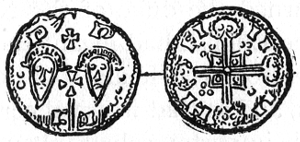
CHAPTER VIII THE CENTRAL YEARS OF THE ENGLISH REIGN
304
The conquest of England had exalted William
of Normandy to a position of dignity and
influence far above all his fellow-vassals of the
French crown, it had renewed the lustre of the
fame which the Norman race had won in its
earlier conquest of southern Italy, but it did not
mean an unqualified gain to the Norman state,
considered merely as a feudal power. The process
which had turned the duke of the Normans into
the king of the English had meant the withdrawal
of Normandy from the feudal politics of France
for four years, and in that interval certain changes
of considerable importance had taken place within
the limits of the French kingdom. The Angevin
succession war was now over; Fulk le Rechin
had his brother safely bestowed in prison and
could begin to prove himself the true heir of
Geoffrey Martel by renewing the latter’s schemes
of territorial aggrandisement. King Philip of
France had reached an age at which he was
competent to rule in person, and it was inevitable
that the enmity between Normandy and France
should become deeper and more persistent now
that William had attained to a rank which placed
him on an equality with his suzerain, and could
305employ the resources of his new kingdom for the
furtherance of any designs which he might form
upon the integrity of the royal demesne. More
important than all, Count Baldwin of Flanders
had died in 1067, and events were in progress
which for twenty years placed the wealthy county
in steady opposition to the interests of the Anglo-Norman
state.
Between 1067 and 1070 Flanders was under the
rule of Count Baldwin VI., the eldest son of Baldwin
of Lille, who had greatly increased his borders
by a marriage with Richildis, the heiress of
the neighbouring imperial fief of Hainault. The
counts of Flanders made it a matter of policy
to transmit their inheritance undivided to the
chosen heir, and Robert, the younger son of the
old Count Baldwin, before his father’s death had
secured himself against his ultimate disinherison
by marrying Gertrude, widow of Florent I., count
of Holland, and assuming the guardianship of
her son Theodoric. On the death of Baldwin VI.,
the ancestral domain of Flanders descended to
his eldest son, Arnulf, who was placed under the
wardship of his uncle Robert, while Hainault
passed to Baldwin, the second son, under the
regency of his mother Richildis. The two regents
were on bad terms from the start, but Robert at
the time was hard pressed to maintain his position
in Holland, and Richildis soon got possession of
Arnulf, the heir of Flanders, and ruled there in
his name. But her overbearing conduct rapidly
306made her unpopular in the county, and Robert
was soon invited to invade Flanders and reign
there in his own right. He accepted the invitation,
and Richildis thereupon hired King Philip
of France to support her with an army, and offered
her hand and her dominions to William Fitz
Osbern, Earl of Hereford. The earl, like a good
knight-errant, accepted the adventure and hastened
to the succour of the lady with the full
assent of his lord King William, but fell into an
ambush laid by his enemy Robert, at Bavinkhove,
near Cassel, and perished there together with
Arnulf his ward. Richildis maintained the
struggle for a short time longer with the aid of
troops supplied by the prince-bishop of Liège; but
on their defeat near Mons, followed a little later
by the surrender of Terouenne, the ecclesiastical
capital of Flanders, she retired into the monastery
of Maxines, and Robert, who is generally described
in history as the “Frisian” from the
name of his earlier principality on the shores of
the Zuyder Zee, had the permanent possession
of Flanders thenceforward.
The enterprise of William Fitz Osbern meant
the dissolution of the alliance between Normandy
and Flanders, which had been founded by the
Conqueror’s marriage in 1053. It was true that
French as well as Norman troops had been involved
in the disaster at Bavinkhove, but William
deliberately refused to make peace with Robert
by recognising his right to Flanders, and threw
307him into the arms of the king of France by maintaining
the claims of Baldwin, the brother of the
dead Arnulf. The close friendship which this
policy produced between France and Flanders
for a time may suggest that William for once
subordinated questions of state to personal
feeling, but his own relations with a former king
of France may have taught him that the alliances
which a French monarch founded with one feudatory
on a common hostility towards another
were not likely to be very strong or permanent.
It was not long after these events that King
Philip threw away his Flemish connections by the
unprovoked capture of Corbie, preferring, perhaps
wisely, a definite territorial gain to a hazardous
diplomatic understanding; and when Robert the
Frisian, in 1085, at last tried to take the offensive
against William, he found support, not in the
French monarchy, but in the distant powers
of Norway and Denmark.[235]
More dangerous than the open hostility of
Flanders were the symptoms of disaffection which
at this time were beginning to show themselves
in the Norman dependency of Maine. Fortunately
for William, the county had kept quiet
during his occupation with the affairs of England,
and the revolt which we have now to consider
occurred at a time when he could give his full
attention to the work of its reduction. The
308nationalist party in Maine had only been suppressed,
not crushed, by the conquest of 1063, and
after some five years of Norman rule their hopes
began to revive, fomented probably by external
suggestion on the part of Count Fulk of Anjou.
There were in the field two possible claimants,
both connected by marriage with the line of
native counts: Azo, marquis of Liguria, husband
of Gersendis, the eldest sister of the Herbert
whose death in 1063 had led to the Norman
occupation, and John de la Flèche, who had
married Paula, the youngest of Herbert’s three
sisters. The seigneur of La Flèche was an Angevin
lord, but he took the Norman side in the war
which followed, and the nationalists made their
application to the marquis of Liguria, who appeared
in Maine with Gersendis his wife and
Hugh their son, the latter being received as the heir
of the county.[236] Azo had brought with him great
store of treasure from his Italian lordship, with
which he secured a recognition of his son’s claims
from great part of the Mancel baronage, but upon
the failure of his supplies his supporters began
to fall away, and he soon retired in disgust beyond
the Alps, leaving behind his wife and son to
maintain the family cause under the guardianship
of Geoffrey of Mayenne.
Thus far the Mancel revolt had run the normal
course of its kind, but a more interesting development
309followed.[237] Shortly after the departure of
Azo the citizens of Le Mans, rejecting the leadership
of their baronial confederates, broke away
on a line of their own which gives them the distinction
of anticipating by some twenty years
the movement of municipal independence which
in the next generation was to revolutionise the
status of the great cities of Flanders and northern
France. The men of Le Mans formed themselves
into a “commune”[238]; that is, a civic republic
administered by elective officers and occupying a
recognised legal position in the feudal hierarchy
to which it belonged. Had this association
persisted, the citizens in their collective capacity
might have held their city of the duke of Normandy
or the count of Anjou, but they would
have enjoyed complete independence in their
local government and no principle of feudal law
would have prevented them from appearing, still
collectively, as the lord of vassals of their own.
We do not know whether they may have been
prompted to take this step by news of Italian
precedents in the same direction, but the formation
of a commune raised the revolt at a bound to
the dignity of a revolution. The citizens, as was
usual in such cases, united themselves in an oath
to maintain their constitution and they compelled
310Geoffrey of Mayenne and the other barons
of the neighbourhood to associate themselves
in the same. Herein lay the seeds of future
trouble, for Geoffrey of Mayenne, a typical feudal
noble, had no liking for municipal autonomy, and
it was largely his oppression as the representative
of Azo and his heir which had stung the citizens
into this assertion of their independence.
At the outset all went well with the young
republic. We hear rumours of various violations
of accepted custom, of the death penalty inflicted
for small offences, and of a certain disregard for
the holy seasons of the church; but the citizens
were able to enter without immediate mishap
upon the work of reducing the castles which
commanded the country around. The commune
of Le Mans did not live long enough to face the
problem of welding a powerful rural feudality
into a coherent city state, and its overthrow,
when it came, came suddenly and disgracefully.
Some twenty miles from Le Mans, the castle of
Sillé was being held by Hugh its lord against the
commune, and the men of the capital called out a
general levy of their supporters within the county
to undertake the siege of the fortress. A considerable
body of men obeyed the summons, and the
communal army set out for Sillé with Arnold,
bishop of Le Mans, marching at its head. Hard by
the castle the army from Le Mans was joined by
Geoffrey of Mayenne with his tenants; but Geoffrey
felt the incongruity of joining with a host of
311rebellious burghers in an attack on the castle
of a fellow-noble, and he secretly entered into
communications with Hugh of Sillé. Whether
the rout of the civic host which occurred on the
following day was the result of Geoffrey’s treason
cannot now be decided, but a sudden sally on the
part of the garrison threw the besiegers into
confusion, and, although they recovered themselves
sufficiently to maintain the fight, they were finally
scattered by a report that Le Mans itself had
fallen into the enemy’s hand. Great numbers
of them perished in the panic which followed,
more by the precipitancy of their flight than by
the efforts of the men of Sillé, and Bishop Arnold
was among the prisoners.
Within the capital all was confusion. The cause
of the commune had been hopelessly discredited,
and there was treachery within the city as well
as in the camp by Sillé. The castle of Le Mans
was occupied in the nationalist interest by Gersendis
of Liguria, who, immediately upon the
retreat of her elderly husband to Italy, had
become the mistress of Geoffrey of Mayenne.
But Geoffrey, after his conduct at Sillé, did not
venture to return to the capital, and Gersendis,
unable to endure her lover’s absence, began to plot
the surrender of the castle to him. Her object was
soon gained, and a fierce struggle raged for many
days between the citizens and Geoffrey of Mayenne,
now in the possession of their fortress. Betrayed
and desperate, the men of Le Mans appealed
312for help to Fulk of Anjou, and pressed on the siege
with such fury that Geoffrey was driven to make
his escape by night. On Fulk’s arrival the castle
surrendered to him, and was dismantled, with the
exception of such of its fortifications as could be
turned to the general defence of the city against
the greater enemy who was already on the way.
Quickly as events seem to have moved, there
had yet been time for news of the revolt to be
brought to King William in England, and the
messenger of evil had been no less a person than
Arnold bishop of Le Mans himself. Long before
William’s army had been set in motion Arnold
had returned to Le Mans to play, as we have
seen, a somewhat ignominious part in the catastrophe
at Sillé. Meanwhile William had gathered
a force, which is especially interesting from the
fact that in it for the first time Englishmen were
combined with Normans in the service of the lord
of both races beyond the sea. Englishmen in the
next generation believed that it was their compatriots
who did the best service in this campaign,
and William of Malmesbury thought that though
the English had been conquered with ease in their
own land yet that they always appeared invincible
in foreign parts.[239] On the present occasion, however,
there was little call for feats of arms. William
entered Maine by the Sarthe Valley and
besieged Fresnay, whose lord, Hubert, was soon
driven by the harrying of his lands to surrender
313Fresnay itself and the lesser castle of Beaumont
lower down the river. Sillé was the next point of
attack, but Hugh of Sillé made his submission
before the investment of his castle had begun,
and William moved on southward towards
Le Mans. After the strife and confusion of the
past months men were everywhere disposed to
welcome the King as the restorer of peace, castles
were readily surrendered to him, and the way lay
open to the distracted capital. Here too, after a
brief delay, he was received without opposition,
but the men of Le Mans, before they surrendered
the keys of the city, obtained from the king a
sworn promise that he would pardon them for
their revolt, and would respect their ancient
customs and the independence of their local rights
of jurisdiction.[240] The commune of Le Mans ceased
to exist, but in its last moments it had shown itself
strong enough to win an act of indemnity from
its formidable conqueror, and to guard itself
against the possible consequences of a feudal
reaction.
The war now entered upon another phase.
Count Fulk was little minded to forego the position
he had won in Le Mans as the protector of
its commune, and, but for the unwonted strength
of the Anglo-Norman army, it is likely enough
that he would have made some effort to oppose
William’s march to the city. As it was, however,
he contented himself with turning upon John
314de la Flèche, William’s leading Angevin adherent,
who immediately appealed to his ally for help.
William at once despatched a force to his assistance
under William de Moulins and Robert de Vieux
Pont, a move which had the effect of widening
the area of hostilities still further. Fulk proceeded
to the siege of La Flèche, and called to his
assistance Count Hoel of Brittany.[241] The combined
Breton and Angevin host would be far
superior to any force which William’s lieutenants
had in the field in that quarter; and at the head
of a large army, now as formerly composed of
English as well as Norman troops, he hastened to
La Flèche in person and everything betokened
a pitched battle of the first class. But, at the
supreme moment, an unnamed cardinal of the
Roman Church, together with some pious monks,
intervened in favour of peace, and within the circle
of the Norman leaders Counts William of Evreux
and Roger of Montgomery were of the same mind.
Various conferences were held to discuss the
conditions of a possible settlement, and at last,
at Blanchelande, just outside the walls of La
Flèche, a treaty was concluded.[242] Now, as ten
years earlier, Robert of Normandy was selected
as count of Maine, and to him Fulk of Anjou
315released the direct suzerainty which he claimed
over the barons of the county, together with all
the fiefs which were Robert’s marriage portion
with Margaret, his affianced bride in 1061. Robert,
in return, recognised Fulk as the overlord
of Maine, and did homage to him in that capacity.
William promised indemnity to those Mancel
barons who had taken the Angevin side in the late
war, and Fulk was formally reconciled to John
de la Flèche, and the other Angevin nobles
who had leagued themselves with the king of
England.
The treaty was in effect a compromise. All the
immediate advantage, it is true, lay on the Norman
side: the heir of Normandy was now the lawful
count of Maine, and Robert’s countship meant
the effective rule of William the Conqueror, who
even appropriated his son’s title and in solemn
documents would at times add to his Norman
and English dignities the style of “Prince of the
men of Maine.” Yet, on the other hand, the
formal recognition of the Angevin overlordship
was no small thing. It gave to succeeding counts
of Anjou a vantage ground which they did not
neglect. The line which separated suzerainty
from immediate rule, clear enough in law, would
rapidly become indistinct when a strong prince
like Fulk the Rechin was the overlord, and a
feckless creature like Robert Curthose the tenant
in possession. More than sixty years were to pass
before a count of Anjou became the immediate
316lord of Maine, but the seeds of such a development
were laid by the treaty of Blanchelande.
In the period which follows the suppression of
the fenland rising of 1070, the bulk of our historical
information relates to the affairs of the
Conqueror’s continental dominions. But in English
history proper the time was one of crucial
importance. Its character was not such as to
invite the attention of a medieval chronicler,
eager to fill his pages with a succession of battlepieces:
with the exception of the revolt of the
earls in 1075, England was outwardly at peace
from the flight of Hereward to the Conqueror’s
death; but it is to this time that we must assign
the systematic introduction of Norman methods
of government, and the gradual reconciliation of
the English people to the fact that they had
thrown their last try for independence, and that
for good or ill they must make the best of the
permanent rule of their alien masters. A process
of this kind, in itself largely subconscious, lay
beyond the understanding of the best monastic
annalist or chronicler, and we shall never know
exactly in what light the great change presented
itself to the peasantry of a single English village;
but there are certain matters, more on the surface
of the history, with regard to which we possess
definite information, and which themselves are
of some considerable importance.
Prominent among these last stands the question
of the relations between the Conqueror and his
317unquiet neighbour, or, as William would probably
have described him, his unruly vassal, Malcolm
Canmore, king of Scots. The Scotch question had
merely been shelved for a little time by the submission
of 1068, and up to the Conqueror’s death
there remained several matters in dispute between
the kings, each of which might serve as a decent
pretext for war if such were needed. In particular
the English frontier on the north-west emphatically
called for rectification from King William’s
standpoint. Ever since the commendation of
Cumbria to Malcolm I., in or about 954, the
south-western border of Scotland had cut the
English frontier at a re-entrant angle at a particularly
dangerous point. From the hills which rise
to 2000 feet along the boundary between Cumberland
and Durham, the valley of the Tees affords
a gradual descent to the fertile country which lies
between the moors of the North Riding of Yorkshire
and the hills of Cleveland. So long as Lothian
remained part of the Bernician earldom, the
strategical significance of Teesdale was to a great
extent masked; no king of Scots could ravage
the plain of north Yorkshire without facing the
possibility that his country might be harried and
his own retreat cut off by a counter raid from
Bamburgh or Dunbar. But the cession of Lothian
to Malcolm II. after the battle of Carham in 1018
materially altered the military situation, and but
for the dissensions within the Scotch kingdom
which followed Malcolm’s death, it is probable
318that Yorkshire during the Confessor’s reign would
have received sharp proof of the danger which
impended from the north-west.
Malcolm was succeeded by Duncan, the son of
his sister by Crinan, lay abbot of Dunkeld; and
on Duncan’s displacement by Macbeth, leader of
the Picts beyond the Forth, the position of the
new king was too unstable to allow him to interfere
effectively on the side of Northumbria. Relying
as he did on Highland support, Macbeth
seems to have left Cumberland in virtual independence,
and it has recently been proved that during
some part of the first fifteen years of his reign
Cumberland was largely settled by English thegns
who seem to have regarded themselves as subject
to Earl Siward of Northumbria.[243] On his
part, Siward supported the party of Malcolm,
Duncan’s son; but when, three years after Siward’s
death, Malcolm had become king of Scots, the
tide began to turn, and Cumberland became once
more a menace to the peace of northern England.
The restoration of the son of Duncan to the
throne of Scotland brought into importance the
marriage relationship which existed between his
line and the family which for a century had held
hereditary possession of the Bernician earldom.
The complicated relationships which united the
local earls of Bernicia will best be illustrated in
tabular form,[244] but the outline of the Northumbrian
succession is fairly clear. Siward, although
319a Dane by birth, was connected by marriage
with the great Bernician house, but on his death
in 1055 the ancient family was dispossessed of the
earldom in favour first of Tostig and then of
Morcar. Their earldoms, however, were mere
incidents in the general rivalry between the
houses of Godwine and Leofric, and the attachment
of the Northumbrians to their local dynasty
is shown by the fact that, at the crisis of 1065,
Morcar is found appointing Oswulf, son of Earl
Eadwulf II., subordinate earl of Bernicia beyond
the Tyne. Upon Oswulf’s murder his cousin
Gospatric, as we have seen, bought a recognition
of the family claims from the Conqueror; and it
is not improbable that the latter, when making
Gospatric his lieutenant in Northumbria, may
have had in mind some idea of securing peace from
the side of Scotland and conciliating the local
sentiment of the north through an earl who
inherited the blood of the ancient lords of Bamburgh
and was near of kin to the king of Scots.
The plan in the first instance failed through the
defection of Gospatric in the summer of 1068,
but the rapidity with which his restoration followed
the submission which he tendered by proxy
to William on the bank of the Tees at the close of
1069 is itself significant. In the interval created
by Gospatric’s deposition there had occurred the
disastrous experiment of the appointment of
Robert de Comines. It was as important now as
two years previously to prevent the men of
320Northumberland and Durham from making common
cause with Malcolm of Scotland against the
Norman government; and now as formerly Gospatric
was the one man who could, if he chose,
perform this work. But before another year
had passed the precarious tranquillity of
the north was again broken, and the Scotch
danger reasserted itself in the acutest of
forms.
We might gather from the table above referred
to, alone, that Malcolm, by his English connections,
would be the natural protector of any dispossessed
natives who might choose to seek refuge at his
court, and we have seen that Edgar the Etheling
had twice been driven to escape beyond the
Tweed. We possess no information as to the
motives which induced Malcolm in the course of
1070 to break peace with King William. In his
barbarian mind Malcolm may have conceived of
himself as avenging the wrongs of his English
friends by harrying the land from which they had
been driven, or, more probably, the withdrawal
of the Conqueror from the north may have seemed
to him to open a safe opportunity for an extended
plunder raid. Possibly he regarded his cousin
Gospatric as having betrayed the cause of his
people by doing homage to the Norman Conqueror,
but whatever the immediate cause, he
suddenly fell upon Northumbria by way of
Cumberland and Teesdale, harried Cleveland and
Holderness, and then turned back again upon the
321modern shire of Durham.[245] And it was while he
was in the act of burning the town of Wearmouth
that Edgar the Etheling, with his mother and
sisters, accompanied by Marleswegn, Harold’s
former lieutenant in the north, and other battered
relics of the national party, landed from their
ships in the harbour.[246] So long as the Danes
under Earl Asbiorn had kept to the Humber, it
would seem that the etheling had been content
to drift about aimlessly with them, but their
departure for Ely had driven him to seek refuge for
a third time within two years at the Scottish
court. Malcolm went down to the fugitives and
assured them of a welcome in Scotland, whither
they sailed off without delay, while he betook
himself with renewed energy to his work of
devastation.
For in the meantime Gospatric had been doing
what he would consider to be his duty as the lawful
earl of Bernicia: while Malcolm was harrying
Durham, Gospatric was harrying Cumberland.
The action taken by King Malcolm had for the
time being destroyed all possibility of a coalition
between Scot and Bernician, and, on the present
occasion, Gospatric’s fidelity was unimpeachable,
if his generalship was bad. He was successful
322in carrying off much booty to his fortress of
Bamburgh, but he did nothing to check the Scot
king’s depredations, and the news of what had
been happening in Cumberland excited Malcolm
to a state of fury, in which he committed the
most appalling atrocities on the country folk of
the region through which his northward march
lay. Red-handed as he was, Malcolm on his
return to Scotland found the English exiles in the
enjoyment of his peace, and forthwith insisted
that Margaret, the etheling’s sister, should be
given to him in marriage. Some project of the
kind had undoubtedly been mooted during the
etheling’s earlier visits to Scotland, but Margaret
felt a desire to enter the religious life; and nothing
but the fact that the very existence of the fugitives
lay at Malcolm’s mercy induced the etheling
to give his consent to the union. The exact date
of the ceremony is uncertain, but it may not unreasonably
be placed in the course of 1071, and
with the alliance of the royal houses of Scotland
and Wessex the northern kingdom begins to
emerge from its barbaric isolation, and to fill a
permanent place in the political scheme of English
statesmen.
To William the marriage was no matter of congratulation.
It meant that the Scottish court
would become definitely interested in the restoration
of the old English dynasty; so long as such an
event were possible, it was likely to make Scotland
both a refuge and a recruiting ground for any
323political exile who might choose to attempt his
return by force and arms. To minimise these
evils, and to avenge the harrying of 1070, the
Conqueror in the summer of 1072 set out for
Scotland in person. The expedition was planned
on a great scale; the fyrd was called out, and the
naval force which was at William’s command
co-operated with the native host. Malcolm seems
to have felt himself unequal to meeting a force of
this size in the open field; he allowed William
to pass through Lothian and to cross the Forth
without any serious obstruction, and the two
kings met at Abernethy on the Tay. There Malcolm
renewed his homage to William, made peace,
and gave hostages for its observance, among them
Donald, his son by his first wife, Ingibiorg. The
expedition could not have been intended to accomplish
more than this, and William at once
turned southwards, retracing his steps along the
great east coast road.[247]
Nothing appears to have been done at this
time to improve the defences of the northern
border. Carlisle remained in Scotch hands, and the
site of the future Newcastle on the Tyne is only
mentioned in the record of this march through
the fact of the river being flooded at the moment
when the army sought to cross it, thereby causing
an inconvenient delay. The importance of the
Teesdale gap had been sufficiently proved by the
events of 1070, but no attempt was made to
324guard the course of the river in any special manner.
On the other hand we should do well not to
ignore the possibility that the first creation of the
earldom of Richmond immediately to the south
of the Tees may not have been unconnected with
the advisability of keeping a permanent military
force in this quarter. The earldom in question
had been conferred upon Brian of Penthievre in
or before 1068, and had passed from him to his
brother Alan by the date of the events with which
we are dealing.[248] So far as we know King William
never created an earldom save for purposes of
border defence, and the geographical facts which
we have just noted make it distinctly improbable
that Richmond was an exception to this rule.
Two important changes in the government of
Northumbria would seem to have been carried out
at this time. The first was the installation of
Walcher of Lorraine as bishop of Durham, and
his establishment in a castle especially built for
him, so that he might be secure against any
spasmodic rising on the part of the men of his
325great diocese. The second event was the deposition
of Earl Gospatric. He was held guilty, we
are told, of complicity in the murder of Robert
de Comines, and the Danish storm of York in 1069,
although his offences in both these matters had
been committed previous to his reconciliation
with William in 1070. Whatever may have been
the true cause of his downfall, it was followed
immediately by the restoration of the house of
Siward to its former position in the north, for
the earldom of Northumbria was now given
to Waltheof of Huntingdon, Siward’s son, and
remained in his hands until the catastrophe
which overtook him three years later. Gospatric
in the meantime betook himself to his cousin’s
court and received from him a large estate in
Lothian, centring round the town of Dunbar, until
he might be restored to King William’s favour.
With this act his political importance ceases;
Domesday proves that the whole or part of his
Yorkshire estates had been restored to him by the
time of the taking of the Survey, but he never
recovered his former rank and influence.
It has been conjectured with much probability
that one of the conditions of the peace of Abernethy
was the expulsion of Edgar the Etheling from
Scotland.[249] Shortly after this time he appears
as beginning a series of journeys, which before
long brought him once more into England as the
honoured guest of King William. His first visit
326was paid to Flanders, where he would be sure of a
kindly reception from Robert the Frisian, by this
time William’s mortal enemy. After a stay of
uncertain length in Flanders he returned to Scotland,
where he landed early in July 1074, and was
hospitably entertained by his sister and her
husband. Before long, however, he received an
invitation from King Philip of France, offering
to put him in possession of the castle of Montreuil,
which he might use as a base from which to
attack his enemies.[250] The offer shows considerable
strategical sense in the young king of France.
Montreuil was the first piece of territory which
the Capetian house had gained on the Channel
coast, but it was separated by the possessions of
the house of Vermandois from the body of the
royal demesne, and it lay between the counties of
Ponthieu and Boulogne. Once established in
Montreuil Edgar could have received constant support
from Robert the Frisian; and if the counts
of Ponthieu or Boulogne wished to revolt from
the Norman connection Edgar’s territory would
have made it possible to form a compact and
powerful league against the most vulnerable part
of the Norman frontier.
Edgar complied with King Philip’s request, and
set out by sea to take possession of his castle;
the good-will of his Scottish protectors being
expressed in a multitude of costly gifts. Unfortunately
for the success of his enterprise he was
327speedily driven on to the English coast by a
storm and some of his men were taken prisoner,
but he succeeded in reaching Scotland again,
although in very miserable condition. Curiously
enough this slight check to his plans seems to
have caused him to abandon outright the idea of
occupying Montreuil, and we are told that his
brother-in-law advised him to make terms with
King William. The Conqueror was at the time in
Normandy, but he gave a ready hearing to the
overtures from Edgar and directed that an escort
should be sent to accompany him through England
and across the Channel. Of the meeting
between the king and the etheling in Normandy
we possess no details, but the English writers
were struck with the honours which the Conqueror
showed to his former rival,[251] and Domesday
reveals the latter in peaceable possessionpossession of upwards
of a thousand acres of land in the north-east of
Hertfordshire. For the rest of William’s reign
Edgar remained a political cipher.
We have now reached the central event of
William’s rule in England, the revolt of the earls
in 1075. The rising in question is sufficiently
characterised by the name which is generally
assigned to it; it was a movement headed by two
of the seven earls who held office in England,
incited by the motives proper to men of their
rank, and finding little support outside the body
of their personal dependants. It had no popular
328or provincial feeling behind it; it cannot even be
described as a purely Norman revolt, for the mass
of the English baronage held true to King
William, and its most striking result was the execution
of the last English earl, for complicity in the
designs of his Norman confederates.
On the death of William Fitz Osbern in 1071 his
earldom of Hereford had passed to his son, a
stupid and vicious young man, in every way a
degenerate successor to the tried and faithful
friend of the Conqueror. From the moment of
his succession to his earldom Roger seems to have
kept himself in sullen isolation in his palatinate
across the Severn; his name has not yet been
found among the visitors to William’s court who
witnessed the charters which the king granted
during these years, and we should know nothing
about the man or his character if it were not for
the preservation of three letters addressed to
him by his father’s old friend Archbishop Lanfranc.
At the time when these letters were
written, William was in Normandy, and Lanfranc
had been left in a sort of unofficial regency, in
which position he had clearly been rendered uneasy
by rumours of Roger’s growing disaffection.
Lanfranc, in his correspondence, was tactfully
indefinite on the latter point, but he was very
outspoken in regard to Roger’s personal acts of
oppression and injustice. By the example of
William Fitz Osbern, “whom,” says Lanfranc,
“I loved more than anyone else in the world,”
329the archbishop pleaded with his friend’s son to
amend his conduct, and promised to see him and
give him counsel on whatever occasion he might
choose. But Roger remained obdurate, and in the
last letter of the three which we possess Lanfranc
declares Roger excommunicate until he has compensated
those whom he has injured, and has
made his peace with the king for his arbitrary
acts in his earldom.
The position of Waltheof at this time has
already been described. His Bernician earldom
was less important on this occasion than were
the group of shires in the eastern midlands over
which he also possessed comital rights. The
four counties of Northampton, Bedford, Huntingdon,
and Cambridge, together with Waltheof’s
extensive estates in Leicestershire and Warwickshire,
went far towards connecting the palatinate
of Hereford with the distant earldom of East
Anglia, the most dangerous quarter of the present
rebellion.
The earl of East Anglia, Ralf of Wader, might,
like Waltheof, claim to be considered an Englishman;
for, although his mother was a Breton and
his father also bore the Norman name of Ralf, the
latter was an Englishman of Norfolk birth, and
had been earl of East Anglia under Edward the
Confessor and during the earliest years of the
Conqueror. Ralf the younger, despite his succession
to his father’s earldom, is identified with
his mother’s land of Brittany, where he held the
330estates of Wader and Montfort, rather than with
England.[252] Like Roger of Hereford, and judging
from the same evidence, Earl Ralf would seem to
have been a consistent absentee from William’s
court, and his one appearance in the history of the
latter’s reign, previous to his own revolt in 1075,
took place in 1069, when he beat off the Danes
from the estuary of the Yare.
The immediate cause of the present outbreak
was the Conqueror’s objection to a marriage
which had been projected between Earl Ralf and
Emma, daughter of William Fitz Osbern and
sister of Roger of Hereford. The reasons for the
Conqueror’s action are intelligible enough; nothing
could be further from his interest than the creation
of a series of marriage ties among the greater
vassals of his crown, especially when the parties
to be connected in this way held the wide
military and territorial powers which at this
early date were inherent in the dignity of an earl.
There is no reason to suppose that Earl Ralf’s
loyalty had been suspected at any earlier time or
that there was anything deeper than the royal
prohibition of his marriage which now drove
him into revolt. Without the king’s consent,
the marriage was celebrated and the wedding
feast held at Exning in Cambridgeshire, a vill
within Waltheof’s earldom. Earls Roger and
Ralf had already made preparations for their
331rising, their friends had been acquainted with their
intention, and their castles were prepared to stand
a siege; and at Exning a determined attempt
was made to seduce Waltheof from his temporary
fidelity to King William. His accession to their
cause might very possibly bring with it some
measure of English support, he had a great popular
reputation as a warrior, and the plans and
motives of the conspirators were unfolded to him at
the wedding feast with startling frankness. The
occasion was hardly such as to produce sobriety
of counsel, and in the one extended narrative
which we possess of the original plot, the terms
of the offer now made to Waltheof were involved
in a long harangue, in which the deposition of the
Conqueror was declared to be a matter pleasing
to God and man, and every event in William’s
life which could be turned to his discredit was
brought forward, heightened according to the
taste of the conspirators or the literary skill of
our informant. More important than the grotesque
crimes attributed to the Conqueror are the
plans formed by the earls for the event of his
expulsion. Their object, we are told, was to
restore England to the condition in which it had
existed in the days of Edward the Confessor.
With this object, one of the three chief plotters
was to be king, the other two earls; Waltheof in
particular was to receive a third part of England.
William was declared to be fully occupied beyond
the sea, his Normans in England were assumed
332to be discontented with the reward they had
received for their services, and it was suggested
that the native English might be willing to rise
once more if a chance of revenge were offered
them. Waltheof was assured that the chances
of a successful rising could never be higher than
at the moment in question.[253]
The narrative of Ordericus Vitalis, which we
have hitherto been following, makes Waltheof
indignantly refuse to be a party to any scheme
of the kind. By the examples of Ahitophel and
Judas Iscariot he demonstrated the sinister fate
that was the portion of a traitor, and declared
that he would never violate the confidence that
King William had placed in him. On his refusal
to join the plot, he was compelled to take a
terrible oath not to betray the scheme and the
rising was accomplished without his assistance;
but after its suppression the tale makes Waltheof
accused of treason by Judith his wife before the
king, and describes his behaviour in prison and
the manner of his end with great wealth of detail
and a not improbable approximation to the
facts of the case. It seems fairly certain that
Waltheof took no effective part in the military
operations which followed the bridal of Exning,
and we may consider the difficult question connected
with his trial and execution apart from
the details of the war.
The plan of campaign followed by both sides
333was extremely simple. Neither the earldom of
East Anglia or of Hereford acting by itself could
obtain any permanent success against the loyal
portions of the country; the object of the rebel
leaders was to join their forces, and the object of
King William’s lieutenants was to prevent the
combination. The line of the Severn was guarded
against Earl Roger of Hereford by the local
magnates of Worcestershire, Wulfstan the bishop,
and Urse d’Abetot the sheriff of the shire, Agelwig,
abbot of Evesham, and Walter de Lacy, at the head
of a force composed of the local fyrd in conjunction
with the knightly tenants from their own
estates.[254]
The Herefordshire revolt had soon run its
course; Earl Roger never got across the Severn
and within a short time had been taken prisoner,
but the earl of East Anglia was a person of
greater ability. Before engaging in the rebellion
the earls had sought for external help; application
had been made to the King of Denmark
for a fleet, and reinforcements had been drawn
from Brittany, recruited in great part, no doubt,
from the Breton estates of Ralf de Wader. From
the latter’s head-quarters at Norwich a highroad
of Roman origin stretched invitingly across the
Norfolk plain towards the royal castle of Cambridge,
and Earl Ralf moved westward in the
hope of effecting a junction with Roger of Hereford;
but at an unknown place in the neighbourhood
334of this line, designated by Ordericus Vitalis
as “Fagadun,” the rebel army was broken and
scattered, and from a letter which Lanfranc wrote
to the king immediately after this event, the
archbishop was evidently in expectation of a
speedy suppression of the whole rising. That
this hope was frustrated was due to the heroism
of Earl Ralf’s bride, who undertook the defence of
Norwich castle in person, while her lord went off
to Denmark, and held out for three months
against all that the Norman commanders could do.
At last she was compelled to surrender upon conditions.
The Breton tenants of Earl Ralf in England
were required to abandon their lands and
to withdraw to Brittany within forty days; the
mercenaries of the same race were allowed a
month to get away from the country. Emma
herself, to whom belonged all the honours of the
war, went to Brittany, where she met her husband,
and Norwich castle was once more occupied in
the king’s name.
Earl Ralf’s journey to Denmark had not been
fruitless, for a fleet of two hundred Danish ships
appeared in the Humber shortly after the fall of
Norwich, under the command of Cnut, son of
King Swegn Estrithson, and a certain earl called
Hakon.[255] Their coming reopened an endless
possibility of further trouble; the Conqueror,
through Archbishop Lanfranc, enjoined Bishop
Walcher of Durham to look well to the defences
335of his castle.[256] But the first object of the ordinary
Danish commander of those times was always
plunder, and Cnut after successfully evading the
royal troops contented himself with the sack of
York cathedral, and quickly sailed away to
Flanders. In the very year of this expedition
(1075), Swegn Estrithson died, and Harold, his
eldest son, who succeeded him, kept peace towards
England throughout his reign. In the autumn
of 1075 William had returned to England, and at
Christmas he proceeded to deal with the persons
and property of the revolted earls. Waltheof
and Roger were in his power; Ralf was safe
beyond the sea, but his English lands remained for
confiscation, and such of his Breton associates as
were in the king’s hands were punished according
to the fashion of the times. Earl Roger was sent
to prison, but his captivity at first was not over
severe, and had it not been for his contumelious
conduct towards the king he might have obtained
his release in due course. Unfortunately for
himself, he mortally offended William by throwing
into the fire a rich present of silks and furs which
the king sent to him one Easter, and perpetual
captivity was the return for the insult. The
relative leniency of the Conqueror’s treatment
of Roger contrasts very strikingly with his attitude
to the third earl implicated in the revolt,
and no incident in King William’s career has won
more reprobation from medieval and modern
336historians than the sentence which he allowed
to be passed on Earl Waltheof.
We have already sketched in outline the narrative
of Waltheof’s action as given by Ordericus
Vitalis, and it will be well now to consider briefly
the independent story told by the native English
chronicles.[257] On all accounts it is certain that
Waltheof had been implicated in the treason
proposed at Exning, and it is no less clear, though
the fact is suppressed by Orderic, that he had
speedily repented and under the advice of Lanfranc
had revealed the whole scheme to King
William in Normandy.[258] The part played by
Lanfranc is explicable, not only by the species
of regency he held in the kingdom at the time,
but also by his position as metropolitan of the
English church, and his reputation as a famous
doctor of the canon law. No man was better
qualified to give a sound opinion as to the circumstances
under which an indiscreet oath might
be broken without the guilt of perjury; and the
penances which he imposed on Waltheof for his
intended breach of the engagement which he had
taken at Exning seem to have been accepted by all
parties as a satisfactory solution of the matter.
On his part, William bided his time; he appears to
have accepted the gifts which Waltheof offered
as the price of his peace, and he contented himself
337with keeping the earl under his own supervision
until his return to England. Not till then was
Waltheof placed under actual arrest, and it has
been conjectured that the reason for this action
was the fear that he might make his escape to the
Danes in the Humber.[259] At the midwinter council
of 1075 he was brought to trial, whether or not
upon information laid against him by his wife,
the countess Judith, and although no definite
sentence was passed against him at this time he
was sent into closer imprisonment at Winchester.
For the first five months of 1076 Waltheof’s
cause remained undecided. It is clear that
there was considerable uncertainty in high quarters
as to what should be done with him. Lanfranc
interceded on his behalf, apparently going so far
as to declare him innocent of all complicity in the
revolt. We are told nothing of the Conqueror’s
own sentiments in the matter, but the strange
delay in the promulgation of definite sentence
suggests that throughout these months he had
been halting between two opinions. At last
the sterner view prevailed, and under the influence
of Waltheof’s Norman rivals at the royal court,
according to Ordericus Vitalis, the king gave
orders for the execution of the last English earl.
Early on the morning of the 31st of May,
Waltheof was taken from his prison in Winchester
to die on the hill of St. Giles outside the city.
Accustomed hitherto to the active life of his
338northern ancestors, the monotonymonotony of his imprisonment
would seem to have destroyed his
courage, and the fatal morning found him in
bitter agony of soul. The executioners, who
feared a rescue, and were anxious to get through
with the work, had little patience with his prayers
and weeping, and bade him rise that they might
carry out their orders. Waltheof begged that he
might be allowed to say a pater noster for himself
and them, and they granted his request, but at the
clause “et ne nos inducas in tentationem” his voice
failed him, and he burst into a storm of tears.
Before he could recover his strength, his head had
been struck from him at a single blow, but the
monks of Crowland abbey, where his body lay in
after years, told their Norman visitor Ordericus
Vitalis that the severed head was heard duly to
finish the prayer with “sed libera nos a malo,
Amen.”
The case of Earl Waltheof involves two separate
questions which it is well to keep distinct
in estimating the justice of King William’s conduct
in the matter. The first is how far Waltheof
had really implicated himself in the designs of
the earls of East Anglia and Hereford; the second
is what, on the assumption of his serious guilt,
would have been the lawful punishment for it.
It does not seem likely that the first question will
ever be finally answered, for by a singular chance
none of our authorities are quite disinterested
when they relate the circumstances of Waltheof’s
339fall. The Anglo-Saxon chronicler and Florence
of Worcester, compatriots of the dead earl,
lie under some antecedent suspicion of minimising
the extent to which he had compromised himself;
and Ordericus Vitalis, to whom we should
naturally turn for a statement of the Norman
side of the case, based his accountaccount of Waltheof
upon information received from the monks of
Crowland at a time when the earl was, in popular
sentiment, rapidly becoming transformed into a
national martyr. Orderic’s narrative, written
under such influences, has just as much historical
value as any professed piece of martyrology;
that is, it probably presents the authentic tradition
of the details of its hero’s death, but it is not
concerned to pay a scrupulous regard to facts which
might be inconvenient for his reputation. And so
King William for once has no apologist; but sixty
years after the event it was recognised by an
impartial writer like William of Malmesbury[260]
that the Norman story about Waltheof was very
different from that which the English put forward.
With such untrustworthy authorities as our
only guides, we should scarcely attempt to settle
a matter which in the days of King Stephen was
already a burning question, but our hesitancy
should make us pause before we accuse King
William of judicial murder.
To the second of the problems arising out of the
case—the sentence which followed Waltheof’s
340condemnation—it is possible to find a more satisfactory
answer. Nothing is more probable than
that the Conqueror, in sending Roger of Hereford
into prison and beheading Waltheof, was simply
applying to criminals of high rank the great
principle that men of Norman or of English race
should be judged respectively according to Norman
or English law.[261] Earl Roger as a Norman,
according to a practice on which we have already
had occasion to remark, was condemned to
imprisonment, but English law regarded treason
as a capital offence, and Waltheof suffered the
strict legal penalty of his crime. Indeed, Waltheof
himself, in Orderic’s version of his reply to the
conspirators at Exning, is made to declare that
the English law condemned a traitor to lose his
head, and it is probable that he was better informed
on this point than have been some of the
later historians who have undertaken his defence.
During the next century, members of the Norman
baronage established in England who had raised
an unsuccessful revolt uniformly received sentence
according to the rule which applied to men of
their race; and the execution of a traitor against
the king will scarcely occur between 1100 and
1200, and but rarely in the course of the thirteenth
century. But Waltheof had no privilege of the
kind, and, stern as was his sentence, he might not
complain that formal justice had been denied him.
341The revolt of 1075 produced a sequel in a small
continental war. Earl Ralf, as we have seen, had
fled to his estates in Brittany, and his appearance
coincided in point of time with the outbreak of a
general revolt among the Breton baronage. Count
Hoel, who possessed in his own right five-sixths
of Brittany, was the first of his line to exercise
effective rule over the whole peninsula, and the
fact was little to the liking of his greater subjects.
The malcontents found a leader in Geoffrey “Grenonat,”
count of Rennes, an illegitimate son of
Alan III.; and the dispossessed earl of East
Anglia brought the resources of his barony of
Wader to their side. Ralf and Geoffrey seized
the castle of Dol; and the rising assumed such
serious proportions that Hoel sent to England,
and requested King William’s assistance. William,
ever desirous of asserting Norman influence in
Brittany, took the present opportunity, and in
1076 he crossed the Channel with a force which
to the chroniclers of Worcester and Peterborough
represented an English fyrd, and laid siege to Dol.
The result was a serious loss of prestige, for
the garrison had answered Hoel’s application to
William by making a counter-appeal to Philip of
France, and held out valiantly in the expectation
of relief. Philip took the field with a large
army, advanced to Dol, and took a measure of
revenge for his father’s discomfitures at Mortemer
and Varaville, by compelling William to beat a
hasty retreat with the loss of his baggage and
342stores. William engaged no further in the
war which dragged on for three years longer,
but ended in 1079 with the final success of
Hoel.[262]
In the meantime, certain important changes
had taken place in the administrative geography
of England. The earldoms of Hereford and
East Anglia, vacant through the treason of Earls
Roger and Ralf, were allowed to fall into abeyance.
Waltheof’s earldom of Northampton likewise became
extinct, although his widow, the countess
Judith, was possessed in 1086 of large estates
scattered over the shires which had lain within
her husband’s government. There was no particular
reason why Northamptonshire should possess
an earl, but it was still abundantly necessary that
William should be represented by a permanent
lieutenant on the Scotch border. An earl for
Bernicia was now found in the person of Walcher
of Lorraine, whose appointment anticipated by
more than sixty years the beginning of the long
series of bishops of Durham, whose secular powers
within their diocese produced the “county palatine”
which lasted until 1836.[263] The experiment
343made in Walcher’s appointment was destined to
end in tragic failure, but for four years Northumbrian
affairs relapse into unwonted obscurity,
and the Conqueror was never again called upon to
lead an army into the north.
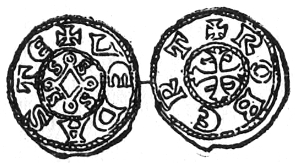
Denier of Robert le Frison
CHAPTER IX THE LAST YEARS OF THE CONQUEROR
344
With the peace of Blanchelande we enter
upon the last phase in the life of William
the Conqueror, and this although more than the
half of his English reign still lay in the future.
It must be owned that no unity of purpose or
achievement can be traced underlying this final
stage; the history of these last years is little
more than a series of disconnected episodes, of
which the details themselves are very imperfectly
known to us. It has, in fact, been customary
for historians to regard this period as marking
somewhat of a decline in the character and
fortunes of the Conqueror; a decline which the
men of the next generation were inclined to
attribute to supernatural vengeance pursuing the
king for his execution of Earl Waltheof in 1076.
“Such was his resolution,” says Orderic, “that
he still maintained a brave fight against his
enemies, but success did not crown his enterprises
now as formerly, nor were his battles often crowned
with victory.”[264] This idea of retributive fate,
characteristic of the medieval mind, has received
from historians various adaptations and exemplifications,
345but perhaps a more reasonable explanation
of the tameness of the last years of the
Conqueror would be that the achievements of
the decade between 1060 and 1070 inevitably
make the succeeding history something of an
anticlimax. The Conqueror’s last wars are indeed
inconsiderable enough when compared with
the campaigns of Le Mans and Hastings, but the
most unique undertaking of his life falls within
two years of its close; and with the Domesday
Survey before us we need no further proof that
the far-sightedness of the king’s policy and the
strength of his executive power were still unimpaired
at the very close of his career.
The main cause of the difficulties which beset the
King in these latter years was the undutiful
eagerness of Robert of Normandy to anticipate
his inheritance. It was natural enough that
Robert should wish to enjoy the reality of power;
for a dozen years at least he had been the recognised
heir of Normandy, and the peace of
Blanchelande had recently assigned him the
county of Maine. But so early as 1074 the earls of
Hereford and Norfolk, in planning their revolt, are
understood to have reckoned the disagreement
between the King and his eldest son among the
chances in their favour,[265] and it is certain that
Robert had been bitterly discontented with his
position for some time before he broke out into
open revolt. The chronology of his movements
346is far from clear; but at some time or other he
made a wild attempt to seize the castle of Rouen,
and when this failed he found an immediate
refuge and base of operations in the land of Hugh
de Châteauneuf, a powerful lord on the border
between Normandy and the royal demesne,
who allowed him to occupy his castles of Raimalast,
Sorel, and Châteauneuf. King William, on
his part, confiscated the lands of the rebels; he
also took into his pay Count Rotrou of Mortagne,
the overlord of Hugh of Châteauneuf for Raimalast;
and Robert was soon driven to seek a more
distant exile in foreign parts. He first visited
Flanders, but Robert the Frisian, notwithstanding
his enmity towards his formidable brother-in-law,
did not think it worth while to spend his
resources upon his irresponsible nephew, for the
latter is represented as wandering vaguely over
Touraine, Germany, Aquitaine, and Gascony in
great destitution. To such straits was he reduced,
that his mother provoked the one dispute which
varied the domestic peace of the Conqueror’s
married life by sending supplies to her son in
exile. The king, on discovering this, became
convulsed with rage, poured reproaches on his
queen for her support of a rebel, and ordered one
of her messengers, who happened to be within his
power, to be seized and blinded. The latter,
however, a Breton named Samson, received a
timely hint of his danger from persons in the
confidence of the queen, and took refuge in the
347monastery of St. Evroul, “for the safety alike of
his soul and body,” says Ordericus Vitalis, who
for some forty years was his fellow-inmate in the
abbey.
At last King Philip took pity upon the fugitive
Robert and allowed him to establish himself
in the castle of Gerberoi in the Beauvaisis. The
king’s patronage of Robert ranks, as a matter of
policy, with his gift of Montreuil to Edgar the
Etheling in 1074; Philip was always ready to take
an inexpensive opportunity of harassing his
over-mighty vassal. Around Robert, in this cave
of Adullam, there gathered a force of adventurers
from Normandy and the French kingdom, including
many men who had hitherto been good
subjects to King William, but now thought it expedient
to follow the rising fortunes of his heir.
William retaliated by garrisoning the Norman
castles which lay nearest to Gerberoi, so as to
prevent the rebels from harrying the border;
and in some way he must have brought the king
of France over to his side; for when, in the last
days of 1078, he laid formal siege to his son’s
castle, we know on good authority that King
Philip was present in his camp.[266] The siege lasted
for three weeks, and in one of the frequent encounters
between the loyalists and the rebels
348there occurred the famous passage of arms between
the Conqueror and his son. William was wounded
in the hand by Robert, his horse was killed under
him, and had not a Berkshire thegn, Tokig, son of
Wigod of Wallingford, gallantly brought another
mount to the king,[267] it is probable that his life
would have come to an ignominious close beneath
the walls of Gerberoi. It was very possibly the
scandal caused by this episode which led certain
prominent members of the Norman baronage
to offer their mediation between the king and his
heir. The siege seems to have been broken up
by mutual consent; William retired to Rouen,
Robert made his way once more into Flanders,
and a reconciliation was effected by the efforts
of Roger de Montgomery, Roger de Beaumont,
Hugh de Grentemaisnil, and other personal
friends of the king. Robert was restored to
favour, his confederates were pardoned, and he
once more received a formal confirmation of
his title to the duchy of Normandy. For a short
time, as charters show, he continued to fill his
rightful place at his father’s court, but his vagabond
instincts soon became too strong for him
and he left the duchy again, not to return to it
during his father’s lifetime.
One is naturally inclined to make some comparison
between these events and the rebellion
which a hundred years later convulsed the dominions
of Henry II. Fundamentally, the cause of
349each disturbance was the same—the anxiety
of the reigning king to secure the succession,
met by equal anxiety on the part of the destined
heir to enjoy the fruits of lordship. And in each
case the character of the respective heirs was
much the same. Robert Curthose and Henry
Fitz Henry, both men of chivalry, rather than of
politics, showed themselves incapable of appreciating
the motives which made their fathers
wish to maintain the integrity of the family possessions;
the fact that they themselves were
debarred from rewarding their private friends
and punishing their enemies, seemed to them a
sufficient reason for imperilling the results of
the statesmanship which had created the very
inheritance which they hoped to enjoy. Robert
of Normandy, a gross anticipation of the chivalrous
knight of later times, represents a type
of character which had hitherto been unknown
among the sons of Rollo, a type for which there
was no use in the rough days when the feudal
states of modern Europe were in the making, and
which could not attain any refined development
before the Crusades had lifted the art and the ideals
of war on to a higher plane. William the Conqueror,
by no means devoid of chivalrous instincts,
never allowed them to obscure his sense of what
the policy of the moment demanded; Henry II.
was much less affected by the new spirit; both
rulers alike were essentially out of sympathy
with sons to whom great place meant exceptional
350opportunities for the excitement and glory of
military adventure, rather than the stern responsibilities
of government.
We know little that is definite about the course
of events which followed upon the reconciliation
of King William and his heir. The next two years
indeed form a practical blank in the personal
history of the Conqueror, and it does not seem
probable that he ever visited England during
this interval. In his absence the king of Scots
took the opportunity of spreading destruction
once again across the border, and in the summer
of 1079 he harried the country as far as the Tyne,
without hindrance, so far as our evidence goes,
from the clerical earl of Northumbria. The
success of this raid was a sufficient proof of the
weakness of the Northern frontier of England,
and in the next year[268] Robert of Normandy was
entrusted with the command of a counter-expedition
into Scotland, with orders to receive the
submission of the king of Scots, or, in case he
proved obdurate, to treat his land as an enemies’
country. The Norman army penetrated Scotland
as far as Falkirk, and, according to one account,
received hostages as a guarantee of King Malcolm’s
obedience. Another and more strictly
contemporary narrative, however, states that this
part of the expedition was fruitless; but, in any
case, Robert on his return founded the great
fortress of Newcastle-on-Tyne as a barrier
351against future incursions from the side of
Scotland.
PITCHER, PHOTO. GLOUCESTER
Some information as to William’s own movements
in Normandy during 1080 may be gathered
from charters and other legal documents. On
the 7th of January he was at Caen,[269] and on
the 13th he appears at Boscherville on the
Seine[270]; at Easter he held a great court probably
at Rouen.[271] At Whitsuntide he presided over a
council at Lillebonne,[272] where a set of canons was
promulgated which strikingly illustrates his
opinion as to the relations which should exist
between church and state.
Whitsunday in 1080 fell on the 31st of May,
and serious disturbances had been taking place
in England earlier in the month. Bishop Walcher
of Durham had proved an unpopular as well as
an inefficient earl of Northumbria. Himself a
foreigner and a churchman, he must from the outset
have been out of touch with the wild Englishmen
placed under his rule, and the situation was
aggravated by the fact that the bishop’s priestly
office compelled him to transact the work of
government in great part by deputy. He entrusted
the administration of his earldom to a kinsman of
his own called Gilbert,[273] and in all matters of
business he relied on the counsel of an ill-assorted
352pair of favourites, one of them a noble Northumbrian
thegn called Ligulf, who found his way to his
favour by the devotion which he professed to
Saint Cuthbert, the other being his own chaplain,
Leobwine, a foreigner. Jealousy soon broke out
between the thegn and the chaplain, and at last
the latter, being worsted by his rival in a quarrel
in the bishop’s presence, took the above mentioned
Gilbert into his confidence and prevailed
on him to destroy the Englishman secretly. On
hearing the news the bishop was struck with
dismay, and, in his anxiety to prove his innocence,
summoned a general meeting of the men of his
earldom to assemble at Gateshead. The assembly
came together, but the Bernicians were in a dangerous
humour; the bishop dared not risk a deliberation
in the open air, and took refuge in the
neighbouring church. Instantly the gathering
got out of hand, the church was surrounded and
set on fire, and the bishop and his companions
were cut to pieces by the mob.
For such an act as this there could be no mercy.
The punishment of the murderers was left to
Walcher’s fellow-prelate Odo of Bayeux, and
the vengeance which he took was heavy. It
must have been impossible to determine with
accuracy the names of those who had actually
joined in the crime, but it is evident that men
from all parts of Bernicia had taken part in the
meeting at Gateshead, and the whole earldom was
held implicated in the murder. Accordingly the
353whole district was ravaged, and the bishop of
Bayeux administered death and mutilation on a
scale unusual even in the eleventh century.[274]
To the thankless dignity of the Northumbrian
earldom, the Conqueror appointed Aubrey de
Coucy, a powerful Norman baron; but he soon
abandoned the task of governing his distressful
province and retired to his continental estates.
To him there succeeded Robert de Mowbray, who
was destined to be the last earl of Bernicia, but
who proved more successful than any of his
predecessors in the work of preserving order
and watching the movements of the king of
Scots; and for the next ten years Northumbria
under his stern rule ceases to trouble the central
administration.
The chief interest of the following year in the
history of the Conqueror lies in the singular
expedition which he made at this time beyond
the limits of his immediate rule into the extreme
parts of Wales. The various but scanty accounts
of this event which we possess are somewhat
conflicting. The Peterborough chronicler says
that the king “in this year led an army into
Wales and there freed many hundred men.”
The Annales Cambriæ tell us that “William,
king of the English, came to St. David’s that
he might pray there.” Very possibly the Conqueror
did in reality pay his devotions at the
354shrine of the apostle of Wales, but secular motives
were not lacking for an armed demonstration in
that restless land. So long as the Normans in
England itself were only a ruling minority, holding
down a disaffected population, the conquest of
Wales was an impossibility; and yet on all grounds
it was expedient for the king to show the Welshmen
what reserves of power lay behind his
marcher earls of Shrewsbury and Chester. The
expedition has a further interest as one of the
earliest occasions on which it is recorded that
the feudal host of England was called to take
the field; the local historian of Abingdon abbey
remarked that nearly all the knights belonging
to that church were ordered to set out for Wales,
although the abbot remained at home.[275] It does
not appear that any of the native princes of South
Wales suffered displacement at this time; the
one permanent result of the expedition would
seem to have been the foundation of Cardiff
castle[276] as an outpost in the enemies’ land. The
strategical frontier of England in this quarter
consisted of the line of fortresses which guarded
the lower course of the Wye, and the settlement of
the Welsh question, like the settlement of the
Scotch question, was a legacy which the Conqueror
left to his successors.
After these events, but not before the end of
the year, King William withdrew into Normandy,
355and probably spent the greater part of 1082 in his
duchy. But his return to England was marked
by one of the most dramatic incidents in his
whole career, the famous scene of the arrest of
Odo, bishop of Bayeux and earl of Kent. Up
to the very moment of the bishop’s fall, the relations
between the brothers appear to have been
outwardly friendly, and in an English charter of
the present year, the bishop appears at court
in full enjoyment of his lay and spiritual titles.[277]
The cause of the final rupture is uncertain. Ordericus
Vitalis[278] assigned it to the unprecedented
ambition of Bishop Odo, who, not content with
his position in England and Normandy, was supposed
to be laying his plans to secure his election
to the papal chair at the next vacancy. According
to this tale, the bishop had bought himself
356a palace in Rome, bribed the senators to join his
side, and engaged a large number of Norman
knights, including no less a person than the earl
of Chester, to follow him into Italy when the time
for action came. Whatever Odo’s plans may
have been, William received news of them in
Normandy, and he hurried across the Channel,
intercepting Odo in the Isle of Wight. Without
being actually arrested, Odo was placed under
restraint, and a special sitting of the Commune
Concilium was convened to try his case. The
subsequent proceedings were conducted in the
Isle of Wight, very possibly in the royal castle
of Carisbrooke, and King William himself seems
to have undertaken his brother’s impeachment.
The articles laid against Odo fell into two parts,
a specific charge of seducing the king’s knights
from their lawful duty, and a general accusation
of oppression and wrong-doing to the church and
to the native population of the land. The task
of giving judgment on these points belonged by
customary law to the barons in council, but they
failed to give sentence through fear of the formidable
defendant before them, and the Conqueror
himself was compelled to issue orders for Odo’s
arrest. Here another difficulty presented itself,
for no one dared lay hands on a bishop; and upon
William seizing his brother with his own hands,
Odo cried out, “I am a bishop and the Lord’s
minister; a bishop may not be condemned without
the judgment of the Pope.” To this claim of episcopal
357privilege William replied that he arrested
not the bishop of Bayeux, but the earl of Kent,
and Odo was sent off straightway in custody to
the Tower of Rouen. At a later date it was suggested
that the distinction between the bishop’s
lay and spiritual functions was suggested to the
king by Lanfranc,[279] whose opinion as an expert
in the canon law was incontrovertible; and apart
from the dramatic interest of the scene the trial
of Odo has special importance as one of the few
recorded cases in which a question of clerical
immunity was raised before the promulgation
of the Constitutions of Clarendon.
The one extended narrative which we possess
of these events was composed some forty years
after the date in question, and the scheme which
is attributed to Bishop Odo may well seem too
visionary a project to have been undertaken
by that very hard-headed person, yet on the
whole we shall probably do well to pay respect
to Orderic’s version of the incident. For, although
the militant lord of Bayeux might seem to us an
incongruous successor for the saintly Hildebrand,
it must as yet have been uncertain how far the
church as a whole had really identified itself with
the ideals which found their greatest exponent in
Gregory VII., and the situation in Italy itself
was such as to invite the intervention of a prelate
capable of wielding the secular arm. The struggle
between pope and emperor was at its height,
358and within three years from the date of Odo’s
arrest Hildebrand himself was to die in exile
from his city, while Norman influence was all-powerful
in south Italy. The tradition represented
in Orderic’s narrative shows an appreciation
of the general situation, and if we regard the
motive assigned for Odo’s preparations as merely
the monastery gossip of the next generation,
yet the bishop’s imprisonment is a certain fact,
and the unusual bitterness of King William towards
his half-brother would suggest that something
more than political disloyalty gave point to the
latter’s schemes. Nevertheless the captivity in
which Bishop Odo expiated his ambition cannot
have been enforced with very great severity,
for in the five years which intervened between
his disgrace and William’s death he appears at
least occasionally in attendance at his brother’s
court.
The circle of the Conqueror’s immediate companions
was rapidly breaking up now. On November
3rd, 1083, Queen Matilda died, and was
buried in the convent of the Holy Trinity at
Caen, which she had founded in return for her
lord’s safety amid the perils of his invasion of
England. Archbishop Lanfranc and Earl Roger of
Montgomery almost alone represented the friends
of King William’s early manhood at the councils
of his last four years. Through all the
hazards of her married life Matilda of Flanders
had played her part well; if William the Conqueror
359alone among all the men of his house kept
his sexual purity unstained to the last, something
at least of this may be set down to his love for the
bride whom he had won, thirty years before, in
defiance of all ecclesiastical censure. Nor should
Matilda’s excellence be conceived of as lying
wholly in the domestic sphere; William could
leave his duchy in her hands when he set out to
win a kingdom for himself and her, and William
was no contemptible judge of practical ability in
others. We shall hardly find in all English medieval
history another queen consort who takes a place
at once more prominent and more honourable.
In the year following Queen Matilda’s death,
the Conqueror’s attention was for the last time
concentrated on the affairs of Maine, and in a
manner which illustrates the uncertain tenure by
which the Normans still held their southern
dependency. Twenty years of Norman rule had
failed to reconcile the Manceaux to the alien
government. The rising of 1073 had proved the
strength and extent of the disaffection, and from
the events of the present year it is plain that the
Norman element in Maine was no more than a
garrison in hostile territory, although the disturbance
which called William into the field in 1084
was merely the revolt of a great Mancel baron
fighting for his own hand, which should not be
dignified with the name of a national movement.
In the centre of the county the castle of Sainte-Suzanne
stands on a high rock overlooking the
360river Arne, one of the lesser tributaries of the
Sarthe. This fortress, together with the castles
of Beaumont and Fresnay on the greater river,
belonged to Hubert the viscount of Maine, who
had been a prominent leader of the Mancel
nationalists in the war of 1063, and had subsequently
married a niece of Duke Robert of Burgundy.
Formidable alike from his position in
Maine and his connection with the Capetian
house, Hubert proved himself an unruly subject
of the Norman princeps Cenomannorum and
after sundry acts of disaffection he broke into
open revolt, abandoned his castles of Fresnay
and Beaumont, and concentrated his forces on
the height of Sainte-Suzanne. Like Robert of
Normandy at Gerberoi, five years before, Hubert
made his castle a rendezvous for all the restless
adventurers of the French kingdom, who soon
became intolerable to the Norman garrisons in
Le Mans and its neighbourhood. The latter,
it would seem, were not strong enough to divide
their forces for an attack on Sainte-Suzanne, and
sent an appeal for help to King William, who
thereupon gathered an army in Normandy, and
made ready for his last invasion of Maine.
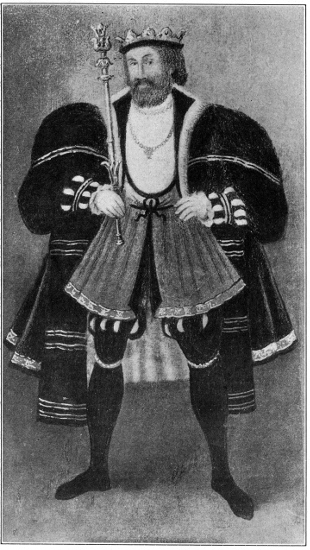
WILLIAM THE CONQUEROR
(AS CONCEIVED BY A FRENCH PAINTER OF THE SIXTEENTH CENTURY)
THE ORIGINAL OF THIS PICTURE, NOW LOST, WAS PAINTED BY AN ARTIST WHEN THE TOMB OF THE CONQUEROR WAS OPENED IN 1522. A COPY EXECUTED IN 1708, IS PRESERVED IN THE SACRISTY OF ST. ETIENNE’S CHURCH AT CAEN; THE PRESENT ILLUSTRATION IS FROM A PHOTOGRAPH OF THAT COPY
But for once in his life the Conqueror found
himself confronted by an irreducible fortress.
“He did not venture to lay siege to the castle of
Sainte-Suzanne,” says Orderic,
“it being rendered impregnable by its position on
361rocks and the dense thickets of vineyards which
surrounded it, nor could he confine the enemy within
the fortress as he wished, since the latter was strong
enough to control supplies and was in command
of the communications. The king therefore built a
fortification in the valley of Bonjen, and placed
therein a strong body of troops to repress the raids
of the enemy, being himself compelled to return into
Normandy on weighty affairs.”[280]
As William had no prospect of reducing the castle,
either by storm or blockade, he was well advised
to save his personal prestige by retreat, but the
garrison of his counterwork under his lieutenant
Alan Earl of Richmond proved themselves unequal
to the task assigned them. For three years,
according to Orderic, the operations in the Arne
valley dragged on, and the fame of Hubert’s successful
resistance attracted an increasing stream
of volunteers from remote parts of France. At
last, when many knights of fame had been killed
or taken prisoner, the disheartened Normans at
Bonjen resolved to bring about a reconciliation
between the king and the viscount. William
was in England at the time, and on receiving
details of the Norman losses before Sainte-Suzanne
he showed himself willing to come to
terms with Hubert, who thereupon crossed the
Channel under a safe conduct and was restored
to favour at the royal court.[281]
362With this failure closes the record of the Conquerors
achievements in Maine. The events of
the next ten years proved that the triumph of
Hubert of Sainte-Suzanne was more than the
accidental success of a rebellious noble; a national
force lay behind him and his crew of adventurers,
which came to the front when Helie de la Flèche
struggled for the county of Maine with William
Rufus. In the process which during the next
half-century was consolidating the feudal world
of France, Maine could not persist in isolated
independence, but its final absorption into Anjou
was less repugnant to local patriotism and the
facts of geography than its annexation by the
lords of Rouen. Those who have a taste for historical
parallels may fairly draw one between
William’s wars in Maine and his descendant
Edward I.’s attack on the autonomy of Scotland,
with reference to the manner in which an initial
success was reversed after the death of the great
soldier who had won it, by the irreconcilable
determination of the conquered people. But
there lies a problem which cannot be wholly
answered in the question why King William’s work,
so permanent in the case of England, was so
soon undone in the case of the kindred land of
Maine.
It is possible that the Conqueror’s placability
363toward Hubert of Sainte-Suzanne was not
unconnected with a more formidable danger
threatening England from the north and east.
Once more the Scandinavian peril hung over the
land. Harold of Denmark, the eldest son of
Swegn Estrithson, had died in 1080, and his
brother and successor Cnut married the daughter
of William’s inveterate enemy, Count Robert of
Flanders. In this way a family alliance between
the two strongest naval powers of the north was
called into being; and in 1085 the king and the
count planned a joint invasion of England. Cnut
attempted to draw King Olaf of Norway into
the expedition, and received from him a contingent
of sixty ships, but Olaf would not join in
person, giving as his reason that the kings of
Norway had always been less successful than the
kings of Denmark in enterprises against England,
and that his kingdom had not yet recovered
from the disaster of 1066.[282] But now, as in the
former year, England had no fleet available for
serious naval operations; and King William’s
subjects must have thought that his defensive
measures were as ruinous to the districts affected
as the passage of an invading army itself. The
king was in Normandy when he became apprised
of the danger, and he hastened across the Channel,
with a great force of French and Breton mercenaries,
“so that people wondered how the
land could feed all that army,” remarks the
364Peterborough chronicler. The king arranged for
the billeting of the host among his barons, and
then proceeded deliberately to lay waste the parts
of the country exposed to attack; a precaution
which would have kept the enemy from advancing
far from the coast, but which must have cruelly
afflicted the poorer folk of the eastern shires.[283]
Meanwhile a great armament from Flanders and
Denmark had been gathered in the Lijm fiord,
and all was ready for the voyage when on July
10, 1086, Cnut was murdered in the church of
Odensee.[284] His death meant the abandonment
of the expedition, but is probable that his abortive
schemes contributed to one of the most notable
events of William’s reign—the oath of Salisbury
of 1086.
The king had kept the feast of 1086 at
Winchester and had knighted his youngest son,
Henry, in the Whitsuntide council at Westminster.
Not long afterwards he turned westward
again, and by the first of August had come to Salisbury,
where he held an assembly of very exceptional
character. “There his Witan came to him,”
says the Anglo-Saxon chronicler, “and all the
landholding men in England, no matter whose
men they might be, and swore him fealty that they
365would be true to him against all men.”[285] The
native chronicler in his cell at Peterborough
was evidently impressed by the scale of all the
Conqueror’s measures in these last years, and his
statement that all the land-holding men in England
came to the Salisbury meeting must not be
construed too literally, but he has seen clearly
enough what was the real purpose of the famous
oath. It was no slight matter that King William
was strong enough to exact from each mesne tenant
in his kingdom an absolute oath of allegiance to
himself in person, without explicit reference to
the tie of homage which bound individual tenants
to their immediate lords. But, significant as is
this clear enunciation of the principle that the
king’s claim to fealty overrides the lord’s claim
to service, it should not be taken to imply any
revolutionary change in the current doctrines
of feudal law. It is highly probable that this
general oath was demanded with the single
purpose of providing against the defection of
disloyal knights and barons to Cnut of Denmark
in the imminent event of his landing. News
travelled slowly in the eleventh century, and
King William at Salisbury on August 1st could
not well have heard of the murder at Odensee
on July 10th. But apart from this, any feudal
monarch could have maintained in theory that
the facts of subinfeudation should not invalidate
his sovereign rights; the question was merely
366as to the possibility of enforcing the latter. The
exceptional power enjoyed by William and his
successors in this respect was due to the intimate
relations established between the king and his
feudatories by the circumstances of the Conquest;
the Oath of Salisbury was a striking incident and
little more.
It was probably not long after the famous scene
at Salisbury that the Conqueror crossed the
Channel for the last time. No chronicler has
recorded the name of the port which witnessed
King William’s last embarkation, but we know
that he called at the Isle of Wight on his way to
Normandy, and we may suppose that he had
set sail from some Hampshire or Sussex haven.
His subjects probably rejoiced at his departure,
for England had fallen on evil times in these last
years. The summer of 1086 had been disastrous
for a population never living far from the margin
of subsistence. “This year was very grievous,”
laments the native chronicler, “and ruinous and
sorrowful in England through the murrain; corn
and fruit could not be gathered and one cannot
well think how wretched was the weather, there
was such dreadful thunder and lightning, which
killed many men, and always kept growing worse
and worse. God Almighty amend it when it
please him.” But the bad harvest brought its
inevitable train of famine and pestilence, and
1087 was worse than 1086 had been. It was the
agony of this year that called forth the famous
367picture of the Conqueror’s fiscal exactions, how
the miserly king leased his lands at the highest
rent that could be wrung out of the poor men
by right or wrong; how his servants exacted
unlawful tolls. Medieval finance was not elastic
enough to adapt itself to the alternation of good
and bad seasons; and in a time of distress men
were crushed to the earth by rents and taxes,
which, as Domesday Book shows, they could
afford to bear well enough in years of normal
plenty. The monk of Peterborough took no account
of this, and yet he clearly felt that he had
reached the climax of disaster as he recorded
the death of William the Conqueror.
The question of the Vexin Française, which,
by a singular chance, was to cost the Conqueror
his life, originated in the days of Duke Robert of
Normandy and Henry I. of France. We have
seen that King Henry, in return for help given
by Robert to him in the difficult time of his accession,
ceded the Vexin Française to the Norman
Duke. Drogo, the reigning count, remained
true to the Norman connection, and accompanied
Duke Robert to the Holy Land, where he died;
but his son Walter wished to detach the Vexin
from association with Normandy and to replace
himself under the direct sovereignty of the king
of France. He proved his hostility to William
of Normandy in the campaign of Mortemer, and
by the claims which he raised to the county of
Maine in 1063, but he died without issue, and his
368possessions passed to his first cousin, Ralf III.,
count of Valois. The house of Valois was not
unfriendly to Normandy, and from 1063 to 1077
its powerful possessions were a standing menace
to the royal demesne. But in the latter year the
family estates were broken up by a dramatic
event. Simon de Crepy, the son of Count Ralf,
who had successfully maintained his position
against Philip I., felt nevertheless a desire to
enter the religious life, and on his wedding night
he suddenly announced his determination, persuaded
his young bride to follow his example, and
retired from the world. Philip I. thereupon
reunited the Vexin to the royal demesne without
opposition from William of Normandy, who was at
the time much occupied with the affairs of Maine.[286]
For ten years William acquiesced in the state of
affairs, and his present action took the form of
a reprisal for certain raids which the Frenchmen
in Mantes had lately been making across
the Norman border. It would clearly have been
useless to expect King Philip to intervene, and
William accordingly raised the whole Vexin question
once more, and demanded possession of
Pontoise, Chaumont, and Mantes, three towns
which command the whole province.
It does not seem that Philip made any attempt
to defend his threatened frontier, and he is
reported to have treated William’s threats with
contempt. Thereupon, the Conqueror, stung by
369some insult which passed at the time, suddenly
threw himself with a Norman force across the
Epte, and harried the country until he came to
Mantes itself. The garrison had left their posts
on the previous day, in order to inspect the devastation
which the Normans had wrought in the
neighbourhood, and were surprised by King
William’s arrival. Garrison and invaders rushed
in together headlong through the gates of the
city, but the Normans had the victory, and
Mantes was ruthlessly burned. And then King
William, while riding among the smouldering
ruins of his last conquest, in some way not quite
clearly known, was thrown violently upon the
pommel of his saddle, and his injury lay beyond
the resources of the rough surgery of the eleventh
century.
Stricken thus with a mortal blow, King William
left the wasted Vexin for his capital of Rouen,
and for six weeks of a burning summer his great
strength struggled with the pain of his incurable
hurt. At first he lay within the city of Rouen
itself, but as the days passed he became less
able to bear the noise of the busy port, and he
bade his attendants carry him to the priory of
Saint-Gervase, which stands on a hill to the
west of the town. The progress of his sickness
left his senses unimpaired to the last, and in the
quiet priory the Conqueror told the story of his
life to his sons William and Henry, his friend and
physician Gilbert Maminot, bishop of Lisieux,
370Guntard, abbot of Jumièges, and a few others
who had come to witness the end of their lord.
Two independent narratives of King William’s
apologia have survived to our day, and, although
monastic tradition may have framed the tale
somewhat to purposes of edification, yet we can
see that it was in no ignoble spirit that the Conqueror,
under the shadow of imminent death,
reviewed the course of his history. He called to
mind with satisfaction his constant devotion
and service to Holy Church, his patronage of
learned men, and the religious houses founded under
his rule. If he had been a man of war from
his youth up he cast the blame in part upon the
disloyal kinsmen, the jealous overlord, the aggressive
rivals who had beset him from his childhood,
but for the conquest of England, in this his
supreme moment, he attempted no justification.
In his pain and weariness, the fame he had shed
upon the Norman race paled before the remembrance
of the slaughter at Hastings, and the
harried villages of Yorkshire. No prevision,
indeed, of the mighty outcome of his work could
have answered the Conqueror’s anxiety for the
welfare of his soul, and under the spur of ambition
he had taken a path which led to results beyond
his own intention and understanding. We
need not believe that the bishop of Lisieux or the
abbot of Jumièges have tampered with William’s
words, when we read his repentance for the events
which have given him his place in history.
371It remained for the Conqueror to dispose of his
inheritance, and here for once political expediency
had to yield to popular sentiment. We cannot
but believe that the Conqueror, had it been in
his power, would have made some effort to preserve
the political union of England and Normandy.
But fate had struck him down without
warning, and ruled that his work should be undone
for a while. With grim forebodings of evil William
acknowledged that the right of the first-born, and
the homage done by the Norman barons to
Robert more than twenty years before, made it
impossible to disinherit the graceless exile, but
England at least should pass into stronger hands.
William Rufus was destined to a brief and stormy
tenure of his island realm, but its bestowal now
was the reward of constant faithfulness and good
service to his mighty father. To the English-born
Henry, who was to be left landless, the Conqueror
bequeathed five thousand pounds of silver
from his treasury, and, in answer to his complaint
that wealth to him would be useless without
land, prophesied the future reunion of the Anglo-Norman
states under his rule. And then, while
Henry busied himself to secure and weigh his treasure,
the Conqueror gave to William the regalia of
the English monarchy, and sealed a letter recommending
him to Archbishop Lanfranc as the
future king, and kissing him gave him his blessing,
and directed him to hasten to England before
men there knew that their lord was dead.
372In his few remaining hours King William was
inspired by the priests and nobles who stood
around his bed to make reparation to certain victims
of his policy, who still survived in Norman
prisons. Among those who were now released
at his command were Wulfnoth, Earl Godwine’s
son, and Wulf the son of King Harold; the
prisoners of Ely, Earl Morcar and Siward Barn;
Earl Roger of Hereford, and a certain Englishman
named Algar. Like ghosts from another world
these men came out into the light for a little
time before they vanished finally into the dungeons
of William Rufus; but there was one state
prisoner whose pardon, extorted reluctantly from
the Conqueror, was not reversed by his successor.
It was only the special intercession of Count
Robert of Mortain which procured the release
of his brother, Bishop Odo. The bishop had
outdone the Conqueror in oppression and cruelty
to the people of England, and regret for his own
sins of ambition and wrong had not disposed the
king for leniency towards his brother’s guilt
in this regard. At length in sheer weariness he
yielded against his will, foretelling that the
release of Odo would bring ruin and death upon
many.
It is in connection with Bishop Odo’s liberation
that Orderic relates the last recorded act of William’s
life. A certain knight named Baudri de
Guitry, who had done good service in the war of
Sainte-Suzanne, had subsequently offended the
373king by leaving Normandy without his license
to fight against the Moors in Spain. His lands
had been confiscated in consequence, but were
now restored to him, William remarking that he
thought no braver knight existed anywhere, only
he was extravagant and inconstant, and loved
to wander in foreign countries. Baudri was a
neighbour and friend to the monks of St. Evroul,
hence no doubt the interest which his restoration
possessed for Ordericus Vitalis.
In the final stage of King William’s sickness,
the extremity of his pain abated somewhat, and
he slept peacefully through the night of Wednesday
the 8th of September. As dawn was breaking
he woke, and at the same moment the great bell
of Rouen cathedral rang out from the valley
below Saint-Gervase’s priory. The king asked
what it meant; those who were watching by
him replied, “My lord, the bell is tolling for
primes at St. Mary’s church.” Then the Conqueror,
raising his hands, exclaimed: “To Mary,
the holy mother of God, I commend myself,
that by her blessed intercession I may be reconciled
to her beloved Son, our Lord Jesus Christ.”
The next instant he was dead.
For close upon six weeks the king had lain
helpless in his chamber in the priory, but death
had come upon him suddenly at last, and the
company which had surrounded him instantly
scattered in dismay. Each man knew that for
many miles around Rouen there would be little
374security for life or property that day, and the
dead king was left at the mercy of his own servants,
while his friends rode hard to reach their homes
before the great news had spread from the city
to the open country. By the time that the clergy
of Rouen had roused themselves to take order
how their lord might be worthily buried, his
body had been stripped, his chamber dismantled,
and his attendants were dispersed, securing the
plunder which they had taken. The archbishop
of Rouen directed that the king should be carried
to the church of his own foundation at Caen, but
no man of rank had been left in the city, and
it was only an upland knight, named Herlwin,
who accompanied the Conqueror on his last
progress over his duchy. By river and road the
body was brought to Caen, and a procession of
clergy and townsfolk was advancing to meet it,
when suddenly a burst of flame was seen arising
from the town. The citizens, who knew well
what this meant among their narrow streets and
wooden houses, rushed back to crush the fire,
while the monks of Saint Stephen’s received the
king’s body and brought it with such honour
as they might to their house outside the walls.
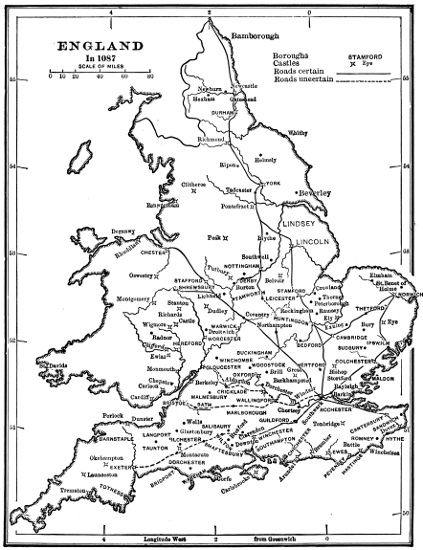
Shortly afterwards, the Conqueror was buried
in the presence of nearly all the prelates of the
Norman church. The bishop of Evreux, who
had watched by the king’s death-bed, preached,
praising him for the renown which his victories
had brought upon his race, and for the strictness
375of his justice in the lands over which he ruled.
But a strange scene then interrupted the course
of the ceremony. A certain Ascelin, the son of
Arthur, came forward and loudly declared that
the place in which the grave had been prepared
had been the court-yard of his father’s house,
unjustly seized by the dead man for the foundation
of his abbey. Ascelin clamoured for restitution,
and the bishops and other magnates drew him
apart, and, when satisfied that his claim was
just, paid him sixty shillings for the ground where
the grave was. And then, with broken rites, the
Conqueror was laid between the choir and the
altar of Saint Stephen’s church.

Denier of Philip I. of France
CHAPTER X WILLIAM AND THE CHURCH
376
Up to the present we have only dealt with the
ecclesiastical relations of William the Conqueror
in so far as they have directly affected
political issues. But the subject has a unity of its
own, quite apart from its bearing upon the course
of war or diplomacy, and no aspect of the Conqueror’s
work is known to us in greater detail.
It may be added that no aspect of the Conqueror’s
work is more illustrative of the general character
of his government, nor of greater significance
for the future history. For four centuries and a
half the development of the church in England
followed the lines which he had indicated.[287]
But the church in Normandy was William’s
first concern, and some appreciation of his work
here is necessary to an understanding of the
tendencies which governed his ecclesiastical policy
in England. Broadly stated, William’s relations
with the church in Normandy and England alike
were governed by two main ideas. He was
beyond all doubt sincerely anxious for the reform
377of the church, as he would have understood the
phrase—the extension and stricter observance
of the monastic life, the improvement of the
learning and morals of the secular clergy, the
development of a specific ecclesiastical law. But
he was no less determined that, at all hazards,
the church in his dominions should be subordinate
to the state, and his enforcement of this
principle ultimately threw him into opposition to
the very party in the church which was most
sympathetic to his plans of ecclesiastical reform.
Between Hildebrand claiming in definite words
that the head of the church was the lord of the
world, and William asserting in unmistakable
acts that the king of England was over all persons
in all causes, as well ecclesiastical as temporal,
through his dominions supreme, there were certain
to be differences of opinion. But the two great
men kept the peace for a surprising length of
time, and it was not until ten years before William’s
death that serious discord arose between
him and the Curia in regard to the question of
church government.
In this matter, indeed, William was but maintaining
prerogatives which he had inherited
from his predecessors, and which were simultaneously
being vindicated by the other princes
of his time. We have already remarked on the
intimate connection of church and state which
prevailed in Normandy at the beginning of the
eleventh century, in relation to its bearing upon
378the general absolutism enjoyed by the duke.
But the fact has a wider significance as governing
the whole character of ecclesiastical life in the
duchy. The rights of patronage which the duke
possessed, his intervention in the process of
ecclesiastical legislation, his power of deposing
prelates who had fallen under his displeasure,
not only forbade the autonomy of the church, they
made its spiritual welfare as well as its professional
efficiency essentially dependent upon the personal
character of its secular head. Under these conditions,
there was scanty room for the growth
of ultramontane ideas among the Norman clergy;
and such influence as the papacy exercised in
Normandy before 1066 at least was due much
more to traditional reverence for the Holy See,
and to occasional respect for the character of its
individual occupants, than to any recognition
of the legal sovereignty of the Pope in spiritual
matters. William himself in the matter of his
marriage had defied the papacy, and the denunciations
of the Curia found but a faint response
among the prelates of the Norman church.
From the ultramontane point of view this
dependence of the church upon the state was a
gross evil, but it was at least an evil which produced
its own compensation in Normandy.
The chaos which had attended the settlement
of the Northmen in the tenth century had involved
the whole ecclesiastical organisation of the land
in utter ruin, and its restoration was entirely
379due to the initiative taken by the secular power.
The successive dukes of Normandy, from Richard
I. onward, showed astonishing zeal in the work
of ecclesiastical reform.[288] Their zeal, however,
must have spent itself in vain if their success
had been dependent upon the co-operation of
the Norman clergy; the decay of the church in
Normandy had gone too far to permit of its being
reformed from within. The reforming energy
which makes the eleventh century a brilliant
period in French ecclesiastical history was concentrated
at this time in the great abbeys of
Flanders and Burgundy, whose inmates, however,
were fully competent, and for the most part
willing, to undertake the restoration of ecclesiastical
order in Normandy. From this quarter, and
in particular from the abbey of Cluny, monks
were imported into the duchy by Dukes Richard
I. and II., and under their guidance the reform
of the Norman church was undertaken according
to the highest monastic ideal of the time. Very
gradually, but with ever increasing strength,
the influence of the foreign reformers gained more
and more control over every rank in the Norman
hierarchy. The higher clergy, who at first resisted
the movement, became transformed into its
champions as the result of the judicious appointments
made by successive dukes. Even the upland
clergy, whose invincible ignorance had aroused
the anger of the earliest reformers, were attracted
380within the scope of the reform, partly by means
of the affiliation of village churches to monasteries,
but above all through the educational
work performed by the schools which were among
the first fruits of the monastic revival.
If the foundation of new monasteries may be
taken as evidence, the process of expansion and
reform went on unchecked throughout the stormy
minority of William the Conqueror. A period of
feudal anarchy was not necessarily inimical to
the ultimate interests of the church. Amid the
disorder and oppression of secular life the church
might still display the example of a society
founded on law and discipline, it might in numberless
individual cases protect the weak from
gratuitous injury, and it certainly might hope to
emerge from the chaos with wider influence and
augmented revenues. The average baron was
very willing to atone for his misdeeds by the
foundation of a new religious house, or by benefactions
to an old one, and the immortal church
had time on its side. In Normandy, at least, the
disorder of William’s minority coincided with
the foundation of new monasteries in almost
every diocese in the Norman church; and the
promulgation of the Truce of God in 1042 gave a
wide extension to the competence of ecclesiastical
jurisdiction in relation to secular affairs.
With William’s victory at Val-es-dunes, the
crisis was over, and for the next forty years the
Norman church sailed in smooth waters. Autocratic
381as was William by temperament, nothing
contributed more greatly to his success than his
singular wisdom in the choice of his ministers in
church and state, and his power of attaching
them to his service by ties of personal friendship
to himself. The relations between William and
Lanfranc form perhaps the greatest case in point,
but there were other and less famous members of the
Norman hierarchy who stood on terms of personal
intimacy with their master. And William was
cosmopolitan in his sympathies. Men of learning
and piety from every part of Christendom were
entrusted by him with responsible positions in the
Norman church; in 1066 nearly all the greater
abbeys of Normandy were ruled by foreign monks.
Cosmopolitanism was the chief note of medieval
culture, and under these influences a real revival of
learning may be traced in Normandy. It is well
for William’s memory that this was so; but for
the work of William of Poitiers and William of
Jumièges, two typical representatives of the new
learning, posterity would have remained in
blank ignorance of the Conqueror’s rule in Normandy.
But it is a matter of still greater importance
that in this way Normandy was gradually
becoming prepared to be the educator of England,
as well as her conqueror. The surviving relics
of the literary activity at this time of Normandy—mass
books, theological treatises, and books of
miracles, which it produced—have but little interest
for the general student of history, but the
382important point is that they are symptoms of an
intellectual life manifesting itself with vigour
in the only directions which were possible to it in
the early eleventh century. Not until it had been
transplanted to the conquered soil of England
did this intellectual life produce its greatest
result, the philosophical history of William of
Malmesbury, the logical narrative of Eadmer,
to name only two of its manifestations; but in
matters of culture, as well as in matters of policy
and war, the Norman race was unconsciously
equipping itself in these years for its later achievement
across the Channel.
It cannot be denied that the English church
stood in sore need of some such external influence.
The curious blight which seemed to have settled
on the secular government of England affected its
religious organisation also. The English church
had never really recovered from the Danish wars
of Alfred’s time. It had been galvanised into
fresh activity by the efforts of Dunstan and his
fellow-reformers of the tenth century, but the
energy they had infused scarcely outlasted their
own lives, and in 1066 the church in England
compares very unfavourably with the churches
of the continent in all respects. It had become
provincial where they were catholic; its culture
was a feeble echo of the culture of the eighth century,
they were striking out new methods of
inquiry into the mysteries of the faith; it was
becoming more and more closely assimilated to
383the state, they were struggling to emancipate
themselves from secular control. There was
ample scope in England for the work of a great
ecclesiastical reformer, but the increasing secularisation
of the leaders of the church rendered it
unlikely that he would come from within.
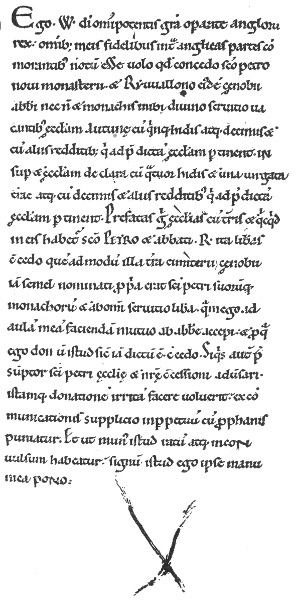
REDUCED FACSIMILE OF THE CHARTER OF WILLIAM THE CONQUEROR TO HYDE ABBEY
Even in 1066 the English church still retained
distinct features of the tribal organisation which
it had inherited from the century of the conversion.
Its dioceses in general represented Heptarchic
kingdoms, and the uncertainty of their
boundaries is here and there definitely traceable
to the uncertain limits of the primitive tribes of
which, they were the ecclesiastical equivalents.
The residences of half the English bishops of
the eleventh century were still fixed, like those
of their seventh-century predecessors, in remote
villages; “places of retirement rather than centres
of activity,” as they have well been called.
The number of dioceses was very small in proportion
to the population and area of the
land, and it tended to decrease; Edward the
Confessor had recently united the sees of
Cornwall and Devon, under the single bishop of
Exeter. Within his diocese each bishop enjoyed
an independence of archiepiscopal supervision,
the like of which was unknown to his continental
fellows; the canonical authority of the archbishops
was in abeyance, and in 1070 it was still
an open question whether the sees of Dorchester,
Lichfield, and Worcester, which represented nearly
384a third of England, belonged to the province of
Canterbury or of York. The smaller territorial
units of ecclesiastical government, the archdeaconry
and rural deanery, are hardly to be traced
in England before the Conquest, and the chapters
in the several dioceses varied indefinitely in
point of organisation.
It was not necessarily an abuse that the right
of making appointments to the higher ecclesiastical
offices belonged in England to the king and
the Witanagemot; it was another matter that the
leaders of the church were becoming more and
more absorbed in secular business. A representative
bishop of King Edward’s day would be a
vigorous politician and man of affairs. Ealdred,
archbishop of York, was sent by the king into
Germany to negotiate for the return of Edgar
the Etheling; Lyfing of Worcester earned the
title of the “eloquent” through the part he played
in the debates of the Witanagemot; Leofgar of
Hereford, a militant person who caused grave
scandal by continuing to wear his moustaches
after his ordination, conducted campaigns against
the Welsh. In Normandy, this type of prelate
was rapidly becoming extinct; Odo of Bayeux
and Geoffrey of Coutances stand out glaringly
among their colleagues in 1066; but in England
the circumstances of the time demanded the
increasing participation of the higher clergy in
state affairs. The rivalry of the great earls at
Edward’s court produced, as it were, a barbarous
385anticipation of party government, and during the
long ascendancy of the house of Godwine, ecclesiastical
dignities were naturally bestowed on men
who could make themselves politically useful to
their patron. Curiously enough, the one force
which operated to check the secularisation of the
English episcopate was the personal character
of King Edward. His foreign tendencies found
full play here, and the alien clerks of his chapel
whom he appointed to bishoprics came to form
a distinct group, to which may be traced the
beginnings of ecclesiastical reform in England.
For a short time the highest office in the English
church was held, in the person of the unlucky
Robert of Jumièges, by a Norman monk in close
touch with the Cluniac school of ecclesiastical
reformers, who seems to have tried, during his
brief period of rule, to raise the standard of
learning among the clergy of his diocese. Robert
fell before he could do much in this direction,
but the foreign influences which were beginning
to play upon the English church did not cease
with his expulsion. Here and there, during
Edward’s later years, native prelates were to be
found who recognised that much was amiss with
the church, and followed foreign models in their
attempts at reform; Ealdred of York tried to
impose the strict rule of Chrodegang of Metz
upon his canons of York, Ripon, Beverley, and
Southwell, the four greatest churches of Northern
England. But individual bishops could not go
386far enough in the work of reform, and their
efforts seem to have met with little sympathy
from the majority of their colleagues.
To a foreign observer, nothing in the English
church would seem more anomalous than the
character of its ecclesiastical jurisdiction. There
existed, indeed, in the law books of successive
kings, a vast mass of ecclesiastical law; it was
in the administration of this law that England
parted company with continental usage. In England
the bishop with the earl presided over the
assembly of thegns, freemen, and priests which
constituted the shire court, and the local courts
of shire and hundred had a wide competence
over matters which, on the continent, would
have been referred to a specifically ecclesiastical
tribunal. The bishop seems to have possessed
an exclusive jurisdiction over the professional
misdoings of his clergy, and the degradation of a
criminous clerk, the necessary preliminary to his
punishment by the lay authority, was pronounced
by clerical judges, but all other matters
of ecclesiastical interest fell within the province
of the local assemblies. Ecclesiastical and secular
laws were promulgated by the same authority
and administered by the same courts, nor does
the church as a whole seem to have possessed
any organ by means of which collective opinion
might be given upon matters of general importance.
No great councils of the church, such
as those of which Bede tells us, can be traced in
387the Confessor’s reign, nor, indeed, for nearly two
centuries before his accession. The church council
had been absorbed by the Witanagemot.
To all the greater movements which were agitating
the religious life of the continent in the eleventh
century—the Cluniac revival, the hierarchical
claims of the papacy—the English church as a
whole remained serenely oblivious. Its relations
with the papacy were naturally very intermittent,
and when a native prelate visited the Holy See,
he might expect to hear strong words about
plurality and simony from the Pope. With
Stigand the papacy could hold no intercourse,
but, despite all the fulminations of successive
Popes, Stigand continued for eighteen years to
draw the revenues of his sees of Canterbury and
Winchester, and other prelates rivalled him in
his offences of plurality, whatever scruples they
might feel about his canonical position as archbishop.
Ealdred of York had once administered
three bishoprics and an abbey at the same time.
The ecclesiastical misdemeanours of a party among
the higher clergy would have been a minor evil,
had it not coincided with the general abeyance
of learning and efficiency among their subordinates.
We know very little about the parish
priest of the Confessor’s day, but what is known
does not dispose us to regard him as an instrument
of much value for the civilisation of his neighbours.
In the great majority of cases, he seems
to have been a rustic, married like his parishioners,
388joining with them in the agricultural work
of the village, and differing from them only in the
fact of his ordination, and in possessing such a
knowledge of the rudiments of Latin as would
enable him to recite the services of the church.
The energy with which the bishops who followed
the Conquest laboured for the elevation of the
lower clergy is sufficiently significant of what
their former condition must have been. The
measures which were taken to this end by the
foreign reformers—the general enforcement of
celibacy, for example—may not commend themselves
to modern opinion, but Lanfranc and his
colleagues knew where the root of the matter
lay. It was only by making the church distinct
from the state, by making the parish priest a
being separated by the clearest distinctions from
his lay brother, that the church could begin to
exercise its rightful influence upon the secular life
of the nation.
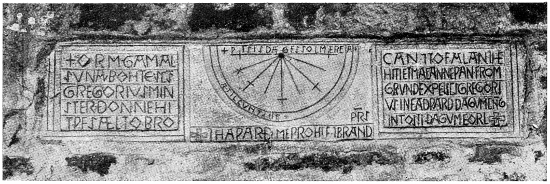
GAMEL SON OF ORME’S SUNDIAL
FROM A SHORT ACCOUNT OF SAINT GREGORY’S MINSTER, KIRKDALE, BY REV. F. W. POWELL, VICAR. THE TRANSLATION IS AS FOLLOWS:
“ORM GAMAL’S SON BOUGHT S. GREGORY’S MINSTER WHEN IT WAS ALL BROKEN DOWN AND FALLEN AND HE LET IT BE MADE ANEW FROM THE GROUND TO CHRIST AND S. GREGORY, IN EDWARD’S DAYS, THE KING, AND IN TOSTI’S DAYS, THE EARL.”
THE CENTRAL PANEL HAS ON THE DIAL—
“THIS IS DAY’S SUN MARKER
AT EVERY TIME.”
AND AT THE FOOT—
“AND HAWARTH ME WROUGHT AND BRAND, PRIESTS”
Political circumstances delayed the beginnings
of ecclesiastical reform for more than three years
after the battle of Hastings had placed the destinies
of the English church in Norman hands.
While the Conqueror was fighting at Stafford and
York, he could not be presiding over synods at
Winchester and London. No steps, therefore,
were taken in this question before 1070, when the
fall of Chester destroyed the last chance of a successful
English rising, and made it no longer expedient
for William to be complaisant to Stigand
389and the nationalist party in the English episcopate.
But in 1070 the work was begun in earnest under
the immediate sanction of the Pope, expressed in
the legation of two cardinal priests who visited
England in that year. There could be little doubt
what their first step would be; and when Stigand
was formally arraigned for holding the sees of
Winchester and Canterbury in plurality, usurping
the pallium of his predecessor, Robert, and receiving
his own pallium from the schismatic Benedict
X., he had no defence to offer beyond declamation
against the good faith of the king. Three other
bishops fell at or about the same time; Ethelmer,
brother of Stigand, and bishop of East
Anglia, Ethelwine, bishop of Durham, and Ethelric,
bishop of Selsey. In regard to none of these
last bishops are the grounds on which their deposition
was based at all certain; and in the case of
Ethelric, an aged man who was famed for his vast
knowledge of Anglo-Saxon law, the Pope himself
was uneasy about the point, and a correspondence
went on for some time between him and Lanfranc
on the subject. But it is a noteworthy fact that
these four prelates are the only bishops deposed
during the whole of the Conqueror’s reign. Nothing
was further from William’s purpose than any
wholesale clearance of the native episcopate. He
was King Edward’s heir, and he wished, therefore,
to retain King Edward’s bishops in office, so far
as this was consistent with the designs of his
ally the Pope. On the other hand, William was
390no less determined to fill all vacancies when they
occurred in the course of nature with continental
priests. Herein he and the Pope were in
complete harmony. It was only by this means
that continental culture and ideas of church
government could be introduced into England,
and William trusted in his own strength to repress
any inconvenient tendencies which might arise
from the ultramontane ideals of his nominees.
The deposition of Stigand meant the elevation
of Lanfranc to the archbishopric of Canterbury.
It is probable that the Pope would have preferred
to attach him to the College of Cardinals, but
William was determined to place his old friend
at the head of the English church, and Alexander
II. gave way. York, vacant through the death of
Ealdred in 1069, was given to Thomas, treasurer of
Bayeux, protégé of Odo, bishop of that see,
and a man of vast and cosmopolitan learning.
Almost immediately after his appointment a
fierce dispute broke out between him and Lanfranc.
The dispute in question was twofold—partly
referring to the boundaries of the two
provinces, but also raising the more important
question whether the two English archbishops
should possess co-ordinate rank or whether the
archbishop of York should be compelled to take
an oath of obedience to the primate of Canterbury.
In a council held at Winchester in 1072
both questions were settled in favour of Canterbury.
The dioceses of Lichfield, Worcester, and
391Dorchester were assigned to the latter provinces,
and Lanfranc—partly by arousing William’s
fears as to the political inexpediency of an independent
archbishop of York, partly by the
skilful forgery of relevant documents—brought
it about that the northern archbishopric was
formally declared subordinate to that of Canterbury.
In ecclesiastical, as well as secular matters,
William had small respect for the particularism
of Northumbria.
The council which decided this matter was
only one of a series of similar assemblies convened
during the archiepiscopate of Lanfranc. The
first of the series had already been held in 1070,
when Wulfstan, the unlearned but saintly bishop
of Worcester, was arraigned pro defectu scientiæ.
He was saved from imminent deposition partly
by his piety, partly by his frank and early acceptance
of the Norman rule; and he retained his
see until his death in 1094. In 1075 the third
council of the series proceeded to deal with one of
the greatest anomalies presented by the English
church, and raised the whole question of episcopal
residence. In accordance with its decrees, the
see of Lichfield was translated to Chester, that
of Selsey to Chichester, and that of Sherborne to
Old Salisbury. Shortly afterwards, the seat of the
east midland diocese of Dorchester was transferred
to Lincoln; and in 1078 Bishop Herbert of Elmham,
after an abortive attempt to gain possession of
Bury St. Edmund’s, removed his residence to
392Thetford, the second town in Norfolk. In all
these changes the attempt was made to follow the
continental practice by which a bishop would
normally reside in the chief town of his diocese.
But new episcopal seats implied new cathedral
churches, and the Conqueror’s reign witnessed a
notable augmentation of church revenues,[289] expressed
in grants of land, the extent of which can
be ascertained from the evidence of Domesday
Book. Here and there are traces of a reorganisation
of church property, and of its appropriation
to special purposes; all of which enabled the
new bishops to support the strain incurred by
their great building activities. By 1087 new
cathedrals had been begun in seven out of fifteen
dioceses.
The church councils which supplied the means
through which the king and primate carried their
ideas of ecclesiastical reform into effect were
bodies of a somewhat anomalous constitution.
In the Confessor’s day the Witanagemot had
treated indifferently of sacred and secular law,
but its competence in religious matters did not
descend unbroken to its feudal representative,
the Commune Concilium. In the Conqueror’s
reign the church council is becoming differentiated
from the assembly of lay barons, but the
process is not yet complete. The session of the
church council would normally coincide in point
of place and time with a meeting of the Commune
393Concilium; no ecclesiastical decree was valid until
it had received the king’s sanction, and the king
and his lay barons joined the assembly, although
they took no active part in its deliberations. There
was, indeed, small necessity for their presence,
and in two of the more important councils of
William’s reign, at London in 1075 and at Gloucester
in 1085 the spiritualty held a session of
their own apart from the meeting of the Commune
Concilium. In any case the spiritual decrees
were promulgated upon the authority of
the archbishop and prelates, although the royal
word was necessary for their reception as law.
No piece of ecclesiastical legislation passed
during this time had wider consequences than
the famous decree which limited the competence
of the shire and hundred courts in regard to
matters pertaining to religion.[290] This law has
only come down to us in the form of a royal writ
addressed to the officers and men of the shire
court, so that its exact date is uncertain. But
intrinsically it is likely enough that the question
of ecclesiastical jurisdiction would be one of the
first matters to which William and Lanfranc
would turn their hands, and the principle implied
in the writ had already been recognised by all
the states of the continent. According to this
document no person of ecclesiastical status might
be tried before the hundred court, nor might
394this assembly any longer possess jurisdiction
over cases involving questions of spiritual law,
even when laymen were the parties concerned.
All these matters were reserved to the exclusive
jurisdiction of the bishops and their archdeacons,
and in this way room was prepared in England for
the reception of the canon law of the church.[291]
Important as it was for the subsequent fortunes
of the church, this decree was perhaps of even
greater importance for its influence upon the
development of secular law. The canons of the
church, in the shape which they assumed at
the hands of Gratian in the next generation,
were to set before lay legislators the example of
a codified body of law, aiming at logical consistency
and inherent reason; a body very different
from the collection of isolated enactments
which the English church of the eleventh century
inherited from the Witanagemots of Alfred and
Edgar. We cannot here trace the way in which
the efforts of the great doctors of the canon law
were to react upon the work of their secular contemporaries;
but the fact of such influence is
certain, and the next century witnessed its abundant
manifestation.
The transference of ecclesiastical causes from
the sphere of the folk law to that of the canons
of the church meant that the Pope would in time
acquire, in fact, what no doubt he would already
claim in theory—the legal sovereignty of the
395church in England. That William recognised this
is certain, and he was determined that the fact
should in no way invalidate the ecclesiastical
prerogatives which he already enjoyed in Normandy,
and which in regard to England he claimed
as King Edward’s heir. Contemporary churchmen
say this too, and the key to William’s relations
with the Pope is given in the three resolutions
which Eadmer in the next generation ascribes
to him. No Pope should be recognised in England,
no papal letters should be received, and no tenant-in-chief
excommunicated without his consent. In
short, William was prepared to make concessions
to the ecclesiastical ideas of his clerical friends
only in so far as they might tend to the more
efficient discharge by the church of its spiritual
function. This was, of course, a compromise,
and no very satisfactory one; it led immediately
to strained relations between William himself
and Hildebrand, it was the direct cause of the
quarrel between William Rufus and Anselm, and
it was indirectly responsible for the greater
struggle which raged between Henry of Anjou
and Becket. On one point, however, king and
papacy were in perfect accord, and it was this fact
which prevented their difference of opinion upon
higher matters of ecclesiastical policy from becoming
acute during the Conqueror’s lifetime. Both
parties were agreed upon the imperative necessity
of reforming the mass of the English clergy in
morals and learning, and here at least the
396Conqueror’s work was permanent and consonant
with the strictest ecclesiastical ideas of the time.
We have already remarked that to the men of
the eleventh century, ecclesiastical reform implied
the general enforcement of clerical celibacy.
The Winchester Council of 1072 had issued a
decree against unchaste clerks, but the matter
was not taken up in detail for four years more,
and the settlement which was then arrived at
was much more lenient to the adherents of the
old order than might have been expected. It
made a distinction between the two classes of
the secular clergy. All clerks who were members
of any religious establishment, whether a cathedral
chapter, or college of secular canons, were
to live celibate for the future. The treatment
applied to the upland clergy was summary.
It would have been a hopeless task to force the
celibate life upon the whole parochial clergy
of England, but steps could be taken to secure
that the married priest would become an extinct
species in the course of the next generation.
Accordingly, parish priests who were married at
the time might continue to live with their wives,
but all subsequent clerical marriage was absolutely
forbidden, and the bishops were enjoined
to ordain no man who had not previously made
definite profession of celibacy. In all this Lanfranc
was evidently anxious to pass no decree
which could not be carried into immediate execution,
even if this policy involved inevitable delay
397before the English clergy in this great respect
were brought into line with their continental
brethren. The next century had well begun before
the native clergy as a whole had been reduced
to acceptance of the celibate rule.
The monastic revival which followed the Conquest
told in the same direction. In the mere
foundation of religious houses, the Conqueror’s
reign cannot claim a high place. Such monasteries
as derive their origin from this period were
for the most part affiliated to some continental
establishment. The Conqueror’s own abbey of
St. Martin of the Place of Battle was founded
as a colony from Marmoutier, though it soon won
complete autonomy from the jurisdiction of the
parent house. It was a noteworthy event when
in 1076 William de Warenne founded at Lewes
the first Cluniac priory in England, although it
does not appear that any other house of this
order had arisen in this country before 1087. In
monastic history the interest of the Conqueror’s
reign centres round the old independent Benedictine
monasteries of England, and their reform
under the administration of abbots imported
from the continent. Here there was much work
to be done; not only in regard to the tightening
of monastic discipline, but also in the accommodation
of these ancient houses, with their wide
lands and large dependent populations, to the
new conditions of society which were the result
of the Conquest. Knight service had to be provided
398for; the property of the monastery had to be
organised to enable it to bear the secular burdens
which the Conqueror’s policy imposed; foreign
abbots were at times glad to rely upon the legal
knowledge which native monks could bring to
bear upon the intricacies of the prevailing system
of land tenure. The Conqueror’s abbots were often
men of affairs, rather than saints; their work was
here and there misunderstood by the monks
over whom they ruled, yet it cannot be doubted
that a stricter discipline, a more efficient discharge
of monastic offices, a higher conception of
monastic life, were the results of their government.
The influence of their work was not confined
within monastic walls. In the more accurate
differentiation of monastic duties which they
introduced, they were not unmindful of the
claims of the monastery school. Very gradually
the schools of such houses as St. Albans and
Malmesbury came to affect the mass of the native
clergy. And the process was quickened by the control
which the monasteries possessed over a
considerable proportion of the parish churches of
the country. The grant of a village to an abbey
meant that its church would be served by a priest
appointed by the abbot, and in Norman times
no baron would found a religious house without
granting to it a number of the churches situate
upon his fief. Already in 1066 the several
monasteries of England possessed a large amount
of patronage; and the Norman abbots of the
399eleventh and twelfth centuries were not slow to
employ the influence they possessed in this way
for the elevation of the native clergy.
Of course, there is another side to this picture.
In the little world of the monastery, as in the
wide world of the state, it was the character of
the ruling man which determined whether the
ascendancy of continental ideas should make for
good or evil. The autocracy of the abbot might
upon occasion degenerate into sheer tyranny:
there is the classical instance of Thurstan of
Glastonbury, who turned a body of men-at-arms
upon his monks because they resisted his introduction
of the Ambrosian method of chanting
the services.[292] It was an easy matter for an abbot
to use the lands of his church as a means of providing
for his needy kinsmen in Normandy[293];
the pious founder in the next generation would
often explicitly guard against the unnecessary
creation of knights’ fees on the monastic estates.
An abbot, careless of his responsibilities, might
neglect to provide for the service of the village
churches affiliated to his house; and it would be
difficult to call him to account for this. But,
judging from the evidence which we possess, we
can only conclude that the church in England
did actually escape most of the evils which might
have resulted from the superposition of a new
400spiritual aristocracy. The bad cases of which
we have information are very clearly exceptions,
thrown into especial prominence on this very
account.
And against the dangers we have just indicated
we have to set the undoubted fact that
with the Norman Conquest the English church
passes at once from a period of stagnation to a
period of exuberant activity. In the conduct
of the religious life, in learning and architecture,
in all that followed from intimate association
with the culture and spiritual ideals of the continent,
the reign of the Conqueror and the primacy
of Lanfranc fittingly inaugurate the splendid
history of the medieval church of England. And
it is only fair for us to attribute the credit for
this result in large measure to King William
himself. Let it be granted that the actual work
of reform was done by the bishops and abbots of
England under the guidance of Lanfranc; there
will still remain the fact that the Conqueror chose
as his spiritual associates men who were both
willing and able to carry the work of reform
into effect. Nothing would have been easier
than for King William, coming in as he did by
conquest, to treat the English church as the
lawful spoils of war. Its degradation under the
rule of feudal prelates of the type of Geoffrey
of Coutances would have made for, rather than
against, his secular autocracy. Had he reduced
the church to impotence he would have spared
401his successors many an evil day. But, confident
that he himself would always be supreme in
church as well as state, he was content to entrust
its guidance to the best and strongest men of
whom he knew, and if he foresaw the dangers of
the future he left their avoidance to those who
came after him.
No detailed account can be given here of the
prelates whom the Conqueror appointed to ecclesiastical
office in England. In point of origin
they were a very heterogeneous class of men.
Some of them were monks from the great abbeys
of Normandy; Gundulf of Rochester came
from Caen, Remigius of Dorchester from Fécamp;
others, such as Robert of Hereford, were of Lotharingian
extraction. Under the Conqueror, as
under his successors, service at the royal court
was a ready road to ecclesiastical promotion;
nor were the clerks of the king’s chapel the least
worthy of the new prelates. Osmund of Salisbury,
who attained to ultimate canonisation, had
been chancellor from 1072 to 1077. But a question
immediately presents itself as to the relations
which existed between these foreign lords of the
church and the Englishmen, clerk and lay, over
whom they ruled. Learned and zealous they
might be, and yet, at the same time, remain
entirely out of touch with the native population
of England. To presuppose this, however,
would be a great injustice to the new prelates.
The very diversity of their origin prevented
402them from sharing the racial pride of the lay
nobility, and their position as servants of a universal
church told in the same direction. They
learned the English language, and some at least
among them preached to the country folk in
the vernacular. They preserved the cult of the
native saints, though they criticised with good
reason the grounds on which certain kings and
prelates had received canonisation, and in most
dioceses they retained without modification the
forms of ritual which had been developed by
the Anglo-Saxon church. Among all the forces
which made for the assimilation of Englishman
to Norman in the century following the Conquest
the work of King William’s bishops and abbots
must certainly hold a high place.
The friendly relations which had existed between
William and the Curia during the pontificate
of Alexander II. were not interrupted immediately
by the accession of Hildebrand, in 1073, but there
soon appeared ominous symptoms of coming
strife. It was no longer a matter of vital importance
for William to retain the favour of the
papacy—he was now the undisputed master of
England and Normandy alike. Hildebrand, a
man of genius, in whose passionate character
an inherent hatred of compromise clashes with
a statesmanlike recognition of the demands of
practical expediency, could not be expected to
refrain from advancing the ecclesiastical claims
to the furtherance of which his whole soul was
403devoted. The Conqueror had indeed gone far in
the work of reform, but neither in England nor
in Normandy did he show any intention of conforming
to the Hildebrandine conception of the
model relationship which should exist between
church and state. Of his own will he appointed
his bishops and abbots, and they in turn paid him
homage for their temporal possessions; he controlled
at pleasure the intercourse between his
prelates and the Holy See. Herein lay abundant
materials for a quarrel; the wonder is that it did
not break out for six years after Hildebrand’s
succession.
The immediate cause of the outbreak was the
abstention of the English and Norman bishops
from attendance at the general synods of the
church which Hildebrand convened at Rome
during these years. Lanfranc was the chief
offender in this respect, but before long Hildebrand
came to recognise that Lanfranc was only
acting in obedience to his master’s orders, and
anger at the discovery drove the Pope to take
the offensive against his former ally. Lanfranc
was peremptorily summoned to Rome; the archbishop-elect
of Rouen, William Bona Anima, was
refused the papal confirmation, and Archbishop
Gebuin of Lyons was given an extraordinary
commission as primate of the provinces of
Rouen, Sens, and Tours; a step which at once
destroyed the ecclesiastical autonomy of Normandy.
William’s reply to this attack was
404characteristic of the man. He was not without
personal friends at the papal court, and without
yielding his ground in the slightest in regard to
the main matter in dispute he contrived to pacify
the angry Pope by protestations of his unaltered
devotion to the Holy See. Gregory bided
his time; Archbishop Gebuin’s primacy came to
nothing. William of Rouen received the pallium,
and shortly after these events the Pope is found
writing an admonitory letter to Robert of Normandy,
then in exile. The storm had in fact
blown over, but a greater crisis was close at hand.
It is quite possible that Gregory considered that
he had won a diplomatic victory in the recent
correspondence. He had not, it is true, carried
his main point, but he had drawn from the king
of England a notable expression of personal
respect, and it is possible that this emboldened
him shortly afterwards to make a direct demand
upon William’s allegiance. In the course of 1080,
to adopt the most probable date, Gregory sent
his legate Hubert to William with a demand
that the latter should take an oath of fealty to
the Pope, and should provide for the more punctual
payment of the tribute of Peter’s Pence due
from England. In making the latter demand
Hildebrand was only claiming his rights; from
ancient time Peter’s Pence had been sent to
Rome from England, and the Conqueror admitted
his obligation in the matter. But the claim of
fealty stood on a different footing. William,
405indeed, cannot have been unprepared for it;
it was inevitable that sooner or later the papacy
would endeavour to obtain a recognition, in the
sphere of politics, of its support of the Norman
claims on England in 1066. None the less, it was
entirely inadmissible from William’s standpoint.
So far as our evidence goes, it is certain that
William had made no promise of feudal allegiance
in 1066[294]; for him, as indeed for Alexander II.,
the papacy had already reaped its reward in the
ecclesiastical sphere, in the power of initiating
the reform of the English church, in the more
intimate connection established between Rome
and England. Alexander II. had been willing to
subordinate all questions of spiritual politics
to the more pressing needs of ecclesiastical reform,
and Gregory had hitherto followed his predecessor’s
lead; nor on the present occasion did he
do more than assert a claim of the recognition
of which he can have held but slender hopes.
For William repudiated the Pope’s demand
outright, asserting that none of his predecessors
had ever sworn fealty to any former Pope, nor
had he ever promised to do the like. We have
no information as to the reception which William’s
answer met at Rome; but, whatever resentment
he may have felt, Gregory was debarred by circumstances
from taking offensive action against
the king of England. In the very year of this
correspondence, Gregory found himself confronted
406by an anti-pope, nominated by the emperor;
and from this time onward, the Pope’s difficulties
on the continent increased, up to the hour of his
death in exile five years later. Fortune continued
true to William, even in his ecclesiastical
relations.
There is no need to trace in detail the history of
William’s dealings with the church during his
last years. In England the work of reform, well
begun in the previous decade, continued without
interruption under the guidance of the new prelates.
There is some evidence, indeed, that
towards the close of William’s reign the English
clergy were in advance of their Norman brethren
in strictness of life and regard for canonical
rule; at least in 1080, at the Synod of Lillebonne,[295]
the king found it necessary to assume for
himself the jurisdiction over the grosser offences
of the clergy, on the ground that the Norman
bishops had been remiss in their prosecution. But
in England the leaders of the church seem to have
enjoyed the king’s confidence to the last, and
their reforming zeal needed no royal intervention.
The work of Dunstan and Oswald, frustrated at
the time by unkind circumstances, had at last,
under stranger conditions than any they might
conceive, reached its fulfilment.