Once upon a time, more years ago than anybody can remember, before the
first hotel had been built or the first Englishman had taken a photograph
of Mont Blanc and brought it home to be pasted in an album and shown after
tea to his envious friends, Switzerland belonged to the Emperor of
Austria, to do what he liked with.
One of the first things the Emperor did was to send his friend Hermann
Gessler to govern the country. Gessler was not a nice man, and it soon
became plain that he would never make himself really popular with the
Swiss. The point on which they disagreed in particular was the question of
taxes. The Swiss, who were a simple and thrifty people, objected to paying
taxes of any sort. They said they wanted to spend their money on all kinds
of other things. Gessler, on the other hand, wished to put a tax on
everything, and, being Governor, he did it. He made everyone who owned a
flock of sheep pay a certain sum of money to him; and if the farmer sold
his sheep and bought cows, he had to pay rather more money to Gessler for
the cows than he had paid for the sheep. Gessler also taxed bread, and
biscuits, and jam, and buns, and lemonade, and, in fact, everything he
could think of, till the people of Switzerland determined to complain.
They appointed Walter Fürst, who had red hair and looked fierce; Werner
Stauffacher, who had gray hair and was always wondering how he ought to
pronounce his name; and Arnold of Melchthal, who had light-yellow hair and
was supposed to know a great deal about the law, to make the complaint.
They called on the Governor one lovely morning in April, and were shown
into the Hall of Audience.
"Well," said Gessler, "and what's the matter now?"
The other two pushed Walter Fürst forward because he looked fierce, and
they thought he might frighten the Governor.
Walter Fürst coughed.
"Well?" asked Gessler.
"Er--ahem!" said Walter Fürst.
"That's the way," whispered Werner; "give it him!"
"Er--ahem!" said Walter Fürst again; "the fact is, your Governorship--"
"It's a small point," interrupted Gessler, "but I'm generally called 'your
Excellency.' Yes?"
"The fact is, your Excellency, it seems to the people of Switzerland--"
"--Whom I represent," whispered Arnold of Melchthal.
"--Whom I represent, that things want changing."
"What things?" inquired Gessler.
"The taxes, your excellent Governorship."
"Change the taxes? Why, don't the people of Switzerland think there are
enough taxes?"
Arnold of Melchthal broke in hastily.
"They think there are many too many," he said. "What with the tax on
sheep, and the tax on cows, and the tax on bread, and the tax on tea, and
the tax--"
"I know, I know," Gessler interrupted; "I know all the taxes. Come
to the point. What about 'em?"
"Well, your Excellency, there are too many of them."
"Too many!"
"Yes. And we are not going to put up with it any longer!" shouted Arnold
of Melchthal.
Gessler leaned forward in his throne.
"Might I ask you to repeat that remark?" he said.
"We are not going to put up with it any longer!"
Gessler sat back again with an ugly smile.
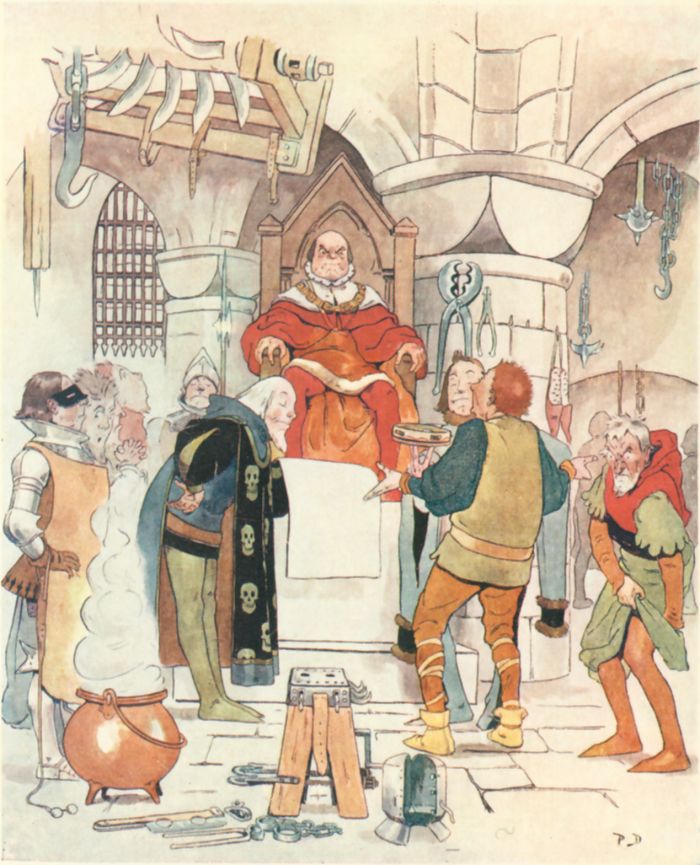
"Oh," he said--"oh, indeed! You aren't, aren't you! Desire the Lord High
Executioner to step this way," he added to a soldier who stood beside him.
The Lord High Executioner entered the presence. He was a kind-looking old
gentleman with white hair, and he wore a beautiful black robe, tastefully
decorated with death's-heads.
"Your Excellency sent for me?" he said.
"Just so," replied Gessler. "This gentleman here"--he pointed to Arnold of
Melchthal--"says he does not like taxes, and that he isn't going to put up
with them any longer."
"Tut-tut!" murmured the executioner.
"See what you can do for him."
"Certainly, your Excellency. Robert," he cried, "is the oil on the boil?"
"Just this minute boiled over," replied a voice from the other side of the
door.
"Then bring it in, and mind you don't spill any."
Enter Robert, in a suit of armour and a black mask, carrying a large
caldron, from which the steam rose in great clouds.
"Now, sir, if you please," said the executioner politely to Arnold of
Melchthal.
Arnold looked at the caldron.
"Why, it's hot," he said.
"Warmish," admitted the executioner.
"It's against the law to threaten a man with hot oil."

"You may bring an action against me," said the executioner. "Now, sir, if
you please. We are wasting time. The forefinger of your left hand,
if I may trouble you. Thank you. I am obliged."
He took Arnold's left hand, and dipped the tip of the first finger into
the oil.
"Ow!" cried Arnold, jumping.
"Don't let him see he's hurting you," whispered Werner Stauffacher.
"Pretend you don't notice it."
Gessler leaned forward again.
"Have your views on taxes changed at all?" he asked. "Do you see my point
of view more clearly now?"
Arnold admitted that he thought that, after all, there might be something
to be said for it.
"That's right," said the Governor. "And the tax on sheep? You don't object
to that?"
"No."
"And the tax on cows?"
"I like it."
"And those on bread, and buns, and lemonade?"
"I enjoy them."
"Excellent. In fact, you're quite contented?"
"Quite."
"And you think the rest of the people are?"
"Oh, quite, quite!"
"And do you think the same?" he asked of Walter and Werner.
"Oh yes, your Excellency!" they cried.
"Then that's all right," said Gessler. "I was sure you would be
sensible about it. Now, if you will kindly place in the tambourine which
the gentleman on my left is presenting to you a mere trifle to compensate
us for our trouble in giving you an audience, and if you" (to Arnold of
Melchthal) "will contribute an additional trifle for use of the Imperial
boiling oil, I think we shall all be satisfied. You've done it? That's
right. Good-bye, and mind the step as you go out."
And, as he finished this speech, the three spokesmen of the people of
Switzerland were shown out of the Hall of Audience.