THE BRITISH JACOBINS
The much better way doubtless will be, in this wavering condition of our
affairs, to defer the changing or circumscribing of our Senate more than may
be done with ease till the Commonwealth be thoroughly settled in peace and
safety.—Milton, A Free Commonwealth.
But cease, ye fleecing Senators
Your country to undo,
Or know, we British sans-culottes
Hereafter may fleece you.
Thelwall, A Shearing Song.
The outbreak of hostilities often tends to embitter the strife
of parties. Those who oppose war find abundant cause for
criticism in the conduct of Ministers, who in their turn perforce
adopt measures alien to the traditions of Westminster. A system
founded on compromise cannot suddenly take on the ways of a
military State; and efforts in this direction generally produce
more friction than activity. At such times John Bull, flurried
and angry, short-sighted but opinionated, bewildered but dogged
as ever, is a sight to move the gods to laughter and his counsellors
to despair.
The events of the session of 1793 illustrate my meaning. In
view of the notorious sympathy of the Radical Clubs with
France, Pitt proposed a Bill against Traitorous Correspondence
with the enemy. Both he and Burke proved that the measure,
far from being an insidious attack on the liberties of the subject,
merely aimed at enforcing "the police of war." Nevertheless, it
passed only by a majority of one—a warning to the Ministry
not to proceed further in that doubtful course (9th April 1793).
Pitt had the full support of the House in opposing Grey's motion
for Parliamentary Reform, which was thrown out by 282 votes
to 41. The war spirit also appeared in a sharp rebuff given to
Wilberforce and the Abolitionists on 14th May. The institution
of a Board of Agriculture (which Hussey, Sheridan, and Fox
opposed as a piece of jobbery) and the renewal of the Charter
of the East India Company were the chief practical results of
that session. But the barrenness of the session, the passing of the
Traitorous Correspondence Bill, and the hardships connected with
the balloting for the militia stirred the Radical Clubs to redoubled
energy; so that home affairs for two or three years centred in
their propaganda and in Pitt's repressive efforts. The development
of a keen political consciousness in the masses is a subject
of so much interest that I may be pardoned for dwelling on it
somewhat fully, with the aid of new materials drawn from the
Home Office Archives.
There we see the causes of unrest. Hunger, hatred of the
militia laws, chafing against restraints entailed by the war, all
conduce to discontent. The newly awakened Caliban is also a
prey to suspicion. He hates foreigners. Yet, either as refugees
or prisoners, they swarm along the south coast (there were
for a time 5,000 prisoners in Winchester). Fishermen are
tempted to help in their escape, and a mariner of Emsworth
is arraigned for treason on this count. Even so far west as
Bodmin the prisoners are numerous and threatening. They
convince many of the townsfolk that England would be better
off as a Republic; and two patriotic ladies in fear and horror
inform Lord Mount Edgcumbe anonymously that Frenchmen
cut a mark round the neck of King George on all coins. The
vicar of Ringmer, near Lewes, reports that the smugglers of the
Sussex coast carry on a regular intercourse with France. In the
Isle of Wight even the French royalists, who are there awaiting
the despatch of Lord Moira's long-deferred expedition to
Brittany, figure as murderous Jacobins. In Bath, too, the mayor,
Mr. Harington, is troubled by the influx of Gallic artists and
dancing-masters, especially as they mix in all the "routs," and
dare even there to whisper treason against King George.
Another report comes that a French usher in a large school near
London—was it Harrow?—has converted several of the boys to
republicanism. Clearly, these are cases for the Aliens Act.
Even Britons, untainted by Gallic connections, are suspect. At
Billingsgate a soldier swears that he was set upon at night because
he wore the uniform of "a d——d tyrant"; and other
evidence proves that the service was unpopular for political reasons
as well as the poor pay. Farmers are plied by emissaries of
the clubs as they come in to market. Complaints come to Dundas
that farmers and shippers on the coasts of Lancashire and
Cumberland sell corn to "the natural enemy."
The discontent takes colour from its surroundings. At Pocklington
in Yorkshire the villagers threaten to burn the magistrates
in their houses in revenge for the conviction of poachers.
The rowdies of Olney in Bucks. (formerly a sore trial to Cowper
and John Newton) terrorize the neighbourhood. Everywhere
the high price of corn produces irritation. The tinworkers of
North Cornwall march in force to Padstow to prevent the exportation
of corn from that little harbour; otherwise they are
law-abiding, though a magistrate warns Dundas that local malcontents
are setting them against the Government. Multiply
these typical cases a thousand fold, and it will be seen that the
old rural system is strained to breaking point. The amenities of
the rule of the squires are now paid back, and that, too, at a
time when England needs one mind, one heart, one soul. At and
near Sheffield serious riots break out owing to the enclosures of
common-fields and wastes, the houses of the agricultural "reformers"
being burnt or wrecked. On the whole, however, I have
found fewer references to enclosures than might be expected.[274]
As generally happens in times of excitement, the towns are
the first to voice the dumb or muttering hatreds of the villages.
Parisians led the Revolution in France, though its causes lay
thickest and deepest in the rural districts. Not until Paris
"stormed" its castle did the villagers attack theirs. So, too, in
the muffled repetition of the revolutionary music which England
sounds forth, the towns buzz, while the country supplies but a
dull ground-tone. Dearness of food and scarcity of work were
the chief causes of discontent. The spokesmen for the Spitalfields
weavers, who number 14,000, sent up a temperate petition
setting forth their distress; but, as is often the case in London,
their thoughts turned not to politics, but to practical means of
cure. They stated that the trade in velvets, brocades, and rich
silks would be absolutely ruined unless steps were taken to revive
the fashion in these fabrics. In Liverpool there were far other
grievances. There, as in all seaports, the tyranny of the press-gang
was sharply resented; and, early in November 1793, the
populace clamoured for the election of a "liberty-loving mayor,"
Mr. Tarleton, who promised to keep the press-gang out of the
town.[275]
In general the malcontents urged their case most pointedly in
towns and villages, where branches of the Radical Societies had
taken root. These Societies or clubs continued to grow in
number and influence through the year 1793, the typical club
being now concerned, not with faro, but with the "Rights of Man."
Some of the Reform Clubs sought to moderate the Gallicizing
zeal of the extreme wing. Thus, the "Friends of the People,"
whose subscription of two and a half guineas was some guarantee
for moderation, formally expressed their disapproval of Paine's
works and all Republican agencies—a futile declaration; for his
"Rights of Man" was the very life-blood of the new clubs.
Working men had shown little or no interest in the earlier
motions for Reform. The Associations of the years 1780–5 had
lapsed; and it was clearly the joint influence of the French
Revolution and Paine's productions which led to the remarkable
awakening of the year 1792.
Besides the London Corresponding Society, started (as we saw
in Chapter III) by Thomas Hardy early in that year, there
was another formidable organization, the Society for Constitutional
Information, founded in London at the close of 1791.
It, too, was concerned with much more than the Reform of
Parliament; for on 18th May 1792 it recommended the publication
in a cheap form of Paine's "Rights of Man"; and on 21st
November it appointed a Committee for Foreign Correspondence.
A little later were adopted some of the phrases used in
the French Convention, and St. André, Roland, and Barère were
admitted to membership. It does not appear that either this
Society, or Hardy's, corresponded with France after the declaration
of war; for the Parliamentary Committee of Secrecy,
charged in 1794 to report on seditious proceedings would, if it
were possible, have fastened on so compromising an act. Its
members belonged to a higher class than those of Hardy's
Society; for they included Romney the painter, Holcroft the
dramatist, Horne Tooke, the humorous littérateur, and Thelwall,
the ablest lecturer of the day.[276] That these men had
advanced far beyond the standpoint of the Whiggish "Friends
of the People," appears from a letter from one of the Norwich
Radical Clubs to the London Corresponding Society:
The Friends of the People mean only a partial Reform, because they
leave out words expressing the Duke of Richmond's plan and talk only
of a Reform; while the Manchester people seem to intimate, by addressing
Mr. Paine, as though they were intent upon Republican principles
only. Now, to come closer to the main question, it is only
desired to know whether the generality of the Societies mean to rest
satisfied with the Duke of Richmond's plan only, or whether it is their
private design to rip up monarchy by the roots and place democracy in
its stead.[277]
These Societies seem to have put forth no definite programme.
Their defenders claimed that they adhered to the Westminster
programme of 1780, championed by Fox and the Duke of Richmond.
But Fox strongly disapproved of their aims, and even
refused to present their petition for annual parliaments and
universal suffrage.[278] In truth, the actions of these bodies belied
their words. They largely devoted their funds and their energies
to the circulation in a cheap form of the works of Paine,
200,000 copies being sold in 1793,[279] and still more in the following
year. The Societies also adopted methods of organization
similar to those of the French Jacobins Club, and advocated the
assembly of a representative Convention. Every sixteen members
of the London Corresponding Society could form a division; and
the divisions, by the process of swarming-off, rapidly extended the
organization. They also sent delegates who conferred on matters
of importance, either locally or at headquarters; and the head
delegation finally claimed to represent very large numbers in
London and affiliated centres. In the conduct of details Spartan
self-restraint was everywhere manifest. Members were urged to
be brief in their remarks and business-like in their methods.
Officials must give a solemn promise not to skulk, or make off,
owing to persecution; and members were warned that noisy
declamation was not a proof of zeal but might be a cloak for
treachery. Above the chairman's seat was suspended a card with
the words—"Beware of Orators." One would like to have
witnessed the proceedings of these dully earnest men.
Both in the provinces and in London, reformers of the old
type sought to curb the more dangerous of these developments,
especially correspondence with the Jacobins' Club at Paris.
Thus, the Manchester Constitutional Society having published
its address of congratulation to that body, together with the
reply of Carras, a member, George Lloyd, entered a formal protest
in these terms: "We are not a Republican Society; but
from such connection and correspondence we shall involve ourselves
in the imputation of Republicanism." He added that their
aim was solely the Reform of Parliament, and with that
foreigners had no concern whatever.[280] Nevertheless the Society
kept up its foreign correspondence, and received addresses from
Jacobin Clubs in France.
Another threatening symptom was the attempt to excite discontent
among the soldiery. There being then very few barracks,
the men were quartered on the public houses; and several
petitions were sent to Whitehall by publicans (sometimes even
by Corporations), pointing out the many inconveniences of this
custom. Thus in the autumn of 1793 the publicans of Winchester
complained that they had had to lodge as many as
5,000 men during their passage through that city, besides the
Bucks. regiment stationed there, and they begged that barracks
might be built. The authorities paid the more heed to these
petitions because local malcontents "got at" the soldiery in the
taverns, and brought home to them their grievances, namely,
poor pay, insufficient allowance for food at its enhanced prices,
and the severities of discipline exercised by "effeminate puppies"
drawn from aristocratic circles. In particular they circulated a
pamphlet—"The Soldiers' Friend: or Considerations on the late
pretended Augmentation of the Subsistence of the Private
Soldiers"—pointing out the close connection between the officers
and "the ruling faction," which "ever must exist while we
suffer ourselves to be governed by a faction."
When the war with France unexpectedly lengthened out,
the Ministry decided to erect new barracks, accommodating
34,000 men, at a total expense of about £1,400,000. In the
debate of 8th April 1796, Fox and General Smith savagely
assailed this proceeding as fatal to English liberty. "Good
God!" exclaimed Smith, "is every town to be made a citadel
and every village converted into a garrison?" Windham had
little difficulty in showing that the old barracks were in general
badly situated, and not adapted for cavalry. Buildings for the
use of 5,400 horsemen were now erected; and on the whole
question he asserted that the men would live more cheaply, and
would contract less vicious habits than when lodged in inns.
Above all, they would be removed from the sedition-mongers,
who now plied them with doctrines destructive alike of loyalty
and military discipline. Windham then quoted a phrase from
Molière's "Médecin malgré lui": "If I cannot make him dumb,
I will make you deaf."[281] The inference was that the inability of
the Cabinet to silence malcontents involved the expenditure of
£1,400,000 partly in order to stop the ears of the soldiery.
Lord Bacon, in his pregnant aphorisms upon sedition, does not
venture on a definition of that indefinable term. Where, indeed,
shall one draw the line between justifiable discontent and the
inciting of men to lawless and violent acts? We shall notice
presently the claim of a Scottish judge that an agitator may
have good and upright intentions, and yet, if his words and acts
lead to general discontent, he is guilty of sedition and perhaps
of high treason. At the other extreme of thought stands the
born malcontent. He is generally an idealist, having a keen
sense of the miseries of mankind and very imperfect notions as
to the difficulty of peacefully and permanently ending them. In
times of political excitement the statesman has to deal with
large bands of zealots nerved by these irreconcilable principles.
It was the misfortune of Pitt that he sought to hold together
a nation rent asunder by the doctrines of Burke and Paine.
Compromise was out of the question; and yet a British statesman
cannot govern unless the majority of the people is ready
for compromise. His position becomes untenable if, while upholding
the throne, he infuriates all friends of progress; if, when
he seeks to remove abuses, he is dubbed a traitor to King,
Church, and Constitution. And yet, to abandon his post because
of these difficulties is not only cowardly, but also an act of disloyalty
alike to King and people.
As the political thermometer rose towards fever point through
the years 1792–3, Government kept closer watch upon the political
Societies; but for a long time Pitt took no action against
them. It seems probable that, if they had confined themselves
to their professed programme (that of the Westminster
Reformers of 1780) he would have remained passive. He did not
prosecute those which in November 1792 congratulated the
French Convention on the triumph of its arms in Belgium and
the advent of a Gallic millennium. What, then, were the developments
which met with his stern opposition?
But, firstly, we must ask the question, Why did not Pitt, in
view of the unswerving loyalty of the great majority of Britons,
rely on the good sense and weight of that mass to overbear the
Jacobinical minority? It is much to be regretted that he did not
take that more intelligent and more courageous course. But
the events of the French Revolution seemed to show the need of
early taking decided measures against a resolute and desperate
group. At half a dozen crises in the years 1789–92 firm action
would have crushed the anarchic forces in Paris, Lyons, and
Marseilles; but, for lack of a strong guiding hand, those forces
broke loose, with results which all genuine friends of liberty have
ever since deplored. It is perfectly certain that, if Mirabeau
had had a free hand, he would have used coercive measures by
the side of which those of Pitt's so-called "Reign of Terror" would
have been but as a pop-gun to a cannon. Besides, to taunt Pitt
with falseness to his principles of the years 1782–5 is to ignore
the patent facts that he advocated very moderate changes in the
representation. The Reform movement virtually collapsed in
1785. That which now borrowed its watchwords was in the main
a Republican and levelling agency. The creed of the Radicals
of 1793 was summed up, not in the academic programme of
the Friends of the People, the lineal heir to the earlier Associations,
but in Part II of Paine's "Rights of Man."
Here, surely, are the reasons for Pitt's repressive policy. He
entered on it regretfully, but he felt no sense of inconsistency
in his change of attitude towards Reform. The times had wholly
changed; and that movement changed with them. As Macaulay
has well pointed out, Pitt never declared that, under no circumstances,
would he favour a moderate Reform of Parliament. But
he did declare that in his view Reform was at present highly
perilous; and he resolutely set himself to the task of coercing
those men and those agencies who advocated it in dangerous
forms and by lawless methods.
The first prosecution that need be noticed here was directed
against Paine for the seditious utterances in the "Rights of
Man," particularly in Part II. The Attorney-General made
out a formidable indictment, whereupon Paine, then a member
of the French National Convention, informed him that the
prosecution might as well be directed against the man in the
moon, and that the liberties of the people of England were in
reality on their trial. After this impertinence the sentence went
against Paine by default, and that, too, despite a skilful speech
by Erskine (December 1792). The aim of Government of course
was to warn those who were circulating Paine's works that their
conduct was seditious and that they did so at their peril.
The Home Office Archives show that in very many cases the
warning was disregarded, and several prosecutions ensued, with
varying results. Still more frequent were the cases of cursing
the King, sometimes in obscene terms. To these we need pay
no heed. Frequently the offence was committed in taverns by
democrats in a state of mental exaltation. To this exciting
cause we may probably ascribe the folly of John Frost, the
attorney with whom Pitt had some dealings during the Reform
agitation of 1782. He was now charged with exclaiming excitedly:
"I am for equality"; and, when challenged as to the
meaning of his words, he added: "There ought to be no Kings."
In this connection it should be remembered that Frost and
Barlow had on 28th November 1792 presented to the French
National Convention the most mischievous of all the addresses
sent by Radical Clubs to that body. It ended with the statement
that other nations would soon imitate France (that is by
overthrowing the monarchy) and would "arm themselves for
the purpose of claiming the Rights of Man."[282] This piece of
bravado must have told against Frost at the trial; for it proved
that amidst his potations at the tavern he spoke his real mind.
Erskine did his best to defend Frost by quoting Pitt's letters to
him of May 1782, on the subject of Reform.[283] The device was
clever; but obviously Pitt's association with Frost for strictly constitutional
purposes in 1782 could not excuse the seditious language
of the latter under wholly different conditions eleven years later.
Frost was condemned to six months' imprisonment in Newgate
and was struck off the roll of attorneys.[284] Other noteworthy
trials ensued, notably that of the "Morning Chronicle" newspaper,
which ended in an acquittal; but it will be well now to
turn to the important developments taking place north of the
Tweed.
Scotland had now thrown off the trance under which she had
lain since 1745; and her chief towns bade fair to outbid London,
Leeds, Sheffield, and Norwich as centres of democratic activity.
There was every reason why she should awake. She had very
little influence in Parliament. She returned 45 members as
against Cornwall's 44; while the total number of persons
entitled to vote for the fifteen representatives of the Scottish
burghs was 1,303,[285] a number smaller than that of the electors of
the city of Westminster. This singular system was defended
chiefly on the ground of the turbulence of the national character.
Even in 1831 a Scottish member declared that Scots could never
assemble without drawing blood; and one of their champions,
Lord Cockburn, made the quaint admission: "The Scots are bad
mobbers. They are too serious at it. They never joke, and they
throw stones." It did not occur to that generation that the cure
for this bloodthirsty seriousness was frequent public meetings,
not no meetings at all. That a high-spirited people should so
long have remained in political childhood seems incredible, until
we remember that a borough election like that of Westminster
was absolutely unknown in the whole course of Scottish history.
Further, it was notorious that the 45 Scottish members were
the most obedient group of placemen in the House of Commons;
and their docility had increased under the bountiful sway of
Henry Dundas, whose control of patronage sufficed to keep the
Caledonian squad close to heel.
This political apathy was now to end. The men of Edinburgh,
Glasgow, and Dundee began to discuss the "Rights of Man,"
and to follow the lead given by the London Corresponding
Society. Thus, on 3rd October 1792, Lieutenant-Colonel William
Dalrymple presided over the first meeting of "The Associated
Friends of the Constitution and of the People," held at Glasgow.
Resolutions were passed in favour of an equal representation of
the people in Parliament, shorter Parliaments, and co-operation
with "the Friends of the People" in London. The entrance and
annual subscriptions were fixed at sixpence and one shilling.
Thomas Muir of Huntershill, an able young advocate, was
appointed Vice-President. Other Societies were soon formed,
and on 11th December there assembled at Edinburgh a General
Convention of Delegates from the Societies of the Friends of
the People throughout Scotland. Its proceedings were orderly,
beginning and ending with prayer. Resolutions were passed
deprecating violence whether in language or action; and the
presence either of Lord Daer or Colonel Dalrymple in the chair
showed that some, at least, of the gentry were for Reform. This
was exceptional. A little later the gentlemen of several towns
and counties asserted their loyalty in flamboyant petitions; and
the farmers of Dalkeith district at their meeting added to their
loyal toasts the following: "May we have no fox in our fold or
greys (wild oats) in our corn."[286] Sir Kenneth Mackenzie on
3rd January 1793 informed William Pulteney that in the North
the towns were thoroughly loyal, with the exception of Perth
and Dundee, where certain ministers and writers led the people
astray.[287]
Nevertheless, the authorities, notably the Lord Advocate,
Robert Dundas, took alarm; and on 2nd January 1793 Thomas
Muir was brought before the deputy-sheriff of Midlothian. Muir
was a man of highly interesting personality. The son of a
Glasgow tradesman, he had shown marked abilities at school
and at the University, whence, owing to his advanced opinions,
he was forced to migrate to Edinburgh. There, in his twenty-seventh
year, he soon became a leader of the Scottish Reformers,
his sincerity, eloquence, and enthusiasm everywhere arousing
keen interest. Had his good sense been equal to his abilities,
he might have gone far; but events soon showed him to be tactless
and headstrong. He went far beyond the rest of the delegates
assembled at Edinburgh, namely, in bringing forward, despite
the reluctance of the Convention, an Address from the Society
of United Irishmen in Dublin. Their conduct much alarmed
the authorities at Dublin Castle, who adopted stringent precautions.
Muir should therefore have seen, what his colleagues
did see, that any plan of co-operation was certain to irritate
Government. Nevertheless he persisted in bringing before the
Convention the Irish Address, which strongly pointed out the
need of common action in the struggle for Reform and urged
both peoples to persevere "until we have planted the flag of
freedom on the summit, and are at once victorious and secure."
Further, the authorities accused Muir of circulating Paine's
writings and other pamphlets, including "A Dialogue between
the Governors and the Governed," which contained such sentences
as these: "The law is the general will—a new order."
"Nations cannot revolt; tyrants are the only rebels." "We will
live without tyrants, without impostors (priests)."[288] The writings
were probably seditious in their tendency;[289] but the evidence
that he circulated them was of the flimsiest character.[290]
Unfortunately, Muir left the country, though in no clandestine
manner, while legal proceedings were pending. After a short
stay in London he proceeded to Paris, in order (as he said at his
trial) to try to persuade the French democrats to spare the life
of Louis XVI. The credibility of this statement is lessened by
the fact that he arrived in Paris only the evening before the
King's execution and remained there long after that tragedy.[291]
A letter from a Scot in Paris, James Smith, to a friend in Glasgow,
which the postal authorities opened, stated that the writer
met Muir in a café of the Palais Royal; that Muir did not hear
of his indictment till the evening of 8th February, and would
return to face his trial, though he was loth to leave France, as
he had made "valuable and dear connections." "Mr. Christie
advised me," adds the writer, "to make some little proficiency in
the language before I begin to think of beginning to do anything."[292]
Now, as a clique of Britons in Paris had not long before
drunk the toast of "The coming Convention of Great Britain
and Ireland," Government naturally connected the efforts of
Muir with this republican propaganda. His next doings increased
this suspicion. He left France on an American ship which
landed him at Belfast; he stayed there a few days, and landed
at Stranraer on 31st July, only to be arrested, along with his
books and papers, and sent to Edinburgh.
The ensuing trial, held on 30th and 31st August, aroused intense
interest, owing to the eloquence of Muir and the unscrupulous
zeal of the Scottish authorities in ensuring his conviction.
They packed the jury with men who belonged to a loyal Association;
and it is said that the Lord Justice Clerk, McQueen of Braxfield,
welcomed one of them with the words: "Come awa', Maister
Horner, come awa', and help us to hang ane of thae daamed
scoondrels." The trial itself bristled with irregularities; and
Muir, who rejected the proffered help of Erskine and conducted
his own defence, fastened on them so effectively, that at the
conclusion of his final speech the Court resounded with applause.
All was in vain. The jury found him guilty, whereupon the
Court of Justiciary pronounced sentence of transportation for
fourteen years.[293]
Admiration of the virtues and courage of Muir must not blind
us to the fact that his conduct had been most provocative. His
visit to Paris, on the scarcely credible pretext that he went
thither to save the King's life, his connection with the United
Irishmen, and his stay in Belfast, told against him. Robert
Dundas, in informing his uncle, Henry Dundas, of his arrest,
added: "I have little doubt that, tho' he avows his intention of
coming home to have been a view to stand trial, [that] he is an
emissary from France or the disaffected in Ireland."[294] The Scot
who first advocated common action with the Irish malcontents
should have paid good heed to his steps. Muir did not do so.
Accordingly, though the direct evidence at the trial told in his
favour, the circumstantial evidence weighed heavily against him.[295]
At such a time men's actions count for more than their words. It
was the visit to Paris and the dealings with the United Irishmen,
far more than biassed witnesses and the bullying of Braxfield,
which led to the condemnation of this talented youth. For his
arrest occurred at the time when terror was the order of the day
at Paris, and when the issue of an inflammatory address at
Dundee spread panic in official circles.
Before adverting to this matter, we may note that Muir settled
down by no means unhappily at Sydney, and bought a farm
which he named Huntershill, after his birthplace. It is now a
suburb of Sydney. A letter from the infant settlement, published
in the "Gentleman's Magazine" of March 1797, describes him
and the other Scottish "martyrs"—Skirving, Margarot, and
Gerrald—as treated indulgently by the authorities, who allotted
to them convicts to till their lands. Shortly afterwards Muir
escaped, and, after exciting experiences, in which he was
wounded, made his way to France. In Paris, early in 1798, he
published some articles on the United Irishmen, which Wolfe
Tone and other Irish patriots deemed most harmful to their
cause. They therefore remonstrated with him, but received the
reply that he knew Ireland as well as they did, and had the
confidence of the United Irishmen as much as they had. Wolfe
Tone says of him: "Of all the vain obstinate blockheads that
ever I met I never saw his equal."[296] Fortunately for his associates,
Muir retired into the provinces and died in the year 1799.
Dundee played a leading part in the democratic agitation. Its
population, consisting largely of poor weavers, suffered severely
in the year 1793 from dearness of food and scarcity of fuel. On
this mass of needy operatives the doctrines of Paine fell like a
spark on tinder. Dundee became the chief focus of discontent
in Scotland. A Tree of Liberty was planted in Belmont Grounds;
bread riots were of frequent occurrence; and Dundas was burnt
in effigy. In the Home Office Archives is a statement that a
local tradesman named Wyllie generously supplied the waistcoat
and breeches: "they was of satin."[297] In July 1793 there appeared
an "Address to the People," dated "Berean Meeting
House, Dundee," which painted the Government in the darkest
colours, and contained these assertions: "You are plunged into
war by a wicked Ministry and a compliant Parliament, who
seem careless and unconcerned for your interest, the end and
design of which is almost too horrid to relate, the destruction of
a whole people merely because they will be free.... Your
treasure is wasting fast: the blood of your brethren is pouring
out, and all this to form chains for a free people and eventually
to rivet them on yourselves." On 1st August 1793 a Government
agent found the MS. from which this placard was printed
in the house of a liquor-seller in Edinburgh. It was in the
writing of a minister, Palmer: so were two letters referring to it.[298]
Robert Dundas therefore sent to have Palmer arrested. In
mentioning this fact to Henry Dundas, he added that Palmer
was "the most dangerous rebel in Scotland." It transpired in
the course of the trial that the address was originally written by
a weaver named Mealmaker, and that Palmer re-wrote it, toning
down some expressions which he thought too strong. Mealmaker
was a witness at the trial, but was not allowed directly
to incriminate himself. The authorities preferred to strike at
Palmer, a man of parts, educated at Eton and Cambridge, who
latterly had officiated as Unitarian Minister at Montrose and
Dundee. Doubtless these facts as well as his association with
the Scottish Friends of Liberty brought on him a sentence of
five years' transportation.[299]
If the authorities hoped to crush the Scottish movement by
these severities they were disappointed; for it throve on them.
A spy, "J. B.," who regularly supplied Robert Dundas with
reports about the Edinburgh club, wrote on 14th September
1793 that the sentence on Palmer had given new life to the
Association; for, after a time of decline in the early summer,
more than 200 now attended its meetings. On 28th October he
stated that nearly all the Scottish clubs had revived. Dunlop,
Lord Provost of Glasgow, also declared that discontent made
progress every day; that the soldiery were corrupted, and that
there was an urgent need of barracks.[300] Indignation also ran
high at London. Evan Nepean wrote to Robert Dundas:
"There is a devil of a stir here about Muir and Palmer." Braxfield's
address to the jury was thus parodied in the "Morning
Chronicle" of 4th March 1794:
I am bound by the law, while I sit in this place,
To say in plain terms what I think of this case.
My opinion is this, and you're bound to pursue it,
The defendants are guilty, and I'll make them rue it.
Nevertheless, as another Convention had met at Edinburgh,
Robert Dundas wrote to his uncle on 2nd November 1793 strongly
deprecating any mitigation of the sentences. It was therefore
in vain that the Earl of Lauderdale, Grey, and Sheridan interviewed
the Home Secretary and pointed out that the offence of
"leasing-making," or verbal sedition, was punishable in Scots
law only with banishment, not with forcible detention at the
Antipodes.[301] Henry Dundas informed his nephew on 16th November
that he would refer the whole question back to the Court
of Justiciary, and if it defended the verdict "scientifically" and
in full detail, he would "carry the sentence into execution and
meet the clamour in Parliament without any kind of dismay."[302]
Braxfield and his colleagues defended their conduct in an exhaustive
treatise on "leasing-making," which the curious may
read in the Home Office Archives.
What was the attitude of Pitt towards these events? Ultimately
he was responsible for these unjust and vindictive sentences;
and it is a poor excuse to urge that he gave Dundas a free hand
in Scottish affairs. Still, it is unquestionable that the initiative
lay with the two Dundases. If any Englishman exerted influence
on the sentences it was the Lord Chancellor, Loughborough.[303]
He treated with contempt the motion of Earl Stanhope on 31st
January 1794 for an examination into the case of Muir, when
the Earl found himself in the position which he so much coveted—a
minority of one. On the cases of Muir and Palmer coming
before the Commons (10th March), Pitt upheld the Scottish
Court of Justiciary in what was perhaps the worst speech of his
whole career. He defended even the careful selection of jurymen
hostile to Muir on the curious plea that though they were
declared loyalists, yet they might be impartial as jurymen. He
further denied that there had been any miscarriage of justice, or
that the sentence on the "daring delinquents" needed revision.
And these excuses for biassed and vindictive sentences were
urged after Fox had uttered a noble and manly plea for justice,
not for mercy. Grey bitterly declared that Muir was to be sent
for fourteen years to Sydney for the offence of pleading for
Reform, which Pitt and the Duke of Richmond advocated twelve
years before. They sat in the King's Cabinet: Muir was sent to
herd with felons. This taunt flew wide of the mark. Pitt in his
motions for Reform had always made it clear that, while desirous
of "a moderate and substantial Reform," he utterly repudiated
universal suffrage. If those were his views in 1782–5, how could
he accept the Radical programme now that it included the absurd
demand for annual Parliaments? None the less Pitt was
answerable for the action of the Home Minister in referring
the sentences back to the judges who inflicted them—a course
of conduct at once cowardly and farcical. Pitt's speech also
proves him to have known of the irregularities that disgraced the
trials. But he, a lawyer, condoned them and applauded the
harsh and vindictive sentences. In short, he acted as an alarmist,
not as a dispenser of justice.
It is easy for us now to descant on the virtues of moderation.
But how many men would have held on an even course when the
guillotine worked its fell work in France, when the Goddess of
Reason was enthroned in Notre Dame, and when Jacobinism
seemed about to sweep over the Continent? Here, as at so many
points, France proved to be the worst foe to ordered liberty.
Robespierre and Hébert were the men who assured the doom
of Muir and Palmer. A trivial incident will suffice to illustrate the
alarm of Englishmen at the assembly of a British Convention.
In December 1793 Drane, the mayor of Reading, reported to
his neighbour Addington (Speaker of the House of Commons)
that the "infamous Tom Paine" and a member of the French
Convention had been overheard conversing in French in a public-house.
Their talk turned on a proposed visit to the British
Convention then sitting in Edinburgh. At once Addington sent
for a warrant from the Home Office, while the mayor urged his
informant to hunt the miscreants down. The machinery of the
law was set in motion. A search was instituted; the warrant
came down from Whitehall; and not until the sum of fourteen
guineas had gone to the informant for his patriotic exertions did
the authorities discover that they had been hoaxed.[304]
The Edinburgh Convention, consisting of delegates of forty-five
Reform Societies, seems to have pursued dully decorous
methods until 6th November, when citizens Hamilton Rowan
and Simon Butler came to represent Ireland; Joseph Gerrald
and Maurice Margarot were the delegates from the London
Corresponding Society; and Sinclair and York from the Society
for Constitutional Information which met at the Crown and
Anchor. A Convention of English Societies assembled at
London about the same time, and deputed the four delegates
to join the Edinburgh body and form a British Convention.[305]
Accordingly, on 19th November, it took the title, "British Convention
of Delegates of the People, associated to obtain Universal
Suffrage and Annual Parliaments." The statement of Margarot,
that the London police sought to prevent his journey to Edinburgh,
should have been a warning to members to measure their words
well. Unfortunately, Margarot, a vain hot-headed fellow, at
once began to boast of the importance of the Radical Societies;
though fluctuating in number, they were numerous in London;
there were thirty of them in Norwich; and in the Sheffield district
their members numbered 50,000. "If," he added, "we could get a
Convention of England and Scotland called, we might represent
six or seven hundred thousand males, which is a majority of all
the adults of the Kingdom; and the Ministry would not dare
to refuse our rights."[306] Butler then declared that Belfast was in a
state of veiled rebellion; Gerrald, the ablest and best educated
of the delegates, also scoffed at the old party system, and said,
"party is ever a bird of prey, and the people their banquet." On
19th November a delegate from Sheffield, M. C. Brown, moved
that the next British Convention should meet near the borders of
England and Scotland. Thereupon Gerrald proposed that York
should be chosen, despite its ecclesiastical surroundings; for (said
he), "as the Saviour of the world was often found in the company
of sinners, let us go there for the same gracious purpose, to convert
to repentance."[307]
All this was but the prelude to more serious work. On 26th–28th
November the Convention declared it to be the duty
of citizens to resist any law, similar to that lately passed in
Dublin, for preventing the assembly of a Convention in Great
Britain; and the delegates resolved to prepare to summon a
Convention if the following emergencies should arise—an invasion,
the landing of Hanoverian troops, the passing of a Convention
Act, or the suspension of the Habeas Corpus Act. These
defiant resolutions were proposed by Sinclair; and, as he afterwards
became a Government informer, they were probably
intended to lure the Convention away from its proper business
into seditious ways. However that may be, the delegates
solemnly assented to these resolutions.
Scotsmen will notice alike with pride and indignation that the
delegates of the Societies north of the Tweed adhered to their
main purpose, Parliamentary Reform, until, under the lead of
the men of London, Sheffield, and Dublin, debates became
almost Parisian in vehemence. As reported in the "Edinburgh
Gazetteer" of 3rd December, they gave Robert Dundas the
wished-for handle of attack. Then and there he decided to disperse
the Convention, so he informed Henry Dundas in the
following letter of 6th December: "Last Tuesday's '[Edinburgh]
Gazetteer,' containing a further account of the proceedings of
the Convention appeared to the Solicitor and me so strong that
we agreed to take notice of them. The proper warrants were
accordingly made, and early yesterday morning put in execution
against Margarot, Gerrald, Callender, Skirving, and one or two
others, and with such effect that we have secured all their
Minutes and papers. Their conduct has excited universal detestation."[308]
The expulsion took place quite peaceably. The
Lord Provost informed the delegates that it was not their meeting,
but their publications, that led him to intervene. The Chairman,
Paterson, thereupon "skulked off"; but Brown, the Sheffield
delegate, took the chair, and declared that he would not quit it
save under compulsion. The Lord Provost and constables then
pulled him down; and the meeting was adjourned. Events ran
the same course on the morrow, save that the chairman, Gerrald,
was allowed to wind up the proceedings with prayer before he
was pulled down. Thus ended the first British Convention.
The natural sequel was a trial of the leaders, Sinclair, Margarot,
Gerrald, and Skirving. Sinclair turned informer, whereupon
his indictment was allowed to lapse. The others were
charged with attending the meetings of the Convention which,
"under the pretence of procuring a Reform of Parliament,
were evidently of a dangerous and destructive tendency," modelled
on those of the French Convention and with the like aims
in view. The charge was held to be proven, and they were severally
sentenced to transportation for fourteen years. The cases
aroused keen interest, in part owing to the novel claims put
forward by the prosecutor and endorsed by the Judges. The
Lord Advocate argued that these men, in claiming to represent
a majority of the people, were in reality planning a revolt; and
Lord Justice Clerk finally declared that the crime of sedition
consisted "in endeavouring to create a dissatisfaction in the
country, which nobody can tell where it will end. It will very
naturally end in overt rebellion; if it has that tendency, though
not in the mind of the parties at the time, yet, if they have been
guilty of poisoning the minds of the lieges, I apprehend that that
will constitute the crime of sedition to all intents and purposes."[309]
To find a parallel to this monstrous claim, that sedition may
be unintentional and may consist in some action which the Government
judges by its results, one would have to hark back to the
days of Judge Jeffreys, whom indeed McQueen of Braxfield resembled
in ferocity, cunning, and effrontery. The insolence of
Margarot at the bar to some extent excused the chief judge for
the exhibition of the same conduct on the bench. But in the
case of Gerrald, an English gentleman of refined character and
faultless demeanour, the brutalities of Braxfield aroused universal
loathing. In one respect Gerrald committed an imprudence. He
appeared in the dock, not in a wig, but displaying a shock of
dishevelled hair, a sign of French and republican sympathies
which seemed a defiance to the Court. Nevertheless, his speech
in his own defence moved to its depths the mind of a young
poet who had tramped all the way from Glasgow in the bleak
March weather in order to hear the trial. At the end of the
speech young Campbell turned to his neighbour, a humble
tradesman, and said: "By heavens, Sir, that is a great man";
to which there came the reply: "Yes, Sir, he is not only a great
man himself, but he makes every other man feel great who
listens to him."
In truth, the Scottish trials were a moral defeat for Pitt and
his colleagues. Sympathy with the prisoners and detestation of
the judges aroused a general outcry, which became furious when
Braxfield declared that he had no idea that his sentence of transportation
involved servitude and hard labour.[310] The assertion implies
an incredible ignorance in the man who had packed the juries
and sought to get his victims hanged. It may be regarded as a
cunning and cowardly attempt to shift part of the odium on
to the Government. Certainly the prestige of the Cabinet now
fell to zero. Ministers were held responsible for Braxfield's
wanton vagaries, and were accused of luring English democrats
into the meshes of the Scottish law. This last charge is absurd.
As we have seen, the London police sought to stop Margarot,
Sinclair, and Gerrald from going to Edinburgh. It was their
presence and that of the Irishmen which gave to the Convention
almost a national character, and placed it in rivalry to Parliament.
Their speeches were by far the most provocative. Finally,
as the letter quoted above shows, the initiative in arresting the
delegates was taken by Robert Dundas and the Scottish Solicitor-General.
On 11th December Henry Dundas wrote to his
nephew: "You get great credit here [London] for your attack
on the Convention."[311]
Far different was the comment of the London Corresponding
Society. On 20th January 1794 that body convened a great
meeting which passed protests against the war, the expulsion of
the British Convention, and the arrest of delegates. It also resolved
that the general committee should sit permanently
throughout the ensuing session. Further, that if the Government
attacked the liberties of the people in the ways described
above, the committee should call "a General Convention of the
People for taking such measures under their consideration."[312]
Equally threatening were the resolutions of the Constitutional
Society of London.[313] Pitt resolved to take up the gauntlet flung
down by these two powerful Societies. On 24th February 1794
Eaton, a publisher of Newgate Street, was tried for publishing
in his periodical pamphlet, "Politics for the People: or Hogs-wash,"
a little parable with which that witty lecturer, Thelwall,
had delighted a debating society. He told how a gamecock,
resplendent with ermine-spotted breast, and crown or cockscomb,
lorded it greedily over all the fowls of the farmyard.[314]
The parallel to George III was sufficiently close to agitate the
official mind; but the jury gave an open verdict, which implied
that the King was not hinted at.
The next prosecution, that of Thomas Walker, of Manchester,
and six others broke down in a way highly discreditable
to the authorities. Walker's services to the cause of Reform
had, as we have seen, been conspicuous alike in energy and
moderation, and his enemies in the Church and King Club
made great exertions in order to procure a conviction. The
archives of the Home Office throw a sinister light on their
methods. A magistrate of Manchester, the Rev. John Griffith,
informed the Home Secretary that Booth, a man who was imprisoned
in June 1793 for seditious practices, made a declaration
against Thomas Walker and McCullum, members of the local
Constitutional Society. According to Booth, McCullum had
said: "Petitioning Parliament be d——d. You may as well petition
the devil to reform himself. The only way is for each
Society to send a number of delegates to a certain place, and
there declare themselves the Representatives of the People and
support themselves as such." Thomas Walker had also said
that each member must have a musket, for they would soon
want them.[315] But it transpired in the trial of Walker, McCullum,
and others that Griffith had let Booth see that he wanted to incriminate
Walker. He not only offered Booth his pardon for
such evidence, but left him alone with Dunn, a malicious perjurer,
the falsity of whose charges against Walker was convincingly
demonstrated.[316] The case proves how far an unscrupulous
magistrate could succeed in getting charges trumped up against
an innocent man who opposed him in politics. Doubtless in
other cases personal spite, or the desire of a reward, led to the
offer of false charges; and the student who peruses the Home
Office archives needs to remember the Greek caution, μέμνησθ' ἀπιστεῖν, as much as if he were perusing French Memoirs.
It is therefore with much doubt that one reads the declaration
of a Sheffield magistrate, in May 1794, that there was in that
town "a most horrid conspiracy against State and Church under
the pretence of Reform." A vast number of pikes and spears
had been made and "cats" to throw in the road to lame the
horses. 2nd July was fixed for the storming of the barracks and
town. "It is a mercy the plot is discovered. I am to be all night
in the search." More detailed is the deposition of a magistrate of
Sheffield, James Wilkinson, that a democrat named Widdison
had made several pikes and sold twelve to Gales, a well-known
Jacobinical printer. Further, that a witness, William Green,
swore that a man named Jackson had employed him and others
to make spear-heads; they made twelve dozen or more in two
days, and the heads were sent to the lodgings of Hill and Jackson.
Wilkinson wrote for instructions how to deal with these
men; also for a warrant to arrest Gales. On 20th May Dundas
sent down warrants for the arrest of Gales, W. Carnage, H. Yorke
(alias Redhead), W. Broomhead, R. Moody, and T. Humphreys;
he also issued a warrant against Williams, a gun-engraver, of the
Tower, in London.[317]
In Birmingham, as we have seen, the two magistrates, Carles
and Spencer, were out and out loyalists; and, as they wrote to
Dundas on 23rd May 1794 that there was not enough evidence
to warrant a search for arms, we may infer that the Midland
capital caused the authorities less concern than rebellious Sheffield.
But even at Birmingham, with its traditions of exuberant
loyalty, there were grounds for concern. John Brook, the
mayor, informed Dundas that there were many malcontents in
the neighbourhood, especially at Dudley.
Turning to the East, we find signs that Norwich seethed with
discontent. From that city had come the first suggestion of a
General Convention of the People. On 5th March 1793 one of
the thirty Societies of Norwich wrote up to the London Corresponding
Society advocating that step, which Hardy and his
colleagues approved "so soon as the great body of the people
shall be courageous and virtuous enough to join us in the
attempt." I have found no proof that either at Norwich or in
London these Societies used illegal methods. The seditious
placards posted up at Norwich may have been the work of some
fanatic or of an agent provocateur. But it is very doubtful
whether the holding of a People's Convention in the manner
proposed was not an act of defiance to Parliament, and therefore
seditious. Individual members certainly came within the ban of
the law. Thus, Dundas received tidings that two members of
Hardy's Society, named Stone and Meakins, were circulating
seditious writings in Essex. When arrested they had with them
one or two military books, copies of the revolutionary song, Ça
ira, and similar papers;[318] but this fact does not incriminate the
Society at large. In fact, the reports as to the purchase of arms
and secret drillings are not very convincing. To take a few instances:
information was sent to the Home Office that a man
named Kitchen had sixty pikes in his house in George Street,
near York Buildings; also that men were drilled secretly at the
house of Spence, a seller of seditious pamphlets in the Little
Turnstile, Holborn, and at that of Shelmerdine, a small tradesman
of Southwark; the arms in the last case were bought from
Williams, of the Tower, with a sum of £10 contributed by "a
desperate tailor of China Walk, Lambeth."[319] Did patriotism or
private spite or greed of money incite these reports? Drawings
of pikes and spear-heads also diversified the report of the Secret
Committee of the Lords appointed to investigate seditious proceedings,
and probably convinced lovers of realism that plots
actually existed.
More alarming in reality were the preparations for a General
Convention of the People. The authorities knew that plans were
actually on foot for sending delegates to form such a body. On
27th March 1794 the London Corresponding Society consulted
the sister club on this question; and in due course delegates
from the two Societies passed resolutions in favour of the
scheme. Hardy thereupon sent a printed letter round to similar
bodies, probably early in the month of April 1794. It ran
thus:
Notwithstanding the unparalleled audacity of a corrupt and overbearing
faction which at present tramples on the rights and liberties
of our people, our meetings cannot, in England, be interrupted without
the previous adoption of a Convention Bill[320]—a measure it is our duty
to anticipate.... Let us then form another British Convention. We
have a central situation in our view, which we believe would be most
convenient for the whole island, but which we forbear to mention ...
till we have the answers of the Societies with which we are in correspondence.
Let us have your answer, then, by the 20th at farthest,
earlier if possible, whether you approve of the measure and how many
delegates you can send, with the number also, if possible, of your
Societies.
PS. We have appointed a Secret Committee on this. Will you do
the same?[321]
In order to further the scheme, the London Corresponding
Society held a meeting on 14th April at Chalk Farm, when an
ardent appeal was read from Hardy to resist the encroachments
on liberty recently made by "apostate reformers"—a fling at
Pitt. "Are they alone," he asked, "to judge of the fit time for
Reform?" The meeting then thanked Earl Stanhope for his
manly and successful opposition to the attempt to bring Hanoverian
and Hessian troops into England; it also condemned the
late rapid advances of despotism and the arming one part of the
people against the other. Finally it declared that in cases of
necessity the safety of the people was the only law. We may
here note that a few Hanoverian and Hessian battalions had
been landed in Hampshire, as a temporary measure, previous to
their transference to other ships. This occasioned some clamour
at Westminster, Grey, Fox, Sheridan and others claiming that
the liberties of England were in the direst danger. Pitt refused
to accept a Bill of Indemnity for his action, and the House supported
him by a great majority.[322]
The other reference at the Chalk Farm meeting was to the
proposal to sanction the subscriptions to the Volunteer forces
now being raised in various counties.[323] At the outset this noble
movement had in view the defence of the constitution no less
than of the land; and this doubtless accounts for the fact that
Coke, Mingay, and other Norfolk Whigs struggled desperately
and successfully to break up a county meeting held at Norwich
for this purpose on 12th April, shouting down even so able
a speaker as Windham. In general, however, these meetings
were an immense success. That at Aylesbury realized £5,851
for a county corps; and one at Epsom, for Surrey, brought in
nearly double as much.[324] Most noteworthy of all these meetings
was one of 19th April 1794 at Birmingham, where loyal sentiments
crystalized in a rhetorical jewel of rare lustre. The "Loyal
True Blues" of Birmingham, in view of the threats of the French
"to insult the chalky cliffs of Albion and to plant in this island
their accursed tree of liberty, more baneful in its effects than
the poisonous tree of Java which desolates the country and corrupts
the winds of heaven," resolved to quit the field of argument
and to take arms as a Military Association. For nothing could
be so effective as "the decided and awful plan of the whole
Nation rising in a mass of Volunteers, determined to dispute
every inch of ground with their daring aggressors and to spill
the last drop of their blood in defence of their religion and their
laws." They beg Edward Carver to command them; they will
choose their uniform, will arrange themselves as grenadiers and
light infantry; and, "to preserve the coup d'œil, the whole corps
will be arranged with the strictest attention to the height of the
members."[325] Possibly the Royalists of Birmingham may have
known of the hint conveyed in Hardy's letter, that the National
Convention should assemble in some convenient centre, a phrase
which seemed to point to their town, which, indeed, the Chartists
chose for that purpose in 1839.
In view of the fervent loyalty manifested on all sides, Ministers
might surely have trusted to the majority to control the
restless minority. Auckland expressed the general opinion when
he said that the country in the proportion of ten to one was
sound and loyal.[326] As the majority was armed, while the malcontents
had but small stores of pikes, there was little cause for
fear, though in the minority were some desperate men. In particular,
Richard Davison, a prominent member of the Sheffield
Constitutional Society, recommended the clubs of London and
Norwich to buy consignments of pikes in order to resist the
"newly-armed minions of the bare-faced aristocracy of the present
Administration"; and it afterwards appeared that he could
sell them at twenty pence each.[327] This letter was sent off on
24th April, 1794, seventeen days after the holding of a mass
meeting on Castle Hill, Sheffield, at which the chairman, Henry
Yorke (alias Redhead), declared that, when the sun of Reason
shone in its fullest meridian, the people would turn out the 558
gentlemen from Westminster. The meeting resolved that, as the
people ought to demand universal suffrage as a right, and not
petition for it as a favour, they would never again petition the
House of Commons on this subject.[328] Contemptuous epithets
were now constantly hurled at Parliament. On 2nd May, that
genial toper, Horne Tooke, of Wimbledon, declared at a dinner
of the Constitutional Society in London that Parliament was a
scoundrel sink of corruption, and that the scoundrel Opposition
joined the scoundrel Government in order to destroy the rights
of Englishmen. In order to add weight to his epithets he called
the company to witness to his complete sobriety.[329]
Pitt and his colleagues now decided to strike at the leaders
who were planning a British Convention. Of these the most
formidable was the Secretary of the London Corresponding
Society. Accordingly, early on 12th May, some Bow Street
officers made their way into Hardy's shop, No. 9, Piccadilly,
arrested him, seized his papers, ransacking the room where Mrs.
Hardy was in bed. The shock to her nerves was such as to bring
on premature child-birth with fatal results. On the same day
a royal message came to Parliament announcing that the efforts
of certain Societies to summon a Convention in defiance of
Parliament had led him to order the seizure of their books and
papers. Those of the Corresponding and Constitutional Societies
were brought, sealed up, to the House of Commons on the morrow,
whereupon Pitt moved for the appointment of a secret
committee to examine them. He himself, Dundas, and nineteen
other members soon drew up the Report. When presented on
16th May, it contained a statement of all the threatening symptoms
of the time, and so far ignored the legal efforts of those
Societies as to form a very alarming diagnosis.[330]
The fears of Ministers were further aroused by the contents of
a letter from the Rev. Jeremiah Joyce (tutor of Earl Stanhope's
son) to Horne Tooke, which the Post Office had seized. It announced
the arrest of citizen Hardy, and ended thus: "Query:
is it possible to get ready by Thursday?"[331] Some effort of the
imagination was needed to figure the Silenus of the literary
world as a plotter against the lives of Ministers. But they now
decided to arrest him and the Reverend Jeremiah, as well as
Bonney, Richter, and Kyd, also members of the Constitutional
Society, besides Camage and one or two other democrats of
Sheffield. Davison, the would-be seller of pikes, had fled betimes.
These were the circumstances which induced Pitt to propose
the suspension of the Habeas Corpus Act (16th May). The
Report of the Secret Committee having been read, he proceeded
to exaggerate the import of the more threatening parts of the
evidence, and to convince the House that these Societies, which
had congratulated the French Convention, and still aped its
methods, were plotting to set up an authority openly hostile to
Parliament. With all the force of his oratory he pictured the
state of things that must ensue—"an enormous torrent of insurrection,
which would sweep away all the barriers of government,
law and religion, and leave our country a naked waste for
usurped authority to range in, uncontrolled and unresisted."
Despite the warning of Fox that the remedy now proposed was
worse than the evil which it sought to avert; despite the pleas
of Grey and Sheridan against indecent haste in hurrying on
this arbitrary measure, it was forced through every stage in the
Commons at that single sitting; finally, at half-past three in the
morning, the numbers of the Whig protestors sank to 13, while
the Ministerialists still mustered 108 strong.[332]
This collapse of the Opposition was due to a sharp cleavage
in its ranks on the vital issues now at stake. As has already
appeared, Pitt had consulted the Duke of Portland and his immediate
followers on subjects affecting public order. Some of the Old
Whigs, notably Windham, served on the Committee of Secrecy;
and the evidence there forthcoming led them to propose a
general support of Government both in its war policy and the
maintenance of order. Those eager Royalists, Burke and Windham,
took the lead in proposing an alliance with the Ministry.
The question arose whether the Old Whigs should support from
outside or actually coalesce with the Ministry, taking their fair
share of power. Burke strongly advised the latter course as the
only means of assuring continued and strenuous support. This
opened a sluice gate of correspondence, resulting in important
changes in the Cabinet. I shall refer to this matter later, merely
noting here that the Duke of Portland took over from Dundas
the Home Office, which was thenceforth limited to British and
Irish affairs, Dundas becoming Secretary of State for War, and
Windham Secretary at War. The changes were most opportune;
for they strengthened the administrative machine and served to
build up a national party strong enough to cope with the growing
difficulties of the time. Thenceforth there was no danger of the
overthrow of the Ministry. Further, the panic pervading all
parts of England in May 1794 was soon allayed by the news of
Howe's victory, termed "the glorious First of June"; while in
July the fall of Robespierre caused a general sense of relief. In
view of these events, Pitt would have done well to relax his
efforts against the British Jacobins. He held on his way and
encountered sharp rebuffs. The trial of Hardy and others in
October dragged on to a great length; and, after hearing an
enormous mass of evidence (some of which proved the possession
of arms by democrats) the jury returned a verdict of Not
Guilty. This result, due to the masterly defence by Erskine
and Gibbs, aroused a tumult of joy in the vast crowd outside
such as London had rarely seen. Hardy afterwards asserted
that, in case of a conviction, Government had decided
to arrest about 800 more persons.[333] This is mere hearsay; but
it has been fastened upon by those who seek to father upon
Pitt the design of reviving the days of Strafford and "Thorough."
A fortnight previously Watt, once a government informer, was
convicted at Edinburgh of a treasonable plot to set the city on
fire, sack the banks, and attack the castle. Before he went to
execution he confessed his guilt.[334]
This was the only conviction obtained by Government. The
trial of Horne Tooke ran a course unfavourable to Ministers,
the evidence for the prosecution being flimsy in the extreme.
Pitt himself was called to the witness-box, and when closely
cross-questioned by Erskine as to his former connection with
the Reform cause, admitted that he was present at a meeting at
the Duke of Richmond's residence, at which delegates from
county Reform Associations were present. The admission
exposed him to the charge of inconsistency in the eyes of those
who looked only at the surface of things. In reality, those who
met at the Duke of Richmond's house had nothing in common
with the democratic clubs which proposed to override the will
of Parliament by a National Convention. Yet, as the superficial
view gains a ready assent, the fame of Pitt now underwent an
eclipse. Never again did he hear the whole-hearted acclaim
which greeted him in the years 1784–90. The roar of delight
which went up at the news of the acquittal of Horne Tooke was
a sign of the advent of a new era, in whose aspirations Pitt had
no part.
The prosecutions against Bonney, Joyce, Kyd, and Holcroft
were now dropped. The charge against Thelwall was pressed
home, but resulted in another defeat for Government. Thus,
except in the case of Watt, no proof was forthcoming of treasonable
designs, though the apprehension of Davison of Sheffield
might perhaps have led to discoveries of that nature. In the
main, then, Pitt and his colleagues failed to justify the harsh
measure of suspending the Habeas Corpus Act; and the failure
of the State prosecutions led to a marked increase of the membership
and activity of the London Corresponding Society, with
results which will appear later.
Nevertheless, Pitt's conduct is far from indefensible with regard
to the main point at issue, the meeting of a National Convention.
In view of the projects of some of the wilder spirits at London,
Sheffield, Norwich, and Edinburgh, it is presumptuous to charge
him with causelessly seeking to bring about a "Reign of
Terror." He was face to face with developments which might
easily have become dangerous; and, with the example of Paris
before him, he not unnaturally took what he thought to be
the safer course, that of stopping them at the outset. Indeed,
we may question whether Fox, had he been in power, would
have allowed the assembling of a National Convention, pledged
to press upon Parliament measures which he reprobated.
It is when we come to details that Pitt is open to the charge
of acting with undue severity. Considering the proved loyalty
of the great mass of the people, what need was there to
inaugurate a system of arbitrary arrests? After all, England
was not France. Here no systematic assault had been made on
the institutions in Church and State. The constitution had
suffered dilapidation, but it was storm-proof, and the garrison
was strongly entrenched. Moreover, the democrats for the most
part urged their case without any of the appeals to violence
which wrought havoc in France. There the mob delighted to
hurry a suspect to la lanterne and to parade heads on pikes. Here
the mass meeting at Chalk Farm, or on Castle Hill, Sheffield,
ended with loss neither of life nor of property. So far as I have
found, not one life was taken by the people in the course of this
agitation—a fact which speaks volumes for their religious
sense, their self-restraint even amidst deep poverty, and, in
general, their obedience to law even when they deemed it
oppressive. The hero of the year 1794 is not William Pitt, but
the British nation.
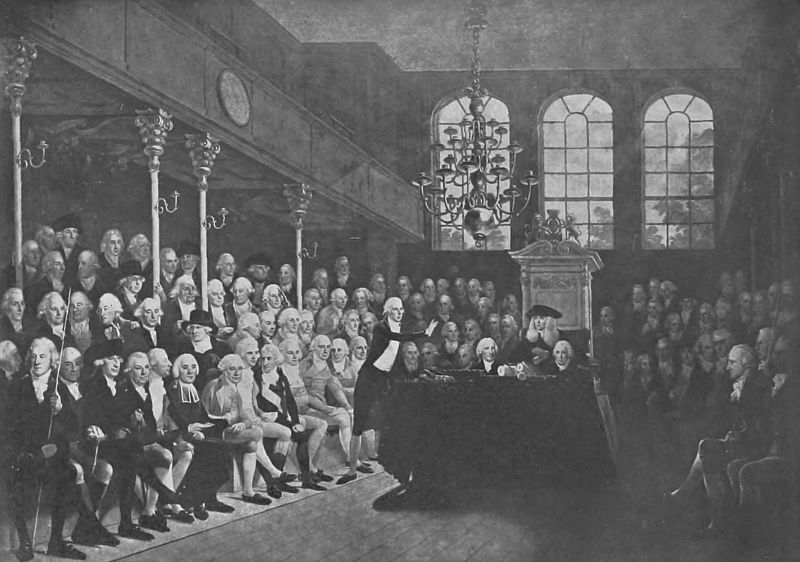
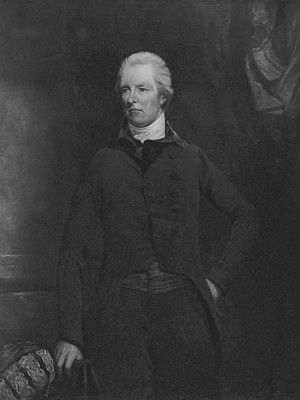 William Pitt, in later life. (From a painting by Hoppner in the National Portrait Gallery)