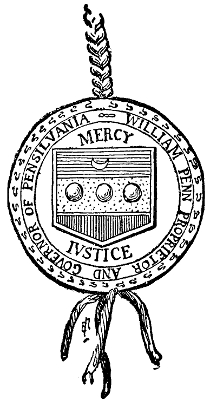
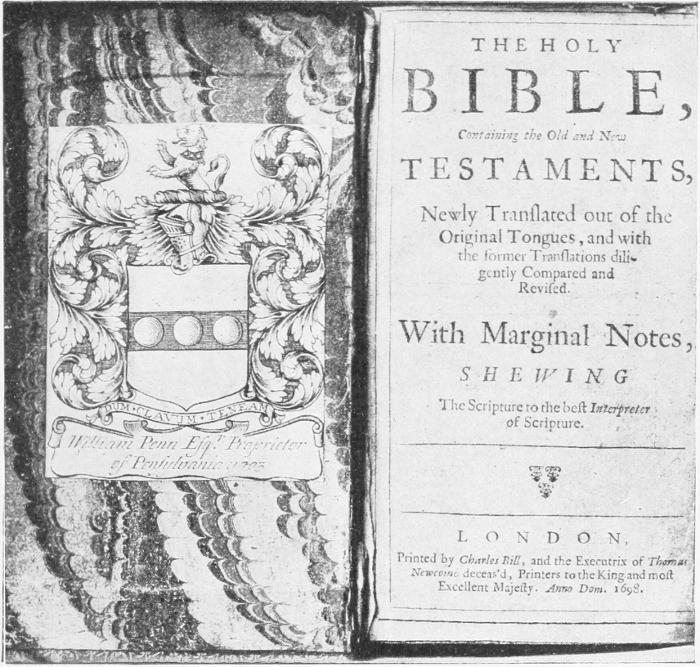
King William had taken the government of Pennsylvania away from William
Penn probably because he thought that a colony governed by a Quaker
friend of James Stuart might easily become a prey to French greed. But
when the king and Penn became reconciled, the province was given back to
Penn, in August, 1694. Although he was anxious to see his new city of
Philadelphia again, it was not until five years later that Penn was able
to cross the Atlantic. This was largely due to the fact that he had very
little money left.
His colony of Pennsylvania had cost him a great deal of money; and,
although he had expected large returns from the land and natural
products there, he found that the colony caused greater and greater
leakage to his purse. The settlers would not pay even the very small
quit-rent of one shilling a year for each hundred acres, and were
constantly calling on Penn to help them. His estates in Ireland brought
in no profits, and the property at Worminghurst that had belonged to
Mrs. Penn had been left in trust for her oldest son, Springett Penn, who
was then about nineteen years old. All that Penn received from that
property was enough to support and educate the three children.
While he stayed in England he began preaching again, and found that now,
under William and Mary, the Quakers were allowed the fullest liberty to
hold their meetings, and that religious persecution was a thing of the
past. His preaching was very successful. Wherever he spoke great crowds
gathered to hear the words of a man who had had such a remarkable
history, who had been a close friend of King James, and who had been in
hiding for some years. Penn was unquestionably a very eloquent speaker,
and his many experiences must have added very much to the interest of
what he had to tell the quiet-living Quakers of the English countryside.
Three years after his first wife died Penn married again, this time
Hannah Callowhill, of Bristol. Soon afterward he lost his oldest child,
Springett, a boy of great charm and a close companion of his father. Of
Guli Penn's two other children, William became dissipated and was a
great disappointment to Penn, and Letitia married William Aubrey, who
turned out to be a very disagreeable son-in-law. By his second wife Penn
had six children, four of whom, John, Thomas, Margaret, and Richard,
ultimately became the joint owners of Pennsylvania.
Penn now moved to the English city of Bristol, where he continued making
plans for his province, and preaching and arguing with people who did
not approve of his religion. The Quakers were then doing a certain
amount of missionary work, and the story goes that Penn sought out a
young Russian prince who was studying shipbuilding in England, and gave
him Quaker books which he explained to him. In time this prince became
the Emperor Peter the Great of Russia, and he is said always to have
taken great interest in the Quakers because of what Penn had taught him.
Meantime, much had happened in Pennsylvania. The history of the province
had been full of ups and downs, many of its difficulties being due to
the fact that for fifteen years Penn had been obliged to stay away from
it. There had been many squabbles between the settlers and the men
appointed to govern the province, but in spite of disagreements the
colony had grown until now there were nearly twenty thousand settlers
there.
When Penn left his colony in 1684, he had placed the power in the
charge of a Council of eighteen men, and each of the eighteen had felt
that it was his duty to do all the governing. When he learned that this
system did not work well, Penn had tried to mend matters by doing away
with the Council and appointing five commissioners. But this did not
work very well, either, and in less than a year Penn appointed an old
soldier of Cromwell's army, Captain John Blackwell, to replace the
commissioners, and act as a deputy governor. The Quakers, however, did
not like being in charge of a soldier, and made matters so difficult for
Captain Blackwell that he resigned his post. Then followed another
Council, and then another deputy governor, so that in ten years the form
of government was changed no less than six times.
When William III. took the province away from Penn, he appointed a
captain general, Colonel Benjamin Fletcher, who served until the colony
was given back to Penn, a year and ten months later. Then Penn appointed
his cousin, Markham, to be deputy governor, with two assistants.
Markham, although he had a troubled time of it, managed to keep charge
until William Penn was able to join him in 1699. All this time Penn had
been paying salaries and spending money on his home at Pennsbury, and
had been receiving nothing in return.
There was another reason for Penn's returning to his colony as soon as
he could, and that was that King William was growing impatient at the
stories he heard of the misgovernment of Pennsylvania, and was
determined that something should be done to put things on a more stable
footing. So, under the urging of friends at court who knew the king's
mind, Penn collected what money he could, and on September 9, 1699,
embarked with his wife and his daughter Letitia on the ship Canterbury
at Southampton. The voyage was long and stormy, but three months
later—toward the end of November—the ship reached the mouth of the
Delaware River. The ship was so slow in sailing up the river that when
New Castle was reached, Penn left her and was rowed to Chester.
Many settlers, hearing of the arrival of the proprietor of the province,
flocked to Chester to greet him. Among them was a Quaker who had been
well known in England, Thomas Story, who had traveled extensively in
America. Penn and Story spent the night together at the house of Lydia
Wade, near Chester, and Story told the proprietor all that had been
happening in the province, including the scourge of yellow fever, or
"Barbadoes distemper," as it was often called, that had visited
Philadelphia a short time before and proved fatal to more than two
hundred people.
Next day Penn returned to the Canterbury and sailed on up to
Philadelphia. Here he landed, paid a short visit to Markham, the deputy
governor, and then went to the Quaker meetinghouse, where he preached to
a great congregation.
He brought with him to Philadelphia a young man named James Logan, who
acted as his secretary; in time Logan became Penn's chief
representative, and one of the wisest of those who helped to govern the
province.
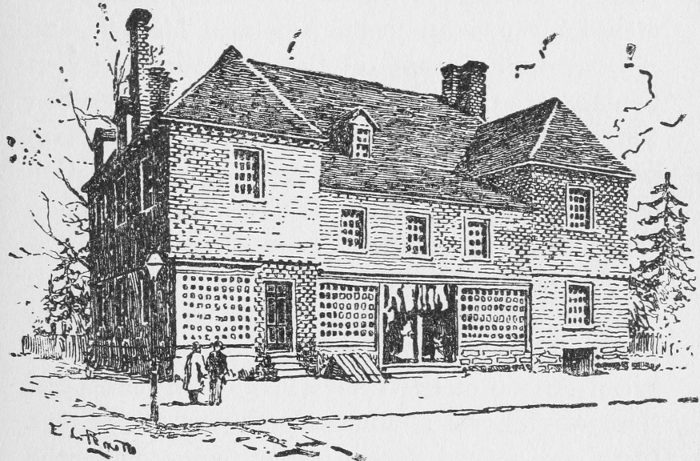
Penn had no house of his own in Philadelphia, so he, with his wife, his
daughter Letitia, and James Logan, stayed for a month at the house of
Edward Shippen, and then moved to one of the largest houses of the town,
then known as "the slate-roof house"; it stood on the east side of
Second Street between Chestnut and Walnut. There his son John was born,
and the boy was always affectionately known as "John the American."
The Slate-Roof House. (See Page 128.)
Most of the people of Pennsylvania, and particularly the Quakers, were
very glad to have Penn with them again. He was a man well able to
govern, but not generally successful in choosing others to govern for
him. There was one man, Colonel Quarry, who had been sowing dissension
and distrust of Penn in the province, but Penn sent for him, and after a
talk, Quarry admitted that he had been wrong and the two became friends.
One of the things Penn soon learned, a thing that seems strange enough
to us, was that there was a good deal of piracy going on in the
neighborhood of his province, and that many of the pirates were actually
living in comfort in Philadelphia! It did not take Penn long to get
after these men, and he soon had them arrested and punished in a way
that spoke well for his energy and zeal. Other crimes and wrongs he
punished or corrected, and the Quakers soon found they were right in
believing that their governor was as good an executive as he was a
preacher.
He was very busy that winter, holding meetings of his Council and
passing new laws, preaching to Quakers in Pennsylvania and New Jersey,
surveying a manor of ten thousand acres at Rockhill, in Bucks County,
for his son John, and overseeing repairs to his country place at
Pennsbury. Incidentally, it is interesting to recall that, liberal and
freedom-loving as he was, it had not occurred to him to oppose the
custom of holding negro slaves, for he himself had many slaves in his
own employment.
He urged the settlers to make their prisons not merely places of
restraint but workhouses and reformatories, and as a result Pennsylvania
prisons were far better managed than those in other colonies. He
introduced the custom of having a night watchman go through the streets,
calling out the hour, the state of the weather, and any news of
interest. In many ways he improved conditions, showing that he had a
real genius for governing and an intense desire to make his province an
ideal place in which to live.
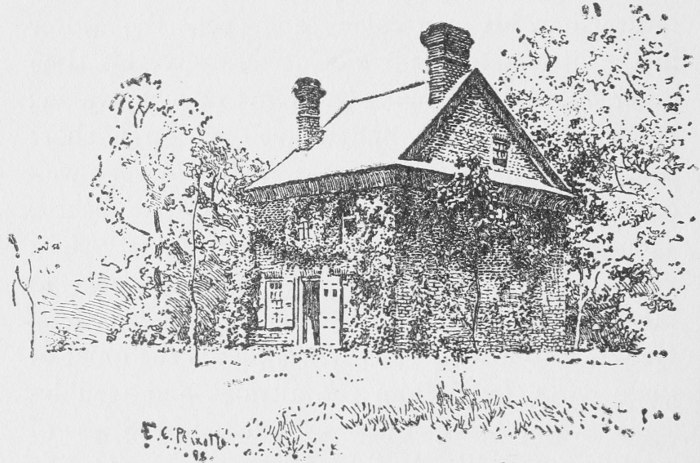
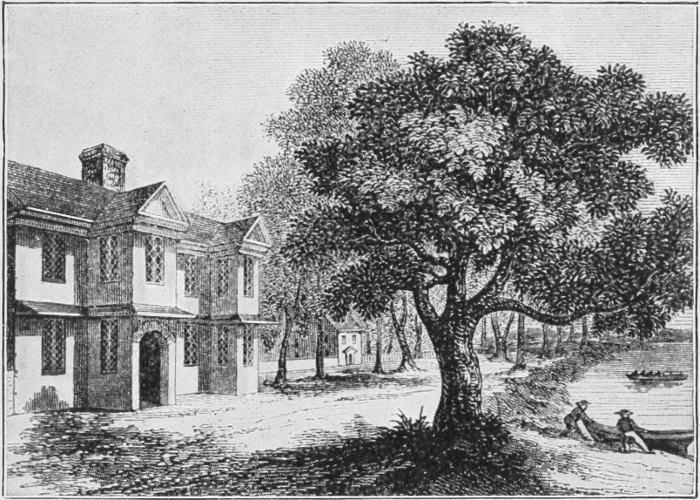
Early in the spring of 1700 he moved to his mansion at Pennsbury, twenty
miles up the river. It was built of bricks, most of which had been
brought from England, and it stood about one hundred rods from the bank
of the Delaware. Back of it were deep forests, penetrated by only a few
roads and trails. It was said to have cost £5000 to build, a very large
sum for a house in the wilderness, but it was the most imposing
residence to be found anywhere between the Hudson and Potomac rivers,
and had few equals in New York or Virginia.
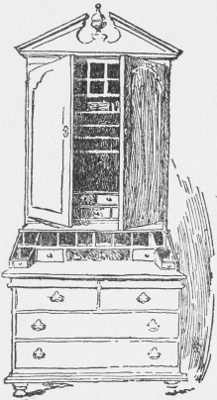
Penn's Desk.
The house had two stories, with a high attic for servants' rooms, and
the main walls were eighteen inches thick. There was a large hall on the
first floor, where Penn held meetings of his Council, gave
entertainments, and welcomed the Indian chiefs who frequently came to
see him. A parlor and a drawing-room were to the north of the hall, a
library and a dining-room to the south. As was the custom then, the
kitchen was a separate building, but connected with the mansion by a
covered passageway. Back of the kitchen was a building called "the
brewhouse," where ale and "strong beer" were brewed. There was also a
laundry and a stable for twelve horses, and at either end of the main
house were small buildings, one of which was Penn's office for the
transaction of the affairs of his province, the other for the business
of his private estate. This was the way in which the large landowners of
colonial times planned their homes and business offices.
When Penn visited Philadelphia, he usually went down the Delaware in his
private barge, rowed by six oarsmen. He seems to have enjoyed this mode
of travel, and to have taken great pleasure in the scenery along the
broad river. Gardens stretched from his house to the water front, and he
transplanted many native wild flowers to his own grounds, besides
setting out walnuts, hawthorns, hazels, and fruit trees that he brought
from England.
He lived in fine style; for William Penn, in spite of his urging
simplicity in all things, could always appreciate and enjoy luxury. He
had very handsome oak and walnut chairs and tables, satin curtains, a
wine cellar well stocked, and six large cisterns for holding water or
beer. Frequently he played the part of host to many Indians, and it is
said that he once entertained them at a long table spread out-of-doors,
serving a hundred turkeys and a large quantity of venison.
While the provincial Assembly was in session in Philadelphia Penn was
very busy directing its business, but when it adjourned, he usually
turned his attention to questions concerning the Indians, whom he
regarded as almost as much his own people as the white settlers. When he
made his first treaty with them, he planned to call them together twice
each year to renew their treaty of friendship, to adjust any matters of
trade that might have arisen, and to smoke the pipe of peace with them.
His absence in England had for a long time made these meetings
impossible, but he now resumed them, and called the chiefs into
conference with him.
The Delaware and Susquehanna tribes, who had now enjoyed his fair
treatment for almost twenty years, were anxious to have Penn make
agreements with other tribes, more especially those who lived in the
country along the Potomac River. So they went to Onas, as Penn was
usually called, and he agreed to meet their allies in April, 1701. At
this meeting there came to see him many leading Indians,—three kings,
and the brother of the Emperor of the Five Nations, as well as forty
other chiefs. With all these Penn made treaties of peace and trade, by
which the Indians were to be protected from the greed and cunning of
white traders, and were, on their part, to sell their furs and skins
only to Pennsylvanians. In this way he contrived to keep the red men
friendly to the whites in his province, and gained the great benefit of
having a bulwark of friendly Indians to protect his colony from enemies.
When he made one of these treaties, he sent word of it to the government
in England, and so increased his already well-deserved reputation of
knowing how to deal with the Indians better than any other governor of
an English colony.
At Pennsbury the family lived much like a family of high rank in
England. The ladies dressed in silk and wore elaborate caps and buckles
and golden ornaments. Penn himself bought no less than four wigs in one
year at a cost of nearly twenty pounds. But if he was indulgent to his
family and himself, he was always looking after the poor and the sick.
When he heard of men or women in prison for debt, he contrived to get
them out and start them afresh; he was always ready to listen to and
help those who came to him in any distress, and he gave pensions of
three shillings a week to many old people who were no longer able to
support themselves. His private cash books show a long list of generous
giving that far outstrips the sums he spent for his own household use.
Besides his barge on the river he had a coach, a calash, and a sedan
chair. He was very fond of good horses, and had a number in his stables.
Often, however, he found it easier to explore the neighboring country on
foot than on horseback, and he was very fond of taking long walks
through the woods. Once he was lost on a hill near Valley Forge, and
wandered about for some time when he came to another height from which
he saw the Schuylkill River. The first hill he named Mount Misery, and
the second Mount Joy, and these names stuck to the hills for some time.
A pleasant little incident is told of how, as William Penn was riding
one day to the Quaker meetinghouse at Haverford, outside Philadelphia,
he overtook a little barefooted girl, Rebecca Wood, who was also going
to the meeting. He took her up behind him on the horse, and the two rode
on to the meetinghouse, the little girl's bare legs making an odd
contrast to the tall governor in his long coat and knee breeches.
William and Hannah Penn entertained continually at their country home,
preferring Pennsbury to the town. Penn's daughter Letitia, however, who
was twenty years old, and a very lively, handsome girl, did not care so
much for the quiet of the country, and spent most of her time in
Philadelphia with the Markhams, the Logans, or the Shippens.
Penn always dealt fairly with the Indians, and they trusted him far more
than they did most of the white men. He traveled through New Jersey, New
York, and Maryland, being eager to see the country and also to spread
Quaker influence as widely as he could in the new world. The life of a
country gentleman suited him to perfection, and he was undoubtedly much
happier in Pennsylvania than he had been when a courtier at Whitehall in
London, or striving to make other people believe that King James was as
worthy a king as he himself thought him.
Still, the government of Pennsylvania did not run smoothly even while
Penn was there. Quakers and Church of England people were constantly
wrangling, and the Assembly would not pass the laws that Penn thought it
ought to. He was not making money from his province; he still had to pay
large salaries, and he was constantly being asked for money for various
purposes. Once he declared that the province had meant a loss to him of
£20,000. Occasionally he received payment from the sale of land or for
rent, but the settlers were hard people to deal with and paid out their
money grudgingly.
The limits of Pennsylvania were still very indefinite, and for the most
part were not settled until years later. The province was said to be
bounded on the north by the southern limits of New York, and on the
south by the northern limits of Maryland. Neither of these boundaries
was actually settled until 1768. Westward the boundary was yet more
vague, being defined by the words "as far to the westward as Maryland
extends." But boundaries were not of great importance then, when there
was so much vacant land, although by 1702 great numbers of Germans,
Swiss, Huguenots, and Scotch-Irish were coming into the province and
taking up homesteads west and north of the little Quaker settlement on
the Delaware.
The Pennsylvania Assembly refused to grant certain supplies that were
asked by King William in 1701, and at the same time a bill was presented
in the English Parliament to change the government of the English
colonies in America. By this bill West and East Jersey were to be
annexed to New York, and Penn's charter was to be revoked, he being
paid a certain sum in return, and his province turned into a Crown
colony similar to New York. When Penn heard of this, he thought that he
ought to return to England and fight it. This he expected would take him
only a short time, and he planned to return to Pennsbury at the end of a
year. He wanted to make his home there, and expected his wife and
Letitia to stay there until he returned. But his family thought
otherwise about being left behind. Penn wrote to James Logan: "I can not
prevail on my wife to stay: still less Tishe. I know not what to do."
And in another letter he wrote: "The going of my wife and Tishe will add
greatly to the expense; more of living in London than of the passage.
But they will not be denied."
Both Mrs. Penn and Letitia were probably homesick for their native
England. Letitia in particular missed her gay friends at home, and found
the Quakers of the province a poor substitute. It happened that later,
when she did return to England, she gave up the Quaker faith and became
a member of the Church of England. Mrs. Penn, in addition to other
reasons for returning home, had already seen that her husband required
the help of her firm will and clear insight when he was beset with
political troubles in England, and believed she could be of great
assistance to him. So when Penn did return, he took his family with him.
He made Andrew Hamilton deputy governor of the province, and James Logan
secretary; and on November 4, 1701, sailed from Philadelphia in the ship
Dalmahoy. The ship made a very quick run, in fact one of the fastest
voyages recorded at that time, taking only thirty-six days to cross; and
by the middle of December Penn was again in London. He took apartments
in Kensington, that he might be close to the king and Parliament in
looking after his title to his province.
It turned out that Penn never went back to Pennsylvania again, although
some of his children did. Politics were to take all his attention; he
was to have no more of the country life in America that he had grown so
fond of, and that seemed to bring out all the best qualities in his
many-sided nature.