WILLIAM MORRIS AND HIS WORK — OMAR KHAYYÁM
IF it is agreed that art, after all, may be summed
up as the expression of character, it follows
that the more we realize an artist's personality the
clearer understanding we shall get of his work.
So remarkable a personality as that of William
Morris must have left many distinct, and at the
same time different, impressions upon the minds of
those who knew him, or enjoyed his friendship in
life.
It is difficult to realize that fifteen years have
passed away since he left us; but from the dark and
blurred background of changing years his character
and work define themselves, and his position and
influence take their true place, while his memory,
like some masterly portrait, remains clear and vivid
in our minds—re-presented as it were in the severe
but refined draughtsmanship of time.
With so distinct and massive an individuality it
was strange to hear him say, as I once did, that
of the six different personalities he recognized
within himself at different times he often wondered
which was the real William Morris! Those who
knew him, however, were aware of many different
sides, and we know that the "idle dreamer of an
empty day" was also the enthusiastic artist and
craftsman, and could become the man of passionate
action on occasion, or the shrewd man of business,
or the keen politician also, as well as the quiet
observer of nature and life. Even the somewhat
Johnsonian absoluteness and emphasis of expression
which characterized him generally, would
occasionally give way to an open-to-conviction
manner, when tackled by a sincere and straightforward
questioner.
But Morris was above and before all else a
poet—a practical poet, if one may use such a term—and
this explains the whole of his work. Not
that personally he at all answered to the popular
conventional idea of a poet, rather the reverse,
and he was anything but a sentimentalist. He
hated both the introspective and the rhetorical
school, and he never posed. He loved romance
and was steeped in mediaeval lore, but it was a
real living world to him, and the glimpses he
gives us are those of an actual spectator. It is
not archaeology, it is life, quite as vivid to him,
perhaps more so than that of the present day.
He loved nature, he loved beautiful detail, he
loved pattern, he loved colour—"red and blue"
he used to say in his full-blooded way. His
patterns are decorative poems in terms of form
and colour. His poems and romances are decorative
patterns in forms of speech and rhyme. His
dream world and his ideal world were like one
of his own tapestries—a green field starred with
vivid flowers upon which moved the noble and
beautiful figures of his romantic imagination,
as distinct in type and colour as heraldic charges.
Textile design interested him profoundly and
occupied him greatly, and one may trace its influence,
I think, throughout his work—even in
his Kelmscott Press borders. One might almost
say that he had a textile imagination, his poems
and romances seem to be woven in the loom of
his mind, and to enfold the reader like a magic
web.
But though he cast his conceptions in the forms
and dress of a past age, he took his inspiration
straight from nature and life. His poems are full
of English landscapes, and through the woods of
his romances one might come upon a reach of the
silvery Thames at any moment. The river he
loved winds through the whole of his delightful
Socialistic Utopia in "News from Nowhere."
As a craftsman and an artist working with
assistants and in the course of his business he was
brought face to face with the modern conditions
of labour and manufacture, and was forced to think
about the political economy of art. Accepting the
economic teaching of John Ruskin, he went much
further and gave his allegiance to the banner of
Socialism, under which, however, he founded his
own school and had his own following, and conducted
his own newspaper. From the dream
world of romance, and from the sequestered garden
of design, he plunged into the thick of the
fight for human freedom, in which, he held, was
involved the very existence of art.
Ever and anon he returned to his sanctuary—his
workshop—to fashion some new thing of
beauty, in verse or craftsmanship, in which we see
the results of his labour in so many directions.
He certainly seemed to have possessed a larger
and fuller measure of vitality and energy than
most men—perhaps such extra vitality is the distinction
of genius—but the very strenuousness of
his nature probably shortened the duration of his
life. There were never any half-measures with
him, but everything he took up, he went into
seriously, nay, passionately, with the whole force
of his being. His power of concentration (the
secret of great workers) was enormous, and was
spent from time to time in a multitude of ways,
but whether in the eager search for decorative
beauty, his care for the preservation of ancient
buildings, in the delight of ancient saga, story, or
romance, or in the battle for the welfare of mankind,
like one of his own chieftains and heroes, he
always made his presence felt, and as the practical
pioneer and the master-craftsman in the revival of
English design and handicraft his memory will
always be held in honour.
His death marked an epoch both in art and in
social and economic thought. The press notices
and appreciations that have appeared from time
to time for the most part have dwelt upon his
work as a poet and an artist and craftsman, and
have but lightly passed over his connection with
Socialism and advanced thought.
But, even apart from prejudice, a hundred will
note the beauty and splendour of the flower to
one who will notice the leaf and the stem, or the
roots and the soil from which the tree springs.
Yet the greatness of a man must be measured
by the number of spheres in which he is distinguished—the
width of his range and appeal to his
fellows.
In the different branches of his work William
Morris commanded the admiration, or, what is
equally a tribute to his force, excited the opposition—of
as many different sections of specialists.
As a poet he appealed to poets by reason of
many distinct qualities. He united pre-Raphaelite
vividness (as in "The Haystack in the Floods"),
with a dream-like, wistful sweetness and charm of
flowing narrative, woven in a kind of rich mediaeval
tapestry of verse, and steeped with the very
essence of legendary romance as in "The Earthly
Paradise"; or with the heroic spirit of earlier
time, as in "Sigurd the Volsung," while all these
qualities are combined in his later prose romances.
His architectural and archaeological knowledge
again was complete enough for the architect and
the antiquary.
His classical and historical lore won him the
respect of scholars.
His equipment as a designer and craftsman,
based upon his architectural knowledge and training
enabled him to exercise an extraordinary influence
over all the arts of design, and gave him
his place as leader of our latter-day English
revival of handicraft—a position perhaps in which
he is widest known.
In all these capacities the strength and beauty
of William Morris's work has been freely acknowledged
by his brother craftsmen, as well as by a
very large public.
There was, however, still another direction in
which his vigour and personal weight were thrown
with all the ardour of an exceptionally ardent
nature, wherein the importance and significance
of his work is as yet but partially apprehended—I
mean his work in the cause of Socialism, in
which he might severally be regarded as an economist,
a public lecturer, a propagandist, a controversialist.
No doubt many even of the most emphatic
admirers of William Morris's work as an artist, a
poet, and a decorator have been unable to follow
him in this direction, while others have deplored,
or even denounced, his self-sacrificing enthusiasm.
There seems to have been insuperable difficulty
to some minds in realizing that the man who
wrote "The Earthly Paradise" should have lent
a hand to try to bring it about, when once the
new hope had dawned upon him.
There is no greater mistake than to think of
William Morris as a sentimentalist, who, having
built himself a dream-house of art and poetry,
sighs over the turmoil of the world, and calls himself
a Socialist because factory chimneys obtrude
themselves upon his view.
It seems to have escaped those who have inclined
to such an opinion that a man, in Emerson's
phrase, "can only obey his own polarity." His
life must gravitate necessarily towards its centre.
The accident that he should have reached economics
and politics through poetry and art, so far
from disqualifying a man to be heard, only establishes
his claim to bring a cultivated mind and
imaginative force to bear upon the hard facts of
nature and science.
The practice of his art, his position as an employer
of labour, his intensely practical knowledge
of certain handicrafts, all these things brought him
face to face with the great Labour question; and
the fact that he was an artist and a poet, a man of
imagination and feeling as well as intellect, gave
him exceptional advantages in solving it—at least
theoretically. His practical nature and sincerity
moved him to join hands with men who offered a
practical programme, or at least who opened up
possibilities of action towards bringing about a
new social system.
His own personal view of a society based upon
an entire change of economic system is most
attractively and picturesquely described in "News
from Nowhere, some Chapters of a Utopian
Romance." He called it Utopian, but, in his
view, and granting the conditions, it was a perfectly
practical Utopia. He even gave an account
(through the mouth of a survivor of the old order)
of the probable course of events which might lead
up to such a change. The book was written as a
sort of counterblast to Edward Bellamy's "Looking
Backward," which on its appearance was very
widely read on both sides of the water, and there
seemed at the time some danger of the picture
there given of a socialized state being accepted as
the only possible one. It may be partly answerable
for an impression in some quarters that a
Socialist system must necessarily be mechanical.
But the society described in "Looking Backward"
is, after all, only a little more developed
along the present lines of American social life—a
sublimation of the universal supply of average
citizen wants by mechanical means, with the mainspring
of the machine altered from individual
profit to collective interest. This book, most
ingeniously thought out as it was, did its work,
no doubt, and appealed with remarkable force to
minds of a certain construction and bias, and it
is only just to Bellamy to say that he claimed
no finality for it.
But "News from Nowhere" may be considered—apart
from the underlying principle, common to
both, of the collective welfare as the determining
constructive factor of the social system—as its
complete antithesis.
According to Bellamy, it is apparently the city
life that is the only one likely to be worth anything,
and it is to the organization of production
and distribution of things contributing to the supposed
necessities and comforts of inhabitants of
cities that the reader's thoughts are directed.
With Morris the country life is obviously the
most important, the ideal life. Groups of houses,
not too large to be neighbourly, each with a common
guest-hall, with large proportions of gardens
and woodland, take the place of crowded towns.
Thus London, as we know it, disappears.
What is this but building upon the ascertained
scientific facts of our day, that the inhabitants of
large cities tend to deteriorate in physique, and
would die out were it not for the constant infusion
of new blood from the country districts?
Work is still a hard necessity in "Looking
Backward," a thing to be got rid of as soon as
possible, so citizens, after serving the community
as clerks, waiters, or what not, until the age of
forty-five, are exempt.
With Morris, work gives the zest to life, and
all labour has its own touch of art—even the
dustman can indulge in it in the form of rich embroidery
upon his coat. The bogey of labour is
thus routed by its own pleasurable exercise, with
ample leisure, and delight in external beauty in
both art and nature.
As regards the woman's question, it never, in
his Utopia, appears to be asked. He evidently
himself thought that with the disappearance of the
commercial competitive struggle for existence and
what he termed "artificial famine" caused by
monopoly of the means of existence, the claim
of women to compete with men in the scramble
for a living would not exist. There would be no
necessity for either men or women to sell themselves,
since in a truly co-operative commonwealth
each one would find some congenial sphere
of work.
In fact, as Morris once said, "settle the economic
question and you settle all other questions.
It is the Aaron's rod which swallows up the
rest."
I gather that while he thought both men and
women should be economically free, and therefore
socially and politically free, and free to choose
their occupation, he by no means wished to ignore
or obliterate sex distinctions, and all those subtle
and fine feelings which arise from it, which really
form the warp and weft of the courtesies and
relationships of life.
Now, whatever criticisms might be offered, or
whatever objections might be raised, such a conception
of a possible social order, such a view of
life upon a new economic basis as is painted in
this delightful book, is surely, before all things,
remarkably wholesome, human, and sane, and
pleasurable. If wholesome, human, sane, and
pleasurable lives are not possible to the greater
part of humanity under existing institutions, so
much the worse for those institutions. Humanity
has generally proved itself better than its institutions,
and man is chiefly distinguished above other
animals by his power to modify his conditions.
Life, at least, means growth and change, and
human evolution shows us a gradual progression—a
gradual triumph of higher organization and
intelligence over lower, checked by the inexorable
action of natural laws, which demand reparation
for breaches of moral and social law, and continually
probe the foundations of society. Man has
become what he is through his capacity for co-operative
social action. The particular forms of
social organization are the crystallization of this
capacity. They are but shells to be cast away
when they retard growth or progress, and it is
then that the living organism, collective or individual,
seeks out or slowly forms a new home.
As to the construction and colour of such a new
house for reorganized society and regenerated life,
William Morris has left us in no doubt as to his
own ideas and ideals. It may seem strange that
a man who might be said to have been steeped in
mediaeval lore,1 and whose delight seemed to be
in a beautifully imagined world of romance peopled
with heroic figures, should yet be able to turn from
that dream world with a clear and penetrating
gaze upon the movements of his own time, and to
have thrown himself with all the strength of his
nature into the seething social and industrial
battle of modern England. That the "idle singer
of an empty day" should voice the claims and
hopes of Labour, stand up for the rights of free
speech in Trafalgar Square, and speak from a
wagon in Hyde Park, may have surprised those
who only knew him upon one side, but to those
who fully apprehended the reality, ardour, and
sincerity of his nature, such action was but its
logical outcome and complement, and assuredly it
redounds to the honour of the artist, the scholar,
and the poet whose loss we still feel, that he was
also a man.
Few men seemed to drink so full a measure of
life as William Morris, and, indeed, he frankly
admitted in his last days that he had enjoyed his
life. I have heard him say that he only knew
what it was to be alive. He could not conceive of
death, and the thought of it did not trouble him.
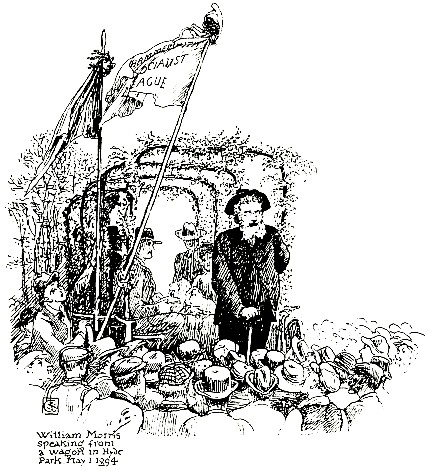
William Morris speaking from a wagon in Hyde Park, May 1 1894
I first met William Morris in 1870, at a dinner
at the house of the late Earl of Carlisle, a man
of keen artistic sympathies and considerable artistic
ability, notably in water-colour landscapes.
He was an enthusiast for the work of Morris and
Burne-Jones, and had just built his house at
Palace Green from the designs of Mr. Philip
Webb, and Morris and Company had decorated
it. Morris, I remember, had just returned from a
visit to Iceland, and could hardly talk of anything
else. It seemed to have laid so strong a hold upon
his imagination; and no doubt its literary fruits
were the translations of the Icelandic sagas he
produced with Professor Magnússon, and also the
heroic poem of "Sigurd the Volsung." He never,
indeed, seemed to lose the impressions of that
Icelandic visit, and was ever ready to talk of his
experiences there—the primitive life of the people,
the long pony rides, the strange, stony deserts, the
remote mountains, the geysers and the suggestions
of volcanic force everywhere, and the romance-haunted
coasts.
I well remember, too, the impression produced
by the first volume of "The Earthly Paradise,"
which had appeared, I think, shortly before the
time of which I speak: the rich and fluent verse,
with its simple, direct, Old World diction; the
distinct vision, the romantic charm, the sense of
external beauty everywhere, with a touch of wistfulness.
The voice was the voice of a poet, but
the eye was the eye of an artist and a craftsman.
It was not so long before that the fame began
to spread of the little brotherhood of artists who
gathered together at the Red House, Bexley
Heath, built by Mr. Philip Webb, it was said, in
an orchard without cutting down a single tree.
Dante Gabriel Rossetti was the centre of the
group, the leading spirit, and he had absorbed the
spirit of the pre-Raphaelite movement and centralized
it both in painting and verse. But others
co-operated at first, such as his master, Ford
Madox Brown, and Mr. Arthur Hughes, until the
committee of artists narrowed down, and became
a firm, establishing workshops in one of the old-fashioned
houses on the east side of Queen Square,
Bloomsbury, a retired place, closed by a garden
to through traffic at the northern end. Here
Messrs. Morris, Marshall, Faulkner and Co. (which
included a very notable man, Mr. Philip Webb,
the architect) began their practical protest against
prevailing modes and methods of domestic decoration
and furniture, which had fallen since the great
exhibition of 1851 chiefly under the influence of
the Second Empire taste in upholstery, which was
the antithesis of the new English movement. This
latter represented in the main a revival of the
mediaeval spirit (not the letter) in design; a return
to simplicity, to sincerity; to good materials
and sound workmanship; to rich and suggestive
surface decoration, and simple constructive forms.
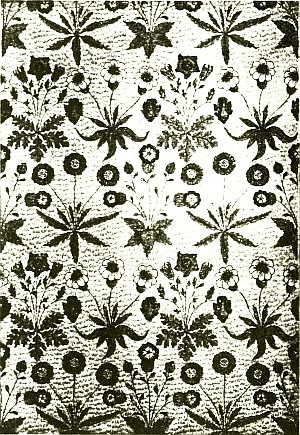
DESIGN FOR WALL-PAPER. "THE DAISY."
The simple, black-framed, old English Buckinghamshire
elbow-chair, with its rush-bottomed seat,
was substituted for the wavy-backed and curly-legged
stuffed chair of the period, with its French
polish and concealed, and often very unreliable,
construction. Bordered Eastern rugs, and fringed
Axminster carpets, on plain or stained boards, or
India matting, took the place of the stuffy planned
carpet; rich, or simple, flat patterns acknowledged
the wall, and expressed the proportions of the
room, instead of trying to hide both under bunches
of sketchy roses and vertical stripes; while, instead
of the big plate-glass mirror, with ormolu
frame, which had long reigned over the cold white
marble mantel-piece, small bevelled glasses were
inserted in the panelling of the high wood mantel-shelf,
or hung over it in convex circular form.
Slender black wood or light brass curtain rods,
and curtains to match the coverings, or carry out
the colour of the room, displaced the heavy
mahogany and ormolu battering-rams, with their
fringed and festooned upholstery, which had hitherto
overshadowed the window of the so-called
comfortable classes. Plain white or green paint for
interior wood-work drove graining and marbling
to the public-house; blue and white Nankin,
Delft, or Grès de Flandres routed Dresden and
Sèvres from the cabinet; plain oaken boards and
trestles were preferred before the heavy mahogany
telescopic British dining-table of the mid-nineteenth
century; and the deep, high-backed, canopied
settle with loose cushions ousted the castored
and padded couch from the fireside.
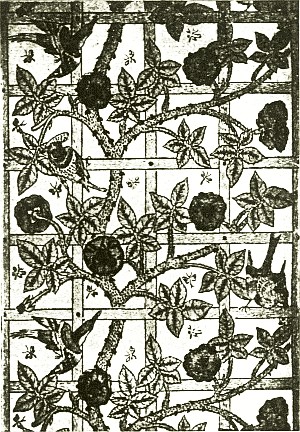
DESIGN FOR WALL-PAPER. "ROSE TRELLIS."
Such were the principal ways, as to outward
form, in which the new artistic movement made
itself felt in domestic decoration. Beginning with
the houses of a comparatively limited circle, mostly
artists, the taste rapidly spread, and in a few
years Morrisian patterns and furniture became the
vogue. Cheap imitation on all sides set in, and
commercial and fantastic persons, perceiving the
set of the current, floated themselves upon it,
tricked themselves out like jackdaws with peacocks'
feathers, and called it "the aesthetic movement."
The usual excesses were indulged in by
excitable persons, and the inner meaning of the
movement was temporarily lost sight of under a
cloud of travesty and ridicule, until, like a shuttlecock,
the idea had been sufficiently played with and
tossed about by society and the big public, it was
thrown aside, like a child's toy, for some new
catch-word. These things were, however, but the
ripples or falling leaves upon the surface of the
stream, and had but little to do with its sources or
its depth, though they might serve as indications
of the strength of the current.
The art of Morris and those associated with
him was really but the outward and visible sign
of a great movement of protest and reaction
against the commercial and conventional conceptions
and standards of life and art which had obtained
so strong a hold in the industrial nineteenth
century.
Essentially Gothic and romantic and free in
spirit as opposed to the authoritative and classical,
its leader was emphatically and even passionately
Gothic in his conception of art and ideals of life.
The inspiration of his poetry was no less mediaeval
than the spirit of his designs, and it was
united with a strong love of nature and an ardent
love of beauty.
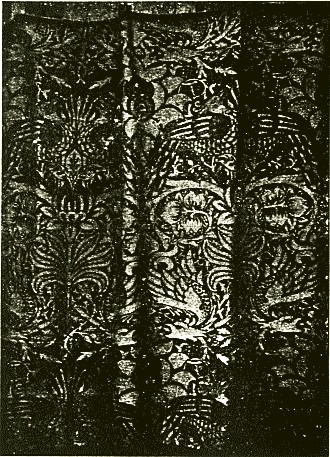
WOOLLEN HANGING. "THE PEACOCK."
One knows but little of William Morris's progenitors.
His name suggests Welsh origin, though
his birthplace was Walthamstow. Born 24th
March 1834, one of a well-to-do family, it was a
fortunate circumstance that he was never cramped
by poverty in the development of his aims. Escaping
the ecclesiastical influence of Oxford and
a Church career, his prophets being rather John
Ruskin and Thomas Carlyle, he approached the
study and practice of art from the architectural
side under one of our principal English Gothic
revivalists, George Edmund Street, although he at
one time entertained the idea of becoming a painter,
and the very interesting picture of "Guinevere"
which was shown at one of the Arts and Crafts
Exhibitions makes one regret he did not do more
in this way. Few men had a better understanding
of the nature of Gothic architecture, and a wider
knowledge of the historic buildings of his own
country, than William Morris, and there can be
no doubt that this grasp of the true root and stem
of the art was of enormous advantage when he
came to turn his attention to the various subsidiary
arts and handicrafts comprehended under decorative
design. The thoroughness of his methods of
work and workmanlike practicality were no less
remarkable than his amazing energy and capacity
for work.
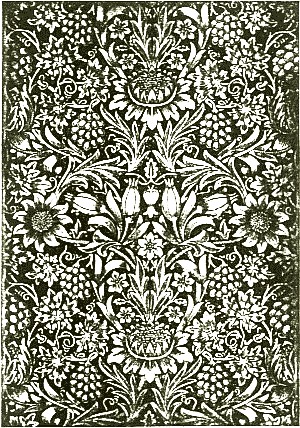
DESIGN FOR SILK HANGING.
In one of his earlier papers he said that it
appeared to be the object with most people to get
rid of, or out of, the necessity of work, but for his
part he only wanted to find time for more work,
or (as it might be put) to live in order to work,
rather than to work in order to live.
While as a decorative designer he was, of course,
interested in all methods, materials, and artistic
expression, he concentrated himself generally
upon one particular kind at a time, as in the
course of his study and practice he mastered the
difficulties and technical conditions of each.
At one time it was dyeing, upon which he held
strong views as to the superiority, permanency,
and beauty of vegetable dyes over the mineral
and aniline dyes, so much used in ordinary commerce,
and his practice in this craft, and the charm
of his tints, did much to check the taste for the
vivid but fugitive colours of coal-tar.
His way was to tackle the thing with his own
hands, and so he worked at the vat, like the practical
man that he was in these matters. An old
friend tells the story of his calling at the works
one day and, on inquiring for the master, hearing
a strong, cheery voice call out from some inner
den, "I'm dyeing, I'm dyeing, I'm dyeing!" and
the well-known robust figure of the craftsman
presently appeared in his blue shirt-sleeves, his
hands stained blue from the vat where he had
been at work.
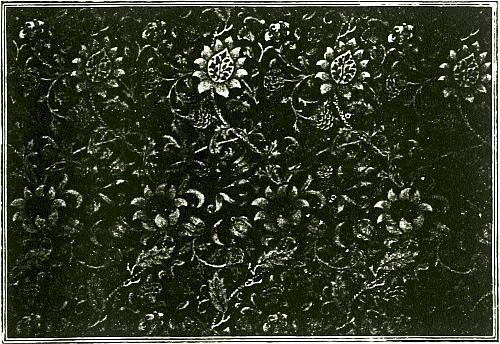
COTTON PRINT. "EVENLODE."
At another time it was weaving that absorbed
him, and the study of dyeing naturally led him to
textiles, and, indeed, was probably undertaken
with the view of reviving their manufacture in
new forms, and from rugs and carpets he conceived
the idea of reviving Arras tapestry. I remember
the man who claimed to have taught
Morris to work on the high-warp loom. His name
was Wentworth Buller. He was an enthusiast for
Persian art, and he had travelled in that country
and found out the secret of the weaving of the fine
Persian carpets, discovering, I believe, that they
were made of goats' hair. He made some attempt
to revive this method in England, but from one
cause or another was not successful. William
Morris, when he had learned the craft of tapestry
weaving himself, set about teaching others, and
trained two youths, one of whom (Mr. Dearle) is
now chief at the Merton Abbey Works, who became
exceedingly skilful at the work, executing
the large and elaborate design of Sir Edward
Burne-Jones (The Adoration of the Magi), which
was first worked for the chapel of his own and
Morris's college (Exeter College) at Oxford.
In this tapestry, as was his wont, Morris enriched
the design with a foreground of flowers,
through which the Magi approach with their gifts
the group of the Virgin and Child, with St. Joseph.
In fact, the designs of William Morris are so
associated with and so often form part of the work
of others or only appear in some conditioned
material form, that little or no idea of his individual
work, or of his wide influence, could be
gathered from any existing autograph work of his.
That he was a facile designer of floral ornament
his numerous beautiful wall-papers and textile
hangings prove, but he always considered that the
finished and final form of a particular design,
complete in the material for which it was intended,
was the only one to be looked at, and always objected
to showing preliminary sketches and working
drawings. He was a keen judge and examiner
of work, and fastidious, and as he did not mind
taking trouble himself he expected it from those
who worked for him. His artistic influence was
really due to the way he supervised work under
his control, carried out by many different craftsmen
under his eye, and not so much by his own
actual handiwork.
In any estimate of William Morris's power and
influence as an artist, this should always be borne
in mind. He always described himself as an
artist working with assistants, which is distinct
from the manufacturer who simply directs a business
from the business point of view. Nothing
went out of the works at Queen Square, or, later,
at Merton Abbey, without his sanction from the
artistic point of view.
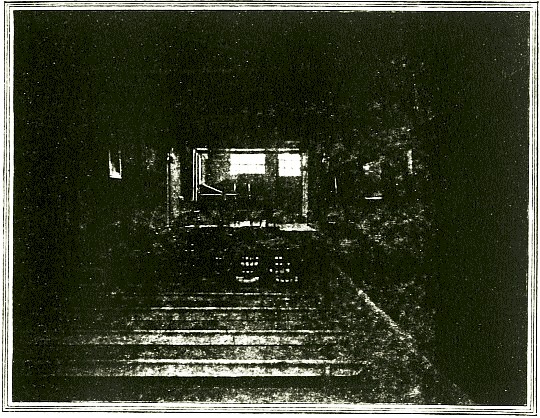
KELMSCOTT HOUSE. MEETING ROOM OF THE HAMMERSMITH SOCIALIST SOCIETY.
The wave of taste which he had done so much
to create certainly brought prosperity to the firm,
and larger premises had to be taken; so Morris
and Company emerged from the seclusion of
Queen Square and opened a large shop in Oxford
Street, and set up extensive works at Merton
Abbey—a most charming and picturesque group
of workshops, surrounded by trees and kitchen
gardens, on the banks of the river Wandle in
Surrey, not far from Wimbledon. The tapestry
and carpet looms which were first set up at
Kelmscott House, on the Upper Mall at Hammersmith,2
were moved to Merton, where also the
dyeing and painted glass-work were carried on.
This latter art had long been an important part
of the work of the firm. In early days designs
were supplied by Ford Madox Brown and D. G.
Rossetti, but later they were entirely from the
hands of Morris's closest friend, Edward Burne-Jones;
that is to say, the figure-work. Floral and
subsidiary design were frequently added by William
Morris, as was also the leading of the cartoons.
The results of their co-operation in this way have
been the many fine windows scattered over the
land, chiefly at Oxford and Cambridge, where the
Christ Church window and those at Jesus College
may be named, while the churches of Birmingham
have been enriched by many splendid examples,
more particularly at St. Philip's. Their glass has
also found place in the United States, in Richardson's
famous church at Boston, and at the late
Miss Catherine Wolfe's house, Vinland, Newport.
An exquisite autograph work of William Morris's
is the copy of "The Rubaiyat of Omar Khayyám,"
which he wrote out and illuminated with his own
hand, though even to this work Burne-Jones contributed
a miniature, and Mr. Fairfax Murray
worked out other designs in some of the borders.
This beautiful work was exhibited at the first
Arts and Crafts Exhibition in 1888. It is in the
possession of Lady Burne-Jones, and by her
special permission I am enabled to give some
reproductions of four of the pages here.
It is so beautiful that one wonders the artist
was not induced to do more work of the kind; but
there is only known to be one or two other manuscripts
partially completed by him. Certainly his
love for mediaeval illuminated MSS. was intense
and his knowledge great, and his collection of
choice and rare works of this kind probably unique.
The same might be said of his collection of early
printed books, which was wonderfully rich with
wood-cuts of the best time and from the most
notable presses of Germany, Flanders, Italy, and
France.
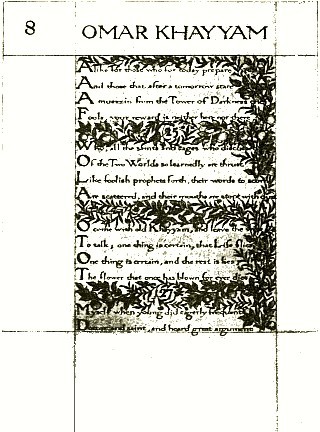
Alike for those who for today prepare
And those that after a tomorrow stare
A muezzin from the Tower of Darkness cries
Fools, your reward is neither here nor there
Why, all the saints and sages who discussed
Of the Two Worlds so learnedly, are thrust
Like foolish prophets forth, their words to scorn
Are scattered, and their mouths are stopt with dust
O come with old Khayyam, and leave the wise
To talk; one thing is certain, that Life flies;
One thing is certain, and the rest is lies
The flower that once has blown for ever dies
Myself when young did eagerly frequent
Doctor and saint, and heard great argument
FROM MORRIS'S MS. OF OMAR KHAYYÁM.
About it and about, and evermore
Came out by the same door as in I went.
28
With them the seed of Wisdom did I sow,
And with my own hand laboured it to grow:
And this was all the harvest that I reaped—
I came like water, and like wind I go.
29
Into this Universe, and why not knowing
Nor whence, like water willy-nilly flowing
And out of it as wind along the waste
I know not whither, willy-nilly blowing
30
What without asking hither hurried whence
And without asking whither hurried hence
Another, and another cup to drown
The memory of this impertinence!
FROM MORRIS'S MS. OF OMAR KHAYYÁM.
My thread-bare penitence apieces tore.
71
And much as wine has played the infidel,
And robbed me of my robe of honour—well,
I often wonder what the vintners buy
One half so precious as the goods they sell.
72
Alas, that Spring should vanish with the rose,
That Youth's sweet-scented manuscript should close
The Nightingale that in the branches sang,
Ah whence, and whither flown again, who knows!
73
Ah, Love! could thou and I with Fate conspire
To grasp this sorry scheme of things entire,
Would we not shatter it to bits, and then
Remould it nearer to the heart's desire?
FROM MORRIS'S MS. OF OMAR KHAYYÁM.
Ah Moon of my delight who knowest no wane,
The Moon of Heaven is rising once again;
How oft hereafter rising shall she look
Through this same garden after me—in vain.
75
And when Thyself with shining foot shall pass
Among the guests star-scattered on the grass,
And in thy joyous errand reach the spot
Where I made one—turn down an empty glass!
TAMAM SHUD
FROM MORRIS'S MS. OF OMAR KHAYYÁM.
This brings us to William Morris's next and,
as it proved, last development in art—the revival
of the craft of the printer, and its pursuit as an
art.
I recall the time when the project was first discussed.
It was in the autumn of 1889. It was the
year of an Art Congress at Edinburgh, following
the initial one at Liverpool the preceding year, held
under the auspices of the National Association for
the Advancement of Art. Some of us afterwards
went over to Glasgow to lecture; and a small
group, of which Morris was one, found themselves
at the Central Station Hotel together. It was
here that William Morris spoke of his new scheme,
his mind being evidently centred upon it. Mr.
Emery Walker (who has supplied me with the
photographs which illustrate this article) was there,
and he became his constant and faithful helper
in all the technicalities of the printer's craft;
Mr. Cobden-Sanderson also was of the party;
he may be said to have introduced a new epoch
in book-binding, and his name was often associated
with Morris as binder of some of his
books.
Morris took up the craft of printing with characteristic
thoroughness. He began at the beginning
and went into the paper question, informing
himself as to the best materials and methods, and
learning to make a sheet of paper himself. The
Kelmscott Press paper is made by hand, of fine
white linen rags only, and is not touched with
chemicals. It has the toughness and something
of the quality of fine Whatman or O.W. drawing-paper.
When he set to work to design his types he
obtained enlarged photographs of some of the
finest specimens of both Gothic and Roman type
from the books of the early printers, chiefly of
Bale and Venice. He studied and compared these,
and as the result of his analysis designed two or
three different kinds of type for his press, beginning
with the "Golden" type, which might be described
as Roman type under Gothic influence, and developing
the more frankly Gothic forms known
as the "Troy" and the "Chaucer" types. He
also used Roman capitals founded upon the best
forms of the early Italian printers.
Morris was wont to say that he considered the
glory of the Roman alphabet was in its capitals,
but the glory of the Gothic alphabet was in its
lower-case letters.
He was asked why he did not use types after
the style of the lettering in some of his title-pages,
but he said this would not be reasonable, as the
lettering of the titles was specially designed to fit
into the given spaces, and could not be used as
movable type.
The initial letters are Gothic in feeling, and
form agreeably bold quantities in black and white
in relation to the close and rich matter of the type,
which is still further relieved occasionally by floral
sprays in bold open line upon the inner margins,
while when woodcut pictures are used they were
led up to by rich borderings.
The margins of the title and opening chapter
which faced it are occupied by richly designed
broad borders of floral arabesques upon black
grounds, the lettering of the title forming an essential
part of the ornamental effect, and often
placed upon a mat or net of lighter, more open
arabesque, in contrast to the heavy quantities of
the solid border.
The Kelmscott Chaucer is the monumental
work of Morris's Press, and the border designs,
made specially for this volume, surpass in richness
and sumptuousness all his others, and fitly frame
the woodcuts after the designs of Sir Edward
Burne-Jones.
The arabesque borders and initial letters of the
Kelmscott books were all drawn by Morris himself,
the engraving on wood was mostly done by
Mr. W. H. Hooper—almost the only first-rate facsimile
engraver on wood left—and a good artist
and craftsman besides. Mr. Arthur Leverett engraved
the designs to the "The Glittering Plain,"
which were my contribution to the Kelmscott
Press, but I believe Mr. Hooper did all the other
work, while Mr. Fairfax Murray and Mr. Catteson
Smith drafted the Burne-Jones designs upon the
wood.
It was not, perhaps, generally known, at least
before the appearance of Miss May Morris's fine
edition of her father's works, published by
Messrs. Longman, that many years before the
Kelmscott Press was thought of an illustrated
edition of "The Earthly Paradise" was in contemplation,
and not only were many designs
made by Burne-Jones, but a set of them was
actually engraved by Morris himself upon wood
for the "Cupid and Psyche," though they were
never issued to the public.
I have spoken of the movement in art represented
by William Morris and his colleagues
as really part of a great movement of protest—a
crusade against the purely commercial, industrial,
and material tendencies of the day.
This protest culminated with William Morris
when he espoused the cause of Socialism.
Now some have tried to minimize the Socialism
of William Morris, but it was, in the circumstances
of his time, the logical and natural outcome
of his ideas and opinions, and is in direct relation
with his artistic theories and practice.
For a thorough understanding of the conditions
of modern manufacture and industrial production,
of the ordinary influences which govern the producers
of marketable commodities, of wares offered
in the name of art, of the condition of worker,
and the pressure of competition, he was in a
particularly advantageous position.
So far from being a sentimentalist who was content
melodiously and pensively to regret that
things were not otherwise, he was driven by contact
with the life around him to his economic conclusions.
As he said himself, it was art led him to
Socialism, not economics, though he confirmed his
convictions by economic study.
As an artist, no doubt at first he saw the uglification
of the world going on, and the vast industrial
and commercial machine grinding the joy and
the leisure out of human life as regarded the great
mass of humanity. But as an employer he was
brought into direct relation with the worker as
well as the market and the public, and he became
fully convinced that the modern system of production
for profit and the world-market, however inevitable
as a stage in economic and social evolution,
was not only most detrimental to a healthy
and spontaneous development of art and to conditions
of labour, but that it would be bound, ultimately,
by the natural working of economic laws,
to devour itself.
Never cramped by poverty in his experiments
and in his endeavours to realize his ideals, singularly
favoured by fortune in all his undertakings,
he could have had no personal reasons on these
scores for protesting against the economic and social
tendencies and characteristics of his own time. He
hated what is called modern civilization and all its
works from the first, with a whole heart, and made
no secret of it. For all that, he was a shrewd and
keen man in his dealings with the world. If he set
its fashions and habits at defiance, and persisted in
producing his work to please himself, it was not his
fault that his countrymen eagerly sought them and
paid lavishly for their possession. A common reproach
hurled at Morris has been that he produced
costly works for the rich while he professed Socialism.
This kind of thing, however, it may be remarked,
is not said by those friendly to Socialism,
or anxious for the consistency of its advocates—quite
the contrary. Such objectors appear to
ignore, or to be ignorant of, the fact that according
to the quality of the production must be its cost;
and that the cheapness of the cheapest things of
modern manufacture is generally at the cost of the
cheapening of human labour and life, which is a
costly kind of cheapness after all.
If anyone cares for good work, a good price
must be paid. Under existing conditions possession
of such work is only possible to those who
can pay the price, but this seems to work out
rather as part of an indictment against the present
system of production, which Socialists wish to
alter.
If a wealthy man were to divest himself of his property
and distribute it, he would not bring Socialism
any nearer, and his self-sacrifice would hardly
benefit the poor at large (except, perhaps, a few
individuals), but under the working of the present
system his wealth would ultimately enrich the rich—would
gravitate to those who had, and not to
those who had not. The object of Socialism is to
win justice, not charity.
A true commonwealth can only be established
by a change of feeling, and by the will of the
people, deliberately, in the common interest, declaring
for common and collective possession of
the means of life and of wealth, as against individual
property and monopoly. Since the wealth
of a country is only produced by common and collective
effort, and even the most individual of individualists
is dependent for every necessary, comfort,
or luxury of life upon the labour of untold
crowds of workers, there is no inherent unreasonableness
in such a view, or in the advocacy of such
a system, which might be proved to be as beneficial,
in the higher sense, for the rich as for the
poor, as of course it would abolish both. It is
quite possible to cling to the contrary opinion,
but it should be fully understood that Socialism
does not mean "dividing up," and that a man
is not necessarily not a Socialist who does not
sell all that he has to give to the poor. "A poor
widow is gathering nettles to stew for her dinner.
A perfumed seigneur lounging in the œil de bœuf
hath an alchemy whereby he can extract from her
every third nettle and call it rent." Thus wrote Carlyle.
Men like William Morris would make such
alchemy impracticable; but no man can change a
social (or unsocial) system by himself, however
willing; nor can anyone, however gifted or farseeing,
get beyond the conditions of his time, or
afford to ignore them in the daily conduct of life,
although at the same time his life and expressed
opinions may all the while count as factors in the
evolution by which a new form of society comes
about.
Thus much seems due to the memory of a man
like William Morris, who was frequently taunted
with not doing, as a Socialist, things that, as a
Socialist, he did not at all believe in; things, for
which, too, one knows perfectly well, his censors,
if he had done them, would have been the first to
denounce him for a fool.
At all events, it is certain that William Morris
spent some of the best years of his life, he gave
his time, his voice, his thought, his pen, and much
money to put Socialism before his countrymen.
This can never be gainsaid. Those who have been
accustomed to regard him from this point of view
as a dangerous revolutionary might be referred
to the writings of John Ball, and Sir Thomas
More, his predecessors in England's history,
who upheld the claims of labour and simple life,
against waste, want, and luxury. Indeed, it might
be contended that it was a conservative clinging to
the really solid foundations of a happy human life
which made Morris a Socialist as much as artistic
conviction and study of modern economics. The
enormous light which has been recently thrown by
historic research upon mediaeval life and conditions
of labour, upon the craft guilds, and the position
of the craftsman in the Middle Ages—light to
which Morris himself in no small degree contributed—must
also be counted as a factor in the
formation of his opinions.
But whether accounted conservative or revolutionary
in social economics and political opinion,
there can be no doubt of William Morris's conservatism
in another field, important enough in its
bearings upon modern life, national and historic
sentiment, and education—I mean the protection
of Ancient Buildings. He was one of the founders
of the society having that object, and remained to
the last one of the most energetic members of
the committee, and in such important work his
architectural knowledge was of course of the
greatest value. At a time when, owing to the
action of a multitude of causes, the historic buildings
of the past are in constant danger, not only
from the ravages of time, weather, and neglect,
but also, and even to a greater extent, from the
zeal of the "restorer," the importance of the work
which Morris did with his society—the work
which that society carries on—can hardly be overestimated.
The pressure of commercial competition and the
struggle for life in our cities—the mere necessity for
more room for traffic—the dead weight of vested
interest, the market value of a site, the claims of
convenience, fashion, ecclesiastical or otherwise, or
sometimes sheer utilitarianism, entirely oblivious
of the social value of historic associations of architectural
beauty—all are apt to be arrayed at one
time or another, or even, perhaps, all combined,
against the preservation of an ancient building if
it happens to stand in their way.
The variety, too, of the cases in which the difference
of the artistic conditions which govern the
art and craft of building in the past and in the present
is another element which often prevents the defenders
and destroyers from meeting on the same
plane. It is the old tragic conflict between old and
new, but enormously complicated, and with the
forces of destruction and innovation tremendously
increased.
William Morris was a singularly sane and what
is called a "level-headed" man. He had the
vehemence, on occasion, of a strong nature and
powerful physique. He cared greatly for his
convictions. Art and life were real to him, and
his love of beauty was a passion. His artistic and
poetic vision was clear and intense—all the more
so, perhaps, for being exclusive on some points.
The directness of his nature, as of his speech,
might have seemed singularly unmodern to some
who prefer to wrap their meaning with many envelopes.
He might occasionally have seemed
brusque, and even rough; but so does the north
wind when it encounters obstacles. Men are
judged by the touchstones of personal sympathy
or antipathy; but whether attracted or repelled in
such a presence, no one could come away without
an impression that he had met a man of strong
character and personal force, whether he realized
any individual preconception of the poet, the
artist, and the craftsman, or not.
He was certainly all these, yet those who only
knew him through his works would have but a
partial and incomplete idea of his many-sided
nature, his practicality, personal force, sense of
humour,3 and all those side-lights which personal
acquaintance throws upon the character of a man
like William Morris.