MR. GIBSON was characteristically American in his habits of work and in
his love of it. He wrought with a zeal and a passion which are
characteristic of the race from which he came. And the early, abrupt,
and untimely close of his brilliant career must be charged almost wholly
to this fiery passion for work, this ardor in doing.
One comes upon traces of this characteristic very early in his career.
His own letters as well as the letters of his friends written in his
youth show that, very soon after leaving “The Gunnery” at any rate, he
acquired the habit of continuous application, and became an expert at
it. No sooner had he made up his mind what he would do in life, than he
began to do it with all his might. He felt the pressure of need, and
responded to it promptly and vigorously. He lost no time, he spared no
pains to train himself for his career. He realized his lack of education
in art, and that he had to furnish out of himself both discipline and
knowledge. There was in his mind evidently but one way to supply the
defects of technical education, which to so many would have seemed
insuperable obstacles. He could overcome everything by work. He knew
how to “toil terribly.” He spared no time, no trial, no tasking of
himself. After he had done a good day’s work in the things he was under
contract to do for his employers, he would turn to work again for
himself and upon schemes of his own, and would spend hours more in the
most absorbing labor. If any student of his work should wonder how his
swift success was won, and how he so soon made good his defects of
education and training, they may find their answer in that one
word—work. It was his talisman. That he had gifts, power, genius, he
believed most implicitly. It was that which gave him courage; but he
knew, too, that genius without work is an engine without steam. A letter
which he wrote to his mother during the progress of his first drawing
for the “Aldine,” of the Inness landscape is his own confession of
excessive industry, and gives a glimpse at the same time of the fiery
zeal and undoubting courage which possessed him.
“I had intended writing to you during the early part of the week, as I
had a message to send you; but I have been so excessively busy that I
could find no moment of time.... I have worked very hard during the past
few weeks, not only during the day, but in the evenings also, yea, even
until the morning on several occasions. The object of my labors you of
course understand is the Inness picture. Well, it is finished and has
been universally admired. I have drawn nearly the whole of it in the
night-time here at home, as my days have been occupied by O. J. & Co.’s
work. I have (with reason) been very anxious over this ‘Aldine’ picture
of mine. Everybody has told me that I was too headstrong to attempt such
a large drawing for my first start in landscape, and no one imagined
that I would succeed. Roberts told me that he knew I would not succeed
and that I ought to have commenced on something smaller at first. Others
have said: ‘It’s a pretty big start to commence with a full page in the
finest American illustrated journal.’ But I have commenced and my
drawing has been admired, accepted and paid for by Mr. Sutton, and is to
appear in the ‘Aldine’ in the course of a few months. I am going to
study very hard on landscape henceforth, as I feel convinced of
success.... I have received congratulations on all sides, for it is not
a small thing to get a drawing accepted in the ‘Aldine.’ I, of course,
am very much encouraged and am determined that my next drawing shall be
an improvement on my last.”
While he was writing those lines his mother was writing to him, in
warning and caution against his undue application:
“I hope your picture will be done before long, so that you will not have
to work at night. Depend upon it you will lose strength and eyesight by
unwise application. I am uneasy to find that you are trying your
strength to its utmost limit. Do be advised.”
Receiving the news of his success with his work, she sends him her
congratulations, and renews her motherly—and timely—cautions. It is
all very interesting reading in the light of what followed; for it is to
be remembered that all these letters were written in 1872, when Gibson
was but twenty-two,—a mere stripling just entering the lists!
Sandy Hook, Tuesday Eve., March 12/72.
“My Dear Willie:
“Excuse this peculiar note-paper! Henry has gone out to spend the
evening, and I cannot find the family supply without more hunting
round than is worth while for mere appearance’s sake. I was
surprised and delighted at the good news in your welcome letter
this noon! Certainly it was a great deal more than I expected, and
I think your success, in such an ambitious effort, the first time,
and with the ‘Aldine,’ is truly wonderful. I can only account for
it by the explanation, that your talent in art is an intuition, a
gift, by which you are, and will be, enabled to surpass those who
would seem to be more likely to succeed than you, on account of
greater practice and education in that particular. But even if this
is the case, that would not be enough of itself, and you add to it
an industry, a perseverance, and a courage which put you straight
through. I cannot see why, if your health and strength are spared,
yours should not yet become a prominent name among American
artists. If you study, work, and continue to add to your knowledge
and skill, you will, by and by, begin to compose, and once well
started in that line, your future is made, and your best ambition
satisfied. I congratulate you most sincerely and lovingly, and
thank God that he has endowed you with a rare and blessed gift.
Now, don’t keep on working at night. You must see that it is very
unwise, and that for the future you should not allow yourself to be
tempted into it.”
His early friend, Mr. Beard, from whom the fortunes of business had
separated him, wrote to him in the same warning strain. Would that
these friendly counsels had been heeded! It was this burning of the
candle at both ends which forecast the early end of it all at
forty-six. But who can think of this letter as addressed to the boy
in whom Mr. Gunn could awaken no spontaneous industry!
“Do you know, I think that in many ways our divorce is a mistake. I
am perhaps more prosperous, but not so happy as in the old times
when we were together; and had we waited a little while we would
have found ample space for both to swim without interfering with
each other. The tide was rising. It has risen very high for you at
least, and I have been and now am heartily glad that it is so.
“You need my laziness and carelessness to temper your consuming
ambition. You need to alternately get indignant, and laugh, and
argue, and double shuffle, if you would avoid the horrors of an
early grave. Of course it is not becoming to your station and
position to do this, but to wear your dignity always is as bad as
being condemned to a dress suit and tight shoes without the
possibility of a change. Forgive an old friend for speaking so
freely, but I have a real affection for you and I believe that you
need this admonition. Your work is killing you, because you are so
fierce at it, and don’t let up at all. I know Parsons thinks as I
do and in fact you must know it yourself.”
Seven years later, in 1879, his wife in a letter to his mother reveals
the same habit, and prophesies, alas! too truthfully, the inevitable
result. She says:
“Will, I believe, will always be busy day and night until he breaks down
in health. I think that would be the only thing (except, perhaps, a
fortune) which would put a stop to his midnight work. I certainly
thought he would be ill after his last strain. He was so weak after
remaining in the house so long, and using his brain so continuously,
that when the last day came and he was copying his manuscript, he nearly
fainted. Only a few more strains like that will be necessary to weaken
his constitution seriously.”
But not only did he overdraw upon the hours he ought to have spent in
sleep. He was always at it while he was awake. He was not a fitful
workman, busy by turns, but taking equal turns at idleness. He could not
be idle. All times were work-times, the odds-and-ends of the day, the
intervals between tasks, the moments of interruption and of waiting, he
turned to the most valuable account. Among the drawings which he made
for his projected botany he left a memorandum, which shows his incessant
watchfulness for subjects of study, and the prompt industry which made
him always ready to secure his material. He was always loaded for the
game that turned up. And no scantiness of materials or of tools in the
least daunted or deterred him. This is his memorandum as he wrote it:
Botany.
“Drawings made in odd moments.”
“While waiting for train.”
“On back of mule.”
“During delay on railroad.”
“On envelopes, bills, letters, check-book, on back of books,
margins of newspapers, inside of a lozenge-paper, all that was
available.”
“On top of stage-coach, from overhanging bough while waiting.”
“On boats in water; on back of mule.”
“While sketching; strolls in park.”
“On city fence while waiting for car, yard specimen.”
“From specimens dried to shreds.”
“From specimens collected in hat or under hat sweat-band.”
“On ferry-boat from specimens picked in city yards.”
“Flower reconstructed from dried specimens on fruity stems
entangled in spider-web. (Spider an ally.)”
“Leaf. Impression with soot at hotels everywhere; intricate details in a
few seconds.”
“Seeds from spider-webs and bird’s-nests.”
Let indolence meditate this matter.
Not even the working hours seem to have been sufficient for him. He also
trenched upon the term sacred to sleep, and in one instance, at least,
did his planning in his dreams. For a time before the publication of the
“Sharp Eyes” articles was begun in Harper’s “Young Folks,” Gibson was
casting about for some new idea for a book, some hint or inspiration or
theme which should serve to focalize his thoughts and materials. One
morning he said to his wife: “I dreamed out a whole book last night. I
never had such a vivid dream. The whole scheme came to me, and I know
just what I will do. I am going over to Harpers’ to talk it over with
them.” This he immediately did, offering them fifty-two articles, to
serve as a sort of naturalist’s almanac. The contract was agreed upon
and he began work immediately. He often thereafter referred to his
“lucky dream.” It was, perhaps, the most popular of his books, and,
whatever its origin, was certainly in itself a very wide-awake volume.
His note-books are witnesses of the same character and tenor. They show,
of course, his thorough study of every project on which his mind was
engaged. They show also how his brain teemed with new projects and
outlined new schemes, before he was done with old ones. His purposes
were always far outrunning his capacity to perform. Yet if ever a man
could do two or three things at a time, he was the one. At least his
motto might well have been that remorseless pledge to continual
industry, “Nulla dies sine linea.” One of his note-books dates from
April, 1877, and runs to June 12, 1896, a month before he died, covering
thus a period of nineteen years. In it is a record of every day’s work
in all that time; and if there was not a line drawn every day, on some
days he drew enough to fully make good the deficit and fulfil the very
letter of the proverb. Sometimes the entries record every item of his
work, like the following, taken at random:
| “March | 29. | Boston on business.” |
| “April | 9. | Cover design for ‘Sharp Eyes.’” |
| ““ | “ | Art Artisans’ Institute.” |
| ““ | 13. | All day on proof of ‘Sharp Eyes’” |
| ““ | 14. |
“““““““ |
| ““ | 15. | New York ½ day, ½ on ‘Sharp Eyes.’” |
| “April | 16. | ½ day on proof, ‘Sharp Eyes’” |
| ““ | “ | Art Artisans’ 2 hours, 3 hours in evening on proofs.” |
| “April | 17. | Whole day on proofs.” |
| ““ | 18. | ½ day on proof.” |
| ““ | 20. | Initial, design, ‘Shakespeare’s Country’” |
| “April | 20. | Initial, design, illustration of apple-blossom.” |
| “April | 20. | Design for ‘Sharp Eyes,’ ‘Bees’” |
So the pages run, by scores and by hundreds. But elsewhere he condenses
the story of a season’s continuous work into a few lines. After the date
May 18, 1887, he wrote:
“Left for Hilltop—
“A very busy summer. Made many drawings for two prospective articles on
‘Midnight Rambles,’ and ‘Insect Botanists,’ beside many flower studies,
and a number of water-colors. Very busy on the memorial volume of Mr.
Gunn. Made a large number of drawings for Botany.”
Then follow pages of entries recording the sketches, designs,
water-colors, illustrations, which in part constituted the details of
that “busy summer.” The following year he made a similar condensation of
a European trip. It is but a note, yet the single item which refers to
“three hundred photographs,” tells the story of his busy days:
“Trip to Europe. Left New York in April, returned in June. Visited
England, France, Holland, Switzerland, including a fortnight each in
London and Paris. Brought home over 300 instantaneous photographs, taken
under all conditions by my detective camera. Went direct to Hilltop, and
settled down to magazine work.”
These note-books carry the evidence of his faithfulness to his various
aims and lines of interest. While he was at work as the artist, he never
hesitated to do something for himself as either naturalist or author. He
was never so preoccupied with his sketching that his ear could not catch
a new bird-note, or his eye perceive an event in the insect-world. His
color box often did duty as a botanist’s case, or bore home a load of
cocoons and beetles. And when he sat down to record his impressions or
outline his plans he revealed his triple interest in every line. Once he
began certain memoranda which he headed “Night-Notes.” In the margin, by
a dozen hasty lines with his pen he made a design for a title-page,—a
lighted candle with moths flying about it. Then he wrote into his text
ideas which should interest the future reader of some article, upon the
scientific side, in sentences which suggest at once the illustrations
and the text itself:
“Moths creeping up screen outside window, their presence marked only by
their luminous eyes. The lamp the center of a whirling maze of all
sorts of nocturnal insects. A rare treat spread on the table before me.
Exquisite hints for the colorist, decorator, or illustrator. Here a
dainty mite of a moth with the most delicate of sage-green, flat-open
wings, crossed by bands of cream-color. Another with steeple-roofed
wings (at rest) glistening like satin, decorated with faint contrast of
pale pink and faded olive.” And so on for pages together.
Such passages as these from his own notes, never meant for the public
eye, and therefore absolutely conclusive of his sincerity and his real
spirit, show how truly he was an observer at first hand. He saw things
for himself. There was not a trace of cant in what he had to say about
original observation of nature, her wonders and her beauties. The thing
he tried to lead others to do he had already done himself. A friend, who
is himself a keen observer of nature, wrote of Gibson, at his death:
“It was to the habit of observation more than to any endowment that he
owed the prosperity of his work,—for his life was a successful one. It
enabled him to see clearly, without a teacher, what others find it hard
to see at all. He acquired his art practically without instruction, and
indeed against opposition, simply taking his pencil and brush into the
field and drawing and painting what he saw there. The greatest painters
are those who have pursued this method. As a writer and lecturer he
showed the advantage of a good scholastic education; yet his themes were
those he had chosen and worked out for himself. He was as well-informed
on botany, entomology, ornithology, and allied studies as almost any
professors of these sciences that could be named; yet it was in the
woods and fields rather than in books that he acquired his knowledge.”
Gibson’s own words, in the preface to “Sharp Eyes,” confirm his friend’s
reflection: “The facts in the following pages are almost entirely drawn
from individual experience, largely gathered in boyhood, the apparently
random selection being based upon a desire for the greatest variety
possible within a limited range of the minor flora and fauna. The dates
are apportioned from careful notes verified through a record of many
years.”
It was this close and personal observation of nature which gave him his
rare power in drawing and in composition. He never wished to make his
pictures with the models, the objects he was drawing, before him. He
studied them in sketches, and mastered every detail of their
construction and appearance. This impression, clear-cut, exact,
truthful, he carried in his memory. And when he wished to draw it, he
worked from memory, refreshed, perhaps, by the memorandum of the sketch;
but his picture would be suffused by the glow of his own imagination,
idealized
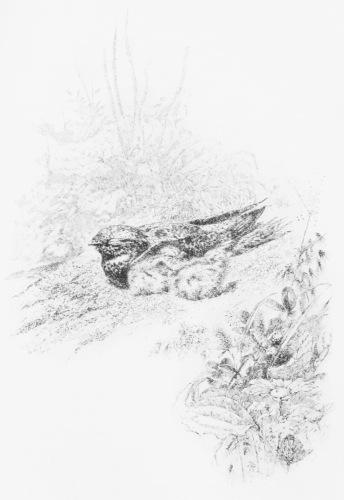
“Wide-Awake Day-Dozers”
(“Strolls by Starlight and Sunshine”)
Copyright, 1890, by Harper & Brothers
by that imperceptible increment which is merely the self, the personal
temperament of the artist, lighting up his subject. His memory furnished
the anatomy of his subject, and his imagination infused it with life. It
was the thing as it was, and something more. Because it was the thing as
he saw it. His view of the function of the sketch, and, indeed, his
theory of art, condensed into small compass, is well put by himself, in
a paragraph from “The Squirrel’s Highway”:
“Humility is the only attitude that wins the heart of nature. It yields
the glow that lights the vision of the ‘inward eye,’ beside which all
other eyes are blind. Audacity and impressionism have their importance
and place in art, but they are not its pinnacle; the one yields helpful
courage for the encounter, the other is the useful short-hand system
which often comes to the artist’s rescue, and without whose aid many of
nature’s most rare and subtle expressions would elude him, and be lost.
But its function is realized in the sketch or motive, which is rarely a
picture, but more often a rough draft, a hieroglyph, a stenographic
note, which like others of its class is fully intelligible alone to its
author, and whose only rational excuse for being is in its latent
possibilities of ultimate translation and perfection.”
That was the method of the artist; and it grew naturally and logically
from the nature of the man. He agreed at bottom with the impressionists,
because he painted and drew only what he saw. His point of difference
with them was that he painted and drew far more than they would
sanction, because he saw so much more. If the canon of the
impressionists is admitted, they must be prepared frequently to see it
apparently violated by some man who, while painting only what he
actually sees, and getting “broad effects” and “values,” sees so much
more than the average observer, and notes as “values” so many things
which even the ordinary trained eye slips over as insignificant, that he
seems to be “descending” to details. Gibson could never have painted to
suit this class, because he saw and felt so much more than they did. Yet
he was as true as the most orthodox of them to the very method he seemed
to defy. He had been speaking (“Highways and Byways,” p. 68) of the
seed-pods of the fireweed, and their hidden floss, “a warp of woven
sunshine, with a woof of ether,” and reasons thus about it:
“It is always awe-inspiring and wonderful to me; it is beautiful beyond
description; and when I see those snowy forms take wing and fly
heavenward, it is more than beautiful, it is divine. And yet it would
seem that there are those among her students who are above the influence
of such a revelation as this in Nature. Disciples of a rampant
superficial school of art, who in seeking to portray Nature ‘in her
breadth’ would feel that they can put the straight jacket upon her and
readily ignore so small and trivial a thing as this. The landscape to
their half-blind and unsympathetic eyes resolves itself into a map, a
relative opposition of so many ‘masses’ and ‘values’ of form and color.
In the mastery of these lies their end and aim while Nature in her
‘detail’ is worthy only of the scientist and ‘has no place in art.’
. . . . . .
“That Nature’s landscape does, to those who seek therefor, resolve
itself into so-called masses and values, is an important truth; but
equally and more deeply true are the infinity and spirit of her breadth.
The value of the broad gray mass of yonder sloping meadow will find its
truest interpreter (assuming an equality of technical skill) in him who
knows by heart its elements of life and color, who has seen its ‘violet
by a mossy stone,’ who has plucked its grasses from their purple maze
and knows the scent of those endless subtle variations of tender
russets, greys, and greens, and cloudy films of smoky color that spread
among its herbage. The true significance and ‘value’ of that massive
bank of oaks will be most deeply felt and understood, and therefore most
truly rendered, by him who has learned the beauty of its vernal buds of
scarlet velvet, its swinging catkins, and the contour of its perfect
leaf; who has stood beside its boughs, and seen the blue of sky and gray
of passing cloud in turn reflected from the polished foliage.
“The impress of that knowledge and the sympathy and companionship it
implies will send its impulse quivering to his brush-tip, in a
spontaneous enthusiasm that shall subdue the pigment to a medium for
thought, and shall hold it in its place as the means rather than the
end. And while the misguided apostle of the new school who shows us
‘Nature in her breadth’ shall revel in his values of turpentine, and
paint and brush-marks, the transcript of his more humble brother-worker,
while not less broad, shall palpitate with life and feeling, and through
some secret intangible testimony of its own, shall conjure up in the
beholder the heart-memories of Nature, and shall breathe her spirit from
the canvas.”
Perhaps it is worth while just here to rescue from oblivion the
exceedingly funny account of some newspaper writer, whose story of Mr.
Gibson’s methods is widely at variance with that we are telling, and
what Gibson himself told, but which has a certain weird charm of its
own. Commenting upon the “marvelous skill” ascribed to Gibson, he
proceeds to say that nothing could be simpler than his method. “When Mr.
Gibson sets out on a walk he always takes a camera with him, and when an
especially interesting twig or fern attracts his attention, he promptly
snaps at it. On his return home the plates are sent to the nearest
photographer to be developed and from the negatives thus obtained,
‘bleach prints’ are made. Mr. Gibson then proceeds to draw very
carefully on these prints, following of course the outline, shading,
etc., of the photograph. After the drawings are finished, all traces of
the photograph are quickly bleached out by immersing them in a simple
solution of chemicals, leaving only the drawings on white paper.” After
such a graphic and veracious account of the way in which the foremost
American illustrator made his pictures, one is not surprised to have the
writer add the brave statement that “it may be said without fear of
contradiction that whatever excellence may exist in Mr. Gibson’s
published work, is due to the careful work of the photographer and the
engraver.” Such is the sort of stuff which some metropolitan newspapers
serve up as “art criticism.” The writer might indeed declare that he
spoke without fear of contradiction; for nobody would take the trouble
to contradict an account so ridiculous. How refreshing, after such a
tissue of absurdities, to read the letter of Henry Marsh, foremost among
the wood-engravers of his day, the estimate, by a real artist, of
another artist:
“Pomfret Centre, Conn., March 8th.
“Dear Sir:
“Pressure of work has prevented me from answering yours of Jan.
1st. I did not see an impression of the ‘chick a dee dee’ block and
was surprised to find it was in any degree successful. I have never
even seen a drawing of yours till now and have never had any idea
of your artistic quality. Common printed impressions of course
represent no one fairly, but those artists lose the most who have
the most to lose, and you are no exception to the rule, as I should
never have guessed what your drawings looked like from anything I
ever have seen printed. You will certainly be disappointed in my
rendering of your work, for I have no patience and my hand is not
as firm or my line as delicate as your drawings require, but if you
send me a block I shall do it honestly after my fashion. With
hearty sympathy in the troubles which you must always find in the
engraving of your most elegant and refined work, I remain
“Yours truly,
“Henry Marsh.
Thackeray somewhere says that there are no people who so love their work
as the artists do, unless it be the actors, who when they are not
playing themselves are always at the theater. Even the holiday of the
artist is generally devoted to work in a different locality from the
home studio; so that it amounts to nothing more than a change of scene
without any abatement of business. Gibson himself was one of the worst
offenders in this way. He never seemed to rest, while in health, save in
and by a change in the place and character of his task. In the pages of
“Pastoral Days,” in which he describes—in the chapter upon
“Summer”—his visit to “Hometown and Snug-Hamlet,” he confesses his
propensity for thus using his vacation.
“My wife and I have run away from the city for a month or so. A vacation
we call it; but to an artist such a thing is rarely known in its
ordinary sense, and often, indeed, it means an increase of labor, rather
than a respite. My first week, however, I had consecrated to luxurious
idleness. Together we wandered through the old familiar rambles, where
as boy and girl in earlier days we had been so oft together.” But the
sort of thing which he calls idling comes out a few pages later, when he
sums up the doings of that seven days of luxury.
“For a week thus we idled, now on the mountain, now in the meadow, while
I with my sketch-book and collecting-box either whiled away the hours
with my pencil, or left the unfinished work to pursue the tantalizing
butterfly or search for unsuspecting caterpillars among the weeds and
bushes.” What a busy-body was this, who knew no distinction between work
and play, and to whom the sketch-book and collecting-box were the
playthings of the idle hour as well as the tools of the most laborious
of professions! Well might the companion of that happy summer say in
after years, “He seemed never to spend an idle hour.” Another member of
his household circle bears similar testimony. “If he were sitting at
the table, chatting and joking with us, as likely as not he would have
his pencil in his hand, and before we knew it, would dash off on any
scrap of paper, some sketch of a beetle, or a bird, or a butterfly, or
perhaps a caricature of somebody in the group.” With this nature, steam
was always up, and the fires hardly banked at all. No wonder that the
machinery literally wore out prematurely.
There is one legacy of his busy life which seems to have a special
interest to those who loved his work and care to know how he did it. For
many years he carried in his mind a plan for a new work, which was
characteristic of his genius, and would have added a new delight to
those he had conferred. He meant some day to write and to illustrate a
book which should describe the history of the endless movement of water,
from cloud to mountain-top, from the heights to the valleys, from the
valleys to the sea, and back to the clouds again. He had made many notes
and references, and the scheme was well worked out in its general
features. The memoranda which he left are sufficiently full to convey a
clear idea of what he proposed; and as one reads them they seem to
suggest all the graceful text and the graphic illustration with which
his matured skill would have filled them out. While they raise the
keenest disappointment in the thought that they never were completed
and that American literature and nature-study have missed what they
promised, yet they are so full of hints, so stimulating to the
imagination, that they seem to belong to that public for which he
wrought, and which prizes every thought of his fertile mind.
On the fly-leaf of the blank-book in which these notes are entered, with
long blanks for the material yet to be written in, he has written the
words “Memoranda; Cycle of the Raindrop.” On the next page follow a
number of tentative titles:
“From the Fountain to the Deep Sea.
“The Cycle of the Raindrop.
“From the Rain Cloud to the Sea.
“A Mission of
“A Cycle of
“The Emblematic Cycle. Typical of human life. Soul from heaven. Earthly
pilgrimage: dross and impurity and final resurrection in mist.”
“An Eternal Pilgrimage
“A —— Pilgrimage
“The Story without an End.
Then follows a suggestion for a table of contents. He heads it,
Division of Subject
“1. The Rain Cloud and the Fountain. ‘Story of a Fountain.’
“2. The Mountain Brook—(Trout Brook) (Trout Stream).
“3. The Mountain Lake. The Swamp.
“4. The Pastoral Brook. The Pond?
“5. The River.
“6. The Delta and the Deep Sea.”
This is the first and broadest sketch. Upon this ground plan he proceeds
to lay out the themes he would treat, evidently having in mind both text
and illustrations. Sometimes the note means one, sometimes the other.
And the closeness with which the two are associated in his mind is a
fine revelation of the manner in which his thought embraced both forms
of production in a profound psychological unity.
1. The Rain Cloud and Spring
The birth of the spring; from perpetual snow on mountain peaks; dew;
mist and cloud; storm cloud.
Rain Cloud dragging its veil on mountain-top. (See quotation from Ruskin
in note-book). Poetic simile of mountain “Light of Asia” (227). Storm on
mountain.
Hovering Mist and Cloud. Lifting and creeping in fantastic forms, above
the lake. Wild Mountain Pass. Hermit’s Ravine. See reference. Ruskin in
literary memorandum. Shelley’s “Cloud.”
Mountain Veterans. Gnarled spruces.
Mountain Flowers. The heath family, clothing the rugged mountains.
Mountain Fruits. “Propitiating the Mountain-gods
by a sacrifice of their fruits.” Thoreau. Supper of blue-berries.
Thoreau.
The Trickling Mountain Spring. “Amy’s Grotto.”
A Dewdrop on leaf (vignette-idea; or tail-piece).
Primeval Elements. Indian Legends, etc. Story of a Fountain. Primeval
spring and incident. Hawthorne.
A Trickling Passage. Drops trickling down a spray of Fumitory (Adlumia)
over rock.
A Recluse. A shy wood flower.
Indian Pipe—legend?
Loiterings among mossy boulders and ferns.
The Wood-bird’s Bath.
The Harebell.
A Fungus. Some beautiful specimen of Hydnum Agaricum or—
Through the Mossy Groove (bole)—to the old Trough.
Water Trough. This subject must come in book. Make view from above
conduit, and looking out through verdure upon road from back of trough.
See Hawthorne’s “Town Pump.” “David Swan.”
Waste Water Running along road and under. Plank Bridge (with roadside
ford) bordered with tall Galingales, Cat-tails etc.
The Meadow Stream (place after mountain-lake?)
The Meadow Rue (shadow or silhouette).
Sensitive Fern (one of the most antiquated forms of existing ferns).
Cardinal Flower.
A Border Tangle. Galium. Rue.
Coils of Gold. The Jewel-weed (or some other plant). Strangled by the
golden dodder. The dodder is mentioned in Lowell’s “Threnodia” as an
emblem of love. It is a questionable sort of love that hangs on by the
teeth. “Deadly gripe of gold” (Hawthorne).
Hemlock cones and Chickadees.
An Ambuscade. Leaf-nest of large Arachnid.
The Alders.
Gathering Cowslip-greens (combine with picture of plant).
The Trout Brook
The Angler. (Consult Izaak Walton. “Contemplative Man’s Recreation.”)
Beauties (good subject for tail-piece).
The Water-mill. Children playing with toy-wheel. See sketch made at
Cumberland, Me.
A Trickling Flume. A mossy flume perched on tall beams, embowered in
leafy branches and overgrown with weeds. See photo and sketch of
“Haunted Mill” with mill in distance.
The Sawmill (combine cider-mill with same? Washington).
“Highland Stream tamed by human cunning.” Hawthorne.
Riding on Sawmill Carry. Children riding out over abyss on the
log-carry.
Under the Mill (old wheel, etc.).
Sheepwashing.
Life under the Water. (Crawfish; leopard-frog, etc.) Under the Water.
Battle of dragon-fly and lizard. Caddis-worms and nests.
The Slender Foot-bridge—“Dangerous passage.” Bubby fishing; three or
four minnows on string. Lovers.
The Witch Hazel. (Several subjects. See memoranda in “Nature Jottings.”)
Unfurling banners and saluting coming snow. The Divining Rod. Old Witch.
Witch hazel; (see Whittier’s Poem, Preface or dedication?) Shrub over
Brook. Peculiar Quality of perfume. Horizontal Foliage in Wood.
Reference in Hawthorne.
Into the Lake. Cascade over precipice into Lake. Boating and fishing.
The Camp. (Adirondacks. See sketch.)
Morning on the Lake (Water-color sketch, deer drinking).
Evening. Hunting with jack. (Dudley Warner’s “Deer hunt.”) “The Loon’s
weird laughter, far away.”
The Rise. Trout rising; flash of sun on still water. “Long ripple.”
Thoreau.
Guide Lore.
Sand Orchid. Secret of fertilization. Lovell’s Pond, several
varieties——
Pond Lilies? (or on brook?) Yellow pond lilies. Hawthorne’s simile.
The Water Mussel. Beautiful pearl. Saranac lake. Wondrous tints brought
out by scouring with sand.
Tiger-beetles on Sand. (Show nests.)
Heron’s Nest (see cut in Harper’s). Evening Subject. Weird Effect.
The Plover.
Evening Mist. Mist rising. Returning skyward. Sun drawing water.
Wild Ducks.
The Bittern. “His precious legs.” Thoreau.
Water Adder. (Winnepesaukee incident, see note-book “Nature Jottings.”)
The Outlet. A Chasm. “Ausable Chasm.”
The Brook (Shepaug?)
The Water-fence.
A Hot Day (cows in water in shade).
Under the Water. Caddis Worms in nest. (Life under ice. Thoreau.)
Dragon-fly larvæ.
Battle under Water. “No refuge e’en in water.” Lizard and dragon-fly
larva. Aquarium incident.
Scouring Rush (grass) gatherers. See quotations.
The Little Sandpipers.
Ephemera. (The creatures of an hour. The twilight flight.)
The Crossing Pole (Newtown brook. Children over dark still current).
The Swimming Hole. (Bathers. Twilight effect. Interrupted Bath.)
The Old Bridge.
On the Muddy Beam (Phebe nest or other bird).
A Gravel Island. (Thoreau’s sentiments on beholding an island.)
A Pebbly Beach.
A Still Nook in Shore. Gnats emerging. Boats of Eggs.
A Sungleam from the River bed. Minnow or Sunfish turning. Combine same
with Kingfisher, if possible, showing the incident of prey from the
fish’s standpoint, under water looking out above. Consult Thoreau’s
“Concord River” and his experiences in taming the fish.
The Willows. The Closed Gentian. The Button-bush.
Sailing the Boat.
The Kingfisher (watching for the gleam).
A Bit of Sentiment. Two figures by the brink; thoughts of brook, etc.
Similes.
The Freshet. Broken Dam. Ice Blockade. Ice piling and crushing against
mill.
A Tumultuous Record. Water sculpture. Torrent making holes in rocks.
Worn by boulders. Diana’s Baths, Shepaug Falls. Glassy Ice on Dripping
Twigs.
The Swamp
(This section should be introduced here as a “loitering-place” of the
saunterer as well as of the brook,—a rest in the journey of the waters
when they linger placidly in the old mill-pond, backing-up from the dam,
and flooding the lowlands. Although it might be brought in between the
mountain-lake and the brook.)
Consider the Black Mountain Swamp for example; Beaver dam, Lenox. Cotton
sedge; Sarracenia; Pond lilies; Sphagnum.
A Quaint Cradle. Nest of Reed Warbler or other bird built among reeds or
rushes.
Musk-rat Huts. A Musquash Village. Muskrat’s bubble under the ice,
driven away from its heath. See “Trapper”; also Thoreau. The provident
musk-rat.
Scouts. Spring Heralds. Skunk cabbage.
Winter Botany. Crystalline Botany; Thoreau. It is the anatomy which
determines the marked character and distinct individuality of plants,
even of the same genus. The winter phantoms present its most perfect and
unencumbered articulation, and render their forms against the snow
especially conspicuous. Thus have I counted, without effort, eight
species of golden-rod, growing in a tangle each as distinctly specific
as in its summer dress and ornament.
A Frost Grotto.
Will o’ the Wisp. A fantasy with fairies, nymphs, or naiads.
Haunt of the Hylas.
Cranberry Culture. The Cranberry plant.
After Bullfrogs. Spatter Dock, turtles, etc.; turtles on a projecting
log or rock, family group. Pollywogs. Duckweed. Specimen of similar
plant. Green shell-like, nerve-like leaf, floating on surface and
sending downward a fringe of purplish black rootlets. Found at
Washington, spring of 1882.
A Living Opal. A fairy creature of the marsh. This is described in my
note-book about two years ago, and I note that Mr. John Burroughs has
discovered the same creature and has written of it under title “A
Fairy,” in Scribner’s, January, 1883.
Pickerel Weed and Pickerel.
Vallisneria—Anacharsis; waterweed.
Swamp plants for selection. (Here follows a list of some twenty plants.)
Transformation of Neuroptera.
Exquisite Bivalves in the mud (small pearly clams).
The Brook (Continued)
The Millpond.
The Water adder (see notes Lake Winnepesaukee).
Nymphæ; maids of the pond (nymphs floating in mist above the floating
lilies. See John Lafarge, portfolio proofs).
Among the Pond-lilies. The Lotus-lily with cup capsule. Allied to
Eastern lily. Suggestion of the Nile.
Mirror of the Sunset. (Reflections. Still pond. Mill dam.)
The Heron.
Winter Sports on the Ice. Fishing. Harvesting the Ice-crop. Waiting for
a Bite (comic character). (See Wordsworth “To win a pittance from the
cold, unfeeling lake.”)
The Grist-Mill. The Miller. (A character from life; Standing at window
of mill door. “The mills of the gods.”)
Under the Fall. (Foam. Bubbles that reflect the glories of the world.)
Swallows. (Skimming over water. “Swallows skating on the air.”)
Below the Dam. The Ripples. The marriage of the Waters; (see Poem,
Burns). The Camp. Shad-fishing.
The River
The Osprey. (Rising with fish. Tumult of water. Bald eagle and catfish,
incident, Cape Cod.) See Wolf’s “Wild Animals.”
The Canoe (modern and Indian).
The Toll Bridge. (Old covered bridge in spans.) Bennett’s Bridge.
Glimpse out from openings of bridge.
The Toll-man’s daughter. (Pathos. Dragging the River. The white face
among the lily-pads.)
Drifting. (Sentiment.)
Spearing Fish by night.
Drawing the Seine.
The Rope Ferry. (North Hampton.)
Calling the Ferry in “ye olden tyme.” (The swarthy boatman. The
Ferryman’s Cottage. Interior of Cottage.)
Cascade and Factories. (Moonlight.)
Through a Large Manufacturing Town.
Picturesque Factories.
Approach to Salt Water. (Stooping from boat to drink from the
river,—brackish water! This and the presence of the mallows which had
escaped our notice, betoken the inroads of the sea.)
Rest this section herewith.
The Delta and the Deep Sea
Navigation. (Scene on Hudson, or Connecticut, or Mississippi. Barges.
Twilight from ferry-boat; (further on?))
Snipe Shooting.
Wild Ducks. (Chesapeake Bay. Clouds of duck,—and hunters.)
Salt Marshes. (Gathering Salt hay. See Sound sketches. “Picturesque
America.”)
Crab-fishing. (Sheepshead Bay.)
Low Tide on Marsh. (Fiddler crabs, playing about holes.)
From the edge of the Boat. (A natural aquarium. Hermit Crabs, fishes,
mussels, algæ.)
Samphire gatherers. (See Hawthorne. Footprints on Seashore. Samphire
luncheon.)
The Prickly Opuntia. (Allude to the wondrous caress of the stamina. A
beautiful cactus, common on our shores, yet quite unknown.)
Fisherman’s Huts. (Quaint houses made of canal-boats. Half canal-boat,
set up on end. See studio prints.)
Gathering Sea-weeds.
A Nursling of the Sea. (Beautiful floating Laminaria.)
The Throng at the Surf. (Coney Island or Rockaway.)
Oyster-dredging. (Water in action—picturesque boat.)
Among the Driftwood. Eggs of shark or skate.
Wind-waves on Sand. (Original explanation.)
Sand Yellow-Jackets digging caves in sand.
Sand-spider. Gossamer tunnel. Fierce maternal solicitude.
Fairy Circles in Sand (around bending grasses.)
Faint Columns of Gnats in still twilight rising like streaks of smoke
from salt-marshes.
A Marsh nest.
Gulls.
Tiger Beetles and holes.
Under the Water.
Rocky Headland. (Mt. Desert, Nahant.)
The Sporting Shoal. Porpoises.
The Vasty Deep. Limitless Mid-ocean.
The Return of the Waters. Waterspout. Earth and Heaven. Finis. A link
completing the cycle. Tailpiece.
![[Image of the book's cover unavailable.]](images/cover_lg.jpg)

![[Image of his signature is unavailable.]](images/signature_lg.png)



