1804-1834.
The youthful experiment was not a substantial
success, and did not long continue; but his
editorship brought him into connection with
certain members of the dramatic profession,
and he was persuaded (we wonder if persuasion
were really needed!) to make a trial of his
stage ability by playing with a company of
amateurs. His success in this venture foreshadowed
his destiny, and we find him in 1825
performing with a provincial company on the
Norwich, Sussex, and Kent circuits.
We cannot help the indulgence, at this moment,
of a playful fancy regarding Burton's
early efforts. Did he, in the exemplification
of tragedy, which he then aspired to, reveal by
a single facial example the dawning of a future
Toodle? Could imagination discover in the
dagger of Macbeth the hook, and in the Thane
himself the features, of Ed'ard Cuttle, Mariner
of England? Did the thoughtful countenance
of Hamlet suggest in any possible way the
lugubriousness of an incipient Sleek? Did he
make his Majesty George IV. laugh at Windsor,
where, as tradition has it, he played before
the king at this stage of his career? We know
not; but the mask of Melpomene had been
thrown aside when, after another round of the
provinces, with varying success, but gaining
celebrity through an unusually wide range of
parts, he made his first appearance in London
in 1831, as Wormwood, in "The Lottery
Ticket," a character that became famous in
his hands. This engagement was at the Pavilion
Theatre, and was a highly successful one.
The great Liston, just twice Burton's age, was
then at the Haymarket, and we can imagine
with what emulous admiration the young
comedian regarded the veteran actor. He
little dreamed that many of Liston's renowned
characters would descend to him by right of
ability and comic power! In the following
year (1832) Liston retired from the Haymarket,
"through a pique," as they say, and Burton
succeeded him; but the audiences retained too
vivid a recollection of Liston's performances,
and the engagement was only moderately successful.
Recovering suddenly from his disaffection,
Liston returned to the Haymarket,
and Burton in his turn retired, to once more
make the rounds of the provinces. But he
bore with him one remembrance in connection
with the Haymarket that consoled him for
many a disappointment; and that was the
thought of having played Marall to Edmund
Kean's Sir Giles Overreach. The story runs
that Mrs. Glover,[1]
a leading actress of the company,
objected for some reason to the Marall,
and declared that she or Burton should be
omitted in the cast. Kean, despite irregularities,
still retained a remnant of his old sway,
and he insisted on being supported by Burton.
The result was that Mrs. Glover was compelled
to yield, and in due course Marall appeared
before a full house, containing many celebrities
of the day. It was at this time, too, that a
production of his pen—the play of "Ellen
Wareham,"[2]
—enjoyed the unusual distinction
of being performed at five London theatres on
the same evening. A year and a half went by
in efforts to enhance his reputation, and it may
be said that his career was not free from the
vicissitudes that frequently attend dramatic
itineracy. But through it all he gained ground
and advanced steadily in his profession. He
played almost every thing; his industry was
indefatigable, his will indomitable. The lamp
of experience never waned; and that knowledge
gained from contact with the world and
human nature, was a preparation for events
and emergencies in another scene and another
land. For now his thoughts were turned
toward the United States, and in 1834 he determined
to cross the ocean, and to take the
chance of fortune and of fame.
Burton landed on our shores unheralded,
to begin the twenty-five years of the artistic
career which holds so conspicuous a place in
the annals of dramatic achievement. He was
not "brought over," and he came at his own
expense. He came, indeed, with the prestige
of having written "Ellen Wareham," and of
having made a comic character
[3]
famous by
fifty consecutive representations; but he was
simply announced as coming "from the Pavilion
Theatre, London," and he made his first
appearance in America at the Arch Street
Theatre, Philadelphia, under the management
of Maywood & Co., on September 3, 1824,
playing Dr. Ollapod, in Colman's "Poor Gentleman,"
and Wormwood, in "The Lottery Ticket."
Ollapod always remained one of Burton's most
effective parts. The portrait, on another page,
of the comedian in that character is from an
engraving by J. Sartain of a picture painted
from life by Henry Inman, in 1840.
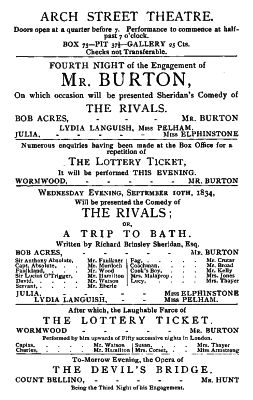
There lies before us a bill (elsewhere reproduced)
of the above theatre, dated Wednesday,
September 10, 1834, being the fourth night of
Burton's first engagement in this country.
The plays on the occasion were Sheridan's
comedy of "The Rivals" and the farce of
"The Lottery Ticket,"—which last seems to
have met with great favor, as the bill states it
to be a repetition, owing to "numerous enquiries
having been made at the box-office";
thus beginning the train of similar "numerous
enquiries" with which, in the years to come,
his own box-office became familiar. Burton
was the Bob Acres of the comedy and Wormwood
in the farce. Then at the age of thirty,
we can believe that the comedian's unfolding
genius gave full promise of the delightful
humor which clothed his Acres at a later day;
and that in the Wormwood of the farce he
afforded glimpses of that wealth of comic
power which thereafter, and for so long, he
lavished for the amusement of the public.
Miss Pelham was the Lydia Languish and Miss
Elphinstone the Julia, English actresses of no
special distinction; but it is interesting to note
that Miss Elphinstone became the second wife
of Sheridan Knowles, the author of a celebrated
and far more popular Julia than the
lady of "The Rivals," and who appeared on
the Philadelphia stage of that year.
Something akin to his reception by the
audiences at the Haymarket in London, was
for a time Burton's experience in Philadelphia.
As the recollection of Liston by the London
audience dwarfed the efforts of the youthful
aspirant, so the memory of Joseph Jefferson,
senior, (who played in the city as late as
1830,
[4])
diluted the interest felt in the new
actor by the Philadelphia benches.
[5]
But the
native force and humorous capability of the
comedian were destined to conquer indifference;
and, although the creative genius which
informed his subsequent delineations was yet
to be made clearly manifest, he soon had a
secure footing; and a belief was strengthening
in the public mind that an actor of rare endowments
and promise had come from the land of
Munden, Elliston, and Liston, and one who
might, it was not too much to say, worthily
perpetuate the traditions of Jefferson.
The engagement of Burton with Maywood
& Co. lasted two years, and was renewed for
two more, during which period the comedian's
powers greatly developed, and displayed remarkable
versatility and dramatic resource.
He widely extended his repertory, and was
seen at the Arch and Chestnut Street theatres
in a variety of comedy rôles and in innumerable
farces. Among the many noted parts performed
by him at various times we may name:
Ollapod, in "The Poor Gentleman"; Doctor
Pangloss, in "The Heir at Law"; Farmer Ashfield,
in "Speed the Plough"; Goldfinch, in
"The Road to Ruin"; Billy Lackaday, in
"Sweethearts and Wives"; Tony Lumpkin, in
"She Stoops to Conquer"; Maw-worm, in
"The Hypocrite"; Sir Peter Teazle and Sir
Oliver Surface, in "The School for Scandal";
Mr. Dove and Mr. Coddle, in "Married Life";
Dogberry and Verges, in "Much Ado About
Nothing"; Launcelot Gobbo, in "The Merchant
of Venice"; Bob Acres, in "The Rivals";—the
last-named character he played on one
occasion with the conjunction of the elder
Wallack as Capt. Absolute, Tyrone Power as
Sir Lucius O'Trigger, and Mr. Abbot (an actor
celebrated in his day) as Falkland; truly a
striking distribution. A few of the farces out
of the many were "The Lottery Ticket,"
"Sketches in India," "The Mummy" (so
famous in Chambers Street), "No Song No
Supper," "John Jones," "Deaf as a Post,"
"The Ladies' Man," and a piece called
"Cupid," which had won renown in England
through the acting of the famous John Reeve.
Burton's growing popularity was substantially
shown in the attendance at his regular
benefits. They were always bumpers, and occasions
of warm demonstrations of regard. He
was always ready, too, with his sympathy and
support where the claims of a professional
brother were in question. William B. Wood,
in his "Personal Recollections of the Stage,"
to which work we are indebted for much useful
information, refers to an occurrence of the
kind as follows: "I must apologize for the
mention here of a circumstance purely personal,
which proved one of the most gratifying
events of my life. During the month of December,
1835, while acting in Chestnut Street,
Burton called me aside between the acts, and
with an expression of great pleasure, informed
me that a meeting for the purpose of giving
me a grand benefit had just adjourned, after
completing the necessary arrangements. This
was the first hint I ever had of this intention.
The object was at once carried into effect, and
on the 11th of January, 1836, I was honored
by the presence of one of the most brilliant
audiences ever assembled.... The following
entertainment was offered: 'Three and
Deuce,' two acts of 'Venice Preserved,' 'John
of Paris,' 'Antony's Orations,' and a new song,
and 'How to die for Love.' I was favored in
these pieces with the valuable aid of Mr. Balls,
Mr. J. Wallack, Mr. Abbot, Mrs. and Miss
Watson, Mr. Wemyss, and Mr. Burton."
In the years while the comedian was advancing
in his profession, and acquiring that knowl
edge of the stage which distinguished his
subsequent management, his pen was not idle.
He wrote several farces, and contributed stories
and sketches to the periodicals of the day.
These articles were widely read, and a collection
of them was published by Peterson at a
later date, with the title, "Waggeries and
Vagaries"—a volume that has afforded entertainment
to many readers of light literature.
The literary taste referred to at the beginning
of this narrative now sought indulgence, and
in 1837 he started "The Gentleman's Magazine,"
a monthly publication of original miscellany.
Articles of his own appeared in it
from time to time, among others a graceful
and appreciative sketch of his friend, James
Wallack. He continued the editorship until
July, 1839, when he associated Edgar A. Poe
with him in the control.
To those who have paid any attention to the
career of the gifted author of "The Raven,"
as depicted by various pens in recent years, it
need scarcely be said that, though a man of
genius, he was not without frailties; and his
warmest defenders will not deny that his life
was marred by many irregularities of conduct.
He was appointed editor of the magazine at a
fixed salary, and the arrangement was such as
to give him leisure to contribute to other periodicals
and to produce many of his famous
tales. "Happier now," says one of his biographers,
[6]
"than he had been for years past, for
his prospects seemed assured, his work regular,
interesting, and appreciated, his fame increasing,
he writes to one friend that he 'has quite
overcome the dangerous besetment,' and to
another that he is 'a model of temperance and
other virtues.'" For nearly a year he remained
with Burton; "but," continues the same biographer,
"so liable was he still to sudden relapses
that the actor was never with confidence
able to leave the city. Returning on one occasion
after the regular day of publication, he
found the number unfinished, and his editor
incapable of duty. He left remonstrances to
the morrow, prepared the 'copy' himself, and
issued the magazine, and then to his astonishment
received a letter from his assistant, the
tone of which may be inferred from Burton's
answer: 'I am sorry you have thought it necessary
to send me such a letter. Your troubles
have given a morbid tone to your feelings
which it is your duty to discourage. I myself
have been as severely handled by the world as
you can possibly have been, but my sufferings
have not tinged my mind with melancholy,
nor jaundiced my views of society. You must
rouse your energies, and if care assail you,
conquer it. I will gladly overlook the past. I
hope you will as easily fulfil your pledges for
the future. We shall agree very well, though
I cannot permit the magazine to be made a
vehicle for that sort of severity which you
think is so "successful with the mob." I am
truly much less anxious about making a monthly
"sensation" than I am upon the point of
fairness. You must, my dear sir, get rid of
your avowed ill-feelings toward your brother
authors. You see I speak plainly; I cannot
do otherwise upon such a subject. You say
the people love havoc. I think they love justice....
But I wander from my design. I
accept your proposition to re-commence your
interrupted avocations upon the Maga. Let
us meet as if we had not exchanged letters.
Use more exercise, write when feelings prompt,
and be assured of my friendship. You will
soon regain a healthy activity of mind, and
laugh at your past vagaries,'" We think
nothing can be clearer than that Burton had
good cause for fault-finding, and that he was
more than considerate and just in his frank expression
of feeling.
We do not intend to pursue the ill-starred
connection further. A more glaring offence
on Poe's part severed the relationship, and not
long thereafter the magazine was sold out to
Graham and merged in his "Casket," the consolidation
ultimately to become "Graham's Magazine."
"The Literary Souvenir," an annual published
by Carey & Hart, was edited by Burton in
1838 and 1840, and its pages contained many of
his entertaining sketches. He also contributed
to the "Knickerbocker Magazine" a series of
theatrical papers styled "The Actor's Alloquy."
Occasional starring tours belong to the chronicle
of these years, and there lies before us a
bill of the American Theatre, Walnut Street,
dated October 14, 1839, announcing "First
night of the re-engagement of Mr. Burton,"
and also that "His Excellency Martin Van
Buren, President of the United States, will
honor the theatre with his presence." The
President must have been greatly amused, for
not only did he see the comedian as Tom Tape
and Peeping Tom, but he also saw him "dance
with Mrs. Hunt the Minuet de la Cour and
Gavotte de Vestris." Burton was fairly well
known now throughout the Union—except in
the town of Napoleon, on the Mississippi
River, where, if we may believe Mr. Davidge,
he found his Waterloo. The engagement had
not been profitable, and his only hope was by
personally drumming for his benefit. So he
deposited a goodly number of tickets with the
bartender at the hotel where he was staying,
with a polite request that he would use his
best endeavor to get rid of them. The benefit
came off, and the attendance was very flattering.
After the play the comedian invited several
friends up to the bar, and there had the
satisfaction of learning that the man had managed
to dispose of all the tickets entrusted to
him. This was very gratifying; but no offer
of settlement being made, he ventured to suggest
that, as he was on the point of quitting
the town, he would like to have the pleasure
of receiving the insignificant amount of seventy-five
cents for each piece of pasteboard deposited.
Mr. Davidge says it takes a great
deal to astonish a barkeeper in Napoleon; but
this one was distanced. He surveyed Burton
for a quarter of a minute, and seeing not a
muscle move in the comedian's expressive
countenance, he said: "Look here, Mr. Billy
Burton, none of your infernal Northern tricks
here; it won't do, no way! You told me to
get rid of them tickets, and as I had promised
I was bound to go straight through with it—and
by thunder, I was obliged to stand drinks to
every man to take one!" An audience may be
uncultured if not lukewarm; and the unimpressible
community of Napoleon reminds us
that the "Antigone" of Sophocles was once
produced under Burton's management, and,
on loud and repeated calls for the author, the
comedian presented himself before the foot-lights
and said: "Ladies and gentlemen, it
would give me the greatest pleasure to introduce
the author of the play; but, unfortunately,
he has been dead for more than twenty
centuries, and I shall have to throw myself
upon your indulgence."
Burton made his first appearance in New
York October 31, 1837, at the old National
Theatre in Leonard Street—then under the
management of the elder Wallack—for the
benefit of Samuel Woodworth, the poet, playing
Guy Goodluck, in "John Jones"; and his
first appearance as a star was made at the same
theatre February 4, 1839, when he played Billy
Lackaday, in "Sweethearts and Wives," and
Guy Goodluck. A complimentary benefit was
given to Mr. Wallack in the same year, when
Burton played Sir Simon Slack, in "Spring and
Autumn." The opera of "Amilie; or, The Love
Test" was produced on the same occasion. If
we mistake not, he was connected with the
management when the theatre was destroyed
by fire not long after. He also appeared at
Niblo's Garden as a star in this year, opening
June 21th, and was seen in a round of parts,
including Gregory Thimblewell, Euclid Facile,
Ignatius Polyglott, and Tobias Munns, in his
own farce of "Forty Winks." He first appeared
on the Park stage June 2, 1840, playing
Sir Timothy Stilton, in "Patrician and Parvenu,"
the occasion being a complimentary
benefit to Peter Richings; and in the same
month acted at Niblo's Garden. At his benefit
(July 6th) he played Brown, in "Kill and
Cure," and Fluid in "The Water Party." The
participation of the Cushman sisters in this
entertainment greatly enhanced its interest
and attractiveness. In this year he fitted up
Cooke's circus-building in Chestnut Street,
Philadelphia, calling it the National Theatre.
He gathered a fine company and was very
prosperous. Charlotte and Susan Cushman
appeared there, and the sterling comedians
Henry and Thomas Placide were among the
force. The fairy piece, "The Naiad Queen,"
was there presented for the first time in the
United States, and brought wealth to the manager's
coffers. A large amount of his earnings
by this enterprise he invested in Nick Biddle's
United States Bank, and in the downfall of
that institution suffered severely.
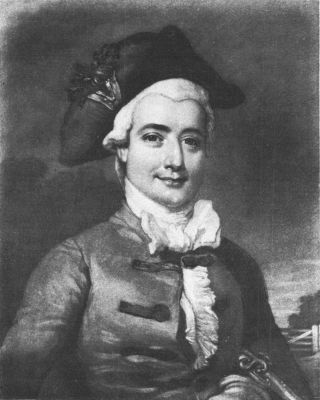
Mr. Burton as Dr. Ollapod.
In 1841, after a brief engagement at the
Providence theatre, he returned to New York,
and leased the rebuilt theatre corner of Leonard
and Church streets, where his first appearance
in New York had been made; brought on
his Philadelphia company, and there established
himself. This was April 13, 1841, and
his first essay as manager in New York. He
transported all the beautiful scenery of "The
Naiad Queen," and reproduced the piece with
gratifying success. But a dread fatality seemed
to attend this temple of the drama. As, while
under Wallack's management, it was destroyed
by fire, so the same doom befell it under
Burton. In the height of prosperity the building
was again consumed, and with it the elaborate
and splendid scenery of "The Naiad
Queen." Of this calamity, F. C. Wemyss, in
his "Theatrical Biography," remarks: "On
this occasion a magnificent and extensive
wardrobe, the property of Mr. Burton, was
consumed, together with his private wardrobe,
manuscripts, books, and other articles of considerable
value. He was not insured to the
amount of a dollar. The citizens of New York
expressed their sympathy with the manager;
and a complimentary benefit at the Park placed
a handsome sum at his disposal." Undaunted
by a disaster which would have utterly discouraged
most men, Burton again sought Philadelphia,
and after starring for a brief season
leased the Chestnut Street Theatre for a fresh
essay. There for a while he continued with
good fortune, until better prospects invited
him to Arch Street, where at last he located
with a view to permanency. Meeting now
with rich success, he determined to extend his
sphere of operation, and added in turn to his
lesseeship the Front Street Theatre, Baltimore,
and the theatre in Washington; so that in
1845-6 he was guiding the destinies of three
dramatic houses, distinguished for well-chosen
companies and for the admirable manner in
which the plays were mounted and cast. But
again the fiat of destiny was written in words of
flame. The Washington theatre, for the first
time in many years, was handsomely rewarding
its manager, when one night, during the performance,
the scenery caught fire, and the
building was burnt to the ground. The Baltimore
theatre was continued; but the lion's
share of attention was given to Arch Street,
and there for several years Burton enjoyed a
flow of prosperity; his fame increasing in public
estimation; surprising and delighting all by
his wonderful acting, and by the knowledge,
taste, and liberality, with which he catered for
his patrons. But New York was in the manager's
thoughts and seemed to beckon him
Northward. Perhaps Burton's prophetic gaze
discerned in the great city a field that would
respond to careful tillage, and that the rapid
growth of the metropolis could not fail to give
momentum to enterprise. Whatever the motive
spring, the step was taken, and in 1848
the building known as Palmo's Opera-House
became Burton's Theatre.
In this brief survey of fourteen years, the absence
of detail in many instances will be pardoned,
we hope, on a reflection of what it may
suggest. We are aware of the interest attaching
to strength of companies, citations of casts,
and notes of special performance; and in all
theatrical histories such details should evoke
the most careful consideration. The Philadelphia
record, however, is not always full and
clear on those points, as respects individual
careers, even in one so active and fruitful as
our subject's; for, so far as we know, there is
no history of the stage of that city which pretends
to do for its dramatic life what Ireland
has done for the New York stage—regarding
which monument of painstaking fidelity,
William Winter, in the preface to his recent
admirable volume on "The Jeffersons," truly
says: "Every writer who touches upon the
history of the drama in America must acknowledge
his obligation for guidance and
aid to the thorough, faithful and suggestive
records made by the veteran historian, Joseph
N. Ireland. "Yet, in depicting the career of
a great actor, many things are rendered subordinate
which in a history of the drama of any
given period would receive due prominence.
That the career of Burton in Philadelphia from
1834 to 1848 embraced much of its stage history
during those years, will, of course, be understood;
and we shall be sorry if our readers,
at the same time, fail to discern the industry,
sagacity, courage, and varied powers—with
which the actor, author, and manager, illustrated
those years—suggested by this recital.
We now approach a period within the memory
of many persons now living. Some few
octogenarians may survive who can recall Burton's
performances of over forty years ago; but
they must be few indeed; and their recollections
cannot be otherwise than dim and uncertain.
But the achievements of Burton in
Chambers Street; the unexampled popularity
of his theatre; the unequalled company he
gathered there; the indisputable creations of
character that there originated; the birth of a
revival of Shakespeare, with a felicity of conception
that revealed the appreciative student,
and with a beauty and minuteness of appointment
unprecedented at the time;—all this,
through a decade of years, forms an enchanting
reminiscence vivid still in the retrospect of numberless
New Yorkers. It is not surprising that
we of the city of New York forget that the
comedian so long belonged to Philadelphia.
So brilliant was his success in Chambers Street
that all other theatres where he flourished seem
to be viewed by the reflected light of that;
and we think there will be no question that
there were clustered his rarest triumphs and
there blossomed the flower of his fame.
BURTON IN NEW YORK.
1848-1856.
Palmo's Opera-House was built in 1842,
and, according to Wemyss' Chronology, was
the sixteenth theatre erected in New York. It
was built by Ferdinand Palmo, and designed
for the presentation of Italian opera. To
Palmo, it is said, belongs the honor of having
first introduced that department of music in
the city. In 1844 he opened with "Lucia di
Lammermoor"; but the support given to his
venture was not generous, notwithstanding the
fact that wealth and fashion still resided in
Warren, Murray, and Beekman streets. The
time apparently was not ripe; the experiment
ended in financial ruin to Palmo, and the unfortunate
man never wholly recovered from
the blow. The house passed into divers hands,
and was the scene of a variety of entertainments
for two or three years afterward. The
writer remembers distinctly going there of an
afternoon, when a boy, to a circus entertainment.
The place was at a low ebb in point of
popularity and attraction when the comedian
fixed upon it as his future professional home.
He rearranged, fitted it up, and adorned it, and
called it Burton's Theatre.
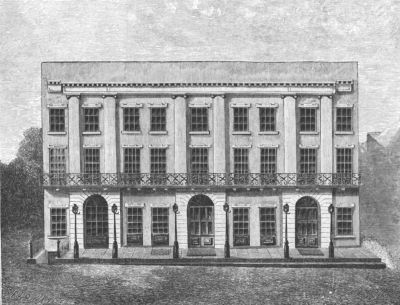
Palmo's Opera-House, afterward Burton's Theatre. (After a water-color drawing in
the collection of Thomas J. McKee, Esq.)
It had no doubt long been a dream of the
manager to attain as nearly as possible to perfection
in the organization and direction of a
first-class theatre. His varied experience in
Philadelphia and elsewhere constantly suggested
an administration composed of members
equally valuable in their respective lines, and
forming an harmonious whole under an efficient
executive, as the best system of government
for the growth and development of dramatic
art; and perhaps during his reign in Chambers
Street he came as near the realization of that
dream as is permitted to human aspiration. In
confirmation of the foregoing, we quote a passage
from William B. Wood's Recollections,
where, writing in 1854 of the evils of the star
system, he says: "Let me here remark, that I
am happy to see of late times—I mean within
the last few years—that the pernicious system
of which I speak, by carrying itself fairly out,
and by so breaking up all sound stock companies,
has finally destroyed itself....
To that intelligent manager, Mr. Burton, the
first credit is due. He has been striving for a
number of years in New York, as he had been
doing here in Philadelphia, to bring his theatre
to a proper system, based on the principles of
common sense and experience. With talents
of his own equalled by few stars, he has preferred
to ascertain whether the public could
not be better attracted by a good stock company
of combined talent, and every New
Yorker knows with what excellent effect he
has labored. His success, I am happy to learn,
has amply confirmed his reputation for dramatic
judgment."
We may supplement this by a paragraph
taken from Laurence Hutton's entertaining
volume of "Plays and Players." Describing in
glowing terms the production of Buckstone's
comedy of "Leap Year," at Burton's, March 1,
1850, Mr. Hutton says: "That our readers
may fully comprehend the subject and period
of which we write, it will be well to remind
them, perhaps, that the art of acting had
arrived at such a point in Burton's Theatre,
that, to play a comedy well, was not enough.
Every thing was so well done, so perfect in
every respect, mere excellence was so much a
matter of course, was so positive, on the
Chambers Street boards, that there was but
little room for the comparative, and the
superlative itself was necessary to create a
sensation."
The Chambers Street Theatre opened July
10, 1848, with "Maidens, Beware"; "Raising
the Wind," and "The Irish Dragoon." These
were succeeded by "New York in Slices,"
"Dan Keyser de Bassoon," and "Lucy Did
Sham Amour." The work was slow at first,
but the disappearance of money was rapid.
We have seen, however, that there was no
limit to Burton's energy and perseverance.
He played in New York, Philadelphia, and
Baltimore, week after week; managed, in conjunction
with John Brougham, an engagement
with Mr. W. C. Macready at Ford's Theatre,
Boston, October, 1848; was announced, on
Macready's departure, to appear himself; but
the intention was unfulfilled, and so it
chanced that he never acted there until the
last years of his life. He played for the
benefit of the widow and family of Edmund
Simpson, at the Park Theatre, December
7, 1848, in referring to which event
Mr. Ireland says: "We insert the entire
bill to show the forgetfulness of self evinced
by the volunteers, and their willingness to
assume any character to insure the best result,
there being no less than five gentlemen
in the cast who had played, and might justly
have laid claim to the principal character of
the play." The play was "The School for
Scandal," cast principally as follows:
| SIR PETER TEAZLE |
Mr. |
Henry Placide. |
| SIR OLIVER SURFACE |
" |
Wm. E. Burton. |
| JOSEPH SURFACE |
" |
Thomas Barry. |
| CHARLES SURFACE |
" |
George Barrett. |
| CRABTREE |
" |
W. R. Blake. |
| SIR BENJAMIN BACKBITE |
" |
Peter Richings. |
| CARELESS |
" |
C. M. Walcot. |
| SIR HARRY |
" |
H. Hunt. |
| MOSES |
" |
John Povey. |
| TRIP |
" |
Dawson. |
| LADY TEAZLE |
Mrs. |
Shaw. |
| LADY SNEERWELL |
" |
John Gilbert. |
| MRS. CANDOUR |
" |
Winstanley. |
| MARIA |
Miss |
Mary Taylor. |
This deed of charity was followed by others
for the same object on the part of New York
managers, and among them Burton contributed
a night at his own theatre, on the 5th of March
ensuing, in which the full strength of his company
appeared.
The burning of the Park Theatre in 1848
left Burton without a rival. The Olympic was
of the past; Forrest thundered at the Broadway;
Wallack's and Daly's were yet to be. It
was not long before the public discovered the
genius that presided in Chambers Street, and
recognized the unusual excellence which characterized
the performances. The location was
favorable for Brooklyn people, and from first
to last the theatre enjoyed a monopoly of their
patronage. "For several years," says Ireland,
"Burton's Theatre was the resort of the most
intelligent class of pleasure-seekers, and there
beauty, wit, and fashion, loved to congregate,
without the formality or etiquette of attire
once deemed necessary at the Park." Its fame
was really phenomenal. Leaping metropolitan
bounds, it spread to distant states and neighborhoods,
and became, one might almost say,
a familiar and welcome contribution to the
social and intellectual communion of the time.
For a stranger to come to New York in those
days and omit to visit Burton's, would imply
an obtuseness so forlorn, or an indifference so
stolid, that in the one case he would be an
object of compassion, and in the other a grave
offender of public sentiment. But in all probability
he looked forward during his journey
city-ward to his evening in those halls of
Momus; and we may be certain that the
"Quips, and cranks, and wanton wiles,
Nods, and becks, and wreathèd smiles"
of that night lived in his memory for many a
long day.
It is not too much to say that this attraction
was almost wholly due to the extraordinary
powers of Burton himself. True, his
company embraced the finest artists in their
several lines of any stage in the country; and
it was well known to all lovers of refined drama
that the Chambers Street Theatre was the
home of English comedy, and that any given
play could be there produced with a cast entirely
adequate, and with a perfection of detail
ensuring to the auditor an artistic delight and
a representation of the highest class. But
there are many who, while appreciating the
delineation of manners and character, seek
amusement pure and simple, and who believe
that good digestion waits on hearty laughter.
To this large constituency Burton was the objective
point, for his humor and comic power
were a perennial fountain of mirth. His appearance,
either discovered when the curtain
rose, or entering from the wing, was the signal
for a ripple of merriment all over the house.
Every countenance brightened, the dullest
face glowed with gleeful expectancy. No
actor, we believe—unless possibly Liston,—ever
excelled Burton in humorous facial expression.
Tom Hood, in referring to certain
pastimes of a London evening, says in his
felicitous rhyme:
"Or in the small Olympic pit sit, split,
Laughing at Liston, while you quiz his phiz."
Read the couplet thus:
"Or in the Chambers Street snug pit sit, split,
Laughing at Burton, while you quiz his phiz,"
and we have the nightly situation. It was a
common circumstance for the theatre to receive
accessions toward the close of the performance,
the new-comers standing in line along the walls,
drawn thither by the potent magnet of the
manager in the farce. Thus it was that, though
the theatre furnished constantly a rich feast of
comedy, and was more widely known than any
other, still more celebrated was the great actor
whose name it bore; and it was the magic of
that name that drew the people, and it was he
whom the people went to see. It seemed to
make little difference what the bills announced;
Burton would play,—and that was enough.
It was the privilege of the writer of these
pages to have free access to the Chambers
Street Theatre, and to know personally its
manager, and his recollections are such as to
induce him to believe that in no better way can
he perform his task of completing Mr. Burton's
career than by employing his own knowledge
and recording the impressions he received. In
so doing, the opportunity afforded for special
reference to members of his company will be
improved; and perhaps our retrospection may
arouse in other breasts a remembrance of past
delight.
Alluding to the comedian's first appearance
in New York, October 31, 1837, Joseph N. Ireland,
so often quoted, remarks: "The advent
of Mr. W. E. Burton, the most renowned comedian
of recent days, demands more than a passing
notice. For nearly twenty years no other
actor monopolized so much of the public
applause, and popular sentiment universally
assigned him a position in broad low comedy
entirely unrivalled on the American stage." It
was a little over three years between his arrival
in America and his New York débût; about
eleven between that appearance and his lesseeship
in Chambers Street; and eleven more
remain to be taken note of. Of these, eight
belong to Chambers Street, two to the uptown
theatre, and one to starring engagements in
various cities—the last being in Hamilton,
Canada, and abruptly terminated by the malady
of which he died.
The company at Chambers Street now demands
our attention; and the wish to suitably
recognize the talents, and to chronicle, however
simply, the triumphs of that famous array, has
constrained us to widen the scope of our original
design, and to extend somewhat our notices
of certain individual actors. We shall in
nowise regret this; for in recalling past delight
it is a pleasure to dwell on those who caused it;
and we may, perchance, awaken thereby a
happy thought of them in other hearts. The
departed years are full of memories, and the
turning of a leaf may lay bare a volume of
reminiscence. It forms no part of our purpose,
however, to follow individual careers, and
to trace their course on other boards than those
of the Chambers Street Theatre. Many of them,
indeed, after Burton removed uptown, and after
his death, continued their successes and won renown
in other scenes and under other management;
and our readers may feel that but scant
justice is done many meritorious names familiar
to the present generation, in confining mention
of them to a period when their talents
and capabilities had not ripened to that excellence
which afterward gave them fame. But
we are concerned with them only as they figured
as members of Burton's company, and as such
contributed richly to our fund of memory.
They stand in the dramatic Pantheon with
their great chief; and in approaching that
central and dominant figure we pause to
bend delighted gaze upon the admirable group
surrounding it.
From 1848 to 1856 the following names were
numbered on the muster-roll: Henry Placide,
Blake, Brougham, Lester, T. B. Johnston, Bland,
Jordan, Barrett, Dyott, Fisher, Thompson, Holland,
C. W. Clarke, Norton, Parsloe, Jr., Holman,
Charles Mathews, Setchell, Mrs. Hughes,
Mrs. Russell (now Mrs. Hoey), Mrs. Skerrett,
Mrs. Rea, Miss Raymond, Mrs. Hough, Mrs.
Buckland, Miss Weston, Miss Devlin, Miss
Malvina, Miss Agnes Robertson, Fanny Wallack,
Mary Taylor, Miss Chapman. This is
by no means intended as a complete enumeration—"but
't is enough, 't will serve." Many
names have been forgotten, and some remembered
but omitted. It may be of interest to
note at this point the fortunes that awaited
at least five of the actresses above named—viz.:
Mrs. Russell, Miss Weston, Miss Devlin,
Miss Malvina, Miss Agnes Robertson.
Mrs. Russell, while at Burton's in 1849, and
a great favorite, was married to John Hoey of
express fame, and shortly thereafter retired
from the stage, the manager doing the honors
at her farewell, and presenting her on the occasion
with a valuable testimonial of his regard.
Long afterward Mrs. Hoey was induced by the
elder Wallack to forsake her retirement, and
for many years was the leading lady at his
theatre, her refined manners, correct taste, and
exquisite toilets, exciting anew public esteem
and admiration. She quitted the stage and
returned to private life in 1865.
Miss Lizzie Weston, whose beauty, dramatic
aptitude, and versatility, won nightly plaudits,
and whose performance was not without much
that was highly meritorious, signalized a career
more or less checkered by uniting her fortunes
with those of the late Charles Mathews, during
his starring tour in 1858, and is now the widow
of that famous actor.
Miss Malvina, a sister of Mrs. Barney Williams,
was a danseuse at Burton's,—for it was
the fashion in the old days to beguile the lazy
time between the pieces with a Terpsichorean
interlude; and we remember but one instance
of her appearance in any other character, and
that was a minor part in the farce of "A School
for Tigers." She became Mrs. Wm. J. Florence
in 1853, and has since shared her husband's
fortunes and honors. Miss Agnes Robertson
made her débût in New York at the Chambers
Street Theatre, October 22, 1853, as Milly in
"The Young Actress," and has since been well
known as the wife of Dion Boucicault.
A more illustrious alliance—so soon to end
in piteous sorrow—was the portion of Mary
Devlin. She was a minor actress at Burton's,
but a woman of rare and lovely character. So
much so, that she won the heart of Edwin
Booth, and became his wife, and the idol of
his home, till death early called her from his
side. It was in memory of this sweet and
gentle lady, that the poet Thomas William Parsons
penned the following exquisite stanzas:
"What shall we do now, Mary being dead,
Or say, or write, that shall express the half?
What can we do but pillow that fair head
And let the spring-time write her epitaph?
"As it will soon in snow-drop, violet,
Wind-flower, and columbine, and maiden's tear,—
Each letter of that pretty alphabet
That spells in flowers the pageant of the year.
"She was a maiden for a man to love,
She was a woman for a husband's life,
One that had learned to value far above
The name of Love the sacred name of Wife.
"Her little life-dream, rounded so with sleep,
Had all there is of life—except gray hairs:
Hope, love, trust, passion, and devotion deep,
And that mysterious tie a Mother bears.
"She hath fulfilled her promise and hath past:
Set her down gently at the iron door!
Eyes! look on that loved image for the last:
Now cover it in earth—her earth no more!"
Let us now summon, as first in order, the
name that heads the list of the actors above
given. Henry Placide enjoyed in public estimation
a fame worthy and well deserved. He
was an actor of the old school, and his conceptions
were the fruit of appreciative and careful
study; his acting was a lucid and harmonious
interpretation of his author; and his elocution,
clear and resonant, was the speech of a scholar
and a gentleman. The artistic sense was never
forgotten in his delineations, and his name on
the bills was a guaranty of intellectual pleasure.
He was not broadly funny like Burton, or
Holland; but those who remember his Sir
Harcourt Courtley, his Jean Jacques François
Antoine Hypolite de Frisac, in "Paris and
London," and his Clown, in Shakespeare's
"Twelfth Night," will not deny that he was
the owner of a rich vein of eccentric humor,
and that he worked his possession effectually.
He was an expert in the Gallic parts where the
speech is a struggle between French and English,
and, indeed, since his departure they, too,
have vanished from the stage. But those who
saw him as Haversac, in "The Old Guard";
as The Tutor, in "To Parents and Guardians";
or as Monsieur Dufard, in "The First Night,"
will bear witness to his inimitable manner, and
to his facile blending of the grave and gay.
We shall never forget how, in the last-named
character (Mons. Dufard), having engaged his
daughter for a "first appearance," and having
declared his own ability to manage the drum
in the orchestra on the occasion, he, suddenly,
during the mimic rehearsal, at an allusion in
the text to sunrise, stamped violently on the
stage; and to the startled manager's exclamation
of "What's that!" serenely replied: "Zat
ees ze cannon vich announce ze brek of day—I
play him on ze big drum in ze night." In
choleric old men Placide was unsurpassed. All
the touches that go toward the creation of a
grim, irascible, thwarted, bluff old gentleman,
he commanded at will. His Colonel Hardy,
in "Paul Pry," for instance, what an example
was that! I hear him, now, at the close of the
comedy, when things had drifted to a happy
anchorage—hear him saying in reply to the
soothing remark: "Why, Colonel, you've
every thing your own way,"—"Yes, I know I
have every thing my own way; but—— it, I
hav'n't my own way of having it!" His repertory
covered a wide range; and we retain
vivid recollections of his Sir Peter Teazle, his
Doctor Ollapod, and his Silky; the last in "The
Road to Ruin," in which comedy, by the way,
we remember seeing Placide, Blake, Burton,
Lester, Bland, and Mrs. Hughes; truly a phenomenal
cast.
Such, briefly sketched, was the actor who
constituted one of Burton's strongest pillars.
For some years he played at no other theatre
in New York. He gave enjoyment to thousands,
and in dramatic annals his name and
achievements have distinguished and honorable
record. As one of the many who remain to
own their debt of pleasure and instruction,
the present writer pays this tribute to the
genius and memory of Henry Placide.
[7]
We now summon another name from the
famous corps, for the purpose of analysis, since
we should be ill content with the cold respect
of a passing glance at an artist so celebrated
as was William Rufus Blake. We can recall
no actor of the past, and we know of but one
in the present, comparable with Blake in certain
lines of old men—certainly in the rôle of
tender pathos like Old Dornton, and in the
portrayal of a sweetly noble nature framed in
venerable simplicity, as in Jesse Rural, he had
no equal; and it is simply truth to say that
with him departed from the stage that unique,
all-affecting, wondrous embodiment of Geoffrey
Dale, in "The Last Man."
The characteristics of Blake's power were a
broad heartiness, suggestive sentiment, and
eloquent idealization. These traits informed
respectively the parts he essayed, and gave to
each in turn rare flow of spirit, richness of
color, and poetic fervor. For the verbal expression
of these salient elements, he possessed
a tuneful voice, which rose or fell
as the sway of feeling dictated, and his delivery
was singularly felicitous in tone and
emphasis. Nor was he lacking in a humor at
once subtle and delicate, happily evinced in
his acting of Mr. Primrose, in the comedietta
of "Bachelors' Torments."
Those who saw Blake at the period of which
we are writing, found it hard to believe that
the Sir Anthony Absolute of aldermanic proportions
before them was once a slender young
man and played light comedy! Yet so it was.
Very old play-goers will recollect the Chatham
Garden theatre, and perhaps some tenacious
memory bears record of having seen Blake there
in the long ago; for there he first appeared
to a New York audience, in 1824, playing
Frederick, in Colman's "Poor Gentleman."
We never saw him earlier than at Burton's,
and then with added years had come a rotundity
of person which, however unobjectionable
in the famous impersonations of his
prime, was not, it must be confessed, the ideal
physique of light comedy; so his Frederick
had long departed and his Sir Robert Bramble
had appeared.
The first time we saw Blake was in "The
Road to Ruin," and the impression he made
has never been effaced. We were young, it is
true, and sentimental, and easily moved; but
our heart tells us that the effect would be the
same could we see the actor in the play
to-morrow. We have read since of the extraordinary
sensation produced by the great Munden
in the part of Old Dornton; but we have
an abiding faith that the acting of the famous
Englishman would have been no revelation to
Blake; and we cannot, indeed, conceive of any
added touch that would not have impaired,
rather than heightened, the latter's superb
delineation. But Blake's portrayal of the outraged,
doting, fond, tender father, is, like his
Jesse Rural, so fresh in the memory of living
persons, that we feel it to be needless to descant
upon its beauties. Few will forget the
years of his last and long engagement at Wallack's—a
fitting crown for a great artistic career.
Blake played many parts and rarely touched
but to adorn. Even his Malvolio, had it not
been for the advent of Charles Fisher (who was
born in yellow stockings and cross-gartered),
would have passed into history as a carefully
conceived and highly finished performance.
Whenever we see Mr. John Gilbert we are reminded
of Blake. There is a grace of action, a
courtliness of manner, inseparable from Gilbert,
which lends to all his efforts an elevating
charm, a feature Blake did not possess in like
degree. But the two actors belonged to the
same school; their traditions will be much
akin; and neither loses in being spoken of in
the same breath, and with the same accent of
admiration.
Following Placide and Blake is the name of
an actor better remembered than either, and
whose death is of comparatively recent date.
We refer to John Brougham, who for thirty
years and more was one of New York's prime
favorites, and his name is associated with many
of the drama's brightest and worthiest triumphs.
His inexhaustible flow of spirits, in
his best days, pervaded all his acting, and invested
the most unattractive part with an alluring
charm, as many a prosaic spot in nature
becomes enchanted land by the music of falling
waters. Add to this exuberant vitality a
rich endowment of mother wit; a bright intelligence;
keen sympathy and appreciation, and
rare personal magnetism, and you have before
you "glorious John," whose hearty voice it
was always a pleasure to hear, and whose face,
beaming with humor, was always welcomed
with delight.
Brougham was Burton's stage manager in
1848, and his dramatization of "Dombey and
Son" was first produced in that year. The
representation of this play established the
Chambers Street Theatre, drew attention to
the talents of the stock company, and put
money into Burton's purse. If theatres, like
other things, succeed either by hook or crook,
as the saying is, surely it was by hook that the
manager won fame and fortune, for the digit of
Captain Cuttle held sway like a wizard's wand.
The temptation to dwell here on this renowned
Burtonian impersonation is hard to resist; but
we must be patient and bide our time.
Mr. Burton as Captain Cuttle.
Brougham played Bunsby and Bagstock, investing
the oracular utterances of the tar, and
the roughness and toughness and "devilish"
slyness of the Major, with a humor and spirit
all his own. We laugh outright as we think
of that scene where Cuttle is being rapidly
reduced to agony and despair by Mrs. MacStinger,
and is rescued therefrom by Bunsby,
who, with a hoarse "Avast, my lass; avast!"
advances solemnly on the redoubtable female,
and with a soothing gravity ejects the entire
MacStinger family, following in the rear himself—Cuttle
meanwhile gazing in speechless astonishment
at the unexpected succor, until the
door is closed; and then, drawing an immense
breath, and turning toward the audience his
inimitable face, exclaims in a tone of profound
respect and admiration: "There's wisdom!"
It was a great treat to see Burton and
Brougham together. The two actors were so
ready, so full of wit, so alive to each other's
points and by-play, that any fanciful interpolation
of the text, or humorous impromptu, by
the one, was instantly responded to by the
other; and the house was often thrown into
convulsions of merriment by these purely unpremeditated
sallies. This was notably the
case in the afterpiece of "An Unwarrantable
Intrusion"—committed by Mr. Brougham upon
Mr. Burton—when in the tag the comedians
suddenly assumed their own persons, and,
addressing each other by their proper names,
engaged in a droll colloquy respecting the
dilemma of having nothing to say to conclude
the piece; and each suggesting in turn something
that ought to or might be said to an audience
under such peculiar and distressing circumstances,—the
audience meanwhile in a state of
hilarious excitement, drinking in every sparkling
jest and repartee, and wishing the flow of
humor would last forever.
And here we are reminded of an incident not
down in the bills, which furnished an audience
with an unlooked-for and affecting episode. It
occurred during the performance of Colman's
comedy of "John Bull," produced for the
benefit of a favorite actor; Burton playing Job
Thornberry, and Brougham, who had volunteered
for the occasion, appearing in his capital
rôle of Dennis Brulgruddery. Brougham was no
longer with Burton—an estrangement existed
between them of which the public was aware—and
the conjunction of the two actors naturally
awakened a lively interest. It chances
in the comedy that Mary Thornberry finds a
refuge in her distress at the "Red Cow," and
is greatly befriended by Dennis. Her father,
discovering her there, and grateful for the service
rendered, exclaims: "You have behaved
like an emperor to her. Give me your hand,
landlord!" Now, in the play, the reply of
Dennis is: "Behaved!—(refusing his hand)—Arrah,
now, get away with your blarney,"—but
Brougham paused for a moment before Burton's
outstretched hand, and then, as if yielding
to an impulse, stretched forth his, and the
two actors stood with clasped hands amidst an
outburst of applause that fairly shook the
building. Of course they were "called out"
at the close, and Brougham, in the course of
a felicitous little speech, remarked—alluding,
perhaps, to the success of his Lyceum not
being all he could wish—that he had "lately
run off the track"; to which Burton, in his
turn, responded by saying: "Mr. Brougham
says he has 'run off the track.' Well, he has
run off the track; but he hasn't burst his boiler
yet!" At this speech the enthusiasm of the
audience knew no bounds; and indeed, with
the exception of Mary Taylor's farewell benefit,
we can recall no theatrical occasion where more
genuine feeling was manifested.
But to return to "Dombey and Son." Mrs.
Brougham was the original Susan Nipper, and
played the part acceptably; but all previous
Nippers suffered eclipse when Caroline Chapman
appeared at a later date, giving us a Susan
that seemed to have sprung full-Nippered from
the head of Boz himself. Her inimitable acting
and ring of delivery were like a new light
turned on the scene. Her flow of spirit and
alert movement, her independent air and saucy
glance, her not-to-be-put-down-under-any-circumstances
manner,—all was freshness and
sparkle, and her presence was as welcome to the
audience as a summer shower to drooping
wayside flowers. Miss Chapman was a great
acquisition to Burton's, and her bright individuality
shone in all her assumptions. Her
line was the stage soubrette, a specialty which
she lifted entirely out of the commonplace and
informed it with force and distinction. It is a
pleasure to place on record the memory of
happy hours that we owe to the performances
of Caroline Chapman.
The original Toots was Oliver B. Raymond,
whom we never saw. T. B. Johnston was his
successor, and as that admirable comedian
never did any thing unacceptably, his Toots
was a memorable effort; and had Uriah Heep
not followed we should have been satisfied
with his Toots; but when "Copperfield" was
produced and Johnston appeared as Heep, it
seemed as if he was born for that and nothing
else. Now that we think of it, it seems to us,
as we recall Johnston, that nature had peculiarly
fitted him for the delineation of many of
Dickens's characters. Something in his spare
figure, his grotesqueness of demeanor, his
whimsical aspect, his odd manner of speech,
continually suggested a flavor of Boz; and
whether as Toots, or Heep, or Newman Noggs, he
seemed to have glided into his element, and
was en rapport with the great novelist.
We must not forget, in writing of "Dombey
and Son," to note how much its attraction was
enhanced by the assumption, in 1849, of the
part of Edith by Mrs. Josephine Russell (the
present Mrs. Hoey). Laurence Hutton, referring
to the event in his volume of "Plays
and Players," says: "Up to the time of
her assumption of the rôle, Edith, in Brougham's
version of the story, was comparatively
a secondary part, and one to which but
little attention had been paid either by performer
or audience. Mrs. Russell, however,
by her refined and elegant manner, brought
Edith and herself into favor and prominence.
She made of Edith more than Brougham himself
ever imagined could be made; and Edith
made her a reputation and a success on the
New York stage, which, until her honorable
and much-to-be-regretted retirement, she ever
sustained.[8]
We have dwelt thus on "Dombey and Son,"
because, in the first place, it gained for the
Chambers Street Theatre an enduring public
regard, and was no doubt the incentive to the
after-production of dramatizations of Dickens,
which gave us Burton in Micawber, Squeers,
Mr. Bumble, and Sam Weller; and because in
so celebrating it we pay a deserved tribute to
Brougham, from whose fertile brain and ready
pen it came. We may say, in this connection,
that not only as actor, but as playwright also,
Brougham achieved fame and honor. Many
of his comedies are well known to the stage,
and are included in the published drama; and
as a writer of burlesque we question whether
any thing better or funnier than his "Po-ca-hon-tas
or the Gentle Savage" has ever
been composed. Of one thing we are certain:
an incarnate pun-fiend presided over its creation.
This extravaganza, first acted at Wallack's
Lyceum, took the town by storm, and its bons-mots,
local hits, and trenchant witticisms, were
on the lips of everybody. In structure, idea,
and treatment of theme, it was ludicrous to a
degree. Who does not remember Brougham
and the late Charles Walcot in their respective
parts of Powhattan and Captain Smith?
It goes without saying that Brougham's
Hibernian delineations were perfect and to the
manner born. Many an Irish farce we recall,
during his stay at Burton's, to which he gave a
new lease of life; and we congratulate ourselves
that our memory holds record of having
once seen him as Sir Lucius O'Trigger, the
only cast in our experience wherein Sheridan's
creation found a fitting representative.
We now pause before an actor of illustrious
lineage; of a name honored in dramatic annals
by encomiums bestowed only upon abilities of
the highest order; an actor who, conscious
of his inheritance of genius, worthily perpetuates
the traditions of his house; and who is
now, despite the flight of time, the most engaging
and accomplished comedian known to the
American stage. Our readers will need no
further introduction to Lester Wallack, the
"Mr. Lester" of Burton's, where first we saw
him so many years ago. We recall the evening
when we sat in the cosy parquette, awaiting
with eager interest the rising of the curtain on
Charles Dance's comic drama of "Delicate
Ground," in which Mr. Lester would make his
"first appearance since his return from England"
(so the bill ran), in the character of
Citizen Sangfroid. We say eager interest, for
we had heard much of Mr. Lester: that he
was graceful, handsome, distingué,—in fact,
splendid generally; and our expectancy was
akin to that of the watching astronomer—
"When a new planet swims into his ken."
At last the tinkle of the bell; the curtain
rose, and enter Miss Mary Taylor, the universal
favorite, as Pauline. Her soliloquy closes with
the cue for Sangfroid's entrance, and at the
words, "Hush! my husband!" a pause succeeded—and
then from "door left" was protruded
an elegantly booted foot, and a moment
later Lester stood before us, bowing with characteristic
ease and grace to the demonstrations
of welcome. We confess to an unconditional
surrender on that occasion. The actual fact
was far beyond any expectation or hope. We
thought we had never seen any one quite so
splendid; and Sangfroid was forthwith invested
with the best and noblest elements that
combine to elevate mankind. We endeavored
for many days afterward to conform our daily
life to the general teachings of Sangfroid; we
imitated the gait and manner, the calm aplomb
of Sangfroid; the accent of Sangfroid was
impressed on all our ordinary forms of speech;
our conversation on whatever topic was plentifully
sprinkled with Sangfroidisms; in short,
the whole tenor of our existence was shaped
and directed by Sangfroid in the person of Mr.
Lester. We recovered in due course from our
abject submission to the spell of Sangfroid;
but Lester continued to stretch forth the
"sceptre of fascination," and to his matchless
grace and finish we owe many a delightful
recollection.
Then in early manhood,[9]
the unrestrained
alertness and vivacity of youth were his in
bounteous measure. He was in the Percy
Ardent and Young Rapid period, and had not
yet entered the corridor of years at the far end
of which lurked the blasé figure of "My Awful
Dad." We remember him in so many parts
which in all likelihood he never will play again!
There was Rover, in "Wild Oats," that buskined
hero, with his captivating nonchalance dashed
with tragic fire; his tender conversion of Lady
Amaranth—played, be it said, with all proper
demureness by Miss Lizzie Weston; his triumph
over Ephraim Smooth—one of Blake's
instances of versatility—in a scene rich with
the spirit of frolic abandon; and his humorous
tilt with Sir George Thunder—a belligerent
sea-dog, played by Burton as he alone could
play it—an episode replete with comic power;—all
these contributed to a performance which
we revelled in many and many a night; and
the memory of it, now as we write, draws near
in a succession of vivid pictures. There was
Tangent, in "The Way to Get Married," a
capital part in Lester's hands, blending manly
action and debonair grace with that easy transition
to airy farcical expression, a favorite and
effective dramatic habit of this actor, and given
full play in that memorable prison scene in the
comedy, when, a victim to adverse circumstances,
and actually fettered, he makes felicitous
use of his handkerchief to hide his mortification
and his chains from the eyes of the
heroine during her visit of sympathy. Percy
Ardent, in "The West End," was another of
his characteristic assumptions in those days;
so also were Young Rapid, in "A Cure for the
Heartache," and the Hon. Tom Shuffleton, in
"John Bull"; and, indeed, Burton's frequent
revivals of the old comedies would have been a
difficult matter without Lester; for in every
one of them a light comedy part is distinctly
drawn, and unquestionably the rarest among
all dramatic artists is the first-class light
comedian.
Let any one who thinks otherwise endeavor
to recall the names of those who have been or
are famous in that special line, and he will be
surprised to find how few he can enumerate.
One might suppose that all young actors would
naturally incline toward light comedy, and be
ambitious in that direction, since in that sphere
are found the charm of youth, the expression
of lofty sentiment, the impulse to chivalrous
action, the opportunity for the display of
graceful and manly bearing,—not to mention
the lover, whom, as Emerson declares, all the
world loves; and why then, one may ask,
should there not be always a plentiful crop of
ripening light comedians? Alas, it is not
enough to be young, good-looking, intelligent,
and of virtuous impulse, or even a lover.
Something more is needed, and we conceive
it to be that gift of nature, which study and
practice develop into seeming perfect art, but
which neither study nor practice can create;
the gift, let us say, of perceiving instinctively
the salient points of a character, and going beyond
the author in felicitous and suggestive
expression of them. It is easier, we think, to
compass tragedy; easier to simulate age;
easier to be funny; than to be at once airy
and gay, delicately humorous, and engagingly
manly. There are fewer light comedians
born,—that is the whole story; and where we
find one actor like Lester Wallack, we meet
with plenty of every other specialty. This
was made strikingly evident by Burton's experiments
in supplying Lester's place, when the
latter joined his father in the establishment of
Wallack's Lyceum. Charles Fisher was imported,
and he for a season essayed to succeed
Lester; but
"The expectancy and rose of the fair state"
he was not, and it was not long before the
fiddle of Triplet and the yellow stockings of
Malvolio emancipated him from the bondage
of light comedy, revealed his true powers, and
made us grateful to Burton for introducing to
New York one of the best eccentric comedians
of the day. Dyott, Norton, and even Holman,
were severally thrown into the breach, such
was the strait in which the manager found
himself; and it was not until he secured George
Jordan that equilibrium was restored to the
company.
But to return. The versatility of Lester, so
conspicuous throughout his career, was early
made apparent. We remember him as Steerforth,
as Sir Andrew Aguecheek, and Captain
Murphy Maguire; and though in the last he
acted under the shadow of Brougham's rich
impersonation, still he was a delightful Captain.
We saw him as the young lover, in
"Paul Pry"; as Frederick, in "The Poor Gentleman,"
and many more; besides those parts,
such as Young Marlow, Charles Surface, and
Captain Absolute, which need no reference,
since they remain ripe and finished conceptions
in his present repertory. But of all his
delineations of the past, that which we linger
on with the greatest pleasure, and which
affected us most, was his Harry Dornton, in
"The Road to Ruin." From the moment he
appears beneath his father's window, importunate
for admittance, he awakens an interest
and sympathy that follow him to the end.
The part abounds in touches of Lesterian hue
and flavor: the scene just mentioned; that
wherein Milford makes careless and heartless
allusion to Old Dornton, and is met by Harry's
eloquent and electric rebuke; the scene with
the Widow Warren, and with Sophia;—all are
charming; and we feel it to be no small tribute
to hold in memory Lester's Harry side by side
with the Old Dornton of Blake.
We have spoken of T. B. Johnston, and referred
to famous parts of his, particularly to
the conception and execution of certain characters
in Dickens which undeniably he made
his own; but we remember this actor in other
and sundry enjoyable delineations, of which
brief mention may be made. The odd aspect
of Johnston, joined to his whimsical method,
so in keeping, as before remarked, with the
creations of Boz, peculiarly fitted him for the
apt portrayal of those idiosyncrasies of nature
and temperament shadowed forth by characters
in many of the old farces, in which he often
appeared, those pieces being quite the fashion
in the days of which we are writing. We may
instance Panels, in "A School for Tigers," as
one of these; his part in "A Blighted Being"
(the name quite forgotten), was another;
Humphrey Dobbins, in "The Poor Gentleman"
(that not a farce, however), was a capital portraiture,
and an amusing foil to Burton's Sir
Robert Bramble; his Miss Swithers, in "A
Thousand Milliners," where he almost divided
the honors with Burton as Madam Vandepants;—these
are a few of the many that come
floating back on the tide of recollection.
Bland was a useful member of Burton's
company, though we think his stay was brief,
and he contributes less to memory, as it
chances, than many others. We never regarded
him as a great actor, though we have read
of his being thought the best Jacques of his
day, and very fine as Sir Thomas Clifford. We
never saw him in either, and have no recollection
of "The Hunchback" being produced at
the Chambers Street Theatre. In "The Honeymoon"
Burton himself was the Jacques.
We remember Bland very well as Sulky, in
"The Road to Ruin," and as Ham, in "David
Copperfield," and both efforts were creditable
and contributed to the general success—his
share in the exciting and touching scenes between
Old Dornton and himself, as Sulky, being
admirably done.
We are surprised that we remember so little
interesting to record of Jordan. Succeeding
Lester, and deemed by many the peer of that
comedian, one might naturally suppose that his
achievements would figure largely in these
reminiscences; but we can recall very few impersonations
of which we retain a vivid impression.
We cannot concur with that estimate of
his powers which ranked him with Lester, yet
we cordially admit that he came nearer than
any actor we know of. He was very handsome,
had a fine stage presence, and was agreeable
in all that he did. We recall his spirited
performance of Rover; his Kitely, in Ben
Jonson's "Every Man in His Humor"; his
Ferdinand, in "The Tempest"; his Lysander,
in "Midsummer Night's Dream"; and his
Captain Hawksley, in "Still Waters Run
Deep," was superb and unequalled. It was
always a pleasure to see Jordan, and we owe to
his acting many an hour of enjoyment.
George Barrett—or, "Gentleman George,"
as he was quite as well known—was one of
Burton's company for a short period, and with
his name are associated many pleasant memories.
Among them we may mention with delight
his performance of Sir Andrew Aguecheek,
a companion picture to Fisher's Malvolio.
His long body and attenuated "make
up," his piping voice, his fantastic manner,
and absurd assumption of acumen,—all contributed
to an embodiment artistic and entertaining
in the highest degree. He also played
Flute, the Bellows-Mender, in the revival of
"Midsummer Night's Dream"; and it seems
but yesterday, so vivid is the remembrance,
that we saw him stalking about the stage, in
the guise of Ben Jonson's bombastic hero,
Captain Bobadil.
Old play-goers, if they remember nothing
else of John Dyott, will recollect his admirable
reading—his distinct utterance—his
fine emphasis,—qualities specially noticeable in
his Shakespearian assumptions and in characters
of a didactic cast; and which made acceptable
many a part he undertook, half redeeming
it from deficiencies consequent upon natural
unfitness. It was such a pleasure to listen to
his delivery of the text, that you overlooked or
pardoned inadequacy of treatment in other respects.
Necessarily his impersonations were
of very unequal merit. Certain phases of the
character assumed might be justly conceived
and well executed; others manifestly lacking
in the expression of what was naturally suggested,
or sufficiently obvious. We might cite
instances of this—Claude Melnotte or Alfred
Evelyn, for example; but we prefer to think of
him in his most agreeable aspects, which were
not conspicuous in light comedy, though that
rôle, under the stress of exigency, often fell to
his lot.
We pleasantly recall him as Lieut. Worthington,
in "The Poor Gentleman"; as Peregrine,
in "John Bull"; as Penruddoch, in
"The Wheel of Fortune"; as Duke Orsino,
in "Twelfth Night"; as Master Ford, in
"The Merry Wives of Windsor"; and others
that might be mentioned. He was a useful
member of the Chambers Street company,
acted always with intelligence and spirit, and,
though leaving no great name, deserves remembrance
as a finished reader and conscientious
artist.
Charles Fisher, well known to the present
generation of play-goers as a sterling comedian,
came to Burton's after Lester's withdrawal,
and, as previously remarked, succeeded that
actor as the exponent of light comedy. We
saw him in several characters of that order;
but it must be confessed that his efforts, however
praiseworthy, were not such as to induce
a condition of complacency on the part of the
management, with regard to his capacity in
that direction. But the whirligig of time, as
Shakespeare tells us, brings on its revenges;
and in due course Mr. Fisher had his, and a
truly artistic one it was.
It came about on the second revival of
"Twelfth Night," and was achieved in the
part of Malvolio. In referring to Blake's assumption
of this character, we observed, in
passing, that Fisher was born in yellow stockings
and cross-gartered—meaning to express
the natural affinity for Shakespeare's creation
existing in the actor; and we believe there
will be no question among those who remember
the impersonation, as to the subtlety of
conception, the felicity of portrayal, and fidelity
to detail, that so eminently distinguished it.
From first to last it was a masterpiece. His
manner when he interrupts the orgies of Sir
Toby, the Clown, and Aguecheek, and during
their maudlin mockery, was full of rare suggestiveness;
the great scene in the garden,
where he falls into the trap set by Maria, was
one of the finest pieces of acting known to our
stage. The audience were as intent during
its progress as if their own lives and fortunes
hung upon that enigmatic letter. When it
comes home to him at last that he indeed is
the favored of Olivia, and he gives full rein to
his fancy respecting his future exaltation—how
he must bear himself, the lofty air he will
assume, the consideration he will extort,—he
was inimitable. Already he is clothed in yellow
stockings and cross-gartered; and he
smiles, as he struts, the smile that his deceiver
declares so becomes him. In the ensuing
scene before Olivia, where the stockings
and smiles play so important a part, he was
equally fine; and if Fisher had played nothing
else, his Malvolio would remain an interpretation
of the highest class, and a glory of dramatic
art. The press, with one accord, united
in its praise; and Mr. Richard Grant White,
whose ability to judge of Shakespearian delineations
was well known, confessed, in the
columns of the Courier and Inquirer that he
did not know where Mr. Fisher learned to
play Malvolio so well. To say that we enjoyed
what we have here endeavored to recall, is to
say but little. It is one of our most valued
memories—and we could not help thinking,
when the lovely Viola of the late Miss Neilson
was captivating all hearts, what a revelation it
would have been to her admiring audience had
Fisher presented his picture of Malvolio.
In Burton's revival of the "Midsummer
Night's Dream," Fisher was cast as Duke Theseus;
and in thinking of the part, that glorious
passage descriptive of the Duke's hounds rings
in our ears, as spoken with glowing enthusiasm
by the actor:
"My hounds are bred out of the Spartan kind,
So flew'd, so sanded; and their heads are hung
With ears that sweep away the morning dew;
Crook-kneed, and dew-lapp'd like Thessalian bulls;
Slow in pursuit, but match'd in mouth like bells,
Each under each. A cry more tunable
Was never holloa'd to, nor cheered with horn,
In Crete, in Sparta, nor in Thessaly:
Judge when you hear."
In "The Tempest" also, as Prospero, Mr.
Fisher appeared to advantage, and swayed the
destinies of the Enchanted Isle with dignity
and effect. Triplet, in "Masks and Faces,"
was another performance of Fisher's that we
might linger over in pleasant memory of its
humor and pathos; a performance, too, by the
way, which brought to public view a new
accomplishment of the actor; namely, his acquaintance
with the violin,—an advantage that
lent unusual force and brilliancy to the capital
scene where Woffington, having played Lady
Bountiful to the forlorn family, completes her
conquest by calling for the fiddle and dancing
"Cover the Buckle." And with the tune in
our ears, and a vision of Fisher's elbow in deft
movement, we take leave of the actor who
gave us in the past so many happy hours.
An artist of quite another sort was Lysander
Steele Thompson. He was an importation of
Burton's; and his specialty was the Yorkshireman
of the stage, a line in which he stood alone
and unapproachable. Actors there have been
who played the same parts, and with a sufficient
mastery of the dialect to pass muster;
but, compared with Thompson's, their assumptions
were like artificial flowers in a painted
vase beside a clump of spring violets in the
dew of morning. The semblance was there;
but the delicious fragrance of nature's breath
it was not theirs to give. The native freshness
and out-of-door breezy spirit were Thompson's
own and born with him. His engagement was
followed by the production of all the known
plays in which there was a Zekiel Homespun, or
a Robin Roughhead. We saw him in them all:
Bob Tyke, in "The School of Reform"; Zekiel
Homespun, in "The Heir-at-Law"; Stephen
Harrowby, in "The Poor Gentleman,"—and
until the advent of Thompson, the Harrowby
family had been omitted in Burton's version of
the comedy;—Robin Roughhead, in "A Ploughman
Turned Lord"; John Browdie, in "Nicholas
Nickleby"; and Giles, in "The Miller's
Maid"; in which last, indeed, he acted under
an inspiration that almost laid claim to genius
itself; and we see him now, in that high-wrought
scene, where, as the defender of virtue and
innocence, he towers in superb wrath above
the villain Gamekeeper, who would tear from
her home the person of Susan Fellows.
It goes without saying that his dialect was
perfect, and all the humorous phases—the
touches of bewilderment and arch simplicity,
the quaint retort, the rollicking drollery, the
innocence blent with audacity,—all these traits
and characteristics were so many gifts of expression
summoned and employed at will. We
have seen many tragedians and artists in melodrama;
many "old men" and light comedians;
many funny men and eccentric actors, but we
have seen one Yorkshireman only—Lysander
Thompson.
He was not without vanity, however, and
possibly aspired to other dramatic walks than
his famous specialty, if we may judge from a
little episode in his career at Burton's, which
really makes too good a story to be lost. Burton
had in view the production of "The Merry
Wives," in order to act Falstaff; and in the
distribution Thompson was asked to make
choice of a part. The story runs that, after
due reflection, Mr. Thompson answered that on
the whole he would prefer to play Sir John.
The manager regarded him for a moment with
a glance of wonder, and then: "I'm—— if
you do; one Falstaff is enough; you must
choose again, Thompson." And he chose the
Host of the Garter Inn, and made a palpable
hit.
The late Charles Mathews played a short engagement
at Burton's; and we remember his
capital acting in "Little Toddlekins" and as
Young Rapid; but we need not dwell upon an
actor whose stay was so fleeting, whose celebrity
was so extended, and whose Memoirs have
so recently been given to the public.
George Holland, also departed, was for a
brief period at the Chambers Street Theatre,
and we recall our enjoyment of his broad fun
and facial extravagance. We always felt, however,
that—as his line was somewhat akin to
Burton's—he underwent a perilous ordeal in
appearing on the same stage with the great
actor whose genius was so overshadowing.
Messrs. Norton,
[10] Holman, and Parsloe, Jr.,
were useful members of the stock company,
limited in range and ability; and we mention
them as painstaking actors, who always did
their best, and aided materially in the general
success of the theatre. The name of young
Parsloe is included on account of his performance
of Puck, which, owing to natural cleverness
and acrobatic aptitude, he succeeded, under
Burton's training, in making exceedingly
effective and full of goblin action.
And now let us fancy ourselves sitting, as of
old, in the parquette, the curtain having risen
on "The Serious Family." Sleek reads his
appeal, and we hear a voice saying: "Those
words give comfort to every fainting and
world-worn spirit, good Mr. Aminadab Sleek"—and
we know that Lady Sowerby Creamly
has spoken, and that Mrs. Hughes is before us.
Of this estimable lady and admirable actress,
much more might be said than present space
will allow. Almost as familiar a figure as the
manager himself, for years she enacted those
characters which were peculiarly her forte, and
was identified with all the success and shared
all the fame of the renowned theatre. We can
recall no instance of her having disappointed
an audience; and though, in the course of her
long service, she may have assumed uncongenial
parts, yet so intelligent was she, so
thorough, so conscientious, that, in spite of unsuitableness,
her performance was always acceptable
and meritorious. Lady Duberly, in
"The Heir-at-Law," Mrs. Malaprop, in "The
Rivals," Lucretia McTab, in "The Poor Gentleman,"
were her accustomed line, and well
indeed she played them. Widow Warren, in
"The Road to Ruin," Mrs. Skewton, in "Dombey
and Son," Betsy Trotwood, in "David Copperfied,"
were kindred felicitous portraitures;
and no one can think of Burton as Sleek and
Toodle without instantly associating Mrs.
Hughes as Lady Creamly and Mrs. Toodle.
How many times did they play those parts together!
In all those lighter pieces and farces
Burton made so popular and famous, she was
his ally and strong support; and no history of
the drama of that period can be written without
conspicuous mention of her name; nor can
the professional career and triumphs of Burton
be recounted without suggestion and remembrance
of Mrs. Hughes. Their professional
relation was perfectly harmonious, and
she was with him to the last. She went with
him from Chambers Street to the New Theatre,
and when that was given up accompanied
him on all his starring tours, acting with him
when he appeared for the last time in New
York, and when he acted for the last time in
his life at Hamilton, Canada. In a speech
Burton once made, he thus referred to their
theatrical relations: "I have been her father,
her son, her uncle, her first husband, her second
husband, and her third husband, her friend, and
her disconsolate widower, and I have liked her
better and better in each relation!"
Even as far back as 1826 Mrs. Hughes was a
great favorite. H. B. Phelps, in his valuable
work known as "Players of a Century," gives a
notice of the press she received for a benefit
night at that period, which he says is worth
preserving as a model: "Mrs. Hughes takes
her benefit at the theatre to-night. It would
be an insult to the generous enthusiasm of her
numerous admirers, to say another word on the
subject."
As it cannot fail to be of interest to readers
of this volume, we copy from Mr. Phelps's book
a reply to a letter addressed by him to the
Hon. Charles Hughes, State Senator, asking
information respecting Mrs. Hughes's subsequent
history.
"Dear Sir:—Mrs. Esther Hughes, formerly Mrs.
Young, was my mother. She died upon her farm,
three miles from this village (Sandy Hill, N. Y.),
on the 15th of April, 1867, at the age of seventy-five,
from the effects of an accident (falling down
stairs, caused by vertigo). She had left the stage
before the war, her last engagement being a travelling
tour with W. E. Burton, in the South and
North. She was acting in Albany as Mrs. Young
when the war of 1812 was declared, and I have
often heard her speak of Solomon Southwick and
of John O. Cole, who was a boy in Southwick's
office. Her many years of theatrical life speak for
themselves."
We have heretofore alluded to the Miss
Agnes Robertson of long ago; and now a memory
steals in upon us of her débût at Burton's,
and of her enchanting performance in the protean
play of "The Young Actress." Of the
half dozen parts assumed, the Scotch lassie and
the Irish lad still haunt us. The highland fling
of the one and the "Widow Machree" of the
other were charming to see and hear; and, indeed,
Miss Robertson was charming altogether.
We could give a long list of actors and actresses
who from year to year were enrolled in
the Chambers Street company, and whose efforts
are pleasantly remembered. We do not
mean to slight them; but we must hasten
toward our appointed goal. One actress, however,
a recognized favorite in New York long
before her engagement with Burton, which terminated
with her farewell to the stage, deserves
more than a passing notice, for the pleasure
she gave was as pure and healthful as it was
winsome and bright. We refer to Miss Mary
Taylor—"Our Mary,"—better known and esteemed
than any actress of her day, except
Charlotte Cushman, that we can recall.
We shall not dwell upon any part of her
career, nor examine her dramatic capabilities.
She never appeared without eliciting the warmest
of welcomes; and when we try to think of
the many characters we saw her in, we find ourselves
remembering only how sweet and good
she was. We were present at her farewell
benefit, and during the speech Mr. Burton made
for her the emotion throughout the house, at
the thought of parting, was as sincere as it was
deep. She stood, visibly affected, in the midst
of her companions, and when the curtain fell
there was a sigh, as if the audience had lost a
friend.
We have endeavored in the foregoing to indicate
the strength of the Chambers Street
company, and we think the reader cannot fail
to be impressed by the exhibit. The fact of
such dramatic portraiture being easy, seems to
us a striking proof of its supreme excellence.
The majority of them were they living now
might be comedy stars. When we have Jefferson,
Raymond, Fawcett Rowe, Stuart Robson,
and Florence, starring about the country,
playing their one part hundreds of nights,
what shall we think of Burton, Placide, Blake,
Brougham, Lester, Johnston, and the rest, appearing
together nightly in characters of varied
but equal dramatic power? There has been a
great change since then. The name of the
places of amusement now is legion, and one
bright star in the heaven of scenic splendor
consoles the public for the loss of a concentration
of wit and genius. As we recall for a moment
all that bright array, we are taken back
through the maze of distance, and old familiar
forms arise; we see the glimmer of accustomed
footlights; the scene is alive with well-known
faces; we even hear voices that we know; we
join in the old-time plaudits—and forget how
many years have rolled between! There is no
retrospection without its tinge of sadness.
"Never to return" is the refrain of human
memory. How beautifully Holmes expresses
it in "The Last Leaf":
"The mossy marbles rest
On the lips that he has pressed,
In their bloom;
And the names he loved to hear,
Have been carved for many a year
On the tomb."
The years of the Chambers Street Theatre
were fruitful in dramatic events. We have already
mentioned "Dombey and Son," in 1848;
and that signal triumph was followed by
"David Copperfield," "Oliver Twist," "Nicholas
Nickleby," and "The Pickwickians." The
immortal Toodles was first seen October 2,
1848, and an account of that performance will
be found in our Recollections. It became
later the custom of the management to present
"The Serious Family" and "The Toodles"
every Tuesday and Friday in each week, so
great was the popularity of those pieces.
People came from all parts of the country to
see them; parents brought their families and
relatives; and one middle-aged couple, a husband
and wife, never failed, for successive
seasons, to occupy the same seats at every representation.
All the old comedies were given
in due course, with that perfection of cast to
which we have alluded, and those pieces made
famous by Burton's acting—such as "The
Breach of Promise," "Charles XII.," "Happiest
Day of my Life," "Paul Pry," "Family
Jars," "Soldier's Daughter," "Charles II.,"
"How to Make Home Happy," etc., (and
which now seem for ever lost,)—were a constant
source of joyous pleasure. The wisdom
and good judgment of the manager were conspicuous
in the nightly programmes, and it
may here be said that no theatrical caterer
ever excelled Burton in an acute perception
of what was needful to meet the public taste,
and in providing the requisite entertainment.
To wide experience he added intuitive appreciation
of stage effect, and his extensive knowledge
of the drama was seen in the disciplining
of his forces and in his sagacious distributions.
It must not be forgotten that as manager as
well as actor Burton shone in the prosperity
and fame of his theatre; and it will not be
when now we touch on the Shakespearian revivals
that lent such beauty, grace, and dignity
to his stage, and revealed the manager in the
gracious aspect of a profound and reverent
student of the mighty dramatist. These revivals
were the crowning triumphs of Burton's
management. The production of "A Midsummer
Night's Dream," "Twelfth Night,"
"The Tempest," "Winter's Tale," "The
Merry Wives of Windsor," marked an era in
theatrical representation, for up to that time
no attempt had been made so ambitious; and
the success that attended the enterprise was in
all respects richly deserved. "A Midsummer
Night's Dream," in particular, won universal admiration.
The fairy portion was so beautiful;
the play before the duke so capital; that Shakespeare's
creation acted upon the public like a
revelation, and heart and mind felt the glow of
a new sensation. The notices of the press were
so unqualified in their praise of "A Midsummer
Night's Dream," that they were
gathered and issued in a pamphlet as a tribute
to the achievement. The effect of the succeeding
revivals was similar in kind, and the
people marvelled at the resources of a management
that on so limited a stage could produce
such wonderful results. And with these plays
of Shakespeare came the impersonations of
Nick Bottom, Sir Toby Belch, Caliban, Autolycus,
and Falstaff—never to be forgotten by
those who witnessed them, and of which a
more extended review is given in our Recollections.
It only needed Shakespeare to round
the glory of Chambers Street; after that there
were no more worlds to conquer.
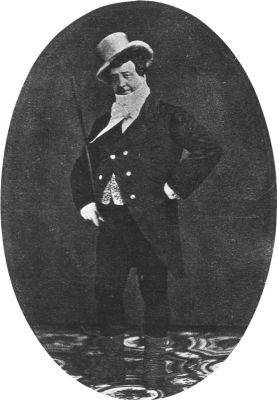
Mr. Burton as Timothy Toodle.
Following the years, we find a record of "As
You Like It," produced for the benefit of the
American Dramatic Fund at the Astor Place
Opera-House, January 8, 1850, in which Burton
appeared as Touchstone, with a cast including
Hamblin, Bland, Jordan, Chippendale, Chapman,
Miss Cushman, Mrs. Abbott, Mrs. Walcott,
and Mrs. J. Gilbert. In the same year he
played a short engagement at the Chatham
Theatre, and also essayed to revive the old
Olympic; but the division of attraction was of
brief duration. His home was in Chambers
Street, and there, to borrow from Lord Tennyson,
the banner of Burton blew. The usual even
tenor of the theatre was varied by new accessions
to the company, and by first appearances,
and other interesting events. The present
Miss Maggie Mitchell appeared June 2, 1851,
as Julia, in "The Soldier's Daughter"; but we
cannot say positively that the occasion was
her stage débût. May 3, 1852, was the farewell
benefit of Mary Taylor, to which reference has
already been made. September 6th of the
same year was the date of the "Centenary
Festival of the Introduction of the Drama into
America," at Castle Garden, and we find Burton
figuring in the elaborate and attractive programme
as Launcelot Gobbo, in "The Merchant
of Venice." Miss Agnes Robertson made her
New York débût October 22, 1853, and November
23d of the same year witnessed the
production of "The Fox Hunt," an original
comedy by Dion Boucicault, in which Burton
appeared as William Link. In 1854, that long
baronet, Sir William Don, entered upon the
scene, and in the same year (December 18th) a
benefit to Morris Barnett occurred, on which
occasion "The Serious Family" was given
with all the honors. Mr. H. A. Perry made
his débût in 1856, playing Gossamer, in "Laugh
When You Can," and that actor was also seen
as Leontes, in "Winter's Tale."
Every summer for several years, during the
recess at Chambers Street, Burton played engagements
at Niblo's with a selection from his
company, and was seen at that resort in a round
of his favorite characters. This was a great
boon to strangers visiting the city, and to those
whose circumstances kept them in town. It
was some consolation to be moved to mirth,
and there never was any disaffection in Burton's
summer constituency. But the theatrical tide
was setting uptown, and the rapid growth of
the city counselled a removal to more available
neighborhoods; and so, following the current,
the manager bid farewell to the scene of so
many triumphs, and leased the building originally
known as Tripler Hall, calling it the
Metropolitan, or, as stated by Ireland, "Burton's
New Theatre," where he opened September
8, 1856, with "The Rivals."
The Chambers Street Theatre was opened
July 10, 1848, and was closed September 6,
1856. The eight years of its existence are
replete with fascinating dramatic history, and
are a copious and important contribution to
the annals of the stage. It was the school of
many an actor who rose to fame, and the most
famous actors of the time were seen upon its
boards. It was the birthplace of plays and
characters never excelled in their effect upon
an audience, and its record is graced by a noble
and poetic celebration of Shakespeare's immortal
works. And who shall say how many
hearts were lightened, and spirits cheered, by
the good genius of mirth that presided there?
1856-1860
It goes without saying that the New Theatre,
to those who had been accustomed to the cosiness
of Chambers Street, was not Burton's.
The home feeling so peculiar to the other
house could not readily be reproduced in the
spacious auditorium of the Metropolitan. The
far-reaching stage seemed alien and unreal, and
the lofty walls were cold and unfamiliar. There
were changes in the company, too; old favorites
were missing, and a kindred interest was
not awakened by new-comers. But the manager
was there, and with wonted energy began
the campaign. The first season was prosperous,
and many of the well-known Chambers Street
pieces were revived and given with effect.
Daniel Setchell made his appearance September
25, 1856, and grew rapidly in public favor.
This comedian at a later date essayed the part
of Aminadab Sleek; but, as Ireland observes,
"Burton's Sleek alone filled the public mind,"
and the effort was not encouraged. The Irish
comedian, John Collins, was seen about this
time, and in November Dion Boucicault and
wife opened an engagement. January 13,
1857, Burton played Dogberry for the first time
in New York, and the same year (May 14th)
Edwin Booth appeared at the New Theatre
as Richard III. It was in this year (October)
that Burton was seen in Albany for the first
time, playing a round of his famous parts; and
it is interesting to note that the present Joe
Jefferson, then at Laura Keene's, "during the
absence of Burton," to quote Ireland again,
"was recognized as the best low comedian
in town." Burton also appeared in Boston for
the first time in 1857, opening in Captain
Cuttle. His reception was so extraordinary in
warmth and enthusiasm that he lost control of
himself and could not speak for several minutes.
This engagement was at the Boston
Theatre, and every night the house was
crammed. He visited Boston again in 1858,
and with the same gratifying success.
It is not impossible that these starring tours
suggested to Burton a new and prosperous field
of activity, and perhaps some physical symptom
dictated relief from the strain and responsibility
of management. From whatever cause,
after another season of varying fortune, the
Metropolitan was given up (1858), and he commenced
a starring tour with the highest success,
"his name and fame," says Ireland,
"being familiar in every quarter of the Union,
and more surely attractive than any other
theatrical magnet that could be presented."
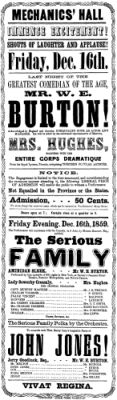
In conjunction with Mrs. Hughes and a few
members of his former company, he opened an
engagement at Niblo's, July 4, 1859, playing to
crowded houses. His last appearance in New
York was at the same theatre, on the occasion
of his benefit, October 15, 1859, playing Toodle
in the afternoon, and Mr. Sudden, Toby Tramp,
and Micawber in the evening, supported by
Mrs. Hughes as Mrs. Toodle, Mrs. Trapper,
and Betsy Trotwood. "On the day and evening
of his benefit," says Ireland, "more than
six hundred persons who had paid for tickets
received their money back from the box-office,
not being able to obtain admission."
On Saturday, December 3, 1859, Mr. Burton
started for Hamilton, Canada, to fulfil an
engagement there and at Toronto. A terrible
snow-storm was met on the way; the train was
blocked; and the delay and discomfort consequent
were almost unendurable. While recovering
from the exposure and fatigue, Mr.
Burton wrote the following letter to his children,
and we are kindly permitted to make use
of it in this volume. It will be read with interest,
not only for its feeling, but for its graphic
vigor of narration and humorous spirit. And
we believe it was the last letter he ever
wrote.
Hamilton, Canada;
Sunday, December 4, 1859.
My Darling Children:
Here I am, in this provincial city of the Western
wilderness, snowed up, 500 miles away from
my dear home and my precious treasures. Such
a day and night as we had yesterday I hope
never to go through again. You remember how
warm it was on Friday? positively hot; and on
the next morning the weather was cold as New
Year's, but clear and brisk, and the icy tone of the
atmosphere seemed to agree with me. We reached
Albany in good order, and started at twelve on the
long trip to the Suspension Bridge, over 300 miles,
with a light fall of snow, blown about in every direction
by a very low sort of a high wind. As
we got on our way we found the snow getting
deeper, and the flats of the Mohawk River covered
with ice. We dined at Utica—a pretty fair
meal, with cold plates and Dutch waiters, who
looked cold too. When we changed cars at Rochester
the wind blew ferociously, and the snow fell
heavily, so much so that some fears were expressed
that a drift might form on some part of the road
and prevent our progress for a while. At the Suspension
Bridge, at half-past twelve in the night, I
had to get out of the car and wade ankle deep in
snow to the open road beside the baggage-car, and
pick out and give checks for our wagon-load of
trunks, seeing them safely deposited in another car
for transportation into Canada. I thought this was
a hard job, but it was nothing to what I had to do
in Canada, and really a pleasant little episode compared
with my doings hereafter. We crossed the
Suspension Bridge within sight of the Falls of
Niagara, but we saw them not. The wind howled
as we passed over that fearful gulf, and drowned
the roaring of the Falls and the rumbling of the
rapids as they boiled along some 170 feet below us.
I confess that I rejoiced in reaching terra firma,
even on the cold, inhospitable land of Canada.
Well, we thought we were snugly housed for the
balance of our journey, some forty-four miles to
Hamilton, where we intended to rest for the night
(at two in the morning) and pass a cheerful Canadian
Sunday in our own rooms looking at the snow,
when we were roused from our seats: "Change
cars and re-check your baggage." Out we turned,
bundles, bags, shawls, top-coat, brandy bottle,
cough mixture, papers, books, and growls, leaving
behind my old travelling cap, which I have had for
years, and is now gone for ever. When I got out I
had to jump into a bed of snow up to my knees,
wade a quarter of a mile through the unbroken
whiteness to a stand of cars inhumanly situated far
from the shelter of the dépôt or the lee of any
building whatever. There, in that snow, without
any feeling in my feet, the wild wind whistling no
end of Verdi overtures with ophicleide accompaniment
in the snort of various engines, I had to select
my nine packages, see them weighed, have them
checked, wait while the numbers of the checks were
written down, copied off for me, and a receipt written
for the payment imposed on me for extra baggage.
If I had not been so miserably perished
with cold, I could have felt some pity for the poor
officials who had to do all this, not only for me, but
for some twenty others, and in the open air too.
But it seemed that I had all the baggage in the car.
"Who owns 57,467?" "I do." "Why, you have
baggage enough for a dozen." And it was so. The
nine boxes looked like ninety in the confused atmosphere
of steam and drifting snow. "That's
all right, sir." "Then why don't you put the
trunks in the baggage car?" "So we will when
they have passed the customs"!!!!!!!
Yes, my darlings, at that hour, past midnight, in
the open snow-storm, with a wind that killed old
Cuttle's "What blew each indiwiddiwal hair from
off yer 'ed," in a blinding drift of frozen crystals
biting each feature and driving their minute but
piercing angles into every pore, I had to wait the
presence and the pleasure of Victoria's excisemen,
to say whether my baggage might or might not pass
duty free into her infernal dominions. I had one
cheerful and pleasant thought that filled my bosom
with religious delight while I waited. I remembered
playing Harrop in the drama of "The Innkeeper's
Daughter,"—he is an old smuggler, and shoots the
exciseman. I remembered that when I fired the
pistol and the victim dropped, I exclaimed "He's
done for!" and the audience laughed and applauded!
Yes, the discriminating public applauded me for
killing that exciseman! Oh, was it to do again!
How well I could kill that Canadian gauger here, in
the snow-storm, at midnight, on the banks of the
mad Niagara! Don't be alarmed, darlings. I
didn't kill him. He came at last, booted up to
his middle, with a Canadian capote and hood, and
a leather belt buckled tightly around his waist.
But, despite his Canadian costume, the Cockney
stuck out boldly all over him. He had a roast-beef-and-porter
look, red cheeks, and big English
whiskers. Again I had to go over my list, "great
box, little box, bandbox, bundle," to the potentate
of the tariff. I gave him my honor as a gentleman,
etc., and then told him my profession, and, oh! my
loves—oh! my darling children—what is fame? he
had never heard of Mr. Burton, the comedian! Of
course, after that, you agree with me that he ought
to be killed at once, "without remorse or dread."
And he had such an aggravating smell of hot steak
and brandy-and-water. Now, I suppose you think
that my Ledger story of intense interest, describing
the agonies of a middle-aged (or more so) individual,
is over. Not a bit of it. The fifth act is to come.
We were jogging along in the cars, slowly crunching
the hard snow on the rails, when we came
gradually to a full stop. Presently whisperings
were heard, occasional and inquisitive male passengers
braved even the fury of the storm, and went
abroad to see what was the matter, and in a few
minutes we learned that there was a "break in the
road." You will ask the meaning of the phrase—so
did I, without avail. Gradually the passengers
withdrew from the car (we had but one) and I was
compelled to look for myself. There had been a
collision, or rather an overtaking, for a fast passenger
train ran into a freight train, and fearful work
they made of it. I went back for Mrs. Hughes and
the bags, coats, and books. Heaven knows how we
got along, in such a fearful storm, knee-deep in
snow and the track full of holes, with a yawning
gulf on each side. When at last we reached our
place of refuge, we found the car so high off the
rail that it seemed impossible to mount it. Some
gentlemen helped Mrs. Hughes in, with such exertions
that I expected to see my dear old friend
pulled into bits. Then your poor father was left to
his fate. I got up—don't ask me how, but when I get
home I'll climb into my bedroom window from the
street, to show you how I did it. We had with us
in the car an admiring friend from Detroit, who
claimed relationship with me because his son married
Niblo's niece. Well, we mustered in the car,
wet, weary, excited, and chilled to the centre. Oh!
my precious ones, didn't that brandy bottle come
in well in that scene? How I let them smell it, and
only smell it! How I took a drink and smacked
my lips, and drank again, and didn't I win the
heart of old Niblo's brother's daughter's husband's
father by giving him a big drink? At last we
started, slowly, backed into Hamilton at half-past
four in the morning, with snow two feet deep in the
streets. Half an hour's ride in a dilapidated article
of the omnibus genus, and we were dumped at a
place a cad called the "Hanglo-American 'Otel,"
recommended me by Miss Niblo's marital ancestor.
A fire in my room, a quiet night's rest, a good
breakfast (first-class venison steak), and I feel quite
well. My feet were wet. My boots could hardly
be pulled off, and in revenge to-day they won't be
pulled on. Now am I not a brave old papa to
carry a heart disease and a nervous cough through
such scenes?
We are now forty miles from Toronto, whither
we proceed at nine in the morning. I hear melancholy
doings are prevalent at the place we are
bound to, and this deep snow will not make it any
better. If business is bad, I shall stay but one
week, and go to Rochester for the second week.
I am afraid our plants at Glen Cove were badly
hurt by the cold spell coming on so suddenly. I
hope this weather has not increased your coughs.
My cough is still troublesome, but I am every way
better.
May the great God of goodness keep His blessing
on all my children; may they keep in health,
and in the spirit of love with each other, is the
nightly prayer of
Their affectionate father,
W. E. Burton.
The last appearance of the comedian on any
stage was at Mechanics' Hall, Hamilton, Canada,
December 16, 1859. He played Aminadab
Sleek and Goodluck in "John Jones." He returned
from the trip in an almost exhausted
condition, and, after lingering for nearly two
months, suffering greatly, died of enlargement
of the heart, February 10, 1860. Mr. Burton
left a wife and three daughters, all of whom
are living. His remains were interred in
Greenwood Cemetery.
The following is a list of parts acted by Mr.
Burton, and though probably there are many
omissions, it fully justifies Ireland's observation
that his repertory was extended almost indefinitely,
and "carried into a range, where, if he
was sometimes excelled by Placide and Blake,
his rivalry was such as to demand every effort
on their part to retain their generally acknowledged
superiority." It may be mentioned that
the parts of Aminadab Sleek and Timothy
Toodle were acted by Burton respectively six
hundred and six hundred and forty times.
LIST OF CHARACTERS PERFORMED BY MR. BURTON.
| CHARACTERS. |
|
PLAYS. |
| HOST, |
} |
|
| FALSTAFF, | } | in "The Merry Wives of Windsor." |
| DROMIO, | | in "The Comedy of Errors." |
| DR. OLLAPOD, | } | |
| SIR ROBERT BRAMBLE, | } | in "The Poor Gentleman." |
| MUNNS, | | in "Forty Winks." |
| JOB THORNBERRY, | | in "John Bull." |
| LAUNCELOT GOBBO, | | in "The Merchant of Venice." |
| HARROP, | | in "The Innkeeper's Daughter." |
| BOTTOM, | | in "A Midsummer Night's Dream." |
| CALIBAN, | | in "The Tempest." |
| SIR TOBY BELCH, | | in "Twelfth Night." |
| CAPT. CUTTLE, | | in "Dombey and Son." |
| TIMOTHY TOODLE, | | in "The Toodles." |
| AMINADAB SLEEK, | | in "The Serious Family." |
| VAN DUNDER, | | in "The Dutch Governor." |
| TRIPLET, | | in "Masks and Faces." |
| BOB ACRES, | | in "The Rivals." |
| DR. PANGLOSS, | } | |
| LORD DUBERLY, | } | in "The Heir-at-Law." |
| BILLY LACKADAY, | | in "Sweethearts and Wives." |
| PILLICODDY, | | in "Poor Pillicoddy." |
| TOBY TRAMP, | | in "The Mummy." |
| TONY LUMPKIN, | | in "She Stoops to Conquer." |
| CHAS. GOLDFINCH, | | in "The Road to Ruin." |
| JACQUES STROP, | | in "Robert Macaire." |
| SEPTIMUS PODDLE, | | in "Take That Girl Away." |
| JEM BAGGS, | | in "The Wandering Minstrel." |
| SLASHER, | | in "Slasher and Crasher." |
| JOHN UNIT, | | in "Self." |
| GREGORY THIMBERWELL, | | in "State Secrets." |
| BONNYCASTLE, | | in "The Two Bonnycastles." |
| JEREMIAH CLIP, | | in "The Widow's Victim." |
| DIMPLE, | | in "Leap Year." |
| MEGRIM, | | in "Blue Devils." |
| FELIX FUMER, | | in "The Laughing Hyena." |
| LA FLEUR, | | in "Animal Magnetism." |
| TOM RIPSTONE, | | in "Evil Genius." |
| TOM NODDY, | | in "Tom Noddy's Secret." |
| SNOBBINGTON, | | in "A Good Night's Rest." |
| PETTIBONE, | | in "A Kiss in the Dark." |
| PAUL PRY, | | in "Paul Pry." |
| JOE BAGS, | | in "Wanted 1000 Milliners." |
| SIR OLIVER SURFACE, | } | |
| SIR PETER TEAZLE, | } | in "The School for Scandal." |
| MEDDLE, | | in "London Assurance." |
| THOMAS TROT, | | in "Paris and London." |
| WORMWOOD, | | in "The Lottery Ticket." |
| WADDILOVE, | | in "To Parents and Guardians." |
| SQUEERS, | | in "Nicholas Nickleby." |
| MICAWBER, | | in "David Copperfield." |
| JOHN MILDMAY, | | in "Still Waters Run Deep." |
| SUDDEN, | | in "The Breach of Promise." |
| CALEB QUOTEM, | | in "The Review." |
| PEDRO, | | in "Cinderella." |
| SCHNAPPS, | | in "The Naiad Queen." |
| MR. BUMBLE, | | in "Oliver Twist." |
| PETER SPYK, | | in "The Loan of a Lover." |
| MOCK DUKE, | | in "The Honeymoon." |
| SIR WM. FONDLOVE, | | in "The Love Chase." |
| CODDLE, | } | |
| DOVE, | } | in "Married Life." |
| DOMINIE SAMPSON, | | in "Guy Mannering." |
| PETER, | | in "The Stranger." |
| MR. GILMAN, | | in "Happiest Day of My Life." |
| GRAVES, | | in "Money." |
| DUKE'S SERVANT, | | in "High Life Below Stairs." |
| SAM WELLER, | | in "Pickwick." |
| DON WHISKERANDOS, | | in "The Critic." |
| SIMPSON, | | in "Simpson & Co." |
| TOUCHSTONE, | | in "As You Like It." |
| TOM TAPE, | | in "Sketches in India." |
| TONY BAVARD, | | in "The French Spy." |
| SCRUB, | | in "Now-a-Days." |
| BROWN, | | in "Kill or Cure." |
| FLUID, | | in "The Water Party." |
| NICHOLAS RUE, | | in "Secrets Worth Knowing." |
| MR. FLARE, | | in "Such As It Is." |
| FREDERICK STORK, | | in "The Prince's Frolic." |
| MR. TWEEDLE, | | in "The Broken Heart." |
| GALOCHARD, | | in "The King's Gardener." |
| SNOWBALL, | | in "The Catspaw." |
| WAGGLES, | | in "Friend Waggles." |
| EUCLID FACILE, | | in "Twice Killed." |
| JENKINS, | | in "Gretna Green." |
| BULLFROG, | | in "The Rent Day." |
| BOX, | | in "Box and Cox." |
| MRS. MACBETH, | | in "Macbeth Travestie." |
| CHRISTOPHER STRAP, | | in "Pleasant Neighbors." |
| OLD RAPID, | | in "A Cure For the Heartache." |
| COL. DAMAS, | | in "The Lady of Lyons." |
| VERGES, | } | |
| DOGBERRY, | } | in "Much Ado About Nothing." |
| JOHN SMITH, | | in "Nature's Nobleman." |
| EPHRAIM JENKINSON, | | in "The Vicar of Wakefield." |
| MICHAEL, | | in "Love in Humble Life." |
| TETTERBY, | | in "The Haunted Man." |
| MR. MENNY, | | in "Socialism." |
| PIERRE DE LA ROCHE, | | in "The Midnight Watch." |
| SPHINX, | | in "The Sphinx." |
| TOM BOBOLINK, | | in "Temptation." |
| PICADILLY, | | in "Burton's New York Directory." |
| JUSTICE WOODCOCK, | | in "Love in a Village." |
| BILL, | | in "Peep From the Parlor Windows." |
| HARESFOOT, | | in "Life Among the Players." |
| NOGGS, | | in "The Mormons." |
| MARC ANTONY BAROWN, | | in "A Great Tragic Revival." |
| SIGNOR TOPAZ, | | in "Fascination." |
| VANDAM, | | in "Wall Street." |
| COL. ROCKET, | | in "Old Heads and Young Hearts." |
| VON FIEZENSPAN, | | in "The Slave Actress." |
| JONAS BLOT, | | in "The Poor Scholar." |
| EPAMINONDAS, | | in "Genevieve." |
| ANTHONY GAB, | | in "The Witch Wife." |
| BONUS, | | in "Laugh When You Can." |
| WILLIAM RUFUS, | | in "Helping Hands." |
| COL. GOLDIE, | | in "'Tis Ill Playing with Edged Tools." |
| BERRYMAN, | | in "False Pretences." |
| DICK, | | in "Ellen Wareham." |
| SUCKLING, | | in "Education." |
| SPATTERDASH, | | in "The Young Quaker." |
| BOB CLOVER, | | in "Married an Actress." |
| OLD REVEL, | | in "School for Grown Children." |
| GILES GRIZZLE, | | in "Stag Hall." |
| BALTHAZAR, | | in "Player's Plot." |
| WILLIAM LINK, | | in "The Fox-Hunt." |
| BLANQUET, | | in "The Lancers." |
| BRAINWORM, | | in "Every Man in His Humor." |
| MANUEL COGGS, | | in "Married by Force." |
| RATTAN, | | in "The Beehive." |
| GREGORY GRIZZLE, | | in "My Wife and Umbrella." |
| DELPH, | | in "Family Jars." |
| TEWBERRY, | | in "A Heart of Gold." |
| JUPITER, | | in "Apollo in New York." |
| COUNT VENTOSO, | | in "Pride Must Have a Fall." |
| DR. LACQUER, | | in "Our Set." |
| DE BONHOMME, | | in "A Nice Young Man." |
| SIR HIPPINGTON MIFF, | | in "Comfortable Lodgings." |
| MAXIMUS HOGSFLESH, | | in "Barbers at Court." |
| FRIGHT, | | in "Crimson Crimes." |
| INFANTE FURIBOND, | | in "Invisible Prince." |
| MR. GREENFINCH, | | in "Duel in the Dark." |
| TIMOTHY QUAINT, | | in "Soldier's Daughter." |
| SIR SIMON SLACK, | | in "Spring and Autumn." |
| PEEPING TOM, | | in "All at Coventry." |
| TRISTAM SAPPY, | | in "Deaf as a Post." |
| CODGER, | | in "You're Another." |
| TACTIC, | | in "My Fellow Clerk." |
| TONY NETTLETOP, | | in "Love in a Maze." |
| TOBIAS SHORTCUT, | | in "The Spitfire." |
| BOB TICKET, | | in "An Alarming Sacrifice." |
| JEREMY DIDDLER, | | in "Raising the Wind." |
| JACK HUMPHREYS, | | in "Turning the Tables." |
| MAW-WORM, | | in "The Hypocrite." |
| DAFFODIL TWOD, | | in "The Ladies' Man." |
| GOLIGHTLY, | | in "Lend Me Five Shillings." |
| CHRISTOPHER CROOKPATH, | | in "Upper Ten and Lower Twenty." |
| GHOST, | | in "Hamlet Travestie." |
| DIGGORY, | | in "The Spectre Bridegroom." |
| BENJAMIN BUZZARD, | | in "The Two Buzzards." |
| MARMADUKE MOUSER, | | in "Betsey Baker." |
| CRACK, | | in "The Turnpike Gate." |
| BILLY BLACK, | | in "100-Pound Note." |
| CAPT. COPP, | | in "Charles the Second." |
| MARALL, | | in "New Way to Pay Old Debts." |
| TOBIAS SHORTCUT, | | in "The Cockney." |
| PETER POPPLES, | | in "Man of Many Friends." |
| ADAM BROCK, | | in "Charles the Twelfth." |
| RICHARD PRIDE, | | in "Janet Pride." |
| POLONIUS, | } | |
| FIRST GRAVE-DIGGER, | } | in "Hamlet." |
| FIRST WITCH, | | in "Macbeth." |
| SIR GEORGE THUNDER, | | in "Wild Oats." |
| GUY GOODLUCK, | | in "John Jones." |
| MARPLOT, | | in "The Busybody." |
| JOE SEDLEY, | | in "Vanity Fair." |
| GIL, | | in "Giralda." |
| QUEEN BEE, | | in "St. Cupid." |
| DABCHICK, | | in "How to Make Home Happy." |
| SHADOWLY SOFTHEAD, | | in "Not So Bad As We Seem." |
| SMYTH, | | in "Mind Your Own Business." |
| SIR TIMOTHY STILTON, | | in "Patrician and Parvenu." |
| CARDINAL MAZARIN, | | in "Youthful Days of Louis XIV." |
| TWINKS, | | in "Mrs. Bunbury's Spoons." |


