In December, 1487, Caxton issued an edition of the Sarum
Missal, though he was not himself the printer. The work was done
for him by a printer at Paris named Guillaume Maynial, about
whom but little is known. He is presumed to be a relation, son,
perhaps, or nephew, of George Maynial, the partner of Ulrich
Gering in 1480. He printed only three books, of which this Missal
is the earliest, the other two being the Statutes and the Manual
of
the Church of Chartres, issued in 1489 and 1490. The only copy
of this book at present known is in the library of Lord Newton.
It is a folio, and when perfect should have contained 266 leaves,
but of these 23 are now missing. The page is printed in two
columns, with 39 lines to a column.
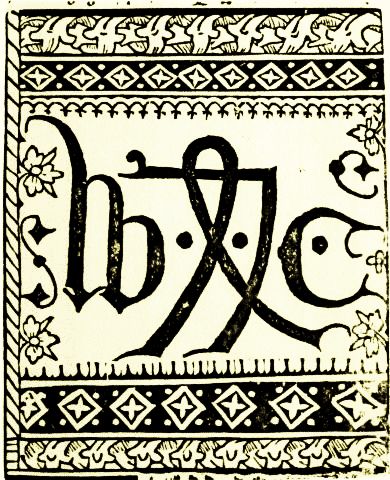
One point which gives this book a peculiar interest is, that in it
is found for the first time Caxton's well-known device. It consists
of his initials, divided by his merchant's mark, with a deep ornamental
border at top and bottom. Many ingenious writers have
attempted to read into this mark several items of information. The
merchant's mark they say is not a merchant's mark at all, but the
figures 74 significant of the time when he began to print. Two
small ornaments shaped like an S and C stand for Sancta Colonia,
where he learned the art of printing. The mark is, however, merely
an ordinary merchant's mark, which in some shape or another all
printers introduced into their devices, and the letters S C merely
ornamental flourishes.
Plate XVI
CAXTON'S DEVICE
(see page 70)]
Plate XVII
LEGENDA AD USUM SARUM
(see page 71)]
Another question has been raised as to whether this device was
cut in England or in France, but it has no resemblance to French
work, and is almost certainly a native production. As Mr. Blades
justly remarks: "Caxton, desirous of associating his press more
directly with this issue than by the colophon only, which many
people might overlook, probably designed his mark for the purpose
of attracting attention. He no doubt stamped this device on the
last blank page of the books after they had been received from
abroad and before putting them into circulation."
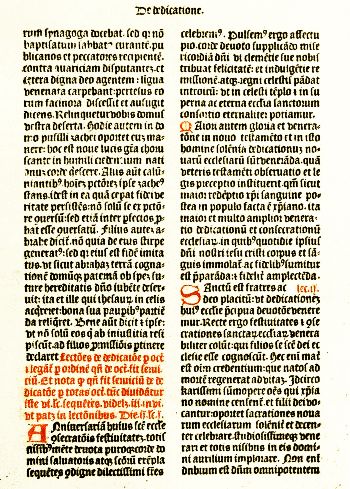
It seems not improbable that besides the Missal, Maynial printed
for Caxton another service-book, the Legenda according to the Salisbury
use. The existence of this book is known only from a few
odd leaves, for the most part rescued from old bindings and preserved
in different libraries, but it agrees in every respect typographically
with the Missal. The type is identical, the number of
lines and size of page the same, and everything points to the same
printer. Perhaps some day a copy with the colophon may be found
and our doubts on the subject set at rest.
About 1488 appeared a new issue of the Golden Legend. It is
not an entire reprint of the first, but only of certain parts of it.
It contains 448 leaves, being one less than the first issue, and of
these 256 are reprinted and 192 are of the original edition. It is
difficult to explain this reprinting, but it was probably caused by
the destruction of a large part of the stock of the original issue.
Caxton took the opportunity to make two improvements in the
reprint. He compressed the quires signed X and Y, which contained
the awkward number of nine leaves, into a single quire X of
eight leaves, and instead of having a blank leaf at the end of the
book he added the life of St. Erasmus. The parts of the book
which are of the second issue may be readily distinguished from
the first by the head-lines. In the first issue they are in the larger
type No. 3; in the second, in the smaller type No. 5.
On the 14th of July, 1489, Caxton finished printing a translation
of the work of Christine de Pisan, entitled the Fayts of Arms
and of Chivalry. This translation, as he tells us in the epilogue,
he undertook at the express desire of Henry VII., who himself lent
him the manuscript with the original French text. It is not
improbable that the identical manuscript which Caxton used is one
which is now in the British Museum, and which formed part of
the old Royal collection. It was written for John Talbot, Earl
of Shrewsbury, who died in 1453, and by whom it was presented
to Queen Margaret, and it agrees very closely in every way with
Caxton's English version.
Considerable doubt has been thrown on the authorship of Christine
de Pisan, but apparently unjustly. In the prologues of many
manuscripts, and in Caxton's edition, the writer apologizes as a
woman for treating of such warlike subjects, and appeals to the
goddess Minerva, saying, "I am, as thou wert, a woman Italian."
A complete copy should contain 144 leaves, the first being
blank, and over twenty copies are known. A perfect copy in the
Cambridge University Library contains a manuscript note showing
that it was bought in 1510 for three shillings and eight pence.
Plate XVIII
THE INDULGENCE OF 1489
(see page 73)]
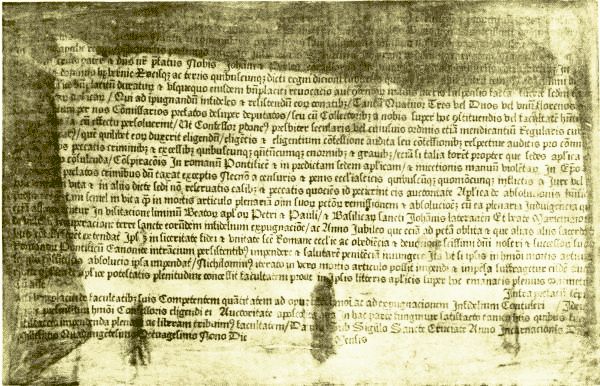
In 1489, also, Caxton issued two editions of an Indulgence of
John de Gigliis, or rather a license to confessors, giving them power
to grant indulgences to any Christian person in England or Ireland
who should contribute four, three, two, or even one gold florin to
assist a crusade against the Turks. These Indulgences are of
peculiar interest, as they were printed in a new type of Caxton's,
the smallest which he ever cut, and of which he never again
made use. The first to draw attention to them was Archdeacon
Cotton, who in the second part of his "Typographical Gazetteer"
mentions one which he had found in the library of Trinity College,
Dublin, and which he considered to be a product of the early
Oxford press. Henry Bradshaw, the University Librarian at Cambridge,
obtained a photograph of it, and at once conjectured from
the appearance of the type that it must have been printed by
Caxton. He immediately communicated this discovery to Blades,
who, however, refused to accept it as the work of Caxton's press
without some further and more convincing proof, and never even
alluded to either the type or Indulgence in later issues of his book.
The necessary proof was soon afterwards found, for Bradshaw discovered
at Holkham an edition of the Speculum Vitae Christi, printed
by Wynkyn de Worde in 1494, which had the side-notes printed in
this type, and as De Worde inherited all Caxton's materials, this
fount must have belonged to him.
The Statutes of the first, third, and fourth years of Henry VII.
may also be put down to the end of 1489, for the fourth year of
Henry VII. ended on August 21, 1489, and the Statutes would no
doubt be printed at once.
With the exceptions just given, none of Caxton's books printed
between May, 1487, and his death in 1491 bear any date, so that
although all may be approximately dated, their exact order cannot
be determined. One very common error in the method of arranging
Caxton's books may be pointed out here, which arises from the
method adopted by Blades. In his Life of Caxton the books are
arranged according to types, which would be an excellent plan if
the use of one type had been discontinued as soon as a newer one
was made. This, however, was not the case, for several were often
in use at one time, and thus Blades's system, though correct in
one way, is very misleading to a superficial reader. For instance,
Caxton started at Westminster with types Nos. 2 and 3, and both
are used in his first books, but Blades puts the books in type No.
3 after all those in type No. 2, and thus the Sarum Ordinale, certainly
one of the earliest books printed in England, comes thirty-sixth
on his list, and while one book with the printed date of 1481
is number 33, another with the printed date of 1480 is number 39.
It will thus be seen that Blades's arrangement was not a chronological
one, though most writers have made the mistake of thinking
so, and have followed it as such, as may be seen, for instance, in
the list appended to Caxton's life in the Dictionary of National
Biography, which blindly follows Blades's arrangement without any
reference to his system or mention of the types.
Two interesting romances were printed about 1489, the History
of the Four Sons of Aymon and the History of Blanchardyn and
Eglantine. The first was an extremely popular story both at home
and on the continent; indeed, it still circulates abroad in the form
of a pedler's chap-book, which perpetuates in a very mutilated
state the story of Renaud, Alard, Richard, and Guichard, with their
famous horse Bayard, on which all four rode at once. The early
English editions of this book almost suffered extermination. The
earliest edition of which a complete copy is known is that printed
at London by William Copland in 1554. The colophon of this book
speaks of an edition printed by Wynkyn de Worde in 1504, of
which no trace remains except perhaps some fragmentary leaves in
the Cambridge University Library; while of the edition printed by
Caxton only one copy, and that imperfect, is known. It is in folio,
and probably contained when complete 278 leaves. The unique
copy, wanting some leaves at the beginning, was obtained by Lord
Spencer from Triphook, the bookseller, and is now, with the rest of
the Spencer Library, in Manchester.
The History of Blanchardine and Eglantine is also known only
from an imperfect copy which was in the Spencer Library. It is
impossible to settle what the correct collation may have been, as the
book breaks off abruptly at leaf 102 and all the remainder is wanting.
As, however, the last chapter of the work is just beginning on
the last remaining page, it seems probable that only the last quire
is missing. On the fly-leaf is a curious note in Lord Spencer's
handwriting relating to its purchase. "This book belonged to Mr.
G. Mason; at whose sale it was bought by John, Duke of Roxburghe.
The Duke and I had agreed not to oppose one another at
the sale, but, after the book was bought, to toss up who should win
it; when I lost it. I bought it at the Roxburghe sale, on the 17th
of June, 1812 for £215 5s." At the earlier sale the Duke had
paid £21 for it. This book was undertaken at the request of
Margaret, Duchess of Somerset, who brought to Caxton a copy of
the French version, which she had long before purchased from him,
commanding him to translate it into English.
During the last two years of his life at least half of Caxton's
books were merely new editions of some of his earlier works, and
therefore hardly call for much detailed notice. The Dictes or Sayings
was reprinted for the third time, and the Directorium Sacerdotum,
Reynard the Fox, and the Mirror of the World for the second.
Of the Directorium but one copy is known, which is in the
Selden collection in the Bodleian. Blades remarks about it that it
is "still in the original parchment wrapper as issued from Caxton's
workshop." All evidence goes to prove that Caxton never made
use of parchment or vellum as a binding material, and in the case
of the present book it is quite clear, on close examination, that it
has been made up from two imperfect copies, and that the binding
is not earlier than the seventeenth century.
The Reynard the Fox is also unique, and buried in that almost
inaccessible collection, the Pepysian Library at Magdalene College,
Cambridge. It wants, unfortunately, the last two leaves, so that
the colophon, if it had one, is wanting.
The Mirror is a fairly common book, and is an exact reproduction,
though in different type, of the first edition. In the interval
between the printing of the two editions one wood-cut had been lost
or destroyed, so that the illustration for Chapter II., "Why God
Made and Created the World," instead of being the correct picture of
the Almighty with the globe in his hand (which Blades strangely
calls "the figure of a philosopher"), is the inappropriate cut of the
Transfiguration of Christ.
The Doctrinal of Sapience, a translation from a French version of
the Manipulus Curatorum, was doubtless printed in the latter half
of 1489, as the translation had been finished on the 7th of May of
that year. The book itself is not of much interest, though one copy
deserves special mention. It is preserved in the Royal Library at
Windsor Castle, to which it was presented by a Mr. Bryant. It is
printed throughout upon vellum, and contains three leaves found in
no other copy. In the text of the book, Chapter 64 is not printed,
but the following heading is inserted: "Of the neclygences of the
masse and of the remedyes I passe over for it apperteyneth to
prestes and not to laie men. C. Lxiiij."
In the Windsor copy this chapter is printed at the end of the
book on three extra leaves, and ends as follows: "This chapitre to
fore I durst not sette in the boke by cause it is not convenyent ne
aparteynyng that every laye man sholde knowe it."
Plate XIX
THE BOKE OF ENEYDOS
(see page 77)]
Plate XX
ARS MORIENDI
(see page 77)]
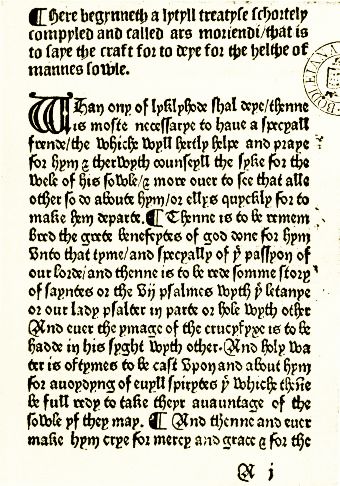
In June, 1490, Caxton finished the translation of two books,
The Art and Craft to know well to die and the Eneydos. The first
is not a translation of the complete book, but merely a small
abridgment, running to thirteen printed leaves in folio. Blades
mentions only three copies, and curiously enough makes no mention
of the peculiarly fine one which belonged to Lord Spencer,
though he made a careful examination of all the Caxtons at
Althorp.
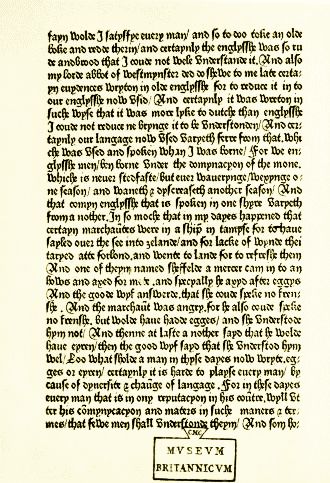
The Eneydos is not, as might be expected from the name,
a translation of Virgil's Aeneid, but is more in the nature of a
romance founded upon it. Caxton's version was translated from
"a lytyl booke in frenshe, named Eneydos," probably the work
called Le Livre des Eneydes, printed at Lyons in 1483 by G. le
Roy. The most interesting part of the work is the prologue, for
in it Caxton sets out at length his views and opinions on the
English language, its changes and dialects. He notes that it was
rapidly altering. "And certaynly our langage now used varyeth
ferre from that whiche was used and spoken when I was borne."
While some were anxious to preserve the old style, others were
equally wishful to introduce the new. "And thus bytwene playn
rude and curious I stande abasshed, but in my judgemente the
comyn termes that be dayli used ben lyghter to be understonde
than the olde and auncyent englysshe."
In order to make the style as good as possible, Caxton obtained
the assistance of John Skelton, lately created a "poeta laureatus"
at Oxford, who revised the work for the press.
A second edition of the Speculum Vitae Christi and the Liber
Festivalis belong probably to 1490. The latter book is not a
reprint of the first edition, but another version, and is reprinted
from the Oxford edition of 1486.
The last five books printed by Caxton are theological or liturgical.
The Ars Moriendi, a unique little quarto of eight leaves, was
discovered in a volume of early tracts in the Bodleian by Henry
Bradshaw, and is described by Blades in the second edition of his
book. He there states that no other edition in any language is
known; but it was certainly reprinted by Wynkyn de Worde. The
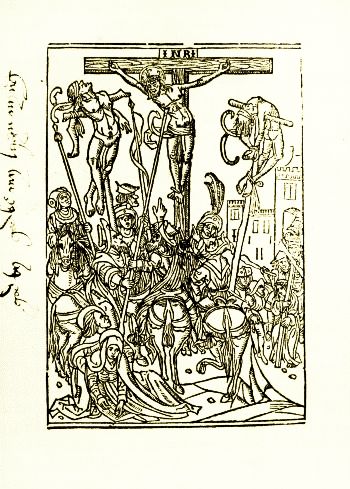
Fifteen Oes, a little quarto containing fifteen prayers, each commencing
with O, is known from a unique copy in the British
Museum. The book was no doubt intended as a supplement to
the Sarum Book of Hours, but no edition agreeing with it typographically
is known. It differs from all other of Caxton's books
in having wood-cut borders round each page of text. It also contains
a beautiful wood-cut of the Crucifixion, one of a series
intended for a Book of Hours. No doubt Caxton possessed the
set, and we find it later on in the hands of Wynkyn de Worde.
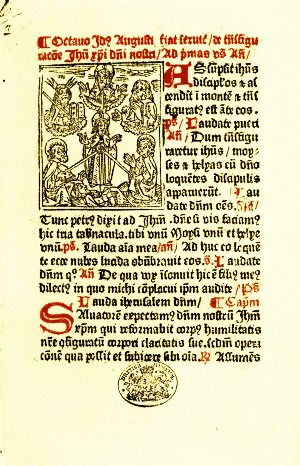
The Servitium de Transfiguratione Jesu Christi and the Commemoratio
lamentationis Beatae Mariae Virginis are special issues of
new services to be incorporated into the Breviary. The first contains
10 leaves, and is one of the very few books in which Caxton
introduced printing in red. The only copy known, bound up with
a unique tract printed by Pynson, and some foreign books, was
formerly in the Congregational Library, London, but was purchased
by the British Museum in 1862 for £200. The Commemoratio, a
quarto of 34 leaves, is known only from the unique copy, wanting
two leaves, presented to the University of Ghent by the learned
librarian, Dr. Ferdinand Vander Haeghen. This little book was
purchased for a trifle at a sale in Ghent and remained unrecognized
for many years, until M. Campbell of The Hague identified it as a
production of Caxton's press.
The book generally considered to have been the last printed by
Caxton consists of three treatises printed with separate signatures.
These are the Orologium Sapientiae, the Twelve profits of
Tribulation,
and the Rule of St. Benet.
Plate XXI
SERVITIUM DE TRANSFIGURATIONE JESU CHRISTI
(see page 78)]
Plate XXII
THE CRUCIFIXION
(see page 78)]
A writer in the British Museum speaking of these three books,
says that they "are in most of the known copies bound together,
and have been usually treated as a single volume under the title,
probably dating from the eighteenth century, A Book of Divers
Ghostly Matters. There is, however, no reason to suppose the connexion
to be due to any other cause than similarity of subject and
form, combined with nearly simultaneous publication."
No doubt this idea commends itself to the Museum authorities,
since they possess only one of the three portions, ruthlessly
abstracted by a thief some years ago from a perfect copy in a
private library, but unfortunately it is quite incorrect. The compiler
distinctly speaks of the books having been printed together,
and on account of their treating different subjects, his wish
that the compilation should be called the Book of Divers Ghostly
Matters.
When complete the book consisted of 148 leaves in quarto.
It contains, at the end of the second tract, a wood-cut which belongs
to the series specially cut for the Speculum Vitae Christi, though it
was not used in it.
The number of books actually printed by Caxton in England,
counting separate editions, is ninety-six, and with the three printed
at Bruges and the Missal makes altogether one hundred genuine
Caxtons. Blades describes ninety-nine books, but amongst these
he includes two which were certainly printed at Bruges after Caxton
had left, and three printed by Wynkyn de Worde after Caxton's
death, so that the number of genuine books which he describes is
ninety-four. The finest collection is now, as is right, in the British
Museum, which by judicious purchases in recent years has quite
outstripped any possible rival.
Five more books remain to be described, which although not
printed by Caxton himself, were printed with his types, and have
therefore often been ascribed by different writers to his press.
These are the Life of St. Katherine, the Chastising of God's
Children, the Treatise of Love, the Book of Courtesy, and the
third edition of the Golden Legend.
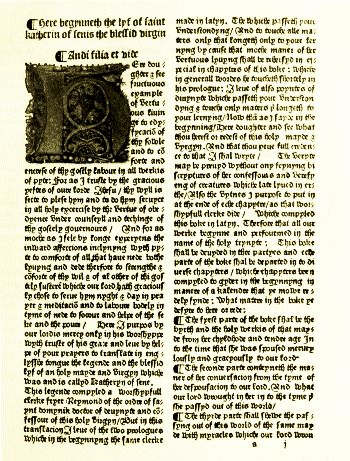
The first of these books is a small folio of 96 leaves, and contains,
besides the Life of St. Katherine of Siena, the Revelations of
St. Elizabeth of Hungary. The type used is a modification of
Caxton's type No. 4*, recast on a slightly smaller body and with
several new additions. Unlike Caxton's books which were made up
in quires of eight leaves, this has been made up in quires of six.
Another point which distinguishes it and the remaining books from
Caxton's work is the introduction of several remarkable capital
letters. These were obtained along with a fount of type and some
wood-cuts from Godfried van Os, apparently about the year 1490,
when he moved from Gouda to Copenhagen. The fount of type was
not used until 1496, and then only for one book.
The Chastising of God's Children, a folio of 48 leaves, printed in
Caxton's type No. 6, is notable as being the first book issued at the
Westminster press with a genuine title-page. It is printed in three
lines, and runs as follows: "The prouffytable boke for mannes
soule, And right comfortable to the body, and specyally in adversitee
and trybulacyon, whiche boke is called The Chastysing of goddes
Chyldern."
Why so obvious an improvement as a title-page never commended
itself to Caxton it is hard to say. It could not have been
for want of examples, for, introduced in Germany as far back as
the year 1468, they had at any rate during the last ten years of
Caxton's life been in common use abroad. Even the London
printer, William de Machlinia, had prefixed one to an edition of
the Treatise on the Pestilence, by Canutus, Bishop of Aarhaus,
which he printed about the year 1486. Of the Chastising, about
twelve copies are known.
Plate XXIII
THE LYF OF SAINT KATHERIN
(see page 80)]
The Treatise of Love is also a folio of 48 leaves, and agrees
typographically with the Chastising; indeed, the two were often
bound together, and are quoted by Dibdin as two parts of one
book. The introduction tells us that it was translated in 1493
from French into English by a person "unperfect in such work,"
but no mention is made either of the original author or the translator.
It was most probably printed also in 1493, for at the end of
that year De Worde introduced his own type and ceased the use
of Caxton's for the text of his books. At the end his first device
is found, consisting of Caxton's initials and mark, much reduced in
size, in black on a white ground, and apparently engraved on metal.
Blades quotes four copies of this book, all of them perfect, but does
not mention the copy in the University Library at Göttingen, and
there are probably at least two other copies in private libraries in
England.
Of the Book of Courtesy, which, like the earlier editions, was in
quarto, nothing now remains but two leaves printed on one side in
the Douce collection at the Bodleian. These two leaves, which have
been used at some time to line a binding, are waste proof of the
beginning and end of the second and last quire of the book, which
probably consisted, like the earlier edition, of 14 leaves. On the
last page, under the colophon, "Here endeth a lytyll treatyse called
the booke of curtesye or lytyll John. Enprynted atte westmoster,"
is De Worde's device printed upside down, the reason no doubt for
the rejection of the sheet.
The last book, the Golden Legend, is a small, thick folio of 436
leaves, with a number of illustrations which had been used in
previous editions. The colophon is reprinted verbatim from the
first edition, with the simple alteration of the date and regnal year.
It ends, as do those of the preceding editions, "By me William
Caxton," a circumstance which gives Blades the opportunity of
remarking on the carelessness of Wynkyn de Worde. "This is only
another instance," he writes, "of the utter disregard of accuracy by
Wynken de Worde, who has here reprinted Caxton's colophon, with
the date only altered, and thus caused what might have been a
puzzling anomaly."
This is, I think, hardly fair criticism. The book is the largest
which Caxton translated, and the words "By me William Caxton"
may apply quite as much to the translation as to the printing, and
it is no doubt that De Worde retained it as applying to the former.
As Caxton was but recently dead, and well known to every one, he
could not possibly have intended to signify that he was the printer.
One point in connexion with this book is curious. How was it
that this third edition was printed when the stock of the earlier
edition was not exhausted? Caxton, by his will, bequeathed a
certain number to the churchwardens of St. Margaret's, to be sold
for the benefit of the church, but these were not exhausted even by
1498, when a fourth edition was printed. In 1496 Caxton's son-in-law
received twenty, and a number still remained in possession
of his daughter.
A solution of this difficulty has occurred to me, which, though it
may be considered as improbable, is by no means impossible. This
is, that the "legends" mentioned in the various documents were not
copies of the Golden Legend at all, but were copies of the Legenda
of Salisbury use, which, as pointed out on page 71, were probably
printed for Caxton. Being a book printed specially for the use of
the clergy in church, such a bequest would be very suitable. In
1496 these "legends" were valued in the law-court at thirteen
shillings and four pence apiece, but the twelve copies sold by the
churchwardens of Westminster between 1496 and 1500 gradually
decreased in price from six shillings and eight pence in the first
year to five shillings in the last.
Plate XXIV
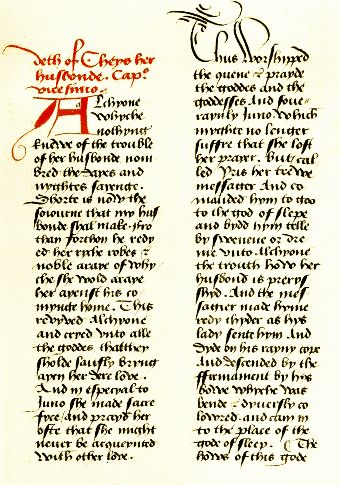
THE METAMORPHOSES OF OVID
(see page 83)]
Plate XXV
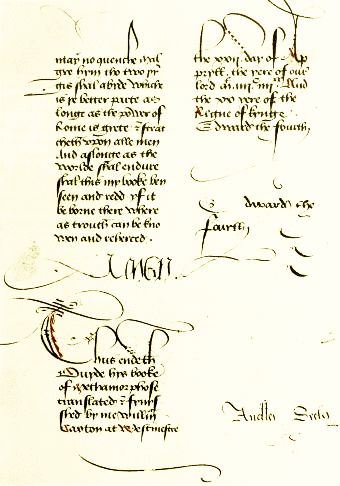
THE METAMORPHOSES OF OVID
(see page 83)]
Considering the number of Caxton's productions that are now
known to us only from mere fragments, it is probable that many
have disappeared altogether. Amongst these may be reckoned one
of considerable importance, the Metamorphoses of Ovid.
In the introduction to the Golden Legend Caxton writes: "Whan
I had parfourmed and accomplisshed dyvers werkys and hystoryes
translated out of frensshe into englysshe at the requeste of certeyn
lordes, ladyes and gentylmen, as thystorye of the recuyel of Troye,
the book of the chesse, the hystorye of Jason, the hystorye of the
myrrour of the world, the xv bookes of Metamorpheseos in whyche
been conteyned the fables of ouyde, and the hystorye of godefroy
of boloyn ... wyth other dyuers werkys and bookes, etc."
These, like all Caxton's translations, were done for the press, so
there is every reason for believing that the Ovid also was printed.
Fortunately we have further evidence, for in the Pepysian collection
at Magdalene College, Cambridge, is a manuscript on paper bought
by Pepys at an anonymous auction, which contains the last six
books of the Metamorphoses, with the following colophon: "Translated
and fynysshed by me William Caxton at Westmestre the xxij
day of Apryll, the yere of our lord. M. iiijc iiijxx. And the xx
yere of the Regne of kyng Edward the fourth."
Though the point can never be settled, it is not unlikely that
this manuscript has preserved for us a genuine specimen of Caxton's
own writing, not, of course, the ordinary current hand, but the
book hand used in copying manuscripts. At that time there was
still a prejudice amongst the nobles against printed books, so that
the presentation copy to the patron generally took the form of a
neatly written manuscript.
There is another interesting point to be noticed about this
manuscript. It contains the autograph of Lord Lumley, who
inherited the library formed by the Earls of Arundel. Now, William
Fitzalan, Earl of Arundel, was one of Caxton's patrons, so that it
seems extremely probable that this manuscript was presented to
him by Caxton himself.
Another translation of which no trace remains is mentioned in
the prologue to the Four Sons of Aymon. The only known copy of
Caxton's edition is imperfect, and wants the earlier part containing
this prologue, but it occurs in full in the later edition printed by
William Copland in 1554, from which the following quotation is
taken: "Therefore late at the request and commandment of the
right noble and virtuous Earl, John Earl of Oxford, my good singular
and especial lord, I reduced and translated out of French into
our maternal and English tongue the life of one of his predecessors
named Robert Earl of Oxford tofore said with divers and many
great miracles, which God showed for him, as well in his life as
after his death, as it is showed all along in his said book." What
this romance may have been is difficult to say, but it probably
refers to the favourite of Richard the Second, the Duke of Ireland,
who was killed in France while engaged in a boar-hunt.
Caxton, like all other printers at that time, numbered bookbinders
amongst his workmen and issued his books ready bound.
Every genuine binding from his workshop is of brown calf, ornamented
with dies. His general method of covering the sides of his
bindings was to make a large centre panel contained by a framework
of dies. This panel was divided into lozenge-shaped compartments
by diagonal lines running both ways from the frame, and in
each of these compartments a die was stamped. The die most
commonly found has a winged dragon or monster engraved upon it.
The framework was often composed of repetitions of a triangular
die pointing alternately right and left, also containing a dragon.
This die is interesting, not only because the use of a triangular die
was uncommon, but because it was an exact copy of one used by a
London binder of the twelfth century.


