Before entering upon any system of remark or comment on the Prophetic
Books, we may set down in as few and distinct words as possible the
reasons which make this a thing seriously worth doing; nay, even requisite
to be done, if we would know rather the actual facts of the man’s nature
than the circumstances and accidents of his life. Now, first of all, we
are to recollect that Blake himself regarded these works as his greatest,
and as containing the sum of his achieved ambitions and fulfilled desires:
as in effect inspired matter, of absolute imaginative truth and eternal
import. We shall not again pause to rebut the familiar cry of response, to
the effect that he was mad and not accountable for the uttermost madness
of error. It must be enough to reply here that he was by no means mad, in
any sense that would authorise us in rejecting his own judgment of his own
aims and powers on a plea which would be held insufficient in another
man’s case. Let all readers and all critics get rid of that notion for
good—clear their minds of it utterly and with all haste; let them know
and remember, having once been told it, that in these strangest of all
written books there is purpose as well as power, meaning as well as
mystery. Doubtless, nothing quite like them was ever pitched out headlong
into the world as they were. The confusion, the clamour, the jar of words
that half suffice and thoughts that half exist—all these and other more
absolutely offensive qualities—audacity, monotony, bombast, obscure play
of licence and tortuous growth of fancy—cannot quench or even wholly
conceal the living purport and the imperishable beauty which are here
latent.
And secondly we are to recollect this; that these books are not each a set
of designs with a text made by order to match, but are each a poem
composed for its own sake and with its own aim, having illustrations
arranged by way of frame or appended by way of ornament. On all grounds,
therefore, and for all serious purpose, such notices as some of those
given in this biography are actually worse than worthless. Better have
done nothing than have done this and no more. All the criticism included
as to the illustrative parts merely, is final and faultless, nothing
missed and nothing wrong; this could not have been otherwise, the work
having fallen under hands and eyes of practical taste and trained to
actual knowledge, and the assertions being therefore issued by authority.
So much otherwise has it fared with the books themselves, that (we are
compelled in this case to say it) the clothes are all right and the body
is all wrong. Passing from some phrase of high and accurate eulogy to the
raw ragged extracts here torn away and held up with the unhealed scars of
mutilation fresh and red upon them, what is any human student to think of
the poet or his praisers? what, of the assertion of his vindicated sanity
with such appalling counterproof thrust under one’s eyes? In a word, it
must be said of these notices of Blake’s prophetic books[48] (except
perhaps that insufficient but painstaking and well-meant chapter on the
Marriage of Heaven and Hell) that what has been done should not have
been done, and what should have been done has not been done.
Not that the thing was easy to do. If any one would realize to himself for
ever a material notion of chaos, let him take a blind header into the
midst of the whirling foam and rolling weed of this sea of words. Indeed
the sound and savour of these prophecies constantly recall some such idea
or some such memory. This poetry has the huge various monotonies, the
fervent and fluent colours, the vast limits, the fresh sonorous strength,
the certain confusion and tumultuous law, the sense of windy and weltering
space, the intense refraction of shadow or light, the crowded life and
inanimate intricacy, the patience and the passion of the sea. By no manner
of argument or analysis will one be made able to look back or forward with
pure confidence and comprehension. Only there are laws, strange as it must
sound, by which the work is done and against which it never sins. The
biographer once attempts to settle the matter by asserting that Blake was
given to contradict himself, by mere impulse if not by brute instinct, to
such an extent that consistency is in no sense to be sought for or
believed in throughout these works of his: and quotes, by way of ratifying
this quite false notion, a noble sentence from the Proverbs of Hell,
aimed by Blake with all his force against that obstinate adherence to one
external opinion which closes and hardens the spirit against all further
message from the new-grown feelings or inspiration from the altering
circumstances of a man. Never was there an error more grave or more
complete than this. The expression shifts perpetually, the types blunder
into new forms, the meaning tumbles into new types; the purpose remains,
and the faith keeps its hold.
There are certain errors and eccentricities of manner and matter alike
common to nearly all these books, and distinctly referable to the
character and training of the man. Not educated in any regular or rational
way, and by nature of an eagerly susceptible and intensely adhesive mind,
in which the lyrical faculty had gained and kept a preponderance over all
others visible in every scrap of his work, he had saturated his thoughts
and kindled his senses with a passionate study of the forms of the Bible
as translated into English, till his fancy caught a feverish contagion and
his ear derived a delirious excitement from the mere sound and shape of
the written words and verses. Hence the quaint and fervent imitation of
style, the reproduction of peculiarities which to most men are meaningless
when divested of their old sense or invested with a new. Hence the
bewildering catalogues, genealogies, and divisions which (especially in
such later books as the Jerusalem) seem at first invented only to strike
any miserable reader with furious or lachrymose lunacy. Hence, though
heaven knows by no fault of the originals, the insane cosmogony, blatant
mythology, and sonorous aberration of thoughts and theories. Hence also
much of the special force and supreme occasional loveliness or grandeur in
expression. Conceive a man incomparably gifted as to the spiritual side of
art, prone beyond all measure to the lyrical form of work, incredibly
contemptuous of all things and people dissimilar to himself, of an
intensely sensitive imagination and intolerant habit of faith, with a
passionate power of peculiar belief, taking with all his might of mental
nerve and strain of excitable spirit to a perusal and reperusal of such
books as Job and Ezekiel. Observe too that his tone of mind was as far
from being critical as from being orthodox. Thus his ecstacy of study was
neither on the one side tempered and watered down by faith in established
forms and external creeds, nor on the other side modified and directed by
analytic judgment and the lust of facts. To Blake either form of mind was
alike hateful. Like the Moses of Rabbinical tradition, he was “drunken
with the kisses of the lips of God.” Rational deism and clerical religion
were to him two equally abhorrent incarnations of the same evil spirit,
appearing now as negation and now as restriction. He wanted supremacy of
freedom with intensity of faith. Hence he was properly neither Christian
nor infidel: he was emphatically a heretic. Such men, according to the
temper of the times, are burnt as demoniacs or pitied as lunatics. He
believed in redemption by Christ, and in the incarnation of Satan as
Jehovah. He believed that by self-sacrifice the soul should attain freedom
and victorious deliverance from bodily bondage and sexual servitude; and
also that the extremest fullness of indulgence in such desire and such
delight as the senses can aim at or attain was absolutely good, eternally
just, and universally requisite. These opinions, and stranger than these,
he put forth in the cloudiest style, the wilfullest humour, and the
stormiest excitement. No wonder the world let his books drift without
caring to inquire what gold or jewels might be washed up as waifs from the
dregs of churned foam and subsiding surf. He was the very man for fire and
faggot; a mediæval inquisitor would have had no more doubt about him than
a materialist or “theophilanthropist” of his own day or of ours.
A wish is expressed in the Life that we could accompany the old man who
appears entering an open door, star in hand, at the beginning of the
Jerusalem, and thread by his light those infinite dark passages and
labyrinthine catacombs of invention or thought. In default of that
desirable possibility, let us make such way as we can for ourselves into
this submarine world, along its slippery and unpaven ways, under its roof
of hollow sound and tumbling storm.
“We shall see, while above us
The waves roar and whirl,
A ceiling of amber,
A pavement of pearl.”
At the entrance of the labyrinth we are met by huge mythologic figures,
created of fire and cloud. Titans of monstrous form and yet more monstrous
name obstruct the ways; sickness or sleep never formed such savage
abstractions, such fierce vanities of vision as these: office and speech
they seem at first to have none: but to strike or clutch at the void of
air with feeble fingers, to babble with vast lax lips a dialect barren of
all but noise, loud and loose as the wind. Slowly they grow into something
of shape, assume some foggy feature and indefinite colour: word by word
the fluctuating noise condenses into music, the floating music divides
into audible notes and scales. The sound which at first was as the mere
collision of cloud with cloud is now the recognizable voice of god or
demon. Chaos is cloven into separate elements; air divides from water, and
earth releases fire. Upon each of these the prophet, as it were, lays
hand, compelling the thing into shape and speech, constraining the
abstract to do service as a man might. These and such as these make up the
personal staff or executive body of his prophecies. But it would be waste
of time to conjecture how or why he came to inflict upon them such
incredible names. These hapless energies and agencies are not simply cast
into the house of allegoric bondage, and set to make bricks without straw,
to construct symbols without reason; but find themselves baptized with
muddy water and fitful fire, by names inconceivable, into a church full of
storm and vapour; regenerated with a vengeance, but disembodied and
disfigured in their resurrection. Space fell into sleep, and awoke as
Enitharmon: Time suffered eclipse, and came forth as Los. The Christ or
Prometheus of this faith is Orc or Fuzon; Urizen takes the place of
“Jehovah, Jove, or Lord.” Hardly in such chaotic sounds can one discern
the slightest element of reason gone mad, the narrowest channel of
derivation run dry. In this last word, one of incessant recurrence, there
seems to flicker a thin reminiscence of such names as Uranus, Uriel, and
perhaps Urien; for the deity has a diabolic savour in him, and Blake was
not incapable of mixing the Hellenic, the Miltonic, and the Celtic
mythologies into one drugged and adulterated compound. He had read much
and blindly; he had no leaning to verbal accuracy, and never acquired any
faculty of comparison. Any sound that in the dimmest way suggested to him
a notion of hell or heaven, of passion or power, was significant enough to
adopt and register. Commentary was impossible to him: if his work could
not be apprehended or enjoyed by an instinct of inspiration like his own,
it was lost labour to dissect or expound; and here, if ever, translation
would have been treason. He took the visions as they came; he let the
words lie as they fell. These barbarous and blundering names are not
always without a certain kind of melody and an uncertain sort of meaning.
Such as they are, they must be endured; or the whole affair must be tossed
aside and thrown up. Over these clamorous kingdoms of speech and dream
some few ruling forces of supreme discord preside: and chiefly the lord of
the world of man; Urizen, God of cloud and star, “Father of jealousy,”
clothed with a splendour of shadow, strong and sad and cruel; his planet
faintly glimmers and slowly revolves, a horror in heaven; the night is a
part of his thought, rain and wind are in the passage of his feet; sorrow
is in all his works; he is the maker of mortal things, of the elements
and sexes; in him are incarnate that jealousy which the Hebrews
acknowledged and that envy which the Greeks recognized in the divine
nature; in his worship faith remains one with fear. Star and cloud, the
types of mystery and distance, of cold alienation and heavenly jealousy,
belong of right to the God who grudges and forbids: even as the spirit of
revolt is made manifest in fiery incarnation—pure prolific fire, “the
cold loins of Urizen dividing.” These two symbols of “cruel fear” or
“starry jealousy” in the divine tyrant, of ardent love or creative lust in
the rebellious saviour of man, pervade the mystical writings of Blake.
Orc, the man-child, with hair and flesh like fire, son of Space and Time,
a terror and a wonder from the hour of his birth, containing within
himself the likeness of all passions and appetites of men, is cast out
from before the face of heaven; and falling upon earth, a stronger Vulcan
or Satan, fills with his fire the narrowed foreheads and the darkened eyes
of all that dwell thereon; imprisoned often and fed from vessels of iron
with barren food and bitter drink,[49] a wanderer or a captive upon earth,
he shall rise again when his fire has spread through all lands to inflame
and to infect with a strong contagion the spirit and the sense of man, and
shall prevail against the law and the commandments of his enemy. This
endless myth of oppression and redemption, of revelation and revolt, runs
through many forms and spills itself by strange straits and byways among
the sands and shallows of prophetic speech. But in these books there is
not the substantial coherence of form and reasonable unity of principle
which bring within scope of apprehension even the wildest myths grown out
of unconscious idealism and impulsive tradition. A single man’s work,
however exclusively he may look to inspiration for motive and material,
must always want the breadth and variety of meaning, the supple beauty of
symbol, the infectious intensity of satisfied belief, which grow out of
creeds and fables native to the spirit of a nation, yet peculiar to no man
or sect, common yet sacred, not invented or constructed, but found growing
and kept fresh with faith. But for all the dimness and violence of
expression which pervert and darken the mythology of these attempts at
gospel, they have qualities great enough to be worth finding out. Only let
none conceive that each separate figure in the swarming and noisy life of
this populous dæmonic creation has individual meaning and vitality. Blake
was often taken off his feet by the strong currents of fancy, and
indulged, like a child during its first humour of invention, in wild
byplay and erratic excesses of simple sound; often lost his way in a maze
of wind-music, and transcribed as it were with eyes closed and open ears
the notes caught by chance as they drifted across the dream of his
subdued senses. Alternating between lyrical invention and gigantic
allegory, it is hard to catch and hold him down to any form or plan. At
one time we have mere music, chains of ringing names, scattered jewels of
sound without a thread, tortuous network of harmonies without a clue; and
again we have passages, not always unworthy of an Æschylean chorus, full
of fate and fear; words that are strained wellnigh in sunder by strong
significance and earnest passion; words that deal greatly with great
things, that strike deep and hold fast; each inclusive of some fierce
apocalypse or suggestive of some obscure evangel. Now the matter in hand
is touched with something of an epic style; the narrative and characters
lose half their hidden sense, and the reciter passes from the prophetic
tripod to the seat of a common singer; mere names, perhaps not even
musical to other ears than his, allure and divert him; he plays with
stately cadences, and lets the wind of swift or slow declamation steer him
whither it will. Now again he falls with renewed might of will to his
purpose; and his grand lyrical gift becomes an instrument not sonorous
merely but vocal and articulate. To readers who can but once take their
stand for a minute on the writer’s footing, look for a little with his
eyes and listen with his ears, even the more incoherent cadences will
become not undelightful; something of his pleasure, with something of his
perception, will pass into them; and understanding once the main gist of
the whole fitful and high-strung tune, they will tolerate, where they
cannot enjoy, the strange diversities and discords which intervene.
Among many notable eccentricities we have touched upon but two as yet; the
huge windy mythology of elemental dæmons, and the capricious passion for
catalogues of random names, which make obscure and hideous so much of
these books. Akin to these is the habit of seeing or assuming in things
inanimate or in the several limbs and divisions of one thing, separate
forms of active and symbolic life. This, like many other of Blake’s
habits, grows and swells enormously by progressive indulgence. At first,
as in Thel, clouds and flowers, clods and creeping things, are given
speech and sense; the degree of symbolism is already excessive, owing to
the strength of expression and directness of dramatic vision peculiar to
Blake; but in later books everything is given a soul to feel and a tongue
to speak; the very members of the body become spirits, each a type of some
spiritual state. Again, in the prophecies of Europe and America, there
is more fable and less allegory, more overflow of lyrical invention, more
of the divine babble which sometimes takes the place of earthly speech or
sense, more vague emotion with less of reducible and amenable quality than
in almost any of these poems. In others, a habit of mapping out and
marking down the lines of his chaotic and Titanic scenery has added to
Blake’s other singularities of manner this above all, that side by side
with the jumbled worlds of Tharmas and Urthona, the whirling skies and
plunging planets of Ololon and Beulah, the breathless student of prophecy
encounters places and names absurdly familiar; London streets and suburbs
make up part of the mystic antediluvian world; Fulham and Lambeth, Kentish
Town and Poland Street, cross the courses and break the metres of the
stars. This apparent madness of final absurdity has also its root in the
deepest and soundest part of Blake’s mind and faith. In the meanest place
as in the meanest man he beheld the hidden spirit and significance of
which the flesh or the building is but a type. If continents have a soul,
shall suburbs or lanes have less? where life is, shall not the spirit of
life be there also? Europe and America are vital and significant; we mean
by all names somewhat more than we know of; for where there is anything
visible or conceivable, there is also some invisible and inconceivable
thing. This is but the rough grotesque result of the tenet that matter
apart from spirit is non-existent. Launched once upon that theory, Blake
never thought it worth while to shorten sail or tack about for fear of any
rock or shoal. It is inadequate and even inaccurate to say that he
allotted to each place as to each world a presiding dæmon or deity. He
averred implicitly or directly, that each had a soul or spirit, the
quintessence of its natural life, capable of change but not of death; and
that of this soul the visible externals, though a native and actual part,
were only a part, inseparable as yet but incomplete. Thus whenever, to his
misfortune and ours, he stumbles upon the proper names of terrene men and
things, he uses these names as signifying not the sensual form or body but
the spirit which he supposed to animate these, to speak in them and work
through them. In America the names of liberators, in Jerusalem the
names of provinces, have no separate local or mundane sense whatever;
throughout the prophecies “Albion” is the mythical and typical fatherland
of human life, much what the East might seem to other men: and by way of
making this type actual and prominent enough, Blake seizes upon all
possible divisions of the modern visible England in town or country, and
turns them in his loose symbolic way into minor powers and serving
spirits. That he was wholly unconscious of the intolerably laughable
effect we need not believe. He had all the delight in laying snares and
giving offence, which is proper to his kind. He had all the confidence in
his own power and right to do such things and to get over the doing of
them which accompanies in such men the subtle humour of scandalizing. And
unfortunately he had not by training, perhaps not by nature, the
conscience which would have reminded him that whether or not an artist may
allowably play with all other things in heaven and earth, one thing he
must certainly not play with; the material forms of art: that levity and
violence are here prohibited under grave penalties. Allowing however for
this, we may notice that in the wildest passages of these books Blake
merely carries into strange places or throws into strange shapes such
final theories as in the dialect of calmer and smaller men have been
accounted not unreasonable.
Further preface or help, however loudly the subject might seem to call for
it, we have not in this place to give; and indeed more words would
possibly not bring with them more light. What was explicable we have
endeavoured to explain; to suggest where a hint was profitable; to prepare
where preparation was feasible: but many voices might be heard crying in
this wilderness before the paths were made straight. The pursuivant would
grow hoarse and the outrider saddle-sick long before the great man’s
advent; and for these offices we have no further taste or ability. Those
who will may now, with what furtherance they have here, follow us through
some brief revision of each book in its order.[50]
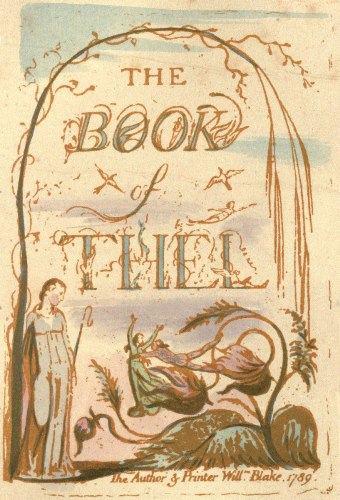
The Book of Thel, first in date and simplest in tone of the prophecies,
requires less comment than the others. This poem is as the one sister,
feeblest if also fairest, among that Titanic brotherhood of books. It has
the clearness and sweetness of spring-water; they have in their lips the
speech, in their limbs the pulses of the sea. In this book, as in the
illustrations to Blair, the poet attempts to comfort life through death;
to assuage by spiritual hope the fleshly fear of man. The “shining woman,”
youngest and mortal daughter of the angels of God, leaving her sisters to
tend the flocks and close the folds of the stars, fills herself with the
images of perishable things; she feeds upon the sorrow that comes of
beauty, the heathen weariness of heart, that is sick of life because death
will come, seeing how “our little life is rounded with a sleep.” Let all
these things go, for they are mortal; but if I die with the flowers, let
me also die as they die. This is the end of all things, to sleep; but let
me fall asleep softly, not without the lulling sound of God’s voice
audible in my ears. The flower makes answer; does God not care for the
least of these? they shall not die, they shall all be changed. She answers
again; the flower is serviceable to God’s creatures, giving food to the
pasturing lambs and flavour to the honey of the gleaning bees: but her
beauty is barren as a lighted cloud’s; wherefore should she live? She is
bidden to seek counsel then of the cloud; and of him she asks the secret
of his glad ephemeral life; for she, not less ephemeral, has no such joy
of her life. Here again she is shown that life and permanence are twain;
the cloud has drunk at the springs of the sun, whence all hours are
renewed; and shall not die though he pass away; for his falling drops find
out the living flowers, and are wedded to the dew in these; and they are
made one before the sun, and kept alive to feed other flowers: and all
these are as women and men, having souls and senses, capable of love and
prayer. But she answers, that of her fair body no cloud or bird gets food,
but the worm only; why should anything survive of her who has been helpful
to nothing? The worm therefore is called to witness; and appears in an
infant’s likeness, inarticulate, naked, weeping; but upon it too the
divine earth has mercy, and the clay finds a voice to speak for it; this
likewise is not the sad unprofitable thing it seems; for the very earth,
baser and liker death than the least thing bred of it, is the bride of
God, a fruitful mother of all his children. “We live not for ourselves;”
else indeed were earth and the worm of earth things mournful and
fruitless. The secret of creation is sacrifice; the very act of growth is
a sacrament: and through this eternal generation in which one life is
given for another and shed into new veins of existence, each thing is
redeemed from perpetual death by perpetual change. This secret once made
evident to Thel, her fear is in a measure removed; for the very deathbed
of earth in which she must lie is now revealed as a mother’s bosom, warm
and giving warmth, living and prodigal of life. That God would care for
the least thing he made she knew always; but now knows also that in the
least thing there is something of God’s life infused, which makes it
substantially imperishable. So far one may say the poem is as fluent and
translucent as the merest sermon on faith, hope, and charity could well
be: and not less inoffensive. The earth, who has overheard and gathered up
all the flitting sighs of this unwedded Eve, now unveils to her the
mysteries of the body, bred in the grave whither all sorrows tend and
whence all tears arise. The forces of material nature give way before her;
passing to her own grave, she hears thence a voice lamenting over the
nature of all the senses, their sweet perilous gifts and strange limits,
and all their offices which fill and discolour the days of mortal life. To
this, the question lying at the root of life and under the shadow of
death, nothing makes answer; as though no word spoken upon earth or under
could explain the marvel of the flesh, the infinite beauty and delight of
it, the infinite subtlety and danger; its prodigalities and powers, its
wide capacity and utter weakness. Set face to face with this bodily
mystery, and affrighted at the sudden nakedness of natural life, the soul
recoils; and Thel regains the common air and quiet light of earth. Such,
cut short and melted down, is the purport of this poem: a prophecy as
literally as any other of Blake’s, being professedly an inspired
exposition of material things; for none of course pretend to be prophecies
in the inaccurate and vulgar sense of prediction. It is full of small
sweet details, bright and soft as summer grass, regular to monotony in its
cadence until the last division, where the tone suddenly strengthens and
deepens. There and not for the last time the strong imagination of Blake
wrestles with the great questions of physical life, constraining the mute
rebellious flesh as in a fervent and strenuous grasp of spirit, if
perchance it will yield up the heart of its mystery. Throughout the book
his extreme and feminine tenderness of faith speaks more softly and shows
a simpler face than elsewhere. One might almost say that Thel had
overmuch of this gracious and delicate beauty; that the intense faith and
compassion which thus animate all matter give a touch of almost dubious
and effeminate sweetness to the thought and style. Not however justly; for
there is a firm body of significance in the poem, and the soft light
leaves in which the fruit lies wrapped are solid as well as sweet.
It is well worth while to compare any average copy of Thel with the
smaller volume of designs now in the British Museum, which reproduces
among others the main illustrations of this book. The clear, sweet, pallid
colour of the fainter version will then serve to throw into full effect
the splendour of the more finished work. Especially in the separate copy
of the frontispiece, the sovereignty of colour and glorious grace of
workmanship double and treble its original beauty; give new light and new
charm to the fervent heaven, to the bowing figure of the girl, to the
broad cloven blossoms whose flickering and sundering petals release the
bright leaping forms of loving spirits, raindrop and dewdrop wedded before
the sun; and again, where Thel sees the worm in likeness of a new-born
child, the colours of tree and leaf and sky are of a more excellent and
lordly beauty than in any copy known to me of the book itself; though in
all good copies these designs appear full of great and gracious qualities.
Of the book of designs here referred to more must not now be said; not
even of the twelfth plate where the mother-goddess and her fiery
first-born child exult with flying wingless limbs through splendid spaces
of the infinite morning, coloured here like opening flowers and there like
climbing fire, where all the light and all the wind of heaven seem to
unite in fierce gladness as of a supreme embrace and exultation; for to
these better praise than ours has been already given at p. 374 of the
Life, in words of choice and incomparable sufficiency, not less bright
and sweet, significant and subtle, than the most tender or perfect of the
designs described.
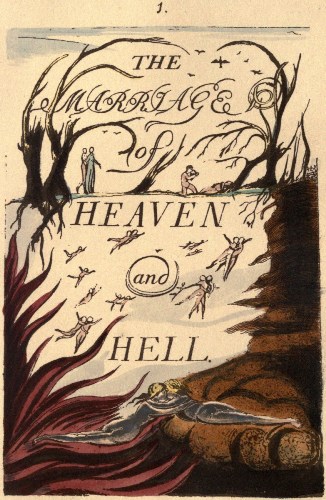
In 1790 Blake produced the greatest of all his books; a work indeed which
we rank as about the greatest produced by the eighteenth century in the
line of high poetry and spiritual speculation. The Marriage of Heaven and
Hell gives us the high-water mark of his intellect. None of his lyrical
writings show the same sustained strength and radiance of mind; none of
his other works in verse or prose give more than a hint here and a trace
there of the same harmonious and humorous power, of the same choice of
eloquent words, the same noble command and liberal music of thought; small
things he could often do perfectly, and great things often
imperfectly; here for once he has written a book as perfect as his most
faultless song, as great as his most imperfect rhapsody. His fire of
spirit fills it from end to end; but never deforms the body, never singes
the surface of the work, as too often in the still noble books of his
later life. Across the flicker of flame, under the roll and roar of water,
which seem to flash and to resound throughout the poem, a stately music,
shrill now as laughter and now again sonorous as a psalm, is audible
through shifting notes and fitful metres of sound. The book swarms with
heresies and eccentricities; every sentence bristles with some paradox,
every page seethes with blind foam and surf of stormy doctrine; the humour
is of that fierce grave sort, whose cool insanity of manner is more
horrible and more obscure to the Philistine than any sharp edge of
burlesque or glitter of irony; it is huge, swift, inexplicable; hardly
laughable through its enormity of laughter, hardly significant through its
condensation of meaning; but as true and thoughtful as the greatest
humourist’s. The variety and audacity of thoughts and words are
incomparable: not less so their fervour and beauty. “No bird soars too
high if he soars with his own wings.” This proverb might serve as motto to
the book: it is one of many “Proverbs of Hell,” as forcible and as
finished.
It was part of Blake’s humour to challenge misconception, conscious as he
was of power to grapple with it: to blow dust in their eyes who were
already sandblind, to strew thorns under their feet who were already lame.
Those whom the book in its present shape would perplex and repel he knew
it would not in any form have attracted; and how such readers may fare is
no concern of such writers; nor in effect need it be. Aware that he must
at best offend a little, he did not fear to offend much. To measure the
exact space of safety, to lay down the precise limits of offence, was an
office neither to his taste nor within his power. Those who try to clip or
melt themselves down to the standard of current feeling, to sauce and
spice their natural fruits of mind with such condiments as may take the
palate of common opinion, deserve to disgust themselves and others alike.
It is hopeless to reckon how far the timid, the perverse, or the malignant
irrelevance of human remarks will go; to set bounds to the incompetence or
devise landmarks for the imbecility of men. Blake’s way was not the worst;
to indulge his impulse to the full and write what fell to his hand, making
sure at least of his own genius and natural instinct. In this his greatest
book he has at once given himself freer play and set himself to harder
labour than elsewhere: the two secrets of great work. Passion and humour
are mixed in his writing like mist and light; whom the light may scorch or
the mist confuse it is not his part to consider.
In the prologue Blake puts forth, not without grandeur if also with an
admixture of rant and wind, a chief tenet of his moral creed. Once the
ways of good and evil were clear, not yet confused by laws and religions;
then humility and benevolence, the endurance of peril and the fruitful
labour of love, were the just man’s proper apanage; behind his feet the
desert blossomed; by his toil and danger, by his sweat and blood, the
desolate places were made rich and the dead bones clothed with flesh as
the flesh of Adam. Now the hypocrite has come to reap the fruits, to
divide and gather and eat; to drive forth the just man and to dwell in the
paths which he found perilous and barren, but left safe and fertile.
Churches have cast out apostles; creeds have rooted out faith. Henceforth
anger and loneliness, the divine indignation of spiritual exile, the salt
bread of scorn and the bitter wine of wrath, are the portion of the just
man; he walks with lions in the waste places, not worth making fertile
that others may reap and feed. “Rintrah,” the spirit presiding over this
period, is a spirit of fire and storm; darkness and famine, wrath and
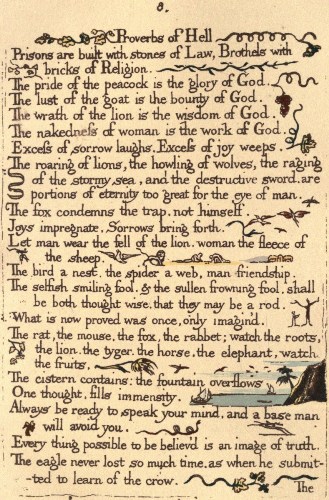
want, divide the kingdoms of the world. “Prisons are built with stones of
Law; brothels with bricks of Religion.” “As the caterpillar chooses the
fairest leaves to lay her eggs on, so the priest lays his curse on the
fairest joys.” In a third proverb the view given of prayer is no less
heretical; “As the plough follows words, so God rewards prayers.” This was
but the outcome or corollary of his main doctrine; as what we have called
his “evangel of bodily liberty” was but the fruit of his belief in the
identity of body with soul. The fear which restrains and the faith which
refuses were things as ignoble as the hypocrisy which assumes or the
humility which resigns. Veils and chains must be lifted and broken. “Folly
is the cloak of knavery; shame is pride’s cloak.” Again; “He who desires
but acts not breeds pestilence.” “Sooner murder an infant in its cradle
than nurse unacted desires.” The doctrine of freedom could hardly run
further or faster. Translated into rough practice, and planted in a less
pure soil than that of the writer’s mind, this philosophy might bring
forth a strange harvest. Together with such width of moral pantheism as
will hardly admit a “tender curb,” leave “a little curtain of flesh on the
bed of our desire,” there is a vehemence of faith in divine wrath, in the
excellence of righteous anger and revenge, to be outdone by no prophet or
Puritan. “A dead body revenges not injuries.” Sincerity and plain dealing
at least are virtues not to be thrown over; Blake indeed could not
conceive an impulse to mendacity, a tortuous habit of mind, a soul born
crooked. This one quality of falsehood remains damnable in his sight, to
be consumed with all that comes of it. In man or beast or any other part
of God he found no native taint or birthmark of this. Upon all else the
divine breath and the divine hand are sensible and visible.
“The pride of the peacock is the glory of God;
The lust of the goat is the bounty of God;
The wrath of the lion is the wisdom of God;
The nakedness of woman is the work of God.”
All form and all instinct is sacred; but no invention or device of man’s.
All crafts and creeds of theirs are “the serpent’s meat:” and that a man
should be born cruel and false is barely imaginable. “If the lion was
advised by the fox he would be cunning.” Such counsel was always wasted on
the high clear spirit and stainless intellect of Blake.
We have given some of the most subtle and venturous “Proverbs of
Hell”—samples of their depth of doctrine and plainness of speech. But
even here Blake rarely indulges in such excess and exposure. There are
jewels in this treasure-house neither set so roughly nor so sharply
cut as these; they may be seen in the Life, taken out and reset, so
as to offend no customer. And these sayings must themselves be read by the
light of Blake’s life and weighed against others of his words not less
weighty than they. Apology shall now and always remain as far from us as
it was in life from Blake himself; to excuse and to explain are different
offices. To plead for his acquittal on the base and foolish ground that he
meant no harm, knew not what he did, had no design or desire to afflict or
offend, is no office for his counsel; who must strive at least to speak
not less frankly and clearly than did Blake when he could speak in his own
cause. Neither have we to approve or condemn; but only to endeavour that
we may see the right and deliver the truth as to this man and his life.
“That I cannot live,” he says, in the Butts correspondence, “without doing
my duty to lay up treasures in heaven, is certain and determined, and to
this I have long made up my mind. And why this should be made an objection
to me, while drunkenness, lewdness, gluttony, and even idleness itself
does not hurt other men, let Satan himself explain. The thing I have most
at heart—more than life, or all that seems to make life comfortable
without (it)—is the interest of true religion and science.” His one fear
is to “omit any duty to my station as a soldier of Christ;” a fear that
“gives him the greatest torments;” for “if our footsteps slide in clay,
how can we do otherwise than fear and tremble?” And such books as these
were part of his spiritual taskwork. From whencesoever the inspiration of
them came, inspiration it was and no invention. He is content with that
knowledge; and if it please the hearer to call it diabolic, diabolic it
shall be. If he has a devil, he will make the most and the best of him. If
these things come from hell, let us look to it and hold them fast, that we
may see what it is that divides hell from heaven.
“As a new heaven is begun, and it is now thirty-three years since its
advent: the Eternal Hell revives. And lo! Swedenborg is the Angel
sitting at the tomb: his writings are the linen clothes folded up.
Now is the dominion of Edom, and the return of Adam into Paradise;
see Isaiah xxxiv. and xxxv. chap.
“Without Contraries is no progression. Attraction and Repulsion,
Reason and Energy, Love and Hate, are necessary to Human existence.
“From these Contraries spring what the religious call Good and Evil.
Good is the passive that obeys Reason.
“Evil is the active springing from Energy.
“Good is Heaven. Evil is Hell.
“The Voice of the Devil.
“All Bibles or sacred codes have been the causes of the following
Errors.
“1. That man has two real existing principles—viz., a Body and a
Soul.
“2. That Energy, called Evil, is alone from the Body; and that
Reason, called Good, is alone from the Soul.
“3. That God will torment Man in Eternity for following his Energies.
“But the following contraries to these are True.
“1. Man has no Body distinct from his Soul, for that called Body is a
portion of Soul discerned by the five Senses, the chief inlets of
Soul in this age.
“2. Energy is the only life, and is from the Body; and Reason is the
bound or outward circumference of Energy.
“3. Energy is Eternal Delight.
“Those who restrain desire to do so because theirs is weak enough to
be restrained; and the restrainer, or reason, usurps its place and
governs the unwilling.
“And being restrained it by degrees becomes passive, till it is only
the shadow of desire.
“The history of this is written in ‘Paradise Lost,’ and the Governor,
or Reason, is called Messiah.
“And the original Archangel, or possessor of the command of the
heavenly host, is called the Devil or Satan, and his children are
called Sin and Death.
“But in the Book of Job Milton’s Messiah is called Satan.
“For this history has been adopted by both parties.
“It indeed appeared to Reason as if Desire was cast out; but the
Devil’s account is, that the Messiah fell, and formed a heaven of
what he stole from the Abyss.
“This is shewn in the Gospel, where he prays to the Father to send
the comforter or Desire, that Reason may have Ideas to build on, the
Jehovah of the Bible being no other than he who dwells in flaming
fire. Know that after Christ’s death, he became Jehovah.
“But in Milton the Father is Destiny, the Son a Ratio of the five
Senses, and the Holy Ghost, Vacuum.
“Note.—The reason Milton wrote in fetters when he wrote of Angels
and God, and at liberty when of Devils and Hell, is because he was a
true Poet, and of the Devil’s party without knowing it.”
Something of these high matters we have seen before, and should now be
able to allow for the subtle intricate fashion in which Blake labours to
invert the weapons of his antagonists upon themselves. Neither can the
banns of marriage be published between heaven and hell with the voice of a
parish clerk. This prophet came to do what Swedenborg his precursor had
left undone, being but the watchman by the empty sepulchre, and his
writings as the grave-clothes cast off by the risen Christ. Blake’s
estimate of Swedenborg, right or wrong, was, as we shall see, distinct and
consistent; to this effect; that his inspiration was limited and timid,
superficial and derivative; that he was content with leaves and husks, and
had not the courage to examine the root and the kernel of things; that he
clove to the heaven and shrank from the hell of other men; whereas, to men
in whom “a new heaven is begun,” the one must not be terrible nor the
other desirable. To them the “flaming fire” wherein dwells a God whom men
call devil, must seem a purer element of life than the starry and cloudy
space wherein dwells a devil whom they call God. It must be remembered
that Blake uses the current terms of religion, now as types of his own
peculiar faith, now in the sense of ordinary preachers: impugning
therefore at one time what at another he will seem to vindicate. Vague and
violent as this overture may appear, it must be followed with care, that
the writer’s intensity of spiritual faith may be hereafter kept in sight.
The senses, “the chief inlets of soul in this age” of brute doubt and
brute belief, are worthy only as parts of the soul. This, it cannot be too
much repeated and insisted on, this and no prurience of porcine appetite
for rotten apples, no vulgarity of porcine adoration for unctuous wash, is
what lies at the root of Blake’s sensual doctrine. Let no reader now or
ever forget, that while others will admit nothing beyond the body, the
mystic will admit nothing outside the soul. That the two extremes, if
reduced to hard practice, might run round and meet, not without lamentably
curious consequences, those may assert who will; it is none of our
business to decide. Even granting that the result will be about equivalent
if one man does for his soul’s sake all that another would do for his
body’s sake, we might plead that the difference of thought and eye between
these two would remain great and important. Indulgence bracketed to faith
and vivified by that vigorous contact with things divine is not (we might
say) the same, whether seen from the actual side of life or from the
speculative, as indulgence cut loose and left to decompose. But these
pleas we will leave the mystic to advance, if it please him, on his own
behalf.
“A Memorable Fancy.
“As I was walking among the fires of hell, delighted with the
enjoyments of Genius, which to Angels look like torment and insanity,
I collected some of their Proverbs: thinking that as the sayings used
in a nation mark its character, so the Proverbs of Hell show the
nature of the Infernal wisdom better than any description of
buildings or garments. When I came home, on the abyss of the five
senses, where a flat-sided steep frowns over the present world, I saw
a mighty Devil folded in black clouds, hovering on the sides of the
rock; with corroding fires he wrote the following sentence, now
perceived by the minds of men, and read by them on earth:—
“‘How do you know but ev’ry Bird that cuts the airy way
Is an immense world of delight, clos’d by your senses five?’”
Here follow the “Proverbs of Hell,” which give us the quintessence and the
most fine gold of Blake’s alembic. Each, whether earnest or satirical,
slight or great in manner, is full of that passionate wisdom and bright
rapid strength proper to the step and speech of gods. The simplest give us
a measure of his energy, as this:—“Think in the morning, act in the noon,
eat in the evening, sleep in the night.” The highest have a light and
resonance about them, as though in effect from above or beneath; a spirit
which lifts thought upon the high levels of verse.
From the ensuing divisions of the book we shall give full extracts; for
these detached sections have a grace and coherence which we shall not
always find in Blake; and the crude excerpts given in the Life are
inadequate to help the reader much towards a clear comprehension of the
main scheme.
“The ancient Poets animated all sensible objects with Gods or
Geniuses, calling them by the names and adorning them with the
properties of woods, rivers, mountains, lakes, cities, nations, and
whatever their enlarged and numerous senses could perceive.
“And, particularly, they studied the genius of each city and country,
placing it under its mental deity.
“Till a system was formed, which some took advantage of and enslaved
the vulgar by attempting to realize or abstract the mental deities
from their objects: thus began Priesthood,
“Choosing forms of worship from poetic tales;
“And at length they pronounced that the Gods had ordered such things.
“Thus men forgot that All deities reside in the human breast.”
From this we pass to higher tones of exposition. The next passage is one
of the clearest and keenest in the book, full of faith and sacred humour,
none the less sincere for its dramatic form. The subtle simplicity of
expression is excellently subservient to the intricate force of thought.
“A Memorable Fancy.
“The Prophets Isaiah and Ezekiel dined with me, and I asked them how
they dared so roundly to assert that God spoke to them; and whether
they did not think at the time that they would be misunderstood, and
so be the cause of imposition.
“Isaiah answered, ‘I saw no God, nor heard any, in a finite or
organical perception; but my senses discovered the infinite in
everything, and as I was then persuaded, I remain confirmed, that the
voice of honest indignation is the voice of God. I cared not for
consequences, but wrote.’
“Then I asked, ‘Does a firm persuasion that a thing is so, make it
so?’
“He replied, ‘All poets believe that it does, and in ages of
imagination this firm persuasion removed mountains. But many are not
capable of a firm persuasion of anything.’
“Then Ezekiel said, ‘The philosophy of the East taught the first
principles of human perception. Some nations held one principle for
the origin and some another. We of Israel taught that the Poetic
Genius (as you now call it) was the first principle, and all the
others merely derivative, which was the cause of our despising the
Priests and Philosophers of other countries, and prophesying that all
Gods would at last be proved to originate in ours, and to be the
tributaries of the Poetic Genius. It was this that our great poet
King David desired so fervently and invokes so pathetically, saying
by this he conquers enemies and governs kingdoms; and we so loved
our God, that we cursed in his name all the deities of surrounding
nations, and asserted that they had rebelled; from these opinions the
vulgar came to think that all nations would at last be subject to the Jews.
“‘This,’ said he, ‘like all firm persuasions, is come to pass, for
all nations believe the Jews’ code and worship the Jews’ God, and
what greater subjection can be?’
“I heard this with some wonder, and must confess my own conviction.
After dinner, I asked Isaiah to favour the world with his lost works.
He said none of equal value was lost.
“Ezekiel said the same of his.
“I also asked Isaiah what made him go naked and barefoot three years?
He answered, the same that made our friend Diogenes the Grecian.
“I then asked Ezekiel, why he eat dung, and lay so long on his right
and left side? he answered, the desire of raising other men into a
perception of the infinite. This the North American tribes practise;
and is he honest who resists his genius or conscience, only for the
sake of present ease or gratification?”
The doctrine of perception through not with the senses, beyond not in the
organs, as also of the absolute existence of things thus apprehended, is
again directly enforced in our next excerpt; in praise of which we will
say nothing, but leave the words to burn their way in as they may.
“The ancient tradition that the world will be consumed in fire at the
end of six thousand years is true, as I have heard from Hell.
“For the cherub with his flaming sword is hereby commanded to leave
his guard at the tree of life; and when he does, the whole creation
will be consumed, and appear infinite and holy, whereas it now
appears finite and corrupt.
“This will come to pass by an improvement of sensual enjoyment.
“But first the notion that man has a body distinct from his soul is
to be expunged; this I shall do, by printing in the infernal method,
by corrosives, which in Hell are salutary and medicinal, melting
apparent surfaces away and displaying the infinite which was hid.
“If the doors of perception were cleansed, everything would appear to
man as it is, infinite.
“For man has closed himself up, till he sees all things through
narrow chinks of his cavern.”
After which corrosive touch of revelation there follows a vision of
knowledge; first, the human nature is cleansed and widened into shape,
then decorated, then enlarged and built about with stately buildings for
guest-chambers and treasure-houses; then the purged metal of knowledge,
melted into form with divine violence, is made fluid and vital, that it
may percolate and permeate the whole man through every pore of his spirit;
then the metal is cast forth and put to use. All forms and forces of the
world, viper and lion, half-human things and nameless natures, serve to
help in this work; all manner of aspiration and inspiration, wrath and
faith, love and labour, do good service here.
“The Giants who formed this world into its sensual existence, and now
seem to live in it in chains, are in truth the causes of its life and
the sources of all activity; but the chains are, the cunning of weak
and tame minds, which have power to resist energy; according to the
proverb, the weak in courage is strong in cunning.
“Thus one portion of being is the Prolific, the other, the Devouring;
to the devourer it seems as if the producer was in his chains; but it
is not so; he only takes portions of existence and fancies that the
whole.
“But the Prolific would cease to be Prolific, unless the Devourer as
a sea received the excess of his delights.
“Some will say, Is not God alone the Prolific?
“I answer, God only Acts and Is in existing beings or Men.
“These two classes of men are always upon earth, and they should be
enemies; whoever tries to reconcile them, seeks to destroy existence.
“Religion is an endeavour to reconcile the two.
“Note.—Jesus Christ did not wish to unite but to separate them, as
in the Parable of sheep and goats! and he says I came not to send
Peace but a Sword.
“Messiah or Satan or Tempter was formerly thought to be one of the
Antediluvians who are our Energies.”
These are hard sayings; who can hear them? At first sight also, as we were
forewarned, this passage seems at direct variance with that other in the
overture, where our prophet appears at first sight, and only appears, to
speak of the fallen “Messiah” as the same with the Christ of his belief.
Verbally coherent we cannot hope to make the two passages; but it must be
remarked and remembered that the very root or kernel of this creed is not
the assumed humanity of God, but the achieved divinity of Man; not
incarnation from without, but development from within; not a miraculous
passage into flesh, but a natural growth into godhead. Christ, as the type
or sample of manhood, thus becomes after death the true Jehovah; not, as
he seems to the vulgar, the extraneous and empirical God of creeds and
churches, human in no necessary or absolute sense, the false and fallen
phantom of his enemy, Zeus in the mask of Prometheus. We are careful to
note and as far as may be to correct any apparent slips or shortcomings in
expression, only because if left without a touch of commentary they may
seem to make worse confusion than they do actually make. Subtle, trenchant
and profound as is this philosophy, there is no radical flaw in the book,
no positive incongruity, no inherent contradiction. A single consistent
principle keeps alive the large relaxed limbs, makes significant the dim
great features of this strange faith. It is but at the opening that the
words are even partially inadequate and obscure. Revision alone could have
righted and straightened them; and revision the author would not give.
Impatient of their insufficiency, and incapable of any labour that implies
rest, he shook them together and flung them out in an irritated hurried
manner, regardless who might gather them up or let them lie.
In the next and longest division of the book, direct allegory and
imaginative vision are indivisibly mixed into each other. The stable and
mill, the twisted root and inverted fungus, are transparent symbols
enough: the splendid and stormy apocalypse of the abyss is a chapter of
pure vision or poetic invention. Why “Swedenborg’s volumes” are the
weights used to sink the travellers from the “glorious clime” to the
passive and iron void between the fixed stars and the coldest of the
remote planets, will be conceivable in due time.
“A Memorable Fancy.
“An Angel came to me and said, ‘O pitiable foolish young man! O
horrible! O dreadful state! Consider the hot burning dungeon thou art
preparing for thyself to all eternity, to which thou art going in
such career.’
“I said, ‘Perhaps you will be willing to show me my eternal lot and
we will contemplate upon it and see whether your lot or mine is most
desirable.’
“So he took me through a stable and through a church and down into
the church vault at the end of which was a mill; through the mill we
went, and came to a cave; down the winding cavern we groped our
tedious way, till a void, boundless as a nether sky, appeared beneath
us, and we held by the roots of trees and hung over this immensity;
but I said, ‘If you please, we will commit ourselves to this void,
and see whether Providence is here also; if you will not, I will.’
“But he answered, ‘Do not presume, O young man, but as we here
remain, behold thy lot, which will soon appear when the darkness
passes away.’
“So I remained with him, sitting in the twisted root of an oak; he
was suspended in a fungus, which hung with the head downward into the
deep.
“By degrees we beheld the infinite Abyss, fiery as the smoke of a
burning city; beneath us at an immense distance was the sun, black
but shining; round it were fiery tracks on which revolved vast
spiders, crawling after their prey; which flew or rather swam in the
infinite deep, in the most terrific shapes of animals sprung from
corruption; and the air was full of them, and seemed composed of
them; these are Devils, and are called Powers of the air. I now asked
my companion which was my eternal lot? he said, between the black and
white spiders.
“But now, from between the black and white spiders a cloud and fire
burst and rolled through the deep blackening all beneath, so that the
nether deep grew black as a sea and rolled with a terrible noise:
beneath us was nothing now to be seen but a black tempest, till
looking east between the clouds and the waves, we saw a cataract of
blood mixed with fire, and not many stones’ throw from us appeared
and sunk again the scaly fold of a monstrous serpent; at last, to the
east, distant about three degrees, appeared a fiery crest above the
waves; slowly it reared, like a ridge of golden rocks, till we
discovered two globes of crimson fire, from which the sea fled away
in clouds of smoke: and now we saw it was the head of Leviathan; his
forehead was divided into streaks of green and purple, like those on
a tiger’s forehead: soon we saw his mouth and red gills hang just
above the raging foam, tinging the black deep with beams of blood,
advancing toward us with all the fury of a spiritual existence.
“My friend the Angel climbed up from his station into the mill; I
remained alone, and then this appearance was no more; but I found
myself sitting on a pleasant bank beside a river by moonlight,
hearing a harper who sung to the harp, and his theme was, The man who
never alters his opinion is like standing water, and breeds reptiles
of the mind.
“But I arose, and sought for the mill, and there I found my Angel,
who, surprised, asked me how I escaped?
“I answered, ‘All that we saw was owing to your metaphysics: for when
you ran away, I found myself on a bank by moonlight hearing a harper.
But now we have seen my eternal lot, shall I show you yours?’ He
laughed at my proposal: but I by force suddenly caught him in my
arms, and flew westerly through the night, till we were elevated
above the earth’s shadow: then I flung myself with him directly into
the body of the sun; here I clothed myself in white, and taking in my
hand Swedenborg’s volumes, sunk from the glorious clime, and passed
all the planets till we came to Saturn: here I staid to rest, and
then leaped into the void, between Saturn and the fixed stars.
“‘Here,’ said I, ‘is your lot, in this space, if space it may be
called.’ Soon we saw the stable and the church, and I took him to the
altar and opened the Bible, and lo! it was a deep pit, into which I
descended, driving the Angel before me; soon we saw seven houses of
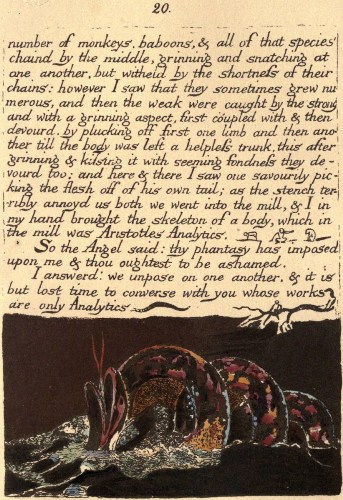
brick; one we entered; in it were a number of monkeys, baboons, and
all of that species chained by the middle, grinning and snatching at
one another, but withheld by the shortness of their chains; however,
I saw that they sometimes grew numerous, and then the weak were
caught by the strong and, with a grinning aspect, first coupled with
and then devoured, by plucking off first one limb and then another,
till the body was left a helpless trunk; this, after grinning and
kissing it with seeming kindness, they devoured too; and here and
there I saw one savourily picking the flesh off of his own tail. As
the stench terribly annoyed us both, we went into the mill, and I in
my hand brought the skeleton of a body, which in the mill was
Aristotle’s ‘Analytics.’
“So the Angel said; ‘Thy phantasy has imposed upon me, and thou
oughtest to be ashamed.’
“I answered; ‘We impose on one another, and it is but lost time to
converse with you, whose works are only Analytics.’”
The “seven houses of brick” we may take to be a reminiscence of the seven
churches of St. John; as indeed the traces of former evangelists and
prophets are never long wanting when we track the steps of this one. Lest
however we be found unawares on the side of these hapless angels and
baboons, we will abstain with all due care from any not indispensable
analysis. It is evident that between pure “phantasy” and mere “analytics”
the great gulf must remain fixed, and either party appear to the other
deceptive and deceived. That impulsive energy and energetic faith are the
only means, whether used as tools of peace or as weapons of war, to pave
or to fight our way toward the realities of things, was plainly the creed
of Blake; as also that these realities, once well in sight, will reverse
appearance and overthrow tradition: hell will appear as heaven, and heaven
as hell. The abyss once entered with due trust and courage appears a place
of green pastures and gracious springs: the paradise of resignation once
beheld with undisturbed eyes appears a place of emptiness or bondage,
delusion or cruelty. On the humorous beauty and vigour of these symbols we
need not expatiate; in these qualities Rabelais and Dante together could
hardly have excelled Blake at his best. What his meaning is should by
this time be as clear as the meaning of a mystic need be; it is but
partially expressible by words, as (to borrow Blake’s own symbol) the
inseparable soul is yet but incompletely expressible through the body.
Whether it be right or wrong, foolish or wise, we will neither inquire nor
assert: the autocercophagous monkeys of the mill may be left to settle
that for themselves with “Urizen.”
We come now to a chapter of comments, intercalated between two
sufficiently memorable “fancies.”
“I have always found that Angels have the vanity to speak of
themselves as the only wise; this they do with a confident insolence
sprouting from systematic reasoning.
“Thus Swedenborg boasts that what he writes is new, though it is only
the Contents or Index of already published books.
“A man carried a monkey about for a show, and because he was a little
wiser than the monkey, grew vain, and conceived himself as much wiser
than seven men. It is so with Swedenborg: he shows the folly of
churches and exposes hypocrites, till he imagines that all are
religious and himself the single one on earth that ever broke a net.
“Now hear a plain fact: Swedenborg has not written one new truth.
“Now hear another: He has written all the old falsehoods.
“And now hear the reason: He conversed with Angels who are all
religious and conversed not with Devils who all hate religion; for he
was incapable, through his conceited notions.
“Thus Swedenborg’s writings are a recapitulation of all superficial
opinions, and an analysis of the more sublime, but no further.
“Hear now another plain fact: Any man of mechanical talents may, from
the writings of Paracelsus or Jacob Behmen, produce ten thousand
volumes of equal value with Swedenborg’s; and from those of Dante or
Shakespeare, an infinite number. But when he has done this, let him
not say that he knows better than his master, for he only holds a
candle in sunshine.”
This also we will leave for those to decide who please, and attend to the
next and final vision. That the fire of inspiration should absorb and
convert to its own nature all denser and meaner elements of mind, was the
prophet’s sole idea of redemption: the dead cloud of belief consumed
becomes the vital flame of faith.
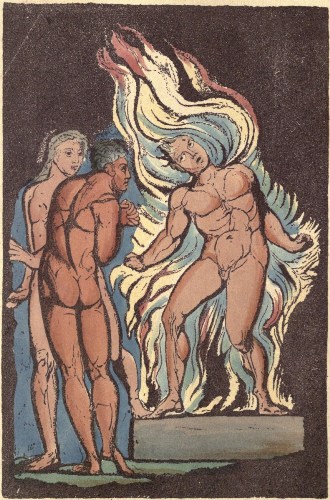
“A Memorable Fancy.
“Once I saw a Devil in a flame of fire, who arose before an Angel
that sat on a cloud, and the Devil uttered these words.
“The worship of God is: Honouring his gifts in other men, each
according to his genius, and loving the greatest men best; those who
envy or calumniate great men hate God, for there is no other God.
“The Angel hearing this became almost blue, but mastering himself, he
grew yellow, and at last white, pink, and smiling; and then replied,
Thou Idolator, is not God one? and is not he visible in Jesus Christ?
and has not Jesus Christ given his sanction to the law of ten
commandments? and are not all other men fools, sinners, and nothings?
“The Devil answered; Bray a fool in a mortar with wheat, yet shall
not his folly be beaten out of him: if Jesus Christ is the greatest
man, you ought to love him in the greatest degree; now hear how he
has given his sanction to the law of the ten commandments: did he not
mock at the sabbath, and so mock the sabbath’s God? murder those who
were murdered, because of him? turn away the law from the woman taken
in adultery? steal the labour of others to support him? bear false
witness when he omitted making a defence before Pilate? covet when he
prayed for his disciples, and when he bid them shake off the dust of
their feet against such as refused to lodge them? I tell you, no
virtue can exist without breaking these ten commandments. Jesus was
all virtue, and acted from impulse, not from rules.
“When he had so spoken, I beheld the Angel who stretched out his arms
embracing the flame of fire, and he was consumed, and arose as
Elijah.
“Note. This Angel, who is now become a Devil, is my particular
friend: we often read the Bible together in its infernal or
diabolical sense, which the world shall have if they behave well.
“I have also the Bible of Hell, which the world shall have, whether
they will or no.”
Under this title at least the world was never favoured with it; but we may
presumably taste some savour of that Bible in these pages. After this the
book is wound up in a lyric rapture, not without some flutter and tumour
of style, but full of clear high music and flame-like aspiration. Epilogue
and prologue are both nearer in manner to the dubious hybrid language of
the succeeding books of prophecy than to the choice and noble prose in
which the rest of this book is written. The overture must be read by the
light of its meaning; of the mysterious universal mother and her son, the
latest birth of the world, we have already taken account. The date of 1790
must here be kept in mind, that all may remember what appearances of
change were abroad, what manner of light and tempest was visible upon
earth, when the hopes of such men as Blake made their stormy way into
speech or song.
“A SONG OF LIBERTY.
1. The Eternal Female groan’d! it was heard over all the Earth.
2. Albion’s coast is sick silent; the American meadows faint!
3. Shadows of Prophecy shiver along by the lakes and the rivers, and
mutter across the ocean. France, rend down thy dungeon;
4. Golden Spain, burst the barriers of old Rome;
5. Cast thy keys, O Rome, into the deep down falling, even to
eternity down falling;
6. And weep.
7. In her trembling hands she took the new-born terror howling:
8. On those infinite mountains of light now barred out by the
Atlantic sea, the new-born fire stood before the starry King!
9. Flag’d with grey-browed snows and thunderous visages the jealous
wings waved over the deep.
10. The speary hand burned aloft, unbuckled was the shield, forth
went the hand of jealousy among the flaming hair, and hurled the
new-born wonder thro’ the starry night.
11. The fire, the fire is falling!
12. Look up! look up! O citizen of London, enlarge thy countenance: O
Jew, leave counting gold! return to thy oil and wine; O African!
black African! (go, winged thought, widen his forehead.)
13. The fiery limbs, the flaming hair, shot like the sinking sun into
the western sea.
14. Waked from his eternal sleep, the hoary element roaring fled
away.
15. Down rushed, beating his wings in vain, the jealous King; his
grey-browed councillors, thunderous warriors, curled veterans, among
helms and shields, and chariots, horses, elephants; banners, castles,
slings and rocks;
16. Falling, rushing, ruining! buried in the ruins, on Urthona’s
dens;
17. All night beneath the ruins, then their sullen flames faded
emerge round the gloomy King.
18. With thunder and fire, leading his starry hosts thro’ the waste
wilderness, he promulgates his ten commands, glancing his beamy
eyelids over the deep in dark dismay;
19. Where the son of fire in his eastern cloud, while the morning
plumes her golden breast,
20. Spurning the clouds written with curses, stamps the stony law to
dust, loosing the eternal horses from the dens of night, crying,
Empire is no more! and now the lion and the wolf shall cease.
CHORUS.
Let the Priests of the Raven of dawn no longer in deadly black with
hoarse note curse the sons of joy; Nor his accepted brethren, whom,
tyrant, he calls free, lay the bound or build the roof; Nor pale
religious letchery call that virginity that wishes but acts not;
For everything that lives is Holy.”
And so, as with fire and thunder—“thunder of thought, and flames of
fierce desire”—is this Marriage of Heaven and Hell at length happily
consummated; the prophet, as a fervent paranymph, standing by to invoke
upon the wedded pair his most unclerical benediction. Those who are not
bidden to the bridegroom’s supper may as well keep away, lest worse befall
them, not having a wedding garment. For us there remains little to say,
now that the torches are out, the nuts scattered, the songs silent, and
the saffron faded from the veil. We will wish them a quiet life, and an
heir who may combine the merits and capacities of either parent. It were
pleasant enough, but too superfluous, to dwell upon the beauty of this
nuptial hymn; to bid men remark what eloquence, what subtlety, what ardour
of wisdom, what splendour of thought, is here; how far it outruns, not in
daring alone but in sufficiency, all sayings of minor mystics who were not
also poets; how much of lofty love and of noble faith underlies and
animates these rapid and fervent words; what greatness of spirit and of
speech there was in the man who, living as Blake lived, could write as
Blake has written. Those who cannot see what is implied may remain unable
to tolerate what is expressed; and those who can read aright need no index
of ours.[51]
The decorations of this great work, though less large and complete than
those of the subsequent prophecies, are full of noble and subtle beauty.
Over every page faint fibres and flickering threads of colour weave a net
of intricate design. Skies cloven with flame and thunder, half-blasted
trees round which huddled forms of women or men cower and cling, strange
beasts and splendid flowers, alternate with the engraved text; and
throughout all the sunbeams of heaven and fires of hell shed fiercer or
softer light. In minute splendour and general effect the pages of Blake’s
next work fall short of these; though in the Visions of the Daughters of
Albion the separate designs are fuller and more composed. This poem,
written in a sort of regular though quasi-lyrical blank verse, is more
direct and lucid in purpose than most of these books; but the style is
already laxer, veers more swiftly from point to point, stands weaker on
its feet, and speaks with more of a hurried and hysterical tone. With
“formidable moral questions,” as the biographer has observed, it does
assuredly deal; and in a way somewhat formidable. This, we are told, “the
exemplary man had good right to do.” Exemplary or not, he in common with
all men had undoubtedly such a right; and was not slow to use it. Nowhere
else has the prophet so fully and vehemently set forth his doctrine of
indulgence; too Albigensian or antinomian this time to be given out again
in more decorous form. Of pure mythology there is happily little; of pure
allegory even less. “The eye sees more than the heart knows;” these words
are given on the title-page by way of motto or key-note. Above this
inscription a single design fills the page; in it the title is written
with characters of pale fire upon cloud and rainbow; the figure of the
typical woman, held fast to earth but by one foot, seems to soar and yearn
upwards with straining limbs that flutter like shaken flame: appealing in
vain to the mournful and merciless Creator, whose sad fierce face looks
out beyond and over her, swathed and cradled in bloodlike fire and drifted
rain. In the prologue we get a design expressive of plain and pure
pleasure; a woman gathers a child from the heart of a blossom as it
breaks, and the sky is full of the golden stains and widening roses of a
sundawn. But elsewhere, from the frontispiece to the end, nothing meets us
but emblems of restraint and error; figures rent by the beaks of eagles
though lying but on mere cloud, chained to no solid rock by the fetters
only of their own faiths or fancies; leafless trunks that rot where they
fell; cold ripples of barren sea that break among caves of bondage. The
perfect woman, Oothoon, is one with the spirit of the great western world;
born for rebellion and freedom, but half a slave yet, and half a harlot.
“Bromion,” the violent Titan, subject himself to ignorance and sorrow, has
defiled her;[52] “Theotormon,” her lover, emblem of man held in bondage to
creed or law, will not become one with her because of her shame; and she,
who gathered in time of innocence the natural flower of delight, calls now
for his eagles to rend her polluted flesh with cruel talons of remorse and
ravenous beaks of shame: enjoys his infliction, accepts her agony, and
reflects his severe smile in the mirrors of her purged spirit.[53] But he
“sits wearing the threshold hard
With secret tears; beneath him sound like waves on a desert shore
The voice of slaves beneath the sun, and children bought with money.”
From her long melodious lamentation we give one continuous excerpt here.
Sweet, and lucid as Thel, it is more subtle and more strong; the
allusions to American servitude and English aspiration, which elsewhere
distract and distort the sense and scheme of the poem, are here well
cleared away.
“I cry Arise, O Theotormon; for the village dog
Barks at the breaking day; the nightingale has done lamenting;
The lark does rustle in the green corn, and the eagle returns
From nightly prey and lifts his golden beak to the pure east;
Shaking the dust from his immortal pinions, to awake
The sun that sleeps too long. Arise my Theotormon, I am pure
Because the night is gone that closed me in its deadly black.
They told me that the night and day were all that I could see;
They told me that I had five senses to enclose me up,
And they enclosed my infinite beam into a narrow circle,
And sank my heart into the abyss, a red round globe hotburning
Till all from life I was obliterated and erased.
Instead of morn arises a bright shadow like an eye
In the eastern cloud; instead of night a sickly charnel-house.
But Theotormon hears me not: to him the night and morn
Are both alike; a night of sighs, a morning of fresh tears.
And none but Bromion can hear my lamentations.
With what sense is it that the chicken shuns the ravenous hawk?
With what sense does the tame pigeon measure out the expanse?
With what sense does the bee form cells? have not the mouse and frog
Eyes and ears and sense of touch? yet are their habitations
And their pursuits as different as their forms and as their joy.
Ask the wild ass why he refuses burdens, and the meek camel
Why he loves man: is it because of eye, ear, mouth or skin,
Or breathing nostrils? no: for these the wolf and tiger have.
Ask the blind worm the secrets of the grave and why her spires
Love to curl around the bones of death: and ask the ravenous snake
Where she gets poison; and the winged eagle why he loves the sun;
And then tell me the thoughts of man, that have been hid of old.
Silent I hover all the night, and all day could be silent,
If Theotormon once would turn his loved eyes upon me;
How can I be defiled when I reflect thy image pure?
Sweetest the fruit that the worm feeds on, and the soul prey’d on by woe;
The new-washed lamb tinged with the village smoke, and the bright swan
By the red earth of our immortal river; I bathe my wings
And I am white and pure to hover round Theotormon’s breast.
Then Theotormon broke his silence, and he answered;
Tell me what is the night or day to one overflowed with woe?
Tell me what is a thought? and of what substance is it made?
Tell me what is joy? and in what gardens do joys grow?
And in what rivers swim the sorrows? and upon what mountains
Wave shadows of discontent? and in what houses dwell the wretched
Drunken with woe forgotten, and shut up from cold despair?
Tell me where dwell the thoughts forgotten till thou call them forth?
Tell me where dwell the joys of old? and where the ancient loves?
And when will they renew again and the night of oblivion be past?
That I might traverse times and spaces far remote and bring
Comfort into a present sorrow and a night of pain!
Where goest thou, O thought? to what remote land is thy flight?
If thou returnest to the present moment of affliction
Wilt thou bring comforts on thy wings and dews and honey and balm
Or poison from the desert wilds, from the eyes of the envier?”
After this Bromion, with less musical lamentation, asks whether for all
things there be not one law established? “Thou knowest that the ancient
trees seen by thine eyes have fruit; but knowest thou that trees and
fruits flourish upon the earth to gratify senses unknown, in worlds over
another kind of seas?” Are there other wars, other sorrows, and other joys
than those of external life? But the one law surely does exist “for the
lion and the ox,” for weak and strong, wise and foolish, gentle and
fierce; and for all who rebel against it there are prepared from
everlasting the fires and the chains of hell. So speaks the violent slave
of heaven; and after a day and a night Oothoon lifts up her voice in sad
rebellious answer and appeal.
“O Urizen, Creator of men! mistaken Demon of heaven!
Thy joys are tears: thy labour vain, to form man to thine image;
How can one joy absorb another? are not different joys
Holy, eternal, infinite? and each joy is a Love.
Does not the great mouth laugh at a gift? and the narrow eyelids mock
At the labour that is above payment? and wilt thou take the ape
For thy counsellor, or the dog for a schoolmaster to thy children?
********
Does the whale worship at thy footsteps as the hungry dog?
Or does he scent the mountain prey, because his nostrils wide
Draw in the ocean? does his eye discern the flying cloud
As the raven’s eye? or does he measure the expanse like the vulture?
Does the still spider view the cliffs where eagles hide their young?
Or does the fly rejoice because the harvest is brought in?
Does not the eagle scorn the earth and despise the treasures beneath?
But the mole knoweth what is there, and the worm shall tell it thee.”
Perhaps there is no loftier note of music and of thought struck anywhere
throughout these prophecies. For the rest, we must tread carefully over
the treacherous hot ashes strewn about the latter end of this book: which
indeed speaks plainly enough for once, and with high equal eloquence; but
to no generally acceptable effect. The one matter of marriage laws is
still beaten upon, still hammered at with all the might of an insurgent
prophet: to whom it is intolerable that for the sake of mere words and
mere confusions of thought “she who burns with youth and knows no fixed
lot” should be “bound by spells of law to one she loathes,” should “drag
the chain of life in weary lust,” and “bear the wintry rage of a harsh
terror driven to madness, bound to hold a rod over her shrinking shoulders
all the day, and all the night to turn the wheel of false desire;”
intolerable that she should be driven by “longings that wake her womb” to
bring forth not men but some monstrous “abhorred birth of cherubs,”
imperfect, artificial, abortive; counterfeits of holiness and mockeries of
purity; things of barren or perverse nature, creatures inhuman or
diseased, that live as a pestilence lives and pass away as a meteor
passes; “till the child dwell with one he hates, and do the deed he
loathes, and the impure scourge force his seed into its unripe birth ere
yet his eyelids can behold the arrows of the day:” the day whose blinding
beams had surely somewhat affected the prophet’s own eyesight, and left
his eyelids lined with strange colours of fugitive red and green that
fades into black. However, all these things shall be made plain by death;
for “over the porch is written Take thy bliss, O man! and sweet shall be
thy taste, and sweet thy infant joys renew.” On the one hand is innocence,
on the other modesty; infancy is “fearless, lustful, happy;” who taught it
modesty, “subtle modesty, child of night and sleep?” Once taught to
dissemble, to call pure things impure, to “catch virgin joy, and brand it
with the name of whore and sell it in the night;” once corrupted and
misled, “religious dreams and holy vespers light thy smoky fires: once
were thy fires lighted by the eyes of honest morn.” Not pleasure but
hypocrisy is the unclean thing; Oothoon is no harlot, but “a virgin filled
with virgin fancies, open to joy and to delight wherever it appears; if in
the morning sun I find it, there my eyes are fixed in happy copulation:”
and so forth—further than we need follow.
“Is it because acts are not lovely that thou seekest solitude
Where the horrible darkness is impressed with reflections of desire?—
Father of Jealousy, be thou accursed from the earth!
Why hast thou taught my Theotormon this accursed thing?
Till beauty fades from off my shoulders, darkened and cast out,
A solitary shadow wailing on the margin of non-entity;”
as in a later prophecy Ahania, cast out by the jealous God, being the type
or embodiment of this sacred natural love “free as the mountain wind.”
“Can that be love which drinks another as a sponge drinks water?
That clouds with jealousy his nights, with weepings all the days?
********
Such is self-love, that envies all; a creeping skeleton
With lamp-like eyes watching around the frozen marriage-bed.”
But instead of the dark-grey “web of age” spun around man by self-love,
love spreads nets to catch for him all wandering and foreign pleasures,
pale as mild silver or ruddy as flaming gold; beholds them without
grudging drink deep of various delight, “red as the rosy morning, lustful
as the first-born beam.” No single law for all things alike; the sun will
not shine in the miser’s secret chamber, nor the brightest cloud drop
fruitful rain on his stone threshold; for one thing night is good and for
another thing day: nothing is good and nothing evil to all at once.
“‘The sea-fowl takes the wintry blast for a covering to her limbs,
And the wild snake the pestilence, to adorn him with gems and gold;
And trees and birds and beasts and men behold their eternal joy.
Arise, you little glancing wings, and sing your infant joy!
Arise and drink your bliss! For everything that lives is holy.’
Thus every morning wails Oothoon, but Theotormon sits
Upon the margined ocean, conversing with shadows dire.
The daughters of Albion hear her woes, and echo back her sighs.”
It may be feared that Oothoon has yet to wait long before Theotormon will
leave off “conversing with shadows dire;” nor is it surprising that this
poem won such small favour; for had it not seemed inexplicable it must
have seemed unbearable. Blake, as evidently as Shelley, did in all
innocence believe that ameliorated humanity would be soon qualified to
start afresh on these new terms after the saving advent of French and
American revolutions. “All good things are in the West;” thence in the
teeth of “Urizen” shall human deliverance come at length. In the same year
Blake’s prophecy of America came forth to proclaim this message over
again. Upon this book we need not dwell so long; it has more of thunder
and less of lightning than the former prophecies; more of sonorous cloud
and less of explicit fire. The prelude, though windy enough, is among
Blake’s nobler myths: the divine spirit of rebellious redemption,
imprisoned as yet by the gods of night and chaos, is fed and sustained in
secret by the “nameless” spirit of the great western continent; nameless
and shadowy, a daughter of chaos, till the day of their fierce and
fruitful union.
“Silent as despairing love and strong as jealousy,
The hairy shoulders rend the links, free are the wrists of fire.”
At his embrace “she cast aside her clouds and smiled her first-born smile,
as when a black cloud shows its lightnings to the silent deep.”
“Soon as she saw the terrible boy then burst the virgin’s cry;
I love thee; I have found thee, and I will not let thee go.
Thou art the image of God who dwells in darkness of Africa,
And thou art fallen to give me life in regions of dark death.”
Then begins the agony of revolution, her frost and his fire mingling in
pain; and the poem opens as with a sound and a light of storm. It is
throughout in the main a mere expansion and dilution of the “Song of
Liberty” which we have already heard; and in the interludes of the great
fight between Urizen and Orc the human names of American or English
leaders fall upon the ear with a sudden incongruous clash: not perhaps
unfelt by the author’s ear also, but unheeded in his desire to make vital
and vivid the message he came to deliver. The action is wholly swamped by
the allegory; hardly is it related how the serpent-formed “hater of
dignities, lover of wild rebellion and transgressor of God’s Law,” arose
in red clouds, “a wonder, a human fire;” “heat but not light went from
him;” “his terrible limbs were fire;” his voice shook the ancient Druid
temple of tyranny and faith, proclaiming freedom and “the fiery joy that
Urizen perverted to ten commands;” the “punishing demons” of the God of
jealousy
“Crouch howling before their caverns deep like skins dried in the wind;
They cannot smite the wheat nor quench the fatness of the earth;
They cannot smite with sorrows nor subdue the plough and spade;
For terrible men stand on the shores, and in their robes I see
Children take refuge from the lightnings. * * * *
Ah vision from afar! ah rebel form that rent the ancient heavens!
* * * * Red flames the crest rebellious
And eyes of death; the harlot womb oft opened in vain
Heaves in eternal circles, now the times are returned upon thee.”
“Thus wept the angel voice” of the guardian-angel of Albion; but the
thirteen angels of the American provinces rent off their robes and threw
down their sceptres and cast in their lot with the rebel; gathered
together where on the hills
“called Atlantean hills,
Because from their bright summits you may pass to the golden world,
An ancient palace, archetype of mighty emperies,
Rears its immortal pinnacles, built in the forest of God
By Ariston the king of beauty for his stolen bride.”
A myth of which we are to hear no more, significant probably of the
rebellion of natural beauty against the intolerable tyranny of God, from
which she has to seek shelter in the darkest part of his creation with the
angelic or dæmonic bridegroom (one of the descended “sons of God”) who has
wedded her by stealth and built her a secret shelter from the strife of
divine things; where at least nature may breathe freely and take pleasure;
whither also in their time congregate all other rebellious forces and
spirits at war with the Creator and his laws. But the speech of “Boston’s
angel” we will at least transcribe: not without a wish that he had never
since then spoken more incoherently and less musically.
“Must the generous tremble and leave his joy to the idle, to the pestilence,
That mock him? who commanded this? what God? what Angel?
To keep the generous from experience, till the ungenerous
Are unrestrained performers of the energies of nature,
Till pity is become a trade and generosity a science
That men get rich by; and the sandy desert is given to the strong?
What God is he writes laws of peace and clothes him in a tempest?
What pitying Angel lusts for tears and fans himself with sighs?
What crawling villain preaches abstinence and wraps himself
In fat of lambs? no more I follow, no more obedience pay.”
This is perhaps the finest and clearest passage in the book; and beyond
this point there is not much extractable from the clamorous lyrical chaos.
Here again besides the mere outward violence of battle, the visible plague
and fire of war, we have sight of a subtler and wider revolution.
“For the female spirits of the dead pining in bonds of religion
Run from their fetters reddening and in long-drawn arches sitting.
They feel the nerves of youth renew, and desires of ancient times.”
Light and warmth and colour and life are shed from the flames of
revolution not alone on city and valley and hill, but likewise
“Over their pale limbs, as a vine when the tender grape appears;
********
The heavens melted from north to south; and Urizen who sat
Above all heavens in thunders wrapt, emerged his leprous head
From out his holy shrine; his tears in deluge piteous
Falling into the deep sublime.”
Notwithstanding for twelve years it was fated that “angels and weak men
should govern o’er the strong, and then their end should come when France
received the demon’s light:” and the ancient European guardians “slow
advance to shut the five gates of their law-built heaven, filled with
blasting fancies and with mildews of despair, with fierce disease and
lust;” but these gates were consumed in the final fire of revolution that
went forth upon the world. So ends the poem; and of the decoration we
have barely space to say enough. On one page are the visions of the
renewed world, on another the emblems of oppression and war: children
sleeping nestled in the fleece of a sleeping ram with heavy horns and
quiet mouth pressing the soft ground, while overhead shapely branches
droop and gracious birds are perched; or what seems the new-born body of
Orc cast under the sea, enmeshed in a web of water whose waves are waves
of corn when you come to look; maidens and infants that bridle a strong
dragon, and behind them a flight of birds through the clouds of a starry
moonlit night, where a wild swan with vast wings and stretching neck is
bestridden by a spirit looking eagerly back as he clutches the rein;
eagles that devour the dead on a stormy sea-beach, while underneath fierce
pikes and sharks make towards a wrecked corpse that has sunk without
drifting, and sea-snakes wind about it in soft loathsome coils; women and
children embrace in bitter violence of loving passion among ripples of
fruitful flame, out of which rise roots and grasses of the field and laden
branches of the vine. Of all these we cannot hope to speak duly; nor can
we hope to give more than a glimpse of the work they illustrate.
Throughout the Prophecy of Europe the fervent and intricate splendours
of text and decoration are whirled as it were and woven into spreading
webs or twining wheels of luminous confusion. The Museum copy, not equal
in nobility of colour to some others, is crowded with MS. notes and mottos
of some interest and significance. To the frontispiece a passage of Milton
is appended; to the first page is prefixed a transcript of some verses by
Mrs. Radcliffe concerning a murdered pilgrim, sufficiently execrable and
explanatory; and so throughout. These notes will help us at least to
measure the amount of connexion between the text and the designs; an
amount easily measurable, being in effect about the smallest possible.
Fierce fluctuating wind and the shaken light of meteors flutter or glitter
upon the stormy ways of vision; serving rather for raiment than for
symbol. The outcast gods of star and comet are driven through tempestuous
air: “forms without body” leap or lurk under cloud or water; War, a man
coated with scales of defiled and blackening bronze, handling a heavy
sword-hilt, averts his face from appealing angels; Famine slays and eats
her children; fire curls about the caldron in which their limbs are to be
sodden for food; starved plague-stricken shapes of women and men fall
shrieking or silent as the bell-ringer, a white-haired man with slouched
hat drawn down and long straight cassock, passes them bell in hand; a
daughter clings to her father in the dumb pain of fear, while he with arms
thrust out in repulsion seems to plead against the gathering deluges that
“sweep o’er the yellow year;” mildews are seen incarnate as foul flushed
women with strenuous limbs contorted, blighting ears of corn with the
violent breath of their inflated mouths; “Papal Superstition,” with the
triple crown on a head broader across cheek and jowl than across the
forehead, with bat’s wings and bloodlike garments dripping and rent, leers
across the open book on his knees; behind his reptile face a decoration as
of a cleft mitre, wrought in the shape of Gothic windows that straiten as
it ascends, shows grey upon the dead black air; this is “Urizen seen on
the Atlantic; and his brazen book that kings and priests had copied on
earth, expanded from north to south;” all the creeping things of the
prison-house, bloated leaf and dropping spider, crawl or curl above a
writhing figure overgrown with horrible scurf of corruption as with
network; the gaoler leaves his prisoner fast bound by the ankles, with
limbs stained and discoloured; (the motto to this is from “The Two Noble
Kinsmen,” Act ii., Sc. 1., “The vine shall grow, but we shall never see
it,” &c.); snakes and caterpillars, birds and gnats, each after their own
kind take their pleasure and their prey among the leaves and grasses they
defile and devour; flames chase the naked or swooning fugitives from a
blazing ruin. The prelude is set in the frame of two large designs; one of
the assassin waiting for the pilgrim as he turns round a sharp corner of
rock; one of hurricane and storm in which “Horror, Amazement and Despair”
appear abroad upon the winds. A sketch of these violent and hideously
impossible figures is pasted into the note-book on a stray slip of paper.
The MS. mottos are mostly from Milton and Dryden; Shakespeare and
Fletcher, Rowe and Mason, are also dragged into service. The prophecy
itself is full of melody and mist; of music not wholly unrecognisable and
vapour not wholly impermeable. In a lull of intermittent war, the gods of
time and space awake with all their children; Time bids them “seize all
the spirits of life and bind their warbling joys to our loud strings, bind
all the nourishing sweets of earth to give us bliss.” Orc, the fiery
spirit of revolution, first-born of Space, his father summons to arise;
“and we will crown thy head with garlands of the ruddy vine; for now thou
art bound; and I may see thee in the hour of bliss, my eldest born.”
Allegory, here as always, is interfused with myth in a manner at once
violent and intricate; but in this book the mere mythologic fancy of Blake
labours for the most part without curb or guide. Enitharmon, the universal
or typical woman, desires that “woman may have dominion” for a space over
all the souls upon earth; she descends and becomes visible in the red
light of Orc; and she charges other spirits born of her and Los to “tell
the human race that woman’s love is sin,” for thus the woman will have
power to refuse or accede, to starve or satiate the perverted loves and
lives of man; “that an eternal life awaits the worms of sixty winters, in
an allegorical abode where existence hath never come; forbid all joy, and
from her childhood shall the little female spread nets in every secret
path.” To this end the goddess of Space calls forth her chosen children,
the “horned priest” of animal nature, the “silver-bowed queen” of desolate
places, the “prince of the sun” with his innumerable race “thick as the
summer stars; each one, ramping, his golden mane shakes, and thine eyes
rejoice because of strength, O Rintrah, furious King.” Moon and sun,
spirit and flesh, all lovely jealous forces and mysteries of the natural
world are gathered together under her law, that throughout the eighteen
Christian centuries she may have her will of the world. For so long nature
has sat silent, her harps out of tune; the goddess herself has slept out
all those years, a dream among dreams, the ghostly regent of a ghostly
generation. The angels of Albion, satellites once of the ancient Titan,
are smitten now with their own plagues, crushed in their own
council-house, and rise again but to follow after Rintrah, the fiery
minister of his mother’s triumph. Him the chief “Angel” follows to “his
ancient temple serpent-formed,” ringed round with Druid oaks, massive with
pillar and porch built of precious stones; “such eternal in the heavens,
of colours twelve, few known on earth, give light in the opaque.”
“Placed in the order of the stars, when the five senses whelmed
In deluge o’er the earth-born man: then bound the flexile eyes
Into two stationary orbs concentrating all things:
The ever-varying spiral ascents to the heaven of heavens
Were bended downward, and the nostril’s golden gates shut,
Turned outward, barred and petrified against the infinite.
Thought changed the infinite to a serpent; that which pitieth
To a devouring flame; and man fled from its face and hid
In forests[54] of night; then all the eternal forests were divided
Into earths rolling in circles of space, that like an ocean rushed
And overwhelmed all except this finite wall of flesh.
Then was the serpent temple formed, image of (the) infinite
Shut up in finite revolutions,[55] and man became an Angel;
Heaven a mighty circle turning; God a tyrant crowned.”
Thus again recurs the doctrine that the one inlet left us for spiritual
perception—that namely of the senses—is but one and the least of many
inlets and channels of communication now destroyed or perverted by the
creative demon; a tenet which once well grasped and digested by the
disciple will further his understanding of Blake more than anything else
can: will indeed, pushed to the full extreme of its logical results,
elucidate and justify much that seems merely condemnable and chaotic. To
resume our somewhat halting and bewildered fable: the southern porch of
this temple, “planted thick with trees of blackest leaf, and in a vale
obscure, enclosed the stone of night; oblique it stood, o’erhung with
purple flowers and berries red;” image of the human intellect “once open
to the heavens” as the south to the sun; now, as the head of fallen man,
“overgrown with hair and covered with a stony roof;” sunk deep “beneath
the attractive north,” where evil spirits are strongest, where the
whirlpool of speculation sucks in the soul and entombs it. Standing on
this, as on a watch-tower, the “Angel” beholds Religion enthroned over
Europe, and the pale revolution of cloud and fire through the night of
space and time; beholds “Albion,” the home once of ancient freedom and
faith, trodden underfoot by laws and churches, that the God of religion
may have wherewithal to “feed his soul with pity.” At last begins the era
of rebellion and change; the fires of Orc lay hold upon law[56] and
gospel; yet for a little while the ministers of his mother have power to
fight against him, and she, allied now and making common cause with the
God alien to her children, “laughs in her sleep,” seeing through the veil
and vapour of dreams the subjection of male to female, the false attribute
of unnatural power given to women by faith and fear. Not as yet can the
Promethean fire utterly dissolve the clouds of Urizen, though the flesh of
the ministering angel of religion is already consumed or consuming; nor
as yet can the trumpet of revolution summon the dead to judgment. That
first blast of summons must be blown by material science, which destroys
the letter of the law and the text of the covenant. When the “mighty
spirit” of Newton had seized the trumpet and blown it,
“Yellow as leaves of Autumn the myriads of Angelic hosts
Fell thro’ the wintry skies seeking their graves,
Rattling their hollow bones in howling and lamentation;”
as to this day they do, and did in Blake’s time, throughout whole
barrowfuls of controversial “apologies” and “evidences.” Then the
mother-goddess awoke from her eighteen centuries of sleep, the “Christian
era” being now wellnigh consummated, and all those years “fled as if they
had not been;” she called her children around her, by many monstrous names
and phrases of chaotic invocation; comfort and happiness here, there sweet
pestilence and soft delusion; the “seven churches of Leutha” seek the love
of “Antamon,” symbolic of Christian faith reconciled to “pagan” indulgence
and divorced from Jewish prohibition; even as we find in the prophet
himself equal faith in sensual innocence and spiritual truth. Of “the soft
Oothoon” the great goddess asks now “Why wilt thou give up woman’s
secrecy, my melancholy child? Between two moments bliss is ripe.” Last she
calls upon Orc; “Smile, son of my afflictions; arise and give our
mountains joy of thy red light.”
“She ceased; for all were forth at sport beneath the solemn moon,
Waking the stars of Urizen with their immortal songs,
That nature felt thro’ all her pores the enormous revelry.
Till morning oped her eastern gate;
Then every one fled to his station; and Enitharmon wept.”
But with the dawn of that morning Orc descended in fire, “and in the
vineyards of red France appeared the light of his fury.” The revolution
begins; all space groans; and lion and tiger are gathered together after
their prey: the god of time arises as one out of a trance,
“And with a cry that shook all nature to the utmost pole
Called all his sons to the strife of blood.”
Our study of the Europe might bring more profit if we could have genuine
notes appended to the text as well as to the designs. Such worth or beauty
as the poem has burns dim and looms distant by comparison; but there is in
it more of either than we have here time or means to indicate. At least
the prelude so strangely selected for citation and thrown loose upon the
pages of the biography in so crude and inexplicable a manner, may now be
seen to have some tangible or presumable sense. The spirit of Europe rises
revealed in the advent of revolution, sick of time and travail; pleading
with the mother-goddess, Cybele of this mythology; wrapping about her
veils of water and garments of cloud, in vain; “the red sun and moon and
all the overflowing stars rain down prolific pains.” Out of her
overlaboured womb arise forms and forces of change, fugitive fires of
wrath, sonorous shapes of fear; and they take substance in space, but
bring to their mother no help or profit, no comfort or light; to the
virgin daughter of America freedom has come and fruitful violence of love,
but not to the European mother. She has no hope in all the infinity of
space and time; “who shall bind the infinite with an eternal band, to
compass it with swaddling bands?” By comparison of the two preludes the
relations of the two kindred poems may be better understood: the one is
plaintive as the voice of a world in pain, and decaying kingdom by
kingdom; the other fierce and hopeful as the cry of a nation in travail,
whose agony is not that of death, but rather that of birth.
The First Book of Urizen is perhaps more shapeless and chaotic at a
first glimpse than any other of these prose poems. Clouds of blood,
shadows of horror, worlds without form and void, rise and mingle and wane
in indefinite ways, with no special purpose or appreciable result. The
myth here is of an active but unprolific God, warring with shapes of the
wilderness, and at variance with the eternals: beaten upon by Time, who
figures always in all his various shapes and actions as the saviour and
friend of man. “Earth was not, nor globes of attraction; the will of the
Immortal expanded or contracted at will his all-flexible senses. Death was
not; but eternal life sprang.” (1. Urizen, ii. 1.) Urizen, the God of
restraint, creator of prohibition, whose laws are forbearance and
abstinence, is for ages divided from Eternity and at war with Time; “long
periods in burning fires labouring, till hoary, and age-broken, and aged,
in despair and the shadows of death.” (1. Urizen, iii. 6.) In time the
formless God takes form, creating and assuming feature by feature; bones,
heart, eyes, ears, nostrils, throat with tongue, hands with feet; an age
of agony being allotted to each of the seven created features; still
toiling in fire and beset by snares, which the Time-Spirit kindles and
weaves to avert and destroy in its birth the desolate influence of the
Deity who forbids and restrains. These transformations of Urizen make up
some of Blake’s grandest and strangest prophetic studies. First the spinal
skeleton, with branchwork of rib and savage nudity of joint and clavicle,
shaped mammoth-wise, in grovelling involution of limb. In one copy at
least these bones are touched with dim green and gold colour; such a faint
fierce tint as one might look for on the cast scales or flakes of dragons
left astrand in the ebb of a deluge. Next a huge fettered figure with
blind shut eyes overflowing into tears, with convulsed mouth and sodden
stream of beard: then bones painfully gathering flesh, twisted forms round
which flames break out fourfold, tortured elemental shapes that plunge and
writhe and moan. Until Time, divided against himself, brings forth Space,
the universal eternal female element, called Pity among the gods, who
recoil in fear from the dawn of human creation and division. Of these two
divinities, called in the mythology Los and Enitharmon, is born the
man-child Orc. “The dead heard the voice of the child and began to awake
from sleep; all things heard the voice of the child and began to awake to
life.” (vii. 5.) Here again we may spare a word or two for that splendid
figure (p. 20) of the new-born child falling aslant through cloven fire
that curls and trembles into spiral blossoms of colour and petals of
feverish light. And the children of Urizen were Thiriel, born from cloud;
Utha, from water; Grodna, from earth; Fuzon, “first-begotten, last-born,”
from fire—“and his daughters from green herbs and cattle, from monsters
and worms of the pit. He cursed both sons and daughters; for he saw that
no flesh nor spirit could keep his iron laws one moment.” (viii. 3, 4.)
Then from his sorrows for these his children begotten on the material body
of nature, the web of religion begins to unwind and expand, “throwing out
from his sorrowing soul, the dungeon-like heaven dividing” (viii. 6)—and
the knotted meshes of the web to involve all races and cities. “The Senses
inward rushed shrinking beneath the dark net of infection: till the
shrunken eyes, clouded over, discerned not the woven hypocrisy; but the
streaky slime in their heavens, brought together by narrowing perceptions,
appeared transparent air; for their eyes grew small like the eyes of a
man. Six days they shrank up from existence, and the seventh day they
rested, and they blessed the seventh day, in sick hope; and forgot their
eternal life.” (1. Urizen, ix. 1, 2, 3.) Hence grows the animal tyranny of
gravitation, and hence also the spiritual tyranny of law; “they lived a
period of years, then left a noisome body to the jaws of devouring
darkness; and their children wept, and built tombs in the desolate places;
and formed laws of prudence and called them the eternal laws of God.” (ix.
4, 5.) Seeing these his brethren degraded into life and debased into
flesh, the son of the fire, Fuzon, called together “the remaining children
of Urizen; and they left the pendulous earth: they called it Egypt, and
left it. And the salt ocean rolled englobed.” (ix. 8, 9.) The freer and
stronger spirits left the world of men to the dominion of earth and water;
air and fire were withdrawn from them, and there were left only the
heaviness of imprisoning clay and the bitterness of violent sea.
This is a hurried and blotted sketch of the main myth, which is worth
following up by those who would enter on any serious study of Blake’s
work; all that is here indicated in dim hints being afterwards assumed as
the admitted groundwork of later and larger myths. In this present book
(and in it only) the illustrative work may be said almost to overweigh and
stifle the idea illustrated. Strange semi-human figures, clad in sombre or
in fiery flesh, racing through fire or sinking through water, allure and
confuse the fancy of the student. Every page vibrates with light and
colour; on none of his books has the artist lavished more noble profusion
of decorative work. It is worth observing that while some copies are
carefully numbered throughout “First Book,” in others the word “First” is
erased from every leaf: as in effect the Second Book never was put forth
under that title. Next year however the Book of Ahania came out—if one
may say as much of a quarto of six leaves which has hardly yet emerged
into sight of two or three readers. This we may take—or those may who
please—to be the Second Book of Urizen. It is among the choicer spoils
of Blake, not as yet cast into the public treasury; for the Museum has no
copy, though possessing (in its blind confused way) duplicates of
America, Albion, and Los. Some day, one must hope, there will at
least be a complete accessible collection of Blake’s written works
arranged in rational order for reference. Till the dawn of that day people
must make what shift they can in chaos.
In Ahania, though a fine and sonorous piece of wind-music, we have not
found many separate notes worth striking. Formless as these poems may
seem, it is often the floating final impression of power which makes them
memorable and valuable, rather than any stray gleam of purple or glitter
of pearl on the skirt. Thus the myth runs—to the best of its power; but
the tether of it is but short.
Fuzon, born of the fiery part of the God of nature, in revolt against his
father, divides him in twain as with a beam of fire; the desire of Urizen
is separated from him; this divided soul, “his invisible lust,” he sees
now as she is apart from himself, and calls Sin; seizes her on his
mountains of jealousy; kisses and weeps over her, then casts her forth and
hides her in cloud, in dumb distance of mysterious space; “jealous though
she was invisible.” Divided from him, she turns to mere shadow “unseen,
unbodied, unknown, the mother of Pestilence.” But the beam cast by Fuzon
was light upon earth—light to “Egypt,” the house of bondage and place of
captivity for the outcast human children of Urizen. Thus far the book
floats between mere allegory and creative myth; not difficult however to
trace to the root of its purport. From this point it grows, if not wilder
in words, still mistier in build of limb and shape of feature. Fuzon,
smitten by the bow of Urizen, seems to typify dimly the Christian or
Promethean sacrifice; the revolted God or son of God, who giving to men
some help or hope to enlighten them, is slain for an atonement to the
wrath of his father: though except for the mythical sonship Prometheus
would be much the nearer parallel. The bow, formed in secresy of the
nerves of a slain dragon “scaled and poisonous-horned,” begotten of the
contemplations of Urizen and destroyed by him in combat, must be another
type, half conceived and hardly at all wrought out, of the secret and
jealous law of introspective faith divided against itself and the god of
its worship, but strong enough to smite the over-confident champion of men
even in his time of triumph, when he “thought Urizen slain by his wrath: I
am God, said he, eldest of things.” (II. 8.) Suddenly the judgment of the
jealous wrath of God falls upon him; the rock hurled as an arrow “enters
his bosom; his beautiful visage, his tresses that gave light to the
mornings of heaven, were smitten with darkness.—But the rock fell upon
the earth, Mount Sinai, in Arabia:” being indeed a type of the moral law
of Moses, sent to destroy and suppress the native rebellious energies and
active sins of men. Here one may catch fast hold of one thing—the
identity of Blake’s “Urizen,” at least for this time, with the Deity of
the earlier Hebrews; the God of the Law and Decalogue rather than of Job
or the Prophets. “On the accursed tree of mystery” that shoots up under
his heel from “tears and sparks of vegetation” fallen on the barren rock
of separation, where “shrunk away from Eternals,” alienated from the
ancient freedom of the first Gods or Titans, averse to their large and
liberal laws of life, the jealous God sat secret—on the topmost stem of
this tree Urizen “nailed the corpse of his first-begotten.” Thenceforward
there fell upon the half-formed races of men sorrow only and pestilence,
barren pain of unprofitable fruit and timeless burden of desire and
disease. One need not sift the myth too closely; it would be like
winnowing water and weighing cloud with scale or sieve. The two
illustrations, it may here be said, are very slight—mere hints of a
design, and merely touched with colour. In the frontispiece Ahania,
divided from Urizen, floats upon a stream of wind between hill and cloud,
with haggard limbs and straightened spectral hair; on the last leaf a dim
Titan, wounded and bruised, lies among rocks flaked with leprous lichen
and shaggy with bloodlike growths of weed and moss. One final glimpse we
may take of Ahania after her division—the love of God, as it were, parted
from God, impotent therefore and a shadow, if not rather a plague and
blight; mercy severed from justice, and thus made a worse thing than
useless. Such may be the hinted meaning, or at least some part of it; but
the work, it must be said, holds by implication dim and great suggestions
of something more than our analytic ingenuities can well unravel by this
slow process of suggestion. Properly too Ahania seems rather to represent
the divine generative desire or love, translated on earth into sexual
expression; the female side of the creative power—mother of all things
made.
“The lamenting voice of Ahania weeping upon the void and round the
Tree of Fuzon. Distant in solitary night her voice was heard, but no
form had she; but her tears from clouds eternal fell round the Tree.
And the voice cried ‘Ah Urizen! Love! Flower of morning! I weep on
the verge of non-entity: how wide the abyss between Ahania and thee!
I lie on the verge of the deep, I see thy dark clouds ascend; I see
thy black forests and floods, a horrible waste to my eyes. Weeping I
walk over the rocks, over dens, and through valleys of death. Why
dost thou despise Ahania, to cast me from thy bright presence into
the world of loneness? I cannot touch his hand; nor weep on his
knees; nor hear his voice and bow; nor see his eyes and joy; nor hear
his footsteps, and my heart leap at the lovely sound; I cannot kiss
the place where his bright feet have trod: but I wander on the rocks
with hard necessity. Where is my golden palace? where my ivory bed?
where the joy of my morning hour? where the sons of eternity singing
to awake bright Urizen my king to arise to the mountain sport, to the
bliss of eternal valleys, to awake my king in the morn, to embrace
Ahania’s joy on the breath of his open bosom; from my soft cloud of
dew to fall in showers of life on his harvest? When he gave my happy
soul to the sons of eternal joy; when he took the daughters of life
into my chambers of love; when I found babes of bliss on my beds and
bosoms of milk in my chambers, filled with eternal seed. O! eternal
births sung round Ahania in interchange sweet of their joys; swelled
with ripeness and fat with fatness, bursting in clouds my odours, my
ripe figs and rich pomegranates, in infant joy at thy feet, O Urizen,
sported and sang: then thou with thy lap full of seed, with thy hand
full of generous fire, walkedst forth from the clouds of morning, on
the virgins of springing joy, on the human soul, to cast the seed of
eternal science. The sweat poured down thy temples, to Ahania
returned in evening; the moisture awoke to birth my mother’s joys
sleeping in bliss. But now alone over rocks, mountains—cast out from
thy lovely bosom—cruel jealousy! selfish fear! self-destroying! how
can delight renew in these chains of darkness, where bones of beasts
are strewn on the bleak and snowy mountains, where bones from the
birth are buried before they see the light?’”—Ahania, ch. v., v. 1-14.
With the prolonged melody of this lament the Book of Ahania winds itself
up; one of the most musical among this crowd of singing shadows. In the
same year the last and briefest of this first prophetic series was
engraved. The Song of Los, broken into two divisions headed Africa and
Asia, has more affinity to Urizen and Ahania than to Europe and
America. The old themes of delusion and perversion are once again
rehandled; not without vigorous harmonies of choral expression. The
illustrations are of special splendour, as though designed to atone for
the lean and denuded form in which Ahania had been sent forth. In the
frontispiece a grey old giant, clothed from the waist only with heavy
raiment of livid and lurid white, bows down upon a Druid altar before the
likeness of a darkened sun low-hung in heaven, filled with sombre and
fiery forms of things, and shooting out upon each quarter a broad
reflected ray like the reflection struck by sunlight from a broad bare
sword-blade, but touched also, as with strange infection, with flakes of
deadly colour that vibrate upon the starless solid ground of an
intolerable night. Less of menace with more of sadness is in the landscape
and sky on the title-page: a Titan, with one weighty hand lying on a
gigantic skull, rests at the edge of a green sloping moor, himself seeming
a grey fragment of moorland rock; brown fire of waste grass or rusted
flower stains crag and bent all round him; the sky is all night and fire,
bitter red and black. On the first page a serpent, splendid with blood-red
specks and scales of greenish blue, darts the cloven flame of its tongue
against a brilliant swarm of flies; and again throughout the divided lines
a network of fair tortuous things, of flickering leaf and sinuous tendril
and strenuous root, flashes and curls from margin to margin.
This song is the song of Time, sung to the four harps of the world, each
continent a harp struck by Time as by a harper. In brief dim words it
celebrates the end of the world of the patriarchs where faith and freedom
were one, the advent of the iron laws and ages, when God the Accuser gave
his laws to the nations by the hands of the children of time: when to the
extreme east was given mere abstract philosophy for faith instead of clear
pure belief, and man became slave to the elements, the slave and not the
lord of the nature of things; but not yet was philosophy a mere matter of
the five senses. Thus they fared in the east; meantime the spirits of the
patriarchal world shrank beneath waters or fled in fires, Adam from Eden,
Noah from Ararat; and “Moses beheld upon Mount Sinai forms of dark
delusion.” Over each religion, Indian and Jewish and Grecian, some
special demon or god of the mythology is bidden preside; Christianity, the
expression of human sorrow, human indulgence and forgiveness, was given as
gospel to “a man of sorrows” by the two afflicted spirits who typify man
and woman, in whom the bitter errors and the sore needs of either several
sex upon earth are reproduced in vast vague reflection; to them therefore
the gentler gospel belongs as of right. Next comes Mahometanism, to give
some freedom and fair play to the controlled and abused senses; but
northwards other spirits set on foot a code of war to satiate their
violent delight. So on all sides is the world overgrown with kingdoms and
churches, codes and creeds; inspiration is crushed and erased; the sons of
Time and Space reign alone; Har and Heva, the spirits of loftier and purer
kind who were not as the rest of the Titan brood that “lived in war and
lust,” are fled and fallen, become as mere creeping things; and the world
is ripe to bring forth for its cruel and mournful God the final fruit of
reason debased and faith distorted.
“Thus the terrible race of Los and Enitharmon gave
Laws and Religions to the sons of Har, binding them more
And more to Earth, closing and restraining;
Till a Philosophy of Five Senses was complete;
Urizen wept, and gave it into the hands of Newton and Locke.”
These “terrible sons” of time and space are the presiding demons of each
creed or code; the sons of men are in their hands now, for the father and
mother of men are fallen gods, oblivious and transformed: and these minor
demons are all subservient to the Creator, whose soul, sorrowful but not
merciful, animates the whole pained world. So, with cloud of menace and
fire of wrath shed out about the deceased gods and the new philosophies,
the first part ends. In the second part the clouds have broken and the
fire has come forth; revolution has begun in Europe; the ancient lords of
Asia are startled from their dens and cry in bitterness of soul for help
of the old oppressions; for councillors and for taxes, for plagues and for
priests, “to turn man from his path; to restrain the child from the womb;
to cut off the bread from the city, that the remnant may learn to obey:
that the pride of the heart may fail; that the lust of the eye may be
quenched; that the delicate ear in its infancy may be dulled, and the
nostrils closed up; to teach mortal worms the path that leads from the
gates of the grave.” At their cry Urizen arose, the lord of Asia from of
old, ever since he cast down the patriarchal law and set up the Mosaic
code; “his shuddering waving wings went enormous above the red flames,” to
contend with the rekindled revolution, “the thick-flaming thought-creating
fires of Orc;”
“His books of brass, iron, and gold
Melted over the land as he flew,
Heavy-waving, howling, weeping.
And he stood over Judea,
And stayed in his ancient places,
And stretched his clouds over Jerusalem.
For Adam, a mouldering skeleton,
Lay bleached on the garden of Eden;
And Noah, as white as snow,
On the mountains of Ararat.”
Thus, with thunder from eastward and fire from westward, the God of
jealousy and the Spirit of freedom met together; earth shrank at the
meeting of them.
“Forth from the dead dust rattling bones to bones
Came; shaking, convulsed, the shivering clay breathes;
And all flesh naked stands; Fathers and Friends;
Mothers and Infants; Kings and Warriors;
The Grave shrieks with delight, and shakes
Her hollow womb, and clasps the solid stem;
Her bosom swells with wild desire;
And milk and blood and glandous wine
In rivers rush and shout and dance
On mountain, dale and plain.
The Song of Los is ended.
Urizen wept.”
So much for the text; which has throughout a contagious power of
excitement in the musical passion of its speech. For these books, above
all, it is impossible to read continuously and not imbibe a certain
half-nervous enjoyment from their long cadences and tempestuous
undulations of melody. Such passion went to the writing of them that some
savour of that strong emotion infects us also in reading pages which seem
still hot from the violent touch of the poet. The design of Har and Heva
flying from their lustful and warlike brethren across green waste land
before a late and thunder-coloured sky, he grasping her with convulsive
fear, she looking back as she runs with lifted arm and flame-like hair and
fiery flow of raiment; and that succeeding where they reappear fallen to
mere king and queen of the vegetable world, themselves half things of
vegetable life; are both noble if somewhat vehement and reckless. In this
latter, the deep green-blue heaven full of stars like flowers is set with
sweet and deep effect against the darkening green of the vast lily-leaves
supporting the fiery pallor of those shapely chalices which enclose as
the heart of either blossom the queen lying at her length, and the king
sitting with bright plucked-out pistil in hand by way of sceptre or sword;
and below them the dim walls of the world alone are wholly black: his
robes of soft shot purple and red, her long chrysalid shell or husk of
tarnished gold, are but signs of their bondage and fall from deity; they
are fallen to be mere flowers. More might be said of the remaining
designs; the fierce glory of sweeping branches and driven leaves in a
strong wind, the fervent sky and glimmering hill, the crouching figures
above and under, the divine insane luxuriance of cloudy and flowery colour
which makes twice luminous the last page of the poem; the strange final
design where a spirit with huge childlike limbs and lifted hair seems to
smite with glittering mallet the outer rim of a huger blood-red sun; but
for this book we have no more space; and much laborious travel lies ahead
of us yet.
With the Song of Los the first or London series of prophecies came to a
close not unfit or unmelodious. As their first word had been Revelation,
their last was Revolution. We have now to deal with the two later and
larger books written at Felpham, but not put forth till 1804. To one of
these at least we must allow some tolerably full notice. The Milton
shall here take precedence. This poem, though sufficiently vexatious to
the human sense at first sight, is worth some care and some admiration.
Its preface must here be read in full.
“The stolen and perverted writings of Homer and Ovid, of Plato and
Cicero, which all men ought to contemn, are set up by artifice
against the sublime of the Bible; but when the New Age is at leisure
to pronounce, all will be set right, and those grand works of the
more ancient and consciously and professedly inspired men, will
hold their proper rank; and the daughters of memory shall become the
daughters of inspiration. Shakespeare and Milton were both curbed by
the general malady and infection from the silly Greek and Latin
slaves of the sword. Rouse up, O young men of the New Age! set your
foreheads against the ignorant hirelings! For we have hirelings in
the camp, the court, and the university; who would, if they could,
for ever depress mental and prolong corporeal war. Painters! on you I
call! Sculptors! Architects! suffer not the fashionable fools to
depress your powers by the prices they pretend to give for
contemptible works or the expensive advertising boasts that they make
of such works: believe Christ and his Apostles, that there is a class
of men whose whole delight is in destroying. We do not want either
Greek or Roman models if we are but just and true to our own
imaginations, those worlds of eternity in which we shall live for
ever, in Jesus our Lord.
And did those feet in ancient time
Walk over England’s mountains green?
And was the holy Lamb of God
On England’s pleasant pastures seen?
And did the Countenance Divine
Shine forth upon our clouded hills?
And was Jerusalem builded here,
Among these dark Satanic mills?
Bring me my bow of burning gold;
Bring me my arrows of desire;
Bring me my spear: O clouds, unfold;
Bring me my chariot of fire.
I will not cease from mental fight,
Nor shall my sword sleep in my hand,
Till we have built Jerusalem
In England’s green and pleasant land.
‘Would to God that all the Lord’s people were prophets.’—Numbers xi.
29.”
After this strange and grand prelude, which, though taken in the letter it
may read like foolishness, is in the spirit of it certainty and truth for
all time, we pass again under the shadow and into the land that shifts and
slips under our feet. Something however out of the chaos of fire and wind
and stormy colour may be caught at by fits and stored up for such as can
like it. Thus the poem opens, with not less fervour and splendour of sound
than usual.
“Daughters of Beulah! Muses who inspire the Poet’s Song!
Record the journey of immortal Milton thro’ your realms
Of terror and mild moony lustre, in soft sexual delusions
Of varied beauty, to delight the wanderer and repose
His burning thirst and freezing hunger! Come into my hand,
By your mild power descending down the Nerves of my right arm
From out the Portals of my Brain, where by your ministry
The Eternal Great Humanity Divine planted his Paradise
And in it caused the Spectres of the Dead to take sweet forms
In likeness of himself.”
(Observe here the answer by anticipation to the old foolish charge of
madness and belief in mere material visions; a charge indeed refuted and
confuted at every turn we take. Thus, and no otherwise, did Blake believe
in his dead visitors and models: as spectres formed into new and
significant shape by God, after his own likeness; not called up as by
some witch of Endor and reclothed with the rags and rottenness of their
dead old bodies; creatures existing within the brain and imagination of
the workman, not as they were once externally and by accident, but as they
will be for ever by the essence and substance of their nature. For the
“vegetated shadow” or “human vegetable” no mystic ever had deeper or
subtler contempt than Blake; nor was ever a man less likely to care about
raising or laying it after death.)
“Tell also of the False Tongue! vegetated
Beneath your land of shadows; of its sacrifices, and
Its offerings: even till Jesus, the image of the Invisible God,
Became its prey; a curse, an offering, and an atonement
For Death Eternal, in the heavens of Albion, and before the gates
Of Jerusalem his Emanation, in the heavens beneath Beulah.”
Let the Súfis of the West make what construction they can of that
doctrine. We will help them, before passing on, with another view of the
Atonement, taken from The Everlasting Gospel.
“But when Jesus was crucified,
Then was perfected his galling pride.
In three days he devoured his prey,
And still he devours the body of clay;
For dust and clay is the serpent’s meat,
Which never was meant for man to eat.”
That is, the spirit must be eternally at work consuming and destroying the
likeness of things material and the religions made out of them. This
over-fervent prophet of freedom for the senses as well as the soul would
have them free, one may say, only for the soul’s sake: talking as we see
he did of redemption from the body and salvation by the spirit at war with
it, in words which literally taken would hardly have misbecome a monk of
Nitria.
Returning to the Milton, we are caught again in the mythologic
whirlpools and cross-currents of symbol and doctrine; our ears rung deaf
and dazed by the hammers of Los (Time) and our eyes bewildered by the
wheels and woofs of Enitharmon (Space): “her looms vibrate with soft
affections, weaving the Web of Life out from the ashes of the Dead.” This
is a fragment of the main myth, whose details Los and Enitharmon
themselves for the present forbid our following out.
“The Three Classes of men regulated by Los’s hammer, and woven
By Enitharmon’s Looms, and spun beneath the Spindle of Tirzah:
The first: The Elect from before the foundation of the World;
The second: The Redeemed. The Third: the Reprobate and formed
To destruction from the mother’s womb.”
Into the myth of the harrow and horses of Palamabron, more Asiatic in tone
than any other of Blake’s, and full of the vast proportion and formless
fervour of Hindoo legends, we will not haul any reluctant reader. Let him
only take enough by way of extract to understand how thoroughly one vein
of fiery faith runs through all the prophetic books, and one passionate
form of doctrine is enforced and beaten in upon the disciple again and
again; not hitherto with much material effect.
“And in the midst of the Great Assembly Palamabron prayed;
O God, protect me from my friends that they have not power over me;
Thou hast given me power to protect myself from my bitterest enemies.”
Then the wrath of Rintrah, the most fiery of the spirits who are children
of Time, having entered by lot into Satan, who was of the Elect from the
first, “seeming a brother, being a tyrant, even thinking himself a brother
while he is murdering the just,” “with incomparable mildness,” believing
“that he had not oppressed”—a symbolic point much insisted on—
“He created Seven deadly Sins, drawing out his infernal scroll
Of moral laws and cruel punishments upon the clouds of Jehovah,
To pervert the divine voice in its entrance to the earth
With thunders of war and trumpet’s sound, with armies of disease;
Punishments and deaths mustered and numbered; saying, I am God alone,
There is no other; let all obey my principles of moral individuality
I have brought them from the uppermost innermost recesses
Of my Eternal Mind; transgressors I will rend off for ever;
As now I rend this accursed Family from my covering.”
This is the Satan of Blake, sufficiently unlike the Miltonic. Of himself
he cannot conceive evil and bring forth destruction; the absolute Spirit
of Evil is alien from this mythology; he must enter into the body of a
law or system and put on the qualities of spirits strange to himself
(Rintrah); he is divided, inconsistent, a mystery and error to himself; he
represents Monotheism with its stringent law and sacerdotal creed, Jewish
or Christian, as opposed to Pantheism whereby man and God are one, and by
culture and perfection of humanity man makes himself God. The point of
difference here between Blake and many other western Pantheists is that in
his creed self-abnegation (in the mystic sense, not the ascetic—the
Oriental, not the Catholic) is the highest and only perfect form of
self-culture: and as Satan (under “names divine”—see the Epilogue to the
Gates of Paradise) is the incarnate type of Monotheism, so is Jesus the
incarnate type of Pantheism. To return to our myth; the stronger spirit
rears walls of rocks and forms rivers of fire round them;
“And Satan, not having the Science of Wrath but only of Pity,[57]
Rent them asunder; and Wrath was left to Wrath, and Pity to Pity.”
This is Blake’s ultimate conception of active evil; not wilful wrong-doing
by force of arm or of spirit; but mild error, tender falsehood innocent of
a purpose, embodied in an external law of moral action and restrictive
faith, and clothed with a covering of cruelty which adheres to and grows
into it (Decalogue and Law). A subtle and rather noble conception,
developing easily and rapidly into what was once called the Manichean
doctrine as to the Old Testament.
“If the guilty should be condemned, he must be an Eternal Death,
And one must die for another throughout all Eternity;
Satan is fallen from his station and can never be redeemed,
But must be new-created continually moment by moment,
And therefore the class of Satan shall be called the Elect, and those
Of Rintrah the Reprobate, and those of Palamabron the Redeemed;
For he is redeemed from Satan’s law, the wrath falling on Rintrah.
And therefore Palamabron cared not to call a solemn Assembly
Till Satan had assumed Rintrah’s wrath in the day of mourning,
In a feminine delusion[58] of false pride self-deceived.”
The words of the text recur not unfrequently in the prophetic books. A
single final act of redemption by sacrifice and oblation of one for
another is not admitted as sufficient, or even possible. The favourite
dogma is this, of the eternity of sacrifice; endless redemption to be
bought at no less a price than endless self-devotion. To this plea of “an
Eternal” before the assembly succeeds the myth of Leutha “offering herself
a ransom for Satan:”[59] a myth, not an allegory; for of allegory pure
and simple there is scarcely a trace in Blake.
“I formed the Serpent
Of precious stones and gold turned poison on the sultry waste.
To do unkind things with kindness; with power armed, to say
The most irritating things in the midst of tears and love;
These are the stings of the Serpent.”
This whole myth of Leutha is splendid for colour, and not too subtle to be
thought out: the imaginative action of the poem plays like fire and
palpitates like blood upon every line, as the lips of caressing flame and
the tongues of cleaving light in which the text is set fold and flash
about the margins.
“The Elect shall meet the Redeemed, on Albion’s rocks they shall meet,
Astonished at the Transgressor, in him beholding the Saviour.
And the Elect shall say to the Redeemed; We behold it is of Divine
Mercy alone, of free gift and Election, that we live;
Our Virtues and cruel Goodnesses have deserved Eternal Death.”
Forgiveness of sin and indulgence, the disciple perceives, is not enough
for this mythology; it must include forgiveness of virtue and abstinence,
the hypocritic holiness made perfect in the body of death for six thousand
years under the repressive and restrictive law called after the name of
the God of the Jews, who “was leprous.” Thus prophesies Blake, in a fury
of supra-Christian dogmatism.
Here ends the “Song of the Bard” in the First Book. “Many condemned the
high-toned song, saying, Pity and Love are too venerable for the
imputation of guilt. Others said, If it is true!” Let us say the same, and
pass on: listening only to the Bard’s answer:—
“I am inspired! I know it is Truth! for I sing
According to the Inspiration of the Poetic Genius
Who is the Eternal all-protecting divine Humanity
To whom be Glory and Power and Dominion evermore. Amen.”
Then follows the incarnation and descent into earth and hell of Milton,
who represents here the redemption by inspiration, working in pain and
difficulty before the expiration of the six thousand Satanic years. His
words are worth quoting:—
“When will the Resurrection come, to deliver the sleeping body
From corruptibility? O when, Lord Jesus, wilt thou come?
Tarry no longer; for my soul lies at the gates of death:
I will arise and look forth for the morning of the grave:
I will go down to the sepulchre and see if morning breaks.
I will go down to self-annihilation and eternal death
Lest the Last Judgment come and find me unannihilate
And I be seized and given into the hands of my own selfhood.”
This grand dogma, that personal love and selfishness make up the sin which
defies redemption, is in a manner involved in that former one of the
necessary “eternity of sacrifice,” for
“I in my selfhood am that Satan; I am that Evil One;
He is my Spectre.”
Now by the light of these extracts let any student examine the great
figure at p. 13, where “he beheld his own Shadow—and entered into it.”
Clothed in the colours of pain, crowned with the rays of suffering, it
stands between world and world in a great anguish of transformation and
change: Passion included by Incarnation. Erect on a globe of opaque
shadow, backed by a sphere of aching light that opens flower-wise into
beams of shifting colour and bitter radiance as of fire, it appeals with a
doubtful tortured face and straining limbs to the flat black wall and roof
of heaven. All over the head is a darkness not of transitory cloud or
night that will some time melt into day; recalling that great verse:
“Neither could the bright flames of the stars endure to lighten that
horrible night.”
“As when a man dreams he reflects not that his body sleeps,
Else he would wake; so seemed he entering his Shadow; but
With him the Spirits of the Seven Angels of the Presence
Entering, they gave him still perceptions of his Sleeping Body
Which now arose and walked with them in Eden, as an Eighth
Image, Divine tho’ darkened, and tho’ walking as one walks
In Sleep; and the Seven comforted and supported him.”
The whole passage is full of a deep and dim beauty which grows clearer and
takes form of feature to those only who bring with them eyes to see and
patience to desire it. Take next this piece of cosmography, worth
comparing with Dante’s vision of the worlds:—
“The nature of infinity is this; That everything has its
Own vortex: and when once a traveller thro’ Eternity
Has passed that vortex, he perceives it roll backward behind
His path into a globe itself enfolding, like a sun
Or like a moon or like a universe of starry majesty,
While he keeps onward in his wondrous journey thro’ the earth,
Or like a human form, a friend with whom he lived benevolent:
As the eye of man views both the east and west encompassing
Its vortex, and the north and south, with all their starry host;
Also the rising and setting moon he views surrounding
His cornfields and his valleys of five hundred acres square;
Thus is the earth one infinite plane, and not as apparent
To the weak traveller confined beneath the moony shade;
Thus is the heaven a vortex passed already, and the earth
A vortex not yet passed by the traveller thro’ Eternity.”
One curious piece of symbolism may be extracted from the myth, as the one
reference to anything actual:—
“Then Milton knew that the Three Heavens of Beulah were beheld
By him on earth in his bright pilgrimage of sixty years
In those three Females whom his Wives, and those three whom his Daughters
Had represented and contained, that they might be resumed
By giving up of Selfhood.”
But of Milton’s flight, of the cruelties of Ulro, of his journey above the
Mundane Shell, which “is a vast concave earth, an immense hardened shadow
of all things upon our vegetated earth, enlarged into dimension and
deformed into indefinite space,” we will take no more account here; nor of
the strife with Urizen, “one giving life, the other giving death, to his
adversary;” hardly even of the temptation by the sons and daughters of
Rahab and Tirzah, when
“The twofold Form Hermaphroditic, and the Double-sexed,
The Female-male and the Male-female, self-dividing stood
Before him in their beauty and in cruelties of holiness.”
(Compare the beautiful song “To Tirzah,” in the Songs of Experience.) This
Tirzah, daughter of Rahab the holy, is “Natural Religion” (Theism as
opposed to Pantheism), which would fain have the spiritual Jerusalem
offered in sacrifice to it.
“Let her be offered up to holiness: Tirzah numbers her:
She numbers with her fingers every fibre ere it grow:
Where is the Lamb of God? where is the promise of his coming?
Her shadowy sisters form the bones, even the bones of Horeb
Around the marrow; and the orbed scull around the brain;
She ties the knot of nervous fibres into a white brain;
She ties the knot of bloody veins into a red-hot heart;
She ties the knot of milky seed into two lovely heavens,
Two yet but one; each in the other sweet reflected; these
Are our Three Heavens beneath the shades of Beulah, land of rest.”
Here and henceforward the clamour and glitter of the poem become more and
more confused; nevertheless every page is set about with jewels; as here,
in a more comprehensible form than usual:—
“God sent his two servants Whitfield and Wesley; were they prophets?
Or were they idiots and madmen? ‘Show us Miracles’?
Can you have greater Miracles than these? Men who devote
Their life’s whole comfort to entire scorn, injury, and death?”
Take also these scraps of explanation mercifully vouchsafed us:—
“Bowlahoola is named Law by Mortals: Tharmas founded it
Because of Satan: * * * *
But Golgonooza is named Art and Manufacture by mortal men.
In Bowlahoola Los’s Anvils stand and his Furnaces rage.
Bowlahoola thro’ all its porches feels, tho’ too fast founded
Its pillars and porticoes to tremble at the force
Of mortal or immortal arm; * * *
The Bellows are the Animal Lungs; the Hammers the Animal Heart;
The Furnaces the Stomach for digestion;”
(Here we must condense instead of transcribing. While thousands labour at
this work of the Senses in the halls of Time, thousands “play on
instruments stringed or fluted” to lull the labourers and drown the
painful sound of the toiling members, and bring forgetfulness of this
slavery to the flesh: a myth of animal life not without beauty, and to
Blake one of great attraction.)
“Los is by mortals named Time, Enitharmon is named Space;
But they depict him bald and aged who is in eternal youth
All-powerful, and his locks flourish like the brows of morning;
He is the Spirit of Prophecy, the ever-apparent Elias.
Time is the mercy of Eternity; without Time’s swiftness
Which is the swiftest of all things, all were eternal torment.”
At least this last magnificent passage should in common charity and sense
have been cited in the biography, if only to explain the often-quoted
words Los and Enitharmon. Neither blindness to such splendour of symbol,
nor deafness to such music of thought, can excuse the omission of what is
so wholly necessary for the comprehension of extracts already given, and
given (as far as one can see) with no available purpose whatever.
The remainder of the first book of the Milton is a vision of Nature and
prophecy of the gathering of the harvest of Time and treading of the
winepress of War; in which harvest and vintage work all living things have
their share for good or evil.
“How red the sons and daughters of Luvah! here they tread the grapes,
Laughing and shouting, drunk with odours; many fall o’erwearied,
Drowned in the wine is many a youth and maiden; those around
Lay them on skins of Tigers and of the spotted Leopard and the wild Ass
Till they revive, or bury them in cool grots, making lamentation.
This Winepress is called War on Earth; it is the printing-press
Of Los, there he lays his words in order above the mortal brain
As cogs are formed in a wheel to turn the cogs of the adverse wheel.”
All kind of insects, of roots and seeds and creeping things—“all the
armies of disease visible or invisible”—are there;
“The slow slug; the grasshopper that sings and laughs and drinks
(Winter comes, he folds his slender bones without a murmur);”
wasp and hornet, toad and newt, spider and snake,
“They throw off their gorgeous raiment; they rejoice with loud jubilee
Around the winepresses of Luvah, naked and drunk with wine.
There is the nettle that stings with soft down; and there
The indignant thistle whose bitterness is bred in his milk;
Who feeds on contempt of his neighbour; there all the idle weeds
That creep around the obscure places show their various limbs
Naked in all their beauty, dancing round the winepresses.
But in the winepresses the human grapes sing not nor dance,
They howl and writhe in shoals of torment, in fierce flames consuming;”
tortured for the cruel joy and deadly sport of Luvah’s sons and daughters;
“They dance around the dying and they drink the howl and groan;
They catch the shrieks in cups of gold, they hand them one to another;
These are the sports of love, and these the sweet delights of amorous play;
Tears of the grape, the death-sweat of the cluster; the last sigh
Of the mild youth who listens to the luring songs of Luvah.”
Take also this from the speech of Time to his reapers.
“You must bind the sheaves not by nations or families,
You shall bind them in three classes; according to their classes
So shall you bind them, separating what has been mixed
Since men began to be woven into nations. * *
* * * The Elect is one class; you
Shall bind them separate; they cannot believe in eternal life
Except by miracle and a new birth. The other two classes,
The Reprobate[60] who never cease to believe, and the Redeemed
Who live in doubts and fears, perpetually tormented by the Elect,
These you shall bind in a twin bundle for the consummation.”
The constellations that rise in immortal order, that keep their course
upon mountain and valley, with sound of harp and song, “with cups and
measures filled with foaming wine;” that fill the streams with light of
many visions and leave in luminous traces upon the extreme sea the peace
of their passage; these too are sons of Los, and labour in the vintage.
The gorgeous flies on meadow or brook, that weave in mazes of music and
motion the delight of artful dances, and sound instruments of song as they
touch and cross and recede; the trees shaken by the wind into sound of
heavy thunder till they become preachers and prophets to men; these are
the sons of Los, these the visions of eternity; and we see but as it were
the hem of their garments.
A noble passage follows, in which are resumed the labours of the sons of
time in fashioning men and the stations of men. They make for doubts and
fears cabinets of ivory and gold; when two spectres “like lamps quivering”
between life and death stand ready for the blind malignity of combat, they
are taken and moulded instead into shapes fit for love, clothed with soft
raiment by softer hands, drawn after lines of sweet and perfect form. Some
“in the optic nerve” give to the poor infinite wealth of insight, power to
know and enjoy the invisible heaven, and to the rich scorn and ignorance
and thick darkness. Others build minutes and hours and days;
“And every moment has a couch of gold for soft repose
(A moment equals a pulsation of the artery)
And every minute has an azure tent with silken veils,
And every hour has a bright golden gate carved with skill,
And every day and night has walls of brass and gates of adamant
Shining like precious stones and ornamented with appropriate signs,
And every month a silver-paved terrace builded high,
And every year invulnerable barriers with high towers,
And every age is moated deep, with bridges of silver and gold,
And every Seven Ages are encircled with a flaming fire.”
There is much more of the same mythic sort concerning the duration of
time, the offices of the nerves (e.g., in the optic nerve sleep was
transformed to death by Satan the father of sin and death, even as we have
seen sensual death re-transformed by Mercy into sleep), and such-like huge
matters; full, one need not now repeat, of subtle splendour and fanciful
intensity. But enough now of this over-careful dredging in such weedy
waters; where nevertheless, at risk of breaking our net, we may at every
dip fish up some pearl.
At the opening of the second book the pearls lie close and pure. From this
(without explanation or reference) has been taken the lovely and mutilated
extract at p. 197 of the Life. Thus it stands in Blake’s text:—
“Thou hearest the nightingale begin the song of spring;
The lark, sitting upon his earthy bed, just as the morn
Appears, listens silent; then, springing from the waving corn-field, loud
He leads the choir of day: trill—trill—trill—trill—
Mounting upon the wings of light into the great expanse,
Re-echoing against the lovely blue and shining heavenly shell
His little throat labours with inspiration; every feather
On throat, and breast, and wing, vibrate with the effluence divine.
All nature listens to him silent; and the awful Sun
Stands still upon the mountains, looking on this little bird
With eyes of soft humility, and wonder, love, and awe.
Then loud, from their green covert, all the birds began their song,—
The thrush, the linnet and the goldfinch, robin and the wren,
Awake the Sun from his sweet reverie upon the mountains;
The nightingale again essays his song, and through the day
And through the night warbles luxuriant; every bird of song
Attending his loud harmony with admiration and love.
(This is a vision of the lamentation of Beulah over Ololon.)
Thou perceivest the flowers put forth their precious odours,
And none can tell how from so small a centre come such sweets,
Forgetting that within that centre eternity expands
Its ever-during doors that Og and Anak fiercely guard.[61]
First ere the morning breaks joy opens in the flowery bosoms,
Joy even to tears, which the sun rising dries; first the wild thyme
And meadow-sweet downy and soft waving among the reeds,
Light springing on the air, lead the sweet dance; they wake
The honeysuckle sleeping on the oak, the flaunting beauty
Revels along upon the wind; the white-thorn, lovely May,
Opens her many lovely eyes; listening, the rose still sleeps,
None dare to wake her: soon she bursts her crimson-curtained bed
And comes forth in the majesty of beauty; every flower,
The pink, the jessamine, the wallflower, the carnation,
The jonquil, the mild lily, opes her heavens; every tree
And flower and herb soon fill the air with an innumerable dance,
Yet all in order sweet and lovely; men are sick with love.
Such is a vision of the lamentation of Beulah over Ololon.”
This Beulah is “a place where contrarieties are equally true;” “it is a
pleasant lovely shadow where no dispute can come because of those who
sleep:” made to shelter, before they “pass away in winter,” the temporary
emanations “which trembled exceedingly neither could they live, because
the life of man was too exceeding unbounded.” Of the incarnation and
descent of Ololon, of the wars and prophecies of Milton, and of all the
other Felpham visions here put on record, we shall say no more in this
place; but all these things are written in the Second Book. The
illustrative work is also noble and worth study in all ways. One page for
example is covered by a design among the grandest of Blake’s. Two figures
lie half embraced, as in a deadly sleep without dawn of dream or shadow of
rest, along a bare slant ledge of rock washed against by wintry water.
Over these two stoops an eagle balanced on the heavy-laden air, with
stretching throat and sharpened wings, opening beak, and eyes full of a
fierce perplexity of pity. All round the greenish and black slope of moist
sea-cliff the weary tidal ripple plashes and laps, thrusting up as it were
faint tongues and listless fingers tipped with foam. On an earlier page,
part of the text of which we have given, crowd and glitter all shapes and
images of insect or reptile life, sprinkling between line and margin keen
points of jewel-coloured light and soft flashes as of starry or scaly
brilliance.
The same year 1804 saw the huge advent of Jerusalem. Of that terrible
“emanation,” hitherto the main cornerstone of offence to all students of
Blake, what can be said within any decent limit? or where shall any
traveller find a rest for feet or eyes in that noisy and misty land? It
were a mere frenzy of discipleship that would undertake by force of words
to make straight these crooked ways or compel things incoherent to cohere.
Supra hanc petram—and such a rock it is to begin any church-building
upon! Many of the unwary have stumbled over it and broken their wits.
Seriously, one cannot imagine that people will ever read through this vast
poem with pleasure enough to warrant them in having patience with it.
Several things, true in the main of all the prophetic books, are
especially true and memorable with regard to those written or designed
during the “three years’ slumber” at Felpham. They are the results of
intense and active solitude working upon the capricious nerves and
tremulous brain of a man naturally the most excitable and receptive of
men. They are to be read by the light of his earlier work in the same
line; still more perhaps by the light of those invaluable ten letters
printed in Vol. II. of the Life, for which one can hardly give thanks
enough. The incredible fever of spirit under the sting and stress of which
he thought and laboured all his life through, has left marks of its hot
and restless presence as clearly on this short correspondence as on the
voluminous rolls of prophecy. The merit or demerit of the work done is
never in any degree the conscious or deliberate result of a purpose.
Possessed to the inmost nerve and core by a certain faith, consumed by the
desire to obey his instinct of right by preaching that faith, utterly
regardless of all matters lying outside of his own inspiration, he wrote
and engraved as it was given him to do, and no otherwise. As to matter and
argument, the enormous Jerusalem is simply a fervent apocalyptic
discourse on the old subjects—love without law and against law, virtue
that stagnates into poisonous dead matter by moral isolation, sin that
must exist for the sake of being forgiven, forgiveness that must always
keep up with sin—must even maintain sin that it may have something to
keep up with and to live for. Without forgiveness of sins, the one thing
necessary, we lapse each man into separate self-righteousness and a cruel
worship of natural morality and religious law. For nature, oddly enough as
it seems at first sight, is assumed by this mystical code to be the
cruellest and narrowest of absolute moralists. Only by worship of
imaginative impulse, the grace of the Lamb of God, which admits infinite
indulgence in sin and infinite forgiveness of sin—only by some such faith
as this shall the world be renewed and redeemed. This may be taken as the
rough result, broadly set down, of the portentous book of revelation.
Never, one may suppose, did any Oriental heretic drive his deductions
further or set forth his conclusions in obscurer form. Never certainly did
a man fall to his work with keener faith and devotion. Sin itself is not
so evil—but the remembrance and punishment of sin! “Injury the Lord
heals; but vengeance cannot be healed.” Next or equal in hatefulness to
the division of qualities into evil and good (see above, Marriage of
Heaven and Hell) is the separation of sexes into male and female: hence
jealous love and personal desire, that set itself against the mystical
frankness of fraternity: hence too (contradictory as it may seem till one
thinks it out) the hermaphroditic emblem is always used as a symbol
seemingly of duplicity and division, perplexity and restraint. The two
sexes should not combine and contend; they must finally amalgamate and be
annihilated.[62] All this is of course more or less symbolic, and not to
be taken in literal coarseness or folly of meaning. The whole stage is
elemental, the scheme one of patriarchal vapour, and the mythologic
actors mere Titans outlined in cloud. Reserving this always, we shall not
be far out in interpreting Blake’s dim creed somewhat as above. One
distinction it is here possible to make, and desirable to keep in mind:
Blake at one time speaks of Nature as the source of moral law, “the harlot
virgin-mother,” “Rahab,” “the daughter of Babylon,” origin of religious
restrictions and the worship of abstinence; mother of “the harlot
modesty,” and spring of all hypocrisies and prohibitions; to whom the
religious and moral of this world would fain offer up in sacrifice the
spiritual Jerusalem, the virgin espoused, named among men Liberty,
forbidding nothing and enjoying all, but therefore clean and not unclean:
by whom comes indulgence, after whom follows redemption. At another time
this same prophet will plead for freedom on behalf of “natural” energies,
and set up the claims of nature to energetic enjoyment and gratification
of all desires, against the moral law and government of the creative and
restrictive Deity—“Urizen, mistaken Demon of Heaven.” With a like
looseness of phrase he uses and transposes the words “God” and “Satan,”
even to an excess of laxity and consequent perplexity; not, it may be
suspected, without a grain of innocent if malign pleasure at the chance of
inflicting on men of conventional tempers bewilderment and offence. But as
to this question of the term “Nature” the case seems to lie thus: when, as
throughout the Marriage of Heaven and Hell, he uses it in the simple
sense of human or physical condition as opposed to some artificial state
of soul or belief, he takes it as the contrary of conventional ideas and
habits (of religion and morality as vulgarly conceived or practised); but
when, as throughout the Milton and Jerusalem, he speaks of nature as
opposed to inspiration, it must be taken as the contrary of that higher
and subtler religious faith which he is bent on inculcating, and which
itself is the only perfect opposite and efficient antagonist to the
conventional faith and (to use another of his quasi-technical terms) the
“deistical virtue” which he is bent on denying. Blake, one should always
remember, was not infidel but heretic; his belief was peculiar enough, but
it was not unbelief; it was farther from that than most men’s. To him,
though for quite personal reasons and in a quite especial sense, much of
what is called inspired writing was as sacred and infallible as to any
priest of any church. Only before reading he inverted the book.
“Both read the Bible day and night,
But thou read’st black where I read white.”
(Everlasting Gospel, MS.)
Thus, by his own showing, in the recorded words of Christ he found
authority for his vision and sympathy with his faith; in the published
creed of reason or rationalism, he found negation of his belief and
antipathy to his aims. Hence in his later denunciation he brackets
together the Churches of Rome and England with the Churches of Ferney and
Lausanne; it was all uninspired—all “nature’s cruel holiness—the deceits
of natural religion”; all irremediably involved, all inextricably
interwoven with the old fallacies and the old prohibitions.
Such points as these do, above most others, deserve, demand, and reward
the trouble of clearing up; and these once understood, much that seemed
the aimless unreflecting jargon of crude or accidental rhetoric assumes a
distinct if unacceptable meaning. It is much otherwise with the external
scheme or literal shell of the Jerusalem. Let no man attempt to define
the post or expound the office of the “terrible sons and daughters.”
These, with all their flock of emanations and spectrous or vegetating
shadows, let us leave to the discretion of Los; who has enough on his
hands among them all. Neither let any attempt to plant a human foot upon
the soil of the newly-divided shires and counties, partitioned though they
be into the mystic likeness of the twelve tribes of Israel. Nor let any
questioner of arithmetical mind apply his skill in numbers to the finding
of flaws or products in the twelves, twenty-fours, and twenty-sevens which
make up the sum of their male and female emanations. In earnest, the
externals of this poem are too incredibly grotesque—the mythologic plan
too incomparably tortuous—to be fit for any detailed coherence of remark.
Nor indeed were they meant to endure it. Such things, and the expression
of such things, as are here treated of, are not to be reasoned out; the
matter one may say is above reasoning; the manner (taken apart from the
matter) is below it: the spirit of the work is too strong and its form too
faulty for any rule or line. It will upon the whole suffice if this be
kept in mind; that to Blake, in a literal perhaps as well as a mystical
sense, Albion was as it were the cradle and centre of all created
existence; he even calls on the Jews to recognize it as the parent land of
their history and their faith. Its incarnate spirit is chief among the
ancient giant-gods, Titans of his mythology, who were lords of the old
simple world and its good things, its wise delights and strong sweet
instincts, full of the vigorous impulse of innocence; lords of an extinct
kingdom, superseded now and transformed by the advent of moral fear and
religious jealousy, of pallid faith and artificial abstinence. In this
manner Albion is changed and overthrown; hence at length he dies, stifled
and slain by his children under the new law. His one friend, not misled or
converted to the dispensations of bodily virtue and spiritual restraint,
but faithful from of old and even after his change and conversion to moral
law, is Time; whose Spectre, or mere outside husk and likeness, is indeed
(as it must needs be) fain to range itself on the transitory side of
things, fain to follow after the fugitive Emanation embodied in these new
forms of life and allied to the faith and habit of the day against the old
liberty;[63] but for all the desire of his despair and fierce entreaties
to be let go, he is yet kept to work, however afflicted and rebellious,
and compelled to labour with Time’s self at the building up within every
man of that spiritual city which is redemption and freedom for all men
(ch. i.). All the myth of this building of “Golgonooza,” (that is, we
know, inspired art by which salvation must come) is noticeable for sweet
intricacy of beauty; only after a little some maddening memory (surely not
pure inspiration this time, but rather memory?) of the latter chapters of
Ezekiel, with their interminable inexplicable structures and plans, seizes
on Blake’s passionate fancy and sets him at work measuring and dividing
walls and gates in a style calculated to wear out a hecatomb of
scholiasts, for whole pages in which no subtilized mediæval intellect,
though trained under seraphic or cherubic doctors, could possibly find one
satisfactory hair to split. For it merely trebles the roaring and rolling
confusion when some weak grain of symbolism is turned up for a glimpse of
time in the thick of a mass of choral prose consisting of absolute fancy
and mere naked sound.
Not that there is here less than elsewhere of the passion and beauty which
redeem so much of these confused and clamorous poems. The merits and
attractions of this book are not such as can be minced small and served up
in fragments. To do justice to its melodious eloquence and tender
subtlety, we should have to analyze or transcribe whole sections: to give
any fair notion of the grandeur and variety of its decorations would take
up twice the space we can allow to it. Let this brief prologue stand as a
sample of the former qualities.
“Reader! lover of books! lover of heaven
And of that God from whom all things are given;
Who in mysterious Sinai’s awful cave
To Man the wondrous art of writing gave;
Again he speaks in thunder and in fire,
Thunder of thought and flames of fierce desire;
Even from the depths of Hell his voice I hear
Within the unfathomed caverns of my ear;
Therefore I print; nor vain my types shall be;
Heaven, Earth, and Hell henceforth shall live in harmony.”
“We who dwell on earth,” adds the prophet, speaking of the measure and
outward fashion of his poem, “can do nothing of ourselves; everything is
conducted by Spirits no less than digestion or sleep.” It is to be wished
then that the spirits had on this occasion spoken less like somnambulists
and uttered less indigested verse. For metrical oratory the plea that
follows against ordinary metre may be allowed to have some effective
significance; however futile if applied to purer and more essential forms
of poetry.
It will be enough to understand well and bear well in mind once for all
that the gist of this poem, regarded either as a scheme of ethics or as a
mythological evangel, is simply this: to preach, as in the Saviour’s
opening invocation, the union of man with God:—(“I am not a God afar
off;—Lo! we are One; forgiving all evil; not seeking recompense”): to
confute the dull mournful insanity of disbelief which compels “the
perturbed man” to avert his ear and reject the divine counsellor as a
“Phantom of the over-heated brain.” This perverted humanity is incarnate
in Albion, the fallen Titan, imprisoned by his children; the “sons of
Albion” are dæmonic qualities of force and faith, the “daughters” are
reflex qualities or conditions which emanate from these. As thus; reason
supplants faith, and law, moral or religious, grows out of reason;
Jerusalem, symbol of imaginative liberty, emanation of his unfallen days,
is the faith cast out by the “sons” or spirits who substitute reason for
faith, the freedom trodden under by the “daughters” who substitute moral
law for moral impulse: “Vala,” her Spectre, called “Tirzah” among men, is
the personified form in which “Jerusalem” becomes revealed, the perverted
incarnation, the wrested medium or condition in which she exists among
men. Thus much for the scheme of allegory with which the prophet sets out;
but when once he has got his theogony well under way and thrown it well
into types, the antitypes all but vanish: every condition or quality has a
god or goddess of its own; every obscure state and allegorical gradation
becomes a personal agent: and all these fierce dim figures threaten and
complain, mingle and divide, struggle and embrace as human friends or
foes. The main symbols are even of a monotonous consistency; but no
accurate sequence of symbolic detail is to be looked for in the doings and
sayings of these contending giants and gods. To those who will remember
this distinction and will make allowance for the peculiar dialect and
manner of which some account has already been taken, this poem will not
seem so wholly devoid of reason or of charm.
For its great qualities are much the same in text as in design: plenteous,
delicate, vigorous. There is a certain real if rough and lax power of
dramatic insight and invention shown even in the singular divisions of
adverse symbol against symbol; in such allegories as that which opposes
the “human imagination in which all things exist”—do actually exist to
all eternity—and the reflex fancy or belief which men confound with this;
nay, which they prefer to dwell in and ask comfort from. These two the
poet calls the “states” of Beulah and Jerusalem. As the souls of men are
attracted towards that “mild heaven” of dreams and shadows where only the
reflected image of their own hopes and errors can abide, the imagination,
most divine and human, most actual and absolute, of all things, recedes
ever further and further among the clouds of smoke, vapours of “abstract
philosophy,” and is caught among the “starry wheels” of religion and law,
whose restless and magnetic revolution attracts and absorbs her.
“O what avail the loves and tears of Beulah’s lovely daughters?
They hold the immortal form in gentle bands and tender tears,
But all within is opened into the deeps”—
the deeps of “a dark and unknown night” in which “philosophy wars against
imagination.” Here also the main myth of the Europe is once more
rehandled; to “create a female will,” jealous, curious, cunning, full of
tender tyranny and confusion, this is “to hide the most evident God in a
hidden covert, even in the shadows of a woman and a secluded holy place,
that we may pry after him as after a stolen treasure, hidden among the
dead and mured up from the paths of life.” Thus is it with the Titan
Albion and all his race of mythologic men, when for them “Vala supplants
Jerusalem,” the husk replaces the fruit, the mutable form eclipses the
immutable substance.
But into these darker parts of the book we will not go too deep. Time,
patience, and insight on the part of writer and reader might perhaps clear
up all details and lay bare much worth sight and study; but only at the
expense of much labour and space. It is feasible, and would be worth
doing; but not here. If the singular amalgam called Blake’s works should
ever get published, and edited to any purpose, this will have to be done
by an energetic editor with time enough on his hands and wits enough for
the work. We meantime will gather up a few strays that even under these
circumstances appear worth hiving. In the address (p. 27) to the Jews,
&c., Blake affirms that “Britain was the primitive seat of the patriarchal
religion”: therefore, in a literal as well as in a mystical sense,
Jerusalem was the emanation of the giant Albion. (This it should seem was,
according to the mythology, before the visible world was created; in the
time when all things were in the divine undivided world of the gods.) “Ye
are united, O ye inhabitants of Earth, in one Religion: the most Ancient,
the Eternal, and the Everlasting Gospel. The Wicked will turn it to
Wickedness; the Righteous, to Righteousness.” If there be truth in the
Jewish tradition, he adds further on, that man anciently contained in his
mighty limbs all things in heaven and earth, “and they were separated from
him by cruel sacrifices; and when compulsory cruel sacrifices had brought
Humanity into a feminine tabernacle in the loins of Abraham and David, the
Lamb of God, the Saviour, became apparent on earth as the prophets had
foretold: the return of Israel is a return to mental sacrifice and war,”
to noble spiritual freedom and labour, which alone can supplant “corporeal
war” and violence of error.
The second address (p. 52) “to the Deists” is more singular and more
eloquent. Take a few extracts given not quite at random. “He,” says Blake,
“who preaches natural religion or morality is a flatterer who means to
betray, and to perpetuate tyrant pride and the laws of that Babylon which
he foresees shall shortly be destroyed with the spiritual and not the
natural sword; he is in the state named Rahab.” The prophet then enforces
his law that “man is born a spectre or Satan and is altogether an Evil,”
and “must continually be changed into his direct contrary.” Those who
persuade him otherwise are his enemies. For “man must and will have some
religion; if he has not the religion of Jesus he will have the religion of
Satan.” Again, “Will any one say, Where are those who worship Satan under
the name of God?—where are they? Listen. Every religion that preaches
vengeance for sin is the religion of the enemy and avenger, and not of the
forgiver of sin: and their God is Satan named by the Divine Name.” This,
he says, must be at root the religion of all who deny revelation and adore
nature;[64] for mere nature is Satanic. Adam the first man was created at
the same time with Satan, when the earth-giant Albion was cast into a
trance of sleep: the first man was a part of the universal fluent nature
made opaque; the first fiend, a part contracted; and only by these
qualities of opacity and contraction can man or devil have separate
natural existence. Those, the prophet adds in his perverse manner, who
profess belief in natural virtue are hypocrites; which those cannot be who
“pretend to be holier than others, but confess their sins before all the
world.” Therefore there was never a religious hypocrite! “Rousseau
thought men good by nature; he found them evil, and found no friend.
Friendship cannot exist without forgiveness of sins continually.” And so
forth.
At p. 66 is a passage recalling the myth of the “Mental Traveller,” and
which seems to bear out the interpretation we gave to that misty and
tempestuous poem. This part of the prophecy, describing the blind pitiful
cruelty of divided qualities set against each other, is full of brilliant
and noble passages. Even the faint symbolic shapes of Tirzah and all her
kind assume now and then a splendour of pathos, utter words of stately
sound, complain and appeal even to some recognizable purpose. So much
might here be cited that we will prefer to cite nothing but this slight
touch of myth. In the world of time “they refuse liberty to the male: not
like Beulah,
Where every female delights to give her maiden to her husband.”
The female searches sea and land for gratification to the male genius, who
in return clothes her in gems and gold and feeds her with the food of
Eden: hence all her beauty beams. But this is only in the “land of
dreams,” where dwell things “stolen from the human imagination by secret
amorous theft:” and when the spectres of the dead awake in that land, “all
the jealousies become murderous:—forming a commerce to sell loves with
moral law; an equal balance, not going down with decision:
therefore—mutual hate returns and mutual deceit and mutual fear.” In
fact, the divorce batteries are here open again.
The third address “to the Christians” is too long to transcribe here; and
should in fairness have been given in the biography. Its devout passion
and beauty of words might have won notice, and earned tolerance for the
more erratic matter in which it lies embedded. “What is the joy of heaven
but improvement in the things of the spirit? What are the pains of hell
but ignorance, bodily lust, idleness, and devastation of the things of the
spirit?” Mental gifts, given of Christ, “always appear to the
ignorance-loving hypocrite as sins; but that which is a sin in the sight
of cruel man is not so in the sight of our kind God.” Every Christian
after his ability should openly engage in some mental pursuit; for “to
labour in knowledge is to build up Jerusalem; and to despise knowledge is
to despise Jerusalem and her builders.” A little before he has said: “I
know of no other Christianity and no other Gospel than the liberty both of
body and mind to exercise the divine arts of imagination.” God being a
spirit, and to be worshipped in spirit and in truth, are not all his gifts
spiritual gifts? “The Christians then must give up the religion of
Caiaphas, the dark preacher of death, of sin, of sorrow, and of
punishment, typified as a revolving wheel, a devouring sword; and
recognize that the labours of Art and Science alone are the labours of the
Gospel.” As to religion, “Jesus died because he strove against the current
of this wheel—opposing nature; it is natural religion. But Jesus is the
bright preacher of life, creating nature from this fiery law, by
self-denial and forgiveness of sin.” So speaks to the prophet “a Watcher
and a Holy One;” bidding him
“Go therefore, cast out devils in Christ’s name,
Heal thou the sick of spiritual disease;
Pity the evil; for thou art not sent
To smite with terror and with punishments
Those that are sick. * * * *
But to the publicans and harlots go:
Teach them true happiness; but let no curse
Go forth out of thy mouth to blight their peace.
For hell is opened to heaven; thine eyes behold
The dungeons burst, the prisoners set free.
England, awake! awake! awake!
Jerusalem thy sister calls;
Why wilt thou sleep the sleep of death
And chase her from thy ancient walls?
Thy hills and valleys felt her feet
Gently upon their bosoms move;
Thy gates beheld sweet Zion’s ways;
Then was a time of joy and love.
And now the time returns again;
Our souls exult; and London’s towers
Receive the Lamb of God to dwell
In England’s green and pleasant bowers.”
Much might also be said, had one leave of time, of the last chapter; of
the death of the earth-giant through jealousy, and his resurrection when
the Saviour appeared to him revealed in the likeness and similitude of
Time: of the ultimate deliverance of all things, chanted in a psalm of
high and tidal melody; a resurrection wherein all things, even “Tree,
Metal, Earth and Stone,” become all
“Human forms identified; living, going forth, and returning wearied
Into the planetary lives of years, months, days, and hours: reposing
And then awaking into his bosom in the life of immortality.
And I heard the name of their emanations: they are named Jerusalem.”
We will add one reference, to pp. 61-62, where God shows to Jerusalem in a
vision “Joseph the carpenter in Nazareth, and Mary his espoused wife.”
Through the vision of their story the forgiveness of Jerusalem also, when
she has gone astray from her Lord, is made manifest to her.
“And I heard a voice among the reapers saying, ‘Am I Jerusalem the lost
adulteress? or am I Babylon come up to Jerusalem?’ And another voice
answered saying, ‘Does the voice of my Lord call me again? am I pure
through his mercy and pity? am I become lovely as a virgin in his sight,
who am indeed a harlot drunken with the sacrifice of idols?—O mercy, O
divine humanity, O forgiveness and pity and compassion, if I were pure I
should never have known thee: if I were unpolluted I should never have
glorified thy holiness, or rejoiced in thy great salvation.’” The whole
passage—and such are not so unfrequent as at first glimpse they seem—is,
if seen with equal eyes, whether its purport be right or wrong, “full of
wisdom and perfect in beauty.” But we will dive after no more pearls at
present in this huge oyster-bed; and of the illustrations we can but speak
in a rough swift way. These are all generally noble: that at p. 70 is
great among the greatest of Blake’s. Spires of serpentine cloud are seen
before a strong wind below a crescent moon; Druid pillars enclose as with
a frame this stormy division of sky; outside them again the vapour twists
and thickens; and men standing on desolate broken ground look heavenward
or earthward between the pillars. Of others a brief and admirable account
is given in the Life, more final and sufficient than we can again give;
but all in fact should be well seen into by those who would judge fitly of
Blake’s singular and supreme gift for purely imaginative work. Flowers
sprung of earth and lit from heaven, with chalices of floral fire and with
flower-like women or men growing up out of their centre; fair large forms
full of labour or of rest; sudden starry strands and reaches of
breathless heaven washed by drifts of rapid wind and cloud; serrated array
of iron rocks and glorious growth of weedy lands or flowering fields;
reflected light of bows bent and arrows drawn in heaven, dividing cloud
from starlit cloud; stately shapes of infinite sorrow or exuberant joy;
all beautiful things and all things terrible, all changes of shadow and of
light, all mysteries of the darkness and the day, find place and likeness
here: deep waters made glad and sad with heavy light that comes and goes;
vast expansion of star-shaped blossom and swift aspiration of laborious
flame; strong and sweet figures made subject to strange torture in dim
lands of bondage; mystic emblems of plumeless bird and semi-human beast;
women like the daughters of giants, with immense shapeliness and vigour of
lithe large limbs, clothed about with anguish and crowned upon with
triumph; their deep bosoms pressed against the scales of strong dragons,
their bodies and faces strained together in the delight of monstrous
caresses; similitudes of all between angel and reptile that divide
illimitable spaces of air or defile the overlaboured furrows upon earth.
It is easier to do complete justice to the minor prophecies than to give
any not inadequate conception of this great book, so vast in reach, so
repellent in style, so rich, vehement, and subtle beyond all other works
of Blake; the chosen crown and treasured fruit of his strange labours.
Extracts of admirable beauty might be gathered up on all hands, more
eligible it may be than any here given; none I think more serviceable by
way of sample and exposition, as far as such can at all be attained. That
the book contains much of a personal kind referring in a wild dim manner
to his own spiritual actions and passions, is evident: but even by the new
light of the Felpham correspondence one can hardly see where to lay finger
on these passages and separate them decisively from the loose floating
context. Not without regret, yet not with any sense of wilful or scornful
oversight, we must be content now to pass on, and put up with this
insufficient notice.
The only other engraved work of a prophetic kind did not appear for
eighteen years more. This last and least in size, but not in worth, of the
whole set is so brief that it may here be read in full.
THE GHOST OF ABEL.
A REVELATION IN THE VISIONS OF JEHOVAH.
Seen by William Blake.
To Lord Byron in the Wilderness.—What dost thou here, Elijah?
Can a Poet doubt the Visions of Jehovah? Nature has no Outline:
But Imagination has. Nature has no Time; but Imagination has.
Nature has no Supernatural, and dissolves; Imagination is Eternity. |
SCENE.—A rocky Country. Eve fainted over the dead body of Abel
which lays near a grave. Adam kneels by her. Jehovah stands above.
Jehovah. Adam!
Adam. It is in vain: I will not hear thee more, thou Spiritual Voice.
Is this Death?
Jehovah.Adam!
Adam.It is in vain; I will not hear thee
Henceforth. Is this thy Promise that the Woman’s Seed
Should bruise the Serpent’s Head? Is this the Serpent? Ah!
Seven times, O Eve, thou hast fainted over the Dead. Ah! Ah!
(Eve revives.)
Eve. Is this the Promise of Jehovah? O it is all a vain delusion,
This Death and this Life and this Jehovah.
Jehovah.Woman, lift thine eyes.
(A Voice is heard coming on.)
Voice. O Earth, cover not thou my blood! cover not thou my blood!
(Enter the Ghost of Abel.)
Eve. Thou visionary Phantasm, thou art not the real Abel.
Abel. Among the Elohim a Human Victim I wander: I am their House,
Prince of the Air, and our dimensions compass Zenith and Nadir.
Vain is thy Covenant, O Jehovah: I am the Accuser and Avenger
Of Blood; O Earth, cover not thou the blood of Abel.
Jehovah. What vengeance dost thou require?
Abel.Life for Life! Life for Life!
Jehovah. He who shall take Cain’s life must also die, O Abel;
And who is he? Adam, wilt thou, or Eve, thou, do this?
Adam. It is all a vain delusion of the all-creative Imagination.
Eve, come away, and let us not believe these vain delusions.
Abel is dead, and Cain slew him; We shall also die a death
And then—what then? be as poor Abel, a Thought; or as
This? O what shall I call thee, Form Divine, Father of Mercies,
That appearest to my Spiritual Vision? Eve, seest thou also?
Eve. I see him plainly with my mind’s eye: I see also Abel living;
Tho’ terribly afflicted, as we also are: yet Jehovah sees him
Alive and not dead; were it not better to believe Vision
With all our might and strength, tho’ we are fallen and lost?
Adam. Eve, thou hast spoken truly; let us kneel before his feet.
(They kneel before Jehovah.)
Abel. Are these the sacrifices of Eternity, O Jehovah? a broken spirit
And a contrite heart? O, I cannot forgive; the Accuser hath
Entered into me as into his house, and I loathe thy Tabernacles.
As thou hast said so is it come to pass: My desire is unto Cain
And he doth rule over me: therefore my soul in fumes of blood
Cries for vengeance: Sacrifice on Sacrifice, Blood on Blood.
Jehovah. Lo, I have given you a Lamb for an Atonement instead
Of the Transgressor, or no Flesh or Spirit could ever live.
Abel. Compelled I cry, O Earth, cover not the blood of Abel.
(Abel sinks down into the grave, from which arises Satan armed in
glittering scales with a crown and a spear.)
Satan. I will have human blood and not the blood of bulls or goats,
And no Atonement, O Jehovah; the Elohim live on Sacrifice
Of men: hence I am God of men; thou human, O Jehovah.
By the rock and oak of the Druid, creeping mistletoe and thorn,
Cain’s city built with human blood, not blood of bulls and goats,
Thou shalt thyself be sacrificed to me thy God on Calvary.
Jehovah. Such is my will—(Thunders)—that thou thyself go to Eternal Death
In self-annihilation, even till Satan self-subdued put off Satan
Into the bottomless abyss whose torment arises for ever and ever.
(On each side a Chorus of Angels entering sing the following.)
The Elohim of the Heathen swore Vengeance for Sin! Then thou stood’st
Forth, O Elohim Jehovah, in the midst of the darkness of the oath all clothed
In thy covenant of the forgiveness of Sins. Death, O Holy! is this Brotherhood?
The Elohim saw their oath eternal fire; they rolled apart trembling over the
Mercy-Seat, each in his station fixed in the firmament, by Peace, Brotherhood, and Love.
The Curtain falls.
(1822. W. Blake’s original stereotype was 1788.)
On the skirt of a figure, rapid and “vehemently sweeping,” engraved
underneath (recalling that vision of Dion made memorable by one of
Wordsworth’s nobler poems) are inscribed these words—“The Voice of Abel’s
Blood.” The fierce and strenuous flight of this figure is as the motion of
one “whose feet are swift to shed blood,” and the dim face is full of
hunger and sorrowful lust after revenge. The decorations are slight but
not ineffective; wrought merely in black and white. This small prose lyric
has a value beyond the value of its occasional beauty and force of form;
it is a brief comprehensible expression of Blake’s faith seen from its two
leading sides; belief in vision and belief in mercy. Into the singular
mood of mind which made him inscribe it to the least imaginative of all
serious poets we need by no means strive to enter; but in the trustful
admiration and the loyal goodwill which this quaint inscription seems to
imply, there must be something not merely laughable: as, however rough and
homespun the veil of eccentric speech may seem to us at first, we soon
find it interwoven with threads of such fair and fervent colour as make
the stuff of splendid verse; so, beyond all apparent aberrations of
relaxed thought which offend us at each turn, a purpose not ignoble and a
sense not valueless become manifest to those who will see them.
Here then the scroll of prophecy is finally wound up; and those who have
cared to unroll and decipher it by such light as we can attain or afford
may now look back across the tempest and tumult, and pass sentence,
according to their pleasure or capacity, on the message delivered from
this cloudy and noisy tabernacle. The complete and exalted figure of Blake
cannot be seen in full by those who avert their eyes, smarting and
blinking, from the frequent smoke and sudden flame. Others will see more
clearly, as they look more sharply, the radical sanity and coherence of
the mind which put forth its shoots of thought and faith in ways so
strange, at such strange times. Faith incredible and love invisible to
most men were alone the springs of this turbid and sonorous stream. In
Blake, above all other men, the moral and the imaginative senses were so
fused together as to compose the final artistic form. No man’s fancy, in
that age, flew so far and so high on so sure a wing. No man’s mind, in
that generation, dived so deep or gazed so long after the chance of human
redemption. To serve art and to love liberty seemed to him the two things
(if indeed they were not one thing) worth a man’s life and work; and no
servant was ever trustier, no lover more constant than he. Knowing that
without liberty there can be no loyalty, he did not fear, whether in his
work or his life, to challenge and to deride the misconstruction of the
foolish and the fraudulent. It does not appear that he was ever at the
pains to refute any senseless and rootless lie that may have floated up
during his life on the muddy waters of rumour, or drifted from hand to
hand and mouth to mouth along the putrescent weed-beds of tradition. Many
such lies, I am told, were then set afloat, and have not all as yet gone
down. One at least of these may here be swept once for all out of our way.
Mr. Linnell, the truest friend of Blake’s age and genius, has assured
me—and has expressed a wish that I should make public his assurance—that
the legend of Blake and his wife, sitting as Adam and Eve in their garden,
is simply a legend—to those who knew them, repulsive and absurd; based
probably, if on any foundation at all, on some rough and rapid expression
of Blake’s in the heat and flush of friendly talk, to the effect (it may
be) that such a thing, if one chose to do it, would be in itself innocent
and righteous,—wrong or strange only in the eyes of a world whose views
and whose deeds were strange and wrong. So far Blake would probably have
gone; and so far his commentators need not fear to go. But one thing does
certainly seem to me loathsome and condemnable; the imputation of such a
charge as has been brought against Blake on this matter, without ground
and without excuse. The oral flux of fools, being as it is a tertian or
quotidian malady or ague of the tongue among their kind, may deserve pity
or may not, but does assuredly demand rigid medical treatment. The words
or thoughts of a free thinker and a free speaker, falling upon rather than
into the ear of a servile and supine fool, will probably in all times
bring forth such fruit as this. By way of solace or compensation for the
folly which he half perceives and half admits, the fool must be allowed
his little jest and his little lie. Only when it passes into tradition and
threatens to endure, is it worth while to set foot on it. It seems that
Blake never cared to do this good office for himself; and in effect it can
only seem worth doing on rare occasions to any workman who respects his
work. This contempt, in itself noble and rational, became injurious when
applied to the direct service of things in hand. Confidence in future
friends, and contempt of present foes, may have induced him to leave his
highest achievements impalpable and obscure. Their scope is as wide and as
high as heaven, but not as clear; clouds involve and rains inundate the
fitful and stormy space of air through which he spreads and plies an
indefatigable wing. There can be few books in the world like these; I can
remember one poet only whose work seems to me the same or similar in kind;
a poet as vast in aim, as daring in detail, as unlike others, as coherent
to himself, as strange without and as sane within. The points of contact
and sides of likeness between William Blake and Walt Whitman are so many
and so grave, as to afford some ground of reason to those who preach the
transition of souls or transfusion of spirits. The great American is not a
more passionate preacher of sexual or political freedom than the English
artist. To each the imperishable form of a possible and universal
Republic is equally requisite and adorable as the temporal and spiritual
queen of ages as of men. To each all sides and shapes of life are alike
acceptable or endurable. From the fresh free ground of either workman
nothing is excluded that is not exclusive. The words of either strike deep
and run wide and soar high. They are both full of faith and passion,
competent to love and to loathe, capable of contempt and of worship. Both
are spiritual, and both democratic; both by their works recall, even to so
untaught and tentative a student as I am, the fragments vouchsafed to us
of the Pantheistic poetry of the East. Their casual audacities of
expression or speculation are in effect wellnigh identical. Their outlooks
and theories are evidently the same on all points of intellectual and
social life. The divine devotion and selfless love which make men martyrs
and prophets are alike visible and palpable in each. It is no secret now,
but a matter of public knowledge, that both these men, being poor in the
sight and the sense of the world, have given what they had of time or of
money, of labour or of love, to comfort and support all the suffering and
sick, all the afflicted and misused, whom they had the chance or the right
to succour and to serve. The noble and gentle labours of the one are known
to those who live in his time; the similar deeds of the other deserve and
demand a late recognition. No man so poor and so obscure as Blake appeared
in the eyes of his generation ever did more good works in a more noble and
simple spirit. It seems that in each of these men at their birth pity and
passion, and relief and redress of wrong, became incarnate and innate.
That may well be said of the one which was said of the other: that “he
looks like a man.” And in externals and details the work of these two
constantly and inevitably coheres and coincides. A sound as of a sweeping
wind; a prospect as over dawning continents at the fiery instant of a
sudden sunrise; a splendour now of stars and now of storms; an expanse and
exultation of wing across strange spaces of air and above shoreless
stretches of sea; a resolute and reflective love of liberty in all times
and in all things where it should be; a depth of sympathy and a height of
scorn which complete and explain each other, as tender and as bitter as
Dante’s; a power, intense and infallible, of pictorial concentration and
absorption, most rare when combined with the sense and the enjoyment of
the widest and the highest things; an exquisite and lyrical excellence of
form when the subject is well in keeping with the poet’s tone of spirit; a
strength and security of touch in small sweet sketches of colour and
outline, which bring before the eyes of their student a clear glimpse of
the thing designed—some little inlet of sky lighted by moon or star, some
dim reach of windy water or gentle growth of meadow-land or wood; these
are qualities common to the work of either. Had we place or time or wish
to touch on their shortcomings and errors, it might be shown that these
too are nearly akin; that their poetry has at once the melody and the
laxity of a fitful storm-wind; that, being oceanic, it is troubled with
violent groundswells and sudden perils of ebb and reflux, of shoal and
reef, perplexing to the swimmer or the sailor; in a word, that it partakes
the powers and the faults of elemental and eternal things; that it is at
times noisy and barren and loose, rootless and fruitless and informal; and
is in the main fruitful and delightful and noble, a necessary part of the
divine mechanism of things. Any work or art of which this cannot be said
is superfluous and perishable, whatever of grace or charm it may possess
or assume. Whitman has seldom struck a note of thought and speech so just
and so profound as Blake has now and then touched upon; but his work is
generally more frank and fresh, smelling of sweeter air, and readier to
expound or expose its message, than this of the prophetic books. Nor is
there among these any poem or passage of equal length so faultless and so
noble as his “Voice out of the Sea,” or as his dirge over President
Lincoln—the most sweet and sonorous nocturn ever chanted in the church of
the world. But in breadth of outline and charm of colour, these poems
recall the work of Blake; and to neither poet can a higher tribute of
honest praise be paid than this.
We have now done what in us lay to help the works of a great man on their
way towards that due appreciation and that high honour of which in the end
they will not fail. Much, it need not be repeated, has been done for them
of late, and admirably done; much also we have found to do, and have been
compelled to leave undone still more. If it should now appear to any
reader that too much has been made of slight things, or too little said of
grave errors, this must be taken well into account: that praise enough has
not as yet been given, and blame enough can always be had for the asking;
that when full honour has been done and full thanks rendered to those who
have done great things, then and then only will it be no longer an
untimely and unseemly labour to map out and mark down their shortcomings
for the profit or the pleasure of their inferiors and our own; that
however pleasant for common palates and feeble fingers it may be to nibble
and pick holes, it is not only more profitable but should be more
delightful for all who desire or who strive after any excellence of mind
or of achievement to do homage wherever it may be due; to let nothing
great pass unsaluted or unenjoyed; but as often as we look backwards among
past days and dead generations, with glad and ready reverence to answer
the noble summons—“Let us now praise famous men, and our fathers who were
before us.” Those who refuse them that are none of their sons; and among
all these “famous men, and our fathers,” no names seem to demand our
praise so loudly as theirs who while alive had to dispense with the
thanksgiving of men. To them doubtless, it may be said, this is now more
than ever indifferent; but to us it had better not be so. And especially
in the works and in the life of Blake there is so strong and special a
charm for those to whom the higher ways of work are not sealed ways that
none will fear to be too grudging of blame or too liberal of praise. A
more noble memory is hardly left us; and it is not for his sake that we
should contend to do him honour.
THE END.
BRADBURY, EVANS, AND CO., PRINTERS, WHITEFRIARS.
NEW BOOKS
PUBLISHED BY
JOHN CAMDEN HOTTEN,
74 & 75, PICCADILLY, LONDON, W.
————————
⁂ Note.—In order to ensure the correct delivery of the actual
Works, or Particular Editions, specified in this List, the name of the
Publisher should be distinctly given. Stamps or a Post Office Order may be
remitted direct to the Publisher, who will forward per return.
————————
THE REALITIES OF ABYSSINIA.
“It is almost a truism to say that the better a country is known the more
difficult it is to write a book about it. Just now we know very little
about Abyssinia and therefore trustworthy facts will be read with
eagerness.”—Times, Oct. 9.
This day, price 7s. 6d., 400 pages, crown 8vo. cloth neat.
Abyssinia and its People; or, Life in the Land of Pres’er John. Edited by John Camden Hotten, Fellow of the Ethnological Society. With map and eight coloured illustrations.
“This book is specially intended for popular reading at the present time.”
“Mr. Hotten has published a work which presents the best view of the
country yet made public. It will undoubtedly supply a want greatly
felt.”—Morning Post.
“Very complete and well digested. A cyclopædia of information concerning
the country.”—Publisher’s Circular.
“The author is certainly entitled to considerable kudos for the manner
in which he has collected and arranged very scattered materials.”—The
Press.
“It abounds in interesting and romantic incident, and embodies many
graphic pictures of the land we are about to invade. As a handbook for
students, travellers, and general readers, it is all that can be
desired.”—Court Journal.
“A book of remarkable construction, and at the present moment, peculiarly
useful—very valuable and very interesting.”—Morning Star.
————————
Immediately.
New Book by the late Artemus Ward.
————————
A genuine unmutilated Reprint of the First Edition of
Captain Grose’s Classical Dictionary of the Vulgar Tongue, 1785.
⁂ Only a small number of copies of this very vulgar, but very
curious book, have been printed for the Collectors of “Street Words” and
Colloquialisms, on fine toned paper, half-bound morocco, gilt top, 6s.
————————
In Crown 8vo., pp. 650, 7s. 6d.
Caricature History of the Georges; or, Annuals of the House of Hanover,
from the Squibs, the Broadsides, the Window Pictures, Lampoons, and
Pictorial Caricatures of the Time. By THOMAS WRIGHT, F.S.A.
⁂ Uniform with “History of Signboards,” and a companion volume to
it. A most amusing and instructive work.
————————
“THE STANDARD WORK ON PRECIOUS STONES.”
The New Edition, Prices brought down to the Present Time.—Post 8vo.,
cloth extra, full gilt, 12s. 6d.
Diamonds and Precious Stones; their History, Value, and Properties, with
Simple Tests for Ascertaining their Reality. By HARRY EMANUEL, F.R.G.S.
With numerous Illustrations, tinted and plain.
“Will be acceptable to many readers.”—Times.
“An invaluable work for buyers and sellers.”—Spectator.
See the Times Review of three columns.
⁂ This new edition is greatly superior to the previous one. It
gives the latest market value for Diamonds and Precious Stones of every
size.
————————
CRUIKSHANK’S FAMOUS DESIGNS.
This day, choicely printed, in small 4to., price 6s.
German Popular Stories. Collected by the Brothers Grimm from Oral
Tradition, and Translated by EDGAR TAYLOR. With Twenty-two Illustrations
after the inimitable designs of George Cruikshank. Both series complete in
1 vol.
⁂ These are the designs which Mr. Ruskin has praised so highly,
placing them far above all Cruikshank’s other works of a similar
character. So rare had the original book (published in 1823-1826) become,
that £5 or £6 per copy was an ordinary price. By the consent of Mr.
Taylor’s family a new Edition is now issued, under the care and
superintendence of the printers who issued the originals forty years ago.
The Illustrations are considered amongst the most extraordinary examples
of successful reproduction that have ever been published. A very few
copies on LARGE PAPER; proofs of plates on India paper, price One
Guinea.
————————
THE BEST BOOK ON CONFECTIONERY AND DESSERTS.
New Edition, with Plates, Post 8vo., cloth, 6s. 6d.
Gunter’s Modern Confectioner. An Entirely New Edition of this Standard
Work on the Preparation of Confectionery and the Arrangement of Desserts.
Adapted for private families or large establishments. By William Jeanes,
Chief Confectioner at Messrs. Gunter’s (Confectioners to Her Majesty),
Berkeley Square.
“All housekeepers should have it.”—Daily Telegraph.
⁂ This work has won for itself the reputation of being the
Standard English Book on the preparation of all kinds of Confectionery,
and on the arrangement of Desserts.
————————
GUSTAVE DORÉ’S SPECIAL FAVOURITES.
This day, oblong 4to., handsome table book, 7s. 6d.
Historical Cartoons; or, Pictures of the World’s History from the First to
the Nineteenth Century. By GUSTAVE DORÉ. With admirable letterpress
descriptions of the Nineteen Centuries of European History.
⁂ A new book of daring and inimitable designs, which will excite
considerable attention, and doubtless command a wide circulation.
————————
Now ready, 7s. 6d.
History of Signboards. A Fourth Edition.
⁂ The Times, in a review of three columns, remarked that the
“good things in the book were so numerous as to defy the most wholesale
depredation on the part of any reviewer.”
Nearly 100 most curious illustrations on wood are given, showing the
various old signs which were formerly hung from taverns and other houses.
The frontispiece represents the famous sign of “The Man loaded with
Mischief,” in the colours of the original painting said to have been
executed by Hogarth.
————————
In 4to., half-morocco, neat, 30s.
“Large-paper Edition” of History of Signboards. With Seventy-two extra
Illustrations (not given in the small edition), showing Old London in the
days when Signboards hung from almost every house.
————————
In Crown 8vo., handsomely printed, 3s. 6d.
Horace and Virgil (The Odes and Eclogues). Translated into English Verse.
By HERBERT NOYES.
————————
THE NEW “SPECIAL” GUIDE.
200 pages, 24 Illustrations, Bird’s-eye View Map, Plan, &c. Crown 8vo.,
price One Shilling.
Hotten’s Imperial Paris Guide. Issued under the superintendence of Mr.
CHARLES AUGUSTUS COLE, Commissioner to the Exhibition of 1851.
⁂ This Guide is entirely new, and contains more Facts and
Anecdotes than any other published. The materials have been collected by a
well-known French Author, and the work has been revised by Mr. Cole.
————————
A SEQUEL TO THE “SHAM SQUIRE.”
New and Enlarged Edition, Crown 8vo., boards, 2s. 6d.
Ireland before the Union. With Revelations from the Unpublished Diary of
Lord Clonmell. By W. J. FITZPATRICK, J.P.
————————
This day, price 1s., 160 pages,
A Visit to King Theodore. By a Traveller returned from Gondar. With a
characteristic Portrait.
⁂ A very descriptive and amusing account of the King and his
Court by Mr. HENRY A. BURETTE.
————————
A VERY USEFUL BOOK.
Now ready, in Folio, half-morocco, cloth sides, 7s. 6d.
Literary Scraps, Cuttings from Newspapers, Extracts, Miscellanea, &c. A
Folio Scrap-book of 340 columns, formed for the reception of Cuttings, &c.
With Guards.
⁂ A most useful volume, and one of the cheapest ever sold. The
book is sure to be appreciated, and to become popular.
————————
A MAGNIFICENT WORK.
Immediately, in Crown 4to., sumptuously printed, £7.
Lives of the Saints. With 50 exquisite 4to. Illuminations, mostly coloured
by hand; the Letterpress within Woodcut Borders of beautiful design.
⁂ The illustrations to this work are far superior to anything of
the kind ever published here before.
————————
In Crown 8vo., uniform with the “Slang Dictionary,” price 6s. 6d.
Lost Beauties of the English Language. Revived and Revivable in England
and America. An Appeal to Authors, Poets, Clergymen, and Public Speakers.
“Ancient words
That come from the poetic quarry
As sharp as swords.”
Hamilton’s Epistle to Allan Ramsay. |
————————
NEW AND GENUINE BOOK OF HUMOUR.
Uniform with Artemus Ward. Crown 8vo., toned paper, price 3s. 6d.
Mr. Sprouts his Opinions.
⁂ Readers who found amusement in Artemus Ward’s droll books will
have no cause to complain of this humorous production. A Costermonger who
gets into Parliament and becomes one of the most “practical” Members,
rivalling Bernal Osborne in his wit and Roebuck in his satire, OUGHT TO BE
an amusing person.
————————
In 3 vols. Crown 8vo., £1. 11s. 6d.
Melchior Gorles. By Henry Aitchenbie.
The New Novel, illustrative of “Mesmeric Influence,” or whatever else we
may choose to term that strange power which some persons exercise over
others, controlling without being seen, ordering in silence, and enslaving
or freeing as fancy or will may dictate.
⁂ “The power of detaching the spirit from the body, of borrowing
another’s physical courage, returning it at will with (or without)
interest, has a humorous audacity of conception about it.”—Spectator.
————————
POPULAR MEMOIR OF FARADAY.
This day, Crown 8vo., toned paper, Portrait, price 6d.
Michael Faraday. Philosopher and Christian. By the Rev. SAMUEL MARTIN, of Westminster.
⁂ An admirable résumé—designed for popular reading—of this
great man’s life.
————————
Now ready, One Shilling Edition of
Never Caught: Personal Adventures in Twelve Successful Trips in Blockade Running.
⁂ A Volume of Adventure of thrilling interest.
————————
FOLK-LORE, LEGENDS, PROVERBS OF ICELAND.
Now ready, Cheap Edition, with Map and Tinted Illustrations, 2s. 6d.
Oxonian in Iceland; with Icelandic Folk-lore and Sagas. By the Rev. FRED. METCALFE, M.A.
⁂ A very amusing Book of Travel.
————————
MR. EDMUND OLLIER’S POEMS.
This day, cloth neat, 5s.
Poems from the Greek Mythology, and Miscellaneous Poems. By EDMUND OLLIER.
“What he has written is enough, and more than enough, to give him a high
rank amongst the most successful cultivators of the English
Muse.”—Globe.
————————
THE NEW RIDDLE BOOK.
New Edition of “An awfully Jolly Book for Parties.” On toned paper, cloth
gilt, 7s. 6d.; cloth gilt, with Illustration in Colours by G. Doré, 8s.
6d.
Puniana; or, Thoughts Wise and Otherwise. Best Book of Riddles and Puns
ever formed. With nearly 100 exquisitely fanciful drawings. Contains
nearly 3,000 of the best Riddles and 10,000 most outrageous Puns, and it
is believed will prove to be one of the most popular books ever issued.
Why did Du Chaillu get so angry when he was chaffed about the Gorilla?
Why? we ask.
Why is a chrysalis like a hot roll? You will doubtless remark, “Because
it’s the grub that makes the butter fly!” But see “Puniana.”
Why is a wide-awake hat so called? Because it never had a nap, and never
wants one.
————————
A REPRODUCTION IN EXACT FACSIMILE, LETTER FOR LETTER, OF THE EXCESSIVELY
RARE ORIGINAL OF SHAKESPEARE’S FAMOUS PLAY,
Much Adoe about Nothing. As it hath been sundrie times publikely acted by
the Right Honourable the Lord Chamberlaine his seruants. Written by
WILLIAM SHAKESPEARE, 1600.
⁂ Small quarto, on fine toned paper, half bound morocco,
Roxburghe style, 4s. 6d. (Original price 10s. 6d.)
————————
Immediately, in Crown 4to., exquisitely printed, £3. 10s.
Saint Ursula, and the Story of the 11,000 Virgins, now newly told by
THOMAS WRIGHT, F.S.A. With Twenty-five Full-page 4to. Illuminated
Miniatures from the Pictures of Cologne.
⁂ The finest book-paintings of the kind ever published. The
artist has just obtained the gold prize at the Paris Exposition.
————————
New Edition, with large Additions, 15th Thousand, Crown 8vo., cloth, 6s.
6d.
Slang Dictionary. With Further Particulars of Beggars’ Marks.
⁂ “Beggars’ Marks upon House Corners.—On our doorways, and on
our house corners and gate-posts, curious chalk marks may occasionally be
observed, which, although meaningless to us, are full of suggestion to
tramps, beggars, and pedlars. Mr. Hotten intends giving, in the new
edition of his ‘Slang Dictionary’—the fourth—some extra illustrations
descriptive of this curious and, it is believed, ancient method of
communicating the charitable or ill-natured intentions of house occupants;
and he would be obliged by the receipt, at 74, Piccadilly, London, of any
facts which might assist his inquiry.”—Notes and Queries.
————————
UNIFORM WITH ESSAYS WRITTEN IN THE “INTERVALS OF BUSINESS.”
This day, a Choice Book, on toned paper, 6s.
The Collector. Essays on Books, Authors, Newspapers, Pictures, Inns,
Doctors, Holidays, &c. Introduction by Dr. DORAN.
⁂ A charming volume of delightful Essays, with
exquisitely-engraved Vignette of an Old-Book Collector busily engaged at
his favourite pursuit of book-hunting. The work is a companion volume to
Disraeli’s “Curiosities of Literature,” and to the more recently published
“Book-Hunter,” by Mr. John Hill Burton.
————————
“A PERFECT MARVEL OF CHEAPNESS.”
Five of Scott’s Novels, complete, for 3s., well bound.
Waverley Novels. “Toned Paper.” Five Choice Novels Complete for 3s., cloth
extra, 850 pp. This very handsome Volume contains unmutilated and Author’s
Editions of Ivanhoe, Old Mortality, Fortunes of Nigel, Guy Mannering, Bride of Lammermoor.
Also, FIRST SERIES, Fifth Thousand, containing Waverley, The Monastery, Rob Roy,
Kenilworth, The Pirate. All complete in 1 vol., cloth neat, 3s.
————————
A GUIDE TO READING OLD MANUSCRIPTS, RECORDS, &c.
Wright’s Court Hand Restored; or, Student’s Assistant in Reading Old
Deeds, Charters, Records, &c. Half-morocco, 10s. 6d.
⁂ A New Edition, corrected, of an invaluable Work to all who have
occasion to consult old MSS., Deeds, Charters, &c. It contains a Series of
Facsimiles of old MSS. from the time of the Conqueror, Tables of
Contractions and Abbreviations, Ancient Surnames, &c.
————————
OLD ENGLISH RELIGIOUS BALLADS AND CAROLS.
This day, in small 4to., with very beautiful floriated borders, in the
Renaissance style.
Songs of the Nativity. An entirely New Collection of Old Carols, including
some never before given in any collection. With Music to the more popular.
Edited by W. H. HUSK, Librarian to the Sacred Harmonic Society. In
charmingly appropriate cloth, gilt, and admirably adapted for binding in
antique calf or morocco, 12s. 6d.
⁂ A volume which will not be without peculiar interest to lovers
of Ancient English Poetry, and to admirers of our National Sacred Music.
The work forms a handsome square 8vo., and has been printed with beautiful
floriated borders by Whittingham & Wilkins. The Carols embrace the joyous
and festive songs of the olden time, as well as those sacred melodies
which have maintained their popularity from a period long before the
Reformation.
————————
“DOES FOR WINCHESTER WHAT ‘TOM BROWN’ DID FOR RUGBY.”
This day, Crown 8vo., handsomely printed, 7s. 6d.,
School Life at Winchester; or, the Reminiscences of a Winchester Junior.
By the Author of the “Log of the Water Lily.” With numerous illustrations,
exquisitely coloured after the original drawings.
————————
ANGLICAN CHURCH ORNAMENTS.
This day, thick 8vo., with illustrations, price 15s.
English Church Furniture, Ornaments, and Decorations, at the Period of the
Reformation. Edited by ED. PEACOCK, F.S.A.
“Very curious as showing what articles of church furniture were in those
days considered to be idolatrous or unnecessary. The work, of which only a
limited number has been printed, is of the highest interest to those who
take part in the present Ritual discussion.”—See Reviews in the
Religious Journals.
————————
NEW BOOK BY THE “ENGLISH GUSTAVE DORÉ.”—COMPANION TO THE “HATCHET-THROWERS.”
This day, 4to., Illustrations, coloured, 7s. 6d.; plain, 5s.
Legends of Savage Life. By James Greenwood, the famous Author of “A Night
in a Workhouse.” With 36 inimitably droll Illustrations drawn and coloured
by Ernest Griset, the “English Gustave Doré.”
⁂ Readers who found amusement in the “Hatchet-Throwers” will not
regret any acquaintance they may form with this comical work. The pictures
are among the most surprising which have come from this artist’s pencil.
————————
COMPANION VOLUME TO “LEECH’S PICTURES.”
This day, oblong 4to., a handsome volume, half morocco, price 12s.
Seymour’s Sketches. The Book of Cockney Sports, Whims, and Oddities.
Nearly 200 highly amusing Illustrations.
⁂ A reissue of the famous pictorial comicalities which were so
popular thirty years ago. The volume is admirably adapted for a
table-book, and the pictures will doubtless again meet with that
popularity which was extended towards them when the artist projected with
Mr. Dickens the famous “Pickwick Papers.”
————————
MR. SWINBURNE’S NEW WORK.
This day, in Demy 8vo., pp. 350, price 16s.
William Blake; Artist and Poet. A Critical Essay. By ALGERNON CHARLES SWINBURNE.
⁂ The coloured illustrations to this book have all been prepared,
by a careful hand, from the original drawings painted by Blake and his
wife, and are very different from ordinary book illustrations.
————————
RECENT POETRY.
——
MR. SWINBURNE’S NEW POEM.
This day, fcap. 8vo. toned paper, cloth, 3s. 6d.
A Song of Italy. By Algernon Charles Swinburne.
⁂ The Athenæum remarks of this poem:—“Seldom has such a chant
been heard, so full of glow, strength, and colour.”
————————
Mr. Swinburne’s “Poems and Ballads.”
NOTICE.—The Publisher begs to inform the very many persons who have
inquired after this remarkable Work that copies may now be obtained at all
Booksellers, price 9s.
————————
Mr. Swinburne’s Notes on his Poems and on the Reviews which have appeared
upon them, is now ready, price 1s.
————————
Also New and Revised Editions.
Atalanta in Calydon. By Algernon Charles Swinburne. 6s.
————————
Chastelard: a Tragedy. By A. C. Swinburne. 7s.
————————
Rossetti’s Criticism on Swinburne’s “Poems.” 3s. 6d.
————————
UNIFORM WITH MR. SWINBURNE’S POEMS.
In fcap. 8vo., price 5s.
Walt Whitman’s Poems. (Leaves of Grass, Drum-taps, &c.) Selected and Edited by WILLIAM MICHAEL ROSSETTI.
⁂ For twelve years the American poet Whitman has been the object
of widespread detraction and of concentrated admiration. The admiration
continues to gain ground, as evidenced of late by papers in the American
Round Table, in the London Review, in the Fortnightly Review by Mr.
M. D. Conway, in the Broadway by Mr. Robert Buchanan, and in the
Chronicle by the editor of the selection announced above, as also by the
recent publication of Whitman’s last poem, from advance sheets, in
Tinsleys’ Magazine.
————————
In preparation, small 4to. elegant.
Carols of Cockayne. By Henry S. Leigh. [Vers de Société and humorous
pieces descriptive of London life.] With numerous requisite little
designs, by Alfred Concannen.
————————
Now ready, price 3s. 6d.
The Prometheus Bound of Æschylus. Translated in the Original Metres. By C.
B. Cayley, B.A.
————————
Now ready, 4to. 10s. 6d., on toned paper, very elegant.
Bianca: Poems and Ballads. By Edward Brennan.
————————
Now ready, cloth, price 5s.
Poems from the Greek Mythology: and Miscellaneous Poems. By Edmund
Ollier.
————————
In crown 8vo. toned paper.
Poems. By P. F. Roe.
————————
In crown 8vo. handsomely printed.
The Idolatress, and other Poems. By Dr. Wills, Author of “Dramatic
Scenes,” “The Disembodied,” and of various Poetical contributions to
Blackwood’s Magazine.
————————
HOTTEN’S AUTHORIZED ONLY COMPLETE EDITIONS.
This day, on toned paper, price 6d.; by post, 7d.
Hotten’s New Book of Humour. “Artemus Ward Among the Fenians.”
————————
This day, 4th edition, on tinted paper, bound in cloth, neat, price 3s.
6d.; by post, 3s. 10d.
Hotten’s “Artemus Ward: His Book.” The Author’s Enlarged Edition;
containing, in addition to the following edition, two extra chapters,
entitled “The Draft in Baldinsville, with Mr. Ward’s Private Opinion
concerning Old Bachelors,” and “Mr. W.’s Visit to a Graffick” (Soirée).
⁂ “We never, not even in the pages of our best humorists, read
anything so laughable and so shrewd as we have seen in this book by the
mirthful Artemus.”—Public Opinion.
————————
New edition, this day, price 1s.; by post, 1s. 2d.
Hotten’s “Artemus Ward: His Book.” A Cheap Edition, without extra
chapters, with portrait of author on paper cover, 1s.
⁂ Notice.—Mr. Hotten’s Edition is the only one published in this
country with the sanction of the author. Every copy contains A. Ward’s
signature. The Saturday Review of October 21st says of Mr. Hotten’s
edition: “The author combines the powers of Thackeray with those of Albert
Smith. The salt is rubbed in by a native hand—one which has the gift of
tickling.”
————————
This day, crown 8vo., toned paper, cloth, price 3s. 6d.; by post, 3s. 10d.
Hotten’s “Artemus Ward: His Travels Among the Mormons and on the Rampage.”
Edited by E. P. HINGSTON, the Agent and Companion of A. Ward whilst “on
the Rampage.”
⁂ Notice.—Readers of Artemus Ward’s droll books are informed
that an Illustrated Edition of His Travels is now ready, containing
numerous Comic Pictures, representing the different scenes and events in
Artemus Ward’s Adventures.
————————
This day, cheap edition, in neat wrapper, price 1s.
Hotten’s “Artemus Ward: His Travels Among the Mormons.” The New Shilling
Edition, with Ticket of Admission to Mormon Lecture.
————————
THE CHOICEST HUMOROUS POETRY OF THE AGE.
Hotten’s “Biglow Papers.” By James Russell Lowell. Price 1s.
⁂ This Edition has been edited, with additional Notes explanatory
of the persons and subjects mentioned therein, and is the only complete
and correct edition published in this country.
“The celebrated ‘Biglow Papers.’”—Times.
————————
Biglow Papers. Another Edition, with Coloured Plates by George Cruikshank,
bound in cloth, neat, price 3s. 6d.
————————
Handsomely printed, square 12mo.,
Advice to Parties About to Marry. A Series of Instructions in Jest and
Earnest. By the Hon. HUGH ROWLEY, and illustrated with numerous comic
designs from his pencil.
————————
AN EXTRAORDINARY BOOK.
Beautifully printed, thick 8vo., new, half morocco, Roxburghe, 12s. 6d.
Hotten’s Edition of “Contes Drolatiques” (Droll Tales collected from the
Abbeys of Loraine). Par BALZAC. With Four Hundred and Twenty-five
Marvellous, Extravagant, and Fantastic Woodcuts by Gustave Doré.
⁂ The most singular designs ever attempted by any artist. This
book is a fund of amusement. So crammed is it with pictures that even the
contents are adorned with thirty-three illustrations. Direct application
must be made to Mr. Hotten for this work.
————————
THE ORIGINAL EDITION OF JOE MILLER’S JESTS. 1739. Price 9s. 6d.
Joe Miller’s Jests: or, the Wit’s Vade-Mecum; a Collection of the most
brilliant Jests, politest Repartees, most elegant Bons Mots, and most
pleasant short Stories in the English Language. An interesting specimen of
remarkable facsimile, 8vo., half morocco, price 9s. 6d. London: printed by
T. Read, 1739.
Only a very few copies of this humorous book have been reproduced.
————————
This day, handsomely printed on toned paper, price 3s. 6d.; cheap edition,
1s.
Hotten’s “Josh Billings: His Book of Sayings;” with Introduction by E. P.
HINGSTON, companion of Artemus Ward when on his “Travels.”
⁂ For many years past the sayings and comicalities of “Josh
Billings” have been quoted in our newspapers. His humour is of a quieter
kind, more aphoristically comic, than the fun and drollery of the
“delicious Artemus,” as Charles Reade styles the Showman. If Artemus Ward
may be called the comic story-teller of his time, “Josh” can certainly be
dubbed the comic essayist of his day. Although promised some time ago, Mr.
Billings’ “Book” has only just appeared, but it contains all his best and
most mirth-provoking articles.
————————
This day, in three vols., crown 8vo., cloth, neat.
Orpheus C. Kerr Papers. The Original American Edition, in Three Series,
complete. Three vols., 8vo., cloth; sells at £1. 2s. 6d., now specially
offered at 15s.
⁂ A most mirth-provoking work. It was first introduced into this
country by the English officers who were quartered during the late war on
the Canadian frontier. They found it one of the drollest pieces of
composition they had ever met with, and so brought copies over for the
delectation of their friends.
————————
Orpheus C. Kerr [Office Seeker] Papers. First Series, Edited by E. P.
HINGSTON. Price 1s.
————————
THACKERAY AND GEORGE CRUIKSHANK.
In small 8vo., cloth, very neat, price 4s. 6d.
Thackeray’s Humour. Illustrated by the Pencil of George Cruikshank.
Twenty-four Humorous Designs executed by this inimitable artist in the
year 1839-40, as illustrations to “The Fatal Boots” and “The Diary of
Barber Cox,” with letterpress descriptions suggested by the late Mr.
Thackeray.
————————
THE ENGLISH GUSTAVE DORÉ.
This day, in 4to., handsomely printed, cloth gilt, price 7s. 6d.; with
plates uncoloured, 5s.
The Hatchet-Throwers; with Thirty-six Illustrations, coloured after the
Inimitably Grotesque Drawings of Ernest Griset.
⁂ Comprises the astonishing adventures of Three Ancient Mariners,
the Brothers Brass of Bristol, Mr. Corker, and Mungo Midge.
“A Munchausen sort of book. The drawings by M. Griset are very powerful
and eccentric.”—Saturday Review.
————————
This day, in Crown 8vo., uniform with “Biglow Papers,” price 3s. 6d.
Wit and Humour. By the “Autocrat of the Breakfast Table.” A volume of
delightfully humorous Poems, very similar to the mirthful verses of Tom
Hood. Readers will not be disappointed with this work.
————————
Cheap edition, handsomely printed, price 1s.
Vere Vereker: a Comic Story, by Thomas Hood, with Punning Illustrations.
By William Brunton.
⁂ One of the most amusing volumes which have been published for a
long time. For a piece of broad humour, of the highly-sensational kind, it
is perhaps the best piece of literary fun by Tom Hood.
————————
Immediately, at all the Libraries.
Cent. per Cent.: a Story written upon a Bill Stamp. By BLANCHARD JERROLD.
With numerous coloured illustrations in the style of the late Mr. Leech’s charming designs.
⁂ A Story of “The Vampires of London,” as they were pithily
termed in a recent notorious case, and one of undoubted interest.
————————
AN ENTIRELY NEW BOOK OF DELIGHTFUL FAIRY TALES.
Now ready, square 12mo., handsomely printed on toned paper, in cloth,
green and gold, price 4s. 6d. plain, 5s. 6d. coloured (by post 6d. extra).
Family Fairy Tales: or, Glimpses of Elfland at Heatherston Hall. Edited by
CHOLMONDELEY PENNELL, Author of “Puck on Pegasus,” &c., adorned with
beautiful pictures of “My Lord Lion,” “King Uggermugger,” and other great
folks.
⁂ This charming volume of Original Tales has been universally
praised by the critical press.
————————
Pansie: a Child Story, the Last Literary Effort of Nathaniel Hawthorne.
12mo., price 6d.
————————
Rip Van Winkle: and the “Story of Sleepy Hollow.” By WASHINGTON IRVING.
Foolscap 8vo., very neatly printed on toned paper, illustrated cover, 6d.
————————
Anecdotes of the Green Room and Stage; or, Leaves from an Actor’s
Note-Book, at Home and Abroad. By GEORGE VANDENHOFF. Post 8vo., pp. 336,
price 2s.
⁂ Includes original anecdotes of the Keans (father and son), the
two Kembles, Macready, Cooke, Liston, Farren, Elliston, Braham and his
Sons, Phelps, Buckstone, Webster, Charles Matthews, Siddons, Vestris,
Helen Faucit, Mrs. Nisbet, Miss Cushman, Miss O’Neil, Mrs. Glover, Mrs.
Charles Kean, Rachel, Ristori, and many other dramatic celebrities.
————————
Berjean’s (P. C.) Book of Dogs: the Varieties of Dogs as they are found in
Old Sculptures, Pictures, Engravings, and Books. 1865. Half-morocco, the
sides richly lettered with gold, 7s. 6d.
⁂ In this very interesting volume are 52 plates, facsimiled from
rare old Engravings, Paintings, Sculptures, &c., in which may be traced
over 100 varieties of dogs known to the ancients.
————————
This day, elegantly printed, pp. 96, wrapper 1s., cloth 2s., post free.
Carlyle on the Choice of Books. The Inaugural Address of THOMAS CARLYLE,
with Memoir, Anecdotes, Two Portraits, and View of his House in Chelsea.
The “Address” is reprinted from The Times, carefully compared with
twelve other reports, and is believed to be the most accurate yet printed.
⁂ The leader in the Daily Telegraph, April 25th, largely quotes
from the above “Memoir.”
————————
In Fcap. 8vo., cloth, price 3s. 6d. beautifully printed.
Gog and Magog; or, the History of the Guildhall Giants. With some Account
of the Giants which guard English and Continental Cities. By F. W.
FAIRHOLT, F.S.A. With Illustrations on Wood by the author, coloured and
plain.
⁂ The critiques which have appeared upon this amusing little work
have been uniformly favourable. The Art Journal says, in a long article,
that it thoroughly explains who these old giants were, the position they
occupied in popular mythology, the origin of their names, and a score of
other matters, all of much interest in throwing a light upon fabulous
portions of our history.
————————
Now ready, handsomely printed, price 1s. 6d.
Hints on Hats; adapted to the Heads of the People. By HENRY MELTON, of
Regent Street. With curious woodcuts of the various style of Hats worn at
different periods.
⁂ Anecdotes of eminent and fashionable personages are given, and
a fund of interesting information relative to the History of Costume and
change of tastes may be found scattered through its pages.
————————
This day, handsomely bound, pp. 550, price 7s. 6d.
History of Playing Cards: with Anecdotes of their Use in Ancient and
Modern Games, Conjuring, Fortune-Telling, and Card-sharping. With Sixty
curious illustrations on toned paper. Skill and Sleight-of-Hand; Gambling
and Calculation; Cartomancy and Cheating; Old Games and Gaming-Houses;
Card Revels and Blind Hookey; Piquet and Vingt-et-un; Whist and Cribbage;
Old-fashioned Tricks.
“A highly-interesting volume.”—Morning Post.
————————
This day, in 2 vols., 8vo., very handsomely printed, price 16s.
THE HOUSEHOLD STORIES OF ENGLAND.
Popular Romances of the West of England; or, the Drolls of Old Cornwall.
Collected and edited by ROBERT HUNT, F.R.S.
For an analysis of this important work see printed description, which may
be obtained gratis at the publisher’s.
Many of the stories are remarkable for their wild poetic beauty; others
surprise us by their quaintness; whilst others, again, show forth a tragic
force which can only be associated with those rude ages which existed long
before the period of authentic history.
Mr. George Cruikshank has supplied two wonderful pictures as illustrations
to the work. One is a portrait of Giant Bolster, a personage twelve miles
high.
————————
Pp. 336, handsomely printed, cloth extra, price 3s. 6d.
Holidays with Hobgoblins; or, Talk of Strange Things. By DUDLEY COSTELLO.
With humorous engravings by George Cruikshank. Amongst the chapters may be
enumerated: Shaving a Ghost; Superstitions and Traditions; Monsters; the
Ghost of Pit Pond; the Watcher of the Dead; the Haunted House near
Hampstead; Dragons, Griffins, and Salamanders; Alchemy and Gunpowder;
Mother Shipton; Bird History; Witchcraft and Old Boguey; Crabs; Lobsters;
the Apparition of Monsieur Bodry.
————————
SUPPLEMENTARY VOLUME TO HONE’S WORKS.
In preparation, thick 8vo., uniform with “Year-Book,” pp. 800.
Hone’s Scrap Book. A Supplementary Volume to the “Every-Day Book,” the
“Year-Book,” and the “Table-Book.” From the MSS. of the late WILLIAM HONE,
with upwards of One Hundred and Fifty engravings of curious or eccentric
objects.
————————
BARNUM’S NEW BOOK.
Humbugs of the World. By P. T. Barnum. Pp. 320. crown 8vo., cloth extra,
4s. 6d.
“A most vivacious book, and a very readable one.”—Globe.
“The history of Old Adams and his grisly bears is
inimitable.”—Athenæum.
“A History of Humbugs by the Prince of Humbugs! What book can be more
promising?”—Saturday Review.
————————
A KEEPSAKE FOR SMOKERS.
This day, 48mo., beautifully printed from silver-faced type, cloth, very
neat, gilt edges, price 2s. 6d.
Smoker’s Text Book. By J. Hamer, F.R.S.L. This exquisite little volume
comprises the most important passages from the works of eminent men
written in favour of the much-abused weed. Its compilation was suggested
by a remark made by Sir Bulwer Lytton:—
“A pipe is a great comforter, a pleasant soother. The man who smokes
thinks like a sage and acts like a Samaritan.”
⁂ A few copies have been choicely bound in calf antique and
morocco, price 10s. 6d. each.
————————
A NEW BOOK BY THE LATE MR. THACKERAY.
The Student’s Quarter; or, Paris Life Five-and-Twenty Years Since. By the
late WILLIAM MAKEPEACE THACKERAY. With numerous coloured illustrations
after designs made at the time.
⁂ For these interesting sketches of French literature and art,
made immediately after the Revolution of 1830, the reading world is
indebted to a gentleman in Paris, who has carefully preserved the original
papers up to the present time.
————————
Thackeray: the Humorist and the Man of Letters. The Story of his Life and
Literary Labours. With some particulars of his Early Career never before
made public. By THEODORE TAYLOR, Esq., Membre de la Société des gens de
Lettres. Price 7s. 6d.
⁂ Illustrated with Photographic Portrait (one of the most
characteristic known to have been taken) by Ernest Edwards, B.A.; view of
Mr. Thackeray’s House, built after a favourite design of the great
novelist’s; facsimile of his Handwriting, long noted in London literary
circles for its exquisite neatness; and a curious life sketch of his Coat
of Arms, a pen and pencil humorously introduced as the crest, the motto,
“Nobilitas est sola virtus” (Virtue is the sole nobility).
————————
This day, neatly printed, price 1s. 6d.; by post 1s. 8d.
Mental Exertion: its Influence on Health. By Dr. BRIGHAM. Edited, with
additional Notes, by Dr. ARTHUR LEARED, Physician to the Great Northern
Hospital. This is a highly important little book, showing how far we may
educate the mind without injuring the body.
⁂ The recent untimely deaths of Admiral Fitzroy and Mr. Prescott,
whose minds gave way under excessive mental exertion, fully illustrate the
importance of the subject.
————————
EVERY HOUSEKEEPER SHOULD POSSESS A COPY.
Now ready, in cloth, price 2s. 6d.; by post 2s. 8d.
The Housekeeper’s Assistant; a Collection of the most valuable Recipes,
carefully written down for future use, by Mrs. B—— during her forty
years’ active service.
As much as two guineas has been paid for a copy of this invaluable little
work.
————————
How to See Scotland; or, a Fortnight in the Highlands for £6.
A plain and practical guide.—Price 1s.
————————
Now ready, 8vo., price 1s.
List of British Plants. Compiled and Arranged by Alex More, F.L.S.
⁂ This comparative List of British Plants was drawn up for the
use of the country botanist, to show the differences in opinion which
exist between different authors as to the number of species which ought to
be reckoned within the compass of the flora of Great Britain.
————————
Now ready, price 2s. 6d.; by post 2s. 10d.
Dictionary of the Oldest Words in the English Language, from the
Semi-Saxon Period of A.D. 1250 to 1300; consisting of an Alphabetical
Inventory of Every Word found in the Printed English Literature of the
13th Century, by the late HERBERT COLERIDGE, Secretary to the Philological
Society. 8vo., neat half morocco.
⁂ An invaluable work to historical students and those interested
in linguistic pursuits.
————————
The School and College Slang of England; or, Glossaries of the Words and
Phrases peculiar to the Six great Educational Establishments of the
country.—Preparing.
————————
This day, in Crown 8vo., handsomely printed, price 7s. 6d.
Glossary of all the Words, Phrases, and Customs peculiar to Winchester
College.
See “School Life at Winchester College,” recently published.
————————
Robson; a Sketch, by Augustus Sala. An Interesting Biography, with
Sketches of his famous characters, “Jem Baggs,” “Boots at the Swan,” “The
Yellow Dwarf,” “Daddy Hardacre,” &c. Price 6d.
————————
In preparation, Crown 8vo., handsomely printed.
The Curiosities of Flagellation: an Anecdotal History of the Birch in
Ancient and Modern Times: its Use as a Religious Stimulant, and as a
Corrector of Morals in all Ages. With some quaint illustrations. By J. G.
BERTRAND, Author of “The Harvest of the Sea,” &c.
————————
In 1 vol., with 300 Drawings from Nature, 2s. 6d. plain, 4s. 6d. coloured
by hand.
The Young Botanist: a Popular Guide to Elementary Botany. By T. S. RALPH,
of the Linnæan Society.
⁂ An excellent book for the young beginner. The objects selected
as illustrations are either easy of access as specimens of wild plants, or
are common in gardens.
————————
Common Prayer. Illustrated by Holbein and Albert Durer. With Wood
Engravings of the “Life of Christ,” rich woodcut border on every page of
Fruit and Flowers; also the Dance of Death, a singularly curious series
after Holbein, with Scriptural Quotations and Proverbs in the Margin.
Square 8vo., cloth neat, exquisitely printed on tinted paper, price 8s.
6d.; in dark morocco, very plain and neat, with block in the Elizabethan
style impressed on the sides, gilt edges, 16s. 6d.
Apply direct for this exquisite volume.
————————
AN APPROPRIATE BOOK TO ILLUMINATE.
⁂ The attention of those who practise the beautiful art of
Illuminating is requested to the following sumptuous volume:—
The Presentation Book of Common Prayer. Illustrated with Elegant
Ornamental Borders in red and black, from “Books of Hours” and Illuminated
Missals, by GEOFFREY TORY. One of the most tasteful and beautiful books
ever printed. May now be seen at all booksellers.
Although the price is only a few shillings (7s. 6d. in plain cloth; 8s.
6d. antique do.; 14s. 6d. morocco extra), this edition is so prized by
artists that, at the South Kensington and other important Art Schools,
copies are kept for the use of students.
————————
Now ready, in 8vo., on tinted paper, nearly 350 pages, very neat, price
5s.
Family History of the English Counties: Descriptive Account of Twenty
Thousand most Curious and Rare Books, Old Tracts, Ancient Manuscripts,
Engravings, and Privately-printed Family Papers, relating to the History
of almost every Landed Estate and Old English Family in the Country;
interspersed with nearly Two Thousand Original Anecdotes, Topographical
and Antiquarian Notes. By JOHN CAMDEN HOTTEN.
By far the largest collection of English and Welsh Topography and Family
History ever formed. Each article has a small price affixed for the
convenience of those who may desire to possess any book or tract that
interests them.
————————
AN INTERESTING VOLUME TO ANTIQUARIES.
Now ready, 4to., half morocco, handsomely printed, price 7s. 6d.
Army Lists of the Roundheads and Cavaliers in the Civil War.
⁂ These most curious Lists show on which side the gentlemen of
England were to be found during the great conflict between the King and
the Parliament. Only a very few copies have been most carefully reprinted
on paper that will gladden the heart of the lover of choice books.
————————
Folio, exquisitely printed on toned paper, with numerous Etchings, &c.,
price 28s.
Millais Family, the Lineage and Pedigree of, recording its History from
1331 to 1865, by J. B. Payne, with Illustrations from Designs by the
Author.
⁂ Of this beautiful volume only sixty copies have been privately
printed for presents to the several members of the family. The work is
magnificently bound in blue and gold. These are believed to be the only
etchings of an heraldic character ever designed and engraved by the
distinguished artist of the name.
Apply direct for this work.
————————
Now ready, 12mo., very choicely printed, price 6s. 6d.
London Directory for 1677, the Earliest Known List of the London
Merchants. See Review in the Times, Jan. 22.
⁂ This curious little volume has been reprinted verbatim from one
of the only two copies known to be in existence. It contains an
Introduction pointing out some of the principal persons mentioned in the
list. For historical and genealogical purposes the little book is of the
greatest value. Herein will be found the originators of many of the great
firms and co-partnerships which have prospered through two pregnant
centuries, and which exist some of them in nearly the same names at this
day. Its most distinctive feature is the early severance which it marks of
“goldsmiths that keep running cashes,” precursors of the modern bankers,
from the mass of the merchants of London.
————————
Now ready, price 5s.; by post, on roller, 5s. 4d.
Magna Charta. An Exact Facsimile of the Original Document preserved in the
British Museum, very carefully drawn, and printed on fine plate paper,
nearly 3 feet long by 2 feet wide, with the Arms and Seals of the Barons
elaborately emblazoned in gold and colours. A.D. 1215.
⁂ Copied by express permission, and the only correct drawing of
the Great Charter ever taken. Handsomely framed and glazed, in carved oak
of an antique pattern, 22s. 6d. It is uniform with the “Roll of Battle
Abbey.”
A full translation, with Notes, has just been prepared, price 6d.
————————
NEW BOOK BY PROFESSOR RENAN’S ASSOCIATE.
Exquisitely printed, 12mo., cloth, very neat, price 3s. 6d.
Apollonius of Tyana: the Pagan or False Christ of the Third Century. An
Essay. By ALBERT REVILLE, Pastor of the Walloon Church at Rotterdam.
Authorized translation.
⁂ A most curious account of an attempt to revive Paganism in the
third century by means of a false Christ. Strange to say, the principal
events in the life of Apollonius are almost identical with the Gospel
narrative. Apollonius was born in a mysterious way about the same time as
Christ. After a period of preparation came a Passion, then a Resurrection,
and an Ascension. In many other respects the parallel is equally
extraordinary.
————————
In the press, 4to. Part I.
The Celtic Tumuli of Dorsetshire: an Account of Personal and other
Researches on the Sepulchral Mounds of the Durotiges; forming the First
Part of a Description of the Primeval Antiquities of the County.
————————
In small 4to. handsomely printed, 1s. 6d.
Esholt in Airedale, Yorkshire: the Cistercian Priory of St. Leonard,
Account of, with View of Esholt Hall.
————————
ANECDOTES OF THE “LONG PARLIAMENT” OF 1645.
Now ready, in 4to., half morocco, choicely printed, price 7s. 6d.
The Mysteries of the Good Old Cause: Sarcastic Notices of those Members of
the Long Parliament that held places, both Civil and Military, contrary to
the Self-denying Ordinance of April 3, 1645; with the sums of money and
lands they divided among themselves.
⁂ Gives many curious particulars about the famous Assembly not
mentioned by historians or biographers. The history of almost every county
in England receives some illustration from it. Genealogists and
antiquaries will find in it much interesting matter.
————————
Now ready, in 4to., very handsomely printed, with curious woodcut initial
letters, extra cloth, 18s.; or crimson morocco extra, the sides and back
covered in rich fleur-de-lys, gold tooling, 55s.
Roll of Carlaverlock, with the Arms of the Earls, Barons, and Knights who
were present at the Siege of this Castle in Scotland, 26 Edward I., A.D.
1300; including the Original Anglo-Norman Poem, and an English Translation
of the MS. in the British Museum; the whole newly edited by THOMAS WRIGHT,
Esq., M.A., F.S.A.
⁂ A very handsome volume, and a delightful one to lovers of
Heraldry, as it is the earliest blazon or arms known to exist.
————————
UNIFORM WITH “MAGNA CHARTA.”
Roll of Battle Abbey; or, a List of the Principal Warriors who came over
from Normandy with William the Conqueror and settled in this country, A.D.
1066-7, from Authentic Documents, very carefully drawn, and printed on
fine plate paper, nearly three feet long by two feet wide, with the Arms
of the principal Barons elaborately emblazoned in gold and colours, price
5s.; by post, on roller, 5s. 4d.
⁂ A most curious document, and of the greatest interest, as the
descendants of nearly all these Norman Conquerors are at this moment
living amongst us. No names are believed to be in this “Battel Roll,”
which are not fully entitled to the distinction.
Handsomely framed and glazed, in carved oak of an antique pattern, price
22s. 6d.
————————
Warrant to Execute Charles I. An Exact Facsimile of this Important
Document in the House of Lords, with the Fifty-nine Signatures of the
Regicides, and Corresponding Seals, admirably executed on paper made to
imitate the Original Document, 22 in. by 14 in. Price 2s.; by post, 2s.
4d. Handsomely framed and glazed, in carved oak of an antique pattern,
14s. 6d.
————————
Now ready.
Warrant to Execute Mary Queen of Scots. The Exact Facsimile of this
Important Document, including the Signature Queen Elizabeth and Facsimile
of the Great Seal, on tinted paper, made to imitate the original MS. Safe
on roller, 2s.; by post, 2s. 4d.
Handsomely framed and glazed, in carved oak of an antique pattern, 14s.
6d.
————————
In 1 vol., 4to., on tinted paper, with 19 large and most curious Plates in
facsimile, coloured by hand, including an ancient View of the City of
Waterford.
Illuminated Charter-Roll of Waterford, Temp. Richard II.Price to Subscribers, 20s.; Non-subscribers, 30s.
⁂ Of the very limited impression proposed, more than 150 copies
have already been subscribed for. Amongst the Corporation Muniments of the
City of Waterford is preserved an ancient Illuminated Roll, of great
interest and beauty, comprising all the early Charters and Grants to the
City of Waterford, from the time of Henry II. to Richard II. Full-length
Portraits of each King adorn the margin, varying from eight to nine inches
in length—some in armour and some in robes of state. In addition are
Portraits of an Archbishop in full canonicals, of a Chancellor, and of
many of the chief Burgesses of the City of Waterford, as well as
singularly-curious Portraits of the Mayors of Dublin, Waterford, Limerick,
and Cork, figured for the most part in the quaint bipartite costume of the
Second Richard’s reign, peculiarities of that of Edward III. Altogether
this ancient work of art is unique of its kind in Ireland, and deserves to
be rescued from oblivion.
John Camden Hotten, 74 & 75, Piccadilly, London.
Footnotes:
[1] Gilchrist’s “Life of Blake.”
[2] It may be as well set down here as at any further stage of our
business, that the date of Blake’s birth appears, from good MS. authority,
to have been the 20th of November (1757), not the 28th; that he was the
second of five children, not four; James, the hosier in Broad Street,
being his junior, not, as the biography states, his senior by a year and a
half. The eldest son was John, a favourite child who came to small good,
enlisted, and died it seems in comparative youth; of him Mr. Gilchrist
evidently had not heard. In some verses of the Felpham period (written in
1801, printed in vol. ii. p. 189 of the “Life and Selections”) Blake makes
mention, hitherto unexplained, of “my brother John the evil one,” which
may now be comprehensible enough.
[3] Our greatest poet of the later days may be cited as a third witness.
Through the marvellous last book of the Contemplations the breath and
sound of the sea is blown upon every verse; when he heard as it were the
thunder and saw as it were the splendour of revelation, it was amid the
murmur and above the motion of the Channel;
près du dolmen qui domine Rozel,
À l’endroit où le cap se prolonge en presqu’île.
[4] W. B. Scott. The few and great words cited above occur, it will be
observed, in a poem affording throughout no inapt allegory of Blake’s life
and works. More accurate and more admirable expression was never given to
a theme so pregnant and so great. The whole “fable” may be well applied by
students of the matter in hand to the history of Blake’s relations with
minor men of more turn for success; which, as Victor Hugo has noted in his
royal manner, is so often “a rather hideous thing.”
[5] It appears that some effort, laudable if wholly sincere, and not
condemnable if partly coloured by personal feeling, has been made to rebut
the charges brought against Stothard and Cromek by the biographer of
Blake. What has been written in the text is of course based upon the
assumption that Mr. Gilchrist has given an account of the matter as full
and as fair as it was assuredly his desire to make it. As junior counsel
(so to speak) on behalf of Blake, I have followed the lead of his
biographer; for me in fact nothing remained but to revise and restate,
with such clearness and brevity as I could, the case as laid down by him.
This, finding on the face of it nothing incoherent or incredible, I have
done; whether any man can disprove it remains to be seen. Meantime we are
not left to our own choice in the matter of epithets. There is but one
kind of phrase that will express such things and the doers of such things.
Against Stothard no grave charge has been brought; none therefore can be
refuted. Any reference to subsequent doings or sufferings of his must be
unspeakably irrelevant to the matter in hand. Against Cromek a
sufficiently heavy indictment has been laid; one which cannot be in the
least degree lightened by countercharges of rash violence on Blake’s part
or blind hastiness on Mr. Gilchrist’s. One thing alone can avail him in
the way of whitewash. He is charged with theft; prove that he did not
steal. He is charged with breach of contract; prove that his contract was
never broken. He is charged with denying a commission given by him; prove
that he did not deny it. For no man, it is to be feared, will now believe
that Blake, sleeping or waking, forged the story of the commission or
trumped up the story of the contract. That point of the defence the
counsel for Cromek had best give up with all convenient speed; had better
indeed not dream at all of entering upon it. Again: he is charged, as
above, with adding to his apparent perfidy a superfetation of insolence,
an accretion or excrescence of insult. Prove that he did not write the
letter published by Mr. Cunningham in 1852. It is undoubtedly deplorable
that any one now living should in any way have to suffer for the misdoings
of a man, whom, were it just or even possible, one would be willing to
overlook and to forget. But time is logical and equable; and this is but
one among many inevitable penalties which time is certain to bring upon
such wrong-doers in the end; penalties, or rather simple results of the
thing done. Had this man either dealt honestly or while dealing
dishonestly been but at the pains to keep clear of Walter Scott and
William Blake, no writer would have had to disturb his memory. But now,
however strong or sincere may be our just sense of pity for all to whom it
may give pain, truth must be spoken; and the truth is that, unless the
authorities cited can be utterly upset and broken down by some palpable
proof in his favour, Cromek was what has been stated. Mr. Gilchrist also,
in the course of his fair and lucid narrative, speaks once of “pity.” Pity
may be good, but proof is better. Until such proof come, the best that can
be done for Cromek is to let well alone. Less could not have been said of
him than equitable biography has here been compelled to say; no more need
be said now and for ever, if counsel will have the wisdom to let sleeping
dogs lie. This advice, if they cannot refute what is set down without more
words, we must give them; μὴ κίνει
Καμάριναν. The waters are
muddy enough without that. Vague and vain clamour of deprecation or appeal
may be plaintive but is not conclusive. As to any talk of cruelty or
indelicacy shown in digging up the dead misdeeds of dead men, it is simply
pitiable. Were not reason wasted on such reasoners it might be profitable
(which too evidently it is not) to reply that such an argument cuts right
and left at once. Suppress a truth, and you suggest a lie; and a lie so
suggested is the most “indelicate” of cruelties possible to inflict on the
dead. If, for pity’s sake or contempt’s or for any other reason, the
biographer had explained away the charges against Cromek which lay ready
to his hand, he must have left upon the memory of Scott and upon the
memory of Blake the stain of a charge as grave as this: if Cromek was
honest, they were calumniators. To one or two the good name of a private
man may be valuable; to all men the good name of a great man must be
precious. This difference of value must not be allowed to weigh with us
while considering the evidence; but the fact seems to be that no evidence
in disproof of the main charges has been put forward which can be
seriously thought worth sifting for a moment. This then being the sad
case, to inveigh against Blake’s biographer is utterly idle and hardly
honest. If the stories are not true, any man’s commentary which assumes
their truth must be infinitely unimportant. If the stories are true, no
remark annexed to the narrative can now blacken the accused further. Those
alone who are responsible for the accusation brought can be convicted of
unfairness in bringing it; Mr. Gilchrist, it must be repeated, found every
one of the charges which we now find in his book, given under the hand and
seal of honourable men. These he found it, as I do now, necessary to
transcribe in a concise form; adding, as I have done, any brief remarks he
saw fit to make in the interest of justice and for the sake of
explanation. Let there be no more heard of appeal against this exercise of
a patent right, of invective against this discharge of an evident duty.
Disproof is the one thing that will now avail; and to anything short of
that no one should again for an instant listen.
[6] It is to be regretted that the share taken in this matter by Flaxman,
who defended Stothard from the charge of collusion with Cromek, appears to
have alienated Blake from one of his first friends. Throughout the MS. so
often cited by his biographer, he couples their names together for attack.
In one of his rough epigrams, formless and pointless for the most part,
but not without value for the sudden broken gleams of light they cast upon
Blake’s character and history, he reproaches both sculptor and painter
with benefits conferred by himself and disowned by them: and the
blundering stumbling verses thus jotted down to relieve a minute’s fit of
private anger are valuable as evidence for his sincere sense of injury.
To F. AND S.
“I found them blind: I taught them how to see;
And now they know neither themselves nor me.
’Tis excellent to turn a thorn to a pin,
A fool to a bolt, a knave to a glass of gin.”
Whether or not he had in fact thus utilized his rivals by making the most
out of their several qualities, may be questionable. If so, we must say he
managed to scratch his own fingers with the pin, to miss his shot with the
bolt, and to spill the liquor extracted from the essence of knavery. The
following dialogue has equal virulence and somewhat more sureness of aim.
Mr. Stothard to Mr. Cromek.
“For fortune’s favour you your riches bring;
But fortune says she gave you no such thing.
Why should you prove ungrateful to your friends,
Sneaking, and backbiting, and odds-and-ends?”
Mr. Cromek to Mr. Stothard.
“Fortune favours the brave, old proverbs say;
But not with money; that is not the way:
Turn back, turn back; you travel all in vain;
Turn through the iron gate down Sneaking Lane.”
For the “iron gate” of money-making the brazen-browed speaker was no unfit
porter. The crudity of these rough notes for some unfinished satire is
not, let it be remembered, a fair sample of Blake’s capacity for epigram;
and it would indeed be unfair to cite them but for their value as to the
matter in hand.
[7] Since writing the lines above I have been told by Mr. Seymour Kirkup
that one picture at least among those exhibited at this time was the very
noblest of all Blake’s works; the “Ancient Britons.” It appears to have
dropped out of sight, but must be still hidden somewhere. Against the
judgment of Mr. Kirkup there can be no appeal. The saviour of Giotto, the
redeemer of Dante, has power to pronounce on the work of Blake. I allow
what I said to stand as I said it at first, only that I may not miss the
chance of calling attention to the loss and paying tribute to the critic.
[8] Written in 1863. Mr. Landor died Sept. 17th, 1864.
[9] Since the lines above were written, I have been informed by a
surviving friend of Blake, celebrated throughout Italy as over England, in
a time nearer our own, as (among other things) the discoverer of Giotto’s
fresco in the Chapel of the Podestà, that after Blake’s death a gift of
£100 was sent to his widow by the Princess Sophia, who must not lose the
exceptional honour due to her for a display of sense and liberality so
foreign to her blood. At whose suggestion it was made is not known, and
worth knowing. Mrs. Blake sent back the money with all due thanks, not
liking to take or keep what (as it seemed to her) she could dispense with,
while many to whom no chance or choice was given might have been kept
alive by the gift; and, as readers of the “Life” know, fell to work in her
old age by preference. One complaint only she was ever known to make
during her husband’s life, and that gently. “Mr. Blake” was so little with
her, though in the body they were never separated; for he was incessantly
away “in Paradise”; which would not seem to have been far off. Mr. Kirkup
also speaks of the courtesy with which, on occasion, Blake would waive the
question of his spiritual life, if the subject seemed at all
incomprehensible or offensive to the friend with him: he would no more
obtrude than suppress his faith, and would practically accept and act upon
the dissent or distaste of his companions without visible vexation or the
rudeness of a thwarted fanatic. It was in the time of this intimacy (see
note at p. 58) that Mr. Kirkup also saw, what seems long since to have
dropped out of human sight, the picture of The Ancient Britons; which,
himself also an artist, he thought and thinks the finest work of the
painter: remembering well the fury and splendour of energy there
contrasted with the serene ardour of simply beautiful courage; the violent
life of the design, and the fierce distance of fluctuating battle.
[10] The direct cause of Blake’s death, it appears from a MS. source, “was
the mixing of the gall with the blood.” It may be worth remark, that one
brief notice at least of Blake’s death made its way into print; the
“Literary Gazette” (No. 552; the “Gentleman’s Magazine” published it in
briefer form but nearly identical words as far as it went) of August 18,
1827, saw fit to “record the death of a singular and very able man,” in an
article contributed mainly by “the kindness of a correspondent,” who
speaks as an acquaintance of Blake, and gives this account of his last
days, prefaced by a sufficiently humble reference to the authorities of
Fuseli, Flaxman, and Lawrence. “Pent, with his affectionate wife, in a
close back-room in one of the Strand courts, his bed in one corner, his
meagre dinner in another, a ricketty table holding his copper-plates in
progress, his colours, books (among which his Bible, a Sessi Velutello’s
Dante, and Mr. Carey’s translation, were at the top), his large drawings,
sketches, and MSS.; his ankles frightfully swelled, his chest disordered,
old age striding on, his wants increased, but not his miserable means and
appliances; even yet was his eye undimmed, the fire of his imagination
unquenched, and the preternatural never-resting activity of his mind
unflagging. He had not merely a calmly resigned, but a cheerful and
mirthful countenance. He took no thought for his life, what he should eat
or what he should drink; nor yet for his body, what he should put on; but
had a fearless confidence in that Providence which had given him the vast
range of the world for his recreation and delight. Blake died last Monday;
died as he had lived, piously, cheerfully, talking calmly, and finally
resigning himself to his eternal rest like an infant to its sleep. He has
left nothing except some pictures, copper-plates, and his principal work,
a series of a hundred large designs from Dante.... He was active” (the
good correspondent adds, further on) “in mind and body, passing from one
occupation to another without an intervening minute of repose. Of an
ardent, affectionate, and grateful temper, he was simple in manner and
address, and displayed an inbred courteousness of the most agreeable
character.” Finally, the writer has no doubt that Mrs. Blake’s “cause will
be taken up by the distributors of those funds which are raised for the
relief of distressed artists, and also by the benevolence of private
individuals”: for she “is left (we fear, from the accounts which have
reached us) in a very forlorn condition, Mr. Blake himself having been
much indebted for succour and consolation to his friend Mr. Linnell the
painter.” The discreet editor, “when further time has been allowed him for
inquiry, will probably resume the matter:” but, we may now more safely
prophesy, assuredly will not.
[11] Of course, there can be no question here of bad art: which indeed is
a non-entity or contradiction in terms, as to speak of good art is to run
into tautology. It is assumed, to begin with, that the artist has
something to say or do worth doing or saying in an artistic form.
[12] Observe especially in Chaucer’s most beautiful of young poems that
appalling passage, where, turning the favourite edgetool of religious
menace back with point inverted upon those who forged it, the poet
represents men and women of religious habit or life as punished in the
next world, beholding afar off with jealous regret the salvation and
happiness of Venus and all her servants (converse of the Hörsel legend,
which shows the religious or anti-Satanic view of the matter; though there
too there is some pity or sympathy implied for the pagan side of things,
revealing in the tradition the presence and touch of some poet): expressly
punished, these monks and nuns, for their continence and holiness of life,
and compelled after death to an eternity of fruitless repentance for
having wilfully missed of pleasure and made light of indulgence in this
world; which is perfect Albigeois. Compare the famous speech in Aucassin
et Nicolette, where the typical hero weighs in a judicial manner the
respective attractions of heaven and hell; deciding of course dead against
the former on account of the deplorably bad company kept there; priests,
hermits, saints, and such-like, in lieu of knights and ladies, painters
and poets. One may remark also, the minute this pagan revival begins to
get breathing-room, how there breaks at once into flower a most passionate
and tender worship of nature, whether as shown in the bodily beauty of man
and woman or in the outside loveliness of leaf and grass; both Chaucer and
his anonymous southern colleague being throughout careful to decorate
their work with the most delicate and splendid studies of colour and form.
Either of the two choice morsels of doctrinal morality cited above would
have exquisitely suited the palate of Blake. He in his time, one need not
doubt, was considerably worried and gibbered at by “monkeys in houses of
brick,” moral theorists, and “pantopragmatic” men of all sorts; what can
we suppose he would have said or done in an epoch given over to preachers
(lay, clerical, and mixed) who assert without fear or shame that you may
demand, nay are bound to demand, of a picture or poem what message it has
for you, what may be its moral utility or material worth? “Poetry must
conform itself to” &c.; “art must have a mission and meaning appreciable
by earnest men in an age of work,” and so forth. These be thy gods, O
Philistia.
[13] I will not resist the temptation to write a brief word of comment on
this passage. While my words of inadequate and now of joyless praise were
in course of printing, I heard that a mortal illness had indeed stricken
the illustrious poet, the faultless critic, the fearless artist; that no
more of fervent yet of perfect verse, no more of subtle yet of sensitive
comment, will be granted us at the hands of Charles Baudelaire: that now
for ever we must fall back upon what is left us. It is precious enough. We
may see again as various a power as was his, may feel again as fiery a
sympathy, may hear again as strange a murmur of revelation, as sad a
whisper of knowledge, as mysterious a music of emotion; we shall never
find so keen, so delicate, so deep an unison of sense and spirit. What
verse he could make, how he loved all fair and felt all strange things,
with what infallible taste he knew at once the limit and the licence of
his art, all may see at a glance. He could give beauty to the form,
expression to the feeling, most horrible and most obscure to the senses or
souls of lesser men. The chances of things parted us once and again; the
admiration of some years, at last in part expressed, brought me near him
by way of written or transmitted word; let it be an excuse for the
insertion of this note, and for a desire, if so it must be, to repeat for
once the immortal words which too often return upon our lips;
“Ergo in perpetuum, frater, ave atque vale!”
[14] There are exceptions, we are told from the first, to all rules; and
the sole exception to this one is great enough to do all but establish a
rival rule. But, as I have tried already to say, the work—all the
work—of Victor Hugo is in its essence artistic, in its accident alone
philanthropic or moral. I call this the sole exception, not being aware
that the written work of Dante or Shelley did ever tend to alter the
material face of things; though they may have desired that it should, and
though their unwritten work may have done so. Accidentally of course a
poet’s work may tend towards some moral or actual result; that is beside
the question.
[15] The reader who cares to remember that everything here set down is of
immediate importance and necessity for the understanding of the matter in
hand (namely, the life of Blake, and the faith and works which made that
life what it was) may as well take here a word of comment. It will soon be
necessary for even the very hack-writers and ingenious people of ready
pens and wits who now babble about Balzac in English and French as a
splendid specimen of their craft, fertile but faulty, and so forth—to
understand that they have nothing to do with Balzac; that he is not of
their craft, nor of any but the common craft of all great men—the guild
of godlike things and people; that a shelf holding “all Balzac’s
novels—forty volumes long,” is not “cabin-furniture” for any chance
“passenger” to select or reject. Error and deficiency there may be in his
work; but none such as they can be aware of. Of poetic form, for example,
we know that he knew nothing; the error would be theirs who should think
his kind of work the worse for that. Among men equally great, the
distinctive supremacy of Balzac is this; that whereas the great men who
are pure artists (Shakespeare for instance) work by implication only, and
hardly care about descending to the level of a preacher’s or interpreter’s
work, he is the only man not of their kind who is great enough to supply
their place in his own way—to be their correlative in a different class
of workmen; being from his personal point of view simply impeccable and
infallible. The pure artist never asserts; he suggests, and therefore his
meaning is totally lost upon moralists and sciolists—is indeed
irreparably wasted upon the run of men who cannot work out suggestions.
Balzac asserts; and Balzac cannot blunder or lie. So profound and
extensive a capacity of moral apprehension no other prose writer, no man
of mere analytic faculty, ever had or can have. This assuredly, when men
become (as they will have to become) capable of looking beyond the mere
clothes and skin of his work, will be always, as we said, his great
especial praise; that he was, beyond any other man, the master of
morals—the greatest direct expounder of actual moral fact. Once consent
to forget or overlook the mere entourage and social habiliment of
Balzac’s intense and illimitable intellect, you cannot fail of seeing that
he of all men was fittest to grapple with all strange things and words,
and compel them by divine violence of spiritual rape to bring forth
flowers and fruits good for food and available for use.
[16] Could God bring down his heart to the making of a thing so deadly and
strong? or could any lesser dæmonic force of nature take to itself wings
and fly high enough to assume power equal to such a creation? Could
spiritual force so far descend or material force so far aspire? Or, when
the very stars, and all the armed children of heaven, the “helmed
cherubim” that guide and the “sworded seraphim” that guard their several
planets, wept for pity and fear at sight of this new force of monstrous
matter seen in the deepest night as a fire of menace to man—
“Did he smile his work to see?
Did he who made the lamb make thee?”
We may add another cancelled reading to show how delicately the poem has
been perfected; although by an oversight of the writer’s most copies
hitherto have retained some trace of the rough first draught, neglecting
in one line a change necessary to save the sense as well as to complete
the sentence.
“And when thy heart began to beat,
What dread hand and what dread feet
Could fetch it from the furnace deep
And in thy horrid ribs dare steep?
In what clay and in what mould
Were thine eyes of fury rolled?”
Having cancelled this stanza or sketched ghost of a stanza, Blake in his
hurry of rejection did not at once remember to alter the last line of the
preceding one; leaving thus a stone of some size and slipperiness for
editorial feet to trip upon, until the recovery of that nobler reading—
“What dread hand framed thy dread feet?”
Nor was this little “rock of offence” cleared from the channel of the poem
even by the editor of 1827, who was yet not afraid of laying hand upon the
text. So grave a flaw in so short and so great a lyric was well worth the
pains of removing and is yet worth the pains of accounting for; on which
ground this note must be of value to all who take in verse with eye and
ear instead of touching it merely with eyelash and finger-tip in the
manner of sand-blind students.
[17] Compare the passage in Ahania where the growth of it is defined;
rooted in the rock of separation, watered with the tears of a jealous God,
shot up from sparks and fallen germs of material seed; being after all a
growth of mere error, and vegetable (not spiritual) life; the topmost stem
of it made into a cross whereon to nail the dead redeemer and friend of
men.
[18] Compare again in the Vision of the Last Judgment (v. 2, p. 163),
that definition of the “Divine body of the Saviour, the true Vine of
Eternity,” as “the Human Imagination, who appeared to me as coming to
judgment among his saints, and throwing off the Temporal that the Eternal
might be established.” The whole of that subtle and eloquent rhapsody is
about the best commentary attainable on Blake’s mystical writings and
designs. It is impossible to overstate the debt of gratitude due from all
students of Blake to the transcriber and editor of the Vision, whose
indefatigable sense and patient taste have made it legible for all. To
have extracted it piecemeal from the chaos of notes jotted down by Blake
in the most inconceivable way, would have been a praiseworthy labour
enough; but without addition or omission to have constructed these
abortive fragments into a whole so available and so admirable, is a labour
beyond praise.
[19] This exquisite verse did not fall into its place by chance; the poem
has been more than once revised. Its opening stanza stood originally
thus:—
“Sleep, sleep; in thy sleep
Thou wilt every secret keep;
Sleep, sleep, beauty bright,
Thou shalt taste the joys of night.”
Before recasting the whole, Blake altered the second line into—
“Canst thou any secret keep?”
The gist of the song is this; the speaker, watching a girl newly-born,
compares her innocuous infancy with the power that through beauty will one
day be hers, her blameless wiles and undeveloped desires with the strong
and subtle qualities now dormant which the years will assuredly awaken
within her; seeing as it were the whole woman asleep in the child, he
smells future fruit in the unblown bud. On retouching his work, Blake thus
wound up the moral and tune of this song in a stanza forming by its rhymes
an exact antiphonal complement to the end of the first Cradle Song.
“When thy little heart does wake,
Then the dreadful lightnings break
From thy cheek and from thine eye,
O’er the youthful harvests nigh;
Infant wiles and infant smiles
Heaven and earth of peace beguiles.”
The epithet “infant” has supplanted that of “female,” which was perhaps
better: as to the grammatical licence, Blake followed in that the
Elizabethan fashion which made the rule of sound predominate over all
others. The song, if it loses simplicity, seems to gain significance by
this expansion of the dim original idea; and beauty by expression of the
peril latent in a life whose smiles as yet breed no strife between
friends, kindle no fire among the unripe shocks of growing corn; but whose
words shall hereafter be as very swords, and her eyes as lightning;
teterrima belli causa.
[20] “His,” the good man’s: this lax piece of grammar (shifting from
singular to plural and back again without much tangible provocation) is
not infrequent with Blake, and would hardly be worth righting if that were
feasible. A remarkable instance is but too patent in the final “chorus” of
the Marriage of Heaven and Hell. Such rough licence is given or taken by
old poets; and Blake’s English is always beautiful enough to be pardonable
where it slips or halts: especially as its errors are always those of a
rapid lyrical style, never of a tortuous or verbose ingenuity: it stammers
and slips occasionally, but never goes into convulsions like that of some
later versifiers.
[21] Such we must consider, for instance, the second Little Boy Lost,
which looks at first more of a riddle and less worth solution than the
haziest section of the prophetic books. A cancelled reading taken from the
rough copy in the Ideas will at all events make one stanza more amenable
to reason:
“I love myself; so does the bird
That picks up crumbs around the door.”
Blake was rather given to erase a comparatively reasonable reading and
substitute something which cannot be confidently deciphered by the most
daring self-reliance of audacious ingenuity, until the reader has found
some means of pitching his fancy for a moment in the ordinary key of the
prophet’s. This uncomfortable little poem is in effect merely an allegoric
or fabulous appeal against the oppression of formulas (or family
“textualism” of the blind and unctuous sort) which refuse to single and
simple insight, to the outspoken innocence of a child’s laughing or
confused analysis, a right to exist on any terms: just as the companion
poem is an appeal, so vague as to fall decidedly flat, against the
externals of moral fashion. Both, but especially the Girl, have some
executive merit: not overmuch. To the surprising final query, “Are such
things done on Albion’s shore?” one is provoked to respond, “On the whole,
not, as far as we can see;” but the “Albion” of Blake’s verse is never
this weaving and spinning country of our working days; it is rather some
inscrutable remote land of Titanic visions, moated with silent white mist
instead of solid and sonorous surf, and peopled with vague pre-Adamite
giants symbolic of more than we can safely define or conceive. An inkling
of the meaning may, if anything can, be extracted from some parts of the
Jerusalem; but probably no one will try.
[22] With more time and room to work in, we might have noticed in these
less dramatic and seemingly less original poems of the second series which
take up from the opposite point of view matters already handled to such
splendid effect in the Songs of Innocence, a depth and warmth of moral
quality worth remark; infinite tenderness of heart and fiery pity for all
that suffer wrong; something of Hugo’s or Shelley’s passionate compassion
for those who lie open to “all the oppression that is done under the sun”;
something of the anguish and labour, the fever-heat of sleepless mercy and
love incurable which is common to those two great poets. The second Holy
Thursday is doubtless far enough below the high level of the first; but
the second Chimney-sweeper as certainly has a full share of this
passionate grace of pain and pity. Blake’s love of children never wrung
out into his work a more pungent pathos or keener taste of tears than in
the last verse of this poem. It stood thus in the first draught:
“And because I am happy and dance and sing
They think they have done me no injury,
And are gone to praise God and his priest and king,
Who wrap themselves up in our misery.”
The quiet tremulous anger of that, its childish sorrow and contempt, are
no less true than subtle in effect. It recalls another floating fragment
of verse on social wrongs which shall be rescued from the chaos of the
Ideas:
“There souls of men are bought and sold,
And milk-fed infancy, for gold;
And youths to slaughter-houses led,
And maidens, for a bit of bread.”
[23] This verse is of course to be read as one made up of rough but
regular anapæsts; the heavier accents falling consequently upon every
third syllable—that is, upon the words if, not, and him. The next
line is almost as rough, and seems indeed to slip into the solid English
iambic; but may also be set right by giving full attention to accent.
[24] A strange and rather beautiful, if grotesque, evidence of the unity
of faith and feeling to which Blake and his wife had come by dint of
living and thinking so long together, is given by one of the stray notes
in this same book: which we transcribe at full on account of its great
biographical value as a study of character. Space might have been found
for it in the Life, if only to prove once again how curiously the nature
and spiritual habits of a great man leave their mark or dye upon the mind
nearest to his own.
“South Molton Street.
“Sunday, August, 1807.—My wife was told by a spirit to look for
her fortune by opening by chance a book which she had in her hand; it
was Bysshe’s ‘Art of Poetry.’ She opened the following:—
‘I saw ’em kindle with desire,
While with soft sighs they blew the fire;
Saw the approaches of their joy,
He growing more fierce and she less coy;
Saw how they mingled melting rays,
Exchanging love a thousand ways.
Kind was the force on every side;
Her new desire she could not hide,
Nor would the shepherd be denied.
The blessed minute he pursued,
Till she, transported in his arms,
Yields to the conqueror all her charms.
His panting breast to hers now joined,
They feast on raptures unconfined,
Vast and luxuriant; such as prove
The immortality of love.
For who but a Divinity
Could mingle souls to that degree
And melt them into ecstasy?
Now like the Phœnix both expire,
While from the ashes of their fire
Springs up a new and soft desire.
Like charmers, thrice they did invoke
The God, and thrice new vigour took.’—Behn.
“I was so well pleased with her luck that I thought I would try my
own, and opened the following:—
‘As when the winds their airy quarrel try,
Jostling from every quarter of the sky,
This way and that the mountain oak they bear,
His boughs they scatter and his branches tear;
With leaves and falling mast they spread the ground;
The hollow valleys echo to the sound;
Unmoved, the royal plant their fury mocks,
Or, shaken, clings more closely to the rocks:
For as he shoots his towering head on high,
So deep in earth his fixed foundations lie.’—Dryden’s Virgil.”
Nothing is ever so cynical as innocence, whether it be a child’s or a
mystic’s. As a poet, Blake had some reason to be “well pleased” with his
wife’s curious windfall; for those verses of the illustrious Aphra’s have
some real energy and beauty of form, visible to those who care to make
allowance, first for the conventional English of the time, and secondly
for the naked violence of manner natural to that she-satyr, whose really
great lyrical gifts are hopelessly overlaid and encrusted by the rough
repulsive husk of her incredible style of speech. Even “Astræa” must
however have fair play and fair praise; and the simple truth is that, when
writing her best, this “unmentionable” poetess has a vigorous grace and a
noble sense of metre to be found in no other song-writer of her time. One
song, fished up by Mr. Dyce out of the weltering sewerage of Aphra’s
unreadable and unutterable plays, has a splendid quality of verse, and
even some degree of sentiment not wholly porcine. Take four lines as a
sample, and Blake’s implied approval will hardly seem unjustifiable:—
“From thy bright eyes he took those fires
Which round about in sport he hurled;
But ’twas from mine he took desires
Enough to undo the amorous world.”
The strong and subtle cadence of that magnificent fourth verse gives
evidence of so delicate an ear and such dexterous power of hand as no
other poet between the Restoration date and Blake’s own time has left
proof of in serious or tragic song. Great as is Dryden’s lyrical work in
more ways than one, its main quality is mere strength of intellect and
solidity of handling—the forcible and imperial manner of his satires; and
in pure literal song-writing, which (rather than any ‘ode’ or such-like
mixed poem) may be taken as the absolute and final test of a poet’s
lyrical nature, he never came near this mark. François Villon and Aphra
Behn, the two most inexpressibly non-respectable of male or female
Bohemians and poets, were alike in this as well; that the supreme gift of
each, in a time sufficiently barren of lyrical merit, was the gift of
writing admirable songs; and this, after all, has perhaps borne better
fruit for us than any gift of moral excellence.
[25] Another version of this line, with less of pungent and brilliant
effect, has yet a touch of sound in it worth preserving: some may even
prefer it in point of simple lyrical sweetness:
“She played and she melted in all her prime:
Ah! that sweet love should be thought a crime.”
[26] On closer inspection of Blake’s rapid autograph I suspect that in the
second line those who please may read “the ruddy limbs and flowering
hair,” or perhaps “flowery;” but the type of flame is more familiar to
Blake. Compare further on “A Song of Liberty.”
[27] Other readings are “soothed” and “smiled”—readings adopted after the
insertion of the preceding stanza. As the subject is a child not yet grown
to standing and walking age, these readings are perhaps better, though
less simple in sound, than the one I have retained.
[28] Here and throughout to the end, duly altering metre and grammar with
a quite laudable care, Blake has substituted “my father” for the
“priests;” not I think to the improvement of the poem, though probably
with an eye to making the end cohere rather more closely with the
beginning. This and the “Myrtle” are shoots of the same stock, and differ
only in the second grafting. In the last-named poem the father’s office
was originally thus;
“Oft my myrtle sighed in vain
To behold my heavy chain:
Oft my father saw us sigh,
And laughed at our simplicity.”
Here too Blake had at first written, “Oft the priest beheld us sigh;” he
afterwards cancelled the whole passage, perhaps on first remarking the
rather too grotesque confusion of a symbolic myrtle with a literal wife;
and the last stanza in either form is identical. The simple subtle grace
of both poems, and the singular care of revision bestowed on them, are
equally worth notice.
[29] Those who insist on the tight lacing of grammatical stays upon the
“painèd loveliness” of a muse’s over-pliant body may use if they please
Blake’s own amended reading; in which otherwise the main salt of the poem
is considerably diluted as by tepid water: the angel (one might say) has
his sting blunted and the best quill of his pinion pulled out.
“And without one word said
Had a peach from the tree;
And still as a maid,” &c.
[30] We may find place here for another fairy song, quaint in shape and
faint in colour, but with the signet of Blake upon it; copied from a loose
scrap of paper on the back of which is a pencilled sketch of Hercules
throttling the serpents, whose twisted limbs make a sort of spiral cradle
around and above the child’s triumphant figure: an attendant, naked, falls
back in terror with sharp recoil of drawn-up limbs; Alcmena and Amphitryon
watch the struggle in silence, he grasping her hand.
“A fairy leapt upon my knee
Singing and dancing merrily;
I said, ‘Thou thing of patches, rings,
Pins, necklaces, and such-like things,
Disgracer of the female form,
Thou paltry gilded poisonous worm!’
Weeping, he fell upon my thigh,
And thus in tears did soft reply:
‘Knowest thou not, O fairies’ lord,
How much by us contemned, abhorred,
Whatever hides the female form
That cannot bear the mortal storm?
Therefore in pity still we give
Our lives to make the female live;
And what would turn into disease
We turn to what will joy and please.’”
Even so dim and slight a sketch as this may be of worth as indicating
Blake’s views of the apparent and the substantial form of things, the
primary and the derivative life; also as a sample of his roughest and
readiest work.
[31] Lest the kingdom of love left under the type of a woman should be
over powerful for a nation of hard fighters and reasoners, such as Blake
conceived the “ancients” to be. Compare for his general style of fancies
on classic matters the prologue to “Milton” and the Sibylline Leaves on
Homer and Virgil. To his half-trained apprehension Rome seemed mere
violence and Greece mere philosophy.
[32] Let the reader take another instance of the culture given to these
songs—a gift which has happily been bequeathed by Blake to his editor.
This one was at first divided into five equal stanzas; the last two
running thus:—
“‘And pity no more would be
If all were happy as we;’
At his curse the sun went down,
And the heavens gave a frown.
“Down poured the heavy rain
Over the new-reaped grain;
And Misery’s increase
Is Mercy, Pity, Peace.”
Thus one might say is the curse confuted; for if, as the “grievous devil”
will have it, the root of the sweetest goodness is in material evil, then
may the other side answer that even by his own showing the flower or
“increase” from that root is not evil, but good: a soft final point of
comfort missed by the change which gives otherwise fresher colour to this
poem.
[33] But as above shewn the vision of the wise man or poet is wider than
both; sees beyond the angel’s blind innocent enjoyment to a deeper faith
than his simple nature can grasp or include; sees also past the truth of
the devil’s sad ingenious “analytics” to the broader sense of things, seen
by which, “Good and Evil are no more.”
[34] Query “Putting?” This whole poem is jotted down in a close rough
handwriting, not often easy to follow with confidence.
[35] In the line “A God or else a Pharisee,” Blake with a pencil-scratch
has turned “a God” to “a devil”; as if the words were admittedly or
admissibly interchangeable! A prophet so wonderfully loose-tongued may
well be the despair of his faithfullest commentators: but as it happens
the pencil-scratch should here be of some help and significance to us:
following this small clue, we may come to distinguish the God of his
belief from this demon-god of the created “mundane shell”—the God of
Pharisaic religion and moral law.
[36] The creator by division, father of men and women, fashioner of evil
and good; literally in the deepest sense “the God of this world,” who
“does not know the garment from the man;” cannot see beyond the two halves
which he has made by violence of separation; would have the body
perishable, yet the qualities of the bodily life permanent: thus inverting
order and reversing fact. Parallel passages might be brought in by the
dozen on all hands, after a little dipping into mystic books; but I want
to make no more room here for all this than is matter of bare necessity.
[37] We shall see this presently. I conceive however that Blake, to save
time and contract the space of his preaching, uses the consecrated Hebrew
name to design now the giver of the Mosaic law, now that other and
opposite Divinity which after the “body of clay” had been “devoured” was
the residue or disembodied victorious spirit of the human Saviour.
Mysticism need not of necessity be either inaccurate or incoherent:
neither need it give offence by its forms and expressions of faith: but a
mystic is but human after all, and with the best intentions may slip
somewhere, especially a mystic so little in training as Blake, and so
much of a poet or artist; who is not accustomed to any careful feeling of
his way among words, except with an eye to the perfection of their bodily
beauty. Indeed, as appears by Mr. Crabb Robinson’s notes of his
conversation, Blake affirmed that according to scripture itself the world
was created by “the Elohim,” not by Jehovah; whose covenant he elsewhere
asserted was simply “forgiveness of sins.” Thus even according to this
heretical creed the God of the Jews would seem to be ranged on the same
side with Christ against “the God of this world.”
[38] Compare this fragment of a paraphrase or “excursus” on a lay sermon
by a modern pagan philosopher of more material tendencies; but given to
such tragic indulgence in huge Titanic dithyrambs. “Nature averse to
crime? I tell you, nature lives and breathes by it; hungers at all her
pores for bloodshed, aches in all her nerves for the help of sin, yearns
with all her heart for the furtherance of cruelty. Nature forbid that
thing or this? Nay, the best or worst of you will never go so far as she
would have you; no criminal will come up to the measure of her crimes, no
destruction seem to her destructive enough. We, when we would do evil, can
disorganise a little matter, shed a little blood, quench a little breath
at the door, of a perishable body; this we can do, and can call it crime.
Unnatural is it? Good friend, it is by criminal things and deeds unnatural
that nature works and moves and has her being; what subsides through inert
virtue, she quickens through active crime; out of death she kindles life;
she uses the dust of man to strike her light upon; she feeds with fresh
blood the innumerable insatiable mouths suckled at her milkless breast;
she takes the pain of the whole world to sharpen the sense of vital
pleasure in her limitless veins: she stabs and poisons, crushes and
corrodes, yet cannot live and sin fast enough for the cruelty of her great
desire. Behold, the ages of men are dead at her feet; the blood of the
world is on her hands; and her desire is continually toward evil, that she
may see the end of things which she hath made. Friends, if we would be one
with nature, let us continually do evil with our might. But what evil is
here for us to do, where the whole body of things is evil? The day’s
spider kills the day’s fly, and calls it a crime? Nay, could we thwart
nature, then might crime become possible and sin an actual thing. Could
but a man do this; could he cross the courses of the stars, and put back
the times of the sea; could he change the ways of the world and find out
the house of life to destroy it; could he go into heaven to defile it and
into hell to deliver it from subjection; could he draw down the sun to
consume the earth, and bid the moon shed poison or fire upon the air;
could he kill the fruit in the seed and corrode the child’s mouth with the
mother’s milk; then had he sinned and done evil against nature. Nay, and
not then: for nature would fain have it so, that she might create a world
of new things; for she is weary of the ancient life: her eyes are sick of
seeing and her ears are heavy with hearing; with the lust of creation she
is burnt up, and rent in twain with travail until she bring forth change;
she would fain create afresh, and cannot, except it be by destroying: in
all her energies she is athirst for mortal food, and with all her forces
she labours in desire of death. And what are the worst sins we can do—we
who live for a day and die in a night? a few murders, a few”—we need
not run over the not so wholly insignificant roll-call; but it is curious
to observe how the mystical evangelist and the material humourist meet in
the reading of mere nature and join hands in their interpretation of the
laws ruling the outer body of life: a vision of ghastly glory, without
pity or help possible.
[39] Blake had first written “the creeping,” then cancelled “the” and
interlined the word “Antichrist”: I have no doubt intending some such
alteration as that in the text of “creeping” to “aping”; but as far as we
can now know the day for rewriting his fair copy never came.
[40] There are (says the mystic) two forms of “humility”: detestable both,
and condemnable. By one, the extrinsic form, a man cringes and submits,
doubts himself and gives in to others; becomes in effect impotent, a
sceptic and a coward; by the other or intrinsic form, he conceives too
meanly of his own soul, and comes to believe himself less than God—of
course, to a pure Pantheist, the one radical and ruinous error which
throws up on all sides a crop of lies and misconceptions, rank and ready;
as base a thing to believe as an act of bodily “humility” were base to do:
consequently any mere external worship is by this law heathenish,
heretical and idolatrous. This heathenish or idolatrous heresy of
spiritual humility comes merely of too much reliance on the reasoning
power; man is undivine as to his mere understanding, and by using that as
an eye instead of an eyeglass “distorts” all which he does not obliterate.
“Pride of reason” is a foolish thing for any clerical defender of the
“faith” to impugn; such pride is essentially humility. To be proud of
having an empty eye-socket implies that you would be ashamed of having
eyesight; then you are proud on the wrong side, and humble there exactly
where humility is a mere blundering suicide’s cut at his own throat; if
you are not of your nature heavenly, how shall any alien celestial
quality be sewn or stuck on to you? in whose cast clothes will you crawl
into heaven by rational or religious cross-roads? “Imputed righteousness”
will not much help your case; if you “impute” a wrong quality to any
imaginable substance, does your imputation change the substance? What it
had not before, it has not now; your tongue has not the power of turning
truth to a lie or a lie to truth; the fact gives your assertion a straight
blow in the face. The mystic who says that man is God has some logical
cause for pride; but the sceptic has no more than the cleric—he who
asserts that reason, which is finite, can be final, is essentially as
“humble” as he who admits that he can be “saved” by accepting as a gift
some “imputed” goodness which is not in any sense his. For reason—the
“spectre” of the Jerusalem—is no matter for pride; if you make out that
to be the best faculty about you, you give proof of the stupidest modesty
and hatefullest humility. Look across the lower animal reason, and over
the dim lying limit of tangible and changeable flesh; and be humble if you
can or dare, then; for if what you apprehend of yourself beyond is not
God, there is none—except in that sad sense of a dæmon or natural force,
strong only to create and to divide and to destroy and to govern by reason
or religion the material scheme of things. Extra hominem nulla salus.
“God is no more than man; because man is no less than God:” there is
Blake’s Pantheistic Iliad in a nutshell.
[41] An ugly specimen of ready-writing; meaning of course “with the
sacrifice of bloody prey:” but doubtless even Blake would not have let
this stand, though we cannot safely alter it: and the passage did upon the
whole appear worth citing.
[42] This is so like Blake’s style of design that one can scarcely help
fancying he must somewhere have translated it into colours perhaps more
comprehensible than his words: have given somewhere in painter’s types the
likeness of that bodily appetite, serpentine food of the serpent, a lithe
and strenuous body of clay, fair with luminous flakes of eruptive poison,
foul with cold and coloured scales as the scales of a leper in grain; with
green pallor of straining mouth and bloodlike expansion of fiery throat;
teeth and claws convulsed with the painful lust of pain, eyelids cloven in
sunder with a dull flame of desire, the visible venom of its breath shot
sharp against the face and eyes of the divine human soul: he, disembodied
yet incarnate in the eternal body, stripped of accidental and clothed with
essential flesh, naked of attribute that he may be girdled with substance,
wrestling silent with fair great limbs, but with calm hair and brows
blanched as in fire, with light of lordship in the “sunclear joyful eyes”
that already absorb and devour by sweet strength of radiance the relapsing
reluctant bulk of body, that foulest ravenous birth begotten of accident
or error upon time; eyes beautiful with the after-light of ancient tears,
that shall not weep again for ever: “for the former things are passed
away”: and by that light of theirs shall all men see light. Behind these
two, an intense and tremulous night stricken through with stars and fire;
and overhead the dividing roof and underfoot the sundering floor-work of
the grave; a waste place beyond, full of risen bones that gather flesh and
springing roots that strike out or catch at light flying flames of life.
Decidedly the design must exist somewhere; and presumably in “Golgonooza.”
We have the artist’s prophetic authority for believing that his works
written and painted before he came upon earth do in effect fill whole
chambers in heaven, and are “the delight and study of archangels:” an
apocalyptic fact not unnaturally unacceptable and inconceivable to the
cleverest of Scotch stonemasons.
[43] Compare Hugo’s admirable poem in the Châtiments (vii. 11. p.
319-321)—“Paroles d’un conservateur à propos d’un perturbateur:”—where,
speaking through the mouth of “Elizab, a scribe,” the chief poet of our
time gives in his great swift manner a dramatic summary of the view taken
by priests and elders of Christ. It is worth looking to trace out how
nearly the same historical points of objection are selected and the same
lines of inference struck into by the two poets; one aiming straight at
present politics, one indirectly at mystic doctrine.
“Cet homme était de ceux qui n’ont rien de sacré,
Il ne respectait rien de tout ce qu’on respecte.
Pour leur inoculer sa doctrine suspecte,
Il allait ramassant dans les plus méchants lieux
Des bouviers, des pêcheurs, des drôles bilieux,
D’immondes va-nu-pieds n’ayant ni sou ni maille:
Il faisait son cénacle avec cette canaille.
******
L’honnête homme indigné rentrait dans sa maison
Quand ce jongleur passait avec cette sequelle.
******
Il traînait à sa suite une espèce de fille.
Il allait pérorant, ébranlant la famille,
Et la religion et la société.
Il sapait la morale et la propriété.
******
Quant aux prêtres,
Il les déchirait; bref, il blasphémait. Cela
Dans la rue. Il contait toutes ces horreurs-là
Aux premiers gueux venus, sans cape et sans semelles.
Il fallait en finir, les lois étaient formelles,
On l’a crucifié.”
[44] In a briefer and less important fragment of verse Blake as earnestly
inculcates this faith of his: that all mere virtues and vices were known
before Christ; of right and wrong Plato and Cicero, men uninspired, were
competent to speak as well as he; but until his advent “the moral virtues
in their pride” held rule over the world, and among them as they rode
clothed with war and sacrifice, driving souls to hell before them, shone
“upon the rivers and the streams” the face of the Accuser, holy God of
this Pharisaic world. Then arose Christ and said to man “Thy sins are all
forgiven thee;” and the “moral virtues,” in terror lest their reign of war
and accusation should now draw to an end, cried out “Crucify him,” and
formed with their own hands the cross and the nails and the spear: and the
Accuser spoke to them saying:—
“Am I not Lucifer the great
And ye my daughters, in great state,
The fruit of my mysterious tree
Of Good and Evil and Misery?”
If, the preacher adds, moral virtue was Christianity, Christ’s pretensions
were madness, “and Caiaphas and Pilate men praiseworthy;” and the lion’s
den a fitter emblem of heaven than the sheepfold. “The moral Christian is
the cause of the unbeliever;” and Antichrist is incarnate in those who
close heaven against sinners
“With iron bars in virtuous state
And Rhadamanthus at the gate.”
But men have so long allowed the heathen virtues, whose element is war and
whose essence retaliation, to “take Jesus’ and Jehovah’s name” that the
Accuser, Antichrist and Lucifer though he be, is now worshipped by those
holy names over all the world: and the era called Christian is the era of
his reign. For the rest, this new relic has no special merit, although it
may be allowed some share of interest as a supplement or illustration to
the larger poem or sermon.
[45] The words “female” and “reflex” are synonymous in all Blake’s
writings. What is feminine in its material symbol is derivative in its
spiritual significance; “there is no such thing in eternity as a female
will;” for in eternity substances lose their shadows, and essence puts off
accident. The “frowning babe” of the last stanzas is of course the same or
such another as the one whose birth is first spoken of; not the latter
female growth born in the earthly house of art, but genius itself, whose
likeness is terrible and unlovely at first sight to the run of men,
filling them with affright and scandal, with wonder and the repellent
sense that a new and strange thing is brought into the world.
[46] It seems not impossible that this series may have been intended, in
its complete form, to bear the title of Ideas of Good and Evil, which we
find loosely attached to the general MS. When the designer broke it up
into different sets, this name would naturally have been abandoned.
[47] Of Blake’s prose other samples are extant besides the notes on art
published in the second volume of the Life and Selections. These strays
are for the most part, as far as I have seen, mere waifs of weed and
barren drift. One fragment, not without some grace and thoughtfulness
curiously used up and thrown away, is an allegory of “the Gods which came
from Fear,” of Shame born of the “poisonous seed” of pride, and such
things; written much in the manner of those early Ossianic studies which
dilate and deform the volume of Poetical Sketches: perhaps composed
(though properly never composed at all) about the same time. Another, a
sort of satire on critics and “philosophers,” seems to emulate the style
of Sterne in his intervals of lax and dull writing; in execution it is
some depths below the baby stories of little Malkin, whose ghost might
well have blushed rejection of the authorship. The fragment on Laocoon
is a mere cento of stray notes on art which reaffirm in a chaotic and
spluttering manner Blake’s theories that the only real prayer is study of
art, the only real praise, its practice; that excellence of art, not moral
virtue, is the aim and the essence of Christianity; and much more of the
same sort. These notes, crammed into every blank space and corner of the
engraved page, burst out as it were and boil over, disconnected but
irrepressible, in a feverish watery style. All really good or even
passable prose of Blake’s seems to be given in the volume of Selections.
[48] It should not be overlooked that this part of his work was left
unfinished, all but untouched, by the author of the Life. Without as
long a study and as deep a sympathy as his, it would seem to any follower,
however able and zealous, the most toilsome as well as the most sterile
part of the task in hand. The fault therefore lies with chance or fate
alone. Less than I have said above could not here be said; and more need
not be. I was bound at starting to register my protest against the
contempt and condemnation which these books have incurred, thinking them
as I do not unworthy the trouble of commentary; but no word was designed
to depreciate the careful and admirable labour which has completed a
monument cut short with the life of the sculptor, joined now in death to
the dead whom he honoured.
[49] Something like this may be found in a passage of Werner translated by
Mr. Carlyle, but mixed with much of meaner matter, and debased by a
feebleness and a certain spiritual petulance proper to a man so much
inferior. The German mystic, though ingenious and laborious, is also
tepid, pretentious, insecure; half terrified at his own timid audacities,
half choked by the fumes of his own alembic. He labours within a limit,
not fixed indeed, but never expansive; narrowing always at one point as it
widens at another: his work is weak in the head and the spine; he ventures
with half a heart and strikes with half a hand; throughout his myth of
Phosphorus he goes halting and hinting; not ungracefully, nay with a real
sense of beauty, but never like a man braced up for the work requisite; he
labours under a dull devotion and a cloudy capacity. Above all, he can
neither speak nor do well, being no artist or prophet; and so makes but a
poor preacher or essayist. The light he shows is thick and weak; Blake’s
light, be it meteor or star, rises with the heat and radiance of fire or
the morning.
[50] A word in passing may here be spared to the singular MS. of Tiriel.
This little poem or mythical episode is evidently a growth of the crude
Ossianic period; in style it is somewhat weak and inadequate to any grave
or subtle expression of thought: a few noticeable lines intervene, but the
general execution is heavy, faint, and rough even for a sketch. Here
however (if I am not incorrect in referring it to a date earlier than the
earliest of the prophetic books) we may see the dull dawn of a day full of
fiery presage, of the light and vapour of tempestuous revelation. The name
of Tiriel king of the West, father of a rebellious race of children who
perish by his curse, hardly reappears once as “Thiriel” the cloud-born son
of Urizen; Har and Heva, the gentler father and mother of the great
eastern family, who in the Song of Los are seen flying before the windy
flames of a broad-blown sunset, chased over Asia with fire and sword by
the divine tyrant and his tributary kings, are here seen forsaken of their
sons in extreme and childish age, but tended by “Mutha” their mother;
“they are holy and forgiving, filled with loving mercy, forgetting the
offences of their most rebellious children.” Into the story or
subject-matter we need not go far; but it is worth notice that the series
of twelve designs classified in the catalogue, section B., No. 156, pp.
253-4 of vol. 2, must evidently (as is there half suggested) be a set of
illustrations to this Tiriel. In one of these any reader will recognize
the serpentine hair which at her father’s imprecation rose and hissed
around the brows of “Hela” (Tiriel, ch. 6); but these designs have as
evidently fallen out of order; thus the one lettered (k) appears to
illustrate the very first lines of the poem; and others seem equally
misarranged. In this faint allegory of the blind discrowned king with his
two brothers, the mad invulnerable giant of the woods and the fettered
dotard dwelling in caves, some fresh incomplete symbol is discernible of
tyranny and error, of strength made insane or perverse and weakness made
cruel or imbecile by oppression of the spirit or the flesh; the “eloquent”
outcast oppressor might then be the uninspired intellect, against whose
errors and tyrannies its own children revolt, and perish by the curse of
their perishing father and mother, blind reason and powerless faith: but
from such shallow and sandy soil the conjectural Muse of commentary can
reap little worth her pains to garner, and at every sweep of her sickle
must risk being blinded by the sand blown into her eyes. Some stray verses
might be gathered up, perhaps worth a place in the gleaner’s loose sheaf;
such as these:
“And aged Tiriel stood and said: Where does the thunder sleep?
Where doth he hide his terrible head? and his swift and fiery daughters,
Where do they shroud their fiery wings and the terrors of their hair?”
Anything better worth citation than such crude sonorous snatches of lyric
style I have not found here, except in chap. vii., where the dying Tiriel
lays his final curse on Har—“weak mistaken father of a lawless race,”
whose “laws and Tiriel’s wisdom end together in a curse.” Here, in words
afterwards variously repeated and enlarged, he appeals against the laws of
mere animal life, the narrowed senses and material bondage of men upon
earth; against unnatural training and abstinence through which “milk is
cut off from the weeping mouth with difficulty and pain,” when first “the
little lids are lifted and the little nostrils opened;” against
“hypocrisy, the idiot’s wisdom and the wise man’s folly,” by which men are
“compelled to pray repugnant and to handle the immortal spirit” till like
Tiriel they become as subtle serpents in a paradise which they consume
fruit by fruit and flower by flower till at its fall they themselves are
left desolate. Thus too he inveighs against faith in matter and “respect
of persons” under their perishable and finite forms: “Can wisdom be put in
a silver rod or love in a golden bowl? is the son of a king warmed without
wool? or does he cry with a voice of thunder? does he look upon the sun
and laugh, or stretch his little hands into the depths of the sea?” Much
of this has been half erased, probably with a view to remoulding the
whole: for here alone does anything in tone or thought recall the nobler
mysticism of Blake’s later writings.
[51] Before we dismiss the matter from view, it may be permissible to cast
up in a rough and rapid way the sum of Blake’s teaching in these books, if
only because this was also the doctrine or moral of his entire life and
life’s work. I will therefore, as leave has been given, append a note
extracted from a manuscript now before me, which attempts to embody and
enforce, if only by dint of pure and simple exposition, the pantheistic
evangel here set forth in so strange a fashion. Thus at least I read the
passage; if misinterpreted, my correspondent has to thank his own laxity
of expression. “These poems or essays at prophecy” (he says) “seem to me
to represent in an obscure and forcible manner the real naked question to
which all theologies and all philosophies must in the end be pared down.
Strained and filtered clear of extraneous matter, pruned of foreign fruit
and artificial foliage, this radical question lies between Theism and
Pantheism. When the battles of the creeds have been all fought out, this
battle will remain to fight. I do not see much likelihood on either hand
of success or defeat. Faith and reason, evidence and report, are alike
inadequate to decide the day. This prophet or that prophet, this God or
that God, is not here under debate. Histories, religions, all things born
of rumour or circumstance, accident or change, are out of court; are, for
the moment, of necessity set aside. Gentile or Jew, Christian or Pagan,
Eastern or Western, can but be equal to us—for the moment. No single
figure, no single book, stands out for special judgment or special belief.
On the right hand, let us say (employing the old figure of speech), is the
Theist—the ‘man of God,’ if you may take his own word for it; the
believer in a separate or divisible deity, capable or conceivably capable
of existence apart from ours who conceive of it; a conscious and absolute
Creator. On the left hand is the Pantheist; to whom such a creed is mainly
incredible and wholly insufficient His creed is or should be much like
that of your prophet here;” (I must observe in passing that my
correspondent seems so unable to conceive of a comment apart from the
text, an exponent who is not an evangelist,—so inclined to confuse the
various functions of critic and of disciple, and assume that you must mean
to preach or teach whatever doctrine you may have to explain—in a word,
so obtuse or perverse on this point that he might be taken for a
professional man-of-letters or sworn juryman of the press; but I will hope
better things of him, though anonymous;) “and that creed, as I take it, is
simply enough expressible in Blake’s own words, or deducible from them;
that ‘all deities reside in the human breast’; that except humanity there
is no divine thing or person. Clearly therefore, in the eyes of a Theist,
he lies open to the charge of atheism or antitheism. The real difference
is perhaps this; God appears to a Theist as the root, to a Pantheist as
the flower of things. It does not follow logically or actually that to
this latter all things are alike. For us (he might say), for us, within
the boundaries of time and space, evil and good do really exist, and live
no empirical life—for a certain time, and within a certain range. ‘There
is no God unless man can become God.’ That is no saying for an Atheist.
‘There is no man unless the child can become a man’; is that equivalent to
a denial of manhood? But if a man is to be born into the world, the mother
must abstain from the drugs that produce abortion, the child from strong
meats and drinks, the man from poisons. So it is in the spiritual world;
tyranny and treachery, indolence and dulness, cannot but impede and impair
the immutable law of nature and necessary growth. These and their like
must be and must pass away; the eternal body of things must change. As the
fanatic abstains through fear of God or of hell, the free-thinker abstains
from what he sees or thinks to be evil (i. e., adverse or alien to his
nature at its best) through respect for what he is and reverence for what
he may be. Pantheism therefore is no immoral creed, and cannot be, if only
because it is based upon faith in nature and rooted in respect for it. By
faith in sight it attains to sight through faith. It follows that pure
Theism is more immediately the contrary of this belief, more unacceptable
and more delusive in the eyes of its followers, than any scheme of
doctrine or code of revelation. These, as we see by your Blake” (again),
“the Pantheist may seize and recast in the mould of his own faith. But
Theism, but the naked distinct figure of God, whether or not he assume the
nature of man, so long as this is mere assumption and not the essence of
his being—the clothes and not the body, the body and not the soul—this
is to him incredible, the source of all evil and error. Grant such a God
his chance of existence, what reason has the Theist to suppose or what
right to assume his wisdom or his goodness? why this and not that? whence
his acceptance and whence his rejection of anything that is? ‘Shall the
clay demand of the potter, why hast thou made me thus?’ Shall it not? and
why? Of whom else should a man ask? and if sure of his God, what better
should he do? Theism is not expansive, but exclusive: and the creeds
begotten or misbegotten on this lean body of belief are ‘Satanic’ in the
eyes of a Pantheist, as his faith is in the eyes of their followers.”
There is much more, but it were superfluous to mix a narcotic over strong:
and in pursuit of his flying “faith” my friend’s ideal “Pantheist” is apt
to become heretical.
[52] That is, woman has become subject to oppression of customs; suffers
violence at the hands of marriage laws and other such condemnable things.
“Emancipation” and the cognate creeds of which later days have heard so
much never had a more violent and vehement preacher. Not love, not the
plucking of the flower, but error, fear, submission to custom and law, is
that which “defiles” a woman in the sight of our prophet.
[53] Even thus told, the myth is plain enough; a word or two of briefer
translation may serve also to light up future allusions. “I plucked
Leutha’s flower,” says Oothoon in the prelude of this poem, “and I was not
ashamed;” the flower that brings forth a child, which nature permits and
desires her to gather; Leutha is the spirit emblematic of physical
pleasure, of sensual impulse and indulgence, from whom comes the “loose
Bible” of Mahomet (Song of Los). But crossing the seas eastward to find
her lover, the strong enslaved spirit of Europe, she, type of womanhood
and freedom, is caught and chained as he by the force of conventional
error and tyrannous habit, which makes her seem impure in his eyes; so
they sit bound back to back, afraid to love; the eagles that tear her
flesh are emblems of her lover’s scorn; vainly, a virgin at heart, she
appeals to all the fair and fearless face of nature against her rival, the
prurient modesty of custom, a virgin in face, a harlot at heart; against
unnatural laws of restraint upon youths and maidens, whose inevitable
outcome is in the licentious alternative not less unnatural; he will not
answer but with vain and vague lamentation, will not turn himself and love
her for all her crying: the mystery of things and thoughts, the tyranny of
times and laws, is heavy upon them to the end. All forms of life but these
are free to be fair and happy: only from east to west the prison-houses
are full of the wailing of women.
[54] Night, or the darkness of worlds yet undivided and chaotic, is always
typified by Blake as a “forest” dark with involved and implicated leaf or
branch. Compare “The Tiger.”
[55] Along this page a serpent of imperious build rears the strong and
sinuous length of his dusky glittering body, and spits forth keen
undulating fire.
[56] It is possible that Blake intended here some grotesque emblematic
reference to the riots witnessed by himself, in which Lord Mansfield’s
house and MSS. were destroyed by fire. At all events, here alone is there
any visible allusion to a matter of recent history.
[57] That is, being unable to reconcile qualities, to pass beyond the
legal and logical grounds of good and evil into the secret places where
they are not. The whole argument hinges on this difference between
Pantheism, which can, and Theism, which cannot, and is therefore no surer
or saner than a mere religion based on Church or Bible, nor less
incompetent to include, to expound, to redeem the world.
[58] Compare, for the doctrine as to delusion and jealousy being
feminine principles (destructive by their weakness, not by their
strength), this strange expostulation with God, recalling the tone of
earlier prophets:—
“Why art thou silent and invisible,
Father of Jealousy?
Why dost thou hide thyself in clouds
From every searching eye?
Why darkness and obscurity
In all thy words and laws,
That none dare eat the fruit but from
The wily serpent’s jaws?
Or is it because Jealousy[A]
Gives feminine applause?”
[A](This word, half rubbed off in the MS., may be “secrecy”; and the point would remain the same.)
[59] Leutha, the spirit or guardian goddess of natural pleasure and
physical beauty, is sacrificed as a ransom to redeem the spirit or
guardian god of prohibitive law or judicial faith; to him she is
sacrificed that through her he may be saved. Thus, in the Visions of the
Daughters of Albion, the maiden who “plucks Leutha’s flower,” who trusts
and indulges Nature, has her “virgin mantle torn in twain by the terrible
thunders” of religious and moral law: woman was sacrificed and man “fast
bound in misery” during the eighteen centuries—through which the mother
goddess lay asleep, to weep over her children at her waking; as in the
Prophecy of Europe Time the father and Space the mother of men are
afflicted and spellbound until the sleep of faith be slept out. There
again the emblematic name of Leutha recurs in passing.
[60] That is of course the reprobate according to theology, such as the
heretical prophet himself: the class of men upon which is laid the burden
of the sins of the elect, as Satan’s upon Rintrah in the myth.
[61] This line appears to have been too much for the writer in the Life,
who here breaks his quotation short off by the head, annihilating with a
quite ingenious violence at once grammar, sense, and sound. It is but a
small nut to have broken his critical tooth upon; the evident meaning
being simply this: that within the centre of everything living by animal
or vegetative life there is by way of kernel something imperishable; the
fleshly or material life of form contains the infinite spiritual life,
lurking under leaf or latent under limb: man and flower and beast have
each the separate secret of a soul or divisible indestructible spirit
(compare even the Songs of Innocence); but while the earthly and fleshly
form remains there stand as wardens of the ways the two material giants,
Strength and Force, binding the soul in the body with chains of flesh and
sex, the spirit in the petals with bonds of vegetable form, fashioned
fastenings of chalice and anther, sprinklings of dusty gold on leaf or
pistil; always, without hammer or rivet of Vulcanic forging, able to hold
fast Prometheus in blind bondage to the flesh and form of things; so that
except by inspiration there can be no chance of seeing what does exist and
work in man or beast or flower; only by vision or by death shall one be
brought safe past the watch guarded by the sentinels of material form and
bodily life, the crude tributary “Afrites” (as in the Æschylean myth) of
the governing power which fashions and fetters life in men and things. And
thus this, the singing of birds and dancing of flowers, the springing of
colour and kindling of music at each day’s dawn, is a symbol—“a vision of
the lamentation of Beulah over Ololon”—of the dwellers in that milder and
moonlight-coloured world of reflex mortal spirits over the imperishable
influences of a higher spiritual world, which descending upon earth must
be clothed with material mystery and become subject to sensuous form and
likeness in the body of the shadow of death. This glorious passage, almost
to be matched for wealth of sound, for growth and gradation of floral and
musical splendour, for mastery of imperial colour, even against the great
interlude or symphony of flowers in Maud, was not cast at random into
the poem, but has also a “soul” or meaning in it—though the ways of
seeing and understanding are somewhat too closely guarded by “Og and
Anak.” Reading it as an excerpt indeed one need hardly wish to see beyond
the form or material figure. That “innumerable dance” of tree and flower
and herb is not unfit for comparison with the old ἀνήριθμον
γέλασμα of the waves of the sea.
[62] One may fear that some such symbolic stuff as this is really at the
root of the admirable poem christened by its editor with the name of
Broken Love: which I gravely suspect was meant for insertion in some
fresh instalment of prophetic rhapsody by way of complement or sequel to
Jerusalem. The whole tone of it, and especially that of some rejected
stanzas, is exactly in the elemental manner of the scenes (where scene is
none) between Albion, Jerusalem, and Vala the Spectre of Jerusalem (books
1st and 2nd):—
“Thou hast parted from my side—
Once thou wast a virgin bride:
Never shalt thou a true love find—
My Spectre follows thee behind.
“When my love did first begin,
Thou didst call that love a sin;
Secret trembling, night and day,
Driving all my loves away.”
These two stanzas (recalling so many other passages where Blake has
enforced his doctrines as to the fatal tendency of the fears and
jealousies, the abstinence and doubt, produced by theoretic virtue and
hatched by artificial chastity) stood originally as third and fourth in
the poem. They are cancelled in Blake’s own MS.; but in that MS. the poem
ends as follows, in a way (I fear) conclusive as to the justice of my
suggestion; I mark them conjecturally, as I suppose the dialogue to stand,
by way of helping the reader to some glimpse of the point here and there.
“When wilt thou return and view
My loves and them to life renew?
When wilt thou return and live?
When wilt thou pity as I forgive?”
“Never, never, I return;
Still for victory I burn.
Living, thee alone I’ll have;
And when dead I’ll be thy grave.
“Through the heaven and earth and hell
Thou shalt never, never quell:
I will fly and thou pursue;
Night and morn the flight renew.”
(This I take to be the jealous lust of power and exclusive love speaking
through the incarnate “female will.” See Jerusalem again.)
“And I, to end thy cruel mocks,
Annihilate thee on the rocks,
And another form create
To be subservient to my fate.
“Till I turn from female love
And root up the infernal grove,
I shall never worthy be
To step into eternity.”
(This stanza ought probably to be omitted; but I retain it as being
carefully numbered for insertion by Blake: though he by some evident slip
of mind or pen has put it before the preceding one.)
“Let us agree to give up love
And root up the infernal grove,
Then shall we return and see
The worlds of happy eternity.
“And throughout all eternity
I forgive you, you forgive me;
As our dear Redeemer said,
This the wine and this the bread.”
That is perfect Jerusalem both for style and matter. The struggle of
either side for supremacy—the flight and pursuit—the vehemence and
perversion—the menace and the persuasion—the separate Spectre or
incarnation of sex “annihilated on the rocks” of rough law or stony
circumstance and necessity—the final vision of an eternity where the
jealous divided loves and personal affections “born of shame and pride”
shall be destroyed or absorbed in resignation of individual office and
quality—all this belongs but too clearly to the huge prophetic roll. Few
however will be desirous, and none will be wise, to resign for these
gigantic shadows of formless and baseless fancy the splendid exposition
given by the editor (p. 76 of vol. ii). Seen by that new external
illumination, though it be none of the author’s kindling, his poem stands
on firmer feet and is clothed with a nearer light.
[63] In the mythologic scheme, also, Los god of time and Albion father of
the races of men are rival powers; and the “Spectre” or satellite deity
reproaches his lord with resignation of the world and all its ways and
generations (which should have been subject only to the Time-Spirit) to
the guidance of the nations sprung from the patriarch Albion (called in
Biblical records after Jewish names, here spoken of by their English or
other titles, more or less burlesque and barbaric) who have taken upon
themselves to subdue even Time himself to this work and divide his spoils.
So closely is the bare mythical construction enwound with the symbolic or
doctrinal passages which are meant to give it such vitality and such
coherence as they may.
[64] Who adore nature as she appears to the Deist, who select this and
reject that, assume and presume according to moral law and custom, instead
of accepting the Pantheistic revelation which consecrates all things and
absorbs all contraries.
Transcriber’s Note:
Images have been moved from the middle of a paragraph to a nearby paragraph break.
The text in the list of illustrations is presented as in the original text, but the links
navigate to the page number closest to the illustration’s loaction in this document.
Inconsistencies in
spelling and hyphenation have been retained from the original.