WORK IN ILLUSTRATION
Blake’s work in illustration is considered by many persons to be finer
than the embodiment of his original conceptions in art.
There is perhaps something to be said for this point of view. In the
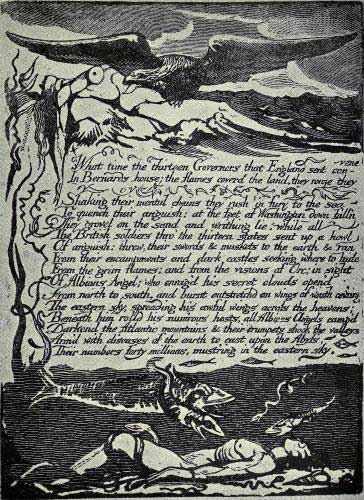
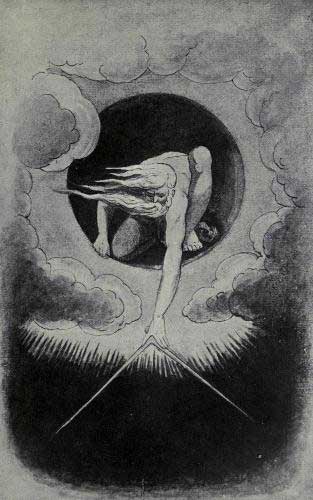
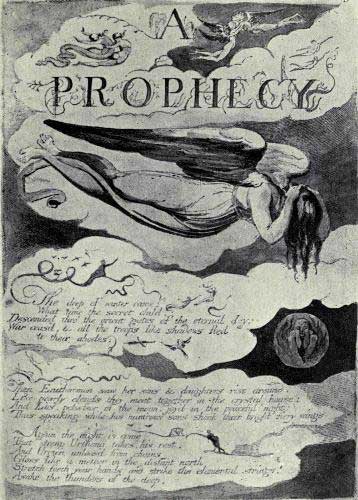
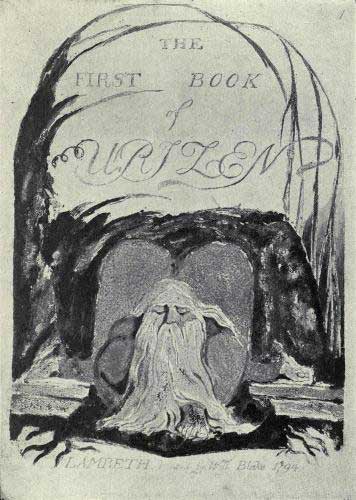
designs to the “Prophetic Books” his over-heated brain attempted the
production in visible images of conceptions not matured—hints, scraps,
vague but immense suggestions. His unfettered imagination set sail on a
shoreless ocean of speculative thinking, and kept to no recognized course,
made for no definite port. Roaming hither and thither on the wide dim sea
of his ever-shifting thoughts, we sometimes long to see his imagination at
work in a more limited, a more definite area.
And so when other minds circumscribed this area, giving him a central pole
around which to group his ideas, we find no loss of individuality, no pale
reflection of another’s conceptions, but a passionate concentration of
original thinking on the subject prescribed, resulting in the development
of an unsuspected point of view, a new aspect.
I am not speaking of illustrations such as those he executed as mere
task-work to gain a living, like the engravings to Mary Wollstonecraft’s
Stories, or those for Hayley’s Ballads. For these subjects had not enough
matter, depth or scope to attract his thoughts or engage his sympathies.
As illustrator to Dante, Milton, Shakespeare, Virgil and the Book of Job,
Blake worked with all his best and most characteristic powers under his
command, and the more effective, vital and original for being
concentrated.
In the same year in which he produced the last of the “London Books of
Prophecy,” 1795, we find him illustrating a so-called translation of
Bürger’s “Lenore.” In spite of the weakness and wilful inaccuracy of the
English version, Blake seized with power on the spirit of the Teutonic
legend, and gave the edition, a copy of which is in the Print Room (a
quarto), three fine designs, of which the first is the most forceful.
We cannot linger over the designs which Hayley commissioned Blake to
execute for his “Ballads on Animals.” From the engraver’s point of view
they are specially fine, as the execution is very delicate, and reaches a
state of high finish seldom attempted by Blake. Perhaps he wished to atone
for paucity of inspiration by elaborate labour. Certain it is that he
worked in bonds and trammels. The subjects were not interesting to him.
Hayley might well say, in his lumberingly playful way, that “our good
Blake was in labour with a young lion,” when he was engaged on the plate
representing that animal. The labour was immense, for the conception had
no vitality. Blake scourged his imagination into a degree of liveliness
sufficient to make “the Horse” and “the Eagle” arresting and uncommon
work, but the shackles were on his hands, because on his spirit, and he
knew it.
Young’s “Night Thoughts,” which we take up next, bears the date 1797.
Blake made no less than five hundred and thirty-seven water-colour
drawings for this poem, but only forty-three designs were eventually
selected for publication, and these were reproduced as uncoloured
engravings. Till a short while ago, Mr. Bain of the Haymarket possessed
the whole series of water-colour drawings, but they have now passed by
purchase into the hands of an American collector. Through the kindness of
Mr. Frederic Shields, who many years ago made tracings and copies from the
unpublished designs, I am enabled to give reproductions of some of the
most striking, though of course not in colour. (It will be remembered that
Mr. Shields wrote the very powerful chapter on Young’s “Night Thoughts”
which is included in the second volume of Gilchrist’s Life.) The designs
published with the poem are larger than those we are accustomed to see in
Blake’s books, and the disposition of them on the pages, of which the
middle is occupied by the printed type enclosed in rectangular spaces, is
not effective. We miss our artist’s beautiful fluent writing, and the type
produces a bald staring impression on the beholder. When, too, the head
and shoulders of a figure appear above the placard and the feet and legs
below, as in one or two plates, we are irresistibly reminded of sandwich
men. The want of colour also is a crying need in these large, pale,
somewhat flat plates. The engravings are executed with great lightness,
though with a certain monotony of line. They are slightly shaded, and have
a distinguishing quality of purity and breadth. What luminous conceptions
and stimulating fancies they contain! though it must also be admitted that
there are a few plates which seem unworthy of Blake, being diffuse, tame,
uninspired.
Plate 16 represents the “Aspiration of the Soul for Immortality” in a
beautiful symbolic female figure holding a lyre and fluttering upward, but
confined to the earth by chains around the ankles.
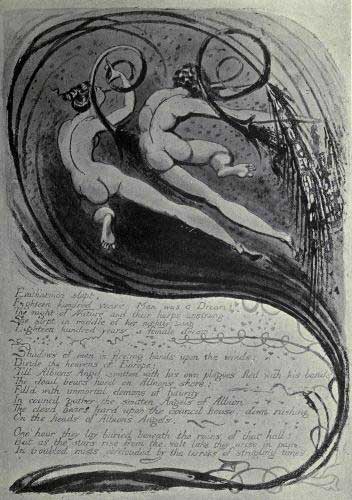
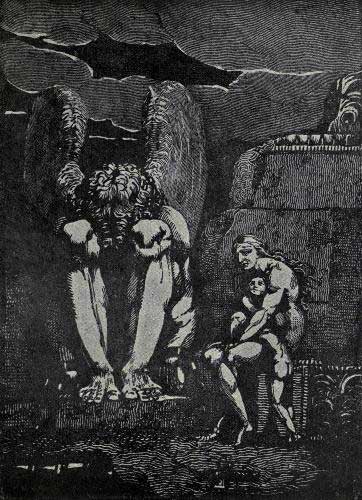
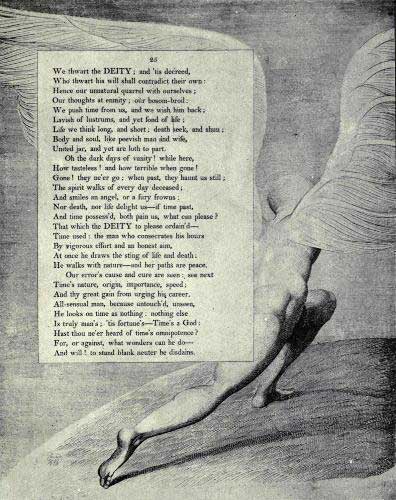
Plates 25 and 26 are, perhaps, the most tremendous in the book. In one
Time creeps towards the spectator, while in the other he half-leaps,
half-flies in his headlong course away.
TIME SPEEDING AWAY
Engraved plate from Young’s “Night Thoughts,” published in 1797
As one turns the pages one is fain to exclaim of the artist that he
breathed the fine thin air of the mountain tops, that indeed he lived “in
the high places of thought.”
I have an impression that Blake drew much of his inspiration from watching
the ever-changing cloud forms of the sky. We know that his designs gained
actually very little from the beautiful natural scenery of Felpham, that
indeed Nature seemed to close round him like a wall. “Natural objects
always did and do weaken, deaden, and obliterate imagination in me,” he
wrote in his MS. notes to Wordsworth. Strange words to come from a
painter-poet. A top room in London with a good view of the sky were all
the conditions which he found necessary for the expression of his genius.
In the vastness of the heavens, clear and deeply blue, or peopled with
glistening clouds, or set with large peaceful stars, which spread
themselves before his upward gaze, Blake found that impetus to creation
which most genius finds in nature or humanity.
He had set himself the task of probing the world of appearances, and
revealing the world of spiritual causes. To say that he succeeded in
representing this pictorially would be to assert that an impossibility had
been achieved, but he got nearer to the goal than any other artist before
or since, not even excepting D. G. Rossetti and G. F. Watts, whose
affinity with Blake’s genius is as close as their manifestation of it is
different.
The better to realize his aim Blake stripped his drawing of everything
that was not essential to the idea he wished to represent. There is never
a single redundant accessory. He never stayed his upward or outward flight
to represent a lovely landscape, woman’s dainty dress, flashing jewels,
bloomy fruit. Typical or merely suggested natural scenes under a great sky
are the usual settings of the human forms who were to him, as to his
master Michael Angelo, the only language coherent enough to express the
innerness and the infinity of spirit.
He seldom chose to inclose his figures in interiors, and such drawings as
he has left of places from which the sky cannot be seen are so rare as to
startle when we come across them. It may be that from Blake Walt Whitman
learned to say, “I swear I will never mention love or death inside a
house.”
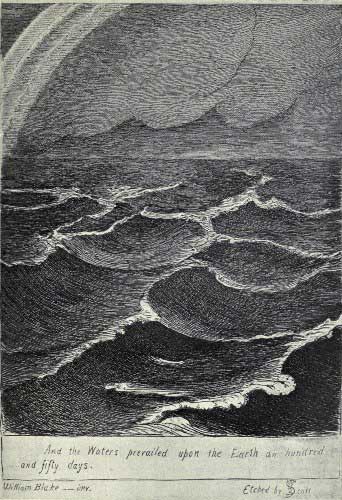
The sea fascinated his imagination, and he has left characteristic records
of it. But for the most part that which he saw with his “corporeal eye”
appeared to him as merely the type of what was unseen. He climbed along
the jutting peninsula of sense to its farthest point, where, giddy with
the immensity of the unsuspected forces revealed to him, he clung, neither
angel nor mortal, but partaking to a certain degree of the conditions of
both. When in this mystic condition of consciousness he focussed his mind
on the “Night Thoughts,” the pencilled ideas resulting are liberal,
spacious, empyrean.
But Blake’s most forcible and poetical thinking on the subject of Death is
crystallized in the delicately gleaming drawings for Blair’s “Grave.”
True, the drawings are not reproduced in Cromek’s edition of the poem as
they left Blake’s hand. The story of Cromek’s mean transaction has already
been retold in these pages. Schiavonetti’s plates, beautiful and fluent in
execution as they are, have lost that peculiar rugged character, that
almost galvanic energy which stamp the original drawings with Blake’s
hallmark. It must be borne in mind that engraving may alter original
drawings much in the same way as does the transposition of a musical
phrase from the original into a foreign key. The melody is the same, but
the mood of it is different. It becomes dull instead of bright, or
plaintive instead of triumphant. Schiavonetti’s transposing of Blake has
made the designs more sweet and less strong, or perhaps less vehement. It
is Blake in a new aspect, one so obviously beautiful that all the world
admits its loveliness. It is Blake arranged for the many, not Blake for
the intimate few!
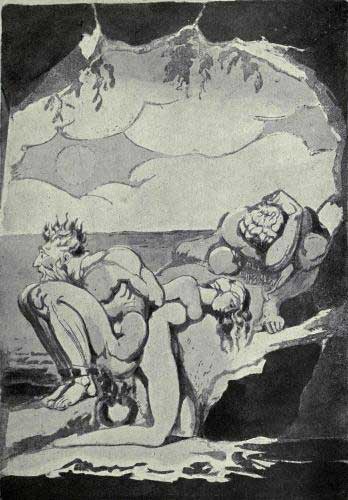
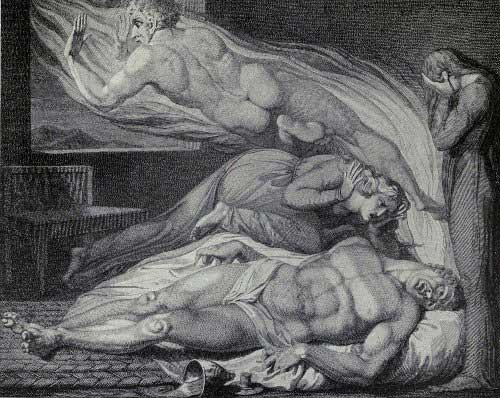
DEATH OF THE STRONG, WICKED MAN, FROM BLAIR’S “GRAVE”
Engraving by L. Schiavonetti after design by Blake. Published 1808
The stanzas he wrote in dedication to Queen Charlotte form such a fitting
introduction to the plates that we quote them:
The door of death is made of gold
That mortal eyes cannot behold,
But when the mortal eyes are closed
And cold and pale the limbs reposed,
The soul awakes and wond’ring sees
In her mild hands the golden keys.
The grave is heaven’s golden gate,
And rich and poor around it wait.
O Shepherdess of England’s fold,
Behold this gate of pearl and gold.
To dedicate to England’s Queen
The visions that my soul has seen,
And, by her kind permission bring,
What I have borne on solemn wing,
From the vast regions of the grave;
Before her throne my wings I wave,
Bowing before my sov’reign’s feet.
The grave produced these blossoms sweet,
In mild repose from earthly strife;
The blossoms of eternal life.
And now Blake comes to close quarters with the subject that had haunted
him all his life, the dark web on which he had woven so many bright,
half-defined fancies.
Again we discern a point d’appui between him and Michael Angelo. The
thoughts of neither of them were long away from death. Michael Angelo
wrestled with the dark angel and brought away from the encounter the
profound and intimate thoughts that he has enshrined in the Medici Tombs
of San Lorenzo. Never has the human soul—save perhaps
Beethoven’s—apprehended more closely the mystery, the terror, the mingled
shrinking and awe of the grave, yet at the same time its hope, than he did
in the Sacristy of the Medici Chapel. And in all plastic art, the only
things to which these fateful sculptures may be likened in their qualities
of rapt and sincere thinking, united to imagination and insight, are the
designs, which Blake made to illustrate Blair’s “Grave.”
The great Florentine, it is true, wrought colossally in enduring marble
before all the world, while the obscure Blake, two centuries later, traced
out his thoughts on paper, his designs being known to comparatively few
persons; but the conceptions of the two brains are allied, and the works
of the two hands are own brothers.
Blair’s conventional and smooth verses in Blake’s case have nothing to do
with the matter. They merely form the pegs on which he cast the great
garment of his thoughts. Death—the Grave!—his intense and fervent spirit
so brooded on the subject that the result is no mere illustration of
Blair’s text, but invention. The poem in his handling has enlarged itself
out of all knowledge, and turned to us an unfamiliar face, new and
enriching conceptions. Blair merely indicated the track on which his
pioneer spirit journeyed heedfully and musingly, through the dim country
of Death. Piercing all conventions, all accepted theology, he would fain
seize the very heart of the elusive mystery. “What is Death?” he asks;
“let me peer into the grave unshrinkingly and see for myself.” And from
the grave he brings this triumphant answer, “Death is Life, this Life only
is Death; you have but to die to conquer Death”; or in Walt Whitman’s
prosaic but arresting phrase, “To die is different from what anyone
supposes, and luckier.”
We reproduce the most significant of the plates.
In “The Soul exploring the Recesses of the Grave,” we see a shuddering yet
resolved man determinately bringing himself to the close contemplation of
death. He remains above the vault on the hillside trying to pierce the
moonlit earth with his limited human vision; but his imagination, his
soul, penetrates where he cannot enter—yet!
In the likeness of a fair woman with a lamp, like the Greek Psyche, she
tiptoes delicately into the arched hollow beneath the hill, and gazes
alarmed but steadfast on a dead body wrapped in flickering flames. It is
to be noted that the man whose soul regards death so closely is already on
the mountain tops, he has “lifted up his eyes unto the hills,” and his
figure set against the sky has an indefinable air of separateness from
ordinary humanity.
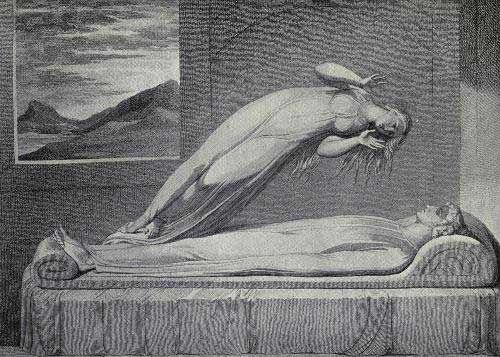
The plate entitled “The Soul hovering over the Body reluctantly parting
with Life” satisfies with a strange and unearthly delight. No Diana ever
hung more yearningly above her Endymion than this beautiful and tender
soul lingers, in loving reluctance to part, above the stiff human tenement
she has just quitted. Presently she will take her darting flight through
the window and over the mountains and up into the illimitable glory of the
distant sunrise. There is the hush and the blessedness of a great silence
on this dim silver dawn, suggesting the spiritual correspondence between
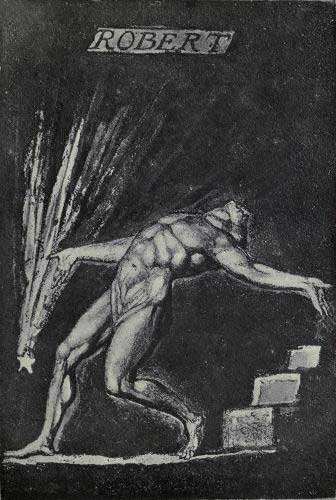
it and the dawning life of the newly-released soul. Was it a recollection
of that younger brother, Robert, so dearly loved, that taught Blake the
pathetic dignity of the composed limbs, the sculptured calm of the dead
face?
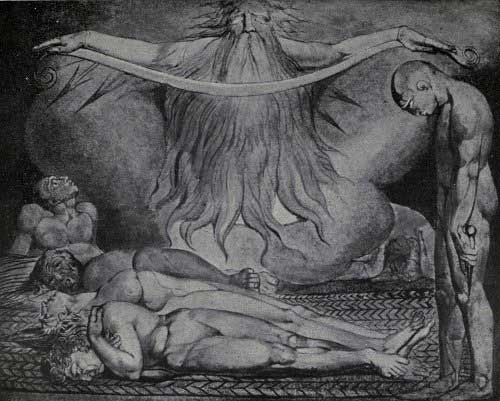
The “Death of the Strong Wicked Man” is a savage contrast to the peace,
the musical pause, of the last-mentioned design.
In “Milton,” Blake writes:
Judge then of thyself; thy Eternal Lineaments explore,
What is eternal and what changeable, and what annihilable.
And he answers the question in the forms given to these passing souls,
some being closely analogous to their mortal appearances, others changing
even to sex, while others again have passed from age into a state of
perpetual youth.
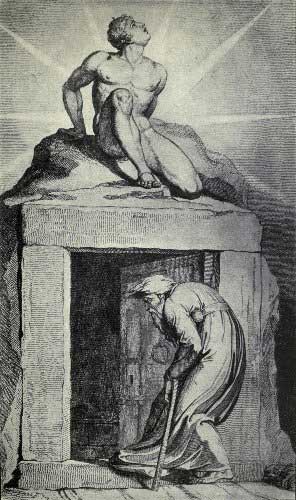
This latter is the case in the plate called “Death’s Door.” “Age on
crutches is hurried by a tempest into the open door of the Grave, while
above sits a young man—‘the renovated man in light and glory’—his
beautiful young head thrown up to the sky, his mouth full of inspired
song, his whole virile body expressing ideal beauty, rapture, glad new
life.”
No one but Michael Angelo could have drawn with strong felicitous hand the
glorious youth atop of the grave as Blake has done. The whole allegory is
so intellectually definite, so succinctly expressed that thought and its
body form are here identical. But the strangest flower of his thoughts on
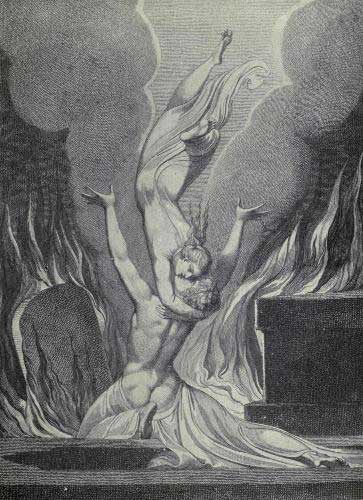
the grave, blossoms in the picture called “The Re-Union of the Soul and
the Body.” Descending like a bolt from the blue, cleaving the smoke
ascending from the fires of consuming materialism, the soul embraces with
passionate joy the strong male body, which struggles from the grave to
enfold her. Cleansing and fusing fires flame around them. The beauty of
the drawing—the melodious curves of the downward plunging “soul,” the
delicious foreshortening of the leg, the swirl of the white drapery—has
stricken into poetic lines the forcefulness of flight, the passion of
re-union. This emotional conception moves the heart strangely. It is the
promise of St. Paul here visibly consummated, that a spiritual body shall
at last clothe the shivering unhoused soul.
THE SOUL RELUCTANTLY PARTING FROM THE BODY, FROM BLAIR’S “GRAVE”
Engraving by L. Schiavonetti after design made by Blake. Published 1808
“States change,” Blake wrote, “but Individual Identities never change nor
cease.”
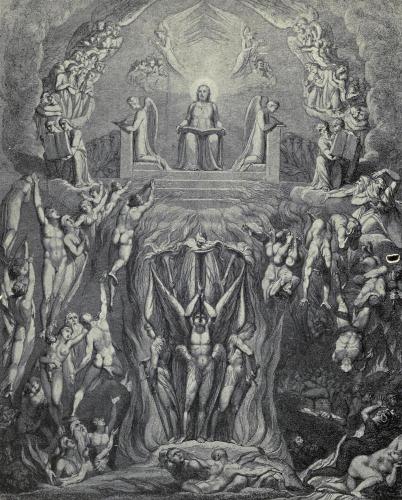
And now take last of all, but not least, the plate called the “Day of
Judgment.” Nothing daunted by the long array of “Last Judgments” that have
been executed from Orcagna to Michael Angelo, Blake must needs give his
rendering of the subject; and an original one it is, though he can hardly
avoid—even he!—the traditional disposition of the main parts of the
picture.
But what freshness, what new life and new motives he has introduced into
this subject, hoary with extreme age. The spirits ascending into Paradise
are as lovely as heart and eye of man could wish. Orcagna’s conception of
the beatified souls in Santa Maria, whose profiles Ruskin likened to
“lilies laid together in a garden border,” is not more delightful in its
artless way than is Blake’s. The children of wrath, snake-encircled,
howling, and falling head foremost into the abyss, recall the terrors, the
uncouth and wild imagination of “Urizen” and one of the plates in
“America.” But here Schiavonetti’s graceful and civilizing hand has passed
over each figure, and he has contrived in some indefinable way to smooth
away the too austere and savage strength of this latest born of the “Dies
illa” of art.
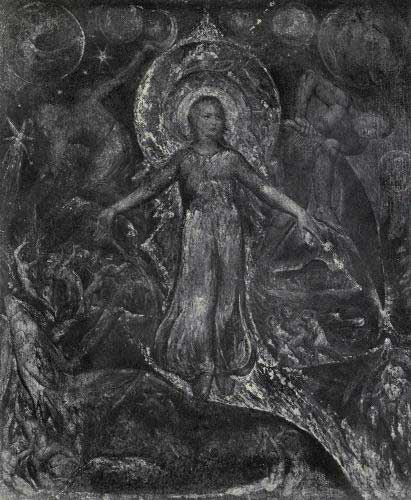
I have not mentioned the first plate, which represents Christ with the
Keys of the Grave in his hand, because my function is chiefly that of
praise. But I ought perhaps to point out, what is however painfully
obvious, that Blake always failed in any attempt to represent Jesus.
Whether he was hampered to a degree beyond his strength of liberation by
the traditional likeness, the type ascribed to the Saviour, and so could
not work in freedom, it is impossible to say authoritatively. But this
traditional face of Christ, ploughed as it is into the heart and memory of
humanity, probably arose and disturbed his own soul’s independent vision
whenever he tried to fix his imagination on the ideal lineaments.
If this were the case, then indeed it is proved beyond question that
Blake’s work is almost valueless when it is not dependent on his own naked
perceptions, his inward recognition of facts, disregardful of all outward
corroboration.
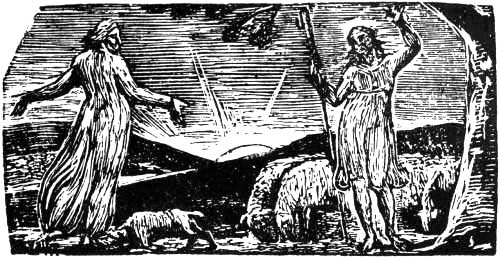
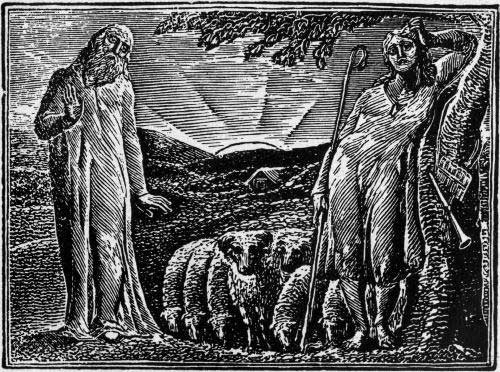
Blake’s next work in illustration was done for Dr. Thornton, who projected
an English edition of Virgil’s “Pastorals” for the use of schools, with
Ambrose Philips’ imitation of Virgil’s first eclogue. They were the first
and the only woodcuts Blake ever did, and though they bear traces of an
unpractised hand, “he put to proof art alien to the artists,” and showed
his essential mastery of this means of expression in a manner which more
than reconciles one to his slight defects of method.
Gilchrist is of opinion that the original designs were a little
marred—lost somewhat in expression and drawing in transference to the
wood; but Mr. Laurence Binyon, who has lately studied them closely, and
has reproduced them with admirable truth, holds a different opinion. He
writes, “Blake’s conceptions in these illustrations did not take their
final form in the drawings; they were only fully realized on the block
itself. Hence they have the character of visions called up as if by
moonlight out of the darkened surface of the wood, and seem to have no
existence apart from it.”
They instance the power Blake had in a remarkable degree of concentrating
in a few types the essence of his subject. In these blocks it is pastoral
life—flocks feeding in lonely stretches of country, the still peace of
hills, the might of tempest—that he concentrates and expresses by the
roughly executed but exquisitely felt little scenes which are the
consummation of his insight into the large natural life of the earth.
BLAKE’S WOODCUTS, FROM HIS OWN DESIGNS, TO PHILLIP’S “VIRGIL’S PASTORALS.” 1821
Blake did in these woodcuts, what he could never have achieved, had he
sought to do so, in any other of the branches of art practised by
him,—namely, he gave truthful because extremely simple impressions of
Nature as she appears in her rarer moods. Master as he was of linear
design, he was too neglectful of tonic values to interpret with any
delicacy the effects of landscape in water-colour or engraving. But here,
the very nature and limitations of woodcutting, its necessary economy of
means, enabled him for once to express effectively and adequately his
great simple generalized impressions.
These pregnant suggestions of his induce a mood sympathetic with the
deeper and subtler chords of pantheism.
In one of the most beautiful, but at the same time one of the simplest of
the blocks, all the witchery and solemn charm of a remote pastoral
neighbourhood is represented in a few typical rural images.
A solitary traveller journeys along a road winding deep between hills, in
the last beams of the setting sun. Blake has endowed this darkened
landscape with I know not what suggestions of watchful intentness. The
wayfarer in some mysterious manner is in its power!
Hands unseen
Are hanging the night around him fast.
And again:
The place is silent and aware,
It has had its scenes, its joy and crimes,
But that is its own affair.
These words of Browning’s are singularly apt to express the delicate and
profound hints in this little woodcut. The wonderful thing is that Blake
could convey so much on a slip of paper about three inches by one and a
half in size.
In all the plates we find this strange accent laid on Nature, her
awareness, her sombre fateful moods, her listening, and the long patience
of her endless waiting. The oft-repeated motive of the shepherding of
flocks is treated in no glib or merely idyllic manner, but has the sort of
holy peace that befits that most ancient and most gentle of all the
occupations of men.
An appreciative critic has said anent these woodcuts, that they prove
conclusively that “amid all drawbacks there exists a power in the work of
the man of genius which no one but himself can utter fully.”
The truth of this remark must be felt by all Blake’s admirers with double
force and poignancy when they think regretfully of Blair’s “Grave,”
wherein the designs, being engraved by another hand than the father of
them, have lost some indefinable note of character belonging to Blake’s
personality.
And now we come to the greatest series of engravings on a religious
subject that have appeared since Albrecht Dürer. The inventions to “Job”
are the crown of glorious achievement on the strenuous and austere life of
the artist-poet, and of all his work there is nothing so perfect in the
dramatic development of the subject, the broad, forceful yet delicate
execution, and the poetic sensibility which animates the entire series.
It appears that Blake’s lifelong friend, Mr. Butts, bought from him a
series of twenty-one water-colour drawings or “Inventions” from the Book
of Job.
(This set of drawings, be it remarked, together with twenty-two brilliant
proof impressions on India paper of the engravings afterwards made from
them, were sold to Mr. Quaritch on March 31st, 1903, at the sale of the
Crewe collection of Blake’s works, for the sum of £5,600.)
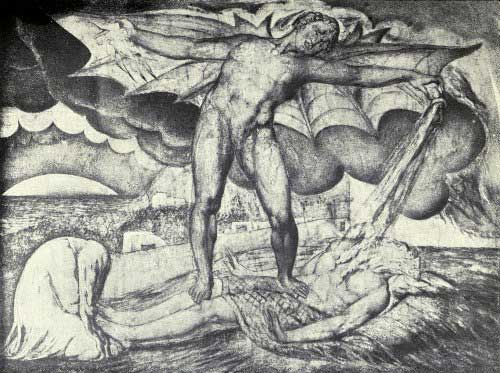
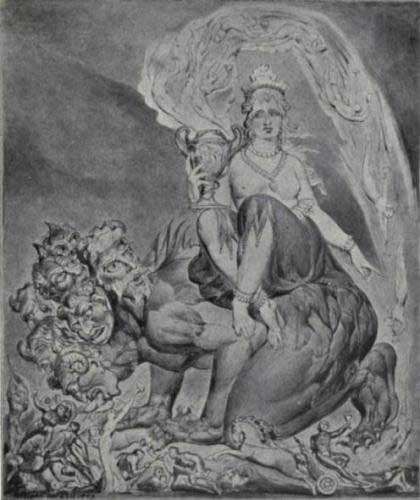
I have seen one water-colour (presumably not one of the original set done
for Thomas Butts, though probably a repliqua) of Satan pouring a vial
containing the plague of boils on the prostrate body of Job. It is
interesting to compare it with the final form the design assumed in the
engraving (Plate 6 in the Book of Job) done for John Linnell. Owing to the
courtesy of Sir Charles Dilke, to whom the picture now belongs, we have
been enabled to reproduce it. It will at once be seen that, in the
engraving the management of the light is more satisfactory, because it is
comprehensible, than in the water-colour; while the cloud-forms are less
conventional and rounder. The bat-like wings with which Satan is furnished
in the painting have been sacrificed in the engraving. Job’s wife has been
put into tone, whereas in the water-colour, the visible side of her, which
ought to have been in dense shadow, was in full light. The whole design
has been pulled together, gaining an impressiveness and unity altogether
wanting in the earlier work. Blake’s passion for “determinate outline”
(irrespective of its appearance in Nature), and contempt for truth of tone
in colour, gives the water-colour a mapped-out definitive appearance in
its background of scenery,—despite the magnificent qualities of
imagination and draughtsmanship displayed in the treatment of the
figures,—which somehow recalls the work of such masters as Paolo Uccello.
Mr. Linnell, deeply impressed with the lofty and imaginative character of
the water-colours done for Mr. Butts, commissioned a complete set of
engravings to be executed from them by Blake’s hand, for which he paid
£150 in instalments of £2 to £3 weekly—the largest sum Blake had ever
received for any one series.
On glancing through them it will at once be noticed that his style of
engraving had undergone a change during the last period of his life.
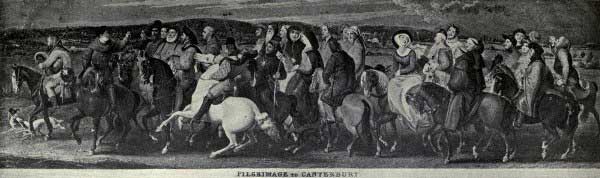
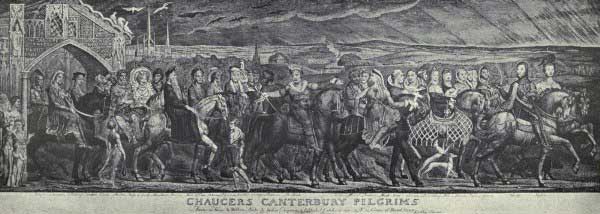
“The Canterbury Pilgrimage,” which he had executed fifteen years
previously, exhibited the old hard and dry manner of engraving which he
had adopted from Basire in its most accentuated form. (For the convenience
of classification I have included that picture among the loose drawings,
engravings, and water-colours for consideration in a later chapter, but it
would be well for the student to look at it now, the better to appreciate
the freedom, grace and power of the engravings in the “Job” series.)
On one of the many pleasant days Blake spent with Linnell at North End,
Hampstead, the latter showed him some choice engravings of Marc Antonio
and his pupil Bononsoni, and from this latter’s work Blake suddenly
apprehended the possibilities, the scope, that lay for him in the
engraver’s art. In the school of Basire much of the work was accomplished
by a laborious and indiscriminate process of cross-hatching.
It is true that Blake by the sheer force of his genius had made this style
answer in a manner to his needs of expression, but it was work performed
in an unnecessarily confined technique.
When he came to study the Italian school of engraving he found to his
delight that every stroke was made to tell. Nothing blotchy or muddled, no
careless cross-hatching, no “lozenges or dots” were admitted, and Blake
quickly appreciated the wider range of effects obtainable by this Italian
manner, and engrafted its main principles on to his own characteristic
style. Of that characteristic style, as we know, the beauty of outline,
the care for its preservation whenever possible, was the main principle.
And here in the school of Marc Antonio and Bononsoni he found that
principle adopted as the basis of beauty in engraving, every other
consideration being made subservient to it. The conflict and want of unity
of effect, resultant on making compromises with other principles of
art,—such as subtlety of modelling, delicate distinctions in values,
imitation of textures, intricacy of detail,—had not disturbed the dignity
of the Italian school, which consciously sacrificed variety and a wide
range of effects in order to keep the work of the burin as broad and
simple as possible, the outline always being insisted on as the chief
subject of alterations, while the shading and modelling were
comprehensively indicated by long curved lines, close together, only
crossing and intersecting in the darkest parts. The beauty and freedom of
the “Job” engravings are a revelation of the final grace and power
achieved by Blake through his appreciation of the legitimate functions of
an art pre-eminently concerned with line.
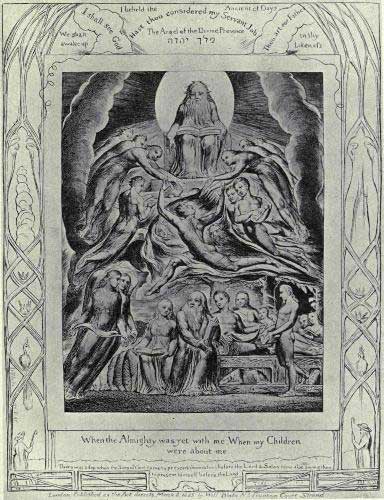
PLATE II FROM “THE BOOK OF JOB”
Engraving, published March, 1825
The Book of Job is one of the world’s great epics. It voices man’s need of
belief in God; it is the cry of one pierced to death with the arrows of
misfortune, yet asserting with passionate faith, “Though He slay me, yet
will I trust in Him.” Earthquake, famine, bereavements, pestilence cannot
eradicate from man the deep-rooted assurance that God not only exists, but
is just and loving, and the Book of Job is the supreme poetical expression
of this fundamental belief.
As such, it welded itself into Blake’s imagination, and the designs he
made to illustrate it are worthy in all respects to be set alongside the
ancient tragic text.
Plate 1 represents Job, his wife, and their sons and daughter kneeling
around them, praising God at the rising of the sun. Their flocks and herds
surround them, and a noble tree—on which their musical instruments are
hung—overshadows them; in the background, at the base of rocky hills, a
Gothic cathedral is daringly set, to typify the soul of worship made
visible. “Thus did Job continually.” The border that surrounds the
finely-wrought plate is very slight but decorative and thoughtful. An
altar with a flaming sacrifice upon it is indicated, with these words
inscribed upon its front:
The letter killeth,
The Spirit giveth Life,
It is spiritually discerned.
While, above, the words,
Our Father which art in Heaven,
Hallowed be Thy name,
set the keynote to the whole work.
Plate 2 contains no less than twenty-three figures, and two scenes are
being enacted simultaneously.
Job and his wife still sit beneath the tree with their children, but above
them we see the heavens open and God giving power to Satan, who strides
like Urizen through flame, to test the uprightness of His servant Job.
“This was the day when the sons of God came to present themselves before
the Lord, and Satan came also among them to present himself before God.”
The border is exquisite, light as gossamer, and containing in its fine
web-like lines beautiful suggestions. Angels with heads bent beneath
Gothic tracery receive the flame and smoke that are the thought-sacrifices
of two shepherds, who mind the sleeping flocks in their fold. The next two
plates are (3) the Destruction of the Children of Job, and (4) the
reception of the news by Job and his wife.
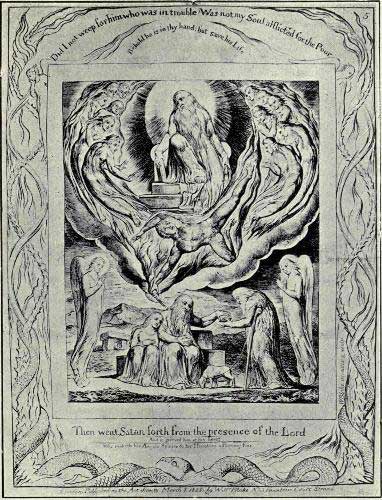
Plate 5 is one of the finest of the series. Job and his wife, sitting on
the ruins of their home, give of their straitened means to the blind and
halt, while “the angels of their love and resignation,” as Gilchrist
sympathetically terms them, hallow and beautify the scene. But above, the
Almighty sits enthroned, with an expression almost remorseful, and the
angels shrink away in horror, for He has given Satan leave to try Job
to the uttermost, only reserving his life. “Behold he is in thy hand, but
save his life.” Satan, with face averted from the sublime spectacle of Job
in his affliction, has concentrated the fires of God into a phial which he
is about to pour on his head.
PLATE V FROM “THE BOOK OF JOB,” 1825
Engraving
The border is symbolically woven with writhing snakes and thorn-set
brambles, among which quick darting flames find their way upwards.
And then follow Plates 6, 7, 8, the workings of the Evil One, the coming
of the three friends to Job, and Job raising himself in agony and uttering
the frantic words, “Lo, let the night be solitary and let no joyful voice
come therein, let the day perish wherein I was born.” This suggests
“thoughts beyond the reaches of the soul.” Then follows the Vision of
Eliphaz—very terrible and grand—and Plate 10, “The Just Upright Man is
laughed to scorn,” in which Job’s attitude, the dignity of his grief and
faith, are magnificent. “Though He slay me, yet will I trust in Him,” is
expressed in every line of the noble, piteous figure.
Plate 11—“With Dreams upon my bed thou scarest me and affrightest me with
Visions”—has something mediaeval in the grotesqueness and ingeniousness
of the horrors depicted. Orcagna’s devils, Dürer’s “Death and Satan” are
not more terrible than Job’s tormentors. The words engraved in the border
contain all the condensed pain of the race of man, as well as the faith
which alone makes it possible to be endured.
And then to all this “storm and stress” succeeds Plate 12, with its
suggestions of returning peace and the everlasting calm of the stars. “Lo,
all these things worketh God oftentimes with Man to bring back his Soul
from the pit to be enlightened with the light of the living!” says the
inspired young man to Job, who with the seal of a great suffering set on
his face—but a suffering of which the bitterness is past—sits listening
intently as one who suddenly receives light in his soul. The sonorous
penetrating words fall on the senses like the music of rain-drops on a
thirsty land, and the design grows out of them like a true organic form of
which the shape is innate. Oh! the peace of that night sky, and the gentle
radiance of the stars set in its depth!
The border is here specially beautiful. “Look upon the heavens, and behold
the clouds which are higher than thou”—words that found a responsive echo
in the heart of Blake—is the verse inscribed on the robe of a sleeping
old man. The border is quick with winged thoughts, floating upwards from
his head, in the shape of small men and women, linked in a sinuous
succession, which finally reaches a sky, also set with stars, whose clouds
have verses written upon them that contribute to a full understanding of
Job.
Plate 13, “Then the Lord answered Job out of the whirlwind,” continues the
gracious and softening influences of the last design. Job and his wife,
with tremulous eager hope, look up into the mild face of God, who, clothed
and enwreathed by a whirlwind of which Blake only could have suggested the
marvellous vortex, stretches His arms in blessing above them. The three
friends are prostrated and overwhelmed beneath the force of the blast that
encloses God.
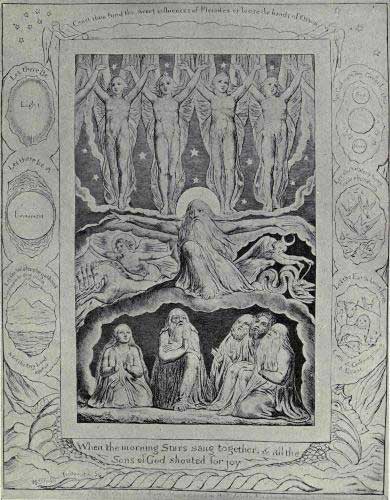
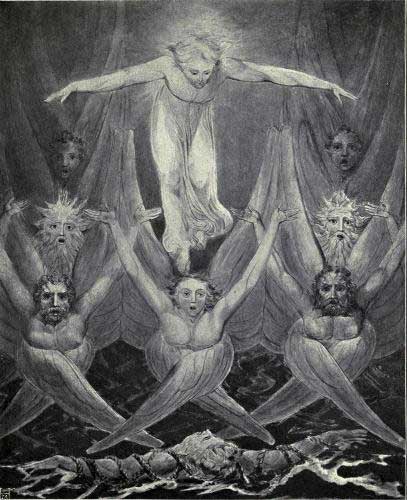
And now we come to Plate 14, than which nothing can be imagined more
beautiful. “When the morning stars sang together and all the sons of God
shouted for joy,” are the words beneath and around the border; the six
days of creation are indicated in six delicate medallions, which may in
their turn have suggested the noble series of paintings, of ample scope
and poetic imagining, which Sir Edward Burne-Jones executed.
PLATE XIV FROM “THE BOOK OF JOB,” 1825
Engraving
But the main design—God, the centre of the universe, from whom issues Day
and Night, the listening rapt group of Job, his wife, and the
comforters, and, above all, the glorious rejoicing ranks of angels—is
beautiful almost beyond expression. It is noticeable that on either side
appears the arm alone of an angel outside the picture, thus cleverly
suggesting the idea of an infinity of this heavenly host. Mrs. Jamieson,
in her “Christian Art,” says, “The most original and, in truth, the only
new and original version of the scripture idea of angels which I have met
with is that of William Blake, a poet-painter, somewhat mad as we are
told, if indeed his madness were not rather ‘the telescope of truth,’ a
sort of poetical clairvoyance, bringing the unearthly nearer to him than
others.
“His adoring angels float rather than fly, and with their half-liquid
draperies seem about to dissolve into light and love; and his rejoicing
angels—behold them!—sending up their voices with the morning stars, that
‘singing in their glory move!’”
The picture has the thrill, the immensity of music in it, and I never look
at it without recalling the motive of the last movement of the Choral
Symphony.
It resolves all the human suffering, all the incoherent and striving
emotions, all the diverse and multiform forces of the Book of Job, into a
final harmony and triumph of beauty.
In much the same way the last motive of Beethoven’s “Ninth Symphony” rings
forth after the tentative, subtle and passionate music of the preceding
movements like a shout of joy, the cry of a faith which says—not, “I
have heard, I have learnt, I believe,” but, “I know! absolutely and for
ever!”
Plate 15 shows God pointing out the works that His hand has fashioned.
“Behemoth” and Leviathan, in a circular design very Gothic in character,
appear below. And to this succeeds Plate 16, “Satan Falling.”
Plate 17, in which God appears blessing Job and his wife, while the false
comforters hide their diminished heads with an almost comic fright, is
distinguished by another of those fine effects of light for which Blake
had so great an aptitude. The sun, which forms the nimbus of God’s head,
emits strange prismatic rays, very beautiful and weird. “Also the Lord
accepted Job” shows us Job with his wife and friends offering a fire on an
altar before a great sun, which, like God’s halo in the previous picture,
flashes the same strange light. The design is calm and solemn, and has an
exquisite decorative feeling. Immediately below the altar, on some steps
which form part of the border, Blake has touchingly and humbly laid his
own palette and brushes, as if to indicate that, like Job, his work had
been offered and accepted by the Lord.
In Plate 19 Job and his wife are seated beneath a fig-tree in a field of
standing corn, gratefully receiving offerings from a father and mother and
their two beautiful daughters.
“Everyone also gave him a piece of money.” The border contains, as usual,
amid its palm leaves and angelic figures, verses relating to and assisting
the chief motive of the picture.
For pure melodious beauty perhaps there is no plate like 20. “There were
not found women fair as the daughters of Job in all the land, and their
father gave them inheritance among their brethren.” Job is seated in a dim
rich chamber, on whose walls are wrought paintings illustrating the trials
he has experienced. Around him are grouped three beautiful daughters, who
listen rapt while he relates to them God’s dealings with him.
This is a rare example of Blake’s choosing an interior with no opening out
into the beyond. It is quaint and beautiful, but we are so accustomed to
seeing Blake’s figures set in the open air with the sky above them, that
this closed-in chamber, exquisitely wrought and fantastic as it is, seems
a thing foreign to his usual methods, his elective affinity for the great
expansive types of God’s universe. I think the reason he chose an interior
in this instance was that we might be shut in and enclosed within the mind
of Job as it revealed itself to his daughters. Instinctively we know that
Blake’s true lover Rossetti must have cared for this plate with quite
special fervour, so close is the analogy between its hidden mysterious
richness and the wonderful painted interiors in which he set his women,
and from which he developed such a high degree of romantic suggestion and
atmosphere. A lute and harp amid trailing vines, grape-laden, form a
border to Blake’s design, as delicate as the illuminated tracery in a
mediaeval Hour-Book. In the final plate—“So the Lord blessed the latter
end of Job more than the beginning”—the hole of the great tree that has
figured in so many of the designs is surrounded by a crowd of persons,
with Job, his wife and beautiful daughters in the midst. All play on
instruments of music, while sheep and lambs and (it must be admitted) a
most Gothic-looking sheep-dog repose in the immediate foreground. The
ancient and fantastic instruments, the rapt upraised faces, the beautiful
girls, recall the old Florentine singing galleries—cantorias as they are
called—the one by Donatello and the other by Luca della Robbia, now in
the Museo del Duomo at Florence. In neither has the joy of praise, the
delight in making music, found more complete expression.
Blake’s “Book of Job” is a holy thing. The full compass of his orchestral
nature exerted itself for this final effort. All his long sacrifices,
deprivations, passionate sorrows and sacred joys, his burning aspirations
and his steadfast faith, found their true meaning, their perfect
consecration in the blossoming of this supreme flower on his tree of life.
It was Blake’s offering to God, like the Sacred Host, reserved and offered
up in his own hands on the altar of his storm-weary heart.