Blake’s Life in South Molton Street and Fountain Court—Acquaintance with Linnell and
Varley—Drawings of Visionary Heads—Miscellaneous Works in Private Collections—Illustrations
of “Job”—Work as an Engraver—Acquaintance with Crabb Robinson—Illustrations
of Dante—Declining health and death—General observations—His
principal Biographer and Critics.
Very little is known of Blake’s life for several years after his exhibition.
William Carey, a rare example of disinterestedness among
picture-dealers, for he praised Blake enthusiastically without having dealt
with him, says in his exposition of West’s Death on the Pale Horse
(1817), “So entire is the uncertainty in which he is involved that after
many inquiries I meet with some in doubt whether he is still in existence.
But I have accidentally learned since I commenced these remarks that he
is now a resident in London.” He was, in fact, continuing to live on
his second floor in South Molton Street, poor, but content, subsisting
from day to day by hack work as an engraver, and the occasional
sale of a water-colour design or a coloured copy of one of his books,
but nowise squalid, abject, or destitute. He was no longer able to
publish on his own account as of old, and the poems which he continued
to produce abundantly, all of which have perished, met with
the reception which was to be expected from earthly publishers. Blake
smiled in pity, assured that, in his own figurative language, they were
handsomely printed and bound in heaven, and eagerly perused by
spiritual intelligences. “I should be sorry,” he afterwards said to
Crabb Robinson, “if I had any earthly fame, for whatever natural
glory a man has is so much taken from his spiritual glory.” He certainly
had not thought so when he published his catalogue; but there
is no question of his perfect sincerity when he added, “I wish to
do nothing for profit. I wish to live for art.” Though he had said
“Thought is act: Christ’s acts were nothing to Cæsar’s if this is not so”;
so intense was his own devotion to labour that for two years he never
quitted his lodging, except (for the ridiculous will intrude where it is
not wanted—imps grin in the cells of anchorites—) for a pot of porter.
Even while he engraved he read, as the plate-marks on his books attest.
Flaxman, his steady friend from youth, found him some work in
engraving, and praised him in conversation. “But Blake’s a wild
enthusiast, isn’t he?” “Some think me an enthusiast,” answered Flaxman,
who was, in truth, more than half a Swedenborgian.
From this hermit’s existence Blake once more emerges, in 1818,
into comparative publicity through the intimacy he formed with a
young painter of promise, which he was destined to more than redeem.
This was John Linnell, who was introduced to him by Mr. George
Cumberland, of Bristol, an enlightened patron of art. At this time
Linnell was largely engaged in portrait painting, and the plate of the
portrait selected here for reproduction, that of Wilson Lowry, Esq.,
appears to have been worked upon by both him and Blake, bearing the
name of each. Linnell, though neither gentle nor mystical, lived much
in the world of the spirit, and, without sharing Blake’s peculiarities, was
rather attracted than repelled by them. Within a few days after making
Blake’s acquaintance he had found him work to the amount of fifteen
guineas, and gradually introduced him to patrons, including Sir Thomas
Lawrence, a great gentleman as well as a fine painter, who took the
notice of Blake which it became him to take in his position as President
of the Royal Academy. Blake never encountered hostility from artists
of true eminence. Reynolds advised him wisely, though he would not
think so. Lawrence patronised him; and Flaxman, Fuseli, Stothard,
Linnell were, so far as he permitted them, real friends. Within a few
years Linnell had introduced him to a younger circle, ready in a
measure to sit at his feet, and the rejected stone was honourably built
into the corner. Of these we shall have to speak afterwards, but one
important intimacy mainly belongs to the period of 1818-21. This
was his acquaintance with John Varley, famed as one of the fathers of
English water-colour painting, but even more renowned as an astrologer.
Indeed, some of the stories told of his successful predictions are less
startling to the uninitiated than to astrologers themselves, who cannot comprehend
on what principle of the art they could be made. They certainly
were not arrived at by vision or revelation, for the good Varley was a
most unspiritual personage, the very antipodes of seer or anchorite, big,
sanguine, jovial, and everlastingly in the claws of the bailiffs. Astrology,
therefore, a study which, with all its fascination for an imaginative mind,
requires nothing but observation and calculation, was the only occult
science open to him; for magic, although a diabolical pursuit, occasionally
demands an amount of fasting inconvenient even for a saint. Varley
would have wished to go further, and finding the perception of visions
inconsistent with his own corporeal and spiritual constitution, was delighted
to make the acquaintance of one who to this end needed but to open
his eyes. He speedily developed the practical idea that Blake should
depict the spiritual entities which he beheld. Blake forthwith set to
work, and ere long the portfolios of Varley and Linnell were enriched
with those ghosts of fleas, portraits of Edward the Third, and men who
built the pyramids, which are better known to many than anything
he ever did, and are assuredly no mean examples of his imaginative power.
“All,” says Gilchrist, “are marked by a decisive portrait-like character,
and are evidently literal portraits of what Blake’s imaginative eye
beheld.”[7] This is corroborated by the account of Varley, who says,
“On hearing of this spiritual apparition of a Flea, I asked him
if he could draw for me the resemblance of what he saw. He instantly
said, ‘I see him now before me.’ I therefore gave him a paper and a
pencil, with which he drew the portrait of which a facsimile is given
in this number [of Varley’s Zodiacal Physiognomy]. I felt convinced by
his mode of proceeding that he had a real image before him; for he left
off and began on another part of the paper to make a separate drawing of
the mouth of the Flea, which the spirit having opened he was prevented
from proceeding with the first sketch till he had closed it.” It was “an
idea with the force of a sensation,” as Peacock’s philosopher classifies the
apparition in Nightmare Abbey. Shelley, who also saw visions, has
enriched his note-books with similar delineations of imaginary figures,
generally vague and careless, but sometimes very Blake-like. One of
Linnell’s most spirited studies from life, engraved in Story’s biography,
represents Blake and Varley in discussion.
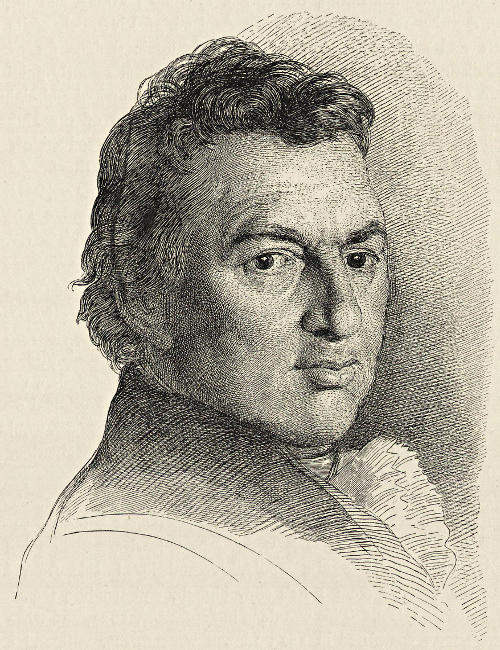
Portrait of Wilson Lowry. By John Linnell. Engraved by Blake and Linnell.
These drawings were mostly executed in 1819 and 1820. In the
latter year Blake lost his chief patron Butts, whose walls, indeed, had
become so crowded with his works that he had almost ceased to give him
commissions. The greater part of the collection was dispersed in 1852,
but the zeal of Mr. W. M. Rossetti traced most of its constituents out,
and reference to his notes, printed in the second volume of Gilchrist’s
biography, will enable us to convey some faint notion of its manifold
opulence. Putting the Job aside for the present, the most remarkable
appear to be the nine designs for Paradise Lost, the property of Mr.
J. C. Strange, in which, says Mr. Rossetti, Blake is king of all his powers
of design, draughtsmanship, conception, spiritual meaning, and impression.
Another set, belonging to Mr. Aspland, of Liverpool, omits one
subject and adds four. Another set of Miltonic designs for Comus,
rather distinguished by grace than grandeur, has been recently published
by Mr. Quaritch. Another set of no less than one hundred and eighteen
designs for Gray’s works, in 1860 in the possession of the Duke of
Hamilton, are reputed to rank among Blake’s finest productions, but
have not been inspected by any one competent to describe them. Among
others especially commended by Mr. Rossetti are The Sacrifice of Jephthah’s
Daughter, Ruth, The Judgment of Paris, The Wise and Foolish Virgins,
Fire, Famine, Samson subdued, The Finding of Moses, Moses erecting
the Brazen Serpent, The Ghost of Samuel appearing to Saul, The Entombment,
The Sealing of the Sepulchre, The Angel rolling the Stone from the Sepulchre,
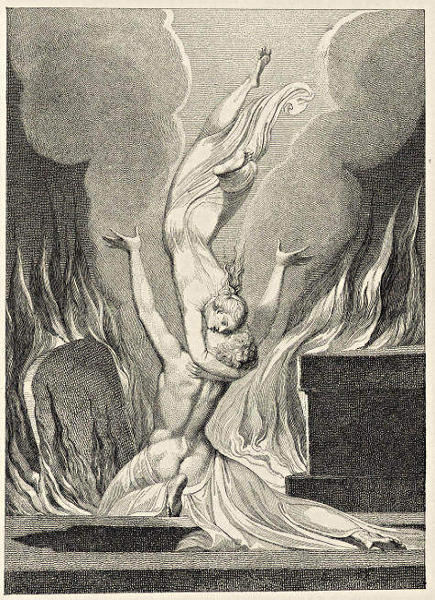
The River of Life, and Hecate. To these may be added The Resurrection
of the Dead, now in the British Museum, reproduced by us. Many
others, not belonging to the Butts collection, are described with equal
enthusiasm; and, apart from all questions of technical execution, usually
splendid, but lost upon those who have not access to the original works,
it may be said that the conceptions, as described by Mr. Rossetti, would be
impossible to one unendowed with the highest artistic imagination, and
that the body is worthy of the spirit.
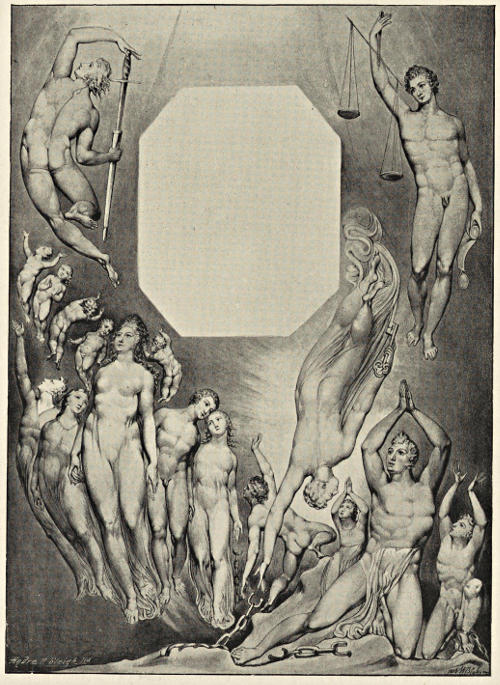
The Resurrection of the Dead. From a water-colour drawing by W. Blake.
British Museum.
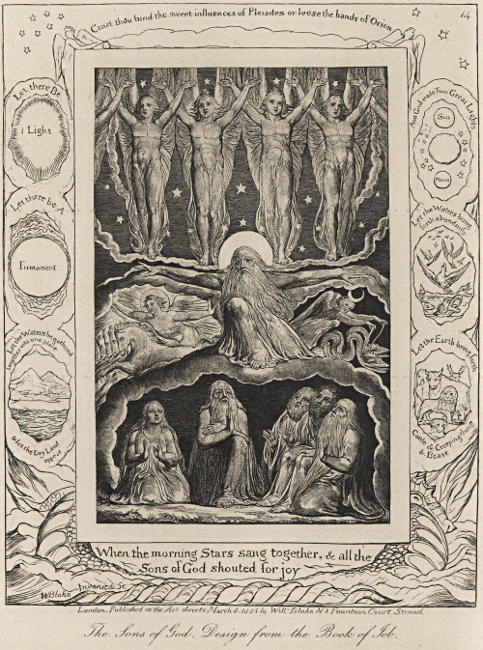
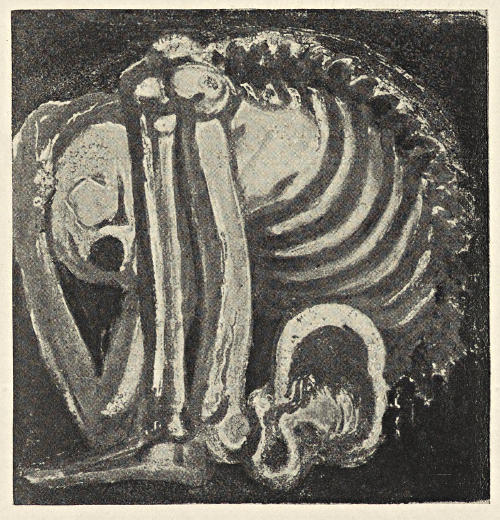
Prominent among these designs are the set of illustrations to Job, now
the property of the Earl of Crewe. A duplicate set belonged to Mr.
Linnell, who, “discounting as it were,” says Gilchrist, “Blake’s bill on
posterity when no one else would,” commissioned this from him,
tracing the outlines from Butt’s copy himself, and handing them over
to Blake to complete. This was done in September, 1821, and when the
drawings were completed in 1823 Linnell went further still, and commissioned
Blake to engrave them, a stroke which has probably effected
more than anything else for the artist’s fame, for the drawings which have
set him on such a pinnacle, if unengraved, would have remained virtually
unknown to the world. The terms also were liberal. Blake was to
receive £100 for the twenty-two plates and £100 more out of the profits.
When the publication barely covered its expenses, Linnell, reflecting that
the plates remained in his possession in virtue of the agreement, not
unreasonably but very handsomely allowed Blake £50 more. But for
this manna from heaven Blake’s last years would have been spent in
engraving pigs and poultry after Morland. Linnell, who was himself an
excellent engraver, further conferred an important benefit upon him
by making him acquainted with the best style of Italian engraving. Blake
proved a docile pupil at sixty-five, and his plates to Job are not only
technically the best he ever executed, but occupy an important place in
the history of the art.
The glory of Job, however, is not in the engraving, but in the invention,
which, beautiful in the soft and idyllic passages, rises into sublimity
when the theme appeals strongly to the creative imagination. It is especially
remarkable as being one of the very few instances of a worthy representation
of the Almighty. The tender humanities of Christian art are
absent: all is awful, Hebraic, and strictly monotheistic. Among the
most remarkable designs may be noted that where the exulting fiend pulls
down the mansion upon Job’s sons and daughters (reproduced here); the
frantic speed of the messenger of evil, who bursts out with his tale before
he is well within hearing, while another follows with equal haste hard
upon him, and the uninterested sheep graze on undisturbed; the terrible
scene where Satan, a figure repeated in essentials from works of earlier
date, smites the prostrate Job with sore boils; Eliphaz besieged with
phantoms, to all seeming not less real than himself (also given here); the
morning stars singing together; the downfall of the wicked; and the
Lord answering Job out of the whirlwind. Passages even of the less
striking designs often have a singular fascination, such as the night-piercing
stars in the Elihu scene, which would be impressive in the
absence of any human figure; Behemoth and Leviathan, the ne plus ultra
of grotesque grandeur, which we have also given; and the bowed backs
of Job’s accusing friends when the Lord blesses him.[8] On the whole,
though others of Blake’s designs may be more transcendent of ordinary
human faculty, he has scarcely executed anything displaying all his faculties
so well combined and in such perfect equilibrium; and, were it necessary
to rest his fame upon one set of works, this would probably be selected.
As a scriptural theme it appealed with especial strength to English
sympathies, and having been selected by Gilchrist for reproduction, it is
more widely known than any of his works except the illustrations to Blair’s
Grave. “The original water-colour designs,” Rossetti says, “are much
larger than the engravings, and generally pale in colour, with a less full
and concentrated effect than the engravings, and by no means equal
to them in power and splendid decorative treatment of the light and
shade. On the other hand, they are often completer and naturally freer
in expression, and do not exhibit a certain tendency to over-sturdiness of
build and physiognomy in the figures.” Fine as is the figure of Satan in
The Destruction of Job’s Sons and Daughters, it is, Mr. Rossetti thinks,
much finer in the water colour. On the other hand, “the effect of sublimity
and multitude in When the morning stars sang together is centupled in
the engraving by adding the upraised arms of two other angels to right and
left, passing out of the composition.” The whole account suggests how
desirable it would be to have many of Blake’s unpublished water colours
translated into black and
white, could engraver or
etcher of the needful force
be found.
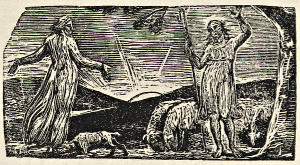
Woodcut from Thornton’s Pastoral.
In 1821 Blake had
performed another work
of moment, his first and
last wood-engravings.
These were to illustrate
Phillips’s imitation of
Virgil’s first pastoral, republished by Dr. Thornton, a physician and
botanist. Blake was a novice in this branch of art, and the cuts answer
to Dr. Thornton’s own description of them: “They display less of art
than of genius.” But nothing could more effectually confirm the principle
enunciated by their critic in the Athenæum: “Amid all drawbacks there
exists a power in the work of the man of genius which no one but himself
can utter fully.” Rude as they are, their force is extraordinary; few
things can be more truly magical than the glimpse of distant sea in the
second of those engraved by Gilchrist. At the same time they are not
in the least Virgilian, and in this respect form an instructive contrast
with the exquisite though unfinished Virgilian illustrations of Samuel
Palmer. Palmer, though putting in a cypress now and then as a tribute
to couleur locale, provides Virgil substantially with the same style of
illustration as he had been producing all his life for other ends, and yet
this seems as appropriate to the text as Blake’s is discrepant. It is interesting
to speculate what effect an Italian residence of two or three years,
such as Palmer had enjoyed, would have produced upon Blake beyond
the inevitable one of dissipating his monstrous delusions about Italian
artists. He would probably have gone chiefly with the view of studying
Michael Angelo, but we suspect that the influences of Italian landscape
would in the long run have proved fully as potent.
In 1821 Blake removed from South Molton Street to Fountain
Court, Strand, near the Savoy, where he occupied two rooms on the first
floor. The reason may have been that the house was kept by a brother-in-law
of Mrs. Blake’s named Baines, the only trace we have of any connection
with his wife’s family. Economy too may have had its influence;
his means were very low, not yet improved by the donation of £25 he
received from the Academy next year, or his arrangement with Linnell in
the year following. At the worst, however, the rooms were always clean
and neat, thanks to Mrs. Blake’s industry and devotion; and Blake’s
manner always had the simplicity and dignity of a gentleman. That his
circumstances improved was almost entirely the doing of Linnell, who
not only provided for his wants by commissions, but made him what his
genius had never made him, the patriarch of a band of admirers, almost
disciples. Coming frequently to visit Linnell at Hampstead, Blake fell
in with a group of young men who resorted thither, four of whom at
least—Samuel Palmer, Edward Calvert, George Richmond, and F. O.
Finch—became artists of great distinction. One characteristic these
young men had in common: they were as far as possible from the
theory of art for art’s sake, but only valued art as the outward and visible
sign of the inward and spiritual grace of consecration to the Power behind
Nature. The biographies of Palmer and Calvert disclose the priestlike
spirit in which they wrought, a spirit akin to that of their pre-Raphaelite
successors, but apparently less impregnated with the ordinary atmosphere
of the studio. These were just the men to treat the aged Blake as the
antediluvian youth ought to have treated the aged Jubal; and the
patriarchal influence is visible both in their writings and their works, not
always to the advantage of the latter, if we may judge by the examples
preserved of Palmer’s early labours. But all seemed fair in the light of
fond retrospect. Twenty-eight years after Blake’s death Samuel Palmer
addressed a letter to Mr. Gilchrist, long and full of interesting particulars
relating to Blake’s opinions on art; but the gist of the estimate of
the man is conveyed in few words. “In him you saw at once the Maker,
the Inventor; one of the few in any age; a fitting companion for Dante.
He was energy itself, and shed around him a kindling influence, an
atmosphere of life, full of the ideal. He was a man without a mask; his
aim single, his path straightforwardness, and his wants few; so he was
free, noble, and happy.”
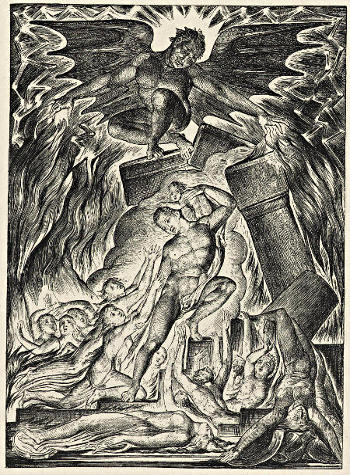
The Destruction of Job’s Sons and Daughters. From the “Book of Job.”
By W. Blake.
A very important witness to Blake’s demeanour and opinions in his
later years is Henry Crabb Robinson the diarist, whom we have already
met as a visitor to Blake’s exhibition, and who had made him the subject
of an essay in a German periodical. Robinson was the right man in the
right place, not being a mystic or enthusiast to fall down at Blake’s feet,
nor yet a man of the world to deride him as a visionary, but an inquisitive
observer of great intellectual range and most kindly and tolerant disposition,
ready to allow that things might exist of which his philosophy
had not dreamed, and whom abnormal opinions, if held in evident
sincerity, might startle but could hardly shock. “It is strange,” says he,
“that I who have no imagination, nor any power beyond that of a logical
understanding, should yet have a great respect for religious mystics.”
Thrown into Blake’s company in 1825, he has recorded his conversations
with him at considerable length in his delightful diary, as yet but
partially published. His description of Blake’s “interesting appearance”
agrees with that of his own circle. “He is pale, with a Socratic countenance,
and an expression of great sweetness, though with something of
languor about it except when animated, and then he has about him an
air of inspiration. The tone and manner are incommunicable. There
are a natural sweetness and gentility about him which are delightful.”
Having heard of Blake’s visions, Robinson was not surprised to find him
asserting that the visionary gift was innate in all men, and only torpid
for want of cultivation; but he must have had much ado to digest such
statements as that the world was flat, that Wordsworth was a Pagan, and
that “what are called the vices in the natural world are the highest
sublimities in the spiritual world.” Not understanding that by atheism
Blake meant, in his own words, “whatever assumes the reality of the
natural and unspiritual world,” Robinson was naturally aghast when Locke
was classed with atheists, and ventured what must have appeared to him
the conclusive rejoinder that Locke had written in defence of Christianity.
Blake, who probably understood Robinson’s definition of atheism
as little as Robinson did his, “made no reply.” Some of Blake’s remarks
are well worthy of preservation. “Art is inspiration. When Michael
Angelo, or Raphael, or Mr. Flaxman does any of his fine things, he does
them in the spirit.” “Irving is a sent man. But they who are sent go
further sometimes than they ought.” “Dante saw devils where I see
none.”
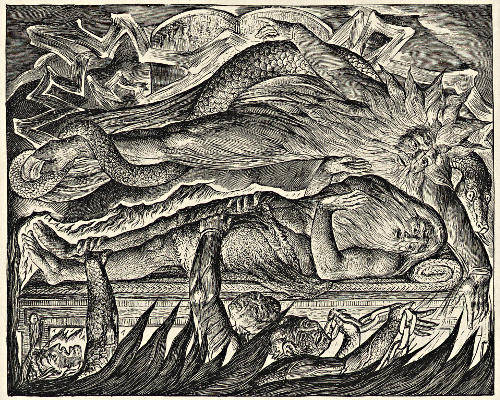
With Dreams upon my Bed thou scarest me. From the “Book of Job.”
By W. Blake.
Dante must have been much in Blake’s thoughts just then, for
Robinson found him occupied with the long series of illustrations of the
poet commissioned by Linnell, the last important work of his life. The
history of the commission is thus related by Linnell’s biographer, Mr.
Story. “Although the Job had been paid for, Linnell continued to
give him money weekly. Blake said, ‘I do not know how I shall ever
repay you.’ Linnell replied, ‘I do not want you to repay me. I am
only too glad to be able to serve you. What I would like, however, if
you do anything for me, is that you should make some designs for
Dante’s Inferno, Purgatorio, and Paradiso.’ Blake entered upon the
work with alacrity, concurrently with the engraving of the Job
designs, and the two together occupied the old man for the rest of his
life.” During all this period Linnell was remitting Blake money,
as the latter’s notes in acknowledgment prove. Linnell undoubtedly
acquired the designs at a low price, but immediately upon Blake’s death
he endeavoured to dispose of them for the benefit of the widow. Failing
in this he kept them, never attempting to make anything by them; and
they are still in the possession of his family.
Blake studied Italian to qualify himself more effectually for his task,
and is said to have acquired it; when Robinson saw him, however, at
an early stage of the commission it is true, he was working by the
aid of Cary’s English version. He executed no less than ninety-eight
drawings, several of which were left in an unfinished state. Seven have
been engraved. The merits of the series have been variously estimated.
Mr. Rossetti considers them “on the whole a very fine series, though not
uniformly equal in merit.” Mr. Yeats, so well qualified by his own
imaginative gift to enter into the merit of Blake’s work, thinks them the
finest of all his productions. Robinson, who saw Blake at work upon
them, says, “They evince a power I should not have anticipated of
grouping, and of throwing grace and interest over conceptions monstrous
and horrible.” For our own part, we must regretfully admit that when
we saw them at the Old Masters’ exhibition the monstrosity and horror
appeared more evident than the grace and interest. We could not deem
Dante’s conceptions adequately rendered; the colour, too, often seemed
harsh and extravagant. Blake went on working upon them until his
death, when Mrs. Blake sent them to Linnell. They thus escaped the
fate of Blake’s other artistic and literary remains left in his widow’s
possession, which after her death were appropriated, apparently without
any legal authority, by a person named Tatham, who had been much about
Blake in his later years, and who ultimately destroyed them in deference
to the mandate of a religious sect with which he had become connected![9]
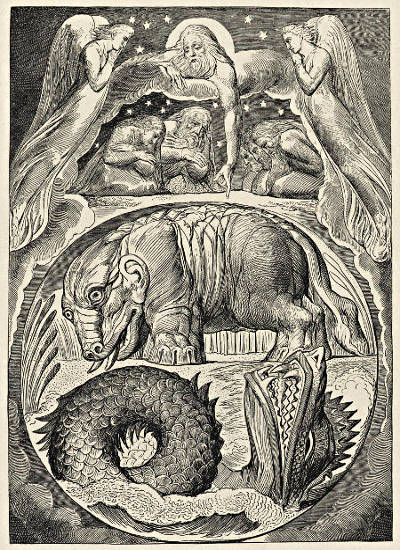
Behemoth and Leviathan. From the “Book of Job.” By W. Blake.
The end was now near. During 1827 Blake’s health greatly failed
from catarrh and dysentery, and he could no longer go up to Hampstead
to see Linnell. Linnell wished him to quit the damp neighbourhood of
the river, and live in his own house in Cirencester Place, part only of
which he used as a studio. But Blake said, “I cannot get my mind out
of a state of terrible fear at such a step.” He also said, “I am too much
attached to Dante to think much of anything else.” One of his last
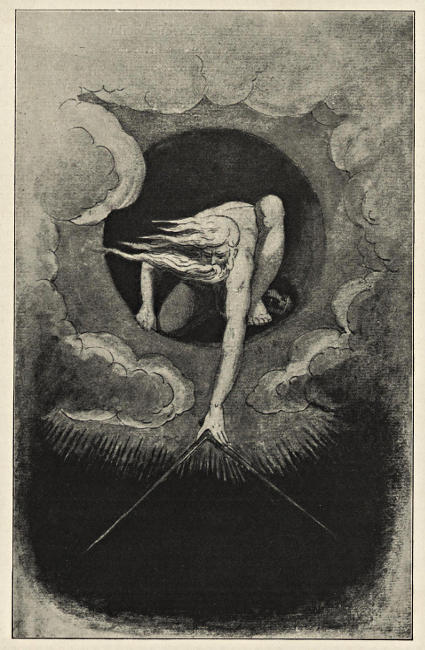
works was the colouring of The Ancient of Days for the elder Tatham,
who paid him at a higher rate than he was accustomed to receive. Blake
accordingly worked his hardest, and when it was finished “threw it from
him, and with an air of exulting triumph exclaimed, ‘There, that will
do, I cannot mend it.’” Later still he exclaimed to his wife, “You have
ever been an angel to me, I will draw you,” and produced a sketch,
“interesting, but not like.” On August 12 he died, “composing and
uttering songs to his Maker.” He was buried in Bunhill Fields, in a
grave which cannot now be identified. It is little to the honour of his
countrymen that no public memorial of him should exist. A better one
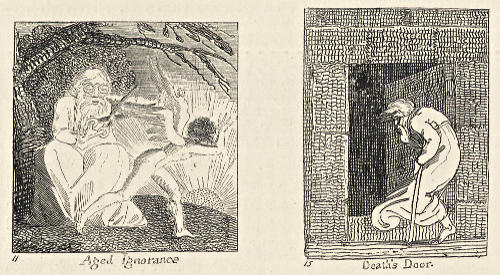
could not be than his own Death’s Door in the illustration to Blair’s
Grave, treated as a bas-relief with the necessary modifications.
The artist whose life had been spent in a condition so little remote
from penury did not leave a single debt, and the accumulated stock
of his works sufficed to support his widow in comfort for the four years
for which she survived him. Friends, indeed, aided, Linnell and Tatham
successively giving her house-room, and others assiduously recommending
her stores of drawings to wealthy patrons. She died in Upper Charlotte
Street, Fitzroy Square, and was buried beside her husband in Bunhill
Fields.
The artistic processes used by Blake are a subject of considerable
discussion. Notwithstanding his constant description of his pictures as
“frescoes,” it seems certain that he never resorted to fresco in the
ordinary acceptation of the term. Linnell, who must have been exceedingly
familiar with his work, told Mr. Gilchrist: “He evidently founded
his claim to the name fresco on the material he used, which was water-colour
on a plaster ground (literally glue and whiting); but he always
called it either fresco, gesso, or plaster.” Linnell added that when he
himself obtained from Italy the first copy that ever came to England of
Cennino Cennini’s Trattato della Pittura, a sixteenth-century treatise, edited
in 1822 from the original MS., Blake, who was soon able to read it, “was
gratified to find that he had been using the same materials and methods
in painting as Cennini describes, particularly the carpenter’s glue.” “Unfortunately,”
says Linnell, “he laid this ground on too much like
plaster to a wall,” and when this was so applied to canvas or linen the
picture was sure to crack, and many of Blake’s best works have suffered
great injury. Oil he disliked and vituperated. The reason probably was
that, contrary to what might have been expected, his system of execution
was by no means bold and dashing, but deliberate and even slow. He
drew a rough dotted line with pencil, then with ink, then colour, filling
in cautiously and carefully. All the grand efforts of design, he thought,
depended on niceties not to be got at once. He seems, in fact, to have
worked very much in the spirit of the mediæval illuminators, and the
general aspect of a page of one of his Prophetical Books reminds us
forcibly of one of their scrolls. Whether any direct influence from them
upon him is traceable would be difficult to determine. Keats had
evidently seen illuminated manuscripts, and been deeply impressed by
them; but nearly forty years elapsed between the publication of the first
of Blake’s Prophetical Books and the composition of Keats’s Eve of St.
Mark. In one respect Blake certainly differed from the ancient miniaturists;
he wrought mainly from reminiscence, and disliked painting with
his eye on the object. His memory for natural forms must have been
very powerful.
Blake is endowed in a very marked degree with the interest ascribed
by Goethe to Problematische Naturen, men who must always remain
more or less of a mystery to their fellows. In ancient times, and perhaps
in some countries at the present day, he would have been accepted as
a seer; in his own age and country the question was rather whether he
should be classed with visionaries or with lunatics. A visionary he
certainly was, and few will believe either that his visions had any
objective reality, or that he himself intended them to be received merely
as symbols. “You can see what I do, if you choose,” he said to his
friends. He thus confused fancy with fact; unquestionably, therefore,
he laboured under delusions. But delusions do not necessarily amount to
insanity, and, however Blake erred in form, it may be doubted whether
in essentials he was not nearer the truth than most so-called poets and
artists. Every poet and artist worthy of the name will confess that his
productions, when really good for anything, are the suggestion of a power
external to himself, of an influence which he may to a certain extent
guide, but cannot originate or summon up at his will; and in the absence
of which he is helpless. In personifying this influence as the Muse, or
howsoever he may prefer to describe it, such an one is usually fully aware
that, in obedience to a law of the human mind, he is bestowing personality
and visibility upon what is actually invisible and impersonal, but not
on that account unreal. Some there are, however, whose perceptions are
so lively, or their power of dealing with abstractions so limited, that the
mental influences of which they are conscious appear to them in the
light of personalities. Such was Blake, and the peculiarity in him was
probably closely connected with the childlike disposition which rendered
him so amiable as a man. As a child it naturally never occurred to him
to question the reality of his visions, and he grew up without acquiring
the critical habit of mind which would have led him to do so. With him
“the vision splendid” did not
Die away,
And fade into the light of common day.
Such a state of mind is quite compatible with sanity. The question is
not whether the person
Gives to airy nothings
A local habitation and a name,
but whether he allows his conduct to be actuated by them to the extent
of inverting the rules of right and wrong, wasting his substance, or becoming
offensive to others or dangerous to himself. It is even possible
to travel far in this direction without arriving at the confines of insanity.
Prince Polignac brought the monarchy of the Restoration to ruin in
deference to imaginary revelations from the Virgin Mary, yet no court
of law would ever have placed him under restraint. With Blake not the
faintest suggestion of such a thing is possible. Except for one or
two incidents, related upon doubtful authority, he appears throughout
his life in the light of an exemplary citizen, and in his unselfishness
and unworldliness contrasts with his Sadducæan neighbours in a way that
forbids us to call him mentally diseased, though he may have been
mentally warped. The value of his mystical utterances is quite another
question. The occasional splendour of the poetry in which they are
couched will not be disputed, any more than their general confusion and
obscurity. Commentators have striven hard to elicit the sunbeam from
the cucumber; we pass no judgment on their efforts, further than may
seem to be implied in the observation that in our opinion the chief
mission of Blake’s mystical poetry was to be the vehicle of his finest and
most characteristic art. His ideas, many profound and worthy of close
attention, may, we think, be more advantageously collected from his
prose aphorisms and the fragments of his conversation; and in this
respect he is by no means singular. The one great achievement which
unquestionably entitles him to the distinction of an inspired man, is to
have produced in boyhood, without set purpose or any clear consciousness
of what he was doing, lyrics recalling the golden prime of English poetry,
and instinct with a music to which, since Chatterton was no more, no
contemporary save Burns was capable of making the slightest approach.
It is true that reaction against artifice and conventionality was in the air
of the time, and was already announced by evident symptoms. To compare,
however, the highly creditable efforts in this direction of even such
poets as Cowper and Mickle with the achievements of this stripling is to
become sensible at once of the difference between talent and inspiration.
Blake’s gifts and shortcomings as an artist are sufficiently revealed
by the examples of his work which accompany this essay. It need merely
be remarked here that, apart from the great army of artists of genius who
move on recognised lines, transmitting the succession from the age of
Zeuxis and Phidias to our own, there is, as it were, a parallel column
skirting it on the by-roads of art; and that at certain periods of Art’s
history the genius which has forsaken the more conspicuous of her
manifestations has seemed to take refuge with etchers, or designers, or
delineators of the life of the people. It has frequently happened of late
that men whose work was chiefly done for books and periodicals, and who
during their lives were scarcely regarded as artists at all, have upon their
deaths been deservedly exalted to very high places. Blake is perhaps the
most striking and remarkable example of this class.
Blake’s peculiarities as a man, and the anecdotes of which he became
the subject, secured him earlier attention as artist and poet than his
works would have obtained on their own account. Not long after his
death he was made (1830) the subject of one of Allan Cunningham’s
Lives of British Painters, in the main a fair and impartial biography,
rather in advance of than behind its time. Cunningham, however,
possessed no sort of spiritual kinship with Blake, who found his first
really congenial commentator in a veteran philosopher, still happily
spared to us, Dr. James Garth Wilkinson, who in 1839, the year
of the first collected edition of Shelley’s poems, republished Songs of
Innocence and Experience with an anonymous preface claiming for Blake
something like his proper position as a lyric poet, and accompanied by
judicious remarks upon his paintings. Dr. Wilkinson would probably
have expressed himself still more decidedly if he had written a few years
later, but the movement towards the exaltation of the more spiritual
aspects of English poetry as typified in Wordsworth and Shelley was as
yet but incipient, and the stars of Tennyson and Browning were hardly
above the horizon. Little further seems to have been done for Blake,
until, about 1855, the late Mr. Alexander Gilchrist began to write his
biography, published in 1862, a labour of love and diligence which will
never be superseded, especially since the revision it has received in the
definitive edition of 1880, brought out by his widow. The value of
Gilchrist’s labours is greatly enhanced by the accompanying illustrations,
which allow a fairly adequate conception to be formed of Blake’s pictorial
genius, by the reprint of much of his most characteristic literary work, and
by the copious descriptions of his drawings by Mr. W. M. Rossetti and Mr.
F. Shields. Since Gilchrist wrote, Mr. Swinburne (1868) has investigated
Blake’s thought with special reference to its Pantheistic tendency,
and Messrs. Ellis and Yeats, in a most comprehensive work in three
volumes (1891), including additional biographical particulars and copious
illustrations, which comprise the previously unpublished “Vala,” have
striven to present Blake’s mysticism as a coherent system of thought.
Valuable monographs are also prefixed to the editions of Blake’s poems
by Rossetti (1883) and Yeats (1893), and to the selection from his
literary works by Mr. Housman (1893), this last perhaps on the whole,
after Gilchrist’s biography, the most desirable possession for the literary
student of Blake. Of the numerous detached essays upon Blake the
most important, perhaps, are that by the late Mr. Smetham, republished
in his Essays, and in the second volume of Gilchrist’s biography, and that
by James Thomson, author of The City of Dreadful Night, appended
to his Shelley, a Poem (1884).
It is exceedingly difficult to obtain a proper idea of Blake as an artist,
from the extent to which his designs depend upon colouring, and the great
inequality of this colouring, which is often not his own. In Mr. Gilchrist’s
opinion, the copy of The Song of Los, in the Print Room of the
British Museum, and a volume of miscellaneous designs, in the same
collection, represent him with adequate fairness; and these fortunately
are public property. The finest specimens of his work seen by his biographer
are apparently in the collection of the Earl of Crewe, and therefore
not generally accessible. Those belonging to private collectors must
of necessity be continually changing hands, and few students have the
time or the opportunity to make the thorough investigation of them
accomplished by Mr. Rossetti. Fortunately the illustrations in Gilchrist’s
biography, where the whole of the Job series is reissued, suffice to
establish Blake’s genius as a designer, even though destitute of the
charm of colour. Mr. Bell Scott has executed effective etchings after
him; Mr. Quaritch has republished the drawings for Comus; in 1876 the
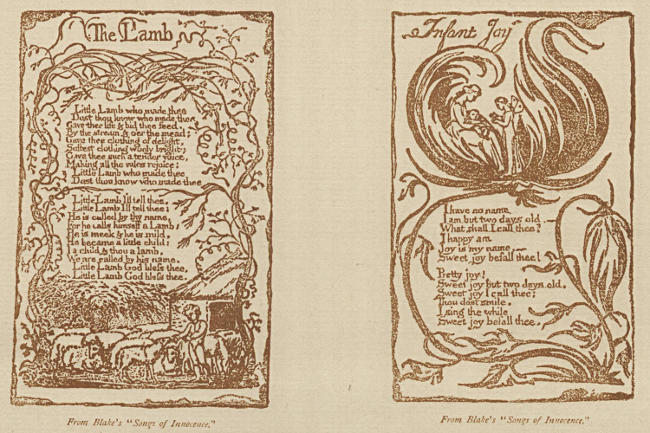
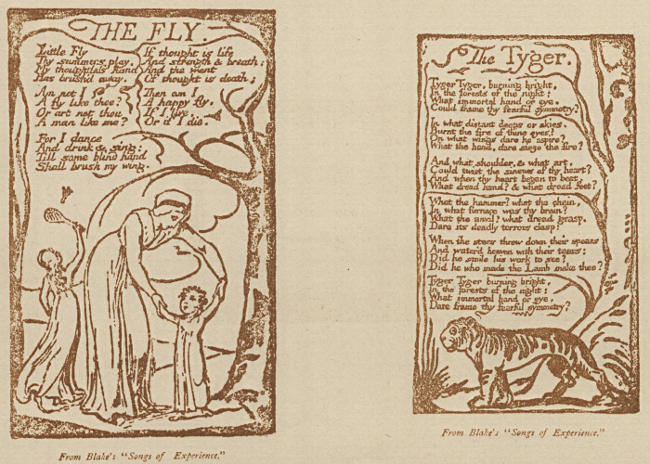
Songs of Innocence and Experience and the Prophetic Books up to Los
were reprinted together, but only to the extent of a hundred copies, nor
was the execution very satisfactory. It cannot be said that Messrs. Ellis
and Yeats have entirely overcome the difficulties of reproduction; yet,
perhaps, for those unable to obtain access to the copies tinted by the
artist, or even to the uncoloured plates in the original edition, nothing so
well displays the wilder and more weird aspects of his genius as the
reprints in their third volume, especially those from Jerusalem.
Blake’s character and works will long remain the subject of criticism
and speculation, for the world does not easily forgo its interest in what
Goethe calls “problematic natures.” By another famous saying of
Goethe’s he cannot profit, “He who has sufficed his own age has sufficed
all ages,” nor can he be reckoned among those who have been in advance
of their age, except in those exquisite early songs which died away before
the actual arrival of the better time. But it would not be too much to
say of him that he revealed possibilities, both in poetry and painting,
which without him we should hardly have suspected, and which remain
an unexhausted seed-field of inspiration for his successors. It is labour
lost to strive to make him transparent, but even where he is most
opaque
Sparks spring out of the ground,
Like golden sand scattered upon the darkness.
Nor is the general tendency of art towards a world of purity, harmony,
and joy unrepresented in him; sometimes this even seems the conclusion
to which all else is merely subservient, as in the series of illustrations to
Job, the ideal representation of his own history.
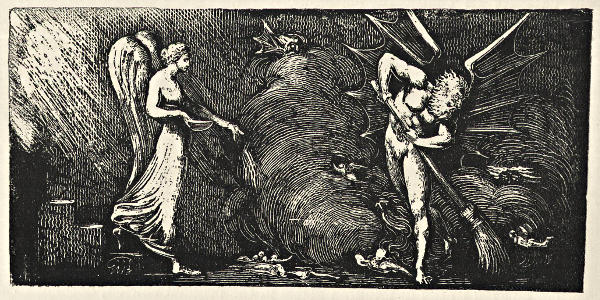
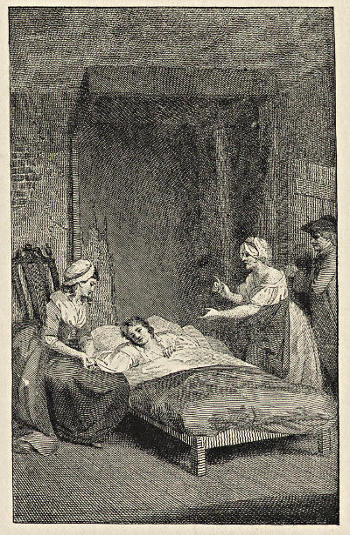
Sweeping the Parlour in the Interpreter’s House.