William, taking his character as a whole, was
not of the artistic genre. He had none of the
shrinking sensitiveness and delicate imaginativeness
of the true artist. But the fact remains that this
summer he was impelled by some inner prompting
to write a play.
The idea had been growing in his mind for some
time. He had seen plays acted by the village
amateur dramatic society which was famous more
for a touching reliance on the prompter than for
any real histrionic talent.
William had considered them perfect. He had
decided, after their last performance, to go on the
stage. But none of his friends could inform him
of the preliminary steps necessary for getting
on the stage. It is true that the man in the boot-shop,
whose second cousin was a scene-shifter in
a provincial music-hall, had promised to use his
influence, but when William was told the next
week that the second cousin had been dismissed
for appearing in a state of undeniable intoxication
and insisting on accompanying the heroine on to
the stage, he felt that all hopes from that direction
must be abandoned. It was then that he had the
brilliant idea. He would write a play himself and
act in that.
William had great confidence in his own powers.
He had no doubts whatever of his ability to write
a play and act in it. If he couldn't go on the stage
he'd go on a stage. Surely no one could object to
that. All he'd want would be some paper and ink
and a few clothes. Surely his family—bent as
they always were on clouding his moments of
purest happiness—couldn't object to that?
"Jus' ink an' paper an' a few ole clothes," he
said wistfully to his mother.
She eyed him with a mistrust that was less the
result of a suspicious nature than of eleven years'
experience of her younger son.
"Won't pencil do?" she said.
"Pencil!" he said scornfully. "Did—did Shakespeare
or—or the man wot wrote 'The Red Gang'—well,
did they write in pencil?"
Mrs. Brown, having no knowledge of the subject,
shifted her point of attack.
"What sort of clothes will you want?" she said.
"Oh—jus' clothes," said William vaguely.
"Yes, but what sort?"
"How can I tell," said William irritably, "till
I've wrote the play?"
******
William's family long remembered the silence
and peace that marked the next few afternoons.
During them, William, outstretched upon the
floor of the summer-house, wrote his play with
liberal application of ink over his person and clothes
and the surrounding woodwork. William was not
of that class of authors who neglect the needs of
the body. After every few words he took a deep
draught from a bottle of Orange Ale that stood on
his right and a bite from an ink-coated apple on his
left. He had laid in a store of apples and sweets
and chocolates under the seat of the summer-house
for his term of authorship. Every now and then he
raised a hand to his frowning brow in thought,
leaving upon it yet another imprint of his ink-sodden
fingers.
"Where is he?" said his father in hushed
wonder at the unwonted peace.
"He's in the summer-house writing a play,"
said his wife.
"I hope it's a nice long one," said her husband.
******
William had assembled his caste and assigned
them their parts. Little Molly Carter was to be
the heroine, Ginger the hero, Henry the hero's
friend, Douglas a crowd of outlaws, William himself
was to be the villain, stage-manager and prompter.
He handed them their parts with a lofty frown.
The parts were in a grimy exercise book.
"It's all wrote out," he said. "You jus' learn
it where it says your names. Molly's Lady
Elsabina——"
"Elsabina isn't a name I've ever heard," said
that lady pertly.
"I didn't say it was, did I?" said William
coldly. "I shu'n't be surprised if there was lots of
names you'd never heard of. An' Ginger is Sir
Rufus Archibald Green an' Henry is the Hon. Lord
Leopold, an' I'm Carlo Rupino, a villain. All
you've gotter do is to learn your parts an' Wednesday
morning we'll go through it jus' to practise it,
an' Wednesday afternoon we'll do it."
"We can't three learn out of one book," said
the leading lady, who was inclined to make
objections.
"Yes, you can," said William. "You can take
turns sitting in the middle."
Lady Elsabina sniffed.
"And such writing!" she said scornfully.
"Well, I don't count on my fingers," said William,
returning scorn for scorn, "not so's everyone can
see me, at any rate."
At which public allusion to her arithmetical
powers, Lady Elsabina took refuge in another sniff,
followed by a haughty silence.
******
The rehearsal was not an unqualified success.
The heroine, as is the way of heroines, got out of
bed the wrong side. After a stirring domestic
scene, during which she bit her nurse and flung a
basin of bread and milk upon the floor, she arrived
tearful and indignant and half an hour late at the
rehearsal.
"Can't you come a bit later?" said the stage-manager
bitterly.
"If you're going to be nasty to me," returned
the heroine stormily, "I'm going back home."
"All right," muttered the stage-manager, cowed,
like most stage-managers, by the threatening of
tears.
The first item on the agenda was the question
of the wardrobe. William had received an unpleasant
surprise which considerably lowered his
faith in human nature generally. On paying a
quiet and entirely informal visit to his sister's
bedroom in her absence, to collect some articles of
festive female attire for his heroine, he had found
every drawer, and even the wardrobe, locked.
His sister had kept herself informed of the date of
the performance, and had taken measures accordingly.
He had collected only a crochet-edged
towel, one of the short lace curtains from the
window, and a drawn-thread work toilet-cover.
Otherwise his search was barren. Passing
through the kitchen, however, he found one
of her silk petticoats on a clothes-horse and
added it to his plunder. He found various other
articles in other parts of the house. The dressing
up took place in an outhouse that had once been a
stable at the back of William's house. The heroine's
dress consisted of Ethel's silk petticoat with holes
cut for the arms. The lace curtain formed an
effective head-dress, and the toilet-cover pinned
on to the end of the petticoat made a handsome
train.
The effect was completed by the crochet-edged
towel pinned round her waist. Sir Rufus Archibald
Green, swathed in an Indian embroidered table-cover,
with a black satin cushion pinned on to his
chest, a tea-cosy on his head, and an umbrella
in his hand, looked a princely hero. The Hon. Lord
Leopold wore the dining-room table-cloth and the
morning-room waste-paper basket with a feather,
forcibly wrested from the cock's tail by William,
protruding jauntily from the middle. Douglas, as
the crowd, was simply attired in William's father's
top hat and a mackintosh.
William had quietly abstracted the top hat as
soon as he heard definitely that his father would not
be present at the performance. William's father
was to preside at a political meeting in the village
hall, which was to be addressed by a Great Man
from the Cabinet, who was coming down from
London specially for the occasion.
"Vast as are the attractions of any enterprise
promoted by you, William," he had said, politely at
breakfast, "duty calls me elsewhere."
William, while murmuring perfunctory sorrow at
these tidings, hastily ran over in his mind various
articles of his father's attire that could therefore be
safely utilised. The robing of William himself as
the villain had cost him much care and thought.
He had finally decided upon the drawing-room
rug pinned across his shoulder and a fern-pot upon
his head. It was a black china fern-pot and rather
large, but it rested upon William's ears, and gave
him a commanding and sinister appearance. He
also carried an umbrella.
These preparations took longer than the caste
had foreseen, and, when finally large moustaches
had been corked upon the hero's, villain's and
crowd's lips, the lunch-bell sounded from the hall.
"Jus' all finished in time!" said William the
optimist.
"Yes, but wot about the rehearsal," said the
crowd gloomily, "wot about that?"
"Well, you've had the book to learn the stuff,"
said William, "that's enough, isn't it? I don't
s'pose real acting people bother with rehearsals.
It's quite easy. You jus' learn your stuff an' then
say it. It's silly wasting time over rehearsals."
"Have you learnt wot you say, William Brown?"
said the heroine shrilly.
"I know wot I say," said William loftily, "I
don't need to learn!"
"William!" called a stern sisterly voice from
the house, "mother says come and get ready for
lunch."
William merely ejected his tongue in the direction
of the voice and made no answer.
"We'd better be taking off the things," he said,
"so's to be in time for this afternoon. Haf-past
two it begins, then we can have a nice long go at it.
Put all the things away careful behind that box so's
bothering ole people can't get at them an' make a
fuss."
"William, where are you?" called the voice
impatiently.
The tone goaded William into reply.
"I'm somewhere where you can't find me," he
called.
"You're in the stable," said the voice
triumphantly.
"Seems as if folks simply couldn't leave me
alone," said William wistfully, as he removed his
fern-pot and fur rug and walked with slow dignity
into the house.
"Wash yourself first, William," said the
obnoxious voice.
"I am washed," returned William coldly, as he
entered the dining-room, forgetting the presence of
a smudgy, corked moustache upon lips and
cheeks.
******
It was an unfortunate afternoon as far as the
prospects of a large audience were concerned. Most
of the adults of the place were going to listen to
the Great Man. Most of the juveniles were going
to watch a football match. Moreover, the caste,
with the instincts of the very young, had shrouded
the enterprise so deeply in mystery in order to
enjoy the sensation of superiority, that they had
omitted to mention either the exact nature of the
enterprise or the time at which it would take
place.
On the side-gate was pinned a notice:
THIS WAY TO THE BLOODY HAND ➔
In the stable was a row of old chairs all turned
out of the house at various times because of broken
backs and legs. As a matter of fact, the caste
were little concerned with the audience. The great
point was that they were going to act a play—they
scarcely cared whether anyone watched it or not.
Upon a broken chair in the middle sat a small
child, attracted by the notice. Her chair had only
lost one leg, so, by sitting well on to one side, she
managed to maintain an upright position on it.
At a stern demand for money from William, she had
shyly slipped a halfpenny into the fern-pot, which
served the double purpose of head-gear and pay-desk.
She now sat—an enthralled spectator—while
the caste dressed and argued before her.
Outside down the road came the Great Man.
He had come by an earlier train by mistake and
was walking slowly towards the village hall, intensely
bored by the prospect of the afternoon. He stopped
suddenly, arrested by a notice on a side gate:
THIS WAY TO THE BLOODY HAND ➔
He took out his watch. Half an hour to spare.
He hesitated a moment, then walked firmly towards
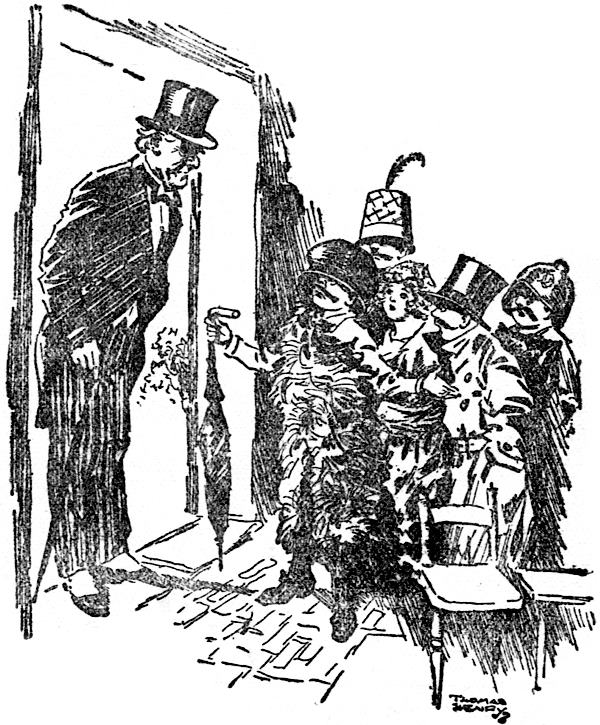
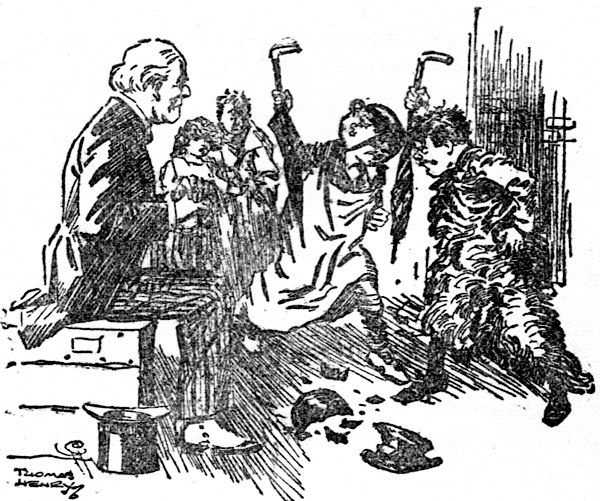
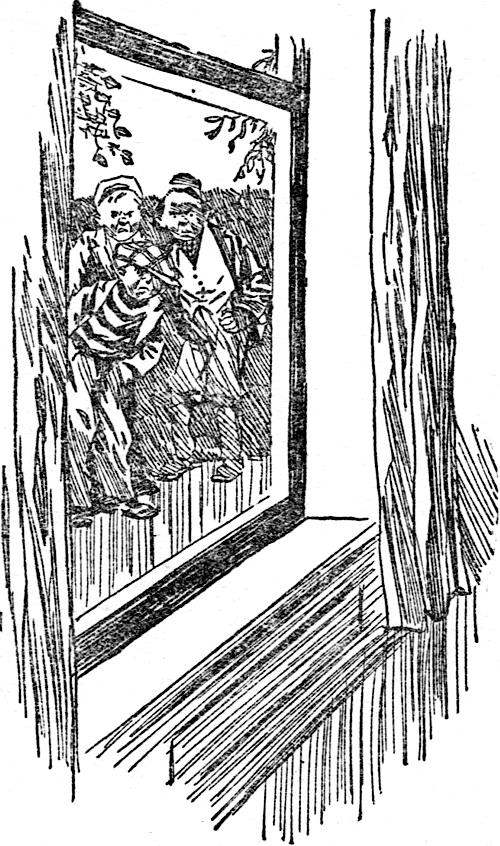
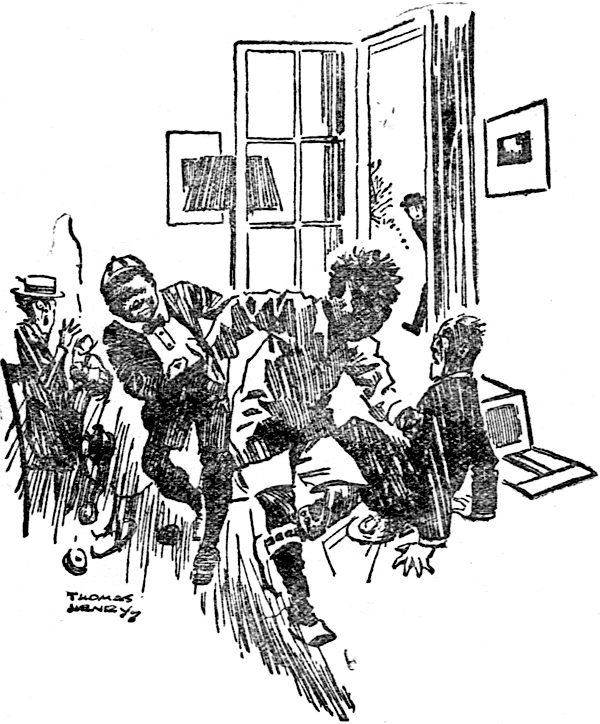
the Bloody Hand. Inside an outhouse a group of
curiously-dressed children stared at him unsmilingly.
One of them, who was dressed in a rug and a fern-pot,
addressed him with a stern frown.
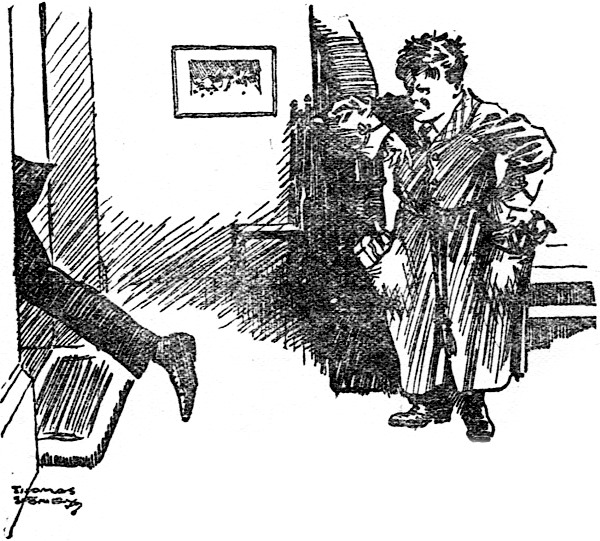
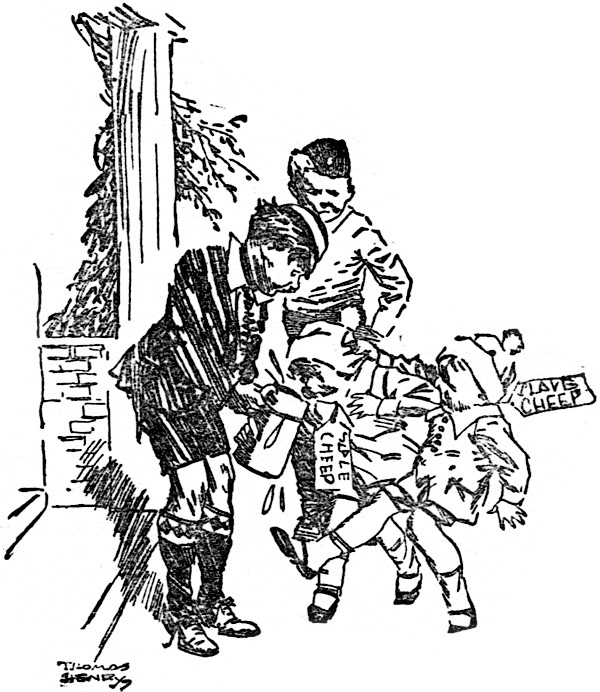
INSIDE AN OUTHOUSE A GROUP OF CURIOUSLY-DRESSED
CHILDREN STARED AT HIM UNSMILINGLY.
"We're jus' going to begin," he said, "sit down."
The Great Man sat down obediently and promptly
collapsed upon the floor.
"You shu'n't have sat on a chair with two legs
gone," said William impatiently. "You've broke it
altogether now. You can manage all right if you try
one with only one gone. We're jus' going to begin."
The Great Man picked up himself and his hat and
sat down carefully upon the farthermost edge of a
three-legged chair.
William, holding the mangled remains of an
exercise book in his hand, strode forward.
"'The Bloody Hand,' by William Brown," he
announced in a resonant voice.
"Well, an' wot about us?" said the heroine shrilly.
"You didn't write it, did you?" said William.
"I'm only saying who wrote it."
"Well, aren't you going to say who axe it?"
she said pugnaciously.
"No, I'm not!" said the stage-manager firmly.
"You jus' say the one wot wrote it. You don't go
on saying all them wot axe it."
"Well, I'm not going to be in it, then," she said.
"I'm going home."
William decided to be a woman-hater for the
rest of his life.
"All right," he capitulated, "'f you're going
to be so disagreeable—jus' like a girl"—he strode
forward again and raised his voice, "'The Bloody
Hand,' wrote, every bit of it, by William Brown—acted
by Molly Carter an Ginger an' Douglas an'
Henry—they jus' learnt wot William Brown wrote.
Now, if you'll be quiet a minute," he went on to his
silent audience, "we'll begin. You begin," he said
to the damsel in the lace curtain.
She advanced. The rest of them stood in a
corner and watched.
"She's on," William announced to the audience.
"We're off. Go on!" he repeated to her.
"I'm jus' going to," she replied irritably, "soon
as you stop talking." Then, changing her voice
to one of shrill artificiality, "Ho! Where am I?
Lorst in a dreadful forest——"
"It's meant to be a forest," explained the author
to the audience.
"I wish you'd stop keep on saying things," said
the heroine. "I forget where I am. Lorst in a
dreadful forest. What shall I do? Ah, me!
Crumbs! Who is this who yawns upon my sight?"
"Dawns!" corrected the prompter.
"A fierce villain," went on the heroine, ignoring
him, "methinks. I shouldn't be surprised if it
wasn't Carlo Rupino of the Bloody Hand. Oh
Lor! what shall I do? Ah me! He draws nearer."
"It is him," prompted William.
"I was jus' going to say that, if you wouldn't
keep on interrupting. It is him. I was jus' going
to say it. Ah me! what shall I do? Whither shall
I flee? Nowhere. Gadzooks! He draws nearer."
"I come on now," explained William to the
audience, holding on to his plant-pot with one hand
to steady it. "I'm him." He advanced threateningly
upon the maiden. "Aha!" he sneered.
"Gadzooks! doest thou happen to know who
I am?"
"I am lorst in the dreadful forest," she replied.
"Ah me! What shall I do?"
"I am Carlo Rupino of the Bloody Hand. Go
on, faint!" he urged in an undertone.
"'F you think I'm going to faint on this dirty
ole floor," she replied, "I'm jus' not. You should
have brushed it up a bit 'f you wanted me to faint
on it."
"You don't know how to," he jeered.
"I do! I can! I can faint beautifully on our
drawing-room carpet. I'm jus' not going to faint on
a dirty ole stable floor an' I'm not going to be in
your nasty ole play 'f you're not going to be nice
to me."
"All right, then, don't be. You jus' take off my
sister's petticoat, an' our lace curtain an' don't
be in it, if you don't want to be."
"Well, I jus' won't, 'f you're going on like this at
me."
"Well, 'f you keep on talkin' not out of the play
who's to know when you're talkin' play an' when
you're jus' talkin' yourself?"
"Anyone with any sense could——"
"Oh, get on with it," said the hero off the scenes.
"You'll never get to where I come in, if you're
going on like this all day. Pretend she's fainted
and go on from there."
"All right," said the villain obligingly. "Aha!
I hast thee in my power. I wilt hang thee ere dawn
dawns from my remote mountain lair." The toilet-cover
train caught on a nail and the petticoat tore
with an echoing sound. "That's right," he went
on, "go on messin' up my sister's things, so's she'll
never be able to wear them again."
"'F you're going to keep on being nasty to me,"
said the heroine again, "I'm going straight back
home an' I'm not going to be in your ole play."
"Well, anyway," said William, with a mental
determination that his next play should contain
no heroines, "now we go off and they come on."
The hero and his friend advanced.
"Alas!" said Sir Rufus Archibald Green, "I
see no trace of her. What canst have happened to
her? I hope she hast not met yon horrible ole
villain, Carlo Rupino, of the Bloody Hand. Seest
thou any footmarks of her, the Hon. Lord
Leopold?"
The Hon. Lord Leopold examined the stable floor.
"Lookin' for footmarks," explained the stage-manager
to the audience.
"Ah me! None!" said the Hon. Lord Leopold.
Then, looking more closely. "Crikey! Yes!" he
said. "I seest footmarks. 'Tis hers and Carlo
Rupino's. I knowest their boots."
"Ah me!" said the hero. "What cattastrop
is here? Gadzooks! Let us follow to his remote
mountain lair. I will kill him dead and cut out his
foul black heart and put an end to his foul black life."
He waved Mrs. Brown's best umbrella threateningly
as he spoke. "Now they come off," explained
William, "an' we come on. Here's the gallows."
He carried forward a small reading stand, taken
from his father's study, then advanced holding the
hand of the fair Elsabina. The crowd in his top hat
and mackintosh stood in attendance.
"Aha!" said Carlo Rupino to his victim, "I hast
thee in my power, thou ole girl! I am now going
to hang thee from yon lofty gallows! Go on!" he
addressed the crowd.
The crowd took off his top hat and uttered a
feeble "Hurray!"
"You couldn't hang me from that old thing,"
remarked the heroine scornfully.
"That's not in the play," said William.
"I know it isn't. I'm jus' saying that myself."
"Well, say wot's in the play."
At that point the chair, upon which the Great Man
was with difficulty sitting, collapsed suddenly,
precipitating the Great Man among its fragments.
William turned upon him sternly.
"'F you're going to keep on making noises
breaking chairs," he said, "how d'you think we're
going to get on?"
The Great Man raised himself from the débris
with a murmured apology, brushed himself as well
as he could, and sat down quietly upon an adjacent
packing-case.
"Well, go on!" said William to the heroine.
"Something about 'Oh, mercy, spare me!' an'
then I've forgot what comes after that."
"Well, why didn't you learn it?"
"I can't read your nasty old writing—all blots an'
things spilt on it."
"Well, you can't write a play at all, so you
needn't go making remarks about people's writing
what can."
"Oh, go on!" said the egoistical hero off the
stage. "Let's get to where I come on."
William studied his exercise-book carefully.
"Here's wot you say," he said, "'Oh, mercy,
spare me——'"
"I said that."
"Be quiet! 'Oh, mercy, spare me——'"
"I said that."
"Be quiet! 'Oh, mercy, spare me an' let me
return to my dear ole mother an' father an' the
young gentleman wot I'm going to marry. His name
is Sir Rufus Archibald Green.' That's wot you say."
"Well, you've said it, so I needn't say it all over
again."
"'F you think I'm going to say all your stuff
for you——" began William.
Elsabina, bored with the question, pointed an
accusing finger at the Great Man.
"Look at him!" she said. "He's come in
without paying any money."
Overcome by embarrassment, the Great Man
hastily took out a case and handed a ten-shilling
note to William. A half-crown would have won
rapturous gratitude. A ten-shilling note was
beyond their ken. The entire caste gathered
round it.
"It's paper money," said Douglas, impressed.
"I don't suppose it's real," said William gloomily.
"Well, where're we got to?"
He turned quickly, and the fern-pot descended
sharply, extinguishing his head. He struggled with
it without success.
"Can't anyone do anything?" said his muffled
voice from inside the fern-pot. "I can't go on
acting like this—people can't see me. Well, isn't
anyone going to do anything?"
The caste pulled without success.
"I didn't say pull my head off," said the stern,
sarcastic voice from inside the pot, "I said pull the
thing off!"
The Great Man arose from his packing-case and
came to the rescue. Finally William's face
appeared. William put his hands to his head.
"Any one'd think you wanted to pull my nose an'
ears off—the way you did it," he said. "Now
let's get on." He turned to the heroine. "'No, I
will not spare thee. I hatest thy mother and thy
father and the young gentleman thou ist going to
marry. Thy mother, thy father, and the young
gentleman thou ist going to marry wilt see thy
lifeless body dangling on my remote mountain lair
ere dawn dawns. Gadzooks!' Now go on!
Scream!"
The heroine screamed.
The crowd took off his top hat and cheered.
"'I will keep thee in a deep, dark dungeon, with
all sorts of rats an' things crawling about till even,
and then—and then——'" He consulted his
exercise-book, "'and then I'll'—I've forgot this
bit, and I can't read wot comes next——"
"Yah!" yelled the heroine in shrill triumph.
"Shut up!" retorted William. "Now, you
come on," to the hero. "Let's do the rest as
quick as we can. I'm getting a bit tired of it.
Let's go down to the pond an' race boats when we've
done."
"Golly! Yes—let's!" said the crowd
enthusiastically.
"Girls won't be allowed," said William to
Elsabina.
Elsabina elevated her small nose.
"'S if I wanted to sail boats!" she said scornfully.
******
William's father entered the house hastily.
"Surely the meeting isn't over, dear?" said
William's mother.
"He hasn't come," said Mr. Brown. "Everybody's
waiting. We met the train, but he wasn't
on it. The station-master says that he came by an
earlier one and walked up, but no one can find him.
He must have lost his way."
"William seems to have collected an old tramp
in the stable," said Mrs. Brown; "he may have seen
him on the road."
"I'll go and see," said Mr. Brown.
In the stable a fight was going on between his
son in a fur rug and his son's friend in a table-cloth
and a tea-cosy. Upon both faces were the remains
of corked moustaches. A broken fern-pot and a
battered top hat were on the floor. Another boy in
a mackintosh and a little girl in a lace curtain were
watching.
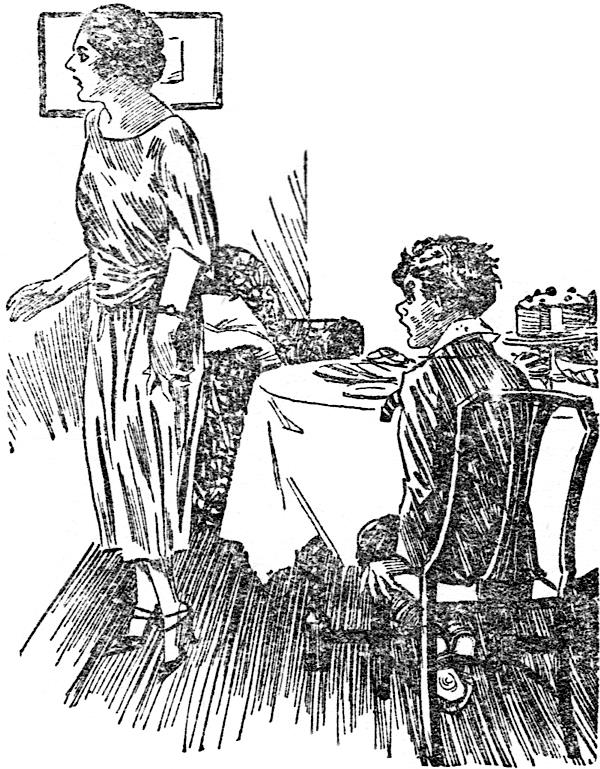
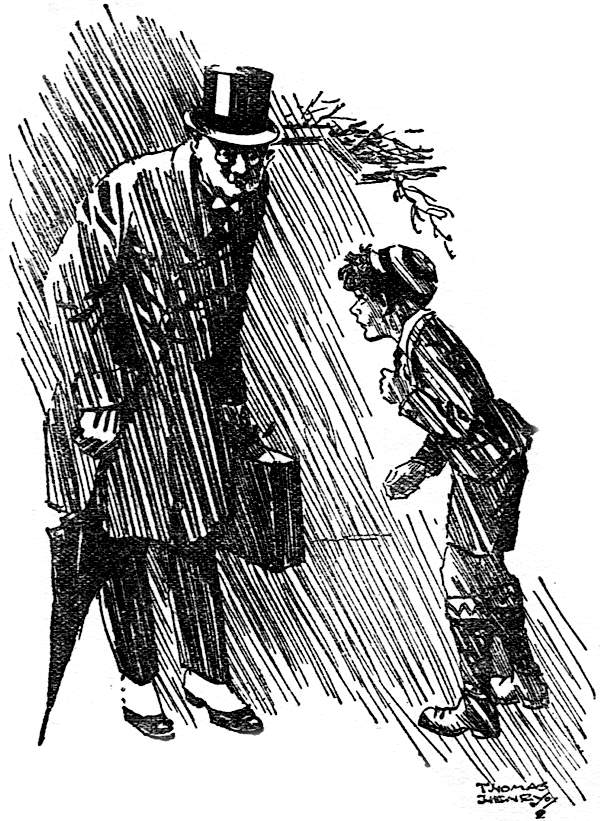
"THOU BEASTLY OLE ROBBER," DOUGLAS WAS SHOUTING,
"I WILL KILL THEE DEAD AND CUT OUT THY FOUL,
BLACK HEART."
"Thou beastly ole robber," Douglas was shouting,
"I will kill thee dead and cut out thy foul, black
heart."
"Nay!" yelled his son. "I will hang thee
from my mountain ere dawn dawns and thy body
shall dangle from the gallows——"
A wistful-looking old man on a packing-case was
an absorbed spectator of the proceedings. When he
saw William's father he took out his watch with a
guilty start.
"Surely——" he said. "I'd no idea—Heavens!"
He picked up his hat and almost ran.
******
The Great Man rose to address his audience.
"Ladies and gentlemen—I must begin by
apologising for my late arrival," he said with dignity.
"I have been unavoidably delayed."
He tried not to meet William's father's eye as he
made the statement.
CHAPTER II
THE CURE
Breakfast was not William's favourite meal.
With his father shut off from the world by his paper,
and his mother by her letters, one would have
thought that he would have enjoyed the clear field
thus left for his activities. But William liked an
audience—even a hostile one consisting of his own
family. True, Robert and Ethel, his elder brother
and sister, were there; but Robert's great rule in
life was to ignore William's existence. Robert
would have preferred not to have had a small
freckled, snub-nosed brother. But as Fate had
given him such a brother, the next best thing was
to pretend that he did not exist. On the whole,
William preferred to leave Robert alone. And
Ethel was awful at breakfast—quite capable of
summoning the Head of the Family from behind
his Daily Telegraph when William essayed a little
gentle teasing. This morning William, surveying
his family in silence in the intervals of making a
very hearty meal, came to the conclusion, not for
the first time, that they were hardly worthy of
him: Ethel, thinking she was so pretty in that
stuck-up-looking dress, and grinning over that
letter from that soft girl. Robert talking about
football and nobody listening to him, and glaring at
him (William) whenever he tried to tell him what
nonsense he was talking about it. No, it wasn't
rounders he was thinking of—he knew 'bout football,
thank you, he just did. His mother—suddenly his
mother put down her letter.
"Great-Aunt Jane's very ill," she said.
There was a sudden silence. Mr. Brown's face
appeared above the Daily Telegraph.
"Um?" he said.
"Great-Aunt Jane's very ill," said Mrs. Brown.
"They don't seem to think there's much chance
of her getting better. They say——" She looked
again at the letter as if to make quite sure: "They
say she wants to see William. She's never seen him,
you know."
There was a gasp of surprise.
Robert voiced the general sentiment.
"Good Lord!" he said, "fancy anyone wanting
to see William!"
"When they're dying, too," said Ethel in equal
horror. "One would think they'd like to die in
peace, anyway."
"It hardly seems fair," went on Robert, "to show
William to anyone who's not strong."
William glared balefully from one to the other.
"Children! Children!" murmured Mrs. Brown.
"How," said Mr. Brown, "are you going to get
William over to Ireland?"
"I suppose," said Mrs. Brown, "that someone
must take him."
"Good Lord! Who?"
"Yes, who?" echoed the rest of the family.
"I can't possibly leave the office for the next
few weeks," said Mr. Brown hastily.
"I simply couldn't face the crossing alone—much
less with William," said Ethel.
"I've got my finals coming off next year," said
Robert. "I don't want to waste any time. I'm
working rather hard these vacs."
"No one," said his father politely, "would have
noticed it."
"I can go alone, thank you," said William with
icy dignity.
******
In the end William and Mrs. Brown crossed to
Ireland together.
"If William drops overboard," was Robert's
parting shot, "don't worry."
The crossing was fairly eventful. William,
hanging over the edge of the steamer, overbalanced,
and was rescued from a watery grave by one of the
crew who happened to be standing near and who
caught him by his trousers as the overbalancing
occurred. William was far from grateful.
"Pullin' an' tuggin' at me," he said, "an' I
was all right. I was only jus' lookin' over the
edge. I'd have got back all right."
But the member of the crew made life hideous
to Mrs. Brown.
"You know, lady," he muttered, "when I saved
yer little boy's life, I give myself such a wrench.
I can feel it in my innards now, as it were——"
Hastily she gave him ten shillings. Yet she
could not stem the flow.
"I 'ope, lady," he would continue at intervals,
"when that choild's growd to be a man, you'll think
sometoimes of the poor ole man wot saved 'is life
at the expense of 'is own innards, as you might say
when 'e were a little 'un."
A speech like that always won half-a-crown.
In the end Mrs. Brown spent her time avoiding him
and fleeing whenever she saw him coming along
the deck. When a meeting was inevitable she
hastily gave him the largest coin she could find
before he could begin on his "innards."
Meanwhile a passenger had discovered William
neatly balanced through a porthole, and earned his
undying hatred by hauling him in and depositing
him upside down on the floor.
"Seems to me," said William to his mother,
"that all these folks have come for is to stop other
folks having a good time. What do you come on
a boat for if you can't look at the sea—that's all I
want to know?"
A gale rose, and Mrs. Brown, pale and distraught,
sat huddled up on deck. William hovered round
sympathetically.
"I got some chocolate creams in my other coat.
Like some of them?"
"William, dear, don't bother to stay here. I'd
just as soon you went away and played."
"Oh, no," said William nobly. "I wun't leave
you feelin' bad."
The boat gave a lurching heave. Mrs. Brown
groaned.
"Think you goin' to be sick, mother?" said
William with interest.
"I—I don't know.... Wouldn't you like to go
over to the other side for a change?"
William wandered away. Soon he returned,
holding in his hands two doughnuts—masses of
yellowy, greasy-looking dough, bearing the impress
of William's grimy fingers.
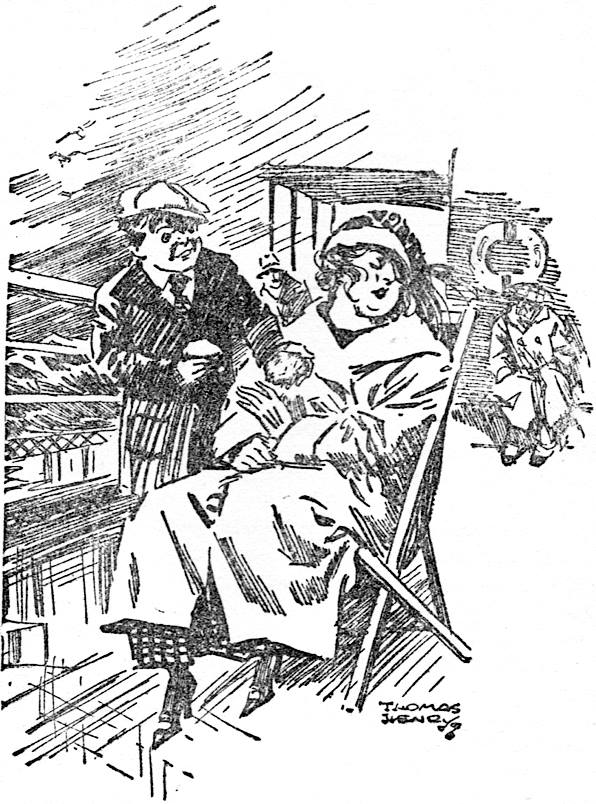
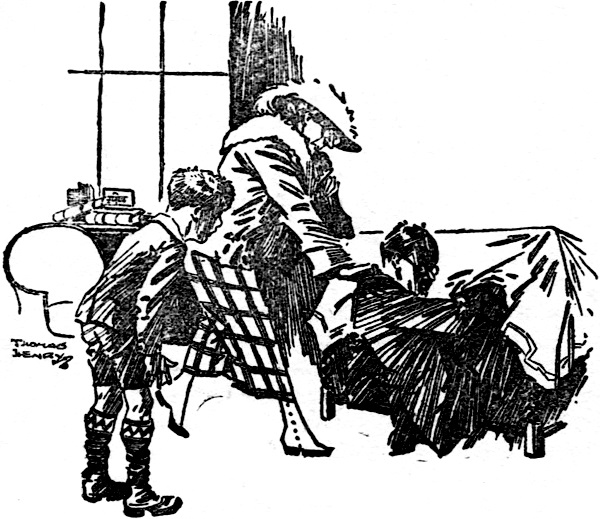
"I've got us one each," said William cheerfully.
"You must be awful hungry, mother."
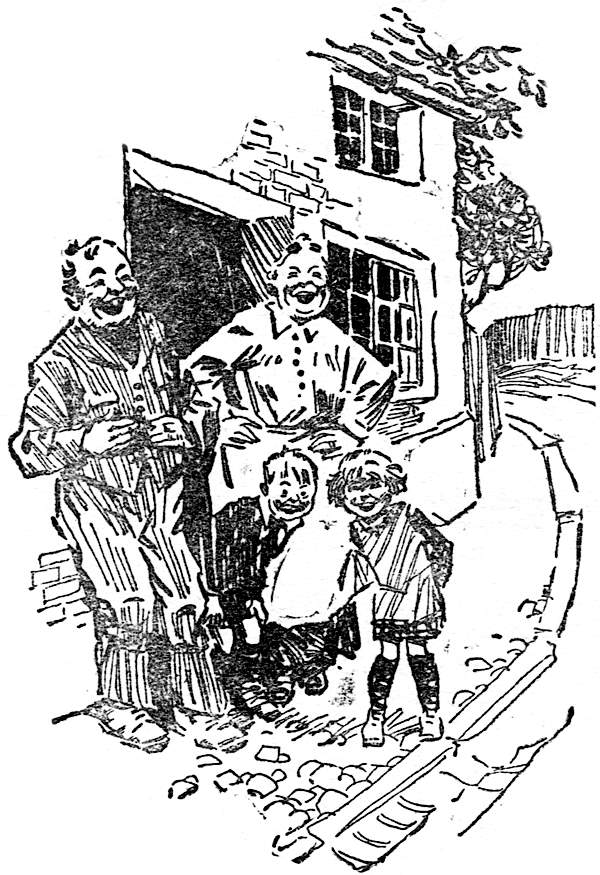
SOON WILLIAM RETURNED, HOLDING IN HIS HANDS
TWO DOUGHNUTS.
Mrs. Brown gave one glance and turned towards
the sea.
******
In Great-Aunt Jane's drawing-room were
assembled Uncle John and Aunt Lucy and Cousin
Francis. Francis was about the same age as
William, but inordinately fat and clad in white.
He had fair curls and was the apple of his parents'
eyes. They had heard of William but none of them
had seen him. There was a murmur of excitement
as the sound of the taxi was heard, then William
and his mother entered. Mrs. Brown was still
pale. William followed her, scowling defiantly at
the world in general.
"If you have any brandy——" said Mrs. Brown
faintly.
"Brandy?" said William cheerfully. "I never
thought of that. I got you nearly everything else,
didn't I? I wanted to tempt her to eat," he
explained to the company. "I thought of choc'lates
an' cakes an' cocoa an' pork-pies—I kept
askin' her to try pork-pie—there was some lovely
ones on the boat—but I never thought of brandy.
Have a good drink of it, mother," he encouraged
her, "an' then try an' have a go at the chocolates."
Mrs. Brown shivered slightly and sipped the
brandy.
"This, William," said Aunt Lucy, "is your
cousin Francis."
Cousin Francis held out his hand. "How do you
do, William?"
William took the proffered hand. "How do you
do?" he said loudly, and added sotto voce, "Fatty."
Thus was war declared.
Mrs. Brown was feeling better.
"How is Great-Aunt Jane?" she said.
"Sinking," said Uncle John in a voice of deepest
gloom. "Sinking fast—sinking fast."
William's expression grew animated.
"Where is she?" he said. "Is she out in the
sea?"
"Little boys," said Uncle John still gloomily,
"should be seen and not heard."
At this point the nurse entered.
"She can see the little boy now," she said, "if
he's come."
"Let the dear children go together," suggested
Aunt Lucy.
"Excellent," said Uncle John in his hushed,
sepulchral voice. "Excellent—together."
William and Francis went upstairs behind the
nurse.
The bedroom was large and dim. At the far end
lay Great-Aunt Jane, propped up in a high old-fashioned
bed. The nurse took them across.
"I only wanted to see William," said Great-Aunt
Jane feebly. "The other need not have
come. So this is Margaret's youngest, is it? I've
seen the others, Robert and Ethel. But I hadn't
seen this one. I didn't want to die without seeing
all my family. He's not as beautiful as Francis, but
he's less fat. Do you trail clouds of glory, William?
Francis trails clouds of glory."
"Clouds of fat more like," said William, who
was beginning to be bored by the whole affair.
Great-Aunt Jane closed her eyes.
"I'm going to rest a little," she said. "You
can stay here and get me anything I want while
nurse goes to have her tea."
The nurse went.
Great-Aunt Jane fell asleep.
William and Francis were left alone in the dim
bedroom, sitting on chairs, one on each side of the
big bed as the nurse had placed them. The silence
grew oppressive. William fidgeted, then opened
hostilities.
"Hello, Fatty!" he whispered over Great-Aunt
Jane's recumbent form.
"'F you call me that again," whispered Francis,
"I'll tell my mother."
"'F you went telling tales of me, I'd pull your
long hair off."
Francis searched in his mind silent for a few
minutes for a suitable term of opprobrium.
"Freckles!" he hissed across the bed at last.
"Softy!" returned William.
This was warfare after his own heart.
"'F I got hold of you, I could throw you out of
the window."
"You couldn't. You'd just roll about. You
couldn't throw anything. You're too fat."
"I told you what I'd do if you called me that
again."
"Tell-tale! Tell-tale! Silly ole tell-tale!"
Still the deadly insults were being hurled across
the bed in whispers, and still Great-Aunt Jane slept.
"I could bash your old freckled face in,"
whispered Francis.
"I could knock your ole long-haired head off."
"I could pull your ears out."
"Come on, then. Have a try."
"Come on yourself!"
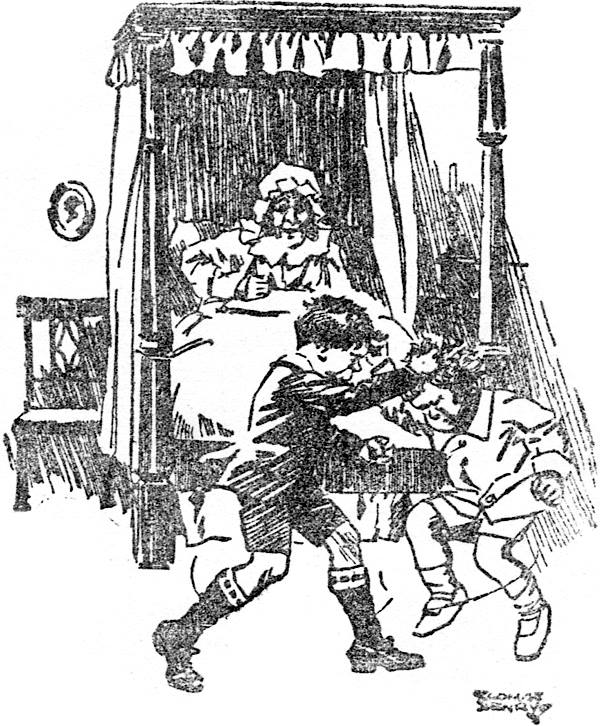
Worked up to fighting pitch, they stole round
their corners of the bed to the open space at the
foot. Then they hurled themselves upon each other.
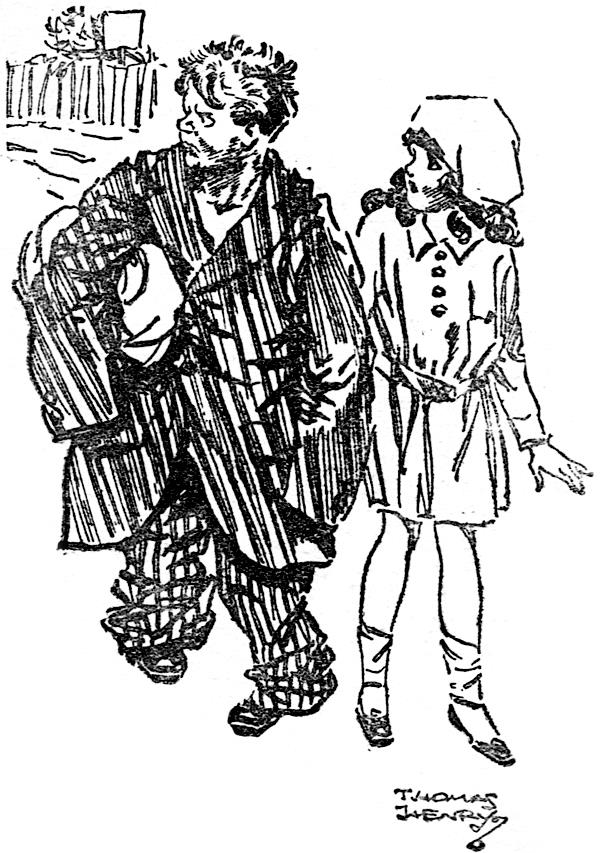
"GO IT, WILLIAM!" GREAT-AUNT JANE CRIED....
"ANOTHER, ANOTHER!"...
They fought with fierce satisfaction, tearing at
each other's hair, punching each other's heads,
squirming and rolling on the floor. Suddenly they
became aware of a spectator. Great-Aunt Jane was
sitting up in bed, her cheeks flushed, her eyes bright.
"Go it, William!" she said. "Get one in on
his nose. That's right, Fatty; well fended! Go
on, William. Another, another! No biting,
Fatty. Go——Oh, dear!"
There were footsteps on the stairs.
"Quick!" said Great-Aunt Jane.
They darted to their seats, smoothing their hair
as they went.
The nurse entered.
"Whatever——" she began, then looked round
the peaceful room. "Oh, it must have been in
the street!"
Great-Aunt Jane opened her eyes.
"I feel much better," she said. "Ever so much
better."
"You look better," said the nurse. "I hope
the children were good."
"Good as gold!" said Great-Aunt Jane, with
the ghost of a wink at William.
"Look at them," said the nurse, smiling. "Both
purple in the face with holding their breaths. They'd
better go now."
Again Great-Aunt Jane winked at William.
Downstairs Uncle John was standing, gloomy as
ever, by the fireplace.
"How is she?" he said, as they entered.
"I think she's risin' a bit," said William.
******
"What did you say he did this morning?" said
Great-Aunt Jane to the nurse.
"He got up early," said the nurse, "and found
a mouse in the mousetrap. He put it into a cardboard
box and almost covered the creature in
cheese, and made holes in the lid and put it into
his pocket. He wanted to keep it. Then the thing
gnawed its way out at breakfast and stampeded
the whole table. It ran over Francis, and he
yelled, and his father nearly fainted. William was
much annoyed. He said he'd meant to teach it
tricks."
"It was yesterday, wasn't it," said Great-Aunt
Jane, "that he dared Fatty to walk on the edge
of the rain tub, and he overbalanced and fell in?"
"Yes—and Fatty got in a temper and bit him,
and they fought and rolled down the bank together
into the pond."
"And Tuesday——"
"Tuesday he brought the scarecrow in from the
field in the evening and put it in front of the fire
where his uncle usually stands, and it was rather
dark, and they hadn't lit up yet, and his aunt came
in and talked to it for quite a long time before she
discovered. She's rather short-sighted, you know."
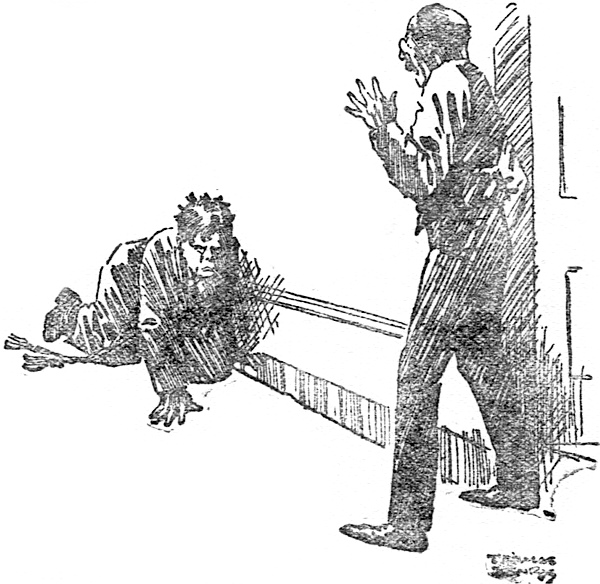
"There was a terrible scuffle going on somewhere
last night," said Great-Aunt Jane eagerly.
"Oh, yes—his Uncle John went downstairs about
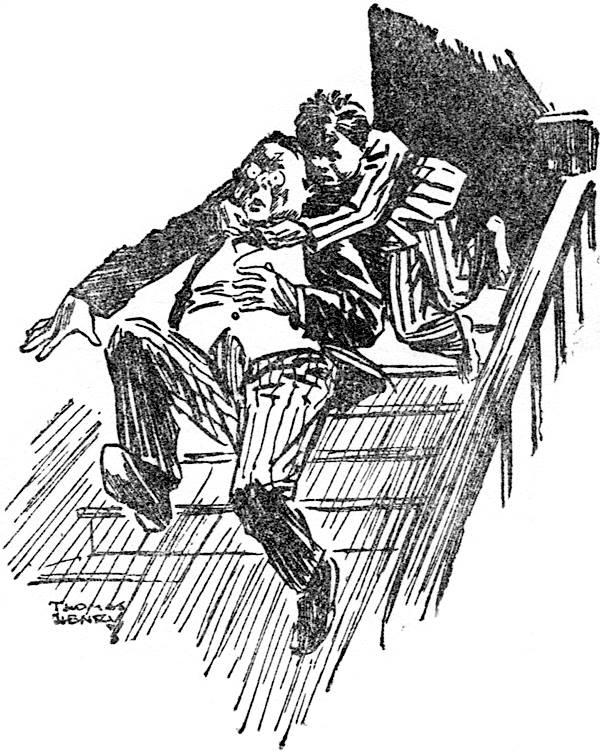
eleven for a book he'd forgotten, and William
heard him and thought he was a burglar, and
attacked him from behind. They fell downstairs on
the top of each other, and then William got his
uncle rolled up in the hall rug with a pair of gloves
in his mouth and his eye-glasses broken before he
found out who he was—he's a curious boy!"
Great-Aunt Jane was sitting up and looking
quite bright.
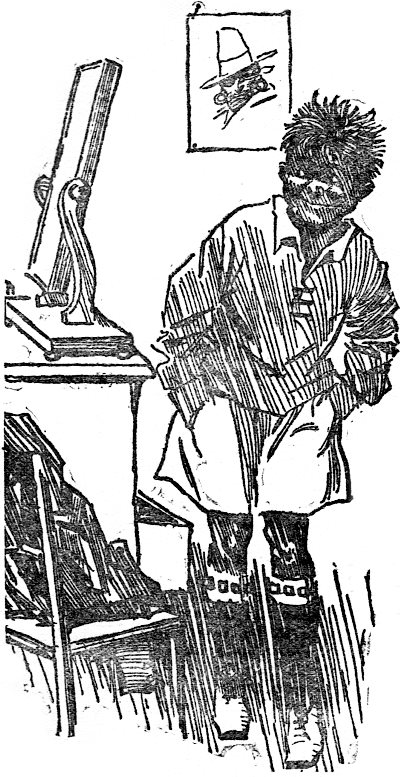
"THERE WAS A TERRIBLE SCUFFLING GOING ON
SOMEWHERE, LAST NIGHT."
"He certainly lends an interest to life. I feel
ever so much better since he came. You might
send him up now, if he's in, nurse, will you?"
On her way down the nurse met Uncle John.
"How long is this young ruffian going to be
here?" he said furiously. William had successfully
dispelled the air of hallowed gloom from the
house. "He's sent my nerves to pieces already—what
his effect on that poor sufferer must be——"
"He seems to be strengthening hers," said the
nurse. "She's just sent for him."
"That means a few minutes' peace for the rest of
the house, at any rate," he said.
William entered the sick room sullenly. He was
thoroughly bored with life. Even his enemy,
Fatty, was not to be found. Fatty retired every
afternoon with his mother to lie down.
"Good afternoon, William," said Great-Aunt
Jane, "are you enjoying your visit?"
"Well," said William vaguely, striving to temper
truth with politeness, "I wun't mind going home
now. I've had enough." He sat down on her
bed and became confidential. "We've been here
for weeks an' weeks——"
"Four days," amended Great-Aunt Jane.
"Well, four days, then," said William, "an'
there's nothing left to do, an' they make a fuss if I
make a noise; an' I've got a lizard in a box at
home and I'm tryin' to teach it tricks, an' it'll have
forgot me if I stay here much longer. It was just
gettin' to know me. I could tell by its eyes. An'
they might forget to feed it or anything—there's
nothing to do here, an' mother's not been well since
the sea made her sick, an' I keep sayin'—why wait
till she's all right to go back—case the sea makes
her sick again; better go back while she's feelin'
bad and get it all over again without the fuss of
gettin' all right an' then gettin' bad again; an' I
keep sayin', why are we stoppin' here and stoppin'
here an' stoppin' here—an' everyone sayin' 'Sh!'
when you make a noise, or sing, or anything. I
say—why?"
Great-Aunt Jane's sunken lips were quivering,
her eyes twinkling.
"And why are you stoppin' an' stoppin' an'
stoppin'?"
"She says 'cause you're not out of danger, and
we must stop till we know which way it is. Well,"
he waxed still more confidential, "what I say is,
shurely you know which way you're goin' to be.
Can't you tell us? Then if you're goin' to get
better we'll go, an' if you're not——"
"Yes, what then?" said Great-Aunt Jane.
"Then we'll go, too. You don't want me hangin'
round when you're dyin'," he said coaxingly. "I'd
like as not make a noise, or something, and disturb
you—and that lizard might have got out if I go
waitin' here much more—like wot that mouse did."
Great-Aunt Jane drew a deep breath of utter
content.
"You're too priceless to be true, William," she
said.
"Can't you tell me which way?" said William
ingratiatingly.
"Yes," said Great-Aunt Jane, "I'm going to get
better."
"Oh, crumbs!" he said joyfully. "Can I go
and tell mother to pack?"
"You've turned the corner," said the doctor to
Great-Aunt Jane an hour later, "we needn't worry
about you any more. All these relations of yours
can pack up and go."
"William's packed already," said the nurse.
"That boy is a cure!"
Great-Aunt Jane laughed.
"Yes, he's a cure, all right," she said.
CHAPTER III
THAT BOY
William had gone away with his family for a
holiday, and he was not enjoying it. For one
reason it was not the sea. Last summer they had
gone to the sea and William had enjoyed it. He had
several times been rescued from a watery grave by
passers-by. He had lost several pairs of new shoes
and stockings by taking them off among the rocks
and then roaming so far afield barefoot that he forgot
where he had left them and so came home without
them. He got wet through every day as a
matter of course. Through the house where his
family stayed his track was marked by a trail of
sand and seaweed and small deceased crabs. He
had upon one occasion floated out to sea in a boat
which he had found on the beach and loosened from
its moorings, and narrowly escaped being run down
by a steamer. At the end of the holiday by the
sea Mrs. Brown had said weakly, "Let it be somewhere
inland next year."
William found things monotonous inland. There
were no crabs and nothing to do. Robert and
Ethel, his grown-up brother and sister, had joined
a tennis club and were out all day. Not that
William had much use for Robert and Ethel. He
preferred them out all day as a matter of fact.
"All I say is," he said aggrievedly to his mother,
"that no one cares whether I'm havin' a nice time or
not. You think that s' long as father can go golfin'—or
tryin' to golf—and those two playin' tennis—or
what they call tennis"—he added scornfully,
"and you can sit knittin', it's all right. You don't
think of me. No one thinks of me. I might just as
well not be here. All I say is," he ended, "I might
jus' as well be dead for all the trouble some people
take to make me happy."
His mother looked at his scowling freckled
countenance.
"Well, dear," she said, "there are plenty of books
about the house that you haven't read."
"Books," said William scornfully. "Sir Walter
Scott's ole things—I don't call that books."
"You can go for walks."
"Walks!" said William. "It's no use goin'
walks without 'Jumble'."
His father lowered his newspaper. "Your
arithmetic report was vile," he said. "You might
occupy your time with a few sums. I'll set them
for you."
William turned upon his parent a glance before
which most men would have quailed. Even
William's father, inured as he was by long
experience to that glare of William's, retired hastily
behind his paper. Then, with a short and bitter
laugh, William turned on his heel and left the room.
That was the last straw. He'd finished with them.
He'd simply finished with them.
He put his head in at the window as he went
towards the gate.
"I'm goin' out, mother," he said in a voice which
expressed stern sorrow rather than anger.
"All right, dear," said Mrs. Brown sweetly.
"I may not be coming back—never," he added
darkly.
"All right, dear," said William's mother.
William walked with slow dignity down to the
gate.
"All I say is," he remarked pathetically to the
gatepost as he passed, "I might as well be dead
for all anyone thinks of tryin' to make my life a
bit happier."
He walked down to the village—a prey to black
dejection. What people came away for holidays
for beat him. At home there was old Jumble to
take for a walk and throw sticks for, and the next-door
cat to tease and the butcher's boy to fight, and
various well-known friends and enemies to make life
interesting. Here there was—well, all he said
was, he might as well be dead.
A char-à-banc stood outside the post-office, and
people were taking their places in it. William
looked at it contemptuously. He began to listen in
a bored fashion to the conversation of two young men.
"I'm awfully glad you ran down," one of them
was saying to the other; "we can have a good tramp
together. To tell you the truth I'd got so bored
that I'd taken a ticket for this char-à-banc show....
Can't stand 'em really."
"Will they give you your money back?" said
the other.
"It doesn't matter," said the first.
Then he met William's dark, unflinching gaze
and said carelessly, "Here, kid, like a ticket for
the char-à-banc trip?"
William considered the question. Anything that
would take him away from the immediate vicinity
of his family seemed at that moment desirable.
"Does it come back?" he said.
"It's supposed to," said the young man.
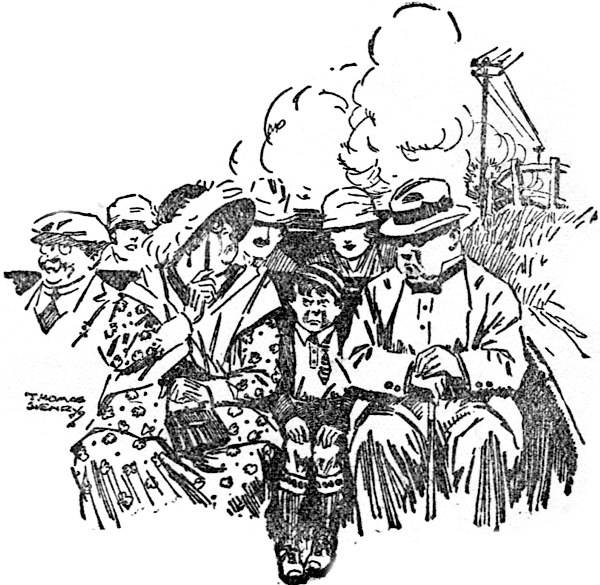
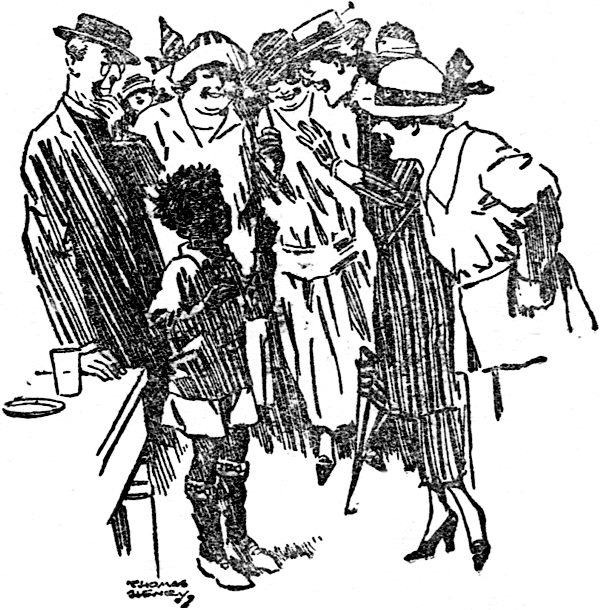
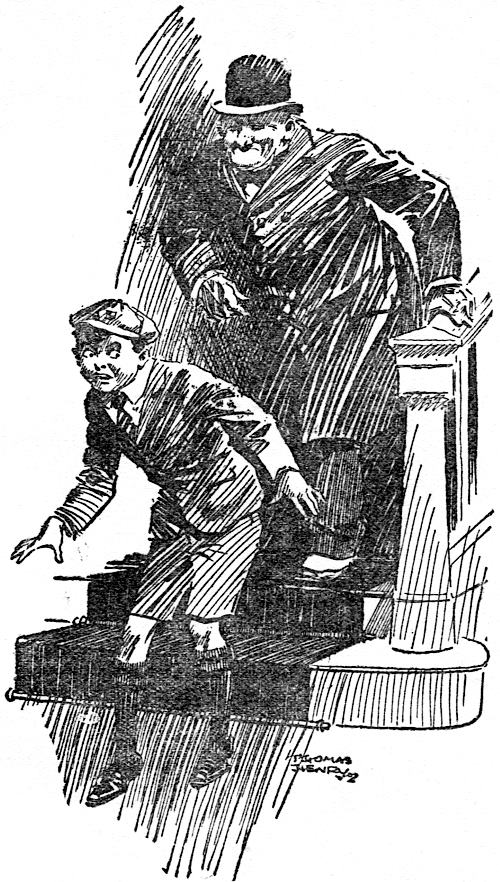
"ALL I SAY IS," WILLIAM SAID PUGNACIOUSLY, TRYING
TO SCOWL UP AT BOTH SIDES AT ONCE, "THAT THERE'S
NOT MUCH ROOM."
That seemed rather a drawback. William felt
that he would have preferred to go away from his
family on something that did not come back.
However, this was better than nothing.
"All right," he said graciously, "I don't mind
going."
The young man handed him the ticket.
******
William sat in the middle of a seat between a
very fat lady and a very fat gentleman.
"Not much room," he remarked bitterly to the
world in general.
The fat lady and the fat gentleman turned
crushing glances upon him simultaneously.
William received and returned them. He even
enlarged upon his statement.
"All I say is," he said pugnaciously, trying to
scowl up at both sides at once, "that there's not
much room."
The fat lady put up lorgnettes and addressed the
fat gentleman over William's head.
"What a very rude little boy!" she said.
Being apparently agreed upon that point they
became friendly and conversed together for the
rest of the journey, ignoring the subterranean
rumbles of indignation that came from the small
boy between them.
At last the char-à-banc stopped at a country
village. The driver explained that the church
was an excellent example of Early Norman architecture.
This left William cold. He did not
even glance at it. The driver went on to remark
that an excellent meal could be obtained at the
village inn. Here William's expression kindled
into momentary animation only to fade again into
despair. For William had spent his last twopence
that morning upon a stick of liquorice. It had
caused a certain amount of friction between himself
and his elder brother. William had put it—partially
sucked—upon a chair while he went to
wash his hands, and Robert had come in from
tennis and inadvertently sat down upon it. Being
in a moist condition it had adhered to Robert's
white flannel trousers. Even when detached the
fact of its erstwhile adherence could not be concealed.
William had considered Robert's attitude
entirely unreasonable.
"Well, I don't know what he's got to be mad
about.... I didn't make him sit down on it, did
I? He talks about me spoilin' his trousers—well,
wot about him spoilin' my liquorice? All I say is—who
wants to eat it, now he's been sittin' on it?"
Robert had unkindly taken this statement at
its face value and thrown the offending stick of
liquorice into the fire.
William sadly extricated himself from the char-à-banc,
thinking bitterly of the vanished twopence,
and liquorice, and the excellent meal to be obtained
from the village inn. He regarded himself at that
moment as a martyr whose innocence and unjust
persecution equalled that of any in the pages of
the Church History book.
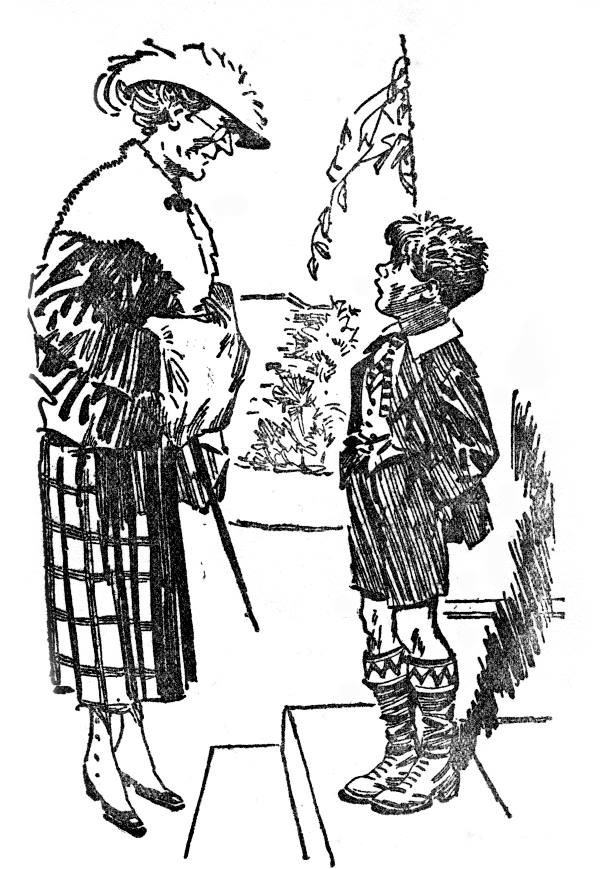
An elderly lady in pince-nez looked at him
pityingly.
"What's the matter, little boy?" she said.
"You look unhappy."
William merely smiled bitterly.
"Is your mother with you?" she went on.
"Nope," said William, thrusting his hands into
his pockets and scowling still more.
"Your father, then?"
"Huh!" said William, as though bitterly
amused at the idea.
"You surely haven't come alone!" said the
lady.
William gave vent to the dark emotions of his soul.
"All I say is," he said, "that if you knew my
family you'd be jolly glad to go anywhere alone if
you was me."
The lady made little clicking noises with her
tongue expressive of sorrow and concern.
"Dear, dear, dear!" she said. "And are you
going to have tea now?"
William assumed his famous expression of
suffering patience.
"I've got no money. It's not much use goin'
to have tea anywhere when you haven't got no
money."
"Haven't they given you any money for your
tea?" said the lady indignantly.
"Not they!" said William with a bitter laugh.
"They wun't of let me come if they'd known.
They wun't of paid anything for me. It was a
frien' gave me the ticket jus' to giv' me a bit of
pleasure," he said pathetically, "but they wun't
even give me money for my tea."
"Perhaps," said the lady, "you had a late
lunch and they thought——"
"Huh!" ejaculated William. "I din' have any
lunch worth speakin' of." He thrust aside the
mental picture of two helpings of steak and three
of rice pudding.
"You poor child," said the lady. "Come along.
I'll give you your tea."
"Thanks," said William humbly and gratefully,
trudging off with her in the direction of the village
inn.
He felt torn between joy at the immediate prospect
of a meal and pity for his unhappy home life.
William, generally speaking, had only to say a
thing to believe it. He saw himself now as the
persecuted victim of a cruel and unsympathetic
family, and the picture was not without a certain
pleasure. William enjoyed filling the centre of the
stage in any capacity whatsoever.
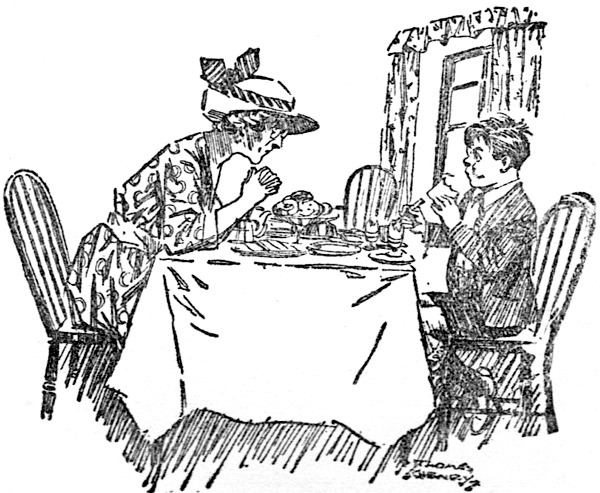
"LITTLE BOY," SHE SAID SOULFULLY, "YOU MUST
TELL ME ALL.... IF I REPORTED THE CASE TO THE
SOCIETY FOR PREVENTION OF CRUELTY TO
CHILDREN——"
"I suppose," said the lady uncertainly, as William
consumed boiled eggs with relish, "that your
family are kind to you."
"You needn't s'pose that," said William, his
mouth full of bread-and-butter, his scowling gaze
turned on her lugubriously. "You jus' needn't
s'pose that. Not with my family."
"They surely aren't cruel to you?" said the
lady in horror.
"Crule," said William with a shudder, "jus'
isn't the word. All I say is, crule isn't the word."
The lady leant across the table.
"Little boy," she said soulfully, "you must
tell me all. I want to help you. I go about the
world helping people, and I'm going to help you.
Don't be frightened. You know people can be put
in prison for being cruel to children. If I reported
the case to the Society for Prevention of Cruelty to
Children——"
William was slightly taken aback.
"Oh, I wun't like you to do that!" he said
hastily. "I wun't like to get them into trouble."
"Ah," she said, "but you must think of your
happiness, not theirs!"
She watched, fascinated, as William finished a
third plate of bread-and-butter, and yet his hunger
seemed to be unappeased. She was not acquainted
with the digestive capacity of an average healthy
boy of eleven.
"I can see you've been starved," she said, "and I
could tell at once from your expression that you were
unhappy. Have you any brothers and sisters?"
William, who had now reached the second stage
of his tea, put half a cake into his mouth, masticated
and swallowed it before replying.
"Two," he said briefly, "one each. Grown up.
But they jus' care for nothin' but their own pleasure.
Why," he went on warming to his theme,
"this morning I bought a few sweets with jus' a
bit of money I happened to have, an' he took them
from me and threw them into the fire. Jus' threw
them into the fire."
The lady made the sympathetic clicking sound
with her tongue.
"Dear! dear! dear!" she said again. "How
very unkind!"
William somewhat reluctantly refused the last
piece of cake. He had, as a matter of fact, done
full justice to the excellent meal provided by the
village inn. It had given him a feeling of gentle,
contented melancholy. He was basking in the
thought of his unhappy home life.
"I'm sorry to keep reminding you of it," said the
lady, "but I feel I really want to get to the bottom
of it. There's generally only one explanation of an
unhappy home. I've investigated so many cases.
Does your father drink?"
William nodded sadly.
"Yes," he said. "That's it."
"Oh," breathed the lady, "your poor mother!"
But William wanted no division of sympathy.
"Mother drinks, too," he said.
"You poor, poor child!" said the lady.
William wondered whether to make Robert and
Ethel drink, too, then decided not to. As an
artist he knew the value of restraint.
"Never mind," said the lady, "you shall have
one happy afternoon, at any rate."
She took him to the village shop and bought
him chocolates, and sweets, and bananas, and a top.
William found some difficulty in retaining an
expression suggestive of an unhappy home life, but
he managed it fairly successfully.
He began to feel very sleepy on the way home.
He had had a lovely time. His pockets were full
of sweets and chocolates, and he held his top in his
hand. He even felt that he could forgive his family.
He'd heap coals of fire on Robert's head by giving
him a chocolate.... He was almost asleep when
the char-à-banc drew up at the post-office. Everyone
began to descend. He took a polite and distant
farewell of the elderly lady and set off for his home.
But he found that the elderly lady was coming with him.
"Where do you live?" she said.
"Oh," said William vaguely, "jus' somewhere
along here."
"I'm coming to see your father," said the lady
in a determined voice.
William was aghast.
"Oh—er—I wun't do that if I was you!" he said.
"I often find," she said, "that a drunkard does
not realise what unhappiness he makes in his home.
I often find that a few words of warning are taken
to heart——"
"You'd better not," said William desperately.
"He dun't mind wot he does! He'd throw knives
at you or shoot you or cut your head off soon as not.
He'll be jus' mad drunk when we get in. He went
off to the public-house jus' after breakfast. You'd
better not come near our house.... All I say is, you
might jus' as well be dead as coming to our house."
"But what about you?"
"Oh, I'm used to it," said William valiantly.
"I don't mind. Please, you'd better not come,"
he urged. "I'm thinkin' of you——"
"I shan't feel that I've done my duty till I've
at any rate tried to make him see his sin."
They were in the street now in which William's
family were living. William looked pale and
desperate. Matters seemed to have gone beyond
his control. Suddenly he had an idea. He would
lead her past the house and on and on till one or
other of them dropped from fatigue. She'd have
to go home some time. She couldn't go on all
night. He could say he'd forgotten where he lived.
He began to dislike her intensely. Fussy ole
thing! Believing everything everyone said to her!
Interfering with other people's drunken fathers!
He was creeping cautiously and silently past his
house by the side of his unsuspecting companion,
when a shrill cry reached him.
"William! Hi! William! Where have you
been? Mother says come in at once!"
It was Ethel leaning out of an upstairs window.
The sight of her pretty white-clad figure brought
no pleasure to her brother's heart. He put out his
tongue at her and sadly opened the garden gate.
"You'd better not come in," he said faintly to
his companion, in a last feeble attempt to avert
the catastrophe which Fate seemed determined to
bring upon him, "he gets vilent about this time of day."
With firm set lips his companion followed him.
"I must do my duty," she said sternly.
******
Mr. Brown looked up from the evening paper as
his younger son entered. At first he merely noticed
that his younger son looked unusually sheepish.
Then he noticed that his son was followed by a tall,
thin lady of prim appearance and uncertain age,
wearing pince-nez. Mr. Brown groaned inwardly.
Had William killed her cat or merely broken one of
her windows?
"Er—good evening," he said.
"Good evening," said the visitor. "I have
been spending the afternoon with your little boy."
Mr. Brown sent William a speaking glance. He
didn't mind what caricatures William picked up
outside the house, but he wished he'd keep them
there. William refused to meet his father's glance.
He sat on the edge of a chair looking rather pale,
his cap in his hand, measuring with his eye the
distance between the chair and the half-open door.
"Very kind of you," murmured Mr. Brown.
"He has told me something of the state of things
in his home," burst out the visitor. "I saw at
once that he was unhappy and half-starved."
Mr. Brown's jaw dropped. William very slowly
and cautiously tiptoed to the door.
"He told me about you and his mother. I
was sure—I am sure—that you don't realise what
you are doing—what your—er—failing—means to
this innocent child."
Mr. Brown raised a hand to his brow.
"Your conscience, you see," said the visitor
triumphantly, "troubles you. Why should the
memory of childhood mean to that dear boy blows
and curses and unkindness—and just because you
are a slave to your baser appetites?"
Mr. Brown removed his hand from his brow.
"You'll pardon my interrupting you," he said
feebly, "but perhaps you would be good enough
to give me some slight inkling of what you are
talking about."
"Ah, you know," she said fervently, "in your
soul—in your conscience—you know! Why
pretend to me? I have had that dear child's
company all afternoon and know what he has
suffered." Here Mrs. Brown entered and the
visitor turned to her. "And you," she went on,
"you must be his mother. Can't you—won't you—give
it up for the sake of your child?"
Her voice quivered with emotion.
"I think, my dear," said Mr. Brown, "that you
had better send for a doctor. This lady is not well."
"But who is she?" said Mrs. Brown.
"I don't know," said her husband; "she's
someone William found."
The someone William found flung out her arms.
"Won't you?" she cried eloquently. "Can't
you—for the sake of your own happiness as well as
his—give it up?"
They stared at her.
"Madam," said Mr. Brown despairingly, "what
do you wish us to give up?"
"Drink," she answered dramatically.
Mr. Brown sat down heavily.
"Drink!" he echoed.
Mrs. Brown gave a little scream.
"Drink!" she said. "But we're both teetotalers."
It was the turn of the visitor to sit down heavily.
"Surely," she said, "that boy did not deceive
me!"
"Madam," said that boy's father bitterly, "it
is more than probable."
******
When the visitor, protesting, apologising,
expostulating, and still not quite convinced, had
been escorted to the door and seen off the premises,
Mr. Brown turned grimly to his wife.
"Now," he said, "where is that boy?"
But a long and energetic search of house and
garden failed to reveal any traces of him. It was
not till an hour later that William, inspired more by
the pangs of hunger than by pangs of conscience,
emerged from the boot cupboard in the kitchen and
surrendered himself to justice.
CHAPTER IV
WILLIAM THE REFORMER
William's regular attendance at church on Sunday
mornings did not betoken any deeply religious
feeling on his part. It was rather the result of
pressure from without, weekly applied and resisted
by William with fresh indignation on each occasion.
His church-going was a point on which his family
insisted. It was not that they hoped that any
real improvement of William would result from it.
As a matter of fact, it generally seemed to have the
opposite effect upon him. But it meant that those
of his family who did not go to church had one
morning at least in the sure knowledge that
William's strident voice could not dispel their
Sabbath peace and calm, nor could William, with
his curious genius for such things, spring any
awkward situation suddenly upon them, while those
who went to church had the comfortable knowledge
that William, cowed, and brushed, and washed,
and encased in his hated best suit, and scowling at
the vicar from the front pew, could do little harm
beside the strange scuffling with his feet that he
seemed able to produce without even moving them.
Moreover, they "knew where he was." It was
something to "know where he was."
This Sunday the usual preliminaries took place.
"I'm not going to church this morning," Robert
happened to say, carrying a deck-chair into the
garden.
"An' I'm not, either," said William, as he seized
another chair. The would-be light finality of his
tone did not deceive even himself.
"You must go, dear," said his mother placidly.
"You know you always do."
"Yes, but why me an' not him?" demanded
William, pale with outrage. "Why him not go
an' me go?"
Robert calmly stated his position.
"If William's not going to church, I'm going, and
if William's going to church, I'm not. All I want
is peace."
"I shun't make a noise if I stayed at home," said
William in a tone of righteous indignation at the
idea. "I'd jus' sit qui'tly readin'. I don't feel
like bein' rough or anything like that. I'm not
feelin' well at all," he ended plaintively.
Mr. Brown came downstairs, tophatted and
gloved.
"What's the matter?" he said.
"William's too ill to go to church," said Robert
in an unfeeling tone of voice.
William raised his healthy, ruddy countenance.
"I'd like to go to church," he explained to his
father. "I'm disappointed not to go. But I jus'
don't feel well. I'm took ill sudden. I'd jus' like
to go an' lie down qui'tly—out of doors," he stipulated
hastily. "I feel's if I went to church I might
worry everybody with bein' so ill. I feel"—his
Pegasean imagination soared aloft on daring wings—"I
feel 's if I might die if I went to church this
mornin' feelin' 's ill as I do now."
"If you're as bad as that," Mr. Brown said
callously, as he brushed his coat, "I suppose you
might as well die in church as anywhere."
This remark deprived William of the power of
speech for some time.
"Well," he said at last, darkly and bitterly,
"I only hope you won't be too sorry afterwards—when
you think of what you've done. I only hope
that—I only hope that when you think of what
you've done afterwards—you won't be too sorry.
When you——"
"Hurry up, dear," said his mother patiently.
"Don't keep us all waiting."
******
Sitting between Ethel and his mother in the
front pew, William allowed his thoughts to wander
at their own sweet will. He found the Litany very
long and trying. Its monotony had been relieved
only by a choirboy who occasionally brightened
William's existence by putting out his tongue at
him from behind the cover of his psalter. From
that a contest in grimaces had arisen, begun furtively,
but growing reckless in the heat of rivalry,
till a choirman had intervened by digging the
choirboy from behind, while Mrs. Brown leant forward
and frowned at William. William retired
from the contest feeling distinctly exhilarated. He
considered that most decidedly he had won. The
choirboy could not have capped that last one of his.
In a half-hearted way he began to listen to the
sermon.
"We all owe our duty to others," the clergyman
was saying. "We must all try to save others
beside ourselves. Not one of us must rest content
till we have recalled from evil ways at least one of
those around us. How many there are going down
the broad path of evil who want just the word to
recall them to the path of virtue—just the word
that the youngest here could say...?"
William considered this view. He found it
distinctly intriguing. He had been so frequently
urged to reform himself that the appeal had lost its
freshness. But to reform someone else. There
was much more sense in that; he wouldn't mind
doing that. His spirits rose. He'd rather like to
try reforming someone else.
They stood up for the hymn. The choirboy was
singing lustily. William caught his eye and began
to imitate his more open-mouthed efforts. This
led to a second contest in grimaces, checked for a
second time when at its height by the choirman and
Mrs. Brown. William returned to his meditations.
Yes, it would be a noble deed to reform someone
else, much more interesting and less monotonous
and possibly more successful than the reforming
of himself hitherto solely enjoined upon him.
But who? That was the question.
******
After due consideration that afternoon in the
apple-tree (where William did most of his deep
thinking) he came to the reluctant conclusion that
he must exclude his family from the list of possible
reformees. This was not because he did not think
that his family were in need of reformation. It was
not because he thought them beyond reformation,
though he certainly was of that opinion. It was
rather because he doubted whether any member
of his family was sufficiently broad-minded to
receive reformation at his hands.
There is a certain proverb about a prophet in
his own country. His thoughts wandered over
several masters at his school, whom he considered
to be in crying need of reformation, but the same
applied to them. When, finally, the tea-bell sounded
forth its summons, he was still undecided on whom
to apply his latent powers of reformation.
His family, who had not passed so peaceful a
Sunday afternoon for weeks, looked at him in
curiosity as he entered the dining-room.
"What have you been doing all afternoon,
dear?" said his mother solicitously.
"Jus' thinkin'," said William coldly. Meditation
on his family's need for reformation had made
him realise afresh all he suffered at their hands.
"Not dead yet?" said Robert jocularly.
"No," said William with a quelling glance,
"though anyone might be with what I've got to
put up with. It's a good thing I'm strong."
He then transferred his attention to a large piece of
bread and butter and the conversation drifted away
from him. Idly he listened to it.
"It's so funny," Ethel, his grown-up sister, was
saying, "to come to a country place like this and
take no part in the life. He's so mysterious. He
took Beechwood over a month ago and hardly a
soul's seen him. He never has anyone in and he
never goes out."
"Of course," contributed Robert with the air of
a man-of-the-world. "A country place like this
is an ideal place for murderers or other criminals
to hide in. That's notorious. Much safer than
London."
"And hardly anyone's seen him," said Ethel.
"What does he look like?" said William
excitedly.
"Don't talk with your mouth full," said Ethel.
"Don't listen to their nonsense, dear," said
Mrs. Brown.
But William was afire. Here was someone to be
reformed at his very doors—no mere ordinary
trivial wrong-doer, but a murderer, a criminal, the
real thing. He was longing to begin. He could
hardly wait till he had finished his bread and butter.
"May I go, mother?" he said hastily, swallowing
a quarter of a slice of bread as he spoke.
"You've had no cake, dear," said his mother
in surprise.
William gave a look of set purposeful
determination.
"I don't want cake to-day," he said in the voice
of one who scornfully waves aside some trifle
unworthy of him. With that he strode frowning
from the room.
"I do hope he's not ill," said Mrs. Brown uneasily.
"He's been awfully quiet to-day."
"He's given us the first peaceful Sunday we've
had for years," said Ethel.
"It's not over yet," said Robert, in a voice of
warning.
******
William was already on his way to Beechwood.
In the road he found Ginger, his bosom friend on
weekdays. On Sundays the two families, inspired
solely by a selfish desire for peace, tried to keep
them as far apart as possible.
"Sunday!" said Ginger, bitterly voicing unconsciously
the grievance of the majority of his countrymen.
"There's nothing to do!"
"I've jolly well got something to do, I can tell
you," said William in a voice in which mystery and
self-importance were mingled.
Ginger brightened.
"Lemme help!" he pleaded. "Lemme help
an' I'll give you half the next thing anyone gives
me."
"S'pose it's something you can't make a half of?"
said William guardedly.
"Well, then, I'll let you have it in turn with me,"
said Ginger generously.
"Fair turns?" said William.
"Rather!" said Ginger.
"All right, then," said William. "Come on!"
Ginger set off happily by his side.
"What you goin' to do, William?" he asked.
William sank his voice mysteriously.
"I'm going to reform" (William put the accent
on the first syllable) "a murderer—make him give
up murdering—same as what he said in church
this mornin.'"
"Criky!" said Ginger, impressed.
******
They crept in at the open gates of Beechwood.
"How're you goin' to begin?" said Ginger in a
sibilant whisper.
"Dunno yet," said William, who always trusted
to the inspiration of the moment.
"S'pose—s'pose he murders us?" whispered
Ginger.
"If he does," said William grimly, still aggrieved
by his family's general attitude to him, "I know
some folks that'll p'raps be sorry for some things!"
Then suddenly——
"He's there!" said William excitedly. "Look!
I can see him!"
They crept behind some bushes and watched.
A man was digging in the middle of the lawn. He
stood up to his neck in a large hole and was throwing
up spadeful after spadeful of earth on to the edge.
Occasionally he stopped to wipe his brow. He
was a thin, youngish man.
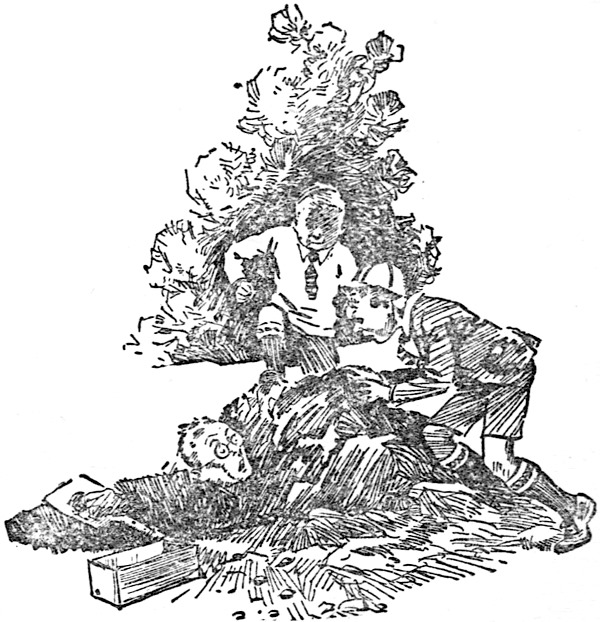
THEY CREPT ACROSS THE LAWN AND SUDDENLY OVERTURNED
THE HEAP OF FRESH-DUG EARTH OVER THE
EDGE OF THE HOLE UPON ITS OCCUPANT.
"Diggin' graves for dead folks he's murdered,"
explained William.
"Golly!" breathed Ginger, his eyes and mouth
wide open. "How're you goin' to stop him?"
"Get him in the hole," said William, "an' then—an'
then—I dunno yet," he ended uncertainly.
The man bent down for another spadeful.
"Come on!" said William.
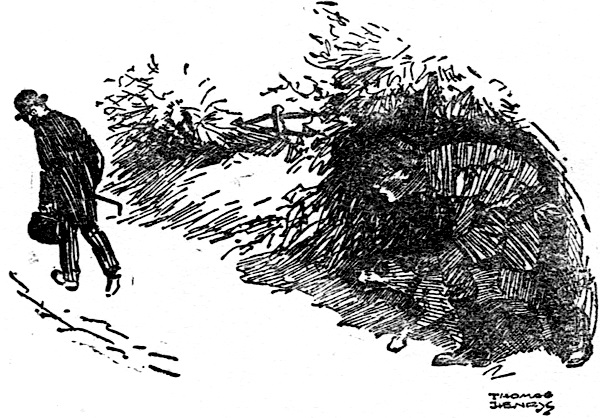
They crept across the lawn and suddenly overturned
the heap of fresh-dug earth that was on the
edge of the hole upon its occupant, using feet and
hands and head and body. It all happened in a
second. The man, up to his neck in the sudden
avalanche of damp garden soil, looked up at them,
sputtering anger and earth.
"I say! I say, you know," he said. "Look
here!"
William leant over the edge of the hole.
"You jus' gotter stop it," he said fiercely.
"D'you see? You jus' gotter stop it!"
The young man gazed at him in amazement. He
made no effort to arise. He lay back on his earthen
couch.
"You've jolly well winded me, you young devil!"
he said, still ejecting earth from his mouth as he
spoke. "Stop what?"
"You know," said William mysteriously, bending
still farther over the edge of the hole. "You
jolly well know, doesn't he, Ginger? How'd you
like someone to do it to you—murderin' you an'
buryin' you in back gardens? Jus' think of
that! Jus' think of how you'd like other folk
doin' it to you, 'fore you start doin' it to other
folks."
"I'll jolly well murder you, once I get out of
here," said the man. "I'll murder you and bury you
ten times over. Don't you worry about that."
"You oughter reform an' start again on the—what
was it?—the path of virt—virt something—now
I've told you like what he said—with jus' a
word. Well, I've said the word, an' you oughter
reform an'——"
"Just you wait, my son," said the young man
grimly, beginning to unearth himself.
But Ginger had made a discovery.
"Look, William," he said. "Look at this!"
"This" was a tin, containing curious earth-covered
coins, at the edge of the hole.
"He's a thief, too," said William indignantly.
"Takin' folks' money as well as buryin' them.
He's goin' right down the broad evil path like what
he said. Well, he oughter stop. I've said it. I've
said the word like what he said, an' he oughter
reform an' come back to the path of virt—what
he said."
The young man was fast unearthing himself.
He looked a curious sight.
"Just you wait," he said again, as he began to
climb out of the hole. "Murder won't be in it."
Instinctively and throwing the zeal of the
reformer to the winds, William and Ginger took to
their heels and fled—across the lawn, down the
drive, down the road—with fleetness of foot gained
in many a flight from irate farmers and landowners.
Ginger still hugged to his breast the tin of coins.
The earthen young man followed, leaving a trail of
soil as he ran.
"Here!" he shouted. "Bring back that tin!
Here! Thieves!"
They threw him off at the first turning, and
made for William's house. They fled panting up
the drive.
"Look out!" said William breathlessly.
"There's father!"
Mr. Brown, putting on his hat in the hall for a
quiet evening stroll, turned to see his son and his
son's friend walking slowly and demurely up the
drive. The son's friend held an old tin clasped
to his breast. Both were red and breathless in
spite of their slow and demure progress. Mr.
Brown looked at his son with a suspicion born of
experience.
"Where have you been?" he said.
"Jus' for a walk," said William meekly and with
wide-eyed, appealing innocence.
The two proceeded towards the stairs.
"Where are you going now?" said Mr. Brown,
still more suspiciously.
"Jus' up to my room, father," said William.
Mr. Brown fastened his stern gaze upon the tin.
"What have you got there?" he demanded.
"Jus' some ole things we've found," floated in
William's dulcet tones from halfway upstairs.
"Crumbs!" said William upstairs, "I thought
he was going to nab us."
"My sainted Aunt!" said William's father
downstairs, "that boy's up to something again!"
******
William's father, however, soon forgot William.
It was a perfect evening. Sabbath calm reigned
supreme over the countryside. The trees were
just beginning to turn from green to gold. The
birds' song rang through the still evening air. As
Mr. Brown walked along, a sense of peace and well-being
descended upon him. He completely forgot
William. Then, suddenly, he turned a bend in the
road and saw a curious figure—so curious that Mr.
Brown pinched himself to make sure he was awake.
Sabbath calm ceased to reign supreme over the
countryside and Mr. Brown's sense of peace deserted
him. The figure was that of a hatless, wild-eyed
young man, covered to the neck in soil, and bearing
traces of it upon his face.
"I say," he began abruptly, "are you a resident
of these parts?"
"Yes," admitted Mr. Brown, debating in his
mind on the safest method of dealing with an
escaped lunatic.
"I've been robbed. Some most valuable coins.
Simply robbed in broad daylight."
"You'd better go to the police about it," said
Mr. Brown soothingly. "Come with me. I'll
show you the way."
He thought the police-station the best receptacle
for the strange wanderer.
"I've taken Beechwood, you know," went on
the excited young man, "and I'm doing some
excavating there on my own. I belong to the
Archæological Society. I've found traces of Roman
occupation here. I've had some experts down and
there's no doubt that there was a Roman villa on
the site of Beechwood. I found some most valuable
coins this afternoon and I've been robbed of them.
They're irreplaceable!"
"Who stole them?" said Mr. Brown. He was
rather bored by the whole proceeding. He was
anxious to deposit the strange young man in the
police-station and continue his walk.
"Mere boys," said the young man. "Mere boys.
They pushed earth in on me and shouted some
gibberish and made off with the coins. Probably
some rival collector heard of the thing and sent
them."
"Probably," agreed Mr. Brown without interest.
"Well, here's the station. I'll say good-night and
good luck."
He touched his hat and was on the point of
proceeding with his walk, but the young man
was pathetically anxious to confide the whole
tale.
"I've really no clue," he said sorrowfully. "The
coins were in an old tin—simply an old tin. Well, I
suppose I'd better go in. Good-night."
Mr. Brown was standing motionless. He seemed
to have lost all desire to proceed with his walk.
His smile had faded from his face. He was seeing a
sudden vision of two small boys, red-faced and
breathless, but wearing looks of innocence that
blazoned guilt far and wide, creeping cautiously
upstairs. One of the boys had held an old tin in
his hand—simply an old tin. He turned to the
young man. The young man had already reached
the door of the police-station.
"Here!" shouted Mr. Brown, "one minute!"
The man returned to him.
"You said boys," said Mr. Brown slowly.
"What sort of boys? Could you describe them?"
"One was freckled," said the young man. "He
called the other one Ginger."
Mr. Brown swallowed.
"I think," he said, "that I can help you—if
you'll come home with me."
"Have you got a clue?" said the young man
excitedly.
"I think," said Mr. Brown, "that I have."
******
The young man, dropping garden soil with every
movement upon Mrs. Brown's drawing-room carpet,
clasped his tin box to his breast—William,
frowning and injured, stood before an accusing
family circle and defended himself.
WILLIAM DEFENDED HIMSELF. "WELL, HOW WAS I
TO KNOW? I FOUND HIM DIGGIN' GRAVES FOR THE
FOLKS HE'D MURDERED."
"Well, how was I to know? I found him diggin'
graves for the folks he'd murdered. I was trying
to reform him—like what he said in church. How
was I to know that he wasn't diggin' graves for the
folks he'd murdered? I wanted to reform someone
same as he said. He said he was a murderer too—he
as near as near murdered Ginger an' me—how
was I to know?"
The young man interrupted, with a quick movement
and another shower of garden soil at which Mrs.
Brown shut her eyes and breathed an inward prayer.
"Look here!" he said, "it was all a misunderstanding.
I say, suppose you come to tea with me
to-morrow and we bury the hatchet instead of the
murdered—eh? I say, I'd better go and change,
hadn't I?"
"I'll see you down the road," said Mr. Brown.
The young man went off, happily clasping his tin
and scattering earth thickly around him.
The rest of the family turned up to William.
"Well, you've done it now!" said Ethel.
"I said Sunday wasn't over!" said Robert.
"The carpet is simply ruined!" moaned Mrs.
Brown.
"Well—how was I to know?" said William
desperately.
"It's ever so long after your bed-time, William,"
said Mrs. Brown with a sigh. "He's simply
trodden the stuff in besides putting it there."
"I advise you to go to bed before father comes
back," said Robert with a superior elder-brother air.
William inwardly agreed. There was something
to be said for being in bed and asleep when his
father came home. Explanations, put off to the
following day, are apt to lose the keenness of their
edge. He turned to the door.
"Nothing I do ever seems to come out right,"
he said gloomily. "How was I to know—diggin'
away like that!"
"I daresay you didn't mean anything, dear," said
Mrs. Brown, "but it was only new last January."
William reached the bottom of the staircase, then
had a sudden thought and returned.
"Anyway," he said, putting his head round the
drawing-room door, "if you hadn't made me go to
church when I was feelin' so ill, I wun't have known
anything about reforming folks."
"William," said Mrs. Brown wearily, "do go
to bed."
William complied, but again only reached the
foot of the staircase. Here another thought struck
him, and he returned.
"Anyway," he said, putting his head round the
door again, "I bet you wun't have gone right up to
a murderer, diggin' a grave for the folks he'd
murdered, an' I bet if he had been a real murderer
an' I'd been dead an' buried by now, you'd be
feelin' a bit——"
"William," said Mrs. Brown, "are you going to
bed?"
William again retired. This time he got halfway
upstairs. Then a third thought struck him and
again he descended.
"Anyway," he said, and his family groaned as
the familiar untidy shock of hair and frowning
freckled face once more appeared. "Didn't Ethel
say that he never had folks in, an' isn't he having
me in to tea to-morrow, so I bet you can't say I
haven't reformed him."
"William!" said Mrs. Brown, "are—you—going—to—bed?"
William was. He had heard the click of the gate
at the end of the drive.
When William's father entered the house three
minutes later, William was in bed and asleep.
CHAPTER V
NOT MUCH
William walked down the village street singing
lustily. His strident, unmelodious young voice
rang out harshly. His face was purple with vocal
effort.
"Dare to be a Daniel,
Dare to stand alo—o—o—one,
Dare to have a purpose true—ue—ue,
Dare to make it know—ow—ow—own."
Becoming tired of that subject and not knowing
the next verse, he abruptly changed his tune—
"I'm longing for the dear ole home agai—ai—ai—ain,
That cottage in the little winding la—a—a—ne,
I can see the roses climbing, I can hear the sweet bells chiming,
And I'm longing for the dear ole home agai—ai-ai—ain."
Inhabitants of the street along which William
was passing hastily shut their front windows or
fled from their front rooms or uttered loud objurgations
of William according to their characters.
William passed along, singing and unmoved. A
parrot, who had refused all invitations to converse
since its purchase, suddenly raised its voice with
William's in piercing screams. The quiet street had
become a nightmare uproar of inharmonious sound.
A man threw a boot at William from an upstairs
window. It hit a hen in a neighbour's garden.
The hen added its voice to William's and the parrot's.
William passed along, singing and unmoved—
"I've a girl in Navara,
I've a girl in Sahara,
I've got a few sweet girlies who—o—o—o I've
promised to—o—o be true—ue—ue—ue to—o—o—o."
He turned off the main street. The hideous
sound died gradually away in the distance and
quiet reigned once more in that vicinity. Windows
were opened, people returned to their front rooms,
the parrot relapsed into his customary silence.
William went on singing towards his home. At
the gate of his garden he changed his song for a
toneless penetrating whistle. He whistled his way
blithely up the drive. His father flung up a window
fiercely.
"Stop that noise!" he called.
William proceeded on his way.
"Stop—that—noise!"
William stopped.
"What noise?" he said.
"That—that foul noise you were making just
now."
"Whistlin'? I din't know you meant whistlin'
when you said noise," William went on, drawing
near the window. "I din't know you was talking
to me at all jus' at first. I thought——" William
was obviously anxious to carry on a friendly
conversation with a fellow-being. His father hastily
slammed the window and returned to his armchair.
William opened his mouth as for a burst of song.
Then he seemed suddenly to change his mind and
pursed his lips as if for a whistle. Then, after a
breathless moment of silence, he unpursed them
and humming untunefully under his breath he
entered by the side door.
The hall was empty. Through the open kitchen
door he could see his mother and Ethel, his grown-up
sister, cutting sandwiches at one table and the
cook and housemaid at another. He went into the
kitchen.
"Who're you makin' sandwiches for?" he
demanded.
His mother surveyed him sadly.
"I do wish you could keep clean for more than
two minutes together, William," she said.
William smoothed back an obstreperous mop
of hair with a grimy hand.
"Yes," he agreed mechanically, "but who're
you makin' sandwiches for?"
Ethel paused with a butter-laden knife in mid-air.
"Don't for Heaven's sake tell him," she said,
"and let's hope and pray that he'll keep out of
the way till it's over. It'll be enough trouble
without him hanging round."
William ejected the tip of his tongue in her
direction behind his mother's back.
"Yes—but—who're—you—makin'—sandwiches—for?"
he said slowly and emphatically, with
an air of patience tried beyond endurance.
"I think he'd be rather a help than otherwise,
you know," said his mother, carefully arranging
pieces of tongue on a slice of bread and butter.
Ethel merely shrugged her shoulders.
"I s'pose," said William with heavy sarcasm,
"you're makin' them jus' for fun?"
"Clever!" said Ethel, cutting off the crusts of
a sandwich.
William, whose appetite was a never-failing
quality, fell upon the crusts and began to eat them.
"Don't spoil your lunch, dear," murmured Mrs.
Brown.
"Oh, do say something and stop him saying
that awful sentence," groaned Ethel.
"Well, dear," began his mother persuasively,
"would you like a little party this afternoon?"
"People coming to tea?" asked William
guardedly.
"Yes, dear, you'd be such a help—and——"
William interrupted.
"I'll eat up all they leave afterwards for you," he
said obligingly; "but I think I won't come this time."
"Thank Heaven!" murmured Ethel.
"I'm not much good at parties," said William
with perfect truth and with a perfunctory grimace
at his sister.
"But wouldn't you like to help to hand things
round, darling?" asked Mrs. Brown.
"No, thanks, but I'll eat up all they've left for
you afterwards."
"How kind!" said Ethel.
William, goaded at last to verbal retaliation,
turned on her.
"If you say much more to me," he said darkly,
"I'll—I'll—I'll not help you at any of your parties."
He then echoed her derisive laughter in a piercing
tenor.
"William, darling," sighed Mrs. Brown, "do go
and wash your face."
William crammed a handful of crusts into his
mouth, put the cushion from the armchair on to the
top of the cat, and went out into the hall. Here he
burst suddenly into a flood of raucous sound—
"Oh, who will o'er the downs with me?
Oh, who will with me ri—i—i—i—ide?"
Mr. Brown opened the library door.
"Will—you—stop—that—confounded—noise?"
he demanded emphatically.
"I'm sorry," said William amicably. "I forgot
you din't like musick."
******
After lunch William sallied forth once more into
the world. He was feeling slightly bored. Ginger
and Douglas and Henry, his three sworn allies, were
all away on their holidays. William did not consider
holidays unmixed blessings. Anyway, he
considered that there ought to be a law that everyone
should go on their holidays at the same time. He
walked again down the village street. He did not
sing this time. Instead he threw stones at the
telegraph poles. He stood at one telegraph pole and
tried to hit the one across the road. Every pole
that was hit was to William a magnificent tiger,
falling lifeless, shot by William through the heart.
The parrot, catching sight of him again, gave an
excited scream. This put William off his aim.
He screamed back at the parrot, missed the telegraph
pole and hit a King Charles spaniel in a
garden. He then dropped the rest of his stones
and fled from the indignant owner of the dog. She
pursued him down the street. "You cruel boy—I'll
tell your father—a poor dumb animal——"
She gave up the chase at the end of the road, and
William went on his way whistling, his hands in his
pockets. At a bend in the road he stood suddenly
silent. A group of children were walking along in
front of him. They had evidently just come out of
the station. At their head walked a tall, thin man.
The children—boys and girls—were about William's
age. They were clean and tidy, but badly dressed,
and with pale cockney faces. William hurried
along the road. A little girl turned round.
"'Ullo," she said with a friendly grin, "did yer
neerly git left be'ind? Wot's yer nime!"
William liked the almost incredible frizziness of
her over-crimped hair. He liked the dirty feather
in her hat and the violent blue of her dress. He
liked her white stockings and yellow boots. He
thought her altogether and entirely charming. He
liked the way she talked. He found her whole
personality intriguing. His grim freckled features
relaxed into an ingratiating smile.
"William," he replied. "Wot's yours?"
"Heglantine," she said. "Noice nime, ain't it?
Me sister's called 'Oratia. Loverly, comin' on the
trine, weren't it?"
It was evident that she took him for one of her
party. William grasped at the opportunity of
continuing the acquaintance. "Um," he said
non-committally.
"Din't see yer on the trine. Such a crawd,
were't there? Some from St. Luke's an' some
from St. Mary's. Oi dunno 'arf of 'em, an' don't
think much o' some of 'em by their looks. Oi
were jus' lookin' aht fer someone ter pal up wif."
William's heart swelled with delight at this
implied superiority. A boy in front turned round.
He was pale and undersized and wore a loud check
cap that would have fitted a grown man.
"'Ullo, Freckles!" he said to William.
William glared at him fiercely.
"You jus' mind wot you say to me," he began
darkly.
Eglantine quickly interposed.
"Nah then, Elbert 'Olmes," she said sharply,
tossing her tight curls and feathered hat. "None
of your fice 'ere! You mind wot yer syes ter me
an' my frens."
The boy grinned and dropped behind with them.
"Wot we goin' ter do, anywyes," he said in a
mollifying tone of friendship. "Not much ter do
in the country, is there? No pishers, no nuffin'."
"There's gimes," said William, deliberately
adopting the accent of his new friends. He decided
to adopt it permanently. He considered it infinitely
more interesting than that used by his own circle.
"Gimes!" said the boy in the check cap with
infinite scorn. "Runnin' rices an' suchlike. An'
lookin' at cows an' pickin' flowers. Thanks!
Not much!"
William stored up this expression for future use.
"Well, yer needn't of come, Elbert 'Olmes,"
said Eglantine sharply, "if yer din't of wanted to."
"They said," said Elbert grimly, "as 'ow there'd
be a tea, an' oi'm not one ter miss a tea—a proper
tea wif cike an' all—not much!"
William was watching the large check cap with
fascinating eyes.
"Where'd you get that cap?" he said at last.
"Dunno," said the boy. He took it off and
looked at William's.
"Loike ter swop?"
William nodded. The boy whipped off the cap
without a word and handed it to William, taking
William's school cap in return. William, with a
sigh of bliss, put it on. It enveloped his whole head
and forehead, the large peak standing out over his
nose. He pulled it firmly down. It was the cap of
his dreams—the cap of a brigand chief.
"We hare smart, ain't we?" said Eglantine
with a little high-pitched laugh.
William felt blissfully happy walking along
beside her.
"Wot does yer farver do?" demanded Elbert of
William suddenly.
"Wot does yours?" replied William guardedly.
"'E goes rahnd wiv a barrer sellin' things," said
Elbert.
"Moine sweeps chimeneys," said Eglantine
shrilly, "'e gets that black."
They both turned on William.
"Wot does yours do?"
William bowed his head in shame. He could
not bear to confess that his father neither sold
things nor swept chimneys, but merely caught a
train to London and his office every morning.
"Ain't got no father," he said doggedly.
"You're a horphin, then," said Eglantine, with
an air of wide knowledge of the world.
"Umph," grunted William.
WILLIAM FELT BLISSFULLY HAPPY WALKING ALONG
BESIDE HER.
At this point the tall, thin man in front stopped
and collected his flock around him. He wore a
harassed and anxious expression.
"Now," he said, "are we all here? One—two—three—four,"
he counted to himself, wagging a thin
forefinger round the group as he spoke.
"Plears, sir, William's a horphin," said Eglantine
excitedly.
"Yes, yes," said the tall man. "Let me see—I
seem to make you one too many, but no matter——William
an orphan? How sad! Poor little fellow!
Come along. We're going to play in the woods
first, children, and then go to a kind friend's to tea.
The vicar rang her up this morning and she very
kindly offered to give you tea. Very kind! Very
kind! Yes, yes. This way, I think."
Again the little procession moved on its way.
"Softie!" commented Eglantine scornfully.
"'E's one of the swanks, 'e is! 'E's a friend of
the vicar's, 'cause the vicar couldn't come. Ain't
got no patience wiv 'em myself. Whoi carn't
they talk like other folks?"
William redoubled his efforts to acquire his
friend's intonation.
"Yes, whoi-oi'd loike ter know," he said aggressively,
pulling his large and loud tweed cap yet
farther over his eyes. The tall, thin man at the
head of the procession stopped again.
"I'll just go into this house, children," he said,
"and ask the way to the woods."
He went up the pathway and knocked at the
door. The group of children clustered round the
gate and watched him. The door was opened by
a housemaid. The thin man disappeared inside.
The door was shut.
"Are we going to hang round him all the time?"
asked William discontentedly. "Won't be any fun—not
much," he added proudly, after a slight pause.
"Well, 'e knows the wye an' we don't," said Elbert.
"I do," said William. "You come with me—quick—afore
he comes out."
They followed William silently round the back of
the house and across a field. From the other end
of the field they had a glimpse of the tall man
coming out of the house, taking off his hat with a
polite bow, then standing at the gate and looking
round in bewildered amazement. Then they disappeared
over a stile into another road. Here a
small person at the rear of the procession set up a
plaintive cry.
"Oo—oo—oo," she sobbed, "I'm tahred of the
country. Oo—oo—oo, I want to gow 'owm."
Eglantine came to the rescue.
"If you don't shut up makin' that noise, Christine
'Awkins," she said, "a cow or sumphin 'll eat you
up. Yer never knows in the country."
The sound ceased as by magic. William led his
friends along the road. At a pair of iron gates
leading past a lodge into a winding drive, Eglantine
stopped.
"I'm tahred of walkin' along this 'ere road," she
announced. "Let's go in here."
Even William was aghast.
"It's someone's garden," he explained.
"Fought yer could go anywheres yer loiked in
the country," said Eglantine aggrievedly. "That's
wot they said, anyway. They said yer could go
anywheres yer loiked in the country. Dunno
whoi we cime," she ended wearily.
The shrill wail rose again from the back of the
crowd.
"Oo—oo—oo—oo, I'm tahred of the country.
I want to gow 'owm."
Eglantine entered the gate determinedly.
"Come orn!" she said.
"They'll turn us out," said William.
Eglantine squared her thin shoulders.
"Let 'em jes' troi turnin' me aht," she said.
"Not much," murmured William proudly.
They passed with no opposition up the first part
of the drive. Then Eglantine saw a hedge with a
gate in it and marshalled her party through that.
Within they saw a lawn, some gardens, and a
fountain.
"Looks orl roight," commented Eglantine loftily.
A young man rose languidly from a hammock
in the trees.
"I beg your pardon?" he said politely.
"Grarnted," said Eglantine, not to be outdone
in politeness.
"Can I do anything for you?" said the young
man.
"We're St. Luke's and St. Mary's," explained
Eglantine importantly.
"I see," said the young man. "You, I presume
are a St. Mary, and he of the horsey headgear is a
St. Luke."
"'Im?" said Eglantine, pointing at William,
"'e's a horphin."
The young man adjusted a monocle.
"Really," he said, "how intensely interesting!"
"We've come into the country fer a 'oliday," went
on Eglantine, "an' we jes' cime in 'ere ter see wot
it was loike in 'ere."
"How extremely kind of you!" said the young
man, "I hope you like it."
Eglantine surveyed the scene distantly.
"Wiv a band an' some swings an' a hice cream
cart, it'd be orl roight," she admitted.
The young man sighed.
"I suppose so," he said.
Most of the children were already making the
best of their opportunities. Some were chasing
butterflies, some picking flowers, some had taken
off shoes and stockings and were paddling in the
ornamental pond. The young man watched them
rather despondently.
"If I'd known that you were coming," he said,
"I'd have procured something in the way of a band
and ice-cream cart."
Eglantine again was not to be outdone in politeness.
She stood, a curious picture, in her blue dress,
white stockings, yellow boots, with her over-frizzed
hair standing out around her sharp little face
beneath her feathered hat, and nodded slightly.
"Hits of no consequence," she said graciously.
She had the situation entirely in hand. Even
William, born leader as he was, was overshadowed
by her, and was content that it should be so. Just
as two small boys had climbed the pedestal in the
middle of the ornamental pond and were endeavouring
to stop up the fountain, a butler came down
the path with an expression of horror on his face.
The young man waved him away.
"It's all right, Thomson," he said.
"Yes, sir," said the man, "but her ladyship
has arrived, sir. Her ladyship has had her boxes
sent upstairs. I thought I'd better warn you, sir."
The young man groaned.
"Is there time for me to be summoned to town?"
he asked.
"I'm afraid not," replied the butler. "She's
coming to find you now, sir. Here she is, sir."
A large woman bore down upon them. She
wore a large cloak and a large hat, and several
Pomeranians trotted at her heels.
The young man rose to receive her.
"Here you are, Bertram," she said, "you didn't
invite me, but I've come."
"How awfully good of you," said the young
man dispiritedly.
The lady put up her lorgnettes and surveyed the
children.
"Who—are—these—ragamuffins?" she said
slowly and distinctly.
"Oh, just a nice little party of mine," said the
young man pleasantly. "St. Luke's and St.
Mary's. You'll get awfully fond of them. They're
very lovable."
The lady's face became stony.
"Are you aware," she said, "that they're
trampling on the flowers and splashing in the
pond and sitting on the sundial?"
"Oh, yes," he smiled. "Just jolly childish
pranks, you know."
"And that one in the awful tweed cap——"
"He's an orphan," said the young man. "I'm
going to give you the room next his. He's got quite
a jolly voice. I heard him humming to himself a
moment ago."
At this point four things happened.
One—William, who had wandered over the flower
beds, was suddenly impelled by the general brightness
of the day to give vent to his feelings by a
burst of song—
"One more river, an' that's the river of Jor—or—or—ordan,
One more river, there's one more river to cross...."
He yelled the words happily in his strident young
voice.
Two—The small pessimist again lifted up her
voice in a wail. "Oo—oo—oo—oo. I'm tahred
of the country. I want to gow 'owm. Oo—oo—oo."
Three—Eglantine, who had surveyed the visitor
in outraged silence for a few moments, at last
burst forth. She set her thin hands on her thin
hips and began.
"An' oo're you ter talk abaht ragamuffins?
Queen of Hengland, are yer? An' wot abaht yer
own 'at? A-hinsultin' of hother people in hother
people's gardings."
Four—The five Poms, excited by the uproar,
burst into simultaneous yapping.
Above the horrible sounds of William's song,
the pessimist's wails, Eglantine's recriminations, the
Poms' yapping, the lady screamed to her nephew.
"I'm going straight home, Bertram. When
you have a Christian house to invite me to, perhaps
you'll let me know."
"Yes, aunt," he screamed back. "Shall I see
you to your car?"
He left them for a few minutes and returned,
mopping his brow, in time to rescue three boys from
an early death from drowning in the pond. William
and a few other daring spirits were balancing
themselves at a dizzy height on the top of the wall.
The young man was beginning to look pale, when
once more the butler appeared.
WILLIAM YELLED THE WORDS IN HIS STRIDENT YOUNG
VOICE.
"There's a gentleman at the front door, sir," he
said respectfully, "who seems in a great state, sir,
and he says that he's lost some slum children——"
The young man's face brightened.
"Ah," he said, "tell him I've found some, and
ask him to come and see whether they happen to be
his. They've done me a very good turn, but I
shouldn't mind being relieved of them now."
******
"'E was one of the swanks an' no mistake,"
said Eglantine to William. "Oi'd no patience
wiv 'im an' 'is wye of talkin'. Oi can plye the toff
as well as anyone when oi loikes—oi did wiv 'im,
din't oi? But oi despises 'em."
William was looking anxiously down the road
where the tall man was taking them.
"Where we goin'?" he said distrustfully.
"To the kind lady's who invited us to tea," said
the tall man, overhearing him.
William walked along in silence. Eglantine began
to expatiate again.
"Look at all them 'ouses," she said, with a
contemptuous glance at the houses between which
they were passing. "Wot they want wiv such
big 'ouses? Swank! That's all it is. Swank!
Livin' in big 'ouses an' talkin' so soft. Oi've no
patience wiv 'em. Oi wouldn't be one of 'em—not
fer nuffin'."
But William was growing more and more uneasy.
"What we're goin' along here for?" he muttered
truculently.
The tall man turned in at a gate. William
moistened his lips.
"He's making a mistake," he murmured, pulling
his check cap still farther over his eyes.
At the door stood Mrs. Brown and Ethel. Their
glance fell first on Eglantine.
"What a dreadful child," whispered Mrs. Brown.
Next it fell on all that could be seen of Eglantine's
companion.
"What an appalling cap!" whispered Ethel.
Then they advanced to welcome them.
"Here we are," said the tall man, with a note
of relief in his voice. "Here we are ... we've
had a delightful time—er—quite a delightful time—er—on
the whole—er—just a little misunderstanding
at one point—a—temporary separation, but
all's well that ends well. It's too kind of you. This
is—er—Eglantine, and—er—this little boy is an
orphan, poor little chap!"
Mrs. Brown laid her hand tenderly on the tweed
cap. "Poor little boy," she began. "Poor little——"
then she met the eyes beneath the tweed
cap. "William!" she said sharply, "take off
that horrible cap and go and wash your face."
******
William, clean and brushed and frowning, sat
and glared across the table at his late friends. He
felt himself disgraced for ever. He was a pariah,
outside the pale, one of the "swanks" who lived in
big houses and talked soft. His mother's and
Ethel's intonation and accent seemed at that
moment a public humiliation to him. He did not
dare to meet Eglantine's eyes. Fiercely he munched
a currant bun. Into his unoccupied hand stole a
small grimy one.
William had before now met the strange species
of male who succumbed to the charms of his elder
sister. William never could think what people saw
in Ethel. Red hair and blue eyes and a silly
little voice.... Some people (thought William)
might call her pretty—but, Crumbs, what a
temper!—making a fuss if his dog Jumble chawed
up any of her old things, or if he jus' borrowed her
bicycle, or if his pet rats got loose in her room.
She didn't even like interesting things like pistols
and rabbits and insects. Girls were bad enough
when they were at school, thought William, but
they were heaps worse when they grew up.
The female sex was an entire mystery to William.
Except in the case of his mother, he could see no
reason for their existence. Yet he grudgingly
admitted to himself that Ethel's admirers had not
been useless to him. There was Mr. French, who
had given him his first couple of white rats, there
was Mr. Drew, who had showered rare postage-stamps
upon him, there was Mr. Loughton, who
had nervously pressed sixpence into his hand
whenever they met....
But Mr. Romford was different. He had a
strange idea that William had no influence with
his elder sister. This happened to be true, but that
made it none the less annoying to William. He
thought it only right that any young man who
was interested in Ethel should ensure his (William's)
sympathy by practical means. Mr. Romford
treated him as if he did not exist. William resented
this very much.
"Wot's he come for?" he said, indignantly.
"He doesn't take no interest in Jumble, nor the
rats, nor the tool-shed, nor the bridge wot I'm
making over the stream, nor me. Wot's he come
for?" he demanded of his assembled family.
They all replied to him.
Ethel said, coldly:
"Don't talk about things that aren't your
business."
His mother said:
"William, I wish something could be done about
your hair. It never looks tidy!"
His father said:
"That reminds me, William, you'd better go
and weed your garden. It's in a disgraceful state."
William went slowly to the door.
"Mr. Romford's going to give me a Persian cat for
a Christmas present," Ethel went on to her mother.
William stopped.
"Wot about Jumble?" he said, indignantly.
"Wot about Jumble with an ole cat about the
place? Wot about my rats? How d'you think
they'll like an ole cat about the place? My rats 've
got as much right to live 's an ole cat, you'd think,
wun't you? My rats an' poor ole Jumble came
here first, I think—I think they did, considering
that the ole cat hasn't come yet. You'd think that
Jumble an' the poor old rats deserved a bit of
peace...."
"Go and give your hair a good brushing,
William," said his mother.
"Take every one of those weeds up. You can't
have touched it for weeks," said his father.
"You aren't the only person in the world who
can keep animals," said Ethel.
"A lot of int'rest you take in animals, don't you?—in
real animals." William exploded bitterly.
"A lot of int'rest you take in my insecks an' rats
an' things, don't you? I mus' say you take a lot
of int'rest in them," he went on in heavy sarcasm.
"Cats! Who'd call cats an animal? They
aren't int'restin', are they? Who ever found cats
int'restin'? They don't follow you like dogs, do
they? They haven't int'restin' habits like insecks—oh,
I mus' say they're very int'restin'!"
He saw Ethel and his mother gathering breath
to speak. His father had retired behind a paper.
He hastily went out, shutting the door firmly
behind him.
"Cats!" he remarked, contemptuously, to the
empty hall.
William was walking slowly along the road, with
his hands in his pockets, whistling. He felt at
peace with all the world. He had a half-crown in
his pocket. It would soon be Christmas. He was
going to have a bicycle for Christmas. Ethel
had insisted on his having a bicycle for Christmas,
not for love of William, but because William's
secret experiments with her bicycle had such dire
results.
"He'll only smash it up, if he has one, dear,"
his mother had said.
"Well, he'll only smash up mine, if he doesn't,"
Ethel had replied.
So William was going to have a bicycle and a
mouth-organ and pocket-compass, in addition, of
course, to the strange things always sent as presents
by distant aunts and uncles. Those did not count—pencil-boxes,
and story-books about curious,
exemplary boys, and boxes of crayons and pens
and things. They didn't count.
Anyway, a bicycle was a bicycle. He wanted to
be able to take a bicycle right to pieces and put it
together again. He'd never been able to have a
really good try at Ethel's. She made such a fuss.
He was thinking about this, with a faint smile on
his face, when he observed a man coming along
with a covered basket in his hands. It was Mr.
Romford. William looked at him coldly. He had
no hopes of a Christmas present from Mr. Romford.
But Mr. Romford stopped.
"Are you going home, William?" he asked.
"Yes," said William ungraciously.
"Would you mind taking this to your sister?
It's a present I am giving her for Christmas. Don't
open the lid. It's a very valuable white cat."
William took it. Something was moving about
inside.
"It's in a highly nervous state," went on the
donor; "I shouldn't look at it if I were you."
"All right," said William, coldly.
William walked on down the road. His smile
had gone. He no longer thought about Christmas.
He swung the basket carelessly as he walked. An
infuriated scratching and snarling came from inside.
William swung it still more carelessly.
"I'm not a cat-carrier," he muttered, indignantly.
"Makin' me into a cat-carrier for him!"
He sighted Ginger, his ever faithful friend and
ally, in the distance, and hailed him with a piercing
whistle. Ginger came to him.
"What d'you think's in here?" queried William.
"Dunno!"
"An ole cat! An' whose d'you think it is?"
"Dunno!"
"Well, a man's givin' it to my sister. An' how
much d'you think he's givin' me for takin' it?"
"Dunno!"
"Nothin'!" said William, bitterly. "Nothin'.
Makin' a cat-carrier of me for nothin'."
"Listen at it!" said Ginger, enraptured.
"It's been carryin' on something dreadful ever
since I got it," said William. "It's a beautiful,
nice quiet cat, isn't it? It'll be nice for Jumble an'
those poor ole rats when this sort of wild thing gets
loose, won't it? It'll be nice for them, then."
Sarcasm was a new weapon of William's, and as
yet his use of it was heavy.
"Let's have a look at it," said Ginger.
"Oh, yes," said William. "It's all right for you.
You aren't going to have looks at it all the res' of
your life. You aren't going to have your life an'
the lives of your dog an' rats made a misery by it
for the rest of your life. I don't feel inclined to
waste time lookin' at it. Listenin' at its carryin'
on's enough for me jus' at present. You've not
been made a cat-carrier for nothing. You don't
feel like I do about it."
"Let me jus' peep, William."
"All right, if you take any int'rest in it. I don't.
I should think there's some law about givin' wil'
animals for presents. There oughter be. Human
life oughter be sacreder than wot it seems to be to
him. All right. Look at it. Don't blame me if it
leaves its mark on you for life. It's a nice, quiet-tempered
sort of cat. Oh, yes! Very!" he
laughed, sarcastically.
Ginger cautiously opened the basket top a
fraction of an inch.
A small, white paw shot out. Ginger closed it
hastily and sucked his hand with an expression of
agony on his face.
"Golly!" he ejaculated.
"There!" said William, triumphantly. "Didn't
I tell you? It'll prob'ly give you blood-poisoning.
All I hope is, if you die of it, he'll get hung. He
oughter be—sendin' wild cats without tamin'
them first."
Ginger assumed a heroic expression.
"It wasn't much of a scratch. Let's have
another look."
He opened the lid of the basket again. Both
William and Ginger disclaimed responsibility for
what followed. William said he wasn't touching
it, and Ginger said that he only opened it a bit and
he didn't know that the creature was mad—not
really mad—not right off its head like that. Anyway,
a white ball of fury hurled itself out of the
basket, dealt William a long scratch across his
cheek, nearly tore off Ginger's ear, and disappeared
over the nearest wall.
"Well," said William, coldly. "What you going
to do now?"
"Me?" said Ginger.
"Yes. Jus' tell me how you're going to replace
a valu'ble cat wot you've just let loose. Jus' tell
me wot I'm goin' to do. Am I going home to say
I've got a valu'ble cat, in a highly nervous state,
and then them find there's nothing in the basket
but jus' air? This is all I get for being his cat-carrier!
Well, you let it loose, an' you've got to
replace it. That's sense, isn't it? I was jus'
quietly carryin' a valu'ble cat, in a highly nervous
state, down the road, an' you come along an' let
it loose. Well, wot you goin' to do?"
"Well, wot can I do?" said Ginger, helplessly.
"I din't know the thing was a cat lunatick, did I?
It oughter be in a cat asylum. You never told me
you was carryin' a wild cat or a mad cat. You
jus' said a cat. You——"
But the white ball of fury had appeared again,
flying over the wall and down the road at full speed.
William grasped his empty basket, and started
after it.
"Come on!" he shouted, as he ran. "Come
on! Catch it! Catch it!"
They raced down the road after the flying white
ball—first the cat, then William, then Ginger—through
a garden, leaving a cursing gardener in their
rear—in and out of a house, leaving its irate owner
ringing up the police—first the cat, then William,
then Ginger, breathless and afire with the chase.
Along a wall, the cat on the top and William
and Ginger at the foot.
They nearly got her then. She fell into a rain-tub
in a private garden at the foot of the wall,
but scrambled out and fled again, dripping and
grimy ... through a muddy ditch ... the ball of
fury was now, not white, but a dingy grey ... and
suddenly right into a tabby cat with a broken ear,
who was washing its face by the roadside. There
was a whirl of claws and flying fur....
"Get it now!" yelled William. "Get it while
they're fighting."
Ginger seized the basket and effected the capture
neatly, but not without a dozen or so more scratches.
They fastened up the basket and resumed their
journey.
THE WHITE CAT RAN SUDDENLY INTO A TABBY CAT
WITH A BROKEN EAR. THERE WAS A WHIRL OF FURY.
"GET IT NOW!" YELLED WILLIAM. "GET IT WHILE
THEY'RE FIGHTING!"
"Well, you can't say I din't do that, can you?"
said Ginger, vaingloriously. "You can't say I
din't do that pretty neatly! You can't say you
helped much there. I bet if you'd got all these
scratches there'd be some sort of a fuss!"
"Yes, and who let it loose? That's all I'm
asking. Who let it loose?... Oh, come on!
Let's get it home. I'm about sick of it. I'm
about sick of being his cat-carrier!"
They walked along in silence for a bit.
"Seems a bit quieter, doesn't it?" said Ginger.
"Speck it knows now it's no use makin' a fuss.
Speck it din't quite know before wot sort of cat-catchers
we was."
"Let's have another look at it, William!"
"Oh, yes, an' go lettin' it loose all over the
place again. Oh, yes, do!"
"It's quiet now. It'll not mind me lookin'.
I want to see if it's got very dirty."
William weakened.
"I'll have a look at it this time," he said, "then
p'raps it won't get loose all over the place!"
Cautiously he opened the basket lid. Over his
face came a look of horror. It faded, leaving it grim
and scornful.
"Oh, yes, you did it," he said, with heavy
sarcasm. "You did it pretty neatly, as you said
you did. Oh, yes, I din't help much. Oh, yes,
you caught it."
He opened the basket wider. A friendly tabby,
with a broken ear, regarded them and gave a
tentative purr.
"Oh, yes, you caught it all right, but you caught
the wrong one!"
Ginger looked at it, aghast, speechless. Then
he pulled himself together.
"Well, we'll have to pretend that it's the one."
"Oh, yes," said William. "She'll believe it's a
valu'ble white cat, in a highly nervous state, won't
she? Oh, yes, she's quite likely to believe that!"
They sat down by the roadside and stared at
each other hopelessly. The tabby showed no
signs of wishing to leave them, though, in their
despair, they had left the basket open.
"We—might do something to make it nervous,"
suggested Ginger, feebly.
He began to make strange noises of obviously
hostile and insulting intent to the cat. The cat
began to purr. William watched with cold scorn.
"Oh, yes, and then do somethin' to make it
valu'ble, an' then do somethin' to make it white!"
They were both strangely silent at this last
suggestion. The hopelessness of their countenances
seemed to clear.
"It mightn't stay on, of course," said William,
"but it might make it look all right for a bit."
"Where can we get some?" asked Ginger,
cryptically.
"P'raps old Lawkins has some," said William.
"You can pay for it."
They carefully replaced the tabby cat in the
basket and went towards the village shop.
William entered and stated his needs.
"White paint?" said the shopman. "I think
so. I think so. For iron work?"
"Well," admitted William, "it's really for fur—I
mean——" he corrected himself hastily, "for
somethin'—for somethin' a bit softer than iron."
"For wood?" suggested the old man.
"I 'speck that'd do," said William, "and a
brush too, please."
They retired to a deserted field to perform the
delicate task.
William took the brush in one hand and put
down the paint-pot on the grass by his feet. Then
he took out the cat.
"Now, I'm going to do this," he explained
"because I want it done prop'ly. I don't want this
cat let loose all over the place."
He held the cat in one hand and drew a bold line of
white paint down its back. The next moment he
was sucking a deep, red scratch on either hand, and
a white-flecked tabby cat was disappearing in the
distance.
"You did that all right, din't you?" said Ginger,
not without satisfaction.
William rose wearily, picking up the empty
basket. He was too disheartened even to save
what was left of the paint.
"Oh, let's leave it and go home," said Ginger.
"Oh, yes, that's all right," burst out William.
"It's all right for you. You've not to go home and
say you've lost a valu'ble white cat, in a highly
nervous state, wot someone was giving to Ethel."
"Well, what can I do?" snapped Ginger.
"You can perduce some sort of a cat," said
William firmly. "That's all I say. You let the
first one loose all over the place, and you can
perduce another. That's all I say. I'm not going
home without some sort of a cat. I don't mind
about it bein' valu'ble, or white, or nervous; but I
must go home with some sort of a cat. All I ask
you is to perduce some sort of a cat."
"I wish you'd stop saying that," said Ginger,
irritably.
"Well, perduce one an' I will," said William,
imperturbably.
"There ought to be lots of cats about," said
Ginger. "Let's go to the road again."
They went down the village street. Only one
cat was to be seen. William and Ginger approached
it cautiously.
"Pretty pussy!" said William, hoarsely.
"Puss, puss, puss!" said Ginger, in honeyed
accents.
"Pretty pussy! Pretty pussy! an' I feel more
like murderin' it," said William.
The cat sidled up to them.
William picked it up, stroking it affectionately
with an expression of intense hatred on his face.
"Open the basket, Ginger, quickly."
"Mother!" came a shrill voice in his rear.
"Boys is stealin' our cat!"
William dropped the cat and fled down the road,
followed by a broomstick, flung after him by the
cat's owner, and a stone thrown by the child. The
extent to which William's spirit had been broken
by his troubles is shown by the fact that he endured
these outrages without retaliation.
When it was safe to relax his speed, he turned
to Ginger.
"I'll try one more cat," he said, "and that's all.
I've done with cats after that."
They found one more cat. It responded to
William's oily flattering. It deigned to be taken
up in his arms and stroked.
It was not till it was almost lowered into the
basket that it showed the falseness of its friendliness.
Its wildness then surpassed even the wildest
of the first occupant of the fateful basket.
"Well, I've done with cats," said William
solemnly, withdrawing his hand from his mouth
and watching the furry, flying creature in the distance.
"I've done with cats. If they was to
come in crowds now, askin' to be put in the basket,
I wun't touch them. I've done with cats. I'll feel
sick whenever I see a cat for the rest of my life."
A boy came down the road, his pockets bulging
with something that moved.
"What's that?" said William, without interest
or spirit.
The boy took out a small furry animal.
"Ferrit. Me Dad catches rabbits with 'um!
You've gotter be careful 'ow you 'olds 'em."
"Will you sell it?" asked William sadly, taking
out his half-crown.
"It's not a cat," said Ginger, wearily.
But William had not lost his optimism.
"Some folks don't know much about animals," he
said, hopefully. "They might think it was a cat!"
William's father and mother and sister were in
the morning-room when he entered with his basket.
He held it out to Ethel.
"There's your cat," he said.
"From Mr. Romford?"
"Yes," said William, gloomily.
She opened the lid a fraction, then shut it in
silence. She looked mystified.
"It isn't a cat!"
William's face was expressionless.
"All I can say is wot he told me," he said in a
monotonous voice. "He said it was a valu'ble
white cat, in a highly nervous state."
"This?"
"It may have got a bit mixed up on the way,
but that's what he said. He said that it was a
valu'ble white cat, in a highly nervous state."
"You needn't keep on saying that," said Ethel,
irritably.
"It's wot he said," said William, doggedly.
"He said distinctly that it was a valu'ble white
cat, in a——"
"Be quiet, William!"
"BE QUIET, WILLIAM," SAID WILLIAM'S SISTER.
WILLIAM'S FATHER LIFTED THE LID AND PEERED IN.
SUDDENLY HE WITHDREW HIS FINGER WITH A YELL
OF PAIN.
William's father came across the room and
held the lid open, peering in. Suddenly he withdrew
his finger with a yell of pain and rushed from
the room, uttering muffled curses.
"Do you mean to say, William," said Mrs.
Brown, "that Mr. Romford sent Ethel that—whatever
it is?"
"All I can say is wot he told me," said William.
"He said it was a valu'ble——"
"Mother, if William says that once more I shall
go mad."
William came across to it curiously.
"Let's have a look at it," he said. "Oo—ow—ow!
It's bit me!"
It was out of the basket suddenly and across the
room. Ethel gave a piercing scream. It met
Jumble in the hall, and a mad chase ensued—scampering
down the hall—round the drawing-room—the
crashing of a small table and all its
ornaments—the ferocious growling of Jumble—then
silence.
"I can't stand much more of this," said Mrs.
Brown. "I don't know what's the matter, or
what the animal is, or whether it's killed Jumble or
Jumble's killed it—but how any man could send
... for a Christmas present, too.... William your
finger's bleeding, and it's covered with dirt. You'd
better go and wash it."
"Yes, mother," said William meekly.
Then he saw a man coming up the drive carrying
a dirty, bedraggled white cat.
"Look!" he said in an awe-struck voice,
"That's him."
"It's Mr. Romford," said Ethel.
She went out into the hall. The conversation
was distinctly audible.
"How d'you do, Miss Brown! I'm afraid
there's been some little accident. I've——"
"Thank you very much," said Ethel, coldly.
"But we don't want any more cats here."
"I'm afraid there's been a mis——"
"The kindest thing to think, Mr. Romford," said
Ethel, "is that you hadn't the least idea what you
were doing."
"There's been a mis——"
"My father and my poor little brother have been
very badly injured. These things often prove
fatal."
"There's been a mis——"
"My mother is terribly upset by it. You must
excuse me if——"
"I can explain, Miss Brown——"
"I dare say you can. You must excuse me.
Good-bye."
She shut the door and returned to the morning-room.
"Go and wash your hands, William," said Mrs.
Brown.
William was watching Mr. Romford's crestfallen
departure. His indignation returned.
"Makin' me his cat-carrier!" he muttered.
"William, will you go?"
"An' how much do you think he gave me for
bringing it?"
"I've no idea, and if once the dirt gets right into
a bite like that——"
"Nothin'," said William, dramatically, as he
turned to the door.
CHAPTER VII
WILLIAM'S SECRET SOCIETY
William considered that the microbe world was
treating him unfairly. Mild chicken-pox would
be, on the whole, a welcome break in the monotony
of life. It would mean delicacies such as jelly
and cream and chicken. It would mean respite
from the pressing claims of education.
It would afford an excuse for disinclination to
work for months afterwards. William was an expert
in the tired look and deep sigh that, for many
months after an illness, would touch his mother's
heart and make her tell him to put his books away
and go out for a walk. No one could rival William
in extracting the last ounce of profit from a slight
indisposition.
And now Henry, Douglas and Ginger, William's
bosom friends and companions in crime, had all
succumbed to chicken-pox, and chicken-pox had
passed William by, leaving him aggrieved and
lonely. William himself spared no effort. He
breathed in heavily the atmosphere of Ginger's
Latin Grammar, on which Ginger had been lately
engaged, as soon as he heard that Ginger had fallen
a victim. It was no use. William caught nothing.
So William was left alone, bereft of his faithful
friends, gloomily picturing their existence as one
glorified holiday. But his troubles did not end
there. Mr. Cremer, William's peaceful and long-suffering
form master, became ill, and the next
morning his place was taken by Mr. French.
William's attitude to his schoolmasters was,
as a rule, one of pitying forbearance, but he was,
on the whole, quite kindly disposed to them. He
indulged their whims, he smiled at their jokes, he
endured their sarcasm; but he refused to concentrate
his mental powers on x's and y's and dates
like 1815 in the few precious hours that were at his
disposal in the evening. Instead of doing homework,
he preferred to play at Red Indians or
Pirates, or to hunt for rats and rabbits with Jumble,
his mongrel dog.
Until the coming of Mr. French, William's
relations with his schoolmasters had been fairly
amicable. Mr. Cremer was a pacifist. He wanted
peace at any price. He frankly avoided conflict
with William. If he saw William quietly engaged
in drawing beetles during his lesson, he did not
expostulate. He thanked Heaven for it. He was
not a proud man.
But Mr. French definitely disliked William.
He kept him in till unreasonable hours in the
evening. Upon William's making a quiet and
unostentatious exit by way of the window when his
back was turned, he followed William to his home,
appeared suddenly when William was sitting down
to a delayed but welcome meal, and led him
ignominiously back.
When William and his special friends, according
to their time-honoured custom, had bought a
large pork-pie, to be passed surreptitiously round
for a bite each, in order to beguile the tedium of
a geometry lesson, Mr. French descended upon
William as he was in the act of making the first
bite, and condemned him to consume the mountainous
whole before the assembled form. It was not
that the pork-pie was really too much for William's
digestive capacity. It was that even William felt
the procedure to be lacking in dignity. Moreover,
there was a stormy meeting afterwards of shareholders
in the pie, who demanded their money
back....
But it was when William had spent the whole
of afternoon school laboriously writing the first
chapter of what was to be an epoch-making
story, and Mr. French had seized upon it, read
it aloud to the form, and then burnt it publicly
and disdainfully, that William felt it was time that
something happened to Mr. French. He was proud
of that story; he thought it sounded a jolly
good yarn, even when read by Mr. French, who
didn't seem to know how to pronounce half the
words.
"The pleecemen rushed upon the outlor as he
stood there so proud an' manly.
"'Ho, ho!' he cried. 'Come on, varlets, an
I'll jolly well show you.'
"With one sweep of his gorry blade three pleecemen's
heads roled of into a heep. He shot another
through the brane, another fell strangled, an
another, wot had a week hart, fell down dead at
the horrible site. Only one was left.
"The outlor gave a snarling laugh through
his clenshed teeth.
"'Come on varlets,' he said, waving his gorry
blade in one hand an' his gun in the other, an'
holding a dagger in his clenshed teeth.
"But the pleeceman slank of.
"'Coward!' taunted the outlor through clenshed
teeth."
William felt strongly that it was a very good
story. He'd have to write the whole thing out
again now. It was certainly time something
happened to Mr. French. He went home planning
vengeance.
He walked home slowly, his brow drawn into a
stern frown, not leaping in and out of the ditch, or
hurling missiles at passing friends or enemies, as
was his usual custom. His thoughts were so
entirely taken up with schemes of vengeance that
he walked past the turning that led to his home and
found himself in a road through which he did not
often pass.
Two boys stood outside the gate of a house.
They were boys whom William's mother would
have designated as "common." William, whose
tastes were lamentably low, looked at them with
interest. He felt suddenly lonely and eager for
the society of his kind. The opportunity of an
introduction soon occurred. The larger of the two
boys looked up to find William's scowling gaze fixed
upon him.
"Ullo, Freckles!" he called, accompanying the
insult with a grimace of obviously hostile intent.
William, forgetting all thoughts of Mr. French
in the exhilaration of the moment, advanced
threateningly.
"You jus' say that again," he said.
The red-haired boy obligingly said it again, and
William closed with him. They rolled across the
road and into the ditch and out of it again. William
pulled the red-haired boy's nose and the red-haired
boy rubbed William's head in the dust. It was
quite a friendly fight—merely an excuse for the
display of physical energy.
The second boy sat on the fence and watched.
Every now and then he spat in the dust with a
certain conscious pride. At last, friendly relations
having been established by the bout, William and
the red-haired boy sat up in the dust and looked at
each other.
"What's your name?" demanded William.
"Sam. Wot's yourn?"
"William. D'you go to school?"
The red-haired boy looked scornful.
"School? Me? Not much! I'm workin',
I am. I works there, I does." He cocked his
thumb in the direction of the house. "'E ain't
much catch, though, 'e ain't. Stingy ole blighter—never
so much as says 'Take an apple or two,' or
'Take a bunch of grapes or two'—not 'e—an' me
the gardener's boy."
He relapsed into pensive gloom at this recital of
his woes.
"So don't you never get none?" said William,
sympathetically.
"Don' I?" said Sam, with a wink. "Wot
d'yer think? That's all I asks yer. Wot d'yer
think? But it 'ud be friendlier in 'im ter ask
me ter 'ave one or two. Not," he admitted, "as
it makes much difference. But 'e's a stingy
bloke—allus 'as been. 'E's one of these 'ere school
teachers. Kinder disagreeable in 'is manner."
"What's his name?" said William, with sudden
interest.
"Ole Frenchy we calls 'im," said Sam. "An'
don' 'e think 'e's clever? Not 'arf. Ho my!"
Into William's inscrutable countenance had come
a gleam of light. For a moment his thoughts
worked silently and daringly.
"Would you like," he said at last, "to b'long to
a secret serciety?"
Sam put his cap on one side and chewed a blade
of grass ruminatively.
"Dunno," he said. "Never tried. Leastways,
not as I can call to mind."
"Well," said William, persuasively, "you can
try now. I want to start one an' you can b'long.
I want you to b'long 'cause you're his gardener's
boy an' can do things—'cause he's awful mean an'
made me eat all the ole pie an' burnt my tale an'
said lots of things an' I want to make a secret
serciety for payin' him out."
Sam seemed to grasp the situation.
"Orl right," he said, "an' wot do I get fer it?"
This slightly nonplussed William.
"Oh," he said vaguely, "it's a serciety—you
jus' b'long—you—er—well, you jus' b'long."
Sam was considering the idea.
"Let's 'ave 'im," he said, pointing at the boy
who was still sitting on the fence and spitting
proudly at intervals. "'E's errand-boy at the
grocer's, he is, an' 'e's offen round 'ere. 'E's
called Halbert, 'e is."
Albert was approached, and expressed himself
willing to join.
"I don't mind b'longing," he said, with a sigh
of deep feeling. "I wouldn't mind murderin'
of 'im sometimes, when 'e tells me to get out of 'is
garding scornful like. I would 'a' murdered 'im
long ago if it 'adn't been for my poor ole
mother."
Even William was startled.
"You needn't murder him," he said, hastily.
"He's only gotter be paid out."
The Secret Society of Vengeance met for the first
time the next afternoon, in an old barn on the
hillside.
Albert had brought a friend of the name of
Leopold to swell their numbers. Leopold wore a
tweed cap, many sizes too large for him, pulled
down over his eyes. It gave him a dare-devil air.
He announced, in a husky voice, that he "din' care
nuffin fer no one, so there!"
William looked round at his small band with a
proud heart. Though he had not forgotten the
aims of his secret society, it was the fact of its
existence that really thrilled him.
"Now we've gotter take a sacred an' solemn
oath," he said, "an' sign it in our blood, an' get a
secret password an' a secret sign an' a secret
langwidge."
Leopold created a diversion by announcing,
briefly and gruffly, that no one was going to sign
nothing in his blood. When threatened with
ejection by William, and taunted with cowardice
by Sam, he flung himself upon them in dramatic
fury. They moved hastily aside in opposite
directions, and his outstretched fist came heavily in
contact with a nail in the barn door. As an
adequate supply of blood seemed to be promptly
assured, he lost his anger and became unbearably
conceited, parading his bleeding fist and commenting
on some people he knew who would have made
a fuss and no mistake over a little thing like that.
He didn't mind a little thing like that—he'd—well,
anyway, hurry up with that oath, or it would be
drying up.
William had found in his pocket a grimy piece of
paper and the stump of a pencil, and was writing
with a set, purposeful expression.
"Now listen," he said at last. "This is wot I've
wrote: 'We, wot our names are sined in blood
under this riting, take an oath to revenge to the
deth any member of this serciety wot is treated
unfair. This is a Secret Serciety. The punishment
for anyone wot does not revenge anyone else,
or wot tells about the Serciety, is not to be spoke
to or played with by any of the other people in the
Serciety for ever till deth.'"
The signatures were the next difficulty. Leopold
signed his with a scornful pride that was beginning
to make him unpopular. William, feeling that his
reputation as founder of the society was at stake,
took out a battered penknife, made a slight incision
with a dramatic gesture, and signed his name
beneath Leopold's. Albert said he wasn't going
to cut his finger, 'cause he was afraid of bleedin' to
death, an' then he wouldn't be able to support his
poor ole mother when he was a man. He got some
red paint at home and he was going to fetch that.
He wouldn't take a minute. He repeated that he
wouldn't mind cuttin' off his head if it wasn't for
his poor ole mother. Leopold's airs were becoming
insufferable. He ejaculated, "Ho, yuss!" at
intervals during Albert's speech, but the rest of the
society seem to be agreed to ignore him for the
present. Sam, with an exaggerated expression of
agony, manfully endured, had been coaxing a two
days' old scratch, and had just completed his
signature when Albert returned with the red paint.
When the document was complete, William folded
it up and put it in his pocket.
"Now," he said, assuming a businesslike
attitude, "we've gotter think of a secret password."
Leopold darkly suggested "'ell," but it was
felt that, though sinister, it was too indefinite.
Albert, after deep thought, brought forward the
proposal: "Hengland hexpects." This was felt to
be, on the whole, too lofty, and finally Sam's
suggestion of "Down wiv tyrants!" was accepted.
William (proposed and seconded by himself) was
elected president, and the others (also on his proposal
and seconding) were elected secretaries.
A whistle of penetrating and inharmonious tone
was originated by William as a secret sign of danger,
at which the whole society was to rally. Further, a
member of the society, on meeting another member,
was to cross the thumb and first finger and to utter
darkly the words "Outlaw—Brother!" Finally,
each member raised his right hand, uttered slowly
and solemnly the fatal words "Down wiv tyrants—till
death!" and the meeting dispersed.
******
Mr. French became thoughtful. The morning
after he kept William in he found (with painful
consequences) a hornet in his boot. The evening
after he had showered on William his choicest
sarcasms he found the back tyre of his bicycle
punctured. After another conflict with William,
he found various indispensable things missing from
his bag when he arrived at school, though he could
have sworn he had put them in. He found them
later in the greenhouse.
On another occasion he found that a little soot
had been put in his hat and had reposed on his
head as he paid a call and (all unconscious of his
appearance) had tried to charm his head-master's
daughter. It was incredible, but——. He pondered
deeply over the matter and always came to
the same conclusion. It was incredible, but——.
He tried ignoring William, and the curious, inexplicable
annoyances ceased. It was certainly
incredible, but——. He left it at that.
The aims of the society widened. When Mr.
Beal, the squire of the village, chased William in
person out of his orchard, with the help of dogs,
sticks, and stones, he found the next morning in
his orchard, in full view of the road, a scarecrow
bearing a curious resemblance to himself and wearing
a suit of his old clothes....
When the Rev. Cuthbert Pugh called William
"a nasty, dirty little boy, and, I am sure, a great
trial to his dear mother," he discovered, the next
morning, horrid little gargoyle-like faces outlined
in white paint on all his trees—most unpleasant—and
conspicuous—and unclerical.
It was altogether a successful secret society.
It achieved its aims. It gave William back his
self-respect, which Mr. French had considerably
impaired. The secretaries, Sam, Albert and
Leopold, seemed to take delight in avenging the
insults heaped by an unsympathetic world on their
president. It was pure joy to William to meet any
of them in the streets or lanes, cross his finger and
thumb and utter darkly the words "Outlaw—Brother!"
So far all was well....
******
Then Ginger, Henry and Douglas, recovered from
chicken-pox, came back to school. The peaceful and
inoffensive Mr. Cremer returned to his own form-room,
and Mr. French retired to his own fifth form.
Mr. French was not sorry to go. He went with
one last speculative look at William, and with the
final thought that it was incredible, but——.
Life held once more games and walks and daring
adventures with Ginger, Henry and Douglas.
William lost his sense of grievance. He realised
from his friends' accounts of their illness that he
had not missed much. Gradually the once thrilling
thought of his secret society ceased to thrill him.
At first he took delight in uttering the mysterious
password when he was with Ginger, Henry or
Douglas, but he became bored with it himself,
even before it got on their nerves, and they took
active physical measures to get it off their nerves.
"All right," agreed William, picking himself out
of the ditch and removing the dead leaves from his
hair and mouth. "I won't say it again, but I
jolly well won't tell you why I uster say it. It's a
deadly secret an' I guess you can't guess wot it
means."
"Yes, an' I guess we jolly well don't want to,"
returned Ginger.
It was the next week that William called a final
meeting of the secret society to announce its dissolution.
As the members appeared, he realised
how intensely he disliked them, Leopold especially.
He hated Leopold now. He hated his large cap
and little eyes and projecting teeth. He looked
at him coldly and critically as he made his speech.
"The Serciety's gotter stop now, 'cause I've
gotter lot of other things to do an' we're making a
bridge over the stream in the field, an' I've not
got time for secret sercieties, an' I don't want
revenging any more 'cause he's gone now, an' so
we'll stop it."
"Wot about 'till deth'?" said Leopold, hoarsely.
"Things is changed since then," said William.
"Ho, yuss!" said Leopold, scathingly.
William's dislike of Leopold increased.
"Anyway, I made it," he said aggressively,
"so I can stop it."
"Orl right," said Sam. "You can pay us off
an' stop it."
"Pay you off?" repeated William, aghast.
"Yuss," agreed Albert. "You pay us off an'
we'll stop it."
"Ho, yuss!" said Leopold.
"I've not got anything to pay you off with,"
said William, desperately. "You don't be paid
for bein' in a secret serciety. I told you you
didn't. You jus' b'long."
"Well," said Sam, as if astounded by the
depravity of human nature, "an' us workin' for
you——"
"Riskin' our lives for you," put in Leopold,
pathetically.
"To be treated like this 'ere," ended Albert,
sadly.
"But—wot d'you want?" said the president,
wildly. "I've not got any money left this week,
an' next week's an' the week's after's goin' to pay
for an ole clock bein' mended wot I was jus' lookin'
at an' I put it back all right, 'cept how was I to
know there was too many wheels in it? An' I tell
you you don't be paid for bein' in a secret serciety—no
one is—they jus'—they jus' b'long... I
keep tellin' you ... you don't understand."
"Wot about 'till deth'?" put in Leopold again
in his sepulchral tones.
"Orl right," said Sam, "we'll jus' go an' tell
ole Frenchy an' Mr. Beal an' Mr. Pugh an' your
father that we did all those things, but you put us
up to them an' made us do 'em." He gazed at
William dispassionately. "I'm sorry for you.
You'll catch it."
William's freckled countenance was full of horror
and amazement. He passed a grimy hand through
his already wild hair.
"But—but it's not right. You don't understand.
It's a serciety. You did the things 'cause you
b'longed. You can't go an' tell of them afterwards.
You—you don't understand."
"We won't tell of them if you'll pay us off,"
said Sam.
"Wot about 'till deth'?" said Leopold
triumphantly, with an air of bringing forward an
irrefutable argument.
William took refuge in sarcasm.
"I b'lieve I've told you," he said, with a passable
imitation of Mr. French's manner, "that I've no
money. I shall be very glad to make some money
for you out of nothing if you'll show me how. Oh,
yes! If you can show someone wot's not got any
money how to make some money out of nothing,
I'll make some for you—as much as you like. Oh,
yes! I hope," he ended, remembering one of Mr.
French's favourite phrases, "that I make myself
quite clear."
They gazed at him in unwilling admiration of
his eloquence. Sam brought them back to the
matter in hand.
"It needn't be money," he said. "All we say
is we oughter get something for all the trouble
an' danger we've took for you. Something to eat
would do—something nice an' big."
"Yes, an' how am I to get it?" demanded
William, indignantly. "D'you want me to starve?
D'you think my folks would look on an' watch me
starve to death givin' my food to you?—jus' 'cause
you went an' put an ole scarecrow in someone's
garden? D'you think that's a good reason for
one person to starve to death, 'cause another
person put a scarecrow in another person's garden?"
They were aware that in rhetoric William soared
far beyond them.
"Well, we'll go home with you," said Sam,
ignoring the argument.
"Either you jus' give us something nice an'
big to eat or we'll tell your father."
William, though rather pale, laughed scornfully.
"Yes, you jus' come home with me," he said.
"I guess you've not seen our dog, have you?
Nearly as big as a horse. I guess there won't be
much of you left when our dog sees you. Huh!"
With what was meant to be a sinister laugh he
turned on his heel and strolled off. With sinking
heart he saw that they were accompanying him,
Leopold and his projecting teeth walking by his
side, Sam and Albert behind. With a slight
swagger and humming airily to himself, but with
apprehension at his heart, William slowly wended
his homeward way.
At the gate stood Jumble, his dog, small and
friendly and rapturously glad to see them all.
Jumble was no snob. Having assured William
of his lifelong devotion and ecstatic joy at seeing
him again, he went on to extend a tempestuous
welcome to Sam, Albert and Leopold. William
looked at him with affectionate sorrow. Though
he adored Jumble, he thought he'd ask for a bloodhound
for his next birthday present—a really
savage one that would recognise his enemies at a
glance. He walked, still with his careless swagger,
but with his heart sinking lower at every step,
round to the side door. Sam, Albert and Leopold
still accompanied him.
"Now," whispered Sam. "You go and get us
something real slap-up to eat, or we'll tell your
father what you made us do."
William entered the side door and shut it
firmly.
He went first to the kitchen. Cook was lifting
a large pie out of the oven. His gloomy expression
lifted.
"Wot's that for, cook?" he enquired, politely.
"For some people as is coming to supper to-night,
an' none of your business, Master William."
There was no love lost between William and
cook. William wandered casually over to the
larder door and opened it gently. Cook wheeled
sharply round.
"Please come away from that door and go out of
my kitchen, Master William. Your tea's laid in the
dining-room."
William uttered his famous scornful laugh.
"Huh! If I wanted anything to eat, I wun't
come here for it. I wun't care to eat anything out
of this larder. My goodness! I'd sooner starve
than eat stuff out of this larder, if I make myself
quite clear."
Cheered by these crushing remarks, but still
apprehensive of what the next few hours might
bring him, he went into the dining-room. His
spirits rose still further at the sight of a lavish meal,
but dropped as he noticed the presence of his
mother and grown-up sister, Ethel. He would
have preferred a clear field for his operations.
He uttered the mumbling sound with which he
generally greeted his family.
"You're rather late, dear," said his mother.
"Are your hands clean?"
William replied by the same non-committal grunt,
pushed back his untidy hair with his hands, then
hastily sat down, keeping his hands beneath the
tablecloth till public interest in their colour should
have waned. Through the window he could plainly
see the forms of Sam, Albert and Leopold standing
outside, and his apprehension increased.
"Mother," he said faintly, "it feels kind of
stuffy in here. May I take my tea out into the
garden? I think I could eat it better there."
Mrs. Brown looked at him anxiously.
"Do you feel ill, darling?"
"Kind of," said William. "I feel kind of as if
I'd like to have tea out of doors. I could eat quite
a big tea, but only out of doors. It's that kind of a
feeling. Sort of as if I felt faint and not hungry
indoors, but would be all right an' wantin' a big
tea in the garden."
"Fiddlesticks!" remarked Ethel, coldly.
"If you feel like that, darling," said Mrs. Brown,
"I think you'd better lie down. I'll bring you up
a nice little tea on a tray."
William perceived that Sam was grimacing at
him through the window and pointing meaningly
to the table.
"It's not that sort of a feeling at all," said
William. "It's quite a different sort. I'd like jus'
cake—lots of cake—in the garden. I'd feel all right
then, if I could jus' take a lot of cake to eat outside."
THROUGH THE WINDOW WILLIAM COULD PLAINLY SEE
THE MENACING FACES OF SAM, ALBERT AND LEOPOLD.
"WHO ARE THOSE BOYS?" ASKED HIS MOTHER.
"THOSE BOYS?" SAID WILLIAM SLOWLY, TO GAIN
TIME. "JUS' FRENS OF MINE."
"William!" said Mrs. Brown, who had moved
over to the window, "who are those boys in the
garden?"
William moistened his lips.
"Which boys?" he said, innocently, but with an
expression of grim despair.
"There! By the hedge. They're pulling faces
at you."
"Oh, those!" said William, as if seeing them for
the first time. "Do you mean those?"
"Who are they, William?"
"Those boys?" said William slowly, to gain
time. "Jus' frens of mine. That's all. Jus'
frens of mine that was interested in gardens an'
wanted to see——"
"But they're horrid, common, rough boys."
William gave a hollow laugh.
"Oh, no," he said. "They're not really. They
only look like horrid, common, rough boys. They're
dressed like horrid, common, rough boys.
They——"
"Don't talk nonsense, William. Go and tell them
to go away at once. Have you finished your tea?"
William glared bitterly at the people who seemed
bent on bringing about his doom.
"Oh, yes," he said. "I've had all the tea I feel
like having in here. I don't know what'll happen
to me later on," he went on pathetically, "with
not having been able to have my tea the way I
felt like——"
"Go and send those boys away at once, William,
and never bring them here again."
William, whose opinion of life in general was, at
this moment, unprintable, went slowly into the
garden.
"You've gotter go away," he said in a hoarse
whisper. "She says so."
"Orl right. We'll go an' tell your father——"
"No," said William, "you wait by the gate an'
I'll bring you something soon an'—my goodness!—it'll
be a long time before I go in for any more secret
sercieties."
They went furtively down the garden drive, and
William returned to the house.
The guests were arriving. He caught sight of
the Rev. Cuthbert Pugh and Mr. Beal as they were
ushered into the drawing-room. He hovered disconsolately
round the kitchen. Cook was securely
in possession. She watched his every movement
suspiciously. The position was desperate. Something
must be done.
At any moment the story of his crimes might be
laid before his father. As cook opened and shut
the larder door, he caught sight of a large pie,
with brown, crisp-looking pastry, upon the top
shelf. That surely would pay off the blackmailing
ex-secretaries of the Secret Society of Vengeance.
Quickly William formed his plans. To go to the
larder by the kitchen door was impossible. But,
somehow, or other, he must get that pie. He went
out of the front door and crept round the house to
the larder window. It was unlatched. He opened
it quietly and climbed in. Holding his breath in
suspense, his fierce and scowling gaze fixed upon
the door that led to the kitchen, he took the pie
and silently climbed out again. There was exultation
in his heart. The end was in sight. But he
reckoned without Cæsar.
Cæsar was a boarhound belonging to Mr. Beal,
who accompanied his master on all his social calls,
and waited outside the front door for him. On this
occasion he seemed to be labouring under the
delusion that William was kindly bringing some
refreshment for him to beguile his long evening.
He advanced to meet William with tail wagging,
and nose eagerly sniffing the delicious perfume of
veal and ham pie. His whole bearing expressed
anticipation and gratitude.
William said "Down!" in a fierce whisper, and
held his precious pie high above his head. Cæsar
pranced along by his side, his eyes uplifted towards
the heavenly smell. William had planned to creep
through a shrubbery to the side gate, but it is
difficult to creep through a shrubbery holding a
heavy pie above one's head in close company with
an enormous dog, whose energies are wholly
concentrated on obtaining possession of the pie.
William managed the situation for some time. He
said "Down!" often, and fiercely, and struggled
on bravely, dragging the pie aloft through laurel
and holly bushes. But Cæsar felt at last that he
had been trifled with long enough.
He rose on two legs, placed his paws on William's
shoulders, impelled him gently to the ground, and
plunged his nose into his delicious supper. William
sat up, rubbed a bruised elbow and looked around.
Cæsar's appetite and capacity were unlimited.
Half the pie had disappeared already, and the rest
was fast disappearing.
"Crumbs!" said William, remembering the title
of a book he had read lately, "Talk about 'Dogged
by Fate'!"
With that thought came the thought of the hero
of the book, Dick the Dauntless. He'd have
thought nothing of a thing like that. He'd have
thought nothing of taking on Sam and Albert and
Leopold all together and licking them. He'd
have just walked up to them and let them see that
they'd jolly well better leave him alone in future.
He'd have just laughed at that dog eating up all
the pie. William promptly uttered a harsh sound
and Cæsar cocked an ear and looked up apologetically.
William was not a romancist for nothing.
He had ceased to be William. Dick the Dauntless
swaggered down the path to the gate with a dark
scowl on his face.
Sam peered through the dusk.
"Well," he said, eagerly. "What 'vyou got?"
Through the bushes Cæsar swallowed the last
mouthful of veal and ham pie and sat back with an
expression of seraphic happiness, and Jumble
humbly came forward to lick the dish.
"Nothin', you—you ole varlets," cried Dick
the Dauntless. "An' I jolly well won't get anything,
ever—till death—so there—an' you jus'
clear off from outside my house, or I'll—"
He flung himself upon Sam. Sam, who was
taken by surprise, rolled into the ditch. Albert
and Leopold rushed upon William, Sam crawled out
of the ditch to join them, and the battle began.
******
"It's gone," said Mrs. Brown. "Simply gone."
The three men looked at her in bewilderment.
"The veal and ham pie," exclaimed Mrs. Brown.
"The one we were going to have for supper. Cook
says she put it in the larder only two minutes ago,
and now it's gone—simply gone. No one's been
through the kitchen. Cook's been near the larder
door all the time. Some tramp must have seen it
through the window and taken it and——"
"He can't have gone far," said Mr. Brown.
Mr. Beal sprang up.
"Let's catch him," he said. "He's probably
eating it in the shrubbery now."
The three men went out and gazed upon the
darkening garden. A faint cracking of twigs in
the shrubbery reached them. In single file and on
tiptoe they set out. At last they discerned a dim
figure in front of them carrying something in its
arms and accompanied by a dog.
"There he is!"
"Quietly! We'll get him!"
"He's made friends with Cæsar!"
"Quite a small man."
"Almost a boy."
There was a horrible suspicion at the heart of
William's father, but he followed with the rest. The
figure disappeared behind a laurel bush. They
followed, still on tip-toe. Behind the bush they
found only Cæsar finishing the remains of the pie
and Jumble watching him with wistful envy.
"Catch the old villain before he makes off," said
Mr. Beal, and they hastened on to the hedge at the
end of the garden and looked over it. There a
glorious sight met their eyes. Dick the Dauntless
was fighting for his life against hundreds of foes.
He punched and butted and dodged and closed.
Thousands fell at each stroke. He was dimly
aware of three heads watching him over the hedge,
but he had no time to look at them. He heard
vague sounds, such as:
"Go it, William!"
"Get one in now, old chap!"
"Jolly good! Jolly good!"
"Give it 'em strong!"
Albert, with a bewildered cry of "Oh, 'elp!" and
a bleeding nose, began to run off towards home.
There was very little left of Dick the Dauntless,
but with a desperate effort he flung Leopold into
the ditch, whence Leopold crawled forth and
followed Albert. Only Sam was left. Sam was
large and no coward, and, in spite of a bruised eye,
would have kept up the fight longer had not Cæsar
appeared.
One glance at Cæsar was enough for Sam.
Echoing Albert's cry of "Oh, 'elp!" he fled for dear
life down the road. Then Dick the Dauntless
vanished, and William, his collar burst, his tie
streaming, his coat torn, his ear bleeding, turned to
survey his audience of three from a quickly-closing
eye.
******
William, in his pyjamas, pondered for a moment
over the mystery of human life as he bestowed
those few perfunctory brushes upon his shock of
hair that constituted its evening toilet. He had
that day committed almost every crime known
to boyhood.
He had brought "common" boys home.
He had stolen a pie.
He had fought openly on the high road.
He had spoilt his collar and tie and coat, and
acquired a thoroughly disreputable black eye.
Finally, turning from these crimes, fully expecting
to meet with retribution at the hands of his family,
he had been acclaimed as a hero. He was bewildered.
He did not understand it. He did not
know why he was a hero instead of a criminal.
Anyway, it wasn't worth bothering over, and, anyway,
he was going to have a jolly fine black eye,
he thought proudly. He turned a somersault from
his chair to his bed, which was his normal manner
of entering it, and drew the clothes up to his
chin. Before he finally surrendered to the power
of sleep, he summed up his chief impressions of
the evening.
"They're jolly queer, grown-ups are," he said,
sleepily. "Jolly queer!"
CHAPTER VIII
THE NATIVE PROTÉGÉ
The person who was ultimately to blame was the
secretary of the Dramatic Society of the school of
which William was a humble member. The
Dramatic Society had given an historical play in
which Christopher Columbus was depicted among
the aborigines of America. William was too unimportant
a member of the institution which served
him out his daily ration of education to figure on
the stage, but he was a delighted spectator in the
back row. Christopher Columbus interested him not
at all. Christopher Columbus was white, and
except for his rather curious and violently anachronistic
costume, looked exactly as the postman or
William's own father might look. But the
aborigines! William could not take his eyes from
them. They were Jones Minor and Pinchin Major
and Goggles, and all that crew. Of course he knew
that. Yet how different—how rapturously
different. Browned from head to foot—a lovely
walnut brown. It made their eyes look queer and
their teeth look queer. It set them in a world
apart. It must feel ripping. William decided
then and there that his life's happiness could never
be complete till he had browned himself like that.
He wondered whether brown boot polish would do
it. Knife polish might. Something must.
He went out with the stream of spectators at
the end in a golden dream of happiness. He saw
himself, browned from head to foot, brandishing
some weapon and dancing on bare brown feet in a
savage land. He was so rapt in his day-dream that
he collided with a tall lank VI. Form boy who
was coming along the passage carrying a box.
"Look out where you're going, can't you?" said
that superior individual coldly. "Do you want me
to drop this stuff all over the place?"
He pointed with a languid hand to "this stuff."
"This stuff" was sticks of brown and red and black
grease paint, pots of cold cream, and tins of powder.
William's eyes brightened.
"Shall I carry it for you?" he said meekly.
"So's to save you trouble?"
The VI. Form boy started. William's attitude
towards his intellectual superiors generally lacked
that respect which is the due of intellectual
superiors.
"Er—all right," he said, handing the box to
William and walking on down the passage.
William walked meekly behind with the box in
his arms. Very neatly as he turned the corner he
transferred two sticks of brown grease paint from
the tray to his own pocket. He sternly informed
his conscience (never a very active force with
William and quite easily subdued) as he did so
that he'd helped to pay for the beastly things,
hadn't he, anyway, by paying (or getting his mother
to pay) two shillings for a rotten seat in the rotten
back row, where he could only see by squinting
round the feather in Dawson's mother's hat, and
anyway he'd like to know whose business it was but
his. His conscience retired, completely crushed.
WILLIAM SURVEYED HIMSELF AGAIN IN THE GLASS, AND
A BLISSFUL SMILE STOLE OVER HIS COCOA-HUED FACE
At the door of the VI. Form room he handed the
box to the secretary of the Dramatic Society.
The secretary of the Dramatic Society entered
the holy sanctum.
"That young Brown's manners," he remarked
patronisingly to his peers, "seem to be improving."
******
William surveyed the effect in the looking-glass.
It was perfect. He had completely used up the
two sticks of brown grease paint upon the exposed
parts of his person. He found the question of
clothing rather a difficulty. He possessed no garment
of the type that the aborigines had worn, but his
ordinary suit was, of course, unthinkable. Football
shorts seemed better—and a green football
shirt that had been Robert's. They partook in
some way of the nature of fancy dress. Robed
in them he surveyed himself again in the glass and a
blissful smile stole over his cocoa-hued face. He
was a perfect aborigine. It only remained to go
out into the world to seek adventures.
Adventures came readily to William even when
attired and coloured simply as a boy. He hardly
dared to think what might happen to him as an
aborigine—provided, of course, that he could get
clear of the parental abode. Otherwise his
mahogany career might come to an abrupt and
untimely end. He looked cautiously out of the
window. There was no one in sight. He lowered
himself to earth by means of a tree that grew
conveniently near his window.
"William!"
The voice came from the drawing-room.
William beat a hasty retreat into a clump of
laurel and remained motionless.
"I'm sure I heard that boy ... William!"
He decided to take the bull by the horns.
"Yes, mother!" he called obediently.
"What are you doing?"
"I'm jus' sittin' in the garden an' thinkin', mother,"
said William, in a voice of honeyed wistfulness.
Mrs. Brown, deeply touched, sought out her
husband.
"You know, dear," she said, "there's something
awfully sweet about William sometimes."
******
William, having gained the open field, felt a
sensation of extreme relief. For some time he
crawled about in ditches tracking imaginary wild
animals and scalping imaginary white men. Then
the occupation began to pall, and he began to
regret having carried off the coup in solitude. A
few more aborigines might have been jollier. However,
the brown was staying on all right, and that
was a comfort. He left the fields and went into
the woods. There he ran and leapt and climbed
trees for a blissful half-hour. He also shot an
entire menagerie of animals and slaughtered
innumerable hosts of white men unaided. He went
along the woods, then across three fields (by way
of the ditches), and then down the valley, and then
close by the side of a garden with which he was not
previously acquainted. And it looked an interesting
garden—just the sort of garden for an aborigine
intent upon enjoying life to the full. He saw a
shrubbery, an orchard, a stream, and some very
climbable trees. He scrambled through a hole in
the hedge to the detriment of the green football
shirt and shorts. Then he ran riot in the jungle
and along the sides of the raging torrent. In a
fierce encounter caused by the joint attack of a
lion and elephant and a rhinoceros (William did
things upon a large scale) he ran (in pursuit, not in
flight) to the further end of the shrubbery. There
he was surprised to find an open lawn and a large
concourse of people. The people sat in rows in
chairs. There was something expectant in their
expression. A tall man in black was standing in
front of them with a watch in his hand. They were
obviously waiting for something. When they saw
William they rose as one man.
"There he is," they said.
Before the bewildered William could realise
what was happening they surrounded him on all
sides and drew him on to the lawn. The clergyman
held him by the hand.
"Don't be frightened, little boy," he said kindly.
"I don't suppose he understands English," said
a tall, thin lady in a small sailor hat. "They don't,
you know—out there."
A large motherly woman bore down upon him
with a glass of milk and a bun. William was
hungry. In moments of uncertainty his rule was
to lie low and take the good things provided by the
gods without question. Moreover, it was perhaps
safer in the circumstances not to understand
English—at any rate, not till he had consumed the
bun and milk. They led him to a table facing the
audience and put the bun and milk before him.
People in the farther rows of chairs craned their
necks to see him. He gave them his inscrutable
frown in the intervals of drinking and consuming
large mouthfuls of bun. The man stood up and
addressed the gathering in a high-pitched, drawling
voice.
"I need not inform my friends that we—er—see
before us our—er—little protégé from Borneo and—er—let
me say that he—er—does us credit." He
placed his hand upon William's head and looked
down at William with a proud smile.
Meeting William's unflinching, unsmiling glare,
his smile faded and he quickly drew back his hand.
"Er—credit," he resumed, putting a hand to his
collar as he moved a step farther from William.
"To—er—those who may be strangers here this
afternoon let me say that we—er—of this—er—parish
have—er—for the past two years—made ourselves
responsible for the—er—rearing and—er—education
of a little native of Borneo."
He paused for applause, which was set going by
the Vicar's wife, who was the tall, thin lady in the
small sailor hat.
"The Reverend Habbakuk Jones, who is—er—at
the native mission school, has come—er—over to
see us—bringing—er—our little native protégé."
Again he smiled lovingly and drew near to William.
William, whose mouth was fuller of currant bun
than European etiquette would have sanctioned,
raised his face, and, without interrupting the
process of mastication, gave Mr. Theophilus Mugg
such a look as sent him precipitately to the farther
end of the table.
"Er—protégé," said Mr. Theophilus Mugg uncomfortably.
"The Reverend Habbakuk Jones wrote
this—er—morning to say that he would call with
the—er—child"—he looked distrustfully at
William—"and leave him in our—er—loving
care—while he—er—visited a relative in the—er—vicinity.
He—er—promised to be—er—with us—by
half-past three to—er—deliver his address.
He—er—evidently dropped his address. He—er—evidently
dropped the—er—little boy—at the
gate and—er—will soon be—er—present himself."
WILLIAM ROSE TO THE OCCASION. "BLINKELY MEN
ONG," HE SAID CLEARLY.
He sat down as far away from William's eye as
possible and wiped his brow. A crowd with a
large preponderance of the feminine element
gathered round William as he drained the last
drop of milk. A fat, motherly woman handed him
a piece of chocolate gingerly, as though he were a
strange sort of wild animal.
"I wonder if he'll speak," said someone wistfully.
"I expect he'll make some sort of thanks for the
bun and milk and chocolates," suggested someone
else.
"Not in English, I expect," said a third hopefully.
William rose to the occasion.
"Blinkely men ong," he said clearly. There was
a murmur of rapt admiration.
"Hindustani, I believe," said the Vicar's wife
doubtfully. "My father was in India several
years."
William soared to further heights.
"Clemmeny fal tog," he said.
"The darling!" said the old lady. "I'm sure
he's saying something beautiful." She held out
a second slab of chocolate. "I love those Eastern
languages, so—musical."
"It's certainly Hindustani," said the Vicar's
wife. "It all comes back to me."
"Oh, what was he saying?"
"He was saying," said the Vicar's wife, "'Thank
you for your kindness and food.'"
"How beautiful!" said the fat lady, handing him
a third slab of chocolate. "I was taking this home
for my son," she explained, "but I'd much rather
give it to our dear little native protégé. Isn't it a
beautiful thought that we reared and clothed him
all this time?"
"I distinctly remember making that little green
shirt," said the Vicar's wife.
"Bluff iffn," said William, who was growing bold.
"The angel!" said the fat lady. "Doesn't it
make you feel you'd do anything for him. What's
his name?" she said to Mr. Theophilus Mugg.
"I'd love to call him by his name."
"I—er—am not sure of his name," said Mr.
Theophilus Mugg with dignity.
"But wasn't it mentioned in the letter?"
"It was spelt," said Mr. Theophilus Mugg with
increasing dignity. "Needless to say, it was not
pronounced. I have no wish to make myself
ridiculous in the boy's eyes."
"The mystery of these dark-skinned races,"
said the Vicar's wife. "The beautiful inscrutable
faces of them. The knowledge, the wisdom they
seem to hold."
"Certainly it is not an English cast of
countenance," said Mr. Theophilus Mugg.
"Bunkum allis lippis," said William, feeling
that something further was expected of him.
"Most certainly Hindustani," said the Vicar's
wife.
It was here that a small voice piped from the
back row, "It's William Brown!"
William, who was enjoying himself intensely,
glared fiercely in the direction of the voice.
"Hush, hush, dear!" said the shocked voice of a
parent. "Of course it isn't William Brown.
It's a poor little boy from a distant land over the
sea—or India's coral strand," she murmured
vaguely.
"It is William Brown," persisted the shrill voice.
"He may bear a resemblance to William Brown,"
said the parent, "but William Brown is white, I
suppose, and this little boy is black."
"Yes," said a small, half-convinced voice, "I
s'pose so."
They approached the table.
"My little girl," said the parent pleasantly,
"sees a resemblance in the child to one of her
schoolfellows."
"Would you like to talk to the little boy?"
The little boy put out his tongue at her.
"A native form of greeting, doubtless," said the
Vicar's wife.
"Oo, it is William Brown," persisted the little
girl shrilly.
"If you say that again, dear," said the parent,
"I shall have to take you home. It isn't kind.
It may hurt the little boy's feelings. He's come
a long, long way from a place where every prospect
pleases and only man is vile, and you ought to
be kind to him. How would you like to go to a
strange far-away country and then have people say
you were William Brown?"
This seemed unanswerable. The small child
subsided.
Mr. Theophilus Mugg looked anxiously towards
the gate.
"He doesn't seem to be coming," he said.
"Shall we—er—adjourn to the drawing-room for
tea and—er—hear Mr Habbakuk Jones's—er—address
afterwards?"
There was an animated murmur of acquiescence.
"The—er—child of the sun," went on Mr. Mugg,
"can stay out and we will—er—send his tea to him."
William's expression brightened.
"Swishy," he said.
"Thank you," translated the Vicar's wife to
the rest of the audience.
The small child had wandered round to the wake
of William.
"He's not black all the way down," she shrilled.
"He is——" She stopped abruptly, remembering
the maternal threat. "Well, anyway, he is," she
ended decidedly.
"Of course he must be black all the way down.
Don't be silly," said the parent.
"They may not be," said an old lady with a kind
face. "Of course, one imagines they are, but,
after all, one sees nothing but the exposed portions."
At this point William, who was very hot, raised a
hand to his brow to wipe away the perspiration.
The sun was certainly having some effect upon his
complexion. A pale patch followed the track of
his hand. His hand in its downward journey
rubbed upon his green shirt. A black patch followed
its track. There was a sudden silence.
The vicar's wife voiced the general sentiments.
"Curious!" she said.
"Surely," said the old lady in a trembling voice,
"we haven't been imposed upon?"
"Impossible," said Mr. Mugg, pale but firm.
"I have known Mr. Habbakuk Jones from childhood.
He is incapable of deception."
"Perhaps," said the old lady, "it's the effect of
the sudden change of climate acting upon the pigment
of the skin."
There was a murmur of relief at the suggestion.
William merely scowled at them. He was wondering
how soon and on what pretext he could
escape to the woods. He felt that he had exhausted
the powers of entertainment of the present position
but he did not wish to miss the tea.
"We will not discuss the matter in the hearing
of the child," said Mr. Mugg.
"But he doesn't speak English," put in the old lady.
"He may understand it," said Mr. Mugg with
dignity. "Let us—er—discuss the matter over the—er—cup
that cheers but not inebriates—ahem!"
Rather bewildered and looking back suspiciously
at the inscrutable William, the company moved
indoors. The old lady soon appeared with a
heavily-laden tray which she placed in front of
William. She seemed about to make some kind
remark, but meeting William's implacable frown,
retired hastily.
"He's certainly beginning to look very annoyed,"
she announced excitedly in the drawing-room.
"It is——" began the small shrill voice, then
stopped abruptly.
It was just as William was consuming the last of
a large plate of cakes that he noticed a couple of
figures coming towards the house. One was a
clergyman. The other was a boy about William's
age, rather more swarthy than the average boy,
and clad in an ordinary grey flannel suit. Nobody
knew exactly what happened then. Certainly on
that occasion William was not the aggressor. The
newcomer may have disliked the look of William
with his now streaky face and curious costume, he
may have been hungry and found the sight of
William, devouring the last cake, unbearable, he
may simply have been feeling the heat. The fact
remains that he hurled himself upon William with
the agility of a wild cat, and William in sheer panic
rushed through the open French window into the
drawing-room, followed by his antagonist. The
two of them charged through the crowded room.
They left in their wake Mr. Theophilus Mugg sitting
upon a dish of cakes upon the floor, the Vicar's wife
soaked in hot tea, the old lady mixed up with the
fragments of a Venetian vase, and the parent of the
child beneath the grand piano. Once outside the
front door William doubled, threw off his pursuer
and made for the woods.
IN SHEER PANIC WILLIAM RUSHED THROUGH THE OPEN
FRENCH WINDOW INTO THE DRAWING-ROOM, FOLLOWED
BY HIS ANTAGONIST.
He had made up his mind to go home and take
the stuff off. It was coming off, anyway. It was
possible that he might be home for tea. It was
possible—he was rather doubtful about this, but
determined to be optimistic—that his father might
not come to hear of the affair. Anyway, it had
been fun. It had been fun in the woods, and those
old loonies had been fun, and the cakes had been
scrummy.
******
In the garden peace was restored. The audience
sat once more in orderly rows. At the table sat
Mr. Theophilus Mugg, the Reverend Habbakuk
Jones and the native protégé, now cool and peaceful
and replete with cakes and milk. A name was
being whispered from mouth to mouth among the
audience. The Reverend Habbakuk Jones rose
to his feet.
"Ladies and Gentlemen," he began.
From the back now rose a shrill, excited voice.
"I said it was William Brown."
CHAPTER IX
JUST WILLIAM'S LUCK
William had accompanied his mother on a visit to
Aunt Ellen. Mrs. Brown was recovering from an
attack of influenza, and the doctor had ordered a
change.
William did not accompany her because his
presence was in any way likely to help her convalescence.
On the contrary it was warranted to
reduce any person of normal health to a state of
acute nervous breakdown. He accompanied her
solely because the rest of the family refused to be
left in charge of him.
As his grown-up brother Robert somewhat
ungraciously put it, "Mother's ill already, and
William can't make her much worse. It's no use
getting the whole lot of us knocked up. Besides,
Mother likes William." He made the last statement
in the tone of voice in which one makes a
statement that is almost incredible, but true.
William was an entirely well-meaning boy. That
fact must be realised in any attempt to estimate
his character, but Fate had a way of putting him
into strange situations, and the world in general had
a way of misunderstanding him. At least, so it
always seemed to William....
William was bored by Aunt Ellen, and Aunt
Ellen's house, and Aunt Ellen's garden, and Aunt
Ellen's cat, and Aunt Ellen's conversation, and
Aunt Ellen's powers of entertainment.
Aunt Ellen had suggested many ways in which
he might spend his first afternoon with her while
his mother rested. He might sit in the garden and
read. She'd rather he didn't go outside the garden
alone, because he might meet rough boys, and she
was sure his dear mother was most particular whom
he met. So she gave him a book called "Little
Peter, The Sunshine of the Home," and put a chair
for him in the garden.
"It's a beautiful book, William," she said,
"and I think will do you good. It's a true book,
written by the boy's mother, as the preface tells
you. He is a beautiful character. I love the book,
myself. We'll have a nice little talk about it when
you've read it. It might prove the turning-point in
your life. I'm sure you'll wish you knew Peter
and his dear mother."
William, after reading a few pages, began, as she
had predicted, to wish he knew Peter and his
mother. He wished he knew Peter in order to take
the curl out of that butter-coloured hair and the
fatuous smile from the complacent little mouth
that stared at him from every illustration. Driven
at last to fury, he dropped Peter down the well, and
began to look for more congenial occupations.
He tried to play with the cat, but the cat, not
being used to William's method of playing, scratched
him on the cheek and escaped under the bicycle
shed, whither William could not follow him.
William next climbed the apple-tree, but, like the
rest of Aunt Ellen's establishment, the apple-tree
was not "used to boys," and the first branch upon
which William took his stand precipitated him on
to the lawn, and almost down the well, to join his
victim, "Peter, the Sunshine of the Home."
Next he took up a few of Aunt Ellen's cherished
chrysanthemums to compare the length of their
roots at different stages, replanting them when he
heard Aunt Ellen's footsteps approaching——
"William, darling," she said reproachfully,
"have you finished the book?"
"Umph," answered William non-committally.
"You must read very quickly, darling. I'll get
you another. I have another book about Peter,
you'll be glad to hear."
William coughed politely.
"Thanks," he said, "I don't jus' feel like any
more readin'. I'd like more to do somethin'. I'm
tired of doin' nothin'."
She looked at him helplessly.
"But what do you want to do, William darling?"
"Dunno. Any sort of a game would do," he
said graciously.
The only game in Aunt Ellen's house was an old
archery set, a relic of her Victorian youth. She
brought it down for William.
"You see, you shoot at the target, darling,"
she explained.
"Thanks," said William, brightening considerably.
"You needn't bother lending me the
target."
Aunt Ellen retreated upstairs to continue her
interrupted nap.
It was only when William, in a perfectly laudable
attempt to shoot an apple down from the apple-tree,
had broken the landing window, driven the
cat into a hysterical state of fury, and landed an
arrow full in the back of the next-door gardener,
that Aunt Ellen raised herself once more from the
bed that was usually the scene of such untroubled
rest. She rescued William, in a state of indignation,
from the cat and gardener, and suggested a little
walk. She felt, somehow, less sure of the
contaminating influence of the outside world on
William's character.
"Everyone's got to practise," said William
indignantly. "Well, I was only practising. I'd
have got my eye in soon. I hadn't got my eye in
when I hit 'em. Everyone's got to practise. No
one's born with their eye in. If I went on about
five minutes longer, I wouldn't be hittin' anythin'
'cept wot I wanted to. And then," he added
darkly, with a vague mental vision of the world in
general, and Peter and the cat and the gardener in
particular, at his mercy, "then some folks had better
look out."
Aunt Ellen shuddered.
"Darling, don't you think a little walk would
do you good?"
"I don't mind," said William. "May I take
the bow and arrows?"
"I think not," said Aunt Ellen.
"All right," said William despondently.
******
William started off down the road. Aunt Ellen
returned once more to her slumbers. Peace
reigned once more over the house. But not over
William. William walked slowly and dejectedly,
his hands in his pockets. A week of sheer boredom
lay before him—of a garden arranged purely for the
grown-up world, of books containing obnoxious
Peters, of irate gardeners, of spiteful cats. He
didn't think that he was going to enjoy himself.
He didn't think that there was going to be anything
to do. He didn't think that his walk that afternoon
would contain anything of the least interest.
He didn't know any boys here. He didn't want
to know any boys in a place like this. They were
probably all Peters. He felt a burning hatred of
Peter. He wouldn't mind meeting Peter....
He was tired of walking along the high road.
He crawled through a hole in the hedge and found
himself in someone's garden. He didn't care. He
was in the reckless mood of the outlaw. He walked
along the lawn and up to the house. He didn't
care. He'd like to see anyone try to turn him out.
That ole gardener—that ole cat—that ole Peter.
Then he stopped suddenly——
Through an open window he could see a room,
and a man sitting at a writing-desk. On the
writing-desk was a pile of books: "What to do
with Baby," "Hints on the Upbringing of Children,"
"Every Mother's Reference Book," and others of
the same nature. There were also several type-written
manuscripts and several copies of a magazine,
"The Monthly Signal: A Magazine for
Mothers."
But it was not on these that William fastened
his scowling gaze. It was on a book, or rather a
pile of books, from whose covers the simpering,
curly-haired face of the hateful Peter looked out
upon the world.
The man who sat at the desk was reading a letter.
There was a look of fear upon his face. Suddenly
he looked up and met William's unflinching gaze.
They stared at each other for a few moments, then
the man put down the letter and ran from the room.
Obviously it was the sight of William that had
moved him. In a less defiant mood towards the
world in general William might have taken to his
heels. Now he stood his ground, frowning ferociously
at the man as he came out of the front-door.
But his ferocity was not needed.
"I say," began the man, "do you live near
here?"
William's frown did not relax.
"Stayin' here," he admitted ungraciously.
"I say," said the man again, "could you help
me? Just for this afternoon. I'll give you everything
you want—a shilling, two shillings, ten
shillings," he went on wildly, "anything. You
can come to this garden any day you like as long
as you stay here. You can birds'-nest in the wood.
I've got a boy's tricycle you can have and—you
can do anything you like in the garden—there's a
pond behind the house——"
"Can I have all those things you said, and do
all those things you said?" said William guardedly.
"Yes—yes—if you'll do what I tell you just
for this afternoon."
"I'd do anything for those things," said William
simply.
"Come in," said the man nervously. "There's
not much time. She'll be here any moment."
"When she comes," said the man quickly—"she'll
be here any minute now—I want you to
pretend you're called Peter and I'm your mother—do
you see?"
William was outraged.
"Me—Peter—that boy?" At his tone of contempt
the man's eyes blinked.
"But he's a charming boy," he said indignantly.
"Everyone says so—I could show you letters——"
Only at the mental vision of the pond, the tricycle,
the wood, the garden, the ten shillings, did William's
conscience allow him to pocket his pride.
"He's more like a monkey out of the Zoo than
a boy," he said bitterly. "But I'll do it if you'll
never tell anyone I pretended to be him."
The man's pride was evidently wounded by
William's attitude.
"I should have thought it an honour—I've had
most flattering notices. I could show you letters.
However, there's no time to argue—as I said, she
may be here any minute. I shan't be here—you
must see her alone—say you're Peter—I'm afraid
you're the wrong type," sadly. "Your hair
doesn't curl and it's the wrong colour, and you're
too big, and your expression's wrong—not sensitive
enough, or gentle enough, or wistful enough——"
William was rather sensitive about his personal
appearance. He accepted it with resignation, as
the subject of numberless jokes from his own family,
but he resented comments on it from outsiders.
"All right," he said coldly, "if all that's wrong
with me, you'd better get someone else wot's got
his soft, silly face."
"No, no," said the man wildly. "I didn't
mean anything—and there's no time, I'm afraid,
to procure a more sympathetic type. She may be
here any minute—all I want is you to meet her and
pretend to be Peter—I shan't be here—you must
say that this is your home, and your mother's in
bed with a bad headache, and is sorry she can't
receive her—then she'll go away—come and tell
me when she's gone away—see?"
"Umph," agreed William.
A tall, angular figure was coming up the drive.
The man fled into the house with a groan.
******
Mr. Monkton Graham was a literary man. That
is to say, he wrote "The Mothers' Page" for "The
Monthly Signal: A Magazine for Mothers." He
signed it "Peter's Mother." The page always
centred round Peter.
"Peter's Mother" told how she dealt with
Peter's measles and whooping-cough, and clothes,
and temper (though Peter's disposition was really
angelic), and how she arranged Peter's parties and
treats and daily routine, and lessons and holidays,
and how she influenced him for good with her
sweet unselfishness and motherly wisdom, and
what sweet things Peter did and said and thought.
Peter was a decided cult. Mothers wrote to "Peter's
Mother, care of The Office, 'Monthly Signal,'" for
advice about John, or Henry, or Jimmie, or even
Ann.
Mr. Monkton Graham was thinking of starting a
Joan. Mothers sent flowers and photographs of
John and Henry and Jimmie to him. Someone
had even sent a tricycle to Peter. Mr. Monkton
Graham had written a letter of thanks in a round
and childish hand. They asked for photographs
of Peter. Mr. Monkton Graham possessed an old
photograph of a nephew of his. He had this
"touched up" and sent it out to Peter's admirers.
It appeared in the magazine. The nephew was in
South Africa, and would hardly have recognised it
in any case. It created quite a furore.
At first Mr. Monkton Graham's work had not been
laborious. It had consisted of reading a paragraph
in a standard reference book on the rearing of
children, expanding it, Peterising it and adding
the ineffably "sweet" touch of "Peter's Mother"
that earned him his six guineas a week. But
success went to his head.
He wrote a book about Peter. It was wildly
popular. He wrote another. It was still more
wildly popular. He received letters and presents
and photographs innumerable. They voted him
a second "Dearest" and Peter a second "Fauntleroy."
He knew fame—even though a strictly
incognito fame—at last. He always replied to
his admirers—"sweet" little letters, breathing the
very spirit of "Peter's Mother."
But last week, after a good dinner when he saw the
world through a rosy mist, his usual discretion had
deserted him. He had written to an admirer of
Peter giving the name of the village and house
where he lived. He had at the time not realised the
significance of what he was doing. It only occurred
to him the next morning when the letter was posted
and the rosy mist had faded. The horrible thing
had really happened. The woman had written to say
that she was coming to see "darling Peter's darling
mother" that day. The letter had come by the
midday post, and the visitor might be there any
minute.
"We are not strangers, darling," ran the letter;
"even as I write, though I have never seen you,
I can see your fair curly hair—Peter's hair—and
your dear blue eyes—Peter's eyes. When I think
that I am going actually to see you two darlings,
whom I feel I know so well, I can hardly believe
my happiness. A kiss to you and darling Peter."
As he had raised his anguished eyes from this
letter, he had met the strange scowling face of a
boy just outside his window. A gleam of hope
came into his heart. The situation might yet be
saved. He might yet escape being held up to the
scorn and ridicule of the readers of "The Monthly
Signal: A Magazine for Women." Looking again
at the face of the boy, he had distinct misgivings,
but he decided to try....
William remained at the front-door till the tall,
angular figure reached it. Then they stared at
each other. William had a gift for staring. People
who tried to stare him out soon realised their
inferiority in the art.
"Good morning, little boy," said the visitor.
"Umph," replied William.
He was determined to earn that tricycle and
pond and wood and birds'-nests and ten-shillings,
and he felt that the less he committed himself to
any definite statements outside his rôle the
better.
"What's your name, dear?"
William inspected her. She looked harmless
enough. She had a weak, good-natured face and
greying hair and kind short-sighted eyes behind
spectacles. She ought to be easy to make a mug
of, thought William, out of the vast store of his
knowledge of human nature.
"Peter," he said.
The disappointment upon the good-natured face
made William feel slightly annoyed.
"Peter? Surely not!" she quavered.
"That curly hair wot I had," he explained,
swallowing his annoyance, "all came off—got
clawered off by a monkey at the Zoo." His
imagination was coming to his aid as usual. "I
went too near the cage an' it stuck out its clawer
an' clawered it all off—every bit. They took me
home bald an' the nex' day it grew again but a
bit different."
"How terrible!" the visitor murmured, shutting
her eyes. "Wasn't your dear mother sad when it
grew that colour?"
"No," said William, coldly, "she likes this
colour."
"That's so like her," said the lady tenderly,
"to pretend to you that she likes it."
William began to dislike the lady. He waited
for her to continue the conversation.
"Somehow you're quite different in every way
from what I expected," she went on, with a distinct
note of regret in her voice which William felt to be
far from flattering. "You're taller and stouter,
and your expression ... yes, that's QUITE
different."
"Yes," said William, still anxious to carry out
his part of the bargain. "I've changed a lot since
I had those pictures took. Got a bit older, you
know, an' had some awful illnesses."
"Really," said the lady, in sympathy. "Your
dear mother never told me in her letters."
"She never knew," said William. "I never
told her, so as not to worry her. I jus' went about
as usual, an' she never knew. But it made me
look different afterwards."
"It would," said the lady, with a bewildered air.
"Well, shall we go in to your dear mother? She
expects me, I believe. My name is Miss Rubina
Strange."
"Oh," said William, "she's ill. She said I was
to tell you. She can't see you. She's very ill."
"Ill? I am so sorry. But I would like to go
to her. Perhaps I could do something for her."
"No you can't," said William, "no one can.
It's too late."
"But—have you had the doctor?"
"Yes—he says it's too late to do anything."
"Good Heavens! She's not——?"
"Yes, she's dyin' all right," said William.
"But can't anything be done? This is dreadful!
I feel absolutely heart-broken. I must just come
into the house. There's surely something I can
do!"
William followed her into the house. Mr. Monkton
Graham had not expected this. He was standing
by the window of his study waiting till Miss Rubina
Strange should depart. When he saw her about
to enter the room, he did the only possible thing.
He disappeared.
Miss Rubina Strange looked round the room with
the air of a pilgrim visiting a holy place.
"And is this, dear Peter," she said in a hushed
whisper, "where she writes those wonderful
words?"
"Umph," answered William.
"Oh, my dear! To think that I see it with my
poor unworthy eyes. I have imagined it so often!"
Then she raised her long, thin nose, and sniffed.
"Peter, dear, there's just a faint smell of it ... surely
your dear mother doesn't smoke cigarettes?"
"No," said William, absently, "it was a pipe
he was smoking."
"Who?"
"Him," said William, who was beginning to tire
of the whole thing. It was the thought of the
tricycle alone that upheld him.
"Your poor mind is unhinged," said Miss Rubina,
soothingly. "I expect you are worrying over
your mother's illness, which I'm sure you exaggerate,
darling. I'm sure she'd have written to tell me if
she'd been really ill. Is this the pen she writes
with? And is this blotting-paper she's actually
used? Peter, dear, do you think I could take just
a corner of it—just a corner, just to remember my
visit by for always?"
Mr. Monkton Graham was growing uncomfortable.
There was not really room under that table for a
full-sized man to dispose his limbs. He stirred
uneasily, and Miss Rubina Strange turned startled
eyes to William, placing her finger on her lips.
Then, snatching up the sacred pen she wrote on
the sacred paper, "Peter, there is a man underneath
the table. Don't be alarmed. I am going to deal
with him. Above all, do nothing to disturb your
dear mother."
William said nothing. He felt that the affair
had got beyond him. Miss Rubina Strange crept
cautiously about the room. She took a long narrow
table cloth from an occasional table, she took a
length of picture-cord which she found in a drawer
of the sacred writing desk, she took an ornamental
dagger from a cabinet, she took a cushion from an
arm-chair. Then she whispered to William, "No noise
or disturbance. Remember your mother is ill!"
Just as the innocent Mr. Graham was trying to
ease the ache in his neck by resting his head on his
knee, he felt a sudden and violent attack in the
rear. He was dragged out forcibly by a tall, thin
female, who was nevertheless evidently possessed
of unusual strength. Before he could remonstrate
his feet were firmly tied together with a tablecloth,
and he was half dragged, half helped to a
sitting position on a chair. Then, leaning over him
threateningly, with the dagger in one hand, the
woman spoke.
"Make a sound," she said in a low, hissing voice,
"utter one word, and I will strike. There is a sick
woman in this house, and I will stick at nothing
to protect her. You have come to rob a woman
who is a dear friend of mine, and of every woman
and, if necessary, I will take extreme measures——"
THE INNOCENT MR. GRAHAM WAS DRAGGED OUT FORCIBLY
FROM HIS HIDING-PLACE BY A TALL, THIN FEMALE OF
UNUSUAL STRENGTH.
Mr. Graham looked apprehensively at the dagger.
It had, as he knew, a nasty sharp point. He therefore
obeyed her orders. He made no sound and
uttered no word while she tied the cushion over
his face and pinioned his arms to his side with
the picture-cord. Then she turned to William.
William had for the moment lost all power of action.
Things were moving too fast for him.
******
"She must know," whispered Miss Rubina
Strange. "I'll break it to her gently. Don't let
him move till I come back. I'll find out if she
wishes to prosecute. Which is her bedroom?"
He stared at her open-mouthed. "Never mind,"
she went on. "I'll soon find her."
When she had gone, William turned his gaze to
the figure in the chair. All that could be seen above
the pinioned arms was a large cushion. The cushion
began to move spasmodically, to shake convulsively,
and to utter muffled curses. The whole figure began
to writhe in its bonds. From what he could make out
of the words that came from the cushion, William
instinctively felt that the monologue was one that
his mother would not wish him to hear. He therefore
listened attentively, mouth and ears wide open.
The words appeared forcible if somewhat inaudible.
Just as Mr. Graham had bent down his invisible
head to try to bite the bonds round his knees through
his cushion, Miss Strange, looking wild and dishevelled,
returned.
"She's GONE ..." she burst out. "She's
not in the house, not in any of the bedrooms....
What SHALL we do?"
At this point, with a bellow of rage, the man in
the chair managed to shake off his cushion. The
face that emerged was hardly human. Something
violent had happened to its hair. Something
violent had happened to its collar. Something
violent had happened to its expression. Before
he could utter anything that was in his mind, a
housemaid came into the room.
"Oooo——" she said, "it's the master. They're
a-murdering of him! Ooo-oo!" With which
remark she fled.
"The master!" gasped Miss Strange. She
turned to William, "I didn't know your father was
alive." Then she turned to the figure who was
obviously seeking words capable of expressing his
feelings. "Where is your wife?" she ended
sternly. "Miserable man, where is your wife?"
"I haven't got any wife," he shouted.
"But who wrote——?"
"I wrote," he yelled.
"Then Peter's mother——"
"There isn't any Peter's mother——"
"My poor man, have I touched on painful
ground?" She placed a kind hand on William's
head. "Poor little orphan Peter," she murmured
softly. "How long ago was it since she wrote
to me?"
"There isn't any Peter," shouted the man, like
one distraught. "There isn't any Peter's mother.
There isn't any Peter. There isn't any Peter's
mother. There's only ME, and you've nearly
throttled me, and you've nearly suffocated me,
and you've nearly knifed me, and would you mind
going away? I don't know who the boy is," he
went on, following her gaze, "except that he's
some young ruffian trespassing in my garden, and
who'll make my life a misery for the next few weeks
till he kills himself or me, or I kill him or myself——"
Miss Rubina Strange, baffled for the first time that
afternoon, sat down weakly.
"But I don't understand," she said.
When she did understand, she did not sweep
out of the room in disgust as he had hoped she
would. Instead, she looked at him with bright eyes.
"But how wonderful of you," she said. "Of course,
I will keep your dear secret. What sympathy and
understanding of a woman's heart you have shown!
It's all the more wonderful that you are a man.
And we are friends, are we not?—old friends. We
must have a chat." She looked round the room.
"Let me tidy up a little first. Ah, the room needs
a woman's touch.... Then we will have a talk.
There are so many things I want to ask and to tell
you—ours will be a very beautiful friendship...."
Mr. Monkton Graham threw a pathetic and
pleading look at William.
"You may stay a little ..." he said.
"Thanks," he said coldly, "I'd rather go jus'
now. You won't forget those things you promised
me, will you?"
"Er—no," said Mr. Graham, whose spirit was
broken.
"My aunt's not got much of a garden," said
William, "so I expect I shall be here most days.
I'll come for the tricycle and money after tea."
"We mustn't be shy of each other," Miss Strange
said in low, confidential tones; "my friends call me
Ruby...."
Mr. Monkton looked wildly from her to William.
His face was the face of a man in the depths of despair.
******
After tea, William's mother was anxious to know
how William had spent his afternoon.
"I met a man," he said casually, "who's going to
let me play in his garden an' he's given me a tricycle
and some money."
"Where does he live, dear?" said Aunt Ellen.
"At the end of the road," replied William.
"Oh, I know," said Aunt Ellen, "it's a beautiful
big garden. You're a very lucky boy, William.
But I can't think why——"
"He must have taken a fancy to William," said
William's mother. "SOME people do...."
"Now I must find you something to read," went
on Aunt Ellen to William's mother. "I've got
some perfectly charming books that I know you'll
love."
"They're all about a little boy—such a dear—called
Peter. They're written by his mother.
They're perfectly true. She tells you so in the
preface. They're so beautiful that they make
me want to cry whenever I read them. I lent one
to William before he went out this afternoon—'Peter,
the Sunshine of the Home'—but he seems
to have mislaid it. However, I've got heaps
more. She—the mother—writes very beautiful
little articles in one of the magazines. She must be
a charming woman—to say nothing of Peter." She
threw William a smiling glance. "There are some
things our William might learn from Peter."
With all his faults, William knew when to keep his
own counsel.
He merely winked at the cat.
CHAPTER X
THE GREAT DETECTIVE
The play was produced by the village dramatic
society. William watched it spellbound from the
front row, sitting between his mother and father.
It was to him like the gateway to a new and enthralling
life. He could not see why his elder brother
and sister were laughing. The scene opened
immediately after a murder. The corpse had been
removed (somewhat to William's disappointment),
otherwise the room was as the murderer had left it.
William held his breath as uniformed policemen
innumerable moved about the stage with note-books,
looking for clues, crawling under the table, and
examining the floor with magnifying glasses. The
only clue they could find left by the murderer had
been a red triangle drawn upon a piece of paper and
neatly pinned to the body by a dagger. This, they
informed the audience many times, was the mark
of a criminal gang of robbers and murderers who
were baffling Scotland Yard.
Then the Great Detective came upon the scene,
followed by a very bored-looking and elderly bloodhound,
with its tail between its legs. The bloodhound,
having made its appearance amid applause,
contented itself with sitting in the corner of the
stage and gazing scornfully at the audience. The
Great Detective advanced to the centre of the stage,
bent down, and picked up a cigarette end from the
floor. It had been left by the murderer. The
police, who had failed to notice it, fell into postures
of ardent admiration. The cigarette end, naturally,
bore the name of the maker, and yet more naturally
was a blend made specially for the murderer. So
justice set off hot upon the track, and the bloodhound
yawned sleepily and shuffled off in the wake of
the Great Detective.
The next scene showed the murderer moving in
scenes of luxury and magnificence, wearing evening
dress at all hours of the day, entertaining earls and
ambassadors amid tropical palms and gilded pillars,
and waited on by an army of obsequious footmen.
There was also the adventuress in a low (very
low) red evening dress, smoking cigarettes upon a
gilded settee. The plot was rather involved. There
was a young man in a tweed suit, who kept appearing
and calling to heaven to support his claim to the
villain's place and wealth, which the villain himself
dismissed with a most villainesque snarl. There
was also a simple maiden in sky-blue muslin, with
golden (very golden) hair, who was generally clinging
to the young man or sobbing on his shoulder
while he appealed to heaven to make him worthy
of her.
But the Great Detective was the real hero of the
play. He appeared (always in a dressing-gown)
in his room smoking a pipe and working up clues,
with his hand upon the collar of his amiable bloodhound,
who tried to assure the audience by little
deprecating wags of his tail that he wouldn't hurt
a fly.
The last scene was the great excitement. The
villain, still in evening dress, with his background of
palms and pillars, was packing to go away. The
Great Detective arrived, tore open his suit-case,
and there were his handkerchiefs, adorned round
the edges with red triangles—irrefutable proofs—policemen
with handcuffs sprang from behind the
palms—the young man, still wearing the young
woman round his neck, appeared from nowhere
and thanked heaven for bringing the guilty to
justice—the bloodhound, in a sudden spasm of
emotion, licked the villain's hand as he was led out,
and all was over, leaving only the young man and
young woman wringing the hand of the Great
Detective, who was still wearing his dressing-gown
and smoking his pipe.
William walked out of the hall in a dream. It
all seemed so wonderful and yet so simple. Probably
half the people one saw about were criminals
and murderers, if only one knew.
You just found a clue and worked it up. It
would be fine to be a detective. Of course, one
needed a dressing-gown and a bloodhound, but he
had a dressing-gown, and though Jumble wasn't
exactly a bloodhound, he was a bloodhound as much
as he was any kind of a dog. Jumble was all sorts of
dog. That was what was so convenient about him.
Before William had retired to bed that night he
had firmly made up his mind to lose no time in
bringing some great criminal to justice with the
aid of Jumble and his dressing-gown.
******
"There have been," said Mrs. Brown, William's
mother, at breakfast the next morning, "a lot of
burglaries around here lately."
William stiffened. A little later he went out,
calling Jumble. He walked down the road, scowling
at the houses as he went. In one of those larger
houses the criminal must live, somewhere where
there were palm-trees and a butler. Of course, a
murderer was more exciting, but a burglar would
do to begin on.
WILLIAM TURNED AND FOLLOWED, CREEPING ALONG
THE SHADOW OF THE HEDGE, BENT ALMOST DOUBLE.
He met a man coming up the road from the
station, carrying a black bag. William glared at
him suspiciously. A bag! Of course a burglar
would need a bag. Somewhat startled by William's
stern, condemnatory expression, the man turned
round again! William scowled still more. A
guilty conscience! That was what made him
turn round like that! He recognised, doubtless,
the expression of a detective. Jumble barked
excitedly, and wagged his tail. Even Jumble
suspected something.
William turned and followed, creeping along
in the shadow of the hedge, bent almost double.
The man turned round again uneasily. William
followed him till he saw him enter a pair of large
gates by the roadside and go up to a fair-sized
house with large bow-windows. William, with
pride and determination writ large upon his
freckled face, took a piece of chalk from his pocket
and made a cross upon the stone gatepost. He had
very neatly, and almost under the master's
eye, removed the chalk from his master's desk at
school that morning for the purpose. Becoming
absorbed in his task, he turned the cross into a
spider, and then into a shrimp. A few minutes
later, inspired now purely by Art for Art's sake,
he was adding a tree and a house, when he was
roughly and ignominiously ordered off by a passing
policeman. With a glance of crushing dignity,
he obeyed.
If only that policeman knew——
******
That night, William, after retiring for the night,
dressed himself completely, donned a dressing-gown
in lieu of an overcoat, crept downstairs, and
out of the back-door. He released Jumble on his
way.
Together they crept up the drive to the house.
The bow-window was open and the room was in
darkness. The first thing William wanted to do
was to find out what the inside of the house was
like. If there were palms——
He climbed in by the open window, holding
Jumble tightly beneath his dressing-gown. He
went out of the room and across a hall past the
open doorway of a room in which the man who had
been carrying the bag was having dinner. Opposite
him was (presumably) the adventuress—a little
fatter than the adventuress in the play, and in a
black evening dress instead of a red one. Still,
you couldn't expect all adventuresses to look exactly
the same. And she was wearing pearls. The
pearls must be what the man had stolen last night
and had been bringing home in his bag.
William stood in the doorway for a minute
taking in the scene, then he went down to a room
at the end of the passage—a glass room—palms!
Ha! William had learnt all he wanted to know.
He returned to the other room and out of the bow-window.
That evening Mr. Croombe, merchant in the
city, turned to his wife, with a worried frown.
"There's something worrying me, old girl,"
he said.
"What is it, Jim?" said Mrs. Croombe.
"Well," said Mr. Croombe, throwing away his
cigar end, "have I seemed queer at all lately?"
"No," said his wife anxiously.
"Not as if I might be subject to—er—hallucinations?"
"Oh no, Jim."
"Well," he said, "it's a strange thing. I was
coming along the road to-day—I suddenly saw a
boy—I hadn't noticed him before, and he seemed
suddenly to appear—a most peculiar expression—most
peculiar—very intense and searching, as if he
had some message—you know, I'm never quite
sure that there's nothing in spiritualism. Well, I
kept thinking about it as I changed—that peculiar
piercing expression—wondering, you know,
whether it was hallucination or a message, or anything,
you know. There was something not ordinary
about his expression, and," he was obviously
reaching the climax of the story—"well, you may
hardly believe me, but—this evening, as we sat at
dinner, I looked up and distinctly saw the same
boy standing in the doorway and looking at me
again with that peculiar expression. He wore a
strange flowing garment this time. I pinched
myself and looked round the room, and then, again
at the door, and he'd disappeared. Yet I swear I
saw him, with just that extraordinary expression,
looking at me—just for a minute."
Mrs. Croombe, open-mouthed, laid aside her
sewing.
"My dear Jim!" she said. "How extraordinary!
I wonder—you might try psycho-analysis
if the vision comes again—it's quite fashionable!"
"I hope," said Mr. Croombe, "that it won't
appear again. It wasn't," he confessed, "on the
whole, a pleasant expression."
Meanwhile, William, asleep in bed, was dreaming
of Mr. and Mrs. Croombe, handcuffed, and dressed
from head to foot in red triangles.
******
"It's chiefly jewellery that's been taken,"
announced Mr. Brown from the local paper the next
morning at breakfast.
"Ha!" said William sardonically.
"Mrs. Croombe wants us to go to dinner on
Saturday," said Mrs. Brown, looking up from a
letter.
"Who's Mrs. Croombe?" said Ethel, William's
elder sister.
"They're new people, up Green Lane, the end
house!"
"Ha!" snorted William.
"What," said William's elder brother, "is the
matter with you?"
"You'd like to know, wouldn't you?" said
William with a disrespectful contortion of his face.
"Just!"
Then he went up to his bedroom and, putting on
his dressing-gown, stood scowling into space with
his head resting on his hand and his elbow on the
mantelpiece in the attitude of the Great Detective
thinking out a clue.
The bloodhound insisted on spoiling the picture
by sitting up to beg.
******
That evening Mr. Croombe looked very weary
when he came home.
"I went to a psycho-analyst," he said wearily,
"about that—boy, you know, and he asked me
questions for over an hour—all about my past life.
He asked me if I'd ever had a shock connected with
boys, and I remembered that squib that a boy let
off just in front of me last November. He says that
this hallucination may be caused by a subconscious
fear. He gave me a lot of other cases of the
same kind that he's treating. He says that if, when
I see the boy, I try to remember that really he
doesn't exist, I may get over it. I met cousin
Agatha afterwards. She thinks it's a message—she
wanted me to ask the Psychical Research
Society to come down, but I think I'll wait till after
the dinner-party anyway."
Mrs. Croombe clasped her hands.
"Oh, Jim!" she said, "it's all very wonderful,
isn't it?"
******
William, after deep consideration, had decided
not to take anyone into partnership. In the play
there had been a faithful and unobtrusive friend
of the Great Detective, who had merely asked
questions and expressed admiration, but William,
reviewing his circle of friends, could not think of
anyone who would be content with this rôle. Therefore,
he kept the whole thing to himself. He
decided to bring off his great coup on the evening of
the Croombe's dinner-party. He decided to go
into the house and hide till the dinner had begun,
and then go out and collect the stolen jewellery and
convict the criminals. He expected vaguely to
be summoned to Buckingham Palace to receive the
V.C. after it. Anyway, his family would treat him
a bit different—just!
He was in his bedroom, wearing his dressing-gown,
and his faithful bloodhound was worrying
the cord of it. He was sucking a lead pencil to
represent the Great Detective's pipe. He had, at
an earlier stage, experimented upon an actual pipe
removed from the greenhouse where the gardener
had left it for a moment. A very short experience
of it had convinced him that a lead pencil would
do just as well.
Dusk was already falling when the Great Detective
issued forth—a sinister figure, with frown, lead
pencil and dressing-gown—on the track of the
criminals. The villain's house was brightly lit
up, and he experienced some difficulty in making his
way in. He made it ultimately through the larder
window, and was detained for a few minutes by a
raspberry cream which was a special weakness of his.
Then, leaving the empty plate behind him, he
gathered his dressing-gown about him and
reconnoitred. The coast seemed to be clear. He
crept upstairs and then on all fours along the landing.
A door opened suddenly, and the master of the
house, in shirt-sleeves, appeared full in William's
way. William returned his gaze unflinchingly.
The master of the house paled and retired
precipitately to his wife's bedroom.
WILLIAM RETURNED HIS GAZE UNFLINCHINGLY. THE
MASTER OF THE HOUSE PALED AND RETIRED
PRECIPITATELY.
"I've seen it again, Marie," he said.
"What, dear?"
"The—er—subconscious fear—the—er—message,
you know. It was crawling along the passage
outside in its curious long garment, and it gave me
just the same kind of look. Piercing, you know—almost
hostile. I'm beginning to feel rather
nervous, my dear. You've—never seen anything
of it, have you?"
"Never!"
Mr. Croombe wiped the perspiration from his
brow.
"I'd better look up some sort of comfortable—asylum,
you know, somewhere where the food's
good—in case I go clean off it suddenly. I believe
it generally begins by hallucinations."
"You must go away for a change," said Mrs.
Croombe firmly, "as soon as you can after the
upset of this party's over."
"Yes," said Mr. Croombe, "but supposing I
see it there—when I have gone away?"
"I don't know," said Mrs. Croombe vaguely.
"Perhaps they don't travel—hallucinations, I
mean."
Meanwhile, the hallucination itself was concealed
under the bed of his victim. He waited till
host and hostess had gone down. He heard the
sound of effusively polite greetings downstairs.
"How good of you to come!"
"Ha!" snorted William to a cardboard hatbox
that shared his refuge with him. "Just you
wait!"
Then he crept out and began to look around the
room. He managed to find some of Mr. Croombe's
handkerchiefs and was disappointed not to find
red triangles on them, but he found a horseshoe on
one, and that was just as likely to be the sign of a
criminal gang. Then he went through the connecting
door to Mrs. Croombe's bedroom. He
opened a drawer and saw a leather box. There
was a key in it, but it was not locked. He opened
it—pearls, rubies, emeralds—all the stolen jewellery.
"Ha!" said William.
He emptied it into the pocket of his dressing-gown.
He looked round the room again. There
were some silver boxes and candlesticks. William's
stern frown deepened.
"Ha!" he said again.
All stolen things. He put them also in his pockets.
The next thing was to try and find some handcuffs
somewhere. He ought to have thought of that before.
******
The party downstairs was going very well. The conversation
turned on the thefts in the neighbourhood.
"I hear that they have taken a considerable
amount of jewellery," said Mrs. Brown.
Mrs. Croombe paled.
"Jewellery!" she said. "Jim! I believe I
forgot to lock my jewel-case. I believe I just
left it in my drawer."
He rose.
"I'll go and see, dear," he said.
He went out of the room. At the foot of the
stairs was William, in a conspiratorial attitude,
his pockets bulging.
White to the lips, Mr. Croombe returned to his
festive board.
"I can't go just now, dear," he said to his wife,
then he whispered with an air of mystery:
"It's there!"
Someone gave a little scream.
"Oh, is the house haunted?"
"Well," admitted Mr. Croombe, not without a
certain wistful pride, "it's not exactly the house.
To be quite precise, it's I who am haunted."
The whole table was agog.
AT THE FOOT OF THE STAIRS WAS WILLIAM,
IN A CONSPIRATORIAL ATTITUDE, HIS
POCKETS BULGING.
"It's—a boy," said Mr. Croombe. "I see him
everywhere—in the road, in the house, with a
piercing expression and curious raiment. He looks
straight at me as if he meant something—a sort of
freckled face—not friendly, I'm afraid. I've been
psycho analysed. It's a sort of—er—complex——"
There was a hubbub of excitement.
"Is it there—now—outside the room?"
"It was, but anyone mightn't see it."
"May we go and see?"
"Er—yes, I should think so—but be careful.
You know, those—er—emanations can be very
dangerous—a hostile aura, you know."
Three or four bold young men opened the door
and crept cautiously into the hall. There was the
sound of a scuffle and a high, indignant voice,
familiar to two at least of the guests. The jaws of
Mr. and Mrs. Brown dropped suddenly.
"Let go of me! Take your 'ole hands out of my
pocket. Mind your own business! Well, I'm a
detective, but I've not got any handcuffs. Leave
go of me—I've left my bloodhound behind—that's
not your stuff—well it isn't his'n—it's stole stuff.
I've tooken it 'cause I'm a detective—let go of me,
I say. Leave go of my dressing-gown, will you?
I'll call the police—I say he's a robber, an' I bet he's
a murderer—will you let go of me? He's a gang—look
at his handkerchiefs—what d'you think of
that—well, will you let go——?"
Still expostulating, William was dragged into
the dining-room. Mr. Croombe covered his face
with his hands.
"That's it," he said. "Don't bring it too near."
"It's the thief," said the young men excitedly.
"Look at his pockets full of things!"
"Leave go of me!" said William, with rising
irritability.
"My jewels!" screamed Mrs. Croombe.
Mrs. Brown, meeting her son face to face in such
circumstances, did the only possible thing. She
fainted dead away and did not recover till the crisis
was partially over.
William frenziedly accused Mr. Croombe of theft
and murder. He referred to handcuffs and bloodhounds.
He said wildly that he had had the house
surrounded by police. It took about half an hour
to convince him of his mistake.
"How do you know they're their own things?
They only say so—I've seen him walking suspicious
with a bag full of something. Well, how do you
know he isn't a gang?"
William, at the head of the gaily-decorated table,
pale and determined, in his dressing-gown, gesticulated
wildly with his hands full of jewellery.
Mr. Croombe was apologetic and pleading,
wistfully grateful to William for being real.
William—only gradually, and under the influence
of a large and indigestible meal which Mr. Croombe
insisted on giving him in proof of his gratitude—forgot
his grievances.
Later, he found his father less sympathetic.
Later still, he surveyed the world scornfully through
his bedroom window, and thought of his family.
It was no good trying to do anything with a family.
The only thing was to cut loose from it altogether.
Mentally he surveyed the past evening. Everything
was different in real life. What was the good
of being a detective when everybody said the
people hadn't done the things?
Real life was stupid.
He decided to go on the stage. There one could
be a detective in comfort, and everyone didn't
say the person hadn't done the things, and you'd
made a mistake.
He'd go on the stage.
Feeling much comforted by this resolve, he got
into bed and went to sleep.
CHAPTER XI
THE CIRCUS
The circus was to be held in a big tent on the green.
William had watched them putting up the tent the
day before. He had hung around with wistful
eyes fixed upon it. Here was the Wonder of
Wonders, the Mystery of Mysteries—a circus. He
had seen the posters of it. It would be there that
very day, with its lions and tigers, its horses and
dogs, its golden-haired, short-skirted beauties, its
fascinating red-nosed kings of laughter, its
moustached masters of the ring, its quips, its thrill,
its mystery, its romance, its gilt and tinsel and
light—a circus! It is a strange fact that William
had lived for the eleven years of his life and never
seen a circus. But he was determined that the
omission should be rectified. It was dusk when
he saw them pass. Through the bars of the cages
looked out weary, spiritless lions and tigers, but
to him they were veritable kings of the jungle.
There was an elephant and two camels, and, chained
to the top of the van, a monkey, shivering in a green
jacket.
"Gosh!" ejaculated William in rapture and
admiration.
There were several closed vans, but to William
it was as if they were open. Clearly in imagination
he saw the scene within. There sat laughing
clowns and beautiful women with filmy skirts
that stuck out round their knees. He could imagine
the clowns pouring forth an endless succession of
jokes, each with suitable contortions. The beautiful
women would be laughing till their sides ached.
He wished he had a clown for a father. Imagination
almost faltered at the blissful thought. A
ragged man leading one of the horses looked
curiously at him—a small boy leaning against a
lamp-post with all his soul in his eyes.
Slowly and reluctantly he went home to supper
and bed. He dreamed of horses and lions, and
tigers and clowns, and a life of untrammelled joy
and jollity.
"There's a circus on the green," he announced
at breakfast.
"Don't talk with your mouth full," ordered his
father.
William looked at him coldly. A clown would
not have said this. He wondered on what principle
parents were chosen. He sometimes wished he
had been given some voice in the choosing of his.
There were one or two improvements he could
think of. He swallowed with slow dignity. Then:
"There's a circus on the green," he announced
again.
"Yes, dear," said his mother soothingly.
"Ethel, pass the marmalade to your father. What
were you saying, dear?"
Whereupon William's father proceeded with a
monologue upon the Labour question that he had
begun a few minutes previously. William sighed.
He waited till the next pause.
"I'm goin' to the circus," he announced firmly.
That brought their attention to him.
"I don't see how you can, dear," said his mother
slowly. "It's only staying for this afternoon and
evening, and it's the dancing-class this afternoon——"
"Dancin'!" repeated William in horror.
"Shurly you don't expect me to go to dancin', with
a circus on the green?"
"I've paid for the twelve lessons," said Mrs.
Brown firmly, "and Miss Carew is very particular
about your not missing without a real excuse."
"Well, there's this evening," said William.
"You know Grandfather and Aunt Lilian are
coming," said Mrs. Brown, "and they'd be most
hurt if we went out the first evening."
"Well, they're comin' to stay a week," said
William with the air of one who exercises superhuman
patience; "shurly they won't mind if I'm
out for one night? Shurly they aren't as fond
of me as all that? I should think Aunt Lilian
would be glad I'm out from the things she said
about me last time she came. You know she
said——"
"You can't go alone," said Mrs. Brown wearily.
"It doesn't begin till eight. It's an absurd hour
to begin. You can't stay up so late, for one thing,
and you can't go alone, for another——"
"Why NOT?" said William with growing
exasperation. "Aren't I eleven? I'm not a child.
I——"
William's father lowered his newspaper.
"William," he said, "the effect upon the nerves
of the continued sound of your voice is something
that beggars description. I would take it as a
personal favour if it could kindly cease for a short
time."
William was crushed. The fact that he rarely
understood his father's remarks to him had a good
deal to do with the awe in which that parent was
held. Clowns, he thought to himself smoulderingly,
didn't say things that no one knew what
they meant. Anyway, he was going to that circus.
He finished his breakfast in dignified silence with
this determination fixed firmly in his mind. He
was going to that circus. He was going to that
circus.
"Fold up your table napkin, William."
Slowly and deliberately he performed the
operation.
"I bet clowns don't have the beastly things," he
remarked dispassionately.
With which enigmatical remark he departed from
the bosom of his family. He was escorted to
the dancing-class in the afternoon by his elder
sister Ethel. He signified his disgust at this
want of trust in him by maintaining a haughty
silence except occasionally unbending so far as to
ejaculate in a voice of scornful indignation,
"Dancin'! Huh!—Dancin'!"
During the dancing-class his attention wandered.
Miss Carew's patience changed gradually to wearied
impatience.
"Slide the right foot, children, right foot,
William Brown! Now chassé to the left. I said
left, William Brown. Now three steps forward.
Forward, William Brown. I didn't say stand still,
did I? Now, take your partner's hand—your
partner's, William Brown—Henry is not your
partner." William's real partner glared at him.
William performed evolutions tardily, faultily,
and mechanically. He saw not a roomful of small
boys and girls, shining with heat and cleanliness,
dominated by Miss Carew's commanding voice and
eager gaze. He saw not his own partner's small
indignant face; he saw a ring, a ringmaster, a
clown, lions, tigers, elephants—a circus!
He was aroused by a sudden wail from his small
partner. "I don't want to dance wif William!
I don't like dancing wif William. I want to dance
wif someone else. William does everyfin' wrong!"
William gazed at her with a reddening countenance.
The dancing-class stopped dancing to
watch. The maiden found a small handkerchief
hidden in a miniature pocket and began to sob
into it. "I could dance nice wif someone nice. I
can't dance wif William. He does it all wrong."
"Me?" said William in horror. "I've not done
anything. I dunno what she's cryin' for," he
explained to the room helplessly. "I've not done
nothin' to her."
"You're enough to make any little girl cry,"
said Miss Carew sharply, "the way you dance!"
"Oh, dancin'," said William scornfully. Then,
"Well, I do it all right in the end. I'm only a bit
slow. I'm thinkin' of sumthin' else, that's all.
That's nothing for her to cry for, is it? Cryin'
because other people dance slow. There's no sense
in that, is there?"
The sobs increased. It was a warm afternoon, and
Miss Carew's exasperation changed to a dull despair.
"Will any kind little girl take William Brown
for a partner, and give Mary a rest?"
There was no answer; William was aware of a
distinct sense of mortification.
"Well, I don't want any of 'em," he said huffily.
"I'll dance slow by myself. I'd sooner dance by
myself than with an ole cryin' girl. I'll"——a
brilliant idea struck him. "I'll go home, shall I?
I shan't mind going home." His cheerfulness
grew. "Then she," he indicated his late partner,
"can do it quick by herself and give up cryin'.
I'll go home. I don't mind goin' home."
"No, you won't," said Miss Carew. "I'll give—I'll
give a chocolate to any little girl who will dance
with William Brown."
A stout little girl, famed for her over-indulgence
in sweets, volunteered. William received her with
an air of resigned patience.
"Well, don't cry over me," he said sternly. She
was less disposed to suffer in silence than his
previous partner.
"He's treading on my toes," she announced in
shrill complaint when the dancing was once more
in full swing.
The goaded William burst forth. "Her feet
are all over the place. I can't keep off them. She
moves them about so quick. She puts them just
where I'm going to tread on purpose. I don't
want to tread on her ole feet. Well, I can't do what
you say and not tread on her feet, 'cause when I do
my feet, how you say do them, they go on her
feet 'cause she's got her feet there first 'cause she's
quicker than me an'——"
Miss Carew raised her hand to her brow.
"William," she said wearily, "I really don't
know why you learn dancing."
"I learn dancin'," said William bitterly, "'cause
they make me."
The various tribulations of the dancing-class
almost drove the thought of the circus from his head.
But he saw the tent as he went home. It was in
darkness, as the afternoon performance was over, and
the only sign of life he could see was a thin dog chewing
a turnip at the tent door. He supposed that the
clowns and princess-riders were having tea in the
brilliantly-lit interiors of the closed caravans. He
could imagine their sallies of wit and mirth; he
listened for their roars of laughter, but the caravan
walls were thick and he could hear nothing but a
noise that might have been a baby crying, only
William supposed it could not be that, for no baby
who was lucky enough to live in a circus could surely
be so misguided and ungrateful as to cry.
"I guess no one ever made them learn dancin',"
he said feelingly.
He found that Grandfather Moore and Aunt
Lilian had already arrived.
William had never met his grandfather before,
and he gazed in astonishment at him. He had met
old people before, but he had not thought that
anything quite so old as Grandfather Moore had
ever existed or ever could exist. He was little, and
wrinkled, and shrivelled, and bald. His face was
yellow, with tiny little lines running criss-cross all
over it; his bright little eyes seemed to have sunk
right back. When he smiled he revealed a large
expanse of bare gum, with three lonely-looking
teeth at intervals. He had a few hairs, just above
his neck at the back, otherwise his head was like
a shining new egg. William was fascinated. He
could hardly keep his eyes off him all tea-time.
Aunt Lilian's life work was looking after Grandfather
Moore. It filled every minute of her time.
She was a perfect daughter.
"May he sit with his back to the light?" she
said. "You know you're better with your back
to the light, dear. Bread and milk, please. Yes,
he always has that, don't you, dear? Are you quite
comfortable? Wouldn't you like a cushion? Get
that footstool, William. This is William, dear—little
William."
William glared at her.
The old man fixed his wistful bright eyes on
William.
"William," he repeated, and smiled.
William felt strangely flattered.
"He's getting a bit simple," sighed Aunt Lilian,
"poor darling!"
She was firm after tea.
"You'll go to bed now, dear, won't you? You
always like to go to bed early after a journey,
don't you? He always likes to go to bed early
after a long journey," she explained to the company.
She helped him upstairs tenderly and left him
in his room.
William was despatched to bed at half-past
seven as usual. They were surprised at his meekness.
They thought he must have forgotten about
the circus. They carefully avoided all mention of
it. But William's silence was the silence of the
tactician. Open attack had failed. He was now
prepared to try secrecy.
Up in his room he sat down to consider the most
unostentatious modes of exit from the house.
There was the possibility of going downstairs and
through the hall on stockinged feet so quickly as
to escape notice. But there was always the chance
of somebody's coming out into the hall at the
critical minute, and then all would be lost. Or
there was the possibility of climbing down from
his window, but his room was on the third storey,
and he had never yet attempted a descent from
that height. Just beneath his room was Grandfather
Moore's room. From the window of Grandfather
Moore's room an old fig-tree afforded a convenient
ladder to the ground. Grandfather Moore
had gone to bed directly after tea. He would surely
be asleep now. Anyway, William decided to risk
it. He crept down the steps to Grandfather
Moore's room and cautiously opened the door.
The room was lit up, and before the fire sat Grandfather
Moore, fully dressed. It was now impossible
to withdraw. The bright little eyes were fixed
on him, and Grandfather Moore smiled.
"William!" he said with pleasure. Then, "I've
not gone to bed yet." He was obviously revelling
in his wickedness.
William came in and shut the door.
"Can I get through your window?" he said
shortly.
"Yes," said Grandfather Moore. "Where do
you want to get to?"
"I'm going to a circus," said William firmly.
The bright eyes grew wistful.
"A circus!" said the little old man. "I went
to a circus once—years and years ago. Horses
and elephants and——"
"Yes, clowns," said the old man eagerly. "I
remember the clown. Oh, he was a funny fellow!
Are you going alone?"
"Yes," said William, crossing to the window.
"Do they know you're going?"
"No."
The little old man began to tremble with excitement.
"William—I want to see a circus again. Let me
come too."
William was nonplussed.
"You can't climb down this tree," he said
judicially. "I was goin' climbin' down this tree."
"I'll go downstairs," suggested Grandfather
Moore. "You wait for me outside. I'll come
out to you."
But William's protective interests were aroused.
"No; if you're goin', I'll stay with you."
He found the old man's hat and coat and helped
him on with them. The old man was quivering
with eagerness.
"There will be a clown, won't there, William?
There will be a clown?"
"I know there's a clown," William assured him.
They crept downstairs and through the hall in
silence. Fortune favoured them. No one came
out. Mr. Brown, Mrs. Brown, Ethel and Aunt
Lilian were playing bridge in the drawing-room.
The hall door stood open.
Outside Grandfather Moore gave a wicked
chuckle.
"Lilian—she thinks I'm in bed," he said.
"Sh! Come on!" whispered William.
Outside the tent door he remembered suddenly
that he possessed no money. His last penny had
been spent on a bag of popcorn the day before.
Grandfather Moore was crestfallen. He said he
had no money, but a systematic search revealed a
shilling in the corner of his coat pocket, and his face
lit up.
"It's all right, William," he said gleefully.
THEY CREPT DOWNSTAIRS AND THROUGH THE HALL
IN SILENCE.
A stream of people were entering the tent. There
was the ring, the sawdust, the stands for the horses,
the sea of people, the smell that is like no other
smell on earth—the smell of the circus! William's
heart was too full for words. He could hardly
believe his eyes. It was all too wonderful to be
true. And there in the ring was a clown—a jolly,
red-nosed, laughing clown. Grandfather Moore
clutched his arm.
"The clown, William!" he gasped in ecstacy.
William sighed—a deep sigh of intense happiness.
They secured good seats in the second row from
the bottom and sat in silence—a curious couple—their
eager eyes fixed on that figure o' dreams with
a loose white suit and a chalked face. He held a
small camera and he was offering to take the photographs
of the people who came in. At last a farmer
and his wife agreed to be photographed. He posed
them carefully in the middle of the ring, the lady
in a chair, her hands folded in her lap, the man
standing by her side, his hand on her shoulder.
Then he told them not to move. He said he was
going to photograph them from behind first. He
went behind and disappeared through the door of
the tent. The couple stayed motionless with
sheepish grins on their faces. The suppressed titters
of the audience increased to roars of laughter. It
was some time before the rustic couple realised
that the clown was not photographing them carefully
from behind. William enjoyed the joke.
He emitted guffaw after guffaw while Grandfather
Moore's shrill cackle joined in.
"He's gone away, William!" he piped between
his laughter. "He's gone right away! They
think he's taking them from behind!"
At last the joke dawned upon the bucolic couple,
and they went to their places amid applause.
SHE RODE ROUND THE RING BAREBACK—BLOWING
THEM KISSES. WILLIAM BLUSHED VIOLENTLY WHEN
HE IMAGINED ONE CAME TO HIM.
Then began the circus proper. The ring-master
came on—a magnificent creature with long
moustachios and a white shirt front. He waved
his whip. Then all held their breath, for in there
pranced a coal-black horse, and on its back one of
the visions of beauty, whose pictures had been on
the poster—golden hair, red cheeks, white tights,
and short, white, frilly skirts.
To William she was Beauty personified. In the
fickleness of his youth he decided not to marry the
little girl next door after all. He would marry
her instead. He would be a clown and marry her.
He watched her with fascinated eyes. She rode
round the ring bareback—she then rode round
standing on the horse's back and blowing them
kisses. William blushed violently when he imagined
one came to him.
"Golly!" he breathed.
"Isn't she fine?" said Grandfather Moore.
"Isn't she just?" said William.
All the while the majestic ring-master stood in
the centre of the ring twirling his moustachios and
flicking his long, curling whip.
Then a man brought her a white horse, and she
raced round the ring, leaping gracefully from horse
to horse at full gallop. Oh, the dreadful moment
when William thought she might fall. He would
have leapt from his seat and saved her, dying,
perhaps, in the attempt. His thoughts lingered
fondly on the scene. Then she leapt through the
paper hoop again and again, landing gracefully
upon the black or white back. William grew
impatient for the time when he should be old enough
to be a clown and marry her. The thought of the
dancing-class had faded altogether from his mind.
The thoughts of youth may be long, long thoughts,
but its memories are distinctly short.
Then the clown came on again. How they
roared at him. He tried to get on to a horse and
he couldn't; he tried to stand on a chair and he
couldn't; he tried to do conjuring tricks and he
dropped everything: he tried to walk across the
ring and he slipped at every step. He fell over his
trousers; he fell over the ring-master; he quarrelled
with the ring-master; the ring-master knocked him
down; he said the funniest things William had ever
heard in all his life. William was literally exhausted
with laughing; Grandfather Moore was hoarse.
Occasionally his cackling laugh cracked feebly on
the top note.
Open-mouthed and tense they watched a collie
dog carry in its puppy, nurse it, give it a bottle of
milk and put it in its cradle; watched the elephant
pick out numbers at the direction of the ring-master;
watched the monkey ride a bicycle and
pelt the clown with sawdust. But the last item
was the most stupendous. It was called "The
Prairie on Fire." There were real flames—red,
rolling flames; and through them, and in headlong
flight before them, came cattle and horses and
buggies, whose occupants stood up lashing on the
horses and casting glances of terror at the flames.
The golden-haired beauty was wringing her hands
in the last buggy but one. The monkey was on
the seat with the driver.
"Crumbs!" gasped William.
Grandfather Moore was beyond words.
Almost dazed and drunk with happiness they
went out into the darkness at the end. They
walked in silence till they were almost at the gate of
William's house.
Then William spoke.
"I don't care what they do to me. It was worth
it—jolly well worth it."
Grandfather Moore gave a chuckle.
"That was a circus, William! I saw a fine one
when I was a boy too. I didn't care what I did to
get to a circus."
William felt that he had found a kindred spirit.
"Did you learn dancin'?" he asked with interest.
"Yes."
"Did you like it?"
"No," said Grandfather Moore emphatically.
The bond between them grew stronger.
The hall and staircase were empty as they crept
cautiously in through the front-door. Mr. Brown,
Mrs. Brown, Ethel and Aunt Lilian were still playing
bridge in the drawing-room. Silently, on tiptoe,
they crept upstairs to bed.
******
Mrs. Brown was apologetic at breakfast.
"I was so sorry about the circus, dear," she said
to William. "It just came on an awkward day
when no one could take you. There's sure to be one
again soon. You shall go to that."
"Thank you, Mother," said William, his eyes
fixed upon his plate.
"You didn't mind very much, did you, dear?"
she continued.
"No, Mother," said William meekly.
Aunt Lilian beamed across at her charge.
"Doesn't he look well this morning? I don't
know when I remember him looking so well. A
good long night does him no end of good. I'm so
glad I persuaded him to go to bed directly after tea."
William's eyes and Grandfather Moore's eyes met
for a second across the table.
CHAPTER XII
WILLIAM SELLS THE TWINS
William and Ginger, William's faithful friend and
ally, were in a state of bankruptcy. They lacked
even the paltry twopence necessary to buy sweets
in these days of inflated prices, and life was unendurable.
They had approached the adult members
of their respective families, only to meet that
callousness and indifference so characteristic of
adults in their dealings with the young....
They sat in the open space of ground behind
Ginger's house, and solemnly considered their
assets.
Asset 1.—An indiarubber ball with a hole in
it, which they had offered to the boy next door
for sixpence and which he had refused.
Asset 2.—A pansy root surreptitiously taken
from William's father's garden. They had taken
this to the local nursery gardener and offered
it to him for fivepence-halfpenny. They had
afterwards retrieved it from the gutter whither
that irascible man had flung it in indignant fury.
Asset 3.—The twins.
The twins really belonged to Ginger. That is
to say, they were Ginger's cousins and were paying
a visit to Ginger's family. They had been there
a week now, and to Ginger it had been a very long
week. On their arrival, he had found to his horror
that he was expected to take an interest in them,
even to the extent of taking them about with him
wherever he went.
He had almost become accustomed, by now, to
their continual presence, but still he disliked them
intensely. In all his daring adventures and
escapades and games he was to be hampered by
the two of them, George and John, both placid,
both plump, both three-and-a-half years old. He
had to listen to William's comments on their
appearance and mental powers, comments with
which he privately agreed, but which, for the sake
of the honour of his family, he was obliged to
resent and avenge....
To-day, to add insult to injury, his mother had
told him to "see that they kept clean," as their
mother was coming to take them home that afternoon.
That, at any rate, was a blessing. It would be
the last day of his persecution. But the ignominy
... that a desperate bravado should have to spend
his noble energy keeping children clean....
George and John were sitting now on the ground,
pulling up bits of grass and eating them. William
and Ginger watched them scornfully.
"Pity we can't make a bit of money out of them,"
said William.
"Umph," agreed Ginger. "They've been enough
trouble."
A speculative look came into William's eye.
"'F we'd lived in historical times," he said, "we
might have sold them as slaves like wot Miss Jones
told us about."
Ginger gasped at the daring idea. Then his eye
fell upon them gloomily.
"No one would have bought 'em," he said. "No
one wot knew them 's well as I do."
"You silly!" said William. "They wouldn't
know them. They'd just see them in a kind of
particular place and think they looked nice——"
"Well, they don't!"
"—or cheap and jus' buy them."
"Well, wot for? Fancy anyone payin' money
for them! ... for those!"
"You're so silly," said William patiently.
"They'd jus' buy 'em once when they were quite
little an' jus pay once for 'em and then have 'em
all the rest of their lives to do work for 'em an'
they'd never pay any more after they'd jus' paid
for 'em once—see?"
Ginger brightened.
"D'you think anyone would?" he said.
William replied with superior scorn.
"'F you'd been listening in History to-day you'd
know that people don't do it now. Someone or
other stopped 'em."
Ginger considered this deeply.
"You never know," he said; "it might be
comin' in fashion again. Things do. We might
try it. You never know. Someone might jus'
like the look of 'em or think 'em cheap or——"
Even William was horrified.
"Yes," he broke in, "an' then when you've sold
'em, what'll you say to their mother?... Jus'
you tell me that! What'll you say to their mother
when you've sold 'em?"
******
Ginger had been considering deeply. Suddenly
his brow cleared.
"I know. We could watch where they took
'em to—the ones that bought 'em—an' rescue 'em
'fore anyone knows anything about it."
"Sounds all right," said William guardedly.
Ginger turned to his charges.
"You'd like to be slaves, wun't you?" he asked
brightly and persuasively.
"Yiss!" chorussed George and John.
"You see?" said Ginger triumphantly to
William. "I'll go an' fix things up. 'S worth
tryin' anyway."
"Sounds all right," said William again doubtfully;
and added gloomily, out of the vast store
of his experience, "but you never know where
things ends."
A few minutes later Ginger brought two large
luggage labels, each inscribed:
SLAVE CHEEP
and on the back of each label was printed:
6½ᴰ
He fastened a label to each twin's neck, to their
riotous delight. Then they sat on the open space
by the roadside awaiting customers. But it seemed
to be a slack time for the slave trade. Only three
people passed, and they did not even look at the
patient group of four eager small boys.
The procedure had been explained to George
and John, as far as their infant intelligences could
absorb it, and they expressed themselves willing
and anxious to be sold and rescued.
At last, when they were tired of waiting, a fourth
passer-by appeared, an old man, walking very
slowly. William, taking his courage in both hands,
approached him.
"Do you want a slave?" he asked.
"Eh?" said the old man.
"Do you want a slave?"
"What?" said the old man.
"Do—you—want—a—slave?" repeated William
slowly.
"Speak up! Speak up!" said the old man
irritably. "Can't you see I'm deaf? What do
you want? What do you want?"
William, whose nerves were suffering from the
repetition of the question, cleared his throat and
shouted again hoarsely:
"Do—you—want—a—slave?"
The old man snorted.
"Want a shave? Want a shave?" he said
angrily. "No, I don't want a shave. You
impudent little boy! You little rascal!"
He made a feint at William with his stick, then
went off, muttering to himself.
William, slightly shaken by the encounter,
returned to his friends.
"It's no good doin' it this way," he said despondently.
"We shall have to take 'em round to
people's houses, like wot they do brushes an' things."
The twins gave a scream of delight at the suggestion.
Then they trotted off happily—George
holding Ginger's hand and John William's, both
wearing their labels.
"Let's go a good way off," said Ginger; "somewhere
where they won't know us."
They walked down a few streets, till William
said: "We'll go into the first house round the
corner." William was looking pale, but resolved.
Having embarked upon the dangerous venture,
he was determined to carry it through. They
came to the next house round the corner, and
walked up an overshadowed, neglected drive.
They slackened speed considerably as they neared
the door.
"You'd better do the talkin'," said Ginger
faintly, with a propitiatory air. "You're better
at talkin' than wot I am."
"Oh, I am, am I!" said William irritably.
"Yes, you think so, don't you? Oh, yes, you
think so when it's a kind of talkin' you don't want
to do! Oh, yes! Huh!"
They stood apprehensively on the front doorstep
and gazed at the milk-jug that was standing there.
"Looks as if they was out," said Ginger.
"Oh, yes," said William, scathing but relieved.
"You don't mind doin' the talkin' now, do you?
You don't think I'm better at talkin' than wot
you are now, do you? You don't mind talkin' to a
milk-jug. Oh, no!"
"You think you're so clever," said Ginger
bitterly. "Who thought of makin' 'em slaves
first of all, anyway. Jus' tell me that."
"Well, wot good's it done?" retorted William.
"Nobody'll buy 'em. Takin' 'em to an ole empty
house, wot good's that done? You tell me that!"
The argument would have pursued its normal
course to physical violence had not George raised
his voice plaintively.
"Wanner be a save," he pleaded.
With a heroic gesture and lips firmly shut,
William raised his hand to the bell and pulled hard.
"That'll show 'em!" he said, darkly. The echoes
of the bell died slowly away within the house. No
sound of human habitation broke the tense silence
on the front doorstop.
"Well," said William weakly, "that's shown 'em,
anyway!"
Then he peered suddenly into the milk-jug.
"Crumbs!" he exclaimed. "A bob!"
Slowly he withdrew the coin, and turned his
eyes towards the twins.
"It'll jus' pay for 'em," he said. "They're
cheap to-day."
Ginger was taken aback.
"But—but you don't know they want 'em."
"Want 'em! Of course they want 'em," said
William scornfully. "Anyone'd want 'em. Two
slaves—cheap at that! I bet they'd have fetched
pounds and pounds in historical times. 'S only
'cause they're a bit out of fashion that they've bin
sold at sixpence-halfpenny."
At this moment a milk-boy appeared, staggering
up the drive, and William hastily put the coin
into his pocket.
"'Ello, kids!" said the milk-boy.
At other moments William might have made a
practical protest against the appellation. But he
felt his present position to be too precarious for
active aggression. He merely replied coldly:
"'Ello, Milky!"
"If you belong 'ere," went on the milk-boy
cheerfully, having filled the jug, "tell 'em they've
forgot the money. So long! Be good!"
With a certain relief they watched his figure
disappear round the gateway. John at once raised
his voice.
"Wanner be a save," he demanded tearfully.
"Wanner be a save," joined in George.
"HERE, HAVE A DRINK OF NICE MILK," SAID WILLIAM.
THE TWINS OBEYED. THEY FOUGHT FOR THE MILK-JUG,
BUT BOTH MANAGED TO DRINK A FAIR AMOUNT.
William looked round desperately.
"Here, have a drink of nice milk," he said.
They obeyed. They fought for the milk-jug,
and spilt some upon their labels and some upon
their coats, but they both managed to drink a fair
amount. Finally, they put down the empty jug
between them and beamed complacently upon the
world again.
"Let's leave 'em and go an' spend the shilling,"
said William. "An' then come back an' rescue
them."
"Oh, yiss!" said the twins.
William and Ginger went slowly down the drive.
At the end they turned round. The twins were
sitting side by side on the doorstop, smiling and
waving fat hands. Their labels were milky and
slightly awry, but still they adhered to their persons.
William and Ginger turned into the road.
William took out the shilling.
"I say," said Ginger, "I—I suppose it's
honest?"
"Honest!" said William scornfully. "'S more
than honest. We've give them a penny. The
slaves was sixpence halfpenny each—proper price—an'
we've only took a shilling."
The shilling was successful. It provided them
with liquorice, bull's eyes, two surprise packets,
and an indiarubber ball. In their bliss they forgot
the flight of time. It was Ginger who remembered
it first.
"I say," he said, "we'd better be doin' that
rescuin' quick. Their mother'll be here soon."
They set off down the road. Both walked
jauntily, as though to hide some secret apprehension.
"Hope we'll be able to rescue them," said
William, with an attempt at lightness.
"Oh, that'll be all right," said Ginger, with an
unconvincing carelessness of tone.
In both their minds was a horrible vision in which
the twins' mother played the part of avenging
fury.
They walked up the drive. The twins were not
on the doorstep. A broken milk-jug alone marked
the scene of their parting from the twins. Their
hearts sank yet farther as they surveyed it.
"Well," said Ginger, moistening his lips, "we'd
better start rescuin'."
Drawing a deep breath, he rang the bell. Again
the echoes died away in distant regions. Again
there came no sounds of human habitation. There
was horror on William's freckled face. His
naturally wild hair was at its wildest. The vision
of the outraged parent of the twins seemed to fill
the whole world.
"They're sure to be somewhere," said Ginger,
still with his gallant but ineffectual attempt at
lightness.
"Oh, yes!" agreed William gloomily. "You
can tell her that!"
They searched the garden. They threw stones
at the windows. They called: "Georgie!" and
"Johnnie!" hoarsely, and with a pathetic appeal
they had never used to those infants before. Then
they turned very slowly towards the gate.
"What can we do now?" said Ginger.
"Nothin'," said William shortly.
Very, very slowly they began to walk down the
road.
"You can do the talkin' to their mother," said
William. "I was goin' to do the talkin' before,
wasn't I? Well, you can do it now."
"Oh, yes," said Ginger, with weary sarcasm.
"A lot of talkin' you did, didn't you? Anyway,
there won't need to be much talkin'—not from
us! She'll do the talkin' all right!"
After a short silence, Ginger spoke again:
"Anyway," he said in a feeble voice, "we got a
jolly lot of things for that bob!"
It was a feeble remark, and was treated by
William with the contemptuous silence it deserved.
As they turned the corner of the road, a lady
wearing a tall toque came into sight, walking
hurriedly towards them.
"It's her!" said Ginger, with a groan.
"Where are the twins?" she demanded sternly.
To William it seemed as if his heart descended
through his boots into the centre of the earth.
"Where are the twins?" she said again.
It was William who answered.
"We don't know," he said desperately. "We've
sold 'em. We've sold 'em as slaves."
******
The twins, left to themselves on the doorstep,
replete with excitement and milk, fell happily
asleep upon each other's shoulders.... The
minutes passed by.
They awoke to find a young man looking at them
in bewilderment. With him were two ladies, one
tall and thin, one short and fat.
"Where do you live, little boys?" said the tall
lady.
George smiled at her.
"Here," he said brightly. "We're saves."
The young man raised a hand to his brow.
"Good Lord!" he groaned. "Surely they
don't go with the house—fixtures or something."
The tall lady was looking at them with a dark
frown.
"It's strange," she said; "there must be some
meaning in it."
The young man took out a latchkey, stumbled
over the milk-jug, and entered the hall, followed
by the tall lady, the short lady, John and George.
"They can't go with the house," said the young
man plaintively. "I took it furnished—but, good
heavens, furniture can't include—these!"
"Did you know the man you took it from?"
said the short one.
"No; we fixed everything up by letter, and he
cleared out this morning."
"There's some meaning in it if only we knew,"
said the tall one again, mysteriously.
"We're saves," said John. "Willum comin'
soon."
"Good Lord! Another!" groaned the young
man.
"'Slaves 6½d.,'" she read out. "It must be a
code. They may be a—er—plant, don't you call
it? A confidence trick ... burglar's trap.
I think we ought to take them straight to Dr.
Barnardo's Homes."
"But perhaps they aren't waifs," said the stout
one. "Are you waifs, darlings?"
"No; saves," said George. "An' Willum
comin' soon."
"I see it all," said the stout one suddenly, "it's
as clear as daylight. William's the burglar. He's
sent them to help him effect an entrance."
"Oo, I'm hungry," said John.
His plaint broke suddenly into a loud howl, in
which George joined. Their united efforts produced
a noise that made the tall lady lean back
against the wall with eyes closed and a hand on
her head, and sent the young man flying into the
kitchen.
"Where's the larder?" he cried desperately.
"Food! Food at any price! He said he'd get
in necessities. Do something ... anything....
They'll have fits or something!"
"Oh, I can't bear it," moaned the tall lady
faintly.
The young man came running back with a pot
of honey and a pot of jam. He handed one to each
of the twins, and the yells subsided. The tall lady
opened her eyes, and the young man mopped his
brow.
"I can't stand any more of this," he said.
"I've come here to work quietly. If they go
with the house, I shan't be able to work any way
at all."
"Dear nephew," said the tall lady, "we will
never desert you."
"It's awfully good of you, aunt," he said hastily.
"But I shouldn't dream of presuming on your
kindness. You were only coming to settle me in,
you know."
"Before I go," she said with firmness, "I must
solve the mystery of these dear children."
She took up their labels again, and studied them
with knitted brows.
"I've come to the definite conclusion," she said
at last, "that it's a code.... It's some kind of
message."
"But who from?" said the other.
"Give me time," she answered with dignity.
"I must decipher the code first."
They all looked at the twins. George smiled
through a thick covering of honey. John smiled
through a thick covering of jam. They sat in
pools of jam and honey.
"He'll make me pay for that," said the young
man. "He'll say I'm responsible."
"You are, dear, legally," said the stout one
brightly. "Now, I'm going to talk to these dear
children, and get to the bottom of this. Now,
darlings, who's William?"
"Willum's nice!" said George.
"Yes, darling, but what does he do? Who is
he?"
"Willum sells us!" said John proudly.
"He doesn't sell little boys, surely!" said the
tall lady, aghast.
George and John nodded their heads.
"Yiss, he does."
"He's not your father, is he?"
"Oh, no," they chorussed. "He's Willum.
He sells us."
******
"A kidnapper!" said the stout lady sharply.
"That's it. A kidnapper! We must get to the
bottom of this. We must confront the man...."
"I still think," said the other dreamily, "that
it's a—plant—or a code."
"Do you know where William lives?" asked
the stout lady of George.
"Oh, yiss!" said George proudly.
"I will confront this man," she said dramatically,
"and you must support me."
The young man groaned.
"It's all like a nightmare," he said. "It'll knock
me off work for months."
"Couldn't you use it?" suggested the stout
lady. "It would make a most sensational plot
... the mysterious children ... the code ...
the——"
"Thank you," said the young man coldly, "I
don't go in for sensational plots."
The procession set out—first, John and the stout
lady, then George and the thin lady, then the young
man, wearing a set agonised expression.
"And I came here for quiet and rest," he muttered
pathetically.
"Take us to William's house, darling," said the
stout lady to John.
"We ought to have brought some sort of a
weapon," said her sister grimly.
"Vivian will protect us," said the other bravely.
Vivian groaned again in the gathering dusk.
The twins had led the procession on to the
common with every sign of confidence, but now
they stopped.
"Want more dam," said John.
"Wanner go home," said George.
"We'll just go down this path and see if it leads
anywhere," said the short lady uncertainly.
"Vivian will stay with the children."
They returned in a few minutes.
"Nothing to be seen—absolutely nothing. It's
most unfortunate. Vivian, where are the
children?"
Vivian, who was leaning against a tree, his eyes
dreamily fixed on the distance, roused himself.
"What children?... Oh, damn! I'd forgotten
them.... Here, aren't they? Just messing
about ... they were.... I'd just got an idea
when you disturbed me."
"But the children?" gasped the stout one,
staring wildly round the dim landscape. The young
man ran his fingers through his hair. The thin
lady gave a little scream.
"It was all a plot. They've led us to a lonely
spot, and now someone's going to murder us."
"They'll be all right," said the young man,
miserably. "Children always are. I'm getting
a cold. Let's go home."
"Don't be foolish," said the stout one sternly.
"I will not move from this spot till I have found
the children. If necessary I will search all night
and you with me."
They began to trudge wearily in single file along
the narrow path.
"Oo, someone's coming," screamed the thin
lady. "Let us be brave.... Offer no resistance....
They're sure to be desperate.... Vivian, for
my sake, don't be rash.... Don't kill anyone."
But it was another little procession that was
approaching them, as weary-looking as their own.
At the head walked a woman in a tall toque. At
the end walked a small boy with freckles and untidy
hair and a dejected expression. They peered into
each other's faces.
"Have you seen two little boys?" they all
began simultaneously.
"John," said the twins' mother.
"George," said the stout lady.
Then the thin lady and the twins' mother had
hysterics.
******
It was William who found them in a dry ditch
near by. They were fast asleep, with blissful
smiles upon their mouths, besmeared with jam
and honey. They awoke and stared in amazement
at the crowd of friends and relations.
"Nice William!" murmured George sleepily.
"Wanner be a save adain," said John. "Want
more dam!"
CHAPTER XIII
WILLIAM'S HELPING HAND
William was on his way to visit his new friend.
He whistled as he went, his lips pursed determinedly,
his brows drawn into a scowl of absorption, his
untidy hair standing, like a somewhat unsaintly
halo, round his head. When William whistled, he
could be heard a long way off. It was an affair of
great effort and concentration. It was a sound
before which strong men quailed.
William's new friend heard the sound long before
William had turned the corner that led to his
house. He put his hand to his head and groaned.
William's new friend was Vivian Strange, the
distinguished poet and journalist. Vivian Strange
had taken a furnished house in the village in order
to enjoy the calm and quiet which were so essential
to his literary calling. Instead of calm and quiet
he had found William. That is, William had
adopted him.
William was attracted to Vivian Strange because,
although Vivian Strange belonged to the tyrant race
of the "grown-ups," he had never yet told William
to wipe his boots or go home at once or not to speak
till he was spoken to. This touched William deeply.
He was not used to it. He imagined that it must
hide a lasting affection for him on the part of
Strange. As a matter of fact it did no such thing.
The attitude of Vivian Strange to William may be
compared to that of a timid fawn before a lion,
or a rabbit before a snake. He was not used to the
human boy. He had never known one before at
close quarters. When he gently hinted to William
that he must be missed at home, William kindly
intimated that they didn't mind a bit and he could
stay a good long time yet.
Such mild sarcasm as Strange could produce
had the same effect on William as water on the back
of the proverbial duck. William was not used to
hints. William was not used either to houses
where he could sit in the best chairs and talk to
his heart's content and eat cake unrestrained. He
made the most of it. He liked Vivian Strange.
And Vivian told himself bitterly every night
that his genius was being ruined, his naturally
sweet temper embittered, his constitution undermined
by a creature less than half his own size
whom he might almost kill with one hand. He
often dreamed of William. He often recalled hard
things he had read or heard about the human
boy, and decided that they were all true. Yet,
when he met William's mother, and William's
mother said, "I do hope that William isn't a
nuisance to you," he flushed and said hastily,
"Oh, no, not at all. I like it." And William's
mother went placidly on her way and remarked
later to an incredulous family circle, "There must
be something about William for a brilliant literary
man like Mr. Strange to take pleasure in his company."
Thereupon the family raised incredulous
eyebrows.
On the previous day William had paid three
visits to his new friend. The first visit had nipped
in the bud a very promising poem written in an
uncommon metre.
William entered playing on his mouth-organ a
tune that he had learnt (not quite correctly, he
admitted) that morning. During the third
repetition of the tune, Vivian Strange began to see
red, but his curse of politeness still clung to him.
"Hadn't you better let them hear that at
home?" he said desperately.
William wiped his mouth politely.
"Oh, no," he said. "I don't mind goin' on a
bit longer. 'Sides my family's not as fond of musick
as wot you are."
When William had gone, Strange returned to the
poem, but inspiration had fled.
After lunch he began a strikingly original essay
on "Nature the Divine." Then William called
again. This time he proudly brought a live mouse
and a dead hedgehog to show his friend. He also
carried (with difficulty) a jar full of muddy water
containing squirming water creatures of repellent
appearance and sinister expressions.
Vivian Strange pricked his finger on the dead
hedgehog and was bitten by the mouse. On retiring
precipitately from the mouse he knocked over the
jar of water which William had thoughtfully placed
on the edge of his bureau. Holding his bitten
finger in his mouth, he watched the water as it
dripped partly on to the carpet, partly upon a new
satin cushion. He also watched his blotting-paper
and pens and stamps and literary masterpieces
floating in mud amongst wriggling, nightmare
creatures. He raised his hand to his head.
"This," he said, "is the last straw."
William, who was on his knees, rescuing as many
of the creatures as he could, raised a face purple
with effort.
"'S all right," he said pleasantly. "Don't you
worry about it. I don't mind. Honest, I don't.
I can get some more. Honest, I can ... an' anyway,
some's not dead. You didn't reely get a proper
look at 'em, did you? I'll get some more to-morrow
an' you can have 'em to keep. But don't you
worry about droppin' 'em. I don't mind."
Half an hour later, his face pale and set, Vivian
took up his half-written essay, "Nature the Divine."
There was a muddy pool through the middle of it,
and a tadpole's corpse reposed peacefully in one
corner. With averted eyes Vivian dropped it into
the fire.
As he lay wakeful through the night, he searched
in his mind for some form of literature that could
resist the blighting effects of his young friend's
frequent and devastating visits. With a lightning
flash of inspiration came the answer—a sensational
story. Vivian had never before lowered his genius
to writing a sensational story, but he felt that the
time had come. Some story that would carry
itself along of its own momentum, that even a
visit from William would not be able to turn from
its course.
He was deep in the throes of it the next afternoon
when the shrill sound of William's distant whistle
reached him.
William entered cheerfully.
"Hello," he said. "You writin'?"
The victim raised his face from his hands.
"I was," he said pointedly.
"I thought you was," said William. "I saw
you through the window with your head in your
hands, like as if you couldn't think wot to write
nex'. So I knew you'd be glad to see me."
As he spoke, his rare smile overspread his freckled
face.
The young man was dumb.
"I used to write a bit myself," went on William
modestly, "an' often I can't think wot to write
nex'. I remember once I wrote an orfully good tale
about a man wot was a pirate an' he was run after
by a dastardly cannibal round an' round a desert
island an' then the dastardly cannibal caught him
an' was jus' goin' to cook him when some frens of
the dastardly cannibal came up, an' while the
dastardly cannibal was saying 'good afternoon' to
them the pirate got up a tree an' waved his pocket
handkerchief to another pirate wot was on the sea
as a sign that he was in deadly danger."
William stopped. "Yes?" said his unfortunate
hearer in a dull voice. William plunged on.
"An' the dastardly cannibal sawed down the
tree but the other pirate came an' they escaped an'
the proud an' beautiful daughter of the dastardly
cannibal escaped with them. She wasn't dastardly
like wot her father was. She didn't like eatin'
human folks. She didn't like the taste, so she was
glad to get to a country where they didn't do it an'
they was married an' she was the queen of the
pirates an' he was the king of the pirates, an' she
was proud an' beautiful an' said 'Avaunt!' when
anyone tried to cheek her jus' like a reel queen.
Is your tale anything like that?"
"No," groaned Mr. Strange.
"Well," said William, comfortably ensconced in
an arm-chair, "now I've told you my tale, you
oughter tell me yours. I say, is there any of that
cake left wot you so kin'ly gave me some of
yesterday?"
The young man waved a limp hand towards the
sideboard cupboard.
William took a large slice of plum cake and
returned to his chair.
"I always get so's I mus' have something to
eat about this time, don't you?" he said pleasantly.
"I can eat mos' times but sometimes I feel so's I
mus' eat.... Well, go on an' tell me about your
tale, now. I've told you about mine an' I'll help
you, you know, about wot to write nex'."
"I don't want you to," said the young man
desperately.
"Oh, it's no bother," said William kindly.
"Don't you think about that. I wanter help you.
You gave me big bits of cake to-day an' yesterday
an' I wanter help you an' I've wrote tales myself an'
I know wot it's like. An' don't worry about
knockin' over my water things. I've gotter fren'
who's promised to catch some more to-morrow an'
we'll bring them along soon's we've gottem. That
was jolly good cake." The young man automatically
waved a hand towards the cupboard again.
"Thanks. I don't mind a bit more. It's jolly
good cake.... Now tell me about your tale so's
I can help. Wot's it about?"
"It's—it's just about a man," said Mr. Strange
feebly.
"Wot sort of a man?" said William with his
mouth full of cake.
"Just a man—he's going home one night——"
"Goin' home, where from?" demanded William.
"That doesn't come into the story," said the
young man irritably. "He was just going home."
"All right," said William soothingly. "Only, if
he was goin' home he must 'a' been somewhere, an'
I jus' wondered where he'd been to be coming home
from."
"Well, as he's coming home he gets a message
that a girl—a girl——" the young man hesitated.
"The girl wot he's in love with?" supplied
William earnestly.
"Er—yes," said the young man. "He gets a
message that she's in danger and he must go to her
at once, so he follows the man, you see——"
"Which follows which?" said William judicially.
"The man the story begins with——"
"The one wot you didn't know where he was
goin' home from?"
"Yes. That. Well, he follows the man that
tells him the girl's in danger and really the man——"
"If you don't call 'em names," said William, "I
can't tell which is which. Let's call the man wot
you don't know where he was goin' home from
Alberto (that's a good tale name), and the one wot
says that the girl wot Alberto's in love with's in
deadly danger Rudolpho (they all end with -o in a
book I've been readin'; it sounded fine). Well
then, Rudolpho tells Alberto that the girl wot
Alberto's in love with's in deadly danger. I think
that's a jolly good tale, but I think that Alberto
oughter have a secret treasure somewhere, an'
let's have another man in called Archibaldo (I've
gotter nuncle called Archibald) wot wants the secret
treasure an' he's gotter trail of dynamite laid to
right under Alberto's bed to blow him up in the
night when's he's asleep, an' let's have another girl
in called Rosabellina wot Rudolpho's in love with—a
proud an' beautiful maiden, you know, an'
Rudolpho gets hold of her an' she yells out, 'Avaunt!
Unhand me, varlet!'... Well, you finish yours
first an' we'll put in my bits afterwards. You'd
jus' got to Alberto comin' home from somewhere
you din't know where an' followin' Rudolpho....
Wot comes next?"
Vivian Strange stared in front of him. He was
once more the rabbit and William the snake.
Some power in William's earnest, freckled countenance
compelled him to proceed.
"The—er—the second man was really a secret
service agent——"
"Wot's that?" inquired William disapprovingly.
"Oh, it's—er—it's a kind of glorified policeman,
I suppose."
"Much better have him a pirate or a red injun,"
said William, "but never mind. Go on."
"Well, he wants to got hold of some letters
that—er—Alberto has, and leads him to a lonely
house and locks him up there, and says he'll keep
him there till he gives them up."
"Hurlin' vile threats?" said William, his face
alight with earnestness. "Let him say it hurlin'
vile threats an' precations an' insults in his teeth.
Wot happens nex'?"
"I don't know," said the young man. "That's
as far as I got. I can't get on with it. I can't
think what he'd say or do next."
William drew his brows together in deep thought.
"I should think Alberto oughter say 'Ha!
villain! Never shalt thou worst me'—or something
like that."
"People don't talk like that in real life."
"Oh, reel life!" said William scornfully. "I
thought we was talkin' about books."
"Don't you think your friends want you to play
with them?" said Mr. Strange with emphasis.
"Don't you think you've left them for quite long
enough?"
William arose and brushed the cake crumbs from
his coat to the carpet.
"P'raps I'd better be goin'," he agreed. "But
I'll be thinkin' over wot comes nex'. You say you
want it real life an' not books. I think you oughter
have more people in it. Can't you have them all
on a desert island an' make Rudolpho get eaten by
cannibals in mistake for Alberto.... Oh, well, jus'
as you like, of course. I'll bring you my tales to
read one day an' I'll bring you some water things
to-morrow. Did you know tadpoles ate tadpoles?
Talk about cannibals!... I say, that's a jolly
fine penknife."
Vivian Strange, whose proud spirit was broken,
handed him the knife with a despairing gesture.
"Take it!" he moaned. "Take it and go!"
William was touched.
"Oh, no," he said. "I'd better not take such a
jolly fine penknife as that. You're sure to be
wantin' it again. But—but I'll borrow it for a
bit if you don't mind. I'll bring it back when I
bring the water animals. I say, it's jolly kind of
you. Well, good-bye."
William closed the door behind him. The
sudden peace and silence of the room seemed to
Strange too blissful to be real. But the door
opened and William's tousled head and earnest
face appeared again.
"I say," he said. "How about having a burglar
in an' a detective after him, you know, an'
mysterious signs an' clues an' blood hounds—as
well as the other people?... Not?... Well,
it's your tale, so you jus' do it how you like. I'll
see you again soon. Well, good-bye."
William disappeared and the front-door opened
and shut. With anxious eyes Vivian Strange
watched through the window for William's youthful
form to appear in the drive loading to the gate. It
did not do so. Instead, the familiar untidy head
appeared once more round the door.
"I say!" he said. "I was jus' tryin' to remember—did
I have three pieces of cake in here, or
only two?... Oh, thanks.... I say, it's jolly
kind of you."
"Take it all," said Mr. Strange, "and go!"
William was still more touched.
"Oh, no!" he said as he opened the cupboard.
"I won't take it all—not jus' now. I'll take one
more piece now an' I'll come round for another
piece later on. It gets so messed up carryin' it
about in your pocket, cake does. I've tried it.
Gets all mixed up with marbles an' bits of clay an'
string an' things. It doesn't spoil the taste but it
wastes it—gettin' it all crumby.... Well,
good-bye."
Once more the front-door opened and shut. Once
more there was silence and peace. Vivian Strange,
with a deep sigh, stretched out for his pen. Then
an expression of wild despair came over his face....
The well-known footsteps sounded in the hall again
and the door opened.
"I nearly went away," said William affectionately,
"without showin' you my new whistle. I've
been practisin' an' practisin' so's to show it you
this afternoon. An' I nearly forgot an' I'd have had
to come all the way back. This is it."
He placed two fingers in the corners of his mouth
and emitted a siren-like sound that caused his
friend to leap suddenly into the air in terror
and surprise. William smiled with pride and
friendliness.
"I knew you'd like it," he said. "My family
doesn't care for it at home, but they don't care
for any whistles. They don't reelly like musick—not
like you do. Well, good-bye."
William walked along the road, humming happily
to himself. His humming was, if possible, more
dreadful than his whistling. William only hummed
when he was happy. He enjoyed the sound of
his humming. In this he was absolutely unique....
He was extremely happy to-day. His heart
warmed at the thought of his friend's kindness ...
the confidential literary chat ... the cake ... the
penknife.... He took out the knife and looked at
it. His heart swelled with pride and pleasure ...
a knife like that ... and he'd been ready to give
it ... give it ... it was jolly decent of him....
William had no other friend in the whole world
who would have thought of lending him a knife like
that, much less giving it.
William's sense of gratitude was not easily
stirred, but it was stirred this afternoon. When
stirred, it demanded immediate and practical
expression.... He must do something for his
friend ... now ... at once.... But what?...
He could get him the water things, of course, but
that wasn't enough. What did Mr. Strange really
want?... Suddenly William's sombre countenance
lit up.... He'd wanted to know what Alberto
would have said and done in real life.... He
should know.
Mr. Porter was walking home. Mr. Porter was
an eminently reliable gentleman who lived a quiet,
hard-working life divided between an eminently
respectable office and an eminently respectable
home. Mr. Porter was on his way home from the
station, carrying his attaché case in his hand as he
had done for the last thirty years.
In his mind was a pleasurable anticipation of a
warm fire, comfortable bedroom slippers, a well-cooked
dinner, a glass of good wine, an excellent
cigar, and the evening paper. Mr. Porter had
walked home with this pleasurable anticipation in
his mind for the last thirty years, and it had always
been fulfilled. There was a rosy glow over all his
thoughts. He hardly noticed the small boy with
the freckled, scowling countenance till he actually
addressed him.
"The lady wot you're in love with," said the boy
to him suddenly in an expressionless tone, "is in
deadly danger, an' says you're to go to her at once."
Mr. Porter stopped short and peered through the
dusk. He felt a little frightened. "The lady
wot——" he repeated. Then, "Would you mind
saying it again?"
William didn't mind.
"THE LADY WOT YOU'RE IN LOVE WITH," SAID WILLIAM,
"IS IN DEADLY DANGER AN' SAYS YOU'RE TO GO TO
HER AT ONCE."
"The lady wot you're in love with," he said clearly
and distinctly, "is in deadly danger an' says you're
to go to her at once."
"The lady wot——" began Mr. Porter again.
"What a curious expression! Do you—er—do
you mean my wife?"
"I s'pose so," said William guardedly.
"Er—did she tell you to say that?"
"Yes."
"Was she a tall lady?"
"Yes," said William, taking the line of least
resistance.
"With a mole on her left cheek?"
"Yes."
"Grey hair?"
"Yes."
"Most curious!" said Mr. Porter. "That's
certainly my wife. What did you say she said?"
"The lady wot you're in love with," said William
monotonously, "is in deadly danger, an' says you're
to go to her at once."
"But—where is she?"
"She said you was to follow me."
"Most curious!" said Mr. Porter uncertainly.
"Most curious! Well—er—I suppose I'd better—er—one
never knows—is it far?"
William's eye gleamed with victory.
"Oh, no," he said soothingly, "not far."
But Mr. Porter's heart had sunk. The rosy vision
of the warm fire, the comfortable bedroom slippers,
well-cooked dinner, glass of wine, cigar, evening paper
seemed to have retreated to an incalculable distance.
"Be as quick as you can," he said irritably.
"I can't stand here all night catching my death of
cold. How do I know it's not some cock-and-bull
story? Hurry up! Hurry up!"
Silently and happily William led the way.
Silently and miserably Mr. Porter followed. Mr.
Porter disliked above all things departing a hair's
breadth from his usual routine. What was it all
about, anyway? What was Mary thinking of,
sending that curious message? Who was this
strange boy? His self-pity and righteous indignation
increased at every step. Down the street
... round a corner ... in at a side-gate ...
down a side-path past a house ... into a back
garden.... What the——? The strange boy
was holding open the door of a kind of outhouse.
"She said particular you was to go in here," said
the boy simply.
"What the——?" blazed Mr. Porter. "What
the——?" he sputtered again.
The boy looked at him dispassionately.
"She said particular you was to go in here."
"Into a——? Into a dirty, empty coal-shed?
What——?"
Mr. Porter stepped into the outhouse and flashed
his electric torch around it. In that second he
satisfied himself that the shed was empty. In
that second also the door banged to behind him and
a key was turned in the lock.
"Here!" cried Mr. Porter angrily. "Where
the——?"
There was no answer.
Mr. Porter banged ferociously at the door.
"Open the door, you young villain!" he shouted.
There was no answer.
Mr. Porter kicked the door, and shook the door,
and rattled the door, and cursed the door. The
door remained immovable, and only the silence
answered him. Having recourse once more to his
electric torch, he discovered a small window high
up at the back of the shed and beneath it a pile of
coal. Mr. Porter determined to reach the window
over the coal. He climbed the coal, and slipped in
the coal, and waded in the coal, and rolled in the
coal, and wallowed in the coal, and lost his collar
in the coal.
Finally he let fly a torrent of language whose
eloquence, and variety, and emphasis, and richness
surprised even himself. Mr. Porter, an hour ago,
would have believed himself incapable of such
language. Then, panting, covered with coal-dust,
his collar gone, his coat torn, he surveyed the scene
of his imprisonment, and there came to him a vision
of a warm fire, comfortable bedroom slippers, a
well-cooked dinner, a glass of wine, a good cigar and
the evening paper.... In sudden frenzy he flung
himself bodily upon the door.
******
Vivian Strange had given up all attempt to write.
He was sitting in the arm-chair by the fire reading
poetry to soothe his nerves. His nerves were very
much upset. He kept imagining that he heard
strange noises—bangs and shouts, and once he
shuddered, imagining that he heard William's
whistle. He decided to go back to town as soon as
possible. The much-vaunted peace of the countryside
was a fiction. The country was not peaceful.
It contained William, and William's whistle, and
William's water creatures, and William's conversations.
There was more peace in the middle of
Piccadilly—without William—than there was in
the country with William.
The door opened suddenly and William appeared.
There was on his face a look of conscious pride as
of one who has something attempted something
done, but is prepared to be quite modest about it.
"You can go an' hear wot he says an' does in
reel life," he said. "He's sayin' an' doin' it now
in the coal-shed. I've been listenin' for ever so
long."
Mr. Strange rose wildly.
"But——" he began.
The curious sounds increased. They were real,
not a delusion of his overwrought nerves, as he had
supposed. William was real too.
"Where——?" he said still more wildly.
"In the coal-shed," said William impatiently.
"Hurry up or he'll be gettin' tired an' stoppin'.
Take some paper an' then you can copy down some
of the things he says in reel life. I told you I was
right."
There came a sudden crashing and rending of
wood, the sound of angry steps on the gravel, and
in front of the house appeared a nightmare figure,
black, gesticulating, ragged, collarless, hatless.
It was the eminently respectable Mr. Porter.
"Police," and "pay for this," and "scoundrel,"
were among the words that reached the bewildered
Mr. Strange through the window. Then, shaking
its fist, the figure disappeared into the dusk.
"There," said William. "You're too late.
He's got out. He's broke the door down an' got
out. Anyway, you know now wot he does in reel
life. He breaks the door down an' gets out. An'
I can remember lots of the things he said. I
listened quite a long time. I'll take another piece
of that cake now, if you don't mind. You said I
could. Thanks awfully. I took a lot of trouble
gettin' that reel life thing for you. Could—could
I keep that penknife jus' for another day? I've
got some frens I'd like to show it to. An' if there's
anything else you'd like me to find out in reel life,
I'll try. I don't bother with reel life myself when
I do tales, but if you.... Oh, I say, are you
goin' on with the tale now?"
Mr. Strange was not. He was writing a telegram
form. It ran:
"Secure berth on any boat sailing anywhere.
Complete nervous prostration. Change and rest
urgent."
"I 'speck I'd better go," said William regretfully.
"It's after my supper time. You don't
mind, do you?"
"No," said the young man wildly. "No, I
don't mind. I'm going away myself to-morrow,
going away for good."
"Oh, are you?" said William sadly. "I'm
sorry. I shall miss you quite a lot an' I 'speck
you'll miss me."
"Oh, yes," answered Mr. Strange. "I shall
miss you. I hope I shall miss you."
"Well, don't worry about it," said William kindly.
"I 'speck you'll be comin' back soon. Good-bye,
an' you can get on with your tale now, can't you,
now you know wot he says an' does in reel life?
Well, good-bye."
He went briskly out of the front door.
Mr. Strange drew a deep, quivering breath of
relief. But not for long. Two apparitions
appeared before the window, coming up the drive,
one the blackened and battered remains of Mr.
Porter and the other a stalwart arm of the law,
carrying a note-book.
There was a gleam in Mr. Porter's eye. He was
going to execute justice but, justice executed, there
lay before him the warm fire, and comfortable bedroom
slippers, and well-cooked dinner, and glass of wine,
and excellent cigar, and evening paper of his dreams.
But Vivian's horrified gaze was drawn from
them by the near vision of William's face pressed
against the glass.
"I say," called William. "You did say I could
keep that knife for a bit, didn't you?"
Vivian Strange made a wild gesture that might
have been assent or dissent or mere frenzy.
William strolled home through the dusk. He
was sorry his friend was going, but, after all, he
would be able to keep all the water creatures himself.
Giving away water creatures was always
a great sacrifice to William. Anyway, he'd had
quite a decent day ... all about that tale had
been interesting and exciting, and that was a jolly
good cake and a jolly good penknife and—his
thoughts flew off to that thrilling five minutes
spent in rapt silence outside the coal house—he'd
learnt a lot of new words.
CHAPTER XIV
WILLIAM GETS WRECKED
William laid aside "Robinson Crusoe" with a sigh.
His dreams of pirate-king and robber-chief vanished.
The desire of his heart now was to be shipwrecked on
a desert island. He surveyed his garden and the
next garden and the fields beyond with an impatient
scowl. He felt bitterly that it was just his luck
to live in an over-populated world with ready-made
houses and where everything one could
possibly need could be purchased at the shop
round the corner....
Yet he felt that within reach there must be a
desert island, or at any rate some spot which a
very little imagination could transform into a
desert island. He decided to set out on a voyage.
He filled his pockets with biscuits and pieces of
string. String was always useful.
He went into the morning-room where his mother
and grown-up sister sat. He felt strongly that a
mariner just about to be shipwrecked ought to
bid a fond farewell to his family.
"Good-bye," he said in a deep voice, "'case I'm
not back."
"I wish you'd remember to wipe your boots
when you come into the house," said his mother
patiently.
"You'd better be back if you want any tea," said
Ethel.
William felt that they lacked every quality that
the family of a shipwrecked mariner should possess.
Not for the first time he washed his hands of them
in disgust.
"All right," he said. "Don't blame me if—if
you're sorry when it's too late."
With this cryptic remark he left them.
To a casual observer William looked only a
small boy walking slowly down a road, frowning,
with his hands in his pockets. He was really
an intrepid mariner sailing across an uncharted
sea.
"Hello, William."
William had a weak spot in his heart for Joan.
He rather liked her dimples and dark curls. In his
softer moments he had contemplated Joan actually
reigning by his side as pirate-queen or robber-chieftainess.
Now he felt that her presence might
enliven a somewhat lonely voyage.
"I'm an explorer," he said, "sailin' along an'
lookin' for new lands."
"Oh, William," Joan pleaded, "may I come with
you?"
He considered the matter with a judicial frown.
"All right," he said at last. "Will you come
in my ship or will you have a ship of your own?"
"I'd rather come in your ship, please."
"All right," he said. "Well, you're in my
ship. Come on."
She walked along by his side. The best part of
Joan was that she asked very few questions.
"We're probably goin' to come to a desert island,
soon," said William. "I speck we shall come to a
desert island soon if we got through these icebergs
all right. There's a pretty awful wind blowin',
isn't there—lashin' the sails an' tackin' an' all
that an' no land in sight an' all these whales an'
things all about?"
"Yes, William," said Joan obediently.
"You'd better be chief mate," William advised.
"I'll be skipper. You don't see any land in sight,
do you, mate?"
Joan gazed at the road before them, the hedges
around them, the cow's head above the hedge,
and the figure of the Vicar in the distance.
"No, Will—I mean skipper," she said.
William heaved a sigh of relief. For a minute
he had thought she was going to fail him.
They proceeded in silence for a time.
"The mast's gone now," said William, "all
crashin' down on the deck before the terrible
hurricane wot sweeps all before it. I thought it
was goin' to crash on your brave head, mate."
"Yes, Will—I mean skipper," said Joan.
She was quite satisfactory. She entered into the
spirit of a thing and had the additional advantage
of not demanding a prominent rôle.
The Vicar had come up to them. He looked at
William with disapproval.
"Fine day, young man," he said breezily.
"Awful," said William gruffly, "blowin' an'
hurricanin' an' lashin' at everything. Come on,
mate."
They left the Vicar staring after them.
"I wonder," he said to the landscape, "whether
that boy is deficient or merely impudent?"
He was still wondering when they vanished from
sight. They reached the river.
"The waves is lashin' up at us," said William,
surveying the placid stream. "I don't think
this ole boat will stick together much longer if
we don' see a bit of land soon. I'm jus' drenched
through—spite of my tauparlings—an' almost
perishin, of hunger 'cause the provisions was swep'
overboard, aren't you, mate?"
"Yes, Will—I mean skipper," said Joan, raising
blue eyes alight with admiration.
The path now turned inland. This part of the
river was private, and the back garden of a large
house swept down to the river's bank.
"I b'lieve—I b'lieve," said William, "that I
see an island—I b'lieve that at last I see an
island jus' as this ole boat is goin' to crash
to pieces against a towerin' rock. There!
It's crashed to pieces against a towering rock.
My goodness! We're in the icy water now!
Well, you catch hold of an ole splinter or somethin'
an' I'll catch hold of somethin' else, an' we'll jus'
make for that ole island with all our might an'
main—spite of the rain an' wind lashin' at our
faces——"
With set, grim expression he began to struggle
through the garden hedge.
"Come on, mate," he called, holding the bushes
aside for her, "here's the island at last. Now
we'll lie down on the sand an' sleep an' then I'll
go an' get the things wot will be washed up from
the wreck."
The part of the garden where they found themselves
was out of sight of the house. There was
a summer-house by the river and near that a clothes-line
with a table-cloth hung out to dry.
They sat down on the bank of the river.
"Nice to rest, isn't it," said William, "after
all that strugglin' against the fierce wind an'
rain?"
"Yes, Will—I mean skipper."
"You go on restin,'" said William, kindly, "an'
I'll go an' try to find things washed up by the
wreck."
******
He crept towards the back of the house. There
was no one to be seen. The door stood slightly
ajar. Cautiously William peered within. He saw
a comfortable kitchen, empty save for the presence
of a grey cat washing its face on the hearthrug.
It suspended operations for a moment, surveyed
William coldly and disapprovingly, and then
returned to its ablutions.
William's glance fell eagerly on a box of matches
on the table and a saucepan in the sink. He waited
in the shadow of the doorway. There was no sound
in the house. At last, on tiptoe, his brows drawn
together, his tongue projecting from his mouth,
his eye fixed on the door, his freckled countenance
purple and scowling, his hair standing on end, he
crept across the room. Returning the cat's haughty
stare, he seized the matches, the saucepan and two
cups, and fled down to the river, where his chief
mate was sitting on the grass, idly throwing stones
into the water.
"Look what I've found washed up from the
wreck," he said proudly. "Now we'll build a fire
an' soon I expect we'll find a native savage an'
some wild animals."
"Not—not too wild, William," said the chief
mate.
"All right," said the skipper, "not too wild, but
anyway it doesn't matter 'cause you've got me an'
there's nothing much I can't kill. Now, after the
night on the open sea, we'd better make breakfast."
With indescribable joy they collected twigs, made
a fire, filled the saucepan with water from the river,
and put it on to boil. When the water was warm,
William poured it into two cups and broke his
biscuits into them. The water was smoked and the
biscuits grimy from their sojourn in William's
pockets, but to the shipwrecked mariners the
draught was as of nectar and ambrosia. Both
drained their cups.
"That was grand, wasn't it, mate? I think
you oughter say, 'Aye, aye, sir.'"
"Aye, aye, sir."
"Well, now, I'd better build us a house out of
logs an' things, an' you go and see if you can find
anything washed up from the wreck."
"Oh, William—I mean skipper!"
"You won't mind—there's no one there but
a cat."
With mingled apprehension and excitement,
Joan stole off to the house.
William, left alone, turned to the summer-house,
and in his imagination made it vanish into thin
air. Then he went through a ferocious and strenuous
pantomime of cutting down trees and piling
up logs, and finally beheld the completed summer-house
with the proud eye of a creator. Then he
opened the door and entered.
A ragged, unkempt man rose from the seat
rubbing his eyes. A black bag was on the floor.
William and the man stared at each other, neither
of them flinching.
"You're jus' wot I wanted to find," said William
at last with excitement and friendliness in his voice;
"I jus' wanted a native savage."
"Oh, yer did, did yer?" said the man. "Glad
I'll do fer yer arl right. An' 'oo may you be if I may
be so bold as to arsk?"
"We're shipwrecked," said William, "shipwrecked
on a desert island. I've jus' built a hut, an'
my chief mate's gone to find things washed up from
the wreck, an' you'll do for the native savage. Do
you mind bein' called Friday?"
"Not at all, young gent," said the man, "not at
all. 'Erbert 'Ammond is my name, but call me
Friday, Saturday an' Sunday, if so you've a mind."
(He ran his eye speculatively over William.) "But
it seems funny to see a shipwrecked sailor in clothes
like them. You'd 'ave thought they'd 'ave all
got tore to pieces in the wreck, like."
"Yes," said William, eagerly, "they did."
"One would 'ave expected to see you—well,
p'raps dressed in a sail or something." His eye
narrowed, and he pointed to the ragged tablecloth
fluttering in the breeze. "That 'ud do fine for
a sail."
William's eyes were alight with enthusiasm.
"Yes—it would," he said, "fine."
"If I was you an' bein' shipwrecked," said the
man, deftly taking the table-cloth from the line,
"I'd nip into that there summer-house, an' take
off that ordinary-like suit an' rig up myself in this
here sail ... then you'd feel like as if you was
shipwrecked, eh?"
He threw the table-cloth into the summer-house,
and William, all excitement, followed. Friday lay
on the bank by the river, smoked a foul pipe and
winked at the landscape.
Soon William emerged proudly wearing the
table-cloth in the fashion of a Roman toga.
"That," said Friday, "looks a bit of orl right—if I
was you I'd go an' show it to the hother one wots
lookin' at the wreck. I'll stay an' look hafter
that there suit of yours so's no one runs off
with it."
As William swaggered slowly towards the house,
Friday rose, spat into the river, winked at the tree
and went into the summer-house again.
Joan was sitting on the step of the house with the
cat on her knee.
"Will—I mean skipper," she said, "it's a lovely
pussy." Then, "Oh, goodness—William!"
Her tone hovered between horror and admiration.
William stepped jauntily up to her. One corner
of the table-cloth trailed on the ground behind him.
"It's a sail," he said, proudly. "I got all my
clothes dashed off me in the wreck, an' I'm wearing
a sail wot got washed up by the waves. It does
jolly well, doesn't it?"
Joan clapped her hands.
"Oh, an' I've found a native savage," went on
William, "an' he doesn't mind bein' called
Friday——"
"Oh, how lovely! An' the pussy will do for a
native wild animal. Oh, William—we've got simply
everything, haven't we?"
They went happily down to the river.
There William sustained the first shock of that
momentous afternoon. Many more were to follow.
The native savage had disappeared. Search in the
summer-house revealed the fact that William's
clothes had also disappeared.
William's jaw dropped.
"Stole 'em!" He ejaculated.
Joan's eyes opened wide. The possibilities of
the situation were beginning to dawn on both of
them.
"William—how'll you get home?"
William's expression was one of pure horror.
"Mean ole thing!" he said. "Simply stole 'em."
"William—what'll your mother say?"
They stared at each other in consternation,
William clutched the table-cloth tightly round his
neck.
At this moment a loud, angry voice came from
the house. They fled precipitately to the summer-house.
Isolated phrases reached them.
"Careless girl ... gossiping in the grocer's shop
... anyone might have come in ... not even locked
the back door.... Heaven knows——"
Then they heard the violent slamming of the
back-door. Both felt that the time had come for
the adventure to end. The desert island had lost
its charm. It must be after tea-time. The sun
was already setting. In normal circumstances,
they would have crept quietly from the garden and
returned to their respective homes. But circumstances
were not normal. Between William's pants
and vest and the world at large was—not his usual
long-suffering cloth suit—but a trailing and in
certain places inadequate table-cloth. William's
freckled face, with its expression of indignant
horror, in its frame of wild, carrotty hair, had a
curious, unexpected appearance at the top of the
long white robe.
"Oh, let's go home," said Joan, with a suspicion
of tears in her voice.
William looked at her desperately.
"I can't go home like this," he said, hoarse with
emotion. "I can't go through the village wearin' a
table-cloth. Everybody'd be laughing at me. No
one's ever done it before—not walked through the
village in a table-cloth—it'd make me ridic'l'us for
the rest of my life."
He sat down, staring despondently in front of him.
"Oh, William, what will you do?"
"I'll stay here till midnight—till everyone else
is in bed, an' I'll go home then. You'd better be
gettin' home now."
"Oh, William—I couldn't, William. I'll go an'
get you something from our house. I'll get you
some of Daddy's clothes. Oh, William!"
William, deeply touched, could only stare at her
and mutter gratefully. "Thanks—thanks, he's
bigger'n me, but they'll do—anything'll do."
He watched her anxiously through the dusty little
window of the summer-house as she crept to the
hole in the hedge and disappeared. Then he heaved
a deep sigh, drew his covering around him, sat down
on the summer-house seat and waited.
He was not left in peace for long. The voice
which had first broken in upon their desert island
sounded again—this time nearer. It was evidently
walking round the garden with a sympathetic
friend.
"And that wicked girl went to the grocer's and
stayed there the whole afternoon—it's that young
man they've got now—it's always the young men,
my dear—that's the worst of girls—and she left
the house entirely unguarded, my dear—didn't
even lock the door—and I came back and—yes, my
dear, all the silver gone from the dining-room—some
thief had been in and—oh, yes, I've
telephoned the police—and good gracious, the
wretch has even taken the table-cloth we had
hanging up in the back garden! Did you ever?"
"Have you—have you looked in the summer-house?
He may be hiding there."
William grew hot and cold, and took up his
position immediately behind the door.
"No, my dear and I'm not going to. I don't
think it's fair to my friends and relations—I'm not
thinking of myself. But—suppose he were there.
He's sure to have a revolver. I'd make a fine
target for his revolver, silhouetted against the
light."
"Y-yes. But couldn't we get pokers and dash in
and stun him before he's time to move?"
William, pressing himself and his table-cloth
tightly into the corner behind the door, was aware
of a curious sinking feeling in his inside. Some
people, he decided, hadn't any hearts at all.
"I don't think so—we might so easily kill him
by mistake."
"Well, then, at any rate we can lock the door
and keep him there till the police come."
A cold perspiration broke out over William.
"The lock won't work. Do you know, my
dear, I'd rather go further away just in case there is
anyone there. Suppose we go indoors?"
The voices died away in the distance. The
tenseness of William's form relaxed. His fixed look
of horror and apprehension faded. He ran his
fingers through his hair.
"Crumbs!" he whispered.
It seemed hours before the door opened and
Joan staggered in with a bundle.
"Quick, William darling," she whispered. "Put
them on, an' we'll go home. No one saw me getting
them. I'm 'fraid they'll be a bit big, but we can
turn things up."
A WOMAN CAME OUT, SAW WILLIAM, AND GAVE A PIERCING
SCREAM OF MIRTH. TWO SMALL CHILDREN FOLLOWED
AND JOINED IN THE SHRIEKS OF MERRIMENT.
WILLIAM CERTAINLY LOOKED VERY QUEER. JOAN
HADN'T REALISED THAT THE SUIT WOULD BE QUITE
SO MUCH TOO BIG.
Her fear was justified. Mr. James Clive, her
father, was six-foot-six in height. On William, his
coat nearly touched the ground. His trousers,
though rolled up bulkily at the ends till they could
be rolled up no more, considerably impeded
William's progress.
"Oh, William, they'll do," she whispered at last.
"They are a bit big, but they'll do."
William, in Mr. Clive's clothes, would have made
his fortune on a music-hall stage. Strong men
would have wept tears at the sight, but Joan's
loyalty was such that only affectionate concern was
in the glance she turned on him. William's face
was set and determined. He thought that the
end of his troubles was in sight, as he rolled the
table-cloth into a ball and put it beneath his arm.
"They—they may be able to track us if we
leave it here," he whispered. "'Sides, someone's
stole my clothes an' I'm jolly well goin' to steal
someone's table-cloth."
The curious couple walked down the road. Joan
kept throwing little anxious glances at her companion.
He certainly looked very queer. She
hadn't realised that the suit would be quite so much
too big. So far they had not passed a house. Now
they were passing a roadside cottage.
A man came out of the cottage and stared at
William open-mouthed. Then he leant against
the wall, put his hands to his sides and emitted
guffaw on guffaw. William merely threw him a
murderous glance and proceeded on his way with
as much dignity as his trousers allowed him.
"Missus?" called the man, wiping his eyes.
A woman came out, saw William, gave a piercing
scream of mirth, and leant helplessly against the
wall with the man. Two small children followed
and joined in the shrieks of merriment that to
William seemed to fill the entire world. Joan put
her hand to that part of the long sleeve where she
judged William's hand might be, and gave a
sympathetic squeeze. Yet even Joan's heart sank
at the thought of the journey through the village
that lay before them.
The next house they had to pass was the house
where Joan lived. To her consternation, Joan saw
a figure in a black dress and white apron at the
gate. It was too late to turn to flee.
"Well, I never, Miss Joan. Your mother says
you're to come in at once. She's in a terrible
state over you—where 'ave you been?"
"I must go home with William," pleaded Joan.
"That you must not," said the housemaid, taking
her hand. "Your mother said I was to find you
and tell you to come in immediate. You've 'ad no
tea nor nothin'. As for you," she turned a devastatingly
scornful eye upon William, "dressin' up an'
thinkin' you're so funny—well, you won't get me
laughin' at you—you oughter be ashamed of
yourself."
With a contemptuous sniff she led away the
reluctant Joan. William continued his pilgrimage
alone. He went slowly. He went slowly for two
reasons. One was that the thought of the journey
down the village street filled even William's heart
with apprehension.
The other was that his trousers were coming
unrolled and his hands were so far up the long
sleeves of the coat that he could not extricate
them. He was glad that dusk was at last falling.
He was aware that a tall figure was approaching from
the opposite direction. He shrank into the shadow
of the hedge, and hoped that it would pass without
observing him. It did not. It stood in front of
him, barring his way, and slowly adjusted a monocle.
With a sinking heart, William looked up into the
face of Joan's father.
"Excuse me, young man," said that gentleman,
"but either you and I patronise the same tailor
and have had identical ideas this spring as to style
and material, or—or," his hand descended firmly
and held the back of William's neck, "or you are
wearing a suit of my clothes, in which case I must
ask you to come home with me and take them off."
He began to impel William gently back towards
his house.
"If you'd jus' let me explain," said William,
pathetically.
"Explanations," said Mr. Clive, transferring
his hold from William's neck to the collar of his
coat, "are tedious, unsatisfactory things. Why
trouble yourself with them? I merely ask of you,
as one gentleman of another, that you will return
to me the garments that you seem to have absentmindedly
appropriated."
Even William's spirits were crushed by the
repeated blows of fate. He did not speak again
till he was face to face with his captor in the library
of Joan's house, but with Joan nowhere to be seen.
He was pale and stern.
"But I've nothin' else to wear," he said, "nothin'.
You don' want me to go all the way home in
nothin'?"
"What," said Mr. Clive, "were you wearing
before you purloined my suit?"
"I was wearin' a table-cloth, but——"
"Then I suppose you can go on wearing a
table-cloth."
"But—but you don't want me to go through
the village in a table-cloth?" said William in frenzied
despair.
"You can go through the village in a table-napkin
for all I care," said Mr. Clive, heartlessly.
"I paid twelve guineas for this suit only last week,
and I'm not going to have it mucked up any more.
It'll take about six years in a press to take these
creases out, anyway. I don't know what mischievous
business you've been engaged in to-day,
but I can guess who got hold of this suit for you,
and I'll have a few words with Miss Joan on the
subject this evening."
William glared at him savagely.
"Nothin' to do with Joan," he said. "I got it
myself." He divested himself of the suit, shook
out his table-cloth and wrapped it round him,
scowling darkly.
"Well," he said, slowly and bitterly, "if you
don't mind me goin' through the village in this——"
"I don't mind at all," said Mr. Clive pleasantly,
"not at all. Allow me to see you to the door.
Good-night, William."
Ho closed the door and went to the library
window. There he watched the white-clad figure
disappear down the drive. "That young man's
progress through the village," he said aloud, "ought
to be worth watching."
William set out once more on his adventurous
journey. At the thought of the village street his
knees felt quite definitely unsteady. Never to
William had his home seemed so near and yet so
unattainable. Suddenly he thought of the path
over the fields and through the churchyard. It
would bring him out a good way beyond his home,
but it would avoid that nightmare of the village
street.
William climbed over the stile and set off over the
fields. It was nearly dark anyway. He could see
no one near.... He climbed the second stile
that led into the churchyard, and began to walk
forward. Suddenly a woman who had been standing
with her back to him, reading one of the gravestones,
turned, stared at him with open mouth and
eyes, gave a scream that made the hair on William's
head stand upright, and shot off like an arrow from
a bow, falling head over heels over the opposite
stile, picking herself up and running with deafening
screams in the direction of the village. William,
feeling slightly shaken, sat down behind a tombstone
to recover.
Several people passed, but William's nerve had
gone. He dared not emerge from his damp and
gloomy refuge. At last he heard the sound of many
cheerful voices, as if seven or eight people were
coming together through the churchyard. His
spirits rose. He would tell them his plight. Seven
or eight people all together would not be afraid of
him.... He rose from behind his tombstone and
with eight wild yells eight young women made for
the horizon. All but one. She tripped over a
stone and crouched with her head on her hands
where she fell. With a thrill of joy William
recognised his mother's housemaid. His troubles
were at an end. She would fetch him his overcoat.
"Ellen,"—he began.
"OO-ow-ow-ow!" yelled Ellen.
With a shriek more piercing than he had yet
heard, Ellen fled from William's sight.
******
"I don't know where William is," said Mrs.
Brown to her husband. "He wasn't in to tea."
"Don't worry yourself about him unduly,"
said her husband. "There was a rumour rife in the
village as I came from the station to the effect that
William had been seen walking in the direction of
the village over an hour ago wearing a suit of clothes
of abnormal size."
Mrs. Brown sat down suddenly.
"Abnormal size? But he was wearing his
ordinary suit at lunch."
"I can't explain it," said her husband. "I
merely repeat the rumour."
"An hour ago—then why isn't he home?"
"I can't say," said her husband callously, opening
the evening paper.
At this point an unearthly yell broke the silence
of the house, and Ellen rushed into the room,
flinging herself beneath the table.
"It's come after me," she screamed. "It's at
the side-door—Oh lor! Oh lor!—it's there, all
white an' all. Oh, don't let it get me—I don't want
to die—I'll repent—I'll—Oh lor! Oh lor!"
Mr. Brown laid down his paper with a sigh.
"What is it?" he said wearily.
"Oh lor! Oh lor!" sobbed Ellen, beneath
the table.
A figure appeared in the doorway—a wild figure,
with a fierce, indignant, aggrieved expression and
hair that stood up round its face, a figure that
clutched a ragged table-cloth round it with certain
enraged dignity.
"It—it—it's William," said Mrs. Brown.
******
"But they was stole off me," said William wildly.
"So I gathered from your account," said Mr.
Brown, politely.
"Well, is it fair to 'speck me to pay for things
wot was stole off me?"
"I have already remarked that if I observed in
you any sudden growth of such virtues as cleanliness,
tidiness, obedience, silence, modesty—er—and
the rest, I might myself contribute a little
towards the waistcoat, say, or the collar and tie.
We will now consider the discussion closed."
"It's ever so long past your bedtime, William,"
said Mrs. Brown. "Do go to bed. I simply
can't bear to see you wearing that dreadful thing
any longer."
With a glance of sorrowful anger at his parents
William drew his table-cloth about him and prepared
to depart. He felt injured, infuriated, ill-treated,
and weary. His self-esteem was cruelly hurt.
Screams of laughter came from the next room where
his grown-up brother and sister were relating his
adventures to a friend.
The telephone-bell rang.
"William, someone wants to speak to you."
He took the receiver unsmilingly.
"William, Daddy said I could ring you up to say
good-night to you. I was so sorry I couldn't go
home with you. William, I don't think you looked
a bit funny in those things—I think you looked
nice in the tablecloth and it wasn't your fault—and
you were awfully brave about it—and wasn't
it fun—the desert island part?—I did enjoy it—we'll
play a game like that again soon, won't we?—Good-night,
William darling."
"Good-night."
William hung up the receiver and went upstairs
to bed. He held his untidy carrotty head erect.
On his freckled face was a softened expression—nearly
as good as a smile—he wore his table-cloth
with an almost jaunty air.
He was himself again.
The End.
Transcriber's Notes:
Variations in spelling and hyphenation are retained.