The bright morning—Sneak’s visit—Glenn’s
heart—The snake hunt—Love and raspberries—Joe is
bitten—His terror and sufferings—Arrival of Boone—Joe’s
abrupt recovery—Preparations to leave the west—Conclusion.
The sun rose the next morning in unusual glory. Not a breath of air stirred the
entranced foliage of the dark green trees in the valleys, and the fresh flowers
around exhaled a sweet perfume that remained stationary over them. The fawn
stood perfectly still in the grassy yard, and seemed to contemplate the
grandeur of the enchanting scene. The atmosphere was as translucent as fancy
paints the realms of the blest, and quite minute objects could be distinctly
seen far over the river many miles eastward. Nor were any sounds heard save the
occasional chattering of the paroquet in the dense forest across the river, a
mile distant, and yet they appeared to be in the immediate vicinity. The hounds
lay extended on the ground with their eyes open, more in a listless than a
watchful attitude. The kitten was couched on the threshold (the door having
been left open to admit the pure air,) and looked thoughtfully at the rising
sun. The large blue chanticleer was balanced on one foot with an eye turned
upwards as if scanning the heavens to guard against the sudden attack of the
far-seeing eagle. Nature seemed to be indulging in a last sweet morning
slumber, if indeed not over-sleeping herself, while the sun rose stealthily up
and smiled at all her charms exposed!
“Hillo! ain’t you all up yit? Git up, Joe, and feed your
hosses,” cried Sneak, approaching the gate on the outside, and thus most
unceremoniously dispelling the charm that enwrapped the premises.
“Who’s there?” cried Joe, springing up and rubbing his eyes.
“It’s me—dod, you know who I am. Come, open the gate and let
me in.”
“What’s the matter, Sneak? Are the Indians after you?” said
Joe, running out, but pausing at the gate for an answer before he drew back the
bolt.
“No—I thought-you had sense enough by this time to know no Indians
ain’t going to come this time a-year. Let me in!” added he,
impatiently.
“What are you doing with them long sticks?” asked Joe, opening the
gate and observing two hickory poles in Sneak’s hand. “Are you
going to try your luck fishing?”
“No, nor ducking nother,” replied he, sarcastically.
“Plague it, Sneak,” said Joe, deprecatingly, “never mind that
affair; you were mistaken about my being frightened. The next chance I get
I’ll let you see that I’m not afraid of any thing.”
“Well, I want you to go with me on a spree this morning that’ll try
you.”
“What are you going to do?” asked Joe, with some curiosity in his
looks.
“I’m going a snaking,” said Sneak.
At this juncture the dialogue was arrested by the appearance of Glenn, whose
brow was somewhat paler than usual, and wore an absent and thoughtful cast; yet
his abstract meditations did not seem altogether of a painful nature.
“Joe,” said he, “I want you to exercise the horses more in
the prairie. They are getting too fat and lazy. If they cannot be got on the
boat when we leave here, we will have to send them by land to St. Louis.”
“Dod—you ain’t a going to leave us?” cried Sneak.
“Well, I thought something was in the wind,” said Joe, pondering,
“but it’ll break Miss Mary’s—”
“Pshaw!” replied Glenn, quickly interrupting him; “you
don’t know what you are talking about.”
“Well, I can’t say I do exactly,” said Joe; “but I know
its a very mysterious matter.”
“What is such a mysterious matter?” asked Glenn, smiling.
“Why, you—Miss Mary”—stammered Joe.
“Well, what is there mysterious about us?”
“Hang it, you know!” replied Joe.
“Pshaw!” repeated Glenn, striding out of the inclosure, and
descending the path leading to Roughgrove’s house, whither he directed
Joe to follow when he had galloped the horses.
“Have you got any licker in the house?” asked Sneak, staring at the
retreating form of Glenn.
“No—its all gone. Why do you ask?” returned Joe.
“Becaise that feller’s drunk,” said Sneak, with a peculiar
nod.
“No he ain’t—he hasn’t drunk a drop for a month.”
“Then he’s going crazy, and you’d better keep a sharp
look-out.”
“I know what’s the matter with him—he’s in love!”
said Joe.
“Then why don’t he take her?” asked Sneak.
“I don’t know,” replied Joe; “maybe he will, some day.
Now for a ride—how are you, Pete?” he continued, opening the stable
door and rubbing the pony’s head that was instantly thrust out in
salutation.
“I’ll ride the hoss,” said Sneak.
“Will you? I’m glad of it,” said Joe, “for
that’ll save me the trouble of leading him.”
“That’s jest what I come for,” said Sneak, “becaise
this hot morning the snakes are too thick to fight ’em on foot.”
“Can you see many of them at a time?”
“Well, I reckon you kin.”
“Won’t they bite the horses?”
“No, the hosses knows what a snake is as well as a man, and they’ll
keep a bright eye for ’emselves, while we stave out their brains with our
poles,” said Sneak.
In a few minutes the companions were mounted, and with the fawn skipping in
advance, and the hounds in the rear, they proceeded gayly out toward the
prairie on a snaking expedition.
The sunlight was now intensely brilliant, and the atmosphere, though laden with
the sweet perfume of the countless millions of wild flowers, began to assume a
sultriness that soon caused the horses and hounds to loll out their tongues and
pant as they bounded through the rank grass. Ere long the riders drew near a
partially barren spot in the prairie, where from some singular cause the grass
was not more than three inches high. This spot was circular, about fifty paces
in diameter, and in the centre was a pool of bright water, some fifty feet in
circumference. The grass growing round this spot was tall and luxuriant, and
terminated as abruptly at the edge of the circle as if a mower had passed along
with his sharp scythe.
“Sneak, I never saw that before,” said Joe, as they approached,
while yet some forty paces distant. “What does it mean?”
“You’ll see presently,” said his companion, grasping more
firmly the thick end of his rod, as if preparing to deal a blow. “When I
was out here this morning,” he continued, “they were too thick for
me, and I had to make tracks.”
“What were too thick for you?” asked Joe, with a singular anxiety,
and at the same time reining in his pony.
“Why, the snakes,” said Sneak with much deliberation.
“I was a-foot then, and from the style in which they whizzed through the
grass, I was afraid too many might git on me at a time and choke me to death.
But now I’m ready for ’em; they can’t git us if we manage
korect.”
“I won’t go!” said Joe.
“Dod, they ain’t pisen!” said Sneak; “they’re
nearly all black racers, and they don’t bite. Come on, don’t
be such a tarnation coward; the rattlesnakes, and copper-heads, and wipers,
won’t run after us; and if they was to, they couldn’t reach up to
our legs. This is a glorious day for snaking—come on, Joe!”
Joe followed at a very slow and cautious pace a few steps farther, and then
halted again.
“What’re you stopping for agin?” asked Sneak.
“Sneak, the pony ain’t tall enough!”
“That’s all the better,” replied Sneak; “you can whack
’em easier as they run—and then they can’t see you as fur as
they kin me. I’ll swap hosses with you.”
“No you won’t!” replied Joe, whipping forward again. But he
had not advanced many seconds before he drew up once more. This time he was
attracted by the unaccountable motions of the fawn, a short distance ahead.
That animal was apparently striking some object on the ground with its feet,
and ever and anon springing violently to one side or the other. Its hair stood
erect on its back, and it assumed a most ferocious aspect. Now it would run
back toward the men a moment, and, wheeling suddenly, again leap upon the foe,
when its feet could be heard to strike against the ground; then it plunged
forward, and after making a spring beyond, would return to the attach.
“Here, Ringwood! Jowler!” cried Joe, and the hounds ran forward to
the spot pointed out to them. But no sooner had they gone far enough to see the
nature of the enemy that the fawn was attacking, than they turned away
affrighted, and with their tails hanging down retreated from the scene of
action.
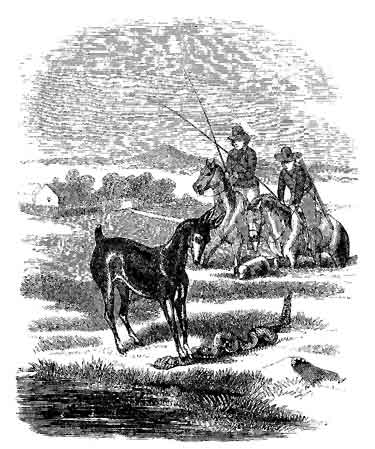
They rode up and surveyed more closely the strange battle. The fawn, becoming
more and more enraged, did not suspend hostilities at their approach. They
paused involuntarily when, within a few feet of the object, which proved to be
a tremendous rattlesnake, some five feet in length, and as thick as a
man’s arm. It was nearly dead, its body, neck, and head, exhibited many
bloody gashes cut by the sharp hoofs of the fawn. Every time the fawn sprang
upon it, it endeavoured in vain to strike its fangs into its active foe, which
sprang away in a twinkling, and before it could prepare to strike again, the
fatal hoofs would inflict another wound on its devoted head. It grew weaker and
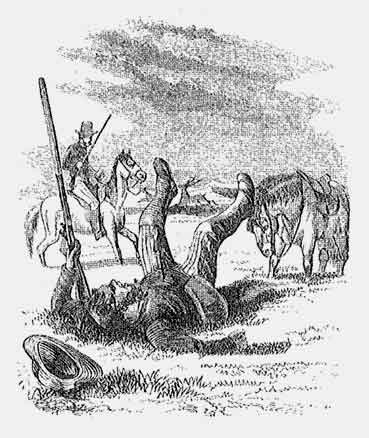
weaker, and finally turned over on its back, when the infuriated deer, no
longer compelled to observe cautionary measures, soon severed its head entirely
from the body and stood over it in triumph.
It grew weaker and weaker, and finally turned over on its back.
“Pete can do that if a deer can!” said Joe, somewhat emboldened at
the death of so formidable a reptile, and beholding the fixed though composed
gaze of the pony as he stood with his head turned sideways towards the
weltering snake.
“Sartinly he kin,” said Sneak, standing up in his stirrups, and
stretching his long neck to its utmost tension to see if any snakes were in the
open area before them.
“Do you see any, Sneak?” asked Joe, now grasping his rod and
anxious for the fray.
“I see a few—about forty, I guess, lying in the sun at the edge of
the water.”
“Sneak, there’s too many of them,” said Joe.
“Dod—you ain’t a going to back out now, I hope. Don’t
you see your pony snuffing at ’em? He wants to dash right in among
’em.”
“No he don’t,” said Joe—“he don’t like the
smell, nor I either—faugh!”
“Why, it smells like May-apples—I like it,” said Sneak;
“but there ain’t more than one or two copper-heads
there—they’re most all racers. Come on, Joe—we must gallop
right through and mash their heads with our sticks as we pass. Then after a
little while we must turn and dash back agin—that’s the way to fix
’em.”
“You must go before,” said Joe.
The number that Sneak mentioned was not exaggerated. On the contrary, additions
were constantly made to the number. The surface of the pool was continually
agitated by the darting serpents striking at the tadpoles and frogs, while on
the margin many were writhing in various fantastic contortions in their sports.
Nearly all of them were large, and some could not have been less than eleven
feet long. They were evidently enjoying the warm rays of the sun, and at times
skipped about with unwonted animation. Now one of the largest would elevate his
black head some four feet from the ground, while the others wrapped themselves
around him, and thus formed the dark and horrid spectacle of a pyramid of
snakes! Then falling prostrate with their own weight, in less than a twinkling
they were dispersed and flying over the smooth short grass in every direction,
their innumerable scales all the time emitting a low buzzing sound as they ran
along. Every moment others glided into the area from the tall grass, and those
assembled thither rushed towards them in a body to manifest a welcome.
“Now’s the time!” cried Sneak, rushing forward, followed by
Joe. When Joe’s eyes fell upon the black mass of serpents, he made a
convulsive grasp at the reins with an involuntary resolution to retreat without
delay from such a frightful scene. But the violence of his grasp severed the
reins from the bit, and the pony sprang forward after the steed, being no
longer subject to his control! There was no retreating now! Sneak levelled his
rod at a cluster just forming in a mass two feet above the ground, and crushed
the hydra at a blow! Joe closed his eyes, and struck he knew not what—but
Sneak knew, for the blow descended on his head—though with feeble force.
In an instant the horsemen had passed to the opposite side of the area and
halted in the tall grass. Looking back, they beheld a great commotion among the
surviving snakes. Some glided into the pool, and with bodies submerged,
elevated their heads above the surface and darted out their tongues fiercely.
Others raced round the scene of slaughter with their heads full four feet high,
or gathered about the dead and dying, and lashed the air with their sharp
tails, producing sounds like the cracking of whips. The few copper-heads and
rattlesnakes present coiled themselves up with their heads in the centre in
readiness to strike their poison into whatever object came within their reach.
So sudden had been the onset of the horsemen that the surprised serpents seemed
to be ignorant of the nature of the foe, and instead of flying to the long
grass to avoid a recurrence of bloodshed, they continued to glide round the
pool, while their number increased every moment.
“What’d you hit me on the head for?” asked Sneak, after
regarding the snakes a moment, and then turning to Joe, the pony having still
kept at the heels of the steed in spite of his rider’s efforts to the
contrary.
“Oh, Sneak,” cried Joe, in tones somewhat tremulous, “do, for
goodness’ sake, let us go away from here!”
“I sha’n’t do any such thing—what’d you hit me on
the head for?”
“I thought I was a killing a snake,” replied Joe.
“Do I look like a snake?” continued Sneak, turning round, when for
the first time he discovered the condition of his companion’s bridle.
“Sneak, let’s ride away!” said Joe.
“And leave all them black sarpents yander poking out their tongues at us?
I won’t go till I wear out this pole on ’em. Ha! ha! ha! I thought
you hadn’t spunk enough to gallup through ’em on your own
accord,” said Sneak, looking at the pony, and knowing that he would
follow the steed always, if left to his own inclination.
“Come, Sneak, let’s go home!” continued Joe, in a
supplicating tone.
“Come! let’s charge on the snakes agin!” said Sneak, raising
the rod, and fixing his feet in the stirrups.
“Hang me if I go there again!” said Joe, throwing down his rod.
“You’re a tarnation coward, that’s what you are! But you
can’t help yourself,” replied Sneak.
“I’ll jump off and run!” said Joe, preparing to leap to the
ground.
“You jest do now, and you’ll have forty sarpents wrapped round you
in less than no time.”
At that moment two or three racers swept between them with their heads elevated
as high as Joe’s knees, and entered the area.
“Oh goodness!” cried Joe, drawing up his legs.
“Git down and git your pole,” said Sneak.
“I wouldn’t do it if it was made of gold!”
“If you say you’ll fight the snakes, I’ll git it for
you—I’m a going to stay here till they’re all killed,”
continued Sneak.
“Give it to me, then—I’ll smash their brains out the next
time!” said Joe, with desperate determination.
“But you musn’t hit me agin!” said Sneak, dismounting and
handing up the weapon to Joe, and then leaping on the steed again.
“Sneak, you’re no better than a snake, to bring me into such a
scrape as this!” said Joe, leaning forward and scanning the black mass of
serpents at the pool.
In a few minutes they whipped forward, Sneak in advance, and again they were
passing through the army of snakes. This time Joe did good service. He
massacred one of the coiled rattlesnakes at a blow, and his pony kicked a
puffing viper to atoms. Sneak paused a moment at the pool, and dealt his blows
with such rapidity that nearly all the black racers that survived glided
swiftly into the tall grass, and one of the largest was seen by Joe to run up
the trunk of a solitary blasted tree that stood near the pool, and enter a
round hole about ten feet from the ground.
But if the serpents were mostly dispersed from the area around the pool, they
were by no means all destroyed; and when the equestrians were again in the tall
grass, they found them whizzing furiously about the hoofs of their horses. Once
or twice Sneak’s horse sprang suddenly forward in pain, being stung on
the ham or shoulder by the tails of the racers as they flew past with almost
inconceivable rapidity.
“Oh! St. Peter! Sneak!” cried Joe, throwing back his head, and
lifting up his knees nearly to his chin.
“Ha! ha! ha! did one of ’em cut you, Joe? They hurt like fury, but
their tails ain’t pisen. Look what a whelk they’ve made on the
hoss.”
“Sneak, why don’t you get away from this nasty place! One of them
shot right over the pony’s neck a while ago, and came very near hitting
me on the chin.”
“You must hit ’em as they come. Yander comes one—now watch
me!” Saying this, Sneak turned the steed so as to face a tremendous racer
about forty paces distant, that was approaching with the celerity of the wind
with its head above the tall grass. When it came within reach of his rod, he
bestowed upon it a blow that entirely severed the head, and the impetus with
which it came caused the body to fly over the steed, and falling upon the neck
of the pony, with the life yet remaining (for they are constrictors,) instantly
wrapped in a half dozen folds around it! Pete snorted aloud, and, springing
forward, ran a hundred paces with all the fleetness of which he was capable.
But being unable to shake off the terrible incumbrance, with his tongue hanging
out in agony, he turned back and ran directly for the horse. When he came up to
the steed, he pushed his head under his neck, manifesting the greatest
distress, and stamping and groaning as if becoming crazed.
“Dod! let me git hold of him!” cried Sneak, bending forward and
seizing the snake by the tail. The long head-less body gave way gradually, and
becoming quite relaxed fell powerless and dead to the earth.
“Oh, Sneak, let’s go!” said Joe, trembling, his face having
turned as pale as death while Pete was dashing about in choking agony under the
tight folds of the serpent.
“Smash me if I go as long as there’s a snake left!” replied
Sneak, striking down another huge racer; but this one, having its back broken,
remained stationary.
Thus he continued to strike down the snakes as long as any remained on the
field; and, as they became scarce, Joe grew quite valorous, and did signal
service. At length the combat ceased, and not a living serpent could be seen
running.
“Sneak, we’ve killed them all—huzza!” cried Joe,
flourishing his rod.
“Yes, but you didn’t do much—you’re as big a coward as
ever.”
“Oh, I wasn’t afraid of them, Sneak,” said Joe;
“I was only a little cautious, because it was the first time I ever went
a snaking.”
“Yes, you was mighty cautious! if your bridle hadn’t broke,
you’d have been home long ago.”
“Pshaw, Sneak!” said Joe; “you’re much mistaken. But
how many do you think we’ve killed?”
“I suppose about a quarter of a cord—but I’ve heard tell of
men’s killing a cord a day, easy.”
“You don’t say so! But how does it happen so many are found
together? When I go out I can never find more than a dozen or so.”
“There’s a snake den under that clear place,” said
Sneak, “where they stay all winter—but its not as big a den as some
I’ve seen.”
“I don’t want to see more than I have to-day!” said Joe,
whipping past the steed as they started homewards, having mended his bridle.
But as he paced along by the decayed tree mentioned above, he saw the
glistening eyes of the large racer peering from the hole it had entered, and he
gave it a smart blow on the head with his rod and spurred forward. The next
moment, when Sneak came up, the enraged serpent sprang down upon him, and in a
twinkling wound himself tightly round his neck! Sneak’s eyes started out
of his head, and being nearly strangled he soon fell to the earth. Joe looked
on in amazement, but was too much frightened to assist him. And Sneak, unable
to ask his aid, only turned his large eyes imploringly towards him, while in
silence he vainly strove to tear away the serpent with his fingers. He thrust
one hand in his pocket for his knife, but it had been left behind! He then held
out his hand to Joe, and in this dumb and piteous manner begged him to lend him
his knife. Joe drew it from his pocket, but could not brace his nerves
sufficiently to venture within the suffocating man’s reach. At length he
bethought him of his pole, and opening the blade thrust it in the end of it and
cautiously handed it to Sneak. Sneak immediately ran the sharp steel through
the many folds of the snake, and it fell to the ground in a dozen pieces! The
poor man’s strength then completely failed him, and he rolled over on his
back in breathless exhaustion. Joe rendered all the assistance in his power,
and his companion soon revived.
“Dod rot your skin!” exclaimed Sneak, getting up and seizing Joe by
the collar.
“Hang it, it wasn’t me! it was the snake!” said
Joe, extricating his neck from his companion’s grasp.
“What’d you hit the sarpent for?”
“Why, I wanted to kill him.”
“Then why didn’t you help me to get it away from my neck?”
“You didn’t ask me,” said Joe, with something like
ingenuousness, though with a most provoking application.
“I couldn’t speak! The tarnation thing was squeezing my neck so
tight I couldn’t say a word. But I looked at you, and you might
’ave understood me. Never mind, you’ll git a snake hold of you some
of these days.”
“I’ll keep a sharp look out after this,” said Joe. “But
Sneak, I’ll swear now you were not born to be hung.”
“You be dod rot!” replied Sneak, leaping on the steed, and turning
towards the river.
“I would have cut him off myself, Sneak,” said Joe, musing on the
odd affair as they rode briskly along, “if I hadn’t been afraid of
cutting your throat. I knew you wasn’t born to be hung.”
“Ha! ha! ha! that was the tightest place that ever I was in,” said
Sneak, regaining his good humour, and diverted at the strange occurrence.
“Didn’t he bite you?” asked Joe.
“No, a black snake can’t bite—they havn’t got any
fangs. If it had been a rattlesnake or a viper, I’d been a gone chicken.
I don’t think I’ll ever leave my knife behind again, even if I
wasn’t to go ten steps from home. Dod—my neck’s very
sore.”
The companions continued the rest of the way in silence. When they reached
home, and returned the horses to the stable, they proceeded down the path to
Roughgrove’s house to report their adventure.
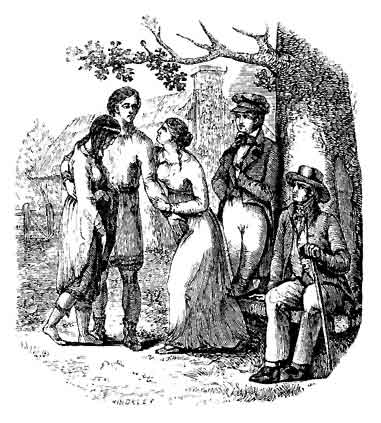
Glenn and Mary, William and La-u-na, were seated under the spreading elm-tree,
engaged in some felicitous conference, that produced a most pleasing animation
in their features.
Mary immediately demanded of Joe a recital of his adventures that morning. He
complied without reluctance, and his hearers were frequently convulsed with
laughter as he proceeded, for he added many embellishments not narrated by the
author. Sneak bore their merriment with stoical fortitude, and then laughed as
heartily as themselves at his own recent novel predicament.
La-u-na asked Sneak if he had been bitten by any of the poisonous snakes. Sneak
of course replied in the negative, but at the same time desired to know the
name of the plant that was used by the Indians with universal success when
wounded by the fangs of the rattlesnake. The girl told him it was the white
plantain that grew in the prairies.
“I’ll go and get some right straight,” said Joe,
“because I don’t know what moment I may be bitten.”
“Never mind it, Joe,” said Glenn, rising. “We are now going
to gather wild raspberries on the cliff south of and we want you and Sneak to
assist us.”
“Well—I like raspberries, and they must be ripe by this time, if
the chickens havn’t picked them all before us.”
“Dod—if the chickens have ett ’em can that make ’em
green agin?” replied Sneak to Joe’s Irishism.
“You’d better learn how to read before you turn critic,” said
Joe, taking up the baskets that had been brought out of the house. He then led
the way, quarrelling all the time with Sneak, while Glenn, placing Mary’s
arm in his, and William imitating the example, followed at a distance behind.
When the party reached the raspberry thicket, they found truly that the fowls
were there before them, though quite an abundance of the delicious berry still
remained untouched. A few moments sufficed to drive the feathered gatherers
away, and then without delay they began to fill their baskets.
Many were the hearty peals of joyous laughter that rang from the innocent
lovers while momentarily obscured by the green clustering bushes. Ere long they
were dispersed in various parts of the thicket, and Glenn and Mary being
separated from the rest, our hero seized the opportunity to broach a tender
subject.
“Mary,” said he, and then most unaccountably paused.
“Well,” said she turning her glorious dark blue eyes full upon him.
“I have something of moment to say to you, if you will listen
attentively—and I know not a more fitting time and place than this to
tell it. Here is a natural bower surrounded by sweet berries, and shielded from
the sun by the fragrant myrtle. Let us sit on this mossy rock. Will you
listen?” he continued, drawing her close to his side on the seat in the
cool retreat.
“Have I ever refused to listen to you? do I not love to hear your
voice?” said the confiding and happy girl.
“Bless you, Mary—my whole heart is yours!” exclaimed our
hero, seizing a rapturous kiss from the coral lips of the maiden. Mary resisted
not, nor replied; while tears, but not of grief, glistened on her dark lashes.
“You will not reject my love, Mary? Why do you weep?”
“It is with joy—my heart is so happy that tears gush out in spite
of me!”
“Will you then be mine?” continued Glenn, winding his arm round her
yielding waist.
“Forever!” she replied, and, bowing her head slightly, a shower of
dark silken tresses obscured her blushing face, and covered our hero’s
panting breast. Thus they remained many moments in silence, for their feelings
were too blissful for utterance.
“Are you always happy, Mary?” said Glenn, at length, taking her
little white hand in his.
“No!” she replied, with a sigh.
“Why?”
“When you are away, I sometimes fear the Indians—or a
snake—or—or something may harm you,” said she, falteringly.
“I thank thee, Mary, for thinking of me when I am away.”
“I always think of thee!” said she.
“Always, Mary?”
“Ay, by day—and thou art ever with me in my dreams.”
“And I will be with thee always!”
“Do!” said she.
“But dost thou not sometimes repine that thy life is thus spent in the
wilderness far from the busy world?”
“I sometimes wish I could see the beautiful cities I read of—but
when I think of the treacheries and miseries of the world, I look at the pure
fresh flowers, and list to the sweet birds around me, and then I think there is
more happiness to be enjoyed here than anywhere else.”
“And such is truly the case,” said Glenn, pondering “But
then, Mary, we all have obligations to discharge. We were created for
society—to associate with our species, and while mingling with kindred
beings, it is our duty to bestow as many benefits on them as may be within the
scope of our power.”
“You think, then, we should leave our western home?” she asked,
with undisguised interest.
“Wilt thou not consent to go?”
“If you go, I will go!” said she.
“And now I declare I will not go unless thou art willing.”
“But is it a duty?” she asked.
“Your fa—Mr. Roughgrove says so.”
“Then let us go! But why did you not say father?”
“He is not your father.”
“No!” exclaimed the maid, turning pale.
“I will tell thee all, Mary.” And Glenn related the story of the
maiden’s birth. “Now, Mary,” he continued, “thou
knowest thine own history. Thou art of a noble race, according to the rules of
men—nay, thy blood is royal—if thou wouldst retract thy plighted
faith (I should have told thee this before,) speak, and thy will shall be
done!”
“Oh! Charles! I am thine, THINE ONLY, were I born an angel!” she
cried, throwing herself into his arms. At this juncture a violent rustling was
heard in the bushes not far distant, and the next moment Joe’s voice rang
out.
“Oh me! Oh St. Peter! Oh murder! murder! murder!” cried he.
Instantly all the party were collected round him. He lay in a small open space
on the grass, with his basket bottom upward at his side, and all the berries
scattered on the ground.
“What is the matter?” asked Glenn.
“Oh, I’m snake-bitten! I’m a dead man! I’m
dying!” cried he, piteously.
“That’s a fib,” said Sneak, “bekaise a dead man
can’t be a dying.”
“Let me see,” said William, stooping down to examine the place on
which Joe’s hands were convulsively pressed. With some difficulty he
pulled them away, and tearing down the stocking, actually saw a small bleeding
puncture over the ankle bone!
“What kind of a snake was it?” asked Glenn in alarm. “A
rattlesnake—Oh!”
“Did you see it?” continued Glenn, knowing Joe’s
foible, though it was apparent he suffered from some kind of a wound.
“I heard it rattle. Oh, my goodness! I’m going fast! I’m
turning blind!”
La-u-na told him to run to the house and cover the wound with salt, and remain
quiet till Sneak could obtain some plantain leaves from the prairie. Joe sprang
up and rushed down the hill. Sneak set out in quest of the antidote, and the
rest directed their steps homeward.
When they reached Roughgrove’s house, they found Joe lying in the middle
of the floor on his back, and groaning most dolefully. He had applied the salt
to the wound as directed, and covered it and his whole leg so plentifully with
bandages that the latter seemed to be as thick as his body.
“How do you feel now, Joe?” asked Glenn.
“I’m a dead man!” said he.
La-u-na told him not to be alarmed, and assured him there was no danger.
“But I’ll die before Sneak can get back!”
“Your voice is too strong to fear that,” said William; “but
do you suffer much pain?”
“Oh, I’m in agony!” said he, rolling back his eyes.
“Where does the pain lie?” asked Glenn.
“Oh, St. Peter! all over me! In my toes, ankles, legs, arms, heart,
throat, mouth, nose, and eyes! Oh, I’m in tortures! I’m
blind—I can’t see any of you!”
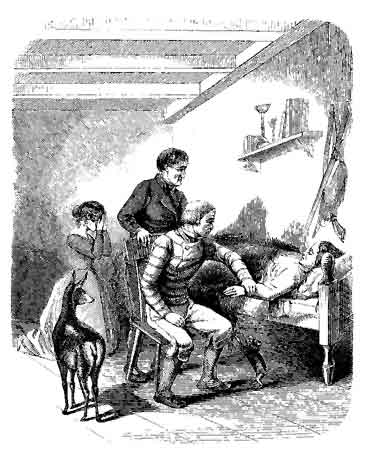
At this moment Roughgrove, who had been over the river on a visit to Boone,
entered the apartment with the renowned hunter at his side. When fully informed
of the circumstances, Boone stooped down and felt Joe’s pulse.
“The strokes are irregular,” said Boone.
“Oh heaven!” exclaimed Joe.
“But that may be caused by fright,” continued Boone.
“Oh goodness! it ain’t that—I’m a dying man!”
“Is the leg much swollen?” asked Boone, endeavouring to ascertain
without taking off the bandages.
“Oh! oh! don’t do that! it’ll kill me in a minute—for
its swelled fit to burst!” cried Joe, shrinking from Boone’s grasp.
“All the cases of snake-bite that I have seen differ from this. I have
always found the swollen limb nearly devoid of feeling. Did you kill the
snake?”
“No—Oh!”
“Tell me precisely the place where you were standing when it bit
you—there is a mystery about it that I must solve.”
“Oh—it was—I can’t speak! my breath’s going fast!
Oh! Paternoster—”
William then described the spot to Boone in such precise terms that the old
woodman declared he would immediately repair thither and endeavour to find the
snake. He accordingly set out in the direction indicated without further delay;
while Roughgrove, believing that poor Joe was really on the verge of eternity,
strove to comfort his departing spirit with the consolation that religion
affords.
“Oh! that ain’t the right one!” exclaimed Joe, pushing away
the Episcopal prayer-book held by Roughgrove.
“Then here is one you cannot object to,” said Roughgrove, opening
the Bible.
“Oh, that’s not it, either!” cried Joe, in great distress.
“Is there no priest in this region? I’m a Roman
Catholic—oh!”
“Can you not confess your sins directly to God—the God who
is everywhere, and governs all things?” said the aged man, impressively,
and with animation.
“I have prayed,” said Joe; “but now I want the
ointment!”
“Your body, which must be placed in the damp cold earth, needs no oil. It
is far better to purify the soul, which perishes not,” said Roughgrove,
in fervent and tremulous tones.
“Oh!—Oh! Ugh!” cried Joe, in a deep guttural voice, and
turning over on his face. His fears had evidently been increased by the solemn
tone and look of Roughgrove.
“Don’t be alarmed, Joe,” said Glenn, turning him again on his
back. “Sneak will soon be here, and La-u-na says the plantain will be
sure to cure you. William tells me that he has seen the Indians permit the
snakes to bite them for a mere trifle in money, so certain were they of being
restored by the plant. And indeed he never knew a bite to terminate
fatally.”
“But I’m afraid Sneak won’t come in time,” replied Joe,
somewhat comforted.
“Pshaw! he won’t loiter in a case of this kind—he knows it is
no joke,” continued Glenn.
“But suppose he can’t find any plantain—then I’m
dead to a certainty! Oh me!”
“Does the pain increase much?” asked Mary.
“Oh, yes! its ten times worse than it was ten minutes ago! I’m
going fast—I can’t move either leg now,” he continued, in a
weak utterance.
Glenn grew uneasy. Joe was pale—very pale, and breathed hard.
Boone entered, with a smile on his lip.
“Have you got the plantain?” asked Joe, in feeble accents, with his
languid eyes nearly closed, thinking it was Sneak.
“Sit up and tell me how you feel,” said Boone, in vain striving to
repress his smile.
“Oh, St. Peter! I haven’t strength enough to lift my hand,”
said Joe, his eyes still closed.
“Did you find the snake?” asked Glenn.
“Yes,” replied Boone. Joe groaned audibly. “I will tell you
all about it,” he continued; “I found the spot where Joe had been
gathering the berries, and tracked him without difficulty to every bush he
visited by the bruised grass under his foot-prints. At length I came to the
cluster of bushes where he received the wound. I stood in his cracks and saw
where he had plucked the raspberries. When about to cast down my eyes in quest
of the snake, suddenly I felt a blow on my own ankle!”
“Did the same snake bite you?” asked Mary, quickly.
“Yes,” replied Boone, still smiling. Joe opened his eyes, and after
gazing a moment at Boone, asked him if he did not suffer much pain.
“Fully as much as you do—but hear me through. I sprang back with
some violence, I admit, but I did not run away. Lifting my cane, I returned
with a determination to kill the snake. I stooped down very low to ascertain
the precise position of its head, which was concealed by a large mullen
leaf—I saw its eyes and its bill—”
“What!” exclaimed Joe, rising up on his elbow with unwonted vigour,
and his eyes riveted on the speaker.
“Yes, its bill”, continued Boone. “And while my cane
was brandished in the air and about descending on its devoted head, a low
clucking arrested my arm, and approaching closer to it than before, and gazing
steadfastly a moment, I lowered my cane to its usual position, and fell back
laughing on the grass among the raspberries you had dropped.”
“Mr. Boone—Mr. Boone!” cried Joe, springing up in a sitting
attitude, and seizing the hand of the veteran, “for Heaven’s sake
tell me what it was?”
“It was an old SITTING HEN!” said Boone.
“Upon your honour?” continued Joe, leaping upon his feet, and
staring the aged hunter in the face, while his eyes gleamed with irrepressible
hope and anxiety.
“It was nothing else, upon my honour,” replied Boone, laughing in
concert with the rest.
“Huzza! huzza!! huzza!!!” shouted Joe, casting the bandages hither
and thither, and dancing nimbly over the floor.
“Fal-de-lal—tider-e-i— tider-e-o— tider-e-um!” he
continued, in frenzied delight, and, observing Sneak at the door with an armful
of plantain (who had returned in time to witness his abrupt recovery, and now
continued to regard him with wonder and doubt—at times thinking he was
delirious,) skipped up and held out both hands, as if inviting him to dance.
“Dod rot it, your leg ain’t swelled a bit!” said Sneak.
“Don’t use that bad word, Sneak,” said Mary.
“I won’t—but dod—he’s had me running all
over—”
“Tider-e-i—tider-e-um!” continued Joe, still dancing, while
the perspiration streamed over his face.
“Have done with this nonsense, Joe!” said Glenn, “or else
continue your ridiculous exercises on the grass in the yard. You may rejoice
now, but this affair will be sport for others all your life. You will not
relish it so much to-morrow.”
“I’d rather all the world would laugh at me alive and kicking, than
that one of you should mourn over my dead body,” replied Joe, leaping
over Sneak, who was sitting in the door, and striding to the grass plot under
the elm, where he continued his rejoicings. Sneak followed, and, sitting down
on the bench in the shade, seemed to muse with unusual gravity at the strange
spectacle presented by Joe.
This was Joe’s last wild western adventure. The incident was soon
forgotten by the party in the house. Serious and sad thoughts succeeded the
mirthful scene described above. Roughgrove had brought Boone thither to receive
their last farewell! The renowned woodman and warrior wore marks of painful
regret on his pale features. The rest were in tears.
“William,” said Roughgrove, “listen to a tale concerning thy
birth and parentage, which I feel it to be my duty to unfold. Your sister has
already learned the story from your friend, who sits beside her. But I will
repeat it to all present. You who are the most interested can then determine
whether it shall ever be disclosed to other ears. The secret was long locked in
my bosom, and it was once my purpose to bury it with my body in the grave. I
pondered long on the subject, and prayed to Heaven to be instructed. I have
satisfactory evidence in my own heart that I have acted correctly.” He
then related the history of the twins, as we have given it to the reader. When
he concluded, La-u-na, who had betrayed much painful interest during the
recital, threw her arms round William’s neck, and wept upon his breast.
“Why do you weep, La-u-na?” asked the youth.
“La-u-na must die!” said she; “her William will leave her and
forget her. The wild rose will bend over her grave—the brook will murmur
low at her cold feet—the rabbit will nip the tender grass by her
tombstone at night-fall—the katydid will chirp over her, and the
whippor-will will sing in vain. William will forget her! Poor La-u-na!”
“No—La-u-na! no! Thou shalt go with me and be my bride, or else I
will remain with thee! Death only shall separate us!” said the youth,
drawing the slight form of the Indian maiden closer to his heart, and
imprinting a rapturous kiss on her smooth forehead.
“We will all go together,” continued Roughgrove, “save our
beloved friend here, who tells me that no earthly consideration could induce
him to dwell in cities among civilized men.”
“True,” said Boone; “I would not exchange my residence in the
western wilds for the gorgeous palaces of the east. Yet I think you do right in
returning to the society which you were destined to adorn. I shall grieve when
I miss you, but I will not persuade you to remain. Every one should act
according to the dictates of his conscience. It is my belief that Providence
guides our actions. You, my friends, were fitted and designed to move in
refined society, and by your example and influence to benefit the world around
you. The benefits bestowed by me will not be immediate, nor altogether
in my day. I am a PIONEER, formed by nature. Where I struggle with the savage
and the wild beast, my great grandchildren will reside in cities, I must fulfil
my mission.”
At this moment Joe and Sneak appeared at the door.
“There’s a covered flat-boat just landed down at the ferry,”
said Joe.
“It is from the island above,” said Roughgrove, “and the one
I have had constructed for our voyage down the river.”
“Are we going, sure enough?” asked Joe.
“Yes; to-morrow,” said Glenn.
“Dod—are you all going off?” asked Sneak, rolling
round his large eyes, and stretching out his neck to an unusual length.
“All but me, Sneak,” said Boone.
“And you won’t be any company for me. Dod—I’ve a notion
to go too! If I could foller any thing to make a living in
Fillydelfa—”
“If you go with us, you shall never want—I will see that you are
provided for,” said Glenn.
“It’s a bargain!” said Sneak, with the eager emphasis
characteristic of the trading Yankee.
“But poor Pete—the horses!” said Joe.
“There are stalls in the boat for them,” said Roughgrove.
“Huzza! I’m glad. Huzza!” cried Joe.
The next morning beamed upon them in beauty—and in sadness. The sun rose
in majesty, and poured his brilliant and inspiring rays on peak and valley and
plain. But the hearts of the peaceful wanderers throbbed in sorrow as they
gazed for the last time on the scene before them. Though it had been identified
with the many perilous and painful encounters with savages, yet the quivering
green leaves above, the sparkling brook below, and the soft melody of happy
birds around, were intimately associated with some of the most blissful moments
of their lives.
La-u-na retired to a lonely spot, and poured forth a farewell song to the
whispering spirits of her fathers. Long her steadfast gaze was fixed on the
blue sky, as if communing with the departed kings from whom she descended. At
length her tears vanished like a shower in the sunshine, and a bright smile
rested upon her features, as if her prayer had been heard and all she asked
were granted! Prophetic vision! While the race from which she separated is
doomed to extinction in the forest, the blood she mingled with the Anglo-Saxon
race may yet be destined to sway the councils of a mighty empire.
William mused in silence, guarding at a distance the bride of his heart, and
not venturing to intrude upon her devotions. The past was like a dream to
him—the present a bright vision—the future a paradise!
Glenn and Mary were seated together, regarding with impatience the brief
preparations to embark. Boone, Roughgrove, Sneak, and Joe were busily engaged
lading the vessel. Sneak had hastily brought thither his effects, and without a
throe of regret abandoned his house for ever to the owls. Joe succeeded
with but little difficulty in getting the horses on board. The fawn, the
kitten, the hounds, and the chickens were likewise taken along.
And now all was ready to push out into the current. All were on board. Boone
bid them an affectionate adieu in silence—in silence, but in tears. The
cable was loosened, and the boat was wafted down on its journey eastward.
William and La-u-na sat upon the deck, and gazed at the receding shore,
rendered dear by hallowed recollections. Glenn and Mary stood at the prow, and
as they marked the fleeting waters, their thoughts dwelt on the happy future.
Roughgrove was praying. Joe was caressing the pony. Sneak was counting his
muskrat skins. And thus we must bid them adieu.
THE END.
Footnote: