Wild Volatile-Oil Plants and Their Economic Importance: I.—Black Sage; II.—Wild Sage; III.—Swamp Bay
Whole book · 17 sections
WILD VOLATILE-OIL PLANTS AND THEIR ECONOMIC IMPORTANCE: I.—BLACK SAGE; II.—WILD SAGE; III.—SWAMP BAY.
U. S. DEPARTMENT OF AGRICULTURE.
BUREAU OF PLANT INDUSTRY—BULLETIN NO. 235.
B. T. GALLOWAY, Chief of Bureau.
BY
FRANK RABAK,
Chemical Biologist, Drug-Plant, Poisonous-Plant, Physiological,
and Fermentation Investigations.
Issued January 30, 1912.
WASHINGTON:
GOVERNMENT PRINTING OFFICE.
1912.
BUREAU OF PLANT INDUSTRY.
Chief of Bureau, Beverly T. Galloway. Assistant Chief of Bureau, William A. Taylor. Editor, J. E. Rockwell. Chief Clerk, James E. Jones.
Drug-Plant, Poisonous-Plant, Physiological, and Fermentation Investigations.
SCIENTIFIC STAFF.
Rodney H. True, Physiologist in Charge.
A. B. Clawson, Heinrich Hasselbring, C. Dwight Marsh, and W. W. Stockberger, Physiologists.
James Thompson and Walter Van Fleet, Experts.
Carl L. Alsberg, H. H. Bartlett, Otis F. Black, H. H. Bunzel, Frank Rabak, and A. F. Sievers,
Chemical Biologists.
W. W. Eggleston, Assistant Botanist.
S. C. Hood, G. F. Mitchell, and T. B. Young, Scientific Assistants.
Alice Henkel and Hadleigh Marsh, Assistants.
G. A. Russell, Special Agent.
LETTER OF TRANSMITTAL.
U. S. Department of Agriculture,
Bureau of Plant Industry,
Office of the Chief,
Washington, D. C., October 14, 1911.
Sir: I have the honor to transmit herewith and to recommend for
publication as Bulletin No. 235 of the series of this Bureau a manuscript
prepared by Mr. Frank Rabak, Chemical Biologist, entitled
“Wild Volatile-Oil Plants and Their Economic Importance: I.—Black
Sage; II.—Wild Sage; III.—Swamp Bay,” submitted by Dr. R. H.
True, Physiologist in Charge of the Office of Drug-Plant, Poisonous-Plant,
Physiological, and Fermentation Investigations.
At present the various industries making use of volatile oils and
their derivatives find their supply of these materials in products
obtained from Old World plants grown in foreign lands. In some
cases, because of the difficulty in producing these substances, it is
likely that this commercial situation will persist for some time, but
in other cases it seems likely that American resources may be capable
of utilization. In our wild flora there are many oil-containing plants
of considerable commercial promise and the purpose of this bulletin
is to bring to notice the results of investigations which have been
carried on with a number of these plants and to point out their commercial
utility. It is presented as the first of a series, to be followed
from time to time with the results of further investigations which
are to be carried on with this class of plants and their products.
WILD VOLATILE-OIL PLANTS AND THEIR ECONOMIC IMPORTANCE: I.—BLACK SAGE; II.—WILD SAGE; III.—SWAMP BAY. — DISTRIBUTION OF WILD AROMATIC PLANTS.
B. P. I.—707.
There exists in the flora of the United States a large number of
plant families which include species of highly odorous character,
many of which are known and described botanically as possessing
peculiar aromas, but which have received no attention from the
standpoint of their volatile-oil content. The various sections of
the country, with their marked differences of soil and climate,
possess floras peculiar to themselves which, if investigated, would
doubtless reveal many plants valuable for their volatile oils. For
example, in Florida and the South Atlantic States are found many
plants with agreeable odors which thrive only in the climate and
soil of that region. The Central Western States produce numerous
species of sages and other plants found only in arid and semiarid
climates. In the extreme Western States are numerous wild aromatic
plants, some of which have been distilled and analyses made of
the oils obtained therefrom.
PRESENT PRODUCTION OF VOLATILE OILS FROM WILD PLANTS NATIVE TO THE UNITED STATES.
Only a very few of the wild plants native to this country have
been distilled and their volatile oils used for commercial purposes.
Among these may be mentioned longleaf pine, sassafras, wintergreen,
sweet birch, pennyroyal, horsemint, and Canada fleabane.
The first and by far the most important oil distilled from a wild
plant indigenous to the United States was turpentine oil, which was
distilled as early as the middle of the eighteenth century. The
production of this oil is rapidly declining, owing principally to the
employment of very wasteful methods, which have resulted in the
destruction of many of the large pine forests. Turpentine is still
obtained, however, from the longleaf pine (Pinus palustris), which
occurs quite abundantly in the South Atlantic States from Virginia
to Florida. The price of this valuable oil has risen so rapidly in
recent years, owing to the shortage of raw material from which it is
distilled, that a suitable substitute would be most desirable. This
problem is now receiving the attention of scientific research workers,
but no satisfactory substitute which can supply the trade has yet
been found.
The commercial distillation of sassafras, wintergreen, and sweet
birch possibly rank next in importance, although the oils are produced
on a considerably smaller scale. These oils are used extensively
by perfumers, confectioners, and manufacturers of toilet soaps.
The plants are gathered in their native habitats and the quality of
the oil depends upon the freedom from extraneous material, which
can be insured only by extreme care in collection.
The production of pennyroyal and Canada fleabane oils from the
wild plants is also carried on in a small way. The oils from these
plants possess valuable therapeutic action and are used principally
in medicinal preparations.
Horsemint and wild bergamot are wild aromatic plants which have
been more recently distilled for their volatile oils. The use of these
plants was brought about by the discovery that their oils contain,
respectively, the valuable antiseptics thymol and carvacrol. The
production of the oils, however, is not being carried on to any great
extent.
These few species are practically the only wild aromatic plants of
the United States which are at present being utilized for their
volatile oils, and no attempt has yet been made to cultivate them
in order to improve the quality or to increase the yield of the oils.
CLASSIFICATION OF VOLATILE OILS BASED ON THEIR ODORS AND CONSTITUENTS.
Volatile oils obtained from plants possess a great variety of odors,
with no two exactly alike, although many are very closely related.
A classification of these oils based on their odors is not satisfactory,
since many which would not be considered as related if judged only
by the sense of smell have chemical relationships, containing substances
belonging to the same general class of chemical compounds.
For our purpose volatile oils are divided into the following classes,
basing the divisions upon odors and constituents. These groups
comprise the majority of oils, but they are not arranged in the order
of their importance:
(1) Camphoraceous oils, possessing a characteristic camphorlike
odor, with camphor or camphor-related compounds predominating,
as in the oils obtained from the camphor tree and from many of the
sages. The products obtained from camphoraceous oils are extensively
employed in the arts and in medicine.
(2) Terebinthinate oils, having a characteristic turpentinelike odor.
These oils are obtained largely from the pine family, the turpentines
of commerce being examples. They are composed largely of terpene
hydrocarbons and find extensive application in the paint and varnish
industries.
(3) Sulphur-containing oils, a small group characterized by extremely
disagreeable and offensive odors, such as those of mustard,
asafetida, garlic, and onion. These oils contain as their chief constituents
sulphids, sulphocyanates, or nitriles, and are used principally
for medicinal purposes.
(4) Phenol and phenol-related oils, containing phenols or phenol
derivatives and characterized by strong, persistent odors, some very
pungent and others pleasant. Owing to their phenolic constituents
the density of these oils is usually very high. Common examples
of this class are the oils of thyme, cloves, cinnamon, sassafras, anise,
fennel, and the monardas. The usefulness of phenol and phenol-related
oils depends largely upon their antiseptic properties, the
principal constituents being thymol, carvacrol, eugenol, anethol,
chavicol, safrol, and their derivatives.
(5) Oils containing esters or alcohols, by far the largest group, consisting
of the fragrant oils which are used principally for perfumery
purposes, although some find a use in medicine. The chief constituents
of these oils are usually alcohols and esters, some few
containing aldehydes, ketones, oxids, and lactones. Prominent here
are the alcohols menthol, linalool, geraniol, citronellol, sabinol and
their esters, benzyl alcohol and its esters, and anthranilic acid and
its esters, forming the chief constituents of the oils of peppermint,
lavender, geranium and rose, citronella, savine, ylang-ylang, and
orange flowers, respectively. Other constituents are the aldehydes
citral and citronellal from lemon and lemon-grass oils, and the
ketones thujone, menthone, pulegone, carvone, and methyl heptenone
from the oils of wormwood, peppermint, pennyroyal, caraway,
and rue. The oxid cineol from eucalyptus and many other oils, and
the lactone sedanolid from celery oil are further examples.
All volatile oils capable of being isolated from wild aromatic plants
will fall into one or more of the foregoing divisions although, it must
be understood, the classification is far from being satisfactory. It
will, however, serve to elucidate the fact that although plant odors
are of a very variable character they still possess some relationship.
COMMERCIAL IMPORTANCE OF VOLATILE OILS AND THEIR CONSTITUENTS.
Not only do volatile oils as such find important uses in commerce,
but the great variety of constituents, one of which in many cases
forms the major part of an oil, find equally important uses commercially.
Such constituents as have antiseptic properties occur widely in
plant oils and are of untold value to the medical profession, to the
manufacturer of pharmaceutical preparations, and to the maker of
toilet lotions and dentifrices. Many volatile oils also contain constituents
which are recognized as very important in the perfumery
industries, their value depending not so much upon their own inherent
odor as upon the effect which they produce in modifying or toning
the fragrance of a mixture of several components. The finest perfumes
are often mixtures of odors blended together and frequently
contain oils which in themselves would not be regarded as very
agreeable or pleasing in odor. In some instances a single constituent,
as for instance citral, the chief constituent of lemon-grass oil, is used
in its own pure condition without the admixture of other odors, as
in the scenting of fine toilet soaps.
As flavoring agents considerable use is made of many of the volatile
oils or of their constituents. For example, the oils of sassafras,
peppermint, cinnamon, and wintergreen are used by confectioners in
the flavoring of candies. The chief constituents of these oils (safrol,
menthol, cinnamic aldehyde, and methyl salicylate) can, with the
exception of menthol, be used with equal efficiency.
Many essential oils and the compounds isolated from them have
proven highly useful in therapeutics, and enter into a number of
medicinal preparations. Such constituents as menthol from peppermint
oil, eugenol from clove oil, methyl salicylate from wintergreen
and sweet-birch oils, thymol from thyme and horsemint oils,
camphor from camphor oil, borneol from Borneo camphor oil, cineol
from eucalyptus oil, and many others, comprise a group of medicaments
which are indispensable.
From the foregoing account of volatile oils and their important
constituents may be observed the possibilities which lie in this field
of investigation. It is probable that a thoroughgoing examination
of the wild flora of the United States would reveal the presence of
volatile oils in many plants which at present are not known to yield
volatile products. This possibility should stimulate the search for
these products with a view to their commercial utilization.
PLANT SOURCES OF CAMPHOR, BORNEOL, AND CINEOL (EUCALYPTOL).
Owing to the presence in large quantities of the compounds camphor,
borneol, and cineol in the oils to be described in this bulletin,
the usual sources of these compounds are herewith presented, together
with their commercial uses.
The occurrence of camphor in the vegetable kingdom as a component
of volatile oils has been noted chiefly in such plant families as
the Lauraceæ, Compositæ, Labiatæ, and Zinziberaceæ. The source
of commercial camphor at present is the camphor tree, Cinnamomum
camphora (Laurus camphora), indigenous to Japan and Formosa.
This tree has been introduced into the United States and experiments
are now being conducted in Florida for the production of
camphor, with some degree of success.
Two modifications of camphor occur in nature, the commercial
variety, or dextrogyrate (rotating the plane of polarization to the
right), and the levogyrate (having the opposite rotation). Comparatively
few plants native to this country have been found to
yield camphor. Whittelsey[1] has recently succeeded in isolating
and identifying levo camphor in considerable quantities from the
oil of a western sagebrush (Artemisia cana Pursh., family Compositæ).
Camphor has been observed in the native plant Sassafras variifolium
(Sassafras officinalis), a tree belonging to the family Lauraceæ. According
to Power and Kleber,[2] sassafras oil contains from 6 to 8 per
cent of dextro camphor. Traces of camphor have also been observed
in tansy oil,[3] obtained from Tanacetum vulgare, a plant which is cultivated
in the Eastern States for its volatile oil.
Borneol, or Borneo camphor, is closely related to camphor and
possesses very similar properties. It is derived chiefly from the
Borneo camphor tree (Dryobalanops aromatica (D. camphora), family
Dipterocarpaceæ), and is found in crude crystalline condition in the
natural cavities of the wood.[4]Blumea balsamifera (family Compositæ),
a shrubby plant[5] native to India, also yields considerable quantities
of borneol,[6] known to the natives as ngai camphor. The presence of
borneol in plants native to this country is restricted to a few species,
where it appears in the free condition only as a trace, being found
more widely distributed as esters. It has been found in small
quantities in the oil of red cedar (Juniperus virginiana),[7] and in
thuja oil from the arborvitæ (Thuja occidentalis),[8] both trees being
found abundantly in various sections of the United States. Small
quantities have been found in the oils of other native plants, such as
the goldenrod (Solidago canadensis),[9] Virginia snakeroot (Aristolochia
serpentaria),[10]
Texas snakeroot (Aristolochia reticulata),[11] Canada
snakeroot (Asarum canadense),[12]
tansy (Tanacetum vulgare),[13] and
sweet gum (Liquidambar styraciflua).[14] As its acetic acid ester, it
occurs in the oils of a large number of species of pines and firs.
Borneol and camphor occur occasionally together in the same oils.
Their association is not surprising, since the relationship of the two
compounds is very close. By oxidation borneol is readily converted
into camphor. The two compounds have been observed together in
the oil of cardamon,[15] distilled from the seeds of Amomum cardamomum;
also in the oil of rosemary, from the plant Rosmarinus
officinalis,[16]
and in spike oil, obtained from Lavandula spica,[17] the
latter two belonging to the mint family.
Cineol, or eucalyptol, is found chiefly in the volatile oils from various
species of the eucalyptus tree and is the principal constituent of many
of these oils. The blue gum tree (Eucalyptus globulus), belonging to
the family Myrtaceæ and introduced abundantly in the western part
of the United States, furnishes a volatile oil of which more than one-half
is cineol. Other important sources also are cajuput oil[18] and niaouli
oil[19] from Melaleuca leucadendron (M. viridiflora), a plant indigenous
to India. Only a few native aromatic plants are known to yield
volatile oils which contain cineol and in only a very few cases has
this constituent been found to be present in any quantity. It is
known to occur in the oil of the California laurel, or mountain laurel
(Umbellularia californica),[20] where it is present to the extent of about
20 per cent. Among other native plants in which cineol is known to
occur in small quantities is the composite Achillea millefolium,[21] commonly
known as milfoil or yarrow. Peppermint oil from Mentha
piperita[22]
and sage oil from Salvia officinalis[23] are said to contain small
quantities of this constituent.
Camphor, borneol, and cineol are found in considerable quantities
in volatile oils which have been distilled from three unutilized aromatic
plants of the United States, which will be discussed fully in
the subsequent pages of this bulletin.
COMMERCIAL USES OF CAMPHOR, BORNEOL, AND CINEOL.
As an article of commerce camphor is most useful, being employed
extensively in the arts and in medicine. Its use in the arts is restricted
principally to the manufacture of celluloid, a commodity which finds
a great variety of uses. It also finds important uses in the manufacture
of lacquers and pyrotechnics, in embalming, and, because of its
odor, is used as an insectifuge. Camphor is also used to a great
extent in medicine both for external and internal application, and
enters into many pharmaceutical preparations.
Borneol, although closely allied to camphor, is much less used commercially
in the United States, principally because of the difficulties
encountered in its collection by the natives in Borneo and the Malay
Archipelago. It would probably be used more extensively in this
country if a sufficient supply could be obtained at reasonable prices,
the high price of the article preventing its use for technical purposes.
Borneol is antiseptic and stimulant, and finds its main use in
medicine, but is also in demand in the perfume industry, the esters
being especially desirable. The acetic acid ester of borneol (bornyl
acetate) is in fact the odoriferous principle of pine-needle odor.
Borneol is used mainly as a base for the manufacture of bornyl
acetate which is much used in the preparation of pine-needle odors
by perfumers. It is in considerable demand in the Orient where,
according to Janse,[24] it is sought by the Chinese, who use it
principally in religious ceremonies, but also in medicine and the
perfuming of India inks. The Chinese are said to pay as much as $1.25
an ounce for it, and since the native producers are unable to supply the
demand, a synthetic borneol, which is not a pure substance but a
mixture of borneol and isoborneol, has entered the markets of the
East.
Cineol, or eucalyptol, is a very important and valuable article of
commerce. Its virtue as a remedial agent has placed it in a high
position among the important drugs used in the treatment of human
ailments. The uses of cineol are entirely medicinal. It is used both
internally and externally, and also as an inhalant. It is administered
internally in the form of various pharmaceutical preparations for the
treatment of colds, pneumonia, bronchitis, and other respiratory
affections. As an inhalant it is used for asthma, diphtheria, and
throat troubles in general. Together with other medicaments cineol
is applied externally in the form of ointments or liniments. Furthermore,
it has a wide application in the manufacture of dentifrices,
mouth washes, and other preparations where an antiseptic action is
desired. At the present time pure cineol, as prepared from eucalyptus
oil, commands a price of $1 to $2 a pound.
PURPOSE OF THE INVESTIGATION OF WILD AROMATIC PLANTS NATIVE TO THE UNITED STATES.
Since many valuable volatile oils and volatile-oil constituents have
been discovered in plants growing wild in various parts of the world,
it has been thought that an investigation of the wild aromatic plants
of this country would reveal many, now practically useless and possibly
classed as weeds, which might become of commercial value.
The economic value of these plants is determined not only by the
proportion of oil which they contain, but by the constituents of the
oil; hence careful analyses must be made in order to discover what
these constituents may be. The present bulletin deals with the
analyses of three heretofore unutilized plants, which may be grouped
together, because the oils obtained from them are all of a camphoraceous
character and because they contain several constituents in
common. These, gathered from different sections of the United
States from entirely different habitats and belonging to unrelated
families, are as follows: Black sage (Ramona stachyoides) from California,
wild sage (Artemisia frigida) from South Dakota, and swamp
bay (Persea pubescens) from Florida.
SPECIAL INVESTIGATIONS. — BLACK SAGE. — BOTANICAL DESCRIPTION AND DISTRIBUTION. — DISTILLATION OF THE OIL. — SEPARATION OF STEAROPTENE. — IDENTIFICATION OF CAMPHOR. — Table I. — Comparison of properties of crystals from oil of black sage and of pure camphor. — CHEMICAL EXAMINATION OF THE OIL. — FRACTIONATION OF THE OIL. — Table II. — Fractionation of the oil of black sage, showing the physical properties of the fractions. — IDENTIFICATION AND SEPARATION OF THE CONSTITUENTS. — SUMMARY.
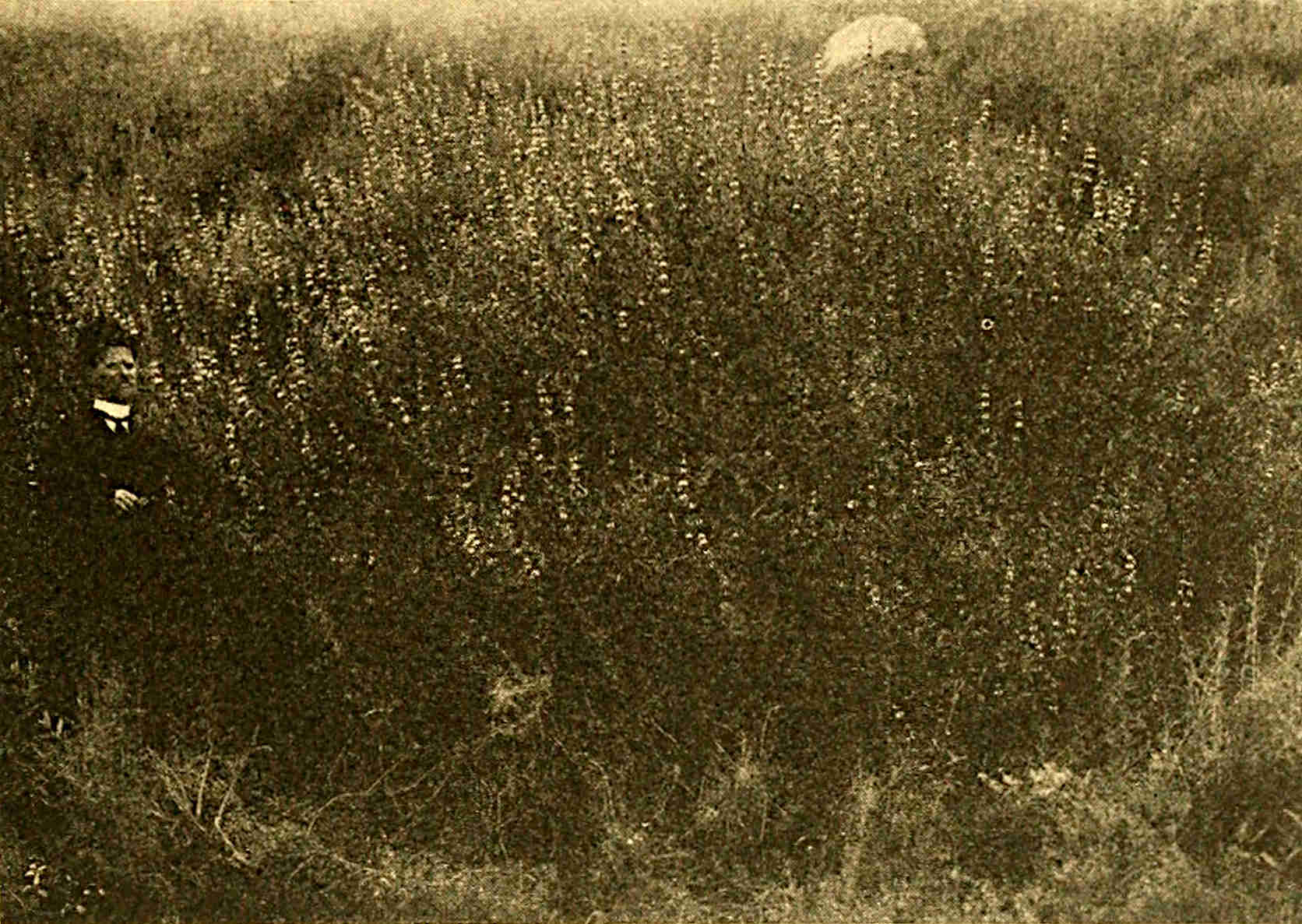
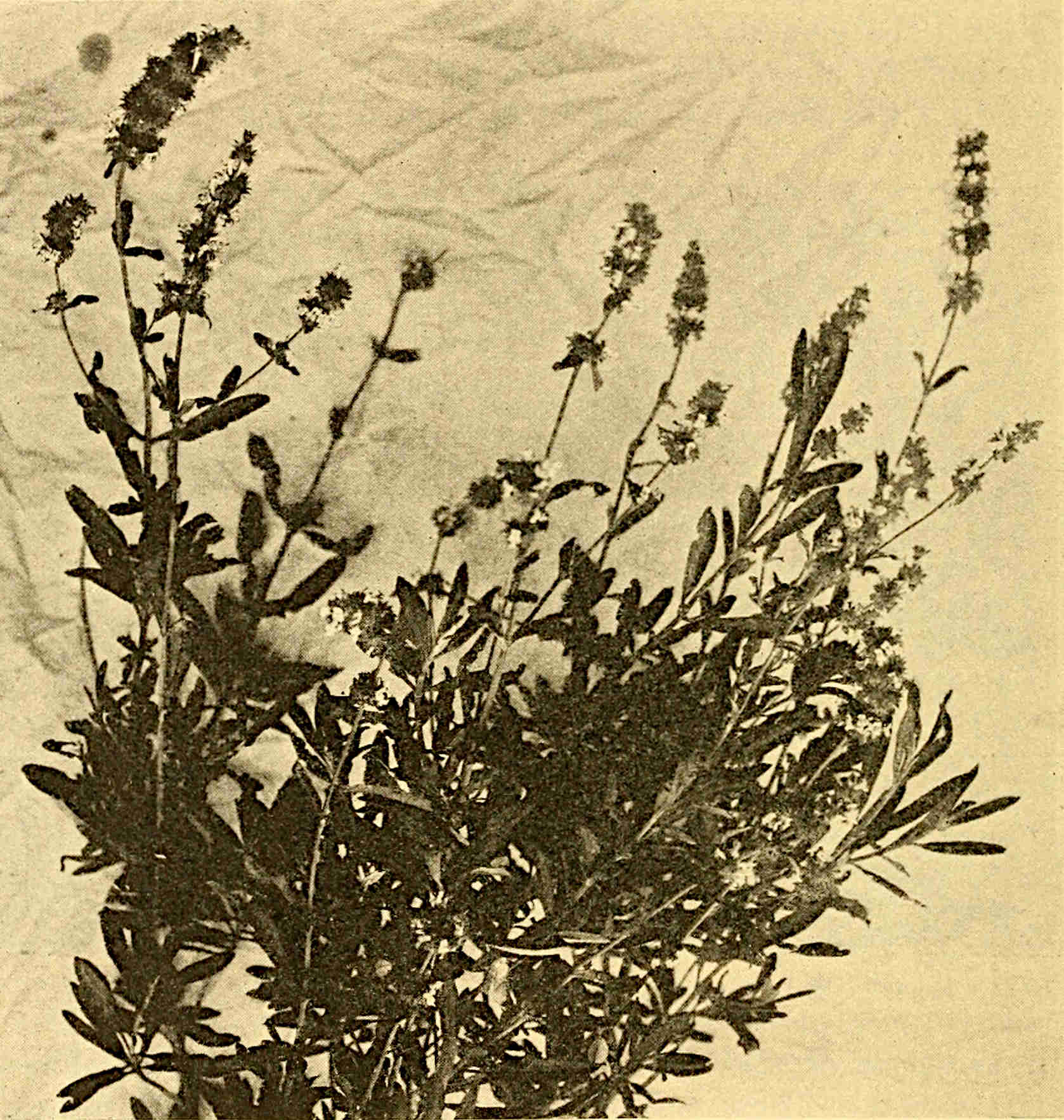
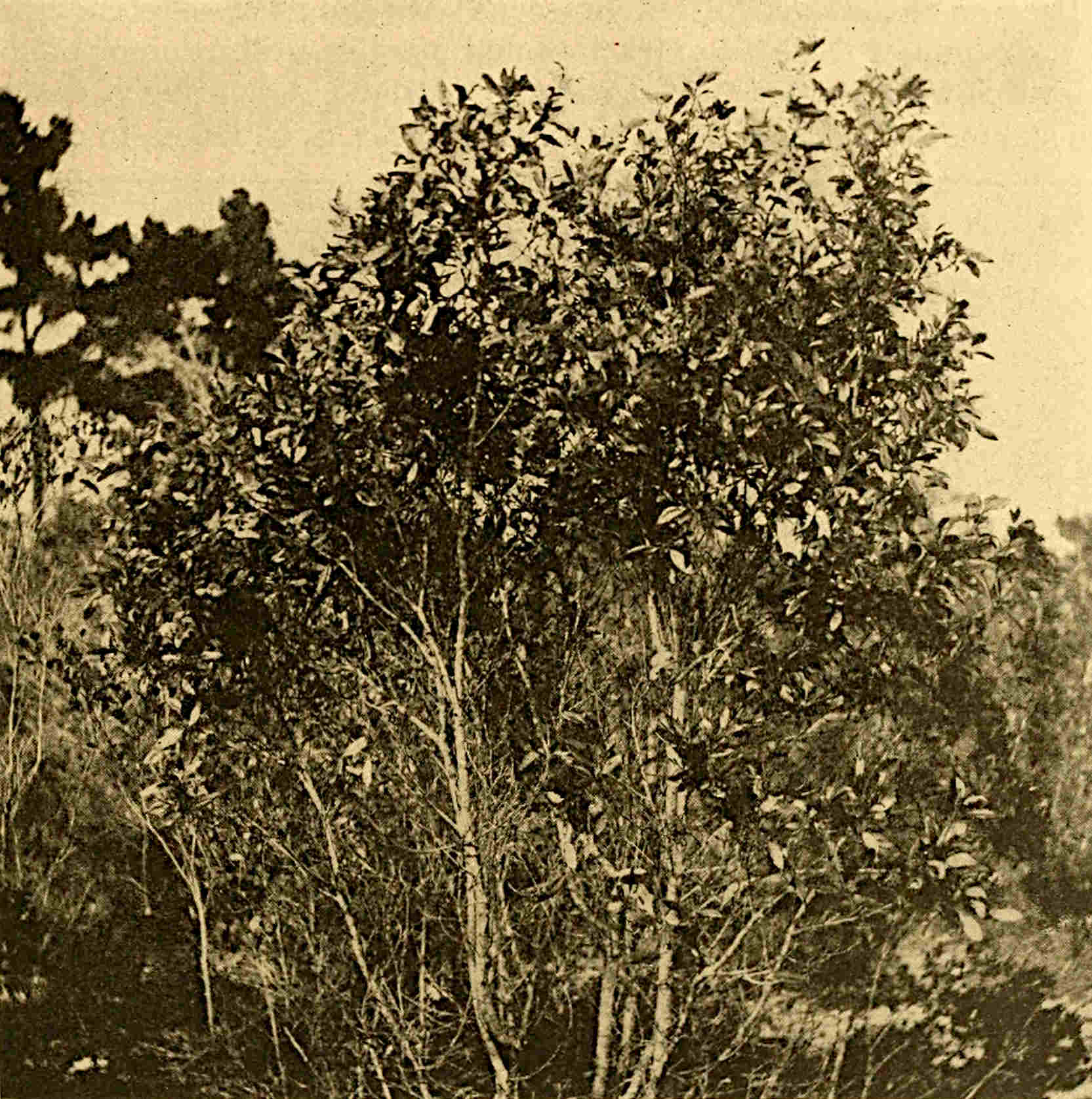
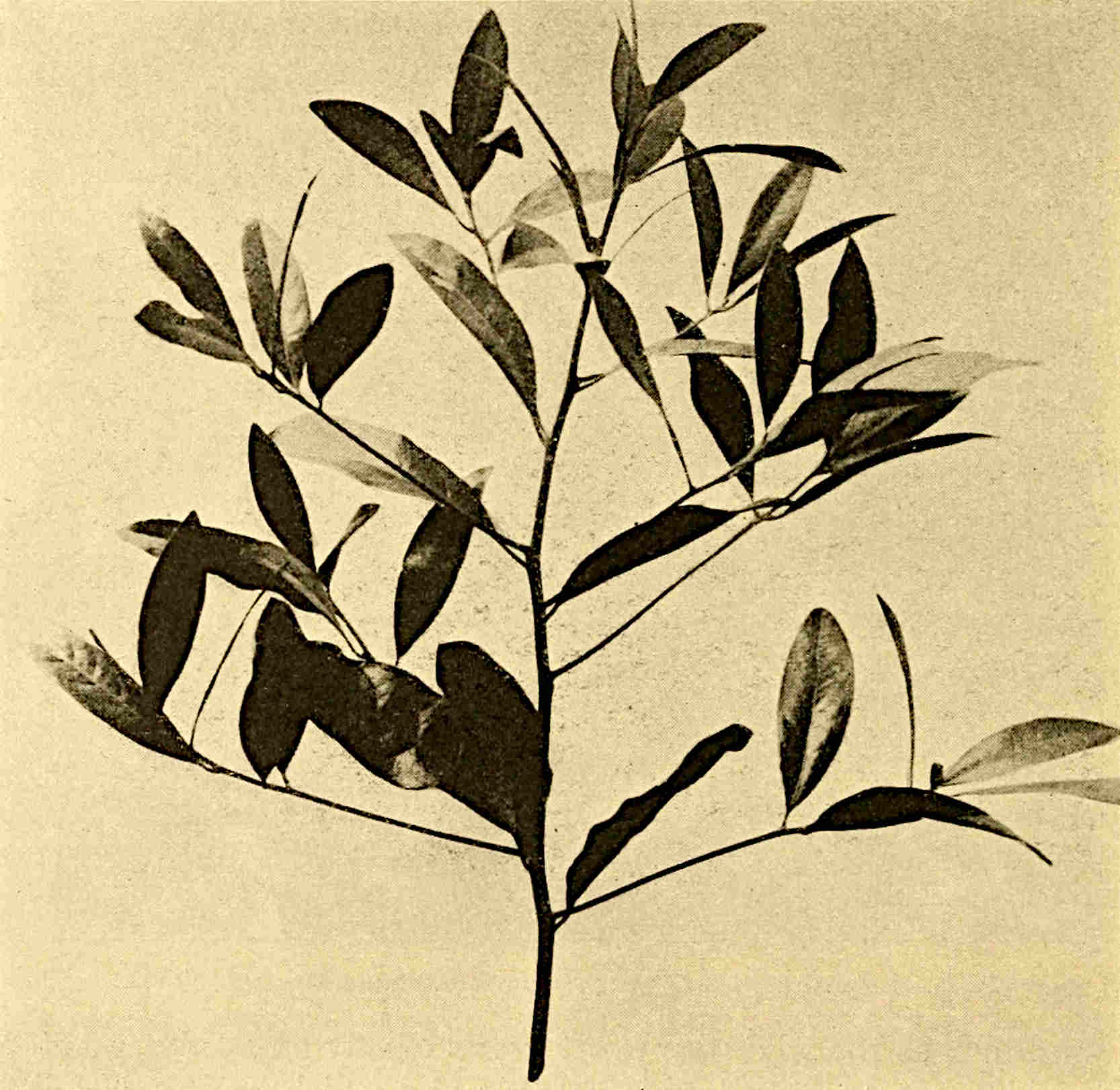
Ramona stachyoides (Benth.) Briquet (synonyms—Audibertia stachyoides
Benth., Salvia mellifera Greene), commonly known as black
sage (figs. 1 and 2), is a shrubby aromatic perennial, occurring from
middle to southern California on low hills from April to June. The
shrub attains a height of 3 to 6 feet and possesses herbaceous leafy
branches with oblong leaves, green and wrinkled above and ash
colored and hairy below. The flowers are white or lilac and in whorls
or heads. The leaves have a strongly aromatic and decidedly camphoraceous
odor, the woody branches being very brittle and also
strongly aromatic.
Fig. 1.—A plant of black sage (Ramona stachyoides) growing near Riverside, Cal.
A quantity of the fresh herb partly in bloom, including the flowering
tops, branches, and leaves, was distilled by steam in the vicinity of
Los Angeles, Cal., in April, 1908, and yielded 0.75 per cent of oil.
The oil was nearly colorless and possessed a penetrating, camphoraceous,
yet agreeable odor, with a bitter, camphorlike taste. At 24° C.
the specific gravity was found to be 0.9144; specific rotation AD =
+30.2°; re-fraction at 24° C., 1.4682. The oil was soluble with
clear solution in 1½ volumes of 70 per cent alcohol, becoming turbid
with 3½ volumes or over.
Fig. 2.—Flowering top of a plant of black sage.
Owing to the very strong camphoraceous odor of the oil, a separation
of the stearoptene suggested itself. In order to separate a
solid body which is held in solution by a volatile oil, the “freezing-out”
method is usually employed. Accordingly 100 grams of the
oil were subjected to a freezing mixture of ice and salt. A temperature
of −15° C. was attained, and flaky crystals formed throughout
the oil. The crystals were separated by being thrown on a force
filter and the remaining oil again subjected to the cold, when a
second lot was obtained, which was likewise separated. A total of
11.3 grams of crystals was separated, corresponding to a yield of
11.3 per cent. These crystals were soft and flaky in nature and
possessed the characteristic odor of camphor.
In order to identify the crystalline substance obtained from the
oil, a small quantity was sublimed, and the usual tests of melting
point, boiling point, and rotation were applied. For further recognition
of the compound, an attempt was made to prepare an oxime.
Accordingly the method of Auwers[25] was applied, which, briefly, is as
follows: To a solution of 10 parts of camphor in 10 to 20 times the
amount of 90 per cent alcohol is added a solution of 7 to 10 parts of
hydroxylamine hydrochlorid and 12 to 17 parts of a soda solution.
If turbidity results, more alcohol is added and the mixture is heated
on a water bath until a small portion of the solution remains clear
upon the addition of water or until the resulting turbidity disappears,
when a few drops of soda solution are added and no free camphor
remains. The mixture is then diluted with water, filtered if necessary,
and neutralized with dilute hydrochloric acid. The camphor
oxime which separates is recrystallized from alcohol or ligroin. It
melts at 118° to 119° C.
The above method applied to the sublimed crystals resulted in
the formation of an oxime which melted at 120° to 124° C. Since
an oxime was obtained (indicating possible ketonic characters),
application was made of another reaction for ketones, namely, the
formation of semicarbazone. Tiemann’s method[26] for the preparation
of camphor semicarbazone was applied. The method is as
follows: 1.5 grams of camphor dissolved in 2 cubic centimeters
glacial acetic acid are treated with a solution of 1.2 grams of semicarbazid
hydrochlorid and 1.5 grams of sodium acetate in 2 cubic
centimeters of water. Water is added and the crystalline compound
recrystallized from alcohol. The melting point of camphor semicarbazone
is 236° to 238° C.
The sublimed crystals when treated in the above manner yielded a
semicarbazone which melted at 232° C.
For a comparison of this substance with pure camphor, a tabulation
was made of the more common physical properties and chemical
tests.
Test.
Crystals from oil of black sage.
Crystals of pure camphor.
Melting point.
174° to 175° C.
175° C.
Boiling point.
205° C.
204° C.
Rotation in 50 mm. tube.
+3.33° (20 per cent solution in alcohol).
+3.51° (20 per cent solution in alcohol).
Oxime.
M. p. 120° to 124° C.
118° to 119° C.
Semicarbazone.
M. p. 232° to 233° C.
236° to 238° C.
The table shows very close similarities in the melting point, boiling
point, and rotation of the crystals from the oil of black sage and of
pure camphor. The melting points of the oximes and semicarbazones,
though not corresponding so well, seemed to indicate that the
crystals were in all probability camphor. To further confirm the
assumption that the compound from the oil was camphor, an elementary
analysis of the compound was made after being twice
sublimed.
0.1273 gram of crystals gave 0.1199 gram H2O, corresponding to 10.5 per cent hydrogen.
0.1273 gram of crystals gave 0.3228 gram CO2, corresponding to 79.7 per cent carbon.
C10H16O camphor
requires
⎰
⎱
79 per cent carbon.
10.5 per cent hydrogen.
0.1279 gram of crystals gave 0.1244 gram H2O, corresponding to 10.8 per cent hydrogen.
0.1279 gram of crystals gave 0.3761 gram CO2, corresponding to 79.9 per cent carbon
dioxid.
The combustion results seemed to indicate that the compound is
identical with that of camphor, as the above tabulation also clearly
shows.
CHEMICAL CONSTANTS.
Preliminary to the detailed chemical examination of the oil the
usual chemical constants were determined.
By neutralization of a weighed quantity of the oil with standard
potassium hydroxid V. S., the acid number (the number of milligrams
of potassium hydrate required to neutralize 1 gram of oil) was found
to be 2.
The ester number (the number of milligrams of potassium hydroxid
required to saponify the esters in the oil) was found to be 2.5, which,
calculated as bornyl acetate, corresponds to 0.88 per cent.
The ester number after acetylization of the saponified oil with
acetic anhydrid (and which represents the total amount of alcohols
present) was 27.1, which, calculated as borneol, represents a total of
7.58 per cent of borneol in the oil, both free and in combination.
FREE ACIDS.
The original oil was slightly acid, as indicated by the acid number
previously mentioned. The free acid was shaken out from a quantity
of the oil with a 10 per cent solution of sodium carbonate. The
shaking was repeated several times and the alkaline liquids united.
The united alkaline liquids were shaken out with ether in order to
remove any oil held in suspension. The sodium-carbonate solution
was then evaporated to a small bulk on a water bath, acidified with
sulphuric acid, and distilled with steam. No oily globules separated,
showing absence of higher insoluble acids. The distillate, which was
decidedly acid, was neutralized with sodium-carbonate solution and
evaporated to a small volume. The liquid which now represented the
sodium salts of the free acids present in the oil was precipitated fractionally
with a dilute silver-nitrate solution. Four fractions resulted.
Each fraction was dried to constant weight and burned.
Fraction 1. 0.1014 gram silver salt = 0.0785 gram silver = 76.3 per cent silver.
Fraction 2. 0.1000 gram silver salt = 0.077 gram silver = 77 per cent silver.
Fraction 3. 0.1116 gram silver salt = 0.0859 gram silver = 76.9 per cent silver.
Fraction 4. 0.1088 gram silver salt = 0.077 gram silver = 70.8 per cent silver.
Fraction 4 indicates the presence of formic acid, the silver salt of
which requires, theoretically, 70.5 per cent of silver. Fractions 1, 2,
and 3 indicate silver carbonate (which requires, theoretically, 78 per
cent of silver) with a slight admixture of silver formate. The
presence of silver carbonate was caused by a possible slight excess
of sodium carbonate being added when the acid distillate was neutralized.
COMBINED ACIDS.
Saponification.—For the purpose of determining the acids held in
combination in the oil in the form of esters, the oil was saponified
with alcoholic potassium hydrate by heating on a water bath with
a reflux condenser for one-half hour. Water was added to the
mixture, and the oil separated in a layer. After removing the excess
alcohol on a water bath, the alkaline solution was shaken out with
ether to remove any adhering oil. The remaining solution was
evaporated to a small volume, acidified with sulphuric acid, and
distilled with steam.
The distillate from the above was extracted with ether and the
ether evaporated spontaneously. Only a trace of an acid residue
remained, which was neutralized with a solution of potassium
hydroxid and precipitated in three fractions:
Fraction 1. 0.1012 gram silver salt = 0.0893 gram silver = 88 per cent silver.
Fraction 2. 0.0774 gram silver salt = 0.0637 gram silver = 82.3 per cent silver.
Fraction 3. 0.0758 gram silver salt = 0.0502 gram silver = 66.2 per cent silver.
The first two precipitates, when dried, consisted principally of
silver oxid, which, theoretically, contains 89.2 per cent of silver. A
slight excess of potassium hydroxid during neutralization was
doubtless responsible. Fraction 3 would seem to point to the presence
of acetic acid in the oil, silver acetate requiring 64.6 per cent of
silver.
The aqueous acid portion remaining after the ether extraction was
neutralized with sodium carbonate concentrated to small bulk and
precipitated with silver nitrate in three fractions. Fraction 1 contained
76.2 per cent of silver; fraction 2, 77 per cent; and fraction 3,
74 per cent. Since silver formate contains 70.5 per cent of silver, a
trace of formic acid is possibly present in the oil in combination.
The esters of the oil, as shown by the above results, are present in
the oil principally as acetates, with a possible trace of formates.
In order to ascertain the total percentage of camphor and to
separate the remaining constituents as completely as possible, a
quantity of the oil was fractionated into seven fractions, as follows:
Fraction 1, 160° C.; fraction 2, 160° to 170° C.; fraction 3, 170° to
178° C.; fraction 4, 178° to 182° C.; fraction 5, 182° to 186° C.;
fraction 6, 186° to 190° C.; fraction 7, 190° to 195° C. These fractions
(125 grams) were refractionated into 10 separate fractions, as
shown in Table II, a determination of the physical properties of each
fraction also being made.
Fraction.
Temperature.
Distilled over.
Specific gravity at 26° C.
Rotation
Re-fraction ND 28° C.
Remarks.
Degrees C.
Per cent.
Degrees.
1
Below 160
2.5
0.8070
+6.9
1.4570
Slight terebinthine odor.
2
160 to 170
6.8
.8768
+10.1
1.4613
Cineol-like odor.
3
170 to 174
7.8
.8865
+10.1
1.4640
Do.
4
174 to 178
12.1
.8920
+10
1.4648
Decidedly cineol-like odor.
5
178 to 182
14.8
.8996
+10.2
1.4652
Do.
6
182 to 186
8.6
.9077
+11.5
1.4659
Slight camphoraceous odor.
7
186 to 190
8
.9105
+11.1
1.4673
Strong camphoraceous odor.
8
190 to 195
8.1
.9130
+11.7
1.4683
Do.
9
195 to 200
7.7
.9170
+11.6
1.4710
Do.
10
200 to 208
11.6
.9220
+10.4
1.4710
Do.
Residue
208 and above
12
.9236
1.4854
Do.
Pinene.—The first fraction distilling below 160° C., and which possessed
an odor of turpentine, was tested for pinene by means of the
nitrochlorid reaction.[27] A deep blue coloration was obtained with
slight turbidity, indicating a possible trace of pinene.
Cineol, or eucalyptol.—Tests were made in fractions 2, 3, 4, 5, and 6
for cineol, which was easily recognized by its odor. For a qualitative
test the iodol reaction was used, crystals of cineol iodol which melted
at 111° to 112° C. forming in each fraction. Fractions 3, 4, and 5,
which smelled strongly of cineol and which doubtless contained the
major portion of cineol in the oil, were assayed by means of the phosphoric
acid method, as directed in the United States Pharmacopœia
for 1900.[28] From these four fractions a total amount of 22.5 per cent
of cineol was obtained, calculated from the original oil. This figure
represents approximately the percentage of cineol in the oil, although
it is low rather than high, since fractions 2 and 6 both showed the
presence of cineol by qualitative tests, but the quantitative estimation
in these fractions was impossible owing to the preponderance of
other constituents in the fractions.
A test for terpinene in fraction 6, by means of the terpinene nitrosite
reaction, produced a characteristic blue coloration, but the
crystalline nitrosite would not separate.
Camphor.—A strong odor of camphor being distinguishable in fractions
7, 8, 9, 10, and in residue, a quantitative separation was made as
completely as possible by means of the “freezing-out” method.
Between 186° and 190° C. some crystals of camphor began to form
in the inner tube of the condenser, and at 195° C. the condenser had
to be kept jacketed with steam to prevent clogging, so rapidly did the
camphor distill over. The fractions above 195° C. were practically
solid. The camphor which separated at ordinary temperature was
filtered on a force filter, and the liquid portion of the fractions subjected
to freezing successively until camphor no longer separated.
It is apparent that the separation of the camphor from these small
fractions by freezing out is rather inaccurate because of the losses in
transferring and filtering. From the above fractions, however, a
quantity of camphor was obtained corresponding to about 40 per
cent of the original oil. This figure is low, for the separation on a
larger scale working with much larger fractions would reduce to a
considerable degree the loss of camphor which is unavoidable in such
small fractions.
The fractions distilling between 195° and 208° C. yielded crystals
when treated with bromin in a petroleum-ether solution of the oil.
The crystals melted at 130° C. Thujone tribromid melts at 122° C.
A trace of thujone is therefore probably present in the oil. It is very
possible, in view of the fact that the acetylization of the oil disclosed
some free alcohol, that the last fraction contained some borneol,
which boils at 212° C.
The results of the experiments would seem to indicate that the oil
of black sage is composed essentially of camphor (more than 40 per
cent) and cineol (22.5 per cent), with a small quantity of an alcohol,
probably borneol, both free and as an ester, and a small quantity of the
ketone thujone, with traces of the terpenes pinene and terpinene. Free
formic acid was found, and only traces of combined acetic and formic
acids in the form of esters.
The constituents of possible economic importance in the oil are
camphor and cineol, both of which possess considerable medicinal
value, the former being used also very extensively in the arts. These
constituents, possessing strong antiseptic virtues, no doubt impart
antiseptic properties to the oil. Inasmuch as the yield of oil from
the fresh herb approximates 1 per cent, if distilled during the full
flowering stage, and furthermore, since the plant thrives on low sandy
hills or wastes, it is very probable that the shrub could be grown
profitably both for its oil and for the large amount of camphor and
cineol capable of being isolated from it.
WILD SAGE. — BOTANICAL DESCRIPTION AND DISTRIBUTION. — DISTILLATION OF THE OIL. — SEPARATION OF STEAROPTENE. — IDENTIFICATION OF CRYSTALLINE COMPOUND. — Table III. — Comparison of properties of crystals from oil of wild sage and of pure borneol. — CHEMICAL EXAMINATION OF THE OIL. — FRACTIONATION OF THE VOLATILE OIL. — Table IV. — Fractionation of oil of wild sage, showing the physical and chemical properties of the fractions. — IDENTIFICATION AND SEPARATION OF THE CONSTITUENTS. — SUMMARY.
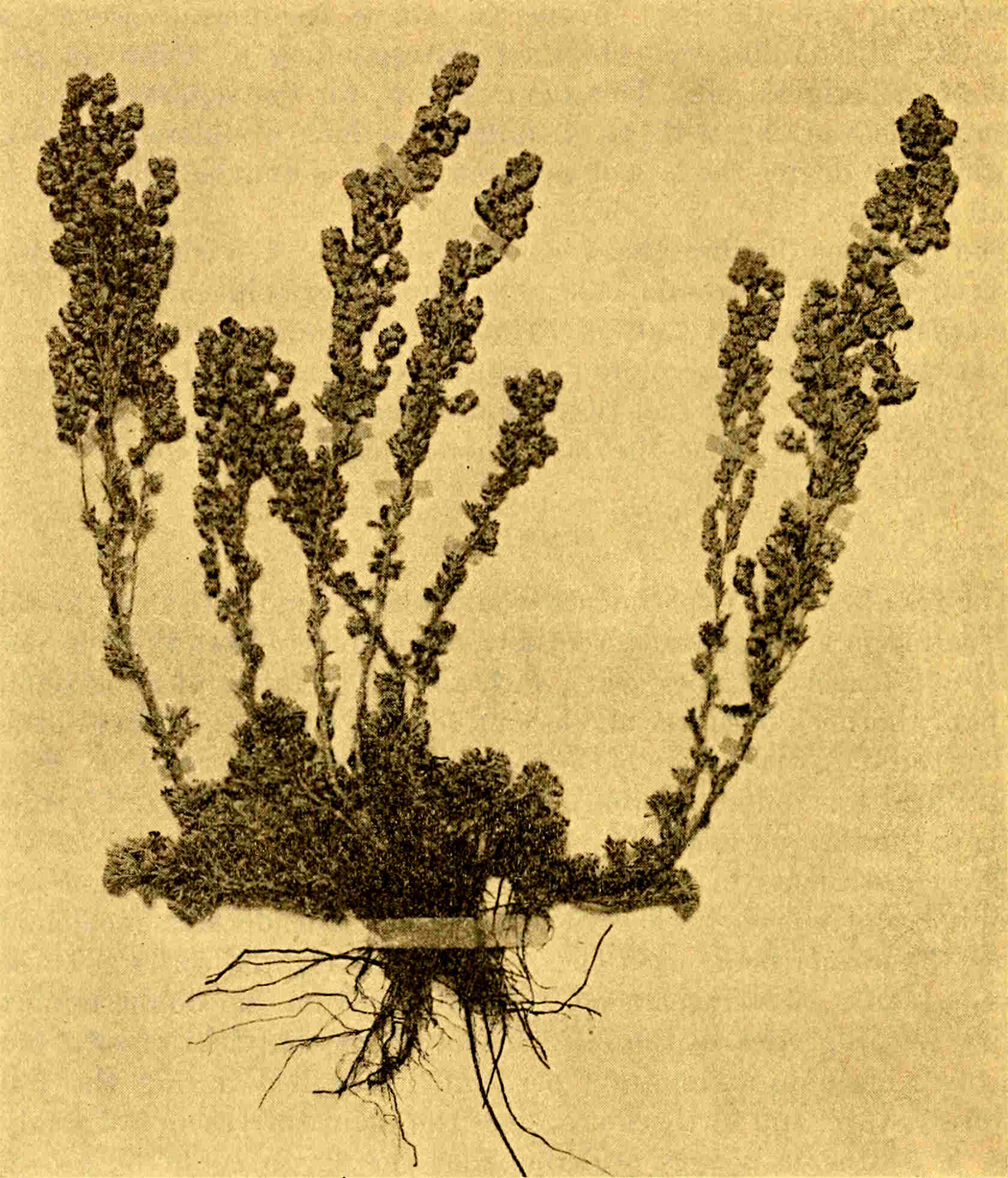
Artemisia frigida Willd., commonly known as wild sage, mountain
sage, pasture sagebrush, and wormwood sage (figs. 3 and 4), is a hardy
perennial 6 to 20 inches high, with a woody base and white silky
leaves. The numerous yellow flowers, arranged in a racemelike head,
possess a strongly camphoraceous odor. The leaves are also strongly
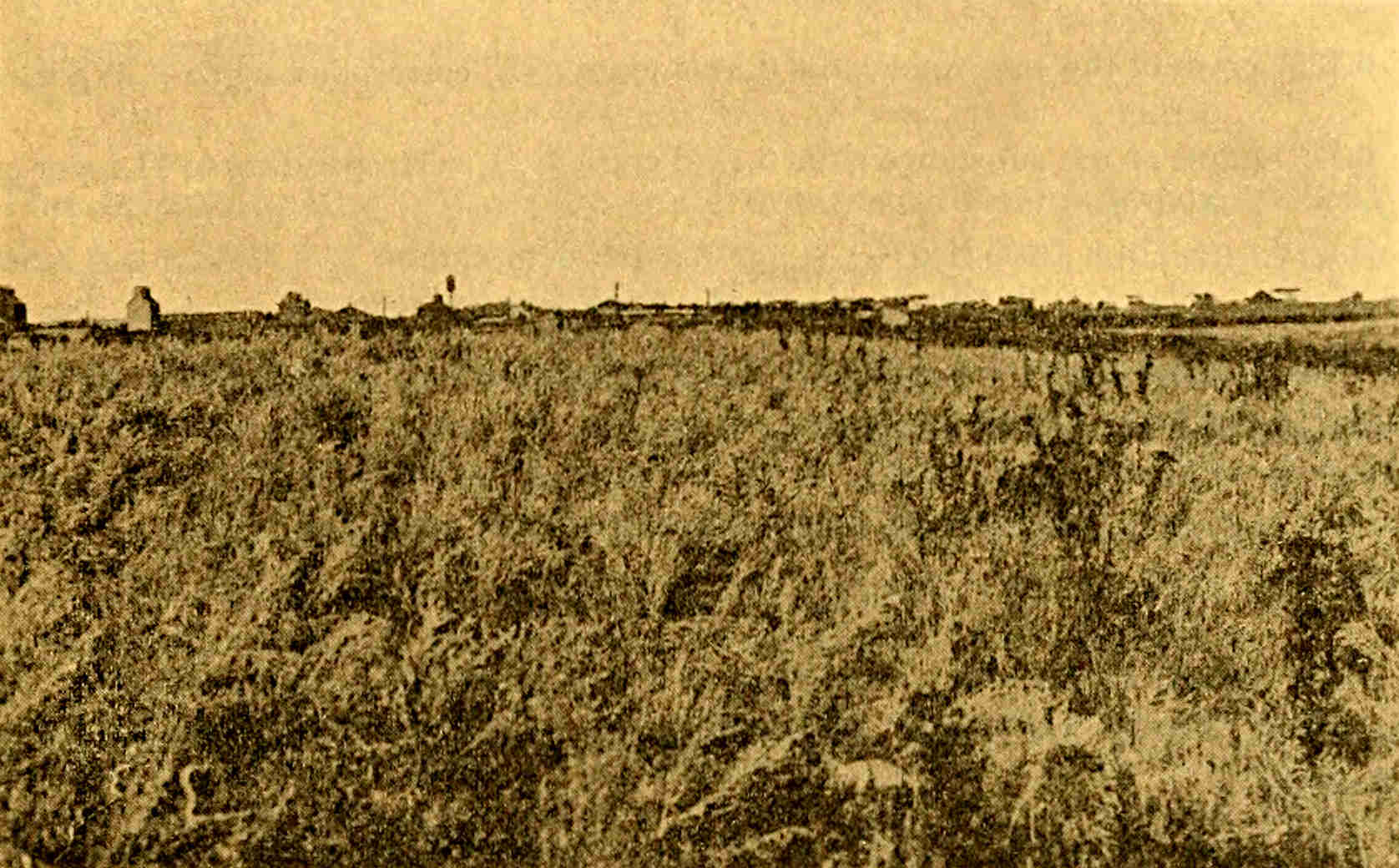
aromatic. The plant abounds on dry sandy hilltops from the Dakotas
west to Idaho, north into Canada, and as far south as Texas.
Fig. 3.—A plant of wild sage (Artemisia frigida).
The oil distilled from wild sage was briefly reported by the writer
in 1905[29] and 1906.[30]
The promising preliminary results encouraged
a further investigation of this plant. During the summers of 1907
and 1908 larger quantities of this interesting wild plant were distilled
in South Dakota, a yield of 0.26 per cent of a very fragrant essential oil
being obtained from plants which had passed their flowering stage.
When the plant is distilled during its flowering stage the yield of oil
is about 0.41 per cent.
The oil obtained by the distillation of the whole plant was beautiful
pale green in color, with an agreeable fatty and camphoraceous
odor and a slightly bitter camphorlike taste. The specific gravity
of the oil at 24° was 0.940; specific rotation AD = −24.2°; re-fraction
ND 24°, 1.4716. The oil was soluble in 1 volume of 80 per cent
alcohol, becoming turbid in 2 volumes or over.
Fig. 4.—A field of wild sage near Webster, S. Dak.
During the distillation and filtration of the oil, small crystals were
observed at the mouth of the distillation apparatus and also at the
mouth of the funnel after standing over night. In order to separate
this stearoptene (solid portion of the oil) from the elaoptene (liquid
portion) 50 grams of the oil were subjected to a freezing mixture of
ice and salt for several hours. As a result crystals separated in the
form of white flakes. The crystals were thrown into a force filter
and weighed, a total of 3 per cent resulting.
After recrystallization of the above crystals from alcohol the properties
of the crystals compared very favorably with levo borneol, as
shown in Table III.
Test.
Crystals from oil of wild sage.
Crystals of pure borneol.
Color.
White.
White.
Odor.
Camphorlike.
Camphorlike.
Taste.
Bitter, camphorlike.
Bitter, camphorlike.
Boiling point.
210° to 215° C.
212° C.
Melting point.
203° C.
203° to 204° C.
Specific rotation.
−32°.
−37°.
To further confirm the above results, which seemed to indicate that
the compound was identical with levo borneol, an elementary analysis
was made.
0.1237 gram of the substance gave 0.3499 gram CO2, corresponding to 77.2 per cent
carbon.
0.1237 gram of the substance gave 0.1252 gram H2O, corresponding to 11.4 per cent
hydrogen.
C10H18O borneol
requires
⎰
⎱
77.8 per cent carbon.
11.7 per cent hydrogen.
The elementary composition substantiates the assumption that the
crystals are identical with levo borneol.
CHEMICAL CONSTANTS.
The usual chemical constants were determined, namely, the acid
number, ester number, saponification number, and acetylization
number.
The acid number, denoting the amount of free acids contained in
the oil and expressed in milligrams of potassium hydroxid, was determined
by simple neutralization of the oil with standard potassium
hydrate volumetric solution.
The ester number, denoting the amount of esters (combination of
alcohols and acids) in the oil and expressed in milligrams of potassium
hydroxid, was determined by saponification of the ester compounds
with alcoholic potassium hydrate.
The acetylization number, or the ester number determined after
acetylization of the oil with acetic anhydrid, signifies the total amount
of alcohol or alcohols in the oil.
The constants of the oil were determined with the following results:
Acid number, 2.5, calculated as acetic acid, indicates 0.26 per cent acetic acid.
Ester number, 25, calculated as bornyl acetate, indicates 8.7 per cent bornyl acetate,
which is equivalent to 6.8 per cent of free borneol.
Saponification number, 27.5.
Acetylization number, 139, corresponds to 42.67 per cent of total borneol in the oil,
or, deducting the 6.8 per cent of free borneol as the ester, to 38 per cent of free borneol.
Assuming that the stearoptene obtained was borneol, a determination
of the constants of the stearopteneless oil was made. The acid
number remained practically the same, being 2.3; the ester number
differed only very slightly, being 24.7; but the acetylization value
obtained was only 132, which corresponded to but 40 per cent of total
borneol. This is in strict conformity with the assumption, which
seemed to be sufficiently proved, that the stearoptene separated from
the oil by freezing was borneol. The stearopteneless oil was nearly
3 per cent poorer in borneol than the original oil, as shown above. It
is to be remembered that 3 per cent of crystalline borneol was removed
by freezing the original oil, hence the lowering of the borneol content
of the stearopteneless oil.
FREE ACIDS.
The determination of the free acids was accomplished by repeatedly
shaking a portion of the original oil with a 10 per cent sodium carbonate
solution. After removing the adhering oil from the alkaline
liquid by shaking with ether, the solution was acidified and distilled
with a current of steam. A few oily globules floated on the surface
of the liquid. These were extracted with ether and the ether evaporated.
A small amount of oily residue remained, which was distinctly
acid. The oily residue was exactly neutralized with sodium hydrate
and precipitated with silver nitrate solution in three fractions:
Fraction 1. 0.0377 gram silver salt gave 0.0162 gram silver = 42.9 per cent silver.
Fraction 2. 0.0206 gram silver salt gave 0.0091 gram silver = 44.1 per cent silver.
Fraction 3. 0.0663 gram silver salt gave 0.3000 gram silver = 45.2 per cent silver.
The three fractions appear to be a mixture of caprylic and œnanthylic
acids. Silver caprylate requires 42.9 per cent silver; silver
œnanthylate requires 45.5 per cent silver.
A small amount of the insoluble free acids was therefore caprylic
acid (octoic acid), the major portion being œnanthylic acid (heptoic
acid).
The distillate from which the oily acids were extracted by ether
was still slightly acid and was accordingly neutralized with sodium
carbonate and precipitated with silver nitrate, two fractions being
obtained. The first corresponded to silver carbonate, due to a slight
excess of sodium carbonate; the second, only trifling in quantity,
indicated the presence of only a trace of formic acid in the free
condition.
Œnanthylic, or heptoic, acid seems to be the predominating free
acid in the oil, with slight traces of formic and caprylic, or octoic,
acids.
COMBINED ACIDS.
The esters in the oil, being combinations of alcohols and acids,
serve as a basis for the identification of the acids in combination.
In order to accomplish a separation of the combined acids a small
quantity of the oil was saponified with alcoholic potassium hydroxid
by heating on a water bath for half an hour. After dilution of the
mixture with water and separation of the oil the alkaline liquid,
which contained a small amount of the oil held in suspension, was
shaken out with ether. The liquid was then acidified with sulphuric
acid and distilled with steam. The oily globules which separated
on the distillate were extracted with ether and the solvent
evaporated. A small amount of an oily liquid with very offensive
odor remained. This mixture of oily acids was neutralized with
sodium hydrate and precipitated with a dilute solution of silver
nitrate. Two fractions resulted:
Fraction 1. 0.0430 gram silver salt gave 0.0160 gram silver = 37.2 per cent silver.
Fraction 2. 0.0440 gram silver salt gave 0.0197 gram silver = 44.7 per cent silver.
From the results obtained it is evident that the fractions consist of
the silver salt of undecylic acid, which requires theoretically 36.8
per cent of silver, and silver salt of heptoic (œnanthylic) acid, which
requires 45.5 per cent of silver.
The aqueous distillate from the above, after being made neutral
with sodium carbonate, was evaporated to small volume and precipitated
in three fractions with silver nitrate:
Fraction 1. 0.243 gram silver salt gave 0.1837 gram silver = 75 per cent silver.
Fraction 2. 0.3255 gram silver salt gave 0.2370 gram silver = 72.9 per cent silver.
Fraction 3. 0.3492 gram silver salt gave 0.1840 gram silver = 52.9 per cent silver.
The greater portion of the soluble combined acids consisted of
valerianic acid, the silver salt requiring 51.6 per cent of silver. A
trace of formic acid was also indicated in combination as an ester in
fraction 2, above.
The chief acids in combination as esters in the oil appear to be
œnanthylic (heptoic) and valerianic, the former being preponderant.
Formic and undecylic acids occur only as traces. All of the above
are no doubt combined in the oil as esters of borneol.
One hundred grams of the original oil were subjected to fractionation
and separated into six fractions of 5 degrees each, beginning with
175° C. Those fractions together with the residue were again fractionated
in order to insure a better separation of the constituents.
Decidedly camphoraceous; free borneol crystallized in
condenser.
7
205 to 215
9.0
.9562
−10.6
56.4
Fraction almost solid (borneol).
8
215 to 230
9.5
.9600
−10.8
75.2
Fraction partially solidified.
9
230 to 245
3.5
.9570
−5.8
70.7
Few crystals separated.
10
245 and above
9.0
.9830
47.0
Dark, sirupy, camphoraceous.
Cineol.—Fraction 1, 175° C., possessed a strong eucalyptuslike odor
and was tested for cineol by means of iodol. The tetraiodopyrol
(iodol) addition product of cineol formed into well-defined, nearly
colorless crystals, melting at 110° to 113° C. This crystalline addition
product of iodol formed in the first four fractions; in fraction 5,
however, only a trace of crystals appeared.
The presence of cineol having been proved, a quantitative estimation
of the compound was made in fractions 1, 2, 3, and 4. Fraction
5, which contained only a very small quantity of cineol, did not admit
of estimation by the phosphoric-acid method, which is reliable only
when large percentages of cineol are present.
The fractions yielded the following percentages of cineol: 1, 40 per
cent; 2, 70 per cent; 3 and 4, 43.7 per cent. Calculating from the
original oil as a basis, the above results correspond to 19.7 per cent
of cineol in the original oil.
Fenchone.—Fraction 5, boiling from 190° to 195° C., was a heavy
liquid with a strong camphorlike odor. Pure levo fenchone[32] from
thuja oil is an oily liquid with a strong camphoraceous odor; boiling
at 192° to 194° C.; specific gravity at 19° C., 0.946; (AD) −66.9°.
An oxime was prepared from the fraction by reaction with hydroxylamine
hydrochlorid according to the method of Wallach,[33] which is
as follows: To 5 grams of fenchone dissolved in 80 cubic centimeters
of absolute alcohol is added a solution of 11 grams of hydroxylamine
hydrochlorid in 11 grams of hot water. Six grams of powdered potash
are added. The oxime separates in the form of crystals, upon standing
for some time. Recrystallized from alcohol it melts at 164° to
165° C.
The oxime formed from the fraction by the above method, after
recrystallization from ethyl acetate, melted at 170° C.
Provided that fraction 190° to 195° C. consists chiefly of fenchone
the oil should contain 8 to 10 per cent of this compound.
Borneol.—The total amount of borneol contained in the oil was
determined by the saponification of a small quantity of the original
oil and subsequently fractionating the saponified oil. Twenty-five
grams of the saponified oil were carefully fractionated and then refrigerated,
7.5 grams of borneol separating out. This corresponds to
a total of 30 per cent borneol. After the separation of the borneol
the oil was again fractionated, and the portion above 195° C. yielded,
when frozen, an additional 2 grams of borneol, making a total of 9.5
grams, or 38 per cent, of total borneol separated from the oil. The
theoretical quantity of borneol in the oil, as shown by the acetylization
value, is about 43 per cent, the lower percentage which was
actually obtained being caused by incomplete separation due to the
smallness of the amount saponified.
Esters of borneol.—A careful examination of Table IV shows that
the esters of borneol, possibly chiefly bornyl heptoate and valerianate,
are found in the fractions boiling above 190° C., principally in the
highest boiling fractions; a perfect separation of these esters was not
feasible because of the existence of the esters as mixtures of several
acids. The ester numbers of the fractions, however, show the distribution
of the esters at the different temperatures.
Briefly summarizing the results of the analyses, the oil of wild sage
may be said to be composed: (1) Of total borneol camphor, 43 per
cent, of which about 6.8 per cent exists as bornyl heptoate (calculating
the esters of the oil as heptoic acid salts of borneol), leaving 35.8
per cent of free borneol camphor present in the oil; (2) of cineol
(eucalyptol), 18 to 20 per cent; (3) of fenchone, 8 to 10 per cent; (4)
of free acids, chiefly œnanthylic, or heptoic, acid, 0.58 per cent, with
traces of formic and caprylic acids; (5) of combined acids in form of
esters, chiefly, œnanthylic acid, with smaller quantities of valerianic,
undecylic, and formic acids. It is very probable that a small
amount of terpenes were also present in the portion distilled below
175° C., which, however, were not identified.
As will be noted from the above, the chief constituents of the oil of
wild sage are borneol camphor and cineol, each of which possesses
valuable antiseptic qualities. Since there is a high percentage of
these constituents, the oil from this wild plant should prove of value
for medicinal purposes. Another important use of the oil is suggested
by the high content of borneol, a constituent which finds application
in celluloid manufacture, and which is readily separated from this oil.
Lastly, combining the agreeable aromatic quality with its antiseptic
qualities, the oil should prove important as an ingredient of medicinal
soaps or as a scenting substance.
Inasmuch as the wild sage plant grows chiefly on sandy and stony
hills which are practically waste lands and which require but little
moisture, it would seem that the plant could be cultivated in various
sections of the Northwestern States.
SWAMP BAY. — BOTANICAL DESCRIPTION AND DISTRIBUTION. — DISTILLATION OF THE OIL. — CHEMICAL EXAMINATION OF THE OIL. — FRACTIONATION OF THE OIL AND SEPARATION OF THE STEAROPTENE. — Table V. — Fractionation of saponified oil of swamp bay and description of fractions. — Table VI. — Refractionation of the oil of swamp bay, showing the physical properties of the fractions. — IDENTIFICATION OF THE CONSTITUENTS OF THE OIL. — SUMMARY.
Persea pubescens (Pursh.) Sarg., commonly known as swamp red
bay or swamp bay (figs. 5 and 6), is an aromatic evergreen tree attaining
a height of 30 feet or more, but usually occurring as a shrub.
The leaves and twigs of the tree possess a pleasant camphoraceous
odor. The swamp bay occurs abundantly in swamps and hammocks
from North Carolina to Florida and Texas. The tree is a member
of the family Lauraceæ, to which the camphor tree belongs.
Fig. 5.—A swamp bay tree (Persea pubescens) growing near Orange City, Fla.
Because of the strong camphoraceous odor and its close relationship
to the camphor tree, the extraction and possible utilization of the oil
from this wild aromatic plant suggested itself. Accordingly, during
the summer of 1910, with the assistance of Mr. S. C. Hood, in charge
of the station at Orange City, Fla., a small quantity of the leaves and
twigs of this plant was distilled and a yield of about 0.2 per cent of
oil was obtained. But with proper conditions and precautions the
yield could no doubt be very materially increased, depending largely
upon the time at which the distillation is made, and also upon the
proportion of twigs and branches included. The above distillation
was made late in the summer, long after the blossoming period, the
stage at which a plant is usually most productive in volatile oils, and
the material also contained many branches and much woody matter.
The oil obtained was pale yellowish brown in color, with a strongly
aromatic and camphoraceous odor, and a persistent bitter, slightly
pungent, and camphorlike taste. The specific gravity at 25° C. was
0.9272; specific rotation, AD = +22.4°; refraction, ND 25° = 1.4695.
The oil was soluble in one-third its volume of 80 per cent alcohol,
becoming faintly turbid upon the addition of five volumes or more
of alcohol.
Fig. 6.—A small branch of swamp bay.
CHEMICAL CONSTANTS.
A preliminary examination of the oil disclosed considerable free
acidity, the acid number being 2.8, while the ester content was rather
low, the ester number being 14.5. The low ester number would seem
to indicate a low percentage of alcoholic compounds in combination
with acids, and would correspond to 4.9 per cent of esters calculated
as the acetate of borneol. After acetylization of the oil with acetic
anhydrid the saponification number was found to be 64, which corresponds
to 14.6 per cent of free alcohol, calculated as borneol.
In order to identify conclusively the constituents of the oil and the
forms in which they occur, and to separate quantitatively the predominant
constituents, the oil was subjected to a more careful and
detailed analysis.
FREE ACIDS.
The free acidity of the oil as indicated by the preliminary tests was
removed by shaking with 10 per cent aqueous sodium carbonate
solution in several portions. The aqueous alkaline extracts, after
being deprived of any adhering oil by extraction with ether, were
concentrated, acidified, and distilled with a current of steam. The
acids which were obtained separated principally as oily globules on
the aqueous distillate, which was only faintly acid.
The free insoluble acids which were separated from the aqueous
distillate by extraction with ether and evaporation of the solvent
were neutralized with a solution of potassium hydroxid and then
precipitated in fractions with a solution of silver nitrate.
Fraction 1. 0.0227 gram silver salt gave 0.0130 gram silver = 57.2 per cent silver.
Fraction 2. 0.0213 gram silver salt gave 0.0119 gram silver = 55.8 per cent silver.
It appears from the above results that the only acid existing in
the free state in the oil is butyric acid, since silver butyrate gives
theoretically 55.3 per cent of silver, fraction 1 being slightly contaminated,
due possibly to a slight excess of potassium hydrate which
was added when the acids were neutralized and which would appear
in the first precipitate.
From the remaining faintly acid distillate, after neutralization with
barium carbonate and concentrating, only a trace of precipitate,
insufficient for silver determination, resulted upon the addition of
silver nitrate solution. The butyric acid detected in the free insoluble
acids was evidently extracted by the ether, in which it is very soluble.
COMBINED ACIDS.
As stated previously, the oil was found to contain a small percentage
of esters, or organic acids in combination with higher alcohols. In
order to identify these acids, which are in combination in the form of
esters, a quantity of the oil, after removing the free acids, was saponified
by heating on a water bath for half an hour with a slight excess
of alcoholic potassium hydroxid. The mixture, after saponification,
was diluted with water and the unsaponified oil separated. The
alkaline liquid, which now contained the combined acids as their
potassium salts, after being freed from adhering particles of oil by
shaking with ether, was acidified with sulphuric acid and distilled
with steam. The insoluble oily acids which formed on the distillate
were separated by shaking the distillate lightly with ether and evaporating
the ether.
SOLUBLE COMBINED ACIDS.
The aqueous portion of the distillate which contained the soluble
combined acids of the oil was neutralized with barium carbonate,
concentrated and precipitated with silver nitrate solution. Only a
small precipitate resulted. This precipitate was found to contain
55.9 per cent of silver, which corresponds to silver butyrate. Hence
the acid in the distillate was butyric acid.
INSOLUBLE COMBINED ACIDS.
As heretofore stated, the insoluble oily acids obtained by extraction
with ether were carefully neutralized with potassium hydroxid
solution and precipitated fractionally with silver nitrate. Two
precipitates were obtained which were thoroughly washed and dried.
The first and largest precipitate assayed 51.2 per cent silver, the
second assaying 45.1 per cent silver. This would indicate that the
insoluble acids were valerianic acid (silver valerianate requiring 51.6
per cent silver), and heptoic acid (silver heptoate requiring 45.5 per
cent silver), the valerianic acid predominating.
The results show that the esters of this oil exist as the salts of
butyric, valerianic, and heptoic acids, valerianic acid esters, however,
predominating.
For the purpose of accomplishing a separation of the constituents,
50 grams of the oil, after saponification, were dried and subjected to
fractional distillation in a three-bulb Ladenburg flask. The results
are given in Table V.
Fraction.
Temperature.
Distilled.
Remarks.
Degrees C.
Per cent.
1
Below 170
1.1
Penetrating odor; largest portion
of the fraction distilled over
below 80° C.; temperature rose
rapidly to 170° C.
2
170 to 182
8.8
Camphoraceous cineol-like odor;
largest portion distilled 175°
to 180°.
3
182 to 185
9.2
Strong cineol-like odor;
temperature rose uniformly.
4
185 to 190
13.5
Cineol-like camphoraceous odor;
temperature rose uniformly.
5
190 to 195
13.0
Strong camphoraceous odor;
temperature rose uniformly.
6
195 to 200
5.8
Strong camphorlike odor; crystals
appeared in condenser;[34] largest
portion distilled between 198°
to 200° C.
7
200 to 205
12.5
Strong camphorlike odor; fraction
semisolid upon cooling; temperature
rose uniformly.
8
205 to 215
14.0
Strong camphorlike odor; fraction
almost solid upon cooling; distilled
largely between 205° to 210° C.
9
215 to 225
12.5
Strong camphoraceous odor; fraction
semisolid; temperature rose
uniformly.
10
225 and above
9.0
Heavy yellow oil with camphoraceous
odor.
Beginning with fraction 6 each successive fraction was refrigerated
in a freezing mixture of ice and salt and the crystals separated by
centrifuging in a platinum Gooch crucible. A total of 13.7 per cent
of crystals was obtained.
In order to obtain a further separation of crystals the portions of
the oil beginning with fraction 5 were fractionated into the following
fractions: 190° to 195° C.; 195° to 200° C.; 200° to 205° C.; 205° to
215° C.; 215° to 233° C.; 233° to 260° C. A total of 4 per cent of
crystals was obtained by refrigeration and centrifugation of those
fractions in which crystals appeared. The portion between 190°
and 215° C., and also fraction 4 of the original, were further fractionated
into four parts: 185° to 190° C.; 190° to 195° C.; 195° to 205°
C.; 205° to 215° C., an additional yield of 3.3 per cent of crystals
being obtained.
By the above method of successive fractionation and refrigeration
a total of 21 per cent of crystals was obtained from the oil. This
represents only approximately the total percentage of stearoptene
in the oil. The separation was not at all quantitative, as a considerable
proportion was lost in the manipulations incident to the
separation. Since the quantity of oil at hand was so meager the
fractions were reduced to such small quantities that further separation
of crystals was impossible, and as unavoidable losses were
encountered in transferring to and from the centrifuge the final
percentages were materially affected and the true amount of stearoptene
may be assumed to be considerably more than is shown above.
After the fractionation and refractionation of the oil and the
separation of the stearoptene portion, the remaining elaoptene portion
grouped itself into fractions, whose physical properties were determined
and qualitative tests for their constituents applied, as shown
in Table VI.
Fraction.
Temperature.
Specific
gravity
at 25° C.
Rotation
in 50 mm.
tube.
Re-fraction
ND
25°.
Tests applied.
Degrees C.
Degrees.
1
Below 170
Insufficient.
Insufficient.
1.4648
When shaken with water the aqueous solution
strongly reduced magenta solution to violet
color; also produced silver mirror with
ammoniacal silver nitrate.
2
170 to 182
0.9011
+22.5
1.4630
Iodol (tetraiodopyrol) dissolved in oil by
gentle warming yielded yellow crystals melting
at 115° C.; cineol iodol melts at 112° C.
3
182 to 185
.9012
+21.5
1.4628
Treated with iodol and the yellow crystals
recrystallized from benzol melted sharply at 112°.
4
185 to 190
.9075
+23
1.4628
Cineol-iodol crystals melted at 113° C.
5
190 to 205
.9228
+31
1.4653
Do.
6
205 to 215
.9351
1.4706
Negative test with iodol.
7
215 to 233
.9358
1.4765
Do.
8
233 to 260
.9360
1.4830
Oxidized with 3 per cent potassium permanganate
in cold yielded camphor crystals.
Camphor.—The compound obtained from the oil by refrigeration
was a soft, white, granular, crystalline mass, and possessed a distinct
camphorlike odor and slightly bitter camphoraceous taste. The
crystals sublimed readily and melted at 174° to 176° C. The boiling
point of the compound was 205° C., and the rotation in a 50 mm. tube
of 20 per cent solution in alcohol was found to be +3.8°, 20 percent
solution of commercial camphor in alcohol rotating +3.5°. It was
readily soluble in alcohol and the other organic solvents.
To further identify the crystals with ordinary camphor two compounds
were prepared, the semicarbazone and the oxime, with which
camphor forms definite chemical compounds. The semicarbazone
was prepared according to the method of Tiemann. (See p. 17.)
The crystals obtained after recrystallization from alcohol melted at
237° to 239° C., pure camphor semicarbazone melting at 236° to 238°.
For the preparation of the oxime Auwers’ method was applied. (See
p. 16.) Recrystallized from ether the oxime melted at 117° to 118° C.,
whereas pure camphor oxime melts at 118° to 119° C.
Since the physical and chemical properties of this substance correspond
almost identically with those of camphor, it may be safely
stated that the crystals are those of commercial dextro camphor.
Aldehyde constituent.—From the pungent and penetrating odor and
the strong reducing properties of the first fraction, which, as shown
in Table V, distilled largely below 80° C., there would seem to be the
possible presence of a trace of formaldehyde.
Cineol, or eucalyptol.—Qualitative tests as indicated in Table V
show the presence of cineol in fractions from 170° to 205° C., the
characteristic crystalline cineol addition product of iodol corresponding
in melting point to the pure cineol iodol. Cineol was further
identified in these fractions by the preparation of cineol hydrobromid
prepared by passing dry hydrobromic acid gas into a well-cooled
solution of the oil in petroleum ether. A crystalline hydrobromid
was obtained from each fraction which gave the iodol reaction. The
hydrobromids prepared melted between 55° to 57° C., while pure cineol
hydrobromid is reported as melting at 56° to 57° C.
Since the presence of cineol in the several fractions of the oil was
proved, a quantitative estimation was deemed desirable. Because of
the smallness of the individual fractions the hydrobromic acid method
was adopted in this estimation, it being the most accurate when cineol
is present in only small quantities. The phosphoric acid method is
best adapted to oils which are very rich in the compound. The
hydrobromic acid method has been used in the assay of eucalyptus
oils,[35] and consists essentially in conducting dry hydrobromic acid gas
into a solution of the oil in about twice its volume of petroleum ether,
the solution being well cooled by a freezing mixture, separating the
crystals on a force filter, washing and decomposing with water, and
measuring the cineol formed. A slight deviation was made from
the directions on account of the smallness of the fractions and
consequently the small amount of hydrobromid obtained, which
when decomposed with water would introduce an error. After the
hydrobromid of cineol was obtained in each case and washed it was
weighed and the percentage of cineol was calculated from the weight
of the crystals from a given quantity of each fraction. In this
manner by assaying the four fractions which gave qualitative tests
there was found to be a total of 19.8 per cent of cineol in the oil.
Borneol.—By oxidation of fraction 233° to 260° C. with a 3 per cent
solution of potassium permanganate, slightly warming and allowing
it to stand for 12 hours, then shaking out the mixture with ether and
allowing the ether to evaporate, a mass of crystals remained which
proved to be camphor. It is possible that borneol was present in this
fraction, as borneol is readily oxidized to camphor with ordinary
oxidizing agents. Since the preliminary chemical examination of
the oil indicated a small percentage of esters and of free alcohol, the
alcohol was probably borneol.
From the results obtained in the chemical examination it appears
that the oil of swamp bay contains over 21 per cent of camphor, 19.8
per cent cineol, and borneol, the latter possibly occurring to a small
extent as esters and as the free alcohol. No terpenes were identified.
Since only a very small portion of the oil distills over below 175° C.,
it would seem that the oil is not terpenic in character, as most members
of the terpene group of hydrocarbons boil below 175° C.
Besides the constituents mentioned, the oil contains butyric acid
in free condition to a slight extent; butyric, valerianic, and heptoic
acids combined in the oil as esters, valerianic acid predominating, and
a slight trace of an aldehyde, possibly formaldehyde.
This oil possessing, as has been proved, considerable quantities of
such constituents as camphor, cineol, and borneol, all of which are
valuable therapeutic agents, may be of economic importance from the
standpoint of the perfumer or the medical practitioner. Doubtless
if the distillation of the plant were carried on, attention being paid to
the stage of growth at which it is distilled and the distillation restricted
to the leaves and small twigs, the yield of oil and possibly the
yield of the three important constituents mentioned could be considerably
augmented.
CONCLUSIONS. — FOOTNOTES: — Transcriber’s Notes
The plants described in the foregoing pages and the volatile oils
distilled from them represent but a small part of our wild aromatic
flora, yet these plants gathered from their wild haunts have been made
to yield products which give promise of no little economic importance.
It is the object of this work simply to call attention to the products
capable of being obtained from our native plants and to emphasize
their possible application in the trades and arts. The actual growth
and cultivation of such as prove to be of economic value should follow.
The lands on which the rankest growth of wild plants occurs are
usually of little value for the production of agricultural crops, and
doubtless large areas of this character exist in all sections of the
United States, which lands might be utilized for the growth of certain
aromatic plants now largely classed as weeds yet which may be made
to yield products of value.
That there is a field for investigation in this direction is shown in
the preceding pages in which three plants representing specimens
picked up at random have been shown to yield oils containing large
quantities of such important compounds as camphor, borneol, and
cineol. Inasmuch as camphor is consumed in enormous quantities
in the United States, the supply at present coming wholly from foreign
countries, the presence of such large quantities of this substance
in the volatile oils of black sage and swamp bay should not be overlooked.
The cultivation of these plants should not be impracticable.
Since black sage if distilled at its flowering stage could be made to
yield approximately 1 per cent of oil from the green plant and the oil
in turn be made to yield from 40 to 50 per cent of camphor, its growth
and cultivation should be profitable. Furthermore, as the plant is a
perennial, a crop of foliage could be produced each year, and the
luxuriant growth of the plant, coupled with the exceptionally high
yield of oil would produce a large amount of oil and camphor per unit
of area. After the separation of the camphor from the oil the camphor-free
oil remaining would still possess value because of its high
content of cineol.
The swamp bay, which yields oil and camphor, though in somewhat
smaller quantities, should also receive attention along similar lines.
The wild sage is an example among the wild plants of the United
States in which borneol is found in quantity. As a natural source for
this compound the plant is far more promising than the two plants
native to Borneo and the Malay Archipelago, which yield most of the
borneol of commerce, supplying a large proportion to the Chinese,
among whom there is a brisk demand. The abundance of wild sage
found in this country, the ease with which it might be cultivated, and
the large percentage of borneol and cineol capable of separation from
the oil make it a most excellent source from which to obtain these
substances. The oil also possesses virtues as a scenting agent
because of the high percentage of the esters of borneol, which are
excellent perfuming materials. As a source for the production of
bornyl acetate which is extensively used by perfumers for its pine-needle
odor, this oil should prove of value.
Since the oil from each of these plants shows important chemical
constituents which may be commercially applied in many ways, their
cultivation for these products is worthy of consideration.
[1] Whittelsey, Th. A New Occurrence of l-Camphor. Otto Wallach Festschrift. Göttingen, 1909,
pp. 668–670.
[2] Power, F. B., and Kleber, C. On the Chemical Composition of the Oil of Sassafras Bark and Oil of
Sassafras Leaves. Pharmaceutical Review, vol. 14, 1896, pp. 101–104.
[3] Schimmel & Co., Semiannual Report, October, 1895, p. 47.
[4] Kremers, E. Borneo Camphor. Pharmaceutical Review, vol. 23, 1905, pp. 7–14.
[5] The earlier name for this genus is Placus (Loureiro, 1790), the name Blumea being published by
De Candolle in 1833.
[6] Schimmel & Co., Semiannual Report, April, 1895, p. 76.
[8] Wallach, O. Untersuchungen aus dem Universitätslaboratorium zu Göttingen, XIV. 4. Ueber das
Semicarbazon des d- and l-Fenchons und das Vorkommen von l-Borneolester im Thujaöl. Nachrichten
der Königlichen Gesellschaft der Wissenschaften zu Göttingen, vol. 1, 1905, p. 11.
[9] Schimmel & Co., Semiannual Report, April, 1897, p. 46.
[10] Spica, M. Studio Chimico dell’ Aristolochia Serpentaria: Nota Preliminare. Gazzetta Chimica
Italiana, vol. 17, 1887, pp. 313–316.
[11] Peacock, J. C. Volatile Oil of Aristolochia Reticulata, Nuttall. American Journal of Pharmacy,
vol. 63, 1891, pp. 257–264.
[12] Power, F. B., and Lees, F. H. The Constituents of the Essential Oil of Asarum Canadense. Journal
of the Chemical Society, London, vol. 81, 1902, pt. 11, pp. 59–73.
[13] Schimmel & Co., Semiannual Report, October, 1895, pp. 46–47.
[16] Gildemeister, E., and Stephan, K. Beiträge zur Kenntniss der ätherischen Oele, VI. Archiv der
Pharmazie, vol. 235, 1897, p. 585.
[17] Bouchardat, G. Sur l’Essence d’Aspic (Lavandula Spica). Comptes Rendus, Academie des Sciences,
vol. 117, 1893, pp. 53–56.
[18] Wallach, O. Über die Bestandtheile einiger ätherische Oele. Justus Liebig’s Annalen der Chemie,
vol. 225, 1884, pp. 314–318.
[19] Bertrand, G. Sur la Composition Chimique de l’Essence de Niaouli. Comptes Rendus, Société des
Sciences, Paris, vol. 116, 1893, pp. 1070–1073.
[20] Power, F. B., and Lees, F. H. The Constituents of the Essential Oil of California Laurel. Journal of
the Chemical Society, London, vol. 85, 1904, pt. 1, pp. 629–639.
[21] Schimmel & Co., Semiannual Report, October, 1894, p. 38.
[22] Power, F. B., and Kleber, C. The Constituents of American Peppermint Oil, and a Method for the
Quantitative Determination of Menthol. Pharmaceutische Rundschau, vol. 12, 1894, pp. 157–165.
[23] Wallach, O. Zur Kenntniss der Terpene und der ätherischen Oele. Justus Liebig’s Annalen der
Chemie, vol. 252, 1889, pp. 94–157.
[24] Janse, J. M. Le Dryobalanops Aromatica Gaertn. et le Camphre de Borneo. Annales du Jardin
Botanique de Buitenzorg, supplement 3, pt. 2, 1910, pp. 947–961.
[25] Auwers, K. Zur Darstellung der Oxime. Berichte der Deutschen Chemischen Gesellschaft, vol. 22,
1889, pp. 604–607.
[26] Michaelis, A., and Erdmann, G. Ueber die Thionylamine der Amidoazoverbindungen und der Naphtylendiamine.
Berichte der Deutschen Chemischen Gesellschaft, vol. 28, 1895, pt. 2, pp. 2192–2204.
[27]
Wallach, O. Zur Kenntniss der Terpene. Justus Liebig’s Annalen der Chemie, vol. 245, 1888, p. 251.
[28] Pharmacopœia of the United States, 8th decennial revision, 1900, p. 313.
[29] Rabak, Frank. On Several New Artemisia oils. Pharmaceutical Review, vol. 23, 1905, pp. 128–129.
[34] To prevent clogging of the condenser with crystals, the jacket of the condenser was deprived of the cold
water, and steam passed through, the melted crystals passing over. The crystals immediately reappeared
in the fractions upon cooling.
[35] Gildemeister, Eduard, and Hoffmann, Friedrich. Translated by Edward Kremers. The Volatile
Oils, p. 528.
Possible printer’s errors and inconsistencies, including spelling,
hyphenation, punctuation, and spacing, were retained except for changes
listed below.
Illustrations have been moved to better fit the text and for standardization,
but the page numbers
on the list of illustrations have been left unchanged. Likewise,
other page number errors in the TOC were retained.
On page 11, a missing closing bracket was added to “Aristolochia
serpentaria”.
On page 14, a missing period was added to the sentence that ends with
“green and wrinkled above and ash colored and hairy below”.
On page 27, a missing period was added to the “C” as in “Celsius” that
follows “Fraction 1”.
On page 27, the footnote connected to the word “Wallach” was missing
its number in the footnote, so a number was added for consistency.
On page 33, a missing “to” was added to “200° to 205°”.
In table VI, “50-mm. tube” was standardized to “50 mm. tube” for
consistency with the text elsewhere.
In table VI, the formatting of the numbers in the “Fraction” column
were changed from right-justification to left-justification to match
the other tables.
In table VI, the formatting of the numbers in the “Rotation” column
were changed to match the respective column of other tables.
On page 34, “Auwer’s” was changed to “Auwers’” since the name of the
person is “Auwers”.