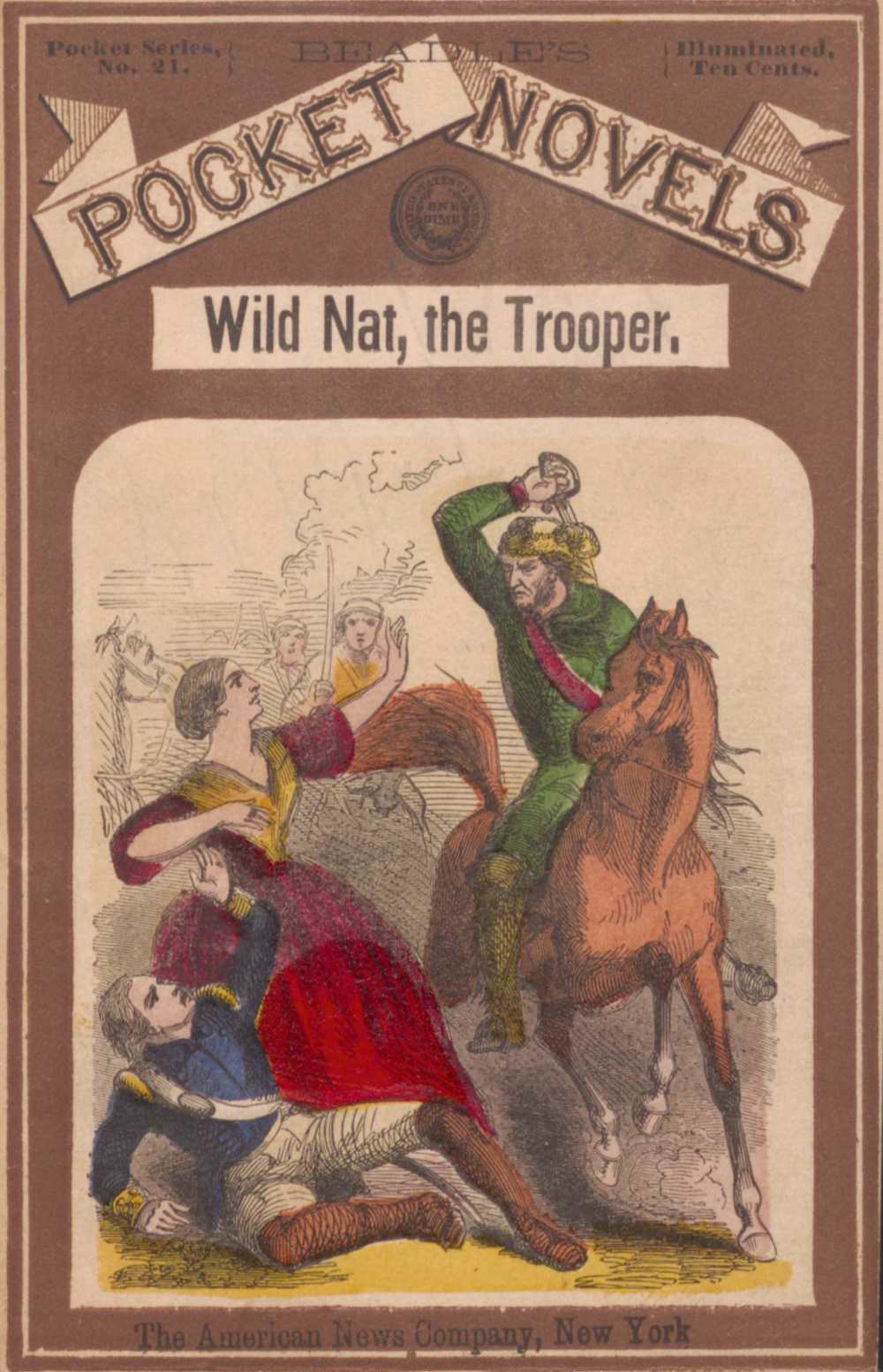
CHAPTER I. CATHERINE VALE.
WILD NAT, THE TROOPER;
OR,
THE CEDAR SWAMP BRIGADE.
There was a time in the history of our country when
the stoutest hearts were filled with despair. The defeat of General
Gates, followed by the overrunning of the Carolinas, the
treachery of Benedict Arnold, and the general bad condition
of our army, did not, certainly, tend to cheer those thousands
of noble souls earnestly praying for the success of the American
cause. It is of that period, of that darkest hour, which
precedes the day, that we purpose to write.
Toward the close of a long, disagreeable day, two women
sat by the fireside of a dwelling some fifteen or eighteen miles
from Charleston. The two presented a contrast, indeed,
even though their features were alike. One was an elderly
woman, with hair sprinkled with threads of gray, though she
yet retained much of her early beauty. The other was a
young girl, whose age could not have exceeded nineteen. Although
not absolutely beautiful, there was that about her
which made her fascinating. With features finely molded, and
a graceful carriage, her figure was a model of physical grace
and perfectness. Her hair was of that golden hue, so seldom
seen save in poet’s dreams. Her voice was as musical and
clear as the notes of a flute. Not in all that land of fair
women could be found a more truly lovable woman than
Catherine Vale.
Catherine and her mother were conversing earnestly together.
“It is not for me, Kate, to judge of the heart of a man; to
say that this one is to be trusted, and that one not, without
an acquaintance of longer standing than that between
myself and young Ernshaw. Without having heard that he
was vicious, it has often been told me that he was of unsettled
disposition; that he is known to the neighbors as
‘Wild Nat.’ Such a name would never have been given a
man of reliable and good character.”
“Whatever you advise, mother, that will I do; for your
wish is law, with me.”
“Do not speak of law, Kate; all I do is for your own happiness.
If I thought you would be happy with Nat Ernshaw,
I would advise you to receive his addresses; as it is, I say
wait. Be not too hasty, for time and circumstances will do
much to place all things in their true light.”
“I will, mother; I will try him, and prove the strength of
his affection. These are perilous times, and times, too, that
bring out the good in a man’s character, if there is any
good in it; and something may happen which will give you
more favorable impressions of Nat Ernshaw, than you appear
to entertain now.”
Catherine turned away and busied herself with her household
duties. Mrs. Vale gazed with pride upon her daughter, and
sorrowfully murmured, “It would be a sad thing for my dear
child to throw herself away on such a fellow as ‘Wild
Nat.’”
Mrs. Vale’s husband had been dead some fifteen years. He
left her the legacy of two fair children, upon whom all her
hopes were centered. The son had now grown to be the hardy
man of two-and-twenty, and Kate, the belle of the region,
had, for several years, been among the young women sought
for by the beaux of the country.
Nat Ernshaw had been on intimate terms with the family
for some years, and had long cherished a feeling of great regard
for Kate. He had an unpleasant reputation, however,
among the more staid in the neighborhood. Not that he was
absolutely vicious, or wedded to habits of dissipation, for he
was neither; but he had a number of, to say the least, negative
qualities, which made that prudent and self-pious class,
who have the morals of every community in their keeping,
predict that he would never come to any good. Catherine
was slow, however, to credit either the reports of the busy-bodies,
or the prophecies of the elder ones, for she had a woman’s
subtle intuitions, sharpened by a cool, clear judgment,
and she was fully conscious of all the lights and shades in
Nat’s not well-defined character. That he was one of those
who let their good qualities remain latent until called out by
some important crisis, she perfectly realized; and she had full
faith in the future. The word “wait” had no terrors in it. She
therefore resolved to abide by her promise; but, like an upright,
conscientious girl that she was, she also resolved that
Nathaniel should know how she felt toward him; if he could
satisfy Mrs. Vale, and prove his affection real, and his character
above reproach, she would have no objection to receive
him as her accepted lover, and future husband.
The frugal meal was at last ready. Catherine moved
toward the door, but before she reached it, the latch was
raised, and a tall, straight, well-featured young man entered.
“Sit down, John; Kate was just going to call you to
supper.”
“All right, mother; I feel hungry enough; and, after
awhile, I want to go over to Squire Stoddart’s. I will be
back early, though. I guess you and Kate will not be afraid
to be left alone for a little while.”
Mrs. Vale smiled as she answered, “I think not; but, John,
it seems to me that you want to see Squire Stoddart rather
often. What has he got that is so attractive? Can’t you enlighten
us?”
“Certainly, mother, if you will tell me that you are really
ignorant, and ask for the sole purpose of finding out what it
is, and not to plague me.”
“I can’t say that; so I suppose we will scarcely get the
requested information from you. Mary Stoddart is a fine
girl, John; and, if the country ever gets settled down, I would
have no objection to calling her daughter; but, now-a-days,
marrying and giving in marriage, are things which had best
be deferred.”
“If we wait till the country gets settled, I am afraid we
will all be old and gray-headed. I am not one of those who
believe in deferring to some future time what can be done
now; and as soon as Mary will consent, you shall call her
daughter. I know you will have no objections.”
Running on in this manner, the three kept up the conversation
until the meal was over; then John, after finishing up
his evening’s work, wended his way in the direction of Mr.
Stoddart’s.
Hardly half an hour had elapsed, when the sound of a
horse, coming at a full gallop along the road, was heard. The
traveler, whoever he was, reined in at the widow’s door. Dismounting,
he tied his horse to a tree. To the surprise of Mrs.
Vale, who had answered the knock, the person was none other
than Nat Ernshaw. She greeted him kindly:
“Come in, Nathaniel; come in. We have seen no one who
could give us any news for over a week; and, as you seem to
have come from Charleston, you can tell us what is going on.”
“I am ready enough to come in; but as for giving you any
news of what is going on in Charleston, it is something I am
unable to do. I haven’t seen the inside of the place for three
or four weeks, and I don’t expect to see it until these Britishers
are driven out.”
The good dame closed the door as he entered, and motioned
him to a seat.
“I’m much obliged to you, Mrs. Vale; but, to tell the
truth, I hardly have time to sit down. I called to see John,
and have a few minutes’ talk with him. If you could tell me
where I can find him I will look for him, as I see he is not
in the house.”
“What do you want of him, Nat? I am afraid you want
to lead him into some mischief.”
“I can not say whether you will call it mischief or not; I
am willing to tell you what I wish to do, and I think you will
approve of it. These are stirring times, Mrs. Vale, and it’s
the duty of every one to do something for the country. The
wolf is at our doors, and it’s our duty to drive him away. A
number of us are about organizing a troop to fight for our
homes and liberty. I know that you and John believe, as I
do, that the colonies are in the right; and I came over to-night
to see if I could not get John to join us. Every one is
joining one side or the other; and, unless we make a vigorous
stand now, it will soon be too late.”
“Nathaniel,” said the widow, “you know that John is the
main support of my old age; that he and Catherine are all
that keeps me here. Were they gone, I would not wish for
life. Is not the cause of freedom hopeless? Have not our
countrymen been beaten at all points? Is there a chance of
success left to hang a single hope on? What good, then, will
it do for John to risk his life for the sake of continuing a little
longer a struggle which must soon end disastrously?”
“‘While there is life there is hope,’ as the doctors say, Mrs.
Vale. You speak truly, when you say the case is desperate;
but that it is hopeless, I deny. While there remains a thousand
swords and a thousand stout arms to wield them—while
there are a thousand brave hearts that pant for liberty, and
liberty only, the cause of American Independence will not be
given up without a last grand struggle. We must be successful;
and, though our lives are given to establish the nationality
of the colonies, the sacrifice must not be grudged.”
“Nathaniel Ernshaw, you speak like a patriot, and you
must feel like one. I but tried you when I spoke of our cause
as hopeless. John is anxious to go to the fray; but his love
for me has kept him at home. He shall be kept here no
longer. Count on him as one of the company, and, if he falls
fighting for liberty and his country, think not I will ever
reproach you for having asked him to enter the paths of
danger.”
“I thought you would feel so, and I believe John is as enthusiastic
as yourself; but his love for you had kept him from
joining the army, knowing that, at any moment, he might be
ordered away from you. Now the case is different. The foe
is in our midst. We can see them from our own door-steps,
and we must battle for the defence of our firesides.”
At this moment, Catherine, who had been in the other
room, entered. With a pleasant “Good evening,” she shook
hands, and, taking a seat, she resumed the knitting which she
had relinquished to prepare supper.
From a discussion of the state of the country, Nathaniel
turned to talk of other matters, spoke of what was going on
about them, and thus passed a pleasant half-hour. Finally, he
rose from his seat, remarking:
“To tell the truth, I must leave now, although I should
love well enough to stay here a little while longer. If I was
certain that John would be home soon, I should wait for him:
but, as it is, I think I shall ride over to Squire Stoddart’s—where
I take it he is—and have a few words with him. It is
important that I speak about the organization now, as we will
hold a meeting to-morrow night.”
Catherine accompanied the young man to the door, and
remained talking with him for some time. When she returned,
the color had risen in her face, but she quietly took her
seat, while the clattering along the road told that Nat was
making all possible speed in the direction of the squire’s.
CHAPTER II. THE TORY SPY.
No man is so base as he who deliberately takes up arms
against his own country. Such a one is fit for any deed,
however mean, cowardly, or wicked. Unfortunately, traitors
have been found in every country, in all times; nor were they
wanting during the American Revolution. While there were
a number of honorable men who, believing that the colonies
were wrong in revolting from the king, did not take up arms
against them, on the other hand there were numbers of base,
sordid wretches, who were willing to cling to any side so that
it was the strongest—to support any cause so that it was one
which promised them booty. Such a one was Timothy
Turner, who followed the fortunes of the British, who was
devoted to their interests, who had, in short, sold to them his
very soul and body for paltry gold.
Although the character of this young man was not fully
known, yet suspicion rested upon him, and the Whigs had
formed unfavorable conclusions which were not long wanting
a justification. He lived in a small cabin, about half or three-quarters
of a mile from Mr. Stoddart’s; and, though ostensibly
he supported himself by tilling a small patch of ground, yet
the dullest mind must have perceived that a support from such
a spot was simply an impossibility.
On this night, Timothy Turner was wending his way home
from a tavern which stood on the road about three-quarters of
a mile from his house. As he turned from the door, he thought
he heard the sounds of a rapidly approaching horseman.
Pausing for a moment, to see whether his ears did not deceive
him, he discovered the dusky figure of the rider. As he passed
the tavern, and by the light which streamed from the door,
Turner caught sight of the man. It was Nathaniel Ernshaw.
“Ha! curse him, what is he doing, riding about at this time
of night? It’s no good Wild Nat is after; blast him, if I
could but lay my hands on his carcass, I would show him a
touch of my nature. If ever I get the chance, he shall pay
dear for what he has done.”
The ruffian kept on his journey down the road, straining his
eyes to follow the fast-flitting figure before him. When Ernshaw
came to the lane which led in to Mr. Stoddart’s dwelling,
he reined in his horse, and, dismounting, threw open the gate.
Turner, who had followed as closely as possible, on seeing the
direction of Nat’s errand, stealthily drew near to the spot.
Nathaniel drew up to the house, and knocked on the door.
The knocking brought a middle-aged man to the door. Holding
a candle above his head, he took a careful survey of the
visitor.
“Why, Nat, is it you?” said the squire. “What brings
you here at this time of night? Come in.”
“No, I thank you, squire. For once in my life I have
business to attend to. I was over to see John Vale, but found
that he was not home. If he is here I wish you would ask
him to step to the door for a few minutes. I have something
important to say to him.”
“Well, he’s here, sure enough; and if you won’t come in,
why I will have to send him out—that is, if he is willing.”
The old squire then entered the house again, to make Nat’s
requisition known to the son of his neighbor. Timothy
Turner had, in the mean time, approached to within hearing
distance, and now stood ready to note every word that was
uttered. He scented gold and revenge in the issue of that
interview.
John Vale soon made his appearance. The two young
men shook each other cordially by the hand. The conversation
which ensued it is unnecessary to detail. Every word
of it was overheard by the spy. When, at length, John
expressed his determination of joining the company which his
friend was raising, Turner rubbed his hands in high glee, as
he muttered to himself:
“You shall find out, Mr. John Vale, and you, Mr. Nathaniel
Ernshaw, that Timothy Turner is not the proper man to slight.
This intelligence is worth ten golden guineas to me, and the
revenge besides.”
“As my mother approves of it, I’m with you, Nat. When
and where do we meet? Let me know the rendezvous, and
trust me but I’ll be there.”
“There was some talk,” replied Nat, “of meeting in the
swamp, but that is too far for the most of us. So that is out
of the question; but you know Clingman’s mills and the pine
woods that run back from the creek. If you enter the woods
by the path immediately opposite the mill, you will find a
small clearing. That is the spot. Be on hand by ten o’clock
to-morrow night, and I promise you that your eyes will be
gladdened by the sight of thirty young men, all good, stout
patriots—ready, if need be, to die for their country.”
“And I can assure you,” said Turner, to himself, “that
you’ll see the greater part of them do so, unless something
very unexpected prevents it.”
“You can depend on me, Nat,” said John. Again shaking
hands, Ernshaw mounted his horse, and galloped away.
Turner waited until the clatter had died away, and then
silently hastened in the direction of his dwelling. Arriving
there, he sought the shed which covered his horse. Hurriedly
saddling the beast, he rode off toward the city of Charleston,
twenty miles distant.
Gen. Clinton, the military commander in Charleston, had
scarcely arisen, on the following morning, when his servant
announced a man waiting to speak with him.
“Who is he?” was the general’s inquiry.
“He says that his name is Turner—that he rode twenty
miles last night to bring you an important piece of news.”
“Turner? Then I think I know the man. He is one of
those tory hounds we find it necessary to use. I’ll vouch for
it, he is planning some piece of rascality. Admit him.”
The servant retired and returned with Turner. Gen. Clinton
surveyed the fellow for a moment, then addressed him
rather sharply:
“How now, sir? What have you to say? It should be
something of importance to cause you to journey so far and
fast.”
“It is of importance,” rejoined Turner. “I heard at a late
hour, last night, of a meeting of rebels which is to take place
this night. There will be thirty or forty of them, and their
purpose is to form a brigade to act with Marion, Sumpter and
others. I know the names of but two; but, if the rest of the
men are as good as they, the band may do much injury to the
king’s cause.”
“What are the names of these two of whom you speak?”
“Nathaniel Ernshaw and John Vale—two most desperate
men, and fit to do any thing against the followers of the king.”
“Ernshaw? I have heard that name before—where, I can
not say. This thing shall be attended to. I will see that
measures are taken to cut them off; but where is this meeting
to be held?”
“About twenty miles from here there is a building called
Clingman’s mill. In a wood immediately behind this the
rebels are to assemble. I will lead any troops which you may
send to the spot.”
“How many of them did you say that there would be?”
“Between thirty and forty. Whether they will be armed
or not, I can not say, but I do not think they will be. Some
of them may have their rifles, but I have no doubt fifty of
your men could take the whole of them alive.”
“Be in readiness, then, to act as guide. Or stay; I will
see you again this morning. Come an hour before noon. If
your intelligence proves correct you shall receive a suitable
reward.”
Gen. Clinton rang the bell for his servant to show the tory
out. The man who performed this duty was a negro whom
Gen. Clinton had received into his service since his arrival in
Charleston. He was an intelligent-looking black, who had
ingratiated himself into favor, and now seemed to be almost
a necessity with the general.
As Sampson opened the door for the exit of Turner, he
shrugged his shoulders in a manner which told that it was
displeasing to him to be compelled to do any service for such
a man. Hardly had the body of the tory crossed the threshold
ere the door was violently closed behind him. The black
returned to his master, and busied himself preparing for his
master’s breakfast. Having partaken of this meal, Gen. Clinton
left the house, turning his footsteps in the direction of a
dwelling inhabited by a rich and influential tory.
Sampson passed quickly out by the back door, and, crossing
the garden, emerged from it into the street. Walking rapidly
along for some squares, he at length turned into a somewhat
obscure alley. A few steps brought him to the front of an
humble-looking dwelling, at whose door he gave a few taps.
His summons was quickly answered, and a middle-aged
woman threw open the door.
“Is it you, Sampson?” said she. “What brings you here at
this time of day? Any thing important?”
“I guess mebbe it is. Whar is Simon? I got suthin’ to
tell ’m.”
“Simon is here, if you would see him; so come in.”
The black entered the cabin, and found himself in the
presence of the person he was seeking, an honest-looking
mechanic, whose eye and bearing betokened the fearless man.
“Whatever brings you here must be of importance, Sampson;
so tell us at once,” said the mechanic, or Simon Hunt, as
was his name.
“Thar’ ar’ no one here who oughtn’t to har a secret, is
thar’.”
“Trust me for not harboring any such about my house.”
“Listen, then. This mornin’ that Timothy Turner came to
see the general, an’ tell him ’bout a meetin’ o’ whigs that was
to be held to-night, and so the general ’l send down a lot o’
his sodgers and chop ’em all up. If you kin send ’em word
you’ll be doin’ a good thing for de blessed cause.”
“All right, where is this meeting to be held, and who is to
hold it? I must know who to send word to. Give me that,
and they shall know the game before night.”
“He on’y knows two—they be Masser John Vale and Nat
Ernshaw.”
“What? Nat Ernshaw turning whig trooper? That’s
unexpected, but I always thought there was good in the
fellow, if he only had a chance and would show it. I’ll send
my boy straight off. If he puts the spurs to the old roan’s
sides he ought to get to Ernshaw’s before dinner. Then they
have the whole afternoon in which to warn the boys not to
come to the meeting. The two that were mentioned, though,
will have to keep dark, or they will find the country too hot
for them.”
“Well, Nat kin take care on himself. Take smarter men
dan de Britishers to ketch him asleep; and he take keer o’
Massa John, too; but I think I better go. It might ’pear
s’picious if any one see me here. Good mornin!”
“Good morning,” answered Hunt. “There goes a noble
fellow,” continued he, speaking to his wife. “This is the
third time he has brought important intelligence of the movements
of the British. Where is Simon? He must start directly.”
CHAPTER III. GOING OUT TO SHEAR, AND RETURNING SHORN.
It was about one o’clock in the afternoon, when fifty
British soldiers, under the guidance of Timothy Turner, set out
for the rendezvous of the Whig partisans, going with the
avowed intention of “driving them like sheep before them into
Charleston, or else leave their mangled carcasses to rot on the
spot where they fell.”
Plenty of time was before them, for the troop was well-mounted
and could get over the distance in a few hours; but
there was danger of getting to the spot too soon. Well acquainted
with the roads thereabouts, the tory determined to
lead the men by a circuitous and rather unfrequented route,
which, though it was some miles further, afforded this advantage—none
of the whigs would thus see the body of horse, and
consequently, could not give the alarm which should prevent
the patriot muster from taking place. By it, too, he could
penetrate through the pines and station the whole force so as
to surround his unsuspecting countrymen.
Having settled his mind on this point, Timothy took the
lead, mounted on a fine horse furnished him for the occasion,—his
own being too fatigued by his morning’s journey to
permit him to take the field with it.
John Vale was just sitting down to his dinner when the
boy Simon reached his house, bearing the important message
with which he was intrusted. John immediately recognized
the lad, for he had often seen him before. Judging that he
had some very special news to tell, he rose from his seat and
followed the lad into the yard.
“If you have any thing to tell, speak out, Simon.”
“Father sent me here to tell you to warn every one not to
go to the meeting in the pines back of Clingman’s mill.”
“Indeed,” responded John, with an accent of astonishment.
“Can you tell me how your father learned a meeting was to
be held there? I did not know of it myself until late last night.”
“Timothy Turner found out about it, and rode over to
Charleston last night. He had a talk with General Clinton,
and the general is going to send forty or fifty soldiers to take
you all. Sampson, the servant of the general, heard Turner
telling General Clinton about it; so he told father, and father
sent me down here to tell you and Nat Ernshaw. You are to
tell the rest, so the Britishers will have their ride for their
pains.”
“Your father has done well, and you’re a patriotic fellow to
take so long a ride to warn us of our danger. Come into the
house and get some dinner, then we’ll go over to Ernshaw’s
together.”
Simon was tired, and a good hearty meal was most acceptable.
When he had done, the young man took down his rifle and
powder-horn from the hooks, and swung them over his shoulder,
then, turning to his mother, he remarked:—
“Perhaps you will not see me again to-day, perhaps not for
weeks. From what I hear, there is a good chance for us to
begin the campaign, and when we once take to the field, there
is no telling how long we shall be compelled to keep it. Remember,
though, that I am fighting, as is my duty, for my
country, and if I die, that I die in a good cause.”
“You know, John, that I love you and would do any
thing to shield you from harm or danger; but I rejoice to see
you going. The nation has need of such as you—those with
strong arms and brave hearts. Go, and may our Heavenly
Father guard and bless you.”
John kissed her and his sister, then left the house, turning
to the stable. He soon led out his gallant steed. Mounting,
he led the way to Nat Ernshaw’s. Nat was at home, and
catching sight of the two at a distance, surmised that they had
important business with him.
“What’s in the wind now, John?” inquired Nat. “Simon
Filby, there, looks as though he had been riding all morning,
and, I guess, if the truth be told, he was—”
“Matter enough. He has ridden from Charleston this
morning for the express purpose of saving us all from capture
or slaughter. Relate to Nathaniel the message which your
father instructed you to deliver.”
The boy proceeded to repeat his story and message. Nathaniel
was astonished; it seemed to him incomprehensible
how Turner had obtained his intelligence concerning the
contemplated meeting.
“There is something strange about this,” said he. “There
can hardly be a traitor among us, and how else the secret
could have leaked out I am unable to say. I particularly
cautioned them not to speak of it even among themselves.
But stay! I think I have it now. You say that Turner arrived
this morning?”
“Yes, sir!” answered Simon.
“Now that I think of it, I have the impression that I
caught a glimpse of him coming out of the Royal Arms, last
night, as I passed on my way to Squire Stoddart’s. He may
have followed, and by sneaking up, may have heard the conversation
that look place between you and I. We have no
time to lose. There is much for us to do.”
“I agree with you,” responded Vale. “It would be well
for us to hold a consultation. I think that, if rightly managed,
we can turn this to advantage. Our troop can be, at
the best, but poorly armed and mounted. To be of any great
service, both of these defects must be remedied. Here is the
opportunity!”
“By heavens! you are right. If we could capture or disperse
this force that is to be sent against us, we could secure
what we most need, horses and arms. Besides, it would give
the men confidence. Here is a list of names,” continued Ernshaw,
drawing a paper from his pocket; “do you hurry and
see the fifteen whose names are first on that paper. Tell
them the particulars, let them know the force that is coming,
and then fix a rendezvous at the Black Rock, a mile this side
of the mill. They must be there at sundown, armed. Leave
your rifle here, for you will be back again before night. You are
well mounted, don’t spare your horse. As for Simon, here, he
had better stay until his nag is rested, then get back to Charleston
as soon as possible. He might be missed.”
It was by no means a light task to accomplish, this visiting
thirty persons at as many different houses; leaving it undone
might prove fatal. With their patriotic enthusiasm kindled,
they bent themselves to their duty. Every one with whom
the young patriots spoke felt as they did. An opportunity
was now offered to strike for their country, and they
were willing to seize it.
Such was the expedition used, that John Vale
had returned to Nat’s, and was conversing with old Mr. Ernshaw by
five o’clock; half an hour later Nat himself returned.
In answer to Vale’s question—“how did you succeed?” he
answered:—
“Oh, admirably. Not one has shown any signs of backing
out. If your success has been equal to mine, thirty as resolute
fellows as ever looked through the sights of a rifle, or
wielded a broadsword, will be assembled at Black Rock by
sundown.”
Near the hour of sunset, an observer, had he been stationed
near the Black Rock—a spot so called from a huge black rock
which lifted its head from the waters of Cedar Creek—might
have noted the approach of a number of young men, all hurrying
in one direction. Some were mounted, and others were
on foot; all bore weapons of one kind or another—rifles, muskets,
fowling-pieces, and a few swords.
They came, too, from every direction, by twos and threes,
talking together, and apparently discussing some important
question. When the sun had finally disappeared and the twilight
had settled over all like a friendly cloak, thirty-two men
were gathered on the banks of Cedar Creek: among the number
were Nathaniel Ernshaw and John Vale. The majority
of the company were young men, none of them over thirty,—all
broad-shouldered, deep-chested, bronzed with exposure to
the weather, and as spirited as the winds which played over
their hills and valleys.
Ernshaw addressed his companions—stating that they were
well acquainted with the object which brought them there;—were
they willing to enter into a conflict with a body of men
larger in number, better armed, more used to such scenes of
blood and carnage? If they were willing let them say so. A low
but distinct “We are!” passed around. Nat continued:—
“The soldiers were to start from Charleston at an early
hour this afternoon, before this time they should have accomplished
the distance. There is another road which they must
have taken. Timothy Turner,”—at the mention of this name
a shout of execration burst from the lips of all—“I say, Turner
knows the other road, and that it leads near by the spot
where we would have held our meeting. I think I know the
exact spot where the dragoons are this moment stationed. By
going three-quarters of a mile out of our way, we may, by a
third path, come upon them unawares. Shall we venture?”
No one raised a dissentient voice; all seemed anxious for
the fray. One, however, a hardy-looking six-footer, begged
leave to say a word before they started.
“You see we’re formin’ into a troop that’s goin’ to give
thunder and brimstone to every bloody, stealin’, cut-throat of
a Britisher that we come across. You know who started this
here idea, and got it into motion, an’ all that ’ar; but thar’s
one thing that ain’t settled yet, an’ that is, who’s captain? It’s
purty generally understood that Nat Ernshaw is goin’ to lead
us, but we hain’t actooally given him the legal authority yit;
so I move that he be constitooted our captin’, an’ we all agree
to be under and obey his orders, regular soger fashion. Whoever’s
in favor of this let him speak out and tell it.”
A simultaneous and unanimous “ay!” announced that Nat
Ernshaw was the accepted and willing chosen commander of
the patriotic brigade.
“Three cheers for Ernshaw’s brigade!” shouted one whose
patriotism had overcome his prudence, and the three cheers
were accordingly given with a will. Then the whole band
took up its line of march, the men handling their weapons
with eager impatience.
Nat was busy in laying out his plans for attack. The principal
difficulty which presented itself seemed to be, how to
open the battle. He might, he felt assured, steal upon the
dragoons and shoot down a score or more of them before they
could rightly tell from whence their danger came; but there
was almost an insuperable objection to this plan—it seemed
too much like murder. After due deliberation he settled on
the course which he intended to take, and which seemed to be
most safe as well as most honorable. What it was, the reader
will hereafter learn.
When the Americans reached the path which led through
the woods, the captain addressed a few last words to his men.
Then they pressed on with noiseless steps. When Ernshaw
found they were within a few rods of the spot designated, he left
the troop and went forward to reconnoiter. Carefully peering
through an opening between the pines, he looked out. It was a
clear, moonlight night—so light that he could easily distinguish
the forms of some forty or fifty horsemen, who occupied
the area before him. Wishing to draw closer to them
to mark their disposal, a cracking stick betrayed his presence.
Every one of the waiting enemies were startled—the captain
of the troop calling out, “Here comes one of them at last.
Into the woods after him, half a dozen of you, but don’t use
fire-arms unless it is absolutely necessary. It will give the
alarm.”
Instantly seven of the privates threw themselves from their
steeds for the pursuit; but they had scarcely touched the
ground when a command, given in a quick, clear-ringing voice,
riveted them to their places. “Hold! Not one step or you
are dead men. Surrender to Nat Ernshaw’s Carolina Brigade,
or your lives shall be the forfeit!”
For a time a panic seemed to thrill the hearts of the Britons—this
command so unexpectedly, so sternly given.
“It’s but a ruse my men,” shouted the captain. “First
rank fire a volley, then charge into the woods.”
“Fire away. We will return volley for volley, and the
man who stirs from his tracks dies,” responded Nat. Then
turning to his men, who had ranged themselves in solid rank
behind him, he gave the command:—“Make ready, advance,
take aim, and be ready.”
A murmur ran along the ranks. The clicking of thirty
rifles sounded out on the still air. The British troops had
quickly formed, and, at the word of command, they sent a volley
from the carbines with which the dragoons were armed,
into the patriot ranks.
“Fire!” shouted Nat. The combined crack of the thirty
rifles rang out with a fearfully startling sound. The hail of
lead was deadly in the extreme, though its effect was not as
severe as it might have been had it gone hurtling forth in the
daytime. Many a bullet proved a messenger of death to the
mercenaries of the foreigner.
Sixteen of the troopers dropped from their saddles, dead.
The captain received a ball through his shoulder. Eight
others were severely wounded. With that marvelous celerity
gained by practice, the Americans had reloaded their rifles.
“First division, fire!” commanded Ernshaw. Another volley
sped on its mission of blood, and half the remaining troopers
tumbled from their saddles, while their maddened and frightened
horses flew wildly away into the woods.
“Fly,” screamed a Briton. “We cannot remain longer
here and live!”
“Hold!” cried the leader of the Americans. “Throw
down your arms and surrender and your lives are safe; attempt
to flee and we give you another volley.”
Hardly had the summons to surrender been given, when the
few of the soldiers who still grasped their arms threw them down,
and the captain, faint from the loss of blood, answered:—“We
agree. Come forward and receive our surrender.”
The Americans stepped from the shade of the woods and
stood in a line, waiting for the commands of their captain.
As Ernshaw appeared, the crack of a pistol was heard, and a
bullet whistled by close to his head.
“Missed! by the infernal!” shouted a voice, easily recognized
as that of the tory Turner. He plunged into the gloom
of the woods, unappalled by the dozen bullets that followed.
“The tory, Turner!” remarked one of the men; “let us pursue
him. His capture is of more importance than all else we have
done.”
“Not so,” replied Ernshaw; “let no man go in pursuit.
It would be impossible to come up with him, and our force
would only be separated, which must not be.”
A little murmuring followed, but all soon saw the wisdom
of obeying the captain, and, accordingly, quietly acquiesced.
General Clinton was sitting in his chamber, busily engaged
in examining a number of parchments which lay exposed on
the table before him. It was now well on toward noon.
Though apparently intent on his work, his mind evidently
was not at ease. “It is strange,” he muttered to himself,
“that nothing has been heard concerning Captain Morgan and
his troop, whom I sent out to capture those rebels. I told
him to endeavor to take the young man, Vale, alive, if possible,
and send me word immediately. One of his men would
have arrived, ere this, had he chosen to obey my commands.
I will see, though; perhaps there is some news stirring without.”
He advanced to the door for the purpose of calling his servant,
when a loud knocking arrested him. He stood for a moment
listening, and then sank back in his chair, remarking,
“There is some one at last.”
The door was flung open to admit the tory spy, Timothy
Turner. With a pale face spattered with blood, and his left
arm supported in a sling, he strode across the floor, and stood
confronting the general. For a moment Sir Henry looked at
him with a countenance indicative of surprise and apprehension;
then he burst forth:
“How now, sir? What brings you before me in such
plight? Speak, man!”
“It is easy to tell the whole story. We went out to shear,
and come home shorn—or, rather, I do, for I am the only one
who escaped. All the rest are dead, or prisoners!”
“Then you deceived me, and I shall see that you receive
your reward for so doing. Without there, Sampson!”
“You needn’t put such a sorry face on the matter, general,
for the information I gave you was correct enough. The
trouble was, that the rebels got wind of our intended attack,
hid themselves in the woods, and, when the moon arose, came
down on us as they would on a covey of partridges. If I
had wished to deceive you, I should have taken better care
of myself, and this left arm would not have had a rifle-ball
through it. I remained till every thing was lost, fired the
last shot, and then cleared out, with half-a-score of balls flying
around my head. If that looks like treachery, then call
in your men and do as you like with me.”
“Probably it is as you say, and I was overhasty. The
king can not afford to lose such friends as you. There is gold
to heal your wounds. Leave me, now, for I have important
business to attend to.”
Turner pocketed the purse which Sir Henry threw upon the
table, and, making a low bow, left the apartment.
Ten minutes later, Sampson, the black servant, entered,
bearing a card, with the name, “Captain Reginald Preston,”
written thereon. Receiving the command to admit him, the
gentleman soon made his appearance. He was still a young
man, not over thirty, and, by some, would doubtless be called
good-looking; but a close inspection would tend to dissipate
any favorable opinion which might be hastily formed. Though
well dressed, with all the appearance of being a gentleman,
his features wore the stamp of a life of profligacy, the effects
of which, the strength of a good constitution was unable to
ward off. Of good family, though a younger son, he had
once been possessed of quite a fortune, which he squandered
away amidst the splendid gayeties of London life, and was
now recruiting his health and fortune in the service of the
king. Such in appearance was Reginald Preston, the visitor
of Sir Henry Clinton.
He approached the general in a careless manner. Shaking
hands with the superior officer, he took a seat.
“I received your note,” remarked Preston, after a silence of
some minutes, which he spent in curiously eyeing the papers
on the table. “I could not quite understand the drift of it,
but here I am to receive the explanation, which you promised
when we should meet. I send out my application for exchange
by the next ship, and have a fair prospect of leaving
this miserable country; so don’t send me where I will be
killed off before I get a chance to enjoy this fortune of
mine.”
“Perhaps it may be as well to stay here. You never could
live in London without money, and your pockets are not particularly
replete with that article.”
“I know they haven’t been; but this little fortune I was
speaking about is sufficient to keep me floating until I can
carry off a rich wife. Three thousand a year is not such an
insignificant sum.”
“It is concerning that ‘small fortune’ that I wish to speak.
If you will take the trouble to recall the words of your letter
from Thompson & Smith, you will remember that they stated
the fact in nearly these words: ‘Although, at the present
time we can scarce speak with absolute certainty, yet, we have
the pleasure of announcing, in all probability you are heir to
an estate of three thousand a year. We would not advise
you to announce this as a fact, until we discover whether
there be any nearer relatives to the deceased than yourself.
At present, we know of none.’ Are not these the words?”
“I must confess that you are better posted in the matter
of the letter than I am. If you ask my opinion, I should say
they are the precise words.”
“Well, then, listen. By these papers which you see upon
the table, it is announced that a nearer relative to the gentleman
who left the property has been discovered, and that your
chances of again shining in London life are decidedly slim—for
the present, at least.”
The careless expression which had been resting on Preston’s
face, suddenly vanished under this, to him, remarkably unpleasing
intelligence.
“Good heavens, general! You do not mean to say that
all my plans are to be disarranged, and hopes blasted in this
shockingly disagreeable manner. Those Thompsons and
Smiths must be a set of thorough-faced rascals. As to my
uncle’s leaving any relatives outside of our family, and nearer
than myself, I am sure it’s a mistake, or else a trumped-up
claim. His wife died forty years ago, and his only son was
killed among the Indians, nearly as long since.”
“You have hit the right nail on the head, to use a vulgar
expression. That son is the person to whom I refer. It
seems that he was not killed by the Indians, and lived long
enough to raise a family. He is dead now, but there remains
a son and daughter, not to speak of his wife. Your uncle
took it into his head to turn this only son out of doors; that
was what caused him to come to America; but, as he left no
will, the estate naturally enough reverts to his grand
children.”
“And who are these grandchildren?”
“The grandson is John Vale, one of the rebels whom we
endeavored to capture yesterday night.”
CHAPTER IV. THE WOLF AND THE LAMB.
“So, he is nothing but one of these cursed rebels, after all.
If that is the case, my chances are not so desperate as you
seem to think. If Captain Morgan succeeded in doing his
duty, he is doubtless in custody now, if not dead. Of course
I speak of the young man; I have no fears of the old woman
and her daughter.”
“Captain Morgan did his duty to the best of his ability; but
I am sorry to say that John Vale is not only not in custody,
but that, on the contrary, it is Morgan and his command—that
is, those of them that are still alive—who are the prisoners.”
“You can not mean to say that a troop of dragoons has
been defeated by a squad of these half-mounted, half-armed
rebels?”
“I mean to say just that; and I now order you to take
your troop and proceed to the spot to bury our dead. No
doubt the Americans will be in such haste to leave, after their
victory, that they will have left the corpses still exposed.”
“And after that, what remains to be done?”
“You will leave the spot and return some miles. There
are two whigs, whose houses are close together; their names
are Phillips and Tappan. Take up your quarters with them
until I send you further orders. It will be necessary to have
a force in that vicinity, and your work will soon be ready for
you.”
“Then I must hold myself ready to begin the extermination
of the rebels. I go; but I have misgivings that it will
be no child’s mission.”
“Good-morning, then.”
“Au revoir! ” and, with a graceful wave of his hand, Reginald
Preston departed.
Hastening to his quarters, he found that the news of the
defeat of Captain Morgan had preceded him. On leaving
the presence of Sir Henry, Turner had been active in spreading
the story of the defeat. He found the men now anxious
for a brush with the “rebel dogs,” as they styled the patriot
brigade.
When the duty detailed was confided to the soldiers, they
were enthusiastic enough, and set up a shout. In an hour
from the time Preston bade adieu to General Clinton, he was
on the road, having Turner with him as guide.
The arm of the tory was not, by any means, seriously injured;
and the prospect of more gold made him ready to encounter
danger again, although he had but lately so narrowly
escaped death. They had not ridden far, when Preston expressed
a wish to have some conversation with him, and the
two rode on some distance ahead.
Whatever it was that Reginald wanted, it seemed as though
he found some difficulty in getting at it. After some questions
of no moment, he began to speak of the Vales. If he
was desirous of knowing the history of the family, from the
very moment when the head of it first put foot within the
State, he could have found no more fitting person to inquire
of. Turner had made them a study, it would seem; and the
questioner soon learned a great deal more than it was pleasing
for him to know. There was no doubt, now, in his mind, but
that John Vale was his uncle’s grandson, and fully entitled to
the possession of the property which he had fondly hoped was
to become his own. Although the young man was a rebel to
the crown, he was afraid that it would not invalidate his title
to the estate. Although John Vale and the rest of the family
might be attainted, yet he well knew that a large proportion
of the money was in the hands of Americans, and probably
they were whigs.
What thoughts passed through his brain in the course of
that ride, it is hard to state; but, long ere the journey’s end
was reached, his mind was settled as to the course to be pursued.
The fortune he would have, and Turner should be the
tool through which he should reach it. Riding side by side
the now deliberate villain and his tool occasionally spoke together,
but Preston was too much engaged in perfecting his
plans to ask more than an occasional question; while Turner,
cunning, and quick of divination, had a partial clue to what
was in the mind of the British partisan.
When the British reached the spot on which the conflict of
the preceding night had taken place, they found all traces of
the struggle removed. Four or five newly-made mounds testified
that the rebels were too brave and generous to let the
corpses of their foes remain festering in the sun. Here and
there, among the short grass, deep red stains and pools of coagulated
blood marked the spot where the men had fallen; a
broken plume, a glove, or a torn epaulet—these were the only
signs of the slaughter. Horses, men, arms—all had disappeared,
and the Britons had the consolation of knowing that
when they should meet this brigade of rebels, they would
find them armed with tried weapons of Great Britain’s own
furnishing. The men looked mournfully around; for soldiers
have hearts, and are capable of warm attachments; and here
many a comrade, with whom they had spent many happy
hours, had bit the dust.
Preston marked the direction which Ernshaw had taken,
for his trail was plainly visible; but, as his orders were to
retire toward Charleston as soon as he had performed the last
sad offices for the fallen, he dared not go in pursuit although
his men were eager enough for a fray. Disappointment was
plainly visible on more than one face, when the order came
for a return, but no murmurs were raised. Slowly the procession
emerged from the woods, and crossed Cedar Creek,
taking the road which led toward the farm-houses, where Captain
Preston was to take up his headquarters.
Mrs. Vale had, long ere this, heard the result of the conflict,
for her son had returned at early dawn. It was to stay
but for a moment, however, for he knew that now home would
be no place for him. A company would be sent to revenge
the defeat of Captain Morgan as soon as intelligence would be
received by the commander at Charleston; and, as his house
lay on the road, it would be dangerous to be near it.
When the troop had arrived opposite the door, Reginald
gave the command to halt, and ordered half-a-dozen of his
men to dismount, and search the house. Though it was improbable,
it still was not impossible that some of the rebels
might be found within it. Catherine and her mother were
sitting sewing, when the door was rudely flung open, disclosing
the red-coated soldiers who stood at the threshold.
With calmness Mrs. Vale arose, and advanced a step
toward them, saying, as she did, “What do you want, sirs?”
The men replied by entering the room first; then, one of
them said: “To search the house to see if there be any
rebels laid away within it.”
“One of you will be sufficient, then; you will find nothing
within its walls which it is not right that an honest woman
should have.”
“And your son—is he within?”
“He is not; but if he were, it perhaps were as well for
you to defer the search, for he is not one who willingly permits
liberties to be taken with himself or his house.”
The answer that was given to this rather fiery speech of
the good woman, was a fierce scowl, and then the men spread
themselves over the house. It was soon evident that those
whom they sought were not within, and they passed out.
Reaching the yard, a large-sized dog was standing in the pathway,
regarding them with a look which might well pass for
one of intense astonishment. The foremost soldier, not liking
the looks of the animal, and having a deep hatred for
any thing American, drew his sabre and made a stroke at the
unflinching dog as he neared him. The sudden attack, and
the pain of a slight wound, caused the dog to bound aside
with a sharp cry; but, almost immediately he turned, and,
with lips drawn back over his teeth, was about to spring upon
the offender.
Catherine, who had hitherto remained seated, hearing the
cry rushed to the door. In a moment she detected the true
condition of affairs. At the sound of her call Lion forgot his
purpose, and, with a quick bound, leaping by his would-be
slayer, stood by the side of Miss Vale.
Captain Preston saw what had transpired, and called to the
man to relinquish his purpose—for he had turned as if to follow
the creature. With a surly obedience the fellow obeyed.
With a low bow to the fair young girl, who still stood in the
doorway, the captain struck spurs into his charger’s sides, and
galloped away, his men following at the same rate of speed.
Catherine and her mother gazed after them, and, as the maiden
caressed the shaggy head of Lion, she gave vent to her feelings,
by saying to her mother in a low, half musing tone:
“Notwithstanding all the cruel deeds that have been committed
by these foreign soldiers, there seems to be a little good in
some of them. So they would kill you, my brave Lion, for
trying to defend your home? You must be more careful next
time, or you may get yourself into an unpleasant difficulty,
from which you can not come with a whole skin.”
The dog shook his head gravely, and looked up into the
face of his mistress, as though he understood the advice given
him, but was rather uncertain, whether or no he should take
it. He gave a low bark and wagging his tail threw himself
on the floor, while Catherine resumed her sewing.
Great was the consternation of the good old whigs,
Phillips and Tappan, when a troop of British cavalry came
dashing along the road, and drew up in front of the dwelling
of the former. In answer to a heavy knock, the old man
himself came to the door. Reginald Preston related to him
the orders of General Clinton. Where he could find accommodations
for thirty or thirty-five men, was a question that
puzzled the good old man for a time, but he consoled himself
with the thought that he would be no worse off than his neighbor
Mr. Tappan—toward whose house the remainder of the
troops were being led by their captain.
As there was no possible good to be gained by demurring,
Mr. Tappan, like Mr. Phillips, obeyed the order of his uninvited
guests with seeming alacrity, and did his best to ingratiate
himself with those who had the power to resent any fancied
ill-treatment.
Captain Reginald had a room set apart for his use in Mr.
Tappan’s house, but, as the two whigs were near neighbors, he
was not separated from the rest of his command, by more than
two hundred yards.
As he retired for the night, he murmured to himself: “I
must really find some way of becoming more intimate with
that pretty cousin of mine, for, though not beautiful, she
pleases my fancy most mightily. I have half an idea that it
would pay to marry her, and settle down in this cursed country!
With her share of the fortune, I could become quite a
respectable farmer. How it would look! The honorable
Reginald Preston driving a couple of plough horses.”
CHAPTER V. CEDAR SWAMP.
Nat Ernshaw had not a very definite idea of what was to
be done when he organized his brigade. His intention was
patriotic,—to assist his country in retaining her independence,—but,
how it was to be done was not particularly clear at the
outset. To wage war against the bands of armed tories,
which were constantly being formed; to take as prisoners any
straggling British, and to attack and cut to pieces all troops,
hostile to the great cause, whom he should chance to meet;
these were the objects contemplated when working to form
the brigade. His signal success in the outset had been inspiriting
to his men as well as to himself, and they were now willing
to obey his orders, with a confidence which an untried
leader never inspires.
One of the great objects sought for was accomplished in
the defeat of the dragoons; his men were able to mount and
arm themselves well. Feeling not the least compunction in
spoiling those who had come to spoil them, the arms and
equipments of the conquered foe were quickly appropriated by
the conquerors; and, having buried the fallen, the whole party
held a consultation. It was decided to be unsafe to disband,
and that it would be better to fall back to Cedar Swamp.
From thence, the troop could send out scouts, who might learn
whatever was going on, and bring intelligence of any place
where their services would be of use.
Although the prisoners were a burden, still, there was a
disinclination to let them go. Accordingly, it was decided
that they also should be carried to the Swamp, as they might
be at some future time, serviceable for exchange. By morning
the troop was plunging into the hidden recesses of Cedar
Swamp.
One might search in vain for a better place of rendezvous,
surrounded on the outside by a swamp which it was almost
impossible for a footman to pass, much less a horseman. There
was, within, a cordon of thickly interwoven bushes and stunted
trees; then another ring of swamp, and, finally, in the
center, a spot of solid ground, some fifteen acres in extent,
studded here and there with tall trees. One track there was,
winding and intricate, along which the Americans found their
way under the careful guidanceship of John Vale. It differed
not in its appearance from the adjoining swamp; but, under
the wet, miry earth, at the depth of six or eight inches, there
was solid footing.
As it was uncertain how long they would remain in this
place, and as the swamp would always be their place of refuge,
on which to fall back, it had been determined to construct a
few huts, sufficient for the accommodation of the whole brigade
and their prisoners. Brawny arms were bent to the
task; and, long before nightfall eight small cabins were to be
seen, lifting their humble roofs which were rendered
quite impervious to inclement weather. Several of the men had
been dispatched to their homes to procure provisions, and
make arrangements with their families, by which supplies
could be obtained during their stay in the Swamp.
Five days have passed. During that time Captain Preston
has been quartered at the house of Mr. Tappan. It
was a heavy thing for the old patriot to bear this, being compelled
to furnish food and drink to the enemies of his country,
but, no murmur was allowed to escape his lips; he knew too
well what might be the consequences of an unguarded expression,
to allow himself or family to give vent to the feelings
which were struggling for utterance.
Understanding his restless disposition, one would suppose
that Preston’s hours would hang heavily on his mind, yet,
that was far from being the case. The tory, Turner, all concealment
as to his principles, having been thrown aside, was
frequently with the captain holding secret conferences. To
what these conferences referred, the reader will learn by a
further perusal of our story. The last two days, also, the
captain had been absent during the afternoon—had his steps
been marked, it would have been found that he rode in the
direction of Mrs. Vale’s. Reginald seemed to have taken a
sudden fancy for his cousin.
This relationship had not thus far been referred to. On the
part of Mrs. Vale and her daughter it was never suspected—how
could it be, when the name of Preston was totally unfamiliar
to her ears? The visits of the captain had been a
source of uneasiness to the two. For, although he seemed to
have stopped by accident, yet a mother’s heart is not the
thing to be deceived by a smooth speech, and a well-coined
lie. She trembled as she thought of the dangers which the
presence of the unwelcome visitor foreboded.
With an unusually warm smile upon his face, Reginald rode
up to the house this afternoon. He stated, that, being in want
of something to occupy his time, he thought he would ride
over and inquire how Miss Catherine’s pet was progressing.
The cut which Lion, the dog, had received was severe, and
the noble animal was consequently an object on which he
might exercise his commiseration.
Captain Preston was received with a cool welcome. Mrs.
Vale was polite—freezingly so; and Catherine, while she did
not manifest decided displeasure, did not seem to be overjoyed
at his presence. The gallant captain had not created
a very good impression in his three visits.
With a pertinacity, by no means pleasant to the uninvited
guest, the widow kept her seat, nor once offered to leave the
room, while Kate seemed deaf to the hints which were thrown
out concerning the state of the garden, the agreeableness of the
weather, and the propriety of exercise. The nimble fingers
plied the needle most rapidly, while answering the numerous
questions of Reginald. As he did not think it best to
commence an offensive warfare upon women, the chances of any
private conference with his fair cousin, seemed, to Preston, to
be small indeed; so small, that the thought of incontinently
beating a retreat, more than once crossed the Briton’s mind,
but was as often dismissed; he could not—he would not give
it up so!
At length, insensibly as it were, Mrs. Vale was drawn into
conversation. The young man had an insinuating manner
that was hard to resist, and he taxed his conversational powers
to entertain these, to him, simple folk, quite as much as he
had ever done to rivet the attention of some wealthy belle, in
the days when he flirted in the London salons, and was an
honored guest at the table of the richest and most distingué
families of the aristocracy. So much did the widow forget
herself, that she actually asked the visitor to remain for tea,
when she saw him preparing to leave about half an hour before
the regular time for that meal. Gratifying as it would,
no doubt, have been to the young man, he was, nevertheless,
compelled to decline—he had an engagement which it was
necessary for him to meet; he did not, however, state this as
an excuse, but simply declared his inability to remain.
When Preston had departed, the impression he left behind
was rather favorable than otherwise. Kate’s heart told her he
was one to be feared rather than respected, and that these
visits boded no good. On the contrary, the mother’s first
suspicions seemed allayed, and she expressed a fear that she
had hastily formed a bad opinion of the honest young man,
as Captain Preston appeared to be. He promised her dwelling
protection from all foraging parties belonging to their line.
As a general rule, it is wisest not hastily to change first-formed
opinions. Mrs. Vale saw into the true character of
Reginald almost the moment he crossed her threshold, but suffered
her vision to be obscured by the curtain of plausible
conversation and insinuating manners, of the shrewd man of
the world. She was not the first mother who had been flattered
into silence in the same manner!
CHAPTER VI. HOT WORK AHEAD.
Two weeks have elapsed since the time when Nat Ernshaw
first formally enrolled the names of the volunteers, who
wished to fight under the continental banner. During that
two weeks they have not been altogether idle, for, in addition
to the discomfiture of the troop of dragoons, they had attacked
and dispersed some fifteen or twenty tories who had assembled
at a spot about nine miles from the swamp.
It may, at first, seem strange that the Americans did not
make an attack upon the detachment of soldiers which had,
for over a fortnight, been holding, as a barrack, the houses of
Tappan and Phillips. No doubt they would have been willing
enough to attempt an expulsion, had there been a probability
of success. Nat considered that his force of thirty-five or forty
men would hardly be able to cope with fifty or sixty, unless
the larger party could be taken by surprise. Though a scout
had been for days watching the houses, it so far seemed as
though nothing could be done.
It was late in the evening, and the sun’s last lingering rays
had long since ceased to tinge the western horizon, when the
majority of the patriot soldiers were already “turned in,” that
Capt. Ernshaw was startled by hearing the low, long-drawn
whistle of the sentinel stationed at the outskirts of the swamp.
The signal implied that something important was to be
communicated. Thrusting a pistol in his belt, Ernshaw left
the hut and traversed the—by no means safe—path that led to
the willow-trees under which the sentinel was stationed.
As he neared the spot, it could be seen that the guard had
left his place of concealment, and was engaged in talking with
a young lad. The boy, who was mounted on a speedy-looking
roan mare, had evidently ridden far and fast.
“Why, Simon, is that you?” queried Ernshaw, as he shook
the boy by the hand. “What has brought you away out
here in such a hurry? Something important, I’ll be bound.”
Simon nodded a recognition as he handed a letter to the captain,
saying: “I should think it must be important, for father
told me to ride as though my life was on it. Sampson was
down at our house this morning, and, after he had left, father
wrote this letter. I guess you’ll have pretty hard work to
read it, for he was in a hurry.”
“Follow me into the camp,” said Ernshaw; “but be sure
you don’t turn aside on the way. The bog is deep enough to
swallow up a hundred as good horses as that gallant roan of
yours, and I should be sorry to see her floundering there after
doing us such good service.”
“Never mind, Mister Nat. I guess I know the path nearly
as well as you do. Before father moved to Charleston we
lived about three-quarters of a mile from here, and there’s
many a time that I went to gather berries in Cedar Swamp.”
“Come on, then, for I am impatient to read this letter.”
The letter, though hastily scrawled by one whose hands
were stiffened with many a day’s hard labor, was sufficiently
legible to be read by Nat. He found that it contained
important news indeed. It ran as follows:
Friend Nat:—Keep your eyes open, for Clinton is going
to give you a brush. Turner was over here yesterday, and
the general has determined to send out a force of a hundred
men for your capture. There’s to be a tory meeting on Black
Run to-morrow evening, and there’ll be thirty-five of the
traitors present. I guess you know what to do. They will
be well armed, so you may expect some hard knocks. Ben
Graham is at the bottom of it, and the meeting will be in his
barn. You know the spot. Success to the good cause!
Simon.
For some minutes Nat did not speak. The distance from
Cedar Swamp to the Black Run spoken of in the letter was
but little, if any, over seven miles, and every man in the
brigade was well acquainted with the road. There was no
necessity for immediate action, as the distance could be got
over, on the following day, from sunset till ten o’clock.
“Well, Simon, you are our good genius,” said Nat. “The
intelligence you bring is important enough, and you can tell
your father he may rest assured that I will act upon it. Gen.
Clinton will find that the best hundred men in the British
army would be insufficient to effect our capture; and, as for
the tories of Black Run, all I have to say is, that if there
are not a few unwelcome guests intruding upon their meeting
before it comes to a close, it will be because there are no true
patriots left in the Carolinas. Will you remain with us to-night?”
“I guess I had better. You see the roan can stand as hard
a pelt as most horses, but it will not do to work her too hard.
She has got over near thirty miles to-day, and thirty more
would be a little too much.”
“You are right, Simon; turn in with us. Accommodations
are rather poor, but I think you can stand it.”
“If I stay to-night, I am afraid you will have to keep me
to-morrow, too. The Britishers are on the road, and stopped
me as I was coming down, but I trumped up a pretty long
story for them. If they see me again, they may stick a little
closer.”
“Never mind that. You are welcome to stay as long as
you choose, provided you are willing to brave our hardships
and dangers. You shall always be welcome. For to-night
you must share my bed, such as it is.”
Wearied with his long ride, the young patriot needed no
second urging. He was soon fast asleep. Early in the following
morning the whole brigade was, as usual, up and astir.
Simon’s mysterious appearance created some surprise, for the
arrival of the previous night had not been spoken of by the
sentinel; but when it was hinted that he brought important
intelligence, which would doubtless bring them face to face
with the enemy again, considerable enthusiasm was manifested,
and two or three of the more immediate acquaintances of the
blacksmith’s son, assumed the pleasant task of “pumping”
him. Their success in this undertaking was by no means
equal to their perseverance.
After an hour of ungratified curiosity had passed, the men
were drawn up by command of Ernshaw, who stated that he
had something to communicate, which, doubtless, they would
be glad to hear.
“From a devoted friend of liberty,” said Nat, “residing in
Charleston, I have just received a message. There is to be a
meeting of tories held to-night at Ben Graham’s, on Black
Run. From what I hear, I think it is their intention to assist
the British troops in attempting our capture. Of course you
know what I would wish to do; are you all with me?”
“All!” was the answer, given in a single breath.
“Then hold yourselves in readiness to march at sunset, in
the direction of Graham’s. We will strike such a blow as
will make these scoundrels, who would make a profit on the
blood of their countrymen, at least a deal more cautious how
they attempt to carry on their trade within reach of the strong
arms of American freemen. Look well to your arms, boys;
nerve your hearts for a determined struggle, and to-night we
will strike again for liberty.”
During the day there was a bustle among the men of the
brigade, that told the British prisoners, confined within the
recesses of the swamp, that something of more than ordinary
importance was about to take place. Swords were brightened
and sharpened, cartridges were made, and a look, which
spake of eager impatience, was worn by all. As night flung
her shadow on all, Nat Ernshaw’s brigade rode out into the
darkness, and the confines of Cedar Swamp were untenanted
save by the dozen English prisoners and the five patriots left
to guard them. For a time the noise of footsteps came faintly
to their listening ears; then all was silence.
Let us return to Captain Preston and his schemes. With
their plot and counterplot, they enter into the thread of our
story to color it all.
The gallant Briton was hastily pacing the room. His face,
flushed as if with anger, wore a well-settled scowl. Half an
hour before he had returned from one of his afternoon excursions
at such a pace that one might think forty troopers were
close behind in hot pursuit.
Casting his bridle to a soldier in waiting, Preston strode
away to his room. Once there, he cast his chapeau upon the
bed, and began his hasty walk, in which, however, he was
interrupted by a knock on the door. In none of the best of
humors he said, “Come in!” The summons was obeyed by
a young man whom Reginald knew as an aid-de-camp of Gen.
Clinton. In his hand he bore a folded paper.
The young men bowed to each other, and then the stranger
said, at the same time handing the paper which he bore, “I
was commissioned by Gen. Clinton to bring you these instructions.
You are to follow them to the letter, and he hopes
that you may be enabled to do good service to your country.”
In his present mood Reginald felt in no humor for interruption.
Unfolding the paper, he hastily read its contents.
He was informed that, in conjunction with a score of light
dragoons, who would be sent to aid him, he would soon have
the opportunity of crossing swords with the man who, above
all others, he now hated—John Vale. Under the guidance of
Timothy Turner, Cedar Swamp was to be invaded; for Gen.
Clinton had learned that Nat Ernshaw’s brigade was there
ensconced.
“Do you intend to return to Charleston?” inquired Preston,
turning to the aid-de-camp.
“Immediately. Such were my orders.”
“Then you will inform Gen. Clinton that I hold myself in
readiness to obey his orders; and, so soon as the reinforcements
of which he speaks—though I see no real necessity for
them—shall arrive, I will proceed to attack the rebels. Tell
him, from me, that I desire something of the kind—some more
stirring life; for this inactive state of affairs is enough to drive
a man crazy.”
“I will say this to him,” answered the young man, and
bowed himself out of the room.
When the messenger had departed, Reginald resumed his
walk, all the while muttering to himself.
“Too bad! too bad!” burst from his lips. “This rebel
beauty has twined herself about my heart until I—I, who
could pass through all the gayeties of London life with a heart
untouched—am almost her slave! By all that’s holy and
unholy, she shall not triumph thus! I’ll make her come
down on her knees and beg—ay, beg in vain—for that which
I have so freely offered her. By heavens! it makes my blood
boil when I think of it. She, with her soft, baby face wearing
a smile of contempt—I, like a school-boy, kneeling at her
feet, asking her for her love! She shall learn what it is to
scorn one who has the will and the power to return revenge
for scorn, and bring tears for laughter.”
Catherine Vale it was who brought that scowl to Reginald’s
brow, who drove him up and down the room, like one possessed.
That afternoon, standing under the shadow of the
great pear-tree which stood behind the house, he had offered
his love, had lain open his heart, and was rejected with a firmness
which had something of scorn in it.
“Useless, sir!” said Catherine. “No arguments which you
can offer may avail to change my determination. I had partially
foreseen some such result, yet did not know how I could
avoid it. If your professions are sincere, I thank you for the
honor which you have conferred upon me. At the same time,
I suppose you see the impropriety of your continuing your
visits. Once for all, I bid you good-by.”
She held out her hand. The captain endeavored to detain
it, but the ever-present Lion came between them rather
menacingly to the lover. He flung the hand from him, hastily
mounted his horse, and rode away.
Catherine had a foreboding of evil to come from that rejection.
She saw the black cloud, for now she read the heart
of the man clearly, truthfully.
Turner now was with the English. To him Reginald
naturally turned as a fit instrument to work out his will. At
his command, Timothy made his appearance. Soon they
were busied with the details of a plan, which even the traitor
tory hesitated at first to engage in. But a man who can betray
his country for gold will not hesitate long, even where a
maiden’s honor is pitted against the base courage of the unscrupulous
villain.
“Beware, Turner, of ever breathing a syllable, to a living
soul, of aught concerning which I have spoken or shall speak.
You know my wish. Now, will you act?”
“Whenever you can show me that it is to my interest to
follow your lead, then I will do what you command,” said the
tory, with a slow but distinct, determined utterance.
“It shall be to your interest, if by interest you refer to your
reward in gold. I am not the kind of man to see friends of
mine go unrewarded. Will you promise secrecy and obedience?
If so, here is a foretaste of what you may expect.”
Preston dangled before the eyes of the base wretch a purse
well filled with gold.
“While you give gold I will give service,” said Turner.
“When you find me shrinking at any piece of work where
there is money to be made, then just shoot me. I ain’t fit to
live.”
The Briton smiled in real satisfaction, as he noted how
eager was the thirst for gold in the heart of the scoundrel
before him. With gold he could lead him anywhere, even to
the very gates of death. He had found his man!
“Take this purse,” continued Preston; “and now listen to
what I say. You have, I suppose, a pretty good idea already
of what it is; hear these particulars. This Kate Vale must
be abducted, but it must be done in such a manner that none
of the blame can rest on me. Persons may suspect, but they
must have no proof on which to hang their suspicions.”
“Well, what else.”
“Return to the city and search out a private in Hyde’s
company. The fellow’s name is Blanchard. You can easily
find him, for he passes all his time, when not on duty, in a
small tavern in the lower part of the city, kept by one James
Fagan. After finding him, explain the state of affairs, and lay
your heads together. If you two can not abduct the woman
between you, I would not give much for your services.”
“Is Blanchard entirely and devotedly in your confidence?”
queried Turner. This asking him to assist in the abduction
of an honest woman, whose only crime was her not being able
to appreciate the good qualities of a British officer, was a
matter which required every caution.
“Fully. He was in my service before he enlisted, and you
need not be afraid of his betraying you. Tom Blanchard may
be a villain, but he is one who will never stoop to betraying a
confidence, or turning on a friend.”
“Then that is all I wished to know. I suppose you want
the thing done as soon as possible; so, without waiting any
longer, I am off for Charleston. As it will cost considerable,
I suppose this purse is only for expenses; our reward is to
come afterwards.”
“Yes, yes; leave now. Do your best, and if you succeed
you shall be fully paid for your time and trouble.”
When the base creature left the room, a smile of disgust
rose to the face of the captain. Though he was willing to use
the tool which so readily yielded to his wishes, Reginald
most heartily despised him. These thoughts, however, were
soon chased away, for he had other things to consider. This
abduction of Catherine Vale was not the only scheme in view.
He earnestly wished to effect the death of his other cousin,
John Vale.
Not, to be sure, by assassination, but rather by the fortune
of war; in the field, with sword in hand, or on the scaffold
as a rebel—either of these modes would be justifiable slaying.
The sister to be abducted, ruined; the brother to be murdered;
the mother to die of a broken heart; when these
things are consummated, perchance there may be a truly
legal claim upon a certain not-to-be-despised fortune, which
these three alive would be pretty sure to keep him from.
All should be done, and the “fortunes of war” would bear
the whole responsibility.
CHAPTER VII. THE ASSAULT UPON THE BARN AT BLACK RUN.
Ben Graham was by no means a man of small importance,
as one might suppose from the manner in which he was
spoken of in the letter which Nat Ernshaw had received.
On the contrary, he was a man well-off in every respect, being
wealthy, and, in spite of his manners,—which, as a general
matter, were by no means worthy of imitation,—was possessed
of influence among the farmers who lived in contiguity
with Black Run.
Though suspected long since by Ernshaw with having a
greater love for the British than was to be desired by an
American-born citizen, yet he had never any reasonable
amount of proof to justify him in denouncing Graham as a
tory. Now, although Hunt might be mistaken,—which was
very improbable,—the predilections of the wealthy planter
were about to be determined with a certainty.
When the shadow of night had fairly clouded over all, the
first of the tories made his appearance in front of Graham’s
house. Each one to be admitted into the tory council was
intrusted with a secret sign and password. With these this
first-comer was acquainted; so Ben, who was enjoying the
night, and apparently taking his ease, sitting on his porch,
invited the man to take a seat.
Soon two others made their appearance, each giving the
mysterious password. All three were directed to go to the
old barn, where Ben would meet them so soon as their number
was complete.
In the course of half an hour thirty men were congregated
in the old barn, when Ben appeared, bearing a lantern, and
bringing with him three more men. It did not take the meeting
long to organize, for every one was in a hurry to learn
what precise advantage it would be to them to be members
of the tory regiment.
When at last, Ben Graham stated the case, the whole
secret was told in one word—plunder. Plunder from the
whigs whatsoever there was to plunder, whether money, lands,
or life. Chosen from a circuit of a number of miles, as men,
devoid of principle, but full of the lust for money, these fellows
were just the creatures to be moved by the mind and
judgment of Ben Graham—for that gentleman, of course, intended
for himself the honors of a captaincy.
Four dimly-burning stable-lanterns cast but a weak and fitful
light over the large company assembled in that old barn.
The room, though in reality well paved and dry, seemed damp
and gloomy. All outside openings had been carefully boarded
up, so that no unobserved listener might see the gathering
or catch some unguarded speech.
It was, in truth, a picturesque scene,—these thirty men, all
crime-stamped, as the majority of them were, standing around
a huge box—through the dim light looking like an altar, and
the men like devotees to some strange shrine—and bending
their gaze fixedly upon the stern countenance of the self-elected
leader. Bold, unscrupulous, fond of adventure, without a
thought for the right of the question, Graham was the sort of
man to lead such a horde of villains.
A half-hour slipped away. The opinions of the men had
been taken, and Graham elected, with all due formality, captain.
Anxious to assume his new dignity in a manner suitable
at once to it and to himself, Captain Ben proceeded to
make a speech:—
“I know most of you have your rifles, but there are some
who are without weapons, and, what is worse, not meaning
any offence, without money to buy any. The king is particularly
careful that such men shall be enabled to do their duty;
and so this box, here, contains about a dozen rifles,—for I
thought we’d need that many,—and swords and daggers
enough to go around the whole party. If one of you will
hand me an ax, I will open the box and show you the gift of
the king.”
An ax made its appearance. A few vigorous strokes removed
the top of the box, disclosing the arms of which Graham
had spoken. With exclamations of pleasure the men
crowded around the box, handling the weapons, and praising
their leader for thus procuring the “tools” for those who were
without them.
Nat Ernshaw’s men had been at no pains to heat their gallant
steeds. The meeting had been some time in session ere
the brigade arrived in sight of the old barn. There was no
sign of any person being within that dark, deserted-looking
stone pile.
“By heavens!” whispered one, “I believe that for once we
are out,—that we have been fooled, and that the sooner we
get back to the swamp the better.”
“Pooh!” answered the one addressed; “you had better reserve
your opinions for to-morrow morning, then, if you are
alive, you are welcome to pass what judgment you choose
upon the object of this expedition. I’ll wager you three to
one it’s not a wild-goose chase.”
“Perhaps!”
“No perhaps about it. Mark my words, we will have some
sharp work to-night. Any thing that comes from Simon the
blacksmith is reliable information.”
“Hush,” said one who rode beside the last speaker. “The
captain wants us to draw up close and listen to his commands.
He has laid out his plan I guess, and is going to explain to
us.”
Wild Nat had laid out his plans and did explain them.
As Ben Graham was forcing off the lid from the box of
arms, Nat was approaching the house with a force of forty
dismounted troopers.
A sentinel had been placed on the outside of the barn, with
directions to stand in the shadow. Leaving his men, Nat
quietly stole around the corner of the barn, looking for the
sentinel. When at length his eye rested upon the indistinctly
defined shadow of the tory, he threw himself at full length
upon the ground and stealthily crawled toward the spot upon
which the man was stationed.
John Vale peered cautiously around the corner and watched
the progress of his friend. He saw the sentinel suddenly
start and lean forward, then a figure leapt up and struck down
the man. A low whistle announced to Vale that the coast
was clear.
Ben Graham cast a glance of pride upon the stalwart villains
whom he was to command. They gave a shout when
they saw the steel, and pressed forward to look within the box.
An answering shout! Was it the echo that pealed through
the room, or did they hear that cheer only in imagination?
The tories looked at one another with astonishment and fear
pictured upon each countenance.
“We are betrayed!” sang out one nearest the door. “Fly,
for the rebels are coming!”
A sort of hurried movement was made; then all stood still
again, to wait for what was to come. The suspense did not
endure long, for with a crash the door flew open, and on the
threshold, with a torch in one hand, a bright gleaming sword
in the other, stood Nat Ernshaw, while a swarm of faces
showed dark behind him.
“Surrender, you tory dogs!” shouted Nat. “Surrender.
Show them your strength, boys. At them!”
The patriots rushed into the room, and were met by those
who now were fighting for life. The contest was therefore
one of desperation. Notwithstanding the patriots were in the
majority, victory was by no means an easy thing to obtain.
The American’s torches had been dropped, and the conflict
was waged by the light of the four lanterns which hung from
the roof of the vault. Graham watched the conduct of his
men with a critical eye, even while he was crossing blades with
a furious “rebel.” The man was ignorant of the science, while
Ben was a master of it; consequently, the tory gave his
antagonist a severe wound in the arm. The smoke of a score
of pistols wrapped the greater part of the scene in obscurity,
but the groans of the wounded told that the contest had not
been bloodless. One of the lamps had been extinguished by
a chance shot; two others hung close together and gave just
enough light for Ben to perceive that his men were being
slowly but surely driven back.
With all his power the tory captain hurled a heavy horse-pistol
which he held in his hand. The weapon struck the
lanterns, and effectually extinguished their light. “Retreat,
boys!” he shouted. “Retreat!” and he dashed away, followed
by his men.
A huge oaken door was at the end of the room. Beyond
this a passage led to a spring-house eight or ten yards
from the barn. Along this passage, with swift steps, part of
the tories flew; while some dozen or so, unable to shake off
their assailants, still sought to make good their resistance.
The door of the spring-house was burst open, and Graham
rushed out, followed by fifteen or sixteen of his fellows; without
pausing to see if they were pursued, they made the best
of their way to the woods, but fifty rods away.
Nat Ernshaw had dispersed the tories. At a loss of but
three men killed, and several severely wounded, he had disposed
of thirty desperate plotters against society and the liberties
of his country.
CHAPTER VIII. TIMOTHY TURNER AFTER HIS GAME.
Turner, anxious to get matters in train for securing the reward
promised him by Captain Preston, did not suffer grass
to grow under the feet of his horse while he journeyed to
Charleston.
Although he was not one of those who are desirous of
having a partner in their wicked deeds, yet this abduction was
a business which he could not well accomplish without help.
For this reason he was well satisfied to follow Preston’s advice,
and search out Tom Blanchard.
Jim Fagan’s tavern, was a building well known to Timothy,
who had, more than once, passed through its portals.
Though frequented by a “pretty hard crowd,” the peace
was but seldom broken in the building—Fagan, a tall, broad-shouldered
Irishman, having made up his mind that he alone
was privileged to do all the fighting which took place upon
his premises. More than once had Turner passed the portals
of Fagan’s dwelling, and he had, also, often noted the very
Tom Blanchard whom Preston had recommended as an assistant.
They were “drinking acquaintances,” for, though the
traitor was not a man to indulge in drinking to excess, he
nevertheless was fond of an occasional glass; “it sharpened
his wits and braced his nerves amazingly,” he averred.
In the course of the evening, the day on which he reached
Charleston, the tory sauntered into the bar-room, and, with a
careless nod, asked Fagan where Tom Blanchard might be found.
Fagan answered that he could be found in the back room—he
had just gone in, and was probably engaged with Joe Lawson
in a game of cards.
He found the soldier sitting at a small table with a young
man of good appearance. A few silver pieces, lying on the
table, told that they were betting.
Tom started, when Turner laid his hand on his shoulder, for
he, the dragoon, had not seen him enter, the look of alarm
was exchanged for one of inquiry, when Turner made a peculiar
sign with the fore-finger of his left hand.
“From the captain?” inquired Blanchard.
“Yes!” said Timothy—at the same time placing his finger
on his lip to indicate silence.
“Is it right haway?” continued Tom, casting a glance full
of regret upon the cards and silver.
“Immediately.”
“Then, Joe, I’ll ’ave to leave you till some hother time.
Hi ’ate to do hit, but duty says hi must.”
“Can’t your friend, there, wait a while? Or, perhaps, he
would have no objection to take a hand himself?”
Joe Lawson was a professional gambler, although still
young, and having an air of respectability about him. Turner,
who was an adept at cards, and really longed to finger the
greasy trumps, abruptly wheeled about, saying:
“It’s impossible, I cannot spare the time.”
Turner asked for a private room, and, with the dragoon accompanying
him, was shown up-stairs. Blanchard turned the
key upon the inside of the door, but his companion very quietly
unlocked it, saying: “In case you want to make a sudden
sally, a locked door is very unhandy.”
“’Ave it yer hown way. Now what’s the go? Yer from
the captain, hand must ’ave somethin’ to tell.”
“I am from Preston; and, as we two are to work together,
you will have a chance to find out ‘what the go is,’ and fill
your pocket with the shiners.”
“If there’s hany thing to be made, hi’m hin. The Cap’s
good pay. Tell hus what’s to be done.”
When Tom heard what was expected of them, he merely
gave a long whistle, remarking with a savage chuckle, that
Preston would have to pay well. Every thing, with this soldier,
resolved itself into a question of pay. The morality
of an action was unquestioned if it was to be rewarded with a
full purse.
“It seems,” continued Turner, “that the captain has had
you to assist him in several jobs of this kind before. Does it
pay well?”
“Twict. In Lunnon. First rate—drive ha long,” answered
Blanchard, whose answers were rather terse, though
sufficiently expressive.
“Where are we to take her? That is about all that is to
be settled upon.”
“Find ha place. Get ha hempty ’ouse somewhere, hand
fix hup ha room to receive ’er.”
“Well, I’ll look up the house, and to-morrow evening meet
me here about this time to arrange our plans in a definite
manner. There must be no bungling work; the girl is to disappear
in such a manner that we leave behind no trace by
which we may be followed.”
“Trust hus for that.”
“Then you can return to your cards and I will try to get a
little sleep. This riding about is enough to wear out a man
made of any thing less durable than cast-iron.”
Tom left the room, when the door was locked from within.
For some time, Turner stood looking musingly out the window.
Not until the clock, striking nine, had aroused him
from his reverie, did he throw himself upon the bed for the
needed rest and sleep.
When the tory arose the next morning, he passed half an
hour in private conference with Jim Fagan; and, though he
did not betray any of the secrets intrusted to his keeping, he
nevertheless, for a consideration, received—or rather was to
receive—valuable assistance. Fagan undertook to provide the
room in which the young girl was to be imprisoned, although
he abstained from mentioning that it would be in an unrented
building which belonged to him.
In the afternoon, Fagan took Preston’s agent to see the
house.
It was a little stone structure, which looked as though it
might have been a hundred years old. Standing almost alone,
near the edge of town—massive, strong, its walls impenetrable
to sound—a more desirable place could not be found. The
windows were closed with shutters, and the building appeared
deserted; but when the Irishman knocked at the door, it was
opened by a grim-looking old negress, who surlily surveyed
the party, and seemed more inclined to slam the door in their
faces than to ask them to enter.
Fagan requested her to show the furnished room up-stairs.
The negress seemed scarcely to understand what was wanted
of her, but at length led them up the stairway. The room
chosen charmed the eye of Turner. The windows were secured
with thick, oaken shutters, guarded on the inside by
padlocks, the door was strongly made, and the strength of the
lock precluded the possibility of a future inmate’s forcing it.
The furniture was simple. A table, a dressing-stand, half a
dozen chairs and a bedstead. There were no clothes on
the bed, but Fagan expressed himself willing to furnish
these.
Perfectly satisfied with every thing, Turner withdrew, and,
after some conversation with the negress, Fagan followed.
Thus the preliminaries were settled, and that evening, when
Tom Blanchard and Timothy Turner met, it was agreed that
in the second succeeding night the attempt should be made.
CHAPTER IX. THE CONSUMMATION OF THE CRIME.
Dark night settled around the dwelling of the widow Vale.
The clouds of an approaching storm obscured the moon, Only
a chance ray would beam out, like a beautiful face from behind
the black of a mourning veil.
The summer breeze blowing strongly would softly lift the plain while
curtain that hung at the open window of Catherine’s room; and then,
as if ashamed of the thought of entering the chamber, would drop it
with a sigh of regret. The heat, for the season of the year, was by
no means oppressive, and the inmates of the house were buried in deep
slumber, for the hour was late.
Good eyes might have failed to detect the three men stealing
up to the house; moving, with noiseless steps, through the
darkness.
The horses had been left by the road-side, where there was
little danger of their being discovered—the darkness was too
thick, the road too little frequented. The three men were,
Turner, Blanchard, and another; one proposed as an assistant,
by Tom, and for whose faithfulness that gentleman expressed
his willingness to go bail.
Wake! lady, wake! A viper has drawn his loathsome form
over the window sill, and now gloats over his prey!
To call now were in vain. With a hand of iron, the man
places a bandage over the maiden’s mouth, while he tightly
grasps her throat, choking back her scream of terror. Tom
Blanchard was now at his side; and, together, they quickly
but silently secured their victim. Carefully wrapping the bedclothes
about the form of the half-strangled girl, they bore her
away to where the horses were waiting.
The inmates of the house—Mrs. Vale and a couple of black
servants—remained buried in a profound slumber; Catherine
could give no outcry, and even faithful old Lion was strangely
inclined to somnolency. The daring deed was consummated
with every success. Catherine was indeed in the power of
monsters.
The ride that night was a long and a gloomy one, but an
hour before the sun arose, a valuable bundle entered the door
of the cottage of Jim Fagan. Catherine had long since become
insensible from her fright and harsh usage.
The sun was high up when Catherine came to her senses,
and realized her situation.
She did not scream, but on the contrary arose, and by the
light of the lamp which sat upon the table, proceeded to dress.
Then, she sat quietly down to consider her circumstances.
Where she was she could not divine. The windows were
closed by thick oaken shutters, which would not permit the
smallest ray of light to pass through them, and, according to
appearances, the only light which it would be permitted her to
use would be that of the lamp now burning on the table.
The cogitations of the maiden were, however, destined, for
a time at least, to be interrupted. The key of the huge lock
turned slowly, and with a creaking sound, then the door
swung open, disclosing to Catherine the repulsive countenance
of the negress who had charge of the building. Fagan had
procured her to wait upon the lovely tenant of his cottage.
The woman approached the table, bearing before her, on a
waiter, that which was to be Catherine’s breakfast.
Kate was a daughter of bravery. Her heart swelled in its
indignation. She addressed the old woman in a commanding
tone, and demanded to know where she was, and for what
reason she had been brought thither.
The sullen eyes of the negro woman flashed for an instant,
but she replied in a mumbling tone: “If missa want me hear,
um mus’ speak loud. Dis chile be berry old, an’ don’t hear
nuffin.”
The question was repeated in a louder tone. It must have
been deep ears, indeed, that could not have caught the sound
of the girl’s ringing voice.
“Dis house be fass on de land, sure; an’ you is in it jist
’cause some pusson whants you here, I s’pose. Dat’s a fac’.”
“And who is that person?”
“Find dat out, I s’pec’s, when he comes to see you. Yah,
yah!”
It was useless to question the woman. She had received
her instructions from Turner, but was cute enough to understand
that he was only the agent, not the master. Kate for a
moment gave way to tears. The negress, seeing her beautiful
charge thus moved, became somewhat pitiful, offered a word
of consolation:
“Bless yer, honey, don’t be skeered, now. No one gwine
to hurt yer; only here ’cause gemman wants to show how he
lubs yer!”
This speech, spoken by the old woman for the purpose of
allaying, had the effect of increasing the excitement of the
poor, bewildered girl.
“See here, missus. I bring a bit of breakfast for de lady,
and if we talk so, the coffee git cold. Come, take suthin’.”
Feeling the necessity of husbanding her strength as much
as possible, to enable her to act bravely her part in that which
was sure to come, the young girl was about partaking of the
food, when a sudden thought struck her, “Was not this
refreshment drugged?” She did not think it possible, after a
few seconds of reflection, but could not refrain from turning
and fixing her eye upon the old negress at the same time, with
a searching glance, saying, “How am I to know that this food
is not drugged? How dare I eat it?”
“Law bless ye! I fix um wid dese ere hands, an’ nebber
put nothin’ in to hurt any thin’. Dis chile fur fair play, an’
wouldn’t do no such a thing for nothin’. If you want’s, I eat
half of ebry thing I brings up.”
“No! there is no necessity for that. I am satisfied.”
Leaving Catherine to partake of the breakfast, let us return
to the despoiled home of her widowed mother.
Though Catherine’s voice was not heard at the usual hour,
the next morning, Mrs. Vale did not feel alarmed. Thinking
that her daughter had merely overslept herself, the good
woman was loth to awaken her, and it was not until, to her,
a late hour, that she tapped at the door of the bedroom. No
answer. Mrs. Vale again rapped. Again, no answer. She
opened the door. A glance at the bed showed it to be empty!
That open window—the disordered state of the room—the
mark of men’s feet all around in the soft grass, told to the
quick and trained eye of the mother that a great sorrow had
come upon her now. She flew out—traced the tracks to the
road, discovered the imprints of the horses’ feet—marked their
number and the direction they had taken. Then retracing
her steps she entered her home—now a prison to her—for its
light was fled.
As we have already hinted, the Vales, if not rich, were at
least well off, and owned a couple of servants. One of these,
a negro man, was called. He hastened to answer the unusual
summons, but a clattering of hoofs caused her to look out
upon the road. With an exclamation of joy she beheld her
son coming rapidly toward the house.
Young Vale dashed up to the gate, and, hastily throwing the
reins over his horse’s neck, dismounted. Approaching his
mother with an air of respect, he tenderly embraced her, imprinting
a kiss upon her forehead.
“My son,” said she, “you come at a moment of great disaster
to us. Had you not come at this moment, I would have
sent for you, though it be unsafe for you to be seen about
your home.”
Alarmed by the serious look of his mother, the young soldier
exclaimed: “Good heavens! what has happened?”
“It may not be dreadful, but it is sad, indeed. Your sister
is gone!”
“Gone!” shouted the trooper. “Not dead? How? when?
where?”
“Calm yourself, my son, she is not dead; at least, I do not
think so. She disappeared last night—was torn violently
from her room.”
“Disappeared! torn from her room! By whom? Say
quickly!” he almost shouted, while his eyes fairly flashed fire.
“There is the mystery,” she said, pointing to the tracks in
the grass, and to the imprints of the horses’ feet in the dust of
the road before the gate.
John beheld these evidences of the presence of men and
horses. He made a close scrutiny of every foot-print as if in
them could be read a history of every thing which had
occurred on the previous night. He then inspected the chamber
room, the bed, the closet, the corners of the room, all were
closely searched. Under a chair which stood by the bedside,
he spied a small piece of white paper. He picked it up and
read:
“All ready, as soon as you like. You can trust the woman
for a jailer as long as you pay her, but no longer.
“Jem.”
It was not calculated to throw any definite light on the
subject.
“Mother, whom do you suspect? There must be some one
who could be reasonably supposed to have had a hand in this
for it is plain she has been abducted. She never left this of
her own accord.”
“Alas! my son, there is one whom I suspect, though I am
loth to mention his name. It is one whom I suspected to be
a villain from the time I first saw him.”
“Who is it? No one whom I know? Speak!”
“No, my son; it is one whose name, in all probability, you
have never heard. It is the British officer named Preston,
who commands the detachment which is stationed at the
house of Mr. Tappan.”
“Then you suspect this ‘foreign gentleman’ of having done
this foul thing? Tell me why, for, if you can make out a
clear case, I will shoot him like a dog the first time I meet
him. Yes, shoot him even if I have to lie in wait for him, by
day and night.”
The calm, desperate tone in which this was uttered, caused
the widow a shudder. Mrs. Vale seemed to be terrified, and
raised her hand to deprecate such a threat, while she continued
the explanation which had been interrupted.
“Do not talk so of blood, John. Remember the divine
command, ‘Vengeance is mine, I will repay it.’ If you can
but rescue her from the hands into which she has fallen, it will
be sufficient for us to rejoice at. These are my reasons for
suspecting Preston:—Having caught sight of Catherine when
he stopped to search the house for rebels, he renewed the visit
through a pretense which, unfortunately, was afforded him.
Though he received little encouragement, again and again he
returned. A few days ago he was here, when Kate and he
had some conversation which did not appear to suit him, for
he left apparently in high dudgeon. Since then I have not
seen him. Who else could have caused the deed to be done
I scarce can conjecture. That, John, is all I have to tell. Do
nothing rashly, for remember I speak nothing with perfect
confidence.”
“Fear not but that I shall act with all prudence. I will
search high and low for her, but I will find her.”
“Be careful lest you run your head into the lion’s jaws, and
lest your mother be compelled, instead of rejoicing to see a
daughter saved, to mourn that daughter lost, and a son sacrificed.
But listen! look to your safety, for I hear the tread of
horsemen. Look to your safety, if you would preserve your
liberty.”
Fortunately, the negro man was of quick wit. He perceived
that his presence would be unnecessary, but noticing that the
bridle of John’s horse was carelessly thrown over a post
which was on the road, and in full view of all passers-by, he—very
considerately for the young man—led the horse behind
the house. When he returned to shake hands with John—for
this was the first time he had been at home since he joined
the brigade—and learned the momentous things on which his
master and mistress were talking, he stood stupefied. The
noise on the road recalled his wandering senses, and he told
what disposition he had made of his horse. John, contrary to
commands of his mother, refused to seek safety in flight, and
preferred entering the house.
Captain Reginald Preston, escorted by four dragoons, soon
came in view.
At first sight, the captain seemed about to pass by; but, as
if by a second thought, he reined in his steed, dismounted and
walked towards Mrs. Vale with a cheerful smile on his face.
“Ah! my dear Mrs. Vale,” said he, “I thought I would
stop for a moment to inquire after your health, and that of
your charming daughter.”
The widow’s face grew frightfully pale as she responded:
“My health is but poor, and as for Catherine, she is gone,
sir!”
“Then it is done!” said Preston, speaking to himself; but,
in so unguarded a manner that one with a quick ear and eye
could make out the words.
“What is this you tell me?” continued he. “Gone! What
mean you by that word? Has she died, eloped, or was she—abducted?”
“She was stolen away, sir,” said the mother, speaking very
sternly. “Stolen away, but by whom I much wish to know.
Can you tell me who it might be?”
Reginald turned pale when this question was so directly put
to him, but he quickly responded in a light, heartless tone:
“Indeed, madam, I cannot. Were I but acquainted with such
a secret it would indeed kill me to keep it from you.”
“Then let it kill you!” cried a voice deep with passion;
the door of the house, which had been ajar, was flung open,
while on the threshold, white with rage, stood John Vale. In
either hand he held a loaded pistol.
Surprise, for the moment, held Preston motionless and
speechless; the sudden apparition completely unmanning him.
Recovering, by a great effort, his presence of mind, he turned
to his men who had not yet dismounted, and shouted: “Shoot
him down! shoot the rebel down! Forward, men, and—”
As Reginald spoke, he drew his sword; but, whatever else
he would have told his comrades, was left unsaid—a ball from
the pistol of John Vale had done its work. The dragoons
hastily snatching their pistols from their bolsters, fired, but apparently
without effect, for the rebel disappeared again, closing
the door behind him. The stout oak door withstood the
rush made against it by the four soldiers, and it was some
time before they ventured to enter by the window. When,
however, they did venture in, they found a window on the opposite
side of the room, thrown wide open, and beheld far over
the fields, a black steed bearing away, right gallantly, the
young avenger.
Seeing pursuit was hopeless, the troopers deemed it necessary
to go to the assistance of their captain.
They found him weltering in his blood, a ball having entered
his right arm near the shoulder, and another the left
thigh some distance above the knee joint. The supposition was,
that Vale had fired both pistols together, for but one explosion
had been heard.
Notwithstanding the wrongs which Mrs. Vale had good
reason to suppose she had received at the hands of this man,
she had lifted his head and was endeavoring to stanch the
blood that flowed from the shoulder. When the four men
approached, she ordered them to carry him into the house.
They obeyed, and the man who merited so little kindness, was
laid on one of the widow’s softest beds. Neither of the
wounds was likely to prove fatal, and for this she was
thankful.
Seeing that the captain was comfortable, one of the men
set off to apprise his second officer of the affair, and learn what
measures it would be best to take under the circumstances.
If it could possibly be done, the captain should be removed
from his present situation, for the house of Mrs. Vale was not
large enough to lodge the troop, and if only part of it was left
near the captain, an immediate attack from Nat Ernshaw’s
brigade could reasonably be expected.
In an hour the man returned with the first lieutenant and
twenty men. They found Preston pale and weak from the loss
of blood, but still able to be moved, and Mrs. Vale was soon
left in quiet possession of her house.
When Reginald returned to his quarters he was much exhausted,
but, by the next morning was recruited enough to
write a long letter to the commander at Charleston. The exact
manner in which the wound was received, he of course
did not take pains to explain, for there might have appeared
that which would have set inquiries on foot which the captain
would rather not excite. He sought to create the impression
that John Vale was a cold-blooded assassin, who
without any provocation, fired upon his victim from an ambush.
The answer to this letter was just such as had been wished
for. On the strength of his wound, another officer was sent
to fill his place, and Preston obtained permission to return
to Charleston. Thus, his scheme with regard to Catherine,
was actually furthered by the results of the assault of the
young girl’s brother.
It was still early in the morning. Nat Ernshaw was standing
alone under the shade of a cedar-tree, thinking of his absent
friend and the sister who now was the star of light to
the soul of the brave patriot. From this reverie he was
aroused by the sharp, peremptory challenge of the sentinel
posted at the outskirts of the swamp.
“Friend!” shouted the horseman, and, without slackening
his pace, he dashed over the narrow neck of safe ground directly
towards the spot where Ernshaw was standing.
Nat recognized his friend, and exclaimed: “Good heavens!
What brings you here so soon?”
“The British are at our house, and my sister has disappeared—was
stolen away last night by three mounted men,
who carried her away by the road which leads to Charleston.”
“Stolen away! Catherine gone! O God! is this so?”
The captain was too startled at the news, and big tears burst
from his eyes. He quickly, however, controlled his feelings,
and then his flushed face and quick words showed that the
man within him was ready for action. “Have they left no
traces behind by which they may be recognized?”
“None but this;” and John showed the note which he had
picked up in his sister’s room.
“You have suspicions, though?”
“Yes; and well-grounded ones, too. The man whom I
suspect—whom my mother suspects—is a captain in the British
army. He came into my presence this morning, and I
shot him down, as I would have shot a dog.”
“If he had a hand in the abduction, she must not be far
distant, for he could not make his reappearance so suddenly.”
“He probably was not present when the deed was done;
but that it was planned by him, and executed for him, I can
have but little doubt. No one else had any motive for such
an act. Alas, Nathaniel! my sister is even now in Charleston,
I have every reason to fear.”
“Be calm, John. If you have killed the fellow, the chances
are that Kate will be set at liberty, as no excuse could offer
for her retention in Charleston.”
“Unfortunately I am not sure that the villain is dead, or
even mortally wounded. I fired in a hurry, and so great was
my agitation I much fear I have missed mortally wounding
him.”
“But, what can we do? If Catherine has been carried to
Charleston, we can do but little to effect her rescue. It would
be almost certain death to risk ourselves within the limits of
the city.”
“And yet it must be done,” said Vale in a firm tone.
“Yes! you are right. One of us must enter Charleston;
and though the risk is terrible, it may be that we can enter
unobserved. After once being fairly housed, there will be but
little danger of arrest.”
“One thing, Ernshaw, I have not yet mentioned; I believe
that Turner had a hand in this deed. It is only another sin
added to his long list of sins, and the first time we or any
other true patriot chances to meet him, unless he can purchase
his life by revealing some secret which may be of importance
to us, he should be strung up without judge or
jury.”
“You are right. The villain has always hated me, and
since Kate’s refusal of him he has been heard to vow vengeance
even against her:—so she has informed me.”
“I am only afraid that your conjecture is but too true.
Should I meet him, the wretch shall receive the reward due
him for his misdeeds. But about the expedition into Charleston?
Would it not be better for both of us to go? In any
kind of adventure two are better than one, and you may wish
for my assistance should you set out alone.”
“Impossible. One of us must remain with the men. Besides,
if we go together the chances are, should either be captured,
the other would share the same fate.”
“And what would be more agreeable, John, for us, who as
friends, have always lived together, to die together?”
“You may say that, Nat, but I think it would be a great
deal more pleasant for us both to live than both to die. Is it
not so?”
“Of course.”
“Then only one of us will go, and that one, of course, will
be me.”
“And why?”
“Because; if I am captured you will still be at liberty, and
through your exertions I will be enabled to effect my escape.”
“I see now;” said the patriot captain; “and I feel free to
acknowledge that you are right. Of course you, as Catherine’s
brother, must be the one to go. What steps are taken,
must be immediate. I would advise you to prepare for the
undertaking in an hour, and Heaven grant that you prosper!”
Was it an echo that repeated the words: “Heaven will
grant that you prosper?” As Vale turned away, Nat heard
them as plainly as he had heard his own.
CHAPTER X. AN UNWELCOME RECOGNITION.
Young Vale was a man of strong will. Sorrow and rage
at his sister’s disappearance did not blind his reason. Knowing
that he must take care of his own safety, if he would do
aught for her’s, all his actions were governed with the utmost
prudence.
As there were numerous tories, well acquainted with him,
residing in the city, he did not deem it prudent to venture in
without a disguise sufficiently impenetrable to deceive all prying
eyes. The disguise was effected in a satisfactory manner:
his own mother would have looked twice before she recognized
in the clodhopper, wending his way along the road, her
own good-looking son.
It was sundown when the queer-looking figure of the patriot
might have been seen wending its way along a rather
deserted-looking street, looking to the right and left in a staring,
half-silly sort of manner, so natural to those who, totally
uneducated either in heart or mind, look upon some strange
scene for the first time.
Three or four soldiers, in red uniforms, came staggering
down the street, evidently just from a visit to a tippling-house.
These the youth carefully avoided by giving them the sidewalk
and himself taking the street. A loud laugh was raised
as they passed, for there was something truly ludicrous about
the countryman; and he joined in the laugh as though not
perceiving it was against himself. After having passed the
soldiers, the sidewalk was regained and the lonely march continued.
A stop was finally made before a small building which our
readers will hardly be surprised to learn was inhabited by the
family of Simon Hunt, the blacksmith, who had, on two occasions,
sent to Ernshaw and his men most important intelligence.
It being so near dark, the blacksmith himself was at
home, and answered the knock which came thundering against
his door. The person whom he perceived to be standing on
the steps was perfectly unknown to him; nevertheless he bid
him enter.
When the two entered the room, Simon turned, and, by the
light of a candle, surveyed the other with a long and scrutinizing
look. The countenance somehow seemed familiar, but
it was only after hearing him speak that the worthy smith was
able to say, “Your name is Vale, is it not?”
“Right, sir—my name is Vale; and yours, I believe, is
Simon Hunt?”
“It is.”
“Then allow me, before proceeding any further, to thank
you for the services you have done to Ernshaw and his men,
as well as to the holy cause of liberty.”
“Never mind about them; I have done nothing which I
wouldn’t wish to do again; and you had better thank another
one whose name I can not tell you, but who was the person
that furnished me with all the information that I have had.”
“Well, Mr. Hunt, to whoever the thanks are due, to him
or them, let them be earnestly given. It was not for this I
came here, disguised in this dress; and, though any assistance
which you can render me will be but small, still, little as it
may be, I shall feel thankful for it.”
“I am with you,” said Hunt, decisively.
Vale told the story of the outrage briefly. It stirred the
soul of the blacksmith deeply, and his lips were not slow in
uttering his sentiments. He asked to share John’s search, and
to be permitted the privilege of avenging her wrongs. The
only service which was now required was to endeavor to find
some traces of Catherine; and, in case any thing went wrong
with Vale, to send immediate intelligence of it to Nat Ernshaw.
“Now that we understand each other,” finally interposed
Hunt, “I suppose that you will stop at my house, for the
present, at least.”
“Under other circumstances, I would be happy to do so,”
responded Vale; “but, at present, it would not be prudent.
If any thing evil should chance to befall me, you might be
placed in a bad predicament.”
“Pooh! never mind that. If any one should inquire about
you, why, we will call you my wife’s cousin; and I defy any
one to recognize you under that disguise.”
“There is another reason why I should not accept your
hospitality, and that is this: I have already engaged lodging
at a rather obscure-looking inn, and, having paid a week in
advance, for the landlord did not seem inclined to trust me
with lodging before seeing the color of my money. If I should
not make my reappearance, it might excite suspicion and cause
inquiry to be made. Of course, that is the last thing I would
have to happen.”
“Perhaps it will be better; but remember that you are welcome
to count on me for any assistance, or to use my house as
your home during your stay in the city. We are fellow-workers
for freedom and the right, and that gives you a full
claim to my sympathy.”
“You will, doubtless, soon see me; meanwhile be on the
alert to catch any loose information which may be within
reach. If, at any time, you wish to communicate with me,
you will find me at the ‘Traveler’s Home,’ kept by Jim
Fagan.”
These were John Vale’s last words; and half an hour later
found him sitting in the front room at Fagan’s.
Notwithstanding the smallness of his hotel, Fagan seemed
to do a good business, and it kept the red-headed boy at the
bar busily engaged to satisfy the wants of the numerous applicants
for his villainous beverages. Vale, still in disguise,
sat in a corner, never speaking, but carefully noting all that was
said or done around him. Some of those who were sitting by
cast a glance of inquiry at the queer-looking figure, but they
evidently had no suspicion of his real character, only wondering
what brought him into Fagan’s place. The “Traveler’s
Home” was a quiet enough house in the daytime, and even
at night a stranger was in no danger of being insulted or maltreated
within its precincts; but the men who frequented it
after nightfall were of rather doubtful, if not of desperate character,
and it was not without the repute of being no better
than a gambling-den. Vale knew nothing of the character
of the place when he first secured lodgings there.
He was destined to learn much of the place and its “patrons”
before he again entered the confines of Cedar Swamp.
The crowd kept growing larger and larger, until the space
in front of the bar was quite filled with men, young and old—all
drinking, talking, and smoking. Fagan stood at one end
of the bar, occasionally assisting his red-haired and masculine
Hebe, but keeping a watchful eye in his head to see that his
property was neither injured nor improperly confiscated. As
he had, several times, subjected Vale to a close scrutiny, the
rebel had thought it best to endeavor to allay any lurking suspicion
which the tavern-keeper might have, and so he staggered
up to the bar and called for a glass of beer.
This being finished, the young man lit a pipe and vigorously
puffed away at it. Whatever Fagan might have thought
before, after seeing this performance of Vale’s, all suspicion
was allayed, and his grim countenance relaxed with a smile.
Hardly had Vale taken his seat, when, from among the
crowd, a man elbowed his way to the bar where Jim stood.
Leaning over, he addressed the landlord in a tone too low for
John to hear the question, but the answer, incautiously given
in a rather loud tone, sent a thrill to the heart of the honest
patriot.
“You know, Harry,” said Fagan, “that Turner has hired
the place for a couple of weeks, and I guess it would be better
to let any thing of the kind alone for the present.”
“All right!” responded Harry. “Some of the boys were
speaking about it, and I gave ’em the same answer you gave
me, without mentioning Turner’s name; but, to make the
thing sure, I thought I’d speak with you about the matter.”
“There’s no harm done by your speaking; but, if it’s necessary,
we can enter by the garden-way without troubling the
other part of the house. Have you heard from Bob yet, about
how he’s getting along?”
“Nary word.”
After this laconic answer, “Harry” disappeared in the
crowd, leaving Jim to attend to his customers. John Vale
was strongly excited by what he had just overheard. That
Captain Preston had used Turner as an instrument with
which to abduct Catherine, was not doubted—the conversation
between Fagan and “Harry” had set him on the trail; and
the point now was to find out of what house they had been
speaking. He did not anticipate much difficulty in doing
that; and when once he lit upon the spot, Vale thought it
would go hard with him if he could not, by hook or crook,
manage to discover if Catherine was there hidden, and to
rescue her from the clutches of the ruffians who had abducted
her.
The hours passed slowly, until it came to ten o’clock. John
was earnestly considering about the best means of leaving his
corner, crossing the room, and making his exit from the opposite
door without running against any one who might chance
to take advantage of his seeming simplicity to annoy him.
Though in a good humor, the crowd seemed to be well primed
with liquor, and it would take but little to involve the
whole roomful in a general row. After half rising to his feet,
he sank back again into his seat. Words of altercation attracted
his attention. A big, rough-looking man was saying
something in an angry tone to some one concealed from the
eyes of Vale by the crowd. Curiosity impelled the young
man to take his stand upon a bench in order that he might get
a glimpse of the man who was being berated. What was his
surprise to recognize the cat-like countenance of Timothy
Turner. That worthy did not seem in the least troubled by
the invectives hurled against him, but waited quietly until the
large man had concluded. Then raising his hand and making
a peculiar sign with his forefinger, he remarked:
“Keep cool, Bob Wynstay. If I shoved against your sore
arm, you ought to be thankful I don’t tell how it got hurt.”
The sign which the tory made seemed to have a remarkably
sedative effect upon the big man, and he only answered:
“What the—— do you run against a fellow that way for?
Aren’t it bad enough to have a broken arm, without having it
punched by every one that chooses to elbow me about?”
“A man with a broken arm ought to keep out of a crowd,
and then he wouldn’t get it hurt,” responded Turner.
The crowd made way for him—he seemed to be well known
to those around him—and Turner passed on, casting a quick
glance around him. For an instant his eye rested on John
Vale’s face, and the gaze, quick and keen, filled the heart of
the disguised patriot with apprehension. Whether or not he
was recognized, Vale could scarce tell; but he felt that it
would be well to make his exit as soon as possible. Turner,
though a traitor, and, at heart, a coward, was a man of great
caution and was possessed of extraordinary perception. Knowing
the hatred the fellow felt for him, John could but think
that his destruction would be certain, surrounded as he was
by enemies, if the tory should recognize him.
Fagan and the new-comer had a few words of conversation,
and the landlord left the room, but almost immediately returned,
followed by Tom Blanchard and several soldiers who
had been playing cards in a back room. Pointing at Vale,
Turner said, in a loud voice: “Secure your man! I accuse
him of being a rebel, and of entering this place as a spy.”
The three soldiers made a rush forward. Vale drew a
brace of pistols.
“He is a dead man who attempts to lay hands on me!”
“Take him, I say!” shouted Tim.
“Dastard! I defy you!” now shouted John, who rose to
his utmost height and looked as if one word more would precipitate
him upon the treacherous scoundrel.
“Yes! because I am unarmed, I suppose,” the tory whispered.
“A coward and traitor always seeks for some excuse for
his baseness!” said Vale.
“He is a spy, for he calls me traitor. Soldiers, you are
armed—will you take him, or shall he be allowed to escape?
I have reason to fear he is not alone on these premises. Off
to the guard-house with him, quick!” said Tim, white with
rage and fear.
Two soldiers stepped forward to seize him. Two pistols
flashed in their faces, and the men fell back, wounded and
stunned.
In an instant a half-dozen men were on the patriot, and,
bearing him to the floor, secured him after a struggle which
proved how great was the strength and will of the young boy.
In the melee, Turner escaped; and when John arose to his
feet, with his arms bound behind him, his eyes sought in vain
for the traitor.
“Your friend ’as concluded to ’elp hus,” remarked Blanchard,
rather humorously inclined, “by making tracks for the
lines. The ’ole garrison will soon be here; so come along
young chap, hand we’ll show you the hinterior of has good a
bake-hoven as you hever grinned hover.”
And amid the laughs and jeers of the crowd, John was
forced away to the guard cells.
CHAPTER XI. THE CAPTOR AND THE CAPTIVE.
Two days have passed since Catherine was made a prisoner.
She has seen no one but the old negress. Her room was only
lighted by a lamp, every ray of the sun having been carefully
shut out. Several times she had thought of attempting to
overpower the negress, but, though old, that personage promised
no easy victory; and then, though no other person had
entered the room, yet the steps of some one were always
heard accompanying the colored woman on her journey up
the stairs. If Kate should even be successful in the attempt
to overpower the negress, she knew not whom she might
meet in her flight from the room. Environed by guards, her
only resource was to place herself in the hands of Providence
and await the end.
Seated by the table, her head resting upon her arms, her
mind absorbed in its own misery, Kate scarce heard the noise
made by the opening of her door. The sharp click of the
bolt as it was shot back to its place by the turning of the key,
however, startled her; and when her eyes, all red and swollen
from weeping, were raised, they fell upon the form of a man,
standing by the door with the key in his hand. At the first
glance she did not recognize him, for he was clad in a long
cloak, while his hat was drawn down over his eyes; but, when
he threw back his cloak, and removed his hat, she exclaimed,
in the agony of her surprise, “Captain Preston!”
“Yes, I am he,” said Reginald, taking a seat. “Reginald
Preston, at your service, Miss Vale; one who has loved you
does now, and always will.”
Perhaps there was something of mockery in his tone as the
officer spoke of love; for, at his words, Catherine grew pale,
and visibly trembled—her courage, for the moment, gone.
“Do you then guess,” said Preston, seeing that Catherine
would not or could not speak, “who it is that has shown himself
so solicitous for your welfare? Foolish girl! you reject
my offers and think you can toss me off as a child’s plaything;
but you shall find me one not to be thwarted.”
A sob was the only answer. Such a sob! It went to the
heart even of that unfeeling profligate. Tears sometimes
effect what a world in arms could never accomplish. The
heart of the British captain was moved—he had not expected
tears. But it was only for a moment; then the old flood of
passion rushed over him again, and the good angel of pity was
driven scornfully away. He grew haughty and bade her be
silent. Then burst forth: “Girl, better for you to have died
than to have done as you have. Wantoning in beauty as
you are, you have led me on till I made a fool of myself—till
I was mad enough to actually dream of allying myself to one
so far beneath me in rank; then, curses on it, you tell me to
leave you, that I can never be beloved, casting me aside with
as little ceremony as if I had been an old garment. Now
hear me! Mine you are, body and soul. Mine till, tired of
you, I throw you aside as recklessly as a worn-out coat.
Weep over it. Shed bitter tears; but so it is, and no spark
of pity shall show itself. As you had no pity on me, thus it
shall be returned; and that tenfold, my country beauty.”
In the man hissing out these sentences, it would have been
difficult to recognize the one who had whispered so many
soft words in woman’s ear—who seemed, to the casual observer,
to be the true gentleman, well-bred and courteous at
the heart. He had spoken too much, however. All the
trepidation in the heart of the girl was now gone; the true
woman had come back to her, and she was now daring enough
to encounter a dozen such wretches.
“You tell, sir, what is untrue, when you insinuate that I
ever did ought to inspire you with a passion for me. From
the first moment I saw you, I feared you, and my forebodings
have only proved too true. Urged on by your own perverse
passion, you have sought to bend me to your will; but, being
foiled when you used fair means, you have descended to foul.
But here, as before, you shall not succeed. If needs be, I can
die; but, sir, dread the avenging of that death! Whether I
go from here alive or not, I tell you I hate and defy you!”
Maddened with anger, Reginald strode forward as though
about to strike her. With a quick spring Kate reached the
table, and seizing a heavy pitcher, she collectedly waited for
him to attempt his worst. This action served to restrain
Preston. His arm had not yet recovered from the wound received
at the hands of John Vale, and was supported in a sling.
“That proud spirit of yours shall bend, and the fire that
sparkles in your eye shall dim, ere many days have flown.
For the present rest undisturbed, and while you have time,
think whether it be not better to conciliate than to defy.”
He turned away, unlocked the door, and removed his hateful
presence from Catherine’s sight.
“By heavens!” he muttered, as he gained the passage; “it
were better for me not to attempt a passage-at-arms till this
arm of mine gets stronger. I believe she would as soon scatter
my brains with that pitcher as wring the neck of a young
chicken. Chicken! bah! I’m more than half one, myself, to
let her rant on as she did, and then run away for fear of doing
something worthy of future repentance! When I should be
cool I get into the very white-heat of passion; and if there
was any thing to be gained in becoming so, I would be cold
as an iceberg! A man has to study hard before he can become
a match for a woman’s tongue and fingers.”
A walk of some distance brought the gallant captain to the
quarters of the commander-in-chief. Although it was late for
a visit, yet as Sir Henry had expressed a desire for an interview,
Preston thought it best not to stand on ceremony.
Accordingly he knocked at the door, and was admitted by
Sir Henry’s black servant, Sampson. He found the general
engaged in reading and answering a number of letters.
After salutations and the captain had taken a seat, General
Clinton remarked, at the same time picking up a letter, “Well,
Captain Preston, I am afraid that your return to England is
indeed indefinitely postponed.”
“Then our fears are realized?”
“Do not say our fears, for, to tell the truth, I had not much
doubt when I received the first intelligence. Of course, under
your present circumstances, you will hardly think of leaving
the army, and by letters that I received yesterday, the question
as to who are the heirs is completely settled. I have
interested myself in this matter as feeling an interest in you, on
account of the friendship I bore your father. I did not wish
to speak too confidently at first, but, well acquainted as I was
with your genealogy, I felt assured that in case any of the
Vales were living, they were the heirs.”
“It is bad enough, but the reverse of fortune must be as
bravely borne as a defeat. I shall beat a retreat in good order,
sir. One thing is certain, though, and that is that Smith,
Jones, and the rest of the firm, will have to wait for the repayment
of the little loan of a hundred-pound note which they
were so kind as to offer me—and which, of course, I accepted.
Perhaps next time they will not be quite so eager after clients.”
“They should have been more careful how they excited
hopes which were not to be gratified. But something may
turn up in your favor before the close of the war. Read that
letter, and you will have a clearer view of the case, perhaps.”
Reginald seized the letter that was tossed to him, and gave
it an attentive perusal. After he had finished he did not
speak for some time; what he had read gave him much food
for meditation. His moral sense having been blunted by the
life which he had for years been leading, crimes which, even
a few months ago, would have appeared most black, now suggested
themselves most naturally to his mind; and great as
was the wrong which he had perpetrated upon the family of
his relations, the Vales, he was laying the plot for another
every way as foul. Could Sir Henry have looked into the
soul of the man who sat beside him, he would have loathed
his very sight. Perhaps it is for some wise purpose that villains
stalk through the world, unpublished and unpunished.
Divinity uses strange means to work its ends, and the mystery
of sin is the mystery of Him who made us. As, from the
principle of sin arose the need of redemption for man,
mayhap from the success which sometimes waits on evil
thinkers and doers, some principle as vastly grand and important
is about to be established.
“I see,” said Preston, at length, “no hopes left for me to
hang on, after perusing that letter. No doubt but that the
money goes to the Vales. The fact of the young man being
engaged in rebellion can make no difference; this is a case in
which, for the present at least, confiscation would be of no
avail. Such has always been my fortune: hopes raised to be
dashed down, anticipations indulged which can never be
realized.”
What answer the general would have made must be surmised,
for he was interrupted by the announcement of Sampson,
that Timothy Turner demanded audience.
As the tory entered, he made a low bow to the commander,
and then, noticing with a start and a smile the presence of
Captain Preston, he bowed to that worthy.
“For what, Mr. Turner, are we indebted to your presence
at this rather unseasonable hour?” queried Sir Henry in a
tone which implied severity of feeling.
“Why, to come to the point without waste of words, a
young man by the name of Vale, a deep-dyed rebel, has been
apprehended within the limits of the city, dressed in disguise,
and there being some difficulty to decide what should be done
with him, I made bold to come to you to state the case, and
ask your commands with regard to him.”
A smile of satisfaction played upon the captain’s face as he
heard this. The sister he had in his hands, the brother was
as good as dead, and all that was requisite now was to prosecute
vigorously the attack; the fortune which seemed to have
oozed from his fingers would again soon be within his grasp!
General Clinton’s countenance, on the contrary, betrayed an
emotion of pain. But he continued his interrogatories: “Are
you certain that he is a rebel?”
“No doubt concerning that. He drew a brace of pistols
and dangerously wounded two men before we could manage
to effect his capture. He is safe enough now, but had he held
a sword in his hand, I believe he would have defeated our
whole party.”
“Well, I will send an officer to attend to the matter, and
meanwhile receive the thanks of the king for having so assiduously
aided his cause.”
To stay longer would have been useless; so Turner departed,
revolving the pleasing thought in his mind that the
harvest of revenge was about to be reaped, and the family of
the rebel made to feel the enmity which he had so long
cherished against them.
After Turner, at intervals, followed two others. The first
Preston, who turned his footsteps toward his lodgings, seeking
quiet that he might think over the various events which had
occurred that day. The second, Sampson, the patriotic servant
of the commander, who played the spy at the risk of his
life. His footsteps were turned toward the dwelling of Simon
Hunt, and his mission to inform that honest-hearted man of
the danger to which John Vale was exposed. Through the
darkness of the night, through dark and unfrequented streets,
he glided as silently as a shadow, until, at length, he reached
the house of the blacksmith.
Although Simon was buried in sleep, the signal of Sampson
awakened him, and without hesitation the negro was admitted.
When he heard of the capture of the young man who but a
few hours before had stood under that very roof, he did not
seem surprised, but replied: “A great pity. I was afraid it
would turn out so, though he was so well disguised. According
to his request I will have to send word some way or other
to Nat Ernshaw.”
“Dey keep him berry tight, an’ I ’fraid Masser Vale be
done gone dis time,” said Sampson.
“Not if firm friends, stout hearts, and strong arms can get
him away. But I must get word to Ernshaw before to-morrow
noon, or he may come too late.”
“Now I got somethin’ else to tell you,” responded the
negro: and for half an hour the two continued the conversation.
At the end of that time they parted, one to hasten
home, the other to hasten the news of John’s capture to
Ernshaw.
CHAPTER XII. IN PERILOUS CIRCUMSTANCES.
Young Simon Hunt by this time, must be admitted, ought
to have some knowledge of the roads leading from the outskirts
of Charleston to Cedar Swamp and its environs, inasmuch
as he had twice already traversed them for the sake of
his country’s welfare; and old Simon, remembering the adage
that, “The pitcher may go to the well once too often,” had
some misgivings as to the result. As he had no other messenger
in whom he could place implicit confidence, he finally
concluded again to send his tried boy—a son worthy of his
brave sire. It was by no means a safe business, this carrying
messages from Charleston to a band of rebels; and once
caught at it, there was little doubt in the mind of Hunt but
that the boy, young as he was, would be speedily strung up
as a warning to all who, in the future, might feel inclined to
attempt to become post-riders with news for an enemy.
Young Simon Hunt threw the saddle upon the back of the
good roan, and having partaken of a substantial breakfast, was
ready to start full an hour before sunrise.
Twice on his journey was he intercepted by those whom he
had reason to dread. Once, when but a few miles from
Charleston, by a troop of British soldiers; once again, when
nearer his goal, by three tories, who stopped him to endeavor
to obtain some information as to what was going on in the
city. Each time, by his boyish assurance, he was enabled
to slip through their fingers; and, safe in body and limb, he
reached the outposts of Nathaniel Ernshaw’s fortified camp.
It was with no pleasurable emotion that the patriot captain
saw the messenger arrive; and even before the tale was
told, he guessed what had brought the boy from the city.
When he found that his fears were all verified, he was not
long in determining how to assist Vale in the perilous strait
in which he was placed.
“I will effect his rescue even though I have to make an
attack on Charleston with the men I have around me,” said
Nat. “I will be in the city to-night.”
When morning came, and Sir Henry Clinton had arisen,
his first thought was of the young man who, the night before,
had been captured as a spy. Accordingly, after breakfast, he
had him brought up from the guard cells for examination.
When the stalwart young man made his appearance before
the general, that worthy gazed upon him with a look of
curiosity. John was still dressed in his disguise, and his
clothing evinced marks of a recent struggle. A cut over the
right eyebrow, with the blood congealed thereon, showed that
he had not yielded himself willingly as a prisoner, and had
only given in at the last moment.
“I understand that, having come into the city in disguise,
you have been apprehended as a spy.”
To this salutation Vale merely responded, “So it appears.”
“Your name, I believe, is Vale; and you are one of those
rebels who are engaged in resisting the laws of the land, in
endeavoring to overthrow the legally appointed government,
to the great injury of the king and all his peaceably disposed
subjects. As a rebel, you were deserving of death by the rope,
and being captured acting as a spy, you will most certainly
receive your deserts.”
Vale kept silent for a moment, as though desirous of hearing
the British officer to an end; but finding that some reply
was expected, he answered: “As for being a rebel, you and I
differ as to what is the true meaning of the word; but this
much I can say: I did not enter Charleston as a spy, but on
my own private and peculiar business, which could neither be
deferred, nor delegated to another. I came for no hostile
purpose, and if I hang, a dozen Britons will keep me company.”
“Indeed! And may we ask how that can be? As you
are bold enough to threaten, perhaps you can explain how
those threats are to be accomplished.”
“I can, and that to your satisfaction. When a company of
dragoons was sent out to capture a number of patriots who
were to meet together for the purpose of forming a patriot
brigade, the majority of them met with a sudden death. Some
twelve or fourteen of them were spared, however, and my execution
will be the signal for theirs.”
This answer, given so calmly, took the commander all
aback. He could scarcely doubt Vale, for the American
spoke with the accent of truth. His contemplated course of
action accordingly was changed; Vale was permitted to live
for a while at least, and the prisoner was remanded to his
place of confinement, while Clinton should make up his mind
as to what should be done with him.
The afternoon had worn well on, and John was sitting in
his cell, cursing the fate that condemned him to this confinement,
when he should be searching high and low for his
missing sister. His cogitations were at length broken in
upon by the opening of the door, and the keeper entered, followed
by Simon Hunt.
“I’ve brought your brother-in-law here to see you, and
give you half an hour for talking; so, whatever business you
have, get done with it in a hurry, for it’s the last time you’ll
meet, I’m a thinking.”
Thus spoke the jailer, and, departing, he slammed the door
behind him, leaving the two alone together.
“This is kind,” said John, “coming to see me; but how
did you effect an entrance here? Will you not excite suspicion
in the minds of the British?”
“Never fear for that. I am pretty well known as a most
devoted subject to the king, and were it not that my trade is
useful to them, before this I should, doubtless, have been enrolled
among the ranks of his supporters. As a relation of
your wife’s, I persuaded the jailer to admit me. He and I are
friends, by the way, and all is right in that quarter.”
“I suppose, of course, you have some object in this visit?”
interrupted Vale, “and whatever it is, it had best be spoken
of immediately, for I understood the jailer to say that you had
but half an hour.”
“What could my object be but to speak of your release
from this imprisonment? There is no question about it; if
you are left here two days, your death is certain. I heard of
the answer that you made to Gen. Clinton this morning, and
that answer alone preserved your life through the day. Unless
we do something to prevent it, day after to-morrow would
scarce see you among the living.”
“But what is to be done? Can you effect my rescue from
this place? I have thought of nothing but escape all day,
but have hit upon no feasible plan as yet. They have even
ironed me so that I can not reach the window, and, if I could,
those stout iron bars would prevent my exit.”
“Supposing they would iron you, I took the liberty to bring
you instruments with which you could effect the removal of
the fetters, and work away at those iron bars which appear to
be so great an impediment to your progress to freedom. Of
course you know what caution means? and I advise you to
use it. Wait till the jailer comes at nine o’clock before you
work off the irons. After his visit, you will have plenty of
time, and when the hour of three arrives, you may expect me
on the outside with a ladder and saw, and, with what you
may already have done, I think it will go hard if you are not
off and away before sunrise.”
John Vale took the file and the little saw which the blacksmith
gave him. His face brightened up instantly, and hope
nerved him to action again.
“Have you concealment provided for me after I make my
exit? There will be a hot search for me, I can tell you. I
fear Gen. Clinton less by far than I do the vindictive search
that the tory Turner will make.”
“If Cedar Swamp will do for a place of concealment, then
I think there is one provided for you, impenetrable enough.”
“Not so!” responded Vale. “You know that I came to
this city for a purpose, and, until that purpose has been accomplished,
I will not leave this place! My sister, if she be in
Charleston, must first be found.”
“Catherine shall be found. I have a spy engaged in searching
for her, and, unless our eyes have been greatly mistaken,
we can even now walk right to where she is confined.”
“You are indeed my friend,” cried Vale, grasping the rough
hand of the blacksmith. “Heaven bless you for the concern
which you take for one, a total stranger to you!”
“Never think of that, man; you would do the same for
any other true patriot that should chance to be in distress.
Remember, then, that you are not to use your instruments until
the jailer has gone around for his nightly inspection, and that,
at three o’clock in the morning I will be near you. One
thing I forgot to tell you—I sent word to Nat Ernshaw concerning
the position in which you were placed, and I should
not be surprised if his brigade would, some time before this,
have set out toward Charleston. But I hear steps coming
down the passage—I suppose my time is up. Good-by, till to-night.
Keep a good heart, and you yet can snap your fingers
to your heart’s content at Gen. Clinton and Timothy Turner.”
The door opened; the jailer made his appearance, crying,
“Time’s up!” Accordingly Hunt took leave of his pretended
brother-in-law, and followed the man from the cell, chatting
all the while very familiarly with him.
It was near ten o’clock, and Simon Hunt was making up a
bundle of those things which he would be likely to want. He
all the while hummed to himself snatches of a song much in
vogue with the rebel partisans of that day.
“At Bunker Hill we met the foe,
To spoil their calculation;
We knock’d the British to and fro,
And lick’d ’em like tarnation.”
Thus the brave-hearted smith was humming, when there
came a knocking on the door. Immediately he put an end
to his song, and bundled away his things in a great hurry.
Opening his door, he saw Nat Ernshaw before him. Hunt,
surprised, said not a word, but drew him into the house, carefully
closing the door and securely fastening it. He then
said, rather sternly, “I think, Mr. Ernshaw, that you have
acted very rashly in entering Charleston. Your presence
here could have been dispensed with, and I only sent you the
message with regard to the capture of Mr. Vale, in order that
you might be prepared to act with me, as I should hereafter
determine.”
“I know all that,” answered Nat, “but I preferred running
the risk and seeing that no stone was left unturned to secure
the escape of my friend. According to your wish, my men
will be at the designated spot at four o’clock to-morrow morning,
and will remain there for about two hours. I would
sooner, though, that they could have time to get further away
from the city under cover of darkness.”
“I would have liked it well enough myself, for I am opposed
to running any useless risk; but, to be of any service,
they must be there at that time and at no other. The rescue
of your friend must be accomplished to-night, for it will be too
late to-morrow to think of it. But you must stand in need of
some refreshment after your journey. Our larder is not overstocked
with delicacies, but of plain fare there is a sufficiency.”
“I am, to tell the truth, in need of some nourishment, for
I have taken little since morning; but I can not rest until my
mind is eased on several points. You know, or rather I suppose
you know, that John’s sister’s disappearance was what
led him into the city; and I would ask whether he has had
any intelligence as to her whereabouts?”
“Make yourself easy on that point,” answered Hunt. “She
is safe as yet, and this night, if the fates are propitious, you
shall see them both.”
“Then I am satisfied,” said Nat, drawing a great sigh of
relief, while he looked his gratitude to Hunt.
The blacksmith’s good, willing wife set out a plain repast
for Ernshaw. He did ample justice to it, for he was fairly
faint from hunger and weariness.
When Ernshaw had finished his meal, Simon resumed the
conversation, saying, “The business upon which we will be
engaged this night will be dangerous enough; and of the
two things which are to be done, I can scarce tell which is
the more so—to rescue John Vale from his prison, garrisoned
as it is by British soldiers; or to rescue his sister from Jim Fagan’s
cottage, garrisoned by any forces which Capt. Preston
may have chosen to throw into it. You can have your
choice which of the two you will attempt.”
“In all things I will be governed by you, though, if I were
to choose, I would let you see to John, while I might be permitted
the privilege of bearing away his sister. But you speak
confidently, as though your plans were well matured, and
there could be no failure. Let me into the secret of your plan
of procedure, for I am, as yet, in the dark, and there does
not appear to be over much time left for us to do our work
in.”
“My plans are simple enough, and need no explanation.
It will take but a few minutes for you to learn them.”
CHAPTER XIII. FOILED.
A fortunate chance seemed about to do for Preston, that
which he had been deliberating about, and hesitating whether
or no he should have it done. John Vale, having crossed
the line of the enemy in disguise, was, according to the laws
of war, a spy; and spies, when captured, are always hung.
So reasoned Captain Reginald, and his satisfaction was intense.
The family which stood between him and a competency
would now disappear, sure enough.
The night had worn far on when Reginald, tossing aside
the papers on which he had been engaged, for the moment resigned
himself to his thoughts. “Let me see,” he discoursed
to himself; “I must get a glimpse of my little beauty to-night,
and see whether or no she will be reasonable. I must keep
my temper, though, for it was a shame the way I went off
into a passion the last time I saw her. One such exhibition
will do more damage than a week’s bowing and kisses, and
soft whispers, can well repair. I wish my arm was full strong
again, for I am more than half afraid to enter single armed
into a contest with a mad woman, armed with a heavy water-pitcher!
Heavens! What a picture she made! I think I see
her now, with her eyes flashing, and her arm thrown back,
and I—ha! ha!—well! I adopted as a motto the old proverb
that ‘discretion is the better part of valor,’ and let her alone.
Here goes, then, for another visit to my rebel beauty. The
hour is so late I wonder if she will be awaiting my coming?”
Throwing on his cloak, he issued from his door and trod along
the streets which led to Fagan’s cottage.
The night could scarce have been better suited to Hunt and
his friends. Without raining, the heavy clouds lay in dense
banks over the heavens, and it was but occasionally that a star
could be seen to twinkle. The heavens were indeed propitious;
and the lonely, unfrequented streets were unusually dreary and
deserted.
As, however, Preston turned a corner, he thought he heard
footsteps coming up the street which he had just passed.
Peering anxiously behind he could just make out the figures
of two men. They seemed to be conversing in whispers, for
they leaned closely together. Preston could not hear what
they said, and was glad to see them keep on their way up the
street without interfering with him.
Waiting until the noise of their footsteps had fully died
away, Reginald again pursued his lonely journey, nor stopped
until he reached its end. Entering the cottage by means of a
key which he carried with him, he closed the door carefully
and relocked it; then mounted the stairs.
Soon the sounds of another’s footsteps were heard approaching
the house and Nat Ernshaw, guided by a son of Simon
Hunt’s, appeared by the door. Dismissing the boy, Nat looked
around him as well as he could by the extremely faint light.
“The window by the sycamore-tree which stands by the porch
in front of the house. Then, if my eyes are not deceived,
this must be it, and now for Kate.” So saying, Nat began the
ascent of the tree.
All this Preston did not see, or even think of, for he had
made his way to the room in which was confined her whom
he sought. A light was burning in the room—it never was
suffered to go out; and Kate had been sleeping, but on hearing
the noise made by the bolt, she started from the bed, all
dressed as she was, and cast a frightened glance toward the
door. A sudden arousing from sleep makes cowards even of
brave men. What wonder, then, that Kate, a poor weak, defenseless
girl, was startled from her presence of mind?
Standing erect, without a purpose, speechless and pale, she
awaited the pleasure of him who, at this unseemly hour,
broke in upon her slumbers.
“I have come once more on a friendly visit, my own Kate,
and though, at an unusual hour, yet as a friend. I know you
will receive me kindly even though I intrench upon your
time for slumber. Have you entirely recovered from the sudden
fit of illness which came upon you when I was last
here?”
The cloven hoof will show itself, be it ever so nicely concealed;
and the purpose of Reginald Preston could not be concealed
even by his bland tones. Preston continued:
“To tell the truth to you, however mortifying it may be
to me, I am ashamed of myself, and acknowledge that the way
in which I acted was reprehensible in the extreme. No man ever
gained any thing by getting into a passion, especially with a
woman. Having made this apology, I can return to the calm
and dispassionate discussion of the subject before us.”
The captain spoke in an easy, self-assured manner. Kate was
herself again, and she answered in a tone calm but clear and
stern: “Mr. Preston, there is nothing to be discussed between
us. You have done that which removes you forever
beyond the pale of common honesty, a deed most foul; I am
to some extent, in your power. You may keep me imprisoned
here, but more than that you can never, dare never, attempt.
I have friends who will find me though they have not the
slightest clue to guide their search; and they will, as sure as
there is a Heaven above us, avenge to the last, any wrong done
to me while I am in your power.”
“That you have friends, for the sake of argument, we’ll admit;
but, if you include your brother in the number, I am
afraid you will never see him again. He was captured in
Charleston last night, is at present in prison, and will be hung
to-morrow as a spy.”
“Then may God preserve him and me!” answered Catherine,
and she sank fainting on the bed beside her. Captain
Preston, springing to raise her, was arrested by a voice exclaiming:
“And He will!”
Turning, he saw standing in the door, which, through inadvertence,
he had neglected to lock, the stalwart frame of Nathaniel
Ernshaw. “Who are you, who dares to intrude here?”
was on his lips, but not uttered; for, as he placed his hand to
his sword-hilt, Ernshaw sprang forward and planted his fist
straight between the eyes of Reginald. The captain fell senseless
to the floor. Ernshaw gently raised the senseless form of
Kate, and called her name. His voice recalled her wandering
senses. Opening her eyes, she murmured, “Thank God! I
am saved! Saved! make haste away!”
Passing quickly out, and crossing a small hall, Nat and his
fair charge entered another room—the one whose window
looked out upon the little porch and the sycamore-tree. The
shutters of this room were the only ones about the house
which were to be opened. The old negress, who brought to
Catherine her meals, occupied this apartment, and obstinately
persisted in retaining the privilege of sunshine and fresh air.
Through this window, Nat had entered, and finding that the
old woman was awake and about making an outcry, he had
bound and gagged her.
Letting Kate down from the window by means of a quilt
which he had snatched from the bed, Ernshaw swung himself
down by the branches of the tree. Standing once more on
the solid ground he gave a low whistle, which was answered
by another from the garden, and young Hunt appeared, leading
a horse; a moment more found the young man in the saddle,
with Kate in front of him. “Is it time?” he inquired of
the boy. “Almost,” was the answer.
“Then here goes for liberty!” half shouted Ernshaw, as he
touched the horse lightly with a spur. In a moment he was
lost in the blackness of the night.
Acting in obedience to the injunction of the blacksmith,
John did not attempt to loosen his irons until the jailer had
made his final round. Then, though working without a light,
half an hour enabled him, with the aid of the sharp-biting
file, to throw off the fetters. With a sigh of relief he laid them
quietly upon the floor, and stretched his limbs well wearied
with the load which they had endured. He next examined
the bars that guarded the window by which escape was to be
made. The aperture was full large enough to admit of the
egress of a man twice as large as Vale were the iron bars once
removed; and of these bars there were three.
The saw which John had in his possession, was made
from a portion of a watch-spring, and a trial of it convinced
him that with a little time he could easily cut through the
bars even without the promised assistance of Hunt. The
bars were so placed, that if but two of them could be removed,
the other would hardly give much trouble; and to the
task of removing these two did Vale most assiduously bend
himself. By an hour after midnight one of the bars was
taken out. By the hour of three, the second bar was more
than half sawn in two. As the hours wore on, Vale would
occasionally pause in his work and listen for some signal
from his expected friend. The faint, bell-like notes of a distant
clock chiming the expected hour, finally reached him,
sounding solemn and still through the noiseless night-air. The
steady movement of the saw ceased for a season, but no sound
was heard, and again the nervous arm of the young man continued
its task. A faint sound as of something scratching the
wall was the signal for work to be discontinued; then, the
cheery voice of Simon whispered: “Are you there, John?”
“All right!” answered Vale as he stretched his hand out
through the opening to be grasped by the hardy blacksmith.
“You have done better than I thought you would, and if
they give us half an hour, or even a quarter, it will go hard
but that you once more regain your liberty.”
The quarter of an hour was destined to be granted, and,
though the work was done noiselessly enough, yet, at the expiration
of that time, under the vigorous wrist of the blacksmith
the bar was severed.
“Wait a moment,” said Simon, “the ladder does not seem
to be over-strong and may not bear two of us.”
Hunt descended to the ground, and, in a moment more Vale
stood beside him. The spot where the two stood was in a
garden, upon which one side of the prison looked, and which
belonged to one of the most influential men in the city. Making
their way carefully along, passing through another garden,
they reached an alley. Hunt gave a low whistle, received an
answer, and, vaulting over the fence, two horses were found
there in waiting, held by a man—his features could not be
made out in the darkness.
Vale turned to his companion, in doubt: “Mr. Hunt,”
said he, “you seem to be well provided. Whose horses are
these? Hardly yours, and yet they could hardly have come
from the British.”
“They are yours as much as mine, though they did not
come from the British. They were furnished me by an influential
and rich man who has found it necessary to conceal
his patriotic proclivities. But into the saddle with you! If
Nat Ernshaw has been successful, there is one waiting for you
whom you much long to see.”
“My sister?” said John excitedly, as he vaulted into his
saddle.
“Yes, your sister; but follow me. I attend you in the ride
to-night; and henceforth until this war is ended, and the colonies
have gained their independence, I shall be found fighting
for my country.”
Following close behind, Vale stopped when his guide
stopped, and the two remained perfectly silent for a moment.
The sound of a horse’s steps were distinctly heard. Nearer and
nearer they came, then a whistle, to which Hunt replied, and
the approaching horseman was soon by the side of the two.
“Thank Heaven it has turned out so well;” said Ernshaw,
and a well-known voice sounded in the ears of Vale, “O
John! are you there?”
“Kate!” exclaimed John. “Kate, and safe!”
“Yes! safe and saved!”
Ernshaw had ridden close up to John, and the fair young
girl stretched out her hand to her brother. Lifting her from
her place, he seated her in front of his saddle, and printed a
kiss with all a brother’s affection upon her cheek. “This
street is no place for explanations,” said Hunt. “We must be
far away before morning comes. We have many miles to ride
before we can say we are in safety.”
“On then!” said John. “Here is a light heart fit for the
dark night! Hurrah!” burst from his lips.
“Are you crazy, man!” said Hunt, “to thus run the risk
of arousing the sentinels on the lines? We are not yet beyond
their hearing; and a word might be fatal to us all.”
“That’s true,” answered Ernshaw; “but, I own I would
like to give one good whoop as a parting salutation.”
“Now for it, boys!” exclaimed Hunt as he led the way in
the early morning dimness, for the darkness was lifting its
trailing robes, and the morning was streaking the east with
its golden arrows.
Away, past houses, sentinels, barriers following the lead of
Simon Hunt, sped the fugitives; through the early hour that
preceded the morning, through the misty light of day-breaking,
into the full glories of the morning; and hard behind rode
Reginald Preston with his troop of dragoons. Certainly no
more then ten minutes’ start had the patriots—and fairly flying
in the pursuit came the British captain, his heart wild with
rage and a burning desire to wreak its revenge. That blow
burned upon his forehead like fire; his prisoned bird, caught
with so much care and money, again was free—the thought
of these awoke all the mad energy of his wicked nature. He
would have the fugitives, or die!
Hastening on, Ernshaw wished only to meet with his men.
Whether or no there was pursuit, he could not, as yet, tell;
but this he felt assured of: once with his company, he would
not be afraid to turn and face any force that would be sent
for his capture, or rather for the recapture of John Vale.
With the first flush of early light, came to the ears of the flying
the sounds of pursuit. The company of Reginald rode
hard, and a company of fifty horsemen, going at full speed,
made no slight noise.
“They come!” cried Ernshaw, as he heard the sounds.
Kate said nothing, but clung tighter to her brother.
“Let them come,” responded Hunt. “Another mile will
see us in safety, unless some unforeseen accident may chance
to occur. Five minutes’ riding should bring us to the brigade,
and with the start which we have, they can not come up
with us in that time.”
“On! on!” exclaimed Vale; and in silence the flight was
continued.
The sounds behind became more distinct, as more brightly
the morning broke above them. On the brow of a hill,
Hunt turned partly round and glanced behind. Half a mile
away he could distinguish the forms of horsemen riding recklessly
on, gaining at almost every stride. Ten minutes more,
at the pace they were going, would bring them within pistol-shot
distance. Would that ten minutes bring them to Ernshaw’s
brigade?
Down the hill Simon spurred his horse, the others keeping
close company; but the animal which John Vale bestrode
was beginning to lag, for it carried double weight.
“Thank Heaven! we are safe!” exclaimed Hunt; and
“Safe!” ejaculated Ernshaw, as, at the distance of but a few
hundred yards, a dozen of the patriot troopers could be seen
standing by the sides of their saddled steeds. A wild hurrah
burst from these men as they saw their captain and
his friend appear, all unharmed. At the cheer, from the
wood which stood by the road-side, or rather through which
the road passed, a score or more of men emerged and joined
their shouts with those of their comrades. A moment more
and the four were in the midst of the patriot brigade.
Forty hands were stretched out toward Nathaniel and Vale,
and forty lips clamored forth congratulations.
“I accept your congratulations,” said Nat, “but this is no
time for words. Hard behind me rides a large force of British
dragoons. They may outnumber us by ten or a dozen
men, but we can easily crush them at a blow. What say ye,
men? Shall we fight or retreat?”
A scornful laugh ran around the circle. “Fight! fight!
Down with the Britishers—the miscreants—dogs!”
“Then back into the woods with you, and we will attack
them as they come up.” In a moment, from the road, not an
American was in sight. “I want some one,” continued Ernshaw,
when they were fairly under cover, “for a duty that
will be both pleasant and unpleasant; some one who is well
enough acquainted with the country to guide Miss Vale to a
place of safety, in case any thing disastrous should happen to
us. Of course he can not mix in with the fight.”
“The person for that is the boy that came to us yesterday
mornin’. I see now that he is with you. After his fifty
miles of ridin’, I guess he wouldn’t be of much use in a scrimmage,
but he’ll do as well as a man fur the lady,” said one of
the men.
“You are right,” replied Nat. “Simon is worthy of the
trust.” So, calling forward the boy, he gave him his instructions.
Hurrying onward with unabating speed, Captain Preston
and his company drew nigh to the spot where the brigade
stood under close cover, all ready for the fray.
“Now, boys, at them!” rang in the ears of the startled
British.
But their quick reply was a discharge of pistols, and their
balls rattled like hail among the tree-limbs overhead. Instantly
from among the trees flashed Nat Ernshaw’s troopers—each
man grasping in his strong hand his trusty sword.
The melee which followed can scarcely be described. There
is an appalling sublimity in a hand-to-hand conflict, when life
or death is in the issue. Whether the conflict be on a larger
or smaller scale, the same fierce elements are excited—the
same personal results follow. As fierce the individual strife
between a hundred as between a thousand times one hundred.
Blended together, horse to horse, arm to arm, sword to
sword, each man shouting his war-cry—each man hewing
fiercely, the hundred struggled, and panted, and strove for
victory, without one thought of death.
“Down with the rebel hounds!” shouted Preston.
“Show the minions no quarter!” answered Nat, in a voice
like thunder.
In the midst of the British, fighting with the fierceness to
which a despairing, cowardly heart can sometimes be goaded,
was Turner.
Twice did John Vale urge his horse in the direction of the
tory, and twice was he prevented from reaching him. Though
blows fell fast around, yet the two seemed to bear a charmed
life, and the strife continued, bearing them still unhurt. Again
did Vale press forward. Suddenly he felt a strange sensation
creep over him; his sight became dimmed, his head appeared to
be whirling round and round, and he fell from his horse.
But if John Vale was down, a score and a half of stout,
unflinching, maddened patriots were not. One Briton after
another fell, until scarce fifteen left, they broke and fled.
Mounted on horseback, with young Hunt on foot beside her,
Catherine hastened on. Passing through the woods for some
distance, the road, turning, crossed their way, and the two
kept on in the beaten path. Kate’s heart was beating wildly
enough with suspense. The first volley of pistol-shots was
heard quite plainly by her; after that the sounds of battle
came but indistinctly—soon nothing was to be heard.
Almost unconsciously Kate had reined in her horse, and sat
as though waiting to hear news of the fight. How long she
thus remained, she could hardly have told; it must have been
for some minutes, for the boy seemed to think the delay too
long.
“Come, miss,” said he, “if I am to take charge of you, I
would rather have you further off from the spot we have just
left. There’s no telling what may happen, and, although I
want to see our side whip, you can’t have every thing as you
want it. Best to be moving along, I guess.”
The advice was good, but it came rather late. Around the
bend of the road, from underneath the overhanging boughs,
came a flying horseman. Hatless and bleeding, his locks disheveled
and his face all distorted with anger and fear, one
could scarce recognize the once gallant-looking Captain Preston.
Catherine Vale did, and right good reason had she to
do so. With a cry of terror she drew up her reins and struck
the horse with her foot to urge him into a run.
Onward thundered the trooper; and behind him, but a few
rods, still grasping a sword, came Timothy Turner.
The eye of Reginald fell upon Kate.
“Ha! ha!” he shouted; “found once more!”
Driving his spurs deep into his horse, he increased his
speed. The young boy, Simon, endeavored to sweep Reginald
from his saddle by a blow from his stick; but, ere it descended,
the captain flung at him a discharged pistol. The
aim was true: it struck the lad upon the breast and felled
him to the ground. Catherine’s steed, though a good one,
was no match for the high-bred animal which the captain bestrode;
and at every stride the distance between them was
lessened. Far behind, like an avenging fury, came Nat Ernshaw,
but too far distant to afford assistance now.
With a great bound, the horse of the captain was placed
side by side with that of the flying girl. He caught her bridle
in his grasp.
“Mine! mine once more!” he shouted. “Found again
and forever!”
Loud came the shouts of the pursuers—Nat Ernshaw and a
dozen men drew near.
One glance behind, then Preston checked his speed. “If
not for me in life, then be it in death!”
Drawing his sword, all smeared with blood, Reginald poised
the weapon, for a moment, then seizing the girl by the throat,
he raised the messenger of death, shouting, “Good-by, Kate!
Cousin Kate!”
With closed eyes and outstretched hands, Catherine awaited
the blow. She heard a crashing sound; the grasp on her
throat was loosened; then came the noise of a heavy fall.
Bewildered she beheld Capt. Preston lying on the road, his
head cleft down to the very jaw, while by her side, with a
saber dripping with the still liquid life’s blood, stood the tory,
Timothy Turner. Blood was slowly trickling from a bullet-wound
in his breast, and his face was ghastly pale; but, from
underneath his lowering brows, his dark eye gleamed with a
bright light.
“I am dying,” he muttered, as he rolled from his horse,
staggering to the green bank which margined the road.
With a brain all awhirl with wonder and doubt, Kate surveyed
the tory. Involuntarily she turned her panting, trembling
horse to one side, and drew near to the man as he lay
there; the life-blood gurgling forth at every quick pant, the
pallid countenance upturned to her with a wistful look. She
saw the lips move, and bent down in her saddle.
“Will you listen to a dying man?” he faintly asked.
“Whatever you have to say, tell it quickly,” she answered.
“Do not let your friends murder me. I shall die soon.
Come nearer.”
Catherine felt herself greatly moved. “Fear not,” she said,
and lightly sprang from her saddle. As she touched the
ground, Nat Ernshaw and his men thundered up. “Harm
him not!” almost commanded Catherine. “He has saved
my life and is dying. Touch him not, I say!” The men
were eager to saber him, it was plain.
“We will not,” replied Nat; and Kate bent over the dying
man.
“I’m going,” said Turner, speaking hoarsely and quickly.
“It’s hard, but it must be. It isn’t much for you to do, but
I want you to say you forgive me.”
“For what?”
“It was me that carried you off.” Turner saw the fire
flash in those eyes, and he continued, “I’ve been wicked—I
loved money—but I loved you better and stronger than any
thing else. It’s the only good in me, but that was made bad
enough when your brother turned me out of the house. I
hated him and Ernshaw. But I didn’t mean to let Preston
harm you. I would have stolen you from him again. I was
near when he was. If I could have made up my mind, I
could have given the alarm when you first escaped. I loved
you and myself, and hated every one else. Say you forgive
me. I have done great wrong, but I’m sorry. Will you forgive?”
Touched more by his tone, so piteously pleading, than by
his words, Catherine answered: “I do.”
“Let me take your hand,” he murmured.
She gave it to him without hesitation. Turner grasped it,
pressed it to his lips, and died with the slight effort.
CHAPTER XIV. THE HAPPY CONSUMMATION.
When Ernshaw returned from the pursuit of Preston and
the tory, he found several of the men standing over John Vale,
anxiously feeling his breast to see if the breath of life was still
left within him. His heart very faintly fluttered, though he
lay in a state of utter unconsciousness.
That night Mrs. Vale found beneath her roof, once again,
her children; Catherine safe, John dangerously, though not
necessarily mortally wounded. For a time his life was held
by a feeble thread; but, through a strong constitution and
good care, he slowly regained his health and strength.
How in the Carolinas a partisan warfare was waged; how
Marion and Sumpter and many other brave-hearted commanders
made themselves a terror to the British and tories,
how the spirit of freedom could never be quenched, but continued
to be made manifest in the midst of the most trying
circumstances and the most perilous positions—all this is well-known
to the student of American history. For the year
following the events just described, Nat Ernshaw’s brigade did
noble service in its country’s cause. Sometimes by themselves,
again in conjunction with other patriot bands, they swooped
down upon a tory gathering, or cut off a detachment of British
soldiers. Now here, now there, they but seldom remained
long in one place; but Cedar Swamp was ever a rendezvous
to which they retired. Here they would take up their quarters
at intervals of some weeks, and lie perfectly quiet until
intelligence reached them of some occasion where a blow could
be struck; then from this spot, like lightning from a thunder
cloud, the fires of freedom flashed forth.
Through all the hand-to-hand conflicts, Wild Nat passed
safely. A sword stroke on the brow had left a scar, but the
wound was not dangerous, for his own blade had carried death
to his enemy, and thus paralyzed his well-aimed blow. John
Vale, too, was fortunate. While more than one brave comrade
fell beside him, he remained untouched. His first
wound was his last. As being the best fitted to devise and
carry out the campaign, the men placed most implicit confidence
in these two. That confidence was never abused.
From the time when Catherine Vale re-entered the walls
of her mother’s house, that house was never disturbed.
Though houses might blaze around them, and the homesteads
of others be desolated, yet was the dwelling of Mrs. Vale
unmolested.
At length came an event which filled every true American’s
heart with joy. The dark pall which had so long been stretched
over the State was lifted. On the 19th of October, 1781,
Lord Cornwallis with seven thousand men, surrendered to the
American army under General Washington. No event in the
history of any nation was ever hailed with more grateful joy
than was this. Though the British were still masters of
Charleston and Savannah, yet it had the effect of doing away
with the necessity of partisan warfare; and marauding bands
of tories, and pillaging troops of soldiers were no longer to be
met wandering through the States.
The tories, seeing that the war must soon end—and end in
the success of the colonies—ceased to rant of the divine right
of kings, and began to consider that perhaps it would be best
to keep their fingers from off the property of their whig
neighbors. They therefore became a source of no further
anxiety to the patriots.
Though willing to meet together at any time for the defense
of their country, the men of Nat Ernshaw’s brigade disbanded,
each one returning to his home.
Winter passed and summer came again. The war was
virtually at an end, and though the city was still retained by
the British, yet no blood had been shed for some time.
It was a moonlight evening in July, and a pleasant breeze
swept softly through the branches of the old pear-tree which
stood near the dwelling of Mrs. Vale.
On a seat under the tree sat Nat Ernshaw and Catherine
Vale; at their feet an old friend, the dog Lion, who appeared
to regard the two with a look of grave curiosity. Sitting
under the tree there, with the pale light of the moon shining
down upon them, the three made a picture. Nat Ernshaw,
with his fine, manly countenance, weather-beaten and marked
with a single scar upon his brow, and that more than half-hidden
by his hair; Catherine Vale, with her fair face, golden
hair, and loving eyes; Lion, huge as he was, looking pleasant
as he gazed up into the face of his mistress.
Tenderly taking the hand of his companion, Ernshaw, after
a momentary silence, said:
“There is something, Kate, of which I have long wished to
speak, but the distracted state of the country prevented my
doing so. For years—almost from the hour of our first acquaintance—no
true man could say that his head sat firmly
upon his shoulders. Life has been, at the most, held on
slender tenure, and hearthstones have been desecrated on short
notice. Now it is, I think, otherwise. The struggle for
freedom is all but ended; independence is placed within our
grasp, and with an assurance which I could not otherwise feel,
I can speak my feelings and wishes. I love you, Kate. Not
with a fierce passion, but with a hopeful, manly, lasting love.
We have known each other long and, I think, well. Such as
I am you see me. I profess not to be free from faults, nor to
be wholly made up of virtues. From the fullness of an unchecked
spirit I have done things which to others might seem
wrong; but they were sins of the head, not of the heart. I
can offer you a hand, a home, and a heart. Knowing me as
you do, having tried my affection as you have, will you be
mine?”
For some moments Catherine did not reply, but sat gazing
on the ground. Though she had often done so before, she
wished again to analyze her heart, and scrutinize closely,
calmly, the feelings which she felt she entertained for Nathaniel.
Under this very tree, two years ago, had Reginald Preston
pleaded his love. What an issue that profession brought forth!
She recalled her abduction—her solitary confinement—the
horrid threats of the British captain—Ernshaw’s daring—his
striking down of the wretch, and his rescue of her—the dying
declaration of Turner; all these incidents came up again before
her, and though they touched her heart with a sense of sadness,
how they all pleaded for the man at her side!
“I have been thinking,” she at length calmly said, “as I
have, I acknowledge, thought before, of you and your claim
upon me. We have known each other long, and have reason
to believe that we know each other truly. I have looked into
my heart, and find that it fully and entirely responds to your
own in its hopes, wishes, love, and confidence. I say then, in
all the truth of my own soul, that I love you as a woman
should love the man she would claim as her husband, and
that, as far as my consent goes, my hand and heart are yours.
I will be your wife, Nathaniel.”
Catherine’s manner was deliberate, unimpassioned; but her
whole being stood looking from her eyes, and her sweet face
lit up like a morning in June. Ernshaw’s strong nature had
met its entire response.
When the patriot captain that night took his leave, he
printed, for the first time, upon the lips of Catherine the holy
kiss of plighted troth.
The next evening Nat Ernshaw came to the cottage, and
told his love to Mrs. Vale in a straight-forward, manly way.
Catherine had told her all, during the day, and received her
parent’s blessing upon her love. For Nathaniel she now
entertained a real, undisguised affection, and answered his
petition for the hand of Catherine in a cordial consent.
“Take her, Nathaniel; she is a precious treasure. Keep
her sacredly,” was all she could say.
Mrs. Vale’s house is all astir. Lights flash all over it, and
glad sounds issue from within. That night will see both son
and daughter of the respected widow enter into the bonds of
wedlock; a double wedding is to occur at the house.
To describe the ceremony, to tell how the brides were dressed,
and who were the bridemaids—to recapitulate all the songs
that were sung, all the speeches that were made, all the toasts
that were drunk, would quite exceed the limits of this little
story. Let it suffice to aver that two handsomer couples had
never been united since Carolina became a State, and that a
happier evening was never known, even to that mythic person,
the “oldest inhabitant.”
About a week after the wedding, John Vale’s mother received
a letter, the contents of which rather surprised her.
The communication read as follows:
“Respected Madam:—As relict of the late John Vale, son
of Charles Vale, M. P., recently deceased, we would beg leave
to inform you that the heir or heirs of the said John Vale are
entitled to a fortune of twenty-seven thousand, three hundred
and odd pounds, sterling. Although there is little danger of
any one disputing your right, yet it will be necessary to have
a competent person to look after your interests. May we
hope that your patronage will go to our firm. We will write
further in a few days.
Yours, respectfully,
“Thompson, Smith & Co., per Smith.”
Though Messrs. Thompson, Smith & Co., were sharp to
ferret out business, they were also faithful when that business
demanded a severe discharge of duty. Through their exertions,
the fortune of the “recently deceased Charles Vale” was
secured to its rightful owners.
Justice will not be defeated. Though Reginald put his
shoulder to the wheel of fate, and strove to push it backward,
yet for all his boldness and sagacity he was crushed. That for
which he toiled, and made himself a villain, the gold of his
relative, passed into worthier hands, and his very name became
synonym of whatever was bad.
For years, annually did Nat Ernshaw gather around him,
in a grand reunion, the former members of the brigade; and
to these reunions always came Simon Hunt. No longer
Simon the blacksmith. A self-educated man, he was at once
true citizen, an upright man, a clear-headed adviser. The
States, just escaped from the despotism of foreign and reckless
rulers, needed just such men to assist in their counsels. Was
it any wonder then, that at one of their reunions Nat Ernshaw
introduced the once plain blacksmith as “the Hon. Simon
Hunt?”
Under the green turf of Carolina now rest the brave men
who once composed Wild Nat’s brigade. Truer hearts never
beat, more patriotic bosoms never swelled with the inspiration
of liberty. Long in the memories of descendants shall they
live, these veritable heroes of the Revolution. Over their
graves let us give them our benedictions, and with Percival
say:—
Here rest the great and good. Here they repose
After their generous toil. A sacred band,
They take their sleep together, while the year
Comes with its early flowers to deck their graves,
And gathers them again, as Winter frowns.
Theirs is no vulgar sepulcher,—green sods
Are all their monument, and yet it tells
A nobler history than pillared piles,
Or the eternal pyramids. They need
No statue nor inscription to reveal
Their greatness. It is round them; and the joy
With which their children tread the hallowed ground
That holds their venerated bones, the peace
That smiles on all they fought for, and the wealth
That clothes the land they rescued,—these, though mute,
As feeling ever is when deepest,—these
Are monuments more lasting than the fanes
Reared to the kings and demigods of old.
Touch not the ancient elms, that bend their shade
Over their lowly graves; beneath their boughs
There is a solemn darkness, even at noon,
Suited to such as visit at the shrine
Of serious liberty. No factious voice
Called them unto the field of generous fame,
But the pure consecrated love of home.
No deeper feeling sways us, when it wakes
In all its greatness. It has told itself
To the astonished gaze of awestruck kings,
At Marathon, at Bannockburn, and here,
Where first our patriots sent the invader back,
Broken and cowed. Let these green elms be all
To tell us where they fought and where they lie
Their feelings were all nature, and they need,
No art to make them known. They live in us,
While we are like them, simple, hardy, bold,
Worshiping nothing but our own pure hearts,
And the one universal Lord. They need
No column pointing to the heaven they sought,
To tell us of their home. The heart itself,
Left to its own free purpose, hastens there,
And there alone reposes. Let these elms
Bend their protecting shadow o’er their graves,
And build with their green roof the only fane,
Where we may gather on the hallowed day
That rose to them in blood, and set in glory.
Here let us meet, and while our motionless lips
Give not a sound, and all around is mute
In the deep sabbath of a heart too full
For words or tears, here let us strew the sod
With the first flowers of spring, and make to them
An offering of the plenty Nature gives,
And they have rendered ours—perpetually.
A MARVEL OF BEAUTY!
A New Series by the New Art!
THE ILLUMINATED DIME
POCKET NOVELS!
Comprising the best works only of the most popular living writers in the field
of American Romance. Each issue a complete novel, with illuminated cover,
rivaling in effect the popular chromo,
And yet Sold at the Standard Price—Ten Cents!
Incomparably the most beautiful and attractive series of books, and the most
delightful reading, ever presented to the popular reading public.
Distancing all rivalry, equally in the beauty of the books and their intrinsic
excellence as romances, this new series will quickly take the lead in public favor,
and be regarded as the Paragon Novels!
NOW READY, AND IN PRESS.
| No. 1—Hawkeye Harry, the Young Trapper Ranger. By Oll Coomes. |
No. 13—The French Spy; or, The Fall of Montreal. By W. J. Hamilton. |
| No. 2—Dead Shot; or, The White Vulture. A Romance of the Yellowstone. By Albert W. Aiken. |
No. 14—Long Shot; or, The Dwarf Guide. By Capt. Comstock. |
| No. 3—The Boy Miners; or, The Enchanted Island. A Tale of the Mohave Country. By Edward S. Ellis. |
No. 15—The Gunmaker of the Border; or, The Hunted Maiden. By James L. Bowen. |
| No. 4—Blue Dick; or, The Yellow Chief’s Vengeance. A Romance of the Rocky Mountains. By Capt. Mayne Reid. |
No. 16—Red Hand; or, The Channel Scourge. By A. G. Piper. |
| No. 5—Nat Wolfe; or, The Gold-Hunters. A Romance of Pike’s Peak and New York. By Mrs. M. V. Victor. |
No. 17—Ben, the Trapper; or, The Mountain Demon. By Maj. Lewis W. Carson. |
| No. 6—The White Tracker; or, The Panther of the Plains. By the author of “The Boy Miners.” |
No. 18—Wild Raven, the Ranger; or, The Missing Guide. By Oll Coomes. |
| No. 7—The Outlaw’s Wife; or, The Valley Ranche. A Tale of California Life. By Mrs. Ann S. Stephens. |
No. 19—The Specter Chief; or, The Indian’s Revenge. By Seelin Robins. |
| No. 8—The Tall Trapper; or, The Flower of the Blackfeet. By Albert W. Aiken. |
No. 20—The B’ar-Killer; or, The Long Trail. By Capt. Comstock. |
| No. 9—Lightning Jo, the Terror of the Santa Fe Trail. By Capt. J. F. C. Adams. |
No. 21—Wild Nat; or, The Cedar Swamp Brigade. By Wm. R. Eyster. |
| No. 10—The Island Pirate. A Tale of the Mississippi. By Captain Mayne Reid. |
No. 22—Indian Jo, the Guide; or, The White Spirit of the Hills. By Lewis W. Carson. |
| No. 11—The Boy Ranger; or, The Heiress of the Golden Horn. By Oll Coomes. |
No. 23—Old Kent, the Ranger; or, The Fugitives of the Border. By Edward S. Ellis. |
| No. 12—Bess, the Trapper. A Tale of the Far South-west. By the author of “Boy Miners,” “White Tracker,” etc. |
No. 24—The One-Eyed Trapper; or, The Maid of the Cliff. By Capt. Comstock. |
☞ Beadle’s Dime Pocket Novels are for sale by all newsdealers; or will be sent, post-paid, to any
address, on receipt of price, TEN CENTS EACH, by
BEADLE AND ADAMS, Publishers,
98 William Street, New York.