FEATHERED NEIGHBORS
The electric cars run past my door, with a switch almost in front of
the house. I can hear a car rumbling in the woods on the west, and
another pounding through the valley on the east, till, shrieking,
groaning, crunching, crashing, they dash into view, pause a moment
on the switch, and thunder on to east and west till out of hearing.
Then, for thirty minutes, a silence settles as deep as it lay here
a century ago. Dogs bark; an anvil rings; wagons rattle by; and
children shout about the cross-roads. But these sounds have become the
natural voices of the neighborhood—mother-tongues like the chat of
the brook, the talk of the leaves, and the caw of the crows. And these
voices, instead of disturbing, seem rather to lull the stillness.
But the noise of the cars has hardly died away, and the quiet
come, when a long, wild cry breaks in upon it. Yarup! yarup!
yarup-up-up-up-up! in quick succession sounds the call, followed
instantly by a rapid, rolling beat that rings through the morning hush
like a reveille with bugle and drum.
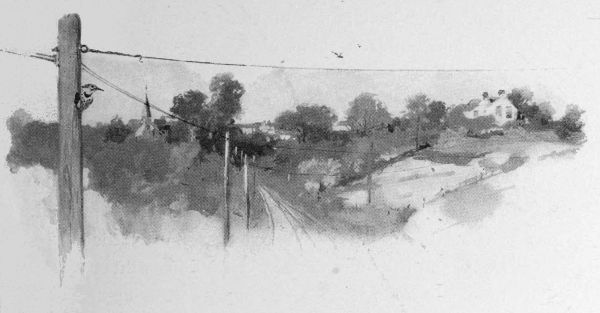
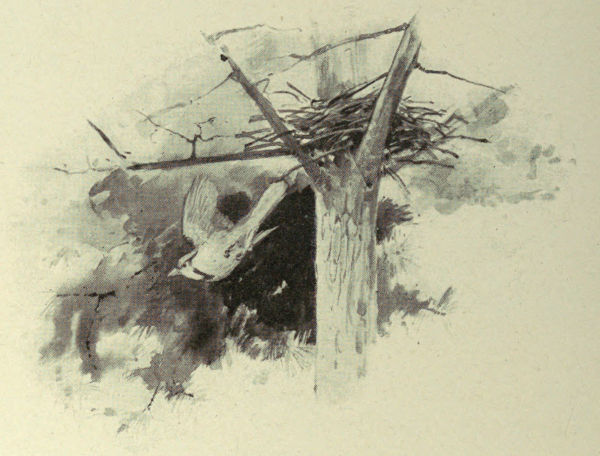
It is the cry of the "flicker," the "high-hole." He is propped against
a pole along the street railroad, nearly a quarter of a mile away.
He has a hole in this pole, almost under the iron arm that holds the
polished, pulsing wire for the trolley. It is a new house, which the
bird has been working at for more than a week, and it must be finished
now, for this lusty call is an invitation to the warming. I shall
go, and, between the passing of the cars, witness the bowing, the
squeaking, the palaver. A high-hole warming is the most utterly polite
function in birddom.
Some of my friends were talking of birds, not long ago, when one of
them turned to me and said hopelessly:
"'Tis no use. We can't save them even if we do stop wearing them upon
our hats. Civilization is bound to sweep them away. We shall be in a
birdless world pretty soon, in spite of laws and Audubon societies."
I made no reply, but, for an answer, led the way to the street
and down the track to this pole which High-hole had appropriated.
I pointed out his hole, and asked them to watch. Then I knocked.
Instantly a red head appeared at the opening. High-hole was mad enough
to eat us; but he changed his mind, and, with a bored, testy flip,
dived into the woods. He had served my purpose, however, for his red
head sticking out of a hole in a street-railway pole was as a rising
sun in the east of my friends' ornithological world. New light broke
over this question of birds and men. The cars drive High-hole away?
Not so long as cars run by overhead wires on wooden poles.
High-hole is a civilized bird. Perhaps "domesticated" would better
describe him; though domesticated implies the purposeful effort of
man to change character and habits, while the changes which have come
over High-hole—and over most of the wild birds—are the result of
High-hole's own free choosing.
If we should let the birds have their way they would voluntarily
fall into civilized, if not into domesticated, habits. They have no
deep-seated hostility toward us; they have not been the aggressors
in the long, bitter war of extermination; they have ever sued for
peace. Instead of feeling an instinctive enmity, the birds are drawn
toward us by the strongest of interests. If nature anywhere shows
us her friendship, and her determination, against all odds, to make
that friendship strong, she shows it through the birds. The way they
forgive and forget, their endless efforts at reconciliation, and
their sense of obligation, ought to shame us. They sing over every
acre that we reclaim, as if we had saved it for them only; and in
return they probe the lawns most diligently for worms, they girdle the
apple-trees for grubs, and gallop over the whole wide sky for gnats
and flies—squaring their account, if may be, for cherries, orchards,
and chimneys.
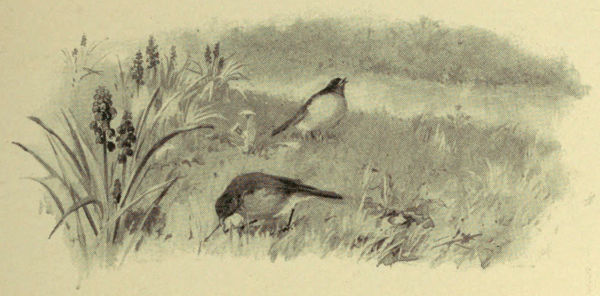
"They probe the lawns most diligently for worms."
The very crows, in spite of certain well-founded fears, look upon a
new farm—not upon the farmer, perhaps—as a godsend. In the cold and
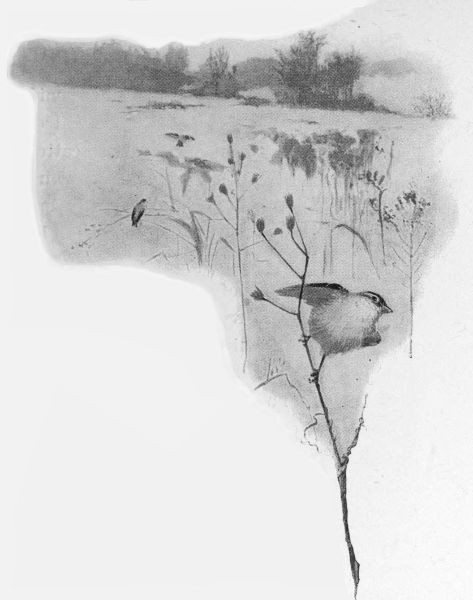
poverty of winter, not only the crows, but the jays, quails, buntings,
and sparrows, help themselves, as by right, from our shocks and cribs.
Summer and winter the birds find food so much more plentiful about
the farm and village, find living in all respects so much easier and
happier here than in remote, wild regions, that, as a whole, they
have become a suburban people.
But life is more than meat for the birds. There is a subtle yet real
attraction for them in human society. They like its stir and change,
its attention and admiration. The shyest and most modest of the
birds pines for appreciation. The cardinal grosbeak, retiring as he
is, cannot believe that he was born to blush unseen—to the tip of
his beautiful crest. And the hermit-thrush, meditative, spiritual,
and free as the heart of the swamp from worldliness—even he loves
a listener, and would not waste his sweetness any longer on desert
forest air. I do not know a single bird who does not prefer a wood
with a wagon-road through it.
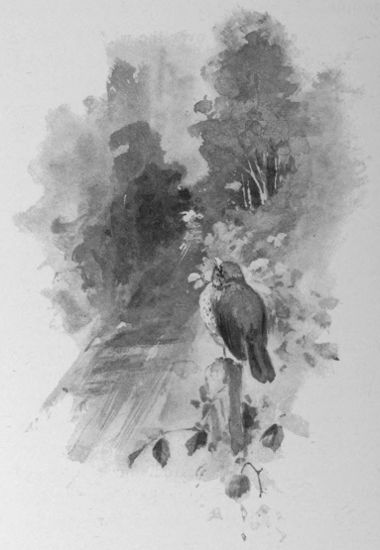
"Even he loves a listener."
My friends had smiled at such assertions before their introduction to
the bird in the pole. They knew just enough of woodpeckers to expect
High-hole to build in the woods, and, when driven from there, to
disappear, to extinguish himself, rather than stoop to an existence
within walls of hardly the dignity and privacy of a hitching-post.
He is a proud bird and a wild bird, but a practical, sensible bird
withal. Strong of wing and mighty of voice, he was intended for a
vigorous, untamed life, and even yet there is the naked savage in his
bound and his whoop. But electric cars have come, with smooth-barked
poles, and these are better than rotten trees, despite the jangle and
hum of wires and the racket of grinding wheels. Like the rest of us,
he has not put off his savagery: he has simply put on civilization.
Street cars are a convenience and a diversion. He has wings and
wildest freedom any moment, and so, even though heavy timber skirts
the track and shadows his pole, and though across the road opposite
stands a house where there are children, dogs, and cats, nevertheless,
High-hole follows his fancy, and instead of building back in the
seclusion and safety of the woods, comes out to the street, the
railroad, the children, and the cats, and digs him a modern house in
this sounding cedar pole.
Perhaps it is imagination, but I think that I can actually see
High-hole changing his wood ways for the ways of the village. He grows
tamer and more trustful every summer.
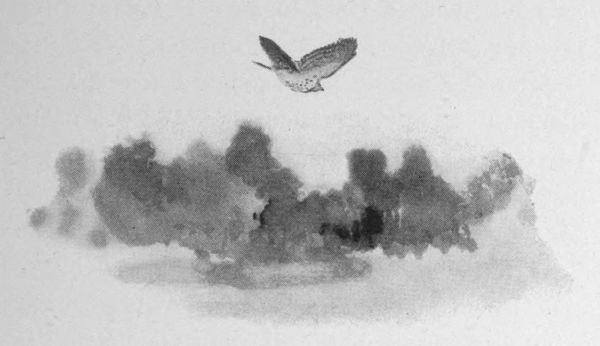
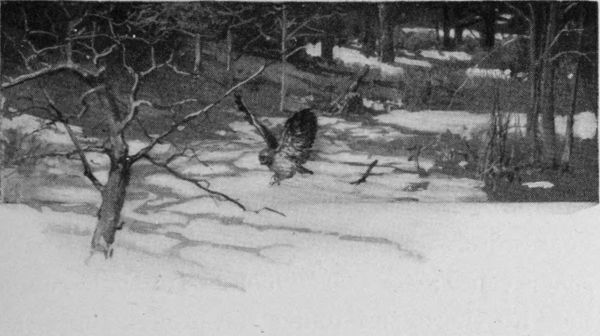
"She flew across the pasture."
A pair have their nest in a telegraph-pole near the school-house,
where they are constantly mauled by the boys. I was passing one day
when two youngsters rushed to the pole and dragged out the poor
harassed hen for my edification. She was seized by one wing, and came
out flapping, her feathers pulled and splintered. She had already
lost all but two quills from her tail through previous exhibitions. I
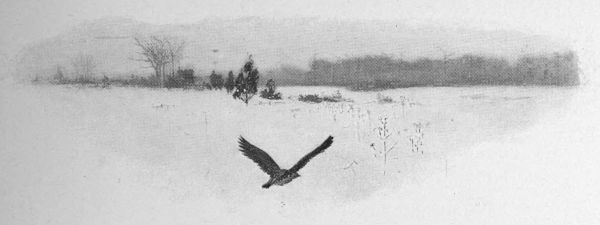
opened my hands, and she flew across the pasture to the top of a tree,
and waited patiently till we went away. She then returned, knowing,
apparently, that we were boys and a necessary evil of village life.
But this pole-life marks only half the distance that these birds have
come from the woods.
One warm Sunday of a recent March, in the middle of my morning sermon,
a ghostly rapping was heard through the meeting-house. I paused. Tap,
tap, tap! hollow and ominous it echoed. Every soul was awake in an
instant. Was it a summons from—? But two of the small boys grinned;
some one whispered "flicker"; and I gathered my ornithological wits
together in time to save the pause and proceed with the service.
After the people went home I found three flicker-holes in the
latticework over the north windows. One of last year's tenants had got
back that morning from the South, and had gone to work cleaning up
and putting things to rights in his house, regardless of Sabbath and
sermon.
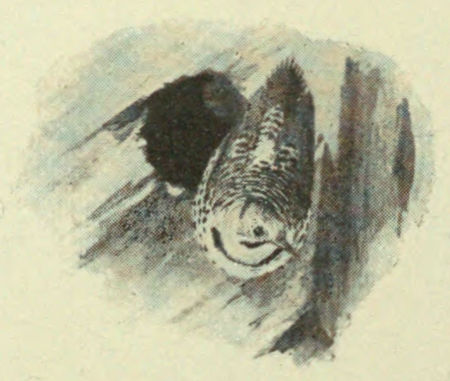
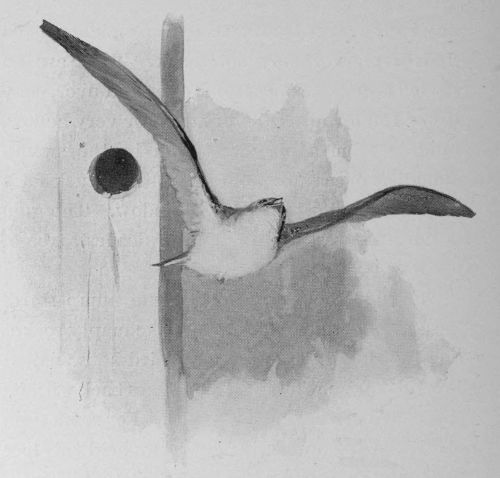
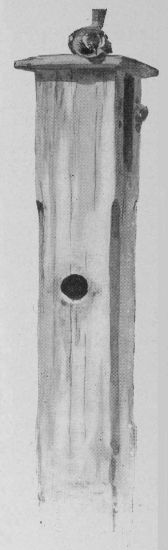
"Putting things to rights in his house."
This approach of the flicker to domestic life and human fellowship is
an almost universal movement among the birds. And no tendency anywhere
in wild life is more striking. The four-footed animals are rapidly
disappearing before the banging car and spreading town, yet the birds
welcome these encroachments and thrive on them. One never gets used to
the contrast in the bird life of uninhabited places with that about
human dwellings. Thoreau tells his wonder and disappointment at the
dearth of birds in the Maine woods; Burroughs reads about it, and goes
off to the mountains, but has himself such an aggravated shock of the
same surprise that he also writes about it. The few hawks and rarer
wood species found in these wild places are shy and elusive. More and
more, in spite of all they know of us, the birds choose our proximity
over the wilderness. Indeed, the longer we live together, the less
they fear and suspect us.
Using my home for a center, you may describe a circle of a
quarter-mile radius and all the way round find that radius
intersecting either a house, a dooryard, or an orchard. Yet within
this small and settled area I found one summer thirty-six species of
birds nesting. Can any cabin in the Adirondacks open its window to
more voices—any square mile of solid, unhacked forest on the globe
show richer, gayer variety of bird life?
The nightingale, the dodo, and the ivorybill were not among these
thirty-six. What then? If one can live on an electric-car line,
inside the borders of a fine city, have his church across the road,
his blacksmith on the corner, his neighbors within easy call,
and, with all this, have any thirty-six species of birds nesting
within ear-shot, ought he to ache for the Archæopteryx, or rail at
civilization as a destroyer?
There is nothing remarkable about this bit of country. I could plant
myself at the center of such a circle anywhere for miles around and
find just as many birds. Perhaps the land is more rocky and hilly, the
woods thicker, the gardens smaller here than is common elsewhere in
eastern Massachusetts; otherwise, aside from a gem of a pond, this is
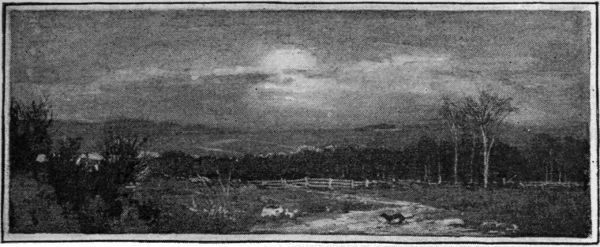
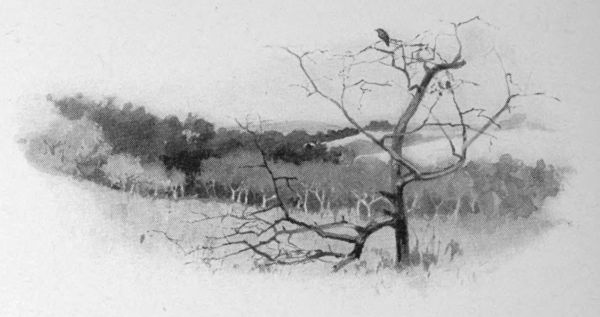
a very ordinary New England "corner."
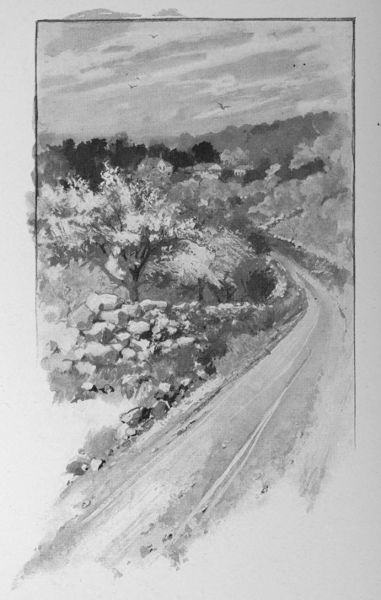
"A very ordinary New England 'corner.'"
On the west side of my yard lies a cultivated field, beyond which
stands an ancient apple orchard; on the east the yard is hedged by a
tract of sprout-land which is watched over by a few large pines; at
the north, behind the house and garden, runs a wall of chestnut and
oak, which ten years ago would have been cut but for some fortunate
legal complication. Such is the character of the whole neighborhood.
Patches of wood and swamp, pastures, orchards, and gardens, cut
in every direction by roads and paths, and crossed by one tiny
stream—this is the circle of the thirty-six.
Not one of these nests is beyond a stone's throw from a house. Seven
of them, indeed, are in houses or barns, or in boxes placed about the
dooryards; sixteen of them are in orchard trees; and the others are
distributed along the roads, over the fields, and in the woods.
Among the nearest of these feathered neighbors is a pair of bluebirds
with a nest in one of the bird-boxes in the yard. The bluebirds
are still untamed, building, as I have often found, in the wildest
spots of the woods; but seen about the house, there is something so
reserved, so gentle and refined in their voice and manner as to shed
an atmosphere of good breeding about the whole yard. What a contrast
they are to the English sparrows! What a rebuke to city manners!
They are the first to return in the spring; the spring, rather, comes
back with them. They are its wings. It could not come on any others.
If it tried, say, the tanager's, would we believe and accept it? The
bluebird is the only possible interpreter of those first dark signs of
March; through him we have faith in the glint of the pussy-willows,
in the half-thawed peep of the hylas, and in the northward flying of
the geese. Except for his return, March would be the one month of all
the twelve never looked at from the woods and waysides. He comes, else
we should not know that the waters were falling, that a leaf could be
plucked in all the bare, muddy world.
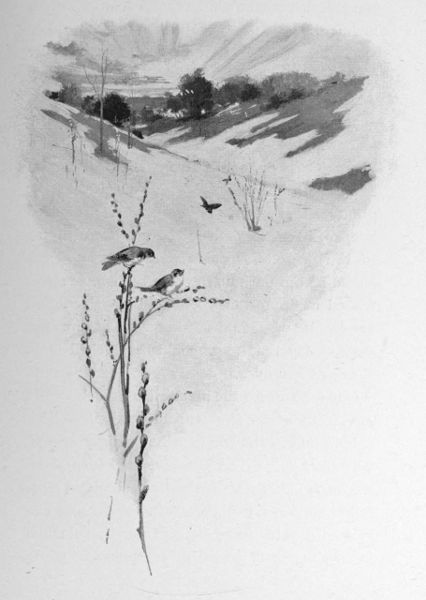
"They are the first to return in the spring."
Our feelings for the bluebird are much mixed. His feathers are not the
attraction. He is bright, but on the whole rather plainly dressed. Nor
is it altogether his voice that draws us; the snowflakes could hardly
melt into tones more mellow, nor flecks of the sky's April blue run
into notes more limpid, yet the bluebird is no singer. The spell is in
the spirit of the bird. He is the soul of this somber season, voicing
its sadness and hope. What other bird can take his place and fill his
mission in the heavy, hopeful days of March? We are in no mood for
gaiety and show. Not until the morning stars quarrel together will the
cat-bird or scarlet tanager herald the spring. The irreverent song of
a cat-bird in the gray gloom of March would turn the spring back and
draw the winter out of his uncovered grave. The bluebird comes and
broods over this death and birth, until the old winter sleeps his long
sleep, and the young spring wakes to her beautiful life.
Within my house is another very human little bird—the
chimney-swallow. Sharing our very firesides as he does, he surely
ought to have a warm place in our hearts; but where have I ever read
one word expressing the affection for him that is universally shown
the bluebird?
I am thinking of our American swallow. We all know how Gilbert White
loved his chimney-swallows—how he loved every creature that flew or
crawled about the rectory. Was it an ancient tortoise in the garden?
the sheep upon the downs? a brood of birds in the chimney? No
matter. Let the creatures manifest never so slight a friendliness for
him, let them claim never so little of his protection, and the good
rector's heart went out toward them as it might toward children of his
own.
But the swallows were White's fondest care. He and his hirundines were
inseparable. He thought of them, especially those of the chimney, as
members of his household. One can detect almost a father's interest
and joy in his notes upon these little birds. Listen to the parent in
this bit about the young in Letter XVIII. They are just out of the
chimney.
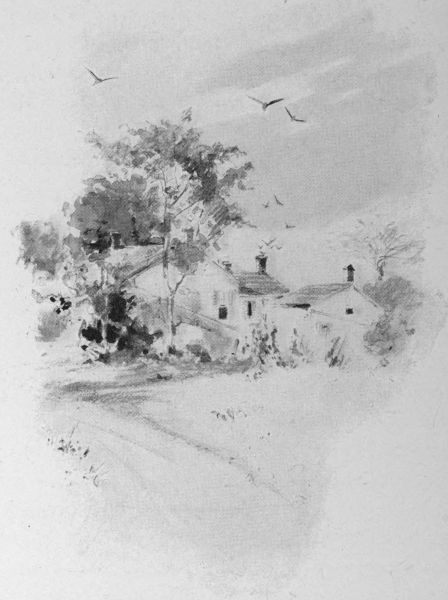
"Where the dams are hawking for flies."
"They play about near the place where the dams are hawking for flies;
and when a mouthful is collected, at a certain signal given, the dam
and the nestling advance, rising toward each other, and meeting at an
angle; the young one all the while uttering such a little quick note
of gratitude and complacency that a person must have paid very little
regard to the wonders of nature that has not often remarked this feat."
Has anything been written about our swift showing as faithful and
sympathetic observation as that? No. He comes and goes without any
one, like Gilbert White, being cheered by his twitter or interested in
his doings. Perhaps it is because we have so many brighter, sweeter
birds about us here; or perhaps our chimneys are higher than those of
Selborne Rectory; or maybe we have no Gilbert White over here.
Of course we have no Gilbert White. We have not had time to produce
one. The union of man and nature which yields the naturalist of
Selborne is a process of time. Our soil and our sympathy are centuries
savager than England's. We still look at our lands with the spirit of
the ax; we are yet largely concerned with the contents of the gizzards
of our birds. Shall the crows and cherry-birds be exterminated? the
sparrows transported? the owls and hawks put behind bars? Not until
the collectors at Washington pronounce upon these first questions
can we hope for a naturalist who will find White's wonders in the
chimney-swallow.
These little swifts are not as attractive as song-sparrows. They are
sooty—worse than sooty sometimes; their clothes are too tight for
them; and they are less musical than a small boy with "clappers."
Nevertheless I could ill spare them from my family. They were the
first birds I knew, my earliest home being so generous in its chimneys
as to afford lodgings to several pairs of them. This summer they again
share my fireside, squeaking, scratching, and thundering in the flue
as they used to when, real goblins, they came scrambling down to peek
and spy at me. I should miss them from the chimney as I should the
song-sparrows from the meadow. They are above the grate, to be sure,
while I am in front of it; but we live in the same house, and there is
only a wall between us.
If the chimney would be a dark, dead hole without the swifts, how
empty the summer sky would be were they not skimming, darting,
wiggling across every bright hour of it! They are tireless fliers,
feeding, bathing, love-making, and even gathering the twigs for their
nests on the wing, never alighting, in fact, after leaving the chimney
until they return to it. They rest while flying. Every now and then
you will see them throw their wings up over their heads till the tips
almost touch, and, in twos or threes, scale along to the time of
their jolly, tuneless rattle.
From May to September, is there a happier sight than a flock of
chimney-swallows, just before or just after a shower, whizzing about
the tops of the corn or coursing over the river, like so many streaks
of black lightning, ridding the atmosphere of its overcharge of
gnats! They cut across the rainbow and shoot into the rose- and
pearl-washed sky, and drop—into the depths of a soot-clogged chimney!
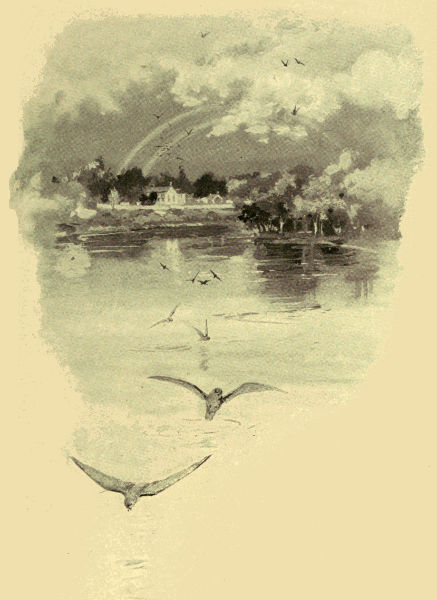
"They cut across the rainbow."
These swallows used to build in caves and in clean, hollow trees; now
they nest only in chimneys. So far have they advanced in civilization
since the landing of the Pilgrims!
Upon the beams in the top of the barn the brown-breasted, fork-tailed
barn-swallows have made their mud nests for years. These birds are
wholly domesticated. We cannot think of them as wild. And what a place
in our affections they have won! If it is the bluebirds that bring
the spring, the barn-swallows fetch the summer. They take us back
to the farm. We smell the hay, we see the cracks and knot-holes of
light cutting through the fragrant gloom of the mows, we hear the
munching horses and the summer rain upon the shingles, every time a
barn-swallow slips past us.
For grace of form and poetry of motion there is no rival for the
barn-swallow. When on wing, where else, between the point of a beak
and the tips of a tail, are there so many marvelous curves, such
beautiful balance of parts? On the wing, I say. Upon his feet he is as
awkward as the latest Herreshoff yacht upon the stays. But he is the
yacht of the air. Every line of him is drawn for racing. The narrow,
wide-reaching wings and the long, forked tail are the perfection of
lightness, swiftness, and power. A master designed him—saved every
possible feather's weight, bent from stem to stern, and rigged him to
outsail the very winds.
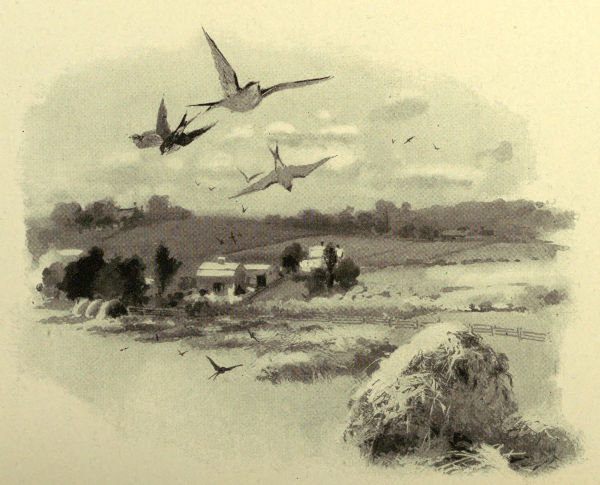
"The barn-swallows fetch the summer."
From the barn to the orchard is no great journey; but it is the
distance between two bird-lands. One must cross the Mississippi basin,
the Rocky Mountains, or the Pacific Ocean to find a greater change in
bird life than he finds in leaping the bars between the yard and the
orchard.
A bent, rheumatic, hoary old orchard is nature's smile in the agony
of her civilization. Men may level the forests, clear the land and
fence it; but as long as they plant orchards, bird life, at least,
will survive and prosper.
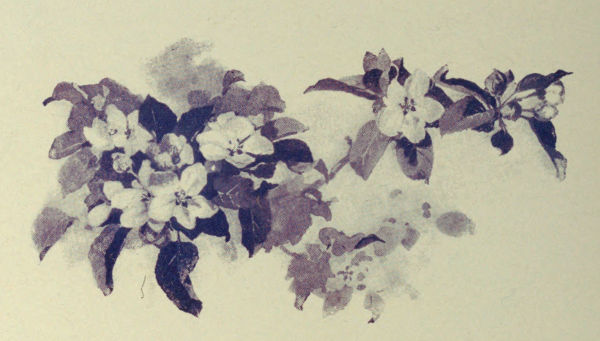
"From the barn to the orchard."
Except for the warblers, one acre of apple-trees is richer in
the variety of its birds than ten acres of woods. In the three
unkempt, decrepit orchards hereabout, I found the robin, chippy,
orchard-oriole, cherry-bird, king-bird, crow-blackbird, bluebird,
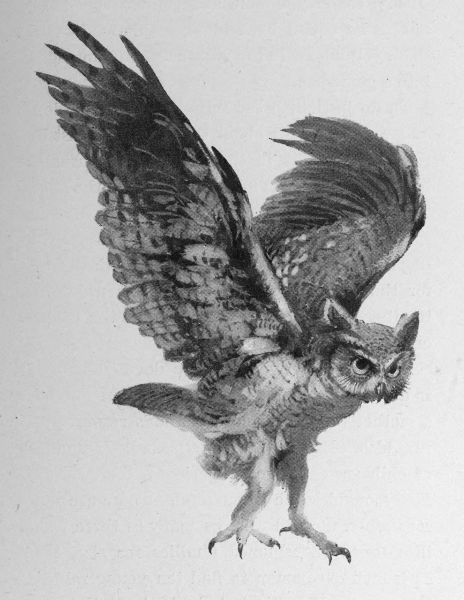
chebec, tree-swallow, flicker, downy woodpecker, screech-owl, yellow
warbler, redstart, and great-crested flycatcher—all nesting as
rightful heirs and proprietors. This is no small share of the glory
of the whole bird world.
I ought not to name redstart as a regular occupant of the orchard.
He belongs to the woods, and must be reckoned a visitor to the
apple-trees, only an occasional builder, at best. The orchard is
too open for him. He is an actor, and needs a leafy setting for his
stage. In the woods, against a dense background of green, he can play
butterfly with charming effect, can spread himself and flit about like
an autumn leaf or some wandering bit of paradise life, with wings of
the grove's richest orange light and its deepest shadow.
When, however, he has a fancy for the orchard, this dainty little
warbler shows us what the wood-birds can do in the way of friendship
and sociability.
Across the road, in an apple-tree whose branches overhang a kitchen
roof, built a pair of redstarts. No one discovered the birds till the
young came; then both parents were seen about the yard the whole day
long. They were as much at home as the chickens, even more familiar.
Having a leisure moment one day, when a bicycle was being cleaned
beneath the tree, the inquisitive pair dropped down, the female
actually lighting upon the handle-bar to see how the dusting was done.
On another occasion she attempted to settle upon the baby swinging
under the tree in a hammock; and again, when I caught one of her own
babies in my hands, she came, bringing a worm, and, without the
slightest fear of me, tried to feed it. Yet she was somewhat daunted
by the trap in which her infant was struggling; she would fan my hands
with her wings, then withdraw, not able to muster quite enough courage
to settle upon them.
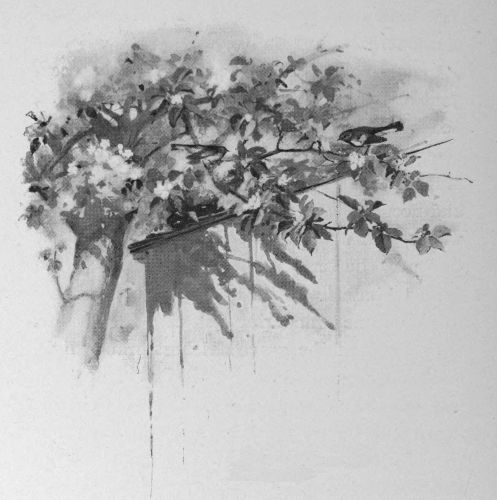
"Across the road, in an apple-tree, built a pair of
redstarts."
Neither of these birds ever showed alarm at the people of the house.
In fact, I never saw a redstart who seemed to know that we humans
ought to be dreaded. These birds are now as innocent of suspicion
as when they came up to Adam to be named. On two occasions, during
severe summer storms, they have fluttered at my windows for shelter,
and dried their feathers, as any way-worn traveler might, in safety
beneath my roof.
From the window one morning I saw Chebec, the least flycatcher, light
upon the clothes-line. She teetered a moment, balancing her big
head by her loosely jointed tail, then leaped lightly into the air,
turned,—as only a flycatcher can,—and, diving close to the ground,
gathered half the gray hairs of a dandelion into her beak, and darted
off. I followed instantly, and soon found her nest in one of the
orchard trees. It was not quite finished; and while the bird was gone
for more of the dandelion down, I climbed up and seated myself within
three feet of the nest.
Back came Mrs. Chebec with a swoop, but, on seeing me, halted short of
the nest. I was motionless. Hopping cautiously toward the nest, she
took an anxious look inside; finding nothing disturbed, she concluded
that there was no evil in me, and so went on with her interesting
work. It was a pretty sight. In a quiet, capable, womanly way she laid
the lining in, making the nest, in her infinite mother-love, fit for
eggs with shells of foam.
The chebec is a finished architect. Better builders are few indeed.
The humming-bird is slower, more painstaking, and excels Chebec in
outside finish. But Chebec's nest is so deep, so soft, so round and
hollow! There is the loveliness of pure curve in its walls. And small
wonder! She bends them about the beautiful mold of her own breast.
Whenever she entered with the dandelion cotton, she went round and
round these walls, before leaving, pressing them fondly with her chin
close against her breast. She could not make them sufficiently safe
nor half lovely enough for the white, fragile treasures to be cradled
there.
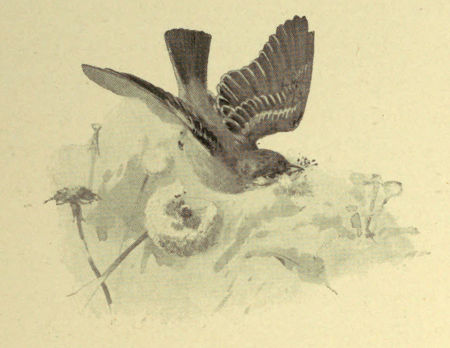
"Gathered half the gray hairs of a dandelion into her
beak."
Artists though they be, the chebecs, nevertheless, are very tiresome
birds. They think that they can sing—a sad, sorry, maddening mistake.
Mr. Chapman says the day that song was distributed among the birds the
chebecs sat on a back seat. Would they had been out catching flies! In
the chatter of the English sparrow, no matter how much I may resent
his impudence and swagger, there is something so bright and lively
that I never find him really tiresome. But the chebecs come back very
early in spring, and sit around for days and days, catching flies, and
jerking their heads and calling, Chebec! chebec! chebec! till you
wish their heads would snap off.
In the tree next to the chebec's was a brood of robins. The crude nest
was wedged carelessly into the lowest fork of the tree, so that the
cats and roving boys could help themselves without trouble. The mother
sputtered and worried and scolded without let-up, trying to make good
her foolishness in fixing upon such a site by abundance of anxiety and
noise.
The fussiest, least sensible mother among the birds is the robin. Any
place for her nest but a safe one! The number of young robins annually
sacrificed to pure parental carelessness is appalling. The female
chooses the site for the home, and her ability for blundering upon
unattractive and exposed locations amounts to genius. She insists upon
building on the sand. Usually the rain descends, the floods come, the
winds blow, and there is a fall.
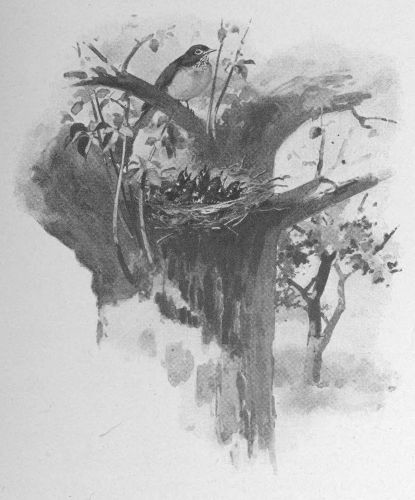
"In the tree next to the chebec's was a brood of
robins. The crude nest was wedged carelessly into the lowest fork
of the tree, so that the cats and roving boys could help themselves
without trouble."
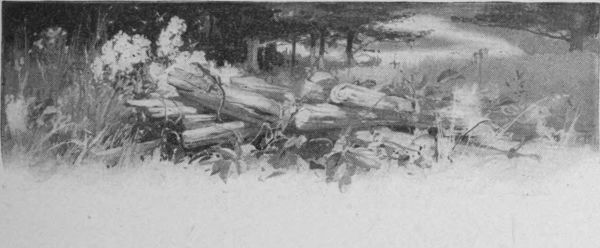
Here is a pair building upon a pile of boards under a cherry-tree;
another pair plaster their nest to the rider of an old worm-fence;
while a third couple, abandoning the woods near by, plant theirs,
against all remonstrance, upon the top of a step-ladder that the
brickmakers use daily in their drying-sheds.
It was the superlative stupidity of this robin that saved her family.
The workmen at first knocked her nest off to the ground. She had
plenty of clay at hand, however, and began her nest again, following
the ladder as it moved about the shed. Such amazing persistence won,
of course. Out of wonder, finally, the men gave the ladder over to her
and stood aside till her family affairs were attended to. Everything
was right in time. After infinite scolding, she at last came off in
triumph, with her brood of four.
A striking illustration of this growing alliance between us and the
birds is the nest of the great-crested flycatcher in the orchard.
Great-crest has almost become an orchard-bird. At heart he is, and
ever will be, a bird of the wilds. He is not tame—does not want to
be tame; he is bold, and the dangers and advantages of orchard life
attract him. His moving into an apple orchard is no less a wonder than
would be an Apache chief's settling in New York or Boston.
Most observers still count Great-crest among the wild and unreclaimed.
Florence A. Merriam, speaking of his return in spring, says: "Not many
days pass, however, before he is so taken up with domestic matters
that his voice is rarely heard outside the woods"; and in Stearns's
"Birds" I find: "It does not court the society of man, but prefers
to keep aloof in the depths of the forest, where it leads a wild,
shy, and solitary life." This is not Great-crest as I know him. I
have found many of his nests, and never one in any but orchard trees.
Riding along a country road lately, I heard Great-crest's call far
ahead of me. I soon spied him on the wires of a telegraph-pole. Under
him was a pear-tree, and a hundred yards away a farm-house. In the
pear-tree I found his nest—snake-skins and all.
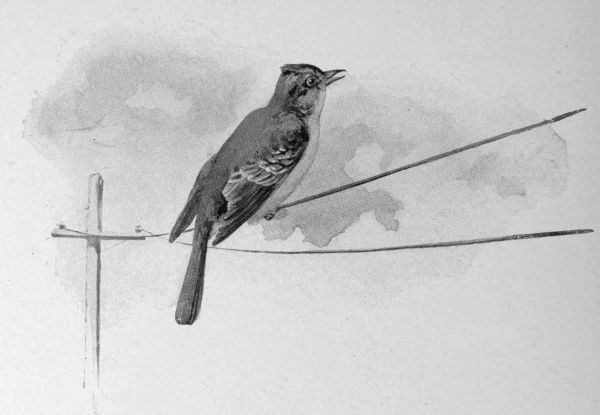
"I soon spied him on the wires of a telegraph-pole."
I disagree, too, with most descriptions of this bird's cry. The
authors I have read seem never to have heard him on a quiet May
morning across a fifty-acre field. His voice is "harsh and
discordant" when sounded into one's very ears. The sweetest-toned
organ would be discordant to one inside the instrument. Give the
bird the room he demands,—wide, early-morning fields,—and listen.
A single shout, almost human it seems, wild, weird, and penetrating,
yet clear and smooth as the blast of a bugle. One can never forget
it, nor resist it; for it thrills like a resurrection call—the
last, long summons to the spring waking. This solitary note is often
repeated, but is never so rapid nor so long drawn out as the call of
the flicker.
Great-crest is a character, one of the most individual of all our
birds. What other bird lines his nest with snake-skins? or hangs such
gruesome things out for latch-strings? He has taken up his residence
among us, but he has given us pretty plainly to understand that we
need not call, else I mistake the hint in the scaly skin that dangles
from his door. The strong personality of the bird is stamped even upon
its eggs. Where are any to match them for curious, crazy coloring?
The artist had purple inks, shading all the way from the deepest
chestnut-purple to the faintest lilac. With a sharp pen he scratched
the shell from end to end with all his colors till it was covered,
then finished it off with a few wild flourishes and crosswise scrawls.
Like the birds of the orchards and buildings, the field-birds also are
yielding to human influences. We can almost say that we have an order
of farm-birds, so many species seem to have become entirely dependent
upon the pasture and grain-field.
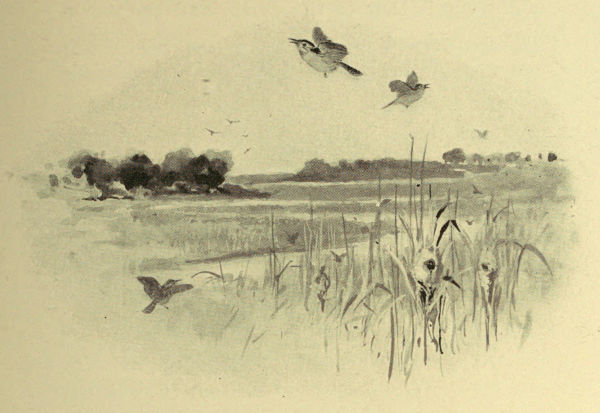
"Where did Bobolink disport himself before there were meadows in
the North and rice-fields in the South? Was he the same lithe,
merry-hearted beau then as now?" I do not know. But I do know that,
in the thirty and three years since Mr. Burroughs asked the question,
Bobolink has lost none of his nimbleness, nor forgotten one bubbling,
tinkling note of his song. Yet in his autumn journey South, from the
day he reaches the ripe reeds of the Jersey marshes till he is lost in
the wide rice-lands of Georgia, his passage is through a ceaseless,
pitiless storm of lead. Dare he return to us in spring? and can he
ever sing again? He will come if May comes—forgetting and forgiving,
dressed in as gay a suit as ever, and just as full of song.
There is no marvel of nature's making equal to the miracle of her
temper toward man. How gladly she yields to his masterful dominion!
How sufferingly she waits for him to grow out of his spoiled, vicious
childhood. The spirit of the bobolink ought to exorcise the savage out
of us. It ought, and it does—slowly.
We are trying, for instance, to cow the savage in us by law, to
restrain it while the birds are breeding; but we hardly succeed yet.
The mating season is scarcely over, the young not yet grown, when the
gunners about me go into the fields with their dogs and locate every
covey of quail, even counting the number of birds in each. With the
dawn of the first day of open season they are out, going from flock to
flock, killing, till the last possible bird is in their bloody bags.
"He will come if May comes."
One of the most pathetic of all the wordless cries of the out-of-doors
is the covey-call of the female quail at night, trying to gather the
scattered flock together after the dogs are called off and the hunters
have gone home.
"Within a few feet of me dropped the lonely frightened quail."
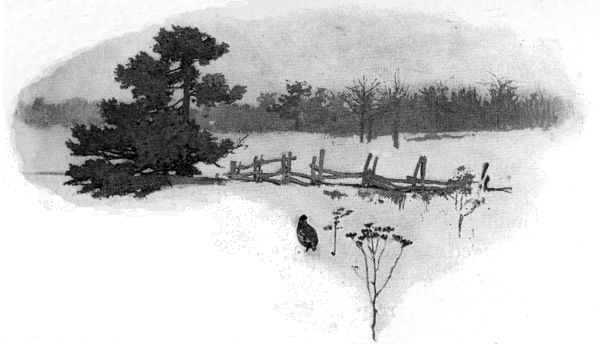
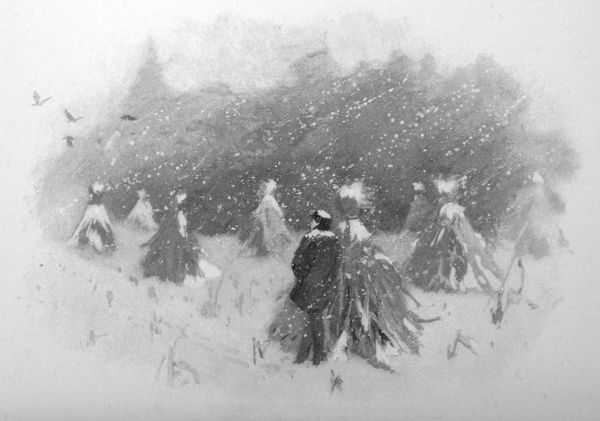
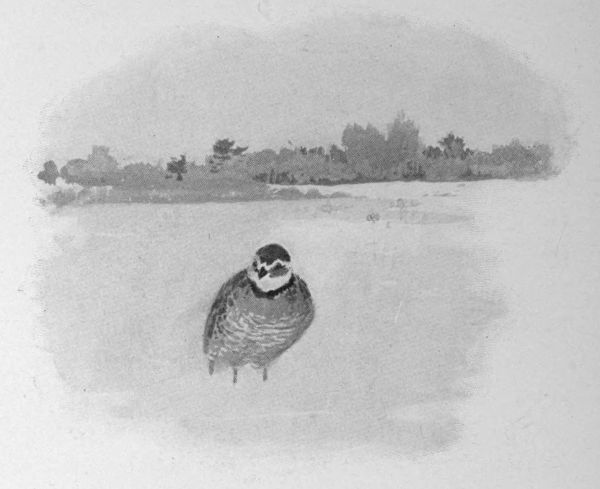
It was nearly dark one December afternoon, the snow ankle-deep and
falling swiftly, when, crossing a wide field, I heard this call from a
piece of sprout-land ahead of me. Kneeling in the snow, I answered the
whistle. Instantly came a reply. Back and forth we signaled till there
was a whir of wings, and down in the soft snow within a few feet of me
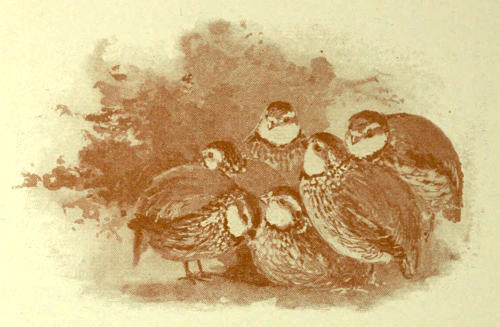
dropped the lonely, frightened quail. She was the only one left of a
covey that the night before had roosted unbroken, snugly wedged, with
their tails together, under a pile of brush.
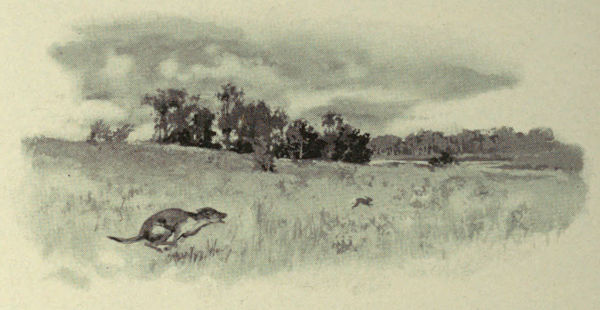
Sharing the fields with the quails are the meadow-larks. They scale
along the grass, rarely rising higher than the cedars, flapping
rapidly for a short distance, then sailing a little in a cautious,
breath-held manner, as though wings were a new invention and just a
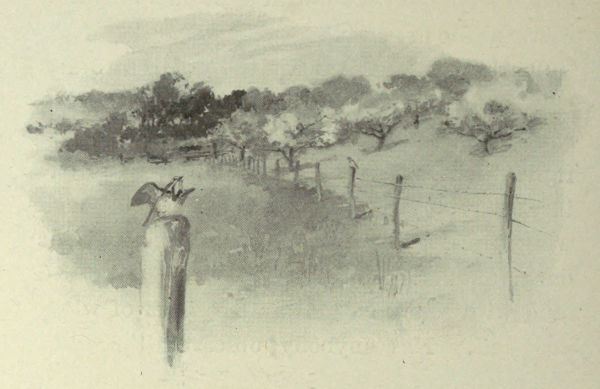
trifle dangerous yet. On they go to a fence-stake, and land with many
congratulatory flirts of wings and tail. Has anybody observed the
feat? They look around. Yes; here I sit,—a man on a fence across the
field,—and the lark turns toward me and calls out: "Did you see me?"
He would be the best-bred, most elegant of our birds, were it not for
his self-consciousness. He is consumed with it. There is too much gold
and jet on his breast. But, in spite of all this, the plain, rich
back and wings, the slender legs, the long, delicate beak, the erect
carriage, the important air, the sleek, refined appearance, compel us
to put him down an aristocrat.
In a closely cropped pasture near the house, in early June, I found
the eggs of the night-hawk. There was no nest, of course: the eggs
lay upon the grass, and, for safety, had been left directly under the
fence. The cows might not step on them here, but nothing prevented
their crushing the fragile things with their noses.
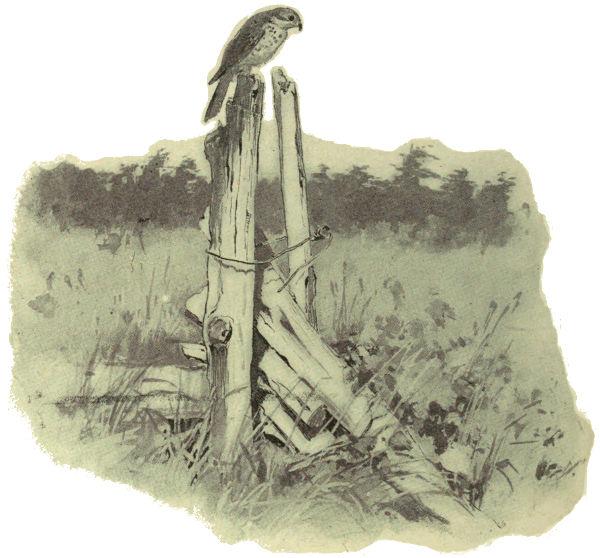
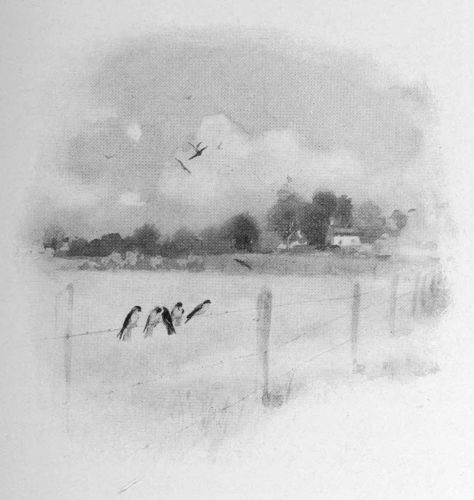
"On they go to a fence-stake."
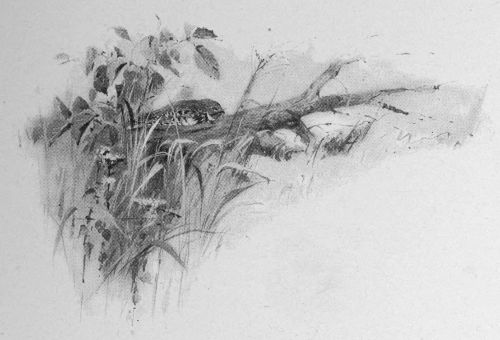
Lengthwise, upon one of the rails, slept the mother. She zigzagged
off at my approach, dazzled and uncertain in the white light of the
noon, making no outcry nor stopping an instant to watch the fate of
her eggs. She acted like a huge bat, slinking and dodging, out of her
element in the light, and anxious to be hid. She did not seem like
a creature that had a voice; and the way she flew would make one
think that she did not know the use of her wings. But what a circus
flier she is at night! and with what an uncanny noise she haunts the
twilight! She has made more hair stand on end, with her earthward
plunge and its unearthly boom through the dusk, than all the owls
together. It is a ghostly joke. And who would believe in the daylight
that this limp, ragged lump, dozing upon the fence or the kitchen
roof, could play the spook so cleverly in the dark?
On the 25th of April, before the trees were in leaf, I heard the
first true wood-note of the spring. It came from the tall oaks beyond
the garden. "Clear, clear, clear up!" it rang, pure, untamed, and
quickening. The solitary vireo! It was his whistle, inimitable,
unmistakable; and though I had not seen him since last July, I hurried
out to the woods, sure he would greet me.
Solitary is the largest, rarest, tamest, and sweetest-voiced of the
vireos. I soon found him high in the tops of the trees; but I wanted
him nearer. He would not descend. So I chased him, stoning and
mocking him even, till, at last, he came down to the bushes and showed
me his big blue head, white eye-rings, wing-bars, and yellow-washed
sides.
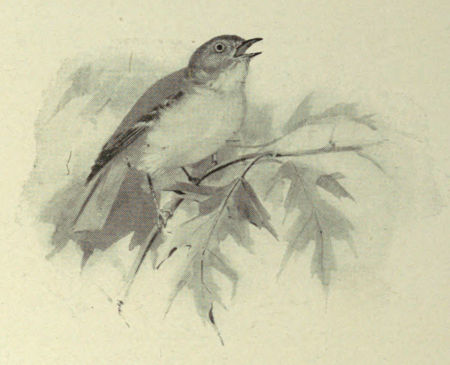
"It was a love-song."
He did more than show himself: he sang for me. Within ten feet of
me, he began a quiet little warble of a tenderness and contentment I
never heard before. Such variety of notes, such sweetness of melody,
such easy, unconscious rendering! It was a love-song, but sung all to
himself, for he knew that there was no gentle heart to listen this
side of Virginia. He sang to his own happy heart as pure and sweet a
song as the very angels know.
Solitary disappeared from that day. I concluded he had gone to
heavier, wilder woods to nest. It was late in June that, passing
through this brush-land, I saw hanging from an oak sapling, just above
my head, a soft, yellowish basket. It was a vireo's nest; but it was
too large, too downy, too yellow for Red-eye. There were no bunches of
white spider-webs upon it, such as Red-eye hangs all over his nest.
I stepped aside for a better view, and had just caught the glint of
a large, white-ringed eye peering over the nest's edge at me, when,
off in the woods behind me, the noon hush was startled by Solitary's
whistle—a round, pure, pearly note that broke the quiet as pearly
teeth break through the smile of a beautiful face. He soon appeared,
coming on, a tree at a time, looking and asking, in no hurry and in no
alarm. When he reached the pine overhead, his mate left the nest to
confer with him. They scolded me mildly while I climbed for a look at
the four delicately spotted eggs; but as soon as I lay down upon the
ground, the mother, without fuss or fear, slipped into the nest and
cuddled down over the eggs till her head hardly showed above the rim.
Had a few bushes been removed I could have seen the nest from my front
door.
Why do the wood-birds so persistently build their nests along the
paths and roads? I said that even the hermit-thrush prefers a wood
with a road through it. If he possibly can he will build along that
road. And what one of the birds will not? Is it mere stupidity? Is it
curiosity to see what goes on? Is there some safety here from enemies
worse than boys and cats and dogs? Or is it that these birds take this
chance for human fellowship? If this last is the reason for their
rejecting the deep tangles for limbs that overhang roads and tufts of
grass in constantly traveled foot-paths, then they can be pardoned;
otherwise they are foolish—fatally foolish.
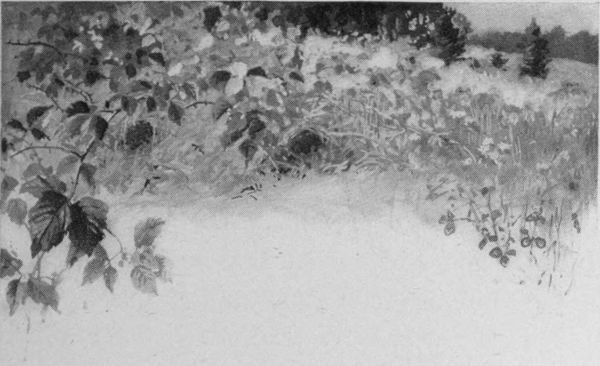
The first black-and-white warbler's nest I ever found was at the
base of a clump of bushes in a narrow wood-path not ten feet from a
highway. There were acres of bushes beyond, thick and pathless, all
theirs to choose from.
In the same piece of scrub-oak the summer after I found another
black-and-white warbler's nest. The loud talk of three of the birds
attracted me. Two of them were together, and just mated, evidently;
the third was a male, and just as plainly the luckless suitor. He was
trying to start a quarrel between the young couple, doing his best to
make the new bride break her vows. He flew just ahead of them, darting
to the ground, scuttling under the brush, and calling out, "See here!
Come here! Don't fool with him any longer! I have the place for a
nest!"
But the pair kept on together, chatting brightly as they ran up and
down the trees and hunted under the fallen limbs and leaves for a
home-site. The male led the way and found the places; the female
passed judgment. I followed them.
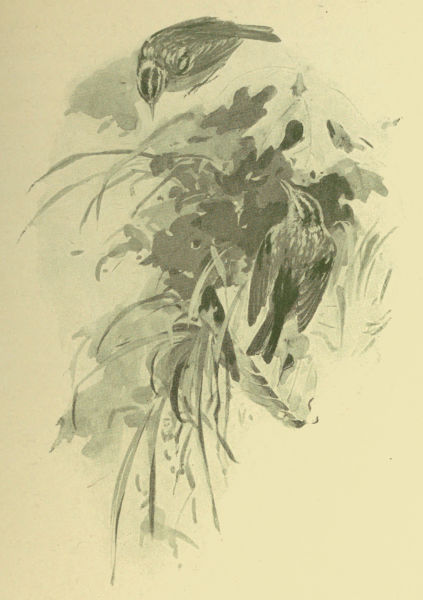
"But the pair kept on together, chatting brightly."
Every spot the cock peeped into was the finest in the woods; his
enthusiasm was constant and unbounded. "Any place is heaven," he kept
repeating, "any place, so long as I have you." But she was to do the
housekeeping, and the ecstasies of the honeymoon were not to turn her
head. She was house-hunting; and, like every woman, at her best. She
said "no," and "no," and "no." I began to think they never would
find the place, when the male darted far ahead and went out of sight
beneath some low huckleberry-bushes near a stone wall. This wall ran
between the woods and a pasture; and parallel with it, on the woods
side, was a foot-path.
Up came the little hen, and together they scratched about under the
leaves. Suddenly the cock flew away and fetched a strip of chestnut
bark. This he turned over to his wife. Then both birds flew out to the
chestnut limbs for bark, and brought their strips back. The home was
founded.
It was the merest cavity, pushed into the dead leaves, with three
shreds of bark for first timbers. In less than a week the structure
was finished and furnished—with a tiny white egg thickly sprinkled
with brown. I watched the spot daily, and finally saw the four young
warblers safely out into their new woods-world. But from the day the
first egg was laid until the nestlings left I constantly expected to
find everything crushed under the foot of some passer-by.
When free from household cares the chickadee is the most sociable of
the birds of the woods. But he takes family matters seriously, and
withdraws so quietly to the unfrequented parts of the woods during
nesting-time as to seem to have migrated. Yet of the four chickadees'
nests found about the house, one was in a dead yellow birch in a bit
of deep swamp, two others were in yellow birches along wood-roads, and
the fourth was in a rotten fence-post by the main road, a long way
from any trees.
A workman while mending the fence discovered this last nest. The post
crumbled in his hands as he tried to pull it down, revealing the nest
of moss and rabbit hair, with its five brown-and-white eggs. He left
the old post, propped it up with a sound one, and, mending the broken
walls of the cavity the best he could, hurried along with his task,
that the birds might return. They came back, found the wreckage of
dust and chips covering the eggs, tried the flimsy walls—and went
away. It was a desecrated home, neither safe nor beautiful now; so
they forsook it.
There is no eagle's nest in this collection of thirty-six. But if Mr.
Burroughs is correct, there is the next thing to it—a humming-bird's
nest; three of them, indeed, one of which is within a stone's throw
of my door! This one is in the oaks behind my garden, but the other
two are even nearer to houses. One of these is upon the limb of a
pear-tree. The tip of this limb rubs against a woodshed connected with
a dwelling. The third nest is in a large apple orchard, in the tree
nearest the house, and saddled upon that branch of the tree which
reaches farthest toward the dwelling. So close is this nest that I can
look out of the garret window directly into it.
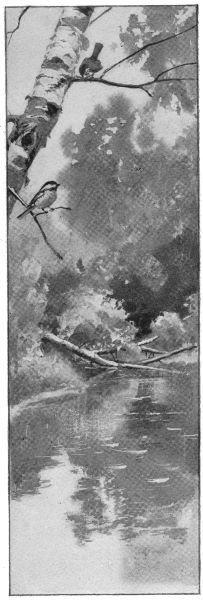
"In a dead yellow birch."
I believe that Ruby-throat is so far domesticated that he rejoices
over every new flower-garden. There was nearly half an acre of
gladioli in the neighborhood one summer, where all the humming-birds
gathered from far and near. Here, for the only time in my life, I saw
a flock of humming-birds. I counted eight one day; and the gardener
told me that he had often seen a dozen of them among the spikes. They
squeaked like bats, and played—about as bullets might play. In fact,
I think I dodged when they whizzed past me, as a soldier does the
first time he is under fire.
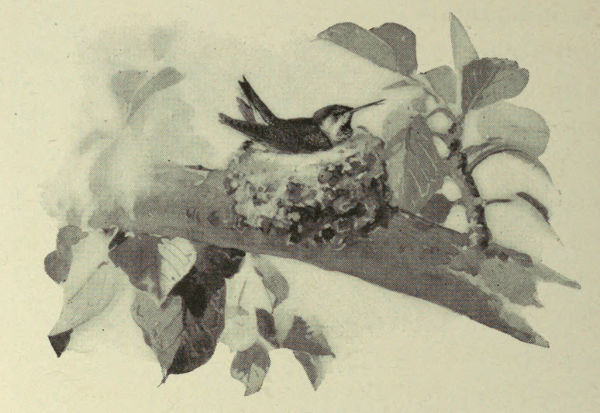
"So close I can look directly into it."
One of my friends had a cellar window abloom with geraniums. A
ruby-throat came often to this window. One day the mistress of the
flowers caught the wee chap in her hands. He knew at once that she
meant no harm and quietly submitted. A few days later he returned and
was captured again. He liked the honey, and evidently the fondling,
too, for he came very regularly after that for the nectar and the
lady's soft hands.
The nest behind my garden is in the top of a tall, slender maple,
with oaks and chestnuts surrounding and overshadowing it. Finding a
nest like this is inspiration for the rest of life. The only feat
comparable to it is the discovery of a bee-tree. Finding wild bees, I
think, would be good training for one intending to hunt humming-birds'
nests in the woods. But no one ever had such an intention. No one ever
deliberately started into the woods a-saying, "Go to, now; I'll find a
humming-bird's nest in here!"
Humming-birds' nests are the gifts of the gods—rewards for patience
and for gratitude because of commoner grants. My nests have invariably
come this way, or, if you choose, by accident. The nearest I ever
came to earning one was in the case of this one in the maple. I
caught a glimpse of a humming-bird flashing around the high limbs
of a chestnut, so far up that she looked no bigger than a hornet. I
suspected instantly that she was gathering lichens for a nest, and, as
she darted off, I threw my eyes ahead of her across her path. It was
just one chance in ten thousand if I even saw her speeding through the
limbs and leaves, if I got the line of her flight, to say nothing of
a clue to her nesting-place. It was little short of a miracle. I had
tried many times before to do it, but this is the only time I ever
succeeded: my line of vision fell directly upon the tiny builder as
she dropped to her nest in the sapling.
The structure was barely started. I might have stared at it with the
strongest glass and never made it out a nest; the sapling, too, was
no thicker at the butt than my wrist, and I should not have dreamed
of looking into its tall, spindling top for any kind of a nest.
Furthermore, as if to rob one of the last possibility of discovering
it, a stray bud, two years before, had pushed through the bark of the
limb about three inches behind where the nest was to be fixed, and
had grown, till now its leaves hung over the dainty house in an almost
perfect canopy and screen.
For three weeks the walls of this house were going up. Is it
astonishing that, when finished, they looked like a growth of the
limb, like part and parcel of the very tree? I made a daily visit to
the sapling until the young birds flew away; then I bent the tree to
the ground and brought the nest home. It now hangs above my desk,
its thick walls, its downy bed, its leafy canopy telling still of
the little mother's unwearied industry, of her infinite love and
foresight. So faultlessly formed, so safely saddled to the limb, so
exquisitely lichened into harmony with the green around, this tiniest
nest speaks for all of the birds. How needless, how sorry, would be
the loss of these beautiful neighbors of our copses and fields!