It was the high-water slack of summer. Up on Seven Mountains the woods
were waves of deep lush green; and in the hot September sunshine the
birds sang again, now that the moulting-moon of August had set. Yet
there was an expectancy in the soft air. Shrill, sweet insect-notes,
unheard before, multiplied. When the trees and the grass were all
dappled with patches of dark and moonshine, the still air throbbed
with the pulsing notes of the white tree-crickets; while above their
range the high lilt of their black brethren thrilled without a pause,
the unnoticed background of all other night-notes. From the bushes,
which dripped moonlight in the clearings, a harsh voice occasionally
said, solemnly, “Katy did!” A week later, all the open spaces on the
fringe of the woods would be strident with the clicking choruses of
the main host of the filmy green, long-winged insects, of which these
stragglers were but the advance-guard.
One morning, from the emerald-green of a swamp maple, a single branch
flamed out a crimson-red. The ebb of the year had begun. As the days
shortened, imperceptibly the air became golden, and tasted of frost.
Then through the lengthening nights the frost-fires began to blaze.
The swamp maples deepened to a copper-red and ended a yolk-yellow. On
the uplands, the sugar maples were all peach-red and yellow-ochre, and
the antlers of the staghorn sumac were badged with old-gold and
dragon’s-blood red. The towering white ashes were vinous-purple, with
an overlying bloom of slaty-violet, shading to a bronze-yellow. The
scented trefoil leaves of the sassafras were all buttercup-yellow and
peach-red, and the sturdy oaks were burnt-umber.
Richest of all were the robes of the red oaks. They were dyed a dull
carmine-lake, while the narrow leaves of the beeches drifted down in
sheaves of gamboge-yellow arrow-heads. Closer to the ground was the
arrow-wood, whose straight branches the Indians used for arrow-shafts
before the days of gunpowder. Its serrated leaves were a dull garnet.
Lower still, the fleshy leaves of the pokeberry were all
carmine-purple above and Tyrian rose beneath. Everywhere were the
fragrant Indian-yellow leaves of the spice-bush, sweeter than any
incense of man’s making; while its berries, which cure fevers, were a
dark, glossy red, quite different from the coral-red and orange
berries of the bittersweet, with its straw-yellow leaves. The fierce
barbed cat-brier showed leaves varying from a morocco-red to the
lightest shade of yolk-yellow, at times attaining to pure scarlet, the
only leaf of the forest so honored.
Through this riot of color, and along a web of dim trails, a great
animal passed swiftly and soundlessly, dull black in color, save for a
brownish muzzle and a white diamond-shaped patch in the centre of its
vast chest. This color, the humped hind quarters, and the head
swinging low on a long neck could belong to none other than the
blackbear, the last survivor of the three great carnivora of our
Eastern forests. It moved with a misleading loose-jointed gait, which
seemed slow. Yet no man can keep ahead of a bear, as many a hunter has
found to his cost.
Not so wise as the wolf, nor so fierce as the panther, the blackbear
has outlived them both. “When in doubt, run!” is his motto; and,
like Descartes, the wise blackbear founds his life on the doctrine of
doubt. As for the unwise—they are dead. To be sure, even this saving
rule of conduct would not keep him alive in these days of repeating
rifles, were it not for his natural abilities. A bear can hear a
hunter a quarter of a mile away, and scent one for over a mile if the
wind be right. He may weigh three hundred pounds and be over two feet
wide, yet he will slip like a shadow through tangled underbush, and
feed all day safely in a berry-patch, with half a dozen hunters
peering and hiding and lurking and looking for him.
To-day, as this particular bear faced the wind, it was evident from
her smaller size and more pointed head that she was of the attractive
sex. Her face was neither concave, like the grizzly bear, nor convex,
like the polar bear, but showed almost straight lines; and as she
stood there, black against the glowing background of the changing
leaves, her legs, with their flat-set feet, seemed comically like the
booted legs of some short fat man. The only part of the naming
color-scheme which appealed to her was that which she could eat.
Purple plums of the sweet-viburnum, wild black bitter cherries,
thick-skinned fox-grapes, shriveled rasping frost-grapes,
huckleberries with their six crackling seeds, blueberries whose seeds
are too small to be noticed—Mrs. Bear raked off quarts and gallons
and barrels of them all with her great claws, yet never swallowed a
green or imperfect one among the number. The fact that the bear is one
of the Seven Sleepers accounted for the appetite of this one. Although
the blackbear wears a fur coat four inches thick, and a waistcoat of
fat of the same thickness, it has found that rent is cheaper than
board, and spends the winter underground, living on the fat which it
has stored up during the fall. Some of the Sleepers, like the
chipmunk, take a light lunch to bed with them, in case they may be
hungry during the long night, and fill a little storehouse before they
turn in for their long winter nap. The bear and the woodchuck,
however, prefer to act the part of the storehouse personally; all of
which accounted for the appetite of this bear through the crisp fall
days. Ordinarily a creature of the twilight and the early dawn, yet
now she hunted through the broad daylight and far into the night, and
devoured with the utmost enthusiasm food of all kinds by the
hundredweight. Some of the selections on her menu-card would have been
impossible to any other animal than the leather-lined blackbear, the
champion animal sword-swallower.
One warm September morning, she began her day with a gallon of berries
which about exhausted the blueberry-patch where she had been feeding.
Thereupon she started to wander along her fifteen-mile range, in
search for stronger food. She found it. In a damp part of the woods
she dug up, and swallowed without flinching, many of the wrinkled flat
bulbs of the wild arum or Jack-in-the-pulpit. The juice of these roots
contains a multitude of keen microscopic crystals, which affect a
human tongue like a mixture of sulphuric acid and powdered glass; nor
does water assuage the pain in the least. Beyond the
Jacks-in-the-pulpits grew clumps of the broad juicy, ill-smelling
leaves of the skunk-cabbage, which bears the first flower of the year.
Mrs. Bear ate these greedily, although the tiniest drop of their
corroding juice will blister the mouth of any human.
Beyond the skunk-cabbage patch, on a limb of a shadbush, she
discovered a gray cone somewhat larger than a Rugby football, made of
many layers of pulpy wood-fibre paper. In and out of an opening in the
smaller end buzzed sullenly a procession of great, flat-faced,
black-and-white hornets. No insect is treated with more respect by the
wild folk than the hornet. Horses, dogs, and even men, have been
killed by enraged swarms. Unlike the single-action bee, whose barbed
sting can be used but once, the hornet is a repeater. It can and will
sting as early and as often as circumstances demand, and is most
liberal in its estimate. Moreover, every sting is as painful as a
bullet from a small-calibre revolver. Yet the bear approached the
nest without any hesitation and, rearing up on her hind quarters, with
one scoop of her paw brought the oval to the ground and was instantly
enshrouded in a furious, buzzing, stinging cloud. Unmoved by their
attacks, the imperturbable animal proceeded to gobble down both the
nest and its contents, licking up grubs, half-grown hornets, and
full-armed fighters alike, with her long flexible tongue, and
swallowing great masses of the gray soft paper. When at last only a
few scattered survivors were left, she lumbered off and followed a
path which, like all bear-trails, led at last to one of the dry,
pleasant, wind-swept hillsides that the bear-people love so well.
There she spent a happy hour before a vast ant-hill erected by fierce
red-and-black soldier ants. Sinking first one forepaw and then the
other deep into the loose earth, she would draw them out covered with
swarming, biting ants, which she carefully licked off, evidently
relishing their stinging, sour taste.
Thereafter, filled full of berries, bulbs, skunk-cabbage, hornets, and
ants, Mrs. Bear decided to call it a day, and curled herself up to
sleep under the roots of a fallen pine.
Another day she discovered groves of oak trees loaded down with
acorns. Better than any botanist she knew which were sweetest; and for
a week she ate acorns from the white oaks, the tips of whose leaves
are rounded, and the chestnut-oaks, whose leaves are serrated like
those of the chestnut tree. Then came a morning when, from a far-away
valley, floated a sound which sent her hurrying down from her tree,
although it was only the bell-like note of the flappy-eared hound
which belonged to Rashe Weeden, the trapper, who lived in the Hollow.
Yet the bear knew that a hound meant a hunter, and that a hunter meant
death. Only a straightaway run for miles and hours could save her, if
the hound were on her trail. Weeks of feasting had left her in no
condition for any such Marathon work.
Yet somewhere, during the hard-earned years of her long life, she had
learned another answer to this attack of the trailing hound. Down the
mountainside, straight toward the approaching dog she hurried,
following a deeply marked path. It led directly under the overhanging
branch of a great red oak. She followed it beyond the tree, and then
doubled and, directly under the limb, circled and confused the trail.
Then, still following her back track, she passed the tree and,
returning to it by a long detour, climbed it from the farther side,
and in a moment was hidden among the leaves. Nearer and nearer came
the tuneful note of the hunting dog who had betrayed so many and many
of the wood-folk to their death. Suddenly, as he caught the fresh
scent, his voice went up half an octave, and he rushed along the faint
path until he reached the red-oak tree. There he paused to puzzle out
the tangled trail. As he sniffed back and forth under the overhanging
limb, there was a tiny rustle in the leaves above him, hardly as loud
as a squirrel would make. Then a black mass shot down like a
pile-driver, a sheer twenty feet. The hound never knew what struck
him, and it was not until an hour later that Rashe Weeden found his
flattened carcass.
“Looked as if he’d been stepped on by one of them circus elephants,”
he confided afterwards to old Fred Dean, who lived over on the
Barrack, near him.
“Elephants be mighty scurce on Seven Mountains,” objected the old man;
and the passing of that hound remains a mystery on the Barrack to this
day.
One bitter gray afternoon, when the flaming leaves had died down to
dull browns and ochres, word came to the wild folk that winter was on
its way to Seven Mountains. Little flurries of stinging snow whirled
through the air, and the wind shrieked across the marshland where the
bear was still hunting for food. As the long grass of the tussocks
streamed out like tow-colored hair, she shambled deep into the nearest
wood, until behind the massed tree-trunks she was safe from the fierce
fingers of the north wind, which howled like a wolf overhead. From
that day she stopped the search for food and started house-hunting.
Back and forth, up and down the mountains, in and out of the swamps,
across the uplands and along the edges of the hills, she hurried for
days at a time.
At last, on a dry slope, she found what she wanted. Deep in the
withered grass showed a vast chestnut stump. Starting above this on
the slope, in the very centre of a tangled thicket she dug a slanting
tunnel. The entrance was narrow, like the neck of a jug, and was so
small that it did not seem possible that the bear could ever push her
huge shoulders through. When it reached the stump, however, it widened
out into an oval chamber partly walled in by buttressed roots. Against
the slope she dug a wide flat shelf, which she covered deep with dry
leaves and soft grass, and sank beside the stump a small air-hole,
which led into the lower end of the burrow. With the same skill with
which she had picked and sorted berries, with her huge paws she
removed every trace of the fresh earth displaced by her digging. Then
she piled loose brush neatly around the entrance to the burrow, and
crawled in. Turning around at the foot of the tunnel, she crept back
head-first and, reaching out her paw, carefully corked the jug with
the brush which she dragged deep over the opening. Then, six feet
underground, on her dry warm bed, she curled up for a four months’
nap.
As the winter days set in, the driving snow drifted deep against the
stump, until even the thicket above it was hidden. Then came the
bitter cold. There were long days and nights when there was not a
breath of wind, and the mercury went down below all readings in the
settlements. In the forests and on the mountains great boulders burst
apart, and in places the frozen ground split open in narrow cracks a
hundred feet long. Life was a bitter, losing fight against cold and
hunger for many of the wood-dwellers; but, six feet underground, the
bear slept safe, at truce with both of these ancient foes of the wild
folk, while the warm vapor of her breath, freezing, sealed the sides
of her cell with solid ice. Not until spring unlocked the door, would
she leave that little room again.
Yet, in January, although the door was still locked by the snow and
barred by the ice, two tiny bearlings found their way in. They were
blind and bare, and both of them could have been held at once on the
palm of a man’s hand. Yet Mrs. Bear was convinced that there had never
been such a beautiful and talented pair. She licked their pink little
bodies and nursed them and cuddled them, and the long freezing months
were all too short to show the full measure of her mother-love. As the
weeks went by, they became bigger and bigger. When they were hungry,
which was most of the time, they whimpered and nuzzled like little
puppies, and pushed and hurried and crowded, lest they might starve to
death before they could reach those fountains of warm milk which
flowed so unfailingly for them. When they were both full-fed, Mother
Bear would arch her vast bulk over them, and they would sleep through
the long dreamy, happy hours, wrapped up warm in her soft fur.
Then, one day—the fortieth after their arrival—a great event
occurred. Both the cubs opened their eyes. There was not much to see,
but the old bear licked them ecstatically, much impressed by this new
proof of their genius. From that time on, they grew apace, and every
day waxed stronger and friskier. Sometimes they would stand up and box
like flyweight champions, and clinch and wrestle and tumble around and
over the old bear, until she would sweep them both off their feet
with one turn of her great paw, and they would all cuddle down
together for a long nap.
Then came the Call. Perhaps it was the contralto note of the bluebird
from mid-sky, or the clanging cry of the wild geese going north; or it
might have been the scent of the trailing arbutus that came through
the solid walls of that little room. At any rate, deep underground,
beneath snow and ice and frozen brush, the little family knew that
spring had come. The cubs began to sniff and claw at the ice-bound
walls, and the old bear heaved her great bulk up and circled the
little cell uneasily.
Then, all in an hour, came the thaw. The ice melted and the snow
disappeared, until, one April day, with a slash of her paw the old
bear opened the door, and the whole family stumbled out into the blue
dawn of a spring day. Around then sounded the sweet minor notes of the
white-throated sparrows, and the jingling songs of the snowbirds;
while over on a sun-warmed slope a flock of tree-sparrows, on their
way to the Arctic Circle, sang a chorus like the tinkling of icicles.
The old bear stood long in the bright sunlight, sniffing and staring
with unseeing eyes—then lurched down to a little mountain stream a
hundred yards away, followed in small procession by her cubs. Once
arrived at the brook, she drank and drank and drank, until it seemed
as if her legs would double under her. After she had filled herself to
the bursting-point, the cubs had their first taste of water. It
seemed to them thin, cold, unstable stuff compared with what they had
been drinking. Their birthplace once abandoned, they never returned to
it. Thereafter they slept wherever and whenever the old bear was
sleepy, cuddled in her vast arms and against her warm fur.
That day, as they turned away from the brook, Mother Bear stopped and
stared long at the larger of her two cubs. Unlike the dull black of
his smaller sister, he was a rich cinnamon-brown in color. In years
past there had been a red cub in her family, and once even a
short-lived straw-yellow youngster; but this was her first experience
with a brownie, and the old bear grunted doubtfully as she led the way
up the mountainside.
At last and at last came the golden month of the wild
folk—honey-sweet May, when the birds come back, and the flowers come
out, and the air is full of the sunrise scents and songs of the
dawning year. The woods were white with the long snowy petals of the
shad-blow, and purple with amethyst masses of rhodora, when the old
bear began the education of her cubs. Safety, Food, More Food
comprised the courses in her curriculum. Less and less often did she
nurse them, as she taught them to find a variety of pleasant foods.
Because Mother Bear knew that disobedience was death, she was a stern
disciplinarian. On their very first walk, Blackie, the littlest of the
family, found it difficult to keep up with the old bear’s swinging
gait. Little bears that fall behind often disappear. Accordingly, when
Blackie finally caught up, she received a cuff which, although it
made her bawl, taught her not to lag.
Brownie erred in the opposite direction. Big and strong and confident,
he once pushed ahead of his mother, along a trail that led up a
mountain-gorge where the soft deep mosses held the water like green
sponges. Suddenly, just as he was about to put his small paw into a
great bear-print in the moss, he received a left-hand swing which sent
him spinning off the trail into a tree-trunk, with the breath knocked
clear out of his small body. Then the old bear showed him what may
happen to cubs who think they know more than their mothers. From deep
under the moss, she had caught a whiff of the death-scent of man.
Reaching out beyond the trail, she raised without an effort, on a
derrick-like forepaw, a section of a dead tree-trunk, a foot in
diameter, and sent it squattering down full upon the paw-print. As the
end of the log sank in the moss, there was a fierce snap, and a series
of sharp and dreadful steel teeth clamped deep into the decayed wood.
Rashe Weeden, the trapper, who trapped bears at all seasons of the
year, had dug up a section of moss containing the bear-imprint, and
underneath it had set a hellish double-spring bear-trap. Let man or
beast step ever so lightly on the print which rested on the broad pan
of the trap, and two stiff springs were released. Once locked in the
living flesh, the teeth would cut through muscle and sinew, and crush
the bones of anything living, while the double-spring held them
locked. A vast clog chained to the trap kept the tortured animal from
going far, and a week later the victim would welcome the coming of the
trapper and the swift death he brought.
A few days later the little family saw an object lesson of what humans
do to bears, and what such a trap meant to them. They were following
one of the bear-paths which always lead sooner or later to hillsides
where there are berries and a view and no flies. Suddenly the wind
brought to the ears of the old bear the sound of sobbing. She stopped
and winnowed the air carefully through her sensitive nose. There was
the scent of bear, but no taint of man in the breeze, and she followed
the trail toward where the strange noises came from, around a bend in
the path. More and more slowly, and with every caution, she moved
forward, while her two cubs kept close behind like little shadows. As
the path opened into a little natural clearing, all three of them saw
a horrifying sight. There in front of them lay another smaller,
younger mother-bear. The cruel fanged jaws of a trap were sunk deep
into her shattered left fore-shoulder, while the clog was caught under
a stump. The prisoned animal had tugged and dragged and pulled,
evidently for long days and nights, as the ground was torn up for
yards and yards around her. At last, worn out by exhaustion and the
unceasing, fretting, festering pain of the gripping jaws, the captive
had sunk down hopelessly to the ground, and from time to time cried
out with a shuddering sobbing note. Her glazed, beseeching eyes had a
bewildered look, as if she wondered why this horror had come to her.
At her knees a little cub stood, and whimpered like a sorrowful baby
and then raised his little paws trustingly against the huge bulk of
his mother, who could help him no more. Another cub had climbed into a
little tree overhead, and looked down in wonder at the sorrowful sight
below.
The old bear took one long look while her cubs, terrified, crowded
close up against her. Then she turned, and plunged into the depths of
the nearest thicket. There was nothing to be done for the trapped one,
and she knew that, soon or late, death would stalk along the trail
which she had just left. Later that afternoon, when they were miles
from the place, the old bear’s keen ear heard two distant shots from
far away across the mountain-ridges. As the twilight deepened, she led
her little family out in a search for food. All at once there came
from below them a strange little distress-note, which made Mother Bear
stop and look anxiously around to see if both of her cubs were safe.
Again it sounded, much nearer, and then from among the trees a small
dark animal hurried toward them. It was one of the cubs they had seen
earlier in the afternoon, escaped from the death which had overtaken
the others, running wailing and lonely through the darkening woods,
looking for its lost mother. At the sight of Mother Bear, it gave a
little whicker of relief and delight, and ran straight to her and
nuzzled hungrily under her warm fur, quite as if it had a right to be
there. Although the old bear growled a little at first, she was not
proof against the entreating whines of the little newcomer. As for
her own cubs, after carefully sniffing this new sister over and
finding her blacker even than Blackie, with a funny white spot near
the end of her small nose, they decided to recognize her as part of
the family. In another minute Spotty was feeding beside Blackie, and
from that day forward the old bear was trailed by three cubs instead
of two.
As summer approached, Mother Bear weaned her family and showed them
how to get their living from the land, as she did. She taught them all
about ants’ nests and grubs, and showed them a score or so of sweet
and succulent roots. Only the root of the water-hemlock, with its
swollen, purple-streaked stem which tastes so sweet and is so deadly,
she taught them to avoid, as well as those fierce and fatal sisters
among the mushrooms, the death-angel and the fly-mushroom, whose stems
grow out of a socket, the danger-signal of their family.
Teaching the cubs to enjoy yellow-jackets’ nests, one of the
delicacies on bear-menus, was a more difficult affair. At first,
Blackie and Spotty, after being stung on their soft little noses,
would have no further traffic with any such red-hot dainties. Brownie
was made of sterner stuff. After he had once learned how good
yellow-jacket grubs were, he hunted everywhere for the nests. When he
found one, he would dig it out, while the yellow-jackets stung his
nose until the pain became unendurable. Then he would sit up and rub
the end of it with both paws and bawl with all his might, only to
start digging again when the smart became bearable. Sometimes he
would have to stop and squeal frantically three or four times, to
relieve his feelings—but he always finished the very last grub.
When the weather grew warmer, the old bear took all the cubs down to
the edge of a hidden mountain-lake, and there taught them, one by one,
to swim, hiding the others safely on the bank. At first, Mother Bear
would allow each little swimmer to grip the end of her five-inch tail,
and be towed through the water. As soon, however, as they learned the
stroke, they had to paddle for themselves. One warm afternoon lazy
Brownie swam with her to the middle of the lake, and then tried to get
a tow back, only to receive a cuff that sent him two feet under water.
When he came to the surface again, he swam beside his mother as
bravely as if he had been born an otter and not a bear-cub.
When they were still a long distance from the shore, the old bear
raised her big black head out of the water and stared over toward a
little bay half a mile away. Her keen nostrils had caught the scent of
man across the still waters. Then, to his surprise, Brownie was again
given the privilege of a tow, and found himself whirling shoreward at
a tremendous rate. From the far-away inlet a lean, lithe canoe flashed
toward them as fast as Steve O’Donnell, the lumberjack, could paddle.
Steve had come over to the lake to estimate on some lumber, and had
seen the swimming bears. Hurriedly pitching into the canoe the long,
light, almost straight-handled axe, which was the article of faith of
all the woodcutters of that region, he started out to overtake the
fugitives.
Steve was not learned in bear-ways, or he would never have started in
a canoe after a swimming bear, without a rifle. As he came nearer and
nearer, and it became evident to the old bear that she would be
overtaken before she could reach shore, she turned and swam
unhesitatingly toward the canoe, while Brownie made the best of his
way ashore. Steve dropped his paddle and seized his axe, and when the
great head was close beside his craft, struck at it with all his
strength. He had yet to learn that the bear is an unsurpassed boxer,
and that few men are able to land a blow on one, even when swimming.
As his axe whizzed downward, it was suddenly deflected by a left turn,
given with such force that the axe was torn from the man’s hands and
disappeared in the deep water. The next instant both the bear’s paws
clutched the gunwale of the canoe, and a second later Steve was
swimming for his life in the cold water. Mrs. Bear paid no further
attention to him, but started again for the nearest shore. Overtaking
Brownie, she gave him another tow, and by the time Steve, chilled to
the bone, reached the farther shore, the whole bear family was miles
away.
By midsummer the cubs were half-grown, although they looked mostly
legs. One summer twilight a strange thing happened. The family had
reached one of their safe and pleasant hillsides, when there loomed up
before them a vast black figure among the trees, and out into the
open strode a blackbear of a size that none of the three little cubs
had ever seen before. In their wanderings they had met many other
bears. Most of these the old bear passed unseeingly, in accordance
with bear etiquette. Sometimes, if the stranger came too close, the
hair on Mother Bear’s back would begin to bristle, and a deep,
threatening rumble, that seemed to come from underground, would warn
against any nearer approach.
To-night, however, when this newcomer lumbered up to the cubs, who
shrank behind their mother, Mother Bear made no protest. He sniffed at
them thoughtfully, and then said loudly, “Koff—koff—koff—koff.”
Mother Bear seemed entirely satisfied with this sentiment, and from
that time on the stranger led the little band, and the cubs came to
know that he was none other than Father Bear. Bears mate only every
other year; but often a couple will join forces in the odd year, and
wander together as a family until winter.
Father Bear was a giant among his kind. He would tip the scales at
perhaps five hundred pounds, and stood over three feet high at his
foreshoulders, and was between six and seven feet long. In all the
emergencies and crises of everyday life, he showed himself always a
very present help in every time of trouble. Warier and wiser even than
Mother Bear, he piloted his little family into the wildest and
loneliest corners of all that wild and lonely land. Not for many years
had the old giant met his match. Of panther, Canada lynx, porcupine,
wolf, wolverine, and all the bears, black and brown, for a hundred
miles around, he was the acknowledged overlord. This sense of power
gave him a certain grim confidence, and he hunted and foraged for his
family, with none to hinder save only man, the king of beasts. Crafty
as he was powerful, the old bear fled into his most inaccessible
fastnesses at the slightest taint or trace of that death-bringer.
One curious custom he had. Whenever he approached certain trees in his
usual fifteen-mile range, he would examine them with great care for
several minutes. These trees always stood in a prominent place, and
were deeply scarred and furrowed with tooth-marks and claw-marks.
Father Bear, after looking them all over carefully, would sniff every
recent mark gravely. With his head on one side, he seemed to be
receiving and considering messages from unseen senders. Occasionally
the news that the tree brought seemed to enrage him profoundly.
Thereupon he would claw and chew the unoffending tree frothingly, and
then trot away growling deep in his throat. At other times, he would
raise his ears politely, as if recognizing a friend; or wrinkle his
nose doubtfully but courteously, as a well-bred bear might do who met
a stranger. Always, however, before leaving, he would stand up on his
hind quarters and claw the tree as high as he could reach, at the same
time drawing his teeth across it at right angles to the vertical
claw-marks. The cubs soon learned that these lone, marked trees were
bear-postoffices and that it was the duty of every he-bear of any
real bearhood to leave a message there, with tooth and claw, for
friend and foe to read.
When September came again, the family found themselves ranging far to
the north, in a country which the cubs had never seen before. There
they saw in the soft moss the deep marks of great splay hoofs; while
here and there the bark of the striped maple was torn off in long
strips seven or eight feet from the ground, and always on only one
side, so that the half-peeled tree never died, as did the girdled
trees attacked by the porcupine. One of the slow migrations of the
moose-folk, which take place only at intervals of many years, had set
in. Drifting down from the Far North, scattered herds had invaded the
old bear’s northernmost range. Like the witch-hazel, which blooms last
of all the shrubs, the love-moon of the moose rises in the fall. The
males of that folk take hardly the stress and strain of courtship.
Bad-tempered at the best, a bull-moose is a devil unchained in
September. As the hunter’s moon waxes in the frosty sky, he neither
rests, eats, or sleeps, but wanders night and day through the woods in
search of a mate. Woe be to man or beast who meets him then!
As the afterglow died out at the end of one of the shortening
September days, the bear family heard faintly from a far-away hillside
a short bellowing “Oh-ah! oh-ah! oh-ah!” Suddenly, not two hundred
yards away, on a hardwood ridge, came back a long ringing, mooing
call, which sounded like “Who-are-you! who-are-you!” It was the
answer of the cow-moose to her distant would-be lover. At the sound,
the ears of the great bear pricked up, and his deep-set, little eyes
twinkled fiercely in the fading light. Without a sound, he shambled
swiftly into the swamp toward the call. Hesitating for a moment,
Mother Bear followed him, and close behind her trailed the usual
procession. The frost in the air and the call, vibrant and pulsing
with warm life, had made the old bear hungry for fresh meat.
Unfortunately for him, as he approached the little ridge, a tiny
breeze sprang up. As the sensitive nostrils of the young cow-moose
caught the scent of danger, she drifted away into the woods like a
shadow, and was gone.
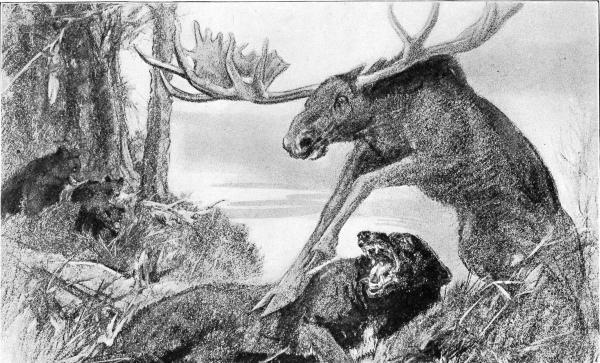
BULL MOOSE AND BLACKBEAR
When the bear reached the ridge, he could not be convinced that she
had escaped. Everywhere lingered the warm delicious scent, so fresh
that his great jaws dripped as he glided silently and swiftly through
the thickets. Then, as he hunted, suddenly, silently, a vast bulk
heaved into view, looming high and huge and black above the saplings
and against the last red streak of the darkening sky. The cubs shrank
close to their mother, and she discreetly retired into the far
background, as into the clearing strode an enormous black beast with a
brown head and white legs, and with a long tassel of hair swinging
from its throat. Seven feet high at the shoulder, and more than ten
feet from tail to muzzle, stood the great bull-moose. The antlers
measured seven feet from tip to tip. With their vast, flat, palmated
spread, with eight curved, sharp prongs in front, a strong man could
not have carried them. Yet the moose switched them as easily as a girl
might settle her hat with a toss of her head.
At the sight of the prowling blackbear, all the devilish temper of the
thwarted, seeking, brooding bull broke loose. His deep-set, wicked
little eyes burned red, and with a roaring bellow he whirled up his
vast bulk over the bear. Ordinarily the bear would not have waited for
any trouble with a bull-moose in the month of September. To-night,
however, he was on his own range. Behind him watched his mate and his
cubs. The moose was a stranger and a trespasser. Morever, the
blood-hunger had seized upon the bear, and a bear that sees red is one
of the most dangerous opponents on earth. Throwing himself back upon
his massive haunches, he prepared for a fight to the finish. A moose
more experienced in bear-ways would have relied chiefly on his
antlers, whose sharp, twisted prongs would cut and tear, while the
immense flat plates of spreading horn were shields against any
effective counter-stroke. This particular bull-moose, however, had
never before met any opponent other than a moose who would await his
attack, and he did not know what a deadly infighter a bear is. His
only thought was to settle the battle before the other could escape.
With a bellowing squeal of rage, he pivoted on his hind legs and
struck two pile-driving blows, one after the other, with his ponderous
keen-edged hoofs. Such a blow would have disemboweled a wolf, or
killed a man, or even have shattered the huge bulk of another moose,
if once they had landed full and fair.
Just as the moose struck, the bear slipped forward and, sudden as the
smashing leads came, they were not so swift as the lightning-like
parries. As each fatal hoof came whizzing down, it was met at its side
by a deft snap of a powerful shaggy forearm, and glanced harmlessly
off the bear’s mighty shoulders. The force of the leads and the drive
of the parries threw the bull off his balance, and for a moment he
staggered forward on his knees, pushing against the ground with
antlers and forelegs, to regain his balance.
That tiny tick of time, however, was all that the old bear needed.
With the dreadful coughing roar that a bear gives when fighting for
his life, he pivoted toward the right on his humped-up haunches.
Swinging back his enormous left paw, armed with a cestus of steel-like
claws, he delivered the crashing, smashing swing that only a bear can
give, one of the most terrible blows known to beasts or man. Every
ounce of strength in the ridged forepaw, every atom of force and
spring from the coiled masses of humped muscles of the enormous hind
quarters, went into that mighty blow. It landed full and fair on the
long neck, just back of the flat cheek-bone. The weight of the moose
approached a ton. Yet that dreadful shattering smash whirled the great
head around like a feather. There was a snap, a rending crack, and
the whole vast beast toppled over on his side, and, with one long
convulsive shudder, lay dead, his neck broken under the impact of that
terrible counter. The old bear rolled forward, but the black bulk
never quivered as he towered over his fallen foe, still the king of
his range.
All that fall the five kept together. Then, one day in November, their
leader disappeared. Mother Bear showed no anxiety, for she knew that
late to bed and early to rise is the motto of all he-bears, and that
her mate had left her only because he intended to stay up for weeks
after his family were asleep for the winter. Far up on the
mountainside the four found a dry cave with a tiny entrance, and spent
the winter there together.
When spring came again, the cubs were cubs no longer. Without Mother
Bear’s bulk or shagginess, yet all three of them were sleek, powerful,
full-grown bears instead of the sprawly, leggy cubs of the season
before. Brownie was still the largest, but Spotty, the starved,
whimpering little cub of a year ago, was a close second to him. Not so
massive nor so powerful, yet she had a supple, sure swiftness that
made her his equal in their unceasing hunts for food. Hurry as he
would, a slim black nose with a silver spot near the end would often
be thrust in just ahead of him. There must have been some charm about
that spot, because Brownie never got angry, although usually any
interference with a bear’s food is a fighting act.
As the weeks wore on toward summer, Blackie became every day more
snappish. She growled if Brownie came near her. Mother Bear also began
to develop a temper. Then came a warm night in late spring, when both
Blackie and Spotty disappeared. Brownie sniffed and searched and
hunted but no trace of either of them could he find. As the days
lengthened into June, the old bear became restless and more and more
irritable. One day in the middle of the month, she wandered back and
forth, feeding but little, and so cross that Brownie followed her only
at a safe distance. He, too, was uneasy and unhappy. Something, he
knew not what, was lacking in his life. As the late twilight faded, a
great honey-colored moon came up and made the woods so bright that the
veeries began to sing again their strange rippling chords, as if the
night-wind were blowing across golden harp-strings.
There before them, in a little glade, suddenly towered the black
figure of a giant bear. With a little whicker Mother Bear moved
forward to meet her mate, and a moment later led the way toward the
dim green fastnesses of the forest. Poor, untactful, unhappy Brownie
started to follow as of old. Both of them growled at him so fiercely
that he stopped in his tracks. As he watched them disappear into the
fragrant dark, he felt that the whole Round Table was dissolved. Never
again would the little family that had been so happy together be
united.
He turned and plunged into a near-by thicket, and hurried away lonely
and unhappy. For long he followed a faint trail, until it widened
into a green circle where some forgotten charcoal-pit had stamped its
seal forever upon the forest. The air was heavy with the drugged
perfume of chestnut tassels and the fragrance of wild grape, sweetest
of all the scents of earth. Then, under the love-moon of June, in the
centre of the tiny circle, there was standing before him a lithe,
black figure with a silver spot showing at the end of her slim tilted
nose—and all at once Brownie knew what his life had lacked. For long
and long the two looked at each other, and he was lonely and unhappy
no more.
Then slowly, slowly, the silver spot moved away, ahead of him, toward
the soft scented blackness of the deep woods. As he followed, he
stopped and rumbled out dreadful warnings to a large number of
imaginary bears, to beware that silver spot. While the veeries, whose
heartstrings are a lute, sang in the thicket, and a little owl crooned
a love-song from overhead, and the last of the hylas piped like pixies
from far away, the two followed the path of their honeymoon, until it
was lost in the depths of that night of love.