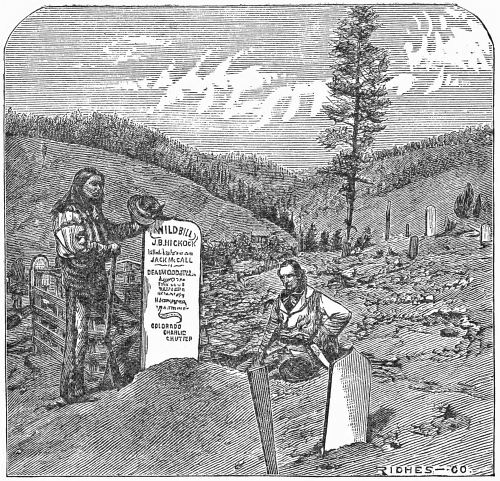
On the 2d day of August, 1876, Wild Bill was in
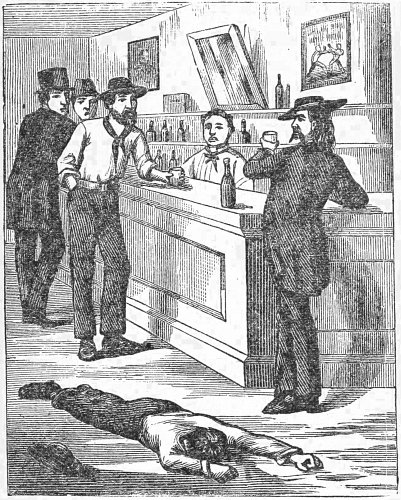
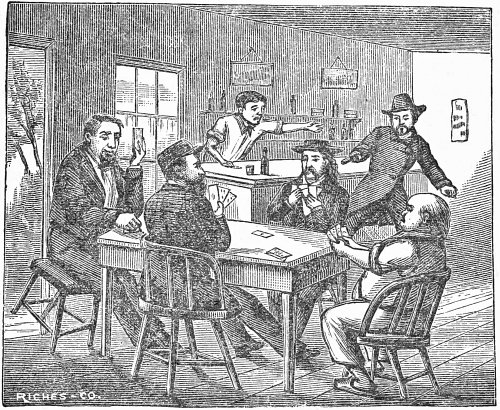
Lewis & Mann’s saloon, playing a game of poker
with Capt. Massey, a Missouri river pilot, Charley
Rich, and Cool Mann, one of the proprietors of the
saloon. The game had been in progress nearly
three hours, when about 4 o’clock, P. M., a man was
seen to enter the door and pass up to the bar. Bill
was sitting on a stool with the back of his head towards
and about five feet from the bar. When the
man entered, Bill had just picked up the cards dealt
him, and was looking at his “hand,” and therefore
took no notice of the newcomer. The man, who
proved to be Jack McCall, alias Bill Sutherland, after
approaching the bar, turned, and drawing a large
navy revolver, placed the muzzle within two
inches of Bill’s head and fired. The bullet entered
the base of the brain, tore through the head,
and made its exit at the right cheek, between
the upper and lower jaw-bones, breaking off several
teeth and carrying away a large piece of the
cerebellum through the wound. The bullet struck
Capt. Massey, who sat opposite Bill, in the right
arm and broke the bone. At the instant the pistol
was discharged, the cards fell from Bill’s hands and
he dropped sideways off the stool without uttering a
sound. His companions were so horrified that several
moments elapsed before it was discovered that
Capt. Massey was wounded.
The assassin turned upon the crowd and compelled
them to file out of the saloon before him. After
reaching the street he defied arrest, but at five
o’clock he gave himself up and asked for an immediate
trial. Deadwood was, at that time, so primitive
that it had no city officers, and there was no one
legally competent to take charge of or try the prisoner.
During the same evening, however, a coroner
was chosen, who impaneled a jury and returned a
verdict to the effect that J. B. Hickok (Wild Bill)
came to his death from a wound resulting from a
shot fired from a pistol by John McCall, alias Bill
Sutherland.
Having proceeded thus far, it was determined to
elect a judge, sheriff and prosecuting attorney to try
McCall on the following day. Languishe, the lessee
of McDaniel’s theatre, offered the use of the theatre
for the purposes of the trial, which was arranged to
take place at 9 o’clock on the following morning.
Three men were sent out in different directions to
notify the miners in the neighborhood of the murder,
and to request their attendance at the trial.
Promptly at the time appointed, the improvised
court convened, and Joseph Brown, who had been
chosen sheriff, produced the prisoner. F. J. Kuykendall,
the pro tempore judge, then addressed the
crowd in a very appropriate manner, reminding those
present that the court was purely a self-constituted
one, but that in the discharge of his duty he would
be governed by justice, and trust to them for a ratification
of his acts. His remarks were greeted with
hand-clappings of approval. The prisoner was then
led forward and conducted to a seat on the stage to
the right of the judge.
Never did a more forbidding countenance face a
court than that of Jack McCall; his head, which was
covered with a thick crop of chestnut hair, was very
narrow as to the parts occupied by the intellectual
portion of the brain, while the animal development
was exceedingly large. A small, sandy moustache
covered a sensual mouth, and the coarse double-chin
was partially hid by a stiff goatee. The nose was what
is commonly called “snub;” he had cross eyes and
a florid complexion, which completed a more repulsive
picture than Dore could conceive. He was clad
in a blue flannel shirt, brown overalls, heavy shoes,
and, as he sat in a stooping position, with his arms
folded across his breast, he evidently assumed a nonchalance
and bravado which were foreign to his feelings,
and betrayed by the spasmodic heavings of his
heart.
The selection of a jury consumed all the forenoon,
as it was next to impossible to select a man who
had not formed or expressed an opinion concerning
the murder, although but few who were in the panel
had heard of the tragedy until a few hours before.
A hundred names were selected, written upon separate
scraps of paper, and placed in a hat. They
were then well shaken, and the committee appointed
for the purpose drew from the hat one name at a
time. The party answering to the name then came
forward and was examined by the judge touching
his fitness to serve as an impartial juror. Ninety-two
names were called from the panel before the
jury was made up. Following are those who were
selected and served: J. J. Bumfs, L. D. Brokow, J. H.
Thompson, C. Whitehead, Geo. S. Hopkins, J. F.
Cooper, Alexander Travis, K. F. Towle, John E.
Thompson, L. A. Judd, Edward Burke and John
Mann. The jurors being sworn, they took their
seats, and testimony for the prosecution was begun.
The first witness called was Charles Rich, who said
that he was in the saloon kept by Lewis & Mann on
the afternoon of the 2d, and was seated at a table
playing a game of poker with Wild Bill and several
others, when the prisoner, whom he identified, came
into the room, walked deliberately up to Wild Bill,
placed a pistol to the back of the deceased, and fired,
saying: “Take that!” Bill fell from the stool upon
which he had been seated without uttering a word.
Samuel Young testified that he was engaged in
the saloon; that he had just delivered $15 worth of
pocket checks to the deceased, and was returning to
his place behind the bar when he heard the report of
a pistol shot; turning around, he saw the prisoner at
the back of Wild Bill with a pistol in his hand
which he had just discharged; heard him say, “Take
that!”
Carl Mann was one of the proprietors of the saloon
in which Wild Bill was killed; was in the poker
game; noticed a commotion; saw the prisoner (whom
he identified) shoot Wild Bill.
The defense called for the first witness, P. H. Smith,
who said he had been in the employ of McCall four
months; that he was not a man of quarrelsome disposition;
that he had always considered him a man
of good character; that he (the witness) had been
introduced to Wild Bill in Cheyenne, and drank
with him; that the deceased had a bad reputation,
and had been the terror of every place in which he
had resided.
H. H. Pickens said that he had known defendant
four years, and believed him to be a quiet and peaceable
man. Wild Bill’s reputation as a “shootist”
was very hard; he was quick in using the pistol and
never missed his man, and had killed quite a number
of persons in different parts of the country.
Ira Ford had known the defendant about one year;
“like a great many others, he would go upon a
spree like the rest of the boys.” Wild Bill had the
reputation of being a brave man, who could and
would shoot quicker than any man in the Western
country, and who always “got away” with his
antagonist.
The defense called several others, the tenor of
whose evidence was but a repetition of the foregoing.
No attempt was made to show that Wild Bill
had ever seen the prisoner.
The prisoner was called upon to make a statement.
He came down from the stage into the auditorium
of the theatre, and with his right hand in the
bosom of his shirt, his head thrown back, in a harsh,
loud and repulsive voice, with a bull-dog sort of
bravado, said: “Well, men, I have but a few words
to say. Wild Bill threatened to kill me if I crossed
his path. I am not sorry for what I have done. I
would do the same thing over again.” The prisoner
then returned to his place on the stage.
The prosecution then adduced testimony to prove
that Wild Bill was a much abused man; that he
never imposed on any one, and that in every instance
where he had slain men he had done so either in the
discharge of his duty as an officer of the law or in
self-defense.
The case having been placed in the hands of the
jury, the theatre was cleared, with the understanding
that the verdict should be made known in the saloon
where the murder was committed. The prisoner
was remanded to the house where he had been imprisoned
during the night. At 9 o’clock the following
verdict was read to the prisoner:
Deadwood City, Aug. 3, 1876.—We, the jurors, find the prisoner,
Mr. John McCall, not guilty.
CHARLES WHITEHEAD,
Foreman.
The prisoner was at once liberated, and several of
the model jurymen who had played their parts in
this burlesque upon justice, and who had turned
their bloodthirsty tiger loose upon the community
indulged in a sickening cheer which grated harshly
upon the ears of those who heard it. The first vote
taken by the jury resulted in eleven for acquittal and
one for conviction, and the single man who desired
justice was so intimidated by his fellow-jurors that
he was induced to sanction the iniquitous verdict.
It was even proposed by one of the jurymen that the
prisoner be fined fifteen or twenty dollars and set
free.
After the inquest the body of the deceased was
placed upon a litter made of two poles and some
boards; then a procession was formed, and the remains
were carried to Charley Utter’s camp, across
the creek. Charles Utter, better known as Colorado
Charley, had been the intimate friend of the deceased
for fifteen years, and with that liberality which
is a feature among mountaineers, had always shared
his purse with him. Charley was much affected by
the death of his friend, and incensed at the villain
who had murdered him. A tepee was pitched at
the foot of one of the giant trees which rise so majestically
above Charley’s camp. Preparations were
at once made for the funeral. The following notice
was printed and sent out:
“Funeral Notice.—Died in Deadwood, Black Hills, Aug. 2,
1876, from the effects of a pistol shot, J. B. Hickok (Wild Bill,) formerly
of Cheyenne, Wyoming. Funeral services will be held at Charley
Utter’s camp, on Thursday afternoon, Aug. 3, 1876, at 3 o’clock.
All are respectfully invited to attend.”
At the time appointed a number of people gathered
at the camp—Charley Utter had gone to a great
deal of expense to make the funeral as fine as could
be had in that country. Under the tepee, in a
handsome coffin, covered with black cloth and richly
mounted with silver ornaments, lay Wild Bill, a picture
of perfect repose. His long chestnut hair,
evenly parted over his marble brow, hung in waving
ringlets over the broad shoulders; his face was
cleanly shaved excepting the drooping moustache,
which shaded a mouth that in death almost seemed
to smile, but in life was unusually grave; the
arms were folded over the stilled breast, which inclosed
a heart that had beat with regular pulsation
amid the most startling scenes of blood and violence.
The corpse was clad in complete dress-suit
of black broadcloth, new underclothing and white
linen shirt; beside him in the coffin lay his trusty
rifle, which the deceased prized above all other things,
and which was to be buried with him in compliance
with an often expressed desire.
A clergyman read an impressive funeral service,
that was attentively listened to by the audience,
after which the coffin-lid hid the well-known face of
Wild Bill from the prying gaze of the world.
A grave had been prepared on the mountain side
toward the east, and to that place in the bright sunlight,
the air redolent with the perfume of sweet
flowers, the birds sweetly singing, and all nature
smiling, the solemn cortege wended its way and deposited
the mortal remains of Wild Bill.
Upon a large stump at the head of the grave the
following inscription was deeply cut:
“A brave man; the victim of an assassin—J. B. Hickok (Wild
Bill,) aged 48 years; murdered by Jack McCall, Aug. 2, 1876.”