Larger versions of most illustrations may be seen by right-clicking them
and selecting an option to view them separately, or by double-tapping and/or
stretching them.
The elephant—“My Lord the Elephant,” as he is
called in India—takes precedence of other quadrupeds
upon several counts. Among these appear conspicuously
the facts that he belongs to an ancient and isolated
family, which has no near relations occupying lower stations
in life; likewise, that from time immemorial these
creatures have been strong enough to do as they pleased.
This latter circumstance more particularly ensured the
sincere respect of mankind, and throughout the records of
the race we find its members in distinguished positions.
Ganesha, the Hindu god of wisdom, had an elephant’s
head, and Elephas Indicus was worshipped from Eastern
China to the highlands of Central India. In Africa this
species only escaped adoration because the natives of that
country were incapable of conceiving any of those abstract
ideas which the animal embodied. Wherever an elephant
has existed, however, men have looked up to him, and as
he was not carnivorous, it comported with human reasoning
to extol the benevolence of a being who, if otherwise
constituted, might have done so much harm.
Oriental, classic, mediæval, and modern superstitions
cluster about the elephant. Pliny and Ælian often seem
to be mocking at popular credulity. “Valet sensu et reliquâ
sagacitate ingenii excellit elephas,” says Aristotle, and
Strabo writes in the same strain. One might nearly as
well take the verses of Martial for a text-book as seek
information among those errors and extravagancies of antiquity
which Vartomannus brought to a climax.
It is no longer said that elephants who, to use Colonel
Barras’ words (“India and Tiger Hunting”), “are practically
sterile in captivity,” are so because of their modesty,
or that this is attributable to a nobleness of soul which
prevents them from propagating a race of slaves. Men
would now be ashamed to say they are monotheists, and
retire to solitudes to pray. But so little of comparative
psychology is known, and the side lights which other
sciences throw upon zoölogy are so much disregarded,
that no hesitation is felt at comparing them with human
beings, or measuring the faculties and feelings of a beast
by standards set up in civilized society.
The elephant is a social animal; in all herds the units
are family groups where several generations are often
represented, and when the larger aggregate dissolves, it
separates into family groups again. With this statement,
anything like unanimity of opinion among authorities upon
elephants is at an end.
It is said that years bring moroseness upon elephants,
and that any evil tendencies they exhibit in youth are
aggravated by age. Apart from what may be exceptional
in cases of this kind, the biological law is that the characteristic
features of species, whether physical or mental,
are not developed until maturity. Most of those who
know these animals personally agree in the opinion that
solitary males are commonly dangerous; and although the
existence of “rogue elephants,” who always belong to
this class, has been denied, confirmatory evidence is too
strong to be rejected. When some member of a group
becomes separated from its relations and is lost, when a
young bull is driven off for precocity, or an old tusker
retires to solitude because he has been worsted in combat
with a rival, the change of state cannot fail to be distressing,
and the individual to deteriorate. At certain seasons
male elephants often voluntarily abandon the society of
females, but not usually of each other. When they grow
old, there is more or less tendency towards seclusion in
all bulls. Retirement, however, when prompted by age,
apathy, or loss of the incitements towards association,
is not at all like exile while physical powers and feelings
are in force.
Ferocity is much more frequently met with in elephants
than most people suppose; and as it is with these animals
in a wild state, so is it also among those in captivity.
There is no reason why a captured savage should
spontaneously evolve adornments to his moral character
because he is under restraint. A vicious brute is only
restrained by fear, and this coercive influence continues
just so long as apprehension is not overbalanced by
passion.
Charles John Andersson (“The Lion and the Elephant”)
infers from the ease with which this animal accommodates
itself to those requirements involved in domestication that
its “natural disposition is mild and gentle.” G. P. Sanderson
(“Thirteen Years among the Wild Beasts of India”)
holds that “obedience, gentleness, and patience ...
are the elephant’s chief good qualities.”
Corse, speaking from his long experience in the elephant
stables at Teperah and other places, states that they constantly
exhibit a rooted animosity to other animals, and
towards the keepers and helpers attached to them; while
Colonel Julius Barras says, “all the old tuskers I have
seen in captivity have killed one or two persons in the
course of their career.”
Passing from domesticated individuals to protected herds,
Dr. Holub (“Seven Years in South Africa”) found that
on the Cape Town reservations they had “lost all fear of
man, and had become excessively dangerous.” Elephants
in the government forests of Ceylon, where they are not
exposed to attack from sportsmen, are described by Colonel
James Campbell (“Excursions in Ceylon”) as vicious and
aggressive. On the other hand, neither Forsyth, Hornaday,
Dawson, nor any other writers who were acquainted with
the condition of animals similarly situated in India, have
noticed that a like change has taken place among
them.
It has been mentioned already that the existence of
“rogue elephants” is denied; but everything that has
ever been said about the race has likewise been denied.
Andersson remarks of the solitary elephant that “instances
innumerable are on record of his attacking travellers and
others who had not offended him in any way.” A tusker
“in seclusion,” observes Major Leveson (“Sport in Many
Lands”), is always “morose, vicious, and desperately cunning.”
Leveson, Andersson, Campbell, Baker, Cumming,
and Selous had ample opportunities for convincing themselves
of the reality of rogues.
Speaking of the species on both continents, we may
consider them as but little entitled to much of their reputation
for harmlessness. Sir Samuel Baker (“The Rifle
and Hound in Ceylon”) gives it as his opinion that they
are “the most dangerous creatures with which a sportsman
can contend;” and W. T. Hornaday (“Two Years in
the Jungle”) takes the same view.
An elephant never exhibits the blind and senseless
ferocity of a black rhinoceros. He is often fully as fierce,
and far more destructive, but this disposition does not display
itself in the same way. Both of these animals will,
however, attack by scent alone. It is not meant that in
elephants this conduct is customary; all that is intended
is to substantiate the occurrence of such an act.
This animal’s character is more completely evinced in
the expression “My Lord the Elephant” than it could be
by any description, however true and striking. Sanderson
explains that the title is not given in reverence so much as
in fear. The native attendants upon elephants, he observes,
have little respect for their intelligence, but a lasting apprehension
of what may at any time happen to themselves.
It is generally said that while male elephants are free
they never become “must,” and, therefore, that this
temporary delirium arising from interference with natural
functions, cannot be the cause of those extreme cases of
viciousness which occasionally make a tusker the scourge
of a whole district. Whether “must” or not, these
brutes are sometimes mad, and among other examples
that might be given, Sir Samuel Baker’s description of a
“tank-rogue,”—shot by himself in Ceylon,—portrays
too faithfully the familiar symptoms of mania to leave
any doubt about the animal’s condition.
This fierce beast had committed many murders,—killing
people without any provocation; lying in wait for
them; stealing towards those places he knew to be
frequented; and apparently devoting all his energies to
the destruction of human life. From the first moment
at which he was seen all his actions betokened insanity.
Baker never suspected the true state of the case, but he
watched this elephant for some time, and carefully noted
his conduct,—his wild and disordered mien, his aimless
restlessness, and causeless anger; all the features which
form the characteristic physiognomy of mania.
Extremely dangerous elephants are not, however, always
insane. There is no need to argue mental alienation in
order to account for acts which vice of itself is fully competent
to explain. The beast’s strength is enormous, its
bulk greatest among land animals, its offensive weapons
and general capability of doing harm are unequalled. Of
these facts the creature itself must be conscious, and
it never exhibits the darker side of its character without
showing that it is so.
This leads to a question that has been considerably disputed,
and concerning which many opinions have been
recorded—all dogmatic, and most of them contradictory.
Suppose that a homicidal elephant catches a fugitive whom
he pursues, how does he kill him, and is he invariably
destroyed? The subject stated does not amount to much
in itself, but some points will appear in the course of a
brief inquiry into it that merit attention. All writers who
held to the instinctive hypothesis, and imagined that
brutes only acted in a predetermined way, have taken
exclusive views of this matter. When a man is overtaken
by an elephant many say he is always killed. Sanderson,
for example, says so. Captain Wedderburn was killed.
Professor Wahlberg was killed. Everybody is killed; it
cannot be otherwise. Nevertheless, Colonel Walter Campbell
(“The Old Forest Ranger”) saw a companion emerge
from beneath the feet of a rogue elephant, and Major
Leveson and Major Blayney Walshe (“Sporting and Military
Adventures in Nepaul”) relate the incidents of like
cases. Henry Courtney Selous (“A Hunter’s Wanderings
in Africa”) lived to tell how this same good fortune attended
himself; and Lieutenant Moodie was actually trampled in
the presence of several witnesses, and yet, although considerably
injured, escaped with his life.
These were, of course, very unusual instances, and it
is undeniable that most people whom elephants catch
are killed. But how? Pressed to death with one of the
animal’s forefeet, one authority declares; with both of
them, another insists; kicked forwards and backwards
between the hind and front legs till reduced to a pulp,
maintains a third; transfixed with the tusks, kneeled upon,
walked over, dismembered, others protest, as if any mode
of putting a man to death, except that particular one
which they had determined to be the natural, usual,
and, so to speak, proper method, would be a singular
departure from the course an elephant might have been
expected to pursue.
Sir Emmerson Tennant (“Ceylon”), who has made as
many mistakes about these animals as can anywhere be
found gathered together in one place, is certain the tusks
are never used offensively. He, in fact, shows that it is
physically impossible that they should be. According to
him these appendages are probably auxiliary to the animal’s
food supply, but for the most part useless. Nobody, however,
ever saw a pair of these developed front teeth that
were symmetrical; one is invariably more worn away than
the other on account of its having been used by preference
in digging up roots, bulbs, etc. With respect to their
employment as weapons, Selous states that “when an
elephant overtakes his persecutor [a man, that is to say],
he emits scream after scream in quick succession, all the
time stamping upon and ventilating his adversary with his
tusks.” That these are “most formidable weapons,” remarks
Sanderson, is recognized by the animals themselves.
“Tuskers always maintain the greatest discipline in a
herd.... Superiority seems to attach to one or the other
in proportion to the size of the tusks;” and in the combats
between bull elephants which he witnessed “one was often
killed outright.” Further, when a male has only one tusk,
as not unfrequently happens, this is obviously more effective
than both would be, and in that event, Sanderson
adds, “he is the terror of an elephant corral ... its undisputed
lord.” The weak point in Sir Emmerson Tennant’s
demonstration of the mechanical impossibility of
using those parts, on account of the angle at which they
are set in the jaw, is due to his having overlooked the fact
that an elephant can move his head. Emin Pasha (“Collection
of Journals, Letters, etc.”) reports that he saw a
soldier in Central Africa who had been desperately
wounded by a thrust from an elephant’s tusk. It was the
accident of being struck by the side of one instead of its
point that enabled Colonel Barras to get off with his life;
and Sir Samuel Baker relates the death of Mr. Ingram,
who was transfixed. These animals have no special way
of inflicting death, though most commonly this is caused
by trampling. All the modes enumerated are vouched for
by witnesses whose evidence there is no reason to doubt,
and this clash of opinion is only one of the many outgrowths
of that strange superstition by which brutes are
represented to act uniformly in consequence of their unvarying
mental constitution. Nothing, for instance, even
among the best authorities, is more frequently met with
than the point-blank assertion that an elephant never
strikes with its trunk. Yet Andersson (“Lake N’gami”)
was nearly killed in this way. General Shakespear saw
his gun-bearer struck down, and Sir James E. Alexander
(“Excursions in Africa”) describes its use as a means of
offence. There are many reasons why this organ should
not be thus employed habitually, but there is no cause
which would prevent it from being applied in this manner
when the animal himself, who is much the best judge,
thought proper to do so.
The effect upon these species of those general influences
which are exerted by social life may be inferred
from the existence of their coherent family groups, from
the protracted period during which maternal guardianship
is continued, and the baneful results that solitude brings
about. Still there seems to be little doubt that Green,
Moodie, and Pollok represent the best opinion in saying
that sympathy is less active in elephants than it is in many
animals whose moral qualities have usually been considered
as greatly inferior to theirs. “I have never known an
instance,” remarks Sanderson, “of a tusker undertaking to
cover the retreat of a herd.”
Although elephants are often hysterical, and always
nervous, discipline effects great changes in their ordinary
conduct. At the same time, they can rarely be trusted.
Sir Samuel Baker states (“Wild Beasts and Their Ways”)
that he had never ridden but “one thoroughly dependable
elephant,” and most tiger-hunters say the same.
Elephants are without ideals of any kind. They cannot
be influenced by superstitions, and it is useless to explain
their excellencies and defects by reference to a descent of
which we know nothing, or to assume that transformations
may be effected by means of an education that always
begins de novo, and is in itself superficial and incomplete
in the highest degree. Foreknowledge of those consequences
entailed by misbehavior no doubt prompts most
of the acts that are attributed to industry, magnanimity,
friendliness, and forbearance, as attention to their keeper’s
directions explains the usual manifestations of intellect
that have been so much admired.
Those who know them best think that elephants, as
Sanderson expresses it, are “wanting in originality,” so
that when an unusual emergency occurs they feel at a loss.
It is true that life is in some respects comparatively simple
with these animals, and that its necessities neither involve
the same constructions, nor require a like care with that
imposed upon many others. But in those directions in
which the struggle for existence engages their powers
energetically they display considerable capacity, though
not of the highest brute order. Colonel Pollok (“Sport in
British Burmah”) says, “if Providence has not given intellect
to these creatures, it has given them an instinct next
thing to it.... Providence has taught them to choose
the most favorable ground, whether for camping or feeding,
and to resort to jungles where their ponderous bodies
so resemble the rocks and dark foliage that it is difficult
for the sportsman to distinguish them from surrounding
objects; whilst their feet are so made that not only can
they tramp over any kind of ground, whether hard or soft,
rough or smooth, but this without making a sound.
“Some of their camping-grounds are models of ingenuity,
surrounded on three sides by a tortuous river, impassable
by reason either of the depth of water, its precipitous
banks, quicksands, or the entangling reeds in its bed;
while the fourth side would be protected by a tangled
thicket or a quagmire. In such a place elephants would be
in perfect safety, as it would be impossible for them to be
attacked without the attacking party making sufficient
noise to put them on the alert.
“Their method of getting within such an enclosure is
also most ingenious. They will scramble down the bank
where the water is deepest, and then, after either wading
or swimming up or down stream, ascend the opposite bank
a good half-mile or more from where they descended,
thereby doubly increasing the difficulty of following them.”
Many animals rival elephants in those respects described,
and a few surpass them. All that they do has been too
much exaggerated, and their unquestionable sagacity loses
much of its point by being unduly exploited.
Relative complexity of structure in brain and mind is in
no way more strongly marked than by the ability to suppress
emotion. This is not the highest characteristic of
an evolved organism, but it is one that no being which is
not of a high grade can possess. When a captive elephant,
often without any provocation, makes up its mind to commit
murder, nothing can exceed the patience with which
the animal awaits an opportunity, except its power of dissimulation.
How it regards the contemplated act, what
thoughts and feelings are agitated while brooding over its
accomplishment, we do not know, but the history of many
such cases has been fully given, and of the behavior displayed
under these circumstances we can speak with
certainty.
Generally elephants kill their attendants, as being those
most likely to give offence. An antipathy is, however, sometimes
conceived against some casual acquaintance, whose
efforts to ingratiate himself have only inspired the creatures
with a causeless hatred. It is the fashion to say that
homicide by these beasts always indicates that they have
been injured. People endow elephants with an exaggerated
form of the sensitive pride belonging to human
character, and, through some unexplainable process of
thought, reconcile its coexistence with the malignant
temper of a murderous brute. The way in which one of
their attendants talks to an elephant whom he suspects
is strange enough. This man despises his intellect, and
knows his character thoroughly. “Have I ever been
wanting in respect? Astagh-fur-Ulla. God forbid! Let
my Lord remember how yesterday at bathing-time he
was placed under a tree, while that son of Satan, Said
Bahadur, stood in the sun. Who has provided your
highness with sugar-cane, and placed lumps of goor
between your back teeth? I represent that this, oh, protector
of the poor, it was my good fortune to do. Hereafter
I will deprive those unsainted ones about you of their provisions
and bestow them upon you.” That is the way a
Hindu talks, hoping to mollify the animal.
Certain traits in animals have come to be accepted as
peculiarly significant of their respective grades; parental
affection, for example. The male elephant is as nearly as
possible without a trace of this feeling, but his polygamous
habits account to a great extent for the deficiency. It is a
quality which greatly preponderates in females of most
species, and in one so elevated we might expect to find
that this, as Buffon asserts, was a prominent trait.
Frederick Green informs us, however, that “the female
elephant does not appear to have the affection for her offspring
which one would be led to suppose,” and his view
is very far from being singular. The author has not
found any justification in facts for Buffon’s assertion to
the contrary. Doctor Livingstone (“Travels and Researches
in South Africa”) reports the case of a calf
elephant whom its mother abandoned when attacked, and
Sir W. Cornwallis Harris (“Wild Sports in Southern
Africa”) says that a young animal of this kind if accidentally
separated from its mother forgets her instantly, and
seeks to attach itself to the nearest female it can find.
Sanderson observes in this connection that “while the
female evinces no particular affection for her progeny,
still, all the attention a calf can get is from its own
mother.”
G. Macloskie (“Riverside Natural History”) states that
“elephants are well disposed towards each other in aggregation.”
Evidently such must be the case, or they could
not live together. Their gregarious habits imply an average
friendliness.
While, however, their ordinary temper may, or rather
must, be as stated, leadership in herds, when this is
not held by a tuskless male or “some sagacious old
female,” whose abilities their companions are intelligent
enough to understand, is settled by combat, and maintained
in the same way. Moreover, bull elephants often
quarrel and fight desperately in the free state, and it is
said by one or two observers (Drummond particularly)
that when herds intoxicate themselves, as they do upon
every opportunity, with the Um-ga-nu fruit, they exhibit
scenes of riot and violence which cannot be matched on
earth. Captive tuskers in elephant stables are always at
feud with some other animal, and all their inmates quarrel
upon small provocation. Recently-captured elephants
that have not been removed from the corral frequently
attack each other, and when some lost or exiled wanderer
attempts in his distress and loneliness to join another
band, its champion at once assails him.
There is one detestable trait, not uncommon among
many species, and shared by a portion of savage mankind,
which elephants do not display. They never destroy
injured or disabled animals of their own kind. On the
contrary, when sympathy does not involve self-sacrifice,
they sometimes (not always by any means) show that
they are not without the feeling, and this conclusion
seems to be quite capable of resisting all the destructive
criticism that can be brought to bear upon it.
Wild beasts have usually been written about both carelessly
and dogmatically. Men, for the most part, no
doubt unconsciously, speak of them as if they knew what
it is impossible that they should know; and it is difficult
to banish the suggestion that many of our prevailing
opinions are in fact survivals from savagery. Public
feeling towards elephants is undoubtedly swayed by their
size, and by involuntary apprehension. We are struck by
the contrast between the animal’s placid appearance and
those powers it embodies. In short, people do not study
elephants, or reason about them; they feel in a modified
form those original impressions which operated upon their
remote ancestors. Hence, in great measure probably,
Buffon’s ipse dixit, “dans l’état sauvâge, l’éléphant n’est
ni sanguinaire, ni féroce, il est d’un natural doux, et
jamais il ne fait abus de ses armes, ou de sa force.” It is
not so much the verbal statement that need be objected
to in this sweeping assertion, as the spirit in which it is
made. More is implied than said, and the implication is
that an elephant is self-controlled by sentiments that are
as foreign to its mind as a pair of wings would be to its
body. A wild beast, which while free to follow its own
devices and desires, does not conduct itself like a wild
beast, is an impossibility in actual life.
Sanderson supposes that “all catching elephants”—the
trained ones used in securing captives—“evince the
greatest relish for the sport.” This is a mild way of
putting Sir Emmerson Tennant’s opinion that they show
a decided satisfaction, a malignant pleasure, such as Dr.
Kemp (“Indications of Instinct”) describes, in the misfortunes
of their fellows. Now in what way Sanderson
discovered that this state of mind existed cannot be
divined, for he gives it as the result of his own direct
observations, that “the term decoy is entirely misapplied
to tame elephants catching wild ones, as they act by command
of their riders, and use no arts.... The animal
is credited with originating what it has been taught, with
doing of itself what it has been instructed to do....
I have seen the cream of trained elephants at work ...
in Bengal and Mysore: I have managed them myself under
all circumstances ... and I can say that I never have
seen one display any aptitude for dealing undirected with
an unexpected emergency.” Since he then believes them
to be incapable of showing this “relish” by their actions,
since he has never known them to do anything of themselves
on these occasions, in what way did he find out
how they felt?
All those who speak from experience concur in representing
a hunted elephant who does not or cannot escape,
as superlatively dangerous. This is not only attributable
to the fact that he is then extremely fierce and determined,
but also to his undoubted ability to use the great powers
of attack and defence he possesses. The animal is capable
of considerable speed for a short distance, but it is not
possible for him to prolong effort to any great extent.
Selous asserts that no large creature, except a rhinoceros,
matches the elephant in its activity upon rough
ground. “They can wheel like lightning,” says Baker;
or, as Andersson expresses it, “Spin round on a pivot.”
Captain J. H. Baldwin (“Large and Small Game of
Bengal”) describes their performances upon hillsides as
very remarkable.
Captain James Forsyth informs us of the ease and
celerity with which they move over a broken surface.
Inglis (“Work and Sport on the Nepaul Frontier”) relates
the dexterity and quickness of these ponderous beasts in
crossing gullies that seem impassable. There is probably
no animal safer to ride over a dangerous mountain road.
Nervous as he is, his intelligence acts through a brain
well enough organized to warn him against the consequences
of carelessness. A horse will dash himself to
death getting out of the way of a swaying shadow or
whirling leaf, and on many journeys nobody thinks of
mounting one; but the elephant’s prudence, if not his
courage, is, as a rule, to be relied upon.
It has somewhat arbitrarily been decided upon that an
elephant can travel at the rate of fifteen miles an hour for
a few hundred yards, and no faster. Its gait has been
similarly settled by several authorities. Dr. Livingstone
declares that the animal’s “quickest pace is only a
sharp walk.” Sanderson modifies this statement by saying
that the rapid walk “is capable of being increased to
a fast shuffle.” He adds the information that “an elephant
cannot jump ... can never have all four feet off the
ground at once ... and can neither trot, canter, nor
gallop.” Joseph Thomson, however (“Through Masai
Land”), saw one of these animals which he had wounded
on the plateau of Baringo, “go off in a sharp trot,” and
Colonel Barras, while beating a clump of bushes for a
wounded tiger, rode his Shikar tusker Futteh Ali almost
over the concealed brute; whereupon says Barras, “he
spun round with the utmost velocity and fled at a rapid
gallop. The pace was so well marked that it would be
useless, as far as I am concerned, for any one to say that
it was mechanically impossible for an elephant to use this
gait. To such learned objectors I would point out the fact
that impossibilities are of daily occurrence, and would further
beg them to suspend judgment till they have sat on
an elephant’s neck with an enraged tiger roaring at his
heels.” Much the same restriction has been placed by
some naturalists upon the camel’s paces. Nevertheless,
Sir Samuel Baker and G. C. Stout were convinced that
they had seen camels trot, and the author is quite as certain
as Colonel Barras could possibly be that he has known
them to gallop.
It has been the fashion to praise these animals indiscriminately.
Among other things the silence maintained
by so bulky a creature, and the noiselessness of its movements,
are mentioned as evidences of great sagacity. An
elephant, however, cannot make a noise with its feet
except by kicking something out of the way or breaking
it; their formation renders its tread, under ordinary circumstances,
inaudible. The body also being elliptical in
its long diameter, passes through undergrowth, when the
animal is moving slowly, like a vessel through water.
Further, obstacles that do not offer too much resistance
are put aside easily by the trunk, which has all those varieties
of motion that about fifty thousand sets of muscles
can confer. More than this, quietness is not necessarily
a mark of caution, foresight, or self-restraint, and some of
the wariest creatures in existence are by no means quiet.
As a matter of fact, if not alarmed or asleep,—in which
case he snores in a manner conformable with his size,—the
elephant is one of the noisiest of wild beasts. A perpetual
crashing accompanies both individuals and herds
while feeding, and in hours of repose they frequently
trumpet, their deep abdominal rumble is often heard, and
sounds expressive of contentment or dissatisfaction constantly
break the silence of the forest.
When danger is apprehended, if they do not dash away
“with the rush of a storm,” elephants are apt to remain
motionless for a time, while straining their most perfect
senses—those of hearing and smell—in order to ascertain
its character and proximity, or one or more may
advance cautiously in order to see. Having done this,
they depart as secretly as possible, and in the way mentioned,
but why anybody should wonder that these creatures,
whose sagacity is considered to be so extraordinary,
do not move off abreast instead of in single file, as is
their custom, and thus voluntarily encounter the greatest
amount of resistance, and ensure the most disturbance, it
is not easy to understand. In all measures relating to
evasion, as contradistinguished from precaution, these
beings occupy an inferior position: their color makes
them nearly indistinguishable in those places they mostly
occupy, and the footfall is naturally noiseless, but they
employ none of those arts in which many species are
expert, and do not even confuse their trail. This deficiency
in cunning cannot be accounted for by the off-hand
explanation that the elephant, conscious of his
strength, has no need to conceal himself. He has fully
as much, if not more reason to do so, than many other
animals, and the experience by which the latter have
profited has been common to them all.
Those inferences which have oftentimes been drawn
from the social life of elephants will scarcely stand the
tests furnished by sociology. “A herd of elephants,”
observes Leveson, “is not a group that accident or attachment
may have induced to associate together, but a
family,” between whose members “special resemblances
attest their common origin.” Reasoning from statements
like this, it is concluded that results accrue from an
aggregation of relatives similiar to those which obtain in
human families;—that they are, in effect, groups of the
same kind, saved from disruption and made amenable to
improvement by mutual aids, forbearances, affections, and
distributions of office. But those resemblances discoverable
do not warrant the comparison.
What we know of social groups among elephants is that
they are unlike those formed by mankind. It is doubtful
whether the family, properly so-called, primarily exists in
human society, and whether it is not a later combination
instituted upon the basis of common possessions. Starcke
(“The Primitive Family”) holds that such is the case,
and his view has not been shown to be incorrect. If this
is true, to compare these congregations is to place lower
animals by the side of human beings who have already
taken an important step in advance. As a matter of fact,
the qualities by which such groups are united among
mankind, are to a great extent wanting with elephants.
They cannot be wholly absent, but they are inconspicuous
and obscured by disaggregative tendencies. As life
advances, age does not bring with it a fruition of those
tendencies upon which family ties depend; time only tends
to exaggerate everything that is unsocial in the brute’s
nature.
Many conclusions respecting the intellect and emotional
character of elephants have been drawn from untrustworthy
anecdotes. It is in an uncritical spirit that Professor
Robinson (“Under the Sun”) reports the behavior
of that famous tusker who bore the imperial standard on
some old Mogul-Mahratta battle-field. The day had gone
against his side, the color-guard was scattered, broken squadrons
swept past the elephant, and his mahout was dead.
He stood fast, however, and finally the retreating forces rallied
around him, and the field was retrieved. Taken literally,
his conduct amounted to this; namely, that his keeper
whom he was accustomed to obey, ordered him to stand
still, and he did so. Of course this animal possessed
unusual nerve, but what else did he have? The high
sense of duty Professor Robinson has discovered; heroic
self-sacrifice that kept him, like the unrelieved Roman
sentinels at Pompeii, on his post to the last? There is
just the same reason for thinking so as there is for giving
to the riderless horses who galloped with the Light Brigade
towards the Russian guns at Balaklava, the sentiments
of those soldiers who made that gallant but useless
charge.
So it is with all instances of a like character. There
are many more accounts of the elephant’s cowardice than
of its courage, and it is notoriously untrustworthy in war.
Some are braver than others, but as soon as we attempt to
find out from the literature of this subject which are the
bravest,—young or old, male or female, trained or untrained,
wild or tame,—hopelessly contradictory statements
crowd upon us from all sides. The highest, the
most complete, the severest discipline this beast receives
is in the hunting-field, and Colonel MacMaster expresses
the general tenor of opinion upon its results in saying, “I
have never known an elephant who could be depended
upon for dangerous shooting.” As a class these animals
are liable to panic, easily confused, and often become imbecile
on account of nervous agitation. It is not uncommon
to see a tusker fly screaming with fear from the skin
of a tiger which he has seen taken off, or to have him
bolt from its dead body when that is instantly recognized
as harmless by the jungle crow, pea-fowl, or monkey.
Being extremely afraid of bears for some unknown reason,
and nearly idiotic when frightened, an elephant may attack
the hunter who has just stepped off his back into a tree,
thinking that he has been suddenly transformed into a
brute of this kind. But from all appearances some of
them like to hunt, and when well broken and in good
health, their prompt and intelligent obedience, their display
of natural powers of several kinds, and the firmness
with which they confront danger and bear pain, are
wonderful.
Neither the man on his back nor the elephant himself
is by any means secure against fatal results when a tiger
charges home. Shikar animals, nevertheless, often do
everything that is required of them admirably. The difficulty
is that the best elephants cannot be counted upon.
A tusker, whose scars speak for themselves, is as likely
as not, says Colonel MacMaster, “to bolt from a hare or
small deer, or quake with fear when a partridge or pea-fowl
rises under his trunk.”
The following narrative by Captain James Forsyth
(“The Highlands of Central India”) illustrates some of
the foregoing criticisms very well:—
“It was in 1853 that the two brothers N. and Colonel
G. beat the covers” of Bétúl, near the village of
Bhádúgaon, “for a family of tigers said to be in it. One of
the brothers was posted in a tree, while G. and the other
N. beat through on an elephant. The man in a tree first
shot two of the tigers, and then Colonel G. saw a very
large one lying in the shade of a bush and fired at it,
on which it charged and mounted the elephant’s head.
It was a small female elephant, and was terribly punished
about the trunk and eyes in this encounter, though the
mahout (a bold fellow named Rámzán, who was afterwards
in my own service) battered the tiger’s head with his iron
driving-hook so as to leave deep marks in the bones of his
skull. At length he was shaken off, and retreated; but
when the sportsmen urged in the elephant again, and the
tiger charged as before, she turned round, and the tiger
catching her by the hind leg fairly pulled her over on her
side. My informant, who was in the howdah, said that for
a time his arm was pinned between it and the tiger’s body,
who was making efforts to pull the shikári out of the back
seat. They were all, of course, spilt on the ground with
their guns, and Colonel G., getting hold of one, made the
tiger retreat with a shot in the chest. The elephant had
fled from the scene of action, and the two sportsmen then
went in at the beast on foot. It charged again, and when
close-to them was finally dropped by a lucky shot in the
head. But the sport did not end here, for they found two
more tigers in the same cover immediately afterwards, and
killed one of them, making four that day. The worrying
she had received, however, was the death of the elephant,
which was buried at Bhádúgaon,—one of the few instances
on record of an elephant being actually killed by a tiger.”
There is no way in which the intellect, moral attributes,
temper, receptive power, and adaptability of elephants can
be decided upon en masse. An animal of this kind will
tend his keeper’s infant with a solicitude which seems to
justify all that has been said of his benevolence; he will
also watch for an opportunity to kill its father with a
patience and self-command that are more significant still.
In the latter event the motive (hatred) displays itself, and
the manner in which the design is carried out can be
studied; but with respect to the determining causes of
conduct in the first instance we know nothing. An intelligent
animal has been told to do something which it
understands, and does it to the best of its ability. That is
all the facts warrant us in saying.
One way of estimating the degree of feeling in any case
is to measure the actions that express it by what they cost
the individual who performs them. An elephant’s opportunities
for displaying self-abnegation can be but few, and
most of those voluntary deeds upon which his reputation
rests require little or no self-forgetfulness. In the hunting-field
he is under coercion. A hunted elephant, however,
is not in this position, and it is in its conduct
that we notice such examples of this kind of behavior as
may be regarded in the light of cases in point. Elephants—females
most frequently—sometimes fight in defence
of their associates when they themselves are not directly
attacked. Both sexes have been occasionally known to
give assistance to each other when they might have been
killed in doing so. But for the most part they are very
far from acting in this way. Fishes, reptiles, birds, together
with a large number of land animals, have fully
equalled elephants in everything they have done in this
direction. Much has been said of the affection an elephant
feels for the person who feeds and tends it, of the care,
consideration, respect, and obedience it renders to a being
whose superiority this amazing brute recognizes. Nevertheless,
it is most probable that this individual had better
be anywhere else than within reach of its trunk if there
is a probability of the animal’s getting bogged, for the
chances are that he will be buried beneath its feet for a
support.
This is not said with the intention of disparaging those
good qualities which elephants possess. It must be plain
from what has gone before that nothing else was to be
expected. Except in the way of patient dissimulation, it
would be difficult to show that when these animals take
to evil courses they display more ability in perpetrating
crime than many others. The consequences of vice in
them are apt to be serious, and thus attract attention; but
so far as cunning, foresight, and invention are called into
play, they do not distinguish themselves, and those tragedies
with which their names are associated seem to be
more particularly marked by violence, ferocity, and rapidity
of execution. Furthermore, it is well known that
cerebral structure in these species is not of a high type;
and with regard to its organization we know nothing.
If we now follow this largest of game into its native
haunts, and note those experiences by which its pursuit
is attended, what has been said with reference to the
habits and character of elephants will, in the main, be
found to rest upon good evidence. The outlook will be
quite different according to where the animals are found.
In India elephants live almost altogether in forests, while
in Africa this is not the case. A hunter on the “Dark
Continent” may also ride; quite an advantage in escaping
a charge, and also in following a beast who, when frightened,
frequently goes forty miles at a stretch. Dogs can
always divert this creature’s attention from the man who
is about to kill him. The barking of a few curs about his
feet never fails to make an enraged elephant forget the
object of attack.
Sir Samuel Baker (“Wild Beasts and their Ways”) and
Colonel Pollok (“Sport in British Burmah”) have described
at length the most vulnerable points in the body
and head, but sporting stories and details, except in so far
as they illustrate temper and traits of character, are beside
the purpose here. It may be said, however, that the forehead
shot, so constantly made in India, cannot be resorted
to with an African elephant. It has been tried a great
many times, and there are only two or three instances on
record where the animal has been killed. This is due to
a difference of conformation in the skull, in the position
of the brain, and to the manner in which this elephant
holds its head in charging, says F. C. Selous (“Travel and
Adventure in South East Africa”).
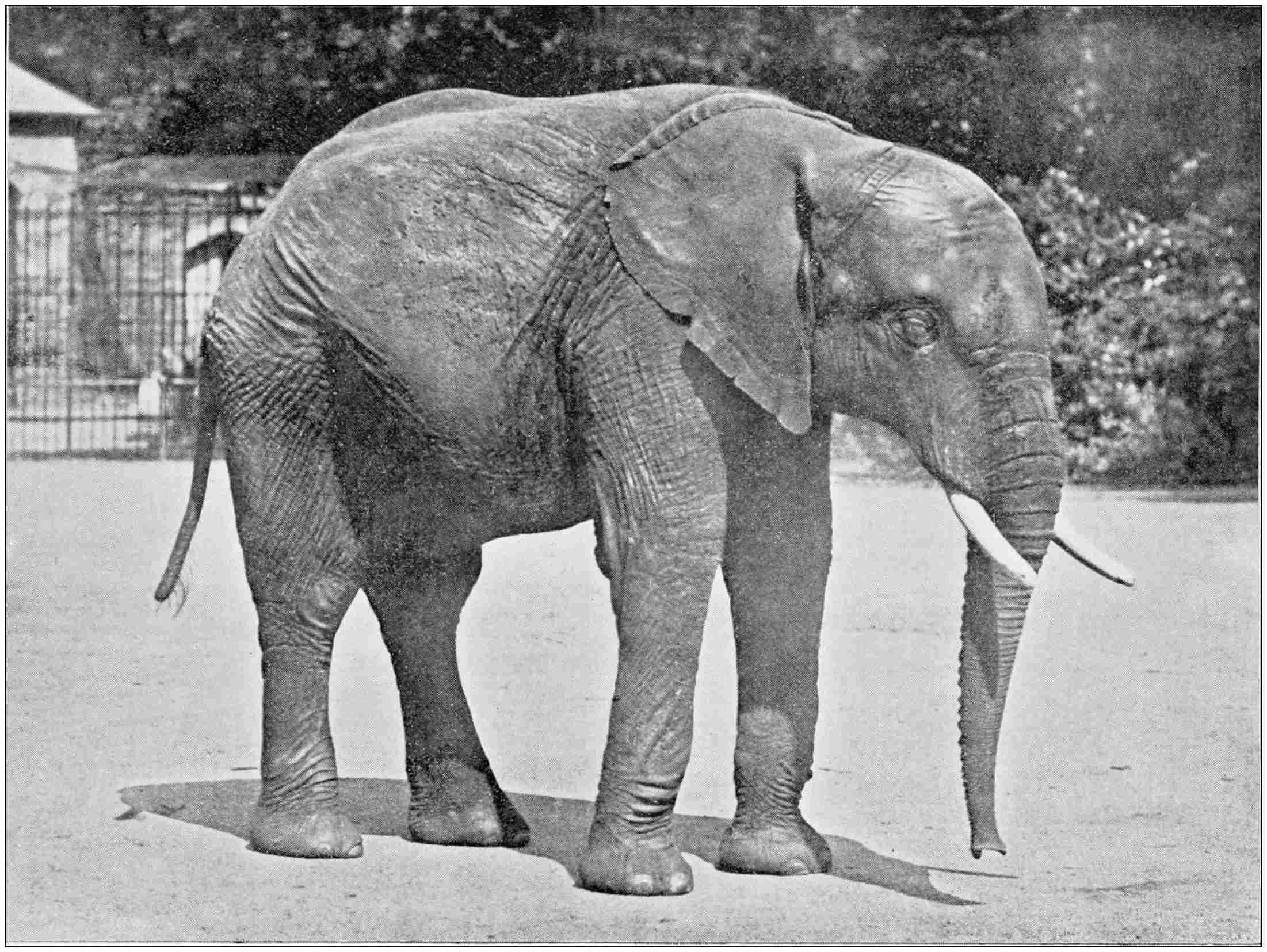
Without going into anatomical details, it may be said
that an African is about a foot taller than an Indian
elephant, his ears are much larger, his back is concave
instead of convex, and the tusks are much heavier and
longer. Their position in the jaw also differs; they converge
in passing backwards and upwards into the massive
processes in which they are set, so that their roots, and
the masses of bone and cartilage which form their sockets,
effectually protect the brain, which lies low behind the
receding forehead.
Speaking of hunting on horseback, W. Knighton
(“Forest Life in Ceylon”) mentioned it as a well-known
fact that “the elephant has an antipathy towards a horse.”
“A solitary traveller is perfectly safe while mounted” he
remarks. To the best of the author’s knowledge and
belief, the fact is directly the other way. Horses, until
accustomed to their sight and odor, fear elephants, but
the latter care nothing about them. They have never
been known to hesitate in attacking hunters in the saddle.
The Hamran and Baggara Arabs on the Upper
Nile and its tributaries nearly always meet them in this
manner. The only weapon used by these aggageers, or
sword-hunters, is a long, heavy, sharp, double-edged
Solingen blade. Three men generally hunt together, and
their method of procedure shows how well they know
the elephant’s character.
Having found the fresh spoor of an old bull whose
tusks are presumably worth winning, they track it to
its resting or feeding place, and approach with no other
precaution than is necessary to keep their quarry from
taking refuge in some mimosa thicket where their swords
cannot be used. When possible, the animal, who appreciates
the situation perfectly, and knows all about sword-hunters,
always makes itself safe in that way. If no
cover is within reach, the elephant backs up against a
rock, a clump of bushes, bank, or anything that will
guard it in the rear, and awaits its enemies with that
peculiarly devilish expression of countenance an elephant
wears when murderously inclined. Supposing the aggageers
to be three in number, and mounted,—two of them
close slowly in upon his flanks, while the third—the
lightest weight, on the most active and best broken
horse—gradually approaches in front. There stands the
elephant with cocked ears and gleaming eyes, and the
Arab slowly drawing nearer, sits in his saddle and reviles
him. Finally, what the Hamrans or Baggaras knew
from the first would happen actually takes place. The
elephant forgets everything, and dashes forward to annihilate
this little wretch who has been cursing and pitching
pieces of dirt at him. Then the horse is whirled round,
and keeping just out of reach of his trunk, its rider
lures the enraged animal on. As soon as he starts,
those riders on his quarters swoop down at full speed,
and when the one on his left comes alongside, he springs
to the ground, bounds forward, his sword flashes in the
air, and all is over. The foot turns up in front, in consequence
of cutting the tendon that keeps it in place,
and its blood rapidly drains away through the divided
vessels until the animal dies.
That “the reasoning elephant,” of whom Vartomannus
(“Apud Gesnerum”) exclaims in terms that have been
repeated for nearly two thousand years, “Vidi elephantos
quosdam qui prudentiores mihi vidabantur quàm quibusdam
in locis hominis,” should have thus relinquished his
advantages, abandoned an unassailable position, and knowing
the consequences, rushed upon destruction in this
way, is deplorable, and the worst of it is that he always
does this. The intellect of which Strabo calmly asserts
that it “ad rationale animal proxime accedit,” is never
sufficient to save him. Probably, however, this conduct
might appear to be more consistent, if instead
of trusting to these very classical but perfectly worthless
opinions, we looked upon it from the standpoint
which Sanderson’s description affords. “Though possessed
of a proboscis which is capable of guarding
it against such dangers, the elephant readily falls into
pits dug to receive it, and which are only covered with
a few sticks and leaves. Its fellows make no effort (in
general) to assist the fallen one, as they might easily do
by kicking in the earth around the edge, but fly in terror.
It commonly happens that a young elephant tumbles into
a pit, near which its mother will remain till the hunters
come, without doing anything to help it; not even feeding
it by throwing in a few branches.... Whole herds
of elephants are led into enclosures which they could
break through as easily as if they were made of corn
stalks ... and which no other wild animal would enter;
and single ones are caught by their hind legs being tied
together by men under cover of tame elephants. Animals
that happen to escape are captured again without
trouble; even experience does not bring them wisdom.
I do not think that I traduce the elephant, when I say
that it is, in many things, a stupid animal.”
Baldwin, Harris, and a few other authorities, report
that elephants are sometimes attacked by the black rhinoceros,
but otherwise they have no foes except man.
In Sir James Alexander’s account (“Excursion into
Africa”) of the manner in which these beasts attempt
to defend themselves against the charge of an enemy
of this kind, it is implied that the trunk is habitually
used offensively. “In fighting the elephant,” he observes,
the two-horned black rhinoceros, for no white
rhinoceros ever does this, “avoids the blow with its
trunk and the thrust with its tusks, dashes at the elephant’s
belly, and rips it up.” Quite a number of writers
have derided and denied statements of this nature,
and if it were not that they have likewise scouted everything
which they did not see themselves, their dissent
might have more weight than it has. Everybody knows
that the species of rhinoceros spoken of are of all wild
beasts the most irritable, aggressive, and blindly ferocious;
that they will, as Selous asserts, “charge anybody
or anything.” Apart from the question whether this
kind of combat ever takes place, or what the result would
be if it did, so many reasons exist why the trunk should
not be used like a flail, as here represented, that good observers
have failed to recognize the fact that it sometimes
is so employed. At all events, in face of various assertions
to the effect that it never strikes with its trunk, we
find Andersson nearly killed in this manner. He was
shooting from a “skärm”; that is to say, a trench about
four feet deep, twelve or fifteen long, and strongly roofed
except at the ends. This hiding-place and fortification
occupied “a narrow neck of land dividing two small
pools”—the water-holes of Kabis in Africa. “It was
a magnificent moonlight night,” and the hunter soon
heard the beasts coming along a rocky ravine near by.
Directly, “an immense elephant followed by the towering
forms of eighteen other bulls” moved down from high
ground towards his hiding place, “with free, sweeping,
unsuspecting, and stately step.” In the luminous mist
their colossal figures assumed gigantic proportions, “but
the leader’s position did not afford an opportunity
for the shoulder shot,” and Andersson waited until his
“enormous bulk” actually towered above his head, without
firing. “The consequence was,” he says “that in the
act of raising the muzzle of my rifle over the skärm,
my body caught his eye, and before I could place the
piece to my shoulder, he swung himself round, and with
trunk elevated, and ears spread, desperately charged me.
It was now too late to think of flight, much less of slaying
the savage beast. My own life was in the most
imminent jeopardy; and seeing that if I remained partially
erect he would inevitably seize me with his proboscis,
I threw myself upon my back with some violence; in
which position, and without shouldering the rifle, I fired
upwards at random towards his chest, uttering at the
same time the most piercing shouts and cries. The
change of position in all probability saved my life; for
at the same instant, the enraged animal’s trunk descended
precisely upon the spot where I had been previously
crouched, sweeping away the stones (many of them of
large size) that formed the front of my skärm, as if they
had been pebbles. In another moment his broad forefoot
passed directly over my face.” Confused, as Andersson
supposed, by his cries, and by the wound he had
received, the elephant “swerved to the left, and went
off with considerable rapidity.”
Of course, taking this narrative literally, it may be said
that it is not an illustration of the point under discussion—that
the elephant attempted to catch the man first, in
order to kill him afterwards. But prehensile organs are
not used as such in the way described. That Andersson
was about to be seized was purely suppositious upon his
part, while the descent of the elephant’s proboscis, with
such violence that it swept away large stones as if they
had been pebbles, was a matter of fact. The animal did
strike, whether he intended to do so or not, and that this
was not his intention is merely a guess. This story illustrates
other traits also, and among these the alleged fear
of man. “An implanted instinct of that kind,” observes
William J. Burchell (“Travels into the Interior of Southern
Africa”) “such as all wild beasts have, their timidity
and submission, form part of that wise plan predetermined
by the Deity, for giving supreme power to him who
is, physically, the weakest of them all.” The only objection
to this very orthodox statement is that it is not true.
Man is not weaker than many wild animals, and so far as
“timidity and submission” go, he might have found African
tribes barricading their villages and sleeping in trees
for no other purpose than to keep out of their way. Caution
proceeds from apprehension, and this from an experience
of peril. When the conditions of existence are such
that certain dangers persist, wariness in those directions
originates and becomes hereditary. Man has been the
elephant’s constant foe, and in those places where human
beings were able to destroy them, these animals were
overawed; but otherwise not, or at least, certainly not
in the sense in which this assertion is generally made.
With regard to the conclusions—many of them directly
contradictory—which prevail concerning the elephant’s
sense of smell, there are several circumstances which
ought to be taken into consideration, but with the
exception of currents of air, they have not been noticed
to the author’s knowledge. Scent in an elephant is very
acute, and the scope of this sense, as well as its delicacy
and discrimination, is greater than in most animals. At
the same time, the nervous energy that vitalizes this apparatus
is variable in quantity, and never exceeds a definite
amount at any one time. If wind sweeps away those
emanations which would otherwise have stimulated the
olfactories, no result occurs, and precisely the same consequence
follows a diversion of nerve force into other
channels.
Many accounts have been given in which this
seemed to be the cause of an unconsciousness that was
explained by saying that the sense itself was in fault.
Evidently, however, when the energy through which an
organ acts is fully employed in carrying on action somewhere
else, its function must be temporarily checked.
Preoccupation, however, fully accounts for the phenomenon.
Thought, feeling, concentrations of attention, physical and
mental oscillations of many kinds, perturb, check, pervert,
augment, or diminish function in this and other directions.
If we cannot accustom ourselves to looking upon wild
beasts as acting consciously and voluntarily, it seems
probable that little progress towards understanding their
habits and characters is likely to be made.
How, for example, are the following facts related by
Gordon Cumming, to be reconciled with conventional
opinions upon the shyness and timidity of elephants, their
fear of man, and the possession of instincts which act
independently of experience. It was in comparatively
early times that these events took place, before many
Europeans with rifles had gone into Africa, and when
elephants knew less about firearms than they did when
the big tusker nearly finished Andersson. “Three
princely bulls,” says Colonel Cumming, “came up one
night to the fountain of La Bono.” They knew that a
man was there, for they had got his wind. It is possible
that they also knew he was not a native, but if
this were the case, that was all that they knew.
The leader was mortally wounded at about ten paces
from the water, went off two hundred yards, “and there
stood, evidently dying.” His companions paused, “but
soon one of them, the largest of the three, turned his
head towards the fountain once more, and very slowly
and warily came on.” At this moment the wounded elephant
“uttered the cry of death and fell heavily to the
ground.” The second one, still advancing, “examined
with his trunk every yard of ground before he trod on
it.” Evidently there was no dancing, screaming horde of
negroes with assegais about; equally sure was it that
danger threatened from human devices, and the elephant,
not being inspired as is commonly supposed, was looking
for the only peril he knew anything about; that is to say,
a pit-fall. As for the explosion and flash, these most
probably were mistaken for thunder and lightning. In
this manner, and with frequent pauses, this animal went
round “three sides of the fountain, and then walked up
to within six or seven yards of the muzzles of the guns.”
He was shot and disabled at the water’s edge. By this
time ignited wads from the pieces discharged had set fire
to a bunch of stubble near by, and two more old bulls
who followed the original band, went up to the blaze;
one, the older and larger, appearing to be “much amused
at it.” This tusker staggered off with a mortal wound,
and another came forward and stood still to drink within
half pistol-shot of Colonel Cumming, who killed him.
Three more male elephants now made their appearance,
“first two, and then one,” and of these two were shot,
though only one of them fatally. What possible explanation
can the doctrine of instinct give of such behavior
as this upon the part of wild beasts? How does this kind
of conduct accord with the idea of a ready-made mind
that does not need to learn in order to know? In what
manner shall we adjust such conduct to preconceptions
concerning natural timidity and that implanted fear of
man “predetermined by the Deity”? It may be said,
of course, that Colonel Cumming’s account was overdrawn;
but the reply to an objection of this kind is that,
overwhelming evidence to the same effect could be easily
produced.
When an observant visitor walks along the line of platforms
in an Indian elephant-stable, the differences exhibited
by its occupants can scarcely fail to attract attention;
and with every increase in his knowledge, these diversities
accumulate in number and augment in importance.
During the free intercourse of forest life, some influence,
most probably sexual selection, has produced breeds whose
characteristics are unmistakable. Even the uninitiated
may at once recognize these. Koomeriah, Dwásala, and
Meèrga elephants exhibit marked contrasts, and experience
has taught Europeans their respective values. The
first is the best proportioned, bravest, and most tractable
specimen of its kind; but it is rare. Intermediate between
the thoroughbred and an ugly, “weedy,” and in
every way ill-conditioned Meèrga, comes what is called
the Dwásala breed, to which about seventy per cent of all
elephants in Asia belong. “Whole herds,” says Sanderson,
“frequently consist of Dwásalas, but never of Koomeriahs.”
Almost all animals used in hunting are of
this middle class, and they constitute by far the largest
division of those kept by the government. Females
greatly outnumber males, and it may be owing to this
fact that so many have been used in the pursuit of large
game, although some famous sportsmen maintain that
these are naturally more courageous and stancher than
tuskers.
Great as are the unlikenesses seen among inmates of
an establishment like that at Teperah, they will be found
to be fully equalled by their dissimilarities in character;
and those who have become familiar with elephants come
to see that their dispositions and intelligence are to some
extent displayed by their ordinary demeanor and looks.
It is wonderful how much facial expression an elephant
has. The face-skeleton is imperfect; that is to say, its
nasal bones are rudimentary, while the mouth, and in fact
all of the lower half of the face, is concealed beneath the
great muscles attached to the base of the trunk. But in
spite of that, and with his ears uncocked and his proboscis
pendant, an elephant’s countenance is full of character.
Passing along the lines where they stand, shackled by
one foot to stone platforms, one sees, or learns to see,
the individualities their visages reveal. Occasionally a
heavily-fettered animal is met with, whose mien is disturbed
and fierce. In his “little twinkling red eye,” says
Campbell, “gleams the fire of madness.” He is “must”;
the victim of a temporary delirium which seems to arise
from keeping male elephants apart from their mates. But
at length, amid all the appearances of sullenness, good
nature, stupidity, bad temper, apathy, alertness, and intelligence,
which the visitor will encounter, a creature is met
with in whose ensemble there is an indescribable but
unmistakable warning. Go to his keeper and state your
views. That “true believer,” if he happens to be a Mussulman,
having salaamed in proportion to his expected
bucksheesh, and said that Solomon was a fool in comparison
with yourself, will then express his own sentiments
but not so that the animal can hear him. These
are to the effect that this elephant is an oppressor of the
poor, a dog, a devil, an infidel, whose female relations to
the remotest generations have been no better than they
should be. That the kafir wants to kill him; is thinking
about doing it at that moment, but Ul-humd-ul-illa, praise
be to God, has not had a chance; though if it be his
destiny, he will do so some day. Very probably these are
not empty words. Most frequently the man knows what
he is talking about. Still if one naturally asks, why then
he stays in such a position, the answer breathes the very
genius and spirit of the East. “Who can escape his
destiny?” asks the idiotic fatalist, and remains where
he is.
The systems of rewards and punishments by which discipline
is kept up in a large elephant stable, affords several
items of interest with respect to the character of these
beasts. If, as sometimes is the case, an elephant shirks
his work, or does it wrong on purpose, is mutinous, stubborn,
or mischievous, a couple of his comrades are provided
with a fathom or two of light chain with which they
soundly thrash the delinquent, very much to his temporary
improvement. This race is very fond of sweets, and
sugar-cane or goor—unrefined sugar—forms an efficient
bribe to good behavior. The animals take to drink very
kindly, and when their accustomed ration of rum has been
stopped for misconduct, they truly repent. Mostly, however,
elephants are quiet, kindly beasts, and it is said by
those who ought to know, that animosity is not apt to be
cherished against men who correct them for faults of
which they are themselves conscious. At the same time,
nobody, if he is wise, gives an elephant cause to think
himself injured. Very often the creature entertains this
idea without cause, and it is not uncommon for them to
conceive hatreds almost at first sight. D’Ewes (“Sporting
in Both Hemispheres”) relates one of the many reliable
incidents illustrative of the animal’s implacability
when aggrieved. A friend of his, a field officer stationed
at Jaulnah, owned an elephant remarkable for its “extreme
docility.” One of the attendants—“not his mahout”—ill-treated
the creature in some way and was discharged in
consequence. This man left the station; but six years
after he, unfortunately for himself, returned, and walked
up to renew his acquaintance with the abused brute, who
let him approach without giving the least indication of
anger, and as soon as he was close enough, trampled him
to death. This is the kind of anecdote which Professor
Robinson remarks is “infinitely discreditable to the
elephant”; that fact, however, has nothing to do with
the truth. All those good qualities the creature possesses
can be done justice to without making any excursions into
sentimental zoölogy. Captain A. W. Drayson (“Sporting
Scenes in Southern Africa”) asserts that “the elephant
stands very high among the class of wild animals.” That
means nothing; affords no help to those who are trying to
find out how high it stands. Sir Samuel Baker (“Wild
Beasts and their Ways”) gives his opinion more at length.
Of the animal’s sagacity he observes that it is, according
to his ideas, “overrated. No elephant,” he says, “that I
ever saw, would spontaneously interfere to save his master
from drowning or from attack.... An enemy might
assassinate you at the feet of your favorite elephant, but
he would never attempt to interfere in your defence; he
would probably run away, or, if not, remain impassive, unless
especially ordered or guided by his mahout. This is
incontestible.... It is impossible for an ordinary bystander
to comprehend the secret signs which are mutually
understood by the elephant and his guide.” Baker
holds, with others who have really studied elephants, that
when they evince any special sagacity, it is because they
act under direction, and that if left to themselves they
usually do the wrong thing. The species is naturally nervous,
and this disability is increased by those alterations
in its way of life that domestication involves. Captivity
likewise shortens its existence. Profound physiological
changes are thus produced, the most noticeable of which
are barrenness, great capriciousness of appetite, enfeeblement
of the digestive functions, and a marked vice of nutrition
by which an animal that recovers from injuries the
most severe in its wild state now finds every trifling hurt
a serious matter, and often dies from accidents that would
otherwise have been of little moment. In the same category
must also be ranked the decreased endurance of tame
elephants. The Asiatic species is much inferior to the
African in this respect, by nature, but both sensibly deteriorate
in this way when domesticated.
There is nothing to show that the African elephant is
worse tempered than the Asiatic. It has never been reclaimed
by the natives, and that fact no doubt has given
rise to the opinion. In the Carthaginian, Numidian, and
Roman provinces, this species was made use of very much
as the other is now in India, and most if not all the famous
homicidal elephants we know of, belonged to the latter
country. But it would appear that a “rogue,” properly so
called, requires peculiar conditions under which to develop.
“Rogue elephants,” says Drummond, “are rare; indeed, it
seems to me that it is necessary for the full formation of
that amiable animal’s character that it should inhabit a
well-populated district where continual opportunities are
afforded for attacking defenceless people, of breaking into
their fields, and, in general, of losing its natural respect for
human beings; and as such conditions seldom exist in
Africa, from the elephant chiefly inhabiting districts devoid
of population on account of their unhealthiness, the rogue,
properly so called, is seldom met with, though the solitary
bull, the same animal in an earlier stage, is common enough.”
Drummond, it will be observed, clings to the superstition
of man’s recognized primacy in nature; and if he had declared
that his appointment to this position was handed
down by tradition among elephants from the time of Adam
and the garden of Eden, the absurdity could scarcely be
greater. In what possible way can a wild beast that has
not been hunted know anything about a man, except that
he is an unaccountable-looking little creature, who walks
like a bird, and has a very singular odor?
A rogue who infested the Balaghat District is described
by Baker as a captured elephant who after a considerable
detention escaped to the forest again. “Domestication,”
he remarks, “seems to have sharpened its intellect and
exaggerated its powers of mischief and cunning....
There was an actual love of homicide in this animal.” He
continually changed place, so that no one could foretell his
whereabouts, and approached those whom he intended to
destroy with such fatal skill that they never suspected his
presence until it was too late. He made the public roads
impassable. By day and night the inhabitants of villages
lying far apart heard the screams which accompanied his
attack, and immediately this monster was in the midst of
them, killing men, women, and children. At length Colonel
Bloomfield, aided by the whole population, succeeded in
hunting the beast down. “Maddened by pursuit and
wounds, he turned to charge,” and as he lowered his trunk
when closing, a heavy rifle ball struck him in the depression
just above its base, and he fell dead.
Cunning as this elephant was, his actions displayed that
lack of inventiveness which Sanderson charges against the
race; and this defect saved the lives of many who would
otherwise have been killed. If any one was out of reach in
a small tree, the rogue never thought of getting at him by
shaking its trunk. Both Sir Samuel and Captain R. N. G.
Baker report having seen an elephant butt at a Balanites
Egyptiaca when it was three feet in diameter, so that a
man “must have held on exceedingly tight to avoid a fall.”
It is certain that these animals are accustomed to dislodge
various edibles by this means. But a change in circumstances
prevented the Balaghat brute from resorting to a
well-known act which would have lengthened considerably
the list of his victims.
Places in Africa where elephants once abounded now
contain none. They are less subject to epidemics than
many species, but suffer from climatic disorders and the
attacks of parasites. This, however, is not the reason
for their disappearance from certain localities. They
have fallen before firearms, or migrated in fear of
them. “From my own observation,” says Baker, “I
have concluded that wild animals of all kinds will withstand
the dangers of traps, pit-falls, fire, and the usual
methods employed for their destruction by savages, but
will be speedily cleared out of an extensive district by
firearms.”
A field naturalist coming from Africa to India, or any
other part of Asia, would be at once struck by the inferior
size, darker color, smaller ears, less massive tusks (rudimentary
in the female), and other structural differences presented
by Elephas Indicus. Likewise, with the forest life,
browsing habits, and nocturnal ways of this species,
“there is little doubt that there is not an elephant ten
feet high at the shoulder in India,” says Sanderson. If a
stranger took to elephant-hunting, his opinion of their
character in that country would probably depend upon the
escapes he made from being killed. There is, however,
something yet to be said upon the subject of Asiatic rogues
that, so far as the author is aware, has escaped the attention
of those who have described them. Such creatures as
those of Kakánkōta, Balaghat, Jubbulpūr, and the Begapore
canal, are extremely exceptional, if what they actually did
be alone considered, but there is nothing to show that
they were very extraordinary in temper or traits of character.
The first seems to have been undoubtedly insane;
the others, however, gave no indications of mental alienation.
They were simply vicious like great numbers of
their kind, and the accidents of life enabled them to show
it more conspicuously than is often the case. Whatever
may be thought of the influence of descent in these instances,
it is certain that a criminal class cannot develop
itself among elephants, and that those murderous brutes
referred to, do not stand alone.
Colonel Pollok (“Natural History Notes”) gives a report
extracted from the records in the Adjutant General’s
Office, that brings out several points relating to the character
of vicious elephants. The statements made seem to
be incredible, but those who have made a study of the
subject will recall many examples of desperation, tenacity
of life, and ferocity in elephants, that may serve to modify
doubt; more especially in connection with the effects of
wounds in the head, which is so formed that half of it
might be shot away without an animal suffering otherwise
than from shock and loss of blood.
To C. Sealy, Magistrate, etc.
Sir:—I have the honor to state that on the 24th instant, at midnight,
I received information that two elephants of very uncommon
size had made their appearance within a few hundred yards of the
cantonment and close to the village, the inhabitants of which were in
the greatest alarm. I lost no time in despatching to the place all the
public and private elephants we had in pursuit of them, and at daybreak
on the 25th, was informed that their very superior size and
apparent fierceness had rendered all attempts at their seizure unavailing;
and that the most experienced mahout I had was dangerously
hurt—the elephant he rode having been struck to the ground by one
of the wild ones, which, with its companion, had then adjourned to a
large sugar-cane field adjoining the village. I immediately ordered the
guns (a section of a light battery) to this place, but wishing in the
first place, to try every means for catching the animals, I assembled
the inhabitants of the neighborhood, and with the assistance of the
resident Rajah caused two deep pits to be prepared at the edge of
the cane field in which our elephants and the people contrived, with
the utmost dexterity, to retain the wild ones during the day. When
these pits were reported ready, we repaired to the spot, and they were
cleverly driven into them. But, unfortunately, one of the pits did not
prove to be sufficiently deep, and the one who escaped from it, in the
presence of many witnesses, assisted his companion out of the other
pit with his trunk. Both were, however, with much exertion, brought
back into the cane, and as no particular symptoms of vice or fierceness
had appeared in the course of the day, I was anxious to make another
effort to capture them. The beldars, therefore, were set to work to
deepen the old and prepare new pits against daybreak, when I proposed
to make the final attempt. About four o’clock yesterday, however,
they burst through all my guards, and making for a village about
three miles distant, reached it with such rapidity that the horsemen
who galloped before them, had not time to apprise the inhabitants of
their danger, and I regret to say that one poor man was torn limb from
limb, a child trodden to death, and two women hurt. Their destruction
now became absolutely necessary, and as they showed no disposition
to quit the village where their mischief had been done, we
had time to bring up the four-pound pieces of artillery [these events
took place in 1809] from which they received several rounds, both
ball and abundance of grape. The larger of the two was soon brought
to the ground by a round shot in the head; but after remaining there
about a quarter of an hour, apparently lifeless, he got up again as
vigorous as ever, and the desperation of both at this period exceeds all
description. They made repeated charges on the guns, and if it had
not been for the uncommon bravery and steadiness of the artillery-men,
who more than once turned them off with shots in the head and
body when within a very few paces of them, many dreadful casualties
must have occurred. We were obliged to desist for want of ammunition,
and before a fresh supply could be obtained, the animals quitted
the village, and though streaming with blood from a hundred wounds,
proceeded with a rapidity I had no idea of towards Hazarebaugh. They
were at length brought up by the horsemen and our elephants, within
a short distance of a crowded bazaar, and ultimately, after many renewals
of most formidable and ferocious attacks on the guns, gave up
the contest with their lives.
The western half of those central Indian highlands
called locally the Mykal, Máhádeo, and Sátpúra hills, is
a famous haunt for elephants. In this wild birthplace of the
streams that pour themselves into the Bay of Bengal and
the Arabian Gulf, these creatures wander in comparative
security. The Gónd, Kól, and Sántál aborigines furnish
the best trackers extant, except, perhaps, those mysterious
Bygá or Bhúmiá, whose knowledge of woodcraft is
unequalled. These small, dark, silent men have no sort
of respect for an elephant’s mind or character, but they
worship it from fear; they adore the animal because they
know enough of its disposition to be always apprehensive
of its doing more than it generally does.
Most of these great timber districts are under the supervision
of officers, and the camps of their parties are widely
scattered through large and lonely tracts of woodland. If
one of these is come upon by a herd of elephants while its
occupants are absent, a striking trait in this creature’s
character will almost surely be exhibited. No monkey is
more mischievous than one of these big brutes, and when
the men return they probably find that nothing which could
be displaced, marred, or broken, has escaped their attention.
Elephants are also very curious; anything unusual is apt
to attract them, and if they do not become alarmed at it,
the gravity with which a novel object is examined, and
the queer, awkward way in which these beasts manifest
interest or amusement, is singular enough. Sometimes
their performances under the incitement of curiosity
or malicious mischief are decidedly unpleasant. A wild
elephant came out of the woods one night and pawed a
hole in the side of Sanderson’s tent. Hornaday says he
made a little door in the wall at the head of his bed, so
that he could bolt at once in case of a visitation like this.
People living in such places, and in frail houses, are exposed
to another contingency. Elephants are very subject
to panics, and as they often arise from causes that
should not disturb such a creature at all, no one can tell
when a herd may not rush off together, and go screaming
through the wood, breaking down everything but the big
trees before them.
Sooner or later, a hunting party’s progress will be arrested
by the halt of their guide: he crouches down in
his tracks and looks intently, as it appears, at nothing.
What he sees would be nothing to eyes less practised, but
it is an elephant’s spoor. If one were in Africa, the
trackers would now smooth off a little spot of ground,
make a few incantations, and throw magic dice to find
out all about this animal. But here nothing of that kind
is done, and yet the guide will follow the trail unerringly,
and the hunter may count upon being brought to his game.
“When you know,” says Captain A. W. Drayson, “that
the giant of the forest is not inferior in the senses of
hearing and smell to any creature in creation, and has
besides intelligence enough to know that you are his
enemy, and also for what purpose you have come, it becomes
a matter of great moment how, when, and where
you approach him.”
Elephants, unless they have some definite end in view,
stroll about in the most desultory, and, if one is following
them, the most exasperating manner. Their big round
footprints go up hill and down dale in utterly aimless and
devious meanderings. Here the brute stops to dig a tuber
or break a branch, there for the purpose of tearing down a
clump of bamboos, in another place with no object in view
except to drive its tusks into a bank. Sportsmen often
spend a day and night upon their trail.
No one can foresee the issue of a contest with an elephant.
It may fall to a single shot, but no matter how
brave and cool and well instructed the hunter may be, how
stanch are his gun-bearers, how perfect his weapons and
the skill with which they are used, when that wavering
trunk becomes fixed in his direction, and the huge head
turns toward him, his breath is in his nostrils. More than
likely the animal, whose form is almost invisible in the
half-lights of these forests, is aware of his pursuer’s presence
before the latter sees him, and if he has remained, it
is because he means mischief. Then it may well happen
with the sportsman as it did with Arlett, Wedderburn,
Krieger, McLane, Wahlberg, and many another.
It stands to reason that a herd is harder to approach
without being discovered than a single elephant would be.
The chances that the hunter will be seen are greater, and
their scattered positions make it more probable that some
of them will get his wind.
Occasionally an old bull who despises that part of mankind
who do not possess improved rifles, and knows perfectly
well the difference between an Englishman and a
native, will take possession of some unfortunate ryot’s
millet field or cane patch, and hold it by right of conquest
against all attempts to dislodge him. Crowds revile the
animal from a safe distance, and a village shikári comes
with a small-bored matchlock and shoots pieces of old iron
and pebbles at him from the nearest position where it is
mathematically certain that he will be secure. As for the
marauder, he stays where he is until everything is eaten
or destroyed, or until he gets tired.
The amount actually consumed by elephants forms but
a small portion of the loss which agriculturists sustain
from their forays. They always trample down and ruin
far more than they eat. Both in India and Ceylon, various
districts suffered so severely in this way that government
gave rewards for all elephants killed. This has now been
discontinued in both countries, but in many places where
the herds are protected their numbers are increasing, so
that the same necessity for thinning them out will again
arise.
All over the cultivated portions of India platforms are
erected in fields, where children by day, and men at night,
endeavor to frighten away these invaders, together with
the birds, antelopes, bears, monkeys, and wild hogs, that
ravage their crops. No very signal success can be said to
attend these efforts, and when a herd of elephants makes
its appearance, they simply keep at a distance from the
stages, and otherwise do as they please.
Plundering bands survey the ground, study localities, go
on their duroras like a troop of Dacoits, and are organized
for the time being in a rude way, under the influence of
what Professor Romanes calls “the collective instinct.”
Hunters favorably situated can easily see this. A far-off
trumpet now and then announces the herd’s advance
through the forest, but as they approach the point where
possible danger is to be apprehended, no token of their
presence is given, and its first indication is the appearance
of a scout,—not a straggler who has got in front by accident,
but an animal upon whom the others depend, and
who is there to see that all is safe. Everything about the
creature, its actions and attitudes, the way it steps, listens,
and searches the air with slowly moving trunk, speaks for
itself of wariness, knowledge of what might occur, and an
appreciation of the position it occupies; no doubt, to a
certain extent, of a sense of responsibility. When this
scout feels satisfied that no danger is impending, it moves
on, at the same time assuring those who yet remain hidden
that they may follow, by one of the many significant
sounds that elephants make.
A number of narratives describe events as they are
likely then to occur, but they are merely hunting
stories, and so far as the writer’s memory serves, do not
bring out the animal’s traits in any special way. It would
appear, however, that the behavior of elephants who unexpectedly
meet with Europeans in those places where all the
resistance previously experienced came from farmers themselves,
is very different from what it is in the former case.
Then they are said to be difficult to get rid of, and when
driven away from one point by shouts, horns, drums, and the
firing of guns, they rush away to another part of the plantations,
and continue their depredations. No such passive
resistance as this is attempted when English sportsmen
are upon the spot. Elephants discover their presence
immediately. Upon the first explosion of a heavy rifle, the
alarm is sounded from different parts of the field, and the
herd betakes itself to flight without any notion of halting
by the way. Their dominant idea is to get clear of those
premises as soon as possible.
“The elephant,” says Andersson, “has a very expressive
organ of voice. The sounds which he utters have been
distinguished by his Asiatic keepers into three kinds. The
first is very shrill, and is produced by blowing through his
trunk. This is indicative of pleasure. The second, made by
the mouth, is a low note expressive of want; and the third,
proceeding from the throat, is a terrific roar of anger or
revenge.” Sanderson seems to think that these discriminations
are somewhat fanciful. He remarks that “elephants
make use of a great variety of sounds in communicating
with one another, and in expressing their wants and
feelings.” But he adds that, while “some are made by the
trunk and some by the throat, the conjunctures in which
either means of expression is employed, cannot be strictly
classified, as pleasure, fear, want, and other emotions are
indicated by either.” Leveson, on the contrary, gives a
list of these intonations, and describes the manner in which
they are produced. So also does Tennant; and Baker adds
another sound to those before given; “a growl,” this
writer calls it, and he says that “it is exactly like the
rumbling of distant thunder.”
Undoubtedly these animals express their thoughts and
feelings intelligibly by the voice, as also through facial
expressions, and by means of such gestures as they are
capable of making. It has been before said that although
the elephant’s face is half covered up, and there are no
muscles either in his case or in that of any other animal,
whose primary function is to express mental or emotional
states, his physiognomy may be in the highest degree significant.
“The courage of elephants,” writes Captain Drayson,
“seems to fluctuate in a greater degree than that of man.
Sometimes a herd is unapproachable from savageness;
sometimes the animals are the greatest curs in creation.”
What is called boldness varies considerably in different
species, among members of the same species, and in the
same individuals at different times. It is a quality, that,
like all others, is double-sided, certain elements belonging
to the mind, and the residue to the body. Elephants are
nervous; that is to say, their nerve centres—the ganglia
in which energy is stored up—are constitutionally in a
state of more or less unstable equilibrium, so that stimulus,
whether of external origin, or initiated centrically, is apt to
produce explosive effects. Courage depends upon physical
and mental constitution, upon specializations in race, training,
and structure, upon differences in personal experience
and organization.
So much as this may be said with confidence, but on
what grounds, biological or psychological, is it possible for
Professor Romanes to assert that the elephant seems
usually to be “actuated by the most magnanimous of
feelings”? Magnanimity belongs to the rarest and loftiest
type of human character: how did an elephant come by
it? The obligations of mental and moral congruity are
not less binding than those of physical fitness. No one
nowadays draws an elephant with a human head; but a
beast with self-respect, courage, refinement, sympathy,
and charity enough to be magnanimous, does not seem to
outrage any sense of propriety. Works like those of Watson
(“Reasoning Power of Animals”), Broderip (“Zoölogical
Recreations”), Bingley (“Animal Biography”),
Swainson (“Habits and Instincts of Animals”), too often
interpret facts so that they will fit preconceived opinions.
There is a story, for example, by Captain Shipp, of how,
during the siege of Bhurtpore, an elephant pushed another
one into a well because he had appropriated his bucket.
Tales like this resemble pictures in which the design and
execution are both weak, and which depend for their effect
upon accessories illegitimately introduced into the composition.
Probably a large part of the present inhabitants
of the earth have seen animals who, while contending for
some possession, acted in a similar manner; but they
were not elephants, nor were the circumstances of a
well and a siege at hand to set them off, and produce
an impression that the actual incident does not justify.
The grief of captive elephants over their situation is a
subject upon which many fine remarks have been made.
Colonel Yule (“Embassy to Ava”) states that numbers
die from this cause alone; but yaarba’hd, either in its
dropsical or atrophic form, is what chiefly proves fatal to
them, and this is brought on by the sudden and violent
interruption of their natural way of life. According to
Strachan, Sanderson, and other experts, the disorder is
due to an overthrow of functional balance; something
which is sure to induce disease whenever it occurs. Sterility,
temporary failure of milk in females with calves,
together with the various effects already mentioned, may
be referred to the same cause. It is not said that elephants
never die of grief; still less, that this is impossible.
Any animal highly organized enough to feel intense and
persistent sorrow may perish. Pain, either physical or
mental, is intimately connected with waste of tissue and
paralysis of reparative action. Bain’s formula that “states
of pleasure are concomitant with an increase, and states
of pain with a decrease, of some, or all, of the vital functions,”
is not strictly correct as it stands; still the truth it
is intended to convey remains indisputable. Grant-Allen
(“Physiological Æsthetics”) defines pleasure as a “concomitant
of the healthy action of any or all of the organs
or members supplied with afferent cerebro-spinal nerves,
to an extent not exceeding the ordinary powers of reparation
possessed by the system.” Grief, when intense, reverses
this, makes normal function impossible, palsies the
viscera, and impairs or perverts those nutritive processes
upon which life directly depends. But the profound and
abiding sorrow this race cherishes in servitude is a romance.
There is nothing to show the regret and longing which
have been imagined. Elephants struggle for a while
against coercion, and then forget. They fail to take advantage
of opportunities for escape, and when they do, the
fugitives are recaptured more easily than they were taken
in the first place. Instances have often occurred of their
voluntary return after a long absence. In the beginning,
it is the finest animals who perish. They kill themselves
in their struggles, or die of disease. Subsequently, it
is said that domestication lengthens average life. This
must, however, be one of those blank assertions made so
commonly about wild beasts; since, independently of any
other objection, it is evident that the statement, in order
to be worth anything, should rest upon the basis of a wide
comparison between the relative longevities of free and
captive animals, and vital statistics of this kind, not only
have not been tabulated, but it is impossible that they
should have been collected.
Colonel Pollok remarks that “at all times, this is a
wandering race, and consumes so much, and wastes so
much, that no single forest could long support a large
number of such occupants.” Livingstone, Forsyth, and
others have, however, noted the fact that little or no permanent
injury to extensive woodlands was wrought by
these animals. They do not overturn trees, as is popularly
believed, and still less do they uproot them. Elephants
bend down stems by pressure with their foreheads, and
they go loitering about breaking branches, till the place
looks as if a whirlwind had passed over it, but these devastations
are of a kind soon repaired. In the forests of
India they have never met with such adversaries, or been
exposed to the same dangers, as the species encountered
on the “Dark Continent.” Some Indian tribes worshipped,
and all feared them. They passed their lives for
the most part in peace, finding food plentiful, ruining
much, and finishing nothing. Pitfalls were few and far
between; no weighted darts fell upon them as they passed
beneath the boughs, no pigmy savage stole behind as they
leaned against a tree boll and woke the echoes of the
wood with deep, slow-drawn, and far-resounding snores,
to thrust a broad-bladed spear into their bodies, and leave
it there to lacerate and kill his victim slowly. Neither
were herds driven over precipices, nor into chasms,
nor did hordes of capering barbarians come against
them with assagais, and scream, while pricking them to
death,—
“Oh Chief! Chief! we have come to kill you,
Oh Chief! Chief! many more shall die.
The gods have said it.”
All this was common throughout Africa, while in Asia
the natives seldom aggressed against elephants except
in the way of capturing them. It is true that this was
done awkwardly, and often caused injury or death; but
that was unintentional, and as a rule they roamed unmolested
among the solitudes of nature.
Existence had its drawbacks, however. Elephants were
not eaten in Asia, and not hunted for their ivory to any
extent, but they were used in war, and the state of no
native prince could be complete unless he had an elephant
to ride on and several caparisoned animals for show.
Owing to these needs and fashions the animals were captured
extensively. In many places at present small parties
of men, often only two or three, go on foot into the forests
as their predecessors did ages ago, each with a small bag of
provisions, and a green hide rope capable of being considerably
stretched. An elephant’s track is almost as explicit
and full of information to them as a passport or descriptive
list, and when they have found the right one, it is
patiently followed till the beast that made it is discovered.
Then in the great majority of cases its fate is fixed.
Flight, concealment, resistance, are in vain. In some
“inevitable hour” a noose of plaited thongs that cannot
be broken is slipped around one of the hind feet, and a
turn or two quickly taken about a tree. A high-bred elephant
gives up when he finds that the first fierce struggle
for freedom is unavailing, but the meerga’s resistance lasts
longer. After one leg has been secured it is easy to fetter
both, and then the captors camp in front of the animal in
order to accustom it to their presence. By degrees they
loosen its bonds, feed and pacify it. When anger is over,
and its terrors are dissipated, these men lead their captive
off to a market at some great fair, and they lie about what
they have done and what the elephant did, with a fertility
of invention, a height and length and breadth of mendacity
which it would be vain to expect to find exceeded in this
imperfect state of existence.
The government also often wants elephants, and when
this is the case, captures are made in a different manner,
and upon a greater scale. What is done is to surround a
herd and drive it into an enclosure called a keddah. This
is often a very complicated and difficult thing to accomplish.
Far away in some wild unsettled region of the
Nilgiri or Satpúra hills, the uplands of Mysore, or elsewhere,
an English official pitches his tent, surveys the
country, and sends out scouts. To him sooner or later
comes a person without any clothes to speak of, but with
the most exquisite manners, and says that, owing to his
Excellency’s good fortune, by which all adverse influences
have been happily averted, he begs to represent that a
herd of elephants, who were created on purpose to be captured
by him, is marked down. Then the commander-in-chief
of the catching forces opens a campaign that may
last for weeks, or even months. The topography has been
carefully studied with reference to occupying positions
which will prevent the animals from breaking through a
line of posts that are established around them, and between
which communication is kept up by flying detachments.
Drafts of men from the district and a trained contingent
the officer brought with him, are manœuvred so that they
can concentrate upon the point selected for their keddah,
which is not constructed till towards the close of these
movements, since the area surrounded is very extensive
and it is not at first known exactly where it must be
placed. Its position is fixed within certain limits, however,
and their object is to drive the herd in that direction
without at first attracting attention to the fact that this is
being done, and thereby causing continued alarm. Those
who direct proceedings know the character of elephants,
and count upon their lack of intelligence to aid them
in carrying out the design. Before any apprehension of
real danger makes itself felt, they have voluntarily, as it
seems to them, moved away from parties who just showed
themselves from time to time and then disappeared. They
still feed in solitudes apparently uninvaded, still stand
about after the manner of their kind, blowing dust through
their trunks or squirting water over their bodies. They
fan themselves with branches, and sleep in peace.
At length, long after the true state of things would
have been fully appreciated by most other species, the
herd finds out that it is always moving in a definite direction.
Then a dim consciousness of the truth, which day
by day becomes more vivid until it arrives at certainty,
takes possession of their minds. From that time an exhibition
of traits which scarcely correspond with popular views
upon the elephant’s intellect is constantly made. If they
had anything like the ability attributed to them, the toils
by which they are surrounded could be broken with ease.
There is no time from their first sight of a human being
to the very moment when they are bound to trees, at
which they could not escape. It is useless to say they
do not know this; that is precisely what the creatures are
accused of. If they were such animals as they are said to
be, they would know it, and act accordingly. But as soon
as the situation is revealed, they become helpless; their
resources of every kind are at an end. They stand still
in stupid despair, break out in transient and impotent fits
of rage, make pitiable demonstrations of attack upon points
where they could not be opposed for an instant if the
assault was made in earnest, and at length suffer themselves
to be driven into an enclosure that would no more
hold them against their will than if it had been made of
gauze.
An elephant corral or keddah is a stout stockade with
a shallow ditch dug around it inside, and slight fences of
brush diverging for some distance from its entrance. Incredible
as it may seem, single elephants frequently break
out of these places, but a herd hardly ever; they have not
enterprise, pluck, and presence of mind enough to follow the
example when it is set them. Sometimes, as we have
seen, elephants may be fierce and determined; desperation
has been shown to be among the possibilities of their
nature. But whereas an exceptional individual will, from
pure ferocity, brave wounds and death, nothing can so
move the race as to cause a display of ordinary self-possession.
It is quite true that whenever the imprisoned
band comes rushing down upon any part of the keddah,
they are met with fire-brands, the discharge of unshotted
guns, and an infernal clamor; but if that be urged in explanation
of their hesitation, it may be replied that if the
whole herd had as much resolution as a single lion brought
to bay, they would sweep away everything before them
as the fallen leaves of their forests are swept away by a
gale.
Often among the bewildered and panic-stricken crowd
within a corral some animal is so dangerous that it has to
be shot; the majority, however, soon grow calmer, and
then comes the task of securing those which it is desirable
to keep. When these are males, the procedure is as follows:
An experienced female is introduced; she marches
up to the tusker, and very shortly all sense of his situation
vanishes from his “half-human mind.” The fascinating
creature who is made to cajole him has a man on
her neck whose voice and motions direct her in everything
she does; but that circumstance, which might undoubtedly
be supposed to attract the captive’s attention, is entirely
overlooked, and when, either by herself or with the assistance
of another Delilah, she has backed her Samson up
against a tree, two or three other men who have been
riding on her back, but whom he has not noticed, slip
down and make him fast. As has been said, after a few
fits of hysterics, his resistance is at an end; the monarch
of the forest is tamed, and considering what has been
written about elephants, it is indeed surprising that no
one has reported the precise course of thought that produced
his resignation. To express this change in the
felicitous language of Professor Romanes, the elephant
has experienced “a transformation of emotional psychology.”
That is to say, a being which has heretofore been
nothing but an unreclaimed wild beast, is by the simple
process of being frightened, deceived, abused, and enslaved,
at once converted into one of the chief ornaments
of animated nature!
The question arises as one ponders upon statements
like this, whether we really know anything worth speaking
of about inferior animals, and if it is possible to use
expressions like “cruel as a tiger,” “brave as a lion,” or
“sagacious as an elephant,” rationally. As for any philosophical,
or, as Spencer calls it, “completely unified knowledge”
on the subject, nobody possesses it; at the same
time the natural sciences may be so applied as to bring
certain truths to light in this connection. It is plain, for
example, that an elephant does not kill his keeper because
he is fond of him; but it is one thing to start out with the
assumption that this noble-hearted, affectionate, and magnanimous
animal would never have been guilty of such an
act unless it had been maltreated, and it is another, and
quite a different course to begin with the fact that the
deed was done by a brute in whose inherited nature no
radical change could by any possibility have been effected
by such training as it has received. If now we endeavor
to ascertain what that nature was,—study the records of
behavior in wild and domesticated specimens, and look at
this by the light which biology and psychology, without
any assumptions whatever, cast upon it,—we shall find ourselves
in the best position for investigating any particular
case under consideration. Many accounts of such murders
have been given at length. We know how, why, when,
and where the animal began its enmity, and the manner
in which it was shown or concealed, so that, having investigated
the matter in the way described, we are, to a
certain extent, able, not to generalize the character of this
species, but to put aside immature opinions, and say that
since very many elephants exhibit traits which are in conformity
with those to be expected of them, these probably
belong to the species at large, and may be displayed with
different degrees of violence whenever circumstances favor
their manifestation.
The chief characteristics of elephants have been discussed,
and an attempt has been made to place them in
their true light. The writer has not found the half-human
elephant in nature, nor does it appear from records that
any one else has done so. An elephant is a wild beast,
comparatively with others undeveloped by a severe struggle
for existence; superficially changed in captivity, and cut
off from improvement by barrenness. It is capable of
receiving a considerable amount of instruction, and learns
quickly and well; but how far its acquisitions are assimilated
and converted into faculty, is altogether uncertain.
In the savage state elephants do nothing that other animals
cannot do as well, and many of them better. Mere bulk,
and its accompaniment, strength, do not influence character
in any definite manner that can be pointed out.
In captivity, elephants are commonly obedient, partly
because, having never had any enemies to contend with,
they are naturally inoffensive, and partly for the reason
that these animals are easily overawed, very nervous, and
extremely liable to feelings of causeless apprehension.
Courage in cold blood is certainly not one of their qualities;
nevertheless, being amenable to discipline, and having
some sense of responsibility, certain elephants are
undoubtedly stanch both in war and the chase.
This animal is easily excited, very irritable, prone to
take offence, and subject to fits of hysterical passion.
Thus it happens that wild elephants are the most formidable
objects of pursuit known to exist, and that the majority
of those held in durance exhibit dangerous outbreaks of
temper. When an elephant is vicious, he displays capabilities
in the way of evil such as none of his kind, when
left to themselves, have ever been known to manifest in
the direction of virtue. A “rogue” is the most terrible
of wild beasts; the captive tusker who has determined
upon murder finds no being but man, who in the prosecution
of his design is so patient, so self-contained, so
deceitful, and so deadly. It is idle to say, speaking of
the relations between elephants and men, that the good
qualities of the former greatly predominate, since if it had
been otherwise, no association between them would have
been possible—they could not have inhabited the same
regions.
The concluding pages may, perhaps, serve to show how
far this sketch of the elephant’s character is compatible
with facts.
Charles John Andersson (“The Lion and the Elephant”)
observes that, “whether or not the elephant be
the harmless creature he is represented by many, certain
it is that to the sportsman he is the most formidable of all
those beasts, the lion not excepted, that roam the African
wilds; and few there are who make the pursuit of him a
profession, that do not, sooner or later, come to grief of
some kind.” Being social animals, there is a certain sympathy
and affection between members of the same family;
but while striking instances of this are recorded, the bulk
of evidence tends the other way.
Impressive examples of solicitude have, however, been
observed. Moodie tells that he saw a female—whom
the experience of most hunters shows to be much more
likely to act in this manner than a male—guard her
wounded mate, and how she, “regardless of her own
danger, quitted her shelter in the woods, rushed out to his
assistance, walked round and round him, chased away the
assailants, and returning to his side caressed him. Whenever
he attempted to walk, she placed her flank or her
shoulder to his wounded side and supported him.” Frederick
Green wrote an altogether unique account to
Andersson of the succor of an elephant that had been
shot, by one who was a stranger, of the same sex, and
who encountered him far from the scene where his misfortune
had befallen him.
The Bushmen, he says, often asserted that elephants
would carry water in their trunks to a wounded companion
at a long distance in the “Weldt.” Green, however, did
not believe it, until, while hunting in the Lake Regions,
he was compelled, from want of ammunition, “to leave an
elephant that was crippled (one of his fore legs had been
broken, besides having eleven wounds in his body) some
thirty miles from the waggons.”
“As I felt confident,” this writer continues, “that he
would die of his wounds ... I despatched Bushmen after
him instead of going myself; but they, not attending to
my commands, remained for two days beside an elephant
previously killed by my after-rider. It was, therefore, not
until the fourth evening after I left this elephant that the
Bushmen came up with him.... They found him still
alive and standing, but unable to walk.... They slept
near him, thinking he might die during the night; but at
an early hour after dark they heard another elephant at a
distance, apparently calling, and he was answered by the
wounded one. The calls and answers continued until the
stranger came up, and they saw him giving the hurt one
water, after which he assisted in taking his maimed companion
away.” Such was the story told Green when the
party came back. He disbelieved their statements
entirely, went off to the spot to see what had happened
for himself, and thus relates his own observations:—
“The next afternoon found me at the identical place
where I had left the wounded elephant. I can only say
that the account of the Bushmen as to the stranger
elephant coming up to the maimed one was proved by
the spoor; and that their further assertion as to his
having assisted his unfortunate friend in removing elsewhere
was also fully verified from the spoor of the two
being close alongside of each other—the broken leg of
the wounded one leaving after it a deep furrow in the
sand. As I was satisfied that these parts of their story
were correct, I did not see any further reason to doubt
the other.”
Male elephants rarely fall in the holes which undermine
so many parts of Africa; they carry their trunks low, have
no one to look out for but themselves, and so detect these
traps, and generally uncover them. Moodie makes the
statement that many elephants follow the recent trails of
those who went before them to watering-places, and if
these turned off, took it for a sign of danger, and did not
drink. After what Inglis and Hallet say to the same
effect of tigers, after St. John’s observations upon red
deer, and Lloyd’s on the Scandinavian fox, inductive
reasoning like this does not seem at all incredible. Amral,
chief of the Namaqua Hottentots, told Galton and Andersson
that on one occasion he and others were in pursuit of
a herd of elephants, and at length came to a wagon-track
which the animals had crossed. Here the latter, as was
seen by their spoor, had come to a halt, and after carefully
examining the ground with their trunks, formed a circle
in the centre of which their leader took up his position.
Afterwards individuals were sent out to make further investigations.
The Raad, or debate, this chieftain went on
to say, must have been long and weighty, for they (the
elephants) had written much on the ground with their
probosces. The decision evidently was that to remain
longer in that locality would be dangerous, and they
therefore came to the unanimous resolution to decamp
forthwith. Attempts to overtake them, Amral went on to
say, were useless; for, though they followed their tracks
till sunset, they saw no more of them.
What these elephants thought when they found a
track which, to them, was new and inexplicable, is, of
course, a matter of conjecture; but their trail revealed
everything that was done on this occasion, as clearly as
if the Hottentots had been eye-witnesses of their actions.
Colonel Julius Barras (“India and Tiger-Hunting”)
entered con amore into a study of the elephant, so far as
its character came into play when the animal was employed
in sport; and he did what no other gentleman,
to the author’s knowledge, has ever done; namely, turned
mahout himself, and drove shikar tuskers against many
a tiger. His appreciation of this creature’s courage,
benevolence, and reliability is very much in accord with
that which has been expressed; but he offers some
observations upon vice that should not be overlooked.
“One peculiarity of elephants,” remarks the Colonel, “is
that, when desirous of killing any one, they nearly always
select as a victim their own or a rival’s attendant.” It
seems rather strained, however, to speak of this fact as
a “peculiarity,” since circumstances would naturally bring
about such a selection.
But no provocation need be offered to an elephant in
order that he should desire to kill a man. “Sahib,” said
Mohammed Yakoob, the driver of an immense old tusker,
whom Colonel Barras had drawn from the government
stables at Baroda, “you see that this elephant is a beast
void of religion (be imān), and he hates the English.”
“Dear me,” answered the Colonel, “and how does he
get on with the natives?”
“Oh!” replied the mahout, “much better, but still he
is uncertain even with them. He has killed two, and
there is but little doubt that he will do for me, his keeper,
sooner or later.”
Colonel Barras knew that Futteh Ali, the elephant in
question, had never seen him before, and was well aware
that it was impossible for this creature to feel offended at
any act of his. The colonel’s mind was also full of conventional
ideas concerning elephants, so he disbelieved
what the driver told him, and resolved to make friends
with Futteh Ali, and ride him after tigers. He tells what
happened in the following words:—
“One afternoon I considered myself fortunate in arriving
before Futteh Ali when no one was in sight. I drew
up in front of him with a few pieces of chopped sugar-cane
in my hand. I looked attentively at the colossus, and
could observe no signs of any unusual emotion. I spoke
to him in those tones which I flattered myself he considered
dulcet. On this he gently waved his ears and
twinkled his eyes, as who should say, ‘It’s all right; you
are my friend.’ I now called out cheerfully, ‘Salaam,
Futteh Ali, Salaam!’ and raised my arm at the same
time. To this he responded by lifting his trunk over his
head in return for the salute. This last act made assurance
doubly sure. I mounted the platform, and as I did
so the elephant again flung up his trunk, and opened his
mouth, as if to accept with gratitude my sweet and juicy
offerings. But his heart was full of treachery. He well
knew that with his front feet manacled it would be useless
to pursue me even if I had but a few inches start of him.
He therefore dissembled with great cleverness and self-command
till I had actually leant up against one of his
tusks, and had got my hand in his mouth; then he suddenly
belched forth a shout of rage, and made a sweep at
me with his tusks that sent me flying off the platform
into the dust below.... I sat up bareheaded and half-stunned,
just in time to see the under-keeper, who had
been slumbering behind a pile of equipments all this time,
sent with greater force in a backward direction.... The
elephant, meanwhile, had thrown off the mask; it was
evidently only the shackles on his front feet that prevented
him from getting off the platform and finishing
us.”
Very few persons would have done the same, but
Colonel Barras took Futteh Ali for his Shikar elephant,
and he afterwards carried him well in many a dangerous
strait. But he was wise enough never to give him a second
opportunity to take his life.
Another tusker enraged himself against Colonel Barras
for a very slight cause. He was coming back one day,
riding this animal, Ashmut Gūj by name, when, as he
says, “I determined to see what this beast would do, if I,
seated on his back, were to imitate a tiger charging.”
Accordingly, he began to mimic that short, hoarse, savage
cry, and the elephant, who was not at all deceived, did
nothing but raise his trunk. The mahout, however,
warned him to desist. “Every time you make that
noise,” said he, “the elephant points his trunk over his
back and takes a long sniff to inform himself as to which
of his passengers is trying to vex him.” Barras stopped
at once, but the evil had been done.
“On arriving at the bungalow,” the Colonel continues,
“I had quite forgotten this little incident. Not so Ashmut
Gūj. At the word of command he bent his hind legs
and allowed the three natives to slip off his back in succession.
I was the last to dismount, and as I touched the
ground the elephant rose with a swift motion, and aimed a
fearful kick at me with his enormous club-like hind foot.
I started forward, so as just to escape the blow, which
would, of course, have annihilated me. This elephant
would never forgive me for the indignity I had put upon
him. Always upon dismounting he would try to rise, so
as to repeat his manœuvre, and it was necessary to make
him kneel down completely before I got off. Nor would
I ever again feed him from my hand, as I believe that
if he could have got hold of me he would have trampled
me.”
There is a tragic story told by the same author, of an
elephant who was “must.” His keeper did not know it,
and, in fact, could not be persuaded that such was the
case.
Barras left Neemuch with a number of elephants, and
among the rest an old friend and favorite of his, Roghanath
Gūj, whose mahout, Ghassee Ram, had been in charge of
him for eighteen years and thus acquired a very great
influence over the animal. Colonel Barras, who had not
seen this beast for some time, was at once struck by the
indifference displayed to his expressions of friendliness,
and to those little presents of sweets which these creatures
enjoy so much. Evidently Roghanath Gūj was changed;
ill, perhaps? No, said and swore his keeper, there was
nothing the matter. His dulness, that sombre air which
excited surprise and suspicion, was nothing more than a
little irritability caused by the extremely hot weather. So
Barras yielded his better judgment to greater experience,
and the consequence was that the next day, while beating
for a tiger, the elephant suddenly rushed upon one of the
attendants, and would have killed him if the man had
not taken off his turban and left it on a bush, while
he himself slipped down into the shade of a deep ravine.
From this time forth Roghanath Gūj was picketed by
himself.
“Two days after,” says Barras, “we arrived at a small
village,”—Mehra,—“and close to it there were some
enormous Banyan trees, under which the elephants were
secured. Opposite to them, on the other side of a small
clearing, stood our little camp. Here, after a long and
unsuccessful day’s beating after a wary tiger, we enjoyed
our late dinner, and had just sought our couches, clad for
the night in our light sleeping-suits, when a burst of
affrighted cries broke upon our ears. The tumult proceeded
from the direction of the great tree where Roghanath
Gūj stood in solitude.
“We instantly rushed for our guns, and seized a hurricane
lamp. We made all haste in our slippered feet to
the scene of action. As we got within twenty yards of the
elephant, Ghassee Ram (his driver) called to us to halt.
The animal, he said, was obeying him, and if nothing
further incensed him, he would be able to tie up his hind
legs with a rope, when he would be incapable (the fore-limbs
being already chained) of doing any more mischief.
So we stood where we were, and waited in great anxiety,
whilst we could hear the mahout uttering the word Sōm-Sōm,
which is the order for an elephant to keep his hind
quarters towards any one who may be washing, or otherwise
attending to him. The night was as dark as pitch;
nothing could be seen. According to the different cries of
the excited people, however, it was clear that something
had happened to the under-keeper of Roghanath Gūj.
Some said he was dead, some that he had escaped from his
terrible assailant. I called to the other elephant-keepers,
but they had all gone with their animals, I knew not
whither, on the first alarm.
“Meanwhile Ghassee Ram was left quite alone to deal
with the enraged beast. Of course we talked to him
all the time, and were prepared to rush in and fire, as
well as we could, if he called upon us to do so. Every
chance, however, would have been against our disabling
the elephant, who, maddened by such wounds as he might
have received, would have worked untold destruction during
the long dark hours of a moonless night. To the
pluck of Ghassee Ram must be ascribed the avoidance of
such a calamity. In a few minutes, which seemed an age,
the mahout called out that we might advance. We did so,
and never shall I forget the weirdness of the scene that
was lighted up by the bright rays of the lamp I carried.
“Under the tree, and with his back to its stem, towered
the dark form of the elephant, whilst his mahout, a mere
speck, stood a little to his right. No other living being
was visible, but close to the animal, on the opposite side
from Ghassee Ram, lay a small, shapeless object, which a
second glance showed to be the missing man. The elephant,
with his ears raised, seemed to be keeping guard
over his victim, and would probably kill any one who should
attempt to remove the body, which lay within reach of his
trunk. Still, this must be done, and at once, for life might
yet be lingering in the shattered frame. I therefore gave
the hurricane lamp to the mahout, and ordered him to
swing it up in the elephant’s face, and call out his name
at the same time. Ghassee Ram, from the long habit of
commanding this huge animal, had acquired some powerful
tones. As he swung the lamp, that hung by a large
ring, in the elephant’s face, and cried out ‘Roghanath Gūj,
Roghanath Gūj,’ the animal seemed deeply impressed.
As the light ascended for the third time towards his dazzled
eyes, I darted from between my two friends, who
stood covering the elephant with their guns, and drew
forth the unfortunate keeper. He was terribly mangled,
and quite dead.” This elephant was semi-delirious, and
in that state the wild beast nature, which had been covered
by a thin layer of educational polish, came out under
the stimulus of some passing irritation. His mahout saw
the man struck down, and interfered; but the animal was
only restrained by his voice for a moment, and then completed
the murder. He was not wholly demented, however;
for Colonel Barras says, “I could not but be touched
by the affection this huge creature displayed, even in his
madness, towards the only two people he loved,—Ghassee
Ram and myself. I fed him every day from my hand,
and he never failed to clank his heavy chains, and turn
round to watch me till I disappeared in my tent on leaving
him.”
It is probable that many persons whose minds are made
up on the subject of elephants, may see nothing in this
account but a case of perversion due to disease, and will
pass by the elephant’s evident power of self-restraint and
discrimination as of no significance; contending that
Roghanath Gūj, like all his kind, was naturally benevolent
and amiable. Likewise, that the vagaries belonging to
certain forms of mental alienation, temporary and chronic,
are of the most eccentric and various character, and that
this instance proves nothing with regard to the elephant’s
inherent nature. As a mere matter of reasoning, the
objection is valid, and logically it is unanswerable; but,
perhaps, some of those who believe that these brutes
possess virtues of which most men are nearly destitute, will
inform the world why “must”-delirium or actual insanity
in an elephant, always takes the form of homicidal mania.
THE LION
“From the earliest times,” says the writer on this
subject in the “Encyclopædia Britannica,” “few
animals have been better known to man than the lion.”
It is precisely because of this knowledge, for the most
part purely imaginary, that the real lion is less known than
almost any of the other great wild beasts. Not so much
in this case on account of the paucity of facts as from a
plethora of fiction, his actual character has very imperfectly
come to light.
Since Aristotle there have always been naturalists who
contended for two species of these animals, and sometimes
more.
THE LION.
[From a photograph by Gambier Bolton. Copyright.]
In Greece, classification was made on the basis of size;
in Rome, upon that of color. With regard to the first,
Sir Samuel Baker remarks that the lions of Cutch and
Guzrat are perhaps not so large as their African congeners;
but according to Dr. Jerdon (“Mammals of
India”) measurements show that they are fully equal in
this respect. Gérard, Livingstone, and others notice very
discernible local contrasts in bulk among them in different
parts of Africa itself, and it has been maintained by many
that the lion grows smaller as one goes south from the Atlas.
Major Smee has also been largely followed in his opinion
that the Asiatic, or more particularly the Indian, lion is
maneless. Dr. Blyth, however, was able to demonstrate
from the specimens in the Calcutta Museum that this was
not the case, and his view of the accidental character of
this deficiency is no doubt the true one. Frederick
Courteney Selous (“A Hunter’s Wanderings in Africa”)
paid particular attention to this feature, and he states that
“out of fifty male lion skins, scarcely two will be found
alike in the color or length of mane”; he adds that, judging
from the same facts which those who multiply natural
groups rely upon, “it would be as reasonable to suppose
that there are twenty species as two.”
This is but a hint at those discrepancies which have
arisen from attaching different values to external and
secondary characteristics. Antagonisms of this kind are
overabundant, still there is no doubt that wherever lions
now exist, they are specifically the same. There is but one
genus of lion, with a single species, whose members vary
in size, skin-appendages, color, temper, and habits, with
the physiography of those provinces they inhabit, and
of their human population, with breed, age, temperament,
special environment, and their personal experience of men
and things.
Sir Samuel Baker (“The Rifle and Hound in Ceylon”)
remarks in the course of his observations upon the Cingalese
buffalo that no individual opinion upon the traits
and disposition of an animal “can be depended upon,”
unless its pursuit “has been followed as a sport by itself.”
The results of many hunters’ experiences are, however, on
record, and so far as facts go, we are actually possessed
of a more varied and extensive acquaintance with the
species than any individual contact with it would be likely
to give.
There is much that is inadequate and also illusory
in Gérard’s descriptions. Still, he met the formidable
adversaries he encountered in a heroic spirit, and had seen
them face to face too often not to be disabused of many
errors. The sultan of the desert as known by him did not
fear man, was not abashed in his presence, and could not
be quelled by his eye. On the contrary, an attempt to
stare him out of countenance was, as Sir Samuel Baker
observes, the surest means to provoke an attack. Gérard’s
experience carried him too far. He only knew the lions
of Algeria and Oran, but he thought that these animals
were the same everywhere. Such is not the case. The
race is now extinct in great areas where it was once
distributed. No trace of it is left in many countries of
Asia Minor, and it is dying out in Western Asia and
India. In some regions man has exterminated the lion
or driven him away, and there are other districts where this
animal has learned that the battle nearly always goes
against him, and where he now has to be forced to fight.
On the other hand, certain tribes cower before lions,
and this does not fail to change the relations they sustain
towards mankind.
This imposing animal makes its appearance in art and
literature very early. Frequent mention is made of it in
the Cuneiform tablets and Hebrew Scriptures. In Pentaur’s
Egyptian Epic upon the War of Rameses II. against
the Cheta or Hittites, lions are said to have accompanied
the king’s chariot, and fought as the Greek mastiffs (the
dogs of Molossos) did at Marathon, or those of the British
during Cæsar’s invasion. Herodotus (“Polymnia”) states
that when Xerxes’ hordes were moving in the country that
lay between the rivers Nestos in Abedra, and Achelous
of Acarnania, the camel trains suffered much loss from
the attacks of these animals. He informs us that their
range was restricted to this district, and expresses his
surprise that camels, being creatures that these lions
had never seen and might have been supposed to shun,
were their especial victims. After Herodotus, when the
Greeks began to write about everything that attracted
their attention, much was said in one way or another
concerning lions, but it amounted to no more than the
little that can be found in Roman archives. It really
seems as if classic writers left out on purpose everything
that one would have cared most to know. Not even the
minute and laborious scholarship of the sixteenth century,
devoted as it mainly was to the explication of antiquity, has
succeeded in extracting from these records any information
which is at all commensurate with the opportunities
afforded for observation in ancient times. The lion occupied
an exceptional position then as now; he was a favorite
subject for poetic allusion, for epigram, and rhetorical
flourishes. But his character was as much a conventional
one at that time as it is at present. This may be also
seen in art, where, whether sculptured and painted, or set
in mosaics, he was depicted in what were supposed to
be characteristic attitudes from Persepolis and the rock
tablets of Kaf to the Sea of Darkness, and from the
banks of the Orontes to the cities of Africa. He impressed
antiquity as he has done the modern world, and
so far as disposition and personal qualities are concerned,
most of what was known or thought then might have
been condensed into the modern statement of his traits
given in the French “Cyclopédie”; namely, that he was
“si fort et si courageux, qu’on l’a appellé le roi des
animaux.”
What amount of truth there is in this view we shall
see; in the mean time it is natural enough to regret
that those who might have accomplished so much, have
in fact done so little. Varro, Columella, Aulus Gellius, and
others wrote on game and hunting, but classic notices of
a venatio in the amphitheatre are as terse and colorless as
entries in a log-book. Marsian boars, or wolves from the
Apennines were the most formidable creatures an ancient
Italian could find in his own country, and Virgil congratulates
himself that such was the case. “Rabidæ tigres
absunt et saeva leonum semina.” But the scribblers in
prose and verse who expatiated upon fish-ponds, nets, gins,
snares, Celtic, Lycaonian, and Umbrian hounds, with all
the appliances of petty sport, where were they while the
Ludi Circenses were going on? How was it that these
men, who gossiped about everything, never chatted with
the keepers of that great Vivarium near the Prænestine
gate, where there were often wild beasts enough to stock
the menageries of the modern world? Why did they not
tell of the fleets laden with such cargoes that came to
Ostia, interview the men who brought them as they drank
rough Massic together in the taverns under the Janiculum,
or report the talk of those dark satellites who guarded
the vivaria of the Colosseum or theatre of Marcellus?
The reason was this: independently of everything else,
a Roman of those days was satiated with the sight of actual
slaughter until all that now fascinates the attention and
enthralls the interest of a reader of adventures had become
insipid. The bestiarii, or wild beast fighters, were
a class apart from other gladiators. So far as our meagre
supply of information goes, these men did not meet a royal
tiger as a Ghoorka now does; that is to say, did not trust
to perfect nerve, training, and activity, to avoid the brute’s
onset, and slay it by striking at advantage; they appeared
in armor and actually fought with sword or spear. Considering
the style in which lions and tigers combat, one cannot
divine the use made of any defensive panoply, which,
so far as we can judge, would seem to have been more of
an encumbrance than an aid. An iron sword two feet
long (for the much-talked-of Iberian steel was most likely
only a good quality of untempered metal) could hardly
have availed a hampered man in a hand-to-hand struggle
of this kind, except in case of accidents that must have
been of rare occurrence. Julius Cæsar’s Thessalian horsemen
chased giraffes around the arena until they were exhausted,
and then killed them with a dagger thrust at the
junction of the spine and head; but it is safe to say that
no bestiarius armed with a venabulum went through any
performances of this kind with a black rhinoceros. Yet
every formidable animal on earth perished upon “a Roman
holiday.” That is, however, all we know.
It is now the fashion to say that lions are such timid
creatures that they might be expected to do little injury
if they got out of their cages in the presence of a crowd.
When, writes Plutarch, the city of Megara was stormed by
Calamus, their keepers or the authorities loosed those
lions kept for the games—“opened their dens, and unchained
them in the streets to stop the enemy’s onslaught.
But instead of that they fell upon the citizens and tore
them in such a manner that their very foes were struck
with horror.” Another curious comment upon the timid
and retiring behavior of these animals is found in the fact
that while they were protected in Africa (preserved for the
spectacles) by cruel game laws which deprived people of
the natural right of self-defence, the loss of life in that
province was so great that it excited compassion even in
Rome, and finally led to the mitigation of these statutes
by Honorius, and their final abolition during the reign of
Justinian.
Moffat (“Missionary Labors and Scenes in South
Africa”) had the reputation of knowing more about lions
than almost any one else, and it was his opinion that eying
them was a very questionable proceeding. Both he and
Andersson (“The Lion and the Elephant”) say that this
experiment may sometimes apparently succeed, but “under
ordinary circumstances” a hungry lion “does not
spend any time gazing on the human eye ... but takes
the easiest and most expeditious means of making a meal
of a man.” It is not very often that things so arrange
themselves as to give any one a chance to try what effect
can be produced in this way; still everything that could
happen has happened, and combining what follows with
the statements already made, it would appear that this
much-talked-of personal power is a delusion.
“A lion,” writes the Hon. W. H. Drummond (“The
Large Game and Natural History of South and South-east
Africa”) “will seldom stand much bullying. He may and
often will get out of your way, nay, even leave his prey if
you approach it, and should you follow him, will perhaps
do so a second time, but that is about the extent of it.”
If interference is pushed further, the lion, “if a male,
growls deeply, and makes his mane bristle up round him;
or, if a lioness, crouches down like a cat, lays her ears
back, and shows her teeth, and in most such cases, when
the brute is fairly roused, a charge is inevitable whether
you advance or retreat.” On the other hand, “some lions
make a point of attacking every human being they meet,
without provocation or apparent cause.” This is unusual,
but “there are many instances of lions having evidently
attacked a human being from no other cause than surprise
or fear at suddenly finding themselves so close to him....
In the above cases, utter immobility and coolness will often
avert an attack; for if the animal, judging by your behavior,
imagines that you do not want to hurt it, it will, after
trying you for several minutes, and even making one or
two sham charges, often walk away and allow you to do
the same.... Several instances of this have occurred
within my own knowledge. A large native hunting party
had gone out and were scattered among the thorns, when
one of my gun-bearers, who had accompanied it, suddenly
found himself face to face with a full-grown male lion,
without a yard between them. He had presence of mind
sufficient to stand perfectly still, without attempting to
take one of the spears he carried in his left hand into the
other, and after a couple of minutes the brute walked
away, turning its head round every second to watch him.
“This could not be attributed to the efficacy of the
human eye, as the man afterwards told me that he had not
dared to raise his from the ground. This lion before going
far met another native, who raised his spear, as if to throw
it; upon which it instantly sprang upon him, and inflicted
such wounds that he died within half an hour. I have no
doubt that if this man had stood still, he would have been
perfectly safe.”
A still more striking example of the fact that lions, unless
hungry, enraged or alarmed, often pass man by is
given by Drummond as follows: “A hunter of mine was
following the trail of a herd of buffalo through some dense
thickets, alone, and armed only with a single barrel. Suddenly
a male lion rose out of one of them, and sitting on
his hind quarters, snarled at him; he had hardly seen it
when another, about three-quarters grown, showed itself
within a few yards on one side, while from behind he could
hear the low rumbling growl of a third. Partly turning so
as to watch them all, he saw that the latter was a lioness,
and that three cubs not much larger than cats were following
her. He had, unawares, got into the centre of a lion
family. Unfortunately, one of the cubs saw him, and without
exhibiting the least fear, ran up to him; upon which
its mother, in terror for her offspring, rushed up, and, as
he afterwards described it, fairly danced round and round
him, springing to within a yard of him, sideways, backwards,
and in every way but on him. Luckily he was a
man of iron nerve, and bred from the cradle in scenes like
this; he therefore remained quiet, taking no more notice
of the frantic behavior of the lioness than if she had not
existed; for, as he said, it was a hundred to one that I did
not kill the mother, and, if I had, the other two would
have avenged her.” It ended by her ultimately retiring into
the thicket, and watching him as he cleared out; but there
can be no doubt that any hesitation, nervousness, or involuntary
movement on his part would have been fatal.
In his description of the lion, Buffon (“Histoire Naturelle”)
has delivered a number of opinions based upon
imperfect knowledge. This animal, he says, owes its characteristics
to climate alone. Lions only inhabit tropical
countries, and among the denizens of hot latitudes they
are “le plus fort, le plus fier, le plus terrible de tous.” On
the Atlas Mountains, where snow sometimes falls, these
beasts have neither the strength, size, courage, nor ferocity
of those who roam the southern plains, and for the same
reason, the lion of America, if it deserves that name, is
but an inferior beast. Man has greatly circumscribed the
range of Felis leo, and the natural character of existing
varieties has been greatly changed through his inventions.
Formerly lions were bolder than they are at present; still,
in the Sahara and other places, it happens that “un seul
de ses lions du désert attaque souvent une caravane entière.”
Owing to its brave and magnanimous character, a lion
only takes life when compelled to do so by hunger. Certain
moral qualities may be said to inhere in the species
at large, but there are also individual lions that add to
these endowments of their race the finest personal traits.
More than one species of this genus exists, and an average
lion is about twelve or thirteen feet long. He is less keen
of sight, and has not so good an organ of scent as other
beasts of prey, and for this reason lions make use of jackals
in hunting. All animals they pursue live upon the
ground, and in consequence it is not customary with them
to climb trees like the tiger and puma—“il ne grimpe pas
sur les arbres comme le tigre ou le puma.” Their attack
is always made from an ambush, whence the victim is
sprung upon and struck down; but it is not devoured
until after life is extinct.
All this, it may be repeated, is erroneous. Climate
alone does not form geographical varieties. Species require
to be adjusted to the whole physiography of their
respective regions, and to their organic environments as
well. The lion inhabits temperate latitudes where the
weather is often cold, and it is on those parallels which
in Africa run north and south of the equatorial belt, that
he attains his highest development.
With respect to the lion of the Atlas, Major Leveson
(“Hunting Grounds of the Old World”), General Daumas
(“Les Chevaux du Sahara”), and Gérard (“Journal des
Chasseurs”) have shown that it is larger than its congener
further south. Buffon’s thirteen feet lions belong to an
earlier geological period than ours; no such specimens of
the cat kind are at present alive, but his tribute to the
courage of the king of beasts is not perhaps altogether undeserved.
Of course there is nothing in his remarks
about magnanimity and the like, and as for a single lion
attacking a caravan, the statement is absurd. Lions and
troops of lions are described by many observers—Le
Vaillant, Cumming, Oswell, Harris, Davidson, Kerr—as
having forayed upon encampments in various ways, but
there is no authentic account of any incident such as
Buffon relates.
What he says about the animal’s deficiency in sight and
scenting power is not supported in any way by facts.
There is nothing in the creature’s anatomy to warrant
such an assertion. Its olfactory apparatus is well developed,
and as it is a beast of prey, and belongs to a family
distinguished for keenness of scent, there is no reason to
think that this function does not correspond with its structure.
Neither is there anything, so far as the writer
knows, in the better class of observations made upon lions,
to indicate any deficiency in this respect. With reference
to sight, if Buffon meant more than that they, as being
nocturnal in habit, are at a disadvantage in the sun’s glare,
it was, we must believe, a mistake upon his part. Their
organ of sight is structurally of a high order; it is so placed
that the range of vision is large, and no good authority has
disparaged the lion’s far-sightedness, or the defining power
of his eye.
None of the great cats is, however, strictly nocturnal
except in places where they are constantly pursued. Lions
frequently stalk or drive game while the sun is up; they
see perfectly well during these hours, and it is evidently
a mistake to give the primary importance commonly attributed
to it to a peculiarity of vision which the Felidæ
have in common with other classes.
Buffon’s opinion of the use to which lions put jackals
falls to the ground before facts. It is an old idea that
they, and tigers also, employ them as scouts; nevertheless
it would appear that the true relation has been overlooked,
and that it is the jackal who uses the lion. When a lion
leaves his lair he always roars, and if any jackals are in the
vicinity, the sound attracts them at once; it is like an invitation
to a meal, for these satellites feast upon the offal.
Similarly, as the lion’s majestic form moves with long and
soft but heavy tread through the gloom, every jackal
that sights the grim hunter follows him.
In works on natural history lions are classed among the
educabilia. There is, however, a certain ludicrousness in
distinguishing this animal as one that can be taught. So
can a flea. Every creature with a nervous system may be
and is instructed in some manner. All living things so
provided learn, though not necessarily through tuition,
nor in all cases consciously. Dr. Maudsley’s remark
(“Physiology and Pathology of the Mind”), that “a spinal
cord without memory would be an idiotic spinal cord,”
is full of meaning. Wherever a nervous arc exists, there is
memory and the potentialities of mind. The central axis
is nothing more than an integrated series of such connected
arcs ending in a brain when the animal is sufficiently
elevated.
A whelp is born in the spring, or towards the close of
winter, a little sooner or later, as the latitude varies.
Before this event the parents have fixed upon some
solitary spot in which to establish themselves. The
mother’s character undergoes a temporary change for
the better during the period of maternity. While the
pairing season lasts she is a shameless wanton, ready at
any moment to abandon her mate for a stronger rival.
Desperate combats accompany the lion’s courtship, in
which both parties are frequently killed, and in almost
all instances these are brought on by the lioness, who
seems to take a savage pleasure in provoking such duels.
Gérard gives the following story, which is in all essentials
a true picture of the behavior of both males and
females at the time spoken of. “It was in the stags’ rutting
season, and Mohammed, a great hunter of every kind
of wild animal, perched himself at sunset in the boughs
of an oak tree to watch for a doe that had been seen
wandering in the vicinity, accompanied by several stags.
The tree he climbed stood in the middle of a large clearing,
and near it was a path which led into the neighboring
forest. Towards midnight he saw a lioness enter
this open space, followed by a red lion, with a full-grown
mane, who carried the carcass of an ox. Soon after
they were followed by another lion, a lioness, and three
cubs. The first lioness strolled from the path, and came
and laid herself down at the foot of the oak, while the
lion remained in the path, and seemed to be listening to
some sound as yet inaudible to the hunter.
“Mohammed soon heard a distant roaring in the forest,
and the lioness immediately answered it. Then the lion
commenced to roar with a voice so loud that the frightened
man let his gun fall, and held fast to the branch with
both hands lest he should tumble from the tree.
“As the voice of the animal heard in the distance
gradually approached, the lioness welcomed him with
renewed roarings, and the lion, restless, went and came
from the path to her, as if he wished her to keep silence,
and then, from the lioness to the path again, as if to say,
‘Let the vagabond come; he will meet his match.’
“In about an hour, a large lion as black as a wild boar
stepped out of the forest and stood on the edge of the
clearing in the full moonlight. The lioness raised herself
up to go to him, but the lion anticipating her intention,
rushed before her, and marched straight towards his adversary.
With measured steps and slow they approached
to within a dozen paces of each other; their great heads
high in air, their tails slowly sweeping down the grass
that grew around them. They crouched to the earth; a
moment’s pause, and then they bounded with a roar high
in air, and rolled upon the ground, locked in their last
embrace.
“Their struggle was long and fearful to the involuntary
witness of this midnight duel. The bones of the combatants
cracked under their powerful jaws, their talons
strewed the grass with entrails, and painted it red with
blood, and their roarings, now guttural, now sharp and
loud, told of their rage and agony.
“At the beginning of the conflict the lioness crouched
low, with her eyes fixed on the gladiators, and all the
while the battle raged, manifested, by the slow, cat-like
motion of her tail, the pleasure she felt at the spectacle.
When the scene closed, and all was still and quiet in the
moonlit glade, she cautiously approached the spot, and
snuffling at the bodies of her two lovers, walked leisurely
away, without deigning to notice the gross but appropriate
epithet Mohammed sent after her, instead of a bullet, as
she went off.”
This otherwise excellent sketch loses something of its
vraisemblance from carelessness and inaccuracy in execution,
and also from an unfortunate style, which gives to
most French narratives of this kind, however true, the air
of romances. Gérard knew that a doe is never accompanied
for any length of time by several stags, and there
can be no excuse for making a lion range the woods with
an ox in his mouth.
When cubs are about two months old, they begin to
forage in the vicinity of their lair. This hunting, however,
is more than half play, for they are sprightly little
creatures whose gambols and infantile familiarities soon
become distasteful to the grave and morose nature of their
father. The lion then takes up his quarters out of their
reach, but at the same time near enough to come to the
assistance of his family if aid should be needed. Two
cubs as a rule are born together, and one of these is
generally a male. If the birth be single, this is said to
be invariably the case, so that the fact that males considerably
outnumber females is accounted for, and with it
both the wantonness of the latter, and those trials to which
their consorts are exposed. The race maintains its place
by the sacrifice of its weaker numbers. The strongest
whelps and most powerful lions live, mate, and kill or
dispossess their rivals. Sexual selection on the lionesses’
part aids this process, and the result is, as everywhere
and always, that the fittest survive, and transmit their
traits with a result which is in every way beneficial to
the species.
A great many young ones die while cutting their teeth.
If this has been accomplished safely, however, their education
begins immediately after that event.
A lion does not reach maturity until the eighth year,
and he lives to be about forty. At the end of his second
year, however, the animal has attained considerable size,
strength, and agility, while his predatory tendencies are
then more freely indulged than at any subsequent period
of life. Up to the time at which mutual indifference
separates parents and offspring, the latter have been
directed and assisted in all things. Game has been found
for them, and methods of capture and killing have been
illustrated. Thus far experience has brought with it only
assurances of success. They have been incited to take
life for practice, encouraged to act when there was no
necessity for acting, guarded from the consequences of
temerity and incapacity. Therefore, when separation takes
place and they go forth alone, it is with an undue self-confidence
which often entails disaster. Young lions are
notoriously daring, destructive, and dangerous.
There are many dogmatic and differing decisions with
regard to the manner in which lions seize, kill, and eat their
victims, as also in respect to the degree in which their
natural ferocity may be tempered by fear or discretion.
There must be, of course, a family likeness among them
in these particulars, but no such uniformity as has been
imagined can be found in their behavior when a wide
enough view is taken.
The fanciful opinion that a lion disdains to eat game
that he has not stricken himself, vanishes at once. Derogatory
to his dignity as it may be, the fact is that he will
consume anything he finds dead, that his taste is of the
most indiscriminate character, and that he is very frequently
a foul feeder. “Many instances,” says Andersson
(“The Lion and the Elephant”), “have come to my
knowledge which show that when half famished he will
not only greedily devour the leavings of other beasts, but
even condescend to carrion.” In another work (“Lake
N’gami”) the same author states that lions eat carrion
without being “half famished.” Sir Samuel Baker (“Nile
Tributaries of Abyssinia”) saw several that he knew were
not pressed by hunger feeding on the putrid body of a
buffalo shot by himself, and Gérard (“Journal des Chasseurs”)
very nearly lost his life by a lioness who had come
to feed upon the carcass of a horse in the last stages of
decomposition. Lions appropriate any meat they may
happen to find. “I have frequently discovered them
feasting on quadrupeds that had fallen before my rifle,”
remarks Colonel Cumming (“A Hunter’s Life in Africa”).
Major Leveson (“Sport in Many Lands”), W. H. Drummond
(“The Large Game and Natural History of Southern
Africa”), Colonel Delgorgue, (“Voyage dans l’Afrique
Australe”), Sir W. C. Harris, (“Wild Sports in Southern
Africa”), and H. C. Selous (“A Hunter’s Wanderings
in Africa”), all confirm the assertion that “lions are by
no means too proud to eat game killed by others.” This
charge must be admitted, and it is entirely conformable
with another; namely, that his majesty is one of the
laziest beings alive. “Laziness, assurance, and boldness,”
says Gérard, are his most conspicuous traits of character,
and Moffat (“Missionary Labors and Scenes in South
Africa”) adds gluttony to the list. He was “taken
aback,” he assures us, by the astonishing feats in the way
of gormandizing that this animal performed. It should be
remembered, however, that an average beast of prey
passes a life divided into alternate periods of famine and
repletion, and that it is, both from habit and conformation,
capable of cramming itself in a manner which
almost exceeds belief.
There is hardly need to cite authorities upon the act of
seizing prey, because lions do so in all those ways that
different observers have severally decided to be peculiar to
this beast; and it is the same with the various methods
by which they kill. The whole subject of attack, whether
upon man or beast, is wrapped in a mass of positive contradictions.
In India troops of lions have been known to divide
themselves into sections that relieved one another at short
intervals in the actual pursuit of game. As a rule, however,
species belonging to this group do not, and can not,
really run down prey. Their peculiar structure, adapted to
bounding, climbing, and brief rushes, does not admit of a
long gallop. Their limbs are too massive and short, and
are not sufficiently detached from the body to give them
free play. Lions have been called “the most cat-like of all
cats,” and for the most part these animals ambush or stalk
those creatures which they kill.
When a lion impelled by hunger leaves his lair, he sometimes
has a definite object in view, but more frequently
goes forth to take advantage of anything that may turn up.
If the former is the case, his course is directed, as that of
a man would be in like circumstances, by a previous acquaintance
with the haunts and habits of the game he is
after. He does not ambush a disused path to a dried-up
spring, or look for a quagga in a buffalo wallow, or attempt
to stalk black antelopes in the same way that he would
approach cattle belonging to some Hottentot kraal.
In Africa, which is his true home, a lion “is never
known to chase prey.” Having sighted it, ascertained its
species, surveyed the ground, found out the direction of
the wind,—preliminaries essential to any subsequent attempts
to get near,—he begins to practise a set of manœuvres
adapted to present conditions, and these he has
learned in the literal meaning of that term. Faculty is
transmitted. Knowledge is always acquired.
Having closed successfully and seized his prey, it is
destroyed in a variety of ways. As a matter of fact
immediate death does not invariably come to the relief
of its sufferings, even in the case of those smaller creatures
on which the lion preys. He does not wait, as
Buffon supposed, until insensibility ensues before tearing
them to pieces. Nor is it true, as Dr. Livingstone
imagined, that Providence assuages the agonies of all
animals thus caught, by bestowing upon the Felidæ a
propensity to shake their victims, and so produce a
state of insensibility. How can a lion shake an ox or
an eland, a horse, giraffe, buffalo, or young rhinoceros?
Andersson tells us that he mistook the groans of a zebra
carried past his camp by night for those of a human being,
and went to the rescue. More than this, if the brute itself
has any feeling about this matter,—and there is every reason
to believe that it has,—all manifestations of pain heighten
the pleasurable excitement it experiences in putting an
animal to death. Cruelty is organized in its brain, and to
a beast of prey, pity is about as possible as poetic inspiration.
Love of bloodshed, exultation in carnage, immitigable
ferocity, are ingrained in them all; and so far as a
lion appreciates expressions of mental anguish and physical
torture, they thrill his fierce spirit with a savage joy.
Gordon Cumming relates a story which shows what a
human being may experience when in the clutches of a
lion. His party had encamped, and “the Hottentots,” as
he tells, “made their fire about fifty yards away, they, according
to their custom, being satisfied with the shelter of
a large bush. The evening passed away cheerfully. Soon
after dark we heard elephants breaking trees in the forest
across the river, and once or twice I strode away into the
darkness, some distance from the fireside, to stand and
listen to them. I little, at that time, dreamed of the imminent
peril to which I was exposing my life, nor thought
that a blood-thirsty, man-eating lion was crouching near,
and watching his opportunity to spring into the kraal and
consign one of us to a horrible death. About three hours
after the sun went down I called to my men to come and
take their coffee and supper, which was ready for them at
my fire. After supper three of them returned before their
comrades to their own fireside, and lay down; these were
John Stofolus, Hendric, and Ruyter. In a few moments
an ox came out by the gate of the kraal and walked round
the back of it. Hendric and Ruyter lay on one side of the
fire, under a blanket, and Stofolus lay on the other. At
this moment I was sitting, taking some barley broth; our
fire was very small, and the night was pitch dark and
windy.
“Suddenly the appalling and murderous voice of an
angry and blood-thirsty lion burst upon my ear within a
few yards of us, followed by the shrieking of the Hottentots.
Again and again the murderous roar of attack was
repeated. We heard John and Ruyter scream, ‘The lion!
the lion!’ Still, for a few moments, we thought he was
but chasing one of the dogs round the kraal. But the next
instant Stofolus rushed into the midst of us almost speechless
with fear and horror, his eyes bursting from their
sockets, and shrieked out, ‘The lion! the lion! he has
got Hendric; he dragged him away from the fire beside
me. I struck him with burning brands upon the head,
but he would not let go his hold. Hendric is dead! O
God! Hendric is dead! Let us take fire and seek him!’
The rest of my people rushed about, yelling as if they were
mad. I was angry with them for their folly, and told them
if they did not stand still and be quiet, the lions would
have another of us, for very likely there was a troop of
them. Then I ordered the dogs, which were nearly all
tied, to be loosed, and the fire increased as far as it could
be. I shouted Hendric’s name, but all was still. I
told my men that Hendric was dead, and that a regiment
of soldiers could not help him then. Hunting my dogs
forward, I had everything brought within the kraal, when
we lighted our fire, and closed the entrance as well as we
could.
“My terrified people sat around the fire with guns in
their hands, fancying at every moment that the lion would
return and spring into the midst of us. When the dogs
were first let go, the stupid brutes, as dogs often prove to
be when most needed, instead of going at the lion, rushed
fiercely at one another and fought desperately for some
minutes. After this they got his wind, and going at him,
disclosed his position. They kept up a continual barking
until day dawned, the lion occasionally springing at them
and driving them in upon the kraal. This horrible monster
lay all night within forty yards of us, consuming the
wretched man he had chosen for his prey. He had
dragged him into a little hollow at the back of the thick
bush beside which the fire was kindled, and there he remained
until day broke, careless of our proximity.
“It appeared that when the unfortunate Hendric rose
to drive in the ox, the lion watched him to his fireside,
and he had scarcely lain down before the brute sprang
upon him and Ruyter (for both were under one blanket)
with his appalling roar; and, roaring as he lay, grappled
him with his fearful claws, and kept biting the poor man’s
chest and shoulder, all the while feeling for his neck, having
got hold of which, he dragged him away backward
round the brush into the dense shade.
“As the lion lay upon him he faintly cried, ‘Help me!
Help me! Oh God! men, help me!’”
Here was no instinctive fear of man, no sign of the
timidity so much talked about, no falling off of the victim
into the dreamy languor Dr. Livingstone expatiates
upon. His pain was sooner over than that of some we
know of; death came when the neck was crushed, but
what had he suffered previously?
There is an alleged trait of character which should be
alluded to on account of the propensity displayed even by
those who really know this animal to make a composite
being of him—part lion and part gentleman.
Gérard is one of them. He was to some extent, no
doubt, deceived by common report, and likewise misled by
his knowledge of those domestic virtues that really belong
to the animal. At all events he constructed a lion that
bears a curious resemblance to a raffiné of the famous old
duelling days in France without the seigneur’s levity or his
lewdness. When his family, whom he has up to this time
fed himself, are able to join in the chase, the lion finds the
game, strikes it down, and then, with that refined self-abnegation
which comports so well with his natural character,
he retires to a little distance from the quarry in order
that Madame may be first served. This and much more to
the same effect.
It happens, however, that one man, and only one to the
writer’s knowledge, the Hon. W. H. Drummond, chanced
to see what Gérard has depicted in colors furnished by his
own fancy. His narrative of the incident from first to
last is much more in accordance with the style of manners
taught in the struggle for existence than the former one.
One day while watching the motions of some antelopes
from the summit of a grassy and rock-strewn ridge, Drummond
suddenly became aware that he was not the only
hunter interested in the game of that vicinity. A lioness
with her whelps crouched among the herbage at a little
distance, and so intent were they upon the movements of
their expected prey, that he was entirely unnoticed. While
awaiting events a band of quaggas passed close to some
bushes at the foot of the slope, and then a lion’s form was
launched upon the leading stallion, and he fell dead from a
blow with the beast’s forearm.
Without any delay the lion proceeded to help himself,
his family drawing near, but waiting until his appetite had
been stayed. “The sultan of the desert” has a short
temper when he is feeding, and on many occasions has
been known to eat his wife, either in the way of reproof
to her importunity at such times, or because he did not
have food enough. It would seem that this lioness suspected
something of the kind might occur, for she kept
herself and the young ones in the background until his highness
had finished, which he, not being particularly hungry,
did very soon. When he had walked away and stretched
himself out, the rest pressed forward, and the mother
treated her offspring with scant curtesy. She pounced
upon those parts she preferred, and boxed the little ones,
who were struggling for a bite, out of the way whenever
they incommoded her.
Thus far in the catalogue of leonine gifts and graces we
have not discovered any that are peculiarly their own; on
the contrary, when examined closely, those with which
lions are accredited turn out to be counterfeits. Gordon
Cumming says of the lion, in company with his mate and
whelps, that, “at this time he knows no fear,” and in defence
of his family “he will face a thousand men.” This
is a rhetorical flourish, and yet now when it has become
the fashion to call the creature a poltroon, the statement
as it stands is better supported by proof than almost any
other that has been made concerning its character. If
this animal is not brave, nobody is in a position to call it
cowardly. All the evidence tends the other way. Taken
as it is, looked upon as a brute to whom heroism, sentiment,
and high resolve must be as impossible as righteousness,
the lion preserves the demeanor of courage better
than any other member of the Felidæ.
Moffat, Lichtenstein, Freeman, Rath, Galton, say with
W. C. Kerr (“The Far Interior”) that “when a lion is
thoroughly hungry there is no limit to his audacity and
daring.” Every being must have some incitement to
action, and those motives which are most powerful with
lions appear to be anger and appetite.
Postponing for the moment his relations with mankind,
let us see what kinds of game the lion is accustomed to
prey upon. No coercion can be exercised in this direction.
Actual starvation might take away liberty of choice,
but, as a rule, it must be admitted that a selection of this
kind is significant of the opinion which an animal has of
its own powers, as it also is of its boldness. The giraffe,
which lions occasionally kill, is entirely defenceless: so
with elands and all antelopes. This is likewise the case
with those domestic animals which are devoured. It has
been said that the elephant is sometimes attacked, but
this is one of those stories which only display the ignorance
of those who propagate them. The black and white
rhinoceros is never assailed, although Delgorgue actually
refers to the latter, a beast second only to the elephant
in size and most formidably armed, as if it were commonly
destroyed. “Maintes fois trouvai-je des rhinocéros de la
plus haute taille, que ni leur poids, ni leur force, ni leur
fureur, n’avaient pu préserver de la mort.” If anything were
needed to set off this pleasant statement, it could be found
in Delgorgue’s roundly declared opinion that lions are all
“abject cowards.”
But in Africa the lion constantly preys upon the buffalo,
and without going so far as Andersson in saying that he
principally lives on this species, the fact that it is continually
killed is beyond question. Many famous hunters suppose
that an African buffalo is the most dangerous creature
to be found on the “Dark Continent.” It is of immense
size and strength, active, brave, and fierce.
No account is known to the writer of a single lion that
was seen to slay a full-grown buffalo, and several authorities
doubt whether this be possible. The latter have, however,
often been shot while bearing the scars of combats
with one or more lions. According to the evidence as it
exists, the case stands in this way. One lion may attack
a buffalo, it is impossible to say whether he will or not;
two of them certainly do so, and the battles that ensue
are of the most desperate description. It is known, also,
that these conflicts do not always end in favor of the
assailants.
“The lion kills only for food,” says Major Leveson,
meaning that in mature life he does not commit useless
murders, or show the same love of blood for its own sake
as some other members of his family. Without doubt, this
animal is not sanguinary when compared with a panther or
puma, but it is quite as likely that he is restrained from
unnecessary carnage by economic views, as by any sentiment
of generosity or mercy.
A lion when surprised does not usually dash away incontinently;
if his retreat is not interfered with, and he has
learned that firearms are more effective than his own
weapons of offence, he falls back slowly. When so placed
that they cannot escape, some lions die like curs, but the
majority of accounts represent them as perishing gallantly.
Such is the case also when for any reason the creature has
resolved to fight. Then it seems to make no difference to
him how many foes he encounters. Numerous narratives
very similar in detail have been written by different
observers of such scenes. No other wild beast confronts
a body of armed men after his manner. That last parade
in face of a horde of savages beneath whose assagais he is
about to die, is so striking that false inferences from the
sight can scarcely be avoided. It is not the “deliberate
valor” of Milton we see, nor even heroic despair; it is
nothing perhaps with which humanity in its nobler emotions
can sympathize; but it looks as if it were, and men
have yielded to their feelings and believed that it was.
“Life,” says Professor Robinson, “has but one end for a
lion—enjoyment. He is incapable of forgetting that he
is only a huge cat, or flying in the face of nature by pretending
to be anything else.... He makes no claim to
invincible courage; on the contrary, he prefers, as a rule,
to enjoy life rather than to die heroically. But when death
is inevitable, he is always heroic, or even when danger
presses him too closely ... a lion in the shadow of death
remains a lion still.”
All things being equal, lions conduct themselves towards
mankind according to the suggestions of the time being
and their previous experiences. One that had just eaten
an antelope might pass by a man; another might kill him.
The former, by all accounts, is the more likely to occur,
and it is said that Bushmen and other natives can tell by
the voice whether he is full or fasting; and in the first case
have no fear that he will become aggressive without provocation.
When forbearance is not a matter of repletion, it
is no doubt, in some measure, the result of sloth. A lion
never does anything he can avoid doing.
Baker’s story of the lion that met a Nubian sheik with
two companions, and tore the leader to pieces, is one of a
great number of instances that might be brought forward
to show that wherever these animals are not conscious of
being put entirely at a disadvantage by superiority of arms,
they display little of that fear of man which is commonly
attributed to them. Poorly-armed tribes are under no
such delusion. The Ouled Meloul, or Ouled Cassi Arabs
whose douars were attacked would have been as difficult to
persuade of the lion’s timidity towards mankind, as those
Makubas on the Ghobe, or “the miserable Bakorus,” whom
he devoured at his good pleasure. Dr. Schweinfurth
(“The Heart of Africa”) was at an Egyptian garrison
where the soldiers were carried off from within their own
lines night after night. Moffat, Delgorgue, Livingstone,
Cumming, all record incidents of what they call his “desperate
attacks.” Still, and as if to show what it is possible
for men to commit themselves to when writing about wild
beasts, we have Burchell’s opinion (“Travels in the Interior
of Southern Africa”).
This author, according to his own account, spent four
years in a lion country, and saw but one during the whole
of this time. That one was accidentally encountered on a
journey, and they succeeded in shooting it through the
body, upon which it drew off into the bushes and disappeared.
Yet it is on the strength of an experience like
this that Burchell says he has “no very high opinion
of the lion’s courage.” Of course the reference has an
appearance of being overstated, but whoever reads the
bulky quartos in which these travels are written will find
that such is not the case.
So much in the way of a review of Buffon’s general
description.
It is easier, however, and safer to decide as to what
lions are not, than to say what they are. Almost everything
written upon this subject deals nearly to exclusion
with the animal’s habits, and leaves its character untouched.
Even in this respect also our information is
not complete.
C. J. Andersson (“The Lion and the Elephant”)
remarks that “the modes of life” belonging to “the
Lord of the African Wilds” are not at all thoroughly
known, and he expresses an opinion fully justified by
facts to the effect that he has himself been able to bring
together much information in this connection that “may
not have been noticed by other travellers and sportsmen.”
In making up a summary of what has gone before, the
writer is much indebted to this valuable work.
We have no psychological scheme for lions, and must
take their characteristics as they happen to present themselves,
without any pretence at arrangement, based either
upon their natural order or real importance. There is an
account given in MS. to Lloyd, the editor of Andersson’s
posthumous papers, that shows the character of the Indian
lion in much the same light that his African congener has
been placed by Baker, Drummond, etc.
“This beast was believed to have his lair in a patch of
copse-wood where, from the jungle having been some years
previously cut away by the natives for stakes and the like,
the young trees had grown up again so close and tangled
as to be almost impenetrable. But this patch was of no
great extent, its area, perhaps, not exceeding that of Grosvenor
Square. The other parts of the wood surrounding
the tank were in a state of nature, consisting of bushes
and timber trees.
“On reaching the ground, the natives were stationed
in the trees thereabouts as markers. But it was not till
the party had beaten the patch with their elephants for
a considerable time that the lion was discovered to be on
foot, and some further time elapsed before he was viewed
as he was stealing away from the brake, along a sort of
hedge-row, for the more open country beyond. Captain
Delamaine, who was some forty or fifty paces from the
beast, then fired, and wounded him severely in the body.
“On receiving the ball, the lion immediately faced
about, and charged my elephant, but the nerves of
the latter having been recently shaken by wounds
received from a royal tiger, turned tail, and regularly
bolted. In the scurry through the jungle, one of the
guns, having been caught by a tree, fell from the howdah
and was broken, a loss, as the sequel proved, that might
have been attended with very disastrous consequences.”
But the lion soon gave up the chase, and retraced his
steps to the patch whence he had been started. Here
he was followed by Captain Harris alone, Delamaine’s
elephant, from its late fright, having become too unsteady
to be taken into thick cover.
“The Captain soon found and fired at the beast, which
in its turn instantly sprang at, and made a fair lodgment
on the head of his elephant, but the latter being a large
and powerful animal, and accustomed to the chasse, almost
immediately shook off its fierce assailant, who fell with
violence on the ground.” This desperate mode of attack
and reprisal was on both sides repeated in more than one
instance, and this, moreover, within view of his companion,
who, though prevented—for the reason mentioned—from
taking part in the conflict, was, from the outside
of the brake, intently watching the proceedings of his
friend. After a time, whether because he left the patch,
or from having concealed himself, the beast was no longer
to be found.
“It was at the period of the monsoon, and just as the
hunters were at fault, there came on a heavy shower of
rain, when, principally for the sake of the guns, it was
deemed best to retire for shelter to some trees in the
more open country at a few hundred paces distance.
“The storm soon passed over, but being doubtful
whether their guns might not be wet, it was thought
advisable to discharge them. This was no sooner done,
however, than the lion began to roar terribly, and
continued doing so for some time, in the direction
of the late scene of conflict, from which it was pretty
evident, that, though they had been unable to find him
in the patch, he had been harbored there the whole
time.
“When reloaded, the party therefore returned to the
brake, and were informed by one of the markers that
on the report of the guns, the lion had rushed roaring
from it into the more open country, evidently for the
purpose of venting his rage on the first object that
came across his path. On proceeding a little further
they were hailed by another marker, who told them that
the brute was crouched in a cluster of brambles, of a very
limited extent, about twenty paces from the very tree in
which he himself was perched.
“As the country was pretty open around the thicket
in question, the sportsmen were able to reconnoitre it
narrowly, and that without taking the elephants into the
very thick of it, which was deemed unadvisable, as, had
those animals come directly upon the lion, they might
have been scared and rendered unmanageable. But the
beast was not perceptible.
“From the cover being so limited in extent, it appeared
to be almost an impossibility that the lion could be there,
the rather that the elephants, so remarkable for their fine
sense of smell, did not seem at all aware of his presence,
and it was in consequence imagined that the man must
be mistaken. But as he persisted in his story, it was
determined to fire a shot into the thicket, which was
accordingly done, though without any result.
“When a lion, that has been wounded and hotly pursued,
has ‘lain up,’ or hidden himself, for a time, his position
is generally known by his roaring, panting, or hard
breathing; but in this instance there were no indications
of the kind, which, coupled with the shot having failed of
effect, confirmed their previous impression, and they were,
therefore, on the point of moving off elsewhere.
“But as the marker continued asseverating from his
tree that the brute was positively lying in the very brake
near which they were standing, it was resolved to try
another shot, which was fired by Captain Harris’ man,
who was seated at the back of his master’s howdah.
“This had the desired effect, for the gun was hardly
discharged, when the lion, with a tremendous roar, sprang
up from his lurking-place, and in a second was once more
on the head of Captain Harris’ elephant. But he was
almost immediately shaken off, when he retreated to the
same brake from which he had issued, and where, as
before, he was no longer discernible.
“A shot was therefore directed towards the spot where
he was supposed to be, and he again charged the Captain’s
elephant, and on being dislodged trotted off towards the
patch that harbored him in the first instance.
“During the mêlée just described, Captain Delamaine,
from an apprehension of hitting some one, had been deterred
from firing; but as the lion was retreating he discharged
both barrels of his double gun, and broke one of
the hind legs of the beast.
“Upon receiving this wound the lion at once turned,
and rushing at the elephant, sprang up on his hind
quarters and fixed his fangs in the thick part of the
tail. The poor animal perfectly screamed from the
extreme torture, which was little to be wondered at, as
this unfortunate appendage had only a week previously
been severely lacerated by a huge tiger. The elephant
now swayed to and fro to such a degree that his rider
had some difficulty in retaining his seat in the howdah,
and was much less able to take an accurate aim at the
lion, which, screened as it was by the protruding rump of
the elephant, would have been scarcely practicable. The
Captain, besides, had only one barrel remaining, and it
therefore behooved him to be most cautious that his last
charge was not ineffectually expended.
“This trying scene continued for two or three minutes,
during which Delamaine anxiously looked out for Captain
Harris. But unluckily his elephant had been rendered
unmanageable by the maltreatment it had itself received
from the lion, and it was not, therefore, in his power to
render aid to his friend.”
The appearance of the lion at this time, maddened as
he was with pain and rage, is described as most awful.
“At length the beast’s long-continued attack on the
elephant caused the poor animal evidently to give way
and to sink behind, and had the affair continued a short
time longer, there is no doubt it would have been on its
haunches, and the rider at the mercy of the fierce assailant.
“Finding matters in this very critical state, it became
necessary for him to risk everything. Leaning, therefore,
over the back of the howdah, and clinging to it with one
hand, he with the other discharged his rifle, a very heavy
one, at the head of the lion (the piece at the time oscillating,
or swinging, in a manner corresponding with the roll
of the elephant), and as luck would have it, the ball, after
crashing through the beast’s jawbone, subsequently traversed
the whole length of its body.
“This caused the lion to let go his hold, and for a few
seconds he appeared to be partially paralyzed, but recovering
himself, he slowly retreated towards the thicker cover.”
Subsequently he was again attacked by the party, and
in two or three instances charged them as gallantly as
ever; but as he was always received with a heavy fire, an
end was at length put to his existence.
There is no need to add much to what has been said of
the effect produced by inherited and personal experience.
Nobody denies that lions are possessed of intelligence, and
this being the case, they learn to avoid known dangers,
and to take advantage of those conditions which have previously
proved favorable. If this and what it implies were
not true, there could be but one reason for it, which is that
the race was congenitally idiotic. Therefore to dispute
about the lion’s courage as if there might be archetypal
beasts differently endowed from those representatives of
their species which naturally, and of necessity, vary in
boldness with changing environments, appears to be a
waste of time. Furthermore, the possession of power of
any kind to a great degree determines its exercise, and it is
impossible to suppose that an animal which, above all
others, except the tiger, is specialized for violence, will not
be blood-thirsty and aggressive.
Sir Samuel Baker appears to be the only writer, really
an authority, who knows nothing authentic and has no personal
cognizance of the forays of lions upon villages and
camps. Delgorgue, Harris, Cumming, Andersson, and
everybody else whose opportunities for observation have
been at all extensive, recognize such incidents as perfectly
well established. Indeed, taking the character of this
beast and its situation into consideration, the only thing
surprising about the matter would be that it had not done
those things upon whose reality Baker seems to cast a
doubt. Drummond relates a story in this connection, in
the scenes of which he was himself an actor, and as many
of those traits which have been discussed are well brought
out in his narrative, it is given in full.
“In two cases I have been an accessory to the death of
well-known man-eaters, one of which had almost depopulated
a district.... The locality in which this one committed
his depredations was in the northeast corner of
Zululand, where a number of refugee Amaswazi had been
located, and when I arrived they had continued for nearly
a year, so that many villages were deserted, and all had
more or less suffered; for the brute did not confine himself
to any one in particular, nor come at any regular intervals,
but so timed his visits that no one was sure of his
or her life from day to day. No fastenings were of any
use against him, as his immense strength enabled him to
force an entrance if he could not find one ready made,
while the outer ring-fence, of interwoven thorns, supported
by strong posts, which guards all native villages, and is
often of great height, offered no obstacle to his powers of
jumping, a single bound being always sufficient to land him
inside.
“He usually confined himself to killing a single individual,
and would claw one out from under the blanket or
skin under which, with covered heads, they cowered in
terror on his arrival; but on the two or three occasions in
which he had met with opposition, and when he had been
wounded with assagais, he had killed every soul in the hut,
and so dreadfully mangled them that their bodies almost
defied recognition.
“I was staying at the villages for some weeks, first at
one and then at another, as they suited the position of the
game, or where I happened to find myself at night; but
though I heard of the lion having attacked one either just
before or just after I had been there, I never happened to
meet it, and the ignorant natives became anxious for my
presence, saying that their enemy feared to go where I
was.
“This, however, was not destined to last. One sultry
evening I arrived at the outermost village, having been
forced to leave the spoor of a herd of elephants for want
of ammunition, and being very tired, I determined to sleep
at it, sending on two of my men to fetch some from the
place which I made my headquarters. Tired as I was with
my exertions on an unusually hot day, I soon fell asleep in
the hut that had been given up to our use; but, as the heat
was stifling, I was not at all surprised at being awakened
towards midnight by a heavy thunderstorm, which crashed
round us for half an hour or more. At last the hush came
that always accompanies the tremendous rain which follows,
and seems to quench such storms, broken only by
the heavy splashing of big drops, and the gurgle of the
water that flooded the ground, and I should soon have
been asleep again had not a drop come splash into my face
through the ill-thatched roof, almost immediately followed
by a small stream, of which it had been the advanced
guard. This necessitated my looking out for a drier spot,
when suddenly out of the quiet of the descending rain,
came such a confused clamor of shrieks and cries, of yelling
and moaning, that until I heard the voice of the lion,
I was utterly unable to account for it. This lasted for full
half a minute, and then such a blood-curdling scream of
mingled pain and despair came as I hope I may never hear
again, and which haunted my dreams for many a month
after.
“My men, and among them two old hunters, each of
whom had killed several lions, shrunk crouching back to the
further end of the hut, returning no answer to my words
when I told them to come out with me and face the beast,
though, as I opened the hut entrance, and looked out on
the pitch darkness, it was evident how useless any such
attempt would be. The death-yell we had heard was followed
by silence for some time, during which the brute
was probably departing with its victim, and the natives
were still afraid of its return; then the usual noisy lamentations
for the dead broke forth, and were continued without
intermission until daylight, though I was so tired that,
without expecting it, I fell asleep again, and did not wake
any more that night.
“There was little to tell when morning did break. The
lion had hit upon the most crowded hut of all, the one in
which the people who had given place to us were sleeping
in addition to its regular owners, and had picked out a
young married woman, taking her from among several,
without injuring any one else; as they said—‘a man does
not stab more than one of his herd of cattle when he is
hungry.’
“Previous to this, on my first arrival, the head man of
the district had come and asked me whether I would assist
him to destroy this brute, as, if so, he would turn out with
all his people, and beat up the country until it was found;
and in point of fact we had already done this, on the occasion
of the chief’s uncle having been carried off; but the
ground was so dry and hard then that our best spoorers
failed to hit off the track. To-day, however, as the rain
had ceased a few minutes after its departure, there could
be no doubt about finding it, and as soon as I awoke I sent
off to the chief to ask him to come with his men, saying
that, whether he had arrived or not, I should take up the
trail at nine o’clock.
“I did not at this time know that the woman who was the
last victim was his relation, but when my messenger came
back and told me so, adding that the chief was fearfully
angry, it did not surprise me to hear that runners had been
sent out already, and that he had threatened to drive out of
the country any one old enough to carry a spear who
remained behind, and that if I could wait until the sun had
reached a certain part of the heavens (till about ten o’clock),
he would join me.
“I had already had breakfast when this news came, and
to save time I took a hunter and a spoorer (tracker) with
me and followed the lion. About two hundred yards off
we found the spot where he had made his disgusting meal,
and then the track led right away towards a stream, nearly
a mile distant, where he had quenched his thirst. Keeping
steadily on, he passed through several covers quite
strong enough to have held him, and through which we
had to pass with the utmost caution, until, at length, he
came out on to the open, and headed in a direction that
we knew could lead nowhere but to the Umbeka bush, the
thickest jungle for miles around. As this was still nearly
four miles off, I sent one man back to tell the people
where to come to, and kept on with the hunter.
“On reaching the jungle, which covered the entire side
of a hill, and was stony and broken to the last degree,
besides having its undergrowth formed of impenetrable
cactus, we did not of course attempt to enter, but separating,
walked round it, the upper and more rugged portion falling
to my share, and carefully examined every inch of the
ground to see whether by any chance he had again left it;
however, no vestige of his spoor could be seen, and by the
time we got back to our starting-point, the whole of
Tekwane’s people were in sight.
“The chief himself was with them, though he had no
intention of taking any active part in the proceedings, and
when we started he retired with some of his old men to a
place of safety, and a council of how to proceed was held
on the spot. My idea was that the guns should guard the
more likely passes, while the people, numbering near five
hundred, should beat out the jungle. To this, however,
the objection was offered, that from the well-known thickness
of the place, and the universal terror of the lion, the
men would not attempt to beat it unless they were led by
myself and my hunters. Such being the case, it was
decided that spies should be placed in the tree-tops and
other commanding positions, while the great body of the
people were to enter at the top and drive down; but
knowing as I did how very dangerous the affair would
become if the lion was wounded in such cover, in many
parts of which one could not see a yard off, I specially
ordered my men not to fire unless they felt sure of killing
or disabling the brute on the spot, and advised that every
one, advancing in as unbroken a line as possible, and going
slowly and making all the noise possible, should try and
make it slink off before them, and enable us in the end to
get a fair chance at it in the open.
“Half an hour was spent in waiting for the spies to take
up their positions, and then the whole body, chanting a
hunting song so loudly that it could have been heard miles
off, and must undoubtedly have broken the slumbers of the
lion, marched up to the top, and spreading out, so as to
take in all but the outskirts, where it was improbable that
he would be, they entered the jungle shouting at the top
of their voices, partly, no doubt, in obedience to my
wishes, but quite as much to keep their own courage up.
In this fashion, and amid cries of ‘Get up! Get out, you
dog! Where’s the dog?’ to which they trusted a good
deal as likely to intimidate the lion, we passed right
through to the other side, and though the ground had been
beaten quite as well as it was possible for anything smaller
than elephants to do, no vestige of the animal had been
seen.
“Hardly, however, had the men begun to cluster out
upon the open, before there was a shouting from the
extreme left, which, when passed on through the stragglers,
soon resolved itself into the lion having been seen
there. Of course there was a general rush in that direction,
which I accompanied, until I met a man who had
come from the spot, and who said the brute had just
showed itself and turned back. On hearing this I stopped
those nearest to me and sent them to collect every one
they could find, and in a few minutes two-thirds of the
people had come around me. I then divided them into
two bodies; the larger, led by all my hunters, except one,
who remained with me, I sent to enter the jungle on the
outer side and to beat through it, shouting and firing their
guns; the other I took myself down to a stream which, at
four or five hundred yards distance, fronted the spot where
the lion had shown himself, and made them lie down in
the bushes that lined it. About fifty men I stationed
round the jungle, telling them never to cease making a
noise, and I also removed the spies from in front of us.
“It took a long time to do this, and longer for the men
to begin to beat, and we waited for an hour by the stream
bank before anything happened. I had left my place and
gone to drink, and as I turned to come back, a stir and
rustle among the bushes where the men lay concealed
made me think something must be in sight, and as soon
as I got back, the man next me said, ‘There he is!’ and
I caught sight of the lion standing under the shade of a
solitary tree outside of the jungle, with his head turned in
the direction of the beaters, evidently uncertain whether
to await them where he was, or to take to flight. At last,
doubtless considering that this was a different phase of the
human character from the one he was accustomed to meet
with during his midnight maraudings, he turned tail, and
coming towards us in long easy bounds, was soon within
a hundred yards of those concealed furthest down. Most
fortunately I had told them all not to show themselves on
any account before I did so myself, and so the brute, unsuspicious
of danger, made for a ford near to which the
hunter who had come down with me had stationed himself.
At sixty yards he fired and rolled the animal over like a
rabbit, it performing a complete somersault before it
regained its legs; up the whole line jumped with a yell,
and the lion, which I had first fancied was killed, continued
his course the same as before, only, perhaps, rather
stupefied by the shot, he abandoned the ford, and ran
parallel to the stream, taking no notice of the people, many
of whom shrank back as they saw him approaching their
part of the line. I began to cover him when he was still
two hundred yards off, and I think I kept the gun up too
long, for when I fired at half that distance I missed clean.
I made a better shot with my other barrel, rather too far
forward, but just catching the point of the shoulder, and
of course putting the limb hors de combat. The brute
appeared to be as cowardly by daylight as he was daring in
the dark, for instead of charging he bolted under a small
tree and lay down growling, and in ten minutes all who
were coming—and three-fourths of the men did so—had
made their appearance, and were formed in a compact
body behind me. He had not waited all this time very
patiently; but when I fancied that I saw symptoms of his
having a desire to slink away out of reach of the fast-arriving
relatives of his victims, I had all the dogs set at
him, and though only a few would go, and they could not
have hampered his escape, yet they distracted his attention
for a time.
“Our plan was a very simple one. The five hunters and
myself were to walk up as close as we dared, and fire in
volleys of three, and if we did not kill, and he charged, we
were to bolt behind the natives for shelter. We walked
up within thirty yards, and I and two hunters stood up
while three knelt in front of us and fired, the lion growling
furiously the while, but not attempting to move. The
moment, however, the balls struck him—and with a lion
crouched flat as he was, it was not to be expected that
they could kill him unless one hit the centre of his forehead—he
came straight at us, roaring horribly. My two
companions, hardly going through the form of taking aim,
pulled their triggers and joined those who had already
fired. Fortunately the lion could not spring with a broken
shoulder, and though he looked most unutterably savage,
he did not get over the ground very fast, so I took a steady
shot at the centre of his big chest, fully expecting to see
him tumble over, but could not even see that it had
struck him; and as he was getting very near I did not
take a much better aim with the second barrel than the
last two hunters had, and, like them, missed, turning as I
did so, and running away for bare life. I was surprised to
see how the men behind had diminished in numbers, but
still there remained upwards of a hundred, who so far
showed no sign of flinching, and I bolted in behind them
and began to reload, altering my position when once the
powder was down, so that I could see what was going on.
“The lion had charged up to within ten yards of them,
and then, no doubt, awed, by their steadiness, he had
pulled up, and was now walking slowly up and down like an
officer in command, growling and showing his teeth, and
looking a very noble animal with his heavy yellow mane
floating around him. Very likely he would have remained
like this until we had reloaded had not a young fellow in
the first rank flung his assagai, with an insulting expression,
at him; but as the spear-head entered he made two
bounds forward, singling out the unfortunate man, who,
however, met him pluckily, presenting him with his great
six-foot shield to tear at, while he stuck him in the chest
with his long and keen double-edged stabbing spear. As
he did so there was a sudden jerk, as of a steel trap closing
along the line, through which I was in time to catch
sight of two more assagais being simultaneously plunged
into the beast. All those who had run away hurried up,
and a dense mass was formed, pushing and struggling to
get into the centre, making the scene somewhat resemble
a native foot-ball match I had once seen in the colonies.
Such a contest could not possibly be continued long.
Dozens of spears had been buried in the brute’s body the
instant it had reached the man, while, although I could tell
by the shouting that they were still stabbing it, it was
probably only a dead body on which they were wreaking
their vengeance. Be that as it might, it was nearly
half an hour before I could find an opening that led to the
lion’s carcass, and I do not think there was one solitary
individual among all who were out that day who had not
gratified himself by driving his spear into it; at any rate,
its skin was a perfect sieve, and had at least five or six
hundred holes in it. The price at which the victory was
gained was comparatively small, only one man having received
a fatal wound; while the one upon whom the lion had
sprung escaped with some severe gashes and a broken arm.”
Those italics inserted in this narrative were not placed
there by Drummond, but by the writer. They are intended
to mark a propensity which he shared with many
others to accuse the lion of cowardice while in the act of
relating his deeds of desperation. This one it appears was
“cowardly” because, with a shattered shoulder and other
severe wounds, he did not at once attack a hundred armed
men drawn up to receive him. Again and again had he
penetrated into the midst of a populous village, and torn
people out of their houses. All the same, he paused during
the fight described, and was a poltroon. It is true
that after walking up and down before his enemies like
a lion of the Atlas as described by Gérard, he finally
charged home and fought until cut to pieces. Still he was
“cowardly.” This is perplexing; there must be some
standard by which courage is judged of in the case of lions
that ordinary people know nothing about.
It is disappointing to find a man whom Lloyd calls “the
well-informed Andersson,” saying that “the length of a
South African adult lion, from the nose to the extremity
of the tail, is from eleven to twelve feet, ... and his
weight not less than from five to six hundred pounds.”
He knew all about the stretching of pegged-out skins, he
had never seen a lion eleven feet long in his life, and yet
he adds two feet, or at least eighteen inches, to the animal’s
average length, and a hundred pounds to its weight.
Nine feet and a half is the average length of a well-known
Indian tiger, which is certainly a larger animal than the
lion, and both may occasionally reach a length of ten
feet, but very rarely. Sometimes, also, lions weigh as
much as five hundred pounds, although few persons
have met with specimens so heavy; but beyond these
measurements and weights, nothing is on record that
deserves serious consideration. There is a perfect fog
of contradictions about the animal’s strength, leaping
power, and his manner of carrying off prey; so that as
far as testimony in these matters goes, no one can arrive
at any conclusion. A lion stands about thirty-six inches
high at the shoulder, and, of course, exceptional individuals
may be taller. He can no more go straight with his
head twisted over his shoulder than a man could; therefore,
taking into consideration the length of his neck,
those stories told about the manner in which lions bear off
large animals in their mouths, and gallop away with oxen
flung across their backs, have the disadvantage of being
impossible. Thunberg asserts that one of these beasts
will “attack an ox of the largest size, and very nimbly
throw it over his shoulders, and leap a fence four feet
high.” Leveson says he leaps the stockade of a kraal
whose palisades are six feet above the ground, with a
steer in his jaws; and Sparman declares that he saw
a lion carry off a heifer in his mouth, “as a cat would a
rat.” Drummond’s lions sprang over thorn fences of an
indefinite height, carrying their human victims; Gérard’s
made no difficulty about clearing the enclosures of Arab
douars, while weighted with cattle. Montgomery Martin
knew them to bear away horses and cows under like circumstances,
and quite as many and as good authorities
protest that all this is nonsense, and that they never did,
and could not do, anything of the kind.
How much intellect this species possesses, and to what
extent it can be cultivated, remains almost unknown.
Their organization makes them subtle, fierce, and sometimes
passionate beyond the limits of self-control, but they
are, no doubt, capable of affection, and certainly exhibit
marked preferences and dislikes. Apart from the instruction
lions receive from their parents,—chiefly the mother,—and
independently of anything which association may do
for them, all are to a great degree self-taught; each one
according to its capacity, to the extent of its opportunities,
and correspondently with the character of its own
mind. They design and carry out their conceptions, they
imagine, and act the scenes suggested by fancy, they
remember and combine their experiences.
Lions are not hunted with elephants in Africa. Dutch
settlers in the southern part of this continent use horses,
but only ride up within shooting distance, dismount, wheel
their animals round so that they may receive the charge,
if one is made, and then fire volleys with their roers—guns
nearly as large as Asiatic and Mediæval wall-pieces.
A number of other European sportsmen have also shot
from the saddle; the advantage of this plan being that, in
case the lion is only wounded, their horses will enable
them to escape. Care is, however, necessary not to get
too close; otherwise, so great is this beast’s speed for a
short distance, that a mounted man is almost certain to be
overtaken.
The lion is a nocturnal animal, although in the more
wild and desolate regions he may often be seen by day,
especially in dark and stormy weather, and then either
singly or in troops. Families of lions live together until
the cubs are mature enough to shift for themselves; but a
troop is a temporary co-operative association designed to
drive game. Andersson states that he has seen “six or
seven together, all of whom, so far as he could judge, were
full-grown, or nearly so.” Freeman relates that he once
encountered a party consisting of ten lions. On another
occasion he saw “five lions (two males and three females)
in a party, and two of these were in the act of pulling down
a splendid giraffe, the other three watching, close at hand,
and with devouring looks, the deadly strife.” Delgorgue
once counted thirty lions formed in a hunting line. Many
are really shot on foot in Africa, many more indeed than
the tigers reported to have been killed in this manner in
India.
Skaärm-shooting—the occupation by the hunter of a partially
covered trench near a water-hole,—and the machan,
or tree-platform, has also been adopted. Lions may often
be seen walking about amid herds of antelopes on the
African plains “like Caffre chieftains,” as Delgorgue expresses
it, “counting their flocks.” The antelope knows
that it cannot be caught so long as it keeps beyond the
range of his first few lightning-like bounds, and thus its
equanimity is in nowise disturbed by this destroyer’s
presence. Nothing but a stalk or an ambush will bring
one of these fleet animals within their enemies’ reach.
“Generally, however,” says Andersson, “during the day
a lion lies concealed on some mountain side, or beneath the
shade of umbrageous trees or wide-spreading bushes. He
is also partial to lofty reeds and long, rank yellow grass,
such as occurs in low-lying ‘vleys.’ From these haunts he
sallies forth when the sun goes down and commences his
nightly prowl,” and except the elephant and rhinoceros,
there is no land animal in Africa that he cannot, and does
not, kill. When lions attack the cattle of native rulers,
their herdsmen, whose lives are held by native masters in no
manner of account, are compelled to take their shields and
spears and go after the marauder. There is no particular
skill displayed save in tracking the beast to its lair, and
the desperate close fighting which follows is due to the fact
that the men know it is much better to be wounded or
even killed, than trust themselves to the tender mercies of
a negro chief who is enraged at the loss of his property.
Namaqua Hottentots, who possess firearms, never take
any risks. They go out in large parties, get into a safe
place, and when a lion is provoked to charge, he is met
with a storm of balls. A filthy little clay-colored Bushman
will steal upon the sleeping beast with a caution and skill
equal to its own. He has no weapon but a toy bow and tiny,
often headless, arrow, poisoned with the entrails of the N’ga
or Kalihari caterpillar, mixed probably with some form of
Euphorbia. This savage wounds the sleeper without
being himself seen, and an injury, however slight, is fatal.
Delgorgue describes a lion-hunt by Caffres as follows:
“One of them, carrying a large shield of concave form,
made of thick buffalo hide, approaches the animal boldly,
and hurls at him an assagai or javelin. The lion bounds
on the aggressor, but the man in the meanwhile has thrown
himself flat on the ground, covered by his buckler. While
the beast is trying the effect of his claws and teeth on the
convex side of the shield, where they make no impression
... the armed men surround him and pierce his body
with numerous assagais, all of which he fancies he receives
from the individual beneath the shield. Then these assailants
retire, and the lion grows faint and soon falls beside
the Caffre with the buckler, who takes care not to move
until the terrible brute has ceased to exhibit any signs of
life.”
It is well known that, as a whole, the native populations
of Africa display more enterprise and courage in the pursuit
of dangerous wild beasts, than do those of Asia. But
extraordinary and well-nigh incredible as are some of the
stories about the temerity of certain tribes in lion-hunting
as told by Freeman and Sir A. Alexander, the account
given by Sir Samuel Baker (“Nile Tributaries of Abyssinia”)
of the Aggageers, or Arab sword-hunters of the
Upper Nile, fully equals them. It is true that he did not
see Taber or Abu Do, those slayers of elephants, cut a
lion through the spine with their Solingen blades; but
there is no doubt that these men encounter the animal on
horseback and armed with their swords alone.
Brave as the Hamran Arabs were, and skilful, Baker,
who has recorded their deeds, was not behind them in daring;
and as the following narrative may almost be said to
stand by itself in the records of hunting as an illustration
of what can be done by a sportsman who is entirely courageous
and cool, it is given in the words in which he has
himself related his feat.
Some lions had been wandering about his camp for
several nights, and they also gave him a good deal of
annoyance by devouring game that he shot. “Under
these circumstances,” Sir Samuel says, “I resolved to circumvent
one or the other of these beasts. On the following
morning, therefore, I took Taber Noor, with Hadji Ali and
Hassan, two of my trusty Tokrooris, and went to the spot
where I had left the carcass of the buffalo I had killed on the
preceding day. As I had expected, nothing remained, not
even a bone; the ground was much trampled, and tracks
of lions were upon the sand, but the body of the buffalo
had been dragged into the thorny jungle. I was determined,
if possible, to get a shot; and therefore followed
carefully the trail left by the carcass, which formed a path
in the withered grass. Unfortunately the lions had
dragged the buffalo down wind, and, after I had arrived
within the thick nabbuk and high grass, I came to the
conclusion that my only chance would be to make a long
circuit, and to creep up wind through the thorns until I
should be advised by my nose of the position of the carcass,
which would be by this time in a state of putrefaction,
and the lions would most probably be with the body.
“Accordingly, I struck off to my left, and continuing
straight forward for some hundred yards, again struck into
the thick jungle, and came round to the wind. Success
depended on extreme caution, therefore I advised my three
men to keep close behind me with the spare rifles, and I
carried my single-barrelled Beattie. This rifle was extremely
accurate, and for that reason I chose it for this
close work, when I expected to get a shot at the eye or
the forehead of a lion crouching in the bush. Softly, and
with difficulty, I crept forward, followed closely by my
men, through the high withered grass beneath the dense
green nabbuk bushes, peering through the thick covert
with nerves strung to the full pitch and finger on the
trigger, ready for any emergency. We had thus advanced
for about half an hour, during which I frequently applied
my nose to within a foot of the ground to catch the scent,
when a sudden puff of wind brought the unmistakable
smell of decomposing flesh. For a moment I halted, and
looking round at my men, made a sign that we were near
the carcass, and that they were to be ready with the rifles.
“Again I crept forward, bending and sometimes crawling
beneath the thorns, to avoid the smallest noise. As
I approached, the scent became stronger, until at length I
felt that I must be close to the carcass. This was highly
exciting. Fully prepared for a quick shot, I stealthily
crept on. A tremendous roar in the dense thorns within
a few feet of me suddenly brought the rifle to my shoulder;
almost at the same instant I saw the three-quarters figure
of either a lion or a lioness within three yards of me, on
the other side of the bush under which I had been creeping.
The foliage concealed the head, but I could almost
have touched the shoulder with my rifle. Much depended
upon the bullet, and I fired exactly through the centre
of the shoulder. Another tremendous roar, and a crash
in the bushes, as the animal made a bound forward, was
followed by another roar and a second lion took the
exact position of the last, and stood wondering at the
report of the rifle, and seeking for the cause of this intrusion.
This was a grand lion with a shaggy mane; but
I was unloaded. Keeping my eyes fixed upon the beast,
I stretched my hand back for a spare rifle; the lion
remained standing, but gazing up wind with his head
raised, and snuffing in the air for the scent of an enemy.
“I looked back for an instant, and saw my Tokrooris
faltering about five yards behind me. I looked daggers
at them, gnashing my teeth, and shaking my fist. They
saw the lion, and Taber Noor, snatching a rifle from Hadji
Ali, was just about to bring it, when Hassan, ashamed,
ran forward—the lion disappeared at the same moment.
Never was such a fine chance lost through the indecision
of gun-bearers.... But where was the first lion?
Some remains of the buffalo lay upon my right, and I
expected to find him most probably crouching in the
thorns near us. Having reloaded, I took my Reilly No.
10 rifle, and listened attentively for a sound. Presently
I heard within a low growl. Taber Noor drew his sword,
and with his shield before him searched for the lion,
while I crept forward towards the sound, which was
repeated. A loud roar, accompanied by a rush in the
jungle, showed us a glimpse of the lion as he bounded
off within ten or twelve yards, but I had no chance
to fire. Again the low growl was repeated, and upon
quietly creeping towards the spot, I saw a splendid animal
crouched upon the ground, among the withered and
broken grass. The lioness lay dying from the bullet
wound in her shoulder. Occasionally in her rage she
bit her own paw violently, and then struck and clawed the
ground. A pool of blood was by her side. She was
about ten yards from us, and I instructed my men to
throw a clod of earth at her (there were no stones), to
prove whether she could rise, while I stood ready with the
rifle. She merely replied with a dull roar, and I ended
her misery with a ball through the head.”
“Lions,” says Andersson, “if captured when quite
young, and treated with kindness, become readily domesticated,
and greatly attached to their owners, whom they
follow about like dogs.” This statement is hardly worthy
of its author, and the fact that these beasts are often kept
in African villages, and made pets of by Asiatic rulers,
does not at all warrant his sweeping assertion. He knew
better than to suppose that a young wild beast did not
inherit the traits of its ancestors, or that one cub was the
same as another. Likewise there is no reason to doubt
that he was acquainted with the incidents which constantly
attend such experiments in the places mentioned.
All this has already been discussed, but the lion’s place in
the opinions of those who live in the same land with him,
and are unprepared to meet his majesty, is a more convincing
proof with respect to his character than any other
that could be advanced. A very small portion of mankind
respect anything that they do not fear. Wherever lions
exist under the conditions mentioned, they are dreaded,
and with reason, and then, very often, their “daring and
audacity almost exceed belief,” according to Andersson,
who after all expresses the sense of those writers in whose
self-contradictory evidence they are called cowards. It
was because men dreaded the lion that he became the
emblem of wisdom in Assyrian sculpture and the type of
courage in Hebrew poetry; that his head crowns the body
of an Egyptian god, and that his form has been taken as a
royal cognizance in the East and West. For no other cause
is it that death is the penalty for any one but a ruler to
wear his claws in Zululand, or that among the Algerian
Arabs his whole body possesses magic virtues.
Lion flesh is eaten in various parts of the earth, although
that counts for nothing with regard to its edibility, for
men in certain phases of development eat everything.
Andersson ate some (“The Okovango River”) and found
it white, juicy, and “not unlike veal.” Much the same
was said ages before his time in Philostratos’ Life of
Apollonius of Tyana, and though this work is doubtless an
Alexandrian forgery, the evidence in this particular is just
as good as if it were authentic.
In an account of this creature it remains to say a few
words more about its intellect, and the conditions under
which it is developed. Given the raw material of mind as
a variable quantity in all beings belonging to the same
group, the difference between them, apart from that which
depends upon unequal endowment, results from the degree
to which the exigencies of life force individuals to use that
amount of intelligence which they possess. Existence to
a lion is a very different thing in one place and another;
it is difficult or easy, varied or monotonous, dangerous or
safe, solitary or the reverse. In other words, those adjustments
of internal to external coexistences and sequences
which constitute what is essential in life, may be many and
great, or few and small. In either case adaptations must
be made, but unequal enlargements of faculty are the
necessary results. Take, for example, the average lion and
place him, as he is placed in fact, under the opposite conditions
of having been born and reared in a desert, or
brought forth amid a cluster of villages and trained to prey
upon human beings. That such specimens cannot be the
same needs no saying, and if not these, then not any who
are differently placed; so that to go into some large province
and write about this beast as if the few individuals
met with summarized all the possibilities of its race, is
manifestly absurd. Actually, and as far as he goes, a lion
is as much an individual as a man; like men also, the more
general resemblances and differences among them which
are not due to organization, depend upon their position.
Diminish the quantity of game in the area where a lion
lives, and its character is altered. Take away certain objects
of prey, and replace them with others, and the brute will
be more or less cunning, fierce, bold, enterprising, and
active. He cannot live at all, without adapting himself to
the character of those beings among whom his lot is cast,
and as they change so will he change also. The same is
true with respect to alterations in physical conditions.
Lions vary with sex; the lioness is usually less grave and
inert, but quicker, more excitable, savage and enterprising
than her mate. Once when Gérard was lying in wait by a
dead horse a lioness arrived with her cub, but pretended not
to see the hunter. She instantly pounced on her unsuspecting
whelp, drove it out of harm’s way, then made a detour,
and stole silently back to kill him. This means maternal solicitude
to the extent of temporary self-forgetfulness, presence
of mind, rapid comprehension of the circumstances
involved in an unexpected and unusual situation, determined
purpose, and courage. Tigers constantly make false charges
with the design of intimidating their foes; lions perhaps resort
to this ruse less frequently, but they adopt other means
to the same end. Much of their awe-inspiring appearance is
due to causes acting independently of will; still, they deliberately
attempt to excite terror. One night while Green
and his friend Bonfield occupied a screen near a watering-place,
a lion passed and repassed, inspecting them closely.
He wished the intruders away, but thought it imprudent
to attack their position, and they objected to fire because
the noise would frighten away elephants for which they
were waiting. Then the lion walked off a little distance,
lay down facing them, and reflected on the situation.
Shortly he sprang up and began to cut extraordinary
capers, at the same time setting up “the most hideous
noise, neither a roar nor a growl, but something between
the two.”
The beast was trying to frighten off these unwelcome
visitors who might keep game at a distance and interfere
with his supper. No one who watches young wild
beasts, and more particularly those of the cat kind, can
fail to notice that they continually rehearse the chief
acts of their lives under the influence of imagination. A
lion’s memory is good, and he can be taught much. His
judgment is excellent, and he seldom attempts what he is
unable to carry out. In cold blood, prudence is one of his
distinguishing characteristics, and he is also very suspicious
and on the lookout for destructive devices and
inventions of the only enemy he has reason to fear; that is
to say, man. Thus, although parts of Africa may be said
to be undermined with pitfalls, lions rarely fall into them
and when this happens they often claw steps in their walls
and get out. Not, however, out of the trenches dug inside
of the fence round an Arab cattle pen, for there their enemies
occupy its edge, and then it is seen that there are
certainly occasions when lions meet inevitable death in a
very dignified manner.
THE LEOPARD AND PANTHER
Those conflicting opinions we have thus far seen expressed
upon the habits and characters of wild beasts,
are not replaced by any unanimity upon the part of those
who have described leopards and panthers. They have a
less voluminous literature than the lion or elephant, but
their temper and traits are disputed about in every particular,
and even the place they occupy in nature.
The only difference between a panther and a leopard is
one of size; or as G. P. Sanderson (“Thirteen Years
among the Wild Beasts of India”) expresses it, the distinction
is the same as that existing between a “horse and
a pony.” Dr. Jerdon (“Mammals of India”) states that
they are merely “varieties of Felis pardus,” and if the
species-making mania were not so prevalent, one might
wonder at men who constantly met with these creatures
in Asia and Africa, and yet wrote about them as if
they belonged to distinct groups, and had very little in
common.
THE LEOPARD.
[From a photograph by Gambier Bolton. Copyright.]
Major H. A. Leveson (“Sport in Many Lands”) thus
describes the panther: “This animal frequently measures
eight feet in length from its nose to the end of its tail. It
has a well-defined, bony ridge along the centre of its skull
for the attachment of the muscles of the neck, which is not
noticeable in the leopard or cheetah. The skin, which
shines like silk, and is of a rich tawny or orange tan above
and white underneath, is marked with seven rows of rosettes,
each consisting of an assemblage of black spots, in the
centre of which the tawny or fulvous ground of the coat
shows distinctly through the black. Its extremities are
marked with horseshoe-shaped or round black spots. Few
animals can surpass the panther in point of beauty, and
none in elegance or grace. His every motion is easy and
flexible in the highest degree; he bounds among the rocks
and woods with an agility truly surprising—now stealing
along the ground with the silence of a snake, now crouching
with his fore-paws extended and his head laid between
them, while his chequered tail twitches impatiently, and his
pale, gooseberry eyes glare mischievously upon his unsuspecting
victim.” Captain J. H. Baldwin (“Large and
Small Game of Bengal”) writes in much the same strain
upon the specific differences between these varieties, and
he is at a loss to understand how Dr. Jerdon and Mr.
Blyth, Captain Hodgson and Sir Walter Elliot, can regard
panthers and leopards as of the same species. The difference
between their skulls—that of the leopard’s being oval,
while the panther’s is round—is, he asserts, “of itself
conclusive evidence upon this disputed question;” and
besides that, “the two animals altogether differ from one
another in size and character.”
Technical discussions have been avoided so far as it was
possible to do so, but here it seems necessary to say
briefly that head-measurements as a basis for classification,
whether among beasts or men, have always failed;
also that developed ridges and processes are for the most
part merely concomitants of more massive skulls in
larger animals whose muscles are of greater size; and that
bulk by itself means very little, and varies in most cases
very much. Finally, the coat-markings, in their minor
details, of all animals whose skins are variegated, constantly
differ in the same species. Among Felidæ one scarcely
sees two lions with like manes, or two tigers with identical
stripes. As for the spotted or rosetted groups, their spots
not only vary in members of specific aggregates, but even
upon different sides of the same creature’s body.
Lockington (“Riverside Natural History”) states that
“the leopard (including both varieties of Felis pardus under
this term) is very variable in size and color.” Stanley,
Emin Pasha (Dr. Schnitzer), and Hissman speak of
those in Somali-land as much larger than any others in
Africa, yet it is certain that there is but one true species
now extant, and that this includes those forms already
spoken of, together with the snow leopard of the Himalayas,
the long-furred, ring-marked, bushy-tailed variety of
Manchuria and Corea, and the “black tiger” of India and
the Malasian Archipelago, which is nothing but a panther
with its colors reversed,—a “sport,” as G. A. R. Dawson
(“Nilgiri Sporting Reminiscences”) calls it, and which
according to him is “of a uniform dull black color, with
its spots (of a fulvous tint) showing in particular lights.”
Colonel A. C. McMaster proved that these dark cubs had
been found in litters having the usual coloration. General
Hamilton demonstrated the same thing, and Colonel
Pollok (“Natural History Notes”) states that “the black
panther, which is very common towards Mergeri and
Tavay, is only a lusus naturæ.” He himself “saw a
female panther near Shoaydung, with two cubs, one black
and one spotted.”
The “snow leopard” is very little known on account of
the solitary and inaccessible regions it inhabits. “It is
the rarest event,” says Colonel F. Markham (“Shooting
in the Himalayas”), “to see one, though it roams about
apparently as much by day as by night. Even the shepherds
who pass the whole of the summer months, year
after year, in the area where it lives, that is to say, above
the forests where there is little or no cover ... seldom
see one.... It is surprising and unaccountable how it
eludes observation.” He describes its ground color as
being of a dingy white, with faint yellowish-brown markings,
and represents the animal to be considerably smaller
than its congeners of the hot country below. Captain
Baldwin, however, saw a skin as large as a panther’s.
This was “of a light gray color, with irregular black spots.
There was a black line running lengthways over the hind
quarters, the hair was long on the neck, and the tail was
remarkably long, ringed with black, and black at the
tip.”
An animal of the same species, and very like this, is
confined to the equatorial belt of Africa. It is as rare as
the “snow leopard,” and has only been seen once or twice.
Andersson (“Lake N’gami”) reports that the “maned
leopard” was mistaken by him for a lion. This name is
a translation of the native title—N’gulula, and Leslie,
who knew more about it than any one else, states that “a
cub is gray, light, and furry.... The half-grown one,
gray also, but the spots are faintly distinguishable. In the
full-grown animal they are perfectly plain, but very dirty
and undefined. There is also a peculiar gray hog mane.”
W. H. Drummond (“Large Game and Natural History of
Southern Africa”) also met with the N’gulula, and he, like
Andersson, thought at first that it was a small lion, which
it greatly resembled “in shape and color.”
We may now turn from the varieties of Felis pardus and
their external characteristics, to an investigation of those
traits which have become organized in them during the long
course of ages in which they have become specialized,
physically and mentally, for a predatory life.
To know what an animal of this kind feeds on, and how
it takes its prey, is also to know much about its structure,
temper, and disposition. Neither lions nor tigers find the
game upon which they subsist in trees, and the latter,
therefore, rarely climb, while there is no account of the
former having been seen to do so.
With the panther and leopard this is quite different.
There are no climbers more expert than these beasts. As the
Panama chief said to the explorer Oxenham, “Everything
that has blood in it is food”; to these animals many things
without blood, or at least without red blood, are food, for
they eat the larva of insects, insects themselves, and birds’
eggs; likewise many fowls, from the splendid peacock to a
common crow, which, as Sir Samuel Baker remarks, “lives
by his wits, and is one of the cleverest birds in creation.”
The panther preys on deer more commonly than any other
kind of game, although it destroys reptiles, rodents, etc.,
and wild pigs in great numbers. Perhaps a wild boar, the
“grim gray tusker” of Anglo-Indian tales and hunting
songs, “laughs at a panther,” as General Shakespear
(“Wild Sports of India”) declares. But all the weaker
members of his race become victims to this spotted robber’s
partiality for pork. Monkeys, too, from the sacred
Hanuman down through all secular grades, are eaten with
avidity by these animals, and they kill great quantities of
them despite their cunning. There is nothing alive of
which monkeys are so much afraid.
Both leopards and panthers can endure thirst much better
than tigers, and the latter are cave-dwellers to a greater
extent than any of the larger Felidæ. They only drink
once in twenty-four hours, and always at night. Their
retreats lie amid low, arid, rocky hills covered with underbrush,
traversed by gullies whose sides have been washed
out into recesses by floods, and their rocks worn away
into caves by weathering or percolation. They are much
more active and energetic than their striped relatives, can
better endure fatigue, and are, as a rule, bolder and more
enterprising.
It is very far from being a fact, however, that “the
habits of leopards are invariably the same”; that is an
error into which Sir Samuel Baker was betrayed by the
doctrine of instinct, and which has likewise been shared
by nearly every other writer upon natural history. There
is a certain sameness in the behavior of such creatures, as
there is in that of all classes of animals leading similar
lives; but this is as much as it is possible to say. In some
localities, for example, the panther is strictly nocturnal; in
others it appears that he hunts during the day nearly as
much as at night. In no instance is he an organic
machine. Far from it; this prowling marauder is the fiercest
and most adventurous of wild beasts, astute to a degree,
capable of using every faculty to its fullest extent, well
able to take care of itself, and fatally skilful in compassing
the destruction of others; a being in every way qualified
to design and execute its projects, to achieve all those
ends which courage and cunning enable it to attain, and
quite fit to meet the ordinary emergencies that may arise
during the perpetration of its acts of rapine and bloodshed.
The panther’s cry—Gérard (“Journal des Chasseurs”)
calls it a “scream”—is often heard upon Indian hillsides
when darkness begins to obscure the scene. Captain
Baldwin describes it as a harsh, measured coughing sound,
without much timbre or resonance, rather flat, in fact, and
not at all like the roar of that animal it most resembles,—the
American jaguar. Like most of the Felidæ, this
species commonly gives tongue upon leaving its lair, or, at
least, has been frequently reported as doing so. This is
not a point of much moment, but it is a matter of considerable
importance to the inhabitants of any village that
may lie in the neighborhood, whether that ominous voice
dies away in the forest, or appears to be approaching their
dwellings. When a panther takes to man-eating, Colonel
Pollok (“Sport in British Burmah”) and Captain James
Forsyth (“The Highlands of Central India”) assert, “he
is far worse than a tiger.” Certainly, no records of such
desperate ferocity exist in the case of any other creature of
the cat kind; no other is reported to have taken like risks
or to have succeeded in its fatal enterprises in the face of
equal difficulties.
It is to be taken into consideration that a panther very
rarely exceeds eight feet from tip to tip, or weighs more
than a hundred and seventy pounds. Several writers have
said that this animal’s powers of offence are scarcely inferior
to those of the tiger; nevertheless, nothing is more certain
than the fact that with all its great strength, its exceeding
activity, and formidable armature, a panther cannot
stand before a tiger for a moment. It cannot overwhelm
a man instantly, bite him through the body, or crush his
life out with a single blow; and yet, unless like the superstitious
people whom this fell beast destroys, we can
imagine demons becoming incarnated to scourge humanity,
nothing more terrible and deadly than a man-eater of this
class can be conceived of. Captain Forsyth thus sketches
a famous panther of the Seoni district, which he was in
charge of when those scenes alluded to occurred. “This
brute killed, incredible as it may seem, nearly a hundred
people before he was shot by a shikári. He never ate the
bodies, but merely lapped the blood from the throat. His
plan was, either to steal into a house at night and strangle
some sleeper on his bed, stifling any outcry with his deadly
grip, or to climb into the high platforms on which watchers
guard their fields from deer, etc., and drag his victim
thence. He was not to be balked of his prey, and when
driven off from one side of a village, would hasten round
to the opposite side, and secure another person in the confusion.
A few moments accomplished his murderous
work, and such was the devilish cunning he joined to his
extraordinary boldness, that all attempts to find and shoot
him were for many months unsuccessful. European sportsmen
who went out, after hunting him in vain, would
often find his tracks close to their tent doors in the
morning.”
It is about time that the usual explanation given for this
kind of exceptional conduct upon the part of a beast of
prey by those writers who think it necessary to allude
to their character, otherwise than in general terms, was
banished from descriptive natural history. The course of
thought upon the natural relations which subsist between
men and brutes, seems to run somewhat in this wise.
At sometime, somewhere, and somehow, all inferior denizens
of this earth were made to appreciate and fear
human superiority. That impression was transmitted as
an instinct, and is in full force now. When, therefore, a
predatory animal does such violence to its nature as to eat
a man, the shock, which according to conventional ideas
always attends great crime, unhinges its mind. A kind of
madness ensues. It becomes wild, and is driven by Furies
like an ancient Greek guilty of sacrilege, or early Christians
who, as reported by Gregory the Great and many
others, had swallowed devils. Instantaneous change of
character is the consequence, and the creature henceforth
thinks, feels, and conducts itself in a new and terrible
manner.
That is about the sum and substance of most statements
bearing upon this subject, and there is not the slightest
foundation in fact for any of them. This question has
been considered in the abstract; but with regard to the panther’s
character the truth is that, in the way stated, no respect
for mankind is discoverable in his conduct. It is
indeed notoriously otherwise; and this is nowhere more
clearly shown than in the records of observations made by
men who were convinced that all species of wild beasts
instinctively feared them. “The Old Shekarry” (Major
Leveson) writes (“Hunting-Grounds of the Old World”)
to this effect: “Panthers, like all forest creatures ... are
afraid of man, never voluntarily intruding upon his presence,
and invariably beating a retreat if they can do so unmolested.”
Then this authority goes on to tell what he
has learned about panthers in the course of an experience
rarely equalled for extent and variety. They are “more
courageous than the tiger.... The panther often attacks
men without provocation.” When one “takes to cattle-lifting
or man-eating he is a more terrible scourge than a
tiger, insomuch as he is more daring and cunning.” He
relates how this timid creature that never voluntarily obtrudes
himself upon human presence, fights hunters on all
occasions; how the beast broke into his own camps, carried
off dogs that were tied to his tent pole, and much more to
the same effect.
There is no difficulty in finding exploits of the same
kind; Rice, Inglis, Forsyth, Barras, Shakespear, Pollok,
Baker, Colonel Walter Campbell, who saw the man riding
next him in a party of horsemen, torn out of his saddle,
or Colonel Davidson moving with a column of troops
around whose encampments the sentinels had to be
doubled to prevent panthers from killing them, all tell the
same story.
“The tiger is an abject coward,” and so is the lion.
Panthers are audacious, but they run away upon instinct,
like Falstaff. No qualifications, no reservations, are made,
no middle ground is taken, only a series of facts is given,
which prove, so far as anything in this connection can be
said to be proved, the incorrectness of what was insisted
upon in the first place.
The opinion that a wild beast that has tasted human
blood is thereby metamorphosed morally, “undergoes a
transformation of emotional psychology,” as Professor
Romanes expresses it, scarcely deserves a serious refutation.
There is not the slightest reason why any such change of
character should take place, and of course it does not.
But the fact of a wild beast’s taking to man-eating is a sufficient
cause for an alteration in habit. What modifies
the animal then, however, is not the fact of killing a
man, but the discovery of the ease with which he can
be destroyed. Under these circumstances the brute
simply substitutes one kind of game for another; it becomes
used to the feeble attempts at opposition met with,
and goes on with its murders. Where the state of affairs
is different, where people are ready to combine against
such scourges, to anticipate their designs, pursue, circumvent,
and slay them, these beasts of prey do not devour
men; they keep as far from them as possible.
It is doubtful if it could be shown that panthers are
more prone to anthropophagous habits than other brutes,
but the evidence is strongly in favor of the fact that they
fight human beings more readily. Their ferocity and hardihood
are exceptional among the Felidæ.
The panther described by Forsyth set at naught quite a
number of favorite theories. His conduct was indeed
very different from that which might have been expected
if the main features of character common to his family are
like those which are said to exist. The relations of cause
and effect were not set aside for his benefit, and therefore,
instead of being at once prepared to do the things he is
known to have accomplished, there must have been some
period of preparation. Of all things it is the most improbable
that this animal set out on an expedition at haphazard.
Perception, foresight, comprehension, judgment,
resource, were not suddenly conferred upon him when he
arrived at his destination and taken away when he left.
He must have added observation and training to his innate
qualities. How easily or to what extent this was
done we cannot decide; for to imagine that a wild beast
could come out of the forest, and instantly become an
experienced master of an entirely new set of circumstances
and have the ability to take advantage of every
opportunity and overcome all opposition, is preposterous;
is nothing less than to suppose an effect without a cause.
The brute in question gave terribly convincing proofs that
it understood the situation in its entirety, and how this
could have been the case unless it was known, in what way
known without being learned, and how learned without a
mind passing through ordinary processes, does not appear.
To isolate the traits of an animal and consider them
separately is a mistake. It is to fall into the same error
that Stallo and the transcendental school in physics have
made with reference to the attributes of matter. These
abstractions of the mind are not identical with realities
in nature. They cannot be studied by themselves without
distorting the subject to be represented. Compared with
that of other great cats the panther’s conduct shows that
he is braver than the rest. But this is only an empirical
conclusion and throws little light upon the animal’s character.
We are not in a position, however, to analyze this in
such a way as to show the relative development of its
traits, or to say how far excess in one direction alters the
general disposition.
So far as the brute’s behavior goes, the following narrative
will be found to bear upon several points that have
been discussed. Colonel Barras (“India and Tiger Hunting”)
had pitched his camp in the Murree jungles, and
it was crowded with the usual supernumerary attendants,
together with elephants, gharry bullocks, horses, and
dogs. One night as he and his companions—Messrs.
Sandford and Franks—lay upon their camp beds in the
deep slumber that follows a hard day’s work, they were
awakened by “a furious roaring.” It appears that a
panther had come among them, and seized upon a pet
dog belonging to the Colonel then tied to his tent pole.
The brute, finding that it was impossible to carry off
his prey, became enraged. Everybody turned out, and
the panther made off in the midst of the hubbub. But
his visit was looked upon as a challenge, and they resolved
to postpone any further proceedings against tigers in that
vicinity, until this marauder had been hunted. Orders to
that effect were issued to the head shikári, and that worthy
acted upon them with such success as to report next
morning that the trackers had marked him down. “After
the usual hot march of three or four miles,” says Colonel
Barras, “we came upon the chief shikári, who was speedily
to place us face to face with our hidden foe. On arriving
at the scene of action, we found that the panther had
taken up his quarters on a steep hillside which was much
more thickly covered with cactus plant than usual. The
top of the hill was flat ... and devoid of cover. The
last short rise up this eminence was so steep that a line
of beaters had drawn themselves up in tolerable safety
all along the crest, prepared to hurl showers of rocks and
stones down the declivity, should the panther take an
upward course. All of them, however, then maintained
an immovable attitude and a profound silence, whilst in
a whisper scarcely to be heard, our guide pointed out the
exact bush in which the enemy was said to be concealed.
We divided the distance around it, and gradually closed
in towards the centre of attraction, till not more than five
or six yards separated us from the place.... Here we
paused in circumspection; no sound struck upon the ear,
nor did so much as a leaf quiver a warning to the eye.
But though invisible to us, we felt that the animal was
aware of our presence, and that its eyes were fixed upon
us as it crouched for a spring.”
Still the panther remained quiet, “and whilst the party
were discussing various projects, my dog keeper asked
permission to ascend the slope of the amphitheatre on
which we were standing, so that he might join the line of
beaters on the ridge above. Permission was given, but
he was strictly enjoined to make a circuit round the tract
of bushes, to enter which would have been dangerous.
He had not gone many yards, however, when with true
native perversity he struck well into the middle of the
cover, and stumbled right upon the panther, which to his
no small dismay sprang from a bush only a few feet in
front of him.... The brute suddenly appeared before
us, going at a great rate through the underbrush. As it
flashed across a small open space we all took snap shots,
none of which took effect, and the animal dashed into
a deep ravine and disappeared.” Nothing now remained
except to drive the game; that is to say, post the guns
at a point where the beast would most probably attempt
to break out, and cause the beaters to advance towards it.
This was done, the signal given, and “the perfect stillness
was instantly replaced by a wild shrieking, the rushing
sound of falling rocks, and a waving about of people and
herbage as though the whole mountain were about to
slide into the valley beneath. No panther could resist
such a pressing invitation to move as this was, and our
friend accordingly started off at full gallop for other
quarters,” which he again reached without being hit, and
presently the report came that the game had taken refuge
in a dense clump of cactus on top of the hill. While
messengers were despatched for rockets to drive it out,
the party agreed to take lunch, and the “tiffin basket”
was placed on the shady side of that impenetrable cover
where the panther lay.
“For a few moments,” continues Colonel Barras, “we sat
quite still. Then it occurred to us to try and peep through
into the centre of the mass of cactus to see if we could
make out the whereabouts of its present occupant....
Not seeing anything, our thoughts reverted naturally to
the basket. There it stood, just on the other side of
Sandford. I stretched across him to reach it with my
right hand, and had just grasped the handle, when a succession
of short, savage roars broke upon my ears, mingled
with the wild shouts of the natives, who were
evidently being chased by the ferocious brute. At this
time I felt that my hat would probably do more for me
than my gun, so I crushed the former down on my head,
seized the latter, and faced the enemy. The panther
meanwhile had floored a beater and got him by the arm,
but dropping him at once, came at me with lightning
bounds. Owing to the beast’s tremendous speed, I could
see nothing but a shadowy-looking form, with two large,
round, bright eyes fixed upon me with an unmeaning stare
as it literally flew towards me. Such was the vision of a
moment.... I raised my gun and fired with all the
care I could at such short notice, but I missed, and the
panther bounded, light as a feather, with its arms around
my shoulders. Thus we stood for a few seconds, and I
distinctly felt the animal sniffing for my throat. Mechanically
I turned my head so as to keep the thick-wadded
cape of my helmet in front of the creature’s muzzle; but
I could hear and feel plainly the rapid yet cautious efforts
it was making to find an opening so as to tear the great
vessels that lie in the neck. I had no other weapon but
my gun, which was useless while the animal was closely
embracing me, so I stood perfectly still, well knowing
that Sandford would liberate me if it were possible to do
so.... As may be supposed, the panther did not spend
much time investigating the nature of a wadded hat-cover,
and before my friend could get round, and fire
without jeopardizing my life, the beast pounced upon my
left elbow, taking a piece out, and then buried its long,
sharp fangs in the joint till they met. At the same time
I was hurled to the earth with such violence that I knew
not how I got there, or what had become of my gun.
I was lying on the ground with the panther on top of me,
and could feel my elbow joint wobbling in and out as
the beast ground its jaws with a movement imperceptible
to the bystanders, but which felt to me as if I were being
violently shaken all over. Now I listened anxiously for
the sound of Sandford’s rifle, which I knew would be
heard immediately, and carefully refrained from making
the slightest sound or movement, lest his aim should be
disturbed. In a few seconds the loud and welcome
detonation, which from its proximity almost deafened me,
struck upon my ear, and I sat up. I was free, and the
panther had gone”—bounded away shot through the
body with a heavy rifle ball, into an acacia and karinda
thicket, from which it had to be driven by rockets.
“Just as the interior of the thicket became lighted up,
and the crackling of the herbage was at its loudest, the
animal roused to frenzy, by the overwhelming character of
the attack, girded itself up for a last desperate effort....
It rushed from its now untenable hiding-place, swift and
straight as an arrow upon Sandford and myself. He fired
both barrels at the beast without stopping it in the least.”
The Colonel, whose wounded arm had been bound up, now
carried a hog spear. “We had only time,” he says, “to
open out one pace from each other, and the momentum
with which the animal was coming, almost carried it past
us. As it brushed my right leg, however, I saw it twist
its supple neck, and literally stop itself by clasping Sandford’s
thigh in its extended jaws, bearing him to the
ground, where they lay for a moment in a close embrace.
I at once adjusted my spear behind the animal’s shoulder,
and with a steady thrust drove it straight through the
heart. Franks fired at the same instant, and it would be
difficult to say which of us caused the panther to give up
his last breath. It was dead though, yet it still retained
the position it had in life, and its teeth were so firmly
locked in the flesh of its foe, that I could not open
the jaws with one hand—they felt like iron to the
touch.”
There are a number of narratives of like import with
this, but neither in these, nor in the accounts we have of
conflicts with other wild beasts, has anything been said
concerning the principle upon which they fight. Briefly,
no brute deliberately engages in conflict without thinking
that the advantage is altogether on its own side. They
may be, and often are, mistaken, but brutes never fight
fairly with intention. Only man does that, civilized not
savage man, whose motives are such as other creatures
know nothing about.
Inglis (“Work and Sport on the Nepaul Frontier”) relates
an experience of his own with a leopard—it may as
like as not have been what is here called a panther—that includes
a good many points which have been touched upon,—the
much talked of eye power, this brute’s instinctive
avoidance of man, etc.,—and it is therefore inserted by
way of illustration.
“I was camped out at the village of Purimdaha, on the
edge of a gloomy Sal forest, which was reported to contain
numerous leopards. The villagers were a mixed lot of low-caste
Hindus and Nepaulese settlers. They had been
fighting with the factory, and would not pay up their rents,
and I was trying, with every prospect of success, to make
an amicable arrangement with them.... It was the middle
of April. The heat was intense. The whole atmosphere
had that coppery look that betokens extreme heat, and the
air was loaded with a fine, yellow dust which the west wind
bore on its fever-laden wings, to disturb the lungs and
temper of all good Christians. The Kanats, or canvas
walls of the tent, had all been taken down for the sake of
coolness, and my camp bed lay in one corner, open all
round to the outside air, and only sheltered from the dew.
It had been a busy day. I had been going over accounts,
and talking with the villagers until I was hoarse.
“After a light dinner I lay down on my bed, but it was
too close and too hot to sleep. By and by the various
sounds died out. The tom-toming ceased in the village.
My servants suspended their low-muttered gossip around
the cook’s fire, wrapped themselves in their white cloths,
and dropped into slumber. Toby, Nettle, Whiskey, Pincher,
and the other terriers looked like so many curled-up hairy
balls, and were in the land of dreams. Occasionally a
horned owl would give a melancholy hoot from the forest,
or a screech owl raise a momentary and damnable din. At
intervals the tinkle of a cow-bell sounded faintly in the distance.
I tossed restlessly, thinking of various things, till
I must have sunk into an uneasy, fitful sleep. I know not
how long I had been dozing, when of a sudden I felt myself
wide awake, but with my eyes yet tightly closed.
“I was conscious of some terrible, unknown, impending
danger. I had experienced the same thing before when
waking from a nightmare, but I knew that the peril was
now real. I felt a sinking horror, a terrible and nameless
dread, and for the life of me I could not move hand or foot.
I was lying on my side and could hear distinctly the
thumpings of my own heart. A cold sweat broke out
behind my ears, and over my neck and chest. I could
analyze every feeling, and knew there was some Presence
in the tent, and that I was in instant and imminent danger.
Suddenly in the distance a pariah dog gave a prolonged
melancholy howl. As if this had broken the spell that
bound me, I opened my eyes, and within ten inches of my
face there stood a handsome leopardess gazing steadily at
me. Our eyes met, and how long we confronted each
other I know not. It must have been for some moments.
Her eyes contracted and expanded, the pupils elongated, and
then opened out into a lustrous globe. I could see the
lithe tail oscillating at its extreme tip with a gentle waving
motion, like that of a cat when hunting birds in a garden.
“Just then there was a movement among the horses.
The leopard slowly turned her head, and I grasped the
revolver that lay under my pillow. The beautiful spotted
monster turned her head for an instant, showed her teeth,
and then with one bound went through the open side of the
tent. I fired two shots, which were answered with a roar.
The din that followed would have frightened the devil. It
was a beautiful, clear night with a moon at the full, and
everything showed as plainly as at noonday. My servants
uttered exclamations of terror. The terriers went into an
agony of yelps and barks. The horses snorted and tried
to break loose, and my chowkeydar, who had been asleep
on his watch, thinking a band of Dacoits had come upon
us, began to lay about him with his staff, and shout, ‘Chor!
Chor! lagga! lagga! lagga!’ that is, ‘thief! thief! lay
on! lay on! lay on!’
“The leopard was hit, and was evidently in a terrible
temper. She halted not thirty paces from the tent, beside
a Shanum tree, and seemed undecided whether to go on or
return and wreak her vengeance on me. That moment of
hesitation decided her fate. I snatched down my Express
rifle, which was hanging in two loops above my bed, and
shot her right through the heart.
“I never understood how she could have made her way
past dogs, servants, horses, and watchman, into the tent,
without raising some alarm.”
Thus far, whether in courage, enterprise, and skill,
whether in sagacity, or desperation of attack and defence,
nothing has been found to traverse W. H. Lockington’s
opinion (“Riverside Natural History”) to the effect that
panthers, “relatively to their size, are the fiercest, strongest,
and most terrible of beasts.”
In ancient Egypt and modern Abyssinia lions formed
part of the royal paraphernalia. Marabouts lead around
sacred animals of this species in North Africa, and if they
occasionally kill somebody, the public in those parts understand
that he was a sinner who deserved his fate. Leashed
tigers also were not uncommon in the courts of Hindu
rajahs, but since the time of the Indian Bacchus, whose
car they drew, panthers have rarely appeared in parades.
These savage brutes do not lend themselves to peaceful
pageants. From all accounts they are the most intractable
and untrustworthy of creatures—the least susceptible of
instruction, says Sanderson (“Thirteen Years among the
Wild Beasts of India”).
Panthers have often been seen associated in families, but
they do not display what Professor Romanes calls “the collective
instinct in hunting.” They can supply their needs
without resorting to these manœuvres, and therefore have
not formed the habit of practising them.
It sometimes happens that Felis pardus in all its forms
has to give up spoil. The lion takes its prey away, and
so does the tiger. Occasionally some blundering, black
rhinoceros comes upon the scene and puts the panther to
flight, or a herd of wild hogs does the same. Kuon
rutilans, the wild dog, is reported to be in the habit of
appropriating their supplies, and J. Moray Brown (“Shikar
Sketches”) states that he had personal knowledge of this
fact. Upon the whole, however, the beast in question is
not much molested.
Over-boldness is disadvantageous to any animal, and
panthers suffer from their temerity in the way of getting
trapped more frequently than other members of their
family. General Morgan (“Memoirs”) remarks that “it
is a very common thing to catch a panther,” but nobody
has said the same of other Felidæ. The difficulty lies in
comparing these species so as to assign the phenomenon
to its real cause. The question is, how does it happen
that a panther walks into a pit more frequently than a
tiger? It cannot be said that it is because the latter has the
more intelligence; facts do not sustain such an explanation,
and yet the absence of deliberation stands in a direct relation
with incompleteness of mental development.
It might be argued that the dissimilarity was due to
temperament, and that while neither could be absorbed by
one idea—that of committing a murder, for instance—without
some temporary disregard of everything else, the
panther was more liable to this state of mind than its relative.
In ordinary parlance such a tendency would be called
courage, and its opposite timidity, although that is rather
a loose manner of speaking. However the truth may be,
there is no doubt that a tiger will often come up to a bait
fixed over a pitfall, examine it carefully on every side, and
finally walk off with that pleasant grin of his, while the
panther precipitates himself into the cavity.
This beast is very partial to dog meat, and the canine
population of countries where panthers abound have an
abiding fear of them. Sir Samuel Baker (“The Rifle and
Hound in Ceylon”) says that his dog “Smut,” who weighed
a hundred and thirty pounds, and was “a cross between a
Manilla bloodhound and some big bitch at the Cape,” made
a practice of hunting leopards on his own account. This
was a very unusual thing, however, since the largest breeds
of the East, Poligar dogs and Tibetan mastiffs, would certainly
be at a great disadvantage in such an encounter.
While the latter was encamped upon the Settite River, an
Abyssinian tributary of the White Nile, one of these animals
sprang into the midst of a circle of men resting
around a watch fire and carried off a dog. To invade a
hunters’ camp on this kind of an errand is quite common
with the panther, and many exploits of his under such circumstances
have been put on record. In India the villanous
pariahs that swarm in every village are his constant
victims. If one of them goes into the jungle, there is apt
to be a momentary scuffle in the dry grass, a stifled yelp,
and the dog vanishes. So in rice fields and around
cattle camps where the Gwallas build their temporary residences.
Principally, however, the panther gets game of
this kind from permanent settlements infested with “curs
of low degree.” Panthers know them well, and act accordingly.
During the night one approaches the outskirts
of a village and so far reveals his presence as to show the
dogs, who are always prowling about, that some strange
animal is near. Now they in turn are well aware of the
tricks that panthers play, but on the other hand can by no
means resist their ingrained propensity to make a display
of courage, which they probably possess in a less degree
than any carnivora. As soon as these pariahs discover
something that conceals itself, the idea which naturally
takes possession of their minds is that this cautious conduct
is due to a fear of themselves. The pack instantly
darts forward, and stops. These brutes endeavor to get
self-encouragement out of absurd antics; they leap, they
howl, they ramp and rave, until one of them, more excitable
than the rest, so far forgets itself as to approach the intruder
too closely. A shadowy form bounds upon it, and
all is over.
If panthers were contented to kill these animals only,
no reasonable objection to their deeds could be made. Unfortunately
this is not the case; sheep, goats, pigs, horses,
cattle, and their owners, all are destroyed; and when some
casualty more exasperating or tragic than usual occurs,
public opprobrium descends upon the hereditary huntsman
of the commune with true Asiatic violence and unreason.
Is he, the accursed, supported in ease and affluence in
order to snore like a swine while people and their property
are thus devoured? Oh Ram! Ram! Ram! May
the choicest curses light upon him, may he be beset by
all devils whatsoever! Then the official, who is wholly
blameless, and except by accident cannot hope to do anything
against a beast like this, curses the panther, his
fate, his fellow-citizens, and himself; after which everybody
forgets the matter.
No prudential reflections interfere with a panther’s singleness
of purpose when on the prowl. Blood is his
object, and blood he intends to have, so the upshot is that
he often finds himself at the bottom of a pit shaped like
an inverted pyramid that it is impossible to dig out of.
What subsequently happens depends upon the demand
for wild beasts. If an agent of Jamrach’s has left an order
for panthers, or some native ruler signified his will that
they be forthcoming immediately, the captive’s life is safe.
Men arrive in the morning with something that looks like
a magnified crate. It is inverted over the pit’s mouth,
earth is thrown in, the floor rises and with it the captive,
until the animal is forced into this temporary cage.
Bamboo crosspieces are then slipped under and secured,
and very shortly he is en route. If the destination be a
zoölogical park or menagerie, it is said that the beast will
live longer and develop physically more completely in
captivity than it would in a state of freedom. This is,
to say the least, doubtful. Much might be advanced upon
the subject, but biological discussions are out of place
here, and it is enough to point out the fact that this opinion
must be purely arbitrary, since no vital statistics exist
from which such a conclusion could be legitimately
drawn.
Returning to the subject of traps, they are not always
constructed alike. Besides excavations there are enclosures
that must be entered intentionally or not at all.
These are made by driving palisades deep in the earth,
roofing them, and cutting a sliding door in the side. It is
connected with the bait by a string in such a manner as to
drop when this is touched. Tigers are seldom taken in by
these inventions, but the panther is frequently caught, especially
if a live animal be placed in the trap. How he
reasons upon the unusual circumstances then presented we
do not know. Perhaps there is little or no deliberation upon
what he ought to do, and the brute merely acts in obedience
to its immediate impulses. But if we examine the
behavior of panthers that go into villages to kill men, in
all instances of this kind the animal’s conduct is marked
by a union of skill and daring with cunning and circumspection.
What makes him lose his prudence in face of a
trap? Except himself, there is not a great cat in Asia
that would not be apt to see into this device and keep out
of danger. The panther, however, enters the enclosure.
Such appears to be a fair statement of facts relating to
the brute’s character and habits in this connection, but no
attempt is made towards explaining them.
In certain parts of India panthers are netted. That is,
nets are hung about ten feet high behind which the hunters
stand with spears. It is not jouer de rigueur to use
rifles unless these defences are leaped.
In the event of the barrier being bounded over, the result
to the huntsmen depends greatly upon the way in
which the beast attacks. Some animals of this species
have a curious habit, under such circumstances, of trying
to kill all their enemies at once. Much the same has been
said of tigers. Sir J. E. Alexander (“Expedition into
Africa”) speaks of the spotted cats of that country as
flying about among a crowd of enemies, striking first at
one and then at another. In such a skirmish nobody
might be seriously injured. On the other hand, they cannot
be counted upon to act in this manner, and if, like
Barras’ panther, one singled out a particular man and
fastened upon him, nothing, it is likely, could save his life
except prompt interference upon the part of his companions.
With regard to its attack upon game, the mode in which
this animal takes its prey has been definitely settled in
several different ways, as is the case also in respect to the
manner in which its prey is eaten. Colonel Pollok (“Sport
in British Burmah”) remarks that “there is a peculiar and
singular distinction, with regard to the mode of breaking
up their prey, between the tiger and the panther, the
latter invariably commencing upon the fore quarters or
chest.” General Shakespear, nevertheless, came unexpectedly
upon a panther that had just killed a cow in the
Bootinaut correa, and it was feeding upon one of the hind
quarters, “a large piece of which had already been consumed.”
Colonel Barras and Captain Forsyth consider
the throat to be the part first fastened upon, Baker states
that the body is at once torn open to get at the viscera,
and Inglis, Leveson, and others explain that panthers suck
the blood of their victims before anything else.
Similar dogmatic opinions and exclusive views of the
way in which a panther or leopard kills game have been
advanced. They are said to break the neck with a blow of
their forearm; and also never to do so, not being able in
the case of large animals, and with small ones this being
unnecessary. Some authorities maintain that the cervical
vertebræ are dislocated by twisting the head; others, that
the head is bent backward till the neck breaks.
Hon. W. H. Drummond (“Large Game and Natural
History of South and Southeast Africa”) says that “leopards
and panthers are very numerous in that country.”
He likewise apparently regards these varieties as distinct
species, and writes about the “ingwe” or Felis leopardus,
the “N’gulula” or maned leopard, and Felis pardus, the true
panther, as if two of these, at least, belonged to different
groups.
Strangely enough to anyone acquainted with the characteristics
of the Asiatic panther, Drummond asserts that
the leopard, which is a comparatively rare animal, is, although
of smaller size, the fiercer and more dangerous of
the two. He explains that its rarity is more apparent than
real, and depends upon the creature’s “nocturnal habits
and the thickness of the jungles they lie in,” so that sportsmen
only “occasionally come across them by accident.”
It is singular, however, that a hunter who had passed a
number of years in a country where they abound, should
have been so little impressed by the prowess of a beast
which, at least in Central and West Africa, is very destructive
to human life. It must be the case that the brute’s
character varies somewhat with locality, yet Drummond’s
narrative portrays a condition of things under which its
native ferocity and aggressive nature should have been
developed and not diminished. However this may be, the
pale, almost white-skinned panther, whose light color is
very conspicuous in its rosette, was plainly regarded by
Drummond as a much less formidable foe than its congener
of the Indian jungles, or even than its relations which
Baker and others found in the northern parts of Africa.
Still, he admits that “common leopards, i.e. the two forms
locally known under the name of ingwe, are much to be
dreaded when brought to bay, and that anecdotes innumerable
might be related of instances where they have
killed or seriously injured both white and black hunters.
The virus of their bite is very great. I remember once
seeing seven men belonging to a Zulu village awfully torn
and mangled by a single animal, and the wounds remained
open for a long time, and ultimately left great scars. On
the other hand, I know of several who have died where the
injuries received were not such as to have been generally
fatal.” Sir W. C. Harris mentions it as a peculiarity of
the leopard’s attack that it strikes at the face; Drummond
says nothing about this trait, and the former author probably
fell into some confusion of ideas, caused by the well-known
tendency of this species to tear open the great
vessels of the throat.
Panthers and leopards are only varieties of the same
species, yet while the reputation of the former is such as
has been stated, hunters often speak of the latter as if it
were nearly harmless so far as human beings are concerned.
Leopards are described as having been shot right
and left in the jungle, treed by dogs and killed on limbs
without difficulty, pelted from the doorways of deserted
huts, and speared in the open from the saddle. Leveson,
Drummond, and Baker relate experiences of this kind, but
the literature of the subject contains many very different
accounts of their prowess. Both in Asia and Africa they
have often been found to be extremely dangerous and
destructive animals. There is good reason why in heraldic
blazonry the leopard should be represented as passant
gardant. The designers did not know it, but the fact is
that no animal capable of doing so much harm, and that
has as many evil deeds to answer for, is at once so enterprising,
so stealthy, and so full of cunning. Compared
with him, the greater Felidæ, on the one hand, and that
much-abused assassin and robber, the fox, upon the
other, are “mild-mannered,” and might be called bunglers.
When a tiger—and the same may be said of the lion—attempts
to carry out a scheme he has formed for the surprise
and murder of some man whose whereabouts he has
ascertained, the design is often more complete than the
execution. His heavy yet muffled tread is sometimes
heard, he breaks dry sticks, rustles as he moves through
parched herbage, waves long grass in passing, so that any
experienced eye can tell he is there, puts his head out of
cover prematurely, is apt to cross open spaces when a
circuit ought to be made; again, he cannot keep his tail
still, and as the moment approaches for making an end of
his victim, anticipation of the pleasure of putting the man
to death and devouring him overcomes his caution, and
he begins to purr. This is not a loud sound, but it is a
very impressive one, and has been frequently heard. But
no creature’s senses can give warning of a panther’s or
leopard’s approach. Few people ever heard or saw one of
these beasts while coming. They steal upon their prey
with the silence and certainty of death. Their stalk is
the perfection of skill. The attack is rapid and fierce
beyond comparison; and afterwards, unless the ground
is such as will retain a trail, this animal cannot be followed.
It is the most difficult to mark down of all beasts
of prey, the hardest to track on account of its many
tricks. No kind of game is so often hunted unsuccessfully.
Leopards get the advantage over a being far cleverer
than any other forest animal. Monkeys of all species
detest tigers, but have an intense dread of the spotted cats.
They “swear” at the former, but fly from the latter, and
as for men, monkeys deride them. Panthers and leopards
catch these creatures in trees, on the ground, by day and by
night; while they are on the alert, and in moments when an
apparent absence of danger lulls these astute little beasts
into a fatal feeling of security.
A cattle-lifting panther, according to Pollok and Forsyth,
is more destructive than a tiger. On the great ranges where
herds graze during the time when pasture is destroyed
by drought in a good part of India, the depredations of
these beasts cost the owners dearly, and they likewise
take a constant toll from those animals, cows principally,
which are kept at villages. A buffalo under ordinary circumstances
is safe, even if alone; and when the herd is
united to resist, even he with the stripes has not the slightest
chance of success.
Cows, however, are the especial prey of panthers. In
India these are of comparatively small size, and preternaturally
imbecile. The Bovidæ are not a gifted family at
their best, and when domestication relieves them to a great
extent from the necessity of taking care of themselves,
they lose much of the faculty which in wild forms is developed
under the stress of necessity. Year after year,
and age after age, the panther has been murdering Indian
cattle in the same way, and they have never originated
the slightest measure of precaution or defence. The full
measure of their weakness of mind has been taken by the
enemy, and when he concludes to give up hunting, except
as a pastime, and live on beef, his prey may be said to
come to him.
In 1863 Captain Forsyth hunted panthers on the higher
Narbadá, under the auspices of an old shikári, an unspeakable
scoundrel, who had killed more of them than anybody
else whose exploits the annals of sport with large game perpetuate.
Bamanjee (the Brahman) seems to have been
exceptionally honest in his dealings with the Captain, and
to have given him an opportunity, rarely accorded to the
hunters whom he swindled, for making observations upon
the habits and character of these beasts. Forsyth relates
his experiences in a way that will serve as a summary of
what has been already said about Felis pardus. “The
number of these animals in the districts around Jubbulpúr
is very great. The low rocky hills, ... full of hollows
and caverns, and overgrown with dense scrubby cover,
afford them their favorite retreats; while numbers of
antelope and hog deer, goats, sheep, pariah dogs, and pigs
supply them with abundant food. A large male panther
will kill not very heavy cattle; but as a rule they confine
themselves to the smaller animals mentioned. They
seldom reside very far from villages, prowling around
them at night in search of prey, and retreating to their
fastnesses before daybreak. Unlike the tiger, they care
little for the neighborhood of water, even in the hot
weather, drinking only at night, and generally at a
distance from their midday retreat.”
The scourge that a man-eating panther becomes, and
those traits which make him worse than either the lion or
tiger when he has taken to preying upon human beings,
have been already given at some length; the following
statements, however, also by Forsyth, place the panther’s
enterprise and hardihood before us very vividly:—
“In my early hunting days I fell into the mistake of
most sportsmen in supposing that the panther might be
hunted on foot with less caution than the tiger. On two
or three occasions I nearly paid dearly for the error, and I
now believe that the panther is really by far a more
dangerous animal to attack. He is, in the first place,
much more courageous. For, though he will generally
sneak away unobserved as long as he can, if once brought
to close quarters he rarely fails to charge with the utmost
ferocity, fighting to the very last. He is also much more
active than the tiger, making immense springs clear off
the ground, which the other seldom does. He can conceal
himself in the most wonderful way, his spotted hide
blending with the ground, and his lithe, loose form being
compressible into an inconceivably small space. Further,
he is so much less in depth and stoutness than a tiger,
and moves so much quicker, that he is far more difficult to
hit in a vital place. He can also climb trees, which the
tiger cannot do, except for a small distance up a thick,
sloping trunk. A few years ago a panther thus took a
sportsman out of a high perch on a tree in the Chindwárá
district. And, lastly, his powers of offence are scarcely
inferior to those of the tiger himself, and are amply sufficient
to be the death of any man he gets hold of. When
stationed at Damoh, near Jubbulpúr, with a detachment of
my regiment, I shot seven panthers and leopards in less
than a month, within a few miles of the station, chiefly by
driving them out with beaters; all of them charged that
had the power to do so, but the little cherub who watches
over ‘griffins’ got us out of it without damage either to
myself or the beaters. One of the smaller species [Forsyth
means a leopard, which, together with Byth, Jerdon,
and other naturalists, he regarded as a true panther of
less dimensions than the other variety], really not more
than five feet long, I believe, charged me three several
times up a bank to the very muzzle of my rifles (of which
I luckily had a couple), falling back each time to the shot,
but not thinking of trying to escape, and died at last at
my feet, with her teeth fixed in the root of a small tree.
“Another jumped on my horse, while passing through
some long grass, before it was fired at at all; and after
being kicked off, charged my groom and gun-carrier, who
barely escaped by fleeing for their lives, leaving my only
gun in possession of the leopard. I had to ride to cantonments
to get another rifle, and gather together some
beaters. When we returned I took up my post on a rock
that overlooked the patch of grass, and the beaters had
scarcely commenced their noise when the leopard went at
them like an arrow. An accident would certainly have
happened this time had my shots failed to stop this devil
incarnate before she reached them. She had cubs in the
grass, which accounted for her fury; but a tigress would
have abandoned them to their fate in a similar case. The
last I killed was a man-eater, that took up his post among
the high crops surrounding a village, and killed and
dragged in women and children who ventured out of the
place. He was a panther of the largest size, and had
been wounded by a shikári from a tree, ... rendering
him incapable of killing game. I was a week hunting
him, as he was very careful not to show himself when
pursued, and at last I shot him in a cow-house into which
he had ventured, and killed several head of cattle before
the people had courage to shut the door.”
Among other peculiarities, says Forsyth, “their indifference
to water makes it extremely difficult to bring
them to book; and indeed panthers are far more generally
met with by accident than secured by regular hunting.
When beating with elephants they are very rarely found,
considering their numbers; but they must be very frequently
passed at a short distance unobserved, in this
kind of hunting. In 1862, I was looking for a tigress and
cubs near Khápá on the Lawá River in Bétúl. Their
tracks of a few days old led into a deep fissure in the
rocky banks of the river, above which I went, leaving the
elephant below, and threw in stones from the edge. Some
way up I saw a large panther steal out at the head and
sneak across the plain. He was out of shot, and I followed
on his tracks, which were clear enough for a few hundred
yards, till, at the crossing of a small rocky nálá (gulch)
they disappeared. I could not make it out, and was
returning to the elephant, when I saw the driver making
signals. He had followed me up above, and had seen the
panther break back along the little nálá which led into the
top of the ravine, and re-enter the latter. I then went
and placed myself so as to command the top of this ravine,
and sent people below to fling in stones; and presently
the panther broke again in the same place, this time
galloping away openly across the plain. I missed with
both barrels of my rifle, but turned him over with a lucky
shot from a smooth-bore at more than two hundred yards.
I then went up to him on the elephant, and he made
feeble attempts to rise and come at me, but he was too far
gone to succeed.
“The panther will charge an elephant with the greatest
ferocity. In 1863, near Jubbulpúr, a party of us were
beating a bamboo cover for pigs, with a view to the sticking
thereof (that is to say, riding them down and spearing
them from the saddle); my elephant was with the beaters,
when a shout from the latter announced that they had
stumbled on a panther. They took to trees, and I got on
the elephant to turn him out, while the rest exchanged
their hog spears for rifles and surrounded the place.
She got up before me, bounding away over the low
bamboos, and I struck her on the rump with a light
breech-loading gun as she disappeared. Several shots
from the trees failed to stop her, and she took refuge in a
very dense, thorny cover on the banks of a little stream.
Twice I passed up and down without seeing the brute, but
fired once into a log of wood in mistake for her, and was
going along the top of the cover for the third time, when
the elephant pointed down the bank with her extended
trunk. We threw some stones in, but nothing moved, and
at last a peon came up with a huge stone on his head,
which he heaved down the bank. Next moment a yellow
streak shot from the bushes, and levelling the adventurous
peon, like a flash of lightning came at my elephant’s head,
but just at the last spring, I broke her back with the
breech-loader, and she fell under the elephant’s trunk,
tearing at the earth and stones and her own body in her
bloody rage.
“The method usually resorted to by old Bamanjee and
other native shikáris for killing panthers and leopards,
was by tying out a kid, with a line attached to a fish-hook
through its ear, a pull at which makes the poor little brute
continue to squeak, after it has cried itself to silence
about its mother. No sentiment of humanity interferes
with the devices of the mild Hindu. A dog in a pit with
a basket work cover over it, and similarly attached to a
line, is equally effective. I have known panthers repeatedly
to take animals they have killed up into trees to
devour, and once found the body of a child that had been
killed by a panther in the Bétúl District, so disposed of in
the fork of a tree. They are very often lost, I believe,
by taking unobserved to trees. Beating them out of
cover with a strong body of beaters and fireworks is, on
the whole, the most successful way of hunting these
cunning brutes; but it is accompanied with a good deal
of risk to the beaters, as well as to the sportsman if he
is over-venturesome; and it is liable to end in disappointment
in most instances. My own experience is that the
majority of panthers one finds, are come across more by
luck than good management.
“A large panther was making himself very troublesome
... in the neighborhood of the Jubbulpúr and Mandlá
road. He had killed several children in different villages,
and promised, unless suppressed, to become a regular
man-eater. I encamped for some days in the neighborhood
of his haunts, and the very first night the villain had
the impudence to kill and drag away a good-sized baggage
pony out of my camp. The night being warm I was sleeping
outside for the sake of coolness, and was awakened by
a riving and gurgling noise close to my bed. It was too
dark to see; so I pulled out the revolver, that in those
uncertain times always lay under my pillow, and fired off
a couple of shots to scare the intruder. Getting a light,
I was relieved to find it was only the pony.” This animal
did not return to its “kill,” and Captain Forsyth’s watch
was in vain.
There are certain writers, William H. Drummond, and
Sir William Cornwallis Harris, for example, from whose
works it might be inferred that in East Africa panthers
and leopards were of a quite different character from
their Asiatic allies. Taking the evidence on record with
regard to this continent as a whole, the discrepancy
disappears, however, and Felis pardus there, appears in
much the same aspect as elsewhere. The animals are
necessarily modified to some extent by differences implied
in a change of province, but in the main they are reported
by observers as exhibiting like traits, and performing
much the same exploits with those that have been given.
THE JAGUAR
Felis onca, generally called the jaguar, and very
often, in the regions he inhabits, el tigre, or the tiger,
is a large and heavy animal; coming, in respect to its
average size, between the Asiatic panther and lion. It
is, perhaps, the most exclusively inter-tropical form among
Felidæ,—or at least the larger species of that family;
and although it passes beyond equatorial latitudes both
to the north and south, and is found at considerable elevations
where the temperature is low, this beast is essentially
an inhabitant of hot countries.
THE JAGUAR.
[From a photograph by Ottomar Anschütz. Copyright.]
H. H. Smith and others look upon the black jaguar of
the Brazilian highlands as a distinct species, and one
whose range is different from that of the spotted animals
of the Amazon valleys and basin of La Plata. W. N.
Lockington (“Standard Natural History”) is one of several
authorities who consider that there may be several
true species of Felis onca, besides geographical varieties.
In short, the zoölogy of this great American cat is not
settled, and the records relating to its character and habits
are rather scanty.
Looking at a full-grown jaguar carelessly, one might
mistake it for a large and thick-set panther, with a rather
short, clumsy tail, and very massive limbs. But besides
that the angular ocelli on its coat—irregular black borders
with an enclosed spot of the same color—are not rosettes,
the ensemble is scarcely the same with that of a panther,
although anatomically these species are nearly identical.
The true home of the jaguar is in the great woodlands
of the Amazon. “Here,” says Lockington, “he reigns
supreme; the terror of the forest, as the lion is of the
desert, and the tiger of the jungle; the acknowledged and
dreaded lord of man and beast.” Charles Darwin found
this species in the basin of the La Plata River, living in reed
belts and around lake shores. Unlike the panther, jaguars
cannot live without a constant supply of water. Falconer
asserts that in some places these animals subsist chiefly
upon fish. At all events, they are very expert in catching
them, and fish even in rivers whose banks abound with
game.
As a rule, however, that large rodent, the capybara, now
the only living representative of an ancient family otherwise
extinct, is the American tiger’s chief article of food,
and Darwin reports a saying among the Indians to the
effect that man has little to fear from “el tigre’s” attacks
where these are plentiful. Another point of resemblance
between this beast and the panther is their mutual fondness
for monkeys.
Natives believe that the jaguar fascinates them. All
instances which have been given of the exercise of this
power seem, however, to be susceptible of a different
interpretation, and naturalists generally discredit the idea
that such an influence is ever exerted. Hypnotic phenomena,
however, are actual facts, and it is undoubtedly
premature to limit the possibility of their induction to
human beings.
Apart from this matter, concerning which there is no
certainty, it is a fact that the brutes in question take their
prey mostly on the surface of the ground, to some extent
in water, and likewise among the limbs of trees.
They are indiscriminate feeders, and besides all species of
land animals that inhabit their range, both wild and
domesticated, they destroy vast numbers of turtles and
their eggs, lizards, fish, shell-covered species, and even insects.
So long as anything has blood, whether red or white,
in its body, it does not come amiss to what Wood calls “the
jaguar’s ravenous appetite.” This trait makes him very
destructive, and in some places domestic animals have
been extirpated.
The jaguar, although he principally subsists upon game,
hunts men also, as might be anticipated both from his
size, strength, and family traits. An almost unarmed
Indian of these regions is no match for a brute like this,
even when provided with the blow-gun used in those
latitudes.
Being as lazy as a lion, and from his usually abundant
supplies, generally in good condition, the jaguar most
commonly ambushes prey. Not always, however, for
T. P. Bigg-Wither reports that they have been known to
follow upon the trail of companies for days, while awaiting
a favorable opportunity to seize one of the party. When
“el tigre” designs to make a meal of peccary, the character
of that creature compels him to surprise it. This is
a very bold and inveterately revengeful animal, and moreover
is rarely found except in herds. An attack upon one
member of the band is instantly and fiercely resented by
all, so that strategy upon the jaguar’s part is essential to
success.
It is not at all unusual to find people congratulating
themselves upon the assumed fact that formidable brutes
are unacquainted with their own strength and skill. This
is one of the many mistakes made concerning lower
animals.
Returning to the jaguar’s general description, one of his
most eccentric propensities is the pursuit of alligators.
The jaguar kills and eats these reptiles from choice; or in
many instances, simply bites their tails off and lets them
go. H. W. Bates found a recently-killed alligator partly
eaten. Orton refers to this habit as well known, and both
Smith and Wallace speak of it as a matter of common
notoriety.
Like all species among the Felidæ, this one is nocturnal.
Their “dull, deadly-looking eyes,” as Barton Premium
describes them, are not adapted to excess of light. In
remote and secluded places, however, and in the dark
recesses of a tropical forest they prowl at all hours, and
the author has met with these beasts in the full glare of
a vertical sun.
When a jaguar sets out on a foraging expedition at
night, he begins to roar like the lion as he leaves his
lair; and again like his majesty, he keeps this up at
more or less regular intervals until he actually begins to
hunt. Jaguars are noisy animals at all times, says Darwin,
but they are especially so upon stormy nights, when
their “deep, grating roar” reverberates through the forest
in a manner very impressive to those unaccustomed to the
sound.
Like all animals with retractile claws, they are in the
habit of sharpening them, as it is called; but it is not for
the purpose of putting a point upon his talons that a
jaguar draws them through the bark of trees. All the
cats are given to trying how far they can reach, and all of
them, both in killing game and feeding, get their nails
clogged with shreds of flesh. It is to cleanse them that
they scratch tree trunks, from time to time, as they go
along. Darwin asserts that each animal has an especial
tree to which he resorts for this purpose.
It is agreed among several authorities that a jaguar
constantly strikes down, disables, and kills game with a
blow of his massive forearm. At the same time, Wood,
Humboldt, and Holder write as if death always ensued
from dislocation of the neck. When a horse or some
other large quadruped is seized, says the former, his assailant
“leaps from an elevated spot upon the shoulders ...
places one paw on the back of the head and another on
the muzzle, and then with a single tremendous wrench
breaks the neck.” So far as the act described is assumed to
be of invariable occurrence many equally reliable accounts
differ entirely, and the author knows from personal experience
that jaguars will attack in front, make their
assault on level ground, and in some instances do not attempt
to kill either man or beast by forcing back the head.
Independently of other facts and considerations which
bear upon this brute in its relation to man, the name by
which it is known among the natives is more conclusive
with regard to character than a host of witnesses. According
to Burton the word jaguar is composed of the
Indian (Tupi) ja we or us, and guara, an eater or devourer;
and it may be assumed that when tribes of savages conferred
such a designation as this, they had very good
reason for doing so. It may be said, however, that other
etymologies of the word have been given.
In the olden days of exploration, both Gonzalo Pizarro
and Orellana spoke of the loss of human life from the
depredations of jaguars; but, strange to relate, their successors,
the accomplished missionary priests, Artiega and
Acuna, have nothing to say about them in their sketch
of the natural history of Northern Brazil.
Like tigers, lions, and panthers, the jaguar, no doubt,
finds it easier to kill a man than almost any other animal
that will afford him a full meal, and under favorable conditions
he acts accordingly. Hence along the Brazilian
frontier of Guiana where these beasts are very numerous,
E. F. im Thurn relates that he found the forest tribes
sleeping in hammocks swung high enough above the
ground to be out of reach of a spring. J. W. Wells and
the distinguished Waterton describe the way in which
their tents were beset by jaguars. Humboldt tells how
his mastiff was carried off from within his camp on the
Rio Negro. Darwin mentions that “many woodcutters
are killed by them on the Paraná,” and that they “have
even entered vessels at night,” and Von Tschudi recounts
how one broke into an Englishman’s hut, seized his boy,
and bore him off into the forest.
When we examine the records of the first European
travellers in those provinces infested by jaguars, their
testimony with regard to its character is quite unanimous.
In the Adelantado Pascual de Andagoya’s narrative of
Pedrarias Davila’s expedition he says, “there are lions and
tigers”—by which all the Spanish and Portuguese writers
meant pumas and jaguars—“on the Isthmus of Panama,
that do much harm to the people, so that on their account
the houses are built very close to one another, and are secured
at night.” Father José de Acosta (“Historia natural
y moral de las Indias”) explains, however, that these beasts
are not equally dangerous. “The tigers are fiercer and
more cruel than the lions.” Likewise it is more perilous
to come in their way “because they leap forth and assail
men treasonably.”
Pedro Cieza de Leon, of whom Prescott remarks that
“his testimony is always good,” gives an account of the
state of affairs on the road between Cali and the port of
Buenaventura. Here are “many great tigers, that kill
numbers of Indians and Spaniards as they go to and fro
every day.” Likewise in the mountainous portions of the
district, these animals were so destructive that the Indian
houses, which are “rather small, and roofed with palm
leaves, ... are surrounded by stout and very long palisades,
so as to form a wall; and this is put up as a defence
against the tigers.” So far as the author’s acquaintance
with the Spanish and Portuguese relations goes, all authorities
of this class agree in giving these beasts the traits
that those theoretical and practical considerations mentioned
respecting the temper and habits of the large carnivora
would lead us to look for.
The writer never saw a full-grown animal of this kind
which had been domesticated to the extent of being harmless
if left at large, and never succeeded in taming one
completely himself. E. George Squier (“Adventures on
the Mosquito Shore”) mentions an incident in which such
was the case. He was summoned to an interview with
“The Mother of the Tigers,” who, under this ominous
title, proved to be a modest young Indian girl, and the high
priestess of one of those secret semi-religious societies that
gave Alvarado so much trouble in the days of the Spanish
invasion. Her retreat lay in the darkest recesses of one
of those gloomy forests where there is always twilight,
even at the tropical noonday. He found that Sukia was
only attended by one old woman, and guarded by an
immense jaguar. This beast did not like the stranger’s
appearance, but made no attack, and at once passed into
the house and lay down when commanded to do so.
Perhaps it is unnecessary to bring, as might readily be
done, proof of what might be assumed beforehand; namely,
that an animal like the jaguar is certain to attack men
wherever their possession of firearms has not in the course
of time taught the sagacious beast that the contest is an
unequal one. It happens, however, that the explorer C.
Barrington Brown (“Canoe and Camp Life in British
Guiana”) has given some quite explicit information concerning
a point which has been rarely touched upon, that
is to say the behavior of a wild beast that very probably
never saw a man before, and certainly not a white man.
Brown was in a country infested by jaguars, but while
remaining in the peopled regions he does not say much
about them. Once, however, he records the fact that he encountered
an Indian whose neck was much distorted by a
bite received from this animal. The man was accompanied
by a friend armed with a gun when the jaguar sprang
upon him, and was shot dead by his friend. Most of
Brown’s explorations were made in boats, by the waterways
of the Essequibo, Corentyne, and other rivers and
their affluents. He penetrated into parts which were, so
far as human beings are concerned, nearly or entirely
uninhabited.
“On one occasion,” says this author, “when we had
landed and were pursuing a herd of bush-hogs,”—peccaries,
he means,—“two men were left in charge of the
boat. We had not been away in the forest more than two
or three minutes, when these men heard a heavy footfall
on the bank above them, and looking up saw a large jaguar
gazing down upon them from the very spot up which we
had clambered.” In other words, neither the sense of
smell, nor actual sight, taught him anything about those
enemies whom he, in common with all other wild beasts, is
so generally represented to fear instinctively. “They immediately
pushed the boat off shore, fearing an attack from
the tiger.” Afterwards his men told Brown “that this
animal was one of those the Indians call ‘Masters of the
herd,’ that it followed herds of swine wherever they
went; and that whenever it was hungry, and found a pig
at a little distance from the rest, pounced upon it, killing
it with one blow of its huge paw. The squeak of the
stricken one always brought down its companions to the
spot, whereupon the jaguar climbed a tree for safety till
the storm it had brewed was over, and the pigs left the
spot; then it descended from its perch to feed on the flesh
of its victim....
“In ascending that portion of the Corentyne below
Tehmeri rocks, we saw a large jaguar standing on a granite
rock close to the river bank, which immediately bolted into
the forest as we paddled to the spot. Glancing up at the
place where it had disappeared, I saw it sitting down and
gazing intently at us, without showing the least sign of
fear. I took aim behind the shoulder and fired a charge
of large shot, which caused it to bound forward, fall and
roll over. But at once regaining its feet it made off into
the forest.” Although they followed the bloody trail,
the animal was not seen again.
Brown had four other shots at jaguars—all of them
close—and he wounded two, but never succeeded in bagging
a single one. In every case observed by him there was
an entire absence of that behavior which is said to be
natural and instinctive. The animals he saw expressed
only wonder at the sight and scent of man, as well as at
the sound of his voice.
Father Acosta declares that the jaguar attacks “treasonably,”
that is to say, being treacherous like all cats, and one
of the laziest of animals besides, he springs upon his prey,
as a rule, from an ambush, which may be above the creature
seized or on a level with it, according to circumstances.
Like all large beasts of prey, these brutes kill in a
variety of ways as existing conditions and the size and
structure of the creature assaulted suggest,—they break its
neck, tear open the blood-vessels in its throat, strike it dead
with a blow from their powerful and massive forearms,
crush its life out in their spring, drown it, and tear it to
pieces while alive. This last is the way in which such
vast numbers of the great river turtles are destroyed:
they are turned upon their backs, the claws inserted
beneath the breast plate, and these unfortunates are then
torn asunder.
With reference to the act of overwhelming an animal,
crushing it to death, or killing it by shock, Emmanuel
Liais (“Climats, Géologie, Faune, du Brésil”), who gives
a somewhat different etymology for the word jaguar from
that before mentioned, remarks that this term may be
translated in a way that refers directly to its method of
taking life. “Le nom de Jaguâra peut alors se traduire en
français par la périphrase: Carnassier qui écrase sa proie
d’un seul bond.” This plan is, however, inapplicable to
large game.
When a jaguar catches fish, either by waiting till they
rise, or by attracting fruit-eating species by tapping with his
tail so they think food is falling from the trees, he simply
tosses them on shore, and they suffocate in the air; but with
the lemantin of the Amazon, upon which he constantly
preys, that would be impossible. Paul Marcoy saw the act
of capture and describes it in these terms: “At the distance
of twenty paces, on a bank facing us, and but a few feet
in height, a jaguar of the larger species,—Yahuaraté pacoa
sororoca,—with pale red fur, and its body beautifully
marked, was crouching with fierce aspect, on its fore-paws,
its ears straight, its body immovable.... The
animal’s eyes, like two disks of pure gold, followed with
inexorable greed the motions of a poor lemantin which was
occupied in crunching the stalks of false maize and water-plantains
that grew on the spot. Suddenly, as the lemantin
raised its ill-shaped head above the water, the jaguar
sprang on it, and burying the claws of his left paw in the
neck, weighed down the muzzle with those of the right,
and held it under water to prevent its breathing. The
lemantin, finding itself nearly choked, made a desperate
effort to break loose from its adversary, but he had no
baby to deal with. The tiger was now pulled under and
now lifted out of the water, according to the direction of
the violent somersaults of his victim, yet still retained
his deadly hold. This unequal struggle lasted some minutes,
and then the convulsive movements of the lemantin
began to relax, and finally ceased altogether—the poor
creature was dead. Then the jaguar left the water backwards,
and resting on his hind quarters, with one fore-paw
for a prop, he succeeded in dragging the enormous animal
up the bank with the other paw. The muzzle and neck of
the lemantin were torn with gaping wounds. Our attention
was so fixed and close—I say our advisedly, for my
men admitted that they had never seen a similar spectacle—that
the jaguar, which had just given a peculiar cry, as if
calling his mate or his cubs, would shortly have disappeared
with his capture, had not one of the rowers broken the
charm by bending his bow and sending an arrow after the
cat, which, however, missed its mark and planted itself in
a neighboring tree. Surprised at this aggression, the animal
bounded on one side, and cast a savage glance from
his round eyes—which from yellow had now become red—at
the curtain of willows that concealed us. Another
arrow, which also missed its object, the shouts of the oarsmen,
and the epithet ‘sua—sua,’ double thief, which
Julio cried at the top of his voice, at length caused it to
move away.”
It is not from the jungle only, or the fringing reeds of
streams, from dense woodlands, or the undergrowth and
high grasses of those restingas (open spaces amid overgrown
and often submerged country), where Bates says
they may be most successfully hunted with beaters, that the
jaguar bounds upon his prey. He is by no means exclusively
a denizen of the forest, and Romain d’Aurignac
(“Trois Ans chez les Argentins”) merely expresses a commonly
known fact when, speaking of the pampas, he remarks
that “les jaguars ... abondent également dans ces
parages.” On these great plains the jaguar subsists upon
cattle, horses, and mules, that are to be found there in immense
numbers, as well as upon those wild animals whose
habits of life confine them to open places.
C. B. Brown, speaking of the causes, whatever these
may be, which prevent the increase of jaguars, remarks
that “they have no enemies.” This is true in so far as
there is no single creature except man in those provinces
through which they range that willingly comes into collision
with them. No doubt the jaguar frequently meets
with a violent death, however, which is not inflicted by
human agency. In one case that is certain; the great ant-eater,
or ant-bear, has been known to kill him. Wallace
and others vouch for the truth of this, and there is nothing
intrinsically improbable in the statement that an animal so
large, so powerful, and so formidably armed with claws
which are more effective than those of the jaguar in every
way, might be able to cling to its enemy long enough to
inflict mortal wounds. When attacked by a tiger, the ant-bear
turns upon his back and uses his talons with deadly
effect. It is said that both parties in such an engagement
are apt to perish. The jaguar cannot disengage himself,
and the ant-eater dies under the fangs of his adversary.
Those qualities which this creature exhibits in procuring
food—the varied styles of attack and modes of destruction
it makes use of—entitle the American tiger to be considered
as among the first of the whole group of beasts of
prey. But there is little doubt that some things are attributed
to him through that admiration and reverence he
excites in the aborigines, which are without foundation.
It is said, for instance, that jaguars mimic the cries of
many animals, and thus beguile them within their reach.
Of those creatures upon which jaguars prey most constantly,
however, a number only call at certain seasons,
others are practically voiceless, and some, as monkeys in
general, are not to be deluded in this manner.
Priests, naturalists, and geographers, whose special pursuits
occupied them fully, have chiefly written of the jaguar’s
provinces; so that the strong light which is cast upon the
character and habits of wild beasts by narratives of the
chase, is almost entirely wanting. J. W. Wells (“Three
Thousand Miles through Brazil”) says, speaking of hunting
jaguars with dogs, what the author knows to be true;
namely, that animals employed in this way, and in fact the
whole canine family in those latitudes where these animals
are found, stand in mortal fear of them. He admits, however,
that the ordinary Indian dog will not keep upon a
tiger’s trail without constant encouragement, and that they
never close with them. After having been barked at, one
can hardly say chased, for a certain distance, this lazy,
short-winded brute gets into some large tree and tries to
conceal himself, while the curs yelp around it until their
noise brings the huntsmen to the spot. That is the theory
of this proceeding, but practically it does not work, and
few jaguars are killed in this manner. Following up a
tiger with dogs just in front—for they will not, as a rule,
keep upon the trail by themselves—does well enough to
talk about; but when the place where this is to be done is
a tropical forest, it will be found impossible to put in practice.
If the beast were not disposed to come to bay, it
might easily get through mazes impenetrable to men, and
go its way along paths by which its pursuers could not follow.
There is a breed called “tiger dogs” in Mexico and
Central America, but the author has never seen them at
work, and also knows that the tigreros, or professional
tiger-hunters of those parts, kill most of their game without
such aid.
Jaguars are constantly seen abroad by day in remote
regions; but from the reports of native hunters, and on
the ground of personal observation, the author is inclined
to believe that their roar is seldom heard except at night.
Waterton speaks of it as an “awfully fine” sound, and
says that “it echoed among the hills like distant thunder.”
Some travellers describe it as a deep, hoarse, rapid repetition
of the syllables pa-pa; and Brown, referring to the
calls of two jaguars he heard on the Berbice River, thought
their “low, deep tones,” which “made the air quiver and
vibrate, ... had a grand sound, with a true, noble ring
in it.” The writer never detected anything like a “ring”
in it; on the contrary, the ordinary intonation is markedly
flat, like that of the panther’s and tiger’s ordinary cry. A
jaguar can roar, however, and often does so with violence:
under all modulations his tones convey the impression of
great power.
The question how far jaguars hunt by scent, and how
far by sight, could not probably be answered, both senses
being constantly employed. T. P. Bigg-Withers relates
that one of them trailed him “all day waiting for a favorable
opportunity” to attack, and that a Botocudo Indian
was finally seized, but escaped with some comparatively
trifling injuries. This pursuit was carried on no doubt
chiefly by scent, although the animal had been seen
more than once. Major Leveson (“Sport in Many
Lands”) makes a statement in connection with shooting
from machans to the effect that elevated positions are
favorable to the sportsman because wild beasts “never
look up.” He excepts leopards, it is true, but the fact is
that all Felidæ, leaving out lions and tigers, which are too
heavy and large to climb, use their eyes in every direction,
and in prowling for food through forests, scrutinize the
trees where their prey is often found, as closely as they do
surrounding jungle and open spaces. Those natives who
live among tigers on this continent do not at all events
think themselves safe in trees, since E. F. im Thurn and
others explain that they not only swing their hammocks out
of reach among branches, but build fires around the stems
to prevent them from being ascended. In such a case the
jaguar would probably act as he does when a monkey gets
out to the end of an isolated limb that will not bear his
weight—that is to say, spring upon the prey, and come to
the ground with it.
When a lion or tiger receives a shot, it is very often
replied to by a roar, and this whether the animal attacks
in return or bounds away. A jaguar, however, generally
bears his wounds without any outcry, and if he intends to
fight, does so, like the panther, at once. The writer has
neither seen nor heard that these animals make use of
those stratagems that tigers constantly, and lions frequently,
adopt for the purpose of intimidating their assailants
and causing them to retreat. It would appear that
jaguars do not commonly make feigned assaults, but
generally charge in earnest, with lightning-like rapidity,
and desperate determination. The writer, speaking from
experience, is inclined to think that these animals act in
this way as constantly as the panther. There may be, however,
numerous exceptions to this behavior; the opinion expressed
is not offered as if it were final, and the data upon
which it is based are extremely imperfect. More than
that, it should be acknowledged with regard to any facts
stated, that they only represent this, or any other animal’s
average behavior. There can be no doubt that wild beasts
will sometimes do anything and everything which is not
positively impossible.
Whether the current opinion that black jaguars are
more ferocious than those of the spotted variety be true,
the author is not able to say. Among tigreros this is
believed to be the case; but that kind of animal is rarer
than the others, attracts more attention, and being undoubtedly
dangerous, naturally gathers round it certain
superstitions with which the minds of this class of men
become impregnated. Natives, in general, do not appear
to make any particular distinction between the varieties,
and such records as we possess place them very much
upon a par, with regard to the habits and characteristics
that have been spoken of.
The jaguar’s strength is very great. These beasts are
well known to “carry off,” as it is called, the bodies of
horses, etc., that have been killed. They swim broad
rivers also, and are said, like the royal tiger, to fight effectively
while in the water. Wood quotes Dr. Holder to
the effect that on one occasion a jaguar destroyed a horse,
dragged it to the bank of a large stream, swam across with
his prey, and finally conveyed it into the forest. The
writer in the “Encyclopædia Britannica” refers to the
same story, but besides these authorities, this kind of an
exploit has not been recorded by any one.
Darwin states that the jaguar prowling at night is much
annoyed by foxes, that attend his movements and keep
up a constant barking. It is well known that jackals
follow or accompany lions under like circumstances, and
Darwin speaks of this parallel association as a “curious
coincidence.” But the fox is in this case an interloper
like the other, an unwelcome hanger-on in expectation of
offal, that betrays the jaguar’s presence when he, usually a
noisy animal, has cause to be quiet.
It is singular that a creature so noteworthy, and one
so frequently mentioned, should remain so imperfectly
known in many important particulars relating to its
natural history, habits, and character. Dr. Carpenter
(“Zoölogy”) remarks that it “may be regarded as the
panther of America,” and many traits which favor this
likeness have been given. It remains to say, however,
that while zoölogists express themselves in guarded terms
with respect to species of Felis onca, and the natives discriminate
half a dozen among the spotted kind alone; while
Liais describes “le jaguar noir” as “a third species,” and
Azara (“Descripcion y Historia del Paraguay”) writes of
a yellowish-white variety as a fourth specific form, the
black jaguar, in all probability, only adds another to the
many resemblances that liken this beast to the panther.
Black or dark-brown cubs have not, as in the case of
Felis pardus, been found, so far as the writer knows, in
one litter with those marked with spots; but there is
reason to believe that they occur in this manner.
Two cubs are born together as a rule, although, as happens
with other species of this family, the average number
is sometimes exceeded. Of the young jaguar’s first essays
in life very little is known. Whether its father takes part
in the whelp’s education, as a lion does, or is on the contrary
a destroyer of his male offspring, like the tiger;
how long parental care continues, and in fact all details
relating to its period of infancy, remain obscure. If one
inquires about these matters from natives, they entertain
him with romances, legends, and folk-lore tales. It was a
subject for comment among the early Spanish writers that
so few of these animals were killed by Indians. In his
“Brief Narrative of the Most Remarkable Things that
Samuel Champlain observed in the Western Indies,”
we find a mention of some jaguar skins that had been
bartered by natives, referred to as rarities. Now, as
many or more come annually from Buenos Ayres alone
as were once procured in the same time throughout the
Amazon valleys. Notices of jaguars being taken in traps
are occasionally found in books, but detailed descriptions
of the process of catching them the author has not met
with. Some of the tribes possess efficient weapons of
their kind—bows, strong enough, as Cieza de Leon asserts,
“to send an arrow through a horse, or the knight who
rides it.” These Indians are in the habit likewise of poisoning
their arrow-heads. Cieza gives an account of how,
after much trouble and persuasion, he induced the aborigines
at Carthagena and Santa Martha to show him their
mode of preparing poison. His relation, however, is not
very instructive. Humboldt and Bonpland (“Voyage, etc.,
Relation Historique”) give “curare” as the active principle
of those mixtures made by Amazonian tribes. These
poisons contain, both in South America and all over the
world where they are used, matters which are more or less
inert, and have been introduced upon purely magical
principles. E. F. im Thurn found the effective constituent
used in Guiana to be “Strychnos-Urari, Yakki, or
Arimaru—i.e., S. toxifera, S. Schomburgkii, S. cogens.”
Both he and Sir R. Schomburgh speak of other ingredients—bark,
roots, peppers, snake venom—compounded with
the more active principle. Waterton gives much the same
account of the toxic agent used by means of the bow or
blow-gun, and of course there is no doubt that a jaguar
inoculated with enough curare would die.
As for foreigners, their reliance has always been upon
firearms, ever since the first arquebuses were introduced
into Spanish America by the conquistadores; and nothing
less efficient is likely to avail against an animal that
Audubon and Bachman say “compares in size with the
Asiatic tiger,” and is his “equal in fierceness.”
THE TIGER
A tiger to the majority of men is probably the most
impressive and suggestive of all animals. Apart
from those traits so obvious in his appearance that they
affect every one, most beholders have in their minds
some material with which imagination works under the
quickening influence of his deadly eye. No creature
matches him in general powers of destruction; none
enacts such tragedies as he, amid scenes so replete with
a various interest; none sheds so much human blood.
The hunter’s spirit natural to our remoter ancestors
survives in their descendants, and few persons are placed
under circumstances favorable for its revival without experiencing
something of its force. When tigers are the
objects of pursuit, this often becomes a passion.
THE TIGER.
[From a photograph by Gambier Bolton. Copyright.]
One can scarcely look upon the poor, dispirited wretch
behind the bars of a cage, without freeing it in fancy, and
transferring the animal to fitting surroundings,—open
spaces in jungle, where tall jowaree grass waves in the
evening air, deep nálás clothed with karinda and tamarisk,
vast, gloomy forests of sál and teak, magnificent mountain
buttresses, upon whose crags stand the ruined fortresses of
long-forgotten chiefs. The tiger of the mind, splendid and
terrible is there, and we are there to meet him.
“In some parts of India,” remarks Inglis (“Work and
Sport on the Nepaul Frontier”), “notably in the Deccan,
in certain districts on the Bombay side, and even in the
Soonderbunds, near Calcutta, sportsmen and shikáris go
after tigers on foot. I must confess that this seems to me
a mad thing to do. With every advantage of weapon,
with the most daring courage, and the most imperturbable
coolness, I think a man no fair match for a tiger in his
native jungles.” The list of killed and wounded shows
that this opinion is not without foundation; and when we
consider what it means to meet such adversaries as these
on level ground, and face to face, our judgment of its accuracy
cannot be doubtful. Gérard compared a contest on
foot with a lion to a duel between adversaries armed with
equally efficient weapons, but one naked and the other
covered with armor in which there were only one or two
spots that were not impenetrable. He intended to illustrate,
not the animal’s invulnerability, of course, but the
fact that its tenacity of life was such that, unless instantly
killed, it would almost certainly kill its opponent. For this
reason sportsmen mostly shoot from howdahs, or machans
in tree-jungle. In its depths a great forest is nearly lifeless
at all times. In India its skirts are commonly fringed
with scrub, and there most of the vitality of these regions
concentrates itself. The intense heat of noonday at that
season when tiger-hunting begins—namely, in April—makes
those immense woodlands as silent and lonesome,
to all appearance, as if the hand of death had been laid
upon them. But when the short twilight of low latitudes
deepens into gloom, the air, before vacant, except for the
wide sweep of some solitary bird of prey, is filled with the
voices of feathered flocks returning to their roosts. Flying
foxes cross vistas still open to the view, and great
horned owls flit by on muffled wings. Those spectral shapes
which haunt such scenes appear amid the solemn gathering
of shadows—contrasts in shade indescribably altering
objects from what they are, waving boughs and rigid tree
trunks that start into strange relief in changing lights,
the distorted forms of animals indistinctly seen moving
stealthily about. Throughout those provinces where the
most famous tiger haunts are found, positions of advantage,
each beetling cliff and isolated hill, holds mementos
of the past which are now inexpressibly desolate; the
former strongholds of Rajpúts that may, like the Baghél
clan, have claimed descent from a royal tiger. As we sit
aloft watching, a gleam of water, where when gorged the
beast will drink, is visible, and towards that also, each
with infinite precaution, and guided by senses of whose
range and delicacy of perception human beings cannot
conceive, the thirsty denizens of this wilderness take their
way. When we mark their timid and uncertain steps, and
see how often they hesitate and stop and turn aside, the
truth that “nature’s peace” is only a form of words expressive
of our own misconception and blindness reveals
itself most impressively. There is no peace. To hunt
and be hunted, to slay and be slain, that is the cycle of all
actual life.
Here, while the solemn booming of the great rock
monkey sounds like a death knell, those tragedies take
place which only a hunter beholds. Every creature has
its enemy, and there is one abroad in the gloaming from
which all fly. Listen! Above the sambur’s hoarse bark,
the bison’s cavernous bellow, and hyæna’s unearthly cry, a
deep, flat, hollow voice, thrilling with power, floats through
the forest. It is a tiger rounding up deer. If he were in
ambush, not the slightest sound would betray his presence.
Now his roar, sent from different directions, crowds the
game together, and puts it at his mercy.
When and in what way will our tiger come? Some of
these beasts never return to a “kill,” they lap the blood,
or eat once, and abandon their quarry altogether. Others
consume it wholly in one or several meals, and even after
putrefaction has set in. This animal for whom we wait
may approach boldly while it is yet light, or wait till darkness
falls, and appear at any hour of the night. At its
coming it might put in practice every precaution that
could be made use of in stealing upon living prey, or walk
openly towards the carcass with long, swinging, soft but
heavy strides.
Incidents of any special kind, however, reveal the tiger’s
nature only in part. What sort of a being is this in whole;
how much mind does he possess; what are the traits common
to his species; and what their individual peculiarities?
Do tigers roar like lions and jaguars, and is it probable
that their neighborhood would be announced in this manner?
Are they in the habit of going about by day; and if
not, on what kind of nights is the beast most active and
aggressive? How does a tiger take his prey, especially
man? How far can one spring; in what way does he kill;
what is his mode of devouring creatures? Can tigers
climb? How large are they? Will they assail human
beings without provocation, or has the aspect of humanity
a restraining power over them? May they be met with
casually, and at any time? Where are their favorite lairs?
Are they brave or cowardly, cunning or stupid, enterprising,
adaptive, energetic, or the reverse?
Sanderson declares that the tiger never roars; he grunts
according to Major Bevan, and the only approach to roaring
Baldwin ever heard, was a hollow, hoarse, moaning cry,
made by holding his head close to the ground. Inglis describes
the sound as like the fall of earth into some deep
cavity, and Colonel Davidson protests that the tiger barks.
Pollok, Leveson, Shakespear, and Rice assert that he roars
loudly, terribly, magnificently, tremendously; and D’Ewes
(“Sporting in Both Hemispheres”) states that in comparison
with the roar of a tigress he encountered in the jungle
between Ballary and Dharwar, “any similar sound he may
have heard, either at the zoölogical gardens or elsewhere,
was like a penny trumpet beside an ophicleide.” All these
names are those of men who hold the most conspicuous
positions among hunters of large game; all had killed
many tigers and often heard the animal’s voice.
Much the same contradictory evidence exists with regard
to other things. Colonel Pollok assures us that if he trusted
to ambushing game to supply himself with food he would
starve to death. Captain Rice, a renowned slayer of tigers,
lays down the law to this effect, that these brutes never
attack except from an ambush.
Without crowding the page with references, suffice it to
say that both by day and night, in forests, thickets, and open
grass land, tigers have many times been reported by equally
reliable witnesses both to stalk their game, and to spring
upon it from a place of concealment.
The striped assassin is provided with a jaw and teeth
that enable him to crush the large bones of a buffalo. He
can strike his claws, as Major Bevan saw him do, through
the skull of an ox into its brain, or break a horse’s back
with a blow of his forearm. How then does he despatch
his victims? Their necks are dislocated, says Colonel Pollok;
by biting into them and wrenching round the head
with his paws, explains Captain Forsyth. Not at all, protests
Baldwin;—dislocation is effected by bending the head
backward. In neither way, Dr. Jerdon declares;—the animal’s
neck is always broken by a blow. Sir Samuel Baker
adds his testimony to the effect that a tiger never strikes,
and Sanderson says “the blow with his paw is a fable.”
Other authorities maintain that the cervical vertebræ are
crushed when the beast, as it always does, bites the back
of the neck; and yet others are sure that since he never
seizes an animal in this manner, loss of blood is the immediate
cause of death, because the great vessels are severed
when a tiger, as is his invariable practice, cuts into the
throat. Sanderson states that the blood is not sucked,
since a tiger could not form the necessary vacuum. In response
to this Shakespear and Davidson both saw the blood
of animals that had been tied up as lures sucked, and
Colonel Campbell, Captain Rice, Major Leveson, and others
speak of this act as having come under their personal cognizance.
These animals have been so generally credited with great
springing power that the expressions, “tiger’s leap,” and
“tiger’s bound,” have passed into the colloquial phrases of
more than one language. Nevertheless, when the experiences
of eye-witnesses of his performances in this way are
referred to, nothing but contradictions are to be met with.
Sanderson (“Thirteen Years among the Wild Beasts
of India”) thinks “the tiger’s powers of springing are inconsiderable.”
Sir Joseph Fayrer (“The Royal Tiger”)
says that “it is doubtful whether a tiger ever bounds when
charging,” and Inglis supports him in this particular. Captain
Shakespear regarded a machan twelve feet high as
perfectly secure, and Captain Baldwin felt that he was safe
when fifteen feet above the ground. Moray Brown saw a
tiger jump fourteen feet high. J. H. Baldwin (“The Large
and Small Game of Bengal”) reports a case in which a
tiger leaped the stockade of a cattle-pen “with a large full-grown
ox in his mouth,” and Dr. Fayrer gives, in the
work referred to, the only authentic story of a tiger’s having
taken a man out of a howdah while the elephant was
on his feet. Major G. A. R. Dawson describes the accident
that occurred to General Morgan from a wounded
tigress that sprang across a ravine twenty-five feet wide
and struck him down. Captain W. Rice (“Tiger Shooting
in India”) measured the leap of a tigress he shot, and
found it to be “over seven yards.”
Professor Blyth and Dr. Jerdon concluded from their
researches at the Calcutta Museum and elsewhere that
tigers could not climb. It was certainly a very singular
conclusion to come to on anatomical grounds; but waiving
this point, we have the statements of Inglis and Shakespear
to the fact that several were shot in trees. It is not
worth while to continue these inquiries as to whether it is
possible to discover something certain about tigers from
books; on all points connected with them we should find
the same discordances.
Although Buffon’s extravagances (“Histoire Naturelle”)
about this brute’s disposition need not be seriously
considered,—such expressions as “sa ferocité n’est
comparable à rien” meaning nothing, and no creature, for
physiological reasons, being capable of remaining in “a
perpetual rage,”—enough is known about the beast to
make it doubtful whether it deserves the “whitewashing”
that some have given its character. But if it be granted that
tigers possess intelligence, that in many places they have
become acquainted with the effects of European firearms,
and are not at all likely to mistake an Englishman with a
rifle for a Hindu carrying a staff, many things which seem
inexplicably at variance will become plain. If rage does
not overpower their discretion, they run away when the
prospect of certain death stares them in the face. What
do they do when it does not? that is the question at
present, and the answer is that they act like tigers. This
most formidable of beasts of prey is not in the least afraid
of a man because he is a man; he does not quail at his
glance—that enrages him; his voice will not always startle,—it
often attracts; nor can the scent of a human being of
itself turn him aside—on the contrary, it frequently guides
the beast to his prey. So much for the general view; and
we may now go into the jungle again and discuss what
befalls, in the light of those principles which have been
advanced elsewhere. This will be a duróra against the
tigers of a district, our hunting-grounds lie in historic
spots, and the party is accompanied by elephants, baggage
animals, attendants, and all the varied appliances that
belong to a raid of this kind conducted upon a large scale.
Close to our camp lie the crumbling cedghas, shrines,
tombs, and fortress palaces of a race of princes now
extinct, and seated in a kiosk around whose crumbling
walls half-effaced Persian and Arabic inscriptions tell of
the beauty of some girl whose bright eyes closed ages
ago, and whose career of ineffectual passion finds a fit
emblem in the pishash, or transient dust column that
glides across the plain, let us attempt to forecast the
events of to-morrow. More can be foretold than one
would suppose. The tiger’s size and age, the configuration
of the ground, his previous habits of life, and the
places where shade and water are to be found, will
certainly affect his movements after he has been roused,
and when the shikáris come in we shall know all
this. Here is the head huntsman now, who comes
back from his scout to make a report to the “Captain
of the hunt,” an experienced sportsman always
elected on such occasions to take a general direction of
affairs, and manœuvre our elephants in the field. Mohammed
Kasim Ali is a typical figure and worth looking
at; a small withered being with a dingy turban wound
around his straggling elf locks; dressed in a ragged shirt
of Mhowa green, and lugging a matchlock as long as
himself loaded half way up the barrel. He bears the big
bison horn of coarse slow-burning native powder, and a
small gazelle-horn primer. His person is bedecked with
amulets, and his beard, he being an elderly man, is dyed
red—if he were young, it would be stained gray. But
despite this man’s grotesque appearance, he possesses a
profound knowledge of wood-craft, and as a tracker and
interpreter of signs, no savage or white prodigy of the
wilderness who ever embellished the pages of a certain
style of romance can surpass him.
This worthy delivers himself somewhat as follows:
“May I be your sacrifice! Whilst searching with eagerness
for these sons of the devil, your slave beheld the
footprints of a tiger. Alla ke Qoodrut, it is the power of
God; then why should your servant defile his mouth with
lies? These tracks were made by the great-grandfather of
all tigers. The livers of Chinneah and Gogooloo turned
to water at the sight, but sustained by my Lord’s condescension
I followed them to a nálá, and he was standing
by a pool. Karinda and tamarisk bushes grew more
thickly than lotus flowers in Paradise, but I saw clearly
that the unsainted beast was bigger than a buffalo bull.
His teeth were as iron rakes, his eyes glared like bonfires,
and the spirits of those whom he had devoured sat upon
his head.” This with many aspirations, to the effect that
unquenchable fire might consume the souls of the tiger’s
entire family.
This rhodomontade—quite in keeping, however, with
the individual and his country—means that a large tiger
was seen, and will be found for us next day.
The one that Kasim Ali, the eloquent, saw by the pool
was making ready for his nightly excursion; for although
they are frequently seen abroad by day, these animals are
nocturnal in habit. The writer, however, sees no reason
for repeating a remark which is often made in this connection,
namely, that they are “half-blind” during daylight.
There is no rigidity in the iris, nothing to prevent
the eye from adjusting itself to different degrees of intensity
in that medium by which the retina is stimulated. He
sees very well at night, and if sensitive to a strong light,
so are many other animals whose vision is also good when
it is not dark. It is habitual with tigers to seek shade;
and any eyes, except those of some birds, would be
dazzled by the intense glare of an Indian sun.
When viewed by the shikáris, he had lately roused from
his rest as the day declined, and the faint lowing of distant
herds, and far-away voices of Gwallas bringing home
their cattle penetrated to his retreat. He stretched his
lithe length and magnificent limbs, his fierce eyes dilated,
and a strange and terrible change came over the beast.
Every attitude and motion betrayed his purpose. But
although murder was in his mind, and all that he did revealed
that intention, his movements varied, or would do
so, with age and experience. If the animal were young,
and had been but recently separated from the tigress,
that taught him to find prey, showed how to attack it, and
encouraged him to kill for the sake of practice, his actions
would exhibit all the boldness that comes from entire self-confidence.
He then leaves the lair without precaution,
and takes his way through the intricacies of the jungle with
confidence, not pausing to examine every sign, as his trail
shows. If old, however, an unusual sound would stop him,
a footprint in the path that was not there when he last
passed would turn him aside. This tiger of ours is not
aged, but has learned something since he became solitary
like all his kind, except in the brief season of pairing.
Experience may be thrown away on men, but not upon
tigers. This one will never again make mistakes such
as those into which overboldness and want of proper
attention have already betrayed him. Once, shortly
after he began to shift for himself, a buffalo, of whom
he thought that it could be killed as easily as a slim
long-necked native cow, tossed him. Another time when
too hungry to wait for a favorable opportunity, he seized
upon a calf prematurely. No sooner did his roar of triumph
as he struck it dead echo through the jungle, than
a dark crescentic line fringed with clashing horns confronted
him. It came on in quick irregular rushes, and
no tiger could withstand such an array, so he had to fly.
His glossy hide was ripped likewise by a “grim gray
tusker,” which the unsophisticated youth designed to despatch
without difficulty. Before these instructive incidents
occurred something more had been learned also.
One morning the silence was broken by blasts of
cholera horns, the beating of tom-toms, and wild cries
from a multitude of men—such men, however, as he
knew and had frequently observed in the jungle and elsewhere.
But there was now a man, mounted on an elephant,
the like of which he had never seen, but whose
appearance is not forgotten. He had guns far worse than
matchlocks, instruments of sudden death that killed his
mother. This formidable robber, for all his ferocious
temper, great strength, and terrible means of offence, is
as cunning as a fox, and wary to a degree that closely
simulates cowardice. But one might as well call North
American Indians cowards,—which by the way is often
done by those whose opinions are unbiassed by any personal
acquaintance with them,—because they always fight
on the principle of taking the greatest advantage and
least risk.
To start a party such as ours takes time, and of the
value of time no Hindu has the slightest idea. The mob
of beaters are packed off with strenuous injunctions to
keep together, but they will not do so. An ineradicable
heedlessness besets them, and they are certain to straggle,
though the risk that doing so entails is perfectly well understood.
The Oriental says, “If it is my fate to perish
thus, how can I avoid the decree of heaven? My destiny is
fixed; it is in the hands of God, and may the devil take
these infidels who talk as if matters could be otherwise
than as they are.”
Every crupper, breast-band, girth, and howdah cloth
must be looked to by the hunters themselves; mahouts
and attendants cannot be trusted to equip their charges,
and if things were left to them, an elephant would be disabled
every day.
All our proceedings as we draw near to the tiger require
to be conducted with reference to the lie of the land.
Whether he be beaten for with elephants, or roused by
the unearthly clamor of the crowd that has come to drive
him, it is probable that his first act will be an attempt to
escape. He carries a perfect topographical chart of the
neighborhood in his head, and an unguarded avenue of
egress means that we shall not carry back his spoils.
When he does start, it will not be with the wild, affrighted
rush of a bison or sambur stag; his retirement, if he is
not actually sighted, is made with the deathly silence of
an elephant warned of danger. He makes use of every
mode of concealment, creeps from bush to bush, from tree
to tree, from rock to rock, crouching where cover grows
thin or fails, so that the colors of his coat assimilate with
those of the herbage, and he becomes well nigh invisible
even in places where it seems utterly impossible for so
large an animal to hide himself. In denser jungle the
fugitive stops and stands with head erect to listen, or
rears up amid long jowaree grass, taking in every sight
and sound that indicates the position of his enemies.
Thus his advance is made towards the point at which it is
intended to break away; and if it be necessary to cross bare
spots, he does so, not indeed with a panther’s lightning-like
rapidity, but in long, easy bounds that devour the distance.
Under all circumstances, if the ground is sufficiently
broken to permit of it, the tiger keeps among ravines, at
one time traversing the crest of a ridge, at another stealing
along through the underbrush below. Then it is that the
pad-elephants and lookouts in trees come into play in
order to turn him in the direction where the rifles are
stationed; the former by their presence, the latter by
softly striking small sticks together.
It is very likely, however, that the surface may not
admit of beating with men; then the sportsmen advance
in their howdahs, and one may see how a highly-trained
shikar tusker can work.
Sir Samuel Baker (“Wild Beasts and Their Ways”)
described the qualities of a good hunting animal in action.
His party were out near Moorwara. It was in the dry
season, and they were keeping on a line parallel with the
railroad, and about twenty miles from it. The heat had
evaporated tanks, caused upland springs to fail, and dried
up pools and watercourses, so that tigers, that cannot
endure thirst, were driven from their accustomed retreats
into places more accessible. On this occasion the natives
were beating towards Baker’s elephant, but the beast, as
it sometimes does, broke back upon their line at once.
“We were startled,” he continues, “by the tremendous
roars of this tiger, continued in quick succession within
fifty yards of the position I then occupied. I never heard,
either before or since, such a volume of sound proceed
from a single animal. There was a horrible significance
in the grating and angry voice that betokened extreme
fury of attack. Not an instant was lost. The mahout
was an excellent man, as cool as a cucumber, and never
over-excited. He obeyed the order to advance straight
towards the spot where the angry roars still continued
without intermission.
“Moolah Box was a thoroughly dependable elephant;
but although moving forward with a majestic and determined
step, it was in vain that I endeavored to hurry the
mahout. Both man and beast appeared to understand their
business completely, but according to my ideas the pace
was woefully slow if assistance was required in danger.
“The ground was slightly rising, and the jungle thick
with saplings about twenty feet in height, and as thick as
a man’s leg; these formed an undergrowth among the
larger forest trees.
“Moolah Box crashed with his ponderous weight
through the resisting mass, bearing down all obstacles
before him as he steadily made his way across the intervening
growth. The roars had now ceased. There were
no leaves on the trees at this advanced season, and one
could see the natives among the branches in all directions,
as they perched for safety on the limbs to which they
had climbed like monkeys at the terrible sounds of danger.
‘Where is the tiger?’ I shouted to the first man we could
distinguish in his safe retreat only a few yards distant.
‘Here! here!’ he replied, pointing immediately beneath
him. Almost at the same instant, the tiger, which had
been lying ready for attack, sprang forward with a loud
roar directly for Moolah Box.
“There were so many trees intervening that I could not
fire, and the elephant, instead of halting, moved forward,
meeting the tiger in his spring. With a swing of his
huge head he broke down several tall saplings, that crashed
towards the infuriated tiger and checked his onset. Discomfited
for a moment, he bounded in retreat, and Moolah
Box stood suddenly like a rock, without the slightest movement.
This gave me a splendid opportunity, and the .577
bullet rolled him over like a rabbit. Almost at the same
instant, having performed a somersault, the tiger disappeared,
and fell struggling among the high grass and
bushes about fifteen paces distant.
“I now urged Moolah Box carefully forward until I
could plainly see the tiger’s shoulders, and then a second
shot through the exact centre of the blade-bone terminated
its existence.”
In this attack four men were wounded, but it is not
often that a tiger charges home upon a line of beaters;
generally, only stragglers suffer, although, as has been
said, some tigers attack immediately upon being found.
Whenever and however the assault is made, it must needs
be a terrible one, and to most creatures at once overwhelming.
Imagine a beast like this, so active, so powerful,
so armed,—five hundred pounds’ weight of incarnated
destructive energy launched by such muscles as his against
an enemy. “It has been the personification of ferocity
and unsparing cruelty,” says Sir Samuel Baker. But it is
to the terrible character of its attack, to the fact that
this is so frequently fatal, and to the awe-inspiring appearance
of the beast as it comes on with dilated form and fire-darting
eyes, that much of its reputation for more than
ordinary ferocity is due. A tiger is beyond question the
most formidable of all predatory creatures when earnest in
his aggressive intentions; very frequently, however, he is
not so. False charges, made in order to intimidate, are
more common than real ones. A tiger will bristle, and
snarl, and roar, apparently with a perfect consciousness of
the additional impressiveness given to his general appearance
in this way. Some are, of course, braver than
others; locality and their experience of human power
make a wide difference between those whose characters
have been formed in separate areas. Still everywhere
their temper is short and fierce, and when roused to fury
they fight desperately. When we hear of the abject cowardice
of these beasts,—how they slink away from before
the face of man and cannot endure his look, how they will
never assail him if not provoked, and how they die like
curs at last,—it is natural, and a mere suggestion of common
sense, to think that these are ex parte statements,
premature generalizations, sweeping conclusions from
special experiences, and misinterpretations of observations
that a little diligence and proper intellectual sincerity
upon the part of their narrators would have shown to be
more than counterbalanced by facts of a different complexion.
No two tigers are identical in anything, and all the elements
of uncertainty and dispute which have been specified
make their appearance when we come into contact
with them. Nobody knows or can know what will happen
then. Silently like some grim ghost, the animal may steal
within shot, and fall dead at the first fire. Sometimes he
bursts from a dense clump of bushes that the hunter’s
sight has been unable to penetrate, and if hit, rages round
the tree from which the ball came as if mad; or, if his
foes be within reach, he kills or is killed. Occasionally
when not well watched by lookouts, the first intimation
that his domain has been invaded is the signal for a retreat
to some secure hiding-place,—the pits and passages of an
abandoned mine, or a cave perhaps, in which latter case, if
it be attempted to dislodge him by an indraught of smoke
from fire kindled at its mouth, it will be seen that a tiger
can breathe in an atmosphere such as would seem to be necessarily
fatal to any animal. Finally, the brute may break
back and attack the beaters, or creep through their line,
or charge the elephants, and perish amid the wildest
display of fury and desperation. Finally, as it sometimes,
though rarely happens, the first stir in the jungle sends
him off by an unguarded path across ridges and plains to
some distant lair, and the hunt for that day is bootless.
Tiger-shooting is never without danger to the sportsman.
Many a man has been clawed out of a tree and killed,
or caught before he could get out of reach. Elephants
have been pulled down, or the howdah ropes have broken
and precipitated its occupants into the tiger’s jaws. Moreover,
nine elephants out of ten are not stanch, they become
panic-stricken and bolt; in which event the risk of
being dashed to death against a tree is greater than that
of any other fatal accident that is likely to occur.
Most accounts of tigers are confined to their connection
with mankind; but if this be the more important, it
certainly is not the more general relationship. Out of the
large number born every year (though not in the same
season, for these animals pair irregularly) few come in
contact with human beings. They prey upon the larger
animals of their respective provinces, both wild and domestic,
but, of course, chiefly upon the former. In this
way they are of positive benefit to the agricultural class.
Baldwin, Sanderson, Leveson and others, whose observations
made upon the spot, and with the best opportunities
for knowing the truth in this matter, are not likely to be
incorrect, state that but for the aid rendered by tigers in
keeping down the numbers of grain-eating species, the
Indian cultivator would find it almost impossible to live.
No doubt the same condition of things prevails in other
parts of Asia. Cattle-lifters, however, impose a heavy tax
on the country, and as these generally grow fat, lazy, and
rarely hunt, they are a decided disadvantage to any neighborhood.
Furthermore, it is from among this class that
most man-eaters come. In districts to which cattle are
driven to graze, and then withdrawn when the grass fails,
tigers accustomed to haunt the vicinity of herds, and that
have remained for the most part guiltless of human blood
so long as their supply of beef lasted, are apt to eat
the inhabitants when it fails. One of these marauders
upon livestock will kill an ox every five days, and
smaller domestic animals proportionately often, and it is
easy to see that the cost of supporting them must be
very considerable.
So much has been said in connection with other beasts
of prey upon the subject of those reports in which each
group is represented to have an invariable way of capturing
and killing game, that it seems unnecessary to enlarge
upon this point with reference to tigers. They stalk animals,
and spring upon them from an ambush. When a
victim has been caught, it is destroyed by a blow with the
arm, its neck vertebræ are crushed by a bite, its throat
is cut, or head wrenched round. Very probably the tiger
does not strike habitually like a lion. He often does so,
however, and the fact that one was seen to drive his claws
into the brain of an ox has been mentioned. Sir Joseph
Fayrer reports the case of a tiger that dashed into a herd,
“and in his spring struck down simultaneously a cow with
each fore foot.” Major H. A. Leveson (“Hunting Grounds
of the Old World”) saw one of his men killed in the Annámullay
forest in this manner. “His death,” says Leveson,
“must have been instantaneous, as the tigress with
the first blow of her paw crushed his skull, and his brains
were scattered about.”
“I venture to assert,” says Colonel Gordon Cumming
(“Wild Men and Wild Beasts”), “that one of the chief
characteristics of the tiger is, that in its wild state, it will
only feed on prey of its own killing.” No other name of
equal weight has been appended to a statement such as
this. On the contrary, nearly all evidence goes to show
that tigers are very indiscriminate in their eating, that
they feed on almost anything, living or dead, fresh
or putrid. Captain Walter Campbell (“The Old Forest
Ranger”) mentions the fact of their appropriating game
already killed as coming under his personal observation;
and Major Leveson (“Sport in Many Lands”) records that
he shot two tigers in the Wynaad forest while they were
engaged in a desperate fight for the possession of a deer’s
carcass. It is notorious that tigers so constantly destroy
their cubs that the tigress leaves her mate almost immediately
after they are born, and conceals her young. There
are several instances in which she herself has been
devoured, and there is no doubt of the cannibalism of this
beast. J. Moray Brown (“Shikar Sketches”), speaking of
the frequency of combats between tigers, says that, “occasionally
the victor eats the vanquished.” Colonel Pollok
(“Sport in British Burmah”) informs us that “when two
tigers contend for the right of slaughtering cattle in any
particular locality, one is almost sure to be killed, and,
perhaps, eaten by the other. I have known instances of
this happening.” General W. C. Andersson shot a tiger
in Kandeish, within whose body he found the recently
ingested remains of another, whose head and paws were
lying close by in the jungle. General Blake also discovered,
near Rungiah in Assam, the partially devoured
body of a tiger that had been killed by one of its own
kind.
Except incidentally, technical details bearing upon
character have not been mentioned; the tiger’s size, however,
has no doubt a marked influence upon his mental
traits. Looking upon a trail that goes straight towards
the water, which other creatures approach so differently,
one sees how the animal that left those footprints—nearly
square in the male, oval in case of a tigress—felt no fear
of any adversary, and therefore must have been of considerable
bulk. Not only the best authorities, so far as
formal zoölogy is concerned, but almost every one who has
devoted special attention to this subject, gives the length
of an average tiger, when fully developed, at about nine
feet six inches from tip to tip. The female is quite twelve
inches shorter. Many writers, however, admit the existence
of tigers ten feet long, and no one is in a position to deny
that some may attain to that length. But when a writer
like Sir Joseph Fayrer (“The Royal Tiger of Bengal”) says
that he has “measured their bodies as they lay dead on the
spot where they had fallen,” and found them to be “more
than eleven feet from the nose to the end of the tail,”
there is nothing to be replied, except that, very few
persons have been so fortunate as to see the like. There
was once, indeed, a tiger-slayer who used to shoot specimens
fourteen feet long and over, but he died gallantly
in battle, and his name need not be given.
With regard to the structure of his brain, the tiger is
gyrencephalous; that is to say, the lobes exhibit a certain
degree of convolution. It may also be said that the
cerebral hemispheres project backwards so as to cover the
anterior border of the cerebellum, and that these greater
segments of the encephalon are completely connected.
The nervous structure is not of the highest type known
to exist among inferior animals, but it is quite high
enough not to militate against an empirical conclusion
that this creature’s actions show it to be organically very
capable.
Of the details of the every-day life of the tiger we
know comparatively little. Thousands of cattle, for instance,
are killed every year in India, and yet there is
but one narrative, so far as the writer knows, of a tiger
having been seen to stalk a quadruped of this kind. It
is quoted by J. Moray Brown (“Shikar Sketches”) from
Captain Pierson’s relation of the incident. While hunting
in the jungles of Kamptee, he saw from the edge of a ravine
on which he was resting, a herd grazing on the ground just
below, and a tigress at a little distance reconnoitering.
Her choice fell in the first place upon a white cow that was
straggling, and she approached till within about eighty
yards under cover of the bushes, and then broke into a trot.
The cow, however, became aware of her danger, and after
standing a moment as if paralyzed with fear, dashed into
the midst of her companions. The tigress, which during
this time had continued to advance, then charged at once,
and “in a few seconds she picked out a fine young cow,
upon whose shoulders she sprang, and they both rolled
over in a heap. When the two animals were still again,
we could distinctly see the cow standing up with her neck
embraced by the tigress, which was evidently sucking her
jugular. The poor creature then made a few feeble efforts
to release herself, which the tigress resented by breaking
her neck.” Major H. Bevan (“Thirty Years in India”)
saw a tiger “knock over a bullock with a single blow on
the haunch, and seizing the throat, lay across the body
sucking the blood.” Major Leveson (“Hunting Grounds
of the Old World”), while lying out by a pool at night,
witnessed the death of a sambur deer that was struck down
and instantly killed by a tiger. Various narratives of the
tiger’s attack might be quoted, but his behavior while stealing
upon his prey, the manner in which he seeks for it,
and the way in which it is discovered, these are points
that we know very little about.
“The tiger is a shy, morose, and unsociable brute,”
Dr. Fayrer remarks, “but like all animals of high type,
the range of individual differences is very great.” “Nearly
every tiger,” observes Moray Brown, “has a certain character
for ferocity, wiliness or the reverse—of being a
man-eater, cattle-lifter, or game-killer—which is well
known to the jungle folk.”
The tiger’s overlordship of the jungle is not maintained
without some reverses. A bear sometimes beats him off,
but usually these contests end in the bear’s being devoured.
Sanderson, together with others, reports this upon personal
observation. Wild boars occasionally avenge the
death of their fellows. Inglis found the bodies of both
combatants lying side by side.
Single buffaloes are killed by a tiger; but when a herd
is combined against him, as is always the case when his
presence is discovered, he has no chance of success.
Inglis (“Work and Sport on the Nepaul Frontier”)
describes such an event, and as it is the only narrative
of this kind the author has met with, his account is given
in full.
“One of the most exciting and deeply interesting
scenes I ever witnessed in the jungles ... took place
in the month of March, at the village of Ryseree, in
Bhaugulpore.
“I was sitting in my tent going over some accounts
with the village putwarrie and my gomasta. A posse of
villagers were grouped under the grateful shade of a
gnarled old mango tree, whose contorted limbs bore
witness to many a tufan and tempest which it had
weathered. The usual confused clamor of tongues was
rising up from this group, and the subject of debate was
the eternal ‘pice’ [small coins].
“A number of horses were picketed in the shade, and
behind the horses, each manacled by weighty chains, with
their ponderous trunks and ragged-looking tails swaying
to and fro with a never-ceasing motion, stood a line of ten
elephants. Their huge leathery ears flapped lazily, and
ever and anon one would seize a branch, and belabor his
corrugated sides to free himself from the detested and
troublesome flies.
“Suddenly there was a hush. Every sound seemed to
stop simultaneously as by prearranged concert. Then
three men were seen rushing madly along the elevated
ridge surrounding one of the tanks. I recognized one of
my peons, and with him there were two cowherds. Their
head-dresses were all disarranged, and their parted lips,
heaving chests, and eyes blazing with excitement, showed
that they were brimful of some unusual message.
“Now there arose such a bustle in the camp as no
description could adequately portray. The elephants
trumpeted and piped; the syces and grooms came pushing
up with eager questions; the villagers bustled about
like so many ants roused by the approach of a foe; my
pack of terriers yelped in chorus; the pony neighed; the
Cabool stallion plunged about; my servants rushed from
the shelter of the tent-veranda with disordered dress; the
ducks rose in a quacking crowd, and circled round and
round the tent; and the cry arose of ‘Bagh! Bagh!
Khodawund! Arree Bap re Bap! Ram Ram, Seeta
Ram!’
“Breathless with running, the men now tumbled up and
hurriedly salaamed; then each with gasps and choking
stops, and pell-mell volubility, and amid a running fire of
cries, queries, and interjections from the mob, began to
unfold their tale. There was an infuriated tigress on the
other side of the nullah, or dry watercourse, and she had
attacked a herd of buffaloes, and it was believed she had
cubs.
“Already Debnarain Singh was getting his own pad-elephant
caparisoned, and my bearer was diving under my
camp bed for the rifles and cartridges. Knowing the
little elephant to be a fast walker, and fairly stanch, I got
upon her back, and accompanied by the gomasta and
mahout we set out, followed by the peon and herdsmen
to show us the way.
“I expected two friends, officers from Calcutta, that
very day, and wished not to kill the tigress, but to keep
her for our combined shooting next day. We had not
proceeded far, when on the other side of the nullah we
saw dense clouds of dust rising, and heard a confused
rushing, trampling sound, intermingled with the clashing
of horns, and the snorting of a herd of angry buffaloes.
“It was the wildest sight I have ever seen in connection
with animal life. The buffaloes were drawn together in
the form of a crescent; their eyes glared fiercely, and as
they advanced in a series of short runs, stamping with
their hoofs, and angrily lashing their tails, their horns
would come together with a clanging, clattering crash,
and they would paw the sand, snort, and toss their heads,
and behave in the most extraordinary manner.
“The cause of all this commotion was not far to seek.
Directly in front, retreating slowly, with stealthy, crawling,
prowling steps, and an occasional short, quick leap or
bound to one or the other side, was a magnificent tigress,
looking the very impersonification of baffled fury. Ever
and anon she crouched down to the earth, tore it up with
her claws, lashed her tail from side to side, and with lips
retracted, long mustaches quivering with wrath, and hateful
eyes scintillating with rage and fury, she seemed to
meditate an attack upon the angry buffaloes. The serried
array of clashing horns, and the ponderous bulk of the
herd appeared, however, to daunt the snarling vixen; at
their rush she would bound back a few paces, crouch down,
growl, and be forced to move back again, before the short,
blundering charge of the crowd.
“All the old cows and calves were in rear of the herd,
and it was not a little comical to witness their awkward
attitudes. They would stretch their ungainly necks, and
shake their heads as if they did not rightly understand
what was going on. Finding that if they stopped too long
to indulge their curiosity, there was danger of getting separated
from the fighting members of the herd, they would
make a stupid, lumbering, headlong rush forward, and jostle
each other in their blundering panic.
“It was a grand sight. The tigress was the embodiment
of lithe savage beauty, but her features expressed the wildest
baffled rage. I could have shot the striped vixen over
and over again, but I wished to keep her for my friends;
and I was thrilled by the excitement of such a novel
scene.
“Suddenly our elephant trumpeted, and shied quickly
on one side from something lying on the ground. Curling
up its trunk it began backing and piping at a prodigious
rate.
“‘Hallo! what’s the matter now?’ said I to Debnarain.
“‘God only knows,’ said he.
“‘A young tiger! Bagh ta butcha,’ screamed our
mahout, and regardless of the elephant or our cries, he
scuttled down the pad rope like a monkey down a backstay,
and clutching a young dead tiger cub, threw it up to
Debnarain. It was about the size of a small poodle, and
had evidently been trampled by the pursuing herd of buffaloes.
“‘There may be others,’ said the gomasta, and peering
into every bush, we went slowly on. My elephant then
showed decided symptoms of dislike and reluctance to
approach a particular dense clump of grass.
“A sounding whack on the head, however, made her
quicken her steps, and thrusting the long stalks aside, she
discovered for us three blinking little cubs, brothers of the
defunct, and doubtless part of the same litter. Their eyes
were scarcely open, and they lay huddled together like
three enormous striped kittens, and spat at us, and bristled
their little mustaches much as an angry cat would do. All
four were males.
“It was not long before I had them wrapped up carefully
in the mahout’s blanket. Overjoyed at our good fortune,
we left the excited herd still executing their singular war-dance,
and the enraged tigress, robbed of her whelps, consuming
her soul in baffled fury.
“We heard her roaring through the night close to camp,
and on my friends’ arrival, we beat her up next morning,
and she fell, pierced by three balls, in a fierce and determined
charge. We came upon her across the nullah, and
her mind was evidently made up to fight.”
A tiger may fail in front of a herd, but with stragglers,
and there are always such, the case is not the same. He
can kill individual buffaloes, or he would not be there, and
this is done so quietly and expeditiously that very often
the act remains for a time undiscovered. His “fore-paw,”
observes Inglis, “is a most formidable weapon of attack....
One blow is generally sufficient to slay the largest
bullock or buffalo.” Then he reports how a tiger, charging
through the skirts of a herd, “broke the backs of two of
these animals, ... giving each a stroke, right and left, as
he passed along.” Now it is certain that an Asiatic buffalo
is quite as large and formidable an animal as the bison;
and it may naturally be inferred from this, that most of
these latter fare differently from the one Leveson and
Burton saw fighting at the Nedeniallah Hills.
Having thus secured a supply of beef, the tiger usually
withdraws and waits for night to make his meal. But if
he were alone with his victim, if there were no danger of
being winded and attacked by its companions, he would
act differently, and might eat at once. Inglis does not tell
how he became acquainted with the following details, but
he states that as soon as his prey is struck down, the tiger
“fastens on the throat of the animal he has felled, and
invariably tries to tear open the jugular vein.” This he
does instinctively, because he knows intuitively that “this
is the most deadly spot in the whole body.” But the
tiger’s intuitions and Inglis’s knowledge are both at fault
in this particular. “When he has got hold of his victim
by the throat, he lies down, holding on to the bleeding carcass,
snarling and growling, and fastening and unfastening
his talons.” In some instances, continues this writer, he
may drink the blood, “but in many cases I know from my
own observation that the blood is not drunk.” After life
is extinct, these brutes “walk round the prostrate carcasses
of their victims, growling and spitting like tabby cats.” If
they wish to eat then, the body is neatly disembowelled,
and the meal begins on the haunch. A panther or leopard
would commonly commence with the inner part of the
thighs, “a wolf tears open the belly and eats the intestines
first,” and a hawk, and other birds of prey, pick out the
eyes; but a tiger follows the course described, as a rule,
and after having bolted—for he never chews his food—as
much as he can hold, the remainder is dragged off and
concealed, or at least this is the intention, though his design
is always very imperfectly executed.
Colonel Barras, while waiting for a tiger driven by beaters,
saw the beast break back upon their line, as these animals
are apt to do, and with evil consequences, seeing that no
power can keep Hindus together.
“I saw him rise up on his hind legs and take the head
of one of them in his mouth. In an instant he dropped
his victim, and made short pounces at the others, who (as
may be supposed) were flying wildly in all directions.
Numbers of them left the long cloths they wear round
their heads sticking to the thorny bushes. These, it
seemed to me, the tiger mistook for some snare, as he suddenly
turned and bounded away at tremendous speed
under the very tree I was in. Owing to the great pace
he was going I missed him. I have since seen others
miss under the same circumstances, but at the time I felt
my position keenly, being under the impression that other
persons invariably dropped their tigers whenever and
wherever they might get a glimpse of them.
“It only remained now to follow up the brute with elephants.
Owing to the fierceness of the sun, he would not
be likely to travel far, or make many moves. After tracking
for about an hour, he did turn out in front of one of
the elephants, and was fired at by the people in the howdah,
with what success I do not remember. For a moment
he pulled himself up, and seemed about to charge, but
thought better of it, and was soon out of sight again. We
followed him for some hours along the rocky banks of the
river, visiting all the most likely nooks and corners, in
hopes that he might find it impossible to travel any further
over the burning rocks. Towards evening he was
descried at the distance of a quarter of a mile, swimming
across a deep pool that led into an extensive piece of forest.
Here we deemed it advisable to leave him for the
night, and organize a fresh plan for the morrow. Accordingly
the next morning a beat was commenced from the
opposite side of the wood, which proved successful. The
tiger broke readily and was shot by one of the party. It
was a very fine male, in the prime of life. At first I wondered
why it was so certainly admitted to be the tiger
of the day before. On asking the question, his feet were
pointed out to me. They were completely raw with his
long ramble over the burning rocks. It is not improbable
that had he been only slightly driven, he would have
travelled miles away during the night, and we might have
lost him.”
As for the wounded man, whose skull, strange to say,
had not been crushed, he was carefully attended to and
well rewarded for his sufferings.
“An occasional accident of this sort should not be
looked upon as a proof of the brutal indifference of the
English in India to the lives of the suffering natives—quite
the contrary. The natives, except under European
leadership, will not go out against dangerous animals.
Bapoo says, ‘My cow is not killed, and besides I have obtained
a charm from a holy man, by which she is made
safe against tigers. Why should I go out?’ On the other
hand, Luximon says, ‘My cow is killed; I shall certainly
not go.’” In consequence of these reasonings, they and
their cattle continue to be eaten. As Barras says, “The
result is that the tigers get the better of the natives, and
kill so many of them and their cattle, that I have seen
many ruined villages, which have been abandoned owing
to the neighborhood of these animals. It is, therefore, a
very good thing for the inhabitants when a well-appointed
shooting party arrives.
“One of the most curious features of tiger-shooting is
the extraordinary tenacity with which both the Europeans
and natives engaged in the sport adhere to certain traditions.
In vain does a tiger break through all established
rules before the very eyes of those engaged; the shikáris,
both white and black, continue as firm as ever in their
articles of faith, and, by their blind belief in the same,
often lose a tiger. I propose, therefore, to mention a few
of the most cherished laws, and to show in the following
pages that they are in every instance fallacies.
“(1) A tiger never charges unless wounded, or in defence
of its young cubs.
“(2) It never lies up for the day in hot weather in a
jungle where there is no water.
“(3) It never looks upward so as to see any one in a
tree.
“I have already given one instance of an unwounded
tiger charging and nearly killing a beater, and I now propose
to show how another was unprincipled enough to
break two of the three rules at the same time.
“A few days after the events narrated in the preceding
chapter, I and the four others comprising our party were
duly posted across a wide nullah (dry watercourse). Gibbon
was told off for a tree growing on the top of the bank. The
fork into which he climbed must have been quite twelve
feet from the ground, so that as I sat in my bush in
the bed of the nullah he appeared almost in another
world. As soon as we were all settled the beat began.
Our band on this occasion was unusually good. It produced
a loud and piercing discord.
“Almost immediately was heard the sound as of a horse
galloping down the stony bed of the nullah. It was a
tigress charging at full speed. Like a flash of lightning
she had cleared all obstacles, and was in the first fork of
Gibbon’s tree eight feet from the ground, and perpendicular
to it. Gibbon fired down upon her, and she fell to
the earth with her jaw broken, but instantly charged again
to the same spot, when another sportsman hit her with an
Express bullet in the back, making a fearful wound.
“The pursuit on elephants now commenced. There
were three of them, and each had a line of his own to
investigate. One called Bahadur Gūj was much the
stanchest, and knew what it was to be clawed.
“Just as this elephant was passing a thick spot, the
wounded tigress sprang on his head. There was a brief
but exciting struggle. Bahadur Gūj got his enemy down,
trampled it to death, and then flung its body up on to the
bank of the nullah.... Fortunately for the elephant,
the tiger’s jaw was broken, so that he received no injuries
worth mentioning.
“The following incidents will show, I think, what a
mistake it is to suppose that tigers are never found except
in the near neighborhood of water during the hot months
of the year. Whilst out with a party of four, in the
middle of May, we beat unsuccessfully for a fine tigress
that had killed a cow during the previous night. The
beat was properly conducted, but no beast of prey appeared.
A mile or two distant there was a very fine
jungle, but it was decided that as there was no water,
there could be no tiger in it. We therefore thought it a
good opportunity to organize a beat on behalf of our
native shikáris, in order that they might slay for themselves
deer, pig, and such like animals for their own
eating.
“Accordingly, we repaired to the desired locality, and
scattered ourselves about without taking any of the usual
precautions. Some of us helped in the beat, and some
of the beaters converted themselves into shooters, and
took up such positions as seemed good to them. Things
were proceeding very pleasantly, when suddenly a shot
was fired by one of the natives, and word was rapidly
passed that he had aimed at a tiger, which had not fallen,
but gone on up a ravine towards the head of the jungle.
No blood marks were found, and the bullet was held to
have missed. This was ultimately found to be true. But
at the moment I doubted it, for the man was an excellent
shot, and the tiger had come out slowly just in front of
him.... At all events, the tiger was gone, and I and
my friend had to do our best to find him. The elephant
Bahadur Gūj was called up, and I and my companion stood
up in front of the howdah, while the native who had first
fired at the animal occupied a back seat with his little
son.
“For a long time our search was fruitless. We
worked up to the head of the jungle without finding a
vestige of the enemy. On our way back my coadjutor
pointed to a thick corinda bush and said, ‘That is a likely
spot.’ I looked, and there was the tiger, or rather tigress,
standing in the centre of it. We fired together. There
was a roar, a scuffle, and a dense cloud of smoke, under
cover of which the tigress disappeared, having only been
seen by the small boy in the back seat. The cover consisted
entirely of detached bushes, so we felt sure she
could not have gone far. At last we discovered a black
hole flush with the ground. This we approached cautiously,
and on peering down saw the legs of a recumbent
tiger. We threw stones in, but the animal never moved;
and on getting a view of her head, my friend put a ball
through it. Three of us now got down into the den, and
with much difficulty contrived to get the beast out without
injuring the skin.”
Looking around once for a wounded tiger in the
Nielgherries by night, Major Leveson and his party
drove the beast into a patch of jungle, “not more than
fifty yards long by twenty wide. Chinneah (the head
shikári) threw a couple of lighted rockets into this retreat,
which evidently annoyed him, although they had not the
effect of causing the animal to break; it only set up a low
angry growl that lasted for some time. Two or three
times I saw the bushes shake as if it were about to spring;
and once I caught a hurried glimpse of its outline, and
threw up my rifle, but put it down again, as I did not like
to fire a chance shot with an uncertain aim. Again Chinneah’s
rockets flew hissing about the tiger, and caused him
to move, for B—— caught sight of him and let drive right
and left. Then out he sprang with an appalling roar, and
struck down poor Ali, who, notwithstanding my orders,
had separated himself from the rest in order to pick up a
stone to throw into the bush. His piercing death shriek
rang through the night air, striking terror to every heart;
and although I knew that it was too late to save him, I
determined that he should be revenged, and dashed forward
towards the spot where the infuriated brute was
savagely growling as it shook the senseless but quivering
body. No sooner did I get a glimpse of the tiger than I
knew I was perceived, for with a short angry roar he left
the corpse, and crouched low upon the ground, with head
down, back arched, and tail lashing his heaving flanks.
At this moment ... carefully aiming between the eyes
which glared upon me like balls of fire, I fired—he reared
up at full length, and fell back dead.
“Vengeance satisfied, I went up to poor Ali, whom I
found shockingly mutilated. His death must, however,
have been instantaneous, as the tiger with the first blow
had shattered his skull and scattered his brains about the
spot.”
The hunting tiger is not the highest development of his
species. He has not much to learn, compared with a man-eater,
in order to adjust himself to the requirements of life;
and the gaunt, somewhat undersized, active, hardy, shy and
solitary beast, pursues the tenor of his way far from the
habitations of men, of whom he is wary and distrustful,
chiefly on account of their strangeness.
To a cattle-lifter life presents more diversified scenes.
The way in which the animal lives implies a greater complexity
of conditions to which he is required to adapt himself,
and a corresponding development of faculty. This kind of
tiger, except under circumstances which rarely occur, is both
a game-killer and beef-eater. Few districts yield a constant
supply in the way of cattle, and when that fails, necessity
compels the marauder to hunt almost exclusively, or take
to homicide. On the one hand, these creatures have the
experiences and training of their brethren belonging to
the wastes; on the other, they are to some extent brought
into a certain relationship with human beings, become
accustomed to them, observe their actions, and are familiarized
during those plundering expeditions, by which they
mainly support themselves, with a variety of things which
are altogether outside the ordinary experiences of wild
beasts. Of the two classes, it goes without saying that
the latter must be the more evolved; for it is not more
certain that, other things being equal, the man who has
had most training will be most capable, than it is that the
same effects will follow in the case of tigers.
Those regions inhabited by hunting tigers have not failed
to contribute, through the influence of their associations
and scenery, to that vague body of feeling and of imaginative
impressions, which most persons carry with them
concerning this suggestive animal. “Tigers,” remarks
Sherwell, “are prone to haunt those crumbling works
belonging to states and dynasties that have been swept
away by war.” In the deserted fortress of Mahoor, says
Major Bevan, they were “so abundant that a few matchlock-men,
who had been kept there to guard the temple,
were afraid to go occasionally to the arsenal to bring their
ammunition.” The jungles and forests where game-killing
tigers prowl for their prey are among those scenes in
nature which no man who has appreciated their full significance
ever forgets. “They who have never explored
a primeval forest,” writes Leveson, “can have but a very
faint impression of the mysterious effect that absence
of light and intense depth of gloom ... the unbroken
stillness and utter silence ... exert upon the mind.”
They “create a strange feeling of awe and loneliness that
depresses the spirits and appalls the hearts of those unaccustomed
to wander in these solitudes.... Solitude is
too insufficient a term to convey an idea of the overpowering
sensation of desolation and abandonment that pervades
these regions.”
Stranger, perhaps stronger than all else, is the bewildering
feeling of contrast between the impressive actualities
of one’s surroundings, and the spectral appearance of whatever
the eye takes in. Peril may be imminent at every
step, and yet all things seem unreal in that weird atmosphere
in which they are seen. Animals look like the
shadows of themselves. An elephant’s motionless, gigantic
form, looming even larger than in life, will define itself
upon the sight, vanish as you gaze, and by some new effect
of light, reappear in the same spot and the same position.
It is like being in the enchanted forests of old romances;
and such impressions can scarcely have failed to influence
many whose exploits were performed amid such scenes.
Leveson, in a place like this, saw the only encounter that
has been described between the tiger and a bison bull.
“Whilst hunting in the jungle between the Bowani
River, and the Goodaloor Pass, at the foot of the Nedeniallah
Hills, my friend Burton and I witnessed a most
gallantly-contested fight between a bull bison and a tiger....
Night had scarcely set in when a loud bellowing
was heard, followed by an unmistakable roar that caused
no little commotion amongst the horses and bullocks that
were picketed round our tents. From the ominous sounds
which succeeded we knew that a mortal combat was raging
at no great distance from our bivouac. Having arranged
for the safety of our camp, Burton and I, armed
with rifles and pistols, followed closely by Chinneah and
Googooloo, each carrying a couple of spare guns, sallied
forth; and keeping along the bank of the river for a
short distance, entered the dense cover, from which the
sounds of the contest seemed to issue, by a narrow deer-run.
Here we could only get along very slowly, having to
separate the tangled brushwood with one hand, and hold our
rifles cocked and ready with the other. We proceeded in
this manner for some distance, guided by the noise of the
contest, which sounded nearer and nearer, and came to an
opening in the woods where we saw a huge bull bison,
evidently much excited, for his eyes flashed fire, his tail
was straight on end, and he was tearing up the ground
with his forefeet, all the while grunting furiously. As
we were all, luckily, well to leeward, the taint in the air
was not likely to be winded, so I made signs to the bearers
to lay down their guns, and climb into an adjacent tree;
while Burton and myself, with a rifle in each hand, by dint
of creeping on our hands and knees, gained a small clump
of bushes on a raised bank, and not more than thirty
yards distant, whence we could see all that was going on.
When we first arrived, the tiger was nowhere to be seen;
but from the bison’s cautious movements, I knew he
could not be far off. The moon was high in the heavens,
making the night as clear as day; so not a movement
could escape us, although we were well concealed from
view.
“Several rounds had already been fought, for the game
had been going on a good twenty minutes before we came
up, and the bison, besides being covered with lather about
the flanks, bore several severe marks of the tiger’s claws
on the face and shoulders. Whilst we were ensconcing
ourselves comfortably behind the cover, with our rifles in
readiness for self-defence only,—for we had no intention
of interfering in the fair stand-up fight which had evidently
been taking place,—a low savage growling about fifteen
paces to the right attracted our attention; and crouched
behind a tuft of fern, we discerned the shape of an immense
tiger watching the movements of the bison, which,
with his head kept constantly turned towards the danger,
was alternately cropping the grass, and giving vent to his
excited feelings every now and then by a deep, tremulous
roaring, which seemed to awaken all the echoes of the surrounding
woods. The tiger, whose glaring eyes were fixed
upon his antagonist, now and again shifted his quarters a
few paces either to the right or the left, once coming so
near our ambuscade that I could almost have touched him
with the muzzle of my rifle; but the wary old bull never
lost sight of him for a second, and ever followed his motions
with his head lowered to receive an attack. At last
the tiger, which all along had been whining and growling
most impatiently, stole gently forward, his belly crouching
along the ground, every hair standing on end, his flanks
heaving, his back arched, and his tail whisking about and
lashing his sides; but before he could gather himself together
for a spring which might have proved fatal, the
bison, with a shriek of desperation, charged at full speed,
with his head lowered and the horns pointed upward, but
overshot the mark, as his antagonist adroitly shifted his
ground just in time to avoid a vicious stroke from the massive
horns. Then making a half circle, he sprang with the
intention of alighting on the bison’s broad neck and shoulders.
This the bull evaded by a dexterous twist; and before
his adversary could recover himself, he again rushed
at him, caught him behind the shoulders with his horns,
and flung him some distance, following up to repeat the
move, but the tiger slunk away to gather breath.
“Round after round of the same kind followed, allowing
breathing-time between each, the tiger generally getting
the worst of it, for the bull sometimes received his rush
on his massive forehead and horns, and threw him a considerable
distance, bruised and breathless, although his
skin seemed to be too tough for the points to penetrate.
Once, however, I thought the bison’s chance was all over,
for the tiger, by a lucky spring, managed to fasten on his
brawny shoulder, and I could hear the crunching sound of
his teeth meeting again and again in the flesh, while the
claws tore the flank like an iron rake. With a maddening
scream of mingled rage and pain, the bull flung himself
heavily on the ground, nearly crushing his nimble adversary
to death with his ponderous weight; and the tiger,
breathless and reeling with exhaustion, endeavored to slink
away with his tail between his legs. But no respite was
given, his relentless foe pursued with roars of vengeance,
and again rolled him over before he could regain his legs
to make another spring. The tiger, now fairly conquered,
endeavored to beat a retreat, but this the bison would not
allow. He rushed at him furiously over and over again; and
at last, getting him against a bank of earth, pounded him
with his forehead and horns until he lay motionless, when
he sprang with his whole weight upon him, striking him
with the forefeet, and displaying an agility I thought incompatible
with his unwieldy appearance.
“The combat, which had lasted over a couple of hours,
was now over, for the tiger, which we thought might be
only stunned, gave unmistakable signs of approaching dissolution.
He lay gasping, his mouth half open, exposing
his rough tongue and massive yellow teeth. His eyes were
fixed, convulsive struggles drew up his limbs, a quiver
passed over his body, and all was still. His conqueror was
standing over him with heaving flanks, and crimsoned foam
flying from his widely distended nostrils; but his rolling
eye was becoming dim, for the life-blood was fast ebbing
from a ghastly wound in the neck, and he reeled about like
a drunken man, still, however, fronting his dead enemy,
and keeping his horns lowered as if to charge. From time
to time he bellowed with rage, but his voice became
fainter, and at last subsided into a deep hollow moan.
Then his mighty strength failed him, and he could not
keep on his legs, which seemed to bend slowly, causing
him to plunge forward. Again he made a desperate effort
to recover himself, staggered a few paces, and with a surly
growl of defiance, fell never to rise again; for, after a few
convulsive heavings, his body became motionless, and we
knew that all was over.”
How often a conflict between animals so formidable
ends in the assailant’s repulse or death, we do not know,
neither can we say whether bisons are habitually attacked
by tigers. Lions destroy the African buffalo either singly
or by taking odds; and in a personal contest, the tiger
would generally have the advantage over a lion. They
have often been pitted against each other, and the general
result is well known to be as stated. Gunga, who belonged
to the King of Oude, killed thirty lions, and destroyed
another after being transferred to the zoölogical garden in
London.
When the young tiger first makes his appearance among
the fastnesses of forests, he is one foot long, has but
little coat, although his stripes can be seen, and is blind.
On the eighth or tenth day his eyes open, and by that
time he has grown four inches and a half. At nine
months the length is five feet, and at the expiration of
a year he measures five feet eight inches. When two
years of age the male’s length from tip to tip is about
seven feet six inches, and that of the tigress seven feet.
Between the second and third year they separate from
their mother. While in the days of his youth the lodia
bagh makes indiscriminate war upon the brute creation,
commits unnecessary murders, stalks his prey instead of
surprising it, and, Leveson and others assert, chases it
like the cheetah. But time diminishes nervous energy,
and leaves him, like all other beings, bereft of the incitements
its excess engenders. Experience warns him
against the consequences of temerity, and he grows lazy.
Then these animals take to ambushing deer-runs and
drinking places; they round up game by moving round
and roaring; they practise upon the curiosity which besets
the Cervidæ; and partly show themselves in the jungle to
tempt an axis deer to a closer inspection; they are also said
to bark in imitation of the sambur stag, in order to lure a
doe or some pugnacious buck, within reach of a rush.
As for the beast that takes to man-eating, what was
most probably at first an accidental event, now becomes
the occupation of its life. In the first place it
encountered men casually, now this is done with intention.
He must study the habits of his game, and that he
does so, is attested by his fatal success. Adme khane
wallah, the eater of men, glares upon them from every
“coign of vantage”; he discriminates between individuals,
classes, and occupations, he learns the ways of farmers
and woodcutters, of women who wash by the stream, of
mail-carriers, and travellers on roads, of priests who serve
at lonely shrines.
No country is so favorable for his exploits as India.
The endless divisions of its people into castes or professions
is destructive to unanimity of feeling and combined
action. The “gentle Hindu,” who is one of the most
callous and unsympathetic of mankind, folds his hands
when one of his co-religionists has been carried off, and
says that Kali probably sent the tiger for that especial
purpose, so what has he to do with it? His Mussulman
acquaintance twists his mustache, and mutters, Ul-humd-ul-illa,
praise be to God, this man was only an infidel, and
it was his destiny! They cannot act together, and formerly
matters were worse than they are now.
Nothing could suit the prowling tiger better than these
isolated settlements with their careless, nearly defenceless
inhabitants, the by-ways and wastes that separate them.
When he has once killed a man, and has discovered the
creature’s feebleness, those horrors so often recorded
follow as matters of course. Henceforth, nobody is safe
beyond the walls of his town or dwelling. Occasionally
not even there, for the man-eater combines the extremes
of conduct,—excessive wariness and desperate audacity.
There is no necessity to multiply references as to the fact
that these tigers are audacious,—that is generally known
to be the case; but it is well to remember in connection
with their relations to mankind, that they are apt to
become panic-stricken at anything which appears strange
and unaccountable. Colonel Pollok preserves an incident
(“Sport in British Burmah”) which illustrates their enterprise,
and yet shows how they become confused, incapable,
and appalled by whatever is beyond comprehension,—a
feature in the animal’s character, by the way, which is
much more creditable to its intellect than derogatory to its
courage.
Hill, the officer to whom the adventure happened,
relates his own experiences. He was out with a body of
native troops after some Shan mutineers at the time, and
in a country that Crawfurd, Colonel Yule, Hallett, Colquhoun,
etc., speak of as much infested by tigers. At
Yonzaleem a report was brought to him that a scourge
of this kind was in the neighborhood, and that fifteen men
had been killed in a month; but duty called, and there was
no time in which to go hunting. “We were travelling
along a mountain pathway fringed with bamboo-like
grass,” Hill says, “and I was leading the way about
thirty paces, perhaps, in front of the party, followed at a
little distance by my lugelay, or Burmese boy, carrying
my loaded gun. I had nothing in my hand but my oak
stick, but you know what a shillelah it is, and what a
thundering blow can be given with it. It was still early,
and as I was trudging along carelessly, the men behind
me jabbering and talking, I heard a slight noise on the
edge of the pathway to my right; for a second I paid
no attention to it, but thinking it might be a jungle-fowl
or a pheasant, I beckoned to the boy to give me my gun.
He had loitered behind, and before he could reach me,
by slow degrees out came the head of an enormous tiger,
close to me, almost within hitting distance. Unfortunately
my lad, and the Burmese escort, saw it too, and
halted, calling out ‘The tiger! the tiger! he will be killed!
he will be killed!’ meaning me. I did not take my eyes
off the tiger’s, but put my hand behind my back, saying
in Burmese to the boy, ‘Give me my gun;’ but he and
the others only kept jabbering, ‘He will be killed! he will
be killed!’ Not a man stirred, though they were all
armed and loaded. So there we were, the tiger and I,
face to face. At last, thinking to frighten it away, I
lifted the stick and pretended to hit it a back-handed
blow, at the same time making a sort of yelling noise.
The stick was over my left shoulder, but so far from
being intimidated, the tiger rushed at me, and I caught
him a blow on the side of the head and floored him.
“Seeing him pick himself up with his back towards me,
I thought he was going to bolt, and for the first time turned
round, and said, ‘Now give me my gun.’ Before the
words were well out of my mouth, my stick was sent
flying, my right hand pinned to my side by one of his
hind claws, and one of his fore-paws on my shoulder and
back, and he stood over me growling in a most diabolical
manner. I bent my back, stuck out my legs, and with
my left arm struck towards my right shoulder at the
brute’s face, which was towering over me, snarling and
growling like the very devil. Suddenly, with an infernal
roar, he struck me on the neck, and down I went as if I
had been shot, the tiger turning a somersault over me,
and falling on his back. In a second, in my endeavors to
get up, I was on my hands and knees, the blood pouring
over my face, beard and chest, giving me, I have no
doubt, a most satanic appearance. As the tiger recovered
we met face to face. He looked at me, seemed to think
that by some strange metamorphosis, from a two-legged
man, whom he despised, I had become some kind of a
four-legged monster like himself, put his tail between his
legs, and bolted for his life.”
This is a very disconcerting account for those who
assert that the tiger is always dazed by daylight, and a
coward at all times; that he shrinks from the sight and
scent of human beings, flies from the sound of the human
voice, and quails before the glance of a man’s eye.
Colonel Pollok (“Natural History Notes”) says he
“never heard of a black tiger,” but that he has “seen the
skins of three white ones; two entirely white and the
other faintly marked with yellow stripes.” These came
from the mountains of Indo-China. In the Himalayas
they have been shot at an elevation of eight thousand
feet above the sea, and, besides being what is called white,
were maned. J. W. Atkinson (“Travels on the Upper
and Lower Amoor”) tells of a young Kirghis who, while
carrying off his bride, camped on this river and lost her
there by a tiger’s attack. He threw away his own life in
following this animal, dagger in hand, into the reeds.
This does not always happen so by any means. Asiatics
do what Europeans cannot attempt. It is well known
that the Ghoorkas kill tigers with their celebrated knives;
but we do not hear how many of them are destroyed in
such combats. Captain Basil Hall (“Travels in India”)
saw a Hindu (using one of these weapons) meet a tiger
at a Rajah’s court, evade his spring, hamstring him as he
passed, and cut through his neck into the spinal cord
when the brute turned. In ancient times that class of
gladiators called Bestiarii, encountered tigers in the
Roman arena; and if one may judge from notices that
are rather vague, they were pretty generally expended.
The Brinjarries, says Forsyth, sometimes, assisted by
their dogs, assail them with lances; and they were certainly
killed by arrows at one period, but in what proportion
to those whom they slew is unknown.
Certain traits are common to all the race; and as a summary
of the foregoing, the appended remarks and illustrations
will not be out of place. Wherever the tiger is found,
water, despite Colonel Barras’ solitary voice to the contrary,
must be near. He drinks much and often, and cannot live
in arid places. Therefore it is that the time to hunt him
in India is during the hot season. Those spots where he
resorts for water, and what is equally necessary to him,
shade, are well known in all parts where he is to be found;
and it is there that buffaloes—young ones, for an ordinarily
fastidious tiger will not touch an old, tough animal—are
tied up. When taken, his trail is followed to the
spot where he makes his lair.
There is one exception, however, to all rules that usually
govern the pursuit of tigers. When a man-eater is the
object, the trailing must go on all day and every day until
this monster is run down. No better example of what is
to be done under these circumstances can be given than
Captain Forsyth’s narrative of his own exploit in the
Bétúl jungle.
“I spent nearly a week ... in the destruction of a
famous man-eater, that had completely closed several roads,
and was estimated to have devoured over a hundred human
beings. One of these roads was the main outlet from the
Bétúl teak forests, towards the railway under construction
in the Harbadá valley; and the work of the sleeper-contractors
was completely at a stand-still, owing to the
ravages of this brute. He occupied regularly a large
triangle of country between the rivers Móran and Ganjál;
occasionally making a tour of destruction much further to
the east and west, and striking terror into a breadth of not
less than thirty or forty miles. It was therefore supposed
that the devastation was caused by more than one animal;
and we thought we had disposed of one of these early in
April, when we killed a very cunning old tiger of evil
repute after several days’ severe hunting. But I am now
certain that the one I destroyed subsequently was the real
malefactor, since killing again commenced after we
had left, and all loss of human life did not cease till the
day I finally disposed of him.
“He had not been heard of for a week or two when I
came into his country, and pitched my camp in a splendid
mango grove near the large village of Lokartalae, on the
Móran River.
“A few days of lazy existence in this microcosm of a
grove passed not unpleasantly.... In the mean time I
was regaled with stories of the man-eater—of his fearful
size and appearance, with belly pendent to the ground, and
white moon on the top of his forehead; his pork-butcher-like
method of detaining a party of travellers while he
rolled himself in the sand, and at last came up and inspected
them all round, selecting the fattest; his power of
transforming himself into an innocent-looking woodcutter,
and calling or whistling through the jungle till an unsuspecting
victim approached; how the spirits of all his victims
rode with him upon his head, warning him of every
danger, and guiding him to the fatal ambush where a
traveller would shortly pass. All the best shikáris of the
country-side were collected in my camp, and the land-holders
and many of the people besieged my tent morning
and evening. The infant of a woman who had been carried
away while drawing water at a well was brought and held
up before me, and every offer of assistance in destroying
the monster made. No useful help was, however, to be
expected from a terror-stricken population like this. They
lived in barricaded houses, and only stirred out, when
necessity compelled, in large bodies, covered by armed
men, and beating drums and shouting as they passed along
the roads. Many villages had been utterly deserted, and
the country was being slowly depopulated by a single
animal. So far as I could learn, he had been killing alone
for about a year—another tiger that had assisted him in
his fell occupation having been shot the previous hot
weather. Bétúl has always been unusually afflicted with
man-eaters, the cause apparently being the great numbers
of cattle that come for a limited season to graze in that
country, and a scarcity of other prey at the time when
these are absent, combined with the unusually convenient
cover for tigers alongside of most of the roads. The man-eaters
of the Central Provinces rarely confine themselves
solely to human food, though some have almost done so to
my own knowledge.
“As soon as I could ride in the howdah [Captain Forsyth
was suffering from an accident at this time], and long
before I was able to do more than hobble on foot, I marched
to a place called Chárkhérá, where the last kill had been
reported. My usually straggling following was now compressed
into a close body, preceded errand followed by baggage-elephants,
and protected by a guard of police with
muskets, peons with my spare guns, and a whole posse of
matchlock shikáris. Two deserted villages were passed on
the road, and heaps of stones at intervals showed where some
traveller had been struck down. A better hunting-ground
for a man-eater certainly could not be found. Thick, scrubby
teak jungle closed in the road on both sides; and alongside
of it for a great part of the way wound a narrow, deep
watercourse, overshadowed by jámare bushes, and with
here and there a small pool of water still left. I hunted
along this nálá the whole way, and found many old tracks
of a very large male tiger, which the shikáris declared to
be those of the man-eater. There were none more recent,
however, than several days. Chárkhérá was also deserted
on account of the tiger, and there was no shade to speak
of; but it was the most central place within reach of the
usual haunts of the brute, so I encamped there, and sent
the baggage-elephants back to fetch provisions. In the
evening I was startled by a messenger from a place called
Lá, on the Móran River, nearly in the direction I had come
from, who said that one of a party of pilgrims who had
been travelling unsuspectingly by a jungle road, had been
carried off by the tiger close to that place. Early next
morning I started off with two elephants, and arrived at
the spot about eight o’clock. The man had been struck
down where a small ravine leading to the Móran crosses a
lonely pathway a few miles east of Lá. The shoulder-stick
with its pendant baskets, in which the holy water
from his place of pilgrimage had been carried by the hapless
man, was lying on the ground in a dried-up pool of
blood, and shreds of his clothes adhered to the bushes
where he had been dragged down into the bed of the nálá.
“We tracked the man-eater and his prey into a very thick
grass cover, alive with spotted deer, where he had broken
up and devoured the greater part of the body. Some
bones and shreds of flesh, and the skull, hands, and feet
were all that remained. This tiger never returned to his
victim a second time, so it was useless to found any scheme
for killing him on that expectation. We took up his tracks,
however, from the body, and carried them patiently down
through very dense jungle to the banks of the Móran,—the
trackers working in fear and trembling under the
trunk of my elephant, and covered by my rifle at full cock.
At the river the pugs [footprints] went out to a long spit
of sand that projected into the water, where the man-eater
had drunk, and then returned to a great mass of piled-up
rocks at the bottom of a precipitous bank, full of caverns
and recesses. This we searched with stones and some fireworks
I had in the howdah, but put out nothing but a
scraggy hyena, which was, of course, allowed to escape.
We searched about here all day in vain, and it was not till
nearly sunset that I turned and made for camp.
“It was almost dusk, when we were a few miles from
home, passing along the road we had marched by the former
day, and the same by which we had come out in the
morning, when one of the men who was walking behind
the elephant started and called a halt. He had seen the
footprint of a tiger. The elephant’s tread had partly
obliterated it, but further on where we had not yet gone it
was plain enough,—the great square pug of the man-eater
we had been looking for all day! He was on before us,
and must have passed since we came out in the morning,
for his track had covered that of the elephants as they
came. It was too late to hope to find him that evening,
and we could only proceed slowly along on the track, which
held to the pathway, keeping a bright lookout. The Lállá
[Forsyth’s famous tiger-hunting shikári] indeed proposed
that he should go on a little ahead as a bait for the tiger,
while I covered him from the elephant with my rifle. But
he wound up by expressing a doubt whether his skinny
corporation would be a sufficient attraction, and suggested
that a plump young policeman, who had taken advantage
of our protection to make his official visit to the scene of
the last kill, should be substituted—whereat there was a
general but not very hearty grin. The subject was too
sore a one in that neighborhood just then. About a mile
from the camp the track turned off into a deep nálá that
bordered the road. It was now almost dark, so we went
on to camp, and fortified it by posting the three elephants
on different sides, and lighting roaring fires between.
Once during the night an elephant started out of its deep
sleep and trumpeted shrilly, but in the morning we could
find no tracks of the tiger near us. I went out early next
morning to beat up the nálá, for a man-eater is not like
common tigers, and must be sought for morning, noon, and
night. But I found no tracks save in the one place where
he had crossed the ravine the evening before, and gone off
into thick jungle.
“On my return to camp, just as I was sitting down to
breakfast, some Banjárás [carriers, and probably gypsies]
from a place called Déckná—about a mile and a half from
our camp—came running in to say that one of their companions
had been taken out of the middle of their drove of
bullocks by the tiger, just as they were starting from their
night’s encampment. The elephant had not been unharnessed,
and securing some food and a bottle of claret, I was
not two minutes in getting under way again. The edge of
a low savanna, covered with long grass and intersected by
a nálá, was the scene of this last assassination, and a broad
trail of crushed-down grass showed where the body had been
dragged down to the nálá. No tracking was required. It
was all horribly plain, and the trail did not lead quite into
the ravine, which had steep sides, but turned and went
alongside of it into some very long grass reaching nearly
up to the howdah. Here Sarjú Parshád, a large government
mukna [tuskless male elephant] I was then riding,
kicked violently at the ground and trumpeted, and immediately
the long grass began to wave ahead. We pushed
on at full speed, stepping as we went over the ghastly
half-eaten body of the Banjárá. But the cover was dreadfully
thick, and though I caught a glimpse of a yellow
object as it jumped down into the nálá, it was not in time
to fire. It was some little time before we could get the
elephant down the bank and follow the broad plain footsteps
of the monster, now evidently going at a swinging
trot. He kept on in the nálá for about a mile, and then
took to the grass again; but it was not so long here, and
we could make out the trail from the howdah. Presently,
however, it led into rough, stony ground, and the tracking
became more difficult. He was evidently full of go, and
would carry us far; so I sent back for more trackers, and
orders to send a small tent across to a hamlet on the banks
of the Ganjál, towards which he seemed to be making.
All that day we followed the trail through an exceedingly
difficult country, patiently working out print by print, but
without having been gratified by a sight of his brindled
hide. Several of the local shikáris were admirable trackers,
and we carried the line down to within about a mile of the
river, where a dense, thorny cover began, through which
no one could follow a tiger.
“We slept that night at the little village, and early next
morning made a long cast ahead, proceeding at once to the
river, where we soon hit upon the track leading straight
down its sandy bed. There were some strong covers reported
in the river-bed some miles ahead, near the large
village of Bhádúgaon, so I sent back to order the tent over
there. The track was crossed in this river by several
others, but was easily distinguished from all by its superior
size. It had also a peculiar drag of the toe of one hind
foot, which the people knew and attributed to a wound he
had received some months before from a shikári’s matchlock.
There was thus no doubt that we were behind the
man-eater; and I determined to follow him while I could
hold out, and we could keep the trail. It led right into a
very dense cover of jáman and tamarisk in the bed and on
the banks of the river, a few miles above Bhádúgaon.
Having been hard pushed the previous day, we hoped that
he might lie up here; and, indeed, there was no other place
he could well go to for water and shade. So we circled
round the outside of the cover, and finding no track leading
outside, considered him fairly ringed. We then went over
to the village for breakfast, intending to return in the heat
of the day.
“About eleven o’clock we again faced the scorching hot
wind, and made silently for the cover where the man-eater
lay. I surrounded it with scouts on trees, and posted a
pad-elephant at the only point where he could easily get
up the high bank and make off, and then pushed old
Sarjú slowly and carefully through the cover. Peafowl
rose in numbers from every bush as we advanced, and a
few hares and other small animals bolted out at the edges—such
thick green covers being the midday resort of all
the life in the neighborhood in the hot weather. About
its centre the jungle was extremely thick, and the bottom
was cut up into a number of parallel water-channels among
the strong roots and overhanging branches of the tamarisk.
“Here the elephant paused and began to kick the earth,
and to utter the low tremulous sound by which some of these
animals denote the close presence of a tiger. We peered
all about with beatings of the heart; and at last the mahout,
who was lower down on the elephant’s neck, said he
saw him lying beneath a thick Jáman bush. We had some
stones in the howdah, and I made the Lállá, who was
behind me in the back seat, pitch one into the bush.
Instantly the tiger started up with a short roar and galloped
off through the jungle. I gave him right and left at
once, which told loudly; but he went on till he saw the
pad-elephant blocking the road he meant to escape by, and
then he turned and charged back at me with horrible
roars. It was very difficult to see him among the crashing
bushes, and he was within twenty yards before I fired
again. This dropped him into one of the channels, but he
picked himself up, and came on as savagely, though more
slowly, than before. I was now in the act of covering him
with the large shell rifle, when suddenly Sarjú spun
round, and I found myself looking the opposite way, while
a worrying sound behind me, and the frantic movements
of the elephant, told me I had a fellow-passenger on board
I might well have dispensed with. All I could do in the
way of holding on barely sufficed to prevent myself and
guns from being pitched out; and it was some time before
Sarjú, finding he could not kick him off, paused to think
what he would do next. I seized that placid interval to
lean over behind and put the muzzle of my rifle to the
tiger’s head, blowing it into fifty pieces with the large
shell.”
In Assam and other parts of Indo-China, and in the
interior of Malacca, the natives are treated by tigers much
after the same manner as those of India were in the days
before modern inventions had modified the views of these
brutes upon mankind.
A pit is an effectual device for taking tigers, but most
descriptions of the way in which it is arranged are evidently
incorrect. Malays, however, procure most of the
animals they export by means of pits, which are constructed
after the manner of those oubliettes or “dungeons
of the forgotten,” where in the good old times captives
were placed who had no hope of release.
What is the tiger’s temper? Conventionally, and
according to common misapprehension, he is the furious
and insatiable savage that Buffon paints—“sa ferocité n’est
comparable à rien.” He is full of base wickedness and inappeasable
cruelty, loves blood and carnage for their own
sake, and longs continually to fly at unfortunate creatures
with that tremendæ velocitatis of which Pliny speaks.
“What immortal hand or eye,
Framed thy matchless symmetry?
In what distant deeps or skies,
Burned that fire within thine eyes?”
writes William Blake, and then he asks, “Did He who
made the lamb make thee?” The French naturalist
and English poet looked at the subject from the same
standpoint. It was not necessarily seen wrongly on that
account, but it happened that the view taken by both was
an imperfect one. Deeper insight or more profound
research would have resolved uncertainty in the one case,
and checked extravagance in the other. Had they read
the runes of nature aright, the answer to such questionings,
the rebuke to such exaggerations, would have been found
stamped upon the organization of everything that lives.
Physical constitution is never an accident or a mistake;
it is at once the consequence of special modes of existence,
and the cause of their continuance. Bodily conformation
and its correlates in mental structure are to brutes absolutely
determinative.
“Most carnivorous of the carnivora,” writes W. N.
Lockington (“Riverside Natural History”), “formed to
devour, with every offensive weapon specialized to the
utmost, the Felidæ, whether large or small, are relatively
to their size the fiercest, strongest, and most terrible of
beasts.” The tiger stands at their head. He must needs
appreciate his destructive power and feel the desire to
exercise it. Inherited tendencies and the pressure of
necessity put his capabilities into action. Their exercise,
transmitted traits, and those experiences implied in habit,
make him what he is,—audacious, treacherous, wary, cunning,
ferocious. These characteristics answer to the anatomical
specialties by which his frame is distinguished,—his
convoluted and back-reaching forebrain, protective
coloring, differentiated and perfectly innervated muscles,
his simple digestive tract, formidable armature, and
padded feet.
THE PUMA
What is true with regard to the present geographical
distribution of the cats, has been true always;
throughout their fossil history the greater and more
formidable Felidæ have been confined to the Eastern
Hemisphere. A number of American species exist, however,
ranging from among the smallest and most beautiful
forms contained in this family, up to animals that in destructive
power, only give place to their great African and
Asiatic allies. The puma and jaguar have not filled so
large a space in zoölogical literature as the lion and
tiger; they have not attracted so much general attention,
and are less known. But this is, to a considerable
degree, the result of accident. For the most part, those
who encountered them were men of a different stamp
from the famous hunters whose adventures in Asia and
Africa have made the animals of their forests and plains
familiar and full of interest to so large a portion of the
public in civilized lands.
THE PUMA.
[From a photograph by Gambier Bolton. Copyright.]
It is seldom that the throngs that pass before cages
in which wild beasts are confined, contain a spectator
who knows how perfect a creature a cat is. As a class
these forms are adjusted to their place in nature better
than other creatures, and also much better than the
human race. Their distinctive characteristics are all
strongly marked, and have persisted from a period so
incalculably remote, that the Felidæ may in this respect
be said to stand by themselves. “We have as yet,”
remarks A. R. Wallace (“Geographical Distribution of
Animals”), “made little approach towards discovering
‘their origin,’ since the oldest forms yet found are
typical and highly specialized representatives of a group
which is itself the most specialized of the carnivora.” No
one acquainted with the evidence upon which this statement
rests is likely to gainsay it, and its meaning is not
obscure. The fact carries with it a necessary implication
that animals of the species referred to, having followed a
definite way of life longer than the rest, are more fit in
every way to meet its requirements.
Perhaps the most striking illustration that could be
given of the reality of what has been said, is the small difference
actually existing between wild and domesticated
cats. Domestication is so great and radical a change from
the feral state, that the entire constitution of an animal is
affected,—mind and body, temper, intelligence, form,
color, fertility and physical capacity, are all modified. But
it is not thorough enough to do away with the traits engendered
in the Felidæ, and therefore it happens that after
thousands of years, the house cat varies from the wild one so
little in important and distinctive characteristics. Cattle and
sheep were domesticated before the dispersion of the Aryan
tribes; linguistic evidence places that fact beyond question.
Cats, however, though introduced into Europe from
Asia, as was the case also with the horse, ass, and goat,
were no doubt first reclaimed from savage life in Egypt.
On the Lower Nile domestic cats were sacred to Pasht,
whom the Greeks called Bubastis, and identified with Artemis.
She was represented with the head of a cat or
lioness, as was Sechet also, a divinity equivalent to the
Phœnician Astarte.
These personifications were not meaningless. Bast or
Sechet was the patroness of the baser passions and more
destructive vices. It was her part, likewise, to torture
the condemned in the lower world. Naturalists (Pastophori)
belonging to the faculties established at “the hall
of the ancients” in Heliopolis, and “the house of Seti” in
Thebes, knew much more, and also much less, about
zoölogy and its allied sciences than is popularly supposed.
Felis concolor, the puma, cougar, panther, mountain lion,
etc., is more correctly called by the last of these names than
by that of panther, under which he is commonly known
throughout the northern part of this continent. In its
habits the puma is said, but not with any great degree of
appropriateness, to resemble the leopard more closely than
any feline species. Buffon called it the American lion, but
he knew very little about this animal, and his opinion upon
its character is of no special importance. E. F. im Thurn
(“Among the Indians of Guiana”) remarks that in the
southern part of America, and particularly in Guiana, all
varieties of feral cats take their titles from the kind of
game upon which they principally subsist. Thus Felis
concolor is called “the deer tiger,” Felis nigra the “tapir
tiger,” and Felis macnera the “peccary tiger.” Such may
be the case when aborigines are forced to particularize;
but in common parlance one hears only the sobriquet
“león” bestowed by all classes of people on the puma.
There is but one true species found in America, and
this is distributed in all parts of the continent. The
average length from tip to tip may be given at about six
and a half feet. In maturity the skin is of a uniform
tawny hue on the back and sides, with some deepening
of shade in the case of individuals. Cubs are born with
dark stripes upon the body, and spots on the neck and
shoulders. Garcilasso de la Vega (“Royal Commentaries”)
speaking of this beast as the tutelar of certain noble
Peruvian families, and probably their eponymous ancestor,
says: “A Spaniard whom I knew killed a large lioness
(female puma) in the country of the Antis, near Cuzco.
She had climbed into a high tree, and was slain by four
thrusts of a lance. There were two whelps in her body
which were sons of a tiger (jaguar), for their skins were
marked with the sire’s spots.”
Like all Felidæ except the cheeta or hunting leopard,
the limbs have little free play; they are not adapted to
continued rapid locomotion, being short and massive, very
powerful, but somewhat limited in variety of action, and
more capable of extreme and spasmodic efforts than of
persistent use. The animal is very arboreal in its habits,
and its climbing powers and general dexterity are not
surpassed by any species belonging to this family.
Like true panthers, these cougars, carcajous, catamounts
or pumas (the native title is sassu-arana or false deer) are,
according to H. W. Bates (“The Naturalist on the River
Amazon”), accustomed to live in cliffs and caves, and they
seem able to do without the constant supply of water that
some others among the Felidæ require.
It is said that here, as in India, the representatives of
the tiger and lion do not live together. While this may
be true in a general way, there is not the same separateness
of range as in Asia; and the author, in common with
other explorers, has found them in similar localities on several
occasions. No accounts have been given, so far as
the present writer is aware, of actual conflicts occurring
between the puma and jaguar, and, in fact, there could be
little hope for the former in such a contest, as his adversary
would be much heavier and more powerful, equally
active, and better armed. With respect to the grizzly
bear, there is little doubt that common report among
frontiersmen, to the effect that he is often assailed by the
puma and frequently worsted, has some foundation in fact.
From two to four young are born together, and by the end
of the first year these whelps lose their spots and stripes.
They are lively and playful during infancy, and although in
them, as in all animals so highly organized, a decided individuality
displays itself from the first, personal experience
has convinced the author that they possess a great degree
of intelligence, are easily taught those things which their
faculties enable them to acquire; and, so far as their own
interest and convenience influence conduct, that they
exhibit ludicrously strong preferences and dislikes.
Great strength and activity are combined in the puma,
its armature is formidable, the brute is habitually silent,
stealthy in the highest degree, and full of the so-called
treachery of its race. Besides this, it is very enterprising
when occasion warrants a display of audacity, as well as
extremely ferocious and blood-thirsty. More frequently,
perhaps, than any of the great cats, it kills for the mere
gratification of its cruel impulses. Dr. Merriman (“Mammals
of the Adirondacks”) states that on level ground “a
single spring of twenty feet is not uncommon for a cougar,”
and Sheppard records the measurement of a distance twice
as great when the leap was made downward from a ledge
of rock upon a deer.
Padre José de Acosta (“Historia natural y moral de las
Indias”) says that neither the puma nor the jaguar “is so
fierce as he appears to be in pictures,” though both will
kill men. There are, however, many places where the
puma has been so cowed by ill success in his attacks
upon human beings, that he avoids them as much as
possible. Cieza de Leon and Garcilasso de la Vega
express themselves to the same effect. Humboldt found
whole villages abandoned by their helpless inhabitants in
consequence of the ravages of the two great American
cats, but Emmanuel Liais (“Climats, Géologie, Faune, etc.
du Brésil”) asserts that both “l’une et d’autre fuient l’homme
et les chiens; même un enfant à cheval leur fait peur.” This
is a mere repetition of what has been asserted without
qualification, proper inquiry, or adequate experience with
the larger Felidæ in Asia and Africa.
There is no need to argue the question whether or not
pumas can or will kill men; that has been affirmatively
settled by facts. This creature’s personal courage is a
different matter. It is only a brute; yet if any one studies
what has been said with regard to this trait, it will appear
that most denunciations of the animal’s cowardice rest
upon circumstances under which it did not conduct itself
like a gentleman. A cougar’s padded foot, its short
massive limbs, which prevent it from chasing prey, the
brute’s great powers of concealing itself, and perfect
physical adjustment to sudden and violent attacks, are
recapitulated as though they had no necessary connection
with its behavior, and were not inseparably associated with
corresponding peculiarities of character and habit.
A beast of prey passes the active portion of its existence
in projecting or executing acts of violence. Habitual
success means life, and failure death. Under such circumstances,
under the influence of an experience in which
by far the larger part of those enterprises undertaken
resulted favorably, a self-confidence, incompatible with
cowardice, will ensue.
At the same time there seems to be some general preconception
with respect to the character of wild beasts,
such as converts every manifestation of prudence into
poltroonery. The clash of opinions expressed about all the
more imposing animals witnesses to the crude and arbitrary
manner in which they have been formed. With
respect to this one, not the tiger himself has been the
subject of more irreconcilable statements.
Stories of puma hunting and of the animal’s exploits
depend, so far as their style is concerned, upon the place
where they are told, and the experiences of the narrator.
No hunter of large game thinks it anything of a feat to
shoot a cougar, yet the author has known these brutes
to fight desperately when brought to bay, and in two
instances their resistance was sufficiently formidable to
cause, in the one case loss of life, and in the other injuries
from which men never entirely recovered. Many
such examples might be gathered, but they are nevertheless
exceptional. A puma is not difficult to kill, and if it
is seen in time, a properly armed man must either be very
unfortunate or very unfit for the position in which he finds
himself, if the result is not favorable. What is said of the
panther and leopard, however, by Captain Forsyth (“The
Highlands of Central India”) and by Sir Samuel Baker
(“Wild Beasts and their Ways”) is peculiarly applicable
to this animal: it is almost always met with unexpectedly,
and no mortal can say beforehand what it will do. If
taken at advantage and by surprise, as commonly happens,
a single man would not usually have much chance at close
quarters. The writer has, however, known them to be
killed with knives, though not without severe injury to the
victor.
The average native of tropical America, while fully
appreciating how much more dangerous is the beast he
calls a tiger, is quite enough impressed with the prowess
of its smaller, though sometimes equally ferocious ally, to
have his mind saturated with superstitions concerning
pumas. Tapuyo or Mameluco guides will sit by a camp
fire and talk in a way to put Acuna or Artieda in the background.
Almost equally with the jaguar this creature has
supernatural and diabolic connections. When its rarely
heard cry or scream, as any one may choose to call a sound
so difficult to describe and which varies so greatly, floats
through the forest, these natives never know whether they
hear a prowling cougar, or the voice of that god from
whom its race descended. Botos, a demon of woodland
lakes, guides the beast to his prey; the basilisk worm
Minhocao is somehow connected with it in its designs
against human beings, and the deadly man-like Cæpora
shrieks in concert with pumas as they roam through the
darkness. W. A. Parry (“The Cougar”) says that its
cry “can only be likened to a scream of demoniac laughter,”
and that the female’s answer to her mate’s call resembles
“the wail of a child in terrible pain.”
James Orton and Prince Maximilian of Nieuwied have
severally settled it that cougars are all abject cowards.
Speaking from personal recollection, the author feels no
hesitation in saying that it required great singleness of
mind to come to this conclusion, and much dexterity to go
where they did and avoid seeing things which might have
modified this conclusion.
It does not follow, for reasons which have been explained
at length, that because a puma attacks a grizzly
bear he must be dangerous to a man; or because numbers
of men have undoubtedly been killed in some places, that
it should be formidable to human beings everywhere.
“When hungry,” says Theodore Roosevelt (“Hunting
Trips of a Ranchman”), “a cougar will attack anything it
can master.” Audubon, however, supposes that it never
ventures to assail such large animals as cows or steers.
William B. Stevenson (“Twenty Years in South America”)
tells us how destructive this creature is to horses,
and also how the more than half-wild cattle of the pampas
form into rings to defend themselves. Captain Flack (“A
Hunter’s Experience in the Southern States of America”)
relates an incident in which his horse was stalked by a
cougar. S. S. Hill (“Travels in Peru and Mexico”) informs
us that “this animal always flies at the sight of
man.” G. W. Webber (“The Hunter Naturalist”) declares
that he “knows hundreds of well-authenticated
instances in which the cougar or panther attacked the
early hunters—springing suddenly upon them from an
ambush.” Many writers affirm that calves, colts, sheep,
goats, swine, are the only domestic animals ever preyed
upon, and a deer the largest wild creature which is destroyed.
But a traveller like Charles Darwin was certain
to observe that, although in La Plata “cougars seldom
assault cattle or horses, and most rarely man,” living
principally on ostriches, deer, bizcacha, etc., in Chile, they
killed all those animals they are said never to touch, including
man.
Moreover, we read dogmatic assertions to the effect that
pumas always leap on their victims from behind, and break
their necks by bending back the head. Another authority
decides that this is so far from being the case that death
commonly arises from dislocation caused by a blow with
the paw; still another insists that the vertebræ are not disjointed
at all, but bitten through, which is again denied by
those who are convinced that cougars invariably kill their
prey by cutting the throat. Much the same statements are
made about everything the beast does or is said to do, and
the conclusion, which one familiar with this kind of literature
comes to, is that these conflicting statements are not
all false, but in a restricted sense all true. That is to say,
the several ways of destruction mentioned are practised as
occasion requires or suggests.
One point at least with regard to the puma’s disposition
in certain directions is more clearly set forth than has
been the case in respect to other beasts of prey, and this
is the fact that the creature’s temper has been greatly
changed by contact with mankind. The same thing has
happened everywhere with all game hunted successfully
for a long period; but this fact is ignored, and brutes
whose natures are different in some minor traits from what
they once were, are discussed as if the special features now
exhibited had been always the same.
C. Barrington Brown (“Canoe and Camp Life in British
Guiana”) relates an incident which occurred while he was
exploring the upper courses of the Cutari and Aramatau
rivers. “One evening, while returning to camp along
the portage path that we were cutting at Wonobobo Falls,
I walked faster than the men, and got some two hundred
yards in advance of them. As I rose the slope of an uneven
piece of ground, I saw a large puma (Felis concolor)
advancing towards me, along the other side of the rise,
with its nose close to the ground. The moment I saw it
I stopped, and at the same instant it tossed up its head,
and seeing me also, came to a stand. With its body half-crouched,
its head erect, and its eyes round and black
from the expansion of their pupils in the dusky light, it
was at once a noble and appalling sight. I glanced back
along our wide path to see if any of the men were coming,
as at that moment I felt that it was not well to be alone
without some weapon of defence, and I knew that one of
them had a gun; but nothing could be seen. As long as
I did not move the puma remained motionless also; and
thus we stood, some fifteen yards apart, eyeing each other
curiously. I had heard that the human voice was potent
in scaring most wild beasts, and feeling that the time had
arrived for doing something desperate, I waved my arms
in the air and shouted loudly. The effect on the animal
was electrical; it turned quickly to one side, and in two
bounds was lost in the forest.”
Now why did this brute thus behave? The narrative
gives not the least explanation of its conduct. Brown
thought it was frightened by his gestures, because a few
days before he had come upon a jaguar basking on a rock
by the river, whose serenity was not at all disturbed by
the voices of a boat full of men. But that was merely a
guess. Very probably this animal had never seen a man
previously, and almost certainly not a white man in civilized
costume. There was then the profound impressiveness
of absolute strangeness in the sight, and this alone
would have been more likely to alarm a human being or
intelligent brute than any other cause we know of. Perhaps
the puma had just devoured a peccary and was
gorged; or possibly its keen senses revealed the approach
of Brown’s party, who in fact appeared almost immediately.
One may see in a narrative like this, which is a
fair specimen of those relations from which most dogmatic
conclusions upon the character of wild beasts have been
drawn, how arbitrary and unjustifiable they generally are.
Roosevelt states that a slave on his father’s plantation in
Florida was passing through a swamp one night, when he
was attacked by a puma. The negro was “a man of colossal
size and fierce and determined temper.” Moreover, he
carried one of the heavy knives that are used in cutting
cane. Both parties were killed after a long and desperate
struggle, whose traces were plainly impressed upon the
spot. But here it appears that a man was assailed, and
that the beast continued its attempts to kill him after discovering
that he was armed, and persisted in its attack as
long as life lasted.
One evening as the author was riding towards a hacienda
in Sinaloa, and was about half a league distant from
it, a girl rushed to the edge of a thicket and began to
scream for help. Galloping up, it appeared she had just
discovered the body of her father, killed apparently by a
puma, who lay dead beside him. Life was not extinct,
however, although he was very badly wounded. He said
that while passing, the bellowing of an ox, mingled with
the cries of some kind of beast, induced him to make his
way to the scene of action. There he found a large lion,
as he called it, engaged in a fight with a steer, whom he
had injured severely, and who was rapidly losing blood.
As soon as the man appeared, the beast left the ox and
made at him. There was scant time to roll his serape
around his left arm, and draw the long knife which every
ranchero wears in the bota on his right leg, before he found
himself in deadly conflict.
In these three anecdotes we have a very clear refutation
by facts of several points with regard to this brute’s character,
which have been generally accepted as settled.
Wariness and an entire absence of all the sentiments
that produce recklessness in man, are as distinctly marked
characters among the Felidæ as their peculiar dentition or
retractile claws; yet the author was informed by Colonel
W. H. Harness that last summer (1893) a very large panther,
as the animal is called in West Virginia, walked into
an extensive logging camp near the town of Davis at midday;
traversed one wing of the long building in which the
men employed slept, and without making any demonstration
of hostility towards those who fled before him, entered
their dining-room and helped himself to the meat on the
table; after which he quietly passed out of a side door, and
was shot from a window. If this beast had been broken
down with age or disabled by accident so that it could not
hunt, or if the season and weather had been such as to
banish game from the vicinity, its conduct might be comprehensible.
This happened with an animal in perfect
physical condition, and at a season when the mountains
were full of game. The brute also must necessarily have
connected all the men it knew anything about with death-dealing
firearms, and that it then should have walked into
a crowd, and lost its life in this act of seemingly idiotic
bravado, simply sets at naught everything that is known
of the creature’s character and habits.
Pumas, like Asiatic panthers, are easily caught in traps,
but independently of this form of incapacity, they are far
from being wanting in sagacity. Cougars are most accomplished
hunters, and it has been explained how much that
means. One of them, for example, will sometimes trail
a human being for a day’s journey without finding what
it considers to be a suitable opportunity for making an
attack.
The best and most intimate acquaintance with the character
of a wild beast comes from those associations involved
in domestication. When you have brought up an
animal and been with it constantly day by day, the chances
of finding out what it is like are better than they could be
under any other conditions whatever. Prince Maximilian
of Nieuwied, states that the puma is “peculiarly susceptible
of domestication.” It does not appear, however, that
he made any experiments in this direction, and it may be
suspected that if he had, certain reasons for modifying his
views upon the animal’s character would have suggested
themselves during their course. A cougar is a cat, and in
virtue of that fact is, as has been said, of all animals the
least susceptible of radical change. Sanderson and Barras
make a wide distinction between feline species, considered
as amenable or refractory to such influences; and nothing
is offered in the way of disparagement to their opinions,
provided it be admitted that a young tiger may be a much
more amiable and interesting infant than a panther cub,
and, according to Gérard, a lion whelp attaches all hearts
by its good qualities. But there soon comes a time at
which traits inherent in them all are developed, and when
they become strikingly alike in all their essential characteristics.
The writer bears in affectionate remembrance a pet
“panther” who, from earliest life until his complete and
splendid maturity, lived with him upon terms of the
closest companionship. Every one who seriously studies
anecdotes of brute intelligence and character must necessarily
distrust them. Their authors always, either directly
or by implication, put inference in the place of observation,
or they start with a hypothesis, the tendency of
which is to assimilate evidence, and often, no doubt unconsciously,
fit facts to their own preconceptions. It is
hoped that the records of daily observation here made use
of for the purpose of sketching traits of character, may
not prove to be without some interest and value, and that
their fragmentary and incomplete form will witness to the
fact that nothing is given which seemed to be either speculative
or unauthentic.
One sultry morning as the author sat at ease in his
sala, an Indian entered and said he had heard that the
Señor delighted in wild beasts, so that having by the help
of God, some saints, and several friends, slain the mother
of this little lion in the Golden Mountains, he had brought
it there as a mark of respect, and would like to have seven
Spanish dollars. Here he unrolled his serape and deposited
a ball of indistinctly striped and spotted fur upon the
floor. In that manner this puma of pumas came into the
keeping of his guardian.
The latter impressed with a sense of the responsibilities
attaching to the position in which he was placed, at once
sprinkled the cub with red wine and called it Gato,—a procedure
it resented as if the spirit of Constantine Capronymus
himself had entered into its sinful little body. The
rage of infancy, however, does not endure, and Gato
shortly “serened himself,” to use the idiom of the country,
where these things took place. He inspected his new
acquaintance, rubbed up against him, had his head
scratched with much complacency, and graciously ate as
much as he could hold. Thus we made friends, and the
compact was ever after kept by both parties, each in his
own way.
The panther’s way was a very simple one. It consisted
in looking to the being he had come in contact with for
everything he wanted, and resolutely refusing to enter
into intimate communications with any one else. Nobody
who knew him could say that the least feeling of affection
ever warmed his heart, but it was plain enough that
while he contemned the human race, one man was tolerated,
and a distinction made between him and all others.
Some individuals he detested at first sight, and resented
the slightest approach to familiarity. For the remainder
he entertained a quiet contempt; but as for fearing them,
nothing was further from his thoughts. So far as that
went, it is very doubtful whether he ever felt any real
dread of his guardian. Some feeling akin to respect may
have existed in his mind. His powers of observation were
keen and quick, he saw that this particular person differed
in appearance from those about him, acted differently,
and was somehow or other not the same as they. If he
got into difficulties, and was likely to suffer the consequences
of misconduct, hostilities against him ceased when
his friend appeared upon the scene; he understood this
perfectly, and took refuge with him when danger threatened.
As was said, Gato had no affectionate impulses so
far as could be certainly known. When he wanted to be
stroked, or was hungry, or wished to play, or felt insecure,
he came to his guardian, followed him about, and lay
beside him. Moreover, the little savage was jealous. If
he beheld a dog it always put him in a passion to see
it coming towards his master to be caressed. He would
fly to get ahead, dance about, jump on his knee, and growl
and show his teeth with every sign of anger against the
intruder upon his rights.
Colonel Julius Barras (“India and Tiger Hunting”)
speaks of the jealousy shown by tiger cubs in his possession,
but whereas he was satisfied that this was an expression of
tenderness towards himself, the writer thinks it more
likely to have been an exhibition of selfishness. Gato
manifested at a very early age an appreciation of his own
possessions, and a determination to do things after his
own fashion. So far from checking this by force, his
guardian encouraged it, and after having come to a clear
understanding with him on the subject of biting and clawing,
left him alone to follow his own devices. He was a
very sagacious personage, and there was not a drop of
cowardly blood in his whole body. When he was a baby
there was little to distinguish him, while at rest, from some
domestic cats, but he no sooner began to move about than
his free wild air, the unmistakable style of savagery that
stamped every action, showed him in another way. It
may be added that, being left free to exhibit his individuality,
and not having his family and personal characteristics
marred or masked by enforced restraint until the
creature grew dull, apathetic, and half imbecile, he was as
pretty a specimen of feline peculiarity as any one could
expect to see. Nothing was clearer to him than that the
many-colored rug he was accustomed to lie on was his
own. He had favorite places in which to sleep, meditate,
and make observations. It would have been disagreeable
indeed for any servant about the establishment to take off
his bright silver collar after he grew to any size, and when
he captured anything and put it away, that article became
his private property, and he had no notion of giving it up.
Candor compels the admission that flattering as would
have been some tokens of disinterested affection, he never
gave any. What he did was to please himself. When he
had no desire to be taught, which was often the case, a
more stupid, sulky, and unsatisfactory pupil could not be
imagined; but when his interest happened to be excited he
was quickness itself, and he seldom forgot. One might
as well have caressed a stuffed cat, or tried to romp with
a dead one, as to have expected any recognition of advances
in these directions when Señor Gato felt disposed
to contemplation, and if compelled, as of course was the
case sometimes, to do anything against his humor, he was
not accustomed to leave any doubt about the disgust and
anger which possessed him. From first to last, always,
and under all circumstances, he like Richard, was “himself
alone,” and never stooped to the snobbishness of pretence.
Thus it happened that although under fostering
care and paternal rule the creature grew in grace continually,
he never became fitted to adorn general society.
The asperity of his nature easily showed itself; the wild
beast broke through the habitual dignity of his demeanor
on small provocation. Not even that to him, extraordinary
person with whom he was most intimate, and whose
resources so powerfully impressed his mind, might pull
his ears or twist his tail after he grew up. This was to
pass the proper limits of familiarity, and whenever it
happened he crouched and glared with glistening fangs.
That was all, however; no act of hostility followed.
Gato began to stalk his guardian at an early age, but
soon learned that a statue of St. John the Evangelist was
not alive, and gave up his practices against the Apostle.
He discovered likewise the illusory character of shadows,
which at one time were taken to be substantialities, and
somehow or other satisfied his mind about his own reflection
in a fountain when the wind ruffled its surface. This
gave him much concern for a while. Being accustomed
to look at himself in a glass, and to stand with his fore-paws
on the edge of the basin and see his reflection in
still water, what perplexed and excited him was the fact
that it sometimes looked as if it moved while he was
motionless. Whether he found out about the ripple, nobody
knows, but he stopped tearing round the fountain
and peering into it to see this thing from different positions.
It was not until he was quite a good-sized animal that
the pretence of killing his guardian was given up. As the
gravity of age grew upon him, and those engaging pastimes
of his childhood gave way before the development
of inherent traits, these playful hunts became more rare
and finally ceased. Both of us fully understood that this
stalking business was nothing but fun. In fact, Gato
never fully entered into the spirit of his part or displayed
his powers to their greatest advantage, unless he was
closely watched. Then, however, his acting was perfect.
He got as far off as possible in the long, gallery-like room,
fastened his glowing eyes upon the pretended victim, and
from first to last showed how complete are the teachings
of heredity, both in all that he did and avoided doing.
Nothing that could favor his approach was neglected, no
mistake was made. The furniture might be differently
arranged with design, lights and shadows changed, new
places of concealment, from which he could make his
mimic attack, constructed; but the animal’s tactics never
failed to alter in accordance with these arrangements, and
to be the best that circumstances admitted of. There is
no doubt that he admired himself greatly, and, so far as it
was possible to judge, commendation was very pleasing.
He always expected to be complimented and caressed
after darting from an ambush which had been reached with
much precaution, and he reared up and rubbed his head
against his friend, asking for praise as plainly as possible.
This account is not intended to convey any principles
of zoöpsychology, but to record special facts relating to an
animal whose family the author looks upon as exceptional
in respect to their savagery, and who was himself, so far
as the closest observation will warrant one in making a
sweeping statement about a wild beast, not recognizably
different in his characteristics from other members of the
race he belonged to, or average individuals of allied species.
“Magnum hereditatis mysterium” is a truth relating to
the process of heredity alone; it has nothing to do with
the fact that like produces like, or that traits, from the
most generalized to those which are special, are undoubtedly
transmitted. Here was a creature developed through
immemorial generations into a typical state of body and
mind. So far as the result is concerned, it does not make
the least difference whether this end was attained in the
manner pointed out by Darwin, or Galton, or Weismann.
In Gato the whole personality, every faculty and feeling,
the functional and structural peculiarities of all his tissues
and tissue elements, were stamped with that impress which
the entire life of his savage ancestry entailed. On what
grounds can it be supposed that such perfectly superficial
influences, as were brought to bear upon him while under
restraint, produce any radical change? The alteration in
demeanor manifested towards one person, and probably
effected through that self-interest which, in its general
aspect, is exhibited by all the higher animals, did not show
that he had been, so to speak, inoculated with civilized
sentiments. On the contrary, he gave a flat denial to that
opinion every day, and was as essentially a puma, pure and
simple, at the hour of his death, as if he had never seen a
man.
It would, however, be a singular course of reasoning by
which the inference that all pumas were the same was
drawn from this statement. Besides the congenital variation
that, to conceal our ignorance, we say is involved in
the plasticity of life, every organism has certain acquired
differences. Life is no more than a state dependent upon
continuous adjustments, and it can never exist in an identical
degree in separate beings, because neither the conditions
themselves, nor the power to fit body or mind to
circumstances, is ever the same in different individuals.
Evolved structures, functions, and qualities in groups,
will be similar; for animals of all kinds must resemble
their direct progenitors; but individuality is not extinguished,
and as the race rises in capacity, or its members
vary from an average, personal traits become salient, and
those dissimilarities produced by alterations in the process
by which existence is maintained, appear more prominently.
Almost the entire body of emotions which Gato possessed
as a beast of prey, as well as his moral and intellectual
traits, were beyond the reach of any modifications that
could be made artificially. He was morose, cruel, treacherous,
and blood-thirsty; but, it does not follow that he was
absolutely so, or that, when compared with other pumas,
these characteristics of his species were equally pronounced.
Observation enables the writer to say that this animal was
more intelligent, tractable, responsive, and reliable than
any other beast of the same kind with which he ever was
brought into close association.
A direct parallel between men, even barbarous men, and
brutes will always fail. We do not know enough of the
mental organization of either even to apply terms justly;
and more than this, the difference between them in developmental
states is so great that while the phenomena of both
are of the same order, and the language used in describing
one is applicable to the other, there are not close enough
likenesses between them to make comparisons possible.
Those who have attempted to frame psychological schemes,
vitiated their work for the most part by a false method, or
invalidated the conclusions arrived at, in consequence of
preconceptions which biassed the temper in which evidence
was examined. Dr. W. L. Lindsay (“Mind in the Lower
Animals in Health and Disease”) recognized the relationship
between psychical manifestations wherever they took
place, yet the influence, as in his case, of this, among many
other hypotheses, was almost certain to make itself felt in the
manner in which facts were regarded. On the other hand,
Professor Prantl (“Reformgedanken zur Logik”) excogitated
a metaphysical system for beasts from the standpoint
of an assumption that the chasm which separated
them from humanity was impassable. He admits their
resemblance in essential nature. He agrees that the dissimilarities
which they exhibit are results of a difference
in evolutionary degree, and then his whole argument goes
to show that this is not the case, and that brute mind and
human intellect are radically distinct in structure and function.
As this analysis of the intelligence in mankind and
inferior beings was made without reference to facts, it is
not surprising that they should be traversed by these in all
directions, and that almost everything which the Professor
asserts to be impossible, is well known to naturalists as a
matter of actual occurrence.
Gato himself set at naught many of his conclusions.
He may not have exhibited either love, gratitude, sense of
duty, or that spirit of self-sacrifice which dogs frequently, and
other animals sometimes, display, and there was no opportunity
for judging of his social instincts; but he certainly
possessed the “time sense” that Prantl attributes exclusively
to man. His account of periods and seasons was as
accurate as possible; he measured intervals and knew when
they came to an end. Whether the ability to count beyond
three existed, it was impossible to determine. The three
copper balls he used to play with were exactly alike, and if
one was missing, its absence never failed to be noticed at
once. If it occurred to him that it had been taken away
intentionally, he got angry or sulky, as the case might be.
During one part of his wardship, the periodical absences of
his only friend put him out greatly, because, so far as actions
revealed the creature’s feelings, they interfered with his
comfort. He became dangerous when grown, and occupied
a room by himself, from which he was not removed
while his guardian was gone. Under ordinary circumstances
he was released for several hours every night, and
when the time came, if there was any delay, he began to
call upon his comrade to let him out, and grew fierce if not
attended to. No one ever knew him to take any violent
exercise in this apartment, but the gymnastic performances
he went through outside were worth seeing. After
being confined in solitude a couple of days, which was the
length of time his friend generally remained absent, his
eagerness to see him back became excessive, according to
all reports. He was restless, savage, and sometimes
refused to eat on the last evening. The servants said that
long before they themselves heard the horse’s tread, it
might be known from Gato that his liberator was coming.
But he never welcomed him as a dog or horse will do.
He was full of exuberant vitality, endowed with an intelligent
interest in the strange things around him, which he
studied with continued interest, and inspired with an
inherited passion for liberty. This always showed itself
first. No sooner was the door opened than he darted out,
intoxicated with being free, and it was not until nervous
tension had been relieved by violent muscular motion, that
he bethought himself of other matters.
To sit and watch a man take himself to pieces was
pleasing but puzzling. It was evident that boots were part
of the body, because his nose told him so. How could
they be taken off, and why had these feet their claws
behind? A sword and pistol did not perplex his mind,
apparently, as much as the foot gear and spurs. The
rapier he admired, like all bright objects, but the firearm
excited distrust as being, perhaps, capable of going off
spontaneously. He knew about revolvers, but placed no
confidence in them whatever. Having presided over the
strange process of taking off one skin and putting on
another, inspected the articles of clothing removed, and
assured himself that those assumed had really become part
of the incomprehensible being who did these things, he
was ready for his own toilet, which was confined to a gentle
brushing of the head. This was expected, however, and
was suggested if it did not come soon enough. Then he
was ready to go to dinner, a pleasing interlude during
which his manners were marked with the greatest elegance
and discretion. It was not appetite that moved Gato—he
had gratified that before; it was the performance
itself.
Forks, for instance, those queer talons that were picked
up and laid down, excited his curiosity. He examined
them, he ate from one with propriety, their glitter attracted
him, but he did not understand the rationale of such devices,
and their use never failed to fix his attention. Moreover,
on occasions when the amenities of social intercourse were
in order, he was peaceable enough; not affable by any means,
for he never noticed the attendants or appeared to be conscious
of their presence. Smoking afforded this observant
creature much satisfaction. Smoke itself, if puffed in his
face, displeased him, but the preliminaries, striking a match,
and the wreaths that floated away and vanished, all this he
liked and pondered upon, as he did on certain pictures
hung around, and everything that for reasons which can
only be guessed at, excited wonder. Professor Prantl lays
down the law that a beast cannot think logically; nevertheless,
and apart from other facts which refute that decision,
it was perfectly plain that Gato solved some problems implying
this power. After a course of observations and
experiments, it was discovered by him that shadows were
not alive because they moved, and then these ceased
to be pursued. Much study was requisite to arrive at a
conclusion that the sunbeams reflected from a mirror were
of the same inanimate nature. This was settled to his
satisfaction only after great research. The creature saw
this thing done time and again before convincing himself of
the resemblance between those luminous shadows and the
dark spectra which had formerly deceived him.
Gato grew graver with age, and abandoned many amusements
in which he had at one time taken delight. It
seemed to his guardian that there was a steady development
of his intellect, which showed itself in everything he
did. It would be too much to say that he was capable of
thinking about his own thoughts, but who shall decide
that he was not? With consciousness, memory, and a
strong sense of personal identity; filled with innate tendencies,
through the medium of which he interpreted
external impressions; prone to contemplations that, as his
eye and changing attitudes indicated, were not vague, apathetic
dreams, no one can know that he did not revive
mental states and meditate on centrically initiated ideas.
Personally, and so far as mere individual opinion unsupported
by proof goes, the conviction in his friend’s mind
is that he did. Often, as with all cats, his brain was torpid.
Unconscious cerebration, no doubt, went on, but only dim,
transient images floated into the field of consciousness,
and fragmentary, isolated, shadow-like pictures of outward
things were presented to the “mind’s eye.” It was plain
enough when he was in this semi-somnolent condition, and
the difference between it and the active exercise of faculty
upon something within himself, was unmistakable. He
thought, but how, and about what? In his realm of that
ideal world so little of which has been explored by man,
subjective processes transpired such as we have no clue
to and no measure for. The contents of mind, however,
must be derivations from experience in a wild beast as much
as in a human being. What he had observed, seen, felt, and
remembered in that form which his own organization conferred,
were manifested characteristically: that is to say,
when vivid imaginations excited, or external sense-notices
aroused him, the beast of prey awoke at once. The same
most likely, or rather, most certainly, must have been true
of all mental conditions, but while the animal remained
impassive, the fact was indiscernible. When this savage
warrior lay before his companion’s arm-chair, and looked
straight in his eyes with fixed intensity, calling to mind,
perhaps, the things he knew about this man, it was natural
that recollections of trainers’ confidences, accounts given
by travellers and hunters, one’s own experiences, the many
superstitions of civilized and savage peoples, should suggest
ideas which had a tendency to color and distort observation
upon the part of his vis-à-vis.
No one, however, who was not under the influence of a
fixed prejudice, could have looked into Gato’s unfaltering
orbs and seen there any confirmation of the common belief
that brutes such as he are only restrained by fear; or that
they have an instinctive sense of reverence and awe in the
presence of human beings. All the respect this one felt
for his guardian he learned. Besides that, he had superstitions
concerning him. In maturity his great size, and
reports of the wisdom he had attained to, made the animal
famous, so that many persons desired to see him—that
is, through the grating at his door. But strangers
found no favor with this misanthropist, and he disliked
being stared at. Thus, after regarding such intruders with
a stern countenance, and taking no notice of his friend
under these degrading circumstances, he affected to be
unconscious that anybody was there, or else deliberately
turned his back upon the visitors. For a time it was supposed
that this mark of contempt occurred accidentally.
Gato could have had no conception of the significance of
this act as it is understood in civilized society, but he did
it for reasons of his own, and at length quite evidently on
purpose.
As was said, curiosity, which is always indicative of
mental development, was an unusually prominent trait in
his character. There were numbers of things to which he
paid no attention, but when an act attracted his notice
and was constantly performed, it appeared to require investigation,
and he applied himself to the subject in a manner
quite different from that superior air with which ordinary
matters were regarded. Books amazed Gato. Nothing
could be made out with regard to them by means of scent
or sight: they were dead apparently, and not fit to eat.
What was in them that never came out? Why should
they be watched so closely? This question he never
found any satisfactory answer to, and one might see that
it often perplexed him. When he was little, reading made
him jealous, and he put his paws on the page and invited
his friend to play. This mysterious occupation lost its
novelty in time, and the desire to romp passed away, but
frequently in after days when he observed his companion
turn towards the bookcase and get up, he escorted him to
the shelves, scrutinized the way in which he looked for a
volume, or turned over the leaves of several, and went back
to see if anything was at last coming to light about this
strange and constant occupation.
Gato resolutely refused to learn English. Why he preferred
Spanish, no one knows, but he did, and would only
respond to communications made in that tongue. Habit
and association had much to do with this, no doubt, but
there is reason to think that a distaste for our vernacular
was one of the many prejudices which, in a measure, detracted
from those qualities which embellished his character.
His guardian discoursed to him at length; taught
him to do and leave undone numerous things, but had to
use the only idiom his pupil chose to acquire any knowledge
of. If he were called in English, the perverse creature
would not come. He stood and stared like an obstinate
child. More than this, if he understood, as no doubt he
sometimes did, and even wanted to do what was commanded,
but could not, because he had made up his mind never to
do anything unless spoken to properly, he got angry.
There is no doubt in the writer’s mind that this is a fact,
and that the prejudice referred to existed. Force might
have been resorted to, of course, but that would have had
the effect of deforming his nature after every effort had
been made to leave it to its natural expansion, except in
so far as its tendencies were prevented from expressing
themselves in homicidal acts.
Langworthy, “the lion-tamer,” as the posters called him,
used to say that feline beasts, after coming to know one,
were infallible physiognomists, but that they had to learn
a face before being able to understand its expressions;
also that they only read the signs of anger and fear, and
never looked for anything else, not caring about approval
or kindness, because all the great cats were destitute of
affection. Lions, tigers, leopards, and the rest, he believed,
scrutinized the countenance chiefly to see if a man were
afraid. If so, no assumed look could conceal the fact, and
they instantly became dangerous. Privately he scouted
the idea that there was any power to overawe animals in
one person rather than another, and held that the sole difference
between men in this respect depended upon quickness
of observation, and especially upon fearlessness.
In the main this squares with what is known of comparative
psychology, and of the Felidæ in particular. But
like most sweeping assertions upon beasts or men, it is not
wholly accurate. Many animals are exceedingly vain,
nearly or possibly quite as much so as savage men, and
vainer they could not be. Now this trait is inseparable from
a desire for praise, and although it is no more necessary to
feel any respect or affection for the persons who gratify
this longing, than it is to love people because they are able
to excite jealousy, creatures with such a disposition will
always solicit approbation, and be pleased when it is
accorded. Certainly this was the case with Gato, who was
fond of display, and delighted in being noticed and admired;
who did many things for the express purpose of
being praised, and claimed commendation as plainly as if
he had been able to speak.
The faces of brutes, similarly with those of human races
which differ greatly in appearance from the observer, at first
all look alike. But afterwards one begins to discriminate,
and finally distinguishes differences between them, and
changes in the same individual at different times. While
Gato lay by the fountain listening to the wind murmur
through the great tamarind boughs that shaded him, heard
the water fall, saw the fleecy trade-wind clouds sail slowly
overhead, and was evidently neither asleep nor lethargic,
but keenly observant of every sight and sound, how easy
would it have been to fit his reflections to the scene; “to
opine probably and prettily,” as Bacon expresses it, and
provide the chained savage with poetic resignation, or indignant
sorrow, to make him feel and think in forms
as far from reality as the vapors that floated above
him were far from being the substantial masses they
seemed. Such writings, eloquent and interesting as they
often are, do a positive disservice to science. Think, he
did: that was to be seen in the eye that softened or grew
stern; in its far-away or introverted expression, or quick
scrutinizing glance; in the smoothed or corrugated brow,
the quivering, contracted, or placid lips; in attitudes indefinably
expressive, and variations of his ensemble that
cannot be described.
How should human insight penetrate this underworld
of the intellect? All things definite there were transmigrations
of his own experiences under the stress of heredity.
What was emotional, unformed, and yet operative,
was the bequest of a wild and free ancestry that sent down
their tendencies and traits, gave him his organization, and,
with a certainty as inevitable as death, stamped everything
that he could think or feel with their “own form and impress.”
His ideas were reproductions; his emotions rose
into consciousness from unknown depths. The latter set
him upon the verge of what his predecessors realized,
vaguely revealed their past, prompted those unrecognizable
half-memories that are born with every being, prepared
him for possibilities from which captivity cut him off,
stirred his heart, and made life and the earth all that they
were or could be to him.
Varying phases of mind as outwardly evinced, manifested
themselves clearly in Gato’s behavior and in his
changes of temper. Those serene meditations which had
sway during beautiful days, and in the calm of tropical
nights, bore little likeness to states of tension that sometimes
possessed him when the storms of the rainy season
set in. If an African lion is to be seen in his glory, he
must be looked at by the lightning’s glare. It is amid
tempest and gloom that the full proportions of his nature
come forth. So with this lion of another world. Many a
time in the course of those nightly interviews which have
been referred to, he roused himself from an intense contemplation
of his companion, disturbed by thunder and the
tumult without. Then while the wind blew unequally,
roared through swaying branches, or mourned around the
walls that shut him in, he quickened under the influence of
over-tones in nature which human beings cannot hear.
Storm and darkness wrought upon him as they will not
do upon man. Beyond what was visible or audible, there
was something that came from within himself; something
that wove “the waste fantasies” of his dreams together,
and gave character and purpose to ideation. He showed
it in profoundly suggestive pantomime. But what “air-drawn”
shapes were followed with those long, swift, soft
yet heavy steps, on what his eyes were fixed, what feelings
and fancies engrossed and transfigured him, gave that
fierce energy, and led him in their train, are unknowable.
They had no voice, but only with mute motions pointed
backward to a past in which humanity shared no part, and
which it cannot explore.
Those who have reared beasts of prey, must, it is probable,
read works that describe the expression of their emotions
with a certain dissatisfaction. Not for the reason
that their authors lacked power, the art of observation, or
scientific attainments, but merely because they themselves
have seen and felt the influence of so much that is too
evasive for definite detail. The grander passions may be
painted; in virtue of the unstable equilibrium of nervous
elements, and that comparatively imperfect system of connections
existing between the centres, they are always
explosive. But a world of complex, kaleidoscopic views
interpose between fury and tranquility. Feeling cannot
be continually intense, nor need it necessarily remain unexpressed
because it is not violent. Only those emotions
which are for the time absorbing have an unmistakable
physiognomy, and these both brutes and higher beings feel
but rarely. In attempting anything more than a suggestion
of the impression produced by current feeling, the
observer is liable to become constructive; to picture himself
instead of the model, or to lose the subject in the midst
of anatomical, physiological, and psychological details.
Unprovoked dislike, antipathy, permanent and constant
in special directions, together with antithetical feelings,
which are also said to be spontaneous, Gato possessed in
abundance. He gave up trying to kill the Apostle John,
but liked him no better than did those heathens who boiled
the saint in oil. Whether on account of an animosity he
had towards all men, or because in his own fashion he became
superstitious about the statue, this much is certain,
that if dragged up to it, he took offence. On the other
hand, Gato made friends with a horse. Every morning
when his groom let him out, Said trotted to the rear of the
house, put his head over the half-door looking into the
court-yard, and asked for a little wine and sugar with a
gentle whinny. Sometimes Gato was chained to one of
the buttresses of a tamarind and saw him. Often Said
walked in on the stone floor and found him loose, as
was customary while his guardian remained at home.
At first, when actually confronted, the Arab showed a good
deal of uneasiness. But the puma was then only half-grown,
and upon being reassured, the horse concluded that
it was all right, and paid no further attention to him. So
this singular compact of neutrality was begun. On Said’s
part, it never became anything else. He suffered Gato
when a mature and very large animal to walk around
him, without any special recognition of his presence, and
that was all. On the other hand, the latter respected, or
admired, or had some kind of a friendly feeling towards
the horse.
In order that he might not remain in that benighted state
in which his forefathers lived among wretched Olmecs,
Chichemecs, and Otomies whom the Aztecs captured to
sacrifice to their war god, it was deemed proper to instruct
him in the use and effects of firearms. He approved of
cartridges as playthings, and watched them put into the
cylinder, but did not think for some time that they were
the things that went off and made a noise and flash.
When he saw a ball strike, he used to leap at the scar and
look for fragments scattered by the shot. Finally, by dint of
seeing ammunition exploded, and snuffing empty arms, Gato
got some inkling that there was a connection between a
pistol he saw charged, and certain effects. Still it is very
doubtful whether in his opinion a loaded revolver was
dangerous, until experience convinced him that it would
kill. In other words, he was taught that which unreclaimed
wild beasts find out for themselves everywhere on the face
of the earth.
What finished his education in this way, was an incident
that very nearly proved disastrous to himself. One
summer morning while he was fastened in the court-yard,
and his guardian sat reading in his sala, a large rabid dog
dashed into the room from the street, and without noticing
the motionless figure in a chair, rushed out by an
opposite door towards the puma, who lay under a tree.
Instant aid was necessary to prevent the latter from being
bitten; for although at that time he would have torn the
dog to pieces, as he had already done in the case of two or
three others, this would not have saved him. He witnessed
the whole affair; saw the revolver, the aim and flash,
heard the report, beheld the dog fall, struggle a moment,
and die. Afterwards its body was dragged nearer to him,
so he could feel assured that life was gone. Then for the
first time did a realizing sense of the potency of this
instrument enter into his mind. Subsequent to this
occurrence, it was for a while only necessary to wear
a pistol to keep Gato at a distance. Once in an unlucky
hour his guardian told a servant to aim one at him by way
of experiment, and nothing but the promptest and most
determined interference saved the man. Charles Darwin
(“Expression of the Emotions,” etc.) says that the physiognomy
of fear among cats is difficult to describe because
it passes so quickly into that of rage. In this case the
transition was instantaneous, and a fine fury it was.
The blare of cavalry trumpets, the roll of drums, and
clang of bells, attracted Gato’s attention and made him
restless, but he was not “moved by concourse of sweet
sounds.” They possessed no meaning, and did not cause
him to think or feel. To sing to him was a waste of
time, and he looked upon a guitar as something that made
an insignificant noise. If the strings were roughly and
unexpectedly vibrated, the effect resembled any other
sudden interruption of meditation or slumber. He was
startled, and apprehension instantly took the form of
anger, and then passed quickly when he saw what had
disturbed his repose. All physiologists will agree with
Spencer that “the existing quantity of nerve force liberated
at any moment which produces in some inscrutible
way the state we call feeling, must expend itself in some
direction, must generate an equivalent manifestation of
force somewhere.” The feeling excited, whatever it may
be, will flow in accustomed channels, and manifest itself
in what Darwin describes as “habitually associated
movements.” This law, and that governing antithetical
manifestations, is founded in the physical and mental
organization of all creatures, and its expressions vary with
the differences obtaining among those of different kinds.
Gato and the members of every species belonging to his
family are primarily avatars of force. They inherit as
predominant traits those feelings and faculties, those
physical specializations and particular aptitudes, which
tend to make violence successful. When any nervous
shock let loose his energy, it flowed from the centres where
it was stored through the most permeable tracts; those
which had been most frequently traversed in the history
of the individual and his race; and as this process was
necessarily accompanied by corresponding movements,
when the strings of a guitar aroused him suddenly, Gato
involuntarily assumed the attitudes and exhibited the
temper of an excited beast of prey. If startled, teased,
or menaced, if impatient, angry, or even pleased, however
different may have been the passing feeling, however
variously it was expressed, his character always overshadowed
him, and gave an air to every outward act;
not always in those set forms which Camper, Le Brun,
Bell, and Darwin set forth, but unmistakably, and, of
course, by the same means through which the typical
representations of passion take place.
That sedateness and inertia which, in Felidæ especially,
soon supervene upon the restlessness of kittenhood,
showed themselves in Gato at an earlier period than
usual. This was in a great degree attributable to his
rapid and enormous growth. The energy which under
ordinary physiological conditions would have remained
free to manifest itself in movement, was expended in
building his frame.
Many times on looking up and meeting Gato’s gaze as
he lay upon a rug contemplating his friend, the expression
of those fiery eyes suggested stories of fascination—Arab
legends, African and Hindu superstitions about the mesmeric
power possessed by tigers and lions. A good deal
has been written on this subject which is not much to the
purpose. But no one has shown, or can show, that this
influence is impossible, or, as it suggested itself to the
author in the course of some experiments upon his puma,
that susceptible subjects might not, as in cases reported
by Charcot and others, hypnotize themselves. Having no
way of getting at the relations subsisting between the
centres of his brain with any certainty, it occurred to his
guardian that a physiological approximation to their state
might be made by means of this kind of an impression, and
that it would reveal, to a certain extent at least, what is
called by French writers the “solidarity” of that organ.
The difficulty lay in the first necessary step, according to
Heidenhain; namely, in arresting attention. Czermak’s
experiments at Leipzig were made upon creatures of a very
different character from Gato. By all accounts, hypnotism
is impossible except when attentiveness approaches to a
wrapped degree of fixedness. The author tried to act
upon his puma, but in vain. A bright object placed above
him in front might or might not excite special curiosity.
If his keeper held it, he looked at him, and probably
wondered what new deviltry he was after then.
Often he grew uneasy, or disgusted perhaps, got up, and
lay down with his head averted, or closed his lids. Sometimes
he walked away, pretending not to notice his companion,
though keenly observant of what he was doing all
the while. But this eye-to-eye interview was quite as likely
to bring the animal close, make him rub against his comrade,
or present his head to be stroked. Whatever he did,
however, was done of his own accord, and had no reference
to the performances of his associate, or to the willpower
exerted and wasted on such occasions.
It was easy to see when Gato was apathetic, and plain
enough when he was intoxicated with what Willis and the
old anatomists called “animal spirits.” In the mean
between these extremes lay the mystery. Who was to
decide when the panther patted you gently with his
sheathed paw, or put his head before the book, whether
these solicitations to take notice of him had their root in a
need for sympathy, or were signs of a desire to enjoy some
pleasant sensation, such as being scratched or played with?
One could only guess at this from the clue given by a
knowledge of his character.
Much uncertainty exists with regard to the degree in
which his æsthetic sense was developed. Whoever has
shown pictures to children and savages, knows the great
uncertainty attending their recognition of things which
are familiar to them. The puma liked glaring colors and
bright objects, yet while capable of identifying a large
statue, the preference he exhibited for certain paintings
depended most probably on their florid style. If his
guardian read a work illustrated with engravings while he
looked over his shoulder, they made no perceptible impression
upon him. He admired gorgeous parrots that
cursed him, and for a long time made hostile demonstrations
towards a raven who was too wise not to let him
alone. Some of the great hunters have thought that those
strong predilections exhibited by tigers for certain beautiful
localities which otherwise had nothing to recommend
them to the choice of such inmates, were evidence of
appreciation upon their part of this advantage.
That conclusion is, however, a very uncertain one, and
most likely comes under the head of those observations
that Czermak designates as “events viewed unequally”;
that is to say, the facts are true, but the inference unwarranted.
Gato had not much opportunity of studying
nature. When, as happened several times during early
life, he was taken into wild and solitary places, his attention
concentrated itself upon living things. Beside
those he seemed to care for nothing, except, perhaps, to
be perverse. He climbed trees and would not come
down, hid, and pretended not to hear when he was called.
Once, improbable as it seems, he lost himself, and when all
hope of recovering him appeared to be gone, here came
the little wretch, in a very bad temper, nosing out his
friend’s trail, and convinced that he had been tormenting
him, and done the whole thing on purpose.
It is time to close these memorabilia. Such facts as
the records of his life contribute towards the ways of wild
beasts, and illustrating their habits and character, have
been now brought forward. A book might be written
about his adventures and the traits he displayed, yet most
of what was most interesting in his character lies on the
border land of actual observation, and cannot be distinctly
stated.
The manner in which Gato departed this life was worthy
of himself, and may be taken as the last proof of his unchanged
savagery of spirit. He had never come into
actual conflict with a man, not because of unwillingness,
but in consequence of the restraint imposed by confinement,
bonds, or his guardian’s presence. On the evening
of his death he was fastened by the fountain; when, as it
is said, for unhappily the writer was absent, a strange dog
appeared, whom he sprang at, breaking his chain close to
the collar, and killed. Afterwards he climbed a tree, and
while the servants shut themselves up in their apartments,
stretched himself out on a limb, and looked down upon the
mangled remains of his victim. No doubt the ferocious
feelings of his nature were all aroused, and unfortunately
just at that time a man rode through the stone passage
that in this country serves as a front door. Then the
puma came down and flew at him, springing on to the
croup of his horse, and wounding, though slightly, both it
and its rider. The man being a nervous person, lost his
head entirely, and not satisfied with making himself safe
in a room whose door was opened to him, must needs fire
out of the window with a carbine he found in the apartment.
Some people become demented at the sight of
their own blood, and this was one of them. He held
straight, however, and the ball shattered the animal’s
right shoulder and passed backwards into his body. Gato
had got between two great roots of the tree when his
friend arrived, and that saved him from another shot.
The creature was desperate, but too intelligent not to
know that he who approached had no part in what he
suffered. It was a mortal wound, but death promised to
be delayed till that splendid frame was wasted by morbid
processes and his life was gasped out in agony. This
was not to be endured. The hand of affection did him
the last good office, and he died instantly.
Pumas do not charge men in masses. Their victims are
chosen among those creatures they find alone. Individuals
have sometimes been assailed by more than one. Im
Thurn asserts that the “Warracaba tigers” of Guiana,
who hunt in families, are pumas. Two persons occasionally
appear in authentic records as having been assaulted.
Mostly, however, the incidents of any serious adventure
of this kind are only known to a single individual, and
whether they are ever recounted depends almost entirely
upon the way in which the attack is made. A hunter
taken by surprise would generally lose his life. This animal
is not difficult to kill, and the facility with which it
may be disposed of is another reason for disparaging its
prowess among the class who most commonly encounter it.
A source of misunderstanding is also found in the special
habits of this animal. Those of the Felidæ about which
some more or less vague information is most generally
diffused, do not climb. The puma is particularly given to
doing so wherever forest lands are found within the range
of its distribution. Quite as frequently as the Asiatic and
African leopard, and more commonly than a jaguar, this
beast resorts to trees when pursued. Its reasons for
doing so cannot be doubted: it feels at home among the
boughs; observation has taught the animal that none of
those natural enemies it need avoid can follow. If dogs
are on its track, it is well aware that, owing to their superior
speed, they are certain to come up with it, and that
in taking to the limbs above, its scent will be lost. For
this habit but one reason has been commonly assigned;
namely, that the puma is a poltroon.
In G. O. Shields’ compilation of monographs upon “The
Large Game of North America,” he publishes some narratives
that throw light upon the cougar’s character. Revenge
is not a very powerful or persistent passion in the
Felidæ, but cruelty is. Injuries are soon forgotten, and
nobody ever knew a lion or tiger to act in this regard
like an elephant. The feline beast never forgets, however,
or becomes indifferent to the joy of torture. That
is why it is fatal to fear it. The sight of this kind of
suffering excites all their fell tendencies. Accidents with
these animals are not results of abiding hate and premeditated
vengeance, but very often of sudden impulse excited
by the sight of apprehension. Deep, concentrated, persistent
feeling is beyond the Felidæ. This is why Dio Cassius’
story of Androcles and his lion is untrue; quite as much
a romance of the affections as Balzac’s “Passion du
Désert.” Gérard’s touching account of his reunion with
Hubert at the Jardin des Plantes fails, in his version of
the animal’s feelings, for the same reason—because it is
impossible. No doubt the lion he had reared was glad to
see him, but that is not what is conveyed. The picture
presented is too like that drawn by Homer of the behavior
of Ulysses’ dog, when his “far-travelled” master came
back, an unrecognized stranger, to Ithaca. No wild beast
of the cat kind ever sat for that portrait.
Shields and others inform us that on several occasions
“panthers” have been known to accompany women and
children for some distance, and play with them, caper
about their paths, and pull at their clothes, without doing
further harm than was produced by fright. That these
creatures act under the influence of playful moods is certain,
but that a wild beast should come out of the woods
and in pure lightness of heart invite a perfect stranger to
romp, appears to be improbable.
Without pretending to decide upon what the mental or
emotional state under such circumstances really was, both
the natural character of these beasts, and certain well-known
devices, not only of theirs, but of allied species,
suggest another explanation. One of the most common
means for defence resorted to by this family at large, is an
assumption of anger, and the pretence of attack—they try
to frighten intruders whom they suspect of an intention to
do them harm. When a puma crouches and bares its teeth
it is not always enraged, but very frequently does this for
the reason that it is uneasy, or dislikes what you are doing
and wishes to put an end to something disagreeable by terrifying
the objectionable person. It might then happen
that a cougar would, when startled by an accidental meeting
of this kind, assume an offensive attitude with the
intention of intimidating the person met. If it succeeded,
apprehension might easily give place for a time to
its propensity towards torture, and the beast would then
behave much in the same manner, apart from actual
violence, as if in the course of its pursuit of prey this
had been overtaken. Such situations, however, present
none of the conditions that tend towards permanence.
In default of speedy rescue, the partially aroused tendencies
of the puma would soon become fully awakened, and
its impulses break out in acts of bloodshed.
Various references have been made to that part of the
education of feline beasts by which they are taught not to
kill their human associates. One may read a great deal
without finding much information on this subject. Most
all of the professional trainers whom the writer has exchanged
ideas with on this point were of opinion that fear
alone would prevent these creatures from becoming dangerous;
and it is customary to proceed upon this principle.
As soon, however, as any single rule is attempted to be
fitted to all cases, it becomes plain that it will not apply.
The personality of a cat is not to be compared with that of
a man; nevertheless, if one is reared without taking this
into account, it will be ruined. Such beings differ so
greatly in disposition and temper, in capacity, and the
power and willingness to learn, that to force them all alike
into a mould, causes mental and moral deformity with the
same certainty that a similar proceeding would cause distortion
of their bodies if the means used were material
restraints to physical development. The system of terrorism
is based upon the false assumption that fear is the
only feeling which will affect the Felidæ deeply and permanently,
and that this can only be excited in one way;
namely, by severity.
The intercourse of an average keeper with the animals
he has in charge is in most instances of the most limited
description. His observations, if he makes any, are more
likely to relate to their behavior as either submission or
otherwise, than to their general conduct towards himself,
and usually, all he has to communicate possesses little
interest except to the visiting public, who are easily satisfied,
and ready to believe anything. A trainer or tamer,
although often an interesting person in virtue of his experiences,
is not always an instructive one. As a rule, all
that he knows is confined to what has presented itself in
the course of a few simple instructions. Experiments
are rarely resorted to, both the knowledge of how to
conduct them, and the attainments by which their results
could be properly interpreted, being from the nature of
the case most generally wanting.
A young savage of the cat kind will naturally bite and
scratch when enraged, and the only means of discouraging
such practices are those of punishment, and a clear demonstration
that its hostile attempts are unavailing. No creature
belonging to this class could comprehend the difference
between right and wrong in an abstract form. But notwithstanding
that what is bad in itself is hidden from
them, things forbidden come to be quickly learned, and
this malum prohibitum no doubt influences their minds in
much the same way that, allowing for the inequalities,
ceremonial observances and rites affect those of savages.
The latter are largely occupied in performing and avoiding
a number of actions because they expect personal advantages
to accrue in one case, and condign vengeance to be
visited upon malpractice in the other. They are superstitious,
and so is the brute. Over and above the benefits
or penalties these know of, there are others which they
imagine but do not know.
To become even in a measure acquainted with pumas,
one must take a reasonably good-natured and intelligent
specimen in its infancy, and train it as consistently as if it
were a child; make it feel the folly and futility of violence
towards its tutor, impress it with the constant experience
that its tricks and stratagems always fail before that friendly
but invincible being who watches over its life and sees
everything. Excite the animal’s curiosity and wonder, show
it the difference between yourself and others, be just and
firm and calm. It will never be anything but a wild beast;
but if this is done, it will be such an one as cannot otherwise
be met with. Above all, if the interest of this occupation
is not enough to affect the risk necessarily incurred,
if such a pursuit cannot be followed without apprehension,
give it up at once. A loose beast of prey is not a fit associate
for a nervous man.
THE WOLF
The wolf represents the typical form among Canidæ,
and it possesses all the ordinary characters belonging
to this group in their highest degree of development.
There is but one family in the Cynoidea, that of the dogs,
and all species of his group fall within the limits of a single
genus. “Canidæ display likenesses in structure nearly as
great as those which the cats exhibit,” remarks W. N.
Lockington (“Riverside Natural History”). Professor
Huxley has broken up the aggregate into two groups, dog-like
or Thoöid animals, and the Alopecoids—those which
most resemble wolves. These are marked off from each
other by peculiarities of the base of the skull and those
parts developed around it. Canis, moreover, is a genus
which, while it varies very greatly among its included forms,
is physiologically so nearly identical that, as Lockington
observes, “there is no proof that any species of this family
is infertile with any other.”
THE WOLF.
[From a photograph by Ottomar Anschütz. Copyright.]
Wolves are among the wildest, wariest, and most widely
removed from human association of all animals. The
question whether all kinds—red, black, white, and gray—are
of one species or many, may be dismissed at once.
Nobody is able to say what specific characteristics really
are. Canis lupus is one of the most widely distributed of
living forms. His range encircles the world within the
arctic zone, and it extends southward into the tropics in
America; wolves roam over nearly all Asia, and at one
time they were found throughout Europe.
“The common wolf,” says Lockington, “is the largest
and fiercest animal of the group, and the only one that
is dangerous to man.” Its average length is about four
feet six inches, it stands rather more than two feet high
at the shoulder, and it is a little higher behind than
before. These dimensions vary in geographical varieties;
the French wolf being smaller than the German, the
Scandinavian larger, heavier, and deeper in the shoulder
than the Russian; while wolves on this continent are not
so large as those of the Old World. All Asiatic forms
north of the Altai Mountains are modifications of the
common wolf of Europe, and the same is true of black
wolves in the Pyrenees and highlands of France, Spain,
Italy, and Russia, as well as of the white, lead-color,
black, and dull-red varieties of America. As a rule, the
wolf dwindles and degenerates within the tropics. Canis
pallipes, the Indian form, approaches the jackal, according
to Huxley, more closely than the members of any other climatic
group, and as Professor Baird remarks, the coyote—Canis
latrans, replaces the jackal in the New World.
Finally, the wolf, though a flesh-eater and beast of prey,
possesses traits of structure which distinguish carnivora
less highly specialized than Felidæ. Unlike the cats, its
limbs are long and less united with the body; freer in
their movements, and adapted to running rather than
to the short, bounding rush and spring of the latter.
Wolves are very powerful animals in proportion to their
size; active, hardy, with strong and formidably armed
jaws. Their senses are all extremely well developed,
their speed is great, and the tireless gallop of the wolf
has given rise to stereotyped phrases and comparisons
in many languages.
Leaving now the zoölogical relations of wolves, their
habits, character, and capacity present themselves for
consideration. At the commencement of such an inquiry
we find sources of information upon some of these points
which are valuable in themselves, and in their general
tenor conclusive.
Cuvier (“Règne Animal”) asserts that the wolf is “the
most mischievous of all the carnivora of Europe,” and it
would have been possible to know this from the folk-lore
of those countries alone. In mythology and minstrelsy,
in fireside story and local legend, wolves stand foremost
among wild beasts in nations of the Celtic and Teutonic
stocks. Their fierce visages look out from all the darker
superstitions of the Old World, and echoes of their
unearthy cry linger in the saddest of its surviving expressions
of dread, foreboding, and despair. Hans Sachs
called them “the hunting dogs of the Lord”; but this
is a conception restricted to a single religion, and nearly
everywhere from Greece to Norway, the wolf has been
an object of horror and hate, an incarnation of evil, the
emblem, agent, or associate of those unseen beings under
whose forms terror personified unknown and destructive
forces.
All this is not meaningless; great masses of men do
not combine to give a “bad eminence” to anything that
is insignificant. They do not often fear harmless objects,
and they never do so when these are familiar. Cuvier
says in his description of the wolf, that “its courage is
not in proportion to its strength.” But it is certain that
packs once howled at night around Paris, and tore people
to pieces in her streets; that they ravaged, and killed man
and beast, in every part of Western Europe, made public
highways unsafe, and put travellers by forest roads in
constant peril of their lives. When the traditions and
myths referred to were formed, things were much worse
in this respect than in Cuvier’s time, and we may be
absolutely sure that these animals’ reputation rests on a
strong foundation of fact. It was not the accident of an
idle fancy that pictured gaunt gray wolves, dripping with
blood, that bore the spirits of death upon northern battle-fields.
Geri and Freki, the wolves of Woden, battened
on the fallen in Valhalla. On earth and on high, fantasy
grouped its most tragic conceptions around “the
dark gray beast” of early Sagas; and it was believed that
chained in hell, the Fenris wolf awaited that day when the
demons of the underworld should be loosed, and with the
bursting of the vault of heaven, “the twilight of the gods”
would come.
Very little good has ever been said about a wolf. But
on the Western Continent there is an almost complete
absence of evidence to show that imagination was affected
by this creature in the same manner as was common
among European nations.
Henry R. Schoolcraft (“Indian Tribes of North
America”) remarks that “the turtle, the bear, and the
wolf appear to have been primary and honored totems
in most tribes.... They are believed to have more or
less prominence in the genealogies of all who are organized
upon the totemic principle.” None knew wolves
better than the aborigines of this country, and it is most
improbable that beasts which so powerfully affected the
thoughts and feelings of men in a similar social phase
elsewhere, failed to conduct themselves similarly here.
The cause for this striking difference is probably to be
found in the peoples and not in the animals; more
especially as every element was present in the situation
where the former were placed, that would have fostered
the growth of superstition. “The Indian dwelling or
wigwam,” says Schoolcraft, “is constantly among wild
animals, ... whether enchanted or unenchanted, spirits
or real beings, he knows not. He chases them by day,
and dreams of them by night.... A dream or a fact
is equally potent in the Indian mind. He is intimate
with the habits, motions, and characters of all animals,
and feels himself peculiarly connected at all times with
the animal creation. By the totemic system, he identifies
his personal and tribal history and existence with theirs;
he thinks himself the peculiar favorite of the Great Spirit,
whenever they exist abundantly in his hunting-grounds,
and when he dies, the figure of the quadruped, bird, or
reptile which has guarded him through life, is put in
hieroglyphics on his grave post.”
This is not an exaggerated statement, and the fact is
that the wolf was not only a tutelar of gentes and emblem
of their confraternity, but also, as in case of the fabled
founders of Rome, a protector of helpless innocence. In
the cycle of legends and myths that gather around the
culture-hero Hiawatha, we find the pretty tale of the
“Wolf-brother.” When the orphan child had been forsaken
by all who were bound through natural affection to
cherish it, wolves admitted the deserted little creature to
their company, and gave the food that supported its life.
With southern tribes the coyote takes the place of the
northern wolf; and how it happened that this “miserable
little cur of an animal,” as Colonel Dodge calls it (“Plains
of the Great West”), became the guardian of anybody or
anything, passes understanding, unless it be due to the
fact that there is more cunning and rascality wrapped up
in its skin than exists in that of any other creature whatever.
Nevertheless, it is true that this jackal of the West
undoubtedly occupies the position spoken of. Dr. Washington
Mathews (“Gentile System of the Navajo Indians”)
has shown that a coyote is the tutelar of at least three
gentes in this great tribe, and Captain John G. Bourke
(“Gentile Organization of the Apaches of Arizona”) traced
this animal in the same capacity through several branches
of the Tinneh family. He found coyote gentes in the
Apache, Apache-Mojave, Maricopa tribes, and among the
Pueblo Indians as well; at Zuñi, San Filipe, Santana, Zia,
and other places. In his “Notes on the Apache Mythology,”
Captain Bourke gives a clue to the undeserved honors
which this beast has received. His researches make
it plain that these natives fully appreciated its astuteness.
The coyote made a bet with the bear and won it; and by
its means, also, men were provided with fire. There was
nothing Prometheus-like in his conduct on this occasion;
not a trace of the spirit which prompted the Titan. Far
from it; he stole a brand the celestial squirrel dropped,
and set fire to the world.
Like other wild beasts, the wolf has suffered at the
hands of those who have described him. Men who, according
to their own showing, had the most limited opportunities
for learning anything about them have so often
pronounced authoritatively upon the character of this
race, and have so constantly confounded observation with
inference, that closet zoölogists are now provided with a
body of extemporaneous natural history in which the real
animal has become as purely conventional as an Assyrian
carving.
Perhaps the only accusation which has not been made
against this much abused creature is that of stupidity.
Nobody ever suspected a wolf of want of sense; although
Buffon (“Histoire Naturelle”) says, “il devient ingénieux
par besoin,” as if he knew of other and more gifted animals
who exerted their minds without any need for
doing so.
The common representation which people make to themselves
of wolves, and which they are most apt to see in
pictures, is that of a pack. There is little doubt, however,
that packs are accidental and temporary aggregates. They
are not composed of family groups. Their members merely
unite for an especial purpose, and disperse when this is at
an end. Moreover, it is exceptional to find large numbers
together in America under any circumstances. Wolves
consort in pairs or small detached bands, and pack temporarily
and rarely.
Captain James Forsyth (“Highlands of Central India”),
speaking of Canis pallipes, an animal whose specific identity
with the common form Sir Walter Elliot and Horsfield
deny, while Blyth and Jerdon very properly insist upon it,
remarks that it is a relatively small and slender beast with
comparatively delicate teeth. He gives a narrative of his
personal experience which is utterly subversive of many
sweeping assertions which have been made upon the subject
of their habits and temper.
In the provinces referred to, wolves are very numerous,
and are “a plain-loving species.” They “unite in parties
of five or six to hunt,” and so far as his observations go,
more than these have not been seen together. “Most
generally they are found singly or in couples.” The
domestic animals upon which these chiefly prey are dogs
and goats. “They are the deadly foes of the former, and
will stand outside of a village or travellers’ camp, and
howl until some inexperienced cur sallies forth to reply,
when the lot of that cur will probably be to return no
more....
“The loss of human life from these hideous brutes has
recently been ascertained to be so great, that a heavy
reward is now offered for their destruction. Though not
generally venturing beyond children ... yet when confirmed
in the habit of man-eating, they do not hesitate to
attack, at an advantage, full-grown women, and even adult
men. A good many instances occurred during the construction
of the railway through the low jungles of Júbbulpúr,
of laborers on the works being so attacked, and
sometimes killed and eaten. The assault was commonly
made by a pair of wolves, one of whom seized the victim
by the neck from behind, preventing outcry, while the
other, coming swiftly up, tore out the entrails in front.
These confirmed man-eaters are described as having been
exceedingly wary, and fully able to discriminate between a
helpless victim and an armed man.
“In 1861, I was marching through a small village on
the borders of the Damoh district, and accidentally heard
that for months past a pair of wolves had carried off a
child from the centre of the village, in broad daylight.
No attempt whatever had been made to kill them, though
their haunts were perfectly well known, and lay not a
quarter of a mile from the town. A shapeless stone, representing
the goddess Devi, under a neighboring tree, had
been daubed with vermilion instead, and liberally propitiated
with cocoanuts and rice. Their plan of attack was
uniform and simple. The village stood on the slope of
a hill, at the foot of which was the bed of a stream
thickly fringed with grass and bushes. The main street,
where children were always at play, ran down the slope of
this hill, and while one of the wolves, that one which was
smaller than the other, concealed itself among some low
bushes between the village and the bottom of the declivity,
the other would go round to the top, and, watching for an
opportunity, would race down through the street, picking
up a child by the way, and make off with it to the thick
cover in the nálá. At first the people used to pursue, and
sometimes made the marauder drop his prey; but finding,
as they said, that in this case the companion wolf usually
succeeded in carrying off another of their children in the
confusion, while the first was so injured as to be beyond
recovery, they ended, like impassive Hindus as they were,
by just letting the wolves take away as many of their offspring
as they wanted.
“A child of a few years of age had thus been carried off
the morning of my arrival. It is scarcely credible that I
could not at first get enough beaters to drive the cover
where these atrocious brutes were gorging on their unholy
meal. At last a few of those outcast helots, who act as
village drudges in these parts, were induced to take sticks
and accompany my horse keeper, with a hog spear, and my
Sikh orderly, with his sword, through the belt of grass,
while I posted myself, with a double rifle, behind a tree at
the other end. In about five minutes the pair walked
leisurely out into the open space within twenty yards of
me. They were evidently mother and son; the latter
about three parts grown, with a reddish-yellow, well-furred
coat, and plump appearance; the mother, a lean and grizzled
hag, with hideous pendant dugs, and slaver dropping
from her jaws. I gave her the benefit of my first barrel,
and she dropped with a shot through both shoulders. The
whelp started off, but the second barrel stopped him also,
with a bullet in the neck.”
Whenever wolves hunt in numbers, it is that one part
may lie in ambush, and the other drive the game, or
because they design to assail enemies they are well aware
a few could not overcome. These packs only hold together
for a short time, and their formation depends upon
the accidental presence of several separate bands in the
same vicinity who are attracted by a common object, or
follow each other’s motions like carrion birds. This is
what happens in the neighborhood of remote and isolated
settlements in Northern Europe, when human beings are
the game they pursue. Within Russian forests and those
which lie near lonely villages in Sweden, Norway, and
Swedish-Lapland, small packs form as darkness veils the
weird, melancholy, desolate beauty of winter landscapes.
They meet irregularly, with the vague, fierce feelings of
an excited mob. The band is brought together by howlings,
and it sweeps outward into the open on an indefinite
quest. Woe betide the wolf who gives out during this
wild gallop, or slips his shoulder on the frozen crust.
Desperation may enable him to conceal the accident for a
few strides, but discovery is certain, and he is instantly
torn to pieces and devoured. If a fresh trail be found, the
pack follows it. Human voices or the sound of sleigh-bells
brings down the wolves like a storm-driven cloud. Men
often go out with drags fastened to sledges, and as
their purpose is simply to kill, and they are prepared, and
do not venture too far from the villages, these hunters generally
succeed in their undertaking. But not always;
many a sleighing party of this kind has not returned,
neither men nor horses. Many a belated wayfarer and
party of travellers have never reached their journey’s end.
A fleet horse will for a time outrun wolves, even when by
stealthy approaches they have almost closed around him,
and this the author knows from experience; but it will
not answer to go far, for in that case the fugitive will certainly
be caught.
Turning now to the most celebrated, as well as the
largest and fiercest member of this family, we find that the
Scandinavian wolf is in many places increasing in numbers,
despite the various means which are made use of for its
destruction. L. Lloyd (“Scandinavian Adventures”)
ascribes this to immigration from Russia and Finland.
However this may be, recent writers still echo the lamentations
of Olaus Magnus, and of quaint old Bishop Pontappidan
(“Natural History of Norway”) to the effect that
the country is overrun by them. Thus Von Grieff asserts
that in many localities “the wolf taxes the peasant higher
than the crown,” and J. A. Strom expresses himself to
much the same effect.
A wolf will eat any sort of flesh, irrespective of its kind
or condition, and when pressed by hunger he consumes
vegetable substances also. Pontappidan says that one was
killed whose “stomach was filled with moss from the cliffs
and birch tops.” Humboldt states that famishing wolves
swallow earth like the Otomac Indians on the Orinoco.
It is the common or gray wolf—the only one known in
Scandinavia, although at one time Nilsson attempted to
erect its black variety, Canis lycaon, into a species—which
those authors referred to speak of when deploring this
creature’s destructiveness. Lloyd thinks that it cannot be
extirpated from the mountain and forest regions of Sweden
and Norway. The animal is prolific. A female, after ten
weeks’ gestation, brings forth from four to six, and even nine
cubs. They are born in burrows, inherit great constitutional
vigor, and are well tended upon the part of their parents.
Whatever else may be denied the wolf, some praise for domestic
virtues cannot in fairness be withheld from him. He
hunts diligently and disinterestedly for the support of his
mate and young, and when these (which are at first nearly
black and look like foxes, except that they have not a white
tip to their tails) are able to travel, both parents carefully
supervise their education. Various diseases are prevalent
among wolves, and many die of sickness; but if it be true
that hydrophobia is unknown among those of North-western
Europe, their exemption from a disorder which
afflicts this species in all cold, and even temperate climates
elsewhere, must be looked upon as an unexplained fact.
During the rigorous and prolonged winters of high latitudes
large numbers starve to death. Men shoot, trap,
and poison them at every opportunity; they often kill
one another, and when the ice breaks up in the greater
inlets of the north Atlantic and Baltic, multitudes of
wolves that have been hunting the young of seals upon
their frozen surfaces perish.
Buffon seems to have furnished the wolf’s character
ready made for use by subsequent writers, since these appear
to have done little more than copy or comment upon
his text. “Il est naturellement grossier et poltron,” he says,
“mais il devient ingénieux par besoin, et hardi par necessité;
pressé par la famine, il brave le danger”—that is, it will
come out of the depths of forests, and attack domestic animals.
“Enfin, lorsque le besoin est extrême, il s’expose à
tout, attaque les femmes et les enfans, se jette même quelquefois
sur les hommes; devient furieux par ces excés, qui
finissent ordinairement par la rage et la mort.”
Now if one reads, not all, for that would be impossible,
but a great many accounts of actual observations upon
wolves, and has at the same time some personal knowledge
of these brutes, the foregoing will prove to be unsatisfactory.
When special traits, and especially those of
courage and enterprise, are examined in books, flat contradictions
begin to appear. Colonel Dodge (“Plains of the
Great West”) maintains that the gray wolf of America is
an arrant coward. Ross Cox (“Adventures on the Columbia
River”) asserts that he is “very large and daring.”
Nobody has ever denied that wolves are formidable creatures
which can be dangerous if they choose; what their
annalists have done is to proceed upon the assumption
that they are exactly alike everywhere, and give the general
disposition and character of an entire race from a few
scattered specimens seen by themselves in some particular
localities. Under any circumstances it would be useless to
discuss the wolf’s courage without having previously settled
what courage in a wolf is, and how it displays itself. Principle
and sentiment have nothing to do with it; appetite
and passion are its sole incentives. To compare it, then,
with that of some savage warrior in whom a certain standard
of action always exists, is unallowable. Yet this is
continually done, not openly and avowedly perhaps, but
evidently in effect.
Audubon (“Quadrupeds of North America”) saw wolf-traps
in Kentucky. “Each pit was covered with a revolving
platform of interlaced boughs and twigs, and attached
to a cross-piece of timber that served for an axle. On this
light platform, which was balanced by a heavy stick of
wood fastened to the under side, a large piece of putrid
venison was tied for a bait.” Visiting one of these pits
in the morning, with its constructor and his dogs, three
wolves, “two black and one brindled,” were found to have
been caught. “They were lying flat on the earth, with
their ears close down to their heads, and their eyes indicating
fear more than anger.” It is said by Felix Oswald,
(“Zoölogical Sketches”) that pitfalls always cow animals.
At all events, in this case, the farmer, axe and knife in
hand, descended and hamstrung them. Audubon stood
above with a gun and the dogs, to whom these helpless
creatures were thrown to be worried. None of the captives
made any resistance worth mentioning because they
were such cowards! If a lion of the Atlas, however, comes
ramping down upon an Arab douar, leaps over the fence of
a cattle-pen, and finds himself at the bottom of a trench, he
meets death with the same resignation. But that is on
account of the dignity of his character. No mortal knows
what either animal thinks or feels, and, since there is no
difference between their demeanors, it would be quite as
easy to make the death scene of the wolf poetic, and probably
fully as much in accordance with the truth.
What has been said of fortitude applies equally to other
qualities. It seems reasonable to allow wolves some part
in deciding what enterprises they shall undertake, which
way an attack ought to be made, and whether the risk of
any adventure is likely to overbalance its advantages.
They are very well acquainted with the business which it
falls to their lot in life to transact, and since the days have
gone when Greek lycanthropes, German währ-wolves, and
French loupgarous appeared among mankind, not anybody
is able to put himself in this animal’s place so completely
as to appreciate those motives by which it is actuated.
Wolves differ with their geographical position, with the
peoples that come in contact with them, and in virtue of
individual peculiarities. What has been done by them
anywhere, might undoubtedly occur again if the conditions
remained unaltered. Dr. Henry Lansdell (“Russian
Central Asia”) knew of Tartars on the steppes who rode
down the wolf and beat it to death with their heavy whips.
He likewise learned that shepherds in the Caucasus protected
their flocks by means of dogs. Yet his native
attendants, as he reports with some surprise, actually
allowed themselves to become alarmed at the threatened
attack of a pack on the road from Kabakli to Petro-Alexandrovsk.
T. W. Atkinson’s views (“Oriental and Western
Siberia”) were not so decided, and his experiences in
these latitudes had been different. He saw plenty of
wolves in the valley of the Ouba, and they had followed
his party on the plains of Mongolia. Cossacks assured
him (“Travels in the Region of the Amoor”) that travellers
upon the steppe were often devoured, and bands of
these grim beasts frequently gathered about his camp by
night. On one occasion while hunting he observed a fine
maral—the large stag of high altitudes in the Ac-tan,
Ale-tan, and Mus-tan regions—run into by three of these
brutes. “The ravenous beasts were tearing the noble
creature to pieces while yet breathing,” when two bearcoots—black
Tartar eagles—sailed over the spot, and
one swooped. “The wolves caught sight of them in an
instant ... and stood on their defence.... In a few
seconds the first bearcoot struck his prey; one talon was
fixed on his back, the other on the upper part of his neck,
completely securing the head, while he tore out the liver
with his beak. The other eagle seized another wolf, and
shortly both were as lifeless as the animal they had
hunted.”
This explorer, however, so far departed from the rule in
such cases made and provided, that he did not immediately
generalize the character of all the wolves in Asia
from his observations of those two that permitted themselves
to be killed by a pair of birds. On the contrary,
when a pack followed his party in Mongolia, he was prepared
to look upon it as a serious matter. They were in
camp, the weather was mild, game abounded, and it was a
beautiful night. “Before long we could hear their feet
beat upon the ground as they galloped towards us. In a
very short while the troop came up and gave a savage
howl. The men now placed some dry bushes on the fire
(which had been allowed to sink by the Kalmucks and
Kalkas, lest its light should attract robbers), and blew it
up into a bright flame which sent its red glare far beyond
us, disclosing the wolves, their ears and tails erect, and
their eyes flashing fire. At this instant I gave the signal,
and our volley was poured in with deadly effect, for the
horrible howling they set up showed what mischief had
been done. We did not move to collect our game—that
might be done in the morning. Our pieces were reloaded
as fast as possible, for the Kalmucks warned us that the
wolves would return. We could hear them snarling,
and some of the wounded howling, but they were too far
away to risk a shot. The fire was let down, and we
remained perfectly quiet.
“We were not long left in ignorance of their intentions.
Shortly there was a great commotion among our horses,
and we discovered that the pack had divided and were
stealing up to our animals on each side, between us and
the water. The Kalkas and Kalmucks rushed up to our
steeds, uttering loud shouts, and this drove the wolves back
again. It was now necessary to guard the horses on three
sides, as we could hear the savage brutes quite near. The
men anticipated that they would make a rush, cause the
animals to break away, and then hunt them down. A
Cossack and Kalmuck turned to guard the approaches on
each side, and I remained watching at the front. The fire
was relighted and kept in a constant blaze by Kalkas adding
small bushes, and this enabled us to see as well as
hear our savage enemies. Presently I discovered their
glaring eyeballs moving to and fro, nearer and nearer;
then I could distinguish their grizzly forms pushing each
other on. At this moment the rifles cracked to my right,
and the fire sent up a bright blaze, which enabled me to make
sure of one fellow as he turned his side towards me. I
sent the second ball into the pack, and more than one
must have been wounded from the howling that came from
this direction. The other men had also fired, and I did
not doubt with equal effect, for it was certain that they
would not throw a shot away. In a few minutes the
growling ceased, and all was still except the snorting of
some of the horses. Both Kalkas and Kalmucks assured
me that the wolves would make another attack, and said
that no one must sleep on his post.
“To increase our difficulty, we now had but few bushes
left, and none could be obtained near us; therefore it
would only be by a most vigilant watch that we could now
save our horses. The night, too, became very dark, and
nothing could be seen at a short distance except towards
the lake, where any dark object might be observed against
the dim light that rested on the water. Sharp and keen
eyes were peering out in every direction, but no wolf was
seen, nor sound heard. The Kalkas said the wolves were
waiting till all was still, and then they would make a dash
at the horses.
“We had been watching a long time without the slightest
movement, when two of the horses became uneasy,
tugging at the thongs and snorting. The clouds rolled
off, the stars came forth and reflected more light upon the
lake. Presently howling was heard in the distance, and
Tchuck-a-boi declared that another pack of wolves was
coming. When they approached nearer, those that had
been keeping guard over us so quietly began to growl, and
let us know that they were not far away. As it was now
deemed absolutely necessary to procure some bushes, four
of my men crept quietly along the shore of the lake, two
being armed, and in about ten minutes they returned, each
of them having an armful of fuel. The embers were
rekindled, and material placed on them, ready to be blown
into a flame the moment it was needed. The sounds we
heard in the distance had ceased for some time, when
suddenly there was a great commotion. The other wolves
had come up, and the growling and snarling became furious.
How much I wished for light, in order to witness
the battle that seemed likely to ensue. For a time there
seemed to be individual combats; but there was no general
engagement, and soon all became still as before.
Again we waited, looking out for more than half an hour,
when the horses began pulling and plunging violently;
but we could see nothing. The men now blew up the
embers, and in a few minutes the bushes burst into a
blaze, and then I saw a group of eight or ten wolves
within fifteen paces, and others beyond. In a moment I
gave them the contents of both barrels, the others fired at
the same instant, and the pack set up a frightful howl and
scampered off.” Atkinson found eight dead bodies next
morning, and the bloody trails of many wounded that had
gone off.
How would this party have fared if instead of warm
weather, and the presence of a pack that merely desired to
gratify their taste for horse flesh, and showed their willingness
to brave fire and rifle-balls to this end, the steppe had
been snowy and the animals starving? There seems to
be no more doubt that a considerable detachment of
Russian infantry was destroyed by wolves about fifty years
ago in the passes of the Ural Mountains, than there is
that the dragoon by whom Wellington sent his despatch
after the battle of Albuera was eaten, together with his
horse. “Daring as the wolf was in olden times,” says
Lloyd, speaking of that found in Scandinavia, “he has lost
nothing of his audacity at the present day.” In proof of
which he collects from newspapers, parish registers, official
reports, and the testimony of eye-witnesses, a statement
of the ravages of wolves among domestic animals
and human beings that almost equals those mediæval
notices in which their evil deeds have been recorded from
one end of Europe to the other. None of these, or rather,
none the writer has met with, rival that recital given by
James Grant (“The Wild Beast of Gevaudan”). French,
Dutch, Belgian, and English journals, during 1765, were
full of those events of which a brief abstract is inserted,
and their prolonged occurrence finally came to be an affair
of grave importance to the government of France.
In that year a beast, not identified as a wolf until after
its death, created a reign of terror in the forest country of
Provence and Languedoc, devouring eighty people about
Gevaudan. “Qui a dévoré plus que quatrevingt personnes
dans le Gevaudan,” says the official report. A drawing
(from description) was sent to the Intendant of Alençon,
and as this looked more like a hyena than anything else,
it was given out that one of these brutes was at large.
The province offered a thousand crowns for its head, the
Archbishop ordered prayers for public preservation, and
the commanding officer of the department scoured the
country with light cavalry. These measures failed, and
after a troop of the 10th dragoons had pursued it for six
weeks through the mountainous parts of Languedoc, and
though it was seen several times, had failed to come up with
the animal, the reward was increased to ten thousand livres,
and Louis XV. offered six thousand more. High masses
innumerable were said, and cavalry, bands of game-keepers,
and gentlemen with their servants, sought the monster in
all directions. Hunters by thousands were in search of it
for months, and in the meantime its howl was heard in
village streets at night, children and women were killed in
their farmyards, woodcutters lost their lives in forests,
and men were dragged out of vehicles on the public roads
by day.
At last the Sieur de la Chaumette, a famous wolf slayer,
appeared upon the scene. His two brothers accompanied
him, and they actually found and wounded the animal.
The chase was taken up by him again, and he was joined
by a party of hunters picked from the most expert foresters
of fifty parishes. It was in vain, however, for they
never viewed their quarry again. In September, 1765, the
Sieur de Blanterne, in company with two associates, shot
the wild beast of Gevaudan, which had ravaged a large region
of Southern France for nearly a year. The carcass
was sent to Paris, and proved to be that of an enormous
wolf.
A creature capable of killing one man, is able, all things
being equal, to kill a dozen or a hundred.
Wolves’ ravages are at present confined to places from
which we have no reports, and that is the reason why public
opinion always places such occurrences in the past. In
all essentials wolves are potentially the same as ever, but
their relations to mankind differ according to geographical
position. In one place they are harmless and timid, in
another they are aggressive and dangerous. Throughout
the Arctic regions of the earth, where one might imagine
that privation would render them audacious, they generally
avoid the presence of human beings and are not often
seen. Franklin, Back, and Parry have little to say about
them, and it is the same with many other travellers in their
northern haunts. Bush, Kennan, Cotteau, Seabohn, Collins,
Price, etc., have no information of any importance to
give. Even Dr. Richardson, the naturalist, passes them
by nearly unnoticed, and Rink (“Danish Greenland”),
in his collection of the “Tales and Traditions of the
Eskimo,” is silent on this subject. All these authors,
however, refer to other animals of the Arctic. Dr.
Harris (“Navigantium atque Itinerantium Bibliotheca”)
finds places for the bear, musk-ox, fox, wolverene, in his
immense repository of facts and impressions, but none
for the wolf.
A somewhat comprehensive acquaintance with what
has been said concerning this creature, disposes the
writer to think, that the silence of explorers with
regard to a beast that would naturally attract attention,
is explained by Captain Ross (“Voyage to Baffin’s
Bay”). In his first expedition the wolf is not mentioned
among those animals described in the “Fauna of the Arctic
Highlands”; but in his narrative of the “Second Voyage”
he says, “the perpetual hunting of the natives seems
to prevent deer, together with those beasts of prey that
follow on their traces, from remaining in their vicinity.”
Dr. John D. Godman (“American Natural History”) contradicts
Ross flatly, and asserts that “in the highest
northern latitudes ... wolves are very numerous and
exceedingly audacious. They are generally to be found
at no great distance from the huts of Esquimaux, and follow
these people from place to place, being apparently
much dependent upon them for food during the coldest
season of the year.” Godman does not say whether his
information was got at first hand, or taken from others,
but there is no doubt as to the fact that he is wrong.
High latitudes do not furnish permanent habitats for game.
Reindeer or caribou are not only migratory, but wander
constantly; the latter being, as Charles C. Ward remarks,
“a very Ishmaelite” in its habits. The same is true of
other animals upon which wolves subsist, and the idea of
their living in any numbers upon Eskimo leavings is
amusing.
Milton and Cheadle (“The North-west Passage by
Land”) give much the same explanation as Captain Ross
for the fact that wolves are so rarely seen in the far north.
“Wild animals of any kind,” they inform us, “are seldom
viewed in the Hudson Bay territories, unless they are carefully
tracked up. They are so constantly hunted, ... and
whenever they encounter man, are so invariably pursued,
that they are ever on their guard, and escape without being
seen.” Forced to range widely because the character of
this region involves constant change of place upon the part
of their principal game, and made wary to the last degree
by perpetual hostilities, it might well be that travellers
found them absent from those regions they explored, and
scarcely had an opportunity to observe such as were actually
in their vicinity. Thus Parry (“Journal”), who was
struck by their shyness, says, “it is very extraordinary that
no man could succeed in killing or capturing one of these
animals, though we were for months almost constantly
endeavoring to do so.”
Something, however, may depend upon local variety.
Captain Koldewey (“German Arctic Expedition”) tells
us that “the peculiar—species, he calls it—of wolf met
with in other arctic neighborhoods is not found in East
Greenland; neither is the wolf-like dog now dying out
from disease.” Brown (“Fauna of Greenland”) takes the
same view, but whatever the facts may be, dogs and wolves
have sometimes been known to treat each other very differently.
Sir Edward Belcher (“The Last of the Arctic
Voyages”) saw a wolf, which he at first supposed from its
appearance to be one of Sir John Franklin’s surviving dogs,
come up to his own team on the sledge journey of 1853.
“It did not quarrel with them.... Its habits were certainly
very peculiar; it cared not for us, and frequently
approached so near that it might have been shot, but was
not disposed to make friends.” Even if the tameness of
this animal had been due to starvation, that would not have
accounted for the friendliness of Belcher’s dogs. General
A. W. Greely (“Three Years of Arctic Service”) reports of
his, that “whenever wolves were near they exhibited signs
of uneasiness, if not of fear.” Captain Ross noticed that
his dogs at Boothia Felix “trembled and howled” whenever
wolves approached them. It is well known, however,
that in the arctic, as elsewhere, these animals interbreed.
Godman gives the following: “Scientia naturali multum
versato et fide digno viro Sabina, se canem Terræ-novæ cum
lupa coire frequenter vidis.” Theodore Roosevelt and
others speak of the same thing as coming under their personal
cognizance.
In high latitudes of America and Asia the wolf’s attitude
towards man is inconstant to a marked degree. Much difference
is doubtless due to influences both general and
local, permanent and temporary, which it is impossible to
ascertain from any accounts. The packs C. A. Hall
(“Arctic Researches”) met with near “Frobisher’s Farthest,”
and at J. K. Smith’s Island, manifested none of
that timidity which has been remarked upon as the consequence
of constant persecution. On the contrary, “they
were bold,” says Hall, “approaching quite near, watching
our movements, opening their mouths, snapping their
teeth, and smacking their chops, as if already feasting on
human flesh and blood.” Similarly, “eleven big fellows
crossed the path” of O. W. Wahl (“Land of the Czar”)
“one winter day, near Stavropol.” They merely inspected
the travellers and went on. Colonel N. Prejevalsky
(“From Kulja across the Tian Shan to Lob-nor”) saw but
few wolves, and in his report upon the fauna of the Tarim
valley, he remarks that they “are unfrequent, if not rare.”
During his expedition (“Mongolia”), however, the Tibetan
wolf, Lupus chanco, the same animal he thinks that
the Mongols of Kan-su call tsobr, but really the common
species under one of its many changes of color, was found
to be “savage and impudent.” Captain William Gill (“The
River of Golden Sand”) saw “here and there” on the
broken and undulating plains of Mongolia near the Chinese
frontier, “small villages surrounded by a wall to protect
them from the troops of wolves that in the desolate winter
scour the barrens of San-Tai.”
Nothing would be gained by multiplying references,
which might easily be given ad nauseam without finding
that there was any particular change in their tenor.
Enough have been already presented to show how utterly
valueless are those sweeping conclusions upon the character
and habits of wolves, which we are too much accustomed
to see. The widest generalization on this subject that can
be made with any approach to certainty, is that these
animals, over and above their specific traits, are what their
situations and the experiences connected with ordinary
and every-day life make them. It is a well-attested fact
that the wolf may be domesticated, and instances of this
kind are not uncommon. Audubon, for example, saw them
drawing the small carts in which Assiniboin Indians
brought their peltries into Fort Union. Samuel Hearne
(“A Journey from Prince of Wales Fort in Hudson Bay,
to the Northern Ocean”) gives an account of certain things
seen by himself, which seem to indicate that these animals
occasionally bear like relations to savages with
those which must have subsisted when they were first
reclaimed. “Wolves,” he says, “are very frequently
met with in those countries west of Hudson’s Bay,
both on the barren grounds and among the woods; but
they are not numerous. It is very uncommon to see
more than three or four of them in a herd.... All
the wolves in Hudson’s Bay are very shy of the human
race.... They are great enemies to the Indian dogs,
and constantly kill and eat those that are heavy loaded
and cannot keep up with the main body.... The
females are much swifter than males, for which reason,
the Indians, both northern and southern, are of opinion
that they kill the greatest part of the game.” This, however,
cannot be the case, Hearne observes, because they
live apart during winter, and do not associate till towards
spring. “They always burrow under ground to bring
forth their young; and it is natural to suppose that they
are very fierce at those times; yet I have very frequently
seen even the Indians go to their dens, take out the young
ones and play with them. I never knew a northern Indian
to hurt one of them; on the contrary, they always carefully
put them into the den again; and I have sometimes seen
them paint the faces of the young wolves with vermilion
or red ochre.”
This statement of the friendliness existing between man
and these beasts is unique. James Morier in the mountains
of Armenia, Persia, and Asia Minor, Douglas Freshfield
in the Central Caucasus, Atkinson, Prejevalsky, and
Gill in Northern Asia, Forsyth, Hunter, and Pollok in
India and Indo-China, and a host of witnesses in Europe
and America, have given evidence to their destructiveness
and to the enmity with which they are regarded.
There never has been any question with respect to the
wolf’s intelligence. His sagacity and cunning are of the
highest brute order; and although, if one looks at a longitudinal
section of his brain, it appears poorly developed,
when compared with that of a dog, resembling, to use
Lockington’s simile, a pear with the small end forwards,
the latter animal is probably not inferior to the
former in natural faculty. “If we could subtract,” says
Professor Romanes (“Animal Intelligence”), “from the
domestic dog all those influences arising from his prolonged
companionship with man, and at the same time intensify
the feelings of self-reliance, rapacity, etc., we should get
the emotional character now presented by wolves and
jackals.” The former need to be wise in their generation,
for it is but seldom that their “ways are ways of pleasantness,”
and their paths are never those of peace. Their
gaunt frames and voracious appetites have become common
colloquialisms, and each has to match his astuteness against
all the devices for his destruction that human ingenuity
can invent.
Lloyd describes the amenities and virtues that adorned
the character of a wolf cub belonging to Madame Bedoire;
how it guarded her premises, made friends with her dog,
went walking with its mistress, played with her children,
and howled when she did not caress it. The biography of
this blessed infant was written by a lady; Lloyd merely
inserts the account. It had to be shot when it was a year
old. He himself had a young she-wolf whose most noticeable
actions seemed to be connected with her endeavors to
get pigs within reach of where she was chained. “When
she saw a pig in the vicinity of her kennel, she, evidently
with the intention of putting him off his guard, would
throw herself on her side or back, roll, wag her tail most
lovingly, and look like innocence personified”; but if, as
occasionally happened, the pig’s mind was impressed with
these artless ebullitions of youthful joy, and it came near
enough, the creature was done for. While Sir Edward
Belcher’s ship lay in winter quarters a wolf haunted her
vicinity. He sat under her stern, he beguiled the dogs
away, he drove off all the game. Then they tried to kill
or capture him, but in vain. When pieces of meat were
fixed at the muzzles of loaded muskets, he fired off the
guns and ate the bait. Seated upon a hill, just out of
range, this “charmed wolf,” as the men called him, “narrowly
watched the proceedings of those engaged in further
schemes for his destruction, and exulted possibly in his
superior wisdom.” Belcher’s sailors began to believe this
animal to be one of the officers of Sir John Franklin’s lost
ship, the Erebus. Dr. Rae reports the case of a wolf that
cut the string fastened to the trigger of a gun before taking
the meat placed in front of it. And Audubon relates that
wolves watch fishermen in the northern lakes, pull their
lines up, and appropriate the catch. They gnaw through
heavy timber into caches and undermine dead-falls. They
uncover and spring steel traps, and are as difficult to beguile
as the wolverene—it is impossible to say more.
Captain Lyon’s crew caught a wolf in a trap that pretended
to be dead when the men who set it arrived.
Wherever men carry firearms the wolf appreciates their
effectiveness, and is perfectly well aware that his coat will
not turn a rifle-ball. But while this exercises an obvious
influence upon his general behavior, in most cases the
ability to see the movements of his enemy seems to lessen
his dread of what may happen. If several are together
when fired at, they will scamper off; but it is very common
to see them turn when they think themselves safe, and
regard their adversary with strict attention.
Upon the whole, it is doubtful whether wolves have been
much diminished in numbers anywhere, except in places
where the country has become thickly settled. While
these creatures have solitudes to fall back upon, they make
use of those great advantages in the struggle for existence
which they possess. Their speed, endurance, and hardihood,
the number produced at a birth, and their exceeding
sagacity, qualify this race to fight the battle of life, hard as
it is in most instances, in a manner that but few animals
of any kind can equal.
There are two reasons why, in the midst of fragmentary
notices and romances innumerable, authentic annals of
American frontier life are so meagre in their accounts of
what these beasts have done. The first is that our earlier
settlers were men such as they have encountered nowhere
else, and the wolves were soon cowed. In the second
place, perils threatened those living on the border, which
were so much more imminent than any which ever
became actual through the agency of wolves that these
beasts came to be disregarded. Those depredations and
murders which they really perpetrated were only perpetuated
in tradition, and when survivals of this kind
came to be recast by writers who, besides being unacquainted
with all the facts, knew nothing about the
animals themselves, they at once assumed a form that
was stamped with all the incongruities of crude invention,
and served only to conceal more effectually that
portion of truth upon which these poor fictions were
constructed.
It is probable that all, who, having really observed the
character of those wolves that inhabit what were once the
buffalo ranges of the Northwest, and then going southward
made the acquaintance of that large, yellowish-red wolf
called the lobo, in Mexico, will admit that there is much
difference between them. In the Sierra Madre two wolves
are commonly considered to be a match for a man armed
as these people usually are, and unless the whole population
have conspired together for the purpose of propagating
falsehoods on this particular subject, it must be believed
that the lobo is often guilty of manslaughter. It has not
happened to the writer to be personally cognizant of the
death of any victim of theirs, but riding westward one day
through the forests of that mountainous country lying
between Durango and the Pacific coast, in the interval
between two divisions of a large train of arrieros separated
from each other by a distance of several miles, a woman
and two children, boy and girl, were met. Struck by the
beauty of the little girl, and knowing the way to be unsafe,
some conversation took place in which the mother made
light of those dangers suggested, and declined, with a profusion
of thanks, an offer to see the party safe to her sister’s
rancho in a neighboring valley. They had only a little
distance to go along the ridge, she said, and would then
soon descend to their place of destination. The wolves
were like devils, it was true, but robbers were worse, and
she had many times crossed there from her home without
meeting with either. In short,—muchissimas gracias
Señor, y todos los santos, etc., etc. Adios!
All of them were devoured a very short time after.
Their clothes and bones were found scattered on the trail
which they had not yet left before they were killed. The
muleteers in rear who found these fragments collected and
buried them, putting up the usual frail cross which is to be
seen along this route, literally by scores.
This term lobo is indiscriminately applied in Spanish
America to creatures that bear little resemblance to one
another. The guara of Brazil is known under that name,
an inoffensive, vegetable-eating animal, in every respect
unlike the wolf in character and habits, and, according to
Dr. Lund, specifically distinct from it in having the second
and third vertebræ of its neck characteristically elongated.
Emmanuel Liais, however (“Climats, Géologie, Faune du
Brésil”), states the chief contrasts between those creatures
in question succintly, as follows: “Au point de vue du
régime alimentaire, les deux espèces du genre Canis les plus
éloignées sont le loup commun d’Europe, animal féroce et
sauguinaire, et la plus carnivore de toutes les espèces du
genre, et l’Aguara ou Guara du Brésil—Canis Jubatus
de Demarest, appelé à Minas-Geraes trés-improprement Lobo
(nom portugais du Loup), et décrit par la plupart des ouvrages
de mammologie comme le loup du Brésil. C’est cependent
le moins carnivore de tous les chiens connus, et sa
nourriture préférée consiste en substances végétales.”
As has been said, the wolf does not reach its highest
development in hot countries. Wolves may be dangerous
and destructive within low latitudes, as is the case both in
America and Asia, but it will be found that when this
occurs their range is generally confined to elevated regions
in those provinces. Major H. Bevan (“Thirty Years in
India”) states that “wolves are amongst the most noxious
tenants of the jungles around Nagpore, and they annually
destroy many children; but they do not commit such ravages
as in northern India.” The same is true of the “giant
wolf,” Lupus Gigas, that Townsend and other naturalists
described as a distinct species; but this brute which has
so evil a reputation in the highlands of Mexico, “the red
Texan wolf,” as Audubon calls it, does not extend in the
United States to the northern prairies; it only exists as
a variety of the common species in the lower Mississippi
valley, and farther south.
Audubon remarks that this form of the common species
has “the same sneaking, cowardly, yet ferocious disposition”
as other wolves; nevertheless those anecdotes
with which he intersperses his descriptions are certainly
not calculated to foster the belief that his impression
agrees with facts.
There are certain traits and habits belonging to wolves
at large which may now be brought together. They are
not by any means strictly nocturnal animals, but very
commonly prowl by night, and in places where large packs
assemble; most of what has with truth been said against
them occurred under cover of darkness. By all accounts,
it is amidst gloom and storm, while the buran rages over
the arctic tundra, that troops of these fierce creatures do
their worst among Yakut and Tungoo reindeer herds.
Caribou are not herded, and have been but little observed
by those who could give any information upon such a point
as this. Everywhere, a wolf is destructive, fierce, wary
and sagacious. Moreover, it will often become aggressive
and audacious in the highest degree, when circumstances
contribute to foster the development and facilitate the
expression of its natural character. It is the typical wild
beast of its family, and if it is not in many instances
sanguinary and prone to take the offensive, there is a
much better explanation for abstention from violence than
that of natural cowardice. Wolves have far too much
sense not to know what they can gain with least exposure
to loss; and no beast of prey, that is sane, and not driven
to desperation, ever proceeds upon any other principle than
this. Given the existence of mind, those accidents by which
mind is modified, and relative differences in degree among
its qualities, must also be admitted. Comparative stupidity,
evenness of temper, want of enterprise, tameness and
timidity, undoubtedly distinguish wolf and wolf, as they
do all carnivores. Still this would not account for the
conventional wolf, or explain the anomaly of its imaginary
character, or show why, or on what grounds, it is maintained
that there should exist so great an incongruity in
nature as an animal unadjusted mentally and yet adapted
physically to a predatory life; that has at the same time
the disposition of a tiger and the harmlessness of a lamb,
that lives by violence, yet shrinks from every struggle,
that maintains itself by the exercise of powers it must be
fully conscious of possessing, and is constantly debarred
from the results which it might attain through their exercise
by causeless apprehension. This is very nearly what
must be meant when a beast of prey is called a coward.
Wolves stalk their prey, ambush it, either alone or in
collusion with others that drive the game, and they also
run it down. The jaw is very powerful and formidably
armed, and in proportion to its bulk this creature is
exceedingly strong. A wolf, though structurally carnivorous,
will eat anything—fish, flesh, or fowl, fresh or
putrid, animal or vegetal. When he has gorged to the
limit of his capacity, if anything remains it is commonly
dragged to some place of concealment and buried. Then
the brute lies down until the apathy induced by surfeit
passes away. Wolves hunt both by sight and scent, by
day and night. They will certainly interbreed with dogs,
producing fertile offspring; and they may be domesticated.
But as they grow older the characteristics germane
to their savage natures assert themselves. It is said by
Godman that “when kept in close confinement, and fed
on vegetable matter, the common wolf becomes tame and
harmless, ... shy, restless, timid.” If he had said it
became ill, the statement would have been more conformable
with fact. No such interruption of the normal course
of life is possible without an impairment of health, both
bodily and mental. Carnivorous animals are not to be
turned into vegetarians at will, nor any creature’s energies
thwarted and cramped without distortion and atrophy.
Wolves no doubt can swim, but it is certain that a wolf
seldom voluntarily takes to water in which he cannot
wade. Audubon saw one swimming, and others have
witnessed the like. Still all accounts represent these
beasts as stopping short in pursuit on the bank of a
stream. Naturalists say that the length of life in this
species is twenty years, and it has been recorded also
that they do not become gray with age. It looks like
a purility to repeat what has been gravely reported more
than once; namely, that when wolves have plenty to eat
they get fat, become lazy, and are not so aggressive as
under contrary conditions. On the other hand, nothing
is more common than to find writers explaining every act
of audacity as due to hunger. Most probably it is; they
would hardly go hunting while in a state of repletion. But
the question is, how these authorities find out the exact
state of their dietaries, and can be certain that they must
be starving before they will attack the wild Asiatic ox
or American moose; also how much less food is required,
to urge them on to assail a party of men.
In seasons of scarcity wolves of the northern plains
prey upon prairie-dogs, ground-squirrels, hares, foxes,
badgers, etc.; small creatures that offer no resistance,
and which it is only difficult to catch. At the same time
they hunt the large game of North America, and although,
much to the disgust of a certain class of writers, the
common wolf, which weighs about a hundred pounds, does
not select a buffalo bull in the best fighting trim as an
object for attack when a less formidable animal of this
species can be found, or meet the moose, that often
stands six feet at the withers, or indeed any creature
that can kill him, in such a way as to give it the best
opportunity for doing so, he often has to fight and frequently
comes to grief. But they “give every human
being a wide berth,” says Roosevelt, and it would be
strange indeed if they did not, since none are apt to be
encountered who, according to the wolf’s experience, are
unprepared for offensive action, or who do not make
it their business in those parts to destroy him. This
fact has been completely realized by wolves of the plains,
and it is for this reason that in these latitudes they have
now become, what Colonel Dodge asserts that they are,
“of all carnivorous animals of equal size and strength,
the most harmless to beasts, and the least dangerous to
man.”
A wolf’s structure is not by any means so well adapted
to destructive purposes as that of the larger Felidæ. No
species of the genus Canis has either the teeth, claws or
muscles which belong to cats. A predatory animal may,
and often does, make an error in judgment, but there is
one thing that it never does, and that is, to attack deliberately
knowing beforehand that it must fight fairly for
victory, and that the issue is quite as likely to be fatal
to itself as to its destined prey. A single wolf is not a
match for those large animals it destroys; and when, in
virtue of what Professor Romanes calls the “collective
instinct,” odds have been taken against them, they succumb
before a combined assault.
Where parties of “wolfers,” as they are called, pass the
winter in placing poisoned meat in their way, and in localities
in which they abound, destroy them for their skins
by hundreds, wolves would need to be much less sagacious
than they are, if what was noticed by Lord Milton and his
companion was not true as a matter of course. “These
animals,” the account says, “are so wary and suspicious
that they will not touch a bait lying exposed, or one that
has been recently visited.” John Mortimer Murphy
(“Sporting Adventures in the Far West”) had seven
years’ experience of the way in which wolves were shot,
trapped, poisoned and coursed. The conclusion he came
to from those observations which he relates so well, was
that the wolf in such localities, “large, gaunt, and fierce as
it looks, is one of the greatest cowards known.” He
omitted to mention—but Godman has rectified the oversight—that
wolves carry their natural cowardice to such
an extent, and are so exceedingly dubious concerning what
man may do, that a few pinches of powder scattered about
dead game, or an article of clothing left near it,—in short,
any evidence of the presence of a human being will prevent
them from approaching it.
There are several ways of writing natural history, and
this is one of them. It would seem, nevertheless, that if
a plan could be adopted for looking upon the general organization
of wild beasts as in a great measure determining
their characters, and for considering, if possible, anomalous
traits as most probably intimately connected with peculiarities
in their situation, we might no longer feel confounded
at finding that sentient creatures are not the same under
dissimilar circumstances. If brutes could be considered
to have some knowledge of themselves, to act like brutes
and to feel like them, without reference to any human
opinions whatever, forthcoming literature of this kind
would be benefited.
In those parts of the world where the wolf comes in
contact with people not well prepared to receive him, his
attitude towards mankind is aggressive. In Eastern
Europe, for example, Austria, Hungary, Bohemia, and
through the Danubian states generally, wolves occupy
quite a distinguished position for dangerousness, and the
inhabitants regard them with any other feeling than that
of contempt. Captain Spencer (“Turkey, Russia, the
Black Sea, and Circassia”), while passing through that
vast forest which separates the more settled tracts of
Moldavia from the Buckowina, was besieged in a half-ruined
chalet with his companions, and the pack continued
their attack all night, and lost heavily.
The coyote,—Canis latrans,—that thieving creature
which is often found intermingled with the gray and other
coated wolves on the great plains of North America, has
been by some writers—Colonel Dodge, for example—discriminated
from the prairie wolf as a separate species.
Those differences which exist between them, however,
have little classificatory value. Contrasts in size, dissimilarities
in color, marking, and the growth of hair, are all
seen in the common wolf, of which this is “a distinct but
allied species,” with northern and southern varieties.
“There is,” says Schoolcraft, “something doleful as
well as terrific in the howling of wolves.” When people
speak of the jackal’s howl, they commonly call it “unearthly,”
but a coyote’s voice is much more singularly
diabolical, and his intonations are so hideously suggestive
of all that is weird and devilish, that it stands by itself
among natural sounds, and cannot be compared with the
outcry of any other creature. Murphy describes it as
follows: “The voice seems to be a combination of the
long howl of the wolf and the yelp of the fox; but so distinctly
marked is it from either, that, once heard, it is
never forgotten. The coyote has the strange peculiarity
of making the utterance of one sound like that of many;
and should two or three try their larynxes at the same time,
persons would fancy that a large pack was giving tongue
in chorus. The cry appears to be divided into two parts.
It first begins with a deep, long howl, then runs rapidly
up into a series of barks, and terminates in a high scream,
issued in prolonged jerks.” According to conventional
opinions, elephants among wild animals, and dogs among
those that have been domesticated, occupy the highest
places in order of intelligence. The author does not believe
this to be the case with respect to the first named
species, and so far as pure intellect goes “Die reinen Vernunft,”
no dog can probably surpass Canis latrans. Professor
Huxley also reports that he can find no essential
difference between their skulls. While these animals
may be equal, however, in absolute capacity, the coyote,
considered according to civilized standards of manners, is
the kind of creature that if any dog were to take after,
he would be incontinently shot or hanged.
His idea of good conduct is to get what he can honestly
procure when driven to straightforward courses, but by
preference to steal it, as being less troublesome. He is
astute beyond comparison in nefarious practices, and has
sense enough to howl with derision (as he sometimes
seems to do) if it could be explained to him that mankind
were capable of judging his behavior according to
any other rule of life than his own. Homo sapiens, in
a highly evolved state, is imbued with the truly noble
idea that he is the centre of creation, and that all living
things are admirable in proportion as they approach
himself. He calls the coyote a “miserable cur,” “a
barking thief,” and says sarcastically that the brute
has kleptomania. Savage man, on the contrary, esteems
him greatly. The two are much alike in many respects.
We have already seen that this little wolf has been
adopted as the tutelar of gentes among Pueblo Indians,
and southern tribes of the Tinneh stock, and its prominence
is scarcely less with those of the northwest coast of
America. They honor the coyote; their myths and folk-lore
record its good qualities and wisdom. To them it is
the incarnation of a deity or a demon (these are nearly the
same), and it is never killed, for fear that ill luck might
be sent by the spirit of which this animal is the representative.
Under these happy auspices coyotes hang around native
encampments and villages, interbreed with Indian dogs,
grow fat on salmon cast upon river banks in the spawning
season, hunt all that smaller game which their more
powerful relations resort to for supplies only when hard
pressed, and omit to take advantage of no opportunity to
gain possession of provisions which are not theirs. The
opinion they have of the human race is that it exists for
their advantage, and mankind, further than it contributes
to their support, is an object of indifference to them.
More to the south, and in the vicinity of white settlers,
the coyote is oppressed and persecuted; subjected to like
usage with that which the common wolf receives. This
state of things is of course accompanied by changes in
character that are not less marked than in the wolf’s case.
It becomes nocturnal in habit, flies from the face of man,
and is one of the most wary, timid, and suspicious of animals.
At the same time its cunning grows greater as the
necessity for self-preservation becomes more pressing, and
in the same measure in which it is pursued does its capacity
for evasion enlarge. Speed, endurance, wind, and
invention, all develop themselves. Unlike wolves, whose
homes and breeding-places are commonly in caves or
clefts of rock, beneath trees or within any natural recess,
coyotes dig burrows in the open, and are seldom or never
inmates of forests.
As the species approaches its southern limit, the average
size decreases and its color changes. In Mexico, where
they are seldom molested, these brutes prowl a good deal
during the day; they pack likewise more commonly than
further north, and if smaller, are also bolder and less upon
their guard.
In Algeria or Oran an Arab knew when the lion was
coming by the jackal’s cry; Brazilian Indians tell one that
they can trace a jaguar’s way at night through the barking
of foxes, and it is said by shikáris in India that a prowling
tiger’s path may be known by a peculiar howl which
his frequent attendant—the kind of jackal called Kole
baloo—utters on such occasions. The coyote also gives
warning of the approach of foes that are oftentimes more
dangerous than either lions or tigers. But it is by its
silence that danger is announced. In a position where
hostile Indians were to be expected at any time, when the
coyote ceased its cries, it was an ominous thing, and frontiersmen
looked out for the appearance of a war party.
Everybody who has been much on the border is probably
acquainted with this very general belief, and it may perhaps
be founded in fact; but this much is certain, that
these creatures do not always become quiet when Indians
are about, for the author has more then once heard them
howl—coyotes, not savages who were imitating them—when
it was known for certain that Indians were near,
and when the fact of their presence was soon proved.
Coursing coyotes is a favorite sport with many persons
in the West, and while the weather is cool and dry they
often make good runs; otherwise, the game soon succumbs
to heat, or to a serious impediment in the way of escape—its
own tail. This is carried low, and despite his long hind
legs and powerful quarters, the brush gathers so much mud
in deep ground as seriously to embarrass flight.
In those localities where this race exhibits indications
of much timidity, it will be found that every destructive
device of man’s ingenuity is practised against it; even to
taking advantage of a harmless weakness for assafœtida in
the matter of preparing poisoned baits. All this makes
certain associations of ideas inevitable, and special impressions
upon his mind things of course. At the same time,
no mortal knows precisely what these are.
Where no such experiences of human malice and duplicity
color the coyote’s character, its conduct is quite
different. Under those circumstances it does not fly from
imaginary perils. Even when fired at it shows no unseemly
haste to leave; but if the shot be repeated, then the hint
is always taken, and it vanishes. Most persons who have
become personally acquainted with them must have had
occasion to observe that where they have been subjected
to the worst that man can do, their dexterity in the way
of robbery is not more striking than the audacity by which
it is accompanied. It seems difficult to reconcile the idea
of any instinctive fear of man with the conduct of an
animal that will steal through a line of sentinels into a
military encampment, and carry off food from beside watch-fires.
They do this; they do everything that requires
enterprise, judgment, and skill, and this to an extent that,
in the mind of an unprejudiced savage, has gained them a
place among his gods.
Once the writer saw as much of the temper of coyotes
in their natural state towards man as it is possible for
anybody to see at one time. It befell that he was badly
hurt in front of General Treveño’s cavalry brigade, then
holding the line of the Rio Caña Dulce. When consciousness
returned, horse and arms were gone, and the bushes
around swarmed with these wolves. There may not, however,
have been so many as there appeared to be, for the
animals moved in and out of cover constantly, and the
same one was probably seen several times. The thirst that
always follows hemorrhage, and the heat of the sun, were
distressing, neither was it pleasant to be an object of so
much attention to a troop like this, while almost completely
disabled. An overhanging bank lay near, and was reached
with great difficulty. Here one could lean up against the
side and contemplate them from a shady place. They
behaved very curiously, and if the attendant circumstances
had been at all conducive to mirth, their spiteful antics,
the pretences of attack they made, and the absurd way in
which some of them assumed an air of boldness, and
apparently sought to inspire their companions with resolution,
would no doubt have been amusing. It was abundantly
shown that these creatures looked upon the inert and
blood-soaked individual before them as a prey, and were
consequently in a high state of excitement. Their eyes
sparkled and the long hair around their necks bristled;
they made short runs at and around the position, they
pushed each other, and howled in every cadence of their
infernal voices; also some individuals showed the rest how
the thing ought to be done. A rush would have been at
once fatal, but it was not made. Nevertheless, they grew
bolder, and when relief arrived, had for the most part
gathered around in the open. What would have happened
when night came, or whether anything, the writer does not
pretend to say.
THE GRIZZLY BEAR — Transcriber’s Notes
Bears are included by zoölogists in that order whose
typical forms are, besides themselves, the dog, cat,
and seal, and they belong to the higher of those sub-orders
into which this group of carnivora has been divided.
Ursidæ hold a middle place among bear-like beasts, and
although their generic history is not so complete as that
of others, Dr. Lund’s discoveries in Brazilian bone-caves
brought to light a fossil form that Wallace regards as
representative of an existing American species. Their
palæontological record carries them far back among the
fauna of earlier geological periods, and connects the sub-ordinal
section which contains existing arctoids with insect-eating
and pouched vertebrates on one side, and on the
other, with the precursors of monkeys, apes, and men.
In their most general structural traits bears possess the
characteristic features of all carnivores—their abbreviated
digestive tract, developed muscular systems and sense
organs, and highly specialized teeth. At the same time
this genus is considerably modified, and on that account
bears were placed among Fissipedia, which are practically
omnivorous. Finally, Ursidæ are plantigrades with muscles
fused in plates, and so exhibit the ungainliness, the
awkward and comparatively slow and restricted movements
peculiar to the genus.
THE GRIZZLY BEAR.
[From a photograph by Ottomar Anschütz. Copyright.]
Geographically they are nearly cosmopolitan. Their
species, although not numerous, inhabit arctic and tropical
regions, and live in the lowlands of Europe, Asia, and
America, as well as among the mountains of both continents.
The grizzly bear is confined to the New World, and there
is distributed from about 68° north to the southern border
of the United States, chiefly in the main chain of the
Rocky Mountains and on their eastern and western slopes,
but also among the ranges between these and the Pacific.
It has been called by many names. Lewis and Clark, who
may be said to have discovered this animal, speak of it
indifferently as the white and brown bear. Cuvier said
he was not satisfied that any specific distinction existed
between the latter and our grizzly, which has also been
identified with Sir John Richardson’s “barren-ground”
species of the Atlantic area. Audubon supposes Ursus
horribilis to have formerly inhabited this province, but the
only basis for such an opinion is found in his interpretation
of some Algonkin traditions. The present title—horrible,
frightful, or terrible bear—is a translation into Latin of
George Ord’s name grisly, given in 1815. As it is commonly
written, however, its significance is lost, the reference
being to color instead of character. Dr. Elliott
Coues and others have remarked upon this discrepancy,
but it is now too late to make a change. The naturalist
Say (“Long’s Expedition to the Rocky Mountains”) first
described this species, although its physical features are
well given by Captains Lewis and Clark, and it was mentioned
before their time. Since then the animal’s dimensions
have been often and also differently determined.
Lockwood (“Riverside Natural History”) very properly
gives no ultimate decision. Lord Dunraven (“The Great
Divide”) speaks of having shot “a middling-sized beast
weighing about eight hundred pounds.” Richard Harlan
(“Fauna Americana”) says that the animal’s “total length
is 8 feet 7 inches and 6 lines; its greatest circumference
5 feet 10 inches; the circumference of its neck 3 feet 11
inches, and the length of its claws 4 inches 5 lines.”
Captain Lewis measured tracks “eleven inches long and
seven and a half wide, exclusive of the claws,” which are
reported by different observers to be of all lengths between
four and seven inches; and the truth is that no one has
been in a position to pronounce definitely on a single point
respecting this animal’s weight and size. It is the largest
and most powerful beast of prey in the world. So much
may be said confidently, but beyond that data for positive
statements are not extant.
With regard to the grizzly bear’s habits, they are variable,
like the color of his coat, which may at one time and place
justify the name he bears, and at another be almost black.
Ursus horribilis preys upon all the large game of North
America; he is, as H. W. Elliott (“Our Arctic Province”)
observes, “a most expert fisherman,” and appears to be
equally partial to wild fruits and carrion. These brutes
consume large quantities of mast, they dig up the pomme
blanche and other tubers and roots, and it is said that their
relatives of the black species are sometimes devoured.
Nothing edible comes amiss to a grizzly, from the larvæ of
insects to spoiled salmon, or from buffalo-berries to the
animal itself. But it must be admitted that accurate information
is wanting upon many particulars connected with
his way of life. Hibernation, for example, which is a trait
varying greatly in its completeness among species of different
genera, appears to be absent in this case. These
animals go about both by day and night, in cold weather as
much as in warm. There are perfectly reliable accounts
of their having been encountered at all seasons, and in
situations which were peculiarly favorable for going into
winter quarters if the animal had desired to do so.
Again, the grizzly’s exploits as a hunter are involved in
much obscurity. It does not require great skill for him to
catch buffalo, or supply himself with beef on a cattle
range. The Bovidæ in general are not particularly intelligent,
and no doubt an ambuscade which might be successful
with them is managed without much difficulty.
With deer, however, it is not the same. Caribou and elk,
the black and white tailed Cervidæ, are not to be had
by any man without a previous acquisition of considerable
knowledge, without the power to put this in practice
according to varying circumstances, and without great
practical dexterity in several directions. Bears are not
exempt from the requirements pointed out. All that is
true of instinct restricts itself in every instance of efficiency
to the fact that transmitted faculty makes acquisition
rapid and promotes the passage of deliberate into
automatic action. Apart from the advantages he possesses
in this way, a grizzly bear needs to learn in the same way
as a man. There are occasions constantly occurring in
which mind must be exercised in a manner such as experience
has not prepared him to meet, and where the animal
acts well or ill, successfully or unsuccessfully, according to
his individual capacity.
John D. Godman (“American Natural History”) calls
it “savage and solitary.” All the more powerful beasts of
prey might be similarly characterized. The influence of
organization, inherited tendencies, and their daily life, indispose
creatures of this kind towards association. Moreover,
they are most generally rivals in their usual habitats,
both as hunters and as suitors during the pairing season.
We have no accounts, like those given of lions and tigers,
to show how males behave toward each other under the
antagonisms implied in contact, but everything points
towards conflict. Still, as there are conditions which
bring the former together in certain localities, so grizzlies
sometimes congregate. Möllhausen (“Diary of a Journey
from the Mississippi to the Pacific”) reports that at Mount
Sitgreaves, and in its surrounding eminences, their dens
were so numerous that Leroux (a famous guide and hunter
of those days) had never seen the same “numbers living
together in so small a space.” They had all gone when
Möllhausen’s party was there, owing to the freezing of
waters in that vicinity. Those places where they had
tried to break the ice were often found, and many trails
well marked in snow showed that the bears had “made
their journey to the south in troops of eight or more,”
each detachment going in single file.
Nevertheless, “Old Ephraim,” as mountain men call
him, having inspired all who ever penetrated into his
haunts with a wholesome respect, has naturally been
exposed to misconstructions. His character is frequently
represented as more fierce and morose than it really is.
Writers say of him that he will not tolerate the presence
of a black bear, or the variety of this species, according
to Baird, the “cinnamon,” in his neighborhood. They tell
how their boundaries are sharply defined, and remark that
occasionally small numbers of these less formidable members
of the family live as enclaves within the grizzlies’
territories, but are rigorously confined to their own limits.
This is one of those wholesale statements with which
descriptive zoölogy is full. No doubt there are plenty of
grizzly bears that would kill any poaching relative of
theirs unlucky enough to encounter them. As a general
fact in natural history, however, the theory of the separateness
of distribution among American Ursidæ will not stand.
Many direct observations show it to be otherwise, and
Schwatka (“Along Alaska’s Great River”) is fully supported
in saying that he doubts the truth of this statement
from his own experience. On Cone Hill River he
saw “four or five black and brown bears in an open or untimbered
space of about an acre or two.”
There are spots in India appropriately called “tigerish.”
Any one who knows the beast’s ways would naturally look
for it in these sites. But it is very doubtful if the physical
features of localities have much to do with selection
by this species, apart from the fact that when he feels
himself to be in danger, a grizzly gets into the most inaccessible
position possible. He loves cover under all circumstances,
although it is not uncommon in secluded
situations to find these animals far out in open country;
but timber and brush seem to be more or less accidental
accessories so far as his preference is concerned. The
animal needs a constant supply of water, and if this can
be had, broken and intricate ravine systems suit it as well
as thickets or forest land. Its partiality for swamps depends
upon their productions, and the fact that game
is apt to be found in them. Independently of special
considerations of any kind, the propensity to conceal
itself is a natural and necessary outgrowth of the habits
and character of all predatory creatures. They do so universally,
and a grizzly, like the rest, much prefers a wind-row,
precipitous arroyo, or brake, to any plain whatever
which is not overgrown in some way.
Grizzly bears do not climb trees. They are said to
shake them in order to procure fruit, and also for the purpose
of dislodging men who have taken refuge among their
branches; in general, however, the animal sits up and
claws down the boughs within reach.
Probably that conventional expression, the “bear hug,”
has no significance anywhere. Some bears hug tree stems
in ascending trunks adapted to their embrace, but Asiatic
species of all kinds simply sink their claws into the bark
of boles they would be utterly unable to gain any hold
upon otherwise, and climb like cats. This arctoid is too
heavy for that; he is over-sized, in fact, like the greater
Felidæ, for any arboreal gymnastics. The writer can find
no reliable evidence to show that this or any other bear
attempts to inflict injury by straining the body of an
enemy within its arms. A grizzly will grasp and hold a
man or beast while biting, or striking with the claws of
its hind feet, and blows from its forearm are delivered as
frequently and not less effectually than is customary with
the lion, but beyond teeth, talons, and concussion, no
authentic mention is made of modes by which its victims
are put to death.
All young vertebrates are playful in youth, and if taken
early enough, some would be found even in species commonly
regarded as untamable, that for a time at least
might be domesticated. Among Ursidæ untrustworthiness
is the rule. They are quite intelligent, capable of being
taught, and competent to understand the necessity for
being peaceable. Yet if one judges from reports they are
more unreliable than the cats. Relatively these animals
are not so highly endowed, and this fact, coupled with inherent
ferocity, and an organization by which passion is
made explosive, accounts for the character they bear.
Cubs of Ursus horribilis grow savage very soon. Lockwood
and others regard the species as incapable of being
completely tamed. As far as that goes, however, the same
is true of every wild beast able to do harm. These animals
are kept under the same conditions as other show creatures,
and seem to be in much the same state. It is nevertheless
probable that either from a greater degree of insensibility
or less mental capacity, they always remain more
dangerous than most feræ. This brute has nothing of the
phlegm about him that his appearance suggests. He is
morose, surly, and rough at all times, and even more liable
to sudden and violent fits of rage than a tiger.
Either, as seems likely from what we know of the animals
in question, on account of the fact that those who
have had an opportunity to observe them were exclusively
occupied with describing their destructiveness, or because
grizzlies have few of those traits that make many species
interesting, their records are very barren indeed. A solitary
being like this could not possess the engaging qualities
Espinas (“Sociétés Animales”) and Beccari describe
among those that live in association; but other creatures
are so placed without losing all attractiveness. It does
not take long to tell the little that is certain about a grizzly’s
ways when left to himself. Besides what has been
already said, we know that they appropriate game not
killed by themselves, and will steal meat wherever it is
found. Audubon saw one swimming in the Upper Missouri
after the carcass of a drowned buffalo, Roosevelt
had his elk eaten, and four of them visited Lord Dunraven’s
camp, carrying off all the food they could find.
He says “they scarcely ate any of the flesh, but took the
greatest pains to prevent any other creatures getting at
it.” This is not always the case, however. That they
bury provisions is sure, but it is sometimes done very imperfectly,
even when there is no physical difficulty in the
way of completeness. On rocky soil the cache is simply
covered with leaves, branches, and grass. Lord Dunraven,
however, tells of a hunter who watched a grizzly burying its
prey with the greatest care, concealing it completely, and
finishing off his work in the most painstaking manner.
Animals that have this habit need not watch their food as
a tiger does his “kill,” and when the interment was accomplished
to this one’s satisfaction, it went away. Before
getting far, some “whiskey jacks” (a kind of magpie) that
had been intently observing his doings began to unearth
the deposit. Then he came back, drove them off, and
repaired damages. This happened several times, until the
bear flew into a violent passion, and while ramping around
after the manner of these beasts he got shot. The author
had a pony killed on one occasion, and the murderer buried
its remains in the most slovenly manner possible.
These bears collect salmon during the spawning season
on the banks of streams. They also scoop them out of the
water with their claws, and dive after single fish. There
are no full accounts of the manner in which prey is taken
among these quadrupeds, but the creature’s conformation
makes it impossible that any of the deer kind could be captured
except by stratagem. A grizzly can make a rapid rush.
His lumbering, awkward gallop carries him forward so
rapidly that on rough ground a man would have to be very
fleet of foot to have any chance of escape. Colonel Markham
states that the charge of an Indian hill bear is so
swift that it cannot be avoided, and it appears from all
accounts that so far as speed goes, at least for a short distance,
the Ursidæ have in general been underrated. In
cover or upon open spaces, one of these bears always
rises up when its attention is attracted, and it does the
same if alarmed or angry, if wounded or intending to
attack. It does this in order to see more clearly; for the
sight, although it is not positively defective, cannot compare
with that of many other species, and independently
of the advantage gained by elevation, its short neck circumscribes
vision while the body is in a horizontal position.
The hearing is acute and the sense of smell highly
developed. J. R. Bartlett, while acting upon the boundary
commission between the United States and Mexico, says
that at his encampment by the geysers of Pluton River his
party found signs of these animals’ proximity, but that
they managed to avoid meeting the intruders, chiefly, as
he supposed, by means of their scenting powers. Lieutenant
J. W. Abert, while hidden with a companion at
fifty yards from three grizzlies, was detected in this way,
and the majority of observers have remarked upon the
goodness of their noses. It is also said that they have an
aversion to human effluvium, and that a warm trail will
cause one to turn aside more certainly than the sight of a
hunter. This needs confirmation, and may be taken with
the same reservation which should attach to Godman’s
statement that the grizzly “is much more intimidated by
the voice than the aspect of man.” No doubt bears may
have failed to push a charge home because their intended
victim screamed with terror, but both in this case and in
that just mentioned, while speaking of the influence of
odor, so soon as such experiences are created into general
truths, they can be met with facts by which they are
stultified.
Nothing, so far as the author knows, has been advanced
upon the subject of a male grizzly’s paternal
virtues or conjugal affections. As is the rule with fierce
beasts, offspring depend upon the mother for care and
protection. Two or three cubs are born together in
spring, and they have been seen in her company from
infancy up to an age when apparently able to shift for
themselves. Very little is known, however, about the important
subject of their training, the length of time during
which they are under tutelage, or the degree to which tenderness
and solicitude are developed in females of this species
by maternity. A tigress robbed of her young has become a
familiar simile for expressing desperation and inappeasable
anger, but it has little foundation in truth, and many
reports to the same effect in this animal’s case, appear
upon a wide survey of the evidence to be equally doubtful.
Colonel R. I. Dodge (“Plains of the Great West”) most
likely comes as near the truth as it is possible for any one
to do in the present state of knowledge, when he remarks
that although a she-bear will often fight desperately in
defence of her cubs, it is just as probable that they may
be abandoned to their fate if the mother supposes herself
to be in danger.
As might be imagined, grizzly bears can, for the most
part, only be got the better of by being killed. They are
occasionally trapped, however. The instrument is an
ordinary toothed spring trap, to which a log is attached by
a chain. When sprung it is impossible either to break or
unloose it, and the furious animal goes off with the entire
apparatus, but is much hampered by this encumbrance,
and leaves a trail as easily followed as a turnpike.
Of necessity such a beast of prey as this has gathered
around it a perfect fog of superstitions, traditions, false
beliefs, and incredible stories. The author is familiar with
the scenes in which most of these exploits and wonders
are said to have been wrought, as well as with the men
who relate and oftentimes believe them. As a class, they
are not perhaps greatly superior in culture and mental
discipline to those savages among whom their lives have
been passed. Like them, their observations are generally
accurate, and the inferences drawn from experience absurd.
Travellers who associate with undeveloped men anywhere
soon learn to make this distinction. Moreover, the trapper
or hunter seen in general and most frequently met with in
books, no more resembles some exceptional members of this
class, than that blustering, melodramatic assassin, the would-be
desperado, does the quiet, self-contained fighting-man of
the frontier, and a wider difference than these classes
present cannot be found among alien species in nature.
If one is fortunate enough to find favor in the eyes of
a true mountain man, he will do well to listen to what
is said, and compare as many experiences with him as
possible.
Among reports most rife upon the border is this, that if
a fugitive pursued by a grizzly bear keeps a straight line
around a hillside, the animal is certain to get either above
or below him. The writer has heard men swear that they
have tried this and seen it tried, but would be loath to
trust in this device himself. Many persons are also convinced
of the truth of a very prevalent account to the
effect that a puma can kill one of these bears, and frequently
does so. Nothing can be offered on the basis of
personal experience or observation either in corroboration
or rebuttal of this opinion. We have seen that there are
good grounds for crediting the fact of Indian wild dogs
assaulting tigers successfully, and the same is not impossible
in this instance. Theodore Roosevelt (“Hunting
Trips of a Ranchman”) says “any one of the big bears
we killed on the mountains would, I should think, have
been able to make short work of a lion or a tiger.” At
the same time he remarks that either of the latter “would
be fully as dangerous to a hunter or other human being,
on account of the superior speed of its charge, the
lightning-like rapidity of its movements, and its apparently
sharper senses.” The fact of an animal’s antagonist being
a man has evidently no relation to the question of relative
prowess. Those advantages attributed to Felidæ must of
course tell in conflict with any animal proportionately to the
degree in which they exceeded like traits upon the part of
an adversary. Cougars greatly excel the grizzly bear in
those qualities mentioned, but how far they might counterbalance
its great superiority in strength is another
matter.
Nearly all that has been said of the subject of this sketch
relates to his behavior towards human beings. Records
of that character are not wanting, and it should be possible
to give a correct idea of the grizzly as he appears in
literature without overloading the text with quotations.
Those traits to be considered in this connection are courage,
ferocity, aggressiveness, and tenacity of life, all of which
are represented very differently, according as the writers
describe them from hearsay or personal observation, and
as they refer to animals existing in dissimilar times and
places, with or without reference to the fact that this is a
creature which has undergone much modification under
unlike conditions of existence. No one can delineate the
features of this species in its entirety, but most persons
attempt to do so, and their accounts are liable to the same
objections which have been made to premature conclusions
and want of discrimination in other instances.
The statements of those who know this animal do not
disagree very conspicuously with respect to its character as
a formidable foe. Dr. Elliott Coues, who, besides being a
distinguished naturalist, had opportunities for acquiring a
special knowledge of the grizzly bear, speaks of it in his
“History of the Expedition of Lewis and Clark” in terms
which afford a curious contrast to those of men who were
less well informed. In mentioning the difficulties encountered
by these explorers, he observes that “this bear was
found to be so numerous and so fierce, especially in the
upper Missouri region, as to more than once endanger the
lives of the party, and form an impediment to the progress
of the expedition.” Lord Dunraven says that on “The
Great Divide” these bears “did not appear to mind the
proximity of our camp in the least, or to take any notice
of us or our tracks. A grizzly is an independent kind of
beast, and has a good deal of don’t-care-a-damnativeness
about him.” Godman asserts that it is “justly considered
to be the most dreadful and dangerous of American
quadrupeds,” while Audubon and Bachman, and, it may be
added, the great majority of all who have had any personal
acquaintance with the brute, refer to it in a similar way.
Frederick Schwatka, for example, reports that “everywhere
in his dismal dominions at the north he is religiously avoided
by the native hunter.... Although he is not hunted,
encounters with him are not unknown, as he is savage
enough to become the hunter himself at times....
Indian fear of the great brown bear I found to be coextensive
with all my travels in Alaska and the British Northwest
Territory.”
The other side in these opinions is represented by nobody
more positively than Alfred G. Brehm (“Thierleben”).
So far as one can judge from his work, he knew the animal
of which he writes only by report, and if the text of his
article is to be taken as an indication of the authorities
consulted upon this subject, they were so few that it is not
surprising he wandered far from reality. This author’s views
upon the character of Ursus horribilis may be thus given
in English: “In its habits the gray bear is similar to ours;
like these, it hibernates; but its walk is staggering and
uncertain, and all its motions are heavier.” Brehm states
that in youth the grizzly climbs trees, that he is a good
swimmer, “a thorough thief, and is strong enough to overpower
every creature in his native country.” When lassoed,
he can drag up the horse. “Former writers have characterized
him as a terrible and vicious animal that shows no
fear of man, but, on the contrary, pursues him, whether
mounted or on foot, armed or unarmed.... On all these
grounds the hunter who has overcome Old Ephraim, as the
bear is called, becomes the wonder and admiration of all
mankind,” including the Indians. “Among all their tribes
the possession of a necklace of bears’ claws and teeth gives
its wearer a distinction which a prince or successful general
scarcely enjoys among us.” He must, however, have
slain the animal from which these trophies were taken,
himself. “Statements of this nature,” remarks Brehm,
“are some of them false and others greatly exaggerated.
They were spread and believed at a time when the far West
was but little visited, and when the public demanded an
exciting story about a much dreaded animal that was fitted
to play in the New World the same part that the famous
beasts of prey did in the Old.” This, with much more to
the same effect; and then, after a passing notice that Pechuel
and Loesche found no grizzlies that would stand, he
quotes General Marcy at length to show that they are
rather harmless, cowardly, contemptible creatures, and dismisses
the beast in disgrace.
Marcy relates (“Thirty Years of Army Life on the Border”)
that when he reached the haunts of grizzly bears,
he expected to see destructive monsters in a perpetual
rage, like Buffon’s tigers. It was his belief that they would
attack mounted men with rifles as soon as they came in
sight, that these bears desired nothing more than to fight,
in season and out of it, irrespective of time, place, or circumstances,
and without reference to odds or any former
experiences of the results. Not finding any such extraordinarily
besotted idiots as this, the soldier, who seems to
have been as fit to decide upon questions of comparative
psychology as he was to give opinions in canon-law, became
possessed with conceptions that are counterparts of those
announced by Brehm. Those extracts made from the latter
were taken from a very voluminous and undoubtedly
valuable work on natural history, but its author has said
nothing concerning the anomaly of a beast of prey twice
as large as a lion and fully as well armed, being naturally
timid and inoffensive, nor offered any suggestions with
respect to those conditions which changed what must
necessarily have been the brute’s inherited character, before
it began to avoid mankind; neither has he, apparently,
taken more than the briefest glance at those accounts of
the grizzly which give the results of personal observation.
This animal is not customarily a hibernating one, it is not
in the habit of climbing trees at any age, its reputation was
far from being the outcome of a demand made by popular
credulity. A grizzly bear could easily drag a horse up to
him if he had hold of its riata. The Indian who killed one
single-handed with a bow and arrows or trade-gun performed
a feat second to none that can be imagined in the
way of skill and daring, but thousands of rifle-carrying
mountain men have done the like who took small credit to
themselves, and got little from anybody else. This whole
description is, considering its source, of the most surprising
and unexpected character.
There are not many accounts of grizzly bears declining
to fight; but it is evident that in this respect the animal,
like every other beast that has been discussed, is more or
less aggressive, according to the locality where it is found.
Those bears Lewis and Clark encountered on the Upper
Missouri in 1804, are like the grizzlies of the Yukon to-day,
but their relations, that have been shot for nearly a
century, know about rifles and conduct themselves accordingly.
Theodore Roosevelt (“Still Hunting the Grizzly”)
expresses this change very well. “Now-a-days,” he observes,
“these great bears are much better aware than
formerly of the death-dealing power of man, and, as a
consequence, are far less fierce than was the case with
their forefathers.... Constant contact with rifle-carrying
hunters for a period extending over many generations of
bear life, has taught the grizzly, by bitter experience, that
man is his undoubted overlord, so far as fighting goes;
and this knowledge has become a hereditary characteristic.”
With every advantage in arms, it is yet as dangerous
to meet this brute fairly as to encounter a tiger on foot;
and wherever that superiority has not been of long standing,
grizzlies act like those that stalked Clark, charged
Fremont, confronted Long, and killed Ross Cox’s voyageur
on the Columbia.
Colonel Dodge, referring to those that had become
familiar with firearms, says that “a grizzly never attacks
unless when wounded, or when he is cornered.” This is,
however, too general a statement. As one rides out of the
Tejon Pass into the Tulare Valley, there is, a little to the
right, an indentation or pocket in the foot-hills, in front
of which stand some huge bowlders. From behind one of
them a bear rushed out and destroyed the famous Andrew
Sublette before he had an opportunity to defend himself.
So far as that goes, the result might have been equally
fatal if he had fired, for the writer used to carry his rifle,
and it was far too light a weapon for such game as this.
Goday, who was as renowned a paladin of the plains as he,
related the circumstances of his death, and said that many
similar cases had occurred in his experience. He added
that one night, while sitting, as we were then, by the hearth
of his little house at the mountain’s base, there was a
commotion outside at the corral, and going out in the darkness
to see what was wrong, an immense bear rushed at
him, and it was only by an instant that he got inside first.
Many persons have been assailed by grizzly bears they
never saw until too late, and the writer, except for the good
fortune of being pitched over a precipice, would have been
another. Some authors have a curious way of accounting
for these incidents. They say that they occur because the
animal was actually cornered, or if that statement cannot
be made to fit the circumstances, its attack is attributed to
an impression that it could not get away. There is no
need to dwell upon this explanation. It is merely a blank
assertion upon the part of those who know nothing about
what the beast thinks or feels, and it is plainly one-sided
in so far as it omits to take cognizance of the constitutional
temper and tendencies of the creature whose acts are discussed.
No writer of any note except General Marcy has, so far
as the author knows, denied that a grizzly bear soon comes
to bay, and that he then devotes his energies to destruction
with entire single-mindedness. Those who have met
him, alike with those who have acquainted themselves with
any completeness with the observations of others, know
that this brute’s patience under aggression is of the briefest,
and his inherent ferocity easily aroused. When it is
injured, the animal is exceptionally desperate, and fights
from the first as a lion, tiger, and jaguar are apt to do only
in their death rally. Colonel Dodge expresses the best
opinions upon this point in saying that “when wounded, a
grizzly bear attacks with the utmost ferocity, and regardless
of the number or nature of his assailants. Then he
is without doubt the most formidable and dangerous of
wild beasts.”
“In some way it has come about,” says Lockwood,
“that ... Bruin has secured for himself an almost superstitious
respect.” The way he did so has just been mentioned.
Men had reason to fear him, and their veneration
followed as a matter of course. It was because he proved
“most formidable and dangerous” that Schwatka found
among the Chilkat Indians the highest clan called brown
bears, and for a like reason the native warrior wore his
claws as a badge of honor.
Ferocity, prowess, and tenacity of life appear most conspicuously
in accounts of actual conflict. Enough has been
said with respect to the first-named trait, and no one ever
called the others in question. Major Leveson (“Sport in
Many Lands”) is of the opinion that grizzly bears should
only be met with the heaviest rifles—“bone-smashers,” as
Sir Samuel Baker calls them. Lighter weapons are too often
ineffectual, and Dall (“Alaska and its Resources”) reports
that when the poorly armed natives of that province occasionally
venture upon an assault of this kind, they assemble
in large parties, watch the bear into the recesses of its
den, block up the entrance with timber prepared for this
purpose, and fire volleys into him as he tries to get at them.
It will be denied by some, on anatomical grounds, that the
Alaskan bears are grizzlies, but we are not concerned here
with structural distinctions, and in character there is no difference.
Colonel Dodge mentions the case of two soldiers
at Fort Wingate who had an unfortunate encounter with
one of these beasts, but does not give the details. Roosevelt,
however, had the tale from the surgeon who attended
them, and relates it (“Hunting Trips of a Ranchman”)
as follows: “The men were mail-carriers, and one day
did not come in at the appointed time. Next day a relief
party was sent out to look for them, and after some search
found the bodies of both, as well as that of one of the
horses. One of the men still showed signs of life; he
came to his senses before dying, and told his story. They
had seen a grizzly and pursued it on horseback, with their
Spencer rifles. On coming close, one fired into its side,
when it turned, with marvellous quickness for so large
and unwieldy an animal, and struck down the horse, at the
same time inflicting a ghastly wound upon the rider. The
other man dismounted and came up to the rescue of his
companion. The bear then left the latter and attacked
him. Although hit by the bullet, it charged home and
thrust the man down, and then lay on him and deliberately
bit him to death, while his groans and cries were frightful
to hear. Afterward it walked off into the bushes, without
again offering to molest the already mortally wounded victim
of his first assault.”
It is commonly believed that feigning death will prevent
a bear from inflicting further injuries. In many cases this
is no doubt the case. Few unwounded animals tear a dead
body, except in the act of devouring it. This stratagem
must always be of doubtful efficacy, since beasts of prey
would generally be acute enough to detect it. The ruse,
however, may have been tried upon grizzlies with success;
they are not brilliant beasts, so far as can be discovered; but
this device sometimes fails. A hunter told the writer, over
their camp-fire in the Sierra Nevada, of his brother’s death,
which he witnessed. They were shooting in those mountains,
and he was on a steep escarpment of rock, his companion
in the ravine beneath. A deer was roused and shot
by the latter, when a large bear rushed upon him, struck
the rifle out of his hands, and knocked him down, but without
causing any serious injury. He said that he dared
not fire for fear of infuriating the animal, and shouted to
his brother to pretend to be dead. This was done; the
beast walked round him, smelt at his body, and finally lay
down close beside it. Suddenly he seized upon one of the
arms and bit it savagely. The unfortunate man probably
could not control respiration sufficiently, or there was some
involuntary muscular movement. At all events, this is what
happened, and the pain caused him to start up with a loud
cry, upon which the bear rose erect, grasped him with his
arms, and, in the language of the narrator, “bit the top of
his head off clean.”
Roosevelt relates that a neighbor of his, “out on a mining
trip, was prospecting with two other men near the head-water
of the Little Missouri, in the Black Hills country.
They were walking down along the river, and came to a
point of land thrust out into it, which was densely covered
with brush and fallen timber. Two of the party walked
round by the edge of the stream; but the third, a German,
and a very powerful fellow, followed a well-beaten game
trail leading through the bushy point. When they were
some forty yards apart, these two men heard an agonized
shout from the German, and at the same time the loud
coughing growl or roar of a bear. They turned just in
time to see their companion struck a terrible blow on the
head by a grizzly, which must have been roused from
its lair by his almost stepping on it; so close was it
that he had no time to fire his rifle, but merely held it
up over his head as a guard. Of course it was struck
down, the claws of the great brute at the same time
shattering his skull like an eggshell. Yet the man staggered
on some ten feet before he fell; but when he did, he
never spoke or moved again. The two others killed the
bear after a short, brisk struggle, as he was in the midst
of a most determined charge.”
Everybody makes an oversight sometimes, and although
this accomplished sportsman and careful writer is very free
from the blemishes that usually disfigure observers of wild
beasts, there is a slip of the pen here. How did he know
this bear was not waiting for the man it killed? Nobody
saw it until in the act of striking, and why the brute “must
have been roused from its lair by his almost stepping upon
it” does not appear. There is at least a probability that
its acute senses warned it of the approach of a heavy man
walking carelessly through brush, and of two others tramping
round the cover within forty yards.
The bear’s temper, disposition, and power of offence
seem to be underrated with respect to the species at large.
Whether because its appearance is less impressive than
that of animals which have gathered about them most of
the world’s gossip, or for any other reason to which this
inappreciation may be attributed, both in Europe, Asia,
and America, the Ursidæ in general have undoubtedly
less reputation than they seem to deserve, and less than
the deeds they do and have done in all countries would
apparently have brought with them as a matter of course.
Poorly armed and primitive populations throughout the
earth think differently, however, about them. In the
folk-lore of Europe and Asia this creature is conspicuous.
The great hunters write of it in a respectful strain. No
man who ever stood before an enraged bear thought
lightly of its prowess. A host of well-known names
are appended to statements concerning destructive arctoids
in the Scandinavian Mountains and the Pyrenees, in
the Himalayas and Caucasus, the highlands of Central
India, and the forests and plains north and south of “the
stony girdle of the world.”
There is every reason why this beast should be formidable
wherever it has not encountered modern weapons;
and that it is so its whole literature attests. Richardson’s
name (“Fauna Boreali Americana”), Ursus ferox,
translates his own experiences and those of native tribes.
Colonel Pollock (“Natural History Notes”) asserts that
“in Assam bears are far more destructive to human life
than tigers,” and more than one authoritative statement
to the same effect has been made concerning those of
India. It happens curiously that the ancient documents
of China preserve the descriptive title which has been conferred
upon the great bear of America. In Dr. Legge’s
edition of the Chinese Classics, the Bamboo Books have a
note appended by some native scholiast to Part I., relating
to the reign of Hwang-te, in which his general Ying-lung,
while fighting against Ch’e-yew, is said to have been assisted
by “tigers, panthers, bears, and gristly (grizzly) bears.”
The grizzly is so difficult to kill that he has the reputation
of being nearly invulnerable. It is quite true that
the species possesses great tenacity of life, and that in
extremity the animal is capable of doing extreme injury.
“One of the most complete wrecks of humanity I ever
saw,” says Colonel Dodge, “was a man who had shot a
grizzly bear through the head. Both were found dead
together.” Roosevelt killed one with a single shot. Following
his trail among the Bighorn Mountains, he and his
companion, while “in the middle of a thicket, crossed what
was almost a breastwork of fallen logs, and Merrifield, who
was leading, passed by the upright stem of a great pine.
As soon as he was by it, he sank suddenly on one knee,
turning half round, his face fairly aflame with excitement;
and as I strode past him with my rifle at the ready, there
was the great bear slowly rising from his bed among the
young spruces. He had heard us ... though we advanced
with noiseless caution, ... but apparently hardly
knew exactly where or what we were, for he reared up
on his haunches sideways to us. Then he saw us and
dropped down again on all fours, the shaggy hair on his
neck and shoulders seeming to bristle as he turned toward
us. As he sank down on his fore feet, I raised the rifle;
his head was slightly bent down, and when I saw the top
of the white bead fairly between his small, glittering, evil
eyes, I pulled trigger. Half rising up, the huge beast
fell over on his side in the death throes, the ball having
gone into his brain.” Generally it is not so soon over.
Captain Lewis mentions a case in which one did not
succumb until eight balls went through its lungs, and
several into other parts of the body. This officer also
relates that one of his party was pursued for half a mile
by a grizzly he had shot through the lungs, and which
it finally took eight men to kill. Lewis said he would
“rather encounter two Indians than one grizzly bear.”
On the other hand, this powerful and ferocious creature
may occasionally be destroyed or beaten off with seemingly
inadequate means. Single Indians sometimes killed it;
white hunters with “pea-rifles” often; and Roosevelt
reports that he had a stallion that disabled one by a kick
in the head. A similar account is given by Colonel
Davidson (“Travels in Upper India”) of an incurably
vicious English thoroughbred at Lucknow, which fractured
a tiger’s skull when condemned to be devoured by this
beast. Major Leveson, who had met most species of
Ursidæ, regarded the grizzly as “by far the largest and
most formidable of his race, ... one of the most dangerous
antagonists a hunter can meet with.” But he
knew that weapons before which the black rhinoceros and
African elephant are powerless, prove too much for this
animal also, and therefore refers “the numerous accidents
that have occurred in hunting the grizzly to insufficiency
of weight in the projectiles generally used.” If the hunter
be “armed with a large-bore breech-loading rifle, and keep
his wits about him,” he has the advantage, barring accident.
But even then, “should the bear not be shot through the
brain or heart, unless his assailant maintain his presence
of mind, and put in his second barrel well and quickly,
the chances are that the latter will come to grief, if his
comrades fail to come to the rescue.”
Leveson relates the following experience of his own:
“We were encamped on the Wind River ... when at
daybreak one dreary morning a cry of alarm rang through
camp, and I was awakened by our people hurrying to and
fro in noisy confusion.... As I drew near to the clump
of red cedars whence the sound of firearms issued ...
one of the half-breeds came running back and informed
me that the row was occasioned by a grizzly, that had
tried to carry off one of the baggage ponies, but had been
driven off by the guard, who fired at him, and that in
revenge he had carried off an Indian boy who had charge
of the dogs. Guided by the shouting, which still continued,
and accompanied by Pierre, who carried a second gun, I
entered the copse and found a big grizzly evidently master
of the situation; for although three or four of our Blackfoot
scouts were halloaing around him, he did not appear
to mind them, but confined his attentions to Crib, a bull-terrier,
that pluckily kept him at bay by dancing about all
round him, without risking a mauling by getting within
striking reach of his claws. I was mounted on a thoroughly
broken Indian mustang ... and rode pretty close up
before I saw that the boy was lying on the ground
apparently so badly hurt as to be insensible, while the
faithful old dog was doing what he could to protect him
by harassing his huge antagonist.
“On my riding up to about twenty yards’ distance, ‘Old
Ephraim’ raised himself on his hind legs, and cocked his
head knowingly on one side, as if he were going to make a
rush. Whilst he was in this attitude, his brawny chest
being fully exposed, I gave him the contents of both
barrels almost simultaneously, which rolled him over on
his back, where he made several convulsive movements
with his paws.... Dismounting, I took my second
gun from Pierre, and gave him the coup de gràce behind
the ear, when, with a peculiarly melancholy, whining moan,
he stretched out his great limbs and breathed his last.”
The boy, though wounded, was feigning death and
escaped, but it must be admitted that the ruse was tried
under exceptionally favorable circumstances. “Many and
many a spirit-stirring yarn,” says Leveson, “have I heard
related by hunters, around the watch-fire, of their encounters
with the much-dreaded grizzly.” Bear stories are greatly
alike, he adds, and concludes his description by saying, in
much the same way as Colonel Dodge (“The Black Hills”),
“from my own experience, I should always give ‘Old
Ephraim’ a wide berth if I were not armed with a
thoroughly serviceable breech-loading rifle throwing a
large ball.”
The annals of hunting preserve the name of no greater
or more adventurous sportsman than he who gives this
opinion. It is one which every one who has encountered
the grizzly bear will agree to, and it might also have been
arrived at from studying the literature of this subject
alone.
Norwood Press: J. S. Cushing & Co.—Berwick & Smith.
Boston, Mass., U.S.A.
Punctuation, hyphenation, and spelling were made
consistent when a predominant preference was found
in the original book; otherwise they were not changed.
Transcribers corrected several spelling and
accent errors in French.
Simple typographical errors were corrected; unbalanced
quotation marks were remedied when the change was
obvious, and otherwise left unbalanced.
Text refers to Colonel “Delgorgue” but the
correct spelling is “Delegorgue.”