In that part of North America
lying north of Mexico more than
1,300 species and geographic races
of mammals are known to exist. Of
these by far the greater number, both of
species and individuals, fall into the class
of smaller mammals.
Some of the most characteristic types
which appear to have originated in North
America are the mountain-beavers,
pocket-gophers, kangaroo-rats, pocket-mice,
wood-rats, white-footed mice,
muskrats, skunks, and ring-tailed cats.
In Siberia and Europe live close counterparts
of our northern weasels, minks,
martens, field-mice, lemmings, northern
hares, conies, marmots, moles, and
others; and on our southern border the
armadillo and the hog-nosed skunk introduce
a faint tinge of a strange fauna
from South America.
The muskrats, minks, martens, and
skunks for many years have yielded an
enormous annual return from their furs;
the squirrels and rabbits afford sport and
a large supply of excellent flesh for food;
the prairie-dogs and some of the ground-squirrels
existing in enormous numbers
have been excessively destructive to
crops; and others, like the porcupine and
the armadillo, have attracted particular
attention because of their strange characteristics.
The smaller mammals live everywhere,
from the tropical end of Florida to the
uttermost lands of the frozen North, and
from the seashore to the limit of vegetation
on the high mountains. The heaviest
forests, open meadows, rugged mountain
slopes, arctic barrens, and sun-scorched
desert plains all have their small
four-footed habitants. Many modifications
of parts and organs of the various
species have been necessary to adapt the
small mammals to specialized modes of
life.
This is strikingly illustrated in the case
of those true rodents, the pocket-gophers,
which apparently found competition on
the surface of the ground so acute that
they took the unoccupied territory below
the surface, where they live as miners
and tunnel from place to place in search
of edible roots, with an occasional stealthy
excursion above ground to seize some of
the food available there.
Another excellent illustration is furnished
by the moles, which, leaving the
numerous closely related species—the
shrews—to feed upon insects above
ground, have descended and, like the
pocket-gophers, live in tunnels which they
make in the pursuit of earthworms and
insects below the surface; like the gophers,
they, too, make occasional excursions
above ground in search of food.
The mink and the muskrat, representing
the carnivores and rodents, have
rivals for their food supply on land and
have become amphibious, being as much
at home in the water as on shore, one
feeding on fish and flesh and the other on
aquatic vegetation. Certain forms of the
squirrel tribe are heavy-bodied and live
in underground burrows, while other
more slender and graceful species make
their homes in the tree-tops.
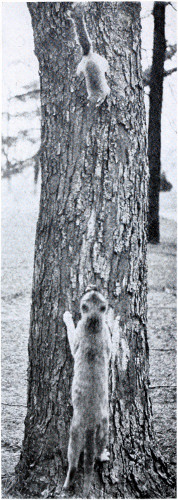
Photograph by Howard Taylor Middleton
HEREDITARY ENEMIES: A CAT WATCHING
A GRAY SQUIRREL
At one time the gray squirrel was so abundant
as to make ruinous inroads on the corn
and wheat crops of our pioneers. In Ohio, a
hundred years ago, there was a law requiring
each free white man to deliver 100 squirrel
scalps every year or pay a penalty of $3. Today
the gray squirrel needs legal protection to
prevent its extermination.
Another member of this group, the flying-squirrel,
has developed an extension
of the skin uniting the front and hind
legs, so it may glide freely from tree to
tree. The bats have gone still further,
and the skin uniting their lengthened
front and hind limbs and long finger
bones forms broad wings which lend
them powers of flight scarcely equaled by
those of birds.
The gophers, pocket-mice, chipmunks,
and others are provided with little cheek
pouches in the skin on each side of the
mouth, in which they may carry food
home to their store-rooms and other hiding
places.
The hares have developed long legs for
running on open plains, and the weasels
have long, slender bodies and an exceeding
quickness which enables them to follow
and capture their elusive prey in its
burrows and among crevices in the rocks.
The hairy coat of the mole is short and
equal to the finest velvet, while that of
the porcupine stands out in strong, sharp
spines; the skin of the armadillo is practically
hairless, but forms a bony armor
covering its upper parts.
The front feet of squirrels and most
other rodents are slender and used with
deftness as hands in manipulating food,
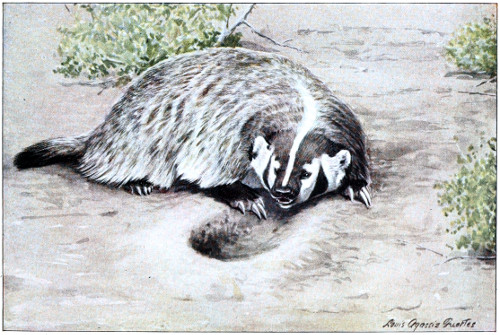
while those of the badger and skunk are
heavily clawed and strongly muscled for
the purpose of digging up their prey.
The tails of many species are varied
in form to serve special purposes. The
long-haired tails of tree-squirrels have a
plume-like character, which adds much to
the beauty of these attractive animals.
The long tails of the kangaroo-rats and
the jumping-mice serve as balances for
their bodies during long leaps. The vertically
flattened tail of the muskrat and
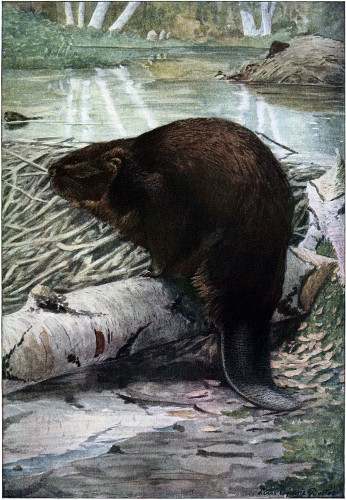
the broad horizontally flattened tail of
the beaver are useful as rudders. Perhaps
the oddest of all is the naked prehensile
tail of the opossum, which coils
about branches or other support and thus
is a safeguard against a possible fall, and
even permits the animal to hang suspended
by it alone.
In such ways, by thousands of adaptations
and modifications of the typical
four-footed mammal, are they fitted to
their varied modes of life, each so far as
possible in some special place of its own.
The effect of the pressure of environment
and competition upon the various
species of mammals in any region could
not be better shown than by the kangaroos
of Australia. That continent is occupied
by many species of these peculiar
mammals, some of which inhabit the
open plains like our jack-rabbits in the
West; others have learned to climb and
live arboreal lives in the tree-tops; and
still other members of this group have
become burrowers and live in dens underground
like some of our native rats and
mice.
From the instances mentioned above
it is evident that the mammalian organism
is very plastic and has been molded
by the environment to which it has been
subjected during the ages. The larger
effects evidenced by profound modifications
in the anatomy are the result of
continued pressure extending far back in
time. The far more numerous, modern,
and superficial changes known to naturalists
as geographic variations are everywhere
in evidence.
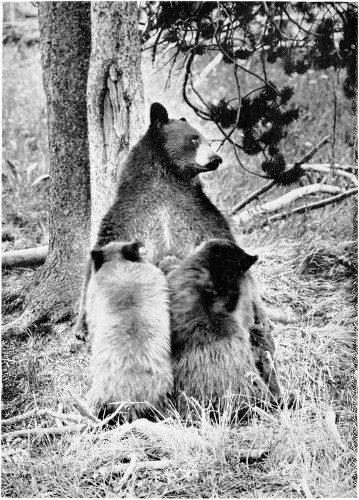
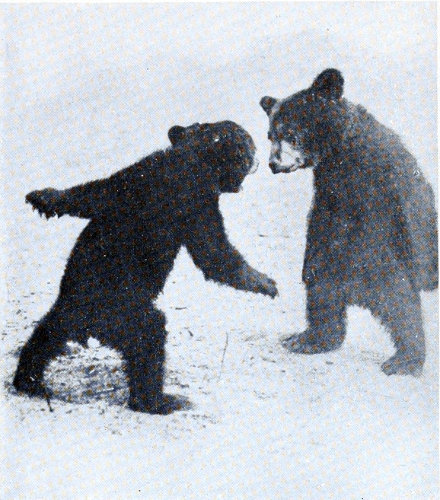
© F. J. Haynes
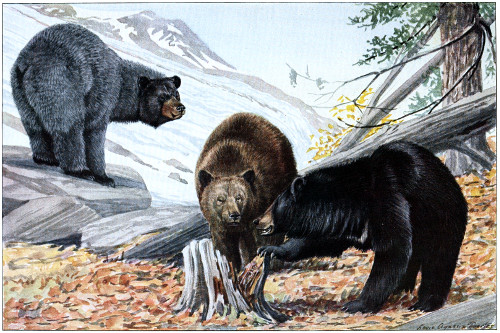
“BABES IN THE WOOD”
The American black bear, of which the brown bear is a color phase, is not aggressive
and will attack man only when wounded or in defense of its young. The hungry twins were
born in mid-winter and came into the world entirely devoid of fur overcoats. Their coats
soon developed, however; in a month their eyes were open, and in two months they were following
their mother about the great forests of the Yellowstone.
By the collection of great series of
specimens in North America and elsewhere
in the world it has been proved
that it is common for a single species of
mammal to occupy a great area, including
such diverse climatic conditions as
humid forested districts near the sea-level,
sections of arid desert plains in
the interior, and high rugged mountain
slopes. In each area of differing conditions
it is ordinarily found that representatives
of a species, under certain conditions,
vary from those in other areas
mainly in shades of color and in proportions.
In arid areas the colors are usually distinctly
paler and grayer, in the humid
districts they are darker and browner.
Other conditions also effect these changes
among members of the same species, as
is shown in some of the most arid and
desert plains of the southwestern United
States, where mammals living among
dark-colored lava beds are darker than
those found, sometimes within a few
rods, on paler adjoining soil. Complete
isolation under the same climatic and
other conditions sometimes produces
marked changes, as is well illustrated by
the difference between the Abert and
Kaibab squirrels on the two sides of the
Grand Canyon in Arizona (see page 448).
The different forms of a species occupying
areas under varying conditions
are commonly termed geographic races.
They grade imperceptibly into one another
along the border between their
ranges, step by step with the gradations
of the climatic and other conditions which
have produced their differences.
One of the most striking modifications
of mammalian economy by environment
is that shown in many small mammals of
our southwestern desert region and adjacent
parts of Mexico, in which such
species as the kangaroo-rats, pocket-mice,
prairie-dogs, and others are able to exist
under the most arid conditions without
drinking. The liquid necessary for supplying
their bodily needs is obtained
through chemical action in their digestive
tracts, whereby some of the starchy parts
of their food are changed into water.
Over considerable areas in the waterless
deserts on the peninsula of Lower
California periods of from three to five
years sometimes pass without a drop of
rain falling. In these areas the small
desert mammals named above, as well as
wood-rats, white-footed mice, cottontails,
and jack-rabbits, are numerous and
successfully pass these dry periods without
inconvenience. The absolute independence
of water of these animals has
been demonstrated in southern California
in the case of pocket-mice kept for
months in captivity in a box and fed
solely upon thoroughly dried seeds without
their showing the slightest sign of
discomfort.
Our small mammals may be roughly
classified by their food habits into three
main groups: Rodents, or gnawing animals;
carnivores, or flesh eaters, and insectivores,
or insect eaters.
The rodents vastly outnumber all other
mammals and are typified by the squirrels,
rats, and mice; their food is mainly
vegetable matter, but many of them eat
insects and meat whenever available.
The carnivores, including such species as
the weasel, mink, and marten, are mainly
flesh eaters, preying largely upon rodents,
but they also eat insects and fruits of
many kinds. The insectivores include
the moles and shrews, which, with all the
bats found within our limits, are almost
exclusively eaters of worms and insects.
While rodents primarily feed on vegetable
matter, it is surprising to note the
large number of species among them
which commonly feed on insects and have
strong carnivorous propensities. This is
not so much the case with such larger
rodents as the beaver, porcupine, and
woodchuck, but most of the smaller kinds,
from squirrels to mice, have been found
to be confirmed flesh eaters.
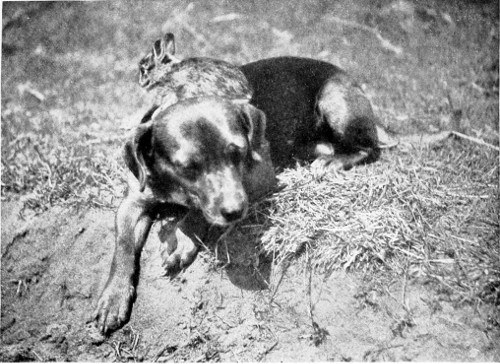
Photograph by Howard Taylor Middleton
A MILLENNIAL SCENE: A RABBIT-HOUND AND A YOUNG RABBIT ENJOYING EACH
OTHER’S SOCIETY
Here the camera records a friendship almost as remarkable as that which is to mark the
association of the lion and the lamb in the final days of the world’s history.
The destruction of the eggs and young
of birds, both on the ground and in the
trees, by these animals must have a far-reaching
effect in reducing the number
of insectivorous and other small birds.
Some small rodents, as the grasshopper-mice,
subsist mainly upon insects and
flesh.
The naturalist who sets traps for small
rodents in field or forest is constantly
annoyed by finding trapped animals partly
devoured by their fellows. When mice
or rats are confined together in cages and
provided with an abundance of vegetable
food, it is a common experience to find
that the stronger kill and eat the weaker
ones, until in a short time only a single
survivor remains. These cannibalistic
traits are strongly developed in the common
house rat, which is notorious for
its savagery toward others of its kind.
To a certain extent the ferocity of
mammals appears to increase in proportion
to a decrease in their size. The
smaller members of the weasel family—the
weasels—are relatively far more active
and bloodthirsty than the minks, martens,
and other larger members of the
group.
If the common weasel should be increased
to the bulk of a mountain-lion
and retain its nature and physical prowess,
it would be many times more dangerous
than any existing carnivore and the
devastations it would commit would be
appalling. Even the tiny insect-eating
shrews are endowed with a fierce and aggressive
spirit scarcely equaled among
larger animals.
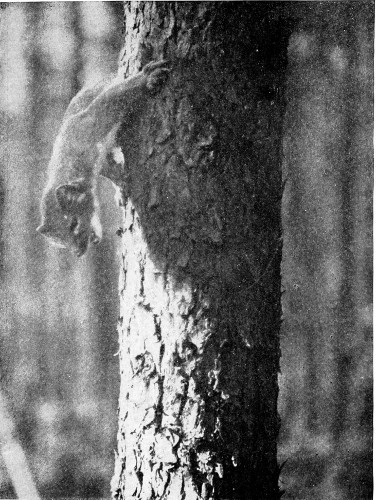
Photograph by Howard Taylor Middleton
A WEASEL AT BAY ON A TREE-TRUNK
Wolves, coyotes, and foxes are the natural enemies of this ferocious
little creature. In spite of its diminutive size, it is a foe to
be respected, for its attack is always aimed at a vital point—commonly
the brain, the back of the neck, or the jugular vein of its adversary.
Rodents and insectivorous mammals
are without effective weapons of offense
or defense against the birds and beasts
of prey which beset them. Many, however,
are surprisingly courageous when
brought to bay, and, using their front
teeth, will fight to the death with vigor
and spirit. This is especially notable of
the muskrats and their cousins, the field-mice.
Carnivores, both great and small,
have teeth and claws with which to defend
themselves against attack.
In addition, skunks have an even more
potent weapon in the secretion of a vile-smelling
liquid which
is sprayed on a dangerous
enemy. So
confident are skunks
in the efficacy of this
weapon that they are
extremely calm and
unhurried in their
manners and take
little trouble to avoid
an encounter with
man or beast. Their
odorous weapon is not
used among themselves
and appears to
be held for service
against more dangerous
enemies.
Scent glands are
common among rodents,
carnivores, and
insectivores, but are
ordinarily used for
purposes of communication
with others of
their kind, sometimes
to attract the opposite
sex and sometimes
merely to give notice
of their presence in a
locality.
The hard school of
experience holding
through the ages has
taught many of our
rodents the necessity
of lying up stores of
food to meet periods
of scarcity. Many
species store food in
a desultory way whenever
a surplus is available,
but when harvest
time comes, at the close of summer, the
work is taken up as a serious occupation
during many busy hours each day or
night by the species living where the severe
northern winters make the stores a
necessity.
The storage instinct is possessed as well
by many of the southern desert species,
where climatic conditions permit activity
throughout the year. In such regions the
supplies serve during storms and in
periods of drought, when the yield of
plant food is limited.
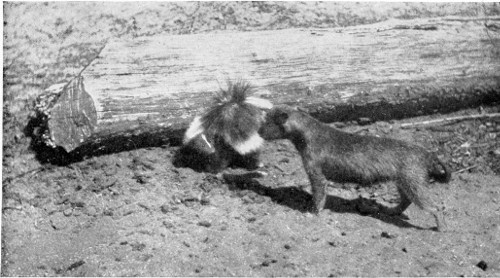
Photograph by Howard Taylor Middleton.
ARMED NEUTRALITY: A DOG AND A SKUNK PREPARE FOR COMBAT
Once in a lifetime the photographer of wild life gets an opportunity such as is recorded
here. Luck was with the camera man, but not with the terrier, as a moment after this picture
was made the dog was a very nauseated and embarrassed animal, the skunk having employed
its natural weapon with overpowering odoriferous effect.
One can but marvel at the wise prescience
with which northern rodents
gather their winter stores and hide them
away safe from the weather in secret
places in hollow trees, old logs, crevices
among the rocks, or in neat storage chambers
dug for the purpose adjoining underground
burrows. The size of the stores
and the tireless industry of these little
husbandmen in gathering them might
well serve as examples worthy of emulation
by some of their human neighbors.
The seeds gathered are freed from chaff,
the grasses and herbs are dried as “hay,”
and roots are carefully cleaned before
being stored.
The storing habit appears to be nearly
always for purely individual benefit. The
food is usually stored in bulk, but squirrels
and chipmunks often bury here and
there single nuts, which they are able to
recover long afterward through their extraordinary
powers of smell.
Stores are laid by for a single season,
and a single failure of a nut or seed crop
will cause the starvation of many small
animals, and the failure of the crops for
two or more seasons is so disastrous that
the rodents may nearly or quite all die of
famine over great areas. The reverse of
this occurs during successive years of
bountiful nut and seed crops.
An abundant food supply appears to
be a powerful stimulant to the fecundity
of mammals, and the number of young
at a birth, as well as the number of litters
born during a season, are greatly increased
by it, until their haunts fairly
swarm with them.
With this stimulated increase of rodent
life goes a related increase in the number
of birds and mammals which prey upon
them. The close relationship between
the numbers of rodents and of the carnivores
which prey upon them is shown
by the records of the Hudson Bay Company,
in which with the increase or decrease
in the abundance of varying-hare
skins secured by the fur traders goes a
corresponding increase or decrease in the
number of lynx skins taken.
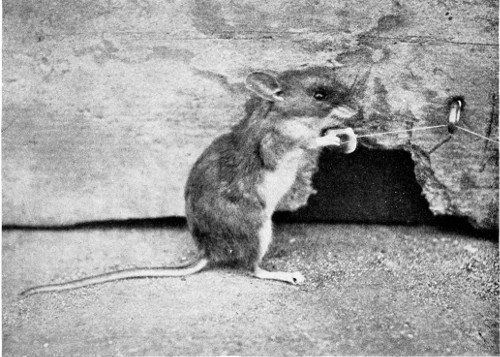
Photograph by Howard Taylor Middleton
IT IS NOT VANITY WHICH PROMPTS THIS MOUSE TO TAKE ITS OWN PICTURE
The bait is a grain of corn attached to one end of a thread; the other end operates the
camera shutter; but the pose is almost “studied”.
After rodents become enormously
abundant, if food becomes scarce they
sometimes make extended migrations,
during which vast numbers swarm across
the country, like the lemmings of the
North or the gray squirrels during their
historic migrations of early days in the
eastern United States. At such times vast
numbers of the wandering hordes perish;
epidemic disease also plays its part in reducing
their numbers. Nature thus is
self-limiting in restraining the permanent
increase of any species beyond the numbers
needed to preserve its balance.
The advent of man in new regions with
his clearing of forests, cultivation of the
soil, and destruction of animal life for
food or other purposes, quickly upsets
the balance of nature, and some species
are much reduced in numbers or disappear,
while others, especially among the
smaller kinds of mammals, may greatly
benefit through added food supplies, and
then increase until they become a pest, to
be destroyed by the farmer as a measure
of self-protection.
For some reason, perhaps owing to
their small size and defenselessness
against birds and beasts of prey, the great
majority of small mammals, including
hundreds of species and untold millions
of individuals, are nocturnal or live such
obscure and hidden lives they are unknown
except to the comparatively few
people who go much afield, with all their
powers of observation alert by day and by
night. Many of the mainly nocturnal species
pursue minor activities by day, where
shelter of one kind or another gives them
a reasonable feeling of security.
Under the revealing light of day most
small mammals, especially the rodents,
are extremely watchful and timid, leading
lives filled with alarms which commonly
end in tragic deaths. By night
they appear to have far greater confidence;
yet this also is a time of imminent
danger from the owls and many beasts
of prey then prowling about.
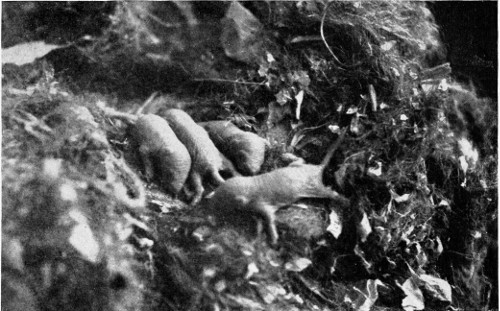
Photograph by Howard Taylor Middleton
A NEST OF YOUNG WHITE-FOOTED MICE
One form of this small animal has been found living at an elevation of from 15,000 to 16,000
feet on Mt. Orizaba, Mexico, the highest record of any North American mammal.
That the small rodents have good cause
for their timorous ways is plain when we
consider the array of enemies which encompass
them, including owls, herons,
gulls, bears, foxes, bobcats, weasels and
their cousins, with snakes, and on occasion
fishes, which take endless toll from
their numbers. Fortunately for them,
these small folk live wholly in the present
and quickly forget the shadow of death
cast by the passage of a hawk or the
skulking form of a four-footed enemy.
By day the squirrels, chipmunks, woodchucks,
and spermophiles are abroad and
unite with the birds to lend an air of
pleasant animation to forest and plain.
With the falling shades of night, near
the abodes of mankind as well as in the
remote wilderness, everywhere a countless
multitude of small beasts come forth
and form a little, bright-eyed furry
world, clad in delicate shades of gray
and brown and characterized by remarkable
grace and agility.
These small folk of the night swarm
out from snug nests hidden in burrows in
the earth, in crevices among the rocks, in
hollow trees, under logs or other cover,
and even from the shelter afforded by
buildings. In number and variety of
forms they far exceed anything seen by
day. The air is filled with the flitting
forms of bats, while among the trees or
on the ground, varying with the locality,
are multitudes of rabbits, flying-squirrels,
rats and mice of many kinds, lemmings,
pocket-mice, kangaroo-rats, pocket-gophers,
shrews, and even moles.
This abundance of night life brings
forth the prowling powers of darkness in
the form of velvet-winged owls, weasels,
skunks, minks, martens, and other carnivores,
which by scent and by keen vision
find abundant harvest. The small carnivores,
in turn, are subject to the predatory
law of might and are at times hunted
by the larger carnivores, as the great-horned
owls, the wolves, foxes, fishers,
bobcats, and mountain-lions.
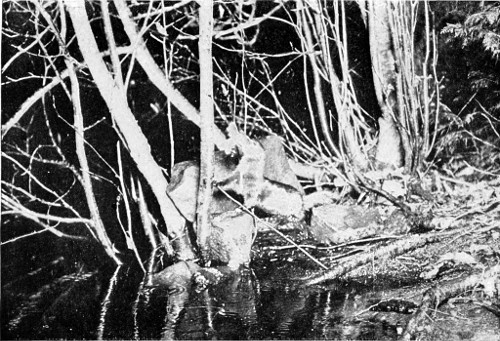
Photograph by George Shiras, 3rd
A MINK TAKING ITS OWN PICTURE BY FLASHLIGHT
This is one of many remarkable nature studies which have been made possible by Dr.
George Shiras 3rd’s invention and development of animal flashlight photography, with the
animals themselves as the photographers. The naturalist may have to spend hours, sometimes
days, waiting in swamp or desert to study his quarry, but by means of flashlight photographs
the inhabitants of the wild are revealed in their native haunts to all who read a story
told in pictures. Dr. Shiras’s notable contributions to this magazine have always won hearty
appreciation from members of the National Geographic Society.
To most people the majority of small
rodents are classed as “rats” or “mice”
and are viewed with the prejudice born
of long familiarity with those omnipresent
pests, the house rats and mice. The
small beasts of field and forest are commonly
of remotest kinship to these repulsive
household parasites and are of
entirely different lineage, having nothing
in common but their size.
When viewed with unbiased attention,
these little animals of the wilds are certain
to charm the observer either by their
beauty and grace or by their varied and
interesting habits. No one can long study
mammals, large or small, without observing
many traits of intelligence so akin to
his own that they awaken feelings of
friendly fellowship.
The modes of life of small mammals
are much more varied than those of the
larger species. At times radical differences
in habits may be noted among different
individuals of the same species, as
instanced by the wood-rats of Santa Margarita
Island, some of which live in burrows
dug by themselves in the ground
and others in nests built of sticks in the
tops of mangroves rising amid the waters
of a lagoon.
An even more extraordinary variation
is shown among the heavy-bodied
meadow-mice of the genus Phenacomys,
most of which live in underground burrows;
but one member of the group in
Oregon builds its nests in the tops of tall
conifers, sometimes at an altitude of 80
feet, and rarely or never descends to the
ground.
The homes of small mammals vary
greatly. The species living in underground
burrows usually excavate an oval
chamber which is filled with fine vegetable
material to form a snug retreat.
The muskrat places a conical lodge on
the border of a marshy stream or lake.
The wood-rat lives in an underground
burrow, in a nest of sticks and trash
heaped above the ground or in a stick
nest placed among the branches of low
trees. Harvest mice build a little hollow
ball of grass blades, lined with finer material,
among the branches of bushes several
feet above the ground. White-footed
mice may lodge in a knot-hole 50 feet or
more above ground in the trunk of a tree.
As a rule, small mammals are of inconspicuous
colors which harmonize so well
with their surroundings that when not in
motion, especially if lying close to the
ground, they are difficult to distinguish.
Exceptions to this rule are obvious in the
case of jack-rabbits when standing on
bare plains, or other mammals which are
apart from the usual partly concealing
growth of vegetation or other surroundings.
In contrast to the protective coloration
are certain markings, like the cottony
white underside of the tail of the cottontail
rabbit, which renders the flight of
this animal conspicuous in the gloomiest
shades of the forest, or even on the approach
of night, when it is impossible to
distinguish the animal itself. The white
underside of the tail of the antelope chipmunk
is another well-defined instance of
this kind.
The most marked of all examples of
“directive” coloration among the small
mammals appears to be that of certain
white-sided jack-rabbits, in which the
white areas on the sides and rump are
drawn up and down as the animal runs
across the plains, giving a flashing effect,
which attracts attention to them exactly
as does the white rump-patch of the
antelope.
In the northern part of the continent,
where snow lies for many months, several
species of hares are dusky or buffy gray
in summer and change to a pure white
coat in winter. This change is of enormous
protective value to these animals.
In Greenland, where the summer is short
and snow exists throughout the year, the
highest northern representative of the
hares remains permanently white, while
near the southern border of snow in the
United States the varying hares and
white-tailed jack-rabbits, which become
pure white in the northern parts of their
range, make only a partial change.
Weasels are the only carnivores which
change from the brown of summer to a
white winter coat. Owing to their small
size and the need for activity in the
snowy northern regions, where they would
be peculiarly susceptible to danger from
birds of prey and larger predatory animals,
their protective white coats serve
them well.
It was formerly considered that the
change of mammals from the brown of
summer to the white winter coat in the
fall, and from the white to the brown in
spring, was due to a change in the color
of the hairs, but it is now known that it
is entirely due to molt. The time of
these changes depends on the season, and
this varies several weeks, according to
whether the fall or spring is early or late.
The general shades of mammals are of
delicate tints, and the spots, stripes, and
other markings, as in the case of chipmunks
and the little spotted skunk, are
often of great beauty.
Small mammals vary greatly in their
vocal powers, but the changes in intonation
and character of the notes and calls
indicate plainly that they are used to convey
a variety of meanings.
Some are practically voiceless, as in
the case of rabbits and hares, except
when in an extremity of fear they utter
loud shrieks of terror. Squirrels, prairie-dogs,
and some other small mammals
bark and chatter, while mice and bats
have a variety of curious squeaking notes.
Marmots and ground-squirrels have chattering
notes and sharp, whistling calls.
In addition, some of the squirrels and
many mice are known to have continuous
series of notes which are as evidently
songs as the utterances of birds. Some
of these notes, as in the case of singing
mice, have a remarkably musical character,
similar to the warblings of canaries.
Various unrelated species of mice
have been observed singing, and a closer
study of the life habits of these small
animals may develop the fact that all are
songsters to some degree.
House rats and mice have, undoubtedly,
been parasitic about the haunts of man
from early times. From Asia they have
accompanied him through his advance in
civilization. With the growth of commerce
they have traveled around the
world, becoming transplanted to all lands
and thriving in all climates. In various
parts of America they have not only become
pests about human habitations, but
where climatic conditions were favorable
have reverted to the wild state and are
competing with the native species in the
fields.
Of all the small mammals none have
become modified to such an extent as the
bats. As a group these mammals are of
world-wide distribution except in the inhospitable
polar regions. They are true
mammals and present an extraordinary
variation in size, from tiny little creatures,
almost as small and fragile as
butterflies, to the huge fruit-bats, with a
spread of wings like that of a wild goose.
The heads of bats are strangely sculptured,
some being smoothly contoured
and shaped like those of little foxes;
others appear like miniature bulldogs;
and still others have curious cartilaginous
nose-leaves upright on the muzzle. Some
have the entire face molded into a hideous
mask repulsive to look upon.
Their habits are equally varied to meet
special conditions: Some are eaters of
fruit alone; others feed solely upon insects,
while others bite other mammals,
including man, for the purpose of drinking
the oozing blood, upon which they
subsist. All are nocturnal, but some appear
late in the afternoon, before the sun
sets; most species, however, wait until
the shades of night have covered the
earth.
Throughout the world the majority of
the species of bats feed upon insects, but
there are many fruit-eaters. The teeming
insects and plant life of the tropics
afford a never-failing food supply, and
the center of abundance of these animals
is found there. In some localities between
twenty and thirty kinds of bats
exist, with such vast numbers of individuals
that the bat population far outnumbers
all other kinds of mammals combined.
In the northern parts of the Old and
New Worlds many mammals, including
bears, marmots, prairie-dogs, ground-squirrels,
and jumping mice, pass a large
part of the winter months in a lethargic
sleep called hibernation. While hibernating
these animals have extremely slow
and slight heart action and their bodily
temperature falls far below the normal
of their active periods. During the most
profound hibernation an animal may be
awakened if brought into a warm temperature,
but when again put into the cold
at once returns to sleep.
Preparatory to this sleep, during the
summer and in the autumn, the hibernating
mammals become exceedingly fat.
It has long been generally accepted that
the fat thus accumulated was for the
purpose of being gradually absorbed to
nourish the animals during their long
fast. As a matter of fact, during this
period the bodily functions appear to be
practically suspended and the animals
may be said to be in cold storage. This
is evident from the fact that observations
have been made of ground-squirrels, and
even bears, emerging in spring, after
their long winter sleep, practically as fat
as when they retired in fall. Hibernating
animals become extremely active as
soon as they come out in spring and
quickly lose the fat which should be of
special service to them, owing to the temporary
shortage of food they experience
at this season.
Most hibernating species do not retire
for the winter until cold weather is at
hand, in September or October, at times
remaining out until after the first snow
has fallen. The animals which retire
latest, like chipmunks and prairie-dogs,
sometimes appear temporarily during certain
warm periods in winter.
Recent observations have established
the fact that the adults of both sexes of
the Richardson ground-squirrel living in
the Northwestern States and adjacent
parts of Canada become excessively fat
by the first of July, and before the first
of August practically disappear for the
season, not appearing again until they
emerge the following March or April.
The retirement of these squirrels for a
part of the summer is a case of imperfect
estivation, as it is termed, followed by
complete hibernation. The young of the
year enter hibernation at a considerably
later date.
A great number of both large and small
mammals live solitary lives except for
brief periods during the mating season
or the association of the young with the
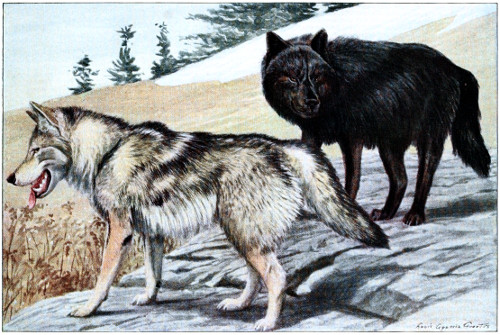
mother. Some species, however, like the
wolves and coyotes, may mate permanently
and show great mutual affection
and constancy. Many species have well-developed
social instincts, which appear
in some cases to combine two purposes,
self-defense and the desire for companionship.
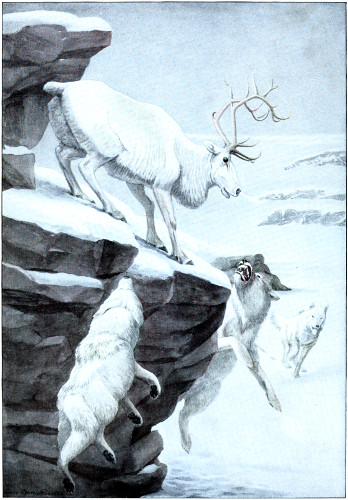
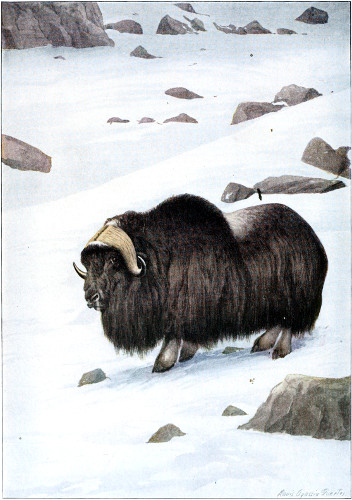
Herds of large herbivorous mammals,
such as musk-oxen and buffalo, frequently
present a solid array of bristling
horns to the attacking wolves, and thus
protect the weaker members of the herd
and give an example of the usefulness
to them of the social instinct. Wolves
and some other predatory animals hunt
in couples or in packs and succeed in
pulling down prey which singly they
could not successfully attack.
Prairie-dogs living in colonies have the
advantage of community intercourse as
well as added safety through the chance
that some member of the colony will espy
an approaching enemy and by its warning
cry allow a safe retreat. In other
cases, such as the flying-squirrels, which
gather in considerable numbers in hollow
trees or other shelter, and the bats, which
gather in caves, the congregation appears
to be purely from a desire for close companionship.
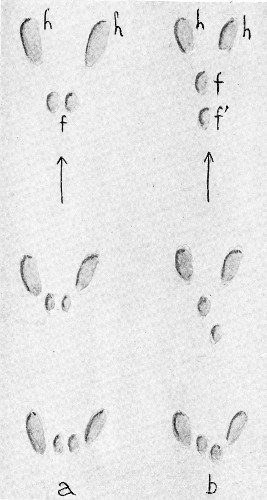
FOOTPRINTS OF NATURE’S WILD FOLK
BY ERNEST THOMPSON SETON
In the drawings accompanying Mr. Nelson’s
article I usually give the track of a normal
adult animal in about one inch of snow, that
being ideal for tracking. Some of the smaller
kinds are shown in fine dust. The trail goes
up or across the page at the ordinary gait of
the animal. The scale is indicated, but when
possible the topmost set is given of life size.
While there are endless variants in each kind,
I aim to give the reader at least one typical
set of each.
In all animals which bound, the hind feet
track ahead of the front ones. This is very
plainly seen in the rabbits. There are two arrangements
of the fore feet when bounding:
That of the rabbit (b), in which the fore feet
are usually one behind the other, and that of
the tree-squirrel (a), in which the fore feet are
side by side. The latter arrangement is associated
with power to climb a tree. The former
means that the animal is purely terrestrial.
These, however, are true only as generalizations.
There are exceptions in all species. The
ground-squirrels conform to the rabbit type.
The tracks are, of course, ideal, giving far
more detail than is usually to be seen.
(For illustration, see page 506)
The antelope, or Allen, jack rabbit is one of
the most picturesque of American mammals.
It is larger than the common western jack
rabbit and is strongly characterized by enormous
ears, long, slender legs, short tail, and
contrasting colors. It is a member of the
white-sided group of jack rabbits, which are
distinguished by the extension of the white of
the underparts well up on the sides of the body.
This group is represented in limited areas on
our southern border by two species. One of
these, the Gailliard jack rabbit (Lepus gailliardi),
occurs on the grassy plains of extreme
southwestern New Mexico and is succeeded
by other white-sided species southward across
the Mexican tableland and through interior
Oaxaca to the Pacific coast, on the Isthmus of
Tehuantepec. The other species, the antelope
jack rabbit, occupies a considerable area in
southwestern Arizona, and with its geographic
races ranges southward through the coastal
plains of Sonora and Sinaloa to northern
Tepic.
All jack rabbits are more or less closely related
to the Old World hares, the term “rabbit”
having been so generally misapplied to them by
the early settlers in the western United States
that the name is now fixed by current usage.
In Mexico and among the Mexicans of our
southwestern border the proper distinction is
made and the jack rabbit is termed liebre, or
hare, and cottontail is called conejo, or rabbit.
The white-sided species are more widely differentiated
from their Old World relatives
than the other jack rabbits and are the southernmost
representatives of the true hares in
America, reaching their limit in the tropics a
little beyond the Isthmus of Tehuantepec.
The extension of the white on the sides of
these species assists in producing one of the
most extraordinary examples of directive coloration
known among mammals. I had the
pleasure of discovering this one day in May,
1895, when hunting on horseback over the
grassy plain bordering the Pacific coast of the
Isthmus of Tehuantepec. As I rode slowly
along, a big jack rabbit hopped deliberately
from its form in the grass a few yards away,
and by the contraction of a special set of muscles
along the back drew the dark-colored dorsal
area forward and together so that it formed
only a narrow band on the middle of the back,
with a corresponding extension of the white
area on the rump and sides until, as the animal
moved diagonally away, it looked almost entirely
white.
At a distance of fifty or sixty yards it came
to a stop, and expanded and contracted the
dark dorsal area, thus producing a “flashing”
effect with the changing area of white on the
sides and rump. This solved the riddle of the
mirror-like white flashes I had often seen as
jack rabbits on the tableland had dashed away
in the brilliant sunshine. The same habit of
“flashing” the white was afterwards observed
in the species of southwestern New Mexico and
southwestern Arizona, demonstrating the appropriateness
of the name, “antelope jack rabbit,”
given them by the ranchmen.
Formerly the antelope jack rabbit of Arizona
was common on the plains about Tucson,
where many were shot for rifle practice. They
are now comparatively scarce in that district,
and are never so excessively abundant as the
common species of the West now and then
becomes. They have an extraordinary appearance
as, with their great ears erect, they stand
poised on their long, thin legs. When alarmed,
they leap away with amazing celerity in long,
high bounds. They are usually much more
shy and alert than the common jack rabbits
and at times are far more difficult to stalk than
antelope. A peculiarly appropriate setting to
this remarkable species is found in the strange
and wonderful growth of giant cactuses, yuccas,
creosote bushes, fouquerias, palo verde, and
other desert vegetation of the plains in Arizona
and Sonora.
Like other hares, the antelope jack rabbits
occupy forms under bushes or in the shelter of
little patches of coarse vegetation. The only
exception to this rule I have seen was west of
the city of Guadalajara, on the Mexican tableland.
There one summer day, in the midst of
a lovely open valley covered with short, velvety
green grass and dotted with scattered acacia
bushes, a caracara eagle suddenly swooped
down upon a young white-sided jack rabbit. In
mortal terror the little beast dashed away at
great speed, the caracara casting at it repeatedly
from a height of fifteen or twenty feet
and each time striking the ground just behind.
The young animal ran not less than five hundred
yards, straight for a little bush on a small
bank, where it vanished as by magic.
The caracara was close behind and, alighting,
ran round and round the trunk of
the bush, craning its neck and apparently as
surprised as myself at this sudden disappearance.
Riding over to investigate, I found,
partly concealed by coarse grass, the entrance
of a burrow large enough to admit an adult
jack rabbit. It extended almost horizontally
into the bank for about eighteen inches, and
then, turning abruptly to the left, ended in a
rounded chamber some fifteen inches in diameter,
in which the young jack rabbit lay snugly
ensconced. It appeared altogether probable
that this burrow had been made by the old
jack rabbit as a shelter for her young, one of
which in its extreme need had again sought
asylum there.
White-sided jack rabbits are frequently
found in pairs, occupying forms in close proximity
to one another. More rarely several
may be found in a small area. When driven
from the forms, they often run in a wide circle,
and in the course of half an hour or more
may be detected returning slyly and watchfully
from a direction nearly opposite to that in
which they departed.
(Lepus californicus
and its subspecies)
(For illustration, see
page 507)
The common hares, or
gray-sided “jack rabbits”
of the Western States,
are among our best
known and most interesting
mammals. They
are characterized by long,
thin necks, long ears
tipped with black, long
legs, grayish sides differing
but little from the
color of the back, and a
rather long tail, black on
its upper side and dingy
gray below.
They are abundant and
generally distributed over
a vast and mainly treeless
area in middle North
America extending from
western Missouri and
eastern Texas to the Pacific
coast, and from the
border of South Dakota
and the Columbia River Valley of Washington
south over the tableland of Mexico and throughout
the peninsula of Lower California. Within
this region they range from sea level up to an
altitude of over 9,000 feet. In the North they
experience severe winters with much snow, but
never show any winter whitening of their furry
coat, as do more northern hares.
The gray-sided hares over all this extended
range belong to a single species, typified by the
California jack rabbit. The area thus occupied
includes many different climatic and other
physical conditions, from the sweeping grassy
plains of Kansas to the juniper and pine dotted
plateaus of the Rocky Mountain region, the
foggy coast of California, the hot cactus-grown
deserts of the Southwest, and the cool
elevations of the Mexican tableland.
This varying environment has worked on the
plastic organization of the species and modified
it into a considerable number of well-marked
geographic races which together make up the
gray-sided group of jack rabbits, in contrast
with the white-sided group already described.
Some of the races are very dissimilar in color,
but each merges imperceptibly into its neighboring
races, and the group thus forms an unbroken
chain of subspecies.
Like other hares, the jack rabbits are both
diurnal and nocturnal in habits. They do not
burrow, but make forms among dense growths
of grass or weeds, or under bushes, where they
lie hidden. It is a question whether they have
more than one litter a season, although it is
known that in some parts of their range young
are born at all times throughout the spring
and summer. From one to six are produced
at a time, fully clothed in fur and with their
eyes open. Within a few days they leave the
“form” and run about like little furry balls.
Even at this early period they are amazingly
alert and skillful in evading capture by quickly
doubling and zigzagging when pursued.
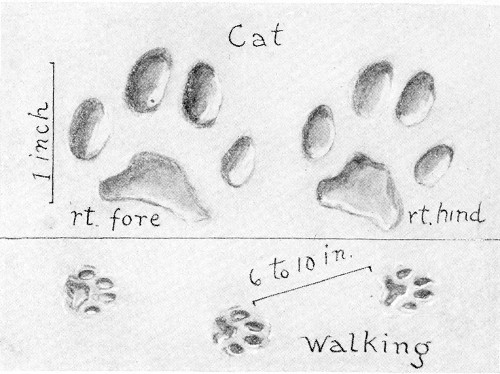
A QUADRUPED WITH BIPED TRACK: THE COMMON CAT
The cat does not show its claws in the track. In walking, the
hind foot is set exactly in the track of the front foot; this perfect
register offers many advantages and makes for a silent tread. The
track of the cat will probably be noticed more than that of any other
animal, owing to the large numbers of them in every locality.
Throughout its range the gray-sided jack
rabbit is preyed upon by a host of enemies, including
wolves, coyotes, wildcats, eagles, and
several species of hawks and owls. As a result
it has become extremely cunning and watchful.
It is a beautiful sight to observe the cautious
grace with which one that suspects danger but
thinks itself unobserved will quietly move out
of its form, pause like a statue for a few seconds,
then raise its body into a sitting posture
and look keenly about, its great upstanding ears
turning sensitively to one side and the other,
delicately testing the air for sound waves,
which may spell approaching peril.
If not alarmed it may then move slowly
along by a series of easy little hops, occasionally
varied by the single-footed gait of most
other mammals. At such times the ears are
often raised and lowered as though worked
by some mechanism. If the rabbit becomes
alarmed, however, it leaps away in quick,
springy and graceful bounds, now and then
making a high soaring leap as if to command
a better view.
These occasional high leaps mark the first
stages of alarm. In greater stress, when pursued
by a coyote or other swift-footed enemy,
the jack rabbit indulges in no such showy performances,
but gets down to serious work, and
developing marvelous action in a continuous
series of rapid, low stretching leaps, with ears
lying flat along the shoulders, it skims over the
ground almost as swiftly as a bird. Coursing
jack rabbits with greyhounds was for many
years a favorite sport in different parts of the
West. No other dog has much chance for success
in the open pursuit of these animals.
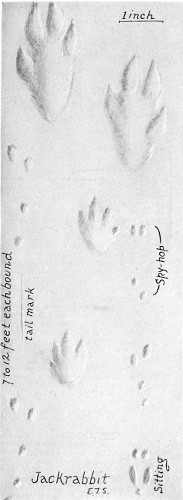
THE TRACKS OF THE JACK RABBIT
The tracks of the western jack rabbit resemble
those of the cottontail (see page 492),
but the feet are seldom paired; a typical set
is seen in the lower left-hand corner. The
bounds cover 10, 12, or even 15 feet each.
The tail is held down, so that it leaves a mark
in the snow between each bound. Sometimes
the animal makes a spy-hop—that is, hops up
high to look around. This is seen in the track.
Ordinarily jack rabbits are mute, but when
wounded and caught they not infrequently
utter a series of long-drawn wailing shrieks
which are movingly expressive of terror and
pain.
Since the settlement of the Western States
numberless predatory animals have been killed
and at the same time the cultivation of the soil
has produced a dependable increase in the food
supply. These changes have resulted in the
sporadic increase of jack rabbits in many parts
of their range, from Texas to Oregon, until at
times they have become a serious menace to
agriculture.
During such periods of abundance they invade
fields and devastate grain, forage crops,
vineyards, and young orchards. In places they
sometimes actually destroy entire crops and
force settlers to abandon their locations. In
winter they swarm about haystacks and destroy
many tons of hay. Depredations of this
character were committed by them on a considerable
scale during 1916 in parts of Oregon,
Idaho, and Utah.
During the early development of the San
Joaquin Valley, California, jack rabbits became
such an intolerable pest that great community
drives were organized. Large woven wire corrals
with wing fences leading away several
miles from the entrance were built on the
open plains. The occasions of the drives were
made public holidays through all the surrounding
region, and people gathered sometimes to
the number of from 5,000 to 8,000. A great
line of beaters was formed, miles in length,
and the jack rabbits were driven between wing
fences into corrals. Four such drives in
Fresno County in the spring of 1892 resulted in
the destruction of 40,000 jack rabbits, one drive
netting more than 20,000 animals.
At this time the level floor of the San Joaquin
Valley was crossed by numberless well-worn
rabbit trails six or eight inches broad and
one or two inches deep, extending in long
straight lines sometimes for miles. On approaching
a patch of large weeds one often
saw twenty or thirty jack rabbits dash out and,
after hopping away a short distance, sit with
upstanding ears to look curiously at the intruder.
It is a general rule that when any species of
animal becomes extremely numerous it loses
its ordinary wariness and, conversely, when its
numbers are materially reduced its wariness is
greatly increased. The periods of abundance
of jack rabbits usually extend through several
years until, at the height of their increase, a
contagious malady suddenly sweeps them away
almost to the point of extinction, as in the case
of the varying hare. A period of years follows
during which their numbers are slowly
recovered.
Jack rabbits are specially adapted for life on
great plains, where speed and the ability to
subsist on almost any form of vegetation are
prime qualities. They are as grotesquely characteristic
of the Western States as the kangaroos
were of Australia, and have entered
largely into the literature of the region they
occupy.
(For illustration, see page 507)
The varying hares, white rabbits, or snowshoe
rabbits, as they are known, form a small
group of closely related species and geographic
races of hares peculiar to northern North
America. They sometimes attain a weight of
five pounds and are about half the size of the
arctic hares, which they resemble in form, except
that they are more heavily built and have
proportionately shorter legs and larger hind
feet.
With a single exception they become white
in winter and change to dusky or brownish in
summer. The molt from the brown summer
coat to the white winter one occurs with the
arrival of winter snows, the exact time varying
according to the season, the reverse change in
spring being governed in a similar way by the
disappearance of the snow. In the southern
part of their range the change to the white
winter coat is less complete than in the North.
There has been much controversy over the
manner of this change in color, some maintaining
that on the approach of winter the hairs
turn white with the first snow. It has been
definitely proved, however, that both seasonal
changes are due to molt.
The Washington hare (Lepus washingtoni),
which remains brown throughout the year, is
the exception to the rule of white winter coats
in this group of hares. It lives in the cool,
dense forests of the humid coast belt of Washington
and adjacent part of British Columbia,
where the snowfall does not affect its pelage.
In winter the large hind feet of the varying
hares and their long, spreading toes are entirely
covered with a heavy coat of hair, forming
broad snowshoe-like pads, which enable
their possessors to move about freely over the
soft snow, a peculiarity that has given rise to
one of the names in common use.
In cool, forested regions varying hares range
from Maine and extreme eastern Canada, including
Newfoundland, to the Pacific coast,
and from the stunted bushes bordering the
northern limit of trees south to the northern
border of the United States and beyond, following
the higher Alleghenies to West Virginia,
the Rocky Mountains to New Mexico,
and well down the Sierra Nevada in California.
As in the case of other species, these hares
make “forms” in which they lie by day, for
they are mainly nocturnal in habits. The mating
season occurs in early spring, when the
males become very restless, several sometimes
congregating in the same vicinity and occasionally
fighting and chasing one another about.
At this time, as well as at other seasons, snowshoe
rabbits have a habit of thumping rapidly
on the ground, making a dull sound audible for
some distance. This is probably done with the
hind feet, as is known to be the case with the
European rabbit.
The thumping is apparently a signal and
may be a part of the mating display, but is
also used for warning purposes. Hunters in
northern Canada call these rabbits by making
a harsh squeaking noise with their lips. Sometimes
they become so eager and excited on
hearing this call that with odd little grunting
sounds they come bounding close up to the
hunter.
The young, varying from two to seven, are
born in nests made of dry leaves, grasses, and
other suitable vegetation, warmly lined with
hair from the mother’s body, and usually hidden
under brush or in dense vegetation. The
young, which have their eyes open and are
fully furred at birth, within a few days leave
the nest and move freely about. Although the
mother snowshoe rabbit will defend her young
at first even at the risk of her life, when they
are half grown she leaves them to shift for
themselves. Young hares of various ages
when caught often utter shrill squealing cries
of fright and the older animals when wounded
and caught sometimes do the same.
Perhaps through living so constantly in low
ground, among swamps and along streams,
varying hares become less averse to entering
water than most of their kind. In the delta of
the Yukon River I saw many places where they
had crossed small streams in spring, their wet
tracks entering and leaving the water, thus
furnishing unmistakable evidence. Curiously
enough, when caught by a flood they will take
refuge on stumps or other support and often
remain to starve rather than swim ashore.
In summer, owing to their nocturnal habits
and the dense thickets they inhabit, varying
hares are rarely seen unless they are unusually
plentiful. In winter their presence is known
by their conspicuous tracks, leading in every
direction through their haunts. A single animal
will in one night so thoroughly track the
snow in a patch of woods it gives the impression
that several must have been there.
In river bottoms, among densely wooded
swamps, these rabbits frequently make definite
beaten runways in the snow; runways are also
made through thickets in their summer haunts.
This habit renders it easy to snare them, and
enormous numbers are thus captured every
winter.
They feed on a variety of small herbage in
summer and in winter depend on buds, twigs,
and the bark of shrubs and small trees. They
are specially fond of willows, and their winter
distribution in many districts is governed by
the abundance of willow thickets.
Varying hares are one of the most important
mammals of the northern fur country. They
are generally distributed and exist in such numbers
that they are an important source of food
supply both to the Indians and to such predatory
birds and mammals as the great horned
and snowy owls, the goshawk, gyrfalcon, lynx,
fox, ermine, fisher, and others. The skins are
also used by the Indians for robes.
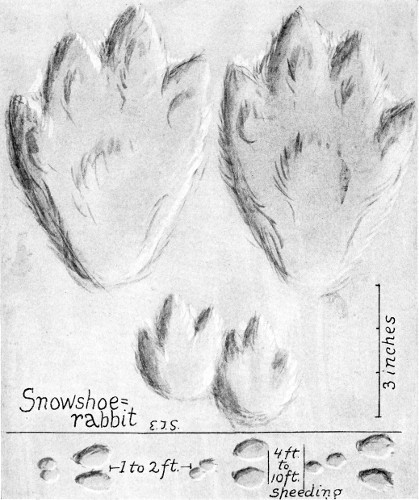
FOOTPRINTS OF THE VARYING HARE, OR SNOWSHOE RABBIT
The great size of the feet from which the creature is named is a strong feature of the track,
distinguishing it from that of the cottontail and others (see pages 489 and 507).
Under favorable conditions they steadily increase
until they become enormously plentiful
over great areas. After this swarming abundance
continues for several seasons it reaches
a maximum, and then, as in the case of many
other mammals when similarly overabundant,
a mysterious malady suddenly attacks and
sweeps them off, until within a year or two they
become rare over the entire area. The people
of the fur country believe these changes in
numbers run in cycles of about seven years
each.
As the hares increase in numbers some of
the birds and mammals which prey upon them
increase proportionately. This is specially
marked with the big northern lynxes. The
skins of varying hares are gathered and sent
to the London fur market with other furs, including
those of lynxes. In the records of
sales of the Hudson’s Bay Company there are
direct increases of the numbers of Canada
lynx skins sold corresponding with the increases
in the sales of varying hare skins. As
the number of hare skins abruptly decreases
following the outbreak of epidemics among
them, there are correspondingly abrupt decreases
in the numbers of lynx skins sold.
This correlation is shown in the records extending
back many years and illustrates the
interdependence in nature between the various
forms of animal life. The far-reaching
tragic effect of the sudden disappearance of
the snowshoe rabbits is not confined to the
wild habitants of the forest, as it has not infrequently
brought starvation and death into
many lonely Indian lodges in the great northern
wilderness.
(For illustration, see page 510)
Many parts of the northernmost circumpolar
lands are occupied by large hares, which attain
a weight of more than ten pounds. They are
about the size of large jack rabbits, but are
more heavily proportioned, with much shorter
ears and shorter, stronger legs. There are several
species and geographic races of these animals,
all of which are snowy white in winter
except for a small black tip on each ear. In
summer the southern arctic hares change to
a nearly uniform dull iron gray or grayish
brown. The northernmost animals of Ellesmere
Land and north Greenland, where the
summer is brief and severe arctic conditions
prevail, retain their white coat throughout the
year.
In keeping with the cold climate of their territory,
the furry coat of the arctic hares is
long and thick, especially in winter, when the
ears, legs, and even the soles of +he feet, as
well as the body, are heavily furred. The
coats of the hares of north Greenland and adjacent
region are so heavy and fleecelike that
during the spring molt they come off in felted
patches as the new coat is assumed, giving the
hares a curiously ragged appearance.
In the region between the areas in which the
summer coat remains wholly white and where
it is completely changed to grayish, there is a
gradual transition, with the lessening severity
of the climate, through every intermediate degree
between the two. As in the case of the
snowshoe rabbit, the large hind feet and long
spreading toes of its big northern relative are
so heavily covered with hair that they form
broad fluffy pads, which enable the hares to
travel lightly over the arctic snowfields.
The distribution of arctic hares is confined
to the barrens or tundras beyond the limit of
trees. They range practically to the land’s end
of northern Greenland and Ellesmere Land.
To the southward in North America they range
down the coast of Labrador and across to
Newfoundland, where they are limited to the
open barrens. They also occur along the
shores of Hudson Bay and follow the tundras
bordering Bering Sea to the peninsula of
Alaska.
In Ellesmere Land they are reported to be
extraordinarily numerous at times in certain
little valleys, and the fur traders on the coast
south of the Yukon Delta informed me of
similar gatherings in spring on gently sloping
hillsides in that region. Photographs taken in
Ellesmere Land show many of these hares
scattered over a small area, each crouched in
a compact form and all heading in the same
direction to face the wind. Such gatherings,
at least those in Alaska, occur during the
mating period, after which the animals scatter
over the area they occupy.
An account of the big northern hares would
be incomplete without reference to the white-tailed
jack rabbit, the largest of all American
hares and a near relative of the arctic species.
It attains a weight of twelve pounds or more
and appears like a giant of its kind. It has
longer legs than the arctic hare and a longer
tail. In summer it is grayish or buffy, with a
conspicuous pure white tail. Throughout most
of its range in winter it becomes pure white
except the black tips to the ears, but near the
southern border the change to white is not so
complete as in the North. The distribution of
the white-tailed jack rabbit extends from Minnesota
to the Cascade Mountains and from the
Saskatchewan River, in Alberta, south to southern
Colorado.
Arctic hares have from one to seven young
in a litter each spring. Owing to the climatic
conditions under which they exist, it is doubtful
if more than a single litter is born each
year.
The manner in which animal life adapts itself
to its environment is beautifully illustrated
by the arctic hares of north Greenland and
Ellesmere Land. There the conditions are rigorously
arctic and continuous winter night extends
through a period of several months. In
all this region the scanty and dwarfed vegetation
is covered with snow and ice the larger
part of the year. The hares living there are,
with little question, a geographic race of those
living farther south, but have developed into
larger and stronger animals, with heavier fur,
to meet the sterner conditions of life.
Their claws are much larger and heavier, so
that they may dig the snow from the hidden
herbage. Most marvelous of all, the anterior
ends of both jaws are lengthened and the incisors
set so that they project and meet at an
acute angle, thus serving, tweezerlike, more
readily to pick out the lowly vegetation imbedded
in the snow.
In most parts of their range arctic hares are
scarce and rarely encountered. Each winter
during my residence on the coast of Bering
Sea the Eskimos killed only a few individuals.
They were shy and watchful and the hunters
sometimes followed one on snowshoes all day
over the tundra without securing it. In the
high North they appear to be more numerous
in places, judging from the number killed for
food by members of polar expeditions. Their
flesh is excellent, but a little dry. Their natural
enemies include wolves, foxes, weasels, gyrfalcons,
and snowy owls, all of which share
their desolate haunts and join in destroying
them.
The winter skins of arctic hares have a beautiful
snowy white pelage, which make warm
garments and sleeping robes for the North, but
are too delicate to withstand much service.
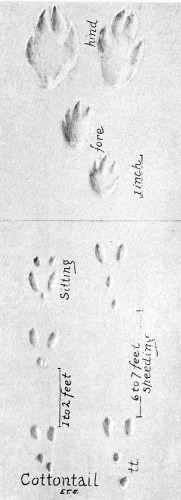
THE COTTONTAIL RABBIT’S TRACK
The large set of four tracks at the top gives
the maximum possible of detail, which is very
rarely seen. The lower figure at the right-hand
corner is a typical track (tt). At the
set marked “sitting” the tail mark is seen, and
in this only are the fore-feet tracks ahead of
the hind tracks. The cottontail has five toes on
the front feet, but only four ever show in the
track (see page 510).
(For illustration, see page 510)
North America has several species of hares,
but no typical representative of the European
rabbit. The American cottontails and their
near relatives, the brush rabbits and others,
combine characteristics of both the hares and
rabbits, but are most like the rabbits, of which
they appear to form aberrant groups.
The cottontails are distinctly smaller than
most of the American hares and average from
two to three pounds in weight. They are
otherwise contrasted with the hares by their
short ears, proportionately shorter and smaller
legs and feet, and by the fluffy snow-white
underside of the tail, which shows so conspicuously
as they run that it has given them
their distinctive name.
The American mammals to which the term
“rabbit” may be properly applied include not
only the cottontails, but numerous other species
closely similar in form and general appearance,
but lacking the cottony white tail. As a
group, these rabbits have a far greater distribution
in America than the hares. They range
from the Atlantic coast to the Pacific and from
the southern border of Canada south through
Central and South America to Argentina.
Their vertical distribution extends from sea
level to above timberline, attaining an altitude
of more than 14,000 feet on Mount Orizaba,
Mexico.
In the United States cottontails are so numerous
and generally distributed that they are
well known to nearly every one. They inhabit
all kinds of country, from the deciduous forests
of the Eastern States to the grassy or
brush-grown plains and pine-clad mountain
slopes of the West and the sun-scorched deserts
of the Southwest. As a result of this
extended distribution and the variety of conditions
in the areas occupied, these rabbits include
numerous species and geographic races,
which in some instances differ greatly in appearance.
Cottontails are especially common about the
brushy borders of cultivated lands throughout
the country, and in fertile brush-grown areas
of foothills, valleys, and river bottoms of the
West. They are mainly nocturnal, and in areas
where there is an abundance of natural cover
in the way of brushy thickets and dense grass
commonly make concealed “forms” in which
they lie safely hidden.
In areas where shelter is represented by scattered
bushes and a comparatively thin growth
of other vegetation they generally occupy burrows
in the ground. These may be holes deserted
by badgers or prairie-dogs or dug by
themselves under a rock or other object. Hollow
logs or natural cavities and crevices among
the rocks are also frequented. When pursued
by dogs, hares as a rule rely solely on their
speed for safety, while the cottontails take refuge
in the first hole they can reach.
Everywhere in their territory, as the shades
of night approach, the cottontails come forth
from their hiding places and skip merrily about
in open ground on the borders of thickets and
similar shelter, where they search for the tender
green vegetation on which they love to
feed. After it becomes too dark to distinguish
their forms, the white tail may be seen twinkling
about in the dusk. During the night they
are often revealed in country roads by the head
lights of automobiles.
Several litters of from two to six young
usually appear during the spring and summer.
These are born blind and practically naked,
their unclad helplessness strongly contrasting
with the open-eyed, fully furred, and alert
young of the hares at the same age. This is a
conclusive indication of the close relationship
between cottontails and European rabbits, the
young of the latter being similarly, but even
more, undeveloped at birth.
The young of the cottontails are born in
nests made of dead grasses warmly lined with
fur from the mother’s body. If above ground
the nest is placed in a little depression and so
artfully concealed by a covering of dead
grasses that it can be discovered only by accident.
When caught, young cottontails utter
little cries of alarm; the wounded adults sometimes
shriek in terror.
From the early settlement of the United
States to the present day cottontails have been
so abundant that they have served as a valuable
source of our game food supply. They are
hunted with guns and with dogs, as well as
being snared and trapped. Enormous numbers,
running into the millions, are killed in
this country yearly, but they are so prolific that
they hold their own in a surprising degree.
Their abundance in many places, however,
has made them a serious pest to agriculture.
They eat growing alfalfa and other forage
plants, many kinds of cultivated vegetables,
young grape vines, and nursery stock and even
kill orchard trees by gnawing the bark from
the base of the trunks. As a result those who
suffer from their depredations consider them
pests to be destroyed, while others look upon
them as desirable game animals to be protected
by law.
As game animals the cottontails furnish
some of the most delightful and interesting
sport available to American hunters. The
scurrying zigzag rush of a cottontail for the
nearest shelter is so full of energetic motion
that it always excites a pleasurable thrill in the
observer, and even the keenest sportsman has
so friendly a feeling for these little animals
that the escape of one of them from an unsuccessful
shot nearly always leaves a feeling of
humorous amusement.
The cottontails have a secure place in American
literature and folklore. Who has not read
the wonder stories of the adventures of “Brer
Rabbit” and ever after had a warmer feeling
of fellowship for his kind? The presence of
cottontails is a source of pleasure to children
of all ages, and their disappearance from the
wild life of a locality creates a more deeply
felt blank than would the passing of many a
nobler animal.
(For illustration, see page 511)
The marsh rabbit, or “pontoon,” as it is
known in Georgia, is a distinctively American
species allied to the cottontails, but distinguished
from them by its more heavily proportioned
body, smaller ears, shorter and slenderer
legs and feet, and shorter, nearly unicolored
tail. Its only close relative in the United
States is the swamp rabbit, known in Alabama
as the “cane-cutter.”
These two species appear to be members of a
Tropical American group of which other members
are the wood rabbits of Mexico, Central
and South America. The distribution of the
group was probably at one time continuous, but
a change to arid conditions in northeastern
Mexico and Texas isolated the two species remaining
in this country.
The distribution of the marsh rabbit is limited
to the southeastern coastal States from
Dismal Swamp, Virginia, to Mobile Bay, Alabama.
It is common in suitable places in Florida.
Its larger relative, the swamp rabbit,
ranges west from this area to Texas and up
the Mississippi Valley to Illinois and southeastern
Kansas. Swamp rabbits are numerous in
the low, wooded coastal region of Louisiana.
They are larger and longer-legged than marsh
rabbits and fleeter of foot.
Among all the rabbits of the world the marsh
and swamp rabbits are the only species which
have aquatic habits. Both live mainly in
marshes, wooded swamps, and along the low
wooded courses of streams. Other rabbits and
hares are occasionally known to cross water
by swimming, but the marsh and swamp rabbits
live about the water and take to it with
all the freedom of a muskrat or mink. The
marsh rabbit appears to be the more aquatic of
the two, as the swamp rabbit sometimes lives
in the forest, farther back from the water.
The Tropical wood rabbits are habitants of
the dense forests, where they are well hidden
under the rank undergrowth. They are not
known to enter the water, but, like their northern
relatives, make runways through the dense
vegetation they frequent. The marsh rabbits
live in cypress or other fresh-water swamps,
heavily wooded bottoms, and fresh water, as
well as brackish marshes. They feed on a variety
of vegetation growing in such places and
dig up such edible roots as the wild potato and
amaryllis.
Both marsh and swamp rabbits have several
litters of from two to six young each season,
beginning in April. The young are born in
large, well-made covered nests, which are built
of rushes, grasses, and leaves and lined with
hair from the parents. The nests, which have
an entrance on one side, are usually located in
the midst of dense growths of vegetation or on
tussocks, in low, swampy places, and are sometimes
surrounded by water. In the most frequented
parts of marsh and swamp these rabbits
make well-trodden trails through the dense
vegetation.
When alarmed, marsh rabbits run for the
nearest water, into which they plunge and swim
quickly to the shelter of aquatic plants or other
cover. When cut off from escape by water
they try to avoid capture by doubling and turning,
but are so short-legged that they are readily
overtaken by a dog. The tracks of these
rabbits in the mud differ from those of the
cottontails in showing imprints of the spreading
toes.
In South Carolina Bachman once found numerous
marsh rabbits in the thickets about recently
flooded rice fields and swamps. When
he beat the bushes the rabbits plunged into the
water and swam away so rapidly that some
escaped from a Newfoundland dog which accompanied
him. Several, apparently thinking
themselves unnoticed, stopped and remained
motionless about fifteen yards from the shore,
with only their eyes and noses showing above
water. Thus concealed in the muddy water,
with ears laid flat on their necks, they were
difficult to see. When touched with a stick
they appeared unwilling to move until they saw
that they were discovered, when they quickly
swam away.
Later, when the water subsided to its regular
channels, where it was about eight feet deep,
many of the rabbits were seen swimming
about, meeting and pursuing one another as if
in sport. One which Bachman had in captivity
during warm weather would lie for hours in a
trough partly filled with water, with which the
cage was furnished.
(For illustration, see page 511)
The pika, little chief hare, or cony, as it is
variously named, is among the most attractive
and interesting of our mountain animals. It
is about the size and shape of a small guinea-pig,
with a short, blunt head, broad, rounded
ears, short legs, practically no tail, and a long,
fluffy coat of fur. While most nearly related
to the hares and rabbits, it has very different
habits.
The pikas form a group comprising many
species, much alike in general appearance and
distributed among the high mountains, from
the Urals of Russia through Asia and northern
North America. In Asia they occur mainly
in the mountains through the middle of the
continent south to the Himalayas. In Pleistocene
time they ranged across Europe to England.
In North America they are limited to
the western side of the continent, from the
Mount McKinley region of Alaska down the
Rocky Mountains to New Mexico and along
the Cascades and Sierra Nevada to the Mount
Whitney region, in California.
Giving to these North American animals the
appellation “cony” is one of many instances in
which the name of an Old World animal is
brought to America to designate a totally unrelated
species. Once fixed in current use, the
misapplied term is certain to persist.
Pikas are among the few mammals which
live permanently along the high crests of the
mountains, mainly above timberline, but they
also descend in rock slides among the upper
spruces, firs, and pines. The altitude of their
haunts varies with the latitude, being between
8,000 and 13,500 feet in the United States, but
in Alaska much lower.
In these cool, alpine regions the little animals
live wholly within the shelter of rock
slides and among the crevices of shattered rock
masses. Their distribution is unaccountably
broken, and although abundant in many places,
they are absent from many others equally suitable.
Their homes are in the midst of the
flower-bedecked glacial valleys and basins, the
haunts of the big marmots and mountain sheep.
They are mainly diurnal in habits, and
throughout the day may be heard their odd
little barking, or bleating note, like the syllables
“eh-eh” repeated at intervals in a nasal
tone, resembling the sound made by squeezing
a toy dog. Occasionally they may be heard
barking at night, perhaps when disturbed by
some prowling enemy. Their notes have a curiously
ventriloquial quality, which renders it
difficult to locate the animals uttering them.
Owing to their dull gray or brownish colors,
the pikas blend with their background so completely
that when quietly sitting on a rock they
are extremely difficult to see. Even when running
about at a little distance they are not
easily noted. Their movements are quick and
they scamper over the rough surface of a rock
slide with surprising agility.
Little is known of their more intimate life
history. Their young, three or four in number,
are born usually during the first half of
summer and are out foraging when less than
half-grown.
Small, bright eyes and big, rounded ears give
pikas an odd and attractive appearance, unlike
that of any other mountain animal. They are
extremely watchful and at the first alarm disappear
in the shelter of their rocky fortresses.
Their little bark, however, continues to come
up from their hiding places with constant iteration.
If the observer will sit quietly at some
good vantage point his patience will eventually
be rewarded by the appearance of the pika on
the top of a stone near the mouth of its retreat.
After a time, if everything is quiet, it resumes
its scampering about over the rocks or
may come to the border of the slide and make
little excursions across the open ground after
some of its forage plants. Skipping nimbly
from the border of the slides to neighboring
patches of vegetation, sometimes fifty or more
feet away, the pika nips off the stems of short
grasses or other plants and taking them up,
like small bundles, crosswise in its mouth, runs
back to add them to its “stacks.” These sallies
are quick little runs, made as though in fear of
being long away from the safety of the rocks.
Caution is needful, however, in a world where
lurk such enemies as coyotes, lynxes, foxes,
weasels, hawks, and owls.
During late summer the pikas have the extraordinary
habit of gathering stores of small
herbage in piles containing sometimes a bushel
each, usually well sheltered in dry places under
the rocks where they live. Pikas are active all
winter, and these little stacks of well-cured hay,
containing a great variety of small plants,
serve them as food during the severe cold season,
when at these high altitudes they are
buried under many feet of snow.
In pleasant weather, near the end of summer,
visitors to the mountains of Colorado, Glacier
National Park, the high slopes of Mount
Shasta, or of the Sierra Nevada may have the
pleasure of watching the pikas hard at work
doing their “haying.” One of their “stacks”
in the mountains of New Mexico contained
thirty-four kinds of plants, including many
flowers. No one who once becomes acquainted
with these unique and gentle little animals will
ever cease to remember them with friendly interest.
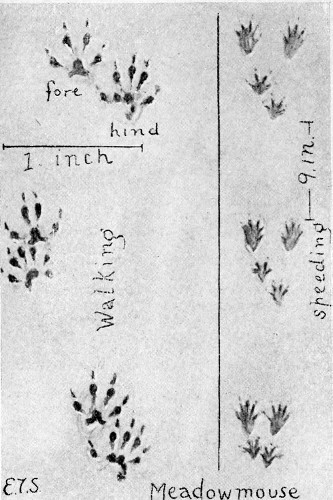
THE TRAIL OF A FIELD OR MEADOW MOUSE
When compared with that of the deermouse,
one notes the absence of the tail mark and the
rarity of the fore feet being paired (see pages
505 and 522).
(For illustration, see page 514)
The porcupine is one of the most grotesque
of the smaller North American mammals.
With a weight of from fifteen to twenty
pounds, its heavy body is supported on short
legs, the feet resting flat on the ground like
those of the raccoon, instead of on the toes, as
in most small animals.
Its strongest peculiarity is the specialized
development of most of the fur into rigid,
sharp-pointed spines or “quills” from half an
inch to over three inches in length. That the
spines represent the underfur of ordinary
mammals is evident from the fact that they
are overlaid by long, coarse guard hairs, sometimes
several times their length.
The spiny armament usually lies flat on
the body, but when the animal is excited or
alarmed it may be raised, by special muscles
on the underside of the skin, into a bristling
array of barbed points. The spines are so
slightly attached that when their points enter
the skin of an enemy they at once become free
at the base. The points firmly set in the skin
of another animal, the spines can be withdrawn
only with considerable effort, and if left will
gradually work deeper and may traverse a
considerable part of the victim’s body before
finally becoming encysted.
When assailed the porcupine turns down its
head, arches its back, and, on firmly planted
feet with all its spines erected into a bristling
cover, awaits the enemy. The instant its body
is touched the club-shaped tail, armed with
a multitude of spines, is swung vigorously
around and the animal so incautious as to receive
the blow is pierced by a host of stinging
darts which, freed from the porcupine, remain
to torment the aggressor. This swift and effective
sweep of the tail has probably given
rise to the idea that the porcupine can “shoot”
its quills when defending itself.
Despite its defensive powers, however, the
porcupine is, on occasion, successfully attacked
by various enemies, including the mountain
lion, bobcat, fisher, and even the eagle and
great horned owl. The fisher is said habitually
to kill and feed upon them, and the encysted
quills are commonly found under its skin.
The frightful effect of an ill-judged attack
on a porcupine is shown by inexperienced dogs
after their first encounter with this strange
beast. That such an attack is a dangerous
venture, even by the craftiest and most powerful
of its enemies, is well demonstrated by
occasional fatalities among large carnivores
which result from the great mass of spines imbedded
in their heads and bodies.
The North American porcupine is a northern
animal belonging mainly to coniferous forests,
and ranges from sea level to timberline.
It originally occupied nearly all the forested
parts of the continent south to West Virginia,
southern Illinois, the Davis Mountains of western
Texas, and the southern end of the Sierra
Nevada in California, but was absent from the
Southeastern States and the lower Mississippi
Valley.
While characteristically a woodland animal,
at times it wanders from forest shelters and
has been found prowling about above timberline
on high mountains, and among alder thickets
beyond the limit of trees in the far North.
They are usually silent, but at times utter a
curious squealing cry, and in addition have a
variety of snuffing, growling, and chattering
noises.
In the forests of tropical America, from
Mexico to Brazil, other and shorter-quilled
porcupines occur, characterized by smaller size
and slenderer bodies with a long tail, the terminal
half of which is naked and prehensile
like that of an opossum. These animals inhabit
forests where no conifers grow, and are
much more arboreal in habits than their northern
relatives. Still other and even more strikingly
different porcupines occur in Europe,
Asia, and Africa, some of the African animals
having heavy spines more than twelve inches
long.
All porcupines are true rodents, and the
name hedgehog is erroneously used when applied
to any of them. Hedgehogs are small Old
World insect-eating mammals, which have their
backs covered with porcupine-like spines, but
are in no way related to the porcupines.
The American porcupines are mainly nocturnal,
although they sometimes wander about
by day. While largely arboreal in habits, they
pass much of their time on the ground and
commonly have their dens in caves at the bases
of cliffs, under the shelter of large rocks, logs,
piles of brush, or in hollows at the bases of
trees. They are sluggish, stupid animals, with
poor sight, and are unable to move rapidly,
either in a tree or on the ground.
Although on the ground they are extremely
deliberate, in the treetops they are even more
sluggish and can be compared only with the
sloth. In consequence they are practically
helpless in the presence of an enemy except
for the defense afforded by their spiny armor.
That in most cases this is effective is evidenced
by their continued presence throughout a large
part of their original range where forests still
exist.
Porcupines are solitary animals, totally devoid
of any qualities of good fellowship with
their kind, but the attraction of woodland
camps often brings a number together. They
are exceedingly fond of salt and persistently
return to camps to gnaw logs, boards, or any
other object having a salty flavor.
They appear to be practically omnivorous so
far as vegetable matter is concerned and feed
upon the bark and twigs of spruces, hemlocks,
several species of pines, cottonwoods, alders,
and other trees and bushes. In orchards and
gardens near their haunts they eat apples, turnips,
and other fruits and vegetables and visit
the shores of ponds for waterlily pads and
other aquatic plants growing within reach.
Ordinarily they eat patches of bark from the
tree trunks, but sometimes girdle the tree or at
times denude the entire trunk. They often remain
for weeks in the top of a single tree, even
in the severest winter weather. I had a practical
illustration of this on one occasion when
stormbound in a fur trader’s cabin at the head
of Norton Bay, on the north coast of Bering
Sea, where a belt of spruces reached down
from the interior. We were short of meat, and
when one of the Eskimos reported that some
time before he had seen a porcupine in a spruce
tree he was sent to look for it. A few hours
later he returned bringing the game, having
found it in the very same tree where he had
seen it many days before, although we had just
experienced a period of severe weather, with
temperatures well under 40 degrees Fahrenheit
below zero. It was on this occasion that I first
learned the palatable qualities of porcupine
flesh.
Little is known definitely concerning the
family life of these animals. The young, from
one to four in number, are amazingly large at
birth and appear fully armed with spines.
Even before they are half grown they adopt
the solitary habit of the adults and wander
forth to care for themselves.
Porcupine’s have an intimate connection with
the romantic side of early Indian life in eastern
America. Their white quills were colored in
bright hues by vegetable dyes known to the
Indians and served to make beautiful embroidery
on belts, moccasins, and other articles of
aboriginal clothing until primitive art gave way
to the more tawdry effects of trade goods.
(For illustration, see page 514)
In several ways the jumping mouse is unique
among American mammals. Its strongest characteristics
are a dull, rusty yellowish color, a
slender body about three inches long, a remarkably
slender tail about five inches in length, and
long hind legs and feet, which are specially
developed for jumping, like those of a little
kangaroo. In addition it is provided with
cheek pouches, one on each side of the mouth,
in which it gathers food to be carried to its
hidden stores.
The long tail serves as a balance during its
extraordinary leaps, some of which in a single
bound cover a distance of about ten feet. If
by accident one of these animals loses its tail,
whenever it jumps it is thrown into a series of
somersaults, turning helplessly over and over
in the air.
The jumping mice form a small group of
species and geographic races closely similar in
general appearance. They are the sole representatives
in North America of the Old World
jerboas and are themselves represented elsewhere
by a single species occurring in the interior
of China. The jerboa family contains in
addition many larger and curiously diverse species
distributed over a large part of Asia,
Africa, and southern Europe. Many Old
World jerboas are desert animals, some of
them exact reproductions in shape and color of
the kangaroo rats of arid regions in the Western
and Southwestern States and Mexico, although
they are in no way related to those
animals.
Jumping mice are distributed over most of
the northern parts of North America from the
Atlantic coast of Labrador to the Bering Sea
coast of Alaska, and southward to North Carolina,
Illinois, New Mexico, and California.
They are nocturnal in habits and live in or near
the borders of forests, in thickets of weeds or
brushwood, and in meadows adjoining woodland
areas or forest lakes. In prairie country
they occupy belts of woody growth bordering
streams. In congenial locations they range
from sea level up to an altitude of 8,000 feet
or more.
For winter homes they dig burrows two or
three feet deep, in the lower parts of which
they excavate oval chambers and fill them with
fine grass and other soft material to make a
warm nest. Other chambers opening from
these burrows serve as store-rooms for berries,
seeds, and nuts of various kinds, among which
beechnuts are a favorite.
The nests occupied as summer homes are
placed in shallow burrows a few inches below
the surface of the ground, or they may be in
a hollow tree, under a piece of bark, in a dense
tussock of grass, or in other makeshift shelter.
In these nests the young, varying from two to
eight in number, are born at varying times between
May and September, indicating the probability
that more than one litter is produced
each season.
When suddenly startled from her nest the
female often flees with several of the young
clinging to her teats. She runs swiftly through
the grass, and if hard pressed will take a long
leap, still carrying the pendant young. It is
surprising that such delicately formed animals
can make long leaps in thickly grown places
and apparently land safely, especially when
carrying their young. In the flights of the
mother some of the young must be jarred
loose, but when the alarm is over no doubt
she returns to find and rescue any that may
be missing.
In the northeastern States jumping mice are
common habitants of meadows. They are
equally at home in the rocky meadows of New
England, on the flower-spangled borders of
rushing trout streams in the Sierra Nevada of
California, and the boggy glades of subarctic
Alaska.
My first acquaintance with them was made
many years ago, during haying time, in northern
New York. Hidden under a haycock, as
the last forkful was raised one of them was
often revealed, and its startling leaps always
resulted in an exciting chase, which usually
ended in the escape of the strange little beast.
Unlike most of their small fellows of
meadow and thicket, jumping mice regularly
hibernate, occupying the nests near the bottoms
of the winter burrows. They usually become
fat on the abundance of food at the end
of summer, and in September or October, with
the approach of cool weather, enter their winter
quarters and sink into the long, hibernating
lethargy. Sometimes two of them are
found hibernating in the same nest.
During hibernation they are coiled up in
little furry balls, the nose resting on the abdomen,
the hind feet on each side of the head,
and the tail wound around the body. The
winter sleep usually lasts until spring, but may
be broken at any time by mild weather.
When hibernating the mice appear cold and
lifeless, but if one is carried into a warm
house or even held a long time in the captor’s
hands it will slowly awaken and may become
as lively as in summer. When returned to a
low temperature, however, it soon resumes its
mysterious seasonal sleep.
(For illustration, see page 515)
Soft, shining fur, delicate coloring, and
graceful form distinguish the silky pocket mice
from others of their kind. The family of
which they are members consists of rodents
peculiar to America and includes many other
species of pocket mice and kangaroo rats. All
are provided with little pouches on each side
of the mouth for gathering and carrying food,
have proportionately long tails, and hind legs
and feet more or less developed for jumping.
Only in the most remote way, however, are
they related to the jumping mice of the jerboa
family.
The silky pocket mice vary in size from the
tiny yellow species pictured on the accompanying
plate, which weighs much less than an
ounce, to forms considerably larger than the
common house mouse. The little yellow pocket
mouse is one of the smallest mammals in the
world, and in addition is one of the most beautiful
of our small species. Its bright eyes and
the delicacy of its form and color, combined
with the readiness with which, in most instances,
it appears to lose all fear when caught
and gently handled, render it extremely attractive.
As with the majority of other pocket mice,
the silky-haired species are limited to the more
arid parts of North America, and range from
the Great Plains west of the Mississippi Valley
to the eastern base of the Cascades, to the
Sierra Nevada, and farther southward to the
Pacific coast, and from the Canadian border
to the Valley of Mexico. Vertically, the range
of these mice extends from sea level to an
altitude of more than 7,000 feet.
As with the majority of our wild mammals,
little accurate information is available concerning
their life history. They are habitants
mainly of desert regions, where they prefer the
areas of sandy loam, which produce an abundance
of scattered desert vegetation. They are
nocturnal and by day are seen only when
driven from their nests. Their rather shallow
burrows are made in soft soil, the situation
varying a little with the species. Some species
burrow only under the shelter of bushes or
other vegetation; others out in the bare ground.
Each burrow commonly has grouped in a
small area several entrance holes, which lead
through tunnels to the central passageway, the
nest, and the storage chambers. Usually there
is a little pile of loose dirt thrown out on one
side of a hole, or a group of holes may be in a
little mound of earth. The entrances are usually
stopped from within by loose earth, and if
a person quietly thrusts in a short stick so as
to remove the earthy plug and let in the light
he may see the dirt suddenly returned to its
place in little jets, as the occupant promptly
kicks the door closed again.
The young, varying from two to six in a
litter, are born in these little dens in warm
nests of dried grasses. They have been found
at all times between April and September, thus
making it apparent that several litters are produced
each season.
The silky, as well as the other kinds of desert
pocket mice, do not drink water, and, as
has been shown by experiments, they may be
kept for months in thoroughly dry sand and
fed on dried seeds without any resulting discomfort.
Through the long pressure of desert
environment they have developed the power to
produce sufficient water for their physiological
processes by chemical changes in the starch in
their food, which are effected in the digestive
tract.
Representatives of this group of mice are almost
everywhere in the arid parts of their
range, and in many sandy localities are extremely
numerous and active at night, as shown
by the multitude of little tracks in the dust at
sunrise each morning. Their presence in the
desert is indicated also by the many little conical
pits half an inch or an inch deep, where
they have located small seeds and dug them up.
They lie close in their burrows during cold
or stormy weather, depending on their stores
for food, but are not known to hibernate, although
in the northern part of their range they
are confined to their burrows for long periods.
At one of my camps in the desert of Lower
California I found the silky and other pocket
mice excessively numerous and so short of
food that they swarmed about us at night with
amazing lack of fear. My experiences with
them are given in the accompanying account of
the spiny pocket mice.
The silky and other pocket mice have many
enemies, among the worst of which are the
handsome little desert fox and the coyote.
Others which continually prey upon them are
the badger, skunk, and bobcat, as well as many
owls.
(For illustration, see page 515)
Pocket mice are divided into several natural
groups of species, all having certain characters
in common, as a pointed head, lengthened hind
feet and legs, and external cheek pouches for
carrying food. The spiny group contains numerous
species, the smallest of which is about
the size of a house mouse and the largest
nearly twice that size.
They are more slenderly built than the silky
species and have longer tails, with the hairs
lengthened along the terminal half, thus giving
a slightly brushy or tufted appearance. Their
most striking character is the distinctly coarser
hair with long scattered guard hairs, like small
bristles, which conspicuously overlie the fur on
the hinder parts of the body and from which
the common name is derived.
The distribution of the spiny forms, although
nearly the same as that of the silky ones, is a
little more restricted. All belong to the arid
or desert parts of the West and Southwest,
from South Dakota and middle California
southward to Michoacan, near the southern
end of the Mexican tableland, and throughout
Lower California.
Some species inhabit the scattered growth of
plants in sandy areas, but they are more generally
characteristic of harder and more rock-strewn
soil, rocky mesas, and foothill slopes.
There a few species make burrows in open
ground, sometimes with a single hole, but most
of them make their nests under rocks, in crevices,
or in burrows sheltered by such desert
bushes as Covillea, Bursera, Olneya, Cercidium,
and mesquites.
In these shelters pocket mice make little
mounds a few inches high and ten or fifteen
inches across. The mounds have several entrances
on different sides, one of which generally
shows signs of recent use, although by
day it is kept closed from within by loose earth.
Each of the many-entranced dens is occupied
by a single animal. Early in the morning, before
the wind fills them with dust, tiny trails
are to be seen leading from these doorways
toward the nearest feeding grounds and all
about their haunts.
The spiny and the silky pocket mice, sharing
much the same arid region, have the same food
plants and are preyed upon by the same enemies.
The food of these mice consists mainly
of small seeds, including the wild morning
glory, wild sunflowers, wild parsnips, and a
multitude of others characteristic of the various
areas they occupy.
Pocket mice are strictly nocturnal or crepuscular
in habits and appear by day only when
disturbed. If the plugged entrance to a burrow
is opened, however, it will probably be
quickly stopped up again from within by the
annoyed householder.
The young, in litters of from two to eight,
are born at irregular times according to the
latitude and general weather conditions. In
the south at least several litters appear to be
born each year, the young being noted almost
every month.
When camping alone for a few days in the
desert near San Ignacio, in the middle of the
peninsula of Lower California, I had a unique
opportunity to learn something of the peculiarities
of the various pocket mice. Three species
were abundantly represented, including both
the silky and the spiny kinds. They quickly
learned that good hunting could be found in
and about the tents for the rice grains and
other scattered food and promptly took advantage
of it.
As soon as approaching darkness began to
render objects indistinct, from their burrows
among the surrounding bushes they swarmed
into camp and were busy throughout the night
minutely searching the ground under the shelter
tent for every particle of food. In order
to see these interesting visitors to better advantage
I placed a candle on a small box in the
middle of the tent.
Five or six individuals, representing three
species, often came within the circle of light at
the same time. At first all were shy and when
I made any sudden movement would leap in
every direction, like grasshoppers, and quickly
vanish. The smallest of the species, a member
of the silky group, was the shyest of all and
remained timid and reserved.
The two larger species, representing both the
spiny and the silky groups, were much more
bold and quickly became confiding and delightfully
friendly. Their attention was promptly
attracted to rolled oats which I scattered on
the ground in a spot well lighted by the candle.
Sitting quietly close by the bait where the
visitors congregated I soon had evidence that
among themselves these little beasts are extremely
pugnacious. The first to reach the
food would fiercely charge the next comer and
always try to leap upon its back, at the same
time delivering a vicious downward kick with
its strong hind feet. Occasionally the newcomer
would charge the one already at the
food.
When five or six were trying to secure sole
possession of the small food pile there was
lively skirmishing about the premises, as they
alternately attacked and pursued one another
over the sand and among the boxes and other
camp gear scattered about. Amazingly quick
in movements, they would leap now forward,
now sidewise, now straight up a foot or more
in the air, with almost equal celerity; and the
direction of their movements when attacked
was often unexpected. When running about
on the level sand they had a steady, swiftly
gliding motion, which their tracks showed was
the result of a series of little jumps.
Both the spiny and the silky pocket mice became
so confiding the first night that when I
put my hand on the ground palm up with a
little rolled oats in it the nearest pocket mouse
would run to it, stop for an instant to smell
the finger-tips, and then mount and sit quietly
on the palm and fill its cheek pouches.
At such times the mice showed no uneasiness,
even when raised in my hand to within
a few inches of my eyes in order that I might
observe their movements more closely. The
motions of their front feet when putting food
into the pouches were so rapid that it was impossible
to follow them. The nose was held
just over the food pile, and the cheek pouches
would slowly but visibly swell as they were
filled until they stood out like little bladders
on each side of the head.
As soon as they were full the mice became
uneasy to get away and would run from one
side of my hand to the other peering down
the abysmal depth of three feet to the ground
without daring to leap. As soon as my hand
was lowered to the ground the mouse darted
away to carry the food to its store in the
bushes twenty to thirty yards away, quickly to
return with empty pouches.
The mice soon became so tame that while
they were on my hand or on the ground I
could with one finger of the other hand stroke
gently the tops of their heads and backs and
even pick them up by their tails and suspend
them head down. When thus held they remained
motionless, their tiny front feet like
little closed hands held against their breasts.
When lowered and released they would immediately
resume the filling of their pouches as
though nothing had happened. Several individuals
of the dozen or more which made free
of the tent had lost part of their tails, so that
they could be readily distinguished.
One of these little bobtails was so gentle and
confiding that I became much attached to it.
It would permit all manner of familiar treatment,
such as being picked up by one foot or
by the tail, or being turned on its back. With
this confidence came a sense of proprietorship
in the good things here so suddenly and mysteriously
plentiful, as was shown by his attitude
toward his fellows.
Again and again when he was filling his
pouches from a pile of rolled oats in my hand
I lowered it in a gently sloping position within
ten or fifteen inches of another mouse gathering
food on the ground. Thereupon the little
bobtail in my hand would invariably leave the
task of filling his pouches and without hesitation
leap down on the back of the one on the
ground. The surprised animal thus assailed
from an unexpected quarter always fled in
terror.
After a short pursuit the bobtailed one would
come running back and instead of going to the
equally inviting pile of food on the ground
would come straight to my hand and complete
his task. The industry of the little animals
appeared to be tireless, as working swiftly they
made trip after trip with pouchloads of food
to their stores and quickly returned. One night
I watched this strenuous work for two hours
until I retired.
The abundance and boldness of pocket mice
and kangaroo rats at this place led me to believe
that there had been a former abundance
of their food here, resulting in a large increase
in the rodent population, but that it was then
becoming scarce through a failure of rain to
renew the seed harvest. The invariable outcome
in such cases is for the small rodents dependent
on seeds and fruits to be reduced by
famine until they become rare, where previously
they existed in great numbers. This is
one of Nature’s processes whereby the danger
of the overwhelming increase of any species is
automatically prevented.
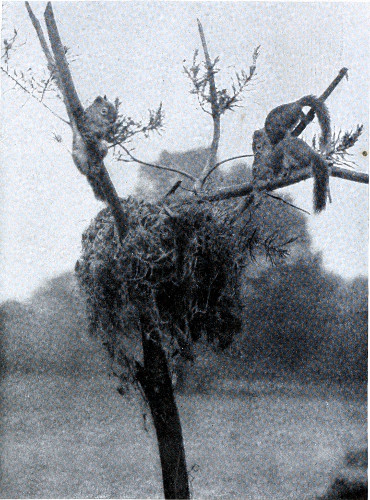
Photograph by Howard Taylor Middleton
YOUNG RED SQUIRRELS AND THEIR NEST
These cute little chaps were found cozily at rest in their nest in
a pine. They were routed out, however, long enough to have their
portraits taken. An effort was made to include the mother, but
without success (see page 556).
(For illustration, see page 515)
With the exception of the moles no other extensive
group of American land mammals is so
highly specialized for a
peculiarly restricted mode
of life as the pocket gophers.
They form a
strongly marked family,
the Geomyidæ, which includes
various genera and
many species, all very
similar in external form,
but varying from the
size of a large mouse to
a massively formed animal
equalling a large
house rat in weight.
Without exception they
are powerfully built for
their size, the head and
front half of the body
being extraordinarily
muscled to meet the demands
of their mode of
life. The broad blunt
head is joined almost directly
on the body. The
eyes are small and have
the restricted vision to
be expected from animals
living underground. The
ears are reduced to little
fleshy rims about the
openings, and the short
naked tail is provided
with nerves, which render
it useful as an organ
of touch.
The front teeth are
broad, cutting chisels,
and on each side of the
mouth is a large pocket
in the skin used for gathering
and carrying food.
On the front feet are
long claws, which, when
not being used to dig or
handle earth, are doubled
under, against the soles
of the feet, so that the
gopher walks on the back
of them much as the ant-eater
walks on its folded
claws.
Peculiar to North America, pocket gophers
occupy a great area extending from Illinois,
Florida, and the Gulf of Mexico to the Pacific
coast, and from the plains of the Saskatchewan,
in Canada, southward to Panama. Their vertical
range within these limits extends from sea
level to timber-line, at above 13,000 feet on
some of the high volcanoes of Mexico. The
family attains its greatest development in that
wonderful region of plains and volcanoes lying
about the southern end of the Mexican table-land.
In the United States these animals are best
known as “gophers,” but in the range they
occupy in the Southeastern States they are
called “salamanders” and in Mexico are widely
known as “tuzas.” As a rule they frequent
treeless areas, but are found also in many
types of forests from among the palms and
other trees of the tropical lowlands to the
oaks, pines, and firs on the mountain sides.
All members of the family live wholly underground,
in many-branched horizontal tunnels,
which they are continually extending in
winding and erratic courses about their haunts.
The tunnels are from two to about five
inches in diameter, according to the size of the
animal, and while usually less than six inches
below the surface, the approaches to the nest
and storage chambers sometimes drop abruptly
two or three feet below the regular working
tunnels to the level of the living quarters. At
intervals along the tunnels short side branches
are used as sanitary conveniences, thus enabling
the occupant to keep the main passageways
in a habitable condition.
The courses of the underground workings
are roughly indicated on the surface by series
of piles of loose earth brought up through
short side passages as the tunnels are extended.
These little miners’ dumps of earth
vary with the size of the animal, sometimes
containing more than two bushels. The outlets
of the passages leading to the surface are
kept plugged with loose earth. When these
animals are numerous the ground is thickly
dotted in all directions with earth piles, and
the caving caused by the network of tunnels
just below the surface renders walking difficult.
The perpetual industry of these rodent
miners outclasses that of the proverbial beaver.
Gophers are both diurnal and nocturnal, the
gloom of their tunnels scarcely varying except
when one of the outlets is temporarily opened.
They are averse to light, and if the plug to a
freshly made opening is removed the observer
may soon catch a glimpse of the owner as he
suddenly thrusts his head into view for a moment
before again plugging the door with earth.
Gophers dig their tunnels by using their teeth
and the strong claws on the front feet. The
loose earth is pushed along the tunnel by the
head, the palms of the front feet, and the
breast in little jerky movements until it is
ejected on the surface dump.
Owing to their poor sight, heavy bodies, and
short legs, gophers are clumsy and deliberate
in their movements and peculiarly helpless in
the open. Apparently appreciating this, they
rarely venture from their underground shelter
by day except when in grain fields or similar
sheltering vegetation. Here they sometimes
run out two or three feet to cut down a succulent
stalk and drag it hastily within the entrance
of the tunnel, where it is cut into short sections
and placed in the cheek pouches if to be used
as food or left on the dump if the object of
the cutting is finally to secure the seeds or
head of ripening grain.
During the mating season in spring pocket
gophers run about clumsily from one burrow
to another and may often be seen on the surface
by the light of the rising sun. Most of
their short trips above ground are made at
night, when they sometimes swarm out and
wander over a limited territory. Their night
wanderings are proved in California by the
many bodies which the morning light often reveals
in the sticky crude oil on newly oiled
roads which the gophers have tried to cross.
From one to seven young are born in a litter,
but whether there is more than one litter in a
season or not is unknown. The young when
about half grown migrate to unoccupied ground
sometimes one or two hundred yards from the
home location and make tunnels of their own.
The food of pocket gophers consists mainly
of tubers, bulbs, and other roots, including
many of a more woody fiber. Whole rows of
potatoes or other root crops are cleaned up by
the extension of tunnels along them. Sometimes
the animals follow a row of fruit trees,
cutting the roots and killing tree after tree. In
grain and alfalfa fields they are great pests, and
in irrigated country their burrows in ditch
banks often cause disastrous breaks.
The big tropical species sometimes exist in
such numbers as to render successful agriculture
very difficult. Sugar-cane planters in
many parts of Mexico and Central America are
compelled to wage unremitting war on them to
avoid ruin. I know of an instance on a plantation
in Vera Cruz in which thousands were
killed during a single season without stopping
the damage from these pests, which swarmed in
from the adjacent area.
The large external cheek pouches of pocket
gophers are used solely for gathering such food
supplies as seeds, small bulbs, and sections of
edible roots or plant stems and transporting
them to storage chambers located along the
sides of the tunnels. Food is placed in the
pouches by deft sidewise movements of the
front feet used like hands, and so quick are
they that the motions of the feet can scarcely
be detected. The pockets are emptied by placing
the front feet on the back ends of the
pouches and pushing forward, thus forcing out
the contents. In their tunnels gophers run
backward and forward with almost equal facility,
the sensitive naked tail serving to guide
their backward movements.
Pocket gophers are stupid solitary little
beasts, with surly dispositions, and fight viciously
when captured or brought to bay. This
attitude toward the world is justified by the
host of enemies ever ready to destroy them.
Among their more active foes are snakes and
weasels, which pursue them into their tunnels;
and badgers, which dig them out of their runways.
They are also persistently hunted day and
night by foxes and coyotes. Moreover, by day
various kinds of hawks watch for them to appear
at the entrances of their dens, and by
night the owls, ever alert, capture many.
When one gopher intrudes into the tunnel of
another the owner at once fiercely attacks it.
In some places I have seen Mexicans take advantage
of this characteristic pugnacity by fastening
the end of a long string about the body
of a captured gopher and then turning it into
an occupied tunnel, through a recently made
opening. The owner, scenting the intruder,
would immediately attack him, the combatants
locking their great incisors in a bulldog grip.
The movements of the string would give notice
of the encounter, and by pulling it out
steadily both animals could be drawn forth and
the enraged owner of the burrow dispatched.
In this manner I have known an Indian to
catch more than a dozen gophers in a few
hours.
Pocket gophers are active throughout the
winter even in the coldest parts of their range,
but in many places must rely largely on food
accumulated in their storage chambers.
Melting snow in the mountains and in the
North reveals the remains of many tunnels
made through it along the surface of the
ground. These snow tunnels are often filled
for long distances with loose earth brought up
from underground, and after the snow disappears
in spring the curious branching earth
forms left, winding snakelike through the
meadows, are a great puzzle to those who do
not know their origin.
In a state of nature pocket gophers are constantly
bringing the subsoil to the surface and
burying humus. Over an enormous area they
exist in such countless thousands that their
work, like that of angleworms, is often of the
most beneficial character. On bare slopes,
however, their work is highly injurious, as it
greatly increases erosion of the fertile surface
soil and thus has its direct influence in changing
world contours.
When civilized man arrives in their haunts
and upsets natural conditions with cultivated
crops the new food supply stimulates an increase
in the gopher population and their activities
immediately become excessively destructive
and necessitate unremitting warfare
against them.
(For illustration, see page 518)
The desert regions of western North America
have developed several peculiar types of
mammals, and among them are none handsomer
or more interesting than the kangaroo
rats. These rodents, despite their name, are
neither kangaroos nor rats, but are near relatives
of the pocket mice, which share their
desert haunts.
All are characterized by a kangaroo-like
form, including small fore legs and feet, long
hind legs and feet for jumping, and a tail
longer than the body to serve as a balance.
In addition, they have large, prominent eyes and
are provided with skin pouches on each side
of the mouth for use in holding food to be
carried to their store chambers.
The color pattern, like the form, of the kangaroo
rats is practically uniform throughout
the group. Both are well shown in the accompanying
plate of Dipodomys spectabilis, the
largest and most strongly marked species. Its
total length is from 12 to 14 inches; most of
the other species are much smaller.
Kangaroo rats of many species are distributed
over most of the arid and semiarid regions
of the United States and Mexico, from
Nebraska, Oklahoma, and the Gulf Coast of
Texas west to the Pacific coast, and from Montana
and Washington southward to the Valley
of Mexico and throughout Lower California.
They are especially numerous in the southwestern
deserts, where they are the oddest and most
picturesque of animals.
Although they have no near relatives in the
Old World, some of the African and Asiatic
jerboas are externally almost perfect replicas
of the kangaroo rats in every detail of form,
color, and color pattern, even to the tail markings.
This extraordinary likeness in appearance
of two widely separated and unrelated
animals is made doubly significant by the fact
that both live in deserts and have similar
habits.
Peculiarly desert animals, kangaroo rats live
like the pocket mice, without drinking, but obtain
the necessary water through their digestive
processes. They are most numerous in sandy
areas, and there the earth is sometimes so riddled
by their burrows as to render horseback
riding difficult.
Kangaroo rats are nocturnal and always live
in burrows dug by themselves. As a rule they
prefer soft or sandy ground, but some species
occupy areas where the earth is hard and rocky.
The burrows of some species have only one or
two entrances with a small amount of earth
thrown out, but others make little mounds with
several openings, entering usually nearly on a
level or at a slight incline. These openings
are nearly always conspicuous, and while frequently
near bushes, no effort appears ever to
be made to conceal them, and a little trail often
leads away through the soft earth.
The large Dipodomys spectabilis, which lives
mainly in New Mexico and Arizona, constructs
the most notable of all the dwelling places of
these animals. From its underground workings
it throws up large mounds of earth, which
gradually increase in size with the length of
time they are occupied until they are sometimes
more than 3 feet high and 15 feet or
more in diameter. From three to a dozen burrows
enter these mounds, usually at the surface
level of the ground, but some are on the slopes
of the mound. The mounds, usually located in
open ground, with their round entrance holes
from four to five inches in diameter, are extremely
conspicuous.
Although generally scattered at varying distances
from one another, the mounds are sometimes
grouped in colonies. Well-worn trails
three or four inches broad lead away from the
entrances, some to other mounds showing
neighborly intercourse and others far away to
the feeding grounds, sometimes 200 or 300
yards distant. One of the openings at the side
of the mound is usually the main entrance, and
by day this is ordinarily kept stopped with
fresh earth. Within the mound and farther
under ground are dug a series of ramifying
passages, among which are located roomy nest
chambers and store-rooms for food.
Kangaroo rats are not known to hibernate
in any part of their range. They lay up food
for temporary purposes at least and do not go
abroad in stormy or cold weather. The northern
species and those on the colder mountain
slopes must make large store against the winter
needs. Their food consists mainly of seeds,
leaves of several plants, and of little plants just
appearing above ground. Tiny cactus plants
and the saline fleshy leaves of Sarcobatus are
often among the kinds gathered for food.
The big Dipodomys spectabilis appears to be
more social than most of its kind, as several
may be caught in a single mound, and, as already
said, well-worn trails lead from mound
to mound. A little noise made just outside one
of these mounds usually brings a reply or challenge
in the form of a low drumming or thudding
noise, no doubt made by the animal rapidly
striking the ground with its hind feet like
a rabbit or wood rat.
When caught they at first struggle to escape,
but, like a rabbit, do not offer to bite, and soon
become quiet. They have from two to six
young, which may be born at any season.
Nothing appears to be known concerning the
number of litters in a year.
When in camp at San Ignacio, in the middle
of the desert peninsula of Lower California, I
had an unusual opportunity to learn something
of the habits of one of the smaller species of
kangaroo rat abundant there. The moon was
at its full, and in the clear desert air its radiance
rendered objects near at hand almost as
distinct as by day. Scattered grains of rice
and fragments of food on the ground about
the cook tent attracted many kangaroo rats and
pocket mice.
During several nights I passed hours watching
at close range the habits of these curious
animals. As I sat quietly on a mess box in
their midst both the kangaroo rats and the
mice would forage all about with swift gliding
movements, repeatedly running across my bare
feet. Any sudden movement startled them and
all would dart away for a moment, but quickly
return.
Although the kangaroo rats did not become
so fearless and friendly as the pocket mice,
they were so intent on the food that at times
I had no difficulty in reaching slowly down and
closing my hand over their backs. I did this
dozens of times, and after a slight struggle
they always became quiet until again placed on
the ground, when they at once renewed their
search for food as though no interruption had
occurred.
One night, to observe them better, I spilled
a small heap of rice on the sand between my
feet. Within two or three minutes half a dozen
kangaroo rats had discovered it and were busily
at work filling their cheek pouches with the
grains and carrying them away to their store
chambers.
While occupied in this rivalry for food they
became surprisingly pugnacious. If one was
working at the rice pile and another rat or a
pocket mouse approached, it immediately darted
at the intruder and drove it away. The
mode of attack was to rush at an intruder and,
leaping upon its back, give a vigorous downward
kick with its strong hind feet. Once I
saw a pocket mouse kicked in this way. It
was knocked over and for a minute or more
afterwards ran about in an erratic course,
squeaking loudly as though in much pain.
Sometimes the pursuit of one kangaroo rat
by another continued for twenty yards or more.
By the time the pursuer returned another
would be at the rice pile and it would immediately
dash at the victor of the former fray
and drive him away. In this way there was a
constant succession of amusing skirmishes.
Sometimes an intruder, bolder than the others,
would run only two or three yards and
then suddenly turn and face the pursuer, sitting
up on its hind feet like a little kangaroo.
The pursuer at once assumed the same nearly
upright position, with its fore feet close to its
breast. Both would then begin to hop about
watching for an opening. Suddenly one would
leap at the other, striking with its hind feet
exactly like a game cock. When the kick
landed fairly on the opponent there was a distinct
little thump and the victim rolled over on
the ground. After receiving two or three
kicks the weaker of the combatants would run
away.
The thump made by the kick when they were
fighting solved the mystery which had covered
this sound heard repeatedly during my nights
at this camp. The morning light revealed a
multitude of little paired tracks made by the
combatants in these battles. Such tracks in
the sand have been referred to as the “fairy
dances” of these beautiful little animals, but
the truth revealed proves them to be really
“war dances.”
(For illustration, see page 519)
Banded lemmings are unique among the
mouse tribe in their change from the rufous
brown, or gray summer coat to pure white in
winter. With the assumption of the white
winter fur a thick, horny, padlike growth develops
on the underside of the two middle
claws of the front feet, which is molted in
spring when the winter coat is lost. For an
animal living in the far North the usefulness
of a white coat in winter is evident, but no good
reason is apparent for these curious claw-pads.
The summer coat varies remarkably in color
and color pattern, and many of the lemmings
in their beautiful shades of chestnut, browns,
or grays are very handsome. They are more
heavily proportioned than field mice and the
very long fluffy fur, which completely conceals
the rudimentary ears and tail, tends to exaggerate
their size.
The banded lemmings form a strongly
marked group, containing a number of species
inhabiting circumpolar regions. In North
America they occur nearly everywhere in the
arctic and subarctic parts, including Greenland,
most of northern Canada, including the Arctic
islands, and a large part of Alaska, including
some of the Aleutian Islands.
They range as far northward as vegetation
affords them a proper food supply and have
been well known to many of the explorers of
those stern northern wilds. To the southward
they extend into the subarctic northern forests,
where they usually keep to the open barren
areas.
Not much is known of their life histories on
this continent. They are mainly nocturnal and
live in burrows from two to three feet long,
ending with a nest chamber four or five inches
in diameter, warmly lined with grass and moss.
Near the nest there is usually a branch burrow
a foot or more long which is used for sanitary
purposes and as a place of refuge when the
main burrow is invaded.
In the nests during early summer litters generally
containing about three young are brought
forth. Ordinarily the burrows open in unsheltered
places, but in wooded regions may be
under a log or beneath a bush or the roots of
a tree. No runways lead out from the burrows
as is customary with many of their relatives.
They are active throughout the winter,
making many tunnels along the surface of the
ground under the snow, which are revealed
when it melts in spring.
These surface tunnels are their foraging
roads, safe from most of the fierce storms
which rage overhead. At times, however, the
snowy shelter is blown away or some other
cause brings the lemmings to the surface, where
they blunder aimlessly about, soon to be captured
by some enemy or to perish from the
cold. As their infrequent appearance on top
of the snow is usually during storms, the
Alaskan Eskimos have a legend that these
white lemmings live in the land above the stars
and descend in a spiral course to the earth
during snowstorms.
Although banded lemmings never become so
extraordinarily numerous over great areas as
the brown species, they become very abundant
at times in the barren grounds of Canada and
the Arctic islands and migrate from one part
of their range to another. The best observation
in regard to this was made by Rae in June
at the mouth of the Coppermine River. On
the west bank of the river north of the Arctic
Circle he encountered thousands of them speeding
northward.
The ice on some of the smaller streams had
broken up and he was amused to see the little
animals running back and forth along the banks
looking for a smooth place in the stream, indicating
a slow current, where they could swim
across. Having found such a place, they at
once jumped in and swam quickly to the opposite
side, where they climbed out and, after
shaking themselves like dogs, continued their
journey as though nothing had happened.
During the years I lived in northern Alaska
the advent of winter was marked by invasion
of the storehouses by many brown lemmings
and other mice, but banded lemmings rarely
appeared. When occasionally captured alive,
the old ones fought viciously, but the young
were gentle and quickly became tame and interesting
pets. Their skins were highly prized
by the little Eskimo girls to make garments
and robes for their walrus ivory dolls.
(For illustration, see page 579)
Few small mammals are so well known in
far northern lands as the brown lemmings.
They form a small group of species having a
close general resemblance to some of the field
mice, from which, however, they may at once
be distinguished by their much heavier proportions,
extremely short tails, and the remarkable
length of the hair on their backs and rumps.
They inhabit most of the arctic and subarctic
lands of both Old and New Worlds. In North
America they are known from the northernmost
lands, beyond 83° north latitude, to the
southern end of Hudson Bay, and throughout
most of northern Canada and all of Alaska,
including the islands of Bering Sea.
The extraordinary migrations of these lemmings
have attracted attention far back in the
early history of northern Europe. At intervals,
through favorable conditions, they become
superabundant over a large area, and then a
sudden resistless desire to migrate in a certain
direction appears to seize the entire lemming
population. The little beasts start in a swarming
horde, sometimes containing millions, and
traverse the country.
In their travels they appear indifferent to all
obstacles and with dogged and unwavering persistence
swim the streams and lakes encountered
on their way. Similar migrations have
been observed at various points in Arctic
America, several of them in Alaska, where the
lemmings abound on the open tundras.
These migrations sometimes continue for
more than one season, the animals meanwhile
being killed in countless numbers by disease,
by accident in field and flood, and, in addition,
through the heavy toll taken from their numbers
by their winged and four-footed foes,
which always gather in numbers to accompany
them.
The migrations sometimes wear out through
the diminution in numbers, and sometimes
when they reach the sea, as in Norway, they
are said to enter the water and swim offshore
until they perish. When one of these swarms
of rodents passes through a farming district it
cleans up the crops and other surface vegetation
like a visitation of locusts.
These lemmings do not hibernate, but, active
throughout the severest winters, are abroad
almost equally by day and by night. Their
burrows consist of winding tunnels, often
many-branched and with more than one opening.
A dry bed of peat or a dense growth of
moss is often pierced by a network of them.
Well-defined runways often lead away from
the burrows or from the entrance of one burrow
to that of another.
Their tunnels run everywhere under the
snow, with occasional passages leading to the
surface. When fierce gales blow away the
snow or a winter rain melts it, many lemmings
lose touch with their burrows and wander
about until they perish from cold or are caught
by some enemy. They are sometimes found
several miles from shore, where they have
strayed out on the sea ice.
In winter in the fur countries, in company
with field mice, they invade storehouses and
habitations in search of food. Among their
enemies are ravens and all northern hawks and
owls, as well as foxes, weasels, lynxes, bears,
and other beasts of prey of all degree.
Within their underground tunnels and often
in dense vegetation on the surface lemmings
make warmly lined nests of grass and moss in
which their young, from two to eight in number,
are born. The young appear at varying
times, thus indicating several litters each year.
When taken alive, the old ones are fierce and
courageous, growling and fighting savagely; but
several half-grown young brought me during
my residence in Alaska proved to be most
amusing and inoffensive little creatures. From
the first they permitted me to handle them
without offering to bite and showed no signs
of fear.
They were kept in a deep tin box, from
which they made continual efforts to escape.
When I extended one finger near the bottom
of the box they would stand erect on their
hind feet and reach up toward it, using their
forepaws like little hands. If my finger was
lowered sufficiently they would climb up into
my hand and thence to my shoulder, showing
no sign of haste, but much curiosity, continually
sniffing with their noses and peering at
everything with their bright beadlike eyes.
They were curiously expert in walking on
their hind feet, holding the body in an upright
position and taking short steps. If anything
was held just out of reach above their heads,
as the point of my finger, they would continue
in an erect position for a considerable time.
At such times they would reach up with their
front paws and often spring up on their hind
feet for half an inch above the floor trying to
touch it. When eating they sat upright on
their haunches, like little marmots, and held
the food in their front paws.
(For illustration, see page 522)
The Pennsylvania meadow mouse is a small
species about as long in body as the house
mouse, but much more heavily proportioned.
Its head is rounded, the eyes small and beadlike,
the legs and tail are short, and the comparatively
coarse fur is so long that it almost
conceals the short, rounded ears.
It is a typical representative of a group of
small mammals commonly known as field mice,
or “bear mice,” which includes a great number
of species closely similar in general appearance,
but varying much in size. In England
they are termed voles, and large species living
about the water in England and northern
Europe are known as “water rats.”
Field mice are circumpolar in distribution
and abound from the Arctic barrens, beyond
the limit of trees, to southern Europe and the
Himalayas, in the Old World, and to the southern
United States and along high mountains
through Mexico and Guatemala, in Central
America. They occur in most parts of the
United States except in some of the hotter and
more arid sections.
As a rule field mice prefer low-lying fertile
land, as grassy meadows, but the banks of
streams, the rank growths of swamps and
marshes, the borders of damp woodlands, the
grassy places on Arctic tundras, or the dwarfed
vegetation of glacial slopes and valleys above
timber-line on high mountains furnish homes
for one species or another.
Two, and even three, species of field mice are
sometimes found in the same locality, but each
kind usually occupies a situation differing in
some way from that chosen by the others.
Some occupy comparatively dry ground and
others, like the European water rat, live in
marshes and are almost as aquatic as the muskrat.
Most species living about the water are
expert in diving and in swimming, even under
water. In streams inhabited by large trout
they are often caught and eaten by the fish.
The presence of field mice is nearly always
indicated by smoothly worn little roads or runways
about an inch in width, which form a
network among the vegetation in their haunts.
These runways lead away from the entrances
of their burrows and wind through the vegetation
to their feeding grounds. They are kept
clean and free from straws and other small
obstructions, so that the owners when alarmed
may run swiftly to the shelter of their burrows.
Fully conscious of their helplessness, meadow
mice are as cautious as the necessities of existence
will permit.
Their burrows are often in the midst of
grassy meadows, as well as under the shelter
of logs, rocks, tussocks of grass, or roots of
trees, and lead to underground chambers filled
with large nests of dry grass, which shelter the
owner in winter and often in summer. The
summer nests in many places, especially in
damp meadows or marshes, are made in little
hollows in the surface or in tussocks of grass.
In these nests several litters containing from
four to eleven young are born each year.
It is rarely that an observer is located where
he can study the every-day lives of little animals
like the meadow mice and at the same
time go on with his regular occupation. At
one of my mountain camps in Mexico I fortunately
pitched my tent on a patch of lawn-like
grass in front of the ruins of an abandoned
hut. Runways of field mice formed a network
everywhere in the surrounding growth of grass
and weeds.
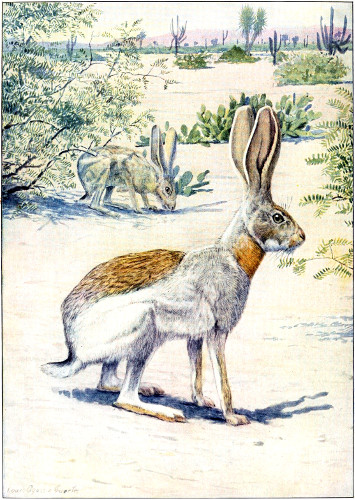
ANTELOPE JACK RABBIT
Lepus alleni
For hours at a time as I worked quietly in
the tent the many mice, unconscious of my
presence, came silently along their little roads
through the tall vegetation to the border of the
short grass. Just within the shelter of the tall
growth they would each time stop and remain
watchfully immovable for a half minute, and
then, if everything was quiet, make a swift run
two or three feet into the open, bite off a tender
little grass blade and dash back to the sheltered
road. There they would sit up squirrel-like,
holding the grass blades in their forepaws and
eating them rapidly, or would sometimes carry
the food back to the burrows.
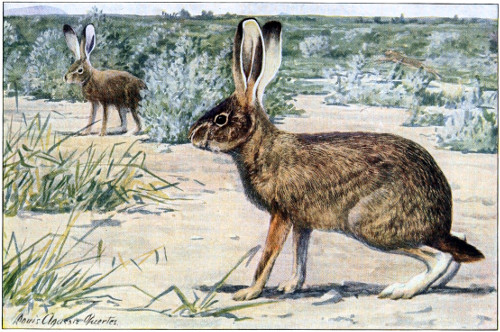
CALIFORNIA JACK RABBIT
Lepus californicus
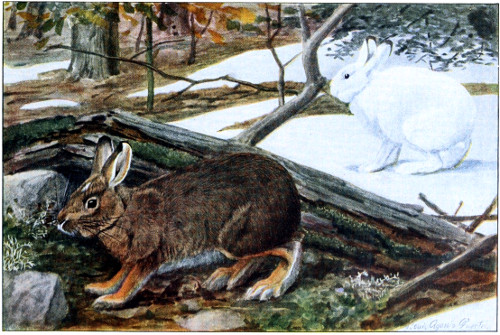
VARYING HARE, or SNOWSHOE RABBIT
Lepus americanus
Occasionally as the mice darted into the open
I made a slight squeaking noise and perhaps
two or three in sight at the time would instantly
turn and dash back into the sheltered
road, sometimes not reappearing for a long
time. Again and again I saw them come into
the open for food, and before securing it suddenly
scamper back in a panic without apparent
cause for alarm.
Eternal vigilance is the only defense such
animals have, and despite their watchfulness
myriads of them are devoured daily by a large
number of rapacious birds and mammals, including
even such huge beasts as the great
Alaskan brown and grizzly bears, which dig
them from their burrows on grassy northern
mountain sides.
Despite their numerous natural enemies field
mice are so prolific they continue among the
most destructive of agricultural pests. They
are so obscure and the damage by a single
mouse appears so insignificant, that it requires
a knowledge of their habits, their wide distribution,
and their enormous numbers to appreciate
what a serious drain they are on the
farmer’s income, even when in their normal
numbers.
In summer they feed on growing grass,
clover, alfalfa, and grain, seeds, bulbs, root
crops, and garden vegetables. In fall they congregate
under shocks to feed on the grain, and
in winter often do enormous injury to young
or even well-grown fruit and other trees by
gnawing off the bark on the base of the trunk
and roots, sometimes in this way destroying
entire orchards and nurseries.
One species in California destroys large
quantities of raisins drying in the field by carrying
them off to some shelter, where they cut
out the seeds and leave the rest of the fruit. I
have seen half a pound of raisins under a piece
of board, the result of the night’s work of a
single mouse.
While field mice are always destructive, at
intervals they have sudden and mysterious accelerations
of increase and become so excessively
abundant that they are a veritable plague.
Many instances of this are on record in the Old
World, where they have become so numerous
as to call forth governmental intervention.
The most notable recent outbreak of this
kind in the United States took place in the
Humboldt Valley, Nevada, where, during the
winters from 1906 to 1908, they swarmed over
the cultivated parts of the valley and completely
destroyed 18,000 acres of alfalfa, even devouring
the roots of the plants. During this outbreak
the mice in the alfalfa fields were estimated
to number as high as 12,000 to the acre.
Whenever field mice become over-abundant
notice appears to go out among their natural
enemies, and in extraordinary numbers hawks,
owls, crows, ravens, sea gulls, coyotes, foxes,
bobcats, weasels, and other animals appear to
prey upon them.
At no season of the year are they free from
their foes, for they remain active throughout
the winter, and most species apparently lay up
no winter store of food. They travel to winter
feeding places through series of tunnels under
the snow, and it is mainly at this season that
they do the most serious damage to orchards
and shrubbery.
In the far North at the beginning of winter
they gather in large numbers about the fur-trading
stations and other habitations, where
they persistently invade the food supplies.
Some of the northern mice, however, gather
stores of food for winter. A species living
along the coast of the Bering Sea and elsewhere
on the Arctic tundra of Alaska accumulates
a quart or more of little bulbous grass
roots, which are delicious when boiled. They
are hidden in nests of grass and moss among
the surface vegetation, and before the first
snowfall I have seen the Eskimo women
searching for them by prodding likely places
with a long stick. The roots thus taken from
the mice are kept to be served as a delicacy
to guests during winter festivals.
(For illustration, see page 522)
The pine mice form a small group of species
peculiar to North America and closely related
to the field mice. They are similar in form to
the common field mice of the Eastern States,
but are usually smaller, with much shorter tails
and shorter, finer, and more glossy fur.
Most of the pine mice are limited to the
wooded region of the States between the Atlantic
coast and the eastern border of the Great
Plains, and from the Hudson River valley and
the border of the Great Lakes south to the
Gulf coast. Strangely enough, one species lives
in a restricted belt covered with tropical forest
along the middle eastern slope of the Cordillera,
which forms the eastern wall of the Mexican
tableland, on the border between the
States of Vera Cruz and Puebla.
Pine mice occupy the borders of thin forests
and brushy areas, from which they work out
into the open borderlands, especially in orchards
or other places where there are scattered
trees amid a rank growth of weeds. Instead
of making their runways among growing
vegetation on the surface of the ground like
field mice, they live in little underground tunnels
or burrows which extend in all directions
through their haunts. These tunnels are
closely like those of the common mole except
that they are smaller and have frequent openings
to the surface, through which the owners
make short excursions for food. They often
utilize the tunnels of moles when conveniently
located for their purposes.
The tunnels are often so near the surface
that the ground is slightly uplifted or broken
as by a mole, or they are made under the fallen
leaves and other small decaying vegetable matter
covering the ground under the trees. Occasionally,
when the surface soil becomes dry
and hard, the burrows are deeper, so that no
surface indications can be discovered. On account
of the similarity of their burrows the
depredations of pine mice are commonly attributed
to moles.
Several inches below the surface pine mice
excavate oval chambers to be used for nests or
for storage purposes. The nest chambers have
several entrances from ramifying tunnels and
are filled with short fine pieces of grass, making
a warm nest-ball. Here the several litters
of young are born each year. Pine mice are
less prolific than field mice, however, and the
litters contain only from one to four young.
The food chambers are larger than the nest
chambers, and when full of stores are kept
closed with earth. In these are stored short
sections of green or dry grasses, bulbous grass
roots, and short sections of other edible roots.
One such store contained about three quarts of
the fleshy roots of a morning glory cut into
short sections.
Pine mice obtain much of their food from
the bark about the bases and roots of trees, including
both coniferous and deciduous species.
They kill many small trees and shrubs by girdling,
or by cutting the roots below the surface,
and in this way frequently inflict severe damage
in orchards and nurseries. Owing to their
underground habits they are much more dangerous
to orchards than field mice. They also
do much damage by burrowing along rows of
potatoes and other root crops, upon which they
feed.
Both pine mice and field mice are serious
pests to agriculture and only by vigilant care
can they be prevented from steadily reducing
the returns from farm and orchard. A mouse
appears so insignificant an enemy that the general
inclination among farmers is to ignore it,
but both field and pine mice exist in such enormous
numbers and are so generally distributed
that the aggregate annual losses from them are
great.
Clean cultivation in orchards, especially for
some distance immediately about the trees, is
an excellent protective measure against both of
these mice. The shrubbery and fruit trees of
orchards, lawns, and gardens may be protected
by the use of poisoned baits and traps as soon
as signs of pine mice or field mice are observed.
(For illustration, see page 523)
With the exception of the banded lemmings
the red-backed mice are the most brightly colored
of the smaller northern rodents. They
are close relatives of the common field mice,
which they about equal in size, but from which
they are distinguished externally by rufous coloration,
finer and more glossy pelage, larger
ears, and proportionately longer tails.
The red-backed mice form a group containing
a considerable number of species distributed
throughout the northern circumpolar
lands, except on the barren islands of the Arctic
Sea. In North America they occur from the
Arctic tundras north of the limit of trees
southward throughout Alaska and Canada to
the northern United States. With other northern
species of mammals, birds, and plants they
follow the high mountain ranges still farther
southward to North Carolina, New Mexico,
and middle California.
It is true that in the far North they are numerous
on the moss-grown tundras, and in the
South range above timber-line on high mountains.
As a general rule, however, they are
woodland animals, whether among the spruces,
birches, and aspens of the North or farther
south in the United States in the cool fir and
aspen-clad slopes of mountains. They also frequent
old, half-cleared fields, brush-grown or
rocky areas, and similar places where cover is
abundant.
Although so closely related to the field mice,
the red-backed species are not known to become
excessively abundant nor seriously to injure
crops. One reason for their harmlessness
in this respect may be their strong preference
for forest haunts.
I once found them numerous in the grass-grown
streets and yards of an abandoned mining
camp in the forest at the head of Owens
River, in the Sierra Nevada, of California. The
mice were making free use of the congenial
shelter afforded by the old log cabins, and their
runways and entrances to burrows were all
about under scattered boards and similar cover.
They are abroad equally by day and by night,
and for this reason are better known to woodsmen
than most of the small woodland animals.
When foraging by day among the fallen leaves
and deep green vegetation they present a most
graceful and attractive sight, now moving about
with quick and pretty ways, now pausing to sit
up squirrel-like to eat some tid-bit held in the
front paws and then on the alert to detect a
suspected danger and poised in quivering readiness
for instant flight.
Red-backed mice usually live in underground
burrows similar to those of field mice, but generally
located with more care in dry situations,
the entrances sheltered by a stump, old log,
root of a tree, rock, or other object. Ordinarily
they do not make such well-defined runways
as do many field mice, and sometimes no
trace of a trail can be found leading away from
their burrows. But where they travel about
through small dense vegetation, under logs and
about stumps and rocks they often make well-marked
trails.
Their nests are bulky and formed of a mass
of fine dry grass, moss, and other soft material,
which is sometimes located in an underground
chamber opening off the burrow and
sometimes in hollow stumps and logs or under
other surface shelters. But little is known
about the home life of these mice except that
they are prolific, and between April and October
have several litters containing from three
to eight young in each.
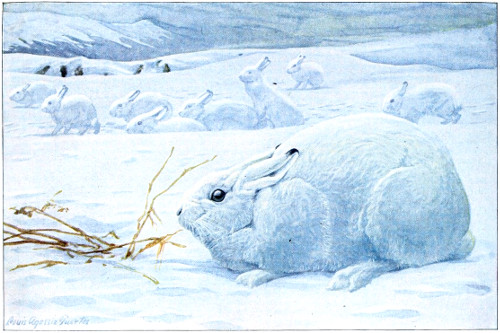
ARCTIC HARE
Lepus arcticus
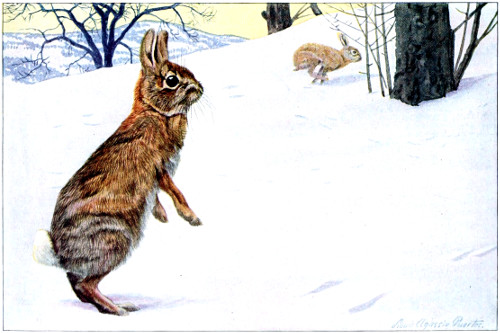
COTTONTAIL RABBIT
Sylvilagus floridanus
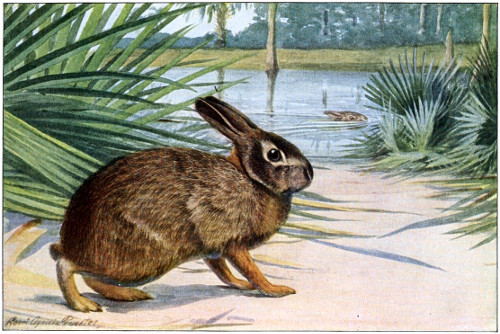
MARSH RABBIT
Sylvilagus palustris
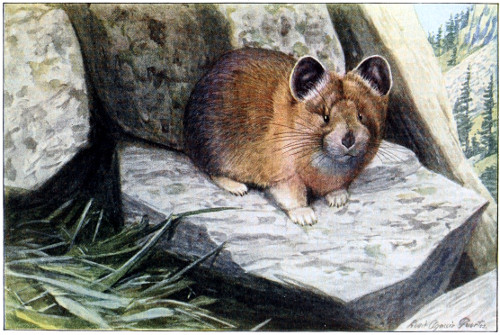
PIKA, LITTLE CHIEF HARE, or CONY
Ochotona princeps
They feed upon a great variety of seeds,
fruits, roots, and succulent vegetable matter
and lay up stores for winter in underground
chambers or in hollow logs and similar places
above ground.
With the coming of winter they gather about
cabins and other habitations in their territory
and become as persistent as house mice in
searching out and raiding food supplies of all
kinds. When the more appreciated kinds of
food fail they resort to gnawing the bark from
roots and bases of trunks of small deciduous
trees of various kinds.
During my sledge journeys in the region
about Bering Strait I found the skins of many
red-backed mice among the Eskimo children.
The small boys kept them with lemming skins
as evidences of their prowess with miniature
dead-fall traps and blunt-pointed arrows, and
the little girls kept them as prized robes for the
dolls carved by their fathers from wood or walrus
ivory.
(For illustration, see page 523)
The genus Phenacomys, to which the rufous
tree mouse belongs, includes a number of species
closely similar in size and external appearance
to some of the well-known field mice.
The structure of their teeth, however, shows
that they form a distinct group of animals.
So far as known, the living members of the
genus are confined to the Boreal parts of North
America, where they range from the Atlantic
to the Pacific in Canada, and southward along
the mountains to New Hampshire, New Mexico,
and northern California. The discovery
of fossil representatives of the genus in Hungary
and England indicates that it was formerly
circumpolar in distribution.
All but one species of the genus live on the
ground, inhabit burrows, make runways through
the small vegetation, and feed on grasses and
other herbage—all in close conformity with the
habits of the meadow mice.
The tree mouse, however, is a strongly aberrant
member of the group. It differs from all
the others, and from all field mice, not only in
its rufous color and longer tail, but in its remarkable
mode of life. It is restricted to the
humid region of magnificent forests in western
Oregon and northwestern California, where it
often spends its life in the tops of such noble
trees as the Sitka spruce, the Douglas fir, and
the coast redwood. Such an amazing departure
from the habits of its kind lends unusual
interest to this little animal.
Its nests are generally located high up in the
trees, sometimes 100 feet from the ground, in
forests where the branches of neighboring
trees interlace so that it can pass from one to
another and inhabit a world of its own, free
from the ordinary four-footed enemies which
prowl below.
The nests vary in size, structure, and location.
In Oregon they have been found only in
large trees at elevations varying from 30 to 100
feet. On the seashore near Eureka, California,
they are placed on the branches of small second-growth
myrtle and redwood trees. Farther
inland in the same region many are in
small trees, within a few yards of the ground,
on the border of heavy redwood forests.
The higher nests of the tree mice are often
the deserted and remodeled homes of the big
gray tree squirrel of that region (Sciurus
griseus) and contain a foundation of coarser
sticks than in the nests wholly built by the
mice. The larger proportion of the nests are
built by the mice and are usually composed of
small twigs, fragments of a netlike lichen, skeletons
of fir, spruce, or other coniferous leaves,
and the droppings of the mice themselves.
They vary from small oval structures a few
inches in diameter, located well out on the
branches, to great masses close against and
sometimes entirely surrounding the tree trunks,
supported on several branches, and measuring
three feet long and two or three feet high.
The interior of these large structures is
pierced with numerous passageways and sometimes
as many as five separate nest chambers
are scattered through one. Tunnels run out
along each of the limbs on which the mass
rests, and if it extends all the way round one
main tunnel encircles the trunk from which
these hallways branch.
Such great nests have evidently been used
for a long period and have grown with the
steady accumulation of material. This has
gradually decayed and become a solid mass of
earthy humus. The large nests are usually the
abodes of a single female, the homes of the
males having been found to be small and more
often located away from the trunk of the tree.
The food of the red tree mouse, so far as
known, consists entirely of the fleshy parts of
fir and spruce needles and the bark from coniferous
twigs.
Tree mice appear to breed throughout most
of the year and have from one to four young
in a litter. They are mainly nocturnal, and
when driven from their nests by day appear
rather slow and uncertain in their movements.
Those living in highly placed nests usually escape
by running out on the limbs, and pass
from one tree to another if necessary. Those
in small trees usually drop quickly from limb
to limb until they reach the ground, when they
run to the nearest shelter.
That these mice sometimes descend to the
ground of their own volition is probable, but
the fact that the stomach of every individual
so far examined has contained only the fleshy
parts of coniferous leaves indicate that their
food habits have become so fixed as to make
arboreal life a necessity.
The modification of the habits of a member
of a group of ground-frequenting animals,
with a structure adapted to such an existence,
to those of a strictly arboreal animal is so
strange as to make the question of cause a
puzzling one.
In the Hawaiian Islands the introduction of
the mongoose has made the common house rat
arboreal in habits, and possibly in the remote
past the pressure of some ground-frequenting
enemy thus affected the lives of the red tree
mouse. An animal rarely makes an abrupt
change in its habits without direct pressure
from some source, and then only as a matter
of self-preservation.
(For illustration, see page 526)
The muskrat, or “musquash,” as it is widely
known in the northern fur country, is three or
four times the size of the common house rat,
to which it bears a superficial resemblance. It
has a compactly formed body, short legs, and
strong hind feet partly webbed and otherwise
modified for swimming. The long, nearly
naked, and scaly tail is strongly flattened vertically
and in the water serves well as a rudder.
The fur is nearly as fine and dense as that of
the beaver and, as in that animal, protects its
owner from the cold water in which so much
of its life is spent.
Muskrats are peculiar to North America,
where they exist in great numbers. Aquatic in
habits, they have a wide distribution along
streams of all sizes and among marshes, ponds,
and lakes from the Atlantic to the Pacific, and
from a little beyond the limit of trees on the
Arctic barrens south throughout most of the
United States. They reach our southern border
at the delta of the Mississippi and the delta
of the Colorado, at the head of the Gulf of
California.
Within this vast area they have been modified
by their environment into several species
and geographic races, none of which differ
much in appearance from the well-known animal
of the Eastern States.
The nearest kin of the muskrats are the
short-tailed field mice, so numerous in our
damp meadows. Like the latter, the muskrat
has several litters of young each season. The
young are born blind, naked, and helpless, and
number from three to thirteen to a litter. This
great fecundity has enabled the muskrats to
hold their own through years of persistent
trapping.
They still occupy practically all their original
range and yield a steady toll of valuable fur
each season. In 1914 more than 10,000,000 of
their skins were sold in London, and other
millions were handled in America. The aggregate
returns on muskrat skins are so great as
to constitute it our most valuable fur-bearer.
The furriers make its skins up in its natural
color or dress and dye it and give it the trade
names of “Hudson seal,” “river mink,” or
“ondatra mink.”
In suitable marshes, as on the eastern shore
of Maryland, muskrats become extremely abundant
and render such areas valuable as natural
“fur farms.” One Maryland marsh containing
1,300 acres has yielded from >,000 to $7,000
worth of skins a year. Not only are the skins
of value, but the flesh is palatable, and is sold
readily under the trade name of “marsh rabbit”
in the markets of Baltimore, Philadelphia, and
elsewhere.
There is little doubt that owners of favorably
situated marshes could derive from them
a steady revenue by keeping them stocked with
proper food plants and protecting the muskrats
from their enemies. The value of these fur-bearers
is becoming more and more appreciated
and many States have laws restricting the
trapping season to a period in fall and winter
when the fur is prime.
In marshes about shallow lakes or bordering
sluggish rivers muskrats build roughly conical
lodges or “houses,” three to four feet high,
with bases, usually in shallow water, several
feet broader. These houses are made of roots
and stems of plants with a mixture of mud.
An oval chamber is left in the interior, well
above the water level, to which entrance is
gained by one or more passageways opening
under water. These shelters are mainly for
winter use, but the young are sometimes born
in them as well as in large grass nests among
dense marsh vegetation.
The curious conical lodges are familiar objects
about marshes in the Eastern and Northern
States, and I remember seeing, a few years
ago, a specially well-formed muskrat house
close to the historic bridge, at Concord, and
others along the Concord River. Within ten
years muskrat houses were common in marshy
ponds in Potomac Park, Washington, where
the Lincoln Memorial Building now stands.
Where the banks of streams or lakes rise
abruptly, the muskrats make their home in dry
chambers in the banks above water level at the
end of a tunnel opening either under water or
close to the water level. Worn trails lead up
the banks about such places and well-marked
runways are made through the heavy reeds
and marsh grasses in their haunts.
Muskrats are mainly nocturnal animals, but
often move about during the day. I have seen
them repeatedly swimming close to the bank of
the Potomac a short distance above Washington.
They like to carry their food to slightly
elevated points where they can overlook the
water along shore, such as the top of a projecting
log, large stone, or earthen bank, from
which they plunge headlong at the first alarm.
Many a solitary canoeman gliding silently along
the shore of stream or pond at night has been
startled by the disproportionately loud splash
made by a muskrat diving from its resting
place.
Their food consists mainly of the roots and
stems of succulent plants varied with fresh-water
clams, an occasional fish, and even by
cultivated vegetables grown in places readily
accessible from their haunts. They store up
roots and other vegetable matter for winter
use and remain active throughout that season.
The roots of which their “houses” are built are
frequently those used for food and sometimes
serve as winter supplies.
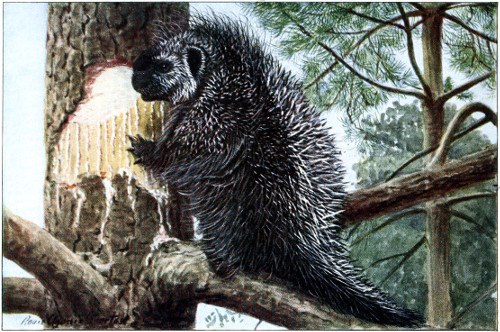
PORCUPINE
Erethizon dorsatum
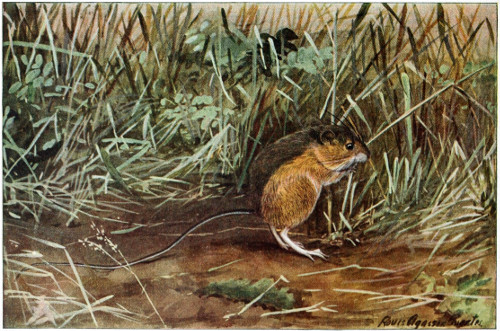
JUMPING MOUSE
Zapus hudsonius
As a rule, muskrats keep near their homes in
winter, making excursions here and there beneath
the ice. Sometimes the water rises and
forces them out and they wander widely in
search of new locations. When encountered at
such times they show extraordinary courage
and fiercely attack man or beast. The first
muskrat I ever saw was one which a farmer
met in midwinter in a snowy road in northern
New York. As soon as the man drew near,
the animal rushed at him with bared teeth and
fought savagely until killed.
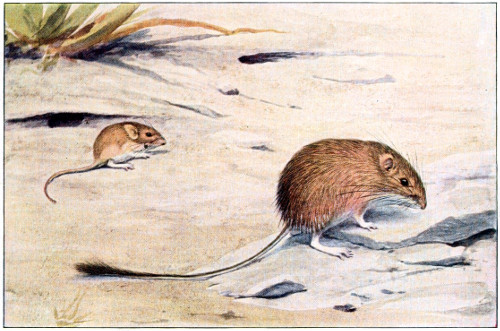
SILKY POCKET MOUSE
Perognathus flavus
SPINY POCKET MOUSE
Perognathus hispidus
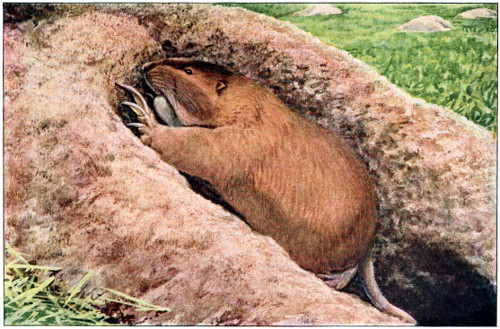
POCKET GOPHER
Geomys bursarius
Muskrats are usually harmless animals and
their presence in marshes and along watercourses
lends a pleasant touch of primitive
wildness to the most commonplace situations.
They appear to have so adapted their habits to
the presence of men that they go on with their
affairs with curious indifference to their human
neighbors. In irrigated country or elsewhere
where banked ditches are built their habits render
them serious pests, as their burrows and
tunnels drain ponds or cause destructive washouts.
An interesting chapter in the history of these
animals began in 1905, when four Canadian
muskrats were introduced on a nobleman’s estate
in Bohemia. Since then they have increased
rapidly and spread over a large area
in Bohemia and beyond its borders. The
streams in the region they occupy are controlled
by grassy banks, and dams are built to
form ponds for fish culture, which is a large
industry there. The muskrats persistently tunnel
into the banks and dams, causing them to
give way, thus causing heavy losses to the
owners.
They also work havoc among river crabs and
mussels, which have great economic value, and
interfere with the fish and their spawning beds.
To cap the climax of their misdeeds, they are
reported to feed on grain and vegetables and
to destroy the eggs of domestic poultry and of
wild-fowl. It is reported also that these expatriates
in their foreign environment have become
larger animals than their ancestors, and
that their fur has greatly deteriorated in quality.
The measures prescribed by the Agricultural
Council of the Kingdom of Bohemia for
their control are apparently without much success.
This instance is a good illustration of
the danger attending the introduction of an
animal from its native habitat into a new
region.
(For illustration, see page 526)
In the East known as woodrats, in the West,
where much more numerous and better known,
these animals are called “mountain rats” or
“trade rats.” Despite a certain superficial resemblance
in size and appearance, woodrats are
not related to those exotic parasites, the house
rats, with coarse hair and bare tails, but are
far more attractive and handsome animals,
clothed in fine soft fur, delicately colored above
in soft shades of gray, buffy, or ferruginous,
while below they are usually snowy white or
buffy. The tail is fully haired and in some
species almost as broad and bushy as that of a
squirrel. Their prominent black eyes and large
ears give them an air of vivacious intelligence
which their habits appear to confirm.
Woodrats are peculiar to North America,
where they occur from Pennsylvania and Illinois
to the Gulf coast, spreading thence to the
Pacific and as far north as the headwaters of
the Yukon, and south through Mexico and
Central America to Nicaragua. They are not
plentiful in the southern Mississippi Valley and
eastward, where they live among cliffs and
broken ledges of rock in the deciduous forests,
and well deserve their common name. In this
region their presence is rarely suspected except
by hunters or others familiar with woodland
life.
Far more numerous and widely known in
the Western States and throughout most of
Mexico, they have adapted themselves to life
under every climatic condition, from the most
sun-scorched deserts of the southwest and the
splendid redwood forests of the humid coastal
region in northern California to the tropical
lowlands farther south.
They live nearly everywhere on the mountain
slopes, even to timber-line at 13,800 feet
on Mount Orizaba. They thrive in an extraordinary
variety of situations, not only where
they may find shelter among rocks, but also
where they must seek safety in nests made on
the surface of the ground or in burrows dug
by themselves. They are prolific animals and
each year have several litters containing from
two to five young.
The presence of woodrats is generally indicated
by accumulations of odds and ends filling
the crevices of the rocks about their retreats
or piled about the entrances of their burrows,
such accumulations including small sticks,
pieces of bark, leaves, cactus burrs, bones,
stones, and any other small objects which may
be found in the vicinity.
Sometimes these piles of fragments seem to
be made merely for amusement or to work off
surplus energy, as they form useless gatherings,
such as heaps of small stones, frequently containing
a bushel or more, piled on the rounded
tops of small protruding boulders in open desert
areas, or small heaps of sticks and other
material scattered aimlessly about their haunts.
In the desert where cactuses of many kinds
abound woodrats’ nests are often made at the
bases of these or other thorny plants and are
covered with such a protective coating of cactus
burrs as to deter the most insistent enemy.
In the heavy forests of northern California
woodrats build huge conical nests of sticks
several feet in diameter on the ground, rising
to a height of five feet or more.
In southern California and elsewhere some
species make great nests of sticks eight to
twenty feet from the ground in live oaks and
other trees. The stick-pile nests on the ground
usually have several entrances, with trails leading
from them, and the underground burrows
usually have two or more openings.
As may be surmised from their habits, woodrats
are skillful climbers, both in trees and on
the rough rock walls of the cliffs they inhabit.
Their only notes appear to be shrill squeaks
and squeals when quarreling among themselves
at night. They also express annoyance or
alarm by a rapid drumming on the ground
with their hind feet, just as is done by some
of the hares and rabbits.
On Santa Margarita Island, in Lower California,
I found the most curiously located
habitations of these animals I have seen, the
bulky stick nests being placed well back in the
midst of a mangrove thicket growing in a tidal
lagoon. At high tide the mangroves were isolated
from shore by several rods of water, so
that only at low tide were the rats able to go
ashore. In going back and forth they followed
certain lines of nearly horizontal mangrove
stems, the discoloration on the bark plainly indicating
the routes which finally led to dry
land by little trampled roads across the muddy
ground bordering the shore.
Back a little way from shore others of the
same species were living in burrows guarded
by orthodox stick and trash-pile nests among
the cactuses.
Woodrats, especially in northern localities,
gather stores of pinyon or other nuts, potatoes,
corn, and any other non-perishable food available
to meet the season of storms and scarcity,
concealing these supplies in cavities in the nests
either above or below the ground. They eat
many kinds of fruits, seeds, leaves, and other
parts of plants, sometimes including bark of
shrubs or small trees and even cactus pads.
As a rule each nest is occupied by a single
rat, but sometimes several may be found in
one, and the well-worn trails that so often connect
the entrances of neighboring nests bear evidence
that woodrats have a social disposition.
In most localities woodrats are distributed
sparingly, but occasionally become so
abundant in favorable places on brushy plains
that colonies containing hundreds of nests may
be found in limited areas. They sometimes become
so plentiful about ranches as to make
serious inroads on grain and other crops. They
also give the Forest Service much trouble by
digging up the pine seeds planted in their great
reforesting nurseries.
Woodrats are mainly nocturnal in habits and
appear to be extremely active throughout the
night. Each morning in the vicinity of their
nests the light soil shows a multitude of tracks,
and in places I have seen little roads in the
sand several hundred yards long which they had
made by repeated trips to a feeding ground.
No sooner is a cabin built in the mountains
than they move in and establish themselves
under the floor, or locate a nest near by and
use the house as their nocturnal resort.
Throughout the night the patter of their busy
feet may be heard as they race about on the
floor or rustle about the roof, and often over
the sleeping forms of their unwilling hosts.
Their activities are sources of mingled amusement
and vexation. Small, loose articles, including
table knives, forks, and spoons, vanish
and all manner of trash, including horse droppings,
are brought in, thus establishing their
title to the cognomen of “trade rats.” If the
owner of a cabin leaves it for a few days, he
may find on his return that the rats have taken
possession and during his absence have tried
to fill it with trash of all kinds, in order to
make a comfortable home for themselves.
At one cabin in the mountains of New Mexico
where I lived one summer several mountain
rats made free of the place and at night
persistently tried to add our shoes to their nest
under the floor. An hour or so after retiring
we would hear our shoes scrape slowly across
the floor, and in the morning they would be
found stuck toe down in the broad crack where
the floor ended near the wall. In the woodrat
country when small articles are missed from
camp it is always worth the trouble to investigate
the nearest rats’ nests.
Woodrats are plentiful on the Mexican table-land,
making their nests under cactuses or
thorny agaves, where they are persistently
hunted as game by the natives, who prize them
as a special delicacy. I saw them regularly
sold in the markets of the cities of San Luis
Potosi and Aguas Calientes, where the method
of marketing them was unique. As soon as
they were dug from their nests, their lower
incisors were broken off close to the jaw to
render them powerless to bite, and then the
rats were placed alive in a strong sack and
carried to town.
The vendor would sit on a curb at the market
and either kill and dress them there or
shout his wares by telling every one who passed
that he had “country rats; very delicious; live
ones; fat ones; very delicious; very cheap.”
The natives all praised their delicate flavor and
one I had served me as a special courtesy was
really good, tasting like young rabbit.
(For illustration, see page 527)
In size, proportions, and color the harvest
mice, of all our American species, most closely
resembles the common house mouse. Many
of them are decidedly smaller than that animal
and they rarely, if ever, exceed it in size. They
may be distinguished from the house mouse by
their browner colors, more hairy tail and especially
by a little groove which extends down
the front of each upper incisor.
The mice of this group include many species
and have a wide distribution ranging from Virginia,
in the eastern United States, to the Pacific,
and from North Dakota, Montana, and
Washington southward through Mexico and
Central America to northern South America.
They reach their greatest development in
number and diversity of species in the region
about the southern end of the Mexican table-land,
where I have caught them from the tropical
lowlands, near sea level, up to an altitude
of 13,500 feet, at timber-line, on Mount Iztaccihuatl.
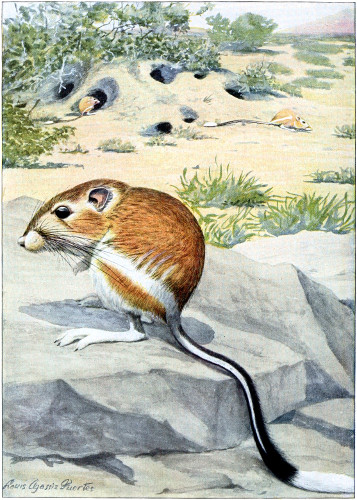
KANGAROO RAT
Dipodomys spectabilis
These delicately proportioned and graceful
little beasts are habitants of grassy, weed-grown,
and brushy locations, mainly in the open
country. They are equally at home, however,
in the beautiful grassy open forests of oak,
pine, and firs which clothe the slopes of the
great continental mountain system of Mexico
and Central America.
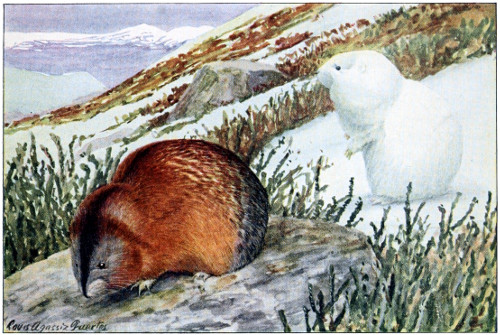
Summer
Winter
BANDED LEMMING (Dicrostonyx nelsoni)
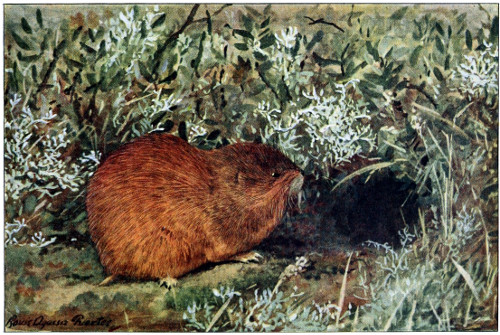
BROWN LEMMING
Lemmus alascensis
In general they prefer comparatively dry situations,
if there is sufficient moisture to produce
the needed vegetation, but some species inhabit
swamps and even salt and fresh water
marshes. Although as a rule not very numerous,
at times they are very abundant and make
well-worn trails through the small vegetation in
their haunts. They are active throughout the
year, and in the North, like some other mice,
burrow through the winter snows along the
surface of the ground in search of food.
So far as man is concerned, most of the
harvest mice are among the least offensive of
mammals. There are exceptions, however,
and, although they rarely approach habitations
and as a rule take but slight toll from grain
fields and meadows, yet in some areas they become
so numerous as to do considerable damage.
Their food includes a great variety of seeds,
small fruits and succulent matter mainly from
wild plants of no economic value. They lay
up stores of seeds in their nests and in little
special storage places for severe or inclement
weather.
Some of the species dig burrows in the
ground where their nests are hidden. Most
of them, however, build globular nests of grass
and other vegetable matter several inches in
diameter in dense grass close to the ground,
or up in the midst of rank growths of weeds,
or even as high as eight or ten feet from the
ground in bushes and low trees.
Sometimes they take possession of convenient
sites already provided, such as old woodpecker
holes, cavities in fence posts, knot
holes, and deserted birds’ nests, including the
nests of the cactus wren and orchard oriole,
which they remodel to suit themselves. Their
nests are lined with fine downy material such
as the pappus of the milkweed or the cattail
flag, and have from one to three small openings
usually located on the underside. In
these neat homes they have several litters of
from one to seven young each year.
Some of their bush nests three or four feet
from the ground were found when I was hunting
on El Mirador coffee plantation in Vera
Cruz. Often on approaching them, the single
occupant would dive headlong into the grassy
cover below and disappear. But sometimes
when disturbed they would come out and run
about through the tops of the bushes, leaping
from branch to branch with all the agility and
graceful abandon of pigmy squirrels. Several
times they were seen to stop and sit crosswise
on the branches with their tails hanging
straight down. When they move about among
the branches they sometimes coil the tail
around the twig as an opossum might, to give
them a more certain hold.
While harvest mice may be seen at their
nests by day, they are mainly crepuscular and
nocturnal, and so retiring in habits that their
presence may be entirely overlooked unless
special search is made to locate them. Where
found their pretty ways well repay the observer
who has the patience to spend a little time with
them.
(For illustration, see page 527)
The grasshopper mice are notable for the
delicate coloring and velvety quality of their
fur. While closely resembling some of the
white-footed mice, they may readily be distinguished
from them by more robust form,
short, thick tail, and the character of the fur.
Only two species, each with numerous geographic
races, are known and both are peculiar
to North America. Characteristic animals of
the arid and semi-arid treeless plains, plateaus,
and foothills of the West, their known range
extends from Minnesota and Kansas west to
the Cascades and to the Pacific coast of southern
California, and in the North, from the
plains of the Saskatchewan southward to San
Luis Potosi, on the tableland of Mexico.
Some races live on the grassy plains west
of the Mississippi, but the majority prefer the
looser soil and sandy areas of the more arid
Great Basin and the even more desert Southwest,
where the vegetation is characterized by
a scattered growth of woody plants, including
many species of cactuses, yuccas, agaves, sagebrush,
greasewood, mesquites, acacias, and
other picturesque types.
Like other small mammals of the open
plains, the grasshopper mice live in burrows.
When opportunity offers they evade the labor
of digging these for themselves by occupying
the deserted holes of mice, kangaroo rats,
ground squirrels, prairie dogs, badgers, and
other animals. In these retreats they have
nests of soft vegetable matter and each season
bring forth several litters containing from two
to six young.
They are active throughout the year, but
nothing appears to be known as to the kind
and amount of stores they lay up for winter
use. As many live far enough north to experience
a long period of cold, with snow covering
the earth, there is little doubt that they
exercise the same provision in providing stores
to meet the need as do many other small mammals.
Many species of mice eat insects or meat
and even on occasion devour one of their own
kind. The grasshopper mice go far beyond
this and are often not only as fierce flesh eaters
as real carnivores, but make their diet, at
least during the summer season, mainly of insects
and other small invertebrates. Their bill
of fare includes a miscellaneous assortment of
several species of mice, including their own
kind caught in traps, small dead birds, lizards,
frogs, cutworms, scorpions, mole crickets, ordinary
crickets, grasshoppers, moths, flies, and
beetles, including the “potato bug.”
In addition they eat many kinds of seeds,
fruit, and other vegetable matter. Where obtainable,
grasshoppers are one of their favorite
foods, and from this they receive their common
name. In Colorado, from their fondness
for scorpions, they are sometimes called “scorpion
mice.”
Vernon Bailey’s observations of a grasshopper
mouse he had in captivity are illuminating
as to their habits, and indicate that their presence
in numbers about cultivated land must be
of distinct economic value. When undisturbed
and well fed the captive was entirely nocturnal,
sleeping all day and becoming very active at
night. While usually quiet, sometimes jumping
with all his force he tried furiously to escape
from his small prison box. His favorite food
consisted of crickets, grasshoppers ranking
next. Among other things he ate were a black
beetle, ladybirds, a potato beetle, spiders, bugs,
and dragon flies.
In feeding he sat upright on his haunches
and held the insects in his front paws, eating
them head first. Large grasshoppers, their tails
resting on the ground, were held head up by a
paw on each shoulder. A grasshopper would
sometimes kick so vigorously as to tip the
mouse off its balance, but was never relinquished
until decapitated.
The mouse promptly killed and ate a small
frog placed in his box and was expert at catching
flies. He ate many kinds of insects, including
a live wasp, but appeared terror-stricken
if a few ants were put in with him.
When a dozen or more crickets and grasshoppers
were put into his box at the same time he
at once proceeded to bite off all their heads
before beginning to feast upon them.
A dead white-footed mouse was dropped in
and “he pounced upon it like a cat, caught it
by the side of the head near the ear, and began
biting it with all the ferocity of a coon
dog.” The bones could be heard cracking and
after the little beast appeared satisfied that his
prey was really dead he ceased worrying it and
an examination showed that he had bitten
through its skull deep into the brain. Afterward
he tore off and ate fragments of flesh
from its head, neck, and shoulders. The ferocious
certainty with which he seized the white-footed
mouse by the head and bit through its
skull indicated that in relation to small mammals
he, probably like all his kind, had the
predatory instincts and habits of the carnivores.
One morning he ate 12 crickets and a spider
in seven minutes and during a single day devoured
53 insects—2 beetles, 8 grasshoppers, 28
crickets, and 15 flies—and appeared ready to
take more.
Oddly enough, this grasshopper mouse, so
fierce toward small game, never offered to bite
when captured or when handled freely, but continued
throughout his captivity to have the
same friendly confidence in his captor. Others
caught in various parts of their range have
shown the same characteristics.
At night, especially early in the evening,
grasshopper mice utter a fine shrill whistling
call note. This habit appears peculiar to them
among all the mice and may be likened to that
of many of the large beasts of prey in uttering
their hunting call as they sally forth for
the night’s foray.
(For illustration, see page 530)
Few of our smaller wild mammals are so
generally known as the white-footed mice.
Usually a little larger and proportionately
shorter bodied than the house mice, they may
at once be distinguished from them by the contrast
between the delicate shades of fawn color,
brown, or gray of the upper parts of the body,
and the snowy white feet and under parts.
Like other members of the genus, they have
cheek pouches inside the mouth for gathering
and carrying food to their stores.
Their exceedingly quick and graceful movements
and their beauty of form and color
would make them generally attractive were it
not for the prejudice against all their kind resulting
from the offensive ways of the house
mouse.
Mice of the genus Peromyscus, to which the
white-footed mice belong, are peculiar to North
and South America and include more species
and geographic races than any other American
genus of mammals. The white-footed mice are
limited to North America. Readily responsive
to the influences of environment, they have
developed numerous species and a large number
of geographic races.
These are spread over most of the continent
from the northern limit of trees to the tropical
shores of Yucatan. One form has the
distinction of living up to an altitude of from
15,000 to 16,000 feet on Mount Orizaba, Mexico,
where I found its tracks in the volcanic
ashes at the extreme limit of vegetation. This
is the highest record for any North American
mammal.
White-footed mice are active throughout the
year and thrive in every variety of situation.
In winter from the Northern States to the
Arctic circle the snowshoer traversing the forest
will note their lace-work patterns of tiny
tracks leading across the snow from log to log
or tree to tree. At sunrise on the southwestern
deserts their tracks made during the night
often form a fine network in the dust, but
disappear with the first breath of the morning
breeze.
They not only live everywhere in the wilderness,
but are prompt to swarm about camps
and other habitations, where they make free
with the food supplies. Few frequenters of
forest camps in the Northern States and Canada
have failed to see the bright eyes of these
pretty little animals peering at them from
some crevice, or the mice scurrying along the
log wall like little squirrels.
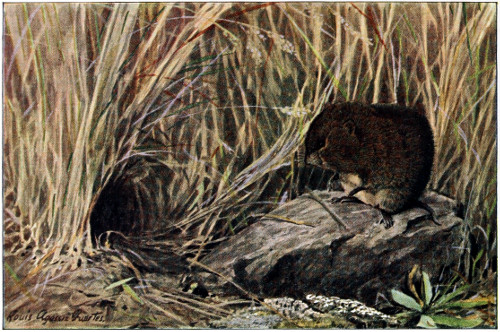
FIELD, or MEADOW, MOUSE
Microtus pennsylvanicus
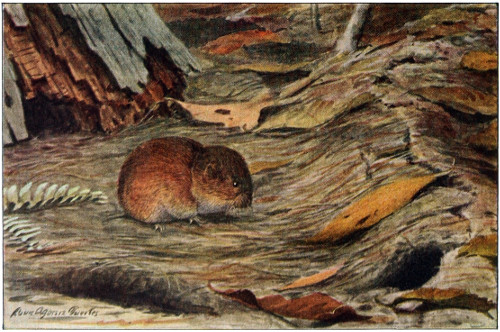
PINE MOUSE
Pitymys pinetorum
They are industrious workers and once in a
cabin quickly locate some cozy nook in a box
or other secluded place to construct a warm
nest of any soft fibrous vegetable material
available. This completed, they set busily at
work nights to raid the food supply of the
owner and hide it in suitable storage places,
such as a crevice among boxes, an old shoe or
a pocket in a garment hung on the wall. Their
depredations usually cause so much exasperation
that the camper overlooks the grace and
beauty of his visitors and makes every effort
to destroy them. If the occupants of such
camps would keep their supplies in mouse-proof
containers and would then feed their woodland
friends, they would find them quickly responsive
and most attractive guests.
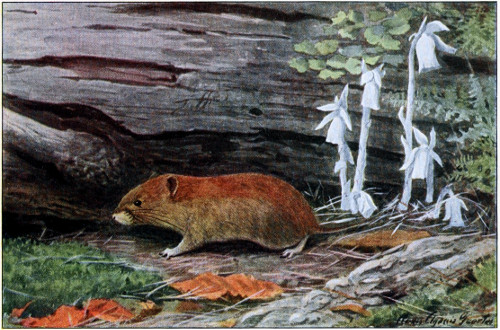
RED-BACKED MOUSE
Evotomys gapperi
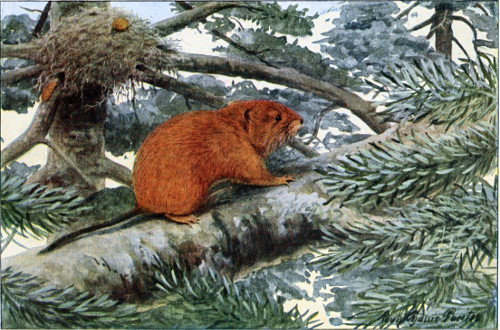
RUFOUS TREE MOUSE
Phenacomys longicaudus
In their native haunts these mice have habits
varying with varying conditions. On brushy
plains they burrow in the ground, while in the
woods they sometimes burrow under rocks,
stumps, and logs, or live in hollows in stumps
and trees. As nimble in climbing as squirrels,
many live in hollow trees sometimes more than
fifty feet above the ground.
That our inability to see at night prevents
more than an occasional glimpse at the doings
of the small animals which often swarm all
about us was impressed on me at one of my
camps in the desert of Lower California. My
blankets were spread under a small leafless tree
growing near the base of a rocky ledge, in the
crevices of which many relatives of the white-footed
mice were living. The first morning in
camp I awoke as the sky began to pale and
color with the approach of day. The dry
branches of the tree a few feet overhead became
sharply silhouetted against the sky, revealing
several of the mice running up and down
them and leaping from twig to twig with all
the active grace of tiny squirrels.
The mice appeared to be racing about in pure
playful enjoyment of the exercise, and when
the light had increased sufficiently to render
objects on the ground distinct they suddenly
ran down the tree trunk and vanished in a
crevice in the rocks. This game was repeated
on several succeeding mornings and is no doubt
commonly indulged in where conditions are
favorable.
White-footed mice feed mainly on many
kinds of seeds and nuts and vary this diet with
snails, insects, and sometimes with the flesh of
dead birds or other mice. As they do not hibernate
they lay up abundant stores of grain
and seeds of many kinds in addition to a variety
of nuts, as acorns, beech nuts, pine nuts,
maple seeds, and others, according to the locality.
The stores are hidden in hollows in logs,
stumps, trees, or in the ground. When in captivity
they have shown themselves expert in
catching flies, sometimes capturing them with
their teeth and again with their front paws used
with all the dexterity of little hands.
Several litters of young containing from
three to seven each are born, the first usually
appearing in spring and the last in fall. The
young are blind and helpless at birth, and in
this condition cling so tenaciously to the mother’s
teats that when she is frightened from the
nest they are often carried off attached to her.
Some individuals at least of the white-footed
mice, like others of the genus Peromyscus, are
known to have a prolonged and musical song.
It is a fine warbling ditty, a little like the song
of a canary. A number of good observers
have recorded these performances, but they
appear to be so infrequent that most people
with woodland experience have never heard
them.
The lives of these mice are passed in constant
fear of a host of enemies. Hawks and
owls, bluejays, and shrikes in the bird world
are ever on the alert to capture them, while
skunks, weasels, minks, foxes, and snakes persistently
seek them in their retreats.
(For illustration, see page 530)
The beach mouse is a beautiful, velvety-furred
little creature about the size of a house
mouse and one of the smallest species of the
genus Peromyscus. Its back is colored with
delicate shades of pale vinaceous-buffy and its
underparts, including the feet, are snowy white.
The species Peromyscus polionotus, of which
the beach mouse is one of several geographic
races, or subspecies, occupies a comparatively
restricted range in the lowland region of Alabama
and Georgia and thence through a large
part of Florida.
It presents an unusually convincing illustration
of the influence of changing environment
upon the physical characters of animals.
Among the cotton fields of Alabama and
Georgia Peromyscus polionotus is rather dark
grayish brown, but on the lighter-colored soil
of Florida the color responds and becomes
paler in perfect correspondence with the change
in soil until the white sand-dunes and beaches
of the coast are reached. There, in strong contrast
with the color of the northern members
of the species, it is so modified that the pale
representatives of this area are recognized
under the name niveiventris, as a geographic
race, or subspecies.
Changes in environment affect both great and
small mammals in a variety of ways, sometimes
in shades of color, sometimes in relative size,
and sometimes in proportions. Exceptions to
the rule are to be found, however, and some
species of mammals have a wide range under
a great variety of conditions, with scarcely an
appreciable sign of variation.
The beach mouse is abundant on the sand-dunes
and beaches of peninsular Florida, especially
from Palm Beach to Mosquito Inlet,
wherever there is a growth of sea oats (Uniola),
which appears to be its principal food plant.
It is a nocturnal animal and its nightly activities
may be read, early in the morning, from
the multitude of tiny tracks which lead in all
directions and often form a network on the
sand. A single track sometimes extends for a
hundred yards or more from a burrow, and
with all its windings may aggregate several
hundred yards of travel, showing the activity
of this small worker during many hours.
Tracks are most plentiful immediately about
growths of sea oats, patches of saw palmetto,
or scrubby bushes. The homes of these mice
are usually in short burrows sheltered by
growing vegetation or under fallen palm
fronds.
As in the case of many of our mammals, we
have scanty information concerning the life of
these attractive little animals, and it is suggested
that here lies a pleasant subject for investigation
by some nature lover wintering in
Florida.
(For illustration, see page 531)
The numerous species of mice of the genus
Peromyscus in North America include a great
variety of little beasts, many of which are distinguished
by beauty of form and color. One
of the most striking and picturesque individualities
among these is found in the big-eared
rock mouse, which is characterized by its great
ears, a thick, soft coat of buffy brown fur, and
a long, well-haired tail. In size it exceeds the
common house mouse and even the white-footed
mice which share its haunts.
This rock mouse is indigenous to the mountainous
regions of the West, from Colorado
and New Mexico to the Pacific and south to
the Cape Region of Lower California, and
down the Sierra Madre of Mexico to Oaxaca.
Within this area it divides into several not very
strongly marked geographic races.
As implied by its common name, it is a characteristic
dweller among cliffs and ledges along
the mountain slopes or rocky canyon walls,
where it occupies the many crevices and little
caves. In California it ranges from near sea-level
up on the mountains to above 10,000 feet
altitude. Although showing a distinct preference
for rocky places, when available, some
races of this mouse adapt themselves to other
conditions and may be found on brush-grown
flats, where they live in brush heaps, old wood-rat
nests, and similar shelter.
That they make their homes in places other
than cliffs in New Mexico was evidenced by a
thick, soft nest made almost entirely of wool,
found in a hollow juniper. They have several
litters of from two to six young each year, the
breeding period extending from spring to fall.
In Arizona and New Mexico I found the
rock mouse most numerous in the belt of
junipers and pinyons and in the adjacent yellow-pine
forest. The crevices of cliffs about
the Moki and Zuni Indian pueblos and in all
the rocky wilderness of that region, including
the Grand Canyon, are abundantly populated
with them.
They search every nook about their haunts
and often visit cabins or temporary camps for
food, but do not usually take up their abode
in them as do the white-footed mice. When
foraging their movements are quick, and when
startled they make surprisingly long leaps.
Like others of their kind, they eat a great variety
of seeds and small nuts, quantities of
which they lay up in winter stores. Pinyon
nuts, and especially juniper seeds, are their
favorite food.
While of nocturnal habits, rock mice at times
wander forth in sheltered spots by day, and on
the few occasions I have seen them I have
been delighted with their grace and beauty,
their great ears and prominent shining black
eyes lending them an attractive air of alert intelligence.
Throughout their lives they are in deadly
peril from predatory foes. Hawks and owls
glide shadowlike along the faces of their rocky
homes ready to pick them up whenever they
venture into open view, while bobcats, skunks,
and weasels prowl about by night hunting their
furry victims.
(For illustration, see page 531)
It is safe to assume that few readers need
an introduction to that world-wide pest variously
known as the brown rat, house rat, wharf
rat, or Norway rat. Two European relatives,
the black rat and the roof rat, preceded the
brown rat to the New World and became
widely distributed. They resemble the brown
rat, but are much smaller and are soon killed,
driven away, or reduced to a secondary status
by their larger and fiercer cousin, which averages
about sixteen inches in length, although
large individuals attain a length of more than
twenty inches and a weight of more than two
pounds. The black rat has nearly disappeared
from most of its former haunts in the United
States and the roof rat is mainly restricted to
southern localities with a mild climate.
Neither the brown, black, nor roof rat has
any near relatives among native rats of America,
and all may be distinguished from our
native animals by their coarser hair and long,
naked tails.
The brown rat is believed to have first invaded
Europe from Asia in 1727, when hordes
of them swam the Volga River, and about the
same year it arrived in England on ships from
the Orient. Since then, traveling by ships and
by inland commercial routes, it has spread to
nearly all parts of the globe. In America it
is now established in human abodes throughout
the length and breadth of the continents
from Greenland to Patagonia.
Wherever it goes the fierce and aggressive
spirit with which it is endowed qualifies the
brown rat more than to hold its own against
all rivals, while its mental adroitness and its
fecundity have largely nullified the constant
warfare being waged against it by all mankind.
Not content with infesting ships, dwellings,
stores, warehouses, and even the refrigerating
rooms of cold-storage plants in many areas, it
has established itself as an extremely destructive
pest in the open fields.
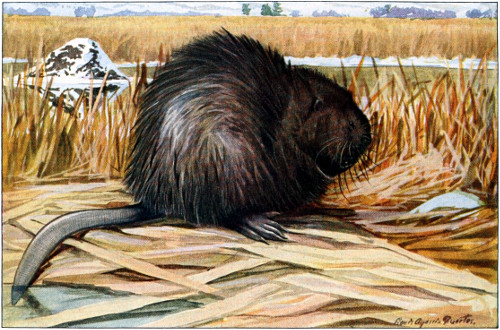
MUSKRAT
Fiber zibethicus
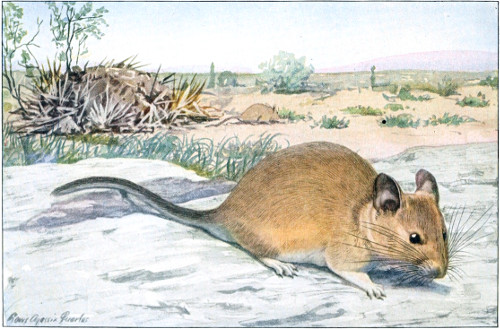
WOOD RAT
Neotoma albigula
In towns it hides among stored merchandise,
in the hollow walls of buildings, in sewers and
other underground passages, or, as in the fields,
in burrows which it digs in the ground. Its
nests are soft, warm masses of fibrous material
which is secured by raids on any available
supply of cotton, wool, or fabrics, which they
cut into shreds for the purpose.
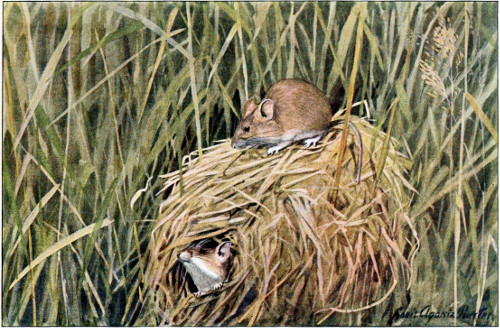
HARVEST MOUSE
Reithrodontomys megalotis
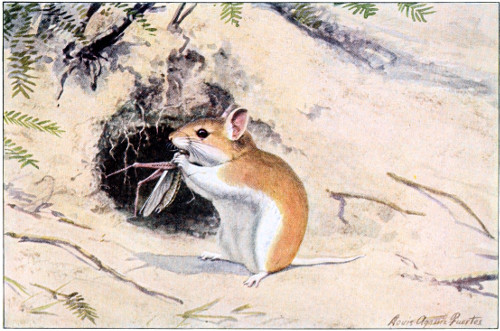
GRASSHOPPER MOUSE
Onychomys leucogaster
In these retreats it has several litters a year,
averaging about ten young, but exceptional
cases of more than twenty young have been
recorded. The young begin to breed when less
than six months old. The size and number of
litters increase with the food supply, and under
favorable conditions rats soon become intolerable
pests.
In Jamaica and the Hawaiian Islands rats
became so numerous that sugar-cane and other
plantations were at one time threatened with
complete destruction. To save the crops the
mongoose was introduced, but after checking
the rats in Jamaica these curious little mammals
in turn became a pest which it appears
hopeless to control.
In the Hawaiian Islands the mongoose reduced
the number of rats, but the survivors
promptly took up their abodes in the tree tops,
where they now live as completely arboreal
lives as squirrels, safe from their ground-inhabiting
enemy.
During a two weeks’ campaign against rats
in the sewers of Paris 600,000 were killed, and
on a rice plantation of about 1,200 acres in
Georgia 30,000 were destroyed in one season.
In Illinois 3,435 were killed on a farm in one
month.
One of the most curious chapters in the life
of this hardy beast is now developing in the
far island of South Georgia, on the border of
the Antarctic, east of Cape Horn. On this
island, which has a cold and stormy summer
and nine months of rigorous winter, several
whaling stations have been established. For
years great numbers of whale carcasses have
drifted ashore each season and, half rotting,
half refrigerated, have furnished a never-failing
food supply for brown rats that have landed
from the ships. With such abundant food
they are reported to have increased until they
now exist there literally in millions. They
make their nests in the tussocks of grass and
peat and swarm along well-marked trails they
have made on the mountain sides.
In the trenches along the battle front in
France they have become extremely abundant
and troublesome, and in England have multiplied
until the Board of Agriculture is recommending
efforts to destroy them as a menace
to the public welfare through their waste of
food supplies.
On farms, in addition to destroying growing
and stored crops, they kill great numbers of
young chickens, turkeys, and other poultry, and
create havoc with such ground-frequenting
game as pheasants. At all times brown rats
are more or less carnivorous, and when several
are confined in a cage the stronger will
soon kill and devour the weaker.
In city department stores and large hotels
they often cause thousands of dollars damage
yearly in single establishments. An English
organization for their destruction estimated in
1908 that, outside the towns and shipping, in
Great Britain and Ireland they caused annual
losses of about $73,000,000.
When there is a sudden diminution in the
food supply, an abundance of which has caused
a great increase in the rat population, the rats
migrate into other districts, sometimes in enormous
numbers. These migrations usually occur
at night, and many are matters of history
in Europe and in the United States.
A witness of one of these migrations in Illinois
in 1903 reported that one moonlight night
as he was passing along the roads he heard a
rustling in a field near by and soon saw crossing
the road in front of him a multitude of
rats extending as far as he could see. The
following year the invaders became a plague
in that district. At times of food scarcity rats
become extremely bold and aggressive. Without
hesitation they swim streams encountered
in their wanderings and at times will even attack
man.
Owing to their great numbers, universal distribution,
and destructiveness, brown rats are
the worst mammal pest known to mankind.
Through their habit of living in sewers, among
the offal of slaughter-houses, and in garbage
heaps, from which they invade dwellings and
storehouses, they pollute and spoil even more
foodstuffs than they eat.
In addition, they are known carriers of some
of the worst and most dreaded diseases, as
bubonic plague, trichinosis, and septic pneumonia;
while there is little doubt that they
spread scarlet fever, typhoid, diphtheria, and
other contagious maladies. Bubonic plague is
mainly dependent upon rats for its dissemination
and has been carried by them to more than
fifty countries, including the United States. In
India more than two million people have died
in one year from this rat-conveyed disease.
Although rats are abhorred by man, yet they
have been for ages so closely associated with
most of his activities that they have long had
their place in Old World literature. Among
other instances, many readers will recall Victor
Hugo’s gruesome account of Jean Valjean’s
fight with the rats in the sewers of Paris. In
England and on the continent rat catching has
been a regular trade and dogs have been specially
bred for use in their pursuit.
Rats are loathsome vermin which civilized
man should eliminate with the other evils of
his semi-barbaric days which he is leaving behind.
One might still wish that in many places
a modern “Pied Piper of Hamelin” would appear
and rid the people of these pests. This
is not necessary, however, if the public will
cease to take their presence as a matter of
course. Their exclusion from buildings and
destruction are merely matters of good housekeeping,
both personal and communal.
Rats can be banished by removing or destroying
trash heaps and similar harboring
places and by the simple expedient of rat-proofing
buildings, especially dwellings, granaries,
warehouses, and other places where food
supplies are stored.
These precautionary measures should be supplemented
by trapping or poisoning in open
places. Campaigns of this kind can be fully
successful only when engaged in by the community
at large. The returns from the investment
for such a purpose will be large, not
only in the vast money values of property
saved, but in the reduction of the death rate and
in the great improvement of the public health.
(For illustration, see page 531)
The familiar house mouse is of Old World
origin and may be distinguished from most of
our native mice by its proportionately slenderer
body, long hairless tail, and the nearly
uniform color on the upper and under parts
of the body. Like the house rat, wandering
an alien from its original home in Asia, and
transported by ship and by inland commerce,
it has gained permanent foothold and thrives
in lands of the most diverse climatic conditions,
except those of the frigid polar regions.
For centuries the house mouse has been parasitic
about the habitations of man, and in
many places in America has spread into the
surrounding country, where it holds its own in
the struggle for existence with many of our
native species. It is probable that its ability
to live in houses also infested by the fierce
brown rat is due wholly to its agility, and to
the small size, which enables it to retreat
through crevices too small for the rat.
In buildings it hides its warm nests in obscure
nooks and crannies, making them of
scraps of wool, cotton, or other soft fibrous
material, often cut from fabrics. Out in the
fields, like any other hardy vagabond, it adapts
itself to whatever cover may be available on
the surface or in crevices and the deserted
burrows of other mammals.
It has several litters of from four to nine
young each year. The young are born blind,
naked, and helpless, but are soon able to run
about, often following the mother on her foraging
expeditions. When a little more than
half grown they usually scatter from the home
nest and seek locations of their own.
Throughout most of its world-wide range
the house mouse has the same general appearance,
but in some localities the effect of
changed environment is developing appreciable
differences, which appear destined to result in
marked geographic races. The representatives
of these mice I caught in weedy fields on the
coast of Chiapas, near the border of Guatemala,
have an appreciable rusty shade on the
back in place of the ordinary dull gray.
The success of both the house mouse and
the house rat in establishing themselves so successfully
in all parts of the world, in the face
of the antagonism of mankind, affords marvelous
examples of physical and mental adaptability
not equaled elsewhere among mammals.
From early days the domestic mouse has
been a familiar member of the household with
people of all degree, and the housewife has had
to match her wits against the cunning persistence
of this small marauder in order to safeguard
the family supplies of food and clothing.
Despite the antagonism excited by its destructive
habits the mouse is so small and often
so amusing in its ways that it has commonly
been regarded with a half hostile, half friendly,
interest. This is apparent by frequent references
to it in proverbs, nursery rhymes, fables,
and folklore, as well as in more serious literature.
Many cases of singing house mice have been
recorded, their notes being a series of continuous
musical chirps, trills, and warblings, rising
and falling about an octave and slightly resembling
the song of a canary. It has been claimed
that this singing is due to an affection of the
songster’s breathing organs, but this can
scarcely account for its being uttered at definite
times and places and ceasing at the volition of
the performer.
In one instance the song had been heard in a
china closet and an observer sat by the open
door to locate the singer. After patient waiting
“a mouse peered out from behind the
plates, climbed up a little way on the brackets,
and after looking around several times, began
to sing.” This mouse continued to sing in the
same place at intervals for several weeks and
became accustomed to the presence of people
during its performances; then it suddenly disappeared,
probably a victim to one of the dangers
which constantly beset its kind.
(For illustration, see page 534)
The first adventurous fur traders who penetrated
the Oregon wilds found the Chinook
Indians provided with robes made of skins of
the mountain-beaver. From that time until recently
but little accurate information has been
available concerning the habits of this curious
animal. Locally it is known by several
other names, including “Sewellel,” “mountain
boomer,” “boomer,” and, in the Olympic mountains,
“chehalis.”
The genus of mountain-beavers contains only
a single species with several subspecies, all having
a close superficial likeness in size and form
to a tailless muskrat, except for their coarse,
harsh fur. It is an exclusively North American
type and, aside from a remote relationship
to the squirrel family, has no kin among living
mammals. It appears to be a sole survivor
from some former age. As with the pocket
gophers, its mode of life has developed powerful
muscles about the head, front legs, and
forepart of the body.
The distribution of the mountain-beaver in
Tertiary times extended through the Great
Basin to North Dakota, but at present is
closely restricted to the humid region between
the crests of the Cascades and the Sierra
Nevada and the Pacific coast, and from the
lower Fraser River, British Columbia, south to
the latitude of San Francisco Bay, California.
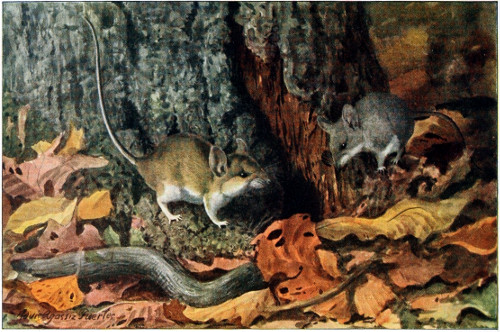
WHITE-FOOTED MOUSE (Adult and Young)
Peromyscus leucopus
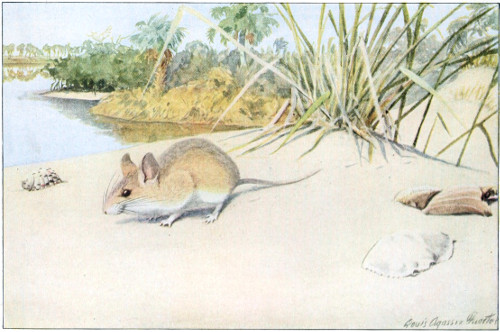
BEACH MOUSE
Peromyscus polionotus niveiventris
Within this superbly forested region this animal
delights in locations that are cool and
oozing with water, where, under the dense
shade of an almost tropical undergrowth of
shrubs, ferns, and other herbage, it constructs
numberless tunnels and trails. These are sometimes
in flats, but much more often along canyons
and mountain slopes, among willow, alder,
aspen, or other thickets, or even in the heavy
coniferous forest.
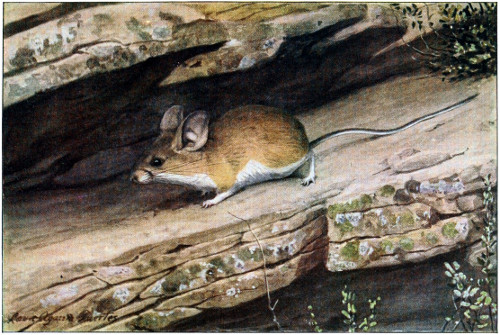
BIG-EARED ROCK MOUSE
Peromyscus truei
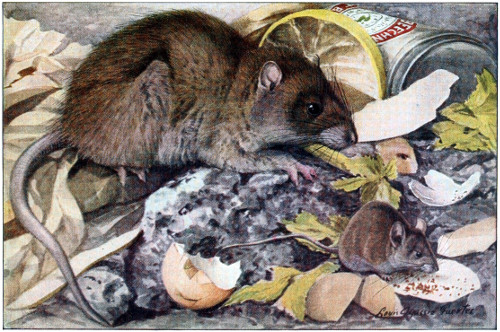
BROWN RAT
Rattus norvegicus
HOUSE MOUSE
Mus musculus
Veritable colonies inhabit certain areas and
the ground is honeycombed with burrows six
to eight inches in diameter and covered with
a network of surface trails. The irregular
branching tunnels are sometimes two or three
hundred feet in length and have at frequent intervals
side passages through which the earth
mined in extending the burrow may be ejected
in small dumps. The tunnels appear in a large
measure built for the safety of the owner in
traveling, since they repeatedly come to the
surface at the end of a log, where an open,
neatly kept trail extends under its shelter the
entire length, the tunnel being resumed at the
far end of the log.
All surface runways connecting tunnel entrances
or leading through the thick surface
vegetation are well kept and free of all obstructions.
The ground in these haunts is
commonly so saturated with water that the
tunnels form drainage channels down which
run little streams.
Nest chambers discovered by T. H. Scheffer
in the Olympic Mountains were located in
tunnels two feet underground. They were oval
in form and one measured eighteen inches in
horizontal diameter and seventeen in height.
Here three storage chambers opened directly
from the nest chamber, one of which contained
two quarts or more of sections of fern
roots, which had been kept so long they were
spoiled, and another was partly filled with
freshly cut leaves of nettles and twigs of cedar
and fir. At the far end an opening dropped
six inches into a small drainage basin partly
filled with water, out of which led two passages.
The roofs of the chambers were lined
with a thin layer of clay, which appeared to
have been packed in place by the owner.
In the upper and drier part of the nest,
which was made of dried fronds of ferns,
grasses, and small twigs, were found three
young less than a week old, with coats of fine
fur, but with eyes still closed. Like burrowing
animals generally, the mountain-beaver is
cleanly in its housekeeping, and offal, loose dirt,
and debris of all kinds are pushed out by the
forefeet and head to the dumps at the less-used
openings.
In winter much of the mountain-beaver
country is buried under several feet of snow,
but this does not stop the activities of this
hardy animal. Between the entrances to its
burrows and out along the surface of the
ground it tunnels through the snow in various
directions in search of forage.
At this time it cuts twigs from bushes and
gnaws the bark from the trunks and roots of
the smaller trees, sometimes completely girdling
and killing trees more than two feet in
diameter. Its underground tunnels are also
extended at this season, the soils being pushed
up in dumps under the snow and parts of the
snow tunnels are packed full of it for some
distance, so that when the snow disappears the
curious earth-forms remain like those of the
pocket gopher.
The mountain-beaver lives a monotonous existence
and correspondingly lacks the mental
vivacity of many other species which have a
greater freedom of movement. When one is
caught it shows little fear, but struggles to
escape, growling, clattering its teeth, and biting
viciously at anything within reach. Its desire
for food, however, appears to control its emotions,
and very soon after being captured it
will eat any green vegetation offered, as unconcernedly
as though free.
That the mountain-beaver possesses social instincts
is evident, as a pair is often found
occupying one set of tunnels, and in many favorable
places a number will have their burrows
closely grouped and connected with a
network of communicating surface trails.
Although mainly nocturnal, the animals are
active early in the morning and late in the
afternoon, as well as throughout dark days.
Those kept in captivity would show periods of
restless activity at night and have alternating
periods of sleep and wakefulness during the
day. Sometimes they would sleep coiled with
the head turned under the body and again flat
on their backs. During these periods their
sleep is often so profound that they may be
handled without being awakened.
One captive animal is reported to have uttered
a curious quavering note resembling that
of a screech-owl. They have a strong musky
odor, which is very evident when they are first
caught, and which is frequently apparent about
the burrows.
Careful and repeated efforts to keep these
animals in captivity under as near normal conditions
as possible in regard to food and surroundings
in the vicinity of where they were
captured have, up to the present time, resulted
in failure. In every case the animals failed to
thrive and soon died.
The mating occurs about the middle of
March, and a month later litters of two or three
young are born. The young grow slowly, not
attaining full size for a year or more, and do
not breed until the second year, but they leave
the shelter of the home nest and scatter to
occupy burrows of their own at the end of
the first two or three months.
The mountain-beaver feeds upon nearly all
small vegetation growing in its haunts, including,
in addition to small herbage, shrubs, the
bark of trees and bushes, ferns, and fern roots.
More than thirty species of native plants have
been found among its “hay” piles at the mouths
of burrows. Since its country has become increasingly
occupied by farmers, it has developed
a fondness for cultivated crops that,
in many places, is rendering it a pest. It appears
to have a special taste for cabbage, potato,
and onion tops, and other garden produce.
When gathering its food it sits up squirrel-like
and grasps the plant stem with one hand,
a long projecting tubercle on the “heel” of the
hand opposing the fingers like a thumb and
giving a good grasp, so that it can pull plants
down to be bitten off with the sharp front
teeth. Sometimes it climbs up a few feet into
a bush or small branching tree after succulent
shoots.
The mountain-beaver has the interesting
habit of gathering stores of green plant food
much like that of the cony on the mountain
tops, but appears to be more methodical in its
ways, gathering the stems of such plants as
grasses, ferns, and lupins, as well as twigs of
various bushes and carrying them in bundles
as large as can be held in the mouth, the butts
of the stems neatly laid together. These little
bundles of “hay” are placed side by side about
the entrances of the burrows, with the butts
all parallel on sticks or other support to keep
them as clear as possible from the ground.
They are left thus for a day or more to cure
before being carried into the subterranean
store-rooms.
Chief among the four-footed enemies of the
mountain-beaver are the fisher and bobcat, and
an eagle has been seen keeping close watch at
the entrance of their burrows.
(For illustration, see page 534)
The woodchuck or “groundhog” is a typical
marmot, with coarse hair, heavy body, short
neck, short, bushy tail, powerful legs, and feet
armed with strong claws for digging. When
fully grown it averages about ten pounds in
weight. Its usual color is a grizzled brown,
but in some districts black, or melanistic, individuals
are not uncommon.
Marmots are common to Europe, Asia, and
North America. The group contains many
species and geographic races varying in size
and color. The Alpine marmot of Europe is
probably the most familiar of the Old World
species and the woodchuck the best known in
America.
North America contains several species of
marmots, their joint territory extending from
coast to coast over the northern parts of the
continent and from southern Labrador, the
southern shores of Hudson Bay and Great
Slave Lake, and central Alaska southward to
northern Alabama, and along the high mountains
to New Mexico and the southern Sierra
Nevada of California. The common woodchuck
is well known to every dweller in the
countryside of the Eastern States and Canada,
where it occurs from sea-level to near the tops
of the highest mountains, at altitudes of over
4,000 feet.
It is a familiar habitant of fields and grassy
hillsides, especially where bordering woodland
offers safe retreat. In such places it digs burrows
under stone walls, rocks, ledges, old
stumps, or even out in the open grass-grown
fields. It commonly lives in the midst of the
forest, where its dens are located in a variety
of situations. The burrows are marked by little
mounds of earth at the entrances and ordinarily
contain from twenty to forty feet of
branching galleries, one or more of which end
in a rounded chamber about a foot in diameter,
well lined with dry grass and leaves.
Within these warm nests the females bring
forth from three to nine blind and helpless
young about the last of April or early in May.
A few weeks later the young appear about the
entrance of the burrows sunning themselves
and playing with one another, but usually
ready to disappear at the first alarm. At times,
however, they are surprisingly stupid and may
be captured with ease. Woodchucks have practically
no economic value. Their flesh, while
occasionally eaten, is little esteemed, and their
coarsely haired pelts are worthless as fur.
The woodchuck is a sluggish and stupid animal,
which does not ordinarily go far from its
burrow, but at certain seasons, especially in
spring, wanders widely, as though looking over
its territory before locating for the summer.
It has much curiosity and often sits upright
on its hind feet to look about, remaining for
a long time as motionless as a statue. When
one is driven into its burrow, if a person approaches
quietly and whistles, it will often
raise its head in the entrance and look about
to satisfy its curiosity.
Its only note is a short shrill whistle, which
it utters explosively at frequent intervals when
much alarmed. At such times it also chatters
its teeth with a rattling sound as owls sometimes
clatter their beaks.
Owing to their mainly diurnal habits and
persistence in living in and about the borders
of fields, woodchucks are among the most
widely known of our smaller mammals, and
have long been the favorite game of the country
boy and his dog. When cornered they will
fight savagely and with their strong incisors
inflict severe wounds.
They feed on grasses, clover, and other succulent
plants, including various cultivated crops,
especially vegetables in field and garden, where
they sometimes do much damage. The holes
and earth mounds they make in fields, in addition
to feeding on and trampling down grasses
or grain, excite a strong feeling against them,
and farmers everywhere look upon them as a
nuisance. In New Hampshire so great was the
prejudice against them that in 1883 a law was
passed placing a bounty of ten cents each on
them: “Provided, That no bounty shall be paid
for any woodchuck killed on Sunday.”
Unlike many rodents, the woodchucks do not
lay up stores of food for winter. As summer
draws to an end they feed heavily and become
excessively fat. On the approach of cold
weather they become more and more sluggish,
appearing above ground with decreasing frequency
until from the end of September to the
first of November, according to locality, they
retire to their burrows and begin the long
hibernating sleep which continues until the approach
of spring.
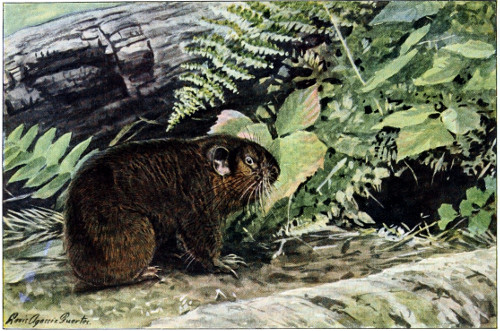
MOUNTAIN-BEAVER
Aplodontia rufa phaea
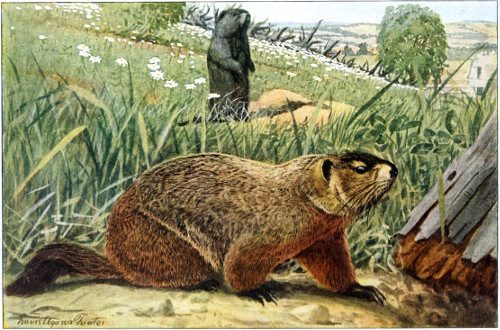
COMMON WOODCHUCK, or AMERICAN MARMOT
Marmota monax
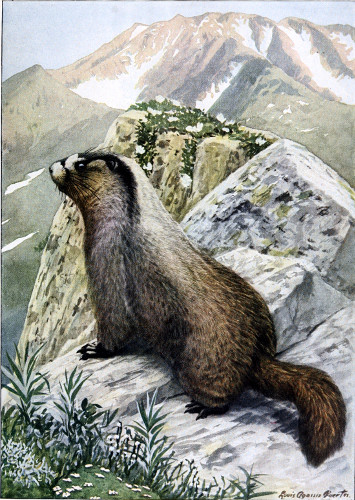
HOARY MARMOT, or WHISTLER
Marmota caligata
Some time between February and April, according
to latitude, they come forth to resume
their seasonal activities. In the northern parts
of their range they usually come out several
weeks before the snow disappears and may be
tracked in it as they wander about searching
for food or a new location.
The prominence of the groundhog as a popular
figure in the country lore of the Eastern
States is shown by his having been given a
place with the Saints on the calendar, February
2 being widely known as “Groundhog Day.”
It is claimed that on this date the groundhog
wakes from his long winter sleep and appears
at the mouth of his burrow to look about and
survey the weather. If the sun shines so that
he can see his shadow, bad weather is indicated
and he retires to resume his sleep for another
six weeks. Otherwise, the winter is broken
and mild weather is predicted. Even on the
outskirts of Washington some of the countrymen
still appraise the character of the coming
spring by the weather on “Groundhog Day.”
(For illustration, see page 535)
The whistler is the largest and handsomest
of the American marmots. It is similar in
proportions to the common woodchuck, but
averages nearly twice its weight. Its fur, far
thicker and of a better quality, might have a
value in the fur trade if enough of the skins
were available. As it is, the skins are used
only for robes and sometimes for clothing by
the Indians.
The distribution of this characteristic animal
of the northern Rocky Mountains and outlying
ranges extends from the Endicott Mountains,
fronting the Arctic coast of Alaska, and the
peninsula of Alaska, southeasterly to the Bitterroot
Mountains of Idaho, Mount Rainier,
the Olympics of Washington, and Vancouver
Island. In the North its range extends from
above timber-line down over hare slopes and
through glacial valleys to the sea-level along
the southern coast of Alaska. To the southward
it is limited wholly to the higher elevations,
usually above timber-line.
Owing to variations in climatic conditions
and to isolation in different parts of its range,
several geographic races of the whistler have
been developed. In the mountains to the southward
of its range other marmots occur as far
as New Mexico and California.
When the French-Canadian voyageurs on
their fur-trading expeditions first visited the
Rocky Mountains they encountered the hoary
marmots and applied to them the name “siffleur,”
or whistler, which they had already
given the common woodchuck of eastern Canada.
The shrill note of the hoary marmot, under
favorable circumstances, may be heard
more than a mile and justifies the restriction
of the name whistler to it.
The whistler lives in such remote and unfrequented
districts that little is known of its life
history. It is diurnal in habits and loves the
free open spaces of the high mountain ridges.
There its loud, oft-repeated call note, striking
colors, together with its habit of running about
on the snowbanks, render it unusually conspicuous.
High in the mountains it usually inhabits
rock slides, the tumbled rock masses of glacial
moraines, or rocky points, but sometimes takes
up its abode on open earth slopes or in the bottoms
of little glacial valleys. Ordinarily the
dens are hidden in the rock slides and broken-down
ledges, or burrows are dug under the
shelter of large boulders and even in open
ground away from any rocky shelter.
During the sunny days of summer the whistler
regularly frequents the top of some conspicuous
boulder or projecting rocky point,
from which it commands a sweeping view of
all its surroundings. Its sight and hearing are
extraordinarily keen, and when perched on its
lookout it is difficult to stalk. When one has
its burrow located in an open place it often sits
upright on its haunches to look watchfully
about, and at the first alarm disappears into its
den. This watchfulness is necessary, for even
in the remote alpine highlands it occupies, the
whistler is beset by enemies. The most formidable
of these are the great brown and
grizzly bears of the North, which dig it from
its burrow. In addition prowling wolves, Canada
lynxes, wolverines, and eagles take occasional
toll from its numbers.
Toward the end of summer, when the high
alpine slopes are thickly grown with small
flowering herbage, the whistler feeds heavily
on many of the plants and, like the woodchuck
at this season, becomes excessively fat. Before
the arrival of winter it retires to the shelter of
its den and begins the long hibernating sleep
which may last six months or more. In spring,
before the snowy mantle is gone from the
mountains, it is out, ready to welcome the approaching
summer. A few weeks later the
three or four young are born. They remain
with the mother throughout the season and
during their first winter may hibernate in the
home den.
The unspoiled wilderness of remote northern
mountain slopes and ridges where the whistler
lives is also the home of the mountain
sheep, caribou, and huge northern bears. As
the hardy sportsmen roam these inspiring
heights in search of game their attention is
constantly attracted to the marmots, whose
presence and shrill call notes lend a pleasing
touch of life to many an otherwise harsh and
forbidding scene.
(For illustration, see page 538)
Prairie-dogs are not “dogs,” but typical rodents,
first cousins to the ground squirrels, or
spermophiles. As a rule, they may be distinguished
from the ground squirrels by their
larger size, proportionately shorter and heavier
bodies, and shorter tails. In length they vary
from fourteen to over seventeen inches, and in
weight from one and one-half to more than
three pounds.
These rodents are limited to the interior of
North America and form a small group of five
species and several geographic races. Although
closely alike in general form and habits, the
species are divided into two sets: one, the
most widely distributed and best known, having
the tails tipped with black, and the other
having the tails tipped with white.
On the treeless western plains and valleys
from North Dakota and Montana to Texas
and thence west across the Rocky Mountains
to Utah and Arizona, they are one of the most
numerous and characteristic animals. Southward
they range into northwestern Chihuahua
and one species occupies an isolated area on
the Mexican table-land in southern Coahuila
and northern San Luis Potosi, Mexico. Their
vertical range varies from about 2,000 feet on
the plains to above 10,000 feet in the mountainous
parts of Colorado and Arizona.
Owing to their diurnal habits, their exceeding
abundance over vast areas, and their interesting
mode of living in colonies, prairie-dogs
have always attracted the attention of travelers
and have become one of the most widely known
of our smaller mammals. All who have lived
in the West, or who have merely traversed the
Great Plains on the transcontinental railroads,
have had their interest excited by these plump
little animals sitting bolt upright by the mounds
which mark the entrances to their burrows, or
scampering panicstricken for shelter as the
train roars through their “towns.”
So strong is the gregarious instinct in prairie-dogs
that they customarily make their burrows
within short distances of each other, varying
from a few yards to a few rods apart. The
inhabitants of these communities, or “towns,”
as they have often been termed, vary in number
from a few individuals to millions. In
western Texas one continuous colony is about
250 miles long and 100 miles wide. In the
entire State of Texas 90,000 square miles are
occupied by prairie-dogs, and the number of
these animals within this area runs into the
hundreds of millions. The extent to which
they occupy parts of their territory is well illustrated
by one situation in a mountain valley,
containing about a square mile, in eastern
Arizona, which by actual count contained 7,200
of their burrows.
The burrows, from four to five inches in
diameter, are usually located on flat or gently
sloping ground. They descend abruptly from
eight to sixteen feet, then turn at a sharp
angle and extend ten to twenty-five feet in a
horizontal or slightly upward course. The
tunnel at the end of the steep descending
shaft is always more or less irregular in
course, and branches in various directions, the
branches often ending, in a rounded nest or
storage chamber, but sometimes forming a loop
back to the main passageway. Not infrequently
two entrances some distance apart lead
to these deep workings. A little niche is ingeniously
dug on one side of the steep entrance
shaft, four to six feet below the surface, to
which on the approach of danger the owner
retires to listen and determine whether it may
or may not be necessary to seek safety in the
depth of the den. It is from these vantage
points that the resentful voices of the habitants
come to an intruder in a prairie-dog “town”
as he passes.
The black-tailed prairie-dog, which is so
numerous on the Great Plains, surrounds the
entrance to its burrow with a crater-shaped
pyramid of soil varying from a few inches to
nearly two feet in height and serving perfectly
as a dike to keep out the water. The owners
keep the funnel-shaped inner slopes of the
rims about the entrances in good condition by
setting briskly to work to reshape them at the
end of a rain-storm, digging and pushing the
earth in place with their feet and molding it
into a more compact mass by pressing it in with
their blunt noses.
The white-tailed prairie-dogs pile the dirt
from their excavations out on one side of the
entrance, as in the case of most other burrowing
animals. Sometimes the dirt in these piles
amounts to from ten to twenty bushels, thus
indicating extended underground workings.
The vivacity and hearty enjoyment of life by
the occupants of a prairie-dog “town” is most
entertaining to an observer. With the first
peep of the sun above the horizon they are
out on the mounds at the entrances of their
burrows, first sitting erect on their hind feet
and looking sharply about for any prowling
enemy. If all is well they begin to run about
from one hole to another, as though to pass the
compliments of the day, and scatter through
the adjacent grassy feeding ground.
The favorite food of prairie-dogs consists of
the stems and roots of gramma grass and
other richly nutritious forage plants. In addition
they eat any native fruits, such as that
of the pear-leaved cactus (Opuntia) and are
extremely destructive to grain, alfalfa, and
other cultivated crops. In addition to ordinary
vegetation, they eat grasshoppers and are fond
of flesh, sometimes being caught far from their
homes in traps set for carnivores. They keep
the grass and other vegetation cut down or
entirely dug out over much of the “town” and
especially in a circle about each entrance
mound, apparently for the purpose of obtaining
a clear view as a safeguard against the approach
of any of their many four-footed enemies.
This habit is exceedingly injurious to
the cattle ranges and often results in much
erosion of the fertile surface soil.
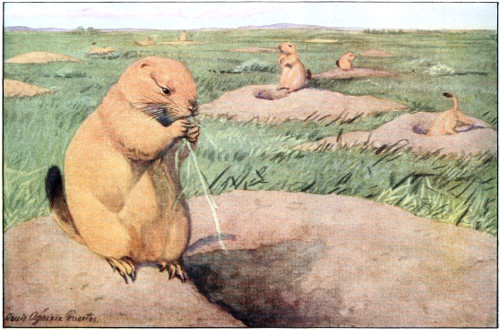
PRAIRIE-DOG
Cynomys ludovicianius
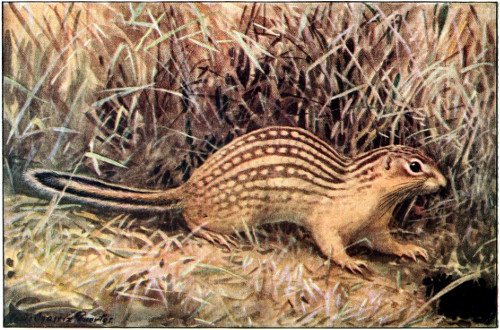
STRIPED GROUND SQUIRREL
Citellus tridecemlineatus
The vast numbers of prairie-dogs over so
large a part of the grazing areas of the West
take a heavy toll from the forage and other
crops. As a consequence a campaign of destruction
is being waged against them as the
country becomes more and more settled, and
they will eventually disappear from much of
their present range. However detrimental they
may be from an economic point of view, they are
among our most interesting species, and when
taken young their playful disposition and intelligence
render them most entertaining captives.
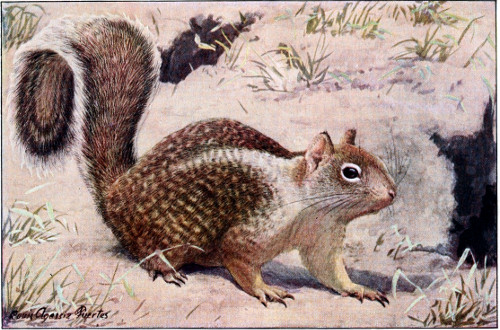
CALIFORNIA GROUND SQUIRREL
Citellus beecheyi
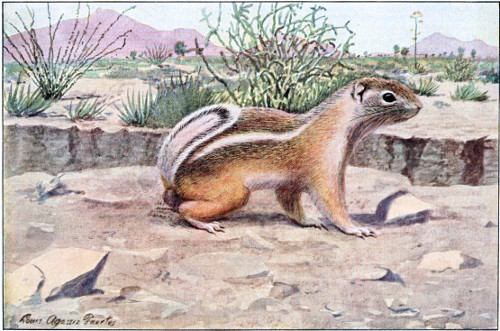
ANTELOPE CHIPMUNK
Ammospermophilus leucurus
Owing to the constant danger to which they
are subject from coyotes, foxes, bobcats, badgers,
and black-footed ferrets, in addition to
eagles and other birds of prey, prairie-dogs
are constantly on the alert. At any suspicious
occurrence the first to observe it runs to his
entrance mound, if the danger is not pressing,
but otherwise to the nearest mound, where he
sits up at his full height, “barking” and vibrating
his tail, ready, if necessary, to disappear
instantly. At the same time the “town” is alive
with scurrying figures of the habitants rushing
panic-stricken for their homes, and the air is
filled with a chorus of their little barking cries.
When all have been frightened to cover barking
continues in the burrows, but an hour or
more may pass before a “dog” will reappear.
I once stalked a solitary antelope by creeping
flat on the ground through a prairie-dog
“town.” As I drew near the first burrows,
the “dogs” all rushed to their mounds, sitting
there and barking at the queer and unknown
animal thus invading their precincts. The
strange sight excited as much curiosity among
them as alarm. As I approached one mound
after another the owners would become almost
hysterical in their excitement and would sit
first on all fours and then stand up at full
height on their hind feet, the tail all the time
vibrating as though worked by some mechanism,
while the barking continued at the intruder
as rapidly and explosively as possible. When
I came within six or eight feet the “dog” would
dive down his hole, sputtering barks from the
depths as he went, but often would pop up
again to take another look before finally disappearing.
In this way I passed ten or a dozen
mounds while the dozens of “dogs” off my
line of progress worked themselves into a
frenzy of curiosity and protest. When the
stalk was finished I passed back through the
“town” and my upright figure was promptly
recognized by the habitants as that of an enemy
and every one disappeared before I was within
fifty yards of the first mound.
The common note of the black-tailed prairie-dogs
is a squeaking “bark,” much like that
produced by squeezing a toy dog; in addition,
there is a rapid chattering note, often given
as the “dogs” vanish down the hole. The
white-tailed species have a shriller, more chirping
note. In both species the odd vibrating
motion of the tail, held stiffly close to the back,
is characteristic.
Prairie-dogs hibernate in severe weather,
those living in high, snow-covered mountains
or in the far north sometimes sleeping through
five or six months. In many places their hibernation
is irregular, and near the southern
border of their range is limited to a few inclement
days now and then. In Wyoming they
come out the last of March or early in April,
sometimes when there is a foot or two of snow
on the ground and the temperature ranges far
below zero. Under such conditions they run
about over the snow during the middle of the
day, feeding on projecting tips of vegetation
or digging to the ground.
Beginning near the southern border of their
range and proceeding north, the single litter of
the season, containing from four to six young,
are born in March, April, or May, and a
month later, when scarcely larger than chipmunks,
may be seen playing about the entrance
mound. When danger appears the mother
sends the young helter-skelter for the refuge
of the burrow, and should any be slow about
going in she rushes at them, driving them to
cover with shrill barks of alarm. When about
half-grown the young scatter and prepare burrows
of their own. Sometimes as many as six
to nine of these animals may be found in a
single burrow, in which, no doubt, they have
taken refuge, or it may be a reunion of the
season’s family.
On warm sunny days, especially at a time
when nights are frosty, these fat little animals
will often lie flat on the bare ground about
their mounds, with legs outstretched, basking in
the grateful rays. As their colonies expand by
the rapid increase of their numbers, many individuals
wander far in search of new locations.
On the mountain plateaus of northern
Arizona I know of instances where they have
traversed several miles of pine and fir forest
to locate in an isolated mountain park, and new
colonies were established as far as six miles
from their nearest neighbors.
The flesh of prairie-dogs is not unpalatable,
and Navajo and Pueblo Indians are extremely
fond of it. The Indians take advantage of
heavy rains and turn the temporary rush of
water down the holes to drown out the “dogs,”
and thus capture many of them.
It is inevitable that many popular misconceptions
should grow up about such numerous
and interesting animals as the prairie-dogs. In
the West many people believe that the burrows
go down to water. In reality, like many other
rodents, these animals have acquired the ability
by chemical action in the stomach to transform
the starchy food into water. I have seen
dog towns located on a few feet of soil resting
on a waterless lava bed miles in extent and
more than 100 feet thick, as shown by canyons
cut through it, thus proving the impossibility
of the prairie-dog-well legend.
Another popular belief is that the rattlesnakes
and burrowing owls living in prairie-dog
towns unite as a kind of happy family in
the burrows of the dogs. The truth is that the
owls live and breed in deserted dog holes, while
the rattlesnakes visit the occupied holes to feed
on the unfortunate occupants.
(For illustration, see page 538)
Small size and a series of thirteen narrow,
well-defined stripes, or lines, marking the upperparts
of the striped ground squirrel serve
to distinguish it from all its relatives. Its total
length is about eleven inches and its form is
nearly as slender as that of the weasel. Its
brightly colored markings blend so well with
the brown earth and plant stems in its haunts
that when quiet it is difficult to distinguish.
This protective coloration is of vital service to
a small animal sought by all the diurnal birds
of prey, as well as by coyotes, foxes, bobcats,
badgers, skunks, weasels, and snakes.
The striped ground squirrel, also known as
the “gopher” or “striped gopher,” is restricted
to middle North America, where it is distributed
from southern Michigan and northern
Indiana west to Utah, and from about latitude
55 degrees in northern Alberta south nearly to
the Gulf coast of Texas. It ranges from near
sea level in Texas up nearly to 10,000 feet in
Colorado. Within these limits the varying
climatic conditions have modified it into several
geographic races, all having a close general
resemblance.
Like most members of the squirrel family,
the striped ground squirrels are diurnal in
habits and well known wherever they occur. I
first learned the ways of these odd little mammals
as a boy on the prairies outside the city
of Chicago, and later observed them in a high
mountain valley in Arizona. In both regions
they had the same habits. By preference they
occupy grassy prairies, old fields, and similar
situations. In many areas they are serious
pests, owing to their abundance and their destructiveness
to grain crops, but where the
land is generally cultivated, the sheltering vegetation
and their shallow burrows are destroyed
by the plow, thus causing a decrease in their
numbers.
The lives of the striped ground squirrels are
so beset with peril that they always move
abroad with watchful hesitation, pausing to
listen, retreating toward their burrows at the
slightest suspicious sound or movement, or rising
bolt upright on their hind feet and remaining
motionless as a small statue until satisfied
that there is nothing to fear. They call to one
another with a chirping note as well as with a
shrill trilling whistle, and when alarmed by the
presence of some enemy their warning call
notes are heard on all sides as the alarm is
passed, and all are on the alert to disappear
down their burrows at the slightest suspicious
movement.
When they have vanished their trilling notes
are often heard from the depths of their burrows;
but curiosity is one of their strongest
traits, and if no disturbance follows one will
almost immediately pop up its head to see the
cause of the alarm. Boys, taking advantage of
this habit, place an open slipping noose at the
end of a long string around the entrance of the
burrow, and, waiting developments, lie quietly
a few yards to one side. The ensuing silence
is too much for the ground squirrel to endure
and soon its head appears above ground, the
boy pulls the string, and the victim is dragged
forth with the noose about its neck.
The entrance to the burrow of these ground
squirrels is about two inches in diameter. It
is usually located in the midst of grass or
weedy growths, and has little or no fresh earth
about it. The burrow descends for several
inches almost vertically and then turns almost
horizontally in a sinuous and erratic course,
with numerous branches and side passages leading
up to the surface. Most of these side
entrances are kept plugged with soft earth.
Opening off the main tunnel is a large nest
chamber filled with fine dry grasses and other
soft vegetable matter, and also one or more
large storage chambers in which the owner lays
up his garnered supplies of grain or other seeds
for use during inclement weather.
These squirrels hibernate throughout their
range, entering their long sleep in an excessively
fat condition the last of September or
in October. In the North they remain in a
torpid state for six months or more.
Soon after they appear in spring they mate
and the single litter of the year, containing
from five to thirteen young, is born the last of
May or early in June. The young are in an
extremely undeveloped state at birth, being
blind, hairless, and with the ears scarcely showing.
They develop slowly and remain with the
mother until toward fall, when, nearly grown,
they scatter to care for themselves.
The striped ground squirrels are among the
most carnivorous of rodents. Although they
devote much time to gathering grain, seeds of
various kinds, and even acorns and other nuts,
which may be eaten on the spot or carried in
their cheek pouches to their underground storage
rooms, in addition they are known to eat
insects and flesh whenever occasion offers. In
fact, during seasons when such insect food as
grasshoppers, caterpillars, and grubs is plentiful,
these ground squirrels frequently feed
mainly upon it. They are known to kill and
devour mice and young birds, and when confined
in a cage will sometimes kill and partly
devour their own kind. When caught they
fight fiercely, biting and struggling to escape.
In captivity they show little of the gentleness
and intelligence which are such pleasing characteristics
of chipmunks and true squirrels.
(For illustration, see page 539)
Owing to its habits, the California ground
squirrel is known locally as the digger-, rock-,
or ground-squirrel. Its prominent ears, bushy
tail, color, and form give it the general appearance
of a heavy-bodied gray tree squirrel, but
in reality it is a true, spermophile and close
kin to the marmots.
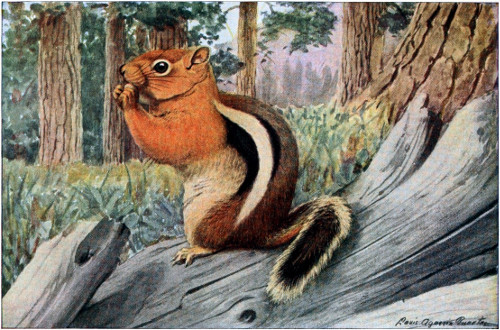
GOLDEN CHIPMUNK
Callospermophilus lateralis chrysodeirus
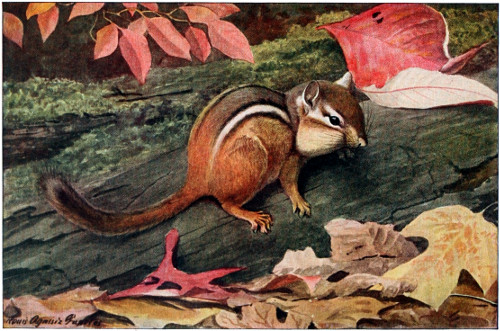
EASTERN CHIPMUNK
Tamias striatus
Spermophiles are nearly circumpolar in distribution,
ranging through northern lands from
central Europe across Bering Strait to the
Great Lakes in North America. Many species
exist in North America, varying greatly in
form, size, and color. They occur mainly in
the western part of the continent from the
Arctic coast of Alaska to the southern end of
the Mexican table-land. Some species are represented
by enormous numbers and do great
injury to cultivated crops. Among the larger
and best known of the injurious species, the
California ground squirrel, with its several geographic
races, occupies most of the Pacific
coast region from Oregon to Lower California.
It has a broad vertical distribution, extending
from the seashore to about 10,000 feet altitude
on the western slope of the Sierra Nevada in
California, and thrives under contrasting climatic
conditions, as the humid northwest coast
region and the most arid deserts of Lower
California.
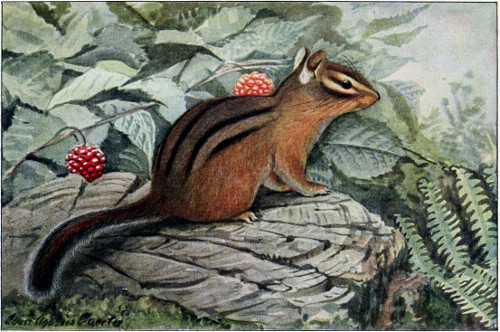
OREGON CHIPMUNK
Eutamias townsendi
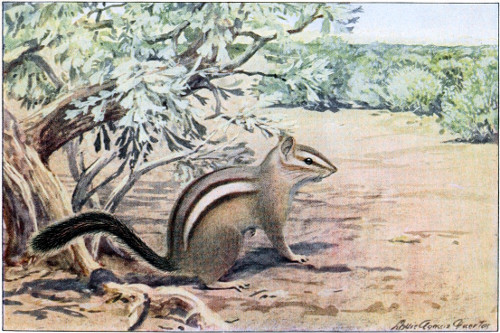
PAINTED CHIPMUNK
Eutamias minimus pictus
In California, where they are generally distributed
and extremely numerous over great
areas, these ground squirrels are most at home
among the wild oats and scattered live oaks on
the open slopes of the rocky foothills and
thence up through the dense chaparral, scrub
oaks, piñon pines, and junipers. Above this
they populate many beautiful little valleys in
colonies, as well as parts of the splendid open
forests of pine and fir. Below they spread out
from the foothills among the ranches in the
great valleys. Wherever they occur they take
heavy toll from the native forage plants, and
in cultivated areas their devastations of crops
place these spermophiles among the most serious
of mammal pests.
They are omnivorous, eating insects and flesh
on occasion, but feeding mainly on seeds, fruits,
and many kinds of plants. The native vegetation
in their haunts contains a wonderful
variety of food plants, from humble weeds in
the valleys to the lordly pines of the Sierra,
but most attractive to these rodents are the
rich food-bearers brought by the cultivators of
the soil. The squirrels gather in great numbers
about farms, and in feeding upon alfalfa,
wheat, and other grains, grapes, peaches, apricots,
almonds, prunes, pomegranates, and a
variety of other crops, cause an annual loss to
the farmers of California probably exceeding
$20,000,000. So serious are their depredations
that great sums have been spent in attempts
to destroy them with poison. The Kern County
Land Company, with vast holdings in the
southern end of the San Joaquin Valley, in
1911 spent more than $40,000 for this purpose.
This company estimated that the ground squirrels
destroyed 20 per cent of the grain crop in
great areas, and that twenty of them would
destroy enough forage to support a cow
through the year.
Ground squirrels by choice locate their burrows
among slide rock, in crevices among
cliffs, under boulders and roots of trees, in
ditch or dry creek banks, or under stone walls,
fences, or building, but in the parks of the
high Sierra, as in the foothills and lowland
valleys, they dig holes out in the open with
conspicuous mounds at the entrances much like
those of prairie-dogs.
Well-worn trails lead from one of their
burrows to another and away to a distance
through the wild oats in the foothills, or in
the grain and forage crops of the valleys, and
along these the animals travel when foraging
or paying social visits. Whenever a large rock,
stump, or other prominent object is convenient,
they spend hours on the top sunning themselves
and keeping a sharp lookout over their surroundings.
From these lookout points when
they suspect danger they utter a short, shrill,
whistling note which may be heard at a long
distance and which sends all their neighbors
scurrying for shelter. They also have a lower
chattering note, uttered about the burrow when
resenting an intrusion or when otherwise displeased.
Ground squirrels are agile climbers on cliffs
and among rocks as well as in fruit trees, live
oaks, and other low trees, but I have never
seen them far from the ground in large trees.
When on the ground they run in a series of
bounds like tree squirrels. The long, bushy tail
is carried almost straight out behind when they
scamper off in alarm, but at other times is
curved and undulating, much as in the tree
squirrels. They gather and manipulate food
with their front paws, sitting upright on their
haunches to eat or look about. On one occasion
when I came to a foot-bridge over a
broad irrigating ditch across which a number
of ground squirrels were raiding an orchard,
they did not hesitate to dash at full speed into
the swiftly running water and swam quickly
across to seek refuge in their holes on the far
side.
Like other spermophiles, the California
ground squirrels hibernate for months in the
cold, snow-covered parts of their winter range,
but remain active throughout the year in the
warmer areas, where no snow falls. Throughout
their range they gather stores of seeds,
grain, and acorns and other nuts, carrying them
in their cheek pouches to underground store-rooms
for use in bad weather. In the valleys
of California they lie hidden in their burrows
for days at a time during cold winter rains, but
are out as soon as the sun reappears. One or
more litters, each containing from six to twelve
young, are born from March to late in summer,
according to the locality. The young leave
the nest and care for themselves when about
half grown.
The swarming abundance of the California
ground squirrel on foothill slopes and in fertile
valley bottoms equals the congregations of
prairie-dogs in their most populous districts.
This abundance of small animal life supports
a great variety of predatory species, as coyotes,
foxes, bobcats, several kinds of hawks, and the
golden eagle. Owing to its predilection for
ground squirrels, the golden eagle is protected
by law in California, where many of them build
their nests in low live oaks only a few yards
from the ground.
When house rats brought the bubonic plague
to San Francisco a few years ago they also
carried it across the bay and passed it on to
the ground squirrels living in the foothills back
of Oakland. Thence the disease spread among
these animals through parts of several surrounding
counties. The United States Public
Health Service and the local authorities in a
vigorous campaign stopped the spread of this
malady, but not until the potential ability of
these rodents as plague-carriers had been well
established. This fact and the wide distribution
of the California and other ground squirrels
over a large part of the continent should
not be overlooked in connection with possible
future outbreaks of the plague. Fortunately,
investigation and field experiments on a large
scale have shown that these spermophiles may
be destroyed by poison over great areas at a
relatively small cost.
(For illustration, see page 539)
Commonly known as the antelope, or white-tailed,
chipmunk, this handsome little mammal
is in reality a species of spermophile, or ground
squirrel. The misnomer is due, no doubt, to
its small size, striped back, and sprightly ways.
From the true chipmunks it may be distinguished
by its heavier proportions, and from
both chipmunks and all other spermophiles by
its odd, upturned tail, carried closely recurved
along the top of the rump. This character
renders the species unmistakable at a glance
and gives it an amusing air of jaunty self-confidence.
The antelope chipmunk is characteristic of
the arid plains and lower mountain slopes of
the Southwest from western Colorado through
Utah, northern Arizona, Nevada, the southern
half of California, and all of Lower California,
and down the Rio Grande Valley through New
Mexico to western Texas.
Within this area it occupies a wide variety
of situations. It inhabits the intensely hot
desert plains near sea level in Lower California,
where the temperature rises to more
than 125 degrees Fahrenheit in the shade and
the vegetation is characterized by such picturesque
forms of plant life as cactuses of
many species, yuccas, fouquerias, palo verdes,
ironwood, and creosote bushes; it is found also
above 7,000 feet altitude on the cool plateaus
and mountain slopes of Arizona and Colorado,
among sage brush, greasewood, junipers, and
piñon pines. It appears equally at home skipping
nimbly over rocky slopes or among slide
rock in arid canyons and scurrying through the
brushy growth on broad sandy plains devoid
of rocks.
The antelope chipmunk has the most vivacious
and pleasing personality of all the numerous
ground squirrels within our borders. During
the many months I have camped and traveled
on horseback in their haunts I have never lost
interest in them. They were forever skirmishing
among the bushes or dashing away down
trails or over the rocks of canyon slopes, their
white tails curled impudently over their backs
like flags of derision at my cumbersome advance.
Their burrows are dug in a variety of places.
In the open flats they enter the ground almost
vertically, and often several entrances are
grouped within a few yards. In some places a
little mound of loose dirt is heaped up at one
side of the entrance and at others there is no
trace of it. Frequently, when the ground is
soft, little trails lead in different directions
from the entrances, and often between holes
100 yards or more apart, as though they made
many social visits. The deserted burrows of
other mammals are sometimes utilized to save
the trouble of digging. The burrows are often
under the shelter of cactuses, bushes, and great
boulders or may be among crevices in the rocks.
Antelope chipmunks are extraordinarily active
and continually wander far from home in
search of food or in a spirit of restless inquiry.
As the traveler on horseback rides
slowly along he will see them racing away in
front of him, sometimes climbing to the top of
a bush 100 or 200 yards in advance for a better
look at the wayfarer and then scuttling down
and racing on again. In this way I have seen
them keep ahead of me sometimes for several
hundred yards instead of hiding in some hole
or shelter, as they might easily do. At other
times they were so unsuspicious they would
permit me to pass within a few yards with
slight signs of alarm. They have a chirping
call, often uttered when watching from the
top of a bush, and also a prolonged twittering
or trilling note, diminishing toward the end.
In the higher and colder parts of their range,
where snow lies long on the ground, these
spermophiles hibernate for several months, but
in the warmer areas they are active throughout
the year. Wherever they occur they gather
food and carry it to their underground store-rooms
in their cheek pouches. Like most
ground squirrels, they eat many kinds of seeds
and fruits as well as flesh and insects when
occasion offers. About cultivated lands they
are sometimes abundant and destructive, digging
up corn or other grain as soon as it is
planted and also taking toll of the ripening
grain until they become a pest. In the desert
they often gather about camps to pick up the
grain scattered about when the horses are fed.
It is well for them that they are prolific,
having one or more litters during spring and
summer, with from four to twelve in each, as
they have many enemies. Snakes and weasels
pursue them into their burrows, while foxes,
coyotes, badgers, bobcats, and many kinds of
hawks, constantly reduce their numbers.
(For illustration, see page 542)
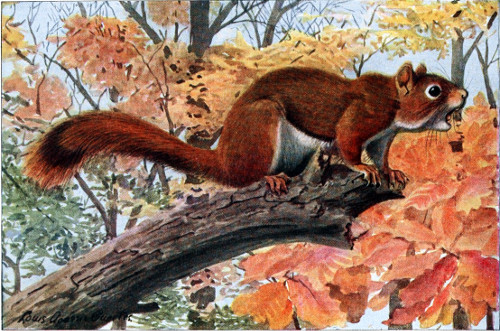
RED SQUIRREL
Sciurus hudsonicus
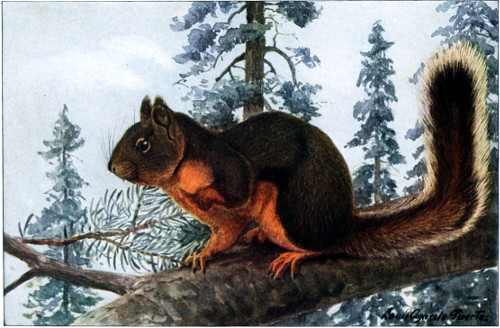
DOUGLAS SQUIRREL
Sciurus douglasi
The golden chipmunk, or calico squirrel, as it
is named in Oregon, is the most richly colored
of the several geographic races of a widely
known species, Callospermophilus lateralis,
abundant among the open forests of yellow
pines and firs of the western ranges, including
the Rocky Mountains, Cascades, and Sierra
Nevada. Although commonly known as a chipmunk,
this handsome animal is a ground squirrel,
or spermophile, distinguished from all its
kind by heavy stripes, resembling those of a
chipmunk, along the sides of its back. From
the chipmunks it may be distinguished at a
glance by its thick-set and often almost obese
proportions, which render its movements much
slower and less graceful than they are with
those nimble sprites. It occurs from northeastern
British Columbia to New Mexico,
southern California, and even in an area in the
high Sierra Madre of southern Chihuahua,
where an isolated representative occupies a
limited range.
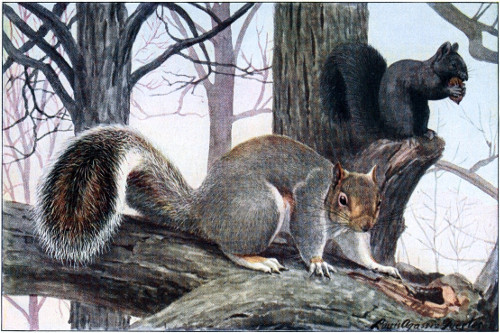
GRAY SQUIRREL (and black phase)
Sciurus carolinensis
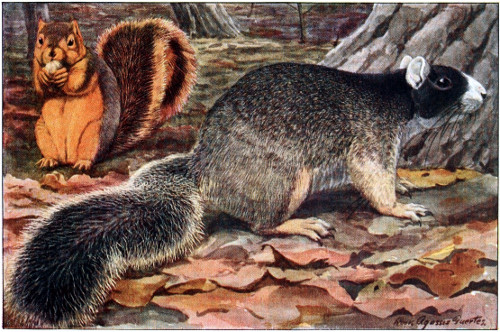
RUSTY FOX SQUIRREL
Sciurus niger rufiventer
FOX SQUIRREL
Sciurus niger
Their vertical distribution extends from a
moderate elevation above the sea in Oregon to
above 11,000 feet in southern California. They
are common in the Yellowstone and other
national parks, where their size, bright markings,
and activities render them conspicuous.
Everywhere their habits resemble those of
the various species of true chipmunks with
which they associate. They live in burrows,
which they dig under the shelter of logs, rocks,
stumps, roots of trees, or even in open ground,
as well as in the ready-made shelter of rock
slides, with conies, at timberline. Their burrows
at times have several entrances within a small
area. Often they occupy the burrows of other
animals, including pocket gophers. They excavate
burrows under cabins or barns in clearings,
and abandoned mining camps or old sawmill
sites frequently abound with them. Nests
and storage chambers are excavated off the
passageways. The nests are usually made of
leaves and other soft vegetable material, but
in the sheep country wool, which they find in
scattered tufts, is often used.
A camping party in their haunts is certain
to attract them, and, as about barns, it is necessary
to keep a watchful eye on them to prevent
their robbing grain sacks or other supplies.
When they once locate an accessible supply of
grain their industry is remarkable. I have
seen a dozen or more working throughout the
day, making continuous hurried trips, with
loaded cheek pouches, to their dens, sometimes
two hundred yards away. On approach of
autumn they become continually active, gathering
their winter supplies.
The length of their hibernation varies with
the severity of the climate, but is rarely under
five months. It is said to run through seven
months on the higher mountains of southern
California. They usually go into winter
quarters in September or early in October, but
occasionally one may be seen out as late as
December. At this time they have become so
fat that their movements are very sluggish.
One kept as a pet for eleven years at Klamath
Falls, Oregon, is reported to have hibernated
regularly each winter. In Montana they retire
to their dens in September and come out in
March. They mate soon after they appear in
spring and the young, four to seven in number,
are half grown the last of May.
Like true chipmunks, these spermophiles are
fond of weedy clearings or other openings in
the forest, where stumps, logs, rocks, and old
fences offer plentiful shelter and many elevated
vantage points where they may sit by the hour
watching the doings of their small world.
They have a sharp whistling or chirping call
note, usually uttered as a warning cry, but
sometimes as a social call. They do not like
gloomy or stormy weather and generally lie
hidden at such times, but on sunny days are
so actively engaged in foraging, running along
the tops of logs, or perching on the tops of
stumps and large rocks that they add greatly
to the pleasant animation of the forests where
they live. When running they usually carry
the tail elevated like a chipmunk.
They sun themselves for hours on elevated
points, sometimes lying quiescent and again
sitting bolt upright, but always watchful and
ready to disappear at the slightest alarm. This
watchfulness is necessary, for their enemies are
abroad at all hours. They are the prey of
bobcats, foxes, coyotes, weasels, snakes, and
hawks.
The golden chipmunk and its related subspecies
are omnivorous feeders. They show a
strong predilection for bacon when looting
camp stores and eat any kind of meat with
avidity. Young birds and birds’ eggs are devoured
whenever found, as are also grasshoppers,
beetles, flies, larvæ, and many other insects.
The number of kinds of seeds eaten is
almost endless and includes chinquapin and pine
nuts, rhus, alfileria, violet, lupine, ceanothus,
and others. They also eat roses and other
flowers, green leaves, wild currants, gooseberries
and other fruit, and small tuberous
roots. They often climb bushes and low trees,
at least 30 feet from the ground, after nuts
and berries. The capacity of their cheek
pouches is shown by one instance, when one
animal was loaded with 750 serviceberry seeds.
The pouches of another contained 360 grains
of barley, another 357 of oats. Bold and persistent
camp robbers, their depredations cover
all articles of food, including bread and cake,
and they sometimes do considerable injury to
small mountain grain fields.
I had the pleasure of living in the mountains
of New Mexico and Arizona for several years
where these attractive ground squirrels were
numerous, and vividly remember them as
among the most interesting of the woodland
folk. Their friendliness about forest cabins is
notable and with a little encouragement they
become extremely confiding and amusing visitors.
The young are playful, pursuing one another
in apparent games of “tag” over rocks, stumps,
and logs. When partly grown they have all
the heedlessness of youth and on one occasion
an observer saw the mother repeatedly push
the young back into crevices in a rock slide
with her front feet, as they persisted in trying
to come out to look at the strange intruder
in their haunts.
(For illustration, see page 542)
The chipmunks are close relatives of the tree
squirrels, but live mainly on the ground, are
provided with cheek pouches for carrying food
to their hidden stores, and have many ways
similar to those of the spermophiles, or ground
squirrels. They are nearly circumpolar in distribution,
ranging through eastern Europe and
northern Asia as well as from the Atlantic to
the Pacific in North America. On this continent
they are far more numerous in species
and individuals than in the Old World, and
their center of abundance appears to lie in the
mountainous western half of the United States.
Their extreme range extends from near the
Arctic Circle in Canada to Durango and Middle
Lower California, Mexico.
As a group the chipmunks are widely known
for their grace, beauty of coloration, and
sprightly ways. Among the handsomest and
most familiar is the common chipmunk of
Canada and the United States east of the Great
Plains. Within this area it is divided into
several geographic races, of which the best
known is the brightly colored animal occupying
all the wooded region from the Great
Lakes to Nova Scotia and New England, which
is the subject of the accompanying illustration.
Its vertical distribution extends from sea level
to the summit of Mount Washington, where
it may be seen on pleasant summer days.
The eastern chipmunks, like most of their
kind, belong to the forest and its immediate
environment. Favorite haunts are rocky ledges
covered with vines and brush, half-cleared land,
the brushy borders of old pasture fences, stone
walls, and similar situations. In early days
they were so plentiful in places that they made
serious inroads on the scanty crops of the
settlers, and bounties were offered for their
destruction.
No one who visits the woods of the eastern
States or Canada can fail to observe with
pleasure the alert, attractive ways of these little
squirrel-like animals. They are everywhere,
including the vicinity of summer camps in the
forest, and, if encouraged, prove most attractive
and friendly neighbors. To such small beasts
the world is peopled with enemies against which
the only safeguard is eternal watchfulness.
This accounts for the hesitating advances and
retreats so characteristic of these chipmunks,
which at the first sudden movement of any
suspicious object, or loud noise, disappear like
a flash. They soon learn to recognize a friend
and in many places come regularly into camp
buildings to receive food. I doubt, however, if
they ever become quite so friendly as some
squirrels under similar conditions.
Like most of the squirrel tribe, they are endowed
with much curiosity, and at the appearance
of anything unusual, but not too alarming,
they seek some safe vantage point from which
to peer at it with every sign of interest. They
are extremely timid and wary, however, and
if doubtful move by little cautious runs, stopping
to sit up and look about, often mounting
a stump, log, or a side of a tree trunk for the
purpose, the tail all the time moving with slow
undulations. If alarmed they dash away to
the nearest shelter, the tail held nearly or
quite erect and sometimes quivering excitedly.
When running to shelter they often utter chattering
cries of alarm. Their principal enemies
are cats, weasels, martens, foxes, snakes, birds
of prey, and the untamed small boy with his
dog. Weasels, the supreme terror of their existence,
follow them to the depths of their
burrows and kill them ruthlessly.
These chipmunks are sociable and playful,
often pursuing one another, first one and then
the other being the pursuer, as though in a
game. They race along fence tops and old
logs and up stumps and even the lower parts
of tree trunks. Lovers of bright, sunny weather,
they usually remain hidden in their burrows
during stormy days. If they venture out at
such times they are quiet and show none of
the mercurial liveliness which characterizes
them when the weather is pleasant.
Their food includes a great variety of cultivated
and wild plants, as wheat, buckwheat,
corn, grass seed, ragweed seed, hazelnuts,
acorns, beechnuts, strawberries, blueberries,
wintergreen berries, mushrooms, and many
others. In addition they eat May beetles and
other insects and insect larvæ, snails, occasional
frogs, salamanders, small snakes, and
many young birds and eggs.
At all seasons they fill their cheek pouches
with food to be carried away to their dens, but
toward the end of summer or early fall they
work industriously laying up stores of seeds
and nuts. Sometimes these stores, hidden in
chambers excavated for the purpose or in
hollow logs and similar places, contain several
quarts of beechnuts or other nuts or seeds.
Small quantities of such food are hidden here
and there under the leaves or in shallow pits
in the ground. Store-rooms in one burrow contained
a peck of chestnuts, cherry pits, and dogwood
berries, and another had a half bushel
of hickory nuts.
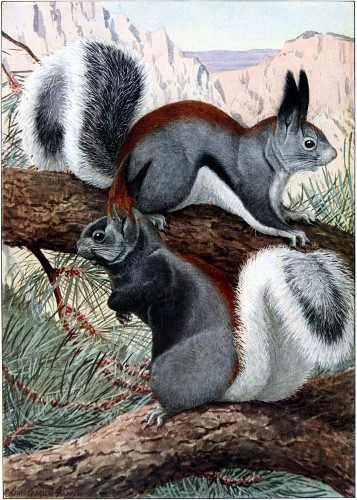
ABERT SQUIRREL
Sciurus aberti
KAIBAB SQUIRREL
Sciurus kaibabensis
While at a summer camp I once saw one of
these chipmunks give an exhibition of the exquisitely
keen power of scent which must be
necessary to recover scattered stores. The
chipmunk had been coming repeatedly down a
wooded slope in full view for twenty-five yards
or more to the floor of the porch for food
supplied by the campers. While it was absent
carrying food to its burrow I placed a few nut
meats on the flat top of a stump about fifteen
feet to one side of the porch and farther away
than the point where the chipmunk was being
fed bread crumbs. On its return several
minutes later, instead of going as usual to the
porch, it ran directly to the stump, climbed
up it, and promptly made off with the nuts,
which it had evidently located from afar. They
sometimes climb beeches and other trees to
gather nuts even to a height of fifty or sixty
feet, and are commonly seen on low limbs and
in bushes.
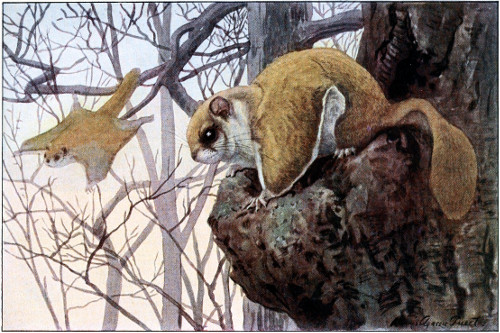
FLYING SQUIRREL
Glaucomys volans
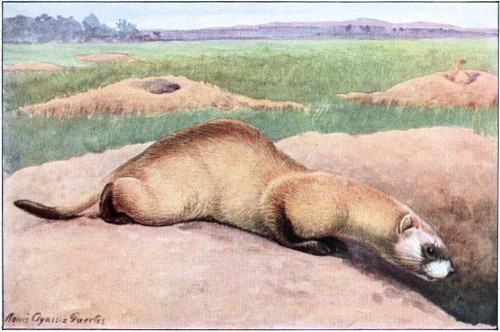
BLACK-FOOTED FERRET
Mustela nigripes
The entrances to the burrows are usually
under logs, roots, or rocks, or the den may be
in a hollow log, stump or base of a tree, or
even under a cabin in the woods. The burrows
in the ground are commonly a series of tunnels
some yards in length, with an oval nest and
storage chamber two or three feet underground,
and with branches from the main
passageway. The nest chamber, a foot or
more in diameter, is filled with fragments of
dry leaves and other soft vegetable material.
One chamber is usually used for sanitary purposes.
The used entrance hole is commonly
without a sign of dug earth about it, the loose
soil from the burrow and its chambers apparently
having been thrown out at another
opening, which appears to be used for this
purpose only and is kept plugged with earth.
Throughout most of the northern half of its
range these chipmunks usually hibernate from
some time in October until March. Their
hibernation is far less profound than that of
the woodchuck and they not infrequently appear
above ground during periods of mild
weather, even in midwinter. The hibernating
period is shorter in the southern part of the
range.
They vary much in numbers from year to
year and at times appear to increase suddenly
in localities where food is plentiful, indicating
a probable food migration. The young, numbering
from four to six in a litter, are born at
varying times between the last of April and
late summer, indicating the possibility of more
than one litter a season.
The most characteristic note of this chipmunk
is a throaty chuck, chuck, which is ordinarily
used as a call note, but which in spring
is uttered many times in rapid succession to
express the seasonal feeling of joy and well
being, thus taking on the character of a song.
Such joyful notes may be heard on every
hand in places where the little songsters are
numerous. In addition, they have a high-pitched,
chirping note and a small churring whistle
when much alarmed.
(For illustration, see page 543)
The resident species of birds and mammals
in the humid coastal region of Oregon, Washington,
and southern British Columbia are
strikingly characterized by their darker and
browner colors in comparison with closely related
species in more arid districts.
The Oregon chipmunk is one of the common
species showing marked response to these local
climatic conditions and is the darkest of all
the many species of chipmunks in the Western
States. This chipmunk is one of several geographic
races into which the species is divided
by changing environment. The species, as a
whole, ranges along the west coast from British
Columbia to Lower California, and the races at
the extremes of the line differ much in color.
As befits a habitant of the humid forested
region, the Oregon chipmunk is robustly built
and distinctly larger than the other chipmunks
of the Western States. It is common and generally
distributed throughout this region, occurring
from among the drift logs along the ocean
beach to above timberline on the Cascade
Mountains. Within these limits it frequents
almost every variety of situation. It occurs in
the midst of gloomy forests of giant spruces,
cedars, and firs, but is particularly fond of old
fences and brush patches on the borders of
farm clearings in the valleys as well as the
vicinity of rocky ledges, brush piles, and fallen
timber, where the low thickets offer a variety
of food-bearing plants and ready shelter.
On the mountains it is most numerous about
rock slides and “burns” or other openings in the
forest. Several pairs usually haunt the vicinity
of old sawmills and of mountain cabins. Like
others of their kind, they are alert and vivacious,
varying in mood from day to day, but
always interesting. At times they are excessively
shy and retiring, and a person might
spend a day in their haunts without seeing
or hearing one, although it is safe to say that
the intruder had been seen and every foot of
his progress noted by the chipmunks. On another
day, perhaps because the sun shines more
brightly and nature is in a happier mood, the
animals appear on all sides. Their slowly repeated
sociable chuck, chuck, is heard from the
depths of the brushy covert as well as from the
tops of stumps, logs, rocks, or other lookout
points where they sit to view their surroundings.
If alarmed they utter a sharp, birdlike
chirping note as they vanish in the nearest
shelter. As one moves about in their haunts
he may now and then see one appear for a
moment above the undergrowth in a tall bush,
on top of a stump, and sometimes even mounting
a few yards up a tree trunk to observe the
cause of the disturbance, only to vanish quickly.
They are always skirmishing for food, and
carrying it in their cheek pouches to hidden
stores. On the approach of winter this activity
becomes very marked. A surprising variety of
fruits and seeds are eaten and stored, among
them the salmonberry, red elderberry, black-capped
raspberry, thimble berry, blackberry,
blueberry, gooseberry, thistle seed, dogwood
seed, hazelnuts, acorns, and others. They have
favorite feeding places, such as the top of a
stone or stump or the shelter of a log where
they carry nuts or other seeds. These places
are always marked by little piles of empty shells
or chaff from seeds. About ranches they raid
grain fields and other crops, sometimes in numbers
sufficient to do considerable damage.
In sheltered spots they make underground
burrows with nest chamber and store-rooms excavated
along the passages. They usually retire
to these dens to hibernate during the last
of September or first of October, and appear
again about March or April, often long before
the snow disappears. During fall and early
winter they are sometimes seen running about
over newly fallen snow. One which was dug
from its winter quarters in British Columbia
the last of November would move about slowly
and sleepily if teased, but when left undisturbed
would curl up and go to sleep again.
This indicates the difference between the light
and often broken hibernation of chipmunks and
the deep lethargy which possesses ground
squirrels in the North at this time. Toward
the southern end of their ranges neither chipmunk
nor ground squirrel hibernates. They
mate soon after they awake from their winter
sleep, and the young, two to five or six in
number, are born from April to June. Whether
more than one litter is born during a season,
is, like many other details concerning the lives
of these attractive animals, still to be learned.
(For illustration, see page 543)
The preceding sketch tells how the Oregon
chipmunk, living under a cool, humid climate,
in a region of great forests, has responded to
its environment by developing dark colors and
a robust physique. The painted chipmunk of
the Great Basin has given an equally perfect
response to entirely different conditions. It is
one of the geographic races of a species peculiar
to the sagebrush-covered plains and hills
from the Dakotas across the Rocky Mountains
and the Great Basin region to the east slope
of the Cascades and the Sierra Nevada. Its
home is on treeless plains, in a climate characterized
by brilliant sunshine and clear, dry
air. In this environment the painted chipmunk
has developed a smaller and slenderer body
than the Oregon species, and strikingly paler
colors.
These differences in physique are accompanied
by equal differences in mental and
physical expression. These little animals are
exceedingly alert and agile, darting through
dense growths of bushes with all the easy grace
of weasels. When running they hold the tail
stiffly erect. When alarmed they utter a shrill
chippering cry, especially when darting into
shelter. They also have a chucking call, uttered
at intervals, which may be used merely as a
note of sociability or to put their neighbors on
the alert.
Although one of the most distinctive animals
of the sagebrush plains, this chipmunk also
ranges into the borders of open forests on the
mountain sides. It is most numerous on flats
and foothill slopes among heavy growths of
sage and rabbit brush. When its territory is
invaded by settlers it does not hesitate to gather
about the borders of fields and even to raid
barns in search of grain and other food. Its
burrows are dug under large sagebrush and
other bushes and under rocks and similar
shelter.
As with others of their kind, painted chipmunks
habitually gather seeds of many plants
and carry them in their cheek pouches to their
underground dens. In addition to seeds and
green vegetation, they eat any fruits growing in
their haunts, and also many insects, especially
grasshoppers and larvae. In one locality in
Nevada during June and July more than half
their food consisted of a web worm and its
chrysalids with which the sage bushes swarmed.
The chipmunks climbed into the bushes and
pulled the larvæ from the webs. As half the
bushes were infested, the work of the many
chipmunks had a material effect in reducing
the numbers of this pest. The vegetable food
eaten includes the seeds of Ribes, Kuntzia,
Sarcobatus, pigweed, and many other weeds,
serviceberry, various grasses, oats, wheat, and
the seeds of small cactuses. They regularly
climb into the tops of large sage and other
bushes for their seeds and the ground beneath
is often covered with the small sections of
twigs cut by them. They climb readily and
often travel from bush to bush through tall
thickets like squirrels in tree-tops. On warm
mornings after frosty nights they may be seen
in the tops of the bushes basking in the sun.
Throughout most of their range they begin
hibernation in September or October, and reappear
early in spring. The young appear a
month or more later, and litters containing
from two to six may be born throughout the
summer, indicating the possibility that several
litters may be born to the same pair in a season.
So alert and shy are they that even a person
in their haunts day after day will see but few
of them. Their hearing is extremely acute, and
even at a great distance the footsteps of an intruder
sets them all on the alert. On every
side they run swiftly to cover before the observer
has opportunity to see them. In such
places a large setting of baited traps will reveal
their presence in surprising numbers. In
one locality, during a brief visit, traps set
among the brush for other small mammals
yielded more than forty chipmunks.
On stormy and cloudy days, especially if the
weather is cool, painted chipmunks remain in
their dens, but on mild sunny days they frisk
about with amazingly quick darting movements.
A horseman riding along a road leading
through a sagebrush flat will frequently see
them racing across the road often several hundred
yards away, the sound of the horse’s footfalls
having alarmed the chipmunks over a
wide area. Here and there one may be seen
climbing hastily to the top of a tall bush to
take a look at the cause of alarm before finally
seeking concealment. When pursued among
the bushes they often run considerable distances
before taking refuge in a burrow. When hard
pressed they will enter the first opening encountered,
but if it is not its own home the
fugitive soon comes out and scampers away,
apparently fearful of the return of the owner
or perhaps owing to his presence.
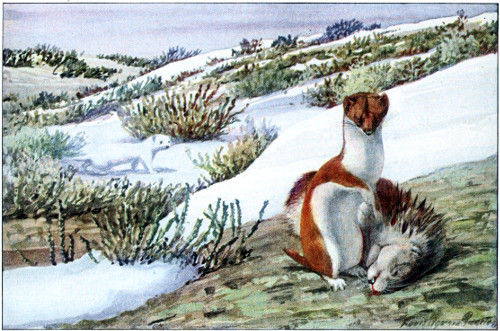
Winter
Summer
LEAST WEASEL
Mustela rixosa
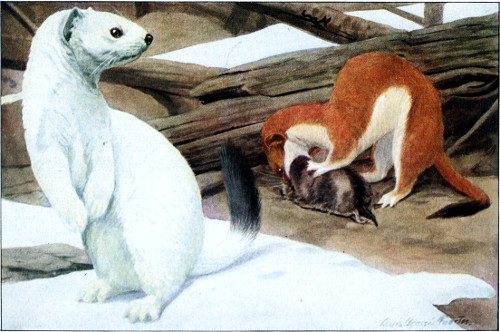
LARGE WEASEL, or STOAT (Winter and Summer)
Mustela arcticus
Apparently, as in the case of many other
desert mammals, the painted chipmunk, with its
related races, is able to subsist without drinking,
since it is often seen far out on arid plains
many miles from the nearest water.
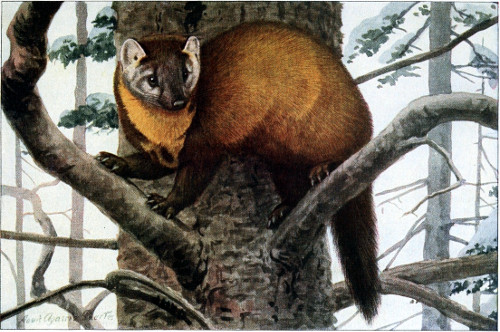
MARTEN, or AMERICAN SABLE
Martes americana
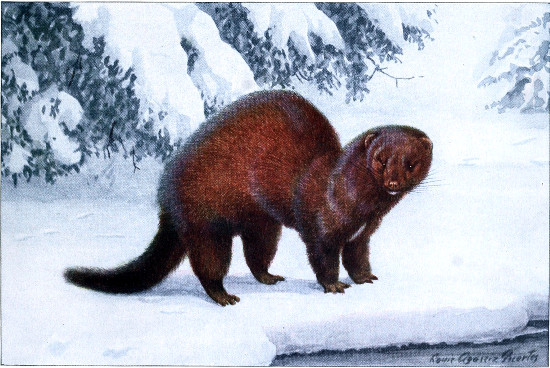
AMERICAN MINK
Mustela vison
As with all its kind, the world of the painted
chipmunk is filled with imminent peril of sudden
death. Overhead, gliding on silent pinions,
are hawks of several species, while on the
ground snakes, weasels, badgers, bobcats, foxes,
and coyotes are ever searching for them as prey.
(For illustration, see page 546)
Every one who has visited the forests of
Canada and northeastern United States knows
the vivacious, rollicking, and frequently impudent
red squirrel. This entertaining little
beast, known also as the pine squirrel and
chickaree, has little of that woodland shyness
so characteristic of most forest animals. It
often searches out the human visitor to its
haunts and from a low branch or tree trunk
sputters, barks, and scolds the intruder, working
itself into a frenzy of excitement. This
habit, combined with the rusty red color and
small size of the animal, about half that of
the gray squirrel, renders its identity unmistakable.
It has distinct winter and summer
coats, but in both the rusty red prevails. The
winter dress is distinguished, however, by small
tufts on the ears.
The red squirrel, with its related small species,
occupying most of the wooded parts of North
America north of Mexico, forms a strongly
characterized group, with no near kin among
the squirrels of the Old World. In its geographic
races it ranges through the forests of
all Alaska and Canada and south to Idaho,
Wyoming, the Dakotas, Wisconsin, northern
Indiana, all the Northeastern States to the District
of Columbia, and along the Alleghenies
to South Carolina. Owing to its small size,
this animal, like the chipmunk, is considered
too small for game, although occasionally
hunted for sport. As a consequence its increase
or decrease is usually governed by the
available food supply, although man interferes
locally when it becomes too destructive.
This squirrel shows a strong preference for
coniferous forests, whether of hemlock, spruce,
fir, or pine, but may be common in woods
where conifers are few and widely scattered.
Although usually diurnal and busily occupied
from sunrise until sunset, it sometimes continues
its activities during moonlight nights,
especially when nuts are ripe and it is time to
gather winter stores. During warm, pleasant
days in spring and fall, when the nights are
cool, it often lies at full length along the tops
of large branches during the middle of the day,
basking in the grateful warmth of the sun.
The nests, which are located in a variety
of situations, are made of twigs, leaves, or
moss, and lined with fibrous bark and other
soft material. Some are in knot-holes or other
hollows in trees, others may be built outside
on limbs near the trunk, and still others are
in burrows made in the ground under roots,
stumps, logs, brush heaps, or other cover offering
secure refuge. Apparently several litters,
of young, containing from four to six, are
born each season, as they have been found
from April to September.
They do not hibernate, but are active throughout
the year, except during some of the coldest
and most inclement weather. To provide
against the season of scarcity, they accumulate
at the base of a tree, under the shelter of a
log, or other cover, great stores of pine, spruce,
or other cones, sometimes in heaps containing
from six to ten bushels. They also hide scattered
cones here and there and place stores of
beechnuts, corn, and other seeds in hollows or
underground store-rooms. They are fond of
edible mushrooms and sometimes lay up half
a bushel of them among the branches of trees
or bushes to dry for winter use. In the western
mountains their great stores of pine cones
are often robbed by seed-gatherers for forestry
nurseries. In winter they tunnel through the
snow to their hidden stores and sometimes
continue the tunnels from one store to another.
Each squirrel makes its home for a long
period in or about a certain tree. There he
carries his cones to extract the seeds, and on
the ground beneath it the accumulation of
fallen scales and centers of cones sometimes
amounts to fifteen or twenty bushels. In addition
to the seeds of the various conifers, red
squirrels eat many kinds of fruits and seeds;
they also raid cornfields and orchards and even
make nests in barns and woodsheds to be near
the food supply which some farmer’s industry
has collected.
Red squirrels have the interesting habit of
voluntarily swimming streams and lakes, including
such bodies of water as Lake George
and even the broadest parts of Lake Champlain.
When they thus cross the water and
make their migrations, there is little doubt that
they are usually in search of a better feeding
ground.
The red squirrels and related species have the
greatest variety of notes possessed by any of
the American members of the squirrel family.
In addition to the barking, scolding, chattering
notes already mentioned, they have a real song,
which is one of the most attractive of woodland
notes. It is a long-drawn series of musical
rolling or churring notes, varied at times by
cadences and having a ventriloquial quality
rendering it difficult to locate. These notes
never fail to awaken pleasurable emotions and
to recall to me my early boyhood in the Adirondacks,
where the spring songs of the chickarees
were among the first calls which awakened
me to the marvelous beauties of nature.
The worst trait of the red squirrel and one
which largely overbalances all his many attractive
qualities is his thoroughly proved habit
of eating the eggs and young of small birds.
During the breeding season he spends a large
part of his time in predatory nest hunting, and
the number of useful and beautiful birds he
thus destroys must be almost incalculable. The
number of red squirrels is very great over a
continental area, and one close observer believes
each squirrel destroys 200 birds a season.
Practically all species of northern warblers,
vireos, thrushes, chickadees, nuthatches,
and others are numbered among their victims.
The notable scarcity of birds in northern forests
may be largely due to these handsome but
vicious marauders.
In the fur country these squirrels are much
disliked by the trappers for their constant interference
with meat-baited traps. Many fall
victims to their carnivorous desires, but their
places are soon taken by others.
The energy and unfailing variety in the performances
of red squirrels always keep the
attention of their human neighbors. Among
other interesting activities, their pursuit of one
another up and down and around the trunks
of trees, over the ground, along logs, back and
forth in the most reckless abandon, is most
entertaining to watch. These pursuits among
the young are playful and harmless, but among
the males in spring are of the most deadly
character. I have seen the victim go up and
down tree after tree, shrieking in fear and
agony and leaving a trail of blood on the snow
as he tried to escape his truculent pursuer.
Such scenes as this, combined with our knowledge
of its bird-killing habits, appear belied by
the exquisite grace and beauty of this squirrel
as it sits on a branch and sends its musical
cadences trilling through the primeval forest.
So confirmed are red squirrels in the destruction
of bird life, however, they should not be
permitted to become very numerous anywhere
and it may eventually become necessary to
outlaw them wherever found.
(For illustration, see page 546)
In all details of size, form, notes, and habits
the Douglas squirrel gives testimony to its descent
from the same ancestral stock as the common
red squirrel (Sciurus hudsonicus). The
typical Douglas squirrel, represented in the accompanying
illustration, is one of several geographic
races of a species which ranges from
the Cascades and Sierra Nevada to the Pacific,
and from British Columbia south to the San
Pedro Martir Mountains of Lower California.
The home of the Douglas squirrel is amid the
wonderful coniferous forests of western Oregon,
Washington, and southern British Columbia.
As in other mammals of this extremely
humid region, the colors of its upperparts are
dark brown, in strong contrast to the much
paler and grayer colors of the closely related
subspecies living in the clearer and more arid
climate of the Sierra Nevada in California.
These squirrels are known locally by a variety
of common names, including pine squirrel, redwood
squirrel, and “drummer.”
Although usually not quite so noisy and self-assertive
as the irrepressible little red blusterer
of eastern forests, the Douglas squirrel is also
notable for its rollicking, chattering character
and sometimes cannot be outdone in its amusing
displays of aggressive impudence. When
the animals are numerous the air at times resounds
with their call notes or songs, one
answering the other, now near and now far,
until the somber depths of the mighty forest
seems peopled with a multitude of these joyous
furry sprites. Their song, resembling that of
the red squirrel, is a rapid trilling or bubbling
series of notes, long drawn out and sometimes
varied by cadences. It is so musical that
it seems more like the song of some strange
bird than of a mammal. When these squirrels
are not common they are much less given to
song and seem subdued and shy, as though impressed
by the vast loneliness of their deep
forest haunts.
At mating time, early in spring, they are
especially noisy, and again in summer when the
first litter of young are out trying their youthful
pipes in expression of their cheerful well
being. They frequently come down on a low
branch or on the trunk of a tree and chatter,
bark, and scold at man, dog, or other intruder,
now rushing up and down, or making little
dashes around the tree trunk, their necks outstretched
and tails flirting with a great show
of anger and contempt highly entertaining to
see. They are restlessly active at all seasons
of the year and habitually chase one another
through the forest with an appearance of rollicking
fun which may many times be in more
deadly earnest than appears to the casual observer.
In winter their tracks in the snow lead from
tree to tree, along the tops of logs and fences,
and in all directions to hidden stores of food,
which they appear to be able to locate with
unerring certainty under the snow. An adventurous
spirit leads them to race away from
the forest, along fence-tops, to pay visits to
ranch buildings and even to villages and small
towns. Like their eastern relative, the Douglas
squirrels are omnivorous, feeding on the seeds
of all the conifers in their range, including
spruces, firs, pines, and redwoods, and also
upon acorns, and a great variety of other seeds,
fruits, and mushrooms, insects, birds’ eggs,
young birds, and any other meat they can find.
Owing to their habit of interfering with meat-baited
traps, they are a nuisance to trappers.
They frequently visit orchards and carry off
apples and pears, from which they extract the
seeds. They have been seen also to visit the
wounds made on a willow trunk by sapsuckers
to drink the flowing sap. Their feet and the
fur about their mouths are often much gummed
with pitch from working on pine cones.
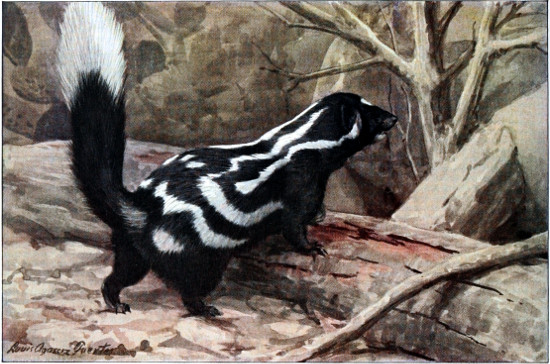
LITTLE SPOTTED SKUNK
Spilogale putorius
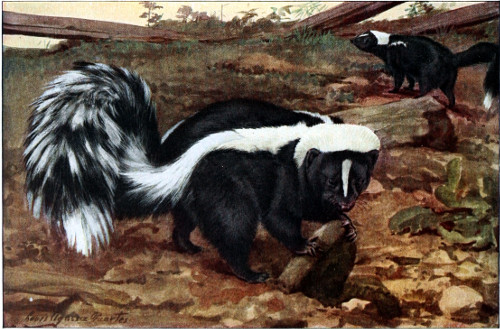
COMMON SKUNK
Mephitis mephitis
In many places the soft, moist earth in the
woods is riddled with little pits dug by these
squirrels apparently when they are after larvæ
or perhaps edible roots. Throughout the summer,
but especially during the last half of the
season, and in autumn Douglas squirrels work
with persistent energy to amass great stores
of seed-bearing cones, which they heap, sometimes
bushels of them, about the bases of trees,
stumps, and the upturned roots of fallen trees
or under other shelter. Cones are also buried
here and there in the loose leaves and humus.
In winter many holes in the snow with piles
of cone scales at the entrances show where the
owners have dug down to their stores.
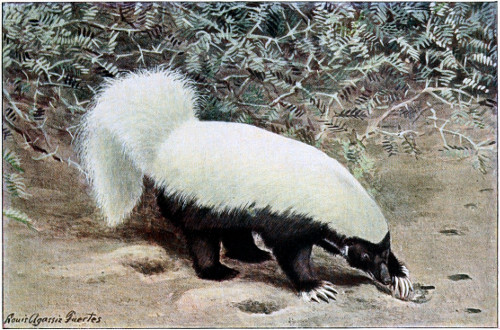
HOG-NOSED SKUNK
Conepatus mesoleucus
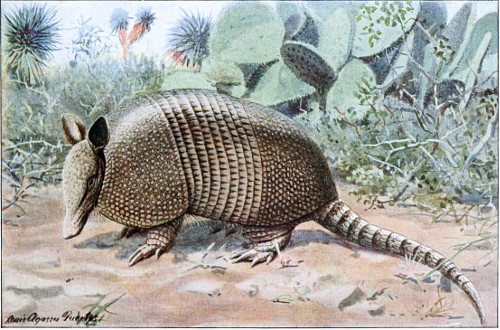
NINE-BANDED ARMADILLO
Dasypus novemcincta
Some of their nests are constructed in hollow
trees, many others on branches near their
junction with the trunks, and still others in
underground dens under roots, logs, or stumps.
In winter when alarmed these squirrels sometimes
race down the tree trunks and take
refuge in holes leading through the snow to
their food caches and underground burrows.
The nests built in tree-tops are usually rather
bulky, measuring a foot or more in diameter,
and are made of small twigs, dry leaves, moss,
grass, and fibrous bark. They are commonly
lined with such soft material as feathers and
fur. The young, numbering three to seven at
a litter, are born at any time between April
and October.
The extraordinary intelligence and sense of
prevision possessed by squirrels of this group
is well illustrated by certain local food migrations.
These have been observed in eastern
Oregon in years when the cone crop has failed
and nothing was available to lay up for winter.
Under such conditions to remain in the mountain
forests would mean death by starvation
before winter had fairly begun. In 1910 and
1913 failure of the cone crop occurred in eastern
Oregon and these squirrels promptly left
the mountain forests in September and descended
along creek courses to the open sagebrush
plains as much as seven or more miles
from the border of their ordinary haunts. In
this open country they wintered successfully,
raiding the farmers’ grain bins, root cellars,
and other stores, and otherwise showing their
supreme fitness to survive in the struggle for
existence. With the coming again of summer
they promptly returned to their abandoned
homes in the pines. It appears to be one of
the marvels of animal intelligence that under
such circumstances as those named above the
entire body of the squirrels on the mountains
should have known what to do, especially as
a great percentage of their number could never
have had any previous experience as a guide.
(For illustration, see page 547)
The gray squirrel is so well known to everyone
in the Eastern States that it scarcely needs an
introduction. Many who have not seen it in its
native haunts are familiar with it as a graceful
and charming resident of parks in many cities.
It is about twice as large as the red squirrel
and intermediate in size between that species
and the fox squirrel. Although sharing some
of the range of both the species named, the
color of the gray squirrel at once distinguishes it.
The gray squirrel is a North American
species with no near relative in the Old World;
on the Pacific coast, in the mountains of the
Southwest, and in Mexico are other squirrels
having much the same gray-colored body, but
with no close relationship to it. Its range
covers the deciduous forests of the Eastern
States and southern Canada from Nova Scotia
to Florida, and westward to the border of the
treeless Great Plains. Wherever they occur
these squirrels are an attractive element in the
woodland life, their barking and chattering,
their graceful forms, and their activity adding
greatly to the cheerful animation of the forest.
They are far less vociferous than red squirrels,
but their notes are varied and serve to express
a variety of meanings.
During the early settlement of the country
west of the States bordering the coast, gray
squirrels existed in great numbers and often
made ruinous inroads on the pioneer corn and
wheat fields. In 1749 they invaded Pennsylvania
in such hosts that a bounty of three pence
each was put on their scalps. Eight thousand
pounds sterling was paid on this account, which
involved the killing of 640,000 squirrels. In
1808 a law in force in Ohio required that each
free white male deliver 100 squirrel scalps a
year or pay $3 in cash. Records of the ravages
of these squirrels in corn fields are extant also
from Kentucky, Missouri, and other States.
Enormous migrations of gray squirrels from
one part of the country to another occurred in
those days, caused apparently by the failure of
food supplies in the deserted areas. Some impulse
to move in one general direction at the
same time appeared to affect the squirrels and
they swarmed across country in amazing numbers,
carrying devastation to any farms crossed
on the way. When engaged in such movements
they appeared indifferent to obstacles
and without hesitation swam lakes and streams
even as large as the Hudson and the Ohio.
Amusing legends grew up concerning these
migrations, one of which avers that when the
squirrels arrived on a river bank each dragged
a large chip or piece of bark into the water
and mounting it raised its bushy tail in the
breeze and was wafted safely to the other
shore! As a fact, many were drowned in crossing
large streams and others arrived exhausted
from their exertions.
The gray and fox squirrels were favorite
targets for pioneer marksmen. The early
chronicles tell of the ability of Daniel Boone
and other riflemen to “bark” a squirrel, which
meant so to cut the bark of the branch on which
the squirrel sat as to bring it to the ground
stunned without hitting the animal. With the
clearing away of the forests, the general occupation
of the country, and the decrease of
larger animals, gray squirrels have been deprived
of most of their haunts and have become
such desirable game that they have decreased
to a point requiring stringent legal
protection to save them from extermination.
Gray squirrels are more thoroughly arboreal
than red squirrels and make their nests either
in hollow trunks or build them in the tops of
trees. These outside nests are common and
much like a crow’s nest in appearance except
that they are generally more bulky and show
more dead leaves. They are built on a foundation
of small sticks with a rounded top of
leaves, and are lined with shreds of bark, moss,
and similar soft material. In the extreme
northern part of their range they live mainly
in hollow trees, but farther south many winter
in outside nests. During severe cold and in
stormy weather they remain hidden, sometimes
for days at a time.
They have two litters of four to six young
a year, the first usually being born in March
or April. The old squirrel is a devoted mother
and if the nest is disturbed she will at once
carry the young to some safer retreat.
In many parts of their range black, or melanistic,
individuals are born in litters otherwise
of the ordinary gray color. In some districts
the number of the black squirrels equals or
exceeds the gray ones.
Gray squirrels range through such a variety
of climatic conditions that their food varies
greatly. They eat practically all available nuts,
including acorns, chestnuts, beechnuts, hickory-nuts,
and pecans, besides numberless seeds,
many small fruits, and mushrooms. They raid
fields for corn and wheat, and steal apples, pears,
and quinces from orchards to eat the seeds.
Like most other small rodents, they are fond of
larvæ and insects and also destroy many birds’
eggs and young birds. They are far less serious
offenders, however, in destroying birds
than the red squirrel.
On the approach of winter they lay up stores
of seeds and nuts in holes in trees and in little
hiding places on the ground. Many nuts are
hidden away singly. In the public parks of
Washington, where many gray squirrels exist,
I have repeatedly seen them dig a little pit
two or three inches deep, then push a nut well
down it cover it with earth, which they press
firmly in place with the front feet, and then
pull loose grass over the spot. One squirrel
will have many such hidden nuts, and with
nothing to mark the location it appears impossible
that they could be recovered. That
the squirrels knew what they were doing I
have had repeated evidence in winter, even with
several inches of snow on the ground, when
they have been seen sniffing along the top of
the snow, suddenly stop, dig down and unearth
a nut with a precision that demonstrates
the marvelous delicacy of their sense of smell.
Although mainly diurnal, they are sometimes
abroad on moonlight nights, especially when
gathering stores of food for winter.
Wherever they are, these squirrels are extremely
graceful, moving along the ground by
curving bounds, the long fluffy tail undulating
as they go, or running through the tree-tops,
leaping from branch to branch with an ease
and certainty beautiful to see. When pressed
they make amazing leaps from tree to tree or
even from a high tree-top to the ground without
injury. They are extremely cunning at
concealing themselves by lying flat on top of
branches or by gliding around tree trunks, keeping
them interposed between themselves and
the pursuer.
Gray squirrels are so responsive to protection
that they may continue to grace our remaining
forests if we properly guard them. In
addition to their beauty, they are interesting
game animals which should continue to afford
a moderate amount of sport—sufficient to prevent
them from becoming overabundant and
destructive. Now introduced in many city
parks throughout the United States and in
parts of England, including London, their ready
acceptance of people as friends renders them
charming animals in such places; but natural
food is so scarce under these artificial conditions
that care must be taken to feed them at
all seasons, especially in winter.
(For illustration, see page 547)
(For illustration, see page 547)
Three species of tree squirrels inhabit the
varied forests of eastern North America, each
having its marked individuality expressed in
color, size, and habits. All occupy a wide territory
with varying climatic conditions, to which
each species has responded by becoming modified
into a series of geographic races, or subspecies.
The red and the gray squirrels have
already been described and it remains to give
an account of the largest and in some respects
the most remarkable of the three, the fox
squirrel.
No other species of North American mammal
can show such an extraordinary contrast
in color among its subspecies as that between
the rusty yellowish animal of the Ohio and
upper Mississippi Valleys, and the handsome
blackish one of the Southeastern States, both
of which are pictured in the accompanying
illustration.
The distribution of the fox squirrel is limited
to the forested parts of the Eastern States.
There it ranges from the Atlantic coast to the
border of the Great Plains, and from southern
New York and the upper Mississippi Valley
southward to Florida, the Gulf coast, and across
the lower Rio Grande into extreme northeastern
Mexico.
Variations in the character of the haunts of
the different subspecies of this squirrel almost
equal their differences in color. In the upper
Mississippi and Ohio Valleys the rusty-colored
race frequents the upland woods, where the
nut-bearing hickory trees characterize the forests.
In the South the dark-colored squirrels
have more varied homes, either amid the live
oaks draped in long Spanish moss, in the mysterious
cypress forests of the swamps, or out
in the uplands among the southern pines.
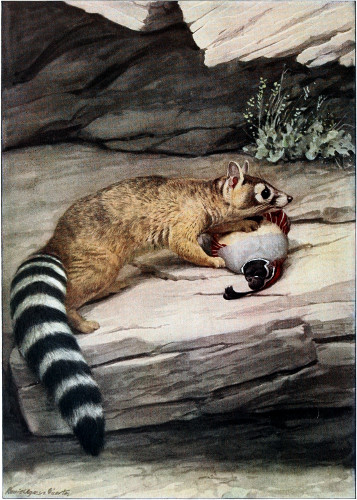
RING-TAILED CAT
Bassariscus astutus
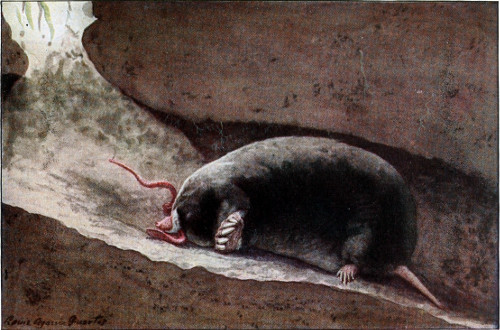
OREGON MOLE
Scapanus townsendi
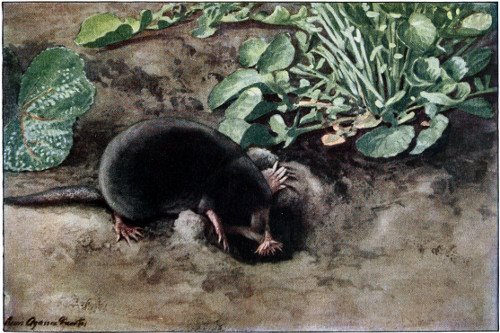
STAR-NOSED MOLE
Condylura cristata
In early days fox squirrels were plentiful,
but never equaled the numbers of the gray
squirrel. They appear always to have been
more closely attached to their own district, for
we have no records of the great migrations so
notable in the other species.
Fox squirrels are not only distinguished from
gray squirrels by their color, but are also nearly
twice their size, commonly attaining a weight
of two and sometimes nearly three pounds.
They are the strongest and most heavily proportioned
of all American squirrels. A deliberation
of movement going with heaviness
of body is in marked contrast to the graceful
agility of most other tree squirrels. On the
ground they walk with a curiously awkward,
waddling gait, and even when hard pressed
climb trees with none of the dashing quickness
shown by other species. They often move
about on the ground by a series of bounds, and
at such times, with broad, feathery tails undulating
in the air, present a most graceful and attractive
sight.
Fox and gray squirrels occupy the same districts
throughout most of their ranges, but
often become so segregated locally that the
grays may be found almost exclusively along
bottom-lands and the fox squirrels on the higher
ridges, but there is no hard and fast separation
of haunts and the two forms usually share the
same woodlands.
Much time is spent by fox squirrels on the
ground searching for food. When danger approaches,
in place of promptly taking refuge in
a tree, as is a common habit with most tree
squirrels, they retreat along the ground, mounting
a stump or log now and then, to look back
at a suspected intruder, whose footsteps they
can hear at a long distance. If the hunter is
without a dog they may run away and be lost.
A dog soon forces them up a tree and if a
knot-hole or other hollow is available they at
once take refuge in it. Otherwise they hide
skillfully in bunches of leaves high in the top
or lie flat on a limb or against the trunk, slyly
moving to keep on the opposite side as the
hunter draws near. In the Mississippi Valley
during the crisp days when the hickory nuts
are falling and the trees are decked in all the
glories of autumn foliage, few sports afield
yield more pleasurable sensations than fox-squirrel
hunting.
The fox squirrels become fatter than most of
their kind and their flesh is not so dry, although
all furnish appetizing meat. Owing to
their size and the quality of their flesh, they
have been such desirable game animals that with
the constantly growing number of hunters and
the destruction of forests they have already
disappeared from large areas where formerly
abundant and are in real danger of extermination
in the not-distant future. They are among
the most notable and attractive of the forest
animals in the Eastern States, and before it is
too late every effort should be made to protect
them from overshooting. With reasonable conservation
they will continue to thrive and keep
some of the old-time primitive spirit in our
woods. Formerly they had the same predilection
as the gray squirrel for the farmers’ corn
fields and were under the ban, but their numbers
are now so reduced that they give little
trouble in this way. In some city parks where
they have been introduced, they soon become
tame and do well, except that in losing their
fear of man they become subject to many accidents.
Fox squirrels, like many others of their kind,
have homes both in knot-holes or other hollows
in tree trunks, and in bulky nests of sticks and
leaves high up among the branches. Both kinds
of nesting places are often located in the same
tree, the owner living in the outside nest in
warm weather and retiring to the shelter of
the hollow trunk in severe weather or to escape
an enemy. The young, two to four in number,
are usually born in March or April, and it is
not definitely known whether there is a second
litter. These squirrels have a barking call as
well as several other rather deep-toned chucking
notes.
They are as omnivorous as any of their kind,
eating many kinds of nuts, seeds, fruits, mushrooms,
insects, birds, birds’ eggs, and other
flesh food when available. The principal nuts
in their haunts are hickory-nuts, beechnuts,
walnuts, pecan nuts, and the seeds of pines
and cypresses. Toward the end of summer and
in fall they work busily gathering and storing
food for winter in hollow trees, in old logs,
about the roots of trees, and in any other snug
place where it may be kept safely until needed.
Many single nuts are buried here and there in
little pits three or four inches deep dug in the
soft surface of the earth under the trees. These
scattered stores are located when needed by
the acute sense of smell which the owners
possess.
(For illustration, see page 550)
(For illustration, see page 550)
Among the many kinds of squirrels which
lend animation and charm to the forests of
North and South America, none equal in beauty
the subjects of this sketch—the Abert and the
Kaibab squirrels. These are the only American
squirrels endowed with conspicuous ear tufts,
which character they share with the squirrels
occupying the forests in the northern parts of
the Old World from England to Japan. In
weight they about equal a large gray squirrel,
but are shorter and distinctly more heavily proportioned,
with broader and more feathery tails.
Their range covers the pine-forested region
of the southern Rocky Mountains in the United
States and the Sierra Madre of western Mexico.
The Abert squirrel and its several subspecies
is the more widely distributed, being
found from northern Colorado, south through
New Mexico, Arizona, Chihuahua, and Durango.
The Kaibab squirrel, which is even
more beautiful than its relative, shows marked
differences in appearance and yet is evidently
derived from the same species.
The typical Abert squirrel lives in the pine
forests along the southern rim of the Grand
Canyon in northern Arizona, and the Kaibab
squirrel lives in the pines visible on the northern
rim of the canyon less than 15 miles away.
It is confined to an islandlike area of pine
forest above 70 miles long by 35 miles wide, on
the north side of the canyon, on the Kaibab
and Powell plateaus, directly across from the
end of the railroad at the Grand Canyon Hotel.
The two species live under practically identical
conditions as to vegetation and climate.
In these sketches of our mammal life I have
repeatedly noted the effect of changing environment
in modifying the animals subject to it.
In the present case the change in the squirrels
on the north side of the Grand Canyon has
evidently been brought about by that powerful
factor in evolution known as isolation. Cut off
from their fellows by the deepening canyon of
the Colorado, Kaibab squirrels have occupied
a forest island ever since, with the resulting
change in characters we now have in evidence.
The home of both the Abert and the Kaibab
squirrels is almost entirely between 6,000 and
9,500 feet altitude, on the mountain slopes and
high plateaus overgrown with a splendid open
forest of yellow pine mixed in many places
with firs and aspens. Occasionally, as food becomes
scarce in their ordinary haunts, they
range up into the firs or down into the oaks
and piñon pines. In winter their haunts are
buried in snow, but in summer on every hand
present lovely vistas among the massive tree
trunks, varied here and there by gemlike parks.
Everywhere the ground is covered with grasses
and multitudes of flowering plants. In the
wilder parts of this fascinating wilderness
roam bears, mountain lions, wolves, deer, and
wild turkeys, and only a few decades ago still
wilder men, belonging to some of our most
dreaded Indian tribes.
Although these squirrels commonly make use
of large knot-holes or other hollows in trees,
they regularly build high up in the branches
bulky nests of leaves, pine needles, and twigs
and line them with soft grass and shredded
bark. Sometimes several full-grown squirrels
may be found occupying one of these outside
nests, probably members of one family. They
are active throughout the year, but remain in
their nests during storms and severe winter
weather. In northern Arizona I have known
them to stay under cover for a week or two at
a time in midwinter.
The young appear to be born at varying
times between April and September. Although
not definitely known, it seems probable that they
have two litters of from three to four young
each season.
The seeds and the tender bark from the
terminal twigs of the yellow pine (Pinus ponderosa)
furnish their principal food supply. During
periods when pine seeds are not available
the squirrels cut the ends of pine twigs, letting
the terminal part bearing the leaves fall to the
ground, while the stem, several inches in length,
is stripped of bark. Often at times of food
scarcity the bark will be eaten for a considerable
distance along the outer branches, almost
like the work of porcupines. The ground under
the pines where the squirrels are at work is
sometimes almost covered with the freshly
dropped tips of branches.
The Abert squirrels also eat the seeds of
Douglas spruce, of the piñon pine, acorns, many
seeds, roots, green vegetation, mushrooms,
birds’ eggs, and young birds. Now and then
they rob cornfields planted in clearings, but
they do little damage to crops. Some years
they are extremely numerous and are in evidence
everywhere; again they become scarce
and so wary that it is difficult to see one, even
where its fresh workings are in evidence.
Both these squirrels have a deep churring
or chucking call, sometimes becoming a barking
note resembling that of the fox squirrel. They
also have a variety of chattering and scolding
notes when excited or angry. At times they
become almost as aggressive as the red squirrel
and come down the tree trunk or to a lower
branch, whence they scold and berate the object
of their disapproval.
When much alarmed they are expert at hiding
among tufts of leaves near the ends of
branches, on tops of large limbs, or behind
trunks. They will remain hidden in this way
for an hour or more, patiently waiting for the
danger to disappear, but one is often betrayed
by the wind blowing the feathery tip of its tail
into view.
On the ground the tail is usually carried upraised
in graceful curves. Here these squirrels
spend much time among fallen cones and in
digging for roots and other food. When they
walk they have an awkward waddling gait, but
when they are alarmed, or desire to move more
rapidly for any cause, they progress in a series
of extremely graceful bounds, which show the
plumelike tail to good advantage. When the
Kaibab squirrel is moving about on the ground
its great white tail is extraordinarily conspicuous
in the sunshine. This repeatedly drew my
attention to these squirrels, even at such long
distances that they would otherwise have been
overlooked.
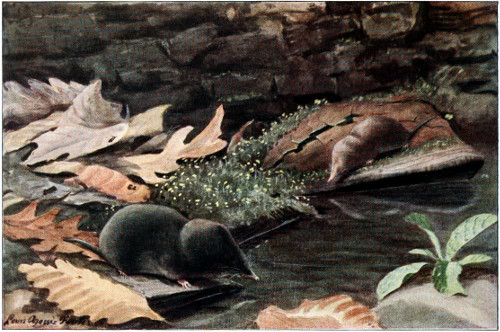
SHORT-TAILED SHREW
Blarina brevicauda
COMMON SHREW
Sorex personatus
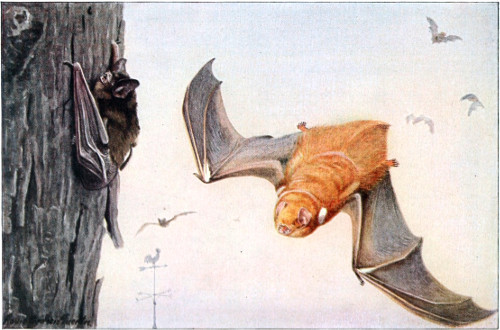
HOARY BAT
Nycteris cinereus
RED BAT
Nycteris borealis
Although so heavily built, these squirrels are
adept in leaping from branch to branch and
from tree to tree. On one occasion a branch
on which an Abert squirrel was standing near
the top of a pine tree was struck by a rifle ball;
the squirrel promptly ran to the end of a large
branch about fifty feet from the ground, and
although no tree was anywhere near on that
side, leaped straight out into the air, with its
legs outspread just as in a flying squirrel. It
came down in a horizontal position and struck
the ground flat on its under side and the rebound
raised it several inches. Without an instant’s
delay it was running at full speed across
a little open park and disappeared in the forest
on the other side. I was standing only a few
yards to one side of the falling squirrel and the
widely spread feet and legs were perfectly outlined
against the sky. It was evident that this
squirrel and probably all of its kind appreciate
that such an attitude will help break the force
of the descent. This suggested the possibility
of a similar habit having influenced the origin
of the flying squirrel’s membranes.
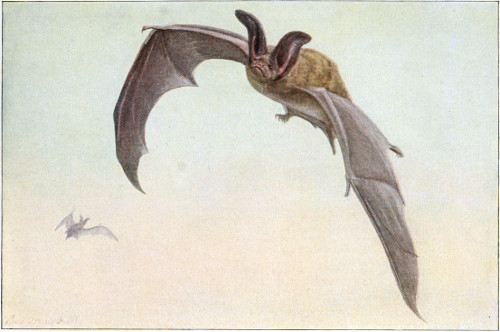
BIG-EARED DESERT BAT
Antrozous pallidus
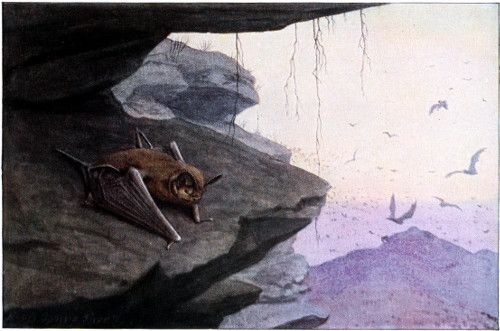
MEXICAN BAT
Nyctinomus mexicanus
One summer day in the Sierra Madre of
western Durango I sat on a mountain slope
watching for game. Below me stood the hollow-topped
stub of an oak, the top being on a
level with my eyes and about twenty yards
away. Soon after I arrived the heads of four
half-grown squirrels of the Abert family appeared
in a row at the upper border of the
opening, their bright eyes turning on all sides.
Suddenly a hawk glided by, one of its wing tips
almost brushing the noses of the squirrels. Instantly
they vanished from sight and a noise of
scratching and frightened chattering continued
for several minutes, as though they were burying
themselves under the nest. About twenty
minutes later the boldest of the family showed
the tip of his nose at an opening in a hollow
branch near the top of the stub, but it required
another ten minutes for him to venture forth
his head. Finally, becoming confident that no
danger threatened, he came out on the limb
and deliberately stretched himself, yawning as
widely as his little mouth would permit, after
which he flirted his tail and frisked over to the
trunk of the stub, where he began frolicking
about with all the abandon of a kitten at play.
When I departed his more timorous companions
were still peering fearfully out of the hole, anticipating
the return of the dreaded hawk.
(For illustration, see page 551)
No one can see one of our small flying squirrels
in life without being charmed by its delicate
grace of form and velvety fur, nor fail to
note the large black eyes which give it a pleasing
air of lively intelligence. Flying squirrels
are distinguished from all other members of
the squirrel family by extensions of the skin
along the sides, which unite the front and hind
legs, so that when the animal leaps from some
elevated point with legs outspread the membrane
and the underside of the body present a
broad, flat surface to the air. This enables it
to glide swiftly down in a diagonal course
toward a tree trunk or other vertical surface
on which it desires to alight. It is able to control
its movements and to turn with ease to one
side or the other, or upward before alighting.
When gliding down a wooded hillside or through
thick growths of timber, it is thus able to avoid
obstacles and alight on the desired place.
Flying squirrels are circumpolar in distribution.
In the Old World they occupy forested
areas in eastern Europe, and nearly all of Asia.
In the New World they are peculiar to North
America, where they frequent nearly all the
wooded parts from the Arctic Circle to the
Mexican border, and in forests in Mexico along
the eastern border of the highlands as well as
through Chiapas and Guatemala. In Asia, the
center of development of these interesting rodents,
many extraordinary forms occur. Some
are giants of their kind, measuring nearly four
feet in total length. In America there are two
groups of species, the smaller and better known
of which, the subject of this sketch, occupies
the eastern United States and southward. The
northern and western animals are larger, some
of them more than twice the weight of the
eastern species.
In many parts of the United States flying
squirrels are common and even abundant, but
their habits are so strictly nocturnal that they
are infrequently seen. They make their homes
in woodpecker holes, knot-holes, and hollows in
limbs, and trunks of trees and stubs. In addition
they take possession of many odd places
for residence, among which may be mentioned
bird-boxes, dove-cotes, attics, cupboards, boxes,
and other nooks in occupied or unoccupied
houses that are located within or at the borders
of woods.
They also make nests of leaves, lining them
with fine fibrous bark, grass, moss, fur, or other
soft material placed securely in the branches
or in forks in trees. They often remodel old
bird or squirrel nests into snug homes for
themselves. The size and construction of these
outside nests vary according to the locality and
the material available.
As a rule, the nests are small and accommodate
only a single pair with their young, and
sometimes hold only a single individual, but numerous
exceptions to this have been observed.
In southern Illinois fifty flying squirrels were
discovered in one nest in a tree; in Indiana
fifteen were found in a hollow stump; and
near Philadelphia thirty were evicted from a
martin box they had usurped.
In the southern part of their range flying
squirrels are active throughout the year, but in
the North they become more or less sluggish
if they do not actually reach the stage of real
hibernation during the severest weather.
Their food is extremely varied and includes
whatever nuts grow in their haunts, as beechnuts,
pecans, acorns, and others, with many kinds
of seeds, including corn gathered in the field,
and buds, and fruits of many kinds. They also
eat many insects, larvæ, birds and their eggs,
and meat. Taking advantage of their known
liking for bird flesh, they may frequently be
caught by concealing a trap on top of a log in
the woods and scattering bird feathers over
and about it. Trappers for marten and other
forest fur-bearers are much annoyed in winter
by the persistence with which the flying squirrels
search out their traps and become caught
in them, thus forestalling a more valued capture.
Trappers in Montana who run long lines
of traps for marten through the mountain forests
capture hundreds of these squirrels in a
single season.
Flying squirrels have
several notes, one of
which is an ordinary
chuck, chuck, much like
that of other squirrels.
They also utter sharp
squeaks and squeals when
angry or much alarmed,
and a clear musical chirping
note, birdlike in character,
which is frequently
repeated for several minutes
in succession and is
undoubtedly a song.
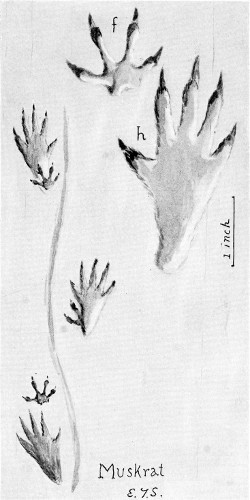
THE TRAIL OF THE MUSKRAT
The usual gait of the muskrat on land is a slow walk. The tail
mark is always very strongly shown (see pages 513 and 526).
These beautiful little
animals become the most
delightful of pets, as they
are notable for extraordinary
playfulness and a
readiness to accept man
as a friend. Many interesting
accounts have
been published concerning
the affectionate attachment
they form for
their human hosts and
the amusing and tireless
activity they show at
night. By day they remain
sound asleep, rolled
up in a furry ball in
some dark corner.
They are known to have
a litter of from two to
six young in April, and
young are born at various
times throughout the
summer, but it is still unsettled
whether there is
more than one litter a
year. The mother is devoted
to the young, and
if driven from them will
keep close by at the risk
of her life, showing much
anxiety and readiness to
do what she can to protect
them. One instance
well illustrates this maternal
care. From a nest
in a hollow stub the helpless
young were taken
and placed on the ground
at its base, while the despoiler
of the home stood
by to observe the result.
The mother soon returned
and not finding
her family in the nest
promptly located them on
the ground. Quickly descending,
she took one
in her mouth, carried it
to the top of the stub
and, launching into the
air, sailed to a tree thirty
feet away, up which she
carried her baby and
placed it safely in a
knot-hole. The trip was
quickly repeated until the
family was reunited in
its new location.
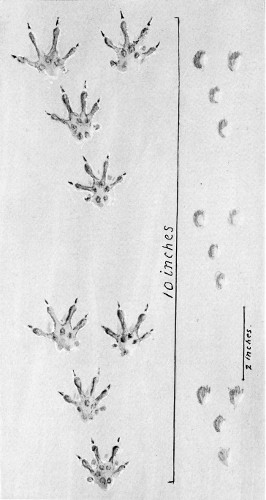
THE TRACKS OF A GRASSHOPPER MOUSE
The anatomy of the foot is fairly well shown in the track—the
insignificant thumb and the tubercles on the soles. The placing of
the fore feet, one behind the other, indicates that the creature cannot
climb a tree. The tail seldom or never shows. The original of
this was in fine dust. The small tracks to the right show the style
usually seen. There are many species of grasshopper mouse, but the
tracks are not distinguishable from each other. The exact species
is determined by locality, size, etc. (see pages 520 and 527).
At night the curiosity
of flying squirrels about
strange things and their
mischievous activities are
often most entertaining,
and sometimes exasperating.
Whatever is accessible
within their territory
is certain to be
thoroughly explored. A
large apartment building,
seven stories high, in
Washington stands on
the border of the woods
of the Zoological Park.
During one summer night
a friend occupying an
apartment on the seventh
floor of this building,
fronting the park, observed
some movement
on one of his window
sills and by later observation
and by inquiry
among the other residents
learned that flying
squirrels were habitually
climbing all about the
high walls to the top of
this building, using it
and some of the rooms
as a nightly playground.
Several occupants of
apartments in different
parts of the building
regularly placed nuts of
various kinds on the
window ledges for them,
and now and then were
amused to find that during
the night the squirrels
had carried away
some of their nuts, but
had replaced them with
other kinds, sometimes
brought from a window
at a considerable distance
on another side of
the building. The presence
of these squirrels
was warmly welcomed
and furnished much interest
to their hosts.
The constant activity
of these little animals at
night enables owls and
cats to capture many, but
their small size and the
shelter of their homes
by day will prevent their
serious decrease in numbers
so long as suitable
forests remain to supply
their needs.
(For illustration, see page 551)
Of all the varied forms of mammalian life
in America, the black-footed ferret has always
impressed me as one of the strangest and most
like a stranded exotic. It is about the size of
a mink, but, as the illustration shows, is entirely
different in appearance and has the general
form of a giant weasel. It has no close relative
in America, but bears an extraordinarily
close resemblance in size, form, and color to
the Siberian ferret (Mustela eversmanni).
The black-footed ferret occurs only in the
interior of the United States, closely restricted
to the area inhabited by prairie-dogs, from the
Rocky Mountains eastward and from Montana
and the Dakotas to western Texas. It is
known also west of the mountains in Colorado.
Like others of the weasel tribe, it must have
a wandering disposition, since one was captured
at 9,800 feet altitude, and another was found
drowned at 10,250 feet in Lake Moraine, Colorado.
These ferrets exist as parasites in the prairie-dog
colonies, making their homes in deserted
burrows and feeding on the hapless colonists.
In Kansas their presence in certain localities
appears to have been effective in exterminating
prairie-dogs, and similar activities may account
for the deserted “dog towns” which are not
infrequently observed on the plains with no apparent
reason for the absence of the habitants.
They do not appear to be numerous in any
part of their range and little is known concerning
their habits. Now and then they are
seen moving about prairie-dog “towns,” passing
in and out of the burrows at all hours of the
day, but it is probable that they are mainly
nocturnal. This probability is strengthened by
the extreme restlessness shown at night by captive
animals. With the occupation of the country
and the inevitable extinction of the prairie-dog
over nearly or quite all of its range, the
black-footed ferret is practically certain to disappear
with its host species.
It has the same bold, inquisitive character
shown by the weasel, and when its interest is
excited will stand up on its hind legs and
stretch its long neck to one side and another
in an effort to satisfy its curiosity. When
surprised in a “dog town” it commonly retreats
to a burrow, but promptly turns and raises its
head high out of the hole to observe the visitor.
As a result ferrets are readily killed by hunters.
When one is captured it will at first hiss and
spit like a cat and fight viciously, but is not
difficult to tame.
Although mainly dependent upon prairie-dogs
for food, there is little doubt that ferrets, after
the manner of their kind, also kill rabbits and
other rodents in addition to taking whatever
birds and birds’ eggs may be secured. In one
instance a black-footed ferret lived for several
days under a wooden sidewalk in the border
town of Hays, Kansas, where it killed the rats
harboring there.
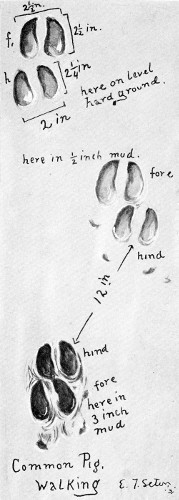
TRACK OF A COMMON PIG
Pig and deer tracks are often found in the
same places and to a casual glance may be mistaken
for each other, but the bluntness of the
pig track distinguishes it and the clouts or
hind hoofs do not show on level ground, but
do in one or two inches of snow or mud.
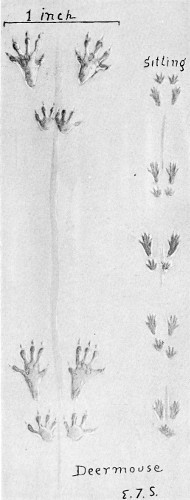
FOOTPRINTS OF A WHITE-FOOTED MOUSE
When reduced to scale, the large tracks on
the left side are life size, showing the animal
making the ordinary bounds of about 3 inches
between each set of tracks. In speeding, the
space may increase to 12 inches. The tail usually
shows in the deermouse track, and this,
with the pairing of the fore paws, is a strong
characteristic (see pages 521 and 530).
THE LARGE WEASELS, OR STOATS
(Mustela arcticus and its relatives)
(For illustration, see page 554)
The weasel family includes not only the true
weasels, but numerous other carnivores, as the
sable or marten, mink, ferret, skunk, and land
and sea otters, all of which rank among our
highly valued fur-bearers. The large weasel
may be distinguished from others of its family
by the small size and the snakelike proportions
of the flattened and pointed head, combined
with a long, extremely slender neck and
body and a comparatively long tail. The best
known of these animals are the stoat of the
northern parts of the Old World (Mustela
erminea) and its close relative in northern
North America (Mustela arcticus), the winter
skins of which furnish the famed ermine, once
sacred to the trappings of royalty.
The northern weasels are strongly marked by
their habit of changing their brown coat to
one of snowy white at the beginning of winter.
To the south the change becomes less complete
as the winter snows decrease, and south
of the limit of snow the brown coat is retained
throughout the year. The time of change depends
on the coming of the snow and varies
with the year, and the time of resumption of
the brown coat in spring depends in the same
way on the season. The white winter coat of
the larger and medium-sized species is accompanied
by a strongly contrasting jet black tip
to the tail.
Weasels are circumpolar in distribution and
occupy nearly all parts of Europe, Asia, and
North and South America, the greatest number
and variety of species occurring in North
America. Surprisingly enough, the largest of
these eminently northern animals is found in
the forests of the American tropics. The Arctic
weasel ranges to the northernmost polar lands
of North America, where its presence has been
recorded many times by ice-bound explorers.
Other species are more or less generally distributed
over the remainder of the continent.
In Mexico I have found them from sea level
to above timberline, at more that 13,000 feet
altitude on the high volcanoes.
The strong personality of the weasels as a
group is based mainly on their extraordinary
celerity of movement, their courage, and their
insatiable desire to kill. They are not satisfied
with supplying the call for food, but whenever
opportunity arises kill from sheer lust of
slaughter.
Their slender forms enable them to follow
their prey to the remotest depths of their retreats,
and that all rodents have an abiding
horror of them is shown by the effect of a
weasel’s appearance. Rabbits, although many
times their size, become easy victims, and in
one instance when a large rat, which had
fought its human captor viciously, was put in
a cage with a weasel, it at once lost all its
courage and permitted itself to be killed without
an effort at defense.
Weasels are wonderfully endowed for their
predatory work and are undoubtedly the most
perfectly organized machines for killing that
have been developed among mammals. Their
keen eyes are constantly alert to observe everything
about them, their ears are attuned to
catch the faintest squeak of a mouse or cry of
any other small animal, and their powers of
scent are very great. When hunting they dart
in and out of the holes of rodents, among
crevices in the rocks, or through brush piles,
pausing now and then to stand upright on their
hind feet, the head swaying to and fro as they
peer about. The squeak of a mouse starts
them instantly in search of it, and like a dog
they trail rabbits and other rodents by scent.
As a rule, weasels are terrestrial, but in
wooded country they climb trees and leap from
branch to branch with all the ease of squirrels.
In most localities they are not common, but
now and then, where conditions are peculiarly
favorable, they become numerous. At one
naturalist’s camp in the upper Yukon they were
surprisingly abundant, so much so that more
than forty were caught in a few days in traps
set among broken rocks. There they were extremely
bold, hunting for their prey among the
rocks within a few feet of the trappers.
The prey of weasels includes almost every
kind of small rodent and bird living within
their territory. They feed especially upon
northern hares, cottontails, conies, ground
squirrels, chipmunks, tree squirrels, wood rats,
mice, lemmings, quail, ptarmigan, spruce and
ruffed grouse, ducks, and numberless other
small species. They are also very destructive
to domestic fowl, often killing thirty or forty
in a night. They unhesitatingly attack rodents
many times their own weight.
Once when hunting on the open plain near the
southern end of the Mexican table-land, I saw
at some distance what appeared to be a brown
ball rolling about on the ground. This was
soon determined to be a weasel fastened to one
of the large and powerful pocket gophers of
that region. The weasel had its teeth set in the
back of the neck of the gopher, while the latter
was blindly trying to tear itself loose. I fired
an ineffectual shot at the weasel and it vanished
like a flash in the open tunnel of the gopher.
As I drew near, the gopher, still in fighting
mood, faced me with bared teeth. Later, when
I removed its skin, I found that the weasel had
torn loose the attachment of the heavy neck
muscles to the back of the skull until only a
thin layer remained to protect the spinal
column. This had been accomplished without
breaking the thin, but extremely tough, skin of
the gopher.
When a weasel is attacking an animal which
resists, like a large ground squirrel, it raises
its head and sways its long neck back and
forth, its eyes glittering with excitement as it
watches for an opening to spring forward and
seize its prey. Its attack is always aimed at
a vital point, commonly the brain, the back of
the neck, or the jugular vein on the side.
Weasels dig their own burrows under the
shelter of slide rock, ledges, stone walls, stumps,
and outbuildings, or they occupy hollow trees
and the deserted burrows of other animals. In
nests thus safely located they have one litter
containing an average of from four to six, but
sometimes numbering up to twelve, young a
year. They are born at any time from April
to June, according to the latitude. The number
of young in a litter is enough to render weasels
very abundant, but this is rarely the case, and
raises the question as to the influence which
holds their number in check.
They are both nocturnal and diurnal, apparently
in almost equal degree, since they are
frequently observed hunting in the middle of
the day, while their nocturnal raids on poultry
houses testify to their activities at night. When
hunting they appear like sinister shadows and
are persistent in pursuit. The young commonly
remain with the female until nearly or quite
grown and follow her closely on hunting-trips.
It is interesting to see a pack of these deadly
carnivores working, the mother leading and the
young skirmishing on all sides, now spreading
out, now closing in, like a pack of miniature
hounds. On these family hunting parties, however,
they usually keep close to the rocks, logs,
brush, or other cover.
Themselves subject to the law of fang and
claw, weasels are killed and eaten by wolves,
coyotes, foxes, and various birds of prey. Their
very lack of fear perhaps in many cases leads
to their destruction.
These representatives of the primitive woodland
life continue to occupy practically all of
their original range. They visit farms in all
parts of the country and I have seen them near
the outskirts of Washington.
It is well that weasels are not abundant, for
beasts with such innate ferocity and love of
killing would otherwise be a menace to the
existence of many useful species of birds and
mammals, especially the game birds. In many
places they live almost entirely on mice, and
there they should be left unmolested; but
whenever they locate in the vicinity of a chicken
yard the owner will do well to take proper
measures for protection.
(For illustration, see page 554)
In addition to the larger members of the
tribe briefly described in the foregoing sketch,
the true weasels include another group of
species, so small they may appropriately be
termed the dwarfs of their kind. They vary
from a half to less than a fourth the size of
the larger weasels, but have the same characteristic
form and proportions, except that the
tail is very short and never tipped with black.
Like the larger species, they change their brown
summer coat for white at the beginning of
winter and back again in spring.
The least weasels are also circumpolar in
distribution, but are limited to the northern
parts of Europe, Asia, and North America.
In England and other parts of the Old World
the group is represented by the well-known
species Mustela vulgaris. In North America
several species are known which, between them,
share all the continent from the Arctic coast
south to Nebraska and Pennsylvania. On the
desolate islands extending from the mainland
far toward the Pole their place seems to be
taken by the ermine.
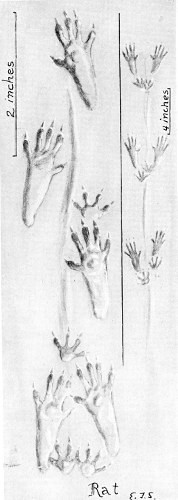
THE COMMON BROWN RAT
The large series shows the ordinary foraging
gait; the smaller one, to the right, shows
the travel at low speed. In all, the tail mark
is a strong feature (see pages 525 and 531).
The dwarf weasels appear to be less numerous
and, as a consequence, less known in most
parts of America than in England and northern
Europe. Our most northern species,
Mustela rixosa, sometimes called the “mouse
weasel,” occupies Alaska and northern Canada
and has the distinction of being the smallest
known species of carnivore in the world. In
this connection it is interesting to note that
in Alaska we have associated on the same
ground the least weasel and the great brown
bear, the smallest and the largest living carnivores.
Least weasels are characterized by the same
swift alertness and boldness so marked in the
larger species. In fact they are, if possible,
even quicker in their movements. Once when
camping in spring among scattered snowbanks
on the coast of Bering Sea, I had an excellent
opportunity to witness their almost incredible
quickness. Early in the morning one suddenly
appeared on the margin of a snowbank within
a few feet, and after craning its neck one way
and the other, as though to get a better view
of me, it vanished, and then appeared so
abruptly on a snowbank three or four yards
away that it was almost impossible to follow
it with the eye. It was beginning to take on
its summer coat of brown and was extremely
difficult to locate amid the scattered patches
of snow and bare moss of the tundra. Certainly
no other mammal can have such flash-like
powers of movement.
They feed mainly on mice, lemmings, shrews,
small birds, their eggs and young, and insects.
Mice furnish a large proportion of their prey
and weasels have often been seen following the
runways of field mice. Their small size enables
them to pursue mice into their underground
workings as readily as a ferret enters a rabbit
burrow. They also climb trees and bushes with
great agility, although nearly always seeking
their victims on the ground. The mice upon
which they prey are often so much larger than
the weasels that they cannot be dragged into
the dens. The weasels continue in full activity
throughout the winter and constantly burrow
into the snow in search of their prey. In the
snow or in the ground the holes of this animal
are about the diameter of one’s finger.
In the Old World the small weasels are reported
to have several litters in a season, each
containing five or six young. At Point Barrow,
Alaska, a female captured on June 12 still contained
twelve embryos. This indicates that
only one litter a year would be born there, and
that Mustela rixosa is more prolific than its
European representative.
In the more southern latitude least weasels
live in forests and about farms, sheltering
themselves under logs, brush piles, stone walls,
and similar cover. They are always restless
and filled with curiosity regarding anything of
unusual appearance.
When one encounters a
man it shows no fear,
but slyly moving from
one shelter to another,
now advancing and now
retreating, examines the
stranger carefully before
going on its way. As
they devote practically
their entire lives to the
destruction of field mice,
they are valuable friends
of the farmer and should
have his good will and
protection. Unfortunately
for these weasels, no discrimination
is shown between
them and their
larger relatives of more
injurious habits.
Among the natives of
Alaska all weasels are
looked upon with great
respect on account of
their prowess as hunters.
I found this feeling peculiarly
strong among the
Eskimos, whose existence
for ages has depended so
largely on the products
of the chase. Among
them the capture of a
weasel meant good luck
to the hunter, and to take
the rarer least weasel
was considered a happy
omen. The head and entire
skin of the least
weasel was highly prized
for wearing as an amulet
or fetich. Young men
eagerly purchased them,
paying the full value of
a prime marten skin in
order to wear them as a
personal adornment, that
they might thus become endowed with the hunting
prowess of this fierce little carnivore.
Fathers often bought them to attach to the
belts of their small sons, so that the youthful
hunters might become imbued with the spirit
of this “little chief” among mammals.
(For illustration, see page 555)
In the American mink we have one of the
most widely known and valuable fur-bearers of
the weasel family. It is a long-bodied animal,
but more heavily proportioned than the weasel,
and attains a weight of from one and one-half
to more than two pounds. It has short legs
and walks slowly and rather clumsily with the
back arched. When desiring to travel rapidly
it moves in a series of rapid easy bounds which
it appears able to continue tirelessly.
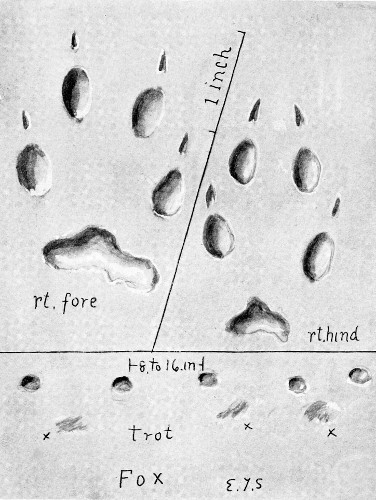
THE TRACK OF A FOX
The size, the small pads, and the set of all feet nearly in one line are
strong features, as also is the tail touch.
The minks form a small group of species
circumpolar in distribution, and well known in
Europe, northern Asia, and in North America.
The European animal is closely similar to the
North American species and all have the same
amphibious habits. The American minks include
several different geographic races, which are
distributed over all the northern part of the
continent from the Atlantic to the Pacific and
from the mouths of the Yukon and Mackenzie
Rivers to the Gulf coast in the United States.
They are absent from the arid Southwestern
States.
Few species are more perfectly adapted to a
double mode of life than the mink. It is equally
at home slyly searching thickets and bottom-land
forests for prey or seeking it with otter-like
prowess beneath the water. It is a restless
animal, active both by day and by night, although
mainly nocturnal.
While usually having definite dens to which
they return, minks wander widely and for so
small an animal hunt over a large territory
and pass from one body of water to another.
Their wanderings are most pronounced in fall
and again during the mating in spring. They
are solitary, their companionship with one another
not outliving the mating period.
Mink dens are located wherever a safe and
convenient shelter is available, and may be a
hole in a bank, made by a muskrat or other
animal, a cavity under the roots of a tree, a
hollow log, a hollow stump, or other place.
The nest is made of grass and leaves lined
with feathers, hair, and other soft material. A
single litter of from four to twelve small and
naked young is born during April or May.
The young remain with the mother throughout
the summer, and do not leave her to establish
themselves until fall, when they are nearly
grown. When captured at an early age they
are playful and become attached to the person
who cares for them. When caught in a trap
they become fiercely aggressive, often uttering
squalling shrieks, baring their teeth, and fronting
their captor with a truculent air of savage
rage. The adults have scent sacs located under
the tail like those of a skunk. When angry or
much excited they can emit from these an exceedingly
acrid and offensive odor, but have
no power to eject it forcibly at an enemy.
Minks are bold and courageous in their attitude
toward other animals, and attack and kill
for food species heavier than themselves, like
the varying hare and the muskrat. On land
they are persistent hunters, trailing their prey
skillfully by scent. They eat mice, rats, chipmunks,
squirrels, and birds and birds’ eggs of
many kinds, including waterfowl, oven-birds,
and other ground-frequenting species. About
the waterside they vary this diet by capturing
fish of many kinds, which they pursue in the
water, snakes, frogs, salamanders, insects, crustaceans,
and mussels.
Their prowess is shown by their raids on
chicken-houses, where they often kill many
grown fowls in a night, and sometimes drag
birds heavier than themselves long distances to
their dens. A remarkable indication of the
varied menu of the mink was exhibited in a
nest found by Dr. C. H. Merriam, where the
owner had gathered the bodies of a muskrat,
a red squirrel, and a downy woodpecker.
The value of the mink’s furry coat has led
to its steady pursuit by trappers in all climes,
from the coast of Florida to the borders of
sluggish streams on Arctic tundras. Millions
of them have fallen victims to this warfare
and their skins have gone to adorn mankind.
In spite of this the mink today occupies all its
original territory, and each year yields a fresh
harvest of furs.
The mink by preference is a forest animal,
living along the wooded bottom-lands of rivers
or the thicket-grown borders of small streams,
where the rich vegetation gives abundance of
shelter and at the same time attracts a wealth
of small mammals and birds on which it may
prey. From these secure coverts it wanders
through the surrounding country at night, visiting
many chicken-houses on farms and leaving
devastation behind. It is persistent and bold
in such forays and in locations near its haunts
great care must be exercised to guard against
it. Minks have repeatedly raided the enclosures
of the National Zoological Park in Washington.
Now and then, on the banks of some wild
stream, one will try to appropriate the catch
lying at the very feet of a lone fisherman. A
naturalist fishing on a stream in northern
Canada, seeing a mink making free with his
catch, set a small steel trap on the bare ground,
and holding the attached chain in one hand
raised and slowly drew toward him the fish
upon which the mink was feeding. The mink,
without hesitation, followed the fish and was
caught in the trap.
An abundance of food may modify the preference
of the mink for wooded or partly wooded
country. The marshy and treeless tundra
lying near sea-level in the triangle between the
coast of Bering Sea, and the lower parts of
the Yukon and Kuskokwim rivers offers such
an attractive situation differing from their
usual haunts. The sluggish streams and numberless
ponds abound with small fish four
to five inches long. Minks swarm in this area
to such an extent that the Eskimos who inhabit
the district are known among the natives
of the surrounding region as the “mink people.”
Steel traps are used there, but a primitive
method is even more successful. A wicker
fence is built across a narrow stream and a
small fyke fish-trap placed in it. In swimming
along the stream minks pass into the trap like
fish, and I knew of from 10 to 15 being thus
taken in one day.
During my residence in that region from
10,000 to 15,000 mink skins were caught in
this tundra district annually, and the supply
appeared to be inexhaustible. With the growing
occupation of the continent and the increasing
demand for furs, however, the numbers of
the mink must surely decrease. To forestall
the shortage of furs that seems imminent, efforts
are now being made to establish fur farming
to replace the declining supply of wild furs
with those grown under domestication. The
mink appears to be well adapted to successful
breeding in captivity. The main question to
solve is the relation of the cost of caring for
the animals to the value of its pelt in the
market.
(For illustration, see page 555)
Wild animals possess an endless variety of
mental traits which endow them in many instances
with marked individualities. Few are
more strongly characterized in this respect than
the marten. One of the most graceful and
beautiful of our forest animals, it frequents the
more inaccessible parts of the wilderness and
retires shyly before the inroads of the settler’s
ax. Its rich brown coat, so highly prized that
the pursuit of it goes on winter after winter in
all the remote forests of the North, is a source
of danger threatening the existence of the
species. The full-grown animal weighs five or
six pounds and measures nearly three feet in
length.
The martens are circumpolar in distribution,
and the several species occupy northern lands
from England, Europe, and northern Asia to
North America. Of the Old World species, the
Siberian sable is best known on account of the
beauty of its fine, rich fur, which renders it
the most valued of all in the fur markets of
the world.
The North American marten is a close relative
of the Siberian species, and occupies all
the wooded parts of North America from the
northern limit of trees southward in the forested
mountains to Pennsylvania, New Mexico,
and the southern part of the Sierra Nevada in
California.
Like other members of the weasel tribe, the
marten is a fierce and merciless creature of rapine,
but unlike the mink and weasel, it avoids
the abodes of man and loves the remotest
depths of the wilderness.
Martens are endowed with an exceedingly
nervous and excitable temperament, combined
with all the flashing quickness of weasels. They
are more restless than any other among the
larger species of their notably restless tribe,
and couple with this extraordinary and tireless
vigor. This is admirably shown in captivity,
when by the hour they dart back and
forth, up and down and around their cages
with almost incredible speed.
In the forest they climb trees and jump from
branch to branch with all the agility of a
squirrel—in fact, they pursue and capture red
squirrels in fair chase, and have been seen in
pursuit of the big California gray squirrel
(Sciurus griseus). On the ground they move
about quickly, hunting weasel-like, under brush
piles and other cover.
Practically every living thing within their
power falls victim to their rapacity. They eat
minks, weasels, squirrels, chipmunks, wood rats,
mice of many kinds, conies, snowshoe hares,
ruffed and spruce grouse, and smaller birds of
all kinds and their eggs, as well as frogs, fish,
beetles, crickets, beechnuts, and a variety of
small wild fruits. Unlike minks and weasels,
they are not known to kill wantonly more than
they need for food.
They make nests of grass, moss, and leaves
in hollow trees, under logs, among rocks, and
in holes in the ground. Sometimes they have
been found in possession of a red squirrel’s
nest, probably after having slain and devoured
the owner.
The young, varying from one to eight in
number, are born in April or May. At first
they are naked and helpless, but when large
enough accompany the mother on her search
for food. This period of schooling lasts until
they are forced to take up their separate lives
with the approach of winter. Thenceforth they
are among the most solitary of animals, showing
fierce antagonism toward one another
whenever they meet, and associating only during
a brief period in the mating season in
February or March. Martens show a cold-blooded
ferocity toward one another that often
renders it dangerous to put two or more in
the same cage. When placed in a cage together
the male very commonly kills the female
by biting her through the skull. At times they
utter a loud, shrill squall or shriek, and in
traps hiss, growl, and sometimes bark.
Among the dense forests of spruce and lodge-pole
pine high up in the mountains of Colorado,
martens are sometimes hunted on skis in midwinter,
an exciting and often, on these rugged
slopes, a dangerous sport. They are not wary
about traps and are readily caught by deadfalls
and other rude contrivances as well as
by steel traps. In Colorado and Montana hundreds
of their skins are taken by trappers every
winter.
In Siberia the sable has been exterminated
by hunting in many districts, and before the
present war began had become so scarce in
others that the Russian Government closed the
season for them for a period of years over
nearly all of their range. The same reduction
in the numbers of our marten has occurred in
most parts of Alaska and elsewhere in its range,
and its only hope against extermination lies in
stringent protection. Protective regulations are
already in force in Alaska.
During the early fur-trading days in northern
Canada the number of martens varied between
comparative abundance and rarity. These
variations were said to occur about every ten
years. Some claimed the decrease was due to
a migration which the martens were believed
to make from one region to another, just as
was believed of the lynx. The lack of a corresponding
increase in surrounding districts,
where trading posts were located, effectually
disproved the migration theory. There is little
doubt that the increase of martens was due to
a reproductive response to a plentiful food
supply during years when mice or snowshoe
hares were abundant and their decrease was
due to a lessening of the numbers of these food
animals.
Efforts are being made to domesticate martens
and raise them for their skins on fur
farms. The main difficulty so far encountered
lies in the fiendish manner in which the old
males kill the females and the younger males.
Although always nervous, they are not difficult
to tame, and will be most entertaining and attractive
animals to rear if their savage natures
can be sufficiently overcome.
(For illustration, see page 558)
The skunks form a distinct section of the
weasel family, limited to North and South
America. The group is divided into three well-marked
sections. One of these, the little spotted
skunks, is distinguished from all other
mammals by the curious and pleasing symmetry
of the black and white markings of the
animals. Few more beautiful fur garments are
made than those from the skins of these animals
in their natural colors. These skunks are
smaller than any members of the other groups,
varying from a little larger than a large chipmunk
to the size of a fox squirrel.
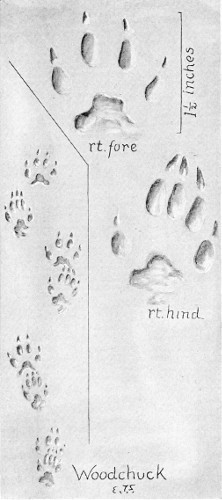
THE COMMON WOODCHUCK, OR AMERICAN
MARMOT (SEE PAGES 533-534)
Its track shows this animal’s kinship with
the squirrels. The small series, to the left,
show the ordinary ambling pace. When speeding,
it sets its feet much like the little, or eastern,
chipmunk (see page 580).
Little spotted skunks include several species
and geographic races. All are limited to North
America and are rather irregularly distributed
from the Atlantic coast to the Pacific and from
Virginia, Minnesota, Wyoming, and southern
British Columbia southward to the Gulf coast,
to the end of Lower California, and through
Mexico and Central America to Costa Rica.
They inhabit a variety of climatic conditions,
from the rocky ledges high up on the slopes
of the western mountains to the hot desert
plains of the Southwest, and to partly forested
regions in both temperate and tropical lands.
In different parts of the United States they
have several other names, including “civet,”
“civet cat,” and “hydrophobia skunk.”
The spotted skunks make their homes in
whatever shelter is most convenient, whether
it be clefts in rocky ledges, slide rock, hollows
in logs or stumps, holes dug by themselves in
banks or under the shelter of cactuses or other
thorny vegetation, the deserted holes of burrowing
owls in Florida, or the old dens of
various kinds of mammals elsewhere. Thickets,
open woods, ocean beaches, and the vicinity of
deserted or even occupied buildings on ranches
are equally welcome haunts. On the plains of
Arizona they have been known to live inside
the mummified carcass of a cow, the sun-dried
hide of which made an impregnable cover. They
have a single litter of from two to six young
each year.
Their diet is fully as varied as that of others
of the weasel kind, but is made up mainly of
insects and other forms injurious to agriculture,
including grasshoppers, crickets, beetles,
and larvæ of many kinds. They feed also on
flesh whenever possible and prey on wood rats,
mice of many kinds, small ground squirrels,
small birds and their eggs, young chickens,
lizards, salamanders, and crawfish. This carnivorous
diet is further varied with mushrooms,
peanuts, persimmons, cactus fruit, and other
small fruits. Sometimes the animals locate
about occupied habitations in primitive communities,
where they give good service by killing
the house rats, mice, and cockroaches on
the premises. On one occasion a spotted skunk
was detected cunningly removing the downy
chicks from under a brooding hen without disturbing
her.
In comparison with the other skunks these
little animals are extremely agile. They are
strictly nocturnal and when pursued at night
by dogs will climb to safety in a tree like a
squirrel. When caught in a trap they struggle
and fight far more vigorously than their big
relatives. They usually carry the tail in a
somewhat elevated position, but when danger
threatens hold it upright like a warning signal.
If the enemy fails to take heed they shoot two
little spraylike jets of liquid bearing the usual
offensive skunk odor, and the victim retires
without honor.
In writing of these skunks about the Valley
of Mexico, in 1628, Dr. Hernandez tells us
that “the powerful arm which they use when
in peril is the insupportable gas they throw out
behind which condenses the surrounding atmosphere
so that, as one grave missionary
says, it appears as though one could feel it.”
That the little spotted skunk is subject to
rabies and has communicated it to many men
in the West is unquestionable. It usually bites
men who are sleeping on the ground in its
haunts, as they commonly do on the western
stock ranges.
I have personally known of several instances
in northern Arizona of men being bitten by
them. The head, face, and hands, being uncovered,
are the points attacked. One man in
the mountains south of Winslow, Arizona, was
bitten on the top of his head in April, 1910,
but paid no attention to the slight wound until
two months later when he began to have
spasms. He then hurried to town and died in
great agony the next day. The year following
a man in the same district was bitten in the
face, and seizing the animal threw it from him
in such a manner that it fell on his brother
and bit him before he awakened. Both men
were given the Pasteur treatment and had no
further trouble.
On New Year’s night of 1906, while I was at
the village of Cape San Lucas, at the extreme
southern end of the Peninsula of Lower California,
a large-sized old male spotted skunk
entered the open door of a neighboring house
and bit through the upper lip of a little girl
sleeping on the floor. Her screams brought
her father to the rescue, and with a well-aimed
blow he killed the offender. The next morning
the skunk was brought to me and added to my
collection. As I left a few days later I never
learned the result of this bite, but while there
was informed that a man had died the previous
year from a similar bite. The occasional instances
of this kind are remembered and appear
more numerous than they are in fact. For
years many men have slept in the open where
these animals abound, without being molested.
It is interesting to find that when the voyager
Duhaut-Cilly visited the Cape in 1826, the natives
feared these skunks because they entered
houses at night, biting people and infecting
them with hydrophobia.
The little spotted skunks have extremely animated,
playful natures, as I have had several
occasions to observe. Two instances serve to
illustrate this. Once at the mouth of a canyon
at the southern end of the San Joaquin Valley,
California, I camped several days at a deserted
ranch. At night I spread my blankets on the
bare floor of the house, from which the doors
were gone. Under it led several burrows of
some animal which I at first supposed to be a
ground squirrel. Each night while there I was
awakened by the sound of little footfalls padding
rapidly about over the floor on which I
was sleeping, and in the dim light from the
moon could see two or three little spotted skunks
pursuing one another around me like playful
kittens. At the slightest movement on my part
they dashed out the door and into their dens
under the house. As there was no food of any
kind in this room, it was evident that the little
fellows were there for a frolic on the smooth
board floor.
On another occasion in the mountains of
San Luis Potosi, on the Mexican table-land, I
found a spring to which bears were coming
for water at night. As the bears here appeared
to be strictly nocturnal. I ensconced myself in
the evening with a dark lantern, amid some
small bushes, against a large pine log which
sloped downward to the bottom of the gulch
near the spring, with the plan to welcome any
bears which might come in. An hour or more
after dark the clinking rattle of small stones
on the far side of the gulch indicated the presence
of some animal. The light from the
lantern was flashed on the spot and the rifle
lowered with exasperation as, running back and
forth, turning over stones in search of insects,
a spotted skunk was revealed. The movements
of this unwelcome visitor were extremely light
and graceful, and in my interest in watching
them, for a time I forgot the bear. Two or
three hours passed and the skunk tired of the
hillside and came down to the spring, where
he found the offal from a deer which I had
placed there for bait. This gave him more to
do, and after I had listened to him worry the
meat for awhile, I turned on the light and was
entertained by the sight thus revealed. The
skunk appeared to have a persistent desire to
drag away the offal many times his weight. He
would seize the edge of one of the lungs and
after a hard struggle would get it up on one
edge, when the burden would turn over with
a flap, whirling the skunk flat on his back each
time. Immediately scrambling to his feet, he
would give the meat a fierce shake of resentment
and repeat the performance.
After a long time the moon arose and the
skunk could be plainly seen running back and
forth playfully, now biting at the meat and now
turning over stones apparently in sheer exuberance
of spirit. Then he suddenly mounted the
lower end of the log and came galloping up it
until he was close to my shoulder. There he
stopped and, coming as near as possible, extended
his nose within a few inches of my
face, and for minute or more stood trying to
satisfy himself about this strange object. Satisfied
at last, he turned and galloped back down
the log and resumed his antics in the gulch,
finally working close to the bank three or four
yards below me. There he found many small
stones and had a fine time rattling them about
until I decided that with this disturbing presence
I should have little chance for other game.
Finding a convenient stone, and locating the
skunk as well as possible from the sounds, I
tossed it over to try and frighten him away.
My aim was too true, for the characteristic
skunk retort filled the air with suffocating
fumes and I immediately lost interest in further
bear hunting.
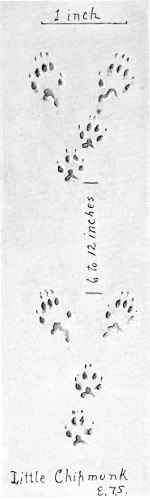
THE TRAIL OF THE EASTERN CHIPMUNK
The track is much like that of the fox squirrel,
but usually the fore feet are a little, or
quite, one behind the other and, of course,
much smaller. No tail mark is ever seen (see
pages 542 and 549).
THE COMMON SKUNK (Mephitis
mephitis and its relatives)
(For illustration, see page 558)
Probably no American mammal is more generally
known and less popular than the skunk.
This current odium is due wholly to its possession
of a scent sac of malodorous fluid, which
it distributes with prompt accuracy when annoyed.
The possession of this method of defense
is common to all skunks. The term “pole-cat,”
sometimes given to all kinds of skunks, is
the misuse of a name given Old World martens
of several species and to the Cape pole-cat, a
South African animal which in form and markings,
including the plumelike tail, is remarkably
like some of our smaller skunks.
In the preceding article an account was given
of the spotted skunks, smallest of the three
groups into which these animals are divided.
The common skunk and its relatives form another
group, which contains some of the larger
species of their kind, some of them weighing
up to ten pounds or more. These are the typical
skunks, so familiar in most parts of the
United States, and distinguished by the disproportionately
large size of the posterior half
of the body and the long, plumelike tail.
The common skunk, with its closely related
species, is generally distributed in all varieties
of country, except in deep forests and on waterless
desert plains. It ranges from the Atlantic
coast to the Pacific and from Hudson Bay and
Great Slave Lake southward to the highlands
of Guatemala. The vertical range extends from
sea-level up to above timberline in Mexico,
where I found one living in a burrow it had
dug under a rock at 13,800 feet altitude on the
Cofre de Perote, Vera Cruz.
Skunks are most common in areas of mixed
woodland and fields, in valley bottoms, and
along the brushy borders of creeks and rocky
canyons. One of their marked characteristics
is a fondness for the vicinity of man. They
frequently visit his premises, taking up quarters
beneath outbuildings or even under the house
itself.
Any convenient shelter appears to satisfy
them for a home, and they will occupy the deserted
burrows of other animals, small cavities
among the rocks, a hollow log, or a hole dug
by themselves. A warm nest of grass and
leaves is made at the end of the den, where the
single litter of young, containing from four to
ten, is born in April or May. As soon as the
young are old enough they follow the mother,
keeping close behind her, often in a long single
file along a trail. They are mainly nocturnal,
but in summer the mother frequently starts out
on an excursion with her young an hour or
two before sunset and they may remain abroad
all night.
The young family remains united through the
following winter, which accounts for finding at
times from eight to a dozen in a den. In all
the northern parts of their range they hibernate
during the two to four months of severest cold
weather, coming out sometimes during mild
periods. When the season of hibernation ends
the family scatters and mating begins. One
solitary skunk was found in Canada hibernating
in the same burrow, but in a separate chamber,
with a woodchuck, evidently an unbidden guest.
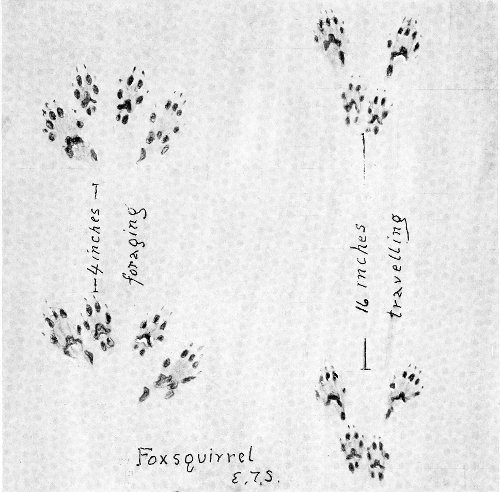
THE TRACKS OF A RUSTY FOX SQUIRREL AND FOX SQUIRREL
The exaggerated pads of the squirrel foot are a strong feature of this track. It is typical
in the pairing of the fore feet, much more so than that of the gray squirrel. There is
never a tail mark in this track (see pages 547 and 561).
As in the case of their relatives, the common
skunks are omnivorous, but feed mainly upon
insects and rodents injurious to agriculture.
They are known to eat great quantities of
grasshoppers, besides crickets, cicadas, May
beetles, wasps, and larvæ of many kinds. One
killed in New Mexico had its stomach crammed
with honey bees. Wherever possible they prey
upon small rodents, as mice, wood rats, and
small spermophiles. To these may be added
ground-nesting birds and their eggs, lizards,
turtle eggs, snakes, frogs, salamanders, fish,
crustaceans, and numerous small fruits. Now
and then they visit the farmers’ chicken yards
with such disastrous consequences that in many
country districts the animals are killed at sight.
It is pleasing to record that a more intelligent
view of their real value to farmers, through
their destruction of farm pests, is rapidly gaining
ground, and they are now being protected
in many States. One of their worst traits is
their destructiveness to breeding game birds,
both upland species, and especially the waterfowl.
Skunks walk on the soles of their feet instead
of on their toes, as do so many mammals.
The common skunks are wholly terrestrial and
move with the deliberation of one without fear
of personal violence or of having his dignity
assailed. Long experience has taught them that
the right of way is theirs. As they amble
slowly along, the tail is carried slightly elevated,
and when the owner is suspicious of attack, it
is raised and the hairs hang drooping like a
great plume, conspicuous and unmistakable. If
the disturber still refuses to take the hint, a
rear view is promptly presented and a discharge
made that puts most enemies to flight.
Some have thought that the odorous liquid is
scattered by the long hairs of the tail, but in
fact it is ejected in fine jets from two little
tubes connected with the scent sacs on each
side of the vent.
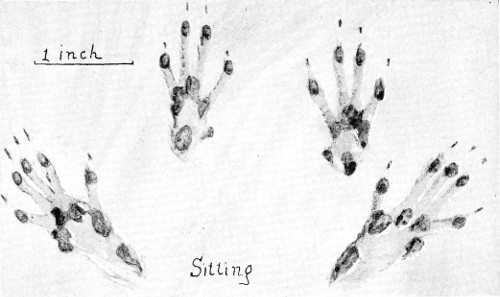
A FULL SIZE RENDERING OF A FOX SQUIRREL TRACK
Illustrations of the arrangement of this track when the animal is foraging and traveling are
shown on page 581.
When mildly annoyed the big skunks stamp
their front feet on the ground and utter little
growls of displeasure. By some effort they can
be urged into a retreat which may take the
form of a clumsy gallop. They are known occasionally
to swim streams voluntarily, and even
to cross rivers, probably urged by the instinct
that so often forces animals of all kinds to
move to new feeding grounds.
Although usually safe from annoyance
through the protective armament, many skunks,
especially the young, each year fall victim to
natural enemies, including wolves, coyotes,
foxes, badgers, and great horned owls.
The flesh of the skunk is a favorite food
among certain tribes of Canadian Indians, and
many white men have pronounced it exceedingly
palatable, even claiming its superiority
over the flesh of domestic fowls. In the narrative
of his expedition through the Canadian
wilderness many years ago, the naturalist
Drummond recorded that when the party was
about a day’s journey from Carleton House it
had the good fortune to kill a skunk, “which
afforded us a comfortable meal.” In the Valley
of Mexico I found the natives prize the flesh
of these animals as a cure for a certain loathsome
disease.
It is well known that large skunks are often
extremely fat. The oil produced from them is
clear and is said to have unusually penetrating
qualities. For many years there was a demand
for this oil for various medicinal purposes.
During recent years the fur of skunks has
come into great demand, and good prices are
paid for prime skins. The animals are so
numerous and the catch is so large that they
now rank among the most valuable of our fur-bearers.
They are gentle animals which readily
become domesticated and breed freely in confinement,
and many efforts are being made to
establish skunk farms. Success in such farming
depends wholly on the outlay for upkeep.
Skunk farming will probably pay better as a
side line, like chickens on the ordinary farm,
than to establish regular fur farms. The scent
sac may be removed by a slight surgical operation,
so there need be no trouble from that
source. Common skunks when taken young
make affectionate and entertaining pets. They
become as tame and playful as kittens, and are
vastly more intelligent and interesting.
(For illustration, see page 559)
The third and last group of skunks contains
a number of species showing well-marked differences
from the two groups already described.
The species vary in size, but among them is
included the largest of all skunks. All are
characterized by comparatively short hair, especially
on the tail, and this appendage lacks
the plumelike appearance observed in other
skunks. The nose is prolonged into a distinct
“snout,” naked on the top and sides and evidently
used for rooting in the earth after the
manner of a pig. In addition, the front feet
are armed with long, heavy claws, and the front
legs and shoulders are provided with a strong
muscular development for digging, as in a badger.
This likeness has led to the use in some
places of the appropriate name “badger skunk”
for these animals. The single white stripe along
the back, and including the tail, is a common
pattern with these skunks, but this marking is
considerably varied, as in the common species.
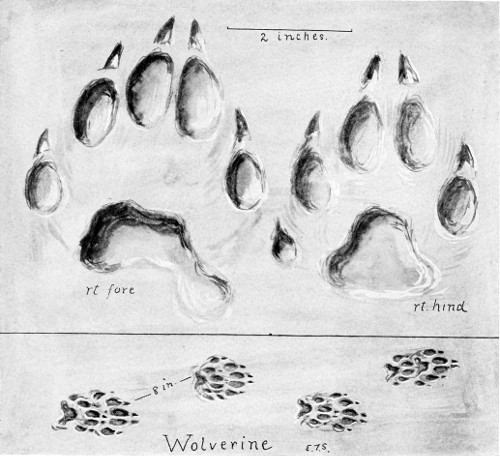
WOLVERINE
Its weasel kinship is seen in the wolverine track. Occasionally, not always, its fifth toe
shows. The track is not plantigrade, and a single track is easily mistaken for that of a wolf.
The hog-nosed skunks are the only representatives
of the skunk tribe in South America,
where various species occupy a large part of
the continent. They appear to form a South
American group of mammals which has extended
its range northward through Central
America, Mexico, and across the border of the
United States to central Texas, New Mexico,
and Arizona. In Mexico they range from sea-level
to above 10,000 feet altitude on the mountains
of the interior.
The hair on these skunks is coarse and harsh,
lacking the qualities which render the coats of
their northern relatives so valuable. Where
their range coincides with that of the common
skunks, the local distribution of the two is
practically the same. They live along the bottom-lands
of watercourses, where vegetation is
abundant and the supply of food most plentiful,
or in canyons and on rocky mountain slopes.
For shelter they dig their own burrows, usually
in a bank, or under a rock, or the roots of a
tree, but do not hesitate to take possession of
the deserted burrows of other animals, or of
natural cavities among the rocks. Owing to
their strictly nocturnal habits, they are much
less frequently seen than the common skunks,
even in localities where they are numerous. In
fact it is only within the last few years that
their presence in many parts of the southwestern
border has become known.
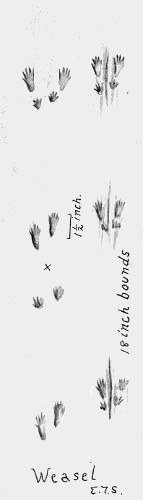
THE TRACK OF THE WEASEL
The unusual space between the fore and
hind feet in the middle of the left series is
often seen. Sometimes the tail mark is there
and sometimes not. Sometimes the trail is
like that of a small mink. The toes seldom
show (see pages 554 and 572).
Although both the little spotted and common
skunks live mainly on insects, the hog-nosed
skunks are even more insectivorous in their
feeding habits. The bare snout appears to be
used constantly for the purpose of rooting out
beetles, grubs, and larvæ of various kinds from
the ground.
On the highlands of Mexico I have many
times camped in localities where patches of
ground were rooted up nightly by these skunks
to a depth of two or three inches as thoroughly
as might have been done by small pigs. In
such places I repeatedly failed to capture them
by traps baited with meat, the insects and grubs
they were finding apparently being more attractive
food. I have had similar failures in
trapping for coyotes with meat bait in localities
where they were feeding fat on swarms of
large beetles and crickets. The persistence with
which the hog-nosed skunks hunt insects renders
them a valuable aid to farmers.
In addition to grasshoppers, crickets, beetles,
flies, grubs, and other larvæ, and many other
insects, they are known to eat wood rats, mice,
and the small fruit of cactuses and other plants.
The stomach of one of these skunks examined
in Texas contained about 400 beetles.
One Texas naturalist writes that he has lost
a number of young kids which had their noses
bitten off, and in one instance caught one of
these skunks mutilating a kid in this manner.
He also states that they pull down and eat corn
when it is in the “roasting-ear” stage.
Far less is known concerning the habits of
hog-nosed skunks than of the other species of
these animals. The number of young appears
to be small, judging from the record of a single
embryo found in one animal and in another
instance of two young found in a nest located
in a hollow stump. They have a curiously
stupid, sluggish manner and have even less
vivacity than the somewhat sedate common
skunk. No use is made of their skins in this
country or in Mexico, but the gigantic natives
of Patagonia make robes of them which are
worn like great cloaks.
(For illustration, see page 559)
Armadillos are distinguished from other
mammals by having the nearly, or quite, hairless
skin developed into a bony armor covering
the upperparts of the head and body and
all of the tail. They lack teeth in the front of
both upper and lower jaws, and are members
of the group of toothless animals which includes
the ant-eaters. The insects they feed on
are licked up by the sticky surface of their
extensile tongues.
In the remote past many species of armadillos,
some of gigantic size, roamed the plains
of South America, and a number of small
species still exist there. These animals are
peculiar to America and have their center of
abundance in the southern continent.
The nine-banded species ranges over an
enormous territory and is subdivided into a
number of geographic races, living from southern
Texas through Mexico and Central America
to Argentina. In Mexico its vertical distribution
extends from sea-level up to an altitude
of about 10,000 feet on the mountains of
the interior. Like the hog-nosed skunk, it no
doubt originated as a member of the South
American fauna and has spread northward to
its present limits. It is one of the larger of
the living representatives of this curious group
of animals and reaches a weight of from twelve
to fifteen pounds.
As might be surmised from its appearance,
the armadillo is a stupid animal, living a monotonous
life of restricted activities. Its sight
and hearing are poor, and the armored skin
gives it a stiff-legged gait and immobile body.
From these characteristics, combined with the
small head hung low on a short neck, it has in
life an odd resemblance in both form and
motion to a small pig; it jogs along in its trails
or from one feeding place to another with the
same little stiff trotting gait and self-centered
air. If alarmed it will break into a clumsy
gallop, but moves so slowly that it may be
overtaken by a man on foot. So poor is its
eyesight that a person may approach openly
within about thirty yards before being noticed.
When alarmed the armadillo immediately runs
to the shelter of its burrow, but may easily be
caught in one’s hands, especially if intercepted
on the way to its den. When caught it will
struggle to escape, and while it may coil up
in a ball in the presence of a dog or other
mammal foe, I never saw one try to protect
itself in this way. While presumably serving
for protective purposes, the armor is flexible
on the sides of the body, and I have found the
remains of many armadillos where they had
been killed and eaten by coyotes or other predatory
beasts. The armor would no doubt be sufficient
protection to enable them to escape to
cover from the attack of birds of prey. They
are mainly nocturnal animals, but are frequently
seen abroad by day and in some places
appear to be out equally by day or night.
This armadillo lives by preference amid the
cover afforded by forests, brushy jungle, tall
grass, or other vegetation. In the midst of
such shelter it usually digs its own burrow a
few yards deep in a bank or hill slope, beneath
a stump, under the roots of a tree, or a rock,
or even on level ground. It will also occupy
small caves in limestone rock. At times it
shows a piglike fondness for a mud bath, and
the prints of its armor may be found where it
has wallowed in miry spots.
Well-beaten and conspicuous trails lead from
the burrows often for half a mile or more, frequently
branching through the thickets in various
directions. Armadillo burrows sometimes
accommodate strange neighbors, as was shown
by one in Texas which was dug out, and in
addition to containing the owner in his den at
the end, was found to be occupied by a four-foot
rattlesnake and a half-grown cottontail
rabbit, each in a side chamber of its own.
The food of the armadillo consists almost
entirely of many species of insects, among
which ants appear to predominate. When
searching for food the animals become so intent
that they may be cautiously approached
and closely observed or captured by hand. They
root about among fallen leaves and other loose
vegetation and soft earth, now and then digging
up some hidden grub or beetle. At night they
visit newly plowed fields in their haunts, rooting
in the mellow earth. They are accused of
digging up plants in gardens during their nocturnal
wanderings, and in Texas have been
charged with robbing hens’ nests of eggs, and
of reducing the supply of wild turkeys and
quail by breaking up the nests, all of which
needs confirmation. Their method of feeding
appears to vary considerably, as they have been
seen rising on their hind legs to secure small
caterpillars infesting large weeds.
The insect food eaten by the nine-banded
armadillo in Texas, as known from examination
of stomach contents, covers a wide range
of insect and other small life, including many
species of grasshoppers, crickets, roaches, caterpillars,
beetles, ants, spiders, centipedes, and
earthworms. As the list includes also wireworms
and other noxious species, these inoffensive
animals deserve thorough protection as a
most useful aid to the farmer.
Some time from February to April each year,
litters of from four to eight young are born.
They have their eyes open at birth, and the
armor is soft and flexible like fine leather. The
hardening of the skin into a bony armor is
progressive, continuing until after the animal
fully completes its growth. As soon as the
young are able to travel they trot along with
the old one during her foraging trips.
Early one afternoon, when riding along a
trail in the heavy forest of southern Oaxaca,
accompanied by an Indian boy and a pack of
dogs, I suddenly came upon an old armadillo
and eight young about two-thirds grown.
They had heard our approach and stood motionless
in a compact little group half hidden
in the grass. I had barely time to stop my
horse when the dogs spied them and made a
rush. The armadillos darted into the undergrowth
in every direction like a litter of pigs,
and with the exception of two caught by the
dogs gained safe refuge in their burrow. This
we found dug in the level ground about fifty
yards from where we encountered them.
The Maya Indians of the Peninsula of Yucatan
have a legend that the black-headed vulture
(Catharista atrata) in old age changes
into an armadillo. The tale runs, that when
a vulture becomes very, very old it notifies its
companions that the time has come and alights
before a hole in the ground that resembles the
den of an armadillo. The other vultures bring
food and the old one remains there for a long
time. Its wings disappear, the feathers are
lost, and when the change is complete the newly
created armadillo enters the hole and begins
its new life. If skepticism is expressed as to
this metamorphosis, the Indians point out as
proof of the legend the similarity between the
appearance of the bald pate of the vulture and
that of the armadillo.
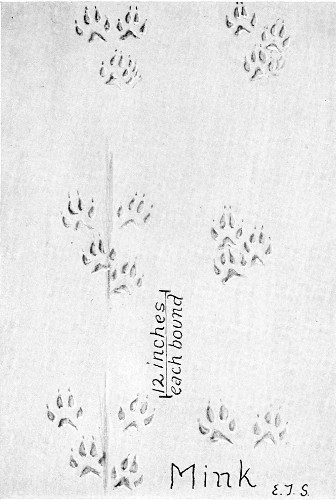
AMERICAN MINK TRACKS, SHOWING VARIOUS ARRANGEMENTS
AND TAIL MARKS
The typical track of a mink is as in the bottom set at the
left, which also illustrates the tail mark. Twelve to twenty-four
inches are usually cleared at each bound. This illustration
is greatly reduced from natural size (see opposite page
and pages 555 and 575).
THE RING-TAILED CAT (Bassariscus
astutus and its relatives)
(For illustration, see page 562)
The mild climate and the proximity of the
Southwestern States to Mexico and the tropics
brings within our borders numerous strange
types of wild life. Of these the
ring-tailed cat is one of the
most strikingly marked and interesting.
In the United States
it is known by several other
names, including “civet cat,”
“coon cat,” and “band-tailed
cat.” In Mexico it still bears
the old Aztec name cacomixtle,
except in Lower California,
where it is the “babisuri.” It
is about the size of a large cat
but with proportionately longer
and slenderer body, shorter
legs, and longer tail. The alternating
bands of black and
white on the tail proclaim its
relationship, not to the cat, to
which it has no kinship, but
to the raccoon, which has a tail
similarly marked. Few mammals
possess such a beautifully
formed head and face, and its
large, mild eyes give it a vivid
expression of intelligence.
The ring-tailed cat occupies
areas under such differing climates
as to produce geographic
races, but none of them vary
strikingly from the typical animal
here illustrated. They
range from Oregon, Nevada,
southern Utah, Colorado, and
Texas south to Costa Rica. In
Mexico they occur from near
sealevel up to an altitude of
about 10,000 feet. While chiefly
rock-inhabiting species, they
sometimes live in the forests
and as a rule make their dens
in caves and deep crevices, but
sometimes in hollow trees or
about houses. Their young,
from three to four in number,
are born in May or June.
In the Southwest they frequent
some of the ruined cliff
dwellings, and I have found
them haunting many of the
ancient ruins of Mexico. Their
presence in little caves and other
sheltered spots along cliffs and
rock walls bordering canyons
or on mountain slopes may usually be known
by an examination of the fine dust which accumulates
in sheltered places. Whenever present
their delicate cat-like tracks will be found
where they have been hunting mice or other
small game.
Strictly nocturnal, they do not sally forth
from their dens until darkness is complete.
During the night they are restless and frequently
wander far and wide in search of food,
and apparently at times merely to satisfy a
spirit of inquiry. Their inquisitive nature frequently
leads them to explore the streets of
towns and cities on the Mexican table-land,
filled though these places are with dogs. At daybreak,
tracks left in the
dusty streets tell the story
of their wanderings, as
they often do also in the
case of opossums.
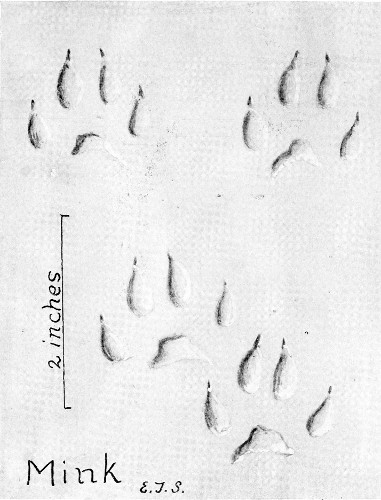
AMERICAN MINK TRACK NEARLY NATURAL SIZE
Although this animal has five toes on each foot, only four appear
in each track. This illustration, which is practically natural size,
shows the usual arrangement of the track. The hind feet are, of
course, in advance. Variations of arrangement are shown on the
opposite page (see also pages 555 and 575).
One morning in February,
1893, soon after sunrise,
I chanced to pass
through a little wooded
square in the City of
Mexico and saw a lot of
boys pursue and capture
one of these animals
which, having overstayed
his time, had been surprised
by daybreak. This
wanderer might have had
its den in some house in
the neighborhood, since
one of its known habits
is to take up its abode
about houses, even in the
midst of towns. A friend
living in the City of
Mexico informed me that
after having been annoyed
for some time by
noises on the roof at
night, he investigated and
discovered a female cacomixtle
with partly grown
young snugly located in
a nest placed in a narrow
space between the tile
roof and the ceiling. In
southern Texas the animals
live on the brush-grown
plains under conditions
very different
from those usually
chosen.
Like its relative the
raccoon, the cacomixtle,
with a taste for a varied
fare, takes whatever edibles
come its way. It
stalks wood rats, mice,
and even bats amid their
rocky haunts and birds
in bushes and low trees.
About the southern end of the Mexican table-land
it is much disliked for its robberies of
chicken roosts, especially when these are located
in trees. Insects of many kinds, larvæ,
and centipedes are eaten, as well as a great
variety of fruits, including that of the pear-leaved
cactus, and dates, figs, and green corn.
Ring-tailed cats regularly locate among rocky
ledges, neighboring orchards, or other cultivated
areas where they may gather some of
the bounty provided by man. I found them
more plentiful among the broken lava cliffs
bordering date palm orchards in Lower California
than in any other place. When the
dates were ripening they prowled about under
the palms after dark with gray foxes and
spotted skunks to pick up the fallen fruit.
They sometimes uttered a complaining cry and
when caught in a trap would bark almost like
a little dog, or occasionally utter a vicious
scream of mixed fear and rage.
Being an intelligent animal, the cacomixtle is
readily tamed and makes a most interesting pet.
During the early years of gold mining in
California, when many men were living in rude
cabins in the mountains, the prevalence of mice
often attracted these “cats” to take up their residence
there. Often the owner of the premises
and the mouser struck up a friendly relationship
and the cacomixtle, becoming as free and
friendly about the place as a real cat, kept it
entirely clear from mice. I have had first-hand
accounts of these tame individuals from miners
who had harbored them in this way for months.
These accounts always gave the impression that
the animal was somewhat playful and mischievous
and most attractive to have about the
premises. All agreed that it was extremely
fond of sugar.
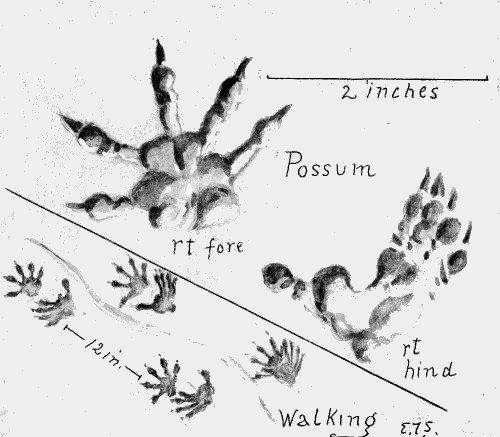
TRACK OF THE OPOSSUM
The hand-like paws are unmistakable. The tail mark appears. The absence of claw on the
thumb of the hind foot is usually seen.
(For illustration, see page 563)
The effect on mammals of a narrowly specialized
mode of life is well illustrated in the
mole. It is an expertly constructed living mechanism
for tunneling through the earth. The
pointed nose, short neck, compactly and powerfully
built cylindrical body, with ribs strongly
braced to withstand pressure, and the short,
paddlelike hands armed with strong claws for
digging are all fitted for a single purpose. Eyes
and ears are of little service in an underground
life, so they have become practically obsolete;
the fur has been modified to a compact velvety
coat which will lie either front or back with
equal facility and thus relieve any friction from
the walls of the tunneled roads, no matter
which way the animal travels.
Moles are circumpolar in distribution, being
found from England to Japan in the Old
World and on both the Atlantic and Pacific
coasts of the New World, where they occur
only in North America. On this continent they
are limited mainly to the United States and
southern Canada, extending across the Mexican
border only in two limited areas at the
extreme east and west. Their distribution is
not continuous across the continent, but is
broken by a broad unoccupied belt formed by
the arid interior, including the Great Basin.
The home of the Oregon mole lies in the humid
area west of the Cascade Mountains in Washington,
Oregon, and extreme northwestern
California. Closely related forms range from
eastern Oregon southward through California
to the San Pedro Martir Mountains in Lower
California, and others north into British Columbia.
The Oregon mole is the largest and handsomest
member of the group in America and
perhaps in the world. Its skin, a velvety coat
of nearly black fur, often with a purplish sheen,
now brings a higher price in the market than
that of any other species. Its size and the
beauty of its dark coat distinguish it from any
other mole.
Where the soil is loose the mole practically
swims through it, urged forward by powerful
impulses of its “hands” and feet. This is the
common mode of travel near the top of the
ground, where the course is marked by the
lightly upheaved and broken surface. When
working at a greater depth and in more compact
soil the mole must dig its way and dispose
of the loose earth by pushing it along the
tunnel to an outlet at the surface through which
it is thrust to form a mound similar to the
“dumps” of that other great miner, the pocket
gopher.
On account of this similarity in mode of life,
moles and pocket gophers are sometimes confused
by persons not familiar with the two
animals. The resemblance ends in this apparent
likeness, for the pocket gophers belong
to the great order Rodentia, or gnawing animals,
while the moles are of the Insectivora,
or insect-eaters.
The superbly forested region inhabited by
Oregon moles is so well watered that few
places, even on high mountain slopes, are too
dry for them to occupy. These animals are
generally distributed, and their hills may be
seen in the midst of the great coniferous forests
as well as in the open valleys.
They are most abundant in open grassy areas,
especially in meadows and in the bottoms of
canyons and similar places, where the damp
rich soil affords a plentiful supply of earthworms,
grubs, and insects on which to feed.
Like other moles, they lead lives of great activity
and almost constant hard labor. During damp
weather they work near the surface, but in
dry periods as the upper soil hardens they
follow their prey to lower levels. A hard
shower, however, always brings an outburst of
activity as they reoccupy the upper soil and
throw up a multitude of new mounds. They
have the habit of regularly coming to the surface
to hunt food during the night. This is
no doubt coincident with the swarming up to
the surface of earthworms on which the moles
feed. At such times many are captured by
owls, cats, and other beasts of prey.
The runways of moles close along the surface,
shown by well-marked ridges, are for
hunting purposes, and the lower tunnels, from
which the earth in the mounds is brought, are
for traveling and lead to the nest chamber.
The deep tunnels of the Oregon mole sometimes
extend considerable distances along fences, or
other surface cover, which afford more or less
protection. Such tunnels are a kind of highway
often used by several moles and also by
shrews and field mice. The system of tunnels
of the moles over a considerable area often intersect
and are used more or less in common.
As a result more than twenty moles have been
trapped at a single point in one of these underground
roads.
They make an intricate system of many-branched
tunnels, the courses of which are
usually marked by series of mounds varying
from four to ten inches high and five to twenty
inches wide and often scattered over meadows
or other fields from two to six feet apart.
Owing to the persistence with which the moles
raise their mounds everywhere in the occupied
parts of their territory, they have become a
serious and costly pest. In meadows the knives
of mowing machines are dulled by them, and
in towns lawns are disfigured by their undesirable
activities. As a consequence they have
now fallen under the ban and are classed with
other mammals which have shown their lack
of ability to fit in satisfactorily with the changed
conditions brought to their ancient territory by
civilized man. Under natural conditions their
activities were undoubtedly entirely beneficial.
They appear to have but a single litter of
young, numbering from one to four, each year.
These are born in March and grow so rapidly
that by the last of May they are working in
the tunnels and are scarcely distinguishable
from the adults.
The recent discovery that the Oregon moleskin
is valuable for its fur will give such an
incentive to trapping that there is little doubt
the boys of the State within a few years will
reduce the numbers of the animal and thus
control its injury to agriculture. The market
for the skins appears practically unlimited,
judging by trade reports, one dealer in Brooklyn
stating that he dressed 4,000,000 imported
European moleskins in 1916.
(For illustration, see page 563 )
The star-nosed mole, known in parts of
Maine as the “gopher,” is peculiar among the
moles in having a fringe around the end of its
nose formed by twenty-two short fleshy tentacles.
A less-marked character is in the proportionately
long tail, which becomes greatly
enlarged in fall and remains in this condition
during the winter months. Otherwise the external
appearance of this species is much like
that of the common moles of America and the
Old World.
The star-nosed mole is found from southern
Labrador, the southern end of Hudson Bay,
and southeastern Manitoba south along the
Atlantic coast to Georgia and in the interior
down the Alleghenies to North Carolina and
to Ohio, Indiana, Illinois, Wisconsin, and Minnesota.
Throughout this area it ranges irregularly
and much yet remains to be learned
about the details of its distribution and habits.
Ordinarily solitary, these moles at times are
so numerous in limited areas that they appear
to form colonies. Such gatherings probably
mean an unusually rich feeding ground, which
makes it unnecessary for the young to disperse
to outlying locations, as is the habit of moles
and most other mammals.
The star-nosed mole has a strong preference
for damp and even marshy or swampy locations.
It frequents low-lying meadows, the
borders of streams, and grassy swamps, where
its underground burrows alternate with open
surface runways among grass roots and other
matted vegetation. It spends far more time
above ground than the other moles, and not
infrequently swims among flooded cat-tails and
other vegetation and in winter has been seen
swimming under the ice.
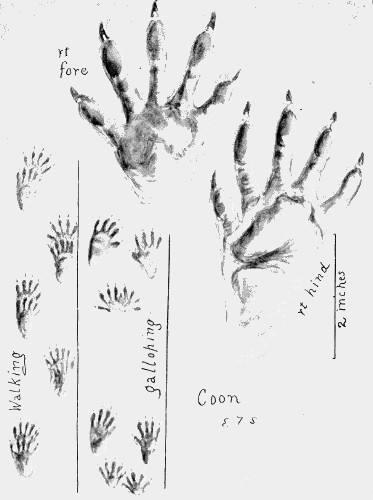
A RACCOON’S TRACK
The track of the raccoon is very distinctive and usually easy to find, because it frequents
the mud by the water side. Sometimes, to a casual glance, the track of a small coon is taken
for that of a large muskrat, but their differences are very obvious.
Like others of its kind, this mole is amazingly
powerful in proportion to its size. It persistently
adds to its surface ridges, and in constantly
extending its deeper tunnels must dig
loose earth and dispose of it by forcing it up
through an outlet to form the mounds which
mark the course of its travels. Where the soil
is loose it readily forces it aside with its compact
body and paddle-shaped hands. In pushing
up the little piles of earth and in the ridges
raised when burrowing close to the surface it
sometimes injures meadows and other cultivated
land. Occasionally it wanders away from
the fields and invades lawns and gardens, where
the only injury it does is in the disturbance of
the soil.
Its nests are compact little balls of fine grass,
weeds, or leaves in dry underground chambers
excavated in its burrows. The nests are a foot
or two underground, but above the level of the
water, sometimes under a stump and again in
a knoll or bank. One nest containing five young
was found in Maryland in an old woodshed
under several inches of chips. This location
and its choice of a site for its nest under a
stump in a field or in a dry knoll are clear indications
of a kind of intelligence which even
the lowliest animals appear to have in caring
for their young.
The star-nosed mole is full of the restless
energy so necessary in a mammal which must
come across its food by more or less haphazard
tunneling through the soil. It is active both
summer and winter. In dry weather as the
moisture near the surface decreases the soil
hardens and earthworms and other subterranean
life seek deeper levels. The mole follows
them, only to return with them nearer the
surface with a renewal of the moisture. In
winter it sometimes comes out and travels
slowly about on top of the snow, ready to burrow
out of sight at once, however, at the sound
of approaching footsteps.
The food of the star-nose, like that of most
other moles, is made up mainly of earthworms,
white grubs, cutworms, wireworms, and other
underground insects. In captivity, before eating
a worm or other flesh food offered, it first
feels of it with the little raylike organs of
touch on its nose. It is difficult to surmise the
real value of these “feelers,” for it would seem
that the acute sense of smell so common to
mammals should do better service.
Aside from its disturbance of the surface soil
by its ridges and mounds, the star-nosed mole
does no direct injury, and its life is largely
passed in the useful task of searching out and
destroying insects. Indirectly it causes some
injury to root crops, plants of various kinds,
and fruit trees, by providing tunnels along
which meadow and pine mice travel to commit
the ravages which on circumstantial evidence
are charged to the mole.
(For illustration, see page 566)
Many interesting small mammals are nocturnal
or lead such obscure and hidden lives
that they are rarely observed except by naturalists.
Of these are the numerous species of
shrews, which include the smallest mammals in
the world. These tiny beasts all live among the
vegetation and debris on the surface of the
ground or in little burrows below. With the
moles they are members of the order Insectivora
and depend mainly on insects and meat
for food. Despite their minute size, they are
possessed of an indomitable courage and ferocity,
which leads them without hesitation to attack
and kill mice many times their own weight.
The genus Sorex, of which the common shrew
is a member, is circumpolar in distribution, the
various species ranging through England, the
European mainland, Asia, and North America
as far south as Guatemala.
The common shrew is a purely North American
animal, occupying all the northern part of
the continent from the Arctic shores of Alaska
and Canada south to northern Nevada, South
Dakota, Illinois, and Pennsylvania, and along
the Allegheny and high Rocky Mountains to
North Carolina and New Mexico. Its vertical
range extends from the seacoast up to timberline
in the Rocky Mountains.
The common shrew is the smallest of the
mammals in all the northern parts of this continent,
and one marvels at the possibility of
such a tiny morsel of flesh and blood withstanding
the rigors of the arctic winters. It
measures about four inches in total length and
weighs about forty-five grains; the body and
tail are slender, the nose long and sharp, and
the rim of the ears shows a little above the
dense velvety fur. By these characters it may
be distinguished from the larger, more heavily
proportioned (and darker-colored) short-tailed
shrews which abound with it in certain parts
of its range. Its smaller size and grayish
brown color are the main superficial differences
between it and other American members of the
same genus. The climatic differences in its
wide range have developed several geographic
races, none of which, however, show strongly
marked characters.
This shrew appears to have a most catholic
taste, so far as its surroundings are concerned,
for it appears to frequent every type of situation
where shelter and food can be found. It
abounds among the peat beds and sphagnum
mosses of the desolate barrens bordering on
the Arctic coast, as well as amid the rotten
stumps, old logs, fallen leaves, and other vegetable
debris on the floor of the forests farther
south. It will be found also in the rank matted
vegetation about marshes, in old fields and occasional
sphagnum swamps in the southern
parts of its range.
The little tunneled runways of these shrews
form a network in the beds of moss in a sphagnum
swamp near Washington. In
the forest the animals always seek
the cover afforded by fallen logs, slabs
of bark, or anything else that will
give protection. On the coast of New
Jersey they live so near the sea that
an extra high tide forces them to
mount the drift logs on the salt
meadows for safety. They often make
little burrows in the soft earth under
the roots of a tree, a stump, or a log.
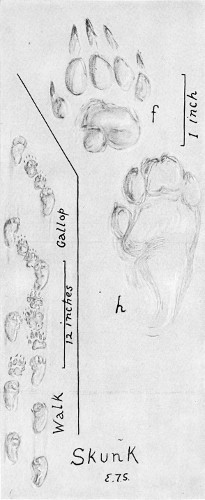
THE TRAIL OF THE COMMON SKUNK
The hind foot of the skunk rarely shows the claws
in the track. The diagonal set during the gallop is characteristic
(see pages 558 and 580).
Their nests are small balls of dry
leaves, grasses, or other soft vegetable
material placed snugly under a log
or in a hollow stump, burrow, or
other good retreat, where they appear
to have two or more litters of from
six to ten young during the summer
and fall.
As in the other shrews, the food
of the common species consists mainly
of insects, larvæ, worms, and obtainable
flesh; but in winter and possibly
at other seasons many kinds of food
are eaten, including insects, meat, fat,
flour, and seeds. During the years I
passed at St. Michael, on the coast of
Bering Sea, the beginning of winter
always brought into the storehouses
and dwellings a swarm of field mice,
lemmings, and these shrews. The
food requirements of all appeared to
be the same, and all fed freely on the
flour and other accessible stores.
Dozen of the shrews were killed in
the houses every winter.
Occasionally I caught and kept one
captive for a time to observe its
habits. It would be extremely restless
and equally active by day or night.
The small eyes appeared of little service,
but the long, flexible snout was
used constantly and served as the
main reliance of the little beast for
information as to the outside world.
Wherever they travel these shrews
utilize the runways of the field mice
or other small animals and make little
runs of their own only where necessary.
Aside from a faint squeak, I
have never heard them utter a sound,
but other observers credit them with
series of fine twittering notes apparently
uttered as a song.
The common shrew is a solitary
animal of so morose a disposition
that if two are placed in a cage together
they almost immediately fall
upon one another with tooth and
nail, and the victor devours the body
of its companion at a single meal.
The digestion of shrews is so rapid
and the call for food so incessant
that it requires constant activity to
keep the demand satisfied.
After the winter snow arrived in
the North I found many tunnels of
these shrews running just under its
surface and raising it a little in a
slight but distinctly rounded ridge.
Such tunnels wandered widely and
on the ice of the Yukon River I
traced one of them more than a mile
and repeatedly saw them crossing the
river from bank to bank. It was surprising
to note the ability of the little
travelers under the surface to keep
in so nearly a direct line for long distances.
At times these little adventurers
make similar tunnels in the snow far
out on the sea ice. The mythology
of the Eskimos contains accounts of
many supernatural animals which a
lone hunter may meet and which
have the power to do him deadly
harm. Among these the “sea shrew”
is one of the most malignant. Its
appearance is described as exactly
like that of the common land shrew,
but it is said to live on the ice at sea,
and if it sees a hunter to dart at him
through the air, pierce the skin, and,
after running all through the body
with incredible rapidity, to enter the
man’s heart and kill him. In consequence
of this belief the Eskimo
hunters were in mortal terror if they
chanced to encounter a stray shrew
on the sea ice. I knew one hunter
who suddenly meeting one on the ice
stood motionless for hours until the
shrew wandered out of sight. He
then hastened home and all the other
hunters agreed he had had a lucky
escape.
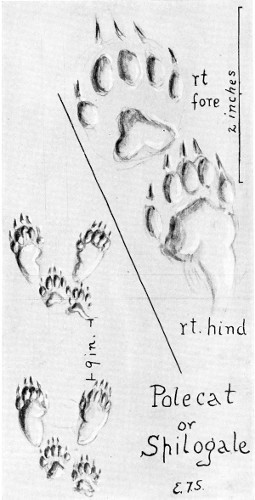
LITTLE SKUNK, POLECAT, OR SPILOGALE
This trail combines the characteristics of the skunk
with those of a squirrel. At first it looks like the track
of a stubby-toed squirrel, but the five-inch toe on the
front foot is plainly seen. The frequent pairing of the
fore paws is important. There is no tail mark (see
pages 558 and 576).
(For illustration, see page 566)
Several groups of species or genera
of the little mouselike animals known
as shrews are peculiar to North
America. Of these one of the most
numerous and best known is the short-tailed
shrew. It is a dark-colored
animal much more heavily proportioned,
larger, and with a shorter tail
than the common shrew. Its fur is
so thick and velvety that it is confused
by many people with the mole,
despite its smaller size.
The short-tailed shrews, sometimes
called mole shrews, of the genus Blarina
belong to a single species with
several geographic races occupying
eastern Canada and the United States,
from Nova Scotia, southern Quebec, Ontario,
Minnesota, and North Dakota southward to
Florida and the Gulf coast as far as eastern
Texas. Vertically they range from sea-level
up to the tops of the Alleghenies. Another
group of American shrews, containing numerous
species belonging to the genus Cryptotis,
occupies the mountains of the Western States,
and ranges south to northern South America.
In external form it is indistinguishable from
the short-tailed species.
Probably no mammal is more numerous in
the eastern United States than the short-tailed
shrew. It occurs everywhere—in forests, in
brushy areas, in old fields,
and along grassy banks.
Within the city of Washington
it is common in
Rock Creek Park, where
it lives in covered runs
which it makes among the
grass and fallen leaves.
These shrews drink frequently,
and this may in
part account for their
abundance near streams
or other water, although
it may be the desirable
moist soil conditions
which draw them to such
situations.
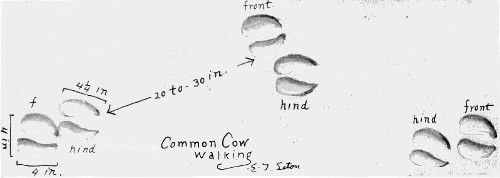
THE TRACK OF A COMMON COW (A SMALL ONE)
It is well to take the tracks of domestic animals as standards in identifying tracks of wild big game. The roundness of the front foot and the
narrowness of the hind are general characteristics, though not always so pronounced as here. But note that the hind foot is set ahead, beside, or
behind the trail of the front foot, but rarely exactly on it. This peculiarity is commonly seen in animals that are accustomed to walk on bogs.
Note also the toes are set pointing a little outward, not straight forward. The clouts, or accessory hoofs, rarely show; only in deep, soft ground.
The runways of these
shrews are scarcely half
an inch wide, usually
partly sunken in the mold
or rotting surface vegetation.
These are not made
by digging, but by pushing
aside the loose mold,
and they cross and re-cross
in an irregular network.
They lead to the entrances
to burrows which
generally drop nearly
straight down. The burrows
are sometimes amid
the leaves, but usually
under the shelter of a
root, stump, old log, or
other cover. In addition
to their own runways, the
shrews make free use of
the runs of meadow mice
and even traverse the
tunnels of the pine mice
and moles in their restless
search for prey.
Small rounded chambers
opening off their
underground runways are
filled with fine grass,
pieces of leaves, and
other soft matter for a
nest. One nest examined
was made entirely from
the hair of meadow mice,
probably the spoils of
war from the bodies of
victims. As a rule, shrews
are extremely unsocial,
but a pair of this species
is sometimes found occupying
the same nest, no
doubt a temporary arrangement.
Several litters,
containing from four
to six each, appear to be
born through the summer
and fall, usually beginning
in June.
While equally active by
day and by night, the eyes
of these shrews seem to
be of little use except to
distinguish between light
and dark, but their senses
of hearing and smell are
highly developed, as is
also the sense of touch
in their long hairs, or
“whiskers,” about the
nose. In captivity an extreme
sensitiveness is exhibited
to sudden sounds,
especially such as those
of a bird’s wings, indicating
an instinctive fear
born of age-long persecution
by birds of prey.
Food is located by smell,
and as the flexible end
of the snout is moved
continually from side to
side, odors are caught
which may register conceptions
as definite in the
minds of these small animals
as sight does in
more favored beasts. All
shrews are provided with
musk glands and on account
of these are apparently
nauseous to most
other animals, as they
are rarely eaten by beasts
of prey. These musky
secretions must be of
great service to facilitate
them in locating one another.
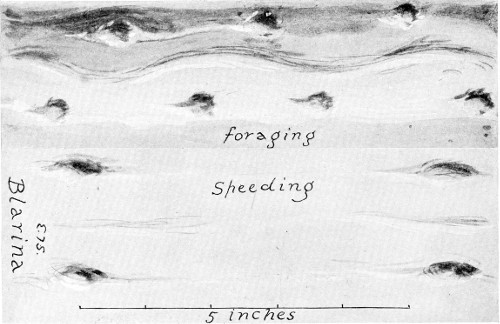
THE SHORT-TAILED SHREW, OR BLARINA
The curious grooved track in the snow with the tail mark is seen
on the left (see pages 566 and 593).
Like other shrews and
the moles, their digestion
appears to be very rapid
and they will eat two or
three times their own
weight in a day. This
necessitates great activity
on their part during much
of the time in order to
find the required food.
They prefer insects and
meat, but are practically
omnivorous, feeding not
only upon many kinds of
insects, but on earthworms,
slow-worms, sow-bugs,
snails, slugs, mice,
shrews, and the young of
ground-nesting birds, as well as such vegetable
food as beechnuts, seeds, bread, and oatmeal.
The instinct of prevision against the season
of winter scarcity appears to be developed in
them, as one in captivity buried beechnuts in
the earth, and they are known to store living
snails in small piles and to gather disabled
beetles in store-rooms in their tunnels.
The courage and blind ferocity of the short-tailed
shrews when they are placed near captive
mice far larger than themselves, is amazing
to all who witness their encounters. They
attack instantly, spreading their front feet to
gain a firmer footing and moving forward in
little rushes. Mice larger and much more
powerful than the shrew are persistently attacked
and, finally giving out, are pounced upon
and the flesh torn from their heads and necks
with ravening eagerness. One day a passing
observer heard a loud squealing on a railroad
bank where an examination revealed a short-tailed
shrew dragging away a nearly dead pine
mouse, though the mouse was much the heavier.
The notes of shrews are a fine tremulous squeak
which becomes a longer, harsher, and more
twittering or chattering cry when they are angry.
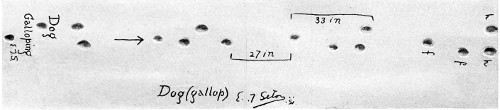
DOG GALLOPING IN SNOW
Showing the curious change whereby the right front ceases to take first place; no doubt this rests the muscles a little. This is
typical of many animals (see page 597).
No cessation of their activity occurs in winter.
When the cold weather begins many gather
about barns and houses located near woods or
old fields, and thus with the field mice take
advantage of the garnered food supplies and
shelter. Others remain in their regular haunts,
where they frequently burrow long distances in
the snow, making networks of tunnels and
traveling long distances just below the surface,
leaving little raised ridges like the track of a
mole on the ground. Their journeys upon and
under the surface of the snow appear to be
in search of food, as they burrow down to old
logs and stumps which make good feeding
grounds. Their movements are very active, as
they go about either at a walk or quick trot.
These fierce and truculent little hunters are
wholly beneficial in their habits and should be
encouraged in place of being killed on sight
indiscriminately, as one of the ordinary mouse
tribe.
(For illustration, see page 566)
Bats reach their greatest development in the
tropics, where a marvelous variety of these
curious mammals exist. To the northward the
number of species gradually decreases, until
eventually, in northern Canada and Alaska, a
single species represents the group. The United
States, occupying the middle latitudes, has a
considerable number of different kinds. Some
of these remain throughout the year, hibernating
in caves during the period of cold, when
insects are not to be had; others wing their
way southward like birds on the approach of
winter and return in spring.
All bats are nocturnal, although individuals
of some species occasionally fly about for a
time by day and many come out just before or
soon after sunset. In this country practically
all species are insectivorous, but in Mexico and
the West Indies many are fruit-eaters and a
few true vampires or blood-suckers.
As a rule, bats are clothed in dull colors, but
richly tinted coats give a few a more attractive
appearance. Of these none has a more striking
adornment than that presented by the soft
covering of glossy orange-red fur of the red
bat. Its large size, about four inches in total
length, with a spread of wings amounting to
twelve inches, combined with its color, suffices
to distinguish it at once from any other northern
species.
The range of the red bat extends from the
Atlantic coast to the Pacific and from Ontario
and Alberta in southern Canada south throughout
most of the United States to the Gulf coast
and southern California; also beyond our limits
to Lower California and Costa Rica. The
genus to which this bat belongs ranges more
widely in other parts of North America; also
to South America and across the eastern Pacific
to the Galapagos and Hawaiian Islands.
The red bat rarely or never seeks shelter in
gloomy caves and crevices, but hangs to the
small twigs or leaf stems on trees and bushes
in the full light of the sun. One observer in
Texas on July 4 found four of them hanging
in a cluster from a twig on a peach tree, with
the sun shining full on them, although the temperature
in the shade was 82 degrees Fahrenheit.
I have found them in northern Illinois
in the glaring sunlight of May, hanging from
leaves in the tops of oak trees. This unusual
tolerance of light in a member of the bat tribe
is further shown by its habit of beginning to
hunt through the air for insects earlier in the
afternoon than other species in its range.
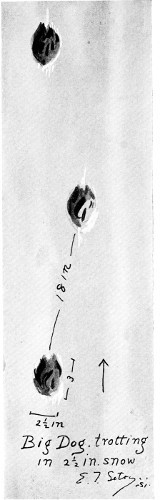
BIG DOG TROTTING
This track of a big dog trotting in about two
and a half inches of snow is singular in the
perfect register it shows. The hind foot drops
each time into the track of the front foot.
This correct style is more usual with wild than
with tame animals. Compare with track of
dog galloping, page 596.
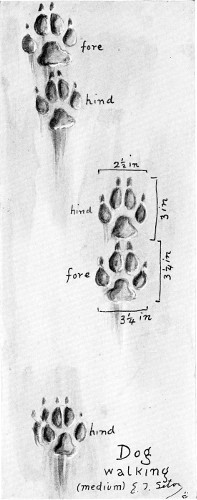
A COMMON DOG
The hind feet are, as usual, narrower, though
nearly as long as the front. The dog is a loose
walker. Sometimes the hind foot is on the
track of the front, sometimes ahead, and often
behind. The claws show. The dragging of
the front feet is another slovenly habit, an evidence
of overdomestication.
Long, narrow wings and swift, powerful flight
characterize the red bats in the air. They have
marvelous control in darting and turning here
and there, and no birds, except possibly the
chimney swifts, can equal them in their extraordinary
gyrations.
Red bats are known to migrate from the
northern part of their range in September or
October and to return in May. They have been
seen going south at Cape Cod the last of
August and in September; and late in October
Dr. E. A. Mearns has recorded great flights of
them down the Hudson Valley, lasting throughout
the day. That they share the vicissitudes
of migrating birds is indicated by observation
on the New Jersey coast of stray individuals
coming in from the sea exhausted early on
September mornings.
They are among the most solitary of their
kind, usually being found hanging singly on a
tree or bush, sometimes within a few feet of
the ground. On occasion they gather in clusters
as mentioned above, and in one instance in
Maryland more than a dozen were hanging in
a compact ball, which suddenly exploded into
its winged parts when disturbed.
One of the most unusual characteristics of
the red bat is found in the number of young
it bears. Usually other species, except the
hoary bat, have one or two young, but at varying
dates between May and July each year the
red bat produces from two to four, the average
being three or four. The young when very
small are carried clinging to the body of the
mother in her flights. She continues to take
them from place to place in this manner until
their combined weight exceeds her own. The
strength of the maternal feeling in this species
is well illustrated by an instance in Philadelphia
where a boy caught a half-grown red bat in a
city square and carried it home. In the evening,
three hours later, he crossed the same
square, carrying the young bat in his hand,
when the old one came circling about him and
finally in her deep anxiety alighted on his
breast. Both were brought in, the young one
clinging to its mother’s teat. The devoted
mother received injuries when she was captured,
from which she died two days later.
In the contact between mankind and bats,
man, the invariable aggressor, finds the bats
baring their teeth, biting viciously, squeaking,
and behaving altogether like little fiends. A
gentler side is sometimes exhibited, however,
and one observer who caught a partly grown
red bat found that it became tame, showed intelligence,
and developed a friendly feeling for
its captor.
The hoary bat is a close relative of the red
bat described above, but is larger, about five
inches long, and, as its name implies, is of a
different color. It is widely distributed over a
large part of North America, where it is known
to breed from Nova Scotia, Manitoba, and the
southern shore of Great Slave Lake south practically
throughout the United States. It is
one of our larger species and is remarkable for
its power and skill on the wing. The wings
are long and narrow and carry their owner
through the air in a bewildering series of
swoops, curves, and zigzag turns remarkable
even in a group of animals so notable for their
powers of flight.
With the approach of cold weather the hoary
bat migrates from the northern parts of its
range to the milder southern districts. It is a
late migrant, not leaving its northern home
until the last of September or October and returning
in May. Some individuals appear to
remain in the North all winter, as one has been
taken in Connecticut in December. In its southern
flight it wanders as far as Jalisco, near the
southern end of the Mexican table-land, to
Lower California, and to the Bermuda Islands.
To reach the Bermudas it is evident the bat
must make a continuous flight from the nearest
point on our shores of at least 580 miles—a
good tribute to its wing power.
Like the red bat, it lives in the open, hanging
from twigs and leaves in the tops of trees or
bushes in the broad light of day rather than in
the dark, stifling crevices where so many of its
kind pass their lives. It appears to hang up
indifferently on any convenient tree or bush,
including conifers, aspens, or willows. During
the day it has a curious lack of alertness, and
as it is not rarely attached to low branches or
bushes within a few feet of the ground it may
be readily approached and taken in the hand.
I once captured a fine specimen the middle of
May, in southern California, hanging on a bush
about four feet from the ground. It appeared
to be sound asleep until taken by the skin on
the back of the neck, when it became very much
alive and, struggling in a fury, uttered grating
shrieks of rage, baring its sharp, white teeth
and trying desperately to bite.
Its food is made up entirely of insects, which
it appears to hunt higher up than most bats,
sweeping over the tops of the forest and in and
out about the trees. It appears to be of even
more solitary habits than the red bat and is
nowhere so common. Another reason for our
lack of information concerning it is found in
its strictly nocturnal habits, for it rarely appears
until shortly before the approaching
night hides it from view.
The hoary bat shares with the red species
the distinction of bearing from two to four
young each year. The young are born in June
and are carried attached to the underside of
the mother’s body until they become too heavy
a burden. They hang to the teats with the
greatest tenacity and apparently rely mainly on
this hold to prevent being dropped as they are
carried on the wild aërial hunting excursions.
With the unusual fecundity indicated by the
number of young, it is difficult to account for
the scarcity of these bats unless their habit of
hanging in the open, exposed to the elements
and to other dangers, may cause a heavy mortality
among them.
Note.—The attention of the reader is called
to an error on page 566, where the Little Brown
Bat, Myotis lucifugus, on the tree trunk, a
common species throughout most of North
America, is labeled “Hoary Bat, Nycteris cinereus,”
which is a much larger and very different
animal.
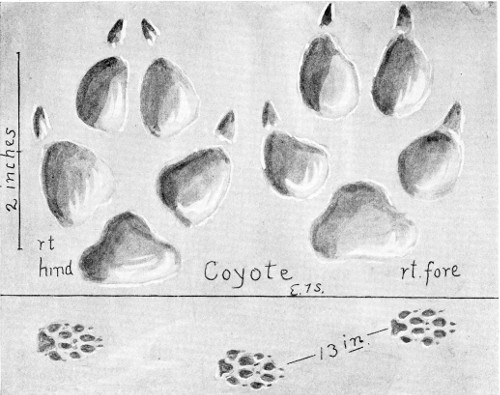
THE TRACK OF A COYOTE
This track cannot be distinguished with certainty from that of a small dog (see pages 596
and 597). The greater size of the side toes in the hind track I have often noticed, but there
is no corresponding disproportion in the animal’s foot.
(For illustration, see page 567)
Reference has been made in several preceding
sketches of this series to the mammals of
tropical origin which have invaded our southern
border. The Mexican bat is a notable
member of this class. It differs in many curious
ways from the bats with which it associates
in temperate regions. It is smaller than any of
the other three bats treated here and is strongly
characterized by a flattening of the head and
body which enables it to creep into a surprisingly
narrow crevice in the rocks or elsewhere.
The ears are broad and flaring and extend forward
over the eyes like the visor of a cap, and
the end of the tail is not confined within the
membrane extending between the hind legs, but
projects from it. Another pronounced characteristic
of this bat and one highly disagreeable
is the rank musky odor which it gives out.
This pollutes the air about its harboring places,
rendering it a most unwelcome guest.
Whoever has visited the Southern and Southwestern
States or Mexico must have noted
the offensive odor in many places about the
verandas of houses and especially about old
churches and other public buildings. This is
the sign of occupancy placed on the premises
by the Mexican bats, which, to the number of
a few dozens or actually by thousands, as conditions
permit, may lie snugly hidden in cracks
and dark openings of all kinds about the roof
and walls. No other bat in
Mexico or the United States
is provided with so strong an
odor.
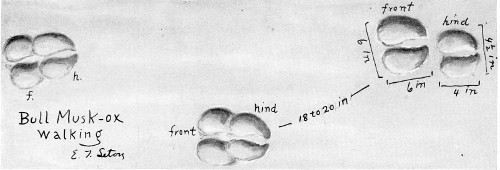
MUSK-OX
Drawn from the tracks of a big bull in the barren grounds of Canada. Much like the track of a common cow (see page 594), but more rounded
and less deeply cloven; also, I think, less often sprawling—in other words, more often hind foot on front track; for the musk-ox is more of an
upland creature.
The Mexican bat is extremely
abundant, probably exceeding
in numbers any other species
within its territory. It ranges
throughout the tropical and
lower temperate parts of Guatemala,
Mexico, and across our
border, throughout most of
Texas, and east as far as
Florida and South Carolina; in
the West it also abounds both
in town and country in the
warmer parts of New Mexico,
Arizona, and California.
Closely allied relatives of the
Mexican bat abound throughout
the warmer parts of Central
and South America to beyond
Brazil. The genus to
which this species belongs is
represented in the warmer parts
of both hemispheres. It extends
north in the Old World
to southern Europe and also
is found in the Philippines.
The abundance of the Mexican
bat in some favorable
places is almost incredible. At
Tucson, Arizona, I once saw
them, a short time before dark,
issuing from a small window in
the gable of a church in such
numbers that in the half light
they gave the appearance of
smoke pouring out of the opening.
At times they occupy
houses in such numbers that
their presence and accompanying
offensive odor render the
places uninhabitable. At the
town of Patzcuaro, near the
southern end of the Mexican
table-land, I saw two rooms in
an old adobe house occupied
by as many of them as could
possibly hang from the rough
ceiling. The owner considered
their presence a valuable asset,
as he collected and sold the
guano for more than the rooms
would have brought in rent.
The bats congregate in even
greater numbers in large caves.
So numerous are they in certain
caves in Texas that the
owner reports an annual income
of about $7,000 from the
guano.
They are very plentiful by
day in the thin crevices about
the roof and walls of caves in
the celebrated Ixtapalapa, or
“Hill of the Star,” beyond the
floating gardens at the City of
Mexico, and I also found them
living in many of the marvelous ruins of
Mexico, including Chichen-Itza, in Yucatan.
Wherever they occur in numbers they may be
heard frequently by day shuffling uneasily
about and squeaking shrilly at one another.
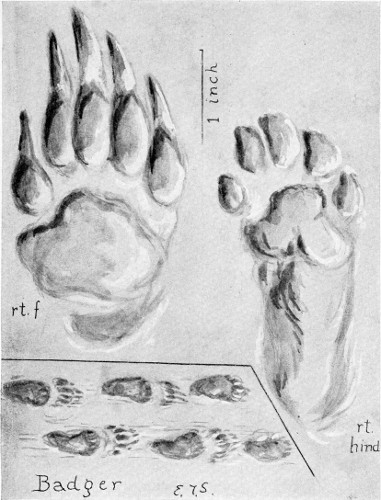
BADGER
The huge fore claws are a strong feature. The hind claws rarely show in the track. The
broad spread of the tracks in the lower trail corresponds with the low, thick form of the
animal.
When they first come out after sunset they
usually fly away in a great stream, nearly all
in the same direction, as though migrating.
This course will probably be found leading to
water, where they scoop up a drink from the
surface before beginning their wonderfully
erratic zigzags through the air in pursuit of
insects.
From the colder northern parts of their range
they migrate southward to milder climatic conditions
or descend to lower altitudes. In Mexico,
where they live up to above 8,000 feet altitude,
they move down from one to two thousand
feet. Their young, one at a birth, are born
from April to May.
It has been claimed that the Mexican bat
brings bedbugs to infest houses. This is untrue
of this or any other bat. These animals
have certain small parasites, some of which, resembling
small bedbugs, have probably given
rise to the belief mentioned. These parasites
live only on the bats.
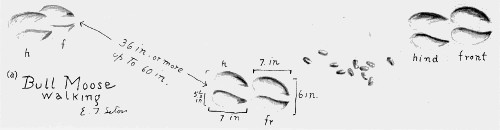
THE TRACK OF A BIG BULL MOOSE WALKING ON HARD GROUND
The great size, the pointed shape, and the long stride usually distinguish it from the track of a domestic cow. Ordinarily, the clouts do not show.
The dung pellets, however, are very important diagnostics. They are cylindrical, about ⅝ inch through and 1¼ inches long. Probabilities of time
and place must always be considered. Oftentimes the hind foot is set far ahead of the front-foot track. The excessive spreading of the hoofs is
a strong character of moose tracks.
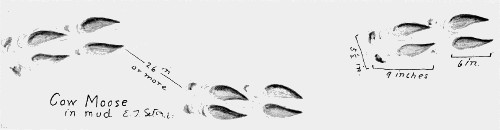
TRACK OF A COW MOOSE WALKING IN THREE OR FOUR INCHES OF MUD
In this the clouts show clearly. The excessive pointedness of the cow’s track is not a fixed character. The hoofs of a moose in swamp country
are larger and more pointed than those in a rocky country, because less worn. The cow track, in this case, was sketched in a land of swamps, so
that it is longer and sharper than the average.
Within a few years considerable publicity has
been given to the supposed possibility of utilizing
bats to destroy mosquitoes and thus eliminate
malaria from infested areas. One or more bat
houses have been built at San Antonio, Texas,
for the purpose of assembling bats in large
numbers, and many untenable claims have been
put forth concerning the benefit to be derived
from their services. The Mexican bat is the
species which abounds above all others at San
Antonio and is the principal species which has
occupied the bat houses near town. It is definitely
known that bats often fly miles from
their roosts when feeding and do not concentrate
on any one kind of insect. Examination
of the contents of the stomachs of Mexican bats
shows that they feed on beetles and numerous
other insects, but rarely upon mosquitoes. I
have visited many Mexican towns and villages
in which every house was haunted by numbers
of these bats and where malaria was perennial.
The evidence against these animals serving any
useful purpose in checking malaria is conclusive.
It may be repeated here, however, that all
of our bats are of high utility as insect-destroyers
and should be protected. Among the many
species of varying habits which exist in the
United States, a few make their homes about
houses in annoying numbers. In place of killing
them to abate the nuisance, it would be better
to exclude them from buildings by closing the
entrance ways promptly after all have left in
the evening, and thus by quiet eviction cause
them to find abiding places elsewhere. The
destruction of forests, and the consequent absence
of the hollow trees where they formerly
lived, is mainly responsible for bats and chimney
swifts coming to houses for harbor.
(For illustration, see page 567)
The marvelous variations in structure of the
ears and other organs about the heads of insect-eating
bats serve probably as microphones by
which the flight of their prey may be detected
and its direction located with instantaneous
certainty. The beautiful accuracy with which
this hearing mechanism works must be evident
to any one who will take a position where he
may have the evening glow of the western sky
as a background for flights of bats. It is certain
that the small and ineffective eyes these
animals possess could never locate their minute
flying game and enable them to secure it in
the whirling, zigzag courses they pursue, often
at a speed and under a control which few, if
any, birds could rival.
The great ears of the big-eared desert bats
illustrate one form of a highly developed hearing
apparatus and give these animals a handsome
and strikingly picturesque appearance.
This character at once distinguishes them from
others of their kind in the United States.
The distribution of this species lies mainly in
the arid parts of the Southwestern States and
Mexico. It extends from western Texas, southern
Colorado, Nevada, and Oregon, south to
Queretaro, on the Mexican table-land, and to
the southern end of the peninsula of Lower
California. The vertical distribution extends
from sea-level up to at least 5,000 feet altitude.
By day these desert bats live in crevices and
caves in cliffs, in old mining tunnels, hollows
in trees, and in sheltered places about the roofs
and walls of houses, barns, or other buildings.
Their presence in dark hiding places may sometimes
be detected by occasional grating squeaks.
They appear to lack any musky odor which
characterizes so many bats. About the 1st of
June each year either one or two young are
born, and for a time these cling to the mother’s
breast and are carried during her swift flights
in pursuit of insect prey.
Often when camping at desert waterholes, I
have seen them come in just before dark to
drink, scooping up water from the surface
while in flight, and then circling back and forth
over the damp ground at an elevation of a few
yards for the capture of some of the insects
common in such places. At such times, with
the distant hills mantled with a deepening
purple haze and the pulsating heat of the day
replaced by the milder temperature of approaching
night, these bats could often be seen sharply
outlined against the rich orange afterglow of
the departed sun. Here and there in the still
air flickered and zigzagged multitudes of tiny
bats, like black butterflies, and among them the
occasional big-eared bats on broad wings appeared
huge in contrast. Their wing strokes
were slower and shorter than those of the
smaller species and impelled them forward in
a swift, gliding movement which gave their
evolutions a sweeping grace beautiful to see.
In August several years ago, during a visit
to the Indian School at Tuba, in the Painted
Desert of northern Arizona, I found these bats
living in considerable numbers about the buildings.
Just before dark they swarmed out and
hunted about the surrounding orchards and
small fields. One evening my collector shot
at one as it circled over a potato field in a small
orchard. It continued its flight, circling low
among the apple trees as though unhurt, when
suddenly it dropped to the ground. Supposing
the bat to be wounded, it was cautiously approached
and covered with a hat, when, without
a struggle, it permitted itself to be picked
up by the nape. It then became evident that
the bat was unhurt from the shot. The reason
for its sudden descent was revealed in the person
of a large, fat mole cricket (Stenopalmatus
fuscus) which it was holding firmly in its jaws,
and so ferociously intent was it in biting and
worrying its luscious prey that it paid not the
slightest attention to its captor. Finally it was
killed by having its chest compressed and died
with its bull-dog grip on its prey unbroken.
These bats, like the other members of the
tribe in the United States, are fully as beneficial
to the farmer as the best of our insect-eating
birds and deserve equal protection in
place of the general persecution from which
they now suffer.
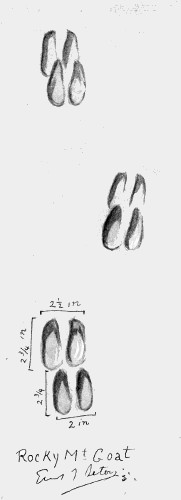
ROCKY MOUNTAIN GOAT
Kinship with sheep and antelope is reflected
in the track of the goat. Its heel-pads are so
large and rubber-like that the track is rarely
so sharp as here shown. “Although marvelously
surefooted and fearless in traversing the
faces of high precipitous slopes, goats lack the
springy grace and vivacity of mountain sheep
and move with comparative deliberation.”
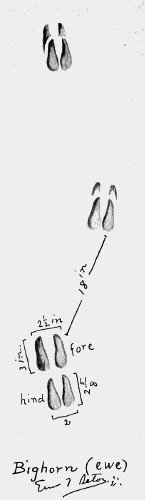
BIGHORN
The general style of a bighorn track is like
that of deer, but the toes are finished off
more squarely and the hollow in the outer
edge of each hoof is a strong characteristic.
Sometimes the tracks are in correct register.
The clouts rarely show. The dung pellets are
like those of the deer, but rounder. The track
is that of a ewe; the ram’s is similar, but larger.
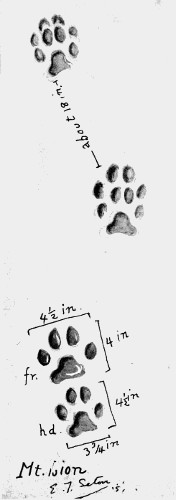
MOUNTAIN LION, OR COUGAR
The track of a mountain lion is much like
that of a house cat, differing only in size.
Sometimes, as in the cat, the hind foot is set
exactly on the track of the front foot.
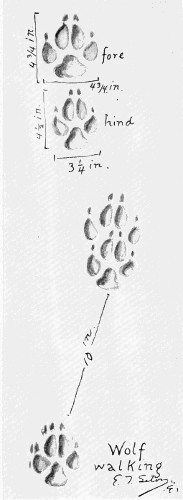
GRAY WOLF
The track is that of a large wolf. There is
no certain way of distinguishing it from that
of a dog (see page 597). Size and probabilities
must be considered.
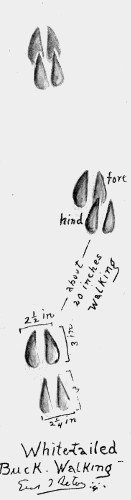
WHITE-TAILED DEER
WALKING
The track of the white-tail is
ideal—a starting point to study
all the tracks. Sometimes the
hind foot fits on the front
track, but sometimes not.
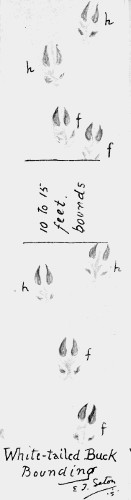
WHITE-TAILED DEER
BOUNDING
In these the clouts are clearly
shown. Note the resemblance
to the tracks of the moose
(see page 602), which differ
chiefly in their greater size.
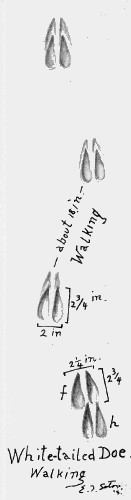
WHITE-TAILED DOE
WALKING
This track differs from that
of the buck in being smaller,
slimmer, and in having the toes
pointing forward or inward—rarely
outward.
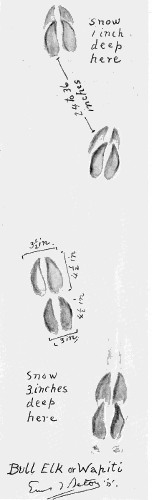
ELK
This shows the track of a large male walking.
Each hoof-mark is about 4½ inches long.
Had it been five inches it would have meant
a very large bull. The track is strictly deer-like
in type, but has a little of the roundness
of point that is so marked in the domestic
cow. At the upper end of the drawing is
snow one inch deep. Here no clouts show;
at the lower end it is three inches deep, so the
clout-marks are clear. Size is essential in distinguishing
the track. The dung pellets, about
⅝ × ⅛ inch, are also important.
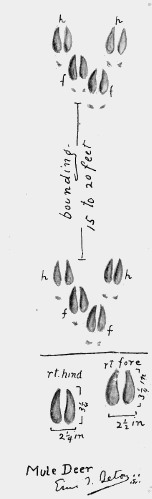
MULE DEER
The mule deer tread cannot be distinguished
with certainty from that of white-tailed or
coast deer; yet it averages larger than either
of these, and the curious close set together of
all four feet while it does its peculiar bounding
is quite unlike what we see in the white-tail
track. “These deer are not good runners in
the open. On level country in Arizona I have
ridden after and readily overtaken parties of
them within a mile. The moment rough country
was reached, however, with amazing celerity
a series of mighty leaps carries them away”
(see page 456).
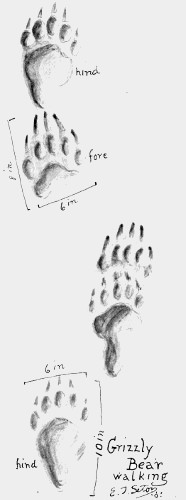
GRIZZLY BEAR
The great size and the immense claws are
the chief characteristics of the grizzly’s track.
All five toes usually show in each track. “The
strongest and most distinctive characteristic of
the grizzlies is the long, proportionately slender
and slightly curved claws of the front feet,
sometimes more than three inches long” (see
pages 440 and 442).
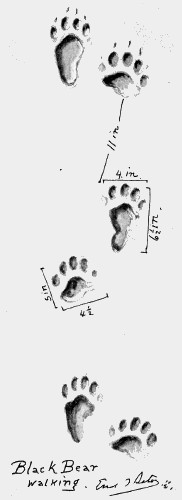
BLACK BEAR
The plantigrade foot is clearly shown in the
bear track. That of a black bear differs from
that of a grizzly, first in size, second in the
shortness of the claws. Usually no claws
show, and the fifth toe, which is well developed
on both front and hind paws, leaves little
sign and often none at all. Frequently the
hind foot is set on the track of the front foot
in correct register.
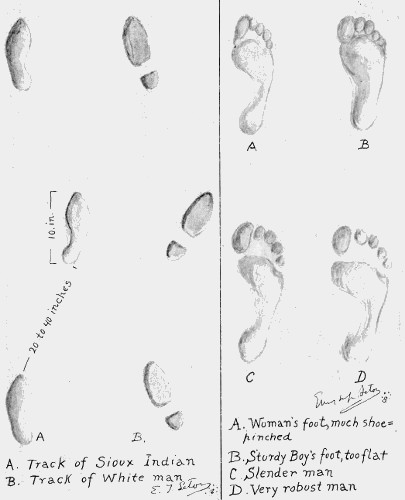
THE HUMAN FOOTPRINTS
The footprints of the human animal are included in this series of sketches for the purpose
of comparison. Especially interesting is the similarity to be noted between the tracks
made by man and those of the grizzly and the black bear (see page 608). The tracks shown
on the left half of this page present the moccasin-shod footprints of a Sioux Indian compared
with the shoe tracks of a white man. On the right are shown: (A) a woman’s foot which
has been much pinched by tight shoes; (B) a sturdy boy’s foot, somewhat too flat to be normal;
(C) the footprint of a slender man, and (D) the imprint of a robust man’s foot.
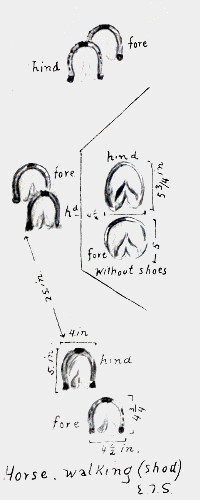
THE HORSE
A hunter needs to know horse tracks as
much as those of wild game. The greater
size and roundness of horse tracks distinguish
them from those of mules and asses. When
shod the toe calks are a strong feature; when
without shoes the unbroken front edge is distinctive.
Some horses walk in correct register;
some do not. Mules are more exact than
horses. When trotting the arrangement is
much as in walking, but the spaces are longer
and the hind-feet track farther ahead of the
front feet. In galloping the arrangement is
much as in the white-tailed deer.
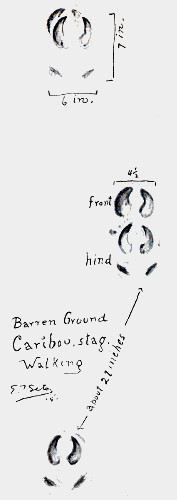
BARREN GROUND CARIBOU
The caribou track is distinguished by its
great spread and the fact that the clouts or
hind hoofs touch the ground, even on a hard
surface. I know of no difference but size between
the tracks of the various caribou and
reindeer. The probabilities of time and locality
help in determining the species, but it
need never be mistaken for that of any other
type of deer. In winter the caribou’s tracks
in the snow show that its feet, instead of being
raised high at each step, like those of a
Virginia or mule deer, drag through the snow
like those of domestic cattle.
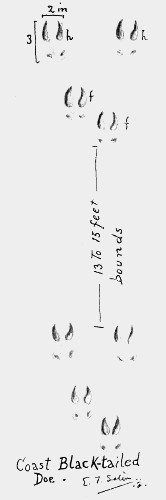
COAST BLACK-TAILED DOE
I know of nothing but probabilities to distinguish
the walking tracks of the coast deer
from those of nearly related species. This
track of a bounding female shows a peculiar
grouping that corresponds fairly with the
bounding action characteristic of the species.
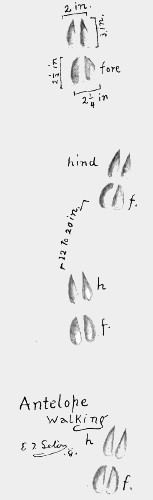
ANTELOPE
The different styles of front and back feet
is a marked character of the antelope’s track
and is best seen in the walk. In galloping all
of these animals leave the hind tracks ahead of
the fore tracks, but disturb the ground, so that
almost no characteristic marks are to be seen.
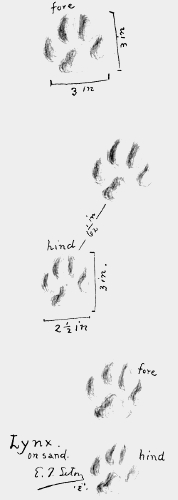
CANADA LYNX
This track I sketched on the Athabasca
River. In summer the track of a lynx shows
the toe-pads faintly; in winter all are muffled
in hair and the track is much larger. “The feet
in winter are so broad that they serve admirably
for support in deep snow” (see page 409).
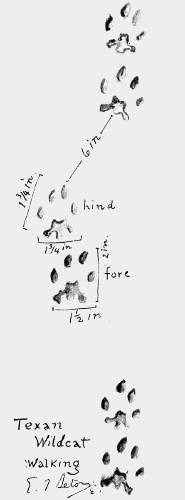
TEXAN WILDCAT
This track, while akin to that of a cat (see
page 487), has some very well-marked characteristics.
The complicated outline of the heel-pads
is striking. This, with its large size, will
distinguish it from the track of a house cat.
The claws do not show.
[Reprinted from Science, N. S., Vol. XLVIII., No.
1248, Pages 547-549, November 29, 1918
Wild Animals of North America: Intimate
Studies of Big and Little Creatures of the
Mammal Kingdom. By Edward W. Nelson.
Natural-Color Portraits from Paintings by
Louis Agassiz Fuertes. Track Sketches by
Ernest Thompson Seton. Published by the
National Geographic Society, Washington,
D. C., U. S. A.; 8vo, pp. + 385-612, folded
frontispiece, 108 colored illustrations on text
paper (not plates), 85 halftone illustrations.
[This is essentially a reprint of two articles
which appeared in the National Geographic
Magazine, for November, 1916, and
May, 1918. The changes comprise repaging
beyond page 472, the readjustment of the
matter on pages 473-475, the replacement of
a half-tone on page 475, the rectification of
page references to illustrations to accord
with the new paging where needed, and readjustment
of the matter from page 571 on,
so as to admit 32 new illustrations of footprints
and the captions to these.
This is a work which meets to a gratifying
degree the need for an essentially non-technical
treatise upon the natural history of the
mammals of North America. No living person
is better equipped to carry to a successful conclusion
such an undertaking than is its author.
Nelson has contributed in the field of vertebrate
zoology now for over forty years, to be
explicit, beginning in July, 1876 (Bulletin
Nuttall Ornithological Club, Vol. 1, p. 39).
With a background of long experience in the
field, and with further years of official connection
with the United States Biological Survey
and its unique resources in mammalogy,
he has made available a brochure of pleasing
amplitude and satisfying authoritativeness.
Between the colored pictures and the written
sketches the public can gain from this contribution
a better idea of our principal mammals
than from any other available publication.
It should awaken a generally greater
interest in our native mammals, and this will
help build up a desire for the conservation of
the harmless and useful species such as has
resulted from the public education in relation
to our bird life. On the other hand it is important
to be able to distinguish those mammals,
chiefly of the order Rodentia, which are
thoroughly inimical to human interests. People
at large must know how to cope with these
enemies. It would seem that a full knowledge
of the natural history of such animals is
essential to determining the most successful
means of controlling them and to applying
these means properly to the varying conditions
throughout the country. Nelson’s accounts of
our injurious mammals are full of stimulative
suggestions along these lines, and while the
work as a whole can not be considered as an
“economic” publication, its influence will go
far to secure adequate popular consideration
of these matters.
The species are taken up in groups, in so
far as this can be done safely. Each biography,
of which there are 119, is, as a rule, a
composite applying to a number of near-related
forms, thus simplifying matters of presentation,
and avoiding repetition. A marked
feature of the book is the degree of concentration
attained; there is no trace of padding,
and no room for baseless speculation, sentimentalizing
or humanizing, such as characterize
many current “nature” books. At the
same time the style is animated and thoroughly
entertaining, a gift of composition
which Nelson has exercised in many preceding
contributions. Here is an instance, unfortunately
a rare one, in which a man who really
knows the field has put out a popular book on
a natural history subject.
Many are the portrayals which are evidently
based on Nelson’s own personal field knowledge,
some of them involving facts here for
the first time made known to science. His account
of the behavior of kangaroo rats in
Lower California is particularly apt in illustration
of the above statement.
During several nights I passed hours watching
at close range the habits of these curious animals.
As I sat quietly on a mess box in their midst ...
[they] would forage all about with swift gliding
movements, repeatedly running across my bare
feet. Any sudden movement startled them and all
would dart away for a moment, but quickly return....
They were so intent on the food [grains
of rice put out for them] that at times I had no
difficulty in reaching slowly down and closing my
hand over their backs. I did this dozens of times,
and after a slight struggle they always became
quiet until again placed on the ground, when they
at once renewed their search for food as though
no interruption had occurred.... While occupied
in this rivalry for food they became surprisingly
pugnacious. If one was working at the rice pile
and another rat or a pocket mouse approached, it
immediately darted at the intruder and drove it
away. The mode of attack was to rush at an intruder
and, leaping upon its back, give a vigorous
downward kick with its strong hind feet....
Sometimes an intruder, bolder than the others,
would run only two or three yards and then suddenly
turn and face the pursuer, sitting up on its
hind feet like a little kangaroo. The pursuer at
once assumed the same nearly upright position,
with its fore feet close to its breast. Both would
then begin to hop about watching for an opening.
Suddenly one would leap at the other, striking with
its hind feet, ... [producing] a distinct little
thump and the victim rolled over on the ground.
After receiving two or three kicks the weaker of
the combatants would run away. The thump made
by the kick when they were fighting solved the
mystery which had covered this sound heard repeatedly
during my nights at this camp.
The brilliantly coated paper used throughout
this book although hard on sensitive eyes, is
necessary to the handling of the halftone illustrations.
The printing of both the colored
and uncolored pictures in all the copies we
have seen has been done with pronounced success.
The color drawings by Fuertes are admirable
and we are astonished at the success
with which this noted bird artist was able to
turn to mammals, the drawings of which in
this contribution mark as far as we know his
first efforts in the new field.
A critical reviewer might succeed in finding
a number of small points to elaborate upon
and of which to complain. For instance: It
is trite to say that an Alaska brown bear is no
more an animal than is a house fly. Yet here we
have the title, “Wild Animals of North America,”
though there is an evident effort made in
the subtitle to remedy the matter by using the
expression, “mammal kingdom.” But here a
taxonomic blunder is tumbled into! We can
hardly believe that Nelson himself had anything
final to say with regard to the title page
of this book, but that the editor of the National
Geographic Magazine got in his work
here in the belief so characteristic of editors
of popular magazines that their public must
be talked down to.
But to pin the attention of the reader of
this review upon such really minute defects
would do violence to the facts in the case,
which are that, according to the convictions
of the reviewer, Nelson’s “Wild Animals of
North America” is more uniformly accurate
and at the same time replete with information
along many lines than any preceding book on
American mammals. And even more, it may
be declared with confidence that this book is
by far the most important contribution of a
non-systematic nature that has appeared in its
field in America.
Joseph Grinnell
Museum of Vertebrate Zoology,
University of California
Obvious printer errors corrected silently.
Inconsistent spelling and hyphenation are as in the original.