When Lewis and Clark reached the Big
Sioux River in Dakota, on their famous
journey up the Missouri, one hundred and
ten years ago, they met, on the very edge and
beginning of its range, the Mule Deer, and added
the new species to their collection.
It is the characteristic Deer of the rough country
from Mexico to British Columbia, and from California
to Manitoba; and is one of the kinds most
easily observed in the Yellowstone Sanctuary.
Driving from Gardiner, passing under the Great
Tower of Eagle Rock on which an Osprey has
nested year after year as far back as the records
go, and wheeling into the open space in front of
the Mammoth Hot Springs Hotel, one is almost
sure to come on a family of Deer wandering across
the lawn, or posing among the shrubbery, with all
the artless grace of the truly wild creature. These
are the representatives of several hundred that
collect in fall on and about this lawn, but are now
scattered for the summer season over the adjoining
hills, to come again, no doubt in increased numbers,
when the first deep snow shall warn them to
seek their winter range.
Like the other animals, these are natives of the
region and truly wild, but so educated by long
letting alone that it is easy to approach within a
few yards.
The camera hunter should not fail to use this
opportunity, not only because they are wild and
beautiful things, but because he can have the films
developed at the hotel over night, and so find out
how his camera is behaving in this new light and
surroundings.
This is the common Blacktailed Deer of the hill
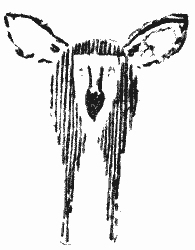
country, called Mule Deer on account of its huge
ears and the shape of its tail. In Canada I knew
it by the name of "Jumping Deer," from its gait,
and in the Rockies it is familiar as the "Bounding
Blacktail"—"Bounding" because of the wonderful
way in which it strikes the ground with its legs
held stiffly, then rises in the air with little apparent
effort, and lands some ten or fifteen feet away.
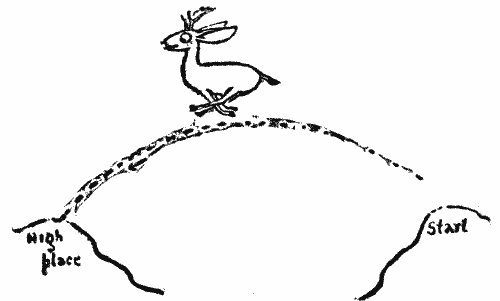
As the hunters say, "The Blacktail hits only
the high places in the landscape." On the level
it does not run so well as the Antelope or the
Whitetailed Deer, and I often wondered why it had
adopted this laborious mode of speeding, which
seemed so inferior to the normal pace of its kin.
But at length I was eyewitness of an episode that
explained the puzzle.
In the fall of 1897 I was out for a Wolf hunt
with the Eaton boys in the Badlands near Medora,
N. D. We had a fine mixed pack of dogs, trailers,
runners, and fighters. The runners were thoroughbred
greyhounds, that could catch any four-foot
on the plains except perhaps a buck Antelope;
that I saw them signally fail in. But a Wolf, or
even the swift Coyote, had no chance of getting
away from them provided they could keep him
in view. We started one of these singers of the
plains, and at first he set off trusting to his legs,
but the greyhounds were after him, and when he
saw his long start shrinking so fearfully fast he
knew that his legs could not save him, that now
was the time for wits to enter the game. And
this entry he made quickly and successfully by
dropping out of sight down a brushy canyon, so the
greyhounds saw him no more.
Then they were baffled by Prairie-dogs which
dodged down out of reach and hawks which rose up
out of reach, and still we rode, till, rounding a little
knoll near a drinking place, we came suddenly on
a mother Blacktail and her two fawns. All three
swung their big ears and eyes into full bearing on
us, and we reined our horses and tried to check
our dogs, hoping they had not seen the quarry
that we did not wish to harm. But Bran the leader
gave a yelp, then leaping high over the sage,
directed all the rest, and in a flash it was a life
and death race.
Again and frantically the elder Eaton yelled
"Come back!" and his brother tried to cut across
and intercept the hounds. But a creature that
runs away is an irresistible bait to a greyhound,
and the chase across the sage-covered flat was on,
with every nerve and tendon strained.
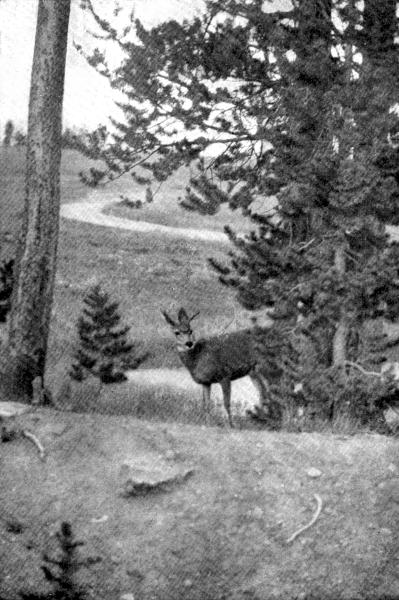
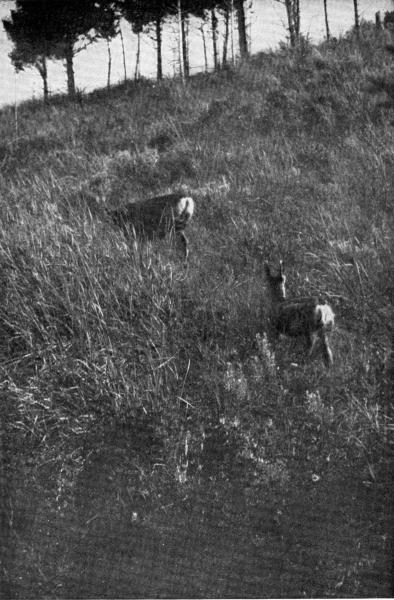 X. Blacktail Family
Photo by E. T. Seton
Away went the Blacktail, bounding, bounding at
that famous beautiful, birdlike, soaring pace,
mother and young tapping the ground and sailing
to land, and tap and sail again. And away went
the greyhounds, low coursing, outstretched, bounding
like bolts from a crossbow, curving but little
and dropping only to be shot again. They were
straining hard; the Blacktail seemed to be going
more easily, far more beautifully. But alas! they
were losing time. The greyhounds were closing;
in vain we yelled at them. We spurred our horses,
hoping to cut them off, hoping to stop the ugly,
lawless tragedy. But the greyhounds were frantic
now. The distance between Bran and the hindmost
fawn was not forty feet. Then Eaton drew
his revolver and fired shots over the greyhounds'
heads, hoping to scare them into submission, but
they seemed to draw fresh stimulus from each
report, and yelped and bounded faster. A little
more and the end would be. Then we saw a
touching sight. The hindmost fawn let out a
feeble bleat of distress, and the mother, heeding,
dropped back between. It looked like choosing
death, for now she had not twenty feet of lead. I
wanted Eaton to use his gun on the foremost
hound, when something unexpected happened.
The flat was crossed, the Blacktail reached a great
high butte, and tapping with their toes they soared
some fifteen feet and tapped again; and tapped
and tapped and soared, and so they went like
hawks that are bounding in the air, and the greyhounds,
peerless on the plain, were helpless on
the butte. Yes! rush as they might and did, and
bounded and clomb, but theirs was not the way
of the hills. In twenty heartbeats they were left
behind. The Blacktail mother with her twins
kept on and soared and lightly soared till lost to
view, and all were safely hidden in their native
hills.
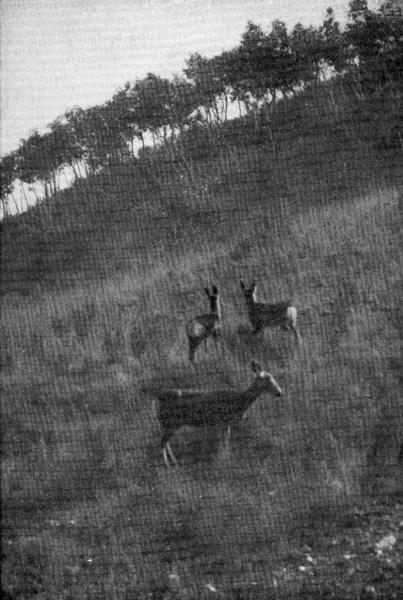 XI. Blacktail mother with her twins
Photo by E. T. Seton
That day I learned the reason for the bounding
flight, so beautiful, but not the best or swiftest
on the plain, yet the one that gives them dominion
and safety on the hills, that makes of them a hill
folk that the dangers of the plain can never reach.
So now, O traveller in the Park, if you approach
too near the Blacktail feeding near the great hotel,
and so alarm them—for they are truly wild—they
make not for the open run as do the Antelope and
the Hares, not for the thickest bottomland as do the
Whitetail and the Lynxes, but for the steeper
hillsides. They know right well where their
safety lies, and on that near and bushy bank,
laying aside all alarm, they group and pose in
artless grace that tempts one to a lavish use of
films and gives the chance for that crowning triumph
of the art, a wild animal group, none of which is
looking at the camera.
One more characteristic incident: In 1897 I
was riding, with my wife, from Yancey's over
to Baronett's Bridge, when we came on a young
buck Blacktail. Now, said I, "I am going to
show you the most wonderful and beautiful thing
to be seen in the way of wild life speeding. You
shall now see the famous bounding of the Blacktail."
Then I spurred out after the young buck,
knowing that all he needed was a little alarm to
make him perform. Did he take alarm and run?
Not at all. He was in the Yellowstone Sanctuary.
He knew nothing of guns or dogs; he had lived all
his life in safety. He would trot a few steps out of
my way, then turn and gaze at me, but run, bound,
and make for the high land, not a bit of it. And to
this day my fair companion has not seen the Blacktail
bounding up the hills.
The Rocky Mountain Elk, or Wapiti, is the
finest of all true Deer. The cows weigh 400 to
500 pounds, the bulls 600 or 800, but occasionally
1000. At several of the hotels a small herd is
kept in a corral for the pleasure and photography
of visitors.
The latest official census puts the summer population
of Elk in the Yellowstone Park at 35,000,
but the species is migratory, at least to the extent
of seeking a winter feeding ground with as little
snow as possible, so that most of them move out as
snow time sets in. Small herds linger in the rich
and sheltered valleys along the Yellowstone, Snake
and nearby rivers, but the total of those wintering
in the Park is probably less than 5,000.
In the summer months the best places in which to
look for these Deer are all the higher forests, especially
along the timber-line. I had an interesting
stalk after a large band of them among the woods
of Tower Falls in the June of 1897. I had found the
trail of a considerable herd and followed it up the
mountain till the "sign" was fresh. Then I tied
up my horse and went forward on foot. For these
animals are sufficiently acquainted with man as a
mischief-maker to be vigilant in avoiding him, even
in the Park. I was cautiously crawling from tree to
tree, when out across an open space I descried a cow
Elk and her calf lying down. A little more crawling
and I sighted a herd all lying down and chewing the
cud. About twenty yards away was a stump whose
shelter offered chances to use the camera, but my
present position promised nothing, so I set out carefully
to cross the intervening space in plain view
of scores of Elk; and all would have been well but
for a pair of mischievous little Chipmunks. They
started a most noisy demonstration against my
approach, running back and forth across my path,
twittering and flashing their tails about. In vain
I prayed for a paralytic stroke to fall on my small
tormentors. Their aggravating plan, if plan it was,
they succeeded in fully carrying out. The Elk
turned all their megaphone ears, their funnel noses
and their blazing telescopic eyes my way. I lay
like a log and waited; so did they. Then the mountain
breeze veered suddenly and bore the taint of
man to those watchful mothers. They sprang to
their feet, some fifty head at least, half of them with
calves by their sides, and away they dashed with a
roaring sound, and a rattling and crashing of
branches that is wonderfully impressive to hear,
and nothing at all to tell about.
I had made one or two rough sketches as I lay
on the ground, but the photographs were failures.
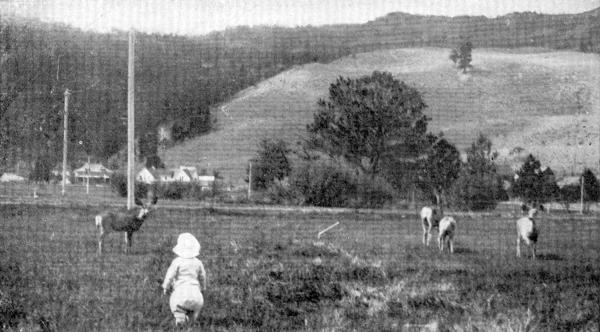 XII. A young investigator among the Deer at Fort Yellowstone
Photo by E. T. Seton
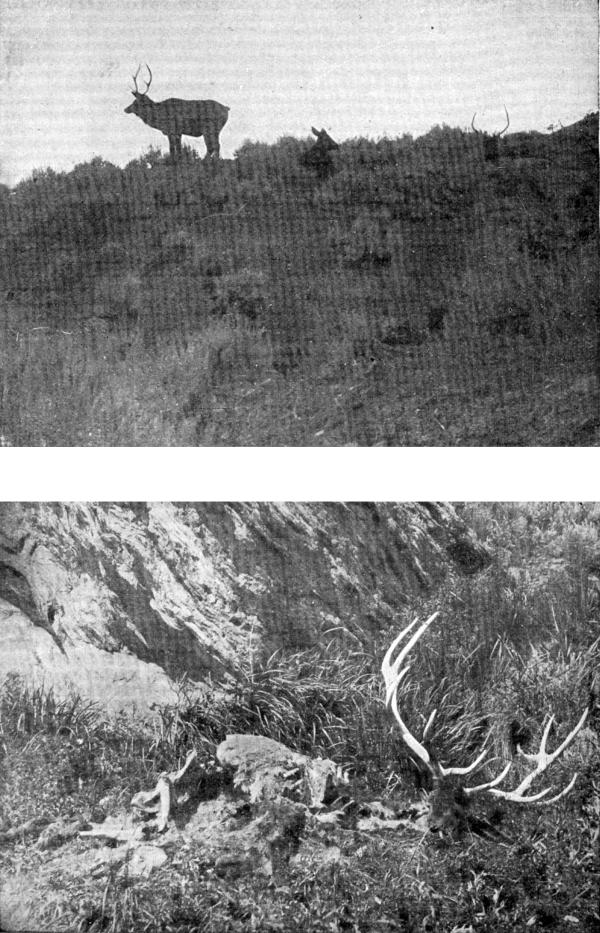 XIII. Elk in Wyoming: (a) "Dawn"
Photo by E. T. Seton
(b) "Nightfall"
Photo by G. G. Seton
This band contained only cows engaged in growing
their calves. According to Elk etiquette, the
bulls are off by themselves at a much higher elevation,
engaged in the equally engrossing occupation
of growing their antlers. Most persons are
surprised greatly when first they learn that the
huge antlers of the Elk, as with most deer, are
grown and shed each year. It takes only five
months to grow them. They are perfect in late
September for the fighting season, and are shed in
March. The bull Elk now shapes his conduct to
his weaponless condition. He becomes as meek as
he was warlike. And so far from battling with all
of their own sex that come near, these big "moollys"
gather in friendly stag-parties on a basis of equal
loss, and haunt the upper woods whose pasture is
rich enough to furnish the high power nutriment
needed to offset the exhausting drain of growing
such mighty horns in such minimum time.
They are more free from flies too in these high
places, which is important, for even the antlers
are sensitive while growing. They are even more
sensitive than the rest of the body, besides being
less protected and more temptingly filled with
blood. A mosquito would surely think he had
struck it rich if he landed on the hot, palpitating
end of a Wapiti's thin-skinned, blood-gorged antlers.
It is quite probable that some of the queer
bumps we see on the finished weapons are due to
mosquito or fly stings suffered in the early period
of formation.
During the summer the bulls attend strictly to
their self-development, but late August sees them
ready to seek once more the mixed society of their
kind. Their horns are fully grown, but are not
quite hardened and are still covered with velvet.
By the end of September these weapons are hard
and cleaned and ready for use, just as a thrilling
change sets in in the body and mind of the bull.
He is full of strength and vigour, his coat is sleek,
his neck is swollen, his muscles are tense, his horns
are clean, sharp, and strong, and at their heaviest.
A burning ambition to distinguish himself in war,
and win favours from the shy ladies of his kind,
grows in him to a perfect insanity; goaded by desire,
boiling with animal force, and raging with war-lust,
he mounts some ridge in the valley and pours forth
his very soul in a wild far-reaching battle-cry.
Beginning low and rising in pitch to a veritable
scream of piercing intensity, it falls to a rumbled
growl, which broken into shorter growls dies slowly
away. This is the famed bugling of the Elk, and
however grotesque it may seem when heard in a
zoo, is admitted by all who know it in its homeland
to be the most inspiring music in nature—because
of what it means. Here is this magnificent
creature, big as a horse, strong as a bull, and fierce
as a lion, standing in all the pride and glory of his
primest prime, announcing to all the world: "I
am out for a fight! Do any of you want a
F-I-G-H-T——!-!-!?" Nor does he usually
have long to wait. From some far mountainside
the answer comes:
"Yes, yes, yes! Yes, I Do, Do, Do, Do!"
A few more bugle blasts and the two great giants
meet; and when they do, all the world knows it for a
mile around, without it being seen. The crashing
of the antlers as they close, the roars of hate, the
squeals of combat, the cracking of breaking branches
as they charge and charge, and push and strive,
and—sometimes the thud of a heavy body going
down.
Many a time have I heard them in the distant
woods, but mostly at night. Often have I gone
forth warily hoping to see something of the fight,
for we all love to see a fight when not personally in
danger; but luck has been against me. I have
been on the battlefield next morning to see where the
combatants had torn up an acre of ground, and
trampled unnumbered saplings, or tossed huge
boulders about like pebbles, but the fight I missed.
One day as I came into camp in the Shoshonees,
east of the Park, an old hunter said: "Say, you!
you want to see a real old-time Elk fight? You
go up on that ridge back of the corral and you'll sure
see a hull bunch of 'em at it; not one pair of bulls,
but six of 'em."
I hurried away, but again I was too late; I saw
nothing but the trampled ground, the broken saplings,
and the traces of the turmoil; the battling
giants were gone.
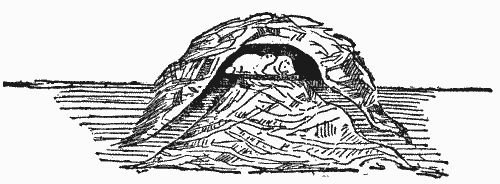
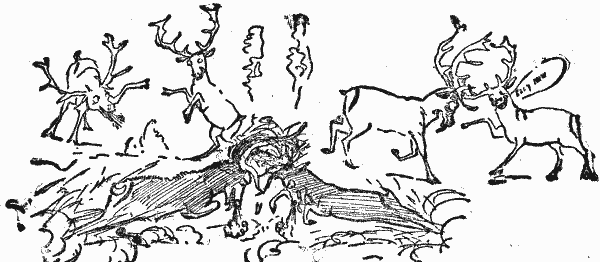
Back I went and from the hunter's description
made the sketch which I give below. The old
man said: "Well, you sure got it this time.
That's exactly like it was. One pair was jest
foolin', one was fencing and was still perlite; but
that third pair was a playin' the game for keeps.
An' for givin' the facts, that's away ahead of any
photograph I ever seen."
Once I did come on the fatal battle-ground, but
it was some time after the decision; and there I
found the body of the one who did not win. The
antlers are a fair index of the size and vigour of the
stag, and if the fallen one was so big and strong,
what like was he who downed him, pierced him
through and left him on the plain.
At one time in a Californian Park I heard the
war-bugle of an Elk. He bawled aloud in brazen,
ringing tones: "Anybody want a F-I-G-H-T
t-t-t-t!!"
I extemporized a horn and answered him according
to his mood. "Yes, I do; bring it ALONG!"
and he brought it at a trot, squealing and roaring
as he came. When he got within forty yards
he left the cover and approached me, a perfect
incarnation of brute ferocity and hate.
His ears were laid back, his muzzle raised, his
nose curled up, his lower teeth exposed, his mane
was bristling and in his eyes there blazed a marvellous
fire of changing opalescent green. On he
marched, gritting his teeth and uttering a most
unpleasantly wicked squeal.
Then suddenly down went his head, and he
came crash at me, with all the power of half a ton
of hate. However, I was not so much exposed as
may have been inferred. I was safely up a tree.
And there I sat watching that crazy bull as he
prodded the trunk with his horns, and snorted,
and raved around, telling me just what he thought
of me, inviting him to a fight and then getting up
a tree. Finally he went off roaring and gritting
his teeth, but turning back to cast on me from
time to time the deadly, opaque green light of his
mad, malignant eyes.
A friend of mine, John Fossum, once a soldier
attached to Fort Yellowstone, had a similar adventure
on a more heroic scale. While out on
a camera hunt in early winter he descried afar
a large bull Elk lying asleep in an open valley.
At once Fossum made a plan. He saw that he
could crawl up to the bull, snap him where he
lay, then later secure a second picture as the
creature ran for the timber. The first part of the
programme was carried out admirably. Fossum
got within fifty feet and still the Elk lay sleeping.
Then the camera was opened out. But alas!
that little pesky "click," that does so much mischief,
awoke the bull, who at once sprang to his
feet and ran—not for the woods—but for the
man. Fossum with the most amazing nerve stood
there quietly focussing his camera, till the bull
was within ten feet, then pressed the button, threw
the camera into the soft snow and ran for his life
with the bull at his coat-tails. It would have
been a short run but for the fact that they reached
a deep snowdrift that would carry the man, and
would not carry the Elk. Here Fossum escaped,
while the bull snorted around, telling just what he
meant to do to the man when he caught him; but
he was not to be caught, and at last the bull went
off grumbling and squealing.
The hunter came back, recovered his camera, and
when the plate was developed it bore the picture
No. xiv, b.
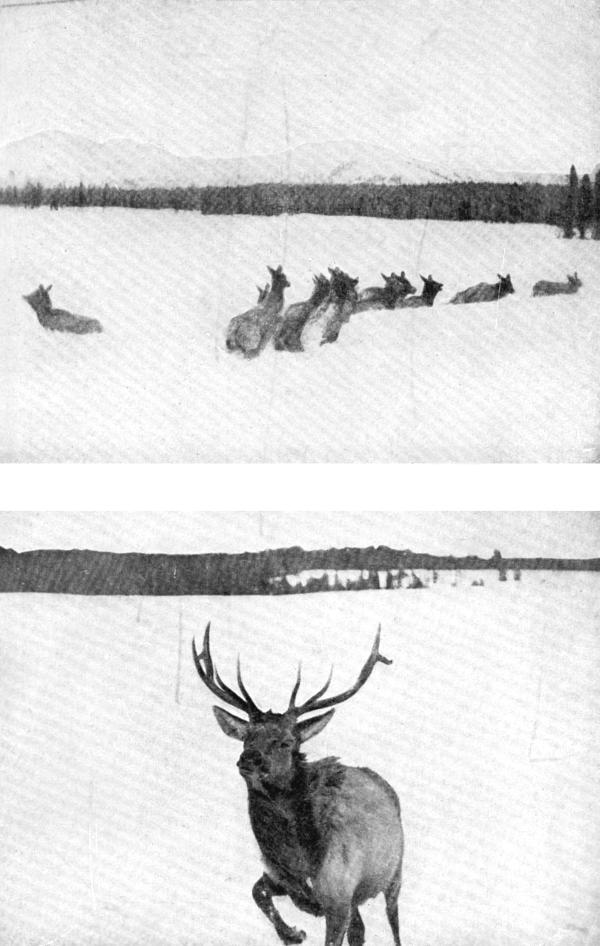 XIV. Elk on the Yellowstone in winter: (a) Caught in eight feet
of snow;
XIV. Elk on the Yellowstone in winter: (a) Caught in eight feet
of snow;
Photo by F. Jay Haynes
(b) Bull Elk charging
Photo by John Fossum
It shows plainly the fighting light in the bull's
eye, the back laid ears, the twisting of the nose,
and the rate at which he is coming is evidenced
in the stamping feet and the wind-blown whiskers,
and yet in spite of the peril of the moment, and
the fact that this was a hand camera, there is no
sign of shake on landscape or on Elk, and the
picture is actually over-exposed.
One of the best summer ranges for Elk is near
the southeast corner of the Yellowstone Lake,
and here it was my luck to have the curious experience
that I call the "Story of a Hoodoo Elk."
In the September of 1912, when out with Tom
Newcomb of Gardiner, I had this curious adventure,
that I shall not try to explain. We had crossed
the Yellowstone Lake in a motor boat and were
camped on the extreme southeast Finger, at a
point twenty-five miles as the crow flies, and
over fifty as the trail goes, from any human
dwelling. We were in the least travelled and
most primitive part of the Park. The animals here
are absolutely in the wild condition and there was
no one in the region but ourselves.
On Friday, September 6th, we sighted some Elk
on the lake shore at sunrise, but could not get
nearer than two hundred yards, at which distance
I took a poor snap. The Elk wheeled and ran
out of sight. I set off on foot with the guide
about 8:30. We startled one or two Elk, but
they were very wild, and I got no chance to photograph.
About 10:30, when several miles farther in the
wilderness, we sighted a cow Elk standing in a
meadow with a Coyote sneaking around about
one hundred yards away. "That's my Elk," I said,
and we swung under cover. By keeping in a little
pine woods, I got within one hundred yards, taking
picture No. 1, Plate XV. As she did not move,
I said to Tom: "You stay here while I creep out
to that sage brush and I'll get a picture of her at
fifty yards." By crawling on my hands I was
able to do this and got picture No. 2. Now I
noticed a bank of tall grass some thirty yards from
the cow, and as she was still quiet, I crawled to
that and got picture No. 3. She did not move
and I was near enough to see that she was dozing
in a sun-bath. So I stood up and beckoned to
Tom to come out of the woods at once. He came
on nearly speechless with amazement. "What
is the meaning of this?" he whispered.
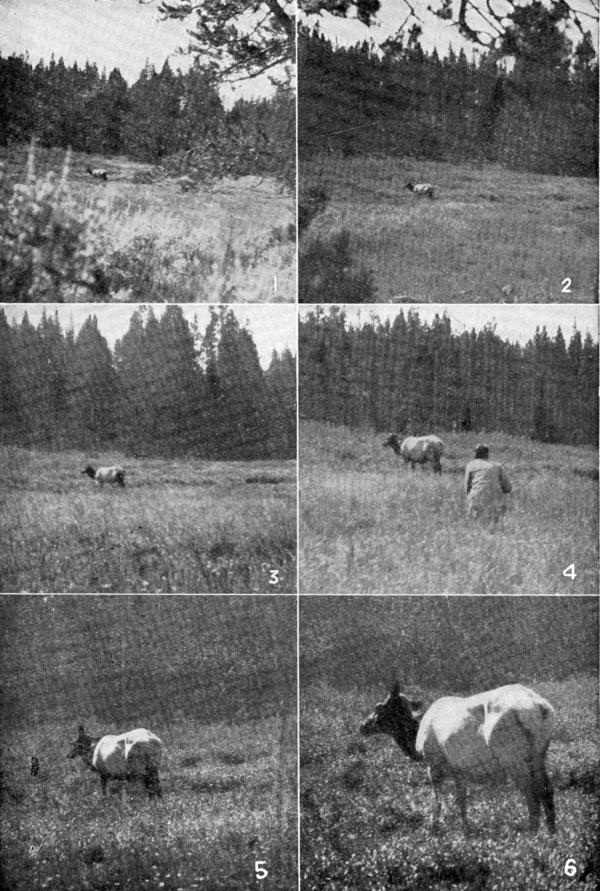 XV. The first shots at the Hoodoo Cow
Photos by E. T. Seton
I replied calmly: "I told you I was a medicine
man, perhaps you'll believe me now. Don't you
see I've made Elk medicine and got her hypnotized?
Now I am going to get up to about twenty yards
and take her picture. While I do so, you use the
second camera and take me in the act." So Tom
took No. 4 while I was taking No. 5, and later No. 6.
"Now," I said, "let's go and talk to her." We
walked up to within ten yards. The Elk did not
move, so I said: "Well, Bossie, you have callers.
Won't you please look this way?" She did so and
I secured shot No. 7, Plate XVI.
"Thank you," I said. "Now be good enough
to lie down." She did, and I took No. 9.
I went up and stroked her, so did Tom; then
giving her a nudge of my foot I said: "Now
stand up again and look away."
She rose up, giving me Nos. 8, 10 and 11.
"Thank you, Bossie! now you can go!" And
as she went off I fired my last film, getting No. 12.
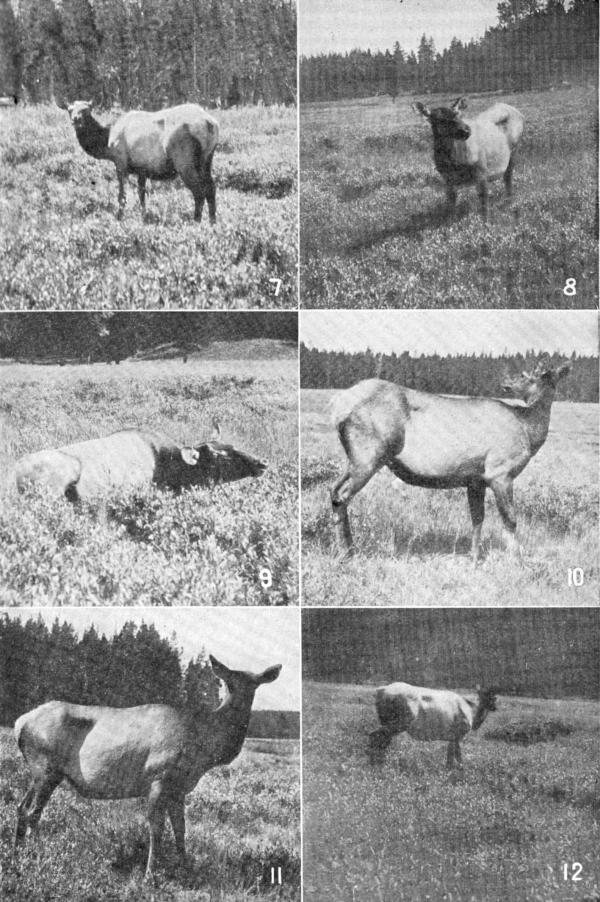 XVI. The last shots at the Hoodoo Cow
Photos by E. T. Seton
By this time Tom had used up all his allowable
words, and was falling back on the contraband
kind to express his surging emotions.
"What the —— is the —— meaning —— of this ——?"
and so on.
I replied calmly: "Maybe you'll believe I have
Elk medicine. Now show me a Moose and I'll
give you some new shocks."
Our trip homeward occupied a couple of hours,
during which I heard little from Tom but a snort
or two of puzzlement.
As we neared camp he turned on me suddenly
and said: "Now, Mr. Seton, what is the meaning
of this? That wasn't a sick Elk; she was fat and
hearty. She wasn't poisoned or doped, 'cause
there's no possibility of that. It wasn't a tame
Elk, 'cause there ain't any, and, anyhow, we're
seventy miles from a house. Now what is the
meaning of it?"
I replied solemnly: "Tom! I don't know any
more than you do. I was as much surprised as
you were at everything but one, and that was when
she lay down. I didn't tell her to lie down till
I saw she was going to do it, or to get up either,
or look the other way, and if you can explain the
incident, you've got the field to yourself."
The Moose is one of the fine animals that have
responded magnificently to protection in Canada,
Maine, Minnesota, and the Yellowstone Park. Formerly
they were very scarce in Wyoming and
confined to the southwest corner of the Reserve.
But all they needed was a little help; and, receiving
it, they have flourished and multiplied. Their
numbers have grown by natural increase from about
fifty in 1897 to some five hundred and fifty to-day;
and they have spread into all the southern half of
the Park wherever they find surroundings to their
taste; that is, thick level woods with a mixture of
timber, as the Moose is a brush-eater, and does not
flourish on a straight diet of evergreen.
The first Deer, almost the only one I ever killed,
was a Moose and that was far back in the days of
my youth. On the Yellowstone, I am sorry to
say, I never saw one, although I found tracks and
signs in abundance last September near the Lake.
Though I have never since fired at a Moose, I
was implicated in the killing of one a few years later.
It was in the fall of the year, in the Hunting
Moon, I was in the Kippewa Country with my
partner and some chosen friends on a camping
trip. Our companions were keen to get a Moose;
and daily all hands but myself were out with the
expert Moose callers. But each night the company
reassembled around the campfire only to exchange
their stories of failure.
Moose there were in plenty, and good guides,
Indian, halfbreed and white, but luck was against
them all. Without being a very expert caller I
have done enough of it to know the game and to
pass for a "caller." So one night I said in a spirit
of half jest: "I'll have to go out and show you men
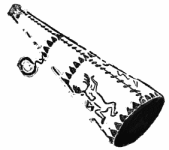
how to call a Moose." I cut a good piece of
birch-bark and fashioned carefully a horn.
Disdaining all civilized materials as "bad medicine,"
I stitched the edge with a spruce root or wattap,
and soldered it neatly with pine gum flowed and
smoothed with a blazing brand. And then I
added the finishing touch, a touch which made the
Indian and the halfbreed shake their heads ominously;
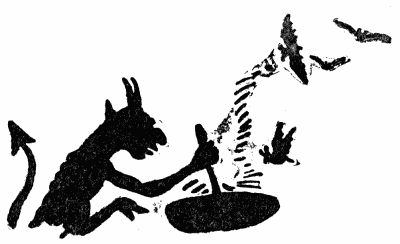
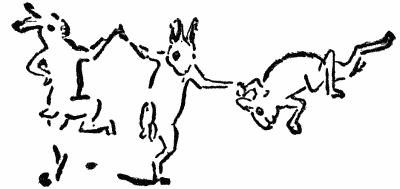
I drew two "hoodoo Moose"—that is, men
with Moose heads dancing around the horn.
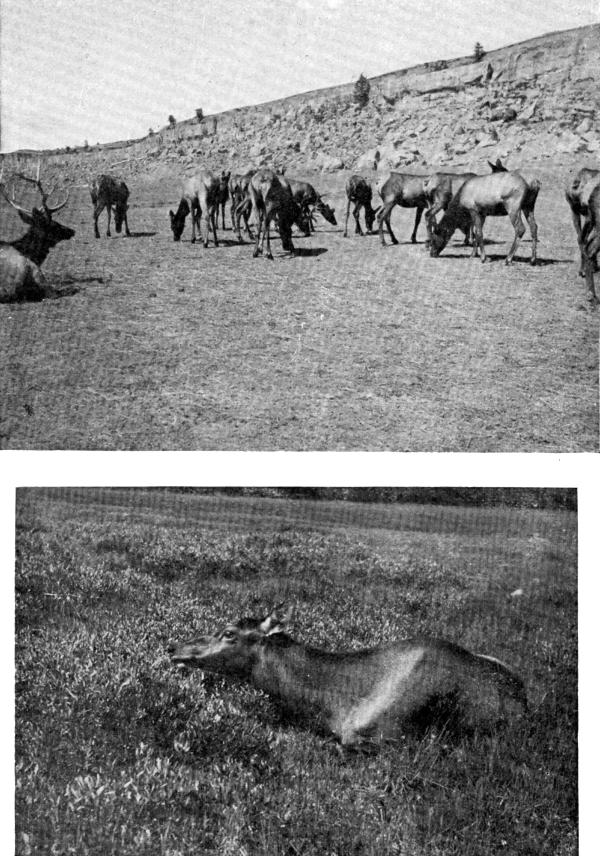 XVII. Elk on the Yellowstone: (a) In Billings Park;
(b) Wild Cow Elk
XVII. Elk on the Yellowstone: (a) In Billings Park;
(b) Wild Cow Elk
Photos by E. T. Seton
"You put that on before you catch one Moose,
Moose never come," they said.
Still I put them on, and near sundown set off
in a canoe, with one guide as paddler, and my
partner in charge of the only gun. In half an
hour we reached a lonely lake surrounded by
swamps, and woods of mixed timber. The sunset
red was purpling all the horizon belt of pines, and
the peace of the still hour was on lake and swamp.
With some little sense of profanity I raised the
hoodoo horn to my mouth, gave one or two high-pitched,
impatient grunts, then poured forth the
softly rising, long-drawn love-call of a cow Moose,
all alone, and "Oh, so lonesome."
The guide nodded in approval, "That's all
right," then I took out my watch and waited for
fifteen minutes. For, strange to tell, it seems to
repel the bull Moose and alarm him if the cow
seems over-eager. There is a certain etiquette
to be observed; it is easy to spoil all by trying to go
too fast. And it does not do to guess at the time;
when one is waiting so hard, the minute is like
twenty.
So when fifteen minutes really had gone, I
raised the magic horn again, emitted a few hankering
whines, then broke into a louder, farther
reaching call that thrilled up echoes from across
the lake and seemed to fill the woods for miles
around with its mellifluous pleading.
Again I waited and gave a third call just as the
sun was gone. Then we strained our eyes and
watched at every line of woods, and still were
watching when the sound of a falling tree was heard
far off on a hillside.
Then there was a sort of after-clap as though the
tree had lodged the first time, and hanging half a
minute, had completed its fall with breaking of
many branches, and a muffled crash. We gazed
hard that way, and the guide, a very young one,
whispered, "Bear!"
There was silence, then a stick broke nearer,
and a deep, slow snort was heard; it might have been
the "woof" of a Bear, but I was in doubt. Then
without any more noises, a white array of shining
antler tips appeared above the near willows, and
swiftly, silently, there glided into view a huge bull
Moose.
"How solid and beefy he looks!" was my first
thought. He "woofed" again, and the guide, with
an eye always to the head, whispered to my partner:
"Take him! he's a stunner."
Striding on he came, with wonderful directness,
seeing I had not called for twenty minutes, and
that when he was a mile or more away.
As he approached within forty yards, the guide
whispered, "Now is your chance. You'll never
get a better one." My partner whispered,
"Steady the canoe." I drove my paddle point
into the sandy bottom, the guide did the same at
the other end, and she arose standing in the canoe
and aimed. Then came the wicked "crack" of the
rifle, the "pat" of the bullet, the snort and whirl
of the great, gray, looming brute, and a second shot
as he reached the willows, only to go down with a
crash, and sob his life out on the ground behind the
leafy screen.
It all seemed so natural, so exactly according to
the correct rules of sporting books and tales, and
yet so unlovely.
There were tears in the eyes of the fair killer,
and heart wrenches were hers, as the great sobs
grew less and ceased; and a different sob was heard
at my elbow, as we stood beside the biggest Moose
that had been killed there in years. It was triumph
I suppose; it is a proud thing to act a lie so
cleverly; the Florentine assassins often decoyed and
trapped a brave man, by crying like a woman.
But I have never called a Moose since, and that
rifle has hung unused in its rack from that to the
present day.
"Yes, that's a buffalo-bird," said the old Indian,
pointing to some black birds, with gray mates,
that flitted or ran across the plain. "Pretty bad
luck when the Buffalo gone. Them little birds
make their nest in a Buffalo's wool, right on his
head, and when the Buffalo all gone, seem like the
buffalo-bird die too; 'cause what's the use, no got
any nest."
This is a fragment that reached me long ago in
Montana. It seemed like a lusty myth, whose
succulent and searching roots were in a bottomless
bog, with little chance of sound foundation. But
the tale bore the searchlight better than I thought.
For it seems that the buffalo-bird followed the
Buffalo everywhere, and was fond of nesting, not
in the shaggy mane between the horns of the ruling
monarch, but on any huge head it might find
after the bull had fallen, and the skull, with
mane attached, lay discarded on the plain. While
always, even when nesting on the ground, the
wool of the Buffalo was probably used as lining of
the black-bird's nest. I know of one case where an
attendant bird that was too crippled to fly when
autumn came, wintered in the mane of a large
Buffalo bull. It gathered seed by day, when the
bull pawed up the snow, and roosted at night
between the mighty horns, snuggling in the wool,
with its toes held warm against the monster's
blood-hot neck.
In most of the Northwest the birds have found a
poor substitute for the Buffalo in the range-cattle,
but oh! how they must miss the wool.
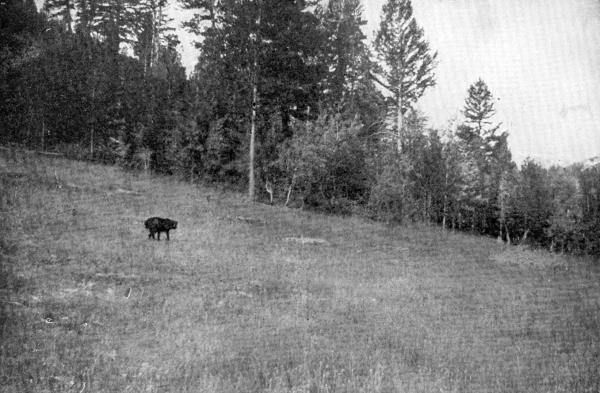
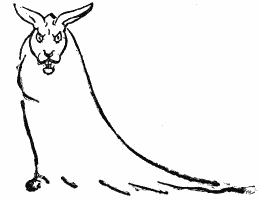
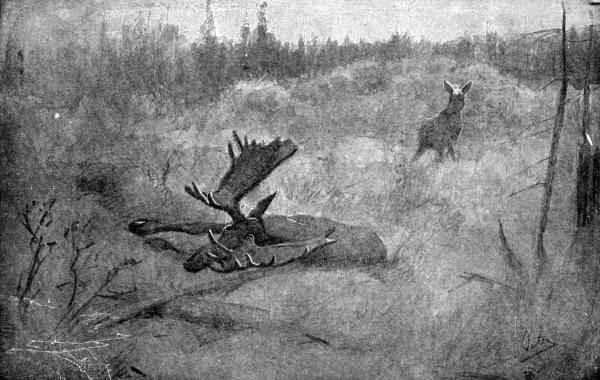 XVIII. Moose—the Widow
Drawing by E. T. Seton
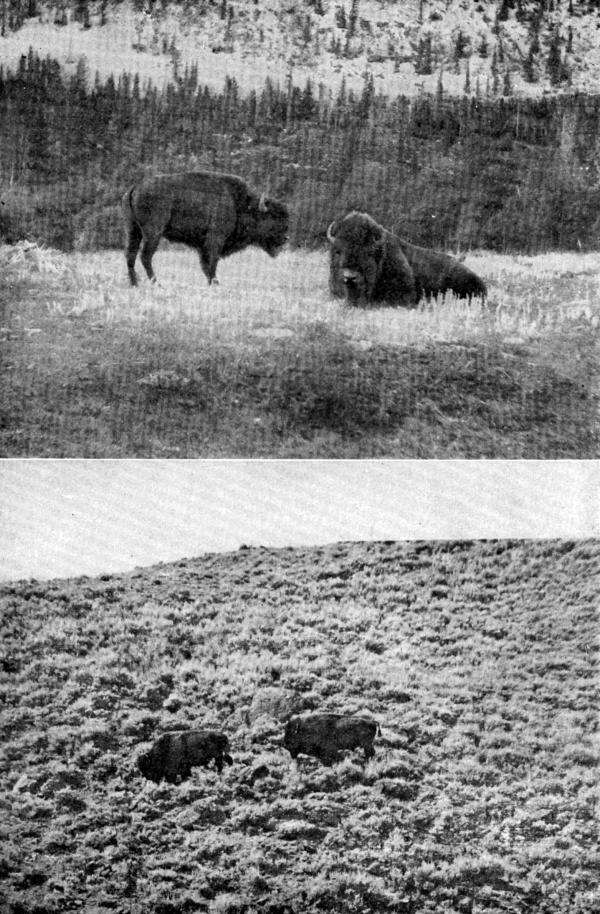 XIX. Buffalo Groups (a) Bull and Cow at Banff; (b) Yellowstone
Bulls
XIX. Buffalo Groups (a) Bull and Cow at Banff; (b) Yellowstone
Bulls
Photos by G. G. Seton
It is not generally known that the American
Buffalo ranged as far east as Syracuse, Washington
City, and Carolina, that they populated the forests
in small numbers, as well as the plains in great
herds. I estimate them at over 50,000,000 in A.D.
1500. In 1895 they were down to 800; probably
this was the low-ebb year. Since then they have
increased under judicious protection, and now reach
about 3,000.
In the June of 1897, as I stood on a hill near
Baronett's Bridge, overlooking the Yellowstone just
beyond Yancey's, with an old timer, Dave Roberts,
he said: "Twenty years ago, when I first saw
this valley, it was black-speckled with Buffalo, and
every valley in the Park was the same." Now
the only sign of the species was a couple of old
skulls crumbling in the grass.
In 1900 the remnant in the Park had fallen to
thirty, and their extinction seemed certain. But
the matter was taken up energetically by the
officers in charge. Protection, formerly a legal
fiction, was made an accomplished fact. The
Buffalo have increased ever since, and to-day
number 200, with the possibility of some stragglers.
We need not dwell on the story of the extinction
of the great herds. That is familiar to all,[B] but it is
well to remind the reader that it was inevitable.
The land was, or would be, needed for human
settlement, with which the Buffalo herds were
incompatible; only we brought it on forty or fifty
years before it was necessary. "Could we not save
the Buffalo as range-cattle?" is the question that
most ask. The answer is: It has been tried a hundred
times and all attempts have been eventually
frustrated by the creature's temper. Buffalo,
male or female, are always more or less dangerous;
they cannot be tamed or trusted. They are
always subject to stampede, and once started,
nothing, not even sure destruction, stops them;
so in spite of their suitability to the climate,
their hardihood, their delicious meat, and their
valuable robes, the attempts at domesticating
the Buffalo have not yet been made a success.
A small herd of a dozen or so is kept in a fenced
range near the Mammoth Hot Springs, where the
traveller should not fail to try for pictures, and
with them he will see the cowbirds, that in some
regions replace the true buffalo-birds. Perched
on their backs or heads or running around them
on the ground are these cattle birds as of yore,
like boats around a man-o'-war, or sea-gulls around
a whale; living their lives, snapping up the tormenting
flies, and getting in return complete protection
from every creature big enough to seem a
menace in the eyes of the old time King of the
Plains.
The Antelope, or Pronghorn, is one of the most
peculiar animals in the world. It is the only
known ruminant that has hollow horns on a bony
core as with cattle, and also has them branched
and shed each year as in the Deer.
It is a creature of strangely mixed characteristics,
for it has the feet of a Giraffe, the glands of a
goat, the coat of a Deer, the horns of an ox and
Deer combined, the eyes of a Gazelle, the build
of an Antelope, and—the speed of the wind.
It is the swiftest four-footed creature native to the
plains, and so far as known there is nothing but a
blooded race horse that can outrun it on a mile.
But the peculiarity that is most likely to catch
the eye of the traveller is the white disc on its
rear.
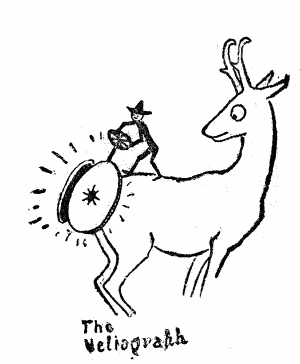 The Heliograph
The first day I was in the Yellowstone I was
riding along the upland beyond Blacktail Creek
with T. E. Hofer. Miles away to the southeast
we saw some white specks showing, flashing
and disappearing. Then as far to the northeasterly
we saw others. Hofer now remarked,
"Two bunches of Antelope." Then later there
were flashes between and we knew that these two
bands had come together. How?
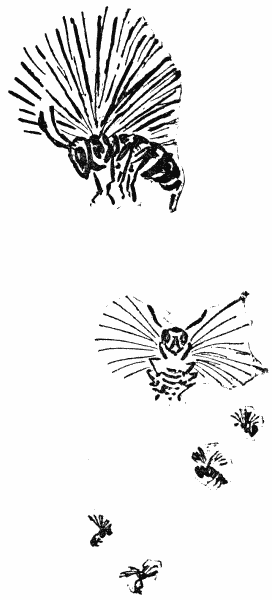
When you have a chance in a zoo or elsewhere to
watch Antelope at short range you will see the
cause of these flashes. By means of a circular
muscle on each buttock they can erect the white
hair of the rump patch into a large, flat,
snow-white disc which shines in the sun, and shows
afar as a bright white spot.
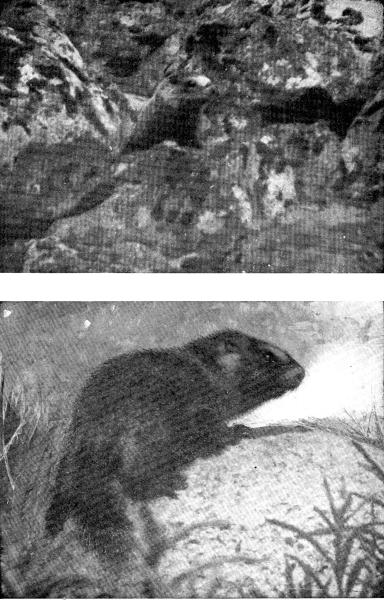
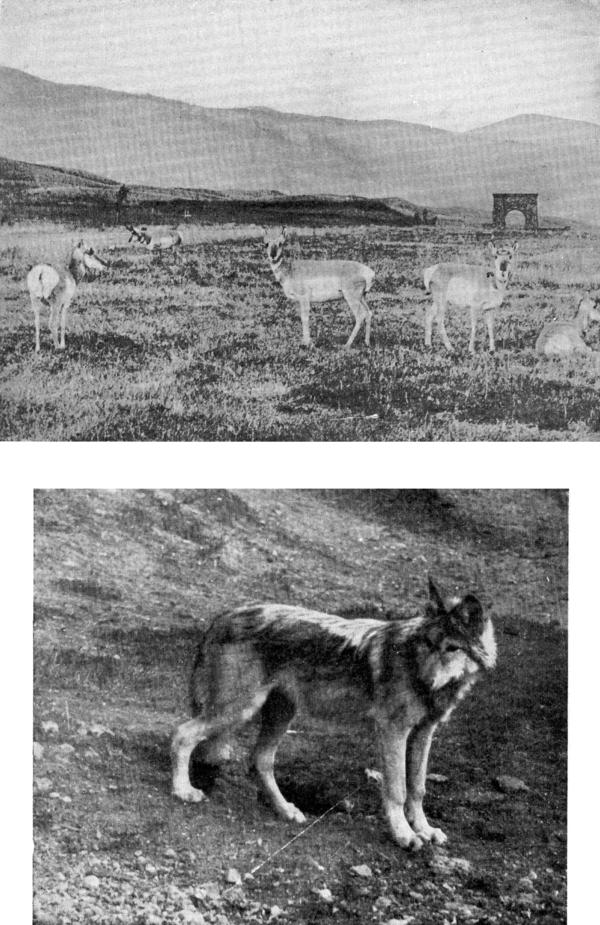 XX. Near Yellowstone Gate: (a) Antelope
Photo by F. Jay Haynes
(b) Captive Wolf
Photo by E. T. Seton
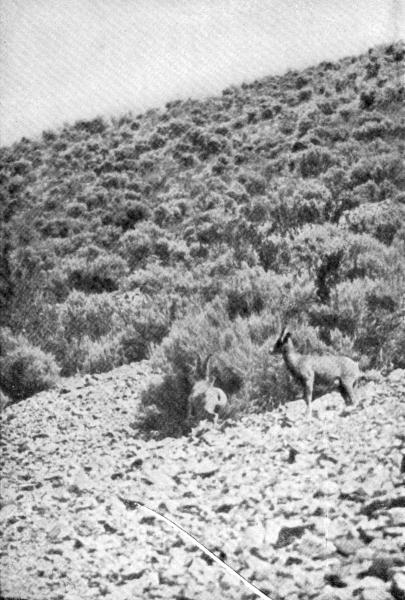 XXI. Mountain Sheep on Mt. Evarts
Photo by E. T. Seton
This action is momentary or very brief; the
spread disc goes down again in a few seconds. The
flash is usually a signal of danger, although it answers
equally well for a recognition mark.
In 1897 the Antelope in the Park were estimated
at 1,500. Now they have dwindled to about one
third of that, and, in spite of good protection, continue
to go down. They do not flourish when confined
even in a large area, and we have reason to fear
that one of the obscure inexorable laws of nature
is working now to shelve the Antelope with the
creatures that have passed away. A small band
is yet to be seen wintering on the prairie near
Gardiner.
At one time the Bighorn abounded along all
the rivers where there was rough land as far east
as the western edge of the Dakotas, westerly
to the Cascades, and in the mountains from Mexico
and Southern California to Alaska.
In one form or another the Mountain Sheep
covered this large region, and it is safe to say that
in the United States alone their numbers were
millions. But the dreadful age of the repeating
rifle and lawless skin-hunter came on, till the
end of the last century saw the Bighorn in the
United States reduced to a few hundreds; they
were well along the sunset trail.
But the New York Zoölogical Society, the Camp
Fire Club, and other societies of naturalists and
sportsmen, bestirred themselves mightily. They
aroused all thinking men to the threatening danger
of extinction; good laws were passed and then
enforced. The danger having been realized, the
calamity was averted, and now the Sheep are on
the increase in many parts of the West.
During the epoch of remorseless destruction the
few survivors were the wildest of wild things; they
would not permit the approach of a man within
a mile. But our new way of looking at the Bighorn
has taught them a new way of looking at us, as
every traveller in Colorado or the protected parts
of Wyoming will testify.
In 1897 I spent several months rambling on the
upper ranges of the Yellowstone Park, and I saw
not a single Sheep, although it was estimated that
there were nearly a hundred of the scared fugitives
hiding and flying among the rocks.
In 1912 it was believed that in spite of poachers,
Cougars, snow slides, and scab contracted from
domestic sheep, the Bighorn in the Yellowstone Park
had increased to considerably over two hundred,
and the traveller can find them with fair certainty
if he will devote a few days to the quest around
Mt. Evarts, Washburn, or the well-known ranges.
In September, 1912, I left Gardiner with Tom
Newcomb's outfit. I was riding at the end of the
procession watching in all directions, when far
up on the slide rock I caught sight of a Sheep.
A brief climb brought me within plain though not
near view, to learn that there were half a dozen at
least, and I took a few shots with my camera. I
think there were many more hidden in the tall
sage behind, but I avoided alarming them, so did
not find out.
There were neither rams nor lambs with this
herd of ewes. The rams keep their own company
all summer and live, doubtless, far higher in the
mountains.
On Mt. Washburn a week later I had the luck
to find a dozen ewes with their lambs; but the
sky was dark with leaden clouds and the light so
poor that I got no good results.
In winter, as I learn from Colonel Brett, the
Sheep are found in small bands between the
Mammoth Hot Springs and Gardiner, for there is
good feed there, and far less snow than in the
upper ranges. I have just heard that this winter
four great rams are seen there every day with
about forty other Sheep; and they are so tame that
one can get pictures within ten feet if desired.
Alas! that I have to be so far away with such
thrilling opportunities going to waste.