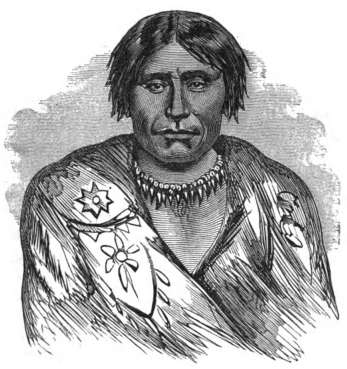
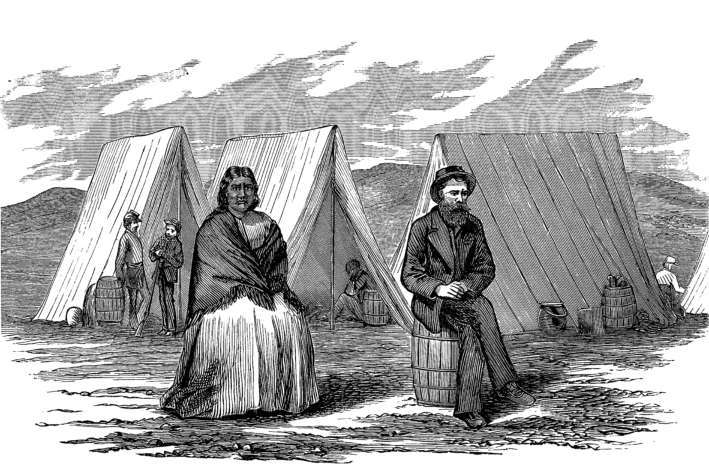
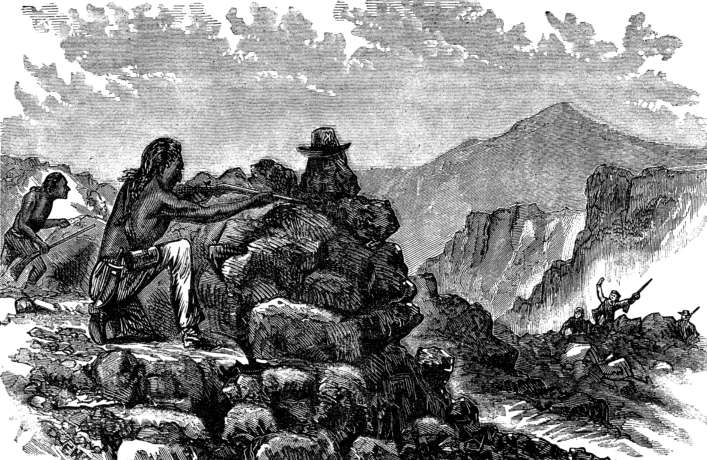
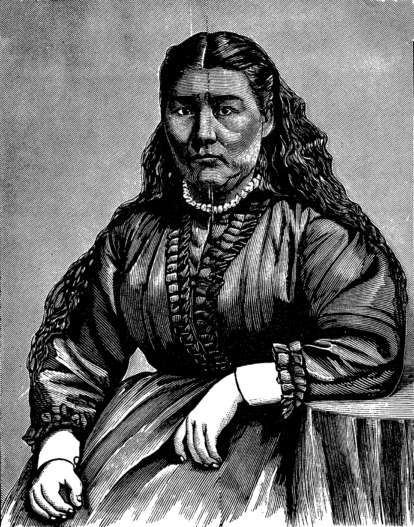
ASSASSINATION—“KAU-TUX-E”—THE DEATH PRAYER
SMOTHERED BY BLOOD—RESCUED.
While these two parties are wending their way to the council tent, let us
see what is going on around it. On the side opposite from the camp a small
sage-brush fire is burning. It is not at the same spot where the fire was
built when Meacham and Roseborough had the long talk with Captain Jack a
few days since. Why this change? Think a moment. The council that day was
in full view of the signal station. This fire is behind the council
tent, and cannot be seen from the station. Around the fire loose stones
are placed. This looks suspicious. But who are those fellows dressed like
white men, sitting around that fire? Ah! they are Modocs waiting for the
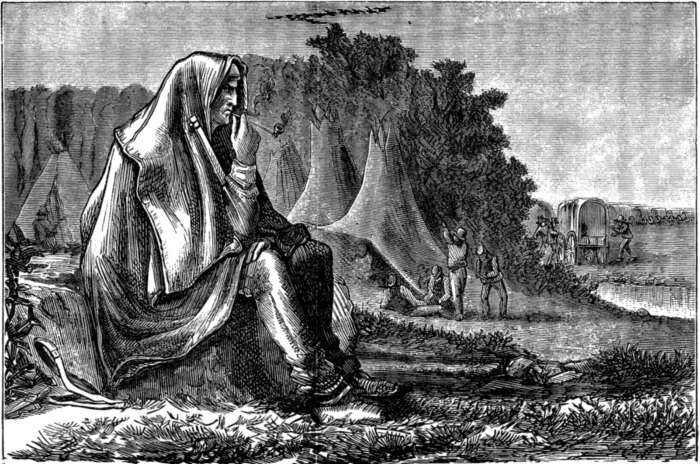
commissioners. That man with a slouched hat and well-worn gray
coat,—nearest the tent, is Captain Jack. He looks sad and half
melancholy, and does not seem at ease in his mind.
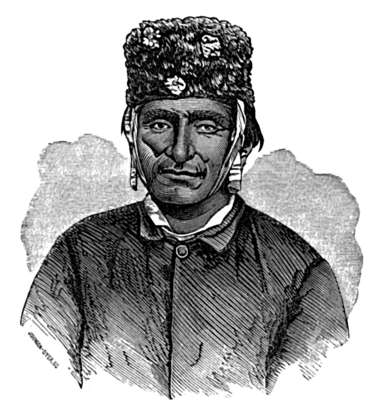
Near him sits old Schonchin, the image of the real savage. His hair is
mixed with gray. His face indicates that he is a villain.
That fellow who appears restless, and walks back and forth, is Hooker Jim.
He is not more than twenty-two; his face tells you, at a glance, that he
is a cut-throat. He is tall, stout-built, very muscular, and would be an
ugly customer in a fight. He
is
accredited with being the best
“trailer,” and the closest marksman in the Modoc tribe.
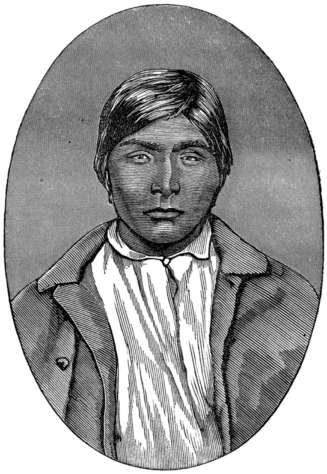
That other young fellow, with feminine face, and hair parted in the
middle, is a brave and desperate man. That is Shacknasty Jim.
That dark-looking man, who reminds you, at the first view, of a snake, is
Black Jim. He is of royal blood, and half-brother of Captain Jack. His
hair is cut square below the ears, and, take him altogether, he is a
bad-looking man.
The light-colored, round-faced, smooth-built man, who stands behind the
chief; is “Ellen’s Man.” He is young, and is really a fine-looking fellow.
He does not appear to be a bad man, but he is; and you will think him
the worst of the company before we lose sight of him.
The talk around that council fire would freeze your blood could you hear
it. They are making arrangements for the carnival of death that they
propose holding.
The chief is nervous, and speaks of his regret that this thing is to be.
“Ellen’s Man” proposes to take his place if he lacks courage. “I do not
lack courage, but I do not feel right to kill those men. If it is the
Modoc heart, it shall be done,” replies the chief.
Walk out towards the Modoc camp forty steps, and lying behind a low ledge
of rocks are two boys, Barncho and Slolux. They are very quiet, but under
each one we see several rifles. They are both young, and have
volunteered to play this part in the tragedy soon to be enacted.
Near them is another man, crouching low, and in his hand he holds a gun,
with its muzzle
pointing
towards the tent. His face indicates a much
older man than he really is. He is not there to take a part in the
proceedings of the coming meeting, except in a certain contingency. There
is a something about him that declares him to be a man of more than
ordinary stamp. This is Scar-face Charley, and if, in the slaughter that
is to ensue, Riddle or his wife should fall, the rifle that that man
grasps will talk in vengeful tone, with deadly effect, upon the murderer.
Look behind you at the council fire. Eight Indians are there now, and the
new-comers have familiar faces. They are Bogus and Boston, just
arrived from head-quarters. They are telling the others who are coming,
that they are all unarmed.
Boston intimates something like regret or faltering in the purpose. Bogus
declares that he will “Do it alone, if all the others back out. Kill these
men, and the war will stop. It will scare all the soldiers away.”
Hist! here comes Gen. Canby, with the brass buttons on his coat glittering
in the sunlight; and Dr. Thomas, also, who is so well worthy to walk by
the side of the general. The Indians arise and greet them cordially. Gen.
Canby takes from his pocket a handful of cigars, offering one to each.
They accept them from his hand, while in their hearts they have determined
on his death. The general and all the Indians are smoking now. The
thoughts of the general will never be known; not even whether he had any
suspicion of their intentions.
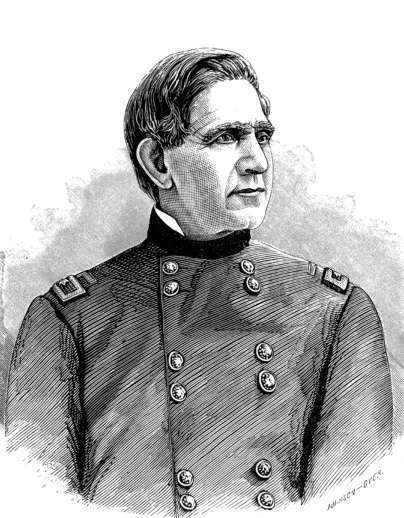 Gen. Canby.
Meacham and his party are approaching. They ride up very near the council
fire,—Meacham to the right, Dyer and Mrs. Riddle to the left.
Riddle
passes to the left of the tent, looking in as he comes to the council.
Meacham is taking off his overcoat before dismounting. Why is this? The
weather is not warm. There is a reason for this strange action.
Before reaching the tent the matter had been discussed by the four persons
of that party. Riddle declared that if attacked he would save himself by
running, Mr. Dyer saying there was no hope of escape in any other way.
Meacham considered running impracticable and hopeless, and suggested that,
“if we stand together, we can, with the aid of the Derringer, get a
revolver for Riddle, and then we can all be armed in quick time.” Dyer and
Riddle adhered to the plan of escape they had proposed, Meacham still
saying that it was hopeless, and adding, “I cannot run; but I will sell my
life as dearly as possible.” The Derringer is in his under coat.
As they ride up, they see clearly that the council fire is behind the
tent, out of sight of the signal station, and that the Modocs are all
armed with revolvers secreted under their clothing.
The Indians welcome the party with a cordiality that is very suspicious.
They are good-humored, too; another confirmation of the worst fears. Even
before the party dismount, they are saluted by the Modocs with
hand-shaking and other demonstrations.
Dyer is the first to alight from his horse. He looks a little pale. Tobey
quietly dismounts, securing her horse to a small sage brush near the
council. Meacham still sits upon his horse, apparently listless, as if in
doubt. He is fighting a battle with his pride. His family are in his
thoughts, and also
another
family of little orphans of a much-loved
brother. He glances at the face of Gen. Canby and Dr. Thomas. His mind is
made up. He dismounts, dropping the halter of the horse upon the ground.
He intends that “Joe Lane” (the horse) shall have a chance for escape. But
“Joe Lane” is well known among the Modocs. They have seen him before, and
they fix their eyes on him now, impatient to feel him flying over the
plains. Perhaps they are making a calculation of his value as an offset to
several of the ponies captured from them by Maj. Biddle a few days
previous.
See the manœuvring going on by both parties. The Modocs are seeking to
separate themselves from the white men, while Dyer, Meacham and Riddle are
seeking to prevent the formation of a tableau of white men. Canby stands
erect and firm, not seeming to notice the game that is playing before his
eyes. His pride will not permit him to notice or to shun what is evidently
the intention of the Modocs. Dr. Thomas does not see what is going on, or,
if he does, so strong is his faith in God that he does not fear. Dyer and
Riddle are outside on either hand, not wishing to join the group.
Meacham, now satisfied that the party are entrapped, is walking carelessly
a few steps towards the camp. Perhaps he is going to make a signal to
those at the lookout. If that was his intention, he abandons it; for just
beside him are a pair of small, bullet eyes that watch his every movement.
The party feel that not the motion of even an eye is lost by the Modocs.
They see everything, and, while all are apparently on the best of terms,
all are on the lookout for any sign or intimation of
danger.
Not a motion
is made unobserved. Still, no unkindly words are spoken; indeed, all
parties appear to be in cheerful humor.
Appearances are deceitful sometimes, and especially in this instance. One
party is intending to commit an unparalleled crime; the other, suspicious
of their intention, awaits the issue, not quite without hope, but almost
in despair.
The white men do not seem anxious to begin the council. The Modocs are
trying to appear careless.
What does that mean? Bogus is going out towards a low cliff, carrying his
rifle with him. Watch him a moment. While standing on a prominent rock, he
is scanning the ledge that runs towards the soldiers’ camp. Ah, yes! he
is looking for sage brush with which to feed the fire. Now he has laid
down his gun and breaks off the brush and returns to the council. That,
then, was the pretended object of his trip. Curious that in all former
councils the Modoc women have performed this work, but that none of
them are here now!
Hooker Jim is on the alert, and if you will watch his eye you will see
that it glances often in the direction of the soldiers’ camp. Something
excites his suspicion, and the other Indians, except Captain Jack, follow
his gaze; and the white men, too, discover some one’s head above the
rocks. All arise to their feet. Is the terrible affair to begin now? Wait
a moment and keep your eyes divided, watching the intruder and the
Modocs. The former is looking around him, as if hunting for some lost
article. The latter are nervous, and a hateful fire is burning in their
eyes. The moment is one of intense peril. The least
motion
of distrust
now on the part of the white men will precipitate the bloody scene,
awaiting only for a signal to begin.
Mr. Riddle recognizes the intruder as Mr. Clark, who is hunting lost
horses.
“Why for he come here? We no want him,” says Boston Charley.
“Mr. Dyer, will you go out to Mr. Clark and send him back?” requests Mr.
Meacham.
Mr. Dyer rides out to the man, and, after explaining to him the desire of
the commissioners, returns to the council fire. Oh, how near we were to
witnessing a horrible murder! But it is averted for the moment, and we
breathe again.
Meacham is in charge of the council talk, and finally sits down near the
fire, and Captain Jack takes a seat directly opposite him, and so close
that their knees almost touch. The council talk begins.
Meacham says, “We have come to-day to hear what you have to propose. You
sent for us, and we are here to conclude the terms of peace, as your
messengers of yesterday requested.”
To this Captain Jack replies, “We want no more war. We are tired, and our
women and children are afraid of the soldiers. We want them taken away,
and then we can make peace.”
Meacham says, “Gen. Canby is in charge of the soldiers. He is your friend.
He came here, because the President sent him to look out for everybody and
to see that everything goes on all right.”
Captain Jack replies, “We do not want the soldiers here. They make our
hearts afraid. Send them away, and we can make everything all right.”
Meacham continues, “Gen. Canby has charge of the soldiers. He cannot take
them away without a letter from the President. You need not be afraid. We
are all your friends. We can find you a better home than this, where you
can live in peace. If you will come out of the rocks and go with us, we
will leave the women and children in camp over on Cottonwood or Hot Creek,
and then we shall need the soldiers to make other folks stay away, while
we hunt up a new home for you.”
Riddle and his wife are both essential to a careful rendering of the
speeches. Riddle is interpreting the Modocs’ speeches into “Boston talk,”
and Tobey is translating the white men’s speeches into the
“Mo-a-doc-us-ham-konk”—(Modoc language). Hence they are both giving
closest attention. Riddle stands now just behind the chairman of the
commissioners. Tobey is sitting a little to the left. Gen. Canby seats
himself upon a rock on Meacham’s right, about three feet distant. Old
Schonchin sits down in front of him. Dr. Thomas bends a sage bush, and,
laying his overcoat upon it, also sits on the left and in the rear of
Meacham.
Hooker Jim is restless and very watchful; sometimes standing immediately
behind Captain Jack, and occasionally walking off a few steps, he scans
the rocks in the direction of the soldiers’ camp, and saunters back again,
always, however, in front of the white men. Keep an eye on him; he is
making now a declaration by his acts that will stop your heart’s blood.
“Joe Lane,” the horse, is just behind Captain Jack, standing a mute and
unsuspecting witness of the act now being played.
Watch that demon, Hooker Jim! See him stoop down, and while his eye is
fixed on Meacham, he is securing “Joe Lane” to a sage bush, pushing the
knot of the halter close to the ground. He slowly rises, and, while
patting the horse on the neck, calling him by name, and telling him he is
a “fine horse,” still keeping his eye on Meacham, with his left hand he
takes the overcoat from the saddle, and with a stealthy, half-hesitating
motion, slowly inserts his arm in the sleeve, and then without changing
his position or his eyes, quickly thrusts his right arm in the other
sleeve, and with a heavy shrug jerks the coat squarely on his shoulders;
and, having buttoned it up from top to bottom, smiting his breast with his
hand, he says, “Me old man Meacham, now. Bogus, you think me look like old
man Meacham?” My dear reader, he does not fasten that horse for Meacham.
He does not put on the coat because he is cold, nor merely as a joke. No,
he does not mean anything of that kind. He intends to make sure of the
horse and coat, and, at the same time, provoke a quarrel, and make the way
easy for the bloody attack.
Meacham fully understands the import and intention of this side-play, but,
with assumed indifference, remarks, “Hooker Jim, you had better take my
hat also,” at the same time lifting it from his head. Watch the play on
that scoundrel’s face as lie replies, “No. Sno-ker gam-bla sit-ka
caitch-con-a bos-ti-na chock-i-la”—(“I will, by-and-by. Don’t hurry, old
man.”)
This speech completes the declaration of what they intended to do. There
can be no longer any doubt as to the purpose of these bloodthirsty
desperadoes. O God! is there no help now? Can nothing
be
done to save our
friends? They read their fate in Hooker’s action. They realize how
fearfully near the impending doom must be. Every face is blanched; but no
words of fear are uttered. Dyer, with a face of marble, walks slowly to
his horse, now on the right of the group, and, going to the farthest side
of him, pretends to be arranging the trappings of his saddle with his face
towards the council fire. Riddle, pale and aghast, makes excuse to change
the fastenings of the saddle on his wife’s horse, which stands behind Dr.
Thomas. Tobey, who has been sitting in front of the doctor, with a half
child-like yawn throws herself carelessly at full length on the ground,
resting on her elbows. Every act tells, too plainly to be mistaken, how
each one feels and what they are expecting.
Both Dyer and Riddle intend to be covered by their horses when they start
on a run for life. Tobey evidently does not intend to be in the way of the
bullets that are now lying quietly on their beds of powder in the little
iron chambers of the pistols under the coats of the red devils. She sees
clearly that the storm, which is evidently coming up with a great black
hurrying cloud from the west, will precipitate the effusion of blood that
is now leaping and halting in the veins of the doomed men who sit almost
motionless, waiting, watching, listening for the signal of death to be
given, wondering how it will come. Will it be from ambushed men, a volley,
a sting, and a war-whoop; and then, while the soul is making its exit,
will the eye, growing dim, behold the infuriated monsters, with gleaming
knives uplifted, spring on the helpless body? Will the ear, as life ebbs
away, be lulled by streams of blood trickling on the
rocks?
Are angels
hovering near to convey their souls away? Is God omnipresent? Is He
omniscient? Is He omnipotent? Does he hear prayer? Will not God interpose
now when human aid is beyond reach?
Oh, how the mind recalls the past, outstripping the lightning flash, while
it passes in review the scenes from the cradle to this hour!—all the
bright and happy days; the dark clouds and direful storms that have swept
over the soul, and realizing the still more awful agony of the farewell
greetings of sad-faced Hope leaving the heart; for until this last act of
Hooker Jim’s she had lingered lovingly on the threshold undecided. Words
may not tell the anguish, the gloom, the terrible loneliness without her
presence. Every heart breathes a prayer for her return. “Oh, come back to
us now; be with us in this expiring hour of life’s last midnight!”
Thank Heaven, she comes again clad in garments, not as in days past, made
up of ambitions and worldly dreams, but in shining robes of spotless
purity and immortal light, and she whispers, “Be of good cheer, the
journey is short, and it is but a change from one life to another;” and
though the voyage be stormy and the night be dark it will end in a morning
of eternal day in the beautiful sunlit summer-land where sorrows come no
more.
Meacham turns towards Gen. Canby and invites him to talk. Every movement
is scrutinized by the Modocs. Meacham has made an excuse to look Gen.
Canby in the face. He sees plainly that the general understands the
situation. Will he, oh! will he not promise to remove the soldiers on the
demand that has been so often made? It would avert
the
tragedy. It would
save the lives that are banging on his words. Will he do it? Surely, now,
when convinced, as he must be, that the threat will be executed, will he
not feel justified in yielding? Now that the Modocs have absolved him from
all obligations to them, will he grant their request; or will the high and
extraordinary sense of honor that controlled his reply to Meacham in the
morning, when the latter proposed to grant “any demand made, rather than
give the assassins an excuse for murder,” control him now? Every eye is on
him. The Modocs understand that he is chief.
He stands upright in form, and character as well. He looks the great man
he is. His face alone shows the intensity of his feelings. His lip quivers
slightly, as it always does under excitement. He speaks slowly:—
“Tobey, tell these people that the President of the United States sent the
soldiers here to protect them as well as the white men. They are all
friends of the Indians. They cannot be taken away without the President’s
consent. Tell them that when I was a young man I was sent to move a band
of Indians from their old home to a new one. They did not like me at
first, but when they became acquainted with me they liked me so well that
they made me a chief, and gave me a name that signified ‘Friend of the
Indian.’ I also removed another tribe to a new home; and they, too, made
me a chief, and gave me a name that meant ‘The tall man.’ Many years
afterwards I visited these people, and they came a long distance to meet
me, and were very glad to see me. Tell them I have no doubt that sometime
the Modocs will like me
as
those people did, and will recognize me as
their friend.”
As the general sits down, Meacham turns to Doctor Thomas, and invites him
to speak. The doctor drops forward on his knees, and, with his right
hand on Meacham’s left shoulder, says, “Tobey, tell these people, for me,
that I believe the Great Spirit put it into the heart of the President
to send us here to make peace. We are all children of one Father. Our
hearts are all open to him. He sees all we do. He knows all our hearts. We
are all their friends. I have known Gen. Canby eight years; I have known
Mr. Meacham fourteen years, and I have known Mr. Dyer four years. I know
all their hearts are good. They are good men. We do not want any more
bloodshed. We want to be friends of yours. God sees all we do. He will
hold us all responsible for what we do.”
The doctor resumes his seat. Captain Jack is ill at ease. His men are
watching him closely. They evidently distrust him.
Meacham has almost decided in his mind that when the attack is made
Captain Jack will throw himself in the breach, and, if he takes part at
all, it will be with the white men.
The chief is slow to give the signal to begin. He is not in position
according to the programme arranged in the morning. He had hoped that the
demand for the withdrawal of the troops would be complied with. He sits
now with his hands on his knees, staring into Meacham’s face. He meets a
gaze intense as his own. What are the thoughts of his mind? He is
wavering. Perhaps he may refuse
to
sanction the butchery. He feels that
his own people are watching him. Suddenly, rising to his feet, he turns
his back on the white men. He is walking away from them. See! he stops!
Schonchin springs to the seat Captain Jack has left, and, with eyes
gleaming with the pent-up fury of hell, begins to talk. His voice is loud,
and betokens great excitement. How savage he looks now, while he says,
“Give us Hot Creek for a home, and take the soldiers away.”
“Maybe we cannot get Hot Creek for you,” replies Mr. Meacham.
Then Schonchin says, “I have been told we could have Hot Creek.”
Meacham asks, “Did Fairchild or Dorris say you could have it?”
“No,” replied Schonchin; “but Nate Beswick said we could have Hot Creek.”
“Hot Creek belongs to Fairchild and Dorris,” says Meacham. “We can see
them about it, and if we can get it you may have it.”
“Take away your soldiers and give us Hot Creek, or quit talking. I am
tired of talking. I talk no more,” shouts Schonchin in loud tones, and
with eyes burning with passion.
The interpreter is rendering the speech, but, before it is finished,
Captain Jack, who has returned to the group, and is standing a step behind
Schonchin, gives a signal, and the Modoc war-whoop starts every one
present to his feet (except Tobey, who lays close to the ground); catching
the sound, and oh! the sight, too, of Barncho and Slolux coming with the
rifles.
“Jack, what does that mean?” demands Meacham.
The answer came quickly. Captain Jack, thrusting his right hand under the
left breast of his coat, draws a six-shooter, and shouts in a loud voice,
“Ot-we-kau-tux!”—(“All ready!”)
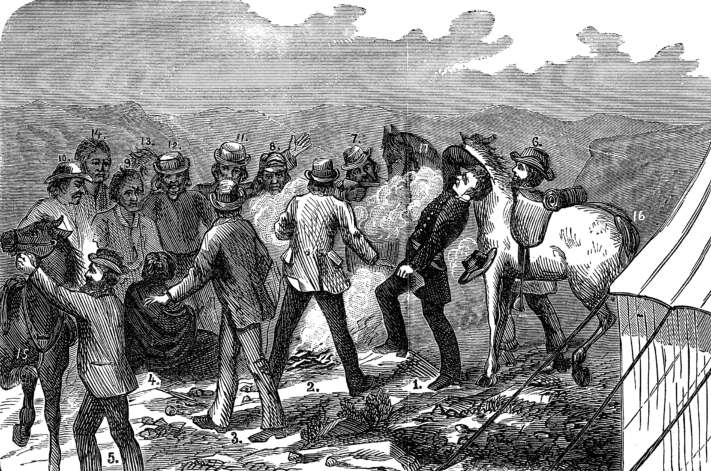 The Assassination Scene.
- 1. General Canby.
- 2. Colonel Meacham.
- 3. Doctor Thomas.
- 4. Tobey Riddle, reclining.
- 5. Frank Riddle.
- 6. Mr. Dyer.
- 7. Captain Jack.
- 8. Schonchin.
- 9. Boston Charley.
- 10. Shacknasty Jim.
- 11. Hooker Jim.
- 12. Ellen’s Man.
- 13. Bogus Charley.
- 14. Black Jim.
- 15. Horse held by Riddle.
- 16. Horse held by Dyer.
- 17. Horse.
Holding the barrel with his left hand, and cocking the pistol with his
right, he points it at Gen. Canby’s head, touches the trigger, and
explodes the cap, but does not the powder. Quickly he revolves the
cylinder, and again presents it to the petrified general, who stands
unmoved. Why, oh, why does he not close on the monster, and wrench the
weapon from him? Quick, general, quick! He is too late. Another instant,
and a shot is passing through his head. He does not fall, but turns and
flees. Jack and “Ellen’s Man” pursue him until he falls on the rocks. They
close on him. Captain Jack holds him by the shoulder, while the other cuts
him across the neck. In the fall his chin struck on the rocks and
shattered his lower jaw. The monsters strip him of every article of
clothing, while he is struggling in the agonies of death. Barncho comes up
now, and “Ellen’s Man” snatches a rifle from his hands, and, pointing at
the general, discharges it, and another ball passes entirely through his
head. They turn him on his face, and leave him in the last agony of a
horrible death, while, with his uniform on their arms, they go back to the
council tent.
Look towards the soldiers’ camp. Two men are running. The foremost one is
Dyer, and following him is Hooker Jim, who fires repeatedly at Dyer, who
turns, and pointing his pistol, Jim drops to avoid the shot. Dyer resumes
his run for life, and the other follows until Dyer has widened the space
between
them so much that Hooker Jim, fleet as he is, abandons the chase,
and returns to join the other murderers.
Over towards the lake two other men are running. The foremost one is Frank
Riddle. The pursuer is Black Jim, who fires rapidly at Riddle; in fact, he
is not trying to hit him, because he knows that Scar-face Charley is
watching, and if Riddle falls by a shot from Black Jim, Black Jim himself
will fall by Scar-face Charley’s rifle.
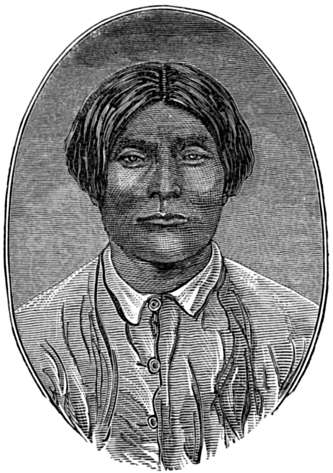 Black Jim.
Simultaneously with Jack’s first attack on General Canby, Boston Charley’s
first shot struck Dr. Thomas in the left breast, above the heart. The
doctor drops partly down, and catches with his right hand, and with the
other uplifted towards his assassin, begs him to shoot no more, as he has
already received a death-wound. Bogus joins Boston. They permit the doctor
to get upon his feet, and start to run, when they trip him and he falls
again. They taunt him with his religion, saying, “Why don’t you turn the
bullets? Your medicine is not strong.” The doctor rises again and walks a
few steps, when they push him down, still ridiculing him. Again he pleads
for them to spare his life. They laugh in his face and say, “Next time you
believe a squaw, won’t you?” Once more—and it is the last time that he
will ever walk in that bruised and mangled body—the doctor rises to his
feet, and, going a few steps, pleading with his inhuman tormentors for
mercy, and with his Maker for mercy on them, he falls to rise no more.
Slolux joins them, and Bogus, placing the muzzle of a gun towards the
doctor’s head, sends another bullet crashing through it. The red devils
now strip him of
his
clothing, jesting and mocking his words of prayer,
and finally turn him face downwards, while through the blood from the
wounds on his lips he cries, “Come, Lord—” and the prayer is smothered
forever.
When the signal for the attack was given, Schonchin was in position, and,
springing to his feet, he draws a revolver from his left side, and, with
his other hand, unsheathes a knife. He is so near his victim that he dare
not trust to a pistol alone. He is very much excited, and is not so quick
as the others in cocking his pistol.
Meacham draws his Derringer, and pushing the muzzle squarely against the
heart of Schonchin, pulls the trigger, but, alas! it does not fire. Why?
Oh! why? He tries again, and still the hammer does not fall. He now
discovers that it is but half-cocked. Too late! too late! Schonchin
thrusts his pistol forward, almost touching Meacham’s face. The latter
jumps back and stoops, while the ball from Schonchin’s pistol tears
through the collar of his coat, vest, and shirt on the left shoulder, so
close that the powder burns his whiskers and the bullet bruises him. He
runs backwards with the pistol now ready for use, but with Schonchin
pursuing him and firing as fast as he can until his pistol is empty. Now
he drops it on the ground, and, drawing another from his right side, he
continues the attack, but dare not close on the Derringer still in the
hands of Meacham. Why does not the pursued man fire? He is a good shot.
Why don’t he drop the old scoundrel? He was very much frightened when the
attack began, but, like a soldier in battle, he has passed that, and is
terribly cool now. He dare not risk his only shot, for fear of
missing
Schonchin, and because of the danger of hitting Tobey, for she is now
interposing for his life, and, putting her hand on Schonchin’s pistol,
turns it away again and again, while pleading, “Don’t kill him! don’t kill
Meacham! He is the friend of the Indians.” Slolux joins Schonchin, and,
with his gun, strikes the woman on the head, while Shacknasty, snatching
it from him, says, “I’ll fetch him,” at the same time sitting down and
taking deliberate aim. Meacham, striking his breast with his left hand,
shouts, “Shoot me there, you cowardly red devil!” Tobey strikes down the
gun. Shacknasty threatens her, and again takes aim and fires just as
Meacham leaps over a low ledge of rocks and falls. “I hit him, high up! He
is all right!” shouts Shacknasty.
Meacham now decides to fire his only shot, and pushing the pistol up
over the rocks, carefully raises his head, with it thrown back, and just
as his eye comes above the rocks, he sees Schonchin sitting with his
revolver resting on his knee. Instantly a flash and a sting, and a ball
strikes Meacham in the forehead, between the eyes. Strange freak of the
bullet that passes under the eye-brow and out over the left eye, but does
not blind the other eye. Meacham now fires at Schonchin, who leaps up and
falls on the rocks, wounded. Almost at the same instant a ball passes
through Meacham’s right arm. The pistol drops. Another ball cuts away the
upper part of his right ear, and still another strikes him on the right
side of the head and glances off. He quivers, and his limbs are
outstretched, denoting the death-struggle. Shacknasty is the first to
reach him, and he proceeds to strip him of his clothing, first pulling
his
boots off, then his pantaloons, and, while taking off his coat, tears the
vest down at the side and throws it away. Then he strips him of his shirt,
for it is a good one, and Shacknasty saves it for his own use.
While he is unbuttoning the shirt at the neck, Slolux comes up, and,
placing the muzzle of the gun close to the temple of the wounded man, sets
the hammer, and as he raises it up to his face to get it in range,
Shacknasty pushes it away, saying in Modoc, “You needn’t shoot. He is
dead. He won’t get up.” Hearing the voice of Captain Jack calling, they
leave the scene, saying to Tobey, “There lies another of your brothers,
you white-hearted squaw! Go and take care of him. You are no Modoc.”
This hour seems to have inherited even the wrath of the Almighty. The
blackness of unnatural night hangs over this scene of blood. Gen. Canby’s
limbs have straightened on yonder rocks, but a few steps to the west, and
his stark body looks ghastly in the awful gloom. Twenty yards to the east
the form of Dr. Thomas, his body half stripped and covered with blood, is
still convulsing, while his face presses the cold rocks.
The chief calls again to the red-handed demons and bids them flee to the
stronghold. They gather around him with the clothing of the slain still
dripping blood upon their feet. They are exulting by wild shouts of
half-satiated thirst for blood. While glancing towards the soldiers’ camp
they reload their arms.
“I am going to have old man Meacham’s scalp to put on my shot-pouch,” says
Boston, passing the doctor’s clothing to a companion standing near.
“He has no scalp,” breaks in Hooker Jim, “or I would have it myself.”
Boston now runs to where the bleeding man is lying, and takes from his
pocket a small two-bladed, black-handled knife which had been taken from
the pocket of a soldier who was killed in the January battle. The Indian
woman is wiping the blood from the mutilated face, now upturned with
closed eyes. Boston thrusts her aside, and with his left hand, still red
with the blood of Dr. Thomas, grasps the largest locks, and makes a stroke
with the knife. The woman remembers that the prostrate man over whom
Boston is bending has been her benefactor, and that through his official
action, in 1869, he compelled Frank Riddle to make her a lawful wife,
and that, had it not been for this man, she would now, perhaps, be a
cast-off squaw. She cannot restrain her indignation, but rushes against
the red cut-throat and hurls him back on to the rocks. He rises and
threatens to take her life if she again interferes, taunting her with
being a “white woman.” Stamping on the prostrate man’s head, he places one
foot on his neck, and renews his attempt to secure an ornament for his
shot-pouch, swearing because he found no better scalp, but saying that he
would take one ear with it. With his left hand resting on the head, he
cuts square down to the skull a long, half-circular gash preparatory to
taking off the side lock and ear, too, with his knife.
Tobey now resorts to strategy to accomplish what she cannot do otherwise.
Looking towards the soldiers’ camp she claps her hands and shouts,
“Bos-tee-na soldiers. Kot-pumbla!”—(“The soldiers are coming!”) Boston,
without waiting to ascertain
the
truth of the warning, starts suddenly
and leaves the woman alone with the dead.
Tobey’s warning to Boston has reached the ears of the band of murderers at
the council fire, who, hastily putting the slightly wounded old sinner,
Schonchin, on “Joe Lane,” while the blood-stained uniform of Gen. Canby
and the gray suit of the doctor, together with Meacham’s clothes, are
lashed on Dyer’s horse, turn away, leaving Boston behind, who grasps the
rein of Tobey’s horse. She shouts to Jack, who turns and orders Boston to
leave him.
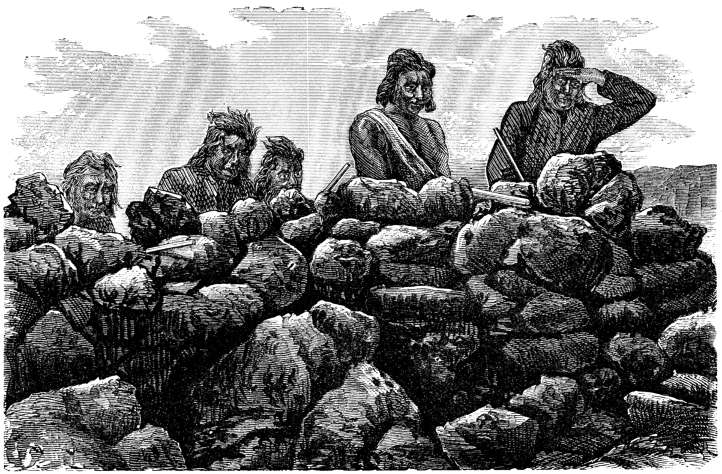
Jack and his party scamper over the rocks, looking back, expecting to hear
the guns of the white soldiers who are coming to the rescue.
Tobey again wipes the blood from the face of her benefactor, and, stooping
down, places her hand over his heart. “It stop! It stop!” she cries. With
her finger she opens his eyes. They do not see her. They are overflowing
with blood from the wound in his face and on his head. Again with her
dress she wipes the blood from his face. She straightens his limbs and
body. Then, standing alone a moment, with three dead men in sight, she
sorrowfully mounts her horse and starts for the soldiers’ camp.
While this scene of terror is being enacted at the council tent, another,
a little less bloody, is in progress on the opposite side of the Modoc
stronghold, the plans for which have been mentioned. Curly-haired Jack
(Cum-ba-twas) and Curly-haired Doctor have gone out towards Col. Mason’s
camp, with a flag of truce, to decoy the “Little Tyee” (Col. Mason) among
the rocks. But he is an old Indian fighter, and cannot be caught by such
devices.
Maj. Boyle is there, and, notwithstanding the fact that on the day before
Meacham had told him of the threatened treachery, he proposes to Lieut.
Sherwood to go out and meet the flag of truce. The major was Indian agent
at Umatilla, and had been successful in managing peaceable Indians. He had
been with Gen. Crook in Arizona, also; and, having confidence in his
sagacity to manage still, he volunteered to go now.
Having obtained the consent of Col. Mason, they leave the picket-line
behind them and the guard of the day on the lookout. They go cautiously,
and, when within hailing distance, the Modocs, under cover of the flag of
truce, ask for the “Little Tyee.”
“He will not come,” replies Boyle. The quick eye of the major catches
sight of a musket behind the flag of truce. He turns and flees, calling on
Sherwood to “Run! run for your life!”
They run. But see! Sherwood falls! A bullet from the musket of
Curly-haired Jack has broken his thigh. The guard rush to the rescue. The
Modocs fire a volley, and then flee to their stronghold, pursued by the
guard. The signal-station at Mason’s camp says, “Boyle and Sherwood
attacked, under a flag of truce.” Capt. Adams, of the signal corps, on the
bluff above Gilliam’s camp, receives and dictates it to his secretary,
who, after writing, sends it to Gen. Gilliam, in the camp, one hundred
yards below. The general reads the dispatch, and calls for Dr. Cabanis to
come in, while he writes a message to send by the doctor, informing the
commissioners of the attack on Mason’s men. The general has written but a
line, when Maj. Biddle, who has the other glass at the signal station,
shouts, “Firing on the
commissioners!”
The officers order the men to
“Fall in!” Soon the bugle repeats the assembly call. The men spring to
their arms, and in a few moments the five hundred men are ready to rush to
the rescue. Each company forms in line in the order in which they are
encamped,—Col. Miller’s company occupying the left front, Lieut. Eagan’s
next on the left, and Maj. Throckmorton taking his position behind Eagan’s
company; the cavalry companies are on the right.
Gen. Gilliam is astounded, petrified. He hesitates; he does not give the
order to march; he seems bewildered. Maj. Biddle rushes down from the
signal station and cries, “I saw Canby fall.” The men are frantic. They do
not understand the delay. The officers swear, and threaten to move
without orders.
Gen. Gilliam now awakes from his lethargy, and gives the order, “March,
and deploy from the left in skirmish line!”
“Forward!” shouts Col. Miller.
“Forward!” rings out along the lines, while Maj. Riddle’s bugle sounds
“Forward!” Maj. Thomas is ordered to remain with his battery and guard the
camp.
Now that the order to march is given, the men go flying towards the scene
of blood in skirmish line. Behind the army are the surgeons with the
stretchers.
The newspaper reporters are there, also, and foremost among them “Bill
Dad” of the “Sacramento Record.” While waiting for orders Bill Dad says to
a citizen, “I will give you fifty dollars to carry my message to Yreka
ahead of all others. Yes, seventy-five!”
“All right,” responds the man, anxious to
make
money out of the occasion.
Other reporters engage couriers.
Col. Miller nears the council tent, urging his men on. He is behind them,
pushing them forward, expecting every moment to see a Modoc blaze of fire
in front. They soon after meet Dyer, who, breathless, says, “They are all
killed but me.” Soon after they discover Riddle, who cries, hurriedly,
“They are all killed.” But now they meet Tobey, who sobs, “Canby, Thomas,
Meacham, all ‘kill.’”
Thirty minutes have passed, and Meacham is struggling to get upon his
feet. He hears a voice. “Up, on the left! Forward, my boys!” Faintly the
sound reaches his ears. “Steady, right! Up! up on the left, you d——d
scoundrels!” Distinctly and clearly he hears the words, “Steady, right!
Guide, centre!” Then the sound of men’s feet on the rocks mingles with the
words of command. The men near the centre level their guns.
“That’s an Indian,” says one of the men.
“Don’t shoot, he’s a white man!” shouts Col. Miller.
The line passes over the wounded man still in skirmish order, as they
expect a Modoc volley. As they pass, Dr. Cabanis comes up and says, “Bring
a stretcher here. Take Meacham. He’s not dead.”
“I am dead! I am dead!” murmurs the wounded man.
The soldiers lift the mutilated body on a stretcher.
“Water! water! give me water!” moans the wounded man.
The doctor puts a canteen of brandy to his lips. The lips refuse.
“I can’t drink brandy. I am a temperance man,” says Meacham.
“Stop your nonsense. No time for temperance talk now. Down with it! down
with it!” cries the doctor.
“Am I mortally wounded, doctor?” asked Meacham. The surgeon hastily
thrusts his finger into the several wounds and replies, “Not unless you
are wounded internally.”
“I am shot through the left shoulder,” said the wounded man.
“Now, boys, for the hospital! Quick! Lose no time, and we will save him,”
cries the doctor.
“I hit Schonchin in the right side. He fell over just in front of me,”
says the man on the stretcher.
“Never mind Schonchin,” says the doctor. “We’ll look out for him. Here,
take some more brandy. Now, boys, quick! He’ll stand it until you reach
the hospital.”
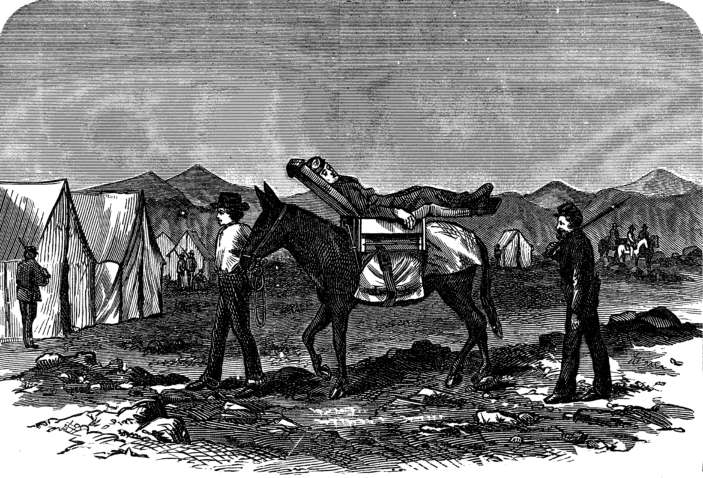
Four pairs of strong hands grasp the handles of the stretchers, and four
other pairs carry the arms, and walk beside to relieve the carriers. A
soldier covers the man with his coat as they hurry along. Listen, now, to
the sad wail of young Scott, Canby’s orderly, who was with him through the
war of the Rebellion. When he reaches the body of his beloved general, who
was more than a father to him, he throws himself on the prostrate form,
and, frantic with grief, raves like a madman. “Bill Dad” and a soldier
lift him up and cover the body with their coats.
Men with stretchers come up, and, while they lift the general, Bill Dad
cuts the side of the council
tent
out and covers him over. Strange that
this council tent should become Gen. Canby’s winding-sheet! The body of
Dr. Thomas is also placed on a stretcher, and it, too, is covered with a
part of the tent. It is his winding-sheet, also.
While these affairs are taking place at the scene of the terrible tragedy,
the quartermaster, at the camp, is putting the hospital in order for the
reception of patients, ordering cooks to prepare food for the men, packing
mules with supplies, stretchers, water-casks, and such other things as are
necessary for the men while fighting, never doubting but that they will be
needed. The animals are ready and waiting for orders from the general
commanding.
But lo! behold! The glistening bayonets above the rocks come nearer! The
army of five hundred men are returning to camp. “Why is this?” ask the
men. “Why did we not follow the murderers to their den?” demand the
officers.
“We shall not be ready to attack them until the Warm Spring Indians come,”
replies the general, who a few days since thought “he could take the
Modocs out with the loss of half-a-dozen men.” Why did not Col. Mason
follow up the Modocs who attacked Sherwood and Boyle? Because he could
not move without orders, and the orders were not given.
Three or four horsemen are waiting while a dozen pencils are rattling over
paper. The burden of each despatch is the assassination. “Modoc treachery!
Gen. Canby and Dr. Thomas killed; Meacham mortally wounded; Dyer and
Riddle escape.” How much these hasty lines will tell, and how many hearts
will feel a dark shadow fall over them when
the
electric tongue of fire
repeats this message to the world!
“Fifty dollars extra, if you get my despatch into the telegraph office
ahead of the others,” says Bill Dad, as he hands the paper to his courier.
Away goes the courier up the steep and rugged bluff.
“One hundred dollars if you get to the office in Y-re-ka, first,” says
another reporter, in a whisper, to his courier, who dashes off close
behind the first.
Another rider is mounted and waiting for the word to start. Gen. Gilliam’s
adjutant hands this man a sealed envelope. It contains an official
telegram for the authorities.
“Lose no time! Off with you!” says Adjutant Rockwell. And now three riders
are urging their horses up the hill. Y-re-ka is eighty-three miles
distant. A long race is before them. The evening is dark and gloomy, but
the clouds pass away, and the moon shines on three men galloping together,
mile after mile. Sunrise finds two of them still together. One of them, as
they near a ranch, swings his hat and shouts. A man in shirt-sleeves runs
to a stable and brings a fresh horse to the man who signalled him. The
rider dismounts, and, while changing the saddle from his horse to the
fresh one, tells the awful tidings. The other rider urges his horse on,
on, for he, too, has a fresh horse but a few miles ahead. On he goes, and
looking behind him sees his rival coming. He comes up and passes, saying,
“Good-by, George!”
Twenty minutes more and both are mounted on fresh horses, one leading, but
now in sight of each other. One is casting an eye backwards over his
shoulder; the other is pressing the sides of his
horse.
The gap closes
up. Y-re-ka is now in sight, and they are galloping side by side. Both are
sitting erect, and the music of jingling spurs is in harmony with the
stride of the horses. One mile more, and somebody wins. It all depends on
“bottom.” The spurs cease to jingle. They are muffled in the bleeding
sides of the panting horses.
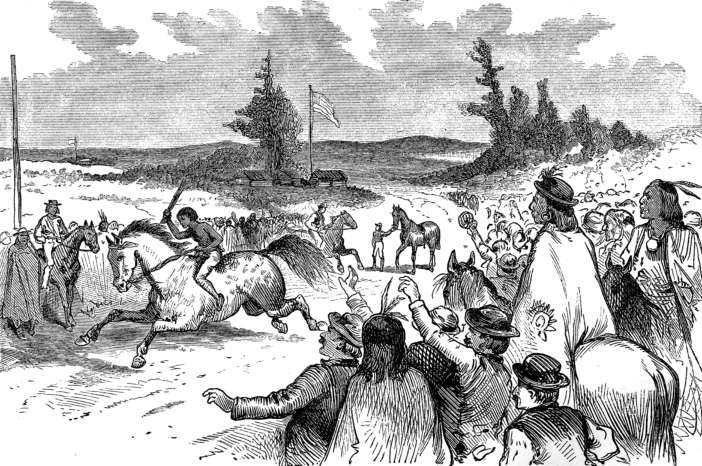
What a race! One is an iron-gray, the other a Pinto horse. The rider of
the gray, reaching back with his spurs, rakes his horse from the flank
forward, leaving a vermilion trail where the spurs have passed. With
extended head and neck, and lengthened stride, he goes ahead a few yards.
With another application of spurs, the switch of the horse’s tail touches
his rider’s back.
“Ah, ha! I’ve got you now!” shouts the rider of the Pinto, as he comes up
like the moving of a shadow, and leaves the gray and his rider behind. One
hour more, and the lightnings of the heavens are repeating the messages,
and sending them over mountains and plains, to almost the farthest ends of
the earth.