Open Old Books

Widows Grave and Otherwise

Whole book · 2 sections

WIDOWS GRAVE AND OTHERWISE — WIDOWS GRAVE AND OTHERWISE
“Widders are ’ceptions to ev’ry rule.”

—Dickens.

PURLOINED BY AN EX-WIDOW
AND PICTURED BY A VICTIM

PUBLISHED BY AN IMMUNE
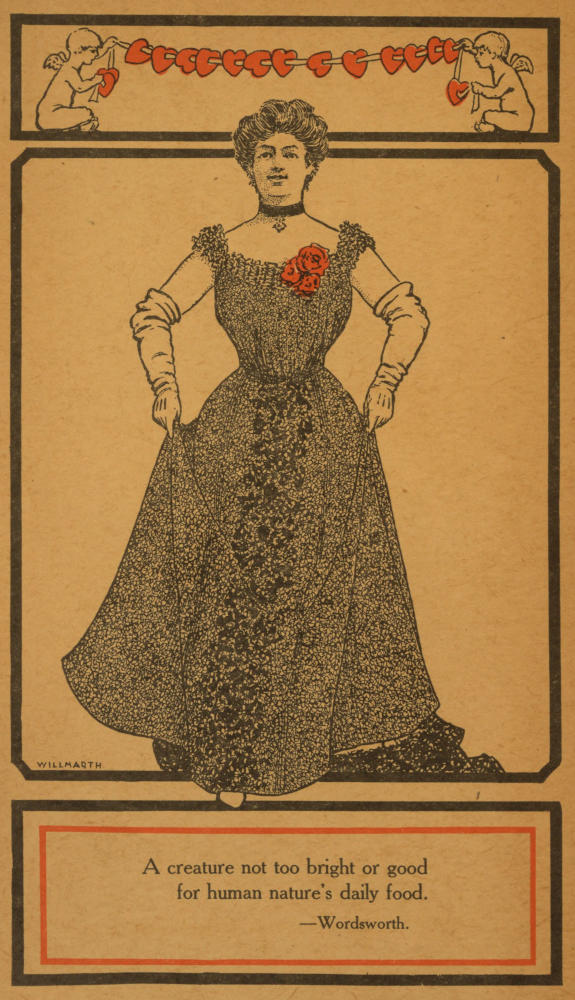

A creature not too bright or good
for human nature’s daily food.
—Wordsworth.
COMPILED BY CORA D. WILLMARTH
ILLUSTRATED BY A. F. WILLMARTH

COPYRIGHT, 1903
BY PAUL ELDER AND COMPANY

PAUL ELDER AND COMPANY
PUBLISHERS, SAN FRANCISCO

January First — January Second — January Third — January Fourth — January Fifth — January Sixth — January Seventh — January Eighth — January Ninth — January Tenth — January Eleventh — January Twelfth — January Thirteenth — January Fourteenth — January Fifteenth — January Sixteenth — January Seventeenth — January Eighteenth — January Nineteenth — January Twentieth — January Twenty-first — January Twenty-second — January Twenty-third — January Twenty-fourth — January Twenty-fifth — January Twenty-sixth — January Twenty-seventh — January Twenty-eighth — January Twenty-ninth — January Thirtieth — January Thirty-first — February First — February Second — February Third — February Fourth — February Fifth — February Sixth — February Seventh — February Eighth — February Ninth — February Tenth — February Eleventh — February Twelfth — February Thirteenth — February Fourteenth — February Fifteenth — February Sixteenth — February Seventeenth — February Eighteenth — February Nineteenth — February Twentieth — February Twenty-first — February Twenty-second — February Twenty-third — February Twenty-fourth — February Twenty-fifth — February Twenty-sixth — February Twenty-seventh — February Twenty-eighth — February Twenty-ninth — March First — March Second — March Third — March Fourth — March Fifth — March Sixth — March Seventh — March Eighth — March Ninth — March Tenth — March Eleventh — March Twelfth — March Thirteenth — March Fourteenth — March Fifteenth — March Sixteenth — March Seventeenth — March Eighteenth — March Nineteenth — March Twentieth — March Twenty-first — March Twenty-second — March Twenty-third — March Twenty-fourth — March Twenty-fifth — March Twenty-sixth — March Twenty-seventh — March Twenty-eighth — March Twenty-ninth — March Thirtieth — March Thirty-first — April First — April Second — April Third — April Fourth — April Fifth — April Sixth — April Seventh — April Eighth — April Ninth — April Tenth — April Eleventh — April Twelfth — April Thirteenth — April Fourteenth — April Fifteenth — April Sixteenth — April Seventeenth — April Eighteenth — April Nineteenth — April Twentieth — April Twenty-first — April Twenty-second — April Twenty-third — April Twenty-fourth — April Twenty-fifth — April Twenty-sixth — April Twenty-seventh — April Twenty-eighth — April Twenty-ninth — April Thirtieth — May First — May Second — May Third — May Fourth — May Fifth — May Sixth — May Seventh — May Eighth — May Ninth — May Tenth — May Eleventh — May Twelfth — May Thirteenth — May Fourteenth — May Fifteenth — May Sixteenth — May Seventeenth — May Eighteenth — May Nineteenth — May Twentieth — May Twenty-first — May Twenty-second — May Twenty-third — May Twenty-fourth — May Twenty-fifth — May Twenty-sixth — May Twenty-seventh — May Twenty-eighth — May Twenty-ninth — May Thirtieth — May Thirty-first — June First — June Second — June Third — June Fourth — June Fifth — June Sixth — June Seventh — June Eighth — June Ninth — June Tenth — June Eleventh — June Twelfth — June Thirteenth — June Fourteenth — June Fifteenth — June Sixteenth — June Seventeenth — June Eighteenth — June Nineteenth — June Twentieth — June Twenty-first — June Twenty-second — June Twenty-third — June Twenty-fourth — June Twenty-fifth — June Twenty-sixth — June Twenty-seventh — June Twenty-eighth — June Twenty-ninth — June Thirtieth — July First — July Second — July Third — July Fourth — July Fifth — July Sixth — July Seventh — July Eighth — July Ninth — July Tenth — July Eleventh — July Twelfth — July Thirteenth — July Fourteenth — July Fifteenth — July Sixteenth — July Seventeenth — July Eighteenth — July Nineteenth — July Twentieth — July Twenty-first — July Twenty-second — July Twenty-third — July Twenty-fourth — July Twenty-fifth — July Twenty-sixth — July Twenty-seventh — July Twenty-eighth — July Twenty-ninth — July Thirtieth — July Thirty-first — August First — August Second — August Third — August Fourth — August Fifth — August Sixth — August Seventh — August Eighth — August Ninth — August Tenth — August Eleventh — August Twelfth — August Thirteenth — August Fourteenth — August Fifteenth — August Sixteenth — August Seventeenth — August Eighteenth — August Nineteenth — August Twentieth — August Twenty-first — August Twenty-second — August Twenty-third — August Twenty-fourth — August Twenty-fifth — August Twenty-sixth — August Twenty-seventh — August Twenty-eighth — August Twenty-ninth — August Thirtieth — August Thirty-first — September First — September Second — September Third — September Fourth — September Fifth — September Sixth — September Seventh — September Eighth — September Ninth — September Tenth — September Eleventh — September Twelfth — September Thirteenth — September Fourteenth — September Fifteenth — September Sixteenth — September Seventeenth — September Eighteenth — September Nineteenth — September Twentieth — September Twenty-first — September Twenty-second — September Twenty-third — September Twenty-fourth — September Twenty-fifth — September Twenty-sixth — September Twenty-seventh — September Twenty-eighth — September Twenty-ninth — September Thirtieth — October First — October Second — October Third — October Fourth — October Fifth — October Sixth — October Seventh — October Eighth — October Ninth — October Tenth — October Eleventh — October Twelfth — October Thirteenth — October Fourteenth — October Fifteenth — October Sixteenth — October Seventeenth — October Eighteenth — October Nineteenth — October Twentieth — October Twenty-first — October Twenty-second — October Twenty-third — October Twenty-fourth — October Twenty-fifth — October Twenty-sixth — October Twenty-seventh — October Twenty-eighth — October Twenty-ninth — October Thirtieth — October Thirty-first — November First — November Second — November Third — November Fourth — November Fifth — November Sixth — November Seventh — November Eighth — November Ninth — November Tenth — November Eleventh — November Twelfth — November Thirteenth — November Fourteenth — November Fifteenth — November Sixteenth — November Seventeenth — November Eighteenth — November Nineteenth — November Twentieth — November Twenty-first — November Twenty-second — November Twenty-third — November Twenty-fourth — November Twenty-fifth — November Twenty-sixth — November Twenty-seventh — November Twenty-eighth — November Twenty-ninth — November Thirtieth — December First — December Second — December Third — December Fourth — December Fifth — December Sixth — December Seventh — December Eighth — December Ninth — December Tenth — December Eleventh — December Twelfth — December Thirteenth — December Fourteenth — December Fifteenth — December Sixteenth — December Seventeenth — December Eighteenth — December Nineteenth — December Twentieth — December Twenty-first — December Twenty-second — December Twenty-third — December Twenty-fourth — December Twenty-fifth — December Twenty-sixth — December Twenty-seventh — December Twenty-eighth — December Twenty-ninth — December Thirtieth — December Thirty-first

Be to her virtues very kind;
Be to her faults a little blind.
—Prior.

Widows, like ripe fruit, drop easily from their perch.

—Bruyere.

Wedlock’s like wine,—not properly judged of till the second glass.

—Douglas Jerrold.

The Spaniards have it that a buxom widow must be either married, buried, or shut up in a convent.

—Haliburton.

Frailty, thy name is woman! a little month, or ere those shoes were old with which she followed my poor father’s body, like Niobe, all tears:—why she, even she, married with my uncle.

—Shakespeare.

To marry once is a duty, twice a folly, thrice is madness.

—Dutch Proverb.

Mrs. President has disposed of six husbands and is to take a seventh: being of the opinion that there is as much virtue in the touch of a seventh husband as of a seventh son.

—Addison.

I praise th’ saints I niver was married, though I had opportunities enough when I was a young man, an’ even now I have to wear me hat low whin I go down be Cologne Street, on account iv the widow Grogan.

—Mr. Dooley.

Tush! herself knows not what she shall do when she is transformed into a widow.

—Chapman.

Widows are such a subtle generation of people they may be left to their own conduct; if they make a false step, they are answerable for it to nobody but themselves.

—Addison.

I have seen a widow that just before was seen pleasant enough, follow an empty hearse and weep devoutly.

—Chapman.

I’ faith, he’ll have a lusty widow now,
That shall be wooed and wedded in a day.
—Shakespeare.

Here’s a small trifle of wives: alas,—eleven widows and nine maids, is a simple coming in for one man.

—Shakespeare.

If for widows you die,
Learn to kiss, not to sigh.
—Charles Lever.

The widow Quick married within a fortnight after the death of her last husband. Her weeds have served her twice and are still as good as new.

—Addison.

She was clever, witty, brilliant, and sparkling; but possessed of many devils of malice and mischievousness; she could be nice, though, even to her own sex.

—Kipling.

A rogue met a pretty young Mrs.,
A widow, and stole a few Krs.,
And the lady, though she was astounded,
Said she’d waive prosecution,
If he’d make restitution,
So the felony soon was compounded.
—Philadelphia Press.

“Yes, he’s going to marry that rich widow. His debts were looming up dreadfully, and—”

“I see. His marriage will be the finished product of the loom.”

—San Francisco News Letter.

“Dear Joseph is dead. Loss fully covered by insurance.”

—(Telegram) Tit Bits.

“Why for your spouse this pompous fuss?
Was he not all his life your curse?”
“True, but at length one single action
Made up for each past malefaction.”
“Indeed! what was the action, pray?”
“Why, sir, it was,—he died one day.”
—Exchange.

Take my word for it, the silliest woman can manage a clever man, but it needs a very clever woman to manage a fool.

—Kipling.

But if the priest’s daughter be a widow, or divorced, and have no child, and is returned unto her father’s house, as in her youth, she shall eat of her father’s meat.

—Bible.

But every vow of a widow and of her that is divorced shall stand against her.

—Numbers xx:11.

Le Fiance. “Why have you not introduced me to your mother, darling?”

La Fiancee. “Gerald, my mother is a widow, and I have lost two fiances to widows already.”

—Life.

With all the experience of married life she has the sense of perfect freedom and irresponsibility; consequently her flights in flirtation are as daring as they are without fear or reproach.

—Malcolm C. Salomon.

“So DeWolff Hopper is divorced and married again?”

“Yes.”

“Well, now I suppose the question is, is his former wife a grass widow or a grass Hopper?”

—Life.

’Tis safest in matrimony to begin with a little aversion.

—Sheridan.

It sometimes happens that when a man fails in doing anything else well, he marries well.

—Atchison Globe.

Whatever Rome may strive to fix,
The sacraments are only six;
For surely of the seven, ’tis clear
Marriage and penance but one appear.
—Proverb.

Lady Catherine Swallow was a widow at eighteen, and has since buried a second husband and two coachmen.

—Addison.

Jerry, dying intestate, his relatives claim’d
While his widow most vilely his mem’ry defam’d:
“That’s no wonder,” says one, “for ’tis very well known,
Since he married, poor man, he’d no will of his own!”
—Burns.

The wives of hen-peck’d husbands most alwus outliv ther victims, and I hev known them to git marrid agin and git hold ov a man that time (thank the Lord!) who understood all the hen-peck dodges.

—Josh Billings.

Her mourning is all make believe:
’Tis plain there’s nothing in it:
With weepers she has tipp’d her sleeve,
The while she’s laughing in it.
—Burns.

The Lord will destroy the house of the proud: but he will establish the border of the widow.

—Proverbs xv:25.

One said a rich widow was like the rubbish of the world, that helps only to stop the breaches of decayed houses.

—Hazlitt.

Of course not every man who has been pursued by a widow was caught, and there are a number of thrilling, if slightly apochryphal, narratives of daring adventurers who have escaped the clutches of the dangerous creatures at the last minute.

—Dorothy Dix.

Mrs. Pepperday. “My first husband had a great deal more sense than you have.”

Mr. Pepperday. “True enough, he died.”

—Harper’s Magazine.

“Take example by your father, my boy, and be wery careful o’ the widders all your life.”

—Dickens.

Keep yourself from the tumult of the mob, from fools in a narrow way, from a man that is marked, and from a widow that has been thrice married.

—Proverb.

Lawyer. “I can get a divorce without publicity for two hundred and fifty dollars.”

Actress. “How much more will it cost with publicity?”

—Judge.

A man that marries a widow is bound to give up smoking and chewing. If she gives up her weeds for him he should give up his weed for her.

—Louisville Journal.

There is but one good excuse for a marriage late in life, and that is a second marriage.

—Josh Billings.

For it is better to marry than to burn.

—I Cor. vii:9.

“Ven you’re a married man, Samival, you’ll understand a good many things as you don’t understand now: but vether it’s worth while goin’ through so much to learn so little, as the charity boy said ven he got to the end of the alphabet, is a matter o’ taste.”

—Dickens.

For as all widows love too well,
She liked upon the list to dwell,
And oft ripped up the old disasters.
—Hood.
Sir Simon, as snoring he lay in his bed,
Was awaked by the cry, “Sir, your lady is dead!”
He heard, and returning to slumber, quoth he,
“In the morn, when I wake, oh, how grieved I shall be!”
Thanks, my good friend, for the advice,
But marriage is a thing so nice,
That he who means to take a wife
Had better think on’t all his life.
Why are those tears, why droops your head?
Is then your other husband dead?
Or does a worse disgrace betide,
Hath no one since his death applied?
—Gay.

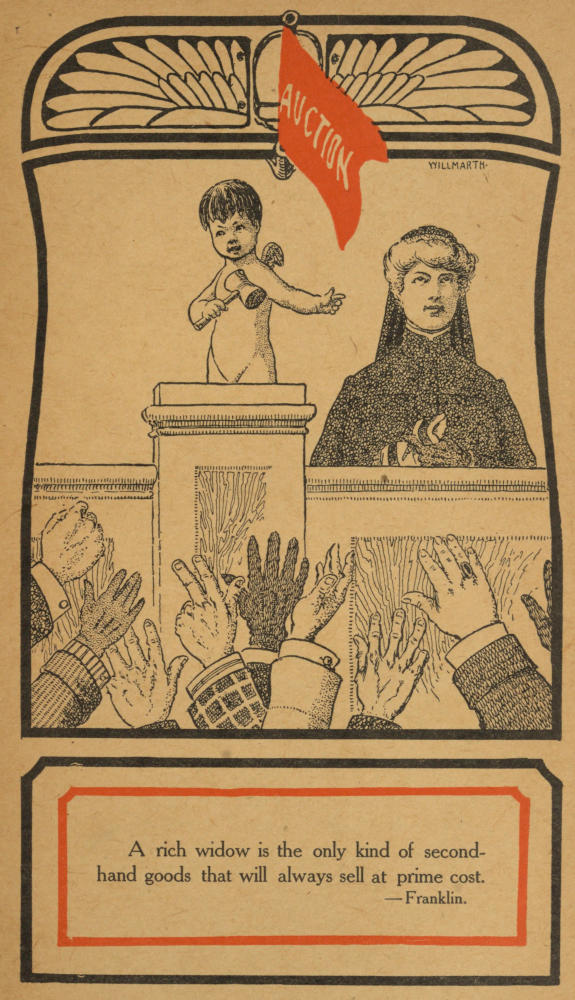
A rich widow is the only kind of second-hand goods that will always sell at prime cost.

—Franklin.

It pleased the Lord to take my spouse at last.
I tore my hair, I soil’d my locks with dust,
And beat my breasts—as wretched widows must:
Before my face my handkerchief I spread,
To hide the flood of tears I did—not shed.
—Pope.

She. “I think I should like a widower after all.”

He. “Very well; whom shall I marry first?”

—Life.

May widows wed as often as they can,
And ever for the better change their man;
And some devouring plague pursue their lives,
Who will not well be governed by their wives.
—Dryden.
Whilst Adam slept, Eve from his side arose:
Strange! his first sleep should be his last repose!
—Anonymous.

A widow is more sought after than an old maid of the same age.

—Addison.

The widow is indigenous to all climes and wherever found is a source of aggravation to women and of danger to men.

—Dorothy Dix.

Widows are indeed the great game of your fortune hunters.

—Addison.

“Some day I’m goin’ to let me temper r-run away with me, and get a comity together, and go out an’ hang ivry dam widdy and orphan between the rollin’ mills an’ th’ foundlin’s home. If it wasn’t for thim raypachious crathers, they’d be no boodle annywheres.”

—Mr. Dooley.

The widow Cross, I should have told,
Had seen three husbands to the mould:
The dear, departed Mr. Cross,
Came in for nothing but his thirds.
—Hood.

“She knows how to look out for number one.”

“That is quite evident from the way she is looking out for number two.”

—Smart Set.

Sum marry the second time to get even and find it a gambling game: the more they put down the less they take up.

—Josh Billings.

The wife is bound by the law as long as the husband liveth.

—I Cor. vii:39.

Remove thy way far from her and come not nigh the door of her house.

—Proverbs.

Woo the widow while she is in weeds.

—Proverb.

Indeed, we were once in great hopes of his recovery, upon a kind message that was sent him from the widow lady whom he had made love to the last forty years of his life: but this only proved a lightning before death.

—Addison.

One widow at a grave will sob
A little while and weep and sigh!
If two should meet on such a job,
They’ll have a gossip bye and bye.
—Hood.

“You are a marrid man, Mr. Young, I believe?” sed I.

“I hev eighty wives, Mr. Ward. I certainly am marrid.”

—Artemus Ward.

’Tis dangerous marrying a widow because she has cast her rider.

—Spanish Proverb.

“I have heerd how many ord’nary women one widder’s equal to, in pint of comin’ over you. I think it’s five-and-twenty, but I don’t rightly know whether it an’t more.”

—Dickens.

“As for the widders, anny healthy widdy with street car stock ought to be ashamed of hersilf if she’s a widdy long.”

—Mr. Dooley.

That is why little widows are so dangerous: they not only know their own sex, but they know ours, too, and knowledge is power.

—Malcolm C. Salomon.

The basis of the contemporary matrimonial decline, as most writers interpret it, is man. Man cannot very well be left out of marriage altogether without defeating some of its more important ends and impairing its results.

—Edward Stanton Martin.

Easy or frivolous divorce is condemned and deplored, but the easily divorced are not excluded from the politest society.

—Edward Stanton Martin.

Onions can make heirs and widows weep.

—Proverb.

He who marries a widow will often have a dead man’s head thrown in his dish.

—Proverb.

Divorce, with all its privileges and possibilities, must continue to be a second-rate bliss by no means comparable to true marriage.

—Edward Stanton Martin.

“Mind that no widder gets a inklin’ of your fortun, or you’re done.”

—Dickens.

Mrs. Biffery Biff. “You should be happy. You have such a kind husband.”

Mrs. Quittem. “Yes; we are getting along splendidly, since we don’t live together.”

—San Francisco Examiner.

A good occasion for courtship is when a widow returns from the funeral.

—Proverb.

Second marriages receive much less universal consideration because comparatively few persons find themselves in a position where they have to reach a decision as to their expediency.

—Edward Stanton Martin.

She was a little widow and was consequently a complete compendium of the art of love.

—Malcolm C. Salomon.

She was a good lookin’ woman and had seen trouble. It stands to reason she had, with four husbands. Good land!

—Josiah Allen’s Wife.

Wooers and widows are never poor.

—Ralph Roister Doister (1566).

Do, but dally not: that’s the widow’s phrase.

—Barry.

“You know what counsel said, Sammy, as defended the gen’lem’n as beat his wife, with the poker, venever he got jolly: ‘And arter all, my Lord,’ says he, ‘it’s a amiable weakness.’ So I says respectin’ widders.”

—Dickens.

Of course I wanted to marry the widow because she declared she would never marry again.

—Malcolm C. Salomon.

The multi-widow. “A woman seldom finds that her husband is the same man she married.”

—Brooklyn Eagle.

Why, if I had had two husbands, or even four, I should want to keep ’em apart sittin’ up in high chairs on different sides of my heart.

—Josiah Allen’s Wife.

Disagreeable suspicions are usually the fruits of a second marriage.

—Racine.

“Have you made your will?” asked the lawyer of the old colored citizen.

“No, suh. I ain’ got nothin’ to leave ’cept one wife and de rheumatism.”

—Atlanta Constitution.

It is only a widow who is wise enough to know that a jolly laugh in a woman is a bait to which a man will invariably rise as a trout to a fly.

—Dorothy Dix.

Get a wife who has learned how to keep house on your predecessor, and is in no danger of giving you dyspepsia while she experiments with cooking school recipes.

—Dorothy Dix.

“So they were divorced for incompatibility of temper?”

“Yes; you see he had the incompatibility and she had the temper.”

—Judge.

The shameless Chloe placed on the tombs of her seven husbands the inscription, “The work of Chloe.”

—Martial.

Few persons turn grey because their husbands die.

—Proverb.

He that’s married once may be pardoned his infirmity;
He that marries twice is mad;
But if you can find a fool
Marrying thrice, don’t spare the lad,
Flog him, flog him back to school.
—Garrick.

Oh! a maid is sometimes charming, but a widow all the while.

—Anonymous.

Disguise our bondage as we will,
’Tis woman, woman rules us still.
—Moore.

One husband is worth two good wives: for the scarcer things are, the more they’re valued.

—Benjamin Franklin.

I, Dionysius of Tarsus, lie here at sixty, having never married; and would that my father had not.

—Greek Epitaph.

Once you are married there is nothing left for you, not even suicide, but to be good.

—Robert Louis Stevenson.

“Didn’t you do well by your second marriage?”

“Oh, yes indeed; the clothes of my wife’s first husband just fit me!”

—Danbury News Man.

The lachrymose widow is one of those clinging vines that always gets there.

—Dorothy Dix.

“Of course I am a widow. Sure, that poor little insignificant crayther of a husband is not worth mentioning.”

—Irish Life.

Old friend—“Was your daughter’s marriage a success?”

Hostess—“Oh, a great success! She’s traveling in Europe on the alimony.”

—New York Weekly.

“No other man can ever fill poor John’s place. I loved him from the bottom of my heart.”

“Of course; but you know there is always room at the top.”

—Chicago Daily News.

A different cause, says Parson Sly,
The same effect may give.
Poor Lubin fears that he shall die,
His wife—that he may live.
—Poor Richard’s Almanac.

“There is more to be learned from one widow than from a whole Smithsonian museum of anthropology.”

Fijjit—“The widow says that her marriage to Gobang was secret.”

Ijjit—“It must have been. Gobang himself did not mention a widow in his will, so he could not have known of the wedding.”

—Life.

“Widows, gentlemen, are not usually timorous, as my uncle used to say.”

—Dickens.

The good widow’s sorrow is no storm, but a still rain.

—Fuller.

A woman deserted by one man has no remedy but to appeal to twelve.

—Jerrold.

At the prospect of a cosy separation society would reach at last the condition of Rome as described by Seneca, when women computed their ages by the number of their husbands instead of by the years they had lived.

—Matthews.

“Jerome speaks of witnessing the funeral of a woman who was followed by her twenty-second husband to the grave, she having been his twenty-first wife.”

If you want a neat wife, choose her on a Saturday.

—Poor Richard’s Almanac.

She—“They are the most wonderful compositions in the language.”

He—“They don’t compare with Jack Harvey’s. Why, he wrote a letter of condolence to a widow and she took off her mourning immediately.”

—Life.

Drying a widow’s tears is one of the most dangerous occupations known to man.

—Dorothy Dix.

I told Martin when we’d first come to London, that I must see the Widder Albert whilst I was there.

—Josiah Allen’s Wife

“Doctor, do you think my wife will recover?”

“Oh, yes! I told her I already had a wife picked out for you in case she didn’t get well.”

—Life.

Keep your eyes open before marriage; half shut afterwards.

—Poor Richard’s Almanac.

Widow—“Yes, I have cremated three husbands.”

Old maid—“It seems unfair. Here I’ve lived all these years and never have been able to get married to one man and you’ve had husbands to burn.”

—Chauncey M. Depew’s Story.

“Better to have loved extensively than never to have loved at all.”

Agent—“Isn’t this stone a trifle small for a man of your husband’s prominence?”

Widow—“No, sir! If Thomas thought a stone like that was good enough for his first wife, I guess it’s plenty good enough for Thomas.”

—Life.

You can’t talk to a remarried woman at a dinner party about her first husband, especially if one of her subsequent husbands is present.

—Edward Stanton Martin.

Divorce is the spice of life.

—Life.

“We hated to tell you, but your drowned husband’s body has been found and it is covered with eels.”

“Well,” sighed the widow, drying her eyes, “set him again.”

—Chauncey M. Depew’s Story.

St. Peter (to first applicant)—“Were you married while on earth?”

First Applicant—“I was; twice.”

St. Peter—“Walk in. You deserve it.”

—The Wasp.

The turf has drunk a widow’s tear,
Three of her husbands slumber here.
—Epitaph at Staffordshire.

Behold I have commanded a widow woman there to sustain thee.

—I Kings xvii:9.

She—“Should you die, are you opposed to my remarrying?”

He—“No. Why should I be solicitous about the welfare of a fellow I’ll never know?”

—Life.

“Why did he get a divorce from his wife?”

“She named the baby after the first husband.”

—Life.

I asked her (who had buried twelve husbands): “At what time of life do you think the married state ceases to be preferable?”

She replied: “You must ask somebody older than I am.”

—Josh Billings.

A widow is like a frigate of which the first captain has been shipwrecked.

—Alphonse Karr.

Widowhood is true freedom.

—Mme. des Jardins.

“So Mrs. Gaylord insists on a separation?”

“Yes. She didn’t mind his neglect, but whenever he was a little good to her he was so very virtuous about it that she just couldn’t stand it.”

—Harper’s Bazar.

Easy-crying widows take new husbands soonest; there is nothing like wet weather for transplanting.

—Oliver Wendell Holmes.

Mrs. Henpeck—“Now, suppose I should die.”

Mr. Henpeck—“Good heavens! Is there any doubt about it?”

—Life.

There are four hundred and fifty Revolutionary widows left. Here is a chance now for those men who pant for a wife of the good old days.

—Danbury News Man.

Never marry a widow unless her first husband was hanged.

—Proverb.

Widows secretly rejoice in the admiration of men, but indulge themselves in no further consequences.

—Addison.

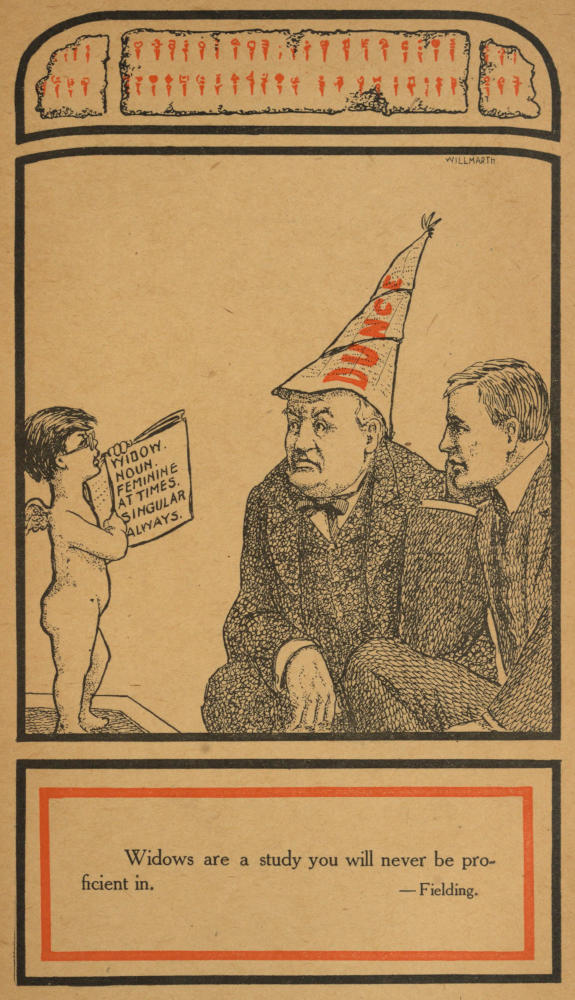
Widows are a study you will never be proficient in.

—Fielding.

Women who have been happy in a first marriage are most apt to venture upon a second.

—Addison.

Were I not resolved against the yoke
Of hapless marriage never to be curs’d
With second love, so fatal was the first,
To this one error I might yield again.
—Dryden.

How blessings brighten as they take their flight!

—Young.

From thousands of our undone widows, one may derive some wit.

—Thomas Middleton.

For I have buried three husbands beside this man; and now I am no’ sure of no nother husband; and therefore ye may be sure I have great cause to be sad and heavy.

—Hazlitt.

Here lies my wife: here let her lie!
Now she’s at rest, and so am I.
—Dryden.

Her waist was ampler than her life, for life is but a span.

—O. W. Holmes.

Here’s to the maiden of bashful fifteen;
Here’s to the widow of fifty.
—Sheridan.

A Brookfield woman was completely unmanned by the loss of her husband.

—Danbury News Man.

Women have a special antipathy to the blond widow, and when one crosses their path they sit down and throw up their hands and give up the game.

—Dorothy Dix.

Why is a garden’s wildered maze
Like a young widow, fresh and fair?
Because it wants some hand to raise
The weeds which have no business there.
—T. Moore.
Fortune is like a widow won,
And truckles to the bold alone.
—Somerville.

“Suppose,” said a friend who had been reading Enoch Arden, “that you went away on a sea voyage and came back and found that your wife had married another man?”

“That’s an absurd proposition. Henrietta would never be so careless as to let me go away on a sea voyage.”

—Washington Star.

An Atchison girl will marry a widower with five hand-me-down children.

—Atchison Globe.

A widow is a woman who has buried her husband; a grass widow is one who has simply mislaid hers.

—Will M. Clemens.

Yet because this widow troubleth me, I will avenge her, lest by her continual coming she weary me.

—Luke xviii:5.

Not even the immense labor of assimilating a new spouse’s relatives, appalling as it is, should hinder second marriages.

—Edward Stanton Martin.

The rich widow cries with one eye and rejoices with the other.

—Cervantes.

“There is one thing about my first husband I shall always respect him for,” she said.

“What is that?”

“He paid all the expenses of our divorce like a perfect gentleman.”

—Life.

He that marries a widow and three daughters has three back doors to his house.

—Spanish Proverb.

He that wooes a maid must never come in sight,
But he that wooes a widow, must woo her day and night.
—English Proverb.

In appearance the widow is extremely attractive, being smooth and sleek, of a jet black color, with snow white collar. It also possesses a most melodious purr, and though it has extra sharp claws, these are seldom visible.

—Dorothy Dix.

Mrs. Manhattan—“The thirteenth husband is sure to be unlucky.”

Mrs. Lakeside (pensively)—“I’ll have to skip that number and marry twins.”

—New York Herald.

Misfortunes never come single; sometimes they come married.

—Life.

“Doctor, I can’t get it out of my head that possibly my poor husband was buried alive.”

“Nonsense,” snorted Dr. Peduncle, “didn’t I attend him myself in his last illness?”

—Life.

Scarcely less to be feared by the prudent, is the species of this interesting animal, which is known as the domestic widow.

—Dorothy Dix.

Little Clara (in an audible whisper)—“O nurse! I wish I had been born a widow instead of an orphan!”

—Harper’s Monthly

Young widows are always charming.

—Stowe.

Surely any good man who has one wife already would stay at home till moss accumulated on his scalp, rather than go gadding and take the chance of running against his affinity.

—Edward Stanton Martin.

When a man is chased by a determined widow, it is a mere waste of shoe leather to run away from it.

—Dorothy Dix.

You can’t imagine, sir, what ’tis to have to do with a widow.

—Addison.

What objections there are to second marriages are almost exclusively sentimental.

—Edward Stanton Martin.

Miss Jones (to Mr. Brown who has survived three wives)—“They must get kind o’ mixed up in heaven with so many Mrs. Browns about.”

Mr. Brown—“Oh, no, I calculate not! You see they’re all different shades of Brown.”

—Life.

The chief characteristic of the widow is its skill in bringing down its game.

—Dorothy Dix.

“For patient resignation, that widow lying there a corpse could dance all ’round any woman living.”

—Danbury News Man.

By taking a second wife man pays the highest compliment to the first.

—Johnson.

For many persons who have lost their mates prematurely, it is far better to find a new one, if that is possible, than to go through life alone.

—Edward Stanton Martin.

And I caused the widow’s heart to sing for joy.

—Job xxix:13.

If you are an unsophisticated widow—one whose husband is just dead—you will find that you can remain in your own home sixty days without paying rent.

—Stowe.

I don’t feel at all sentimental;
For women I care not a rap,
But give me a jolly and gentle
Rich widow in weeds and a cap.
—Strong.

When they deal directly with widows, they want a class that knows nothing of business.

—Stowe.

Then let him write her a bill of divorcement and give it in her hand and send her out of his house.

—Deut. xxiv:1.

“Ah, sweetest one, may I be your captain and guide your bark down the sea of life?”

“No. But you can be my second mate.”

—Exchange.

One of the chief inducements to marry a widow is the conversation that ought to result from her enlarged experience of life.

—Edward Stanton Martin.

“I celebrate June Thirtieth as Independence Day.”

“Isn’t that a trifle early?”

“It’s the day on which I secured my first divorce.”

—Judge.

“You say his wife’s a brunette? I thought he married a blonde.”

“He did, but she dyed.”

—Wrinkle.

A law by which a widow should not burn herself till she had conversed privately with a young man. Since that time not a single woman hath burned herself in Arabia.

—Voltaire.

To the diplomatic widow, man is simply an open book. She plays upon his weaknesses as upon a harp with a thousand strings.

—Dorothy Dix.

Widows are dangerous animals to be at large.

—J. W. Stowe.

Wanted—A nice young girl of affectionate disposition willing to make a good-looking bachelor happy. Previous experience not necessary.

—Wasp.

In buying a horse and taking a wife,
Shut your eyes and trust God for your life.
—Italian Proverb.
A Bunch of Cash, with figures not too Few,
A Mine of Gold, a Government Bond or Two,
And Youth and Beauty and Cupid ever near her,
A Widow’s lot is not so Worse, think You?
—Widow.

Drying a widow’s tears is an expensive luxury.

—Dorothy Dix.

Wake! for the Son that scatters into flight
The Sighs and Tears that make you such a fright,
Drives them along, away, forever, and
Knocks Your Widow’s mourning Higher than a Kite!
—Widow.

Love makes time pass and time makes love pass.

—Proverb.

Divorce is necessary in advanced civilization.

—Montesquieu.

Woman, by nature, is a thing of change.

—Petrarch.

They can show no mercy to the widow.

—Barnich.

God has to me sufficiently been kind,
To take my husband, and leave me here behind.
—Anonymous.

Whoso has married once and seeks a second wedding, is a shipwrecked man who sails twice through a difficult gulf.

—Greek Epigramme.

A mistress I’ve lost, it is true;
But one comfort attends the disaster:
That had she my mistress remained,
I could not have called myself master.
—Epigrammes Old and New.

He that marries a widow and three children marries four thieves.

—Spanish Proverb.

Said Jan, twice wedded to a scolding wife,
“Church-going’s the greatest pleasure of my life;
’Tis strange and sweet to see a man, oh, rare!
Keep full five hundred women quiet there.”
—Dutch Epigramme.

The greatest merit of some men is their wife.

—Poincelot.

There was a time when the ideal condition coveted by women who craved unlimited freedom, was that of a widow with one child.

—Edward Stanton Martin.

Let no Mandalay in his effort to seize
The Widows Three, or just one if he please,
There are others, I know, quite Simla to these,
And the diff’rence not one man in Seven Seas.
—Widow.

Two consorts in heaven are not two, but one angel.

—Swedenborg.

“Please take the medicine, wife, and I’ll be hanged if it doesn’t cure you.”

“Oh, I’LL take it, then, for it is sure to do good one way or another.”

Marriage is a feast where the grace is sometimes better than the dinner.

—Colton.

“It is never too late to wed.”

The cause of his death was a complication of diseases, madam.

Widow—Ah! that was so like him! He was always versatile in everything.

—The Wasp.

“You say Grace married into the smart set?”

“Gracious, no; she was divorced into it.”

—Baltimore Herald.

A young widow has established a pistol gallery. Her qualifications as a teacher of the art of dueling are of course undoubted. Has she not killed her man?

—Louisville Journal.

“I have here one divorce notice and one marriage announcement,” said the editor’s assistant. “What caption shall I put on them?”

“Run them together and head them “Breaks and Couplings,” replied the railway editor.

—Exchange.

But when he called on Sally Brown
To see how she got on,
He found she’d got another Ben
Whose Christian name was John.
—Thomas Hood.

Widowhood grows yearly less necessary.

—Edward Stanton Martin.

The giddy widow is an ever-present danger.

—Dorothy Dix.

“Some men are awfully unfortunate. You remember Smith, whose wife died last year?”

“Yes.”

“Well, he’s got married again.”

—The Wasp.

A daughter of Eve—for such was the widow Wadman—had better be fifty leagues off than make a man the object of her attentions when the house and all the furniture are her own.

—Sterne.

What is a first love worth, except
To prepare for a second?
What does a second love bring?
Only regret for the first.
—John Hay.
If once I loved him? Dear, I cannot say;
All things have changed to me since he was here;
I thought to die when first he went away,
And now I name his name without a tear.
—Anonymous.
Is it dyin’ ye’re shpakin’ of? What would I do,
An unmarried widda in mournin’ for you?
—David L. Proudfit.

It is better to have courage than a wife. A man can’t have both.

—Life.

The widow knows man as merely a fallible human institution and she works him for all that he is worth.

—Dorothy Dix.

The instances that second marriage move
Are base respects of thrift and not of love.
—Shakespeare.
Faith, I thought him dead, not he!
There he loves with ten-fold glee;
And now this moment with his wings,
I feel him tickling my heart-strings.
—Cupid Swallowed.

Court in haste but marry at leisure.

—Widow’s Maxim.

As you may find, whene’er you like to find her,
One man alone at first her heart can move;
She then prefers him in the plural number,
Not finding that the additions much encumber.
—Byron.

Mrs. Morris—“Since I have been married I have had only one wish ungratified.”

Mr. Morris—“And what is that, dear?”

Mrs. Morris—“That I were single again.”

—Life.

The pure one loved him to the day he died,
But when he died, his dearest friend she wed.
—James B. Bensal.

“There never was a nicer woman as a widder, than that ’ere second wentur o’ mine,—a sweet cretur she was, Sammy; and all I can say on her now, is, that as she was such an uncommon pleasant widder, it’s a great pity she ever changed her condition.”

—Dickens.

Alas! you see of how slight metal widows’ vows are made.

—Chapman.

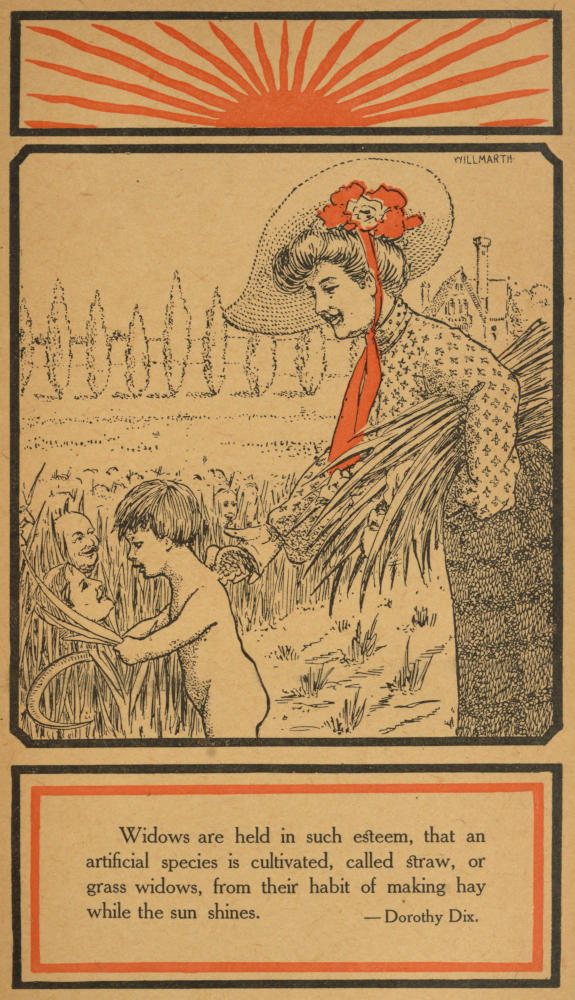
Widows are held in such esteem, that an artificial species is cultivated, called straw, or grass widows, from their habit of making hay while the sun shines.

—Dorothy Dix.

It tells me how short lived widows’ tears are, that their weeping is in truth but laughing under a mask, that they mourn in their gowns and laugh in their sleeves.

—Chapman.

But few men who have gone out to console widows have returned unscathed.

—Dorothy Dix.

“Maids are either harmless, or will become so, but with a widow the sting is never gone.”

The widow about to remarry is the most unselfish of mortals. She seldom thinks of number one.

—Life.

The head and the heart in the game of love
Must each play a separate part;
But we’ll pardon a girl with a cold in her head,
If she’ll only be warm in the heart.
—Life.

“Do you think old maids live longer than widows?”

Old maid—“It seems longer.”

That’s what a man wants in a wife, mostly: he wants to make sure o’ one fool as ’ll tell him he’s wise.

—George Eliot.

Husbands are in heaven whose wives chide them not.

—Proverb.

“No man is a romantic hero to a widow.”

The chain of wedlock is so heavy that it takes two to carry it—sometimes three.

—Alex. Dumas.

“And how long have you been a widow?”

“Oh, the year was up yesterday; but indeed you must give me at least a month to get ready.”

When he got outside again, he murmured, “Now I know what old Weller meant.”

—The Wasp.

It is mere folly for a man to underestimate the danger he runs from a widow.

—Dorothy Dix.

Are you not ashamed to enforce a poor widow to so rough a course?

—Shakespeare.

Cupid has no trouble keeping Lent;
For since with flame his year is spent,
He must have lots of ashes.
—Puck.
After such years of dissension and strife,
Some wonder that Peter should weep for his wife;
But his tears on her grave are nothing surprising,
He’s laying her dust, for fear of its rising.
—Hood.

Was never widow had so dear a loss!

—Shakespeare.

For she saith in her heart, I sit a queen, and am no widow and shall see no sorrow.

—Rev. xviii:7.

“And so you are married—joined for life?”

“Oh, it’s hardly that bad!”

—Judge.

Parke—“Wiggson married a widow, didn’t he?”

Lane—“Yes.”

Parke—“I wonder how he likes her former husband?”

—Puck.

She had tasted the sweets of wedded life, but somehow single blessedness, decked in the latest modes of widow’s weeds, offered her a more alluring programme.

—Malcolm C. Salomon.

The dearest object to a married man should be his wife; but it is not infrequently her clothes.

—Danbury News Man.

A little widow is a dangerous thing; but is there not always a fascination in dangerous things?

—Malcolm C. Salomon.

Being a widow, rightly understood, gives a woman many privileges that no other woman possesses.

—Dorothy Dix.

It does not matter whom you marry, for you will find next morning you have married some one else.

—S. Rogers.

Whoso findeth a wife, findeth a good thing.

—Proverbs.

A young man in the West has written home: “Send me a wig.” And his fond parents don’t know whether he is scalped or married.

—Danbury News Man.

Heaven preserve you ever from that dull blessing, an obedient husband.

—John Tobin.

“By George! if I were in your place I would apply for a divorce.”

“I’d like to, but she won’t let me.”

—Indianapolis Journal.

George Washington was rejected by at least one young lady and finally had to marry a mere widow.

—Judge.

Divorce Lawyer—“What’s the cause, madam?”

Client—“I have been married two years.”

—Puck.

One husband on earth is worth two underground.

—Widow.

A woman enjoys two days of happiness on earth: when she takes a husband and when she buries him.

—Anonymous.

“Widows are witches, don’t you think?”

Widow Black—“Whad meks you fink he’s gwine to propose at last?”

Widow Grey—“Kase I kin tell from his hungry looks and his seediness dat he cain’t suppo’t hisself much longer.”

—Harper’s Bazar.

Many overhasty widows cut their years of mourning very short and within a few weeks make post-speed to a second marriage.

—Fuller.

Handsome widows, after a twelvemonth, enjoy a latitude and longitude without limit.

—Balzac.

Marriage: an institution where one person undertakes to provide happiness for two.

—Mme. Roland.

It destroys one’s nerves to be amiable every day to the same human being.

—Beaconsfield.

If a widower buys a new tie and it is of a bright color, his daughters begin to grow suspicious.

—Atchison Globe.

“All the world loves a widow.”

“Do you think that was a fortunate marriage?” asked the minister’s wife.

“Oh, yes, very!” replied the reverend gentleman; “I needed the money.”

—Yonkers Statesman.

Mrs. Black—“They say he’s dreadfully henpecked.”

Mrs. Dash—“Henpecked! why the man does not even dare to get a divorce.”

—Harper’s Bazar.

A woman keeps her first love long if she happens not to take a second.

—Rochefoucauld.

“Yes, sir, it’s a fact: that married men live longer than single ones.”

“And do you know the reason, sir? The miserable wretches don’t dare die.”

—Harper’s Bazar.

First Soubrette—“What is the cause of the divorce?”

Second Soubrette—“Both intend to star next season.”

—Exchange.

Maude—“Is she married?”

Mabel—“No, unmarried for the fourth time.”

—Harper’s Bazar.

Now, if you must marry, take care she is old;
A troop-sergeant’s widow’s the nicest, I’m told;
For beauty won’t help if your rations is cold,
Nor love ain’t enough for a soldier.
—Kipling.
Your spouse, who husbands dear hath buried seven,
Stands a bad chance to make the number even.
—Martial.

Marriage is a lottery; every wife does not become a widow.

—I. Zangwill.

Bachelors are providential beings; God created them for the consolation of widows.

—J. de Finod.

A man without a wife is but half a man.

—Benjamin Franklin.

No wise man ever married; but for a fool it is the most ambrosial of all possible future states.

—Byron.

Now a little widow is perilously fascinating; her very littleness constitutes an element of danger, since it coaxingly compels sympathy.

—Malcolm C. Salomon.

“Sacred to the memory of my dearly beloved wife, Mary. Ditto Jane.”

—Epitaph.

It is but a shallow philosophy that underrates the married state; and he who bids you avoid matrimony because he has tried it and failed, is a fool for his pains.

—Malcolm C. Salomon.

We would the widow wed; she’s old, say I,
But if she older were, I would comply.
—Martial.
To be a widow is a mournful state;
Delia was wise and made one moon its date.
—Anonymous.

Your wise man will never marry his first love.

—Malcolm C. Salomon.

From your breast you may pluck
His dart, if you will,
But the place where it struck
Will be sensitive still.
—Life.

Star—“I have had my diamonds stolen three times and been married four. Now what else can I do?”

Manager—“You might take lessons in acting.”

—Puck.

“A widow and her money are soon married.”

Widows differ; maids are all alike.

The law allows one husband to one wife,
But wives will seldom brook the straightened life;
They must have two; besides her Jack, each Jill,
In spite of law and gospel, weds her will.
—Exchange.

When one sympathizes with a widow, when one says, “Poor little woman”—one is lost.

—Malcolm C. Salomon.

She was so pious during Lent,
I thought it best to shun her,
So she’d have leisure to repent;
But in the forty days so spent,
My rival wooed and won her.
—Life.

“Needs must when the widow drives.”

“Are you going to sue him for breach of promise?”

“No. Dick always signed his letters ‘without recourse.’”

—Life.

Man flattering man not always can prevail,
But woman flattering man can never fail.
—Marriott.
A place under government was all that Paddy wanted;
He married soon a scolding wife, and his wish was granted.
—Anonymous.

Why should she be condemned to wear moral sackcloth and ashes all her life because she is a widow and does not choose to marry again?

—Malcolm C. Salomon.

Though marriage by some folks be reckoned a curse,
Three wives did I marry, for better or worse;
The first for her person, the next for her purse,
The third for a warming pan, doctor and nurse.
—Thomas Bastard, of Oxford.
If you’d be married, first grow young,
Wear a mask and hold your tongue.
—Proverb.

And withal they learn to be idle, wandering about from house to house.

—I Tim. v:13.

There is a great charm in loving a woman who is versed in the lore of love and who is practiced in all the sleight-of-heart tricks of it.

—Malcolm C. Salomon.

And there came a certain poor widow and she threw in two mites, which make a farthing.

—Mark xii:42.

And not only idle, but tattlers also, and busybodies, speaking things which they ought not.

—I Tim. v:13.

If a man do not erect in this age his own tomb ere he dies, he shall live no longer in monument than the bell rings and the widow weeps.

—Shakespeare.

Raillery! Raillery! madam, we’ve no animosity. We hit off a little wit now and then, but no animosity.

—Congreve.

Not whom you marry, but how much you marry, is the real question.

—Whipple.

“They tell me, Daniel, you’ve had four wives.”

Daniel (proudly)—“Ess, zur, I ’ave—and what’s more, two of ’em was good ’uns!”

—San Francisco News Letter.

The little widow is experienced, accessible and free, and withal fatally fascinating.

—Malcolm C. Salomon.

“Haven’t you lost your wife?” inquired the gravestone agent.

“Why, yes, I have,” said the man, “but no gravestone ain’t necessary; you see the cussed critter ain’t dead. She’s scooted with another man.” The agent retired.

—Danbury News Man.

Give unto mine hand, which am a widow, the power that I have conceived.

—Judith ix:9.

He (desperately in love)—“Don’t you think two can live as cheaply as one?”

Widow (reflectingly)—“Ya-as; but I’d rather be the one.”

—Puck.

Let us oppress the poor righteous man, let us not spare the widow.

—Wisdom of Solomon ii:10.

Do not the tears run down the widow’s cheeks, and is not her cry against him that causeth them to fall?

—Ecclesiasticus xxxv:15.

She is a dead shot with Cupid’s arrow, and never misses her mark.

—Malcolm C. Salomon.

She was a woman without a past.

Who?

Eve.

—Life.

A little widow may be a dangerous thing, but the danger is harmless.

—Malcolm C. Salomon.

The remains of many eligible bachelors who have strayed away from their clubs and been lost have been found by their anxious friends reposing by the domestic widow’s fireside.

—Dorothy Dix.

He evil entreateth the barren that beareth not; and doest not good to the widow.

—Job xxiv:21.

The barrel of meal shall not waste; neither shall the cruse of oil fail.

—I Kings xvii:14.

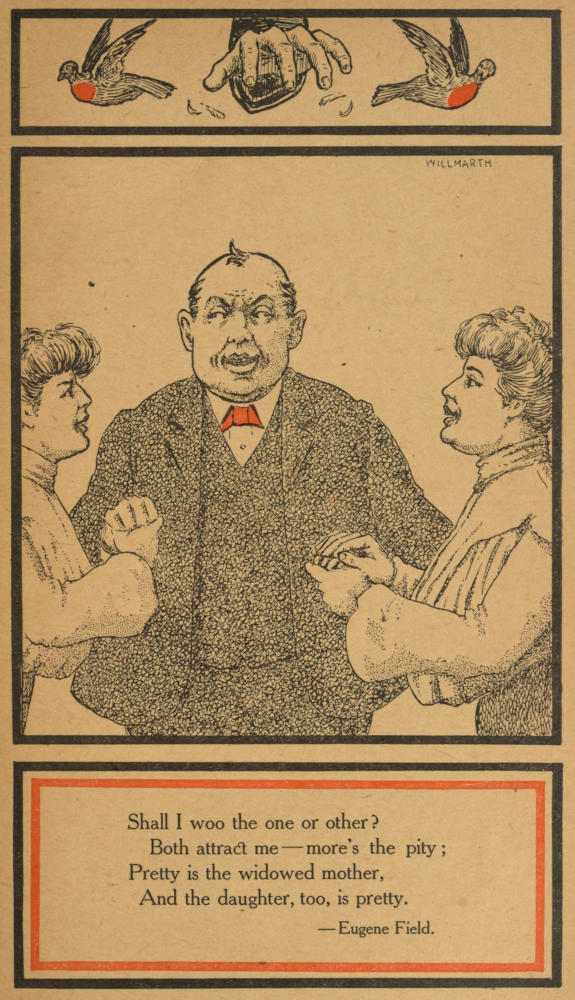
Shall I woo the one or other?
Both attract me—more’s the pity;
Pretty is the widowed mother,
And the daughter, too, is pretty.
—Eugene Field.

To the public eye the most attractive widow is the gay and frivolous one.

—Dorothy Dix.

Among all her lovers she hath none to comfort her.

—Lamentations i:2.

Finally, I will search for things that are little, avoiding all torch-lite processions, wimmin’s rights conventions and grass widders generally.

—Josh Billings.

How is she become as a widow! she that was great among the nations!

—Lamentations i:1.

Neither shall they take for their wives a widow.

—Ezekiel xliv:22.

“I want some cards printed for ‘Mrs. Carrol.’”

“What’s her other name?”

“Ain’t got no other; her husband’s run away and left her.”

—Danbury News.

And all the widows stood by him weeping.

—Acts ix:39.

And now a widow I must mourn,
The pleasures that will ne’er return;
No comfort but a hearty can,
When I think on John Highlandman.
—Burns.

Where is the bill of your mother’s divorcement?

—Isaiah i:1.

“Ev’ybody knows there ain’ no happiness in married life till one of de contractin’ parties done ’ceasted.”

—Harper’s Magazine.

Whoso shall put away his wife, let him give her a writing of divorcement.

—Matthew v:31.

It has been found that the only way to head off a widow is to kill it.

—Dorothy Dix.

“If ever you’re attacked with the gout, sir, just you marry a widder as has got a good loud woice, with a decent notion of using it.”

—Dickens.

Your seventh wife, Phileros, is now being buried in your field. No man’s field yields him greater profit than yours, Phileros.

—Martial.

“It behooves a husband, if he would not be forgotten, to stay alive.”

The most common, and perhaps the most dangerous, is the weeping widow, which may be easily distinguished by its long, flowing black veil and pensive air of melancholy.

—Dorothy Dix.

“The widow can bake, the widow can brew,
The widow can shape and the widow can sew.”

Honor widows that are widows indeed.

—I Timothy v:3.

Now she that is a widow indeed and desolate, trusteth in God.

—I Timothy v:5.

“Take example by your father, my boy, and be very careful o’ the widders all your life.”

—Dickens.

Mrs. Peachblow—“Why does your husband carry such a tremendous amount of life insurance when he’s in such perfect health?”

Mrs. Flicker—“Oh, just to tantalize me! Men are naturally cruel.”

—Life.

She that is a widow is a lady.

—Kent.

The particular skill of the widow has ever been to inflame your wishes and yet command respect.

—Addison.

Second marriage: “The triumph of hope over experience.”

—Johnson.

Lawyer—“Incompatibility? How does this incompatibility manifest itself?”

Lady—“Why, I want to get a divorce and my husband doesn’t.”

“Thou art not the first man a widow’s love hath sent to the barber shop.”

—Exchange.

These widows, sir, are the most perverse creatures in the world.

—Addison.

With his dying breath he bid me never marry again till his grave should be dry, even though it should take up four days in drying.

—Oliver Goldsmith.

Lawyer—“But, Mrs. Smith, there is absolutely no ground for a divorce.”

Fair Client—“No cause? How long do you imagine it requires for one to become thoroughly tired of the name of Smith?”

—Life.

Both here and hence, pursue me lasting strife,
If, once a widow, ever I be wife!
—Shakespeare.

None wed the second but who killed the first.

—Shakespeare.

If I have withheld the poor from their desire or have caused the eyes of the widow to fail.

—Job xxxi:16.

“The Bible distinctly says, ‘Ye ask and ye receive not, because ye ask amiss.’”

“Then ask a widow.”

In proportion as his passion for the widow abated and old age came on, he left off fox-hunting; but a hare is not yet safe that sits within ten miles of his house.

—Addison.

Man proposes and the widow—accepts.

Come, Hurry up! Cause the widow’s heart to sing,
Seal Pledge and Vow and Pleading with a Ring;
Or, if Cupid’s dart has failed your Heart to flutter,
To Cupid She won’t do a Thing.
—Ex-Widow.
Are you mirthful? how her laughter,
Silver sounding, will ring out!
She can lure, and catch and play you,
As an angler does the trout.
—Anonymous.

How would you like to swap a ten-dollar pension for a five-dollar man?

—Kansas Suitor.

Men dying make their wills,
But wives escape a task so sad;
Why should they make what all their lives
The gentle dames have had?
—Dryden.

Wedding is destiny, and hanging likewise.

—Heywood.

Of old women, widows are most woeful.

—Thomas Fuller.

The first moment the widow Wadman saw him she felt something stirring within her in his favor,—something, something.

—Sterne.

But with a husband we demand
The coin that’s current in the land.
—Richard Realf.

In her first passion woman loves her lover; in all others, all she loves is love.

—Byron.

“And when a widow’s in the case,
You know all other things give place.”

The Tomoyé Press
San Francisco, Cal.