By Maxime Schottland, Doctor Juris.
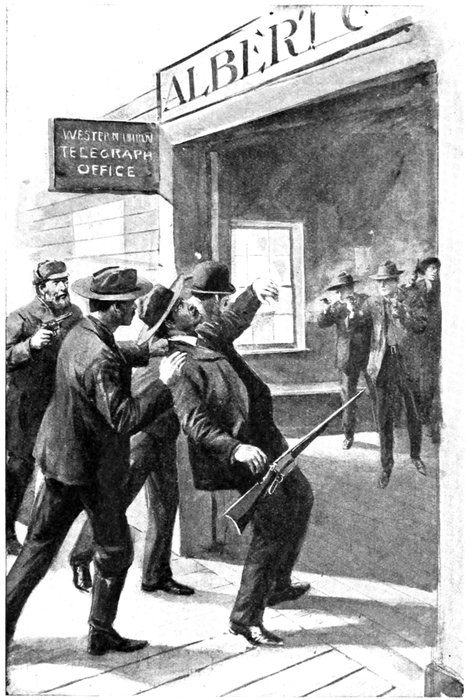
The amazing experience which befell a drunken old Russian bootmaker. "The events described
occurred within my own cognizance while living in St. Petersburg," writes the author. "The
episode could only have happened in Russia, unless there is any other country where the military
caste is held in such veneration among civilians."
It was the birthday of Petroff, the
bootmaker, and he had been celebrating
it in the customary manner.
That is to say, he had consumed
so much of his favourite beverage,
vodka, that he had now become hopelessly and
helplessly intoxicated. In fact, so drunk was
Petroff that the proprietor of the St. Petersburg
inn where he had been soaking steadily all the
afternoon had just turned him out into the
street on the sufficient grounds that he could
neither drink nor purchase any more liquor.
As poor Petroff staggered from the inhospitable
doors of the inn, accompanied by the
jeers of the remaining patrons, he fell into the
arms of a couple of stalwart policemen.
"Lemme go," he protested, as the detaining
hands tightened on his wrists. "I tell you I'm
not—hic—drunk! I'm all ri'—shober as a
judge, in fact. I want to go home."
The policemen laughed callously.
"You're going to the station with us,"
remarked the senior, with a grin at his comrade.
"A night in the cells will cool your
head, old man. Now, then, come along. Go
quietly, or it will be the worse for you."
Petroff's legs swayed, and he would have
fallen had not his escort, who were accustomed
to dealing with such cases, held him tightly in
their grasp.
The spectacle of the tipsy old man being
led through the streets in custody promptly
attracted a crowd, who followed the little procession
at a respectful distance. Petroff turned
his bleary eyes upon them, in the vain hope that
they might light upon someone who would
soften the hearts of his captors. Then another
thought struck him with a chill feeling of dismay.
If—as seemed certain to be his fate—he
were locked up all night his wife would demand
an explanation the next time he saw her.
Mme. Petroff was a bit of a virago, and the
drunken old reprobate had a wholesome terror
of what might be in store for him if she got
wind of his misbehaviour.
"Lemme go home," he whimpered. "I've a
mosh important engagement—hic! My wife is
waiting for me. It's all ri', I tell you."
The crowd laughed uproariously, as though
they had just heard an excellent joke, while the
policemen gave their prisoner a push forward.
Petroff wept bitterly. He was just going
to burst into an angry denunciation upon their
conduct, when his attention was attracted by a
couple of officers in military uniform, who strode
up to him with outstretched hands.
"My dear fellow," exclaimed the younger of
the two, looking at him in a puzzled fashion,
"what on earth is the meaning of all this? It
won't do, you know. We must take care of you."
Petroff's eyes began to blink, and he pinched
himself to make certain he was not dreaming.
But no; everything was quite real. Here were
two of the Czar's officers, whom he had no
recollection of ever having seen before, actually
claiming his acquaintance! Wonders would
never cease! It was no time, however, for argument.
Evidently the strangers meant him well,
and if they were making a mistake he meant to
profit by it. Shaking the speaker's hand, accordingly,
he poured out his wrongs in an eager
torrent.
The brilliant uniforms of the two new-comers
had a magic effect upon Petroff's custodians.
"I beg your Excellency's pardon," said one
of them, with a deferential salute, "but we found
this—er—gentleman drunk in the streets, and
we thought it best to take him to the station.
May I inquire if you know him?"
The officer nodded.
"Certainly," he returned. "We know him
very well indeed. In fact, he's a neighbour of
ours. I'm afraid he's had too much to drink.
We'll take charge of him, though, and see
him safely home. Here's something for your
trouble," he added, slipping a couple of roubles
into the other's hand.
"Please call a cab, and we'll take the
professor to his rooms," observed the second
officer, who had not yet spoken.
Petroff smiled affably. It was much pleasanter
to be called a professor than a drunken old
man.
"It's all ri'," he exclaimed, delightedly.
"These gentlemen are—hic—old friends of
mine. We'll all go home together—see?"
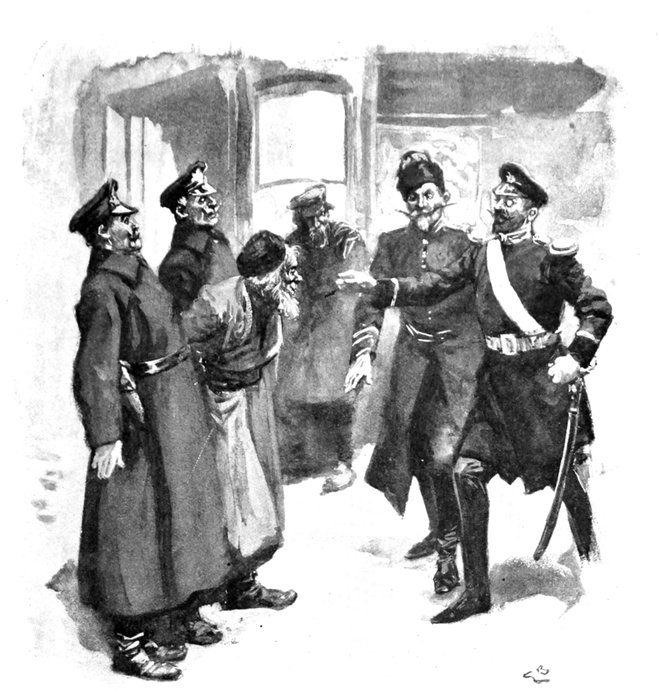
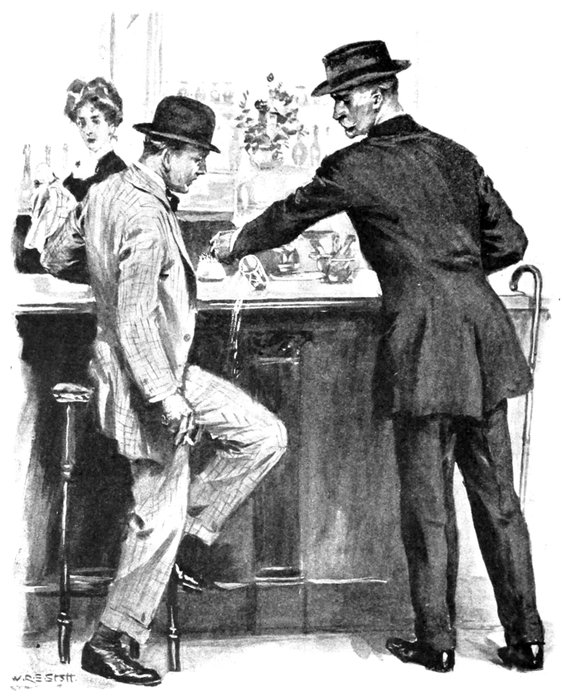
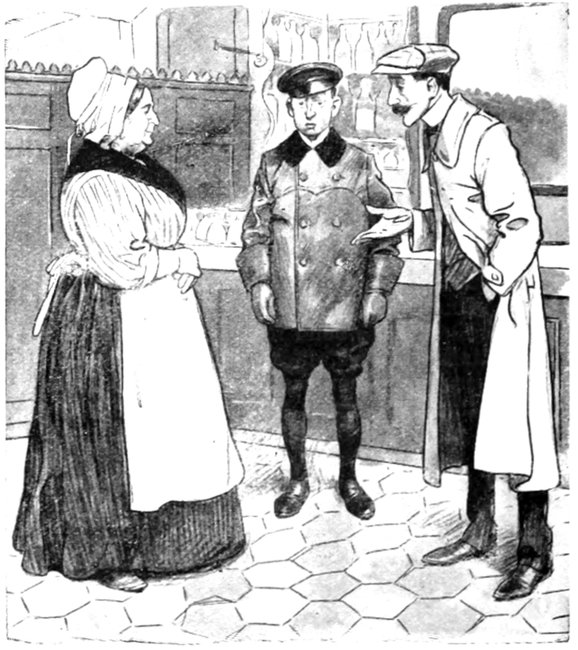
"'MY DEAR FELLOW', EXCLAIMED THE YOUNGER OF THE TWO, 'WHAT ON EARTH IS THE MEANING OF ALL THIS?'"
The two policemen, their last doubts dissipated
by the promptitude with which the
officers claimed their charge's acquaintance,
acquiesced readily enough. A cab was procured
and Petroff and his new-found friends
installed therein, while the coachman was
directed to drive to an address in a fashionable
neighbourhood.
As the vehicle started off, Petroff looked at
his deliverers with fresh wonder.
"Where have I met you before?" he
murmured. "I don't seem to remember. Did
you ever come to my boot-shop? If so, I mush
have been drunk!"
The officer thus addressed shook his head
gravely. "We had the honour of meeting
your Excellency when you served in the
army."
Petroff looked more puzzled than ever.
"The army?" he repeated. "What do
you mean? I'm not a soldier. I'm a bootmaker."
The two officers exchanged glances.
"I beg your pardon for venturing to contradict
you, sir, but the Czar has just been pleased
to promote you to major-general in appreciation
of your distinguished services."
Petroff smiled happily.
"It's the first I've heard of it," he murmured.
"I fancied, sir, that you might have been
celebrating the appointment already," was the
grave response. "We shall, however, be
honoured if you will join us in a little refreshment.
Our house is close at hand."
"Certainly, my friends. I was going to have
a drink when those rude policemen interfered
just now."
As the old man spoke the cab drew up at the
door of a handsome building. The next
moment Petroff found himself being ushered
into a beautifully-furnished room. Here the
first thing upon which his eyes fell was a sideboard
covered with bottles and glasses.
"How perfectly lovely!" he exclaimed, clasping
his hands in ecstasy. "You don't know
how thirsty I am. But what house is this?"
"It is your house, general."
The bootmaker's eyes blinked.
"Who's a general?" he demanded, truculently.
"I won't have you make fun of me."
The senior of the two officers bowed
deferentially.
"Your Excellency is pleased to jest. Of
course you are a general. As, however, it is
only to-day that you were appointed one, it is
quite possible that the fact has escaped your
memory."
Petroff's momentary anger evaporated at the
speaker's apologetic tone. After all, it was
much better to be a major-general than a bootmaker,
and he was not going to quarrel with his
good fortune.
"I did forget it for the moment," he returned,
"but I'll remember it now. If I'm a major-general,
though, I must have something to
drink, eh?"
"Certainly, your Excellency," replied the
other, as he uncorked a bottle of vodka and
poured out a brimming glass. Petroff sat sipping
it happily, when the second officer came over to
his chair and saluted.
"Will your Excellency be pleased to dress
now?" he remarked. "It is time to get into
uniform." Then, without waiting for the old
man to recover from the surprise which this
announcement created, he brought forward a
richly ornamented tunic, together with the
remaining items of a general's uniform. Petroff
gazed at the clothes in awe; he had never seen
so much magnificence in his life.
As his two companions proceeded to make
his toilet for him he could do nothing but
murmur, "I'm a general." At last he had
repeated the statement so often that, in his
befuddled condition, he almost came to believe
in it.
"I suppose I am really a general?" he
remarked, as his companions assisted him to
buckle on his sword.
"There is no doubt of it, your Excellency,"
replied the senior. "Let me introduce myself
as Major Romanoff, and my colleague here as
Captain Marckovitch. We have been appointed
to act as your adjutants, and shall be pleased to
carry out any orders you may give us."
Petroff laughed delightedly. This was a
thousand times better than being a bootmaker
and getting locked up for taking too much
vodka.
"Very well, then; if I'm a general I must
have another drink," he declared, stretching out
his hand towards the table.
The fiery spirit seemed to touch a chord of
memory.
"But what about my wife?" he demanded,
suddenly. "Does she know I'm a—hic—general?"
"Certainly, sir. In fact, she has been trying
to find you all day."
Petroff's face paled.
"What does she want?" he gasped.
"Merely to offer your Excellency her congratulations."
Here was a new mystery.
"That's very strange. She never wanted to—hic—congratulate
me before."
"But she has only just heard of your promotion,
sir."
The look of dismay faded from the old man's
countenance, and a placid smile took its place.
"I must buy her a present," he declared.
"Yes, sir. That is why we are going out.
Your wife will have to be presented at His
Majesty's next reception, and you must accordingly
order her some suitable jewels.
Captain Marckovitch and I will be very pleased
to conduct you to a firm where you can obtain
such diamonds and other articles as will be
necessary."
Petroff gulped down another glass of vodka.
Under its stimulus his mind was working
rapidly.
"That's all very well, my friends, but how
am I going to get the money to pay for them?
I spent my last rouble in the inn where the
policemen found me."
Major Romanoff nodded.
"We have not yet had time to draw any funds
from the Treasury on your behalf. Everything
will be all right by to-morrow, though. In the
meantime my colleague and myself will see that
you are supplied with whatever you may be
pleased to order at any shop. As the afternoon
is drawing in, I would propose that we set out
for a drive at once in your carriage."
Petroff rubbed his eyes in amazement. It
seemed that surprises would never cease.
"But I haven't got a carriage," he protested.
"Pardon me," said Captain Marckovitch,
"but your Excellency's establishment includes
a carriage and pair. It is already waiting at the
door. Will it please you to make a start just
now?"
"All right! I suppose I can't say anything
better than that, can I?"
Captain Marckovitch bowed.
"Certainly, that will do admirably. In fact,
sir, it's the only thing you need say while you
are with us. Perhaps you will graciously pardon
me if I take this opportunity of once more
reminding you that, as your appointment is so—er—recent,
it would perhaps be best if you
permitted yourself to be guided by Major
Romanoff and myself."
Petroff wagged his grey head with an air of
profound wisdom. "Quite so. You tell me
what to say, and I'll say it."
The senior adjutant bowed gravely.
"I was going to suggest that, sir. We are
now all going out together to make some purchases
for your Excellency's wife. While we
are in the different shops it will not be necessary
for you to say anything but 'All right' whenever
your opinion is asked. You see, sir, your previous
experience has almost entirely been gained
on the field of battle. In fact, you have only
just returned from a campaign."
"Have I?" interrupted the old man. "'Pon
my word, I don't recollect it very clearly."
"Your Excellency was wounded in action,"
observed Captain Marckovitch, suavely. "Your
memory may not return for a day or two. Still,
you have only to say 'All right.'"
"Yes, I can remember that."
There was only time for a parting glass of
vodka, and as Petroff drained the last drop in
the bottle all his qualms disappeared. He felt
determined to show the whole of St. Petersburg
that he was as fine a major-general as any that
the army of the Czar contained. The whole
way down the stairs and out into the courtyard
he kept repeating to himself, "I'm a general.
All right."
A splendidly-appointed carriage was in waiting
at the doorway. As the trio entered it, Major
Romanoff gave the liveried coachman the address
of a jewellery establishment in the Nevski
Prospect. A few minutes' drive brought them
to the door. The moment they alighted the
manager and his assistants, dazzled by the
magnificent equipage and uniforms of the party,
came forward to receive their illustrious patrons
with deferential bows.
Major Romanoff went up to Petroff, who
had sunk heavily into a chair.
"Shall I explain your Excellency's wishes to
Mr. Gorshine?" he inquired.
The manager rubbed his hands briskly.
The unknown patron was an Excellency, then!
"All right," said Petroff.
"Perhaps I might be permitted to show his
Excellency a selection from my stock," suggested
Mr. Gorshine.
"Quite so," said Captain Marckovitch, hastily.
"You must, however, please understand that
his Excellency does not wish to spend more
than two hundred thousand roubles this afternoon.
The general," he added, sinking his
voice a little, "is not feeling very well, so
perhaps you had better make all the arrangements
with Major Romanoff and myself."
Mr. Gorshine nodded comprehendingly.
"I understand perfectly, sir. His Excellency
shall not be inconvenienced at all. Now, what
can I have the pleasure of showing you?"
"His Excellency wishes to buy a diamond
tiara and other jewellery for his wife. He
would also like some rings and bracelets.
Show us the best that your stock contains."
The manager beamed with delight, and, hastily
unlocking a large safe, produced tray after tray
covered with beautiful gems. The two adjutants
inspected their contents hastily, and put aside
the finest for a more detailed examination.
"How will this suit?" inquired Captain
Marckovitch, picking up a magnificent tiara.
Petroff, who was feeling drowsy after his
plentiful consumption of vodka, pushed it away
with a lordly gesture.
"All right," he exclaimed.
"Then his Excellency approves of it?"
inquired the delighted manager.
"Certainly, Mr. Gorshine; you have just
heard him say so," declared Major Romanoff.
"Pack it up."
"I'm feeling very thirsty," murmured Petroff.
"Why doesn't somebody give me a drink?"
The obsequious jeweller rushed forward.
"Pray allow me to send for refreshments," he
begged.
Captain Marckovitch nodded meaningly
towards the chair where Petroff was sitting.
"Perhaps I ought to have told you that the
general has a little weakness," he said. "His
Excellency has only lately returned from a hot
climate, and—well—you understand, no doubt."
The jeweller bowed.
"Entirely so, sir," he whispered. "In fact,
a brother of mine, who is also in the army,
cannot stand the slightest——"
"Besides," interrupted the adjutant, "we
must make every allowance for so distinguished
an officer. Apart from his bravery in action, it
is well known that his kindness of heart, his
thoughtfulness, and his generosity are proverbial.
All the presents that he is buying now are
intended for his wife."
"Yes, I'm going to give them to my wife,"
said Petroff, sharply. "She'll be so pleased
that she'll forgive me. Now bring out some
more. It's all right."
Mr. Gorshine wanted nothing better. Here
was a customer who showed a lordly indifference
to price, and who approved of everything set
before him. Clearly a profitable afternoon was
in store. Accordingly, he exerted himself to
ransack the shelves and show-cases of their
finest gems. These, after being critically inspected
by the two adjutants, were passed over
to their companion, who, for his part, contented
himself with drowsily murmuring "All right."
At last, when goods to the estimated value of
two hundred thousand roubles had been set
aside, Major Romanoff declared that enough
had been exhibited.
Mr. Gorshine bowed again. He had done a
very fine day's work and nothing was to be
gained by being too greedy.
"Might I venture to inquire his Excellency's
name?" he hazarded.
Captain Marckovitch looked at him haughtily.
"I am surprised that you do not recognise
the general," he remarked. "This is his
Highness the Prince Savanoff, who has just
returned from special service in the Caucasus.
He is at present occupying an appointment at
the Imperial Court."
"That's all right," murmured Petroff.
The jeweller was almost overcome with confusion
at the slip he had made. Not to be
familiar with the name of Prince Savanoff—the
illustrious soldier whom all Russia was honouring
just then on account of his distinguished
services in the Caucasus—indicated a quite
abysmal ignorance.
"Of course, I recognise his Excellency's
name," he protested, humbly. "I had not,
however, seen a photograph of the Prince."
Major Romanoff bent his brows.
"The Prince is as modest as he is brave. On
this account he has never permitted his portrait
to appear in the papers."
"Ten thousand apologies," exclaimed the
contrite Mr. Gorshine. "And now, sir, is there
anything else I can have the honour of showing
you?"
"I will inquire," said the other, as he shook
Petroff by the shoulder. "Is your Highness
satisfied with what you have already chosen? If
so, perhaps I had better take the jewels to the
palace and let her Highness, your wife, decide
which she will retain. Then, when I return,
you can pay Mr. Gorshine for what she wishes
to keep."
"All right," muttered Petroff.
The adjutant turned to the smiling jeweller.
"Very well, then. As time presses, I will
start at once. His Excellency and Captain
Marckovitch will remain here to await my return.
The carriage is outside, and I can get to the
palace and back in less than half an hour.
Please pack everything up very carefully."
"Certainly, sir. If her Highness would like
me to change any of these ornaments for others
I shall be only too pleased to do so. Might I
also beg, sir, that you will use your influence
with the Prince to secure me an appointment
as jeweller to the Court? Perhaps his Excellency
would sign my application now?"
The major shrugged his shoulders and
glanced at the somnolent Petroff.
"I'm really afraid," he answered, in a low
tone, "that his Highness is scarcely in a condition
to sign anything at this moment. Still, I
will remember the matter. I should prefer,
however, to speak to the Princess about it first.
After all, these jewels are for her, you know."
"Quite so," was the prompt reply. "I will
not detain you any longer."
As he spoke the manager picked up the
velvet-lined cases and followed the adjutant to
the carriage. When it disappeared from sight
he went back into the shop, full of delight at
the excellent stroke of business he had accomplished.
"A charming afternoon, your Excellency," he
remarked.
Petroff gave vent to a long-drawn-out snore
and dropped his head on the counter.
"The Prince is a little fatigued," observed
Captain Marckovitch, apologetically. "He is
not used to buying jewels. Perhaps you will be
good enough to make out your bill, and it can
be settled when my brother adjutant returns
with her Excellency's decision."
"Certainly, sir. I will see about it at once."
Withdrawing to the counting-house, Mr.
Gorshine spent a pleasant quarter of an hour
totalling up the cost of the various articles which
had been selected on approval. A smile of
content spread over his features as he saw the
substantial amount to which it came. Even if
Major Romanoff brought back half the goods
there would still be a handsome profit on the
transaction. Certainly, Prince Savanoff was the
sort of customer he would like to see in his shop
every day in the week.
Presently he returned and handed the itemized
account to the adjutant. Captain Marckovitch
cast a cursory glance over it, and then put it
down with a careless gesture.
"I expected it to be a good deal larger," he
said, airily.
Mr. Gorshine began to reproach himself for
not having added twenty-five per cent. to every
item. The Prince would have paid it, he
felt sure. However, it was no good wasting
time on vain regrets. Accordingly, he began to
speculate what would be the best position in
his showroom for displaying the coveted certificate
appointing him Court jeweller. A quarter
of an hour passed in this fashion. Mr. Gorshine
looked at the clock pointedly. The evening
was coming on, and it would soon be time to
close the premises for the night.
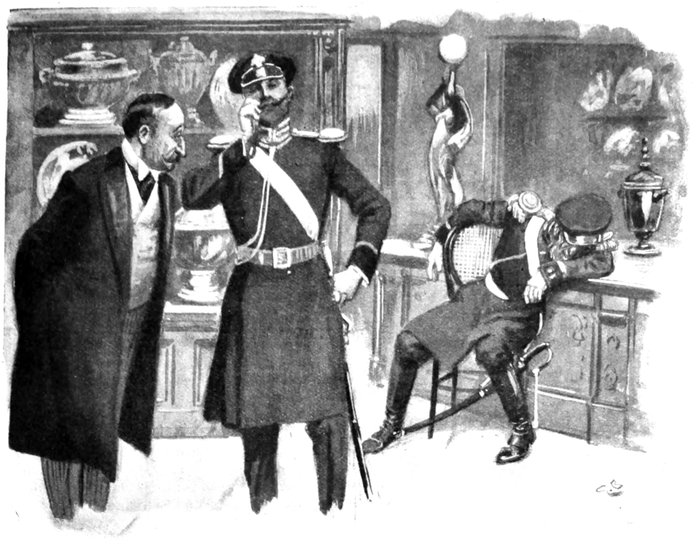
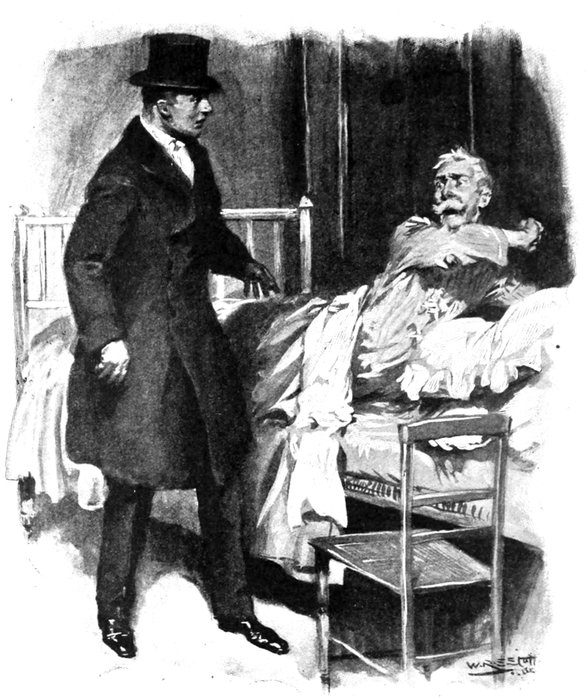
"'THE PRINCE IS A LITTLE FATIGUED,' OBSERVED CAPTAIN MARCKOVITCH."
"Major Romanoff is longer than I expected,"
observed Captain Marckovitch, taking out his
watch.
"Perhaps he has not found her Excellency at
home," suggested the other.
"I dare say you're right. It is quite possible,
too, that her Excellency was out shopping when
the major reached the palace. In this case he
will naturally have decided to wait until she
returns."
"Oh, naturally," agreed the jeweller.
Another twenty minutes went by. Despite
all his efforts to appear at ease Mr. Gorshine
began to feel a little disturbed. Several possible
explanations of the delay occurred to him, the
most likely one being that the Princess might
have decided to see the general before making
up her mind.
The adjutant interrupted his train of thought.
"I'm afraid it's not very far off your usual
closing time," he remarked.
"We generally close at seven, sir."
The captain glanced at his watch again.
"It is now half-past six. If I start at once I
can get to the palace and back by seven.
Would you like me to drive there and explain
that his Highness the Prince wishes her Excellency
to make an immediate decision? Then,
if by any chance I find she has not arrived,
I will come back with Major Romanoff and
the jewels."
Mr. Gorshine felt almost overwhelmed at such
condescension.
"I could not think of troubling you, sir," he
protested. "I will send one of my assistants."
"I'm afraid that won't do," returned the
other, with a laugh. "You see, only an officer
of the Guards would be admitted to the palace
at this hour, and as I feel that I ought to relieve
your very natural anxiety I will go myself. By
the way, on no account disturb his Excellency
during my absence. It would make him very
angry, and he might cancel his order."
"Certainly not, sir."
"Very well, then, I'll start at once. Be good
enough to call a cab with a fast horse."
Secretly overjoyed at having the matter thus
settled, but volubly protesting his disinclination
to trouble his illustrious patron, the jeweller
escorted the captain to the door and saw him
into a cab. Then he returned to the showroom,
where a group of assistants, with smiling
faces, were watching the still snoring Petroff.
As the manager came up to his chair he opened
his eyes sleepily.
"It's all right," he murmured.
Darkness began to fall. It was too late to
expect any more customers. In fact, the usual
closing hour had already gone by and the
assistants were beginning to get restless. Mr.
Gorshine went to the doorway a dozen times
and peered out into the street. On each
occasion, however, he returned to his desk in
disappointment. There was no sign of either
Major Romanoff or Captain Marckovitch.
"What can have happened to his Excellency's
adjutants?" he said. "They ought to have
been back here long ago."
The principal assistant blew his nose thoughtfully.
"It's a long way after closing time, sir. I
really think we ought to awaken his Excellency."
Mr. Gorshine, mindful of Captain Marckovitch's
injunction, would not hear of such a thing.
"On no account," he exclaimed. "If we
did so, his Highness would be certain to cancel
the order he has given us."
At the end of another half-hour, however, the
jeweller decided that it would perhaps be better
to take his assistant's advice after all. There
was just a possibility, too, that the Prince might
catch cold. Besides, he ought to be back in
the palace by this time for dinner. Accordingly
he went up to him deferentially and laid a
respectful hand upon his epauletted shoulder.
"I beg your Excellency's pardon," he said,
"but your adjutants have not yet returned,
and we wish to close the establishment now.
If you will graciously permit me, I will see
you back to the palace."
"All right," muttered Petroff. "I'm a general."
"Certainly, your Highness; but this is closing
time."
The vodka mounted to Petroff's brain, and
he began to get angry.
"Go to the devil!" he shouted, rising unsteadily
to his feet. "I'm a general, I tell
you. I want a drink. If you don't let me
have one I'll put you all in prison!"
"Oh, pray forgive me!" exclaimed the
manager, regretting his boldness. "I did not
mean to inconvenience your Excellency. I
merely wished to point out that it is closing
time, and that perhaps you would like to return
home."
A gleam of intelligence crept into Petroff's
eyes.
"Yes, I want to go home," he murmured.
"I want to see my wife."
"Then pray permit me to escort you. I will
send for a carriage at once."
"All right," was the sulky response.
Although the keen night air sweeping up
the open street sobered him a little, Petroff
was still somewhat unsteady on his feet. Mr.
Gorshine and a couple of assistants, however,
managed to get him into a cab.
"Will your Highness have the goodness to
give me the address to which you wish to be
driven?" inquired the manager, deferentially,
as he took the opposite seat.
With some little difficulty Petroff remembered
the obscure quarter of the city in which he
lived, and repeated the name and number of
the street. Mr. Gorshine heard the answer in
amazement, convinced that there must be some
mistake. His companion, however, showed
such an inclination to become argumentative
that he finally decided to humour him, and they
set off for the address indicated.
At the end of half an hour's drive the cab
stopped in front of a squalid-looking house in
a mean little side-street, far removed from the
fashionable quarter of the city.
"It's all right," declared Petroff, glancing out
of the window. "Here we are. Don't let my
wife get angry with me. Tell her it wasn't my
fault."
The jeweller smiled reassuringly, as the other
clung to his arm and led the way up a steep
flight of stairs. At the top floor Petroff stopped
and fumbled with his latch-key.
"Don't wake my wife," he whispered.
As he spoke, however, the door was flung
suddenly open, and an elderly woman, brandishing
a stick, rushed out into the passage.
"There you are, then, you wicked old
drunkard!" she exclaimed, shrilly. "I'll give
you something for stopping out all this time.
See if I don't!"
"Please don't let her hit me," shrieked
Petroff, trying to hide behind his companion.
"Pardon me, madam, but his Highness is
unwell," protested the jeweller, quite at a loss to
account for this extraordinary reception.
Mme. Petroff burst into a peal of derisive
laughter.
"Unwell, is he?" she retorted. "He'll be
worse presently, I can promise you!" Then
her eyes fell on the magnificent uniform her
husband was wearing.
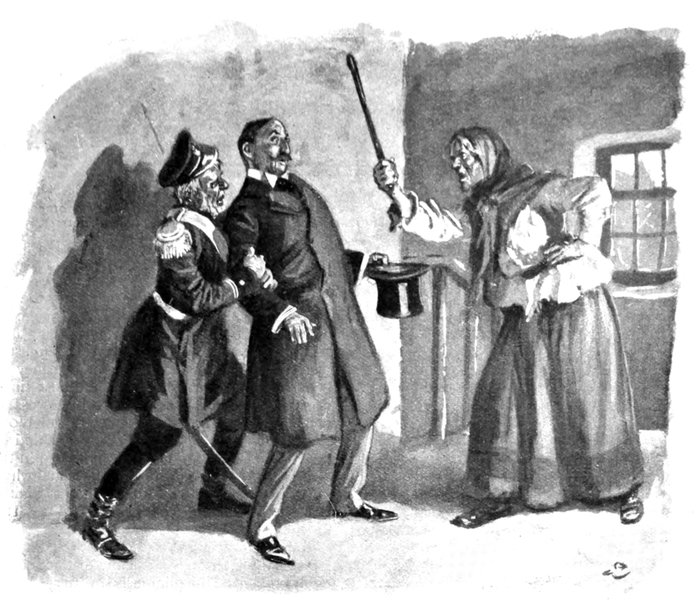
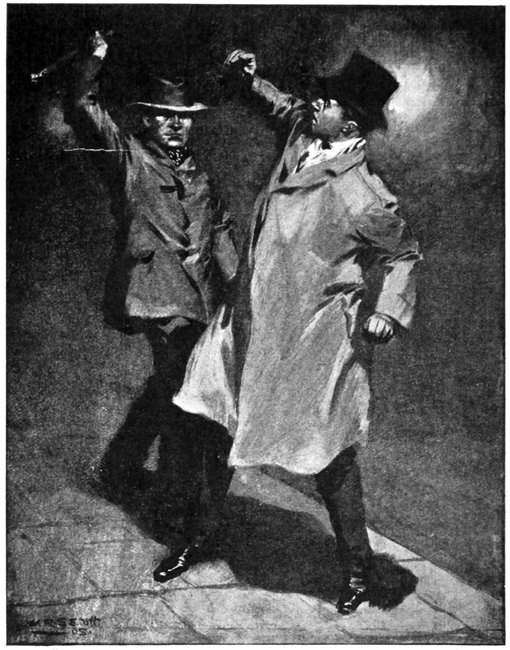
"'PLEASE DON'T LET HER HIT ME,' SHRIEKED PETROFF, TRYING TO HIDE BEHIND HIS COMPANION."
"What drunken freak is this?" she cried.
"How dare you dress up as an officer, you silly
old guy?"
Mr. Gorshine's face grew suddenly pale.
"I beg you not to be angry with his Highness,"
he exclaimed. "His adjutants, Major
Romanoff and Captain Marckovitch, will probably
be here directly."
Mme. Petroff snorted indignantly.
"I believe you're drunk, too. Since when,
pray, has my husband been a Highness? He
was Petroff, the bootmaker, this morning."
Mr. Gorshine sank into a chair, overwhelmed
with horror.
"What?" he gasped, as soon as he found his
breath. "Is not this his Highness Prince
Savanoff, the famous general?"
"The famous fiddlestick," returned the other.
"He's no more a Highness, and a Prince, and a
general than you are yourself. He's a rascally,
drunken old bootmaker, who disgraces the name
of Petroff."
With the angry woman's shrill laughter ringing
in his ears the unhappy jeweller staggered
from the room and rushed down the stairs. He
could think of nothing but the loss he had just
sustained. By reporting the matter to the police
at once there was a bare chance that some of
the property might yet be recovered.
The superintendent of police, however, to
whom he poured out his story, could not offer
him much encouragement. It was clear that
he had been made the victim of a singularly
audacious robbery. The only thing that the
authorities could do was to arrest Petroff as an
accomplice. As, however, there was no evidence
to connect him with the theft, he was, after a
week's enforced sobriety, permitted to return to
his wife.
This was comforting for Petroff, perhaps, but
it was anything but pleasant for the hapless
Mr. Gorshine, who never saw his jewels or the
two "adjutants" again.
Some of the customs in vogue at American Universities are startling enough, but it comes as a
surprise to learn that the authorities of an ancient Scottish foundation, aided and abetted by the
police, countenance such extraordinary doings as are chronicled in this topical article. The writer
describes the Glasgow University Rectorial Election of 1905, in which he took part as an official of
one of the clubs concerned.
On October 24th of this year the
students of Glasgow University will
choose for themselves a new Lord
Rector. Already announcements
have appeared in the Press that the
candidates are Lord Curzon (Conservative), Mr.
Lloyd George (Liberal), and Mr. Keir Hardie
(Socialist).
Triennially the public reads in some obscure
corner in its newspapers that a Rectorial election
is in progress in a Scotch University, that the
fighting is fiercer than ever before, and that
damage has been done amounting to hundreds
of pounds. The reader, according to his viewpoint,
either swiftly ejaculates a condemnation
of such barbarous practices or grins as he
detects what he takes to be newspaper exaggerations.
The real facts behind all this
the general public never learn; they never
realize what a strange anachronism a Rectorial
election is.
Fancy carefully-organized fighting, with a
hundred or two hundred young men on either
side, ending in the wrecking of the premises of
the losers—to the breaking down the plaster of
the walls and the tearing up of the floor—all
countenanced by staid University authorities and
countenanced, too, by the police department of
a municipality that prides itself on being the
most up-to-date in the country! Indeed, the
police not only countenance the business but
actually assist by sending forces of men to the
scene of operations to ring round the arena,
keep back the crowd, and often to hold up the
electric cars and other street traffic while the
rival parties push the claims of their respective
candidates vi et armis! In the exigencies of
the campaign, moreover, many deeds are done
with perfect impunity by the students which
would be seriously visited on less favoured
mortals—for example, the cutting through of
main water-pipes, carrying the supplies of whole
blocks of buildings.
The good people of Glasgow are, for the most
part, not at all inclined to withdraw this licence.
They are, on the contrary, rather proud of the
sacrifices they make in order that old customs
may be kept up, and their complacency and
good-humoured tolerance are almost inconceivable
to people of non-University towns.
That the readers of The Wide World
Magazine may realize what lies behind the
fragmentary reports which they will find in their
newspapers this month I shall relate what I
know of Glasgow Rectorial elections, and particularly
of the last election in November, 1905,
in which I was specially concerned.
In most other Universities in these days the
Rectorship is a purely academic distinction, probably
conferred unanimously by the students.
In Glasgow, however, it is still decided on
political grounds.
In the University there exist two permanent
clubs: the Glasgow University Conservative
Club and the Glasgow University Liberal Club,
the constitutional purpose of each of which is to
effect the election of a Lord Rector of its own
political colour.
For three years—since the last election—these
clubs have been scraping money together. The
election will cost each side from two to four
hundred pounds, and the size of the fight they
put up and their output of election literature
will be on the scale of the funds in hand.
Needless to say, most of the money comes from
party sources and private subscriptions outside
the University, but owing to the extraordinary
nature of the campaign no accounts are ever
made public. Like Tammany Hall and other
efficient political "machines," a despotism is
absolutely necessary. The entire control of the
money is vested in four, or three, or even two
students, and no questions are ever asked as to
the uses to which they think best to put it.
At the beginning of the session preceding the
election the presidents of the clubs, with great
secrecy, approach various leading men of their
parties, and finally fix on candidates. In the
second half of the session, about February, the
candidates are announced, and soon afterwards
the Conservative and Liberal Rectorial Committees
are formed. These committees are
large, numbering, perhaps, fifty in each, though,
as I have said, the actual executives are very
small. Each committee is divided into three
sections—the canvassing, the literature, and the
physical force.
The conveners of these sub-committees are
busy all through the summer vacation with
preparations for the coming fray, forming their
plans, inventing ruses, and intriguing for various
advantages.
The campaign commences in earnest as soon
as college reassembles in the third week of
October, and continues in a wild whirl of excitement
for a fortnight, until the day of election.
Then all the leading men, haggard and nearly
dead with fatigue and the incessant strain, go to
bed and sleep for twenty-four hours. The day
after the election the 'Varsity is as quiet and
peaceful as the most select young ladies'
seminary.
This is the invariable course of events. On
the particular occasion I am about to describe—the
election of 1905—the candidates announced
in the spring were Lord Linlithgow (Conservative)
and Mr. Asquith (Liberal). The Liberals
had lost the last election badly, but the reaction
against the Government gave them high hopes
of pulling their man through on this occasion.
The summer, apart from the publishing of one
magazine by the Liberals, was, as usual, a time
of public inaction, but secret preparations. The
clubs rented two large shops—almost next door
to one another, by mutual arrangement—in a
street near the University. These were the
"committee rooms," and were practically the
head-quarters from which the fighting was done.
They were prepared for occupation by (1) removing
all partitions and throwing the shop
itself and the rooms behind into one large, bare
apartment. (2) Taking out all fittings, even to
the fire-grates. (3) Taking out the windows
and filling their place with very massive,
buttressed barricades, having loopholes high up.
(4) Leading in special water supplies and fitting
hydrants for hoses. In addition, the cellars are
stocked with great cases of pease-meal, made
up into paper packets of convenient size for
throwing. A piano was also placed in each of
the committee rooms.
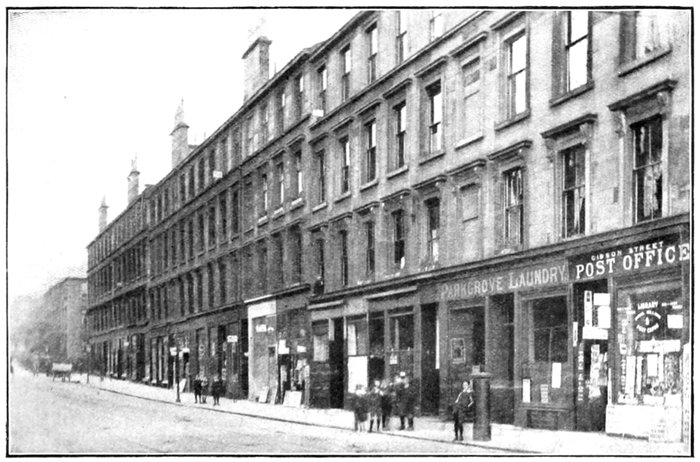
GIBSON STREET, GLASGOW, WHERE BOTH COMMITTEE-ROOMS ARE INVARIABLY SITUATED—IN THE LAST ELECTION THE
CONSERVATIVES USED THE PREMISES OF THE LAUNDRY SHOWN AT THE RIGHT OF THE PHOTOGRAPH, WHILE THE INTERNAL
ROOMS WERE TWO SHOPS HIGHER UP THE STREET.
From a Photograph.
About the 20th of October students rattled
back to their Alma Mater from all parts of the
country with an eager lust for the coming fray.
For myself I can solemnly say that the ensuing
fortnight was the happiest time I have ever had.
The abandon, the madness of it; the fiercest
possible fighting and raiding, with a minimum
of serious injury; and behind it all, on both
sides, the greatest good-humour—all these are
impossible to describe. Only students, I
imagine, could fight such wild, lunatic fights
with never a lost temper.
The Glasgow University
Conservative and Liberal Clubs
hereby agree to the following
arrangements for the conduct
of the Rectorial Election.
1. The Rooms of the Clubs shall
be used for Fighting on and
after October 25th, with the
exceptions hereafter mentioned.
2. Pianos shall be held
inviolable.
3. There shall be no Battering
Rams used or similar appliances
whose use is dangerous.
4. Matriculation and Class
Tickets shall not be taken.
5. Fighting shall be with "open
doors," i.e., no insuperable
obstacles shall be placed in
the doorway.
6. Gas fittings shall be
inviolable.
7. Canvassers and Canvass
Sheets shall be inviolable.
8. The evenings on which
Smokers are held by either
Club shall be truces.
9. Truces shall exist till
half-an-hour after all other
meetings.
JOSEPH DAVIDSON,
Hon. Secy.,
G.U. Conservative Club.
J. C. WATSON,
Hon. Secy.,
G.U. Liberal Club.
THE "ARTICLES OF WAR," PUBLISHED BY
BOTH CLUBS IN THESE MAGAZINES.
The atmosphere was something different from
the rest of life; it was like a
slice out of the Middle Ages.
Up all night and sleeping
during the day, life became
for us a complicated mass
of plottings and intrigues,
ambushes, wild chases in
cabs, men spying on other
men and in turn being
shadowed themselves. Last,
but by no means least, there
was the unholy but very real
joy that comes of the unlicensed
destruction of property.
A Rectorial election
is the shortest road to
romance in this prosaic
modern life that I know of.
The canvass, though very
efficient, is comparatively
routine work, and naturally
neither particularly novel
nor interesting. I shall pass
it over and deal mainly with
the fighting. There were
four chief features in the
fighting—"painting raids,"
"regular battles," "magazine
captures," and "bus fights."
At this election some attempt
was made for the first
time to restrain and organize
the fighting. It was thought
that it would be better to
have something in the way
of fixed battles by mutual
agreement rather than or in
addition to the constant
running fight. Consequently
truces were frequently
arranged, except at the
times fixed on for battles.
These truces, however, were
technically held not to
inhibit painting raids.
The front of each of the committee-rooms
was, of course, loudly painted with the party
colour—red for the Liberals, blue for the Conservatives.
A painting raid meant stealing out
at dead of night, with paint-buckets and brushes,
and daubing the enemy's rooms your own colour.
Our opponents, however, sometimes received
information beforehand in some mysterious way.
The painters would be softly busy, with a whish-whish
of brushes, chuckling to one another,
when suddenly, without a whisper of warning,
two deadly streams of water would pour an
irresistible cross-fire from the loopholes and
sweep painters, chairs, and ladders to the ground
in a confused, dripping
mass. Then there was much
spluttering and vociferation,
and, if possible, the contents
of the paint-buckets
were made to shoot through
the loopholes. The barricades,
however, were invulnerable,
and the hoses could
not be withstood. If the
enemy are prepared for a
painting raid there is little
to do but retire.
In this sort of work it was
pretty well give-and-take;
both sides painted and were
painted. The raids, however,
ceased once the regular
fighting commenced.
This happened a few days
later, when the "articles of
war," here reproduced, were
published by both clubs in
their magazines.
The "open doors" article
was new. It came of past
experience. If the massive
doors of a committee-room
were closed, obviously the
only way of getting at those
inside was with axes and
heavy rams, with results
and risks, in excited hands,
rather more serious than
the clubs were prepared to
face. It turned out a wise
step, for it had the effect
of making the fights more
physical and good-humoured,
and in all probability prevented
a great deal of serious
injury and wounding.
The article about pianos
was, strangely enough,
strictly kept. It was a striking
sight at the end of a "wrecking" to see
the piano standing unhurt and immaculate amid
a chaos of torn flooring and broken plaster.
The matriculation and class tickets of a
student are what make him eligible to vote, and
would cost at least four guineas to replace. To
make war on these would be a shabby way of
winning an election.
Though it was the "open season," so to
speak, after October 25th very little fighting
was done by the rank and file except at the
battles. The clubs concentrated all their
energies on these. The occasions were arranged
beforehand, and there were four
altogether.
On the evening of the first battle students
arrived in the oldest rags they could lay hands
on. A great crowd of spectators also turned
up, the time of the engagement having leaked
out. The crowd was kept back by a force of
policemen. Inside the rooms busy preparations
were going on. Boxes of pease-meal bags were
hauled up from the cellar and served out to all
hands—if you were clever you might manage to
carry ten of these most effective missiles. The
hoses were fixed up and tested, while men who
were not willing to submit even the worst
clothes they had to the combined effect of
pease-meal and water stripped until they were
clad only in the sparsest of underwear.
The Liberals—of whom I may as well confess
at once I was one—divided their force. About
two-thirds were detailed for attack, and the
remainder had to stay by the rooms and defend
them in case of need. This boldness was
because we had been assured by our scouts that
we were largely in the majority. The Conservatives,
realizing their weakness, only threw
perhaps a quarter of their number outside.
A few minutes before the hour the attacking
forces lined up opposite their doors, facing one
another. They looked a queer lot, in most
grotesque attire—the first pease-meal bag ready
in each man's right hand, their figures bulging
with the remainder. In the rooms the defending
forces were massed at the open doors, while
at each loophole were two men controlling the
nozzle of a hose. These waited anxiously, for
the result of the collision of the outside forces
determined whose rooms were to be attacked.
On this occasion, however, there was little
doubt. The odds were so clearly against the
Conservatives that, unless they had some stratagem
up their sleeve (which was always very
possible), it was decidedly to be the Liberals'
night.
The good-natured and even sympathetic police-inspector
in charge capped the official sanction
by consenting to blow his whistle to start us.
He stood, watch in hand, with the whistle
between his lips and his eyes on the minute-hand.
Dead silence prevailed all around.
Suddenly the whistle shrilled out, the crowd
shouted, and the two forces rushed at one
another, the narrowing space between them
netted with the parabolas of pease-meal bags,
which burst like shells where they struck. The
concussion of the adversaries took place somewhere
in the midst of a dense cloud of fine
yellow dust. But out of that cloud, in the
direction of the Blue rooms, there emerged a
writhing bulk of men. It was body to body
now; there was throwing only on the outskirts.
The Liberals were as three to one, and the
Blues were crumpled up and driven before us.
Our advance was irresistible; there was no
stand or halt until they had retreated right into
their rooms. In less than thirty seconds from
the whistle we were in the Conservative doorway.
But there we stopped, for all their defence
was opposed to us. In that doorway there was
a tight, breathless jam—as severe an experience
as I ever want to have. Our own men from the
outside and the Tories from the back poured in
a steady fusillade of pease-meal, of which the
doorway was the focus. The pease-meal bag
does not injure, but if it explodes in the face
it fills mouth, nose, ears, and lungs with its
nauseous, choking dust. Here there were
hundreds bursting within a few square feet.
The atmosphere was unimaginable.
With eyes tightly shut—one could not see an
eighth of an inch if they were open—jammed
off one's feet, and with a roaring in the ears,
we remained there, unable even to think, but
possessed with one insensate idea—to shove,
shove, shove, whenever we could get the slightest
purchase.
And presently the hoses were at it. The
enemy had brought them away from the loopholes
(where they were useless) and taken them
back into the room. From there they played
relentlessly on the jam in the door, the solid
jets striking like rods of iron.
Behind us there were gusts of charging that
shook our wedged mass. Parties of half-a-dozen
would run back ten yards and then hurl
themselves in a solid body at the pack. But
still the Tories defended their citadel most
pluckily, holding on to the doorway with
desperate tenacity.
But steps were being taken to help us. In
the Liberal rooms a small party of trusted men
descended to the cellar. There, by crawling
through holes and breaking down brick partitions,
they arrived at length at the foundations
of the block of buildings. Here they found a
network of water-pipes, but to fix on the one
which led to the Conservative rooms was a
difficult job. While they were still hesitating,
word came down to them that their men in the
street above were having an awful time with the
hoses. A big main pipe was obvious, and one
of the band, equipped with an axe, speedily
severed it.
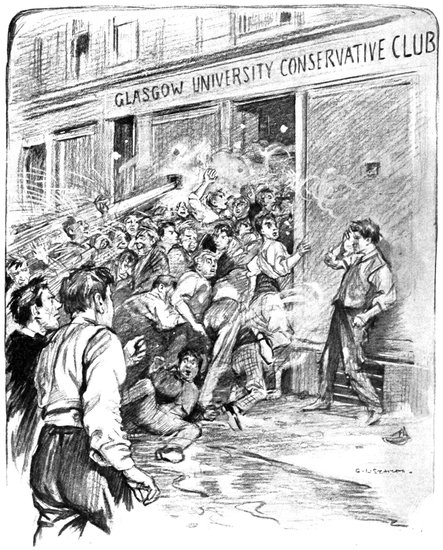
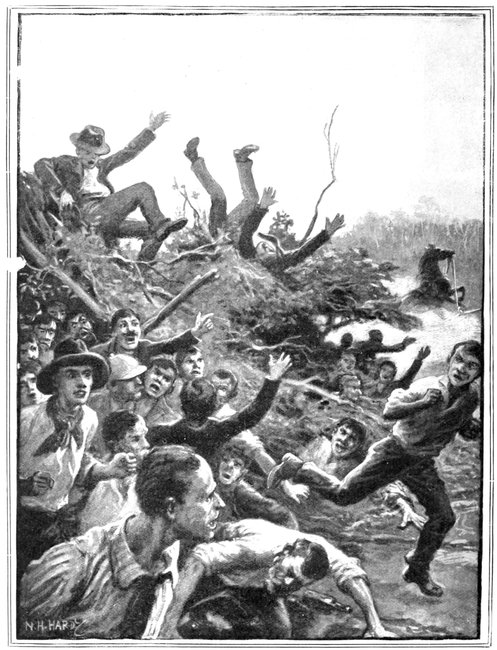
"IN THAT DOORWAY THERE WAS A TIGHT, BREATHLESS JAM."
Meanwhile, up above, the streams of water
were playing splendidly. They could not break
the jam, but they prevented and smashed up
any attempt at organized effort on the outskirts
of the attack. Suddenly, however, they stuttered,
leapt out high, and then fell to the merest
dribble. From our packed ranks there rose a
muffled growl, which was meant for a cheer.
With the chief obstacle removed—it is wonderful
how a hose deters men—we began steadily
to gain.
That terrible jam had lasted for nearly half
an hour. The men in the forefront of the
attack had long ago become exhausted, but
unlimited energy came from behind. I felt
myself scrape along the wall. Suddenly the
resistance in front gave way and we staggered
forward, our mass opening out like a fan. In
another instant we were all inside.
Personally, I was content to lie on the floor
in a corner; my eyes were bloodshot, and my
nose bleeding from inhaled pease-meal. But
fresher men set about the wrecking of the
premises, and presently I, too, joined them with
zest, while the defeated Conservatives looked on
indifferently or jokingly proffered assistance.
The unsophisticated reader may think there
is little to destroy in a room with bare walls and
floor, but we found quite a lot. There was the
woodwork to tear off, the plaster of walls and
ceiling to be broken and poked down. The
doors were detached and thrown in the Kelvin,
a very convenient river, along with much other
stuff. The gas-pipes for obvious reasons were
inviolable, but much of the water-piping was
destroyed, and in addition two hoses, a large
supply of pease-meal, and a storming platform
were captured and transferred to the Liberal
rooms.
Thereafter a joint smoking-concert was held
in the Liberal rooms, as being in their present
state more comfortable, and both sides had a
very jolly and friendly time, not at all disturbed
by a party of policemen and plumbers, who
came round with some strange story of a burst
pipe they had to locate.
Two days later the second fight took place.
The Reds were again in a large majority, and
forced the Tory rooms in less than twenty
minutes. Very little had been done in the way
of repairing damages, and there was, consequently,
not much scope for the wreckers.
Nevertheless, there were some who were not
discouraged, but did their best under the
circumstances. If a barrel of dynamite had
been exploded in the rooms they could not
have looked more forlorn and dislocated than
they did after this second visitation.
The third fight took place very late in the
evening, because it followed a Liberal meeting
in the St. Andrew's Hall, addressed by Mr.
Lloyd George.
The Conservatives acted on the defensive all
through this fight, and never left their rooms.
For over an hour we tried to effect an entrance,
but all in vain. We were baffled by a clever
system of railing, rigged up to lead from each
side of the door into the middle of the room.
Almost across this passage was a platform. To
enter the room one had to traverse this nine or
ten feet of narrow gangway with the enemy
massed behind the railing on each side, and
dead in the face of a powerful hose which was
stationed on the platform and had a clear sweep
down the passage. Moreover, a special, inaccessible
water-pipe, which our underground
scouts were unable to discover, had been led
into the building.
It was an impossible task. After many weary
efforts we gave it up, and this fight was declared
a draw.
The fourth was the last fight. We had so far
had all the advantage. The enemy's rooms
had been twice wrecked; ours were untouched.
In this last fight the Tories made a big effort to
equalize, while, for our part, we were rather
slack.
The result was that for the first time they
outnumbered us. At the very start we were
swept off our feet and beaten back to our
rooms. Our water supply was cut off, leaving
only a feeble trickle, which was refreshing rather
than otherwise. For an hour and a quarter we
held them out; then we broke, and five minutes
later the interiors of the two committee-rooms
were as like each other as—well, as they were
like anything.
In addition to these fixed battles there were
constantly little skirmishes in which half-a-dozen
or fewer might be engaged on each side. These
mostly centred round attempts to capture the
literature of one party or the other.
The literature was inviolable at the printers'
and inviolable when it was up at college and
being distributed, but it was liable to be seized
at any point in transit. The respective printers
are, of course, pledged to secrecy, and, to do
them justice, for staid commercial men they
enter into the spirit of the thing with uncommon
zest. So much so, that on one occasion two
genuine young Liberals, who had been sent for
some printed matter with insufficient credentials,
were suspected by our wily printers of being
Tory spies, and were accordingly decoyed into
a room, locked up for an hour or so, and
finally unceremoniously bundled downstairs.
But, though the firm may be thus zealous,
there are always employés in a large works who
are approachable, and, having unstinted money
for bribing, the enemy often get secret information
as to when a magazine may be expected to
come out.
During this campaign, however, though there
were many exciting cab chases and encounters,
the prize always escaped with its rightful owners.
There was no single delivery of magazines or bills
captured from either side. Once our magazine
was only saved by a ruse. Just at the time of
dispatch a party of Tories was observed in
waiting. The convoy was not strong enough to
run any risks, and had to use their wits to save
the precious publications. A large number of
cabs was promptly summoned by telephone
from the nearest cab office. They all gathered
round the printers' door. Into one of the cabs
the magazine was carried and hidden. All the
vehicles then drove off simultaneously in
different directions. Of course, the right cab
escaped.
The literature of the campaign, I may mention
here, is delightful when one is "in the know."
Unrestrained personalities are bandied backwards
and forwards in elegant Billingsgate with
quite remarkable freedom, but for the most
part with perfect good-humour.
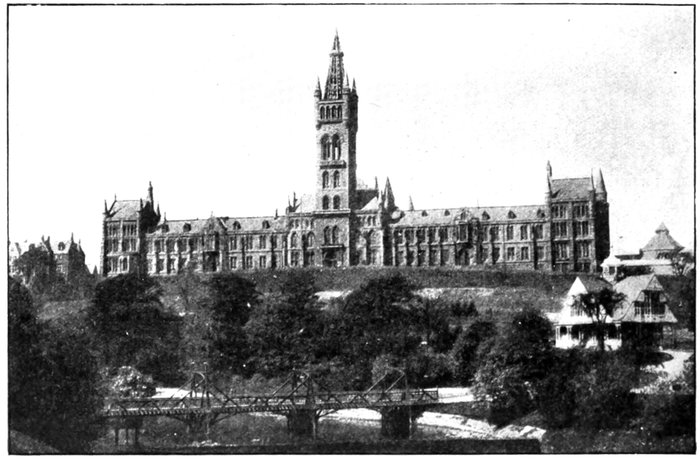
GLASGOW UNIVERSITY—IT IS ON THE TERRACE IN FRONT THAT THE FINAL BATTLE RAGES ON ELECTION DAY.
From a Photograph.
The Liberals, being in funds, published eight
full magazines during the campaign, the Conservatives
not so many. Only professional
journalists will appreciate the strain on amateurs
of putting forth a series of eight or twelve-paged
magazines at intervals of a couple of days.
I have all the magazines before me now.
They are full of cleverness both in writing and
caricature, but they are so essentially topical
and personal that it is difficult to make extracts
that would be understood by the non-University
reader.
At length the final day of the struggle came
round. The election took place on the first
Saturday in November. At an unearthly hour
of the morning parties of Reds and Blues were
out pasting their bills all over the town, on
whatever flat surface they could find. These
parties met sometimes, and bills were captured
or lost and paste used as an offensive and
defensive weapon.
An hour or two later began the last feature of
the campaign—the bus fights.
Between seven and eight in the morning each
club sends anything from a dozen to twenty
buses to outlying parts of the city and to all
the principal railway stations. Nominally, and
probably originally, these buses were meant to
collect voters. Now their chief mission is to
hunt and destroy one another.
Each bus is manned by about a dozen men.
It carries also a few boxes of pease-meal, but
not many. There is a new weapon to-day, in
abundant rows of cardboard boxes—rotten eggs.
Up to the day of election it is considered bad
form to throw anything but pease-meal. But
on election day everything is permitted—soot,
red and blue ochre, and, above all, rotten eggs.
When two hostile buses sight one another—and
that is no very rare occurrence, since they
are dispatched to the same districts—the crews
descend and fight in the streets, unless the crew
of one bus sees itself outmanned, when it may
fly and be chased at breakneck speed, to the
consternation and dislocation of the regular
street traffic. Otherwise the crews fight in the
street until one of the parties is beaten and
forced back into its bus. They must defend
this, whip up the horses, and try to escape. On
the other hand, the assailants endeavour to
cover the approach of one of their number who
carries a long sharp knife. It is his business
to cut the traces and prevent the enemy's
escape.
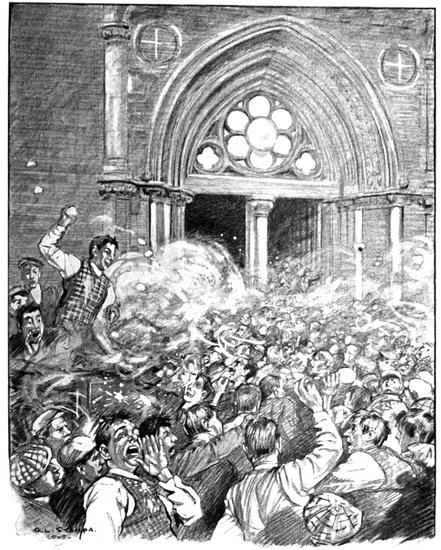
"WE SURGED ROUND THE 'FRONT' IN A PERPETUAL RUGBY 'SCRUM.'"
If they are successful in doing this they put
the vanquished bus hors de combat altogether by
cutting the harness to pieces and sending the
grinning driver back to the stables with the horses.
The bus on which I was had the good fortune
to win its first fight. The combat was long and
doubtful, and, incidentally, it took place in one
of the busiest streets in Glasgow. All the time
it lasted policemen held up the traffic on either
side. When we had finished there were rows of
electric cars packed behind one another, up the
street and down; half Glasgow seemed to be
waiting patiently while a score of young men
exchanged hostilities.
When the battle was over we gave the policemen
a hand to drag the dismantled bus of our
enemy up a side-street. After that we were
joined by a crew of Liberals who had been dispossessed
in a similar manner. Thus brought
to double strength, we soon scored another easy
victory. Then we had a long stern chase after
a fugitive bus. It ended fruitlessly, because
we were overloaded.
Finally we made our way to the University,
where polling was in progress all the forenoon.
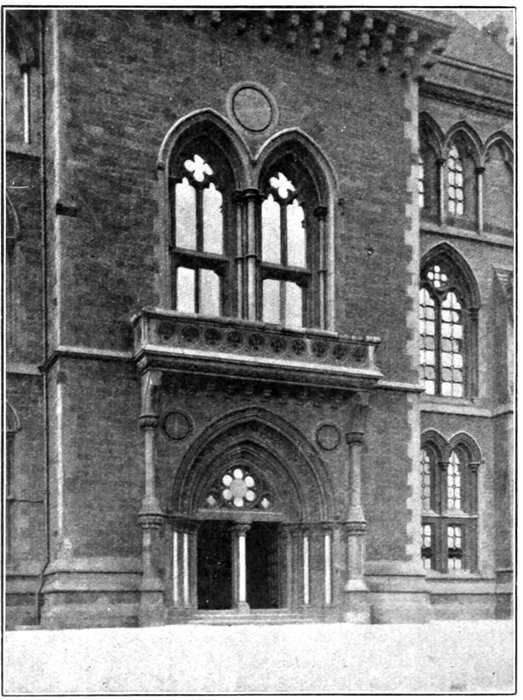
THE MAIN ENTRANCE TO GLASGOW UNIVERSITY—FROM THE BALCONY ABOVE THE
RESULT OF THE POLL IS DECLARED.
From a photograph.
A pease-mealy,
egg-plastered
crowd we were, as
we surged round
the "Front" in
a perpetual
Rugby "scrum."
The game here
was to get possession
of the doors
and pass only
your own men
in. The Liberals
succeeded in
doing this for a
time, but out
came the Clerk
of Senate and
announced that
unless the formation
were broken
the election
would cease. As
we had only
sporting reasons
for this policy—we
knew we were
going to win; the
canvass had
shown that—we
dropped it, and,
apart from a few
local centres of
disturbance, and
the perpetual
pease-meal, soot,
and rotten eggs,
we became quite pastorally happy and peaceful.
The election goes by a majority of "nations."
There are four of these nations—Glottiana,
Rothesiana, Transforthiana, and Loudoniana.
Every student belongs to and votes in one of
these, according to his birthplace. Thus it is possible
for a majority of votes to lose the election
if they happened to be massed in one nation.
The result is announced about one o'clock
from the balcony. The "Front" is packed with
buses and carriages swarming with students.
Long rows of hansoms contain the "Q.M.'s"—our
girl students. They vote as well, but at
their own college. I have not said anything
about them during the campaign because all
they do is to canvass and make rosettes.
Presently the white-bearded figure appeared
on the balcony. For five minutes it was hopeless
for him to attempt to speak. Then his lips
moved and his beard wagged, and instantly there
began a gradual, slow-swelling yell of terrific
volume. Those near who had heard his words
shouted them to
those far off:
"Asquith is in in
four nations!"
Then the
buses careered
wildly round the
town for an hour
or two and the
good folk of
Glasgow grinned
tolerantly, as is
their way. Last
of all we went
home. It was
finished, and we
were dying for a
long, long sleep.
In conclusion,
for those who
wish to follow the
Rectorial campaign
at present
in progress in
Glasgow, I would
point out that by
a rearrangement
which has just
come into force
the session now
begins on October
9th, and the
election will take
place on October
24th, instead of
in November as
heretofore.
It has always been our rule, in order to obtain accurate pictures, to entrust the illustration of our
stories only to artists who have actually visited or lived in the various countries referred to, and are
consequently familiar with the conditions of life prevailing there. The result of this custom is that
our artistic staff is composed of men who have travelled extensively, roughing it in many remote
parts of the world. In the course of their journeyings our illustrators have themselves met with
exciting and unusual experiences, some of the most interesting of which are here given, each artist
depicting his own adventure.
That the artists who illustrate the
stories in The Wide World Magazine
are recruited from a specially-qualified
staff is, we venture to think,
an obvious fact. Our stories, dealing
as they do with stirring adventures and
strange happenings, ranging in their locale from
our own shores to the uttermost ends of the
earth, could not, of necessity, receive adequate
and accurate pictorial embellishment save at the
hands of experts—men, in fact, who have themselves
had experience of the world in its most
varied aspects.
Our illustrators must, indeed, have in them
something of the soldier, the sailor, the hunter,
the cowboy, or the explorer to find a place in
our pages. Thus, should we have a story
dealing with Patagonia, the pictures are drawn
by an artist who has actually visited that
remote country; when it is necessary to illustrate
a scene in the Arctic we employ an artist
to whom the everlasting ice is as familiar as the
streets of London. Should we find it necessary
to depict a marine incident we have recourse to
the brush of an artist who has himself been a
sailor. In connection with every story we consult
our list of "specials" for one who has either
met with a like experience or is thoroughly
familiar with the country concerned. Thus it
will be seen that The Wide World is able to
avail itself of the pictorial services of an
altogether exceptional body of men, many of
whom have themselves met with thrilling
adventures. As their experiences will have a
particular interest for our readers, we are glad to
be able to give an account of the most exciting
episodes in the lives of some of the artists
whose work has been a prominent feature in this
magazine.
Mr. Henry Sandham is a Wide World artist
who has had a distinguished and adventurous
career. By birth a Canadian, of British descent,
he has seen much of the world in out-of-the-way
places. He has hunted on the north
shore of the Gulf of St. Lawrence, and has
probably travelled North America as extensively
as any man living, his sketching trips having
taken him from the north of Canada to the
south of the United States, and across country
from the Atlantic to the Pacific. He served his
time in the Canadian Volunteer Artillery and
saw active service during the Fenian raid on
Canada in 1864. Much to the consternation of
his friends, he once set off on a tour with a
notorious desperado known as "Curley Bill," a
"bad man," whose boast it was that he could
not sleep unless he shot a man per month; if
troubled with insomnia, he said, he shot an
extra one. Mr. Sandham roughed it for some
time with this fire-eating companion, who tended
him with a solicitude only equalled by that of a
mother for her only child; all he could beg,
borrow, or steal he cheerfully placed at the
artist's disposal. They were attended by a
dwarf, cousin to "Curley Bill," who, although
of diminutive stature, was quite as desperate a
ruffian as his bigger relative, whom he venerated
with an ardour amounting to hero-worship, and
whose dress, manners, and habits he followed
as closely as he could. "Curley No. 2," as he
was called, nearly got the party into serious
trouble by wanting to shoot a too-inquisitive
miner, and was only prevented from so doing
by "Curley Bill" himself, who took him by the
nape of his neck and shook him as a dog does
a rat.
Mr. Sandham has visited the West India
Islands, the Azores, Italy, France, Germany,
and Holland. He is a Charter member of the
Royal Canadian Academy, and President
Roosevelt accorded him the signal honour of
selecting him to illustrate his book of hunting
adventures.
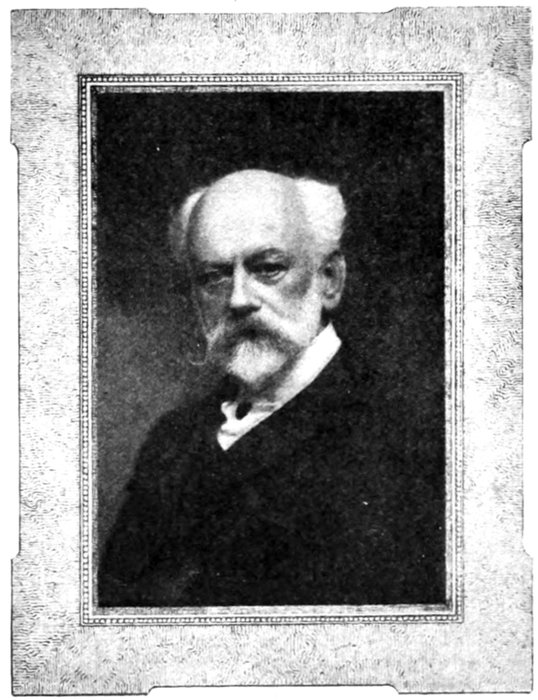
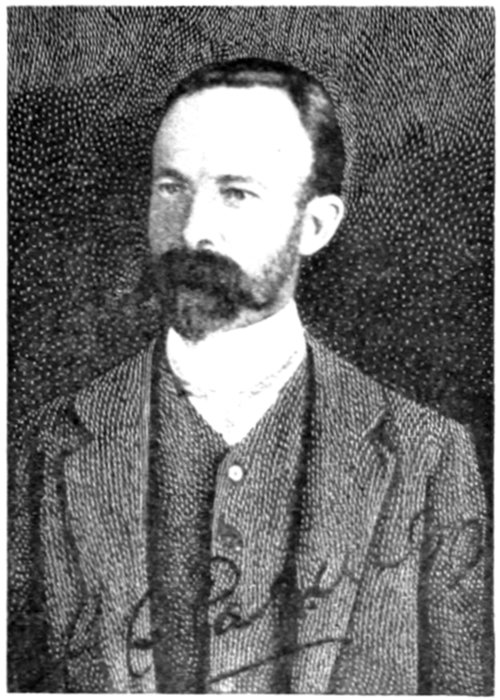
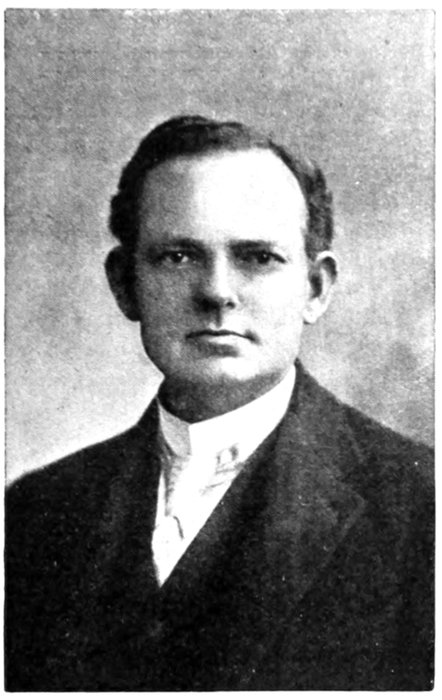
MR. HENRY SANDHAM, WHO, IN ATTEMPTING TO RESCUE A
DROWNING MINER, NEARLY LOST HIS OWN LIFE.
From a Photo, by Elliott & Fry.
Among his varied experiences Mr. Sandham
has had several narrow escapes from death, and
on one occasion in particular the perilous position
in which he was placed might well have
been a creation of the
brain of Edgar Allan Poe
rather than an experience
from real life.
It was in August, 1882,
during a sketching tour
in California, that Mr.
Sandham met with this
alarming adventure.
Accompanied by a
brother artist, he paid a
visit to the Little Sailor
Mine, which is situated
on a spur of the Sierra
Madre Mountains, by the
side of the Sacramento
River, some fifty miles
from San Francisco. The
manager of the mine, in
which hydraulic power is
used, invited Mr. Sandham
to accompany him
on the occasion of the
monthly clean-up of the
gold in the tunnels.
Always anxious to add
to his store of information,
the artist gladly
accepted the invitation,
asking at the same time that his friend might
join the party, to which request the manager
readily assented.
On the following day Mr. Sandham was on
the spot at the appointed time, eager for what
was to him an entirely novel experience. His
friend, however, was late, and he decided to wait
for him. As subsequent events proved, Mr.
Sandham owes his life entirely to this trivial
incident! The manager and his staff of assistants,
anxious to start the work of cleaning up
without delay, thereupon entered the tunnel,
which had been cut through a high bluff to allow
the water a free passage to the Sacramento
River, several thousand feet below the level of
the mine.
While waiting for his friend, Mr. Sandham
employed his time in making a sketch of the
only "monitor" (delivery-nozzle) then working,
and the man in charge of it sauntered over
to watch the progress of his facile pencil. Before
his sketch was finished Mr. Sandham noticed
that the "monitor," which had hitherto been
throwing a regular jet of water at a terrific
pressure, by means of which the solid rock was
literally washed away, had become spasmodic in
its action. Curious to learn the reason, he
called the miner's attention to the fact. To his
utter astonishment the engineer received his
remark with the utmost consternation, and,
throwing up his hands
with a gesture of despair,
shrieked:—
"Good heavens! The
pipe has burst, and all the
boys will be drowned!"
With that he at once
dashed off frantically
in the direction of the
signal-station to order the
water to be turned off
at the upper reservoir,
which was situated many
hundred feet above the
level of the mine, and
was fed from the Sierra
Madre Mountains, twenty
miles away. Meanwhile
Mr. Sandham realized
that with the bursting of
the pipe the tunnel must
have been instantly
flooded with an immense
volume of water, and that
the unfortunate manager
and his staff were caught
like rats in a trap. At that
very moment they were,
without a doubt, fighting
desperately for their lives. With characteristic
energy Mr. Sandham's one desire was to help in
the work of rescue, but the very thought of the
men's seemingly hopeless plight left him with
a sickening feeling of impotency. He quickly
decided, however, that the one place where he
might be of use was at the outer end of the
tunnel, from which the escaping waters rushed
headlong over a precipice, to fall in a series of
frightful leaps some thousands of feet into the
river far below. To reach this spot Mr. Sandham
had to climb the high bluff through which
the tunnel was cut, and descend the almost perpendicular
cliff on the other side. The climb
itself was no mean test of a man's agility and
nerve, but Mr. Sandham has both, and he was
soon at the summit. As to how he got down
the other side Mr. Sandham says he is to this
day not quite clear, but judging from his
battered and bleeding condition and the state
of his clothing afterwards he thinks he must
have done so by alternately falling and sliding.
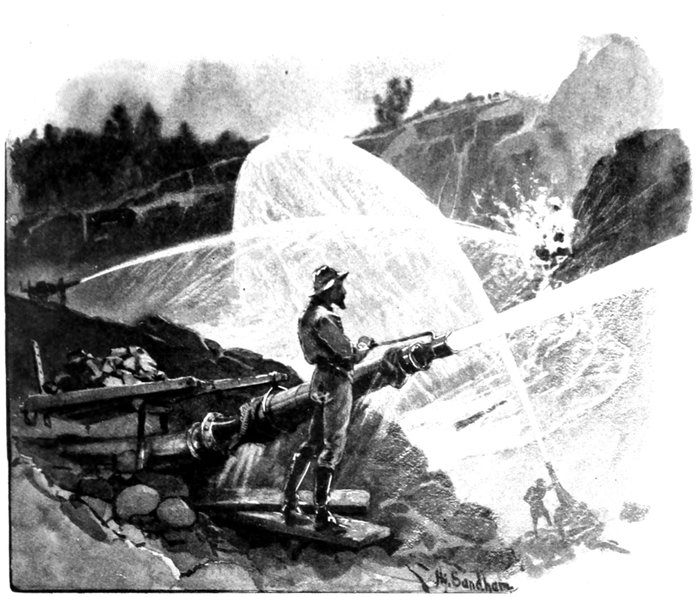
"MONITORS" AT WORK—THE PRESSURE OF THE WATER IS SO TERRIFIC THAT THE SOLID ROCK IS LITERALLY WASHED AWAY.
OUR ILLUSTRATION IS FROM A DRAWING MADE BY MR. SANDHAM WHILE IN CALIFORNIA.
Exhausted and breathless, he finally reached
the short section of the flume, immediately under
the outlet of the tunnel, leading to the edge of
the precipice. At that instant a dark object shot
like a ball from a cannon out of the cavern into
the flume, and was carried along and swept over
the edge of the cliff. Mr. Sandham discovered
afterwards that this was the body of the ill-fated
mine-manager. After an interval of a few
seconds another body was fired out of the
tunnel, and as it swept down the flume towards
him Mr. Sandham instinctively reached out
his arm to catch it. Next instant his hand
was grasped with a convulsive grip, the man's
body swung out to the rush of the water, and
Mr. Sandham knew that on the strength of his
arm depended a human life.
At first he thought he could easily rescue the
man by hauling him out of the water, but he
speedily found that this was impossible, and
that he was not only fighting for a fellow-creature's
life but for his own as well. His
position on the side of the flume afforded him
but a precarious hold, and such was the terrific
force of the racing torrent of water as it threatened
to tear the drowning miner from his grasp
that Mr. Sandham realized that he was not only
powerless to pull the man out, but that he
himself was in imminent danger of being
pulled in. Once at the mercy of the rushing
waters, no power on earth could save the pair
of them from an awful death.
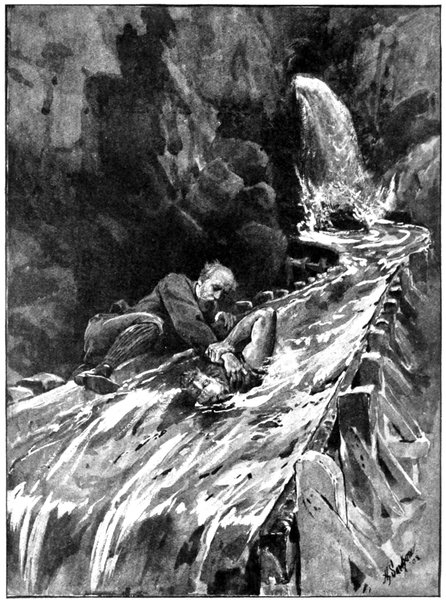
"NEXT INSTANT HIS HAND WAS GRASPED WITH A CONVULSIVE GRIP."
It is vastly to Mr. Sandham's credit that even
in this dire extremity he had no thought of
releasing his grip of the man's hand in order to
save his own life. At the same time, any such
intention on his part would have been futile,
for the frenzied miner, with the fear of death
strong upon him, held him in such a vice-like
grip that it was perfectly clear they must both
share the same fate, be it life or death.
The struggle was a grim one, and, putting
forth every effort he was capable of, the artist
strove hard to pull the man out of danger. His
frantic endeavours, however, were unavailing,
and he felt himself gradually slipping—drawn
irresistibly into the mill-race, which would sweep
him and the hapless miner down the flume and
hurl them over the precipice to meet a frightful
death on the rocks far below. Meanwhile his
companion in danger was powerless to help
himself, but the agony of mind he endured was
vividly portrayed on his drawn and ghastly face
as he fought with all his strength against the
onrush of the current.
Slipping, slipping, inch by inch, until his
body overhung the water to a perilous extent,
Mr. Sandham felt instinctively that his strength
was failing him. A few seconds more and the
end must come! A cold sweat broke out on
his brow, and his arm felt as though it was being
wrenched from its socket. And then, suddenly,
the dreadful strain lessened. The miner, in his
frantic struggles, had managed to grasp the side
of the flume, and, with this added opposition to
the force of the water, Mr. Sandham was able to
recover his balance, and at last, with an almost
superhuman effort, he dragged the man from
the water.
Their peril did not end here, however, for the
force he had exerted landed the engineer on top
of the artist, and in their nervous excitement the
pair clutched each other and rolled over towards
the precipice. The rocks sloped sharply down
to the edge, and for the second time within the
space of a few seconds they were in actual
danger of their lives, for the impetus their bodies
had acquired carried them down until their
heads were actually hanging over the chasm.
"There was no earthly reason why we should
stop there," says Mr. Sandham, "save that
Providence so ordered it." But stop they did,
and in a few minutes they were able to crawl
back exhausted to a place of safety, where they
lay unable to move, speak, or even think for
some considerable time. At length the miner
sat up and said in a dazed, monotonous voice,
"The boss is gone dead, drowned like a rat in
a hole. Poor beggar, he was to have gone East
to-morrow—he had made his pile. He was
going back to his wife and kids. And I should
have died with him if you had not caught hold
of me." Then his mind seemed to clear and he
exclaimed, "Say, stranger, what particular kind
of fool are you, anyway? Because, if I had
missed my clutch on the flume side when I got
my grip on your arm, we would both be down
there, ground up into tailings. Shake, stranger."
He held out a huge, hairy hand, and Mr.
Sandham realized that he had received a
Western miner's heartfelt thanks for the saving
of his life.
The water had now been turned off at the
reservoir and, the furious torrent being thus
reduced to a mere trickle, all further danger
to those in the mine was over. The miner's
convulsive grip and the terrific strain of the
current left Mr. Sandham with a crushed
hand and badly-wrenched shoulder, the effects
of which he felt for many months.
Looking back to-day on his adventure Mr.
Sandham says that the point most vividly
impressed on his memory is the fact that if he
had not waited for his friend he would have
been caught with the others in the flooding
of the mine. Naturally, as the guest of the
manager, who had gone on ahead of the party,
he would have been close to him at the time
of the disaster and would undoubtedly have
shared his terrible fate. The rest of the party,
being near a manhole, luckily made their escape—all
except the foreman, who had pluckily
allowed his men to go first. His chivalry nearly
cost him his life, for he was too late to save
himself and was caught in the flood. It was he
whom Mr. Sandham so pluckily rescued.
Among the artists who have contributed to
The Wide World, one of the most familiar
names is undoubtedly that of Mr. Alfred Pearse,
whose well-known signature, "A. P.," appeared
in the very first number of the magazine.
Mr. Pearse has met with such an extraordinary
number and variety of accidents and
adventures during his career that he says,
"There is no doubt that by all the laws of
chance I ought not to be here, but killing seems
to agree with me."
His list of casualties is an extraordinary one.
He has been nearly drowned three times, and
has had concussion of the brain more than
once. He has fallen off the tops of omnibuses—on
one occasion through the bus skidding
when he was on his way to Cowes to make a
sketch of Queen Alexandra's pet dogs. This
resulted in his being paralyzed in the legs for
six months, and one of his most cherished
possessions is a kindly letter of sympathy from
Her Majesty, expressing her hopes for his
speedy recovery. Mr. Pearse has been drugged,
poisoned, and shot, has fallen down Beachy
Head, and been knocked down and injured by
runaway horses and motor-cars. He has slipped
between a moving train and the platform,
has been within an ace of falling over a precipice
in the Alps, has been chased by wild bulls, been
blind for two days (the after-effects of a red
spider bite), and had his left shoulder put out
of joint. It is perhaps permissible, therefore, to
refer to him as the most "accidental" man in
the world.
Mr. Pearse's alarming list of mishaps, however,
does not appear to have affected him in any
way, for he is to-day as full of vigour and spirits
as many a man of half his years and considerably
less than half his accidents.
But there is one particular experience in his
life which Mr. Pearse confesses stands out above
all others in sheer intensity of horror and nerve-racking
anguish—an occasion when he was
absolutely and entirely at the mercy of a raving
lunatic. There are, it is safe to say, few men
who have been so near death and have survived
the ordeal.
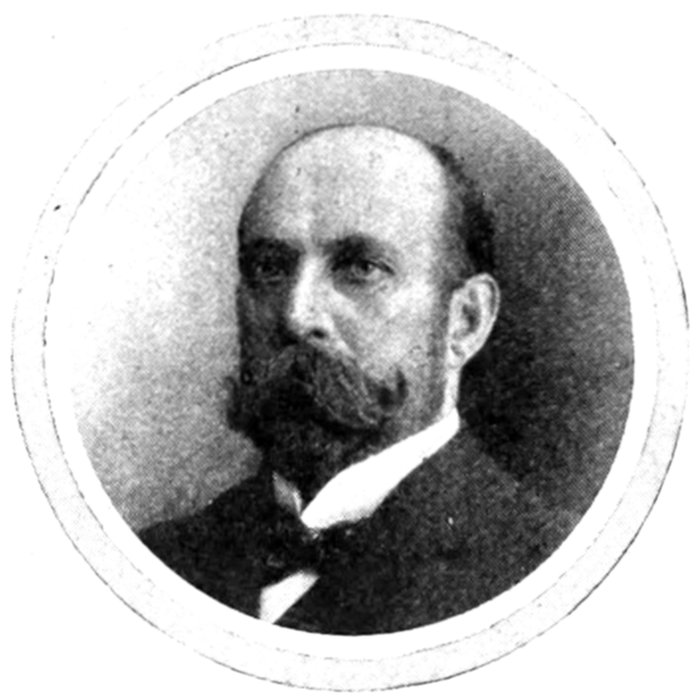
MR. ALFRED PEARSE, WHO WAS SUSPENDED OVER
THE WELL OF A DEEP STAIRCASE BY A MADMAN.
From a Photo. by Talma, Melbourne.
This alarming adventure
dates back to Mr. Pearse's
early manhood, and had its
inception in the introduction
into his family circle of a
certain individual who, for
obvious reasons, we shall
refer to in this narrative as
Mr. X——.
Mr. Pearse first made the
acquaintance of Mr. X——
owing to the interest he manifested
in the affairs of the
church at which his family
attended. Mr. X—— soon
began to show a considerable
liking for Mr. Pearse,
and the close friendship
which ensued led to the latter's father inviting
Mr. X—— to his house, where he soon
became a welcome visitor. He was undoubtedly
an interesting personality, although
even at this time he was regarded as being
somewhat strange in his manner and subject to
hallucinations. For instance, he once declared
that he had caused the death of his wife, and
also that he took a delight in poisoning his
neighbours' dogs and then offering a reward for
the apprehension of the poisoner. These wild
statements, however, were received with pity
rather than credence.
Mr. X—— was, according to his own account,
an Australian, and in appearance was gaunt,
large-headed, and glaring-eyed, with a scanty
beard and moustache. He stood well over
six feet in height, and was evidently of immense
muscular strength.
Although a man of professedly religious inclinations,
his actions were not always in keeping
with his words; and Mr. Pearse, when visiting
him at his rooms, would often find him raving
like a madman, reviling himself and those with
whom his past life had been spent. On one of
Mr. Pearse's visits he found Mr. X—— almost
delirious with laughter, owing to the fact that
his servant was seriously ill after drinking some
of his master's whisky, into which Mr. X——,
suspecting that the man was in the habit of
helping himself, had put some laudanum.
On the other hand, for all his evident madness
or wickedness, there was a good side to his
character, and Mr. Pearse once saw him knock
down a bully who had insulted an old man;
while on another occasion he interfered to protect
a woman from the brutal assault of her
husband. It was simply for this reason that Mr.
Pearse endeavoured to befriend him, although
at times his conduct was such as to strain their
relations almost to breaking-point.
Unfortunately, X——'s conduct
went from bad to worse,
until at length he gained
for himself an unenviable
notoriety throughout the
neighbourhood. Mr. Pearse
was still stanch to his ill-guided
friend and ready to
welcome him in his home,
but his father, having regard
to his son's welfare, could not
but regard their friendship
with considerable misgivings,
and on one of X——'s
periodical visits he was reluctantly
compelled to forbid
him the house. X——
received the ultimatum in sullen silence, and
with a vindictive scowl on his face he took
his departure.
Mr. Pearse was at the time studying wood-engraving
with Messrs. Nicholls and Aldridge
at 13, Paternoster Row, and one afternoon
shortly afterwards he was considerably surprised
when Mr. Nicholls came into the office and
said, "Who is that madman sitting on the
stairs?"
Naturally enough the young artist's first
thoughts were of Mr. X——, and he immediately
ran out on to the landing to investigate. There,
sure enough, seated on the top stair, was the
familiar figure of X——, wearing a "wideawake"
hat and Inverness cape.
They were on the top floor of the building,
and there was a large well staircase with a sheer
drop of sixty feet straight down to the hall
below. Mr. X——, whose eyes were staring
wildly and whose every feature was working convulsively,
dropped his hat and umbrella at sight
of Mr. Pearse, and without a word seized him
by the collar of his coat and the left arm and
forced him towards the banisters. So sudden
was the onslaught that the young man had no
time even to call for assistance, but he nevertheless
realized his peril and struggled desperately
in the grip of the madman. Mr. Pearse was not
only young but slight of build for his age, and
despite his efforts he was quite powerless in
the hands of X——, who, with the almost
supernatural strength of a maniac, lifted him,
apparently
without effort,
clean over the
banisters, and
held him suspended
in mid-air
over the
abyss, with nothing but sixty feet of air between
him and the stone floor below.
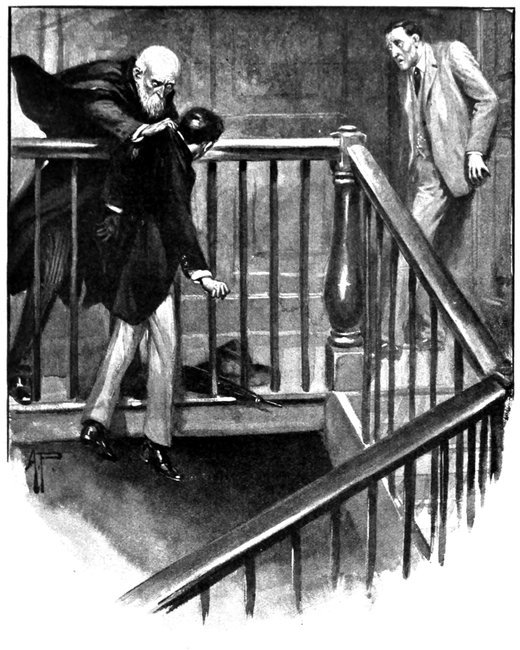
"HE HISSED IN A COLD, HARD VOICE, 'I ALWAYS REPAY! I AM GOING TO
DROP YOU, ALFRED; AREN'T YOU AFRAID?'"
Even in this awful extremity the one idea
uppermost in the artist's mind was as to his best
means of escape. Could he clutch hold of anything
before the crash came? Could he swing
himself on to the next landing or cling to his
captor? X——, however, was too cunning in
his methods to allow of any such manœuvres,
and Mr. Pearse
soon realized that
he was absolutely
and entirely at the
mercy of a raving
lunatic, and that
his life depended,
small though the chance was, on his own coolness
and resource.
At that critical moment, curiously enough,
the young man's chief concern was for the
welfare of a friend of his, also studying wood-engraving,
who had followed him from the
office, and who, with bulging eyes, open
mouth, and face ghastly green with fright,
was a horrified witness of the proceedings,
pressing back against the panelled wall as if he
wished he might vanish through it. Mr. Pearse
devoutly hoped the young fellow would remain
quiet, for the slightest movement, he felt convinced,
would hasten his own end. Fortunately,
however, he was too petrified by fear to
be capable of action or speech.
Thoughts of his mother and her anguish at
his tragic death next took possession of Mr.
Pearse's mind, but his desire to live and the
necessity for concentrating his thoughts on his
terrible plight were suddenly brought back to
him by Mr. X——, who hissed in a cold, hard
voice, "I always repay! I am going to drop
you, Alfred; aren't you afraid?"
Mr. Pearse was firmly convinced that his last
hour had come, but summoning all his fortitude
and exerting his will-power to the utmost he
replied without the slightest hesitation, "No;
for I know you will put me back."
The apparent coolness and indifference with
which the young artist replied were without
doubt the means of his salvation, for the madman,
with a profound sigh—as though he was
sorry, but was obliged to do so—pulled him
over the banisters and
dropped him on the landing.
Then he fled, leaving his
umbrella and hat behind him.
Mr. Pearse has never from
that day seen or heard of his
assailant, but even now the
mere thought of the agonizing
suspense he endured at his
hands brings with it a
shudder of horror.
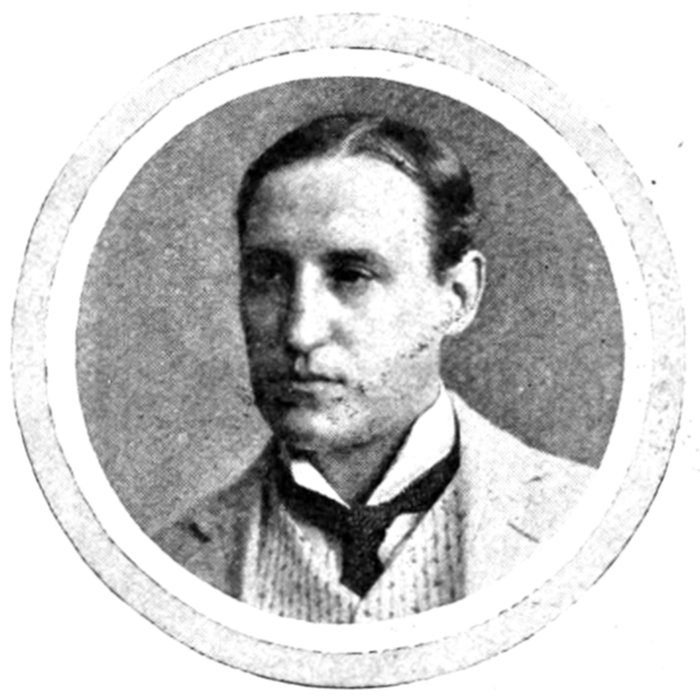
MR. A. J. GOUGH, WHO NARROWLY ESCAPED DEATH
AT THE HANDS OF AN INFURIATED COWBOY.
From a Photo. by Geo. Newnes, Ltd.
Mr. A. J. Gough is another
Wide World artist—a Yorkshireman
by birth—who has
seen much of the world and
taken part in many an exciting
episode in wild and
uncivilized places.
His early youth was spent
in India, where his father—Mr. J. W. Gough,
the architect—was building a palace for the
Maharajah of Durbhungah; and there he met
with his first adventure, when he lost himself in
a tiger-infested jungle, and was only found by
the search-party with much difficulty.
Mr. Gough subsequently went to America,
where his experiences included encounters with
alligators and rattlesnakes and disputes with
"bad men" armed with bowie-knives and six-shooters.
He has won fame as an amateur
boxer, and is still a member of the Belsize Boxing
Club, being also well known as a swimmer.
Mr. Gough has roughed it in Florida and
Texas, and it was in the latter State that he
experienced his most alarming adventure, on
which occasion he was literally within half an
inch of death.
It was at the hands of a cowboy known as
"Harry" that he nearly lost his life. He
made this man's acquaintance under the following
singular circumstances. Mr. Gough and a
friend of his were on their way to Florida from
New York by steamer, and, as funds were low,
had perforce to travel steerage. Among their
fellow-passengers was a man whose appearance
clearly denoted the cowboy, and who, although
of rough exterior and manners, was evidently in
some respects fastidious in his tastes.
He took occasion, early in the voyage, to find
fault with the drinking water supplied in the
steerage, which was contained in a huge tin
tank. Calling the steward, he remarked:—
"That there tank isn't fit for a dog to drink
out of, let alone a man."
"Isn't it, by gum?" replied the steward, sullenly.
"Well, you can take it from me, it's all
you'll get this voyage."
"Oh, it is, is it?" growled the cowboy, with
an ugly look in his eyes. "I
can tell you this, mister: if
you expect me to drink out
of that blamed horse-trough
you are blamed well mistaken!"
"You can take it or leave
it," replied the steward, with
an oath; "and, if you are
so mighty particular, why
don't you go first class? You
look like a millionaire, I must
say," he added, offensively.
The cowboy was by this
time livid with passion, and,
fetching his "Winchester"
from the cabin, he, without
further reply, started blazing
away at the tank, from
which the water was soon
spurting in all directions.
He had obviously completely lost all control
of himself, and on an attempt being made to
secure him he got his back against a bulkhead
and threatened to shoot any man who came
near him. If looks went for anything he certainly
meant it, and as no one dare approach
him he fairly "held up" the ship, or, at any
rate, the steerage.
In this extremity the captain was appealed to.
Seeing that he had a dangerous customer to deal
with, and being anxious to avoid bloodshed, he
pretended to side with the cowboy, telling him
he was quite right in what he had done, and
promising to see that the steerage passengers had
a better supply of drinking water. Peace being
thus restored the malcontent cooled down, and for
the rest of the voyage he was quite good-natured
and jolly, becoming the life and soul of the
ship. In fact, he became so popular that even
the captain and mate of the steamer joined in
the merrymaking which took place in the steerage.
Before the voyage was ended, Mr. Gough—then
a youngster in his teens—and Harry the
cowboy had established a firm friendship, and
this was renewed some nine months later
at Leesburg, in Florida, whither Mr. Gough
had drifted in search of work. Harry was
then ranching at Sumterville, in Texas, and
having taken a violent fancy to Mr. Gough he
offered to engage him to help with the horses,
which offer, coming as it did at an opportune
moment, was promptly accepted.
The cowboy was a man of about forty,
tall and loosely built, with deep-set eyes, a
bristly moustache, and a square, determined
jaw. His huge, knotted limbs gave evidence
of immense physical strength, and his brawny
chest might well have served as a model for a
sculptor. On special occasions he wore on his
breast a small solid gold model of a bull, given
him as a memento by a lady whose life he had
saved, at the imminent risk of his own, by killing
a mad bull that had attacked her, and he was
exceedingly proud of his queer medal.
Albeit an exceedingly rough specimen of the
uncut diamond, Harry the cowboy was, under
normal conditions, of an unusually kind and
even tender-hearted disposition, but, as this
story will show, he was subject to sudden outbursts
of temper, often for very trifling reasons,
of absolutely appalling ferocity.
His ranch was situated in a lonely spot, and
there for some months Mr. Gough lived a hard
and open-air life, enjoying to the full, in the
vigour of his youth and spirits, the arduous
round of a rancher's daily toil. Although now
and again his companion gave way to outbursts
of temper, there was nothing to cause him any
serious alarm.
Among his various duties, it fell to Mr.
Gough's lot to cook the meals. On one occasion
he had prepared a savoury dish of stew, which
he and the cowboy, at the end of a particularly
hard day's work, sat down to enjoy.
The manners of the establishment were, to
say the least, of a rough-and-ready description,
and the two hungry diners sat facing each other
on the floor, helping themselves from a large
iron pot.
Mr. Gough, as it happened, was the first to
finish his repast, and in the exuberance of a
passing fit of hilarity proceeded to execute a
pas seul, hopping on each leg alternately round
the bare apartment.
In the course of his antics he came quite close
to the seated figure of the cowboy, who had just
helped himself to a fresh plate of stew. Then,
stumbling, he lost his balance, and fell heavily to
the ground, his foot crashing fairly into the
middle of his friend's plate.
Mr. Gough at once scrambled to his feet and
began to apologize in a jocular way for his
accident. "Sorry, old chap," he exclaimed; "I
hope I haven't spoilt your dinner."
But Harry was not at all disposed to take
the matter as a joke, and with a dangerous glare
in his eyes he half rose to his feet. "You
clumsy brute!" he shouted, angrily. "Isn't it
hard enough to earn a meal without you spoiling
it with your infernal tricks, confound you?"
"Oh, all right," replied Gough; "there's
plenty more, so you needn't get in a rage about it."
The cowboy was now absolutely beyond himself
with passion, and with twitching lips and
starting eyes he reached for his "gun." For
the moment, in fact, he was quite demented
and "saw red."
Fortunately, however, his revolver was not at
his side. If it had been, Mr. Gough is firmly
convinced that he would there and then have
been shot dead.
Deprived of this weapon Harry leapt to his
feet. "You don't spoil a man's dinner for
nothing, I can tell you," he roared, "and, by
Heaven, I'll spoil you, if I swing for it!" With
that, carried away by an ungovernable fury of
rage, he drew a gleaming bowie-knife from his
belt and rushed at Gough, who was much his
inferior in strength, and was, moreover, unarmed,
thus being apparently entirely at his mercy.
To make matters worse, the cowboy was
between the young artist and the door, so that
escape that way was impossible. He has never
yet been found wanting in pluck, however, and,
although he felt that his last hour had surely
come, he braced himself to meet the attack.
A rapid glance in search of a weapon of defence
showed that there was nothing within reach.
His first impulse was to grapple with his
assailant, but the odds were obviously too great,
and there was nothing for it but to await the
attack. This, mercifully, was not long in coming,
for, with the unreasoning fury of a maniac, the
cowboy made a dash for him with upraised knife.
A quick lunge, and the knife flashed downward.
If ever a man stood face to face with
death, Mr. Gough did during that awful second.
Instinctively he ducked and dodged the blow, the
deadly blade whizzing over his shoulder, missing
him so narrowly that it actually grazed his head!
Mr. Gough was standing against the wall, and
as the cowboy had literally hurled himself at him
in the intensity of his passion, the knife, driven
with all the power of Harry's immense strength,
was buried deeply in the woodwork. So firmly
was it embedded that its owner, in his blind
fury, experienced considerable difficulty in extricating
it. The consequent lull in the hostilities
gave Mr. Gough his chance, and with a flying
leap he dashed through the door and gained the
open air. Once outside the tables were turned,
for the cowboy was no match for the youngster
when it came to a test of speed.
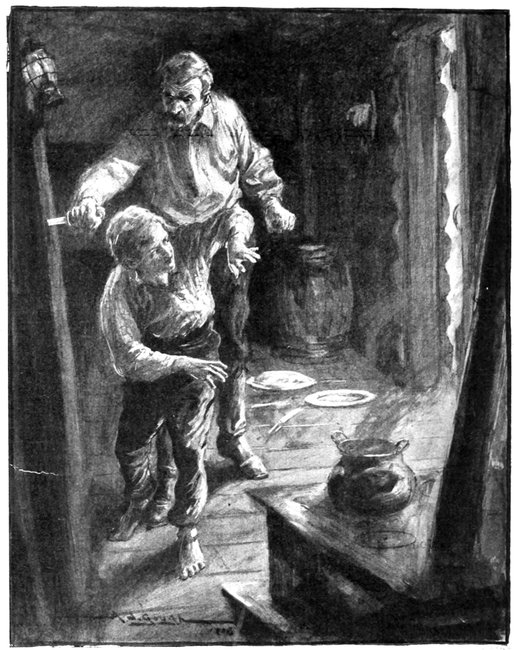
"THE KNIFE, DRIVEN WITH ALL THE POWER OF HARRY'S IMMENSE STRENGTH, WAS BURIED DEEPLY IN THE WOODWORK."
This he soon realized, and in a few moments
he calmed down. As his brain cleared the
frightful possibilities of his murderous outbreak
dawned on him, and with sincere and abject
repentance in every look he exclaimed:—
"Come inside, old chap. I was mad, and
I'm sorry I made a fool of myself. Here's my
hand on it. Shake."
Mr. Gough took the proffered hand and there
and then made up the quarrel, but very wisely
he decided not to risk the chances of another
similar outburst, and so shortly afterwards he
said good-bye to Harry the cowboy and secured
work elsewhere.
(To be concluded.)
Another of the famous Alpinist's fascinating articles, describing his attempt to reach the hitherto
untrodden summit of Mount Sarmiento, the highest peak in desolate Tierra del Fuego.

To the ordinary reader the name of
Tierra del Fuego probably suggests
a region about as remote and unfamiliar
as any outside the Arctic
regions. Yet the country, far away
though it is, is not really difficult of access.
The Straits of Magellan are daily traversed by
ocean-going steamers, all of which stop at Sandy
Point on the mainland, just opposite this forbidding
island. Thousands of voyagers annually
pass through the Straits and, if the weather is
fine, behold the snowy mountains on the
southern horizon; but very few stop by the way,
and fewer still ever cross to the inhospitable
shore opposite. Nothing more bleak and uninviting,
indeed, can be imagined than the
shores of Magellan's Straits. The weather is
generally abominable. Rain falls in soaking
torrents. The lower slopes and flats are
covered with dense, reeking forests. Higher
up comes the snow, which gradually looms
forth in a pallid, death-like whiteness out
of the heavy clouds, very different in aspect
from the splendid brilliancy of Alpine snows,
standing forth against
radiant, sunlit skies. In
fine summer weather
Alpine snows attract a man
upwards; their loveliness
seems to invite a visit. It
is far otherwise in the
Fuegian archipelago.
There the great range of
Andes sinks into the ocean,
its peaks become islands,
and its valleys are straits
or fjords. You must go by
water to the foot of each
mountain, and the navigation
is difficult and often
dangerous. Not far away
is the raging ocean, everlastingly
tortured by storm
and tempest. A black
cloud roof generally passes
overhead, dragging skirts of hail, rain, or
snow over the reeking earth. Never is the
whole round of view clear. Now one region is
blotted out and now another. If the sun shines
for a little while it is soon obscured, and storm
succeeds after a short interval.
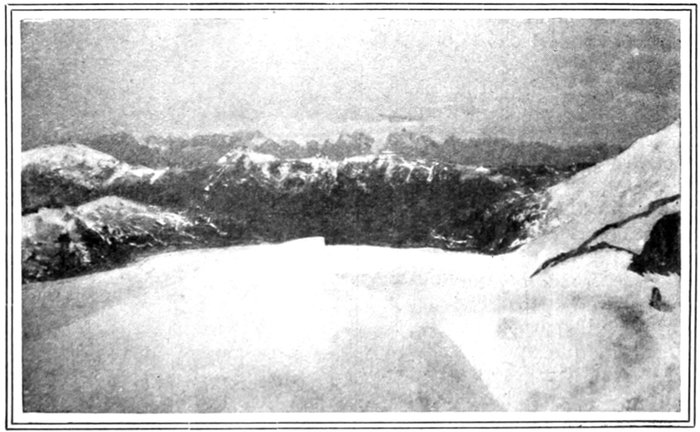
A TYPICAL LANDSCAPE IN TIERRA DEL FUEGO, GIVING SOME IDEA OF THE AWFUL DESOLATION
OF THE COUNTRY.
From a Photograph.
To an explorer, nevertheless, this region has
great attractions, owing to these very facts.
There is so much to discover, the scenery is so
unusual, and there is the possibility of adventure
at every step. All is uncertain, and the way has
almost to be felt. Moreover, if perchance a
fine interval comes, the storm-riven, ice-sheathed
landscape is so astounding, the effects of light
in so dense and wet an atmosphere are so extraordinary,
that it is impossible to resist their
fascination. Add to all this the spice of
danger which still remained when I was there,
and perhaps still remains. The natives were
distinctly hostile to the white man. They were
few in number, an amphibious race living in
booths, practically in the Stone Age so far as
tools and weapons were concerned; not very
dangerous foes, therefore, yet subtle, and
delighted to slay a white man if they got
the chance. They would overpower him in
his sleep, or lie in wait for him in the dense
forest, through which they can travel far faster
than he can. Many a man has been killed by
them with their stone or glass-pointed arrows,
shot out of the dense bush from the distance of
only a yard or two. When I was lying in a
small launch off the foot of one of the mountains,
in the blackest darkness of a stormy night,
a canoe laden with such Indians crept silently
up alongside in the shadow of overhanging
trees. Had we not been on the alert they
would have tried to rush our boat, but, finding
that impossible, they as silently glided away;
and no trace of them was anywhere discoverable
when morning dawned, though no doubt
they were hidden somewhere near at hand and
kept us under close observation.
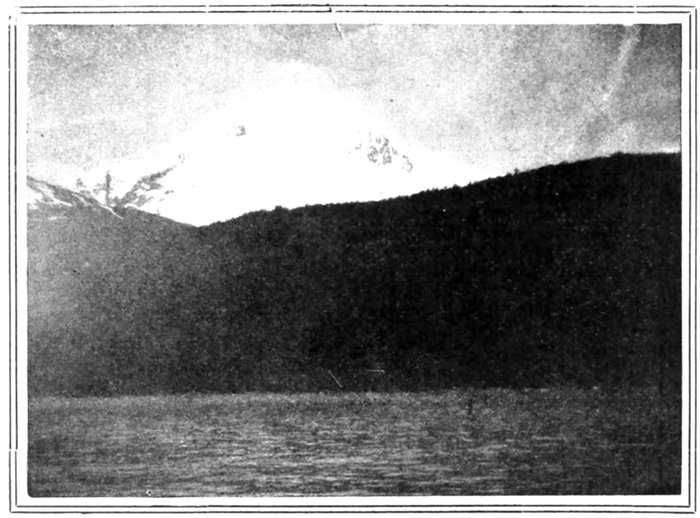
MOUNT SARMIENTO FROM COCKBURN CHANNEL.
From a Photograph.
As we came into the maze
of channels which surround
and penetrate the mountains,
though we saw no Indians, we
were aware that our coming
was noticed, because at different
points columns of smoke
arose into the air. It is thus
that the savages communicate
with one another. They have
a smoke language, and news
is passed quickly and silently
from group to group. It was
only when we landed and
climbed to a high point overlooking
the channels that we
realized what was going on;
for then we were able to observe
the columns of smoke in a dozen
or more different places—signals
of our movements, spreading
gradually over the archipelago
from family to family of scattered
Indians.
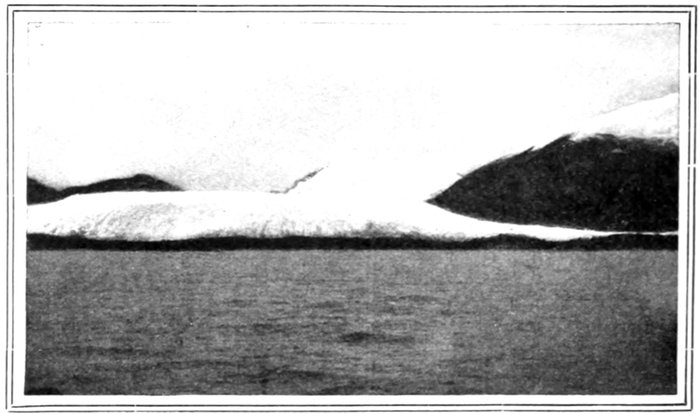
THE GLACIER OF MOUNT SARMIENTO.
From a Photograph.
The great mountain in this
part of the world is Mount Sarmiento.
It is only seven thousand
two hundred feet high, but
its glaciers reach to the sea, so
that it may be compared on an
equality, from a climbing point
of view, with Mont Blanc, if that
be thought of as sunk into water
up to the snow region. On clear
days Sarmiento is visible to
voyagers through Magellan's
Straits. It is a glorious mountain,
surrounded by many other
noble peaks. In form it is of
supreme beauty, and its surroundings are of
the most romantic character. It was this peak,
of course, that I desired to attempt, and I
stopped at Sandy Point for that purpose.
After much trouble I obtained the loan of a
steam-launch for a few days, and set forth in
the usual bad weather. We voyaged up various
channels, between steep hillsides streaming with
more waterfalls than, I think, can elsewhere
exist in an equal area. In Cascade Reach, for
instance, there are literally hundreds of them,
succeeding one another every few yards.
After a day's steaming we reached the foot
of our peak, and with much difficulty found a
treacherous anchorage. There were clouds
everywhere above and below, and wooded banks
loomed dimly into view close at hand; but
towards sunset there were signs of the weather
clearing up. It was one of those slow midsummer
sunsets of high latitudes, when the
colour comes very gradually and fades equally
slowly. At first only the icy base of the
mountain was visible in the grey shadow of
clouds, with the dark forest ring around it,
and the calm, black water below. Presently a
soft, pink light crept up the tumbled ruin of the
glacier, higher and higher, as the mist dissolved,
and revealed steep ice walls scarred by serrated
ridges, and a great arête set with pinnacles of
splintered rock. Some white points on the
summit crest appeared, but a soft cloud floated
just above them, enveloping the top. Suddenly—so
suddenly that all who
saw cried out—away above
this cloud, surprisingly high,
appeared a point of light,
as it were a brightly glowing
coal. The fiery glow
crept down and down till
we beheld the likeness of
a great pillar of red fire. It
was a tower of ice-crusted
rock reflecting the bright
afterglow of sunset. Regathered
mists wrapped the
glorious vision away even
before it had begun to fade.
We remained afloat on the
calm water, wondering at
the utter silence all around.
Not a breath of air stirred,
no stone fell, no avalanche
slipped. The babbling
glacier-torrent above alone
broke the evening stillness.
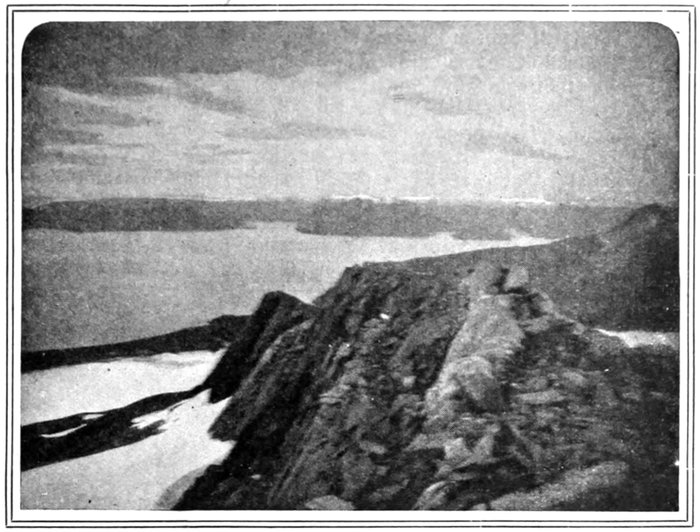
THE VIEW FROM THE SLOPES.
From a Photograph.
Next day we landed to
reconnoitre, and at two
o'clock the following morning we set forth
for our climb. We landed at the edge of a
forest and had to force our way through it. The
ground was a chaos of stones, the trees grew
close together and were densely matted with
other vegetation. The whole place was reeking
wet and it was pitch-dark. We fought and
tumbled our way through this hideous chaos as
best we might, and in an hour or two got out
on the other side, near the margin of a glacier.
Here we could scramble along well enough over
the moraine, and presently we had daylight to
help us. Nothing was visible ahead; there was
the ice-wall on one hand, rock-cliffs on the other.
Presently it seemed better to climb the rocks,
and we accordingly turned aside to scale them.
They were not difficult, and we rose higher
and higher, passing through another narrow belt
of forest, where the trees grew in the chinks
and crannies of a wall of rock polished by ice
and precipitously steep. Above that came a
floundering bog, and then at last a reasonable
grass-slope that narrowed into a rock-ridge.
The rock presently gave place in turn to snow,
and led us on to the mass of the mountain.
The weather was now tolerably clear, though
over all there hung a dark pall of cloud, through
occasional holes in which shafts of solid-looking
sunlight penetrated. Where we rested for breakfast
we had a most striking view over desolate
channels and still more desolate islands, a very
labyrinth of waterways and mountain walls. We
could see westwards to the ocean and northwards
to the continent; the flat land of the
northern part of Tierra del Fuego was at our
feet.
Its great mountain backbone was behind us
as we faced north. We looked along the face of
it as along a wall, but all its crest was in the
clouds. Looking down whence we had come
we saw our boat like a little cork on the
water. Also we could now look down into the
water itself and discover the countless sunken
rocks amongst which we had so casually navigated.
There was one, only a short distance
from our anchorage, close to which we must
have steamed. These details, of course, are not
charted; a navigator in such out-of-the-way
places must take his luck.
From this point our way lay right up the
great northern face of the peak, which is covered
by an ice-cascade. This empties below into a
huge glacier plateau or lake, which is drained
by several glacier tongues, up one of which
we had come. As we climbed on I kept
looking round and gazing on the wonderful
panorama, for it was obviously destined to be
soon blotted out. Our way lay amongst huge
seracs. Deep crevasses yawned all about, and
occasionally we had to double back and forth to
get ahead.
At last, however, we reached plainer going,
traversing a steeper but less broken slope
which led to the foot of a final pyramid of rock.
But these rocks, unfortunately, we never actually
reached, for the storm battalions from the north
swept furiously down upon us, swallowing up
the view before ever we reached the crest of the
range whence we might have looked down into
the dark hollow of Beagle Channel. The darkness
in the north before the tempest fell upon us
was truly appalling. As it advanced it seemed
to devour the wintry world. The heavens
appeared to be descending in solid masses, so
thick were the skirts of snow and hail that the
advancing cloud-phalanx trailed beneath it.
The black islands, the leaden waters, the pallid
snows, and the splintered ice-encrusted peaks
disappeared in the blackness of the storm, which
enveloped us also, almost before we had realized
that it was at hand. A sudden wind shrieked
and whirled round our heads; hail was flung
into our faces, and all the elements began to
rage together. The ice-plastered rocks were now
easily accounted for; we resembled them ourselves
in a very few minutes. All landmarks
vanished; the drifted snow itself was no longer
distinguishable from the snow-filled air.
To advance under these appalling conditions
was impossible. The one thing to be done,
and done at once, was to secure our retreat
before it was too late. How we raced downwards!
Not till we gained the lower glacier
did snow give place to rain, which soaked us to
the skin and overflowed in a steady stream out
of our boots. We floundered in swamps,
tumbled through brushwood, and at last gained
the shore, almost dead beat with toil, yet
delighting in what had been, after all, an
exhilarating experience. A boat came off to
fetch us, and we were soon on board our
steamer. Thus we did not reach the actual
summit of Mount Sarmiento—that remains
virgin, for I could not wait to try it again.
Whoever climbs it will accomplish a great feat
and will have a splendid experience. Some
years have already passed since my attempt,
however, and I have not heard of another. I
suppose the inhabitants of Sandy Point have
more urgent interests to attend to.
THE UNTRODDEN SUMMIT OF MOUNT SARMIENTO, WHICH THE AUTHOR WAS PREVENTED FROM
REACHING BY A SUDDEN STORM.
From a Photograph.