By Frederic Lees.
That romance, such as the writer of fiction is alone thought capable of producing, often lies hidden in
family records is strikingly borne out by the following story of adventure. The author recently
came into possession of a bundle of letters written from the West Coast of Africa in 1844 and 1845
by his paternal great-grandfather, and from these, combined with details handed down from father to
son, he has put together this interesting narrative. Fierce fighting and foul play on sea and land is
the subject; the scene, the Islands of Ichaboe and St. Helena; the time, the early years of the
reign of Queen Victoria, when, as the reader will see from the dangers run by the hero of the story,
the early pioneers of British commerce were brought face to face with difficulties and perils
which are now almost unknown.

In spite of what had happened,
Captain Jasper Ivory, much to
everybody's astonishment, remained
in the roadstead. With a twelve
months' interdiction against his
name, all chance of getting a pit or stage before
the guano was exhausted was gone. Yet the
Gurango and the Florentia stopped where they
were, their owner professing himself to be
occupied with the purchase of cargoes in view
of a rise in prices. Few people, however, were
deceived, for at the same time that he carried
on these very speculative transactions he was
making himself conspicuous by his overtures of
friendship to certain members of the committee,
who after a few weeks' cajoling he so far won
over as to persuade them to propose a remission
of part of his sentence. But Joseph Lees and
other magistrates would not hear of this, since
it would have been, as the chairman said when
the matter was discussed, "a fatal proof of
weakness on their part, above all in the case of
such a man as Ivory, who would simply take
advantage of it to obtain further concessions
and favours, to which—as a man who had
nearly been caught in the act of crime—he was
certainly not entitled." It was rumoured that
Captain Jasper was extremely angry on hearing
the committee's decision, but he nevertheless
continued his habitual policy of outward friendliness
to all men.
Early in September, shortly after the above-mentioned
meeting, Joseph Lees fell ill. The
symptoms of his malady were peculiar, and as
they baffled the skill of no fewer than three
doctors, it will be as well to enumerate them.
Taking up a book one evening, just before
retiring to rest, he was amazed to discover that
he had suddenly become short-sighted. As his
eyesight had hitherto been perfect, he attributed
the phenomenon to fatigue and the glaring sun
to which he had been exposed all day, and
decided to forego his reading and to at once
retire for the night. On awaking next morning
he was relieved to find that his sight was again
normal. Shortly after noon, however, the focus
of his eyes again changed; then, as before,
there was a return to the normal state.
These intervals of shortsightedness recurred
with distressing regularity for a week or ten
days, at the end of which time Lees called
in the doctor who had accompanied him
from England. General physical debility, occasioned
by living under bad conditions, was pronounced
to be the root of the ill, which would
quickly disappear if combated with a bottle of
port, a generous allowance of nourishing victuals,
and a few days' rest in purer air. Remaining
on board the Elora instead of going on to
the island to superintend the loading of
the boats, the patient tried this treatment
for a week. Far from improving, however,
he rapidly became worse, much to the alarm
of the doctor—a young and nervous man, as
he proved himself to be by losing his head
and proposing a consultation with a brother
practitioner. Putting their wise heads together,
the two doctors found that the supercargo's
stomach was at fault, so they prescribed croton
oil and a low diet. Other peculiar features of
his ailment now began to make their appearance.
He experienced a difficulty in breathing;
at times his eyes brimmed over with tears,
though he felt none of the feelings that usually
accompany them. Weakness, too, set in, and
after six weeks of lying on his back, he was
afflicted with twitchings of the facial muscles.
By this time a third doctor was in attendance.
But he confessed to his colleagues that he had
never seen such a peculiar case before, and
argued that Lees must be suffering from some
blood disease, combined with a nervous ailment,
both of which, he suggested, might be
endemic in that part of the world.
"Let us try mercury," he said. "I have
known it effect wonderful cures. And to show
that I do not disregard your remedy, which has
also many virtues, we will give him occasional
doses of croton oil as well."
The ignorance of these three doctors brought
Lees to death's door. By the beginning of
September he was reduced to such a state of
weakness that he had to have assistance if he
wished to leave his cabin, where he lay for
hours at a time in a semi-paralyzed state. His
brain, he noticed, continued its functions, but
his body began to lose its sensibility to pain.
At last he made up his mind to have done with
his medical attendants and their physics and
try a régime of his own.
"I have the most heartrending tidings to
communicate," he wrote on December 5th to
his son. "I am a dying man, and the chances
are if I ever leave this place and reach England,
though I implore God to spare me to see my
family and arrange my affairs. But, notwithstanding,
His will be done. I am resigned."
Feeling no longer able to direct the affairs of
Ichaboe, and fearing that troubles would sooner
or later once more break out, Lees communicated
with the authorities at St. Helena. The
result was the return of H.M.S. Thunderbolt,
which brought not only a certainty that disturbers
of the peace would be held in check—a
great relief to the supercargo's mind—but also
a first-rate ship's doctor, who was to play an
important part in this history.
"We must see what Alexander Maxwell can
do for you," said the captain of the man-of-war,
when, half an hour after his arrival off the island,
he called on the chairman of the committee.
"He's one of the best doctors in the Royal Navy,
without a doubt. If anyone can pull you
through—and a man of your build and constitution,
Lees, isn't going to be bowled over
yet—he will. So as soon as I get back, I'll
send him over to you."
A quarter of an hour later, Dr. Maxwell, a
man of close on forty, with a broad, high
forehead, was sitting by the sick man's side,
feeling his pulse, questioning him as to his
sensations, and learning the history of the case
from its very beginning. His knitted brow and
the intent manner in which he watched his
patient's face showed that he was keenly interested,
if not a little puzzled.
"There, now, Mr. Lees, that will do for the
present, thank you," he said after a few minutes.
"You mustn't fatigue yourself by too much
talking. I'm going to leave you for half an hour
or so. I'll bring you a bottle of something to
relieve that shortsightedness—something a little
pleasanter than mercury and croton oil."
And as he closed the cabin door behind him,
Captain Graham, who was present at the consultation,
heard him murmur: "Mercury and
croton oil indeed! The dunderheads, not to
think of belladonna!"
Dr. Maxwell, unlike the three incompetent
medical men who had already treated the supercargo,
had kept pace with scientific research,
and was acquainted with the action not only
of deadly-nightshade but of other less-known
poisons, to one of which he knew his remedy
was a counteractive. As a matter of fact, he
was strongly suspicious that his patient's complaint
was not due to natural causes, though as
yet he could not understand how it could have
its origin in artificial ones.
A few hours later Dr. Maxwell, once more
by Lees' side, was in possession of one of those
facts which tell so much to the scientific mind.
The physiological action of belladonna, following
on another agent whose effects were opposite in
character, had revealed the secret.
"Exactly as I thought!" he exclaimed, when
he had finished his examination of the patient.
"You'll be as right as a trivet in three months
or so from now. Good food and fresh air are
what you want. Your case, my good sir, is
one in which I can approve of Macbeth's advice
to 'throw physic to the dogs.' By the by,
captain," turning towards Graham, "would you
kindly close the door, so that there'll be no fear
of our being overheard? I should like to have
a little conversation with Mr. Lees and yourself."
Wondering as to what was coming, Captain
Graham did as he was asked, and drew a chair
up to the side of the bunk.
"Now, Mr. Lees," began the doctor, "at the
risk of fatiguing you I want all your attention
for a few minutes whilst I put several very important
questions to you. This is a most
serious matter, and the sooner we act the better.
Would you tell me, please, if you have any
enemies either on board this ship or in the
roadstead of Ichaboe?"
"Not a few, I imagine, in the roadstead, but
on the Elora I should say certainly not," replied
the supercargo, in a low voice. "My position
as chairman of the committee has naturally not
contributed to popularity amongst the savages
of these parts, and I could name at least five or
six of the guano thieves who wish I'd never
come to Ichaboe, and who certainly wouldn't
be sorry to see the last of me."
"Particularly Captain Ivory, eh? From what
I've been told he's the sort of man who would
stick at nothing. But what I should like to
know is this: What motive could he have for
poisoning you, and, presuming that he's the
instigator of this crime, who is his accomplice?"
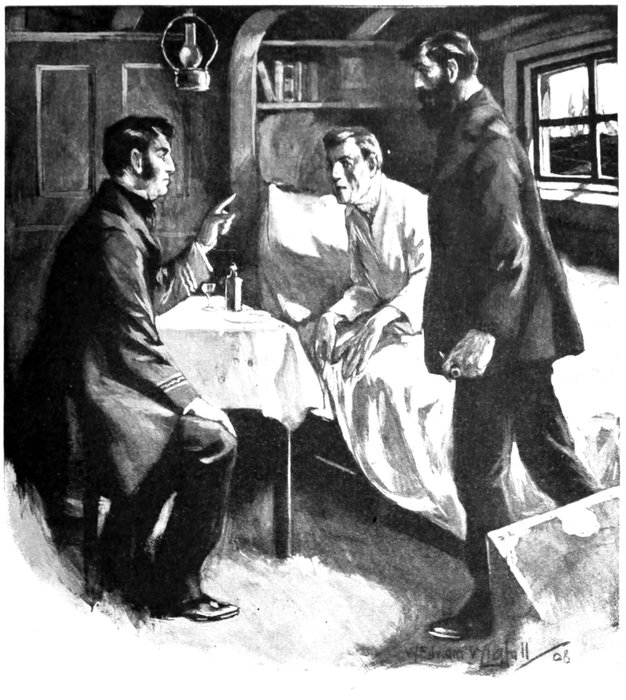
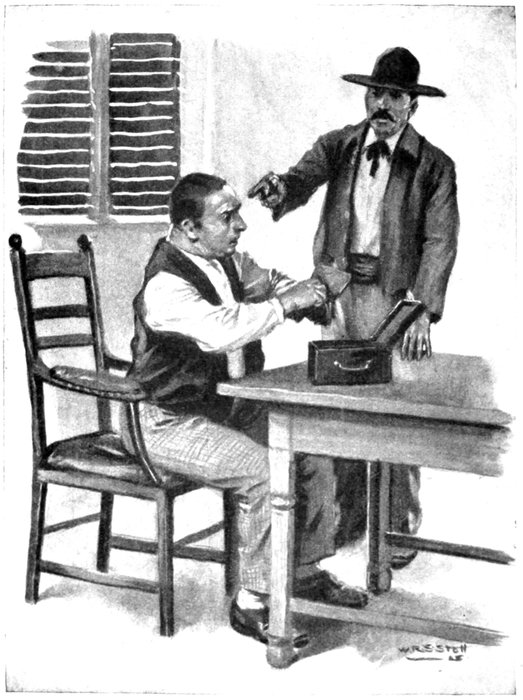
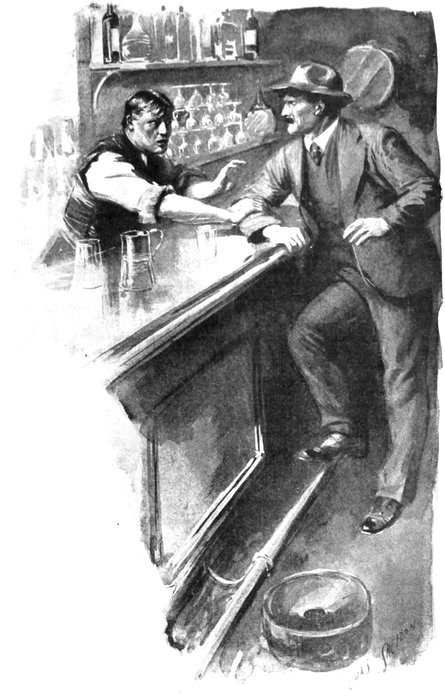
"I DON'T MERELY SUSPECT IT, MY DEAR SIR—I KNOW IT."
"Poisoning me, doctor?" said the sick man
in astonishment, raising himself on his elbow and
gazing at Maxwell with something of the old fire
in his eyes. "Do you really suspect that my
illness is due to a criminal hand?"
"I don't merely suspect it, my dear sir—I
know it. I suspected it when I first saw you,
but I'm certain now. You've been systematically
poisoned for several months past, and not
solely by mercury and croton oil, but by Calabar
bean as well. We may, a little later, if we can
get hold of some of the poison, be able to prove
our statement by analysis. Meanwhile, we know
we've got hold of the truth, and what we've got
to do is to find out the person or persons who
have had a hand in this affair."
"Then you may make up your mind, doctor,
that it's Jasper who's done it," affirmed Captain
Graham, emphatically. "Poison's exactly the
sort o' weapon he'd use, the double-faced,
smooth-tongued villain that he is."
"I grant you, captain, that he's all that, and
much more besides, perhaps. But before we
fix this crime upon him we've to discover first
what motive he could have in committing it;
and, secondly, what means he adopted."
"Not much difficulty in assignin' a motive
when we recall the ambuscade and its
subsequent effects," returned Graham. "Twelve
months' interdict against his name; checkmated
aboard his own ship, if you please, and unable,
ever since that day, to get the least sympathy
from our gallant chairman here, though Jasper's
friends tried their hardest in committee. But
you'll have to hear the whole story, doctor, 'fore
you can understand right, so by your leave
and Mr. Lees' I'll spin you the yarn from the
beginnin'."
Captain Graham gave a rapid account of the
events of the past four months, and concluded
with the remark:—
"Seems to me the business fairly bristles with
motives. What beats me, though, is the question
of his accomplice, seein' as there ain't
more than five or six of us who have entered
this cabin regular-like; and I've never thought
o' lookin' to find a traitor among the crew o' the
Elora. I could have taken my davy there
wasn't a dishonest man aboard."
"I shall be inclined to say that Ivory is
guilty, if only we can find the link between him
and this ship," said Maxwell at last. "You
have had your meals, I understand, almost invariably
alone, Mr. Lees. By whom were they
prepared and served?"
"By Daniel White, the steward."
"A man—I take it from Captain Graham—who
has nothing against his character?"
"Came to me two years ago with a clean
score," chimed in the captain of the Elora,
"and I ain't had no fault to find with 'im since.
'Honest Daniel' he's called, too, by the crew."
"He has certainly shown the greatest attention
to me during my illness; has been
thoughtful and obliging in the extreme," said
the supercargo. "Yet it seems to me,
captain," he added, after a thoughtful pause,
"that my memory is still better than yours.
Don't you remember the conversation we had
in your cabin in July on the subject of the
thefts? or is it merely the fancy of a poor brain
that has had much to bear these last three
months?"
"Conversation in July, in my cabin, about
thefts?" repeated the captain, slowly and
thoughtfully. "Well, now you mention it, I
do. But I fail to see its connection."
He stopped, deep in thought, his eyes fixed
on the invalid's white face. A momentary
pause ensued, then, recollecting himself, he
gave his thigh a mighty smack with his horny
hand, and exclaimed:—
"By Jove, but I do, though! You're right,
sir, you're right! What a lubber I've been to
forget that Daniel White said he'd known Jasper
Ivory at Bristol, an' that he claimed a knowledge
o' some o' his ships! The whole thing
comes back to me now. White told one o' the
sailors about his changin' the names of his ships
fro' time to time; and Baines, who heard the
yarn, told me. Mebbe we'd better hear it again
from the second mate's own lips to be certain,
though it strikes me circumstances are sufficiently
suspicious to warrant our clapping Daniel
White into irons at once."
"They are, indeed, captain," said the doctor,
in his coolest professional manner; "but, by
your leave—and you are, of course, master on
board your own ship—we will do nothing in a
hurry. We've got to prove our case beyond
dispute by obtaining possession of some of the
poison, which, if we take care not to arouse
suspicion, will doubtless be again administered,
probably in the drinking water, since Eserine,
the noxious element of Calabar bean, is tasteless
in solution. Then, we mustn't forget that there
are two criminals who have had a hand in this
affair, and that a too hasty action on our part
might result in the principal one escaping. No;
let us be content for the time being to keep an
eye on this pretty steward of yours. And
now, Mr. Lees," turning to the sick man, who,
overcome with excitement, was lying in his
berth with closed eyes, "I will leave you until
to-morrow in the good hands of Captain
Graham."
Almost on the very day predicted by the
doctor Joseph Lees was able to put his feet
to the ground and sit up for two or three
hours in his chair. Dr. Maxwell and Captain
Graham were once more with him, talking over
the events of the past week and discussing future
plans. For several unexpected things had
happened since the day on which it was discovered
that an attempt had been made on the
supercargo's life, and one of these—the disappearance
of Daniel White—had completely
altered their plan of campaign. The steward,
who had evidently taken alarm at the doctor's
repeated visits, the presence of the Thunderbolt,
and the guard that was placed upon Lees' food
and drink, had escaped down a rope and, unperceived
by the watch until it was too late to
hope to be able to put a bullet through him,
had swum out to one of Ivory's ships, one of
which—the Florentia, in all probability, since it
was no longer in the roadstead when morning
came—had taken him on board.
"Fate has certainly been against us," said the
doctor, "and I'm sorry, captain, that I didn't
follow your suggestion to take the fellow into
custody whilst we had the chance. From the
point of view of a case against Jasper Ivory, my
blunder, unfortunately, has had disastrous consequences.
There's a moral certainty he was
the instigator of the crime, but without our
hands on Daniel White's collar we cannot bring
forward anything that would lead to the conviction
of the captain of the Gurango. With
the plea of absolute ignorance as to the very
existence of this steward, he would be acquitted
without a doubt."
"You're the last man in the world, doctor,
who needs to reproach himself," responded
Captain Graham. "You did the main thing,
after all, when you arrested the assassin's hand.
But for you Mr. Lees would have been takin' a
longer voyage than from 'ere to the old country.
And we sha'n't be long now afore we sails,
thank goodness."
"The sooner you wind up your affairs and
get away from the stench of Ichaboe the better
for both of you," said Dr. Maxwell. "I should
strongly advise you, Mr. Lees, to touch at St.
Helena on your way home. The air there is
particularly bracing, and a fortnight's sojourn
will put new life into you. Indeed, the climate
is so favourable to convalescents that some of
my patients——"
The doctor's sentence was at this moment
broken off short by the appearance of the second
mate in the open doorway.
"Beg pardon for interrupting you, gentlemen,"
he said, "but Captain Ivory is here and would
like to speak with Mr. Lees for a few minutes."
Before either Captain Graham or the supercargo
had time to protest against his impertinent
intrusion, the captain of the Gurango, with all
his old assurance, had brushed past Baines and
was advancing into the cabin.
"Good morning, captain; good morning,
gentlemen all," he said briskly, and with a nod
to each. "Very glad to see, Mr. Chairman,
that you are on the high road to recovery.
Mackenzie told me yesterday that you'd been
making great progress lately, so I thought I'd
come round and have a chat with you before
you sailed, which I gather from him you'll be
doing very shortly. You're a lucky man to be
able to get from this wretched place—with your
fortune made, I warrant, but a very unpleasant
recollection, withal, of the infernal climate."
For several moments, which seemed an
eternity of time, so dead was the silence, no one
replied. The three men—a little taken aback
at Ivory's audacity—gazed at him with frankly
hostile eyes. The first to speak was Dr. Maxwell,
in slowly pronounced phrases, as keen as a
lancet:—
"In saying that my patient is a lucky man in
being able to get away from Ichaboe, you never
spoke truer words in your life, Jasper Ivory. But
you are wrong if you imagine that we are such
ignoramuses as to attribute his illness to what
you are pleased to call the infernal climate.
Infernal climate, forsooth! But I am forgetting
that you are a layman, liable, now
and then, to express yourself inaccurately,
and, of course, totally ignorant in the matter
of diseases or drugs—particularly poisons.
I may tell you, therefore, that the initial
cause of Mr. Lees' malady has been traced
to one of the precious pack of rascals whom
he had to keep in order here. I suppose
a simple seaman like you has never seen any
seeds like these before? I found them in the
locker of Daniel White, late steward of the
Elora—a man who, curiously enough, was an
old friend of yours."
The doctor, as he said these words, took a
number of claret-coloured seeds out of his waist-coat
pocket and held them out on the palm of
his hand for Captain Ivory's inspection, closely
watching his face the while. But not a muscle
moved; and it was with absolute control over
both voice and features that Jasper replied,
nonchalantly:—
"What a beautiful colour! And what may
be the name of those pretty things, doctor? I
rely on your superior knowledge, which appears
to cover a wider field than science, since you've
just made me the friend of a man of whom I've
never heard in my life."
"We scientists call them the seeds of
Physostigma venenosum; but they are known
amongst you sailors as Calabar beans. Considering
that there isn't a mariner cruising on
the West Coast of Africa who doesn't know
them, your education appears to have been
singularly neglected. However, Daniel White
will be able to complete it for you when the
Gurango rejoins the Florentia, on which ship—for
the time being, at any rate—he escaped
from justice."
At this Captain Jasper could preserve his
self-possession no longer.
"So you persist in coupling your confounded
steward with me and my ships, do you?" he
said, hotly. "Then let me tell you that you
can talk enigmas and concoct your inventions
until you are black in the face. I don't care
that for them," snapping his fingers; "and I'll
see you all three in Hades before you'll get
another civil word from me!"
In a flash he had left them and was out on
deck, where he continued to vent his anger by
a torrent of oaths. Dr. Maxwell and the captain
of the Elora watched him with aggravating
coolness as he was being rowed away, a sullen,
malicious look in his eyes. "His face was a
study for a criminologist," was the doctor's
pregnant comment on returning to the cabin.
Lees saw no more of Ivory before the Elora
set sail for St. Helena, but he had not yet
finished with that remarkable man; and so
dramatic and unexpected was his next meeting
with his enemy to be, that its every circumstance
remained fresh in his mind to the day of
his death.
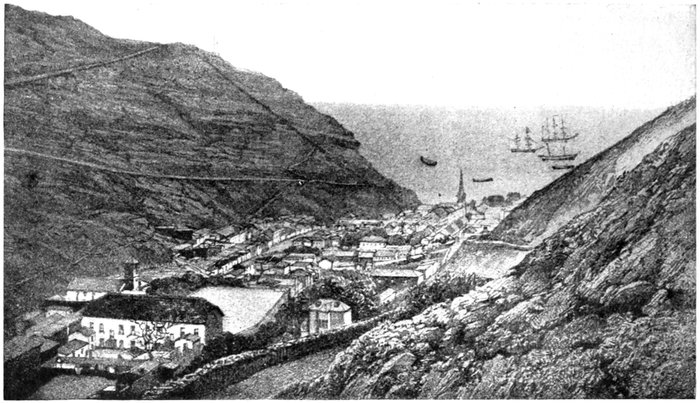
A VIEW OF JAMES TOWN, ST. HELENA, AS IT APPEARED IN 1845, THE TIME OF THIS STORY.
From an Old Print.
The ill wrought on Joseph Lees' constitution
was more deep seated than even so astute a
man as Dr. Alexander Maxwell could foresee.
After his departure from Ichaboe, which he
devoutly hoped he would never set eyes on
again, he had a serious relapse—so serious that,
on the third day of the voyage to St. Helena,
he gave up all his papers to Captain Graham,
believing that he would not reach his destination
alive. However, on New Year's morning, 1845,
the first perspiration that he had had for nine
months brought relief, and from that day progress
towards recovery, though slow, was sure.
As the Elora came within sight of St. Helena,
which from the sea looks like a bare and arid
rock, the supercargo, who was sitting on deck in
a despondent mood, found himself likening it
to an immense tomb. Would it be his? Almost
inclined at that moment to abandon all hope
and answer in the affirmative, he fell to musing,
his eyes fixed on the island. Black thoughts
gave place to more cheerful ones, however, as
the ship drew near to land, for its aspect gradually
changed from the forbidding to the inviting.
The verdure-covered mountains of the interior,
their rounded summits reaching to the clouds,
became more and more distinct; and though
these disappeared when the Elora got within
shorter range of the perpendicular rocky cliffs,
the watcher had soon the great satisfaction of
once more setting eyes on human habitations—the
houses and buildings of James Town, crowded
within the narrow ravine formed by the almost
vertical sides of Rupert's Hill and Ladder Hill.
His sense of joy on returning to the haunts of
men and civilization became still keener when
he had actually landed and was being carried
through the main street of the town—a street of
solidly built houses, many with stone steps and
iron railings leading up to the front doors, some
with bow-windows and others with verandas.
Recommended to put up at "the first house in
the island," Lees was taken to the Rose and
Crown, kept by Charles Fuller, an old-established
resident. The letter from which I have already
quoted was written from that hotel, three days
after his arrival, and in it he says to his son:
"I have two of the first doctors on the island,
who are altering my treatment; and what effect
it may have God alone knows. They are, too,
for changing my residence from town to the
very house and room where Napoleon lived
until Longwood was made ready, and my nurse
is the same person who nursed Mme. Bertrand.[6]
Things are very dear here, and for all this I
have to pay well; but whatever will contribute
to my comfort and recovery I will have and pay
for cheerfully. Thank God, I can afford it."
This nurse, Mme. MacDonald, née Valadon,
had a Frenchwoman's admiration for the great
captive and everything connected with him; she
bitterly hated the British Government and Sir
Hudson Lowe; she was fond of acrimoniously
expressing her views on events long since
past, and she delighted in telling her patients
anecdote after anecdote from her vast store of
information respecting Napoleon. Certain it
is, too, that her reputation as a nurse was considerable,
especially among the few French
inhabitants that remained, otherwise the supercargo's
doctors would never have strongly
advised him, as they did, to continue to employ
her when he removed from the Rose and Crown
to the Briars, that little estate on which Bonaparte
resided, in company with Mr. Balcombe
and his family, while Longwood Old House was
being prepared for his reception.
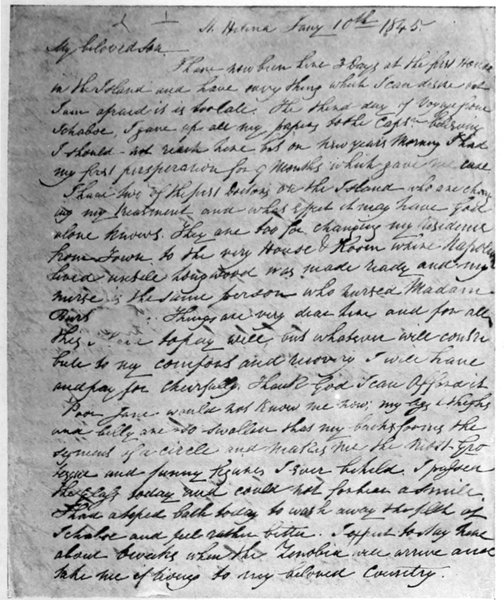
FACSIMILE OF A LETTER WRITTEN FROM ST. HELENA, IN WHICH MR. LEES MENTIONS HIS REMOVAL
TO NAPOLEON'S HOUSE.
The Briars consisted—and still consists, I
believe—of two houses, one called the Pavilion,
where Napoleon lived, and another building to
the left, both situated on a plateau at the foot of
hills and buried in trees.
A fine garden and grass
fields adjoined, and the
surrounding country was
then, as now, precipitous
and wildly picturesque.
This beautiful little estate
was some mile and a half
from James Town, and
access was gained to it by
a road winding up the side
of the rugged hill. Both
houses, comfortably furnished,
chancing to be let
(owing to the owner's temporary
absence in England)
when Joseph Lees arrived
in St. Helena, he rented
the smaller for two months,
at the end of which time,
said the doctors, he ought to
have sufficiently recovered
his health and strength to
be able to proceed home.
One bright morning
about the middle of
January, four sturdy
"yamstalks," or inhabitants
of composite origin,
laboriously mounted the
hillside above the town,
carrying the invalid on a
chaise à porteurs extemporized
out of an arm-chair
and a couple of poles.
Nurse MacDonald walked
by his side, chattering
vivaciously.
"Never before or since have I heard such
vivid narratives as those of Nurse MacDonald,"
said Joseph Lees in after years when relating
his adventures. "She was certainly a very
remarkable woman. But with all her cleverness,
there was something about her that made me
distrust her from the very beginning. She was
given to falling into periods of morose silence,
and on more than one occasion, during my first
fortnight's residence at the Briars, she struck me
as being a woman whom it would be better to
have as a friend than as an enemy. In short,
the longer I was acquainted with her, the more
uncomfortable did I feel. At first I attributed
my feelings to prejudice, to the morbid effects of
my illness; but as I got to know her better, and
as my bodily health rapidly returned, I had
finally to confess that I could not be altogether
mistaken, and that the sooner I brought my
sojourn in the hills of St. Helena to an end
the better it would be for my peace of mind.
After events proved that I was right, and that
our first impressions of a person are sometimes
to be trusted."
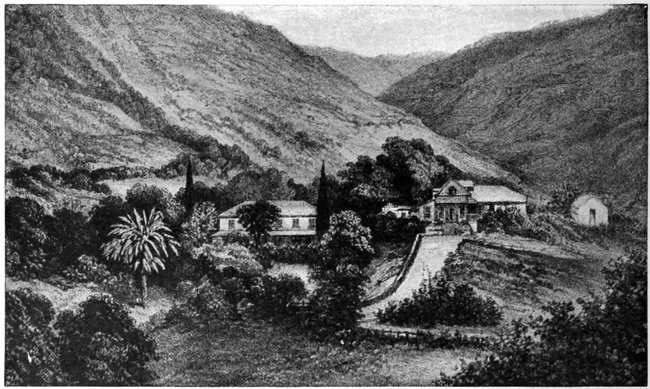
THE BRIARS, NAPOLEON'S HOUSE AT ST. HELENA, WHERE MR. JOSEPH LEES STAYED.
From an Old Print.
The dread—and there is no other word to
express the feeling—that Joseph Lees finally
came to have for the Briars was first awakened
by an incident that occurred there after his first
month's residence. As near as possible, I will
describe it in his own words.
"I shall remember the night of that incident,"
he would begin, "as long as I live. The impression
that it made at the time appeared to
be slight, but in the light of after events it
became indelible. It was midnight, and I was
perusing a letter which I had just written to my
son in the dim light of a candle placed on a
little table near my bed on which I was
stretched. The captain of one of the vessels
which I myself had chartered had brought me
that day fresh information from Ichaboe, and,
as he was to sail on the following morning, I
was anxious that he should take my epistle with
him. After giving certain instructions in regard
to the sale of the cargo, I proceeded to speak of
my health and of the renewal of the troubles on
the island. 'I have now some hopes of returning
home, as I am much better,' I wrote.
'We have suffered greatly by robberies of guano,
even to the tune of thousands. Disturbances
and battles are frequent between the soldiers
and the crews, who want and will have cargo.
There are yet three hundred and fifty ships in
the roadstead of Ichaboe, though there are not
twenty cargoes on the island, and these are all
expecting to beat the authorities and take it
from the owners. Three hundred men made
an attack the other day, and got from the chairman's
pit as many tons before the soldiers
proved masters. In consequence of all these
things we shall not be able to fill all the ships
named in the list, and there are six more to
come that will not get more than half a ——'
"I had reached this part of my letter when I
broke off, my attention being attracted by the
sound of voices. At first I imagined that it
was Mme. MacDonald talking to herself, as
she was in the habit of doing, but on listening I
could distinguish another voice. A feeling of
alarm suddenly came over me and impelled me
to blow out the candle.
"'Who could my nurse's visitor be?' I asked
myself, as I jumped off the bed and approached
the long French windows that opened on to a
little veranda. To find anyone calling upon
her at such an hour was, to say the least,
strange. Stranger still, I seemed to know the
voice of the person who was talking with her,
but where I had heard it before I could not for
the life of me tell. There was no doubt, however,
that it was that of a man, and that the
language in which he was conversing was French,
of which I knew sufficient to seize a phrase
now and then. From the words 'arrivé aujourd'hui,'
'voyage,' 'fatigue,' I came to the conclusion
that the speaker must be a sailor who
had arrived at the port of James Town after a
long and fatiguing voyage; and on hearing him
addressed as 'mon fils,' my mind immediately
began to weave a story around the mother and
the son. Their relationship thus established, I
felt much less alarmed than I had been at first;
so I refrained from further eavesdropping and
retired to rest. But, though I tried my hardest,
I could not get to sleep for hours. Again and
again I found myself dwelling on the question:
'Where have I heard that voice before?'
"On the following morning, much to my
surprise, the visitor was nowhere to be seen.
Having fully expected to meet this sailor son of
hers, I expressed my regret that he had gone so
early.
"'A visitor, monsieur?' she replied, with well-feigned
astonishment. 'Since no one has come
here during the last twenty-four hours, no one
can have departed. You have been dreaming,
monsieur—one of the consequences, no doubt,
of your illness. I hope not a nightmare?
Monsieur must not sit up so late at night. It
is an imprudence when still so weak.'
"I had not been dreaming, but I did not
contradict her. She evidently had reasons for
concealing from me the fact that her son had
paid her a nocturnal visit; and as I could conceive
these reasons to be of such a nature as to
warrant her little subterfuge, I decided to poke
my nose no further into her affairs. What
business was it of mine if she cared to receive
her son in secret? Why should I trouble my
head over the question as to whether she had
or had not—as, indeed, she affirmed—a sailor
son? Nevertheless, the old question recurred
as regards the disconcerting resemblance of his
voice to that of someone whom I had once
met—but where I could not recall.
"The mystery, as you will soon hear, was to
be unveiled three days later. I had gone to
bed about ten o'clock, but, being unable to
sleep, had arisen at midnight, intending to dress
myself and spend a few hours over my accounts.
About to strike a light, the creaking of the
veranda under someone's footsteps attracted my
attention and drew me to the window. Fortunate
it was that I had done so before lighting
the candle, for, on looking out into the
darkness, I was just in time to catch sight of
the dim figure of a man creeping stealthily
along in the direction of the entrance to Mme.
MacDonald's room. After proceeding a couple
of yards or so he stopped, gave a low whistle,
and at the same time so turned his head that,
in the light of the moon, which up to then had
been obscured, I could see his face in profile.
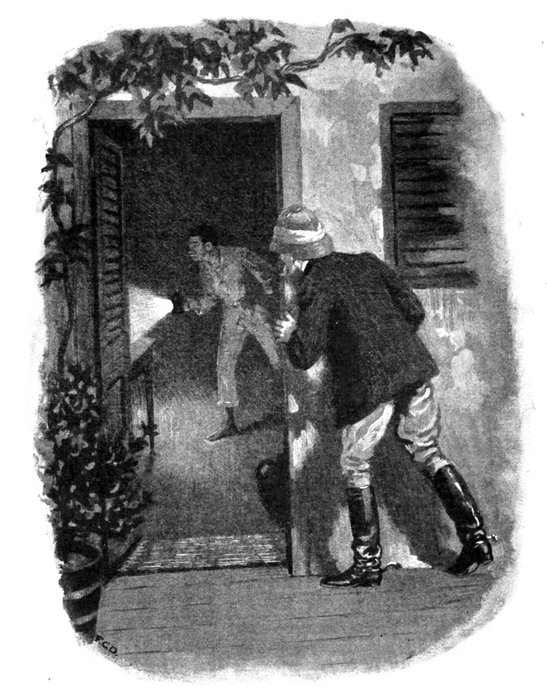
One glance was enough. It was Jasper
Ivory—the last man in the world whom I
should have expected to be my nurse's son!
Suddenly awakened to a sense of my danger—for
I knew that this ruffian had vowed
vengeance upon me, and in my weakened state
I was no match for him—I sprang back into
the room, huddled on my clothes with the
greatest rapidity, and after stowing away my
money and as many of my papers as I could get
together in the dark, once more crept to the
window. Ivory had disappeared into the old
woman's room, whence, amidst the dead stillness
of the night, came the hum of their voices.
Were they plotting my destruction? I wondered.
"Having opened the long window, I noiselessly
slipped out on to the veranda, turned to the left,
in the opposite direction to where they were in
consultation, and rapidly passed down a small
flight of steps into the garden. What a relief it
was to feel that I was free! I lost no time, I
can tell you, in making my way as best I could
to the limit of the grounds, where there was a
pathway that would lead me to the main road
and James Town. But before I had reached
the fence that enclosed the Briars a cry from
the house told me that my escape had been
discovered, and somehow or other I failed to
find the path I was seeking. There was nothing
to be done, therefore, but to push on in the
darkness at hazard. Stumbling over rocks and
shrubs, my progress was exceedingly slow. My
weakness, too, hindered me considerably, and I
was more than once forced to stop and rest.
On one of these occasions I turned round and
saw that the search for me was continuing.
Two lights were moving about among the
shrubberies. Suddenly one of them stopped;
there was a cry from the holder of the lantern—cry
that I could easily recognise as coming
from Ivory, and the next moment he was rapidly
moving forward in my direction. He had found
my track at last!
"Through the rocky, hilly country surrounding
the Briars he pursued me, tenacious as a
bloodhound. Owing to the fact that he had a
lantern, and was thus able to avoid the obstacles
which frequently impeded my progress, he
covered the ground much quicker than I did.
He also had an advantage in being in a perfect
state of health. On the other hand, he had
this against him—I was better able to follow his
movements, thanks to his light, than he mine.
Quick to see that I might turn this to profit, I
decided, since it was inevitable he would overtake
me, to lie in wait for him behind some
convenient boulder, to attack him unawares, to
disarm him if he carried a weapon, and then to
render him harmless by methods which—as an
old North-country wrestler—I felt were still
within the range of my powers.
"We had reached what was evidently a little
plateau on high ground. Judging this to be a
suitable place for the execution of my plan, I
rapidly dodged behind an agglomeration of
rocks and waited for his coming. Being fifty to
sixty yards in the rear, it was some time before
he had completed his search of the immediate
neighbourhood and could push on still farther.
This gave me time to recuperate my strength.
Luck, too, would have it that when he came up
with me, swinging his lantern this way and that,
he passed to the right of my shelter in such a
way that I had but to throw out my leg to send
him sprawling to the ground. As he came
down with a crash, a pistol which he held in his
right hand fell and exploded, while the lantern
clattered among the stones and was extinguished.
"Hoping that he would be so stunned that he
could offer but a slight resistance, I was upon
him in an instant. Much to my surprise, however,
he got to his feet in less time than it takes
me to relate the fact, and, with a growl of rage,
gripped me so tightly that I saw I should have
the greatest difficulty in mastering him. Though
a man possess all the science of all the
wrestlers of Cumberland, he is a poor thing
when in an indifferent state of health, and so I
soon discovered.
"Locked in each other's arms, we swayed
backwards and forwards in the darkness—now
one, now the other, appearing to have the
advantage through the accidental nature of the
ground. It was a marvel that we managed to
keep our feet at all amidst all those stones and
ruts. At times, also, we backed against huge
rocks, and whenever Ivory got me in that
awkward fix he would either angrily hiss his
intention to finish me off, in payment of old
scores, or grind his teeth with grim satisfaction.
I can almost imagine, even now, that I feel his
hot breath on my neck and the grip of his
powerful arms around my body.
"For a quarter of an hour my tactics were
defensive. It was evident to me from the very
first that the man knew nothing of wrestling,
that he had merely his strength to depend upon.
My object, therefore, was to let him use it up as
much as possible, reserving my own force for an
occasion when I could call to my aid the useful
art that I had learnt in my youth. Soon, indeed,
he began to show signs of flagging. So,
seizing a favourable opportunity, I suddenly
drew upon all my resources, had recourse to a
certain 'throw' which had many times gained
me the victory at Keswick, and successfully
passed him over my thigh.
"Just as his feet left the ground he released
his hold of me in order to be able to break his
fall. And well for me was it that he did so, for
as he came down, like a slaughtered ox, I heard
the sound of his body slipping away from me
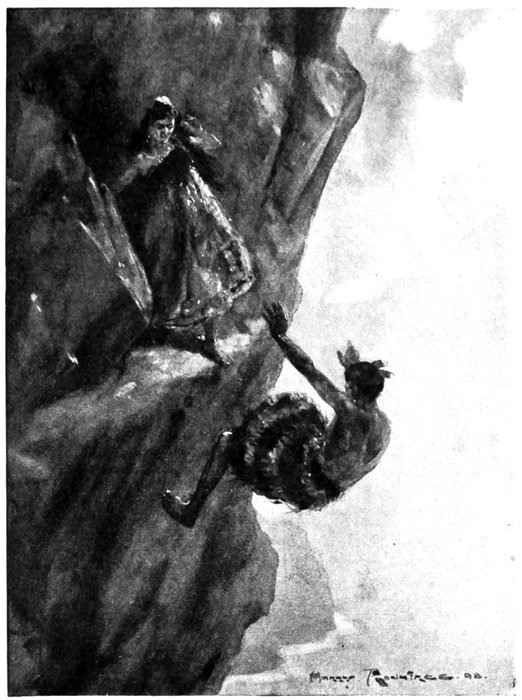
and of stones rolling down an abyss. He gave
one wild and piercing cry of terror when he
dropped down, down, down into the darkness!
"For fully a minute did I stand where I was,
my knees trembling under me through fear and
exertion. Fearing to move a step before I had
ascertained the exact position of the precipice,
I at last stooped down and, by feeling my way
in all directions, succeeded in creeping out of
the danger-zone to a sheltered spot where I
could lie down and sleep until daybreak. To
have attempted to have found my way to James
Town out of that wilderness of rocks would
have been madness. Besides, I was thoroughly
exhausted, and had no sooner stretched myself
on the ground than I fell into a sound
slumber.
"It was still early when I awoke, aching in
every muscle. But I lost no time in making for
the town, a distance of some two miles, being
anxious to obtain food and drink at the Rose
and Crown, and to give information to the
authorities on the subject of my adventure. I
felt that I had still a bone to pick with the
treacherous Mme. MacDonald, and the sooner
she was arrested the better.
"In the absence of the Governor of the island
I was received at his town offices by his chief
representative, who patiently heard my tale from
beginning to end.
"'Yours is a very remarkable story, Mr. Lees;
one of the most romantic I have ever heard,'
he exclaimed, earnestly. 'It is all the more
strange, as we've been looking for years for a
man bearing somewhat the description of your
Captain Ivory. I am surprised that the commander
of the Thunderbolt did not spot him at
Ichaboe. But I rather imagine that that officer's
knowledge of the judicial affairs of St. Helena
does not go back fifteen years, otherwise he
would have been sure to recollect the circumstances
attending the capture of one of our
schooners on June 28th, 1830. The commander
of the vessel in question, Captain
Harrison, a certain Dr. Waddell, and several of
the crew were entrapped on board a ship called
the Daspegado, flying French colours, and
murdered. It has always been understood
that the name of the captain of the pirate was
Williams, but your description of Jasper Ivory
tallies so exactly with his, that I have no doubt
whatever that they are one and the same man.
I shall, of course, have to institute an inquiry
into this affair, and above all order the immediate
arrest of this Mme. Valadon, or whatever
she calls herself. Meanwhile, Mr. Lees, you will
have to hold yourself at the disposal
of the authorities. Manslaughter, you
know, is a serious thing—even though
the man you have killed is a pirate.
And now, seeing that this matter is
finished for the present, I hope you
will do me the honour of dining with
me this evening. I will call for you at
six o'clock at the Rose and Crown and
take you with me to Plantation House.'
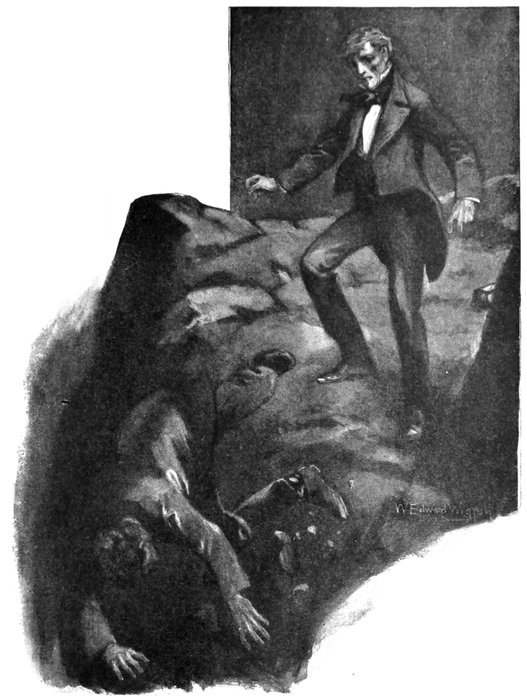
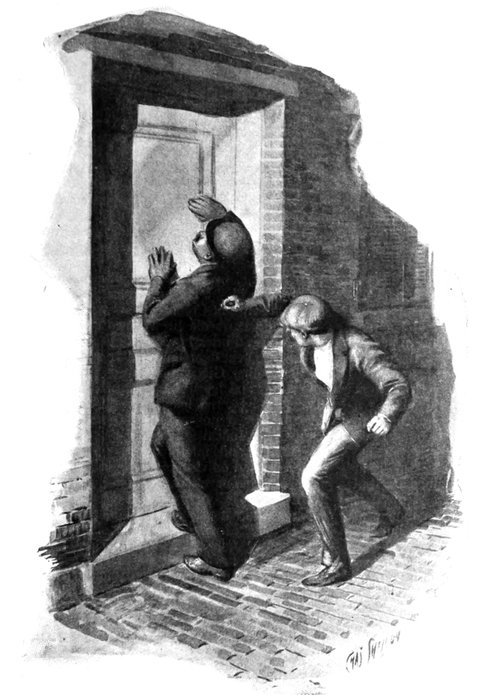
"HE GAVE ONE WILD AND PIERCING CRY OF TERROR WHEN HE DROPPED DOWN,
DOWN, DOWN INTO THE DARKNESS."
"The pistol and lantern of Captain
Jasper Ivory, alias Williams, alias
MacDonald, alias
Valadon, were
found where they
had fallen. But his
body was never
recovered from the 'Devil's Punch Bowl,' as
the rocky and precipitous region where we
had wrestled was—and is still—called. Was
he killed on the spot, or did he escape
miraculously? I cannot tell you. All I know
is this: not a trace of either
him or his precious mother
could be discovered.
Years afterwards, however,
when I had returned to
England and was enjoying
the fruits of my hard
eight months' work at
that horrible island of
Ichaboe, I heard that
she was living at Havre,
where she kept a lodging-house and, it was said,
continued to carry on at least one branch of her
son's profession—that of smuggling—in collaboration
with Daniel White, one-time steward of
the good ship Elora."