I
While our great battleship fleet
thundered peace and friendship
to the world, as it moved from
sea to sea, stinging pens and voices in one
country after another answered that America
had suddenly passed from blustering
youth to cynical old age, and that the harmless
effrontery of our nationality in the past
was not to be confounded with the cold-brained,
organized, money-worshipping
greed of the new generation of Americans.
Meanwhile, in all parts of the American
continent, preparations were being made to
celebrate the one hundredth anniversary of
the birth of Abraham Lincoln, the humblest,
simplest and plainest of our national
leaders, whose name no American can utter
without emotion.
We think of Washington with pride, of
Jefferson and Madison with intellectual
reverence, and of Jackson and Grant with
grateful consciousness of their strength.
But the memory of Lincoln, even now,
so many years after his piteous death, stirs
the tenderest love of the nation, thrills it
with a sense of intimate relationship to his
greatness and awakens a personal affection
in the average American’s breast—not a
mere political enthusiasm, but a peculiarly
heartfelt sentiment that has no parallel in
human history.
If it be true that the nation has at once
become old, that it has grown sinister and
corrupt, that it cringes before material success,
stands in awe of multi-millionaires and
prostrates itself before money, why is it that
we love Lincoln?
If in the pride of wealth and strength we
have forgotten our early republican ideals
of simple justice and manhood, how is it
that the movement to commemorate the
birth of this lowly, clumsy backwoodsman
and frontier lawyer turned President—a
movement begun in the rich cities of New
York and Chicago—instantly spread to the
remotest villages, and all that seemed ugly
and haggard, with all that seemed brave
and fair and true, swarmed together, heart-naked,
to make that twelfth day of February
an unforgetable event?
Arches and statues; flower-strewn streets
with endless processions; moving ceremonies
in thousands of schools and colleges;
multitudes kneeling in churches; other multitudes
listening to orators; warships and
fortresses roaring out salutes.
Yet these were the mere externals of Lincoln
Day. The average American does not
shout when he hears Lincoln’s name. Even
the political demagogue, the stock gambler,
the captain of industry, aye, the sorriest
scarecrow of a yellow journalist, is likely to
grow silent and reverential when that word
is spoken.
With all our national levity, we do not
jest about Lincoln. With all our political
divisions, every party to-day reveres his
memory and claims his spirit. It is sober
truth to say that he struck the noblest, highest,
holiest note in the inmost native soul of
the American people. There is nothing so
arrogant or sodden and sordid in that new
paganism which has set its altars in Wall
Street but will in some sense uncover and
kneel at the sound of his name.
Our fleet, in its voyage around the world,
found no record of such a man in any of the
lands of its visitations. Each nation, each
epoch, each race, has its hero. But there is
none like Lincoln. Alexander, Caesar, Napoleon,
Cromwell—how cold their glory
seems to his, how immeasurably smaller
their place in the affections of mankind?
And, while America was getting ready to
honor Lincoln, none might pretend to understand
his people who had not first discovered
what it is in his character and in
ours that, even in this day of restless commercialism,
makes us love him above comparison
in the story of the world’s great
men—love him for his poverty, for his
simplicity, for his humanity, for his fidelity,
for his justice, for his plainness, for his life
and for his death.
By sheer force of character, conscience-inspired,
Abraham Lincoln rose from abject
depths of squalid environment to become
the most august figure in American
history, and perhaps the most significant
and lovable personality in the annals of
mankind.
In his amazing emergence to greatness
from poverty and ignorance is to be found a
supreme demonstration and justification of
American institutions.
It was the common people who recognized
the nobility and majesty in this singular
man. He understood that always, and,
even in his days of power, when great battles
were fought at a nod of his head, and a
whisk of his pen set a whole race free, it
kept him humble.
Perhaps the profoundly tender love which
the American people have for his memory is
to be explained by the fact that in the secret
recesses where every man communes with
the highest, bravest and most unselfish elements
of his own nature, the average American
is an Abraham Lincoln to himself.
The power to recognize is not so far removed
from the power to be recognized, and
it is thrillingly significant, after all these
dreary years of babble about the omnipotence
of money, that the same people who
raised Lincoln from penniless obscurity to
his place of power and martyrdom, still
cherish his name and example with a depth
of devotion that increases with each year of
national growth, confusing and confounding
the learned foreign critics of the Republic,
who miss the finest thing in American
civilization when they fail to learn why we
love Lincoln.
II
If Daniel Boone, the mighty hunter and
Indian fighter, had not roused the imagination
of Virginians and Carolinians
by his wonderful and romantic deeds in the
exploration of the Kentucky wilderness, the
grandfather of Abraham Lincoln would not
have left Rockingham County, Virginia,
and “entered” seventeen hundred acres of
land in Kentucky, where he was presently
slain on his forest farm by a savage in the
presence of his three sons.
The youngest of these sons, Thomas
Lincoln, was the father of the future President
of the United States.
In spite of an educated, well-to-do American
ancestry of pure English Quaker stock—one
was a member of the Boston Tea
Party; another was a revolutionary minuteman,
served in the Continental Congress
and was Attorney General of the United
States under Jefferson—this frontier boy,
who was only six years old when his father
was murdered before his eyes, grew up without
education, to be a wandering work boy,
who gradually picked up odd jobs of carpentering.
He became a powerfully built, square-set
young man, somewhat indolent and improvident,
who occasionally showed his
temper and courage by knocking down a
frontier rowdy.
The rough young carpenter in 1806 married
Nancy Hanks, a niece of Joseph Hanks,
in whose shop he worked at his trade.
Nancy, who was the mother of Abraham
Lincoln, was the daughter of a supposedly
illiterate and superstitious family, but she
was comely, intelligent, knew how to read
and write and taught her husband to scrawl
his name.
The great Lincoln always believed that he
got his intellectual powers from his mother.
For a time this pair, who were to bring
forth the savior of America, dwelt in a log
hut, fourteen feet square, at Elizabethtown,
Kentucky, where they were married. Then
a daughter was born. A year later the carpenter
bought a small farm on the Big
South Fork of Nolin Creek, in Hardin
County.
Here, on wretched soil overgrown with
stunted brush, Thomas Lincoln and Nancy
Hanks lived with their infant daughter in a
rude log cabin, enduring profound poverty.
It was in this mere wooden hutch, which
had an earth floor, one door and one window,
that Abraham Lincoln was born on
February 12th, 1809.
What American, however poor, ignorant,
unlettered or discouraged, can look upon
the rude timbers of the home which sheltered
the birth of the greatest man of the
Western Hemisphere without a thrill of
hope and a new realization of the opportunities
that are co-eternal with conscience,
courage and persistence?
What man of any race or country can
stand before that cabin and be a coward?
Moses, the waif; Peter, the fisherman;
Mahomet, the shepherd; Columbus, the
sailor boy—each age has its separate message
of the humanity of God and the divinity
of man.
The gray-eyed boy Lincoln played alone
in the forest near Knob Creek, where his
father had secured a better farm. It was a
solitary and cheerless life for a child. Sometimes
he sat among the shavings of his
father’s carpenter shanty—a silent, lean
little boy, with long, black hair and grave,
deep-set eyes, dressed in deerskin breeches
and moccasins, without toys and almost
without companions.
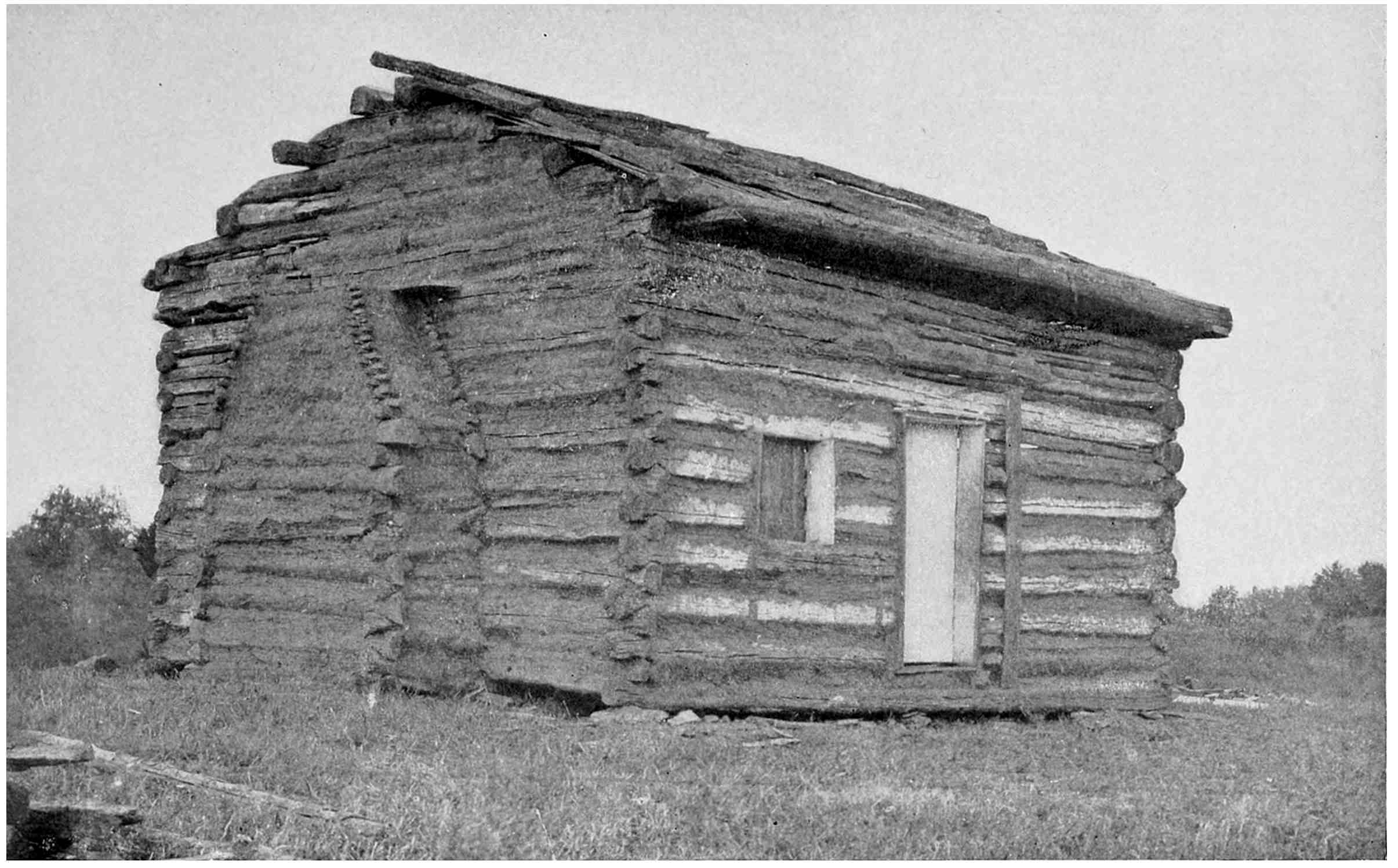
The Kentucky log cabin in which Lincoln was born on February 12th, 1809
For a few months he attended log-cabin
schools with his sister Sarah, but he learned
little more than his letters. It is amazing
to think that this man, whose Gettysburg
address is accepted as one of the noblest
classics of English literature, did not have
much more than six months of schooling in
his whole life.
In 1816 Thomas Lincoln decided to move
from Kentucky to Indiana. He built a raft,
loaded it with a kit of carpenter’s tools and
four hundred gallons of whiskey, and, depending
on his rifle for food, floated down
into the Ohio River in search of a new home.
Having picked out a place in the Indiana
forest, he walked home and, with a borrowed
wagon and two horses, he took his wife and
children into the wilderness, actually cutting
a way through the woods for them.
Near Little Pigeon Creek the carpenter
and his wife, assisted by young Abraham,
now seven years old, built a shed of logs and
poles, partly open to the weather, and here
the family lived for a year. Meanwhile a
patch of land was cleared, corn was planted,
and as soon as a log-cabin, without windows,
could be built, the Lincolns moved into it.
The forest swarmed with game and the
carpenter’s rifle kept his family supplied
with venison and deer hides for clothing.
They relied on the rifle and the corn patch
for life. Little Lincoln “climbed at night
to his bed of leaves in the loft by a ladder of
wooden pins driven into the logs.”
Not only were the means of life hard to
get, but it was a malarial country, and in
1818 the small group of pioneers who came
to dwell at Pigeon Creek near the Lincolns
were attacked by a pestilence known as the
milk-sickness.
In October the mother of Abraham Lincoln
died. Her husband sawed a coffin out
of the forest trees and buried her in a little
clearing. Several months later a wandering
frontier clergyman preached a sermon
over her lonely, snow-covered grave.
No wonder the countenance of the great
Emancipator moved all who beheld it by its
deep melancholy. He knew what sorrow
was forty-five years before he paced his
office in the White House all night, with
white face and bowed head, sorrowing over
the bloody defeat of Chancellorsville, wondering
whether he was to be the last President
of the United States, and praying for
the victory that came at Gettysburg.
All that year the sensitive boy grieved
for the mother who had gone out of his life;
but in time his father went back to Elizabethtown,
Kentucky, where he married the
widow of the town jailer, and presently a
four-horse wagon creaked up to the door of
the Lincoln cabin in the Indiana forest, with
the bride, her son and two daughters, and a
load of comfortable household goods, including
a feather bed and a walnut bureau,
valued at fifty dollars.
Sarah Bush Lincoln, the stepmother of
Abraham Lincoln, was a woman of thrift
and energy, tall, straight, fair, and a kind-hearted
motherly Christian. The American
people owe a debt to this noble matron who
did so much to influence and develop the
character of the boy who was yet to save the
nation from destruction.
She was good to the Lincoln orphans
whose mother lay out in the wild forest
grave. She gave them warm clothes. She
threw away the mat of corn husks and leaves
on which they slept and replaced it with a
soft feather tick. She loved little Abe, and
the lonely boy returned her kindness and
affection. In a primitive cabin, set in the
midst of a savage country, she created that
noblest and best result of a good woman’s
heart and brain, a happy home.
Oh, pale woman of the twentieth century,
sighing for a mission in the great world’s
affairs! Perhaps there may be a suggestion
for you in the simple story of what Sarah
Bush did for Abraham Lincoln and, through
him, for the ages. Did not the two malaria-racked
and care-driven mothers who lived
in the rough-hewn Lincoln cabin do more
to influence the political institutions of mankind
than all the speeches and votes of
women since voting was first invented?
III
Even at the age of ten years the frontier
lad was a hard worker. When
he was not wielding the axe in the
forest, he was driving the horses, threshing,
ploughing, assisting his father as a carpenter.
He also “hired out” to the neighbors
as ploughboy, hostler, water-carrier, baby-minder
or doer of odd chores, at twenty-five
cents a day. He suddenly began to
grow tall, and there was no stronger youth
in the community than the lank, loose-limbed
boy in deerskins, linsey-woolsey,
and coonskin cap, who could make an axe
bite so deep into a tree.
His stepmother sent him to school again
for several months. In 1826, too, he walked
nine miles a day to attend a log-house
school. He had new companions at home
now, a stepbrother, two stepsisters, and his
cousins, John and Dennis Hanks.
As young Lincoln grew taller his skill and
strength as a woodchopper and rail-splitter,
and his willingness to do any kind of work,
however drudging or menial—in spite of a
natural meditative indolence—made him
widely known. His kindly, helpful disposition
and simple honesty gave him a distinct
popularity, and he was much sought
after as a companion, notwithstanding his
ungainly figure and rough ways.
But it was his extraordinary thirst for
knowledge, his efforts to raise himself out
of the depths of ignorance, that showed the
inner power struggling against adverse surroundings.
He grew to a height of six feet and four
inches by the time he was seventeen years
old. His legs and arms were long, his hands
and feet big, and his skin was dry and yellow.
His face was gaunt, and his melancholy
gray eyes were sunk in cavernous
sockets above his prominent cheek bones.
A girl schoolmate has described him: “His
shoes, when he had any, were low. He
wore buckskin breeches, linsey-woolsey shirt,
and a cap made of the skin of a squirrel or
coon. His breeches were baggy and lacked
by several inches meeting the tops of his
shoes, thereby exposing his shin-bone, sharp,
blue and narrow.”
This is the real Abraham Lincoln, who
read, and read, and read; whose constant
spells of brooding abstraction, eyes fixed,
dreaming face, gave him a reputation for
laziness among some of his shallow fellows;
who would crouch down in the forest or sit
on a fence-rail for hours to study a book;
who would lie on his stomach at night in
front of the fireplace and, having no paper
or slate, would write and cipher with charcoal
on the wooden shovel, on boards and
the hewn sides of logs, shaving them clean
when he wanted to write again.
Here is his cousin’s picture of him at the
age of fourteen:
“When Abe and I returned to the house
from work he would go to the cupboard,
snatch a piece of corn bread, sit down, take
a book, cock his legs up as high as his head,
and read. We grubbed, plowed, mowed
and worked together barefooted in the field.
Whenever Abe had a chance in the field
while at work, or at the house, he would
stop and read.”
His principal books were an arithmetic,
the Bible, “Æsop’s Fables,” “Robinson
Crusoe,” Weems’ “Life of Washington,”
“The Pilgrim’s Progress,” and a history of
the United States. He became the best
speller and penman in his neighborhood.
Yet there was a vein of waggery in him
which occasionally found a vent in such
written verse as this:
Abraham Lincoln,
His hand and pen,
He will be good,
But God knows when.
All this has been told of him many times
and in many ways; yet the nation he saved
loves to dwell on the picture of the tall,
tanned, awkward woodchopper and farm
drudge; gawky, angular, iron-muscled, with
bare feet or moccasins, deerhide breeches
and coonskin cap, battling out in the forest
against his own ignorance and, by sheer
force of will power, conquering knowledge
and commanding destiny.
Not a whimper against fate, not a word
against youths more successful than himself,
no complaint of the hard work and
coarse food—simply the strivings of a soul
not yet conscious of its own greatness, but
already superior to its squalid environments.
It is probable that there is not a youth in
all America to-day, however poor, ignorant,
and forlorn, that has not a better chance to
rise in life than Abraham Lincoln had when
he started to climb the ladder of light by
courage and persistent application.
He attended spelling matches, log-rollings
and horse races. He wrote vulgar and
sometimes silly verse. He outraged the
farmers who employed him by delivering
comic addresses and buffoonery in the form
of sermons from tree-stumps, to the snickering
field hands. Sometimes he thrashed a
bully. His strength was tremendous. No
man in the country could withstand him. It
is said that he once lifted half a ton. Yet his
temper was cool, his heart gentle and generous,
and back of his singsongy, rollicking,
spraddling youth, with its swinging axe-blows,
forest-prowlings, and coarse humor, there
was a gravity, dignity, sanity, fairness, generosity
and deep, straightout eloquence that
made him a power in that small community.
Think of a young man of six feet and four
inches in coonskin and deerhide, who could
sink an axe deeper into a tree than any pioneer
in that heroic region, and who yet had
perseverance enough in his cabin home to
read “The Revised Statutes of Indiana”
until he could almost repeat them by heart!
He became a leader and could gather an
audience by merely mounting a stump and
waving his hands. Nor was that all. He
frequently stopped brawls and acted as umpire
between disputants. Another side of
his nature was displayed when he found the
neighborhood drunkard freezing by the
roadside, carried him in his arms to the
tavern and worked over him for hours.
When Lincoln’s sister Sarah married
Aaron Grigsby in 1826, the seventeen-year-old
giant composed a song and sang it at
the wedding. Here are the concluding
verses:
The woman was not taken
From Adam’s feet we see,
So he must not abuse her,
The meaning seems to be.
The woman was not taken
From Adam’s head we know,
To show she must not rule him—
’Tis evidently so.
The woman she was taken
From under Adam’s arm,
So she must be protected
From injuries and harm.
Yet that dry volume of “The Revised
Statutes of Indiana,” through which the
woodchopper worked so bravely, contained
the Declaration of Independence, the Constitution
of the United States and the Ordinance
of 1787, and he bound them on his
heart like a seal and wore them till the hour
of his cruel death.
As time went on Lincoln developed into a
popular story-teller and oracle at Jones’ grocery
store in the nearby village of Gentryville.
His oratory grew at the expense of
his farm-work. He went to all the trials in
the local courts, and trudged fifteen miles to
Booneville for the sake of hearing a lawsuit
tried. Between times he wrote an essay on
the American Government and another on
temperance. He made speeches, he gossiped,
he argued public questions, he cracked
jokes, he made everybody his friend—sometimes
he worked. Already he was an American
politician, although he did not know it.
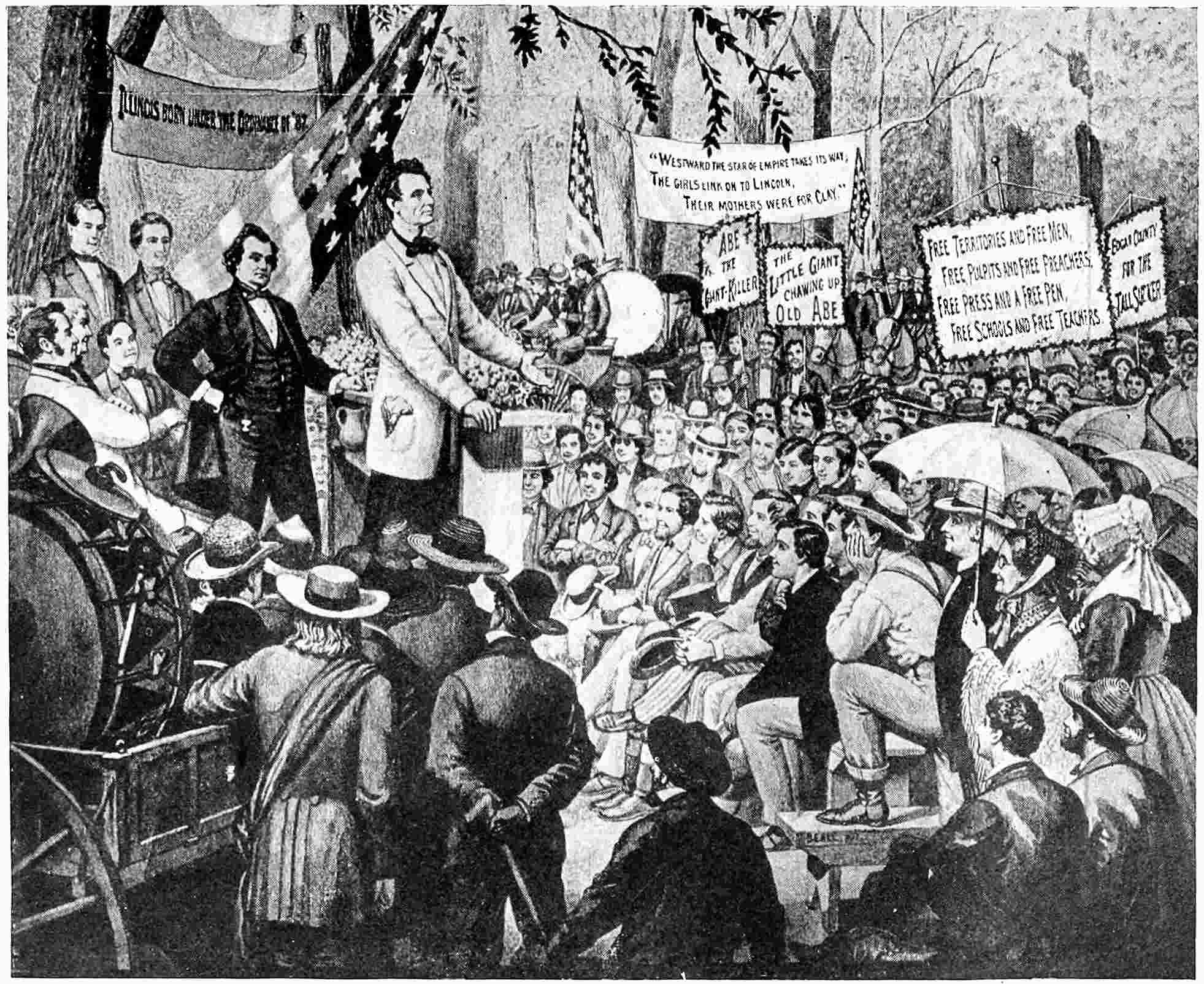
Taken from an old print
Lincoln debating with Douglas in 1858
It is hard to realize that, even later in his
career, and with all his mighty strength and
courage, the man who preserved “government
of the people, for the people, and by
the people” to the world could earn only
thirty-seven cents a day, and that he had “to
split four hundred rails for every yard of
brown jeans dyed with white walnut bark
that would be necessary to make him a pair
of trousers.”
When he was President of the United
States he told Secretary Seward the story of
how he had once taken two men and their
trunks to a river steamer in a flatboat built
by his own hands, and got a dollar for it.
“In these days it seems like a trifle to
me,” he added, “but it was a most important
incident in my life. I could scarcely
credit that I, the poor boy, had earned a
dollar in less than a day; that by honest
work I had earned a dollar.”
In 1828 Mr. Gentry, of Gentryville,
loaded a flatboat with produce, put his son
in charge of it and hired Lincoln for eight
dollars a month and board to work the bow
oars and take it to New Orleans. Near
Baton Rouge the young men tied the boat
up at night and were asleep in a cabin when
they were awakened to find a gang of negroes
attempting to plunder the cargo. With
a club Lincoln knocked several of the marauders
into the river and chased the rest
for some distance, returning bloody but victorious.
The boat was then hurriedly cut
loose, and they floated on all night.
That voyage was Lincoln’s first brief
glimpse of the great world. Till then he
had never seen a large city. In New Orleans
he was yet to see human beings bought
and sold, and hear the groans that were afterwards
answered by the thunders of the
Civil War.
IV
Two years later the milk-sickness which
had robbed Lincoln of his mother
again visited the Pigeon Creek settlers,
and his father decided to move to
Illinois, where rich lands were to be had
cheap. Dennis Hanks and Levi Hall accompanied
the Lincoln family.
The tall young woodchopper had just
passed his twenty-first birthday, and it was
he, in buckskin breeches and coonskin cap,
who goaded on the oxen hitched to the
clumsy wagon that creaked and lurched
through the March mud and partly frozen
streams on that terrible two weeks’ journey
into the Sangamon country of Illinois.
He said good-bye to the old log-cabin. It
was rude and mean, but, after all, it was his
home. He shook hands with his friends in
Gentryville. He took a last look at the unmarked
grave of his mother. His boyhood
was over.
Before setting out for his new home, Lincoln
spent all his money, more than thirty
dollars, in buying petty merchandise, knives,
forks, needles, pins, buttons, thread and
other things that might appeal to housewives.
And on the voyage to Illinois the
future President of the United States peddled
his little wares so successfully that he
doubled his money. Thus Abraham Lincoln
entered the State which saw him rise
to greatness—woodchopper, ox-driver, peddler,
pioneer.
Even in that rough, heroic pilgrimage, the
tender heart of the man showed itself again
and again. One loves to remember Lincoln
as Mr. Herndon, his law-partner, has
described him, pulling off his shoes and
stockings and wading a stream through
broken ice to save a pet dog left whining on
the other side.
“I could not bear to abandon even a dog,”
he explained.
Presently the emigrants settled on a bluff
overlooking the Sangamon River, five miles
from Decatur, in Macon County. All
promptly set to work. A clearing was
made, trees felled, and a cabin built. Abraham
and his cousin, John Hanks, ploughed
fifteen acres of sod and split rails enough to
fence the space in.
Some of the rails split by Lincoln at that
time were thirty years later carried into the
convention which nominated him for President.
Having reached his majority and seen his
father and family safely housed, Lincoln
started out to shift for himself. Among
other things, he split three thousand rails
for a Major Warnick, walking three miles a
day to his work.
Then came the winter of “the deep snow,”
a season so terrible that John Hay has thus
described its effects:
“Geese and chickens were caught by the
feet and wings and frozen to the wet ground.
A drove of a thousand hogs, which were being
driven to St. Louis, rushed together for
warmth, and became piled in a great heap.
Those inside smothered and those outside
froze, and the ghastly pyramid remained
there on the prairie for weeks; the drovers
barely escaped with their lives. Men killed
their horses, disemboweled them, and crept
into the cavities of their bodies to escape the
murderous wind.”
Lincoln left his father’s house empty-handed,
save for his axe, and he had to face
that blizzard winter as best he could. No
man or woman ever heard him complain.
In all his after years he looked back upon
the struggles of his early career without a
word of self-pity. Those were iron days,
but they were not without romance, and life
was honest and strengthening.
It is doubtful, after all, whether Lincoln’s
son, who became rich, dined with kings and
queens, and came to be president of the hundred-million-dollar
Pullman Company, ever
in his comfortable and successful career
once felt half the sense of life in its deepest,
grandest moods that thrilled his gaunt
father facing that fearful winter.
Let the discouraged American, whose
heart grows faint in the presence of “bad
luck,” think of that rude frontiersman, to
whom hardship brought only strength and
renewed courage. In spite of everything,
the sources of a man’s success are within
him, and none can stay him but himself.
Lincoln knew famine, and cold, and wandering.
But he did not pity himself. Axe in
hand, he confronted his fate in that smitten
country with as great a soul as when he
faced the armed Confederacy and saw his
country riven and bleeding.
In the spring of 1831 Denton Offut hired
Lincoln to go with him on a boat, with a
load of stock and provisions, to New Orleans,
and, after many adventures, in which
his strength and ingenuity saved boat and
cargo several times, he again found himself
at the mouth of the Mississippi.
Here he first saw the hideous side of slavery.
His law-partner thus refers to one
of the scenes he witnessed:
“A vigorous and comely mulatto girl was
being sold. She underwent a thorough examination
at the hands of the bidders; they
pinched her flesh and made her trot up and
down the room like a horse.... Bidding
his companions follow him, he said,
‘By God, boys, let’s get away from this. If
ever I get a chance to hit that thing I’ll hit
it hard.’”
The grandest and bloodiest page of modern
history is a record of how Lincoln fulfilled
that promise.
That very summer he went to the village
of New Salem, on the Sangamon River—a
village that has long since vanished—and
became clerk in a log-house general store
opened by Offut, who was a restless commercial
adventurer. Lincoln and an assistant
slept in the store.
Here the tall clerk became famous for his
stories and homely wit. His immense stature,
his strength, his humor and his penetrating
logic attracted attention at once. He
talked in quaint, waggish parables, but he
never failed to reach the heart or brain.
Offut’s store grew to be the common
meeting place of the frontiersmen, and long-legged,
droll, kindly Lincoln developed his
natural genius for story-telling and argument.
But Offut bragged of his clerk’s strength.
That angered the rough, rollicking youths of
a nearby settlement known as Clary’s Grove,
who picked out Jack Armstrong, their leader
and a veritable giant, to “throw” Lincoln.
At first Lincoln declined the challenge on
the ground that he did not like “wooling and
pulling.” But, although his inheritance of
Quaker blood inclined him to avoid violence,
he was finally taunted into the struggle. In
the presence of all New Salem and Clary’s
Grove he partly stripped his two hundred
and fourteen pounds of muscle-ribbed body
and conquered the bully of Sangamon
County.
After that exhibition of strength and
pluck, Lincoln was the hero of the community.
Braggarts became silent in his presence.
A ruffian swore one day in the store
before a woman. Lincoln bade him stop,
but he continued his abuse. “Well, if you
must be whipped,” said the clerk, “I suppose
I might as well whip you as any man.”
And he did it. That was Lincoln.
His honesty became a proverb. It is said
that, having overcharged a customer six
cents, he walked three miles in the dark,
after the store was closed, to give back the
money. By mistake he sold four ounces of
tea for a half-pound, and the next day
trudged to the customer’s cabin with the
rest of the tea.
Just when Lincoln became a conscious
politician no man can say. His endless
anecdotes and jokes, his winning honesty
and good nature, his readiness to accept or
stop a fight, his willingness to do a good
turn for man, woman or child, and his open
scorn for meanness, cruelty or deceit, were
the simple overflowings of his natural character.
He was coarse in his speech and
manners. But behind the joking and buffoonery,
the primitive man in him was true,
gentle, chivalrous. His tender-heartedness
was real. His kindliness was not merely
the result of a desire to catch friends.
He once illustrated himself by quoting an
old man at an Indiana church meeting:
“When I do good I feel good, when I do
bad I feel bad, and that’s my religion.”
But in New Salem it soon became evident
that Lincoln was not satisfied to remain
a clerk in a general store, and that the
strivings of leadership were in him. He
borrowed books. He asked Menton Graham,
the schoolmaster, for advice. He
read, read, read. He walked many miles at
night to speak in debating clubs. He
trudged twelve miles to get Kirkham’s
Grammar, and often asked his assistant in
the store to keep watch with the book while
he said the lesson. It was a common thing
to find him stretched out on the counter,
head on a roll of calicos, grammar in hand.
His desire to master language became a
passion. The whole village “took notice.”
Even the cooper would keep a fire of shavings
going at night that Lincoln might read.
The young frontiersman of six-feet-four,
who could outlift, outwrestle and outrun any
man in Sagamon County, rising from an
almost hopeless abyss of ignorance and poverty,
was, by his own resolute efforts, acquiring
the power that made him the hero of
civilization and the savior of a race.
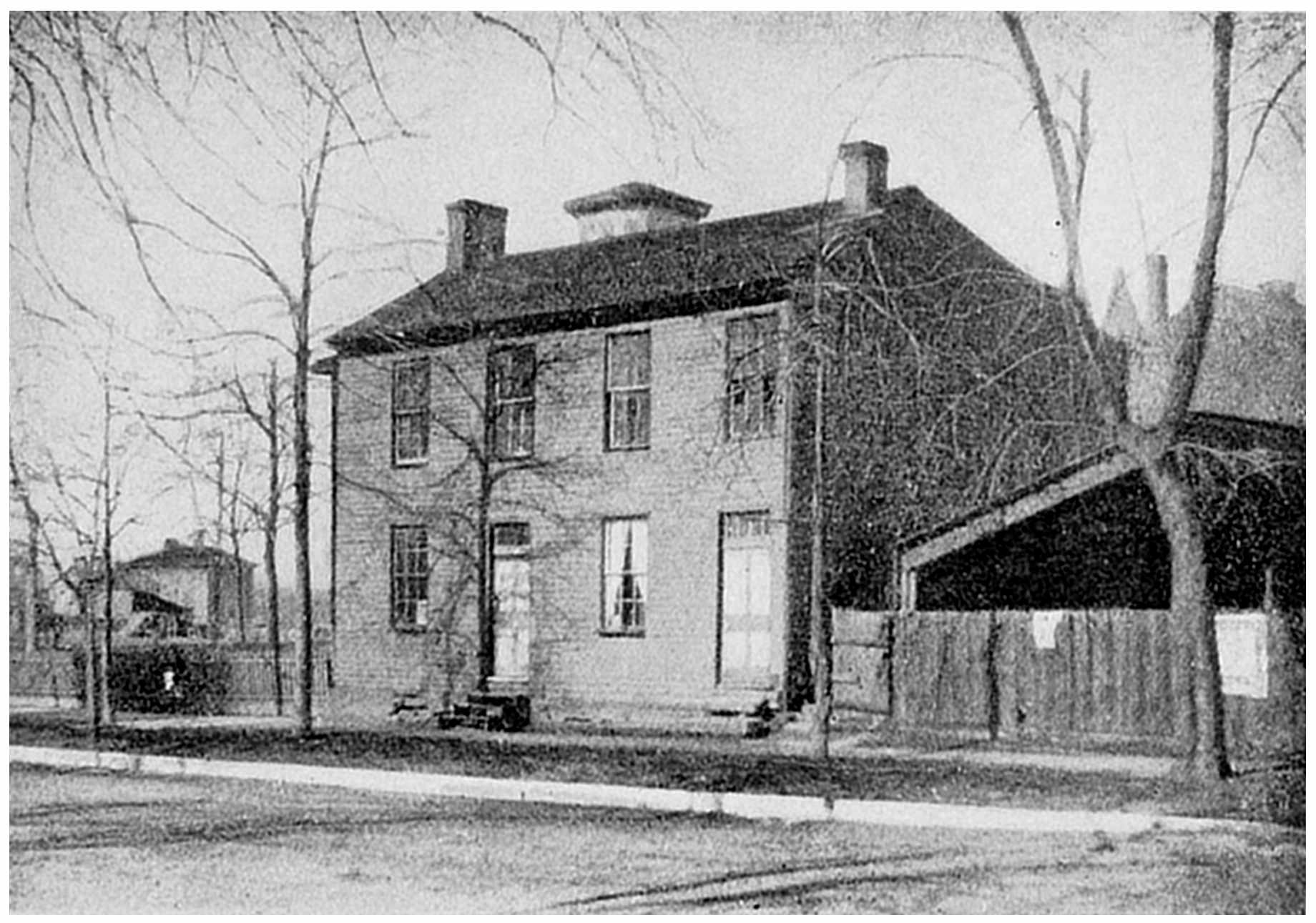
From “Abraham Lincoln.” Copyright, 1892, D. Appleton & Co.
The Globe Tavern, Springfield, where Lincoln lived
How many of the almost seventeen million
children who receive free education in
the public schools in the United States, and
who assemble once a year to repeat the
imperishable sayings of Lincoln, realize how
he had to strain and struggle for the knowledge
which is offered daily to them as a gift?
No wonder that Lincoln became popular
in New Salem, and that when the little Black
Hawk Indian war broke out he was elected
captain of the company which marched
forth from the village in April, 1831, in
buckskin breeches and coon caps, with
rifles, powder horns and blankets.
It was in that picturesque campaign that
Lincoln, coming with his company to a
fence gate and not remembering the military
word of command necessary to get his company
in order through such a narrow space,
instantly showed his ingenuity by shouting,
“This company is dismissed for two minutes,
when it will fall in again on the other
side of the gate.”
A poor, old half-starved Indian crept into
Lincoln’s camp for shelter. The excited
soldiers insisted on killing him. But Lincoln
stood between them and the frightened
fugitive. At the risk of his own life he
saved the Indian. The soul of chivalry was
in him.
He had no chance to fight, and he was
compelled to wear a wooden sword for two
weeks because his company got drunk—he
who afterwards commanded Grant, Sherman
and Sheridan—yet he returned to his
village a hero without having shed blood,
for the world honors courage and patience
even in those who fail to reach the firing
line.
V
After the war of 1812, which was
fought while Lincoln was in his
rude Kentucky cradle, the continental
spirit of the American people gradually
rose to a high pitch, which was
intensified in 1823, when the Monroe
Doctrine was born and the Holy Alliance—not
to say all Europe—was warned against
armed interference with even the humblest
republic of the Western Hemisphere.
A new sense of power inspired swaggering,
bragging American politics. So the
Greeks bragged when Alexander overthrew
Persia; so Christendom bragged when
Charles Martel smashed the Saracens and
made possible the Empire of Charlemagne;
so the British bragged after Trafalgar and
Waterloo; so the Puritans bragged when
Cromwell struck off the head of King
Charles.
The boastful spirit of America was encouraged
by spread-eagle statesmen in blue
coats, brass buttons and buff waistcoats,
who spoke as though history began at Bunker
Hill. Andrew Jackson, whose frontiersmen
had thrashed the trained British regiments
at New Orleans, had succeeded John
Quincy Adams, the polished Harvard professor,
in the White House. It was a time
of grand talk. The People—with a capital
P—puffed out their unterrified bosoms and
made faces at the miserable rulers of Europe.
It was brave and honest, this strutting,
defiant democracy, but it took Charles
Dickens some years later to show us the
ridiculous side of it, even though he went
too far.
“Do you suppose I am such a d—d fool
as to think myself fit for President of the
United States? No, sir!” was Jackson’s
estimate of himself in 1823. Yet there was
the rough old hero in Washington’s chair
at last.
Hayne had talked in the United States
Senate of nullifying the nation’s laws in
South Carolina, and Webster had thundered
back his majestic defence of the indivisible
Union. Then South Carolina had
attempted nullification and threatened secession,
to be promptly answered by President
Jackson with an effective promise of
cold steel and powder, and a gruff hint of
the hangman’s noose.
Beyond the Allegheny Mountains were
the new Western States, with unpaved
towns, frantic land booms, tall talk, and
hero-hearted men in coonskin caps pushing
out with axes and rifles into the unsettled
national territories.
In the midst of this half-organized civilization
Abraham Lincoln listened to the
slowly swelling voices of conflict that came
to him in his Illinois village from the Eastern
and Southern States.
The great scattered West longed for
means of transportation. Railroads, canals,
steamboats! They meant wealth and power
to the pioneers and the shrieking speculators.
The Whigs under Henry Clay promised
to raise such a national revenue through
a high protective tariff that a mighty surplus
of money could be divided among the States
to carry on internal improvements.
Lincoln was a Whig. He was for a high
tariff and internal improvements. Had he
not personally piloted a steamboat from
Cincinnati between the crooked and overgrown
banks of the Sangamon River, and
had not the imagination of that country
taken fire as the vessel reached Springfield?
Railroads, canals, steamboats! And no recognition
yet of the issue of disunion that
was to shake the continent and drench it
with blood.
After the return from the Black Hawk
war Lincoln offered himself as a candidate
for the Legislature. His handbill, addressed
to the voters, dealt mainly with
river navigation, railroads and usury.
“I was born and have ever remained in
the most humble walks of life,” he wrote.
“I have no wealthy or popular relatives or
friends to recommend me.”
Lincoln knew that public. He made his
first speech in “a mixed jeans coat, claw-hammer
style, short in the sleeves and bob-tail;
flax and tow-linen pantaloons, and a
straw hat.” First, he jumped from the platform,
caught a fighting rowdy by the neck
and trousers, hurled him twelve feet away,
remounted the platform, threw down his
hat, and made his historic entrance into
American politics in these words:
“Fellow citizens: I presume you all
know who I am. I am humble Abraham
Lincoln. I have been solicited by many
friends to become a candidate for the Legislature.
My politics are short and sweet,
like the old woman’s dance. I am in favor
of a national bank. I am in favor of the
internal improvement system and a high
protective tariff. These are my sentiments
and political principles. If elected I shall
be thankful; if not, it will be all the same.”
There is the Lincoln we love—simple,
genuine, direct! He seemed to feel to the
day of his death that the public was not
some distant abstraction, to be approached
fearfully and crawlingly; but men like himself,
with the same feelings and aspirations.
It was because Lincoln hated shams and
sneaks, and had the root of kindly honor in
his nature, and because he saw, at the very
bottom, all men more or less the same, that
he reached the average American heart as
no one has reached it before or since. He
was humble enough—and humility is an
inevitable result of moral and spiritual intelligence—to
believe that the honesty he felt
in himself stirred an equal honesty in others
about him.
He was defeated in the election, but that
was the only time the people rejected him.
Failure did not sour Lincoln. He took
odd jobs about the village—Offutt’s had
“petered out”—and for a time he considered
the blacksmith’s trade. But presently
he became a partner in a general store with
an idle fellow named Berry, giving his note
in payment of his share. He and his partner
bought out still another unsuccessful
store, paying for it with their notes. The
end of it all was that their business failed
and Lincoln had to shoulder a debt that
made him stagger for many years.
He was not a good merchant. His fondness
for study made him neglect his store.
Having secured copies of Blackstone and
Chitty he spent his days and nights studying
law. He would go to the great oak just
outside of the door, lie on his back with his
feet against the tree, and lose himself in
Blackstone for hours.
The store was a failure, and Lincoln went
back to rail splitting and farm work. But his
law books were always with him. No hardship,
no disappointment, could persuade him
to give up his pursuit of knowledge.
In 1833 he became postmaster of New
Salem, often carrying the scanty mail about
in his hat and reading the newspapers before
he delivered them.
Meanwhile John Calhoun, the Surveyor
of Sangamon County, wanted an assistant,
and he appointed the tall, story-telling, likeable
postmaster to the place. Lincoln knew
nothing of surveying, but in six weeks he got
enough out of books to fit him for the work.
His survey maps are still models of accuracy
and intelligence.
Once more he was a candidate for the
Legislature, in 1834. This time he was
elected. He had to borrow money to buy
clothes in which to make his legislative
appearance.
VI
And now came the first great romance
of Lincoln’s life. He fell in love
with pretty, auburn-haired Anne
Rutledge, daughter of the owner of the
tavern in which he lived. His passion
seemed hopeless, for the slender maid of
seventeen was pledged to a young man
from New York. Yet Lincoln loved and
waited and hoped. His studies had worn
him to emaciation. His ill-fitting clothes
hung loose on his ungainly figure. His
face was thin and his eyes sunken. He
was poor, and a mere clodhopper. Still he
loved sweet little Anne Rutledge, even
though all the village knew she was another’s,
and that love burned in him always.
When her lover went away, promising to
return, Lincoln was her watchful knight,
serving and hoping. But the New Yorker
did not come back. Anne Rutledge grew
pale with waiting. It was evident that she
was deserted. All New Salem knew it.
Then Lincoln offered her his heart and
she consented, asking only time enough to
write to her lost lover. No answer to the
letter came. Week after week passed. And
then Lincoln was accepted. But, alas, the
strain had been too great, and the abandoned
young beauty grew mortally ill. On
her deathbed she called for Lincoln continually,
and when he came they left him
alone with her for farewell. Afterwards he
went to her grave and wept like a child.
“My heart lies buried there,” he said.
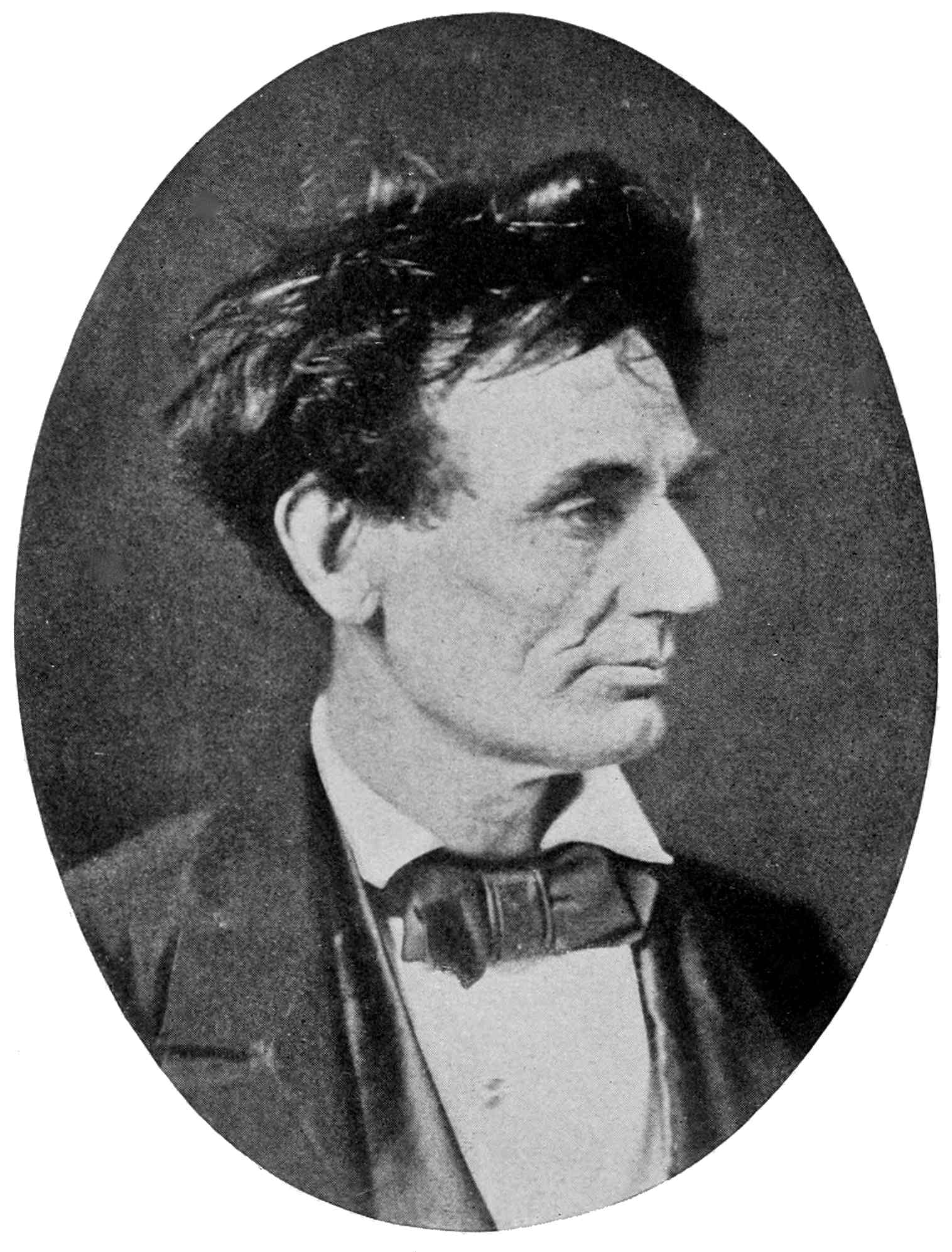
Lincoln in 1857
Poor, honest, ugly Lincoln! That tragedy
saddened his life, and years afterwards
he could not refer to Anne Rutledge without
tears. So terrible was the effect of her
death upon him that for a time his friends
feared for his reason. He would wander in
the woods a victim to despair. To a companion
who urged him to forget his loss he
groaned, “I cannot; the thought of the snow
and rain on her grave fills me with indescribable
grief.” Finally, he was taken to
a friend’s house and there watched and comforted
through days of deep torment, bordering
on madness, till he could bear to go
out again among men.
Lincoln went to the Legislature at Vandalia
in a coarse suit of jeans, but most of
the Illinois lawmakers wore jeans and coonskin
caps. It cannot be honestly said that
he was a brilliant or important lawmaker,
although his great height, immense strength,
quaint, sharp wit and never-failing stories
made him a popular figure at the State
capital.
His mind was too much occupied with the
study of the law. He had resumed an acquaintance,
formed during the Black Hawk
war, with Major John T. Stuart, who encouraged
him to become a lawyer, and
loaned him books. Curiously enough he
seemed to desire no teacher, but followed
his course of studies alone. Self-reliance
was his strongest trait, self-reliance and endless
work.
Those who attempt to account for Lincoln’s
remarkable rise in life are apt to overlook
the terrific mental grind to which he
subjected himself for so many years; and,
as we value most that which we get through
stress and sacrifice and pain, so the things
which Lincoln dug out of his books were
never forgotten.
Perhaps, in these easy days, when education
is pressed upon all, there is a lesson to
be found in the story of this man who laid
firm foundations for his after life of greatness
by taking upon himself the whole responsibility
for searching after sound knowledge
and principles.
Lincoln became Major Stuart’s law-partner,
and for many years he alternated between
petty lawsuits and his more profitable
work as a surveyor. His sincerity, shrewd
humor, fairness and hearty hand-shaking
qualities drew friends to him wherever he
went. His long, almost ludicrous figure,
with its trousers short of the shoetops by
several inches; his stooping shoulders and
shriveled, sunken, melancholy face, were
not associated with the distinction, romance
and tragic dignity which history has given
to all that belongs to him. But his very
spraddling awkwardness, the picturesque
vernacular in which he told his countryside
parables, coarse and satirical though they
sometimes were; the humble spirit in which
the lawyer-surveyor-politician would do odd
jobs or chores to help a neighbor or earn a
dollar, gave him added political strength
with a frontier people who loved plain men.
He does not understand Lincoln who
thinks of him as a guileless, innocent frontiersman,
raised by accident from a log-cabin
to direct a mighty war and shape the
policy of a nation. He was a sagacious,
observant, natural politician, ambitious but
honest. His law-partner, Mr. Herndon, has
made that plain. Horace White, who knew
Lincoln in his days of political campaigning,
has written of him:
“He was as ambitious of earthly honors
as any man of his time. Furthermore, he
was an adept at log-rolling or any political
game that did not involve falsity....
Nobody knew better how to turn things to
advantage politically, and nobody was readier
to take such advantage, provided it did
not involve dishonorable means. He could
not cheat the people out of their votes any
more than out of their money. The Abraham
Lincoln that some people have pictured
to themselves, sitting in his dingy law
office, working over his cases till the voice
of duty roused him, never existed. If this
had been his type he never would have been
called at all.”
It helps one to realize the man who afterwards
roused the soul of the Republic to
resist the degradation of slavery and the
shock of war to read what he wrote from
Washington to Mr. Herndon in 1848:
“Now, as to the young men, you must
not wait to be brought forward by the older
men. For instance, do you suppose that I
should ever have got into notice if I had
waited to be hunted up and pushed forward
by older men? You young men get together
and form a Rough and Ready club,
and have regular meetings and speeches.
Take in everybody that you can get....
As you go along, gather up the shrewd,
wild boys about town, whether just of age
or just a little under. Let every one play
the part he can play best—some speak, some
sing, and all halloo.”
And in 1836 we catch sight of Lincoln,
again a candidate for the Legislature, leaping
forward, with flashing eyes to answer a
taunt of a Mr. Forquer, who had a lightning
rod on his new house, and had just left the
Whig party for a place in the Land Office:
“I desire to live, and I desire place and distinction;
but I would rather die now than,
like the gentleman, live to see the day that
I would change my politics for an office
worth three thousand dollars a year, and
then feel compelled to erect a lightning rod
to protect a guilty conscience from an
offended God.”
Yes, Lincoln was a politician who could
seize your attention by the very witchery of
his grotesque personality, twist his opponent
into helplessness by the stinging shrewdness
of a humorous story, make you laugh or
cry alternately, reach down into your humanity
by some frank confession of his poverty
and rough beginnings, and then suddenly
stir the highest instincts of your nature
by a sublime moral appeal.
It is true that in his second term in the
Legislature he voted for all manner of extravagant
and preposterous schemes of “internal
improvements.” But that was a day
of inflated hope, and Illinois was delirious
with land gambling. Lincoln, like the
other politicians of the State, was swept
along by the current of popular enthusiasm.
He swaggered, dreamed, bragged and voted
with the rest. The voters wanted railways,
canals and river improvements. So the
Legislature authorized thirteen hundred
miles of railways, a canal between the Illinois
River and Lake Michigan, and endless
improvements of rivers and streams; and
to carry out this staggering programme of
improvements in a poor, half-settled frontier
State, a loan of twelve million dollars was
voted.
Not only did Lincoln in his early life vote
for this audacious and spendthrift scheme,
in response to a harebrained popular demand,
but he advocated woman suffrage;
proposed a usury rate, with the naive suggestion
that “in cases of extreme necessity
there could always be found means to cheat
the law”; wrote foolish love letters to blue-eyed
Mary Owens, offering to keep his supposed
marriage engagement to her, but advising
her for her own sake not to hold him
to it; and developed into a more or less
ranting, downright country politician, ready
to make a stump speech, tell a story, shake
hands with a crowd or thrash a ruffian on
the slightest provocation.
And when the capital of Illinois was
changed to Springfield, he rode into that
town on a borrowed horse, with “two saddlebags,
containing two or three law books
and a few pieces of clothing,” and, not having
seventeen dollars with which to buy a
bed and furnishings, accepted a free room
over the store of his friend, Mr. Speed,
dropped his saddlebags on the floor and
smilingly said, “Well, Speed, I’m moved.”
That was his entrance into the town which
saw his rise to the Presidency.
Around the fireplace in Speed’s store Lincoln
used to sit with Douglas, Baker, Calhoun,
Browning, Lamborn and other rising
politicians and orators of the West. Here
every question under heaven was debated,
stories were told, jokes cracked, poems recited;
and it would take the pen of a Balzac
to describe the scenes of merriment, or serious,
sharp contest, that happened before
those blazing logs, with an attentive ring of
friends listening to the never-ceasing flow
of wit and wisdom.
Again and again Lincoln was elected to
the Illinois Legislature, always as a Whig.
Yet he remained humble in spirit. In
answer to the taunt that the Whigs were
aristocrats, he made a speech showing that
he understood how the political sympathies
of the West were to be won:
“I was a poor boy, hired on a flatboat at
eight dollars a month, and had only one pair
of breeches to my back, and they were buckskin.
Now, if you know the nature of buckskin
when wet, and dried by the sun, it will
shrink; and my breeches kept shrinking
until they left several inches of my legs bare
between the tops of my socks and the lower
part of my breeches; and whilst I was growing
taller, they were becoming shorter, and
so much tighter that they left a blue streak
around my legs that can be seen to this day.
If you call this aristocracy I plead guilty to
the charge.”
He could outwrestle, outrun and out-talk
any man in his section. He was recognized
as the most skillful and hard-headed
politician in his State. His courage and
shrewdness in ordinary affairs were notable,
and his honesty and earnestness, sweetened
by a sure sense of humor, lent distinction
and dignity to a ridiculous figure and sometimes
theatrical manner of address.
Yet there was a strange, gloomy self-distrust
in Lincoln which showed itself in his
love affairs; an imaginative melancholy that
wrung his heart and tortured his mind with
baseless, shadowy misgivings. He engaged
himself to marry Mary Todd and, doubting
his own love, broke the engagement. It has
been even charged that he deserted her when
she was attired for the wedding. Lincoln
described his parting to Mr. Speed:
“When I told Mary I did not love her,”
he said, “she burst into tears and almost
springing from her chair and wringing her
hands as if in agony, said something about
the deceiver being himself deceived. To
tell you the truth, Speed, it was too much
for me. I found the tears trickling down
my own cheeks. I caught her in my arms
and kissed her.”
So great was Lincoln’s agony and depression
after this that he was watched by his
friends lest he might commit suicide. “I
am now the most miserable man living,” he
wrote to Major Stuart. “If what I feel
were distributed to the whole human family,
there would not be one cheerful face on
earth. Whether I shall ever be better, I
cannot tell; I awfully forbode I shall
not.”
The shadow of threatened insanity passed,
and within two years Mary Todd became
his wife. It was a singular jest of fate that
he should have won her away from Stephen
A. Douglas, who was yet to be his rival in
the great anti-slavery struggle that was
ended only by millions of armed men.
Poor heart-torn, shrewd, foolish, humble,
sublime Lincoln!
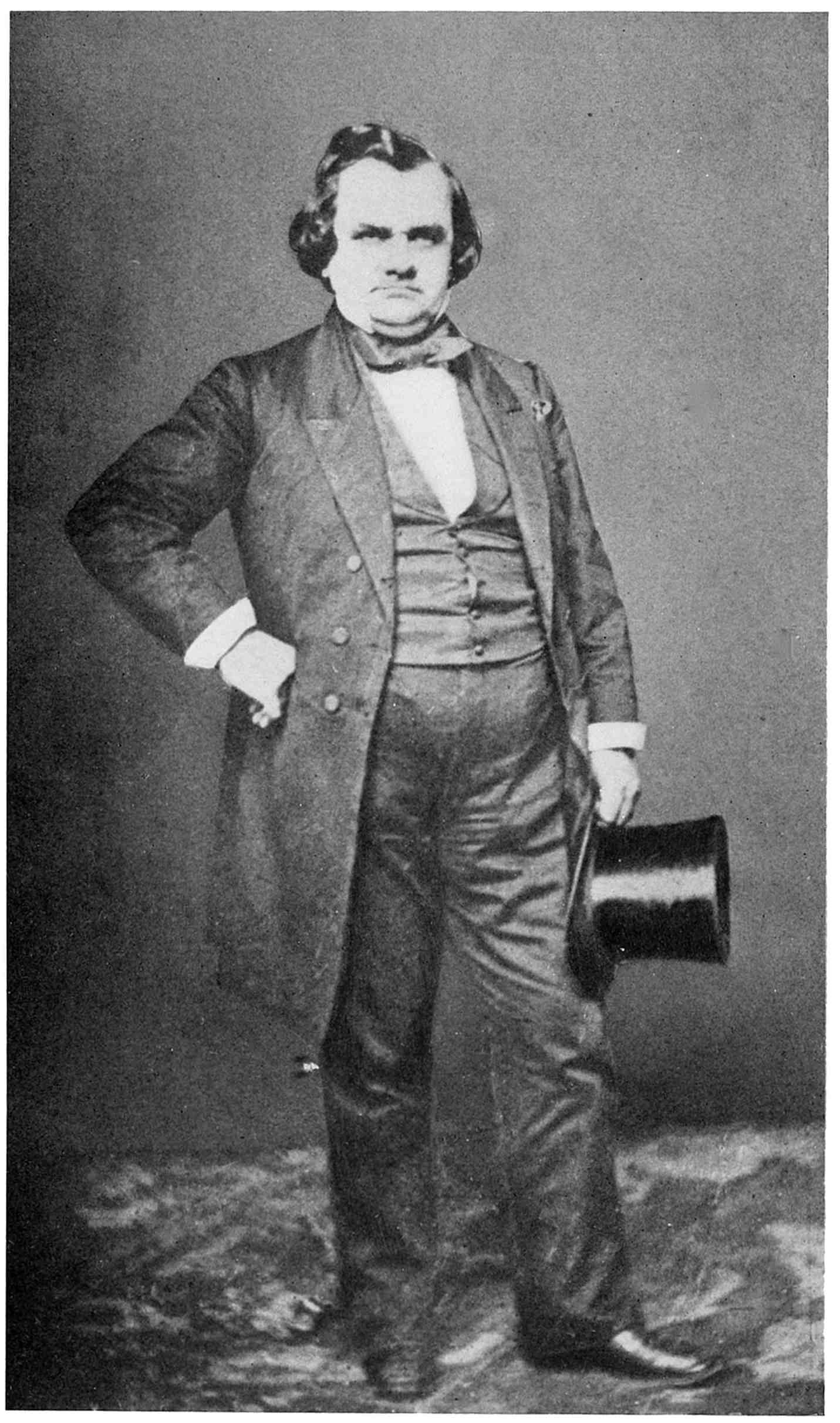
Senator Stephen A. Douglas, Lincoln’s great rival
Then there was the duel with James
Shields. That hot-headed Irishman had
challenged Lincoln to fight because the tall
politician had written certain anonymous
letters for the Springfield Journal. Lincoln
accepted and named “cavalry broadswords
of the largest size.” The duelists went to
the place appointed by the river, and sat on
logs on opposite sides of the field. Here is
a description of the scene by an onlooker,
from Miss Tarbell’s “Life of Abraham
Lincoln”:
“I watched Lincoln closely while he set
on his log awaiting the signal to fight. His
face was grave and serious. I could discern
nothing suggestive of ‘old Abe,’ as we knew
him. I never knew him to go so long without
making a joke, and I began to believe
he was getting frightened. But presently
he reached over and picked up one of the
swords, which he drew from its scabbard.
Then he felt along the edge of the weapon
with his thumb, like a barber feels of the
edge of his razor, raised himself to his full
height, stretched out his long arms and
clipped a twig from above his head with the
sword. There wasn’t another man of us
who could have reached anywhere near that
twig, and the absurdity of that long-reaching
fellow fighting with cavalry sabres with
Shields, who could walk under his arm,
came pretty near making me howl with
laughter. After Lincoln had cut off the
twig he returned the sword to the scabbard.”
Before the combat could begin, friends
arrived in a canoe, Shields was induced to
make a concession, and presently Lincoln
and his opponent returned to town fast
friends.
VII
We love Lincoln because his life
plucks every harp-string in true
democracy. Lincoln is the answer
to Socialism. He represents individualism,
justifying opportunity. Self-government
stands vindicated in his name. The
thought of him is at once an inspiration and
challenge to the poorest and most ignorant
boy or man in America.
But we love him most of all because he
saved the nation which Washington began,
and, in the bloody act of salvation, brought
human slavery to an end in the great Republic.
In following Lincoln through his picturesque
and gaunt youth and through his service
in the Illinois Legislature and in Congress
to the point where the inner and outer
influences of his life, his soul and its environments,
merged into one supreme idea—the
preservation of the Union—we must not
forget the things that preceded the final
test of his life.
Up to Lincoln’s time it had not been determined
whether the fathers of the Republic
had really produced a nation, or merely
a contract or treaty between independent
and sovereign States. The system of separated,
incoordinate and aloof colonies—a
shrewd and stubborn British device for
keeping their American subjects weak by
disunion—grew into the system of States
which formed the Republic.
When the Constitution of the United
States was framed, ten of the thirteen States
had prohibited the importation of slaves.
Georgia and the two Carolinas still permitted
the slave trade with Africa. In order
not to leave these three States out of the
Union, the Constitution permitted the importation
of slaves until 1808. But the conscious
horror of that concession is to be
recognized in the care with which the word
slavery is avoided. To satisfy all the slave-owning
States, whose consent was necessary
to the adoption of the Constitution, slavery
itself, within those States, was recognized
and sanctioned by a clause providing that
five slaves should equal three free persons
as a basis of representation in the national
House of Representatives.
So that, whether we like the remembrance
or not, it is a fact that the founders of the
nation actually did sanction slavery, although
there was some righteous talk in
the Constitutional Convention over the reluctant
compromise.
While this convention, in Philadelphia,
was legalizing slavery, the Continental Congress,
in New York, passed an ordinance
for the government of the “territory of the
United States northwest of the river Ohio,”
providing that slavery should be forever prohibited
in that territory.
In 1820 the ocean slave-trade was declared
to be piracy, punishable by death.
In that same year Congress, under pressure
from the slave owners, adopted the
Missouri Compromise, by which Missouri
was admitted to the Union as a slave State,
with the proviso that slavery should be always
forbidden in any other part of the
territory north of 36° 30´ north latitude.
New England raged against slavery. Her
abolitionists cried out against it night and
day. To the assertion of the South that
slaves were valuable property, legally acquired
and legally held, they answered that
slavery was a deep damnation in the sight of
God, an unspeakably cruel crime, intolerable
among civilized men. They helped
slaves to escape from their masters, and did
everything in their power to make a farce
of the laws under which such fugitives might
be returned.
A great gulf opened between the free
States and the slave States, a gulf flaming
with passion and menace. Could the nation
hold together?
There were tremendous scenes in the Senate
in 1850, when a compromise was reached.
California was to be admitted a free State,
slavery was to be abolished in the District
of Columbia, and there was to be an effective
Fugitive Slave Law. These were the principal
points.
Henry Clay, in his seventy-third year,
spoke for two days in favor of compromise
and peace, picturing the frightful war that
must result from a failure to agree. John
C. Calhoun, pale, haggard and dying, rose
from his sick bed, staggered into the Senate
on the arms of friends and, being too weak
to speak, sat there while his plea for the
rights of the South was read. Then he went
back to his bed to die a few days later, groaning,
“The South! The poor South! God
knows what will become of her.” Daniel
Webster, too, raised his voice for compromise
in one of his noblest orations.
William H. Seward and Salmon P. Chase
bitterly opposed any compromise on the
basis of the Fugitive Slave Law. So fierce
did the debate become that Senator Benton
drew a pistol on Senator Foote.
Yet in the end, the compromise was
adopted and the Fugitive Slave Law was
passed.
Then, in 1854, Stephen A. Douglas,
United States Senator from Illinois, introduced
a bill providing a government for
the immense country now included in Kansas,
Nebraska, the Dakotas, Montana and
portions of Wyoming and Colorado—a country
larger than all the existing free States.
All this region was in the area from which
slavery was forever prohibited by the Missouri
Compromise. Yet Douglas’ bill provided
that whenever any part of the territory
should be admitted to the Union the question
of slavery or free-soil should be decided
by its inhabitants. This was the famous
“squatter sovereignty” idea, a virtual repeal
of the Missouri Compromise.
After a desperate fight in Congress, Douglas
carried his bill. It was a startling step
and a direct bid for the Democratic nomination
for the Presidency. By this act
Douglas made himself one of the most conspicuous
men in the country.
Hell seemed to break loose after President
Pierce signed this bill. It became impossible
to enforce the Fugitive Slave Law.
The anti-slavery agitation in the North
broke out with indescribable fury. “Uncle
Tom’s Cabin” was published. The abolitionists
were almost insane with anger and
indignation. Douglas was denounced as a
scoundrel who had sold himself to the slaveholders
for the sake of his Presidential ambitions.
Lincoln was a well-supported candidate for
the United States Senate in 1854, but he gave
up his chance and threw his strength to Lyman
Trumbull, a weaker candidate, rather
than risk the election of a pro-slavery Senator.
Miss Tarbell gives this picture of Lincoln
by his friend, Judge Dickey:
“After a while we went upstairs to bed.
There were two beds in our room, and I
remember that Lincoln sat up in his nightshirt
on the edge of the bed arguing the
point with me. At last we went to sleep.
Early in the morning I woke up, and there
was Lincoln half sitting up in bed.
‘Dickey,’ he said, ‘I tell you this nation
cannot exist half slave and half free.’ ‘Oh,
Lincoln,’ said I, ‘go to sleep.’”
The Territories of Kansas and Nebraska
became the center of interest, for whether
they would be slave States or free States
must depend upon the vote of their inhabitants,
and that was a simple question of
emigration.
Bands of colonists were sent to Kansas by
both the slavery and anti-slavery forces.
The work of colonizing the State was organized
on a large scale by both sides. The
pro-slavery men from Missouri crossed into
Kansas in 1854 and elected a pro-slavery
delegate to Congress. In 1855 about five
thousand Missourians, armed with pistols
and bowie knives, invaded Kansas and carried
the elections for the Territorial Legislature.
This Legislature enacted the Missouri
slavery laws and, in addition, provided
the death penalty for inciting slaves to leave
their masters or revolt. The Free Soil Kansans
thereupon elected a Constitutional Convention,
and organized a State government,
with a constitution prohibiting slavery.
Thus there were two governments in Kansas,
one pro-slavery, the other anti-slavery.
Blood began to flow as the hostile governments
collided.
In 1856 Preston Brooks, a nephew of
Senator Butler, of South Carolina, stole up
behind Senator Sumner, who had brilliantly
defended the Free Soilers of Kansas, and
beat him on the head with a heavy cane till
he fell unconscious. The pro-slavery Kansans
sacked the town of Lawrence. John
Brown and his abolitionist fanatics went
from cabin to cabin in Kansas, killing and
mutilating pro-slavery men. Riots and murders
terrorized the State. It was war to the
knife between slavery and anti-slavery. And
Douglas, in Washington, was pressing his
bill declaring that, as soon as Kansas had
ninety-three thousand voters, the pro-slavery
Territorial Legislature should call a convention
and organize the State.
VIII
It was in 1856 that the conscience and
courage of the North found a voice in
Abraham Lincoln. In his great soul
the civilization of America suddenly flowered.
In Congress Lincoln had vainly opposed
the war with Mexico as “unnecessary and
unconstitutional,” and he had gone back to
Springfield to practice law with his new
partner, William H. Herndon.
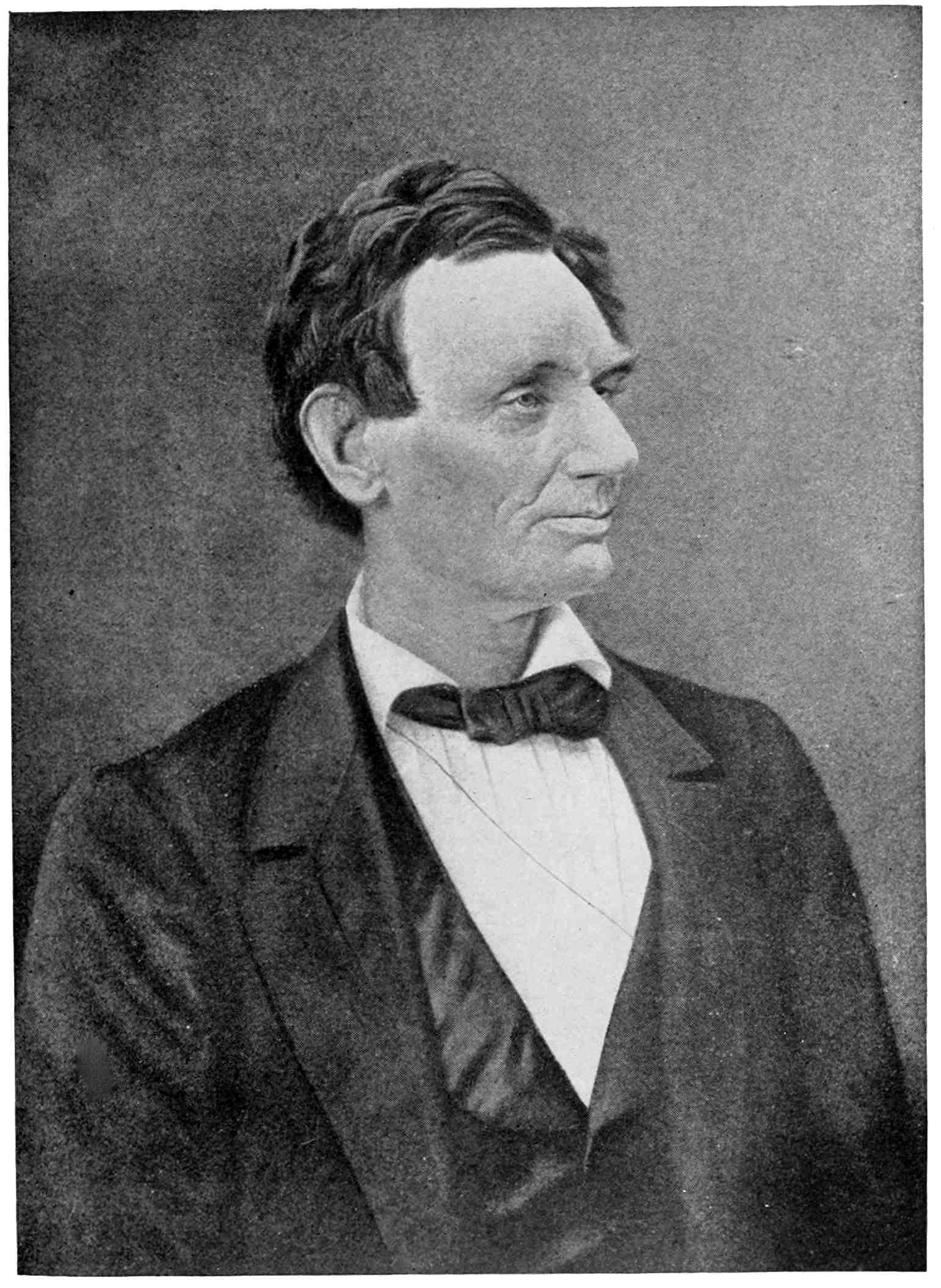
Abraham Lincoln. This photograph was made by Hesler, in
Chicago, about 1860
The mighty sweep of events in the country
had forced the Whigs and Northern
Democrats to form the Free Soil party,
not to extinguish slavery, but to prevent
its spread from the slave States into the
free Territories, and Lincoln’s tongue had
pleaded powerfully for freedom. But Fremont,
the Free Soil candidate for President,
was defeated, and the contending slaveowners
and abolitionists continued to press
the cup of horror and hatred to the trembling
lips of the nation. The South threatened
to withdraw from the Union.
Again and again Lincoln had expressed
his opinion that slavery was a crime against
civilization. In the teeth of Senator Douglas,
the eloquent and all-powerful Democratic
leader of Illinois, who was arousing
the West for slavery, he lashed and trampled
upon the attempt to make Kansas a slave
State.
While trying to obtain the release of a
free-born Illinois negro boy held by the authorities
of Louisiana, Lincoln appealed to
the Governor of Illinois, to whom he said,
“By God, Governor, I’ll make the ground
in this country too hot for the foot of a slave,
whether you have the legal power to secure
the release of this boy or not.”
Even then the man who felt in himself
the stirrings of power great enough to utter
that threat was a grotesque figure among
his fellow-lawyers. Yet there was no
shrewder advocate, no more effective jury-pleader
and no kindlier heart in Illinois.
Mr. Herndon gives this picture of him:
“His hat was brown, faded, and the nap
usually worn or rubbed off. He wore a
short cloak and sometimes a shawl. His
coat and vest hung loosely on his gaunt
frame, and his trousers were invariably too
short. On the circuit he carried in one
hand a faded green umbrella, with ‘A Lincoln’
in large white cotton or muslin letters
sewed on the inside. The knob was gone
from the handle, and when closed a piece
of cord was usually tied around it in the
middle to keep it from flying open. In the
other hand he carried a literal carpet bag,
in which were stored the few papers to be
used in court, and underclothing enough to
last until his return to Springfield. He
slept in a long, coarse yellow flannel shirt,
which reached half way between his knees
and ankles.”
Lincoln was not a distinguished lawyer.
Nor was he a financial success in his profession.
His partners complained that he
neglected the business side of things and
was completely absorbed in the justice or
humanity involved in his cases. His heart
would melt over the sorrows of a client, and
he would either accept a petty fee or altogether
neglect to collect anything. Mr.
Lamon, his junior partner, has testified that
when he charged a fee of $250, Lincoln made
him return half the money to their client on
the ground that “the service was not worth
the sum.” So extreme was his generosity
and charity, so averse was he to accepting
anything but the most modest fees, that
Judge David Davis once rebuked him from
the bench for impoverishing his brother lawyers
by such an example.
Not only that, but Lincoln many times in
court showed his deep and unfailing love of
justice and fair play by refusing to take advantage
of the mere slips of his opponents.
That generous honesty made him a power
with judges and juries.
It was when the Republican party was
born in the convention at Bloomington,
Illinois, on May 29, 1856, that Lincoln displayed
the full grandeur of his character.
His speech opposing the extension of slavery
to Kansas was so stirring, his presence so
inspiring, that the reporters forgot to take
notes. His hearers were thrilled, swept out
of themselves. He seemed to grow taller as
he spoke, his eyes flashed, his face shone with
passion, he seemed suddenly beautiful, for
his soul was in his eyes and on his lips as he
declared that slavery was a violation of
eternal right.
“We have temporized with it from
the necessities of our condition,” he said,
“but as sure as God reigns and school
children read, that black, foul lie can
never be consecrated into God’s hallowed
truth.”
McClure’s Magazine in 1896 gave a
report of this extraordinary speech. Here is
an extract:
“Do not mistake that the ballot is stronger
than the bullet. Therefore, let the legions
of slavery use bullets; but let us wait patiently
till November and fire ballots at them
in return.... We will be loyal to the
Constitution and to the ‘flag of our Union,’
and no matter what our grievance—even
though Kansas shall come in as a slave
State; and no matter what theirs—even if
we shall restore the Compromise—we will
say to the Southern disunionists, ‘We won’t
go out of the Union and you shan’t!’”
We love Lincoln because on that day he
spoke as one naked in the presence of God.
There was no lie in his mouth. Slavery
must be kept out of Kansas. Kansas must
be free. Slavery was an unspeakable offence
in the nostrils of a free people. Yet,
since the Constitution and the Missouri
Compromise permitted it in the slave States,
a law-respecting nation must permit it to
remain there. But Kansas must be free.
All the soil as yet uncursed by slavery must
be kept free.
And slave or free, the nation must be held
together—that was the central note of Lincoln’s
great speech.
It is a common mistake to suppose that
Lincoln was an advocate of the abolition of
slavery in the United States. Yet in 1854,
while denouncing slavery as a “monstrous
injustice,” he said:
“When Southern people tell us they are
no more responsible for the origin of slavery
than we, I acknowledge the fact. When it
is said that the institution exists and that it
is very difficult to get rid of it in any satisfactory
way, I can understand and appreciate
the saying. I surely will not blame
them for not doing what I should not know
how to do myself. If all earthly power were
given me, I should not know what to do as
to the existing institution.”
There was a sincere man, brave enough
and humble enough to make such an admission
in the teeth of the terrific abolitionist
crusade. So, too, he stood in 1856. The
nation had given its word, right or wrong,
to the slaveholders, and the nation’s word
must be kept. But Kansas must be free.
No, tender and merciful as Lincoln was,
he did not raise his voice for negro emancipation.
That thought came years afterwards,
when, in the agony of fratricidal strife, he
proclaimed the freedom of the blacks as a
war measure.
However, when the Supreme Court of the
United States in 1857 decided in the Dred
Scott case that a negro could not sue in the
national courts, and expressed the opinion
that Congress could not prohibit slavery in
the territories, there was a fierce outcry in
the free States, for five of the Supreme Court
justices were from slave States. It is impossible
to indicate the pitch of excitement
in the country.
Senator Douglas, prompt, bold, masterful,
faced his constituents in Illinois and
stigmatized opposition to the Supreme Court
as simple anarchy. Lincoln answered him
at once. The people must not resist the
court, but it was well known that the court
had often overruled its own decisions and
“it is not resistance, it is not factious, it is
not even disrespectful, to treat it as not having
yet quite established a settled doctrine
for the country.”
Another strain was placed upon the nerves
of the overwrought country. By trickery
the pro-slavery men of Kansas had brought
about the “Lecompton Constitution,” permitting
slavery in the State. President
Buchanan pressed for the admission of Kansas
into the Union with this constitution.
So, in 1858, when Lincoln was nominated
by the Republicans to succeed Douglas in
the Senate, and when he challenged Douglas
to a joint debate, the nation was in the
throes of an agitation that transcended all
other passions in its history.
When the long-legged country lawyer, in
loose-hung cloak, faded hat and ill-fitting
trousers—sunken-eyed, lantern-jawed and
stoop-shouldered—went forth to meet the
great Senator before the people, the whole
country watched the struggle with intense
interest. For, ever since Andrew Jackson
overthrew the Virginia oligarchy, the West
had grown stronger in the national councils,
and it was even now suspected that the balance
of political power was passing from
the South to the North. And Lincoln, risen
from the soil itself, was a singularly bitter
challenge to the aristocratic and haughty
temper of the slaveowners.
Who can describe that unforgetable and
decisive debate in Illinois?
On the very day of his nomination Lincoln
uttered the thought that was pressed on
and on until slavery and secession were
trampled into dust under the heels of the
Union armies:
“A house divided against itself cannot
stand. I believe this government cannot
endure permanently half slave and half
free. I do not expect the house to fall—but
I do expect it will cease to be divided.
It will become all one thing or all the other.”
Gaunt, gray-eyed, crooked-mouthed Lincoln!
In all history no man ever flayed an
opponent as he did Douglas.
“I tremble for my country when I remember
that God is just,” he exclaimed in
one of his loftiest moments.
He pelted Douglas with logic, exposed the
sham of his “squatter sovereignty” doctrine,
and pitilessly analyzed the predatory
policy of the slavery forces. He forced
Douglas to defend and explain his Kansas-Nebraska
law, trapped him into confusing
admissions and showed that his popular
sovereignty principle meant simply “that
if one man chooses to make a slave of another
man, neither that other man, nor anybody
else, has a right to object.”
Against the awkward country lawyer with
shriveled, melancholy countenance and
shrill voice, the polished, handsome and resourceful
Douglas contended in vain in the
seven monster outdoor meetings of the debates.
The humanity of Lincoln, the fairness
of his statements, the moral height from
which he spoke, the homely, cutting anecdotes,
the originality and imagination, the
obvious simplicity and sincerity of his arguments
beat down Douglas’ lawyer-like pleas.
Douglas charged Lincoln with favoring
the political and social equality of the white
and black races. Lincoln denied that he
considered the negro the equal of the white
man. “But in the right to eat the bread
which his own hands earns,” he added, “he
is my equal, and the equal of Judge Douglas,
and the equal of every living man.”
Nothing in the whole story of the American
people approaches this struggle between
Lincoln and Douglas for dramatic setting
and popular enthusiasm; and nothing in
Lincoln’s life proved more clearly that with
his feet set upon a moral issue he was matchless.
He was filled with the majesty of his
cause.
“If slavery is right,” he said that winter in
Cooper Institute, New York, “all words,
acts, laws and constitutions against it are
themselves wrong, and should be silenced
and swept away. If it is right, we cannot
justly object to its nationality, its universality.
If it is wrong, they cannot justly
insist upon its extension, its enlargement.
All they ask we could readily grant, if we
thought slavery right; all we ask they could
as readily grant, if they thought it wrong.
Their thinking it right and our thinking it
wrong is the precise facts upon which depends
the whole controversy.”
In the race for the Senatorship Douglas
defeated Lincoln; but in that defeat Lincoln
won a great victory in the awakened conscience
and courage of the North.
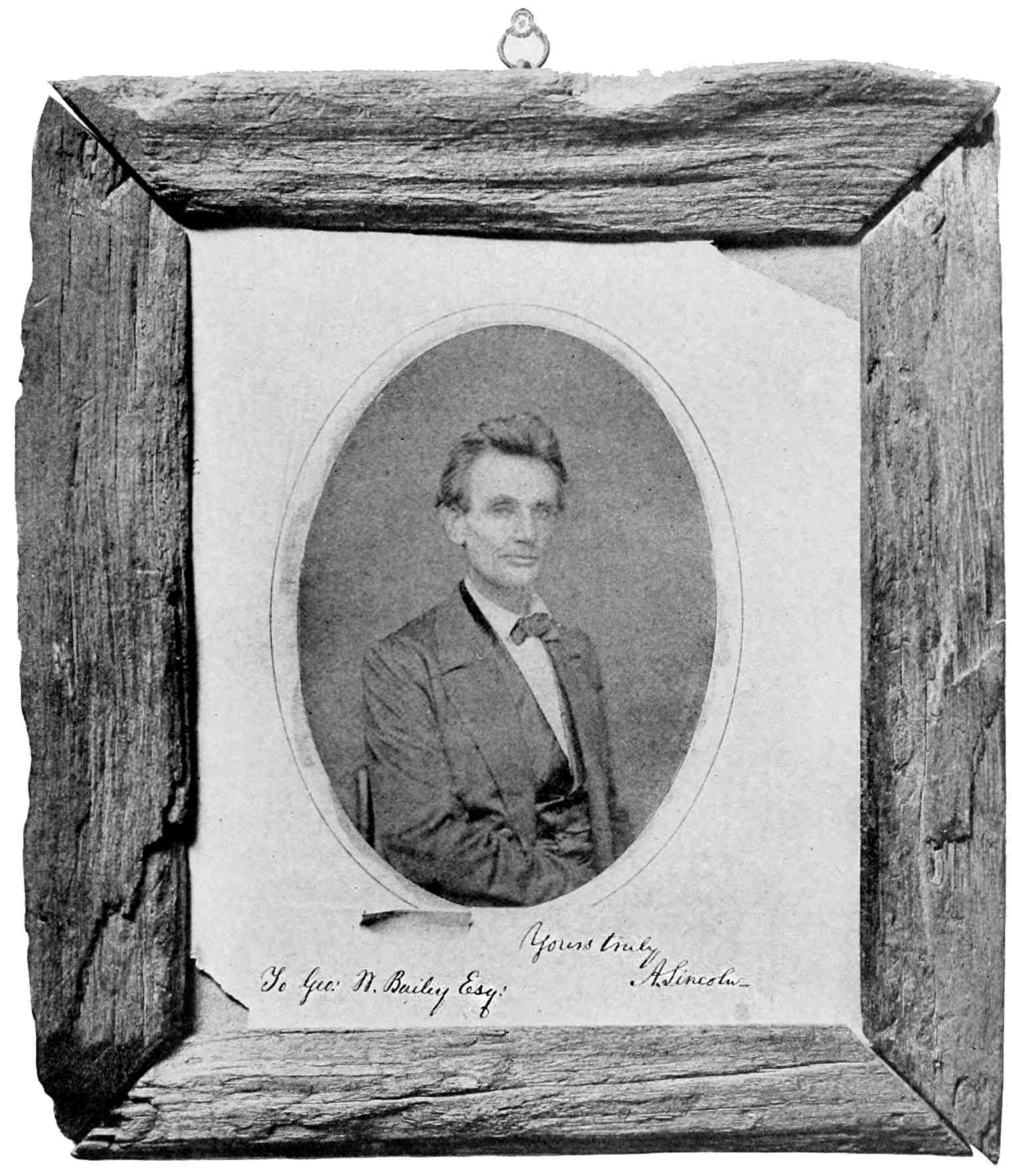
An unpublished photograph of Lincoln in 1860, framed in walnut
rails split by him in his woodchopper days. Owned by Charles
W. McClellan of New York
We who love him now can hardly understand
how deep was the love and how great
the confidence that, a year later, raised the
cabin-born, uncouth country lawyer and
politician to be President of the United
States.
We remember his strength and faith in
the great war; we remember his gentle patience,
his justice and mercy, and his martyrdom;
but do we fully realize the effort
he made to save his people from the ghastly
sacrifice made on the battlefields where the
nation was reborn?
IX
How still Lincoln became after his
nomination for President in 1860!
A note of acceptance, just twenty-three
lines long, and then unbroken silence
till the end of the campaign.
He had thundered throughout the country
against the Christless creed of slavery until
men forgot his crude manners, preposterous
figure and shrill, piping voice in admiration
and reverence of his noble qualities.
Now the crooked mouth was set hard. He
retired to his modest home in Springfield,
Illinois. Nor could threats or persuasions
induce him to address a word to the public
during that terrific campaign which was the
prelude to the horrors of civil war.
In the upward reachings of Lincoln’s life
there was a singular mysticism that sometimes
startles one who contemplates the imperishable
grandeur of his place in history.
He saw omens in dreams; experimented
with the ghostly world of spiritualism; half-surrendered
to madness, when his personal
affections were attacked; predicted a violent
death for himself; dreamed of his own
assassination, and discussed the matter seriously;
and gave evidence many times of a
strange, aberrant emotional exaltation, alternated
with brooding sadness or hilarious,
uncontrollable merriment.
But behind these mere eccentricities were
sanity, conscience, strength and far-seeing
penetrativeness.
In the midst of his heroic debate on slavery
with Douglas in 1858, while the whole nation
watched the exciting struggle, he showed his
statesmanlike appreciation of the situation
when he said: “I am after larger game; the
battle of 1860 is worth a hundred of this.”
And when he was nominated in the roaring
Chicago Convention, where the foremost
politicians of the East actually shed
tears over the defeat of William H. Seward,
he let his party do the shouting, promising,
denouncing and hurrahing, while he—wiser,
cooler, abler than all—stood squarely on his
record and his party’s platform, without
apology, explanation or mitigation.
To his mind the issue was simple. It
could not be misunderstood. Slavery was
immoral. It must be confined to the slave
States, where it had a constitutional sanction,
but uncompromisingly kept out of the
free territories.
Yet the country rang with threats that the
slave States would break up the Union if
Lincoln was elected. He had declared that
the nation could not endure half slave and
half free. That, they insisted, was a declaration
of war against the slave States.
Lincoln drew the short gray shawl about
his stooped shoulders, and his face grew
more sorrowful. But he said nothing.
Not many months before he had written a
letter to a Jefferson birthday festival in Boston,
in which he flung the name of Jefferson
against the Democrats as Douglas hurled the
heart of Bruce into the ranks of the heathen:
“The Democracy of to-day holds the
liberty of one man to be absolutely nothing
when in conflict with another man’s right
of property.
Republicans, on the contrary, are for
both the man and the dollar; but in cases of
conflict, the man before the dollar.
I remember being once amused much at
seeing two partially intoxicated men engage
in a fight with their great coats on, which
fight, after a long and rather harmless contest,
ended in each having fought himself
out of his own coat and into that of the
other. If the two leading parties of this
day are really identical with the two in the
days of Jefferson and Adams, they have performed
the same feat as the two drunken
men....
The principles of Jefferson are the definitions
and axioms of free society, and yet
they are denied and evaded, with no small
show of success. One dashingly calls them
‘glittering generalities.’ Another bluntly
calls them ‘self-evident lies.’ And others
insidiously argue that they apply to ‘superior
races.’...
This is a world of compensation; and he
who would be no slave must consent to have
no slave. Those who deny freedom to others
deserve it not for themselves, and, under
a just God, cannot long retain it. All honor
to Jefferson—to the man who, in the concrete
pressure of a struggle for national independence
by a single people, had the coolness,
forecast, and the capacity to introduce
into a merely revolutionary document an
abstract truth, applicable to all men and all
times, and so to embalm it there that to-day
and in all coming days it shall be a rebuke
and a stumbling-block to the very harbingers
of reappearing tyranny and oppression.
Your obedient servant,
A. Lincoln.”
After that no man might claim that he had
not bared his soul.
Editors, political leaders, personal friends,
vainly attempted during the Presidential
campaign to draw from him some public
expression of opinion, some hint of what was
going on in his mind while the national horizon
flamed with passion and threats of war
were openly made by the slaveholders.
But he knew that it would not pay to say
a word that might complicate a question so
clear. The American people were sound at
heart. If the issue could be confined to the
question of whether slavery was morally
right or wrong, the common people could
be depended upon to vote against spreading
it to the free territories.
Lincoln’s confidence in the plain people
grew with years. In spite of his shrewd experience
in politics he was free from cynicism.
There was a childlike simplicity in
his character, a central purity and earnestness,
that enabled him to see under the
broadcloth and ruffles of the East the same
elemental humanity he had known under
the deerhide, jeans and coonskins of the
West.
Up to the hour of his death he gave no
evidence of class consciousness. The rich
citizen was no better and no worse than the
poor citizen. The college professor was no
better and no worse than the field hand. At
the bottom of each was the original man,
with almost divine possibilities of justice,
love and compassion in him.
It was this supreme faith in the better natures
of men, and their ability to reach sound
conclusions on simple moral issues, that persuaded
Lincoln to remain mute throughout
the struggle.
How many political leaders are there in
the United States to-day who disclose their
minds and hearts so unreservedly to the
people that they could dare to stand for
office with closed lips, relying solely on their
record and on the general public intelligence?
Even in his career as a lawyer Lincoln
made fun of himself. His small fees were
the jest of his companions. It is probable
that he did not earn an average of more
than three thousand dollars a year, notwithstanding
his eloquence and logic. When
he went to the White House, all his possessions,
including his residence, were worth
only about seven thousand dollars.
So he laughed at and made light of his personal
appearance. The change from deerhide
breeches and coonskin cap to black
cloth and a high silk hat simply emphasized
the clumsy enormity of his figure. His skin
was yellow and his face seamed and puckered.
The gray eyes looked out of hollow
sockets. The high cheek-bones protruded
sharply above sunken cheeks. The mouth
was awry and the neck long, lean and
scraggy. His immensely long arms swung
loosely from stooped shoulders, his trousers
were always “hitched up too high,” and his
ill-kept hat was set at a grotesque tilt from
his lugubrious countenance. His great
height, the lank, swinging slouchiness of his
immense frame, his somber, saggy clothing
and sorrowful expression, added to unconventional
manners, made him a target for his
political opponents.
“Old ape,” “ignorant baboon”—these
were the favorite flings of the Southern Democrats.
He was pictured as a raw, coarse,
brutal and reckless “nigger lover,” filled
with hatred of the slave States, eager to rob
them of their legitimate property, a half-horse-half-alligator,
unfit to enter a polite
house or associate with gentlemen, and almost
insane with the murderous fanaticism
of the New England abolitionists.
If Lincoln felt the sting of this cruel satire
he gave no sign of it. So humble was his
nature that, after his election, he grew a
beard at the suggestion of a little girl, who
wrote to say that it might make him look
better. He wrote this during the Presidential
campaign:
“If any personal description of me is
thought desirable, it may be said, I am, in
height, six feet, four inches, nearly; lean in
flesh, weighing on an average, one hundred
and eighty pounds; dark complexion, with
coarse black hair and gray eyes—No other
marks or brands recollected. A. Lincoln.”
He was silent in the face of pitiless abuse
and carricature, yet he sent many confidential
letters, advising, encouraging, admonishing
the Republican leaders. While his
supporters carried fence-rails in processions
and shouted hosannahs, he quietly directed
matters from his home.
And, although he would sometimes laugh
with a pure humor that bubbled up unconsciously
from his blameless nature, as the
strain of the political campaign increased,
the tragic sadness of his countenance deepened,
for his keen eyes began to see the awful
significance of the eminence to which he
was to be lifted.
A year ago the rebellion of John Brown
at Harper’s Ferry had dramatically revealed
the irreconcilable temperaments of North
and South. While Virginia enthusiastically
hanged the man who tried to create an
armed negro revolution, the North tolled
her bells, lowered her flags to half-mast and
glorified him as a holy martyr.
X
A month before the first vote for President
was cast, Governor Gist, of
South Carolina, addressed a secret
circular to the other slave State governors
saying, that if Lincoln were elected, which
seemed almost certain, South Carolina would
secede from the Union. The whole South
was urged to join in this dismemberment of
the republic.
The answers of the governors, even before
the election had occurred, showed that
it was not the intention of the slave States to
submit to the rule of the majority, and that,
already, armed resistance to the national
authority was acceptable as the alternative
to “the yoke of a black Republican President.”
If any secret voice of this germinating
treason reached Lincoln at Springfield he
kept it to himself.
But when his victory was assured by a
majority that made the combined vote of
his opponents seem insignificant, his continued
silence in the midst of general rejoicing
and boasting showed that he understood
the gravity of the situation.
South Carolina withdrew from the Union,
seizing custom houses, post offices, arsenals
and forts.
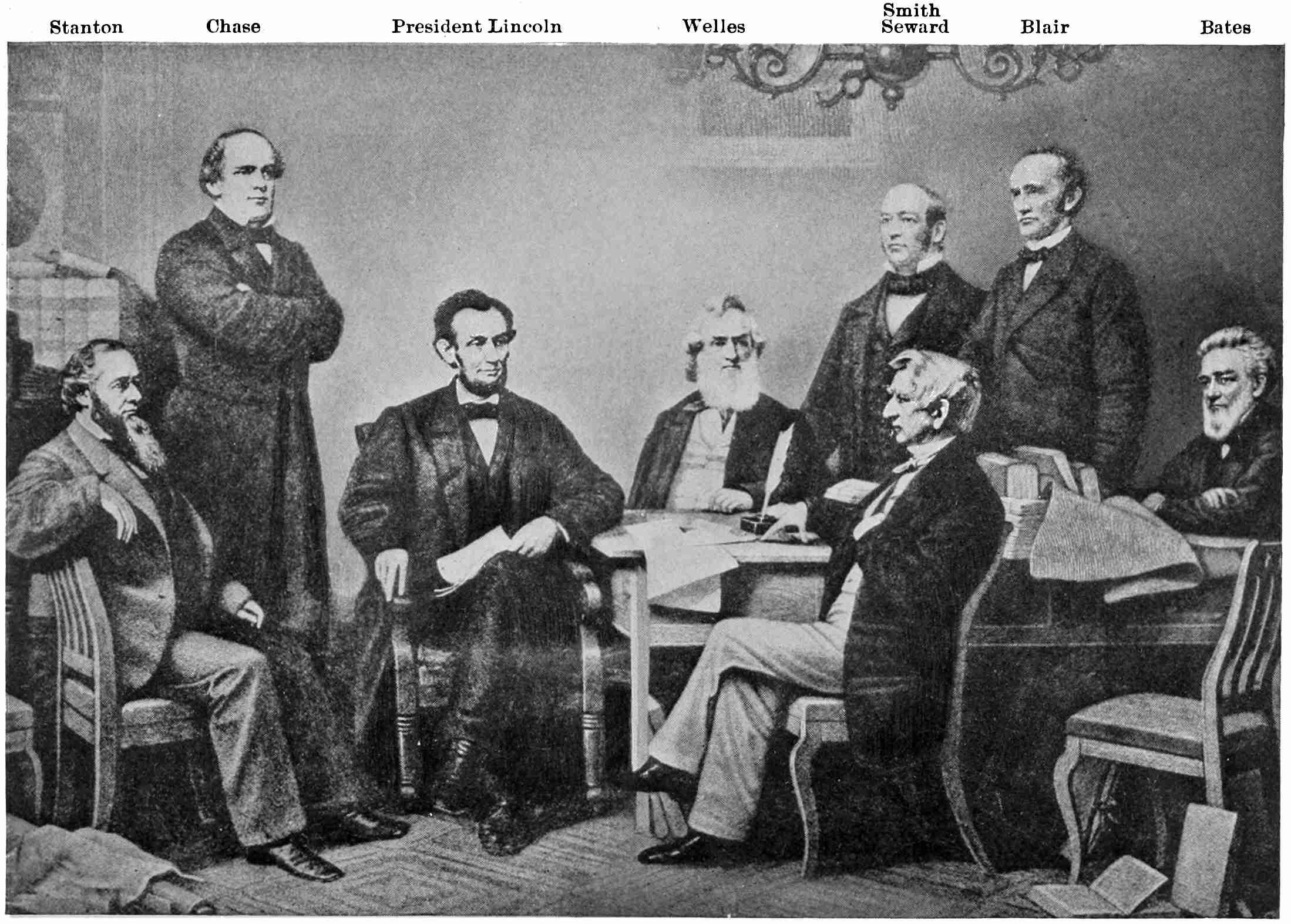
Stanton Chase President Lincoln Welles Smith/Seward Blair Bates
Carpenter’s picture, painted under the personal supervision of Lincoln, represents the moment
when the President told his cabinet that he would issue the Proclamation of Emancipation in
fulfilment of a personal vow to God.
President Buchanan, old, weak and cowardly,
promised to use no force against the
rebels, but to leave everything to Congress.
His Secretary of War, Mr. Floyd, of Virginia,
was a traitor, secretly helping the
slave States to arm against the general government.
His Secretary of the Treasury,
Mr. Cobb, of Georgia, also conspired with
the disunionists, and finally resigned to take
part in the rebellion. His Secretary of the
Interior, Mr. Thompson, of Mississippi,
actually acted as a rebel commissioner to
spread the doctrine of secession while he
was still in the Cabinet. The Assistant
Secretary of State, Mr. Trescott, was another
member of the great plot.
Within two months, Mississippi, Florida,
Alabama, Georgia, Louisiana and Texas
had followed South Carolina out of the
Union. Forts, arsenals, post offices and
custom houses were captured, the Stars and
Stripes lowered, and the rebel flag hoisted.
Before Lincoln could be inaugurated, the
seceded States had organized a Confederate
government, with Jefferson Davis for
President.
With treason in his Cabinet, and armed
rebellion openly preached in Congress, the
bewildered, rabbit-hearted Buchanan did
nothing to defend the national sovereignty.
He was no traitor—simply a poltroon, without
character, convictions or courage enough
to assert the plain powers of his office, and
willing to shelter his cringing soul and dishonored
responsibilities behind a paramount
authority which he pretended to find in
Congress.
Imagine Lincoln, sitting in far-away
Springfield, helpless to act, while Buchanan
permitted a foreign government to be set up
within the United States, and promised to
use no force against the rebels lest war
might follow.
Think of the newly-chosen leader of the
American people compelled to silence and
impotence while the President refused to
send relief to loyal Major Anderson and his
handful of soldiers besieged in Fort Sumter
by rebels whose arms had been furnished
by the government they sought to destroy!
The lines in Lincoln’s face deepened.
His eyes grew more sorrowful. The stooping
shoulders stooped still lower. There
was that in his look sometimes that compelled
mingled awe and pity.
For Lincoln loved his country with the
love that a father has for his child, and the
pent-up agony that showed in his lean visage
as he watched the attempt to break up the
great republic might not yet find utterance.
It was useless for him to repeat that he
did not hate the South; that he did not favor
the political and social equality of negroes
and whites; that he was not an abolitionist;
that, although he considered slavery wrong
and would oppose its extension to Kansas
and all other free soil of the United States,
he would do nothing to interfere with it in
the States where it had Constitutional rights.
Yet he waited patiently and silently, believing
that he could persuade the South
that he was not an enemy, and in that time of
slow anguish his soul turned to God for help.
The careless, foot-free, waggish woodchopper
of New Salem had scoffed at religion,
and written a bitter attack on the Bible,
which a wiser friend had snatched from his
hands and burned. The President-elect
with the cares of a mighty nation in its
death throes descending upon his shoulders,
stretched his hands child-like to a power
greater even than the “omnipotent and sovereign
people.”
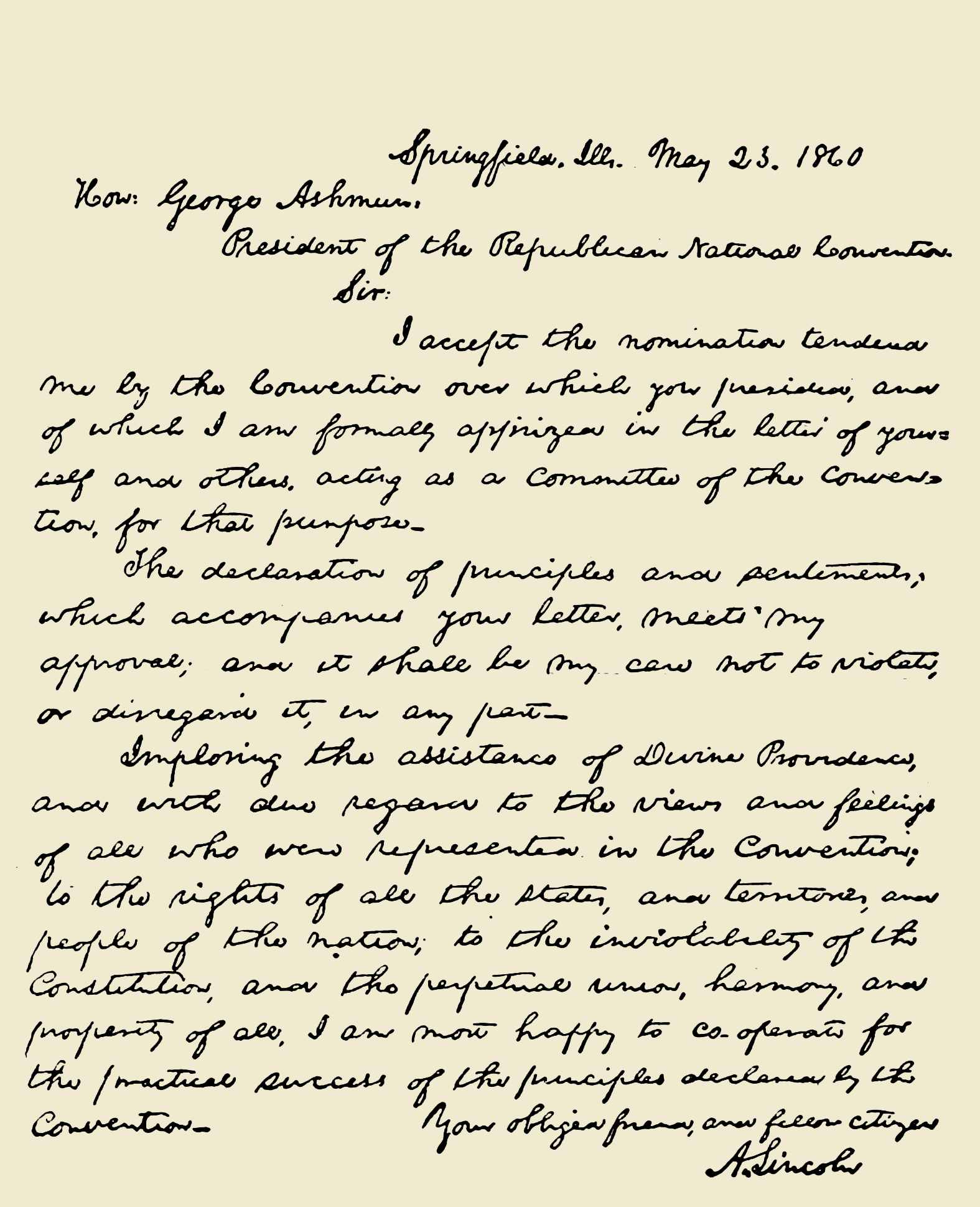
Fac-simile of Lincoln’s letter of acceptance
Mr. Herndon, his law partner, has given
us an unforgetable picture of Lincoln a day
before his departure for the White House:
“He crossed to the opposite side of the
room and threw himself down on the old
office sofa, which, after many years of service,
had been moved against the wall for
support. He lay for some moments, his
face towards the ceiling, without either of
us speaking. Presently he inquired, ‘Billy’—he
always called me by that name—‘how
long have we been together?’ ‘Over sixteen
years,’ I answered. ‘We’ve never had
a cross word in all that time, have we?’...
He gathered a bundle of papers and
books he wished to take with him, and
started to go; but, before leaving, he made
the strange request that the sign-board
which swung on its rusty hinges at the foot
of the stairway should remain. ‘Let it
hang there,’ he said, with a significant lowering
of the voice. ‘Give our clients to understand
that the election of a President
makes no change in the firm of Lincoln &
Herndon. If I live, I am coming back
some time, and then we’ll go right on practising
law as if nothing had happened.’ He
lingered for a moment, as if to take a
last look at the old quarters, and then he
passed through the door into the narrow
hallway.”
On the day Lincoln left Springfield to
take the oath of office at Washington he
stood in a cold rain on the rear end of the
train that was to take him away, and addressed
a bareheaded crowd. His face
worked with emotion. His lips trembled
and his voice shook. His eyes sought the
faces of his old neighbors with a new sadness.
“To-day I leave you,” he said, bending
his tall, ugly figure, as if in benediction. “I
go to assume a task more difficult than that
which devolved upon Washington. Unless
the great God who assisted him shall be with
me and aid me, I must fail.”
Strong men in the crowd wept.
“But if the same omniscient mind and
almighty arm that directed and protected
him shall guide and support me, I shall not
fail—I shall succeed.”
The long arms and bony hands were extended.
The crooked mouth quivered, the
gray eyes were moist, and the tall figure
seemed to grow taller.
“Let us all pray that the God of our fathers
may not forsake us now.”
With that prayer on his lips Lincoln went
on his way to Washington through many a
cheering multitude that uncovered as the
train passed.
He made speeches at Indianapolis, Columbus,
Steubenville, Pittsburg, Cleveland,
Buffalo, Albany and New York. He begged
the American people to be patient. No
blood would be shed unless the government
was compelled to act in self-defense. There
would be no “coercion” or “invasion” of
the South, but the United States would
retake its own forts and other property and
collect duties on importations. In Cincinnati
Lincoln spoke to the South, which was
reviling him and defying the national authority,
in terms that prove how eager he
was to avert armed conflict:
“We mean to leave you alone, and in no
way interfere with your institutions; to
abide by all and every compromise of the
Constitution; and, in a word, coming back
to the original proposition, to treat you, so
far as degenerate men—if we have degenerated—may,
according to the examples of
those noble fathers, Washington, Jefferson
and Madison. We mean to remember that
you are as good as we are; that there is no
difference between us other than the difference
of circumstances. We mean to recognize
and bear in mind always that you have
as good hearts in your bosoms as other people,
or as we claim to have, and to treat you
accordingly.”
It took a great soul in a man of Lincoln’s
heroic origin, direct methods, intense patriotism
and deep hatred of slavery to speak
in such terms to rebellion.
The time came when he hurled a million
armed men against the insurgent South,
when with a stroke of his pen he set free
four millions of slaves, representing a property
value of about two and a half billion
dollars; and when, with fire and sword and
the expenditure of hundreds of thousands of
lives and billions on billions of treasure, he
proved to the world that democratic institutions
were strong enough to resist the
mightiest shocks of civil war.
But as he moved on to the scene of his
great ordeal in Washington, there was nothing
but temperate reason, kindness and
peace on his lips.
It must not be forgotten that the tall,
gawky, sad-faced lawyer in ill-fitting funereal
black, was no limp-limbed product of
sedentary sentimentalism, but a man with
muscles of steel, who had thrashed and
cowed the most dreaded desperadoes of the
frontier, a self-made son of the wilderness,
who had battled against floods, famines and
wild beasts; and who had in him the stout
heart and steady will of the cabin-born and
forest-bred. Lincoln was incapable of fear,
save the fear of folly or injustice. He was
not afraid even of ridicule, that poisoned
weapon before which so many strong men
tremble.
As the nation prepared to honor the hundredth
anniversary of his birth, well might
it remember him, newly separated from his
provincial and rude, but heroic West, advancing
between the haggard passions of a
divided country with firm, brotherly hands
held out to the whole people.
In Philadelphia he was told by Allan
Pinkerton, the detective, that there was a
conspiracy to murder him when he reached
Baltimore. Unless he agreed to make the
rest of the journey secretly he could not
reach Washington alive. He was urged not
to expose himself again in public, but to go
right on to his destination at once.
With this knowledge of his peril, he assisted
in the raising of a new flag over Independence
Hall that day, and delivered a
noble address, in which he recalled the sentiment
in the Declaration of Independence
“which gave promise that in due time the
weights should be lifted from the shoulders
of all men, and that all should have an equal
chance.”
“Now, my friends,” he cried, his shrill
voice ringing to the outer edge of the excited
multitude, “can this country be saved
on that basis? If it can, I will consider myself
one of the happiest men in the world if
I can help to save it.... But if this
country cannot be saved without giving up
that principle, I was about to say that I
would rather be assassinated on this spot....
I have said nothing but what I am
willing to live by, and, if it be the pleasure
of Almighty God, to die by.”
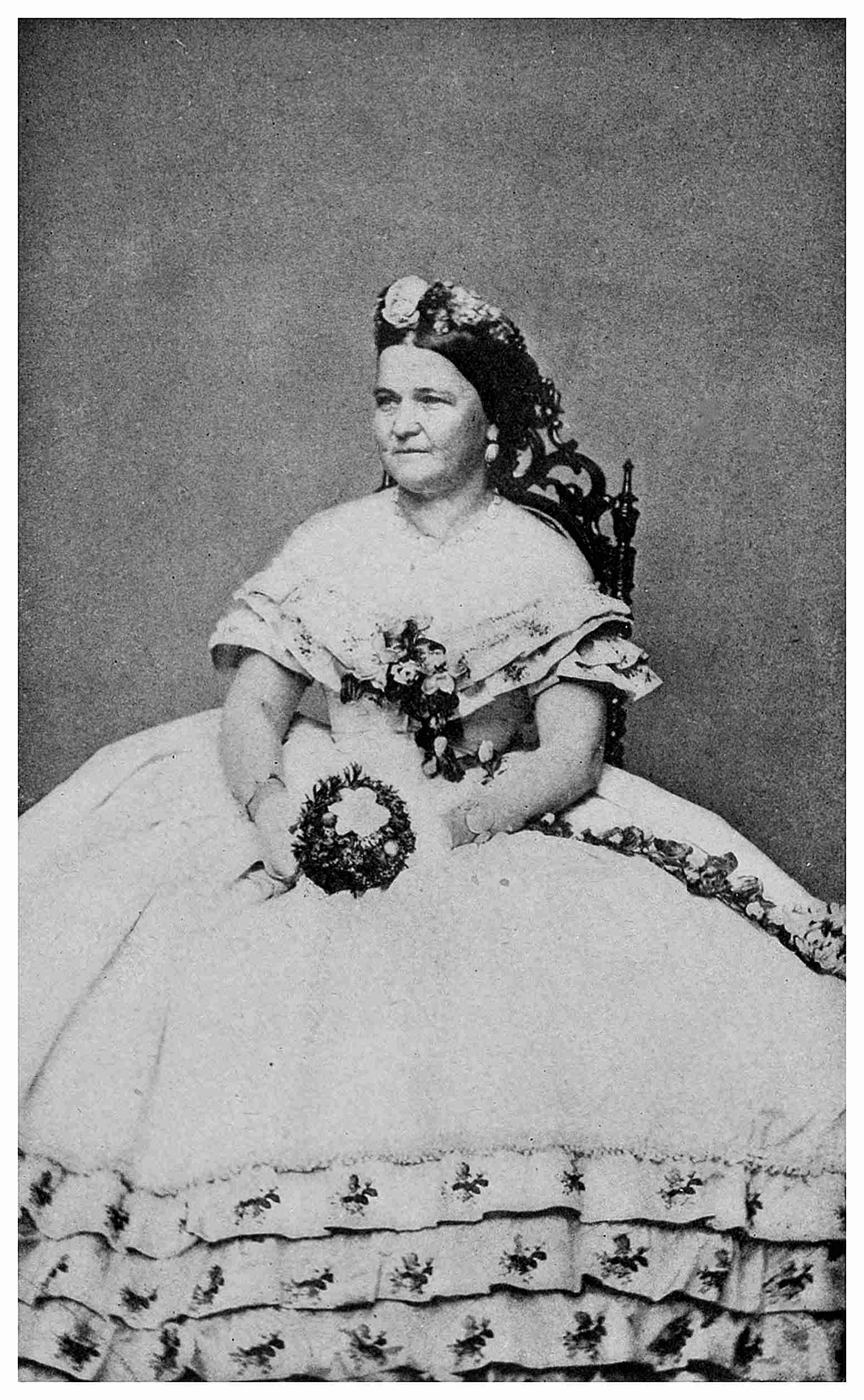
Mrs. Abraham Lincoln
With assassins waiting in Baltimore to
save the cause of slavery and disunion by
striking down the President-elect, Lincoln,
by a secret change of plan, managed to reach
Washington in safety.
XI
All the way from Springfield Lincoln
carried a small handbag containing
the manuscript of his inaugural
address, upon which it was believed that
the issue of peace or war would depend.
The whole country waited anxiously to hear
what the rail-splitter had to say, now that
he had command of the army, navy and
treasury.
Would he dare to send troops to the rescue
of Major Anderson and his men, besieged
in Charleston harbor by rebellious South
Carolina?
Would he relieve the loyal garrisons
hemmed in by insurgent Florida?
To use force meant instant civil war. To
refrain from using force meant the destruction
of the Union.
Only three months before, Mr. Holt,
Buchanan’s loyal Postmaster General, had
written to one of Lincoln’s partners:
“I doubt not, from the temper of the
public mind, that the Southern States will
be allowed to withdraw peacefully; but
when the work of dismemberment begins,
we shall break up the fragments from month
to month, with the nonchalance with which
we break the bread upon our breakfast
table.... We shall soon grow up a
race of chieftains who will rival the political
bandits of South America and Mexico, who
will carve out to us our miserable heritage
with their bloody swords. The masses of
the people dream not of these things. They
suppose the Republic can be destroyed to-day,
and that peace will smile over its ruins
to-morrow.”
Away out in his Illinois home Lincoln had
written these words in his inaugural address:
“In your hands, my dissatisfied fellow-countrymen,
and not in mine, is the
momentous issue of civil war. The government
will not assail you. You can have no
conflict without being yourselves the aggressors.
You have no oath registered in
heaven to destroy the government, while I
shall have the most solemn one to ‘preserve,
protect and defend it.’”
This was the spirit in which he made that
journey from the West, knowing that the
question of war or peace hung as upon a
hair trigger. Backwoodsman and provincial
though he might be, he knew the underlying
American character well enough to
hope, in his own heart, in spite of the secession
of so many States, what was bluntly
said to Jefferson Davis and his Cabinet:
“Unless you sprinkle blood in the face of
the people of Alabama, they will be back in
the old Union in less than ten days.”
But when Lincoln went through the
guarded streets of Washington to the bayonet-girt
Capitol, to have the pro-slavery
Chief Justice administer the oath of office,
the speech he carried in his pocket had been
greatly altered. He had even been persuaded
by Mr. Seward, his new Secretary
of State, to modify this brave sentence:
“All the power at my disposal will be
used to reclaim the public property and
places which have fallen; to hold, occupy
and possess these, and all other property
and places belonging to the government.”
They thought he might be murdered before
he could take the oath. There was artillery
in the streets and ominous swarms of
soldiers. Even on the roofs sharpshooters
were to be seen.
Grizzled old General Scott had sent this
word from his sick bed to the President-elect:
“I’ll plant cannon at both ends of
Pennsylvania Avenue, and if any of them
show their heads or raise a finger I’ll blow
them to hell.”
Yet when Lincoln’s long body reared itself
before the hushed crowd, and when he laid
aside his new ebony, gold-headed cane, set
his iron-bound spectacles on his nose and
removed his hat—there was Douglas, his old
rival for Mary Todd’s hand, his competitor
for the Senate and the Presidency, his antagonist
in the struggle against slavery; but
a new Douglas, loyal to the Union, who was
content to reach out his hand in the presence
of that high-strung multitude and hold
Lincoln’s hat.
President Buchanan was there, withered,
bent, slow, insignificant, in flowing white
cravat and swallowtail coat. Beside him
towered the homely rail-splitter—also in an
unaccustomed and distressing swallowtail
coat and wearing a stubby new beard,
grown to please a little girl—who dared at
last to give the national authority a voice
and to say that “No State, upon its own
mere motion, can lawfully get out of the
Union,” that “resolves and ordinances to
that effect are legally void,” and that “I
shall take care, as the Constitution itself
expressly enjoins upon me, that the laws of
the Union be faithfully executed in all the
States.”
How hard it is for us now to realize the
appalling strain of responsibilities that could
persuade a valiant frontiersman like Lincoln—knowing
that Fort Sumter was already
besieged; that the Florida forts were
threatened and that an organized Confederate
government, with drilled troops, was
actually in possession of many States—to
say so softly to the armed and defiant
South:
“I trust that this will not be regarded as a
menace, but only as the declared purpose of
the Union that it will constitutionally maintain
and defend itself.”
Just before he closed his speech Lincoln
looked up from his manuscript, and his gray
eyes—those eyes that could be so tender as
to make his gaunt face beautiful—sought
the silent, listening crowd. There were
dark circles under his eyes. His whole
bearing was that of a man in pain. Then
he raised his splendid head and made that
last sublime appeal against war:
“I am loath to close. We are not enemies,
but friends. We must not be enemies.
Though passion may have strained, it must
not break our bonds of affection. The mystic
chords of memory, stretching from every
battlefield and patriot grave to every living
heart and hearthstone all over this broad
land, will yet swell the chorus of the Union
when again touched, as surely they will be,
by the better angels of our nature.”
As Lincoln kissed the open Bible in the
hands of Chief Justice Taney—who wrote
the Dred Scott opinion supporting slavery—the
thunder of artillery announced his
vow to defend the Union.
XII
Those who in peaceful times like
these wonder why so strong and
direct a man as Lincoln should
have been so eager to conciliate the
haughty and rebellious Confederacy, to
assure the rebels that there would be no
“coercion” or “invasion,” and to appeal
to their historic national consciousness,
rather than to tell them in so many
words that they would be scourged into
obedience, must consider that he at last
realized the Southern misunderstanding of
his purpose and temperament which caused
the Governor of Florida to write to the Governor
of South Carolina:
“If there is sufficient manliness at the
South to strike for our rights, honor and
safety, in God’s name let it be done before
the inauguration of Lincoln.”
Not only that, but Mr. Seward, the great
Republican leader of the East, now Secretary
of State, and one of the deadliest foes
of slavery, within three weeks wrote this
advice:
“Change the question before the public
from one upon slavery, or about slavery, for
a question upon union or disunion.”
No man knew or loved Lincoln better
than Leonard Sweet, who made this deliberate
analysis of him:
“In dealing with men he was a trimmer,
and such a trimmer the world has never
seen. Halifax, who was great in his day as
a trimmer, would blush by the side of Lincoln;
yet Lincoln never trimmed in principles,
it was only in his conduct with men.”
Besides, Lincoln was incapable of mere
hatred. All through the Civil War he
showed that his love for the whole American
people was tidal. It was his belief in
the goodness of human nature and the justice
of the Union cause that made him grieve
like a defied and deserted father over the
erring Southern insurgents, and to hope,
with an intensity that drew prayer from his
lips, that the ties of race, continental pride
and common national memory would reunite
the nation without the sacrifice and
seal of bloodshed.
It was not for love of the negro that he
waged war upon slavery, but for the sake of
justice and humanity, and to save the nation
from increasing degradation and demoralization.
True, he had challenged the South
when he said, “a house divided against itself
cannot stand. I believe this government
cannot endure permanently half slave and
half free.” But he had also said:
“There is a physical difference between
the white and black races which I believe
will forever forbid the two races living together
on terms of social and political equality.
And inasmuch as they cannot so live,
while they do remain together, there must
be the position of superior and inferior, and
I as much as any other man am in favor of
having the superior position assigned to the
white race.”
Lincoln’s private letters and conversations,
from his nomination to his election,
prove that there was one point only on which
he would permit no compromise—slavery
must not be extended to the free territories.
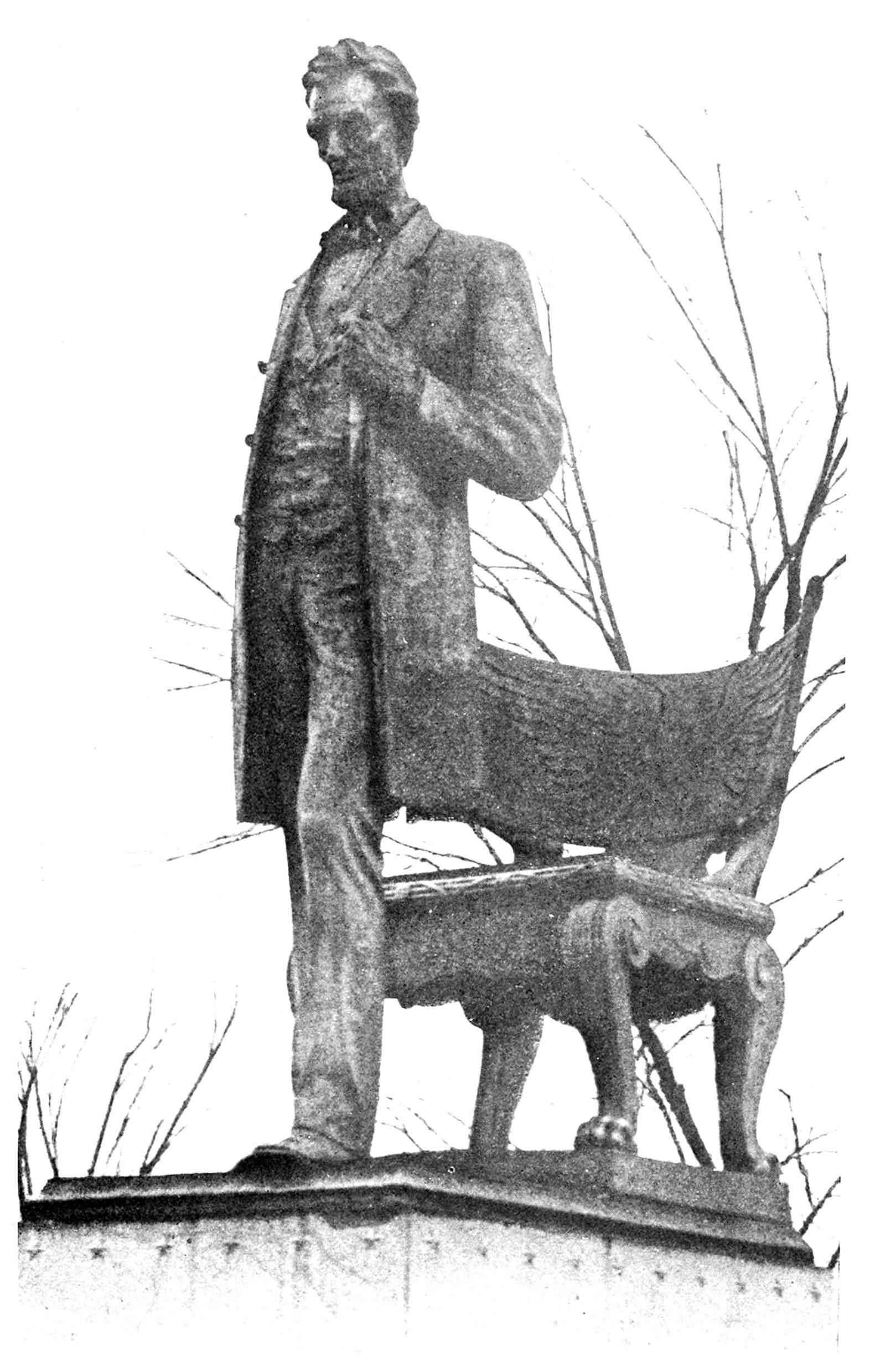
St. Gaudens statue, Lincoln Park, Chicago
But as President his one supreme duty
was to save the Union, to prevent the destruction
of the nation. He was yet to write
amid the roar of a conflict in which half a
million lives were lost, that agonized but unflinching
letter to Horace Greeley:
“I would save the Union. I would save
it the shortest way under the Constitution.
The sooner the national authority can be
restored, the nearer the Union will be ‘the
Union as it was.’ If there be those who
would not save the Union unless they could
at the same time destroy slavery, I do not
agree with them. My paramount object in
this struggle is to save the Union, and is not
either to save or to destroy slavery. If I
could save the Union without freeing any
slave, I would do it; and if I could save it
by freeing all the slaves, I would do it; and
if I could save it by freeing some and leaving
others alone, I would also do that. What I
do about slavery and the colored race, I do
because I believe it helps to save the Union;
and what I forbear, I forbear because I do
not believe it would help to save the Union.”
Those who did not recognize the greatness
of Lincoln under his simple manners
and kindly, humble disposition, assumed
that he would be dominated by Mr. Seward,
his scholarly and distinguished Secretary
of State. The homespun, picturesque
orator of Illinois was all very well to catch
votes. But Mr. Seward would be the real
President.
Mrs. Lincoln heard the talk and mentioned
it to her husband.
“I may not rule myself, but certainly
Seward shall not,” said Lincoln. “The
only ruler I have is my conscience—following
God in it—and these men will have to
learn that yet.”
John Hay, his secretary and bosom friend,
who called Lincoln “the greatest character
since Christ,” wrote to Mr. Herndon: “It
is absurd to call him a modest man. No
great man was ever modest. It was his intellectual
arrogance and unconscious assumption
of superiority that men like Chase
and Sumner could never forgive.”
Still, even though he stood rocklike where
his mind and conscience told him that he
was right, a humbler, simpler, more unaffected
man never walked the earth; and
there are libraries of books teeming with
tales of his tenderness to women, his love of
little children, his compassion for the unfortunate.
The first sign of the strong, sure Lincoln
in the White House came when the new
President on the day after his inauguration
received a dispatch from Major Anderson
declaring that he was short of provisions,
that Fort Sumter must be abandoned to the
Confederacy in a few weeks, and that it
would take at least twenty thousand soldiers
to relieve Charleston harbor from the Confederate
siege. The whole Federal army
numbered only sixteen thousand men.
Washington was filled with clamorous
office-seekers who crowded the White
House. The President was distracted.
Even his carriage was stopped by a greedy
applicant, and he was compelled to cry, “I
won’t open shop in the street.”
With the secret news from Fort Sumter
stirring his soul—for no one knew better that
immediate war depended on his action—Lincoln
told stories, cracked jokes and dealt
with the thronging politicians in his old
shrewd, homely way. None of the place-hunters
was permitted to suspect the impending
tragedy that made him bow his
head when he was alone.
Meanwhile he ordered General Scott to
report what could be done; but the old
hero advised him that the abandonment of
Sumter was “almost inevitable.” He had
also ordered troops to be sent to relieve Fort
Pickens, in Florida, which was also menaced.
General Scott reported that both
Pickens and Sumter should be evacuated.
Instantly the President ordered the Navy
Department to prepare plans for a relief
expedition for Fort Sumter. That night he
gave a great state dinner. His humorous
stories and quaint sallies of wit kept his
guests in high spirits. His lean face was
convulsed with laughter, his eyes sparkled
and his thin, high voice whipped up the merriment.
But as the night waned and the laughter
died down, he called the members of his
Cabinet aside and, with haggard face and
a voice of deep emotion, he told them the
news from General Scott.
That night Lincoln did not close his eyes.
The next day, against the advice of five of
his Cabinet, including Mr. Seward, all of
whom advised the abandonment of Fort
Sumter, he ordered the preparation of a
naval expedition to relieve Major Anderson.
Additional troops and supplies were
ordered into the beleaguered Fort Pickens
in Florida.
The Confederate commissioners might
seek conferences with Secretary Seward in
vain. The expedition to rescue Sumter
sailed with orders to deliver food to the garrison
and, if opposed, to force its way in.
Lincoln’s hand had signed the order that
precipitated the Civil War.
Although the President had notified Governor
Pickens, of South Carolina, that the
relief expedition simply contemplated the
peaceful delivery of provisions to a garrison
threatened by starvation, the Confederates
immediately demanded the surrender of
Sumter, with a pledge from Major Anderson
that he should make no preparations to injure
the fort after withdrawing. This
demand was refused by Anderson, who added,
“if I can only be permitted to leave on the
pledge you mention, I shall never, so help
me God, leave this fort alive.”
Again and again Anderson was called upon
to surrender Sumter. The Confederates
were determined to have the place before
Lincoln’s supplies arrived. Each time the
brave Union officer replied that he would
maintain his country’s flag where it flew.
Then came the crash which shook the continent
and thrilled the civilized world.
At daybreak on April 12, 1861, in the
presence of a great multitude of civilian spectators
in Charleston harbor, the rebel batteries
opened fire on Fort Sumter and the
Union. For two days the fort withstood
the terrific bombardment, and then, with all
food gone, his quarters set on fire by red hot
cannon balls, and his ammunition almost exhausted,
Major Anderson lowered the stars
and stripes to native-born Americans and
hoisted the white flag.
That was on Saturday. On Sunday Lincoln
wrote a proclamation calling for seventy-five
thousand volunteers to defend the
Union.
The same night Douglas called at the
White House—Douglas, the Democratic,
thundering Douglas, the champion of slavery;
Douglas, the antagonist of Lincoln in
almost every crisis of his career; Douglas,
who in the Senate only a few weeks ago had
cried, “War is disunion. War is final, eternal
separation”—and Lincoln clasped hands
with the brilliant rival from whom he had
won his wife and the Presidency, now come
to pledge his life to the defence of the Union.
On Monday morning Lincoln’s proclamation
and Douglas’s noble and magnanimous
declaration that he would support Lincoln
in saving the nation were read by the American
people.
To the exultant shout that went up from
the armed slave States, there came an answering
cry of rage and indignation from
the free States. The whole country trembled
with the war spirit. War! war! war!
Every city, town and village in the North
answered Lincoln’s call for troops to crush
the rebellion. Farms and factories poured
out their men. Streets were gay with bunting
and noisy with marching feet. Industry
was abandoned in the instant and tremendous
preparation for the conflict.
Yet Lincoln’s call for seventy-five thousand
men was to grow into a call for a half million
men and a half billion dollars, and the struggle
between the sixteen free States and the
seven rebellious slave States, with the border
States hesitating between, was to change
into a four years’ death-grapple between all
the States of the South and all the States of
the North, a conflict without parallel in its
horror and costliness.
Mr. Stoddard, one of Lincoln’s private
secretaries, thus described Lincoln in the
White House at the beginning of the war:
“A remarkably tall and forward-bending
form is coming through the further folding
doors, leaving them carelessly open behind
him. He is walking slowly, heavily, like a
man in a dream. His strongly marked features
have a drawn look, there are dark
circles under his deep-set eyes, and these
seem to be gazing at something far away, or
into the future.”
That countenance of unutterable sadness,
fixed gray eyes that seemed to see something
in the vacant air; thin, stooped shoulders,
bowed head, hands clasped behind the back,
slow, halting step and general air of weariness
and melancholy abstraction, was known
only to those who saw Lincoln when he
wrestled alone with the agony of his burdens.
The greedy crowd that pressed for office,
the impatient fanatics who thrust their advice
upon him, the haughty statesmen who
condescended to meddle with his powers,
the tricksters and traders, saw only the simple,
resolute, vulgar, kindly Lincoln, full
of the old allure of anecdote and jest,
patient, keen and ready in a flash to avoid
an immature decision or soften a refusal by
a witty epigram or an illuminating joke.
It is an astonishing evidence of Lincoln’s
complex character that he could laugh and
play like a careless boy, and patiently putter
over the small details of office-giving, while
the iron of his character was annealing in
the furnace of war.
No more sensitive or imaginative man
than Lincoln ever lived. His amazing sense
of humor stayed him in his trial. It was
sometimes Titanic.
“Has anything gone wrong at the front?”
asked a friend, seeing him downcast.
“No,” replied the President with a weary
smile. “It isn’t the war; it’s the post office
at Brownsville, Missouri.”
The deadly, ceaseless, shameless crowding
and intriguing of place-hunters—notwithstanding
the shock of war that threatened
the nation itself—made a profound impression
on Lincoln.
“This human struggle and scramble for
office, for a way to live without work, will
finally test the strength of our institutions,”
he said to Mr. Herndon.
That has been the idea of every tormented
President of the United States, from Washington
to Roosevelt.
“He is an old criminal lawyer,” wrote one
of his secretaries, “practiced in observing
the ways of rascals, accustomed to reading
them and circumventing them, but he does
not commonly tell any man precisely what
he thinks of him.”
Even so able a man as Secretary Seward
did not at first recognize the force, genius
and dignity that lay behind the rough,
whimsical exterior of Lincoln, and gave
himself the airs of a superior; but presently
even Seward said: “He is the best of us
all.”
While the country was ringing with the
sounds of marching men after the fall of
Fort Sumter, it was reported that a great
force of Confederates was moving against
Washington. There were only four or five
thousand troops in the capital. A Massachusetts
regiment on the way to Washington
had been attacked by a mob. The
Seventh Regiment of New York was expected,
but the Marylanders had torn up
the tracks and it did not come. The city
was in danger of famine. The Confederate
attack was hourly expected. The capital
was cut off.
Lincoln’s anguish was unconcealed.
Walking up and down his office, with a
look of pain on his face, he gave vent to his
dread.
“I begin to believe that there is no North.
The Seventh Regiment is a myth.”
Again he paced the floor for half an hour.
“Why don’t they come? Why don’t they
come?” he groaned.
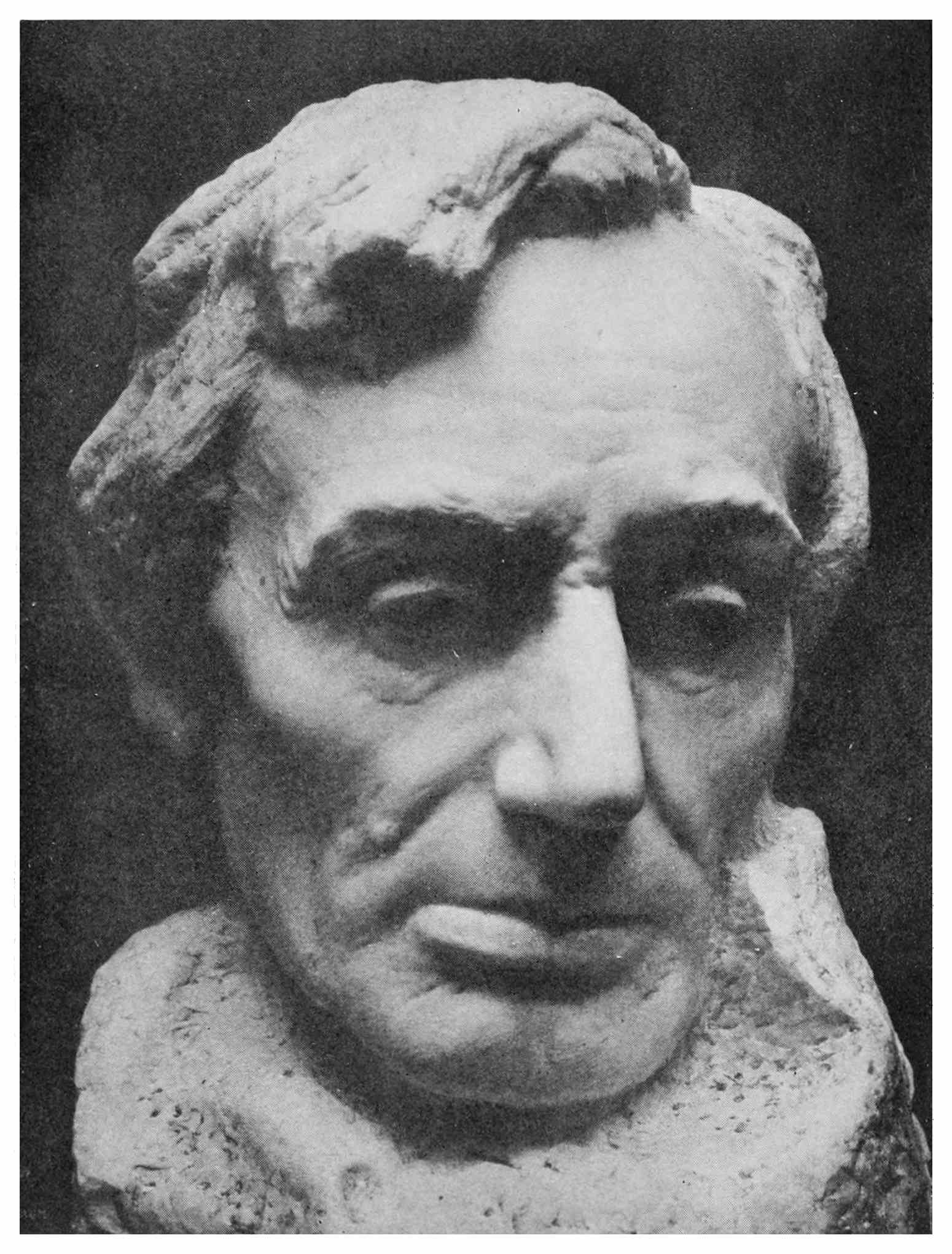
Photograph by Davis and Eikemeyer
This powerful and poetic head of Lincoln, by Gutzon Borglum,
which deeply impressed the emancipator’s living son, has been
presented to Congress by Eugene Meyer, Jr., of New York
Presently the New Yorkers, who had rebuilt
the tracks and bridges from Annapolis
on, marched into Washington, and within a
week Lincoln had seventeen thousand soldiers
in the city.
It was this terror of losing Washington
that persuaded Lincoln to withdraw
McDowell’s forty thousand men from
McClellan when his army was within sight
of Richmond.
XIII
Lincoln’s tenderness of heart was one
of his striking traits. The story of
his life is full of touching incidents
showing his pity for all living things in
distress. As a boy he protected frogs and
turtles from torture; as a frontiersman he
returned young birds to their nests, and
once rode back on his tracks over the
prairie and dismounted to help a pig stuck
in the mud; as President his habit of pardoning
soldiers condemned to death excited
the wrath of his generals. His heart melted
at the sight of tears. It was hard for him
to withstand a tale of woe. The shedding
of blood stirred horror and grief in him.
This extreme sensitiveness would have
been an element of almost fatal weakness
in the man upon whom events had so suddenly
thrust the command of a great war,
particularly a war between his own countrymen,
but for the fact that reason and devotion
to justice were the anchors of his nature.
He could not be moved on a clear question
of principle by either friendship, enmity or
compassion.
He appointed Edwin M. Stanton as Secretary
of War, in place of the discredited
Simon Cameron, in spite of the fact that
Stanton had treated him contemptuously in
a law case on which they were engaged together,
and had described him as a “long,
lank creature from Illinois, wearing a dirty
linen duster for a coat, on the back of which
the perspiration had splotched wide stains
that resembled a map of the continent.”
He raised George B. McClellan to command
the army, notwithstanding the circumstance
that McClellan, as vice-president
of the Illinois Central Railway, had once
deeply wounded him by declining to pay his
lawyer’s bill; and that, in 1858, while the
Illinois Central refused Lincoln the most
common courtesy, McClellan was accompanying
his rival, Douglas, in a private car
and special train.
It was not chivalry, but patriotism, that
inspired Lincoln to put these two Democrats
in control of the armed forces of the
nation. His own feelings were nothing;
the fate of the Union was everything. Stanton
had been an honest and masterful member
of Buchanan’s Cabinet. McClellan had
made a glorious answer to the Bull Run
defeat by driving the Confederate troops out
of West Virginia.
The life of the nation was more important
than party lines. Besides, Stanton and McClellan
had the confidence of the Democrats,
and it was essential, not only that the
whole North should be held together, but
that the loyal Democrats in the wavering
border States should feel that there was no
sectional or party prejudice in the government.
Stanton tried to bully Lincoln and called
him “the original gorilla,” and McClellan
treated him with disdainful indifference.
Neither could exhaust his patience. He
mastered his lion-headed Secretary of War
by gentle persistence. He endured McClellan’s
months of inactivity after the Army
of the Potomac had grown into a fighting
force of nearly a hundred and seventy thousand
magnificently trained men, and when
the government was being openly sneered
at for its hesitation to give battle.
Great-hearted, patient Lincoln! He even
consented to sit uncomplainingly in the
waiting room of McClellan’s residence while
the arrogant young general talked to others.
“I will hold McClellan’s stirrup if he will
only bring success,” he said.
But, in the end, he wrote the orders which
forced McClellan’s army against Richmond;
and when Frémont, in the West, ignored
the President’s orders to fight, Lincoln
promptly removed him from command.
To the newly assembled Congress he
said:
“This is essentially a people’s contest.
On the side of the Union it is a struggle for
maintaining in the world that form and substance
of government whose leading object
is to elevate the condition of men—to lift
artificial weights from all shoulders....
It is now for them [the people] to demonstrate
to the world that those who can fairly
carry an election can also suppress a rebellion;
that ballots are the rightful and
peaceful successors of bullets; and that
when ballots have fairly and constitutionally
decided, there can be no successful appeal
back to bullets; that there can be no
successful appeal except to ballots themselves
at succeeding elections.”
To one of the many committees that went
to the White House to complain that the war
was not being pressed rapidly enough, he
suggested a question and answer that were
repeated all over the country.
He was tired, pale, almost worn out.
The ceaseless grind of work, the frightful
and increasing responsibilities imposed by
the war, the cruel jibes of critics all over
the country, had deepened the furrows in
his brow and wasted his homely face. Every
mail brought threats of assassination. The
far-away, rapt look in his eyes, the pitiful
droop of his strong mouth, the pathetic sloping
of his tall, black-clad figure, gave evidence
of the strain upon him.
“Gentlemen,” he said, with a smile that
lit up his wonderful face, “suppose all the
property you were worth was in gold, and
you had put it in the hands of Blondin [the
famous tight-rope walker] to carry across
the Niagara River on a rope. Would you
shake the cable, or keep shouting at him,
‘Blondin, stand up a little straighter—Blondin,
stoop a little more—go a little
faster—lean a little more to the north—lean
a little more to the south’? No, you
would hold your breath, as well as your
tongue, and keep your hands off until he
was safe over. The Government’s carrying
an enormous weight. Untold treasures
are in their hands. They are doing the
best they can. Don’t badger them. Keep
silence, and we will get you safe across.”
Lincoln did not fight battles himself, but
he searched patiently for generals who
could, and then he trusted them, and kept
the public off their backs. As he said
to General Grant, “If a man can’t skin,
he must hold a leg while somebody else
does.”
Imagine Lincoln, in his black frock coat
and high hat, stealing out of the White
House in the morning to kneel in the grass
on the Mall and practice at a sheet of note
paper with newly-invented rifles till the indignant
sentries dash up shouting, to see
the long figure unfold itself upward and
recognize in the disturber the President of
the United States!
Imagine him playing with his children on
the White House lawn, “his coat-tails standing
out straight and his black hair tousled
this way and that” as he dashes about,
chased by his shrieking playmates!
Imagine him again and again asking little
girls to kiss him, snatching them to his thin
breast, fondling them with tears in his
eyes!
Imagine him watching through weary
nights by his son’s deathbed, standing
stricken beside the little coffin, and then,
for the first time, turning to the Bible for
consolation!
Imagine him entertaining his log-cabin
cousin, Dennis Hanks, in the White House,
and, when that simple soul disapproves of
Secretary Stanton’s arrogance and urges
him to “kick the frisky little Yankee out,”
patiently answering, “It would be difficult
to find another man to fill his place”!
Imagine him sitting in his nightshirt on
the edge of young John Hay’s bed, night
after night, reading doggerel verses from the
newspapers, cracking jokes or reciting from
Shakespeare!
Imagine him signing a pardon for a young
soldier sentenced to be shot and hearing the
sobs of that mother waiting outside, “Thank
God! Thank Lincoln! Pardoned! Oh,
my boy! my boy!”
Imagine him facing the gray-haired father
of another doomed soldier and saying, “If
your son lives until I order him shot, he will
live longer than ever Methuselah did”!
Imagine him sitting at the table day after
day, his face cold, abstracted, his gray eyes
“seeing something in the air” and hardly
touching his food!
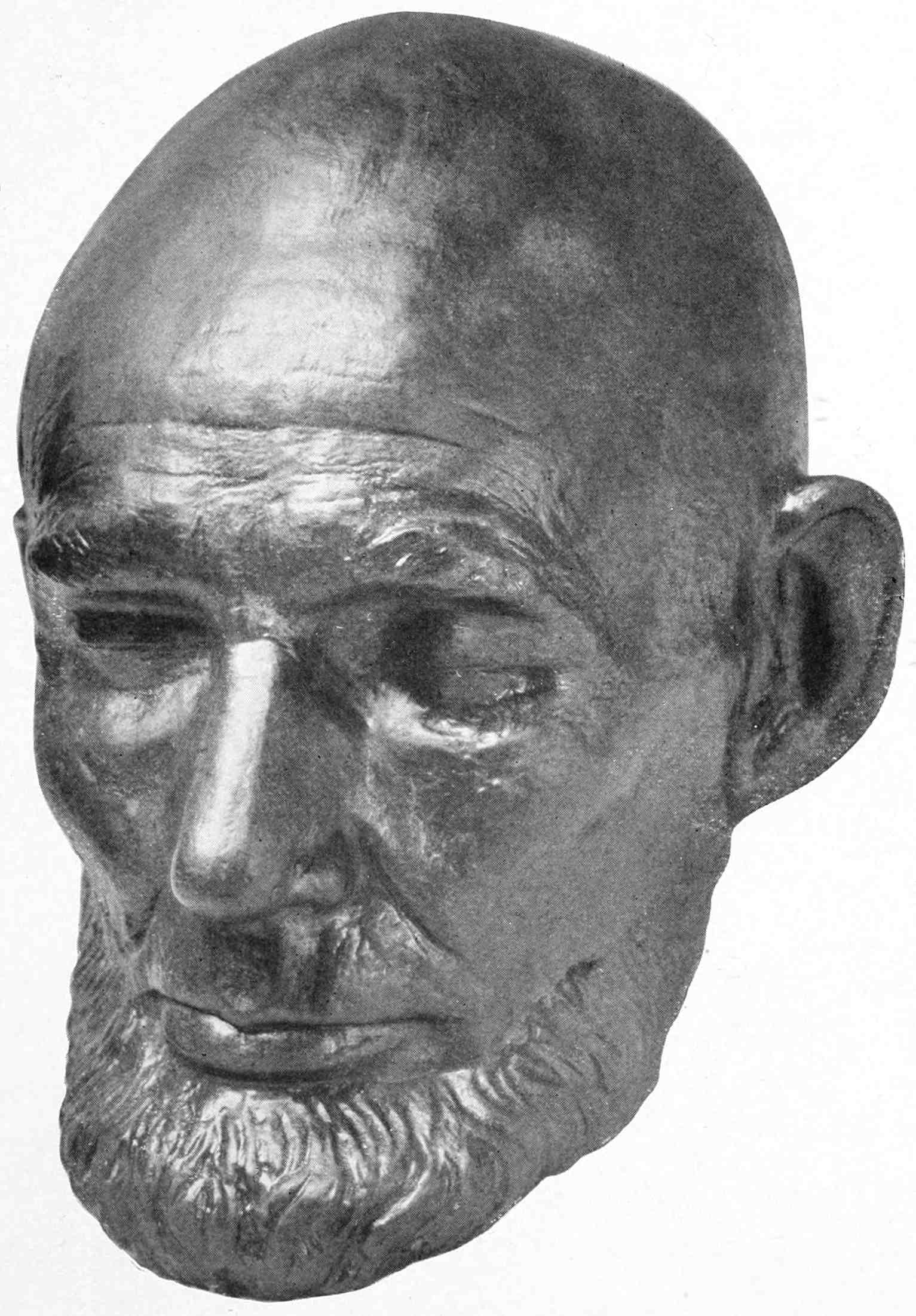
Life mask of Lincoln while President. Observe the wasted
features, the kindly, humorous mouth, and the reverential
indications of the high top head
Imagine him on the night after the bloody
loss of Chancellorsville—seventeen thousand
killed, wounded and missing! Mr. Stoddard,
sitting in the deserted White House,
underneath Lincoln’s room, has helped our
imagination:
“But that sound, the slow, heavy, regular
tread of the President’s feet, pacing up and
down in his room and thinking of Chancellorsville!
A man’s tread may well be heavy
when there is such a load upon his shoulders
as Lincoln is carrying.... He can
hear, in his heart, the thunder of the Union
and Confederate guns, and the shrieks and
groans that rise on the lost battlefield....
Ten o’clock—and now and then there have
been momentary breaks, as if he paused in
turning at the wall; but no pause has lasted
longer than for a few heart-beats....
Eleven o’clock—and it is as if a more silent
kind of silence had been obtained, for the
tread can be heard more distinctly, and a
sort of thrill comes with it now and then....
There has been no sound from the
President’s room for a number of minutes,
and he may be resting in his chair or writing.
No; there it comes again, that mournfully
monotonous tread, with its turnings
at the wall.... Two o’clock comes,
without another break in the steady tramp
of Lincoln’s lonely vigil. Three o’clock arrives,
and your task is done, and you pass
out almost stealthily ... and the last
sound in your ears is the muffled beat of
that footfall.
Before eight o’clock of the morning you
are once more at the White House ...
look in at the President’s room.... He
is still there, and there is nothing to indicate
that he has been out of it.... There
upon the table, beside his cup of coffee, lies
the draft of his fresh instructions to General
Hooker, bidding him to push forward without
any reference to Chancellorsville.”
These are but fragmentary glimpses of
the savior of the Union in his many-sided
life during the war. But they help us to
understand him in that tragic stretch of time
when he plodded wearily between the White
House and the telegraph room in the War
Department to learn, day by day, what his
generals at the front had to say.
It would be but vain repetition to picture
him in silent, white-faced anguish, or in
equally silent transports of joy and thanksgiving,
all through the fighting days of
Shiloh, Stone River, Fredericksburg, Antietam,
Gettysburg, Vicksburg, Chickamauga,
the Wilderness, Spottsylvania and Petersburg,
when Americans reddened American
soil with the blood of Americans, and the
ordinary dress of women and children
throughout the country turned to black.
They said of him that he sometimes
cracked jokes, Nero-like, while the continent
shuddered at the slaughter of its
bravest and best, and while the fate of the
Union hung trembling in the balance.
“I must laugh or I will surely die,” he
explained to John Hay.
XIV
To Lincoln the preservation of the
Union was of much greater importance
than the freedom of the
negro race.
No one who has ever glanced through his
speeches and writings can have any doubt
about that.
When he signed the Proclamation of
Emancipation he did it solely to save the
Union. It was his mind, rather than his
heart, that inspired the deed; for his inclination
was to recognize the constitutional
property right in slaves and to secure their
emancipation by paying for them.
This reverence for the Constitution and
defense of all its guarantees and sanctions,
even when the argument advantaged those
who raised their hands against the government,
is not the least of Lincoln’s claim to
the love and gratitude of his countrymen.
Not even the monstrous emotions of a fratricidal
war could shake his determination to
recognize slavery as a property right confirmed
by the nation, so long as the nation
itself could survive. Nor could the alternate
appeals and abuse of the New England
abolitionist fanatics make him forget that
the rebel South was defending what it believed
to be its legal rights.
There is not a single note of bitterness or
hatred for the South in all that he said or
wrote up to the day when a Southern hand
struck down the South’s best friend.
The time came, however, when there was
no longer any hope that emancipation by
compensation would be accepted as a means
of restoring peace.
Then, and then only, Lincoln considered
unconditional emancipation as an act of war
in defence of the Union and as a means of
peace.
Thirty-four years afterwards General
Longstreet, one of the most distinguished
soldiers of the Confederacy, stood before
thousands of Union veterans in Atlanta,
white-haired and shaking with emotion, and
said:
“Your loss would have been our loss and
your gain has been our gain.”
The President had held out as long as possible
against what he afterwards considered
“the central act of his administration and
the greatest event of the nineteenth century.”
To members of Congress who urged him to
free the negroes and muster them into the
army he made a military argument:
“Gentlemen, I have put thousands of
muskets into the hands of loyal citizens of
Tennessee, Kentucky and North Carolina.
They have said that they could defend themselves
if they had guns. I have given them
the guns. Now, these men do not believe
in mustering in the negro. If I do it, these
thousands of muskets will be turned against
us. We should lose more than we should
gain.”
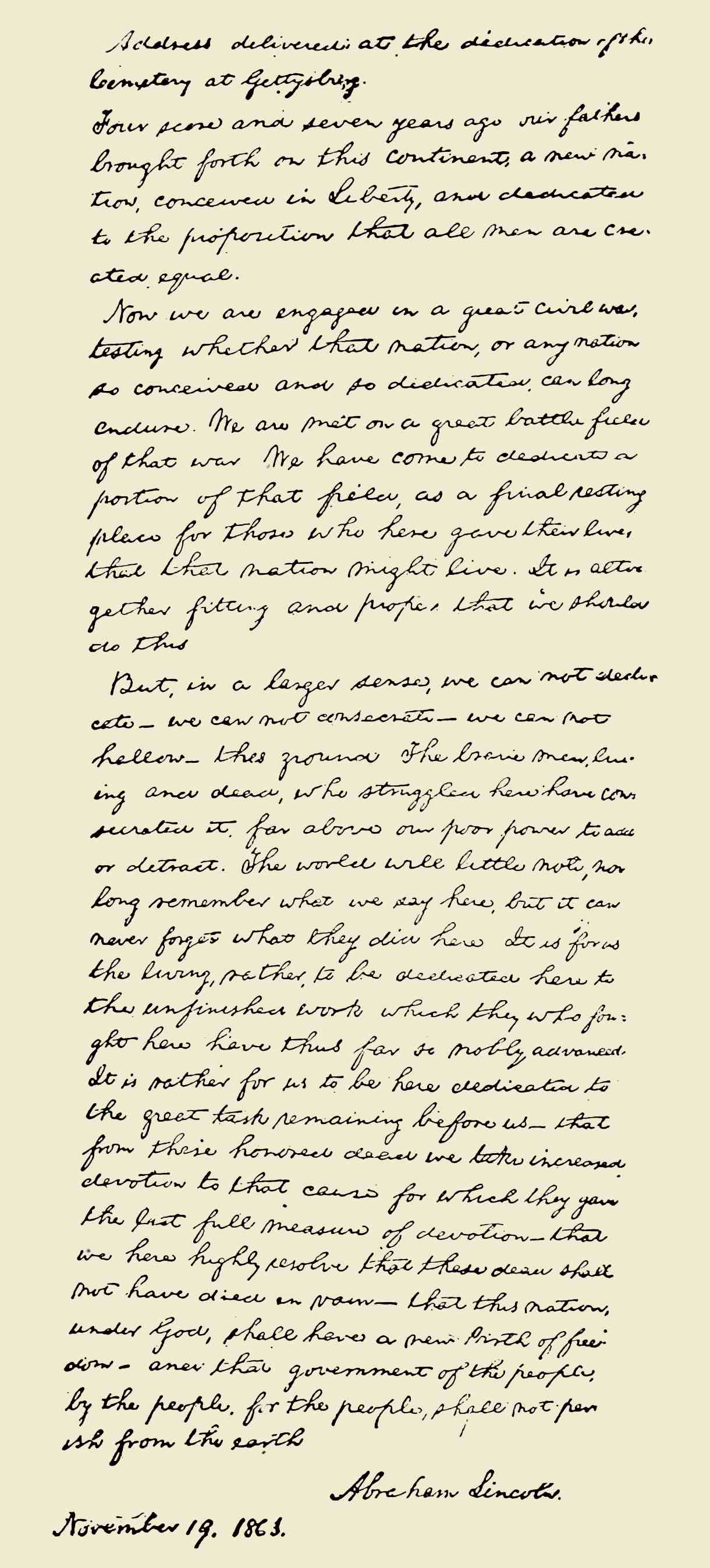
Autograph copy of Lincoln’s speech at Gettysburg
On July 22, 1862, Lincoln called his Cabinet
together and read to them a draft of a
proposed proclamation freeing all the slaves
in the United States.
Secretary Seward, however, advised delay,
pointing out the fact that the Union
arms had sustained repeated defeats, and
that a proclamation of emancipation, issued
at such a time, might be “viewed as the last
measure of an exhausted government.” He
advised the President to wait until a victory
was won and then “give it to the country
supported by military success.” Lincoln
consented to wait.
How the anti-slavery forces bellowed and
threatened! How Wendell Phillips lashed
the President! How Greeley scored him in
the Tribune! How the abolitionist committees
poured into the White House and raged
against delay!
Poor Lincoln! He who had scoffed and
blasphemed in his rough, hard youth in New
Salem, turned to God for guidance. There
is nothing in history more touching than
the spectacle of this strong man, struggling
between his sense of duty and the pitiless
clamor of his country, raising his soul like a
child to its father.
And while he communed with God he did
not fail to use all the resources of his nature
to find a safe, sure way for the Republic he
loved so well. He drew strength from God,
but he continued to observe, compare and
analyze conditions. A Chicago delegation
went to him and declared that it was God’s
will that he should free the slaves. Lincoln
drew himself up and said:
“I hope it will not be irreverent for me to
say that if it is probable that God would
reveal His will to others on a point so connected
with my duty, it might be supposed
He would reveal it directly to me....
These are not, however, the days of miracles,
and I suppose it will be granted that I
am not to expect a direct revelation. I must
study the plain physical facts of the case,
ascertain what is possible, and learn what
appears to be wise and right.”
The signal that Lincoln waited for came
on September 17, 1862, when McClellan defeated
Lee’s army at Antietam, inflicting a
loss of more than twenty-five thousand men
in killed, wounded and missing.
Then came one of the strangest sights in
the life of the American government, a spectacle
that reveals the profoundly mystic side
of Lincoln.
The Cabinet was called together again to
consider a proclamation of emancipation.
There was Stanton, the Secretary of War,
short, deep-chested, thick-bearded, dogmatic;
Chase, the Secretary of the Treasury,
tall, shaven, dignified, learned, able;
Seward, the Secretary of State, slim, erect,
hawk-eyed, polished, haughty; white-bearded
Welles, the Secretary of the Navy;
tall, courtly Blair, the Postmaster General;
heavy-faced, ponderous Smith, the Secretary
of the Interior; and silent, shrewd,
studious Bates, the snowy-headed Attorney
General.
When this group of hard-headed and experienced
politicians was solemnly gathered
around the table in the Cabinet room, Lincoln
opened a humorous book by Artemus
Ward and began to read a chapter in his
shrill, singsongy voice, pausing now and
then to join the chuckling of his hearers.
Stanton alone sat with thunder in his eyes
and a frown on his brow. The tendency of
the President to relieve a strain on the
nerves, or clear the mind by a good laugh,
exasperated him to the point of fury.
Suddenly the laughter vanished from Lincoln’s
voice and there came into his strong
face the look that he is remembered by in
his greatest moods.
Then he poured out his mind and soul.
In a few words he announced that he had
decided to emancipate the slaves by proclamation,
and explained his reasons. Looking
earnestly into the faces of his advisers, he
informed them that he had left the decision
to God, that he had made a promise to God,
and that he would keep that promise.
Think of President Roosevelt making such
a statement to Secretary Root, Secretary
Cortelyou, Secretary Wright, Attorney General
Bonaparte and the other members of
his Cabinet!
There was no self-consciousness in Lincoln’s
manner as he made this extraordinary
avowal. He spoke simply and with an air
of intense conviction. His soul was in his
eyes. There was peace in his face.
“He remarked,” wrote Secretary Welles
that night, “that he had made a vow—a covenant—that
if God gave us the victory in the
approaching battle [Antietam] he would consider
it an indication of Divine will, and that
it was duty to move forward in the cause of
emancipation. It might be thought strange,
he said, that he had in this way submitted
the disposal of matters when the way was
not clear to his mind what he should do.
God had decided this question in favor of the
slaves. He was satisfied it was right—was
confirmed and strengthened in his action by
the vow and the results. His mind was
fixed, his decision made, but he wished his
paper announcing his course as correct in
terms as it could be made without any
change in his determination.”
What a scene!—the master politician of
his times, the ugly rail-splitter and country
politician, whose very appearance excited
smiles, surrounded by shrewd, calculating,
learned, world-hardened men, and telling
them gravely that he had left to the decision
of God the question of banishing slavery
from American soil.
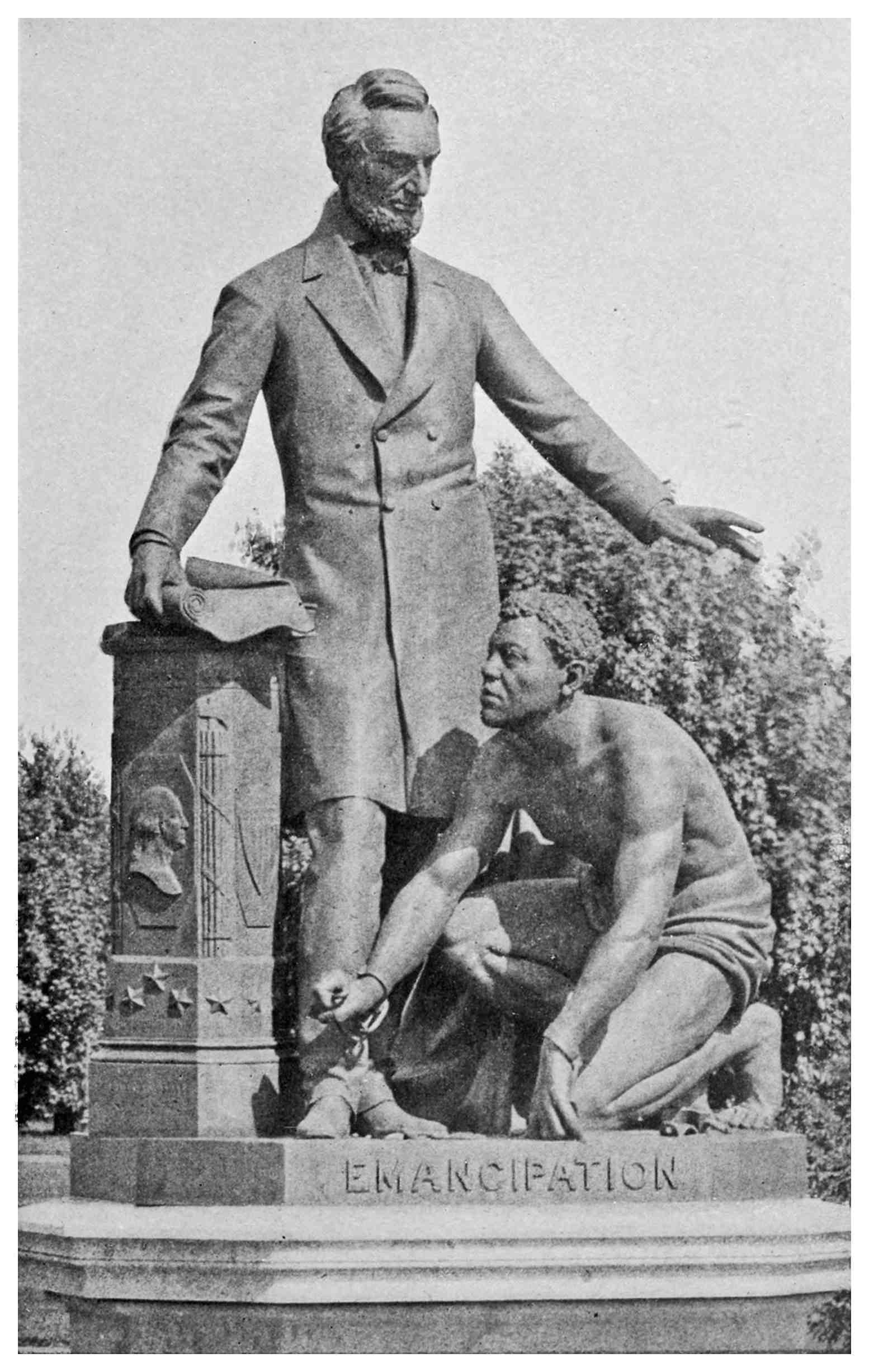
Lincoln statue, E. Capitol and Thirteenth Street, Washington
It was so impressive, so extraordinary,
that even Secretary Chase wrote it all down
as soon as he got home. Here is his statement
of Lincoln’s words:
“When the rebel army was at Frederick,
I determined, as soon as it should be driven
out of Maryland, to issue a proclamation of
emancipation, such as I thought most likely
to be useful. I said nothing to any one, but
I made the promise to myself, and (hesitating
a little) to my Maker. The rebel army
is now driven out, and I am going to fulfill
that promise. I have got you together to
hear what I have written down. I do not
wish your advice about the main matter, for
that I have determined for myself. This I
say without intending anything but respect
for any one of you.... There is no
way in which I can have any other man put
where I am. I am here; I must do the best
I can, and bear the responsibility of taking
the course which I feel I ought to take.”
There was nothing Oriental about Lincoln.
He made much of human wisdom.
He listened reverently to the voice of the
people. He bowed to the Constitution, in
spite of the sanctions it gave to slavery, because
it represented the deliberate will of
the majority.
But that incomparable hour in the White
House proves that in the stress of contending
human passions, almost crushed by the
weight of his office, with heart and mind
overwhelmed, Lincoln turned from earth to
Heaven, and, like Elijah on Mount Carmel
among the priests of Baal, cried to God for a
sign. “The God that answereth by fire, let
him be God.”
As Secretary Seward put the Proclamation
of Emancipation in his pocket and the members
of the Cabinet withdrew from the most
thrilling council ever known in that place,
Lincoln’s countenance was calmer than it
had been for many weeks.
The proclamation freeing all slaves in
rebellious States, together with a plan for
emancipation by compensation, was submitted
to Congress. To the very last Lincoln
hoped that the South might accept his plan
to abolish slavery by paying for the slaves.
His appeal to Congress was notable:
“The fiery trial through which we pass
will light us down, in honor or dishonor, to
the latest generation. We say we are for
the Union. The world will not forget that
we say this. We know how to save the
Union. The world knows that we do know
how to save it. We—even we here—hold
the power and bear the responsibility. In
giving freedom to the slave, we assure freedom
to the free—honorable in what we give
and what we preserve. We shall nobly save
or meanly lose the last, best hope of earth.”
On January 1, 1863, Lincoln issued the
proclamation that ended slavery forever under
the American flag.
XV
Wearying of McClellan’s delays
and excuses for not fighting,
Lincoln removed him and put
Burnside in command of the Army of the
Potomac. When Burnside fought at Fredericksburg
the President appeared at the
War Department telegraph office in carpet
slippers and dressing gown, and waited
all day without food for the shocking news
of defeat that did not come until four
o’clock the next morning—ten thousand
dead and wounded.
The President calmly endured the general
abuse that followed this disaster. Then he
removed Burnside and put General Hooker
in his place, writing to him these characteristic
words:
“I have heard, in such a way as to believe
it, of your recently saying that both the army
and the government needed a dictator. Of
course it was not for this, but in spite of it,
that I have given you the command. Only
those generals who gain successes can set
up dictators. What I now ask of you is
military success, and I will risk the dictatorship.”
Lincoln went to Hooker’s army and reviewed
it. As the hundred thousand men
marched by they watched him eagerly as he
sat on his horse, tall, angular and in black
frock coat, among the glittering generals.
Seymour Dodd has described the scene:
“None of us to our dying day can forget
that countenance! From its presence we
marched directly onward toward our camp,
and as soon as route step was ordered and
the men were free to talk, they spoke thus to
each other: ‘Did you ever see such a look
on any man’s face?’ ‘He is bearing the burdens
of the nation.’ ‘It is an awful load;
it is killing him.’ ‘Yes, that is so; he is
not long for this world!’
“Concentrated in that one great, strong,
yet tender face, the agony of the life or death
struggle of the hour was revealed as we had
never seen it before. With new understanding
we knew why we were soldiers.”
A month later came the dispatch announcing
the slaughter and defeat of Chancellorsville.
Noah Brooks read it to Lincoln:
“The appearance of the President, as I
read aloud these fateful words was piteous.
Never, as long as I knew him, did he seem
to be so broken up, so dispirited, and so
ghostlike. Clasping his hands behind his
back, he walked up and down the room
saying, ‘My God! My God! What will
the country say? What will the country
say?’”
Not that Lincoln feared criticism or even
denunciation. He does not know the greatest
and noblest American who thinks that.
No, it was the torturing, intolerable thought
that it might be his dreadful fate to be the
last President of the United States, the
haunting idea which, a generation later,
was written by the loyal, iron-souled Grant
on his deathbed: “Anything that could have
prolonged the war a year beyond the time
that it did finally close would probably have
exhausted the North to such an extent that
they might then have abandoned the contest
and agreed to a separation.”
The shedding of blood grieved Lincoln.
Even when Grant won Vicksburg, and Lee’s
gallant army was defeated in the three days’
battle at Gettysburg, his joy was overcast
by the thought of the dead and dying on both
sides. All through the bloodiest days of the
war he went to the hospitals in Washington.
His heart was with the common soldiers.
And he was tender to the Confederate
wounded. He never could forget that they
were his countrymen. Nor could he withstand
an appeal to pardon a young soldier
sentenced to death. Again and again he left
his bed, after a day and evening of exhausting
toil, to save the life of some distant
wretched youth condemned to die at daybreak.
Is there anything in the whole range of
English literature more solemnly beautiful
and heart-moving than the note he wrote to
the widow Bixby, of Boston?
“Dear Madam: I have been shown in
the files of the War Department a statement
of the Adjutant-General of Massachusetts
that you are the mother of five
sons who have died gloriously in the field of
battle. I feel how weak and fruitless must
be any words of mine which should attempt
to beguile you from the grief of a loss so
overwhelming. But I cannot refrain from
tendering to you the consolation that may
be found in the thanks of the republic they
died to save. I pray that our Heavenly
Father may assuage the anguish of your
bereavement, and leave you only the cherished
memory of the loved and lost, and
the solemn pride that must be yours to have
laid so costly a sacrifice upon the altar of
freedom.
Yours very sincerely and respectfully,
A. Lincoln.”
But in his determination to save the Republic
no horror could shake his resolution.
It is no small part of his title to the love of
the nation to-day that one so merciful and
tender-hearted could suffer the frightful
shocks of years of slaughter and waste without
wavering from his duty.
His sense of nationality, his refusal to consider
the American people save as a whole,
was expressed in that immortal speech at
the dedication of the cemetery on the Gettysburg
battlefield in November, 1863.
Edward Everett, who was looked upon as
the most eloquent of living Americans, was
the orator of the occasion. The invitation
to Lincoln was an afterthought.
Yet who can remember anything of the
two hours’ polished speech of Everett, and
who can forget a sentence of the two hundred
and sixty-five words which Lincoln
spoke almost before his hundred thousand
listeners realized the dignity and imperishable
beauty of his utterance?
“Fourscore and seven years ago our fathers
brought forth upon this continent a new
nation, conceived in liberty, and dedicated
to the proposition that all men are created
equal.
Now we are engaged in a great civil war,
testing whether that nation, or any nation, so
conceived and so dedicated, can long endure.
We are met on a great battlefield of
that war. We are met to dedicate a portion
of it as the final resting place of those who
here gave their lives that that nation might
live. It is altogether fitting and proper that
we should do this.
But, in a larger sense, we cannot dedicate—we
cannot consecrate—we cannot hallow
this ground. The brave men living and
dead who struggled here have consecrated
it far above our power to add or detract.
The world will little note, nor long remember,
what we say here, but it can never forget
what they did here. It is for us, the
living, rather to be dedicated here to the
unfinished work that they have thus far so
nobly carried on. It is rather for us to be
here dedicated to the great task remaining
before us—that from these honored dead
we take increased devotion to the cause for
which they gave the last full measure of
devotion—that we here highly resolve that
these dead shall not have died in vain; that
the nation shall, under God, have a new
birth of freedom, and that government of
the people, by the people, and for the people
shall not perish from the earth.”
Even after that Lincoln offered pardon
to every one who would return to the old allegiance,
save the leaders of the rebellion. His
heart cried out to the bleeding South.
Yet his head was steady, and when he put
the sword of the nation into the hands of
Grant, with Sherman and Sheridan to help
him; when the army swept all before it,
and when, after reviewing Grant’s forces in
front of grim Petersburg, Lincoln called for
half a million fresh soldiers, he had the wit
and shrewdness to silence Horace Greeley’s
senseless clamor for peace negotiations by
writing to the officious editor:
“If you can find any person anywhere
professing to have any proposition of Jefferson
Davis in writing, for peace, embracing
the restoration of the Union and abandonment
of slavery, whatever else it embraces,
say to him he may come to me with you;
and that if he really brings such proposition,
he shall at the least have safe conduct with
the paper (and without publicity if he
chooses) to the point where you shall have
met him. The same if there be two or
more persons.”
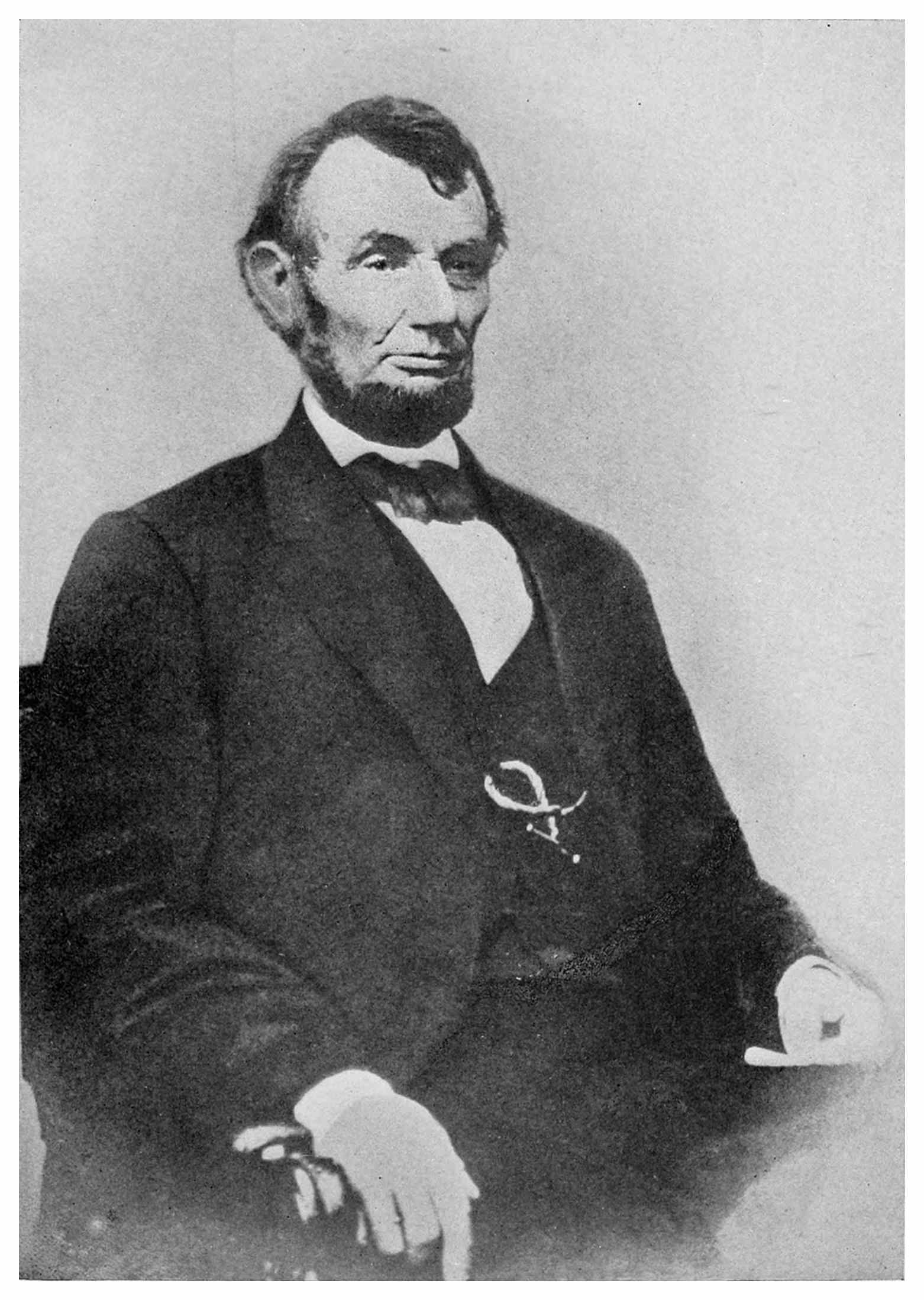
One of the last photographs of Lincoln. The picture shows
plainly the cares of office
After his second election to the Presidency,
and while pressing his generals on to the
end, Lincoln continued to show how free
was his soul from bitterness toward the
South. The climax came in his second
inaugural speech, when a million soldiers
were executing his orders in the field. It
was the last, supreme outpouring of his
great and gentle soul before peace came in
the surrender at Appomattox, to be followed
by his own bloody death at the hands of a
fanatic.
Those who saw him on the day of his second
inauguration say that he was thinner
and more wrinkled than ever. His face had
a ghastly, gray pallor. There was an expression
of indescribable mourning in his
eyes. After speaking for some time to the
crowd there came a strangely beautiful look
into his wasted features as he drew himself
to his full height and raised his hands high.
Then came that matchless outburst which
is repeated by hundreds of thousands of
American schoolboys every year:
“Fondly do we hope—fervently do we
pray—that this mighty scourge of war may
speedily pass away. Yet, if God wills that
it continue until all the wealth piled by the
bondsman’s two hundred and fifty years of
unrequited toil shall be sunk, and until every
drop of blood drawn with the lash shall be
paid by another drawn with the sword, as
was said three thousand years ago, so still
it must be said, ‘The judgments of the Lord
are true and righteous altogether.’
With malice toward none; with charity
for all; with firmness in the right, as God
gives us to see the right, let us strive on to
finish the work we are in; to bind up the
nation’s wounds, to care for him who shall
have borne the battle, and for his widow,
and his orphan—to do all which may
achieve and cherish a just and lasting peace
among ourselves, and with all nations.”
After he was shot by John Wilkes Booth
in Ford’s theater on April 14, 1865, Lincoln
never spoke again. He had seen the stars
and stripes raised in Richmond. He had
seen the end of human slavery on the American
continent. The nation was one again.
But he was to speak no deathbed message.
It was all in that last great speech: “With
malice toward none; with charity for all.”
For hours they stood about him as he lay
moaning or struggling for breath, his wife,
his Cabinet officers, his pastor, secretary and
doctors. At daybreak the troubled look
vanished from his face. There was absolute
stillness, followed by a trembling prayer
by the pastor.
“Now he belongs to the ages,” said the
deep voice of Secretary Stanton.
* * * * *
No, while Lincoln lives in the heart of the
nation, it is idle to think that the Republic
can be corrupt or cowardly.
There were less than nine millions of
Americans when he was born. These have
become almost ninety millions. The national
wealth has grown to more than a hundred
billions of dollars. The flag he
defended now flies over the Philippines, Hawaii
and Porto Rico. The law-resisting
millionaire, the “captain of industry” and
the “tariff baron” have taken the place of
the slaveholder.
Yet the love of Lincoln deepens with increasing
years; and a century after his birth
in a Kentucky log cabin, and nearly forty-four
years after his martyrdom, the American
people answered the charge that they
had outlived their early ideals by the tribute
they paid to the memory of their humblest-born,
plainest, most beloved leader and
President.
Set up, Electrotyped and Printed at
THE OUTING PRESS
Deposit, New York