HOW I FACED DEATH, HOW MY HUSBAND WAS SHOT, AND SOME NARROW ESCAPES OF
MY COMPANIONS
From the moment when he commits his first crime the professional
criminal never knows what it is to enjoy real peace of mind. His crimes
hang over him like the sword of Damocles, and, unless he reforms, he
can never be free from the fear of some day being found out and sent
away to prison for a long term.
And arrest is not the only thing he has to fear—he is continually face
to face with the danger of serious injury or death. Whatever the crime
he undertakes, he must run the most desperate risks—he has to stake
not only his liberty, but life itself on the narrowest of margins.
The powerful explosive he is using to blow open a safe may go off
prematurely, as it did one night when George Mason and I were robbing a
bank in Illinois, and leave the robber half dead.
Perhaps an indignant mob may decide to take justice into its own hands
by lynching the criminal. This is what happened to one of my comrades
in Kentucky. They had the noose around his neck and were all ready to
string him up when I arrived in the nick of time to save his life.
Perhaps he will be caught in the act at one of his crimes and shot down
like a dog, as my husband, Ned Lyons, was in Connecticut one night.
That was the narrowest escape my husband ever had—I saw it with my own
eyes, and, if I live to be a hundred, I shall never forget the agony of
it all.
At the time of this thrilling adventure the police wanted us so badly
for our share in several famous robberies that Ned and I did not dare
to undertake any operations in the large cities which usually formed
our most profitable fields. So, being in need of ready money, we had
decided to take a little trip through some of the smaller towns of
New England. The amount of cash to be had from the banks, stores and
postoffices in these places was not large, but, on the other hand, it
was not hard to get and we thought we ought to be able to spend two or
three weeks quite profitably in the nearby towns of Connecticut and
Massachusetts.
As my health that summer was not very good and Ned did not want me to
take any very active part in the robberies, we invited George Mason to
go along with us.
From the start we seemed to be ill-fated. Ned and George succeeded in
getting into a bank in Fitchburg, Mass., but were frightened away by a
watchman before they had time to open the safe. From the postoffice in
a little village just outside Fitchburg we secured only eight or ten
dollars to pay us for our trouble. Quite discouraged and desperately in
need of money we went on to Palmer, Mass.
There I scouted around and discovered that the most likely place for
us to rob was G. L. Hitchcock's drug store, which was also the village
postoffice. A storm came up to hide the full moon, and this enabled us
to make the attempt that very night. It was not the easiest job in the
world, for Mr. Hitchcock and his family lived directly above the store
and the least noise was sure to rouse them.
Shortly after midnight I took up my position in an alley in the rear
of the store to stand guard while Ned and George removed a pane of
glass from a cellar window. Through this opening the men squeezed, and
presently the dim reflection of their dark lanterns showed me that they
had safely reached the store above.
I had been standing there in the rain for nearly twenty minutes when a
low rumble from inside the store made me prick up my ears. Just as I
was puckering my lips to whistle a shrill warning to my comrades I saw
them appear at the back door of the store carrying between them a small
iron safe. It was this safe rolling over the floor which I had heard.
The safe was a small affair, but so well made that it had successfully
resisted all their efforts to drill it open. Finding it was not too
heavy to be carried they had decided to take it outside the town, where
they could blow it open without fear of arousing the sleeping village.
We must have made a strange procession as we trudged along through
the darkness—the two men partly carrying and partly rolling the safe
along, and all of us wading through mud half way to our knees.
At last we reached a meadow far enough removed from any houses for our
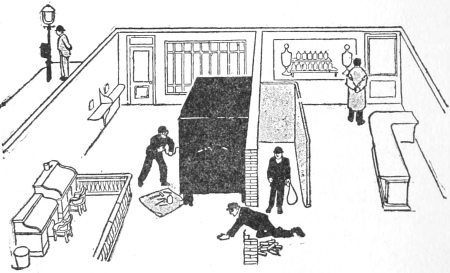
purpose. George Mason filled one of the holes he had drilled with black
powder and wrapped the safe with some old sacks to protect the fuse
from the wet and also to muffle the noise of the explosion.
Ned touched a match to the fuse and we scurried to a safe distance. The
charge went off with a dull boom—the shattered door of the safe flew
high into the air and landed several yards away.
Waiting a few minutes to make sure that no one in the village had
been awakened, we hurried back to get our plunder. There were $350 in
cash, a diamond ring, some gold pens, and fifteen or twenty dollars'
worth of postage stamps. With the few dollars the boys had taken from
the till this made a trifle more than four hundred dollars for our
night's work—a pitifully small sum compared with what some of our bank
robberies brought us, but enough to support us until we could plan some
more ambitious undertaking.
Just as we were dividing our plunder into three equal shares a freight
train whistled in the distance.
"George and I will jump on this train," said my husband, giving me a
hurried kiss. "It's safer than for the three of us to stick together.
Good-bye—and take care of yourself. We'll meet you in South Windham,
Conn., late to-night or early to-morrow."
Wet, bedraggled, and so tired that I could have fallen asleep standing
up, I groped my way to the railroad station and curled myself up on a
bench to snatch what rest I could. Just before daybreak a milk train
came along. I boarded this and traveled by a roundabout route to South Windham.
I reached there late in the afternoon and went straight to the
postoffice. This was always the accepted rendezvous for professional
criminals when no other place had been agreed upon. Detectives in
every city might very profitably spend more of their time watching the
postoffice, for wherever the criminal is he makes a point of calling
there at least once every twenty-four hours to keep appointments with
his friends or in the hope of running across some acquaintance.
Ned and George were there waiting for me, and mighty glad they were to
see me, for they had heard vague rumors of a woman having been arrested
on suspicion that she knew something about the Palmer robbery.
The best opportunity the sleepy little town afforded seemed to be a
general store run by a man named Johnson. I dropped in there late one
evening, and, on the pretext of buying a crochet hook, saw the old
proprietor locking the day's receipts—quite a respectable bundle of
money—in a ramshackle safe which offered about as much security as a
cheese box.
We got everything in readiness to break into the store the following
night. It was a foolhardy time for such a job, as there was a bright
moon—but we were hungry for money, and one more good haul would supply
enough to keep us in comfort until we could lay our plans for some
robbery really worthy of our skill.
There was really little I could do to help the men, but I could not
bear to be left behind. Just after midnight I stole out of the railroad
station, where I had been waiting ostensibly for the night train to New
York, and hid myself in the doorway of a livery stable, where I had a
good view of the store we were going to rob.
Pretty soon I saw my two comrades come cautiously down the main street
from opposite directions. They met underneath a window of the store on
the side which was in the dark shadow of a tree.
The window was so high above the ground that my husband had to climb up
on George Mason's shoulders to reach it. I could hear the gentle rasp
of his jimmy as it worked against the fastenings.
At last he raised the sash gently and stepped into the store. Then
he leaned far out across the sill and stretched his brawny arms down
toward his companion.
Mason gave a leap, caught hold of Ned's wrists, and, with the agility
of a circus performer, swung himself up into the window.
All was as silent as the grave. The only sign of life I could see in
the peaceful street were two cats enjoying a nocturnal gambol on a
nearby piazza roof. I shivered for fear they might start yowling and
awaken somebody to spoil our plans.
Just at that instant one of the cats upset a flower pot which stood at
a window opening on the porch roof. To my horror that pot went rolling
down the roof with a tremendous clatter, hung suspended for a second
on the eaves, then fell to the stone steps with a crash that woke the
echoes.
At once the whole town awoke. In every direction I could hear windows
being thrown open, children crying, and sleepy voices asking what the
trouble was.
At a window directly over the store where my two friends were a
night-capped head appeared and a frightened woman screamed, "Help!
Burglars!" at the top of her lungs.
That completed the havoc which the playful cats and the flower pot had
begun. From every house half-dressed men armed with rifles, shotguns,
and all sorts of weapons poured into the street.
All this racket had started too suddenly for me to give Ned and George
any warning. I could only crouch farther back in the shadow of my
doorway and trust to Providence that the villagers would overlook me in
their excitement.
"There goes the burglar now!" some one shouted, and just then I saw my
husband dash past my hiding place so close that I could have touched
him. He was headed for the open country beyond the railroad tracks and
was running faster than I had ever supposed a man of his weight could.
"Stop, or I'll shoot!" yelled an old white-whiskered farmer, who stood,
rifle in hand, not a dozen yards away.
But Ned, if he heard the command, made no move to obey. Instead, he
only ran all the faster, hunching his head down between his shoulders
and zigzagging back and forth across the road as if to make his bulky
form a less favorable target.
The old farmer raised his rifle as deliberately as if he had been
aiming at a squirrel instead of a fellow man. Three shots blazed out in
rapid succession.
The first shot went wild. At the second my husband stumbled. At the
third he threw up his hands and pitched forward headlong in the road.
"We've got him!" the crowd shouted with what seemed to me fiendish
glee, and rushed up to where Ned's body lay in a quivering, bloody heap.
I supposed he was dead, but, whether dead or alive, I knew there was
nothing I could do to aid him. Nervous and trembling at the awful sight
I had seen, I slipped out of town unnoticed.
I saw nothing of George Mason and for months afterward did not know
how he had escaped. With better judgment than my husband showed he
had remained quietly in the store after the outcry started. He saw
the shooting, and, in the confusion which followed, he found little
difficulty in getting out of town.
Friends of mine in New London aided me to return to the hospital in
Hartford, where Ned had been taken after the shooting. His recovery
was slow, for there was a bullet imbedded nine inches deep in his back
which the surgeons were unable to remove. As soon as he was able to
stand trial he was sentenced to three years in State prison, and, when
he had completed this term, he was given three years in Massachusetts
for the robbery at Palmer.
This was the result of our crimes in New England—my husband nearly
killed and sentenced to six long years in prison. Can you wonder why I
have learned the lesson that crime does not pay?
But, to my sorrow, I did not learn the lesson then—no, not for many
years after that. With my husband in prison the support of my little
ones fell wholly on my shoulders, and I promptly turned to bank robbing
as the easiest way I knew of making a living.
My early training under such expert bank robbers as Ned Lyons, Mark
Shinburn, and Harry Raymond made me extraordinarily successful in this
variety of crime. The cleverest men in the business began to have
respect for my judgment and were continually inviting me to take an
important part in their risky but very profitable ventures. Soon, as
I am going to tell you, my reputation for skill in organizing the most
daring robberies and carrying them through without detection had spread
even beyond the limits of the underworld.
One day, when I was trying to enjoy the novel experience of living
honestly for a few weeks, a distinguished looking gentleman called at
my home. He saw my look of incredulity when he announced himself as
a bank president and promptly produced a heavy engraved card which
confirmed the truth of his statement.
Instantly I was on my guard. In those days my house was the
headquarters for all sorts of strange persons—receivers of stolen
goods, professional bondsmen, criminal lawyers, escaped prisoners—but
I had never before been honored by a visit from a bank president. What
on earth could the president of a bank want of a bank robber?
"I understand that you are one of the most successful bank robbers in
America," he said without any delay in coming to the point. "I want
your advice in a little undertaking I have in mind, and, if possible,
your help."
"My advice and help!" I exclaimed, thinking the man must be out of his head.
"That's exactly what I want," he replied coolly. "I want you to tell
me how I can have my bank robbed, and, if possible, I want you to take
charge of the robbery yourself."
As he explained, he was more than $150,000 short in his accounts. He
had taken this amount from the bank within the past year and lost
every dollar of it in speculation. He could not return this money and
it was only a matter of a few weeks before his embezzlement would be
discovered.
Being a man of prominence in his community—a deacon in the church, his
wife a society leader, his children in college—running away was out of
the question. For months he had been racking his brain for some way of
averting the ruin which he had brought upon himself.
The plan he had finally devised for retaining his good name and keeping
out of prison was to have his bank robbed. On the night of the robbery
he would leave $50,000 in the vault to pay the robbers for their
trouble, but, when he came to announce the robbery to the police and
the newspapers, he would declare that $200,000 had been taken.
In this way his thefts would be covered up and he could continue to
enjoy the respect and confidence of the community where he had always lived.
I was amazed at the bold ingenuity of this plan and the matter-of-fact
way in which he presented it to me. This was the first I had ever heard
of a bank being robbed by request of one of its officials. Later I came
to know that it is not an uncommon thing for dishonest presidents and
cashiers to conceal their thefts by hiring robbers to break into their
banks. The difference between what is actually taken in one of these
robberies by request and what the police and the newspapers say is
taken covers the amount which the embezzling official has lost in Wall
Street or some other speculation.
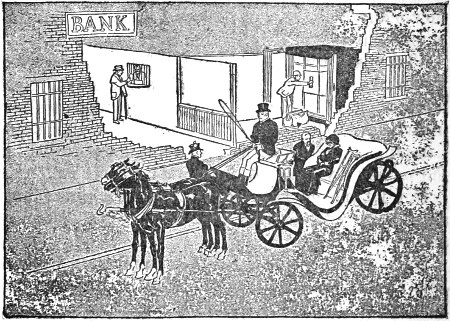
WHAT HAPPENED WHEN WE ROBBED A BANK "BY REQUEST."
At that time such an idea was so new to me that all sorts of suspicions
crowded into my mind. Probably it was a trap for me, I thought, and I
positively declined to have anything to do with it.
But the old banker would not take no for an answer. He urged me to
think it over and a week later he called again.
By this time the fear of the disgrace which threatened him and his
family had made him a nervous wreck. He begged so piteously for me to
help him save his good name that my womanly sympathies got the better
of me and I finally consented.
All my feeling for him, however, did not quite free my mind of the fear
that the whole affair might be a trick, and I determined to protect
myself and the robbers who would assist me with all the shrewdness I
could.
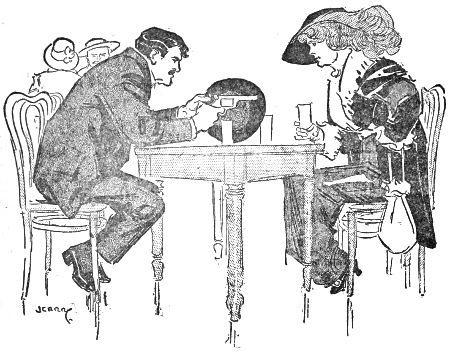
"We must have a written agreement," I said at the very start.
The banker objected to this, fearing, I suppose, that I might use the
paper against him later for blackmail. But I insisted that I would not
do a thing until I had it.
"If you can't trust me to that extent I can't trust you," I said
firmly—and at last he told me to draw up the paper and he would sign
it.
According to the contract which I prepared, the banker paid five
thousand dollars down and was to pay me an equal amount as soon as I
had completed my arrangements and set the date for the robbery. He
further agreed that there should be at least $50,000 in cash in the
bank vault on the night of our visit.
It was further provided that the banker should cooperate with me and my
fellow robbers in every possible way, and that he should do nothing to
aid in our arrest or conviction for the crime, which, as was expressly
stated, was committed at his suggestion, and not ours. In case the
robbery was interrupted before we could get inside the vault the banker
was to pay us $25,000 in cash in addition to the $10,000 already
advanced.
I agreed to leave no stone unturned to carry out the robbery and
promised to return the agreement to the banker as soon as all its
provisions had been fulfilled.
All this I set down on paper in as businesslike way as I knew how. It
was a document which would have made the poor old banker's ruin even
greater than his thievings had done if I had been the sort of woman to
break faith with him. With trembling fingers he signed it and counted
out $5,000 in bills.
From the banker I had gained a good idea of the bank and the sort of
vault we would have to enter. Now, to get some good, reliable men to
help me do the job.
Of all the bank burglars in my acquaintance George Mason seemed best
fitted for this particular crime. He was a cool, resourceful fellow
and had had wide experience in blowing open bank vaults.
George readily agreed to join me, and for the rest of the party he
recommended two younger men—Tom Smith and Frank Jones, I will call
them, although those were not their names. I do not like to reveal
their identity here because they later reformed and led honest lives.
Right here let me say that I never told these three men of my
arrangements with the banker or that I was to receive from him $10,000
in addition to what we expected to find in the vault. If they are alive
to-day and read these lines they will learn here for the first time
that the bank in Quincy, Ill., which they helped Sophie Lyons rob was
robbed by request of its president.
I sent word to the banker that we were ready and he came to my house
and paid me $5,000 more. Then, by different routes, George Mason, the
other two robbers and I proceeded to Quincy.
I was the first to arrive. I went to the leading hotel, announced my
plan to add a patent medicine laboratory to the town's industries and
began to look around for a suitable location for my enterprise. As I
believe I mentioned in a previous chapter, this ruse of the patent
medicine laboratory was one I had borrowed from my friend, Harry
Raymond—he had used it to splendid advantage in his robbery of the
Boylston Bank in Boston.
Of course, it was a part of my prearranged plan with the banker that
the quarters I should finally find best suited for my purpose would
be a room on the second floor of the bank building, directly over the
vault we were going to rob.
I made several visits to the bank before I completed my arrangements
with the president—partly to carry out my rôle of the cautious
business woman and partly to study the construction of the vault and
see where we could best bore our way into it.
By the time the lease was signed the three men who were to be
associated with me in the new business arrived. With their help I
secured a quantity of bottles, labels, jars of chemicals, chairs,
desks, tables, and other things we would need if we were really making
patent medicine.
Among the articles of furniture we moved in was an unusually large oak
wardrobe. We removed the bottom from this and placed it over the exact
spot in the floor where we planned to dig our opening into the bank
vault.
Then, while one of the men and I ostentatiously pasted labels on
endless bottles of "Golden Bitters," the other two men crawled into
the wardrobe where no chance visitor could see them and day after day
continued the work of removing the layers of brick and timber which
separated us from the vault. We stored the débris as it accumulated in
bags and carried it away every night.
It was a long job and a hard one. The floor timbers were seasoned oak
and beneath them were two layers of brick.
In the cramped space inside the wardrobe it was hard to work to the
best advantage and, besides, the men never knew just how far they had
progressed and were in constant fear that an extra vigorous blow would
loosen a big strip of plaster in the ceiling of the bank.
To our disgust we found, after we had passed through the floor itself,
that the vault had a sort of false roof composed of short lengths of
railroad iron placed irregularly in a setting of mortar and brick. This
made our task three days longer than we had expected.
Late one afternoon George Mason cleared away a space which left only a
thin layer of lath and plaster between us and the inside of the vault.
There was too much danger of the gaping hole we had dug under the
wardrobe being discovered to admit of any further delay. We made our
arrangements to rob the bank that very night.
While the rest of the town was going to bed we waited impatiently for
it to get late enough for us to lay our hands on the $50,000 which I
had every reason to believe was waiting below that thin layer of lath
and plaster. Luckily enough the bank's watchman was at a christening
party that evening and was not likely to return until the wee small
hours. This prevented the necessity of my remaining on guard outside.
Shortly after midnight we turned out our lamps and lighted our dark
lanterns. I peered out of the window—the streets were deserted.
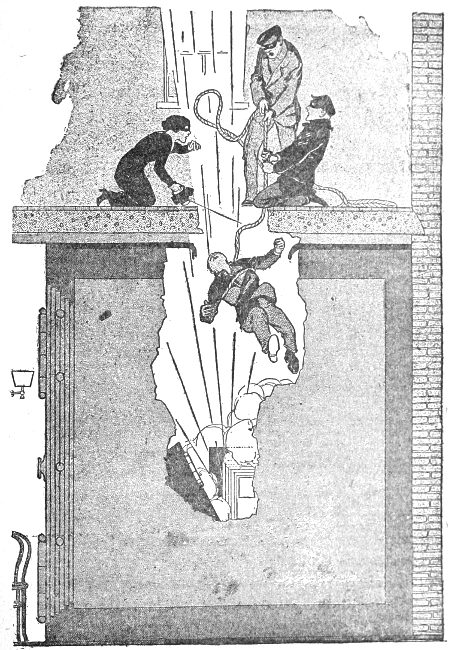
George Mason took a small sledge hammer and with one or two well
directed blows opened up the hole in the floor wide enough to admit his
body. Then he tied one end of a long rope under his arms and we lowered
him down into the vault.
To the best of my knowledge and belief the cash which had been promised
would be found right on the shelves of the vault, and all George would
have to do would be to stuff it into his pockets and climb back up the
way he had come.
But, whether through intent or an oversight on the president's part,
that was not the case. For several minutes we waited breathlessly
listening to George as he fumbled around the vault by the light of his
dark-lantern. Then we heard him call in a hoarse whisper:
"Sophie, it's just as I was afraid it would be. Every cent of the money
is locked up in the small steel safe. I'll have to come back up and get
my tools."
It is the custom in big bank vaults to have a small and separate steel
safe to put the actual cash into. Leases, documents, account books, and
sometimes bonds and stock certificates are kept in the big vault, but
money and things of special value are usually locked up in the inside
steel compartment.
With some difficulty we hauled him back up. From his bag he selected
the drills he thought he would need and from a bottle poured out what
seemed to me an extra generous quantity of black powder.
"Be careful and not use too much of that stuff," I called as he
disappeared again through the hole. "Ned always said that was your
worst failing."
"Don't you worry, Sophie," he replied; "it will take a good big dose to
open this safe."
For several minutes we sat there listening to the rasping of his drills
against the door of the safe. Just as we felt that tug on the rope
which was the signal to haul him up, we saw the flare of his lighted
match and heard the sputter of the fuse.
We pulled on the rope for all we were worth but before George's body
was within two feet of the hole in the floor there came a blinding
flash, followed by an explosion that shook the building.
Although dazed by the shock and half blinded by the cloud of dust and
poisonous fumes which poured up through the hole, we managed to keep
our hold on the rope and haul our helpless comrade out of the death
trap in which the premature explosion had caught him.
"George!" I called, as we lifted the rope from under his arms. But he
never answered and I thought it was only a corpse that we laid gently
on the floor. His hair and eyebrows were completely burned off, his
face and hands were as black as coal and he was bleeding from an ugly
wound in the head.
We forgot the money we were after—we forgot the danger of being
caught—in our anxiety for our wounded friend. One of the men brought
water while I tried to force a drink of brandy down his throat. It
seemed an age before he came to his senses, raised himself on one elbow
and roughly pushed me aside.
"It went off too quick for me," he said; "but don't be foolish—I'll be
all right in a minute. Look and see if the noise has roused the town."
I looked out—there was not a soul in sight. The bank's thick walls and
the fact that it stood at some distance from any other building had
evidently prevented the explosion being heard outside.
Although suffering intense pain George insisted on going back to get
the money. It was no easy task, for the vault was full of suffocating
smoke. There was no time to lose, as the watchman might return at any
minute.
After a few minutes we hauled him up for the third time.
"That charge blew the safe door to splinters, but here's every dollar
it contained," he said, handing me several packages of bills.
I counted the money and had hard work to conceal my surprise when I
found there was only $30,000. But, as Mason thought himself lucky to
escape with his life and, as the other two men seemed well satisfied
with the amount, I said nothing.
We started at once for Chicago, where a few days later we divided the
spoils. As I had expected, the bank's loss was placed by the newspapers
at $200,000. A large reward was offered for the capture of the robbers.
I was pleased to note that the president's story of the amount taken
and of the complete mystery in which the affair was shrouded seemed to
be generally accepted.
After the excitement had died down the bank president came to Detroit
to see me. Worry over the possibility of his crime being discovered
had shattered his nerves and he was such a poor broken specimen of an
old man that I did not have the heart to demand the additional $20,000
which he had promised us. As I tore up our agreement and handed him the
pieces, he said:
"My criminal folly has ruined my peace of mind. Thanks to your help, I
have saved my family from disgrace, but the worries and nervous strain
of my defalcation and the bank robbery have killed me. My doctors say
I have heart disease, and have but a few months to live. I wish I had
known two years ago what I have since learned—that crime does not pay."
The desperate risks every criminal has to run often come through no
crime of his own, but through his association with other criminals.
Two of the most exciting events in my varied career happened to me
through my loyal effort to save the life of my friend, Tom Bigelow, a
well-known bank sneak and burglar.
It was in Mount Sterling, Kentucky, that all this happened. I was
there on a perfectly legitimate errand and had no idea that any of my
criminal friends were in the vicinity.
There was a circus in town that day and the long main street was
crowded with sightseers. I had been watching the parade with the rest
and was on my way back to the hotel for dinner when I heard some one
call my name.
Looking around in surprise I saw Johnny Meaney, a young bank sneak,
whom I knew well, pressing his way through the crowd toward me. He was
all out of breath and in the greatest agitation.
"Sophie," he whispered in my ear, "they've just caught Tom Bigelow with
the bank's money on him and they're going to lynch him."
There was no time to ask him more—before the last word was fairly out
of his mouth he had disappeared in the crowd.
As I afterward learned, Tom and Johnny had taken advantage of the
excitement created by the circus parade to rob the Mount Sterling Bank.
While the cashier was standing upon the counter to see the passing
parade, Johnny had crawled in under his legs and taken a bundle of
money out of the vault.
He got safely out with his plunder and was just handing it to Tom,
who had been waiting in a buggy outside, when the cashier discovered
his loss and raised a great outcry. Before Tom had time to stir out
of his tracks a hundred willing hands in the crowd had made him a
prisoner—then some one started the cry, "Lynch the Yankee robber!" and
some one else brought a rope.
In the excitement nimble John Meaney had managed to escape. As he
dashed down the street he had chanced to catch sight of me and had
passed me the word of our friend's peril.
The crowd was already hurrying in the direction of the square in the
center of the town where the court house stood and I followed as fast
as my legs could carry me.
As I entered the square I could see Tom's familiar form looming above
the heads of the yelling mob which surrounded him. He was mounted on a
soap box under an oak tree which stood in front of the court house.
I shall never forget how he looked—pale as a sheet, his feet tied with
rope, his arms securely bound behind him. He was bareheaded and they
had removed his coat and collar in order to adjust the noose which hung
around his neck.
Quite plainly, if there was anything I could do to save my friend,
it must be done quickly. The mob was loudly clamoring for his life.
Already a young man was climbing up the tree in search of a convenient
limb over which to throw the end of the rope.
I shuddered to think that, unless I could devise some plan of action,
Tom Bigelow's lifeless body would soon be dangling before my eyes.
Summoning every ounce of the nervous energy I possessed I pressed my
way through the crowd, screaming frantically:
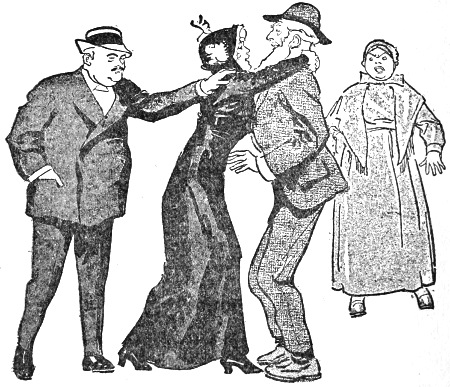
"That man is my sweetheart! Don't lynch him—oh, please don't lynch him!"
My action took the crowd by surprise—they made a lane for me and
pushed me along until finally I stood right at Tom's feet.
I climbed up on the box beside Tom; I threw my arms around his neck,
although the feel of that ugly noose against my flesh made me shudder.
"This man is innocent—he is my sweetheart," I kept shouting. "You must
let him go."
I hugged Tom Bigelow, I kissed him, I wept over him—I did everything I
could imagine a woman doing when the man she loves is about to be hung
before her eyes.
"If you hang him you'll have to hang me, too," I screamed between my
heart-rending sobs.
The crowd was amazed. Lynchings were no uncommon occurrence in that
region, but nothing like this had ever happened before.
The cooler heads in the crowd began to have their say. "Take that noose
off his neck and lock them both up," some one shouted.
The Sheriff put handcuffs on us and led us away. My ruse had
succeeded. Tom Bigelow's life was saved!
Tom and I were lodged in jail, indicted by the Grand Jury and held
without bail for trial. Of course, I was innocent of any share in the
robbery, but, as the authorities believed my story that I was Tom's
sweetheart, they thought I must know more about it than I admitted.
It was while we were confined in the jail at Mount Sterling that I
had an opportunity to see for myself how it feels to face a desperate
lynching mob. That was one of the most horrid nightmares I ever
experienced.
One of our fellow inmates in the jail was a man named Murphy Logan,
who was awaiting trial for the murder of his father. He was a sullen,
weak-minded fellow, who had several killings to his discredit. The
general opinion was that he belonged in an insane asylum.
In another neighboring cell was a young man named Charlie Steele. He
was exceedingly popular in the community. His worst fault was love of
liquor and he was in jail for some minor offense which he had committed
on one of his sprees. The other prisoners shunned Logan on account of
his disagreeable ways, but Steele good naturedly made quite a friend of
him and they often played cards together.
In this jail the prisoners were allowed the freedom of the long
corridor on which the cells opened. One afternoon Tom Bigelow and I sat
just outside my cell trying to devise some way to regain our liberty.
Down at the other end of the corridor, Charlie Steele and Murphy Logan
were enjoying their usual game of cards.
Suddenly we were startled by a piercing scream. I jumped to my feet,
and looked around to see poor Steele lying on the floor with the blood
streaming from a long wound in his throat. Over him, glaring like the
madman he was, stood Murphy Logan, brandishing in one hand a heavy
piece of tin which he had fashioned into a crude sort of dagger.
Forgetful of my own danger, I rushed up and seized Logan's arm, just as
he was about to plunge the weapon into Steele's body again. He turned
on me, but I managed to keep him from wounding me until Tom and some of
the other prisoners came to my assistance.
Steele lived only a few hours. The Sheriff placed the murderer in
solitary confinement, and chained him to the floor of his cell. His
ravings were something terrible to hear. He continually threatened
vengeance on any of his fellow prisoners who would tell how he had
slain his friend.
After listening to these threats all night long we were in terror of
our lives, and when the inquest was held next day not a single prisoner
would admit that he had seen the killing.
"Didn't you see this happen?" the Sheriff asked me.
"No," I lied, "I was in my cell at the time, and don't know anything
about how Steele came to his end."
"You lie!" shouted Logan, when he heard this. "If you hadn't interfered
I would have cut him up worse than I did. I will make you suffer for
sticking your nose into my affairs."
The town was in a fever of excitement, and from the windows of our
cells we could see excited groups discussing the murder on every
corner. Feeling ran particularly high, because the dead man had been so
popular in the community while nobody liked Murphy Logan.
Late that night Logan became so exhausted with his ravings that he fell
asleep. I was just preparing to try to get some rest myself when I
heard the tramp of heavy feet coming up the jail stairs.
By the dim light of the one smoky kerosene lamp I saw a crowd of masked
men trooping into the corridor. The leaders carried heavy sledge
hammers, and with these, having been unable to make the Sheriff give up
his keys, they attacked the iron door of Logan's cell.
It quickly fell to pieces before their sturdy blows. Then they broke
the murderer's shackles and dragged him, shrieking curses with every
breath, down the stairs and out into the street.
They strung him up to a tree, riddled him with bullets, and left his
body hanging there in the moonlight in full view of my cell window.
This was too much for my overwrought nerves. I threw myself on my couch
and wept. Tom Bigelow did his best to console me, but I could not
sleep—my head ached and I trembled in every limb.
About an hour later I heard that ominous tramp of feet again! This time
the masked men came straight to the door of my cell.
"Is this where that woman is?" a rough voice called.
I cowered in a corner, too frightened to reply. They pounded the door
down just as they had Murphy Logan's. A man seized me by the arm and
pulled me out, none too gently.
They were going to lynch me—I was convinced of that. With tears
streaming down my cheeks I pleaded, as I never had before, that I was
innocent of any crime, and begged to be allowed to go back home to my
children.
They took me downstairs into the Sheriff's office, where sat a man who
seemed to be the leader of the mob.
"So you tried to save Charlie Steele's life, did you?" he said to me.
Then for the first time it dawned on me that perhaps I was not going to
be hanged after all. I told the whole truth about what I had done when
I saw Logan waving his dagger over his victim. When I had finished the
leader said:
"That's all we want to know, young woman. We liked Charlie Steele, and
we like you for what you tried to do for him. Now you're free to get
out of town—that's your reward for trying to save poor Charlie. We'll
see you safely to the depot."
I was overjoyed. The leader handed me enough money for my traveling
expenses and permitted me to go up to Tom's cell and tell him of my
good fortune. Before day broke I was on a train for Detroit.
These are only a few of the desperate risks which my husband, my
friends, and I were constantly facing during the years when I was
active in crime.
If every business man and merchant faced prison, bullets, or a lynching
as a necessary risk of trade, would anybody regard business life as
attractive?
The incidents from my own experiences give one more illuminative reason
why I maintain that CRIME DOES NOT PAY!