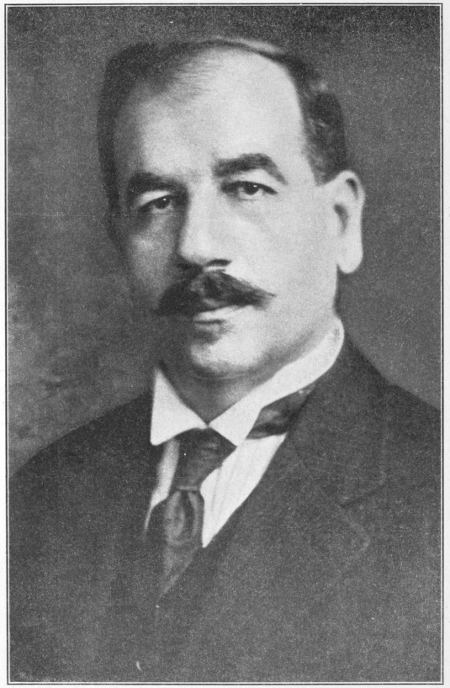
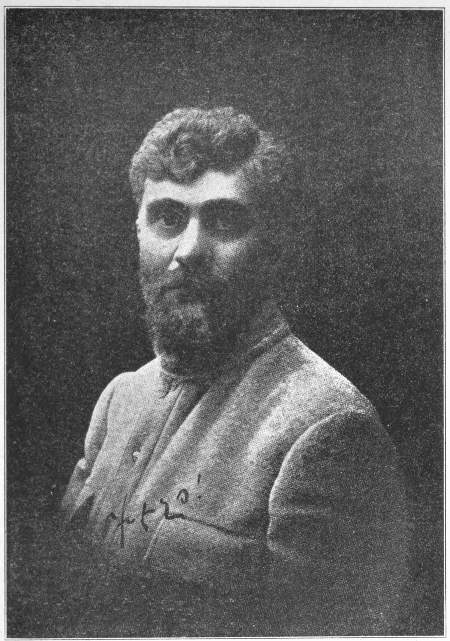
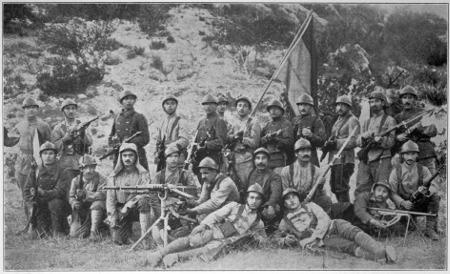
Dr. Pasdermadjian, the author of this pamphlet, is a native of Erzeroum,
and a member of a family which, both in the past and in the present, has
been an object of barbarous persecution at the hands of the Turks. When
the Russians in 1829 captured Erzeroum for the first time, 96,000
Armenians, with the encouragement of the Russian government, left that
city and the outlying villages with the Russian army, and emigrated
towards the Caucasus, where they founded three new cities, Alexandropol,
Akhalkalak, and Akhaltsikh. Only 300 Armenian families remained in
Erzeroum, refusing to leave their homes, even in face of the Turkish
despotism. Among these was the Pasdermadjian family.
In 1872 the Turkish government had Khatchatour Pasdermadjian killed,
simply because he was a well-to-do and influential Armenian, and,
therefore, undesirable. In 1877 during the Russo-Turkish war, the
Pasdermadjian family was subjected to the basest kind of persecution by
the Turkish government, which still owes the Pasdermadjians 36,000
Turkish liras ($180,000), the value of a quantity of wheat wrested
from them by the military authorities. During those same hostilities,
taking advantage of the war conditions, the Turkish government planned
to hang Haroutiun Pasdermadjian, on the ground that he was in
communication with the Russian army; but he was saved through the
intervention of the British consul. When the Russian army occupied
Erzeroum in 1878, the Pasdermadjians naturally gave a very hospitable
reception to the two Armenian Generals, Loris Melikoff and Lazareff.
After learning of the family's history, Loris Melikoff asked Haroutiun
Pasdermadjian to emigrate to the Caucasus. He promised to bring the
influence of the Russian government to bear on Turkey and to claim the
family's extensive real estate and various sums of money which the
Turkish government owed them. But Haroutiun Pasdermadjian refused the
kind offer, saying that he could not leave the country which contained
his martyred father's grave. When the Russians, in accordance with the
terms of the Berlin Treaty, were forced to evacuate Erzeroum, the Turks
came back and began anew to persecute the Pasdermadjians in every
possible way. In 1890 the Armenians of Erzeroum made a protest against
Turkish despotism, and demanded to have the reforms promised in the
Berlin Treaty carried out. The first bullet fired by the Turkish
soldiers during those disturbances was aimed at Haroutiun Pasdermadjian;
but he was saved through the heroism of a group of young Armenians. In
the massacres of 1895, the Pasdermadjians were again attacked by an
armed Turkish mob, but were saved from plunder and murder through the
stubborn resistance of all the members of the household, including the
servants. Afterwards, three members of the family, Hovhannes, Tigrane,
and Setrak, were imprisoned for a long time as revolutionists. In
reality, they were imprisoned simply because they had not allowed
themselves to be slaughtered like sheep by the Turkish mob. In February,
1915, when the present Turkish government began its organized slaughters
to eliminate the Armenians from the world, the first victim in Erzeroum
was Setrak Pasdermadjian, because he was an influential Armenian and had
had the courage several times to protest against the unlawful acts of
the government. The remnants of this numerous and ancient Armenian
family are now scattered throughout Mesopotamia.
The author of this booklet, Garegin Pasdermadjian, is the son of
Haroutiun Pasdermadjian and the grand-son of Khatchatour Efendi. He was
born in 1873, and received his elementary education at the Sanasarian
College of Erzeroum, being one of its first graduates (1891). In 1894 he
went to France and studied agriculture in the college at Nancy,
intending to return and develop the lands belonging to his family
according to the modern agricultural methods of Europe, and in that way
give a practical lesson to the Armenian peasants. He had hardly begun
his course when the great massacres of 1895 revolutionized the plans of
the younger generation of Armenian students. Out of the 26 young
Armenians at the University of Nancy, four, Sarkis Srentz, Haik
Thirakian, Max Zevrouz, and Garegin Pasdermadjian, left their studies
and returned to participate in the effort at vengeance which the
Armenian Revolutionary Dashnaktzoutiun (Federation) had decided to
organize in Constantinople. In 1896, Garegin Pasdermadjian and Haik
Thirakian, under their assumed names of Armen Garo and Hratch
respectively, took part in the seizure of the Ottoman Bank. This
European institution, with its 154 inmates and 300 million francs
($60,000,000) of capital, remained in the hands of the Armenian
revolutionists for fourteen hours as a pledge that the European
ambassadors should immediately stop the Armenian massacre in
Constantinople and give assurances that the reforms guaranteed to the
Armenians in the Treaty of Berlin should be carried out. On behalf of
the six great powers, signatories to the Berlin Treaty, the chief
interpreter of the Russian embassy, Mr. Maximoff, made a gentleman's
agreement with the young Armenian revolutionists to fulfill their
demands. Trusting to Mr. Maximoff's word of honor, the Armenians left
Constantinople. But immediately after their departure, the massacres
were resumed with more intensity, while the reforms have remained a dead
letter to this day. Such were international morals in 1895.
After these events Garegin Pasdermadjian returned to Europe to continue
his unfinished studies. Mr. Hanoteau, however, the French foreign
minister at that time, would not allow the Armenians who had been
connected with this affair to remain in France, so young Pasdermadjian
went to Switzerland and studied the natural sciences at the University
of Geneva. In 1900 he completed his course and received the degree of
Doctor of Science. Unable to return to Turkish Armenia, as was his
desire, Dr. Pasdermadjian went to the Caucasus and settled at Tiflis in
1901. There he opened the first chemical laboratory, for the purpose of
investigating the rich mines of that region.
National events, however, prevented him from pursuing his research work.
Having been a member of the responsible body of the Armenian
Revolutionary Dashnaktzoutiun (Federation) since 1896, he took part in
all the movements which aimed to protect the moral and physical well
being of the Armenian people from Turkish and Russian despotism. For
example, in 1905, when the Caucasian Tartars, with the approval of the
Russian government, began to massacre the Armenians in divers parts of
the Caucasus, Dr. Pasdermadjian became a member of the Committee created
by the Armenian Revolutionary Dashnaktzoutiun (Federation) to organize
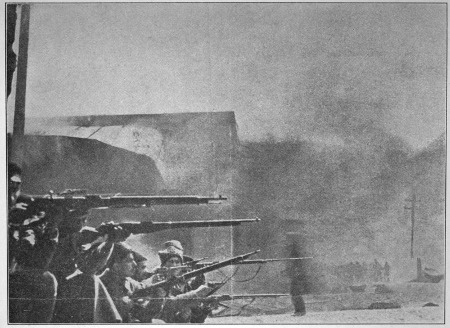
defence work among the Armenian people. In November of the same year,
when the Armeno-Tartar hostilities began right in Tiflis, under the very
nose of the Russian administration, he was entrusted with the command of
the Armenian volunteers to protect Tiflis and its environs. During the
seven-day struggle which took place in the streets of Tiflis, 500
Armenian volunteers faced nearly 1400 armed Tartars, and drove them back
with heavy losses.
The situation in the Caucasus was almost normal, and Dr. Pasdermadjian
and his idealistic colleagues were about to resume their main
object,—to carry arms and ammunition from the Caucasus to the Turkish
Armenians in order to prepare them for self-defense,—when the Turkish
revolution came in 1908. The Armenians in Erzeroum, as well as the party
to which he was a member, telegraphed to Dr. Pasdermadjian and strongly
urged him to become their candidate in the coming elections for
Representative to the Ottoman Parliament. After seven years of
professional studies, Dr. Pasdermadjian had been able to create for
himself in the Caucasus a life fairly prosperous financially. He had
just secured the right to develop a copper mine, and was about to work
it in partnership with a large company. His business required that he
should stay in the Caucasus to continue his successful enterprise, but
he yielded to the moral pressure of his comrades and left his personal
affairs to go to Constantinople as a deputy from Erzeroum.
During his four years in Constantinople as a deputy, Dr. Pasdermadjian
devoted his entire time to better the economic conditions of the
Armenian vilayets, and especially worked for the railroad bill, of which
he was the real author, but which was known to the public as Chester's
bill. Its main object was to build railroads as soon as possible in
those vilayets of Armenia which were considered to be Russia's future
possessions. For that reason neither France nor Germany wished to
undertake it, lest they should arouse the enmity of Russia. Another
fundamental object was to build those lines with American capital, which
would make it possible to counteract the Russo-Franco-German policies
and financial intrigues, for the benefit of the Armenian people. But in
spite of all his efforts, Dr. Pasdermadjian was unable to overcome the
German opposition in Constantinople, although, as the outcome of the
struggle in connection with that bill, two ministers of public works
were forced to resign their post. Both of the ministers were absolute
German agents under the name of Turkish ministers. It may also be worth
mentioning that during his four years at Constantinople as a deputy from
Erzeroum, at three different times, Talaat Bey (who became the butcher
of the Armenian people in 1915), on behalf of the "Committee of Union
and Progress," offered the portfolio of public works to Dr.
Pasdermadjian, as the most competent man for the post. Dr.
Pasdermadjian, however, refused these proposals, for the simple reason
that he did not wish to compromise in any way with the leaders of the
Turkish government, as long as they continued their chauvinistic and
anti-Armenian policy.
In the parliamentary elections of 1914, the "Committee of Union and
Progress" used every means to defeat the election of Dr. Pasdermadjian
in Erzeroum. On account of this attitude of the Turks, all the Armenian
inhabitants of the Erzeroum vilayet refused to take part in the last
elections. This intense opposition of the Turks to the candidacy of Dr.
Pasdermadjian was due to the fact that he had taken too active a part in
1913 in the conferences held for the consideration of the Armenian
reforms, and especially because, while parliamentary elections were
going on in Turkish Armenia during April, 1914, he was in Paris and
Holland, as the delegate of the Armenian Revolutionary Dashnaktzoutiun
(Federation), to meet the inspectors general who were invited to carry
out the reforms in Turkish Armenia.
In the autumn of 1914, a month and a half before the beginning of
Turco-Russian hostilities, Dr. Pasdermadjian went to the Caucasus on a
special mission, and joined the committee which had been appointed by
the Armenian National Council of the Caucasus to organize the Armenian
volunteer movement. In November of the same year, when the Russo-Turkish
war had begun, he accompanied the second battalion of the Armenian
volunteers, as the representative of the executive committee of Tiflis,
to prepare the local inhabitants of Turkish Armenia for self-defence, as
the Russian army was about to advance into the captured territories of
that country. On November 14 the second battalion of the Armenian
volunteers engaged in battle for the first time, near Bayazid, with the
Turkish soldiers and the Kurds. In the course of a bloody combat which
lasted twenty-four hours, Dro, the brave commander of the battalion, was
seriously wounded, and Dr. Pasdermadjian was forced immediately to take
his place. From that day to March of the following year, he remained at
the head of that battalion, and led it into eleven battles in the
neighborhood of Alashkert, Toutakh, and Malashkert, until Dro recovered
and returned to resume the command. In the summer of 1915, Dr.
Pasdermadjian (again as a representative of the executive committee of
Tiflis) went to Van. He was there when the people migrated en masse to
the Caucasus (when the Russian army was forced to retreat to the old
Russo-Turkish frontiers) and shared their untold hardships.
In the spring of 1917, when the Russian Revolution turned all the
defence work of the Caucasus up-side down, Dr. Pasdermadjian, with Dr.
Zavrieff, was sent from the Caucasus to Petrograd to negotiate with the
temporary Russian government concerning Caucasian affairs. From
Petrograd he left for America in June of the same year as the
representative of the Armenian National Council of Tiflis and as the
special Envoy of His Holiness the Catholicos of all the Armenians, to
lay before the American public and government the sorrows of the
Armenian people with the view of winning their sympathy and protection
for the indisputable rights of Armenia. He is still acting in that
capacity with all the energy at his command. His last effort has been
the preparation of this pamphlet, in which the reader will find a part
of these biographical facts under his assumed name of Armen Garo.
A word or two more about this booklet, which has been written in the
nick of time.
The critical days in the spring of this year are over, and the complete
victory of the Allies and of the United States has been won. "The day is
not very far," in the words of the writer, "when ... the representatives
of all the nations of the world,—guilty or just,—are to receive their
punishment or reward...." It is the purpose of this pamphlet to
demonstrate beyond any shadow of doubt, with most authentic facts, that
Armenia has fulfilled her duty to the allied cause in full measure (and
suffered untold sacrifices in doing so), and, therefore, is entitled to
her just claims as an Independent Armenia.
One other purpose the writer had in view in writing this booklet: to
make the great and generous American public realize that Armenians are
not an anaemic and unaggressive people, with no fighting blood in their
veins; that the Armenians have not been butchered like sheep, but, on
the contrary, have fought most bravely and resisted most stubbornly the
savage attacks of the Turks whenever they had an opportunity.
If the translation can possibly convey the spirit of the original, the
sustained eloquence and suppressed emotion with which the author pleads
the cause of his unfortunate but brave people, should be intensely
effective because they are not mere words, but are based on actual,
real, undeniable facts, and are the expression of a soul wholly
dedicated to a sacred cause.
A. T.
Cambridge, Mass.
December, 1918.
WHY ARMENIA SHOULD BE FREE
ARMENIA'S RÔLE IN THE PRESENT WAR
"The interest of the weakest is as sacred as the interest of the strongest."
President Wilson.
New York, Sept. 27, 1918.
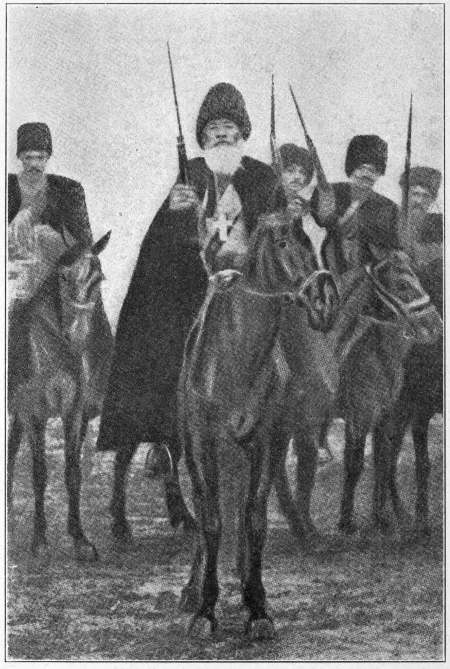
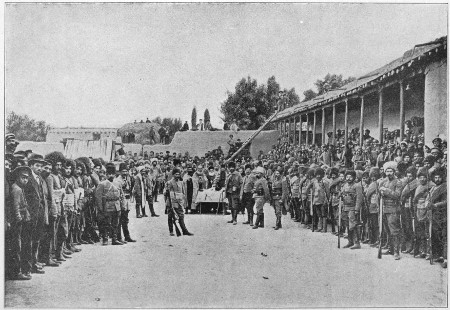
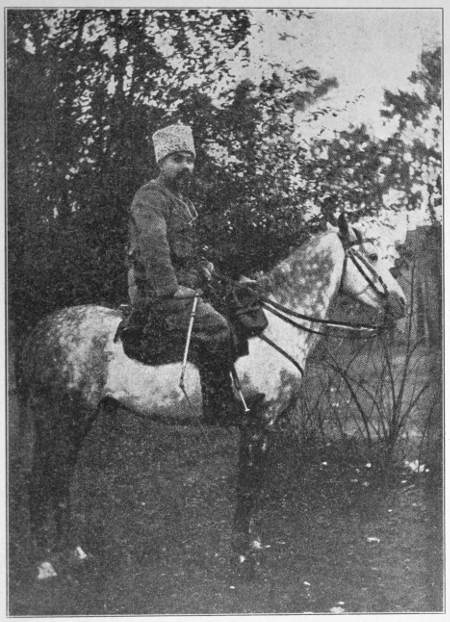
A seventy-year old Armenian priest leading the volunteers
to the battlefield.
WHY ARMENIA SHOULD BE FREE
ARMENIA'S RÔLE IN THE PRESENT WAR
In the early days of August, 1914, when civilized nations took up arms
against the German aggression, only three of the smaller nations of
Europe and the Near East had the courage, from the very first days of
the war, to stand by the Allies without any bargaining or dickering, and
they still stand at their posts on the ramparts, in spite of the immense
sacrifices they have already made.
The first member of this heroic triad was brave Serbia, which was the
first victim of Austrian aggression, and whose sons, after four years of
heroic struggle, are about to regain their lost native land. The second
member was little Belgium, whose three weeks of heroic resistance
delayed the German advance of 1914 and enabled gallant France to crown
with success the historic battle of the Marne. The third member of this
heroic triad was the Armenian people, who for four years and without an
organized government or a national army, played the same role in the
Near East by preventing the Turco-German advance toward the interior of
Asia as the Belgians played in the West by arresting the march of
Germany toward Paris. The Armenians, however, paid a higher price to the
God of War than either the Belgians or the Serbs. Out of four and
one-quarter millions of Armenians living in Turkey and Russia at the
beginning of the war, scarcely three millions remain at the present
time. What were the conditions under which the Armenians sided with the
Allies, and why were they forced to bear so great a sacrifice for their cause?