In general, all whole body counters must have (1) a mechanism
that reacts to the energy emitted by some kinds of
disintegrating, or radioactive, atoms; (2) a device that displays
or records these reactions; and (3) adequate shielding
to exclude unwanted rays from other sources.
3
Figure 1 Types of whole body counters.
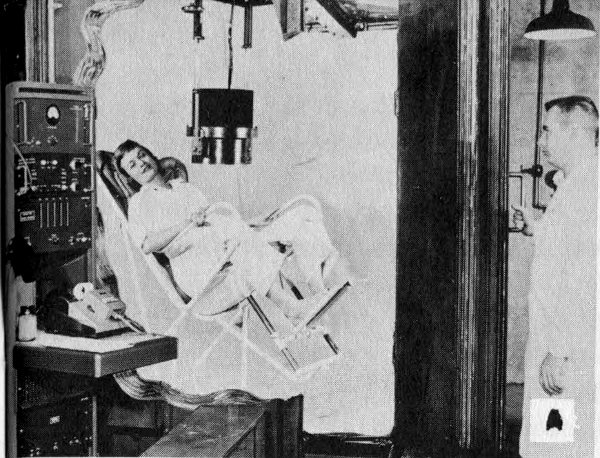
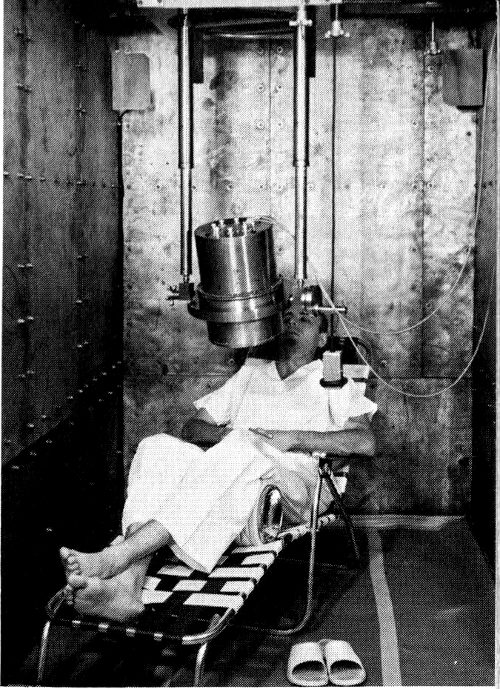
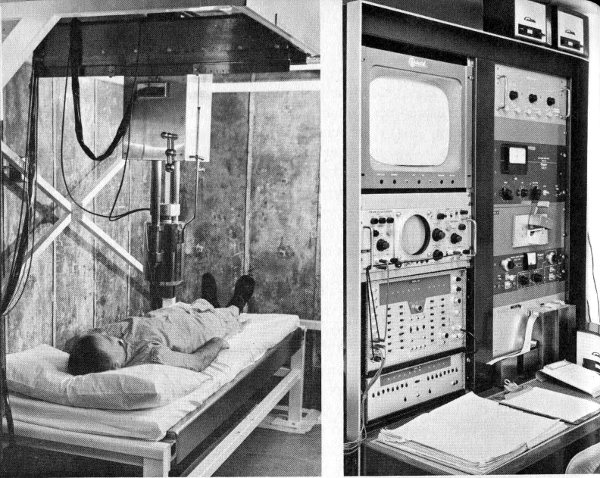
A The subject may be seated in a chair in an iron-shielded room and under a scintillation detecting crystal.
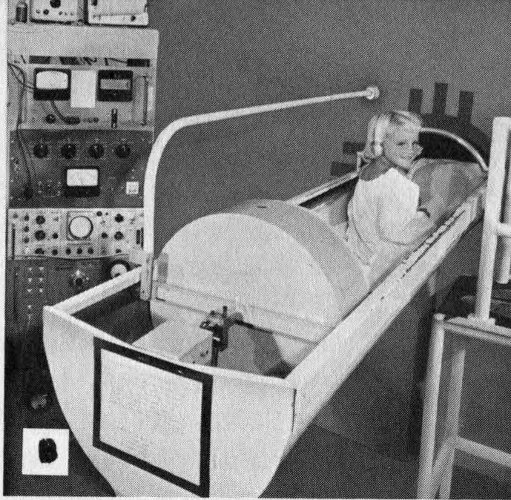
B The subject may lie in a bed that slides into the end of a hollow cylindrical tank filled with scintillation fluid.
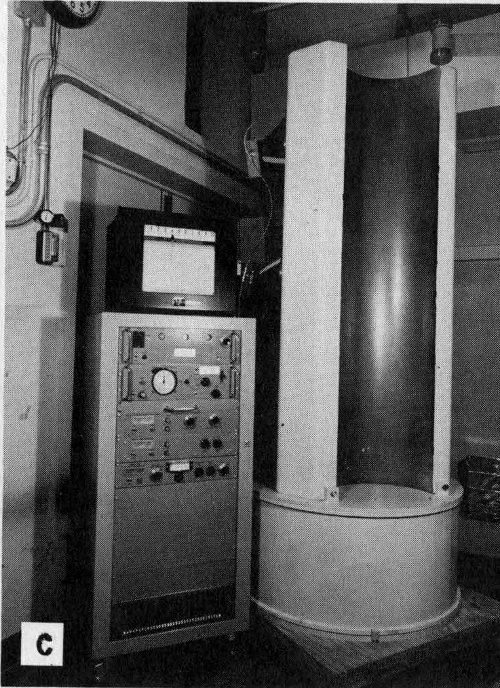
C The subject may stand in a semicylindrical double-walled tank filled with scintillation fluid. (See Figure 2.)
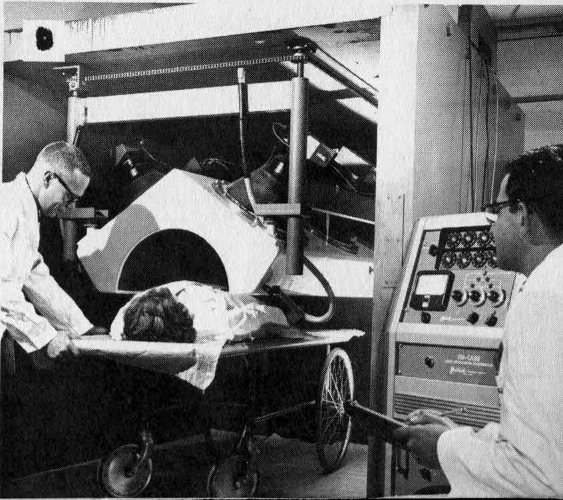
D The subject may lie on a wheeled cart and be wheeled beneath a shielded detecting crystal.
4
One of the first whole body counters was shown at an
atomic science conference in Geneva, Switzerland, in 1955
(Figures 1D and 2). While it was on display, 4258 visitors to
the meeting climbed a set of stairs to enter a 10-ton lead-walled
chamber. Here they stood still for 40 seconds while
the radioactive atoms in their bodies were being “counted”,
or recorded. This device, because it was the first one persons
could walk into, aroused great interest.
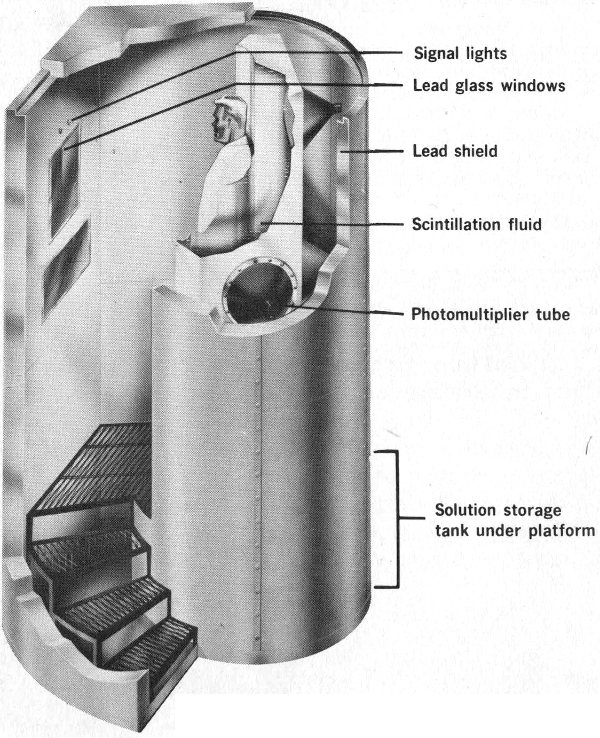
Figure 2 How a “walk-in” whole body counter, such as the one demonstrated at Geneva, works.
Shielding for the Geneva counter consisted of 3 inches of
lead. Only the most energetic background gamma rays and
5
cosmic rays can penetrate this amount of shielding, and the
number that do so remain almost constant during successive
counting periods. This constant remaining “background”
radiation level, once determined, could be subtracted from
the recorded number of emissions to provide the correct
radiation total from the body of each person examined.
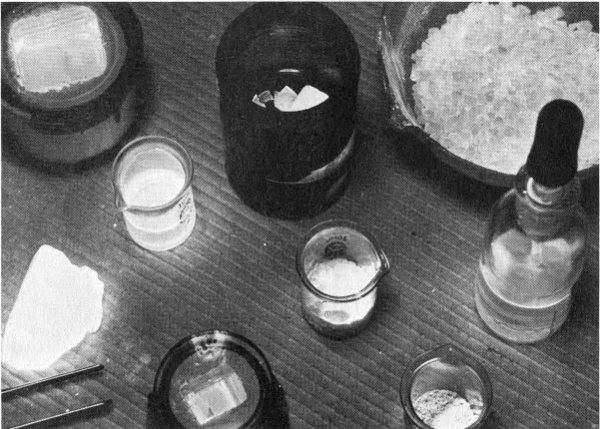
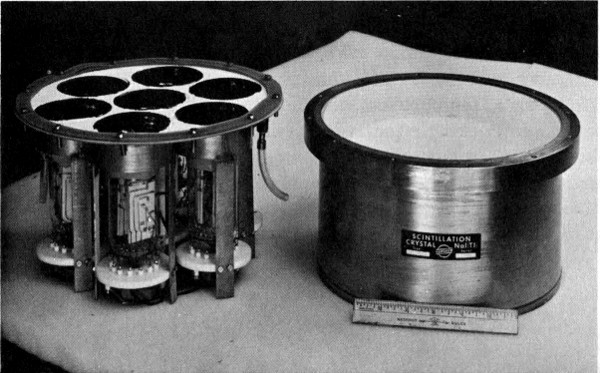
Figure 3 Typical crystals and liquid materials used to produce scintillations for whole body counters and other radiation-detecting instruments. Scintillation counters provide much faster recording of radiation than Geiger counters, and are widely used in experiments with high-energy particle accelerators, as well as in whole body counters.
To detect the gamma rays emitted by radioactive atoms
disintegrating within the body, whole body counters take
advantage of a property of radiation that has been known
since 1896. In that year the English physicist William
Crookes discovered that X rays react with certain chemicals
to produce fluorescence. A few years later a New
Zealand-born physicist, Ernest Rutherford (later Lord
Rutherford), found that this glow consisted of many tiny
individual flashes or scintillations, each caused by the
emission of a single alpha particle. He laboriously counted
individual flashes by observing them through a magnifying
glass. If you examine a luminous watch with a hand lens in
6
a dark room, you can see these fascinating scintillations,
just as Rutherford saw them long ago.
Today, scientists have found several crystals, liquids, and
plastics that are especially effective in showing scintillations
caused by nuclear radiations. One of these substances,
with the challenging name 2,2′-p-phenylene bis [5-phenyloxazole],
often shortened to POPOP, was used in the
scintillating liquid of the Geneva counter. How the flashes
are detected can be appreciated by considering the infinitely
small world of individual atoms and following a
single atom as it disintegrates. (For a more complete
explanation of radioactivity, see the companion booklet
Our Atomic World in this series.)
Let us assume that we are looking at a single potassium-40
atom in the body of the person to be examined and that it
is about to disintegrate. (Potassium-40 is naturally radioactive.
It is the most abundant radioisotope in our bodies.)
In any sizable portion of potassium-40, we know that half of
the atoms will disintegrate over a period of 1.3 billion
years, but, since this process is random, there is no way
for us to know when any particular atom will do so. However,
when it does, one of two alternative events will occur:
either a beta particle (that is, an electron) will be ejected
from the nucleus, creating an atom of nonradioactive
calcium-40, or the nucleus will capture one of its own
orbital electrons, resulting in creation of an atom of stable
argon-40 and the emission of a gamma ray. (The beta
emission process occurs in 89 out of every 100 disintegrations.
See Figure 4.)
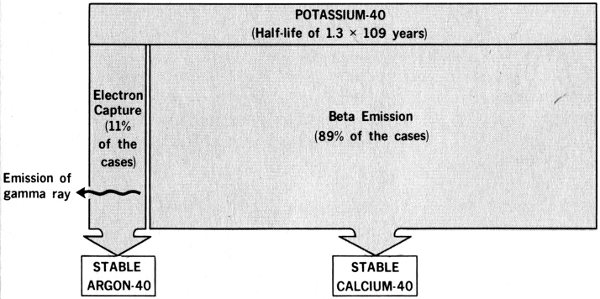
Figure 4 Comparison of potassium-40 disintegration methods.
7
Assume that the particular gamma ray is traveling in the
direction of the scintillating liquid in the counter. Remember
that the gamma ray is tiny in comparison with an atom,
which is mostly empty space. Therefore, any one gamma
ray probably will miss all the material part of the atoms
in the body of the person being studied. Nor will it collide
with anything as it passes through his clothes and the stainless
steel tank. It also may fail to collide with any of the
atoms in the molecules of scintillation liquid, of course.
But let us assume that the one we are watching does make a
hit there. Its total energy will be converted instantaneously
to a flash of many bits or photons of light.
These photons radiate from the collision scene and strike
a light-sensitive surface in one or more of the counter’s
photomultiplier tubes, which have been placed where they
can “see” the scintillation liquid. Energy transformations
result, and a tiny pulse of electricity is originated. These
photomultiplier devices are similar to the equipment in the
familiar “electric eye” door openers. As their name suggests,
photomultiplier tubes (see Figures 6 and 9) do more
than merely respond to the light flashes produced in the
scintillation liquid. They also amplify the weak electron disturbances
into electrical pulses to operate meters that
record each scintillation and count the total.
The Geneva counter recorded about 25% of the total gamma
rays emitted by each subject. Since this sample was a constant
proportion of the total body radiation, it could be
converted to whole body measurements with about 97%
reliability.
In addition to finding persons with actual body contamination
among those counted at Geneva, the 1955 counter revealed
some interesting sideline information. People who
failed to remove radium-dial watches were soon spotted.
And one small boy who had picked up a sample of uranium
ore at a nearby exhibit “jammed” the instrument.
Each of the 25 persons who were found to have above-normal
levels of radiation could recall having worked with
8
radium or some other radioactive substance at some time in
the past.
A visit to this type of counter recalls the first glimmers
of scientific insight that the radiation in the human body
could be counted. In the early 1950s, Frederick Reines and
Clyde L. Cowan, two scientists at the Los Alamos Scientific
Laboratory, Los Alamos, New Mexico, built a large liquid
scintillation counter hoping to prove or disprove that neutrinos
really existed. Neutrinos are elusive, uncharged particles
with essentially no mass. They had been predicted in
theory nearly 20 years earlier to explain how beta particles
of different energy levels can be emitted from atoms with
apparently identical nuclei.
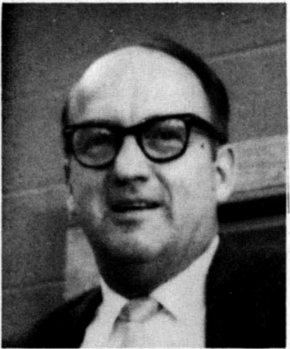
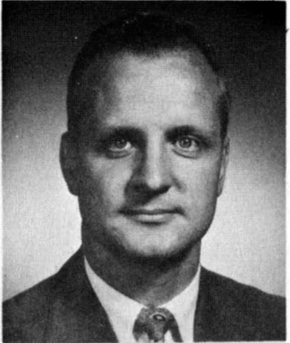
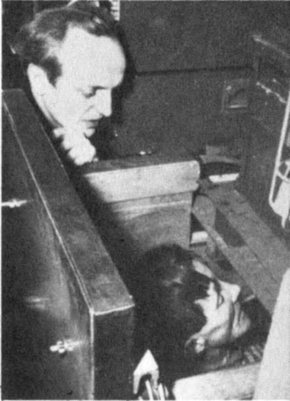
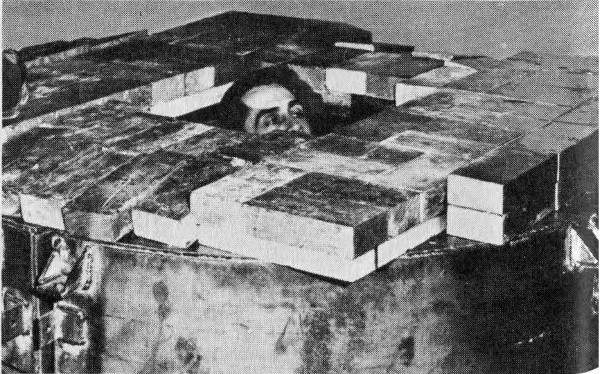
Figure 5
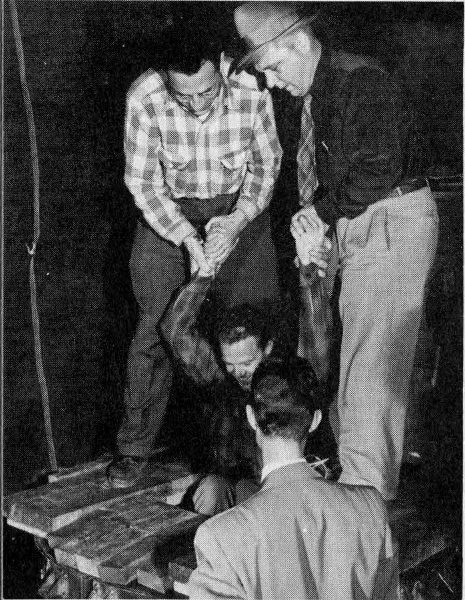
Dr. Frederick Reines (left)
and Dr. Clyde L. Cowan (right), co-discoverers
of the neutrino, lower a
fellow worker into the first “whole
body counter”, the scintillation assembly
used in their experiment. Below, Dr. Wright Lanham, inside the counter,
peers from the opening.
According to theory, neutrinos are created whenever negative
beta-emitting atoms are produced. On this basis,
Drs. Reines and Cowan were convinced that the fission of
the nuclear fuel in the reactors of the Hanford atomic plant
at Richland, Washington, should create high densities of
neutrinos. They went to Hanford and set up an elegant neutrino-catching
experiment that hinged on detecting and counting
9
gamma rays of definite energy. To accomplish this, they
built a large liquid scintillation detector and shielded it from
stray gamma radiation. As their work progressed, someone
realized that the equipment was large enough to allow a
person to crawl inside. After further research at the
Atomic Energy Commission’s Savannah River Plant in
South Carolina, they were successful in finding their long-sought
neutrino. In doing so, they also developed the sort of
instrument that can study the human body.
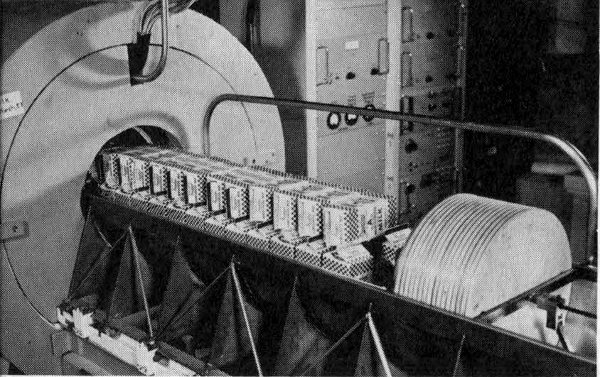
Figure 6 shows a person about to enter one version of a
Los Alamos counter, the instrument’s 140-gallon tank of
scintillation fluid, and 45 of its 108 photomultiplier tubes.
When the instrument is in use, the tank slides into, and is
shielded by, a 20-ton barrier of 5-inch lead.
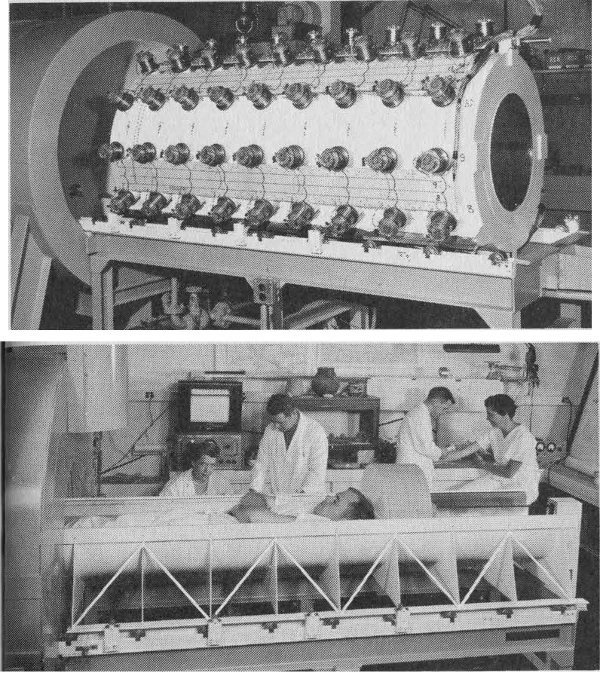
Figure 6 A liquid scintillation whole body counter at Los Alamos
National Laboratory, showing (left) a subject in the chute before it
is slid into the shielded detector chamber. Below,
the same instrument’s
detecting assembly, showing the photomultiplier tubes,
removed from the shielding.
The loading chute will hold a person 6 feet 4 inches tall
and weighing up to 260 pounds. The subject lies in the chute
as it slides into the counter. A lead plug behind his head
closes the end of the cylinder to add shielding. Counters of
this type have “panic buttons” with which subjects may
signal if they become uneasy on being confined. Most counts
are completed in less than 5 minutes, however, so the buttons
are rarely used.
Since the detector fluid almost completely surrounds the
subject when the chute is in place, this type of counter captures
twice as large a fraction of the emitted gamma rays
as does the Geneva type.
10
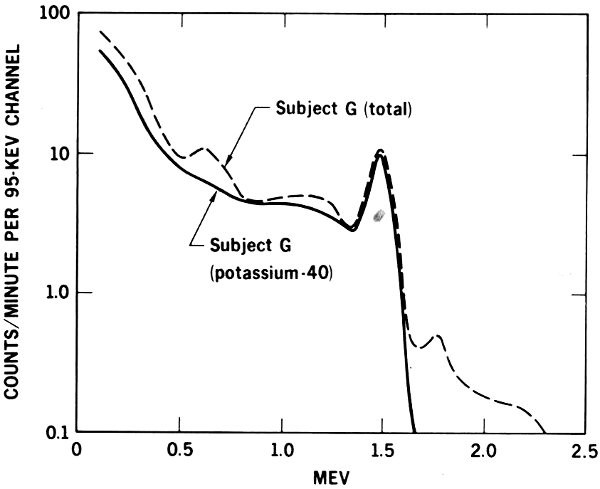
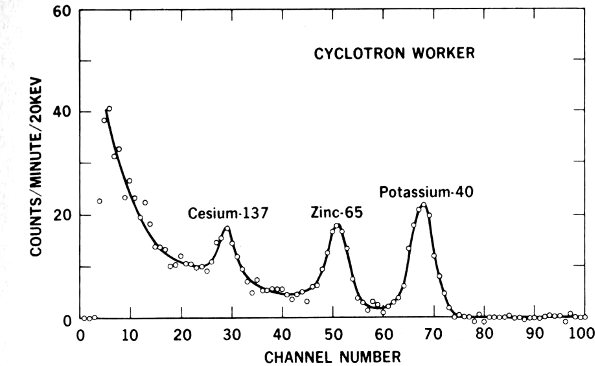
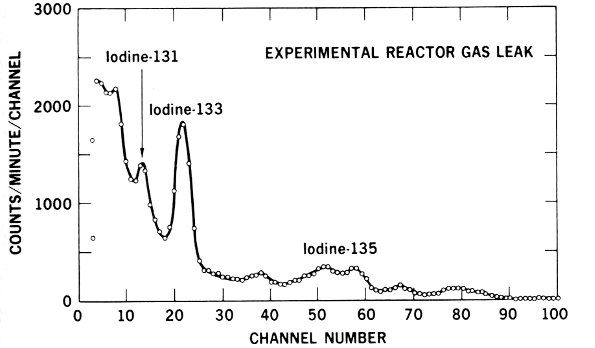
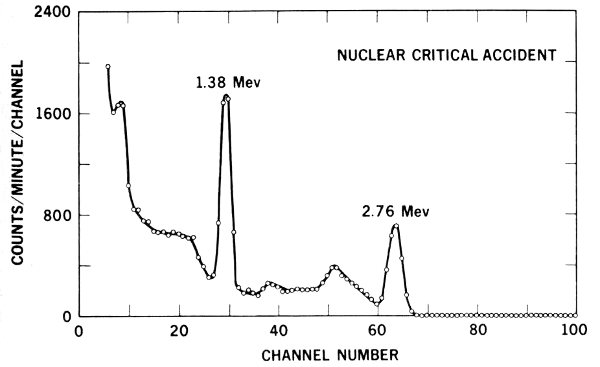
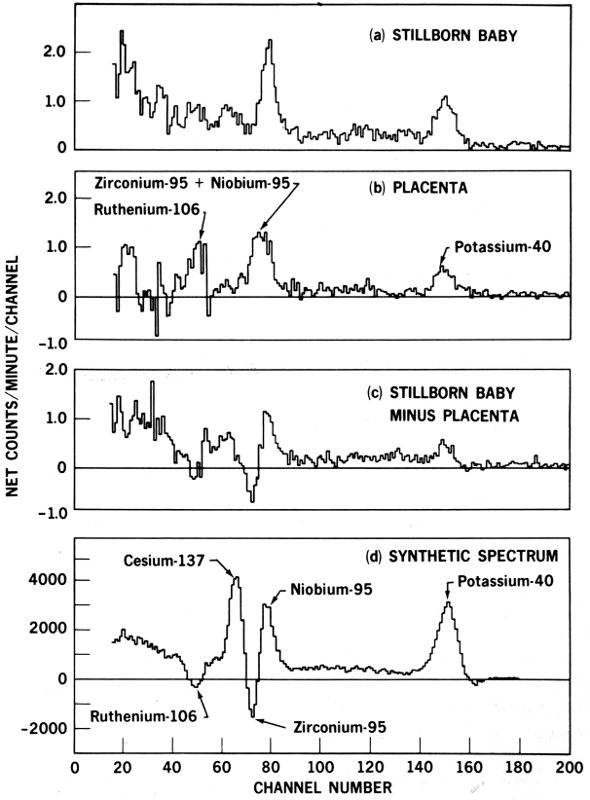
Each radioactive substance emits gamma rays with an
energy level characteristic of that substance. Whole body
counters are able to measure this specific energy spectrum,
or “fingerprint”, and so identify the kind of atom producing
the radiation.
The number of light photons produced in the scintillation
fluid is proportional to the energy transferred by the incoming
gamma rays. For example, gamma rays emitted by
potassium-40 have 1.46 million electron volts (Mev) energy;
those of cesium-137 have 0.660 Mev energy. When both these
radionuclides are producing flashes of light in the scintillation
fluid at once, the photomultiplier tubes produce two
different strengths of electrical pulses. Electronic devices
called multichannel pulse-height analyzers sort and record
the number of each.
Data from whole body counters indicate that potassium-40
is the most abundant radionuclide in the human body. Our
bodies also contain other naturally radioactive substances
but the numbers of atoms usually present are so low (as
with radium for instance) that they cannot be detected with
whole body counters. Several man-made radionuclides also
have found their way into body tissues and organs in quantities
that sometimes are large enough to be detected and
counted.
Measurement of disintegrating potassium-40 atoms in the
tissues of a human body can be used to determine the total
amount of potassium (both radioactive and stable) in the
body. It is known that potassium-40 makes up 0.0119% of
all potassium and that 11% of all disintegrating potassium-40
atoms emit high-energy gamma rays that are measurable
by the counter.
The method of determining the amount of potassium in a
human subject is to compare the number of gamma rays
from a known amount of potassium placed in a phantom,
or dummy body, with the number counted from the human
subject (see photo on next page). Phantoms are artificial
bodies, approximately the size, shape, and density of a
human body, used for calibrating counters. They are designed
11
so the radioisotopes they contain have similar
distribution to the distribution of the isotopes expected in
the real body. This is how a test might work:
| Counts per minute from 140 grams of potassium in the phantom | 16,800 |
| Counts per minute with nothing in counter (background) | 12,000 |
| Net counts per minute from 140 grams of potassium | 4,800 |
| Counts per minute with a 77-pound boy in counter | 14,400 |
| Background cunts per minute | 12,000 |
| Net count per minute from boy | 2,400 |
| Calculated amount of potassium in boy | 70 grams |
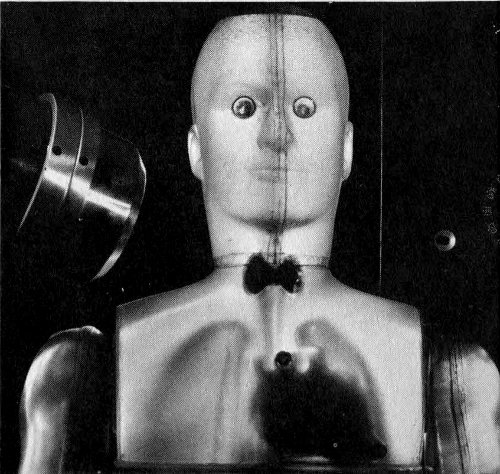
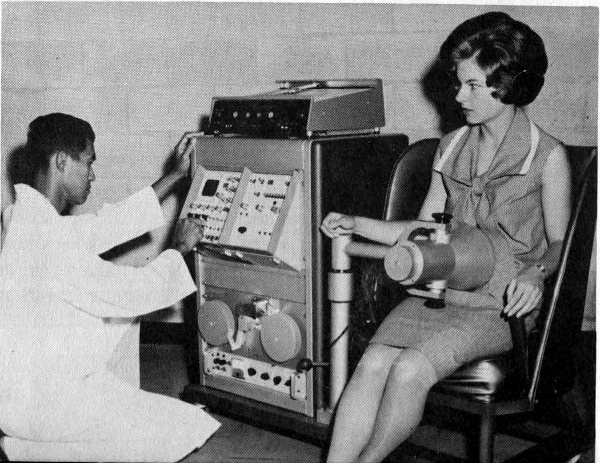
Figure 7 Phantom used for iodine-131 studies. The radiation spectrum from the thyroid area in the neck is being obtained with a sodium iodide crystal, left.
We can appreciate the sensitivity of whole body counters
by comparing the number of gamma rays recorded by the
instruments with the total number emitted from the body
being counted. The following data, also simplified, illustrate
this comparison:
| Total atoms in 70 grams of potassium | 1.08 × 10²⁴[1] |
| Number of atoms of potassium-40 in 70 grams of potassium | 1.3 × 10²⁰ |
| Half-life of potassium-40 in minutes | 6.4 × 10¹⁴ |
| Number of potassium-40 atoms disintegrating |
| per minute in 70 grams of potassium | 141,000 |
| Number of potassium-40 atoms disintegrating per minute with emission of measurable gamma rays | 15,510 |
| Number of counts recorded | 2,400 |
| Detection efficiency: 2,400 ÷ 15,510 = 15.5% |
12
Fatty tissues are known to have a low potassium concentration
and muscle tissue a higher level. It is therefore
apparent that potassium-40 determinations provide a way
to indicate the amount of lean muscle in any individual,
and indirectly the amount of fat. Estimates of the amount of
fat based on the measurement of the specific gravity of the
subject, often used in the past, have never been satisfactory.
Not only do variable and unmeasurable air spaces change
body density, but the process of submerging a person in a
tank—to determine his specific gravity by the amount of
water he displaces—is a clumsy and uncomfortable one.
Significant variations in potassium content have been found
in persons suffering from muscle diseases or malfunctions.
For example, a sharp drop in potassium content accompanies
the profound muscle weakness that follows diabetic
coma. Administration of potassium produces striking improvement
in the condition known as familial periodic
paralysis.
Whole body counter data from a study of muscular dystrophy
and myotonia atrophica patients showed there is a
gradual and progressive decrease of body potassium during
the unrelenting courses of these diseases. Otherwise healthy
children of muscular dystrophy patients, or their brothers
and sisters, also may be deficient in potassium. By assisting
in muscle research, whole body counters help doctors
learn more of how potassium relates to muscle function and
muscle health.
Whole body counting is an improvement over potassium
determination based on chemical analysis of body fluids.
If counters are not used, one way to measure body potassium
is to inject a known quantity of potassium-42 (another
radioactive form of potassium), wait until this has been
uniformly mixed with the potassium already in the body,
and then record the radioactivity of a volume of blood serum.
From the degree of dilution of the injected potassium-42,
the total body potassium can be calculated. This widely
used method is uncomfortable for the patient since it involves
use of syringes to inject and withdraw fluids. Because
about 95% of the body potassium is inside the cells,
rather than in fluids between the cells, this method may also
be inexact if the mixing process does not continue long
13
enough. (See Radioisotopes in Medicine, another booklet in
this series, for a full discussion of medical treatment
with radioactive materials.)
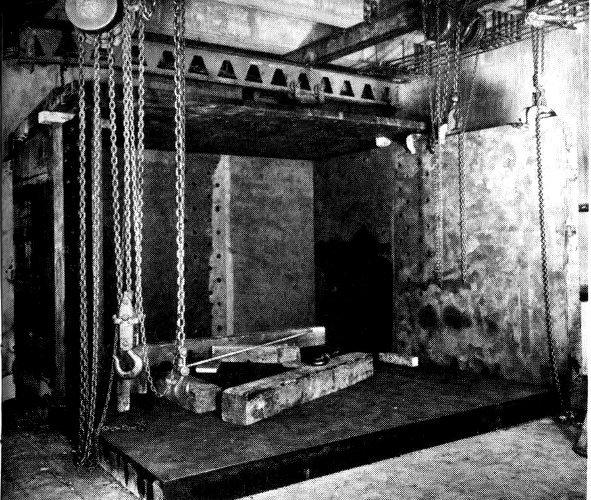
Figure 8 A crystal whole body counter “iron room” under construction above, and in use.