SLAVERY IN THE BRITISH MINES.
In proceeding to speak more particularly of the
various forms of British slavery, we will begin with
labour in the mines—the horrors of which became
known to the world through reports made to Parliament
in the summer of 1840. Pressed by the fear of general
execration, Parliament appointed a commission of inquiry,
which, after a thorough examination of all the
mines in the United Kingdom, made a voluminous report.
So shocking were the accounts of labour in the
mines given by this commission, that the delicate nerves
of several perfumed lords were grievously pained, and
they denounced the commissioners as being guilty of
exaggeration. Nevertheless, the evidence adduced by
the officers was unimpeachable, and their statements
were generally received as plain truth.
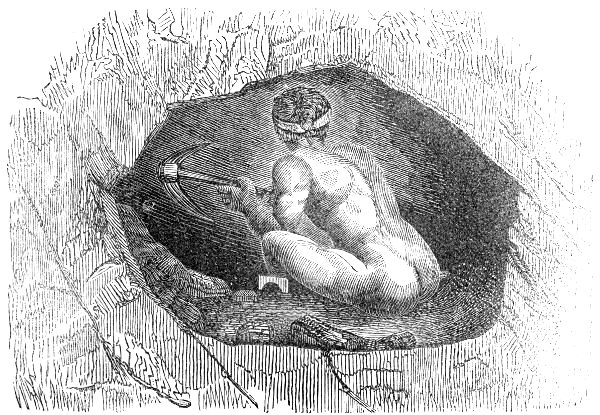
COAL GETTER AT WORK.
The mining industry of the kingdom is divided into
two distinct branches—that of the coal and iron mines,
and that of the mines of tin, copper, lead, and zinc.
The "coal measures," as the geological formations
comprising the strata of coal are designated, are variously
dispersed in the middle, northern, and western
portions of South Britain, and in a broad belt of country
which traverses the centre of Scotland, from the
shores of Ayrshire to those of the Firth of Forth.
There are, also, some coal-tracts in Ireland, but they
are of comparatively small importance. In all these
districts, the coal is found in beds, interstratified for
the most part with various qualities of gritstone and
shale, in which, in some of the districts, occur layers
of ironstone, generally thin, but sometimes forming
large masses, as in the Forest of Dean. When the
surface of the coal country is mountainous and intersected
by deep ravines, as in South Wales, the mineral
deposites are approached by holes driven into the sides
of the hills; but the common access to them is by vertical
shafts, or well-holes, from the bottoms of which
horizontal roadways are extended in long and confined
passages through the coal strata, to bring all that is
hewn to the "pit's eye," or bottom of the shaft, for
winding up. It is requisite to have more than one
shaft in the same workings; but where the coal lies so
deep that the sinking of a distinct shaft requires an
enormous outlay of capital, only one large shaft is
sunk; and this is divided by wooden partitions, or
brattices, into several distinct channels. There must
always be one shaft or channel, called the "downcast
pit," for the air to descend; and another, called the
"upcast pit," for the return draught to ascend. The
apparatus for lowering and drawing up is generally in
the upcast shaft. This is either a steam-engine, a
horse-gin, or a hand-crank. The thickness of the
seams that are wrought varies from the eighteen-inch
seams of the Lancashire and Yorkshire hills, to the ten-yard
coal of South Staffordshire. But two, three, and
four feet are the more common thicknesses of the beds
that are wrought. When there is a good roof, or hard
rock immediately over the coal, with a tolerably solid
floor beneath it, thin coal-seams can be worked with
advantage, because the outlay of capital for propping
is then very limited; but the very hardness of the contiguous
strata would require an outlay almost as great
to make the roadways of a proper height for human
beings of any age to work in.
By the evidence collected under the commission, it is
proved that there are coal-mines at present at work in
which some passages are so small, that even the youngest
children cannot move along them without crawling on
their hands and feet, in which constrained position they
drag the loaded carriages after them; and yet, as it is
impossible by any outlay compatible with a profitable
return, to render such coal-mines fit for human beings
to work in, they never will be placed in such a condition,
and, consequently, they never can be worked
without this child slavery! When the roads are six
feet high and upward, there is not only ample space
for carrying on the general operations of the mine, but
the coals can be drawn direct from the workings to the
foot of the shaft by the largest horses; and when the
main roads are four feet and a half high, the coals may
be conveyed to the foot of the shaft by ponies or asses.
But when the main ways are under four feet, the coals
can only be conveyed by children. Yet, in many mines,
the main gates are only from twenty-four to thirty
inches high. In this case, even the youngest children
must work in a bent position of the body. When the
inclination of the strata causes all the workings out of
the main ways to be on inclined plains, the young
labourers are not only almost worked to death, but exposed
to severe accidents in descending the plains with
their loads, out of one level into another. In many of
the mines, there is such a want of drainage and ventilation,
that fatal diseases are contracted by the miners.
According to the report of the Parliamentary commission,
about one-third of the persons employed in the
coal-mines were under eighteen years of age, and much
more than one-third of this number were under thirteen
years of age. When the proprietor employs the whole
of the hands, not only will his general overseer be a
respectable person, but his underlookers will be taken
from the more honest, intelligent, and industrious of
the labouring colliers. Elsewhere, the rulers in pits
are such as the rudest class is likely to produce. The
great body of the children and young persons are,
however, of the families of the adult work-people employed
in the pits, or belong to the poor population of
the neighbourhood. But, in some districts, there are
numerous defenceless creatures who pass the whole of
their youth in the most abject slavery, into which they
are thrown chiefly by parish authorities, under the
name of apprenticeship. Said the Parliamentary commissioners
in their report—
"There is one mode of engaging the labour of children and
young persons in coal-mines, peculiar to a few districts, which
deserves particular notice, viz. that by apprenticeship. The
district in which the practice of employing apprentices is most in
use, is South Staffordshire; it was formerly common in Shropshire,
but is now discontinued; it is still common in Yorkshire,
Lancashire, and the West of Scotland; in all the other districts, it
appears to be unknown. In Staffordshire, the sub-commissioner
states that the number of children and young persons working in
the mines as apprentices is exceedingly numerous; that these
apprentices are paupers or orphans, and are wholly in the power
of the butties;
[1]
that such is the demand for this class of children
by the butties, that there are scarcely any boys in the union
workhouses of Walsall, Wolverhampton, Dudley, and Stourbridge;
that these boys are sent on trial to the butties between the ages
of eight and nine, and at nine are bound as apprentices for twelve
years, that is, to the age of twenty-one years complete; that, notwithstanding
this long apprenticeship, there is nothing whatever
in the coal-mines to learn beyond a little dexterity, readily acquired
by short practice; and that even in the mines of Cornwall,
where much skill and judgment is required, there are no apprentices,
while, in the coal-mines of South Staffordshire, the orphan
whom necessity has driven into a workhouse, is made to labour
in the mines until the age of twenty-one, solely for the benefit of
another."
Thomas Moorhouse, a collier boy, who was brought
to the notice of the Parliamentary commissioners,
said—
"I don't know how old I am; father is dead; I am a chance
child; mother is dead also; I don't know how long she has been
dead; 'tis better na three years; I began to hurry
[2] when I was
nine years old for William Greenwood; I was apprenticed to him
till I should be twenty-one; my mother apprenticed me; I lived
with Greenwood; I don't know how long it was, but it was a
goodish while; he was bound to find me in victuals and drink
and clothes; I never had enough; he gave me some old clothes
to wear, which he bought at the rag-shop; the overseers gave him
a sovereign to buy clothes with, but he never laid it out; the
overseers bound me out with mother's consent from the township
of Southowram; I ran away from him because he lost my indentures,
for he served me very bad; he stuck a pick into me twice."
Here the boy was made to strip, and the commissioner,
Mr. Symonds, found a large cicatrix likely to
have been occasioned by such an instrument, which
must have passed through the glutei muscles, and have
stopped only short of the hip-joint. There were twenty
other wounds, occasioned by hurrying in low workings,
upon and around the spinous processes of the vertebræ,
from the sacrum upward. The boy continued—
"He used to hit me with the belt, and mawl or sledge, and
fling coals at me. He served me so bad that I left him, and went
about to see if I could get a job. I used to sleep in the cabins
upon the pit's bank, and in the old pits that had done working.
I laid upon the shale all night. I used to get what I could to
eat. I ate for a long time the candles that I found in the pits
that the colliers left over night. I had nothing else to eat. I
looked about for work, and begged of the people a bit. I got to
Bradford after a while, and had a job there for a month while a
collier's lad was poorly. When he came back, I was obliged to
leave."
Another case was related by Mr. Kennedy, one of
the commissioners. A boy, named Edward Kershaw,
had been apprenticed by the overseers of Castleton to
a collier of the name of Robert Brierly, residing at
Balsgate, who worked in a pit in the vicinity of Rooley
Moor. The boy was examined, and from twenty-four
to twenty-six wounds were found upon his body. His
posteriors and loins were beaten to a jelly; his head,
which was almost cleared of hair on the scalp, had the
marks of many old wounds upon it which had healed
up. One of the bones in one arm was broken below
the elbow, and, from appearances, seemed to have been
so for some time. The boy, on being brought before
the magistrates, was unable either to sit or stand, and
was placed on the floor of the office, laid on his side on
a small cradle-bed. It appears from the evidence, that
the boy's arm had been broken by a blow with an iron
rail, and the fracture had never been set, and that he
had been kept at work for several weeks with his arm
in the condition above described. It further appeared
in evidence, and was admitted by Brierly, that he had
been in the habit of beating the boy with a flat piece
of wood, in which a nail was driven and projected about
half an inch. The blows had been inflicted with such
violence that they penetrated the skin, and caused the
wounds above mentioned. The body of the boy presented
all the marks of emaciation. This brutal master
had kept the boy at work as a wagoner until he was no
longer of any use, and then sent him home in a cart to
his mother, who was a poor widow, residing in Church
lane, Rochdale. And yet it is said that a slave cannot
breathe the air of England!
The want of instruction, and the seclusion from the
rest of the world, which is common to the colliers, give
them a sad pre-eminence over every other class of
labourers, in ignorance and callousness; and when they
are made masters, what can be expected? In all cases
of apprenticeship, the children are bound till they
attain the age of twenty-one years. If the master dies
before the apprentice attains the age of twenty-one
years, the apprentice is equally bound as the servant
of his deceased master's heirs, executors, administrators,
and assigns. In fact, the apprentice is part of the
deceased master's goods and chattels!
But, to speak more particularly of the labour of the
children:—The employment of the adult collier is almost
exclusively in the "getting" of the coal from its
natural resting-place, of which there are various methods,
according to the nature of the seams and the
habits of the several districts. That of the children
and young persons consists principally either in tending
the air-doors where the coal-carriages must pass through
openings, the immediately subsequent stoppage of which
is necessary to preserve the ventilation in its proper
channels, or in the conveyance of the coal from the
bays or recesses in which it is hewn, along the subterranean
roadways, to the bottom of the pit-shaft; a
distance varying from absolute contiguity even to miles,
in the great coal-fields of the North of England, where
the depth requires that the same expensive shaft shall
serve for the excavation of a large tract of coal. The
earliest employment of children in the pits is generally
to open and shut the doors, upon the proper custody of
which the ventilation and safety of the whole mine
depends. These little workmen are called "trappers."
Of the manner in which they pass their earlier days,
Dr. Mitchell, a distinguished Englishman, has given a
very interesting sketch, which deserves to be quoted
here entire:—
"The little trapper, of eight years of age, lies quiet in bed. It
is now between two and three in the morning, and his mother
shakes him and desires him to rise, and tells him that his father
has an hour ago gone off to the pit. He turns on his side, rubs
his eyes, and gets up, and comes to the blazing fire and puts on
his clothes. His coffee, such as it is, stands by the side of the
fire, and bread is laid down for him. The fortnight is now well
advanced, the money all spent, and butter, bacon, and other
luxurious accompaniments of bread, are not to be had at breakfast
till next pay-day supply the means. He then fills his tin
bottle with coffee and takes a lump of bread, sets out for the pit,
into which he goes down in the cage, and walking along the
horse-way for upward of a mile, he reaches the barrow-way, over
which the young men and boys push the trams with the tubs on
rails to the flats, where the barrow-way and horse-way meet, and
where the tubs are transferred to rolleys or carriages drawn by
horses.
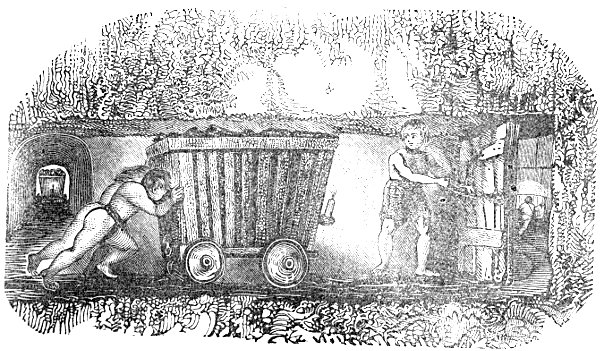
THRUSTERS AND TRAPPER.
"He knows his place of work. It is inside one of the doors
called trap-doors, which is in the barrow-way, for the purpose of
forcing the stream of air which passes in its long, many-miled
course from the down-shaft to the up-shaft of the pit; but which
door must be opened whenever men or boys, with or without carriages,
may wish to pass through. He seats himself in a little
hole, about the size of a common fireplace, and with the string in
his hand; and all his work is to pull that string when he has to
open the door, and when man or boy has passed through, then
to allow the door to shut of itself. Here it is his duty to sit, and
be attentive, and pull his string promptly as any one approaches.
He may not stir above a dozen steps with safety from his charge,
lest he should be found neglecting his duty, and suffer for the
same.
"He sits solitary by himself, and has no one to talk to him;
for in the pit the whole of the people, men and boys, are as busy
as if they were in a sea-fight. He, however, sees now and then
the putters urging forward their trams through his gate, and
derives some consolation from the glimmer of the little candle of
about 40 to the pound, which is fixed on their trams. For he
himself has no light. His hours, except at such times, are passed
in total darkness. For the first week of his service in the pit
his father had allowed him candles to light one after another,
but the expense of three halfpence a day was so extravagant
expenditure out of tenpence, the boy's daily wages, that his
father, of course, withdrew the allowance the second week, all
except one or two candles in the morning, and the week after the
allowance was altogether taken away; and now, except a neighbour
kinder than his father now and then drop him a candle as
he passes, the boy has no light of his own.
"Thus hour after hour passes away; but what are hours to
him, seated in darkness, in the bowels of the earth? He knows
nothing of the ascending or descending sun. Hunger, however,
though silent and unseen, acts upon him, and he betakes to his
bottle of coffee and slice of bread; and, if desirous, he may have
the luxury of softening it in a portion of water in the pit, which
is brought down for man and beast.
"In this state of sepulchral existence, an insidious enemy gains
upon him. His eyes are shut, and his ears fail to announce the
approach of a tram. A deputy overman comes along, and a
smart cut of his yardwand at once punishes the culprit and recalls
him to his duty; and happy was it for him that he fell into
the hands of the deputy overman, rather than one of the putters;
for his fist would have inflicted a severer pain. The deputy
overman moreover consoles him by telling him that it was for his
good that he punished him; and reminds him of boys, well known
to both, who, when asleep, had fallen down, and some had been
severely wounded, and others killed. The little trapper believes
that he is to blame, and makes no complaint, for he dreads being
discharged; and he knows that his discharge would be attended
with the loss of wages, and bring upon him the indignation of
his father, more terrible to endure than the momentary vengeance
of the deputy and the putters all taken together.
"Such is the day-work of the little trapper in the barrow-way.
"At last, the joyful sound of 'Loose, loose,' reaches his ears.
The news of its being four o'clock, and of the order, 'Loose, loose,'
having been shouted down the shaft, is by systematic arrangement
sent for many miles in all directions round the farthest
extremities of the pit. The trapper waits until the last putter
passes with his tram, and then he follows and pursues his journey
to the foot of the shaft, and takes an opportunity of getting into
the cage and going up when he can. By five o'clock he may
probably get home. Here he finds a warm dinner, baked potatoes,
and broiled bacon lying above them. He eats heartily at the
warm fire, and sits a little after. He dare not go out to play
with other boys, for the more he plays the more he is sure to
sleep the next day in the pit. He, therefore, remains at home,
until, feeling drowsy, he then repeats the prayer taught by our
blessed Lord, takes off his clothes, is thoroughly washed in hot
water by his mother, and is laid in his bed."
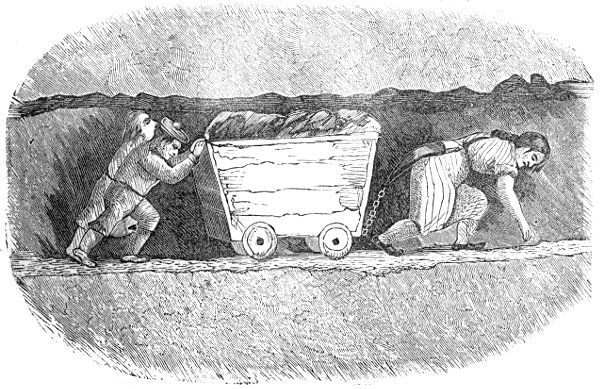
HURRIER AND THRUSTER.
The evidence of the Parliamentary commissioners
proves that Dr. Mitchell has given the life of the young
trapper a somewhat softened colouring. Mr. Scriven
states that the children employed in this way become
almost idiotic from the long, dark, solitary confinement.
Many of them never see the light of day during the
winter season, except on Sundays.
The loaded corves drawn by the hurriers weigh from
two to five hundred-weight. These carriages are mounted
upon four cast-iron wheels of five inches in diameter,
there being, in general, no rails from the headings to the
main gates. The children have to drag these carriages
through passages in some cases not more than from
sixteen to twenty inches in height. Of course, to accomplish
this, the young children must crawl on their
hands and feet. To render their labour the more easy,
the sub-commissioner states that they buckle round
their naked person a broad leather strap, to which is
attached in front a ring and about four feet of chain,
terminating in a hook. As soon as they enter the main
gates, they detach the harness from the corve, change
their position by getting behind it, and become "thrusters."
The carriage is then placed upon the rail, a
candle is stuck fast by a piece of wet clay, and away
they run with amazing swiftness to the shaft, pushing
the loads with their heads and hands. The younger
children thrust in pairs.
"After trapping," says the report of the commissioners, "the
next labour in the ascending scale to which the children are put, is
'thrutching,' or thrusting, which consists in being helper to a
'drawer,' or 'wagoner,' who is master, or 'butty,' over the
'thrutcher,' In some pits, the thrutcher has his head protected
by a thick cap, and he will keep on his trousers and clogs; but
in others, he works nearly naked. The size of the loads which
he has to thrutch varies with the thickness of the seam; and with
the size, varies his butty's method of proceeding, which is either
as a drawer or a wagoner. The drawers are those who use the
belt and chain. Their labour consists in loading, with the coals
hewn down by the 'getter,' an oblong tub without wheels, and
dragging this tub on its sledge bottom by means of a girdle of
rough leather passing round the body, and a chain of iron attached
to that girdle in front, and hooked to the sledge. The drawer
has, with the aid of his thrutcher, to sledge the tub in this manner
from the place of getting to the mainway, generally down,
though sometimes up, a brow or incline of the same steepness as
the inclination of the strata; in descending which he goes to the
front of his tub, where his light is fixed, and, turning his face to
it, regulates its motion down the hill, as, proceeding back foremost,
he pulls it along by his belt. When he gets to the mainway,
which will be at various distances not exceeding forty or
fifty yards from his loading-place, he has to leave this tub upon a
low truck running on small iron wheels, and then to go and fetch
a second, which will complete its load, and with these two to
join with his thrutcher in pushing it along the iron railway to
the pit bottom to have the tubs successively hooked on to the
drawing-rope. Returning with his tubs empty, he leaves the
mainway, first with one, and then with the other tub, to get
them loaded, dragging them up the 'brow' by his belt and chain,
the latter of which he now passes between his legs, so as to pull,
face foremost, on all fours. In the thin seams, this labour has
to be performed in bays, leading from the place of getting to the
mainways, of scarcely more than twenty inches in height, and in
mainways of only two feet six inches, and three feet high, for the
seam itself will only be eighteen inches thick.
"Wagoning is a form of drawing which comes into use with
the more extensive employment of railways in the thicker seams
.
The tubs here used are large, and all mounted on wheels. From
the place of getting, the loads are pushed by the wagoners with
hands and heads to the bottom of the pit along the levels; and
where they have to descend from one level into another, this is
generally done by a cut at right angles directly with the dip,
down the 'brow' which it makes. Here there is a winch or
pinion for jigging the wagons down the incline, with a jigger at
the top and a hooker-on at the bottom of the plane, where it is
such as to require these. The jiggers and the hookers-on are
children of twelve or thirteen. Sometimes the descent from one
line of level into another is by a diagonal cutting at a small
angle from the levels, called a slant, down which the wagoners
can, and do, in some instances, take their wagons without jigging,
by their own manual labour; and a very rough process it is,
owing to the impetus which so great a weight acquires, notwithstanding
the scotching of the wheels."
Mr. Kennedy thus describes the position of the children,
in the combined drawing and thrutching:—
"The child in front is harnessed by his belt or chain to the
wagon; the two boys behind are assisting in pushing it forward.
Their heads, it will be observed, are brought down to a level with
the wagon, and the body almost in the horizontal position. This
is done partly to avoid striking the roof, and partly to gain the
advantage of the muscular action, which is greatest in that position.
It will be observed, the boy in front goes on his hands and
feet: in that manner, the whole weight of his body is, in fact,
supported by the chain attached to the wagon and his feet, and,
consequently, his power of drawing is greater than it would be
if he crawled on his knees. These boys, by constantly pushing
against the wagons, occasionally rub off the hair from the crowns
of their heads so much as to make them almost bald."
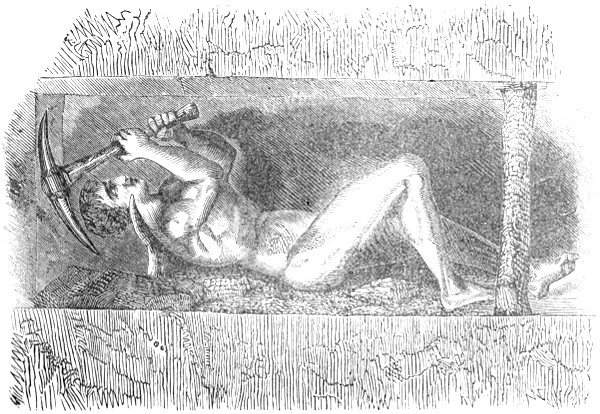
In Derbyshire, some of the pits are altogether worked
by boys. The seams are so thin, that several have
only a two-feet headway to all the workings. The boy
who gets the coal, lies on his side while at work. The
coal is then loaded in a barrow, or tub, and drawn
along the bank to the pit mouth by boys from eight to
twelve years of age, on all fours, with a dog-belt and
chain, the passages being very often an inch or two
thick in black mud, and neither ironed nor wooded.
In Mr. Barnes's pit, these boys have to drag the barrows
with one hundred-weight of coal or slack, sixty times a
day, sixty yards, and the empty barrows back, without
once straightening their backs, unless they choose to
stand under the shaft and run the risk of having their
heads broken by coal falling.
In some of the mines, the space of the workings is
so small that the adult colliers are compelled to carry
on their operations in a stooping posture; and, in others,
they are obliged to work lying their whole length along
the uneven floor, and supporting their heads upon a
board or short crutch. In these low, dark, heated,
and dismal chambers, they work perfectly naked. In
many of the thin-seam mines, the labour of "getting"
coal, so severe for adults, was found by the commissioners
to be put upon children from nine to twelve
years of age.
If the employment of boys in such a way be, as a
miner said to the commissioners, "barbarity, barbarity,"
what are we to think of the slavery of female children
in the same abyss of darkness? How shall we express
our feelings upon learning that females, in the years
of opening womanhood, are engaged in the same occupations
as their male companions, in circumstances
repugnant to the crudest sense of decency? Yet we
have unimpeachable evidence that, at the time of the
investigations of the commissioners, females were thus
employed; and there is reason to believe that this is
still the case.
COAL GETTER.
The commissioners found females employed like the
males in the labours of the mines in districts of Yorkshire
and Lancashire, in the East of Scotland, and in
Wales. In great numbers of the pits visited, the men
were working in a state of entire nakedness, and were
assisted by females of all ages, from girls of six years
old to women of twenty-one—these females being
themselves quite naked down to the waist. Mr.
Thomas Pearce says that in the West Riding of Yorkshire—
"The girls hurry with a belt and chain, as well as thrust.
There are as many girls as boys employed about here. One of
the most disgusting sights I have ever seen, was that of young
females, dressed like boys in trousers, crawling on all fours, with
belts around their waists and chains passing between their legs,
at day-pits at Thurshelf Bank, and in many small pits near
Holmfirth and New Mills. It exists also in several other places."
In the neighbourhood of Halifax, it is stated that
there is no distinction whatever between the boys and
girls in their coming up the shaft and going down; in
their mode of hurrying or thrusting; in the weight of
corves; in the distance they are hurried; in wages or
dress; that the girls associate and labour with men who
are in a state of nakedness, and that they have themselves
no other garment than a ragged shift, or, in the
absence of that, a pair of broken trousers, to cover their
persons.
Here are specimens of the evidence taken by the
commissioners:—
"Susan Pitchforth, aged eleven, Elland: 'I have worked in
this pit going two years. I have one sister going of fourteen,
and she works with me in the pit. I am a thruster.'
"'This child,' said the sub-commissioner, 'stood shivering
before me from cold. The rags that hung about her waist were
once called a shift, which was as black as the coal she thrust,
and saturated with water—the drippings of the roof and shaft.
During my examination of her, the banksman, whom I had left
in the pit, came to the public-house and wanted to take her away,
because, as he expressed himself, it was not decent that she
should be exposed to us.'
"Patience Kershaw, aged seventeen: 'I hurry in the clothes
I have now got on, (trousers and ragged jacket;) the bald place
upon my head is made by thrusting the corves; the getters I
work for are naked except their caps; they pull off their clothes;
all the men are naked.'
"Mary Barrett, aged fourteen: 'I work always without stockings,
or shoes, or trousers; I wear nothing but my shift; I have
to go up to the headings with the men; they are all naked there;
I am got well used to that, and don't care much about it; I was
afraid at first, and did not like it.'"
In the Lancashire coal-fields lying to the north and west of
Manchester, females are regularly employed in underground
labour; and the brutal policy of the men, and the abasement of
the women, is well described by some of the witnesses examined
by Mr. Kennedy.
"Peter Gaskill, collier, at Mr. Lancaster's, near Worsley:
'Prefers women to boys as drawers; they are better to manage,
and keep the time better; they will fight and shriek and do every
thing but let anybody pass them; and they never get to be coal-getters—that
is another good thing.'
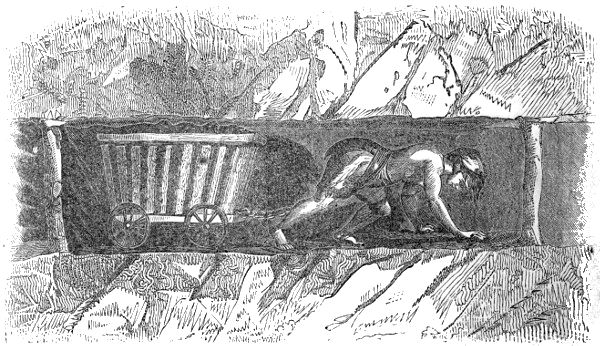
GIRL WITH COAL CART IN THIN SEAM.
"Betty Harris, aged thirty-seven, drawer in a coal-pit, Little
Bolton: 'I have a belt round my waist and a chain passing between
my legs, and I go on my hands and feet. The road is very
steep, and we have to hold by a rope, and when there is no rope,
by any thing we can catch hold of. There are six women and
about six boys and girls in the pit I work in; it is very hard
work for a woman. The pit is very wet where I work, and the
water comes over our clog-tops always, and I have seen it up to
my thighs; it rains in at the roof terribly; my clothes are wet
through almost all day long. I never was ill in my life but
when I was lying-in. My cousin looks after my children in the
daytime. I am very tired when I get home at night; I fall asleep
sometimes before I get washed. I am not so strong as I was,
and cannot stand my work so well as I used to do. I have drawn
till I have had the skin off me. The belt and chain is worse when
we are in the family-way. My feller (husband) has beaten me
many a time for not being ready. I were not used to it at first,
and he had little patience; I have known many a man beat his
drawer.'
"Mary Glover, aged thirty-eight, at Messrs. Foster's, Ringley
Bridge: 'I went into a coal-pit when I was seven years old, and
began by being a drawer. I never worked much in the pit when
I was in the family-way, but since I have gave up having children,
I have begun again a bit. I wear a shift and a pair of
trousers when at work. I always will have a good pair of trousers.
I have had many a twopence given me by the boatmen on
the canal to show my breeches. I never saw women work naked,
but I have seen men work without breeches in the neighbourhood
of Bolton. I remember seeing a man who worked stark naked.'"
In the East of Scotland, the business of the females
is to remove the coals from the hewer who has picked
them from the wall-face, and placing them either on
their backs, which they invariably do when working in
edge-seams, or in little carts when on levels, to carry
them to the main road, where they are conveyed to the
pit bottom, where, being emptied into the ascending
basket of the shaft, they are wound by machinery to
the pit's mouth, where they lie heaped for further distribution.
Mr. Franks, an Englishman, says of this
barbarous toil—
"Now when the nature of this horrible labour is taken into
consideration; its extreme severity; its regular duration of from
twelve to fourteen hours daily; the damp, heated, and unwholesome
atmosphere of a coal-mine, and the tender age and sex of
the workers, a picture is presented of deadly physical oppression
and systematic slavery, of which I conscientiously believe no one
unacquainted with such facts would credit the existence in the
British dominions."
The loads of coal carried on the backs of females
vary in weight from three-quarters of a hundred-weight
to three hundred-weight. In working edge-seams, or
highly inclined beds, the load must be borne to the
surface, or to the pit-bottom, up winding stairs, or a
succession of steep ladders. The disgrace of this peculiar
form of oppression is said to be confined to
Scotland, "where, until nearly the close of the last
century, the colliers remained in a state of legal bondage,
and formed a degraded caste, apart from all humanizing
influences and sympathy." From all accounts,
they are not much improved in condition at the present
time.
A sub-commissioner thus describes a female child's
labour in a Scottish mine, and gives some of the evidence
he obtained:—
"She has first to descend a nine-ladder pit to the first rest,
even to which a shaft is sunk, to draw up the baskets or tubs of
coals filled by the bearers; she then takes her creel (a basket
formed to the back, not unlike a cockle-shell, flattened toward
the back of the neck, so as to allow lumps of coal to rest on the
back of the neck and shoulders,) and pursues her journey to the
wall-face, or, as it is called here, the room of work. She then
lays down her basket, into which the coal is rolled, and it is frequently
more than one man can do to lift the burden on her back.
The tugs or straps are placed over the forehead, and the body
bent in a semicircular form, in order to stiffen the arch. Large
lumps of coal are then placed on the neck, and she then commences
her journey with her burden to the bottom, first hanging
her lamp to the cloth crossing her head. In this girl's case, she
has first to travel about fourteen fathoms (eighty-four feet) from
wall-face to the first ladder, which is eighteen feet high; leaving
the first ladder, she proceeds along the main road, probably three
feet six inches to four feet six inches high, to the second ladder,
eighteen feet high; so on to the third and fourth ladders, till she
reaches the pit-bottom, where she casts her load, varying from
one hundred-weight to one hundred-weight and a half, in the tub.
This one journey is designated a rake; the height ascended, and
the distance along the roads added together, exceed the height of
St. Paul's Cathedral; and it not unfrequently happens that the
tugs break, and the load falls upon those females who are following.
However incredible it may be, yet I have taken the evidence
of fathers who have ruptured themselves from straining to
lift coal on their children's backs.
"Janet Cumming, eleven years old, bears coals: 'I gang with
the women at five, and come up with the women at five at night;
work all night on Fridays, and come away at twelve in the day.
I carry the large bits of coal from the wall-face to the pit-bottom,
and the small pieces called chows in a creel. The weight is
usually a hundred-weight, does not know how many pounds
there are in a hundred-weight, but it is some weight to carry; it
takes three journeys to fill a tub of four hundred-weight. The
distance varies, as the work is not always on the same wall;
sometimes one hundred and fifty fathoms, whiles two hundred
and fifty fathoms. The roof is very low; I have to bend my back
and legs, and the water comes frequently up to the calves of my
legs. Has no liking for the work; father makes me like it.
Never got hurt, but often obliged to scramble out of the pit when
bad air was in.'
"William Hunter, mining oversman, Arniston Colliery: 'I
have been twenty years in the works of Robert Dundas, Esq.,
and had much experience in the manner of drawing coal, as well
as the habits and practices of the collier people. Until the last
eight months, women and lasses were wrought below in these
works, when Mr. Alexander Maxton, our manager, issued an
order to exclude them from going below, having some months
prior given intimation of the same. Women always did the
lifting or heavy part of the work, and neither they nor the children
were treated like human beings, nor are they where they
are employed. Females submit to work in places where no man
or even lad could be got to labour in; they work in bad roads,
up to their knees in water, in a posture nearly double; they are
below till the last hour of pregnancy; they have swelled haunches
and ankles, and are prematurely brought to the grave, or, what
is worse, lingering existence. Many of the daughters of the
miners are now at respectable service. I have two who are in
families at Leith, and who are much delighted with the change.'
"Robert Bald, Esq., the eminent coal-viewer, states that, 'In
surveying the workings of an extensive colliery under ground, a
married woman came forward, groaning under an excessive
weight of coals, trembling in every nerve, and almost unable to
keep her knees from sinking under her. On coming up, she
said, in a plaintive and melancholy voice, "Oh, sir, this is sore,
sore, sore work. I wish to God that the first woman who tried
to bear coals had broke her back, and none would have tried it
again."
The boxes or carriages employed in putting are of
two kinds—the hutchie and the slype; the hutchie being
an oblong, square-sided box with four wheels, which
usually runs on a rail; and the slype a wood-framed
box, curved and shod with iron at the bottom, holding
from two and a quarter to five hundred-weight of coal,
adapted to the seams through which it is dragged. The
lad or lass is harnessed over the shoulders and back
with a strong leathern girth, which, behind, is furnished
with an iron-hook, which is attached to a chain fastened
to the coal-cart or slype. The dresses of these girls
are made of coarse hempen stuff, fitting close to the
figures; the coverings to their heads are made of the
same material. Little or no flannel is used, and their
clothing, being of an absorbent nature, frequently gets
completely saturated shortly after descending the pit.
We quote more of the evidence obtained by the commissioners.
It scarcely needs any comment:—
"Margaret Hipps, seventeen years old, putter, Stoney Rigg
Colliery, Stirlingshire: 'My employment, after reaching the
wall-face, is to fill my bagie, or slype, with two and a half to
three hundred-weight of coal. I then hook it on to my chain and
drag it through the seam, which is twenty-six to twenty-eight inches
high, till I get to the main road—a good distance, probably two
hundred to four hundred yards. The pavement I drag over is
wet, and I am obliged at all times to crawl on hands and feet with
my bagie hung to the chain and ropes. It is sad sweating and
sore fatiguing work, and frequently maims the women.'
"Sub-commissioner: 'It is almost incredible that human beings
can submit to such employment, crawling on hands and knees,
harnessed like horses, over soft, slushy floors, more difficult than
dragging the same weights through our lowest common sewers,
and more difficult in consequence of the inclination, which is frequently
one in three to one in six.'
"Agnes Moffatt, seventeen years old, coal-bearer: 'Began
working at ten years of age; father took sister and I down; he
gets our wages. I fill five baskets; the weight is more than
twenty-two hundred-weight; it takes me twenty journeys. The
work is o'er sair for females. It is no uncommon for women to
lose their burden, and drop off the ladder down the dyke below;
Margaret McNeil did a few weeks since, and injured both legs.
When the tugs which pass over the forehead break, which they
frequently do, it is very dangerous to be under with a load.'
"Margaret Jacques, seventeen years of age, coal-bearer: 'I
have been seven years at coal-bearing; it is horrible sore work;
it was not my choice, but we do our parents' will. I make thirty
rakes a day, with two hundred-weight of coal on my creel. It is
a guid distance I journey, and very dangerous on parts of the
road. The distance fast increases as the coals are cut down.'
"Helen Reid, sixteen years old, coal-bearer: 'I have wrought
five years in the mines in this part; my employment is carrying
coal. Am frequently worked from four in the morning until six
at night. I work night-work week about, (alternate weeks.) I
then go down at two in the day, and come up at four and six in
the morning. I can carry near two hundred-weight on my back.
I do not like the work. Two years since the pit closed upon
thirteen of us, and we were two days without food or light; nearly
one day we were up to our chins in water. At last we got to an
old shaft, to which we picked our way, and were heard by
people watching above. Two months ago, I was filling the tubs
at the pit bottom, when the gig clicked too early, and the hook
caught me by my pit-clothes—the people did not hear my shrieks—my
hand had fast grappled the chain, and the great height of
the shaft caused me to lose my courage, and I swooned. The
banksman could scarcely remove my hand—the deadly grasp
saved my life.'
"Margaret Drysdale, fifteen years old, coal-putter: 'I don't
like the work, but mother is dead, and father brought me down;
I had no choice. The lasses will tell you that they all like the
work fine, as they think you are going to take them out of the
pits. My employment is to draw the carts. I have harness, or
draw-ropes on, like the horses, and pull the carts. Large carts
hold seven hundred-weight and a half, the smaller five hundred-weight
and a half. The roads are wet, and I have to draw the
work about one hundred fathoms.'
"Katherine Logan, sixteen years old, coal-putter: 'Began to
work at coal-carrying more than five years since; works in harness
now; draw backward with face to tubs; the ropes and
chains go under my pit-clothes; it is o'er sair work, especially
where we crawl.'
"Janet Duncan, seventeen years old, coal-putter: 'Works at
putting, and was a coal-bearer at Hen-Muir Pit and New Pencaitland.
The carts I push contain three hundred-weight of coal,
being a load and a half; it is very severe work, especially when
we have to stay before the tubs, on the braes, to prevent them
coming down too fast; they frequently run too quick, and knock
us down; when they run over fast, we fly off the roads and let them
go, or we should be crushed. Mary Peacock was severely crushed
a fortnight since; is gradually recovering. I have wrought above
in harvest time; it is the only other work that ever I tried my
hand at, and having harvested for three seasons, am able to say
that the hardest daylight work is infinitely superior to the best
of coal-work.'
"Jane Wood, wife of James Wood, formerly a coal-drawer and
bearer: 'Worked below more than thirty years. I have two
daughters below, who really hate the employment, and often
prayed to leave, but we canna do well without them just now.
The severe work causes women much trouble; they frequently
have premature births. Jenny McDonald, a neighbour, was laid
idle six months; and William King's wife lately died from miscarriage,
and a vast of women suffer from similar causes.'
"Margaret Boxter, fifty years old, coal-hewer: 'I hew the
coal; have done so since my husband failed in his breath; he has
been off work twelve years. I have a son, daughter, and niece
working with me below, and we have sore work to get maintenance.
I go down early to hew the coal for my girls to draw;
my son hews also. The work is not fit for women, and men
could prevent it were they to labour more regular; indeed, men
about this place don't wish wives to work in mines, but the
masters seem to encourage it—at any rate, the masters never
interfere to prevent it.'"
"The different kinds of work to which females are put in South
Wales, are described in the following evidence:—
"Henrietta Frankland, eleven years old, drammer: 'When
well, I draw the drams, (carts,) which contain four to five hundred-weight
of coal, from the heads to the main road; I make
forty-eight to fifty journeys; sister, who is two years older, works
also at dramming; the work is very hard, and the long hours
before the pay-day fatigue us much. The mine is wet where we
work, as the water passes through the roof, and the workings are
only thirty to thirty-three inches high.'
"Mary Reed, twelve years old, air-door keeper: 'Been five
years in the Plymouth mine. Never leaves till the last dram
(cart) is drawn past by the horse. Works from six till four or
five at night. Has run home very hungry; runs along the level
or hangs on a cart as it passes. Does not like the work in the
dark; would not mind the daylight work.'
"Hannah Bowen, sixteen years old, windlass-woman: 'Been
down two years; it is good hard work; work from seven in the
morning till three or four in the afternoon at hauling the windlass.
Can draw up four hundred loads of one hundred-weight
and a half to four hundred-weight each.'
"Ann Thomas, sixteen years old, windlass-woman: 'Finds
the work very hard; two women always work the windlass
below ground. We wind up eight hundred loads. Men do not
like the winding, it is too hard work for them.'"
The commissioners ascertained that when the work-people
were in full employment, the regular hours for
children and young persons were rarely less than
eleven; more often they were twelve; in some districts,
they are thirteen; and, in one district, they are generally
fourteen and upward. In Derbyshire, south of
Chesterfield, from thirteen to sixteen hours are considered
a day's work. Of the exhausting effects of such
labour for so long a time, we shall scarcely need any
particular evidence. But one boy, named John Bostock,
told the commissioners that he had often been
made to work until he was so tired as to lie down on
his road home until twelve o'clock, when his mother
had come and led him home; and that he had sometimes
been so tired that he could not eat his dinner,
but had been beaten and made to work until night.
Many other cases are recorded:—
"John Rawson, collier, aged forty: 'I work at Mr. Sorby's
pit, Handsworth. I think the children are worked overmuch
sometimes.'—Report, No. 81, p. 243, 1. 25.
"Peter Waring, collier, Billingby: 'I never should like my
children to go in. They are not beaten; it is the work that hurts
them; it is mere slavery, and nothing but it.'—Ibid. No. 125,
p. 256, 1. 6.
"John Hargreave, collier, Thorpe's Colliery: 'Hurrying is
heavy work for children. They ought not to work till they are
twelve years old, and then put two together for heavy corves.'—Ibid.
No. 130, p. 256, 1. 44.
"Mr. Timothy Marshall, collier, aged thirty-five, Darton: 'I
think the hurrying is what hurts girls, and it is too hard work
for their strength; I think that children cannot be educated after
they once get to work in pits; they are both tired and even disinclined
to learn when they have done work.'—Ibid. No. 141, p.
262, 1. 39.
"A collier at Mr. Travis's pit: 'The children get but little
schooling; six or seven out of nine or ten know nothing. They
never go to night-schools, except some odd ones. When the
children get home, they cannot go to school, for they have to be
up so early in the morning—soon after four—and they cannot do
without rest.'—Ibid. No. 94, p. 246, 1. 33.
"Mr. George Armitage, aged thirty-six, formerly collier at
Silkstone, now teacher at Hayland School: 'Little can be learnt
merely on Sundays, and they are too tired as well as indisposed
to go to night-schools. I am decidedly of opinion that when
trade is good, the work of hurriers is generally continuous; but
when there are two together, perhaps the little one will have a
rest while the big one is filling or riddling.'—Ibid., No. 138, p.
261, 1. 24.
"William Firth, between six and seven years old, Deal Wood
Pit, Flockton: 'I hurry with my sister. I don't like to be in pit.
I was crying to go out this morning. It tires me a good deal.'—Ibid.
No. 218, p. 282, 1. 11.
"John Wright, hurrier in Thorpe's colliery: 'I shall be nine
years old next Whitsuntide. It tires me much. It tires my
arms. I have been two years in the pit, and have been hurrying
all the time. It tries the small of my arms.'—Ibid. No. 129, p.
256, 1. 31.
"Daniel Dunchfield: 'I am going in ten; I am more tired in
the forenoon than at night; it makes my back ache; I work all
day the same as the other boys; I rest me when I go home at
night; I never go to play at night; I get my supper and go to bed.'—Ibid.
No. 63, p. 238, 1. 32.
"George Glossop, aged twelve: 'I help to fill and hurry, and am
always tired at night when I've done.'—Ibid. No. 50, p. 236, 1. 21.
"Martin Stanley: 'I tram by myself, and find it very hard
work. It tires me in my legs and shoulders every day.'—Ibid.
No. 69, p. 240, 1. 27.
"Charles Hoyle: 'I was thirteen last January. I work in the
thin coal-pit. I find it very hard work. We work at night one
week, and in the day the other. It tires me very much sometimes.
It tires us most in the legs, especially when we have to
go on our hands and feet. I fill as well as hurry.'—Ibid. No. 78,
p. 242, 1. 41.
"Jonathan Clayton, thirteen and a half years old, Soap Work
Colliery, Sheffield: 'Hurrying is very hard work; when I got
home at night, I was knocked up.'—Ibid. No. 6, p. 227, 1. 48.
"Andrew Roger, aged seventeen years: 'I work for my father,
who is an undertaker. I get, and have been getting two years.
I find it very hard work indeed; it tires me very much; I can
hardly get washed of a night till nine o'clock, I am so tired.'—Ibid.
No. 60, p. 237, 1. 49.
["'This witness,' says the sub-commissioner, 'when examined
in the evening after his work was over, ached so much that he
could not stand upright.']—Ibid. s. 109; App. pt. i. p. 181.
"Joseph Reynard, aged nineteen, Mr. Stancliffe's pit, Mirfield:
'I began hurrying when I was nine; I get now; I cannot hurry,
because one leg is shorter than the other. I have had my hip
bad since I was fifteen. I am very tired at nights. I worked in
a wet place to-day. I have worked in places as wet as I have
been in to-day.'
["'I examined Joseph Reynard; he has several large abscesses
in his thigh, from hip-joint disease. The thigh-bone is dislocated
from the same cause; the leg is about three inches shorter; two
or three of the abscesses are now discharging. No appearance of
puberty from all the examinations I made. I should not think
him more than eleven or twelve years of age, except from his
teeth. I think him quite unfit to follow any occupation, much
less the one he now occupies.
Signed, "'U. Bradbury, Surgeon.']
"'This case,' says the sub-commissioner, 'is one reflecting the
deepest discredit on his employers.'—Symons, Evidence, No. 272;
App. pt. i. p. 298, 1. 29.
"Elizabeth Eggley, sixteen years old: 'I find my work very
much too hard for me. I hurry alone. It tires me in my arms
and back most. I am sure it is very hard work, and tires
us very much; it is too hard work for girls to do. We sometimes
go to sleep before we get to bed.'—Ibid. No. 114, p. 252,
1. 44.
"Ann Wilson, aged ten and a half years, Messrs. Smith's
colliery: 'Sometimes the work tires us when we have a good bit
to do; it tires we in my back. I hurry by myself. I push with
my head.'—Ibid. No. 229, p. 224, 1. 12.
"Elizabeth Day, hurrier, Messrs. Hopwood's pit, Barnsley:
'It is very hard work for us all. It is harder work than we
ought to do, a deal. I have been lamed in my back, and strained
in my back.'—Ibid. No. 80, p. 244, 1. 33.
"Mary Shaw: 'I am nineteen years old. I hurry in the pit
you were in to-day. I have ever been much tired with my work.'—Ibid.
No. 123, p. 249, 1. 38.
"Ann Eggley, hurrier in Messrs. Thorpe's colliery: 'The
work is far too hard for me; the sweat runs off me all over sometimes.
I am very tired at night. Sometimes when we get home
at night, we have not power to wash us, and then we go to bed.
Sometimes we fall asleep in the chair. Father said last night it
was both a shame and a disgrace for girls to work as we do, but
there was nought else for us to do. The girls are always tired.'—Ibid.
No. 113, p. 252, 1. 17.
"Elizabeth Coats: 'I hurry with my brother. It tires me a
great deal, and tires my back and arms.'—Ibid. No. 115, p. 252,
1. 59.
"Elizabeth Ibbitson, at Mr. Harrison's pit, Gomersel: 'I don't
like being at pit; I push the corf with my head, and it hurts me,
and is sore.'—Ibid. No. 266, p. 292, 1. 17.
"Margaret Gomley, Lindley Moor, aged nine: 'Am very tired.'—Scriven,
Evidence, No. 9; App. pt. ii. p. 103, 1. 34.
"James Mitchell, aged twelve, Messrs. Holt and Hebblewaite's:
'I am very tired when I get home; it is enough to tire a horse;
and stooping so much makes it bad.'—Ibid. No. 2, p. 101, 1. 32.
"William Whittaker, aged sixteen, Mr. Rawson's colliery: 'I
am always very tired when I go home.'—Ibid. No. 13, p. 104, 1. 55.
"George Wilkinson, aged thirteen, Low Moor: 'Are you tired
now? Nay. Were you tired then? Yea. What makes the
difference? I can hurry a deal better now.'—W. R. Wood, Esq.,
Evidence, No. 18, App. pt. ii. p. h 11, 1. 30.
"John Stevenson, aged fourteen, Low Moor: 'Has worked in
a coal-pit eight years; went in at six years old; used to rue to
go in; does not rue now; it was very hard when he went in, and
"I were nobbud a right little one." Was not strong enough
when he first went; had better have been a little bigger; used
to be very tired; did not when he first went. I waur ill tired.'—Ibid.
No. 15, p. h 10, 1. 39.
"Jabez Scott, aged fifteen, Bowling Iron Works: 'Work is
very hard; sleeps well sometimes; sometimes is very ill tired and
cannot sleep so well.'—Ibid. No. 38, p. h 10, 1. 29.
"William Sharpe, Esq., F. R. S., surgeon, Bradford, states:
'That he has for twenty years professionally attended at the Low
Moor Iron Works; that there are occasionally cases of deformity,
and also bad cases of scrofula, apparently induced by the boys
being too early sent into the pits, by their working beyond their
strength, by their constant stooping, and by occasionally working
in water.'"—Ibid. No. 60, p. h 27, 1. 45.
The statements of the children, as will be seen, are
confirmed by the evidence of the adult work-people, in
which we also find some further developments:—
"William Fletcher, aged thirty-three, collier, West Hallam:
'Considers the collier's life a very hard one both for man and
boy, the latter full as hard as the former.'—Report, No. 37, p.
279, 1. 17.
"John Beasley, collier, aged forty-nine, Shipley: 'He has
known instances where the children have been so overcome with
the work, as to cause them to go off in a decline; he has seen
those who could not get home without their father's assistance,
and have fallen asleep before they could be got to bed; has known
children of six years old sent to the pit, but thinks there are
none at Shipley under seven or eight; it is his opinion a boy is
too weak to stand the hours, even to drive between, until he is
eight or nine years old; the boys go down at six in the morning,
and has known them kept down until nine or ten, until they are
almost ready to exhaust; the children and young persons work
the same hours as the men; the children are obliged to work in
the night if the wagon-road is out of repair, or the water coming
on them; it happens sometimes two or three times in the week;
they then go down at six P.M. to six
A.M., and have from ten
minutes to half an hour allowed for supper, according to the
work they have to do; they mostly ask the children who
have been at work the previous day to go down with them,
but seldom have to oblige them; when he was a boy, he has
worked for thirty-six hours running many a time, and many
more besides himself have done so.'—Ibid. No. 40, p. 274, 1. 23.
"William Wardle, aged forty, Eastwood: 'There is no doubt
colliers are much harder worked than labourers; indeed, it is the
hardest work under heaven.'—Ibid. No. 84, p. 287, 1. 51.
"Samuel Richards, aged forty, Awsworth: 'There are Sunday-schools
when they will go; but when boys have been beaten,
knocked about, and covered with sludge all the week, they want
to be in bed to rest all day on Sunday.'—Ibid. No. 166, p. 307,
1. 58.
"William Sellers, operative, aged twenty-two, Butterley Company:
'When he first worked in the pit, he has been so tired
that he slept as he walked.'—Ibid. No. 222, p. 319, 1. 35.
"William Knighton, aged twenty-four, Denby: 'He remembers
"mony" a time he has dropped asleep with the meat in his
mouth through fatigue; it is those butties—they are the very
devil; they impose upon them in one way, then in another.'—Ibid.
No. 314, p. 334, 1. 42.
"—— ——, engine-man, Babbington: 'Has, when working
whole days, often seen the children lie down on the pit-bank and
go to sleep, they were so tired.'—Ibid. No. 137, p. 300, 1. 10.
"John Attenborough, schoolmaster, Greasley: 'Has observed
that the collier children are more tired and dull than the others,
but equally anxious to learn.'—Ibid. No. 153, p. 304, 1. 122.
"Ann Birkin: 'Is mother to Thomas and Jacob, who work in
Messrs. Fenton's pits; they have been so tired after a whole day's
work, that she has at times had to wash them and lift them into
bed.'—Ibid. No. 81, p. 285, 1. 59.
"Hannah Neale, Butterley Park: 'They come home so tired
that they become stiff, and can hardly get to bed; Constantine,
the one ten years old, formerly worked in the same pit as his
brothers, but about a half a year since his toe was cut off by the
bind falling; notwithstanding this, the loader made him work
until the end of the day, although in the greatest pain. He was
out of work more than four months owing to this accident.'—Ibid.
No. 237, p. 320, 1. 51.
"Ellen Wagstaff, Watnall: 'Has five children, three at Trough
lane and two at Willow lane, Greasley; one at Trough lane is
eighteen, one fourteen, one thirteen years of age; and those at
Willow lane are sixteen and nineteen; they are variously employed;
the youngest was not seven years old when he first went
to the pits. The whole have worked since they were seven or
seven and a half; they have worked from six to eight; from six
to two for half days, no meal-time in half days; she has known
them when at full work so tired when they first worked,
that you could not hear them speak, and they fell asleep before
they could eat their suppers; it has grieved her to the heart to
see them.'—Ibid. No. 104, p. 292, 1. 18.
"Ann Wilson, Underwood: 'Is stepmother to Matthew Wilson
and mother to Richard Clarke. Has heard what they have said,
and believes it to be true; has known them when they work
whole days they have come home so tired and dirty, that they
could scarcely be prevented lying down on the ashes by the fireside,
and could not take their clothes off; has had to do it for
them, and take them to the brook and wash them, and has sat up
most of the night to get their clothes dry. The next morning
they have gone to work like bears to the stake.'—Ibid. No. 112,
p. 294, 1. 5.
"Hannah Brixton, Babbington: 'The butties slave them past
any thing. Has frequently had them drop asleep as soon as they
have got in the house, and complain of their legs and arms aching
very bad.'—Ibid. No. 149, p. 302, 1. 44.
"Michael Wilkins: 'Never has a mind for his victuals; never
feels himself hungry.'
"John Charlton: 'Thinks the stythe makes him bad so that
he cannot eat his bait, and often brings it all home with him
again, or eats very little of it.'
"Michael Richardson: 'He never has much appetite; and the
dust often blacks his victuals. Is always dry and thirsty.'
"William Beaney: 'Has thrown up his victuals often when he
came home; thinks the bad air made him do this.'
"John Thompson: 'Often throws up his food.'
"Thomas Newton: 'Threw up his victuals last night when he
came home. Never does so down in the pit, but often does when
he comes home.'
"Moses Clerk: 'Throws up his victuals nearly every day at
home and down in the pit.'
"Thomas Martin: 'Many times feels sick, and feels headache,
and throws up his food. Was well before he went down in the
pit.'
"Thomas Fawcett: 'Many a night falls sick; and he many
times throws up his meat when he is in bed. Sometimes feels
bad and sick in the morning.'
"George Alder: 'Has been unwell of late with the hard work.
Has felt very sick and weak all this last week.' (Looks very pale
and unwell.)
"John Charlton: 'Often obliged to give over. Has been off
five days in the last month. Each of these days was down in the
pit and obliged to come up again.'
"John Laverick and others: 'Many times they fell sick down
in the pit. Sometimes they have the heart-burn; sometimes they
force up their meat again. Some boys are off a week from being
sick; occasionally they feel pains.'
"Six trappers: 'Sometimes they feel sick upon going to work
in the morning. Sometimes bring up their breakfasts from their
stomachs again. Different boys at different times do this.'
"George Short: 'It is bad air where he is, and makes him
bad; makes small spots come out upon him, (small pimples,)
which he thinks is from the air, and he takes physic to stop
them. His head works very often, and he feels sickish sometimes.'
"Nichol Hudderson: 'The pit makes him sick. Has been
very bad in his health ever since he went down in the pit. Was
very healthy before. The heat makes him sick. The sulphur
rising up the shaft as he goes down makes his head work.
Often so sick that he cannot eat when he gets up, at least he
cannot eat very much. About a half a year since, a boy named
John Huggins was very sick down in the pit, and wanted to come
up, but the keeper would not let him ride, (come up,) and he
died of fever one week afterward.'
["The father of this lad and his brother fully corroborate this
statement, and the father says the doctor told him that if he (the
boy) had not been kept in the pit, he might have been, perhaps,
saved. This boy never had any thing the matter with him before
he went down into the pit."—Leifchild, Evidences, Nos. 156, 169,
270, 83, 110, 142, 143, 374, 194, 364, 135, 100, 101; App. pt. i.
p. 582 et seq. See also the statement of witnesses, Nos. 315,
327, 351, 359, 360, 361, 362, 363, 365, 377, 381, 382, 384, 403,
434, 454, 455, 457, 464, 465, 466.]
Similar statements are made by all classes of witnesses
in some other districts. Thus, in Shropshire:—
"A surgeon who did not wish his name to be published: 'They
are subject to hypertrophy of the heart, no doubt laying the
foundation of such disease at the early age of from eight to thirteen
years.'—Mitchell, Evidence, No. 45; App. pt. i. p. 81, 1. 16.
"Mr. Michael Thomas Sadler, surgeon, Barnsley: 'I have
found diseases of the heart in adult colliers, which it struck me
arose from violent exertion. I know of no trade about here
where the work is harder.'—Symons, Evidence, No. 139; App.
pt. i. p. 261, 1. 36.
"Mr. Pearson, surgeon to the dispensary, Wigan: 'They are
very subject to diseases of the heart.'—Kennedy, Report, 1. 304;
App. pt. ii. p. 189.
"Dr. William Thompson, Edinburgh: 'Workers in coal-mines
are exceedingly liable to suffer from irregular action, and ultimately
organic diseases of the heart.'—Franks, Evidence, App.
pt. i. p. 409.
"Scott Alison, M. D., East Lothian: 'I found diseases of the
heart very common among colliers at all ages, from boyhood up
to old age. The most common of them were inflammation of
that organ, and of its covering, the pericardium, simple enlargement
or hypertrophy, contraction of the auriculo-ventricular
communications, and of the commencement of the aorta. These
symptoms were well marked, attended for the most part with
increase of the heart's action, the force of its contraction being
sensibly augmented, and, in many cases, especially those of hypertrophy,
much and preternaturally extended over the chest.'—Ibid.
p. 417.
"Mr. Thomas Batten, surgeon, Coleford: 'A boy about thirteen
years of age, in the Parkend Pits, died of hæmorrhagia
purpurea, (a suffusion of blood under the cuticle,) brought on by
too much exertion of the muscles and whole frame.'—Waring,
Evidence, No. 36; App. pt. ii. p. 24, 1. 21.
To this list of diseases arising from great muscular
exertion, must be added rupture:—
"Dr. Farell, Sheffield: 'Many of them are ruptured; nor is
this by any means uncommon among lads—arising, in all probability,
from over-exertion.'—Symons, Evidence, No. 47, App. pt.
i. p. 286, 1. 2.
"Mr. Pearson, surgeon to the dispensary, Wigan: 'Colliers
are often ruptured, and they often come to me for advice.'—Kennedy,
Report, 1. 304; App. pt. ii. p. 189.
"Andrew Grey: 'Severe ruptures occasioned by lifting coal.
Many are ruptured on both sides. I am, and suffer severely, and
a vast number of men here are also.'—Franks, Evidence, No.
147; App. pt. i. p. 463, 1. 61.
But employment in the coal-mines produces another
series of diseases incomparably more painful and
fatal, partly referable to excessive muscular exertion,
and partly to the state of the place of work—that is,
to the foul air from imperfect ventilation, and the wetness
from inefficient drainage. Of the diseases of the
lungs produced by employment in the mines, asthma
is the most frequent.
"Mr. William Hartell Baylis: 'The working of the mines brings
on asthma.'—Mitchell, Evidence, No. 7; App. pt. i. p. 65, 1. 31.
"A surgeon who does not wish his name to be published:
'Most colliers, at the age of thirty, become asthmatic. There
are few attain that age without having the respiratory apparatus
disordered.'—Ibid. No. 45, p. 81, 1. 15.
"Mr. George Marcy, clerk of the Wellington Union: 'Many
applications are made from miners for relief on account of sickness,
and chiefly from asthmatic complaints, when arrived at an
advanced age. At forty, perhaps, the generality suffer much
from asthma. Those who have applied have been first to the
medical officer, who has confirmed what they said.'—Ibid. No. 46,
p. 81, 1. 44.
"'I met with very few colliers above forty years of age, who,
if they had not a confirmed asthmatic disease, were not suffering
from difficult breathing.'—Fellows, Report, s. 57; App. pt. ii. p.
256.
"Phœbe Gilbert, Watnall, Messrs. Barber and Walker: 'She
thinks they are much subject to asthma. Her first husband, who
died aged 57, was unable to work for seven years on that account.'—Fellows,
Evidence, No. 105; App. pt. ii. p. 256.
"William Wardle, collier, forty years of age, Eastwood: 'There
are some who are asthmatical, and many go double.'—Ibid. No.
84, p. 287, 1. 40.
"Mr. Henry Hemmingway, surgeon, Dewsbury: 'When children
are working where carbonic acid gas prevails, they are rendered
more liable to affections of the brain and lungs. This acid prevents
the blood from its proper decarbonization as it passes from
the heart to the lungs. It does not get properly quit of the
carbon.'—Symons, Evidence, No. 221; App. pt. i. p. 282, 1. 38.
"Mr. Uriah Bradbury, surgeon, Mirfield: 'They suffer from
asthma.'—Ibid. No. 199, p. 278, 1. 58.
"Mr. J. B. Greenwood, surgeon, Cleckheaton: 'The cases
which have come before me professionally have been chiefly
affections of the chest and asthma, owing to the damp underfoot,
and also to the dust which arises from the working of the coal.'—Ibid.
No. 200, p. 279, 1. 8.
"J. Ibetson, collier, aged fifty-three, Birkenshaw: 'I have suffered
from asthma, and am regularly knocked up. A collier
cannot stand the work regularly. He must stop now and then,
or he will be mashed up before any time.'—Ibid. No. 267, p. 292,
1. 42.
"Joseph Barker, collier, aged forty-three, Windybank Pit: 'I
have a wife and two children; one of them is twenty-two years
old; he is mashed up, (that is, he is asthmatical,) he has been as
good a worker as ever worked in a skin.'—Scriven, Evidence, No.
14; App. pt. ii. p. 104, 1. 60.
"Mr. George Canney, surgeon, Bishop Aukland: 'Do the
children suffer from early employment in the pits?' Yes, seven
and eight is a very early age, and the constitution must suffer in
consequence. It is injurious to be kept in one position so long,
and in the dark. They go to bed when they come home, and
enjoy very little air. I think there is more than the usual
proportion of pulmonary complaints.'—Mitchell, Evidence, No. 97;
App. pt. i. p. 154, 1. 2.
"Mr. Headlam, physician, Newcastle: 'Diseases of respiration
are more common among pit-men than among others, distinctly
referable to the air in which they work. The air contains
a great proportion of carbonic gas, and carburetted hydrogen.
These diseases of the respiratory organs arise from the breathing
of these gases, principally of the carbonic acid gas.—Leifchild,
Evidence, No. 499; App. pt. i. p. 67, 1. 11.
"Mr. Heath, of Newcastle, surgeon: 'More than usually liable
to asthma; mostly between thirty and forty years of age.
A person always working in the broken would be more liable to
asthma. Asthma is of very slow growth, and it is difficult to
say when it begins. Custom and habit will not diminish the evil
effects, but will diminish the sensibility to these evils.'—Ibid.
No. 497, p. 665, 1. 10-14.
"Matthew Blackburn, driver, fifteen years of age, Heaton Colliery:
'Has felt shortness of breath. Helps up sometimes, but
is bound to drive. Cannot help up sometimes for shortness of
breath. His legs often work, (ache;) his shoulders work sometimes.
Working in a wet place.'—Ibid. No. 27, p. 573, 1. 34.
"Dr. S. Scott Alison, East Lothian: 'Between the twentieth
and thirtieth year the colliers decline in bodily vigour, and
become more and more spare; the difficulty of breathing progresses,
and they find themselves very desirous of some remission
from their labour. This period is fruitful in acute diseases, such
as fever, inflammation of the lungs, pleura, and many other ailments,
the product of over-exertion, exposure to cold and wet,
violence, insufficient clothing, intemperance, and foul air. For
the first few years chronic bronchitis is usually found alone, and
unaccompanied by disease of the body or lungs. The patient
suffers more or less difficulty of breathing, which is affected by
changes of the weather, and by variations in the weight of the
atmosphere. He coughs frequently, and the expectoration is
composed, for the most part, of white frothy and yellowish
mucous fluid, occasionally containing blackish particles of carbon,
the result of the combustion of the lamp, and also of minute
coal-dust. At first, and indeed for several years, the patient, for
the most part, does not suffer much in his general health, eating
heartily, and retaining his muscular strength in consequence.
The disease is rarely, if ever, entirely cured; and if the collier
be not carried off by some other lesion in the mean time, this
disease ultimately deprives him of life by a slow and lingering
process. The difficulty of breathing becomes more or less permanent,
the expectoration becomes very abundant, effusions of
water take place in the chest, the feet swell, and the urine is
secreted in small quantity; the general health gradually breaks
up, and the patient, after reaching premature old age, slips into
the grave at a comparatively early period, with perfect willingness
on his part, and no surprise on that of his family and
friends.'—Franks, Evidence, App. pt. i. p. 412, 415, Appendix A.
"John Duncan, aged fifty-nine, hewer, Pencaitland: 'Mining
has caused my breath to be affected, and I am, like many other
colliers, obliged to hang upon my children for existence. The
want of proper ventilation in the pits is the chief cause. No part
requires more looking to than East Lothian; the men die off like
rotten sheep.'—Ibid. No. 150, p. 464, 1. 28.
"George Hogg, thirty-two years of age, coal-hewer, Pencaitland:
'Unable to labour much now, as am fashed with bad
breath; the air below is very bad; until lately no ventilation
existed.'—Ibid. No. 153, p. 406, 1. 46. See also Witnesses, Nos.
4, 36, 53, 131, 152, 155, 175, 275, 277, &c.: 'The confined air and
dust in which they work is apt to render them asthmatic, as well
as to unfit them for labour at an earlier period of life than is the
case in other employments.'—Tancred, Report, s. 99, App. pt. i.
p. 345.
"Dr. Adams, Glasgow: 'Amongst colliers, bronchitis or asthma
is very prevalent among the older hands.'—Tancred, Evidence,
No. 9; App. pt. i. p. 361, 1. 44.
"Mr. Peter Williams, surgeon, Holiwell, North Wales: 'The
chief diseases to which they are liable are those of the bronchiæ.
Miners and colliers, by the age of forty, generally become affected
by chronic bronchitis, and commonly before the age of sixty fall
martyrs to the disease. The workmen are, for the most part,
very healthy and hardy, until the symptoms of affections of the
bronchial tubes show themselves.'—H. H. Jones, Evidence, No.
95; App. pt. ii. p. 407, 1. 8.
"Jeremiah Bradley, underground agent, Plaskynaston: 'The
men are apt to get a tightness of breath, and become unfit for the
pits, even before sixty.'—Ibid. No. 30, p. 383, 1. 8.
"Amongst colliers in South Wales the diseases most prevalent
are the chronic diseases of the respiratory organs, especially
asthma and bronchitis.'—Franks, Report, s. 64; App. pt. ii.
p. 484.
"David Davis, contractor, Gilvachvargoed colliery, Glamorganshire:
'I am of opinion that miners are sooner disabled and off
work than other mechanics, for they suffer from shortness of
breath long before they are off work. Shortness of breath may
be said to commence from forty to fifty years of age.'—Franks,
Evidence, No. 178; App. pt. ii. p. 533, 1. 32.
"Richard Andrews, overseer, Llancyach, Glamorganshire:
'The miners about here are very subject to asthmatic complaints.'—Ibid.
No. 152; p. 529, 1. 7.
"Mr. Frederick Evans, clerk and accountant for the Dowlais
Collieries, Monmouthshire: 'Asthma is a prevalent disease
among colliers.'—R. W. Jones, Evidence, No. 121; App. pt. ii.
p. 646, 1. 48.
"Mr. David Mushet, Forest of Dean: 'The men generally become
asthmatic from fifty to fifty-five years of age.'—Waring, Evidence,
No. 37; App. pt. ii. p. 25, 1. 3.
"'Asthmatic and other bronchial affections are common among
the older colliers and miners.'—Waring, Report, s. 72; App.
pt. ii. p. 6.
"Mr. W. Brice, clerk, Coal Barton and Vobster Collieries,
North Somersetshire: 'The work requires the full vigour of a
man, and they are apt, at this place, to get asthmatical from the gas
and foul air.'—Stewart, Evidence, No. 7; App. pt. ii. p. 50, 1. 49.
"James Beacham, coal-breaker, Writhlington, near Radstock:
'Many of the miners suffer from "tight breath."'—Ibid. No. 32;
p. 56, 1. 31."
Of that disease which is peculiar to colliers, called
"black spittle," much evidence is given by many medical
witnesses and others:—
"Mr. Cooper, surgeon, of Bilston, gives the following account
of this malady when it appears in its mildest form: 'Frequently
it occurs that colliers appear at the offices of medical men, complaining
of symptoms of general debility, which appear to arise
from inhalation of certain gases in the mines, (probably an excess
of carbonic.) These patients present a pallid appearance, are
affected with headache, (without febrile symptoms,) and constriction
of the chest; to which may be added dark bronchial expectoration
and deficient appetite. Gentle aperients, mild stomachics,
and rest from labour above ground, restore them in a
week or so, and they are perhaps visited at intervals with a
relapse, if the state of the atmosphere or the ill ventilation of the
mine favour the development of deleterious gas.'—Mitchell, Evidence,
No. 3; App. pt. i. p. 62, 1. 48."
In other districts this disease assumes a much more
formidable character:—
"Dr. Thompson, of Edinburgh, states that, 'The workmen in
coal mines occasionally die of an affection of the lungs, accompanied
with the expectoration of a large quantity of matter of a
deep black colour, this kind of expectoration continuing long
after they have, from choice or illness, abandoned their subterranean
employment; and the lungs of such persons are found, on
examination after death, to be most deeply impregnated with
black matter. This black deposition may occur to a very considerable
extent in the lungs of workers in coal-mines, without
being accompanied with any black expectoration, or any other
phenomena of active disease, and may come to light only after
death has been occasioned by causes of a different nature, as by
external injuries.'—Franks, Appendix A, No. 1; App. pt. i. p.
409.
"Dr. S. Scott Alison: 'Spurious melanosis, or "black spit" of
colliers, is a disease of pretty frequent occurrence among the
older colliers, and among those men who have been employed in
cutting and blasting stone dykes in the collieries. The symptoms
are emaciation of the whole body, constant shortness and quickness
of breath, occasional stitches in the sides, quick pulse,
usually upward of one hundred in the minute, hacking cough
day and night, attended by a copious expectoration, for the most
part perfectly black, and very much the same as thick blacking
in colour and consistence, but occasionally yellowish and mucous,
or white and frothy; respiration is cavernous in some parts, and
dull in others; a wheezing noise is heard in the bronchial passages,
from the presence of an inordinate quantity of fluid; the
muscles of respiration become very prominent, the neck is shortened,
the chest being drawn up, the nostrils are dilated, and the
countenance is of an anxious aspect. The strength gradually
wasting, the collier, who has hitherto continued at his employment,
finds that he is unable to work six days in the week, and
goes under ground perhaps only two or three days in that time;
in the course of time, he finds an occasional half-day's employment
as much as he can manage, and when only a few weeks' or
months' journey from the grave, ultimately takes a final leave of
his labour. This disease is never cured, and if the unhappy
victim of an unwholesome occupation is not hurried off by some
more acute disease, or by violence, it invariably ends in the
death of the sufferer. Several colliers have died of this disease
under my care.'—Ibid. Appendix A, No. 2; App. pt. i. p. 415,
416.
"Dr. Makellar, Pencaitland, East Lothian: 'The most serious
and fatal disease which I have been called to treat, connected
with colliers, is a carbonaceous infiltration into the substance of
the lungs. It is a disease which has long been overlooked, on
account of the unwillingness which formerly existed among that
class of people to allow examination of the body after death; but
of late such a prejudice has in a great measure been removed.
From the nature of Pencaitland coal-works, the seams of coal
being thin when compared with other coal-pits, mining operations
are carried on with difficulty, and, in such a situation, there is
a deficiency in the supply of atmospheric gas, thereby causing
difficulty in breathing, and, consequently, the inhalation of the
carbon which the lungs in exhalation throw off, and also any
carbonaceous substance floating in this impure atmosphere. I
consider the pulmonary diseases of coal-miners to be excited
chiefly by two causes, viz. first, by running stone-mines with
the use of gunpowder; and, secondly, coal-mining in an atmosphere
charged with lamp-smoke and the carbon exhaled from
the lungs. All who are engaged at coal-pits here, are either employed
as coal or stone miners; and the peculiar disease to which
both parties are liable varies considerably according to the employment.'—Ibid.
Appendix A, No. 3, p. 422. See also witnesses
Nos. 7, 44, 112, 144, 146. For a full account of this disease, see
reports of Drs. Alison, Makellar, and Reid, in the Appendix to
the sub-commissioner's report for the East of Scotland."
Dr. Makellar gives the following remarkable evidence
as to the efficacy of ventilation in obviating the production
of this disease:—
"The only effectual remedy for this disease is a free admission
of pure air, and to be so applied as to remove the confined smoke,
both as to stone-mining and coal-mining, and also the introduction
of some other mode of lighting such pits than by oil. I know
many coal-pits where there is no black-spit, nor was it ever known,
and, on examination, I find that there is and ever has been in them
a free circulation of air. For example, the Penstone coal-works,
which join Pencaitland, has ever been free of this disease; but
many of the Penstone colliers, on coming to work at Pencaitland
pit, have been seized with, and died of, this disease. Penstone
has always good air, while it is quite the contrary at Pencaitland.'—Ibid.
Appendix A, No. 3; App. pt. i. p. 422."
Other diseases, produced by employment in coal-mines,
less fatal, but scarcely less painful, are rheumatism
and inflammation of the joints.
Mr. William Hartell Baylis states that working in
the cold and wet often brings on rheumatism. "More suffer
from this than from any other complaint."
[3] Asthma
and rheumatism, which are so prevalent in other districts,
are very rare in Warwickshire and Leicestershire.
[4]
But, in Derbyshire, "rheumatism is very
general. I believe you will scarcely meet a collier,
and ask him what he thinks of the weather, but he will
in reply say, 'Why, his back or shoulders have or have
not pained him as much as usual.'"
[5]
George Tweddell, surgeon, Houghton-le-Spring, South
Durham, says, in answer to the question—Are miners
much subject to rheumatism?—"Not particularly so.
Our mines are dry; but there is one mine which is wet,
where the men often complain of rheumatism."
[6]
Similar evidence is given by the medical and other
witnesses in all other districts. Wherever the mines
are not properly drained, and are, therefore, wet and
cold, the work-people are invariably afflicted with rheumatism,
and with painful diseases of the glands.
The sub-commissioner for the Forest of Dean gives
the following account of a painful disease of the joints
common in that district:—
"'The men employed in cutting down the coal are subject to
inflammation of the bursæ, both in the knees and elbows, from
the constant pressure and friction on these joints in their working
postures. When the seams are several feet thick, they begin by
kneeling and cutting away the exterior portion of the base. They
proceed undermining till they are obliged to lie down on their
sides, in order to work beneath the mass as far as the arm can
urge the pick, for the purpose of bringing down a good head of
coal. In this last posture the elbow forms a pivot, resting on the
ground, on which the arm of the workman oscillates as he plies
his sharp pick. It is easy to comprehend how this action, combined
with the pressure, should affect the delicate cellular membrane
of this joint, and bring on the disease indicated. The thin
seams of coal are necessarily altogether worked in a horizontal
posture.'—Waring, Report, s. 63-66; App. pt. ii. p. 5, 6.
"Twenty boys at the Walker Colliery: 'The twenty witnesses,
when examined collectively, say, that the way is so very dirty,
and the pit so warm, that the lads often get tired very soon.'—Leifchild,
Evidence, No. 291; App. pt. i. p. 627, 1. 661.
"Nineteen boys examined together, of various ages, of whom
the spokesman was William Holt, seventeen years old, putter:
'The bad air when they were whiles working in the broken,
makes them sick. Has felt weak like in his legs at those times.
Was weary like. Has gone on working, but very slowly. Many
a one has had to come home before having a fair start, from
bad air and hard work. Hours are too long. Would sooner
work less hours and get less money.'—Ibid. No. 300; p. 629, 1. 1.
"Twenty-three witnesses assembled state: 'That their work is
too hard for them, and they feel sore tired; that some of them
constantly throw up their meat from their stomachs; that their
heads often work, (ache;) the back sometimes; and the legs feel
weak.'—Ibid. No. 354; p. 639, 1. 18.
"John Wilkinson, aged thirteen, Piercy Main Colliery: 'Was
in for a double shift about five weeks ago, and fell asleep about
one o'clock P.M., as he was going to lift the limmers off to join
the rolleys together, and got himself lamed by the horse turning
about and jamming one of his fingers. Split his finger. Was
off a week from this accident. Sometimes feels sick down in the
pit; felt so once or twice last fortnight. Whiles his head works,
(aches,) and he has pains in his legs, as if they were weak.
Feels pains in his knees. Thinks the work is hard for foals,
more so than for others.'—Ibid. No. 60; p. 579, 1. 22.
"John Middlemas: 'Sometimes, but very rarely, they work
double shift; that is, they go down at four o'clock A.M. and do not
come up until four o'clock P.M. in the day after that, thus stopping
down thirty-six hours, without coming up, sometimes; and sometimes
they come up for half an hour, and then go down again.
Another worked for twenty-four hours last week, and never came
up at all. Another has stopped down thirty-six hours, without
coming up at all, twice during the last year. When working this
double shift they go to bed directly they come home.'—Ibid. No.
98; p. 588, 1. 42.
"Michael Turner, helper-up, aged fourteen and a half, Gosforth
Colliery: 'Mostly he puts up hill the full corves. Many
times the skin is rubbed off his back and off his feet. His head
works (aches) very often, almost every week. His legs work so
sometimes that he can hardly trail them. Is at hard work now,
shoving rolleys and hoisting the crane; the former is the hardest
work. His back works very often, so that he has sometimes
to sit down for half a minute or so.'—Ibid. No. 145; p. 598,
1. 58.
"George Short, aged nearly sixteen: 'Hoists a crane. His
head works very often, and he feels sickish sometimes, and
drowsy sometimes, especially if he sits down. Has always been
drowsy since he went there. Twice he has worked three shifts
following, of twelve hours each shift; never came up at all during
the thirty-six hours; was sleepy, but had no time to sleep. Has
many times worked double shift of nineteen hours, and he does
this now nearly every pay Friday night. A vast of boys work in
this shift, ten or eleven, or sometimes more. The boys are very
tired and sleepy.'—Ibid. No. 191; p. 606, 1. 41.
"John Maffin, sixteen years old, putter, Gosforth Colliery:
'Was strong before he went down pits, but is not so now, from
being overhard wrought, and among bad air.'—Ibid. No. 141;
p. 598, 1. 2.
"Robert Hall, seventeen years old, half marrow, Felling Colliery:
'The work of putting makes his arms weak, and his legs
work all the day; makes his back work. Is putting to the dip
now in a heavy place. Each one takes his turn to use the
"soams," (the drawing-straps;) one pulls with them, and the
other shoves behind. Both are equally hard. If it is a very
heavy place there are helpers-up, but not so many as they want.
Has known one sore strained by putting.'
"John Peel, aged thirteen: 'Is now off from this. Is healthy
in general, but is now and then off from this work.'—Ibid. No.
325; p. 634, 1. 11.
"Michael Richardson, fifteen years old, putter, St. Lawrence
Main Colliery: 'About three quarters of a year since he wrought
double shift every other night; or, rather, he worked three times
in eleven days for thirty-six hours at a time, without coming up
the pit. About six months ago he worked three shifts following,
of twelve hours each shift, and never stopped work more than a
few minutes now and then, or came up the pit till he was done.
There was now and then some night-work to do, and the overman
asked him to stop, and he could not say no, or else he (the overman)
would have frowned on him, and stopped him, perhaps, of
some helpers-up. Thinks the hours for lads ought to be shortened,
and does not know whether it would not be better even if
their wages were less.'—Ibid. No. 270; p. 623, 1. 32.
"James Glass, eighteen years old, putter, Walbottle: 'Puts a
tram by himself. Has no helper-up, and no assistance. Mostly
puts a full tram up. Is putting from a distance now. Mostly
the trams are put up by one person. Was off work the week
before last three days, by being sick. Was then putting in the
night shift, and had to go home and give over. Could not work.
His head works nearly every day. He is always hitting his head
against stone roofs. His arms work very often. Has to stoop
a good deal. The weight of his body lies upon his arms when he
is putting. The skin is rubbed off his back very often.'—Ibid.
No. 244; p. 619, 1. 27.
"Mr. James Anderson, a Home Missionary, residing in Easington
Lane, Hetton-le-Hole, in reply to queries proposed, handed in
the following written evidence: 'The boys go too soon to work:
I have seen boys at work not six years of age, and though their
work is not hard, still they have long hours, so that when they
come home they are quite spent. I have often seen them lying
on the floor, fast asleep. Then they often fall asleep in the pit,
and have been killed. Not long ago a boy fell asleep, lay down
on the way, and the wagons killed him. Another boy was killed;
it was supposed he had fallen asleep when driving his wagon,
and fallen off, and was killed.'—Ibid. No. 446; p. 655, 1. 62."
The children employed in the mines and collieries
are distinguished by a remarkable muscular development,
which, however, is unhealthy, as it is premature,
obtained at the expense of other parts of the body, and
of but short duration. The muscles of the arms and
the back become very large and full.
With the great muscular development, there is commonly
a proportionate diminution of stature. All
classes of witnesses state that colliers, as a body—children,
young persons, and adults—are stunted in growth.
There are only two exceptions to this in Great Britain,
namely, Warwickshire and Leicestershire. It is to be
inferred from the statements of the sub-commissioner
for Ireland, that that country forms a third exception
for the United Kingdom. Of the uniformity of the
statements as to the small stature and the stunted
growth of the colliers in all other districts, the following
may be regarded as examples:—
In Shropshire, the miners, as a body, are of small
stature; this is abundantly obvious even to a casual
observer, and there are many instances of men never
exceeding the size of boys.
[7] Andrew Blake, M. D.,
states of the colliers in Derbyshire, that he has observed
that many of them are not so tall as their neighbours
in other employments; this, in a degree, he considers is
owing to their being worked so young.
[8] In the West
Riding of Yorkshire, also, there is in stature an "appreciable
difference in colliers' children, manifest at all
ages after they have been three years constantly in the
pits; there is little malformation, but, as Mr. Eliss, a
surgeon constantly attending them, admits, they are
somewhat stunted in growth and expanded in width."
[9]
"Mr. Henry Hemmingway, surgeon, Dewsbury: 'I am quite
sure that the rule is that the children in coal-pits are of a lower
stature than others.'—Symons, Evidence, No. 221; App. pt. i. p.
282, 1. 47.
"Mr. Thomas Rayner, surgeon, Bristall: 'I account for the
stunted growth from the stooping position, which makes them
grow laterally, and prevents the cartilaginous substances from
expanding.'—Ibid. No. 268, p. 292, 1. 52.
"Henry Moorhouse, surgeon, Huddersfield: 'I may state, from
my own personal examination of many of them, that they are
much less in stature, in proportion to their ages, than those working
in mills.'—Ibid. No. 273, p. 293, 1. 49.
"Mr. Jos. Ellison, Bristall: 'The employment of children decidedly
stunts their growth.'—Ibid. No. 249, p. 288, 1. 8."
Mr. Symons, in Appendix to p. 212 of his Report,
has given in detail the names, ages, and measurement,
both in stature and in girth of breast, of a great number
of farm and of colliery children of both ages respectively.
By taking the first ten collier boys, and
the first ten farm boys, of ages between twelve and
fourteen, we find that the former measured in the aggregate
forty-four feet six inches in height, and two
hundred and seventy-four and a half inches around the
breast; while the farm boys measured forty-seven feet
in height, and two hundred and seventy-two inches
round the breast. By taking the ten first collier girls
and farm girls, respectively between the ages of fourteen
and seventeen, we find that the ten collier girls
measured forty-six feet four inches in height, and two
hundred and ninety-three and a half inches round the
breast; while the ten farm girls measured fifty feet
five inches in height, and two hundred and ninety-seven
inches round the breast; so that in the girls there is a
difference in the height of those employed on farms,
compared with those employed in collieries, of eight
and a half per cent. in favour of the former; while
between the colliery and farm boys of a somewhat
younger age, and before any long period had been spent
in the collieries, the difference appears to be five and a
half per cent. in favour of the farm children.
In like manner, of sixty children employed as hurriers
in the neighbourhood of Halifax, at the average
ages of ten years and nine months, Mr. Scriven states
that the average measurement in height was three feet
eleven inches and three-tenths, and, in circumference,
three feet two inches; while of fifty-one children of the
same age employed on farms, the measurement in height
was four feet three inches, the circumference being the
same in both, namely, two feet three inches. In like
manner, of fifty young persons of the average of fourteen
years and eleven months, the measurement in
height was four feet five inches, and in circumference
two feet three inches; while of forty-nine young
persons employed on farms, of the average of fifteen
years and six months, the measurement in height was
four feet ten inches and eight-elevenths, and, in circumference,
two feet three inches, being a difference of
nearly six inches in height in favour of the agricultural
labourers.
In the district of Bradford and Leeds, there is "in
stature an appreciable difference, from about the age
at which children begin to work, between children employed
in mines and children of the same age and
station in the neighbourhood not so employed; and this
shortness of stature is generally, though to a less degree,
visible in the adult."
[10]
In Lancashire, the sub-commissioner reports that—"It
appeared to him that the average of the colliers
are considerably shorter in stature than the agricultural
labourers."
[11] The evidence collected by the other
gentlemen in this district is to the same effect. Mr.
Pearson, surgeon to the dispensary, Wigan, states,
with regard to the physical condition of the children and
young persons employed in coal-mining, as compared
with that of children in other employments, that they
are smaller and have a stunted appearance, which he
attributes to their being employed too early in life.
[12]
And Mr. Richard Ashton, relieving-officer of the Blackburn
district, describes the colliers as "a low race, and
their appearance is rather decrepit."
[13] Though some
remarkable exceptions have been seen in the counties
of Warwick and Leicester, the colliers, as a race of
men, in some districts, and in Durham among the rest,
are not of large stature.
[14] George Canney, medical
practitioner, Bishop Aukland, states, "that they are
less in weight and bulk than the generality of men."
[15]
Of the collier boys of Durham and Northumberland,
the sub-commissioner reports that an inspection of
more than a thousand of these boys convinced him that
"as a class, (with many individual exceptions,) their
stature must be considered as diminutive."
[16] Mr.
Nicholas Wood, viewer of Killingworth, &c., states
"that there is a very general diminution of stature
among pit-men."
[17] Mr. Heath, of Newcastle, surgeon
to Killingworth, Gosforth, and Coxlodge collieries,
"thinks the confinement of children for twelve hours
in a pit is not consistent with ordinary health; the
stature is rather diminished, and there is an absence of
colour; they are shortened in stature."
[18] And J.
Brown, M. D., Sunderland, states "that they are
generally stunted in stature, thin and swarthy."
[19]
Of the collier population in Cumberland, it is stated
that "they are in appearance quite as stunted in
growth, and present much the same physical phenomena
as those of Yorkshire, comparing, of course, those following
similar branches of the work."
[20] Thomas
Mitchell, surgeon, Whitehaven, says, "their stature
is partly decreased."
[21]
Of the deteriorated physical condition of the collier
population in the East of Scotland, as shown, among
other indications, by diminished stature, Dr. S. Scott
Alison states that "many of the infants in a collier
community are thin, skinny, and wasted, and indicate,
by their contracted features and sickly, dirty-white or
faint-yellowish aspect, their early participation in a deteriorated
physical condition. From the age of infancy
up to the seventh or eighth year, much sickliness and
general imperfection of physical development is observable.
The physical condition of the boys and girls
engaged in the collieries is much inferior to that of
children of the same age engaged in farming operations,
in most other trades, or who remain at home unemployed.
The children are, upon the whole, prejudicially
affected to a material extent in their growth and development.
Many of them are short for their years."
[22]
In South Wales, "the testimony of medical gentlemen,
and of managers and overseers of various works,
in which large numbers of children as well as adults
are employed, proves that the physical health and
strength of children and young persons is deteriorated
by their employment at the early ages and in the works
before enumerated."
[23] Mr. Jonathan Isaacs, agent of
the Top Hill colliery:—"I have noticed that the children
of miners, who are sent to work, do not grow as
they ought to do; they get pale in their looks, are
weak in their limbs, and any one can distinguish a collier's
child from the children of other working people."[24]
Mr. P. Kirkhouse, oversman to the Cyfarthfa collieries
and ironstone mines, on this point observes—"The
infantine ages at which children are employed
cranks (stunts) their growth, and injures their constitution."[25]
John Russell, surgeon to the Dowlais Iron
Works:—"In stature, I believe a difference to exist in
the male youth from twelve to sixteen, employed in the
mines and collieries, compared with those engaged in
other works, the former being somewhat stunted; and
this difference (under some form or other) seems still
perceptible in the adult miners and colliers."[26]
A crippled gait, often connected with positive deformity,
is one of the frequent results of slaving in the
mines.
In Derbyshire, the children who have worked in the
collieries from a very early age are stated to be bow-legged.[27]
In the West Riding of Yorkshire, "after they are
turned forty-five or fifty, they walk home from their
work almost like cripples; stiffly stalking along, often
leaning on sticks, bearing the visible evidences in their
frame and gait of overstrained muscles and over-taxed
strength. Where the lowness of the gates induces a
very bent posture, I have observed an inward curvature
of the spine; and chicken-breasted children are very
common among those who work in low, thin coal-mines."[28]
Mr. Uriah Bradbury, surgeon, Mirfield:—"Their
knees never stand straight, like other people's."[29]
Mr. Henry Hemmingway, surgeon, Dewsbury:—"May
be distinguished among crowds of
people, by the bending of the spinal column."[30] Mr.
William Sharp, surgeon, Bradford:—"There are
occasionally cases of deformity."
[31]
In Lancashire district, John Bagley, about thirty-nine
years of age, collier, Mrs. Lancaster's, Patricroft,
states, that "the women drawing in the pits are generally
crooked. Can tell any woman who has been in
the pits. They are rarely, if ever, so straight as other
women who stop above ground."
[32] Mr. William Gaulter,
surgeon, of Over Darwen, says—"Has practised as a
surgeon twenty-four years in this neighbourhood.
Those who work in collieries at an early age, when
they arrive at maturity are not generally so robust as
those who work elsewhere. They are frequently
crooked, (not distorted,) bow-legged, and stooping."[33]
Betty Duxberry, whose children work in the pits, asserts
that "colliers are all crooked and short-legged,
not like other men who work above ground; but they
were always colliers, and always will be. This young
boy turns his feet out and his knees together; drawing
puts them out of shape."
[34]
Evidence collected in Durham and Northumberland,
shows that the underground labour produces similar
effects in that district.
Mr. Nicholas Wood, viewer of Killingworth, Hetton,
and other collieries:—"The children are perhaps a
little ill-formed, and the majority of them pale, and not
robust. Men working in low seams are bent double
and bow-legged very often."
[35] J. Brown, M. D. and
J. P., Sunderland:—"They labour more frequently
than other classes of the community under deformity
of the lower limbs, especially that variety of it described
as being 'in-kneed.' This I should ascribe to
yielding of the ligaments, owing to long standing in the
mines in a constrained and awkward position."[36] Mr.
Thomas Greenshaw, surgeon, Walker colliery:—"Their
persons are apt to be somewhat curved and cramped.
As they advance in life, their knees and back frequently
exhibit a curved appearance, from constant
bending at their work."
[37] Mr. W. Morrison, surgeon
of Pelaw House, Chester le street, Countess of Durham's
collieries:—"The 'outward man' distinguishes a
pit-man from any other operative. His stature is
diminished, his figure disproportionate and misshapen;
his legs being much bowed; his chest protruding, (the
thoracic region being unequally developed.) His countenance
is not less striking than his figure—his cheeks
being generally hollow, his brow over-hanging, his cheek-bones
high, his forehead low and retreating. Nor is
his appearance healthful—his habit is tainted with
scrofula. I have seen agricultural labourers, blacksmiths,
carpenters, and even those among the wan and
distressed-looking weavers of Nottinghamshire, to
whom the term 'jolly' might not be inaptly applied;
but I never saw a 'jolly-looking' pit-man. As the germ
of this physical degeneration may be formed in the
youthful days of the pit-man, it is desirable to look for
its cause."
[38]
Ruptures, rheumatism, diseases of the heart and of
other organs, the results of over-exertion in unhealthy
places, are common among the persons employed in the
mines, as many intelligent persons testified before the
commissioners.
An employment often pursued under circumstances
which bring with them so many and such formidable
diseases, must prematurely exhaust the strength of ordinary
constitutions; and the evidence collected in
almost all the districts proves that too often the collier
is a disabled man, with the marks of old age upon him,
while other men have scarcely passed beyond their
prime.
The evidence shows that in South Staffordshire and
Shropshire, many colliers are incapable of following
their occupation after they are forty years of age;
others continue their work up to fifty, which is stated
by several witnesses to be about the general average.
Mr. Marcy, clerk to the Wellington Union, Salop,
states, that "at about forty the greater part of the
colliers may be considered as disabled, and regular old
men—as much as some are at eighty."
[39]
Even in Warwickshire and Leicestershire, in which
their physical condition is better than in any other districts,
Mr. Michael Parker, ground bailiff of the Smithson
collieries, states that "some of the men are
knocked up at forty-five and fifty, and that fifty may
be the average; which early exhaustion of the physical
strength he attributes to the severe labour and bad
air."
[40]
Mr. Dalby, surgeon of the Union of Ashby-de-la-Zouch,
says—"The work in the pit is very laborious,
and some are unable for it as early as fifty,
others at forty-five, and some at sixty; I should say
the greater part at forty-five."
[41] And Mr. Davenport,
clerk of the Union of Ashby-de-la-Zouch, gives a higher
average, and says that "a collier may wear from
sixty-five to seventy, while an agricultural labourer
may wear from seventy to seventy-five."
[42]
Of Derbyshire the sub-commissioner reports—"I
have not perceived that look of premature old age so
general amongst colliers, until they are forty years of
age, excepting in the loaders, who evidently appear so
at twenty-eight or thirty, and this I think must arise
from the hardness of their labour, in having such great
weights to lift, and breathing a worse atmosphere than
any other in the pit."
[43] Phoebe Gilbert states—"The
loaders are, as the saying is, 'old men before they
are young ones.'"
[44] Dr. Blake says—"He has also
noticed that when a collier has worked from a child,
and becomes forty, he looks much older than those of
the same age above ground."
[45]
In Yorkshire "the collier of fifty is usually an aged
man; he looks overstrained and stiffened by labour."[46]
"But whilst both the child and the adult miner appear
to enjoy excellent health, and to be remarkably free
from disease, it nevertheless appears that their labour,
at least that of the adult miner, is, in its general result,
and in the extent to which it is pursued, of a character
more severe than the constitution is properly able to
bear. It is rare that a collier is able to follow his
calling beyond the age of from forty to fifty, and then,
unless he be fortunate enough to obtain some easier
occupation, he sinks into a state of helpless dependence.
Better habits with regard to temperance might
diminish, but would not remove, this evil; and the
existence of this fact, in despite of the general healthiness
of the collier population, gives rise to the question
whether, apart from all considerations of mental
and moral improvement, a fatal mistake is not committed
in employing children of tender years to the
extent that their strength will bear, instead of giving
opportunity, by short hours of labour, for the fuller
and more perfect physical development which would
better fit them to go through the severe labour of their
after-life."
[47]
In the coal-fields of North Durham and Northumberland,
Dr. Elliott states "that premature old age in
appearance is common; men of thirty-five or forty
years may often be taken for ten years older than they
really are."
[48] Mr. Thomas Greenhow, surgeon, Walker
Colliery, North Durham, says "they have an aged
aspect somewhat early in life."
[49] Of the effect of employment
in the coal-mines of the East of Scotland, in
producing an early and irreparable deterioration of the
physical condition, the sub-commissioner thus reports:
"In a state of society such as has been described, the
condition of the children may be easily imagined, and
its baneful influence on the health cannot well be
exaggerated; and I am informed by very competent
authorities, that six months labour in the mines is sufficient
to effect a very visible change in the physical
condition of the children; and indeed it is scarcely
possible to conceive of circumstances more calculated to
sow the seeds of future disease, and, to borrow the language
of the Instructions, to prevent the organs from
being fully developed, to enfeeble and disorder their
functions, and to subject the whole system to injury
which cannot be repaired at any subsequent stage of
life."
[50] In the West of Scotland, Dr. Thompson, Ayr,
says—"A collier at fifty generally has the appearance
of a man ten years older than he is."
[51]
The sub-committee for North Wales reports—"They
fail in health and strength early in life. At thirty a
miner begins to look wan and emaciated, and so does a
collier at forty; while the farming labourer continues
robust and hearty."
[52] John Jones, relieving officer for
the Holywell district, states—"Though the children
and young persons employed in these works are healthy,
still it is observable that they soon get to look old, and
they often become asthmatic before they are forty."[53]
In the Forest of Dean, Mr. Thomas Marsh, surgeon,
states that "colliers usually become old men at fifty
to fifty-five years of age."
[54] In North Somersetshire,
William Brice, clerk and manager, says "there are
very few at work who are above fifty years of age."[55]
Early death is the natural consequence of the premature
decrepitude thus described to those whom ever-imminent
casualities have not brought to the grave during
the years of their vigour. The medical evidence
shows that even in South Staffordshire and Shropshire,
comparatively few miners attain their fifty-first year.
In Warwickshire and Leicestershire it is not uncommon
for the men to follow their occupation ten years longer;
but all classes of witnesses in the other districts uniformly
state that it is rare to see an old collier.
In Derbyshire, William Wardle "does not think
colliers live as long as those above ground; very few
live to be sixty."
[56]
In Yorkshire, "colliers have harder work than any
other class of workmen, and the length of time they
work, as well as the intense exertion they undergo,
added to the frequent unhealthiness of the atmosphere,
decidedly tend to shorten their lives."
[57] Mr. Henry
Hemmingway, surgeon, Dewsbury, states—"I only
knew one old collier."
[58] Mr. Thomas Rayner, surgeon,
Bristall, says—"I have had twenty-seven years' practice,
and I know of no old colliers—their extreme term
of life is from fifty-six to sixty years of age."[59] In
Lancashire, states Mr. Kennedy, "it appeared to me
that the number of aged men was much smaller than in
other occupations."[60]
After stating that the colliers of South Durham are
a strong and healthy race, Dr. Mitchell adds—"The
work, however, is laborious and exhausting; and the
colliers, though healthy, are not long-lived."
[61] John
Wetherell Hays, clerk of the Union, Durham, states,
"that the colliers are not long-lived; that they live
well, and live fast."
[62] And George Canney, medical
practitioner, Bishop Auckland, says "they are generally
short-lived."
[63]
The sub-commissioner for the East of Scotland reports,
that after a careful consideration of all the
sources of information which could assist him in the
object of his inquiry, he arrives at the following conclusion:—"That
the labour in the coal-mines in the Lothian
and River Forth districts of Scotland is most
severe, and that its severity is in many cases increased by
the want of proper attention to the economy of mining
operations; whence those operations, as at present carried
on, are extremely unwholesome, and productive of diseases
which have a manifest tendency to shorten life."[64]
Mr. Walter Jarvie, manager to Mr. Cadell, of Banton,
states that "in the small village of Banton there are
nearly forty widows; and as the children work always
on parents' behalf, it prevents them having recourse to
the kirk-session for relief."
[65] Elsper Thompson says,
"Most of the men begin to complain at thirty to thirty-five
years of age, and drop off before they get the
length of forty."
[66] Henry Naysmith, sixty-five years
of age, collier, who says he has wrought upward of
fifty years, adds that "he has been off work nearly ten
years, and is much afflicted with shortness of breath: it
is the bane of the colliers, and few men live to my
age."
[67]
In North Wales, it is said that "few colliers come to
the age of sixty, and but still fewer miners. This I
believe to be the fact, though I met with many, both
miners and colliers, who had attained the age of sixty;
yet they were few compared with the number employed
in these branches of industry."
[68] Mr. John Jones,
relieving-officer for the Holywell district, "thinks they
are not as long-lived as agriculturists."
[69] James Jones,
overman, Cyfarthfa Works, states "that the colliers
are generally very healthy and strong up to the age of
forty or fifty; they then often have a difficulty of
breathing, and they die at younger ages than agricultural
labourers or handicraftsmen."
[70] Mr. John Hughes,
assistant underground agent, says "they do not appear
to live long after fifty or sixty years old."
[71]
In South Wales, the sub-commissioner reports that he
"has not been able to ascertain, for want of sufficient
data, the average duration of a collier's life in the
counties either of Glamorgan or Monmouth, but it is
admitted that such average duration is less than that
of a common labourer. In the county of Pembroke,
however, Mr. James Bowen, surgeon, Narbeth, in that
county, informs me—"The average life of a collier is
about forty; they rarely attain forty-five years of age;
and in the entire population of Begelly and East Williamson,
being 1163, forming, strictly speaking, a
mining population, there are not six colliers of sixty
years of age."
The Rev. Richard Buckby, rector of Begelly, in
answer to one of the queries in the Educational Paper
of the Central Board, writes—"The foul air of the
mines seriously affects the lungs of the children and
young persons employed therein, and shortens the term
of life. In a population of one thousand, there are
not six colliers sixty years of age."
There are certain minor evils connected with employment
in the worst class of coal-mines, which, though not
perhaps very serious, are nevertheless sources of much
suffering, such as irritation of the head, feet, back, and
skin, together with occasional strains. "The upper
parts of their head are always denuded of hair; their
scalps are also thickened and inflamed, sometimes
taking on the appearance tinea capitis, from the pressure
and friction which they undergo in the act of
pushing the corves forward, although they are mostly
defended by a padded cap."
[72] "It is no uncommon
thing to see the hurriers bald, owing to pushing the
corves up steep board gates, with their heads."
[73]
Mr. Alexander Muir, surgeon: "Are there any peculiar
diseases to which colliers are subject? No, excepting
that the hurriers are occasionally affected by a
formation of matter upon the forehead, in consequence
of pushing the wagons with their head. To what extent
is such formation of matter injurious to the
general health? It produces considerable local irritation.
When the matter is allowed to escape, it heals
as perfectly as before. Do you conceive this use of
the head to be a necessary or unnecessary part of their
occupation? I should think it not necessary. Does it
arise from any deficiency of strength, the head being
used to supply the place of the arms? I should think
it does."
[74] David Swallow, collier, East Moor: "The
hair is very often worn off bald, and the part is swollen
so that sometimes it is like a bulb filled with spongy
matter; so very bad after they have done their day's
work that they cannot bear it touching."
[75] William
Holt: "Some thrutched with their heads, because
they cannot thrutch enough with their hands alone.
Thrutching with their heads makes a gathering in the
head, and makes them very ill."
[76]
In running continually over uneven ground, without
shoes or stockings, particles of dirt, coal, and stone get
between the toes, and are prolific sources of irritation
and lameness, of which they often complain; the skin
covering the balls of the toes and heels becomes thickened
and horny, occasioning a good deal of pain and
pustular gathering."
[77] James Mitchell: "I have hurt
my feet often; sometimes the coals cut them, and they
run matter, and the corves run over them when I stand
agate; I an't not always aware of their coming."
[78]
Selina Ambler: "I many times hurt my feet and legs
with the coals and scale in gate; sometimes we run
corve over them; my feet have many a time been
blooded."
[79] Mrs. Carr: "Has known many foals laid
off with sore backs, especially last year and the year
before, when the putting was said to be very heavy in
the Flatworth pit. Some foals had to lay off a day or
two, to get their backs healed, before they could go to
work again."
[80] William Jakes: "His back is often
skinned; is now sore and all red, from holding on or
back against the corf."
[81] George Faction: "In some
places he bends quite double, and rubs his back so as to
bring the skin off, and whiles to make it bleed, and
whiles he is off work from these things."
[82] Mr. James
Probert, surgeon: "Chronic pain in the back is a
very common complaint among colliers, arising from
overstrained tendonous muscles, and it is the source of
much discomfort to the colliers."
[83] Mr. William Dodd,
surgeon: "As to the 'boils,' when a fresh man comes
to the colliery he generally becomes affected by these
'boils,' most probably from the heat in the first instance,
and subsequently they are aggravated by the salt
water."
[84] James Johnson: "Sometimes when among
the salt water, the heat, etc., brings out boils about the
size of a hen's egg upon him, about his legs and thighs,
and under his arms sometimes. A vast of boys, men,
and all, have these boils at times. These boils perhaps
last a fortnight before they get ripe, and then they
burst. A great white thing follows, and is called a
'tanner'."
[85] Dr. Adams, Glasgow: "An eruption on
the skin is very prevalent among colliers."
[86] William
Mackenzie: "Had about twenty boils on his back at
one time, about two years since. These lasted about
three months. He was kept off work about a week.
If he touched them against any thing they were like
death to him. But few of the boys have so many at a
time; many of the boys get two or three at a time.
The boys take physic to bring them all out; then they
get rid of them for some time. If the salt water falls
on any part of them that is scotched, it burns into the
flesh like; it is like red rust. It almost blinds the
boys if it gets into their eyes."
[87]
Accidents of a fatal nature are of frightful frequency
in the mines. In one year there were three
hundred and forty-nine deaths by violence in the coal-mines
of England alone. Of the persons thus killed,
fifty-eight were under thirteen years of age; sixty-two
under eighteen, and the remainder over eighteen.
One of the most frequent causes of accidents is the
want of superintendence to see the security of the machinery
for letting down and bringing up the work-people,
and the restriction of the number of persons
who ascend or descend at the same time. The commissioners
observed at Elland two hurriers, named Ann
Ambler and William Dyson, cross-lapped upon a clutch-iron,
drawn up by a woman. As soon as they arrived
at the top the handle was made fast by a bolt. The
woman then grasped a hand of both at the same time,
and by main force brought them to land.
From all the evidence adduced, the commissioners
came to the following conclusions:—
"In regard to coal-mines—
"That instances occur in which children are taken into these
mines to work as early as four years of age, sometimes at five,
and between five and six; not unfrequently between six and
seven, and often from seven to eight; while from eight to nine is
the ordinary age at which employment in these mines commences.
"That a very large proportion of the persons employed in carrying
on the work of these mines is under thirteen years of age;
and a still larger proportion between thirteen and eighteen.
"That in several districts female children begin to work in
these mines at the same early ages as the males.
"That the great body of the children and young persons employed
in these mines are of the families of the adult work-people
engaged in the pits, or belong to the poorest population in
the neighbourhood, and are hired and paid in some districts by
the work-people, but in others by the proprietors or contractors.
"That there are in some districts, also, a small number of
parish apprentices, who are bound to serve their masters until
twenty-one years of age, in an employment in which there is
nothing deserving the name of skill to be acquired, under circumstances
of frequent ill-treatment, and under the oppressive condition
that they shall receive only food and clothing, while their
free companions may be obtaining a man's wages.
"That, in many instances, much that skill and capital can effect
to render the place of work unoppressive and healthy and safe,
is done, often with complete success, as far as regards the healthfulness
and comfort of the mines; but that to render them perfectly
safe does not appear to be practicable by any means yet
known; while, in great numbers of instances, their condition in
regard both to ventilation and drainage is lamentably defective.
"That the nature of the employment which is assigned to the
youngest children—generally that of 'trapping'—requires that
they should be in the pit as soon as the work of the day commences,
and, according to the present system, that they should
not leave the pit before the work of the day is at an end.
"That although this employment scarcely deserves the name
of labour, yet, as the children engaged in it are commonly excluded
from light, and are always without companions, it would,
were it not for the passing and repassing of the coal-carriages,
amount to solitary confinement of the worst sort.
"That in those districts where the seams of coal are so thick
that horses go direct to the workings, or in which the side passages
from the workings to the horseways are not of any great
length, the lights in the main way render the situation of the
children comparatively less cheerless, dull, and stupefying; but
that in some districts they are in solitude and darkness during
the whole time they are in the pit; and, according to their own
account, many of them never see the light of day for weeks
together during the greater part of the winter season, except on
those days in the week when work is not going on, and on the
Sundays.
"That, at different ages from six years old and upward, the
hard work of pushing and dragging the carriages of coal from
the workings to the main ways, or to the foot of the shaft, begins;
a labour which all classes of witnesses concur in stating requires
the unremitting exertion of all the physical power which the
young workers possess.
"That, in the districts in which females are taken down into the
coal-mines, both sexes are employed together in precisely the same
kind of labour, and work for the same number of hours; that the
girls and boys, and the young men and young women, and even
married women and women with child, commonly work almost
naked, and the men, in many mines, quite naked; and that all
classes of witnesses bear testimony to the demoralizing influence
of the employment of females under ground.
"That, in the East of Scotland, a much larger proportion of
children and young persons are employed in these mines than in
any other districts, many of whom are girls; and that the chief
part of their labour consists in carrying the coal on their backs
up steep ladders.
"That, when the work-people are in full employment, the regular
hours of work for children and young persons are rarely
less than eleven, more often they are twelve; in some districts
they are thirteen, and in one district they are generally fourteen
and upward.
"That, in the great majority of these mines, night-work is a part
of the ordinary system of labour, more or less regularly carried
on according to the demand for coals, and one which the whole
body of evidence shows to act most injuriously both on the physical
and moral condition of the work-people, and more especially
on that of the children and young persons.
"That the labour performed daily for this number of hours,
though it cannot strictly be said to be continuous, because, from
the nature of the employment, intervals of a few minutes necessarily
occur during which the muscles are not in active exertion,
is, nevertheless, generally uninterrupted by any regular time set
apart for rest or refreshment; what food is taken in the pit being
eaten as best it may while the labour continues.
"That in all well-regulated mines, in which in general the
hours of work are the shortest, and in some few of which from
half an hour to an hour is regularly set apart for meals, little or
no fatigue is complained of after an ordinary day's work, when
the children are ten years old and upward; but in other instances
great complaint is made of the feeling of fatigue, and the
work-people are never without this feeling, often in an extremely
painful degree.
"That in many cases the children and young persons have
little cause of complaint in regard to the treatment they receive
from the persons of authority in the mine, or from the colliers;
but that in general the younger children are roughly used by
their older companions, while in many mines the conduct of the
adult colliers to the children and adult persons who assist them
is harsh and cruel; the persons in authority in these mines, who
must be cognizant of this ill-usage, never interfering to prevent
it, and some of them distinctly stating that they do not conceive
that they have any right to do so.
"That, with some exceptions, little interest is taken by the
coal-owners in the children or young persons employed in their
works after the daily labour is over; at least, little is done to
afford them the means of enjoying innocent amusement and
healthful recreation.
"That in all the coal fields accidents of a fearful nature are
extremely frequent; and that the returns made to our own queries,
as well as the registry tables, prove that, of the work-people who
perish by such accidents, the proportion of children and young persons
sometimes equals and rarely falls much below that of adults.
"That one of the most frequent causes of accidents in these
mines is the want of superintendence by overlookers or otherwise,
to see to the security of the machinery for letting down and bringing
up the work-people, the restriction of the number of persons
that ascend and descend at a time, the state of the mine as to the
quantity of noxious gas in it, the efficiency of the ventilation, the
exactness with which the air-door keepers perform their duty, the
places into which it is safe or unsafe to go with a naked lighted
candle, the security of the proppings to uphold the roof, &c.
"That another frequent cause of fatal accidents is the almost
universal practice of intrusting the closing of the air-doors to very
young children.
"That there are many mines in which the most ordinary precautions
to guard against accidents are neglected, and in which
no money appears to be expended with a view to secure the safety,
much less the comfort, of the work-people.
"There are, moreover, two practices, peculiar to a few districts,
which deserve the highest reprobation, namely,—first, the practice,
not unknown in some of the smaller mines in Yorkshire, and
common in Lancashire, in employing ropes that are unsafe for
letting down and drawing up the work-people; and second, the
practice occasionally met with in Yorkshire, and common in Derbyshire
and Lancashire, of employing boys at the steam-engines
for letting down and drawing up the work-people."—First Report,
Conclusions, p. 255-257.
Well, what did the British Government do when the
heart-rending report of the commissioners was received?
It felt the necessity of a show of legislative interference.
Lord Ashley introduced a bill into the House of Commons,
having for its object the amelioration of the condition
of the mining women and children. Much discussion
occurred. The bill passed the House of Commons,
and was taken to the House of Lords, the high court of
British oppression. Some lords advocated the measure,
whereupon Lord Londonderry and some others spoke
of them as "bitten with a humanity mania." Modifications
were made in the bill to suit the pockets of the
luxurious proprietors, and then it was grumblingly
adopted. What did the bill provide? That no child
under ten years of age, and no woman or girl, of any
age, should be allowed to work in a mine. Now, children
may be ten years of age, and above that, and yet
they are still tender little creatures. The majority of
the sufferers who came to the notice of the commissioners
were above ten years of age! In that point,
at least, the bill was worse than a nullity—it was a base
deceit, pouring balm, but not upon the wound!
The same bill provided that no females should be
allowed to work in the mines. But then the females
were driven to the mines by the dread of starvation.
Soon after the passage of the bill, petitions from the
mining districts were sent to Parliament, praying that
females might be allowed to work in the mines. The
petitioners had no means of getting bread. If they
had, they would never have been in the mines at all.
The horrors of labour in the mines were consequences
of the general slavery. Well, there were many proprietors
of mines in Parliament, and their influence
was sufficient to nullify the law in practice. There is
good authority for believing that the disgusting slavery
of the British mines has been ameliorated only to a very
limited extent.