I UP CHOCORUA
The Mountain and Its Surroundings in Mid-May
The smooth highway over which thousands of
automobiles skim in long summer processions
from Massachusetts to the mountains, coquettes
with Chocorua as it winds through the Ossipees.
Sometimes it tosses you over a ridge whence the
blue bulk and gray pinnacle stand bewitchingly
revealed for a second only to be eclipsed in another
second by the lesser, nearby beauties of the
hill country, and leave you wistful. Sometimes
it gives you tantalizing flashes of it through trees
or by the gable of a farm-house on a round, hayfield
hill, but it is only as you glide down the long
incline to the shores of Chocorua Lake that the
miracle of revelation is complete. Then indeed
you must set your foot hard on the brake and
gaze long over the Scudder farm-house gate
down a green slope of field to the little lake, and
as the eye touches approvingly Mark Robertson's
rustic bridge, set in just the right spot to give
the human touch to the wild beauty of the landscape,
and leaps beyond to the larger lake framed
in its setting of dark growth, and on again to
the noble lift of the great mountain with its bare
pinnacle of gray granite, you realize the grandeur
and beauty of this outpost sentinel of the white
hills. It is hard to believe that Switzerland or
Italy or any other country has anything finer
than this to show the traveller.
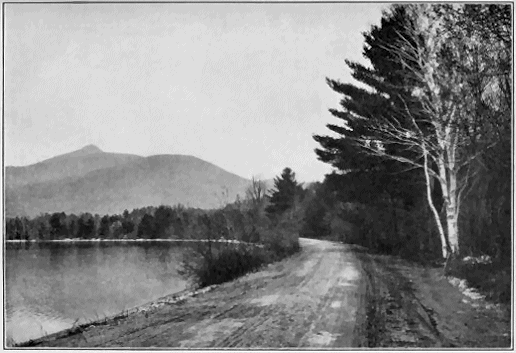
"The smooth highway over which thousands of automobiles skim in long summer processions from
Massachusetts to the Mountains"
It was a wonder day in May when I first
stopped, spell-bound, upon this spot. A soft blue
haze of spring was over all the mountain world,
making mystery of all distant objects and lifting
and withdrawing the peak into the sky of which
it seemed but a part, only a little less magical and
intangible. Hardly was this a real world on this
day, but rather one painted by some mighty master
out of semi-transparent dust of gems. The
lake was a mirror of emerald stippled about its
distant border with the chrysophrase reflection
of young leaves, carrying deep in its heart another,
more magical, Chocorua of softest sapphire
tapering to a nadir-pointing peak of beryl.
Out of the nearby woods came the song of the
white-throated sparrow, the very spirit of the
mountains, a song like them, built of gems that
fade from the ear into a trembling mist of sound,
the nearby notes sapphire peaks, the others distant
and more distant till they seem but the recollection
of a dream. Such days come to the
mountains in May and they bring the white-throats
up with them from the haze of the subtropics
where they are born.
If one would climb Chocorua by the Hammond
trail he must leave the smooth road that
winds onward to Crawford Notch after he passes
Chocorua Lake. There another, less smooth but
still available to carriage or motor, will take him
across Chocorua Brook and end at a house in
the woods. Just before the end it crosses a
second brook, and there is the beginning of the
trail, a slender footpath only, but well defined
in the earth and well marked by little piles of
stone wherever it goes over ledges. It is hardly
possible to miss it in daylight; after dark it
would be hardly possible to find it. Twice it
crosses the brook, the second time leaving it to
gurgle contentedly on in its ravine and rising
more directly skyward. Beech and birch
branches shimmered overhead with the translucent
green of half-grown young leaves along
the lower reaches of this trail. Maples flushed
the green in spots with tapestry of coral red.
Scattered evergreens, pine, spruce, hemlock and
fir lent backgrounds of green that was black in
contrast to the lighter tints. Smilacina, checkerberry
and partridge berry wove carpets of varying
color in the tan brown of last year's leaves,
climbing the slope as bravely as anyone, and
painted and purple trilliums did their best to
follow, but had not the courage to go very far.
The pipsissewa, bellwort and Solomon's seal did
better. A few of them dared the ledges well up
to the top of the first great southerly spur which
the trail ascends.
It was the day after I had first seen Chocorua
and a wind out of the west had blown the blue
haze of unreality away from the mountain, massing
it to the east and south where it still held
the land in thrall. I got the blue of it through
straight stems of beech and birch and through
the soft quivering of their young leaves painted
with the delicate coral tracery of maple fruit.
All the way up the lower slope one is drowned
in Corot. I watch yellow-bellied sap-suckers
make love among the beeches, the crimson of
their crowns and throats flashing with ruby
fire, the blotched gray and white of wings and
bodies a living emanation of the bark to which
they cling. Their colors seem the impersonal
fires of the young trees personified. In this,
another wonder day of May, the goodness of
God to the green earth flows in a tide of unnameable
colors up the mountain-side, enflaming
bird and tree alike and from the great shoulder
of the mountain I look down through its mist
of mystery and delight to Chocorua Lake, a
clear eye of the earth, wide with joy and showing
within its emerald iris as within a crystal
lens magic mountains, upside down, and between
their peaks the turquoise gateway to another
heaven, infinitely deep below. The lowland forest
sleeps green at my feet, a green of sea
shoals that deepen into the tossing blue of
mountains far to the south, Ossipee, Whittier,
Bear Camp and the lesser hills of the Sandwich
range.
Many of the shrubs and trees of the lower
slopes climb well to the top of this great southerly
spur of the mountain, but straggle as they
climb and lessen in number as they reach the
height. Few of the lowland birds get so far,
but among the dense spruces and firs which
crowd one another wherever there is soil for
their roots among the weather worn ledges, deciduous
trees sprinkle a green lace of spring
color, and among the spruces, too, is to be heard
the flip of bird wings and an occasional song.
Here the hardier denizens of the country farther
to the north find a congenial climate. Myrtle
warblers show their patches of yellow as they
flit about, feeding, making love and selecting
nest sites, and with them the slate-colored juncos
glisten in their very best clothes and show the
flesh color of their strong conical bills. These
two are birds of the mountain and they climb
wherever the spruce does.
Beyond the crest of this great southerly spur
the path dips through ravines and climbs juts
of crag and débris of crumbled granite to the
base of the great cone which is the pinnacle.
Now and then one gets a level bit for the saving
of his breath and his aching leg muscles
and may find a seat on fantastically strewn
boulders, dropped by the glaciers when they fled
from the warmth to come. On up the mountain
go the small things of earth, too. Here are
sheep laurel and mountain blueberries, stockily
defiant of the winter's zero gales, the laurel
clinging as firmly to its last year's leaves as it
does on the sunny pastures of the sea level hundreds
of miles to the south, the roots set in the
coarse sand that the frost of centuries has
crumbled from rotten red granite. Poplars
climb among the spruces and willows are there,
their Aaron's rods yellow with catkins in the
summer-like heat that quivers in the thin air.
The trees feel in them the call to the summit
as does man.
As they go on you seem to see this eagerness
to ascend expressed in the attitudes of the trees
themselves. To the southwest a regiment of
birches has charged upward toward the base of
the pinnacle. Boldly they have swarmed up the
steep slope and, though the smooth acclivities
of the ledges about the base of the cone have
stopped all but a corporal's guard, and though
they stand, theirs is the very picture of a turbulent,
onrushing crowd. Motionless as they
are, they seem to sway and toss with all the
restless enthusiasm of a mighty purpose; nor
could a painter, depicting a battle charge, place
upon canvas a more vivid semblance of a wild
rush onward toward a bristling, defiant height.
Few are the birches that have passed this glacis
of granite that forever holds back the body of
the regiment, yet a few climb on and get very
near the summit of the gray peak. More of
the dwarf spruces have done so. In compact,
swaying lines they rush up, marking the wind
and spread of slender defiles and leaning with
such eagerness toward the summit that you
clearly see them climbing, though they are individually
motionless, rooted where they stand.
There is a black silence of determination about
these spruces that must indeed carry them to
the highest possible points, and it does, while
to the eye the birches behind them toss their
limbs frantically and cheer.
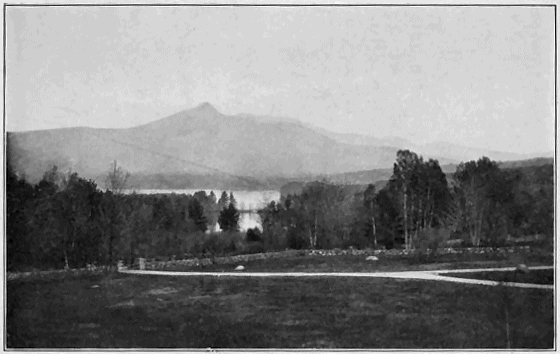
"You realize the grandness and beauty of this outpost sentinel of the White Hills"
Whether the little blue spring butterflies climb
the mountain or whether they live there, each
in his chosen neighborhood, going not far either
up or down, it is difficult to say, but I found
them in many places along the trail to the base
of the cone, little thumbnail bits of a livelier,
lovelier blue than either the sky or the distant
peaks could show, frail as the petals of the bird-cherry
blossoms that fluttered with them along
the borders of the path, yet happy and fearless
in the sun. With them in many places I saw
the broad, seal-brown wings of mourning cloaks,
and once a Compton tortoise flipped from the
path before me and hurried on, upward toward
the summit. I looked in vain for him there,
but as proof that butterflies do climb to the
very top of Chocorua I saw, as I rested on the
square table of granite which crowns it, a
mourning cloak, which soared up and circled
me as I sat, rose fifty feet above, then coasted
the air down toward the place where the birches
seemed to toss and cheer in the noonday sun.
He had won the height, and more, and I envied
him the nonchalant ease with which his
slanting planes took the descent.
One other creature I saw, higher yet, a
broad-winged hawk that swung mighty circles
up from the ravine to the southeast, down
which one looks in dizzy exaltation from the
very summit. There was a climber that outdid
all the rest of us in the swift ease of his ascent.
Out of nothing he was borne to my sight,
a mote in the clear depths three thousand feet
below, a mote that swept in wide spirals grandly
up with never a quiver of the wing. Up and
up he came till he swung near at the level of
my eye, then swirled on and on, a thousand
feet above me. A moment he poised there, then
with a single slant of motionless wings turned
and slid down the air mile on mile, one grand,
unswerving coast, to vanish in the blue distance
toward Lake Ossipee.
Southerly from Chocorua summit the land
was soused in the steam of spring. Chocorua
Lake lay green at my feet, an emerald mirror
of the world around it. To its right a little
way Lonely Lake was a dark funnel in the
forest, a shadowy crater opening to unknown
depths in the earth below, filled with black
water, and all to the east and south the country
lay flat as a map, colored in light green,
the lakes in dark green or steel blue, the
roads in dust brown, the villages scattered white
dots, while beyond a blue mist of mountains
was painted on the margin for the horizon's
edge.
To look north and west was to look into
another world, to realize for what mountains
Chocorua stands as the sentinel at the southeast
gate. Paugus lifted, a blue-black, toppling
wave to westward, seemingly near enough to
fall upon Chocorua summit, while over its
shoulder peered Passaconaway flanked with
Tripyramid and White Face. Northward and
westward from these toppled the pinnacles of
jumbled, blue-black waves of land that passed
beyond the power of vision. Northward again
the glance touched summit after summit of this
dark sea of mountains till the crests lifted and
broke in the white foam of the Presidential
Range with Mount Washington towering, glittering
and glacial, above them all. Here was no
steam of spring to soften the outlines and blur
the distance in blue. Rather the crystal clearness
of the winter air still lingered there, and though
but a few drifts of December's snow lay on
Chocorua and none were to be seen on the other,
nearer mountains, Carrigain was white crested
and Washington topped the ermine of the Presidential
range like a magical iceberg floating
majestically on a sea of driven foam. Chocorua
is not a very high mountain. Three thousand
feet it springs suddenly into the blue from
the lake at its feet, 3508 feet is its height above
the sea level, but its splendid isolation and the
sharpness of its pinnacle give one on its summit
a sense of height and of exaltation far greater
than that to be obtained from many a summit
that is in reality far higher.
Yet to him who stays long on the summit
of Chocorua thus early in the spring is apt to
come a certain sense of sadness, following the
exaltation of spirits, sadness for the inevitable
passing of this inspiring pinnacle. The work
of alternating heat and cold, of sun and rain,
are everywhere visible, beating the granite dome
to flinders and carrying it down into the valley
below. The bare granite shows the sledgehammer
blows of the frost as if a giant had been
at work on it making repoussé work with the
weapon of Thor. Not a square foot of the sky-facing
ledges but has felt the welts of this
hammer of the frost, each lifting a flake of the
stone, from the size of one's thumbnail to that
of a broad palm. These crumble into nodules
of angular granite that make drifts of coarse
sand even on the very summit. The sweep of
the wind and the rush of the rain come and
send these in streams down the mountain side.
The rain and the water of melted snow do
another work of destruction, also. Such water has
a strong solvent power, even on the grim granite.
Always after rain or during the snow-melting
season of early spring, there is a little
basin full of this water in the bare rock just
northeast of the very summit. There it stands
till the winds blow it away or the thirsty sun
dries it up, and year after year it has dissolved
a little of the rock on which it rests till it has
worn quite a basin in the granite,—a basin
which looks singularly as if it had been hollowed
roughly out by mallet and chisel. So the work
goes on, and Chocorua summit is appreciably
lowered, century by century.
Fortunately man thinks in years and not in
geological epochs, else the sadness of the thought
were more poignant. After all, the work of
erosion of the centuries to come can never be so
great on the mountain as that of the centuries
that have passed, for the geologists tell us that
all the summits of the Appalachians were once
but valleys in the vast table-land which towered
far higher above them than they now do
above the sea. The forces of erosion whose
patient work one now sees on Chocorua summit
have hammered at the hills thus long. So wears
the world away, but the great square block which
sits on the very peak of the mountain shows none
of the bruises which fleck the soft granite below
it, and it may well be many a thousand years
before it slides down into the ravine below.
The black bulks of Paugus and the mountains
beyond were rimmed with the crimson fire of
the westering sun as I reluctantly climbed down
from the peak of this hill of enchantment,
greeted by the evensongs of the juncos and
myrtle warblers in the first broad patches of
spruce about the base of the cone. A pigeon
hawk swung up from the westerly ravine and
hovered a moment so near me that I could see
the white tip of his tail and the rusty neck
collar, then slid down the air and vanished in
the ravine on the opposite side of the mountain.
He builds his nest on mountains and was well
fitted to show me the easiest way down. I
grudged him his wings as I waked the yelps in
a new set of leg muscles, slumping down the
slopes and climbing laboriously down the almost
perpendicular, rocky ravines. The Hammond
trail is no primrose path, for all its beauties, and
it was my first climb of the year. I was glad
indeed to drink deep of the mountain brook
near the end of the trail and then rest a bit
to the soothing contralto of its song.
The shadowy coolness of the evening was
welling up and blotting the gold of sunset from
the treetops as I rounded Chocorua Lake and
watched the sunset fire the summit where I had
lingered so long,—a fire reflected deep in the
very heart of the mirroring waters. The roar
of the little river on its way down to Chocorua
town came faintly to me, a sleepy song, half
that of the wind in pines, half an echo of droning
bees that work all day in the willow blooms
by its side. Liquid, clear, through this came the
songs of wood thrushes out of the shadows.
The peace of God was tenderly wrapping all the
world in night, and the mountain loomed farther
and farther away in blue mystery and dignity,
while from its pinnacle slowly faded the rosy
glow of the passing, perfect day.
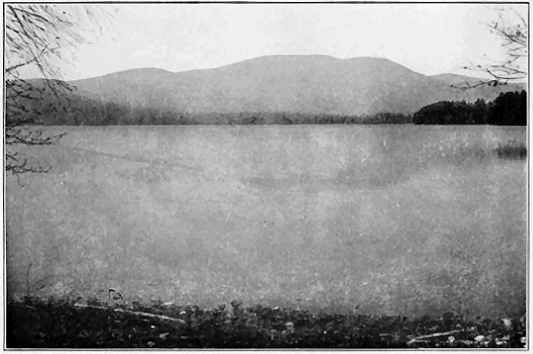
"The shadowy coolness of evening was welling up and blotting the gold of sunset from the treetops"
II BOBOLINK MEADOWS
Early June about Jackson Falls and Thorn
Mountain
On a May morning after rain the bobolinks
came to the meadows up under the shadow of
Thorn Mountain. The morning stars had sung
together and the breaking of day let tinkling
fragments of their music through, or so it
seemed. Something of the sleighbell melodies
that have jingled over New Hampshire hills all
winter was in this music, something of the happy
laughter of sweet-voiced children, and something
more that might be an echo of harps
touched in holy heights. Surely it is good to
be in the mountains at dawn in May, when such
sweet tinklings of melody fall out of celestial
spaces! The high hills were veiled in the mists
of the storm that had passed, but the nearer
summit of Thorn leaned friendly out of them,
and over it from the south pitched the fragments
of heavenly music, fluttering down on
short wings like those of cherubs. The bobolinks
had come to Jackson.
It is as easy to believe that the cherubs of
Raphael and Rubens can make the journey from
high heaven to earth on their chubby wings as
that these short-winged, slow-fluttering birds
can have come from the marshes below the
Amazon on theirs, but so they have done, finding
their music on the way. They went south
in early September, brown, inconspicuous seed-eaters
with never a note save a metallic "chink."
Somewhere in the far south they found new
plumage of black with plumes of white and old
gold. Somewhere in the sapphire heights of air
above the Caribbean Sea they caught the tinkling
music of the spheres and dropped upon
Florida with it in the very last days of April,
bringing it thence again in joyous flight that
drops them among the mountain meadows in
mid May.
Now June is making the grass long about the
little brown nests where the brown mother-bird
sits so close, but the meadows are full of tinkling
echoes of celestial music still. All the
mountain world is rapturous with this same joy
of something more than life which the bobolinks
brought from on high in their songs, dancing
and singing with it and tossing something
of beauty skyward day and night. Round the
margins of the bobolink meadows the apple trees
have completed their adoration of bloom, the
strewing of incense and purity of white petals
down the wind, and now yearn skyward with
tenderness of young leaves. The meadow violets
smile bravely blue from shy nooks, and the
snow that lingered so long on the slopes is born
again in the gentler white of houstonias which
frost the short grasses with star-dust bloom.
All the heat of the dandelion suns that blaze in
fiery constellations round the margins cannot
melt away this lace-work of the houstonias, and
it is not till the buttercups come, too, and focus
the sun rays from their glazed petals of gold
that the last frost of the season, that of the
houstonia blooms, is melted away. Dearly as the
bobolink loves his brown mate in the nest, the
moist maze beneath the grass culms where he
dines, and his swaying perch on the ferns that
feather the meadow's edge, he, too, feels this
upward impulse within him too strong to resist
and continually flutters skyward, quivering with
the joy of June and setting the air from hill
to hill a-bubble with his song.
The bobolink meadows begin on the grassy
levels between the Ellis and Wildcat rivers, the
bottom land which forms the foothold of Jackson
town, and they climb the mountains in all
directions as do the summer visitors, scattering
laughter and beauty as they go, till you hear the
tinkle of the bobolink's song and find the beauty
of meadow blooms in tiny nooks well up toward
the very summits. Up here the shyest meadow
birds and sweetest meadow flowers seem to love
the rough rocks well and climb them by the
route that the brooks take as they prattle down
from the high springs. Up the very rivers they
troop, and though they turn aside eagerly to the
safer haven of the brook sides, they climb as
well by way of the boulders that breast the
roar of the bigger streams. The Wildcat River
plunges right down into Jackson village by way
of Jackson Falls, a thousand-foot slope over
granite ledges worn smooth with flood, and
mighty boulders scattered in bewildering confusion.
In time of freshet this long incline is
a welter of uproarious foam. This year a long
spring drought has bared the rocks in many
places, and one may climb the length of the falls
as the stream comes down, from ledge to ledge
and from boulder to boulder.
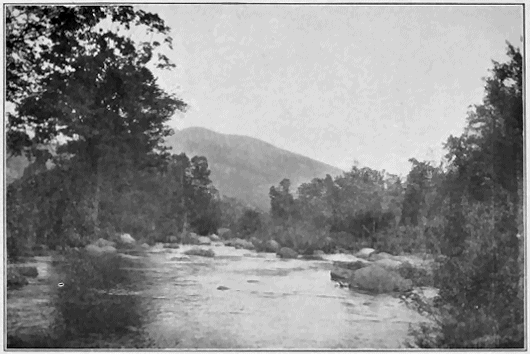
The Glen Ellis River at Jackson, New Hampshire, Thorn Mountain in the distance
The rush of the water drowns the warbling
of the water-thrushes in the alders and viburnums
on the banks, it drowns the cool melodies
that the wood thrushes sing from the deep shade
of the wooded slopes along the stream, but nothing
has drowned the wild flowers that climb the
falls by way of the ledges and boulders as the
adventurous fisherman does. Why the whelming
rush of freshets has not wiped them out of
existence it is hard to say. There must be times
each year when they are buried deep beneath
the boiling foam, but there they cling this June
and smile up in the sun and take the fresh scent
of the churning waters as a strong basis for
their perfumes. They knew the tricks of the
perfumer's trade long before there were perfumers,
and the moisture of the flood itself is
their ambergris. Here the cranberry tree leans
over the water and drops the white petals of
the neutral blooms from its broad, flat cymes to
go over one fall after another on their way to
Ellis River and, later, the Saco. The gentle
meadow-sweet dares far more than this. It
grows from slender cracks in the face of perpendicular
granite, and with but rocks and water
for its roots thrives and bathes its serrate leaves
in the spray. The mountain blueberries have set
their feet in similar places and hang fascicles
of white bells over the water for the more daring
of the bumblebees that have their nests in
the moss of the river banks.
Showiest and boldest of all is the rhodora
which has taken possession of a rock island in
midstream well up the falls. Here in a tangle
of rock points and driftwood it grows in clumps
and puts out its umbel clusters of richest rose,
a mist of petals that seems to have caught and
held one of the rainbow tints from the spray
that dashes by the blooms on either side. Nor
is even this, with its showy beauty that Emerson
loved, the loveliest thing to be found growing
out of granite in the very tumult of the waters.
The blue violet is there, unseen from the bank
but smiling shyly up to him who will clamber
out to midstream, finding coigns of vantage
down where even at low water the splash of
spray sprinkles its pointed leaves and violet-blue
flowers. Viola cucullata is common to all moist
meadows and stream margins from Canada to
the South, but nowhere does it bloom more
cheerily and confidingly than in the midst of the
rush and roar of Jackson Falls in these danger
spots among the rocks. One clump I found in
a square well of granite in the very wildest uproar,
holding its sprays of bloom bravely up in
a spot that at every freshet must be fairly
whelmed with volumes of whirling icy water.
How it holds this place at such times only the
clinging, fibrous roots and the gray granite that
they embrace can tell, but there it is, blooming
as sweetly and contentedly as in any sheltered,
grassy meadow in all the land.
Up from the bridge above Jackson Falls the
road climbs by one bobolink meadow after another
along the slope of Tin Mountain till it
stops at the wide clearing on the higher shoulder
of Thorn, which was once the Gerrish farm.
Farm it is no longer, for the farmers are long
gone. The jaw-post of the old well-sweep leans
decrepitly over the well, which is choked with
rubbish. The weight of winter snow and the
rush of summer rain have long since broken
through the roof of the old house and are
steadily carrying it down into the earth from
which it sprang. The chimney swifts have deserted
the crumbled chimney, and the barn swallows
no longer nest in the barn, last signs of
the passing of a homestead, and even the phœbes
have gone to newer habitations, but the broad
acres are still strong in fertility and the grass
grows lush and green on the gentle slopes.
Down from Thorn summit and over from Tin
the forest advances, but hesitatingly. It is as
if it still had memory of the strokes of the
pioneer's axe and did not yet dare an invasion
of the land he marked off. It sends out skirmishers,
plumed young knights of spruce and fir,
scouts of white birch and yellow, of maple and
beech, to spy out the land, and where these have
found no enemy it is advancing, meaning to
take peaceful possession, no doubt, for the wild
cherries and berry bushes mingle with the old
apple trees, and both hold out white blossom
flags of truce.
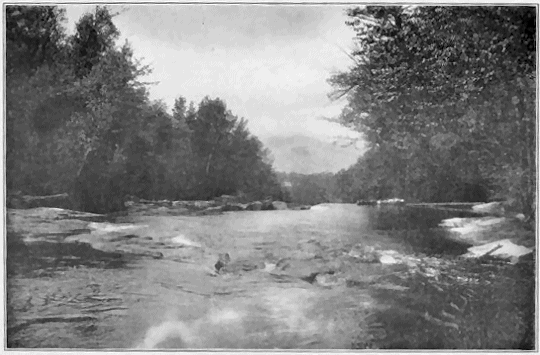
Down the Wildcat River, over the brink of Jackson Falls, Moat Mountain in the distance
One wonders if the pioneer did not have an
eye for mountain scenery as well as for strong,
rich land, for from the very doorstone of the
old house the glance sweeps a quarter of the
horizon, scores of miles from one blue peak to
another. At one's feet lies Jackson as if in a
well among the hills, Eagle Mountain and Spruce
and the ridges beyond dividing the valley of the
Wildcat from the glen of Ellis River, yet not
rising high enough to hide the peak of Wildcat
Mountain, up between Carter and Pinkham
notches. Iron Mountain rises on the left of
Jackson, and beyond it the unnamed peaks of
Rocky Branch Ridge lead the eye on to the
snow still white in the ravines of the Presidential
Range and Mount Washington looming in
serene dignity to the northwest. One may climb
thus far on Thorn Mountain by carriage if he
will, or by motor car indeed, provided he has
a good hill climber. The ascent is often made
thus. But to get to the very summit, the point
of the thorn, a footpath way leads up through
the bars into the pioneer's pasture, onward and
upward through the forest.
The pasture ferns climb too, and the pasture
birds love the wooded summit as well as they
do the slopes far below the pioneer's farm. The
June delight which echoes in the bobolink music
in the meadows so far below sweeps up the
mountain-side in scent and song and color till
it blossoms from the Puritan spruces on the very
top of Thorn. There one glimpses the rare outpouring
of joy that comes from reticent natures.
They are in love, these prim black spruces, and
they cannot wholly hide it however hard they
try. Instead they tremble into bloom at the
twig tips, and what were brown and sombre
buds become nodding blossoms of gold that thrill
to the fondling of wind and sun and scatter
incense of yellow pollen all down the mountain-side.
In the distance they are prim and black-robed
still, but to go among them is to see that
they wear this yellow pollen robe in honor of
June, a shimmering transparent silk of palest
cloth of gold. More than that, their highest
plumes blush into pink shells of acceptance of
joy, pistillate blooms of translucent rose as dear
and wondrous in their colors of dawn as any
shells born of crystalline tides, in tropic seas,
blossoms whose fulfilment shall be prim brown
cones, but each of which is now a fairy Venus,
born of the golden foam of June joy which
mantles the slender trees. Only with the coming
of June to the mountains can one believe
this of the spruces, because seeing it he knows
it true.
The little god of love has shot his arrow to
the hearts of the trembling spruces, and he sings
among their branches in many forms. The blackburnian
warbler lisps his high-pitched "zwee-zwee-zwee-se-ee-ee"
all up the slope of Thorn
to the summit and shows his orange throat and
breast in vivid color among the dark leaves.
The black-throated green, moving nervously about
with a black stock over his white waistcoat, sings
his six little notes, and the magnolia warbles
hurriedly and excitedly his short, rapidly uttered
song. The mourning warbler imitates the
water-thrush of the misty banks of Jackson
Falls, and the Connecticut warbler echoes in
some measure the "witchery, witchery" of the
Maryland yellow-throats, both birds that have
elected to stay behind with the bobolinks.
Thus carolled through cool shadows where the
striped moosewood hangs its slender racemes of
green blossoms, you come rather suddenly out
on the bare ledges which face northerly from
the summit. Truly to see the mountains best
one should look at the big ones from the little
ones. Here is the same view that Gerrish had
from his farm, only that you have a wider
sweep of horizon. Over the Rocky Branch
Ridge to the westward rises the Montalban
Range, with the sun swinging low toward Parker
and Resolution and getting ready to climb down
the Giant's Stairs and vanish behind Jackson
and Webster. Everywhere peak answers to
peak, and you look over low banks of mist that
float upward from unknown glens, forming level
clouds on which the summits seem to sit enthroned
like deities of a pagan world. There
is little of the bleak débris of battle with wind
and cold on the summit of Thorn. It is but
2265 feet above sea level, lower than most of
the mountains about it, and the trees that climb
to its top and shut off the view to the east and
south are in no wise dwarfed by the struggle
to maintain themselves there. But from it one
gets a far better outlook on mountain grandeur
than from many a greater height. Washington
holds the centre of the stage which one here
views from a balcony seat, seeming to rise in
splendid dignity from the glen down which the
Ellis River flows, and it is no wonder that there
is a well-worn path from the Gerrish farm to
the point of the Thorn.
It may be that the pioneer who first hewed
the mountain farm from the forest also first trod
this path to the very summit of the little mountain.
It may be that he got a wide enough
sweep of the great hills on the horizon to the
north and west from his own doorstone. But
I like to think that once in a while, of a Sunday
afternoon perhaps, he went to the peak and
dreamed dreams of greater empire and higher
aspirations even than his mountain farm held
for him. There is a tonic in the air and an
inspiration in the outlook from these summits
that should make great and good men of us all.
These linger long in the memory after the
climb. But longer perhaps even than the hopes
the summit gives will linger in the memory of
him who climbs Thorn Mountain in early June
the recollection of two things, one at least not
of the summit. The first is the joy of June in
the bobolink meadows far down toward Jackson
Falls, the celestial melodies that the bobolinks
echo as they flutter upward in the vivid
sunshine and sing again to mingle their white
and gold with that of the flowers that bloom
the meadow through. The other is the bewildering
beauty of the once black and sombre spruces
in their sudden draperies of golden staminate
bloom, looped and crowned with the pistillate
shells which so soon will be prim brown cones.
The bobolinks will sing in the meadows for
many weeks. The mountains will blossom with
one color after another till late September brings
the miracle of autumn leaves to set vast ranges
aflame from glen to summit, but only for a little
time are the spruces so filled with the full tide
of happiness that they put on their veils of diaphanous
gold and their rosy ornaments of new-born
cones. It is worth a trip into the hills
and a long climb to see these at their best, which
is when the bobolinks have eggs in the brown
nests in the meadow grass and the blue violets
are smiling up from the rock crevices in the
midst of the tumult of Jackson Falls.
III CLIMBING IRON MOUNTAIN
Some Joys of an Easy Ascent Near Jackson
The dawn lingers long in the depths of the
deciduous woods that line the eastern slope of
Iron Mountain. You may hear the thrushes
singing matins in the green gloom after the sun
has peered over Thorn and lighted the grassy
levels in the hollow where Jackson wakes to the
carols of field-loving birds. The veery is the
bellman to this choir, ringing and singing at the
same time, unseen in the shadows, the notes of
bell and song mingling in his music till the two
are one, the very tocsin of a spirit in the high
arches of the dim woodland temple, calling all to
prayer. The wood thrushes respond, serene in
the knowledge of all good, voices of pure and
holy calm, rapturous indeed, but only with the
pure joy of worship and thoughts of things
most high. So it is with the hermit thrushes
that sing with them, nor shall you know the
voice of the hermit from that of the wood thrush
by greater purity of tone or exaltation of spirit,
though perhaps it falls to the hermits to voice
the more varied passages of the music. Of all
bird songs that of these thrushes seems to be
most worshipful and to touch the purest responsive
chords in the human heart. As they
lead the wayfarer's spirit upward, so they seem
to lead his feet toward the mountain top, the
cool forest shades where they sing alternating
with sunny glades as he scales the heights with
the mountain road, which climbs prodigiously.
Way up the mountain the sunny glades widen
in places to mountain farms, their pastures set
on perilous slants, so that one wonders if the
cattle do not sometimes roll down till checked
by the woodland growth below, but their cultivated
fields more nearly level, spots seemingly
crushed out of the slopes by the weight of giant
footsteps, descending. The wooded growth and
ledges of the summit leap upward from the
southern and western edges of these clearings,
but to the north and east the glance passes into
crystal mountain air and penetrates it mile on
mile to the blue summits that cut the horizon
in these directions. Far below lie the valleys,
with the smaller hills that seem so high from
the grassy plains about Jackson village smudged
and flattened from crested land waves to ripples.
Highest of all mountain cots is the Hayes
farm-house, its well drawing ice water from
frozen caverns deep in the heart of the height
and its northern outlook such as should breed
heroes and poets through living cheek by jowl
with sublimity. Here the mighty swell of the
mountain sea has sunk the rippling hills below,
but the sweep of crested land waves leaps on,
high above them. Looking eastward, one seems
to be watching from the lift and roll of an
ocean liner's prow as the great ship runs down
a gale. Out from far beneath you and beyond
roar toppling blue crests, ridge piling over ridge.
Thorn Mountain, Tin and Eagle are the nearer
waves, their outline rising and falling and showing
beyond them Black Mountain and the two
summits of Doublehead, and beyond them Shaw
and Gemini and Sloop, great billows rising and
rolling on. Down upon the forest foam left
behind in the hollows of these rides the Carter
Moriah Range, a jagged, onrushing ridge, driven
by the same gale. The day may be calm to all
senses but the eye, yet there is the sea beneath
you and beyond, tossed mountain high by the
tempest.
To turn from the tumult to things near by
is to find the forests of the mountain coming
down through the pastures to look in friendly
fashion over the walls at the clean mowing fields.
On these they do not encroach, and though they
continually press in upon the pastures and narrow
their boundaries they do it gently and with
such patient urbanity that the open spaces hardly
know when they cease to be and the woodland
occupies them. The flowers of the pasture sunshine
grow thus for years in the forest shadows
before they realize that they are out of place
and hasten back to seek the full sunshine, and
the trillium and clintonia and a host of other
shade-loving things move out into the open and
mingle with the buttercups and blue violets, sure
that the trees will follow them. Thus gently
does nature repair the ravages that have been
wrought by the hand of man. Yet all through
the mountain region she moves on, and fewer
farms nestle in the giants' footfall on the high
ridges than were there fifty or a hundred years
ago. In many cases the summer hotel or the
summer residence has taken the place of the
one-time farm-house, but the dwellers in these
encourage the wood rather than hold it at bay.
The lumbermen make sad havoc among the big
trees, but the forest acreage is greater in the
mountains now than it was a century ago, more
than making up in breadth what it loses in
height.
In this low growth of the pastures about the
farms high on Iron Mountain the June sunshine
seems to pass into living forms of plant and
animal life. Not only do the dandelions and
buttercups blossom with their gold in all the
moist, rich soil, but out of the green of forest
leaves and the deep shadows of the wood it
flutters upon quivering wings. The yellow
warblers that flit and sing vigorously among the
young birches are touched with the olive of the
gentler shadows, but as they sing their vigorous
"Wee-chee, chee, chee, cher-wee" their
plumage is as full of the sunshine gold as are
the dandelion blooms. The myrtle warblers of
the spiring spruces, the magnolias, Blackburnians,
mourning, Canadian and Wilson's, are
flecked with it, and the forest shadows that
touch them too only seem to bring it out the
more clearly. But these are birds of the wood
or its edges. In the trees that stand clear of
the forest the goldfinches sing as if they were
canaries, caged within the limits of the farm,
their gold the brightest of all that which the
birds show, the black of their wings densest, the
color of night in the bottom of the glen, under
evergreens. The thrushes that sing in the deep
woods far down the mountain chant prayers,
even until noon, the warblers in a thousand trees
twitter simple ditties that are the mother-goose
melodies of the forest world, cosy, fireside refrains
hummed over and over again, but the
goldfinches are the choristers of the summer
sunshine when it floods the open spaces. They
seem to be the familiar bird spirits of summer
on the little mountain farms.
As the sunshine blossoms from the mountain
meadows, as it flits and sings in the forest
margins and in the goldfinch-haunted trees of
the open farm, so it is born even from the twigs
in the deeper wood, far up above the highest
farm on the way to the summit of Iron Mountain.
Great yellow butterflies, tiger swallowtails,
flutter in the dapple of light and shadow, their
gold the sunlight that flows across them as they
sail by. A few days ago not one of these soaring
beauties was in all the woodland; then, of
a day, the place was alive with them. Born of
chrysalids that have wintered under dry bark
and in the shelter of rocks and fallen leaves,
passing unharmed through gales and cold that
registered forty below and six feet of hardened
snow? Nonsense! Watch the play of sunlight
on young leaves of transparent green. See it
flame with shining gold, stripe them with rippling
shadows of twigs, and then see the whole
quiver into free life and flutter away, a
tiger-swallowtail butterfly, and believe these spirits
of the woodland shadows are born in any other
way, if you can. Papilio turnus may come out
as chrysalids in scientists' insectaries, but these
woodland sprites are born of the love of sunshine
for young leaves and quiver into June to
be the first messengers of the full tide of summer,
which neither comes up to the mountains
from the south nor falls to them from the sky,
but is a miracle of the same desire.
It is for such miracles that the young shoots
of the forest undergrowth ask as they come forth
each year with their tender leaves clasped like
hands in prayer. Through May you shall see
this attitude of supplication in the young growth
all along the mountain-sides where the shade of
the woods is deep, and it lingers with the later-growing
shrubs and herbs even until this season.
Most devout of these seems the ginseng,
its trinity of arms coming from the mould in
this prayerful attitude, and now that these have
spread wide to receive the good and perfect gifts
that they know are coming the trinity of leaflets
at their tips are still clasped most humbly. So
it is with the bellwort and the Solomon's seal
and many another gentle herb of the shadows.
Their leaf hands are clasped in prayer as they
come forth, and their heads are bowed in humble
adoration all summer long. The joy of warmth
and the sweetness of summer rain are theirs
already, and one might think it was for these
creature comforts that the prayer had been. But
it was not. It was, and is, for grace of bloom
and the dear delight of ripening fruit, the one
deep wish of all the world.
The very summit of Iron Mountain, 2725 feet
above the sea level, is a plateau of broken rock,
scattered over solid ledges which protrude
through the débris. Trees and shrubs of the
slopes and the lowland have climbed to this
plateau, poplar and birch, bird cherry, sumac,
dwarf blueberries and alder, that find a footing
here and there among the crevices. Spruces,
somewhat dwarfed and scattered but spiring
primly, are there, too, and the whole concourse
makes the bleak rock glade-like and friendly, yet
do not altogether obstruct the outlook. The
breath of summer has pinked the young cones
on the spruce tops and robed them in the gold
of pollen-bearing catkins. It has set silver reflections
shimmering from the young leaves of
poplar and birch, and the dwarf blueberries are
pearled with white bloom. Other spirits of
summer are among these; alert, frantically
hasty skipper butterflies dash about among them,
and a big, lank mountain variety of bumblebee
drones from clump to clump, showing a broad
band of deep orange across the gold and black
of his back. He is a big and husky mountaineer
of a bee, but buzzing with him comes a clearwing
moth, the spring form of the snowberry
clearwing. Hæmorrhagia diffinis, if I am not
mistaken, though I hardly expected to find this
little day-flying moth at so great an elevation so
far north. The very spirit of summer, the tiger-swallowtail
butterfly, was there, too, hovering
confidingly at the tip of my pencil as I wrote
about him, and with him the black, gold-banded
Eastern swallowtail, Papilio asterias, these two
the largest butterflies of the summit. Of all
the insect life, large or small, that revelled in
the vivid sunlight of the thin air of the little
plateau the most numerous were the little bluebottle
flies that hummed there in swarms, very
busy about their business, whatever it was, filling
the air with glints of the deepest, most scintillant
azure.
But he who climbs Iron Mountain will not
linger too long with the summer denizens of its
little rocky plateau. From the cairn which
mountaineers have built of its loose rocks the
eye has a wide sweep of the mountain world
in every direction. To the south the land fades
into shadowy mountains far down the Ossipee
Valley, mountains that seem to float there in a
soft, violet haze as if they were but massed
bloom of the Gulf Stream that flows and gives
off its wondrous colors half a thousand miles
farther on. East the tossing sea is dappled with
green and blue as the cloud shadows follow one
another over the forest growth. West the peaks
against the sun loom blue-black and stern as
they climb northward into the Presidential
Range, lifting their summits over the rough
ridge of the Montalban Range till one wonders
what wildernesses lie in the shadowy ravines
between the two. But whether to the east or
the west the gaze still falls upon a surging sea
of forest-clad granite, the very picture of tumultuous
motion, till the cairn beneath the gazer
takes on the semblance of a mainmast-head on
which he stands, and from which the plunge
of the ship may at any moment send him whirling
into space.
To look northward from this main-truck is
to get a further insight into the mystery of the
motion. Here, as the clouds blow away from
the upper slopes of the highest peak, the semblance
of a tossing sea vanishes, and one seems
to understand what happened here in an age
long gone. Once upon a time this mountain
earth must have been fluid, one thinks, and the
wind have blown an antediluvian gale from the
northwest. It sent great waves of earth tossing
and rolling and riding southeast before it,
with clouds for crests and the blue haze of distance
for the scurrying spindrift. Then uprose
from the depths of this awful sea Mount Washington,
enthroned on the Presidential Range,
"clothed in white samite, mystic, wonderful,"
and commanded the tumult to cease. There it
stands.
It stands, not only in the rock but in the imagination
of the onlooker, once he has found
the dignity and grandeur of the highest summit,
for authority. Dignity and grandeur are
the impressions which come to one from the
north through the crystal clear, thin air out of
the cool, snow-samite which still stands in the
deep ravines even on the southerly slope of the
master mountain, just as illusion and romance
dwell in the violet haze which veils all the south
in pleasing mystery. Here on Iron Mountain
one is lifted high in air between the two and
able with a turn of the head to see either, and
again it should be said that to know the mountains
well it is best to see them from the lesser
summits of their ranges. From every one of
these they stand before the onlooker in new aspects,
so different each from each that they
seem new peaks whose acquaintance he has not
hitherto made. Only thus is their many-sided
completeness revealed and their full personality
brought out. Nor need the visitor be among
them long before he realizes that they have personality
and grow to be individual friends, as
well loved and as ardently longed for when absent
as any human neighbor or associate. Within
them dwell a deep kindliness and a strength
which goes out to those who love them, unfailing
and unvarying through the years. It is no
wonder that prophets seek them, and that within
the sheltering arms of their ridges are cosy
nooks where hermits build their hermitages and
find a deep peace which the cities of the world
deny them.
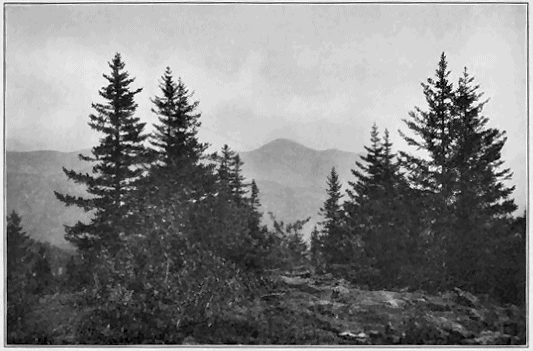
"From nowhere does one get a better view of Kearsarge than from this little cairn on the plateau
which is the summit of Iron Mountain"
From nowhere does one get a better view of
Kearsarge than from this little cairn on the
plateau which is the summit of Iron Mountain.
The long ridge which rises from the east branch
of the Saco to Bartlett Mountain and goes on
and up to make the summit of Kearsarge stands
with its edge toward him and vanishes against
the mountain itself, leaving its outline that of
a narrow cone, rising abruptly from a plain
below. There is something spectacular in its
dizzy, abrupt loom into the sky, quivering in
gray haze against the violet depths beyond, making
of it a magic peak such as the early voyagers
of legendary times saw and viewed with
fear and wonder. Such a mountain as this
seems was the lodestone which drew the ship
of Sinbad from the sea to be wrecked on its
base, and over it at any time might come flying
a roc with the palace of a prince of India in
its talons.
The sun that sinks to his setting behind the
great ridges that wall in Crawford Notch sets
their peaks in eruption, black smoke of clouds
rising from them and glowing with the reflection
of lakes of lava below and the flicker of
long flames. The Presidential Range looms and
withdraws in mighty solemnity and dignity, lost
in the turbid glow of this semblance of what
may have happened in æons gone, but the reflection
of these fires only deepens the amethystine
gray of Kearsarge and the purple
gloom beyond it, while it touches the very summit
with a soft rose, a flower of mystery as
sweet as any that ever bloomed in legendary
lore. When the watcher on the peak sees these
signs, it is time to begin the descent to the deepening
shadows far down the mountain, where
the thrushes are singing vespers in tuneful
adoration, prayerfully thankful for a holy day
well spent.
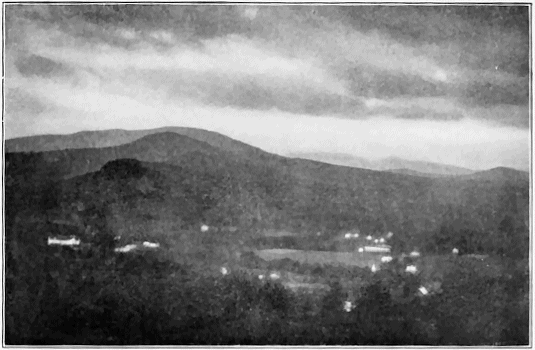
Sunset over Iron Mountain and Jackson, seen from Thorn Mountain
IV JUNE ON KEARSARGE
Butterflies and Flowers on a Summit of Splendid Isolation
The familiar spirits of Kearsarge Mountain
this June seemed to me to be the white admiral
butterflies. Clad in royal purple are these with
buttons of red and azure and broad white epaulettes
which cross both wings. These greeted
me in the highway at Lower Bartlett and there
was almost always one in sight up Bartlett
Mountain, over the ledges and to the very top
of Kearsarge itself. One of them politely
showed me the wrong wood road as a start for
the trail up Bartlett which leaves the highway
just a little south of the east branch of the Saco.
Then when the road ended in a vast tangle of
slash and new growth he showed me what was
to him a perfectly good trail still, up in the air
and over the tops of the trees and ledges in easy
flight, and I dare say he thought me very dull
that I did not follow as easily as he led. It is
the season for white admirals and you may meet
them in favored places all over the mountains
from now on, but nowhere have I seen them so
plentiful as they are this June along the slopes
of Bartlett and Kearsarge. A South American
navy could not have more admirals.
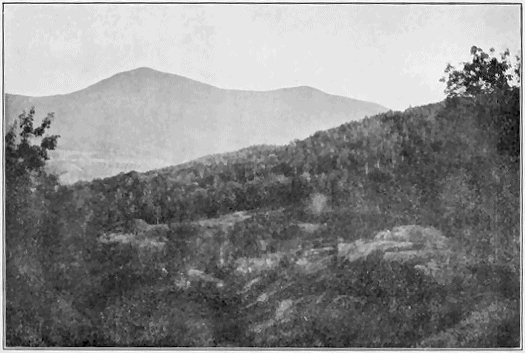
Kearsarge and Bartlett, seen from Middle Mountain, near Jackson
With the white admirals I find, flying lower
and keeping well in shadowy nooks, a thumbnail
butterfly which might well be a midshipman,
he is so much a copy on a small scale of
the admiral, very dark in ground color and having
white epaulettes across both wings also.
This butterfly is new to me, nor do I find him
figured in such works on lepidoptera as I have
been able to consult since I have seen him. I
had to get lost on the way up Bartlett to find
him most plentiful, but his fellows are common
throughout the shady woodlands of the upper
branches of the Saco from Pinkham Notch to
the borders of the Conway meadows. In fact
I fancy the whole White Mountain region is a
school for these understudies of the white admirals,
and they certainly could have no more
noble exemplar.
No doubt my volunteer white admiral guide
had a great contempt for any would-be sailor
that could not climb as he did when he went
straight toward the main truck of Kearsarge
by way of the bobstay, but he left me where the
lumber road did, in a wild tangle of slash, to
get up the mountain the way the bear does, on
all fours. There is a path up Bartlett, a proper
one that enters from the highway as the A. M. C.
guide says it does and sticks to its job after the
first third of the ascent is accomplished, but the
way it flirts with the wood roads between these
two points is bewildering to the sober-minded
stranger who attempts to follow it. However,
missing this slender trifler had its compensations.
I am convinced that I reached portions
of the slope of Bartlett that are rarely visited.
I was long getting out of the awful mess which
lumbermen leave behind them at the upper ends
of their roads. The inextricable confusion of
tangled spruce tops and the sudden riot of new
deciduous growth, wild with delight over the
flood of sunshine it gets, held me as if in a net.
And all the time I wrestled with it an indigo
bunting sat on the top of a rock maple and
sang his surprise at seeing such a thing in such
a place. "Dear, dear!" he gurgled, "who is
it? who is it? dear, dear, dear!" and once in
a while he added a little tittering "tee, hee, hee."
It was all very well for him. He could follow
the white admiral if he were bound for the main
truck of Kearsarge by way of the Bartlett bobstay,
and he looked very handsome and capable
as he glistened, iridescent blue-black up there
against the sun. How poor a creature a man
is, after all! A box turtle could have gone up
through that slash better than I did.
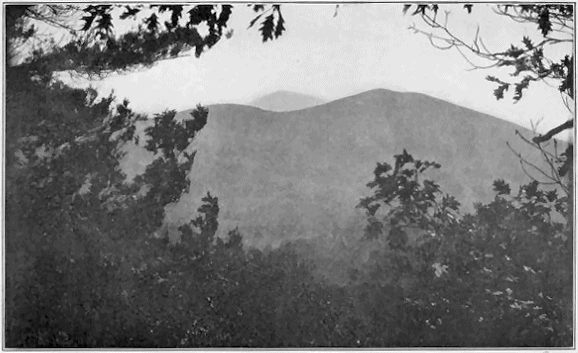
From Eagle Mountain one may see Kearsarge, blue and symmetrical in the distance, peering over the
shoulder of Thorn
However, man wins because he keeps everlastingly
at it, and I reasoned that if I kept
climbing I would come out on top of something
or other, and I did. On top of a pretty little
hill, which is an outlying, northwesterly spur
of Bartlett, a spot which gave me a glimpse of
the dark, spruce-covered summit far above and
a deep ravine between down into which I must
go and begin my scramble all over again. A
no-trail trip gives one an idea of what a mountain
really is, showing him, for one thing, how
rapidly it moves down into the valley beneath
it. Here on steep slopes were loose masses of
angled fragments of granite, weighing from a
few pounds to a few tons each, broken from
the precipices above by the frost and ready, some
of them at least, to be toppled at a touch and
start an avalanche. It needs but the footfall
of a climbing deer, a bear, or a stray man to
start one rock, or two, and it is easy to see that
a down-rush of spring rain takes always a part
of the mountain with it. To go up one of the
precipitous ledges, "tooth and nail" as one
must who misses the path, is to find how easily
these broken chunks, separated by the frost from
the parent rock, fall out and join the masses
below.
Yet such a climb has its joys, which the path
does not always give. Here the deer have
browsed and left prints of slender hoofs in the
black earth beneath the trees, there the white
hare had his lair all winter, a jutting rock
sheltering him and the sun from the southwest
warming him as he crouched. Here are holes
where the porcupines have scratched their
bristly way, or a cave where perhaps a bear had
his den. This the wandering stranger views
with suspicion and approaches with many delightful
thrills strangely compounded of hope
and fear. Probably there are no bears on
Bartlett, but what if there were one, and nothing
for defence but the majesty of the human
eye! A man is apt to get his own measure in
places like these. Of course the bear, if there
be one, will run—but which way? In the wildest
glen, filled with rough dens and suspicions
of bears of the largest size, I found grateful
traces of at least the former presence of men,
men in bulk, so to speak. Here, in the forest
tangle, wreathed with mountain moosewood
blooms, was a good-sized cook-stove. There
was no suspicion of a road, and I could only
guess that it had wandered from a lumber camp
and lost the trail, as I had. It reminded me
that Bartlett summit was still distant, more
distant perhaps than the noon hour which this
mountain range also suggested, and it set me
to the ascent with renewed vigor.
All the way up in woodsy nooks where are
little levels of rich black soil the moccasin flowers
climb till the very top of Bartlett is reached.
Their rose-purple foot coverings with the
greenish-purple pointed thongs for tying seem
scattered as if pukwudgies had lost them, fleeing
in terror from the bears which I could only
suspect, the mountain top their refuge, where I
found them, grouped rather close together in
mossy nooks among the ledges. The dwarf cornels
climb with them, finding footing in much
the same places and stare unblinkingly up with
round and chubby foolish faces. The cypripediums
are sensitive and emotional; these that
climb with them are strangely stolid and shallow
by comparison, yet they add beauty of their
own sort to the wide, moss-carpeted stretches
beneath the trees. On the very ledges themselves
neither of these advance, yet wherever
the frosts of winter have split the rock the
slender lints of strange lettering are green with
mountain cranberry vines, and the creeping
snowberry has followed and holds rose-white
blooms up to lure the mountain bees. The
lichens have painted these ledges, of which the
upper part of Bartlett Mountain is built, with
wonderful soft colors of mingled grays and
greens, and the spruces spire, black and beautiful,
all over the summit, making one hunt for
open spaces from which to view the world
stretched out beneath. I found the path again
on the ledges well up toward the summit, a
slender, coquettish thing still, hard to follow,
but enticing with its waywardness, its most bewildering
vagaries marked by former lovers,
men of the A. M. C. without doubt, little piles
of stone which lead him who trusts them to the
very summit.
Here, as on that lower spur of Bartlett which
I had struggled to attain, one looks upon a
greater height, with a ravine between, Kearsarge
looming grandly up into the sky to eastward.
The white admiral butterfly danced along
here, too—or was it another?—seemingly impatient
at my long delay in following, and the
path coquettes in vain, down ledges and up
ledges, always to be found by patient study of
those little piles of marking stone, till, breasting
the steep slope of Kearsarge itself, one enters
the comparatively broad highway which leads
up from Kearsarge village. After that the ascent
to Olympus is easy.
On few mountains does one get the sense of
exaltation and ecstatic uplift that comes to him
when he stands on the high summit of Kearsarge.
The mountain is splendidly isolated,
only Bartlett rising high near it, and the summit
of that even being so far below as to
be readily overlooked. Northwestward looms
Mount Washington, higher, no doubt, but so
buttressed by the great ranges on which it sits
serene as to lose the effect of upleap that Kearsarge
has. Under you is spread all eastern
Maine, like a map, and you look northeastward
across silver levels of lakes and mottled green
of dwarfed hills till, shadowy on the far horizon,
looms the peak of Katahdin, a blue land-cloud
on the rim of the silver-flecked green sea. The
two peaks of Doublehead are curious twin green
knolls below to the north, and only in the far-distant
north and west are summits of height
that equal or exceed your own. Far away in
these directions they begin and pinnacle and retreat,
range beyond range, till they fade into
the dim blue haze of the farthest horizon.
Southeast lie one silver lake after another, till
the eye finds Sebago, and beyond that the thin
rim of the world which is Casco Bay and the
sea.
Much cool water must well up from the heart
of Kearsarge to its summit, for grass grows long
there in the hollows of the granite, and many
alders, hung with powdery curls of staminate
bloom and green with many leaves in mid-June.
The moccasin flowers failed in their climb from
Bartlett summit to reach the top of Kearsarge,
but the rhodora has come up and set rose purple
blooms in the same season, the leaves here pushing
out with the flowers instead of waiting, as
they do in lower latitudes, at lesser heights.
Under their caresses the mountain has smiled
and given forth butterflies. Here are the white
admirals, conscious with epaulettes as if they
had just stepped ashore from the white cloud
fleets that swing with cumulus sails piled high
just off shore. Here is the painted lady, hovering
admiringly by, seemingly unnoticed by the
admirals. Here are tiger swallowtails, their
gold black-barred with rippling shadows, and
little skippers, swift and busy when the admirals
heave in sight. Most of all I note mourning
cloaks, and one in particular is in deep mourning,
the usual pale rim of his wings replaced
by a brown that is so deep it is black and hides
all azure spots that should be there. It may be
that all these butterflies sailed up into the island
port of a mountain top that swims so high in
the vivid sunshine of the June afternoon that
the air about it seems to me, watching them,
to be a veritable transparent blue sea of great
depth, yet it is just as likely that many were
born on or near the summit, of generations of
mountain dwelling lepidoptera. Of these must
have been my black-bordered mourning cloak,
the winter's cold having dulled his color within
the chrysalis and giving an added depth to his
mourning. He was as sombre as the dusky-wings
which dashed about with the skippers, like
black slaves come to help in the lading of their
vessels.
Into this island port in the high air came,
about four in the afternoon, a wind from the
sea, cooling the intense heat and spreading a
smoke-blue haze all along the southeastern horizon.
It wiped out the coast-line of Casco Bay
and moved the sea in with it, swallowing Sebago
and pushing on till Lovell's Pond and the lesser
ones within the New Hampshire line became
estuaries at which one looked long, expecting to
see slanting sails and smell the cool fragrance
of tide-washed flats. Into this haze loomed
one after another the distant Maine mountains
and vanished as if slipping their cables and sailing
away over the rim of the world, bound for
foreign ports. A new romance of mystery had
come to the outlook from the mountain top.
Far up its side, borne on this cool air, came the
song of thrushes, a jubilation of satisfied longing.
The breath of the sea had come with cool
reassurance to soothe and hearten all things.
On beyond Kearsarge, toward Crawford
Notch and the Presidential Range swept this
cool reviving air, carrying its blue haze with
it. The low sun sent broad bands of palest blue
down through this vapor and with it, northwestward,
the mountains seemed to withdraw;
details that had been so clear vanished, and instead
of dapple of purple-green forest and rose-gray
cliff were long cloud-ridges of wonderful
deep blue riding one beyond another like waves
on a painted sea, the darkest nearest, the farther
paling into the farthest and that vanishing into
the blue of the sky itself. Out of Crawford
Notch rolled the Saco, flecking the valley below
with patches of gleaming silver. The cumulus
cloud fleets that had swung over the mountains
all day long, bluing the green of the hills with
the shadows of their canvas, swept northwestward
with this wind, a great convoy for the sun
on into the ports of the radiant west. Now one
of them hid him from sight, its edges all gold
with the joy of it. Again the rays flashed clear
and the shadow of Kearsarge moved its point
of blue a little farther out on the green of the
forest to eastward. Down the mountain path
a Bicknell's thrush sang, the veery's song, less
round and loud and full, but with much of the
spiral, bell-tone quality in it. It reminded me
that the visitor to the summit who is to go
home by way of the broad path to Kearsarge
village may well wait till this pointed shadow
of the summit climbs Pleasant Mountain in
Maine and looms upward into the purple
shadows beyond. I was to go back by that
coquette of a trail down Bartlett, and the thought
of what tricks it would play on me by moonlight
made me hasten.
The cool of evening was descending like a
benediction on the level, elm-fringed meadows
of Intervale, and the little village of North
Conway gleamed white in the low sun and
pointed the broad way down the Saco Valley
to a hundred lakes as I climbed over the brow
of Bartlett and clinked my heels on the ledges
of its western face. The mocassin flowers
nodded good night and the golden green, spiked
blooms of the mountain moosewood waved me
on down the path that seemed as true as slender
as it wound on down the hill. Surely, I thought,
holding is having, and I shall keep this little
path close till the end of the way. And then
it slipped from under my arm and snickered
as it made off in the bushes, goodness knows
where, leaving me two-thirds the way down
Bartlett with the dusk and the tangle of forest
all before me. However, "down hill goes merrily,"
and so did I, and by and by I came to a
tiny mountain brook, and we two jogged on together
in the deepening gloom, prattling of what
we had seen.
At least, mountain brooks do not run away
from you as mountain paths do, but it is as well
not to trust them too much, after dark. This
one led me demurely to the brink of the little
precipice of "No-go" Falls and chuckled as it
took the thirty-foot leap, a slim thread of silver in
the moonlight. I dare say it was thinking what
a fine splash I would make in the shallow pool
below. Instead I clambered carefully around
and made the foot of the little cliff without a
thud, there to find that the laugh is really on
the brook, for its leap takes it into a big iron
funnel whence it is personally conducted down
a mile more of mountain into the little reservoir
of the North Conway water supply. I followed
the pipe, too, but outside, and the brook did not
gurgle once about it all the way down.
V RAIN IN THE MOUNTAINS
The Gods, Half-Gods and Pixies to be Seen
as the Storm Passes
There are other beauties in the high mountains
than those of fair days which show blue
peaks pointing skyward in the infinite distance.
Now and then a northeaster comes sweeping
grandly down from Labrador, swathing the
peaks in mist wraiths torn from the weltering
waves of Baffin's Bay and the Gulf of St.
Lawrence. Then he who knows the storm only
from the sea level finds in it a new mystery and
delight. On the heights you stand shoulder to
shoulder with the clouds themselves, seeing the
gray genie stalk from summit to summit or anon
swoop down and bear a mountain away to cloud
castles that build themselves in a moment and
vanish again in a breath. At the sea level the
storm rumbles on high above your head, tossing
down upon you what it will; here you are among
the mysteries of its motion, sometimes almost
above their level, and through rifts in the clouds
you may get glimpses of their sun-gilded upper
portions and see the storm as the sky does for
a moment from above. Again the clouds coast
to the valleys and wrap even them in the matrix
of mist out of which rain is made.
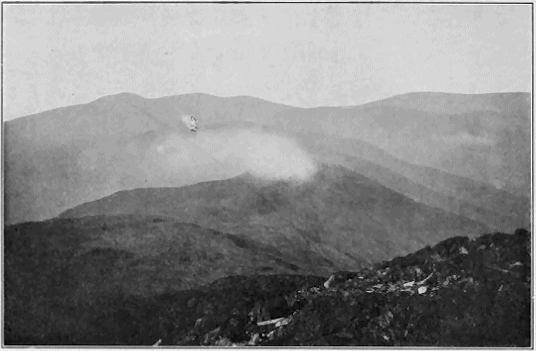
Sunset light on the Southern Peaks, seen from the summit of Mount Washington
Most beautiful is such a storm in the hours
of its passing, when the main cohorts have
swept by, when the rear guard and camp follower
clouds pass at wider and wider intervals
and more and more sun comes to paint their
folds with rose and flash the meadows and dripping
woods with scattered gems set in most vivid
green. Far off the high hills loom mightier and
more mysterious than ever, for their shoulders
still pass into the storm and the imagination
gives them unrevealed majesties of height, built
upon the blue-black cloud plateaus that hide
them. No wonder the great gods dwelt on
Mount Olympus. So they do on cloud-capped
Mount Washington, on Carrigain, Lafayette
and Carter Dome.
In time of storm lesser divinities may well
come down to the valleys, and when the passing
clouds are mingled with the coming sunshine
is the time to look for trolls in the woodland
paths, pixies by the stream, and to find, in the
very blossoming shrubs and graceful trees of
the level river meadows a personality that is
as nearly human as that which the Greeks gave
their gods. Who can know the elms of the Conway
and Intervale meadows without loving them
for their femininity? Each one "walks a goddess
and she looks a queen." Yet each one
flutters feminine fripperies with a dainty grace
such as never yet stepped from motor car at
the most fashionable hostelry between Bretton
Woods and Poland Spring. The summer visitors
who wear hobble skirts on the piazzas and
along the lawns of the most luxurious mountain
hotels need not think they are the first to flaunt
this curious inflorescence of fashion before the
stony stare of the peaks. The river-bottom elms
have worn their peek-a-boo garments of green
that way ever since they began to grow up in
the meadows. Nor can the newcomers vie in
grace, however clever their artifice, with these
slim mountain maids, than whom no dryads of
any grove have ever combined caprice and dignity
into more bewitching beauty. The meadow
elms are the queens of all summer exhibitions
of the perfect art of wearing clothes.
The elms of the deep wood are far more
simply dressed, losing not one whit of dignity
by it, as he who intrudes upon them in their
cool, shadowy bowers may know. But these
elms of the sandy intervales where the sun would
otherwise touch them with the full warmth of
his admiration are dressed for the world, all in
fluffy ruffles of green that flow yet sheathe, that
clothe in all dignity yet are of such exquisite
cut and proper fashion that the highest art of
Fifth Avenue has nothing to match them. To
look beyond these to the hillsides is to see the
firs and spruces as prim Puritans of an elder day
wearing the high, pointed caps of witch-women
and conical skirts that follow the flaring lines
of a time long gone; and the maples and beeches
are roundly, frankly, bourgeois, grafting the
balloon sleeves of a quarter of a century ago
upon the bulge of hoop-skirts such as some of
our great-grandmothers wore in conscious pride.
But the meadow elms! Sylph-like and teasingly
sweet, fluffy, fashionable and fascinating, yet
robed throughout in a gentle dignity such as
might well be the aura of purity and nobility,
no tree in all the mountain world can quite match
them.
In these valleys among the high hills the man
from the lowland regions is apt to miss and long
for the sheen of placid waters. All descents
are so abrupt that streams rush impetuously
always downward toward the sea, carrying with
them whatever may obstruct, whether flotsam
of blown leaves or the very granite ledges themselves
if they impede the advance too long.
They burst ledges, smash boulders to pebbles
and grind pebbles to sand and then to silt and
spread it over the meadows where the elms grow
or hurry it on to make deltas and vex ships on
the very sea itself. If they may not smash the
ledges or the boulders they slowly dissolve them
or more rapidly wear them away by constant
scouring with the passing sand of their freshets,
and always in the ravines they have dug sounds
the uproar of their perpetual attrition and unrest.
Far away this comes intermittently in a
soothing sibilation which seems to be saying to
itself "Hush, hush." It is as if one heard the
voices of little mother levels of still pools trying
to quiet the fretful child-foam of the
cascades.
But sitting on the rock itself by the stream as
it dashes down one gets, through this, a deep
vibration which has almost too few beats to the
second to be a tone, that is as much a jar as
a sound, the deep diapason of the quivering
granite itself. A beaten ledge responds like a
mighty gong with a humming roar that is
strangely disproportionate to the means employed
to produce the sound. Sometimes to
stamp with the foot over a rounded surface of
earth-covered granite is to produce an answering,
drumlike boom that makes one suspect that
he stands on a thin film of rock over a cavern.
The music of a fall has many parts. One of
these is the sand-dance sibilation of the shuffling
waters, another this boom of the rock drum
on which the green flood beats with padded
blows.
As the heart of the listener is tuned so it answers
to the mingled voices of the waters. One
may hear in them the well-harmonized parts of
a runic lullaby and be soothed to peace and
belief in all things good by the music. To many
another their perpetual turmoil and unrest find
too loud an echo from the depths within him,
and he longs for still lakes that look friendlily
up to him with the blue of the sky in their
clear eyes, fringed with the dark-pencilled lashes
of firs beneath the brow of the hill. The valleys
of the high white hills have so few of these
that one may count them on the fingers of a
hand. "Echo Lake" or "Mirror Lake" we find
them named, and all summer long they have
their throng of admirers, who in the lowland
regions would pass such tiny tarns with little
thought of their beauty. They may be so set
that they mirror no mountain peak. Their echo
may be no more silvery in tone or more frequently
repeated than one would get if he blew a
bugle in some dusty, forgotten city square where
red brick blocks would toss the call from one to
another, yet the little lakes have a charm of
placid personality that the cataracts cannot give.
Some day, without doubt, man will fill the
blind ravines of the upper mountain region with
a thousand eyes of these, binding the waters
for use and thereby adding to their beauty.
Every narrow ravine has its stream, dashing
uproariously downward. It needs but a barrier
of boulders set in cement to make at once a little
lake and a cascade. The water, set for a moment
to turn a turbine, will again dash on with
its full gift of flashing foam and musical uproar
for all who watch and listen, but its momentary
restraint will have helped the men of the mountains
with power and have helped the hills themselves
to greater permanency and added beauty.
Man must do this if he would keep the beauty
of the hills whence cometh his strength, or indeed
if he would keep the hills themselves. The
black spruce growth that once clothed them
from base to summit, holding the winter's snow
and ice beneath their sheltering boughs to melt
slowly almost all summer long, making deep,
cool shadows for the growth of water-holding,
spongy mosses, he has ruthlessly cut away. For
many years, winter after winter, out of the Glen
Ellis River Valley, right up under the slope of
the Presidential Range, went half a hundred
million feet of this growth, and in all the other
valleys where spruce remained it was the same.
The sudden freshets are more sudden, the disintegrating
droughts more severe now because
of this, and by these the very mountains themselves
are torn down.
Such a little lake, built not to turn a wheel
but to please the eye of the lovers of mountain
beauty, has lately been made just north of Jackson.
There it sits in a little bowl of a hollow
among spruce-clad hills and its waters purl
gently over a cement dam, to splash for the
square-tailed trout under the shadows farther
down the ravine. Creatures that already knew
the little stream and the marshy hollow where
the lake had welled have taken kindly to its
presence, but the wider ranging woodland folk
are still surprised at finding it there and shy
about trusting themselves on it or its borders.
It is too young to be adopted by the water birds
that have known the region long. The sand-pipers
that move leisurely north up Ellis River,
feeding and teetering as they go, do not light
in on the borders of the new-born lake, and
though the loons have no doubt seen it as they
fly over, they, too, go by. I have never yet seen
a loon plunge over the ridge to ripple its waters
with his splash or set the goblin echoes of the
forest laughing with his eerie cry. A mountain
lake without one loon is lonely. In the tiny
"mirror lake," which is a mountain tarn that
has been an eye to the woodland for countless
centuries over beyond the southeast slope of
Kearsarge, a loon family dwells, and I watch
them from the summit, diving, feeding and making
great sport in their world. Over on Chocorua
there are two such, and I fancy they are
equally numerous on all still waters of the high
mountain world, but they have not yet trusted
this new-born mountain lake, nor have the
spotted sand-pipers come to nest among the ferns
on its margin.
But the little lake mirrors many a bird wing
nevertheless, mainly those of the eave swallows
that nest in a long row under the eaves of a
Jackson barn. These know that man loves them,
and the things that he has made, whether barn
roofs or little lakes, are to be adopted and used
without fear. So they swoop over the fir tops
and skim the surface of the unruffled waters,
dipping to touch their own reflections and twittering
mightily about it as they sweep the dust
of tiny insects out of the shimmering air. Nor
does the lake mirror lack for the reflection of
many even more beautiful wings. When the
sun breaks through the passing storm a thousand
gauzy, white-bodied dragon-flies magically
appear. They cluster on sunny margins and
dash into the air and clash wings in infinitesimal
rustlings. Their fellows of a score of varieties
of coloration and shape are here too, spirits of
the air but children of its love for the waters
and born of the lake itself. While the storm
passes I watch their miracles of recreation.
When the sun lights up the shallow margins
they come swimming beneath the surface,
strange little slender submarines with filmy
propellers behind and round conning towers in
front. They come to a projecting twig and
climb up on this with hitherto unsuspected legs
till they are many inches above the surface,
where the sun and wind will dry them.
How do they know the appointed time?
Whence comes this impulse to leave the water
which has been their home since the first faint
beginnings of individuality were theirs? There
is no answer to these questions in any depth to
which scientific investigation has yet probed.
Yet the impulse is there and they do know the
appointed time. Moreover they know if they
have obeyed the promptings of the impulse too
soon. Now and then one climbs out and rests
for a moment, then in a sudden panic lets go
his hold on the twig and drops into the water
again, scuttling back to the depths in haste.
For him the hour has not yet struck. But most
of them come out to stay. They cling motionless
with the sun drying their backs and filling
them with such new life and vigor that they
burst. The submarine is itself a shell, and as
it bursts out of it comes the life that animated
it, in a new form, to dry and stretch its wings
and presently dart into the air on them, henceforth
a creature of the sun. Behind each remains
its water-world husk, still clinging to the
twig to which it crawled. Sometimes I put a
finger into the water in front of the swimming
insect, and it as readily crawls out on that as
on a twig, but neither of us has yet had patience
to wait thus till the transformation is complete.
The larger dragon-flies, with their clashing
wings and darting flight, which is so swift sometimes
that the eye fails to record it clearly,
seeing the insect at the beginning and again at
the end but unable to receive an impression of
the passage, seem well named. Here are small
creatures, indeed, but veritable dragons nevertheless
that may well carry apprehension to the
human watcher as well as to the tiny midges,
which they capture in this darting flight and
summarily devour. It may be that they will not
sew up the mouth of the boy that swears in
their presence, but no boy is to be blamed if he
believes that they can. Their gorgon-like build
and their uncanny swiftness of motion might
well prompt the superstitious to believe that they
could be a terror to evil-doers. But no one could
think the gentle demoiselles capable of wrong,
though they are dragon-flies too and are born
of the same waters and eat tiny insects in the
same way. Appearances count for much with
all of us, and the demoiselles flit so softly and
fold their wings on alighting in such prayerful
demureness of attitude that they seem instead
the good folk of the fairy world that margins
the little lake, created to bring rewards to the
good rather than to punish evil.
Thus by the man-made mountain tarn one may
find the dragons and the pixies that man has
made too, out of the débris of dreams that the
race has accumulated since it too grew up out
of placid waters which in ages past seem to have
sheltered all elementary forms of life as it shelters
the dragon-fly nymphs before they have
grown up to use their wings. While the storm
wraps the world in the illusions of romance the
half-gods of Greek myth stalk the mist-entangled
meadows and shout in the winding valleys, across
the mountain streams. As the storm breaks, the
clouds pass, and the sun floods the thin air with
his gold, these mayhap, like the pixie dreams,
will vanish. The half-gods go, but the gods
arrive. The eye lifts with the clouds to wider
and wider spaces and greater and greater
heights, up stepping-stones of glistening cliffs,
along rugged ranges to where the peaks sit enthroned
in splendor, the great gods themselves.
Vulcan looms vaguely by his black anvil, the
distant storm swathing him in the smoke of his
forge fire. The chariot of Apollo rides beyond,
his arrows flashing far and fast. Cytherea
passes with the clouds and flames them with her
opalescent presence, and high over all, mighty
and storm-compelling, sits Zeus himself, enthroned
in white majesty on the carved nimbus
of the passing rain.
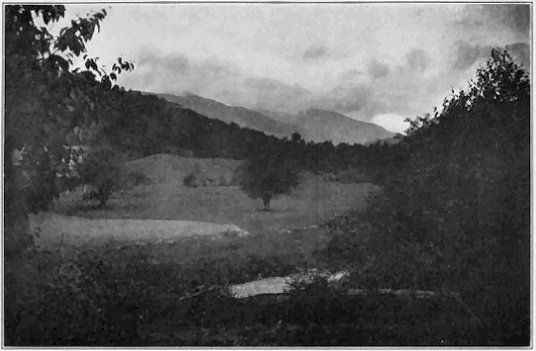
Clouds on Mount Washington, from the Glen Road, Jackson
VI CARTER NOTCH
Its Mingling of Smiling Beauty and Weird Desolation
Sometimes, even in midsummer, there comes
a day when winter swoops down from boreal
space and puts his crown of snow-threatening
clouds on Mount Washington. They bind his
summit in sullen gray wreaths, and though the
weather may be that of July in the valleys to
the south, one forgets the strong heat of the
sun in looking upward to the sullen chill of this
murky threat out of the frozen northern sky.
Thus for a day or two, it may be, the summit
is withdrawn into cloudy silence, which may lift
for a moment and let a smile of sunlight glorify
the gray crags, and flash swiftly beneath the
portent, then it shuts down in grim obsession
once more.
At other times winds come, born of the brooding
mass of mists, and sweep its chill down to
the very grasses of the valley far below, but
this shows the end of the portent to be near.
The morning of the next day breaks with a
bright sun, and you go out into a crisp air that
sends renewed vitality flashing with tingling delight
through every vein down to the very toe
tips. The clouds that blotted out the summits
with their threat of winter are gone, and the
mountains leap at you, as you look at them, out
of a clarity of atmosphere that one learns to
expect where the hills rise from the verge of
the far Western plains but which is rare in New
England.
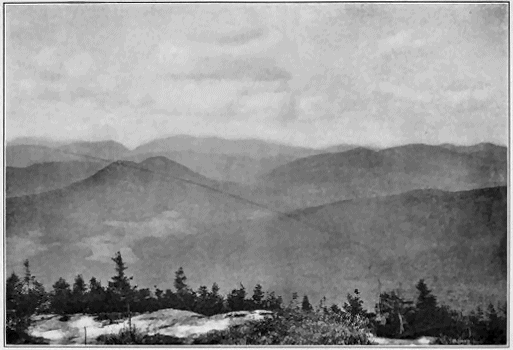
Carter Notch seen over Doublehead from Kearsarge summit
The mystical haze that has for weeks softened
all outlines and magnified all distances till objects
within them took on a vague unreality, is
gone, and we see all things enlarged and clarified
as if we looked at them from the heart of
a crystal. And as with outlines, so with colors.
No newly converted impressionist, however enthusiastic
in his conversion, could paint the grass
quite such a green as it shows to the eye, or get
the gold in its myriad buttercup blooms so flashing
a yellow as it now has. All through the soft
days these have been a woven cloth of gold.
Now the cloth is unmeshed, the very warp has
parted, the woof separated and the particles
stand revealed, a thousand million scattered
nuggets instead, each individual and glowing, a
sun of gold set in the green heaven of the
meadow. The wild strawberries that nestled by
thousands in the grasses so shielded that one
must hunt carefully to see them, seeming but
blurred shadows complementing the green, now
flash their red to the eye of the searcher rods
away. Here for a day is the atmosphere of
Arizona, which there reveals deserts, drifting
in from the north over the lush growth and
multiple rich colors of a New England hillside
country.
It is a scintillant country on such a day. The
twinkling leaves of birch and poplar flash like
the mica in the rocks far up the hillsides, the
surface of each dancing river vies with these,
and through the crystal waters you look down
upon the bottom where silvery scales of mica
catch the light and send it back to the eye. It
is no wonder the early explorers from Massachusetts
Bay colonies came back from the white
hills with stories of untold wealth of diamonds
and carbuncles to be found here. You may find
these jewels on such a day at every turn, though
they are fairy gems only and must not be covetously
snatched, lest they turn to dross in the
hand.
The meadows above Jackson Falls flash with
this beauty from one hillside across to another,
and through them winds the Wildcat River, luring
the casual passer to wade knee deep in the
grass and clover from curve to curve, always
fascinating with new enticement till it is not
possible to turn back. Nor are the fairy gems
which the long, winding valley has to show confined
to the sands of the river bottom or the
boulders scattered along its way. At times the
air over the clover blooms is full of them, quivering
in the sun, borne on the under wings of the
spangled fritillary butterflies that swarm here
in early July. Above, the fritillaries have the
orange tint of burnt gold, plentifully sprinkled
with dots of black tourmaline, but beneath they
have caught the silver scintillation of the mica-flecked
rocks and sands on which they love to
light when sated with the clover honey. These
too are gems of the mountain world which, if
not found elsewhere, one might well come many
miles to seek. It is easy to believe, too, that the
spangled fritillaries know the source of the silver
beauty of their under wings and cunningly seek
further nourishment for it. You find them
hovering in golden cloud-swarms over bare spots
of scintillant sand along the reaches of the river
or in the paths of the roadside which rambles
down from the hills with it, anon lighting upon
this bare and shining earth to probe with long
probosces and draw from the mica-flecked sand
perhaps the very essence of its silvery glitter,
for the renewing of their wing spots. The white
admirals are with them, not in such swarms to
be sure, but in considerable numbers, eager also
for the same unknown booty. It may be that
they too thus renew the silver of their white
epaulets.
I found all these and a thousand other beauties
on my trip up the Wildcat to its source in Carter
Notch, through this region of mica-made fairy
gems. They lured me from curve to curve and
from one rapid to the next beyond, always climbing
by easy gradients toward the great V in
the Carter-Moriah range, whose mysteries, to me
unknown, were after all the chief lure. The
crystal-clear air out of the north, which had
swept the gloom from the high brow of Mount
Washington, made the mountains seem very
near and sent prickles of desire for them
through all the blood. On such a day it is a
boon to be allowed to climb, nor can one satiate
his desire for the achievement of heights except
by seeking them from dawn till dusk. Little adventures
met me momentarily on the way. Here
in a mountain farmer's field was a great mass
of ruddy gold, showing its orange crimson for
rods around a little knoll. Yet this was but
fairy gold as the gems of the Wildcat meadows
are fairy gems, a colony of composite weeds
which no doubt the farmer hates, but which produce
more wealth for him than he could win
from all the rest of his farm for a decade—if
he could but gather it. The fritillary butterflies
know its value and flock to it, losing their
own burnished coloration in it, and the wild bees
are drawn far from the woodland to it by its
soft perfume. To come suddenly on this was
as good as discovering a new peak.
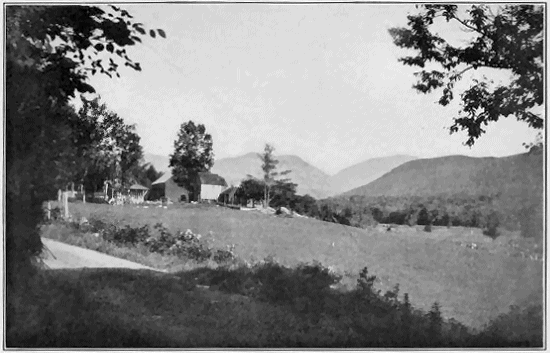
"Always climbing by easy gradients toward the great V in the Carter-Moriah Range"
To hear a tiny shriek in the wayside bushes
and on search to rescue a half-grown field sparrow
from the very jaws of a garter snake, sending
the snake to gehenna with a stamp of a big
foot and seeing the fledgling snuggle down again
into the nest with the others, was as pleasant
as finding the way to a new cascade. But after
all, the great lure of such a crystalline day is
toward the high peaks. The Wildcat River has
its very beginning in the height of Carter Notch,
and its prattle over every shallow teased me to
follow its trail back to this high source and see
what the spot might be. To do this step by
step with the falling water would be a herculean
task, for the gorges down which it runs
are choked with boulders and forest débris and
tangled with thickets as close-set and difficult of
passage as any tropical jungle. But there is no
need to seek its source by that route. You may
go within four miles of it by motor, if you will,
up the good road from Jackson that finally
dwindles and vanishes on the slope up toward
Wildcat Mountain, but not before it has taken
you through a gate and showed you the entrance
to the A. M. C. trail to the top of the Notch.
All the way up to this point the outlook to
the south has been growing more extensive and
more beautiful. Black Mountain still lifts its
broad ridge from pinnacle to pinnacle on the
east side of the Wildcat, but Eagle Mountain,
Thorn, Tin, and the little height between these
last two have been dropping down the sky line
till Kearsarge, Bartlett, Moat, and even the distant
Sandwich and Ossipee ranges far to the
south, loom blue and beautiful above them, while
the valley of the Wildcat unrolls its slopes,
checkered with farm and woodland, to where the
river vanishes from sight around the turn at
Jackson Falls. Fifty miles of sylvan beauty lie
before you as you look down the narrow valley,
over the green heights that rim it to the blue
ones far beyond, and up again to the amethystine
sky.
It is a wide world of sun and it is good to
look at it now, for the path before you plunges
to shade immediately and is to give you little
more than a dapple of sunlight for five miles.
Yet it is a wide and easy way for most of the
distance, for which the chance traveller may
thank the lumbermen, whose road it follows, and
the Appalachian Mountain Club. The lumbermen
opened it. The Appalachians have kept it
up since the tote road was abandoned. They
even have mowed its grassy stretches each spring,
lest some fair Appalachian pilgrim set her foot
upon a garter snake, inadvertently and without
malice, and henceforward abjure mountaineering.
A half-dozen brooks splash down the
mountain-side and cross this trail, all for the
slaking of your thirst, and if you do not find
the garter snake to step on you may have a
porcupine. Indeed, to judge from my own experience,
the porcupine is the more likely footstool.
Just before you round the low shoulder
of Wildcat Mountain to enter the Notch is a
burnt region full of gaunt dead trees, and this
neighborhood grows porcupines in quantity, also
in bulk. One of them looms as big as a bear
at the first glimpse of him in the trail ahead, and
if he happens to start from almost beneath your
foot as you step over a rock, giving that queer
little half squeal, half grunt of his, you are
momentarily sure that you have kicked up Ursus
Major himself.
But though the porcupine may squeal and
move for a few shambling steps with some degree
of quickness, he is by no means afraid of
you. He just moves off a few feet, turns his
back, shakes out his quills till they all point true,
then waits for you to rush at him and bite him
from behind—waits with a wicked grin in his
little eye as he leers over his shoulder at you.
Then if nothing happens he shambles awkwardly
away into the shadows of the forest. If something
does happen it is the aggressor that
shambles away with a mouthful of barbed,
needle-pointed quills. But then, why should anyone
bite a porcupine? They do not even look
edible, and judging by the numbers of them that
strayed casually out of the path round the shoulder
of Wildcat that day nothing has eaten any
of them for a long time, else there had not
been so many. In this burnt district you get a
glimpse of Carter Mountain on the other side
of the notch you are about to enter and then
you plunge again into deeper woods on the west
side, under the cliffs of Wildcat, whose very
frown is hidden from you by the high trees.
The cool, shadowy depths here will always be
marked in my mind as the place of great gray
toads. I saw several of these right by the path,
six-inch long chaps, looking very wise and old
and having more markings of white than I ever
before saw on a toad, besides a white streak
all the way down the backbone. The place is
as beautiful as these bright-eyed, curious creatures,
and as uncanny. Mossy boles of great
trees rise through its gloom and through the
perfumed air comes the cool drip of waters.
Moss is deep, and over it and the rough, lichen-clad
rocks grows the Linnæa, holding up its pink
blooms, fairy pipes for the pukwudgies to smoke.
Here out of high cliffs have fallen great rocks
which lie about the patch in mighty confusion.
Here are caves, little and big, that might shelter
all the hedgehogs roaming the fire-swept mountain-side
below, and as many bears. Yet neither
porcupines nor bears appeared, or any other living
things except the great white-mottled toads,
that would not hop aside for my foot, but sat
and gazed at me with the calm patience of woodland
deities.
Then the path swung sharp down the hill
through lesser trees that gave a glimpse of the
high frown of Carter cliffs, swimming in the sky
above, and then—I wonder if every pilgrim
does not at this point laugh with pure joy and
caper a bit on road-weary legs, for here in the
gruesome depths of the great Notch, at the
climax point of its wildness, is a little clear
mountain lake where surely no lake could be, set
in thousand-ton fragments of mighty broken
ledges. To look north is to see a little barrier
of wooded ridge stretching across from side to
side of the place, and between the eye and this
a low barrier of wood growth among great rocks,
behind which is the air of empty space. I
pushed through this, expecting a crater, and behold!
Here is another little round lake with lily
pads floating on its surface, and beyond this an
open space in the woods and the A. M. C. camp.
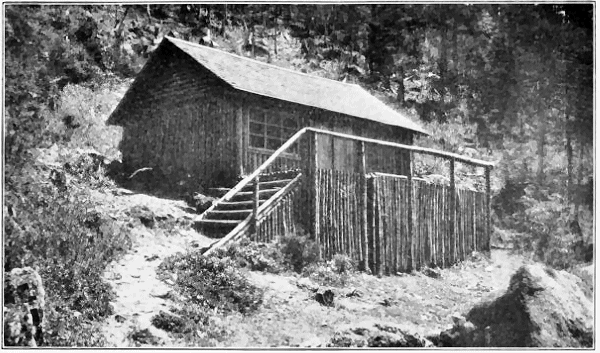
The Appalachian Mountain Club camp in Carter Notch
The time was early afternoon of one of the
longest days of the year, and the sun sent a
cloudburst of gold a thousand feet down the
perpendicular cliffs of Wildcat Mountain and
flooded the highest source of Wildcat River with
it. The north wind poured its wine over the
ridge and set the surface of the little lake to
dancing with silver lights such as had greeted
me in the river far below, in the boulders along
the way, and in the spangles of the thousands
of fritillary wings that had fluttered and folded
as I passed. Here is the crucible for the making
of these fairy gems, and I dare say the wise
old toads from the shadows on the side of Wildcat
just above are the sorcerers whence the
tinkering trolls learned the trick of their
manufacture.
I had to wait but a little while, however, to
know the difference. Stretched on the slope on
the farther shore of the flashing lake, I watched
the sun swing in behind the high pinnacle of
a wildcat cliff that leaps from the water's edge
almost a thousand feet in air, its sheer sides
embroidered by the green of young birch leaves.
I had left the full tide of early summer in the
Jackson meadows. Here it was early spring.
There the strawberries were over ripe, here the
blossoms were but opening their white petals,
and the mountain moosewood and mountain ash,
there long gone to seed, were here just in the
height of bloom. By the lake side the Labrador
tea offers its felt-slipper leaves for the refreshment
of weary travellers who may thus drink
from fairy shoon; nor need one go to the trouble
of steeping, for the round heads of delicate white
bloom send forth a styptic, aromatic fragrance
that is as tonic as the air on which it floats.
A drone of wild bees was in this air, and looking
up the cliff toward the sun a million wings
of tiny, fluttering insects made a glittering mist.
But even then the shadow of the pinnacle of
the great cliff fell on the western margin of the
pool and, as I lay and watched it, moved majestically
out across the waters. It wiped the
golden glow and the fluttering sheen of insects
from the air, the glitter from the surface of the
lake, and spread a cool mystery of twilight over
all things which it touched. A chill walked the
waters from the base of the cliff, whose rough
rock brows frowned where the birches but an
hour before had smiled, and all the hobgoblins
of the wild Notch showed themselves in the advancing
shadows. Rock sphinxes and dead-tree
dragons suddenly appeared, and as the afternoon
advanced so did the shadows of Wildcat
Mountain, sweeping across the narrow defile and
bringing forth all its weird and sinister aspects.
The way to the light of day lies down the
stream southerly. But there is no stream. The
waters of the upper lake flow to the other one
beneath a great jumble of broken ledges, and
then go on to form the stream farther down
under a titanic rock barrier of shattered cliff and
interspersed caverns. Gnarled and dwarfed
spruces climb all over this great barrier, and so
may a man if he have patience and will step
carefully on the arctic moss which clothes the
rocks and gives roothold to the spruces, watchful
lest it slip from under him and drop him
into the caverns of unknown depth below. It
is a region of wild beauty of desolation even
with the sun on it, and after the shadow of
Wildcat has climbed it, its rough loneliness has
something almost sinister about it. Only when
its topmost rock is surmounted and the valley
below shows down the Notch, still bathed in sunshine
and peaceful in its green beauty and its
rim of blue mountains far beyond, may one forget
the weird spell which the shadows have
cast on him in the very heart of the chasm. Here
is the scintillant world of the Wildcat River
valley once more, still bathed in sunshine, though
the shadows of the range to westward creep
rapidly toward its centre. I had seen the heart
of its beginnings at the moment when the toiling
trolls were at their work. I had seen the
weirder spirits cast their mantle over the place,
and far down the Notch I could hear the little
river calling me to come down to it again as
I scrambled off this giant's causeway to the
friendly leading of the path and went on down
through the region of great gray toads to the
slope of a thousand porcupines, and on to where
the footpath way enters the road. The smile
of sunshine had gone from the face of the valley
and the night shadows of Wildcat and its
spurs were drawn across it, but only for a little
was it sombre. With the darkness came a million
scintillations of firefly lights in all its
grasses, and out of the clear blue of the sky
above twinkled back the answering stars.
VII UP TUCKERMAN'S RAVINE
Day and Night Along the Short Trail to
Mount Washington Summit
The snow arch at the head of Tuckerman's
Ravine holds winter in its heart all summer long.
In the sweltering heat of the early July weather
it is an unborn glacier, a solid mass of compacted
snow and ice, two hundred feet in vertical
diameter and spreading fan-fashion across
the whole head of the ravine. Out from under
it rumbles a stream of ice water, and it still
makes danger for the mountain climber on the
upper part of the path which climbs the head
wall of the ravine and goes on, up to the summit
of Mount Washington. All winter long the
north wind sweeps the snow over the round ridge
between the summit cone and Boott's Spur and
drifts it down the perpendicular face of rock
which stands above the beginning of the ravine.
There are summers when the heat of the sun,
beating directly upon this glacial mass, melts
it away. There are others when it lingers till
the snows of autumn come to build upon it
again.
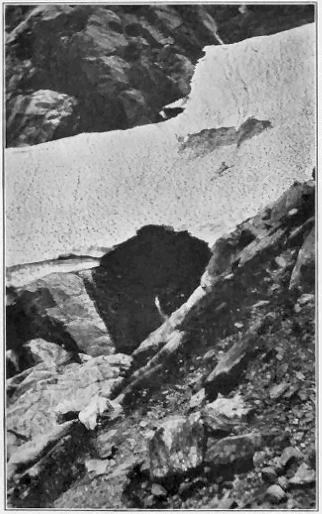
"The snow arch at the head of Tuckerman's Ravine holds
winter in its heart all summer long"
He who would do much mountain climbing in
a comparatively short distance will do well to
go up Mount Washington by the Tuckerman
Ravine. A good motor road leads from Jackson
to Gorham, and on, and the trail leaves this
nine miles above Jackson. A. M. C. signs and
the feet of thousands of mountain lovers have
made the path's progress plain, but for a further
sign the wilderness sends the swish of Cutler
River, flashing over its boulders, to the ear all
the way up to the snow arch, and it serves free
ice water for the refreshment of travellers.
Only in rare spots does this tiny torrent find time
to make placid pools. All the rest of the way
it leaps boulders, shelters trout in clear, bubbling
depths, and makes its longest, maddest plunges
at the cliffs down which foam the Crystal Cascades.
Here, at the end of your first half-mile
of ascent, you may lie in the shadow of maple
and white birch on the brink of a narrow gulf,
see the white joy of the river as it makes its
swiftest plunge toward the sea, and listen to
the myriad voices in which it tells the lore of
the lonely ravine which the waters have traversed
from the very summit of the head wall.
No water comes down the Crystal Cascade that
is not beaten into a foam as white as the quartz
vein in which it has its very beginnings, high
up the cone of the summit. It is as if this
quartz were here turned to liquid life which
spurts in a million joyous arches from the black
rock which it touches and leaves more nimbly
than the feet of fleeing mountain sheep. There
are wonderfully beautiful pink flushes in this
white quartz and you may see them as you go
up the path to the summit above the alpine
gardens of the plateau. But you do not have to
climb that far to see them. The same colors of
dawn are in the cascade when the sun filters
through the leaves and touches those curves of
beauty in which the river laughs down to its
wedding with the Ellis in the heart of the Pinkham
Notch.
In the heart of the snow arch is winter. On
its steadily receding southern margin all through
July is a continual dawn of spring. As the snow
recedes the alders emerge bare and leafless. A
rod down stream they are tinged green with the
beginnings of crinkly leaves and have hung out
their long staminate tassels of bloom. Another
rod and they are in full leafage and the staminate
tassels have given place to the brown seed
cones. These mountain alders have a singularly
crimped rich green leaf, and they so love
the snow water torrents of Tuckerman's Ravine
that they stand in them where they plunge in
steepest gullies down the cliffs, bearing their
tremendous buffeting with steadfast forgiveness.
Sometimes the freshets skin them alive and leave
them rooted with their white bones yearning
down stream as if to follow the water that killed
them. The torrents hurl rocks down and crush
them, and always the downpour of water and
mountain-side has bent them till in the steepest
places they grow downward, their tips only
struggling to bend toward the sky. Yet still in
July they put out their bright green, corrugated
leaves, array themselves in the beauty of golden
tassels flecked with dark brown, and scatter
pollen gold on the waters that now prattle so
lovingly by.
In places the river-side banks are white with
stars of Houstonia and the lilac alpine violets
nod from slender stems nearby. Down the high
cliffs the mountain avens climbs and sets its
golden blooms in the most inaccessible places,
flowers from the low valleys and the alpine
heights thus mingling and making the deep
ravine sweet with fragrance and wild beauty.
The rough cliffs loom upward to frowning
heights on three sides, but on their dizziest gray
pinnacles the fearless wild flowers root and garland
their crags, clinging in crevices from summit
to base. With equal courage the alders have
climbed them till they can peer at the very
summit of the high mountain across the wind-swept
alpine garden.
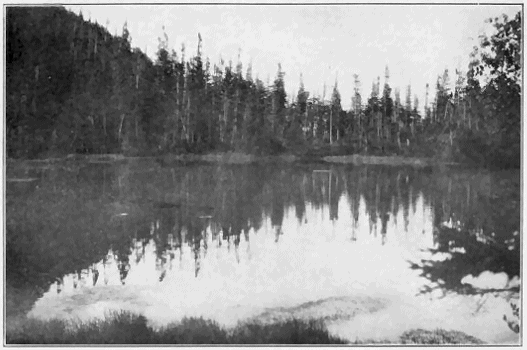
"Then the shadows are deep under the black growth that spires up all about the little placid sheet of
water, though it still reflects the sapphire blue of the clear sky above"
By the middle of the afternoon the shadows
of the heights begin to wipe the sunshine from
the upper end of the ravine and the shade of
the head wall marches grandly out, over the snow
arch and on, down stream. The long twilight
begins then and moves out to Hermit Lake by
six. Then the shadows are deep under the black
growth that spires up all about the little placid
sheet of water, though it still reflects the sapphire
blue of the clear sky above. The lake is,
indeed, a hermit, dwelling always apart in its
hollow among the spiring spruces, a tiny level
of water, strangely beautiful for its placidity
amid all the turmoil and grandeur about it.
From its boggy margin the morning of the day
that I reached it a big buck had drank and left
his hoof prints plain in the mud among the short
grasses. I waited long at evening for him to
come back, but the only signs of life about the
margins were the voices of three green frogs
that cried "t-u-g-g-g" to one another by turns.
One living long here might well measure the
flight of time on a clear afternoon and evening
by the changes of color in the lake. It is but
a shallow pool, but you look through the mud
of its bottom and see far below, by the inverted
spires of the marginal trees, into infinite depths
of a blue that is that of the sky but clarified and
intensified by the clear waters from which it
shines till it is to the eye as perfect and inspiring
as a clear musical note that leaps out of
silence to the longing ear.
As the day passes this color in the lake deepens
and changes in rhythmical cadences till twilight
brings a deep green, through which you see the
inverted ravine below you more clearly than
above. The one clear note has swelled into a
symphony of color through which floats one entrancing
tone, as sometimes lifts a clear soprano
voice out of the fine harmony of the chorus, the
pink of sunset fleece of clouds a mile above the
head wall of the ravine. As the day fades, so
does this high, clear tone, and the advancing
night deepens the green to a black that is silence,—a
silence that is velvety in body but scintillant
with the glint of stars.
Through all this symphony of changing color
a single hermit sang till the blackness of night
welled up to the spruce top in which he sat, and
as if to keep him company one or two wood
warblers piped from the very darkness beneath
where it seemed too dark for full songs, and
they sang fragments only, too brief for me to
identify the singers. From the lake itself came
the voices of the three green frogs, speaking
prophetically through the night with the single,
authoritative words of true prophets. Just for
a moment at dusk, from the icy waters of the
stream above the lake, came a guttural chorus
which I took to be that of tree frogs, which
croak in the woodland pools of Massachusetts
in March.
In the clear waters that run from the perpetual
winter of the snow arch I had seen two of these
frogs, of the regulation wood frog size and shape
but wonderfully changed in color. Instead of
the usual brown, here were frogs that were
cream white throughout save for a black patch
from the muzzle across either eye extending in
a faint line down the side nearly to the hind leg.
They seemed like spirit frogs with all the dross
in their epidermis washed out by the solvent
purity of that icy snow water in which they constantly
dwell. In these same pools of the icy
stream were caddice-fly larvæ which had woven
armor for themselves with a warp of the usual
spider-web threads and a filling of tiny stones.
But their stones were the scales of mica with
which the bottoms of the pools are paved, and
as they slowly moved about they were sheathed
in rainbows of sky reflections in these tiny surfaces.
Such wonders of beauty has the heart
of the high mountain for all that dwell in the
depths of its ravines.
In the blackness of full night the song of the
falling waters is the only sound that one hears
in the ravine. This is an ever-varying multitone
into which he who listens may read all the day
sounds he has ever heard. The still air takes
up the mingled voices of tiny cataracts and
tosses them from one wall to another, and there
are places along the path where this sound is
that of a big locomotive engine with steam up,
stopping at a station, the chu-chu of the air
brakes coming to the ear with a definiteness that
is startling. In other spots the echo of trampers'
voices sound till one is sure that a belated party
is on the trail and will arrive later to share the
hospitality of the camp.
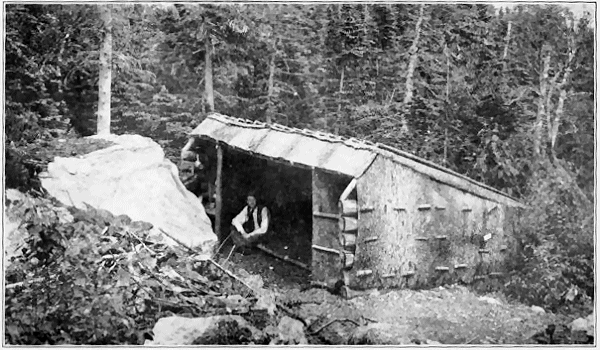
The Appalachian Mountain Club camp in Tuckerman's Ravine
Through it all rings the gentle lullaby of the wilderness, the drone
of all the winds of a thousand years in the spruce
tops and the crisp tinkle of clashing crystals
when an ice storm has bowed the white birches
till their limbs clash together in the xylophonic
music of winter. All these and more are in the
song which lulled me to slumber on the borders
of Hermit Lake,—a slumber so deep and restful
that I did not know when the porcupines came
and ate thirteen holes in the rubber blanket in
which I was wrapped to keep out the cold of the
snow arch which creeps down the ravine behind
the shadow of the head wall. Thirteen is an
unlucky number when it represents holes in one's
blanket, and the chill of interstellar space wells
deep in Tuckerman's Ravine toward morning of
a night in early July.
Twilight begins again by three o'clock. One
may well wonder what time the hermit thrush
has to sleep, he sings so long into the night and
begins again before the dawn is much more than
a dream of good to come. As the light grows
the castellated ridge of Boott's Spur shows
fantastic shapes against the sky, and the pinnacle
of the Lion's Head which looms so high above
Hermit Lake glooms sternly with grotesque
rock faces which are carved like gargoyles along
its ravineward margin. Beauty wreathes the
cliffs in this wildest of spots, but goblins grow
in the rock itself and peer from the wreaths to
make their friendliness more complete by gruesome
contrast. One wakes shivering and longs
for the sun of midsummer to come out of the
northeast over the slope of Mount Moriah and
warm him. Far below in Pinkham Notch the
night mists have collected in a white lake that
heaves as if beneath its blanket slept the giant
who carved the stairs over beyond Montalban
Ridge. But the giant too is waiting for the
sun, and though he stirs uneasily in his waking
he does not toss off the blanket till it shines well
over Carter Range and the day has fairly begun.
The ravine gets the morning early at Hermit
Lake. The widening slopes lie open to the light,
but the Lion's Head jealously guards the snow
arch and seems to withdraw its long shadow
with reluctance. By and by the sun shines full
upon the great white bank, and as at the pyramid
of Memnon strikes music from it with the
increasing tinkle of falling water.
By this time the stirring of the giant's blanket
has tossed off woolly fleeces from its upper side,
and these climb toward the ravine in wraiths of
diaphanous mist that now dance rapidly along
the tree tops, now linger and shiver together as
if fearful of the heights which they essay.
These follow me as I toil laboriously up the almost
perpendicular slope along the snow margin
toward the head wall, and by the time I have
worked around the dangerous glacial mass and
surmounted the cliffs they are massed along the
cold slope and seem to mingle with the snow
into an opaque, nebulous mystery.
For a long time these do not get beyond the
brow of the cliff. Now they bed down together,
as dense and as full of rainbow colors under the
sun as is mother-of-pearl, again little fluffs dare
the climb toward the summit, fluttering with
fear as they proceed and fainting into invisibility
in the thin air that flows across the alpine
garden. Tiny streams from the base of the high
cone slip down the rocks to them and whisper
in soft voices that they need have no fear, but
whether it is fright or the compelling power
of the sun that now shouts mid morning warmth
over Carter Notch, these thin pioneers hesitate
and vanish as the main body sweeps up from the
Crystal Cascade and Glen Ellis Falls and fills
all the lower ravines with that white blanket that
began to stir at daybreak so far below. The
giant is awake, has tossed his bed-clothes high
in air, and is striding away along the Notch behind
their shielding fluff.
I fancy him clumping up the Gulf of Slides
and over to the ravines of Rocky Branch on his
way to see if those stairs he built are still in
order in spite of the disintegrating forces so
steadily at work pulling the mountains down.
Listening on the top wall of Tuckerman's I can
hear these forces at work and do not wonder
that he is uneasy. The steady flow of white
water in a million tiny cascades is filing the rocks
away all day long. But the water does far more
than this. It seeps down into the cracks in the
great cliffs, swells there with the winter freezing,
and presses the walls apart.
"The giant is awake, has tossed his bed-clothes high in air, and is striding away along the notch behind
their shielding fluff"
It dissolves and excavates beneath hanging rocks and cunningly
undermines them till gravity pulls them
from their perch and sends them down to swell
the great masses of débris all along the bottoms
of the ravine sides. Sitting on the head wall
I hear one of them go every few minutes. Often
it is only the click and patter of a pebble obeying
that ever present force as it bounds from
ledge to ledge down the wall. But sometimes
a larger fragment leaps out at the mysterious
command and crashes down, splintering itself or
what it strikes on the way to the bottom. My
own climbing feet dislodged many that have
caught on other fragments, and in the steeper,
more crumbled portions of the path each climber
does his share in producing miniature slides.
Except on rare occasions the fall of the mountains
is slight, but it is continually going on
wherever peaks rise and cliffs overhang.
Not till the mists out of the Great Gulf over
on the other side of the mountain had swept
around the base of the summit cone and hung
trailing streamers down into Tuckerman's
Ravine did the masses that filled it with white
opacity to the top of the snow arch scale the
head wall. Then they came grandly on and met
and mingled with their kind till Boott's Spur
disappeared and all the long ranges of mountains
to southward were wiped out by an atmosphere
that, with the sun lighting it, was like the
nebulous luminosity out of which the world was
originally made. Behind me they climbed the
central cone, but slowly, almost, as I did. My
trouble was the Jacob's ladder of astoundingly
piled rocks of which the way is made. Theirs
was a little cool wind that came down from the
very summit and which steadily checked them,
though they boiled and danced with bewildering
turbulence against it. They wiped out the solid
mountain behind me as I went till the cone and
I seemed to be floating on a quivering cloud
through the extreme limits of space.
Climbing this Tuckerman's Ravine path one
gets no hint of the buildings on the summit.
With the clouds below me and the rocks above
I was isolated in space on a cone of jagged
rock whose base was continually removed from
beneath me as I climbed. It seemed as if, when
I did reach that high pinnacle, the last rock
might fade from beneath my feet and leave me
floating in the white void that came so majestically
on behind me. We reached the top together,
but the crisis was not so lonely as I had
imagined. Instead, I found myself walled in
by opaque mists indeed, but still with much solid
rock beneath my feet and a friendly little village,
a railroad track and station, a stage office
and stables, and an inn at hand, all with familiar
human greetings for the weary traveller. You
may come to the summit by many paths, by train,
carriage or motor, but no trail has more of
beauty, or indeed more of weirdness if the fluff
of the giant's blanket follows you to the summit,
than the three miles and a half of steady
climbing by way of Tuckerman's Ravine.
VIII ON MOUNT WASHINGTON
Sunny Days and Clear Nights on the Highest Summit
The dweller on the top of Mount Washington
may have all kinds of weather in the twenty-four
hours of a July day, or he may have a
tremendous amount, all of one kind, extending
through many days. It all depends on what
winds Father Æolus keeps chained, perhaps in
the deep caverns of the Great Gulf, or which
ones he lets loose to rattle the chains of the
Tip Top House. My four days there were such
as the fates in kindly mood sometimes deal out
to fortunate mortals. The land below was in
a swoon of awful heat. People died like flies
in cities not far to the southward. The summit
had a temperature of June, and the wind that
drifted in from Canada made the nights cool
enough for blankets; all but one. The night
before the Fourth we perspired, even in this
wind of Hudson Bay, and the habitués of the
hilltop were properly indignant. They had snowballed
there for a brief hour on the July Fourth
of the year before and these sudden changes
were disquieting.
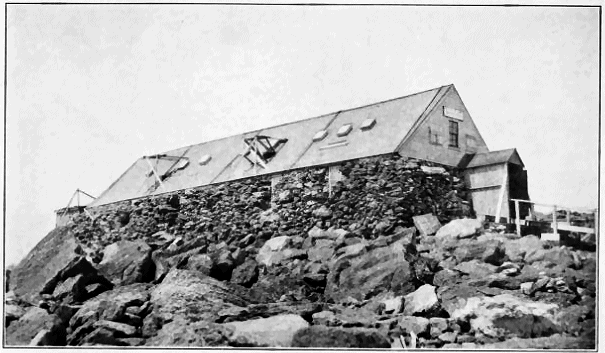
"It all depends on what winds Father Æolus keeps chained, perhaps in the deep caverns of the Great Gulf,
or which ones he lets loose to rattle the chains of the Tip Top House"
Of these four gems of days the first was a
pearl, two were amethystine, and the last was
of lapis lazuli. The morning of the pearl broke
after light rains in the valley below, the air so
clear that the city of Portland lifted its spires
on the eastern horizon just before sunrise and
the blue water of Casco Bay flashed beyond it.
Yet the nearer valleys were shrouded in the
white mists that were mother-of-pearl, a matrix
that gradually rose and blotted out the green
and gray of granite hilltops below till the summit
was a great ship, rock-laden, ploughing
through a white tumultuous sea whose billows
were fluffy clouds like those on which Jupiter
of old sat and dispensed judgment on mankind.
I know of nothing so much like this sea of white
cloud surface seen from above as is the sea of
Arctic ice under a summer sun, its white, sun-softened
expanse crushed into flocculent pressure
ridges of frozen tumult stretching as far
as the eye can reach. Yet this is different in
its strange beauty, for the Arctic ice changes its
form only slowly, while this fleecy sea, seemingly
so stable to the fleeting glance, changes shape
before the next look can be given. No breath
of wind may fan your brow on the summit, but
the clouds below you tread a stately minuet, advancing,
retreating, meeting and dividing, now
a white Arctic sea, again a swiftly dignified
dance by ghostly castles in Spain.
Often the near mists close in upon the summit
and make all opaque, and the gray, shadowy
hand of the cloud lies against your cheek and
leaves a smear of cool moisture when it is withdrawn.
On that morning when the summit and
the day were bosomed together in a white pearl
I saw the wayward moods of an imperceptible
wind ordering this dance of the clouds. It
passed down from the peak by the path that
leads over the range to Crawford Notch, waving
one line of mists eastward from the ridge
until Boott's Spur and Tuckerman's Ravine
stood clearly revealed, while on the west an
obedient white wall stood, wavering indeed, but
holding its ground from the margin of the path
high into the sky toward the zenith. For nearly
half an hour any alpinist climbing over the head
wall of Tuckerman's in sunshine would have
seen his way clearly to this Crawford path, and,
going westward, have stepped into the white
mystery of the mists on the farther verge.
Again the imperceptible winds beckoned and
the clouds whirled up from Pinkham Notch and
blotted out the spur and the ravine, pirouetting
up to meet their partners while the latter retreated,
fluttering lace skirts behind, the high-walled
chasm of clear space between them passing
over the ridge and swinging north until met
by an eruption of white dancers out of the Great
Gulf and across the railroad track. Then all
whirled together up the rough rock tangle of
the central cone and blotted out the world in a
pearly opacity.
The clouds that morning were born in the
lowlands and ascended to the summit from all
sides, out of Huntington and Tuckerman
Ravines, out of Oakes Gulf and Great Gulf and
up from Fabyan's by way of the Base Station
and the Mount Washington Railroad, enfolding
the summit only after they had shown the marvels
of their upper levels all about the foundations
of the central cone. Then, after the white
opalescence of the conquest of the peak the
whirling dervishes above, for an hour or two,
now occluded, again revealed, what was below.
For half an hour they danced along the northern
peaks, now hiding, now disclosing portions
of them, but always during that time showing
the peak of Adams, a clearly defined purple-black
pyramid, framed in their fleece. After
that for a long time they lifted bodily for ten-minute
spaces, revealing another body of mists
below, their upper surface far enough down so
that the castellated ridge of Boott's Spur, Mount
Monroe, Mount Clay and Nelson Crag stood
out above them.
Here were clouds above clouds, the upper
levels whirling in wild dances, fluttering together
and again parting to let the sun in on the summit
and on the levels below whence rose fleecy
cloud rocks of white, tinged often with the rose
of sunlight, mountain ranges of semi-opaque
mists that changed without seeming to move
and showed oftentimes a curious semblance in
white vapor to the land formation as it is revealed
below on a clear day. Out of these lower
clouds came sometimes sudden jets of vapor, as
if the winds below found fumaroles whence
they sent quick geysers of mists, vanishing
fountains of a magic garden of the gods. Old
Merlin, long banished from Arthur's Court in
the high Welsh hills, may well have found a
retreat in this new world Cærleon, nor did ever
knight of the Round Table see more potent
display of his powers of illusion and evasion
than were here shown for any man who had
climbed the high peak on that day of pearl
cloud magic.
Afterward came two days of fervent sun on
clear peaks that stand all about the horizon from
Washington summit, half islanded in an amethystine
heat haze, as beautiful, seen from the
wind-swept pinnacle, as if old Merlin after a
day of tricks with pearls had ground all the
gems of his magic storehouse to blue dust that
filled the valleys of all the mountain world. On
those days few men climbed the peak, but all
the butterflies of the meadows and valleys far
below danced up and held revels in the scent
of the alpine plants, then in the full joy of their
July blooming. The more distant valleys were
deeply hazed in this amethystine blue, but the
nearer peaks and plateaus stood so clear above
them that it seemed as if one might leap to the
lakes of the clouds or step across the great
gulf to Jefferson in one giant's stride. I have
heard a man on the rim of the Grand Cañon
in Arizona declaring that he could throw a stone
across its thirteen miles. So on those days in
the high air miles seemed but yards, and only
in the actual test of travel did one realize how
far the feet fall behind the eye in the passage
of distances.
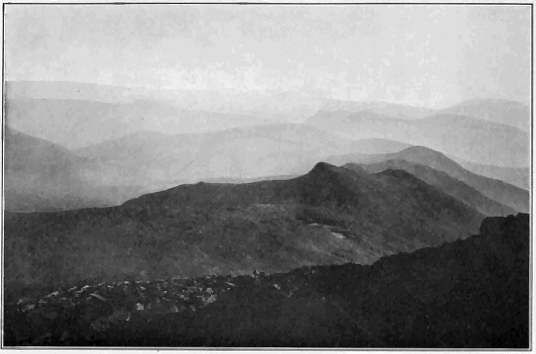
"The more distant valleys were deeply hazed in this amethystine blue, but the nearer peaks and plateaus
stood so clear above them that it seemed as if one might leap to the Lakes of the Clouds or
step across the Great Gulf to Jefferson in one Giant's stride."
At nightfall one realized how that heat haze
not only possessed the valleys but the air high
above them, for the sun, descending, grew red
and dim and finally was swallowed up in the
mists of his own creating long before he had
reached the actual horizon's rim. Under his
passing one lake after another to westward
flashed his mirrored light back in a dazzling
gleam of silver, then faded again to become a
part of the blue dust of the distance. By their
flashes they could be counted, and it was as if
each signalled good night to the summit as the
day went on. Eastward the purple shadow of
the apex moved out across the Alpine garden,
joined that of the head wall of Huntington Ravine,
and, flanked by those of the Lion's Head
and Nelson Crag, went on toward the horizon.
Clearly defined on the light-blue haze where the
sun's rays still touched, this deep pyramid of
color moved majestically out of the Notch and
up the slope of Wildcat Mountain, leapt Carter
Notch and from the high dome of the farther
summit put the Wild River valley in shadow as it
went on, up Baldface and on again across the
nearer Maine ranges, till it set its blunt point
on the heat-haze clouds along the far eastern
horizon. Nothing could be more expressive of
the majesty of the mountain than to thus see
its great shadow move over scores of miles of
earth and on and up into the very heavens.
It was as if God withdrew the mountain for
the night into the sky, leaving the watcher on
that great ledge-laden ship which is the very
summit, plunging on over dark billows with the
winds of space singing wild songs in the rigging.
Beneath is the blue-black sea of tumultuous
mountain waves that ride out from beneath
the prow and on into the weltering spindrift
haze of distance where sea and sky are one. In
the full night the winds increase and find a
harp-string or a throat in every projection of
the pinnacle ledges whence to voice their lone
chanteys of illimitable space. It is the same
world-old song that finds responsive echoes in
man's very being but for which he can never
find words, the chantey of the night winds that
every sailor has heard from the fore-top as the
ship plunges on in the darkness when only the
dim stars mark the compass points and the very
ship itself is merged far below in the murk of
chaos returned. What the night may be during
a storm on this main-top of the great mountain
ship only those who have there endured it may
tell; my nights there were like the days, fairy
gifts out of a Pandora's box that often holds
far other things beneath its lid.
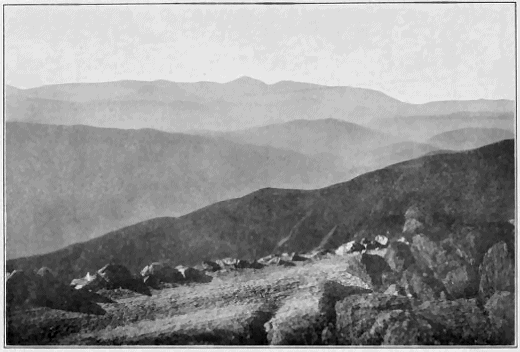
"Dawn on the mornings of those days was born out of the sky above the summit, as if the fading
stars left some of their shine behind them"
Dawn on the mornings of those days was
born out of the sky about the summit as if the
fading stars left some of their shine behind
them, a soft, unworldly light that touched the
pinnacles first and anon lighted the mountain
waves that slid out from under the prow of the
ship and rode on into the flushing east. As the
heat haze at night had absorbed the red sun in
the west, so now it let it gently grow into being
again from the east. In its crescent light he
who watched to westward could see the mountain
come down again out of the sky into which
it had been withdrawn. Out of a broad, indistinct
shadow that overlaid the world it grew
an outline that descended and increased in definiteness
till the apex was in a moment plainly
marked on the massed vapors that obscured the
horizon line. Down these it marched grandly,
touching indistinct ranges far to westward, more
clearly defined on the Cherry Mountains and
the southerly ridges of the Dartmouth range,
and becoming the very mountain itself as its
point touched the valley whence flows Jefferson
Brook and the slender thread of the railway
climbs daringly toward the summit.
Below in a thousand sheltered valleys the
hermit thrushes sang greetings to the day. Far
up a thousand slopes the white-throated sparrows
joined with their thin, sweet whistle, and
higher yet the juncos warbled cheerily, but no
voice of bird reaches the high summit. The
only song there is that of the wind chanting still
the thrumming runes of ancient times, sung
first when rocks emerged out of chaos and
touched with rough fingers the harp strings of
the air. To such music the light of day descends
from above, and the shadows of night
withdraw and hide in the caves and under the
black growth in the bottoms of ravines and
gulfs. Rarely does one notice this music in the
full day. Then the rough cone even is a part
of man's world, built on a sure foundation of
the familiar, friendly earth. It is only the darkness
of night that whirls it off into the void of
space and sets the eerie runes in vibration. Few
nights of the year are so calm there that you
do not hear them, and even in their gentlest
moods they come from the voices of winds lost
in the void, little winds, perhaps, rushing shiveringly
along to find their way home and whistling
sorrowfully to themselves to keep their
courage up.
Man comes to the summit at all hours and by
many paths. Often in that darkest time which
precedes the dawn one may see firefly lights approaching
from the northeast, bobbing along in
curious zigzags. These will-o'-the-wisps are pedestrians,
climbing by the carriage road to greet
the first dawn on the summit and watch the sun
rise, carrying lanterns meanwhile lest they lose
the broad, well-kept road and fall from the Cape
Horn bend into the solemn black silence of the
Great Gulf. The voices of these are an alarm
clock to such as sleep on the summit, calling
them out betimes to view the wonders they seek.
By day men and women appear on foot from
the most unexpected places. The Crawford and
Gulf Side trails, Tuckerman's and the carriage
road bring them up by accepted paths, but you
may see them also clambering over the head wall
of Huntington's or the Gulf, precipitous spots
that the novice would think unsurmountable.
These are the "trampers," as the habitués of
the mountain summit call them. But the carriage
road brings many who ride luxuriously
up for four hours behind two, four or six horses,
or flash up in less than an hour to the honk of
automobile horns and the steady chug of gasolene
engines. The old-time picturesque burros
that patiently bore their riders up the nine miles
of the Crawford trail have gone, probably never
to return, and the horseback parties once so
common are now rare. But by far the greater
numbers climb the mountain by steam. From
the northerly slope of Monroe, over beyond the
Lakes of the Clouds, I watched the trains come,
clanking caterpillars that inch-worm along the
trestles of the cogged railroad, clinking like
beetles and sputtering smoke and steam as only
goblin caterpillars might, finally becoming
motionless chrysalids on the very summit. From
these burst forth butterfly crowds that put to
shame with their raiment the gauzy-winged
beauties that flutter up the ravines to enjoy the
sweets of the Alpine Garden. Then for a brief
two hours on any bright day the bleak summit
becomes a picnic ground, bright with gay crowds
that flutter from one rock pinnacle to another
and swirl into the ancient Tip Top house to buy
souvenirs and dinner, restless as are any lepidoptera
and as little mindful of the sanctity of
this highest altar of the Appalachian gods. Soon
these have reassembled once more in their chrysalids
that presently retrovert to the caterpillar
stage and crawl clanking and hissing down the
mountain, inching along the trestles and vanishing
anon into the very granite whence you
hear them clanking and sputtering on. Amid
all the weird play of nature in lonely places the
summit has no stranger spectacle than this.
The day of lapis lazuli began with a break
in the intense heat, a day on which cumulus
clouds rolled up thousands of feet above the
summit in the thin air and cast their shadows
before them, to race across the soft amethyst
of the miles below and deepen it with their rich
blue out of which golden sun-glints flashed
still, racing shifting breaks in the cloud masses
above. The wind increased in velocity toward
mid-afternoon and cumulus massed in nimbus
on the far horizon to the northwest out of which
the flick of red swords of lightning and the
battle roar of thunder sounded nearer and
nearer. Mightily the black majesty of the storm
moved up to us, wiping out earth and sky in
its progress, the rolling edges of its topmost
clouds still golden with the color of the sun that
sank behind them. Here was a glory such as
day nor night, sunrise nor sunset, had been able
to show me.
The pagan gods of the days long gone seemed
to come forth out of the summits far to the
northwest and do battle, but half-concealed by
their clouds. Swords flashed high and javelins
flew and the clash of shields and the rumble
of chariot wheels came to the ear in ever increasing
volume as the tide of battle swept on
and over the summit. A moment and we should
see the very cohorts of Mars himself in all their
shining fury, but father Æolus let loose all the
winds at once from his caverns, Jupiter Pluvius
opened wide the conduits of the clouds and the
world, even the very summit thereof, was
drowned in the gray tumult of the rain.
IX MOUNT WASHINGTON BUTTERFLIES
Filmy Beauties to be Found in Fair Weather on
the Very Summit
The height of the butterfly season comes to
the rich meadows about the base of Mount Washington
in mid-July. The white clover sends its
fragrance from the roadside and the red clover
from the deep grass for them, and all the meadow
and woodland flowers of midsummer rush into
bloom for their enjoyment, while those of an
earlier season seem to linger and strive not to
be outdone. The cool winds from the high summits
of the Presidential Range help them in this,
and even in the summer drought the snow-water
from the cliffs and the night fogs of the ravines
keep them moist and fresh. No wonder that
butterflies swarm in these meadows and even
climb toward the summits along the flowery paths
laid out for them up the beds of dwindling mountain
torrents and under the cool shadows of
forests impenetrable to the sun. Butterflies come
to know woodland paths as well as man does and
delight to follow them.
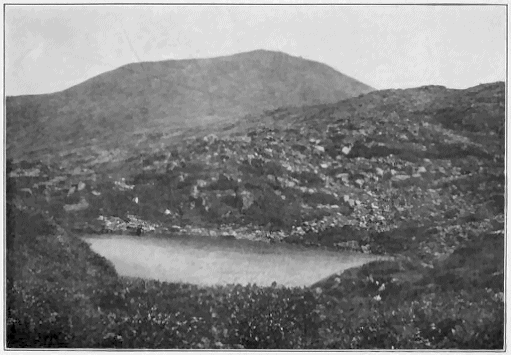
Butterfly-time on Mount Washington, the summit seen over the larger of the Lakes of the Clouds
Of a July day the butterflies and I journeyed
together up the flower-margined carriage
road that leads to the summit of Mount Washington.
They may have been surprised at the
pervasiveness of my presence. I am sure I was
at theirs, which lasted as long as the marginal
beds of wild flowers did.
To climb this smooth road leisurely, on foot,
is always to marvel at the engineering skill which
found so steadily easy a grade up such an acclivity
and so cunningly constructed it that it
has been possible to keep it in good condition
all these years—it was finished in 1869—in
spite of summer cloudbursts and the gruelling
torrents of melting snow in early spring. One
is well past the first mile post before he realizes
that he is going up much of a hill. The rise
is that of an easy country road and might be
anywhere in the northern half of New England
from all outside appearances.
The striped moosewood and the mountain
moosewood growing by the roadside under white
and yellow birch and rock maple suggest the latitude.
The white admiral butterflies emphasize
the suggestion. Rarely have I found these plants
or this insect south of the northern boundary of
Massachusetts. The white admirals flip their
blue-black wings with the broad white epaulettes
up and down the road in numbers. Butterflies
of the shady spots, they find this highway where
the trees arch in and often meet above peculiarly
to their taste. Yet the meadow-loving fritillaries
outnumber the admirals ten to one. Not even
among the richly scented clover of the flats below,
not even in the full roadside sun on the milkweed
blooms which all butterflies so love, are
they so plentiful. I suspect them of having a
strain of adventurous blood in their veins, such
as gets into us all when among the mountains
and sets us to climbing them, and later observations
bear out the suspicion. It was a day
to lure butterflies to climb heights, still, steeped
in fervid sun heat, and redolent of the perfect
bloom of a hundred varieties of flowering
plants.
At first I thought these all specimens of the
great spangled fritillary, Argynnis cybele, but
they gave me such friendly opportunities for
close examination that I soon knew better. The
greater number of these mountain climbing
butterflies were a rather smaller variety with a
distinct black border along the wings, Argynnis
atlantis, the mountain fritillary. They swarmed
along the narrow shady road as plentiful as the
blossoms of field daisies and blue brunella. With
playful necromancy they made the daisies change
kaleidoscopically from gold and white to gold and
black, or they folded their wings and set the
flower stalks scintillant with silver moon spangles.
So with the blue brunella blooms. They
flashed from close spikes of modest blue flecks
to great four-petalled flowers of gold and silver
and black, a blossom that would make the fortune
of any gardener that could grow it, and
presto! the miracle of bloom rose lightly into
the air on fluttering wings and the stalk held
only the shy blue of the brunella after all. Such
is the magic of the first mile of the ascent, which
might be any easy rise under the deciduous shade
of most any little New Hampshire hill, so far
as appearances go.
During the second mile spruces slip casually
into the roadside. They do it so unassumingly
that you hardly know when, they and the firs.
But the swarms of butterflies go on up the grade
and through the dense foliage you still glimpse
no mountain tops. With them shines occasionally
the pale yellow of Colias philodice, and
little orange skippers skip madly from bloom to
bloom of the wayside flowers that still fill the
margins from woods to wheel tracks. Clearwing
moths buzz and poise like miniature humming
birds, and with them in the deeper shadow
flits a small white moth so delicately transparent
and so ethereally pure in color that when he lights
on a leaf the green of it shines through his wings.
These first two miles of the carriage road
are amid scenes of such sylvan innocence that
a partridge with her half-grown brood hardly
feared me as their path crossed mine, and they
flew only when I approached very near them.
Cotton-tailed rabbits hopped leisurely across in
front of me, in no wise excited by my approach,
and though the chipmunks whistled shrilly and
dived into their holes before I touched them, they
waited almost long enough for me to do it. The
roadside flowers climbed bravely up the second
mile among the wayside grasses, white clover,
blue-eyed grass and golden ragwort, with the
daisies, these not so plentiful as below, and the
gentle brunella, and out of the woods came as
if to meet and fraternize with them the rose-veined
wood sorrel, its pure white petals seeming
even more diaphanous because of the rose-veining.
The heart-shaped, trifoliate leaves of this
lovely little plant which climbs the great mountain
on all sides are not those of the veritable
shamrock, perhaps, but they are enough like them
to prove to a willing mind that St. Patrick must
surely have climbed Mount Washington in his
day, and that this gentle insignia of his clan
remained behind to prove it. It is a flower of
shaded mossy banks in deep evergreen woods,
where its tender white flowers, with their beautifully
rose-shaded, translucent petals, delight the
eye along the lower and middle reaches of all
paths that lead to the summit.
Toward the end of the second mile one realizes
that he is climbing high. Through the trees to
westward flit glimpses of the deep valley of the
Peabody River, when he has risen, and beyond
it the misty blue wall of the Carter Range, rising
ever higher behind him as he goes up. The
fritillaries come on, but the admirals drop behind
to be seen no more, their places taken by an
occasional angle-wing, Grapta interrogationis or
Grapta comma. As the road rises the wayside
flowers too fall behind, leaving lonely places,
though well up to the Halfway House, nearly
four miles up, white and pink yarrow is to be
found, flanked by bunchberry blooms and the
lovely greenish yellow of the Clintonia. This has
half-ripened berries in the lowlands at the base,
but toward the summit of the mountain it blooms
till well into the middle of July, perhaps later.
The butterflies fall behind as the roadside flowers
do, yet now and then a mountain fritillary goes
by and almost at the Halfway House I saw the
most superb Compton tortoise, Vanessa j-album,
that I have met anywhere. Below the Halfway
House young spruces have crowded into the roadside
to the very wheel tracks, and the last of the
lowland blooms has vanished. On the day that
I came looking for them the lowland butterflies
had vanished too, and the road seemed bare and
desolate for two or three miles, indeed until the
alpine plants of the high plateau began to appear,
and with them the Arctic butterfly that makes this
summit home, the curious little Oeneis semidea.
I had thought to find this, "the White Mountain
butterfly," the only variety of the plateau
and the summit cone, but in this the day and
the place had more than one surprise in store
for me. There are many days in summer when
even the hardiest, strongest-flying lowland butterfly
would not be able to scale the summit
because of wind and cold, but this day had only
a gentle air drifting in from the north, and the
heat, which was a killing one below, was there
tempered to that of a fine June day. The sudden
bloom of the alpine plants had passed its
meridian, but many were still in good flower.
All along on the head wall of the Tuckerman
Ravine and out upon the Alpine Garden were
the pink, laurel-like cups of the Lapland azalea.
There was the Phyllodoce cærulea with its urn-shaped
corolla turning blue as it withers, the
three-toothed cinquefoil, Potentilla tridentata
which looks to the careless glance like a little
running blackberry vine with its star of white
bloom, and everywhere low clumps of the lovely
little mountain sandwort, Arenaria grœnlandica,
the only petal-bearing plant that dares the very
summit, where its white, cup-shaped blooms make
the bleak rocks glad.
On the Alpine Garden and at the ravine heads
are lower level flowers which come up and mingle
with these. The buttercup-like blossoms of
the mountain avens flash their rich yellow. The
Labrador tea puts out its white umbels and sends
spicy fragrance down the wind. The houstonia
grows bravely its little white, four-pointed stars
with their yellowish centre, and cornel and even
Trientalis, the American star-flower, grow from
the tundra moss and make a brave show in that
bleak spot. Boldest of all is the great, rank-growing
Indian poke, with its erect stem of big
green leaves and its topping spike of greenish
bloom. High up to the angles of the rock jumble
of the cone, wherever the water comes down into
the Alpine Garden, this climbs with a bold assurance
that no other lowland plant equals. It
is plentiful in the neighborhood of the Lakes of
the Clouds and high on the head wall of the
Tuckerman Ravine it sprouts under the receding
snow, blanched like celery.
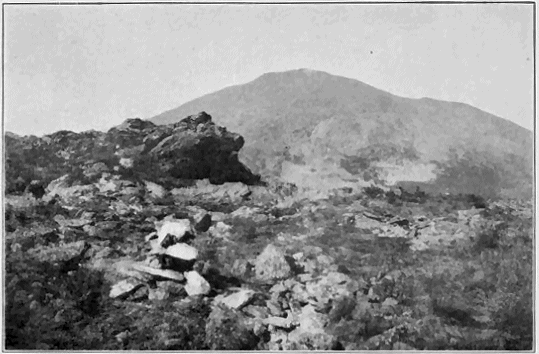
The fantastic lion's head which, carved in stone, guards the trail along Boott's Spur toward the
summit cone of Washington
All these and more were in bloom on the
plateau that supports the high cone of Washington
summit on that day, and up to them had come
the lowland butterflies. Most plentiful were the
mountain fritillaries, but often a great spangled
fritillary spread his wider wing above the head
wall of Huntington or Tuckerman and soared
along the levels. With these was an occasional
angle-wing, Grapta interrogationis and Grapta
progne, feeding in the larval stage on the leaves
of the prickly wild gooseberry which is common
well up to the base of the summit cone. Strange
to relate, the beautiful, hardy, and common
mourning cloak was not to be seen on the days
in which I hunted butterflies about the summit,
but his near relative, the Compton tortoise,
Vanessa j-album, was there, and the smaller but
lovely little Vanessa milberti, with his wings so
beautifully gold-banded, I saw frequently. Milbertis
flew up out of the Great Gulf toward the
summit, and one afternoon I found one of them
carefully following the Crawford trail down,
winding its every turn a foot above the surface
as if he knew that it was made to show the
way. To the very summit, circling the Tip Top
House, came big, red-winged, black-veined monarchs,
and all the varieties I had seen in the
Alpine Garden came up there too, most numerous
of all being the mountain fritillaries. I take it
that no one of these lowland butterflies is bred
at these high levels, but that all wander up when
the sun is bright and the wind still enough to
permit the excursion.
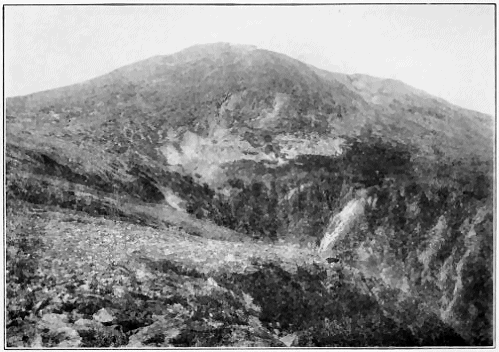
"Semidea persistently haunts the great gray rock-pile which is the summit cone"
Most interesting of all to the lepidopterist is
the one Arctic butterfly of our New England
fauna, Oeneis semidea, "The White Mountain
Butterfly," which might be perhaps better called
in common parlance "The Mount Washington
Butterfly," as it is commonly believed to be restricted
in its habitat, so far as New England is
concerned, to the high summit cone of Mount
Washington. Holland so states in his excellent
butterfly book. As a matter of fact the insect
is plentiful over a rather wider range. I found
it along the Crawford trail out to the Lakes of
the Clouds and Mount Monroe, as well as along
the lawns and Alpine Garden and down the carriage
road far below the summit cone. It is
also found at similar altitudes on Jefferson,
Adams and Madison, its habitat being rather the
high peaks of the Presidential Range than Mount
Washington alone.
But semidea persistently haunts the great gray
rock pile which is the summit cone. Wherever
you climb, there it flutters from underfoot like
a two-inch fleck of gray-brown lichen that has
suddenly become a spirit. Alighting, it turns
into the lichen again. In rough weather the
other butterflies go down hill into the shelter of
the ravines, but this one has learned to fight
gales and midsummer snow storms and hold
patriotically to its native country. Even in still
weather when disturbed it skims the surface of
the rock in flight, seeming to half crawl, half
fly, lest a gale catch it and whirl it beyond its
beloved peak. Its refuge is the little caverns
among and beneath the angled boulders, and
when close pressed by a would-be captor it flies
or climbs down into these as a chipmunk would,
and remains there till the danger has passed. It
seems to be born of the rocks and to flee to its
mother as children do when afraid of anything.
It is our hardiest mountaineer. Neither beast
nor bird dares the winter on this high summit.
Yet here, winter and summer, is the home of this
boreal insect which in the egg or the chrysalid
withstands cold that often goes to fifty below
Fahrenheit, and is backed by gales that blow
a hundred miles an hour. No wonder this little
but mighty butterfly takes the colors of the rocks
that are its refuge.
It is the only easily noticed form of animated
wild life that one is sure to find on the very
summit, even in summer. Hedgehogs sometimes
come to the door of the Tip Top House in summer
weather and have to be shooed away, and
gray squirrels have been seen there; but these,
like the tourists, are casual wanderers from the
warmer regions below. I believe the only bird
that makes its summer home on the cone is the
junco, though I heard song-sparrows and white-throats
sing down on the levels of the plateau,
at the Alpine Garden and about the Lakes of the
Clouds. The juncos breed about these next highest
levels in considerable numbers, and one pair
at least bred this summer high up on the summit
cone, about a third of the way down from the top
toward the Alpine Garden. Like the Arctic butterflies,
the refuge of this pair was the interstices
of the rocks themselves, the nest being actually
a hole in the ground, beneath an overhanging
jut of ledge where the moss from below crept
perpendicularly up to it, but left a gap two inches
wide into which the mother bird could squeeze.
It was almost as much of a hole in the ground
as that in which a bank swallow nests, absolutely
concealed, and protected from wind or down-rush
of torrential rain.
Rare butterflies are not the only insects which
tempt the entomologist to the very summit of
Mount Washington. On my butterfly day there
I found two members of the Cambridge Entomological
Society dancing eagerly about the
trestle at the terminus of the Mount Washington
Railway, collecting beetles, of which they had
hundreds stowed away in their cyanide jars.
I'll confess that all beetles look alike to me, but
these grave and learned gentlemen were ready
to dance with joy at their success of the afternoon
before at the Lakes of the Clouds, where
each had captured one Elaphrus olivaceus. The
name sounds like something gigantic; as a matter
of fact, olivaceus is a tiny, dark, oval-shaped
beetle, on which these enthusiasts saw beautiful
striæ and olive-yellow stripes. Having the eye
of faith I saw them too, but only with that eye.
Together we went hunting the Alpine Garden
for Elaphrus lævigatus, another infinitesimal
prodigy of great rarity and scientific interest,
but the omens were bad and lævigatus escaped.
Such are some of the magnets with which this
mighty mountain top draws men and women
from all over the world, to spend perhaps
a day, perhaps a summer, among its clouds,
its scintillant sunshine and its ozone-bearing
breezes.
Storm winds drive most of us below. When
they blow, all the beautiful lowland butterflies set
their wings and volplane down to the shelter of
the valleys behind the jutting crags and the head
walls. The chill of descending night as well
drives these light-winged creatures off the hurricane
deck of this great rock ship of the high
clouds. But the thousands of hardy Oeneis
semidea simply fold their lichen gray wings and
creep into miniature caverns of the jumbled
granite, waiting, warm and secure, for the light
of the next sunny day.
X MOUNTAIN PASTURES
Their Changing Beauty from Low Slopes to
Presidential Plateaus
On the mountain farms the cultivated fields
hold such levels as the farmer is able to find.
Often on the roughest mountain side he has
found them, treads on the stairways of the hills
whose risers may be perpendicular cliffs or slide-threatening
declivities. These last are for woodland
in the farm scheme, if tremendously rough,
or if they have roothold for grass and foothold
for cattle they are pastures. Thus it is the
pastures rather than the cultivated lands that
aspire, and from their heights one looks down
upon the farm-house and the farmer and his
men at work in the hay fields. The stocky,
square-headed, white-faced cattle may well feel
themselves superior to these beings far below
who groom and feed them, and from their wind-swept
ridges I dare say they have the Emersonian
thought, even if they have never learned
the couplet:
"Little recks yon lowland clown
Of me on the hilltop looking down."
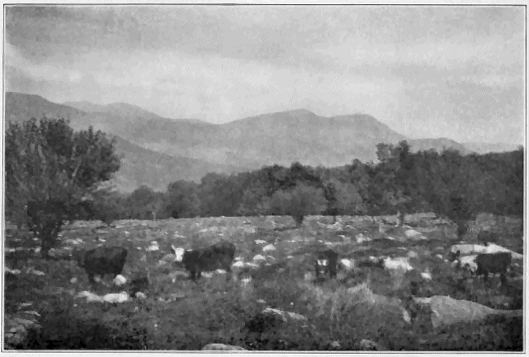
"The stocky, square-headed, white-faced cattle may well feel themselves superior to these beings
far below who groom and feed them"
These mountain cattle are of many breeds,
according to the fancy or the fortune of their
owner. Probably many of them are mongrels
whose ancestors it would be hard to determine,
yet there seems to be a strong resemblance in
some to those cattle one sees on Scottish hills
and in the highlands of the English border, and
one wonders if here are not lineal descendants
of the stock which came in with the early English
settlers. At least the white-faced ones have
been settled on the mountain pastures long
enough to become part and parcel of them. Except
when in motion they so fit their rocky surroundings
as to be with difficulty picked out
from them by the eye. One might say the pasture
holds so many hundred rocks and cattle, but
which is which it takes a nice discernment to
decide. Especially is this true when the herd
stands motionless and regards the wandering
stranger. Then the red bodies are the very color
shadows of the green pasture shrubs and the
white faces patches of weather-worn granite.
Sometimes it is disconcerting to tramp up to such
a rock in such a shadow and have it suddenly
spring to its feet with an indignant "ba-a" and
flee to the forest with much clangor of a musical
bell.
Most of the mountain cattle wear this bell,
which is but a hollow, truncated, four-sided
pyramid with a clapper hung within. It does
not tintinnabulate, but "tonks" with a tone that
is low, but carries far and seems always a part
of the woodland whence it so often sounds,—woodland
in which pasture and cattle so continually
merge. In its mellow tones the clock of
the pasture strikes, marking the lazy hours for
the loving listener. In the time when the slender
thread of the old moon disputes with the new
dawn the honor of lighting the high eastern
ridges, I hear it chorusing in mellow merriment
as the herd winds up the lane from the big old
barn. It briskly rings the changes of the forenoon
as the herd crops eagerly among the rocks,
the slowing of its tempo marking the appeasing
of hunger. Through the long, torrid hours of
mid-day it sleeps in the deep shadow of the
wood, toning only occasionally as the drowsy
bearer moves. Then with the coming of the
afternoon hunger I hear it again, moving down
the mountain with the day, to meet the twilight
and the farmer at the pasture bars.
As these mountain cattle are curiously different
in aspect and carriage from those of our
lowland pastures in eastern Massachusetts, so
the pastures themselves differ widely in more
than location and level. Here in part is the old
world of bird and beast, herb, shrub and tree,
yet many an old friend is missing and many a
new one is to be made. It is difficult to believe
that a pasture can be fascinating and lovable
without either red cedars or barberry bushes,
yet here are neither, and though the slim young
spruces stand as prim and erect as the red cedars
of a hundred and fifty miles farther south, they
do not quite take their places, nor do they have
the vivid personality of those trees. It is the
same with the barberry. There is an individuality,
an aura of personality about the shrub
that forbids any other to take its place or indeed
to in any way resemble it. The mountain
pastures are the worse for that.
For my part I miss the clethra more even
than these. July is the time for those misty white
racemes to be coming into bloom and sending
down the wind that spicy, delectable fragrance
that seems to tempt him who breathes it to adventure
forth in search of all woodland romance.
But the clethra is a lover of the sea rather than
the mountains and it has never voyaged far up
stream. The waters of the mountain brooks
have lost their clearness long before they greet
the clethra on their banks. The striped moosewood
and the mountain moosewood, both pasture-bordering
shrubs of the high pastures, are
beautiful in their way, but they cannot make
up for this sweet-scented, brook-loving beauty
of the lowlands.
There are two pasture people, however, who
love the high slopes of the White Mountain
pastures as well as they do the sandy borders
of the Massachusetts salt marshes. These are
the spiræas, latifolia and tomentosa. The latter,
the good old steeple bush or hardhack, moves
into some rocky, open slopes till it seems as if
there was hardly room for any other shrub or
scarcely for grass to grow, and makes the whole
hillside rosy with its pink spires. It always
seems to me as if the hardhack should be
hardier than its less sturdy-looking, more dainty
sister, the Spiræa latifolia or meadow-sweet. In
most pastures of the foothills, so to speak, I find
them together, but as one goes on up the slopes
of the high ranges the hardhack vanishes from
the wayside leaving the meadow-sweet to climb
Mount Washington itself and show the delicate
pink of its bloom over the head wall of the
Tuckerman Ravine and about the Lakes of the
Clouds. Nor has it altogether escaped the pasture
there. The white-faced cattle remain behind
with the hardhack, but the deer come over
the col from Oakes Gulf and browse on its leaves
and those of the Labrador tea and drink from
the clear waters of the high lakes. These herds
of the highest pastures bear no bell and fit into
the color scheme of the landscape better even
than the white-faced cattle, and it is no wonder
that they escape observation. Yet I find their
hoof marks at almost every drinking place of
these highest mountain moors.
In these last days of July the most conspicuous
bird of the pastures is the indigo bunting.
I say this advisedly and in the presence of goldfinches,
myrtle and magnolia warblers, purple
finches and various sparrows, including the
white-throat, also some other birds who breed
and sing there. Yet of all these the indigo bunting
seems by numbers and pervasiveness to be
most in the public eye; I being the public.
Early in the morning he sings. In the full
warmth of noontide he sings, and I hear him
when the sun is low behind the Presidential
Range and the clouds are putting their gray
nightcap on the summit of Washington. Always
it is the same song, which slight variations only
tend to emphasize without obscuring. "Dear,
dear," he says, "Who-is-it, who-is-it, who-is-it?
dear, dear, dear." And sometimes he adds a
little whimsical, stuttering, "What-do-you-know-about-that?"
He sits as he sings on the penultimate
twig of some pasture shrub or tree, and
as the sun shines on his indigo blue suit it
flashes little coppery reflections from it that
might well make one think him the product of
some skilled jeweller's art rather than born of
an egg in the bushes.
With the self-consciousness of the average
summer visitor, I at first thought that this song
of his referred to me. I fancied that he was
calling to his little brown wife at the nest in
the nearby bushes, exclaiming about this stranger
who was tramping the pastures and asking
her about him. If you wish to know about
new people in town ask your wife. Any
happily married indigo bunting will give you
that advice. But I know his theme better now.
I have seen the wife slip slyly out of the dense
green of the thicket, and have most impolitely
invaded it, there to find the compact grass nest
full of a new-born bunting family. I know now
that the father bunting sits in the tree tip and
exclaims all day long over the arrival of these.
Seeing their huddled, naked forms, their astounding
mouths and unopened eyes, I do not
wonder that he exclaims in perplexity and indeed
some dismay over the new arrivals.
"Dear, dear," he says, "Who-is-it, who-is-it?
What-do-you-know-about-that?" He will never
get over his astonishment at such tiny gorgons
coming from those pale, pretty eggs that were
there but a few days ago. Nor do I blame him
one bit. It does not seem possible that these
miracles of ugliness can ever grow up to be such
sleek, beautiful birds as this father of theirs that
sits on the treetop and all day long fills the
pasture with echoes of his song of wonder over
them. No. His song had no reference to me,
but was strictly concerned with his own affairs.
Like the other native-born mountaineers, he does
not take the summer visitors any too seriously.
It is interesting to go up the mountains from one
pasture, scramble to another and see what lowland
folk fall behind and how the habits of those
that keep up the climb change as they progress
into the higher altitudes. The woodchuck is not
missing here, but he is not the same. He is
the northern woodchuck, very like his Massachusetts
cousin in habits but grayer, leaner and
rangier. At this time of year a Massachusetts
woodchuck is so fat that if you meet him he
fairly rolls to his hole. The northern woodchuck
gets into his with a scrambling bound that shows
much less accumulation of adipose tissue. I
fancy this leanness and greater alertness is due
to the greater numbers and greater alertness of
his woodland enemies. The pastures are full
of foxes, and when they get hungry they go
down and dig out a woodchuck for dinner. But
even the northern woodchuck fails the pastures
in their higher portions.
One by one the lowland flowers fall back and
the lowland trees and shrubs, also, until high
on the Presidential Range the pastures themselves,
in the common use of the word, have
failed as well. Yet I like to think the true use
of the word includes that debateable land at the
tree limit as pasture land. In the economy of
a farm it would surely be of use for nothing else,
and it would make excellent pasturage in summer,
were there farms near enough to use it.
It always seems homelike, this region of grass
and browse, coming to it as one does from the
dark depths of fir woods and dwarfed deciduous
trees. The hemlocks, beeches, yellow birches
and maples have stayed behind in the region of
cow pastures. Here where sometimes the deer
come and where mountain sheep ought to find
pasturage, only the hardiest of pasture people
have dared to take their stand. The firs and
spruces have come up, growing stockier and
more gnome-like at every hundred-foot rise,
until above the head walls of the ravines they
shrink to low-growing shrubs not knee high, except
where they have cunningly taken advantage
of some hollow. Even there they rise no higher
than the shelter that fends them from the north
wind. Above that they are trimmed down, often
into grotesque shapes like those that old-time
gardeners affected, shearing evergreens into
strange caricatures of beasts or men. Often on
these Alpine pastures you find a boulder behind
which on the south a fir has taken refuge. Close
up to the rock it mats, drifting away from it,
southerly, in much the same lines that a snowdrift
would assume in the same position. There is
in this nothing of the spiring shape of the same
variety of spruce or fir in the valley pastures
far below. Yet the botanists accept this as an
individual distortion due to environment and do
not class these firs or spruces of the mountain
pastures as a variety different from those that
grow below.
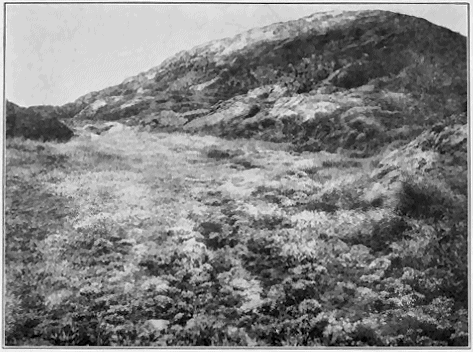
Mountain Sandwort in bloom on a little lawn near Mount Pleasant on the last day in July
They think otherwise of other trees.
The white birches come up in location and
come down in size on these mountain pastures
very much as do the spruces and firs. We have
the big canoe birch of the lower slopes, often
a splendid tree that matches any in the forest
in height. On higher ranges it shrinks and even
undergoes certain structural changes that have
given excuse for the naming of new varieties.
Hence, beginning with Betula papyrifera in the
valleys we have a shrinkage to cordifolia, minor,
and glandulosa with its sub-variety rotundifolia,
this last a veritable creeping birch which sticks
its branches but a little above the tundra moss in
places where the spruce and fir trees are not
much different in character and the willow becomes
most truly an underground shrub with no
bit of twig showing above the surface and only
the little round leaves cropping out, making a
growth that is more like that of a moss than
that of a tree. To such straits do wind and
cold reduce the trees that defy them.
Yet in spite of the botanical classification
which sets up these dwarfed trees as different
varieties from those of the lower slopes, one
cannot help wondering if the differentiation is
justified. Suppose the seeds of a big paper
birch from the lower valley were planted among
the creeping willows of the Alpine Garden on
Mount Washington. Would they not grow a
dwarfed and semi-creeping Betula glandulosa or
rotundifolia? Would not the seeds of glandulosa,
if blown down into the lower valley and
growing in the soil among the paper birches produce
Betula papyrifera? It always seems to me
that there is less difference between the creeping
birches of the high plateaus of the Presidential
Range and the paper birches of the lower
slopes than there is between the grotesquely
dwarfed firs and spruces of the Alpine Garden,
and the big ones that grow in Pinkham Notch
and in the rich bottom lands of the lower part
of the Great Gulf.
The alders of these highest pastures are very
dwarf, and because of the puckered leaf margins
have received the specific name of crispa,
being familiarly known as the mountain alder
or green alder. Yet we have in lower pastures
the downy green alder, Alnus mollis, so much
like its higher-growing relative that even the
authorities say it may be but a variation. Here
again one wonders if the difference is not that
of climate on the individual rather than one of
species, and if the seeds of Alnus mollis from
the banks of the Ellis River if planted along the
head wall of the Tuckerman Ravine would not
grow up to be Alnus crispa. It seems as if there
was a very good opportunity for experimentation
along some line between the Silver Cascades
and the rough rocks at the base of the summit
cone of Washington. Down in the valleys the
juncos build their nests in low shrubbery or at
least on the top of the ground. Up on the side
of the summit juncos build actually in holes in
the ground, and lay their eggs almost a month
later than those below. Here is a variation in
habit, yet in each case the bird is Junco hiemalis;
perhaps when the scientists really get around to
it we shall have the cone builders classed as
variety hole-iferus.
But however we may differ as to the naming
of the plants and birds that frequent them, all
who have climbed that far confess to the beauty
of these highest pastures of the New England
world. To wander in them of a sunny summer
day for even a short time is to begin to be fond
of them, an affection which increases with each
subsequent visit. There soon gets to be a homey
feeling about them that lasts at least while the
sunshine endures. With the passing of the sun
comes a difference. The chill of the high spaces
of the air comes down then and the winds complain
about the cliffs below and above and
prophecy disaster to him who remains too long.
It is well then to scramble downward and leave
the highest pasture lands to the deer, if they
choose to climb out of the sheltering black
growth below, or to such spirits of lonely space
as may come at nightfall. Far below are the
man-made pastures that are friendly even at
nightfall, and it is good to seek these. The tonk
of the cow-bells will lead you in lengthening
shadows out of the afterglow on the heights
down into the trodden paths and beyond to the
pasture bars.
XI THE NORTHERN PEAKS
Some Fascinations of the Gulfside Trail in Stormy Weather
The summit of Mount Washington sits on so
high buttresses of the lesser spurs and cols of
the Presidential Range that it is not always easy
to recognize its true height. From the south,
east and west it is a mountain sitting upon
mountains, gaining in grandeur indeed thereby
but losing in individuality. To realize the mountain
itself I like to look at it from the summit
of Madison, the northernmost of the northern
peaks. There you see the long, majestic upward
sweep of the Chandler Ridge, swelling to the
rock-burst of the Nelson Crag, and beyond that,
higher yet and farther withdrawn, the very
summit, immeasurably distant and lofty, across
the mighty depths of the Great Gulf.
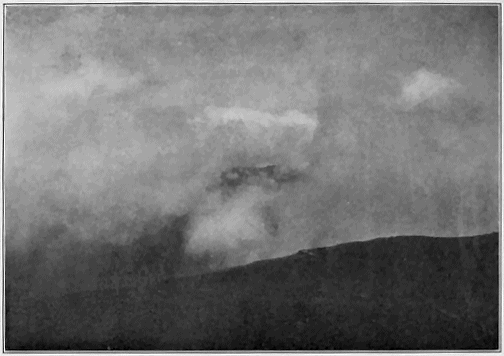
Clouds on the Northern Peaks, Mount Adams seen from Mount Washington summit
Here is the real mountain and the whole of it laid out
for the eye from the beginnings in the low valley
of the Peabody River to the corrugated pinnacle
which is the crest. It takes the gulf to
make us realize the mountain, and great as the
gulf is it is forgotten in the mighty creature that
rears its head into the clouds beyond it. From
Madison the mountain has more than individuality.
It has personality. It is as if some great
god of Chaos had crushed an image of immensity
out of new-formed stone. To look long at
this from the northernmost peak is to realize its
personality more and more. If some day, sitting
on the pinnacled jumble of broken rock
which is Madison summit, I see the mighty one
shiver and wake and hear him speak, I shall be
terrified, without doubt, but not surprised.
When August comes to the Northern Peaks
I like to come too, by way of the Gulfside Trail
which leaves the carriage road a little below the
summit of Washington and skirts the head wall
of the Great Gulf. Here in early August, just
off the carriage road, I am sure to find the mountain
harebells nodding friendly to me in the
breeze, their wonderful violet-blue corollas flecking
the bare slopes with a beauty that is as dear
as it is unassuming. It is easy to stride by these
and not see them, so much they seem but shadow
flecks of the sky above, yet once seen no one
can go by without stopping for at least a time
to worship their brave loveliness. Flowers of
intense individuality are the harebells, with each
group having, oftentimes, characteristics peculiarly
its own. It seems always to me that these
of the high summits of the Presidential Range
are of a deeper, richer blue than any others.
This may be because of the atmosphere in which
I see them. They and the mountain goldenrod,
the Spiræa latifolia and the little dwarf rattlesnake-root
with its nodding, yellowish, composite
flowers, have come in to take the places of
the spring blooms that opened in these high gardens
with July. Down at the sea level the seasons
have three months each. Up here July is
spring, August is summer, and the autumn has
flown from the hilltops before the last days of
September have passed.
Of the spring flowers that have lingered beyond
the limits of their season are the beautiful
little mountain sandwort, whose clumps still
bloom white in favored spots, though most of
the others hold seed pods only, and the three-toothed
cinquefoil with its blossoms so like those
of a small running blackberry that it is easy to
mistake it for a stray from the pastures far
below. The mountain avens, too, has what seems
a belated crop of its yellow, buttercup-like blooms
in a few places, though over the most of its area
brown seed heads only nod on the tall blossom
stalks. Such are the flowers of the Presidential
Range high plateaus in earliest August, and
though the harebells are to me the most beautiful
and most striking, individually, the mountain
goldenrod outdoes all others in profusion
of color, its golden sprays swarming up from
the Great Gulf to the trail about its head and
garlanding the rocks toward the summit with
feathery bloom that lures the lowland butterflies
to climb trails of their own as far as it goes
and to soar over the very summit in search of
more of it. As a background for these flowers
grows the mountain spear-grass, which is so
much like the June grass of our lowland fields,
its feathery blooms making a soft purple mist
in many places. On the very summit of Washington
this is abundant, disputing the scant soil
with the sandwort, the two the most Alpine of
all New England plants. Rapidly indeed do all
these plant dwellers in Alpine heights hasten
through their love and labor of the summer season,
for with October comes the winter which
will put them all to sleep until the end of the
following June.
The human sojourner in this region needs as
well to hasten wisely with an eye on the weather.
My early August trip began at the Halfway
House and strolled on up the mountain in very
pleasant morning sunshine. On the col between
Washington and Clay the sun had hazed and the
cool sea odor of the southeast wind bade me cut
short my worship of harebells and mountain
goldenrod. Yet so clear was the air that every
detail of the bottom of the Gulf stood out to the
eye, and Spaulding Lake, a quarter mile below
me and a mile distant, looked so near that it
seemed as if with a jump and perhaps two flops
of even clumsy wings I might light in it.
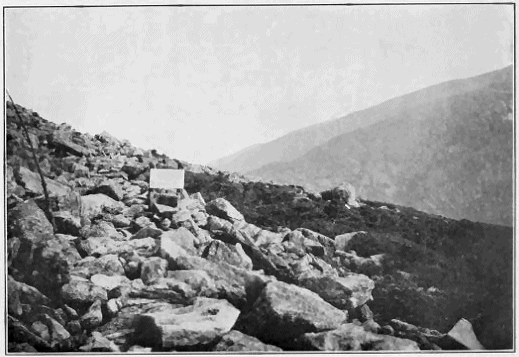
"Where the path swings round the east side of Jefferson"
Where the path swings round the east side of Jefferson
I began to get glimpses of the mountains far
to southeastward, and as I stood above Dingmaul
Rock and looked straight down Jefferson
Ravine I could see the haze behind the southeast
wind shutting off these as well as the sun.
The great hills no longer sat solidly on the earth
beneath. Instead a soft blue dust of turquoise
gems flowed up from the valleys and lifted them
from their foundations till they floated gently
zenithward through an increasing sea of this
same semi-opaque blue. Always the distant
mountains are ethereal. Tramp them as much
as you may, get the scars of their granite ledges
on yourself, as you surely will if you climb them,
get to know their every crag and ravine if you
can; and when it is all done and you look at
the mountain only a few miles away, it takes
itself gently from the realm of facts and becomes
to your eye but the filmy substance of a dream,
a picture painted on the sky and thence hung
on the walls of memory forever. So these mountains
to the southeast of Jefferson—Meader,
Baldface and Eastman first, Imp and Moriah,
the Carters and even Wildcat—lifted and
swam in this blue sea of dreams that the southeast
wind brought up with it, quivered and vanished
into forgetfulness, and beyond where their
summits had disappeared I saw the long blue-gray
levels of stratus clouds standing out against
the lesser gray of the storm bank and rising
slowly and evenly toward the zenith.
Slowly, with majestic sureness a storm was
marching up from the south. No unconsidered
assault of the heights was this, no raid by the
white cavalry of thunderstorm, but a forward
march of a great army of investment, bent on
complete conquest of the range. So slow was
its coming and so sure its promise that no
mountain climber need rush to safety. Each
could proceed with the same dignity as the
storm, having ample time to beat a safe retreat.
By noon no animal life was visible on the high
levels. The juncos have nests innumerable in
tiny, sheltered caverns under overhanging rocks.
The mother birds were snuggled deep in these
on the brown-spotted eggs. Butterflies and
bumblebees had been busy all the morning in
the goldenrod, and a host of other insects, coleoptera,
diptera, hymenoptera, honey seekers and
pollen eaters. Now all had vanished save here
and there a bumblebee that still clung, drunk
with nectar, in the yellow tangle of bloom. The
wind that had been so gentle blew cold on these
and swished eerily through the sedges on the
borders of the little pool over on the side of
Sam Adams, known as Storm Lake. Very different
was this swish of the wind in the sedges
from its soft song in the mists of the mountain
spear-grass. Very different was the feel of it
as it blew out of the smooth gray arch of sky
where had been those level lines of stratus clouds.
It had blown these to the zenith and over, and
the following mists had shut off the Carter
Range entirely, and even as I watched from the
Peabody spring on the southwest slope of Sam
Adams they shut off the farther ridge of the
Great Gulf and came over the close tangled tops
of the dwarf spruces with the swish of rain.
Even then as I tramped along the northerly
slopes of Adams and John Quincy Adams I
could see the fields of Randolph laid out in
checker-board pattern and the lower slopes of
the Crescent Range farther to the north, but
as I came down the final pitch to the stone hut
on Madison a gust growled ominously over the
Parapet and a rush of rain shut the visible world
within a narrow circle of which I was glad to
make the cosy shelter of the hut the centre.
The Madison hut is built of stone, cemented
together, and is tucked so well into the hillside
that one may step from the rocks in the rear
to the roof. Certainly its walls are storm proof,
but for thirty hours the wind did its best to
tear the roof off it while the rain filled every
gully with a rushing torrent, and the caretaker
and I did our best to make merry within the
safe shelter of the walls. The clouds that had
been so high came down with the rain and made
the world an opaque mass of solid white. It
was not so much like a mist as like a cheese
through which the wind in some miraculous
fashion blew at a tremendous rate.
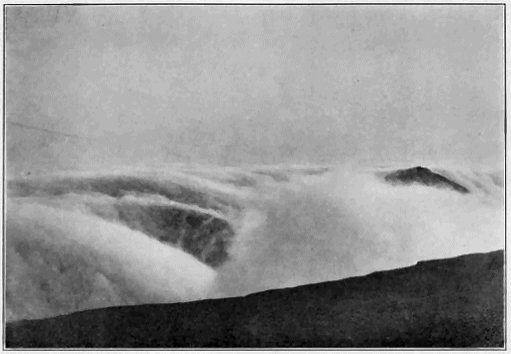
Cataract of clouds pouring over the Northern Peaks into the Great Gulf, seen from the summit
of Mount Washington
From mid-afternoon of one day until mid-forenoon of the
next there was no change in this white opacity
which blocked the very door and hid objects
completely though only a few feet away, and
through it the wind roared in varying cadences
and the drumming rain fell steadily. Then came
occasional tiny rifts in this white cheese in which
the world was smothered. It lifted a little from
the mountain side beneath and left fluffy
streamers of mist trailing down. By noon it
had shown the summit of John Quincy once,
then shut down as if it were a lid operated by
a stiff spring. Late in the afternoon, thirty
hours after the murk had immured us in the
hut, the wind had lulled, swung to the west, and
was shredding the clouds to tatters, through
which I climbed to the peak of Madison.
Again the great gods of chaos were crushing
an image of immensity out of new formed stone.
Out of the void of cloud I saw it come, piece
by piece, the artificers adding to and withdrawing
from their structure as the result pleased
or displeased them. Once they swept the mountain
away entirely leaving only the formless
gray of chaos, then as if with a sudden access
of skill and inspiration swept the whole grandly
into being, and the low sun shot his rays through
the débris of their previous failures and gilded
the final structure. Through the long miles
below me came the voice of the Great Gulf.
Down its sheer declivities ten thousand streams
were splashing to reach the swollen flood in the
channels of the west branch of the Peabody.
Each lisped its consonant or its vowel, and as they
met and mingled in syllables and sped on the
river took them and built them into words and
phrases, an oration whose sonorous uproar came
from the deep diaphragm of the mighty space
out of which, for all I know, the mountains
themselves were born. Down its distant, narrow
ravine I could see the Chandler River leap
from its source high on the Nelson Crag, to its
junction with the west branch, a continuous line
of white cataract, roaring full from brink to
brink. Few little rivers of any mountains fall
so swiftly through so deep and straight a ravine
and few indeed have a mountain top three miles
away that gives an unobstructed view of their
flood fury from source to mouth.
A little aftermath of the storm, blown back
on the ever freshening north wind, sent me down
the cone again to further refuge in the hut, and
it was not until the next morning that I could
retrace my steps over the gulfside trail to Washington.
Again I started with a clear sky, but
by the time I had made the miles to the east
side of Jefferson the high summits were altars
whereon the little gods of storms were at work.
They caught the saturated air that rose from
all ravines, laid it across the upper slopes and,
hammering it with the brisk north wind, beat
white puffs of mist out of it with every stroke.
These streamed from the peaks and were caught
and tangled on them and in one another till all
distances vanished and I walked in a narrowing
world where mist creatures played and danced
lightly to the tinkle of water that still fell from
all heights. More and more little clouds the
little gods hammered out on the slopes and ever
fresher blew the north wind that swirled them
together after it had beaten them out. The vanishing
distance took with it the peaks above and
the Gulf below, and the world that had been so
great became very small indeed, a half circle of
rocks but a few rods in circumference bisected
by a trail and the whole packed in cotton wool.
In the lower parts of the trail between Jefferson
and Clay this packing was thinnest. Probably
at yet lower levels it was clear and these
were clouds that floated above. But this thinness
was not sufficient to give the traveller any
landmark. His only hold on the earth was that
tiny circle of rock that ever changed yet was
ever the same as he went on, and the trail itself.
As this rose along the west slope of Clay and
swung along the levels toward the head wall
of the Gulf the packing became more dense, and
I walked in Chaos itself, thankful that the trail
is here so well marked that one does not need
to see from monument to monument, but may
follow the way foot by foot without fear of
wandering. A little lift came in this density just
at the head wall of the Gulf. To the south just
for a moment loomed ghostly blobs of deeper
gray that I knew were the water tanks of the
railroad, not a stone's toss away. To the north
was the ravine. On this spot I had stood two
mornings before and marvelled at the seeming
nearness of the little lake a mile away. The
rim of the head wall showed ghostly gray, but
there was no Gulf. All the world, above, below
and beyond, was but a mass of cotton wool so
solidly packed that it seemed as if I might walk
out onto that space where the Gulf should be
and not fall through it.
Further on the trail was harder to find and
the little diminution in the density ceased. The
little gods of storms were doing well at their
practice. No drop of rain fell, but where the
north wind blew this white mass of mist against
me it condensed within the pores of all garments
and filled them with moisture. The last landmarks
of the trail vanished and the white clouds
blew in and tangled my feet like a flapping
garment as I stepped upon the carriage road
and turned mechanically to the right, hardly
able to distinguish by sight the roadside from
the rocks that wall it in. Even the great barns
where they stable the stage horses were invisible
as I walked between them, but I found the plank
staircase which leads up to the stage office and
found that and a good fire and a jolly crowd
inside. My trip over the northern peaks had
been one of such varied adventure that it was
to be preferred to one made under fair skies and
on a windless day. Yet this tramp in the clouds
was to be had that day on the high summits
alone. At the base of these and even up to
the head walls of the ravines during a good part
of the time the air had been clear. It was just
the little weather gods making medicine with
the saturated air from the ravines and the cold
steel hammer of the north wind.
XII THE LAKES OF THE CLOUDS
The Alpine Beauty of These Highest New England Lakes
At nightfall from the summit of Mount Washington
the Lakes of the Clouds look like two
close-set, glassy eyes in the face of a giant, a
face that stares up at the sky far below and whose
hooked nose is the summit of Mount Monroe.
As the light passes, the glassy stare fades from
these and they lie fathomless black orbs that gaze
skyward a little while, then close, and the giant,
whose outstretched body is the southern half of
the Presidential Range, sleeps. In the full sunshine
of a pleasant forenoon one knows them for
tiny, shallow lakes, and so near do they look that
it seems almost as if a good ball player might
cast a stone into them from the rim of the summit
just behind the Tip Top House. As a matter
of fact, they are a little over two miles away
over declivities and ridges that lie above the tree
line. For the most part the trail to these lakes,
whether one comes from Mount Washington or
along the Crawford bridle path, seems bare and
desolate to the overlooking glance. But when one
gets down to it he finds it full of beauty and
interest. The southern part of the Presidential
Range, between Mount Washington and Mount
Clinton, is a mighty ridge, out of which topple
the crests of Monroe, Franklin and Pleasant,
a giant still by day, but now a giant wave
petrified.
Coming up the land from the south I had
thought that the lifting of Mount Washington
through the plastic earth had caused the waves
of land to radiate from it in all directions, but
to stand on the highest summit is to see that
this is not so. The force that made the mountains
to the south and the mountains to the
north is the same, and the Presidential Range
is a result, also, and not a cause. It is but the
seventh wave of those which ride in from the
northwest, and the force which made them all
came over the land from countless leagues beyond.
The Presidential Range lifts out of the
hollow of the wave, which is the Ammonoosuc
Valley, in a long clean sweep southeastward,
exactly as a mighty wave does at sea. It pinnacles
into the various peaks and it drops suddenly,
almost sheer in places, into the next hollow
beyond. This hollow beyond the northern
peaks is the Great Gulf, beyond the southern
peaks is Oakes Gulf, and beyond Mount Washington
itself begins with Huntington and Tuckerman
ravines. Something drove mighty waves
through the land from the west, sent them pinnacling
five and six thousand feet above the sea
level, and froze them there. The main wave is
the solid rock mass thirteen miles long and in
the neighborhood of five thousand feet in height
above the sea level. The crests are the summit
cones, jumbled piles of great mica-schist rocks,
varying in size from a cook-stove to a city block,
all seeming to have been tossed together in a disorderly
heap and to have settled down into such
regularity as gravity at the moment allowed.
The central cores of these may be solid. Certainly
the outer part is but a jumble of loose
rocks that sometimes topple and grind down over
one another at a touch and that give air and
water access to unknown depths.
Hence on the peak of Washington, for instance,
or Adams, or Jefferson, one may see the
somewhat astonishing spectacle during a heavy
downpour of rain of a great rock pinnacle absorbing
the water as fast as it falls. One would
expect miniature cataracts and a rush of a thousand
streams down such a summit at such a time.
Yet the downpour gets hardly beyond the spatter
of the drops. The loose rocks absorb and hide
it. Hence after every rainfall welling springs
on the summits, and farther down the gurgle
of waters running in unseen crevices one never
knows how far below the surface. Hence, also,
lakes of the clouds. After every rain there are
well-filled springs on the very top of Washington,
and it is only after many days of dry weather
that these begin to dwindle. There are chunks
of ledge up there so hollowed out toward the sky
that they hold the rain by the first intention, so
to speak, and every cloud that touches them oozes
from its fold more water for their sustenance.
Often for weeks these pools reflect the stars by
night and evaporate under the shine of the sun
by day. In one of them in late June of this
year I found a pair of water striders skipping
merrily about on the calm surface. Two weeks
of drought dried the pool up completely, and I
thought these daring adventurers on the ultimate
heights dead, and indeed wondered much how
they came there at all. But later a good rain
filled the pool again and my two water striders
appeared on its surface once more, merry as
grigs. I am divided in my mind as to what they
did meanwhile. Perhaps they simply survived
the drought by main strength; perhaps they followed
the dew down into cracks between the
rocks and there abided in at least some moisture
till the rain came. But I am more of the
opinion that they simply skipped down the caverns
toward the interior and there found an
underground pool for a refuge until they could
return to the sunlight. I can think of no other
excuse for water striders on the summit of
Mount Washington.
This pool, of course, like a half score others
that one can find on the very top of the summit
cone after rain, was a mere puddle. But the
Lakes of the Clouds are substantial bodies of
water the summer through, and in the winter
substantial bodies of ice, for they freeze to the
bottom as soon as winter sets in. Water striders
they have and larvæ of caddis flies and water
beetles of many varieties, but never a fish swims
in them, and I doubt if any other form of aquatic
animal life ever wanders to their shores. Clear
as crystal, shallow, ever renewed, they are but
mirrors in which by day the peaks can see if
their clouds are on straight and through which
by night fond stars may look into the eyes of
other stars near by without being noticed by
envious third parties. Their source is the clouds,
yet their waters are if possible clearer and even
more sparkling than new fallen rain. Even the
air above the highest peaks has its dust and soot
which the rain washes out of it as it comes
down. In the spring the snow at the head of the
Tuckerman Ravine was dazzling in its pure whiteness.
Now the dwindling arch is flecked with
black; dust blown from the peaks above, soot
washed to its surface from the sky by the rain,
and without doubt also the cinders of burned-out
stars that perpetually sift down to earth out
of the void of space.
All this the rain brings out of the sky when
it comes in deluge from the clouds to the peaks,
but nothing of it does it take into the Lakes of
the Clouds. The crushed rock through which it
must filter on its way down the ledges takes out
all impurities, and the mosses of the lower slopes
aid the process. But they do more than that.
By mysterious methods of their own the mountains
aerate this rain water in its passage till it
finally reaches the lakes, as it reaches all mountain
springs, filled with a prismatic brilliancy
that is all its own. Whether we assume these
lakes to be eyeglasses of the slumbering giant
which is the Range, or mirrors for the peaks and
the stars, they are crystalline lenses of no ordinary
brilliancy and power of refraction.
High as these tiny mirrors of the sky are, by
actual measurement 5053 feet above the sea level,
the highest lakes east of the Rocky Mountains,
the tree line creeps up to them, and firs, dwarfed
but beautiful in their courage, set spires along
portions of their borders, dark, straight lashes
for clear blue eyes. In other spots along their
margin the ground is bluish early in the season
with the leaves of the dwarf bilberry, pink-sprayed
with their tiny, cylindrical petals of deciduous
bloom, and, now that August is here, blue in very
truth with the berries themselves.
These are not large, but they are firm-fleshed
and sweet as any lowland blueberry, and whether
the flavor they have is inherent in themselves or
draws its subtlety from the surroundings I am
never sure, but as I sit among them and eat I
know that it is worth the climb to their Alpine
altitudes.
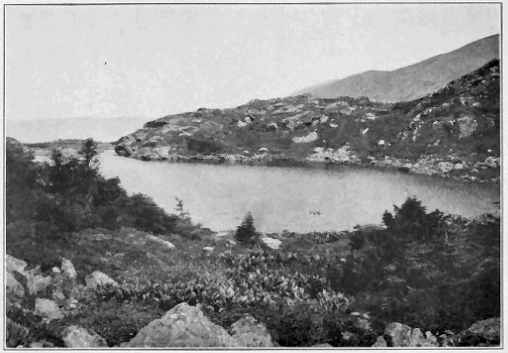
"Dwarfed firs, beautiful in their courage, set spires along portions of their borders, dark,
straight lashes for clear blue eyes"
In the first part of the Alpine springtime,
which comes to the Lakes of the Clouds with
the early days of July, the country round about
them was a veritable flower garden. The water
in the lakes was ice water then, though the ice
had disappeared from their surfaces and lingered
only in the shadow of the low cliff which
forms the southern boundary of one. Often the
nights brought frost, and sometimes with the
rain sleet sifted down as well. But little the
dwellers in these Alpine heights care for these
things. If the sun but shines it warms the tundra
to their root tips and they push their blossoms
forth to meet it with all speed. The geum flecked
everything with yellow gold. In the crevices of
the cliffs it clung where there was little but coarse
gravel for its roots, and its radiate-veined, kidney-shaped
root leaves flapped in the gales and
were tattered in spite of their toughness. In
such soil as the rocks gave the sandwort put
forth tiny innumerable cups of white. Down in
the tundra-clad slopes the geum throve as well,
but there the white of the sandwort was replaced
by that of countless stars of Houstonia. White
and gold was everywhere in this flower-garden
of the clouds, subtended here and there by the
lavender delicacy of the Alpine violet, Viola
palustris. Everywhere, too, was the honest,
plebeian white and green of the dwarf cornel,
and the æsthetic, green-yellow blooms of the
Clintonia. It is strange that of two flowers that
touch leaf elbows all through the woods of this
northern country, high and low, one should be
so hopelessly bourgeois as the Cornus canadensis
and the other so undeniably aristocratic from root
to anther as Clintonia borealis.
To tramp the slopes and hollows of this garden
about the two lovely lakes is to alternate the
rasping surface of pitted and weather-worn cliffs
and scattered boulders of mica-schist with
plunges half-knee deep in a soft and close-knit
tundra moss. Here are mosses and lichens in
close communion that ordinarily grow far apart.
The sphagnums are to be expected, and they are
plentiful, but with them grows the hairy-cap
moss, sturdier and with larger caps than I often
find it elsewhere. With these also grows the
gray-green cladonia, the reindeer lichen, all
massed in together in a springy sponge that holds
water and plant roots and continually builds peaty
earth. Because of this building of earth by the
tundra mosses there are fewer Lakes of the
Clouds than there were once. In half a dozen
levels above and below the present lakes this
constructive vegetation has built up a bog where
once was open water, and makes tiny meadows
for the quick-blooming plants of the mountain
season.
Meadows of this sort climb from the Lakes
of the Clouds up the ridge toward Boott's Spur,
connected by underground rills and having little
springs scattered through them where even in dry
weather the thirsty may find good water. Up
the side of the peak of Monroe they go as well,
and it is not difficult to trace the moisture they
hold by a glance from a distance, so green and
pleasant does it make their flower-spangled surfaces.
In the lowlands meadows are level or
they are not meadows. On the mountains they
sometimes run up at a pretty sharp angle and are
meadows still.
In August the spring color scheme of white
and gold stippled on the tundra moss by the
geums, the sandwort and the Houstonia becomes
blue and gold, built out of harebell blooms and
those of the dwarf Alpine goldenrod, Solidago
cutleri. There is much more of the gold than
in the springtime and the blue of the harebells
by no means is so prevalent as the white of
Houstonia and of Arenaria. But clumps of
Spirea latifolia put out their pale pink flowers
in many nooks among the rocks and even insert
patches of color among the dark firs that under
the high banks of the lakes dare stand erect,
though they are at the top of the tree line.
Most picturesque of all plants about the Lakes
of the Clouds, in midsummer as in early spring,
is the Indian poke, Veratrum viride. Next to the
firs and spruces it spires highest, but unlike them
it is of no obviously tough and hardy fibre. On
the contrary, here is an endogenous plant, one
of the lily family, that ought from its appearance
to grow in a Florida swamp rather than on the
great ridges of the Presidential Range, five thousand
feet and more above sea level. Here is a
place for low-growing Alpine plants like the sandwort,
the Alpine azalea, the Lapland rose-bay,
and the little moss-like Diapensis lapponica; and
they grow here. But in the boggiest part of the
tundra grows also this rank succulent herb, the
Indian poke, spiring boldly with its light green
stem, bearing three feet in air its big pyramidal
panicle of yellowish green blossoms in early
July, seed pods in middle August, but yellowish
green and pyramidal still. Beneath the pyramid
on the single stem stand the close-set, broadly
oval, plaited and strongly veined leaves, and there
the whole will stand till the freezing cold of
October cuts down its succulent strength. The
more I see of the Indian poke on Alpine heights
the more I admire it. It does not quite reach
the tip of the summit cone of Washington, but
it climbs as near it as many a seemingly tougher
fibred plant and would, I believe, reach as high
as the sandwort could it have roothold in the
necessary moisture.
Much has been written about the beauty of the
Alpine Garden between the base of the summit
cone of Washington and the head wall of Huntington
Ravine. All that has been said of this
and more is true of the rough rocks, the slopes,
and the meadows about the two little Lakes of
the Clouds. Traces of animal life indeed are
rare on their borders. The most that I have seen
was a deer that came at dawn over the ridge
from Oakes Gulf, nibbled grass and moss in the
meadows, drank from the larger lake, and
bounded off again, leaving the tundra moss
punctured by slender hoof marks. Birds are as
numerous here as about those other wooded lakes
of the clouds that lie below in the ravines, Hermit
Lake in Tuckerman's and Spaulding at the head
of the Great Gulf. I suspect the Myrtle and
Magnolia warblers of building their nests in the
dwarf firs not far from the shores, though I am
unable to prove it. White-throated sparrows
sing among the evergreens, though in August,
in these altitudes, the white throats rarely give
their full song. Often it is but a note or two
and pauses there as if the bird were in doubt
about the propriety of singing at this season.
But the birds of the place beyond all others are
the juncos. They sit on the bare ledges and sing,
morning, noon and night, their gentle, melodious
trill. It makes the place home to the listener at
once as it is to the singers whose nests are tucked
away in holes under many an overhanging stone
along the ledges.
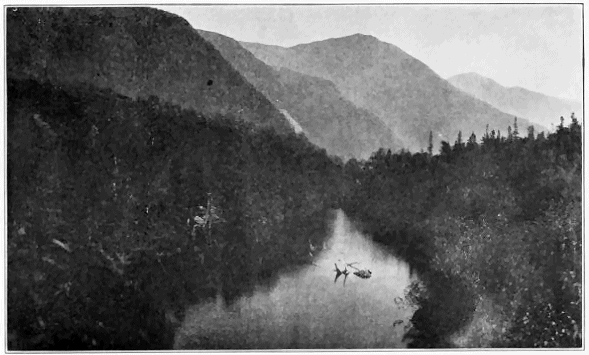
Spaulding Lake at the head of the Great Gulf, Mounts Adams and Madison in the distance
"The wind that beats the mountain blows
more gently round the open wold" in which lie
the two little Lakes of the Clouds. Into their
tiny hollows the August sunshine wells and seems
to tip with gold the plumes of the spinulose wood
ferns which grow in the tundra moss and snuggle
up against the mica-schist ledges that make miniature
cliffs along the shores. Around the base of
the mountain these ferns are everywhere, taking
the place in higher altitudes of the Osmunda
claytonia, which is the prevalent variety of lower
lands. The progress of claytonia is interrupted
not far from the entrances to the Gulf and to
Tuckerman Ravine. Thence the Aspidium spinulosum
goes on and is plentiful in many places
up to and on the Alpine Garden. It makes the
neighborhood of the Lakes of the Clouds beautiful
with its feathery fronds and sends out to
the lingerer in this beauty spot its ancient woodsy
fragrance of the world before the coal age.
Among all the beauties of the place it is hard to
tell what is dearest, but I think, after all, the
decision should be with the feathery, fragrant
Aspidium spinulosum, the spinulose wood fern.
But for all their beauty by day and their cosy
friendliness, the Lakes of the Clouds are at their
best after nightfall. As the sunshine welled in
them, so at dusk the purple shadows grow dense
there and the shallows disappear. A boy can
throw a stone across these lakes. He can wade
them, but as the darkness falls upon them and
the juncos pipe the last notes of their evensongs
the little lakes widen and grow vastly deep. The
farther shores slip away and become ports of
dreams, and he who stands on the margin looks
down no longer at bare rocks through transparent
shallows, but into a universe of fathomless depth
where star smiles back at star through infinite
distances of blue. Who shall say it is not for
this that the little lakes lie through the brief summer,
clear mirrors under the shadow of the peak
of Monroe?
XIII CRAWFORD NOTCH
The Mighty Chasm in the Mountains and Its Perennial Charms
In the nick of the Notch—Crawford Notch—the
narrow highway so crowds the Saco River
that, tiny as it is, it has to burrow to get through,
thereby meeting many adventures in a half mile.
If Mount Willard had flowed over to the north
just a few rods farther, when it was fluid, there
would have been no Notch, but only a gulf like
that between Washington and the northern peaks,
or like Oakes Gulf, barred completely by the vast
head wall of metamorphic rock. It came so near
that originally there was room only for the Saco
to pass down, a slender stream, new-born at the
shallow lake on the plain just above. Then the
famous old "Tenth Turnpike" of New Hampshire
came along and by smashing away the rock
and crowding the Saco men made a way through
for it. As for the railroad, its case was hopeless.
It had to burrow a nick of its own through the
base of Mount Willard, and out of the débris
of this blasting the road makers built a series
of fantastic rock piles, monuments to the heathen
deities of Helter-Skelter, which serve to make
the gateway in which these three jostle one another,
road, railroad and river, more weird even
than it was before.
But the gateway is as beautiful as it is fantastic.
The road south to it comes along a smiling
plain and the mountains draw in to meet it, indeed
as if to bar it. On the left Mount Clinton
sends down two long ridges between which flows
Gibb's Brook. On the right Mount Willard
shoulders its rough rock bulk boldly into the
way, and down these the spruces stride like tall
plumed Indians come to bar the passage of the
white man. But the road winds on and just as
it seems as if it must stop it finds a way and,
fairly burrowing as does the river, flows down
the Notch. With the rocks alone the gateway
would be a forbidding tangle of débris. Clothed
in the hardwood growth, it would be but a greenwood
gap. But these pointed spruces and the
firs that mingle with them bring to it an architectural
dignity of pillars and spires, a jutting
of Gothic pinnacles, a suggestion of Ionic columns,
that makes it the gateway of a vast woodland
cathedral, a place through which one passes
to worship and be filled with awe and veneration
of the mighty forces that shaped it.
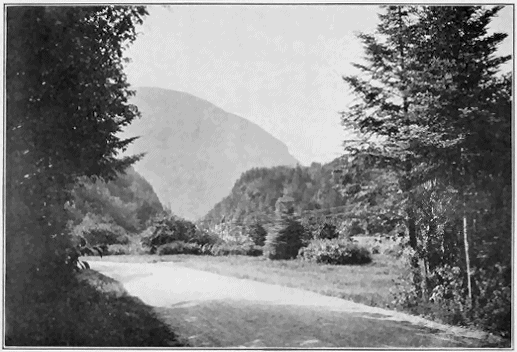
"Profile of Webster," looking toward Crawford Notch from the old Crawford farm-house site
It is a cathedral that has its gargoyles, too;
everywhere through the spiring spruces and the
softening outlines of deciduous trees protrude
the rocks in fantastic shapes that show strange
creatures to the imaginative onlooker. Just at
the gateway, lumbering out from the mountain,
comes an elephant, head and trunk, little eye and
flapping ears plainly visible, poised in granite,
but ready at any moment to take the one step
onward that will reveal the whole gigantic animal
standing in the roadway. Beyond, the whole left
side of the Notch shows a gigantic face, the
mountain's brow itself a noble dome of thought,
the nose huge and Roman, and the whole weird
and misshapen, but not without a strange dignity
of its own. And so it is with the whole formation
of the Notch. Its once molten rocks cooled or
have been water-worn into strange forms that
greet the eye of the imagination at every turn.
It is well that the narrow turnpike flows so swiftly
down into the depths of the wood and hides the
traveller from the sight of too many portents.
To get down the nick of the Notch just a little
way by road is to be shaded by the overhanging
deciduous growth and to be able to forget, as does
the Saco, the crowding together of those weird
forms carved by the ages from enduring granite.
The railroad hangs to its grade on the mountain
side, but the road descends rapidly, though
not so rapidly as the river that, here a little released
from its pressure between the two, comes
to sight again and slips in purling shallows or
babbles down miniature cascades, the thinnest
of slender streams, to the depths of a shaded
cleft in the cliffs known as "The Dismal Pool."
Dismal this may be to look at from the height
of the train as it winds along the steep face of
the Mount Willard cliff. But it is not dismal
when one gets down to it, in the very bottom of
the nick of the Notch. In places rough gray
cliffs, in others black spruces, climb one another's
shoulders from this little level of grass and placid
water where flows the Saco. A pair of spotted
sand-pipers make this their home and they did not
resent my coming to join them. Instead they
bobbed a greeting and then went on industriously
picking up dinner, wading leg deep in the shallows
and often putting their heads as well as
their long bills under water in search of food.
Spotted sand-pipers nest in the summer from
Florida to Labrador, but I fancy no pair has a
finer home than this little pool in the very bottom
of the vast cleft in the mountains which is Crawford
Notch. Its shores were netted with the
tracks of their nimble feet.
No other bird track was there, but the sand-pipers
by no means monopolize the borders of
this shallow water. Here were the marks of
hedgehog claws, and there was a track which
led me to pause in astonishment. What plantigrade
had set foot of such size on the soft sand
of the shore? I looked over my shoulder after
the first glimpse, half expecting to see an old
bear, for here was what looked very like the
track of a young one. A second look told me
better. This footmark, not unlike that of a
human baby, save for the claws, was no doubt
that of a raccoon, but certainly the biggest raccoon
track I have seen yet. It was perfectly
fresh, and I dare say the owner, interrupted in
his frog hunt by the sound of my scrambling
approach beneath the black growth, had but then
shambled to some den in the nearby cliffs and
was impatiently awaiting my departure.
The flower of the place was the little, herbaceous
St.-John's-wort, Hypericum ellipticum,
in whose linear petals such sunlight as reached
the bottom of the cleft seemed tangled. It grew
everywhere on the narrow margin between the
black shade of the spruces and the clear, shallow
water, and its petals shone out of a soft mist
of tiny white aster blooms in many places. Farther
up stream, and indeed in most woodland
shadow throughout the Notch, grows the Eupatorium
urticæfolium, which, though its common
name is "white snake root," is nevertheless the
daintiest of the thoroughworts. Its flowers are
a finer, whiter fluff of mist than are those of
the aster, so plentiful on the shore of the not
dismal pool and which I take to be aster ericoides.
In late August they seem to me quite the most
beautiful flowers of the Notch woodlands. In
this I do not except the blue harebells which
grow so plentifully on the sandy flats down by
the Willey House site. Above the tree line the
harebells are beautiful. Here they are straggling
and pale and are not to be compared with
their hardier, sturdier sisters.
As railroad, highway and river draw together
and touch elbows in passing through the gateway
of the Notch, so do all other tides of travel.
Here in spring should be the finest place in the
world to see all migrant birds on their way
farther north. The valley of the Saco catches
them as in the flare of a wide tunnel and gradually
draws them together here. At certain corners
in London all the world is said, sooner or
later, to pass. So at the gateway of the Notch
one should see in May and June all north-bound
varieties of birds. Even at this time of year the
wandering tribes concentrate at this spot and
bird life seems far more plentiful than at any
other equal area in the mountains. On the bare
heights of the Presidential Range, which I had
been travelling for long, the juncos are one's only
bird companions. Here in deep forest glades
variety after variety passed singing or twittering
by. Here were robins, song sparrows, chipping
sparrows, white-throated sparrows, chickadees
in flocks. Red-eyed vireos preached in the
tops of yellow birches. A yellow-throated vireo
twined and peered among the twigs, gathering
aphids. Here were myrtle and magnolia warblers
and a blackpoll, all residents in the neighborhood
without doubt, but all on their way, and
seen in a brief time.
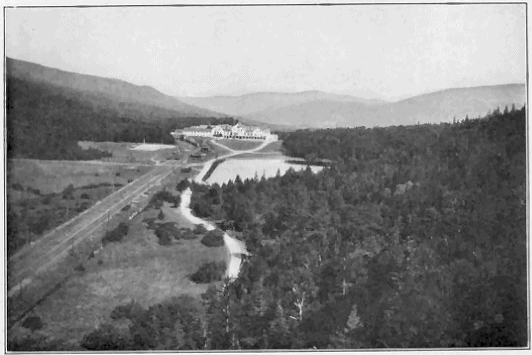
"Where railroad, highway, and river draw together and touch elbows in passing through the gateway
of the Notch"
Most pleasing of all to me was a strange new
chickadee voice which sang something very like
the ordinary black-capped chickadee song, but
with a slower and far different intonation. I
followed the maker of this old song with new
words over some very rough country, from one
side of the Notch just below the nick to the
other, for I was very eager to see him. By
and by I found him with others of his kind
swinging head down from twigs, climbing and
flitting in a fashion that is that of all chickadees,
but had a quality of its own, nevertheless. Here
was a flock of chickadees, with less of nervousness
in their manner and a little more poise, if
I may put it that way, than the blackcaps have,
chickadees with brown crowns instead of black,
and, I thought, a little more of buff in their
under parts. All summer I had looked for the
Hudsonian chickadee on one mountain slope after
another, and I had not found him. But here in
the nick of the Notch a flock had come to me and
I did my best to see and hear as much as possible
of them. They, too, were on their way, but
were probably residents of the neighborhood, for
I took them to be one family, father, mother and
five youngsters, just learning to forage for themselves.
This they did in true chickadee fashion,
swinging and singing, flitting and sitting, and
always following and swallowing food, to me invisible,
with great gusto.
The song was what pleased me most. One
authority on birds has written it down in a book
that the song of the Hudsonian chickadee is not
distinguishable from that of the blackcap, though
uttered more incessantly. Another, equally reliable,
says the notes are quite unlike those of the
blackcap. My Hudsonian chickadees sang the
blackcap's song, but they sang it a trifle more
leisurely and with a bit of a lisp. But that is not
all. There is something in the quality of the
tone that reminded me at once of a comb concert.
It was as if these roguish youngsters had put
paper about a comb and were lustily singing the
prescribed song through this buzzing medium.
It may be that other Hudsonian chickadees sing
differently. Birds are intensely individualistic,
and it is hardly safe to generalize from one flock.
This may have been a troupe doing the mountain
resorts with a comb concert specialty and tuning
up as they travelled, as many minstrels do, but
the results were certainly as I have described
them. I am curious to see more birds of this
feather and see if they, too, conform, but I fancy
Crawford Notch is about the southern limit of
the variety in summer, and I may not hear another
serenade in passing. These certainly found
me as interesting as I did them. They fearlessly
flew down on twigs very near me and looked me
over with bright eyes, the while talking through
their combs about my characteristics and how I
differed from the Hudsonian variety of man. It
was a genuine case of mutual nature study.
Very cosy all these things made the nick of the
Notch, but now and then as I scrambled through
its rough forest aisles the mountains looked down
on me through a gap in the trees, frowning so
portentously from such overhanging heights that
I was minded to jump and flee from the imminent
annihilation. For, after all, the beauty of flowers
and the friendliness of birds, the architectural
decorations of the firs and spruces, even the monster
semblances of the rock carvings that overhang,
are but the embroidery on the real impression
of the Crawford Notch. To get this it
is well to go down the long slope of the highway,
ten miles and more, till you emerge below Sawyer's
River where Hart's Ledge frowns high
above Cobb's Ferry. Thus you shall know
something of the length of this tremendous fold
in the rock ribs of the earth. Here is no work
of erosion alone. The Notch was made primarily
by the bending of the granite of the mountains
that rise in such tremendous sweeps on either
side to heights of thousands of feet. On most
of their swift-slanting sides some dirt and débris
of rock has accumulated and the forest has
clothed them, but this clothing is thin and in
many places the slant is so swift and the surface
so smooth that the rock lies bare to the sun, and
all streams have swept it clean. In August little
water comes down these, but there is the bare
channel of brown rock up which one may look
from the highway, taking in the whole sweep
of a stream at a glance. At the bottom of these
swift glissades the tangled piles of smashed rocks
show with what force the waters come down
when floods push them.
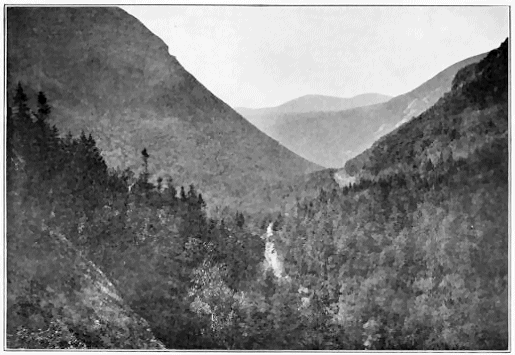
"Just below the nick of the Notch you may see where the Silver Cascade and the Flume Cascade
hurry down from their birth on Mount Jackson, and farther down the
vast slope of Webster"
Thus just below the nick of the Notch you
may see where the Silver Cascade and the Flume
Cascade hurry down from their birth on Mount
Jackson, and farther down the vast slope of
Webster is swept clear in great spaces where
now only a little water comes moistening the
upper rim of rocks, spreads, and evaporates before
it has passed over the slanting, sun-heated
surface. All the way down the glen, to the Willey
House, to Bemis, and on to Sawyer's River,
one looks to the right and left up to rock heights
swimming more than a thousand feet in air,
bare, immanent, cleft and caverned, and often
carved to strange semblances of man or beast.
Crawford Notch is a veritable museum of gigantic
fantasies.
Most impressive of all it is to pause at the
site of the Willey House and look back toward
the gateway of the Notch, through which you
have come. Here the mighty bulk of Mount
Willard lifts sheer from the tree-carpeted floor,
six hundred and seventy feet in air, a mountain
that once in semi-molten form flowed into place
across the wide valley and blocked it with a
solid rock, overhanging, seamed and wrinkled,
showing projecting buttresses and withdrawing
caverns, a rock so solidly knit and compact that
the wear of the ages on it has been infinitesimal.
On the summit of this cliff are the hammer
marks of frost. These blows and the solvent
seep of rain may take from the mountain a
sixteenth of an inch in a hundred years, but the
disintegrating power that splits ledges and hurls
hundred-ton rock from precipices seems never
to have worked on this cliff, so perpendicularly
high and mighty does it stand.
First or last the visitor to the Notch will do
well to climb Willard and see it as a whole.
An easy carriage road makes the ascent, stopping
well back from the brow of this tremendous
cliff. Willard is hardly a mountain. It is rather
a spur, a projecting ledge of the Rosebrook
Range, whose peaks, Tom, Avalon and Field,
tower far above it. But on this great ledge of
Willard one is swung high in air in the very
middle of the upper entrance to the Notch.
Hundreds of feet of it are above him still, but
thousands are below, and he looks down the
tremendous valley as the soaring eagle might.
Soothed by distance the rough valley bottom
seems as level as a floor, its forest growth but
a green carpet on which certain patterns stand
out distinctly, the warp of green deciduous
growth being filled with a dainty woof of fir,
spruce and pine. To the left the bulk of Webster
blocks the horizon.
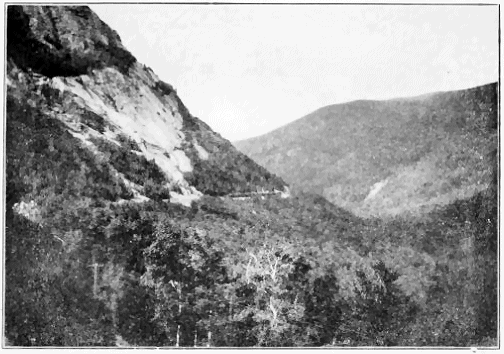
In the heart of Crawford Notch, the summit of Jackson on the distant horizon
To the right the glance goes by Willey and on down to Bemis and Nancy,
and the blue peaks of other more distant mountains
that peer over them. From the head wall
of the Great Gulf, looking down between Chandler
Ridge and the Northern Peaks of the Presidential
Range, one gets a view of a wonderful
mountain gorge. The outlook from Mount
Franklin, down the mighty expanse of Oakes
Gulf to its opening into the Crawford glen below
Frankenstein Cliff is, to me, more impressive
still. But greatest of all in its beauty of detail
and its simplicity of might and grandeur is this
ever-narrowing, ten-mile chasm, this mighty,
deep fold of rock strata that begins below Sawyer's
River and ends where the enormous rock
which is Mount Willard so pinches the gateway
to the Notch that the railroad burrows, the
highway excavates and the tiny brook which is
the beginning of the Saco River dives out of
sight between the two, to reappear in that "dismal
pool" which lies at the very bottom of the
nick of the Notch.
XIV UP MOUNT JACKSON
The Climb from Crawford's Through an Enchanting Forest
Off Mount Jackson runs a tiny brook. I do
not know its name, but because it is the very
beginning of the Saco River and because it
empties into Saco Lake, I fancy it is Saco Brook.
Whatever its name it is fortunate above most
White Mountain brooks in that the lumbermen
have kept away from it for half a century or
so and the great growth of an ancient forest
shadows it. At the bottom of this it dances
down ledges and under prostrate trunks of trees
that have stood their time and been pushed over
by the wind, and as it goes it splashes joyously
to itself in a liquid flow of language that has
as many variations of syllables and intonations
as has human speech. On either side its winding
staircase in the forest old, old hemlocks rise
in columnar dignity and great yellow birches
spread the climbing walls of its passageway with
a leafy tapestry of gold and green, their once
crisp, sun-imprisoning curls of yellow bark all
gray with age and as shaggy as those on a centenarian's
head. Through such shady glens of
cool delight the little brook calls the path up
Jackson from its beginnings at the cellar-hole
of the old Crawford homestead and the path
responds gladly, climbing within sound of this
melodious monologue a pleasant part of the way.
Even after it turns, reluctantly one thinks, to
breast the slope southward and leave the friendly
brook behind, the way leads still through this
fine old forest whose moist gloaming fosters the
growth of all mosses and through them in turn
makes the forest tenure secure. Nor does it pass
into the full sun until its two and three-quarters
miles to the summit of Jackson are all but completed
and it climbs steeply out of dwarf firs and
spruces to surmount the bare dome. How excellent
the moist moss which deeply clothes
stumps, stones and all things else, is for the
growing of firs and hemlocks may be easily seen.
Here no seedling need fail to grow for lack of
moisture, even if it fall on the very top of a
high rock. Here is a fir, for instance, beside the
path up by Bugle Cliff. Its first rootlets ran
from the very top of a boulder down each side
of it through this soft, moist covering of moss
till they reached the ground beneath. There as
the years have passed they sunk deep and the
fir has become a fine tree, though the base of
its trunk is five feet from the ground and its
two big roots straddle the rock on which they
first found frail tenure in the thin covering of
moss. Once let the sun in on this to dry out
the moisture and the seedling would have evaporated
with it. Thus the trees protect the moss
and the moss protects the trees. Remove either
one and the other must go.
This golden gloom and persistent moisture
fosters other evergreen growth than firs and
mosses. Here thrives and grows beautiful the
spinulose wood fern, which seems peculiarly the
fern of the high mountain slopes. But more conspicuous
along this path to the summit of Jackson
are the polypodys. The polypody stands
drought or cold equally well. In either it shrivels
and seems to wither, but let the warmth or
moisture needed come back and the seemingly
blighted fronds fill out and are vigorously alive
once more. I often find polypodys in summer on
exposed rocks seemingly crisp and dead with the
drought. But when the September rains have
soaked them I come by again and find them
growing as huskily as before. Yet for all their
persistence throughout weather torment these
ferns are most beautiful and luxuriant in spots
where moisture persists, and they have uninterrupted
growth throughout their summer season.
Such a spot is the deep wood along this trail,
and there, on such rocks as they favor, the polypodys
set close fronds of a green that seems
singularly bright and rich in shade. It may be
that the diffused gold of the sunlight in such
places brings out greens at their best, but surely
nowhere else have I found these little ferns at
once so luxuriant in growth and so beautiful in
color.
For all that, not all rocks in this delectable
woodland bear the picturesque decoration of the
polypody fronds. Up by Bugle Cliff are two great
cubical boulders. On the level top of one of
these is a splendid garden of the little ferns.
They cover it with an even matted growth that
looks like a marvellously woven and decorated
mat covering a mighty footstool that might have
been left behind by some recently departing race
of giants. Yet within a stone's throw of it is
another rock, quite like it in size and shape, on
which one or two straggling ferns are trying
to get a foothold, but with very indifferent success.
So through this as other woodlands it
seems to be with the polypody, which is without
doubt a fern of feminine nature in spite of its
sturdiness. With one rock Miss Polypody will
dwell in woodland seclusion most happily all her
days; with another of similar shape and size
she will have no dallying. The cause is no doubt
to be sought in the character of the rock rather
than in its figure or consistency. The polypody
has a predilection for lime, and it is probable
that the rocks which they decorate so faithfully
have their characters sweetened by this
ingredient.
But in these forest shades if every stone may
not bear wilful Miss Polypody upon its breast
none goes without decoration of beauty. Without
the mosses and lichens the ferns would find
little chance for life in any forest, and here they
cover all things with a beauty that is as profuse
as it is delicate. No rock nor stump nor growing
trunk of forest tree but has these, so wonderfully
blended in their grays and greens, their
olives and browns, that the eye accepts them as a
whole and, in such perfect harmony is their
adornment, half the time fails to note that they
are there at all. Yet one has but to pick out a
definite spot and examine it for a moment to
be impressed with the prodigality of beauty of
the whole. Here, for instance, not far from the
point where the trail up Mount Webster diverges
from that up Jackson, is a pathside rock of
rough, micaceous granite such as mosses love.
Its surface slopes like a lean-to roof toward the
north and is but a foot or two square. It is
no more beautifully, no more diversely decorated
than ten thousand other rocks which one may
see along the trail. Yet here is a harmony of
blending and contrasting colors and forms such
as the cleverest human artist with all the fabrics
and all the dyes of Christendom might labor in
vain to produce.
Tiny fern-like fronds of the dainty cedar moss
weave across it a tapestry of golden green, a
feathery fabric such as only fairy workmen,
laboring patiently for long years, can produce.
Yet it is a fabric common to the whole wood,
carpeting and upholstering its inequalities for
miles. Into this is sparingly wrought an over-pattern
of deeper green tufts of the hairy-cap
moss, sending up slender stems headed with
fruitage and holding the pointed caps which are
the fairy headgear. To note these is to realize
suddenly that the fairies are still at work under
the shadow of the warp and woof of the fabric,
though they are too nimble to be seen, however
suddenly one may lift it. It is easy to lift the
hairy caps, but I refrain. To take even one
away is to spoil the perfect symmetry of this
pattern which is so complete that every detail,
even the most minute, is needed for the harmony
of the whole. On one side an hepatic lichen
spreads a rosette-like decoration of purple-brown
edged with silvery gray, a color that has its answering
glints all through the structure of the
cedar moss and which joins the brown hepatic
in all its roughness to this dainty background.
In another spot is the gray mist of a clump
of reindeer lichen, a fine, soft, green-gray mist,
blowing across from the other lichen's edge and
clouding with its filmy fluff a tiny portion of the
picture. It is thus that summer clouds float
over the green tops of the forest trees on some
days and shadow them with a gray mist for a
moment. The reindeer lichen is growing on the
stone, but it has all the effect of being blown
across it, and I know well that if I look away
for a moment it will be gone when I look back.
Diagonally across the rock runs a bar dextra of
Clintonia leaves, loosely laid in shining green,
and in certain groups are the trifoliate scallops
of the wood-sorrel. The whole is like a shield
of one of the great knights of Arthur's court,
heraldic emblazonry thick upon it, hung here in
the greenwood while its bearer rests upon his
arms or drinks perhaps from the waters of the
Silver Cascade brook which I hear swishing
coolly down the glen not far away.
But all this decoration, so wonderfully harmonious,
so minutely complete in itself, is, on this
particular rock, but a background for a clump
of pure white Indian pipe blooms, growing in
its centre. Ghostlily beautiful, their white glowing
by contrast in the green gloom of the place,
these blossoms seem the plant embodiment of
the cool echo of falling waters that slips along
the aisles of flickering, golden light between the
brown, straight columns of the firs and hemlocks.
The nodding, pallid flowers are as soothing to
the sight as is this soft whisper of descending
streams to the ear. The forest writes the word
"hush" in letters of the Indian pipe blooms.
With eye and ear as well as muscles rested,
I go on to the steeper ascent which the path
makes through a tangle of firs that diminish in
size but increase in numbers as the elevation increases.
For long it climbs within sound of
Silver Cascade brook, but finally gets too high
for it and passes into a little section of silver
forest, where for a space all the firs are dead.
Most of them still stand erect, the green all gone
out of them. Ghosts of the trees they once were,
they stand silvery gray in the midst of the green
wood, as if a patch of moonlight had forgotten
to go when the day came. Into this sunlit place
in the surrounding shade of the forest the mountain
goldenrod has come till its flowers make all
the space beneath the dead trees yellow, a very
lake of sunlight. Silver and gold the rocks of
the White Mountains may or may not have in
their veins, but the White Mountain forests hold
the two precious metals in nuggets and pockets
and veritable placers for all who will seek.
Not far from this silver forest the path crowds
through a dense tangle of dwarf firs and climbs
out upon the rough rock dome of Mount Jackson,
4112 feet above the sea level, just rising
above the tree line. Here, to be sure, are a few
dwarf firs, not knee high, and here climbs plentifully
the resinous perfume of their taller
brothers just below, but the eye has an uninterrupted
sweep of the horizon where few ranges
obstruct. Northward, fifteen miles or so across
Oakes Gulf, looms Mount Washington, 2181
feet higher still, and the long ridge of the
southern peaks descends from this to Clinton,
a mighty wall of perpendicular rock set against
the sky. The vast basin of the gulf is always
a marvel, with its precipitous walls and its expanse
of forested floor, the forest so distant and
so close set that it looks like the cedar-moss
tapestry on the way up; but nowhere is it more
impressive than from the summit of Jackson,
with its mighty wall of the Presidential Range
for a background. Southeast Kearsarge lifts its
clean cone over the jumble of mountains that
make the northward walls of the Crawford
Notch; southwesterly stands Carrigain, with the
pinnacles of the Sandwich Range far beyond;
while westerly Lafayette rises above Guyot and
the Twins, far over Zealand Notch. Under
one's feet, almost, lies the green level of the
Fabyan plateau with its huge hotels giving almost
the only human touch to the view. Out
of this depth of distance swings a flock of eaves-swallows,
already, like the occupants of the
hotels very likely, planning their southern trip
and discussing accommodations and gastronomic
possibilities. In the upper woods of the trail
I had passed through a considerable flock of
Hudsonian chickadees, but these had fallen behind
and the only birds of the summit were the
swift passing swallows. Here again were the
summit herbs of the higher hills, the mountain
sandwort, mountain cranberry, creeping snowberry,
Labrador tea, all springing from mosses
in scant soil which obtains in the almost level
acre of rock which is the top of the mountain.
It is a place on which to make rendezvous
with the winds of the world and be sure they
will meet you there, yet, strange to relate, on
my day on the summit for a long time no winds
blew and gauzy-winged insects from the regions
below fluttered lazily over the great rock dome.
Here were colias, hunter's, mourning cloak and
mountain fritillary butterflies, making the place
gay with their bright colors. Here were a score
of varieties of diptera and hymenoptera, some
of astonishing size and peculiarities of wing and
leg, some of amazing brilliancy of color, till I
wished for a convocation of the Cambridge Entomological
Society to name and describe them
for me. None of these unexpected mountain
flyers was difficult to capture. Neither was I,
and I was glad when a sudden breeze from the
west sent them all careering down into the Oakes
Gulf whence I dare say they came.
Passing the silver forest on my way down
I found my Hudsonian chickadee friend in numbers
in the firs once more. Much as I have been
in the woods about the Presidential Range it is
only lately that I have met these interesting
birds, and now I seem to find them in increasing
numbers, at the head of the Notch, on the
northerly slope of Mount Pleasant, and here. I
have sought them for long, and at last, as Thoreau
said of the wild geese, they fly over my
meridian and I am able to bag them by shooting
up chimney. Perhaps a more reasonable interpretation
would be that now the nestlings are
full fledged and the increased flocks beginning
to range far in search of food. August passes
and the wind out of the north has sometimes
in it a zest that collects flocks and sets the
migratory instinct to throbbing in many a bird's
breast.
No tang of the north wind could touch the
heart of the deep woods down the trail, but there,
too, as I descended I found the promise of autumn
written in many colored characters in the
enchanting gloom. The Clintonias spelled it in
the Prussian blue ink of their ripe berries. The
creeping snowberry had done it in white and the
Mitchella, Gaultheria, and Trillium in varying
shades of red. Even the Indian pipe which
writes "hush" and "peace" all along the forest
floor in late summer seems in this way to tell
of the season of rough winds, migrating birds
and falling scarlet leaves that is just ahead of
us. Its pallid attempt to hold the full glory of
the ripened summer where it is cannot succeed
here on the high northern hills where the summer
is at best but a brief sojourner. Rather,
for all its desires, it seems but a pale flower of
sleep, presaging that white forgetfulness of snow
that will presently descend through the whispering
hemlock leaves and blot out all this writing
on the forest floor.
Ah, these wise old hemlocks of the deep trails
of the Northern woods! These indeed of the
forest primeval,
"Bearded with moss, in garments green, indistinct in the twilight,
Stand like Druids of eld, with voices sad and prophetic,
Stand like harpers hoar with beards that rest on their bosoms."
These are the wise old men of the woods. Erect
and tall, of mighty compactness of muscles and
shaggy headed with deep green, conical capes
shielding crown and shoulders, they seem less
trees than woodland deities, and to stand among
them is to be present at an assembly of demigods
of the forest. The wisdom of centuries,
blown about the world by the west winds,
finds voice in their whispering leaves, and I,
listening in the cool twilight below, hear it told
in forest runes. Some day someone who loves
the woods enough shall learn to translate this
runic rhyme of the harper hemlocks as their tops
chant to the west wind and send the music down
the listening forest aisles where the Indian pipes
whitely whisper "hush" and "peace"—and
the translator will be very wise thereby.
He who climbs Jackson shall see much beauty
of wild gulfs and rugged peaks, and this I saw.
But more vividly in my memory of the trip linger
the sunny glade under the silver firs all yellow
with its flood of goldenrod, and the moss-clad
rocks with their messages written in white Indian
pipe blooms. Most vivid of all is the personality
of those stately old-man hemlocks that
stand with such dignity, making the deep woods
along the trail.
XV CARRIGAIN THE HERMIT
The Mountain and Its Overlook from the
Very Heart of the Hills
On no peak of the White Mountains does one
have so supreme a sense of uplift as on Carrigain.
Here is a mountain for you! No nubble
on top of a huge table-land is Carrigain but a
peak that springs lightly into the unfathomable
blue from deep valleys of black forest. So high
is this summit that from it you look through the
quivering miles of blue air right down upon the
mountains in the heart of whose ranges it stands
and see them reproduced in faithful miniature
below, a relief map on the scale of an inch to
the mile. In the very middle of the mountain
world you see the mountains as the eagle sees
them, and so isolated is the peak that like the
eagle you seem to swim in air as you watch.
The black growth of spruce and fir climbs
Carrigain from all directions. Over from
Hancock it swarms along the ridge from the westward.
From the Pemigewasset it sweeps upward,
and from Carrigain Notch it leaps twice,
once to the round summit of Vose Spur, a clean
bound of almost two thousand feet, then on to
another higher point, and again to the mountain
top. Up Signal Ridge from the east and
south it scales almost perpendicular heights for
a mile, leaving only the thin, dizzy edge of this
spur bare and going on by the sides to the top
of the main mountain. The path to the summit
makes its final assault through this black growth
to the knife edge of Signal Ridge by one of the
most desperately perpendicular climbs in the
whole region. One or two trails are steeper,
a little, notably part of that from Crawford
Notch up Mount Willey, but none holds so grimly
to its purpose of uplifting the climber for so
great a distance as does this. Four and a half
miles of pleasant journey in from the railroad
station at Sawyer's River, this mighty ascent begins
a strong upward movement at the old lumber
camp known as "Camp 5." Thence for
about two miles it goes up in the air at a most
prodigious angle, with no suggestion of let up
till the dismayed and gasping climber finally
emerges on the knife edge of the ridge summit
and willingly forgives the mountain for all it
has done to him. If the climb had no more to
give than just this outlook from Signal Ridge
it were worth all the heart failure and locomotor
ataxia it may have caused.
Right under the onlooker's feet the north side
of the ridge drops away almost sheer to the
deep gash in the mountain, which is Carrigain
Notch. Across the valley rises the sheer wall of
Mount Lowell, with a great, beetling cliff of red
rock half way up intersected by a slide, the whole
looking as if giants had carved a huge, preposterous
figure of a flying bird there for a sign
to all who pass. The summit of Lowell is far
below the observer's feet, and the whole mass
is so small a thing in the mighty outlook before
him that it seems ridiculous to call it a mountain.
It is but an insignificant knob on the universe
in sight.
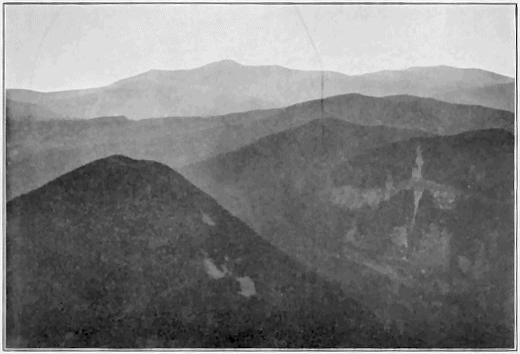
"As if giants had carved a huge, preposterous figure of a flying bird there for a sign to all who pass"
Over beyond its rounded summit
rise others, little larger or more significant,
though each really a mountain of considerable
size, each part of the western wall of Crawford
Notch, Anderson, Bemis and Nancy, and beyond
again the sight passes between Webster and
Crawford, on and up the broad expanse of Oakes
Gulf to Washington itself. Here always is bulk,
magnificence and dignity, and between it and the
nubbles which mark the line of the southern
peaks rises a glimpse of the northern, Jefferson
peering over Clay, but Adams and Madison withdrawn
behind the looming bulk of the summit
cone of Washington. Between Washington and
Crawford runs the long Montalban Ridge with
the Giant Stairs conspicuous as always, but
dwarfed to pigmy size in the great sweep of the
whole outlook.
Easterly is a great jumble of the mountains
south of Bartlett, Tremont in the foreground
and over that Bartlett-Haystack, Table with its
flat top, the peaked ridges of the Moats, and
beyond them all the perfect cone of Kearsarge
on the eastern horizon. There is something of
the same feeling of supreme uplift to be felt on
the summit of Kearsarge as one gets on Carrigain,
though in lesser degree. Kearsarge, too,
is a mountain that dwells somewhat apart from
other mountains and gives the climber the full
benefit of this height and withdrawal. As the
glance swings to the southward again it stops
in admiration on the blue wall of the Sandwich
Mountains, the great horn of Chocorua first arresting
the gaze. Here is a splendid outlook
upon the full sweep of this great, jagged range,
Paugus, Passaconaway, Whiteface, Tripyramid
and Sandwich Dome, each rugged peak rising
out of the blue mass of the whole, with the
green Albany intervales along the Swift River
showing below their foothills, and over it all, far
to the south again, the low line which is the
smoke haze of cities, a brown brume behind the
exquisite soft blue of the uncorrupted mountain
miles of air.
At the bottom of a scintillant blue transparency
of this air lies the high valley between
Signal Ridge and the Sandwich Range, a mountain
valley with no hint of green fields or farm
steadings in it. Its green is that of the rich
full growth of leaves in deciduous treetops,
shadowed here and there by the point of a fir
or a spruce, still strangely standing, though the
lumbermen have long since swept the valley far
and wide. Almost one may determine the exact
height of spur cliffs above the valley bottom by
the line of black growth where it has escaped
the axe, not because axemen could not reach it,
but because horses could not be found to drag
it to the valley after being cut. The lumbermen
put their horses in upon acclivities now that were
thought to be forever inaccessible twenty years
ago, but there are still heights they do not dare,
and the lines beyond which they fail are marked
along all steep slopes by that dividing line between
the green of deciduous trees and the black
of spruce. Seen from the great height of this
knife-edge ridge the valley is grotesque with its
lifting crags of rough cliff, so solidly built of
rock that no green thing finds a crevice in which
to grow, or so steep as to defy any wind-borne
seed to find a lodging there. These rough rock
cliffs have grotesque resemblance to the shaggy
heads of prehistoric animals of more than gigantic
size that seem to have been turned into stone
where they lie, their bodies half buried and
concealed by the luxuriant growth of forest that
still surges round them. A lumber company is
known by its cut. The work done here seems
to have been done with a certain feeling of fair
play to the forest, a desire to give it a chance
to ultimately recover. Westward, deeper into
the heart of the wilderness, one sees another
record.
To see the west one must climb beyond Signal
Ridge. High as it is it is but a spur of the
main mountain that looms, spruce-clad, all along
the western sky, and the path rises steeply again
through this spruce, but not so steeply as it
climbed the ridge. Midway of the half-mile one
finds the tiny log cabin of the fire warden of
the mountain, snuggled beneath the spruce behind
the shoulder of the ultimate height. Whatever
this lone watcher on the mountain top is
paid he earns, for all furnishings for his tiny
cabin, all supplies, even water, must be packed
on his back up the two miles of dizzy trail.
On Carrigain's very top is a little bare spot
surrounded by dwarf spruce and fir over whose
tops you may look upon the world around. The
dark tree walls of this roofless refuge ward off
all winds, and the full sunshine fills it to the top
and seems to ooze thence through the black
growth and flow on down the mountain sides,
which are so near that a few steps in any direction
takes you to a spruce-clad precipice. Some
mountain tops are broad and flat enough to form
the foundation for a farm, but not this one. It
is a veritable peak. Signal Ridge is a good deal
of a knife edge. Here you have the edge prolonged
into a point.
A step or two west out of this sun-filled spruce
well of refuge on the summit takes one to the
finest view of all from this swimming mountain
top. Underfoot lies the broad wilderness valley
of the Pemigewasset, filled with what, from
this point of view, are minor nubbles, but which
really are lesser mountains. Just to the right,
far below, is a whole string of three thousand-foot
eminences, yet the sight passes over them,
almost without notice, to the magnificent gap in
rock walls, which is Zealand Notch. Almost due
west is Owl's Head and half-a-dozen lesser
heights, but all these sink unnoticed below the
blue wall of solid mountain range which blocks
the horizon above them, the tremendous uplifted
bulk of the Franconia Mountains. Not the
grandeur and dignity of Washington, lifting the
sphinx's head from the Presidential Range, not
the jagged line of the Sandwich peaks cutting
with points of distance-blued steel the smoke
opalescence of the far southern sky, not the
emerald marvels of all the low-lying ranges all
about, can compare in beauty or impressiveness
with that mountain mass of solid blue that walls
the west across the rugged miles of the Pemigewasset
Valley. Its great mass of unblurred, undivided
color holds the eye for long and gives
it rest again and again after wandering over
the thousand varied beauties of the surrounding
landscape. Lafayette, Lincoln, Haystack, Liberty
are its famous peaks, which, however they
may seem upon nearer view, from the dizzy pinnacle
of Carrigain, across the broad wilderness
of the Pemigewasset Valley, hardly notch the
sky that pales above that mighty wall of deep
blue, that restful mass of immensity, that unfathomable
well of richest color that once looked
into holds the eye within its shadowy coolness for
long and stays forever in the memory.
What a world of black-growth wilderness this
vast Pemigewasset Valley must once have been
it is easy to see. What it will become in just
a few years more, alas! is too easy to be inferred.
The modern lumberman comes to his
work equipped with all the vast resources of
capital and scientific machinery. In this region
west of Carrigain, which still holds a remnant
of virgin growth of pine and spruce, where still
stand trees four or five feet in diameter at the
butt, his logging trains rumble down his railroad
through the deep woods, summer as well
as winter. The sound of dynamite explosions
scares bear and deer as his road builders grade
and level the roads down which his armies of
men and horses will haul the splendid timber as
soon as the snow flies. From Carrigain summit
I see the long winding line of his railroad,
clear up to the western slopes of the mountains
that wall in Crawford's Notch. From the railroad
to the right and the left run the carefully
graded logging roads, high up on the sides of
the surrounding mountains, branching, paralleling
and giving the teams every opportunity for
careful, methodical work.
Already over square miles of mountain sides
you see the brown windrows of slash left in the
wake of his choppers, who have left literally not
one green thing. The black growth cut for the
lumber and pulp mills, the clothes-pin men and
the makers of ribbon shoe pegs have been in
and taken the last standing scrub of hard wood.
Mountain side after mountain side in this region
looks like a hayfield, the brown stubble
marked with those long, wavering windrows of
slash. These are the newly cut spaces. One
winter's work took out of this region over thirty
million feet of pine and spruce alone. There is
written on the open book of the forest below
Carrigain the story of the most ruthless, clean-sweep
lumbering that I have ever seen in any
wood. You may go down the Pemigewasset and
see the slopes that have been cleaned out thus
over square mile after square mile of mountain
side, four, eight, twelve years ago, and, save for
blueberries, blackberries and wild cherry trees,
they are as bare and desolate to-day as when
first logged.
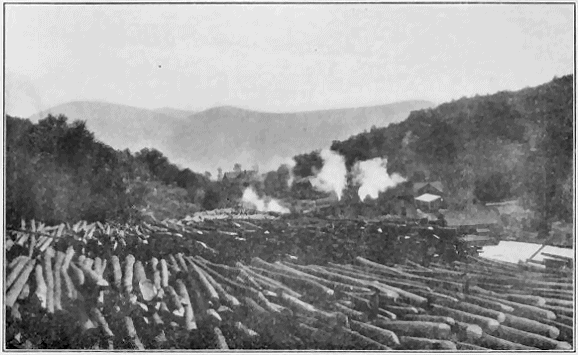
"Nor is this to be said in any scorn of the lumberman. He bought the woods and is using them now for the
purpose for which he spent his money"
In a hundred years those slopes
will not again bear forests; indeed, I doubt if
they ever will. Nor is this to be said in any
scorn of the lumberman. Pulp and lumber we
must have. He bought the woods and is using
them now for the purpose for which he spent
his money. The scorn should rather be for a
people who once knew no better and who, now
that their eyes are opened, still allow this priceless
heritage of ancient forest to be swept away
forever.
It is good to shift the eye and the thought
from these bare patches to the still remaining
black growth. Fortunately some steeps still defy
the keenest logging-gang and some spruce will
remain on these after another ten years has
swept the valley clean. On the high northern
slopes, well up toward the peaks, where the deer
yard in winter, the trees are too dwarf to tempt
even the pulp men, who take timber that is
scorned by the sawmill folk. On the summit
of Carrigain trees a hundred years old and
rapidly passing to death through the senile
decay of usnea moss and gray-green lichens are
scarcely a dozen feet tall. Yet as these pass the
youngsters crowd thickly in to take their places
and grow cones and scatter seed, often when
only a few feet high. In these one sees a faint
hope for the reforestation of the valley in the
distant future. There, after the clean sweep,
we may allow fifty years for blueberries and
bird-cherries, a hundred more for beech, birch
and maple to grow and supply mould of the
proper consistency from their falling leaves in
which spruce and fir seedlings will take root.
After that, if all works well, another hundred
will see such a forest of black growth as is going
down the Pemigewasset daily now on the flat
cars of the logging railroad.
Carrigain's peculiar birds seem to be the
yellow-rumped warblers, at least at this season
of the year. They flitted continually through
and above the dwarf trees of the summits.
There they had nested and brought up their
young, and now the whole families were coming
together in flocks and beginning to move
about uneasily as the migration impulse grows
in them. All along the trail up Carrigain and
back I found this same spirit of movement in
the birds. Two weeks ago they were moulting
and silent. Hardly a wing would be seen or a
chirp heard in the lonesome woods. Now all
is motion in the bird world once more and flashes
of warbler colors light up the dark places with
living light. Among these black spruces the redstart
seems to me loveliest of all. No wonder
the Cubans call him "candelita" when he comes
to flit the winter away beneath their palm trees.
His black is so vivid that it stands clearly defined
in the deepest shadows and foiled upon it
his rich salmon-red flames like a wind-blown
torch as he slips rapidly from limb to limb, flaring
his way through the densest and deepest
wood. The myrtle warblers were the birds of
the summit, but the redstarts gave sudden beauty
to the slopes all along the lower portions of the
trail.
The sun was setting the deep turquoise blue
of the Franconia Range in flaming gold bands
as I left the mountain top. The peak of Lafayette
was a point of fire. Garfield, just over the
shoulder of Bond, was another, and it seemed
as if the two were heliographing one to another
from golden mirrors. But along the knife edge
of Signal Ridge lay the shadow of Carrigain
summit and the dwarfed growth down the two
miles of steep descent was black indeed. Hardly
could the sunlight touch me again, for the trail
lies in the eastward-cast shadow of Carrigain
all the way to Sawyer's River. The evening
coolness brought out all the rich scents of the
forest, for here to the east of Carrigain the deciduous
growth makes forest still. From the
heights the rich aroma of the firs descended with
me, picking up more subtle scents on the way.
Not far below the crest of Signal Ridge the
mountain goldenrod begins to glow beside the
trail. Scattered with it is the lanceolate-leaved,
flutter-petalled Aster radula. These two lent to
the aromatic air the subtle, delicate pungency of
the compositæ, and far below, in the swampy
spots at the foot of the declivity, the lovely,
violet-purple Aster novæ-angliæ added to it.
Here in open spots beside the trail this beautiful
aster starred the gloom for rods, but yet it
was not more numerous than the rosy-tipped,
white, podlike blooms of the turtle-head that in
the rich dusk glowed nebulously among them.
Nowhere in the world do I remember having
seen so many turtle-head blooms at one time as
in the marshy spots along the trail leading
toward Livermore and Sawyer's River from the
base of Signal Ridge. Their soft, delicate perfume
began to ride the fir aroma there, mingling
curiously with the scent of asters and goldenrod.
Often I looked back for a glimpse of the lofty
peak I had left, but Carrigain is indeed a hermit
mountain. It had withdrawn into the heart of
the hills which are its home, and nothing westward
showed save the rose-gold of the sunset
sky which hung from the zenith down into the
gloom of the woods, a marvellous background
for the tracery of its topmost leaves.
XVI UP THE GIANT'S STAIRS
The Back Stairs Route up this Curious Mountain
My way to the Giant's Stairs lay over the
high shoulder of Iron Mountain, where the road
shows you all the kingdoms of the mountain
world spread out below, bids you take them and
worship it, which perforce you do. Then it
swings you down by a long drop curve into a
veritable forest of Arden, through which you
tramp between great boles of birch and beech for
miles. Here long ago Orlando carved his initials
with those of Rosalind on the smooth bark of great
beech trees and, I doubt not, hung beside them
love verses which made those pointed buds open
in spring before their time. Here came Rosalind
to find and read them, and carry them off treasured
in her bodice, wherefore one finds no traces
of them at the present day.
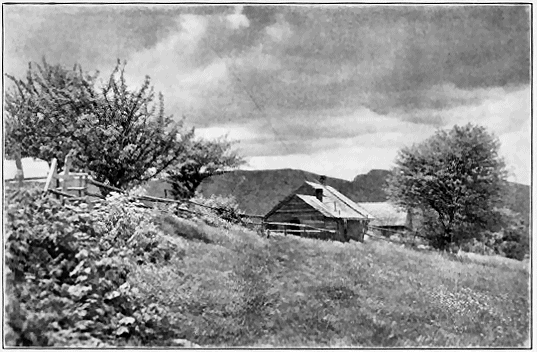
"My way to the Giant's Stairs lay over the high shoulder of Iron Mountain, where the road shows you all
the kingdoms of the mountain world spread out below"
Yet the carven initials remain, as anyone who treads the road beneath
these ancient greenwood trees may see.
Little underbrush is here and no growth of
spruce or fir, and one may look far down arcades
of green gloom where the flicker of sunlight
through leaves may make him think he sees
glints of Rosalind's hair as she dances through
the wood in search of more poems. The long
forest aisles bring snatches of joyous song to
the ear, nor may the listener say surely that this
is Rosalind and that a wood warbler, for both
are in the forest, one as visible as the other.
The whole place glows with the golden glamour
of romance, and he who passes through it, bound
for the Giant's Stairs, thrills with the glow
and knows that his path leads to a land of
enchantments.
By and by the trail drops me down a sharp
descent, and at the bottom I find, close set with
alders, a tiny clear stream which soon babbles
out from beneath the bushes into another of
those forest aisles; and there is a little house
in the wood, so tiny and so picturesquely a part
of its surroundings that, though it purports to
be a hunter's camp, I know it at once for that
little house which Peter Pan and the thrushes
built for Wendy. But the song of the brook,
this Serpentine of the deep woods, is a lonesome
one, for the door of the little house is locked
and the shutters are up. If I remember rightly
Wendy went away and never came back, and
Peter Pan is so rarely seen, now-a-days, that
few people really believe he is to be found at
all. But at least here is his house, on a tributary
to Rocky Branch Creek, over northwest of Iron
Mountain.
Out of the illusory gloom of the brook the
path leaps with joy to the clear sunlight of open
fields and seems to stop at an old doorstone behind
which the ruins of a house still strive to
shelter the cellar over which they were built.
Floors and sills are gone, boarding and shingles
and upright timbers have fallen, but still the oak
pins hold plates and rafters together, and the
bare bones of a roof crouch above the spot, so
sturdy was the work of the pioneers that here
hewed a home out of the heart of a forest.
Between this spot and civilization is now only
a logging road for miles, and the presence of
these open, sunny fields in the deep forest, and
among rough hills, seems almost as much an
illusion as the echoes of the voice of Rosalind
in the deep woodland glades and the thrush-built
house of Peter Pan by the brookside. But here
they stand in this cove of the mountains, field
after field, still holding out against the sweep
of the forest that for half a century has done
its best to ride over them, still loyal to the dreams
of whose fabric they were once the very warp.
The old highway, too, still loiters from farm to
farm, though the wood shades it and in places
even sends scouting parties of young trees out
across it. The growing maples push the top
stones from the old stone walls, brambles hide
the stone heaps and fill cellar holes with living
green. Yet still the apple trees hold red-cheeked
fruit to the sun from their thickets of unpruned
growth and scatter it in mellow circles on the
ground for the deer and the porcupine. The
forest will in time make them its own. It will
shade out the European grasses that still grow
knee deep and fill their places with dainty cedar
moss and the shy wild flowers of the deep wood.
Yet for all that the trail of the pioneers, the
boundaries that they set and the work of their
hands will never be quite disestablished on the
spot. It will remain for long years to come a
sunny footprint of civilization, dented deep in
the surrounding green of the wilderness.
Down one gladed terrace after another, from
one farm to the next, the old road goes, and the
path, which seems to linger at the first doorstone,
slips finally away and follows between the
ancient ruts. Through gaps in the investing forest
I look far down the Rocky Branch Valley
to the blue of Moat Mountain, a color so soft
that it makes the great mass but a haze of unreality
to the perceiving senses. If a wind from
the west should come up and blow it away, or
if some scene shifter of the day should wind
it up into the sky above, just a part of a beautiful
drop curtain, I should hardly be surprised.
I do not care to climb Moat, if indeed there be
really such a mountain. All summer it has hung
thus, a soft haze of half reality, a mountain
painted on some portion of the view from whatever
hill I climb, its contour changing so little
from whatever direction I view it that it seems
what I prefer always to keep it, the blue fabric
of a half-wistful dream. So shall it be more
permanent and in time more real than many a
higher summit, the grind of whose granite has
left its mark upon me. It is the unclimbed peaks
which are eternal.
From the last terrace of the lowest farm the
trail drops suddenly to Rocky Branch, a tributary
of the Saco which has its rise in a deep
angled ravine far up on the southerly slope of
Mount Washington. Here is a choice of ways,
a good tote road, a logging railroad, and a
broad, graded logging road which the lumbermen
are dynamiting through to the last spruce
of the valley, up at the headwaters of the branch.
From these highways broad logging roads give
me a plain trail up the steep Stairs Brook Valley
to the bottom step in those mighty stairs. He
who would know what lumbermen can do in
logging precipitous spots may well look about
him here. The ground rises at tremendous
angles from the ravine bottom to the foot of
Stairs Mountain, and on, yet down these precipices
the woodsmen have brought their log-laden
teams safely, the sleds chained and the whole
load lowered inch by inch by snubbing lines.
To note the spots into which men have worked
is to have a vivid impression of the value of
spruce and the desperate lengths to which men
will go to get it now-a-days.
The Giant's Stairs are more in number than
the two great ones that appear to the eye from
a long distance, either east or west. Northeast
of these a half mile or less is a side stair, as
big and as steep as the ones most commonly
seen, and farther on around the mountain toward
the north are others. It was these back stairs
that I climbed, all because of a yellow-headed
woodpecker that flew by the ruins of the logging
camp which are not far from the base of the
side stair. I got a glimpse of the yellow crown
patch and of some white on the back or wing
bars, but whether it was the Arctic three-toed
woodpecker or the American I could not make
out, and I followed his sharp cries and jerky
flight up the steep slope to the right of the side
stairs. Here was an astounding tangle of windrowed
slash with many trees still standing in
it, and here for a long time I got near enough
to my bird to almost make sure which variety
he was, but not quite. It is hard to distinguish
markings, even black and white, when a bird is
high on a limb against the vivid light of a mountain
sky. It is easy to follow along the parallel
roads through which the logs have come down
out of the slash, but it is another matter to
struggle from one road to another across those
mighty tangles, and thus my woodpecker led me.
Finally at the very top of the col between Stairs
Mountain and its outlying northeasterly spur he
shrieked, quite like a soul in torment, and flew
away high over my head, straight toward the
summit of Mount Resolution, leaving me somewhat
in doubt as to whether he was Picoides
Arcticus or Picoides Americanus, or a goblin
scout sent out by the giants to toll strangers
away from the easier path up their mountain
and lose them in the wilderness tangle all about
it. Whatever he was he had led me some miles
round the mountain to a point exactly opposite
to the good path up.
The back stairs are formidable enough to
dismay anyone with mere human legs, and for
some time I wandered in what the lumbermen
have left of a hackmatack swamp at their foot,
looking for a way about the bottom stair, for
only Baron Munchausen's courier—he of the
seven-league boots—could have gone directly
up it. It felt like being a mouse in a mansion,
and by and by I found a very mouse-like route
up detached boulders loosely held in place by
spruce roots, scrambling up trunks and clawing
on with fingers and toes, in momentary fear of
starting an avalanche and becoming but a very
small integral portion of it, and I finally reached
the top of the bottom back stair, which is by
all odds the highest, and sat down to get breath.
At one scramble I had left behind the woful
tangle of slash and come into a country of enchantment.
Here a bear had passed the day
before, leaving undeniable signs. There was a
deer path through the dense spruce showing
recent dents of their sharp, cloven hoofs, and all
about and above was a forest of black growth,
in which it was easy to fancy no human foot
had ever trod, before I all-foured up into it,
mouse fashion. Here were trees not large
enough to tempt the lumbermen, but old with
moss and gray-green lichens, casting so dense
a shade that only mosses and lichens could flourish
beneath them.
Here was a soft carpet of dainty cedar moss,
wonderfully fronded and luxuriant, covering
everything,—rocks, roots and the trunks of
ancient trees that had fallen one across another
for unnumbered centuries. It was like a miniature
of the close-set tangle of downwood and
growing timber that one sees in the Puget Sound
country. There for miles one may make progress
through the wood only by clambering along
one fallen trunk to the next, perhaps twenty
feet in air. Here the fallen trunks and growing
trees were not one-tenth the size of the
Pacific coast giants, but the proportion and condition
was the same. And so up through this
fairyland I scrambled and plunged, following a
deer path as best I might and longing for their
sure-footed ability to leap lightly over obstacles.
I daresay my clattering plunges drove all the
deer off the mountain. At least I saw none,
though their paths intersected and their hoof-marks
had dented them all recently. Stairs
Mountain is certainly the house of a thousand
staircases. All through my climb I found detached
stairs scattered about, and the mountain
seems to be largely built of them, from a few
feet to a few hundred feet in height.
And after all I came out, not at the top of
the highest front stair, but at the top of that
side stair that looks directly down on the old
lumber camp. A half mile or less southeast of
me were the front stairs, and I had to go down
an internal flight and climb again before reaching
their top, passing again through forest
primeval criss-crossed by deer paths. The yellow-headed
woodpecker had given me a pretty
scramble, but I think it was worth it.
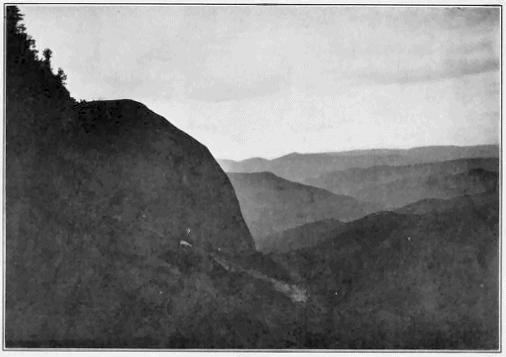
"From the top tread of the Giant's Stairs one sees half of the mountain world,
the half to southward"
From a distance I had thought Stairs Mountain
to be fractured slate. Instead it is moulded
granite. The edge of the tread on the topmost
stair is of a stone that seems as hard and dense
as any that comes out of the Quincy quarries.
Yet still clinging to it in places are remnants
of a crumbly granite that seems once to have
been poured over it and cooled there in a friable
mass. You may kick this overlying granite to
pieces with your hob-nailed mountain shoe, and
I fancy once it filled the gap between the topmost
tread and the summit of Mount Resolution,
just to the south, and has been frost riddled
and water worn away leaving the solid
granite of the stairs behind.
From the topmost of the Giant's Stairs one
sees but half the mountain world,—the half to
southward. All the north is cut off by the
spruce-covered round of the summit behind him.
Eastward was the great bulk of Iron Mountain,
over which I had come, its round top so far
below me that I could see the whole of the perfect
cone of Kearsarge over it. Directly south
was the half bald dome of Resolution, and just
over it the equilateral pyramid of Chocorua
dented the sky. Wonderfully blue and far away
it looked, and to its right was stretched the
varied sky-line of the whole Sandwich Range.
To the right again was a mighty wilderness of
mountains, cones and billows and ranges massed
in together in almost inextricable confusion,
though out of this rose certain peaks one could
not fail to recognize,—Carrigain, stately and a
bit apart in dignified reserve, and the great blue
wall of the Franconia Range, diminished by distance
but beautiful and impressive still. Almost
at my feet, down the Crawford Notch, crept a
train along the thin, straight line of the railroad.
A puff of white steam shot upward from the
engine whistling for the Frankenstein trestle,
but it was long before the shrill sound rose to
my ears. Nothing could so well emphasize the
immensity of the prospect before me. I realized
that the brakeman was walking through the observation
car shouting, "Giant's Stairs! Giant's
Stairs now on your left!" and that the mighty
cliff on whose verge I was perched seemed no
more than a letter on the printed page to the
onlooking crowd.
The way home lies down the west side of the
mountain, the steep but good Davis trail to and
along the bottom of the lower stair, thence to
the west side of the ridge between Stairs Mountain
and Mount Resolution. Then a trail east,
very slender but distinguishable, goes to the
broad highway of a logging road, and thence the
descent, though precipitous, is easy. The Stairs
Mountain is so different from anything else that
one can find in this region that it has an eerie
individuality all its own. To look back as I
went on down the logging road was to see the
stairs standing out against the glow of the lowering
sun, less like steps than gigantic rock faces.
The lower one particularly looked as if a giant
himself, wild-eyed and bristly haired, was lying
behind the forest with his great head leaned
against the mighty granite cliff that towered
above. And so I left him, waiting doubtless to
devour the next lone climber who, if he goes up
the front stairs, must pass directly in front of
his jaws. For all that I hesitate to advise the
back stairs route to which the yellow-headed
woodpecker led me. It is rough—and chancey.
XVII ON MOUNT LAFAYETTE
Glimpses of Coming Autumn from Franconia's Highest Peak
Upon the highest mountain tops the winds of
winter make their first assaults upon the summer,
driving it southward, peak by peak. In
September the skirmishes begin, and by the end
of October the conquest of the high peaks is
complete, but meanwhile the outcome of the
contest is by no means sure, and day by day,
sometimes hour by hour, the redoubts are won
and lost again. Mid-September sees the approaches
to the peaks fluttering gayly the banners
of both chieftains, summer's blue and gold
in the asters and goldenrod, winter's crimson
and gold in the flare of maple and the glow of
yellow birch. Thus I saw them from the summit
of Lafayette on a day when the forces of
the north met those of the south there and the
long ridge was now in the hands of one army,
now of the other. Nor was it difficult to
prophesy what would be the outcome of the conflict.
It seemed as if moment by moment the
yellow banners of winter, planted almost on the
very summit in the leaves of the dwarf birches,
increased in number and crowded farther down
the slope and into the forests of the outlying
spurs. Now and then, too, the eye noted where
a shell had exploded in a goldenrod bloom, or
so it seemed, and blown its summer banner out
of existence in a white puff of pappus smoke.
So the wind out of the north drives the summer
away, though it rallies again and again and
comes stealing up the southerly valleys and
along the sunny slopes to the very summits.
Near the high summits the birches show autumn
tints first. These are of the round-leafed
variety of Betula glandulosa, which is peculiar
to the high peaks of the White Mountains.
Very dwarf at best, on the highest peaks they
win as near the top as do the dwarf firs, yet
at humiliating expense of stature, becoming
scarcely more than creeping vines at the greatest
heights, sending up doubtful branches out
of the protection of soft tundra moss. Up the
higher slopes of Lafayette they thus grow,
crowding together in dense masses that now
spread a velvety golden carpet to the eye that
looks upon them from the summit. Amidst the
gray and brown of ledges and the green of
spruce and fir, which is so deep that it is black,
they glow by contrast and put the goldenrod of
the lower glades to shame with their color. No
other deciduous trees reach this height, and in
looking at them in the early weeks in September
it is easy to believe that autumn comes down
from the sky and first, like jocund day, stands
tiptoe on the misty mountain tops. On Lafayette
the color was richest near the top and paled
into green as the glance slipped farther and farther
down toward the Pemigewasset Valley.
Even by the middle of September the birches
of the valleys show little of the marvellous yellow
that seems suddenly to come upon them a
little later. From the mountain-top they still
hold the full green of summer to the first glance,
and only by looking again and more carefully
can one see that they have changed. Then, indeed,
little cirrus clouds of yellow mist them
in places, rounding the low hilltops a little more
definitely against the more distant wood. To
look again is to see here and there the undeniable
flaunt of a yellow banner, but from the
hilltops, that is all. To tramp the levels along
the water-courses or climb the lower slopes beneath
deciduous trees is to see more, and to
learn that the autumn tints come by other routes
than a descent upon the summits. For weeks
in the cool seclusion of the forest aisles the ways
have been lighted by yellow flares of birch or
elm leaves and red flashes of the swamp maple.
Day by day now these increase in number, and
once in a mile the whole tree seems to have
caught all the sunshine of the summer in itself
and to begin to let it glow forth in the half-dusk
of the woodland shadows.
In places it is as if autumn had set candles
along these dusky cloisters to light pilgrims to
some shrine, and in many a hollow glade one may
think he has found the shrine itself,—an altar
perhaps of gray rock covered with a wonderful
altar cloth of dainty cedar moss all patterned
with polypody ferns, and with a great birch
candelabra stretching protecting arms above it,
all alight with a thousand candles of yellow
leaves. The heat of the September sun above,
ray-filtered by the feathery firs, is caught in
these yellow leaves that hold back the last of its
fire and set the place about with a cool, holy
glow, an illumination that is like a presence before
which one must bow down in reverent
adoration. After all it is not a defeat that has
come to the fiery forces of summer that have
so well held the hills; it is a conversion.
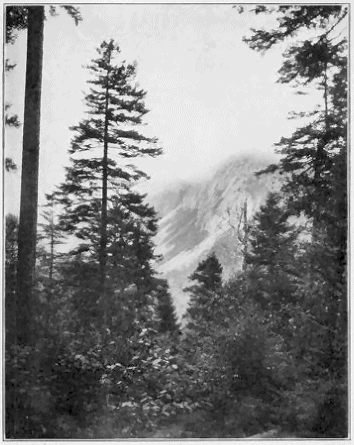
"On the way the gray brow of Mount Cannon looks in through
the gaps in the foliage"
In the cloistered seclusion of the woods one
knows this, and that seclusion obtains for much
of the four-mile climb to the summit of Lafayette.
Once or twice on the way the gray brow
of Mount Cannon looks in through gaps in the
foliage, from its great height, seeming to lean
across the Notch and peer solemnly down from
directly over head, so narrow is this deep defile
between two mighty mountains. A mile up and
the trail leans to a brief level, where it bridges
the chasm between the spur of the mountain
which is Eagle Cliff and the main mass. Here
at a glimpse comes an idea of what happened
when the mountains were made. The whole
Franconia Range, one thinks, must have come up
out of the hard-pressed levels of the earth in
one great rock mass, from which the foundations
settled and let portions lean away and split
off. Here in the Eagle Cliff Notch is a great
gap of the splitting, now more than half filled
with fragments of the rock which fell away in
enormous chunks when the action took place.
Rocks the size of a city block lie here roughly
placed one upon another with caverns of unknown
depth made by the openings between
them. Out of these caverns wells up on the
hottest days a cold that undoubtedly comes from
ice that forms in depths to which no man's eye
has penetrated, and that remains the year
through. The clinging of gray lichens upon
these rocks has made roothold for the dainty
cedar moss which makes them green and holds
moisture in turn for the roots of firs that grow
from the very rocks and fill their gaps with
forest. Here where once was titanic motion is
now titanic rest, and out of summer sun from
above and winter coolness from below wild
flowers build tender petals and distil perfumes
the brief season through, asters and goldenrod
lingering still in the crannied wall, the cool airs
that made them late in blooming equally delaying
their passing. In this green gap in the gray
granite summer's conversion is long delayed,
though winter waits just below her flowers the
whole season through.
More than a mile the path again climbs
steeply through closely set evergreens, in whose
perpetual shade the moist mosses are knee deep
above all rocks and fallen timber. Nowhere can
one see better the value of spruce and fir growth
on mountain sides in the preservation of the
mountains themselves. Beneath this everlasting
cushion of wet moss, re-enforced by roots, each
rock lies in place and nothing short of an avalanche
can stir it. Where the path has let in
the sunlight on the moss the torrents have
stripped it clean from the surface and frost and
storm year by year gully the opening deeper.
It is astounding, this sponge of moss that climbs
to the top with the path, sphagnums and dainty
cedar moss predominating, but seemingly all
other varieties intermingled as well.
And at the top one finds how persistent in its
withdrawal the summit of a great mountain like
Lafayette can be. This is only the top of a
westerly spur, a far greater chunk than Eagle
Cliff, but only a chunk of the main mountain,
that also broke off when the foundations of the
range settled. Strange to relate, the ravine that
lies between is choked, not with mighty rocks,
but with a level that has for a surface at least
a boggy space in which lie two sheets of water,—the
Eagle Lakes, 4146 feet in elevation. This
is no summit; rather it is another notch, and
the peak of Lafayette lies more than a thousand
feet farther on into the blue.
A little above this point the firs cease and the
moss with them. The rest of the way lies over
broken stone that has crumbled from rough
ledges unrestricted by any mossy protection. In
the gravel ground from it grow some stunted
firs, some very dwarf birches and scattered wild
flowers, but the way to the summit lies for all
that through a desert. From its jagged agglomeration
of rocks, scattered on ledges that still
hold to the main mass of rock which is the
mountain, one looks north or south along a
great rocky ridge which is the crest of the
Franconia Range. North lie the great outlying
spurs and buttresses of Lafayette, leading across
a high col to Garfield, which sticks a bare rock
pinnacle skyward. Southward a well-worn path
lies along the ridge to Lincoln, Haystack, Liberty
and Flume, each just a rise in the crest
which lies along the ponderous bulk of really
one mountain. Garfield is in a certain measure
off by itself, but these others are all merely pinnacles
of one great structure, Lafayette being
the highest. Here as on the Presidential Range
one finds Alpine plants, conspicuously the tiny
mountain sandwort, so constant a bloomer as to
show its white flowers still in mid-September.
With this, but no others in bloom, were the
three-toothed cinquefoil, the mountain avens,
mountain cranberry, mountain goldenrod,
bilberry and Labrador tea, all to be seen on the
final crest which is Lafayette's summit.
A north wind out of a clear sky had blown
at the start of my trip, but as if to prove that
its day was not yet over, the wind out of the
south came over the long barren ridge, bringing
butterflies in its train. For a time the two winds
seemed to meet at the very mountain top, and
a yellow Colias, that was the first to come,
caught between the two, coasted upward and
disappeared toward the zenith as if even the
summit of Lafayette were not high enough for
him. Later, when the south wind had fairly
driven that from the north back toward the
Canadian boundary, I saw several of these,
which I took to be Colias philodice, the common
sulphur, flitting about the summit, their yellow
pale and clear compared with that of the autumn-tinted
birches just down the slope. Two
mourning cloaks, a Compton tortoise and a
Grapta progne, made up the list of other butterflies
seen. Summer was doing well to be able
to show even these so late in September on so
high a summit as Lafayette. I looked curiously
for the little gray Oeneis semidea, the White
Mountain butterfly which is so common in earlier
summer on the Presidential Range and said
to be confined to it, but I did not see it. Perhaps
this variety is not to be found on Lafayette,
though the altitude is sufficient, the food
plants are there, and the same geological conditions
which left this variety "islanded" on
Washington no doubt apply.
The south wind which brought up the butterflies
and which pushed the north wind back
brought up also a gray haze which swept in like
a sea turn. It blotted out the Ossipee Mountains
and the little Squam Range. For a time the
Sandwich peaks stood out, deep blue against
its pale blue blur, then they melted into it and
were gone. It came on and took Tecumseh,
Osceola and Kancamagus. Kineo, Cushman and
Moosilauke were drowned in it one after another,
but still to the eastward Carrigain and
Hancock showed, and below them the broad
Pemigewasset Valley was spread out like a map.
Almost at my feet was the broad swath of ruin
which past years of lumbering have cut in this
once beautiful valley of primeval forest. For
miles down the western slope of the Franconia
Range and beyond all valleys are bare and all
slopes that the utmost daring can climb are
denuded. On mile after mile, save for, in spots,
a pale undergrowth of blueberry and wild cherry,
only dead birches stand, stretching bare white
bones to the sky in ghostly appeal. Islanded in
it here and there are peaks and ridges still beautiful
in deep-green evergreens, with just a misty
touch of the tender yellow of autumn-tinted
birches, wood too small or too dangerously set
to tempt the axe. The rest is desert; dignified,
haughty even in the mighty uplift of its long
slopes and bare gray crags, but desert for all
that.
It is a relief to turn the eye from this to the
rich green of the unscathed slopes of the Notch
itself. A thin blue line of air between Eagle
Cliff and Mount Cannon shows the narrow passage
where the mountains split apart, perhaps
to let man and the streams go through. Over
the way lies Moran Lake, a blue gem among
the green ridges of Cannon. At my feet, so
near it seems, is the round eye of Echo Lake,
which is at the bottom of the Notch, but seems
almost as near as the larger Eagle Lake, which
is but a thousand feet below, far up on the side
of the mountain. All about are bold, bare cliffs
showing through the green, but their bareness
is that of nature, and the deep green around them
grows, forgetful of the axe, which for many
long years has not been laid at their roots, perhaps
never will be again. Southerly the Pemigewasset
Valley opened far to the villages of
Woodstock and on to Plymouth, but even as I
looked the pale blue haze blotted them out and
swept on up the valley. The south wind was
getting into a passion, bringing clouds behind
and above the haze, putting out the sun and
growling in gray gusts about the summit. It
shouted threats in my ears and shook me as I
went down the zig-zag trail to the shelter of the
firs about the nearer Eagle Lake. Then it lulled
and dropped a tear or two of warm rain as if
ashamed of itself.
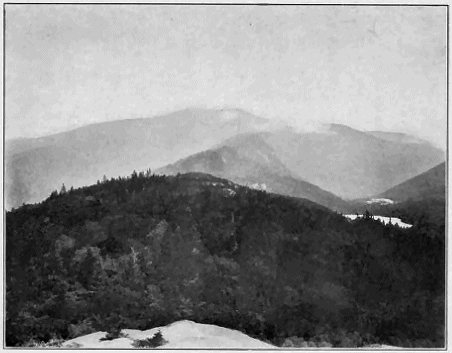
Profile Lake, Franconia Notch, and Mount Lafayette from Bald Mountain
Star Lake, on Mount Madison, is but a puddle
among the bare, slatey-coherent rocks of the
Northern Peaks. The Lakes of the Clouds are
real lakes, beautifully set, but barren in themselves,
their shallow rocky bottoms allowing
no growth of water-plants. Spaulding Lake at
the head of the Great Gulf on Washington
and Hermit Lake at the bottom of the Tuckerman
Ravine are singularly alike, shallow, transparent,
barren and beautifully set among spiring
firs and spruces, each in the heart of a
mighty gorge. But here, way up on the high
shoulder of Lafayette, where one would think
no lake could possibly be, is a little one in
a brown bog,—a bog in which the mountain
cranberry sets its deep red fruit to the sun and
the snowberry scatters its pearls all over the
maroon carpet of the sphagnum. Curiously
beautiful fruit, that of the creeping snowberry.
Here is a cranberry vine grown slender and
with tiny leaves fringing it most delicately.
Here at its tip is an elongated checkerberry,
waxy, almost transparent white, with an odor
of checkerberry, a pleasantly acid pulp that reminds
one of cranberry and an after-flavor of
checkerberry also. If there were prehistoric
wizards in plant-breeding in these mountains,
surely one must have cross-fertilized the cranberry
with the pollen of the checkerberry to the
producing of this shy, delicate, hardy and altogether
lovely fruit. To this antediluvian Burbank
it may be that the Old Man of the Mountain
is a statue, erected by a grateful posterity
in the Notch below.
In the lake itself grows the tape grass, stretching
its straw-yellow ribbons along the surface
and curiously ripening its knobby fruit under
water. With it in scattered groups was the
yellow pond-lily, its broad, ovate leaves floating
and turning up their edges to the gusts of the
south wind that swung in over the corner of
the mountain. Strange indeed these familiar
water plants looked in this little tarn swung
more than four thousand feet in air on the shoulder
of so mighty a mountain. All other mountain
lakes at such heights had seemed weird to
me in the crystalline barrenness of their purity.
This one with its boggy shore, its mud and its
homely water weeds was so friendlily familiar
that I lingered long on its banks. The southerly
wind had massed its clouds high above the
Notch, and in their shadow the dusk of early
nightfall was on the path and deep in the woods
on my way down. Yet in the bottom of the
deep defile between Lafayette and Cannon I saw
the north wind again pressing on to victory,
scattering the clouds above Mount Cannon and
letting the sunset light through far over its
northerly slopes. The nimbus broke into cumulus
clouds, and these to fluffs of cirrus that
showed at first an angry red. Then this softened
to pink and finally dimpled into miles of
gold between which the depths of the sky showed
a pure blue of forgiveness such as can be found
in heaven only when one looks up into it from
the bottom of a deep like that of Profile Notch.
Not in flowers or gems or in the pure eyes of
children can be found such a blue as the Franconia
sky showed, out of which night and deep
peace settled like a benediction on the mountains.
XVIII A MOUNTAIN FARM
One on Wildcat Mountain the Highest Ever
Cleared in New England
Last night the north wind died of its own cold
among the high peaks and black frost bit deep
down in the valley meadows, killing all tender
herbage. Then morning broke in a sky of crystal
clarity, of a blue as pure and cool as the hope
of Heaven in the heart of a Puritan, through
miles of which all objects showed as if through
a lens. From the ledges of Wildcat Mountain
I looked over to the summit of Mount Washington,
whose details were so plain that the five
trains that came up were visible to the naked
eye, and with glass I could see the people flow
from them in a slow black stream, its tide flecked
with the flotsam of fall millinery. So still was
the air upon the summit that from each engine
as it came in sight over the ridge stood high and
straight a cloudy pillar of mingled smoke and
steam. The Israelites who of old were thus led
through the wilderness to the promised land could
have had no more visible guide. Slowly to the
mountain rim sank the frosted fragment of the
once round and yellow moon, a wan, gray ghost
seeking obliteration in the grayer ledges of the
summit cone.
On these gray ledges of the cone the scant
herbage of the summer clung in flowing, warm,
tan-brown streaks drifting down as snow does
from the summit, but coloring only perhaps a
twentieth part of the surface. All else was the
gray of the rock, softened by distance into a
cool delight to the eye. Lower the Alpine Garden
slants toward the ravines, black in patches
with dwarf firs, soft green in others where in
moist hollows the grasses and moss still grow,
but for the most part showing the olive yellow of
autumn-tinted tundra. Only below this, where
the garden drops off steeply to the slope between
Tuckerman and Huntington ravines, was the rich
yellow of the dwarf birches to be seen, here a
clear sweep of color, lower still mottled with the
black growth of spruce and fir.
There was never a flame of rock maple in sight
on all the visible slope of the big mountain, but
below, in the middle distance of a slope up to
Slide Peak, below the boulder and from there
down into Pinkham Notch, they flared, one after
another, ending in a blazing group whose conflagration
was stabbed by the points of the firs
on the near slope of Wildcat.
Such beauties as these the mountains set daily
before the eyes of the man who hewed out the
highest farm in New England, a century or less
ago, on the high shoulder of a westerly spur of
Wildcat Mountain. Few New Englanders are
farmers now. In the eighteenth century most of
them were, and the tide of young men who had
the courage and the brawn to build farms in the
wilderness rose high in the New Hampshire hills.
The river-bottom lands were taken up, then the
lower valleys, then the higher slopes, and finally,
as the nineteenth century grew, the ultimate
pioneers landed on the very shoulders of the
White Mountains. Up the valley of the Wildcat
River climbed the Fernalds, the Hayeses, the
Wilsons, the Meserves, Wentworths, Johnsons
and half a dozen other pioneer families, each
hewing out of the terrific timber and grubbing
out of the grim rocks with infinite labor the fields
that to this day smile up to the sun.
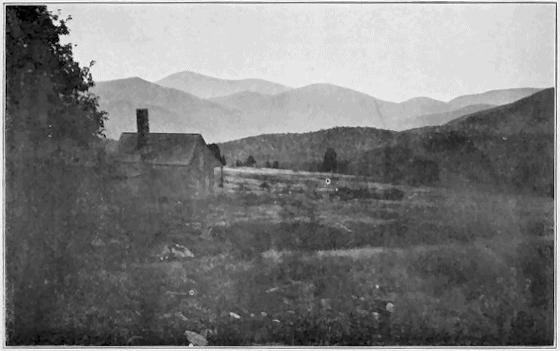
"Such beauties as these the mountains set daily before the eyes of the man who hewed out the highest farm
in New England on the high shoulder of a westerly spur of Wildcat Mountain"
Hall, the traditions have it, was the name of
the highest-minded pioneer, who set his farm on
a spur of Wildcat, 2500 feet above the sea level.
He is said to have been an educated man, born
far down the State and educated in college.
Tradition has it, too, that he was a poor farmer,
which is what tradition always says of college
men who farm. However that may be, he certainly
was a worker. On his farm acre after
acre of mighty trees crashed to the ground in the
wine-sweet mountain air and went up again in
the pungent smoke of the "burns," whereby the
first settlers cleared their ground and made ready
for their primitive first plantings. Gray ledges
and black soil inextricably intermingled drop
down his farm from terrace to terrace toward
the Wildcat River, and on the highest of these
stood his house. Its foundations only remain
to-day, showing the vast square occupied by the
central chimney. Around the foundations of this
the cellar lingers, narrow and apologetic. The
rooms above even must have been rather crowded
by this leviathan chimney, four-squared to the
world and with a big fireplace on each side. We
are apt to think of the houses of the early mountaineers
as being cold in winter, but this one need
never have been. That great bulk of enclosed
chimney once warmed through would hold the
heat in its stone heart for hours, and the wood
for its reheating was so plentiful as to be in the
way.
From his door sill to the south the pioneer's
family looked forth upon the sweet curves of the
Wildcat River valley at their very feet. From
the shoaling green of the sea of air beneath them
it deepens into a richer and softer blue as mile
runs beyond mile to the spot where Thorn and
Iron mountains slope toward one another to a
broad notch through which the glance runs on
down the Saco to the horizon line where the
Ossipee Mountains melt and mingle with the blue
of the sky. Thorn Mountain blocks the lower
end of the Wildcat Valley, in which the pioneer
saw from his doorstone more farms than I see
to-day. Down the slope of Wildcat beneath him
a half-dozen since his time have passed to the
slumber of pasture or on to the complete oblivion
of returning forest. Over on Black Mountain
now unoccupied were as many more. But the
view in the main is the same as he saw on clear
September days, nor need one think he or any
other mountain farmer was or is insensible to the
beauty of it. You rarely get one to talk much
about it—they all know how poor things words
are—but they feel the joy of it for all that.
From the northern edge of Hall's topmost terrace
I look forth across a wide gulf of crystalline
air to the rough slopes and ridges of Wildcat and
Carter mountains. The middle of September is
past and autumn is setting the seal of her colors
deeper and deeper on the high hills. Both mountains
have a saddle blanket, so to speak, of green-black
dwarf firs, but each of these is decorated
with a misty featherstitching of yellow birch
leaves. Below each blanket is a ridge up and
down which fire swept some years ago. On these
ridges great birches, all dead, stand so close together
that their trunks line it with perpendicular,
parallel scratches of gray, all cross-hatched with
a netting of limbs that soften the whole into a
wonderful warm tone. In the greatest distance
these scratches blend into a fur that is softer and
more beautiful than any ever brought into the
markets of civilization by the Hudson Bay Company.
Other winter pelts that the mountains
wear may be warmer, but none can vie with this
in the delight of its coloration.
Down the ridge again the birches thin out and,
all among them and below, the bird cherry trees
paint the slope a soft cerise, a color that in the
distance is but a neutral one, a background for
the rich hues of the rock maples that climb into
it from the ravines. Not all these have felt the
flare of autumn in their blood. Many seem to
ride toward the summit in Lincoln green. The
outcry of beagles should be just ahead of them.
But more have added a scarlet facing to their
hunting coats, and some others are fairly aflame
with the richest tint that any autumn leaf can
get, the flaming crimson of the rock-maple foliage
ripened under a full sun where mountain brooks
soak a primal vigor from the granite and send
it upward into white cambium layers all summer
long. The twenty-fifth of September finds the
hillsides displaying the autumn hunting colors
for all who follow the hounds. The very sight
of them sets the blood a-gallop and brings the
view-halloo to the lips of the most sedate.
All along the horizon to the east of this highest
farm stretches the green wall of Black Mountain.
In the pioneer's day no doubt it deserved its descriptive
title for the spruce growth which clothed
it, but on the easy slopes this did not last so long
as the pioneer, and the green of deciduous trees
which has replaced it belies the mountain's name.
So high is this wall of green hill that only Doublehead
peers over it, and that by way of a gap in
the ridge, a little of the purple haze of distance
setting it apart lest one take it for a part of the
same mountain. But I fancy the gaze of the
pioneer passing oftenest a little to the west of
south, passing the smiling beauty of the valley
and the stately cone of Kearsarge, to the summit
of Iron Mountain, where to this day one may see
the broad cultivated fields of what I believe to
be the next highest farm in New England, and
one still occupied by descendants of the pioneers
that hewed it out on a broad terrace not far
below the summit. This is the Hayes farm, and
it is a singular fact that while, according to the
surveys, the Hayes farm is many hundred feet
below this site of the ancient Hall homestead,
and looks it, on the contrary one looking across
from the Hayes farm thinks himself several hundred
feet above it. In the same way Hall could
look across to the Gerrish farm on Thorn Mountain
and would surely know that it was far below
him. Yet on the Gerrish place, looking across to
Hall's fields, I always feel sure that the Gerrish
place is much the higher. As a matter of fact,
a contour map places Hall's house six hundred
feet higher in the air than that of Hayes and
eight hundred higher than Gerrish. In so much
at least was the college-bred farmer superior to
his good neighbors of other mountain tops.
Farther westward the highest farmer looked
in his day as one does now upon an unbroken
wilderness where the Giant Stairs break the long
levels of the Montalban Range and stand blue-black
against the gold of the sunset. Only on
the north and northwest was his view broken by
the highest points of Wildcat Mountain, which
sheltered him completely from the sweep of the
winter winds. It is now, as it was then, a wood-lot,
and from it the forest steadily moves down
into the open spaces of this highest New England
farm. The firs and spruces sit about in it now in
groups, reminding one of dark-plumed aborigines
that seem to have come back and to be holding
councils once more in this clearing of the pale-face.
The unmown grass stands deep all about
these encroaching forest trees and, lacking the
care of the farmer, has cured itself and waits in
vain to be harvested, while all through it the sunlight
silvers the dry white panicles of the everlasting,
the only flower of the season on these
terraced fields which so steadily and surely drift
back to be again the forest from which the
college-bred pioneer with such labor reclaimed
them. There is a pungent aroma of old herb
gardens about this silvery everlasting, though it
is essentially a wild flower, that seems to bear
dreams of the pioneer grandmothers of the lovely
Wildcat Valley. It is as if in the bright September
sun they came back with silvery hair and
white kerchiefs and caps, for one more stroll in
the pleasant fields and one more look at the beautiful
valley below, a landscape than which none
in New England is more beautiful.
The nasal twittering of red-breasted nuthatches
led me up the hill above the highest
cleared terrace into the forest that from its multiplicity
of fascinating wood roads gives evidence
of having always been the farm wood-lot. The
pioneer should certainly have loved this hill. It
sheltered him on all parts of his farm from the
bite of winter winds out of the northwest. Out
of its deep heart it gave him water that he had
but to allow to run to his buildings, and from
its top the wood which he cut would coast down
grade to his fireplace. An hour before it had
been a silent forest filled with a yellow underglow
of sunlight, doubly distilled from the ripening
leaves of white and yellow birch. Now, in a
moment it was filled with quaint twittering and
snatches of eerie song. With the nuthatches
came chickadees, and the red-breasted ones sang
in part their song, at least an eerie imitation of
it such as only nuthatches could make. The nuthatches
are the goblin acrobats of the deep wood.
Gravity may exist where they perform, but it
does not trouble them. They walk with utter
disregard to it, and in their evolutions I expect
any day to see one fly upside down, and, if I were
mean enough to shoot one, I would as soon expect
him to fall up into the sky as to fall down to
the ground. Nor would I be much surprised if
he hung like Mahomet's coffin, suspended between
heaven and earth. If brownies ever try to blow
the notes of the chickadee's song on tiny tin trumpets,
ranged in Palmer Cox rows on mossy tree
trunks, they no doubt get the same result that the
red-breasted nuthatches did that day in the wood-lot
of the highest farm in New England.
Beside this they sang little twittering ditties
that were quite musical and altogether uncanny
as well, and seemed to fill the golden woodland
aisles with all sorts of suggestions of goblin
adventures to be found there. Between me and the
deep heart of the Carter-Moriah range was unbroken
wilderness out of which might well come
any of the phantoms the Pequawkets were wont
to declare they saw there. Climbing steadily
toward the top of the long ridge which swings
round from the old farm to the summit of Wildcat
I thought I heard the footsteps of that great
white moose that breathed fire from his nostrils
and turned back all arrows before they reached
him. Nearing the top I knew I heard him—or
something just as good—an irregular stamping
which I stealthily approached from behind the
screen of gray tree trunks and golden forest
leaves.
Almost at the top I could see the shaking of
boughs from which the creature was browsing,
and to me, approaching from below and with the
elfin incantations of the nuthatches still in my
ears, these seemed very high in air. Some creature
of prodigious size was just beyond and in
a moment more a turn of a rock corner revealed
part of him. A long, lean, white neck I saw, and
a head stretching high up to a maple limb whence
prehensile lips plucked pink-cheeked leaves. Its
mouth full the creature turned a long face toward
me and neighed, and the forest aisles echoed the
spluttering whinny in tones full as uncanny in
their laughter as had been those of the nuthatches;
also vastly louder. Somebody's old
white horse looked at me with a mild curiosity
as I tramped up to him on this ridge of the Wildcat
wilderness, and at sight of him the spectral
moose vanished into the past century, there to
remain with the Indians who claimed to have
seen him.
Spectral enough the old horse looked here in
the deep shadows of the wood. He had "yarded"
on the hilltop much as deer do in winter. I
found well-worn trails of his, leading hither and
thither on the ridge, but none going away from
it, and, under the shade of a beech, in what had
tried to be a thick bed of spinulose wood ferns,
was evidently his nightly bed. He had worn
the earth bare in his clumsy getting up and lying
down. Far down the terraces of the old farm
in sunny glades were pastured other horses and
cattle. There they stayed, for the feed was good
and water near, and they loved the sight of the
lower pasture bars that will later let them out
to the road to stalls of which they dream. But
here was a finer soul than these, a hermit that
preferred the cool fragrance of wood fern and
the unmolested quiet of his wooded hilltop, from
the loopholes of whose retreat he might look
upon the world. I fancy him the best horse of
the herd.
Now and then you find a man like that, and
I dare say such an one was the maker of the old
farm. As I came down again into his highest
field the sun was sinking behind Boott's Spur and
cool blue shadows stretched out across the low,
sweet curves of the Wildcat River valley.
Against them the pale smoke of supper fires rose
lazily and far over from the gorge below Carter
Notch floated the hush of falling waters. The
blue of the mountains to southward deepened
and only on their summits sat the rose of sunset
fire. Behind me in the wood was now no sound
of nuthatches, but a single robin sat in a treetop
and sang softly, as if to himself. On such
a scene of peace and unsurpassed beauty it is
easy to fancy the college-bred pioneer looking
at nightfall and finding it good. If his descendants
descended through the pasture bars to be
stall-fed in cities, so much the worse for them.
XIX SUMMER'S FAREWELL — INDEX
The Blaze of Its Adieu to Mount Washington
Summer lingers yet just south of Mount Washington
and, though often frowned away, as often
returns to say good-bye, "parting is such sweet
sorrow." Already there have been days when
the frown was deep, when the hoar frost on the
summit clung as white as snow in the sun and
refused to melt even on the southerly slopes,
when at night the cold of winter bit deep and
the Lakes of the Clouds shone wan in the morning
light under a coating of new, black ice. Then
summer has come back, dissolving the repentant
frost into tears at a touch of warm lips, bending
and quivering over the great gray dome of the
summit until, approaching from peaks to the
southward, I have seen her presence surround
all in a shimmering enfolding of loving radiance.
From the high ridge of Boott's Spur I saw
it thus, slipping back myself to say good-bye,
of a day in late September. From no point in
the mountains does one get a finer impression of
the massive dignity of Washington summit than
from this. The Spur is itself no mean mountain,
rising with precipitous abruptness from between
Tuckerman Ravine and the Gulf of Slides, bounding
in rounding, thousand-foot ledges from Pinkham
Notch to a height of more than 5500 feet; it
lifts the persistent climber to a veritable mizzen-top
whence he looks still upward to the main
truck of the summit, with the wonderful rock
rift of Tuckerman Ravine between, dropping out
of sight behind sheer cliffs at his feet. On such
an autumn day there is a mighty exhilaration in
thus floating in blue sky on such a pinnacle. The
body is conscious that the spirit within it steps
forth from peak to peak into limitless space and is
ready to shout with the joy of it. Indian summer,
which does not come down to the sea-coast levels
for another month, touches the high ranges now,
and under its magic they remember spring. It
paints the brown grasses, the sedges and the
leaves of the three-toothed cinquefoil which
scantily streak the cone of Washington, with a
purple tint, and the gray rocks themselves ripen
like grapes with a soft blue bloom in all shadows.
To me the finest of the four trails which lead
to the summit of Boott's Spur is that which
comes up from Pinkham Notch by way of the
Glen boulder. Its start is through a forest
primeval. The lumbermen have taken the spruce,
to be sure, but here are birches along the footpath
that may have been growing when Darby
Field first came this way to the summit of Washington
with his two Indians. It may be not.
Birches are quick-growing trees, yet here are
some that are almost three feet in diameter, having
the great solid trunks and shaggy, scant
heads of foliage which are characteristic of trees
that reach maturity in a forest before it knows
the axe. Whatever the trials of the trail it is
worth while to climb among such trees as these.
It is a steep trail, in ledgy spots, and it soon
leads to slopes where the axe has not followed
the spruce, on to a growth which the axe scorns,
and on again to a dwarf tangle of firs that are
hardly to be passed without the cutting of a
canyon. Not in the mangroves of Gulf swamps
nor in the rhododendron "slicks" of the southern
Appalachians can a traveller find a more
determinedly dense impediment to his passage
than in these mountain firs where they dwindle
to chin height and interlace their century-old
stubs of branches. Farther up they shorten into
a knee-deep carpet which hardly delays the passage,
and from these emerges the great cliff on
whose verge hangs "the boulder."
He who does not believe that "there were
giants in those days," that they fought on the
Presidential Range, and that the head of one,
cut off and petrified with fear, rolled down to
this spot where it quite miraculously stopped, has
probably never seen the boulder from the ledge
about north of its point of poise. There it looks
all these things. It has a George Washington
nose, a Booker Washington chin, and the low
forehead of the cave man. It has even an ear,
plugged with a bluish, slaty rock quite different
from the brown sandstone of which the whole
is composed, as this is quite different from the
various rocks of the ledges round about. Motorists
driving up the Glen road can see the boulder
ahead of them outlined against the sky. It looks
from that point as if it might roll down and
stop the car at any time. But if it looks insecure
in its position to motorists in the highway, to
the Alpinist who stands beside it this appearance
of instability is startling. Jocund day never
poised more on tiptoe on the misty mountain top
than does this big rock head on the verge of the
cliff. I, for one, dislike to go directly below it.
Some day it is going to roll on down the mountain
and that might be the day.
In the clearness of the autumn air all the forest
of Pinkham Notch and its approaches lay far
below my feet. The world below was a Scotch
plaid of equally proportioned crimson and green
with a finer stripe of rich yellow. Every maple
is at the height of its flame, but the birches of
the valley still hold much of their green, at least
from above. Below them in the forest one walks
as if at the bottom of a sea of golden light in
which flecks of other color fall or spring into
view at each new turn of the path. The hay-scented
ferns are almost as white as the bark of
the canoe birches. The brakes are a golden
brown, and all the under-forest world is yellow
with the leaves of all varieties of birch. Only
the withe-rod sets splotches of maroon in its
great oval leaves, and shows among them its deep
blue of clustered berries. But none of this
reaches my eye as I sit high in air above it.
Thence the world below is a Scotch plaid, out of
which the roar of Glen Ellis Falls rises, the falls
themselves completely hidden within the plaid.
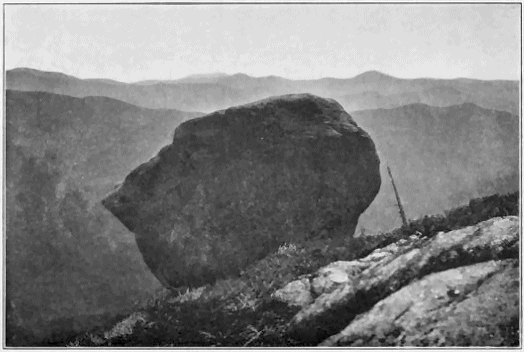
"The Glen Boulder has a George Washington nose, a Booker Washington chin, and the
low forehead of the cave man"
More and more of the under-world of birch
yellow comes to the surface as the trees climb the
hill till at the last they spread a golden mist of
color wonderful to behold. At certain portions
of the slope the firs begin again and go on up
the hill with the birches, slender and beautiful,
aspiring and inspiring, and even along among the
bleak rocks they creep, soft green mats of spreading
limbs, flecked here and there with the yellow
of creeping birches and the maroon of low blueberries,
all this patterned among the exquisite
lichen-grays of the rocks. All the southerly ridge
beyond the boulder is a rolling smoke of these
golden birch tops pricked through with the green-black
spires of spruce and fir, nor has any slope
on any mountain more beauty to offer to the eye
on this day in late September when the air is like
a crystal lens through which one looks into unmeasured
distances and sees clearly.
Behind the boulder, terrace by terrace, the
mountain rises to the top of Slide Peak, whence
one may see the magic of the air lenses change
this mingling of vivid colors to a blend which is
a rich violet and loses its red as the distance
grows greater till it ends on the far horizon in
a pure blue that seems born of the very sky itself,
and to sleep in its arms. With it the eye floats
over the ranges that rim the horizon half around,
touching and soaring from Wildcat and Black
on to Baldface and on again to be lost in the
maze of hills that ride eastward into the dim distance
of the State of Maine. More to the southward
Doublehead lifts his twin peaks in massive
dignity and over Thorn is Kearsarge, almost
airy in the contrast of its perfect cone. On again
southeast and south flash lakes, Silver and
Conway and Ossipee, Lovell's Pond and in the far
distance Sebago, lighting the softest blue toward
a haze that one suspects is the sea. Due south
between peak after peak, between Paugus and
Chocorua and through a gap in the Ossipee
Range lie the waters of Winnipesaukee, shining
beneath the noonday sun.
The Gulf of Slides beneath my feet was a vast
bowl of russet gold decorated with Chinese patterns
of deep green. In its very bottom I saw a
black stream rounding the edge of a level open
meadow where the deep grass had been trodden
into paths by the passing deer. All round about
it the spruce and firs set a bristling wall of pointed
tops, and the quivering air that filled the bowl to
the brim was obviously a liquid. I could see it
flow up and over the ridge toward the summit of
Boott's Spur, and as if to prove that it did so a
red-tailed hawk flapped up from the firs that surround
the little meadow, caught the updrift of
this southerly breeze and soared on it in easy
spirals to a point just above the ridge. Here he
caught another current that came up the Rocky
Branch Valley, a breeze resinous with the last
big area of spruce in sight from the summits near
Mount Washington, pungent with the smoke of
the great woodcutter camps in its midst, and
soared on up Boott's Spur. And as he did so
the sun flashed back in white fire from a point
in a ledge of the Spur overhanging the Gulf of
Slides.
Somewhere in the highest hills hung once the
great carbuncle whose fame led many early settlers
to dare disaster in mountain searches for
precious gems. Tradition has it that the great
gem vanished from its matrix long ago. Perhaps
it did. But something flashes white fire from a
high cliff on the Spur to the eye of him who gets
the sun at just the right angle from Slide Peak.
The carbuncle may be there yet. Certainly the
ridge that leads up from the boulder is rich in
matrices for gems. Out through its granite burst
veins of sparkling quartz, dazzling white, pink
and green. Imbedded in this quartz are great
crystals of silvery mica and smaller ones of black
tourmaline. There are spots along the trail that
glitter like a Bowery jeweller's window. This
profusion of gemlike stones is to be found all
along the way to the high ridge of Boott's Spur
and make it doubly fascinating. If the great carbuncle
ever really hung high in the mountains
I fancy it is still not far from this neighborhood.
Very likely it broke from its cliff and lies now
buried in the débris of slides at the bottom of
the great precipice which springs from the Gulf
up to the top of the Spur, leaving only a fragment
to dazzle my eyes from the top of Slide
Peak. Perhaps the real thing is there yet, and
I recommend the Glen Boulder trail to present-day
gem hunters.
But from the mountain tops on the last days
of September all the world is one of gems. From
Washington the range and the Southern peaks
which rise from it showed ruby fires of sunlight
transmitted by the colored leaves of creeping
blueberries and the three-toothed cinquefoil.
Lower, emerald and bloodstone glinted among
the dwarf firs, and lower yet were zones of gold
for the setting of as many gems as the forest
could furnish. All the blue stones of the lapidary
showed their colors in the distance while the
woods of the lower slopes were chrysoprase, garnets,
topaz and all other stones which hold red,
yellow or green glints in their hearts. Looking
westward only the centre of the Fabyan plateau
lacked this plaiding of interwoven gem colors.
Instead it was a level oasis of tender green
around which sat the great hotels in solemn
sanctity.
The perfect clearness of this still mountain air
was not only for the sight but for the hearing.
One's ear seemed to become a wireless telephone
receiver and sounds from great distances were
plainly audible. Voices of other climbers, I do
not know how far away, seemed to come out of
the ledges of the high ridge of Boott's Spur as
I sat among them and looked toward the great
gray summit of Washington. Among the Derryveagh
Mountains in the northwest of Ireland I
have heard voices of children at play a mile
away come out of a fairy rath, or seem to come
out of it, and here at far higher levels was a
similar spell at work. Finally I located other
voices, seeing people on the summit of Monroe
and others down at the refuge hut near the Lake
of the Clouds, talking to one another. That one
party could hear the other at that distance was
strange enough, but that I, a mile farther away
than the people at the hut, could hear those on
top of Monroe was a still greater proof of the
wonderful clearness of the air at that time.
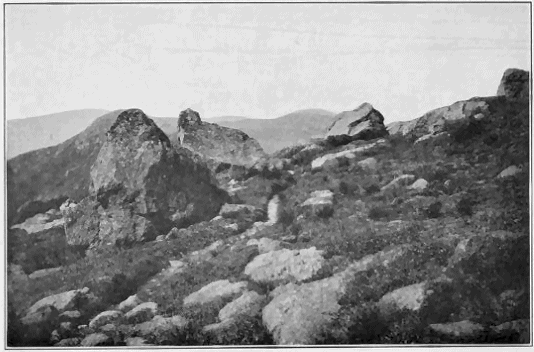
The Crawford trail along Franklin, Mount Pleasant in the distance
Such a condition presages storm, and before
night, from the summit of Washington, I watched
it materialize from thin air. In the sunlit stillness
a thin, long line of cumulo-stratus clouds
appeared circling the southern horizon from west
to east. The line was broken in many places
and it was lower than the summit, for I could
see clear sky and land through the breaks. It
did not seem possible that such a line of disconnected
clouds could bring storm. But they joined
and thickened while I watched, and by and by,
as if at a word of command, far to the south
light scuds were detached from them and came
scurrying in from beyond Chocorua, blotting out
Tremont and Haystack, Bear and Moat, swallowing
the Montalban Range and Rocky Branch
ridge in their floating fluff, coasting up and over
Boott's Spur and blotting out Tuckerman's Ravine.
They whirled in upon us, palpable, cotton-batting
clouds with a chill in their touch, and
wrapped all the summit in gray obscurity.
Again and again they broke and let me see all
about, and each time I saw that the ring of
cumulo-stratus clouds was denser at the bottom,
and had moved in towards us from all the southern
half of the horizon. The sun set, but we
did not see it. The world was blotted out in a
gray mass of scudding vapor that gradually became
black night, out of which by and by rain
came hissing on a wind that shook the buildings
of the tiny summit village beneath their clanking
chains. Morning came, and noon of the next
day. The wind had changed from south to northwest,
the sky in all valleys was clear, but still
the dense clouds swirled about the cone of
Washington and swathed the high ridge of the
whole Presidential Range in masses of fleeting
mist. No rain fell from this, but to stand in it
was to gather and condense it in the pores of
one's garments and become wringing wet.
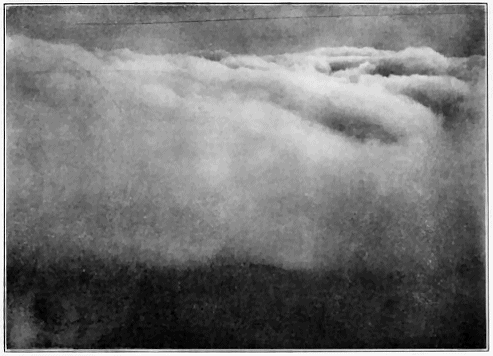
"The world was blotted out in a gray mass of scudding vapor that gradually became black night
out of which by and by rain came hissing"
Feeling my way through this opaque blindness
down the painted trail to Tuckerman Ravine, I
was well down to the verge of the head wall before
I could see below it. There the wind seems
to make a funnel between the Lion's Head and
Boott's Spur and draw the clouds through it so
rapidly as to thin them. With the Fall of a
Thousand Streams splashing all about me, I saw
the gray masses lift and through them the sun
pouring its autumn gold upon the plaid of Pinkham
Notch. The ravine below me was in
shadow, but the fairy gold of that light seemed
to flood back into it and infuse all its dripping
firs and wet rocks with rainbow colors. It
decked this mighty chasm in the mightiest mountain
as if for a bridal, and all along the downward
trail by the rushing Cutler River the firs shed
diamonds and rubies with each touch of the wind,
and the birches, yellow and black and white, held
their autumn gold encrusted with precious stones.
In such guise was the mountain decked for my
farewell to it, and though the slanting sun shone
warm on the Glen road when I reached it I was
wet with the parting tears into which all this
finery dissolved as I passed. The summit is lone
now. The last train has taken the villagers to
the base and the village is boarded up. The
hoar frost whitens it as I write and the film of
ice dulls the clear eyes of the Lakes of the Clouds.
Soon the snow will begin again to blow over the
head wall into Tuckerman Ravine and mass at
the bottom into the glacier which will once more
stretch broad across the ravine next spring.
Already the crimson of the rock maples which
flames the woodland begins to sift down and
leave the topmost twigs bare. Summer has said
good-bye to the summit, and though she looks
often fondly back she is well on her way south
through the valleys.
A
Aaron's rod, 7
Adams, 116, 139, 167, 168, 178, 225
—— John Quincy, 167, 169
—— Sam, 167
Admirals, white, 42, 49, 50, 51, 55, 57, 58, 130, 134
Æolus, Father, 112, 127
Albany intervales, 226
Alder, 21, 40, 57, 99, 100, 157
—— downy green, 157
—— green, 157
—— mountain, 157
Alnus crispa, 157
—— mollis, 157
Alpine gardens, 98, 100, 119, 125, 135, 136, 137, 138, 139, 141, 158,
187, 189, 269
—— pastures, 154
Amazon, 18
Ambergris, 22
A. M. C. camp, 91
—— guide, 50
—— signs, 97
—— trail, 86
Ammonoosuc Valley, 177
Anderson, 225
Anglewing, 134, 137
Aphids, 198
Apollo, 78
Appalachian Mts., 14
—— Club, 87
—— gods, 125
Apple trees, 19, 25
Arctic butterfly, 135, 141
—— ice, 114
Arctic sea, 114
Arden, Forest of, 238
Arenaria grœnlandica, 136, 186
Argynnis atlantis, 131
—— cybele, 131
Arizona, 81, 118
Arthur's Court, 117, 213
Ash, mountain, 92
Aspidium spinulosum, 189
Aster, 197, 237, 252
—— ericoides, 197
—— novæ angliæ, 236
—— radula, 236
—— white, 196, 237, 252
Avalon, 204
Avens, mountain, 100, 136, 163, 260
Azalea, Alpine, 186
—— Lapland, 135
B
Baldface, 119, 165, 290
Barberry, 147
Baron Munchausen's courier, 246
Bartlett, Mt., 45, 46, 48, 49, 50, 51, 53, 54, 55, 56, 57, 61, 86, 225
—— Lower, 48
Base station, 116
Bay, Casco, 57, 59, 113
Bear, 52, 53, 54, 90, 246
Bear Camp, 6
Bear Mountain, 295
Bee, bumble, 22, 41, 167
—— wild, 85, 92
Beech, 4, 5, 25, 67, 154, 234, 238, 281
Beetles, 142
Bellwort, 4, 40
Bemis, 203, 204, 205, 225
Berry bushes, 25
Betula cordifolia, 155
—— glandulosa, 155, 156, 253
—— minor, 155
—— papyrifera, 155, 156
—— rotundifolia, 155, 156
Bilberry, 182, 261
Birch, 4, 5, 8, 9, 10, 37, 40, 41, 80, 92, 93, 234, 238, 255, 256, 261,
263, 273, 286, 289
—— black, 297
—— canoe, 289
—— creeping, 155
—— dwarf, 253, 260, 269
—— paper, 156
—— white, 25, 98, 105, 130, 155, 274, 288, 297
—— yellow, 25, 130, 154, 198, 206, 252, 273, 278, 297
Birds
Blackpoll, 198
Bobolinks, 17, 18, 19, 20, 26, 28, 30, 31
Bunting, indigo, 51, 150, 151
Canary, 37
"Candelita," 235
Chickadees, 198, 199, 279
—— black-capped, 198, 199, 200
—— Hudsonian, 199, 200, 217, 218
Finch, gold, 37, 150
—— purple, 150
Hawk, broad-winged, 10
—— pigeon, 15
—— red-tailed, 291
Junco, 6, 15, 28, 37, 122, 141, 157, 166, 190, 198
—— hiemalis, 158
Loon, 73
Maryland yellow-throats, 28
Nuthatch, red-breasted, 278, 279
Phœbe, 24
Picoides arcticus, 245
—— Americanus, 245
Redstart, 235
Robin, 198, 282
Sand-pipers, 73
—— spotted, 73
Sap-suckers, yellow-bellied, 5
Sparrow, 150
—— chipping, 198
—— field, 85
—— song, 141, 198
—— white-throated, 3, 122, 141, 150, 198
Swallow, 217
—— bank, 141
—— barn, 24
—— eave, 74
Swift, chimney, 24
Thrush, 32, 37, 59, 240
—— Bicknell's, 61
—— hermit, 32, 33, 102, 105, 122
—— water, 21, 28
—— wood, 16, 21, 32, 33
Veery, 32, 61
Vireo, red-eyed, 198
—— yellow-throated, 198
Warblers, 37
—— Blackburnian, 27, 37
—— black-throated green, 28
—— Canadian, 37
—— Connecticut, 28
—— Magnolia, 28, 37, 150, 188, 198
—— mourning, 28, 37
—— myrtle, 6, 15, 37, 150, 188, 198, 235
—— Wilson's, 37
—— wood, 102, 239
—— yellow, 36
—— yellow-rumped, 234
Woodpecker, American three-toed, 244
—— Arctic three-toed, 244
—— yellow-headed, 244, 248, 251
Blackberry, 136, 163, 232
Black Mountain, 34, 86, 272, 273, 290
Blackpoll, 198
Bloodstone, 293
Blueberries, 232, 234, 263
—— creeping, 293
—— dwarf, 40, 41
—— low, 289
—— lowland, 182
—— mountain, 7, 22
Bobolinks, 17, 18, 19, 20, 26, 28, 30, 31
—— meadows, 20
Boott's Spur, 97, 105, 110, 114, 116, 185, 282, 284, 286, 291, 292,
293, 294, 296, 297
Boulder, Glen, 286
"Boulder, The," 287, 288
Brakes, 289
Bretton Woods, 66
Brook, Saco, 206
—— Gibbs', 192
Brunella, 31, 133
Buck, 101
Bugle Cliff, 208, 210
Bunchberry, 134
Bunting, indigo, 51, 151
Burbank, antediluvian, 266
Buttercups, 19, 35, 36, 80
Butterflies
Admiral, white, 42, 49, 50, 51, 55, 57, 58, 130, 134
Anglewing, 134
Arctic, 135, 141
Argynnis, atlantis, 131
—— cybele, 131
—— yellow, 261
Blue, little spring, 9
Colias, philodice, 132, 261
Compton, tortoise, 9, 134, 138, 261
Dusky-wings, 59
Fritillary, great spangled, 131, 137
—— mountain, 131, 134, 137, 138, 217
——, spangled, 82, 83, 84, 130, 134
Grapta comma, 134
—— interrogationis, 134, 137
—— progne, 137, 261
Hunters', 217
Monarch, 138
Mourning cloak, 9, 10, 58, 137, 217, 261
"Mt. Washington," 138
Oeneis semidea, 135, 138, 139, 143, 262
Painted Lady, 58
Papilio asterias, 41
—— turnus, 39
Skipper, 41, 58, 59
—— orange, 132
Sulphur, common, 261
Swallowtail, eastern, 41
—— tiger, 38, 41, 58
Vanessa j-album, 134, 138
—— milberti, 138
"White Mt.," 135, 138, 262
C
Caddice-fly larvæ, 103, 180
Cæerleon, 117
"Camp 5," 223
Canada, 23, 112
Canary, 37
"Candelita," 235
Cannon, 256, 263, 264, 267
Cape Horn Bend, 123
Carbuncle, 82, 292
Carrigain, Mt., 12, 65, 216, 222, 225, 228, 230, 231, 232, 233, 234,
235, 236, 237, 250, 292, 293, 294, 295, 296
—— Notch, 223, 224
—— Cliffs, 90
Carter, Dome, 65
Carter-Moriah Range, 25, 280
—— Mt., 89, 156, 273
Carter, Notch, 25, 83, 85, 87, 108, 119, 282
Cascade, crystal, 97, 98, 108
—— Flume, 202
—— Silver, 157, 202, 214
—— —— Brook, 214
Cattle, "white-faced," square-headed, 144, 150
—— mountain, 145, 147
Cedar, red, 147
Celery, 137
Chandler River, 170
—— Ridge, 160, 205
Checkerberry, 4, 265, 266
Cherry bird, 9, 40, 234, 274
—— Mts., 122
—— wild, 25, 232, 263
Chickadee, 198, 279
—— black-capped, 198, 199, 200
—— Hudsonian, 199, 200, 217, 218
Chipmunk, 133, 140
Chocorua Brook, 3
—— Lake, 1, 3, 5, 11, 16
—— Mountain, 1, 3, 4, 10, 11, 12, 13, 14, 15, 226, 249, 291
—— Summit, 11, 13, 14, 15
—— town, 16
Chrysoprase, 294
Cinquefoil, three-toothed, 136, 163, 260, 285, 293
Clay, 116, 164, 172, 225
Clethra, 148
Cliff Eagle, 257, 259, 263
Clinton, 176, 192, 216
Clintonia, 35, 134, 183, 213, 219
—— borealis, 184
Clover, 82
—— red, 128
—— white, 128, 133
Colias, 217, 261
—— philodice, 132, 261
Colonies, Massachusetts Bay, 82
Company, Hudson Bay, 274
Compton tortoise, 9, 134, 138, 261
Conway Meadows, 49, 66
Conway, North, 61, 63
Cornel, 136
—— dwarf, 54, 183
Cornus canadensis, 184
Corot, 5
Cox, Palmer, 279
Cranberry Mountain, 55, 217, 260, 265
—— tree, 22
Crawford Glen, 205
—— homestead, 207
—— Mountain, 225
—— Notch, 3, 46, 60, 114, 115, 191, 195, 196, 197, 198, 199, 200,
201, 202, 203, 204, 205, 216, 218, 223, 225, 231, 250, 256, 264, 266
Crescent Range, 168
Crispa, 157
Cushman, 262
Cutler River, 97, 297
D
Daisy field, 132
Dandelions, 19, 36, 37
Dartmouth Range, 122
Deer, 52, 158, 187, 241, 246, 248, 281, 291
Demoiselles, 73
Derryveagh, 294
Diamonds, 82, 297
Diapensis lapponica, 186
Dingmaul Rock, 165
Doublehead, 34, 56, 275, 290
Dryads, 67
Dusky-wings, 59
E
Eagle, 204
—— Cliff Notch, 257
—— Mountain, 25, 34, 86
Eastman, 165
Elaphrus olivaceus, 142
—— lævigatus, 142
Ellis River, 20, 22, 25, 29, 45, 48, 49, 60, 73, 98, 157
Elm, 66, 67, 68, 225
—— meadow, 67, 68
Emerald, 293
Emerson, 23
English borders, 145
Eupatorium urticæfolium, 196
Everlasting, 277
F
Fabyan's, 116
—— Plateau, 216, 294
Falls, Glen Ellis, 108, 209
—— Jackson, 21, 23, 24, 28, 30, 31, 82
—— "No-go," 62
—— of a Thousand Streams, 297
Ferns
Aspidium spinulosum, 189
Brake, 289
Hay-scented, 289
Osmunda claytonia, 189
Polypody, 208, 209, 210, 211, 256
Spinulose wood, 189, 208, 281
Wood, 282
Fernalds, 270
Ferry, Cobb's, 200
Field, 204
—— Darby, 286
Finch, gold, 37, 150
—— purple, 150
Fir, 4, 6, 25, 67, 70, 74, 132, 154, 155, 186, 193, 200, 204, 208,
214, 215, 218, 220, 222, 226, 228, 234, 236, 237, 239, 254, 256,
257, 258, 265, 277, 286, 290, 291, 297
—— dwarfed, 156, 182, 188, 207, 253, 269
Firefly, 95, 123
Florida, 18, 195
—— swamp, 186
Flume, 260
Fly, blue bottle, 42
—— dragon, 75
—— white-bodied, 74
Franconia, 267
—— Mountain, 230
—— Range, 235, 250, 257, 260, 263
Frankenstein Cliff, 205
—— Trestle, 250
Franklin, 176
Fritillaries, mountain, 131, 134, 137, 138, 217
—— great spangled, 131, 137
—— spangled, 82, 83, 84, 130
Frog, green, 101, 103
—— tree, 103
—— wood, 103
G
Garfield, 235, 260
Garnet, 294
Gaultheria, 219
Gemini, 34
Gerrish, 28
—— farm, 24, 28, 29, 276
Geum, 185, 193
Giant Stairs, 28, 225, 238, 239, 244, 249, 250, 277
Gibbs' Brook, 192
Ginseng, 39
Glen Ellis Valley, 72
Glen Road, 28, 297
Goldenrod, 252, 254
—— Alpine, 185
—— mountain, 162, 164, 167, 215, 220, 236, 260
Gooseberry, wild, 137
Gorham, 97
Grand Cañon, 118
Granite, 13, 14, 15, 22, 23, 43, 52, 57, 69, 146, 249, 292
—— ledges, 21, 68
Grapta comma, 134
—— interrogationis, 134, 137
—— progne, 137, 261
Grass, blue-eyed, 133
—— June, 163
—— spear, 163, 167
—— tape, 266
Gulf, Great, 109, 112, 115, 116, 123, 124, 138, 157, 160, 161, 163,
167, 170, 172, 173, 177, 188, 205, 265
—— Oakes, 116, 149, 177, 187, 191, 205, 216, 218, 225
—— of slides, 108, 285, 291, 292
Gulf Stream, 42
Guyot, 216
H
Hackmatack Swamp, 246
Hæmorrhagia diffinis, 41
Halfway House, 134, 164
Hall, 271, 273
—— farm, 276
Hancock, 223, 262
Hardhack, 149
Harebell, blue, 197
—— mountain, 161, 162, 163, 164, 185
Hawk, broad-winged, 10
—— pigeon, 15
—— red-tailed, 291
Hayeses, 270
—— farm, 276
—— farm-house, 34
Haystack, 225, 230, 260, 295
Hedgehog, 140, 195
Hemlock, 4, 154, 206, 207, 214, 220, 221
Hills, New Hampshire, 17, 270
—— Scottish, 145
—— Welsh, 117
Holland, 139
Horse, 281
Houstonia, 19, 100, 136, 182, 185, 186
Humming bird, 132
Hunters' butterfly, 217
Hypericum Ellipticum, 196
I
Imp, 165
India, 46
Indian, 281, 286
—— pipe, 214, 219
—— poke, 136, 186, 187, 220, 221
—— summer, 285
Intervale, 61, 66
Iron Mountain, 25, 32, 36, 38, 40, 42, 44, 45, 238, 240, 249, 272, 275
Israelites, 269
J
Jackson, 18, 20, 21, 25, 34, 74, 86, 97, 202, 206, 208, 215
—— Meadows, 92
—— Mountain, 28, 32, 202, 206, 207, 208, 211, 215, 221
Jacob's Ladder, 110
Jefferson, 118, 139, 165, 171, 172, 178
—— Brook, 122
Johnsons, 271
Juncos, 6, 15, 37, 122, 141, 157, 166, 188, 198
—— hiemalis, 158
Jupiter, 113
—— Pluvius, 127
K
Kancamagus, 262
Katahdin, 56
Kearsarge, 45, 46, 48, 49, 50, 51, 55, 56, 57, 60, 86, 225, 249, 275, 290
—— S. E., 216
—— Village, 61
Kineo, 262
L
Labrador tea, 92, 136, 149, 195, 217, 261
Lafayette, 65, 216, 230, 235, 252, 254, 256, 259, 260, 261, 262, 265,
266, 267
Lakes
Chocorua, 1, 3, 5, 11, 16
Conway, 291
Eagle, 259, 264
"Echo," 70
Echo, 264
Hermit, 101, 105, 106, 188, 265
Lonely, 11
Mirror, 70, 73
Moran, 263
Of Clouds, 124, 137, 139, 141, 142, 149, 175, 180, 181, 182, 184, 185,
186, 187, 189, 265, 284, 295, 298
Ossipee, 11, 291
Saco, 206
Sebago, 57, 59
Silver, 291
Spaulding, 164, 188, 265
Star, 264
Storm, 167
Laurel, sheep, 7
Ledge, Hartt's, 200
Liberty, 230, 260
Lichen, gray, 257
—— gray-green, 234, 247
—— hepatic, 212, 213
—— reindeer, 184, 213
Lily, yellow pond, 266
Lincoln, 230, 260
Linnæa, 89
Lion's Head, 106
Livermore, 237
London, 197
Loon, 73
Lowell Mountain, 224
M
Madison, 139, 160, 161, 168, 225, 264
—— hut, 168
Mahomet's coffin, 279
Mangroves, 287
Maples, 4, 25, 67, 98, 154, 234, 241, 252, 280, 288
—— fruit, 5
—— rock, 51, 130, 270, 274, 298
—— swamp, 255
Mars, 127
Maryland yellow-throats, 28
Meader, 165
Meadow-sweet, 22, 149
Memnon, pyramid of, 107
Merlin, Old, 117
Meserves, 271
Mica, 81, 104, 292
—— schist, 177, 184, 189
Milkweed, 130
Mitchella, 219
Moat, 86, 242, 295
Moats, The, 225
Moccasin flowers, 54, 57, 61
Monarch butterfly, 138
Monroe, 116, 124, 139, 175, 176, 185, 190, 294, 295
Montalban Range, 28, 42, 106, 225, 277, 295
—— Ridge, 225
Moose, 280
Moosewood, mountain, 53, 61, 92, 129, 148
—— striped, 28, 129, 148
Moosilauke, 262
Moriah, 106, 165
Moss, cladonia, gray-green, 184
—— dainty cedar, 212, 216, 241, 247, 256, 257, 259
—— hairy cap, 184, 212
Moth, clear wing, 41, 132
—— Hæmorrhagia diffinis, 41
—— small white, 132
—— snowberry, 41
Mountains
Adams, 116, 139, 167, 168, 178, 225
—— John Quincy, 167, 169
—— Sam, 167
Anderson, 225
Avalon, 204
Baldface, 119, 165, 290
Bartlett, 45, 46, 48, 49, 50, 51, 53, 54, 55, 56, 57, 61, 86, 225
—— Lower, 48
Bear, 295
—— Camp, 6
Bemis, 203, 204, 205, 225
Black, 34, 86, 272, 273, 290
Boott's Spur, 97, 105, 110, 114, 116, 185, 282, 284, 286, 291, 292,
293, 294, 296, 297
Cannon, 256, 263, 264, 267
Carrigain, 12, 65, 216, 222, 225, 228, 230, 231, 232, 233, 234, 235,
236, 237, 250, 292, 293, 294, 295, 296
Carter, 89, 165, 273
—— Cliffs, 90
—— Dome, 65
Cherry, 122
Chocorua, 1, 3, 4, 10, 11, 12, 13, 14, 15, 226, 249, 291
Clay, 116, 164, 172, 225
Clinton, 176, 192, 216
Crawford, 225
Cushman, 262
Derryveagh, 294
Doublehead, 34, 56, 275, 290
Eagle, 25, 34, 86
Eastman, 165
Field, 204
Flume, 260
Franconia, 230
Frankenstein Cliff, 205
Franklin, 176
Garfield, 235, 260
Gemini, 34
Giant Stairs, 28, 225, 238, 239, 244, 249, 250, 277
Guyot, 216
Hancock, 223, 262
Haystack, 225, 230, 260, 295
Iron, 25, 32, 36, 38, 40, 42, 44, 45, 238, 240, 249, 272, 275
Jackson, 28, 32, 202, 206, 207, 208, 211, 215, 221
Jefferson, 118, 139, 165, 171, 172, 178
Kancamagus, 262
Katahdin, 56
Kearsarge, 45, 46, 48, 50, 51, 55, 56, 57, 60, 86, 225, 249, 275, 290
—— S. E., 216
Kineo, 262
Lafayette, 65, 216, 230, 235, 252, 254, 256, 259, 260, 261, 262, 265,
266, 267
Liberty, 230, 260
Lincoln, 230, 260
Lion's Head, 106, 119, 297
Lowell, 224
Madison, 139, 160, 161, 168, 225, 264
Meader, 165
Moat, 86, 242, 295
Moats, The, 225
Monroe, 116, 124, 139, 175, 176, 185, 190, 294, 295
Moosilauke, 262
Moriah, 106, 165
Nancy, 205, 225
Nelson Crag, 116, 119, 160, 170
Northern Peaks, 161, 174, 191, 205, 265
Olympus, 56, 65
Osceola, 262
Ossipees, 1, 6, 86, 262, 272, 291
Owl's Head, 229
Parker, 28
Passaconaway, 11, 226
Paugus, 11, 15, 226, 291
Pleasant, 61, 176, 218
Range
—— Carter-Moriah, 35, 280
—— Crescent, 168
—— Dartmouth, 122
—— Franconia, 235, 250, 257, 260, 263
—— Montalban, 28, 42, 106, 225, 277, 295
—— Ossipee, 86
—— Presidential, 12, 25, 42, 43, 46, 60, 72, 128, 139, 153, 156,
160, 162, 163, 173, 176, 186, 198, 205, 216, 218, 230, 260, 262,
284, 286, 287
—— Rosebrook, 204
—— Sandwich, 6, 86, 216, 226, 250
—— Squam, 262
Resolution, 28, 249, 251
Ridge, Chandler, 160, 205
—— Montalban, 225
—— Rocky Branch, 25, 28, 108, 295
—— Signal, 223, 224, 226, 228, 229, 236, 237
Rocky, 181
Sandwich Dome, 226
—— Peaks, 230
Shaw, 34
Sloop, 34
Spruce, 25
Stairs, 244, 245, 251
Table, 225
Tecumseh, 262
Thorn, 17, 24, 26, 27, 29, 30, 32, 34, 86, 272, 290
Tin, 24, 34, 86
Tom, 204
Tremont, 225, 295
Tripyramid, 12
Twins, The, 216
Vose Spur, 223
Washington, 12, 25, 29, 43, 56, 65, 79, 84, 97, 98, 112, 117, 128,
129, 133, 137, 139, 142, 149, 150, 156, 157, 160, 161, 164, 171,
175, 176, 177, 178, 179, 191, 216, 225, 230, 243, 265, 268, 292,
293, 294, 295, 296
Webster, 11, 28, 202, 205, 211, 225
White, 253, 270
White Face, 12, 226
Whittier, 6
Wildcat, 25, 86, 87, 88, 89, 91, 93, 94, 95, 119, 165, 268, 270, 271,
272, 273, 277, 280, 290
Willard, 191, 192, 194, 203, 204, 205
Willey, 205, 223
Mourning-cloak, 9, 10, 58, 137, 217, 261
Mouse, 246
N
Nancy, 205, 225
Nelson Crag, 116, 119, 160, 170
Northern Peaks, 161, 174, 191, 205, 206
Notch, Carrigain, 223, 224
—— Carter, 25, 83, 85, 87, 108, 119, 282
—— Crawford, 3, 46, 60, 114, 115, 191, 195, 196, 197, 198, 199, 200,
201, 202, 203, 204, 205, 216, 218, 223, 225, 231, 250, 256, 264, 266
—— Eagle Cliff, 257
—— Pinkham, 25, 49, 98, 106, 115, 157, 270, 285, 286, 288
—— Profile, 267
—— Zealand, 216, 229
Nuthatch, 280, 281
—— red-breasted, 278, 279
O
Oeneis semidea, 135, 138, 143, 262
Old Man of the Mountain, 266
Olympus, 56, 65
Orlando, 238
Osceola, 262
Osmunda claytonia, 189
Ossipee, Lake, 11, 291
—— Mountains, 1, 6, 86, 262, 272, 291
—— Range, 86
—— Valley, 42
Owl's Head, 229
P
Pandora's Box, 121
Papilio asterias, 41
—— turnus, 39
Parker Mountain, 28
Partridge, 132
—— berry, 4
Passaconaway, 11, 226
Paugus, 11, 15, 226
Peabody River, 134, 161, 170
Peak, Northern, 161, 174, 191, 205, 265
—— Slide, 270, 290, 293
—— Southern, 293
Pemigewasset River, 223
—— Valley, 229, 230, 231, 232, 254, 262, 264
Pequawkets, 280
Peter Pan, 240, 241
Phœbe, 24
Phyllodoce cærulea, 136
Picoides Americanus, 245
—— Arcticus, 245
Pine, 4, 205, 231, 232
Pinkham Notch, 25, 49, 98, 106, 115, 157, 270, 285, 286, 288
Pipsissewa, 4
Pleasant Mountain, 61, 176, 218
Plymouth, 264
Polypody, 208, 209, 210, 211, 256
Pond, Lovell's, 59
"Pool, The Dismal," 194
Poplar, 7, 40, 41, 81
Porcupine, 53, 87, 88, 90, 94, 105, 241
Portland, 113
Potentilla tridentata, 136
Presidential Range, 12, 25, 42, 43, 46, 60, 72, 128, 139, 153, 156,
160, 162, 163, 173, 176, 186, 198, 205, 216, 218, 230, 260, 262,
284, 286, 287
Profile Notch, 267
Puget Sound, 77
Q
Quartz, 292
—— quarries, 249
—— vein, 98
R
Rabbit, cotton-tail, 132
Raccoon, 196
Ragwort, golden, 132
Randolph, 168
Raphael, 18
Rattlesnake root, 162
Ravines
Huntington, 115, 119, 124, 137, 177, 187, 269
Jefferson, 165
Tuckerman's, 96, 97, 99, 105, 108, 109, 110, 111, 114, 115, 135, 137,
149, 157, 177, 180, 188, 189, 265, 269, 285, 296, 297, 298
Redstart, 235
Resolution Mountain, 28, 249, 251
Rhododendron "slicks," 287
Rhodora, 22, 57
River, Chandler, 170
—— Cutler, 97, 297
—— Ellis, 20, 22, 25, 29, 45, 48, 49, 60, 73, 98, 157
—— Peabody, 134, 161, 170
—— Pemigewasset, 223
—— Saco, 22, 45, 48, 49, 60, 191, 194, 195, 197, 205, 206, 243, 272
—— Sawyer's, 200, 203, 205, 223, 236, 237
—— Swift, 226
—— Wild, 119
—— Wildcat, 20, 82, 83, 85, 86, 91, 94, 270, 271
Robertson's, Mark, rustic bridge, 2
Robin, 198
Roc, 46
Rocky Branch Valley, 240, 242, 243, 292
—— Mountains, 181
—— Ridge, 25, 28, 108, 295
Rosalind, 238, 239, 241
Rose-bay, Lapland, 186
Rosebrook Range, 204
Round Table, 117
Rubens, 18
Ruby, 297
S
Saco River, 22, 45, 48, 49, 60, 191, 194, 195, 197, 205, 206, 243, 272
—— Valley, 61
Samite, 44
Sand-pipers, 73
—— spotted, 73, 195
Sandstone, brown, 287
Sandwich Dome, 226
—— Peaks, 230
—— Range, 6, 86, 216, 226, 250
Sandwort, mountain, 136, 163, 164, 183, 185, 187, 217, 260
Sap-suckers, yellow-bellied, 5
Sawyer's River, 200, 203, 205, 223, 236, 237
Scudder farm-house, 2
Sea, Caribbean, 18
Semidea, 139
Shamrock, 133
Shaw, 34
Signal Ridge, 223, 224, 226, 228, 229, 236, 237
Sinbad, 46
Skipper butterfly, 58
—— orange, 132
Sloop, 34
Smilacina, 4
Snake, garter, 85, 87
"Snake-root, white," 196
Snow arch, 96, 97, 99, 101, 103, 106, 109
Snowberry, creeping, 217, 265, 266
Society, Cambridge Entomological, 142, 218
Solidago cutleri, 185
Solomon's seal, 4, 40
Sorrel, wood, 133, 213
Sparrow, chipping, 198
—— field, 85
—— song, 141, 198
—— white-throated, 3, 122, 150
Spiræa latifolia, 149, 162
—— tomentosa, 149
Spring, Peabody, 167
—— Poland, 66
Spruce, 4, 6, 7, 15, 25, 26, 30, 31, 37, 40, 41, 67, 72, 105, 132, 134,
141, 147, 154, 155, 186, 188, 192, 193, 196, 198, 200, 205, 222,
226, 228, 229, 231, 232, 234, 235, 239, 243, 246, 254, 258, 265, 269,
277, 290, 291, 292
—— black, 26, 71, 195, 235
—— dwarf, 8, 9, 93, 156, 167, 207
——, mountain, 25
—— tops, 50
Squam Range, 262
Squirrel, gray, 140
Stairs, Brook Valley, 243
Stairs, Mountain, 244, 245, 251
Star-flower, American, 136
Steeple bush, 149
St.-John's-wort, 196
St. Patrick, 133
Strawberries, wild, 81, 92
Striders, water, 179, 180
Sumac, 40
Swallow, 217
—— bank, 141
—— barn, 24
—— eave, 74
Swallowtails, eastern, 41
—— tiger, 38, 41, 58
Swift, 226
T
Table Mountain, 225
Tecumseh, 262
"Tenth Turnpike," 191
Thor, 13
Thoreau, 218
Thorn Mountain, 17, 24, 26, 27, 29, 30, 32, 34, 86, 272, 290
Thoroughworts, 196
Thrush, 32, 37, 59, 240
—— Bicknell's, 61
—— hermit, 32, 33, 102, 105, 122
—— water, 21, 28
—— wood, 16, 21, 32, 33
Tin Mountain, 24, 34, 86
Toad, great gray, 89, 91, 94
Tom, 204
Topaz, 294
Tourmaline, black, 292
Trails
A. M. C. to Carter Notch, 86
Carriage road, 124, 129, 161
Crawford, 124, 138, 139
—— bridle path, 176
Davis, 251
Glen Boulder, 293
Gulf Side, 124, 169, 171
Hammond, 3, 16
Tuckerman's, 124
Tremont Mountain, 225, 295
Trientalis, 136
Trillium, 219
—— painted, 4
—— purple, 4
Tripyramid, 12
Turtle, box, 57
Turtle-head, 237
Twins, The, 216
U
Ursus Major, 88
V
Valley, Ammonoosuc, 177
—— Glen Ellis, 72
—— Ossipee, 42
—— Pemigewasset, 229, 230, 231, 232, 254, 262, 264
—— Rocky Branch, 240, 242, 243, 292
—— Saco, 61
—— Stairs' Brook, 293
—— Wildcat, 25, 272, 278, 282
Vanessa j-album, 134, 138
—— milberti, 138
Veery, 32, 61
Venus, 27
Veratrum viride, 186
Viburnums, 21
Viola cucullata, 23
—— palustris, 183
Violets, blue, 23, 31, 35
Violets, lilac alpine, 100, 183
—— meadow, 19
Vireo, 198
—— red-eyed, 198
—— yellow-throated, 198
Vose Spur, 223
Vulcan, 78
W
Warbler, 37
—— Blackburnian, 27, 37
—— black-throated, green, 28
—— Canadian, 37
—— Connecticut, 28
—— Magnolia, 28, 37, 150, 188, 198
—— mourning, 28, 37
—— myrtle, 6, 15, 37, 150, 188, 198, 235
—— Wilson's, 37
—— wood, 102, 239
—— yellow, 36
—— yellow-rumped, 234
Washington, Booker, 287
—— carriage road, 124, 129, 161
—— George, 287
—— Mount, 12, 25, 29, 43, 56, 65, 79, 84, 97, 98, 112, 117, 128, 129,
133, 137, 139, 142, 149, 150, 156, 157, 160, 161, 164, 171, 175,
176, 177, 178, 179, 191, 216, 225, 230, 243, 265, 268, 292, 293,
294, 295, 296
—— railroad, 116, 142
Webster, Mt., 11, 28, 202, 205, 211, 225
Wendy, 240
Wentworths, 271
White Face, 12, 226
White Mountain butterfly, 138, 261
White Mountains, 253, 270
Whittier, Mt., 6
Wild River, 119
Wildcat Mountain, 25, 86, 87, 88, 89, 91, 93, 94, 95, 119, 165, 268,
270, 271, 272, 273, 277, 280, 290
—— meadows, 84
—— River, 20, 82, 83, 85, 86, 91, 94, 270, 271
—— Valley, 25, 272, 278, 282
Willard, 191, 192, 194, 203, 204, 205
Willey House, 197, 203
Willey Mountain, 205, 223
Willow, 7, 155
—— creeping, 156
Wilsons, 271
Withe-rod, 289
Woodchuck, 153
Woodpecker, American three-toed, 244
—— Arctic three-toed, 244
—— yellow-headed, 244, 248, 251
Woodstock, 264
Y
Yarrow, pink, 134
—— white, 134
Z
Zealand Notch, 216, 229
Zeus, 78
Transcriber Note
On pages 136 and 307, Phyllodoce cærulea was corrected.
Other minor typos may have been corrected. Where illustrations split
paragraphs, either text was moved above or below the image to rejoin
the paragraphs. Where paragraphs were very long, they were split to
accommodate the placement of the illustration.