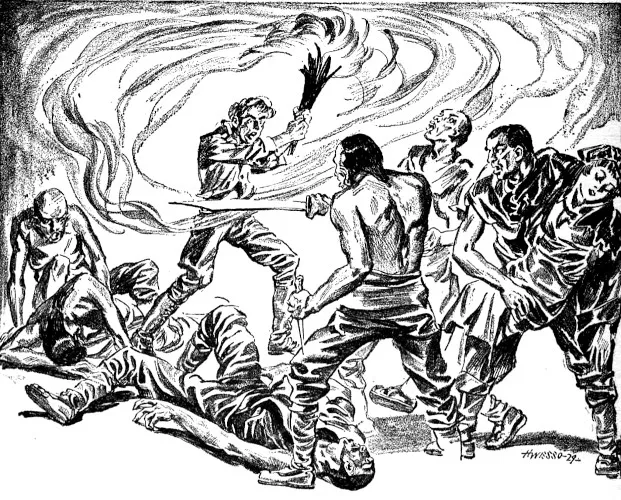
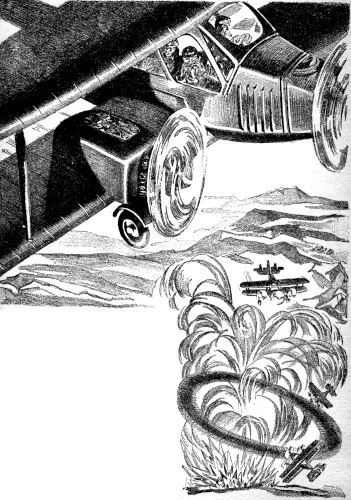
While Saxby watched, and under the same bright moonlight the maddened
Chinese were annihilating one another hundreds of miles away, the
marines slept. But they did not rest. The unnatural cold chilled them
to the bone, and a specific poison, odorless as clean air, tainted the
night. They began to toss and groan in their sleep, unable to shake off
the dreams that defied reason and yet were more credible than any human
experience.
"I had better waken them," Saxby muttered to himself. "They are having
the same dream that I had the night Yang died. Gad! I begin to feel it
myself. Something's going to happen; I can feel it coming, and I think
it is coming pretty soon."
He tried to move and discovered that he could not. He seemed to be
paralyzed.
"Something new," he remarked. "Well, let it come. I can't stop it."
Unable to move a muscle he sat staring straight ahead over the moonlit
desolation of the shattered mountains. To test the strange paralysis
he tried to shout, only to find he had lost control of his throat. The
automatic functions of his body continued normally. His heart did not
lose a beat, he breathed regularly, and he saw and heard as clearly
as ever. Then he became aware that his hands and feet were losing all
sensation. The numbness rapidly spread over his whole body, and he sat
as rigid as a rock, without sensation, yet fully conscious of what he
saw.
His condition was precisely that of a patient submitting to a
surgical operation under one of the newer wonderfully effective local
anesthetics.
Naturally he wondered what the nature of the operation was to be.
It began with a tremendous roaring swish like the simultaneous ascent
of thousands of gigantic sky-rockets. The wilderness of shattered rock
that had overflowed the plain for a distance of fifteen miles or more
began to boil. Its surface rose and fell tumultuously in huge bubbles
of rock and earth that puffed up suddenly, burst, and collapsed with a
brittle din that shook the sky.
This phase lasted but a few seconds.
First one bubble survived, then another, until the whole desolation
became a city of bleak, colossal domes. The domes began to glitter
icily in the moonlight, and almost instantly the imprisoned life that
was in them burst forth and multiplied. Jostling one another to ruin,
the furiously increasing masses of crystal flashed out gleaming arms
that branched and begot new colonies of glittering crystal; these fed
for a moment on their generative substance, then instantly burst out in
explosive growth in all directions, repeating the conquest of space.
As yet they had no mode of locomotion; their sole power over distance
was growth. In their urgency to survive, the opposing masses shot their
gleaming progeny at one another, devouring the diminishing distances
between them.
Their one instinct, if they had any, was to exterminate their
competitors by seizing and absorbing all of the food by which they
might increase.
Before the last alley closed and became a dense mass of furiously
growing crystals like the rest, the mountain range that had flowed over
the plain was a vast concourse of gigantic crystal shapes, towering
and flashing in the moonlight, that shot upward with an accelerated
growth that menaced the sky. Each glittering pinnacle budded at a
thousand sparkling points into living spears of crystal; these shot
into the night, themselves to become the sources of explosive life.
Neither upward nor lateral growth apparently had any natural limit, and
the huger the vast bulks became the faster they grew. The whole mass
pulsed and flickered with striæ of green and purple light deep within
the hollow crystal masses, and from the brittle, spearlike points
streamed steadily upward innumerable brushes of clear, cold blue light.
The loftiest pinnacles, leaping skyward with an ever greater speed,
bristled with electricity whose sharp, dry hiss all but drowned in
volume the creeping rustle of an incessant growth.
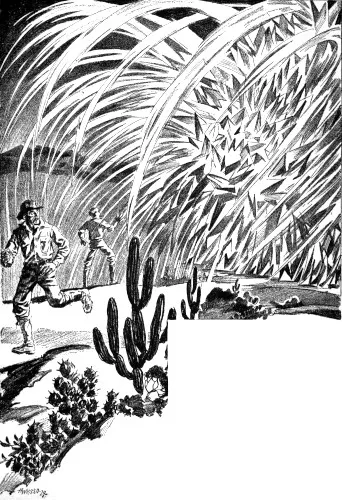
With a succession of pealing clashes of crystal masses the last lanes
closed and instantly became new foci of fecundity. For perhaps a
second the densely packed mass withstood the internal pressure of its
own lateral expansion. Then with a transcendent crash thousands of
irregular chasms were instantly created, radiating in all directions
through the still growing mass, as the hollow crystals collapsed along
the planes of greatest pressure.
As the crushed crystals released the purple and green luminescence
which was the source of their life, they instantly lost their solid
structure and sublimated into a heavy, invisible gas. Where one crystal
volatized, the impact of its destruction set free the imprisoned energy
to shatter the densely packed crystal matrix in which it was embedded;
the wave of destruction thus started stopped only at the densest cores,
isolating them as prolific centers of unabated vitality.
Again the merciless contest for possession of the nutritive rocks
was fought out, but with diminishing speed, and again the resultant
deadlock was suddenly broken by waves of destruction that cleft the
solid unit into thousands of isolated enemies. The terrific speed of
the encounters became less as the nutrition in the rocks was drawn into
successive generations, to be dissipated into gas as enemy clashed
against enemy, till, after the hundredth assault the lanes ceased
to close, and the towering victors grew slowly and silently upward,
starving on their exhausted rocks. The food they had battled for no
longer existed. Ten thousand conquerors towered in the moonlight
to await the trivial accidents that would destroy them as they had
destroyed their enemies.
The whole conflict lasted but an incredibly short time as men measure
events. From the instant when the first gleaming spire rose from the
rocks to the last clash but thirty or forty seconds had elapsed.
Yet every detail of it was fixed distinctly and indelibly on the
consciousness of the one human being who saw it all from beginning to
end.
Saxby would have closed his eyes and stopped his ears if he could, but
he had lost control of his body. By a sense more ancient than either
sight or hearing he experienced a torture less endurable than either
the sights or the sounds of that conflict between things which lived,
and yet were neither animal nor plant, for the cells of his whole body
were aware of the combatants' agony as parts of their substance died.
Each wave of destruction that cleft the warring masses asunder rocked
the very atoms of his own flesh and bone with a pang that was not
mortal pain, but the after-shock of an immemorial dissolution. The
stuff of his own body had suffered in forgotten ages as those things
were suffering now; before the first life started on the millions of
years of upward evolution that had culminated in his own body and in
his mind, the substances of his body had lived as these things were
living, and had died in agony such as theirs.
It was not a dream. The men who slept, drugged by the same poison as
he, also experienced it. Nature does not communicate with its creatures
by reason alone, nor through the haze of ideas that reason evolves to
explain nature, for it is insensible to reason, but directly, thing
to thing. Because we have existed, thought and reasoned for at most a
few million years—which are less than a pulse beat in the life of the
stuff of which we are made—we assume that nature has but one mode of
expression and but one way of communicating with its creatures. When
the last man has ceased to think, the universe will still be evolving
as if our race had never existed, and possibly the shadow of our own
passing may fall upon the life that is to follow us, chilling our
successors with the memory of a pain that only their atoms remember.
May no accident precipitate us into their age as the living crystals
were hurled into our own. With all their insensate ferocity, according
to the lonely watcher who saw their war and who suffered in their
death, those crystals were less terrible than some whose nostrils are
filled with the breath of life.
The discharge of millions of volts of electricity from the warring
crystals, and the escape of vast quantities of ionized gases as the
dying bled out their purple or green lifeblood, incurred its inevitable
reaction. Even as the clashing Titans warred, grinding themselves and
their opposing kind to dust that sublimated instantly, the suspended
moisture of the chilly air condensed into black thunder clouds above
their splintering pinnacles.
When the conflict ended, and the victors towered up in solitary might
awaiting starvation and the dawn, a vast canopy, black as anger,
sagged down from the sky above them, shutting them from the moonlight
and penning them up in all but total darkness. All about their sombre
isolation a soft radiance flooded the plain, and it became the dream,
the unsubstantial vision of an infinite ocean from another life; the
black island of the Titans awaiting the lightning was the reality, the
substance, and the familiar dwelling place. The lucent calm, glowing
like a milky opal about the black cliffs at the base of the island, and
receding with diminishing brilliance to infinity, was the incredible
memory; the stark island; the vivid present.
The sooty shadow, under that black canopy instinct with lightning, was
the natural habitat and fecund breeding place of the living crystals
that had bred and multiplied in sunless caverns to burst asunder
the mountains; in total darkness they increased without restraint;
in sunlight they ceased to multiply. Injured in darkness they still
lived; the most trivial wound inflicted in full daylight slew them
progressively and swiftly from pinnacle to root. In one last effort to
increase in their fostering darkness, the living crystals drew from
the impoverished rocks the last traces of their silicon, absorbed and
digested it into the compounds that gave them life, grew explosively
for a fraction of a second, and ceased absolutely to grow. Unless
transplanted to fresh feeding grounds the ravenous Titans must stand
where they were rooted, and starve till the accident of a thrown
missile should break a fragment from the brittle armor of one,
releasing the prisoned life and letting the famished thing perish
utterly.
The black island leaped into stark relief as the lightning struck the
highest pinnacle, demolished it, and sent the towering crystal crashing
down in a wave of progressive ruin to fragments that volatilized
instantly. The following crash of thunder, sharp as a pistol shot,
was the signal for the sagging canopy to release all of its forked
darts. Under the volleying thunders that jarred the plain like a rapid
earthquake, the stabbing lightings etched every glittering detail of
the motionless Titans in glaring relief, playing harmlessly about a
group of fifty or a hundred, only to leap suddenly away and strike down
a solitary martyr. As a colossal crystal expired, the man watching its
extinction suffered its infinite pain, and the sleepers dreamed of its
agony with every atom of their bodies. The vast army of the victorious
crystals that had survived by annihilating their kind dwindled rapidly
to half its numbers, then to a quarter, and then more slowly, till but
a scant dozen of Titans stood where they had grown, powerless to flee,
awaiting their doom. A single spurt of blue fire from above destroyed
all but three; the clouds burst, and with a roar that might have been
heard fifty miles let down their deluge.
The three survivors toppled slowly over on the dissolving earth and
came gently to rest on their sides in the flood, exposing their matted
roots of crystal to the rain.
The lightings did not cease with the coming of the rain, but continued
to strike viciously at the last of their fallen enemies. In falling
the three had exposed their secret places, the very hearts and
fountains of their life. Through the crystal curtains of the rain it
was not possible to see precisely what happened to the exposed roots
about which the lightings concentrated their attack; yet the quality
of the flickering light which they emitted changed visibly. It was
in the roots that the purple and green light, the lifeblood of the
living crystals, first generated as the monsters grew. Passing into
the hollow crystals that budded from the roots, the light gave life
to the branching mass, and carried with it the principle of life and
generation to the farthest tips. As the glancing lightnings played all
about the roots the quality of the light underwent a gradual change.
The purple separated from the green and darted through the limbs of
the recumbent masses, while the green, its brilliance intensified,
remained in the roots. As if repelled by the green, the lightnings
followed the purple, stabbing viciously. Simultaneously the recumbent
purple branches of all three were struck. The stricken branches
withered instantly, and the same bolts which destroyed them fused the
ends of the huge stumps, sealing up the green light in the roots. The
lightnings ceased, and a pall of darkness descended with the flood.
Through the black torrent three misty green embers glowed and flickered
evilly, waiting the accidental missile which would liberate their
prisoned life to ravage the world.
A sleeping man stirred in his dream and groaned, Saxby felt sensation
steal into his nerves once more. The man who had groaned staggered
to his feet in six inches of water, cursed, and shouted to rouse his
companions before they drowned.
"What a hellish night!" It was the captain's voice. "Where's Mr. Saxby?"
"Here. I'm beginning to move again."
"Why the devil didn't you waken us?"
"I couldn't. You were drugged into paralysis. So was I. But I saw
everything."
"I dreamed it," a man muttered. "Why can't I move my legs?"
"Gassed," Saxby informed him. "Lie still. You'll find your legs in a
minute. This downpour is dissolving the poison like salt and soaking it
into the ground."
"There will be a flood if this keeps up another ten minutes," Lane
remarked. "Give us a hand in rousing the men. We must move higher up
the slope at once."
It was a half an hour before they were on the march uphill, slushing
through a torrent of gravel and muddy water that almost swept them from
their feet. At length they reached a place of safety and stood about
miserably in the dark and the rain waiting for daylight.
On comparing notes Saxby and Lane found a remarkable similarity between
their awareness of pain during the battle of the living crystals,
although one had been stupefied in sleep and the other intensely
awake. Questioning his men Lane found that they, too, had distinct
recollections of the same thing, although only three or four had the
skill to express graphically what they had "dreamed." On being assured
by Saxby that the rain was disposing of the poisonous gas for good, the
men brightened. The downpour continued to within an hour of daybreak.
The sun rose red upon a welter of white mud—the sticky paste of
crushed rock from which every particle of silicon compounds had been
absorbed by the living crystals. Most of this stuff was pulverized
limestone. The living crystals, it appeared, needed only a small amount
of lime or other calcium compounds to start their explosive growth;
their food, so far as they obtained it from rocks, was silicon dioxide.
From the fate of Tom's cotton mat and Yang's wood-pulp notebook, it was
clear, as Saxby had already deduced, that some at least of the crystals
could draw nourishment from cellulose. An equally probable theory
suggested was that at some stage of their development the crystals in
which both the purple and the green luminescence played the part of
blood or chlorophyll, could live and multiply on both kinds of food,
silicon and cellulose, but that they prefered silicon and thrived best
on it. In fact some of the phenomena indicated that these dual monsters
could absorb only a limited amount of cellulose, no matter how huge
they became. When the lightning which must have been electricity of
some kind, positive or negative, played about the roots of the three
survivors, it repelled the oppositely electrified gas, the green, into
the roots and pursued the purple into the farthest tips before striking
the branches of hollow crystal and sealing off the green in the roots.
Such was Saxby's tentative explanation to Lane as they stood staring
out over the mass of white mud that buried the ruins of Teng-shan. The
deluge had one good thing; it had effectively sluiced the earthquake
fissures full of gravel from the undestroyed hills.
The men gathered in silent knots viewing the three enormous roots,
towering up in the cold morning air, like the wrecks of colossal
icebergs, which were all that remained of the vast forest of monsters
that perished in the night. Saxby was uneasy.
"I can't understand," he said, "why those infernal things don't melt
into gas as the sun strikes them. They must be a new breed."
"Let's walk—or swim—over and take a look," Lane suggested.
"Not yet. Give the sun an hour. If they're not dead then, I'll go with
you. What about sending the men off on a foraging expedition in these
hills? There must be dead pigs or chickens in the ruins of the farm.
I'm starving."
"So am I. We shall have to get over the pass into Shen-si today. I'll
send the men off to see what they can do."
"That's the stuff. Tell them to bring back a cow or something for me.
I've got to stay and see the end of this."
When, at the end of an hour, the three bergs of crystal showed no sign
of melting in the hot sunshine, Lane and Saxby made their way down
to the white, sticky, steaming mess. As they slipped and floundered
through the mire stretching for miles between them and their goal they
regretted their early start. The deluge had washed the lethal gas of
the crystals' destruction from the air thoroughly enough, but the stuff
still poisoned the soil. Under the sun's rays it was now decomposing
in the paste which it impregnated. Every step released a sickening
puff of the repulsive gas. Although it was not definitely poisonous
in this advanced state of decay, its indescribable odor was all but
unendurable. Only an insatiable curiosity on Saxby's part held Lane to
his intention.
Presently splintered timbers, fragments of copper waterspouts, and the
remains of three machine guns sticking up from the mire, announced that
they were walking over the churned-up ruins of the governor's palace.
They were now rapidly nearing the smallest of the crystal "bergs."
Saxby walked warily ahead, glancing sharply from side to side.
"I say," he called back, "do you notice anything?"
Lane, trained as a soldier to observe the minutest details of the
enemy's territory, replied that he did. The metal scraps were more
plentiful than ever, and two twisted copper spouts showed that they
were still walking over the ruins of important buildings. There was,
however, a total and suspicious absence of wood. Not a splinter was to
be found.
"Evidently that green devil squatting there like a tame iceberg is a
cellulose feeder," Saxby remarked.
"Squatting" was rather a contemptuous term to apply to the huge shape
that towered above them like a skyscraper, shadowing the mire with its
distorted limbs of hollow crystal for a radius of a quarter of a mile.
Through the vast bulk of its main mass, and along the jagged "roots"
that sprawled in all directions, a dull green light pulsed slowly as if
the creature had a living heart. Watching it in awed silence the men
almost heard the steady beat of the life flowing and ebbing through
the crystal arteries of the thing. They could not doubt that it lived.
Saxby broke the silence.
"After last night nothing surprises me. Yet this beats them all. You
can see it live, or rather you can see it starving to death. There's
not a stick of wood or any other cellulose material within half a mile
of the infernal brute, and that, I'll wager, is the only sort of stuff
it can absorb. It must be a cellulose feeder. What would happen, do you
suppose, if I were to go back and get one of those posts and offer it
to the brute?"
"You might try it and see," Lane suggested. "I'll wait here."
Saxby was as good as his challenge. He started back to get a stick of
wood. Lane stopped him.
"Don't be a fool! You haven't the ghost of an idea how that green devil
eats its food when it gets the chance. We saw how the purple and green
got at Markoff's bones. Once is enough."
"All right," Saxby laughed. "I'll have to wait till you're gone. Shall
we go up and take a look at him at close quarters? I want to see how
brittle he is."
"I'm game." He suddenly remembered what had happened to Tom's mat.
"Take off your clothes," he ordered, proceeding to set the example.
"What the devil for?" Saxby demanded.
"You say it is a cellulose feeder. There's a lot of cotton in our
clothes. I have a wife and kid in Los Angeles. Want any more reasons?"
Under protest Saxby stripped to the skin, Lane would not even permit
him to put his shoes on to protect his bare feet.
"The fact that Markoff's boots and nails were not destroyed doesn't
prove anything," he objected. "Nor does the fact that the hoofs of the
burros came through unchanged have anything to do with us. Neither you
nor I ever saw an all-green brute like this. Ours all had a dash of
purple. This fellow may relish leather and horn and stuff like that
as much as Markoff's seemed to enjoy bones and cotton. You make your
inspection in a state of nature or you don't make it."
Grumbling at Lane's "militarism," Saxby submitted. Naked as worms the
two men passed into the cold shadow of the colossus. Though neither
admitted it till long afterwards, both were so stiff with fright that
they had difficulty in making their legs move. Had either been alone
he would never have dreamed of going forward. Afraid of acting the
poltroon before his companion, each made a fool of himself, for it was
nothing less than ignorant bravado to tempt the devil of whose habits
they knew precisely nothing, except that they were probably evil.
On close inspection the towering buttresses of the creature appeared
as nothing more ominous than huge, hollow crystals, packed solidly
together, and filled with a moving green light. The whole structure
gave an impression of massive strength, and somehow, for the feeling it
induced was undefinable, a sullen threat of immense stores of creative
energy locked up within the crystal cavities.
"I wonder how brittle this rock crystal is?" Saxby speculated. He
glanced up at the tremendous root three hundred feet above them,
zig-zagging far out over the site of Teng-shan like a forked dart of
green lightning. "If that thing up there should break away now and fall
on us, we should be cut to ribbons before we could yell. Feel how sharp
these edges are where the crystals twin. Damn it! I've cut my finger."
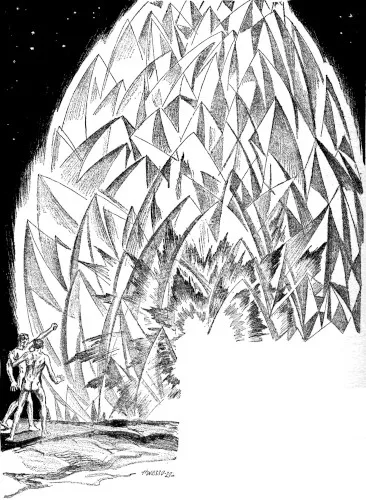
"I wonder how brittle this rock crystal is?" Saxby
speculated. He glanced up at the tremendous root three hundred feet
above them, zig-zagging far out over the site of Teng-shan like a
forked dart of green lightning. "If that thing up there should break
off, now, and fall on us, we should be cut to ribbons before we could
yell. Feel how sharp these edges are where the crystals twin, Damn it!
I've cut my finger."
"Don't do that!" the captain yelled.
Before Lane could stop him, Saxby had dealt the crystal wall a
resounding blow. The hollow crystal vibrated, emitting a deep,
bell-like note that was inexpressibly mournful. The sound died away in
the vitals of the thing and the wall ceased to shudder.
"You could almost imagine the brute had nerves," Saxby remarked. "But,
of course, that's rot."
"What did you hit it for?" Lane expostulated, his own nerves on edge.
"To get some idea of its elasticity. I wanted to find out what are the
chances of killing it with a judiciously thrown stone. From the way the
crystal vibrates I infer that it is extremely brittle." He looked up at
the hanging root. "Before the breeze grows into a full-sized wind and
snaps that thing off, I think we had better retreat. I don't like the
way the gusts eddy about the base of this berg."
As they put on their sodden clothes they held a council of war.
"These infernal things have got to be destroyed before you leave,"
Saxby declared. "There's no telling what a sudden storm may blow up.
These are cellulose feeders, pure and simple. I'm convinced of that.
Suppose there is another storm and a high wind. Those roots will be
blown down and smashed into millions of bits. They are exceedingly
brittle. When they do smash, they will go all to pieces, and vast
quantities of pulverized glass will blow all over western China. What
if some of that dust settles on a forest, or even on a grove like the
one we camped in last night? Although I am not sure of my deduction, I
believe that it is certain that something bad would start.
"With abundant nourishment the germs of life in the dust might well
generate a plague of the huge brutes that would sweep the world and
denude it of all growing things—trees, grass, shrubs and all. We saw
how the silicon feeders stop growing when they have exhausted their
food. They can't budge an inch, except by growing laterally, from the
place where they take root. The slightest impact jars them pieces;
the breaking of the brittle crystals start a physical reaction that
dissolves the solids instantly into heavy gases. Then, when the sun
rises, it finishes the killing by decomposing the gases into lighter,
unstable ones that are perfectly harmless, apparently, and don't seem
to retain their composition long. That they smell like the very devil
while they are disintegrating is merely an unpleasant detail of no
significance. Now, I vote that we act on these obvious hints and try
our luck against these three green devils before you leave. I've got to
stay here till General Maitland sends me some word and a geologist or
two."
After much argument Lane finally agreed. The point which decided him
was not made by Saxby. That intrepid collector of earthquakes thought
nothing of his personal danger. He never even mentioned it. Lane simply
could not leave him, even with a squad or two for protection, to his
own devices. To do so would expose him and his insatiable curiosity
to almost certain destruction, for Saxby would never be content, with
Lane out of the way, until he had explored every crystal of those evil
bergs. With the devils destroyed before he left with the main body of
his men, as he must do owing to the scarcity of food, Lane felt that
Saxby might safely stay a year in Kansu if he liked, and enjoy himself
after his own fashion. The decision was a human one. It offered,
perhaps, the only solution of a difficult problem. Neither could
foresee what would happen. The only way to find out was to experiment,
which they did. "There can't be any danger," Saxby repeated. "These
brutes have consumed every stick of wood within reach. They were the
outposts of the army that destroyed itself last night. What can they
live on if we smash them where they stand? Nothing. They'll die, half
an hour after we let their blood out. But destruction in a high wind
would be another matter. At least some of the spores—if you can
call them that—would blow into trees before they were dead. To make
everything safe for the future, you can collect an army of Chinese in
Shen-si and bring them back with you to bury all the fragments under
six feet of this paste. There's not an atom of silicon or a splinter
of wood in it, so the disease will be buried forever. Here's where we
get the better of nature. Our kind of evolution shall survive, not her
antique brand that would make the silicon compounds masters, and the
carbon compounds—ourselves among the rest—slaves and food for these
brainless abominations."
The battle of "carbon against silicon," as Saxby called the assault of
the human beings against their primeval rivals, began at twelve o'clock
sharp. On returning to the camp in the fir grove, Saxby and the captain
found the men roasting the sad remains of half a dozen fowls, nine
pigs, and two marmots—all victims of the earthquake. The ration was
inadequate for the ravenous men, but it would eke out what they carried
in their knapsacks and make a forced march into Shen-si possible.
Believing in safety first, Lane organized the attack against the
smallest of the crystal bergs—the one he and Saxby had inspected. If
they conquered that one they would proceed to demolish its two gigantic
brothers. The baby was not much taller than the tallest New York
skyscraper; its brothers made it look like a pigmy.
At a quarter to twelve the marines lined up just opposite the zone
which the voracious infant had licked clean of the last splinter
of wood. The jagged projection shadowing the plain, three hundred
feet from the ground, under which Lane and Saxby had conducted their
investigation, was selected as the most vulnerable point. If that
forked streak of crystal lightning could be severed at its base, it
would crash against the main body in its fall and probably bring the
whole huge berg crashing down in shattered crystal. Such was the
mechanical theory of the attack. By chipping off chunks of the jagged
root at the highest point of its thickest part, where it branched from
the exposed core, the desired end would follow with éclat. It was
as easy, the sergeant asserted, as shooting fish with dynamite. The
captain's voice rang out.
"Are you ready? Fire!"
Most of the steel-nosed bullets made clean hits. A shower of crystal
chips leaped into the sunlight; the brittle support cracked, and very
slowly for a fraction of a second the huge root began to wheel inward
toward the main mass. Then, with a terrific impact it struck the
crystal berg at its weakest part, and the whole cracked asunder and
began collapsing in a thousand cascades of glittering crystal.
The men's cheers were lost in the brittle thunder that filled the sky.
So also was Saxby's warning shout. Unable to make himself heard he
ploughed through the puddles and sticky mud and grasped the sergeant
by the arm. By signs he conveyed his warning and the sergeant passed
it on. It was a slow process, as the men were reluctant to turn their
backs on a spectacle that beat a hundred Niagaras.
What sent the cold shivers up Saxby's back was this. He noticed as the
green gas escaped from the broken crystals that it flowed down, not
up. Moreover, as the sunlight played upon the gas it rapidly bleached.
The hollow crystals evidently were filters for the actinic rays of
the sun. Now that the sunlight played directly upon the gas, chemical
changes set in, transforming it into a colorless compound. Was the
new gas as heavy as the old? Was it heavier than air? If so, it would
continue to stream downward, invisibly, and pile up for a moment as it
fell about the crumbling base of the berg. Then, when the whole berg
collapsed, the wind of its fall would shoot the colorless gas out over
the plain in a huge, ever-expanding vortex. If the gas was poisonous
the shattered berg would be avenged on the men who had destroyed it.
It was every man for himself. Saxby and the captain found themselves
floundering in white mud up to their knees. They had stumbled into a
shallow earthquake fissure which the deluge had filled with sticky
slime. The premonitory puff of air, being shoved forward in a huge wave
before the oncoming gas, knocked them flat on their faces in the white
mesa and ducked them completely. Saxby stuck his head up, wiped his
eyes as best he could, and saw the captain's head just reappearing. He
also saw a rabble of men trying to run. They were having about as much
success as flies on fly-paper, but they had made progress. They were
now bogged in one of the worst places where splintered timbers from the
governor's palace protruded through the mire. Saxby found his attention
riveted by one stout post, evidently part of a roof beam, which stuck
up in solitary desolation between the men and the shattered berg. It
was covered with a glittering crust of large scales which looked like
bright green barnacles, but which were in fact young living crystals.
Saxby grabbed Lane's arms and pulled them under the slime.
"Keep under, except enough to breathe with," he shouted. "It's coming!"
Lane did not see it come, as he was unable to wipe the white paste off
his eyelids. Saxby did, and he regretted his ability to see. Yet he
could not have closed his eyes; horror forced them open. First he saw
the fur of green crystals on the post add a second coat on top of the
first. What happened, of course, was that the first coat was thrust
out from the decomposing wood by a more vigorous growth of crystals
that absorbed the first as they grew. He remembered a third coat being
laid on in a fraction of a second. Then instantly the mass attained the
maximum growth and exploded into a motionless dome of green crystal,
bristling like a mace, forty feet in diameter. The entire substance of
the post had been devoured by the monster. Its hollow crystal cells,
thin as paper yet strong as granite, were the offspring of an invisible
gas breeding on the cellulose of the wood. In its explosion to maturity
the brute cut one bogged man to pieces with its razor-edged knives of
crystal.
What happened next was repeated until the shattered berg had achieved
a complete and barren victory over its destroyers. One man, bogged to
his boots in the white paste, suddenly disappeared. The invisible gas
flowing over the quagmire had isolated him like an island in hell.
Instantly the life in the gas seized upon the cotton in his uniform,
devoured it, and burst into a living crystal that reached its maturity
in less than a second and ceased to grow. A pillar of densely packed
green crystals, ten feet in diameter and six feet high, squatted in the
mire where, less than a second since, a living man had stood. The white
of his naked body gleamed mistily at the core of his living tomb.
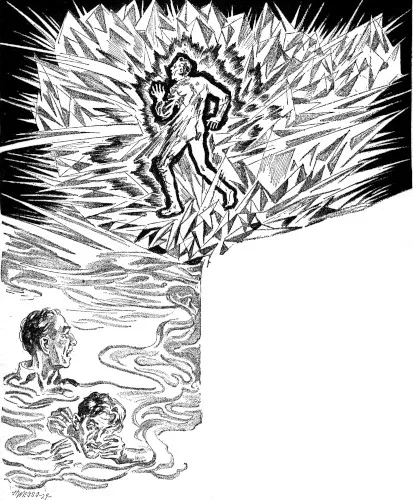
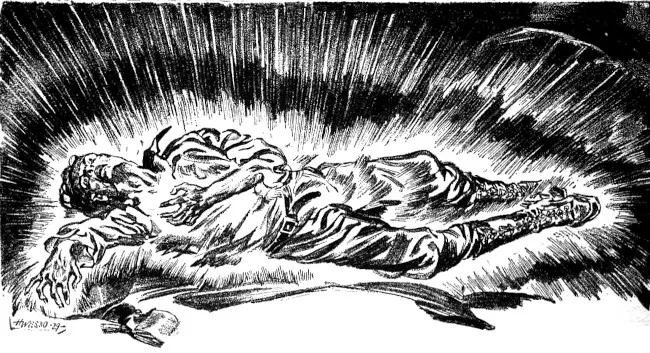
A pillar of densely packed green crystals, ten feet
in diameter and six feet high, squatted in the mire, where, less than
a second since, a living man had stood. The white of his naked body
gleamed mistily at the core of his living tomb.
In less than ten seconds the last man was dead. The victors, except
the two cowering in the mudhole, were wiped out by the fiend they had
conquered. Some fell victims to the knives of the living crystals,
that burst from every stick or splinter, before the gas overtook them
a second or two later and crystallized their clothes, but most were
entombed as was the first. That these men had come to Kansu on a
mission of mercy counted for nothing with nature, whose motto seemed to
be, "Who taketh the sword shall fall by the sword."
The two survivors did not dare to venture from their mudhole till
sunset. When at last Saxby decided to risk it, he managed to tear off
a piece of his cotton undershirt without getting it completely smeared
with white paste. This was brought to the surface in his clenched fist
and hastily dropped. It was not attacked. The men crawled out of the
mess that had saved their lives and reeled off toward the pass into
Shen-si.
"I must report as soon as possible to General Maitland," Lane muttered.
"We can do nothing here."
"No," Saxby agreed. "We made a ghastly mistake. We shall have to
get back somehow to Shanghai and return with the proper weapons for
destroying these infernal things."
"How can they be destroyed? Your last guess was a bad one."
"After what has happened I won't insult you by prophesying. Still, I
have on idea. Stay here while I go over and look at one of these new
brutes. No! Don't you come. Remember you have a family; I haven't."
Saxby's latest idea was a natural outgrowth of his previous theories.
His main contentions still survived, although each successive assault
of nature modified the details. These new crystals were of a different
kind from any of the others. This much was obvious from their habits.
They were pure cellulose feeders like the two Titans still looming
undestroyed above the ruined mountains; but their contours were utterly
different from those of the giants. Saxby still maintained that his
initial strategy was sound. He had merely blundered in carrying it
out. Before firing, the men should have stripped to the skin, and they
should have burned every stick of wood in the vicinity of the bergs.
Approaching one of the squat pillars Saxby suffered a mishap which
nearly cost him his life. He learned that the living crystals were not
quite so immobile as they seemed. Human beings and other animals walk
by advancing their feet. The object of lifting the feet and walking is
to cover distance, to move from one place to another—in short, not to
be chained a prisoner to one spot. It probably has never occurred to
most human beings or animals that other natural ways of breaking their
bondage to space are available. Yet such an alternative escape without
machines is not only feasible but also ridiculously simple. This is
exactly what Saxby almost lost his life to discover.
The crystals had devoured every stick of wood in their vicinity that
showed so much as a splinter through the protective paste. It was
Saxby's misfortune to stumble elaborately over the submerged barrel of
a Chinese rifle and kick the stock violently against one of the razor
edges of the brute before him.
There is a lot of good solid wood in a rifle stock. The cutting edge of
the crystal bit into its prey and instantly began to feed. Saxby was
stabbed in the calf of the left leg by an evil green sword that shot
from the stock. A difference in aim of a few degrees would have cut his
leg off. That was the one accident that befell him; the other crystals
shot away from him. Within two seconds the green devil had acquired a
huge protuberance on its side that shifted its center of gravity. Then
it walked.
Lane came to Saxby's rescue just as the unbalanced brute heaved slowly
over in the slime to regain its equilibrium. As they floundered
through the sticky mud the thing seemed to pursue them. In whichever
way they turned, trying to shake it off, it followed. In horror they
began to believe that it had intelligence. But, as they subsequently
discovered, it had none. It was merely a blind devil that walked in
spite of itself. As its keen swords of crystal swished through the
slime they bit into submerged rifle butts and splintered beams. These
became new masses of crystal, like tumors on the old, and again shifted
the balance. Occasionally the green brute stood rocking uncertainly
for a few minutes, as if undecided which way to roll, when the slight,
inevitable fluctuations of the law of chance swerved some crystal knife
against a submerged splinter, and immediately the new growth tipped the
monster forward. It walked by toppling as it fed and grew irregularly,
a pure sport of nature. Where its food chanced to lie plentifully it
advanced rapidly; where sustenance was scarce it tottered; with a whole
forest but ten feet away it would stand and starve till a chance storm
should strew the ground before it with twigs and hurl a broken branch
against its terrible knives. Then it and its voracious progeny would
devour the forest.
The last hundred yards of their flight was a nightmare. Exhausted by
the loss of blood from his wound, Saxby had to be dragged. He begged
Lane to leave him, reminding the captain that he had a family. Lane, of
course, refused. When at last they reached comparative safety Lane was
all in.
"Let's rest a minute," he panted, "and see if we can't stop your leg
from bleeding."
While they were binding up the wound with rags torn from their shirts
they saw the last of their pursuer. In its wallowing lurch through the
mire in search of food it collided with one of the squat, well balanced
pillars. The impact shattered both, and their green blood gushed out in
the twilight.
"Watch that stuff," Saxby whispered. "If it doesn't lose color and turn
white my theory is wrecked."
Almost before he had stopped talking the green gas vanished.
"That settles it!" he exulted. "They're only a species of
cellulose-feeders after all. If there were any wood around here now
you'd see something."
"What about my clothes?"
"Great Scott! I clean forgot. Beat it, before the stuff spreads. Up on
that higher ground!"
They spent the night marooned on a hillock of harder paste. The first
few hours till the moon rose were the hardest. Gazing at the two
undestroyed Titans that loomed through the fading light, and imagining
the worst of the insignificant green devils their own fool-hardiness
had created, they sat silently dreading what the moonlight might bring
forth. Was the malignant fecundity of the ruined mountains indeed
exhausted? Were those crystal demons slowly starving where they stood,
or were they merely waiting for their generative light to give them
strength to march blindly over the plain?
The east brightened; the underside of a fleecy cloud became silver,
and the first level rays of the full moon struck the highest pinnacles
of the Titans. The two men held their breath and waited for the
flooding light to bathe the whole infernal brood. The moon cleared
the undestroyed hills, and the vast desolation, like a memory from a
forgotten life, lay still as death under a cold, unearthly brilliance.
Not a vestige of life stirred.
"We had better take no chances," Saxby advised, venting his relief in a
prodigious sigh. "If the moonlight isn't strong enough to take the vice
out of that hellish gas the sunlight may be."
"It wasn't this afternoon," Lane reminded him. "The men were killed in
the blazing sunshine."
"I know," Saxby admitted. "But I believe the stuff can live only a
short time in the full sunlight. The men were all killed within five
minutes of our crazy attack."
"Yes," Lane argued, "but the gas stopped crystallizing things only
because its food ran out. When it died there was not a stick of wood
or a rag of cotton above ground. If there had been, the gas would have
attacked it in short order."
"That's obvious. And like most obvious things it is obviously only half
true. What happened when we crawled out of the mud to inspect? Were our
clothes attacked? They were not. That disposes of your pessimism. When
I kicked up that damned rifle it came into direct contact with one of
the razor edges of the crystal. The crystal was still living—you saw
what happened. It was the living crystal that attacked the wood, not a
concealed pocket of undissipated gas. My optimism, as usual, comes out
top dog. We shall walk away from here tomorrow morning as sound as a
couple of bright new pennies. Then, after we get to Shanghai, we shall
come back and lay those devils out for good. Your boys will be avenged.
Maitland will give us whatever we ask."
"Much good it will do them," Lane responded bitterly. "They're dead."
"Could they have died better? They were not here to kill and pillage.
If they are the means of ending the reign of terror quickly and
forever, they will have died like soldiers."
"Do you remember what that Chinese girl told us her grandfather said?
'There shall be no killing.' I wonder if she would extend that order
to cover the enemy over there? They are just as much alive as you or
I, and if last night is any criterion, they can feel more pain than a
woman. Why should we kill them?"
"In order that we may survive. Our kind of evolution is better than
theirs."
"Sure?" Lane quizzed.
"Shut up! You're just arguing to keep awake. You think as I do.
Nature blundered when she made those brutes. Take it from me, it is
not mere chance that gave the carbon compounds a long lead over their
competitors—these silicon and cellulose feeders among others—in the
race toward evolution and a higher form of life. Whatever we may be
we are less fiendish than they are. There must be something more than
insane chance behind it all."
"What, for instance?"
"Oh, shut up! How the devil should I know?"
"I think you may have said it," Lane chuckled. "Just one more question.
How do you propose to demolish our fellow creatures over there?"
"No bragging till we do it. We may never beat them. Still, I think
there is rather more than a hint in a fine line I remember from one of
the poets—who wrote it I forget:
"'A stone is hurled; the giant falls.' Now, for Heaven's sake shut up
and let me try to get some sleep. This has been a hell of a day."
While they slept, dreaming of victory, the enemy marched in triumph
over the battlefield, hundreds of miles to the east, which two human
enemies had consecrated with their futile bloodshed. Nature was showing
those who could still see what war is. It beggared their beat.