CHAPTER I
WHITE HOUSE GOSSIP FROM
ANDREW JOHNSON TO
CALVIN COOLIDGE
ADMINISTRATION OF ANDREW JOHNSON
April 15, 1865, to March 4, 1869
LATE April and early May of 1865 brought none of the
usual springtime joys to Washington, the Capital
City; its residents, in common with the rest of the nation,
were shaken with grief over the death of President Lincoln.
Public buildings and private houses hid behind dismal
swathings of crêpe, and the people were still subdued with
the harrowing incidents that had their beginning on the
terrible night of April 14th. Previous sectional opinions
were set aside in the general regret over the loss of the
gaunt, kindly man whom the troubled, disrupted country
had learned to trust. The tragedy at Ford’s Theatre,
with the simultaneous attack upon Secretary of State
William Seward, was the hourly topic of conversation.
Search for the conspirators had begun, and suspicion,
fear, and suspense hung like a pall over the land. Peace
and security were gone. None knew when or where the
relentless arm of the law would pounce upon another suspect.
Innocent and guilty alike went through the gruelling.
Especially did the fear of Northern soldier vengeance
lie heavily upon Southern hearts already bowed in
the sorrow of defeat.
Andrew Johnson, the Union Democrat, the “Tailor
from Tennessee”—“The Knight of the Shears and
Goose,” as Secretary of War Edwin M. Stanton had so
often dubbed President Lincoln’s running mate—had
stepped into the presidential shoes and was handling the
reins of government with dominant force and decision.
Punishment radiated from every fibre of his being. As
he turned from the bier of his slain chief, two paramount
purposes were definite in his mind: to follow Lincoln’s
policies, and to punish those guilty of his death. He
could think of the tragedy in no other terms but those that
spelled treason in its blackest form, especially as, upon
every hand, because of the attack upon Seward, he
found public sentiment committed to the belief that a
general conspiracy had been formed in the South for
the purpose of exterminating the entire Lincoln Cabinet,
together with himself as Vice President, and also General
Grant.
From the hour he took the presidential oath and established
his offices in the Treasury building, the demands for
vengeance poured in upon him from every side.
At the moment, the surrender of all of the Southern
arms was incomplete, and a vast Northern army, two
hundred thousand strong, chafing at restraint, was ready
at a word to take the matter of avenging the death of
“Father Abraham” into its own hands and thus renew
the bloody conflict. Never had a man stepped into the
Presidency under such difficult and soul-trying conditions,
or been confronted with greater tasks, more exacting demands,
or more serious responsibilities. Never had there
been such urgent need for a calm, judicial, well-balanced
mind, able to rise above partisan bias, poised to hold firmly
to the ability to see both sides of each problem and to
refrain from impetuous action.
A nation torn asunder through an internal upheaval had
to be brought together and welded into one again.
Although Andrew Johnson had spent thirty years in
public service, fighting for what he conceived to be right,
his experience had not been of the type to furnish the
subtle diplomacy or suave poise needed to handle successfully
the great problems that now confronted him. It is
doubtful if any man who participated in the political contests
of that period, even the great, wise Lincoln, could
have brought harmony out of the hysteria and chaos that
prevailed in the nation on the morning of April 15, 1865.
Following his induction into office and his inaugural address,
Johnson called his first Cabinet meeting at twelve
o’clock on April 15th, at which two important measures
were decided. These were the arrangements for the
funeral of Mr. Lincoln and the appointment of Mr. W.
Hunter as temporary Secretary of State pending the recovery
of Secretary Seward. At this time the new President
requested the members of the Cabinet to retain their
portfolios.
In his first proclamation President Johnson expressed
his horror of the crime and his resolve to punish the guilty
participants. This document also offered rewards for the
arrest of those believed to be implicated—one hundred
thousand dollars for Jefferson Davis; twenty-five thousand
dollars each for Clement C. Clay, Jacob Thompson,
George N. Sanders, and Beverly Tucker; and ten thousand
dollars for William C. Cleary, late clerk of Clement C.
Clay.
It might be stated here that, despite the most exhaustive
efforts, not the slightest evidence was produced to connect
any of the Southern leaders with the crime of Booth.
Jefferson Davis was captured May 10, 1865, at Irwinsville,
Wilkinson County, Ga., and sent to Fortress Monroe.
Although indicted for treason against the United States
in the Federal Court for the District of Virginia, he was
finally admitted to bail, one of his bondsmen being Horace
Greeley, the abolitionist leader of the North, and released
without trial.
Colonel Lafayette Baker, Chief of Secret Service, was
out of Washington the night of the tragedy. On his return,
he at once applied himself to the task of capturing
Booth, Herold, and all others suspected by Secretary of
War Stanton, for the apprehension of whom the latter had
offered liberal rewards in a proclamation issued immediately
following the tragedy. The Stanton proclamation
stated that $50,000 would be paid by the War Department
for the apprehension of the murderers of the late President.
All persons were warned against harbouring or aiding
them in any way on pain of being treated by the government
as accomplices in the plot.
The City of Washington also offered a reward of $20,000
for the arrest of the assassin and his associates implicated
in the crime.
These rewards stirred up extra zeal, and the army of
searchers grew steadily.
The search for Booth through the swamps and the final
scenes of his capture and death were most graphically told
by George Alfred Townsend, a newspaper correspondent,
in the New York World during that eventful period.
“Gath,” as he was familiarly known, gathered his daily
reports from the most reliable sources. Those bearing
upon Booth’s wild act he later assembled in booklet form
and published in 1865. From it this picture of Booth’s
final stand is copied.
The assassin had been traced to the Garrett home on
the Rappahannock, some distance from Bowling Green,
by the little force sent out by Colonel Lafayette Baker,
Chief of the Secret Service, with instructions not to return
till they had their man. The company was in charge of
Colonel Baker’s former Lieutenant Colonel, E. J. Conger,
and of his cousin, Lieutenant L. B. Baker. At two o’clock,
early morning, they approached the house.
“In the dead stillness, Baker dismounted and forced
the outer gate; Conger kept close behind him, and the
horsemen followed cautiously. So they surrounded the
pleasant old homestead, each horseman, carbine in poise,
adjusted under the grove of locusts, so as to inclose the
dwelling with a circle of fire. After a pause, Baker rode
to the kitchen door on the side, and dismounting, rapped
and hallooed lustily. An old man, in drawers and a nightshirt,
hastily undrew the bolts, and stood on the threshold,
peering shiveringly into the darkness.
“Baker seized him by the throat at once, and held a
pistol to his ear. ‘Who—who is it that calls me?’ cried
the old man. ‘Where are the men who stay with you?’
challenged Baker. ‘If you prevaricate you are a dead
man!’ The old fellow, who proved to be the head of the
family, was so overawed and paralyzed that he stammered
and shook, and said not a word. ‘Go light a candle,’
cried Baker, sternly, ‘and be quick about it.’ The trembling
old man obeyed, and in a moment the imperfect
rays flared upon his whitening hairs and bluishly pallid
face. Then the question was repeated, backed up by the
glimmering pistol, ‘Where are those men?’ The old man
held to the wall and his knees smote each other. ‘They
are gone,’ he said. ‘We haven’t got them in the house.
I assure you that they are gone.’ Here there were sounds
and whisperings in the main building adjoining, and the
lieutenant strode to the door. A ludicrous instant intervened,
the old man’s modesty outran his terror. ‘Don’t
go in there,’ he said feebly, ‘there are women undressed in
there.’ ‘Damn the women,’ cried Baker; ‘what if they
are undressed? We shall go in if they haven’t a rag.’
Leaving the old man in mute astonishment, Baker bolted
through the door, and stood in the assemblage of bare
arms and night robes. His loaded pistol disarmed modesty
of its delicacy and substituted therefor a seasonable
terror. Here he repeated his summons, and the half light
gave to his face a more than bandit ferocity. They all
denied knowledge of the strangers’ whereabouts.
“In the interim, Conger had also entered, and while the
household and its invaders were thus in weird tableaux, a
young man appeared, as if he had risen from the ground.
The muzzles of every gun turned upon him in a second;
but, while he blanched, he did not lose loquacity. ‘Father,’
he said, ‘we had better tell the truth about the matter.
Those men whom you seek, gentlemen, are in the barn, I
know. They went there to sleep.’ Leaving one soldier
to guard the old man—and the soldier was very glad of
the job, as it relieved him of personal hazard in the approaching
combat—all the rest, with cocked pistols at the
young man’s head, followed on to the barn. It lay a
hundred yards from the house, the front barn door facing
the west gable, and was an old and spacious structure,
with floors only a trifle above the ground level.
“The troops dismounted, were stationed at regular
intervals around it, and ten yards distant at every point,
four special guards placed to command the door and all
with weapons in supple preparation, while Baker and
Conger went direct to the portal. It had a padlock upon
it, and the key of this Baker secured at once. In the
interval of silence that ensued, the rustling of planks and
straw was heard inside, as of persons rising from sleep.
“At the same moment, Baker hailed: ‘To the persons in
this barn. I have a proposal to make; we are about to
send in to you the son of the man in whose custody you
are found. Either surrender to him your arms and then
give yourselves up, or we’ll set fire to the place. We mean
to take you both, or to have a bonfire and a shooting
match.’
“No answer came to this of any kind. The lad, John
M. Garrett, who was in deadly fear, was here pushed
through the door by a sudden opening of it, and immediately
Lieutenant Baker locked the door on the outside.
The boy was heard to state his appeal in undertone.
Booth replied:
“‘Damn you! Get out of here. You have betrayed
me.’
“At the same time he placed his hand in his pocket as
for a pistol. A remonstrance followed, but the boy
slipped quickly over the reopened portal, reporting that
his errand had failed, and that he dared not enter again.
All this time, the candle brought from the house to the
barn was burning close beside the two detectives, rendering
it easy for any one within to have shot them dead.
This observed, the light was cautiously removed, and
everybody took care to keep out of its reflection. By this
time, the crisis of the position was at hand, the cavalry
exhibited very variable inclinations, some to run away,
others to shoot Booth without a summons, but all were
excited and fitfully silent. At the house near by, the
female folks were seen collected in the doorway, and the
necessities of the case provoked prompt conclusions. The
boy was placed at a remote point. The summons was
repeated by Baker:
“‘You must surrender inside there. Give up your arms
and appear. There is no chance for escape. We give
you five minutes to make up your mind.’
“A bold, clarion reply came from within, so strong as
to be heard at the house door:
“‘Who are you and what do you want with us?’
“Baker again urged: ‘We want you to deliver up your
arms and become our prisoners.’
“‘But who are you?’ hallooed the same strong voice.
“Baker—‘That makes no difference. We know who
you are, and we want you. We have here fifty men,
armed with carbines and pistols. You cannot escape.’
“There was a long pause, and then Booth said:
“‘Captain, this is a hard case, I swear. Perhaps I am
being taken by my own friends.’ No reply from the detectives.
“Booth—‘Well, give us a little time to consider.’
“Baker—‘Very well. Take time.’
“Here ensued a long and eventful pause. What
thronging memories it brought to Booth, we can only
guess. In this little interval he made the resolve to die.
But he was cool and steady to the end. Baker, after a
lapse, hailed for the last time.
“‘Well, we have waited long enough; surrender your
arms and come out, or we’ll fire the barn.’
“Booth answered thus: ‘I am but a cripple, a one-legged
man. Withdraw your forces one hundred yards from the
door, and I will come. Give me a chance for my life,
Captain, I will never be taken alive.’
“Baker—‘We did not come here to fight, but to capture
you. I say again, appear, or the barn shall be fired.’
“Then, with a long breath, which could be heard outside,
Booth cried in sudden calmness, still invisible, as
were to him his enemies:
“‘Well, then, my brave boys, prepare a stretcher for
me.’
“There was a pause, broken by low discussions within
between Booth and his associate, the former saying, as if
in answer to some remonstrance or appeal, ‘Get away from
me, you are a damned coward and mean to leave me in my
distress; but go! go! I don’t want you to stay. I won’t
have you stay.’ Then he shouted aloud:
“‘There’s a man inside who wants to surrender.’...
“At this time, Herold was quite up to the door, within
whispering distance of Baker. The latter told him to put
out his hands to be handcuffed, at the same time drawing
open the door a little distance. Herold thrust forth his
hands, when Baker, seizing him, jerked him into the night,
and straightway delivered him over to a deputation of
cavalrymen. The fellow began to talk of his innocence
and plead so noisily that Conger threatened to gag him
unless he ceased. Then Booth made his last appeal, in
the same clear, unbroken voice:
“‘Captain, give me a chance. Draw off your men and
I will fight them singly. I could have killed you six times
to-night, but I believe you to be a brave man, and would
not murder you. Give a lame man a show.’
“It was too late for parley. All this time Booth’s
voice had sounded from the middle of the barn.
“Here he ceased speaking, Colonel Conger, slipping
around to the rear, drew some loose straws through a crack
and lit a match upon them. They were dry and blazed
up in an instant, carrying a sheet of smoke and flame
through the parted planks, and heaving in a twinkling a
world of light and heat upon the magazine within. The
blaze lit up the black recesses of the great barn till every
wasp’s nest and cobweb in the roof was luminous. Behind
the blaze, with his eye to a crack, Conger saw Wilkes
Booth standing upright upon a crutch. He likens him at
this instant to his brother Edwin, whom he says he so
much resembled that he half believed, for the moment, the
whole pursuit to have been a mistake. At the gleam of
the fire Wilkes dropped his crutch, and, carbine in both
hands, crept up to the spot to espy the incendiary and
shoot him dead.... In vain he peered with vengeance
in his look; the blaze that made him visible concealed
his enemy. A second he turned, glaring at the fire,
as if to leap upon it and extinguish it, but it had made such
headway that this was a futile impulse, and he dismissed it.
As calmly as upon the battlefield a veteran stands amidst
the hail of ball and shell and plunging iron, Booth turned
to the door, carbine in poise, and the last resolve of death,
which we name despair, set on his high, bloodless forehead.
“As so he dashed forward, intent to expire not unaccompanied,
a disobedient sergeant at an eye-hole drew
upon him the fatal bead. The barn was all glorious with
conflagration, and in the beautiful ruin this outlawed man
strode like all that we know of wicked valour, stern in the
face of death. A shock, a shout, a gathering up of his
splendid figure as if to overtrip the stature God gave him,
and John Wilkes Booth fell headlong to the floor, lying
there in a heap, a little life remaining. ‘He has shot
himself!’ cried Baker, unaware of the source of the report,
and rushing in, he grasped his arms to guard against any
feint or strategy. A moment convinced him that further
struggle with the prone flesh was useless. Booth did not
move, nor breathe, nor gasp. Conger and two sergeants
now entered, and taking up the body, they bore it in haste
from the advancing flame, and laid it without upon the
grass, all fresh, with heavenly dew.
“‘Water,’ cried Conger, ‘bring water.’
“When this was dashed into his face, he revived a moment
and stirred his lips. Baker put his ear close down
and heard him say:
“‘Tell Mother—I die—for my country.’
“They lifted him again, the fire encroaching in hotness
upon them, and placed him on the porch before the dwelling.
“A mattress was brought down, on which they placed
him and propped his head, and gave him water and brandy.
The women of the household, joined meantime by another
son, who had been found in one of the corn cribs, watching,
as he said, to see that Booth and Herold did not steal
the horses, were nervous, but prompt to do the dying man
all kindnesses, although waved sternly back by the detectives.
They dipped a rag in brandy and water, and
this being put between Booth’s teeth, he sucked it greedily.
When he was able to articulate again, he muttered to Mr.
Baker the same words, with an addendum, ‘Tell Mother I
died for my country. I thought I did for the best.’
Baker repeated this, saying at the same time, ‘Booth, do
I repeat it correctly?’ Booth nodded his head. Twice
he was heard to say, ‘Kill me, kill me.’ His lips often
moved but could complete no appreciable sound. He
made once a motion which the quick eye of Conger understood
to mean that his throat pained him. Conger put
his finger there, when the dying man attempted to cough,
but only caused the blood at his perforated neck to flow
more lively. He bled very little, although shot quite
through, beneath and behind the ears, his collar bone
being severed on both sides.
“A soldier had been meanwhile dispatched for a doctor
three miles away. Just at his coming, Booth had asked
to have his hands raised and shown him. They were so
paralyzed that he did not know their location. When
they were displayed, he muttered with a sad lethargy,
‘Useless, useless.’ These were the last words he ever
uttered. As he began to die, the sun rose and threw
beams into all the tree-tops. It was of a man’s height
when the struggle of death twitched and fingered in the
fading bravo’s face. His jaw drew spasmodically and
obliquely downward; his eyeballs rolled toward his feet,
and began to swell; lividness, like a horrible shadow, fastened
upon him, and, with a sort of gurgle and sudden
check, he stretched his feet and threw his head back and
gave up the ghost.
“They sewed him up in a saddle blanket. This was his
shroud; too like a soldier’s. Herold, meantime, had been
tied to a tree, but was now released for the march. Colonel
Conger pushed on immediately for Washington; the
cortège was to follow. Booth’s only arms were his carbine,
knife, and two revolvers. They found about him
bills for exchange, Canada money, and a diary. A venerable
old Negro living in the vicinity had the misfortune
to possess a horse. This horse was a relic of former generations,
and showed by his protruding ribs the general
leanness of the land. To this old Negro’s horse was
harnessed a very shaky and absurd wagon, which rattled
like approaching dissolution. It had no tailboard, and its
shafts were sharp as famine; and into this mimicry of a
vehicle the murderer was to be sent to the Potomac River,
while the man he had murdered was moving in state across
the continent. The corpse was tied with ropes around the
legs and made fast to the wagon sides. Herold’s legs were
tied to stirrups, and he was placed in the centre of four
murderous-looking cavalrymen.... When the wagon
started, Booth’s wound, till now scarcely dribbling, began
to run anew. It fell through the crack of the wagon,
dripping upon the axle, and spotting the road with the
terrible wafers. It stained the planks, and soaked the
blankets; and the old Negro, at a stoppage, dabbled his
hands in it by mistake; he drew back instantly, with a
shudder and stifled expletive, ‘Gor-r-r, dat’ll never come
off in de world; it’s murderer’s blood.’ He wrung his
hands and looked imploringly at the officers, and shuddered
again: ‘Gor-r-r, I wouldn’t have dat on me fur
t’ousand, t’ousand dollars.’
“Toward noon, the cortège reached Port Royal and
proceeded to Bell Plain, where the old Negro was niggardly
dismissed with two paper dollars. The corpse was
cast upon the deck of a steamer, and the journey to Washington
began.
“All the way associated with the carcass went Herold,
shuddering in so grim companionship, and in the awakened
fears of his own approaching ordeal, beyond which loomed
already the gossamer fabric of a scaffold. He tried to talk
for his own exoneration, saying he had ridden, as was his
wont, beyond the East Branch, and returning, found
Booth wounded, who begged him to be his companion.
Of his crime he knew nothing, so help him God, &c. But
nobody listened to him. All interest of crime, courage,
and retribution centred in the dead flesh at his feet. At
Washington, high and low turned out to look on Booth.
Only a few were permitted to see his corpse for purposes
of recognition. It was fairly preserved, though on one
side of the face distorted, and looking blue like death,
and wildly bandit-like, as if beaten by avenging winds.
“Yesterday, the Secretary of War, without instructions
of any kind, committed to Colonel Lafayette C. Baker,
of the Secret Service, the stark corpse of J. Wilkes Booth.
The Secret Service never fulfilled its volition more secretively.
‘What have you done with the body?’ said I to
Baker. ‘That is known,’ he answered, ‘to only one man living
beside myself. It is gone. I will not tell you where.
The only man who knows is sworn to silence. Never
till the great trumpeter comes shall the grave of Booth
be discovered.’ And this is true. Last night, the 27th of
April, a small rowboat received the carcass of the murderer;
two men were in it, they carried the body off into the
darkness, and out of that darkness it will never return.”
Gossip and rumour have played fast and loose with the
life and death of Booth, and statements and evidence have
been plentiful disputing the fact that Booth was the man
killed in the Garrett barn. Plausible theories have been
advanced as to his escape, due to the secrecy imposed by
Colonel Baker in the interment of the body. The corpse
really was interred beneath the floor of one of the cells in
the penitentiary in the Arsenal grounds, and not committed
to the river, as some believed. Later, the Booth
family were permitted to remove the body to their own
burial plot in Maryland.
Doubtless, to the end of time in American history, the
question of Booth’s death, like that of the fate of the
Dauphin of France, will inspire tales of romance and adventure
for the pen of the imaginative writer.
However, he was proved dead to the satisfaction of
those empowered to apprehend him, and to the satisfaction
of those most vitally interested in the punishment of
the murderer, and all further search for Booth was abandoned.
Robert Todd Lincoln, eldest son of the President,
who was on General Grant’s staff at the time of the
tragedy, gave a statement in his eighty-second year to the
effect that he had never doubted that Booth met his death
in the Garrett barn; that the evidence produced at the
time was sufficiently conclusive, and that the numerous
stories of the escape of the assassin were merely fabrications
created for sensation.
From the diary of Booth, discovered on his body after
his death, the whole scheme of the actor was disclosed.
The repeated failure of a plan to kidnap the President
while he was driving or walking about the city, and take
him by force to Richmond and keep him there as a hostage
for the release of a large group of Confederate prisoners,
was the reason that brought Booth finally to the point
of planning assassination.
This diary was not produced at the trial of the conspirators,
nor did it receive publication in the newspapers
until President Johnson ordered a certified copy of it sent
to him two years later. Then, on Wednesday, May 22,
1867, the National Republican printed a certified copy of
it together with the facts connected with its capture.
To the President
The following is a copy of the writing (which was in
pencil) found in the diary taken from the body of J.
Wilkes Booth.
OFFICIAL COPY:
J. Holt
Judge Advocate General
Te Amo
April 13-14—Friday the Ides.
Until to-day nothing was ever thought of sacrificing
to our country’s wrongs. For six months we had worked
to capture. But our cause was almost lost. Something
decisive and great must be done. But its failure was owing
to others who did not strike for their country with a
heart. I struck boldly and not as the papers say. I
walked with a firm step through a thousand of his friends,
was stopped, but pushed in. A colonel was at his side.
I shouted “sic semper” before I fired. In jumping broke
my leg. I passed all his pickets. Rode sixty miles that
night with the bone of my leg tearing the flesh at every
jump.
I can never repent it though we hated to kill. Our
country owed all her troubles to him and God simply made
me the instrument of His punishment.
The country is not
April 15, 1865.
what it was. This forced union is not what I have loved.
I care not what becomes of me. I have no desire to out-live
my country. This night (before he died) I wrote a
long article and left it for one of the editors of the Intelligencer
in which I fully set forth our reasons for our proceedings.
He or the Gov’s
Friday 21
After being hunted like a dog through swamps, woods,
and last night being chased by gunboats till I was forced
to return wet, cold, and starving with every man’s hand
against me, I am here in despair. And why? For doing
what Brutus was honored for, what made Tell a hero, and
yet I, striking down a greater tyrant than they ever knew,
am looked upon as a common cut-throat. My action was
purer than either of theirs. One hoped to be great. The
other had not only his country’s but his own wrongs to
avenge. I hoped for no gain. I knew no private wrong.
I struck for my country and that alone. A country that
groaned beneath this tyranny and prayed for this end,
and yet behold the cold hand they extend to me. God
cannot pardon me if I have done wrong. Yet I cannot
see my wrong, except in serving a degenerate people.
The little, the very little I left behind to clear my name the
Gov’t will not allow to be printed. So ends All. For
my country I have given all that makes life sweet and
holy, brought misery upon my family and am sure that
there is no pardon in the Heavens for me since man condemns
me so. I have only heard of what has been (except
what I did myself) and it fills me with horror. God try
and forgive me and bless my mother. To-night I will
once more try the river with intent to cross. Though I
have a greater desire and almost a mind to return to
Washington and in a measure clear my name—which I
feel I can do.
I do not repent the blow I struck. I may before God,
but not to man. I think I have done well. Though I
am abandoned with the curse of Cain upon me, though, if
the world knew my heart, that one blow would have made
me great though I did desire no greatness.
To-night I try to escape those bloodhounds once more.
Who, who can read his fate? God’s will be done. I have
too great a soul to die like a criminal. Oh, may He spare
me that and let me die bravely. I bless the entire world,
have never hated or wronged any one. This last was not
a wrong unless God deems it so. And it is with Him to
damn or bless me.
And for this brave boy with me, who often prays (yes,
before and since) with a true and sincere heart, was it a
crime in him, if so, why can he pray the same? I do not
wish to shed a drop of blood but I must fight the course,
’tis all that’s left me.
As the Capital City was still under military rule, a military
commission was appointed to meet at Washington,
D. C., on May 8, 1865, for the trial of the conspirators
and other persons implicated in the murder of the late
President Lincoln and the attempted assassination of Hon.
William E. Seward, Secretary of State.
Throngs gathered about the Court (sitting then in the
Penitentiary at the Arsenal) daily eager to view the
spectacle of the prisoners, hooded and in irons. Mrs.
Surratt was manacled like the men, according to the account
given by Ben Perley Poore.
The Court finished its task on June 30, 1865, and a full
report of its findings was ordered to be submitted to the
President. On July 5th, the President approved the report
and ordered the executions of Mrs. Surratt, David
E. Herold, George A. Atzerodt, and Lewis Payne to take
place at once. On July 7th, these sentences were carried
out. The others implicated, Samuel Arnold, Edward
Spangler, Samuel Mudd, and Michael O’Laughlin, were
sent to the military prison at Dry Tortugas.
In Mrs. Surratt’s case, every effort made by her daughter
and her father confessor, as well as a group of prominent
men and women who sought to intercede in her
behalf, met with complete failure. Although the daughter
knelt upon the White House steps for hours beseeching a
hearing by the President, Mrs. Johnson, and even Mrs.
Patterson, admission was denied to her and all others on
the same mission.
The recommendation for clemency for Mrs. Surratt,
making her sentence one of life imprisonment instead of
execution, because of her age and sex, was signed by all
members of the Court except General Lew Wallace, A. P.
Howe, Colonel R. Clennin, and T. M. Harris. This paper
was prepared, signed, and given to Judge Holt to be
handed to the President with the findings of the Court.
President Johnson declared this petition never reached
him, and the supposition is that it was either blocked or
mislaid accidentally or intentionally in the War Department.
Great was the furore stirred up in legal circles over
this trial, and dissenting opinion was freely expressed.
Judge Andrew Wiley, of the District Supreme Court,
known as one of the strongest characters on the bench,
did not concur in the plans for a military trial for the
conspirators. He arose early on the morning of the execution
day to sign a writ of habeas corpus for the release
of Mrs. Surratt. Judge Wiley, a devoted friend of Abraham
Lincoln, having received his appointment to the
bench from him, believed that the legality of Mrs. Surratt’s
conviction by court martial should be determined
by a civil court. He concurred in the effort to secure a
stay of execution by signing the writ of habeas corpus,
directing General Hancock to produce her in court. The
writ was served, but General Hancock did not obey it.
Judge Wiley’s scathing rebuke to the military authorities
for thus ignoring and overriding the civil powers is one of
the most notable in the annals of court history.
During the short period of the trial, from May 8th to
June 30th, 403 witnesses were subpœnaed, 247 examined
for the prosecution, 236 for the defense, 4,300 pages of
legal copy testimony taken, with an additional 700 pages
of arguments.
John Surratt, whose intimate association with Booth
led to his mother’s being implicated, escaped to Canada
and for two years evaded capture. Finally, he was apprehended,
but owing to the odium that had followed the
Military Commission, he had a civil court trial. This
grew into such a bitter controversy over the execution of
his mother that it became more of a trial of a former court
than of himself, and through the failure of the jury to
agree he was released.
The first great task of President Johnson was the disbandment
of the army. As a fitting climax to their four
years of terrible struggle and hardship, President Lincoln
had planned the Grand Review in Washington for May
23 and 24, 1865. To completing the preparations for this
notable event, the President and Secretary Stanton devoted
much attention, keenly aware of the impression
which the assembly of the nation’s armed force would
make upon the minds of foreign representatives and of its
influence upon the general public.
As the time for the pageant drew near, there came a
lifting of the gloom that had enveloped the capital, still a
tented city surrounded on a circuit of thirty-seven miles
by a ring of sixty-eight armed forts, with their encircling
watch fires—a picture that had inspired Julia Ward Howe
to write the “Battle Hymn of the Republic.” Public
squares were still occupied by camps, and all available
structures, converted into hospitals, were filled to overflowing
with wounded soldiers.
Washington’s streets were notorious for their clouds of
dust or wallows of sticky mud. As the dust prevailed at
this period, the services of the Fire Department were
necessary on both mornings to sprinkle the line of march
to make the passing of the procession fairly comfortable
for marchers and onlookers. Patrols guarded the intersections.
Upon the grassy hillsides and steps of the Capitol were
massed the city’s school children in gala dress, with
wreaths, flags, and bouquets, ready to greet the conquering
hosts with patriotic songs. Four gaily decorated reviewing
stands were erected in front of the White House for
officials and celebrities. With the President were the
members of the Cabinet and General U. S. Grant. Every
window, roof, and tree presented its full limit of spectators
while every foot of standing room along the entire line of
march was filled with enthusiastic people.
With military promptness, on each morning at 9 o’clock,
the great divisions of the army began their movement
down Capitol Hill. The Army of the Potomac, with
General George A. Meade commanding, occupied the
entire day on Tuesday in passing in review, while Sherman’s
army, with its two wings—the Army of Tennessee
commanded by Major General John A. Logan, affectionately
called “Black Jack” by his men because of his
swarthy complexion, and the Army of Georgia, in command
of Major General Henry D. Slocum—kept a weary
audience shouting applause until dark on Wednesday.
Before the columns started, the young women and girls
of the city decked officers, men, horses, cannon, and guns
with floral wreaths, garlands, and bouquets, and as each
officer passed, he received a special ovation.
Brevet Major General George M. Custer, in command
of the cavalry of the Army of the Potomac, was a picturesque
figure, mounted upon a handsome stallion, his long
hair reaching to his shoulders. Just as the procession
turned into Pennsylvania Avenue from Fifteenth Street,
the onlookers were horrified to see his horse rear and wildly
dash up the street. The General’s hat flew off, and everyone
expected to see him pitched to the ground and killed.
But fears were turned to shouts of admiration at his horsemanship
when he suddenly quieted the horse, turned, and
rode back to his place, picking up his hat as easily as if he
had planned the performance. In fact, such a charge was
made. Every man in his contingent wore the Custer tie,
a red scarf around the neck and extending almost to the
belt.
A slowly increasing roar of applause greeted the coming
of Sherman and Major General Oliver O. Howard, whose
empty sleeve was an eloquent testimony of his service.
These two rode a little in advance—horses flower decked
and wreathed—and after they passed the reviewing stand,
they too dismounted and joined the receiving party.
Spectators and marchers alike thrilled over the battle-torn
flags that brought forth such storms of applause as
they appeared. One flag alone drew every eye but no
applause. It hung from the portico of the Treasury
building—the flag of the Treasury Guard Regiment—a
flag never to be forgotten. The lower portion was torn
and jagged, not by bullet or shell, but by the spur on the
boot of Booth the assassin, when he had jumped from the
presidential box to the stage in Ford’s Theatre.
No military pageant in the history of the world had
ever surpassed or equalled this review in size or character.
The four years of constant conflict with a foe equally fine
in every respect as themselves had battered, trained, and
polished the raw recruits of the North, who had responded
so quickly to President Lincoln’s call for volunteers, into
the finest military organization in the world, unmatched
anywhere save by their Confederate antagonists, also
trained in the same rigorous school of experience.
From early morning until dark, on each day, eighty
thousand bronzed patriots, in a column reaching from curb
to curb, tramped up Pennsylvania Avenue to the triumphant
music of their bands. Powerful, grim, relentless,
they typified the rigours of war. Upon them still was the
atmosphere of the conquest of half a continent reflected
in their resolute faces and their worn clothes. No dress-parade
soldiers were these. They were men who had
witnessed and experienced every phase of the terrible
game of war and had paid its heavy toll in wounds and
hardship. None needed to scan the ragged emblems they
carried so proudly to know that they had met and sustained
the shock of combat. Veterans of Bull Run,
Antietam, Fredericksburg, Chancellorsville, Gettysburg,
Petersburg, and the final glory of Appomattox; veterans
of Donelson, Belmont, Shiloh, Corinth, Perryville, Stone
River, Vicksburg, Chickamauga, Mission Ridge, Atlanta,
Savannah, the Carolinas, Bentonville, and scores upon
scores of other places. Behind them, upon these and
many other blood-dyed fields, they had left another host,
a silent army whose mangled bodies had consecrated the
cause for which they and Abraham Lincoln had fallen.
Following this majestic and awe-inspiring pageant
came the queerest collection of flotsam and jetsam ever
gathered together—the “Bummers.” These were the
stragglers that had attached themselves to the various
corps, odd assortments of humans, animals, loot and salvage,
hangers-on of Sherman’s March to the Sea, drift-wood
clinging to the only anchorage that promised food
and safety. They furnished the oddest parade ever seen
in Washington before or since. Mules, goats, asses,
horses, dogs, sheep, pigs, colts, raccoons, chickens, cats,
and Negroes all ambling along contentedly as though their
only object in life was to follow the army—as, indeed, it
was. Each beast of burden was loaded to its carrying
capacity with the odds and ends of camp luggage, equipment,
and the queer lot of junk the soldiers had gathered
“to carry home some day”—tents, knapsacks, hampers,
sacks, bundles of clothing, boxes, valises, blankets, pots,
kettles, fiddles, bird cages, camp stools, a few stray cradles,
plenty of pickaninnies, and here and there, presiding over
the lot, a black woman. Realism thus painted a living
picture of the vicissitudes of the long weary march of destruction
through the forests, swamps, plantations, and
towns that came within the path of the blue-clad torrent
which had swept all before it.
In this epochal review were numbers of distinguished
officers: Merritt, Macy, Benham, Griffin, Humphreys,
Davies, Devin, Patrick, Woods, Carey, Hunter, Hancock,
Ross, Blair, Ward, Smith, Nagle, Geary, and others, too
many to enumerate with any degree of accuracy—names
a grateful nation has since placed high upon the honour
roll in her Memorial Hall of Fame.
Most deservedly interesting of them all was the quiet,
diffident man, with the three stars in his shoulder straps,
the idolized commander of all of the armies of the North
during the last year of the war—Ulysses S. Grant, whom
Lincoln had chosen to bring peace to a sorely stricken land.
A silent and unassuming observer, he seemed entirely
unconscious that through his persistent and efficient
service the Stars and Stripes were floating over a reunited
nation.
A tanner’s clerk with a series of mercantile failures behind
him when the guns of Sumter opened the war, he
was the honoured and loved commander of half a million
veterans, with the faith and trust of a nation when it
closed—the leader of the greatest army from every
standpoint that any man had ever had subject to his
call.
Inarticulate in public, modest and silent by nature,
General Grant’s pride and elation in the day’s event were
manifest in the concentrated attention he gave to the
passing marchers. His popularity demanded his almost
constant response to the ovations to himself.
During the four years of the war for the preservation of
the Union, there had been more than twenty-four hundred
engagements of greater or lesser importance. In all,
2,600,000 men had been enlisted in the Federal armies,
and while some of the records of the Confederate forces
were destroyed, it has been estimated that they put more
than a million men under arms.
The conclusion of the review sent back to civil life a
vast host. All but a standing army of 15,000 men were
disbanded.
The time had now come when President Johnson’s task
assumed herculean proportions. Secession was abolished,
slavery was an institution of the past, the Negroes were
free, and the indestructibility of the Union and the supremacy
of the national government were definitely and
completely established. With the conspirators captured
and on trial, public attention turned with redoubled interest
to the political situation and with concentrated
scrutiny to the attitude of the new Executive toward the
problems that developed and multiplied daily about his
head in stabilizing the government and reviving long-neglected
and stagnant industries.
Before him lay the greatest responsibility and the greatest
opportunity that had ever confronted any executive of
the United States. From a huge disorganized fluid mass
of opposed human elements, each committed to and allied
to some of the varied forces that made up the national
chaos, he must either bring reorganization, a harmonious
welding of the mighty forces into a structure of government
to endure, or must suffer retrogression, the tragedy
of dissolution and national eclipse. Medusa-headed were
the disrupting units, and legion the demands, needs, and
appeals for attention and action.
It was a crucial period, when legal astuteness, super-statesmanship,
extraordinary political acumen, expert diplomacy,
unbiased vision, indomitable courage, and, above
all, unswerving patriotism and Gibraltar-like strength
to hold to convictions were the qualifications needed to
control the rocking ship of state.
To form any just estimate of the administration of
Andrew Johnson in his accidentally conferred office
through such an epochal period, one must first get a concept
of the man—his background of ancestry, environment,
education, and former achievements.
The whole story of his life and public service reveals
one of the most notable examples of self-development in
our national history. Never was man more entirely captain
of his own soul and master of his own destiny. Adversity
surrounded him with every baffling agency in his
childhood, and opportunity forgot him in his boyhood.
But the fates that presided at his birth showered him
liberally with pugnacity, energy, determination, and unlimited
ambition which, though late in awakening, drove
him unceasingly until the end of his life.
With these qualities, he builded his own career, a sturdy
structure of achievement of which his posterity may be
proud and to which a nation now pays a measure of tardy
tribute.
Throughout his entire life, Johnson conducted a personal
defense of the Constitution of the United States, which he
treasured as his Bible, a much-worn copy never being
absent from his pocket. However, though staunch and
unswerving in his loyalty to his country, his perspective
was narrowed by his own stubbornness, and his vision
limited by his passion for detail.
In unwavering patriotism and firm devotion to the
Union, he may be compared with Abraham Lincoln, and
in the measure of his martyrdom, he falls not far behind
that great emancipator.
President Lincoln lived long enough to see his gigantic
struggle crowned with success, to hear the wild enthusiasm
over Northern victory, and to feel the first great relief
in the dawn of peace. His death, the deed of a crazed
actor, enshrined him forever in American hearts.
Not even a small measure of any satisfaction or acclaim
came to Andrew Johnson. He had turned his back on
his native southland, upon his constituents, and had led
his own state back into the Union in the face of every
possible personal risk and sacrifice. With notable courage,
he had taken his stand at the side of Abraham Lincoln
in every crisis through the war, with a price upon his
head and a curse for him in the hearts of all of the Confederacy.
When he found himself in the midst of the delegation
that came to wait upon him with the news of the death of
his chief and to witness his taking the oath that placed
the sceptre of a great office in his hands, he plainly and
emphatically avowed his purpose to carry out President
Lincoln’s often-expressed policies toward the defeated
Southern States. With the purest, best intentions in the
world, he attempted to do this, but because he lacked the
calm patience and ability to hold himself impervious to
personal slander and abuse, he was denied the satisfaction
that came to Abraham Lincoln before tragedy brought
oblivion. Andrew Johnson found himself put through
indignities and subjected to affronts such as no other
President has ever been called upon to meet.
His official family withheld their support and deserted
him, he was stripped officially of his prerogatives, was accused
of treason and of complicity in the murder of his
chief, and, finally, was haled before a Court of Impeachment,
thereby providing a spectacle for the public during
which he was required to defend every word and act of
his public career. Attacked and ridiculed by the press,
he was, at last, forced to stand before the world a leader
chosen for his policies when a national exigency needed
him, yet repudiated a few months later because of those
same policies.
His blunders—and that he made blunders is admitted
by his staunchest friends—were due to his zeal to bring to
pass the measures that his point of view decreed as conducive
to the best interests of his country. He met attack
with counter attack, and criticism and incrimination with
retort and recrimination. Herein lay the pit of his own
digging—the ever-widening chasm between himself and
Congress into which he was finally plunged on the most
trivial and unwarranted charges. The whole matter was
a product of the wild spirit of the disorganization that was
then upon the land.
Through all of the abuse and criticism, Johnson, nevertheless,
remained to the bitter end the same stubborn
fighter, yielding not one tittle of his principles. Brusque
of manner and more brusque of speech, he maintained his
attitude, austere, forbidding, uncompromising, and defiant
toward a hostile Congress that omitted no opportunity
to belittle, discredit, and humiliate him in its final
effort to depose a man it could not control for party
ends. Exasperated, again and again, and led into violent
retorts and unwise attacks not compatible with the dignity
of his high office, he kept his faith in himself and his
countrymen, in spite of all.
When he was finally vindicated, and that by but a single
vote, and thus escaped being deposed, it is claimed his
mask of indifference was so firmly set that he showed no
elation or emotion whatever, unless it was a sense of disappointment
that the long battle was over.
Johnson was born December 20, 1808, in Raleigh, N. C.,
in a one-room log cabin. When the boy was but four years
old, the father died, leaving him and his mother to battle
with poverty and obscurity. The child scrambled daily
for pennies, and the best that befell him was his apprenticeship
to a tailor, at the age of ten. He had no schooling
whatever, not even a knowledge of the alphabet.
While he was fully engrossed in learning the technic of
tailoring and becoming expert with the shears and goose
he heard, through a friend, of a gentleman of the city
whose favourite form of social service was that of reading
aloud to labouring men in their luncheon hours. Andrew
joined the group and manifested such interest that he
received as a gift the book used in these readings. This
imbued him with the courage to learn to read for himself.
In a moment of mischief, while still an apprentice, he
and some other boys directed a rock bombardment upon
what they believed to be an empty house. To his horror,
he learned the next day it was occupied, and that the
owner had recognized him and made a formal complaint
against him. Young Johnson did not care to face a session
with his employer or be taken to court; so he ran away
in the night with only the clothes upon his back and the
tools of his trade. His employer posted the following
advertisement for the return of this future president of the
United States.
Ten Dollars Reward.
RAN AWAY from the Subscriber, on the night of
the 15th instant, two apprentice boys, legally
bound, named WILLIAM and ANDREW JOHNSON.
The former is of a dark complexion, black hair, eyes, and
habits. They are much of a height, about 5 feet 4 or 5
inches. The latter is very fleshy freckled face, light hair,
and fair complexion. They went off with two other
apprentices, advertised by Messrs Wm. & Chas. Fowler.
When they went away, they were well clad—blue cloth
coats, light colored homespun coats, and new hats, the
maker’s name in the crown of the hats, is Theodore Clark.
I will pay the above Reward to any person who will deliver
said apprentices to me in Raleigh, or I will give the above
Reward for Andrew Johnson alone.
All persons are cautioned against harboring or employing
said apprentices, on pain of being prosecuted.
JAMES J. SELBY, Tailor.
Raleigh, N. C. June 24, 1824 26 3t
For two years, he worked in a tailor’s shop in Laurens,
S. C., and while there had his first love affair, the young
lady being Miss Sarah Wood. His devotion found expression
in assisting her in making a patchwork quilt, still
preserved by her descendants. The story current of the
quilt included the fact that the initials S. W., found on the
corners, were the unassisted handiwork of the young lover.
When Andrew Johnson decided upon matrimony, he
returned to see his mother and to make peace with his
former employer. In bidding his fiancée farewell, he presented
her with his treasured goose. Their parting
proved final, for they disagreed and broke their engagement.
Andrew found his mother had remarried. Owing to the
advertisements posted in so many places, no one would
employ him, as he was considered bound to Mr. Selby
until of age. His eagerness to establish himself independently
in new fields gained his former employer’s sympathy,
and with his trouble adjusted, he prevailed upon his
mother and stepfather, Turner Dougherty, to travel westward
with him. They settled in Greeneville, Tenn.,
where the young man quickly found employment and soon
had his own little shop, the site of which is one of the
historic spots of the town.
One of the traditions of his arrival at Greeneville is to
the effect that, on that day, he and his parents passed a
little group of girls, among whom was Eliza McCardle,
daughter of the village shoemaker. As the young lad
passed, she prophesied to her companions, “Girls, there
is my beau—you wait and see.” They “saw” Andrew
Johnson and Eliza McCardle married within a year, on
May 17, 1827, when he was nineteen and she but seventeen.
While he had acquired a rudimentary knowledge of the
three “R’s” in Raleigh, he was far behind his girl wife in
education. As she came of prudent Scotch ancestry and
was a schoolteacher, she set to work to encourage and
instruct her young husband. He studied while he plied
his needle, and she taught to help the finances of the little
home until her babies absorbed all of her time. Thus,
together, they budded the foundation of his later career.
The more he read and studied, the more public service
and politics attracted him. To become a speaker, he
joined a debating society and tramped eight miles regularly
each week to listen and participate. To lose no opportunity
for absorbing information, he hired a schoolboy for
fifty cents a day to read to him while he worked at his
bench.
Financial success awarded his steady industry as a tailor
and political honours his determined self-development.
From town commissioner to the White House, he fought
his way through defeat and victory in a continual succession
of elective offices. His ambition carried him
through the State Legislature, through both houses of
the United States Congress, through the governorship
to the vice presidency, while accident sent him into the
White House.
During the war, he was the most conspicuous figure in
official life—a United States Senator from a seceded state,
standing with President Lincoln against his own constituency.
He threw himself into the fight against the
ordinance of Secession passed by the Tennessee Legislature
and toured his state, making powerful speeches for the
Union.
This trip proved the most exciting and dangerous of all
his experiences. His life was in constant danger, and he
was insulted and threatened in various places, and was
repeatedly hanged or burned in effigy as a traitor to the
South.
Antipathy to his policies and hatred of his acts ran so
high that, before appearing to make one address, he was
warned that he would be shot upon his appearance on the
platform. Upon arriving at the hall, he marched to the
platform, faced the audience calmly, and, looking over the
assembly, leisurely pulled a revolver from his pocket, remarking
crisply, “Before I begin my speech, there is another
matter that needs to be attended to. Threats have
been made that if I appeared here to-night I would be
shot. Now, if any man has any shooting to do, let him
begin.”
He looked about a bit, and, seeing no move, continued:
“I have been misinformed and will now proceed to address
you on the issues which have called us together.”
His subsequent remarks must have been convincing, as
was the case wherever he spoke, for his efforts won the
citizens as supporters of the Union cause, and East Tennessee
not only voted against the act of Secession but
refused to be governed by it.
To danger he was indifferent. It was Mrs. Johnson
who paid the heavy price in suffering for his energetic
service to the Union. When the little family was finally
reunited in Nashville after two years of separation, it was
a most eventful and happy day. The occasion was one
of the few, if not the only one, where rumour credits Senator
Johnson with exhibiting any emotion of joy. Mrs.
Johnson’s strength, however, gave way, and disease fastened
upon her so tenaciously that she was reduced to
complete invalidism for the balance of her life.
The Johnson element quickly formed themselves into a
fighting unit for action, a procedure that was characterized
by Jefferson Davis as the “rebellion of East Tennessee.”
President Lincoln appointed Senator Johnson Military
Governor of Tennessee on March 7, 1862, with the rank
of Brigadier General, with full authority to do as seemed
best to him to bring order out of the chaos in that state.
Johnson inaugurated a rule of stringency and dictatorship
that was long remembered.
In the autumn of that year General Buell, chief in command,
proposed to evacuate the city on the approach of
the Confederate Army. Governor Johnson determined to
prevent this and requested the President to remove General
Buell, threatening to shoot the first man who talked of
surrender.
At this juncture, when the Governor was most alarmed
over the impending disaster, he was visited by the fighting
Parson of the Buckeye state, Reverend Granville Moody.
A story often related of their meeting is as follows:
“Mr. Johnson turned to Mr. Moody, exclaiming,
‘Moody, we are sold out. Buell is a traitor. He is going
to evacuate the city, and in forty-eight hours we will be
in the hands of the rebels.’ Presently, when calmer, he
said, ‘Moody, can you pray?’ ‘That’s my business as a
minister of the gospel,’ said the preacher. ‘Well, I wish
you would pray,’ said Johnson. The two knelt down at
their chairs, and as the prayer became more fervent, Johnson
added his ‘Amen’ with true Methodist energy. Presently,
he crawled over to the preacher and put his arms
about him as he prayed, and when the prayer was over,
Johnson said emphatically, ‘Moody, I feel better.’ A
moment later he said, ‘Moody, I don’t want you to think
I have become religious because I asked you to pray. I
am sorry to say it, but I have never pretended to be religious,
but, Moody, there is one thing I do believe: I believe
in Almighty God, and I also believe in the Bible, and
I say, I’ll be damned if Nashville shall be surrendered.’”
Nashville was not surrendered. President Lincoln
relieved General Buell. In his office of Brigadier General,
Andrew Johnson raised and equipped twenty-five regiments
for service in Tennessee, in which his sons and sons-in-law
were all enrolled.
This position was to his liking, and he reluctantly turned
his face to Washington for the inauguration of March 4,
1865.
Much has been written of Andrew Johnson’s words and
deeds, but detailed descriptions of his appearance, habits,
and personal characteristics have not been either prolific
or expansive.
The descriptions written of him by his various secretaries
are perhaps the most dependable, since these men had
the advantage of seeing him at all times under all conditions
of mental stress and calm, in his moments of relaxation
and under the irritation of attack.
He possessed neither the physique nor the temperament
to inspire admiration or win friends. His life struggle had
been too severe, and all that he had gained had exacted
a heavy toll. He was in constant physical pain, with an
ailment of long duration that caused him so much suffering
at times that he stood for hours to gain relief. In his
features, as a result, had come a grim severity of expression,
forbidding and repelling. It impregnated the atmosphere
about him and gave him the morose irritability that his
many anxieties accentuated. His nerve tension was so
great at times that even audible laughter annoyed him.
To offset this, his speech was courteous and suave and
kindly, his manner distant. Fred Cowan, who served as
one of his secretaries at the White House, said in his
reminiscences that he never saw the President smile but
once in more than two years; nor did he ever see him relax
from the austere dignity which encased him like an armour.
He greeted friends with the pleasure showing in his face.
A deep-cut line or wrinkle took the place of a smile. The
sorrows of his private life, the loss of one son, the weakness
of another, the perpetual illness of his wife were heavy
upon him.
The arrival of the President’s family in June brought
him great pleasure and was a source of delight to the White
House.
There were in the party Mrs. Johnson, Colonel Robert
Johnson, who assisted his father in a secretarial capacity,
Mrs. David Patterson, eldest daughter, wife of Senator
Patterson with her two children, Mary Belle and Andrew
J.; Mrs. Stover, second daughter of the President, and the
three little Stovers, Sarah, Lettie, and Andrew J.; and last
but not least important, the President’s youngest son,
Andrew Johnson, Jr., a lad of fourteen years.
Naturally, all attention was turned upon the new First
Lady of the Land and her daughter. Mrs. Johnson, from
the beginning, took no active part in the direction of
affairs. All matters were delegated to Mrs. Patterson
and to Mrs. Stover. According to Colonel Wm. W.
Crook, whose service in the mansion extended over a
period of thirty years, Mrs. Johnson was a small, fragile
woman afflicted with old-fashioned consumption, exceedingly
pleasant and thoughtful, but very dignified. Owing
to her long illness, she was weak and emaciated, and was
obliged to walk very slowly.
Mrs. Johnson appeared at but three functions during
her entire residence at the White House, and seldom came
to breakfast, spending most of her time in her room in a
little rocking chair with her needlework and a book. She
kept abreast of the times and had decided literary tastes,
preferring serious books to fiction. Her husband had long
since learned to respect her opinion and to value her judgment.
Her influence with him was greater than that of
any one else.
Mrs. Patterson was very like her father; they were
thoroughly in accord and congenial. She understood his
disposition and at once applied herself to the task of turning
a much disorganized and dishevelled establishment into an
orderly household. The entire atmosphere of the place
had changed with the arrival of the troop of five lively
youngsters, who adored their grandfather and grandmother,
and who raced pell-mell, whooping like Indians,
through the corridors and halls. Andrew Johnson, Jr.,
was put into public school and a competent teacher engaged
to come to the White House every morning for
the grandchildren.
To make the White House wholesome and attractive for
the New Year reception of 1866, the first function of their
rêgime, was a gigantic task to which Mrs. Patterson devoted
her energy and created a great transformation.
Congress had appropriated $30,000—a mere bagatelle
against the necessities of repairing and cleaning a supply
of worn-out equipment.
The dingy carpet of the great East Room was covered
with fresh white linen, as were also the shabbiest pieces of
the furniture. The other carpets were removed, leaving
the oilcloth beneath them. Flowers were used in quantities,
and the air of cheerfulness and welcome that pervaded
the place, where happy children’s voices were heard, destroyed
much of the gloom that had settled over the mansion
with the tragedy and funeral of the previous spring.
President Johnson received in the Blue Room with Mrs.
Patterson at his side. She made a charming picture in a
regal gown of rich black velvet with elegant point lace
trimmings, a white japonica in her hair. She showed
much skill in keeping political friction out of her drawing-room.
The great value of her calm, diplomatic social
charm was apparent to everyone, and her unfailing graciousness
won continual regard and admiration.
Her hobby was her dairy. She introduced into the
White House the newest, most spotless dairy equipment,
and her daily routine of duty began with her regular early
morning visit to supervise her milk pans. Her dress
covered by a large print apron, she showed a vast pride in
her shining pans and spotless crocks and the quality of her
butter, and took as great delight in conducting friends
through her dairy as through the conservatory. She made
all of the butter used in the mansion during her father’s
term, and was proud of the accomplishment. To her is
credited this statement: “We are plain people from the
mountains of Tennessee, brought here through a national
calamity. We trust too much will not be expected of us.”
When making this statement, she was the daughter of a
President and the wife of a United States Senator, and she
had no need to explain or deprecate her discharge of the
duties of the position which she graced with such success
to the end of her father’s administration.
In the White House, President Johnson’s life was as
simply conducted as when he had worked at his bench.
He arose at six o’clock, read the papers carefully, breakfasted
at eight, visited with the family and his wife a few
minutes before entering his office, where he remained until
lunch. In the afternoon, conferences and callers occupied
him until four o’clock, when he returned to the family
group, visiting until dinner, which was served at five.
Then he would either walk or ride for a while. In the
evening, when there were no formal functions, he received
callers from nine to eleven. He had very few intimate
friends, but such as were his cronies came to his room
whenever they chose. Nothing delighted the President
more than to gather up the three little Andrews and such
of the rest of the family as could go, and stage an impromptu
picnic in the country. He was a different person
in the midst of his family, for then he relaxed and
entered into all of the fun and interests of the group. When
the boys and girls wanted to ask him something, they
trooped into his office without permission or ceremony,
for they knew they were welcome. His pronounced fondness
for children was not well known. They had many
joyous times with him in the privacy of the home group,
where, in dressing gown and slippers, he would join in the
popcorn feasts and the chestnut and apple roasts.
The new President made much history in the months between
his induction into the office on April 15th and the
assembling of the Thirty-ninth Congress the following
December. He was engrossed in the question of reëstablishing
the seceded states, which was the thought in
every mind and the topic on every tongue.
From the beginning of his rêgime, he made it clear that
his own policy toward the restoration of the Southern
states was exactly that which Abraham Lincoln had so
definitely expressed; that the Government of the United
States was erected as a perpetuity; that the Constitution
provides for the admission of the states, but not for their
secession or destruction. Said President Johnson: “A
rebellious state, when it comes out of a rebellion, is still a
state. I hold it a high duty to protect and to secure to
those states a republican form of government, but such a
state must be restored by its friends, not smothered by
its enemies.”
As first step toward accomplishing the restoration of the
civil status of the South, Johnson bent all his energies to
the task of encouraging and aiding the states to make the
required pledges of allegiance. This he regarded as a
political and economic necessity and his most important
duty as the Executive of the nation.
On May 9th, Johnson issued an order declaring that all
acts, proceedings of the political, military, and civil organizations
which had been in a state of rebellion against the
authority of the United States within the State of Virginia
were null and void and that the various heads of the
Federal government should proceed to reorganize civil
authority in the state. He also appointed Francis H. Pierpoint
governor with power to reëstablish civil government.
From May 29th to July 13th, he issued similar proclamations
appointing provisional governors for North Carolina,
Mississippi, Georgia, Texas, Alabama, South Carolina,
and Florida, with authority and instructions to reorganize
state governments. These governments had been partially
reorganized when the Thirteenth Amendment to the
Constitution, prohibiting slavery, had been submitted
to them and ratified by them by the time Congress assembled.
Mass meetings and conventions were held
daily throughout the South, where the terms for readmission
to the Union were discussed. These terms required
them to renounce the Confederate debt and the right of
secession, and to abolish slavery.
By December, 1865, conventions had met in all of the
states where Johnson had appointed provisional governors.
The ordinance of secession had been repealed or had been
declared void; slavery had been abolished. All but two
states had repudiated the Confederate debt, and all but
two had adopted the Thirteenth Amendment. State
governments had been organized and representatives and
senators had been generally elected. In fact, all of the
eleven seceding states save Texas were ready, or in the
process of getting ready, to be restored to the privileges
of citizenship and participation in the legislation of the
land.
During all this time, every effort had been put forth to
induce Johnson to call a special session of Congress. Of
its own volition, that body could not assemble until the
regular time of meeting. The President, however, refused.
He thoroughly disagreed with such radicals as
were led by Charles Sumner of Massachusetts, Ben Wade
of Ohio, and Thaddeus Stevens of Pennsylvania. His
own theory of reconstruction was in accord with Lincoln’s
ideas. It had been approved by the Cabinet. Johnson’s
firm conviction was that, for the good of everyone concerned,
he must put it into execution and he felt he could
carry it out more easily without interference from Congress.
He had begun his administration with the expressed
approval of Northern leaders on his policy toward
the South. But to delegate to himself, as he did, the
handling of matters of such vital national importance,
however they might have been approved, incurred criticism
that never abated and that soon developed into open
hostility.
He reiterated the Monroe Doctrine in reference to the
occupation of Mexico by the French forces under Maximilian
and threw down the gauntlet by stating that “now
that the Civil War is over, the attention of the administration
will be directed, among other matters, to that objectionable
invasion.” This statement, coming from a
man whose forcefulness in his office was already making
itself felt, was most disturbing news to the hostile foreign
financiers who had invested fully $600,000,000 in Confederate
bonds, to say nothing of the vast sums expended on
Confederate ships, supplies, and Southern cotton. Many
of Mr. Johnson’s friends believed that this foreign antagonism
started the propaganda against him. At any rate,
a cabal of slander and distrust was started that resulted
in the most trying situation a president was ever called
upon to face. Abroad and at home, a torrent of abuse
broke out.
The Thirty-ninth Congress was chiefly Republican.
Thirty-nine of the fifty senators were of this party, while
the political disparity in the House of Representatives
was even greater.
Trouble started at once, for both Houses began to form a
policy regarding the Southern States without waiting for
the customary presidential message which, upon its receipt,
did not meet with the approval of Congress. To add to
the tension, twenty-two senators elect and a much larger
delegation of representatives elect, representing the seceded
states, sought seats in the legislative body. Both
Houses of Congress refused admission to the waiting applicants,
in spite of the fact that their state governments
had been reorganized and had approved the Thirteenth
Amendment.
A joint committee was appointed to consider the terms
of reconstruction of the Southern States, and until this
committee should report, no action would be taken to seat
the waiting legislators elect. Congress thus repudiated
what Johnson had done toward reconstruction and made
it clear that it regarded the restoration of seceded states
to a full participation in government a matter for legislative
and not executive decision.
The Republican house leader, Thaddeus Stevens, was
bitter against the South. He declared it to be his conviction
that the Confederate states had been out of the
Union, insisting that they were conquered territory,
entirely under the disposition of Congress—a theory
diametrically opposed to that of Abraham Lincoln and
Johnson. Stevens attacked President Johnson’s policy
in vigorous terms, denouncing it from every standpoint.
Secretary of State Seward sought to have the subject
brought into amicable discussion, but his efforts to get a
friendly or even unbiassed hearing for the administration
policy not only failed utterly but aroused a bitter contest
that was aggravated on both sides by the persistent lampooning
of the Chief Executive by the foreign press.
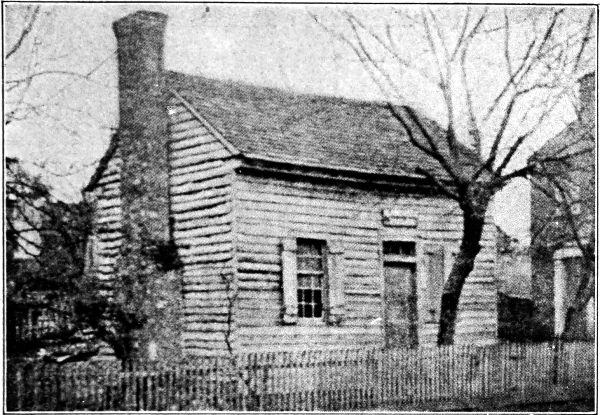
Photo. by Brady
ANDREW JOHNSON’S FIRST TAILOR SHOP
Now a Museum in Greeneville, Tennessee
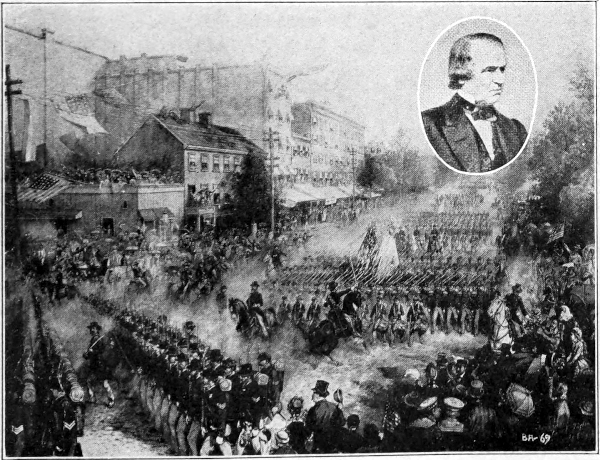
Photos. by Brady
THE GRAND REVIEW OF THE ARMIES OF THE NORTH
Washington, May 23rd, 24th, 1865. Reviewed by President Johnson and
Cabinet and General Grant
Party lines were drawn so tight that arbitration was out
of the question. Senator Sumner then came forward with
another suggestion, which held that, while no state could
legally go out of the Union, yet, by its act of rebellion, it
had lost its status as a state. This was often referred to
as his State Suicide theory. He also insisted that under
this plan it could be restored only by the united effort
of its own loyal element and Congress. Under the leadership
of Stevens and Sumner, Congress finally decided this
momentous question, rejecting the theory of President
Lincoln and also the radical view of Stevens. Republican
leaders repudiated past professions and declarations upon
which the North had so thoroughly agreed in the conduct
of the war. Through the winter of 1866 and until the end
of the session, antagonism to President Johnson continued
to grow.
Acting in accordance with his theories, Johnson vetoed
the bill providing for the continuance of the Freedman’s
Bureau, the Civil Rights Bill, the import of which was to
place the Negroes on the same footing with the whites.
Congress passed both of these bills over his veto. Regarding
Civil Rights, President Johnson said: “I yield to
no one in attachment to that rule of general suffrage which
distinguished our policy as a nation, but there is a limit
wisely observed hitherto which makes the ballot a privilege
and a trust, and which requires of some classes a time
suitable for probation and preparation. To give indiscriminately
to a new class wholly unprepared by previous
habits and opportunities to perform the trust it demands
is to degrade it and finally to destroy its power.”
Now the advisers of the President began to urge upon
him the need of making more friends, so that he should
have less opposition in the next Congress. As the summer
of 1866 waned, they became more insistent on the importance
of his making a tour through the principal cities
of Maryland, Pennsylvania, New York, Ohio, Indiana,
Illinois, and Missouri. The occasion presented was the
laying of the cornerstone of the Chicago monument to
Stephen A. Douglas arranged for September 6th. The
tour started on August 28th and was the most unusual
trip ever made by a president. Mrs. Patterson, her
husband, Senator Patterson, Secretaries Seward and
Welles, Mrs. Welles, Postmaster General Randall, General
Grant, Admiral Farragut, and a group of sixty people
accompanied him. He had continual ovation for three
weeks.
But his responses and speeches failed to please. They
were considered campaign utterances, and campaigning
was regarded as unbecoming to presidential etiquette.
The criticisms did not deter him, however, for he never
allowed himself to be governed by precedent when he
considered principle involved. Throughout the tour his
speeches were aggressive, even violent. He had much
provocation, as the storm of impeachment proceedings
was already brewing, and he read of himself frequently as
a traitor who should be hanged.
The fight with Congress grew in bitterness. The President
retaliated by taking the stump in an effort to
defeat his traducers for reëlection. His resentment expressed
by his manner, he declared, “I would ask you,
with all the pains this Congress has taken to poison the
minds of their constituency against me, what has this
Congress done? Have they done anything to restore the
Union? No! On the contrary, they have done everything
to prevent it.”
“If my predecessor had lived,” the President stated in
another address, “the vials of wrath from a mendacious
press and subsidized gang of hirelings would have been
poured upon him as upon me.”
Upon another occasion, he declared, “I have been
fighting traitors South. They have been whipped and
crushed and acknowledge their defeat. Now, I am fighting
traitors North. Some talk about traitors in the
South—when they have not the courage to go away from
home and fight, but remain cowardly at home, speculating
and committing frauds in the government.”
The President vetoed all of the Reconstruction acts but
they were passed over his vetoes. The Tenure of Office
Act was passed March 2d, taking away from the Executive
the power of removal of all officers whose nomination required
confirmation by the Senate.[1] The President might
suspend such an officer during the recess of the Senate,
but must within twenty days after that body reassembled
present his reasons therefor. If the Senate deemed them
insufficient, the officer at once resumed his place. On
March 2, 1867, also through a rider attached to an Appropriation
bill, the President was forbidden to give any
orders to the army save through the general of the army,
General Grant, or to order him from Washington save with
the consent of the Senate.
President Johnson stoutly maintained that all of these
acts were unconstitutional. Supplementary Reconstruction
acts set aside the instructions of the President issued
to the military governors, notwithstanding the fact that
all of the Cabinet had endorsed them, with the exception
of Stanton.
From the beginning of President Johnson’s efforts to
readmit the seceded states, Secretary Stanton’s contempt
for his chief, whom he ridiculed as the “Tailor from Tennessee,
the Knight of the Shears and Goose,” developed
into open hostility, and he had aligned himself with the
opponents of Johnson in Congress. The President considered
his presence in his Cabinet out of place and undesirable.
On August 5, 1867, he sent the following
communication to Secretary Stanton:
Sir:
Public considerations of a high character constrain me
to say that your resignation as Secretary of War will
be accepted.
(Signed) Andrew Johnson.
Mr. Stanton replied the same day as follows:
War Department,
Washington, Aug. 5, 1867.
Sir:
Your note of this day has been received, stating that
public considerations of a high character constrain you to
say that my resignation as Secretary of War will be accepted.
In reply, I have the honour to say that public considerations
of a high character, which alone have induced me
to continue as the head of this Department, constrain me
not to resign the office of Secretary of War before the next
meeting of Congress.
Very respectfully yours,
(Signed) Edwin M. Stanton.
A week later, President Johnson sent the following letter
to Secretary Stanton:
Executive Mansion,
Washington, August 12, 1867.
Hon. Edwin M. Stanton, Secretary of War.
Sir:
By virtue of the power and authority vested in me as
President by the Constitution and laws of the United
States, you are, hereby, suspended from office as Secretary
of War, and will cease to exercise any and all functions
pertaining to the same.
You will, at once, transfer to General Ulysses S. Grant,
who has, this day, been authorized and empowered to act
as Secretary of War, ad interim, all records, books, papers,
and other public property now in your custody and charge.
In his reply, Secretary Stanton said in part:
Under a sense of public duty, I am compelled to deny
your right under the Constitution and laws of the United
States, without the advice and consent of the Senate and
without legal cause, to suspend me from office as Secretary
of War, or the exercise of any or all functions pertaining
to the same, or without such advice and consent to compel
me to transfer to any person the records, books, papers,
and public property in my custody as Secretary.
But inasmuch as the general commanding the armies
of the United States has been appointed Secretary, ad
interim, and has notified me that he has accepted the
appointment, I have no alternative but to submit, under
protest, to superior force.
When Congress convened, the Senate voted the reason
for suspension insufficient. The President hoped that
General Grant would contest the decision, but the latter
was wholly guided by the Senate and retired without even
notifying his chief of his intention. Stanton resumed
charge at once.
Johnson let the matter rest until February 21, 1863,
when he dismissed Stanton and appointed General B.
Lorenzo Thomas, Adjutant General of the Army, Secretary,
ad interim. General Thomas, mild and courteous,
presented his papers and was literally ejected from Stanton’s
office. Stanton barricaded himself in and sent distress
calls to his Senator friends at the Capitol. This
produced an executive session of the Senate which lasted
many hours. Stanton was ordered to hang on to his job,
Sumner sending him one cryptic word, “stick,” and the
impeachment bubble, so long threatening, burst.
President Johnson’s actions in ordering Secretary
Stanton’s removal in spite of the Tenure of Office Act was
exactly what was wanted by his opponents in Congress,
led in the House by Stevens and in the Senate by Sumner.
These vigorous leaders, angered by President Johnson’s
utter ignoring of their policies, rushed a resolution through
the House declaring that, “Andrew Johnson, President of
the United States, be impeached of high crimes and misdemeanours.”
The managers for the House were Thaddeus Stevens,
Pennsylvania; George S. Boutwell, Massachusetts; James
F. Wilson, Ohio; Benjamin F. Butler, Massachusetts;
George F. Miller, Pennsylvania; John A. Bingham, Pennsylvania;
William Lawrence, Ohio; William Williams,
Pennsylvania; and John A. Logan, Illinois. They filed
into the Senate Chamber and formally read their charges
against the President, who, when his presence was called
for, responded by proxy.
The impeachment court organized March 5th; the trial
began on March 13th. The eleven articles of offense were
boiled down to five:
1. That the President had violated the Tenure of Office
Act by dismissing Stanton.
2. That he had violated the Anti-conspiracy Act.
3. That he had declared laws unconstitutional.
4. That he had criticized and ridiculed Congress.
5. That he had attempted to prevent the execution of
various acts of Congress.
The papers were served on President Johnson. He appeared
with Henry Stanbury, his Attorney General, who
had resigned from that office to act as his counsel. Through
his counsel he asked that he be given thirty days to prepare
a reply to the charges. His request was curtly refused,
and the demand was made that the case proceed at once,
ten days being finally permitted him in which to prepare
his defense. The trial lasted over the month, ninety
witnesses being heard. When this sensational jury voted,
thirty-five declared the President guilty and nineteen
voted not guilty. Immediately after the announcement
by Chief Justice that two thirds of the Senators had not
voted him guilty, President Johnson was acquitted.
Analyzed and stripped of all superfluous matter, the
difficulty revealed itself strictly as a contest between the
executive and the legislative branches of the government.
Naturally, during the war, the executive branch had
eclipsed the other two. After the death of President
Lincoln, powerful leaders in the two houses clamoured for
the subordination of the executive branch to the legislative.
Mr. Johnson’s firm fight for the independence of
the Executive was in reality the cause of his unpopularity.
Had he been impeached, undoubtedly succeeding presidents
would have found their position stripped of many
of its prerogatives and reduced to that of being mere
figureheads.
This bare escape, though by a single vote, was, nevertheless,
a victory. It kept the nation from having still
another cataclysm over the selection of a successor to the
President. But, for the balance of his term, President
Johnson was entirely ignored by Congress, or at least the
part that had opposed him so vigorously. It passed bills
over his veto with apparent delight, and he went out of
office despised and ignored by such of its members as had
fought him all through his term.
Despite all of the discord and agitation that prevailed
during Johnson’s administration, much important legislation
was accomplished. One of the most noteworthy acts
was the purchase of Alaska, effected for $7,200,000, in
1867, under the negotiations of Secretary Seward, who
was greatly abused for having bought icefields and polar
bears.
The laying of the Atlantic cable was another achievement.
On December 25, 1868, President Johnson issued
his last Amnesty proclamation. This was universal, and
under it Jefferson Davis was released and his case dismissed,
as was also that of John Surratt.
The last reception was so largely attended as to assume
the form of an ovation. Thousands passed through the
White House to felicitate the Chief Executive upon the
outcome of the impeachment proceedings. In this farewell,
his policy was commended and the social rêgime
highly praised. His attitude toward receiving gifts was
applauded.
The only record of his acceptance of any gift of value
was that of the tea or coffee set presented to him in the
opening days of his administration, a unique silver, brass,
and porcelain facsimile of a railroad locomotive and tender
which had been especially designed as a gift to Jefferson
Davis and owned by him previously to the evacuation of
Richmond. It had been purchased at auction and was
sent to President Johnson by Mr. A. Barratti. The boiler
received the tea or coffee and made and then discharged
it through a spigot, the miniature steam whistle indicating
when the beverage was ready. The tender carried the
sugar and glasses and container for the cognac. Its sides
carried racks for cigars, and a tiny secret music box, when
set, played eight popular airs. Upon the side of the locomotive,
“President Jefferson Davis” was emblazoned.
In front, where the cow catcher belonged, the Confederate
banner and battle flag, entwined with the ensign of France,
had been fashioned into a charming design.
With the advent of Inauguration Day, the Johnson
family left the White House with relief. The retiring
President took his departure from the scenes of his great
trial without regret. His trip to Greeneville was a continuous
ovation, with praise and applause upon every
hand. It seemed as though the crowds sought to console
him for the affronts he had suffered. But the dream of his
life—the election to the Presidency as his party’s choice—was
denied him.
Johnson’s energy and dominant will would not let him
retire to idleness. Not only did he still continue to study
diction, but he began another congressional race. He was
defeated successively for both the House and the Senate.
He ran again for the Senate as an independent and was
elected, taking his seat March 5, 1875, at a special session
called by President Grant, and was the most interesting
member of that body. At the close of the special session,
he returned to his home. On July 29, 1875, he suffered a
stroke of paralysis, and on the 31st he died at the home
of his daughter Mrs. Stover, where he was visiting for a
few days.
CHAPTER II
FIRST ADMINISTRATION OF ULYSSES
S. GRANT
March 4, 1869, to March 4, 1873
DURING the strife and turmoil of the régime of President
Johnson, the prestige and popularity of General
Grant continued to increase. His brilliant military exploits,
his magnanimity to the Southern generals, his
unostentatious demeanour upon all occasions, and the
wisdom of the silence he maintained upon the issues of the
day, combined to invest him in public opinion with superlative
acumen and the qualities of a superstatesman. The
result of the adulation was the creation of a gigantic tide of
public approval that expressed itself in a universal demand
for him as President of the United States. At this particular
crisis, he was regarded with a sort of reverent affection
as the man of destiny to handle the troubled political
situation with the same brilliant strategy that had characterized
his military achievements. Yet none remembered
that this peerless soldier became the victorious war
general through long training in military technique. Following
an expert military education, his skill in this science
had been amplified, concentrated, and forged into a life
vocation by years of hard service and bitter experience in
Texas, Mexico, and California. Every single success of
the Civil War had come through the application to each
situation of the knowledge derived through years of experience
and observation.
In all his busy life as soldier, farmer, tanner, store
clerk, and real-estate dealer, politics had had no place.
Politics had never interested him. He seems to have
given but the most casual attention to the political struggles
of the great parties. His political inclination was
shown by the only ballot he ever cast before he came to the
White House—for James Buchanan. So it was upon his
military record alone that he was swept into the Presidency,
with a million and a half majority of votes. That
the American public did not underestimate the character
of General Grant is proved by the fact that the maelstrom
of political intrigue, scandal, and crookedness into which
he was precipitated wholly unprepared by previous experiences
left him a greater man at the close of his eight
years of administration—in spite of his Presidency rather
than because of it.
Ulysses S. Grant was inaugurated March 4, 1869, in the
disagreeable weather that had become traditional for these
ceremonies in Washington. The weather, however, could
not dampen the hilarious spirit of the vast throngs that
had descended upon the city. No man ever came into
the office more thoroughly approved and honoured by the
American people. He was the idol of the military through
the war; and the military, in dispersing to their homes,
carried and spread the fame of “Unconditional Surrender”
Grant to every city and hamlet and crossroads.
The President elect rode with General Rawlins,
escorted by eight divisions of organizations of military
regulars and volunteers (among them several companies
of coloured men) and numerous civic and patriotic organizations.
Never did Washington witness such packed streets.
Trains had been unloading thousands daily, and every
Washingtonian able to leave his bed was out to do his bit
to honour the President elect who had so greatly endeared
himself to the people of the district in his four years of
residence among them. President Johnson did not accompany
him, but went to the capitol early to sign bills.
Mr. Colfax, with the senatorial committee, followed General
Grant, and after the installation of the Vice President,
the presidential oath was given to the incoming President
by Chief Justice Chase in the presence of the multitude
assembled around the East Portico. The inaugural address
was brief and direct and set forth the fact that he
“would have a definite policy of his own upon all subjects
to recommend but none to enforce against the will of the
people.”
The General’s prideful family sat close by. His little
daughter Nellie, startled at the confusion, ran with childish
instinct to her father for protection and, after getting hold
of his hand, remained contentedly at his side.
The climax of the day’s events was the ball held in the
north wing of the Treasury Department.
The President and Mrs. Grant and Vice President and
Mrs. Colfax attended. Mrs. Grant wore an unusually
rich and handsome gown of elegant white satin elaborately
trimmed in point lace with pearl and diamond ornaments,
while Mrs. Colfax was especially lovely in soft pink satin,
with a profusion of pink illusion (tulle), offset by pearls.
The affair was horribly mismanaged, causing great discomfort
and drawing severe criticism to the managers.
The bitter weather added to the distress. There were no
adequate arrangements for wraps and hats, no system for
calling cabs and carriages, and, consequently, scores upon
scores of people were obliged to give up all hope of finding
their own garments when they desired to leave. There
were no hired carriages to be had, and many walked home
through the mud and slush in the wee small hours of the
morning minus cloaks and headgear. Horace Greeley
lost his cherished white hat and venerable gray overcoat
in the mêlée. Many ladies, in their struggle to get into
the supper room, lost their escorts, and, failing to find them
again or to get any supper, remained sitting on the floor,
cold, hungry, and disconsolate, through that never-to-be-forgotten
night. Ten o’ clock next morning found nearly
a thousand people still clamouring for their hats and
coats.
The supper also was a dismal failure. Half of the assemblage
could not get near the door, much less to the
table, after having bought supper tickets. All of this
confusion was bad enough; what made it worse was that
Washington was locked in the teeth of a blizzard. Many
deaths and much illness were attributed to the exposure.
General Grant kept the personnel of his Cabinet a complete
secret until he sent their names to the Senate for
confirmation the day after inauguration. Elihu B.
Washburne, of Illinois, was made Secretary of State. He
had been the staunchest defender of General Grant when
General Halleck’s charges and complaints of Grant’s
conduct to President Lincoln threatened to cause him to
be relieved of his command after the engagement of Shiloh.
He served only six days, when Hamilton Fish, descended
from a long fine of prominent New York statesmen, was
nominated and confirmed as his successor. Washburne
went to France as Minister Plenipotentiary.
President Grant found his problems multiplying with
unpleasant rapidity. From the start, he had difficulty
with Senator Charles Sumner, of Massachusetts, who was
offended because he had not been consulted about Cabinet
nominations, and showed his disapproval by objections to
the President’s nominee for Secretary of the Treasury.
This man was A. T. Stewart, the millionaire merchant of
New York, who accepted the position with pleasure and
engaged a suite at the Ebbitt House preparatory to assuming
his position. Senator Sumner’s objections to him
were based on the grounds that it was not lawful for a
man who was an importer in active business to hold the
position of Secretary of the Treasury. Although Mr.
Stewart was ready to retire from business and devote the
entire profits that might accrue during the term of his
desired Cabinet service to charity, this was not regarded
as a proper procedure for him or for the government to
sanction. The President requested that the old law,
accredited to Alexander Hamilton, covering this situation,
which had been passed in 1788, be set aside so as to enable
his candidate to qualify for the office. However, the
Senate declined, and the President was disappointed and
distinctly annoyed at meeting antagonism at the beginning
of his term. The antipathy between President Grant and
Charles Sumner came finally to open rupture. President
Grant appointed George S. Boutwell, ex-Governor of
Massachusetts, as Secretary of the Treasury. This
nomination was unanimously confirmed.
Edwin M. Stanton’s career as Secretary of War was
ended, and he had been appointed Justice of the Supreme
Court through the efforts of Senator Ben Wade, of Ohio.
He accepted and took the oath, but never sat in the tribunal,
since he died December 24, 1869. Considerable
mystery surrounded his death; many believed that he
committed suicide, but investigation of this matter and
evidence of the attending physician brought the statement
that death occurred from natural causes.
The President chose for his Secretary of War General
John A. Rawlins, who had been his chief of staff and
military adviser. Rudolph R. Borie, a retired Philadelphia
merchant, received the nomination as Secretary of
the Navy; John D. Cox, lawyer, of Ohio, the post of Secretary
of the Interior; John A. Cresswell, of Maryland, that
of Postmaster General; and Ebenezer Rockwood Hoar, of
Massachusetts, Attorney General. This concluded what
was regarded as a very strong Cabinet. James G. Blaine
was elected Speaker of the House. By this time, every
state was represented in the legislative body, and the
administration had the support of a large majority in
both Houses.
Shortly after his induction into office, President Grant
developed a plan to improve the condition and appearance
of the Capital City. He considered it unworthy of
its name, and no credit either to the nation or the name of
General Washington, who had selected the site and had
approved the designs and plans made for its development
by his friend and aide, the gifted Major Pierre L’Enfant.
With each war of the nation, the Capital City experienced
a mushroom growth in population and in business enterprise.
Then would come a slump financially and physically.
The effect of the slump following the close of the
Civil War was not conducive to either national or civic
pride in the city as the seat of government for an already
great and growing nation.
The streets were wagon trails of alternating mud and
dust; the pavements crooked and overgrown with grass
and weeds. The parks, having been soldier camps, were
covered with brush, weeds, and even débris of wrecked
buildings, the grassy slopes beaten bare by the tramp of
thousands of feet. The population and business projects
alike had shrunk, and the general aspect of squalor and
neglect was heightened in many localities by the presence
of shanties, cabins, and lean-tos thrown together with
nondescript odds and ends of lumber, tin, and what-not
to make shelter for the Negro element. These were
pitched anywhere about the city where a darky family of
squatters were unmolested long enough to get a shack put
up and install themselves. Frequently, for many years,
their little hovels abutted some of the stateliest mansions.
General Grant selected the best man available for the
rehabilitation he had in mind—Alexander R. Shepherd, of
the District of Columbia, and made him Chairman of
Public Works. Together they planned extensive permanent
improvements, which were put into execution as
speedily as money was forthcoming. Regardless of expense,
the entire city was placed upon an even and regular
grade. High knolls and embankments were cut down,
low places filled, many houses, in consequence, finding
themselves far above or below the new street level.
Public grounds and parks were planted with trees and
shrubbery; pavements were repaired and laid; ninety of
the three hundred miles of streets were straightened and
graded, and a great improvement was made by reducing
the width of streets to give to each house a bit of lawn or
front yard. Shade trees were set out. Tiber Creek, so
long an eyesore, running through part of the city, a breeding
place for mosquitoes and an attraction for the pigs
and cattle that were allowed to roam about, was diverted
from its original course and turned into a sewer.
For all of this work, Congress appropriated five million
dollars, while eight million came from the taxpayers.
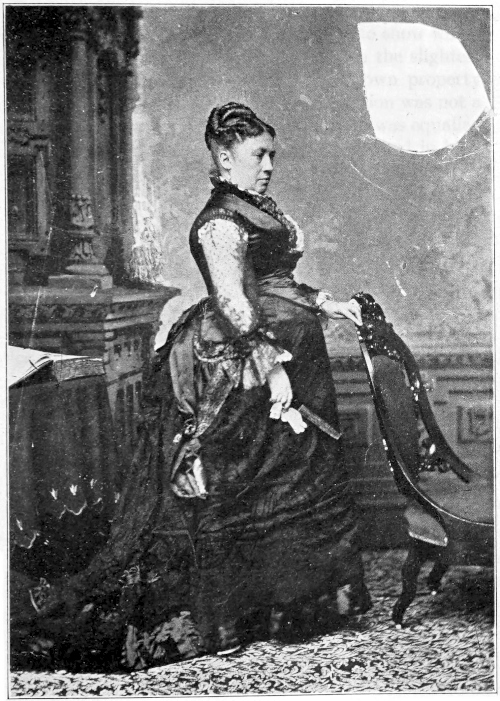
Photos. by Brady
MRS. ULYSSES S. GRANT
On February 20, 1871, the President signed the bill by
which territorial government was established in the District
of Columbia, with a governor, a house of delegates,
and a delegate to Congress. Henry D. Cooke, the first
governor, was succeeded by Alexander Shepherd, chosen
because of the great improvement he was bringing to pass
in the city. Governor Shepherd soon found himself in
difficulties, owing to charges that he gave contracts to his
friends and to the friends of members of Congress whose
votes were needed to secure liberal appropriations for the
work. However, close investigation failed to show where
Governor Shepherd had enriched himself in the slightest
degree, or had added to the value of his own property
any more than to that of others. His ambition was not a
selfish one, it was for the city, and his ability was equalled
by his honesty. General Grant always believed in him,
and as his improvements became perfected, he was regarded
as the saviour and regenerator of the City of Washington.
The social functions at the Shepherd home were
long remembered for their lavish hospitality and for the
brilliance of the assemblages that flocked there under the
inspiration of this very progressive governor and his
charming lady.
The new Department of State was under construction.
From 1869 until 1875, the Government leased the Washington
Orphan Asylum at Fourteenth and S streets, established
by Dolly Madison, for the quarters for this department.
With the opening of the Grant régime, the old customs
of the White House disappeared. New furnishings and
a change in plan of household management made it possible
for the President to make his entertainments conform
more truly to the dignity of his office. Before this administration,
the wives of the presidents had superintended
their own culinary department, but with President
Grant’s induction into office, a steward was installed in
the White House for the first time since Mrs. Madison’s
day. Melah, this steward, was an Italian of considerable
fame, as he had served some of the most famous hotels of
the country. A past master in the art of concocting
delicious menus and an expert in service, under his guiding
genius, the cuisine at the White House assumed the dignity
and perfection befitting the home of the President.
He planned his dinners according to his idea of the quality
of his guests. As the table would seat but thirty-six,
it was necessary to hold these functions weekly during the
social season. Some of these dinners cost as little as three
hundred dollars, but the usual amount allowed was seven
hundred. When Prince Arthur of England was entertained
the banquet for thirty-six guests cost fifteen hundred
dollars, exclusive of the wines.
Social life experienced a very profound revival, taking
its cue from the White House family, as is usual. Mrs.
Grant being endowed with exceptional social graces, her
régime was one of charming, genial hospitality strongly
tinged with the wholesome domesticity that made the
President’s house the ideal American home. She loved
people, was a charming conversationalist, and all her life
had lived in a social atmosphere. She was keenly alive
to the interests and events of the hour, and, while typically
feminine in every instinct, was also clever and thoroughly
conversant with the questions that engrossed her husband;
yet she never intruded in his affairs. Her influence with
him was paramount through life. He appeared at her
morning and afternoon receptions, and together they
broke many of the burdensome social precedents that had
been fastened upon the incumbents of the White House by
previous régimes. The President and his wife dined out.
They made calls, if they so desired, and whereas it had
not been considered dignified for the President and his wife
to attend evening parties, these two settled such matters
as their own fancy dictated and lost no social prestige
whatever thereby. President Grant flatly refused to be
a prisoner in the White House or to be handicapped by
customs he considered useless and irksome.
At the height of his popularity, when he was in demand
everywhere by individuals, groups, and associations who
sought to honour him, Mrs. Grant became disturbed over
the condition of her right eye, which had been injured in
girlhood by a peculiar and distressing accident that occurred
while she was boating with a party of young people
on the river near her home at White Haven. Through
accident or someone’s carelessness, an oar flew up and
struck her in the eye. Surgery not being advanced, as it
is to-day, the eye never resumed its normal position, being
slightly turned. The General would not listen to the
suggestion of an operation. He reminded her that he had
fallen in love with her with her eyes just as they were, and
had been contentedly looking at them for a good many
years and did not wish them changed. His veto settled
the matter for all time.
Mrs. Grant established a new plan for the weekly
Cabinet day receptions that became so popular as to be
followed more or less by her successors. She invited some
of the ladies of the Cabinet, wives of Senators or other
officials, as well as visiting friends and celebrities to assist
her on these occasions, generally entertaining her receiving
party at luncheon on the appointed day. After the Cabinet
meeting, the President would join his wife and receive
with her.
The evening receptions, like those of the Grant home on
Minnesota Row, were always packed with an eager, interested
crowd.
One of the distinguished visitors to the Capital the
first year of the Grant régime was the nineteen-year-old
Prince Arthur, young son of Queen Victoria of England,
who was elaborately entertained at the British Legation.
The President did not feel it incumbent upon him either
to make an especial call upon the young man or to give a
special entertainment in his honour. Instead, the Prince
was invited to the regular state dinner of the week, just as
any other distinguished visitor might have been.
Among the many problems presented to Mrs. Grant
was the selection of a fashion dictator for American women.
So long had the charming and elegant Empress Eugénie
been the arbiter of fashion that, with her eclipse in the
passing of the last Napoleonic empire, women were at a
loss for a leader. Accordingly, they besought the First
Lady of the Land to settle the matter. Mrs. Grant, with
her usual wisdom, referred the representative of the press
to Mrs. Fish, wife of the Secretary of State, saying:
“In matters pertaining to good sense and fine tact, I
rely upon Mrs. Fish. Say to her that you seek her presence
by my direction.”
Upon learning that Mrs. Grant desired her to make a
statement for publication as to whether or not the ladies
of the Cabinet would originate the styles, Mrs. Fish said:
“I am glad the time has come when we shall have
fashions of our own and not be dictated to by those who
differ with us in the spirit of our institutions. This is a
republic, not an empire or a monarchy. No woman, either
at home or abroad, will be followed or allowed to set the
fashions for this country. So far as I am concerned, the
short, comfortable street dress has come to stay, and the
neat-fitting basque in some form will always be found in
my wardrobe, and I trust every woman will seek her own
convenience and comfort whilst thinking of other things
than dress.”
Mrs. Grant’s gowns were notable for their good taste
and elegance. The first administration, or at least the
first three years of it, were rather quiet, owing to the fact
that the children, all but small Jesse, were away at school.
Mrs. Grant liked to have her own people around her, and
her family was pretty thoroughly and constantly represented
in the house guests.
Mr. F. F. Dent, her father, made his home with them
while they were in the White House. A most interesting
man, he was the object of family attention and devotion.
Although a Southerner who never changed his political
views, he was devoted to his distinguished son-in-law, with
whom he differed radically on many questions. President
Grant’s affection for his wife’s father expressed itself in
many practical ways. When serious reverses came to Mr.
Dent, and it seemed as though all of his property must
be sacrificed, the President bought up the notes on the old
Dent homestead and so arranged matters that the income
from it was paid periodically and promptly to Mr. Dent,
who was left to believe that, through a readjustment, the
property was still his own. Mr. Dent died in the White
House, and his funeral was held there.
General Grant brought his army efficiency into the
executive office, along with two of his generals, Babcock
and Porter; and with his genius for organizing, he soon
had a schedule that left him a little time to follow the
pursuits that diverted and rested him.
An early riser, seven o’clock found him reading the
papers. He breakfasted with his family at eight o’clock,
then went for a stroll to enjoy his cigar. By ten he was in
his office ready for the day’s tasks, and when three o’clock
came he considered the day’s work completed sufficiently
for him to leave his desk.
A daily pleasure was the visit to his horses, which were
a hobby. After making the rounds and giving a word or a
pat to each, he enjoyed a walk or drive, the latter usually
to please his wife. His horses were Cincinnatus, a dark
bay charger; St. Louis, and Egypt, carriage horses, beautifully
matched; Julia, for a buggy; Billy Button and Red.
Shetland ponies; Jeff Davis, a saddle horse quite hard to
manage; Jennie and Mary, the property of Miss Nellie.
Five vehicles found place in the carriage house, and thus
the tastes and fancy of every member of the family were
considered—a landau, barouche, top buggy, pony phaëton,
and road wagon.
General Grant’s love for horses had become proverbial
before he became President. At the time that he was
elected, he had a stock farm near St. Louis, where it is
said he kept more than a hundred animals.
Cincinnatus was a good saddle horse, and the President
could ride him to any part of the city and leave him standing
unhitched for any length of time. He never became
frightened at parades or street fights or commotion.
One of Grant’s best horses was named Butcher’s Boy,
into the possession of which he came in an odd way. General
Grant was riding through the city one day and attempted
to pass a butcher’s wagon, which was jogging
along in front of him. The boy driving the horse whipped
up and the General whipped up, and the two had a lively
race. Grant was in a light rig and the boy had no idea
in the world that he was racing the President of the United
States. His horse was so good, however, that he kept
ahead for a long distance, and President Grant admired
him so much that, when the wagon stopped at a butcher’s
shop, he made note of the place. Some days after this,
he sent one of his friends to look at the horse and purchase
it if possible. The result was that the butcher’s horse
took his place in the White House stables.
During his administration, new stables of the White
House were built.
The family dinner hour was five o’clock, and the master
of the establishment required punctuality from all of his
household. The table was invariably set to accommodate
half a dozen extra guests, and there were few days in the
strenuous eight years when the family dined alone. With
old-fashioned wifely care, Mrs. Grant saw to it that the
dishes the President especially liked were included in the
menus. His favourite dessert, rice pudding, gained international
fame as concocted under the direction of the
incomparable steward.
General Grant’s presidency simply transferred the national
interest from the house on Minnesota Row, given
him by an admiring public, to the White House. His
election and inauguration also brought to publication
many interesting stories of his boyhood, youth, and military
career through which his pride in his sturdy all-American
ancestry, the events and exploits which made
him so rich in nicknames, and the youthful achievements
of pluck and persistence that cast their prophecy of his
calibre as man while he was yet in his teens all became
household history. Familiar, also, was thus made the life
at West Point, the thrilling experiences of the Mexican
War, and the drab, disheartening struggles of the civilian
life at “Hardscrabble,” and the clerkship in the family
tannery.
Old and young alike exulted again and again over the
turn of fortune that threw this born soldier back into the
leadership of men; and the tale of every victory and the
record of every honour called forth a responsive throb of
sympathy and affection, expressed emphatically in the
ballots at his election.
But the least known among the treasured stories of
Grant’s modest young manhood are those that relate to
his meeting and his courtship of his first and only sweetheart,
Julia Dent. The romance of Ulysses S. Grant and
Julia Dent began with their first meeting—it ended with
life.
While at West Point, his roommate invited him to spend
a furlough at his father’s home, at White Haven, near St.
Louis. They arrived without announcing their coming,
and he met the sister of his chum, Julia Dent, then about
seventeen. He was greatly attracted to her, the interest
seemed to be mutual, and other visits followed more frequently
after graduation. After Lieutenant Grant took
his departure at the close of one of these he found the
memories of Miss Julia so compelling that he returned to
pursue his attentions to her. Their betrothal occurred
while they were crossing the Gravois. They were in a
light rig, the young man driving, the waters swollen and
the current so swift from recent heavy rains that they
were in grave danger.
The manner of her clinging to him in her fear of the
water inspired him with the courage to propose to her in
the midst of the stream. In after years, she often related
to her grandchildren the story of the betrothal, placing
special stress on the significance of the old superstition
that prophesied unusual strength and constancy to any
pledge made over running water. Mrs. Grant also told
the tale of her dream. The night before the first meeting,
she had a vivid dream, in which she met, loved, and
married a young officer whose name she did not know and
whom she had never seen. After she became engaged,
she told her sisters, the dream was “out.”
From the beginning of their romance until she closed
her hero husband’s eyes in death, no one else could ever
equal or compare with him in her estimation of his appearance,
character, or achievements.
President Grant was not unaware of the proportions of
the task that an adoring following had placed upon his
shoulders as the new head of the nation still in the throes
of internal political chaos. He fully realized the difficulties
of working a miracle in the restoration of harmonious
organization. The absence of political bias and of animosity
toward those who differed with him was a great asset.
In this he stood alone, a figure unique in its isolated superiority
to other party leaders. Advice he did not seek.
There was no one qualified to give him what he could
supply so well from his own impartial point of view. While
he appreciated the confidence, loyalty, and high honour
of his overwhelming election to the Presidency, he was
not blind to the undercurrent of suspicion swirling about
his every act, or impervious to the hatred that prevailed
toward him in certain sections, nor was he indifferent to
the smouldering vengeance seeking its appeasement in
his undoing in one fashion or another. So he kept his
counsel, studied well each problem, picked the men to
fit as best he could, and squared himself to meet the
onslaught of legislative and executive sieges with the same
direct, practical common sense that had been focussed
on his military manœuvres. Of course, mistakes followed,
for subtle intrigues and conspiracies could not always be
handled by the direct open method. From the opening
of his administration, international complications with
England beclouded the horizon for a time, and war seemed
altogether too imminent for peace of mind.
The Secretary of State and the President were in accord
as to the importance of an amicable settlement with Great
Britain, if that could be accomplished without the sacrifice
of American dignity or honour, and they were most anxious
that the differences between the two governments over
the depredations of rebel cruisers fitted out in British
ports and the depletion of fisheries in North American
waters be adjusted as speedily and thoroughly as possible.
Remembering the advantages and pleasant relations ensuing
as the result of the Webster-Ashburton conferences
and the subsequent treaty, these two finally concluded
that a set of commissioners from each nation should find
the solution. The view was supported by Sir John Rose,
Canadian Premier, serving as commissioner under a previous
treaty between Canada and the United States, to
effect a settlement of certain disputed points between the
two countries.
The aggressive attitude of Senator Charles Sumner, of
Massachusetts, Chairman of the Committee on Foreign
Relations of the Senate, had produced a strained atmosphere,
which the Secretary of State had to combat in his
dealings with the English Minister, Sir Edward Thornton,
as well as in the case of the Premier of Canada. Frequent
conferences opened a way for a plan of adjustment, and
the letters stipulating for a Joint High Commission were
planned and drawn up. Very soon, the Canadian Premier
left for England, carrying with him a full and complete
concept of the American stand on the difficulty.
The plan of the Joint Commission was adopted; and
shortly after Sir John Rose returned to England, Earl de
Grey, Sir Stafford Northcote, Professor Montague Bernard
of Oxford, and the Premier of Canada, Sir John MacDonald,
arrived to comprise, with Sir Edward Thornton,
the British group, while the American contingent consisted
of the Secretary of State, General Schenck (newly appointed
Minister to England), Justice Nelson of the Supreme
Court, ex-Attorney General E. R. Hoar, and his
successor, General George H. Williams.
The Commission, familiarly called “High Joints,” assembled
in the spring of 1871. They took a furnished
house in Franklin Square and gave a series of dinner
parties and evening entertainments. Many return courtesies
of officials and prominent civic bodies followed,
including a banquet by the Freemasons of Washington,
some of whom were members of Congress, in honour of
Earl de Gray, at the time Grand Master of Masons in
England, and Lord Tenterden, also prominent in this
fraternity.
Monsieur de Catacazy, Minister Plenipotentiary of the
Emperor of Russia to the United States, opposed this
treaty, endeavouring to prejudice Senators and Representatives
against it. He carried his opposition to it far
enough for Secretary of State Fish to request his recall.
His attitude in this matter was not the only reason for his
lack of popularity. His private life had long been a
matter of gossip. His wife was an attractive lady around
whom much scandal centred during his Washington
residence. The story was that she had eloped from her
husband fifteen years previously with Monsieur de
Catacazy, then Secretary of the Legation. The Russian
Emperor, learning that his representative was persona non
grata, instructed his Minister of Foreign Affairs to ask, in
his name, that President Grant tolerate Monsieur de
Catacazy’s service until the impending visit of his third
son, Grand Duke Alexis, was completed. To this General
Grant assented.
Grand Duke Alexis arrived and proceeded at once to
the legation, where he was welcomed by Madame de
Catacazy, elegant and charming in a gown of gold silk.
As the Grand Duke entered the legation, Madame met
him with a touch of his native traditional courtesy—in
the gold salver on which was placed a round loaf of black
bread surmounted by a golden salt cellar. The Prince
took the uninviting loaf, broke it, and tasted it, in accordance
with the Russian custom. The Grand Duke was
cordially welcomed at the White House, and Monsieur de
Catacazy treated with corresponding coldness.
Sumner’s antipathy to the President and Secretary
Hamilton Fish, to both of whom he had been discourteous,
with his subsequent refusal to speak to either, brought
about his removal as Chairman of the Committee on
Foreign Relations of the Senate. In less than two months,
all difficulties were settled and the commissioners made
a satisfactory treaty and returned. It stipulated that
points at issue be submitted to a tribunal of arbitration
composed of five members of different nationalities to sit
at Geneva. In December, 1871, the tribunal met and
each party to the dispute filed its statements. Bancroft
Davis represented the United States, and William E.
Evarts, Caleb Cushing, and Morrison R. Waite were the
American counsel.
When the question of damages was broached, a great
hubbub followed in England, instigated by the opposition
party to the government. The English press demanded
that negotiations cease unless the claims of the United
States were withdrawn, and naturally the situation became
tense and critical. The American counsel maintained
that the British government had agreed to submit
points of dispute to arbitration, and a treaty had been
made and accepted by the two nations to this effect.
Feeling became so bitter in England that the two countries
came near to war, and our own State Department was put
to a severe test. Secretary Fish displayed most able
diplomacy in that he yielded nothing of American national
dignity and yet avoided false moves likely to irritate and
complicate. Finally, the arbitrators exercised their right
to decide that the claims were out of court and in their
hands. Thus, neither nation needed to abandon its position,
as neither was consulted. The arbitrators awarded
damages to the United States to the amount of $15,500,000
in gold for the direct injury inflicted by the Alabama and
her consorts. England expressed due and proper regret,
a few more words or clauses were added to the code of
international law between the two countries, and peace
and good feeling banished the threatening war clouds.
The winter of 1871 was the scene of especial suffrage
activity in the National Capital, and a convention of all
of the principal leaders of the movement was held in
Lincoln Hall, Ninth and D streets, with such celebrated
women on the platform at the various sessions as Elizabeth
Cady Stanton, Grace Greenwood, Phœbe Couzens, Pauline
Davis, Susan B. Anthony, Josephine Griffing, Rachel
Moore Townsend, Reverend Olympia Brown, Isabelle
Beecher Hooker, Charlotte Wilbour, Jocelyn Gage, and
many others. Speeches, conferences, and committee
hearings brought the cause of Woman Suffrage very
prominently to the attention of the general public, and in
Congress, one of the most notable of these gatherings was
that held on January 11, 1871. Those versed in the early
struggles for the enfranchisement of women give to Victoria
Woodhull the credit of the discovery that, under the
rulings of the Fourteenth and Fifteenth amendments to
the Constitution of the United States, women were entitled
to the ballot; and in order that these heretofore undetected
points might be brought to the attention of the legislators,
arrangements were perfected for her presentation of a
printed memorial to the Judiciary Committees of the two
Houses of Congress on January 11, 1871.
Victoria Woodhull is of especial interest because she
was the first woman ever to be nominated for the Presidency
of the United States, being the choice of the Equal
Rights Party in 1872. Mrs. Woodhull, a native of Homer,
Ohio, born in 1838, is at present living in England. Her
career was interesting in 1870. She opened a bank on
Wall Street, New York City, where her transactions were
spectacular. She was also associated with Tennessee
Claflin (Lady Cook) in the publication of Woodhull and
Claflin’s Weekly. After her defeat of election and her
second marriage in 1876, she abandoned politics and likewise
the United States, making her home abroad. Her
editorial interests continue in the publication of the
Humanitarian Magazine in London.
Her appearance before the Committee of Congress
created much comment, owing to her unusual costume,
which the two members of the Woodhull-Claflin firm had
adopted. This dress consisted of a so-called “business
suit” made of dark blue cloth, skimpy in the skirt, with a
basque or jacket finished off with mannish coat tails.
A severely plain hat with steeple crown topping clipped
hair gave a masculine appearance not regarded with favour
by the conservative element.
As the presentation of the memorial was Mrs. Woodhull’s
first attempt at public speaking, she read from the
printed page.
While the advocates of the ballot for women were straining
every effort to put forth plausible and convincing argument
to win adherents to their cherished dream, another
group of women were equally energetic in preventing the
adoption of a suffrage amendment. They became so
anxious over the apparent advantages being gained by
Elizabeth Cady Stanton, Susan B. Anthony, and their
cohorts, that they, too, formulated a pretentious document
which was an opposing petition, and to it they
secured the signatures of hundreds of women who preferred
to follow the old order of things and leave the voting
privilege in the hands of men.
The opposing petition closed with the following appeal:
“Should the person receiving this approve of the object
in view, his or her aid is respectfully requested to obtain
signatures to the annexed petition, which may, after having
been signed, be returned to either of the following
persons: Mrs. Gen. W. T. Sherman, Mrs. John A. Dahlgren,
Mrs. Jacob D. Cox, Mrs. Joseph Henry, Mrs. Rev.
Dr. Butler, Mrs. Rev. Rankin, Mrs. Rev. Dr. Boynton,
Mrs. Rev. Dr. Samson, Mrs. B. B. French, Miss Jennie
Carroll, Mrs. C. V. Morris, Mrs. Hugh McCulloch, all
of Washington, D. C.; Mrs. Senator Sherman, Mansfield,
Ohio; Mrs. Senator Scott, Huntington, Pa.; Mrs. Senator
Corbet, Portland, Ore.; Mrs. Senator Edmunds, Burlington,
Vt.; Mrs. Luke E. Poland, St. Johnsbury, Vt.; Mrs.
Samuel J. Randall, Philadelphia, Pa.; Mrs. Catherine E.
Beecher, 69 West Thirty-eighth Street, New York City.”
Although each war has hatched its own brood of scandals
and given birth to its own tribe of financial and
political vampires to wreck parties and ruin leaders, yet
at no period of our national history have there been more
gigantic, hydra-headed monsters of graft unloosed upon
the head of a nation than the series of financial scandals
exposed during the two administrations of Ulysses S.
Grant. The fact that all of these had their inception
years before and, like a vast canker, had slowly and steadily
spread their virus and corruption through a constantly
widening area until an eruption was inevitable did not
lessen the embarrassment or mitigate the actual suffering
they brought to the Executive. His own character and
simple plan of life had kept him so far removed from contact
with such schemes and their perpetrators as virtually
to render him incapable of understanding a stress of conditions
and circumstances that could ensnare a private
individual, much less a man pledged to the service of
his country, in any entanglement for gain, through which
his disgrace would inevitably reflect discredit upon his
country. But President Grant’s own integrity, which was
never besmirched in the slightest degree, despite many
efforts to implicate him in one scandal or another, did not
spare him the humiliation of seeing his two Vice Presidents
and a large group of friends in the Senate and the House
entangled in the exposure of the Crédit Mobilier swindle
of the government. The gold panic and the Whisky
Fraud investigation also brought low the pride of a group
high in honour and power. Not only among family connections,
but in the Cabinet and even the august precincts
of the Supreme Court, the accusing finger of suspicion
pointed to the guilty.
All writers of the period dwell more or less at length
upon the bold schemes of speculators to enrich themselves
at the expense of the government. One of the first to
come to light, and one of the most daring, was the attempt
to corner the gold market in New York in 1869, when the
gold dollar was forced to 162 on the Stock Exchange.
Ben Perley Poore, noted correspondent of the day, gives
the following account of this transaction, which threatened
to create a financial eruption that would rock the entire
country. In his “Reminiscences,” Mr. Poore says:
“General Grant was much embarrassed early in his
presidential career by the attempts of those around him
to engage in speculations for their private benefit. Always
willing to bestow offices, or to dispense profitable favours
to his numerous relatives by blood and marriage, and to
advance the interests of those who had served him faithfully
during the war, he could not understand the desperate
intrigues which speculation led some of them into.
Among his protégés was Abel R. Corbin, who had been
known at Washington as the clerk of a House committee,
a correspondent, and a lobbyist, and who afterward had
removed to New York, where he had added to his means
by successful speculation. Marrying General Grant’s
sister, who was somewhat advanced in years, he conceived
the idea of using his brother-in-law for a gigantic speculation
in gold, and in order to obtain the requisite capital entered
into partnership with Jay Gould and James Fisk, Jr.
By adroit management, these operators held, on the first
of September, 1869, ‘calls’ for one hundred millions of
dollars of gold, and as there were not more than fifteen
millions of the precious metal in New York outside of the
Sub-Treasury, they were masters of the situation. The
only obstacle in the way of their triumphant success would
be the sale of gold from the Sub-Treasury at a moderate
price, by direction of General Grant. Corbin assured his
co-conspirators that he could prevent this interference,
and wrote a letter to the President urging him not to order
or permit sales from the Sub-Treasury. He ostensibly
sent this letter by a special messenger, but, in fact, substituted
for it an ordinary letter on family matters. General
Grant’s suspicions were aroused by the receipt of
this unimportant epistle, and at his request Mrs. Grant
wrote to Mrs. Corbin, saying that the General had learned
with regret that her husband was engaged in gold speculations,
and he had better give them up.
“General Grant returned to Washington on the 23d of
September, 1869. The next day, ‘Black Friday,’ the
conspirators put up the price of gold, and a wild panic
ensued. Leading men of all parties in the city of New
York telegraphed the President and the Secretary of the
Treasury, urging their interference as the only way of
preventing a financial crash, which would have extended
over the whole country. About eleven o’clock, Secretary
Boutwell went to the White House, and after a brief conference,
General Grant expressed his wish that the desired
relief should be given. Secretary Boutwell promptly telegraphed
to Sub-Treasurer Butterfield, at New York, to
give notice that he would sell four millions of gold. This
collapsed the speculation. ‘I knew,’ said Jim Fisk, afterward,
‘that somebody had run a sword right into us.’ It
was not without difficulty that Corbin, Gould, and Fisk
escaped from the fury of their victims. The conspiracy
was subsequently investigated by a committee of the
House of Representatives, and a report was made by
James A. Garfield, completely exonerating General Grant,
and declaring that, by laying the strong hand of government
on the conspirators and breaking their power, he had
treated them as enemies of the credit and business of the
Union.”
Great satisfaction came to the country when Congress
convened in December, and it was manifest that the reconstruction
of all of the Southern states was accomplished,
and with the opening of the New Year, all the states of
the Union were represented in Congress for the first time
since December, 1860. Vice President Colfax presided
over fifty-one Republican and thirteen Democratic Senators,
while James G. Blaine, Speaker of the House, held
his gavel over one hundred and seventy-two Republicans
and seventy-one Democratic Representatives.
Meanwhile, Congress had established the Weather
Bureau, with headquarters at Washington. Its object
was to secure and issue information of approaching
changes of weather and impending storms. The butt of
many jokes in the beginning of its career, it has saved the
people of the country from heavy losses both by land and
by sea. Branches were located in all of the principal cities.
As time has passed, the importance of the work of this
Bureau brought measures for the extension of its operations.
As the administration drew to a close, the effect of the
financial scandals was shown in the opposition that seemed
to spring up in all directions to President Grant. Rumour
and query were already directed toward the Pennsylvania
Courts, where a Crédit Mobilier scandal was impending
and the money panic threatening.
Charles Sumner and the President, through a series of
misunderstandings that might in the early stages have
been easily explained and completely adjusted, were bitterly
antagonistic. The President’s San Domingo annexation
theory and certain actions and policies followed in
the arrangement for the English treaty were contrary to
Senator Sumner’s ideas. In addition, one of the contributing
causes to the strained relations and widening
breach was the fact that the Senator disapproved
of the President’s receiving valuable gifts. He believed
that all such gifts were made with the idea that especial
consideration could be expected by the donor in return.
He considered it the duty of every public man to set his
face resolutely against the acceptance of all presents and
courtesies that could embarrass him in his official duty in
any respect. To President Grant such a course would
have been exceedingly difficult, owing to his extreme popularity
with both the military and the civilians. Refusal
of tributes of appreciation under such conditions would
also have caused embarrassment. However, this cause
for criticism, added to the other points of dispute between
these two sterling leaders and statesmen, gave sufficient
tinder to the spark of Sumner’s growing antagonism to
send him energetically to work to rally the indifferent or
disgruntled Republicans into a clique to prevent the reëlection
of the President.
The importance attached to Senator Sumner’s opposition
may be gathered from the fact that it called forth a
protest from Henry Wilson, slated for the nomination as
Vice President to succeed Colfax, who was already too
thoroughly enmeshed in the Crédit Mobilier entanglement
to be considered. Part of Mr. Wilson’s letter to the
President is as follows:
“Your administration is menaced by great opposition,
and it must needs possess a unity among the people and in
Congress. The Head of a great party, the President of
the United States, has much to forget and forgive, but he
can afford to be magnanimous and forgiving. I want to
see the President and Congress in harmony, the Republican
Party united and victorious. To accomplish this, we
must all be just, careful, and forgiving.”
General Grant’s wonderful success as a soldier, however,
was not equalled by the same type of success as a statesman.
The opposition to his reëlection grew, and no less
than seven candidates were thrown into the field against
him. To the campaign of 1872 was given the name, “Go
as you please,” the watchword of the factions being “Anything
to beat Grant.” A serious opposition was met in
the combination of the Liberal Republican and Democratic
parties who nominated Horace Greeley, but the victory
was again given to the hero of Appomattox.
CHAPTER III
SECOND ADMINISTRATION OF ULYSSES
S. GRANT
March 4, 1873, to March 4, 1877
WASHINGTON was in the throes of the coldest
weather ever known at an inauguration when
Ulysses S. Grant was inducted into office March 4, 1873,
for the second time. The morning dawned bitterly cold,
with a fierce wind blowing and the thermometer registering
4 degrees above zero, and little change during the day.
Marching was difficult, and standing still was next to impossible.
Flags and decorations were ripped from their
moorings; the music was a failure, as the breath of the
musicians condensed in the valves of their instruments,
making it impossible for them to play. Many marchers
and onlookers were overcome by the cold. The ambulances
were kept busy caring for the cadets and the soldiers,
some of whom were carried from the line insensible. Even
the hardiest and most fur-bundled of visitors deserted the
open stands and abandoned the seats for which such high
prices had been paid.
The procession, headed by members of the regular army,
followed by the Annapolis midshipmen and West Point
cadets, included a number of civic and military organizations.
There was none that did not suffer somewhat from
the arctic atmosphere.
President Grant braved the cold in his own open barouche,
accompanied by a portion of the Committee of
the Senate, Senators John A. Logan of Illinois, Aaron H.
Cragin of Vermont, and Thomas F. Bayard of Delaware.
Vice President elect Henry Wilson followed in the next
carriage, after which came the President’s family.
During the ceremony, the President occupied the famous
chair used by General Washington at his first inauguration,
which had been sent on from New York City for the occasion
by Mrs. William C. H. Woddell, the owner.
Chief Justice Chase officiated for the last time, and after
taking the oath, President Grant delivered his inaugural
address, in spite of a continuous struggle with the wind.
The return to the White House was made with all possible
speed, and the following review of the procession was
much curtailed by reason of the discomfort and suffering
imposed by the intense cold.
Although there was no moderation in the weather conditions,
the peak of the general desire was to attend the
ball. For months the inaugural committee had devoted
elaborate plans and lavish expense to the problem of providing
quarters for the gigantic ball that they were assured
would far surpass all previous affairs in the attendance.
No building or hotel being sufficiently commodious to
house the expected multitude, it was decided to put up a
temporary building in the centre of Judiciary Square,
which should be the perfection of art, skill, and comfort,
designed to meet the needs of the largest throng that had
ever descended upon Washington. The principal room
was three hundred feet long by one hundred fifty feet wide,
with walls twenty-five feet high, and was spanned with
thirty-one arched girders. The floor was built to rest
upon the foundation and be independent of the walls,
so that vibration could not disturb their strength. All
anterooms were correspondingly spacious.
A huge American eagle with outspread wings was suspended
from the highest point in the centre of the hall. In
his talons he held the shield of the United States and
streamers of the national colours one hundred feet long,
radiating to every part of the hall and terminating at the
arches with coats of arms of the states.
The walls, ceilings, arches, and columns were lined and
covered with white muslin or cambric, then trimmed with
flags, shields, bunting, rosettes of the national colours, and
evergreens. The profuse use of white cotton over the
rough boards gave it the name of “The Muslin Palace.”
The President’s reception stage or platform was commodious
and a marvel of artistic decoration and luxurious
furnishings. Several hundred canaries had been purchased
and arranged in such numbers as to make their
singing a notable and unique factor of the welcome to the
President and his party.
Gas was the accepted medium of illumination at that
time, and in the piping and arrangement for lighting, the
committee was consistently lavish. A great sunburst of
lights in the form of a rising sun sent out its rays backed
by reflectors from above the presidential stage. Rows of
chandeliers extending the length of the ballroom were
provided with reflectors. Great standards holding clusters
of burners for additional lights were placed at regular
intervals of space. Twenty-five hundred burners were installed
to give the desired brilliance to the scene.
The attractive dining hall occupied the full length of
the building and adjoined the ballroom, to which there
were twenty arched entrances. The table was extended
the entire length, with sideboards along the wall to supply
dishes of all kinds.
Five smaller buildings adjoined for use as pantries,
each being devoted to the supplies and provisions for one
part of the supper; for instance, one for coffee, tea, and
liquids, another for dessert.
With all of the elaborate attention to every detail and
the expenditure of sixty thousand dollars to make this
event surpass all previous affairs and meet every possible
demand in the emergency of unprecedented numbers,
there was no provision made for any undue weather emergency,
and what heating facilities had been installed were
wholly inadequate, and the ball was a frosty horror.
People came bundled to the eyes in furs and wraps, and
danced in their overcoats and furs to keep warm.
The arrival of the presidential party was announced by
the Marine Band with “Hail to the Chief.”
The platform, like the remainder of the great hall, was
so cold that the ladies kept their ball dresses covered with
their wraps. The reception moved along rapidly, in consequence.
The excellent hot supper served to them was
most welcome.
Mrs. Grant’s gown, of white satin, was covered entirely
by flounces of black Brussels lace and trimmed with lavender.
Miss Nellie Grant, the White House belle, who
stood by her mother, was much observed in her girlish
dress of white illusion over white silk. White flowers
furnished the garniture for dress and hair. The gowns
of the ladies of the Cabinet were all notable for their
elegance and beauty, and while the records of details are
meagre, some of the publications of the day did carry
enough description to give at least an idea of colours
selected, for one account tells that:
“Miss Fish wore a rich pearl-coloured silk, with flounces
of point lace, an ermine cape and diamonds; Mrs. Boutwell
cameo-tinted silk; Miss Boutwell, light blue silk; Mrs.
Cresswell, white silk and black velvet; Mrs. Williams,
pearl-coloured satin with cherry trimmings with a bandeau
of gold and diamonds in her hair; Mrs. Delano, a pompadour
dress of blue and pink; Mrs. Cooke, wife of the District
Governor, emerald satin and velvet.”
Contrary to plans, the canaries did not sing. Not a bird
vouchsafed a single chirp. Instead, paralyzed with cold,
they huddled in little, shivering yellow balls, with their
heads tucked under their wings to try to keep from freezing—the
fate that befell most of them.
The champagne and ice creams were frozen solid. No
one wanted them, but the hot drinks were in demand.
The presidential party remained only a short time, and
the entire assemblage, after paying twenty dollars apiece
for tickets, deserted the “Muslin Palace” before midnight—long
before the ball would have been in full swing under
comfortable conditions.
With the inaugural ceremonies over, the President had
once more to concentrate his attention on his official
duties. Vacancies had to be filled. One of the most
important was that on the Supreme Court, following the
death of Chief Justice Chase on May 7, 1873. Political
preference was slinging sledge-hammer blows to and for
those whose names were presented.
The passing of Salmon P. Chase marked the close of
the public life of one of the best known jurists of the
United States. Mr. Chase entered politics about 1841
as an opponent of the extension of slavery, was one of the
founders of the Free Soil Party, elected to the Senate in
1849, was twice Governor of Ohio, and served as Secretary
of the Treasury in President Lincoln’s Cabinet. He became
Chief Justice of the United States in 1864, and in
this capacity presided at the impeachment trial of President
Johnson. His life’s ambition was thwarted with the
election of General Grant to the Presidency; and with his
death, adverse fate seemed to descend upon the head of
his idolized daughter, Mrs. Kate Chase Sprague, who,
from the time she was sixteen, had presided over her
father’s home and until his death enjoyed a social leadership
of remarkable popularity. As the wife of the handsome,
wealthy war Governor of Rhode Island, who was
later in the Senate, her position was one of marked prestige
and influence.
Following her father’s death, sorrow and disappointment
brought about an open rupture with her husband
that terminated in divorce. He later married again, but
she devoted herself to the upbringing of her children and
died in Washington, broken-hearted and disillusioned.
The President was soon confronted with the distressing
features of the Crédit Mobilier scandal, murmurs of which
had already sent his former Vice President out of office,
humiliated and discredited, and the breaking of this gigantic
scandal was the advance guard of panic, aggravated
later by the Whisky Frauds and the fall of “Boss Tweed.”
Although in no way connected, implicated, or responsible
for these scandals, they robbed General Grant’s second
administration of any glory of achievement by the distressing
spectacle of corruption, thievery, and graft disclosed
on the part of trusted and honoured government
officials.
Like the slowly gathering force of a distant storm, whose
thunderings and rumblings warn of the coming fury, so
the murmurs, whispers, and threats of retribution, judgment,
and disgrace were heard from time to time from
the beginning of President Grant’s first term until the
close of his second, when certain startling disclosures discredited
men high in the counsels of the mighty. It is
doubtful if anything in American history will ever create a
parallel to the Crédit Mobilier as a vehicle for the display
of human passions and emotions from the comic to the
tragic. All previous scandals and sensations sank into
oblivion beside it. So thoroughly did the proportions of
this swindle of the government overwhelm the public
mind by the audacity of those implicated that ruin threatened
every career involved.
Back in 1862, the march of progress demanded better
facilities for transportation across the plains, mountain
ridges, and forests of the vast land beyond the Mississippi
River than were afforded by the prairie-schooner caravans.
In order that the great gaps of distance should be bridged
in shorter time and by easier, safer means, the government
authorized the construction of a Pacific railroad, a logical
move, since the railroads were stretching their network of
ties and tracks and switches in many directions. This
Pacific railroad, built by 1869, at a terrific cost in money
and with a prodigious amount of trickery, reached from
Omaha, Nebraska, to Ogden, Utah, a distance of 1,029
miles, where the Central Pacific terminated its stretch of
878 miles from San Francisco. Thus it was made possible
to come by train from San Francisco to New York, a
distance of 3,322 miles. By the time ten years had elapsed
after its inception, its directing and promoting agents
were before the great court of public opinion, branded for
crimes, with marks more loathsome than that of Cain, as
a result of the disclosures brought forth in the investigations
conducted in the two Houses of Congress.
In consequence, the Crédit Mobilier held the centre of
the stage; nothing else was discussed; argument and debate
were at white heat; and every man who feared implication
lived upon the rack in a torture of suspense. Two members
of the House, Oakes Ames, of Massachusetts, and
James Brooks, were slated for expulsion, while the same
sentence threatened Senator James W. Patterson. But
Congress became too demoralized and too apprehensive as
to where the accusing finger would tag another victim
to take any more decisive action than censure. Ames and
Brooks, weary, ill, and shaken by the efforts to make of
them the scapegoats, died in the opening days of the new
administration, within two months of the investigation.
James Brooks, who had been a trusted government director
of the Union Pacific, died April 30, 1873; while the
bluff, free-handed manufacturer, Ames, followed him a
few days later, on May 8, 1873.
Ben Perley Poore explains the Crédit Mobilier in part
as follows:
“The Crédit Mobilier made a great deal of talk, although
comparatively few people knew what it was about.
Under various acts of Congress granting aid to the Union
Pacific Railroad, that corporation was to receive 12,800
acres of land per mile, or about 12,000,000 acres in all,
and government 6 per cent. bonds for the amount of
$12,000 per mile for one portion of the road; $32,000 per
mile for another portion; and $48,000 per mile for another.
In addition to these subsidies, the company was authorized
to issue its own first-mortgage bonds to an amount equal
to the government bonds and to organize a capital stock
not to exceed one hundred million dollars. All of this
constituted a magnificent fund, and it soon became evident
that the road could be built for at least twenty
million dollars less than the resources claimed. The
honest way would have been to build the road as economically
as possible and give the government the benefit of
the saving. Instead, the directors concocted a scheme
whereby they could command the whole amount, and
after building the road, divide the surplus. They decided
to become contractors and hire themselves to build the
road.
“To complete their fraud successfully, without exciting
public attention, and to cover their tracks, was a complicated
matter. They secured several attorneys skilled
in the intricacies of railroad fraud, and with falsified statements
and some advice, the machinery of the transaction
was arranged satisfactorily. Samuel J. Tilden was their
attorney. In order to avoid personal liability and give
the movement the appearance of legality, the directors
purchased the charter of the Pennsylvania Fiscal Agency
and changed its name to the Crédit Mobilier of America.
This was in 1864, and at this time two million dollars’
worth of stock had been subscribed to the railroad company
and two hundred eighteen dollars paid in. Samuel
J. Tilden had personally subscribed twenty thousand
dollars. The first thing the Crédit Mobilier did was to
buy in all of this stock and to bring the Railroad Company
and the Crédit Mobilier under one management and the
same set of officers. Then the directors of the Railroad
Company, through certain middlemen, awarded the contract
for building the road to the Crédit Mobilier; in other
words, to themselves, for from twenty thousand to thirty
thousand dollars per mile more than it was worth. Evidence
which afterwards came to light in the Congressional
investigations showed that the Crédit Mobilier made a
cash profit in the transaction of over thirty-three million
dollars, besides grabbing up the stock of the road at thirty
cents on the dollar, when the law plainly provided that it
should not be issued at less than par.
“Oakes Ames, the Massachusetts mechanic, who had
made a fortune in the manufacture of shovels, had embarked
in the construction of the Pacific railroad. Finding
legislation necessary, and knowing how difficult it was to
secure the attention of Congressmen to schemes that did
not benefit them or their constituents, he distributed the
shares of this Crédit Mobilier, as he expressed it, where
it would do the most good.’”
Ames being a member of Congress and a manager of the
scheme was peculiarly appreciative of the value of Congressional
assistance in behalf of the Crédit Mobilier. It
looked as though its purpose was to drain money from the
Central Pacific railroad and from the government as long
as possible. Any legislation on the part of Congress designed
to protect the interest of the government would
naturally be unfavourable to the Crédit Mobilier, and it
was the aim of the corporation to prevent any such legislation.
The price agreed upon for building the road was so
exorbitant and afforded such wicked profit to the Crédit
Mobilier that it was almost certain some honest friend of
the people would demand that Congress should protect
the Treasury from such robbery. Accordingly, it was determined
to interest in the scheme enough members of
Congress to prevent any protection of the National Treasury
at the expense of the unlawful gains of the Crédit
Mobilier. Oakes Ames, being in Congress, undertook to
secure the desired hold upon his associates. The plan was
to secure them by bribing them, and for this purpose a
certain portion of the Crédit Mobilier stock was placed in
the hands of Mr. Ames, as trustee, to be used by him as
he thought best for the best interests of the company.
Mr. Ames went to Washington, December, 1867, for the
opening of the session of Congress. Within a month, he
entered into contracts with a considerable number of members
of Congress of both Houses to let them have shares
of stock in the Crédit Mobilier Company at par, with interest
thereon from the first day of the previous July.
Ames was not the only member of the Company engaged
in placing stock where it would benefit the corporation.
Doctor Durant, President of the Pacific Railway,
was engaged in securing his friends in the same way, and
he received a portion of the stock to be used in this manner.
Mr. Henry S. M’Comb of Delaware was also interested in a
scheme to put in his claim for a part of the stock which
was being used as a corruption fund for his friends. The
claim involved him in a quarrel with Ames, and the stock
he claimed was assigned to Ames. In 1872, the quarrel
reached such a pitch that M’Comb made the facts public
and published a list of the Congressmen with whom Ames
had said he had placed his stock, giving the number of
shares sold to each. This list included Schuyler Colfax,
Vice President of the United States; Henry Wilson, Senator
from Massachusetts; James W. Patterson, Senator
from New Hampshire; John A. Logan, Senator from Illinois;
James G. Blaine, Member of the House from Maine,
and Speaker; W. D. Kelly of Pennsylvania; James A.
Garfield of Ohio; James Brooks of New York; John A.
Bingham of Ohio; Henry L. Dawes of Massachusetts;
and others who were not in Congress at the time of the
exposé. A storm of excitement was created over the
country at the prominence of the names. As a rule, all
implicated denied emphatically having ever owned or
purchased Crédit Mobilier stock. They declared themselves
incapable of holding the stock, saying that it would
be a crime against morality and decency to be connected
in any way with the Crédit Mobilier. It was a mistake
on the part of Congressmen to deny their connection with
the Crédit Mobilier. Frank acknowledgment of purchase
and the statement that they had relinquished it as soon
as its true character was known would have saved their
faces before the world. They would have escaped with
being regarded as silly, but the denials caused Ames to
announce that the charges were true, and that he could
and would prove them so. And he did.
When Congress assembled in December, 1872, Blaine,
the Speaker, wishing to vindicate himself, claiming his
character had been unjustly assailed, asked the House to
appoint a committee to investigate the charges brought by
Ames and M’Comb and bring in a report of their findings.
Mr. Poland, of Vermont, was made Chairman. Efforts
to keep the investigation secret failed, as the indignant
public demanded and obtained an open trial.
The committee’s report to the House failed to sustain
the denials of members as to ownership of stock, although
it acquitted all but one of the charge of having been bribed.
It fastened the ownership upon all but Mr. Blaine, and
showed them all as convicted of falsehood. In several
cases, their denial was met by the production of their
checks, as was true in the case of Colfax. Blaine denied
it, and the committee report sustained his denial.
The deaths of Ames and Brooks and all of the distressing
aftermath of the Crédit Mobilier exposé left a most depressing
effect upon the public mind. But the dissatisfaction
arising from the lack of Congressional action was
increased as the same Congress passed a law raising salaries
of members from $5,000 to $7,500, and that of the President
from $25,000 to $50,000, making the act operative at
once.
All of these acts, whether justifiable or not, tended to
create a lack of confidence and faith in the government
which culminated in the business panic of the winter of
1873, with the passage of the new Coinage Act. For
many years, paper money, “greenbacks,” had been the
only kind in use. Silver dollars rarely were seen, and
the small silver quarters and dimes were used only as
“change.”
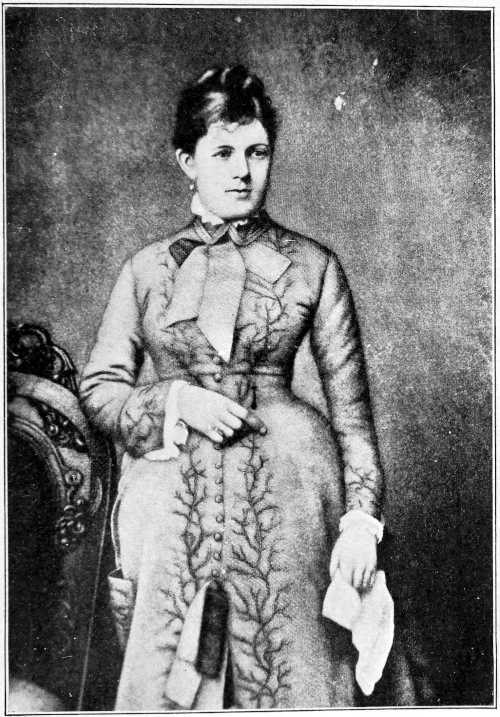
Photo. by G. V. Buck, Washington, D. C.
THE DAUGHTER OF PRESIDENT AND MRS. GRANT
Nellie Grant Sartoris, who was a White House Bride
When the Nevada silver mines were discovered, the
price of this metal dropped as the metal became plentiful,
and in some countries of Europe the coinage of silver
money was abandoned. This policy was planned for the
United States, and it was advocated in Congress that only
gold and silver change and copper be minted for general
use. The idea did not become popular. Many people
became suspicious, believing it to have been instigated
by wealthy bondholders who were resolved to have their
bonds paid in gold. When the government issued bonds
to secure money for the expenses of the Civil War, it borrowed
millions of dollars from individuals and from banks.
These bonds were to be repaid with interest at the expiration
of a specific period. People of all classes and circumstances
purchased these bonds gladly and freely, and
at the time of the negotiation of these loans, the understanding
was current that the payment would be in gold.
The demand for railroad construction became so insistent
that more railroads were built than the needs of
the country required. In some parts of the country, railroads
were built that did not pay interest on the expense
of their construction. Between 1871 and the close of 1873,
twenty thousand miles of railway were built, spreading
into five transcontinental lines. This vast project cost
more than a thousand million dollars. Hundreds of people
invested their savings in this project, hoping for quick
profits and sudden accession of wealth.
This railway construction caused the failure of the
Philadelphia banking firm of Jay Cooke & Co., that had
invested largely in the Northern Pacific road. The failure
of this stable concern precipitated the panic of 1873,
which paralyzed business for several years and hung over
the country a cloud of gloom and distrust. In the space
of a few weeks, thousands of business men and many hundreds
of firms were ruined. Money became so hard to
get that the government found it necessary to discontinue
the construction of public buildings in Washington, and
also to defer payments on the war debt for a time. The
effects of this panic extended over a period of five years.
The life at the White House was not overcast by the
financial depression abroad in the land. Never was the
old mansion more gay. From attic to basement, it buzzed
with activity and excitement in the arrangements for a
wedding in the family. A trousseau was under preparation,
and the upper floors were constantly filled with happy
girls. The White House belle was to be married!
Nellie Grant was only a little girl when her father became
President. Owing to his strong objections to his
family being the object of curious interest, little was known
of this White House maiden until she had completed her
education. During her school days, her mother was exceedingly
strict and required that she be put through
exactly the same discipline as girls whose fathers did not
hold such important positions. With the conclusion of
her school work, she was sent abroad for an extended tour,
receiving throughout Europe the honours and attentions
of a princess.
Eleanor—or Nellie—Grant was of medium height,
beautifully proportioned, with masses of rich brown hair,
soft brown eyes, and a creamy complexion of rich colour.
Her face was exceedingly attractive, with an expression of
amiability that showed her to be an even, sweet-tempered
girl. Although quiet and demure, she was a good dancer
and was perfectly at ease in any company. On her return
from Europe, she met on the steamer Algernon Frederick
Sartoris, with whom she fell in love. The consequence
was that she had no great belle-ship in Washington, since,
even before her début, which her mother decreed should
be at a formal reception rather than at a ball, it was known
that her heart was given to the young Englishman, who
was twenty-three years old, of excellent family, and who
had inherited a very substantial income. From the moment
of their meeting, their romance developed. But,
owing to her youth, her parents would not hear of her
immediate marriage, her father insisting that she wait
until two months before she was nineteen. At that time,
on May 21, 1874, her marriage to Mr. Sartoris occurred
in the White House.
Elaborate preparations were made for this wedding,
which was the most brilliant affair known for many years
in the Capital City.
The East Room was a tribute to the florists’ art. Expense
was not reckoned in the quantities of beautiful
flowers brought from Florida. The masses of tuberoses,
spiræa, lilies of the valley, and other fragrant blossoms,
gave forth a perfume almost oppressive. A dais was
erected in front of the east window. This was covered
by the exquisite rug presented to the White House by
the Sultan of Turkey and canopied with ferns and vines
surmounted by a marriage bell of white blossoms.
All interest focussed in the wedding gown. It was of
rich white satin elaborately trimmed with point lace that
alone was estimated to have cost two thousand dollars.
The groom wore the regulation English wedding dress
and introduced a new note in wedding fashions for men
by carrying a bouquet of orange blossoms and tuberoses
with a centre of pink buds from whose midst rose a flag-staff
with a silver banner inscribed with the word “Love.”
The bridesmaids, eight in number, wore dresses of white
corded silk covered with white illusion, with sashes of
the same material arranged in loops from the waist downward.
Four carried large bouquets of pink flowers, while
the other four carried blue. The approach of the bridal
party through the East Room was heralded by the Marine
Band. First came Mr. Sartoris, with Colonel Frederick
Dent Grant his only groomsman, and then the bridesmaids,
two by two. Following them came the President with
Miss Nellie, and then Mrs. Grant with her younger sons,
Ulysses and Jesse. The ceremony was performed by
Dr. O. H. Tiffany of the Metropolitan Methodist Church.
The menus for the wedding banquet were printed on white
satin, and each guest took home a box of wedding cake.
Sartoris was the grandson of Charles Kemble, the actor,
and a nephew of Fannie Kemble, the celebrated actress.
The young couple were married in the presence of two
hundred guests, including the Cabinet families and the
high officers of the Army and Navy and Diplomatic Corps,
all in their brilliant uniforms. President Grant was deeply
disappointed that his daughter married a foreigner, and
he noted her departure with a sense of real grief.
A few months later, Colonel Frederick D. Grant brought
a bride to the White House, Miss Ida Marie Honoré, of
Chicago, to whom he was married on October 28, 1874.
Miss Honoré was of a Parisian family which had been
most conspicuous in the social and financial affairs of
Chicago.
Young Mrs. Grant was a distinct addition to the social
life of the White House, and in the summer of 1876, a little
girl was born under the historic roof of the mansion. Little
Julia Grant arrived to spend the last year of her celebrated
grandfather’s régime with him, and to help with her dimples
and her baby smiles to lift the loneliness he felt at
the loss of his own beloved daughter. Julia Grant, named
for her grandmother, in later years followed the example
of her aunt Nellie and gave her hand to a distinguished
foreigner, a Russian prince, sharing with him all the brilliance
and luxury of life at the Court of the late Tsar,
and likewise sharing his flight and exile as refugee when the
Russian monarchy fell. Inheriting her grandfather’s gift
for expressing himself vividly with his pen, Princess Julia
Grant Cantacuzene-Speransky joined the group of American
women authors after her return to her homeland and
her reunion with her three children who had been sent to
America to her mother, Mrs. Frederick Dent Grant, at
the very beginning of the European conflict.
General Adam Badeau, Military Aide-de-Camp to
General Grant, who spent much time at the White House,
has given publication to a letter that presents a charming
picture of the Grant family life:
“General Grant’s daughter and her husband had spent a
day or two at my house in the suburbs of London, and the
visit had been so pleasant to me that I wrote an account of
it for the General and Mrs. Grant, which I knew would
please them. In reply, the General wrote, out of the
fullness of a father’s heart, the glowing account of his
children that follows. Nothing could exceed the admiration
as well as affection with which he regarded his sons
and his daughter, and the interest he took in whatever
concerned them. The parental feeling was as strong in
him as in any man I have ever known.
“Executive Mansion,
Washington, D. C., October 25, 1874.
“My dear General:
“Your letter stating that Mr. Sartoris and Nellie had
been at your house in London was received while Mrs.
Grant and I were in Chicago attending the wedding of
Fred to Miss Honoré. Fred’s wife is beautiful and is
spoken of by all her acquaintances, male and female,
young and old, as being quite as charming for her manners,
amiability, good sense, and education, as she is for her
beauty. Mrs. Grant and I were charmed with the young
lady and her family—father and mother, sister and four
brothers. We expect them to spend the winter with us
and as Mr. Sartoris and Nellie will be here in January,
we will have I hope quite a gay household. Buck is in a
law office in New York City, and is a student at the same
time in Columbia Law School. Jesse entered Cornell
University without a condition, although he has never
attended school but three years, then in an infant class.
My boys are all growing up. Fred with no surplus weight,
weighs 193 lbs., and Buck who is a spare looking young
man, weighs 160 lbs., twenty pounds more than I weighed
at forty years of age. As my children are all leaving me
it is gratifying to know that, so far, they give good promise.
They are all of good habits and are very popular
with their acquaintances and associates. We have had—Mrs.
Grant has—a letter from Nellie this morning. But
as I was busy, I have neither read it nor heard its contents;
therefore do not know whether it was written before or
after her visit to London.
“Although remiss in writing, I am always glad to hear
from you and take as warm an interest in your welfare
as though I wrote frequently.
“Yours truly,
“U. S. Grant.
“General A. Badeau.”
Among all the brilliant assemblages which have gathered
in the Rotunda of the National Capitol throughout its
history, it is doubtful if any were more brilliant than filled
that place on the evening of December 16, 1874, when the
Centennial Tea Party was held there to raise funds for
the Centennial Exposition to be held in Philadelphia two
years later. The Star of December 17, 1874, says:
“There was but one fault to be found with the Tea
Party last night, and that was that it was too much of a
success. The crowd was so great from the beginning to
the end of the evening that it was almost impossible to
see the tables or approach them for refreshments. The
effect of the decorations and the toilettes was not as
marked as they would have been in a more open space.
The ladies who undertook the stupendous work of organizing
and carrying out such wonderful entertainment had
certainly shown great executive ability. They have
proved that they are well versed in the history of their
country, and the glory which belonged to the thirteen
original states. Each table and each lady’s dress was in
perfect keeping with the period represented. The parted
hair, and faces with black patches, coquettish caps, prudish
handkerchiefs, and dainty aprons were becoming to
all. The old Hall of Representatives was wrapped in a
dim religious light, which added to the scenic effect of the
marble columns and statues. The Marine Band, in uniform,
with their music stands, each of which had a candle,
made the darkness more visible and supplemented the
effect. There was a rostrum from which General Hawley,
and afterwards Secretary Robeson, addressed the vast
throng. It was impossible to hear the addresses for
thousands of people were surging and milling in search of
fresh novelties and without any desire to use more than
one faculty—sight. No other place in the city but the
Capitol could have accommodated the multitude. The
Tea Party will be repeated to-night.”
In the opening weeks of 1875, the Treasury Department
received information which brought forth an exposure of
frauds almost as startling as had been the revelations of
the Crédit Mobilier. The case trailed its ugly shadow
across the President’s path. This was the Whisky Ring,
a fully organized project to defraud the government,
which, like that of the railroad graft, had been long flourishing.
Possessed of unlimited resources, the Whisky
Ring had been able to keep its transactions under cover,
since it could engage the most expert of counsel and the
most graceless of witnesses to protect its interests.
The Whisky Ring really formed in St. Louis in 1872, and
in two years assumed national proportions. Through a
coalition of distillers and revenue collectors, the government
was defrauded of the internal revenue tax on distilled
liquors. The investigators produced evidence that
resulted in the indictment of 238 persons showing that the
government had been defrauded in the brief space of ten
months of $1,650,000.
Although the Whisky Ring had in some way evaded
prosecution by the secretaries of the Treasury who preceded
Secretary Bristow, this gentleman had a clear case
against them before they were aware of his intentions.
The task had not been easy, as the distillers guarded their
movements with great care and saw to it that some of the
highest officers in government service were in their pay,
and therefore kept the leaders of the Ring forewarned as
to possible investigation, so that they might have all matters
ready for examination.
The tax levied by Congress was 50 cents per gallon.
The distillers paid the collectors 30 cents; they in turn
fixed their returns, giving to the government the smallest
possible amount and dividing the balance among themselves.
Secretary Bristow laboured diligently to break up this
Ring, and great secrecy was imposed, even to the point
of using a new cipher. The cleverest surveillance was
exercised, and when information was in hand, distilleries
were seized in St. Louis, Milwaukee, Indiana, and New
Orleans, and men of highest social position were indicted.
The trials were quiet and decisive. Many of those implicated
were sent to the penitentiary; others fined.
Interest was centred in St. Louis because it seemed to be
the heart of the conspiracy. Against all persons, the
evidence was sufficiently conclusive to bring a conviction,
save in the case of O. E. Babcock, the private secretary
to the President. While strong charges were made that
he shared in the profits of the Ring, conclusive proof
strong enough for conviction was lacking. It was also
charged that he furnished information, but while his innocence
was not established, neither was his guilt confirmed,
and he was acquitted owing to the influence of
the President, who resented his implication very strongly.
He always believed implicitly in the men he selected for
his confidence and service. He felt the same sense of
indignation and personal resentment when it was proved
that his Secretary of War, W. W. Belknap, shared in the
profits of a sutler’s shop on an Indian reservation. Belknap
would undoubtedly have been impeached but for
submitting his resignation, which was accepted by the
President with great regret.
Secretary Belknap’s weakness and fall have often been
laid to the door of a young, attractive, and socially ambitious
wife, whose love of jewels and pretty clothes made
her demands exceed her husband’s income. Because of
his pride in her and the desire to gratify her in her vanity,
he was led into a step that destroyed all the splendid
record of a lifetime.
William Worth Belknap came from an old and prominent
family. His career in the Civil War had been conspicuous
for his gallantry in action. From the post as
Internal Revenue Collector in Iowa, he was called to the
Cabinet. This new honour inspired a natural desire to
look after old friends. This attitude was shared by his
first wife, and led to difficulties.
Many stories have ascribed various reasons for the disgrace
of this previously splendid man. According to some
accounts, the jealousy of a woman acquaintance of Mrs.
Belknap started the rumours and charges that led to the
investigation of the private transactions of the Secretary
of War. Owing to the fact that the charges made were
proved, the nation was served with another scandal of
most distressing type.
The disclosures made by the lady seeking to destroy the
prestige of the Belknaps caused it to be known that the
first Mrs. Belknap persuaded her husband to appoint
Caleb Marsh, husband of a friend of hers, post trader on
the Indian Reservation at Fort Sill. Marsh secured the
appointment and then made an agreement with the
incumbent, who was preparing to bring political influence
to keep the place, but who knew he could not compete
with the appointee of the Secretary of War, allowing him
to remain as long as $12,000 of the annual profits were
paid over to him in quarterly instalments. This money
was divided with the Secretary of War for two years,
the payments being sent to Mrs. Belknap. Later, when it
seemed advisable to reduce this annual bonus to $6,000,
this sum was likewise so divided.
Meanwhile, Mrs. Belknap died, and after the lapse of
the proper period of mourning, the handsome widower
with a young child to care for sought another wife, selecting
the younger sister of his late wife, Mrs. Bowers, of
Harrisonburg, Ky., widow of Colonel Bowers of the Confederate
Army. They came to Washington and set up
such lavish style of living as to lead people to believe Mrs.
Belknap possessed of ample means.
The disclosures of the investigation showed that Belknap,
when Secretary of War, not only knew that $1,000
a month was being profiteered from the private soldiers,
the coloured troops, 600 of them, of the Tenth Cavalry
stationed at Fort Sill, for the small supplies they purchased
at the trader’s shop on the reservation, but he also knew
that one half of it came regularly to him to help him keep
up his sumptuous quarters and extravagant style of living
and enable his gay young second wife to continue indulging
her taste for gowns from Worth of Paris. When an
officer of the coloured regiment, after finding it useless to
apply to the War Department for redress on the exorbitant
prices at the post trader’s shop, wrote the details
to Senator Sumner, then charges were formally made, and
full investigation followed, showing that in the five years
before this fraud was discovered $40,000 had been taken
from these private soldiers, many of them freedmen, receiving
their first pay of thirteen dollars a month.
As soon as the charges were filed, General Belknap resigned.
He appeared at a Cabinet meeting as usual one
day, and the next was a prisoner at the desk in the police
court. He was so distressed in his disgrace that he contemplated
suicide. His resignation prevented impeachment.
Early in June of 1876, officials and a great host of military
men, as well as hosts of admiring friends of the gallant,
picturesque General George Armstrong Custer, who made a
brilliant record during the Civil War, were deeply shocked
and saddened by the news of his untimely death in the
terrible massacre of the Little Big Horn on June 25, 1876.
For several years, much interest had centred around the
celebration of the anniversary of the One Hundredth Year
of the Independence of the United States. The principal
feature of this was the opening of the great Centennial
Exposition in Fairmount Park, Philadelphia, in the spring
of 1876. The huge building of glass and iron covered a
space of about seventy-five acres. To this exhibition all
nations of the world sent samples of their art, industry, or
manufacture, but the United States led in the display of
inventions, which demonstrated that an industrial revolution
had developed. The great progress in time- and
labour-saving devices made a lasting impression upon the
visitors. Two of the remarkable novelties shown at that
time were the electric light and Professor A. G. Bell’s invention
of the telephone.
An amusing incident that had been induced by the approach
of the Centennial was the notion expressed in the
following article which appeared in the Star of May 29,
1875:
“Among the lively bids for the success of the Centennial,
made by the managers, is a circular sent out to the Governors
of the States, asking each of them to furnish the names
of not less than fifty men who in 1876 will have reached the
age of one hundred years. It is proposed to supply free
transportation to the centennial exhibition to all centenarians
and to entertain them as the Nation’s guests. The
New York Herald raises a phantom of alarm in the wide
demoralization of the aged community involved in this
project. The number of aged men who are in training for
the Centennial, it says, would startle the country were it
known. Dazzled by the honours which are bestowed upon
the centenarians, many of these individuals have gone,
like prize fighters, into a regular course of training to
qualify themselves for an appearance at the exhibition
next year. The result will be that next year it will be as
hard to find an old man of 80 as it is now to find one of
100.”
As election time approached, many friends and admirers
urged upon General Grant a third term, their theory
being that, if any man could receive that extraordinary
proof of the regard and confidence of the American people,
Ulysses S. Grant was that man. While the President was
not indifferent to the honour a third term would convey
to the world, he was not altogether assured it would be a
wise move for him to enter the contest again. Such
vindication would be particularly pleasant after the
stormy period which the Democratic majority in the
House had created with fully fifty committees bent upon
investigating every act of his administration. In their
efforts to find cause for charging him with other and graver
faults and mistakes than being a poor judge of men, and
being so constituted as to remain loyal to his friends even
when they abused his trust and imposed upon his confidence.
He realized that he was blamed for much of the
distressing financial condition of the country.
The third term idea was unpopular in the House, and
that body expressed itself in a resolution by a vote of 234
to 18 against the third term, the reason being that the
precedent set by General Washington and adhered to by
all his successors was a fixed custom, and to make a departure
from it would be unwise, if not actually unpatriotic.
According to his habit, the President gave the matter
due consideration from every angle and then declined.
Brigadier General Adam Badeau, who spent much time
at the White House and in travelling in Europe with his
former chief, was the first to read this letter declining a
third term. In his “Grant in Peace,” General Badeau
says:
“I recollect dining with him [President Grant] more
than once in 1875. His table was always laid so that half
a dozen unexpected guests might be entertained, and one
Sunday we lunched informally in the library, no one but
himself and me. He had just finished writing the letter
in which he declined a nomination for a third term. The
paper had not been read as yet to any of his Cabinet, and
Mrs. Grant did not know of his decision. He asked my
opinion of the letter, and I told him it was a good one, if
he had determined to withdraw from the contest, but I
had supposed he would not so determine. The letter was
sent to the press the same day without Mrs. Grant’s
knowledge, for the General was sure it would be disagreeable
to her, and he wished his decision to be irrevocable
before she learned it. Years afterward, when I told her
I had heard that letter before it was sent, she reproached
me more than half in earnest for not striving harder to
prevent its issue.”
Being relieved of the necessity of again going through
the uncertainties and anxieties of a campaign, President
Grant and his wife began their preparations for their release
from public service. As they had long wanted to
travel abroad, that plan was developed while the eyes of
the people turned toward the choice of a successor.
On May 17, 1877, General Grant, with his wife and
youngest son, Jesse, bade farewell to the United States to
begin what was in reality his very first real vacation.
He had long wanted to visit the Old World, see its social
customs, conditions, study its armies, its civilizations, its
governments and their workings.
Everywhere he met friendliness and cordiality, and no
man, American or of any other nationality, ever received
such a continuous and unabating demonstration of appreciation
and popularity as kept step with his travels.
The Occident and the Orient entered into an active contest
in extending proofs of the homage which his life as a
soldier, a president, and the first citizen of the great nation
he represented inspired. Kings, queens, emperors, Indian
princes, and Egyptian potentates, sages, prophets, great
chieftains, plain soldiers, and great statesmen, joined in
greeting this man, as did the masses.
He returned to America two years later, reaching San
Francisco in the autumn of 1879, the greatest traveller of
the world, possessed of enduring fame, quantities of beautiful
and valuable gifts from admiring hosts, and not sufficient
money to maintain his family in the unpretentious
New York house he had purchased for a home. How to
employ his time—he was but fifty-six—both pleasantly
and profitably was a real problem.
He was induced to allow his name to be used as a candidate
for nomination for the Presidency in 1880. Failing to
secure his third-term honour, he turned his attention to
business projects. Shortly, he was persuaded that the
question of income could best be met by investment, and
hence, after much delay and consultation in the family,
he invested all of his capital in the banking business of
Grant and Ward. In making the connection, the General
had stipulated that there should be no government contracts,
since he would not permit his name to be used in
such connection. For a while, everything seemed smooth
sailing; the firm rating was of the best, the dividends came
regularly and plentifully. In May, 1884, without a word
of warning or a hint that difficulties were brewing, the
General learned that his firm had failed. He and his sons
were stripped to pauperism through most stupendous
speculations.
Once more the silent General squared his shoulders to
meet duty, and every bit of real estate and personal property
of his and Mrs. Grant’s was turned over for security
for a previous loan; not even his trophies did he withhold.
The same trumpet call of duty set him to writing articles
for Century Magazine to provide a means of income.
Then came the suggestion that he set himself to the task
of writing his recollections of the war. Finding it an
agreeable task rather than a boresome tax, he was persuaded
to write the story of his life. His son, Frederick
Dent Grant, assisted him.
Stricken with the cancerous condition in his throat while
he was at the beginning of this, he faced the knowledge
that he must work with unremitting zeal to provide a
source of income for his family. Only those close to him
had a real understanding of the physical suffering when
his voice was finally gone and the agonizing struggle to
keep on writing when too weak to move about his room.
Nothing in medical knowledge offered any release from
his pains, and he struggled valiantly, completing his task
four days before his death at Mt. McGregor, on July 23,
1885.
CHAPTER IV
THE ADMINISTRATION OF RUTHERFORD
B. HAYES
March 4, 1877, to March 4, 1881
RUTHERFORD BIRCHARD HAYES the nineteenth
President of the United States, was the only
Chief Executive of the nation to be kept in suspense
regarding his victory in the election until the eve of inauguration,
and the only one to be the storm centre of an
after-election contest of such bitterness and scope that a
commission had to be appointed by Congress to determine
whether the Governor of Ohio or the Governor of
New York should be installed in the White House on
March 4, 1877.
In consequence of the long-drawn bitter controversy,
the result of which was communicated to Governor Hayes
en route to Washington from Columbus, the inauguration
festivities were lacking in many of the usual spectacular
features and much of the customary jubilation of the
quadrennial ceremony, and were reduced to the simplest
of public installations.
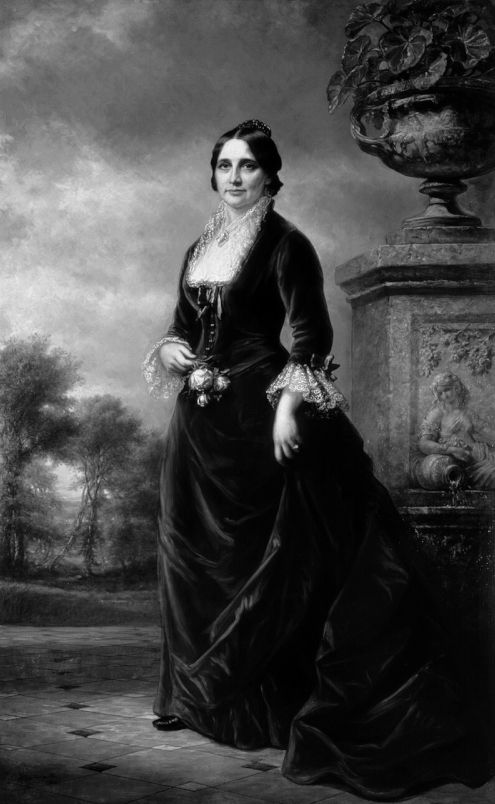
MRS. LUCY WEBB HAYES
The Huntington Portrait, 1881, presented
to the White House by the Women’s Christian
Temperance Union.
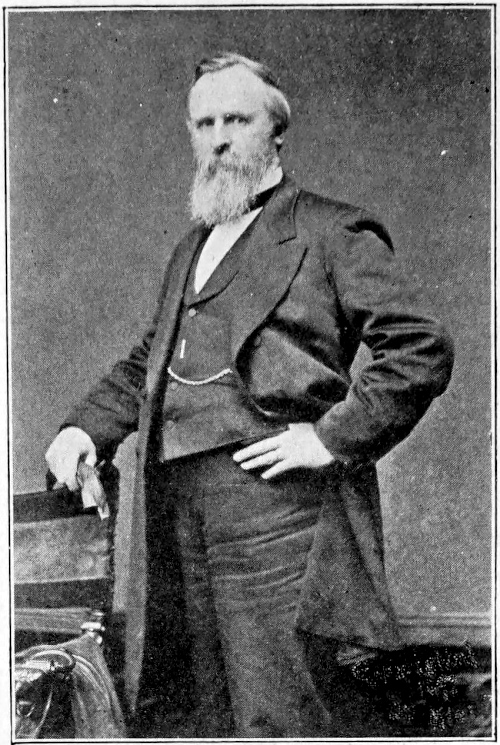
RUTHERFORD BIRCHARD HAYES
Storm centre of an after-election contest
which kept him in suspense until his inauguration
in 1877.
The fact that the 4th of March fell upon Sunday added
somewhat to the perturbed state of the official mind as to
whether or not the oath should be taken on Saturday,
March 3d, or Monday, March 5th. The anxiety lest something
unpleasant transpire as an aftermath of the contest
was present in many minds. President Grant decided to
have Governor Hayes sworn in as quickly as possible—and
on March 3d. A farewell dinner had been arranged
at the Executive Mansion on the evening of March 3d, to
which he invited Governor and Mrs. Hayes. Before the
guests assembled for this function, President Grant conferred
with Chief Justice Waite and a small group gathered
in the Red Room, where Rutherford Hayes was formally
sworn. The fact that Hayes was duly vested with the
powers of Chief Magistrate was not even announced to
the guests at the dinner or known to any outside the group
participating until after the second and public ceremony
of Monday, March 5th.
Monday dawned cold and rainy, but cleared by noon;
and although so much uncertainty had hung over the
results of the recent sitting of the electoral commission,
the city was packed with a great inauguration throng,
thirty thousand being estimated as the number of visitors.
The entire route of the procession was magnificently decorated,
and vociferous cheering and shouting greeted
President Hayes throughout the drive to and from the
Capitol.
Mrs. Grant had put the mansion in perfect order, provided
a day’s supply of food so that the new First Lady
need not concern herself with a menu for dinner and breakfast,
supervised the removal of her own effects then, as
their hostess, she awaited the return of the new President
and his wife, to preside for the last time over the elaborate
luncheon, to which she had invited as many of the official
family as possible. After the meal, which was made most
jolly and informal, General and Mrs. Grant went to the
home of Mr. and Mrs. Hamilton Fish, where they remained
for several weeks completing preparations for their
trip abroad.
Instead of the long afternoon procession and gay ball
which usually featured inauguration celebrations, there
was a torchlight parade during the evening. All winter,
Hayes’s supporters had been waiting to hear that he had
won at the polls, so into that night-time parade they infused
the pent-up enthusiasm of four months. Ten
thousand torch bearers swung up Pennsylvania Avenue
singing the campaign songs. Unrestrained, the serenaders
marched into the White House grounds cheering “Rutherford
Hayes, President of the United States,” until he appeared
on the portico to greet them. Waving torches
and exploding fireworks on the lawn made a brilliant scene.
The reception at Willard Hotel drew a large throng who
had hoped for a ball and furnished a delightful climax
to the day over which there had been so many dire prophecies.
The announcement of the new Cabinet brought forth
the sneers of the Hayes opponents and the commendation
of friends and supporters. The intellectual William M.
Evarts of New York was selected as premier of the State
Department. John Sherman’s (Ohio) known financial
acumen was sought for the Treasury portfolio. To Carl
Schurz of Missouri were confided the Interior Department
problems. Richard W. Thompson, of Indiana, more of
a campaigner and stump spellbinder than a naval expert,
was slated to preside over the Navy. G. W. McCrary,
of Iowa, a country lawyer, was first selected for Attorney
General, but was finally given the post of Secretary of
War, although totally unfamiliar with military affairs.
General Charles Devens of Massachusetts, a gallant soldier,
received the appointment as Attorney General.
David M. Key, of Tennessee, as Postmaster General,
represented the South. This group was dubbed the “Tea
Table Cabinet” by the Tilden adherents.
The same routine of Tuesday and Friday Cabinet meetings
was observed by the new official family and the
President set himself to the task of combatting the handicap
his election contest had entailed.
Rutherford Birchard Hayes was born at Delaware,
Ohio, October 4, 1822, of Scottish ancestry. A matter of
pride was the possession of the names of two chiefs notable
in Highland history. These were Hayes and Rutherford,
who fought together with William Wallace and Robert
Bruce. His parents, of old New England stock, had travelled
westward in covered wagons and settled in Ohio.
This boy was born a few months after his father’s death.
His mother was in fair circumstances and able to send her
children, Fanny and “Ruddy,” as the boy was called,
through school and to give them the advantages of college
education. Rutherford was graduated from Kenyon College
and from Harvard Law School.
It was when he was a young lawyer of great promise at
Cincinnati that he met by chance at Delaware Sulphur
Spring a Miss Lucy Webb, student of Wesleyan Female
College, whom he had known when a boy. They renewed
the acquaintance, which soon passed from friendship into
love. He was the most persistent and faithful among
the young men attending the college teas, suppers, and
receptions. He has been quoted as declaring, “My friend
Jones has introduced me to many of our city belles, but I
do not see anyone who makes me forget the natural gaiety
and attractiveness of Miss Lucy.” After Miss Webb
was graduated, a few years later, they were married by
Professor L. D. McCabe, President of the Wesleyan
Female College. Miss Webb was the daughter of Doctor
and Mrs. James Webb of Delaware, Ohio.
Rutherford Hayes began his military career in the Civil
War as Major of the Twenty-third Ohio Infantry. From
the time he was commissioned Lieutenant Colonel, in
1861, until the war ended, his military service was distinguished
by his valour. Promotions for gallantry in action
awarded his exploits. He was wounded six times,
four horses having been shot under him. Of sixteen
presidents who participated in the wars of the nation, he
and James Monroe were the only ones wounded in battle.
Civic honours also came to him with flattering frequency
and he served through the Thirty-ninth Congress, was
reëlected to the Fortieth, and was three times Governor
of his state.
When a successor for President Grant was being politically
weighed and measured, James G. Blaine of Maine,
Speaker of the House of Representatives, seemed to be
the strongest candidate of the Republican Convention at
Cincinnati. While Robert Ingersoll’s masterly nominating
speech of the “Plumed Knight” had made a profound
impression, opposing influences had been at work, the
high tide for Blaine passed, the other candidates combined,
and with the seventh ballot came the stampede to Rutherford
Hayes, Governor of Ohio.
Fully as exciting was the Democratic Convention held
for the first time in the West, as St. Louis was then designated,
owing to its being across the Mississippi River.
This convention was entirely different from the Republican
gathering. Colonel Henry Watterson, famous editor of
the Louisville Courier Journal, was temporary chairman.
Tilden, like Blaine, was chiefly the favourite, but, unlike
Blaine, was quickly nominated.
As his election to the governorship of New York in 1874,
with a fifty thousand majority, proved, he was one of
the leading Democrats. Thomas A Hendricks of Indiana
was chosen for his running mate.
The election was the hardest fought, the bitterest, and
the closest in history. The Democrats had capitalized
the frauds and scandals of the Republican administration;
the Republicans had followed the retaliating policy by
waving the “Bloody Shirt,” as the reference to reconstruction
policies was called. The consequence was a campaign
heated, excited, and doubtful. Mr. Hayes received but
one electoral vote over Mr. Tilden, and this the Democrats
contested.
Senator Zachariah Chandler (Michigan) was the only
prominent Republican leader to remain unshaken in his
assertion of a Hayes victory. His assurance of this fact
aroused such a furore of resentment and threats of vengeance
among Democrats that it looked for a time as though
another Civil War might ensue. The Senator telegraphed
to President Grant urging the concentration of United
States troops in the Southern States’ capitals to insure a
fair count. The President referred the matter to General
W. T. Sherman, General of the Armies, saying:
“Should there be any grounds of suspicion of fraudulent
count on either side, it should be reported and denounced
at once. No man worthy of the office of President should
be willing to hold it if counted in or placed there by fraud.
Either party can afford to be disappointed by the result.
The country cannot afford to have the result tainted by
the suspicion of illegal or false returns.”
The Democrats charged that the election had not been
fairly conducted, asserting openly that many Democratic
votes in the South had been thrown out instead of being
duly counted by those entrusted with the duty of counting
them. The votes from South Carolina, Louisiana, and
Florida, where carpet-bag government and Negro rule
prevailed, were hotly contested. Investigation showed
fraud on both sides in these states. Two sets of electors,
both insisting that they were legally and properly elected,
met and sent their results to Congress. This produced
grave concern as there was no provision in the Constitution
to meet such a contingency. The uncertainty produced
a tense situation. Some conservatives advocated
calmness and patience until news from doubtful states
could be confirmed. Others saw nothing but crookedness
and excitedly claimed fraud. Each party sent some of its
political leaders to the state capitals, where the issue was
at question to observe and report from the spot.
So grave were the apprehensions over the state of affairs
that Congress was called upon to settle the matter. To
meet the crisis, they created an electoral commission to
consist of five Senators, five Representatives, and five
Supreme Court Justices. Upon this body was placed the
responsibility for the decision.
The members of the Electoral Commission were as
follows: From the Senate, George P. Edwards, Vermont;
Oliver P. Morton, Indiana; Frederick Frelinghuysen, New
Jersey; Thomas F. Bayard, Delaware; Allen G. Thurman,
Ohio; from the House of Representatives, Harry B. Payne,
Ohio; Eppa Hunton, Virginia; Josiah C. Abbot, Massachusetts;
James A. Garfield, Ohio; George F. Hoar,
Massachusetts; from the Supreme Court, Clifford, Miller,
Field, Strong, and Bradley. Senator Francis Kernan substituted
for Senator Thurman, who was incapacitated
by illness.
Ben Perley Poore, noted correspondent, has left a vivid
picture of the conditions of the public mind at this time,
and also the extreme measures used and the pressure each
party threw into the concluding hours of debate and discussion
through which a settlement was finally reached.
In part, he says:
“The counting of the electoral vote on the 2d of February,
1877, attracted crowds to the House of Representatives.
Even the diplomats came out in force, and for
once their gallery was full.... At one o’clock the
Senate came over in solemn procession, preceded by the
veteran Captain Bassett, who had in charge two mahogany
boxes, in which were locked the votes upon which the fate
of the nation depended....
“President pro tem. Ferry, in a theatrical bass voice,
called the Convention to order, and, after stating what it
was convened for, opened one of the boxes and handed an
envelope to Senator Allison, with a duplicate to Mr. Stone.
It was from the State of Alabama, and on being opened,
ten votes were recorded for Samuel J. Tilden, of New
York. State after state was thus counted until Florida
was reached, when the majestic Dudley Field arose and
objected to the counting thereof. A brief discussion
ensued, and the vote of Florida was turned over to the
Electoral Commission. The Senate then returned to its
chamber, preceded by the locked boxes, then nearly empty.
“It was asserted by those who should have known that
Judge Bradley, who had been substituted for Judge Davis,
came near, in the discussion on the Florida votes, turning
the result in favour of Tilden. After the argument upon
the Florida case before the Commission, Judge Bradley
wrote out his opinion and read it to Judge Clifford and
Judge Field, who were likewise members of the Commission.
It contained, first, an argument, and, secondly, a
conclusion. The argument was precisely the same as that
which appears in the public document; but Judge Bradley’s
conclusion was that the votes of the Tilden electors in
Florida were the only votes which ought to be counted as
coming from the State. This was the character of the
paper when Judge Bradley finished it and when he communicated
it to his colleagues. During the whole of that
night Judge Bradley’s house in Washington was surrounded
by the carriages of Republican visitors, who came
to see him apparently about the decision of the Electoral
Commission, which was to be announced next day. These
visitors included leading Republicans, as well as persons
deeply interested in the Texas Pacific Railroad scheme.
“When the Commission assembled the next morning,
and when the judgment was declared, Judge Bradley gave
his voice in favour of counting the votes of the Hayes
electors in Florida! The argument he did not deliver at
the time; but when it came to be printed subsequently, it
was found to be precisely the same as the argument which
he had originally drawn up, and on which he had based
his first conclusion in favour of the Tilden electors.
“Disputed state after disputed state was disposed of,
and Washington was stirred with feverish excitement.
Every day or two, some rumour was started, and those
who heard it were elated or depressed, as they happened to
hope. But the great mass listened with many grains of
allowance, knowing how easy it is at all times for all sorts
of stories, utterly without foundation, to get into the public
mouth. The obstructionists found that they could
not accomplish their purpose to defeat the final announcement,
but their persistence was wonderful. They were
desperate, reckless, and relentless. Fernando Wood
headed, in opposition to them, the party of settlement and
peace, his followers being composed in about equal parts
of Republicans and of ex-Confederates who turned their
backs on the Democratic filibusters. Finally, the count
was ended, and President pro tem. Ferry announced one
hundred and eighty-four votes for Samuel J. Tilden and
one hundred and eighty-five votes for Rutherford B.
Hayes.”
While President Hayes was struggling with portfolios
and patronage and combatting the handicap his election
struggle imposed, his wife was engrossed with the multitude
of duties that devolved upon her as First Lady of the
Land.
Her appearance in Washington had been awaited with
unabated interest, and speculation was rife over Mrs.
Grant’s successor and the social régime to follow. Mary
Clemmer Ames wrote thus of Mrs. Hayes at the public
inauguration:
“Meanwhile, on this man of whom everyone in the nation
is this moment thinking, a fair woman between two
little children looked down. She has a singularly gentle
and winning face. It looks out from the bands of smooth
dark hair with that tender light in the eyes which we have
come to associate with a Madonna. I have never seen
such a face reign in the White House. I wonder what
the world of vanity fair will do with it! Will it frizz that
hair? Powder that face? Drive those sweet, fine lines
away with pride? Bare those shoulders? Shorten those
sleeves? Hide John Wesley’s discipline out of sight as
it poses and minces before the First Lady of the Land?
What will she do with it, this woman of the house and
home? The Lord in heaven knows. All that I know is
that Mr. and Mrs. Hayes are the finest looking type of
man and woman I have seen take up their abode in the
White House.”
When Mrs. Hayes was preparing to come to Washington,
she was beset, as befalls every incumbent of the office,
with many suggestions as to the White House etiquette
and the type of functions to be held there. Possessed of
decided independence of thought and action, she felt that
her family and official position in Ohio would enable her
to decide as to the form of her social régime. Although
Mrs. Hayes had been reared a strong temperance woman,
wines had always been in use in her family, though not
served at their tables. During the war, when she went
to camp, she never failed to carry liquors for the sick.
She had always maintained that every woman should
be absolute mistress of her own home and dictate its
policy. If she wished to serve wines, she would certainly
do so. On the other hand, she reserved the right to decline
to serve them, whether the home over which she was
mistress was in Ohio or the White House.
The zealots of temperance in search of a new sensation
to spring to advance their course seized upon this attitude
of hers as an opening for a definite commitment of a policy
emanating from the White House as a national example.
Soon after Mrs. Hayes arrived at the White House, the
wife of a minister visited her and begged her earnestly to
forbid the use of liquor and wines in the mansion during
her régime. Mrs. Hayes was somewhat surprised at the
request; she did not commit herself as to what stand she
would take, but replied:
“Madame, it is my husband, not myself, who is President.
I think a man who is capable of filling so important
a position, as I believe my husband to be, is quite competent
to establish such rules as will obtain in his house
without calling on members of other households. I would
not offend you, and I would not offend Mr. Hayes, who
knows what is due to his position, his family and himself,
without any interference of others directly or through his
wife.”
The President and Mrs. Hayes conferred over this matter
and were agreed that, to secure the greatest good to
the greatest number, it would be well for them to advocate
and practise total abstinence. Consequently, when the
new mistress of the White House made her plans for her
first functions, the use of wines was tabooed. This statement
created a furore of criticism, ridicule, and protest
among the Cabinet and official and social leaders, many
going so far as to predict international complications, since
the absence of liquors at state functions would be regarded
as an affront by the diplomats. Not even cartoons or
the sneering title “Lemonade Lucy” moved her: Mrs.
Hayes remained firm, and wine remained absent from her
table—and no complications ensued, though, from the
Cabinet down, the President and his wife were besought
to change this dictum, “for the honour of the country,”
as many expressed it.
Among the letters of Rutherford B. Hayes, one dated
Spiegel Grove, Fremont Park, March 10, 1891, published
for the Hayes Memorial Library, regarding the absence of
wines during his administration, says in part:
“As to the Presidency, this was the situation: We were
opposed to the use of wines and liquors in our household.
We continued at Washington the habits of our Ohio home.
A bright and persistent correspondent, who failed to get
the office he wanted, attacked us savagely on all occasions.
He started many ill-natured stories showing that we were
too economical, and repeatedly charged that the total
abstinence rule at the White House was due to a desire to
save expenses. We did nothing that even seemed to warrant
this attack. We spent in hospitality, charities, and
generous living the whole amount. My belief is that no
others ever spent as much in the White House as we did.
Many old congressmen (Messrs. Stevens, Fernando Wood,
and, I think, S. S. Cox) said repeatedly that they had
known and heard of no one who entertained as much.
Mrs. Hayes took pains always to have young ladies as
guests from all parts of the country, South as well as North.
Special entertainments were frequent. And the regular
routine of affairs was made exceptionally brilliant and
expensive. Many new dinners and entertainments were
added to the ‘of course’ affairs. Mrs. Hayes was busy
with her whole-hearted energy in looking up the needy.
“When we left Washington a story was started that I
had saved about twenty thousand dollars during my term.
This was shown by the reduction of my indebtedness to
that amount. This had an appearance of truth, and
was perhaps derived from one of the family. But on
looking up affairs at home it turned out that a large part
of this reduction of my debts was from collections on real
estate sales made before I left home. I left Washington
with less than one thousand dollars.”
In January, 1878, Mrs. Hayes held her first reception
of the season. Thoroughly emancipated in her ideas as to
what was suitable and proper for her, she chose to abide
by the style of hairdressing she had always followed, and
refused flatly to consider allowing her hair to be arranged
according to the style of the hour, in great structures of
frizzed false hair. She wore hers parted plainly and drawn
down, looped over her ears, and loosely coiled at the nape
of the neck. In the matter of her gowns she also had her
own definite ideas. The décolleté so extreme through the
Lincoln and Grant régimes, the huge bustles and lengthy
trains, were not to her liking. She appeared at the New
Year’s reception in a princess gown of black silk of rich
texture and quality, cut with a graceful train, and elaborately
trimmed with handsome jet passementerie. Her
concession to the mode was a V-neck, filled in with delicate
Spanish lace. A silver comb set off her black hair.
Her appearance brought forth much favourable comment,
and many who came prepared to censure and criticize remained
to praise, since the effect was regal, and she received
with a grace and dignity that won all of her critics.
She was assisted by Mrs. Evarts in elegant black velvet,
Mrs. Sherman in old gold satin with court train of black
velvet, red roses arranged about the corsage. Among
the diplomatic guests, especially notable was Madame
Yoshida, wife of the Japanese Minister, since she had discarded
her native dress for American garments.
One of the President’s early appointments was that of
Marshal of the District of Columbia. Frederick Douglass,
a well-indorsed applicant, was chosen. Frederick Douglass,
a Negro, an American journalist and orator, had
once been a slave. He was born in southern Maryland
and ran away from his master about 1838. He made his
way North and established himself at New Bedford,
Mass. Possessed of much natural ability, he began to
lecture on slavery, later publishing a full account of
his own experiences. He visited England, lecturing extensively.
When the war opened, he advocated the use
of coloured troops and aided in organizing regiments of
them.
After the war, he became editor of the National Era at
Washington.
His wife was a white woman.
As it was not possible for Frederick Douglass to fulfil
the duties of his office in the White House as his predecessors
had done, the President’s second son, Webb Hayes,
served as confidential secretary. In this capacity, the
young man presented all callers to his father, while Colonel
T. L. Casey, of the Corps of Engineers, made the introductions
to Mrs. Hayes.
Among the notable functions, the first was the state
dinner in honour of His Imperial Highness Grand Duke
Alexis Alexandrovitch, of Russia, on April 19, 1877, at
7 o’clock, the only function at which wine was served.
This had been arranged by Secretary Evarts.
In the opening days of his administration, President
Hayes gave a brilliant state dinner, which was long discussed
and over which there was much speculation.
Secretary Evarts had expressed his distress over the lack
of wines long and fervently. When the dessert of oranges
was served, there were expressive glances exchanged between
guests. They enjoyed the delicious concoction
and were frankly not averse to more. They were convinced
that the chef had been liberal with Santa Croix
rum and were accordingly delighted to think the First
Lady of the Land had been hoodwinked. The President,
“one of those demmed literary fellers” as he was often
called, appeared to be wholly ignorant of anything to
cause unusual satisfaction. He did not partake of the
fruit. Rumour claims that he enjoyed the situation
thoroughly. No one suspected that he was aware that
his guests were of the opinion that the white ribbon rule
had been rudely jarred, if not broken. He kept his counsel.
The guests whispered the story around and the
popularity of the orange dessert grew. It was often
served. None discovered until long afterward that the
joke was on the guests—the President and the chef had
conferred—a flavouring had been found that so completely
duplicated the taste of the famous rum as to require
an expert to detect the difference.
President Hayes was addicted to the scrapbook habit.
This was his method of keeping up with current information.
One clerk was detailed to go through daily papers,
clip and classify all news and information. The clippings
were pasted in books under the subjects to which they
belonged and were immediately available to the President’s
call, whether his query related to cotton exports, international
treaties, or the country’s finances.
Young Webb Hayes found his time pretty well occupied
with a diversity of duties, as his mother clung to her old
Ohio habit of filling the house with young ladies who had
to be squired and beauxed on sight-seeing trips, and
escorted constantly to social affairs. Often, when some
impromptu expedition was gotten up, he had as many as
eight girls to look after at one time. Asked recently how
he managed this part of his White House job, Colonel
Hayes merely shook his head, gave his Rooseveltian smile,
and looked so reminiscent that it seemed even the illustrious
example of Coolidge silence was in danger of being
forgotten, and perhaps a delightful story of some of the
romance of a twenty-year-old lad might be forthcoming—but
it wasn’t.
Despite his dignity and responsibility, young Secretary
Hayes could and did unbend when not on duty. He has
been charged with learning to ride a bicycle in the East
Room. Upon another occasion, when one of the young
lady guests had a caller who stayed over long, he betook
himself to the room above the Red Room, where the young
people were chatting, and frightened them nearly to death
by dropping the largest dictionary he could find on the
floor just above their heads. Needless to add, the caller
soon departed, and the young secretary was able to see the
mansion closed for the night and get some much-needed
rest.
Among the interesting festivities at the mansion was
the celebration of the silver wedding of President and
Mrs. Hayes, December 31, 1877, which was the first party
of that kind ever held there. The halls and state apartments
of the entire first floor were decorated with cut
flowers, vines, and plants. Smilax was entwined about
the great chandeliers of the East Room, which, by the
way, had been put in during the previous administration
at a cost of $1,800 each. They were made in Germany,
and each of them contains 5,060 pieces of cut glass. Flags
were also used wherever the touch of the national colours
was desired.
The Cabinet and their families were the only official
persons invited. Close friends in Washington and old
friends from Ohio identified with the life of these two people,
and a delegation of the Twenty-third Ohio Volunteer
Infantry, which President Hayes had commanded, comprised
the group of guests.
Promptly at nine o’clock, the Marine Band played
Mendelssohn’s Wedding March, and the President, with
his wife on his arm, came down the stairway, followed by
members of their family and special guests. The little
procession moved into the East Room, in front of the
central window on the east side. Mrs. Hayes wore her
wedding gown and slippers, and she admitted having been
obliged to let out the seams. The gown was of white
brocade, with the wide straight skirt in style at the time,
trimmed with tulle and white silk fringe. Long white
gloves met the short sleeves, and white slippers and the
silver comb for her hair completed the bridal costume.
Mrs. Mitchell, the daughter of the President’s sister,
stood beside Mrs. Hayes, as she had done when a little lass
of eight at the original wedding. Reverend Dr. L. D.
McCabe, the pastor of many years’ association and spiritual
guidance, again gave the blessing. And this occasion,
with the gathering of the lifetime friends, was made more
remarkable by the christening of Fanny and Scott Russell
Hayes and the six-weeks-old baby daughter of Mrs. Herron,
the mother of Mrs. Taft, who had attended the original
wedding. Her baby was named Lucy Hayes Herron.
No gifts were received. The President emphatically
decreed against that, but one came from his old regiment
so expressive of the regard of the men for their commander
and his wife that it could not but be accepted and appreciated.
It was a silver plate in an ebony frame inscribed:
“To the Mother of the Regiment.”
Upon the plate was a sketch of the log hut which had
been Colonel Hayes’s headquarters in the valley of the
Kanawha, surrounded by tattered battle flags.
Soon the President led the way to the state dining room,
where a sumptuous table presented all of the delicacies
of the day and the best of the confectioner’s art.
The ringing in of the New Year disbanded the party.
Many gay parties were given for the eleventh White
House bride, Miss Emily Platt, niece of President Hayes,
who married General Russell Hastings in the Blue Room
on the evening of July 19, 1878. This gay little wedding
was attended by the Cabinet and the many friends of Miss
Platt, who had assisted Mrs. Hayes in her social duties.
Bishop Jagger of Ohio, a Methodist minister, performed
the ceremony beneath a marriage bell composed of fifteen
thousand buds and blossoms. The Marine Band played
the wedding march, and President Hayes gave the bride
away. A very elaborate supper was served to the party
in the private dining room.
Although Mrs. Hayes kept aloof from all political matters
and attended wholly to her end of the presidential
partnership, she did confess to one piece of lobbying for
which posterity is indebted to her. Eliphalet Andrews,
the noted portrait painter of Ohio, came to Washington in
1877 to found the Corcoran School of Art under the
patronage of W. W. Corcoran. He made a charming life-size
portrait of Martha Washington as the first of a series
of presidential portraits, which includes those of Jefferson,
Jackson, Taylor, Buchanan, Johnson, and Garfield. When
Mrs. Washington’s portrait was finished, Mrs. Hayes had
it placed on exhibition in the East Room. It was hung
opposite the one of General Washington. Mrs. Hayes
felt that that portrait belonged right there, so she concluded
to make an effort to have it purchased. Accordingly,
following the next state dinner, she conducted
Speaker Randall to view the portrait. She dilated upon
its merits and expressed her own wish to have it bought
for the mansion. The Speaker coincided and suggested
that she direct Senator Edmunds’s attention to the portrait,
as he was chairman of the committee on the purchases
of portraits for the government. Mrs. Hayes’s
appeal brought the matter to a point where it received
official attention and was the needed impetus to bring
about the purchase of the portrait. It is the only one of
the few portraits of the various First Ladies of the Land
belonging to the White House that is displayed in the
state apartments. The others, that of Mrs. Hayes among
them, are relegated to the basement corridor which opens
from the cloak rooms and which is used by all of the delegations
received by the wife of the President and by the
guests at the various state functions.
Life in the White House was very jolly and happy during
this entire administration. Mrs. Hayes’s love for
young people was one of her great charms. She was the
mother of eight children, three of whom died previous to
or during the war. The eldest son, Birchard, was practising
law; the second one, Webb, performing countless
valuable services for his parents in the capacity of confidential
secretary. Rutherford, Jr., was at school, and
the two little ones livened the house with their pranks.
Christmas was always the occasion of a great celebration,
the family returning to spend the holidays together
when frolic and fun were the order of the hour. While
Mrs. Hayes radiated joy and love to her own, she never
overlooked the unfortunate, but made it a rule to dispense
charity to the limit of her ability. Among other philanthropies,
she distributed forty turkeys with the ingredients
for complete dinners to needy families. She taught her
children to save a share of their pocket money to buy
gifts for less favoured children.
The first Thanksgiving in the White House, November
26, 1877, she established the custom of inviting to dinner
all members of the clerical staff of the White House with
their families. This custom prevailed throughout her occupancy.
Lucy Webb Hayes was the first college woman to be
mistress of the President’s house. Her régime stands out
alone, clear and distinct, an epic of womanly courage and
loyalty to principle. She had the courage to do what no
one else had ever done. She entered official life at a time
when the female lobby was at its height, when scandal had
the nation in its slimy coils, and when ideals and principles
were hibernating. She not only turned a deaf ear to
friend and foe when she set her hand to advance the cause
of temperance, but she also established anew the regard
for Sabbath observance by the example of her own household.
She had always been a strong churchwoman. Her
family was originally Presbyterian but left the Southern
Presbyterian Church because of a difference on the temperance
question and a sectional one in slavery, and became
affiliated with the Methodists. While in Washington,
they were attendants of Foundry Methodist Episcopal
Church, then located on the corner of Fourteenth and G
streets. Sunday was distinctly a family day. The Sunday
evening impromptu family concerts became so popular
as to develop into regular affairs. Mrs. Hayes possessed
a fine strong voice, and she loved to sing as much as
the family enjoyed hearing her. Vice President Wheeler
also had a fine voice. Mrs. Wheeler was a pianist of talent,
and with the President joining them in his favourite Scotch
folk songs and ballads, they quickly developed a delightful
Sunday function that kept adding recruits, Chief Justice
Waite, his daughter, Mr. and Mrs. Harlan, and Miss
Harlan being among those who made the White House
their objective on Sunday evenings for this pleasure.
From her arrival, Mrs. Hayes won popularity for her
charm. She has been called the most beautiful of White
House mistresses since Dolly Madison’s day and kept
that title until the appearance of the lovely Mrs. Cleveland.
Warm-hearted, vivacious, fun-loving, she enjoyed
every moment of life and loved doing things for other
people. Moreover, she was possessed of vigour of health
and strength of vitality that added much to the pleasure
people experienced in meeting her. She had a strong will
and a wholesomeness combined with rare good sense, and
left the impress of her strong personality upon the annals
of her country.
She loved the White House, so filled with historic associations.
She revelled in her explorations of attics, storerooms,
and basement, and soon after her installation had
appraised the odds and ends of furniture, ornaments,
and china, and arranged many of the treasured relics of
bygone administrations so that they might be used and
admired.
Mrs. Hayes enlarged the conservatory by the removal
of the billiard room. Thus she was able to have a more
abundant collection of plants and display of flowers. At
the end of the long corridor, a brilliant and fragrant mass
of growing blooming roses greeted the eye and was a source
of delight to all visitors. Each morning she had baskets
of flowers brought to her, and personally arranged anywhere
from a dozen to fifty bouquets for various people,
not only friends, but officials, and hospitals, and institutions.
She carried her love of flowers and nature to the
extent of purchasing a dinner service of a thousand pieces,
and upon it were reproduced the flora and fauna of America.
This work was done by Theodore R. Davis, an
artist-naturalist who had travelled extensively and familiarized
himself with the vegetation of our land. The
effect of the bold designs of fish, fowl, and flowers upon
the tableware brought a variety of comment. Some
ridiculed and others approved, but all admitted the idea
distinctive and original.
Mrs. Hayes did not emulate Mrs. Grant in her social
activities. She followed the old custom of declining invitations,
but she managed to be well represented by some
of her family and a group of young girls.
She left Washington loved by the poor, with the unqualified
admiration and devotion of the church people
and those advocating prohibition. A movement was
started by the temperance people to express the appreciation
of her stand against liquor by a gift to the city of a
fountain named for her. She did not favour this, for she
had seen too much of unsanitary drinking fountains to be
at all impressed with the idea, even though it was an unusually
appropriate one; and when a life-size portrait of
herself was suggested, instead, she entered into the plan
most cheerfully. The celebrated artist, Daniel Huntington,
of New York, was commissioned to paint the portrait.
As she was planning to make a trip to New York to purchase
her winter wardrobe, she offered to get whatever the
artist considered most suitable in colour and material for
the gown to be worn in the portrait. As she was what he
called a rose brunette, Mr. Huntington chose the colour
and material of the lovely maroon velvet gown which
appears in the portrait that now graces the White House.
This painting was presented by the Woman’s Christian
Temperance Union and unveiled by a delegation at the
close of the Hayes régime in March, 1887. The address
was given by Frances Willard.
Mrs. Hayes did not live very long after her return to
Ohio. She was spared a long and painful illness, however,
dying suddenly on June 25, 1889. She was seated on the
porch engaged with some fancy work, watching some of
the young people of the family playing tennis. Her needle
gave her a bit of trouble, and she inclined her head to
see what was wrong. She was heard to give a little sigh,
and before anyone realized that she was ill, she was unconscious
from a stroke of apoplexy, and died a few hours
later. She was buried on the knoll at Spiegel Grove,
Fremont, Ohio.
President Hayes had long been interested in the preservation
of historic places such as the early homes of the
Presidents, their birthplaces, graves, etc., and this led
to the trip to Wakefield and the placing of a marker there
on the site of George Washington’s birthplace. The
Washington Monument project received through his influence
the needed impetus to secure the appropriation
by Congress for the resumption of the construction. To
Colonel Casey the task was given, and under his direction
work again began. The Monument in its unfinished condition
had been an eyesore to the people of Washington
for nearly twenty-five years.
Rutherford Hayes won high regard for his unfailing
dignity in his official duties, made so difficult by the
politicians of his own party and by the Democrats who
controlled the House. His choice of a private secretary,
W. K. Rogers, of Minnesota, a friend of long standing,
unloosed the first storm of criticism. His Cabinet selections
had been met with ridicule, the claim being that
they were neither Northern, Southern, Democratic, nor
Republican. Throughout his term he was continually
taunted with the charge of fraud, although President
Grant, the electoral commission, and a vast host of powerful,
staunch Americans supported and endorsed him.
President Hayes mapped out his course and followed it.
He would not be stampeded. His calm, deliberate policies
enabled him to carry out his theory regarding the necessity
of withdrawing Federal troops from the Southern States
as the quickest method to aid those states to get rid of
carpet-bag government. To the great consternation of
the opposition and against the advice of many of his own
party, he withdrew the troops—a step calling for courage.
Immediately, the whites assumed control, and the worst
of the reconstruction evils was over.
Out of his resolve to rid the government of the scandals
that had so obscured the vision of the public for the previous
eight years arose so much contention that two factions
formed. One called themselves “Stalwarts”; their chief
reason for existing was to express opposition to the conciliatory
policy which he had manifested toward the South,
in his great effort to make the reality of a reunited country
manifest. For this he was called a “Puritan” and those
who followed him were termed “Half-breeds.”
Very little constructive legislation could be developed
against the combined opposing elements which maintained
their hostility throughout his term. He vetoed the
Bland-Allison Bill, which pledged the government to the
purchase of silver to the extent of $24,000,000 yearly to
be turned into dollars. Congress passed the bill over his
veto. Specie payments were resumed, and a Chinese
treaty negotiated which exercised control over the immigration
from that country.
President Hayes did not seek a renomination, but returned
to his home to indulge in various forms of philanthropy
and to plan and have constructed under his own
direction a monument that should serve as his memorial.
With the death of Mrs. Hayes and her interment in the
spot he had chosen, this memorial became a hallowed and
sacred project to develop into a memorial park. He did not
survive his wife long. His death occurred quite suddenly,
on January 17, 1893, shortly after he had remarked that
he had “rather die at Spiegel Grove than live anywhere
else.”
CHAPTER V
ADMINISTRATION OF JAMES ABRAM
GARFIELD
March 4, 1881, to September 19, 1881
FROM a frontier log cabin in the wilderness to the
White House was the alpha and omega of James A.
Garfield, whose brief régime lasted just two hundred days.
The inauguration of James A. Garfield, twentieth President
of the United States, on March 4, 1881, was a
great pageant, notwithstanding the cold, dismal rain that
followed the light snow of the night before. By noon, the
sun had come out bright and warm, and before the parade
was over, the streets were dry.
Escorted by twelve companies of regular artillery, six
companies of marines, and a like number of infantry,
President Hayes and President-elect Garfield rode together
with the members of the Senate Committee in a four-horse
carriage, with the Columbia Commandery of
Knights Templar, of which General Garfield was a member,
as a guard of honour. An armed guard had been
posted about the Capitol, and no one without the proper
credentials was admitted.
Mrs. Hayes escorted Mrs. Garfield and General Garfield’s
aged mother, a venerable white-haired lady, to the
gallery seats reserved for them.
Following the installation of Mr. Arthur, the new Vice
President, and the new senators, the Senate was adjourned
to witness the ceremony on the East Portico. At the
East Portico, the chair once used by General Washington
had again been placed in the centre of the raised stage.
General Garfield was shown to this as the seat of honour.
Chief Justice Waite administered the oath.
During the inaugural address, “Mother Garfield’s”
undisguised pride and delight in her son awakened the
sympathetic appreciation of all who saw her; she was the
first mother ever to have the privilege of witnessing her
son sworn in as President of the United States.
General Garfield took the oath, given him by Chief
Justice Waite, after which, amidst the applause of the
people, he kissed his mother and his wife and was escorted
to his carriage to return to the White House.
Mrs. Hayes had exercised the same courteous provisions
for her successor as had been extended to her by Mrs.
Grant, and before the new President reviewed the parade,
the two families had lunch together. Ex-President and
Mrs. Hayes then departed for the home of Senator Sherman,
where they visited for a few days.
Since the Grand Review of 1865, Washington had not
witnessed so splendid a parade, one of such length and perfect
formation as this at the inauguration of James Garfield.
It reflected great credit upon the skill of General Sherman,
who had arranged it. The ball that night, too, was a fine
affair, held in the new National Museum, fitted up for the
occasion. The new President and Mrs. Garfield arrived
about nine o’clock and were received by the Ball Committee,
Judge Bancroft escorting the President. Mrs.
Garfield was gowned tastefully in light lavender satin
elaborately trimmed with point lace. A simple cluster of
purple pansies was worn at her neck. Her costume was
remarked for its simplicity and the absence of jewellery.
Mrs. Hayes, who was with her, was most charmingly
gowned in a cream-coloured satin, trimmed with ermine.
The supper was elaborate. The menu for this event
included 1,500 pounds of turkey, 100 gallons of oysters,
3,000 biscuits and rolls, 50 hams, 200 gallons of chicken
salad, 50 gallons of jelly, 250 gallons of coffee, 15,000
cakes, 250 gallons of ice cream, and 300 pounds of butter.
Garfield’s régime was so short that naturally interest
in him must centre more in what he was than in what he
accomplished as President.
Born in Ohio on November 19, 1831, of pioneer parents,
he experienced through childhood and youth the same
kind of struggle and hardship as fell to the lot of many of
our great men. Like many of them, too, he was self-made.
When he was but eighteen months old, his mother was
left, through the death of his father, with four small children
to bring up and a farm to manage. She had literally
to fill a man’s place. Mrs. Garfield struggled and toiled
heroically, and soon Jimmy, the baby, had the chance to
go to school in the summer; the winter term was not possible,
since he had no shoes or suitable clothing. Finally,
Thomas, the eldest, a child of twelve, the man of the family,
secured a job with a farmer to work fourteen hours a
day for six dollars a month. Thomas had one idea—that
was that young Jimmy should be given a chance at
schooling, and when he came home with his first pay,
his one request was that his mother purchase shoes for
Jimmy, so that the little brother could attend the school
in the little town.
As the lad grew into his teens, the boundaries of the
farm grew too restricted. Tales of travel and adventure
had roused a responsive thrill in his heart. At seventeen,
therefore, although his mother wanted him to continue
his education and become a teacher, he set out to make
his fortune, after completing the strenuous job of chopping
one hundred cords of wood for twenty-five dollars for the
ready cash. He tied his belongings in a small bundle,
slung them over his shoulder on a stick, and started his
tramp to find the end of the rainbow of his ambition.
By the time he reached Cleveland, tramping had lost some
of its glamour, especially as water and boats were at hand.
His appeal for a place on a lake steamer met with a curt
and uncompromising refusal, in which his inexperience
was brought home to him.
Employment of some sort being a necessity, he spent
several days industriously seeking a job, and finally found
one with a canal-boat captain. For several months, for
twelve dollars a month and board he trudged the towpath
along the canal his father had helped to build.
Young Garfield was ill with chills and fever for six months,
and when convalescent, realizing that he really desired
schooling more than anything else, to his mother’s delight,
he entered the high school at Chester, which held other
attractions than the academic routine. His childhood
playmate, Lucretia Rudolph, daughter of Zeb Rudolph,
of Garretsville, one of the founders of Hiram College, was
also a pupil.
By the time these two completed the high-school course,
he had acquired the distinction of height, six feet two
inches, which was so much admired when he entered public
life. By this time, also, Lucretia had assumed a definite
place in his scheme of life. Aided and abetted by his
mother, she overcame his rather natural feeling that he
could not afford to give more time to the college course,
to which he looked so longingly. Feminine argument also
had the support and backing of the splendid loyal older
brother, and Jimmy and Lucretia entered the Western
Reserve Electic Institute at Hiram, Ohio, later the Hiram
College. In vacations, he taught a district school for
twelve dollars a month and board. Graduation left a
desire for further educational experience, and Williams
College, Massachusetts, was the objective.
During vacations, he taught school in Pownal, Vt.,
the school of which Chester Alan Arthur had been principal
the term previous. It was there Garfield became
a convert to the Campbellites, being baptized in a tributary
of the Chagrin River. His zeal for his new religious
affiliation sent him lecturing, teaching, and preaching
wherever and whenever opportunity offered.
With the completion of the course at Williams College,
from which he was graduated in 1856, where his son,
Dr. Harry A. Garfield, is now dean, he returned to take
the Chair of Ancient Languages at Hiram College.
His marriage to Lucretia Rudolph, his boyhood sweetheart,
occurred in 1858, and within a year he was made
President of the College, which position he held until
he entered the Civil War in 1861. Their lives ran along
in great happiness, owing to their congenial tastes.
They studied together and kept step in all matters of
public and educational interests. He preached, taught,
and studied law, being admitted to the bar in Cuyahoga
County in 1860.
Seven children were born to them.
Upon offering his services at the opening of the Civil
War, James Garfield was commissioned Colonel of the
Forty-second Ohio Volunteers. For gallantry, he was
made Brigadier General, the youngest man to receive that
rank. He served with distinction at Shiloh and at
Corinth, and in Alabama became Chief of Staff of the
Army of the Cumberland.
At Chickamauga, he was made a Major General of
volunteers, owing to meritorious action. This honour
had just been conferred when he learned of the death of
his infant daughter.
He resigned to enter Congress at the age of thirty-two,
after a conference with General Rosecrans, and served
continuously until 1880.
When Mr. Blaine went to the Senate in 1876, Garfield
became the recognized leader of the Republican element in
the House. In January, 1880, he himself was elected to
the Senate.
In June of that year, the Republicans held their national
convention, when Grant’s name was suggested again.
With his European popularity, many admirers believed
he would be sent to the White House on the crest of another
boom.
Other friends protested against his name being put
up again. They predicted defeat. At no time would he
announce himself as sufficiently receptive to the idea of
a third term to authorize a statement. When asked
whether he would accept a nomination, he replied: “I will
neither accept nor decline an imaginary thing.” Later,
however, he wrote:
“I owe so much to the Union men of the country that
if they think my chances are better for election than those
of other probable candidates, I cannot decline if the nomination
is tendered without seeking on my part.”
When the convention met, General Grant’s name was
brought forward by Roscoe Conkling. His chief opponent
was Mr. Blaine. Roscoe Conkling was a clever
politician, with a gift of sarcasm which he was continually
abusing. He seldom tried to conciliate his opponent,
and he deeply hated Mr. Blaine. At the convention,
Conkling’s words and manner were arrogant and insolent
to a degree. Taunts and insults came to his lips so readily
that he not merely deepened the hostility of the Blaine
men, but estranged the friends of other candidates, whom
otherwise he might, perhaps, have won over. But
he was sure of at least three hundred and six Grant
delegates, and he seemed to feel that he could bully the
convention into giving him the seventy additional votes
needed for a clear majority. Nothing like Conkling’s
conduct had ever been seen at any national convention.
He did not even confine himself to verbal taunts, but once,
at least, he rushed at an opposing delegate who was
speaking, and, seizing him by the shoulders, thrust him
down into his seat in spite of the jeers and hisses which
came from every quarter of the hall. A newspaper of
the day gives the following account:
“Roscoe Conkling, in making the nominating speech
for Grant, ranked for real oratory with Robert Ingersoll,
who nominated Blaine in 1876. Conkling’s speech was
spectacular, but, carried away by his strong partisanship
for Grant and intense hatred and bitterness toward Blaine,
he so lashed the Blaine followers as to make it impossible
ever to win a scattering vote for Grant, and his speech
left that chieftain weaker than before it was uttered.
“However, Grant’s memorable ‘306’ stood with him to
the ultimate finish. During thirty-six ballots he started
with 304, never dropped below 302, and never got more
than 313, being defeated by the avalanche to Garfield,
with 306 delegates true to the bitter end.
“Garfield went to the convention as head of the Ohio
delegation to urge Senator John Sherman as candidate.
Garfield was selected as a compromise candidate when it
became evident that Grant and Blaine were in a deadlock.
Wisconsin started the landslide. Grant’s following for
two months determinedly worked for the defeat of
Garfield, until Conkling had a conference with Grant, and
then they swung around with zealous support that barely
carried Garfield into the White House.”
Chester Alan Arthur, a “Stalwart,” was elected as the
running mate of Garfield, a “Half-breed,” to appease the
faction he represented. Mr. Arthur was collector of the
Port of New York at the time of his election, this appointment
having been conferred by President Grant.
President Garfield early made known his choice of
James G. Blaine as his Secretary of State. He listened to
all suggestions for the other Cabinet posts, but kept his
own counsel concerning his appointments. He understood
that, but for the support given him by General Grant
and Conkling, he might have met defeat. Yet he chose
to ignore hints, requests, appeals, and demands of friends
and party leaders, and chose his Cabinet for some definite
reasons which would undoubtedly have been disclosed
had his term not ended so tragically.
William Windom of Minnesota was chosen for Secretary
of the Treasury; Robert Lincoln, of Illinois, Secretary
of War; William H. Hunt, of Louisiana, Secretary of the
Navy; Wayne McVeagh, of Pennsylvania, Attorney
General; Samuel J. Kirkwood, of Iowa, Secretary of the
Interior; and Thomas L. James, of New York, Postmaster
General.
While some of the appointments he made created resentment
from the “Stalwarts,” particularly that of Blaine,
antagonism blazed into open rebellion when he selected
for the important New York office, that of Collector of the
Port of New York, W. H. Robertson, who proved to be a
political enemy of Conkling and also of Thomas C. Platt,
junior senator. Both were so indignant and resentful that,
when the man’s nomination was followed by confirmation,
and all the suggestions for other New York offices were
ignored by President Garfield, the two Senators promptly
resigned, with the idea that their reëlection by the New
York Legislature would speedily follow as a measure of
approval. The plan, however, did not work out as
scheduled.
Although President Garfield was no stranger to Washington,
his first public appearance created widespread
interest. He presided at the unveiling of the statue
of Admiral Farragut, the work of the little sculptor,
Vinnie Ream Hoxie, whose statue of Lincoln in the
Capitol had created such a sensation, being the work
of a woman—a mere girl. For the Farragut statue,
Congress paid $25,000.
Vinnie Ream deserves a place in the American Hall of
Fame since she was one of the most talented women of her
period. Her unusual life and marked achievements in
spite of limited opportunities should be an inspiration to
ambitious youth.
She was born in Wisconsin, near the site of Madison,
in September, 1847, of pioneer parents. From Indian
children playmates she learned the Indian nature so
beautifully expressed in her later model of Sequoya,
the last work of her hand, which, left unfinished, now
stands in Statuary Hall at the Capitol, having been
completed by Julian Zolnay.
Her childhood in an isolated Kansas settlement was
barren of educational facilities save when a travelling
teacher appeared to establish classes for a few weeks while
resting and preparing to continue his travels. Her
introduction to good poetry and music came through
such agencies. A guitar peddler with instruments, instruction
books, and the good will to teach all purchasers
to play found a willing pupil in the eleven-year-old Vinnie,
whose father bought his first instrument. Guitar sales
flourished. The supply was exhausted, but the little girl
was the only one who mastered the teacher’s method and
was able to pick out tunes from the little book. This
was the beginning of a musical career in which, as composer
and interpreter, she was considered a genius in the
year she was in college.
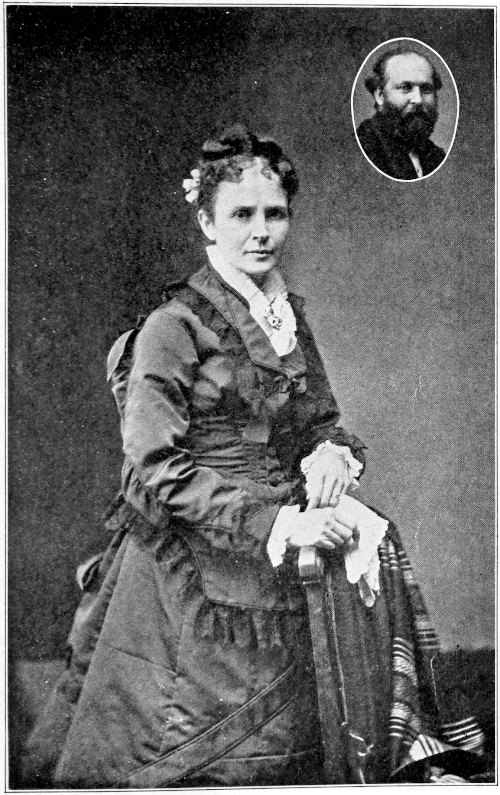
Photos. by Brady
MRS. JAMES A. GARFIELD
The vicissitudes of fortune brought the Ream family
to Washington at the opening of the Civil War, and the
little girl at the age of thirteen had to become the mainstay
for a time, filling a copyist’s position in the Post
Office at fifty dollars a month.
Her first visit to the studio of Clark Mills, the sculptor engaged
to make a bust of her for the Christian College of Missouri,
where she had been for a year a prize pupil, changed
the objective of her life from music to art. As she
watched the artist reproducing her own features in clay,
the conviction burst upon her that she too could command
her fingers in such expression, and she exclaimed, “Oh,
I know I could do that!”
Amused at her girlish presumption, the artist handed
her a bit of clay, to try. In a few minutes, he was amazed
to see a striking likeness of himself taking form under her
small fingers. Instantly, he and those with him in the
studio realized that this undersized girl of thirteen was a
genius of no mean order. Mills accordingly offered her
instruction, sending her home with some clay and a little
statuette to copy. The duplicate made in a few hours
convinced her family that the little girl had discovered her
real life work.
As her work progressed and her skill developed, the
Postmaster General permitted her to complete her daily
quota of work in the mornings so that she might have the
necessary afternoon light for her art.
A bust of President Lincoln modelled from memory
brought her an interview with him, and her story of her
struggle to help her family won his consent for her to
come to the White House for sittings. For five months
this girl, now seventeen, made her daily trip to the
President’s office to make her sketches. Her last sitting
was on the day preceding his assassination. From her
drawings, she made a bust of such remarkable likeness
that she was induced to enter the competition for the
statue of Lincoln for the Capitol for which Congress
appropriated $15,000, and won.
The contract was hers. She had won above the nation’s
leading sculptors. With her advance payment she established
herself and her parents in a studio in Rome to
study and supervise the cutting of the marble for the
statue. Three years later, she returned to begin the
work in an empty committee room assigned to her use,
under the inspiration and criticism of Abraham Lincoln’s
associates.
The completion and dedication brought her more
honours and orders, and the contract for the statue of
Farragut also came to her as the winner of the competition.
Although the Garfield administration was so brief, it
was remembered for the happy home life and domesticity
a large and lively family of youngsters gave to it, and also
for the cultural qualities of the President and his wife. Mrs.
Garfield had devoted much of her time and energies to the
education and care of her four boys and her girl. Her
natural inclination was to prefer the home circle to many of
the social affairs.
“Grandma Garfield,” the President’s mother, made her
home with them. She was the treasured guest of the
family and was given every deference and courtesy that
affection could suggest. She sat on the right of her son
and always was served first. His regard for her added
to the picture of happy home life that prevailed.
The formal state social functions were not scheduled
until the following winter season, but immediately after
the inauguration Mrs. Garfield gave four splendid receptions,
which were largely attended.
Her husband called her “Crete,” a nickname from their
schooldays, which was an abbreviation of her rather formal
name, Lucretia.
The President found the executive treadmill more
absorbing and more engrossing than any other task to
which his hand had been set, and he quickly found a
need for relaxation that was not wholly met by his literary
tastes.
Immediately after settling his family, he had the
billiard room refitted and the table restored. Here, with
his cigar and a little coterie of close friends, he found much
enjoyment. Frequent horseback riding gave him the
needed exercise.
President Garfield had so closely identified himself
with church and masonic organizations that people of the
District of Columbia regarded him as almost a Washingtonian.
He, his wife, and his mother were regular attendants
at the little frame church of the Disciples of
Christ, better known as the Vermont Avenue Christian
Church. Here he frequently filled the pulpit, although
he had never been ordained to the ministry. After his
death, when his assassin was on trial, testimony was
produced that indicated that Guiteau had followed the
President to church, as he had been seen looking in the
windows. The attendance of the President of the United
States is always a great boon to the church he selects.
The present beautiful church is built on the site occupied
by the little frame building in which Garfield was so
interested, and is regarded as a memorial to him.
As a member of the Masonic fraternity, Garfield had
greatly endeared himself to the craft. At the time of
his death he was a member of Columbia commandery,
Knights Templar, in which he was knighted in 1865. He
was undoubtedly the most active Mason locally that has
ever filled the presidential chair.
Though Garfield had chosen his Cabinet himself, without
advice, apparently he had not considered all of the
contending influences represented therein, since four
months later, at the time he was stricken by Guiteau’s
bullet, it was on the verge of dissolution.
The President was noticeably buoyant in spirit on
the morning of July 2, 1881, in bidding adieu to his office
staff as he departed for the railroad station, for he had
planned a little trip that was to take him to Williams
College, his Alma Mater, and then to join his wife at Long
Branch for a longer trip with her and the older children.
Mrs. Garfield had come into the White House with
a slight ailment that clung to her through her anxiety over
her husband’s party difficulties, and as spring opened, this
progressed and was increased through an attack of malaria,
the scourge of the White House families for many years.
After much medical consultation, she was sent to Long
Branch for the benefit of the sea air. This had proved
beneficial and the President had anticipated much pleasure
from their projected trip.
President Garfield and Secretary Blaine were at the
Pennsylvania railroad depot, about to depart. They were
passing through the ladies’ waiting room when two pistol
shots rang out. Mr. Blaine immediately turned and saw
the President lurch forward and fall. A moment afterward,
the assassin, Charles J. Guiteau, was discovered
and was rescued with difficulty from the infuriated mob.
A pistol of very heavy calibre was wrenched out of his
hand, and it became clear that a large ball had entered the
President’s body.
When in answer to eager questions, the physicians informed
Garfield that he had “one chance in a hundred”
of living, he said calmly and bravely: “Then, Doctor, we
will take that chance.”
An ambulance was hastily called. The White House
was notified. Harry, his eldest son, rushed to the station
and very gently the wounded man was placed on a mattress
and carefully lifted into the ambulance, his son
beside him. The President whispered: “Rockwell, I
want you to send a message to Crete. Tell her I am
seriously hurt, how seriously I cannot yet say. I am
myself, and hope she will come to me soon. I send my
love to her.” Preceded by three mounted policemen and
followed by others to keep the crowd back, the wounded
President was borne to the White House. Such wild
confusion as ensued can better be imagined than described.
Like wildfire the news spread over the city, and soon
the wires were flashing their terrible story to every
city and town. Once again the nation was plunged
into horror and grief over the fate that had befallen its
head. Then followed days and weeks of prayerful anxiety
among the watchers at the bedside and the people
of the nation.
General Corbin, assistant adjutant general, had immediately
provided a special train for Mrs. Garfield and
Mollie. They returned to the White House as fast as the
train could bring them, living through such agony and
apprehension as can be appreciated only by those who
have been confronted with a similar experience. To her
great relief, Mrs. Garfield found her husband alive and
able to talk with her, though suffering intensely.
Hopes ran high for his recovery because of his splendid
health and strength, but soon it was apparent to the most
optimistic that he would not recover. Physicians conferred
and disagreed over the case and its diagnosis and
treatment. Great authorities were consulted, but none
could make a suggestion that brought relief, and the
suffering man slipped farther down into the valley of the
shadow. Into the minds of all watchers soon came the
conviction that life was just a matter of days.
He expressed a desire to be taken where he could see
the ocean, and elaborate preparations were made to insure
a journey to Elberon, N. J., as comfortable for the sufferer
as possible. Accordingly, on September 6th, a mattress
was placed on an express wagon, and the trip to the
station was made between daybreak and sunrise. In
order to avoid driving over the cobblestones, the railroad
put a little stretch of track from the station down to
Pennsylvania Avenue and ran a car throughout its length,
so that the invalid might be lifted directly from his
mattress in the express wagon into the car. But even the
sight of the sea did not benefit him, and while every comfort
was provided for him at the cottage of O. G. Francklyn,
he steadily failed. He died on September 19, 1881.
While President Garfield thus lingered between life
and death, an important question arose as to the constitutional
provision relating to the “disability” of the
President. On the part of the Vice President, General
Arthur, there was no move toward assuming the responsibilities
of the executive office. To the Vice President,
the situation was exceedingly trying, but he so conducted
himself as to win universal respect. His whole bearing,
from the day of the crisis to the close of the scene, was
such as to indicate the profoundest sorrow and anxiety.
But, in other quarters, the President’s “disability”
was eagerly discussed. The question arose: Was President
Garfield disabled in the sense contemplated by the
framers of the Constitution? Does that kind of prostration
of the bodily powers in which there is still a prospect
of recovery, which leaves the will free to act and the
mental powers unimpaired, really involve disability?
While these questions were much discussed, it was the
universal public judgment that President Garfield was not
in fact “disabled” in the sense of the Constitution. He
continued to be the Chief Executive of the nation in fact
as well as in name; his Cabinet met from time to time;
and not until the fatal turn of affairs on September 19th,
when the President breathed his last at Elberon, was there
an actual change in the administration.
A sad little group returned to Washington with the
body of James Abram Garfield. This consisted of Chester
A. Arthur, who had become President; General Grant,
to whom the dead man owed deep obligations for his
valiant support in the campaign; also a delegation of the
Freemasons, and many important people. A hearse
drawn by six white horses conveyed the casket to the
Capitol, where it lay in state beneath the great dome, and
where for two days a procession of thousands of citizens
filed past to take a last look upon the face of another
martyred President, whom they had come to love and
admire.
After the family had taken their farewell, the funeral
ceremonies began. The military, with their flags shrouded,
their arms reversed, and their bands pouring forth a dirge,
escorted the body to the same station where the shooting
had occurred, to be conveyed to Cleveland for interment.
The funeral party arrived at Cleveland on September
24th, and on the 26th the body of James A. Garfield was
placed in its final resting place, while the entire nation
attended in spirit and sympathy. During the funeral
services, the sympathy of the world was with the family.
Bells tolled in all big cities, mourning was displayed, and
appropriate services were held throughout the country.
Party differences were forgotten or laid aside and criticism
stilled in the presence of death.
Secretary Blaine loved Garfield, and his oration at
the funeral was an evidence of this fact.
Guiteau, the assassin, had a sensational trial in the
old City Hall. This attracted a great deal of attention,
particularly on the part of the morbid curiosity-seekers
who assembled daily to see the prisoner go to and from the
jail to the City Hall. He paid for his act with his life.
Although of good family, educated and clever, he had always
been queer—a religious fanatic, who took nothing
in halfway fashion. He was an extremist upon all things
that interested him at all, and after years of travel abroad,
imbibing all sorts of radical ideas, he came back with
tendencies that found expression in opposition to all
regularity of action. He had followed President Garfield
about, he said, for weeks. Because of his political activity
and his mad act, it was alleged that the shooting was
due to factional resentment over the total eclipse of
Conkling and Platt.
Guiteau’s sister and her husband, the latter reluctantly,
at his wife’s request, serving as the prisoner’s counsel, won
the pity and respect of everyone by their own demeanour.
Mrs. Garfield was just at her best when she came to
the White House. Just beginning her forties, she had
a background of culture and breeding from ancestry and
education that made her a welcome addition to the best
circles, brief though her régime proved to be.
Although she was well known in Washington society
during her husband’s long service in Congress, when it
became known that she was to be the successor of Mrs.
Hayes, public attention was centred upon her and created
a great demand for information about the incoming mistress
of the White House.
People who claimed intimacy with this family say
that she was fully as conversant with politics as her
husband, and that he found in his wife intelligent and
understanding companionship; that it was she who aided
him in working out his political problems, and that is why
he consulted none of his party associates.
The General had this to say of Mrs. Garfield:
“I have been wonderfully blessed in the discretion of my
wife. She is one of the coolest and best-balanced women
I ever saw. She is unstampedable. There has not been
one solitary instance of my public career where I suffered
in the smallest degree for any remark she ever made. It
would have been perfectly natural for a woman often to
say something that could be misinterpreted; but without
any design, and with the intelligence and coolness of her
character, she has never made the slightest mistake that
I ever heard of. With the competition that has been
against me, many times such discretion has been a real
blessing.”
Mrs. Garfield survived her husband many years, living
to see among other memorials that bear his name a huge
hospital in the Capitol City, which must have held for her
a peculiar appeal.
CHAPTER VI
ADMINISTRATION OF CHESTER ALAN
ARTHUR
September 20, 1881, to March 4, 1885
VICE PRESIDENT CHESTER A. ARTHUR was
not in Washington at the time of the shooting of
President Garfield. He had been to Albany, and was
horror stricken upon landing in New York to be greeted
at the dock with the news. He left immediately for
Washington, going directly to the Ben Butler house south
of the Capitol, occupied at the time by Senator Jones, of
Nevada, where he remained until the injured President
was taken to Elberon, N. J.
Although the White House patient was conscious a
large part of the time, his condition grew more critical,
and his sufferings were increased by the midsummer heat,
and on July 4th his death was predicted hourly. James
G. Blaine, Secretary of State, called upon the Vice President
to acquaint him with the fact that the President’s
death was imminent and to prepare him to assume control.
Mr. Blaine said:
“The President is dying! You must prepare to assume
the responsibilities which the Constitution places upon you
in such an event.”
Vice President Arthur was greatly distressed over the
situation. He believed the prediction and stated that,
when the Cabinet would call upon him, he would be ready
to take the oath of office. The pall of approaching death
and the depression of the great calamity had the entire
nation bowed in sorrow and anxiety.
While Mr. Arthur thus waited with his friends in great
suspense, expecting every moment the worst, they were
notified by an orderly sent by Secretary Blaine to the
effect that the change in the weather, bringing relief
from the exhausting heat, had brought a decided improvement
in the President’s condition, and immediate death
was not anticipated. Mr. Arthur was fervent in his
expressions of relief and joy. Already papers were carrying
stories connecting the names of Arthur and Conkling
with Guiteau’s crime. This was a severe shock to Mr.
Arthur’s sensibilities, and caused him such profound
distress over the injustice and cruelty of such a slander
that he never quite recovered from it. Throughout
his administration, this barbed shaft was often flung
at him and never failed to wound him. When his attention
was first called to the statements, he exclaimed:
“No one deplores the calamity more than Senator Conkling
and myself. These reports are so base and unfounded
I cannot believe that they will be credited. They do
not affect Senator Conkling and myself as much as they
do the entire country. They are a slur upon our institutions,
an attack upon the integrity of Republican government!
Good God! If such a thing were possible,
then liberty is impossible! Such a calamity as this should
be treated as national, not only by every citizen, but by
the entire press of the country. Party and faction should
be forgotten in the general grief. All personal considerations
and political views must be merged in the national
sorrow. I am an American among millions of Americans
grieving for their wounded chief!”
When it became evident that none of the medical experts
in charge of the White House patient were making
any progress toward his recovery and the trip to Elberon,
N. J., was planned to comply with the President’s desire
to be near the ocean, and also as a forlorn hope that a
change of air might again bring about an improvement,
Mr. Arthur returned to his home in New York City, 123
Lexington Avenue, where, two weeks later, on the night of
September 19, 1881, he received the official notice of the
death of his chief.
Although he had been daily informed of the President’s
condition and had known for some days that the Chief
Executive could not recover, yet the communication of
the five members of the Cabinet was a shock. It read:
Announcement to The Vice President
Long Branch, N. J., September 19, 1881.
Hon. Chester A. Arthur,
No. 123 Lexington Avenue, New York.
It becomes our painful duty to inform you of the death
of President Garfield and to advise you to take the oath of
office as President of the United States without delay. If
it concurs with your judgment, we will be very glad if you
will come here on the earliest train to-morrow morning.
William Windom,
Secretary of the Treasury.
William H. Hunt,
Secretary of the Navy.
Thomas L. James,
Postmaster General.
Wayne Mac Veagh,
Attorney General.
S. J. Kirkwood,
Secretary of the Interior.
(The Secretaries of State and War were absent from
Long Branch.)
Preparations were made at once to follow the instructions,
and Justices J. R. Brady and Charles Donoghue,
of the Supreme Court of New York, were summoned, as
were Elihu Root, ex-Commissioner French, Samuel G.
Rollins, and they, with Alan D. Arthur, the son of the
Vice President, comprised the group that witnessed the
taking of the oath of office, administered by Justice J. R.
Brady, at 2 A. M. on September 20, 1881. The news
was flashed to Washington and word sent to Long Branch.
By nine o’clock, Secretary of State Blaine, Secretary of
War Robert Lincoln, and Postmaster General James
called upon the new President, and journeyed with him
later in the day to Elberon.
On September 21st, President Arthur accompanied the
funeral train to Washington. He again went to the home
of Senator John P. Jones, of Nevada, and on Thursday,
September 22d, repeated the oath of office given by Chief
Justice Waite. Two former presidents, Grant and Hayes,
were present at this ceremony, which occurred in the
Vice President’s room in the Senate wing at the Capitol.
The Bible was handed him by the clerk of the Supreme
Court. President Arthur at once issued his inaugural
address and a proclamation on the death of President
Garfield.
Arthur had been an active Grant adherent in 1880, but
when Garfield was nominated, he was chosen for second
place, not only because he happened to be Garfield’s
choice, but because there was hope of appeasing the strong
“Stalwart” faction of the Republican party. However,
this plan did not heal the breach. Instead, the bitter
contest in the Senate, over which Vice President Arthur
had presided, led to such dissatisfaction, despite the Vice
President’s efforts at harmony, that the Garfield Cabinet
was on the point of dissolution when the tragedy turned
the tide of criticism of the President and his policies
into sympathy, and by the time Chester Arthur assumed
the title rôle, prosperity was full upon the land and political
animosities were dormant, apparently forgotten.
He quickly proved himself able to cope with the situation,
and directed affairs in a dignified and statesmanlike
manner.
Chester Alan Arthur was of a different type from any of
his predecessors. He has been called the most elegant,
polished, and courtly gentleman that ever filled the
presidential office. He was a native of Vermont, having
been born at Fairfield, Franklin County, on October 5,
1830, and was the oldest child in a family of two sons and
five daughters. Doubtless, much of his grace of manner
was an inheritance from his father, William Arthur,
born in Ballymena, County of Antrim, Ireland, who was a
Baptist minister and also an author.
Chester Arthur’s boyhood was not unusual. His early
education was conducted at home under the supervision
of his father, who supplied most of the tutoring. He went
to Union College, from which he was graduated in 1848,
and was an active member of the Psi Upsilon Society.
While in college, he added to his slender means by teaching
a country school. In 1852, he was admitted to the bar,
and shortly after entered into a partnership, in New York,
with a friend, Henry D. Gardner. This connection lasted
until the close of the Civil War, when Mr. Arthur continued
the business of the firm alone.
As soon as he had established himself in a lucrative
business, his romance with Miss Ellen Lewis Herndon,
of Virginia, culminated with their marriage on October
29, 1859. Miss Herndon was the daughter of a distinguished
Virginia naval officer, Captain William Lewis
Herndon, who was lost at sea after winning fame in the
exploration of the Amazon. She had a lovely voice,
charming Southern manner, splendid ancestry, and a
girlish beauty that made her the ideal of Mr. Arthur’s
dreams; while he, with his distinguished bearing, six feet
two and a half inches of height, handsome features, and
courtly manners, was the type of lover to fill the measure
of any girl’s ideal.
After their marriage and romantic honeymoon, they installed
themselves in a home on Lexington Avenue where
the charm of her voice and the grace of her manner with
his genius as a host and prince of hospitality drew about
them a delightful coterie of interesting people, particularly
those distinguished in arts, music, letters, and social life
in New York City.
During the Civil War, Mr. Arthur served on the staff of
Governor E. D. Morgan, of New York City, as engineer in
chief. He was later made Inspector General, and in
January, 1862, was promoted to the position of Quartermaster
General. His task in equipping thousands of
volunteers was arduous and difficult, and brought him
much praise for the businesslike efficiency with which it
was conducted. His war account, notwithstanding its
length, owing to the great number of men equipped, was
the first audited, and that without the reduction of one
dollar, while those of other states were cut in varying
amounts ranging from one million to ten million dollars.
He made it a rule to accept neither gifts nor favours,
though many handsome presents were sent him, and he
was poorer at the close of this service than before the term
began. He was also inspector of New York troops in the
field on the staff of Major General Hunt, of the Army of
the Potomac. After the war, he resumed his law practice
with great success, gaining a national reputation through
the important legal cases he handled, and was for a time
counsel to the Board of Tax Commissioners, who paid
him a salary of $10,000 a year.
He received the appointment of Collector of the Port of
New York in 1871 from President Grant, and his reappointment
in 1875 was confirmed by the Senate.
Hayes selected for Secretary of Treasury John Sherman,
“who deemed it important that the custom-house appointments
should be in the hands of one more friendly to the
Hayes administration than Mr. Arthur.” Theodore
Roosevelt was appointed collector, but the United States
Senate refused to confirm the appointment, and Arthur
and Cornell held their respective offices until adjournment
of Congress, July 11, 1878, when they were suspended.
Arthur had previously declined to resign, as requested by
Secretary Sherman, notwithstanding the fact that he was
promised a foreign mission.
His friends prepared and circulated a petition for his
reinstatement which carried the signature of every judge
of every court of New York City, of all important members
of the bar, and of three fourths of the merchant importers.
When Mr. Arthur learned of this, he refused to permit it to
be presented.
The political affiliations of her husband were not
especially pleasing to Mrs. Arthur. She disliked having
him mixed up with them, preferring that he devote himself
exclusively to his legal profession. His admirers have
claimed that he was born with a flair for politics, and from
the time he reached his majority he was a politician
entering into the activities of his chosen party with zest
and enthusiasm.
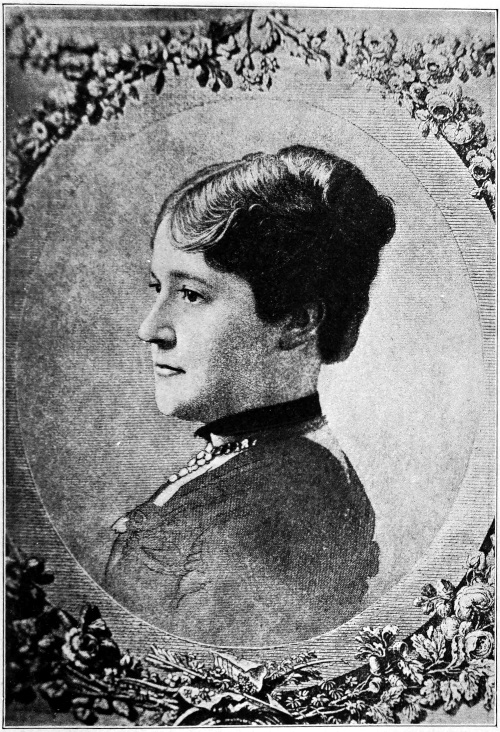
Photo by G. V. Buck, Washington, D. C.
MRS. JOHN McELROY
Sister of President Arthur
The great joy that descended upon the Arthur household
with the birth of their first child, which they named
for the gallant Captain Herndon, was turned to sorrow,
as the babe died in infancy. Several years later, however,
two other children came to them, Alan and little Ellen,
to banish the grief and fill the household with life and
childish voices.
As time progressed, Mrs. Arthur became more and more
a social favourite. Her voice, so often compared to that
of a Southern nightingale, was the great attraction for
countless projects for charity and church benefits. She
gave to such appeals most generously of her talents and her
time.
Her mother, Mrs. Herndon, died in 1878 while travelling
in Europe, and Mrs. Arthur went over alone to bring the
body back to this country for interment. The shock of
her mother’s death, her grief over not being with her,
and the fatigue and strain of the trip undermined her
health so that, when taken ill with pneumonia, she had no
reserve strength with which to combat it, and died after a
three-days’ illness on January 12, 1880.
Her death, so sudden and distressing, was a bitter
blow to her husband just as he was entering upon the most
important stage of his public career. It was also a shock
to the host of their friends, many of them being unaware
of Mrs. Arthur’s illness until they learned of her death.
Her popularity was evidenced by the sincere grief of the
many over her death, especially in the circles where her
quiet sympathy and charity had brought so much relief.
The Mendelssohn Glee Club of New York requested to be
allowed to sing at her funeral.
Mrs. Mary Arthur McElroy, widow of the Rev. John
McElroy of Albany, Mr. Arthur’s youngest sister, came
to his aid and took charge of the desolate and grief-stricken
household. Mr. Arthur would allow none of his wife’s belongings
to be touched. Her room and everything in it
was kept just as she left it, even to a bit of fancy work
with the needle ready for the next stitch was left where
she had dropped it.
Chester Alan, Jr., in his teens, was sent away to school,
while little eight-year-old Nellie became the especial care of
Mrs. McElroy, who had two young daughters of her own
to rear. When Mr. Arthur found himself in a few short
months the head of the nation, it fell upon his sister’s
shoulders to preside over the White House for him. She
had the same gift of grace and charm of manner that made
her handsome brother so popular, and had been given
all the advantages that means and the educational facilities
of the day afforded.
President Arthur returned from the funeral of President
Garfield confronted with the great mass of executive business
that had accumulated during the late President’s
illness. He decreed that out of respect to Garfield’s
memory, all correspondence and documents issued from
the White House should bear mourning for six months,
and that the mansion should be closed to residence and
visitors until Congress assembled. He would not install
his family until the house was put in better condition, since
he was not at all pleased with its appearance. The
furniture was worn and soiled, the china chipped and
marred and mismatched. Hangings and carpets needed
cleaning and replacing. The storerooms, basement
rooms, and attics were filled with the accumulation of
odds and ends of discarded household goods and the
leftovers of personal belongings of all past administrations—outgrown
and forgotten toys, the vast and amazing
assortment of “gifts” with which each succeeding president
had been deluged by an admiring public, cast-off
clothing, old umbrellas, and junk of every description.
President Arthur possessed a beautiful home in New
York, where the best of art and literature that his means
and taste could provide found a congenial setting. To
him, the condition of the home of the presidents was such
as to call for drastic action, although to intrude upon the
treasures of the attics with an intent to remove them was
to break precedents of as great an antiquity as the mansion
itself. But precedent-breaking had started with President
Grant, and continued vigorously under the winsome Mrs.
Hayes, and even without the support of their procedure,
President Arthur would not have hesitated to rid the
White House of the fire trap, as the years’ accumulation
was sometimes termed.
He notified the Commissioner of Public Buildings and
Grounds of his wishes. This official, Colonel Rockwell,
reported that he had no money for repair and renewals.
Mr. Arthur, however, demanded that the mansion be
cleaned and renovated, declaring that he would not live
in a house looking as it did, and if the government could
not or would not pay for it he would do so himself.
The work of rehabilitation was at once begun. Twenty-four
wagonloads of household goods of all description were
cleared out and sold at auction, to the delight of collectors
and souvenir hunters. It is said that a pair of trousers
and a battered silk hat belonging to President Lincoln
were in the collection, as were also an ancient portmanteau
of Mrs. Abigail Adams, and the carpet bag that had held
President Lincoln’s inaugural speech. The sideboard
discarded by Mrs. Hayes was purchased by a local saloon
and restored by the proprietor to its original use, being
stocked with decanters and the paraphernalia and accompaniments
of wines and liquors. Three thousand
dollars in cash was the proceeds from the gigantic house-cleaning.
President Arthur also made some improvements. He
had the huge stained-glass screen, made by Tiffany, installed
in the entrance hall to give a little privacy to the
state apartments, since all comers and goers of every
description who had business in those days entered the
mansion and made their way to the “office upstairs.”
This custom left no privacy whatsoever for the family,
and little or no protection from the importunities of
visitors, who could thus approach the family if any member
of it ventured through the corridors during the office
hours.
By the time Mrs. McElroy arrived with the little girls,
everything was in perfect order and the government paid
the bill.
The first formal function of the administration was the
New Year’s reception of 1882. It was noted for its elegance
and brilliance.
While the President had requested all members of the
Garfield Cabinet to remain until Congress convened, the
personnel changes began by the end of October. Robert
T. Lincoln, Secretary of War, had the distinction of being
the only Cabinet officer to continue with President Arthur
until the close of his régime.
Thus it was a new set of official faces that greeted the
New Year callers.
The reception was at its height when Elisha H. Allen,
Hawaiian Minister, wearing the broad sash of the Order of
Kamahameha III, after passing down the line greeting
new officials and old friends, stepped into the anteroom
for his coat and hat and dropped dead. Festivities were
at once stopped, doors closed, and all signs of gaiety
checked, while gloom again descended upon the mansion
where tragedy, death, and sorrow have thrust dark shadows
upon every administration.
One of the callers at the reception who had come to
pay her respects to the new President and his Cabinet, and
who had attracted universal attention, was Dr. Mary E.
Walker. In her masculine trousers, formal frock coat, and
silk hat, she had vied with the belles in the comment
aroused by her clothes, and not even the gorgeous diamonds
of Madame de Struvem, wife of the Russian
Minister, or the unusually handsome gowns of the new
Cabinet ladies, eclipsed hers in interest.
She was the first woman to receive the Medal of Honour
from Congress, with a personal testimonial from the
President of the United States; the first woman commissioned
as assistant army surgeon; the first woman to adopt
men’s attire for her permanent dress and then legalize it
by obtaining an Act of Congress to authorize her use of it;
and also the first woman prisoner of war to be exchanged
for a man of her own rank. And all of this grew out of her
resentment at having been born a girl and her lifelong
rebellion over the limitations hedging the feminine sex.
Always annoyed with the exactions of fashions which
she would not follow, as expressed in hoop skirts, high
heels, false hair, and rouge, Dr. Mary, at the opening of
her professional career, devised and wore what she called
the American Reform Costume.
With the opening of the Civil War, Dr. Walker was commissioned
a first lieutenant and assistant army surgeon.
She served on battlefields and in hospitals, where her
use of man’s attire facilitated her work. Her bravery
under fire and untiring service for the wounded brought
her the Medal of Honour from Congress and the personal
thanks of President Lincoln. To the end of her life, she
wore her masculine garb and her cherished medal. Her
later years were devoted to philanthropy.
The season thus opened by the presidential family, brilliant
functions followed one another in rapid succession,
and all Washington social leaders joined the official celebrities
in the number and splendour of the banquets, balls,
dances, and receptions.
President Arthur, “First Gentleman of the Land,”
completely revised his social régime, reverting to the
formality and exclusiveness of the code planned by
General Washington and Alexander Hamilton, although
he occasionally dined with friends; and while Mrs.
McElroy did no calling, she too reserved the right of
dining out. Mrs. McElroy introduced serving tea at
her afternoon receptions and refreshments after all other
receptions. The formal dinners were the President’s
especial delight, occupying whole evenings. They were
achievements in gastronomic art, and the elegance of
their service made them a distinctive function of the
administration.
President Arthur’s position and appearance, and the
fact that he was the most eligible widower of the land,
made him the target for the attentions and machinations
of hosts of women. Mothers with marriageable daughters,
engaging widows eager to console and to be consoled,
and hosts of romantic girls who visioned the President
as the reincarnation of the famous King Arthur, all put
forth their most winning smiles in the effort to focus his
attention upon themselves. Did he pay a compliment
to one, present a posy to another, stroll through the
conservatory alone with the wife or daughter of a member
of his Cabinet, lo! tongues wagged, shoulders were
shrugged, eyebrows lifted, telegrams bore veiled allusions,
and gossip had him tagged and all ready for marriage
bells to ring. The only difficulty was that the President
kept serenely on his way with the same deference and
gallantry to all, and eventually any hopes of a White
House bride to give society a new sensation in this administration
faded before the conviction that a second
marriage was not listed upon the presidential calendar of
intentions.
President Arthur gave a state dinner and reception
in honour of General and Mrs. Grant who were his guests
at the White House while on a visit to Washington. On
March 22, 1883, the dinner was given to the Diplomatic
Corps, so that the members of that body in Washington
might have the opportunity to meet the former President,
who had been honoured above all other Americans in his
tour of the world so recently completed.
It was a most brilliant affair, and opened a series of
unusually delightful and elegant functions for the former
President and First Lady. The state dining room, the
East Room, and all other state apartments were so elaborately
decorated with flowers as to resemble a tropical
garden.
On the evening of the next day came the reception to
which the public was invited, to pay its respects to the great
commander and the gentle lady who had never refused
an appeal for aid nor withheld her sympathy during the
eight years of her residence in the house of the Presidents.
The dinner and reception in honour of Christine Nilsson
was regarded as the smartest event of the year. After the
President escorted the singer to the East Room, she sang
with the Marine Band, her splendid voice high above it as
she carried the air. Later in the evening, a large throng
attended the reception, during which she sang “The Last
Rose of Summer” and “Way Down Upon the Suwanee
River,” playing her own accompaniments. Those privileged
to attend considered the event one of rare distinction.
While struggling with the problems of administration,
President Arthur contrived to get relaxation in his chosen
way. He loved to gather old friends about him and chat
with them over late suppers. Owing to his strict rule, few
of these little social gatherings were chronicled by the
papers. His knowledge of political life and his acquaintance
with prominent men made these supper parties
of utmost importance, and to be bidden to attend was
even more of a command to be cherished and obeyed than
the usual White House invitations. Upon one occasion,
a party of his old friends came from New York City,
each bringing his own oyster fork, which he presented to
the President as a souvenir after the dinner.
The detailed accounts of President Arthur’s régime
are meagre because of his dislike of publicity. He would
not allow any chronicles of daily doings of the White
House, or photographs of his children to be made or appear
in the papers, or any stories to be given out about them.
Gossip attached many versions to the story of the
portrait of a pretty woman in the President’s private
apartment, before which flowers in profusion were placed
daily by his order. The story lost its zest when it was
learned that it was the portrait of his wife, the Virginia
nightingale, mother of Alan and Nellie.
Nellie Arthur spent but little time in Washington, as
she was attending a French school in New York City, while
her brother was at college. Both frequently returned to
visit their father, bringing young classmates to visit
the White House with them. They spent lively days
of sightseeing, often visiting the monument of their
grandfather, Captain Herndon, at Annapolis.
Although born and reared under the teaching of a
Baptist clergyman, President Arthur deserted that faith
and became an Episcopalian, and he and his household
attended St. John’s Church—the Church of the Presidents,
across from the White House. He placed there
a beautiful memorial window in honour of his wife, and
arranged for flowers to be sent regularly from the White
House conservatory for the altar.
The President’s young son found Washington a delightful
and alluring place to spend week-ends and brief
holidays from college. His appearance meant a gay
frolic, and with his father’s team and his banjo he was a
welcome addition to the younger set.
Nellie, though but twelve when her father left the
capital, left a memorial to her kindly heart among the poor
children of the city, for she organized and was the first
president of the Christmas Club which, the first year,
collected more than twenty thousand gifts of toys, sweets,
and clothing for the needy little ones—an institution
which has never been allowed to lapse.
In June of 1882, the Army of the Cumberland held its
annual meeting and resolved to erect a monument to
General Garfield. Adjutant General Swaim of the army
was appointed to make the necessary arrangements for
a bazaar. Circulars were sent broadcast, appealing for
contributions of every description. Every trade, profession,
and science was besought to give or loan material
for exhibits.
As the plans progressed, it was decided that the only
place suitable to hold such an ambitious function was in
the Rotunda and Statuary Hall of the National Capitol.
Accordingly, the proper officials were interviewed and the
privilege granted by Congress, so that the fair might open
on November 25, 1882.
The next step was the formation of many state boards
or committees to assist by taking charge of booths.
Notable among these were the booths of Iowa, New
Jersey, Illinois, Kansas, Ohio, Pennsylvania, Kentucky,
Arkansas, and New York.
When the truck loads of donations began to arrive, the
great historical pictures of the Rotunda were covered
with canvas and the marble statues were moved back out
of the way in Statuary Hall. When the decorators had
finished placing the loan exhibits of art, the bunting, and
the flags, no one would have recognized the Hall of
Representatives, whose lofty ceiling and dim corners sent
back echoes of the oratory of Webster, Clay, and Calhoun
and caught the last uttered word of the venerable John
Quincy Adams. Instead of marble busts and bronze
figures, booths appeared, gaily decked with jewellery,
perfumery, candy, fancy aprons, pincushions, dolls, and
crazy quilts. From some, the new-fashioned “Mother
Hubbard” gown swung to and fro. Sewing machines,
pianos, organs, vied with clocks, churns, and washtubs,
and all imaginable utilitarian and ornamental household
articles. Kansas wheat, corn, and great roosters of
wood, busts, portraits, and paintings of Garfield, Henry
Clay, and other notables distinguished the booths of the
various states. The Rotunda was turned into an Art
Hall. Vinnie Ream Hoxie had charge of the arrangement
and made the spot one of rare beauty and interest with the
aid of flowers and numerous loaned portraits, among which
was one from the British Minister, of Queen Victoria in her
royal robes.
Finally, all preparations for the evening were completed,
and at noon, November 25, 1882, the Garfield
Memorial Fair was formally opened by President Arthur.
The Marine Band played lively national airs and gay
music. The enthusiasm and the joyousness of the crowd
were in vivid contrast to the scene of fourteen months
before when the place was shrouded in crêpe and the
body of the slain President lay on the catafalque less
than a dozen steps from where his successor now stood.
Less than four years after this spontaneous effort to start
the fund to memorialize Garfield’s life and administration
in marble or bronze, the President who spoke so feelingly
of his slain chief was also in his grave, as were a number
of officials who cheerfully and earnestly participated in
the opening of the bazaar—David Davis, and Secretaries
Frelinghuysen, Folger, and Howe.
Every inch of space was occupied—all Washington,
his wife, children, and lap dogs were present—for this was
the period when the lap-dog craze swept the city on the
Potomac with the same force as the fad for crazy quilts
and the Mother Hubbard gown, which was so much the
other extreme of tie-back skirts, street-sweeping trains,
and bustles. Papers of the day tell of diminutive lap dogs
with costly rings on their paws and engraved visiting cards
for calling.
All of the city attended, black and white alike seeking
to see and to buy. Most popular of all attractions was the
selling of chances on the elegant diamond earrings, the
finger-rings, the lovely India shawl valued at $1,500, the
handsome saddles, and other much-desired articles.
From November 25th to December 3d pandemonium
continued with the usual disputes, losses, and thefts, and
when all of the débris was cleared away and the basement
disgorged the loads of boxes whose contents had never
been exhibited, it was found that, instead of the huge sum
expected from the $50,000 gross receipts, the amount had
dwindled through expenses and other channels to $7,000,
the sum General Swaim was able to turn over to the
Army of the Cumberland. So many charges of misappropriation
of beautiful articles designed to be raffled
or sold, so much of plain stealing was apparent, that a
group of army officers conducted a quiet investigation,
after which it was concluded wisest, safest, and best to
drop the entire subject.
Frances Hodgson Burnett, it is said, gave the Mother
Hubbard its best advertisement at the fair, appearing
garbed in this style gown made of lovely violet silk and
elaborately trimmed with bolt upon bolt of dainty narrow
lace and fluttering ribbons.
President Arthur was denied the satisfaction of national
approbation which his election to the Presidency would
have given him, and as the close of his term drew near,
he welcomed the relief of the release from the heavy burden.
He entered into every plan for the reception of his
successor, and extended every possible courtesy to the incoming
administration.
Mrs. McElroy was openly mourned. Senator and Mrs.
Pendleton gave a brilliant reception in her honour on her
retirement, and all the officials departing and those
expecting to fill their places with the resident social groups
attended to do her honour. The young girls to whom
she had been such a fairy godmother of good times escorted
her to her train in a delegation and filled the cars
with flowers.
President Arthur was not regretful at leaving the job
that had caused him so much care. In his overanxiety to
do what seemed best for the country, he had made enemies
of old-time friends. Desiring to rise above partisan and
factional contests, he had failed in his effort to please both
parties. Slander, ridicule, and misrepresentation were
hurled at him, not only by the Democrats, but by the
opposing faction of his own party. Merciless abuse fell
upon him for not complying with all requests with regard
to appointments. Each faction had its chosen array of
patronage which it demanded, and whichever way the
distribution was made, there was dissatisfaction. While
he might easily have found eager friends to reveal inside
facts that would have placed him in a better light and
permitted such odium as there was to fall upon those who
were responsible, he flatly refused, preferring to bear the
brunt of much misjudgment himself rather than to be the
means of shifting it to another.
The calumny resulted, however, in the breaking of his
spirit and his health.
His administration was one of dignity, intelligence,
and firmness. He met the problems that beset him with
marked skill. He took a firm stand in support of the
Civil Service laws and appointed a commission to revise
the tariff. He added his influence to the promotion of
Indian education, supported the plans to increase the
strength of the navy, and also the measures for controlling
and improving the course of the Mississippi River. Under
his régime, a Civil Service Commission was established
to conduct examinations for appointments to minor places
in the government service.
His administration saw a return of prosperity in the
greatest degree the country had ever experienced. The
public debt was reduced nearly $500,000,000, internal
revenue stamps were repealed, the number of collection
districts was lessened, and letter postage was reduced
from three cents per one half ounce to two cents per one
ounce. A bill was passed for distributing the Geneva
award, another for returning convicts to our shores, the
tax on matches, checks, and drafts was removed, and the
importation of convict labour was forbidden. In 1883,
the President joined the Villard Excursion party to drive
the silver spike. Provision was made for the adjudication
of the French spoliation claims long awaiting payment and
for the final distribution of the balance of $15,000,000,
paid by England to the United States in satisfaction of the
claims of Americans for losses by rebel cruisers fitted out
in British ports.
The Star Route contractors were brought to trial, and
the long-brewing scandal of their transactions ended.
These contractors had mail routes remote from the great
lines of travel for which they demanded huge sums for the
service of getting the mail through on time. In the
investigation ordered by President Arthur, it was shown
that thousands of dollars had been continuously paid by
the government for no service at all, and for weekly service
for which some careless cowboy had been paid seventy-five
dollars a month, and in some cases much smaller amounts.
Attorney General Brewster finally secured the indictment
of seven of these, and the trial dragged along for months,
attracting a great sensation because of the prominence and
brilliance of the legal lights on both sides. As no conspiracy
against the government could be found as alleged
by the prosecution, the jury rendered a verdict of acquittal.
The government had spent a lot of money, and
while the contractors missed punishment through their
acquittal, the publicity and the attitude of the officials
broke up the system of the star route by which the United
States Post Office and Treasury had so long been victimized.
Among the last official acts of President Arthur was
the signing of the bill to retire General Grant with full
rank and pay. He also urged Congressional action upon
the gifts presented by Mrs. Grant as expressed in the letter
here quoted:
Executive Mansion, February 3, 1885.
To the Senate and House of Representatives:
I take especial pleasure in laying before Congress the
generous offer made by Mrs. Grant to give to the Government,
in personal trust, the swords and military (and civil)
testimonials lately belonging to General Grant. A copy of
the deed of trust and of a letter addressed to me by Mr.
William H. Vanderbilt, which I transmit herewith, will
explain the nature and motives of this offer.
Appreciation of General Grant’s achievements and recognition
of his just fame have in part taken the shape of
numerous mementoes and gifts which, while dear to him,
possess for the nation an exceptional interest. These
relics, of great historical value, have passed into the hands
of another, whose considerate action has restored the
collection to Mrs. Grant as a life trust, on the condition
that, at the death of General Grant, or sooner, at Mrs.
Grant’s option, it should become the property of the
Government, as set forth in the accompanying papers.
In the exercise of the option thus given her, Mrs. Grant
elects that the trust shall forthwith determine, and asks
that the Government designate a suitable place of deposit
and a responsible custodian for the collection.
The nature of this gift and value of the relics which
the generosity of a private citizen, joined to the high
sense of public regard which animates Mrs. Grant, have
thus placed at the disposal of the Government, demand
full and signal recognition on behalf of the nation at the
hands of its representatives. I therefore ask Congress
to take suitable action to accept the trust and to provide
for its secure custody, at the same time recording the
appreciative gratitude of the people of the United States
to the donors.
In this connection I may patiently advert to the pending
legislation of the Senate and House of Representatives
looking to a national recognition of General Grant’s
eminent services by providing the means for his restoration
to the Army on the retired list. That Congress, by
taking such action, will give expression to the almost
universal desire of the people of this nation is evident, and
I earnestly urge the passage of an act similar to Senate
bill No. 2530, which, while not interfering with the constitutional
prerogative of appointment, will enable the
President in his discretion to nominate General Grant as
general upon the retired list.
Chester A. Arthur.
Notable among the events to add distinction to the
Capital City was the completion and dedication of the
Washington Monument on George Washington’s birthday
anniversary in 1885. This ceremony rounding out eighty-six
years of intermittent construction from the inception
of the plan offered a splendid finale to President Arthur’s
administration.
The day was bitterly cold with a high wind which made
the ceremonies difficult for the little party of officials on
the platform five hundred feet from the ground. After
the various addresses by officials, the President dedicated
the monument “to the immortal name and memory of
George Washington.” The entire party, including the
vast concourse of people assembled at the base, marched
to the Capitol where the venerable Robert Winthrop delivered
the oration of the day just as he had done on the
memorable day in 1848 when the corner stone was laid.
The monument has the proud record, the like of which
no other structure of its scope can claim, of there having
been no lives lost during the process of its construction.
When the work on the top was begun, P. H. Laughlin, the
superintendent, devised a strong net which was raised as
the structure increased in height and was kept fastened
firmly to all four sides. Although most of the workmen
slipped and fell into this from time to time, none was
killed.
The most comprehensive summary of Chester Arthur
and his administration was found in the tribute of Elihu
Root at the unveiling of the monument to his memory
in New York, June 13, 1899, of which the following is an
extract:
“Surely no more lonely and pathetic figure was ever
seen assuming the powers of government. He had no
people behind him, for Garfield, not he, was the people’s
choice; he had no party behind him, for the dominant
factions of his party hated his name, were enraged by his
advancement, and distrusted his motives. He had not
even his own faction behind him, for he already knew that
the just discharge of his duties would not accord with
the ardent desires of partisanship, and that disappointment
and estrangement lay before him there. He was
alone. He was bowed down by the weight of fearful
responsibility and crushed to earth by the feeling, exaggerated,
but not unfounded, that he took up his heavy
burden surrounded by dislike, suspicion, distrust, and
condemnation as an enemy of the martyred Garfield and
the beneficiary of his murder. Deep and settled melancholy
possessed him; almost despair overwhelmed him.
He went to power walking through the valley of the
shadow of death and ascended the steps of a throne as
one who is accused goes to his trial. He was wise in
statesmanship, firm and effective in administration.
Honesty in national finance, purity and effectiveness
in the civil service, the promotion of commerce, the recreation
of the American Navy, reconciliation between
North and South, an honourable friendship with foreign
nations, received his active support.
“The genuineness of his patriotism, the integrity of
his purpose, and the wisdom of his conduct, changed
general distrust to universal confidence, reëstablished
popular belief in the adequacy of our constitutional system
in all emergencies, and restored an abiding trust in the
perpetuity of our government. He himself greatly aided
to make true the memorable words of his first inaugural:
‘Men may die, but the fabrics of our free institutions
remain unshaken.’”
CHAPTER VII
FIRST ADMINISTRATION OF GROVER
CLEVELAND
March 4, 1885, to March 4, 1889
THE fourth of March, 1885, dawned fair and warm,
the finest weather ever known in the history of the
city of Washington on Inauguration Day. Cleveland
luck had captured the weather. The city seemed to
respond to the spring air, and block after block blossomed
with fluttering banners, waving flags, and tri-coloured
bunting. Huge lithographs of Cleveland and Hendricks
were displayed in store windows, as well as from the
windows of residences. The usual tribe of vendors of
canes, buttons, noise-makers, and such, seemed to have
multiplied their numbers until they were thick upon every
block of the line of march.
The railroads and the Potomac River boats had poured
into the city more than half a million people, and hotels
and boarding houses overflowed their most elastic limits,
while hundreds of private houses not entertaining friends
and relatives responded greedily to the quadrennial
opportunity to profiteer. Never before or since has there
been so general a representation of all of the states as
composed the military and political organizations in the
parade that attended the ceremony of Mr. Cleveland’s
induction into office.
Members of the Senate Committee of inaugural arrangements
called on the President-elect at the Arlington Hotel
in President Arthur’s carriage, and, with Mr. Cleveland,
returned to the White House afterward. When the
march to the Capitol began, these, with President Arthur,
occupied the first carriage, and Vice President-elect
Hendricks followed in the second. They were escorted
by the first division of the inaugural parade, with the
Seventh Regiment of New York leading. Pennsylvania
sent 8,000 state militia, reaching almost from the Treasury
to the Peace Monument, a moving field of blue. These
were followed by the Richmond Blues, led by General
Fitzhugh Lee, later elected Governor of Virginia. The
Grand Army and countless other patriotic and civic organizations
and marching clubs added their units to this
wonderful pageant. General Henry W. Slocum, as Grand
Marshal, led the procession briskly through a record-breaking
throng drawn by the great enthusiasm over the
return of the Democratic party to power after twenty-four
years.
Vice President-elect Hendricks received the oath from
the President pro tempore of the Senate, Mr. Edmunds; the
new senators were sworn in as usual, and the President-elect
deviated from the usual procedure by making his
inaugural address before taking the oath. This address
was received with absorbed attention and, when published,
produced a great deal of comment in which
criticism and approval were given in full measure, especially
as Mr. Cleveland was the first President actually to
deliver his address, the others having read their manuscripts.
Since he had a natural ability readily to memorize
his own writings, he had no need of carrying a
manuscript.
As he concluded his remarks, he turned to Chief Justice
Waite, who administered the oath.
President Arthur had provided one of his usual delightful
luncheons, after which President Cleveland went
to the stand to review the marvellous pageant assembled
in his honour, comprising 25,000 men whose passing consumed
more than five hours. Dusk was closing down
upon the city when the last group swept past and saluted.
No procession in any part of our broad land is at all like
an inaugural parade. The appearances of the new
incumbent of the White House before and after taking the
oath call forth incidents, episodes, comments, complimentary
and critical, of a type wholly American. Thus,
the crowd whiles away the hours between the ride to the
Capitol and the return to the White House. The journey
to the ceremony of swearing in the President-elect is
usually made in company with the retiring head of the
nation, and is often a divided honour, tinged with the
regret of parting with the man who has filled the place for
four years. Coming back, the new leader fills the picture.
All triumphant, he belongs to the people, and demonstrations
carry the note of jubilation grateful to the ear.
Many amusing things happen in a good-natured celebration,
and human nature unrestrained effervesces and
bubbles over the rim of everyday restraint. One sees
and hears the flamboyant individuals—always in evidence—who
knew the new President in every stage of his
life and career.
Among the many amusing features of the Cleveland
parade was the arrival of President Cleveland’s baggage.
The crowd patiently waiting in the covered stand across
from the White House found great entertainment in
watching the open wagon piled high with shabby and
travel-scarred trunks, all marked “G.C.” in large white
letters, which turned in at the White House gates. The
large white letters and the destination sent the crowd
into shouts of laughter at “Grover’s moving in!” The
crowning feature was a huge bent-wood armchair, large
enough for three ordinary men, which topped the load.
This was the first of the thousands of gifts sent to Mr.
Cleveland by admirers and favour-seeking citizens.
One of the charming stories of Grover Cleveland illustrates
his great love and understanding of children. After
his election in 1884, while in Kenwood, he requested that
the children attending the Convent of the Sacred Heart be
given a holiday on his Inauguration Day. In spite of all
of the demands upon his time and attention in departing
for Washington, he did not forget the matter, but on
March 2d sent a check for fifty dollars to provide a celebration.
With it he sent a note to the Mother Superior.
Albany, Mar. 2, 1885.
Dear Mother O’Rorke:
I send by my good friend Mr. McCall something which
I hope will cause the little ones at the Convent to know
that, while they are thinking of me, they are not forgotten
by the man who in the midst of their holiday is undergoing
the most perplexing ordeal that his life can bring to him.
With many kind thoughts of you and all of the good
people, I am,
Yours faithfully,
Grover Cleveland.
The letter and the check brought great delight. They
were duly acknowledged and the President told of the
details of the party. After the feast was finished, the
children were provided with tiny bottles of champagne,
from which a toast was drunk to “Our new President,
Grover Cleveland,” and certainly no other toast carried
more unselfish affection and sincere good wishes for the
new President than the one from the Convent pupils,
who also sent him a telegram of congratulation to the
White House on the evening of Inauguration Day.
Preparations to make the inaugural ball of the new
Democratic President outstrip all of its predecessors had
gone on for months. The new Pension Building, recently
completed, was chosen for the affair. New York decorators
transformed the interior into an extravagantly
beautiful scene. Ferns, palms, flags, and draperies,
costing thousands of dollars, covered walls and arches.
In the President’s room stood a huge throne chair made
of flowers, while a gigantic globe, also of flowers, was
made to represent the State, the War, and the Navy
departments, and flower scales, the Department of Justice.
The Marine Band, under the direction of John Philip
Sousa, furnished dance music for more than two thousand
couples. Eight thousand people attended this ball,
and while the highly waxed dancing hall measured three
hundred by one hundred and sixteen feet, there was never
at any time during the entire evening room on the floor
for all those desiring to dance.
President Cleveland, his sister, Miss Rose Cleveland,
who came from Holland Patent to preside over the White
House for her bachelor brother, with Vice President and
Mrs. Hendricks, attended for a short time.
While such of the populace as paid five dollars per
ticket danced at the President’s ball, the rest of the city
enjoyed the fireworks on the ellipse south of the White
House. The following evening, a band concert in the
Pension Building drew another crowd, who cheerfully paid
the admission fee to see the rooms and their decorations.
Cleveland had not come into office unopposed. When
it had become evident that President Arthur would not
be nominated to succeed himself, Republican attention
had again turned to James G. Blaine, who had been
nursing presidential ambitions for a number of years,
and who was the outstanding leader of that party. The
National Republican Convention assembled in Chicago
on June 3, 1884, with no organized opposition to threaten
the prospects of Mr. Blaine, who was nominated, early
in the course of the proceedings. Having a coloured man
as temporary chairman was the unusual feature of this
convention, the office being filled by John R. Lynch,
former representative from Mississippi. Ex-Senator John
B. Henderson, of Missouri, was the permanent chairman.
General John A. Logan (“Black Jack”), was nominated
as the running mate of Blaine. Their nicknames,
the “Plumed Knight” and the “Black Eagle,”
formed the basis for some of the campaign jingles.
The National Democratic Convention likewise convened
in Chicago, July 6, 1884, at which Grover Cleveland
was put forward, his nomination having been made certain
by the withdrawal in his favour of Samuel J. Randall of
Pennsylvania. Grover Cleveland was nominated on the
second ballot. Thomas Hendricks of Indiana received
the nomination for Vice President without opposition.
Conventions were plentiful in the land that summer.
A national Prohibition convention chose Pittsburgh for
the scene of its operations, opening on July 23d. Ex-Governor
St. John of Kansas and William Daniel of
Maryland were chosen for the president and vice president.
The National Greenback Convention met in
Indianapolis on May 29th, nominating General Benjamin
F. Butler of Massachusetts for president and A. M. West of
Mississippi for vice president. Still another was that of
the Woman’s Equal Rights Party, which met in San
Francisco, September, 1884, and nominated Mrs. Belva
Lockwood, of New York, lawyer, lecturer, and suffrage
leader, for the Presidency.
To Belva Ann Lockwood belongs the honour of being
the second woman nominated for the Presidency of the
United States; likewise to her also belongs the honour
of being the first woman admitted to practise before the
Supreme Court. For this privilege, she had to get a bill
through Congress permitting women to practise law, and
worked tirelessly for three years to create favourable
sentiment before the barrier was lifted. When she
finished her efforts, every court in the land was open to
her, and never again was a woman lawyer’s application
refused because she was a woman and, as in Mrs. Lockwood’s
case, a married woman.
Mrs. Lockwood worked tirelessly for equal rights for
men and women and drafted and secured the passage of a
bill giving to women in governmental service equal pay
with men for equal work.
The Woman’s Equal Rights Party nominated her for the
Presidency, in San Francisco in 1884 and again in 1888.
While she had not sought the honour, she conducted
vigorous campaigns.
In forty-three years of legal practice, her greatest
effort was always on behalf of the soldier, sailor, and
marine, and during this time she handled more than
seven thousand pension cases, alone. She also secured
the passing of a bill appropriating $50,000 for bounties for
soldiers and marines.
Through her work for world peace, she probably acquired
the greatest fame. For thirty-six years she was a
member of the Universal Peace Union, attending the
International Peace Bureau at Bern for more than a
quarter of a century, and taking a leading part in every
large gathering in this cause, beginning with the first
Peace Congress in 1885. She compiled the peace treaties
of the United States and secured the introduction of the
first bill in Congress for an international arbitration court.
After the Peace Congress in London, in 1890, though
sixty years of age, Mrs. Lockwood remained abroad long
enough to take a course of lectures at Oxford. When
eighty-two, she started off to Europe to carry a peace
message to the women of the world, and in 1916, just a
year before her death, she gave an address on the re-election
of Woodrow Wilson, giving seven reasons for his
choice. This was used as campaign literature.
With the nominees of five different parties in the field,
each making a fight for the needed votes to insure victory,
the political atmosphere became tense. Courtesy and
politeness seemed forgotten as the contest became one of
the ugliest in the national history; no effort was spared to
discredit, defame, and disqualify the candidates. The
private life and character of each of the two most prominent
was mercilessly attacked, and both Blaine and Cleveland
were subject to fierce gruelling in the exposé of incidents,
episodes, and transactions of their earlier lives. Sentiment
appeared to be overwhelmingly strong for Blaine
as party leader, but he was not optimistic. He had
seen the coveted victory slip from his grasp before, and
he was wearied with defeats and hopes deferred!
A few days before election, the tide was turned against
Blaine, and the distrust of him crystallized by the speech
of the Reverend M. Burchard, veteran minister representing
a delegation of clergymen. In his remarks, Mr.
Burchard warned his country against “Rum, Romanism,
and Rebellion,” and thus gave to the anti-Blaine factions
a slogan which Tammany at once placed on billboards,
bulletins, and banners, and sent its ringing echoes through
the succeeding years as a warning to all subsequent campaigners.
Blaine once again dropped his banners in
defeat, though Cleveland carried only a meagre victory of
a thousand votes in his state.
Mr. Cleveland served as Governor until the meeting
of the Legislature after election, when he closed his career
with this, the shortest message on record:
January 6, 1885.
To the Legislature:
I hereby resign the office of Governor of the State of
New York.
Grover Cleveland.
Until elected to the Presidency, Grover Cleveland
concerned himself but slightly with the history of his
family, being content with the fact that his line had
comprised honourable men and good women, who had
filled their respective places with honour to themselves.
Each generation turned out ministers, though they shifted
their sectarian allegiance—Presbyterian, Congregationalist,
and Episcopalian denominations being represented
by clergy of this name.
Richard Falley Cleveland, the father of Grover, a Yale
graduate, was a Presbyterian minister. His task was to
bring up and educate a family of nine children on an
annual income of $600.
As so many youngsters in the family made it necessary
for young Grover to go to work early, at fourteen he
secured a place in the general store, where for the sum of
fifty dollars a year he swept floors, cleaned windows,
opened and closed shutters, sold calico and sugar, beans
and ribbon, hardware and candy. He shared the bare
attic room over the store and its discomforts with another
boy—no carpet, no stove, no wall paper to modify the
icy wind blowing through the cracks between boards. In
winter, they froze, and in summer, they were almost
prostrated with the heat under the rafters. Their bed
had a lumpy straw-stuffed tick in lieu of a mattress, to the
knots and lumps of which only youth could adjust itself
and still sleep.
Soon, he had saved and earned enough in other ways to
be able to attend the academy at Clinton, and at seventeen,
after his father’s death, he was teaching in the New
York Institution for the Blind, where his elder brother,
William, also a Presbyterian clergyman, was the principal.
Finally, he took Horace Greeley’s advice, “Go West,
young man, go West!” and started for Ohio. He halted
at Buffalo, took up the study of law, and was admitted to
the bar.
Mr. Cleveland was a bachelor for many years. He took
care of his mother, who preferred living in her own home in
the little village at Holland Patent, where she died in 1882.
He gave a liberal education to his youngest sister, Rose,
a talented girl.
In 1881, he was the city’s choice for Mayor. In six
months, his methods and careful administration saved the
city more than a million dollars. By this careful supervision
and elimination he became known as the “Veto
Mayor.”
He was elected Governor of New York, September 20,
1882, and in that capacity continued his methods and
practices as Mayor. The “Veto Mayor” advanced to the
“Veto Governor” and won the respect of men of both
parties.
Thus, as the Democratic party had been gradually
regaining its pre-war status, the popular Governor of
New York, the state that would swing the election, was
regarded as the logical man to be the presidential candidate
and the one nominated and elected.
When Cleveland began considering his Cabinet, while
he was still at Albany letters serious and amusing poured
in—asking office, giving advice; congratulatory, denunciatory.
One newspaper man called on him and stated that
from time to time he would send him information about
public men, unsigned, but in his own handwriting. Daily
envelopes came in, with cards of convenient form for filing,
treating of nearly everybody proposed for the Cabinet,
distinguished visitors announced in the public press as on
their way to Albany, and well-known men generally—a
separate card for each person. Good points were written
in red ink; discreditable facts and characteristics were
in black ink. Each card was a concise record of the deeds,
character, and influence of the man dealt with, and gave
an incisive, impartial, and accurate analysis of those about
whom they were written from the point of view of an able
and experienced observer of current events. The whole
record made a kind of judgment-day book of men of both
parties conspicuous in national affairs, in civil life, and in
the army. Many people were surprised at the knowledge
shown by Cleveland of the political affiliations of prominent
men.
When the portfolios were finally announced, there was
general satisfaction. In selecting Senator Bayard of
Delaware for Secretary of State, President Cleveland
satisfied a large following that had twice declared its desire
for Bayard as President. Senator Bayard’s charming
family was a distinct acquisition to the official group.
Daniel Manning, of New York, as the new Secretary of
the Treasury, was also a happy choice. Manager and
owner of the Albany Argus, a clever politician, and president
of a National Bank, he possessed many qualifications
for this post. There was an expression of universal satisfaction
that he was to preside over the national money
vaults.
Upon the capable New England shoulders of William
C. Endicott, astute lawyer and advocate of Civil Service
Reform, was placed the responsibility of the War Department.
The fortunes of our long-neglected navy, with its ninety
more or less obsolete warships, were destined to undergo
radical changes under the efficient direction of William C.
Whitney, of New York. The story of how Mr. Whitney
transformed the navy is an epic in American leadership
and an epoch in American history.
The Secretary of the Interior, Lucius Quintus Curtius
Lamar, of Mississippi, represented the South. He was
regarded as especially keen minded, a moulder of public
opinion.
Postmaster General Vilas was a Vermonter by birth and
a Westerner by adoption, having established his business
career in Wisconsin, from which state he went into the
Union Army. He was an expert in the intricate machinery
of American politics.
The legal authority of the new Cabinet came from the
Senate, a man with an enviable reputation. This was
Attorney General Augustus H. Garland, of Arkansas.
This Cabinet has been considered one of remarkable
strength, but Grover Cleveland was always the President.
Most important to every President is his choice of a
private secretary. Cleveland, in selecting his official
family, lost no time over deliberation on this position. He
simply took with him to Washington Daniel S. Lamont,
from every standpoint the best man for the position, fitted
in every way for the important part he was to play in the
national drama. Mr. Lamont set an example for the
future by establishing a new standard and a new conception
of the part of the Executive Secretary.
By the middle of March, the President was fairly settled
and gave his first official reception, to which the Diplomatic
Corps and Congress were invited, to meet the new
Cabinet. As the Marine Band played “Hail to the Chief,”
the President came down the stairs with Mrs. Bayard on
his arm, while the new Secretary of State escorted Miss
Rose Cleveland, with the rest of the Cabinet following in
succession. It was soon apparent that the President was
not in his congenial element; such affairs were not to his
taste. He had an enormous capacity for work and a great
deal of work to do, of which the social end did not seem to
him a really vital part.
Old families of the city, who had ignored the White
House since the days of the kindly Buchanan and the
lovely Harriet Lane, found it convenient, expedient, and
agreeable to call upon the President and Miss Cleveland.
While this was done out of deference to the party, it did
not impress the new Executive to the extent of securing
for them any more attention or consideration than was
given to any other representatives.
The church people of Washington were eager to secure
the new head of the nation as a communicant. The matter
was settled by Miss Cleveland, who chose the First
Presbyterian Church at Four and One Half Street. At
her first reception, March 21st, the Reverend Byron
Sunderland and his wife presented themselves to her.
He was delighted when Miss Cleveland reminded him that
her mother had attended his church in New York State.
Because of this association, she took a pew in his Washington
church, which was used later by Mrs. Grover Cleveland.
The first Easter after he came to the Presidency, Mr.
Cleveland won the hearts of the Washington children by
reviving the custom of rolling eggs on the lawns of the
White House, a custom peculiar to the Capital City. The
President loved children, and he not only opened the
grounds for the usual egg-rolling, but received all the
youngsters in the East Room, shaking hands with each
one. Many of them, responding to his friendly smile,
presented him and his sister with battered eggs. Between
four and five thousand children, black and white, of every
class, race, and condition attended. The only badge of
eligibility was a basket of multi-coloured eggs.
Congress was in extra session for months, and the question
of appointments under Civil Service occupied a large
share of attention of the entire administration, placing a
check, as it did, upon the old-time practice of wholesale
dismissals with each new administration. This literal
interpretation of the purpose of Civil Service, whereby a
man need not lose his position unless guilty of neglect or
abuse of his office, was a distinct shock to those of the
older order, who believed that to the victor belonged the
spoils.
From the first year of his term, Cleveland became involved
in difficulties with some of the most influential
men of his own party over his determination to uphold the
reform and to adhere to his resolution to keep principle
above partisanship.
His contest with the Senate over the Tenure of Office
Act, which he insisted had fallen into innocuous desuetude,
resulted in a complete victory for him, and he was not
thereafter handicapped in his appointments. His attitude
from the beginning on military pensions attracted wide
comment. He demanded proof of real merit on the part
of any applicant. Because of his vetoing so many private
pension bills, he became the “Veto President.”
The entire nation was saddened by the death of General
Grant during the first summer of the Cleveland administration.
Late in November, Vice President Hendricks passed
away, before he had served even a year of his term.
Following his death, Congress passed the Presidential
Succession Bill. It was a measure that provided for the
filling of the Executive Office in the event of the deaths
of both President and Vice President, by the Secretary
of State, then the Secretary of the Treasury, and so on,
through the membership of the Cabinet, should any such
necessity arise. This became a law in January, 1886.
The New Year’s Reception of 1886 was exceptional in
its large attendance. The weather was propitious and
thus encouraged the timid to get themselves into their
best bibs and tuckers and present themselves in line. The
President greeted his guests cordially as Colonel Wilson
made the introductions. The gowns of the receiving
ladies drew much attention. Miss Cleveland was especially
smart in her white silk and garnet velvet. Mrs.
Bayard wore white silk crêpe. Mrs. Whitney was elegant
with her magnificent diamonds and her white ottoman
silk with its embroidered panel front of crystal and pearls.
Mrs. Endicott’s heliotrope satin was draped with thin
chiffon of deeper tint, and Mrs. Vilas’s pink satin and
point lace offered a bright colour contrast to the others.
The Cabinet was blessed with a goodly share of young
daughters and nieces to add life and gaiety and keep up
the social traditions. Among them was Miss Kate Bayard.
The reception was the last formal White House
function that she attended, as her untimely death occurred
two weeks later and was followed by that of her mother.
This was so unexpected and such a shock as to throw a
shadow over the whole official group; she was to have
assisted Miss Cleveland at a White House function on the
day she died.
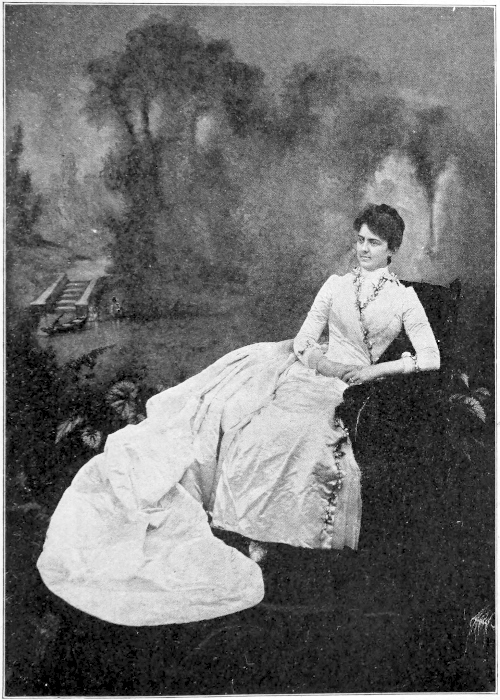
MRS. GROVER CLEVELAND
In her wedding gown
In the social life of Washington in Cleveland’s days,
the activities of William C. Whitney, Secretary of the
Navy, and his charming wife, eclipsed those of any other
public man. A local paper gives some account of their
home:
“In a temporary residence, they at once began to entertain,
and by the fall, when they had the house now the
William A. Slater home, on I Street, selected, their hospitalities
were well under way. The house was done over,
the ballroom addition put on, and a modernizing touch
put everywhere. Each winter, the Secretary and his wife
gave weekly receptions and balls, at which the smart folk
in official and resident society were present, and a supper
of all the substantials and delicacies, with champagne in
plenty, was a regular feature. Dinners for home and
visiting grandees were just as numerous as cotillions as
large as the ballroom would permit, musicals, and every
other fashionable diversion.
“Mrs. Whitney’s Wednesdays at home were attended by
hundreds. There was always a well-spread refreshment
table, a floral decoration, and the presence of the beaux
and belles of every year, and the visiting public by the
hundreds. The last hour of these afternoon gatherings
was regarded as the smartest rendezvous of the capital.
Other daylight parties at the Whitney home were just as
frequent. Readings, musicals by professional and amateur
talent continued throughout each season.
“The Whitneys, besides, carried on a fashionable country
life at Grasslands, in the Tenleytown direction. The
Country Club bought the property later. Their weekend
parties there during the Christmas season and throughout
the spring were most entertaining episodes. The
Secretary gave the use of the place during the summer at
stated times to the clerks of his department and their
families for picnicking. He distributed presents of
turkeys at Christmas time to all of the homekeeping
employees of the Navy Department.
“A spring entertainment of note was the tea which followed
the Easter Monday christening at St. John’s Church
of the baby daughter born to the couple that year. Baby
Dorothy Whitney of that day is now Mrs. Willard Straight
of New York.
“There were souvenirs for all the guests at the house—egg-shaped,
white moire boxes, prettily ornamented and
bearing the date and the baby’s name. The boxes were
filled with tiny egg-shaped candies.
“Mrs. Whitney gave some Christmas tree parties in that
I Street ballroom which were a revelation to many of her
visitors, who had never seen anything so bewilderingly
gorgeous. A tree reaching to the ceiling would be shining
with tinsel and glittering effects, and the centre for one
of the merriest gatherings of the West End. Sometimes
the party was for the children from St. John’s Orphanage,
when substantial gifts followed the other pleasures. Both
husband and wife took interest in local affairs and were
generous in their charities. Mrs. Whitney’s death followed
shortly after her return to New York to reside.”
With the Easter festivities came rumours of an approaching
White House wedding. Gossips had reported the
betrothal of the President and Miss Folsom, and whispers
of a Paris trousseau and of the beauty of the bride, “the
little schoolgirl friend” whom Miss Cleveland had introduced
during a few days’ visit of the early winter.
But no official confirmation was forthcoming. The
bachelor President, past the age when men are apt to
marry, like his predecessor had long been the target for
maids and widows matrimonially inclined. He had disposed
of his obligations to provide the White House mistress
by installing his sister as its chatelaine, but this arrangement
was not wholly ideal. Miss Cleveland was
gracious and responded to every demand upon her, but
she had her own career urging its claims. She was a
cultured, educated teacher and author, who filled her
difficult rôle with dignity and intelligence. While in the
White House she completed a book, “George Eliot’s
Poetry and Other Studies,” which, through the prestige
of her position, had enormous circulation—twelve editions—bringing
her more than $25,000. This offered a convincing
argument for a return to her own work, and rumour
claimed that she was wholly delighted over the prospect of
a White House bridal, and especially pleased that it was
to be Miss Folsom, her brother’s ward and the daughter
of his former partner.
Prior to his accepting public office in the late sixties,
Grover Cleveland and Oscar Folsom had been law partners.
He was a frequent visitor at the Folsom home, when the
little blue-eyed, brown-haired daughter, Frances, was attending
the select French kindergarten conducted by
Madame Bucher in Buffalo. The bachelor mayor made
a pet of her. She always climbed upon his knee when
he came and called him “Uncle Cleve.” In 1875, when
she was eleven years old, her father, Oscar Folsom, was
killed in a carriage accident. It was later discovered that
he had made his partner the guardian of his child. Mrs.
Folsom, the mother, took the little girl to Medina, her
own home town, but the latter later returned to Buffalo
to attend school. Finally, she entered Wells College,
where she was a student for three years. Miss Folsom
was a favourite among teachers and pupils; also an object
of envy to the girls who all noted the letters and flowers
from the Governor of New York. While she was in
college, Cleveland was nominated for the Presidency,
and there was much buzzing of girlish tongues over the
regular letters from Washington.
The following June, when the class of ’85 held its commencement
at Wells, no young graduate attracted more
attention and comment than pretty Miss Folsom. This
was due, in part, to the superb flowers which came to her
from the White House, over which there was much gossip
and speculation.
Before she sailed with her mother for a year of sightseeing
in Europe, the President had conveyed to her his
desire to lose a ward and gain a bride. To the intimate
family group only their engagement was announced.
Miss Folsom, with a French trousseau, finally arrived
in May. She was met by Secretary Lamont, who checked
all newspaper attempts to approach her for information
by whisking her and Mrs. Folsom aboard a steamer he
had waiting. He personally conducted them to the Gilsey
House, where they remained for a few days. President
Cleveland, in the meantime, concluded that his presence
was necessary in New York on Memorial Day. Thus
their final plans were completed. He returned at once to
Washington, and early on the morning on the second of
June, Miss Rose Cleveland hurried to the station, returning
shortly with the young lady and her mother.
All day the President and his lovely fiancée addressed
unusually elaborate boxes of wedding cake, each carrying
a card bearing their combined autographs. The President
had previously sent to a limited number of guests the
following simple form of invitation:
Executive Mansion,
May 29, 1886.
My dear Mr.——
I am to be married on Wednesday evening at seven
o’clock at the White House to Miss Folsom. It will be
a very quiet affair and I will be extremely gratified at
your attendance on the occasion.
Yours sincerely,
Grover Cleveland.
As this was the first and only time a President was
married in the White House, the wedding marked an
epoch in the history of the mansion.
All day a regular army of florists bent their skill upon
the decoration, transforming the Blue Room into a fitting
marriage bower. Cartloads of blossoms, vines, ferns, and
palms, with flags and shaded lights, turned all of the state
apartments into a fairyland of flowers, to form a proper
setting for the loveliest bride and the youngest mistress
the White House has ever known.
The Blue Room was especially lovely. The mellow
light of the tapers in the great candle stands, five feet high,
a gift to President Jackson, added to the beauty of the
scene. The mantels were banked with flowers. On one
the date was outlined in pansies; on the other, the letters
“F. C.,” in white and pink roses.
Miss Folsom had originally planned that at her wedding,
her grandfather, of Folsomdale, whom she called “Papa
John,” was to be present and give her away. His death
while she was crossing the Atlantic upset these arrangements,
so with the first strains of Mendelssohn’s “Wedding
March,” the President and his girlish bride came
down the stairs unattended even by her mother.
The bride’s gown was of absorbing interest. It was of
rich corded ivory satin trimmed with soft folds of India
silk edged with orange buds and blossoms. The same
material was draped to form an overskirt, also edged
with the dainty blossoms, which were artistically arranged
over the entire costume. The four-yard train she managed
as perfectly as if she had always worn it. A coronet
of the bridal flowers held the soft silk tulle veil in place.
More than five yards in length, it fell gracefully over the
entire train. Long gloves met the short sleeves. A
diamond necklace, the President’s gift, and her sapphire-and-diamond
engagement ring, were her only jewels.
The bridal couple took their places facing the Presbyterian
minister, the Reverend Byron Sunderland, who
performed the marriage ceremony, and the Reverend
William Cleveland, brother of the bridegroom, who concluded
the ceremony with the blessing. Immediately
from the navy yard came the presidential salute of twenty-one
guns, announcing the news to the city, and all of the
church bells rang a marriage chime.
An informal reception and collation followed, during
which came many messages of congratulation, among
them one from Queen Victoria. The decorations of the
dining room were beautiful beyond description. The
great mirror purchased for the mansion by Dolly Madison
and used by every President since made a realistic sea
for the full-rigged ship Hymen, constructed of pansies and
pink roses, with the national colours on the mainmast
and tiny white flags with “C. F.” on the other masts.
The guests included the Cabinet, the relatives, and the
close personal friends. About eight o’clock, the bridal
couple were ready for the departure. The President had
replaced the conventional evening clothes with his customary
black business suit, and “Mrs. Cleveland,” as
everyone delighted in addressing her, was fully as beautiful
as in her wedding gown. They left the rear door of the
mansion in a shower of rice, old shoes, and good wishes,
and were driven to the Baltimore and Ohio Station. Here
a special train awaited to take them to Deer Park, Maryland,
where the President hoped to rest and do some fishing.
They had expected to spend a quiet time away from
the curious public, but, to their dismay, the following
morning they found a pavilion had been built overnight
directly opposite their cottage and was thronged with
newspaper correspondents and photographers.
Hopes of seclusion vanished with the rush of summer
visitors to Deer Park and the arrival of a Church Convention.
They went trout fishing, Mrs. Cleveland being
initiated in the proper methods of baiting her own hook,
and the President settled down on a comfortable log to
enjoy his favourite sport. But even the remote woods
were invaded by the visitors eager to get a glimpse of the
distinguished pair. Mrs. Cleveland let her husband fish
alone the next day or so, and finally, on June 9th, when
more summer visitors arrived to enjoy the unusual pleasure
of a President of the United States for a neighbour,
President and Mrs. Cleveland decided that national business
was urgent, and they returned to Washington.
On their return from Deer Park, the President and
Mrs. Cleveland gave an evening reception to a large group.
This was Mrs. Cleveland’s introduction to official and
social Washington as the First Lady of the Land. In
her wedding gown, she was especially lovely, and her
natural charm, poise, and sweet cordiality established her
popularity. It was conceded that, of all the many splendid
things that President Cleveland had done, there was
none that could do so well for him as his marriage.
The prolific use of Mrs. Cleveland’s pictures by patent
medicine, perfume, candy, and underwear manufacturers,
and firms of all kinds in advertising their wares called
forth a well-intentioned protest that finally found expression
in a bill being introduced in the House of Representatives
on March 6, 1888, which read in part:
“Be it enacted, etc. That any person or persons for
themselves or others or for corporations who shall publicly
exhibit, use or employ the likeness or representation of
any female living or dead, who is or was the wife, mother,
daughter or sister of any citizen of the United States
without the consent in writing of the person whose likeness
is to be used shall be guilty of high misdemeanor
and shall upon indictment be fined not less than $500.
nor more than $5,000. and stand imprisoned until fine and
costs are paid.”
Needless to add, the bill joined the great procession of
the unpassed measures. Mrs. Cleveland inaugurated
Saturday afternoon receptions, so that women who were
employed might also have the opportunity to visit the
White House. At many of her receptions, people would
go through the line several times just to see her smile
and again shake her hand.
Although Mrs. Cleveland’s time was so filled with demands
that she had little time for informal correspondence,
the appeal of a child was never ignored. At the opening
of Lent, a Sunday-school superintendent of Youngsville,
Pa., gave each of his thirty-three pupils between seven and
ten years of age one penny with the instruction to invest
it in something that could be sold and reinvested so that
at the end of Lent each child would have an Easter offering
to bring representing its own industrious effort. A little
girl of this group wrote to Mrs. Cleveland enclosing in the
letter a penwiper which she had made and which she asked
the First Lady to buy, telling the story.
Mrs. Cleveland sent the following reply:
Executive Mansion, Washington,
May 9, 1888.
My dear little Friend:
I am very glad to buy your holder. You did not say
how much it was so I send you twenty-five cents and I
trust it will help you a little. I think it is very nice for
little girls to know how to help and I trust you will go on
all your life doing what you can for others.
Sincerely your friend,
Frances F. Cleveland.
A competent housekeeper was installed, and thus the
new mistress of the mansion enjoyed her life there intensely.
She was fond of dogs, and the big mastiff, a gift
to her, seemed to realize the great importance and dignity
of his position, as he majestically walked or stood by her
side. She was an enthusiastic amateur photographer.
Mrs. Cleveland loved the flowers. The conservatory was
a constant delight to her. She filled the private part of
the house with song birds, mocking birds, and canaries.
Upon one occasion, the President, trying to concentrate
upon a message late in the night, had to call one of the
White House staff to remove a mocking bird that insisted
upon singing. The story related is to the effect that, after
the bird had been placed in an unlighted room, his song
ceased, and the President, becoming anxious lest his wife’s
pet might take a chill, had it carefully placed out of drafts.
Mrs. Cleveland, wholly natural, unaffected, and genuine,
won the hearts of the people literally by the minute. She
liked people and everyday things. She had a quality of
cordiality in her greetings that was convincingly sincere.
One of the little bits of gossip of her first reception shows
the President’s pride and confidence in her ability to carry
her social responsibilities without his supporting presence.
Mrs. Folsom had invaded his office to urge that he go down
to see that everything started off well. Though exceedingly
busy with papers piled high, he accompanied her,
and they slipped into the room without being observed
by the new First Lady. They stood watching her fully
five minutes as the long stream of people were being presented
to her. They heard her cheery, hearty greetings,
saw the pleased, admiring faces, and then the President—more
the proud husband than the nation’s chief—touched
his mother-in-law on the arm and pridefully, though laconically,
remarked, “She’ll do! She’ll do!”
Upon the jubilee of the entrance of Pope Leo XIII into
the priesthood, President Cleveland sent felicitations and
a handsomely bound copy of the Constitution of the
United States. The event, which occurred January 21,
1888, had been brought to the President’s attention by
Cardinal Gibbons, and it was through that prelate that
the gift was sent. In transmitting it, Cardinal Gibbons
wrote:
“It is a tribute paid to Your Holiness by the ruler of
sixty million of free men, a ruler elected by them, who feels
deeply the supreme responsibility of his exalted station,
his dependence upon God’s providence and who has had
the wisdom and fortitude to discharge faithfully and conscientiously
all the important duties devolving upon him.”
The Pope in responding said:
“As the head of the Church I owe my duty, love and
solicitude to every part of the Church, but toward America
I bear especial love. The care of your nation is great.
Your government is free. Your future full of hope.
Your President commands my highest admiration.”
Between the disapproving clergy and the opposing politicians,
who classed the gift as a bid for votes, the incident
caused wide discussion.
For months stories were current of the abuse of Mrs.
Cleveland by her husband. Every little trip was construed
into a permanent break, and even Mrs. Folsom’s
journeys were charged to trouble in the White House.
Both the President and his wife were aware of these tales
but ignored them, until, finally, Mrs. Cleveland felt constrained
to reply to one letter and permit publication of
her statement.
Executive Mansion, Washington,
June 3, 1888.
Mrs. Nicodemus
Dear Madam:
I can only say in answer to your letter that every statement
made by the Rev. C. H. Pendleton in the interview
which you send me is basely false, and I pity the man of
his calling who has been made the tool to give circulation
to such wicked heartless lies. I can wish the women of
our country no greater blessing than that their lives may
be as happy and their husbands as kind, attentive, considerate
and affectionate as mine.
Very truly,
Frances F. Cleveland.
Praise was showered upon the President’s highly popular
wife, who never made a mistake. Without a word,
she settled problems that had stirred tempests of discussion.
The matter of wines was settled by her for herself.
She merely turned down her glass, declining thus to use
them, and the quiet dignity placed her action above argument.
She made the unsightly bustle unfashionable and
set also an example of simple and becoming hairdressing.
It fell to the President to announce to the nation the
loss of another ex-President—his immediate predecessor—Chester
A. Arthur, who, after his retirement, never recovered
his health which had been undermined and
shattered by the anxieties of office. He died in his home
within two years after he left the White House.
This was the period when many noted authors, writers,
and artists made Washington their abiding place at least
for a time. Among them, Frances Hodgson Burnett,
at the high tide of her popularity, had established herself
on Farragut Square. Mrs. E. D. E. N. Southworth, from
the sheltered seclusion of the porch of Prospect Cottage,
was wielding her prolific pen and producing a novel a year.
Joaquin Miller had built his unique cabin in the trees, a
mecca for all kindred spirits and for throngs of the curious.
The learned Spofford and the gifted Bancroft rode horseback
in literary companionship. The spell of Mark Twain
and Walt Whitman was upon the city; and Grace Greenwood,
Gail Hamilton, Mary Clemmer Ames were listed
among the shining lights of the press so valiantly served
by Townsend and Poore and dozens of others. Mary S.
Logan was already filling bookshelf space. Olivia Edson
Briggs, trenchant and satirical, had stamped upon the
public mind the quality of her Olivia letters, compendiums
of news—gossip, politics, and fashion. Mary S. Lockwood
won favour reminiscing over the city’s quaint, half-forgotten
old homes, so replete with romances and tragedies
of national history. The literary élite, too numerous
to mention, left their stamp upon the life of the flourishing,
shifting population of the most unique city in the world,
where no rank, power, or residence is permanent.
President Cleveland’s first administration was distinguished
by his firm stand for Civil Service Reform. The
first movement toward reform had begun in 1853, though
nothing was done. Presidents Grant and Hayes also
had taken up the matter, but it remained for President
Cleveland to take a stand that proved its value. A new
Cabinet portfolio was created—the Department of Agriculture.
Norman J. Colman, then serving as Commissioner
of the Bureau of Agriculture, being made its Secretary.
Congress created the first of the governmental commissions
through the Interstate Commerce measure. This
was the first step toward standardizing rates on railroads
and became the basis for a long struggle before railroads
became regarded and treated as monopolies needing
regulation for the best interest of the public. The creation
of the Interstate Commerce Commission was a radical
step that was not understood, and drew to itself and its
promoters great criticism.
In fact, criticism of President Cleveland’s policies was
general. He was blamed more or less for the conditions
that led to the riot in Chicago in Haymarket Square, which
was instigated and engineered by disgruntled foreigners.
Bombs were thrown. Seven policemen were killed and
sixty wounded, and, while the leading rioters were executed,
the people of the country were deeply disturbed.
The year 1886 has often been called the year of strikes.
Beginning with the opening of the year in New York,
among the street-car conductors, they spread their disruption
pretty well over the country.
This administration witnessed also the greatest advance
in development and power of the great companies or corporations,
as well as that of the labour organizations. A
number of important laws were enacted. Among them,
one provided definite rules for counting the electoral
vote, so as to avoid all doubts and disputes over the election
of the President. Another had for its object a uniform
railroad rate for passengers and also for freight.
Another prohibited the importation of Chinese labour.
President Cleveland, in placing his interpretation of
principle above partisanship, had made a remarkable
record for achievement, but he also had aroused great
antagonism, and the Republican party capitalized upon
the opposition to his methods by wresting the power away
from the Democrats and electing a Republican as his successor.
CHAPTER VIII
ADMINISTRATION OF BENJAMIN
HARRISON
March 4, 1889, to March 4, 1893
MARCH 4, 1889, found Washington City dismal and
bedraggled. Her gay decorations were soggy and
discoloured, and under the steady downpour of a heavy
rainstorm, driven at times by a high chill wind, were
either drooping or whipping about, scattering spurts of
icy water. All of the elaborate features of the display
planned so energetically to exceed those of the Cleveland
inauguration ceremonies were ruined or had to be abandoned.
Only one idea prevailed—to do what was necessary
and escape to shelter from the elements. An inauguration
crowd, however, is not easily discouraged.
Long experience with March weather at the Capital City
has taught the merchant and the tourist to prepare for the
unexpected. Rubbers, raincoats, and umbrellas were in
such demand that the stock was literally sold out early in
the morning, for the great assemblage of visitors turned
out, in spite of the pouring rain, to do honour to the first
Chief Magistrate who had the distinction of succeeding to
the office once held by his grandfather. Benjamin Harrison,
grandson of “Old Tippecanoe,” the ninth in the
line of the nation’s Presidents, had been elected the people’s
choice as twenty-third President.
President Cleveland and President-elect Harrison concluded
to brave the weather, dressed accordingly, and rode
in an open carriage to the Capitol. In the struggle with
the wind-driven rain, one of the umbrellas became disabled
and another was borrowed from Secretary Fairchild
of the Cabinet, the retiring President calling out reassuringly,
“We are honest folk, we will return it.” The
presidential party was escorted by the Seventieth Indiana
Regiment, which had been recruited and commanded by
Colonel Harrison in the Civil War.
The inauguration ceremonies were not exactly on schedule
time at the Capitol, and as the hands of the clock were
about to indicate the noon hour, Captain Bassett, nicknamed
by the pages “Old Father Time,” appeared with
his long pole and pushed the hands back ten minutes.
After another wait, he again set them back, this time six
minutes. Two minutes after, President Cleveland entered
with the President-elect. Vice President Morton
was sworn in, and the regular procedure followed on the
East Portico, where the oath was administered by Chief
Justice Fuller. So much had been said of President Harrison’s
oratory and clever speech-making that the concourse
about the Capitol was packed with people so
anxious to hear his words as to disregard the discomforts
of the long wait in the rain. To a sea of black umbrellas,
President Harrison delivered a twenty-minute address.
The return trip to the White House was uneventful.
The street crowd, enthusiastic and faithful, drenched and
bedraggled, sustained their interest until the last marchers
had passed.
President and Mrs. Cleveland had arranged the luncheon
for their successors, immediately after which came
the review of the parade of men that again occupied the
time until dark in passing the President’s stand.
Once more the Pension Office was used for the inaugural
ball, where twelve thousand people gave the new presidential
party a royal welcome.
A notable feature in the decoration was a huge ship of
state made entirely of flowers, suspended from the ceiling
and so constructed as to shower the presidential party
with blossoms as they entered. This floral piece was
thirty feet long and was the largest design ever made of
natural flowers.
Mrs. Harrison’s beautiful pearl brocade gown with its
elaborate gold embroidery and long train was much admired.
It was of especial interest to the women of the
land, as there had been such an effort put forth to induce
her to wear décolleté. She emphatically refused, and
her ball gown, open a little at the throat, filled in with
old point lace, with its elbow sleeves, was sufficiently rich
and elegant to please the most critical.
So much had been said to her on the question of her
dress for this event that, in making her decision against
the low-cut and sleeveless gown, she said, in an interview
on February 22, 1889:
“If there is one thing above another I detest and have
detested all my days it is being made a circus of, and that
is what has come to me in my old age, as it were. I’ve
been a show, the whole family’s been a show since Mr.
Harrison was elected. All last fall I sat in my sewing
room and watched the procession of feet pass across the
parlour floor wearing their path into the nap, and disappear
like the trail of a caravan into the General’s room
beyond. Day by day, I watched the path grow wider
and deeper, and at last the caravan spread out and engulfed
us all. But I don’t propose to be made a circus of
forever! If there’s any privacy to be found in the White
House, I propose to find it and preserve it.”
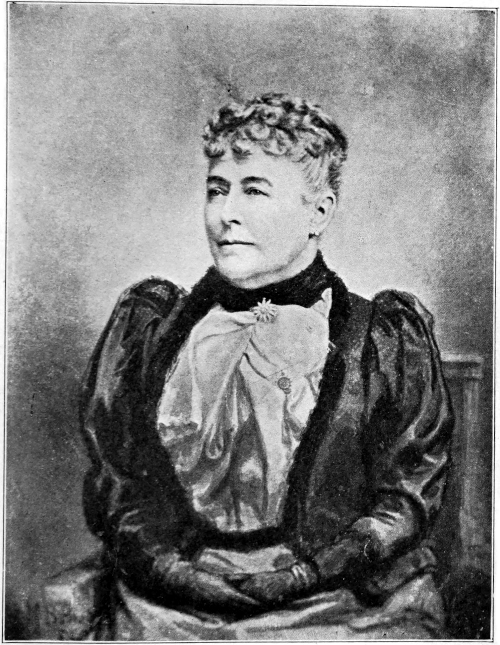
Photo. by Brady
MRS. BENJAMIN HARRISON
Showing her pin of the Daughters of the American Revolution, of which she
was the first President General
With the inauguration festivities over, President Harrison
gave first attention to those who were to be his immediate
advisers in his administration.
He was fortunate in his running mate, Levi P. Morton,
a Vermonter by birth, who had risen from a position as
country store clerk to that of partner in a Boston firm.
Later, he founded banks in New York and abroad in England,
heading Morton Bros. and Company, later the
Morton Trust Company. He served with credit in Congress
during 1878 and 1880, and from 1885 to 1887 rendered
valued service as Minister to France. His influence
and prestige counted for much.
President Harrison chose the following as his official
family: James G. Blaine, of Maine, was named Secretary
of State, the same post he had filled in Garfield’s Cabinet.
Mr. William Windom, of Minnesota, Secretary of the
Treasury, was another Garfield cabineteer. Redfield
Proctor, of Vermont, as Secretary of War; William H. H.
Miller, of Indiana, for Attorney General; John Wanamaker,
of Pennsylvania, for Postmaster General; Benjamin
F. Tracy, of New York, for Secretary of the Navy; John
W. Noble, of Missouri, for Secretary of the Interior; and
Jeremiah M. Rusk, of Wisconsin, for Secretary of Agriculture,
gave general satisfaction.
Although the President was reserved to a marked degree—so
much so that he was accused of haughtiness—those
who knew him in his home life, or as a soldier or a
legal adviser, saw another side to his nature. He was a
man who had always had before him the example of distinguished
forbears, that served to inspire him with the
ambition to achieve and curbed any tendency toward
letting his life run along with the tide of least resistance.
He was born at North Bend, Ohio, in the old Harrison
family homestead, established and defended by his pioneer
grandfather. His boyhood was like that of the average
farm boy, with its round of chores and farm pleasures.
The traditions of the Harrison family were of a high
order. They demanded education for their children, and
so, on the farm, two miles from the house, a small school
was early built for the boys of the vicinity. No regular
district schools were within a distance possible for their
attendance. A log cabin with a dirt floor, rude benches
without backs, slabs and blocks of wood for desks, walls
sans paint or plaster—this little temple of learning was in
its severe primitive rudeness a real school.
In church matters, too, young Harrison had a thorough
training in the Presbyterian faith of his fathers. His
father considered it his parental duty and responsibility
to supervise his children’s religious training.
Sundays frequently brought visits and dinners with his
grandmother, and from babyhood he heard tales of his
grandfather President and, what he loved most, the tales
of the wild, untamed wilderness and brilliant military
achievements.
Harrison was graduated from the Miami University
fourth in a group of sixteen on June 24, 1852.
Greek legends and mathematical problems did not fill
his entire time. With the habit of youth, he had fallen
deeply and seriously in love with his first sweetheart, the
charming dark-eyed daughter, Caroline Lavinia, of Dr.
John Scott, of a near-by academy. To the amazement
and the chagrin of a host of young men students, she became
engaged to eighteen-year-old Ben Harrison. Some
of his mates were astonished and wondered and commented
on the queer ways of love and girls. They asked each
other, how could she—Caroline Scott—fall in love with
a chap small and insignificant in appearance, plain of
feature and of dress, afflicted with unusual diffidence and
reserve, whose only claim to pretensions of any sort was
the possession of an ancestor who had been a signer of
the Declaration of Independence and another a President
of the United States. True, Ben Harrison also claimed
a descent from John Rolfe and Pocahontas. But Miss
Caroline was content. The two were married in the
autumn of 1853 and started out in an Indianapolis boarding
house with a total cash asset of $800, a sum which
the young man had borrowed on a lot which he had inherited
from a relative.
Harrison studied law and was admitted to the bar.
Soon clients flocked to him. There was nothing aggressive
or dominant about him; but the shyness or reserve, which
at first was diffidence, wore away, leaving a quiet assurance
that bespoke power of mind. In 1860, he began his
political career as a candidate before the Republican Convention
for the position of Reporter of the Supreme
Court, to which he was elected by a substantial majority.
Two children soon came to more than fill Mrs. Harrison’s
time. So the young couple found themselves a tiny
cottage, where Mrs. Harrison did all of her housework,
aided before breakfast, at midday, and at night by her
husband. He chopped wood, filled the wood box and
water buckets, and did all of the outside home chores.
This was their situation when the guns of Sumter
sounded the tocsin of war and sent the blood of revolutionary
ancestry bounding in Ben Harrison’s veins. However,
he had a family dependent on him, and he gave
the matter serious consideration. Meanwhile, he made
a call upon Governor O. Morton, of Indiana, who settled
for him the paramount matter of his place in the war.
Mr. Harrison had said to his friend: “If I can be of service,
I’ll go.” Without a moment’s hesitation, the Governor
replied, “Raise a regiment in this congressional district,
and you can command it!”
Harrison regarded this as a command as well as a
promise. He went straight home, found Mrs. Harrison
in full sympathy with his anxiety to do his part for his
country. The Stars and Stripes were hung from the humble
law office window, and Lawyer Harrison started recruiting,
quickly assembling Company A, the nucleus foundation
for the Seventieth Indiana Volunteers. Soon a
regiment was assembled, for the Harrison name held a
magic sound.
Thrilling stories from the Seventieth Indiana Volunteer
Infantry in one of the most severe of the battles—that at
Resaca, Ga., May 14 and 15, 1864—told that “Little
Ben” fought like a demon in the hand-to-hand encounter.
More stories of gallantry came from New Hope Church,
Golgotha Church, and Kenesaw Mountain. But the
crowning exploit that sent Harrison’s name ringing over
the country as a true son of a race of military chieftains
was that of Peach Tree Creek.
The victory of Peach Tree Creek has been accredited
to Harrison’s initiative and fearless leadership. Major
General Joseph Hooker rode up to him after the battle
and exclaimed, “By God, I’ll make you a Brigadier
General for this fight.” The General wrote a letter to
the Secretary of War asking for Colonel Harrison’s promotion,
and the promised commission came as Brevet
Brigadier General, signed by Abraham Lincoln, and
countersigned by Secretary of War Stanton in acknowledgment
of “ability and manifest energy and gallantry
in command of brigade.”
At the end of the war, he returned to Indianapolis,
resumed his office of Supreme Court Reporter, and devoted
his energies to building up his practice.
He took the stump through Indiana in behalf of General
Grant in 1868, and repeated this service in the interest of
the hero of Appomattox again in 1872.
General Harrison’s activity in the Garfield campaign
brought him the offer of a Cabinet portfolio, which he
declined, preferring to serve his term as Senator. While
in the Senate, he opposed President Cleveland’s policy
of pension vetoes.
Although the President sought a renomination and
hoped his policies would receive the endorsement of the
American public in the fall elections, it was evident that
the Republicans would make a determined effort to retrieve
their power. While many of the Democratic
leaders were disgruntled over President Cleveland’s methods
and practices, there was no opposition to him as the
standard bearer for the Democratic party for another
term, and the convention was devoid of excitement as it
renominated him by acclamation, with Allen G. Thurman
for Vice President.
For a time, it seemed that James G. Blaine’s political
star was again in the ascendancy, but the “Plumed Knight”
was in Europe and was not receptive. He had tried and
failed so continuously for sixteen years that he was convinced
the Presidency was not for him, and refused to
permit his name to be used in the Republican Convention,
though besought by cables from hosts of admiring friends
and supporters. Senator Harrison’s steadily growing
popularity prophesied his selection, and he received the
nomination on the eighth ballot. It was made unanimous,
and Levi P. Morton, of New York, was nominated for
Vice President.
The tariff was the vital issue of the hour which drew
the leaders of both parties into the arena of debate during
the campaign, and upon it were hurled volumes of argument
and oratory from platform and stump. Here was
where the lucid exposition of the great lawyer made a
profound impression through his clear speeches and charm
of expression. The campaign was lively; banners, processions,
and songs added zest to the rallies and political
meetings.
The long score of complaints against President Cleveland
due to his independence of party direction had antagonized
Tammany Hall. His stand on the tariff robbed
him of the strong support of the big manufacturing industries.
His wholesale vetoes of pensions had antagonized
the soldier vote. These sins, added to the fact that
the incoming Governor of New York, David B. Hill,
though a Democrat, was not an adherent of the Cleveland
policy, contributed to his defeat. With New York’s
powerful and decisive vote thrown to the Republican
candidate, Benjamin Harrison, President Cleveland was
eclipsed.
One of the important assets of Harrison’s administration
was the new mistress of the White House, whose
cordial friendliness and natural graciousness offset her
husband’s formality.
Mrs. Harrison brought to her position as chatelaine of
the mansion a splendid equipment for her important duties,
through a lifetime of activity in social, philanthropic, and
patriotic service. Always a church worker, she had the
ready sympathy and understanding of welfare matters that
were of the greatest help in meeting the many demands
made upon her in Washington. Her charity and constant
aid to people in every sort of difficulty were extended
so quietly that little or nothing was known of it during
her lifetime.
Both she and the President were deeply religious, and
the Sabbath observance was punctiliously followed, even
to the point of the President’s securing additional clerical
help for necessary Sunday correspondence, so that the
regular staff might have the day for rest after the week of
work. Morning prayers were continued, regardless of the
change of residence. During Harrison’s senatorship, he
and Mrs. Harrison had established their religious attendance
in the Church of the Covenant, where they continued
to worship during their years at the White House.
President Harrison was possessed of an aristocratic
manner and great natural dignity. To this he added a
high regard for his office. He regulated his daily life and
all public appearances while Chief Executive to command
the utmost respect from the public. In this, he was
much like General Grant, who demanded little for himself
but for the President of the United States all possible
honour. It is claimed that he carried this attitude into
his churchgoing, making his arrival just at the opening
moment of the service, and entering from a side door near
the pulpit. This stately progress to his pew made the
congregation aware that the President of the United
States and the First Lady were attendants at worship.
With their installation in the Executive Mansion, the
Harrisons were naturally accompanied by their son and
daughter and grandchildren. They made a lively group
to brighten up the big house. The son, Russell Harrison,
and his wife, had one little daughter, while the son-in-law
and daughter, Mr. and Mrs. James Robert McKee,
brought with them the already famous youngster “Baby
McKee,” two years old, properly known as Benjamin
Harrison McKee, and his infant sister, Mary Dodge, of
less than a year. This little lady was christened in the
Blue Room by her venerable grandfather, the Rev. Dr.
Scott, with water from the River Jordan.
Mrs. Harrison was horrified when she discovered the
basement floor of the White House to be overrun with
rats, and when, a few days later, the President observed
a large gray rodent helping himself from the side table in
the family dining room, a campaign of extermination was
arranged. Every kind of trap and poison having been
tried and ignored by the pests, a professional rat catcher,
with his dog and ferrets, was installed. He discovered the
grounds about the house to be honeycombed with rat
holes, and after several hundred had been killed by the
ferrets, Mrs. Harrison decided to improve the conditions
of the entire basement. She had the floors taken up and
was amazed to find that the kitchen floor contained a
number of layers, new boards having been laid upon the
old whenever repairs had been made in the past. In
accordance with her wish, these were all torn out and the
entire basement covered with concrete, this being covered,
in the kitchen, with tiling. All of the walls of these lower
rooms were tiled shoulder high. The repairs changed the
dark, unattractive, and unsanitary rooms into wholesome,
cheery places, easy to keep clean.
The condition of the kitchen and the vast improvement
brought about by the repairs there furnished Mrs. Harrison
with further incentive to put the entire mansion
through an overhauling. With her daughter and daughter-in-law
to aid her, this trio of accomplished housekeepers
proceeded to supervise the renovation and refurnishing
from the attic to the cellar, and as this work progressed,
Mrs. Harrison began to have visions of what the President’s
house should be and how it might be vastly improved
by remodelling. The more she studied the possibilities
of rearrangement of the offices, the more convinced
she became that a practical solution was feasible. To
enlarge the living quarters, to give the family more privacy
and the Executive more space for the daily work of his
staff was her dream. The repairs she had made had cost
$50,000 and there was no possibility of extensive remodelling,
much as she would have liked it done. But she
consulted the Commissioner of Public Buildings and
Grounds, various architects, discussed the advantages of
her proposed changes with many of the members of Congress,
and planted the seeds of her very fine and thoroughly
practical plan, which was carried out later but not
until ten years after her death.
Soon after Mrs. Harrison’s arrival she engaged for the
culinary department of the White House at a wage of fifty
dollars per month a Frenchwoman formerly in the service
of Lord Sackville West of the British Embassy. This
plan was for the summer months.
The climate of the Capital City or the atmosphere of
the then draughty mansion failed to agree with the Harrison
grandchildren, as they all became ill, to the great
distress of the President and his wife. Early in the summer,
the physician ordered them to be taken to the seashore.
Owing to this sudden change in the family living
arrangements, Mrs. Harrison, to economize, thought she
would dispense with her French cook of vast experience
and high wage, and, during the absence of the bulk of
the family, avail herself of the service of a coloured woman
at fifteen dollars monthly. She forthwith discharged her
cook, only to discover that, although First Lady of the
Land, mistress of the White House, and leader of millions
of women, there were limitations to her authority when
she tried to dismiss her cook. The cook refused to be
discharged, preferring to remain the genius of the White
House kitchen; she most emphatically refused to leave
unless paid for the entire season. She considered her
dismissal cause for a suit for damages, and before the
matter was adjusted satisfactorily to both sides, a lawyer
had been engaged, the matter put before Marquis de
Chambrun, law representative of the French Government
in the city, and the usual attorney’s letter for settlement
sent to the President.
In planning her social programme, the First Lady had
the efficient aid of both Mrs. McKee and Mrs. Russell
Harrison. Each made frequent and lengthy visits to the
White House, and each assumed the rôle of hostess occasionally
to her own large circle of friends in and near
Washington. The state dinners, receptions, luncheons,
balls, and parties were charming and delighted the society
that so loved the gaiety of Mrs. Cleveland’s youthful
régime.
The Harrison family were highly complimented upon
their handsome horses and carriages. For his use on
March 4th, General Harrison purchased an elegant landau
for which he paid $2,000. This the family called the
“state coach.” For Mrs. Harrison’s use he selected a
family carriage at $1,000. Six spirited horses, cherry
bay in colour, all sixteen hands and a half, took possession
of the stables. While President Harrison was the most
consistent pedestrian in White House history, he also
loved to handle the reins and took the greatest pride in his
equipages.
Among the many budding projects to which Mrs.
Harrison gave the support and encouragement of her active
interest and the prestige of her name was that of the
newly formed national society of the Daughters of the
American Revolution, which now numbers more than a
quarter of a million women, and which is the most potent
factor in the preservation of American patriotic traditions
and the greatest existing force in directing the education
of the children of the country toward an understanding
and an appreciation of the principles and standards formulated
by their forefathers.
Mrs. Harrison accepted the leadership of this patriotic
society, serving as its first National President General.
Her influence went far toward giving its growth the needed
impetus. Patriotic societies were not plentiful, and in the
East, no organization of descendants of the Revolution
save that of the Sons of the Revolution existed. This
association, meeting in Louisville, Ky., in April of 1890,
cast a vote excluding women from membership, although
the original organization formed in California in 1875 had
both men and women on its roster.
When the news of this action was broadcast through the
press, Miss Eugenia Washington, great-grandniece of
General George Washington, decided that it was time for
women to form a society of Daughters. With the aid
of Mrs. Ellen Hardin Walworth and Miss Mary Desha, of
Washington, D. C., the Daughters of the American Revolution
was founded in August of 1890. Meanwhile, Mrs.
Mary Lockwood, member of the National Press Association,
aroused to protest against the action of the “Sons”
in Louisville, published in the Washington Post the story
of a Revolutionary War heroine, Hannah Arnett, as an
illustration of the fact that women were worthy of honour
for their service in that conflict as well as men. Mrs.
Lockwood, not being in the city at the time of the meeting,
could not be a founder but was given an especial honour
for her service through the press.
After a time, when Mrs. Harrison’s health began to decline,
Mrs. McKee made the White House her home and
relieved her mother of the greater part of the routine,
particularly that of correspondence.
But it is not so much for the pleasant and important
official functions that the twenty-sixth administration is
remembered as for the picture of delightful home life
presented by these doting grandparents and their little
folks.
Their first grandson, Benjamin Harrison McKee, was
the autocrat of the White House, around whose daily
performances and schedule of living volumes were written,
and this publicity was shared by his baby sister and his
little cousin Marthena Harrison. From the time young
Benjamin smiled and cooed at the crowds at the Harrison
home in Indianapolis, where he got the name of “Baby
McKee,” until the little Cleveland lassie usurped his
Washington residence, he held the centre of the stage.
Idolized by his grandparents, the chum and special playfellow
of the dignified President, he became a national
figure as much discussed as his elders.
With all of the President’s dignity and conventionality,
he did not hesitate an instant in giving chase in all of the
inappropriateness of frock coat and silk hat when, one day,
the goat team elected to run away with Baby McKee,
dashing directly out of the grounds and into the street.
However, young Benjamin sat tight, and the anxious
grandfather reached him in time to prevent a real catastrophe.
The critics who accused Benjamin Harrison of being
“an iceberg” should have seen him romping with the
children of the family.
The presence of these little folk was the incentive for
many delightful children’s parties, particularly during the
holidays, and Colonel W. H. Crook, so long attached to
the White House, has claimed that the first White House
Christmas tree in his memory was the very large, gorgeous
one put up in the library the first Christmas of the Harrison
administration, in the trimming of which the President,
all of the family, and the staff assisted. It carried toys
not only for the children of the family but for everyone
attached to the White House and their families. Around
it, too, were piled the hundreds of gifts and remembrances
sent by friends and presidential admirers.
Mrs. Harrison’s social plans had many unhappy interruptions
through the unusual number of deaths in their
immediate and official family. The first of these, about
at the beginning of their administration, was that of Mrs.
Lord, Mrs. Harrison’s sister, a resident of Washington
and an employee of one of the government departments,
who had also kept house for their aged father, Dr. John
Scott. Mrs. Harrison was untiring in her devotion to her
sister, and after Mrs. Lord’s death, took her father and
Mrs. Mary Lord Dimmick, Mrs. Lord’s widowed daughter,
to the White House to live.
Early in 1890, on February 2d, society was grieved over
the death of Secretary Blaine’s daughter, Mrs. Coppinger,
and on the following day the city was inexpressibly
shocked by the terrible bereavement and tragedy that
came to Secretary Tracy in the fire that destroyed his
home on Farragut Square, causing the deaths of Mrs.
Tracy, a daughter, and a maid. Mrs. Tracy, in her terror
of suffering, had jumped from the window. The President
was among the first to arrive on the scene and at once took
the Secretary and the other daughter, Mrs. Wilmerding,
to the White House, where Mrs. Harrison did her utmost
to comfort them. Later in the day, the bodies of the
Secretary’s wife and daughter were brought to the White
House and the coffins placed side by side in the East Room.
The tragedy to this gracious matron and charming girl
affected his Cabinet group as an individual and personal
affliction.
Those who attended the funeral in the East Room will
never forget the pathos of that service, so poignant in its
atmosphere of sorrow that even one of the little boy choristers
was overcome and carried fainting from the room.
“Baby McKee’s” fourth birthday was an occasion for a
great family celebration. The President and little Benjamin
led the way to the small dining room, where the
round table was surrounded by fifteen high chairs. The
table was gaily decked with flags and flowers to please
childish eyes, and a luncheon was served consisting of
bouillon, beaten biscuits cut in the form of chickens with
their wings outstretched, ice cream, and cakes. Mothers
and nurses attended and enjoyed the Virginia reel which
concluded the affair.
President Harrison had long been of the opinion that
he himself would gain much in the way of understanding
his manifold problems and that the people of the land
would get a clearer grasp of his efforts in administering
his high office if he were to make a tour of the country.
Accordingly, he made his arrangements for a swing around
a circle that embraced practically one half of the United
States. About twenty persons outside of his immediate
family accompanied him. Those most important in the
group were Mrs. Harrison, Mrs. McKee, Mr. and Mrs.
Russell Harrison, and Mrs. Dimmick of the family, and
Secretary Rusk and Postmaster General Wanamaker of
the Cabinet.
They left on the night of April 14th and stopped at
Roanoke, where the President made his first speech. From
there the itinerary took them through Tennessee, Georgia,
Alabama, Texas, New Mexico, Arizona, and California.
In California, Harrison delivered more than forty speeches.
He then proceeded to Oregon, Washington, Idaho, Utah,
Colorado, Nebraska, Kansas, Iowa, Missouri, Illinois,
Ohio, Indiana, Maryland, and Pennsylvania. Everywhere,
at his arrival, there was an enthusiastic ovation.
In New Mexico, at one stop he was presented with a beautiful
case of silver made from ore mined in the vicinity.
On this trip, the President made one hundred and forty-two
speeches, most of them extemporaneous, built upon
the issues of the hour and around the problems of particular
interest to the various sections of the country through
which he was travelling.
One of the prettiest Christmas incidents in which a
President ever figured occurred during this trip and shows
that Harrison’s love of children was not reserved entirely
for his own grandchildren. While passing through Richmond,
Ind., the President was surprised in his car by
the visit of a tiny girl of four who, when he took her upon
his knee, threw her arms about his neck, kissed him impulsively,
and thrust a new penknife into his hand.
When the next holiday time came near, the President
sent a letter and a beautiful doll, both to be delivered to
that same little girl on Christmas Eve. And here is a
copy of that letter:
My dear little Friend:
When you came into my car at Richmond I did not see
you until you stood at my feet looking up to me so sweetly
that I did not know but a little fairy had come in through
the window. But when I picked you up and you gave me
a kiss, then I knew it was a real little girl. The pretty
knife you handed me I will keep till you are a big girl, and
when I go back to Indiana to live you must come to
see me and I will show you that I have not forgotten you.
The little doll which you will find in the box with this
letter is for you, and I hope you will think it is pretty.
If the doll could talk she would tell you how much I love
to be loved by the little children.
Affectionately yours,
Benjamin Harrison.
The Tracy tragedies, coming so close upon the other
griefs, had given Mrs. Harrison’s already depleted strength
a severe shock, from which she really never entirely rallied.
This exhaustion, or fatigue, increased, but Mrs. Harrison
would not admit being ill—“only tired.”
She loved the conservatory. She had always been interested
in china painting and had taken lessons in art.
She spent much time there, after she began to fail, in
painting orchids, the odd blossoms that appeared for the
first time during her régime, and for the first time on a
White House table at a diplomatic dinner. She had also
started collecting relics of her predecessors. In her plans
for enlarging and improving the White House, she had
arranged for their display.
In the spring of 1892, every member of the family save
the President contracted grippe. Mrs. Harrison supervised
the nursing of all, even doing a great deal of the
actual work herself. Finally, she also succumbed to the
malady, which left her with a serious lung trouble, and
while she was pleased and proud of her husband’s renomination,
she could not participate personally in the rejoicings
and celebrations. She continued to fail, and early
in the summer her family took her to Loon Lake, in the
Adirondacks, in the hope that the change of air would
create an improvement. This was a vain hope, and in
October she was brought back to the White House in the
last stages of the disease. Too worn and exhausted to
rally, she never left her room after her return. She passed
her thirty-ninth marriage anniversary with her husband
at the White House five days before she died, on October
24, 1892, after eight months of suffering. She did not
live to know that he was defeated by Cleveland, whom he
had succeeded. Her death occurred in the same room
that had been occupied by President Garfield after he
had been wounded by Guiteau.
The funeral was exceedingly simple and was attended
only by the family, the Cabinet, the Supreme Court, and
a little group of personal friends. Orchids, her favourite
flower, and roses completely covered the casket. After
the services, her body was taken to Indianapolis for
interment.
About a month later, Dr. John W. H. Scott, Mrs.
Harrison’s father, died at the age of ninety-three. His
funeral service was held in the East Room. Although of
such advanced years, he had discharged the duties of
his calling efficiently until President Harrison’s inauguration.
The closing days of President Harrison’s régime were
dreary. In the death of his wife, he had lost his lifetime
companion, whose sweet graciousness and womanly
sympathy did so much to offset his own seeming coldness
and austerity. Many of Mrs. Harrison’s admirers believed
that, had she lived and kept her health, he would
not have failed of a second term.
The illness and death of their beloved President General
who had won the love of the membership was a personal
sorrow to her associates in the Daughters of the Revolution.
At the Congress of 1894, two years after her death,
the beautiful portrait of her by Daniel Huntington was
unveiled and then presented to the White House as the
gift of the society to the nation.
In President Harrison’s administration there was a
complete reversal of policy on the tariff and pensions. A
liberal pension policy was adopted—so liberal that it was
charged that the Commissioner of Pensions hunted up
groups to whom pensions might be extended. Finally, an
act was passed giving a pension to every soldier who had
served ninety days and was not able to be self-supporting,
regardless of whether or not the disability was due to his
war service. Thus, many thousands of pensioners were
added to the roster in Harrison’s four years, with the
enormous increase of annual expenditure from $89,000,000
to $159,000,000.
Much important legislation was enacted. Great was
the satisfaction over the admission of six new states,
two of which, by the way, extended the ballot to women
and equal business rights. The states were Montana,
North Dakota, Idaho, South Dakota, Washington, and
Wyoming.
The opening of Oklahoma marked another epoch in
national progress. The tract which had formed part of
the Indian Territory was purchased from the Indians in
1889. In the spring of that year, fully fifty thousand
people were eagerly waiting the word to enter and take
up lands in that region. President Harrison’s proclamation
declared that no one who entered and occupied lands
in Oklahoma before twelve noon of April 22, 1889, should
be permitted to acquire rights to lands there by such
entrance and occupation. Hence, on the stroke of twelve,
the bugle announced that Oklahoma was open, and a vast
multitude rushed across the line, each endeavouring to
get in ahead of the rest. Almost overnight, towns of
rough board shanties and tents sprang up like mushrooms.
Oklahoma City and Guthrie started thus; but five months
later, Guthrie was a real town, with several newspapers,
banks, and a street railway under construction. Such was
the spirit of progress!
To the delight of the navy enthusiasts, the ninety old
wooden ships were being steadily replaced by battleships
and steamers of steel construction.
Most important to the business interests of the country
were the three acts passed by Congress in 1890: the new
Pension Act, that added 400,000 names to the pension
roster, the expense of which has already been given; the
McKinley Tariff, the principal object of which was the
protection of American products and American industries
against foreign competition; and the Sherman Silver Purchase
and Coinage Act, which provided that each month
the treasurer should buy, if it were offered, 4,500,000
ounces, or more than 140 tons, of silver and coin it into
dollars.
The centennial census showed the population of the
United States to be more than 62,000,000, a gain over the
first census of 1790 of 50,000,000 people. A centennial
celebration was held by the Supreme Court, and another
by the Patent Office. This latter was especially interesting
because of the history it disclosed. The first patents
issued were for potash and soap in 1790. During the
hundred years that followed, 450,000 patents had been
applied for and secured. Inventors had endeavoured to
enter every field of human skill, with the result that
America’s labour-saving machines led the world. A
notable and everyday utilitarian invention that has given
satisfaction in transportation to countless hundreds is the
safety bicycle, which “Baby McKee” learned to ride with
his mother.
It was during this administration that national politics
was invaded by the Farmers’ Alliance. The immigration
laws also came in for amendment. An incident worthy
of note was the great Carnegie Steel Strike at Homestead,
Pa., to which the governor finally had to send troops.
President Harrison could not fail to feel a satisfaction
in the record of accomplishment of his four years, and
when he prepared to turn the White House over to his
successor, he resolved to go back to his law practice, knowing
that his future was established. He need accept only
such clients as appealed to him and would be able to meet
his fees.
He went back to the lawyer’s office in Indianapolis
where he had first practised his profession. He accepted
his defeat for reëlection in 1892 as final, and thereupon
retired permanently from party politics. His only reëntrance
into national affairs was when he became a member
of the board of arbitration for Venezuela, which settled
the historic boundary dispute between Great Britain and
the South American Republic.
After his presidential term General Harrison became
less reserved. He used to spend his vacations out of
doors, and was most devoted to his grandchildren, the
McKees. He became a familiar figure at Cape May,
where the beach crowds often saw him romping in the surf
with them.
On April 6, 1896, he married Mrs. Mary Scott Lord
Dimmick, the niece of his first wife, who had acted as Mrs.
Harrison’s secretary during her stay in the White House.
The wedding took place at St. Thomas’s Protestant
Episcopal Church on Fifth Avenue, New York City, in
the presence of a small group of friends. Neither General
Harrison’s son nor his daughter was present. He took
his bride to his Indiana home, where a baby girl was born
to them the following year. This marriage estranged his
family, as it was not at all pleasing to the children of his
first wife.
He died of acute pneumonia in Indianapolis, March 13,
1901, with his immediate family and a few old friends
around him. Although en route to his side, neither Russell
Harrison nor Mrs. McKee was with him at his death.
Benjamin Harrison’s rêgime was one of dignity. It
reflected honour upon himself and the nation.
CHAPTER IX
SECOND ADMINISTRATION OF GROVER
CLEVELAND
March 4, 1893, to March 4, 1897
CLEVELAND luck brought Grover Cleveland back
to the White House in March, 1893, to succeed the
man who had defeated him at the end of his first term, and
whom he had in turn defeated also from succeeding himself.
The “luck” did not extend its benign influence to
propitiate the elements, since, instead of the ideal day of
sunshine and soft spring zephyrs of his first term, he had
to combat the discomforts of a cold, wet snow with its
chill and slush.
Fortune had been so liberal with her favours that he
could discount her fickleness in that respect, however,
even though Democratic hosts had assembled to celebrate
their return to power with a brilliant and gorgeous
display.
Mr. and Mrs. Cleveland, with the addition of little
Ruth Cleveland, their seventeen-months-old daughter,
reached Washington on March 3d, going direct to the
Arlington, where Mr. Lamont had engaged a suite for
them, and where old friends had gathered to greet them.
They, like Vice President-elect and Mrs. Stevenson, held
a continuous reception.
Promptly at eleven fifty-five the President and the
President-elect departed for the Capitol, unaccompanied,
in the only open carriage in the pretentious procession that
meant the eclipse of one leader and the installation of the
other.
After the ceremonies in the Senate, much pressure was
brought to bear upon Mr. Cleveland to abandon the idea
of taking the oath out of doors. He felt, however, that he
owed it to the waiting thousands, patiently standing, to
let them see and hear him, and so he followed his previous
course, in tribute to Thomas Jefferson, of delivering his
inaugural address before the oath was administered by
Chief Justice Fuller.
Among the many interested spectators of the ceremonies
were Mrs. Cleveland and Mrs. Stevenson, who braved the
weather to hear their husbands.
Following the ceremonies at the Capitol and the luncheon
at the White House, the new President took his position
in the open reviewing stand, where he stood for three
hours as the pageant assembled in his honour and marched
past. Mrs. Cleveland reviewed the parade from a window
over a drug store on Fifteenth Street, where a party of her
old friends had gathered to be with her.
The procession was remarkable for its length, order,
and appearance. The distinguished and the well-known
clubs and organizations participating represented hosts
of Democrats from coast to coast. Governors of eleven
states with their staffs participated; a fine-looking group
of students from Carlisle, and Tammany in all of the
paraphernalia of its origin, 3,400 strong, whom it had
taken eight trains to transport. All these, joined with
20,000 marchers, adherents, and admirers of the new head
of the nation, made a pageant long to be remembered.
The Inaugural Committee had done valiant work in
again preparing the great Pension Building for the ball at
which President and Mrs. Cleveland arrived about nine
o’clock. They were announced by the Marine Band’s
“Hail to the Chief.” Their tour of the ballroom gave
many scores of people the opportunity to see their Chief
Executive and the First Lady at close range, a privilege
for which thousands had travelled many miles and
endured great discomforts. Mrs. Cleveland, walking
with Justice Gray, was all-inclusive in her smile and
greetings, but scores carried away the fond belief that she
smiled just at each of them. The President, escorted by
General Schofield, radiated pride and happiness. When
they reached their own special reception room, the Vice
President and Mrs. Stevenson, with their daughters, were
the first to pay them respect. Here, too, came hosts of
old friends to extend congratulations and greetings.
Mrs. Cleveland’s dress was, of course, the observed of
all observers. Severe and simple in style, it was rich and
graceful. Made of heavy white satin with an empire
front and tightly fitting back, the skirt was carried out to
a pointed train. It was trimmed with point lace and
crystal beads. The embroidery ran up in rows about
twelve inches from the edge of the skirt. The front was
most elaborately embroidered with crystal beads, while
the huge puffs of the satin that made the sleeves were
dotted with the crystal. Stiff satin bows at the shoulders
and a heavy fall of the lace completed the corsage. She
wore diamonds.
Mrs. Stevenson’s handsome gown was distinctive, being
white moire antique made in the style of 1830. It had
a narrow binding of purple velvet on the edge of the skirt
and on the edge of the round low-necked waist. Garlands
of purple violets were arranged to fall over the old-fashioned
bertha of fine duchess lace. Puff sleeves of the
velvet reached to the elbow and were met by soft suède
gloves of the same shade. Mrs. Stevenson’s fan was a
dainty affair of flowers, lace, and ribbons in the same tints.
Adjoining the ballroom, a huge temporary structure had
been constructed on the north side as a kitchen. From
this a local caterer supplied an elaborate banquet to all who
sought refreshments.
Part of the celebration, and one that from the beginning
has been popular in connection with inauguration ceremonies,
was the unusually beautiful pyrotechnic display.
While the Democratic chieftain and Mrs. Cleveland and
all of their followers were celebrating their victory, another
charming function was in progress in honour of Ex-President
Harrison and Mrs. McKee, at the home of
Postmaster General Wanamaker, Eighteenth and I streets,
formerly the Whitney home, where Mrs. McKee and
President Harrison’s household had gone early in the day.
Here, too, all of the retiring Cabinet and the prominent
Republican officials were guests at an elaborate farewell
banquet and reception. From this General Harrison and
Mrs. McKee went to the special train for Pittsburgh,
where they were invited to visit before returning to
Indianapolis.
Great interest was manifested in Baby McKee’s successor,
Ruth Cleveland. The night following her father’s
installation, she was taken seriously ill, but soon recovered.
Mrs. Cleveland found her problems multiplying rapidly
regarding the care of her baby girl. The general public
visiting the White House seemed to regard the President’s
child as part of the establishment. Mrs. Cleveland was
horrified one morning on glancing out of the window to
see her baby being handed from one to another of a group
of about twenty tourists. Against their eagerness to
fondle the baby the nurse was helpless. Upon another
occasion, a determined visitor had to be prevented by
force from snipping a lock of the baby’s hair as she passed
through the corridor of the White House in her nurse’s
arms. Then the President and his wife decided that, for
the protection and safety of their child, the gates of the
grounds must be kept closed and locked. This order was
received with great indignation and considerable protest,
and Mrs. Cleveland suffered much perturbation and annoyance
in consequence, especially when it was boldly
asserted that her little girl was a deaf mute, was deficient
in faculties, or otherwise afflicted, so that her parents
wished to keep her affliction from public attention. One
day, while receiving a delegation in the latter part of the
administration, Mrs. Cleveland saw Ruth pass the door.
She called to her to come in and let the ladies see that she
was not minus arms, legs, or fingers.
With the family installed, President Cleveland and
his wife readily settled to their respective tasks. Mrs.
Cleveland slipped into place as easily as if she had never
left it, and began again her regular Saturday afternoon
receptions, which had become so popular in the first term.
The President also resumed his semi-weekly public receptions,
which he came to enjoy so much, since it gave him
the opportunity to meet people and talk to those who
wished to talk to him.
The selection of the Cabinet was a momentous task.
The group finally comprised the following: Secretary of
State, Walter Q. Gresham of Illinois; Secretary of the
Treasury, John G. Carlisle of Kentucky; Secretary of War,
Daniel S. Lamont of New York; Attorney General,
Richard Olney of Massachusetts; Postmaster General,
Wilson S. Bissell of New York; Secretary of the Navy,
Hilary A. Herbert of Alabama; Secretary of the Interior,
Hoke Smith of Georgia; Secretary of Agriculture, Julius
Sterling Morton of Nebraska.
This was regarded as a good Cabinet, though not so
strong as the President’s first one.
The issues brought forth so prominently in the campaign
now thrust themselves forward for attention; almost
immediately came rumblings of the impending money
panic. Naturally, the trouble-making came from both
Republican and Populist ranks.
In the spring of 1893, on May 1st, President Cleveland
opened the great World’s Columbian Exposition, commemorating
the five hundredth anniversary of the discovery
of America by Columbus. It continued for six
months. The exhibits displayed were a demonstration
of the world’s progress in arts, industries, inventions, and
natural products. To it came distinguished tourists from
all over the world, and notwithstanding the money depression,
twenty-seven million people were admitted to
the exposition.
The money stringency, which the Democrats attributed
to the Republican extravagance of the previous administration
in the great increase of pensioners, which they
claim was not offset by the McKinley Tariff Protection
Law, increased as firms failed and industries closed their
shops. In addition to a growing army of unemployed
came coal-mine and railroad strikes.
The nation was brought to the point where the integrity
of the dollar, whether greenback, silver, or gold, had to be
maintained. President Cleveland determined to maintain
the gold reserve, for he was convinced that the safety of
the nation depended upon it, and therefore sold bonds to
keep up the reserve. The President also called a special
session of Congress, which repealed the Sherman Silver
Purchase and Coinage Act of 1890, as he was satisfied that
the purchasing of the silver was harmful to the nation’s
best interests.
This move, unpopular from the Southern and Western
points of view, naturally put a stop to further buying of
silver in huge quantities and also checked the mintage of
silver dollars.
President Cleveland’s second administration found him
with a different attitude toward the purely social features
of his position. In the beginning of his Presidency, he
had been more or less impatient at the necessity for devoting
valuable time to receptions. By the time he had
watched his charming wife handle the vast crowds that
clamoured to see her, he caught a new meaning from the
contact of the masses with their Chief Magistrate and
First Lady and adapted himself to enjoy the people. He
was particular that no one should be crowded out or rushed
through, and soon made it a rule to give his whole attention
for the brief part of the minute of his contact to the
person before him. He cultivated appropriate responses,
and as he began to enjoy these daily handshaking periods,
he responded to greetings with a spontaneity that evidenced
his pleasure and also made him seem more the
friendly man than the exalted exclusive leader. Should,
for instance, a man in passing, ask, “Where is Mrs. Cleveland?
Why isn’t she here too?” instantly, with the twinkle
of the eye and the smile his friends loved, he would answer,
“Why, somebody might carry her off.”
Mrs. Cleveland and the President drove together most
pleasant afternoons. Their equipages were more pretentious
than those of any of their predecessors, and were the
latest and best examples of carriage building. Five
handsome vehicles made up the presidential stable equipment—a
black landau with green trimmings that had
cost $2,000; a smart brougham, whose value was $1,000;
a victoria; also a phaëton that had been made to order at
a cost of $1,000, with a coachman’s rumble behind; and
a surrey. This last was most used by the President.
In the stables were four handsome bays, two for Mrs.
Cleveland’s use and two for the President’s; sometimes,
upon very special occasions, such as parades, the whole
four would be driven together.
Among the interesting visitors to the United States
during the winter and spring of 1893 was the eighteen-year-old
Hawaiian princess, Kaiulani, who came with her
guardian and his family to seek the aid of the United
States in her behalf. Mr. and Mrs. Davis established
themselves, their ward, their daughter, and secretaries at
the Arlington Hotel. The youthful princess had been
educated in England and therefore knew our language.
She was a tall girl, pretty and graceful, with excellent
taste in dress, and was greatly admired at the inaugural
ball. During her visit she received much flattering attention.
Mrs. Cleveland was impressed with her and extended
various courtesies, formal and informal, to her.
And considerable sympathy was expressed in her effort
to accede to the Hawaiian throne, from which the Hawaiian
people had deposed her aunt, Lilioukulani, in
1891.
Upon the departure of the Princess and her retinue for
Europe, she sent a letter of appreciation through the press:
March, 1893.
To the American People:
Before I leave this land I want to thank all those whose
kindness has made my visit such a happy one. Not only
the hundreds of hands I have clasped nor the kind smiles
I have seen, but the written words of sympathy that have
been sent me from so many homes, have made me feel
that whatever happens to me I shall never be a stranger
to you again. It was to the American people I spoke,
and they have heard me, as I knew they would, and now
God bless you for it, from the beautiful home where your
fair First Lady reigns to the dear crippled boy who sent
me his loving letter and prayer.
Kaiulani.
However, her hopes for a throne were destined to disappointment.
The United States sent a commissioner
over to Hawaii about the time the Princess left; the Republic
of Hawaii was proclaimed on July 4, 1894. Then
annexation to the United States was sought and later
achieved through a treaty of annexation passed by Congress
in 1898.
The announcement early in 1893 that the Princess
Infanta Eulalie, aunt of the small King of Spain (the present
King was then about seven years of age), was coming
with her husband, Prince Antoine d’Orleans, and a large
suite of Spanish grandees to visit the World’s Columbian
Exposition as an honour guest representing the Queen
Regent of Spain, created considerable excitement. Much
diplomatic correspondence was necessary before the details
of her official reception by the President were satisfactorily
settled. The difficulty was due to the lack of
tact exhibited by Señor Maraugo in expressing the wishes
of the President, who had no desire or intention whatever
to omit any courtesy due the Royal Infanta that was
consistent with our Republican form of government.
The minister had allowed his fear that the President would
fail in proper ceremony to become apparent, and in his
anxiety to surround the Princess with the full panoply
of her rank, had overlooked wholly the importance and
prestige due to the President of the United States.
The Infanta arrived in New York May 19th and was
received with a great display of ceremony by the Spanish
Consul and the officers of the Spanish war vessels in New
York.
When the Princess arrived in Washington, she was met
by Secretary of State W. G. Gresham and Colonel J. M.
Wilson, U. S. A., Master of Ceremonies and Social Functions
at the White House. Two troops of cavalry from
Fort Myer, under command of Colonel Guy V. Henry, had
been detailed to escort her to the Arlington Hotel annex,
which, cut off from the rest of the hotel, had been set aside
with all of its three floors of rooms for the use of the
Infanta and her suite of nineteen persons. The annex
had at one time been the elegant private residence of
Charles Sumner, and only after his death had been bought
and added to the hotel property. It had just been redecorated
and furnished.
Very shortly after the arrival, the Infanta, with her
party, was escorted to the White House, where President
and Mrs. Cleveland awaited her.
At the conclusion of the fifteen-minute call, the President
escorted his visitor to the door and watched her
departure—a full concession to her royalty.
In the afternoon of the same day, the Infanta received
a call from Mrs. Cleveland, accompanied by Mrs. Carlisle,
Mrs. Lamont, and other ladies of the Cabinet.
A crowd hung about the Arlington and occupied every
bench seat in Lafayette Square to get a close glimpse of
this bit of elegant pageantry from the Old World.
On the 24th of May, the President and Mrs. Cleveland
gave the first state dinner of their administration. It was
in honour of the Princess and her party. Thirty-six
guests were seated in the state dining room. Just a little
while before the arrival of the guests, a small tempest
swept over the city. Though brief, it was violent, and
during its outburst carried off the strip of carpet placed
across the portico of the White House to the carriage steps.
At this function the new Cabinet met for the first time;
at the dinner to them on the evening of March 4th their
appointments had not yet been confirmed, and some of the
wives had not been present. Here, too, were entirely new
doorkeepers, new ushers, a new steward, and new servants,
Mrs. Cleveland having brought from New York all of
the staff within her province to engage. She had, however,
retained Miss Josephine Kniep the housekeeper the
Harrisons had valued so highly.
Mrs. Cleveland’s artistic taste had been given full scope
in the floral arrangement. The long historic mirror in
the centre of the table reflected the beauty of the two
Spanish flags made of red and yellow roses that rested
against each other with their staffs of scarlet geraniums.
The flower stands held red and yellow roses, the tapers
had red and yellow shades; and these colours were also
carried out in the tints of ices, sweets, and bonbons.
After the royal visitors were presented to all of the
assembled guests, the party, being seated with punctilious
observance of State Department rules of precedence, did
full justice to a ten-course dinner with its full complement
of wines. At Mrs. Cleveland’s place there was just an
apollinaris tumbler.
Mrs. Cleveland was particularly charming and lovely in
her gown of blue embroidered crêpe, made in a modified
empire style, with the fashionable puffed sleeve; a pleated
fall of lace finished the neck. A diamond flower spray in
her hair was especially attractive and a beautiful star of
these jewels adorned her bodice.
The Princess wore a court gown of white satin brocaded
in rosebud stripes. Her skirt, with many gores, was full,
and the train long; the whole lower part of the skirt was
bordered with a ruffle of lace caught with bunches of wild
roses. The bodice was low and was distinctive, since it
had no sleeves, the lace and flower trimming making a
band over the shoulders. Her jewels were superb—diamonds
and emeralds of prodigious size and brilliance,
and in a quantity to be deserving of the judgment that
they were worth a king’s ransom.
The guests at the state dinner comprised the Cabinet,
the members of the Supreme Court and their wives,
General and Mrs. Schofield, the Spanish Minister, Senator
Sherman, and Mrs. Harriet Land Johnston. The boutonnières
for the gentlemen were yellow orchids, while a
cluster of American Beauty roses was provided for each
lady. Place cards were long Spanish flags with their
staffs tied with the Spanish colours.
No private calls were received by the Infanta—only
those of an official nature. According to the custom
followed abroad, a book was kept at the ladies’ entrance
of the hotel. All persons entitled to call were requested
to inscribe their names therein. This was considered a
call, since visiting cards were not left for royalty. Upon
the cover of this was embossed in gold letters: “Infantes Du
Antonio y Da Eulalia.”
When the party had first arrived, a small Spanish lad who
had been a stowaway on the ship joined it. Despite his
being rebuked, he made his way to Washington, and
when the matter was brought to the Princess’s attention,
she laughed and, to the boy’s great joy, ordered him put in
uniform and attached to her suite.
After almost a week of charming attentions and delightful
experience, the royal party departed for New York
and Chicago, the crowd keeping a close vigil until the last
of the one hundred and two pieces of baggage had been
carried off to the station.
The Infanta’s reception in the United States throughout
her stay brought forth her warm praise.
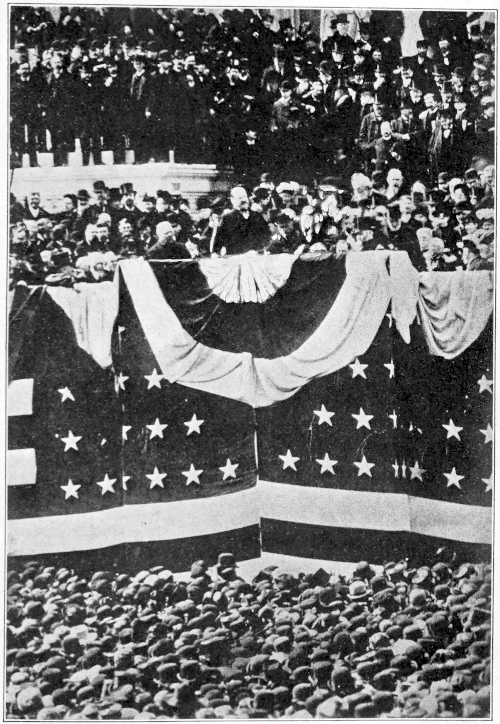
Photo. by Clinedinst Studio, Washington, D. C.
THE INAUGURATION OF GROVER CLEVELAND
In September, the White House nursery had another
occupant, with the birth of another little daughter,
Esther. Much of Mrs. Cleveland’s time had been
occupied in making many of the dainty little garments
after she had withdrawn herself from social affairs for the
summer months.
While the general public was deeply interested in Ruth
Cleveland, she did not command the same degree of
enthusiasm as was showered on her little sister Esther,
since Esther was a real White House baby, the ninth
child born under that famous roof, just as her mother was
the ninth White House bride. These facts gave the
people of the country a proprietary feeling toward this
mite of humanity, and resulted in a deluge of gifts of
all kinds and degrees of loveliness and value. In fact,
not only America, but England, France, Germany, Russia,
all not only sent messages to the babe and her lovely
mother, but followed up their missives of greeting with
gifts, until a huge supply had accumulated. There were
dainty white furs from the Far North, linens from the
cloisters of Spain, dresses, christening robes, sacks,
socks, robes, booties of wool, of kid, and of chamois,
bibs, wee bits of baby jewellery—everything a baby needs
multiplied many times. A room overflowed with toys,
and one paper of the time, in describing the deluge,
insisted that there were enough cradles, cribs, and carriages
for a full score of babies, and toys enough for an
asylum.
The day Esther was born, the President received
informally the young Japanese Prince Yorihato Komatsu,
the grand-nephew of the Mikado, who was travelling
around the world incognito.
One of the events in which Washington was greatly
interested was the one hundredth anniversary of the laying
of the corner stone of the United States Capitol, which
occurred on September 18, 1893. The celebration started
with the ringing of the centennial chime, after which there
was a procession, and other features by civic organizations
as nearly like those of a hundred years ago as the changed
conditions would permit. William Wirt Henry, a grandson
of Patrick Henry, was one of the speakers.
The prevalence of hard times and the growing numbers
of unemployed brought to pass the assembling of “armies”
in all parts of the country. The first of these aggregations
of unemployed, led by a horse dealer named Coxey, set
out for Washington from Ohio to demand relief from the
government. Other armies with the same object started
from the Western Coast states and from Texas, numbering
in all about six thousand men. Many of them were
honest and sincerely desired work. Others were toughs
who joined for a lark and followed what seemed to promise
adventure. Still others were plain everyday tramps and
loafers and criminals. They begged for food, and when
it was not forthcoming they foraged; and when they grew
tired of marching, they simply boarded trains and rode.
Coxey reached Washington, mounted the steps of the
Capitol, made addresses, and hung around the city for
a while. His “army” camped near by from April 26 to
May 1, 1894. Its presence necessitated the increasing
of the White House Guard from twelve to twenty-six men.
As long as no open act of lawlessness and disorder was
committed, Coxey and his followers were unmolested;
they wearied of their futile task and disbanded without
accomplishing anything.
Soon afterward, in the city of Chicago, a strike occurred.
Two thousand workmen employed by the Pullman Car
Company decided they must have higher wages. Men
on some of the Western roads also struck out of sympathy
for the Pullman workers, deciding they would not work
to help in the use or operation of the trains until the
Pullman workers got their desired raise. They carried the
determined stand so far that, for a time, not a train was
running between San Francisco and Chicago.
On June 28th, the American Railway Union, directed by
Eugene Debs, declared a boycott on all Pullman cars,
thereby tying up all railroads west of Chicago hauling
these cars. The next day, the United States Court at
Chicago issued an injunction against the strikers, as the
mails were prevented from proceeding. When it was
brought to the President’s attention that the governor
of the State of Illinois either could not or would not take
steps to break the strike, he made the cryptic statement,
“I will call out the whole army, if necessary, to deliver
a postcard.”
Those who knew President Cleveland and his unfaltering
determination in the pursuit of duty were satisfied that
he would bring the strike to an end.
Major General Miles, then in command of the Missouri,
with headquarters in Chicago, brought the news to the
President that the city was at the mercy of the mobs, and
the seriousness of the situation was intensified by the fact
that there was more than twenty million dollars in the
Sub-Treasury, a fact that was generally known. The
food supplies in the East were jeopardized, especially if the
strike were to extend eastward. The President lost no
time in ordering the United States troops to the spot.
The strike leaders were arrested and communication between
them and their henchmen prevented; so the strikers
disbanded and went back to work, and the strike
collapsed. The relief over the settlement of the trouble
may be appreciated when it is realized that a mob of ten
thousand men were idle in Chicago alone and that the
traffic blockade extended from Illinois through Indiana,
Iowa, Missouri, North Dakota, Montana, Oregon, Washington,
Wyoming, Colorado, Utah, Nevada, California,
New Mexico, and Nebraska.
During this administration it was found expedient to
abandon the Force Act. As the country had gradually
stabilized and state governments had become efficient,
Federal troops were not required to be present at state
elections, and the Force Act, providing for such measures
when needed, was repealed.
The first year of the second administration was certainly
a trying one for the Executive, since, while directing his
energies to controlling and conquering a host of problems
at home, the nation became involved in another dispute
with England over the Behring Sea and seal hunting.
Past experience had proved the wisdom of referring such
matters of foreign disagreement to a commission. The
same policy was followed, and a commission of seven
prominent men was chosen by the United States, England,
France, Italy, Norway, and Sweden to adjust the matter
of contention. An amicable settlement resulted, which
provided that the Behring Sea should remain open, but
that seals should be protected against indiscriminate
killing.
Many have declared Cleveland’s act in regard to the
Venezuelan matter the most important of his administration.
For a number of years, the boundary line
between New Guinea and Venezuela had been a matter
of dispute and contention. Venezuela finally appealed
to the United States to use her influence to induce Great
Britain to submit the matter to arbitration. The idea
was not favourably received by the British Government.
President Cleveland’s ideas on the matter began to
clarify, and he sent a message to Congress December 17,
1895, accompanied by all of the correspondence in the case,
and recommended the appointment of a commission to
determine the actual boundary. His message intimated
that the United States would enforce the decision.
Congress followed the President’s lead; the commission
was appointed, but before it had completed the task
assigned, England had come to an agreement with
Venezuela, a joint board of arbitration having been
appointed. Although the President received a great deal
of criticism for his application of the Monroe Doctrine,
the country’s prestige was much increased.
President Cleveland stood firm for Civil Service reform,
which had always been one of his hobbies, and before his
term closed, about half of all offices of the government
were already under Civil Service and filled by competitive
examinations, instead of being parcelled out as political
patronage.
After a long and bitter struggle, Congress enacted a
tariff measure, a modified form of the Wilson Tariff. This
reduced protective duties about one fourth and admitted
free lumber, wool, and salt. It also condemned trusts.
The public was always interested in the Cleveland
babies, and spontaneous congratulations, greetings, and
gifts poured in when it was known that the stork had paid a
visit to Gray Gables in July of 1895, leaving another small
daughter, upon whom was conferred the name of Marian.
By this time, little Ruth was finding her busy father a fine
playfellow, and many good times they had drawing pictures
and making things together in his office when his
day’s work was done.
The people of the South had planned an exhibition. It
was called “Cotton States and International Exhibition,”
and was opened in September, 1895, by the pressure of the
electric button by the tiny finger of the newest White
House baby, Marian. Thus from the gun room of her
father’s charming house, Gray Gables, on Massachusetts
Bay, the two-months-old infant set all of the wheels
revolving to open the exposition. Great gates and doors
swung wide; machinery started buzzing; and with the
boom of the cannon and the sound of the shrill whistles,
the activities of the great exposition were set in motion.
With the admission of Utah in 1896, the number of
states was forty-five.
Li Hung Chang, Chinese statesman, commander-in-chief
of all forces in the war with Japan, and originator of
the Chinese Navy, on a tour of the world, came to visit the
United States, August 28, 1896. He was received by
President Cleveland the following day. The original
comments and pertinent queries he made while here were
the source of much amusement.
Mrs. Cleveland’s last season in Washington was as gay
as her manifold duties would permit. Three babies are
a full measure of responsibility even for a mother aided
by the best nurses procurable. One of her long-discussed
functions was a luncheon for forty-eight guests for her
husband’s sister, Miss Rose Cleveland. This was most
elaborate and elegant.
The last Christmas in their administration was a gay one
for the children. Three little stockings were hung on the
chimney shelf. There were many gay parties with the
Lamont children and other little folk of the Cabinet
household, and a whole room filled to its utmost capacity
with wonderful gifts and toys.
Though the eyes of the nation were already turning
toward the future occupants so soon to be installed in the
White House, public interest in the Clevelands had not
diminished. Mrs. Cleveland’s New Year reception of
1897 and the evening reception which followed were
attended by the largest throngs ever known. People
seemed just to realize she was leaving the White House,
and they were anxious to see and speak with her. Many
brought their children, impressing upon them the impending
departure of the sweet wholesome lady who gave
another opportunity to shake her hand to those who had
been too confused to do so when they first passed. Great
numbers of guests crowded also to the last of the Saturday
afternoon receptions. These delightful affairs for the
public ceased with Mrs. Cleveland’s departure, and since
her régime, there have been no affairs for the public save
the New Year receptions.
From Helen Nicolay’s pen this description of one of
Mrs. Cleveland’s farewell “crushes” is taken in part:
“A little before three o’clock Mrs. Cleveland entered
on the arm of Colonel Wilson, and took her place in the
improvised passageway, near the northern door leading
from the Red into the Blue Room. Colonel Wilson stood
between her and the door.
“Then the doors were opened and the real reception
began, when for two hours people of high and low degree,
white and black passed through the room at the rate of
twenty-five a minute. Mrs. Cleveland had a smile and a
hearty handshake for each one, and her quick wit and
gracious tact were exercised to the utmost in kindly deeds.
The little woman, for instance, who was so absorbed in
gazing at her hostess’s beautiful face that she missed
the outstretched hand was given another chance, after
she had quite passed on; and the children were greeted
with special kindness. There were touchingly many
children: little ones in arms, toddlers almost as small,
who seemed in danger of being trampled underfoot, but
who had been brought because it was Mrs. Cleveland’s
last reception and in after years they would be proud
to have seen and touched the hand of this most popular
mistress of the White House.
“Women of course made up by far the larger part of the
crowd. Many were evidently ‘flustered’ and passed
on with set smile and lowered eyelids, hardly seeing the
President’s wife at all. Others seemed trying to photograph
her face in their memory. The men were more
inclined to stop and make little speeches to the First Lady
of the Land; they cared not one whit what she wore.
But the young officer standing opposite laid a warning
hand on the arm of each who wished to linger, and urged
him on. Sometimes a rather vigorous push was necessary
to start the procession again. A few coloured people
came through, both men and women, more men possibly
than women. One regular Topsy of a servant girl, black,
undersized, in battered straw sailor, twisted into shapes
that only a coloured Topsy’s hat can assume, with tattered
apron and faded clothes, walked down the line, gleams
of such exultant daring and satisfied desire illuminating
the look she rolled over the daintily clad ladies behind
Mrs. Cleveland, that it seemed a whole revelation of
character, and a volume of race history besides. Toward
the end of the reception two Indians added their characteristic
features to the throng.
“Occasionally the stream would be held back for a
moment or two, that she might rest, and she would turn,
a little breathless, to lean on the back of the sofa and
survey the group of people behind her, with bright nods to
this and that acquaintance. During one of these intervals
she showed her shapely ungloved right hand to a lady
standing near. It was literally black with the contact,
but as she regarded it with an amused smile she asserted
that she was not at all tired. Three hours of such exercise
might make her so, two hours never did.
“At five o’clock Mrs. Cleveland again took Colonel
Wilson’s arm, and followed by the Cabinet ladies, proceeded
to the dining room. There the ladies from behind
the line, and such as had been personally invited to stay,
joined them. A round table was set with tea things,
red roses, fancy cakes, and the gold spoons of the state
dinner service. Chairs were placed in two or three rows
around the sides of the room, and Mrs. Cleveland begged
us all to be seated. The company broke up into little
groups, when tea and ices were served, Mrs. Cleveland
being helped first. She then moved about, cup in hand,
from group to group, sitting and chatting a few moments
with each.
“It made a picture long to be remembered—the square
room with its airy buff-tinted walls, and sideboard set with
historic china and silver, the dainty table, the groups of
attractive women in dresses as many-tinted as a garden
of flowers; the gay pinks, greens, cherry, blues, and whites
subdued to just the right proportion by those of gray and
black and rich dull colours; and moving about among them,
Mrs. Cleveland in her lavender gown, by far the most
beautiful woman there, and as wholesome and sweet and
natural as the violets at her belt.”
The ladies of the Cabinet, learning of Mrs. Cleveland’s
love for the “true blue” of the turquoise, presented her
with an exquisite ring set with this gem as a parting gift of
affection.
She set the mansion in order for Mrs. McKinley and
departed with her little folks to get the new home at
Princeton ready for her husband, who, with the burden of
state lifted from his shoulders, joined a party of friends
for a restful cruise and fishing trip before joining her.
Achievement was writ large upon Grover Cleveland’s
presidential history page. He laboured long and arduously
for the welfare of the nation, most of the time
under the strain of great criticism, but he discharged
his duties in a way that, as time goes on, adds greater
lustre to his name.
Upon his retirement, Cleveland sought a quiet life in
the university town where he was actively associated with
the college. He maintained an interest in various financial
enterprises and, for the first time in his busy
life, indulged in his favourite pastimes of hunting and
fishing with a group of old friends and acquaintances
among whom was Joseph Jefferson, the actor. Those
who doubt the charm and humour of Mr. Cleveland’s
conversations should read his fishing and duck-hunting
stories. Most of all he enjoyed his young family, two sons
being born within a few years of his retirement. He was
an interested and sympathetic adviser in Mrs. Cleveland’s
many activities, especially her promotion of kindergartens.
Many civic honours came to him. He died at his home
in Princeton June 24, 1908, and was buried in the Princeton
Cemetery.
CHAPTER X
FIRST ADMINISTRATION OF WILLIAM
MCKINLEY
March 4, 1897, to March 4, 1901
FEW inaugurations have witnessed such a happy combination
of good weather, universal enthusiasm, and
unusually large throngs of visitors as attended the first
inauguration of William McKinley.
President Cleveland drove to the Ebbitt House, where
Mr. McKinley was staying, and then together the incoming
and the outgoing Presidents rode to the Capitol accompanied
by two members of the Senatorial Committee.
Mrs. McKinley left the hotel about ten minutes before
eleven o’clock. She walked to the carriage leaning on
the arm of Secretary Porter, who had left the President-elect
at the White House and had then returned hastily
to the hotel for the purpose of seeing to the comfort of
Mrs. McKinley. On the other side was Chairman Bell,
of the inauguration committee, and between the two
stalwart men, the lady who was to be first in the land was
tenderly sheltered from the crowd which pressed upon
them from every side.
Mrs. McKinley looked pale but happy. With her were
her sister, Mrs. Mary Barber, little Kate Barber, and the
President’s mother, who refused to be separated from
these members of her family. Several officers of the
regular army were in attendance to escort them.
After the ceremonies in the Senate Chamber, the
President-elect was sworn in by Chief Justice Fuller on
the East Portico, where thousands of people had gathered.
In the bright light, his face, when he stood bareheaded
to take the oath of office, was clear to all.
Mrs. McKinley, his aged mother, sat close beside him,
and her evident pride and gratification were noted with
pleasure, as was also his affectionate greeting to her and
his wife at the conclusion of the ceremonies.
The presidential party took luncheon at the Capitol
after the official exercises on the inaugural stand and before
starting to the White House. It is said that Mr.
McKinley ate sparingly, ordering only a roll, a cup of
coffee, and a piece of ham.
As he and ex-President Cleveland later emerged from
the Capitol, the cavalry buglers sounded a salute, the
troopers came to present arms, and the great throngs
pressed forward to catch a glimpse of the new President.
Cheer on cheer went up, frightening the horses and making
some confusion in bringing forward the handsome turnout
which was to bear the party to the White House. The
President bowed and smiled.
In his triumphal progress from the Capitol to the White
House, President McKinley had for his escort a famous
volunteer cavalry organization, Troop A of Cleveland.
They preceded the carriage, while behind came the
Twenty-third Ohio, the regiment which the new President
had led in the days of the Civil War. Following in the
wake was one of the greatest military and civic cortèges
ever assembled. It was late in the day before the last
of them had passed in review before the President. The
number of political clubs in the parade was greater
than at other inaugurations, and formed an interesting
feature of the festivities. Observing that the salutes were
continuous, Mr. McKinley at last sat bareheaded, hat in
hand, waving acknowledgment to the multitude.
Enthusiastic praise was given veterans in the parade.
When General Cecil Clay, who had charge of the District
militia, passed the reviewing stand he raised the remnant
of his right arm in salute, and the spectators rose and
cheered with all their might. General Howard, who had
but his left arm remaining, was similarly greeted when he
put his reins between his teeth and saluted with his left
arm.
When, at the conclusion of the parade, the President
stepped on the portico of the White House, he was met by
Mrs. Grant, the widow of the illustrious warrior and
ex-President, who, in company with Bishop Newman, had
been patiently waiting for this opportunity of meeting
him. He greeted them so cordially that both felt fully
repaid for their long wait. The President then entered
the White House, and a great crowd that had followed his
footsteps closed up against the doors. Failing to secure
admission, they took their station at the windows and
eagerly struggled to get at least a glimpse of the interior.
The President received a few intimate friends, including
Senator Hanna; then dinner was served. The guests
were Abner McKinley, brother of the President, Mr. and
Mrs. M. C. Barber and daughter Mary, and Mrs. Maria
Saxton. The initial dinner at the White House was entirely
informal. Although no callers were received after
dinner, thousands of curious people crowded the portico
and demanded admittance. It was only by the vigorous
efforts of a cordon of police that the doorway was kept
clear.
Again the Pension Building was the magnet, drawing
youth, beauty, and fashion, as well as the curious, to tread
the stately measure of the march and dance. This time
the magnificent ballroom was a symphony of white and
gold, which made a glowing background for the rainbow
tints of the gowns.
Mrs. McKinley’s ball gown of her favourite shade of
blue silk had a long train, high neck, and long sleeves.
It was a lovely combination of brocade and point lace,
diamond pins fastening the lace at the corsage. Diamond-studded
side combs held her hair in soft puffs in front in
accordance with the prevailing fashion.
The President’s aged mother, very stately in her rich
black satin, seemed to get as much enjoyment out of the
ball as she had got out of the proceedings at the Capitol.
After the presidential party had greeted the assemblage
as they passed through the ballroom, supper was served
in the room splendidly decorated for them, and they
returned to the White House early, as Mrs. McKinley’s
fragile strength had been put to a severe test through the
long, exciting day. The President’s mother, whose joy
in her distinguished son and his honours was a rejuvenating
tonic, was also fatigued.
A detail of the inauguration of particular interest to
many visitors was the unusual car which had been provided
for Mr. McKinley’s trip from Canton to Washington.
It was a private car without name, known simply
as “No. 38.” The walls were of white oak, solid, instead
of the ordinary studding. The top was a double framework
of steel with a cushioned ceiling. The floors were
of four thicknesses of white oak. Such unusual construction
made the car proof against smashing in collision
or breaking should it roll down an embankment. Every
home comfort was provided: an old-fashioned log fireplace,
two elegant bedroom apartments with bath to each,
dainty china, rich silver, and every conceivable luxury to
make travelling a delight.
Mrs. McKinley brought with her a young German
maid, devoted to her and convinced that no former
mistress of the mansion could approach her beloved
mistress in elegance. During the week following inauguration,
“Lena” took especial pride and delight
in personally conducting Mrs. McKinley’s relatives and
intimate friends on an inspection tour of her dressing room
to display to them the White House outfits of the First
Lady and her niece Miss Mary Barber, who spent much
time with her.
It is doubtful if any White House mistress brought a
more complete or elegant wardrobe with her than the one
upon which Mrs. McKinley had expended ten thousand
dollars and much thought and in the selection of which
“the Major” had been drawn into consultation. For
the early formal functions she had provided eight unusually
beautiful gowns that brought enthusiastic praise
for her good taste.
When McKinley, the twenty-fifth President of the
United States, took the oath of office on the 4th of March,
1897, he was admirably equipped for the duties of his new
position. He had been for years prominent in public
life; his personal character and private life had endeared
him to the hearts of the people; he was in the prime of
manhood; he was a student of affairs. He was more of a
politician than of a statesman, but the development of
events proved that he could be either or both. His regard
for the popular will and his long training in accurately
judging its expression served as a restraining influence in
his policies and prevented dangerous and possibly fatal
rashness. When his plans had been fully matured, they
were executed with skill. Each succeeding year, with its
additional burden of important questions, saw the President
broaden and develop in the art of government.
His early background had much to do with his success.
He was born in Niles, Trumbull County, Ohio, January
29, 1843. His father, William McKinley, Sr., moved to
Ohio from Pennsylvania. The family was Scotch-Irish,
whose forefathers had come to America 150 years before.
He was the seventh child in the family of nine. As a boy,
he had regular schooling and was especially noted for his
brilliancy in debate. Later, he taught in the public
schools of the Kerr district, near Poland. About this
time, he joined the Methodist Episcopal Church and
became a diligent student of the Bible.
At the outbreak of the Civil War, he was a clerk in the
Poland post office. When the call was made for volunteers,
young McKinley was among those who stepped
forward. He went with the recruits to Columbus and
was enlisted as a private in Company E, Twenty-third
Ohio Volunteer Infantry. This regiment numbered among
its officers William S. Rosecrans, afterward major general,
and Rutherford B. Hayes, later nineteenth President of the
United States.
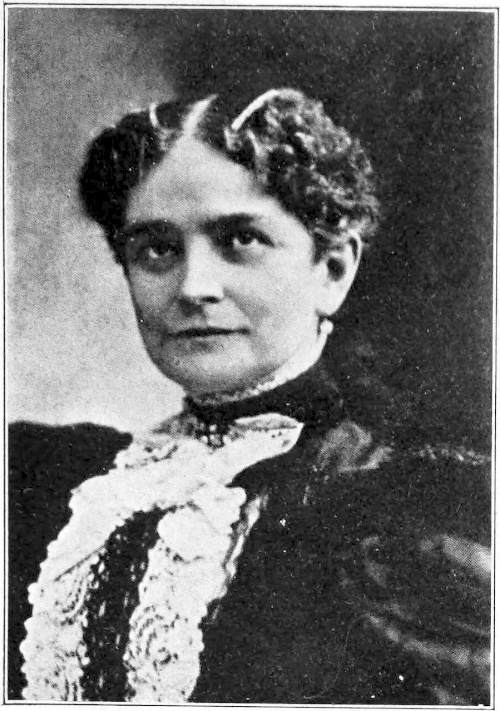
MRS. IDA SAXTON McKINLEY
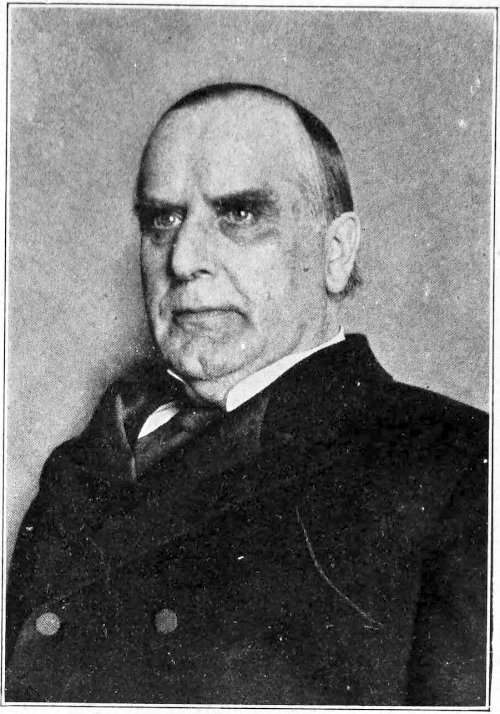
Photo. Underwood & Underwood
WILLIAM McKINLEY
Many are the soldier stories of camp and battlefield
in which McKinley figured. Henry H. Woodruff, of
Oakland, Cal., who served in the same regiment with him,
sent the author the following story of the famous old
Twenty-third Ohio with McKinley’s service to it in war,
and its service to McKinley when he was President. He
says:
“I was born in the township of Mecca, County of Trumbull,
State of Ohio, July 15, 1841. Wm. McKinley was born
in the next township at Niles, in Trumbull County, Ohio,
January 29, 1843. I entered the preparatory department
of Oberlin College, Oberlin, Ohio, about thirty miles west
of Cleveland, April 15, 1861. We were in class in old
Tappin Hall, when the Professor read a dispatch from
Washington City stating that President Lincoln had called
for 75,000 men to go to the front to put down the Rebellion.
Instantly every male member of that class volunteered,
grabbed his hat, rushed out in front of the
building, and tried to form a line, or company, as we had
no military knowledge, being only farmer boys or students.
We took the cars for Cleveland, going into Camp in the
old Fair Grounds called ‘Camp Taylor.’ Other companies
began to arrive, officers were elected, and we were
formed into a regiment and given the number Twenty-third
Ohio. We soon moved to ‘Camp Chare’ at Columbus,
where the regimental organization was completed
and Wm. Stark Rosecrans appointed colonel.
“As new companies arrived, I sometimes would go
among them and get acquainted with the boys. One day
I visited Company E and, to my surprise, found a Private,
my neighbour, Billy McKinley. Colonel Rosecrans took
the regiment into West Virginia, where we were just in
time for the battle of Cainifax Ferry, September 10, 1861.
This is the first battle the writer or ‘Billy’ ever saw. We
moved around considerably, joining other forces all under
command of ‘Old Rosey.’ We had fought nineteen
battles before the war was over, commencing at Cainifax
Ferry and ending at Fisher’s Hill, in the upper Shenandoah
Valley.
“After serving as a private for one year, McKinley was
promoted to Regimental Commissary Sergeant and got his
first shoulder straps, for the meritorious act performed
by him at Antietam. We lined up for battle and commenced
firing before the sun rose. McKinley, knowing
the condition of our haversacks, drew from the quartermaster
1,000 rations of fresh beef, got camp kettles, pressed
some men into service, cut up and cooked the entire
amount, pressed a teamster (John Harvey by name) into
service, got some crackers and drove along behind the line
still in battle, giving every man a chunk of beef between
two crackers. I thought then and still think it was the
sweetest morsel I ever ate.
“This act was noticed by Colonel (afterward President)
Hayes, who was in command, and McKinley got a commission
as Second Lieutenant. From this he rose rapidly
through all grades, ending with Brevet Major, then Governor
of Ohio, and President of the United States.
“Soon after his election he began to make plans for his
inauguration, and among other things, he issued an invitation
to his old regiment to assemble in Washington
City and to act as his escort on Inauguration Day, with
the result that ninety-six members arrived at our headquarters,
very proud of our honoured Comrade ‘Billy,’
as he was called.
“Next morning, we assembled in the Capitol grounds to
witness the second member of our regiment take the
oath of office as President of the United States. We took
the post of honour under the command of Captain Skyles,
whom we had elected as our Commander, formed on
Pennsylvania Avenue, and with great pomp and honour
escorted the new President to the White House, his future
home.
“Next day was set apart for the foreign diplomats to
make their official calls on the new President. When we
arrived there was a great crowd ahead of us. English,
French, German, Japanese, Chinese, etc., with their
retinues of officers and servants all waiting their turn of
admission. The doors were securely locked and guarded
by armed men; soon the President appeared at the door
and speaking to the guards, said, ‘Let my comrades in
first.’ Captain Skyles gave the order, ‘Forward, Twenty-third.’
When I heard that welcome order, my head
swelled with pride and I got a California strut on me,
as we marched by so many waiting diplomats into the
East Room, to shake hands with our highly honoured
comrade.”
Major McKinley participated in the final act of the
great war drama, the grand review in Washington. On
his return to Poland, a complimentary dinner was given
him by the citizens. He entered the office of Judge
Charles E. Glidden, at Youngstown, Ohio. After one
year’s study under the preceptorship of Judge Glidden, he
went to law school in Albany, N. Y., and in March, 1867,
was admitted to the bar at Warren, Ohio.
On the advice of his sister Anna, he decided to settle
at Canton, and was elected prosecuting attorney of Stark
County in 1869. He was renominated, but missed
reëlection by forty-five votes. Resuming his private
practice, he soon built up a profitable business. But in
all political campaigns he was in constant demand as a
speaker.
Mr. McKinley was married to Miss Ida Saxton on
January 25, 1871. Miss Saxton’s grandparents were
among the founders of Canton nearly a century ago. She
was the daughter of a prominent banker, James A. Saxton,
and granddaughter of John Saxton, who established a
well-known publication, the Canton Repository, during
the War of 1812.
Miss Ida Saxton was born in June of 1847. As a girl she
was extremely pretty, lively, and popular. While completing
her education she also participated in the various activities
of her time for soldier relief. Her father undertook
the supervision of her training and education, and as soon
as her graduation closed her studies at a seminary in
Media, he resolved she should be properly trained in
practical business, especially as she would have a little
property left her. Consequently, she served as his assistant
in the bank with which he was associated.
When about nineteen, and when she had been in the
bank about three years, her father died. His loss was
such a shock that she was threatened with serious illness,
and her older sister, with whom she lived, persuaded her
to travel abroad.
After her return to Canton came the romance of her
life with the young lawyer who had just been elected
prosecuting attorney of Stark County. Like the Harrisons,
they started their married life in a boarding house,
but only until their own little home was ready. Here
their first child, Katie, was born, late in December of 1871.
This little one lived to be three years old. Another little
daughter, named Ida for the young mother, also died in
infancy. Added to the grief of losing her children, she
had the additional sorrow of her mother’s death. Altogether,
the shock proved too much for her reserve force.
From the time she was sixteen, ill health had threatened,
and the poignant grief for her loved ones made her an
invalid.
Mr. McKinley was first nominated for Congress in
1876, and elected. During the progress of this canvass, he
visited the Centennial Exposition at Philadelphia and
was introduced by James G. Blaine to a great audience
which he completely captivated.
He entered Congress while his old colonel, Hayes, was
President, and the friendship gave him at the start an
influence which might have taken a much longer time to
win under other circumstances. His power as a speaker
brought him distinction, and his ability as a worker in
committees was soon recognized. He was reëlected to
the Forty-sixth, Forty-seventh, Forty-eighth, Forty-ninth,
Fiftieth, and Fifty-first Congresses. During his
whole career in Congress, Mr. McKinley was a consistent
advocate of a protective tariff.
It was in the Fifty-first Congress that McKinley’s great
political opportunity came. He was a leading candidate
for the speakership with Thomas B. Reed. Reed was
elected. The chairmanship of the powerful Ways and
Means Committee fell to McKinley. On April 6, 1890,
he introduced the tariff measure which has since borne his
name. The bill became a law on October 6, 1890. During
all of the struggle while the bill was pending, McKinley
displayed qualities of leadership of the highest order.
Before the next election came around, his district had
been gerrymandered against him, the adverse majority
being fully 3,000. McKinley was defeated by 300 votes.
His defeat really made him Governor of Ohio. His
victory over Governor Campbell, the Democratic candidate
for reëlection, was decisive.
He was the presiding officer of the Republican National
Convention at Minneapolis in 1892, when the attempt was
made to stampede the delegates for him. It was a most
trying situation, but he bore himself with coolness and
decision. When Ohio recorded two votes for him, he
challenged the vote so as to put himself on record for
Harrison. When the roll call was complete, Harrison
received 535 votes, Blaine 182, McKinley 182, and Reed 4.
Leaving the chair, Mr. McKinley mounted a seat in the
Ohio delegation and moved to make the nomination of
Harrison unanimous. Governor McKinley’s campaign
tour through the West for Harrison was one of the marvels
of the time. He made 325 speeches in 300 different towns.
For more than eight weeks he averaged more than seven
speeches a day. He travelled over sixteen thousand miles
and addressed more than two million people.
Toward the latter part of Mr. Cleveland’s administration,
it became clear that the free silver faction of the
Democratic party would control the Democratic Convention,
but the Republican Convention assembled first.
One of Ohio’s wealthy manufacturers, Marcus A. Hanna,
became convinced that the Republican party needed
William McKinley for its leader, and he set about bringing
this to pass with his own business methods. At the
convention, Governor McKinley was nominated on the
first ballot, with Garret A. Hobart, of New Jersey, for
Vice President. The Republican platform declared for
protection.
In the Democratic Convention, events had been more
spectacular. Old leaders were superseded by more radical
ones, and the West became a factor in politics with William
Jennings Bryan making his first appearance. He
attended the convention merely as a reporter, and when
he seized the opportunity during a long debate to launch
his Cross of Gold and Crown of Thorns speech, he electrified
the assembly, and in the wild enthusiasm which it
aroused, he was nominated. While John R. McLean, of
Ohio, had the lead for the Vice Presidency until the fourth
ballot, he lost to Sewall, of Maine.
Bryan made a meteoric speech-making dash over the
country that played havoc with party allegiance, for
many Democrats swung to the support of the Republican
candidate, and many Republicans preferred to trail with
the following of the silver-tongued orator. From this
time on, William Jennings Bryan was a factor to be
considered in the politics of the land.
The platform of free silver faction of the Democratic
party called for the free coinage of silver at the ratio of
sixteen to one and turned against the administration of
Cleveland.
The silver Republicans also had a convention, endorsing
Bryan for President and Thomas E. Watson of Georgia
for Vice President.
The gold Democrats nominated John M. Palmer,
Union veteran of Illinois, for President and Simeon B.
Buckner, a Confederate veteran for Vice President.
The Prohibition party also split on the silver question.
The Republicans made their fight on the money stringency
and the tariff.
When the confusion subsided and the electoral votes
were counted, they gave the election to McKinley with
a vote of 271; Bryan received 176. A Republican majority
prevailed in both Houses of Congress, and “free
silver” was thus proved not so alluring as a national
measure.
Where McKinley went, Mrs. McKinley usually accompanied
him, and from the time he was nominated she
had little peace of mind. At his home, when the news of
his election was read, she was greatly distressed. “Oh,
Major, they will kill you, they will kill you!” she exclaimed.
He put his arm about her and turned to his
guests and, smiling, remarked, “This little woman is
always afraid someone is going to harm her husband.”
His calm, loving touch reassured her in a measure, but
some of her friends have declared that she never really
knew peace of mind when he was out of her sight, for
they were satisfied she had a premonition of his fate.
Immediately upon his induction into office, President
McKinley called an extra session of Congress to revise the
tariff. The passage of the Dingley bill, levying higher
taxes on some exports, bade fare to cover the revenue
situation.
The trouble with Spain became the centre of attention
and soon reached a point where action was necessary, as
the island of Cuba was in a chronic state of revolt, and
rebellion had broken forth over the failure of Spain
to redeem her promises of self-government. President
McKinley strove to keep out of participation, but the
hostility of the Spanish on the island was so intense
that all his advisers urged the dispatch of a warship as a
protective measure for American citizens. He demanded
that:
“In the name of humanity, in the name of civilization,
in behalf of endangered American interests, which give us
the right and duty to speak and to act, the war in Cuba
must stop.”
Endeavouring to give every opportunity to Spain in her
promises of reform, the President held Congress in
temporary control, while reams of diplomatic correspondence
were interchanged. In the midst of these communications—characterized
on the part of the President
by insistence upon new conditions and on the part of
Spain by plausible evasions and constant seeking for
delay—the American battleship Maine was blown up
in Havana Harbour and 266 men were murdered. From
that moment, a war with Spain was certain. The President
found the country unprepared for a conflict. He
temporized Congress and dallied with Spain, while the
armouries worked day and night and warships were gathered
in American waters from all parts of the world.
Meanwhile, a month and seventeen days before war was
declared, Congress placed in the hands of the President,
without restriction or condition, the sum of $50,000,000.
It was voted to him unanimously by both Houses, a mark
of personal confidence and an evidence of the patriotic
extinction of party lines in the face of a great emergency.
The war cloud burst, and in less than ninety days the
skies were cleared again. Cuba had been liberated,
Porto Rico had been gathered under the American flag,
and, as an indirect but necessary result, Hawaii had been
annexed. All of these things were not to be compared
in importance, however, with the fact that the defeat of
the Spanish fleet in Manila Harbour by Commodore
Dewey’s squadron had ousted the Spanish from their
possession of the Philippine Islands, a possession which
they had enjoyed for three centuries. The United States
at once became a world power in the Orient. All the
other remarkable events of McKinley’s administration—any
one of which would have made it memorable—pale
into insignificance before this acquisition of a vast archipelago,
with 1,200 islands and 10,000,000 people, situated
7,000 miles from our shores.
President McKinley, overwhelmed with problems which
would have crushed a man of smaller calibre and less
experience with national affairs, met his new responsibilities
with admirable courage. He did not act hastily.
On the contrary, one of the features of his administration
was the deliberation with which he developed his important
policies, and for which he was most bitterly criticized.
The Philippines presented from the first the most serious
problem. Situated on the other side of the world, populated
largely by savage races who maintained slaves and
recognized polygamy, the Islands nevertheless possessed
large commercial value and were considered important
because of their situation on the threshold of the Orient.
The military administration which the President at once
established was not altogether satisfactory, and he sought
the assistance of distinguished civilians, appointed by
him as commissioners, in devising another form of government.
The military transferred to the commission, of
which Hon. William H. Taft was president, all duties of
a purely legislative nature. To this commission the
President outlined in great detail a policy which promised
much benefit to the Filipinos, assuring them of the
enjoyment of the privileges contained in the American
Constitution and promising them better educational
facilities, the development of their commerce, and all
the blessings which are the heritage of the American
citizen.
The war with Spain and all of its brilliant exploits, brief
as it proved to be, has been ably and fully covered by
historians and war correspondents. The most interesting
figure in the light of later events was Colonel Theodore
Roosevelt, with his picturesque Rough Riders, in the assault
and victory of San Juan Hill. The achievements
of Richmond P. Hobson, of Schley, of Sampson are all
brilliant pages in an epochal era of United States expansion.
Admiral Dewey’s victory at Manila Bay was celebrated
on his return with a remarkable ovation. Once again
historic Pennsylvania Avenue resounded to jubilation.
Among the many functions given to the distinguished
naval officer was the one at the Metropolitan Club.
The story of the dinner, unique in many respects, is
given herewith:
“Two years ago, when club man George Dewey, then a
commodore in the navy, was on the point of leaving
Washington to assume command of the Asiatic Squadron,
some of his club mates at the Metropolitan Club gave him
a farewell dinner. Wines were drunk, toasts were made,
the best fellowship prevailed, and the memory of the
jolly, happy faces of his friends lingered in the mind of
Dewey all through the stirring events of the two years that
elapsed before his return to his country.
“Last night at the Metropolitan Club the same coterie
of friends gave to Admiral Dewey a dinner of greeting.
Upon the menu card was the menu of the dinner held on
the evening of November 27, 1897. On another page of
the card was identically the same menu, but underneath
was yesterday’s date. Five of those who were present
at the farewell dinner were absent last night. These
were Mr. William H. Emory, Mr. E. A. Garlington,
Mr. Thomas Hyde, Mr. Nathan Sargent, and Mr. L.
Vogel.
“The feature of the farewell dinner given at the Metropolitan
Club late in November, 1897, was a poem by
Hon. Archibald Hopkins. The poem was such an excellent
one and proved so prophetic that it has been quoted
from one end of the country to the other.
“Very naturally, Mr. Hopkins was asked to contribute
something for the dinner of last evening, as well as to
recite the original poem. Immediately after the victory
of Manila Bay, Mr. Hopkins wrote several stanzas as a
sequel to his effort of November, 1897. All these were
read and received with much enthusiasm by the company
last evening. A few of the stanzas are quoted:
‘What mean the crowds, the marching men,
The flags when he appears?
First, welcome to the Admiral; then
There rings through all the cheers
‘Not only praise for victory won;
There is an undertone
Exultant in new life, begun
Not for ourselves alone.
‘He left us but an outside power
’Mongst those that rule the world;
He made us, with the greatest, tower,
Where’er the flag’s unfurled.
‘Paul Jones a fighter unsurpassed,
Our Farragut beyond all praise,
And Dewey, from Manila last,
To share with them undying bays.
‘No heroes ever trod a deck,
Or sailed the rolling seas,
Through stress of battle, storm and wreck
More glorious than are these.
‘An epoch struck on Time’s great clock,
The day he won his fight;
Henceforth our Anglo-Saxon stock
Keep step for law and right.
‘Henceforth with kin beyond the sea,
We bid oppression die,
And pledge the better days to be
Where’er our standards fly.
‘The laurel with the vine is twined;
Give freest rain to cheer,
For fate is kind, we’ve dined and wined,
And got George Dewey here.
‘And now to make our toast complete,
It leaps to all your lips
Here’s to the captain of the fleet,
The men who fought the ships.
‘And fill us up one bumper more,
Till every glass o’erruns;
Drink, if you never drank before;
The men behind the guns.’
“The dinner last night was held in the upstairs banqueting
hall of the club, the same room in which the first
dinner was given, and the diners occupied the same
relative places that had been assigned to them two years
ago around the same board. The table was a big round
one. It was decorated with myriads of fragrant blossoms,
banked in the centre of the table and strewn over the
cloth. There were no other decorations excepting on one
wall of the room hung the wheel of the Spanish ship the
Reina Christina, which was lately sent to the club as a
memento of the May morning in Manila Bay.”
Although Clara Barton had been the “Angel of the
Battlefield” through the Civil War, when she started her
great humanitarian career with the care of the forty
wounded soldiers of the Sixth Massachusetts after the
Baltimore fracas, and the good angel of Europe through
the Franco-Prussian War and the Commune, for which
she was decorated by the governments engaged, it was in
the Spanish War that American soldiers knew her best
and where for the first time the Red Cross symbol and
service made its value known. Through her persistent
efforts, the famous “American Amendment” was added
to the Geneva Treaty of the Red Cross which was signed
by President Arthur. The American Association of Red
Cross was organized in 1881 with Miss Barton as president,
a position she held until 1904. It was at President
McKinley’s personal request that she carried relief to
Cuba and did personal field work through the war. In
his message of December 6, 1898, he expressed his own
appreciation and that of the American people for her
service during the Spanish-American War.
After peace was declared, the unfortunate controversy
between Admirals Schley and Sampson as to the credit
for the victory of Santiago led to a long investigation,
the matter having been referred to a Court of Inquiry, of
which Admiral Dewey was the president. This Court
held daily sessions in a large building in the Navy Yard,
and after forty days of investigation and thorough
consideration of all the points of criticism, Admiral Dewey
rendered the following opinion of the Court as a summary
of all the testimony taken:
“Commodore Schley, in command of the Flying
Squadron, should have proceeded with utmost dispatch off
Cienfuegos and should have maintained a close blockade
of that port.
“He should have endeavoured on May 23, at Cienfuegos,
to obtain information regarding the Spanish squadron by
communicating with the insurgents at the place designated
in the memorandum delivered to him at 8:15 A. M. of that
date.
“He should have proceeded from Cienfuegos to Santiago
de Cuba with all dispatch and should have disposed his
vessels with a view to intercepting the enemy in any attempt
to pass the Flying Squadron.
“He should not have delayed the squadron for the
Eagle.
“He should not have made the retrograde turn westward
with his squadron.
“He should have promptly obeyed the Navy Department’s
order of May 25.
“He should have endeavoured to capture or destroy the
Spanish vessels at anchor near the entrance of Santiago
Harbour on May 29 and 30.
“He did not do his utmost with the force under his
command to capture or destroy the Colón and other
vessels of the enemy which he attacked on May 31.
“By commencing the engagement on July 3 with the
port battery and turning the Brooklyn around with port
helm Commodore Schley caused her to lose distance and
position with the Spanish vessels, especially with the
Vizcaya and Colón.
“The turn of the Brooklyn to starboard was made to
avoid getting her into dangerous proximity to the Spanish
vessels. The turn was made toward the Texas and
caused that vessel to stop and to back her engines to
avoid possible collision.
“Admiral Schley did injustice to Lieut. Commander
A. C. Hodgson in publishing only a portion of the correspondence
which passed between them.
“Commodore Schley’s conduct in connection with the
events of the Santiago campaign prior to June 1, 1898,
was characterized by vacillation, dilatoriness, and lack
of enterprise.
“His official reports regarding the coal supply and the
coaling facilities of the Flying Squadron were inaccurate
and misleading.
“His conduct during the battle of July 3 was self-possessed,
and he encouraged in his own person, his subordinate
officers and men to fight courageously.
“George Dewey,
Admiral, U. S. N., President.
“Sam. C. Lemly,
Judge-Advocate-General, U. S. N., Judge-Advocate.
“In the opinion of the undersigned, the passage from
Key West to Cienfuegos was made by the Flying Squadron
with all possible dispatch, Commodore Schley having in
view the importance of arriving off Cienfuegos with as
much coal as possible in the ships’ bunkers.
“The blockade of Cienfuegos was effective.
“Commodore Schley in permitting the steamer Adula
to enter the port of Cienfuegos expected to obtain
information concerning the Spanish Squadron from her
when she came out.
“The passage from Cienfuegos to a point about 22 miles
south of Santiago was made with as much dispatch as was
possible while keeping the squadron a unit.
“The blockade of Santiago was effective.
“Commodore Schley was the senior officer of our squadron
off Santiago when the Spanish Squadron attempted to
escape on the morning of July 3, 1898. He was in absolute
command, and is entitled to the credit due to such
commanding officer for the glorious victory which resulted
in the total destruction of the Spanish ships.
“George Dewey,
Admiral, U. S. N., President.
“Sam. C. Lemly,
Judge-Advocate-General, U. S. N., Judge-Advocate.
“Recommendation
“In view of the length of time which has elapsed since
the occurrence of the events of the Santiago campaign,
the Court recommends no further proceedings be had in
the premises.
“George Dewey,
Admiral, U. S. N., President.
“Sam C. Lemly,
Judge-Advocate-General, U. S. N., Judge Advocate.”
Garret A. Hobart, the genial Vice President, died on
November 21, 1899. With the approach of the election
in 1900 the successful war President had no opposition
in the Republican Convention and was renominated, with
the Governor of New York, Theodore Roosevelt, as his
reluctant team mate. The Convention endorsed the administration.
Once more the Democratic Convention pinned its faith
to William Jennings Bryan by nominating him for President,
with Adlai Stevenson, Grover Cleveland’s Vice
President, chosen for his former office. The free coinage
of silver was presented as part of the platform, but
the opposition to the expansion of United States territory
was the policy emphasized. McKinley and Roosevelt
received 292 electoral votes to the 155 cast for Bryan and
Stevenson. Thus, after four years crowded with stirring
events of national interest and vital importance, buffeted
between public sentiment and private conviction, President
McKinley, the triumphant war President, found himself
again installed as the people’s choice.
CHAPTER XI
SECOND ADMINISTRATION OF WILLIAM
MCKINLEY
March 4, 1901, to September 14, 1901
THE second inauguration of President McKinley was
a wretched day, and sleet and snow beat upon him as
he took the oath of office. On the way to the Capitol,
Senator Mark Hanna rode by the President’s side. Theodore
Roosevelt took the oath as Vice President in the
Senate Chamber and made a brief address. Mrs. Roosevelt
and the children were present, as was Mrs. McKinley,
who was escorted and cared for by General Corbin. In
the parade from the Capitol to the White House there
was for the first time representation from an American
dependency. This was a battalion of dark-skinned Porto
Rican soldiers in Uncle Sam’s uniform.
The President’s mother had passed away in December
of the first year of his term, and the absence of her proud,
happy face was noted with a surge of sympathy for her
son, whose domestic life carried so much of anxiety.
The procession duplicated the previous one in size and
variety. The President reviewed this procession, from
within a large plate-glass case put up to protect him from
the inclement weather.
Callers filled the afternoon, and the ball and fireworks
occupied the evening.
The great ballroom of the Pension Building was again
a garden of tropical beauty, and was crowded to its utmost
capacity. Mrs. McKinley, whose frailty had at
first threatened to prevent her attendance at any of the
ceremonies, was eager to go, and despite the disagreeable
weather attended the ball; but her limited strength made
it advisable to omit the Grand March through the ballroom.
The President and his wife therefore remained
in their box only a short while, much to the disappointment
of the eager throng, who had hoped for a closer view
of the First Lady and her handsome gown of white satin
and jewels. Everything her sisters, sisters-in-law, and
nieces and the ladies of the Cabinet could do to make
things easy for her was done.
Mrs. McKinley loved to drive, but the President rarely
permitted her to drive without him. Her delight in
knitting never waned. It is said that her nimble fingers
knitted nearly four thousand pieces of dainty bits of wool
and silk—socks, mitts, bags, ties—all of which were made
for charity or for friends. Never was a request for a
gift of her own handiwork refused for fairs and bazaars.
Mrs. McKinley loved her friends. She was the personification
of gentleness and sweetness unless some criticism
of her beloved “Major” came to her ears. Then
she lacked neither force nor spirit in her defense of him.
Both she and the President loved music, singing particularly,
and the unusual musical entertainments which
they held were frequent and delightful.
As the first summer of the second term advanced, Mrs.
McKinley became so frail that a rolling chair was obtained
for her use; she had come to the point where she had to
be carried bodily up and down in the elevator. Owing
to her critical condition, a trip to the Pacific Coast had
to be curtailed. She was, however, able to be brought to
Canton, where she recovered sufficiently to go to Buffalo
with her husband, he having accepted an invitation to attend
the Pan-American Exposition there. “President’s
Day,” which was to feature his address, was set for
September 5th. He spoke, and received one long, delightful
ovation, the assembled crowds exerting themselves
to shower upon him their enthusiastic appreciation. The
glamour of the war victory was still upon him.
On the afternoon of the sixth, after the party’s return
from their visit to Niagara Falls, the President sent Mrs.
McKinley to the home of Mr. John G. Milburn, president
of the Exposition, their host, to rest from the fatigue of the
morning, while he went to the Temple of Music on the
Exposition Grounds, where he was to hold a public reception.
About four o’clock, one of the individuals of a
great throng that was passing approached with his hand
wrapped in a handkerchief. Mr. McKinley smiled in his
usual friendly fashion, extending his hand to the stranger.
Instantly, two loud reports of a pistol sounded sharp and
clear above the buzz of voices. After an instant of complete
stunned silence, during which the President looked
pained and bewildered, he straightened up, threw his
head back, and staggered into the arms of his secretary,
George B. Cortelyou. He was led to a chair, where he
bowed his head in his hands.
The crowds burst forth into cries and curses as the
realization was borne in upon them that the President had
been shot. He remained calm, and begged them not to
be alarmed, assuring those around him he was not badly
hurt. He opened his waistcoat and drew forth his hand
daubed with blood.
The scene that followed was frightful. Several men
threw the assassin, a Polish anarchist, a follower of the
teachings of Emma Goldman, to the ground, snatched
away his pistol, and would have taken justice in their own
hands and executed him but for the feeble words of command
from the stricken President, “Let no one harm him.”
He was locked up under heavy guard.
The President was at once taken on a stretcher to the
Emergency Hospital in the grounds, and the best surgeons
were summoned. The examination disclosed the fact
that the two shots fired at close range had both found
their mark: one struck him on the breastbone, and glancing,
had penetrated the stomach; the other had entered
the abdomen.
In reply to their announcement that an immediate
operation was necessary, he calmly replied, “Gentlemen,
do what in your judgment you think best.”
After a half-hour operation the surgeons were unable
to locate the bullets. Preparations were made to take
the mortally wounded man to the Milburn home.
When it was long past the hour for the President to
return, Mrs. McKinley had grown anxious and nervous,
for she feared some accident had befallen him. While
every effort had been made to keep her in ignorance of
the shooting, she had to be informed as the President was
being carried to the house. To everyone’s amazement,
she took the news quietly. Since her husband seemed
uncomfortable at her absence from his bedside, she was
brought in.
Five days after the shooting, the physicians gave the
impression that he was out of danger and would probably
recover. But all of the sixth day he failed so perceptibly
that Mrs. McKinley was led to his room to take her farewell
of the husband who for so many years had given her
the most constant, solicitous care. She kept calm and
tearless until she reached her own room, when her control
gave way to grief, heartrending, intense, and so absorbing
that none could console her. He grew weaker and repeated
in his last period of consciousness words from
“Nearer, My God, to Thee,” then, a little later, “Good-bye,
all, good-bye. It is God’s way; His will be done.”
The periods of consciousness lapsed, and at two fifteen
on September 14th he passed away in a peaceful sleep.
The body of President McKinley was brought to Washington
and placed in the East Room of the White House,
while a guard of honour maintained a vigil until it was
carried to the Capitol for the state funeral, after which
the funeral cortège started for Canton, where interment
took place on September 19, 1901.
The grief of the nation was universal, and from coast
to coast, every possible expression of love and honour and
grief was given.
From out of the depths of the national sorrow came a
resolve to pursue a different course with this wretched
murderer who felt proud of his deed. It was determined
that his punishment should be swift and sure and that his
act should be made hideous in the eyes of the world, and
robbed of the limelight and publicity that had gratified
the perverted vanity of his predecessors in presidential
murder. His name was to perish from the record of men.
He was a Polish anarchist who had no grievance whatsoever
against the nation of our President save that aroused
by the destructive doctrines that he had imbibed. He
was promptly tried, condemned to death, and executed
in the state prison at Auburn, on October 29, 1901, within
a few weeks after the commission of his crime.
From the hand of Mark Hanna, McKinley’s closest
personal friend, political adviser, and campaign manager,
came a remarkable tribute to the character of the martyred
President which sums up his public and private life in a
graphic and colourful picture and presents him as only one
so intimately associated with him could. Copied from
the Washington Post, it reads:
“The one absorbing purpose in William McKinley’s
political career was to keep closely in touch with the
people, so that he might promote their material and moral
welfare.
“He seemed to study and watch current events as a
barometer, gauging the growth of public sentiment keenly
and particularly watching the development of the new
industries and new resources. He accentuated the American
idea in everything he undertook.
“There was something sublime in the way in which he
viewed his defeat in the tariff reform cyclone of 1892. I
often discussed the situation with him—and then we
talked of the ‘McKinley bill.’ I remember how his eyes
sparkled when it was suggested that his bill was the sole
cause of the Republican defeat, and how he deliberated
a statement to me with an air of prophecy:
“‘That may have been so, but the bill was passed so
short a time prior to election that it was easy for our opponents
to make charges and there was no time for us to
combat them; but wait and see, Mark—wait and see.
The principles and policies of that bill will yet win a
greater victory for our party than we have ever had before.
This misunderstanding will yet contribute to overwhelming
Republican success.’
“The general conditions were such, however, that the
party’s reverse could not be attributed entirely to the
McKinley bill. There were other factors in the landslide
of 1892.
“During the early part of the campaign of 1896, the
charge was made that McKinley voted for the free coinage
of silver. And with his usual candour he admitted
that in the earlier stages of the agitation of the money
question it was to him then a proposition he had not fully
investigated; he did not pretend to be a doctor of finance
and had followed the popular trend of that time. After
fuller discussion and practical demonstration of facts;
after observing the changing conditions of the country
and weighing the question in its various relations to the
fundamental laws of practical finance and the true policy
best for the country, his conclusions were voiced in the
St. Louis platform of 1896.
“The last discussion that I had with him upon the money
question before he was nominated was a few days before
I left for St. Louis, at my office in Cleveland.
“He turned to my desk, sat down, and wrote in lead
pencil an article which he handed me when finished, saying:
“‘There, Mark, are my ideas of what our platform
should be on the money question.’
“I carried the paper in my pocket to St. Louis some days
before the convention, and that declaration of William
McKinley contained in substance what was afterward
drafted into the plank in the platform on that question.
I mention this because in subsequent discussion a great
deal has been said about the construction of that plank in
the St. Louis platform on the tariff and money question.
“This absolute declaration was given me by Maj.
McKinley as embracing his ideas, and while the language
may have been changed somewhat, the meaning of the
article he wrote weeks before the convention was absolutely
followed in the platform of 1896.
“As to the quality of his courage—I never knew a man
more fearless. In the dark days of the Ohio gerrymander,
when, as author of the McKinley bill, he lost his seat
in Congress, he was cheerful, in a defeat that had cut a
Democratic majority of 2,000 down to 300. He had
fought an uphill fight, and, although defeated, was elated
over the confidence which his home people expressed in
the principles which he represented. The defeat had no
depressing effect on his mind and energies, but spurred him
to greater effort. And in every serious emergency that
confronted him he was prepared for the event—always
calm and courageous. Even amid the onslaughts of
campaign abuse, he never uttered in my presence one
retaliatory word, but always referred to the enemy as
‘our opponents,’ while I must confess I used stronger
adjectives at times.
“There was nothing that he enjoyed more than a social
time with friends at dinner. He always entered into the
spirit of the occasion and contributed his full share of
merriment. And once aroused he showed a side of his
character that few were acquainted with. He enjoyed
jokes to the full measure, and was a pleasant tease. When
he once had a joke on me he rung all the changes; and no
one enjoyed a joke on himself more thoroughly than he
did.
“In 1897, when I was a tenderfoot, recently arrived in
Washington, he asked me to give up a dinner engagement
with some gentlemen to fill up the table as an emergency
man at a dinner to be given at the White House that
night. I declined, saying I had a better thing—not knowing
that an invitation from the White House was equivalent
to a social command. This joke on me was a delight
to him.
“When he was a guest at my house for several days,
or a member of a house party, his flow of genial spirits
began at the breakfast table and continued uninterrupted
all day. He seemed to feel as if he were on a vacation,
and had the joyous spirit of a big boy home from school,
always looking after the comfort of others, with never,
apparently, a thought for himself. An ideal home body
was William McKinley, and the American fireside was
a shrine of worship with him.
“At one of our house parties we had a flashlight photograph
taken of the dinner guests. He was particularly
fond of this dinner picture because it contained a splendid
likeness of Mrs. McKinley.
“When McKinley laughed, he laughed heartily all over,
and was a perfect boy in his enjoyment. In all the social
visits to my home it was an inspiration to me to see the
way he could throw off the cares of the day. It always
made me feel twenty years younger to spend a social
evening with him, and I cannot begin to measure the
depth and value of this friendship, to me, entirely aside
from his public career.
“He was never much inclined, I believe, to take an active
part in athletics, though his simple, normal habits of
life kept him always in excellent condition physically and
mentally. He proved the enduring sturdiness of his
frame by his hard service in the Civil War and by the
tremendous amount of labour which he afterward put
into the study and presentation of public questions. He
was, of course, interested in the notable athletic contests
that the college boys held, but it was as late as 1894 that
he and I witnessed together our first game of football—a
Princeton-Yale game at New York.
“It was a drizzling, cold day, but he watched every
movement of the game from the clubhouse with as keen
an interest as he gave to a debate in Congress.
“When some mysterious movement in a ‘pile up’ was
made, he would turn and ask me about it, but I had to
shake my head and confess it was my first game and that
it was all Greek to me.
“He told me how he felt like the country boy who went
to a college football game for the first time, to see the
‘real thing.’ When asked how he liked it, the country
boy naïvely replied:
“‘They didn’t have no game; they got into a scrap and
kept fightin’ all the time when they ought to have been
playin ball.’
“At this football game there was little to foreshadow
what was written on the political horizon two years later,
but I do recall that he seemed to be especially popular
with the sturdy young collegians, one of whom remarked
to his companion as they passed by us:
“‘Who is that distinguished-looking man—the one that
looks like Napoleon?’
“The late President was particularly fond of a good
play, and when he would come to stay with me at Cleveland
overnight, he would always inquire:
“‘Is there anything good at your opera house to-night,
Mark?’
“We enjoyed many pleasant evenings together. He
delighted in meeting the prominent actors and was very
fond of Joseph Jefferson. Many an hour have they
chatted together, and Jefferson never failed to call and
see him when in Washington. Sol Smith Russell was
another friend. The drama of high standard was to
him a relief from worriments of the day and thoroughly
enjoyed as a relaxation. He delighted to discuss with
these play folks their art, and how actors, like men
in public life, had to cater to public wishes, and how
much their influence meant in producing plays of healthful
purpose and moral teaching. Mrs. McKinley was
also very fond of the theatre; he always delighted to indulge
her, and they spent many happy evenings together
witnessing the best plays that were on the boards.
“He never tired of seeing Jefferson in ‘Rip Van Winkle’
and ‘The Cricket on the Hearth,’ which were undoubtedly
his favourite plays.
“‘Mark, you meet as many distinguished men as owner
of an opera house as you do as Senator,’ he would jokingly
remark after a chat with an actor. He always seemed to
have a keen scent for talent in any profession and was
quick to recognize genius. The psychological study the
actor made in portraying human nature before the footlights
was to him fascinating. The personality of these
men on the stage he believed had a potent influence on
the public mind. He never tired of high-class dramas;
he was especially fond of Shakespeare’s plays, and always
attended thoroughly ‘read up.’ He would often chide
me for not being more thoroughly posted on the original
Shakespearean text, but I was more concerned in the play
as staged.
“How well I remember how he enjoyed witnessing the
play entitled ‘The Politician’ during his second campaign
for Governor of Ohio. We sat together in a box. Roland
Reed, who played the ‘Politician,’ and who is now dead,
directed his remarks straight at us, and McKinley enjoyed
his hits immensely. The actor brought in impromptu
points and so generously improvised the speaking
part that it seemed as if the actors and audience were
having an ‘aside’ all to themselves at our expense.
“A man of more generous impulses than William
McKinley never lived. When cases were presented to
him for relief that were beyond his ability to meet, he
would apply to me or some of his friends for assistance in
aiding worthy persons, and his friends were always glad
to respond to these appeals. He was liberal without
stint. It gave him actual pain to see anyone suffering
or in distress, and on such occasions showed his great faith
in friendship, never hesitating to go to any bounds in
an appeal for others. Whatever he had in his pocket,
whether it was 10 cents or $10, he was always ready to
give it to relieve distress. If the applicant only required
50 cents and the Major had $10 in his pocket, the applicant
would get the $10. He did not know such a thing
as taking change from charity.
“Though he had no especial training in music, no person
was more partial to it than William McKinley. And
his tastes were as catholic as a child’s. Anything, from
a hurdy-gurdy to a grand opera, pleased him. He would
keep his hands or feet beating time whenever there was
music about him. I recall many Sunday evening home
concerts. Everyone was singing, and he would call for
‘Nearer, My God, to Thee,’ and ‘Lead, Kindly Light.’
The radiance of his face when he sang those old favourite
hymns, as if his whole soul was in it, is to me a sacred
memory picture of William McKinley.
“He would urge me to try to sing, and insisted I had a
sweet tenor voice, but the pleasant charm of the happy
occasions was never marred by my vocal efforts.
“I knew I could not sing, but I listened; the echoes of
those happy hours will linger with me as long as I live.
The little singing parties in our parlour after dinner were
always his delight.
“I got the closest revelations of William McKinley’s
character, I think, in our quiet hours of smoking and chatting,
when all the rest had retired. Far past midnight we
have sat many times talking over those matters which
friends always discuss—and the closer I came to the man
the more lovable his character appeared. Every time
we met there was revealed the gentle, growing greatness of
a man who knew men, respected them, and loved them.
Never was it the personal interests of William McKinley
that he discussed, but those of friends, or his party, and
above all, of the people. His clear-cut conscientiousness
was pronounced. In these heart-to-heart talks—friend to
friend—in the calm serenity of the night’s quiet hours,
we felt the ties of our life’s friendship growing stronger
as we simply sat and puffed and looked in each other’s
faces. These home smoke chats are the treasured memories
of a man who loved mankind much more than he did
himself, and who had consecrated his career to the
people. He always was interested in business and industrial
affairs, and understood them as few men did in their
relation to the home comforts and happiness of the American
people. It was in these quiet hours together that
the splendid devotion of the man to high and noble ideals
showed clearest. I think that a reminiscent glance at
our smoke-chat meetings night after night, wherever we
chanced to be, reveals to me most freely the great qualities
in the man which the world had so profoundly honoured.
I can see that kindly, quizzical look in his deep blue eyes
under his bushy eyebrows, when he broke the silence after
meditating:
“‘Mark, this seems to be right and fair and just. I
think so, don’t you?’ His ‘don’t you?’ or, ‘did you?’
always had a tone that invited candid confidence, and this
is a peculiarity that brings back to my memory some incidents
of our acquaintanceship in early years and seemed
to foreshadow his future.
“Looking back over the long years of association with
William McKinley, nothing seems to stand out more
prominently than the hearty and sunny way in which
he always enjoyed the friendly hours of recreation.
These pleasant episodes of a purely personal nature are
emphasized more and more as I think of him, and it is
these that I most cherish in the memory of the man. His
greatness as a statesman was but the reflection of his
greatness as a man.
“William McKinley was faultless in his friendships.”
Mrs. McKinley survived her husband several years.
She died at her Canton, Ohio, home in 1907.
CHAPTER XII
FIRST ADMINISTRATION OF THEODORE
ROOSEVELT
September 14, 1901, to March 4, 1905
VICE PRESIDENT THEODORE ROOSEVELT
was away in the New York mountains with his family
on a camping and hunting trip when news reached him of
the shooting of President McKinley. He arrived at
Buffalo the next day. Owing to the hopeful view taken
by the physicians regarding the President’s condition
and the prevalent belief that he would recover, the Vice
President returned to the mountains to resume his outing,
and when Secretary Cortelyou sent the telegram—
“The President’s condition has changed for the worse.”
followed a few hours later by another—
“Come at once.”
he was miles out of reach of telegraph on top of Mount
Marcy. A guide finally found him, and he set out at once,
to make the journey as quickly as possible, by horseback,
buckboard, and special train. Before he had covered
half the journey, the President was dead and Buffalo was
a dark, silent, sorrowing city.
On Saturday afternoon, September 14, 1901, at the
residence of Ansley Wilcox, Colonel Roosevelt took the
oath of office as twenty-sixth President in the presence of
the members of the Cabinet who were in the city at that
time with Judge John R. Hazel, United States district
judge officiating. The new President, with deep emotion,
very briefly pledged himself to carry out the policies of
his predecessor:
“In this hour of deep and terrible bereavement, I
wish to state that it shall be my aim to continue absolutely
unbroken the policy of President McKinley for the peace,
prosperity, and honour of our country.”
He was then within two months of being forty-three
years of age, the youngest man who had ever assumed
presidential duties.
By October he had his family installed in the White
House. The advent of a family of children was welcomed
by the people. It was the largest group of youngsters
since Garfield’s occupancy, four boys and two girls.
The eldest at once won the public and was dubbed
“Princess Alice.” The boys, Theodore, Archie, Kermit,
and Quentin, were placed in the public schools, while
Ethel attended the Cathedral School for girls. The experiences,
exploits, and performances of the young Roosevelts
furnished a joyous chapter to White House history,
for they fully lived up to all that was expected of them,
and their doings throughout their life in Washington
found a responsive, sympathetic note of understanding in
the hearts of boys and girls of America.
Mrs. Roosevelt assumed her new duties with the quiet
dignity and pleasant manner which were always characteristic
of her. The best part of her life had been spent
in official circles through the various positions which the
Colonel had filled, and she had acquired the art of always
giving the impression of being interested and pleased in
the affairs of the moment whether she really felt so or not.
This charm of manner made her receptions popular and
well attended.
President Roosevelt’s career as Civil Service Commissioner
and Assistant Secretary of the Navy, his efficiency
and gallantry at San Juan Hill, which had brought him
the governorship of New York, his well-known reluctance
at being shelved into the vice presidency, all served to
invest him with an unusual hold upon the interest of the
public, apart from the magnetism of his own dynamic
personality. Crowds such as the White House had never
before witnessed, except on special occasions, made the
President’s office their daily objective.
His first public reception, New Year’s Day of 1902,
drew an unprecedented multitude, 8,100 people passing
in line to shake his hand and to be presented to the
new First Lady and the Cabinet ladies.
Mrs. Roosevelt had tabooed the handshaking for herself
early in her husband’s official life at the gubernatorial
mansion in New York. Although warned that this exhausting
ordeal was expected of her, she managed its
omission with the graceful tact that served her so well
later for the seven and a half years of White House leadership.
Instead of wearing a floral corsage she had simply
carried a large bouquet, and no one ever thought she
should lay it aside to shake hands.
Five days after the reception, Mrs. Roosevelt introduced
Miss Alice, just budding into womanhood, to society,
at a most delightful reception and dance at which
an elaborate buffet supper was served. Almost immediately
she became the White House belle, with enough
attention to turn her head completely. Every step was
watched, and every act coloured and exaggerated, until
simple girlish fun with her young companions was made
to assume all sorts of ludicrous and absurd guises, for it
must always be remembered that this slip of a girl was
her father’s daughter, with his love of the outdoors and
of all clean sport. To ride horseback hard and fast as
their father and their brothers, to shoot straight, swim,
drive, walk, and play every game to win, with all the concentrated
energy and knowledge they possessed, had been
instilled into the two Roosevelt daughters. Naturally,
applied to the diversities of the social game, this sort of
inherited dynamic force gave abundant food for discussion
of the young dêbutante whose daily activities, daring
and bizarre as some of them were, would have created
but little attention had she not been a Roosevelt and in
the White House.
It had long been an accepted fact that the White House
had become inadequate for the official entertaining, and
still more so as a residence for a fair-sized family. Though
many White House mistresses had cogitated on ideas of
remodelling, Mrs. Harrison having left a splendid plan for
this, it was not until 1902 that Congress made the appropriation
of $65,196 for the necessary repairs. Work
began almost at once that enlarged, renovated, and
beautified the building. Two connecting wings were
added, one of which took the office and its growing staff
away from the house altogether. While the work was
being done, the President occupied a house on Jackson
Place, now the home of the Women’s City Club, as the
temporary White House.
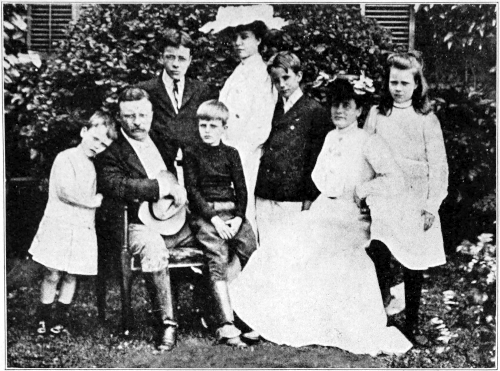
THEODORE ROOSEVELT AND HIS FAMILY
As they appeared when he became President.
In the summer of 1902, President Roosevelt decided to
make a tour of New England for about ten days. On
the last day of this junket, a collision between a trolley
car and the vehicle containing his party resulted in the
instant death of one of the White House Secret Service
men, affectionately known as “Big Bill Craig,” who was
seated with the driver, and injuries to the President and
to Secretary Cortelyou. The uncertainty over the extent
of the President’s injuries and the lack of details of
the accident, owing to the fact that the conveyance with
the newspaper men had been separated from the party
and no members of the press were at hand, caused the
greatest excitement and alarm when rumours of the accident
reached New York and Washington. The Associated
Press rushed its Washington representative from New
York to Oyster Bay in a spectacular dash against time.
Upon Mr. Roosevelt’s arrival at home, long delayed, he
received the representative of the Associated Press at
Sagamore Hill at ten o’clock that night, and despite a
swollen lip, injured hand, leg, and various severe and painful
bruises, he paced up and down his library floor and
dictated the story of the accident, refusing, however, to
allow the account to carry his name.
He had already planned a series of trips he intended
making, and as the next on the list was to attend a labour
convention at Chattanooga during September, he decided
to accede to the demand of his home folks and family
acquaintances to receive them before his next departure.
Accordingly, one Saturday afternoon, early in September
of 1902, President and Mrs. Roosevelt invited their
neighbours and friends to a reception at Sagamore Hill.
All day long the trains and boats poured out a stream of
“neighbours.” It seemed as though everybody on the
Sound were coming to pay his respects to the “Colonel”
and Mrs. Roosevelt.
The horror of the days at Buffalo of the year before was
still upon officials, and the appearance in the vicinity of
the summer White House of several suspicious-looking
characters rumoured to be anarchists brought about the
swearing in as deputy sheriffs of five or six hundred citizens,
among them the newspaper men stationed in the
little town; sixty New York policemen were also added
to the staff about the house.
About three o’clock, the procession began its winding
journey to the home on top of the hill. Carriages were
stopped some distance down the drive, and all occupants
required to complete the distance afoot. Coats, shawls,
umbrellas, parasols, cameras, lunch boxes, even bouquets,
were all scrutinized, and all belongings not actually attached
to their owners were required to be deposited under
a tree on the lawn. The consequent confusion arising
when departing guests tried to redeem their belongings
was the only flaw in an otherwise perfect day. These extreme
measures were simply in obedience to orders to allow
no one to approach the President save with hands
exposed and unencumbered. Every precaution was taken
to prevent a repetition of the tragedy of the previous year.
Threatening letters had added to this fear, which was
never absent from Mrs. Roosevelt’s mind. Even parents
carrying children were required to show their hands.
A double line of Secret Service men stationed themselves
ahead of the President, and as each person came up, he
was subjected to double scrutiny. Standing at the President’s
side was another guard and protector, whose purpose
was not generally known. This was Theodore,
Junior, who had armed himself with a pistol, and during
the entire afternoon kept his hand in his pocket and his
finger upon the trigger, ready for the slightest suspicious
move toward his idolized father. He was the object of
grave concern to the Secret Service, and of a certain grim
amusement to his father, whose reliance upon his son’s
judgment was not shared by the others.
No reception of President Roosevelt in Washington
equalled this one in all of the elements of human interest.
Men and women whom he had not seen in many years
came in droves, and his delight in meeting them was
genuine and spontaneous. Mrs. Roosevelt at his side
shared his pleasure. Did she turn to speak to one of her
receiving party for a minute, she was at once recalled enthusiastically
to meet some old acquaintance. Once
everyone’s attention was centred upon a smallish unpretentious
individual, who was greeted thus: “Bless my
soul, it’s Jake!” and Jake, red of face, beaming with joy,
was dumb with delight. In one of the short lulls, the
President told some of the porch party of Jake:
“When I was like Ted,” indicating his eldest son, “I
roamed these woods and swamps during holidays and
week ends, hunting and fishing. My father engaged
Jake as a sort of guide and guardian, to see that I did not
get lost or hurt, and that I turned up at home on schedule.
Jake and I and the boys who went along had many good
times. He used to make us the most delicious ‘Squawk
Pie.’ Delicious on a cold day around a camp fire, when
you are a boy, tired and hungry! Of course, you don’t
know what ‘Squawk Pie’ is!—made out of young, tender
swamp herons—regular hunters’ pie—bully!” He laughed
reminiscently, glanced out to the side of the house, where
Jake was already surrounded by his three younger boys,
and resumed his place.
A few seconds later, the whole line was stopped while
he and Mrs. Roosevelt greeted two elderly women, one
of whom had been his nurse and had brought with her a
picture of him when he was five years old. Such a warm,
friendly greeting as those two received! They were repaid
for the journey of several hundred miles made to
bring this little reminder of his childhood. They were
taken back into the house and treated with that delightful
democratic courtesy so characteristic of this family.
A group of Hungarians brought a beautiful hand-wrought
lamp, which, after it had been examined, they
were allowed to present to the President.
For three hours, this moving pageant of humanity,
beaming with pleasure and admiration and frankly curious
of the man himself, filed past him. To each and
every one was given that individualistic greeting that was
one of his many claims to popularity. As the visitors left
the other side of the porch, they were served with raspberry
shrub, each person being presented with the little
crystal punch cup from which he drank and on which were
written the words, “Theodore Roosevelt, 1902.”
The next day, Sunday, everyone in Oyster Bay went to
church and gathered about the little church attended by
the President. From dawn, police and Secret Service
men had been scouring the vicinity for the pair of strangers,
alleged anarchists, who had appeared in the town
the day before. The air was tense with expectancy and
dread. The Roosevelt pew was occupied by the President
and his wife and part of their family. As the sermon
progressed and lost some of the pathos of its memorial
to Mr. McKinley in its tribute to the new ruler, likened
to “a young David raised to lead his people,” the President’s
countenance flushed with displeasure. His wife’s
hand upon his arm restrained any budding impulse to
rise or leave.
When the congregation knelt to pray, those seated in
the rear of the Roosevelt pew enjoyed the reassuring and
edifying spectacle of a formidable revolver protruding
from the hip pocket of the Chief Executive.
A trip to Chattanooga will never be forgotten by some
of the army officers and other members of the party, who
failed in keeping up, either riding or walking, with their
athletic, enthusiastic leader, to whom fatigue seemed an
unknown sensation.
The next scheduled trip was to Omaha, Nebr., but
it ended at Indianapolis, as the President was there
forced to undergo an operation of bone scraping as the
result of the injury to his leg in the Pittsfield accident of
the late summer. While not alarming, the operation
carried an element of danger that kept the nation on the
qui vive until complete convalescence was assured.
The state receptions of 1902 and 1903 were significant
for their size and brilliance, as were all of those in the
succeeding four years. To each came many of the great
social and financial leaders of New York, who had never
previously considered these official White House functions
of sufficient importance for their attendance. But all
through the Roosevelt régime the entertainments were
distinguished by the presence of more of the national
celebrities in arts, letters, sciences, finance, and social
eminence than had ever been seen in Washington in such
numbers before. The reason for this was due not merely
to the long-established social position of the President and
his wife, but to the personality of the many-sided Executive
who touched more different kinds of people in a wider
range of activities than had any of his predecessors. He
was thoroughly versed in a greater variety of subjects and
had the faculty of getting the measure of a project,
whether it related to politics, invention, exploration, religion,
navigation, finance, agriculture, mining, sport, or
diplomacy, in a shorter time, with fewer words, than any
other public man of his day.
Furthermore, his mind absorbed information with
sponge-like avidity and possessed a trained quality of
retaining the needed amount of detail for the complete
picture of the enterprise, project, or policy to remain
in a photographic clearness and enabled him to discuss
his problems with amazing comprehension. He had a
positive genius for study and research, and a gift for
eliminating the non-essentials from his mental storehouse.
President Roosevelt handled his problems in a direct,
fearless manner, and he accepted the attacks and criticisms
hurled at him in a fearless attitude that enabled
him to capitalize on his opposition. He started some
reforms and innovations that contributed greatly to his
working schedule, because he felt he had to keep abreast
of public opinion. To one clerk was assigned the task of
daily skimming through between three and five hundred
newspapers and clipping therefrom every article commenting
on or relating in any way, complimentary or otherwise,
to the administration and its policies. These were
classified and pasted into reference scrapbooks for the
President’s perusal.
The winter of 1903 brought many interesting events.
“Princess Alice” received an invitation brought by Prince
Henry of Prussia from the German Emperor to christen
his yacht, then under construction in this country. She
accepted, and on February 25th, at Shooter’s Island, performed
the little ceremony. Some time later, she received
a handsome bracelet from Germany with a
miniature of the Emperor surrounded by diamonds.
In order to keep himself evenly balanced in his strenuous
days of constructive and routine work, the President
sent for the director of the New York Athletic Club, Mike
Donovan, to come down, test him out, and make a
survey of his physical condition. Donovan came as to
any of his pupils; and as his coming was the establishment
of a brand-new precedent, there was a great furore.
The President decided to have Donovan repeat the visit
at least twice a year. Donovan gave a little account of
the “interview” with the President of the United States,
which appeared in the New York World and other publications
at the time:
“Had President Roosevelt come to the prize ring
instead of the political arena, it is my conviction he would
have been successful. The man is a born fighter. It’s in
his blood.
“It is no exaggeration when I say that in some mix-ups
with him I have been compelled to resort to all the arts
and devices that have come to me from years of serious
fighting, often to slug right and left to save myself.
“I have a vivid recollection of my first fistic encounter
with President Roosevelt. The Governor left me in the
old billiard room of the executive mansion, at Albany,
which he had fitted up as a gymnasium for his boys in
order that they might begin their physical education under
his eyes. He then went downstairs to don his boxing
clothes. In a few minutes he returned.
“It was the Governor of the State of New York who
had left me. It was the fighting man who entered the
room. He wore a sleeveless flannel shirt, his khaki rough-rider
uniform trousers and light canvas shoes without
heels. First I was struck by the expression of his eyes,
which are large, light blue, placed well apart—aggressive,
fearless, persistent.
“He is about 5 feet 8 inches in height, but his great
breadth of shoulders and bulk of body made him seem
shorter. His arms are short, but heavy and well muscled.
His head is that of the typical fighter. It is broad and
symmetrical, poised on a powerful neck. A plumb-line
could be dropped from the back of his head to his waist.
That formation shows not only the fighting spirit, but the
physical vigour to sustain it. His short, thick body, with
its high arched chest, is certainly set on unusually strong,
sinewy legs.
“After pulling on his gloves he stepped forward on the
mat. Most men on coming for the first time to box with
a champion, present or retired, show some trepidation.
There was none of that here.
“After we shook hands I studied him carefully. Then
I led a left jab, following it up with a faint-hearted right
that landed like a love-tap high up on his cheek. He
dropped his hands and stopped.
“‘Look here, Mike,’ he said indignantly, ‘that is not
fair.’
“I was afraid I had done something wrong.
“‘What’s the matter, Governor?’ I asked.
“‘You are not hitting me,’ he said, shaking his head.
‘I’d like you to hit out.’
“‘All right, Governor,’ I said, thinking to myself, this
man has a pretty good opinion of himself.
“We started in again, and I sent in a hard right to the
body as he rushed in and then tried a swinging left for the
jaw. He stepped inside and drove his right to my ear.
It jarred me down to the heels.
“I realized from that moment that the Governor was
no ordinary amateur. If I took chances with him I was
endangering my reputation.
“From that day I have taken no chance with Theodore
Roosevelt with the gloves. I’ve hit him many times as
hard as ever I hit a fighter in the ring without stopping
him, and thousands know how hard I can hit.
“I want to say, now, that I never saw him wince or show
even by an involuntary sign that he was discomfited in
spirit, no matter how severe the bodily pain. On the
contrary, it met with only that characteristic turning of
the head a bit to the side, a grim smile, and a determined
setting of the bulldog jaw, followed by another rush.
Theodore Roosevelt is a strong, tough man; hard to hurt
and harder to stop.
“On the evening of March 3, 1905, the day before the
Inauguration, between 5 and 6 o’clock, the President and
I had a go of ten rounds. He was happy as a schoolboy
as he stripped for the fray.
“‘Now, Mike,’ he said, ‘we must have a good bout this
evening. It will brighten me up for to-morrow, which
will be a trying day.’
“We boxed for ten hard, long rounds. He had improved
so much in his practice with me that I had to resort
to all the strategy that my experience had taught me.
After the fifth round, I felt like calling a halt, but did not
want to appear a quitter. We were having it hot and
heavy. In an exchange I tried to land a right-hand body
blow, ducking to avoid a left-hand counter. Instead, he
struck me a flush right-hander on the top of my head,
knocking me sprawling to the mat. As I got to my feet,
he said:
“‘That’s a good make-believe knock-down, Mike.’
Evidently he did not realize how hard he hit me.”
The President decided wrestling would be beneficial
and engaged in that sport several times a week. He also
acquired the art of jujutsu. In a note to one of his boys,
he referred to this Japanese art:
“I am very glad I have been doing this ... but
... I am not at all sure I shall ever try it again while
I am so busy with other work as I am now. Often by the
time I get to five o’clock in the afternoon I will be feeling
like a stewed owl, after eight hours’ grapple with Senators,
Congressmen, etc., then I find the wrestling a trifle too
vehement for mere rest. My right ankle and my left
wrist and one thumb and both great toes are swollen sufficiently
to more or less impair their usefulness, and I
am well mottled with bruises elsewhere. Still I have
made good progress, and since you left they have taught
me three new throws that are perfect corkers.”
He also took up fencing; he engaged in all of these
sports and exercises with either General Leonard Wood or
his own boys.
In April, 1903, the President, with a party of twenty-seven
selected and invited by himself, started on the
long-postponed and often-discussed trip to the Pacific
Coast. The party left on the morning of April 1st and returned
after sixty-five days of almost continuous travel
on the evening of June 5th. On this trip, the travellers
experienced every kind of climate, saw every type of vegetation,
and met every class of people in the United States.
The itinerary covered 13,955 miles, 23 states, and 136
cities.
On his return to Washington, the President was given
a tremendous reception by the people of the Capital.
Crowds lined both sides of Pennsylvania Avenue and
cheered as he rode from the station to the White House.
President Roosevelt’s first administration accomplished
a number of important projects. His term opened with
his interest centred in the creation of a Department of
Commerce and Labour, also of the establishment of forest
reserves and the irrigation of the dry or arid land by the
government. The Canal across the Isthmus of Panama
long under discussion and partially under construction
became a reality after Congress authorized the purchase
of the French holdings for $40,000,000, and after a revolution
in Colombia resulted in the establishment of the
Republic of Panama in November, 1903, which was recognized
by the United States Government a few days later
and a treaty signed containing more liberal terms than
the one rejected by Colombia. Dr. W. C. Gorgas applied
the discoveries of the Spanish War to the problem of the
yellow fever, and American sanitary science made the
completion of the Canal possible without the scourges
of diseases of past years.
President Roosevelt was unanimously nominated for
President in June, 1904, by the Republican National Convention
held at Chicago. No Vice President who ever
succeeded to the Presidency on the death of a chosen President
had ever stood so strong with the people. He made
no speeches during the campaign, remaining most of the
time at his summer home at Oyster Bay, holding frequent
conferences with party leaders. Judge Alton B. Parker,
the Democratic candidate for President, having made
charges in speeches delivered shortly before the election,
that the Republican campaign committee had received
vast contributions of money from trust companies in return
for favours done them by Chairman Cortelyou when
he was Secretary of Commerce and Labour, the President,
three days before the election, issued from the White
House a vigorous denial of the charges, challenging Judge
Parker to produce the proof. It was in this statement
that the President employed the famous “square deal”
term, ending his defense of Chairman Cortelyou with
these words: “All I ask is a square deal. Give every
man a fair chance; don’t let anyone harm him, and don’t
let him do harm to anyone.”
In November, he was elected by the largest electoral
vote ever given a nominee for the Presidency up to that
time.
CHAPTER XIII
SECOND ADMINISTRATION OF THEODORE
ROOSEVELT
March 4, 1905, to March 4, 1909
ROOSEVELT’S inauguration on March 4, 1905, was
more the inauguration of Theodore Roosevelt, the
man, than the installation of a new President of the
United States. No President since Abraham Lincoln
had possessed such a unique personality. His national
following was amply demonstrated by the unequalled
vote of the electoral college and by the popular majority
which exceeded 2,500,000, and it is the common belief
that curiosity to a phenomenal degree drew the hosts of
visitors to the city to witness the ceremonies and to see
this man for themselves. The day dawned with the
promise of fair weather, and the fluttering mass of flags
and banners made the Avenue a brilliant pathway of
gorgeous colour.
Rough Riders, Grand Army Veterans, and Spanish
War Veterans formed the personal escort to the Capitol,
led by Lieutenant General Chaffee, Grand Marshal of the
parade, whose colour bearers attracted special interest.
They were the sons and grandsons of men distinguished
in the annals of American military and naval history.
They were selected from West Point and Annapolis, and
nearly all of them were descendants of army and navy
officers who had won distinguished honours fighting for
their country. Those from the West Point Military Academy
were: Sherman Miles, son of General Miles; Adna R.
Chaffee, son of Lieutenant General Chaffee; Calvin P.
Titus, the first American soldier to scale the wall at the
siege of Peking, China, appointed cadet-at-large by
President McKinley, and Cadet Gatewood. Those representing
Annapolis were: Midshipman Stephen Decatur,
descendant of Commodore Decatur; Midshipman Beauregard,
grandson of the Confederate General; Midshipman
Davis, son of Rear Admiral Davis; Midshipman Early,
son of the Confederate General, Jubal A. Early.
A vast array of civic and military organizations reinforced
the escort. The whole length of the way was
packed with crowds of cheering, applauding citizens eager
to honour the new President.
After the last bills were signed, the President went to
the Senate Chamber to attend the services for the installation
of the Vice President, Charles Warren Fairbanks,
and the swearing in of the new Senators. Here
the scene was most impressive. The Senate Chamber
was packed with spectators and legislators. A brilliant
assemblage of diplomats from all quarters of the globe
was present, most of whom appeared in full court costume,
and the Supreme Court of the United States, solemn
and awe-inspiring in their black silk gowns. The galleries
were filled with invited guests, among them the families
of the new President and Vice President and Cabinet and
their friends. Upon the conclusion of the services here,
the President, with Chief Justice Fuller by his side, led
the procession through the corridors of the Capitol to the
East Portico, where he renewed his oath and delivered his
message containing the promises and the forecasts of a
new administration. During this ceremony, he wore a
ring given him by John Hay, which contained a lock of
Lincoln’s hair.
After the return to the White House, the President and
Mrs. Roosevelt entertained about two hundred persons
at luncheon, including their new official family and intimate
friends and relatives, and then the entire party
walked to the reviewing stand in front of the White House
facing the “Court of History.” There the President reviewed
the largest pageant which had ever assembled in
marching order for an inauguration. This parade was
noteworthy because of its many unique features. Besides
the Rough Riders, Philippine native scouts, Porto
Ricans, and Carlisle Indians, there was a large number of
cowboys in full regalia, led by Seth Bullock, the famous
Sheriff of Deadwood, S. D., and a phalanx of 600 of the
fellow citizens, friends, and neighbours of the Roosevelts
from Oyster Bay, disproving the old saying that “a
prophet is not without honour save in his own country.”
In addition to the Richmond Blues, in their handsome
blue and white uniforms and waving plumes, which are
always to be honoured as the oldest military organization
in the country, and the Lincoln Club of Toledo whose
royal purple broke the monotony of colour, there was also
a body of miners from the anthracite coal region whose
banner expressed their sentiments, “WE HONOUR THE
MAN WHO SETTLED OUR STRIKE.”
Most interesting, at least to the juvenile portion of
onlookers, were Buffalo Bill and the band of Indian chiefs
led by Geronimo, including American Horse, Little Plume,
Quanah Parker, Buckskin Charley, and Hollow Horn
Bear. These braves were a startling reminder of the
pioneer history of the country, in their vivid blankets of
varied hues, their gaudy feather bonnets, and hideous
war paint. Like Remington’s pictures, upon which a
magic touch had bestowed life and motion, they majestically
swung into view and then were gone—swallowed up
in the surging maelstrom of humanity, a brilliant, flashing,
terrible page out of the past, when their names were
synonymous with massacre, reeking scalps, and murderous
tomahawks. So vividly was this impression called
to life that it was hard to realize that these old-time
“bad Indians” had smoked the pipe of peace for all time
and were riding along in loyal allegiance to the Great
Father.
One of the innovations in the matter of street decoration
was the “Court of History,” in the space along the Avenue
facing the Treasury Building, the White House, and the
State, War, and Navy Departments. This was one of
the most elaborate and interesting features ever introduced
into the decorative scheme for inaugural ceremonies.
It was a matter of surprise that it should have been
designed for temporary purposes only. In addition to
stately columns, the Court included pieces of statuary
representing personages prominent in the early history
of the nation, colossal allegorical figures representing
transportation by land and by sea, and victory, massive
urns filled with palms, palmettoes, and vines of the southland,
and tall bamboo poles from the Philippines flying
the Stars and Stripes. There was not a feature but was
full of significance to the American people. The statues,
of which there were three carloads, brought from the
World’s Fair, at St. Louis, represented Clark, La Salle,
Chancellor Livingston, President Monroe, Andrew Jackson,
Bienville, Mabois, Narvez, and Anthony Wayne.
A happy little ceremony in the Court had occurred at
the moment the President took the oath. Upon a signal
from a bugle, “Old Glory” burst to the breeze from forty-eight
bamboo flagpoles.
The gown worn by Mrs. Roosevelt at the inaugural
ball that night will long be remembered, for it was distinctive
both as to fabric and colour, and was rich enough
for an empress. Following the custom set by Martha
Washington, who refused, after she became First Lady of
the Land, to wear any garments of imported material,
Mrs. Roosevelt had the silk for her dress woven in Paterson,
New Jersey, and then, to avoid the inevitable copying
of cloth and pattern, she had the pattern destroyed
after the required number of yards had been turned off
the loom. Thus she might, if she chose, preserve her gown
with the comforting knowledge that no other dress would
ever be just like it.
This gown was a gorgeous creation of robin’s-egg blue
brocade, with raised gold design of large ostrich feathers,
alternating with medallions of the gold. Family heirloom
lace more than two hundred years old gave a delicate
touch to the bodice. Though she rarely wore jewels,
Mrs. Roosevelt, on this occasion, was literally ablaze with
diamonds, but over and above every other feature of the
magnificent costume was the elegant court train, three
yards long. The weight of this gold-embroidered robe
with its heavy underskirts of silk made it advisable to
limit the Grand March to five minutes. The Committee
desired to furnish Mrs. Roosevelt with two powdered
youths to act as train bearers, but she declined. Mrs.
Fairbanks’s rich white satin, with its gold embroidery
and point lace, was a splendid foil for the gown worn
by Mrs. Roosevelt. The freshness and elegance of the
costumes worn by the six or seven thousand women with
the display of jewels were a notable feature of the ball.
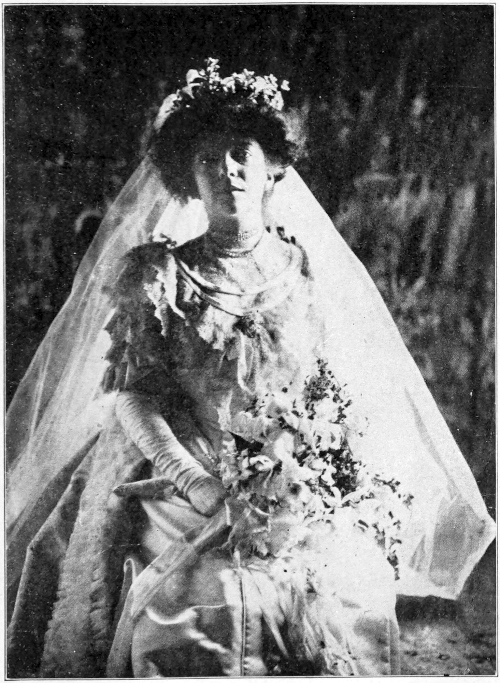
ALICE LONGWORTH IN HER WEDDING GOWN
One would suppose that the decorator’s art would be
taxed to its limit in the beautifying of the Pension Office
each fourth year for these historic functions, but each
setting in turn seems far to surpass all of its predecessors.
The artists always manage to find some new feature upon
which to concentrate their skill, and lo!—the result is
beautiful beyond description. There is no building in the
Capital City so well adapted for the purpose of the ball or
so susceptible of transformation into such a fairyland picture
as the big Pension Office with its open court, tiers of
balconies, tall columns, and ample floor space.
For the Roosevelt inaugural ball the room resembled a
Venetian garden so lovely as to rival even a tropical
moonlight scene. Some of the huge palms that were
used reached forty feet from the floor.
Mrs. Roosevelt won golden opinions from the public
during her seven years as First Lady of the Land; she gave
more private entertainments of all kinds than any of her
predecessors. Official mourning for President McKinley
was observed at the beginning of her régime, and when
that was concluded, the condition of the mansion limited
social activities for a time. The floors, which were not
safe, had been braced and shored up. But after the remodelling,
so long deferred, the entertainments, official
and private, followed each other with a frequency that
delighted society. Mrs. Roosevelt gave more than two
hundred teas, luncheons, musicales, receptions, and dinners,
outside of the regular state affairs. In these, her
own personal and semi-official functions for all sorts of
people whom she considered interesting or to whom she
felt White House courtesies due, she followed her husband’s
example of touching all circles and classes.
While meeting admirably every official demand, Mrs.
Roosevelt protected her private life with the same tactful
cleverness by which she had early evaded the rigours of
reception handshaking. The First Lady made it clearly
understood that it was her husband who was President,
and that his family did not belong to the public.
Mrs. Roosevelt kept no housekeeper, but gave personal
supervision to the entire establishment. But she made
immediately a much-needed and highly important addition
to the White House staff, a social secretary for herself.
For this position she chose Miss Belle Hagner, long
a friend, who was so thoroughly identified through resident
and family connections with Washington’s peculiar
social etiquette and the much more intricate code of
procedure that governs the White House that she quickly
became invaluable.
Since the mail of the First Lady of the Land has come
to rival that of her husband in the number and variety
of demands and requests that besiege her, Mrs. Roosevelt
had at once seen the necessity of organizing the handling
of this volume of correspondence in a systematic way.
Mrs. Roosevelt shared her husband’s tastes and was a
writer herself, even when her children were small, but
she so planned her time as to be able to devote a part
of it both to her husband and her children, and to her
step-daughter during the time Alice spent with her father.
Until the death of her maternal grandmother, Mrs. Lee,
Alice spent the greater part of her time in the Boston home
of her grandparents or in travelling with them.
The President’s wife always found great delight in
horseback riding, and she and the President would drive
to the outskirts of the city, where their riding horses would
be awaiting them, and enjoy frequent rides through the
country roads leading from the city. Thus they escaped
the gaze of the curious. She was accomplished in many
ways, even having trained herself as a nurse, a qualification
of utmost value to the mother of such an active
family.
Early in their establishment at the White House, luncheon
became the important political function. Like the
Hanna breakfasts in the “little White House” across
Lafayette Square, where the chosen were invited to partake
of country sausage and hot buckwheat cakes, maple
syrup or honey, coffee, and a flow of political reason, for
luncheons the White House pantry was always prepared
to serve from one to a dozen or more additional guests.
No one, least of all the President himself, knew how many
he would invite to join him at lunch. Whoever the man
might be that happened to engage his deep interest in a
morning call, he was likely to be asked to stay. When a
subject pressed its claims upon the President’s mind, a
telephone call was sent to the best-informed individual
to request him to come to supply the desired data.
It was in this manner that the President invited Booker
Washington, the well-known Negro educator, to eat
luncheon in the White House—an act that was severely
criticized at the time. In speaking of the incident at a
later period, Mr. Roosevelt said he was in the midst of an
interesting discussion with Washington when the luncheon
hour arrived, and without thinking of the man’s colour,
asked him to the meal in order that they might continue
the conversation.
Both the President and his wife sought to bring people
together at this meal who would enjoy meeting, and they
both did their best to draw their guests into informal
frank discussion of the subjects uppermost in their interest.
Delightful, natural, wholesome, with a spontaneous hospitality
entirely devoid of ostentation, a luncheon at the
White House in the Roosevelt régime was an education
and an adventure. Helen Nicolay, in her recent book,
has this to say of one of these luncheons:
“The luncheon yesterday at the White House was great
fun. The party consisted of the President and Mrs.
Roosevelt, Mrs. Hay, Mr. Von Briesen, a New York
lawyer with a white beard, a strong accent, and eyes blue
as a baby’s, Mr. Wilcox of Buffalo, likewise a lawyer and
a good judge of horseflesh, I take it, Theodore, Jr., and
yours truly.
“The whole lower floor of the White House is in a mess,
undergoing alterations that will improve it immensely.
There was a strong smell of turpentine everywhere, and
we were relieved of our wraps while standing in the great
vestibule, on one foot, so to speak, clutching our skirts to
keep them out of the carpenters’ dust on the floor. Then
we were ushered into the Red Parlour whose walls have
been covered with deep red velvet, with results rather
startling. At least to my mind, they combine the fascinations
of a pall and a sleeping car. The room is at
present furnished with a misfit collection of leather chairs
and lounges. The real furniture is being made to order,
we are told. It also is to be covered with leather, because
the room is to be used for smoking on occasion, and the
furniture must not be of a material to hold the smoke.
Fancy—with those walls!
“In a few minutes Mr. Von Briesen was ushered in.
Then Mrs. Roosevelt appeared, dressed in white wool.
She has a wonderfully pleasant voice and a sweet face. A
few minutes later Mr. Wilcox was announced. After
that there was a long wait, during which conversation of
a kindly gossipy nature was carried on, chiefly by the
two matrons. When a little after two o’clock the door
opened and the President came in—teeth and all—no
time was lost in making for the dining room. He took
out Mrs. Hay, the rest of us followed in a group. Mrs.
Roosevelt stopped a moment at the door of the state
dining room to point out some change, and the President,
having seated his lady, came bouncing back, like a rubber
ball, to see why we did not come on. The poor man was
frankly hungry, having been on his feet since 9:20 A. M.
seeing people, deciding questions all in a minute, and
emphatically leading the strenuous life. He said he felt
as though he had been galloping.
“He talked most entertainingly throughout the meal,
and managed besides to dispose of a goodly amount of
food. You will laugh when I give you the menu—bouillon,
salt fish, chicken with rice, rolls, and baked beans.
Of beans and the salt fish the President had a second helping.
For dessert there was Bavarian cream, served with
preserves and cakes. There was one kind of wine, which
most of the party declined, and tea, poured by Mrs.
Roosevelt, who made it for all the rest just as her husband
liked his ‘and no questions asked.’ Cigars were passed
after the meal, and lighted by the two lawyers. Mr. Roosevelt
did not smoke.
“The china was miscellaneous; nice enough, but not
extraordinary. I only remember some pretty Haviland,
and that the bread and butter plates were in the form of
flags of the different nations. The President had the
Star-Spangled Banner, the rest of us got what was left.
The German drew the tricolour; I the Union Jack. The
waiters were two spry slim coloured youths, not in livery,
and they were kept rather busy. My impression is that
they were always moving toward the President.
“If my life depended on it I could not tell you about
the centrepiece. There must have been one; but the truth
is that Mr. Roosevelt was so rattlingly lively, yet so earnest
and dignified, his wife so kind and unaffected, and the
whole meal so informal in character, that what was on the
table dwindled to minor importance. Theodore, Jr., appeared
after we were all seated, shook hands all around,
took part in the talk with the aplomb of young America,
and excused himself before dessert to go riding with his
small sister—having meanwhile extracted from his mother
permission to use her horse.
“It was just a nice lively United States family entertaining
with heartiness and pot-luck chance visitors of
the hour. The only visible difference was that the President
was served first, then Mrs. Roosevelt, and after
them the guests. Oh, yes. Another detail not customary.
U. S. was embroidered on the plate doilies.
The President and Mrs. Roosevelt sat opposite each
other at the sides, not the ends, of the oval table.
“The talk ranged over many subjects—importunate
Senators; Colonel Hay’s Bavarian ancestors; the Negro
problem; the impossibility of doing more than establish
certain fixed principles in his own mind and live up to
them regardless, and his feeling of the deep obligation
he was under, as President, to do this; anecdotes of pet
riding horses and a humorous account of a portrait recently
painted of him, which was, he said, the only portrait
of himself he had ever liked. He liked it because it
did not resemble him in the least, but looked as he would
like to look. It was the picture he wished to leave to his
grandchildren, if he ever had any.
“In spite of his almost incessant talk, I was impressed
with the care he took—the care of a generous, thoughtful
host—to bring up topics that would interest and draw
out the best from each one of his guests in turn. Von
Briesen had worked with him in civic matters in New
York, and his praise caused the German to turn shy and
rosy as a girl.
“References to books and authors showed much reading
the President managed to do, while the rapidity with
which his mind worked kept us all on the jump. He
seemed to follow the usual processes of reasoning, but to
do so at twice or thrice the usual rate of speed, with the
result of apparently leaping from conclusion to conclusion,
while the rest of us hurried breathlessly after him.
I was reminded of that rhyme in which strange animals
‘hilariously hopped from bough to bough.’
“But the impression above all others is of a man living
with every fibre of his being, ardently as well as arduously,
and having the best time of anybody who ever inhabited
the White House.”
The most fascinating pictures of the Roosevelt régime
were those made by the Roosevelt children, who were
known most distinctively by their pets, the varied assortment
of which enlivened the White House and its environs.
Theodore, older and more serious-minded, concerned
himself with much weightier matters than did his
younger brothers, but he was the judge-advocate-general,
ranking next to the parents when differences of opinion
on the respective merits of the family menagerie had to
be settled. Each child had his full complement of dogs,
birds, ponies, rats, guinea pigs, or whatever pet he favoured.
Upon each of the presidential tours the pet
stock was increased. While the presidential train was
pulling out of a Western town a little girl tossed a small
furry bunch to the President, calling out, “His name is
Josiah!” Josiah proved to be a young badger that had
to be brought up on a bottle and lived to be a nuisance,
nipping at heels and skirts.
A procession of puppies of every breed, colour, and size
succeeded to the adoring ownership of these happy children.
None who visited the President’s family during his
eventful régime will ever forget Algonquin, the small
calico pony from Iceland that was Archie’s proud possession
and delight, and for a sight of which he longed so
fervently during a spell of measles that somehow—nobody
told just how—Algonquin got the message that his little
master wanted to see him, and, lo!—one day it so happened.
When the house was devoid of guests and the
father and mother conveniently out driving, the pony
was smuggled up on the elevator to the boy’s room for
a few minutes’ visit, and convalescence was accelerated
thereby.
An officious bull pup almost produced international
complications by delaying the progress of an ambassador
on his way to call on the President. A small black bear
furnished endless amusement with its clumsy antics,
while a funny black puppy learned to ride on Algonquin’s
back and insisted upon being taken along when Archie
took a ride.
Archie had a kangaroo rat that was always peeking out
of his pocket and sociably accepting tidbits, indifferent to
its high position.
Rabbits, squirrels, and chickens all had their day of
popularity, and when they died they were formally and
properly interred with all possible funeral pomp and
ceremony, and with elaborately marked headstones placed
above them in the pet cemetery.
Kermit, like his eldest brother, was also a naturalist as
a little boy. He, too, roamed the woods and swamps of
Oyster Bay and scoured the country around Washington
in search of specimens.
Not even pets, however, rivalled the joy of a game or a
romp of the children with their father, who was always a
boy with his boys, and from the experiences of his own
health-handicapped boyhood knew just how much sport
meant to normal boys. It was a likable trait in him that
his understanding of boys was not limited in its sympathy
and expression to his own sons, as this little incident shows:
Among the callers on a Saturday morning, when important
persons with missions and other important persons
in want of missions were grouped in his private office,
was a boy, a collegian of the athletic sort, who was very
desirous of meeting the President. In spite of a bold
front, such as is becoming in a dauntless sophomore, it
was evident that he was nervous.
“Shall I say ‘His Excellency’?” he asked a few moments
before his entrance.
“It’s just like a presentation at court, you know,” his
eldest sister had remarked, with a view of putting the untrammelled
football player into the mood of a mere human
being; “you’ll have to bow low, of course.”
“I don’t believe Mr. Roosevelt is that kind of a man,”
he answered with a sinking heart.
“Of course not,” said a more consoling voice; “you
simply have to say ‘Mr. President,’ stand up while anybody
else is standing, and go away when the President
rises.”
Still, the lad was evidently very uncomfortable and uncertain
when he reached the room adjoining the President’s
office. It was evident, from the movement of his
lips, that he was practising on “Mr. President,” as at
least one safe hold on material for conversation.
The moment—the unexpected but fearful moment
came. The President, on hearing the boy’s name, left
the distinguished group with great promptness and made
for his guest.
“Sit down, Jones,” he said, very cordially. “I want to
talk about the races in which your college put up such
a good fight. Oh, sit down!”
“I’m glad you think we put up a good fight, Mr.
President,” said the boy, forgetting everything about the
ceremony in the joy—as he afterward said—of talking to
somebody who knew. “Some people thought we didn’t,
but they were wrong.”
Then there followed a whirling talk, in which the
President showed such a consummate knowledge of sports
and such a sympathy with the boy’s point of view that
the lad almost forgot that he was not talking with “another
fellow.” But he steadied himself and found his
bearings with one or two formal “Mr. Presidents,” and
then the two plunged into jujutsu. The President showed
the boy a scientific grip.
“You’ve got it—you’ve got it,” cried the boy, “you’ve
got it! It’s great, but don’t you think that if a well-trained
American swatted one of those Japs in the belly
he’d do for him? Don’t you,” he added, with a sudden
return to ceremony, “Mr. President?”
The onlookers turned aside—the one most interested
in the lad showing some anxiety—but the President set
the boy at ease with an anecdote of Theodore, Jr., and the
jujutsu which made the boy laugh and say, “Theodore
Roosevelt must have a good grip—Mr. President.”
The interview closed with a warm shake of the hand
between the President and the boy. The President looked
after him with a kindly gleam in his eye. It is a great
thing to have a boy of one’s own; it gives a man sympathy
with all manly boys.
As to the boy, he was radiant.
“The President’s boys are in luck,” he said. “As long
as I live,” he added solemnly, “I don’t think I shall ever
meet a finer man or one that knows more about the
right things!”
One day, to the noon reception in his office came a delegation
of schoolgirls from a small Southern college, stiff
and stilted with embarrassment, but firmly resolved not to
be enthusiastic over a Republican President. They were
introduced by their chaperon—“Mr. President, here are
some good Southern Democrats.” With that engaging
smile he answered, as he put out his hand, “And all good
Americans.” In an instant, he knew their college, their
states, and when two discovered that he knew one father
and a Senator grandfather, his conquest was complete—party
lines were forgotten.
From attic to cellar, from East Room to stables, the
live young Roosevelts roamed at will, monarchs of the
home of the Chief Magistrate and its surroundings. But
with all of this freedom, they were rarely in evidence in
the state apartments during visiting hours. Only once
in a while might visitors catch glimpses of small boys
with chunks of gingerbread or cookies in their hands and
some animal in tow, scurrying through the corridors or
mounting the stairs. Upon one occasion a trail of small
wet footprints, with little puddles here and there on the
polished floor, led to a dripping youngster who had taken
a swim in the White House fountain and, trailing shoes
and stockings, was dodging the observation of the group
of foreign guests calling upon his mother.
Ethel, too, had her share of pets, frolics, and playthings.
Privileged more than any other girl in the White House
before her, she grew up where her charming boudoir, with
her piano, opened into her bedroom. Sundays found her
teaching a Sunday-school class of coloured children at
St. Mary’s Chapel. At Oyster Bay she played the organ
in the little Sunday school, and on Saturdays and holidays
in Washington she had great fun arranging picnics and
outings for her little coloured protégês.
Alice Roosevelt had received an invitation to the coronation
of King Edward, and it looked as though she might
have the interesting experience of visiting the English
Court. When negotiations were started, however, that
provided for her reception as a royal princess, her sturdy
American father rebelled, and the young lady’s trip was
vetoed. Being fond and indulgent toward his children,
however, her father promised her a trip to China, Japan,
and the Philippines as an offset to her disappointment.
In the Philippines she became associated with the Tafts,
who made her visit delightful.
Surrounded constantly by suitors, the gossip of the
Capital insisted that the “Princess Alice” merely wanted
to get away to learn her own mind and make her decision
as to where she would bestow her hand. If so, young
Representative Nicholas Longworth, one of her most
constant admirers, found it expedient to become one of
the party so as to be on hand to help her in her mental research
on this subject. That he did so, thoroughly and
effectively, was demonstrated by the announcement of
their betrothal upon her return, and their marriage in
the East Room on February 17, 1906.
Alice Roosevelt’s marriage, like that of Nellie Grant,
was an event of national and international importance.
The tenth White House bride, with her youth and unusual
popularity, and the enormous prestige of her parents,
drew the attention of the reading world. Gifts
poured in hourly, and congratulations and expressions of
good wishes came from thousands of her own countrymen,
and from all over the world, from crowned heads, rulers
of nations, and celebrities of every description.
Preparations for the wedding were most elaborate,
every detail of which was planned by the young lady, the
least perturbed of anyone concerned. Indeed, her serenity
and casual acceptance of all of the excitement as
part of the day’s work was a source of amazement to her
girl friends. Easter lilies, pink and white rhododendrons,
American Beauties, and bride roses in large vases, massed
in great bowls, with palms, ferns, and festoons and garlands
of smilax, transformed the lower floors of the
White House into a beautiful bridal setting. A broad
raised dais, with an improvised altar, was placed in front
of the windows looking toward the Treasury Department.
Preceded by the ushers and the group of military aides
in uniform at high noon, she entered on the arm of her
father to the strains of “Lohengrin” played by the Marine
Band. At the end of the ribboned aisle, Mr. Longworth
stepped forward and led her to the altar, where Bishop
Satterlee united them according to the service of the
Episcopal Church in the presence of five hundred guests.
The bride wore a gown of white satin woven especially
for the occasion, and trimmed with rare ancestral lace,
with a train five yards long. The veil of silk tulle, which
enveloped her slight figure in a misty cloud of white,
that reached to the edge of the gown and was held in
place by a wreath of orange blossoms. She wore a diamond
brooch, which was a gift from her father, and a
diamond necklace, the gift of the groom.
The wedding breakfast was served in both private and
state dining rooms, the bridal party being served in the
former, where, with characteristic family impetuosity,
the new Mrs. Longworth borrowed Major McCawley’s
sword to cut her cake, finding the knife provided inadequate.
Shortly afterward, the bridal couple left the house by
the South Portico in an automobile and proceeded to
“Friendship,” the suburban residence of John R. McLean,
from where they started on their honeymoon.
Ten thousand people attended the reception. The
value of the gifts represented a magnificent fortune.
The accumulation filled several rooms of the White House
and spilled out into the corridors, and included everything,
such as most exquisite jewels, silver, art objects,
massive furniture, household linen, kitchen equipment,
someone facetiously including a laundry outfit and an
assortment of live pets. What in the world the girl bride
would do with such an embarrassment of riches was the
popular, but unanswered, query.
Ethel’s dêbut on December 28, 1908, when she was seventeen,
was an event to be remembered through life by all
of the great host of young people who attended. President
and Mrs. Roosevelt had kept their younger daughter’s
activities confined to simple amusements until her
school life was finished. In the coming-out party they
made every possible effort for her pleasure. It has been
called the grandest Christmas Party since the Civil War.
The entire suite of state apartments was thrown open,
and the hundreds of guest tripped up the grand stairway
into the lobby, where the portraits of Presidents gazed
across banks of Christmas greens and rows of huge vases
holding whole trees of holly.
Like a fairy princess, the flaxen-haired dêbutante in her
first ball gown—a lovely creation of white satin studded
with crystals—stood beside her mother in the Blue Parlour,
amid wagonloads of flowers sent by friends from far
and near. The Marine Band, in scarlet coats, played
merrily at the front end of the East Boom, in which great
apartment of many memories the dazzling young diplomats
in court dress, and young army and navy officers
in full uniform, tripped the light fantastic with the
débutantes of the season. At midnight, supper was served
at little tables scattered through the corridor and dining
rooms.
Two nights later, Miss Ethel was the guest of honour
at a Christmas ball given by Mrs. Levi Leiter in the white
and gold ballroom of her million-dollar palace. Here the
two hundred and fifty young guests danced beneath scores
of gold baskets filled with begonias and hung from pink
satin ribbons, while the great mirrors on the wall reflected
their forms as they glided across the floor to the music
that sifted through a great screen of smilax and pink
blossoms.
Theodore Roosevelt’s first American ancestor was Claes
Martensen van Roosevelt, the sturdy Hollander who arrived
on the continent two hundred and seventy-five
years before his descendant became President. For
seven generations these hard-working, sturdy landholders
contributed to the development of the United States,
fought in her wars, and served in her council chambers.
His grandfather, Cornelius van Schaack Roosevelt, attained
some local prominence in business. Of his father,
the President had glowing memories, frequently remarking,
“He was the best man I ever knew.”
His mother was from Georgia, and the men of her
family cast their fortunes with the Confederacy in the
Civil War. To this mixture in his make-up was due his
broad, impersonal, national viewpoint.
Theodore was born in New York City, October 27,
1858, and was reared in the atmosphere of a cultured
home of moderate affluence. Too delicate and anæmic
to stand contact with the healthy average boys of a
school, he received his education at home. As early as
the age of nine, however, he resolved to be able to play
and fight and be like other boys; so he mapped out for
himself a schedule of exercise which he followed for many
years, and which no doubt helped greatly toward the
achievement of the physical perfection that came with
manhood.
He entered Harvard when eighteen, and there, as in
every other period of his life, his personality stood out.
He fell in love with Miss Alice Lee, of Boston, and they
were married a few months after his graduation in 1880.
With the birth of a little daughter, Alice, Mrs. Roosevelt
died. The young husband left his baby with her maternal
grandparents, temporarily abandoned the study of law
and his interest in politics, and went West, following the
habit of childhood of seeking the solitude of field or forest
when in distress or under great mental strain.
North Dakota attracted him, and he invested in a
cattle ranch in the Bad Lands during 1884-1886. This
was known as Elkhorn Ranch, Medora, N. D.
Soon the life of the cowboys lured him, and he learned
their duties, their ways, and the best and worst sides of
them. He spent a great deal of time hunting, it being
claimed, not by him, however, that he had killed specimens
of all of the game found on our prairies or in the
mountains. Most of his hunting was done in search of
first-hand information for his books, since he started
authorship very early in his career, and no friends were
more greatly cherished or more enjoyed than the little
group of naturalists, John Burroughs among them, with
whom he found congenial association. Practically all of
his long hunting trips were those of exploration.
In his boyhood days at Oyster Bay, Theodore Roosevelt
had made a pal of the young daughter of a neighbour
of his parents, Edith Carew. Her tastes were much like
his own, and in the gay parties, sleighing, skating, and
dancing, he liked to have her for a partner. She also had
known the girl he married, and though she had been living
in England for some time when she heard of his wife’s
death, she wrote him of her sympathy. This letter followed
him out to Elkhorn Ranch. He answered; more
letters followed, and soon other vistas of life more alluring
than round-ups, branding cattle, shooting wildcats,
and studying mountain lions, drew him back to the centres
of civilization. A trip to London ensued, and a wedding in
a little English chapel was solemnized December 2, 1886.
After a leisurely honeymoon about Europe, Roosevelt
brought his wife back to New York. He entered the political
field again.
President Harrison appointed him a member of the
United States Civil Service Commission in 1889. President
Cleveland continued him, but he resigned in 1895
to become Police Commissioner of New York City. In
this capacity he instituted many reforms.
In 1897, President McKinley made him Assistant
Secretary of the Navy. He had just begun to make his
energy felt in the discharge of the duties of this position
when war was declared with Spain.
Of his recruiting a regiment of hardy plainsmen, cowboys,
miners, athletes—his own friends of the West, men
who could ride, shoot, fight, and stand hardship, the
Rough Riders—everyone knows. Dr. Wood was
made Colonel and Roosevelt Lieutenant Colonel. They
were commissioned, and the regiment speedily organized
and ready for service in five weeks. They were sent to
Cuba with the regulars, landing for the trouble around
Santiago. They rendered valiant services from the beginning.
Colonel Wood was promoted, and Roosevelt
became the commander of the regiment. Their storming
of Kettle Hill when almost a fifth of them were killed or
wounded has been told again and again.
With the fighting over, Roosevelt came back to stir
up interest in better care for the health of our soldiers,
and he began his fight for an adequate army and navy—large
enough for any sudden emergency.
His gallantry in the war carried him into office as
Governor of New York in 1893, with a large majority,
and his administration was conspicuous for its reform
work. His nomination as the candidate of his party for
President appeared to be a foregone conclusion as far
back as 1902. Even at that early date, some of the
States began to endorse him and pledged their support.
President Roosevelt’s action in the great coal strike of
1902 restored order and secured a return of the miners
to their work, at the same time making the workingmen
feel that their cause had not suffered from his counsel.
The country applauded his work at this time, although
some of the big corporations showed hostility. This was
the most important internal question in his first administration—that
is, it vitally affected more people than any
other. There was no law by which he could interfere to
end the strike, and he proceeded to use his great moral
influence to bring the interested parties together. He
brought about a resumption of work pending a settlement
by a commission appointed by him. His counsel during
this critical period was given while he was confined to his
room owing to his wounded leg. In the same year and
the next, he handled carefully the complications growing
out of the Venezuelan trouble. He maintained the Monroe
Doctrine in all negotiations with European powers
interested, and was honoured by Venezuela in being
named as an acceptable arbiter, which duty he gracefully
avoided by proposing the Hague tribunal as the proper
means for arriving at a peaceful solution.
In the matter of the uprising of Panama and the recognition
of that country by the United States, the President
was both applauded and criticized. The great majority
of the people upheld his treaty with Panama, by which
the territory of the Panama Canal passed into the hands
of the United States, so that the beginning of work on that
giant construction should not be longer delayed.
He established a reputation of getting things done.
During his seven and a half years as President, the navy
was nearly doubled in tonnage, the Russo-Japanese War
was ended by the Treaty of Portsmouth, the battleship
fleet was sent around the world, the Consular Service of
the United States was reorganized, the National Irrigation
Act and the Pure Food and Drug Act were passed,
the Panama Canal was begun, the Department of Commerce
and Labour was established. No President ever
created so many new lines of public welfare, or so many
projects of business for government functioning.
Some of the policies recommended by Roosevelt were
the Inheritance Tax, the Income Tax, the Parcel Post
Service, and the increase of the army and navy forces.
His most noteworthy achievement, in the estimation of
many of his fellow citizens, was the fact that he “changed
the attitude of government toward property, and gave
the Republic a new ideal of the duties and responsibilities
of citizenship.”
Visitors of all descriptions made the White House their
mecca; perhaps the most picturesque was Ezra Meeker,
with his long white hair, who called on November 29,
1907, in his prairie schooner of the period of 1849, drawn
by its team of oxen. This quaint vehicle, reminder of
another vivid page of our national history, contained an
elderly man and woman and a collie. It drew up by the
doors near the Executive Office, and the nimble trail
blazer went in to pay his respects to the President. A
few minutes later, Mr. Roosevelt accompanied his caller
to the wagon, where his appreciative comment included
due attention to the collie.
Another day, the President left an important group in
order to greet Eli Smith, who had travelled all of the way
from Nome, Alaska, on his sled on low wheels drawn by
six dogs. He had been a year on the journey.
When Mr. Roosevelt’s carriage arrived at the entrance
to the President’s room at the Union Station, after the
inauguration of President Taft, there were gathered fully
three thousand of his admirers waiting to bid him farewell.
He had to pass between two rows of people, fully a dozen
deep, and had to respond to the greetings of the crowd.
He and Mrs. Roosevelt were accompanied by Secretary
William Loeb and a large group of close personal friends.
As his train pulled out he called out, “Good-bye, good-bye,
good luck!”
Thus Theodore Roosevelt bade adieu to Washington
after seven years of strenuous service through one of the
most remarkable administrations the country has yet
known.
At the time he laid down the sceptre of leadership,
there was considerable agitation in the public press on
the problem of how to employ ex-Presidents, brought to
a focus by Mr. Roosevelt’s own dominant, vigorous
physical and mental fitness for participation in almost any
line of constructive activity in economic or political development.
But Mr. Roosevelt solved this problem for
himself, at least for the time, as he had already planned to
devote a year or so to the exploration of Central Africa.
Shortly, he was entirely out of touch with all political
associations, returning to America about a year later with
a large collection of specimens and valuable contributions
to science. En route he visited Egypt, Italy,
France, Germany, Norway, and England, receiving in all
these places an ovation similar to that given to General
Grant. On this part of the trip, he was accompanied by
Mrs. Roosevelt, and together they repeated their honeymoon
journey, with the exception that his honeymoon
had not been interrupted with speeches, as was the case
on this tour. When he was in Christiania, he received
the Nobel Prize for his work in bringing about peace in
the Russo-Japanese conflict. England showed her appreciation
through the degree conferred upon him at
Oxford. By the time he reached New York, his popularity
had attained a degree where the welcome extended
him seemed to be the universal expression of the nation.
In 1912, a Republican schism wrecked the party, with
Taft and Roosevelt as the central figures of the most furiously
waged row that ever split an American political
party wide open. The underlying cause was the super-strong
personality of Roosevelt with a countless host of
ardent followers unalterably opposed to accept anyone
else as a leader.
The contest during the election was spirited and bitter,
and the split in the party resulted in its defeat, giving
a victory to the Democrats. Following the exhausting
efforts of this campaign, Colonel Roosevelt again made
a trip of rest and exploration, going to South America.
This was the first expedition in all his experience that
proved disastrous, as he contracted a tropical fever which
all but cost him his life, and from which he never entirely
recovered. By this time, Colonel Roosevelt had lost the
sight of one eye, but that in no wise retarded his activities.
The great grief of his life came to him with the
opening of the World War, which called him to active
service with every fibre of his being, and in which participation
was denied him through political partisanship.
However, he had the great satisfaction of seeing all four
of his sons enter the war, saying, as he bade them god-speed,
“I would go with you if I could. I would go as a
corporal if I could obtain the consent of the administration.”
His enforced aloofness was particularly bitter
when both France and England clamoured for his presence.
While he was addressing an audience in Milwaukee,
an assassin’s bullet caused a painful wound, and though
he recovered temporarily, its presence in his system, combined
with the devastating effects of the tropical fever,
hastened his death; but he lived to mourn the death of
his youngest child while exulting in the pride of the boy’s
heroic service in the defense of American ideals, and he
lived to see the utter collapse of the despotism that
plunged the world into the frightful World War. His
death, suddenly, painlessly, came in the midst of his
activities on January 6, 1919. He sleeps at Oyster Bay,
and his grave is year by year becoming a shrine that draws
throngs in increasing numbers to pay tribute to the man
who most of all typified the spirit of America.
At the present writing, Mrs. Roosevelt is a world traveller.
Her living boys have become noted explorers. Her
baby sleeps in France. Her daughters are both married
and all of her children have promising families, to which
Paulina Longworth is the latest addition.
CHAPTER XIV
ADMINISTRATION OF WILLIAM
HOWARD TAFT
March 4, 1909, to March 4, 1913
BECAUSE of the blinding snowstorm, howling winds,
and low temperature, Mr. Taft departed from the
usual custom of an outdoor ceremony and took the oath
of office in the Senate Chamber, with Chief Justice Fuller
officiating, after James Schoolcraft Sherman had been
installed as Vice President.
Only once before had the vow of allegiance been taken
under such conditions, and that was eighty years previously,
when Andrew Jackson was compelled to yield to
the weather and prudence and stay indoors.
President Roosevelt and Mr. Taft, with Senators
Philander Knox and Henry Cabot Lodge, rode to the
Capitol in a closed carriage escorted by Troop A of
Cleveland. Behind Mr. Taft’s carriage the Civil and
Spanish War veterans and other units of the escort fell
into line.
Mrs. Taft and Mrs. Sherman established a precedent
in riding with their husbands at the head of the parade
on the return trip to the White House, receiving vociferous
cheers from the crowds.
The Tafts had been the guests of the Roosevelts the
night of March 3d. At breakfast the next morning, it is
said that Mr. Taft, after taking a rueful survey of the
snowbound city, remarked to the President, facetiously,
“I knew it would be a cold day when I became President,”
to which the President responded, in kind, “I knew there
would be a blizzard clear up to the minute I went out of
office.”
After the luncheon for all of the twenty-seven members
of the Taft clan and their official guests, the President,
bundled in a fur overcoat, made his way, with the Vice
President and their party, through the snow to the reviewing
stand, where he remained until dark, giving full
expression to his approval of the splendid parade in his
honour.
Braving the bitter cold, thirty thousand soldiers,
sailors, and civilians swung along Pennsylvania Avenue
to the music of a hundred bands. Undaunted by the
wintry blasts that numbed their hands and stung their
faces, they marched between the lines of snowdrifts amid
a constant roar of applause. Only three fifths of the
original formation had actually appeared. A large number
never reached the city until hours after all ceremonies
were over, and some failed to come at all. Though
marching quickly and efficiently, the heavy service
overcoats detracted from the beauty of the procession,
since they hid the colours of the uniforms. Fully thirteen
thousand of the marchers belonged to famous Republican
clubs and organizations. The band of sailors from the
fleet was loudly cheered. Sixteen battleships had just
completed a fifty-thousand-mile trip around the world,
during which they had visited every ocean in the journey
of two years, two months, and twenty-two days.
Some idea of the proportions of the blizzard may be
gathered from the fact that ten inches of snow fell from
8 P. M. Wednesday night until noon Thursday (March 4th),
and the labour of six thousand men with shovels was
required to clear the route of the procession from the Capitol
to the White House, removing what was estimated to
be fifty-eight thousand five hundred tons of snow. Eighteen
thousand pounds of sand was used to sprinkle the
Avenue, and before the parade was over, dust was flying
from the middle of the street over the spectators.
Among the celebrations on March 4th was the annual
dinner of the Yale class of 1878, given at the Metropolitan
Club with President Taft as the guest of honour. Here
he enjoyed himself hugely for nearly two hours before
going to the ball. The sons of Old Eli gathered from
all parts of the land to do honour to “Big Bill Taft,”
and songs, toasts, and speeches made the banquet memorable.
Seventy-five of the President’s classmates composed
the group that gathered to forget the formalities
of the day in song and spirit. No incident of the day
pleased Mr. Taft more, and in his address to them he
declared that they would always find the White House
latchstring on the outside.
The ball at the Pension Office in the evening was once
more a picture of bewildering beauty. This happened,
through the trend of circumstances, to be the last of the
old-time inaugural balls.
The President’s box, a flower-decked affair which extended
beyond the first balcony about fifteen feet, had
been provided with a huge, handsomely carved mahogany
chair, lent for the occasion by a New York admirer. Similar
chairs on either side of the throne-like affair were lent
by Mrs. A. C. Barney from her famous collection of
antiques. The top of the box was crowned with a gold
ball surmounted with a golden eagle. Gold-banded
fringed curtains of satin and gold columns flanked its
sides.
The arrival of the presidential party was the occasion
for wild applause, for not until the Grand March through
the roped-off aisle was completed by the man and the
woman in whose honour it was given could the multitude
feel that the ball had actually opened. To the music
of “Hail to the Chief,” President and Mrs. Taft, followed
by Vice President and Mrs. Sherman, made the tour of
the room, bowing and smiling their pleasure at the uproar
of welcome. They then seated themselves in their box,
the President taking the huge armchair which had been
provided for him and which, to his amazement, sank down
and down until he was almost lost to view in its cushioned
depths. The President laughed with the onlooking crowd,
but was careful not again to jeopardize his official dignity
by floundering in a chair many times too large even for his
generous build.
Every sort of costume was worn at the ball. The most
elegant and costly hand-painted, jewelled robes, shirtwaists
and skirts, Sunday-go-to-meeting dresses, sport
dresses, and business suits, all were mixed in, as seems
customary with the inimitable independence of the
American public. Here and there were quaint native
dresses of prosperous and curious foreigners, who evidently
felt that they were highly presentable at what to
them was an American Court function.
Nothing pleased the assembled throng more than a little
spontaneous gesture by the President, who, when he was
about to leave, stepped to the rail, waved his hand to the
dancers, and called out “Good-night.”
Mrs. Taft, like the famous Dolly Madison, the queen of
the ball of a century before her, was attired in a high-waisted
empire gown. It was extremely simple, depending
for its effect upon the fabric and the style of the cut.
Made of white chiffon, it was embroidered in silver lace
and crystal beads in a goldenrod design that reached to
the waistband in front and extended thickly around the
train. The waist was also simply trimmed with the
embroidery and rich lace, and the whole mounted over
a white satin slip. A pearl and diamond dog collar and
a spray in her hair completed her costume. Miss Taft
was becomingly attired in white silk muslin with touches
of blue, while Mrs. Sherman was radiant in white satin.
Though taxicabs and carriages were at a premium, and
the keen March wind penetrated the thickest furs, the
ballroom was so packed that dancing was possible only
in spots until toward the last, when the crowd had thinned
out. It was estimated that ten thousand people attended,
and they brought their enthusiasm along, for they constantly
applauded the new President long after the Grand
March was completed.
In Mrs. Taft, the White House had a mistress of marked
individuality, strong character, and independence of
belief. From the time of her marriage, she made her
husband’s career and their home her chief interests.
She is a college woman and a great believer in higher
education for women, not to make them competitors with
men, but to round out their femininity. On this subject
she allowed herself to be interviewed:
“Higher education for women? My daughter has
elected to take a full college course and is now studying
very diligently at Bryn Mawr to equip herself for entrance
into college, probably next autumn. I believe in the best
and most thorough education for everyone, men and
women, and it is my proudest boast that all my children
are studious. My idea about higher culture for women
is that it makes them great in intellect and soul, develops
the lofty conception of womanhood; not that it makes
them a poor imitation of a man.
“I am old-fashioned enough to believe that woman is
the complement of man, and that what is most feminine
about her is most attractive to man and therefore of the
greatest utility to the world. No fundamental superiority
or inferiority between the two appears plain to me. The
only superiority lies in the way in which the responsibilities
of life are discharged.
“Viewed in this light, some wives are superior to their
husbands, some husbands to their wives, some girls to their
brothers, and women to men in varying circumstances.
Education for women, as much as is obtainable, possesses,
to my mind, far greater advantages than the commercial
one of providing means for making a livelihood. This
is a very great benefit, when necessary, but for the aggregate
woman the highest mission is the ability to preside
over a home and to fulfil the highest obligations of a home
with grace, dignity, and an exalted sense of duty.”
Few of the women called to preside as First Lady of the
Land had the liberal equipment through birth, education,
travel, social and official prestige which has been Mrs.
Taft’s, and the reforms she established were of a character
to call forth high praise. As a part of her plan to create a
real home for her family while administering the social
régime of the Mansion, she introduced a Jersey cow to the
establishment, to the greatest interest and amusement of
the tourists who stopped to watch bossy peacefully grazing
about the grounds, undisturbed by any other animal or
pet.
Every step in the career of the genial President, from
his birth to his service on the bench as Chief Justice of the
Supreme Court, is well known, but the career of his talented
wife, to whom so much of his own success is due, is
familiar but to a limited circle, since her life has been
submerged in his, and her objective the promotion of his
welfare.
Mrs. Taft, the daughter of John W. Herron of Cincinnati,
one-time law partner of Rutherford B. Hayes, had
every social and educational advantage from earliest
childhood. As a girl visiting “Aunt Lucy Hayes,” she is
credited with having declared her intention of becoming
mistress of the White House some day. “I shall never
forget the joy of those visits,” Mrs. Taft has said. “There
was a supper served at eleven or twelve o’clock every
evening in the main corridor and laughing companies of
young people used to gather ’round that table.”
Nellie Herron was still a schoolgirl at that time, but
no one welcomed her home from these delightful visits
more heartily than the jolly big boy she had known from
babyhood, the son of her father’s lifetime friend, Judge
Alphonso Taft, and when he went away to Yale, his
brightest memory was woven around the frolics, dances,
and good times with this talented young girl.
By the time she had finished high school and completed
the course at the Cincinnati University, “Bub” Taft, as
he was nicknamed by his comrades, had graduated from
Yale and was studying law and doing court reporting at
the same time, this last for Murat Halstead’s Cincinnati
paper, which paid him but six dollars a week when he
started. Although his time was so well filled, he still had
ample to help “Nellie Herron” organize a literary society,
which they called the “Salon,” and which met each
Saturday evening at the Herron home on Pike Street.
Made up of a small group of young men and women,
mostly just out of college, it held together for several
years, its members writing essays which they read to each
other, and discussing matters of current interest. At
this time, Miss Herron was teaching in a private school.
This little club had the encouragement of the parents of
both of these young people, who were members of the
Cincinnati Literary Club, of which Judge Taft became the
president. Young William later attained membership
in this exclusive club of older folk, and the fact gave him
added prestige with the junior group. Miss Herron had
in the meantime developed her music and become one of
the founders of the Cincinnati Symphony Orchestra.
Young Taft soon made his intentions regarding Miss
Nellie very plain by outstaying all other members of the
“Salon,” and it was not long before their betrothal was
announced. Their engagement was a long one, as he had
resolved first to build a home for his bride, an ambition
that he saw gratified in the spring of 1886 when “The
Quarry,” on East Walnut Hills, became a reality. A June
wedding followed, when he was twenty-eight and she just
twenty-five.
This marriage service and all of the details were brought
to public attention in June of 1911, when the President and
Mrs. Taft followed the precedent set by their old friends,
President and Mrs. Rutherford B. Hayes, by also having
a silver wedding anniversary celebration, in a charming
reception and dinner at the White House.
Following their marriage, Mr. and Mrs. Taft went to
Europe on their honeymoon and started the travelling
habit that kept them journeying about the world until
his election to the Presidency settled his residence for four
years.
The most eventful and important of Mr. Taft’s many
missions was the one that took him to the Philippines
when President McKinley found himself, through the
fortunes of war, with eight million strange people on his
hands and called upon Mr. Taft to take charge and teach
these people the principles of home government and the
ideals of American citizenship.
He took his family with him, and while he devoted his
attention to organizing system out of the chaos that he
found, Mrs. Taft’s sympathy was aroused at the appalling
infant mortality in the Islands and she concluded to make
that her own problem. She eventually persuaded the
native women to accept medical attention and proper
food for their babies. With Mr. Taft’s help, official
organization of the work followed and the charitable
association called the “Drop of Milk” was established,
which distributed sterilized milk and thereby accomplished
great improvement in the condition of the Filipino
children. Mrs. Taft had her reward for this interest
while on a visit to Manila some years after the expiration
of her husband’s governorship. While he stood in the
great hall greeting all of the governors of the provinces
who had come to meet “Santa Taft,” scores of the native
women were clamouring to see Mrs. Taft and to show her
their children, whose lives her work had saved.
Both Governor and Mrs. Taft spared no pains to win
the confidence and the devotion of their people, and she
taxed her resources and ingenuity to plan festivals and
entertainments for the natives. The Venetian Carnival
given at the Governor’s Palace in Manila, and the Annual
Carnival of Flowers, so beautifully worked out, were the
results of their joint interest, and they added to the esteem
in which they were held when they both learned the
famous Filipino dance, the rigadoon, not unlike the minuet,
and introduced it at their entertainments.
Some of the stories that found publication at election
time and also during the inaugural festivities are worthy
of repetition because of the qualities of the character of
the new President that they reflect. A local paper contained
the following:
“In the peaceful and benevolent assimilation of the
Philippines nothing has ever been so potent as the personality
of Mr. Taft, the former Governor General. Taft
was just the sort of man the Filipinos needed to reconcile
them to American rule. His big human qualities, his
strength, and even his corpulency, endeared him to the
natives.
“The simple-hearted children of the Orient had been
chilled by the dignity of the Spanish officials. But Taft,
with his loud hearty laughter, his cordial handshake, his
beaming face, travelled about the islands creating good-will
wherever he went.
“When Taft went into the Province of Bulacan to
introduce civil government, he naturally inquired for the
most prominent citizen of the place, who proved to be a
former captain of volunteers and a former presidente,
Senator José Serapio. The Senator was oozing dignity.
He was uniformed like a bandmaster, and he had
medals pinned all over his chest. He expected to see the
great American Governor coming with resplendent ceremonies
and in gorgeous array. But Taft came along in a
suit of light linen, and when he was introduced to the grandee
he grabbed him by the hand and said ‘Howdy,’ in
the most approved American manner.
“Taft appointed the Senator governor of that province,
and when the latter appeared to take charge of his office,
the natives were surprised to see him in plain white
clothes. He had laid aside his dignity with his uniform,
and went around shaking hands and saying, ‘Howdy!
Glad to see you.’
“Mr. Taft, in the Philippines, preferred to ride a mule,
because, he explained, a horse usually saw him first and
mutinied, but the mule would stand it a couple of days
before showing he preferred not to be ridden. He once
kept a formal and gorgeous dinner waiting until he made
sure that his hard-worked mule had been fed.
“The story, much to the credit of his humaneness, was
known to a Minnesota mayor whose observation of mules
had been limited to the smaller breeds. He asked Mr.
Taft how big his mule was.
“‘Oh’—indicating the lowest button on his vest—‘about
so high. Weighed about one hundred and fifty
pounds, I should judge.’
“‘Mr. Taft,’ the mayor remarked solemnly, ‘I believe
you’re a nature-faker.’
“So he was, too, for the mules he rode in the Philippines
were big and mighty beasts.”
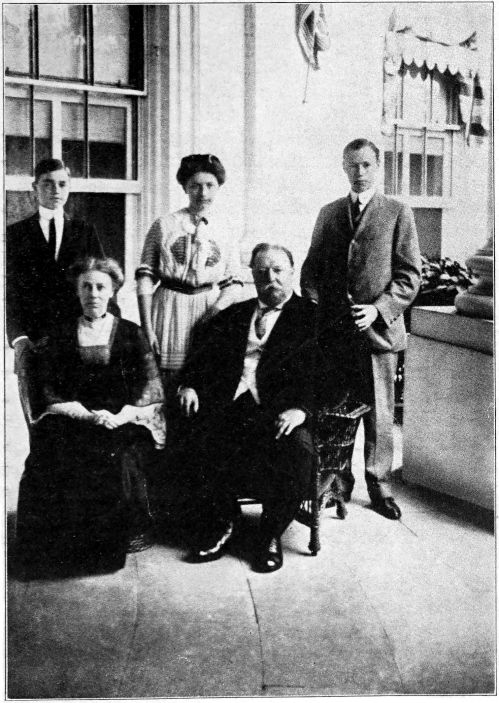
WILLIAM H. TAFT AND HIS FAMILY
On account of his size, his friends always made commiserating
jokes in regard to the beasts which Taft rode.
Another Philippine story refers to a long and tedious
journey he made to the mountains of Bengat.
The Department at Washington knew of the trip,
and Mr. Taft reported by cable direct to Secretary of
State Root:
“Arrived safe and sound after riding one hundred miles
muleback.”
Secretary Root replied like this:
“Congratulations on your health. How is the mule?”
The native Filipinos fairly worship Mr. Taft. They
have a way of calling him “Santa Taft,” and think, in
order to be a great man in America, one must have a
gigantic stature.
When Mr. Taft was appointed Secretary of War, his
wife at once became a popular hostess whose drawing
room was always filled with interesting people. Her
knack of remembering faces and names and her evident
interest in the people she met offset a certain austerity
made noticeable by contrast to the geniality of the head
of the house, but due, in her case, largely to a certain diffidence
that was lost entirely during her public life.
Mrs. Taft had been a suffragist all her life, though
never of the aggressive type. Regarding the ballot for
woman she said:
“I favour bestowing upon women every civic right, but
I should like to put in a prohibitory clause debarring them
from running for office. If women should indulge in a
scramble for office, I think that the natural scheme would
become disjointed and the aim of the home destroyed.
I can see nothing unfeminine in women casting the
ballot, but it seems to me for the present that it is impracticable
to dissociate the right to vote from the right to hold
office.”
It was while her husband was Secretary of War that
Mrs. Taft showed her resourcefulness on that long
journey which they took with their ten-year-old son
Charlie. The Philippines were opening their first Assembly
and had called “Santa Taft,” who had given them
their government, to come to see what they had done with
it. Next, he was to cross Siberia over the new railroad
and return through Europe. Helen Taft was at the
Cathedral School outside Washington, and Robert, the
older son, was at his Uncle Horace Taft’s school at Watertown,
Conn. Few women would have cared to make that
trip, crowded with important entertainments, where one
must always look well, through a climate ranging from
Siberian cold to Philippine heat, without a maid, and with
an irrepressible youngster who must always be kept in
presentable condition. But Mrs. Taft did not hesitate.
Her place was with her husband, and it was an opportunity
for little Charlie to see the world. As usual, she
was the most charmingly gowned woman at every function
they attended. And best of all, they all had a good time.
It was during this eventful trip that Mr. Taft, in alighting
from a train, snagged an ugly hole in his only pair of
dress trousers. This was tragedy, as he had an appointment
to be received by the Czar of all the Russias. Mrs.
Taft did her best, but although her husband stepped
carefully, the cloth gave way again, exposing the knee.
Rumour claims that the imperturbable gentleman merely
donned a long coat and entered the Czar’s presence with it
on, and later told the Emperor the whole story and
produced the proof. At any rate, no international complications
ensued with Russia on the grounds of the
implied discourtesy of the American representative in
being very late for his appointment.
Among the many accomplishments Mrs. Taft brought
to her régime at the White House was her skill as a linguist.
During her extensive travels she had devoted
time to the study of languages in the countries she visited,
and her ability to converse with some of the diplomats in
their own tongues was a source of great satisfaction and
pleasure. Mrs. Taft kept pace with her husband in public
affairs and during her occupancy of the White House
was thoroughly conversant with political questions that
were paramount in interest. But she limited her discussions
and expressions of opinion to the privacy of the
family group. Instead of concerning herself with politics,
she devoted her energies to the changes she wished to
bring about in the management of the forty-room house
which Uncle Sam had given her for a temporary residence.
Beginning with the front door, she substituted
coloured-liveried butlers for the blue-uniformed police
who formerly guarded this entrance, and then, at her
request, the position of steward was abolished and
replaced by that of housekeeper, paid by the government
at the rate of $1,200 annually. Mrs. Jane Jaffray,
recommended by some of Mrs. Taft’s friends in New York,
was appointed to this position, which was one of great
responsibility, as the housekeeper supervised the servants,
all being of equal rank under her authority. She had
charge of the linen and silver, for the cleaning of which
Mrs. Taft installed an electric silver-cleaning machine,
which lessened the labour and saved time. Mrs. Jaffray
also had charge of the china, the pantry, and the refrigerator.
The morning before inauguration, Mrs. Taft
took Mrs. Jaffray to the big centre market and made the
rounds of the stalls with her, explaining her methods and
acquainting her with the food the family liked. All of the
marketing during the Taft régime was done by the housekeeper,
not only for the family and the servants, but for
the formal entertaining. All of the catering for the state
functions was done in the White House kitchens, even to
the ices and confectionery. Mrs. Taft had always been a
practical, capable manager. Under her direction, the purchasing
of staples was done in wholesale quantities.
Mrs. Taft planned and carried out an elaborate social
programme. She was persuaded that Washington City
should be the social centre of the country and did her best
to carry out her ideal, which she explained in an interview
for the New York American as follows:
“It seems to me that, geographically and logically,
Washington should be the representative social city of the
land. Here are the headquarters of the country’s official
and diplomatic life, and every distinguished visitor to
our shores comes to Washington for a time. The home
life is more representative, too, than it is in any other
city. No city in the entire country is more beautifully
laid out or has more natural charm during the months
given over to official and social life than Washington. I
hope one day to see it the recognized social centre of the
United States.”
To assist her in her social duties, she followed Mrs.
Roosevelt’s example of engaging a social secretary, and
Miss Alice Blech filled this position during the first part of
the administration.
President Taft was the first of the Executives to receive
the increased presidential salary. After much discussion,
Congress had finally raised the yearly stipend from $50,000
to $75,000, with an additional $25,000 for travelling
expenses.
Upon his induction into office, President Taft was asked
his views upon serving liquor at the White House functions.
He referred his questioner to a letter he had
written to be read in the Sunday schools of the country a
few weeks before. It read in part:
My dear young Friends:
The excessive use of intoxicating liquors is the cause
of a great deal of the poverty, degradation, and crime of
the world, and one who abstains from the use of such
liquor avoids a dangerous temptation. Each person must
determine for himself the course he will take in reference
to his tastes and appetites, but those who exercise the
self-restraint to avoid altogether the temptation of
alcoholic liquor are on the safe and wise side.
The state dinners of the Taft administration cost
from eight to twelve dollars per plate, according to their
elaborateness and the number and the personnel of the
guests. The diplomatic dinner, being the most sumptuous,
cost around twelve hundred dollars. Mrs. Taft
followed no set rule with reference to the menus or the
wine course, the number of wines served being dependent
upon the menu. Cocktails or white wines with the
oysters, claret or sherry with the soups, champagne with
the entrees, champagne, burgundy, or sauterne with
the principal course, port with the sweets, and brandy or
cordial to finish with. Good taste was always the dictator.
Outside of the state dinners, no wines were served
at any of the functions save the champagne punch at the
formal receptions, at which a buffet supper was provided
usually of dainty sandwiches, salads, relishes, croquettes,
little cakes, ices, and champagne punch, and
coffee. Mrs. Taft served delicious punch and preferred
to make it herself. There is a story to the effect that,
during one of her affairs, to her great distress the supply
became exhausted and she herself descended to the pantry
to direct the preparation of a fresh supply.
One of the charms of the Taft hospitality was the fact
that the genial President and his wife joined their guests in
the dining room and partook of the supper personally.
But the innovation for which Mrs. Taft has received the
greatest amount of praise was the transforming the state
functions from the formal crushes of the past to the smaller,
more exclusive, but withal more enjoyable gatherings
where formality was dispensed with as much as possible,
and where the dainty buffet supper was served to hosts
and guests alike in the state dining room. This displaced
the former custom instituted by Mrs. McElroy, in
President Arthur’s day, of serving supper upstairs to the
receiving party and the Blue Room guests alone. By
limiting each reception to the class of guests for which it
was intended, Mrs. Taft added greatly to the comfort and
pleasure of all concerned, as under this arrangement there
was no necessity for the long line which moved its tiresome
way so slowly through the length of the entire basement
and main floors before reaching the President. The
guests assembled in the East Room until the receiving
party had come downstairs, and then proceeded immediately
to shake hands with the President and greet his wife.
Each reception wound up with an hour or so of dancing
in the East Room, much to the delight of the younger
people, especially when the President would join them,
which he almost always did for a few minutes at least.
Mrs. Taft also personally examined and approved all
bills before they were paid. All her life she had been a
careful manager, a fact to which her husband often
referred with pride. Her own fortune, while not of great
proportions, augmented his earnings to such an extent
that he often said, “When Mrs. Taft stops footing the
bills, I’ll have to hang out my shingle.”
Mrs. Taft’s musical tastes led to a great number of
delightful musical entertainments in the White House,
and many ambitious young artists had a chance to be
heard by real critics.
None of the protégés of either the President or Mrs.
Taft exhibited such a degree of pride as radiated from the
President’s valet, who had served him in the Philippines
and accompanied him to this country. His particular
reason for the pride that brought forth the wrath of the
rest of the servants upon his head was the fact that he
boasted of being a personal servant, paid from the President’s
own pocket, and was unduly scornful of the others,
whom he claimed belonged to the government.
The Taft home life was informal and just like that of
any other normal American family of congenial tastes.
They spent many evenings in the privacy of their own
family circle with Mrs. Taft at the piano, as had been her
lifelong practice. While the two older children were away
at school, the house was never dull, as both the Taft and
the Herron families were liberally supplied with young
people constantly coming or going. Mrs. Taft had five
sisters and two brothers, all of whom were married and
had families, and the President had three brothers and
one sister likewise similarly blessed with children. So
there were always nephews and nieces to keep things lively.
Miss Helen was not so athletic in her tastes as the Roosevelt
girls. She entered Bryn Mawr at sixteen, and by
close study won a scholarship for $300, which gave her
parents great pride. Her début was not made until
her college work was finished. By her own choice, she
preferred the scholastic career to that of a social belle.
With Mrs. Taft’s many talents, a live college girl in the
house, the President a fun-maker and mimic, and young
Charlie to furnish boyish pranks and thrills, they never
lacked for amusement among themselves.
The family generally met at breakfast at eight-thirty,
Mrs. Taft following her habit of dressing for the day before
this meal. Luncheon was reduced to an apple for the
head of the nation, but he usually liked to slip in to visit
with his family and guests at this hour. Dinner was at
seven-thirty, after which, when they were alone, there
would be music or whist. Whenever he went out, the
President would tap on Mrs. Taft’s door for her to inspect
him, to be sure that his hat was on straight or his bodice
not wrinkled, as he facetiously put it.
Mrs. Taft made but few changes in the arrangement of
furniture or rooms. Miss Helen occupied the same suite
used by former belles, and while the members of the
family brought but little outside their trunks, the private
apartments soon reflected their individual tastes. The
President hung his father’s portrait in his study, as he
had placed it over every desk he ever occupied.
When the time rolled around for him to relinquish his
place to Woodrow Wilson, he set his office in order, as his
wife did the mansion under her care, bade the congregation
of All Souls Unitarian Church farewell from the pulpit,
and slipped out of power with the love and respect of those
associated with him.
Among his hobbies are golf and photograph collecting.
After his appointment to the Supreme Court, Washington
welcomed him as her own.
Miss Helen Taft, who for four years occupied one of the
most conspicuous positions in the country, left Washington
as unspoiled as when she came, a little girl, from the
Governor’s palace in the Philippines. Though constantly
fêted she found time for the more serious duties of life
and many quiet philanthropies of which the public knew
nothing.
When the Tafts departed for the South after rendering
every possible attention to their successors, a censorious
critic of Washington’s social life gave the following summary
to their administration:
“Whatever brilliancy their successors may give to the
White House, to President and Mrs. Taft belongs the
distinction of having solved many problems as to precedent
in the conduct of state functions, etc., which had
baffled their predecessors, and of putting soul into the
White House gatherings, a soul which made an invitation
there a pleasure instead of an obligation perfunctorily
performed. Their social record in the White House has
been brilliant from beginning to end. They have seen the
duties of their position with a broadmindedness resulting
in a measure from the almost unprecedented preparation
they had for it in years of public life, and they have lived
up to them with a graciousness that has left nothing to
criticize.”
Mrs. Taft has always been a lover of nature, and in all
of her travels about the world has given great attention to
the types of flowers and trees common to each country or
locality. Her own garden is always a dream of beauty in
the spring and summer. She gives it especial attention,
making personal visits to each tree, shrub, and clump of
flowers with her gardener.
It is to her artistic vision and understanding, coupled
with her capacity for quick action, that the nation owes
the chief beauty of the Potomac Park. When Mrs. Taft
first saw the cherry trees of Japan in full bloom, she
thought them marvellously beautiful and resolved to obtain
some for planting in her own land.
Shortly after she became mistress of the White House,
she secured and had planted a hundred of these trees
between the polo field and the Tidal Basin. Many of
them failed to live. Later, Dr. Jakichi Takamine, noted
chemist of Tokio and New York, the inventor of adrenalin
and other important chemicals, learning of her admiration
of the lovely little flowering trees of his native land,
offered three thousand as a gift from Japan in the name of
the Mayor of Tokio. They arrived during the latter part
of 1911 and were promptly accepted by Mrs. Taft in the
name of the government. It is the common belief that
the arrangement of their planting in groups of odd and
even numbers represents in Japanese characters a message
of welcome.
President and Mrs. Taft did much to popularize the
now famous Potomac Park, once a mosquito-infested
swamp, rendezvouz of tramps, and hiding place of
criminals.
As the Taft régime drew to a close, the society women
of the city who were close to the official family—sixty of
them—subscribed ten thousand dollars for the purchase
of a testimonial of appreciation of Mrs. Taft’s ceaseless
efforts to make Washington the social centre of the nation.
Miss Mabel Boardman was deputized to make the purchase
in New York. A necklace was decided upon.
In order to avoid duplicating the one Mrs. Taft had long
worn, Miss Boardman took along a photograph of it.
On February 21, 1913, a few days before inauguration,
Mrs. Taft was presented with the gift, the beautiful,
perfectly matched chain of diamonds set in platinum
with a pear-shaped stone as pendant. At the same time,
the genial President was the recipient of a lovely pearl
scarf pin from the same group.
In the quiet of retirement, Mrs. Taft has compiled an
ambitious book—a story of her own unparalleled experiences
in public life.
CHAPTER XV
FIRST ADMINISTRATION OF
WOODROW WILSON
March 4, 1913, to March 4, 1917
AFTER sixteen years of Republican domination, the
Federal government passed into the hands of Democratic
rule on March 4, 1913, with the inauguration
of Woodrow Wilson of New Jersey and Thomas Riley
Marshall of Indiana, after one of the most stormy and
eventful of the nation’s thirty-two presidential elections,
which left in its wake a trail of bitterness, disappointment,
and broken friendships, never entirely forgotten or forgiven
by those vitally concerned.
The Wilson family party arrived at Washington in the
mid afternoon of March 3d, going to the Shoreham, where
an entire floor had been reserved for them. Later, they
called upon President and Mrs. Taft at the White House.
That evening, they all assembled at the Shoreham for a
family dinner which Mr. Joseph Wilson of Chicago gave
in honour of his brother, President-elect Wilson, and Mrs.
Wilson.
On the same day, the first great Suffrage pageant took
place. In parade, it told the story of the long struggle
of that party. Led by Mrs. Richard Coke Burleson, the
modern crusaders for “Votes for Women” marched up
Pennsylvania Avenue five thousand strong, with wonderful
floats and bands of stirring music to emphasize their
demand for suffrage through constitutional amendment.
The signal for the procession to start was given by Miss
Inez Milholland, the beautiful young herald, who, astride
her handsome horse, wore the yellow of the heralds of
mediæval days.
Her associates like to remember her as she appeared
that day, for her untimely death followed soon after.
To join the gigantic demonstration came “General”
Rosalie Jones with her two hundred weary, footsore
pilgrims, who had hiked through mud, rain, snow, and ridicule
from New York. In their drab cloaks and hoods,
carrying their staves, they created much comment.
The cavalry was, perhaps, one of the smartest, most attractive
sections in the procession, mostly young society
women who were superbly mounted.
The floats, particularly significant, showed the progress
of the suffrage movement since its beginning in 1840.
Later, tableaux and allegorical dances were given upon
the steps of the Treasury, interpreting the dreams and
ambitions of modern womanhood. Many distinguished
and prominent women participated, while hundreds of
others were interested spectators. The demonstration
called forth unstinted praise from every intelligent source.
Unfortunate indeed was the outrageous lack of police
protection given the marching women; they suffered
insults and physical injury at the hands of hoodlums.
Their flags and banners were spat upon, lighted cigars and
cigarettes were thrown upon them, and the crowding
in upon the line here and there caused more than a
hundred persons to be so trampled and bruised as to
require hospital treatment. The contrast between the
calm orderliness of March 4th and the extreme disorder
of the day previous was so marked that the matter became
subject for presidential appeal.
The heads of the various suffrage organizations returned
to New York at once, and the next morning, the following
telegram was sent to Mr. Wilson so that he should receive
it before leaving for the Capitol:
President-elect Wilson
The Shoreham, Washington, D. C.
As you ride to-day in comfort and safety to the Capitol
to be inaugurated President of the United States, we beg
that you will not be unmindful that yesterday the government
which is supposed to exist for the good of all, left
women, while passing in peaceful procession in their
demand for political freedom, at the mercy of a howling
mob on the very streets which are this very moment
being so efficiently officered for the protection of men.
Harriet Stanton Blatch,
For the Women’s Political Union.
Promptly at ten-fifty on the morning of March 4th,
Woodrow Wilson and Thomas Marshall, President-elect
and Vice President-elect, left the Shoreham Hotel after
several hours of cheering ovations by their respective
Princeton and Culver students, and made their way
to the White House, where the President-elect was
serenaded by the Princeton boys with the Princeton
anthem, “Old Nassau.” The University of Virginia
students also felt a special claim upon Mr. Wilson and
added their strength of numbers to the student delegation
which totalled three thousand.
There were no particularly distinguishing features in
the administering of the oath to either the new President
by Chief Justice White, or to the Vice President by
Senator Gallinger. The drama of the great political
struggle was reflected in the picture presented in the
little group when President Wilson had completed his
address. While the crowd was shouting its enthusiastic
approval, Mr. Taft, the retiring leader of the party,
defeated after sixteen years of supremacy, congratulated
his successor thus: “Mr. President, I wish you a successful
administration and the carrying out of your aims. We are
all behind you.” William Jennings Bryan stood at hand,
the persistent prophet of progressive democracy, thrice
defeated, and once more possessing his soul in patience
as he accepted a commission from the new President who
was claiming to be mustering forces of humanity, not
forces of party.
The long procession of forty thousand marching men
which had been forming while the ceremonies were in
progress, followed the President to the White House.
The Essex Troop, made up of college graduates and young
men of means, all of whom owned their handsome mounts,
wheeled into line in full strength to honour their former
governor, while the sixty mounted Culver cadets that
composed the famous Black Horse Troop of that institution
found their location as escort to Vice President
Marshall.
Twenty-five hundred Tammany Braves also made the
air ring.
The fireworks in the evening were unusually elaborate
because of the omission of the inaugural ball.
All arrangements had been made as usual for the ball,
but it was omitted at the President’s expressed wish.
While there were many rumours as to the reason of its
abandonment, the expense involved in the upheaval of
the routine business, the moving of clerks and upset of
office equipment in the huge Pension Building seemed to
be the chief consideration. There was no other structure
available in Washington at that time large enough to
accommodate the crowds desiring to attend. Then, too,
soon after election it was known that both Governor and
Mrs. Wilson were indifferent, if not actually opposed,
to the idea of a ball. Mrs. Wilson had been quoted as
saying: “I cannot bear to think of a ball with the modern
dances when Woodrow is inaugurated.” To them both,
the ceremony of March 4th carried much of the thought
of dedication, a point of view in accord with the Presbyterian
doctrines in which both were rooted and grounded.
Disappointment was expressed over this departure from
precedent, not so much from a personal standpoint as
from a sense of regret over the breaking up of a cherished
institution which had its inception under the tutelage of
the immortal George Washington, who with all of his dignity
and stateliness deemed it a fitting conclusion of the
celebration and an appropriate way to inspire respect and
maintain prestige in the eyes of other nations. Being
thoroughly consistent, he attended and gallantly did his
share of dancing with the belles of the evening.
The inaugural ball was the people’s ball; it was the
epitome of democracy, the externalized embodiment of
the American doctrine that “all men are created equal,”
for every class of society had always been represented,
from the highest to the most humble.
Woodrow Wilson’s career as college president had been
noted for the many changes he made, the most radical
being the overthrow of the student aristocracy. As
Governor of New Jersey, he had begun his term by
upsetting the political machine. As soon as he became
President the country became aware of the fact that the
new Executive considered rules made for people and not
people—especially White House people—for rules. He
daily disregarded precedents for courses of action which,
in his own judgment, were more feasible and expedient.
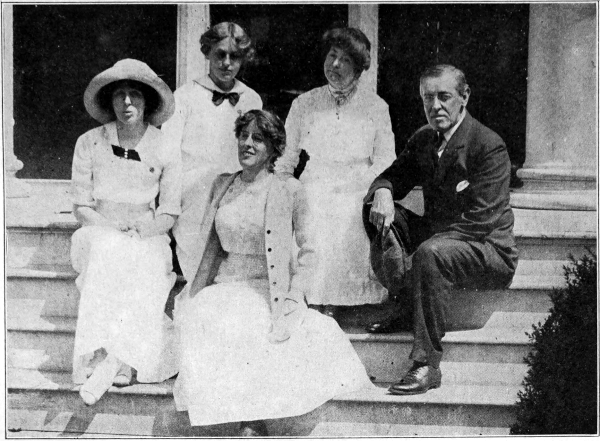
© Underwood & Underwood
WOODROW WILSON AND HIS FAMILY IN 1912
With the abandonment of the inaugural ball, some anxiety
arose about the social régime of the White House.
All doubt on this score was dispelled, however, when the
family began their delightful receptions. The charming
Southern hospitality and the three lively young daughters
gave the mansion an air of joyousness that did not diminish
until the illness of the gracious First Lady cast
its shadow over the entire city. The teas, receptions,
garden parties, and dinners all reflected the wholesome,
unaffected cordiality of the hostess.
President Wilson chose for his Cabinet portfolios:
State, William J. Bryan, Nebraska; Treasury, William G.
McAdoo, New York; Navy, Josephus Daniels, North
Carolina; War, Bindley M. Garrison, New Jersey; Postmaster
General, Albert S. Burleson, Texas; Interior,
Franklin K. Lane, California; Commerce, William C.
Redfield, New York; Agriculture, David F. Houston,
Missouri; Labour, William Wilson, Pennsylvania; Attorney
General, James McReynolds, Kentucky.
Presidential cares were never so engrossing that Woodrow
Wilson failed to respond to the appeal of a child.
On the first Easter Sunday that he was President, he
and the family decided to attend the Eastern Presbyterian
Church. During the service a little six-year-old girl in an
adjacent pew divided her attention between watching the
new President and admiring a cherished bundle in her lap.
Just before the service concluded, she leaned over and
handed the package to Miss Eleanor, who, noting it was
for the President, smilingly passed it on to her father.
The President glanced at the package so carefully wrapped
in a paper napkin, read the name and message scrawled
in childish script, and justified the child’s admiration, for
he turned, smiled, and bowed his thanks to the little girl
with as profound courtesy and as much evidence of pleasure
in his expression as if the gift had been a priceless jewel
instead of being only a gaudy Easter egg.
The first and most important of the social affairs at the
White House during the first year of the administration
was the marriage of Miss Jessie Woodrow Wilson to Mr.
Francis Bowes Sayre, in the East Room, on November 26,
1913. She was the thirteenth bride of the home of the
presidents. No fears of ill luck haunted her, for her
entire family regarded the number thirteen as their
mascot.
For the simple ceremony, a dais approached by two low
steps was erected by the windows facing the Treasury
Building, on the spot where Nellie Grant gave her hand to
Mr. Sartoris, and where Alice Roosevelt became the bride
of Nicholas Longworth. A prie dieu covered with white
satin, bride roses, and lilies of the valley stood upon a
beautiful white rug that had been presented by the
Minister of Peru and Madame Pezet. This bit of vicuna
fur from South America was especially interesting because
of its virtue of bringing good luck to its owner. At four-thirty
the President escorted his wife to the State dining
room where the bridal procession was forming, and turned
her over to Colonel W. W. Harts, his military aide, who
took her to her assigned place in the East Room. Mrs.
Sayre, the mother of the bridegroom, was escorted to a
place opposite.
A fanfare of trumpets and Lohengrin’s march by the
Marine Band announced the approach of the bridal party.
The bridesmaids were the Misses Eleanor R. Wilson,
younger sister of the bride; Mary G. White of Baltimore;
Adeline Mitchell Scott of Princeton, and Marjorie Brown
of Atlanta. With them walked the ushers: Benjamin
R. Burton of New York; Charles Evans Hughes, Jr., of
New York; Dr. DeWitt Scoville Clark, Jr., of Salem,
Mass., and Dr. Gilbert Horax of Mount Clair, N. J., all
college associates of Mr. Sayre. Miss Margaret Wilson
preceded the bride, who, in the traditional white satin
and veil, was escorted by her father. Miss Wilson was
met at the improvised altar by Mr. Sayre, who was attended
by Dr. Wilfred T. Grenfell. The Reverend
Sylvester W. Beach, D.D., pastor of the First Presbyterian
Church of Princeton, N. J., where Miss Jessie taught
a Bible class and where the Wilson family attended, read
the service. The Reverend John Nevin Sayre, brother
of the bridegroom and missionary to China, pronounced
the benediction.
For the supper, the table, with its huge wedding cake,
was beautifully decorated. The cake had been made in
New York, in two layers, and was two and a half feet high
and three feet in circumference. It weighed one hundred
and thirty-five pounds and was reported to have cost five
hundred dollars. To Miss Margaret’s lot fell the slice
with the ring, and later she caught the bride’s bouquet.
The collation in the State dining room, the same as served
to the bridal party, consisted of Virginia ham, salads,
sandwiches, relishes, bonbons, ices, cakes, coffee, and
fruit punch, made in accordance with the bride’s expressed
wish without wine or liquor of any kind.
With the aid of the President’s secretary, Joseph P.
Tumulty, and the White House police, the bridal couple
escaped their friends. Then the ropes were removed and
the young people had a delightful dance with the Marine
Band to play.
Next in interest to the White House bride herself, at
least to the women of the land, was her trousseau. In the
opinion of critics, Mrs. Sayre’s wedding outfit, though
modest, had been designed with artistic skill and carried
out with materials whose elegance and quality made her
gowns appropriate for all occasions. She planned her
clothes to fit the wants of a college professor’s wife with
ample provision for occasional jaunts to Washington and
New York. The wedding gown was made of lustrous
white satin, a product of the now famous Paterson, N. J.,
mills, and was adorned with orange blossoms and rare
point lace, an heirloom in Mrs. Wilson’s family. The full
court train, which was fastened at the shoulders, was also
adorned with wedding flowers. The full-length veil was of
the finest French tulle and completely enveloped the bride.
It was arranged from a lace cap which was fastened close
to the hair and was adorned with sprays of orange blossoms.
Tiny clusters of the flowers were caught in the
veil. The bouquet was a cluster of bride roses with a
shower of buds and ribbon. Mrs. Sayre’s only jewel was a
diamond pendant and chain, the gift of her husband.
The invitations and the announcements of the wedding,
except for the embossed coat of arms of the United States
at the top, were plain enough for any private family.
The list of invited guests contained less than seven hundred
names. It included, besides the relatives and intimate
friends of the two families, the members of the
Cabinet, Supreme Court, Diplomatic Corps, the New Jersey
delegation in Congress, and the leaders in Congress.
The bridal presents were such as only a White House
wedding could call forth. They varied in elegance and
costliness from the tiny beaded hand-made purse presented
by the four-year-old cousin of the bride, to the twenty-five
hundred-dollar-diamond necklace presented by the House
of Representatives. China and cloisonné vases—gold coffee
spoons, candlesticks, mahogany furniture, and many
beautiful gifts of silver rubbed shoulders with such humble
but eminently useful gifts as two washtubs, six boxes
of soap, coal scuttles, a barrel of potatoes, rag rugs, five
bushels of Bermuda onions, a white knitted hammock,
a washing machine, a sewing machine, and an eiderdown
quilt.
Mrs. Wilson’s social régime was simple, making up in
genuine hospitality and sincere enjoyment whatever it may
have lacked of the glitter and brilliance of former administrations.
Each individual came away from her receptions
with a warm glow of satisfaction because of her sincere
personal greeting. Never did she look bored, even when
toward the last, just before her illness began, she was
obliged to sit down. Generations of gentle ancestry had
bequeathed a courtesy that was as much a part of her as
her soft wavy brown hair and expressive dark eyes.
Formerly Ellen Axson of Georgia, the daughter of a
clergyman, Mrs. Wilson had been reared in the cultural
atmosphere of a Southern home, and educated according
to the best traditions of the old South. She had studied
art in New York during the period of her engagement to
Woodrow Wilson. She continued her studies in spite of
the demands of a growing family and a thoroughly domesticated
husband. Following Governor Wilson’s election
to the Presidency, she put a collection of her paintings on
exhibition at the Arts & Crafts Guild in Philadelphia, the
proceeds from whose sale were sent to the Martha Berry
School of Georgia. Mrs. Wilson also made a gift to
Goucher College of which one of her daughters was a
graduate. After coming to the White House, she managed
to devote some time to art work, fitting up a studio
in the attic, where some of her best canvases were completed.
When Mrs. Wilson first came to Washington, she became
interested in the work of the Woman’s Department
of the National Civic Federation, the District Branch of
which, with Mrs. Archibald Hopkins in charge, was busily
working to clean up the alleys and eliminate the slums.
The pitiful condition of many of the old coloured people
living in poverty and squalor had a peculiar appeal to
her. The condition of the children tugged at her sympathies,
too. She not only attended the meetings of the
District Branch of the Federation, but made any number
of personal tours of inspection through some of the worst
of the city’s twenty-three miles of alleys and slums.
One of Mrs. Wilson’s earliest expeditions was to Goat
Alley, considered the worst of its kind in the city. She
was accompanied by Mrs. E. P. Bicknell, chairman of the
committee on housing of the National Civic Federation,
Mrs. Archibald Hopkins, and two Secret Service men.
She traversed the entire length of the alley on foot and
was so impressed by the conditions she found there that
she accepted the position of honorary chairman of the advisory
board of the housing committee, in order to help
actively with the clean-up work.
Mrs. Wilson never indorsed any cause simply by letting
her name be used; so, in the duties of honorary chairman,
she worked as energetically as the rest of the members of
the committee. This was only one of many, many trips
she made through the dirty and dismal byways of the city.
Never did she manifest the aversion and disgust she
must have felt, but went as any serious-minded, interested
woman would who sought to see conditions for herself
and the way to better them. She stopped repeatedly to
talk to the children and their parents. There are scores
of poor alley dwellers who will always treasure the wonder
of the moment when the gentle First Lady of the Land
stepped down from her splendid limousine and walked
through their midst, with a pleasant word and a friendly
handshake for any and all who greeted her. Time and
again she went home with her dainty gloves stained and
grimy. Partly as a result of her interest, a bill was introduced
in Congress for the reclamation of such pest
spots.
Mrs. Wilson was also a frequent visitor to the library
of the blind, where her daughter Miss Margaret, often
sang.
Early in her régime as Chatelaine of the White House
she began investigating the sanitary conditions of the
various big government departments. Through her interest,
all of the departments now have rest rooms, sanitary
drinking cups, and little branch hospitals where first
aid may be given in case of illness or accident.
The Bureau of Printing and Engraving received one of
Mrs. Wilson’s first visits, and all suggestions made by her
were most gladly received and carried out, with the result
that the new building was equipped with one of the finest
rest and lunch rooms for its employees of any in the country.
Just a few days before her death, Mrs. Wilson received
a letter from Public Printer Ford of the Government
Printing Office expressive of the appreciation of
himself and the seventeen hundred women who work there,
for her efforts in also securing a rest room for them.
Among some of the other reforms and improvement
projects for the Capital City in which Mrs. Wilson was interested
were such matters as enforcement of school attendance
laws, regulation of child labour, supervision of
dependent and neglected children, provision for the care
of the feeble-minded and for the treatment of drug victims,
a parental school, open-air schools, playgrounds and recreation
centres, public comfort stations, public baths and
wash houses; legislation to promote the use of school
buildings as social recreation centres—in fact, anything
that tended toward the good of humanity.
Being of the South, she was naturally interested in every
practical progressive movement that related to that section,
and the indorsement she gave to the work of the
Southern mountaineer women was the best thing that
could have befallen them. Like all people with any self-respect
these women did not want charity. They wanted
only opportunity to show their beautiful, old-fashioned
hand-made rugs, carpets, curtains, and counterpanes to
people who might be interested in buying them. Mrs.
Wilson allowed them to fit up a room in the White House
with their handiwork, and she exploited it by telling her
friends and having the women of Congress and the Cabinet
come to tea and inspect the exhibit and talk to the weavers
themselves. The result was order after order for the
quaint work from the toil-worn hands of these women,
who have preserved a lost art in the remote fastnesses of
their mountain homes, and to whom the chance to sell
their work for real money, not trade it for supplies, was
the greatest boon the President’s wife could confer. When
her daughters were married, Mrs. Wilson purchased
numerous pieces of this old-fashioned handwork to be
included among her gifts to them.
To the poorhouse, she constantly sent flowers. Never
before did the poor of Washington receive so liberally of
the floral beauties of the White House conservatories.
In hospitals and orphan asylums she was “an angel,”
and to the little newsboys of the street, for she would buy
their papers and laugh away their return change.
A fall due to a slipping rug brought Mrs. Wilson to her
bed toward the close of her busy season. Already worn
by the social strain, she was attacked by a complication of
ailments chief of which was Bright’s disease, that defied
the best medical attention. It soon became known that
the President’s wife could not recover. Her daughter
Eleanor’s marriage to William Gibbs McAdoo took place
under this shadow.
The night before her death she recalled her interest in
the alleys and slums and mentioned to the President that
it would give her much happiness if the pending bill could
be passed. The alley bill passed the Senate unanimously,
and the fact was made known to Mrs. Wilson during a
period of consciousness about two hours before she died.
The hurried adjournment of Congress following her death
prevented the bringing up of the bill in the House at that
time; but that body approved the measure later.
All through her illness, her constant and chief concern
was that the President be kept in ignorance of her suffering.
Toward the end, she put a charge upon Dr. Cary
Grayson, saying:
“If I go away, Doctor, promise me you will take care
of my husband.”
It was August 6, 1914, that Mrs. Wilson died. She
had won the hearts of the people by her sympathy toward
all in need and suffering. The nation grieved with the
White House family. Her death was a shock such as
Washington had not felt for years. When the big iron
gates were closed and locked, the shades drawn, and the
sombre emblem of death hung from the door of the White
House, the whole city responded to the grief within,
lowered its flags, and stopped its merrymakings and
frolics. Telegrams flooded the White House, and flowers
filled the rooms. They came from every class and degree
of society from the newsboys to the representatives of
foreign governments; and from the handsome offerings of
the Boy Scouts to the simple bouquet of some lowly
protêgê. The interment was in Georgia.
For a time, President Wilson seemed to find continuous
work the only relief from sorrow.
With the combined strength and influence of his Cabinet
he turned his attention to securing the passage by Congress
of a new tariff bill. During this time the Federal
Reserve bill had become a law; President Madero of
Mexico had been deposed and assassinated; Huerta was
fighting for recognition; the insult to the United States
Flag on April 9, 1914, had called for action; and Vera
Cruz was occupied by Marines in consequence.
When rumour started that President Wilson was planning
to bring a new First Lady to the White House, great
interest and much excitement prevailed.
The third President to wed in office, Woodrow Wilson
formed what the most severe critics termed a thoroughly
suitable match. Both he and his charming fiancêe, Mrs.
Edith Bolling Galt, had been married before, both had
passed through similar griefs, and life for each had been
crowded with enriching experiences. They had so many
tastes in common, were natives of the same state, admirably
matched by birth, circumstances, and experience to
form an ideal life partnership.
From the time their betrothal was announced until the
date of the wedding was officially named, two months later,
all Washington kept a ceaseless vigil on the comings and
goings of these two, and watched with approving but
suspicious eyes all of their rides, drives, and walks, their
games of golf, their theatre attendance and appearance at
public functions, lest at some opportune moment a marriage
would occur without previous announcement. When,
finally, the date was set and made public, speculation ran
rife as to the ceremony and its interesting details.
But President Wilson and Mrs. Galt followed solely
their own personal predilections for a simple ceremony,
and in making all of their arrangements acted as plain
citizens. They were married in the presence of their respective
families in the home of the bride just off Dupont
Circle, December 18, 1915. Nothing of pomp or ostentation
occurred. All of the trappings of state, the brilliant
uniforms of the naval and military aides, the jewelled
decorations and glittering lace of the foreign diplomats
were missing. Not even the dignitaries of the Supreme
Court and the President’s Cabinet were included in the
small group witnessing the ceremony that was to place the
social crown of leadership upon the brow of another bride.
Promptly at eight-thirty the President ascended the
flower-decked stairway and escorted Mrs. Galt to the
improvised altar. The Rev. Herbert Scott Smith, rector
of St. Margaret’s Episcopal Church, of which the bride
was a member, and the Rev. James H. Taylor, pastor of
the Presbyterian Church, where the President and his
family attended, awaited them. The choicest and loveliest
of blossoms added beauty to the setting of the ceremony.
The white satin prie dieu, which had figured in
several of the White House weddings, on which the bridal
couple knelt to receive the final blessing, was decorated at
either end with clusters of delicate orchids, the bride’s
favourite flower.
The marriage service occupied about twenty minutes,
and, shortly after ten o’clock, the President and Mrs.
Wilson entered a waiting White House limousine and were
rapidly driven to Alexandria to take the train to Hot
Springs, Va.
The wedding supper, being virtually a family party,
was a merry one. The bride cut her wedding cake with
the same cake knife used by her mother at her own wedding.
The cake was not supplied with the usual fortune-telling
knick-knacks but was instead a rich fruit cake,
made in several tiers, elaborately iced and decorated with
frosted flowers. The top held a cluster of pink orchids.
No boxes were distributed, but several of the guests were
provided with pieces to “dream on.”
Mrs. Wilson was the widow of Norman Galt of Washington,
D. C., a member of a well-known firm of jewellers in
the national capital. She had resided in Washington
twenty years before her marriage to President Wilson,
during which time she had been known for her interest in
charitable and church affairs. She is the daughter of the
late Judge William H. Bolling of Virginia, and Mrs.
Bolling, and claims descent from John Rolfe, famous as
the husband of Pocahontas.
Because of international complications, the plans for
an extended wedding trip were abandoned at the last moment,
and only a brief trip arranged within easy reach
of the Capital.
The sympathetic interest in the White House romance
expressed itself in gifts of all kinds and descriptions, coming
from all sources and from all classes of people. Finally,
the numbers of presents reached such proportions that
the effort which had been made to catalogue, classify, and
acknowledge them had to be abandoned by Mrs. Wilson’s
secretary and be delegated to the White House office staff.
Because of the desire of the President to keep all of the
details of his marriage as simple and informal as possible,
the names of most of the donors of the gifts were withheld
from the public. A few, however, were known.
The joint gift of the Virginia delegation in Congress was
a silver loving cup in the form of a beaker with massive
silver handles. It stands two feet high on a pedestal of
ebony, and is appropriately inscribed. Citizens of Wytheville,
the birthplace of Mrs. Galt, sent handsomely
framed miniatures of the bride’s father and mother, Judge
and Mrs. Bolling, painted by Miss Ellen Douglass Stuart,
a niece of the late Gen. J. E. B. Stuart and a talented
artist.
Among the most unique of Mrs. Wilson’s gifts were a
wonderful scarf sent by the former Queen of Hawaii; the
statuette of Pocahontas, the gift of the Pocahontas Memorial
Association; the queer old painting of Pocahontas
sent from Scotland in recognition of Mrs. Wilson’s descent
from the Indian maid; the gift of the splendid collection
of furs from the Blackfeet Indians of the National Glacier
Park reservation, consisting of the selected skins of forty-eight
animals native to the western part of the United
States; a bracelet of Brazilian gems and an ornament of
rare tropical feathers presented by Dr. A. J. de O’lvera
Botelho of Brazil, the first of the delegates to arrive in
Washington from the Pan-American Scientific Congress;
and a basket woven from Georgia pine needles and filled
with the biggest Georgia pecans the Confederate veteran
giver could find.
The Wilson honeymoon and all of its details were of such
interest that papers published estimated summaries of the
expense involved as follows:
COST OF WILSON HONEYMOON
| Special train |
$ 400 |
| Room and board for the President and Mrs. Wilson |
480 |
| Rooms and board for President’s valet |
64 |
| Room and board for maid |
64 |
| Transportation autos |
120 |
| Room and board for stenographer |
96 |
| Room and board for seven Secret Service men |
352 |
| Salary for Secret Service men |
688 |
| Garage fees and gasoline |
48 |
| Servants’ wages |
48 |
| Salary of stenographer |
64 |
| Tips and fees |
75 |
| Flowers |
240 |
|
——— |
| Cost to President |
$2,739 |
| Cost to newspapers of telling Americans all about it |
$16,000 |
Upon returning to Washington, President Wilson took
hold of his problems with new vigour. Mrs. Wilson, a
Virginian of distinguished lineage, proceeded to brighten
up the White House and carry on its traditions of hospitality
so charmingly inaugurated by Ellen Axson Wilson,
whom she had never known, since she did not become
acquainted with the President until a number of months
after his wife’s death.
When the President’s friendship with Mrs. Galt was
noted and their betrothal predicted, rumours were circulated
that the political leaders of his party were filled
with anxiety lest the wedding prior to the election result
in his defeat. Their idea was that the influence of the
women of the land would be directed against him if he
were to remarry so soon after Mrs. Wilson’s death. While
little conferences were held and it was agreed that the
matter should be presented to the President, no one would
undertake the mission.
In the last year of the first term, when criticism of his
personal life and executive performances was at high tide,
just prior to election, Professor Stockton Axson, brother of
the President’s first wife, one who had long been a member
of the Wilson household in Middletown and Princeton,
was moved to write some of his reminiscences of the Wilson
home and family life, through his own desire to present to
the public a side of the President’s character little known.
This article appeared in a New York paper in October,
1916. In his story, Professor Axson painted a picture of
two Southern families—neighbours. The fathers, Presbyterian
clergymen, were close friends in perfect accord on
the tenets of Calvinism and the causes and effects of the
Civil War; their children typical of a friendship so strong
that each set regarded the adults of the other family as
relatives, calling them Aunt and Uncle through life. Each
family adopted as its own, for special regard, the relatives
and in-laws of the other, and they shared joys, sorrows,
and successes. This was the environment in which Woodrow
Wilson, then called “Tommy,” grew up. It has been
said that, when Ellen Axson was a wee infant a few days
old, little Tommy Wilson paid her his first call.
Of the romance of these two, Professor Axson wrote:
“It was in 1883 that Woodrow Wilson and Ellen Axson
became engaged. She was visiting friends in the North
Carolina mountains when my father fell seriously ill. He
had to summon her by telegraph—my mother had died
two years before, and my sister was the responsible member
of the family. She went to Asheville to catch a train,
but as she had several hours to wait for it she went to a
hotel and whiled away the time reading by a window.
“As fate would have it, Woodrow Wilson was driving in
the mountains, passed the hotel, chanced to look up, and
saw her profile at the window. The two had been together
in Rome the previous summer, and it needed just
that unexpected encounter in the North Carolina mountains
to show them what life held for each and both of
them.”
Professor Axson spoke of his sister and her husband
as being “more truly one than any two people” he had
ever seen. He said they literally married each other’s
family, never seeming to feel any difference between those
of their blood and those related by marriage. Two brothers
and a sister of Mrs. Wilson were also members of the
Wilson family circle for long periods. He paints Woodrow
Wilson as boyish, tender, generous, considerate, whimsical,
and fun loving, and cites an instance of the depth of
the family affection.
A favourite uncle of Mrs. Wilson was a visitor. From
long custom, upon retiring he put his boots outside his
bedroom door to be blacked. The young professor saw
them. The Wilson household maintained no valet and
the Bridget of the kitchen did not include boot blacking
in her schedule of duties. Mr. Wilson concluded that
Uncle Tom expected to have his boots blacked for him,
and as there was no one else to do it, it fell to his lot to
do them, and he did, telling the joke on himself.
This couple took colour from each other, each reflecting
the other’s moods and tastes in books, pictures, music, and
architecture. In the Wilson household, love ruled supreme.
The husband and father, an incorrigible tease
and fun-maker, could never be outdone in story-telling.
One could never tell him a new story. His fund of anecdotes
was inexhaustible, and in his clever telling of them
he caught the spirit and personality of the principals.
Professor Axson said that, when Mrs. Wilson died, the
President was the loneliest, most desolate man in the
world. It was not long before his family and close friends
began to hope he would remarry, and when he did, his
first wife’s people joined his own in their affectionate
welcome to the new First Lady. He claims they loved
her for herself and for what she did for Woodrow Wilson
in giving him new life, companionship, and the love he
had to have to enable him to go on.
While President Wilson was nominated in the Democratic
Convention without opposition, the election was a
close and exciting contest. Charles Evans Hughes of
New York, the Republican nominee, was reported elected
and all of the country went to bed, election night, President
Wilson included, with the idea that Hughes was to
be the next President. Admiral Cary T. Grayson, the
President’s physician, is authority for the statement that,
while the Wilson family and friends were distressed and
depressed over the returns that spelled defeat upon election
night, President Wilson was in the best of spirits.
He sensed a lifting of the yoke and was full of elation.
Finally, the Admiral, believing defeat certain, attempted
consolation predicting that, in another four years, the
American people would call him back to the Presidency.
With the twinkle that always prefaced a story, he replied:
“No, Grayson, I am like the Confederate soldier
who returned to his home after Lee’s surrender. He
looked at his wrecked farm, where the buildings had been
burned, the stock run off or killed, and the fences torn
down. He looked at his bare bleeding feet and at his one
remaining arm in a sling and remarked: ‘I am glad I
fought; I’m proud of the part I played; I have no regrets;
but—I’ll be damned if I ever love another country.’”
For three days, the election decision hung in the balance,
and then belated returns gave the majority to President
Wilson.
His first administration had witnessed many events
fraught with import to the nation’s history. He had been
confronted with stupendous problems. The Panama
Canal had been opened for traffic in August, 1915. The
Mexican situation had grown more acute after the deposition
of Madero and his death. In 1916, sixty thousand
men of the United States National Guard and regulars
had been stationed along the border. The Seventeenth
Amendment to the Constitution had been ratified, thus
providing for the direct election of United States Senators.
The Federal Trade commission had been established, and
the Clayton Anti-Trust measure enacted.
For days the Suffragists had picketed the White House
with their unfurled banners silently pleading their cause
in their efforts to win presidential support. On this
amendment the President had steadfastly refused to commit
himself, although besieged publicly and privately. At
one reception soon after his marriage, a prominent suffrage
leader went through the line with her set suffrage appeal
all ready to recite to the President when she should be
presented. Instead, when she reached him and his wife,
she gazed at Mrs. Wilson a minute and exclaimed enthusiastically:
“Oh! Mrs. Wilson, you are so much more
beautiful than your pictures!” The speech was forgotten
in the beaming smile she received from the President, who
fully appreciated her statement and, turning to his wife,
said triumphantly, “I told you so.” She always claimed
that, in the end, the compliment was more effective than
the speech would have been, although the next suffrage
leader in line was able to say her bit without interruption.
In February, 1916, Lindley M. Garrison, resigned his
post as Secretary of War because of his dissatisfaction
over the President’s attitude toward defense legislation.
As Inauguration time approached, the issues of the
campaign were still sending their echoes throughout the
country. The upheaval of Europe was being felt in
America.
Students of the World War and its progress cannot fail
to be impressed with the extremely difficult position of the
United States as the principal neutral power. From the
moment the Austrian tragedy unloosed the tempest, in
the summer of 1914, embroiling all of Europe, down to the
time of the destruction of the Lusitania, the volume of
American sentiment had been swinging steadily, though
more or less unconsciously, toward a demand that the
horrors of the European type of warfare be terminated.
Our own participation to force this end was a possibility
that was pushed into the remote background of dreaded,
unadmitted probabilities, despite the fact that the loudest
clamour for continued neutrality found its expression in
the campaign slogan of approval of Wilson’s policy, “He
kept us out of war,” and brought him his reëlection.
How closely the two great tides of public opinion were
paralleling each other was proved by the closeness of the
election in which preparedness and anti-preparedness
were paramount campaign issues. Neutrality won the
election, but it took only the announcement of the German
policy of unrestricted submarine warfare in January, 1917,
to clarify the public vision of its cobwebs of reluctance and
fear and bring the reëlected President, just a month prior
to his inauguration, to sound the first war tocsin for
America in his curt note to Germany and his appeal to
Congress to sever all relation with her.
So swiftly had the succession of events swung the United
States into the great struggle that the public accepted, with
dignity and characteristic patriotism, President Wilson’s
statements—“Neutrality is no longer feasible or desirable
where the peace of the world is involved and the freedom
of its peoples,” and “The world must be made safe for
Democracy.”
CHAPTER XVI
SECOND ADMINISTRATION OF
WOODROW WILSON
March 4, 1917, to March 4, 1921
ON SUNDAY, March 4th, Woodrow Wilson went to
the Capitol, and in the President’s room, in the
presence of a small group of officials, took again the oath
of office, reconsecrating himself to its obligation. The
Bible he used was the one on which he had been sworn in
as Governor of New Jersey and as President of the United
States at his first inauguration.
On Monday, the public ceremony occurred on the East
Portico, as was customary, there being but little deviation
from previous programmes. Mrs. Wilson established a
precedent by riding to the Capitol with her husband, the
first time this had ever been done. Mrs. Marshall followed
her example.
The parade was remarkable for the many innovations
that were introduced. The first radical departure from
the beaten path was that regular army soldiers served as
the presidential escort. By the expressed wish of President
Wilson, Troops B, C, and D of the 2d Cavalry,
stationed at Fort Myer, comprised his escort. This
regiment had been closely identified with the growth and
glory of our nation. Hitherto, militia from the states of
the incoming Executive and his running mate had been
given the honour.
Catching the spirit of the people as he went toward
the Capitol, President Wilson decided to smash another
precedent, and when it came time for him to give his address,
he requested the withdrawal of the military immediately
in front of the stand so that the public might
occupy that space and hear his address. There were more
than fifty thousand people massed on the plaza trying to
catch his words.
The ride from the Capitol to the White House was
made quickly, so that the family luncheon party should
see the review. Special arrangements for comfort had
been made, the stand having been enclosed in glass, carpeted
with a Persian rug, and fitted with large easy chairs.
Just opposite, in the Court of Honour, seventy-five
men dressed in uniforms of officers of the Continental
Army were stationed as honour guard to the President.
Most significant and novel in the parade was the
woman’s section, made up of several thousand women of
all sects, beliefs, political persuasions, crafts, trades, and
professions. For the first time, a woman had been permitted
to serve on the Inaugural Committee, and it was
the boast of Mrs. James H. Boggs, the chairman of this
section, that all women were welcome, politics and partizanship
being submerged in the patriotic efforts to demonstrate
what women could do. Her escort, to correspond
to that of Colonel R. N. Harper, inaugural chairman, was
an equestrian squadron. It was made up of Virginia
horsewomen, about three hundred of them, gay and festive
in their brilliant red velvet riding jackets, black velvet
skirts, and smart black silk beavers. Prominent, also,
was the Pennsylvania Women’s Woodrow Wilson League,
and the khaki-clad Girl Scouts, of whom there were several
hundred. Their sturdy little colour bearers struggled
valiantly with their banners against the stiff wind.
A large number of student organizations marched in
the parade. With war crashing over Europe, and the
United States facing participation, it seemed as though
the committee made extra efforts to demonstrate to the
assembled units the amount of man power this country
was ready to put behind its President.
For the first time in the history of the country, a distinctive
part was played in the inauguration by the government
departments. By joint resolution of both Houses of
Congress, the executive department and various branches
of the government in Washington were authorized to give
for two weeks an exhibit of their activities and methods
of transacting business. The entire project was called
“Uncle Sam at Work,” and was arranged and managed
by the various chiefs of bureaus, assisted by the Federation
of Citizen’s Associations of Washington.
President Wilson had asked his Cabinet to remain with
him in the new term. The note to Germany, conflicting
with Secretary Bryan’s pacifist views, brought his resignation
as Secretary of State. The appointment of Robert
Lansing to the post thus left vacant was universally
satisfactory. Newton D. Baker succeeded Lindley M.
Garrison in the difficult and vitally responsible position as
Secretary of War.
In little more than a month after Wilson’s second term
opened, all pretence of peace for the United States was
thrown aside. The President, following the action of
Congress, proclaimed war with Germany on April 7, 1917.
With this act, the Capital City’s aspect changed. Mrs.
Wilson closed the White House to visitors and locked
the gates to tourists and all except those with definite
appointments. To save and produce, she borrowed a flock
of twenty blooded sheep from Bel Air farm in Maryland
and turned them loose upon the White House lawns to
keep the grass in order, in place of a labourer, and, incidentally,
to grow a profitable crop of wool. So well did
these sheep follow the aim of their distinguished shepherdess
that, when the first shearing time came, ninety
pounds of wool were cut and two pounds sent to each state
to be sold for Red Cross work. More than fifty-two
thousand dollars was made. The bidding ran high in
some places where there was keen desire to possess White
House wool. The next shearing, which proved almost as
profitable, was turned over to the Salvation Army for its
fund raising.
Mrs. Wilson had no desire for publicity or for doing
spectacular things either to promote the popularity of her
husband or herself, but she used every personal effort to
promote and inspire many of the different phases of war
work that the participation of the United States demanded.
Every woman of the Cabinet followed her lead.
Mrs. Marshall was a host in herself. The home life
of the Marshalls had become traditional for the devotion
between the genial, humorous Vice President and his wife.
In all of the twenty-odd years of their married life, they
had not allowed themselves to be separated overnight.
Mrs. Marshall had always kept a bag packed ready to
depart upon a moment’s notice for any trip the one-time
Hoosier governor might elect to take. She campaigned
with and for him, and her understanding and support
aided him not only in his election, but also in his filling the
very difficult rôle through eight years as understudy to
President Wilson.
Mrs. Marshall infused a delightful spirit in the group
of Senatorial wives over which she presided. Their weekly
luncheons became informal clearing houses for all of their
individual problems, and developed into an institution of
force and achievement. Their work in volume and quality
during the war was an example to the women of the
land, when “Do your bit” had become a household slogan.
None of the ladies of the Cabinet gave more royally
of her time and energies than Mrs. Robert Lansing, wife
of the Secretary of State. She had been known, trusted,
and loved since her girlhood in the Foster home when her
father was a Cabinet Minister. Her chairmanship of a
measure insured its success. She was head and shoulders
in the Red Cross, the Y. W. C. A., and every other organized
relief measure where her personal interest and backing
might count. No snarl of red tape or personal friction in
any of the great projects was too complicated for her diplomatic
wisdom to adjust.
Mrs. Herbert Hoover gave her time and strength to one
of the great weak spots—the care of the government workers—the
planning for accommodations for housing and
feeding in a city that tripled its population almost overnight
without the facilities or the expert knowledge of
expanding to meet the growing demand. From her experiences
with her husband during the Boxer uprising,
where he obtained his first fame as a food administrator,
and during his work on the Belgian and other relief councils
upon which she had served with him, Mrs. Hoover
had learned skilfully to combat hardships imposed by war.
With practical common sense she set to work to convert
available empty houses, when such could be obtained, into
dormitories with the simplest of necessities and a few of
the comforts of home, for the thousands of young women
who flocked to Washington to enlist in clerical service.
As men were released for war service, women had to take
their places. Mrs. Hoover began in her husband’s Food
Conservation Bureau and gradually found herself in demand
for a problem of army proportions.
Mrs. Josephus Daniels, wife of the Secretary of the
Navy, sister of Worth Bagley, of Spanish War fame, was
the good angel for the men of the navy, while Mrs. Newton
D. Baker, wife of the Secretary of War, was tireless in her
promotion of the welfare and comfort of the soldiers.
Recreation seemed to be the big necessity. Mrs. Baker
sang as often as her strength would allow, and gave her
executive powers to promoting the organization of community
service.
Mrs. William Gibbs McAdoo worked in the interest of
Liberty Loans. She and Mrs. Longworth were conspicuous
in this type of activity. Later, when the terrible
scourge of influenza hit the Capital and war workers died
like flies, Mrs. McAdoo, wife of the Secretary of the
Treasury, came to the rescue with a diet kitchen to supply
all of the invalids connected with the Treasury Department
with broth and nourishment. This work was enlarged
and continued through the utilization of trained
Girl Scouts until the last of the dependent convalescents
no longer needed it.
Mrs. Albert Sidney Burleson found a stupendous task
in looking after the many employees of the Postmaster
General’s department, and the same was true of the wife
of Attorney General Gregory.
This record does not begin to sum up the contribution
these women and all other women workers made to the war
cause, but is given as an illustration of the serious attitude
toward the war taken by the First Lady of the Land and
her official family.
Mrs. Wilson, from the day of her marriage, submerged
her life in that of her husband and spent herself upon her
end of the presidential job. In the first days of their life
together, they were given to horseback riding. Democrat
and Murat carried them through the highways and byways
of the District. As the weight of war bore down upon the
President with its crushing cruelty, however, the task of
keeping him physically and mentally fit required all her
energies.
She it was who had to buoy him up, infuse the brightening
bit of humour, and shore up with her courage a frame
all unconsciously beginning to sag. No longer was the
mercurial temperament of college-professor days able to
rebound at the whip lash of his Irish wit. The elasticity
of the mental processes of the Governor of New Jersey,
which had fitted a limerick-making contest with his daughters
in between matters of state and political campaigning,
still manifested its amazing control in his methodical grasp
of public matters, but the capacity to shut the doors of
his mind on grave problems and turn instantly to humorous
relaxation was gone. President Wilson’s power of
concentration which enabled him to dispose of question
after question with such amazing celerity was the wonder
of his Cabinet. Accuracy and precision of method he required
of those about him. His own mind grasped the
essentials and presented conclusions with a rapidity that
amounted to genius, enabling him to observe the schedules
he set for his official appointments in the forenoons.
Delegations and commissions from abroad seeking financial
help all had to be received and entertained. France,
England, Italy, Russia, Belgium, Japan, and Serbia sent
over their premiers and great statesmen. The White
House extended its welcome to Mr. Balfour, Marshal
Joffre, M. Viviani, Prince Udine, Signor Guglielmo
Marconi, Viscount Ishii of Japan, and M. Vesnitch of
Serbia, during the period between late May of 1917 and
January of 1918.
Mrs. Wilson was importuned to join all of the war projects.
She always held her interest and membership on
the board of a local hospital, and never let her interest in
church work lapse. But she had her war mission cut out
for her and let nothing infringe upon it. She worked with
her hands, knitting, sewing, and writing personal letters to
the mothers of soldiers who wrote to her. But first, last,
and always, her main job was a watchful care of the President,
who was being ground to bits on the wheel of public
criticism and opposition and the feeling of his own responsibility
to his government.
Chiefly a “home body” in the old-fashioned sense, Mrs.
Wilson had never visited the White House during her long
residence in Washington until she one time accepted an invitation
to tea from Miss Helen W. Bones, the President’s
cousin. But when the mansion became her home, she
took the most abiding interest in its care. Her taste was
everywhere in evidence. But not an unnecessary dollar
was allowed to be spent for it after war was declared. The
wall coverings became discoloured before the President
would consent to new ones, and then the former design
was duplicated. The rugs, shabby and worn, were made
to answer. Because of expense, only state apartments received
any refurbishing.
Although Mrs. Wilson eliminated the regular social
activities of normal times, she received daily the distinguished
people war brought to Washington. Usually,
she merely served tea, charmingly and informally. Often-times,
however, as in the case of the visit of Prince Axel
of Denmark, a more formal entertainment was required.
In between her war work and golf for the President’s
benefit, she turned to selecting and fitting up a billiard
room at one end of the ground-floor corridor. Here she
beguiled her husband into many hours of relaxation. A
large fireplace and some of the President’s favourite possessions
made it an attractive spot. She also set aside and
fitted a room to hold the historic White House china, which
Mrs. Roosevelt had started collecting. Little cabinets
were built in the walls in keeping with the architecture of
the house. As new china was needed for use in the White
House, Mrs. Wilson inveigled the President into helping
her plan the new service of 1,700 pieces to be ordered.
His suggestion that the seal of the President be embodied
in the design instead of the coat of arms of the United
States was the basis of the decoration of the ivory and
white service known as the Woodrow Wilson design.
The volcano of war was shaking the entire world.
America was pouring her measure of manhood and money
into the great chasm abroad. The proclamation of war
with Austria was followed by conflicts such as the world
had never before visioned. Then the armistice was signed.
Joy beyond description broke forth over the whole United
States.
The President felt he must go to Paris. He had his plan
for peace and resolved that he and he alone must win its
acceptance in Europe. Despite the uproar of protest,
despite every argument and appeal of Congress and his
Cabinet, he dashed another time-honoured precedent into
smithereens, and left the United States in December, 1918,
arriving in Paris December 15th. He remained away two
months.
Mrs. Wilson’s memories must be as rich and colourful
as the lovely wine-tinted velvets and the purple-shaded
brocades and crêpes that she wore on her trips with her
husband while he addressed statesmen and received the
loud acclaim of the masses. The King and Queen of
Belgium paid them every honour, as did all of the other
crowned heads, princes, and presidents wherever their
journeys took them in their tour of the war-devastated
nations. Showers of violets were tossed into their carriage,
and every demonstration made to express the unparalleled
love and esteem in which the President of the United
States was held.
Then he settled himself at the conference table to expound
the philosophy and reason in his plan with its fourteen
points. While he was honoured by the rulers of
Europe, admired for his knowledge, and enjoyed for his
wit, his training as an American scholar could not encompass
the sophistry and diplomacy of the veteran officials
of Europe. Schooled in the wiles of intrigue, with its admissions
and evasions, they kept their ears to the ground
for the murmur of the American public and fixed a weather
eye upon the American Congress at Washington.
In February, the President and Mrs. Wilson, laden with
rare and costly gifts and tributes of all descriptions, turned
their faces homeward. They were given a tremendous
reception in Boston. After taking up the threads of his
work at home for a few weeks, the President became convinced
that he must return to Europe. Leaving again in
March, he gave his whole mind and body to getting the
Allied Peace Treaty signed, which was done June 28, 1919.
Then he turned to face his most difficult task—to have the
Treaty ratified at home with the League of Nations covenant
incorporated.
He returned to Washington in July, to be confronted by
a bitter struggle with Congress. Determined to win the
states by convincing the people at large, he started on his
tour of the country on September 3d. Those who travelled
with him recall his thoughtfulness of his party and the
solace and pleasure he derived from his wife’s presence and
her watchful charge of him. She could always coax a smile,
and though he was weighted with cares and anxieties, his
inherent wit and humour would respond to her effort to
amuse him.
She lived in a dread that she had to keep concealed.
She knew he was breaking, and when at Wichita the collapse
came that cancelled the trip and removed him from
the active political stage, it was no more than the culmination
of the fear that had haunted her for months.
Throughout the President’s long illness and up to the
moment when Warren G. Harding took office, Mrs. Wilson’s
life at the White House was full. She was called
upon to perform many services for her country far beyond
the mere wifely duties of caring for a loved sick one. The
iron of criticism burned into her soul when his helplessness,
incurred in the line of duty as surely as the wound of any
soldier on the field, was turned against him. With an outward
stoicism, she busied herself with the job of keeping
her husband alive and of getting him well enough to handle
the reins of the government himself, before they were
tugged out of his limp hand by governmental action.
Vice President Marshall was approached by men of both
parties and pressed to assume the executive duties when
it became known in a limited circle that the President had
suffered two cerebral strokes and that his death was considered
imminent. The Vice President steadily refused
to act other than as a substitute in such formal matters
as the reception and entertainment of distinguished visitors
as in the case of the King and Queen of Belgium.
Until the President resigned or some properly constituted
tribunal declared the government without a head, he
would not assent to any such plan.
Mrs. Wilson adapted herself to her husband’s moods.
With the instinct of a loving woman she knew the struggle
of this man, dominant, autocratic, and self-sufficient,
baffled in his efforts to put his policies into execution. She
staged every diversion that would tend toward relaxation.
When the trembling, scraggly signature to the state
documents brought forth a fresh attack of criticism and a
more determined effort to bring about the transfer of
authority which Mrs. Wilson felt would be contrary to
her husband’s wishes and the best interests of his following,
she managed to secure a type of writing board which supported
the weak hand in its work of inscribing the necessary
“Woodrow Wilson” in the proper place.
The President’s pleasure in motion pictures resulted
in Mrs. Wilson’s having a regular daily show for his benefit
in the East Room during 1920 and 1921, until the morning
of the 3d of March. Producers everywhere sent films.
In all, more than 400 pictures were shown, many of them
first productions. When he was able to go about in his
wheeled chair, he liked to be taken over the house. The
daily trip diverted him. On pleasant days he visited the
sun parlour on the roof.
Following his collapse, for five months he lay a shattered
wreck, and it was February, 1920, before he was
able to make his first motor trip.
President Wilson decided to make his permanent home
in Washington, and purchased a commodious dwelling on
S Street, where he had as neighbours the family of Herbert
Hoover.
As the term drew to a close, Mrs. Wilson personally
supervised the moving of their belongings—those from her
own house in which she was married, and the new things
purchased—so that the President might find his home all
settled when he was taken to it from the Capitol after Mr.
Harding’s installation. Feeble, worn, white, and thin,
his helpless hands and wavering feet were placed for him
when he took his seat beside Warren Harding for the ride
to the Capitol on March 4th. His appearance brought an
ovation, and Mr. Harding’s care of him was a matter of
wide comment. Ex-President Wilson did not remain for
all of the ceremony, but returned to his home, which became
a mecca for pilgrimages of his followers until his
death.
Few of our Presidents have dipped more deeply into the
well of experience in the short period of eight years than
did Woodrow Wilson. His mental processes embraced
every variety of emotion in the human category. Circumstance
and ambition led a tortuous path through
victory, defeat, sorrow, love, courtship, marriage, responsibility
for plunging his nation into war, and an even
greater one of pulling it out again and establishing it in
the ways of peace and order. He knew the alternating
triumph of being hailed the saviour of Europe and the god
of peace, and of being hissed from people’s esteem; of being
applauded as a prophet of a new order and denounced as
an autocrat both in his own land and abroad. Hated and
loved like Lincoln, he pursued the course he had mapped
out, believing he had found the solution for lasting peace.
Europe accepted his solution, but his own countrymen
refused it.
One of the great war Presidents of our land, he made
a place in history a rightful judgment of which is beyond
the powers of his contemporaries. It must be left to
future generations. But with whatever historians accredit
him of honour or censure, they must record his
courage and independence in setting aside precedents that
hampered his way. When, as President, he left the country,
contrary to all established precedent, he was regarded
as the saviour of Europe; he wielded power and dictated
terms beyond the scope of kings. Under his leadership,
the United States abandoned its tradition of isolation and
entered the vast mêlée with five million of her men and
many billions of her money, and placed an army on a
battleline across three thousand miles of sea.
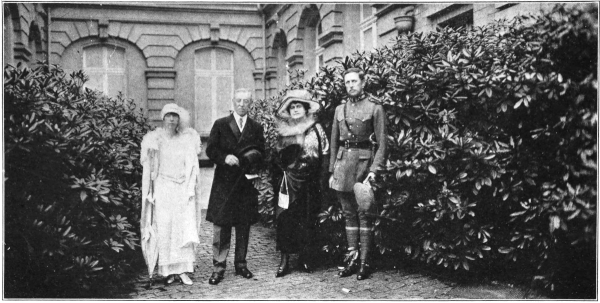
DEMOCRACY AND ROYALTY
Left to right: Queen Elizabeth of Belgium, President Woodrow Wilson,
Mrs. Woodrow Wilson, and King Albert of Belgium
(click image to enlarge)
In the light of his struggle and the opposition that
attended it, his last public utterance is of deep interest.
He spoke from the porch of his S Street home on Armistice
Day of 1923. It was estimated that nearly ten thousand
people had assembled in the street to do him honour. He
paid tribute to the men who had fought, expressed his
pride and pleasure at having been the commander-in-chief
at that time, and concluded with the following words,
which were spoken after he had turned to reënter his door:
“There is one thing—one—I cannot refrain from saying
it. I am not one of those that have the least anxiety
about the triumph of the principles I have stood for.
“I have seen fools resist Providence before, and I have
seen their destruction, as will come upon these again—utter
destruction and contempt. That we shall prevail
is as sure as that God reigns.”
The ratification of the Eighteenth and Nineteenth
amendments, the Suffrage and Prohibition measures, and
the Federal Child Labor Law, important measures long
pending, were enacted in this administration.
He died on February 3, 1924, and his tomb in the crypt
of the great cathedral at St. Albans draws daily pilgrims.
CHAPTER XVII
THE ADMINISTRATION OF WARREN G.
HARDING
March 4, 1921, to August 2, 1923
INAUGURATION DAY dawned clear and bright for
Warren G. Harding, twenty-ninth President. His
installation into office was marked by its simplicity.
The Hardings went direct to the Willard Hotel upon
their arrival in Washington. On the morning of March
4th, President-elect and Mrs. Harding, Vice President-elect
and Mrs. Coolidge, and George B. Christian, Jr.,
with former Speaker Cannon, went to the White House.
As the hour of the inaugural ceremonies drew near, President
Wilson appeared leaning on the arm of Mr. Harding
and took his seat in the machine that was to take him to
the Capitol. Mrs. Wilson was accompanied by Dr.
Grayson. She and Mrs. Harding rode together in a car
following that of their husbands. Four troops of the
Third Cavalry had been assigned to the duty as escort.
This inauguration was not in any respect like previous
celebrations; not a strain of music was heard until the
party had passed the Peace Monument. There the
Harding and Coolidge Band of Washington was playing.
The only other music was by the Marine Band on the
plaza in front of the reviewing stand. President Wilson
spent a few minutes signing belated bills and then decided
to take his departure, as he was taxing his strength. He
was assisted to his machine, and with Mrs. Wilson, Admiral
Grayson, and Mr. Tumulty, he left the scene of so
much of his activity to receive a great ovation later at his
own home.
In the Senate Chamber, Vice President Marshall inducted
Governor Coolidge into office. Miss Alice Robertson
attracted much attention as the second woman to be
elected to Congress. She was from Oklahoma, and succeeded
Miss Rankin as the one woman legislator. The
ceremony on the East Portico deviated but little from
those of former occasions. Amplifiers were used for the
first time to enable the people to hear the address. The
oath was administered by Chief Justice White on a Bible
of historic interest. It was the one used by George
Washington in 1789. It had been borrowed from the
Masonic Lodge for the purpose then, and was loaned by
the same Lodge for Mr. Harding’s use.
After the address, the new President went back to the
Senate chamber, made a brief speech to his former colleagues,
and then presented the names of his Cabinet.
They were at once confirmed. All precedents were
eclipsed in the celerity with which government control was
transferred from the Democrats to the Republicans and
in the speed with which the new régime was organized
and ready for functioning. The new Cabinet consisted of
Charles E. Hughes, Secretary of State; John W. Weeks,
Secretary of War; Harry M. Daugherty, Attorney General;
Will H. Hays, Postmaster General; Edwin Denby,
Secretary of the Navy; Albert B. Fall, Secretary of the
Interior; Henry Cantwell Wallace, Secretary of Agriculture;
Herbert Clark Hoover, Secretary of Commerce,
and James J. Davis, Secretary of Labour.
President and Mrs. Harding enjoyed a family luncheon
party on their arrival at the White House.
The absence of the usual parade and the review was a
real disappointment to the crowds along the way.
When Mr. Harding had been approached by the Inaugural
Committee on plans for the biggest celebration
ever known and the most brilliant ball of history, he was at
first inclined to approve, but pressure was brought upon
him and he vetoed the entire plan, asking that the celebrations
be made just as simple as consistent with the
dignity of the position. Confronted with this ultimatum,
decorations and seat building stopped, and those not interested
in the Charity Ball of the evening promenaded
the brilliantly lighted Avenue.
The first official act of the new President was to order
the gates opened and the public admitted to the grounds
which had been closed so long. This was done upon his
return from the Capitol. The Wilson sheep had been
sent back to their home at Bel Air, and dogs were installed,
Laddie Boy winning popularity for himself from the time
he appeared.
Mrs. Harding set to work at once to banish the gloom
and silence of the large rooms. She filled every possible
nook with flowers and threw wide the doors to invite the
public again to see the interior of the mansion.
From the home on Wyoming Avenue, occupied while
Mr. Harding was in the Senate, came all of the household
goods, and soon the bareness and cheerlessness that followed
upon the exodus of the Wilsons with all of their
lovely foreign gifts disappeared. Mrs. Harding was a
housekeeper of the most efficient type, and with her husband
resumed the custom of holding daily receptions.
She kept Miss Harlan as her secretary and was unusually
approachable. She had bulbs planted all over the lawns
where the Wilson sheep had roamed. She sent away to a
factory for bird houses for the trees.
The advent of a new Mistress of the White House is always
the signal for the limelight to be turned upon her by
the world at large. No detail of her life, family history,
characteristics, accomplishments, limitations, or appearance
is overlooked, and trying beyond description is the
ordeal of the first few weeks of every woman who finds
herself elevated to this position.
The price of residence in the White House is the loss
of personal liberty and of freedom of speech and action.
For every waking minute of the twenty-four hours, the
man and the woman who accept this high honour must
ever keep before them the rules, restrictions, and customs
which tradition has fastened upon the place. To independent
folk, much of this is exceedingly irksome.
Mrs. Harding, close to her husband in age, for thirty
years his companion, co-worker, partner, sweetheart,
wife, and adviser, the one person who believed in him more
completely than any other human being, and who inspired
him to real achievement, was as distinct among women as
her husband was among men.
As in the case of her husband, all the events of her life
contributed to equipping her for the discharge of her White
House obligations, and not even her most bitter critic
will deny that she established a régime that will go down in
history as a tribute to her as a citizen and as a charming,
gracious hostess.
Mrs. Harding, born Florence Kling, the daughter of
Amos and Louisa Bouton Kling, disappointed her wealthy
father immeasurably by being born a girl. He bitterly
resented that fact. Her mother’s health became so fragile
during her little-girlhood that she and her father came to
depend upon each other for outdoor companionship which
the mother could not share. Being obsessed with disgust
over the ignorance of the majority of women in business
matters brought to his attention daily in his banking
affairs, Mr. Kling decided to take a hand in his daughter’s
education and add another study to a programme already
filled with the useful and ornamental branches usually
planned to fit out a girl. Among these was a study of
music that was encouraged and developed to an almost
professional degree, and the five hours of daily piano
practice carried in its wake much besides the ability to
interpret the old masters.
Banker Kling approved of all this and more, so he took
his lively little daughter in hand and trained her as he
would have trained a first son, in all the details of business
and banking. Florence Kling was an apt pupil, and soon
she was as familiar with her father’s routine and detail of
work as he was. Naturally, the comradeship and understanding
between them became very close.
All the joys and sports of her day, the frolics, parties,
and good times belonging to girlhood, were also open
to this girl, who had a knack of making and keeping her
friends. Early in young-ladyhood she became the wife of
Mr. De Wolff and the mother of a son. The marriage was
not happy, and in the course of time a divorce terminated
it. Both Mr. De Wolff and their son died.
As a child, this girl learned to ride horseback, becoming
an expert horsewoman, being able to handle any horse
she chose to ride. This accomplishment played a prominent
part in her friendship with Editor Harding. Gossip
declared that they met at a dance and that the mutual
interest there created was speedily fanned into love. An
ardent courtship followed, much of which was spent by
the two riding horseback through the country lanes.
Mr. Kling viewed this budding romance with stern
disfavour, for he had little use for the newspaper profession.
As the affair progressed, his opposition increased,
and he took a high hand in forbidding the marriage.
Equally high-spirited, his daughter refused to give up her
fiancé just because he was struggling with a one-horse
newspaper. She chose her lover in preference to her
father, and for seven years Mr. Kling refused to speak to
either of them. Later, however, he came to admire his
son-in-law and to admit that his daughter’s husband was
all that he could desire. Because of the bitter feeling in
her family, the young couple were married in the house
which Mr. Harding bought and which they occupied as
their home during all of their years of life in Marion, and
in which the front-porch campaign for the Presidency was
conducted.
From the beginning, their domestic life was ideal, that
of comrades sharing every problem. In the privacy of
their home circle, they were “the Duchess” and “Sonny,”
and sometimes these nicknames slipped out more readily
than the Florence and Warren. He was always deferential
and solicitous to a degree that was a point of pleased
observation to the throngs that met them. Mrs. Harding
was a notable example of the modern woman whose pride
in her husband personally as well as in his career was the
outstanding motive of her own life and activities. Apart
they were never content.
“I have no ambition for myself. I am content to trail
along with Warren Harding. He has the warmest sympathy
of any man I know,” she once said, adding, “Even
the newsboys were crazy about him, just as crazy as his
dogs were.”
In the strenuous pre-election days, Mrs. Harding’s
faith in the successful outcome never faltered. She earned
her place at his side, for she worked tirelessly night and
day in all kinds of weather with all of the energy and more
of the astuteness and patience than the average male
campaigner. She made countless addresses, wrote reams
of campaign literature, and organized numerous clubs of
women voters. Furthermore, she kept a check upon every
move, and her advice on political matters was the wonder
of the old-timers in political wisdom. With it all, she
kept out of the fierce limelight.
She stands out among our Presidents’ wives because
she was the first woman voter and politician to come to the
White House. A trained business woman, possessed of a
keen analytical mind, with a gift of executive ability beyond
the average, she was also a charming, tactful, gracious
hostess. She knew every detail of her housekeeping,
and at the White House as well as in her own home, she
saw to it that money’s worth was being obtained for money
spent.
For thirty years, this woman had studied the political
life of her country as well as that of foreign nations. She
knew her city, her county, her state, and her country.
Great national issues were as familiar to her as to her
husband, and the big questions of the day slipped into her
conversation as readily as the polite small talk. Frank
almost to abruptness, she looked a visitor squarely in the
eye and gave him a man’s handshake along with a greeting
that matched her friendly smile.
Both President and Mrs. Harding enjoyed their stay
in the White House, and they were frank enough to admit
it. She loved the historic associations of the mansion and
said the thrill of showing people through it and pointing
out its treasures never palled upon her.
True to her husband’s policy of economy, she declined
to have any of the available money spent upon refurnishing
the place to please her taste, as is the privilege of each
new First Lady. Downstairs, she revelled in the daily
arrival of the flowers, and every nook, corner, vase, or
basket that was available had its use in brightening and
enhancing the beauty of the main floor.
Scarcely a day passed but that both the Executive and
his wife received a number of delegations, as well as hundreds
of individuals. Neither of them took any of the
applause and attention to themselves. Both insisted that
it was but the homage due the highest office, regardless of
the man and woman filling it for the time. Both made
their endless stream of callers realize that they were human
ordinary folk, genuinely glad to see the American people
who came to see the head of the nation and admire the
home which the nation had provided for him to use.
During his first year, President Harding gave orders to
permit as many people as possible in the daily line to be
received by him. Some days there were fully three thousand
to file by and shake hands, and rarely less than four
or five hundred. Some of his associates urged him to discontinue
this custom or make it weekly, thinking it too
much of a strain.
“Not on your life,” he answered, when the idea was
broached to him; “the only big bright spot of my day is
seeing those admiring and kindly faces. I love to meet
them. They have nothing to ask. They are typical
Americans, and it is merely their way of showing reverence
for their President. Besides, it is a treat to meet someone
at the White House who is not seeking executive favour.”
He often expressed the view that he belonged to the
people and it was his duty to grant every wish in reason.
His wife shared his views in this respect, as in most
others, and their social régime was planned to give the
greatest pleasure and include at the big official functions
as many people as the size of the house would safely admit.
Their first New Year’s reception was notable in that
for the first time in many years a President’s wife went
through the hand-shaking ordeal. Six thousand, five
hundred and seventy-six people went through that line in
five hours, and to each one the President and his wife gave
a cordial greeting and a hearty hand-shake. True, Mrs.
Harding’s right hand became so swollen that she had to
use her left, and when the hour for the end of the reception
came and people were still passing at the rate of about
thirty to the minute, with a long shivering line outside,
the President decided that every last person should be admitted,
and for another hour these two kept up the pace
without flagging. Mrs. Harding’s gloves became so discoloured
that she changed several times in brief lulls.
After that, she quickly developed a little efficient swing
that made her right arm and shoulder stand the strain of
the daily receptions as well as did her husband’s golf-trained
muscles. The ability to perform the prodigious
hand-shaking was due to her years of piano practice and
the strength of wrists that horsemanship gave.
President and Mrs. Harding endeared themselves to
the disabled soldiers, for neither of them ever wearied doing
things for them, and none who witnessed the reception
which they gave to the wounded men of the Great War
will ever wonder why these boys were so devoted to them
and mourned their passing so deeply.
They were idolized by the children, and with good
reason. At Easter, Mrs. Harding reopened the grounds
for the annual egg rolling that had been so long abandoned,
and then she and the President called Laddie Boy and
walked about, mingling with the youngsters, giving and
getting a full measure of fun out of the day. Her love for
children was very deep.
Upon another occasion, when five hundred school children
gathered at the Lincoln Memorial to sing and leave
flowers as their part of the Dedication services, a heavy
storm prevented the arrival of speakers, and the children
marched over to the White House to sing for the President.
Mrs. Harding saw them and gave orders that they
all be brought in, dripping and soaked as they were.
After they had finished their songs and been thanked as a
group, Mrs. Harding greeted each of them most warmly,
and as they passed her they put their flowers at her feet.
By the time the last wet little one had gone, she was waist
deep in a bank of dripping flowers, and drenched to the
skin. Her only comment in reply to the remarks about
her lovely dress was terse: “What’s a gown amount to
compared to a child’s disappointment?”
This is the reason why the soldiers and the children,
as well as the general public, prayed for her recovery—some
kneeling on the White House steps—and kept a
steady stream of inquiry and flowers pouring into the
mansion during her critical illness of September, 1922.
In the acute stages, her husband kept vigil in a chair outside
her door when the physicians would not allow him
to remain longer at her bedside. To all letters of sympathy
and inquiry about her condition, President Harding
placed his signature upon the replies, and there were
bushels upon bushels of them.
The first group of any size received by Mrs. Harding
after her six months of illness and sickroom seclusion was
that of about thirty women writers of the Capital City,
most of whom represented large papers and magazines,
while the rest were well-known free-lance writers. Next
to the pleasure of again seeing Mrs. Harding, for whom
each one had a feeling of warm friendship, all appreciated
the little personal touch of being received in her own sitting
room, the large oval apartment above the Blue Room—the
room that was replete with historic associations of
the first levees in the mansion under Mrs. John Adams,
and that later was made the coziest spot in the building
by Mrs. Fillmore and her library. Great, comfortable,
chintz-covered chairs, davenports, mahogany bookcases,
shaded lamps, and a fire crackling cheerily in the fireplace
above which hung Laszlo’s sketch of Mrs. Harding herself,
all made the place most homelike and attractive. This
atmosphere was emphasized by the winter sunshine
streaming through the three south windows that look
toward the Washington Monument, the Lincoln Memorial,
and the lovely Potomac. Major Baldinger and Lieutenant
Taylor, both of whom she proudly introduced as
“two of my boys from the Marion Star,” were there as
military and naval aides.
Frail, dainty, and courageous, the White House mistress
had come back from the Valley of the Shadow, and
while now and then she had to think for a word, she was
just as merry and full of energy as when she had last
talked over the events of her first year in the White
House. She told of her desperate struggle against death,
solemnly stating that it was only the prayers of the people
that had saved her life.
Mrs. Harding also spoke of the pleasure it had been to
have her husband with her, and to a special friend she
remarked:
“In one way this illness has been a blessing. We have
had more time with each other than at any period since
the beginning of the campaign. Before I had to go to
bed there was not a minute of the day that either of us
was free. There was never a meal when we were alone.
I can tell you it was a treat to be able to take advantage
of my condition and sit upstairs here in the evening and
talk to my husband.”
Though a good mixer like her husband, whose friends
were her friends, Mrs. Harding was not much of a “joiner.”
She was a member of the Daughters of the American
Revolution, by her descent from Captain Edmund Richards,
of Connecticut; but had been identified with that
organization for many years in Ohio and became honorary
member of the Mary Washington Chapter of the District
of Columbia. Wives of the Presidents are so hedged
about with restrictions that they make as few new moves
as necessary to avoid the criticism that is always ready to
descend upon them.
Mrs. Harding once remarked that she had joined
every Animal Rescue League in the land, for that seemed
a perfectly safe thing to join. At the time of Mr. Harding’s
election, she became an active member of the League
of American Pen Women, holding that membership until
her death.
When President Harding set out for Alaska, it was to
realize a dream he had nurtured from the time he came to
the Presidency. Yet there are many who believe that
he had a premonition that he would not survive the trip,
for he set his house in order, made his will, rearranged his
investments, sold certain properties, and left his personal
affairs in ship-shape condition. The trip, though interesting
and enjoyable, proved a severe strain, although his
sixty speeches in thirty-nine days was not an unusual
number for Presidents on such long journeys across the
continent. But his vitality had been weakened by a
sick spell in the early summer. The deaths of the three
men, all friends of his and members of his party, whose
car plunged over the cliff in Colorado depressed him
greatly. Mrs. Harding’s threatened collapse in Alaska,
and the accident to the boat that brought them back to
Seattle, all added to the weariness. At San Francisco,
almost at once came his severe illness, and when the nation
watched with anxiety the sickroom bulletins, the
relief at the news of his improvement and the assurance
of recovery was heartfelt.
No one believed that death was near, certainly not
Mrs. Harding or the physicians. Always devoted, she
sat at his bedside, happy that he was interested in being
entertained. She was reading Sam Blythe’s summary of
him and his administration, “A Calm Review of a Calm
Man.” Apparently comfortable and free from pain, and
enjoying the sound of her loved voice, appreciating, no
one knows how deeply, the words of commendation of his
efforts from a writer of authority, he murmured when she
hesitated:
“That’s good; go on, read some more.” As she picked
up the magazine again, he threw up his hand, perhaps to
ward off the swift blow of the Grim Reaper he felt coming,
and, with a sigh, he was gone—the valiant spirit had
flown—the splendid, vigorous body lay limp—but an
empty shell.
While Mrs. Harding rushed for help, she knew all too
well that it was too late—her husband was dead.
A shocked and grief-stricken group of relatives, Cabinet
members, officials, and friends quickly assembled and
were rallied to the necessities of the hour by the heart-broken
wife, who had never failed Warren Harding in life
and would not let herself fail him in death. Upheld by
the marvellous will power that had characterized her life,
though prostrated by her sorrow, she reassured her pitying
friends: “I will not fail—I will not break down.” No
one can imagine how she went through the formalities
and services in the hotel, calm and controlled; how she
endured the long, weary, sorrowful journey to Washington
in the car beside the bier of her husband, the return
to the White House—there to stand by the casket in the
East Room and then calmly and quietly to go through the
solemn scenes at the Capitol, with the oversight in the
evening that compelled her to ask the hospitality of a
friend’s car to take her to the train—the journey to
Marion, the scene of her childhood, her romance, her
happy wifehood, business life, political triumphs, past the
little home where she had been married, to the home of
her aged father-in-law. Then she greeted the officials
who had journeyed many hours and miles to pay final
honours to Marion’s great man, and, still controlled and
composed, she participated in the last rites that returned
her husband to the dust whence he came.
Even greater courage was required to turn her face to
Washington, once more to endure the fatigue of another
journey, and to remove their belongings from the
White House and make room for their successors. After
ten days of heartbreaking residence in the great mansion,
where she lived alone, she slipped out of the city in a dismal
downpour at dusk with the saddest part of life yet
before her. In all this time, never once did she utter a
plea for herself. With super-courage she filled her rôle
as she felt her husband would expect her to fill it. But
the effort was too great.
Mrs. Harding lived but a year and a half after her
husband’s death. She died November 21, 1924.
******
Warren Gamaliel Harding was born on a farm just outside
the little town of Blooming Grove, Morrow County,
Ohio, on November 2, 1865. He was the first child of
eight, born to a country doctor, George Tryon Harding,
and Phœbe Dickerson Harding. To his parents he was,
of course, a prodigy; and his mother, deeply religious, supplied
his middle name, Gamaliel—which in Hebrew means
“God is a reward”—from the Bible, and in her heart
settled upon his future in the ministry, in the Baptist
faith.
Typically and wholly Colonial, the ancestors of President
Harding were Puritans and Pilgrims who came to wrest
freedom and livelihood from an unbroken wilderness and
played their part through the generations as pioneers,
soldiers, and patriots. Dr. George T. Harding, his
father, was a Civil War Veteran.
Warren G. Harding’s boyhood was spent upon a forest-bordered
farm, and, like most country boys, his time was
filled with a routine of work and chores that never failed
and seldom varied. He chopped down trees, split rails
and firewood, dug post holes, built fences, planted and
hoed corn and other crops, and tended stock and painted
barns and farmhouses. One season, it is said, he left a
crimson trail all through Morrow County in the barns
he tinted a vermilion hue. This barn painting was done
with extra zeal, as the money was to take him to college.
In the strenuous days of his farming, chores, and general
utility work, in the school of poverty that has turned out
so many of our great men, who in such environment
learned the industry and the mastery of detail along with
the dignity of labour, that made them grasp opportunity
with both hands and braced feet, Warren G. Harding laid
the foundation for all later successes.
A little knowledge of the printer’s trade, learned during
his college career as editor of the college paper, fired the
boy with a desire for more, and soon he handled odd jobs
at the town printing office, later becoming a practical
pressman and a “make-up” man.
Seventeen found him the dignified teacher of the district
school and an energetic member of the town band.
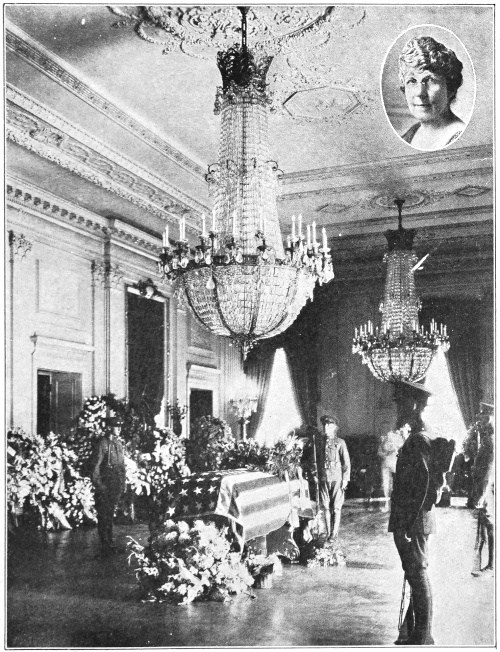
Photo. of Mrs. Harding (upper right corner) by Clinedinst Studio, Washington, D. C.
THE BODY OF WARREN G. HARDING
Lying in State in the East Room of The White House
In 1884, his father, Dr. Harding, pulled up stakes and
moved his family and chattels into the little town of
Marion, the county seat of the adjoining county, then
of about four thousand population. But the eldest son
did not join the family for several months. When he
came, at the age of nineteen, barefoot and astride an old
white mule, his advent into the city that he was destined
to put upon the map in later years furnished the material
for one of the stories he enjoyed telling upon himself.
“My father moved to Marion, from a farm near Caledonia,
the winter before I came,” he used to relate.
“When he moved to Marion, he left behind a mule,
because the mule was so well known in the vicinity that
it could not be sold at a profit and so valuable that he
could not afford to sacrifice it.
“I started out early one afternoon; but this mule had
only one gait. You couldn’t put him in second or third,
and couldn’t step on the gas or anything. The shades
were falling fast as I reached Roberts’ Mill, four miles
out of Marion. The situation was looking dark to me,
and I stopped to ask an old fellow smoking a pipe how far
it was to Marion. Without cracking a smile, he replied,
‘Well, if you are going to ride that mule, it is a further
distance than you’ll ever get.’”
But notwithstanding the slow pace of his temperamental
mule, he arrived in Marion and set about finding a job.
The study of law attracted him for a time, with insurance
on the side. He frequently insisted that the first real
money he ever earned was when he secured the fire insurance
on the Hotel Marion from Amos Kling, who
later became his father-in-law. In this transaction, his
commission was $150, and his first purchase was a “slip
horn,” and then he joined the Marion Silver Cornet Band.
This horn is still a treasured possession in the family.
The proudest memory of his life, Mr. Harding once admitted,
was when he became the leader of that band.
One of the great events of those days was the band contest
at Findlay, Ohio, to which competitors came from
great distances. Upon the occasion that the Marion
Band was to compete, its enthusiastic young leader had
managed by dint of great strain upon his resources to
procure brand-new uniforms, so that his musical flock
would make a fine appearance. He was banking on winning
prize money for reimbursement. The rival bands
all got ahead of the Marion contingent in getting before
the judges, and their efforts were so well appreciated by
their followings that the Marion bandsmen lost heart
and quietly departed, not wanting to suffer the mortification
of public defeat. Finally, when their turn came, only
the leader, who blew an alto horn, the bass drummer,
and the clarinet player were left to perform. But they
did their best with their depleted ability, and their delight
and surprise may be imagined when the judges
called Harding forward and announced that he had won
a prize of $200. This was more than enough to pay for
the new uniforms, and no prouder group participated in
the review of winners than that little trio.
Neither selling insurance nor the intricacies of law held
the appeal of journalism, and young Harding decided to
follow the press, securing a job on the Mirror, a Democratic
paper. Being an ardent Republican and already a
firm party man, he fell out with his employer over the
stand the editor took in the James G. Blaine campaign
for the Presidency. Being a Blaine supporter, the young
man found himself without a job.
Just about this time, the run-down little sheet, the
Marion Star, was scheduled to be sold by the sheriff. Dr.
Harding bought it in at a bargain and turned it over to
his boy, because of his faith in him and because he wanted
to help him get a start in the line of work he seemed
most anxious to follow. From the moment he took possession
of the paper that owned only two hundred pounds
of type, he put into it hard work, faith, and enthusiasm.
Often he could not pay his helpers in the early days, and
sometimes when he did pay them off on Saturday night he
would have to borrow back a little to tide himself over the
opening of the week. Sometimes he had to coax advances
on bills from his advertisers to keep going. He filled
every position, from printer’s devil to managing editor,
but he was never known to lose his pleasure in being just
one of the boys. Later, when the paper began to succeed
financially, he saw to it that his employees got more
pay, and still later he formed a stock company in which
they all held shares.
His paper never had a strike; a strike was never even
threatened.
No more illuminating view of his character was ever
shown than is contained in a tribute he wrote to his dog
long before any high honours came to him. The obituary
published in the Marion Star about twenty years before
he came to the Presidency is worthy of attention. It
reads:
“Jumbo, the Star office dog, died Sunday, not from old
age, but from somebody’s cruel poisoning or from extreme
heat.
“Jumbo was probably known to more people in
Marion than any dog in the city. He had been making
acquaintances at the Star office for eight years. He had
romped with hundreds of newsboys and found canine
joy in their familiar greetings.
“Yet there was a serious side to this playful good-natured
dog. He had a watchful eye for the suspicious-looking,
and would guard a trust with a faithfulness that
men might well imitate.
“He was overzealous, perhaps, in exercising the responsibility
he felt in keeping watch at the home which
sheltered him, but he never harmed anyone without
cause. He was only a dumb brute, but had proved his
intelligence, made himself understood with his great
tender eyes, and possessed a rare combination of dignity
and docility.
“The Star workers, from pressroom to business office,
felt Jumbo to be part of the force, and it would be false
to the feelings of all to allow his passing without notice
and tribute.
“Dear Old Jumbo, your eight years of devotion and
faithfulness have emphasized the realization that a good
dog’s life is all too short—and you were a good dog!
You taught us anew how a fine, noble dog like you can
win his way to human hearts and grow attachments most
painful to have severed.”
One romance, and only one, entered into the life of
editor Harding, and his ardent courtship of Amos Kling’s
cherished daughter brought down upon his head the
enmity of her father. In 1891, when Mr. Harding was
twenty-five, despite all opposition, they were married in
the little house that they called home during their lives
in Marion. His wife’s influence was the greatest factor
in all of his achievements. Her contribution to his
paper was of the greatest value.
Soon after their marriage, Mr. Harding became ill and
the circulation manager quit. Mrs. Harding had always
contended that this end of the business was not properly
productive. There was no delivery. Papers were sold
over the counter in the business office. So in this crisis
she decided to take a hand in matters for a few days to
help out. She gathered some boys for carriers, installed
a carrier system, started them out, and made them collect
regularly. The people who did not pay for their
papers received no further service until they did pay.
Later, she organized the carriers into a newsboys’ club, got
them a meeting place, and helped them in every possible
way, even now and then administering a much-needed
spanking, a scrubbing, or a patch, in the interest of their
moral and physical welfare. She went to the job for a
few days, but stayed fourteen years and saw her plans
develop the circulation into profitable returns and many
of the little carriers into splendid men.
One of these, a little red-headed youngster, claimed the
particular interest of the editor and his wife, and when
Mr. Harding went to Columbus to the state Senate they
took him along, and soon he was serving as a page and
receiving five dollars a day during the session. His
father was dead, and his mother earning her own way.
He sent her his wages, and she saved them for him, and
later on, when he was a little older, she sent him to
Staunton Military Academy because of his bent for
military life. This red-headed carrier boy is Major Baldinger
of the Air Service, who has had a wide experience
of service and won distinction, and when President Harding
came to the White House it happened that Major
Baldinger was assigned there as military aide. He accompanied
the President and his wife upon their journeys
and was assigned to attend Mrs. Harding on her
sad journeys to Marion; and after she no longer needed
him, he again took up his duties at the White House.
As soon as the Marion Star got upon its financial feet,
politics claimed its editor, and his steady rise in the
political arena was but natural to a man of his prominence
in his community. His profession as a writer,
editor, printer, and business man identified with many
of the projects that were developing in his state, all
brought him into a continually widening circle of community
and public interests. Always an active Republican,
his service in the state Senate, to which he was
elected in 1899 and reëlected in 1901, served to make him
stand out as a coming man. His first political speech
brought forth the prediction that he would some day be
President, and political favour began to stalk his steps.
He was elected Lieutenant Governor of Ohio in 1904,
with Governor Myron T. Herrick, but was defeated in
his race for the Governorship by Judson Harmon in 1910.
Mr. Harding took all of his public duties seriously and
never ceased his efforts to cope with all situations. He
travelled extensively, going three times abroad, visiting
most of the European countries, not wholly for the sake
of the pleasure, but to study for himself the systems of
government, of employment, of wages. After his election
to the United States Senate, when he defeated Foraker,
and before taking his seat, he visited the Hawaiian
Islands to get first-hand knowledge of the production and
distribution of sugar.
In the course of his public life, he spoke in almost every
state in the Union and to groups representing practically
every industry.
Always pleasing and forceful as a speaker, his appearance
added materially to his popularity upon the rostrum.
A deep carrying voice, impressive manner, and
the knack of winning his hearers brought him always an
appreciative audience.
His presentation of William Howard Taft’s name for
renomination at the Chicago Convention of 1912, the
most tumultuous convention in the annals of Republican
history, his chairmanship of the Republican National
Convention four years later, his notable speech, and his
poise and parliamentary skill in presiding over that body
are all matters of political history.
His campaign as presidential nominee of his party, and
his election to the Presidency on his fifty-fifth birthday
with a plurality of seven millions, were the expression of
the confidence of the American people.
It was just about dinner time on election day that a
delegation called at the Marion home to see Senator
Harding. This proved to be a group of employees of
the Marion Star who called to show their pride and satisfaction
in him by presenting him with a printer’s gold
make-up rule. He went out on the front porch to thank
them and was choked with the emotion the gift aroused.
When he got his voice in order, he said:
“I don’t know of any call that has aroused my emotions
more than this has. I have worked with you and I have
tried to be honest with you, and God knows, if I am called
to responsibility, I am going to be honest with everybody
in the world. I don’t know if I can meet these responsibilities
fully, but I know I can meet them with the same
honesty that I have treated you.
“I am just a plain ordinary fellow, but I can be on the
square, and that’s all there is to it.”
He had the distinction of being the first Senator elected
to the Presidency while serving in that office and also
the first active newspaper man to wear the presidential
toga.
The outstanding feature of President Harding’s administration
was the Conference on Limitation of Armaments
which met on November 12, 1921. To it the
President invited Great Britain, France, Italy, Holland,
Belgium, Portugal, Japan, and China to send delegates.
Secretary of State Hughes presided. Those who attended
were Prince Tokugawa, Ambassador Jusserand,
Albert Sarrault, M. Viviani, Premier Briand, Senators
G. Pearce Underwood, Elihu Root, Lodge, and Schanzer,
Lord Balfour, Ambassador Geddes, Sir Robert Borden,
Sir John Salmond, and Srinivasa Castri.
The voice of American womanhood was heard when
the President appointed four well-known women as
members of America’s advisory council. These women
represented ably the various schools of feminine thought
of our land. They were Mrs. Thomas G. Winter, of
Minneapolis, President of the General Federation of
Women’s Clubs; Mrs. Charles Sumner Bird, of Boston,
leader of the National League of Women Voters of Massachusetts;
Mrs. Kathrine Phillips Edson, of Los Angeles,
author of many welfare projects for women, and an active
suffragist; and Mrs. Eleanor Franklin Egan, well-known
writer and authority on the Far East.
The presence of the women added to the importance of
the social functions arranged; not since the war had the
city been as festive and the entertaining as general as
during the session of the Conference.
Those close to President Harding, who knew how
staunchly he believed in the men he picked for positions
of honour and trust, believed his illness greatly aggravated
by the disclosures of the Senate investigation of the oil
scandal, which had already brought dishonour to one of
his Cabinet and was threatening to involve others in high
places.
CHAPTER XVIII
FIRST ADMINISTRATION OF CALVIN
COOLIDGE
August 3, 1923, to March 4, 1925
THE death of President Harding in San Francisco,
coming so swiftly and unexpectedly on the evening of
August 2, 1923, at 7:30, stunned all of his immediate
party, none more so than his friend and secretary George
Christian, who immediately flashed the news of the
national calamity to Vice President Coolidge, vacationing
in a little Vermont house, the home of his father, John
C. Coolidge.
Just at midnight a messenger arrived and roused the
elder Coolidge, and to this gray-haired father was given
the duty of awakening his son to apprize him of the fact
that fate had ordained him to assume the reins of government
just fallen from the lifeless hands of his friend and
chief.
By the time Vice President and Mrs. Coolidge had
dressed and gotten downstairs, the newspaper men were
arriving, and, shortly after, Mr. Coolidge’s secretary came.
Within an hour, a telephone had been installed, the house
adjoining secured for use, connection with the White House
established to get the exact phraseology of the presidential
oath of office, and a message of condolence sent to
Mrs. Harding.
At 2:47 A. M., August 3d, the simplest inaugural in
American history was enacted. In the dim lamplight,
with scarce half a dozen witnesses, Calvin Coolidge was
sworn in as President by his father, a notary public,
taking the oath on the old, well-worn family Bible.
History was in the making by the minute in the eventful
twenty-four hours that spanned August 2d and 3d.
Without an instant’s warning the life record of Warren
Harding had been marked “Finis,” and Calvin Coolidge,
tossing hay and farming until bedtime in a smock made
twenty years before by his grandmother, had scarce gotten
well into his first sleep before he was summoned to
pick up the mantle of his chief, step from a salary of twelve
thousand to one of seventy-five thousand, move at once
from a tiny lamplit farmhouse into the Executive Mansion,
and from the paths of peace and serenity into a seething
maelstrom of duties, to be buffeted between the rocks of
the political torrent and the shoals of social quicksands.
The movements of President Coolidge in taking up his
new prodigious burden were characteristic of the typical
New England gentleman. Without haste and without
displaying in the least degree the intense emotion that
must have been surging through him, he made his brief
inaugural address to be sent broadcast to a sorrowing,
anxious nation:
“Reports have reached me, which I fear are correct,
that President Harding is gone. The world has lost a
good man. I mourn his loss. He was my chief and my
friend.
“It will be my purpose to carry out the policies which he
had begun, for the service of the American people and for
the meeting of their responsibilities wherever they may
arise.
“For this purpose I shall seek the coöperation of all
those who have been associated with the President during
his term of office.
“Those who have given their efforts to assist him, I
wish to remain in office that they may assist me.
“I have faith that God will direct the destinies of our
nation.”
In the early morning, an automobile rushed him and
the new First Lady to Rutland, Vt., where they started
their journey to Washington.
Calvin Coolidge, thirtieth President of the United
States, born on Independence Day, 1872, on a farm near
Plymouth, Vt., a sparsely settled mountain village twelve
miles from a railroad, less than a month after his fifty-first
birthday was filling the office of Chief Magistrate.
Upon reaching Washington, the President turned to
the tasks already piling up, giving first thought to the
funeral arrangements and honours for President Harding,
and to the comfort and aid he might render to the bereft
widow. The message from the new President and his
wife, impressing upon her their desire that she should not
tax herself with haste in leaving the White House, “It is
yours as long as it is ours,” must have sent a warm glow
of comfort to Mrs. Harding in her sorrowful vigil.
Four or five days after Mrs. Harding had left the mansion
to visit with friends before starting for Marion with
her belongings, President and Mrs. Coolidge took possession.
Then President Coolidge’s great task began in
earnest to jog itself down into the regular routine. His
days were so strenuous that he was early forced to see
the necessity of regular amusement and exercise. His
relaxations, though encompassed with every possible
facility, were just as modest and simple as in Northampton.
They consisted chiefly of an early morning walk.
When his fondness for that was discovered, several prominent
officials also decided such exercise was good for them,
and a small walking club came into existence, which bid
fair to take the place of the tennis and golf Cabinets of
past administrations. In this way, he freshened up for
breakfast and the day. An afternoon horseback ride
offered the freshening process for dinner. This sport,
too, became quite popular after the President decided to
make use of The General—the horse that Mr. Harding
had used occasionally. Week-end trips on the presidential
yacht Mayflower were frequently taken. Between
these oases of rest, the government machine ground on
its heavy treadmill.
President Coolidge made no snap decisions. He was
the best-equipped man who ever stepped into the position,
for he had not only taken his vice presidential duties
seriously and informed himself extensively on matters
pertaining to the Senate, but he had had the unusual
advantage of attending the Cabinet meetings during
President Harding’s régime.
While still at Marion, Senator Harding asked Governor
Coolidge, as Vice President, to sit with the Cabinet.
They discussed this signal departure from all precedent
and agreed upon it. In referring to it, President Harding
said:
“The sort of government I have in mind ought to
take advantage of the capacity and experience of a man
like Governor Coolidge, by bringing him into the councils.
It would be a fine thing and I don’t see why it has
not been done before. Governor Coolidge is an eminent
American and has had experience as an executive and
should be helpful. I think the Vice President can be the
most effective agency in keeping the executive offices in
touch with the legislative branch of the government.”
A study of the men who have been called to the Presidency
makes President Coolidge stand out from them all.
For he is a new kind of public man. He is called “Silent
Cal,” the inscrutable; he is an unguessable quantity, the
shrewdest politician the White House has ever known,
though on the surface he lacks all set and prescribed qualities
of the successful man of politics.
He is spare in figure, auburn-haired, gray-eyed with
rather thin lips and nose, in vigorous health and possessed
of a dignity and reserve that have already become a
national tradition.
He is a typical New Englander all of whose physical
features proclaim his Pilgrim ancestry. The climate and
conditions under which the early settlers of his section of
the country and their descendants have battled to wrest
from the rocky soil of coast line and mountain valleys the
means of a livelihood, have moulded physiques and
mentalities to meet force with wit and batter down obstacles
with the power of brain as much as by brawn.
He is the son of the late John C. Coolidge and Victoria
J. Moor Coolidge, one of the descendants of John and
Mary Coolidge, early Pilgrims that settled in Watertown,
Mass., about 1630. His ancestry runs through a long line
of farmers of Massachusetts until his great-great-grandfather
moved into Vermont, and he and his descendants
tilled the soil, raised stock, tapped the trees for maple
sugar, and were known and respected as substantial citizens
of their community.
His mother died when he was but thirteen, and before
he reached manhood his only sister passed away; these
bereavements evidently drew father and son closer together.
In college—he attended Amherst—he was not a brilliant
student, and the course was half over before his
mates were really acquainted with him.
An analysis of all of the jumble and hodge-podge of
tales that pour forth to fasten upon any man who rises
to high places in his case leave beneath the froth an
interesting picture that offers worth-while reading for the
American boy of to-day. It paints for us a shy country
lad of extreme slenderness with a mop of reddish hair and
a heavier crop of awkwardness emphasized by unusual
reticence and shyness. Considered “countrified,” he
kept out of the way of the sophisticated city freshman,
being embarrassed to a painful degree if he did happen to
draw attention. But all the while that he battled within
himself, the impressions gathered daily; his reserve created
the habit of clear sharp thinking that found expression
in a paucity of words, direct, clean-cut, and tinged
with a dry wit that made his hearers smile at the humour
while they remembered the common sense. In his senior
year, he won the first prize, a gold medal, for the best
essay on the Principles of the War for American Independence.
The competition was open to all undergraduates
of American colleges. By this feat he won
the esteem of his college and disclosed a comprehensive
and significant knowledge of his own country.
From all accounts, during college life, he was different
from many lads in that he attended strictly to the business
for which he had come. In all of the stories told of
this phase of his career, the mention of girls is conspicuous
by its absence. If he had the usual run of college
love affairs and romances, no one else knew about them,
and they have not come to light. All the reminiscent
tales breaking forth from his classmates of thirty years
ago show a deep and abiding regard for “Cooley,” as they
called him, even though they poked fun at his reticence
and lack of loquacity.
This very introspection provided him with a reserve
fund of assurance that developed the self-confidence and
poise to come through the graduation with high honours,
a prize winner and orator of the class.
Not being in a financial position to take a course in law
school, he studied law in the office of Judge Hammond of
Northampton, Mass., and in less than two years was
admitted to the bar and began his law practice there.
Almost immediately, the young lawyer got into civic
and political activities. He soon was president of the
Nantucket Bank, and, in 1899, was elected to the City
Council of Northampton, and the next year was chosen
city solicitor. He became clerk of the county court in
1904. In 1905, his romance with Miss Grace A. Goodhue,
of Burlington, Vt., culminated in their marriage.
Gossip has put forth various versions of the romance
of President Coolidge and his wife. One of the stories
given much repetition tells that, when Mr. Coolidge called
upon one occasion, he found Miss Grace away from home.
As her return was expected momentarily, he decided to
wait. In the course of his conversation with her father
the young man announced that he dropped in to say that
he had concluded that Grace and he were going to be
married. When her father inquired what Grace thought
about it, Mr. Coolidge is reported to have replied that he
“had not spoken to her about it yet.”
Mr. Coolidge was twice mayor of Northampton, and
in 1907 was a member of the Massachusetts Legislature,
going to the State Senate in 1912 and serving until 1915,
including two terms as president of that body. The lieutenant
governorship of the state came to him in 1916, and
in 1918 he found himself elected Governor.
When he called the Massachusetts Senate to order in
1914, he made the shortest speech of acceptance on record
in the annals of that body. It contained forty-two words
and received state-wide attention and stamped him as
timber for further political service. This speech has been
regarded as a classic in Massachusetts statecraft, for it
embodies the Coolidge Creed—“Do the Day’s Work”
and “Be Brief.”
In 1917, he was elected to the governorship by a majority
of seventeen thousand, but after the great Boston
police strike, which gave him national recognition, and
out of which grew the slogan, “law and order,” he was
reëlected in 1919 by more than one hundred and twenty-five
thousand majority, the largest vote ever given a
candidate for that office in that state.
The gist of his platform in his gubernatorial race, in
which he won such a sweeping victory, was as follows:
“Do the day’s work. If it be to protect the rights of
the weak, whoever objects, do it. If it be to help a powerful
corporation, do that. Expect to be called a stand-patter,
but don’t be a stand-patter. Expect to be called
a demagogue, but don’t be a demagogue. Don’t hesitate
to be as revolutionary as science. Don’t hesitate to be
as reactionary as the multiplication table. Don’t expect
to build up the weak by pulling down the strong. Don’t
hurry to legislate. Give administration a chance to
catch up with legislation.”
People who insist that the President is cold, taciturn,
devoid of feeling and sentiment, have never seen him take
from his pocket a slim little silver case, which he always
carries, and open it to gaze upon the face of the mother
who left him years ago.
The President and his wife are both of the Congregational
faith and regular attendants of the First Church in
Washington.
Mrs. Coolidge, from the first moment she appeared in
Washington as wife of the Vice President, made friends,
and her popularity has never ceased increasing. She is
so youthful looking that it is hard to credit her with being
the mother of the tall son, John, to whom she now has to
look up, for he is rapidly topping his father in height.
No factor has contributed so largely to her continually
mounting host of friends and admirers in the Capital
City and the country at large as her modesty and simplicity,
which have kept her natural and wholesome.
Mrs. Coolidge was born about a hundred miles from the
home of her husband, and, like him, she comes of an old
New England family. She is a native of Burlington, Vt.,
where her mother, Mrs. Lamira Goodhue, resides. Her
father died after she came to Washington.
After a childhood and girlhood practically like that of
the generality of girls born into good families of moderate
means, she went to college at the University of Vermont.
In her freshman year she became one of the founders of
the Vermont Beta Chapter of the Pi Beta Phi Sorority,
which, years after, presented a portrait of her to the
White House. She took her A.B. degree, and after that
followed the custom of New England girls in seeking a vocation.
In her case, it was teaching, the less usual branch
of teaching mutes. After three months’ training for
teaching the deaf at the Clark School in Northampton,
she was given a class of beginners. The difficulties of this
work may be imagined when it is remembered that she had
not only to teach her pupils to read, write, and cipher,
but also to speak. One only need hear the vivacious lady
tell of her class of youngsters set apart from others by
reason of their defective senses to realize the enthusiasm
she must have put into this work of helping them acquire
the art of spoken communication.
Her teaching was limited to three years, for at the end
of that time Mr. Coolidge persuaded her to give up a career
and devote herself to making a home for him.
With the advent of her own children, Mrs. Coolidge
made a thorough study of motherhood and child education.
She always worked and played with her boys and
thus became really acquainted with their virtues and their
faults, and through this comradeship found herself able to
encourage and help them best. She studied educational
problems with minuteness, visiting all sorts of institutions
of learning. She believes in a close personal relation between
the parent, the school, and the child as a solution
for many difficulties that beset both pupils and instructors.
Mrs. Coolidge is a home-maker, first, last, and always.
Her conception of home-making is not bound by a perpetual
routine of the mechanical phases of housekeeping,
as so often has been claimed, and over which she has
laughed merrily, but home-making, according to her code,
means first of all providing the family with all comforts
possible to the income and the luxury of genial, happy
companionship: she served as a buffer, firm and gracious,
for a weary Vice President husband from the importunities
of the hotel telephone, and, despite the limitations of a
hotel suite, manipulated a chafing dish, hot-plate, and all
of the accessories for a daily popcorn feast, or a fudge
party for vacationing boys pining for a bit of their home
treats.
She believes that it is a woman’s first duty to provide her
husband with all of the cheer and pleasure and creature
comforts her surroundings will permit, and send him forth
to his battle with the world, secure that at the end of a
heavy day of toil he will find her waiting for him ready to
share his troubles or pleasures.
All of the world looked on with approval at the simple,
dignified, and wholly American good sense which controlled
the movements of the Coolidge boys when their father
became Vice President of the United States.
Mrs. Coolidge came to Washington with a half-formed
plan for installing her family in a house and sending her
boys to the public schools of the city. She had been there
but a few hours, however, when she learned the futility
of such an idea, for she found out, as Vice President and
Mrs. Marshall had done when they came, that the vice-presidential
salary would be inadequate to meet such a
plan. It simply would not cover the rental of an appropriate
house and the necessary upkeep, with the added
burden of food and clothing. Mrs. Coolidge decided to
follow the example of the Marshalls and do her official
entertaining in a hotel. She further concluded to take
over the hotel suite of her predecessor. As the duty of
the Vice President, outside of presiding over the Senate,
is to represent the President, who entertains, but is rarely
entertained himself, Mrs. Coolidge rapidly became convinced
that there would be but little time or opportunity
for any family home life with her sons in Washington, and
after they had seen their father inducted into office, she
sent them home with their Grandfather Coolidge, with
whom they had come to the city, and had them finish their
school term at home.
Vice President Marshall called himself “the official
diner out,” and the appropriateness of the term may be
gathered from the fact that the Vice President and his
wife are expected to attend all of the White House official
dinners and receptions, all of the ten Cabinet dinners to
the President, and also that of the Speaker of the House,
all of which are fixed affairs. In addition, it is the duty of
the Vice President and his wife to appear everywhere.
Throughout the season, they are the guests of honour at
dinners with such regularity that they have about one
evening a month when they have the opportunity to
remain at home.
Mrs. Coolidge was in constant demand for teas, luncheons,
receptions, and, in fact, for every form of social
gathering.
When the Coolidges found themselves in the White House,
they considered it advisable to follow a schedule for their
sons similar to that which had prevailed before. They
selected Mercersburg, Pennsylvania Academy, with Amherst,
their father’s alma mater, in the offing, as the
educational programme for these lads. The boys made
visits to the White House on holidays, and their mother
managed to slip away occasionally to see them. In the
summer, they went to their grandfather’s farm and to
visit their Grandmother Goodhue at the Coolidge home in
Northampton. John put in time at the Camp Devens
Military Camp. Neither went to Washington when
President Harding died.
In the summer of 1924, both boys went to the White
House to visit their parents before leaving for vacation
activities. Both of them had planned to go to Camp
Devens first and then to their grandfather’s farm. While
playing tennis, Calvin, Jr., got a blister on his heel, an
injury so slight that he paid no attention to it until a fever
developed a few days later. Examination by Dr. Boone,
the White House physician, revealed the first symptoms
of the blood poisoning which caused his death in Walter
Reed Hospital within a week.
All of the nation grieved with the father and the mother;
the hearts of all parents ached for them in the loss that
nothing, not even time, can fill. They planned simple
and beautiful ceremonies for their boy at Plymouth,
where he was laid to rest with four generations of his
forbears.
Following her great bereavement, Mrs. Coolidge spent
many hours in the gardens south of the mansion knitting.
Only mothers who have experienced a similar sorrow
know of the heartaches and the poignant memories
represented in the exquisite stitches of the silken socks,
the dainty ties, and little bags, fashioned by her expert
fingers, while John, all desire for the camp gone with the
death of his loved younger brother, stayed around to help
her get through the first lonely weeks. The pets, Paul
Pry and Rob Roy, the handsome white collies; the cats
(the roaming Tige would not stay home and had to be
locked up to keep him from killing the birds, instead of
devoting himself to his catly duty in the basement); the
birds which Mrs. Coolidge has in her sitting room—all
helped in a way to fill the round of duties that occupied
her time.
Although carrying a heavy heart, the First Lady
did not obtrude her personal sorrow into her official position.
Instead of the sombre black which was more in
keeping with her feelings, she resolutely kept to colours,
but the vivid tones and bright tints worn previously were
laid aside for the softer grays, orchid, and much white.
Mrs. Coolidge’s frankness and lack of pretense have
endeared her to everyone, and many stories are related
of her little kindly actions. As the Vice President’s wife,
she frankly discussed the futility of trying to establish
and maintain a suitable establishment equipped for
entertaining on the inadequate vice-presidential salary.
She frankly admitted she wore ready-made gowns and
liked them because she could slip into them and get the
finished effect without the waste of precious time and
effort in endless sessions of fittings and tiresome searches
for trimmings.
She dresses in most becoming style. Her taste is quiet
and refined, and she has the knack of wearing her clothes
well. She always presents a chic finish and smartness
that is good to look at, and her old-fashioned upbringing
is apparent in that, once dressed, she never gives her
clothes another thought.
One of the prettiest stories of her many thoughtful
kindnesses is of the gift of huge boxes of lovely White
House roses to fifty shop girls of the city who worked as
seamstresses in the big establishment where her gowns
were made for the first season. Best of all, when the
messenger carried the great box into the establishment, he
carried along a large White House monogrammed envelope
to the forewoman, and within, in her own handwriting,
was the First Lady’s gracious expression of her appreciation
of the care and work they put on her “White House
trousseau.” Further joy descended upon that establishment
when the dressmaker was invited to the next White
House reception to see how the gown looked and get ideas
for her own future use.
From the time of her arrival in the Capital City, Mrs.
Coolidge has manifested an interest in every civic enterprise
of welfare. She has distributed the Salvation Army
Christmas baskets to the poor at the headquarters of that
organization. She and the President have given encouragement
to the community Christmas trees by attending,
and the President by officially lighting them. They have
encouraged and participated in the Christmas carols sung
in front of the White House, and they have rivalled each
other in the number of memorial trees they have planted
and the corner stones they have laid.
Mrs. Coolidge does not like to talk about herself. She
insists that the wives of public men best aid their husbands’
careers by being seen as little as necessary and
heard even less, and she puts this theory into practice.
While she does not talk politics at any time, the impression
that she is not interested in politics is wrong. She
holds that women have a very definite obligation and
responsibility as citizens, and it is their duty and privilege
to do serious and effective work toward an intelligent discharge
of public duties.
In a published letter to Mrs. George Horace Lorimer,
President of the Republican Women of Pennsylvania, she
set forth her views most clearly:
“I have been pleased to learn of the general movement
to organize the Republican women of Pennsylvania with a
view to developing the widest interest in and understanding
of the public questions before the country.
“It is always gratifying to know of such organized
movements for more efficient citizenship, whether among
men or women, and whether of one party or the other.
“In the case of your own organization, it is an occasion
of special congratulation that so broad a programme
of activity is afoot, because of the special qualifications
and equipment you have for making it a worth-while
movement.
“The women have lately come into new and, to most of
them, rather unexpected responsibilities in their relations
as citizens. It is altogether desirable that these be taken
seriously, and effective work is undoubtedly needed among
them; precisely as is also needed among a great section of
the male voters whose preoccupation with other interests
too often interferes with the most intelligent discharge of
public duties.”
One of the interesting and highly significant tributes
to Mrs. Coolidge came in the ceremony at Boston University
on December 12, 1924, when President Lemuel H.
Murlin conferred upon her the honorary degree of Doctor
of Laws. This was done upon the occasion of the installation
of Mrs. Lucy Jenkins Franklin, the first dean of
women of this university.
As President Murfin conferred upon her the purple
hood with its trimmings of red and white, and the mortarboard
hat with its gold tassel, he spoke of her as—
“Grace Goodhue Coolidge, student, university graduate,
teacher, daughter, wife, mother, whose fine qualities
of mind and heart have gained the confidence, admiration,
and love of the American people.”
Mrs. Coolidge has so many charming qualities that
all who meet her become enthusiastic in discussing her.
First of all, she is good-looking; she has, in fact, just
missed being a beauty, has a slight girlish figure, sparkling
eyes, and a smile that is already famous.
She is youth personified. She has a buoyancy of spirit,
a joy of life that will keep her young past three score and
ten. She radiates cheeriness and enthusiasm. She loves
people, is willing to meet everyone halfway, and enjoys
her social obligations. She is perfectly fitted to fill her
rôle. Health, temperament, and age, all combine to aid
her. To Mrs. Harding’s cordiality and suavity she adds
the vigour and lightness of youth and health. She calls
people her best books, loves being in the heart of history
in the making, loves the contacts she gets with the celebrities
of the world and the interesting people of our own
land.
At the White House she is at her best. She makes no
false moves. One of her first innovations was evolving
an original response to appeals from organizations seeking
donations from the Mistress of the White House for every
conceivable project. An autographed steel engraving of
the White House now goes in place of the dainty embroidered
handkerchiefs which Mrs. Harding used to send.
Mrs. Coolidge’s New England conscience and training
have given her a perspective, a set of standards, an appreciation
of values, and a tact that keep her anchored to the
conventional neutrality zone. She has brought to the
White House an all-around efficiency of the New England
housewife, the modern vision of the college woman, the
broad understanding of the trained educator, without
the limitations of the pedagogue, and the clearly marked
responsibility of the citizen and voter and co-partner with
her husband in his political obligations to his party and to
his country.
As the time for the inauguration of Calvin Coolidge
approached, he was much better equipped even than when
he inherited the office through the accident of death. Nor
had he exhausted his strength or lost his calm understanding
of what would be expected of him.
President Coolidge possesses a genius for work. Contrary
to the popular belief developed in the past few
years, that the presidential job is too much for the vitality
of any man, President Coolidge has thrived upon its
manifold exactions. He has gained weight and found enjoyment,
not hardship, in his office and the opportunities
opened thereby. Without doubt, the electrical steed
which the President had installed and which caused such
a whirlwind of comment, none of which retarded its use,
has had much to do in keeping him fit. However it is,
both he and Mrs. Coolidge approached the time of their
installation as the choice of the American people, in good
health and happy spirits.
Just before the Inauguration, there was a great deal of
discussion and adverse comment on the custom of shaking
hands. The fact that, although in the White House but
about twenty months, President Coolidge had shaken
hands with ninety thousand people brought forth argument
against the practice on the part of some of his close
friends. A committee was appointed to attempt to relieve
him of some of his routine duties. When the solicitous
group had expounded to him their views upon the matter
and expressed their desires and intentions, expecting him
to acquiesce with pleasure and possibly with praise for
their thoughtfulness of him, he electrified them and disposed
of the entire matter in his characteristic fashion—“BUT
I LIKE IT!”
The quirky lines about the President’s mouth and
eyes, a certain twinkle that insists upon showing itself,
are evidences of his sense of humour, and emphasize the
fact that he is a reserved New Englander, whose reserve is
just the outer crust of dignity, a sort of public armour,
shield, and buckler against the too intrusive, which must
melt away into genial friendliness. He has a dry wit,
keen-edged, that is infectious with its quiet drollery.
At one of the informal gatherings, a woman, desiring
to impress herself upon his mind, remarked airily, “Mr.
President, I’m from Boston!” With that twinkle that is
so ready to show itself, he remarked instantly, “You’ll
never get over it!”
In accordance with his wish, the ceremonies for March
4, 1925, were made as simple and free from display as
possible. Fifty thousand visitors supplied in enthusiasm
what was lacking in brilliant display, and many were the
regrets that so momentous an event in the nation’s life
should be accompanied by so little of the pageantry of
pomp and power. All of the enthusiasm of former days
possessed the throngs of pedestrians along the route to and
from the Capitol.
Preceded by a troop of cavalry and a troop of mounted
police, the presidential automobile, containing President
Coolidge and Mrs. Coolidge and Senator Curtis, of Kansas,
left the White House at the usual time, for the
Capitol. Next came Vice President-elect General Charles
G. Dawes and Mrs. Dawes, with Representative Griest,
of Pennsylvania. Other members of the congressional
and the inaugural committees followed. The usual
programme in the Senate chamber was carried out and
much enlivened by the address of Vice President Dawes,
who criticized the rules of that body.
On the East Portico, the oath of office was administered
by Chief Justice Taft, the only ex-president to become
Chief Justice of the United States. For the first time,
the President’s address was broadcast to the entire
country by radio.
The ovation he received was all that could be desired.
The ride back to the White House for luncheon was made
as quickly as possible. There was a full programme for
the afternoon and evening, including a reception to visiting
governors, among whom was Mrs. Nellie Ross, one of the
first of the woman governors.
After the luncheon, the entire party assembled in
the reviewing stand, this time not requiring the protection
of the glass windows. The parade started. As the famous
Richmond Blues swung around Fifteenth Street, a
man on the presidential stands several rows in the rear of
the presidential box, with lifted hat, said most earnestly
and fervently, “GOD BLESS THE COOLIDGES!”
Mrs. Coolidge turned, her eyes shining with the uplift
of the hour, and smilingly answered with an earnestness
and fervency that matched his remark—
“HE HAS!”
THE END