Whistler’s life is at present a skeleton
of dates on which this incident occurred or
that, and at which the most notable of his
pictures appeared. And this must remain
so until an authoritative biography of the
painter has appeared. With whom the
authority rests was made the subject of a
recent Law Case. Till such a work appears
we can only deal with his art and with the
Whistler legend, the impressions, recorded
and otherwise, he left upon those who were
brought into contact with him.[1] These are
strangely at variance—some having only
met him cloaked from head to foot in the
species of misunderstanding in which, as
he explained, in surroundings of antagonism
he had wrapped himself for protection;
others remembering him for his kindliness
and his old-fashioned courtesy.
Permitting himself sufficient popularity
with a few to be called “Jimmy,” Whistler’s
full name was James Abbot McNeill
Whistler, and the initials gradually twisted
themselves into that strange arabesque with
a wavy tail which he called a butterfly and
with which he signed his pictures and his
letters. Born on 11th July 1834 at Lowell,
Massachusetts, he was the descendant of an
Irish branch of an old English family, and
in his seventeenth year he entered the
West Point Military Academy, where after
making his first etchings on the margins of
the map which he should have been engraving,
he decided to devote his life to art. He
was twenty when he left America and he
never returned to it, so that as far as
America is concerned infancy can be pleaded.
America has since bought more than her
share of the fruits of his genius, finding in
this open-handed way charming expression
for her envy. He went to Paris to study
art, where he was gay, and attracted attention
to himself by the enjoyable way in
which he spent his time. It was not until
he was twenty-five that he arrived in
London, and a little later moving to Chelsea
commenced work in earnest.
A charming picture suggests itself of
the painter escorting his aged mother
every Sunday morning to the door of
Chelsea old church, as was his habit,
bowing to her as she enters and hastening
back to the studio to be witty with
his Sunday friends.
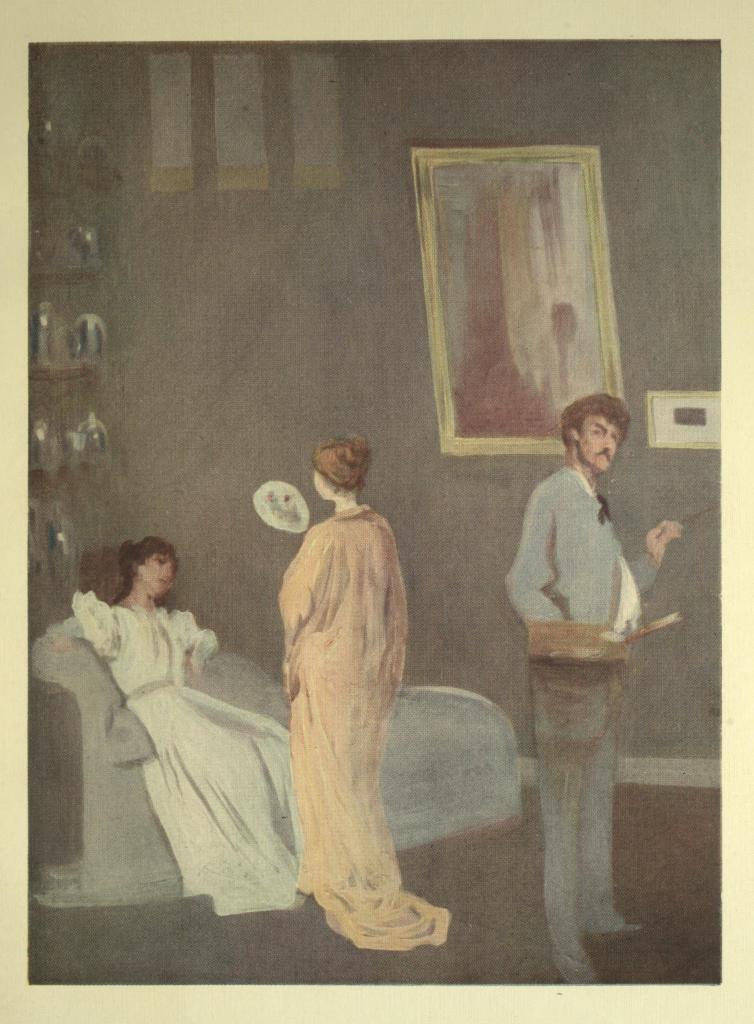
Whistler’s first important picture, “At
the Piano,” issued from Chelsea. It was
hung in the Academy in 1860 and was
bought by a member of the Academy. He
followed the next year with “La Mère Gerard,”
which belongs to Mr. Swinburne. He sent
a picture called “The White Girl,” to the
Salon of 1863. It was, however, rejected.
It was then hung at the collection called the
“Salon des Refusés,” an exhibition held as
a protest against the Academic prejudices
which still marked the Salon. There it met
with an enthusiastic reception which set
Whistler off on his career of defiance. In
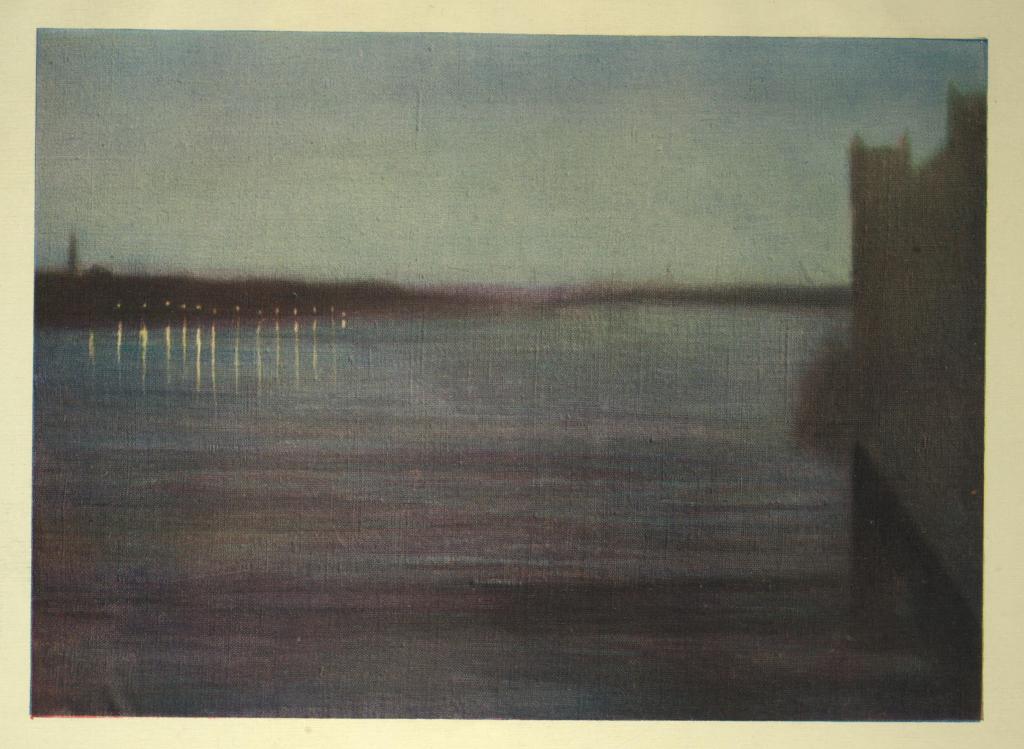
1865 the painter went to Valparaiso for a
visit, from which resulted the beautiful Valparaiso
nocturnes. Back again in Chelsea,
he devoted himself to the river there. He
was then living in a house in Lindsay Row.
At this time he was greatly affected by
Japanese art, and one or two pictures show
curious attempts to adapt scenes of the
life of the West to the Eastern conventions.
This phase of his art was beautiful, but he
passed it on the way to work of greater
sincerity, and more clearly the outcome of
his own vision. In 1874 the first exhibition
of Whistler’s work was held at a Gallery
in Pall Mall, containing among other things
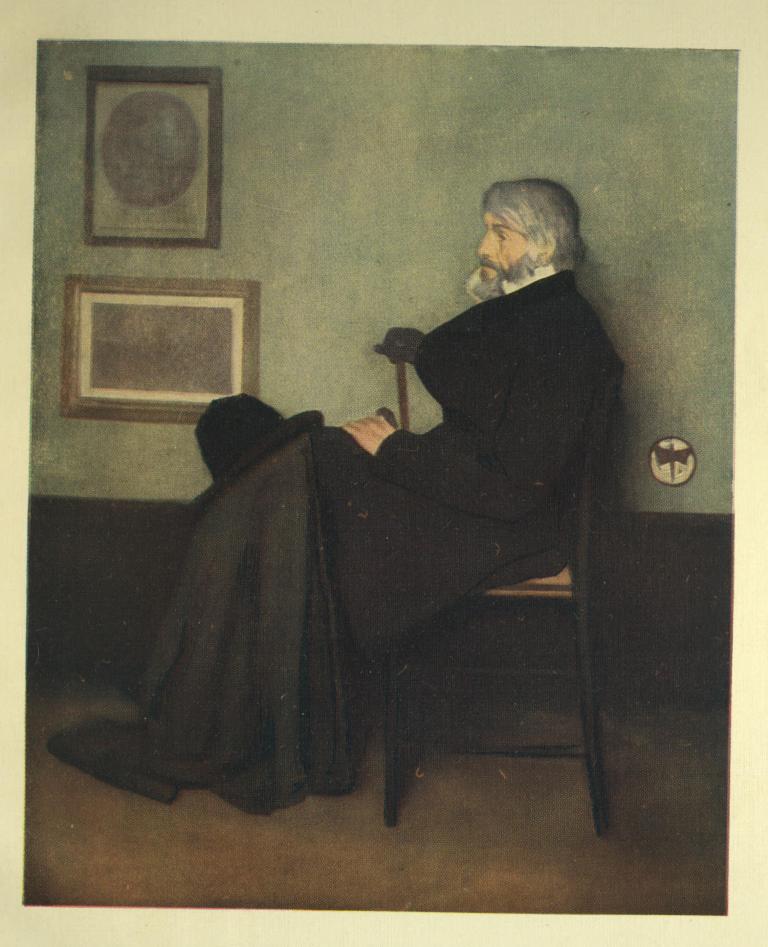
“The Painter’s Mother,” “Thomas Carlyle,”
and “Miss Alexander.” It is interesting that
the Piano Picture, painted just as he emerged
from his studentship, is of the flower of
his art; he did things afterwards of great
significance, and did them quite differently,
but the Piano Picture does not seem a first
work preparing his art for future perfection,
it is so perfect in itself. And here perhaps
we may observe another fact in connection
with Whistler, that in the last days of his
life he painted with the same genius for the
beautiful as at the beginning; none of that
deterioration had set in, which so often comes
in the wake of flattery and belated public
esteem. He was never betrayed by success
into over, or too rapid, production. He
never succumbed to the delight of anticipating
a cheque by every post instead of
bills. He found no difficulty in declining the
most tempting offers. Well, work that is
held thus sacred by its own creator, should
tempt people to search for all that made it
seem so valuable to him. Whistler had an
intense dislike of parting with his work.
When a picture was bought from him he
was like a man selling his child. Sometimes
he would see somewhere a picture he had
painted, he would borrow it to add to or improve
it, but he would keep it and live with
it and gradually forget all about its possessor.
Whatever qualms attacked his conscience
for this procrastination, it was no part of
his genius to confess, instead he would say
“For years, this dear person has had the
privilege of living with that masterpiece—what
more do they want?” At Whistler’s
death, however, it was found that the circumstances
under which a picture had at
any time been borrowed were methodically
entered up, with minute directions as to
the return of one or two pictures, borrowed
thus, that were in his studio when he
died.
In Chelsea, Rossetti and Whistler were
good friends, they shared a love of blue
china, in fact inventing the modern taste for
certain kinds, especially for what they called
“Long Elizas,” a specimen upon which slim
figures are painted,—“Lange leises”—tall
damsels—as they were called by the Dutch.
One supposes that it is through Rossetti that
he came into contact with Swinburne, who
was inspired to write the poem called
“Before the Mirror,” by Whistler’s picture
“The White Girl,” and of which some of the
verses were printed after the title in the
catalogue of the Royal Academy Exhibition.
The first verse in itself suggests a scheme
of white:—
“White rose in red rose-garden
Is not so white;
Snowdrops that plead for pardon
And pine for fright
Because the hard East blows
Over their maiden rows
Grow not as this face grows from pale to bright.”
The poem was printed on gilded paper
on the frame; this was however removed on
the picture going to the Academy, and in
the catalogue the two following verses were
printed after the title:—
“Come snow, come wind or thunder
High up in air,
I watch my face, and wonder
At my bright hair;
Nought else exalts or grieves
The rose at heart, that heaves
With love of her own leaves and lips that pair.
“I cannot tell what pleasure
Or what pains were;
What pale new loves and treasures
New years will bear:
What beam will fall, what shower,
What grief or joy for dower;
But one thing knows the flower; the flower is fair.”
Later on, Swinburne did not allow the
Ten o’clock lecture to go unchallenged, and
he subjects its glittering rhetoric to a not
unkind but cold analysis which, however,
Whistler has the grace to print with marginal
reflections in “The Gentle Art of
Making Enemies,” the book which contains
the paradoxes which reflect so well his
powers as a thinker. It is doubtful whether
Whistler in kinder circumstances would
have produced his brilliant theories. The
irritation caused by misconception, the necessity
of justifying even his limitations to
a world which was apparently prepared to
consider nothing else about him at one time—these
were the wine-press of his eloquence.
He disliked the rôle of teacher and apologised
for it at the beginning of his “Ten
o’clock,” and when, in later life, following
the fashion, he started a school, he relied
upon the example of his own methods of
setting the palette rather than upon precept,
with a little banter to keep good humour in
his class-room. A young lady protested “I
am sure that I am painting what I see.”
“Yes!” answered her master, “but the
shock will come when you see what you are
painting.” A student at the short-lived
Académie-Whistler has written that merely
attempting to initiate them into some purely
technical matters of art, he succeeded—almost
without his or their volition—in
transforming their ways of seeing! “Not
alone in a refining of the actual physical
sight of things, not only in a quickening of
the desire for a choicer, rarer vision of the
world about them, but in opening the door
to a more intimate sympathy with the
masters of the past.”
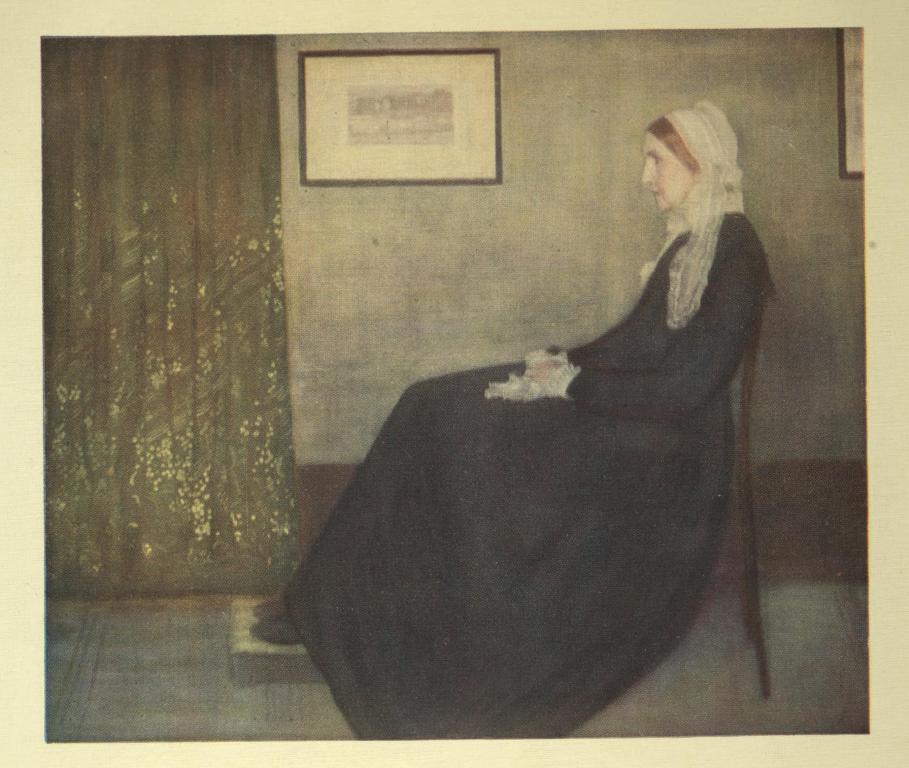
PLATE IV.—PORTRAIT OF MY MOTHER
(In the Luxembourg Galleries, Paris)
This was first exhibited in the Royal Academy in 1872. For
many years it remained in the painter’s possession. It left this
country to become the property of the French Government in the
Luxembourg at the sum of £120. In “The Gentle Art of Making
Enemies” Whistler writes of the picture as an “Arrangement in
Grey and Black.” “To me,” he adds, “it is interesting as a picture
of my mother; but what can or ought the public to care about the
identity of the portrait?”
The thing that strikes one in reading
“The Gentle Art” is how badly those who
entered into combat with its author came
off in the end, some of them in what they
consider their witty replies committing suicide
so far as their reputation as authorities
on art went. Notable is the case of the
critic of The Times, replying “I ought to
remember your penning, like your painting,
belongs to the region of chaff.” We have
indicated the source of Whistler’s success
as a wit—at that source we find the reason
why he always scored when talking about
painting. He is playing something more
than a game of repartee. His best replies are
crystallised from his inner knowledge. In
them we get bit by bit the revelation which
he had received as a genius in his craft.
It was the force of his personality that
obtained for Whistler’s evasive art such recognition
in his lifetime as in the natural
course only falls to fine painters of the obvious,
whom every one delights to honour.
He had said that “art is for artists,” and
it is true that the perfection of his own art
is the pleasure of those who study it. It
reached heights of lyrical expression where
life in completeness has not yet been represented
in painting; reached them perhaps
because so lightly freighted with elementary
human feeling. His work so often leaves
us cold, and we turn seeking for art mixed
further with the fire of life and alight with
everyday desire.
But nature showed many things to this
her appreciator—I write, her intimate friend.
As a moth which goes out from the artificial
atmosphere of a London room into the blue
night, I think of the painter of the nocturnes—yet
always as a lover of nature, never more
so than when his subject is the sea. For
he has a greater consciousness of the salt
wet air than any other sea painter, of the
veil behind which all ships are sailing and
through which the waves break, the atmosphere
which descends so mystically and invisibly
and yet which if not accounted for
in a canvas leaves ships with their sails
set in a vacuum and the waves as if they
were crested with candle-grease. Is it not
absence of this atmosphere which has
tortured us on so many occasions when with
everything quite real a picture has not
brought us pleasure. Pleasure comes to us
always with reality in art, and the end of art
is realism. All is real even around a mystic,
though his thoughts are out of our sight.
Whistler was not a mystic but above everything
he wished to suggest the atmosphere
which is invisible except for its visible
effect, and I cannot help thinking his vision
essentially abstract.
He did not paint subject pictures. To
make our meaning quite clear, let us say
such pictures as Frith’s, or better still, as
Hogarth’s in which we have the extreme.
The art of Hogarth moved upon a plane
lower down, but there it had a strength unknown
to Whistler, a careless and lavish inspiration
of life itself. He had to find speech
for all sorts of things in his art, beauty
was but one of these, creeping in less as
a deliberate aim than as the accident of a
nature artistic. Whistler in painting desired
to express nothing but his sense of
beauty. For the rest of his nature, he found
expression altogether outside his art in enthusiasm
for life itself, its combats, difficulties,
and its opportunities for saying brilliant
things at dinner. His dinner conversation, I
have been told, was like the abstract methods
of his etching, always cryptic, full of suggestion,—wonderful
conversation, full of short
ejaculations which carried your imagination
from one point to another with hints that
seemed to throw open doorways into passages
of thought leading right behind things.
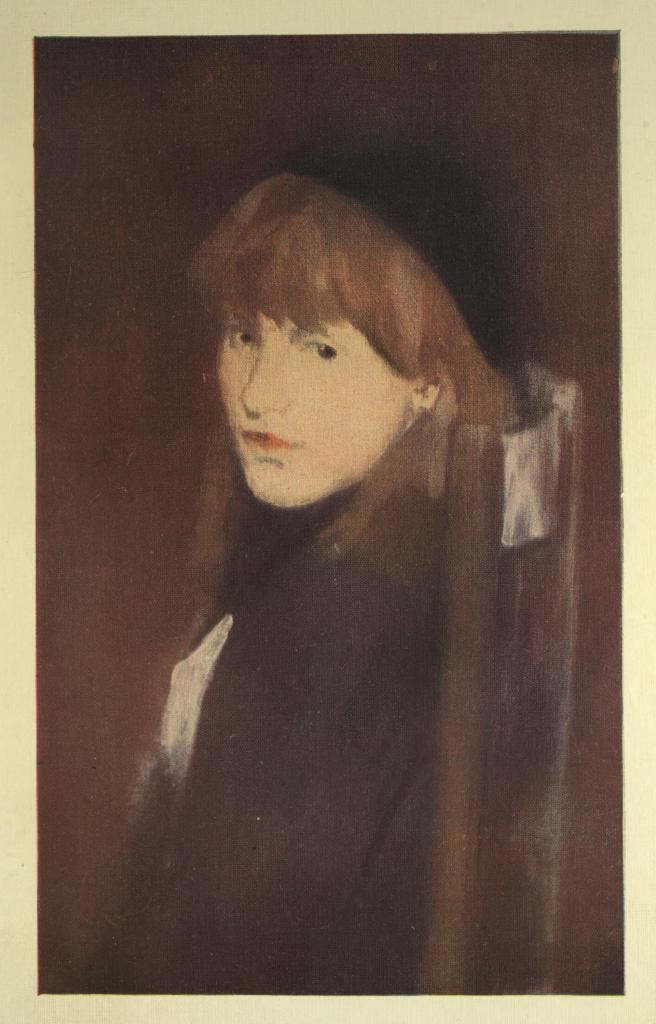
PLATE V.—LILLIE IN OUR ALLEY
(In the possession of John J. Cowan, Esq.)
This study in brown and gold was made about the time (1865)
when the Little Rose of Lyme Regis was painted, one of the most
beautiful portraits of an English child. The latter picture unfortunately
left these shores and is now in the Boston Museum, U.S.A.
He had a remarkable regard for purity
of speech, as became the painter of such
spiritual types of womanhood. It would
seem that women liked him, and readily
apprehended in his art his sensitive view
of life. At table he drank but little and was
a slender eater. When alone he would
sometimes forget all about his meals, or eat
scarcely anything; in later years, feeling the
necessity of taking care of himself he would
guard against his indifference by always
seeking companionship when away from
his house. His nervous disposition forced
him to content himself with little sleep, his
active brain keeping him awake conceiving
witticisms and planning the battle for the
morrow.