THE steamer’s bell is pealing forth its last call. The
huge, hot engine, as if impatient of delay, seems
hissing at every joint, while the dark clouds that roll up
from its smoke-pipes tell of the activity of the sweltering
firemen below. The hawser is cast off. A tardy passenger
or two are hurried over the gangway, and their
baggage sent after them with more celerity than care.
A carriage, driven at a furious rate, is coming down
the wharf, and a man’s head and arm are thrust out of
18the window,—the arm “sawing the air” in a most
vehement manner. But his gesticulations are in vain.
The gangway is drawn in on deck; the wheels slowly
move; the steamer gently swings away from her
moorings; and by the time the carriage is abreast of
her, six yards of foam-covered water separate the
would-be passenger from the crowded deck. A general
half-suppressed laugh from the crowd on the wharf
and the steamer reminds the unhappy straggler that
there is something ridiculous, as well as provoking, in
being a little too late; and, seeking refuge in the carriage,
he is leisurely driven off, to be again laughed
at, perchance, when he reaches the home he had
lately left in such hot haste.
The steamer has now got clear of the vessels
moored around her, and begins to move with greater
speed. So easy is the motion, it would not be difficult
for those on board to imagine that the wharf itself had
hoisted sail, and parted company with the steamer, to
take a turn about the harbor on its own account.
Little groups on shore and on board the boat are
exchanging farewells by the waving of hats and handkerchiefs.
But soon the distance becomes too great
19for recognition; wharves and warehouses mingle together;
the city assumes a crowded and compact look,
and finally resolves itself into
that beautiful panorama which
Boston presents when viewed
from the sea. Even this view
soon fades, and is lost; for the
steamer is now far down the harbor,
gallantly ploughing her way
through the dark-blue waters.
Among the passengers who were enjoying the scene
from the upper, or hurricane deck, might have been
seen a gentleman and three children, who appeared to
be intent upon missing no object of interest. The
largest of the children was a bright and pleasant looking
boy of fourteen. His name was William Davenport;
but he was frequently called Willie, and still
oftener Whistler, by his young associates. This latter
name he acquired when several years younger, being
indebted for it to his whistling talents, which were
really quite clever. He rather liked the nickname;
and, indeed, had become so accustomed to it, that even
“Willie” did not sound quite natural, and “Bill” was
20altogether out of the question. You must not suppose,
however, that he was one of those whistling bores who
give our ears no rest from their shrill pipings, either in
house or in street. On the contrary, he was rather
chary of his music,—perhaps more so than he would
have been but for his nickname, which put him on his
guard against spending too much of his breath in this
manner. But, then, he could whistle beautifully when
he chose to; and, as he had a quick ear for music, he
caught all the new and popular airs of the day, which
made his performances still more pleasant to the listener.
Whistler we shall call him, therefore, in imitation
of his comrades. He belonged in Boston, and was
now on his way to a distant town in Maine, where he
was to spend his summer vacation with the family of
his uncle.
The gentleman who was with Whistler was Mr.
Preston. He was a stout, sun-burnt, and plainly-dressed
man, and was on his way home from a visit to
Boston, with his eldest daughter, Emily, a girl of thirteen.
The other girl, who was a few months younger,
was Ella Preston, a cousin of Emily, who lived in
Boston, and was now on her way to her uncle’s home
21in Brookdale. It was in this same town that Whistler’s
uncle lived; and being well acquainted with Ella,
he had arranged to make the journey in company with
her little party.
It was a mild August evening, and the sea was calm.
Mr. Preston and the children remained upon the deck
until the supper-bell sounded, when they went down
into the cabin, and found a long table spread, around
which the hungry passengers were crowding and pushing,
without much regard to manners, or even decency.
It was with some difficulty that Mr. Preston procured
seats for the children; and even then the difficulty was
but half overcome, for it required a good deal of effort,
not to say rudeness, to obtain enough to eat, so ravenous
and selfish were the company, and so limited was
the supply upon the table. The meal was swallowed,
and the cabin vacated, in about ten minutes. Shortly
after, as Whistler was walking about, he overheard a
few remarks between two gentlemen, that set him to
thinking. From their appearance, and their peculiar
accent, he concluded they were foreign gentlemen,
travelling for pleasure.
“You did not witness the feeding of the animals?”
22said one of the gentlemen, who had just come up from
the cabin.
“No,” said the other, “I have no taste for such exhibitions.
I took the precaution to drink my tea before
I came on board.”
“Well, sir,” added the first speaker, “I’ve breakfasted
with the Turks, I’ve dined with the Arabs, I’ve
supped with the Chinese, and I’ve eaten with nearly
all the nations of Europe; but, sir, I must say that I
never met with such a greedy, scrabbling set of gormandizers
as I have found in this country. Why, sir,
they seize and devour their food like wild beasts.
They shovel it down whole, sir, just as a dog bolts his
meat. I only wonder that these Yankees do not dispense
with knives and forks altogether. Yes, sir, those
implements of a civilized table seem altogether out of
place in their hands.”
This was all that Whistler heard. The unpleasant
American habit which so disgusted this gentleman,
and which is often glaringly conspicuous in our hotels
and steamboats, has been justly censured with great
severity by foreigners who have visited us. Whistler
had himself observed the rude and greedy conduct at
23the table; but he supposed such scenes were always
enacted when large numbers of people got together to
eat. Now, however, he had learned that it was a
peculiarly American characteristic; and, perceiving
how it was viewed by intelligent and well-bred foreigners,
his pride and patriotism were both touched, and he
made up his mind that he would never be guilty of
such rudeness, either at a public or a private table.
The air was now becoming damp and chilly, and
little could be seen beyond the steamer’s decks, save
the occasional flash of some distant lighthouse. The
passengers began to disappear, some seeking out sheltered
nooks in the stern, and others retiring to the
saloons and berths. Mr. Preston gave Emily and
Ellen in charge to the stewardess, who conducted them
to their berths in the ladies’ saloon; while himself and
Whistler soon after turned in to their own quarters in
the gentlemen’s cabin. The saloons were lined on
each side with berths arranged in three tiers. Each
berth was furnished with bedding, and screened in
front by a drapery curtain. The two selected by Mr.
Preston, though not favorite ones in their location,
were the best that were not engaged when he bought
24his tickets. One of them was an upper berth; and, as
Whistler was the lightest and nimblest of the two, it
was assigned to him, while Mr. Preston took the other,
directly beneath him.
Following the example of others, Whistler put off
his shoes, jacket and shirt-collar, and climbed into his
lofty and narrow sleeping-place. Here, partially concealed
by his curtain, he amused himself by watching
the movements of his fellow-passengers, and listening
to their remarks. When Mr. Preston, who had been
reading a newspaper, got ready to retire, he picked up
Whistler’s shoes from the floor, and told him to put
them on a shelf over the berth, if he did not want
“Boots” to get them. This personage, he afterwards
explained, was a colored man, who gathered up all the
boots and shoes he could find in the night, and cleaned
them, charging each of the respective owners a ninepence
(the ninepence is twelve and a half cents in
New England) for his services. As Whistler’s shoes
did not need to undergo this process, his friend was
probably justified in thus interfering with the legitimate
business of the aforesaid “Boots.”
The novelty of his position, the glare of the saloon
25lamps, and the noise of the machinery, made it rather
difficult for Whistler to get to sleep. The ocean was
so smooth, however, that he felt no symptoms of seasickness;
and he was very well contented to lie awake
in his berth, so long as he was not troubled with this
distressing malady, from which he had once suffered
quite severely while sailing in the harbor. But, in
spite of all disturbing influences, he was favored with
several good naps towards morning, from one of which
he awoke, and discerned the gray light of morning
through a small window over his berth. He lowered
himself down from his elevated bed, and went on deck,
when he found that the steamer had already entered
the river, the banks of which were scarcely visible
through the heavy mist with which the atmosphere
was loaded. Ella and Emily soon made their appearance,
and declared that their first night on the ocean
was anything but disagreeable. The fog rapidly disappeared
before the sun; and, as they advanced up the
river, the scenery became more interesting, so that
their attention was constantly occupied, until Mr. Preston
informed them that they had reached their landing-place.
26Our travellers were still forty miles from Brookdale;
but the rest of the journey was to be by land.
On landing, they went directly to the village tavern,
where they found a good breakfast awaiting them, to
which, however, they could devote but a very few
minutes, for the stage coach was waiting. Having
made as large a draft on the driver’s patience as they
deemed prudent, they took their seats in the vehicle,
and resumed their journey. For a while, the children
found much to interest them in the country through
which they passed; but it soon became an old story;
and before they had climbed half of the hills that
separated them from Brookdale, the inquiries were
frequently heard,—
“How far have we got to go, now, Mr. Preston?
Haven’t we come more than half way? Shan’t we
get there before noon?”
As the stage coach did not pass through Brookdale,
passengers for that village were obliged to leave it at a
place called the Cross Roads, about five miles distant,
and find their way over as best they could. It was
noon when our party reached this stopping-place. As
they alighted, a boy about fourteen years old stepped
27up to Mr. Preston, who introduced him to Ella and
Whistler as Clinton Davenport. The two boys were
cousins; but they had never seen each other before.
It seemed that Clinton, knowing they were expected,
had gone over to the Cross Roads after them, with a
wagon. A drive of five miles through a pleasant
road brought them to their journey’s end. They were
in Brookdale.
CHAPTER II. LOOKING ABOUT.
28
DINNER was on the table when Whistler arrived at
Mr. Davenport’s, and he found his uncle and aunt,
and his little cousin Annie, ready to welcome him to
their hospitalities. These, with Clinton, constituted the
whole family. The young stranger soon felt quite at
home in their society. He was much pleased with his
cousins at first sight, for he had never seen either of
them before. Annie, who was about seven years old,
was a beautiful child, with golden curls and fair blue
eyes, and a face full of gentleness and affection. She
seemed to be the pet of the household. Clinton, though
but a month or two older than Whistler, was a stouter
and taller boy, and his browned skin and hardened
hands told that he was not unacquainted with labor and
out-door exposure. He had, moreover, an intelligent,
29cheerful, and frank expression of countenance, that
could not help prepossessing a stranger in his favor.
The parents of these children Whistler had previously
seen at his own house, and he had always numbered
them among his favorite relatives.
Whistler’s first movement, after dinner, was to make
an inspection of the premises. He found that his
uncle’s farm lay at the base of a range of hills, and
embraced a wide extent of land, a good part of which
seemed to be under skilful cultivation. The house
itself was set back a few rods from the street, and was
pleasantly situated, with its front towards the south. It
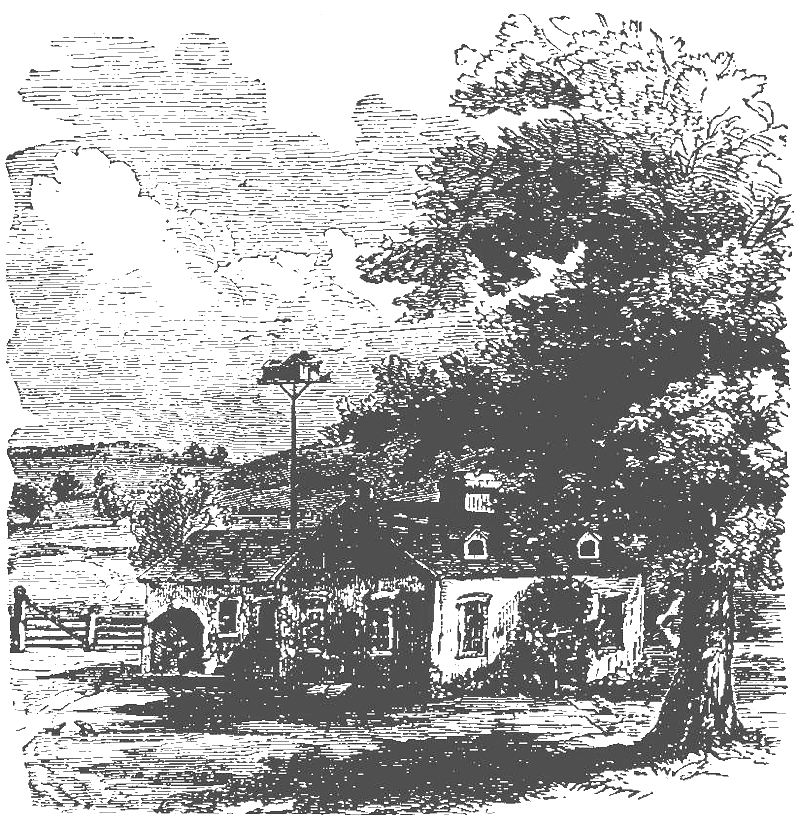
was a snug, plain-looking building, a story and a half
high, with a kitchen and wood-shed attached in the
rear. A noble oak tree, in front, afforded a grateful
shade; and climbing roses and honeysuckles were
trained around the front door, giving a neat and tasteful
aspect to the cottage. In the rear, upon an elevated
pole, was a perfect fac-simile of the house, in miniature,
erected for the accommodation of the birds; and there
never was a spring-time when this snug tenement
failed to secure a respectable family as tenants for the
season. On the next page is a view of the premises.
30The barn, which the picture is not large enough to
take in, was a short distance from the house, on the
left. It was much larger than the cottage, and attached
to it were buildings for the hens and pigs.
Clinton, who had been busy, now joined his cousin,
and offered to accompany him around the premises.
“This is what we call the shop,” he said, opening
the door into a small room adjoining the pantry.
31“Why, what a snug little place! and what a lot of
tools you have got!” said Whistler.
“Father used to be a carpenter before he went to
farming,” added Clinton, “and he has always kept a
set of tools. They are handy in such a place as this,
where carpenters are not to be had.”
“I suppose you work here some, don’t you? If I
had such a place, I should spend half my time in it,”
said Whistler.
“Yes,” replied Clinton; “I use the tools a little.
There’s a windmill I’m making now; but I don’t
know when it will be finished. I haven’t much time
to work in the shop in summer.”
“Clinty made this cart for me,” said Annie, who had
followed the boys; and she pointed to a neat little
wagon.
“Did he? Why, he is a real nice workman,” said
Whistler.
“And he made the vane on the barn, and the bird-house,
too,” added Annie.
“Can’t you think of something else that I made,
Sissy?” said Clinton, laughing at the pride Annie
evidently took in his ingenuity.
32“Yes,” she promptly replied; “he made the arbor
over the front door.”
“Why, Clinton, you are a carpenter, sure enough!”
said Whistler. “I should think you might almost build
a house; I mean a real house, not a bird-house.”
Clinton smiled at this rather extravagant estimate
of his mechanical skill, and led the way towards the
barn, through which he conducted his cousin, from the
cellar almost to the ridge-pole. The hayloft was very
large, and was nearly filled with new-mown hay, the
fragrance of which was delightful. Swallows were
darting in and out of the great door, and gayly twittering
among the lofty rafters, where they had made their
nests. A large quantity of unthreshed grain, bound
up in sheaves, was stacked away on the main floor, in
one end of the barn.
“There’s a good lot of straw,” said Whistler, as
they passed by the grain.
“And something besides straw, too; that is rye,”
replied Clinton.
“Is it rye?” said Whistler. “Well, I’m just green
enough not to know straw from grain, or one kind of
grain from another. Father told me I should make
33myself so verdant that the cows would chase me, and I
don’t know but that he was right.”
“They laugh about country people being green,
when they go to the city,” said Clinton; “but I guess
they don’t appear much worse than city folks sometimes
do in the country. I don’t mean you, though,”
he added; “for you haven’t done anything very bad
yet.”
Whistler broke off a head of rye, and found concealed
beneath the bearded points several hard, plump
kernels, that had a sweet and pleasant taste. Following
his cousin, he then visited the pig-pen, which was
behind the barn, and connected with a portion of the
barn cellar. Half a dozen fat porkers were lazily
stretched about, in shady places, presenting one of
those familiar groups that, if they do not appeal to the
artist’s sense of the beautiful, do appeal most forcibly
to the plain farmer’s sense of lard and “middlings.”
If not picturesque, they are decidedly baconesque,
which some people consider much better.
“Now you must go and see my biddies,” said Clinton;
and he led the way to a large hen-coop, near the
piggery.
34“Are these your fowls?” inquired Whistler.
“Yes, they are all mine,” replied his cousin.
“Father gave me all of his fowls, five years ago, and I
have managed them just as I pleased ever since. I
have to find their food, and I have all their eggs and
chickens. Even the eggs mother uses she has to buy
of me.”
“That is a first-rate plan,” said Whistler. “I
should think you might make lots of money in that
way.”
“This isn’t all,” added Clinton; “I have a flock of
turkeys, and a lot of ducks, besides. The turkeys are
off, somewhere; they roam all over the farm. The
ducks are in that little house down by the brook; we’ll
go and see them by-and-by.”
“I should think I was rich, if I owned so many
creatures,” said Whistler. “But you have to buy corn
for them,—I suppose that takes off the profit, doesn’t
it?”
“I haven’t bought a bushel of corn since the first
year I had them,” replied Clinton. “Do you see that
cornfield, just beyond the brook? That is my field.
35I planted and hoed it myself, and I shall have all the
corn that grows there.”
“But how did you come by it?—did you buy the
land?” inquired Whistler, more astonished than ever.
“No, I don’t own the land,” replied Clinton. “Father
has got more than he can cultivate, and he lets me
have the use of that piece for nothing. He helps
me plough and harrow it, too; but I have to do everything
else myself. If I want any manure, I pay him
for it. If the corn does well, I shall have enough to
carry all my fowls through another year. There will
be a lot of corn fodder too, that I shall sell to father
for the cows; and I have a lot of pumpkins scattered
in among the corn, that will be worth something in
the fall.”
“Well, you’re a real farmer, as well as a carpenter,
that’s a fact,” said his cousin. “How I should like to
be in your shoes!—and not in yours, either, but in
another pair just like them. Come, don’t you want a
partner? I’ll buy in, and we’ll start a new firm—‘C.
& W. Davenport, Farmers, Poultry Dealers and
Carpenters.’ Won’t that sound tall! What will you
sell out one half of your business for? I haven’t
36much capital, and don’t know much about the business;
but I’ll try to make myself useful.”
“I’m afraid you would get sick of the bargain,”
replied Clinton. “You’d find it pretty tough work to
hoe an acre of corn down there in the sun, when the
thermometer is up to ninety in the shade. It’s a good
deal of trouble, too, to take care of so many fowls
every day, in summer and winter. I like to do it, to
be sure; but a great many boys would think they
were real slaves if they had to do what I do.”
“It doesn’t take all your time, does it?” inquired
Whistler.
“O, no,” replied Clinton. “I suppose it doesn’t
take me more than two hours a day, on an average, to
take care of my fowls and cornfield; but I do other
work besides. I have had the whole care of the
garden this summer. Come and look at it.”
They proceeded to a large patch of ground in the
rear of the house, which was devoted to a kitchen
garden. It had been sown with peas, beans, radishes,
lettuce, onions, early potatoes, sweet corn, cucumbers,
and other vegetables. Some of the crops had already
been gathered, such as the lettuce, radishes, and green
37peas; and the others seemed to be in a flourishing
condition.
“After we had planted the garden last spring,”
resumed Clinton, “father told me that if I would take
the whole care of it, I might have one fourth of all the
profits. I thought it was a pretty good offer, and so I
took it up, and I’ve never been sorry for it yet. The
garden has done very well, so far. We keep an
account of everything that is raised; and next fall I
can tell just how much my share will come to. I
haven’t had to work so hard as I expected I should,
either. I do a little every day, and the weeds don’t
have a chance to get the upper hand of me. That is
the way to manage a garden. If I should let my work
get behindhand, I suppose I should very soon be
discouraged.”
“Mr. Preston told us that you did almost as much
work as a man,” said Whistler; “and I think he was
about right. One thing is pretty certain: you can’t
have much time to play.”
“O, no, I don’t work so hard as a man,” replied
Clinton. “It only takes about one half of my time to
38do all my work; but then I have some errands to do,
and my lessons to study.”
“I heard about your studying at home, and reciting
to your mother: is that the way you do?” inquired
Whistler.
“Yes,” replied Clinton; “our school doesn’t keep in
the summer, and, as I have some spare time, I study a
little at home. Last summer my rule was to study
two hours a day; but this year I have had more work
to do, and haven’t studied quite so much.”
“What do you study?” inquired his cousin.
“Arithmetic and grammar, principally,” replied
Clinton; “but I write a composition once a fortnight
and now and then get a spelling or a geography lesson.”
The boys now proceeded towards the duck-house.
This was a small, rough shed; but it answered the purpose
for which it was intended very well. It was
situated near a small brook, and there was a little
artificial pond connected with it, in which the ducks
could swim when the water in the brook was low.
Clinton himself made both the pond and the duck-house,
the summer previous. There were about a
dozen ducks in the pond, several of which were very
39small, being but a few weeks old. They gracefully
sailed off as the boys approached; but when Clinton
spoke to them they recognized his voice, and wheeled
about towards him.
Having visited the principal objects of interest on
the farm, Whistler began to manifest some curiosity
about the geography of Brookdale. He got a pretty
good idea of the natural features of the town, by
ascending a high hill back of his uncle’s house. Before
him lay a beautiful lake, or pond, as the Brookdale
people called it, which looked like a bright mirror set
in emerald. A narrow river, glistening in the sunlight
like a silver thread, stole along through the
meadows towards the southwest. There were but a
few widely scattered houses in sight, for Brookdale
was only a small farming settlement. On the north
and east the view was hemmed in by high hills, covered
with trees; but in other directions the prospect
was extensive. Clinton pointed out to his cousin a
mountain which he said was twenty miles distant. It
looked like a faint cloud on the horizon.
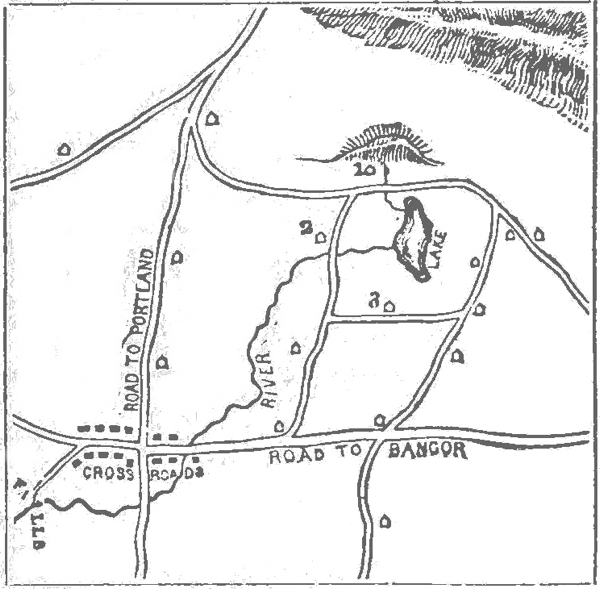
But I can give you a better idea of the geography
of Brookdale by the aid of a little map, which will
40show you at a glance an outline of the objects which
Whistler saw from the hill, and also some things which
he could not see from that position. The house numbered
1 is Mr. Davenport’s, and behind it is the hill
from which Whistler obtained his view. No. 2 is Mr.
Preston’s house, and No. 3 is the schoolhouse. The
map shows the position of the lake, the river, and the
brook near Mr. Davenport’s house. It also shows the
Cross Roads village, and the principal roads passing
through the town.
CHAPTER III. A MORNING’S WORK.
41
CLINTON’S chamber, which Whistler was to share
during his stay in Brookdale, was one of the most
curious rooms in the house. It was in the second
story, on the west side of the house,—the side represented
as nearest to the spectator in the engraving on
page 30. It had two windows, one on the west, and
the other—a luthern, or dormer window,—looking
towards the south. The room was of pretty good size,
but was low studded, the pitch of the roof bringing the
ceiling so far down, on the sides, that a boy twelve
years old could not stand up straight under it. This
made it seem like a garret to Whistler, who had
always slept in a large, airy chamber; but the walls
were plastered and papered, and the room was in all
other respects comfortably finished. It had a neat
42and cosy air, however, which, in spite of its low ceiling,
won rapidly upon the city boy’s regards. The
tastes and habits of its occupant were reflected in
nearly every article. The bed, chairs and table, were
such as you might find in almost any boy’s chamber;
but the extras that you do not find in every body’s room
were quite numerous.
The first thing that attracted Whistler’s notice was a
neat little box upon the table, made of maple. On
turning over the top, it was transformed into a portable
writing-desk, and was found to be supplied with pens,
ink and paper. This, Clinton informed him, was a
birthday present from his father, who made it. A
small book-rack, with three shelves, was fastened to
the wall, and held Clinton’s little library. The books
were mostly of a juvenile order, and among them were
several that Whistler had sent to him in former years.
The rack itself was of Clinton’s own workmanship, and
was very neatly made. Upon the upper shelf, which
held no books, there was another specimen of his
handiwork, in the shape of a full-rigged schooner, with
sails spread and flag flying. Brought up in an inland
town, and never having seen the salt water but once or
43twice, Clinton knew but little about vessels. And yet
he had built quite a respectable schooner; although, to
the more experienced eye of Whistler, the model was
not of the most approved clipper style. The name,
“Dolphin,” was painted on the stern.
A number of engravings, of various degrees of
merit, were attached by pins to the walls of Clinton’s
room. Pasted upon the wall, around the looking-glass,
there was a whole constellation of small pictures,
which evidently had once figured in newspapers and
handbills. The windows were furnished with paper
curtains, which, judging from the quantity of pulleys,
fish-bone rings, cords, and other rigging attached, were
evidently put up by Clinton with an eye rather to
ingenuity than simplicity of arrangement.
Such was the room to which Clinton introduced his
cousin, when the family retired at night. After glancing
at the various objects I have described, Whistler
noticed a slate and several school books upon the table,
and inquired:
“When do you study your lessons, Clinton? Have
you got to get one this evening?”
“No,” he replied; “I’m going to have a vacation
44now. Father thinks I had better suspend my studies
while you are here, so that I may have as much time
to spend with you as possible. I am going to arrange
my work, too, so that it won’t take so much of my
time.”
“You needn’t do that,” said Whistler; “I can help
you some about your work, and I’d rather do it than
not. I can drive the cows home, and help weed the
beds, and hoe the corn, and do lots of other things.”
“Well, you can help me some, if you want to,”
replied Clinton. And the boys continued to lay their
plans, and talk over matters of mutual interest, for an
hour after they had got into bed, when sleep began to
steal over their senses, and their pleasant schemes
melted imperceptibly into airy dreams.
Early the next morning, before the sun was up, a
rap on the chamber door aroused the boys, and was
instantly obeyed; for it was the signal to arise, from
Clinton’s mother. Having hastily dressed themselves,
they proceeded to the barn-yard, where they found
Mr. Davenport engaged in milking the cows. A
vacant stool, an empty bucket, and a gentle-looking
cow, were awaiting Clinton’s movements and without
45any delay he seated himself by the side of “Daisy,”
and the milky stream began to flow. There were two
other cows, “Princess” and “Nelly.” As Whistler
could be of no service, he stood looking on, discussing
the merits of the several cows with his uncle and
cousin. He found that each of the animals had its
own private character. Nelly was a red and white
cow, with a gentle, motherly look. She evinced much
attachment for Daisy, who, indeed, was her daughter,
and resembled her in appearance and disposition.
Daisy, however, was the tamest of the three, and a
trifle handsomer than her mother. She would follow
any of the family, and eat a turnip or an ear of corn
out of their hands. Princess was dark-colored, and
gave the most milk; but, as is apt to be the case with
those bearing royal names, she was selfish, stubborn
and mischievous. One curious thing about her was,
that she always wanted to be milked first; and if the
preference was given to one of the other cows, she
showed her indignation very plainly. If any little
attention was manifested towards the others, such as
carding or stroking them, she would seem very jealous,
and try to interrupt their enjoyment.
46As the conversation was proceeding, Daisy showed
some signs of uneasiness, upon which Mr. Preston said,
in a pleasant tone:
“Mind your milking, Clinty, and postpone your
stories until you get through. You haven’t learned
yet to milk well and talk at the same time.”
Milking is an operation that ought to be done rapidly
and without interruption, to be thoroughly and
properly performed. Conversation is very apt to distract
the attention of the milker, and thus interfere with
his work, as it did in the case of Clinton.
The milking was soon completed, and the boys, as
they drove the cows to pasture, talked as fast as they
pleased. When they returned, breakfast was upon the
table, and the morning air had so sharpened their
appetites that they were prepared to do full justice to
the ample meal.
“Now,” said Clinton, as they went out after breakfast,
“work is the first thing in the order of the day.
I must attend to the fowls, and then I have got to
weed a piece of ground, and after that I shall be at
your service.”
“I’ll help you do the weeding, and I’ll see you do
47the feeding,” said Whistler, laughing at his impromptu
rhyme.
“Your kindness is exceeding,—come, let us be
proceeding,” quickly replied Clinton, taking up the
rhyme.
“Good!” exclaimed Whistler. “Between us both
we might make quite a decent song.”
“That’s the song I like to hear,” said Clinton, as a
hen, flying down from the box in which she had just
deposited an egg, set up a noisy “Cut-cut-cut-cut-ca-dah-cut!”
with the accent very strongly upon the last
syllable but one.
“I suppose that’s what you call ‘The Lay of the
Last Minstrel,’” observed Whistler.
“Yes,” replied Clinton; “and if it isn’t good
poetry, it is good poultry, which comes near enough
to it.”
A flock of turkeys, which were at large, spying
Clinton with his familiar peck measure, now approached
the boys, pompously marching like a file of
soldiers,—a solemn-looking gobbler taking the lead. A
few handfulls of corn scattered among them, gave them
plenty of business, and Clinton then turned his attention
48to the hens, which at this season of the year were
confined within their own quarters, in consequence of
their scratching propensity. Having fed them, and
given them a dish of fresh water, he was ready to
commence work in the garden. Whistler wanted a
hoe, too; and he was provided with one, and set himself
to work by the side of his cousin.
“I shouldn’t think there were many weeds here,”
said Whistler, after hoeing a few minutes. “I can’t
find hardly anything but grass.”
“I should say that was enough,” replied Clinton.
“This witch-grass is about the worst stuff that ever
got into a garden.”
“Do you call this witch-grass?” inquired his cousin.
“Yes, that’s one name for it,” replied Clinton.
“Some people call it piper-grass. Just feel of the
roots, and see how tough they are.”
“Why, they’re almost like wire!” said Whistler.
“I never saw anything like it to grow,” continued
Clinton. “I’ve cleaned out every spear of it from this
ground three times this summer, and yet see how it
has grown. It is almost impossible to kill it. The
roots will grow right through a potato, or a chip, or
49almost anything that happens to be in the way. I left
a handful on the fence-rail last spring, and the first
thing I knew it had taken root in the wood, and was
growing finely. Father says that when he was a boy
they used to say that the only way to kill it was to
dry it, and then put it in your pipe and smoke it, and
be very careful of the ashes.”
“Does it bother you so every year?” inquired
Whistler.
“No,” replied his cousin; “this is the first time we
have had any in this piece of ground, and nobody
knows how it came here. I suppose a few seeds got
scattered here somehow or other. Before the ground
is planted again, it will have to be dug all over with a
ten-tined fork. That will clear it out, if anything
will.”
“If father was here now,” said Whistler, “how he
would moralize over this witch-grass! I can imagine
just how he would talk. He’d say, ‘That’s right,
boys!—pull away! This witch-grass has all got to
come out, at some rate or other. It’s an abominable
pest, isn’t it? Well, it’s just like a bad habit in
a man’s mind.—It’s no trouble at all to get it started;
50but if he ever wants to get rid of it, what a time
he’ll have of it! Why, he’ll have to be raked fore
and aft with the ten-tined fork of tribulation, and then
he won’t be sure that he has got all the plaguy roots
out.’”
The half-serious, half-comic air with which this was
said, and the amusing imitation which Whistler gave
of his father’s manner, proved too much for Clinton’s
gravity, and he indulged in a hearty laugh, in spite of
the excellent moral so queerly brought to his mind.
It was not Whistler’s design, however, to make sport
of his father. He had merely given as faithful an imitation
as he could of what his father might have said,
could he have looked in upon the boys just at that
moment. Mr. Davenport, when in the company of
his children, lost no opportunity of drawing lessons
of instruction from the natural world, and from the
daily events that happened around them; and this
habit had so impressed itself upon Whistler’s mind,
that he often found himself instinctively imitating his
example.
The boys, who were now some distance apart,
worked on in silence a short time, when suddenly
51Whistler gave a vigorous stroke with his hoe, and
then said, as if talking to himself:
“There, old fellow,—you’re fixed now!”
“What is that?” inquired Clinton.
“A toad.”
“Did you kill him?”
“Not exactly. I only cut off his jumpers. Just
look here, and see how smooth I took off his hind
legs.”
Clinton took a look at the poor victim, which was
struggling in its agony, and, shaking his head, said,
seriously:
“That is too bad!”
“What is too bad?” inquired Whistler, with some
surprise.
“Why, to torture a poor thing in that way. I’d put
him out of his misery, if I were you.”
Whistler felt the mild rebuke, and, having found a
large stone, he gave the poor reptile his death-blow
with far less satisfaction than he experienced when he
cut him in halves with his hoe. He was not at heart a
cruel boy, but he was thoughtless,—a fault which is
the excuse (and a very poor one it is) for a great deal
52of suffering inflicted upon dumb creatures. Having
dispatched the toad, he resumed his hoe, saying, in a
half-apologetic tone:
“I never could bear toads;—they say they are
poisonous.”
“I don’t believe that,” said Clinton; “I never heard
of any body being poisoned by a toad. Besides, they
are very useful in a garden,—didn’t you know it?”
“Useful? no, indeed! I thought they ate up the
things,” replied his cousin.
“They eat up the grubs, and worms, and bugs, and
such things,” replied Clinton; “but they don’t hurt the
crops. They are good friends to the farmer, and I’m
always careful never to hurt them.”
“I didn’t know that; I thought they had no business
here,” said Whistler. “I’ve always been in the habit
of pelting them, just as I would a snake, wherever I
found them; and that’s the way all the boys serve
them where I live.”
“You ask my father about them when we go
home, and see if he doesn’t tell you they are useful,”
remarked Clinton, who thought his cousin was not
entirely satisfied on this point.
53“O, I suppose you are right; only it is something I
never heard of before,” replied Whistler.
“I’ve tamed toads, before now, so that they would
eat out of my hand,” resumed Clinton.
“You have?”
“Yes; it is easy enough to tame them. If they
find you don’t disturb them they’ll come out from their
hiding-places, and hop around you, and follow you,
especially if you give them something to eat. Did you
ever see them eat?”
“No; I never did.”
“Well, you ought to; for it’s a curious sight. When
they get within reach of a slug or a fly, they dart their
tongue out as quick as lightning, and seize it. The
tongue is very long, and red; and it moves so quick
that people sometimes think they are spitting fire,
when they are only feeding.”
“I’ve heard that toads spit fire,” said Whistler.
“That’s only one of the old prejudices against
them,” replied Clinton. “They don’t spit fire any
more than I do; but I can tell you of one strange
habit that they do indulge in.”
“What is that?”
54“They swallow their own skins.”
“How can they do that?” inquired Whistler, with a
look of incredulity.
“They shed their skins, like snakes, at certain
times; but, instead of leaving their old coat where
they happen to take it off, they always swallow it.”
“How do you know that?—did you ever see them
do it?”
“No; but father has a book that says so. Besides,
I never found a toad’s skin, although there are plenty
of toads about here.”
“Perhaps they bury their cast-off skins,” suggested
Whistler, who, now that several of his illusions in
regard to toads were dispelled, was disinclined to allow
them the credit of doing anything remarkable.
“If I were going to guess,” replied Clinton, “I
should think that they might hide them in some way.
But the book I spoke of was written by a great naturalist,
and I suppose he knew what he was writing
about. In fact, I don’t know that they shed their skins
at all, only from what I have heard and read about it.”
“Well, poor toady, I’m sorry that I killed you; but
I didn’t know any better,” said Whistler, as he tossed
55away the remains of his victim with his hoe, and
resumed his work.
About two hours before the sun reached the meridian
the boys finished weeding the piece of ground, and
Clinton’s work for the day was accomplished.
CHAPTER IV. AN AFTERNOON EXCURSION.
56
THE boys, after completing their work, amused
themselves in various ways until dinner time. They
proposed going over to Mr. Preston’s in the afternoon;
and as soon as dinner was dispatched, they were on
their way. The distance was about three quarters of
a mile; but it was the nearest house to Mr. Davenport’s.
A walk of less than fifteen minutes brought
them to a large, old-fashioned farm-house, shaded by a
great elm tree. Three girls were just coming from the
house, each with a small basket or tin pail in her hand.
Ella and Emily were among them, and the first-named
introduced the youngest to Whistler as her cousin
Harriet. Harriet was between ten and eleven years
old. She and Emily were the only children of the
57family now at home. The youngest of the flock—sweet
little Mary—fell sick and died about six months
previous to the time of which I am writing. A month
or two before that sad event, the oldest of the children,
Jerry, took it into his head that he could find a
better place than home, and suddenly disappeared one
Sunday, while the family were at church. For a long
time nothing was heard from him; but at length he
wrote to them, from a foreign port, stating that he had
gone to sea, and was bound on a long voyage.
It appeared that the girls were about starting on a
strawberry excursion when the boys arrived; and the
latter having been invited to join them, they all set
out together. Strawberries grow wild in that part of
the country. Ella and Whistler, to whom this fruit
was known only as a dear-bought luxury, thought it
must be fine to eat the berries fresh from the vines,
with no fear of coming to the bottom of the box, and no
two-shillings-per-quart drawback upon the indulgence.
They sauntered along in advance of the others, looking
on every side for the red and luscious fruit; but they
found none; for it was a long walk to the strawberry patch.
In going to it, they had to pass through a
58swamp, near the upper end of the pond, the entrance
to which did not look very inviting to Ella.
“O, dear! I never can go through that horrid
place!” she exclaimed. “I should be frightened out
of my wits!”
“O, no, you won’t,” said Clinton. “There’s a good
path all the way through, and nothing will hurt you.
You follow right behind me, and I’ll help you over the
bad places.”
Ella still stood in doubt, while Whistler in his
eagerness was following the faint track, forgetful of his
companions. Emily and Harriet assured their cousin
that they had often crossed the swamp; and, with a
little further encouragement from Clinton, she set
forward,—not, however, without some misgivings. In
some places the ground was very wet; and they had
to step upon stones, logs, stumps, etc., which had been
used for this purpose for years. Two or three brooks
also crossed their track, over which old logs had been
thrown to serve as bridges. In many places a thick
growth of bushes, often armed with sharp thorns,
stretched across the path, making it difficult for them to
force their way through. Ella, however, was the only
59one who evinced any fear; and, but for Clinton’s constant
encouragement and aid, she would have concluded
that the strawberries were not worth the risk and
trouble of getting them.
“Are there any snakes here?” she inquired, a new
terror bursting on her mind.
“None of any consequence,” replied Clinton. “There
may be a few water-snakes: but they won’t harm any
body.”
“It makes no difference what they are, if they are
only snakes,—I’m as afraid of one kind as of another,”
said Ella, who had a city girl’s dread of everything of
the serpent kind.
“O, no; you wouldn’t be afraid of a water-snake.
They are just as harmless as toads,” said Clinton.
“I’m afraid of toads, too,—and I can’t help it,”
replied Ella.
“If you should live in the country a little while you
wouldn’t mind such things,” said Emily.
“Yes, I should,” replied her cousin. “I always had
a perfect antipathy to snakes, and toads, and spiders,
and all such creatures. I know they won’t hurt me;
but I can’t help hating them.”
60Seeing how little headway they made against her
prejudices, Clinton and Emily dropped the subject.
They were not yet out of the swamp, however; and
soon another terror arose in the mind of the timid city
girl.
“I shall get poisoned here!—I know I shall!” she
said, in a tone of mingled alarm and resignation, as
though she would have added, “You may do what you
please with me,—I’m resigned.”
“There’s no danger of that,” replied Clinton, with a
laugh. “You keep close to me, and I will look out for
you.”
“Are there any poisonous plants in this swamp?”
inquired Whistler, who had heard Ella’s remark.
“Yes, there’s plenty of poison ivy,” replied Clinton.
“O, yes; I see some now!” said Whistler, who was
still at the head of the little party. “That’s poison
ivy, isn’t it?” he continued, pointing to a luxuriant
vine that was twining around the trunk of a dead tree.
“No, that isn’t it; that’s the other kind of ivy, or
woodbine, or creeper, as we call it,” replied Clinton.
“What is the difference?” inquired Whistler.
61“A good deal of difference;—one is poisonous and
the other isn’t,” said Clinton.
“I know that; but how do you tell one from the
other?”
“You see the leaves grow in clusters?”
“Yes; there are five of them. Each leaf looks as
if it were made up of five little ones.”
“Well, the leaves of the poison ivy have only
three in a cluster; and that is the way I tell the
difference between them. When the leaves grow in
threes, look out; but when they are in fives, there’s
no danger.”
“I must try to remember that,” said Whistler,
repeating to himself the last remark of Clinton. “Let
me see,—how can I fix that in my mind, so that I
shall know ‘which is which,’ as they say? Now, I
have it! If the leaf has five fingers, like my hand, I
can handle it; if it hasn’t, I must not touch it.”
This process, in Whistler’s mind, was not a mere
boyish whim. It was founded on a law planted deep
in our mental natures,—the law of the association of
ideas. It is difficult to remember a number or figure
standing by itself; and the matter becomes still worse
62when two numbers are to be borne in mind, and distinguished
from each other, as in this instance. But,
by associating the number in the mind with some particular
object, event or word, we have a clew to it,
which will seldom fail us; and if the word, event or
object, bears any resemblance to the number, it is all
the better. Thus you see that Whistler was quite a
philosopher in this matter, although he did not know
it. By making the act of handling depend upon the
fancied resemblance of the leaf to his hand, he would
never be at a loss to tell whether it was the three or
five-lobed leaf that he was to avoid.
“There’s a three-leaved one!—that’s a poison ivy,
isn’t it?” exclaimed Whistler, a few moments after,
pointing to a vine that looked very much like the
other, except in the number of its leaflets.
“Yes, that’s one of them,—don’t touch it!” said
Clinton, as Whistler approached it.
“I shan’t look at it,” said Ella, turning her head in
an opposite direction.
“It won’t hurt you if you don’t touch it,—you
needn’t be afraid to look at it,” remarked Clinton.
“I’ve a great mind to touch it, just to see how it
63would operate,” said Whistler, going still nearer to the
vine.
“Why, William Davenport!—you silly boy!” exclaimed
Ella, with a look of astonishment.
“No! don’t touch it, Willie! You’ll be sorry if
you do,” said Clinton. “It will make your face and
eyes swell up, so that you won’t know yourself; and it
won’t feel very comfortable, either.”
“But it doesn’t poison every body, does it?” inquired
Whistler.
“No; some people can handle it without being
hurt,” said Clinton; “but I wouldn’t risk it, if I were
you. If you get poisoned once, you’ll be more liable
to it next time; and so the danger will keep increasing,
every time you come in contact with it.”
“Is there any dogwood about here?” inquired
Whistler, turning away from the ivy.
“Yes; there’s a little, I believe,” said Clinton.
“That is awful stuff! I’ve heard that you can’t
look at it without getting poisoned,” said Ella.
“I don’t believe that story,” replied Clinton. “I’ve
looked at it myself without being poisoned. Sometimes
people who have been poisoned a good many
64times, get to be so susceptible that they can’t go near
ivy or dogwood without being infected, even if they
don’t touch it; and I suppose that accounts for the
notion that dogwood will poison you if you only look
at it.”
“What sort of a thing is dogwood? What does it
look like?” inquired Whistler.
“It is a very pretty shrub,” replied his cousin. “It
grows almost large enough to be called a tree, and has
smooth and glossy branches and leaves. It thrives
only in wet places, I believe; but it is not near so
common as the poison ivy.”
There are one or two other facts relating to these
plants, which Clinton did not know, but which may be
of some advantage to my readers when they ramble
through the woods and swamps. These two shrubs,
known in common language as “poison ivy” and
“poison dogwood,” both belong to the sumach family,
and are the only plants in our New England woods
that are poisonous to the touch. Neither of them
bears a conspicuous blossom or fruit; so that if the
young botanist should chance to discover a strange
plant with a beautiful and prominent flower, he may
65be sure that it will not harm him to pluck it. An
unknown plant should never be eaten, however; as
many species of the vegetable kingdom, which may be
handled with impunity, are poisonous if taken into the
stomach.
Our party had now emerged from the swamp, and
were ascending to higher land. They soon came to
the strawberry patch, but did not find the berries quite
so plenty as they anticipated, other pickers having
been there before them. Clinton proposed going
further, and Whistler fell in with the suggestion; but
the girls preferred to stop and glean the few berries
that were left, rather than to seek new fields. The
boys, however, concluded to extend their tramp to the
hills, about a mile distant, leaving the girls to look out
for themselves. Their course lay through a succession
of fields and pastures, gradually ascending, until they
reached the base of the high hills shown in the upper
part of the map of Brookdale. These hills were
thickly wooded, many of the trees being of majestic
size and great beauty. They were chiefly pines, and
the ground beneath was cushioned with the brown
foliage of former years, while the air was full of the
66balmy odor that distills from this noble tree. Now and
then a decayed stump, which their united arms could
scarcely encircle, showed where some giant of the
woods had fallen; but, in the main, this hill-side forest
was as nature made it.
The boys found it a slippery and toilsome path up
the hill; but, once on the top of “Bald Peak,” as the
eminence was called, they were rewarded for their
pains by the extensive prospect that met their eyes.
The spot was very rocky, and, as its name implied,
was destitute of trees. The view took in a wide range
of country, dotted with houses and cultivated fields.
“There!” exclaimed Clinton, as they seated themselves
upon a mossy stone,—“have you got anything
in Boston that beats this?”
“I don’t know,—we have some pretty good views
in Boston,” replied his cousin.
“From the top of the State House?” inquired Clinton.
“Yes, that’s one of the places,” said Whistler; “but
we have a pretty distant prospect from our house,—fully
equal to this, I should say.”
“How far can you see?” continued Clinton.
67“Well, I can’t say exactly,” replied Whistler, with
the utmost soberness; “but I believe we can see about
ninety-five million miles, in the day time, and considerably
further in a clear evening.”
“I’ll knock under,—I don’t think even Bald Peak
can beat that,” replied Clinton, with a laugh.
After resting themselves, the boys, suddenly remembering
that they had started in quest of strawberries,
concluded to go down to the foot of the hill on the side
opposite to the one they ascended, where Clinton
thought they should find some berries. They had not
proceeded far, when the sharp crack of a musket was
heard not far off.
“Halloo! somebody’s gunning about here! I wonder
who it can be?” said Clinton.
“Are there many houses over this way?” inquired
Whistler.
“No; there isn’t one nearer than our house,” replied
Clinton. “There isn’t a road within two or three
miles either, except a logging-road through the woods.”
“Then it must be somebody from Brookdale,” observed
Whistler.
“I suppose so,” added his cousin.
68
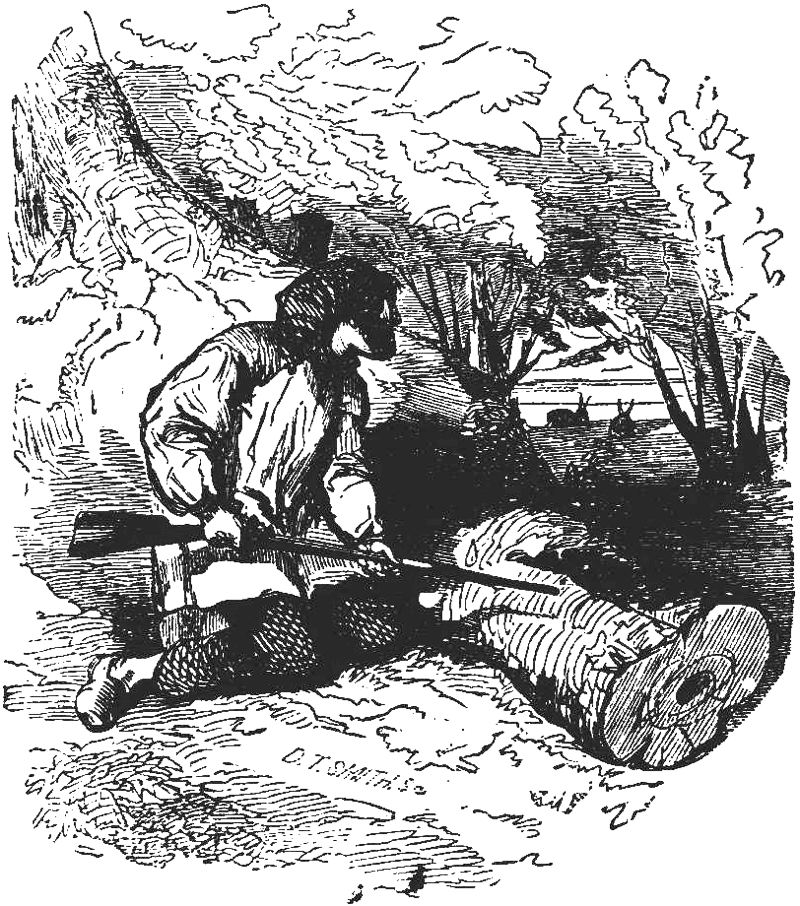
They soon reached a clearing in the woods, and discovered
a rough-looking man concealed behind the
prostrate trunk of a large tree, getting ready to fire at
a pair of rabbits, which were nibbling the herbage at a
short distance from him. The timid creatures apparently
heard the boys’ footsteps, for they suddenly fled,
before the man noticed that any one else was near.
69When he turned about and saw the boys, he looked
surprised, and a scowl settled upon his face.
“What did you scare my game for?” he inquired,
in a surly tone, addressing Clinton.
The latter seemed somewhat alarmed, and replied
that it was entirely accidental. The appearance of
the man was far from prepossessing, leaving out of the
account his cross looks, and the solitary place in which
they encountered him. His face was coarse and unshaven,
and his hair looked as if it was not on good
terms with the comb. He wore a loose blouse, or
frock, and a queer slouched cap, and his feet were
without stockings. After giving the boys a searching
look, he said, addressing Clinton:
“Do you know me?”
“Yes, sir,” he replied.
“Who is this boy?” continued the man, pointing to
Whistler.
“He is a cousin of mine, from Boston,” replied
Clinton.
“What are you here after?” inquired the gunner.
“Partly to take a walk, and partly to get some
strawberries,” said Clinton.
70The man now got up, and the boys noticed—what
had before escaped their attention—that he was quite
lame. Using his gun to help support his body, he
hobbled a little ways, and then turned back toward the
boys, and said, in a kinder tone than before:
“Clinton, I want you to do me a little favor, if you
will.”
“I will, with pleasure,” replied Clinton.
“I met with an accident this morning,” continued the
gunner. “I’m taking a tramp after game, you
see. I started last week, and am on my way to
Moosehead Lake, all alone. I camp out nights, and
have got a booth over yonder, where I slept last night.
But this morning, as bad luck would have it, I fell
from a tree and sprained my ankle, and it’s just as
much as ever I can do, now, to hobble about. I’m
afraid I shall be laid up here two or three days, if I
don’t do something for it. If I could only get a little
rum, or balm of Gilead, or pain-killer, or something of
that sort, to bathe it with, I should be right down
glad.”
“I guess mother has got something that would be
good for your ankle,” said Clinton, anticipating the
71man’s request. “I’ll ask her, and if she has, I’ll
bring it over to-morrow forenoon.”
“Couldn’t you get it yourself, without saying
anything to her about it?” inquired the sportsman.
“No, I don’t think I could,—I don’t know anything
about her medicines,” replied Clinton. “But if she has
got anything that is good for a sprain, she would send
you some, I’m certain of that.”
“But I don’t want her nor any body else to know
that I’m here,” said the man.
Clinton did not know what to say to this. After a
brief pause, in which the sportsman seemed in deep
thought, he continued:
“The case is just this: I’m owing old Ben Brown
a little money, and I can’t pay it now; but Ben is such
an ugly old dog, that if he should hear that I’m around
here, it would be just like him to have a writ out
after me, or do some other rascally thing. You
mustn’t tell a single soul that you saw me here. If
you do, it might get to him. Do you understand?”
“Yes, sir; I’ll keep dark,” replied Clinton.
“You promise, on your word of honor, that you
won’t say a word about me?” continued the man.
72“Yes, sir,” replied Clinton.
“Well, I believe your character is pretty good, and
I suppose I can trust you,” said the man; “but if you
should betray me, all I have got to say is, look out
for Dick Sneider!”
The savage tone with which this last sentence was
uttered, startled the boys somewhat; but they made no
reply. The man then bound Whistler to secrecy by a
similar promise. The boys, who had seated themselves
on the log, now arose to depart, Clinton observing
as he did so:
“I’m sorry that I can’t bring you something for
your sprain, Mr. Sneider; but I don’t see how I can,
unless you will let me ask mother.”
“Never mind that. I’ll give my ankle a good bathing
in cold water to-night, and I guess I shall be able
to travel in a day or two.”
The sun was getting low, and the boys now started
for home, at a brisk pace. Their adventure supplied
a topic of conversation most of the way; but, in reply
to Whistler’s numerous questions, Clinton could give
no very definite information in regard to the man they
had so unexpectedly encountered. All that he knew
73about Sneider was, that he once kept a disreputable
shop at the Cross Road, where he sold intoxicating
liquor, in violation of law; that his establishment was
finally broken up, and himself sent to jail; and that he
had the name of being a desperate fellow.
On their way the boys passed through the pasture
in which the cows were kept. They found Daisy,
Nelly and Princess, quietly awaiting their coming at
the gateway; and, having taken down the bars, they
drove, or rather followed, the sober and dignified
animals to their home.
CHAPTER V. THE ACCIDENT.
74
“YOU will have to amuse yourself indoors to-day,”
said Clinton to his cousin, the next morning, as
he looked out of the window, soon after the accustomed
triple rap had aroused him from his slumbers. The
rain was falling fast, and the direction of the wind
betokened a storm rather than a shower. Whistler
was somewhat disappointed, as he and Clinton had
planned a ride; but he concluded to make the best of
it, and find such amusement as he could in the barn,
the shop, and the house.
After breakfast the boys went out to the barn, Clinton
having several jobs to attend to. Whistler, not
liking to be idle, took it into his head to cut up some
hay for the horse,—a kind of work which he could do as
well as Clinton. The hay-cutter, as most of you know,
75consists of a sort of shallow wooden trough, with a
cylinder, in which are several sharp knives, at one end
of it. The cylinder is made to revolve very fast, by
means of an iron wheel and crank turned by the hand;
and as the hay is pushed slowly against the knives, it
is cut into short pieces, and falls into the vessel placed
to receive it. Whistler had worked at the machine
but a few minutes, when some drops of fresh blood on
the hay attracted his attention. He looked at his left
hand, which was feeding the machine, and found, to his
astonishment, that the end of the fore finger was missing!
For an instant, he could hardly believe his eyes,
for the knife had done its work so neatly that he felt
no pain nor unusual sensation in the mutilated finger;
but the flowing blood quickly dispelled all doubt as to
what had happened.
“Clinton!” he called, “come here, quick! I’ve cut
my finger off!”
Clinton, pale with fright, ran to his aid; but he seemed
somewhat relieved when he found that his cousin had
not lost the whole finger, but only about half an inch
of it. It was bad enough, however, as it was; and he
sympathized most tenderly with Whistler. They were
76about to go into the house, when a new idea occurred
to Clinton.
“Where is the piece that came off? Have you found
it?” he inquired.
“No,” replied Whistler.
“We must find it, then, and put it on before it gets
cold. I shouldn’t wonder if it would grow on again.
I believe I’ve heard of such things,” said Clinton.
“You look for it, then,—I can’t. I don’t want to see
it,” said Whistler, who began to feel faint and sick
from the sight of blood. “O, dear!” he added,
“what shall I do? My visit is spoilt!—and I thought
I should have such a good time!” And the tears began
to flow fast.
“Don’t say so, Willie,” said Clinton, who was looking
among the hay for the end of the finger. “This
won’t be a very bad affair. I know you’ll have a
good time yet, before your vacation is over.”
“What will uncle say?” continued Whistler. “He
cautioned me about the hay-cutter this morning; and
father did, too, before I came down here. I thought I
was careful, and I don’t see, now, how I did it.”
“Here’s the piece!” said Clinton, as he discovered
77the missing tip. “It looks as natural as life, doesn’t
it? Now, let me put it on, just as it belongs, and then
we’ll go in and get mother to do the finger up.”
Clinton carefully pressed the severed parts together,
and put a handkerchief over the hand, and they then
went into the house. Willie’s appearance, as he
entered the room, gave his aunt quite a shock; but
she quickly recalled her presence of mind, and, on
learning the nature of his injury, took immediate
measures for his relief. Clinton, in the meantime,
called his father. As his uncle entered, Whistler gave
vent to a new outburst of tears; but when Mr. Davenport,
instead of alluding to the warning he had given
him, or charging him with carelessness, spoke of the
danger attending the use of the hay-cutter, and of the
frequency of accidents of this kind, Willie’s tears gradually
dried up, and he began to regain something of the
self-command he had lost. It often happens that the
first shock of a misfortune unmans even the bravest of
spirits; and we need not wonder, therefore, that Whistler
was at first so much affected by what was after all
not a very serious accident.
It was thought best to send for the physician at
78once; and Clinton was despatched for him, in a covered
wagon, as the rain was still falling fast. Dr.
Hart lived a mile or two from Mr. Davenport’s; and
it was nearly an hour before he drove up in his gig.
He found his young patient quite calm and cheerful,
and received from him a minute account of the accident.
He then tenderly unbound the wounded finger,
and examined into the extent of the injury.
“This is not going to be a very bad affair, Willie,”
said the doctor, after he had completed his examination.
“It isn’t near so serious as it would be if you
had cut off two or three of your fingers, as I have frequently
known boys to do when playing with a hay-cutter.
I think the tip will grow on again, and the
finger will be about as good as it ever was. It is very
fortunate that you did not forget to put the piece on
again.”
“I must give Clinton the credit of that; I shouldn’t
have thought of it,” said Whistler.
“Suppose the piece shouldn’t grow on, what then?”
inquired Clinton.
“Then his finger will always be half an inch short,
and it will be rather tender for a time,” replied the
79doctor. “But I feel quite confident that it will knit
together. I shall have to sew it on, to keep it in its
place; but that won’t hurt him much.”
The doctor drew from his coat pocket a small case
of instruments, at the sight of which little Annie
retreated from the room. Clinton soon followed her
example, feeling that he had not the nerve to witness
the operation. Whistler himself looked rather anxious,
but not more so than his uncle and aunt. He promptly
obeyed all the directions of the doctor, however; and
when the needle was inserted through his flesh, he did
not flinch, nor utter a single cry, although the pain sent
the tears into his eyes. No resistance being offered,
and no time lost in coaxing the patient, the operations
of sewing and dressing were performed very quickly
and neatly.
“There,” said Dr. Hart, as he applied the last bandage,
“you bore that like a hero. There are few men
who would behave so well as you did under such an
operation. Now, if you take good care of your finger,
I have no doubt it will heal up nicely. You must
make a baby of it for a while, and treat it very tenderly;
if you don’t, it will be likely to let you know it.”
80The doctor then gave Mrs. Davenport some directions
in regard to the management of the wounded
finger. Having thus fulfilled his professional duty, he
branched off to the topics of village news, as was his
wont, remarking to Mr. Davenport:
“Friend Walker met with a pretty serious loss last
night.”
“What loss? I’ve heard nothing about it,” replied
Mr. Davenport.
“Heard nothing about the fire!” exclaimed the
doctor, with surprise. “Why, his barn was burned flat
last night, with everything in it.”
“Is it possible?” exclaimed Mr. Davenport.
“Yes,” continued the doctor; “and his oxen, and
one of his cows, and all of his hogs, were burned to
death. Then his barn was full of hay—about twenty
tons. It’s quite a sad loss to the old man, and he’s
almost crazy about it.”
“O, I am sorry for the old gentleman,” said Mrs.
Davenport, with much feeling. “It’s a great loss, at
his time of life, and he has seen so much trouble, too.”
“But where were we, that we knew nothing about
this before?” inquired Mr. Davenport.
81“O, I don’t wonder at that at all,” replied his wife.
“You know his house is over a mile from us, and
there’s quite a hill between us, so that a fire in his
neighborhood wouldn’t show very plain here.”
“How was it with his horse? I suppose he was in
the pasture,” said Mr. Davenport.
“Yes,—they turned him into the pasture last night;
but they can’t find anything of him this morning,”
replied the doctor.
“That is very singular; it looks as if some roguery
had been going on,” observed Mr. Davenport.
“O, yes; the barn was set on fire,—there is no
doubt of that,” continued the doctor. “There hadn’t
been any fire or light near it for several months.”
“Who do they suppose did it?” inquired Clinton,
who had returned to the room while the doctor was
telling the news.
“They don’t suspect anybody, that I know of,”
replied the doctor. “Mr. Walker says he hasn’t the
slightest idea who did it, and other folks are as much
in the dark as he is. People can’t help thinking of that
drunken, vagrant son of his; but, then, I don’t believe
Tom would do such a fiendish act, bad as he is.”
82“O, no; Tom Walker never could have done such a
thing as that,” said Mrs. Davenport.
“Well, I’m sorry it has happened,” said the doctor,
as he arose to depart, “not only on Mr. Walker’s
account, but because it diminishes the security of the
whole community. There is no safety for any of us,
when such villains are prowling around. Good-by,
Willie; I’ll call to see how you are getting along, in a
day or two. Good-day, all.”
Soon after the doctor departed, Clinton and his
father rode over to Mr. Walker’s to see the ruins, and
to tender their sympathies to the sufferers. It was
indeed a sad, and, in that village, an unusual spectacle,
that they beheld. The smouldering heaps of half-burned
grain and hay, the blackened remains of the
animals that perished, the partially consumed carts,
ploughs and implements, the iron of which only
remained, and the surrounding trees, stripped of every
green leaf, presented a gloomy picture of desolation,
where peace and plenty smiled but a few hours before.
The family had not recovered from their alarm
and excitement, and seemed to feel their loss very
deeply. Mr. Davenport tendered his sympathies and
83his services to his afflicted neighbors, and soon after
returned home.
Whistler, during the absence of his uncle and cousin,
talked quite cheerfully with Annie, and seemed in his
usual spirits.
“I’ve got a baby, now, that beats yours,” he said, as
Annie brought out her doll to play with it.
“Where is it?” inquired Annie.
“Here it is,” he said, pointing to his bandaged
finger.
“O, I wouldn’t have such a baby as that!” exclaimed
Annie.
“He’s a real good baby; he’s alive, and yours
isn’t,” said Whistler.
“But his head is cut off,” suggested Annie.
“No matter; the doctor has sewed it on again,”
replied Whistler.
“Well, it’s an ugly baby; I don’t like it,” said
Annie.
“No, he isn’t ugly; he never cries, nor makes any
fuss,” replied Whistler.
“He makes you cry, though,” retorted Annie, with a
look so arch that Whistler laughed merrily.
84“I guess your finger doesn’t pain you much, Willie,
does it?” inquired Mrs. Davenport.
“No, ma’am,” he replied, “I don’t feel it hardly
any, now; and it hasn’t hurt me much yet, only when
the doctor was fixing it.”
For the greater security of Whistler’s finger, which
could not bear the slightest touch, his aunt fixed a
sling, in which he carried his arm. During the day
he experienced but very little pain from the wound,
and in this respect was most disagreeably disappointed.
Mr. Davenport suggested that his father ought to be
informed of the accident; and Whistler decided to
write to him that afternoon, as he had the free use of
his right hand. The thought of doing this, however,
brought a shadow over his countenance.
“I wish I could get along without letting the folks
at home know anything about this,” he at length said.
“That would hardly be possible,” said his uncle, “as
your finger will not have time to heal up entirely
before you go home; and, even if it were possible, do
you think it would be right to do so?”
“No, sir,—I did not think of doing so; but I dread
to have them know it,” replied Whistler. “Mother
85will worry about me, and father will say that I was
careless,—that’s what he always says when anything
happens to me.”
“Isn’t it possible that you were a trifle careless?”
inquired Mr. Davenport.
“I suppose I was,” he replied.
“Clinton has used that hay-cutter, more or less, for
four or five years, and he never hurt himself with it,”
said Mr. Davenport, who really thought that Willie
was a little heedless, and wished this accident should
prove a valuable lesson to him.
The gathering tears in the boy’s eyes warned Mr.
Davenport that he had said enough, if not too much.
Clinton, noticing his cousin’s sensitiveness, came to his
relief, saying:
“Well, father, I always thought that hay-cutter was
a dangerous thing, and I’ve come pretty near cutting
my fingers with it more than once. But I’ve thought
of a way that I can fix it, so that it won’t cut off any
more fingers. I’m going to nail a strip of wood over
the place where you put the hay in, close up to the
cylinder, so that you can’t reach the knives with your
fingers. I’ll go and do it now, and see how it works.”
86Whistler proceeded with his letter. Clinton came
in, after a short absence, and reported that he had
applied his safety-guard to the hay-cutter, and that it
worked admirably. He said it interfered but very
little with the operation of the machine, and he thought
it would not trouble him at all after he became accustomed
to it. It was impossible, he said, for a person
to cut his fingers when this guard was on, unless he
did it with design.
When Whistler had finished his letter, Clinton took
it over to the Cross Roads, this being the nearest post-office.
The rain had ceased, and Mrs. Davenport,
having an errand to do, accompanied Clinton, leaving
the house in charge of Whistler and Annie, who found
plenty of ways of amusing each other until the return
of the absentees.
It was not until bed time that Whistler began to
experience much inconvenience from his cut finger.
He then found that he should need Clinton’s assistance
in undressing; and he subsequently discovered that it
was not quite so easy to keep his finger from contact
with surrounding things in bed, as it was when sitting
up.
87As the boys talked over the incidents of the day,
after they had got into bed, Clinton inquired, in a low
tone:
“Didn’t you think of Dick Sneider, Willie, when
you heard of the fire?”
“Yes, I thought of him the very first thing, and I
should have spoken of it if we hadn’t promised not to,”
replied Whistler.
“So should I,” added Clinton; “but, then, it isn’t
likely he set the fire, for he was so lame he couldn’t
have got over to Mr. Walker’s.”
“No, I don’t imagine he did it,” said Whistler;
“but there was something about his looks that
I didn’t like. How cross he looked when he first
saw us!”
“I know it; and how afraid he was that we should
tell somebody we saw him!” added Clinton.
“Well, if he wasn’t so lame I should have some
suspicion of him,” said Whistler.
“But, perhaps he wasn’t so very lame; he might
have only made believe so,” suggested Clinton.
“I wish we hadn’t bound ourselves not to say
anything about him,” said Whistler.
88“They say a bad promise is better broken than
kept,” added Clinton.
“Yes; but how do you know that was a bad promise?”
inquired Whistler.
“I don’t think it was a very good one, even if the
excuse he gave about his owing Mr. Brown some
money was the real one,” replied Clinton.
“Well, I hope they will catch the rascal that set the
fire, whoever he is,” said Whistler; “but, after all, I
don’t think it could have been the man we met in the
woods.”
Whistler did not pass the night very comfortably.
When he slept he was visited by troubled dreams, the
effect of the nervous excitement of the day; and his
wounded finger was continually receiving knocks, the
throbbing pain of which awoke him, sometimes keeping
him in agony for half an hour afterwards. Daybreak
was never more welcome to him than it was the next
morning.
CHAPTER VI. A LITERARY ENTERPRISE.
89
WHISTLER soon found that his visit to Brookdale
was not quite “spoilt,” as he feared it was,
by the accident that had happened to him. His
injured finger was somewhat troublesome, it is true,
especially at night, when it received many unfortunate
knocks, which often awoke him from a sound sleep.
It also prevented his joining in the rough and active
sports of which boys are generally so fond; and, as he
had but one hand to work with, he found, moreover,
that he could render but little assistance to Clinton, in
his regular duties. But there was another and a
pleasanter side to the account. The wound pained
him but slightly, and his health was not at all affected
by it. He could walk and ride as much as he pleased;
and then, when Clinton could not accompany him in
90his excursions, he never failed to find sources of
amusement about the house, or in the shop or the barn.
The doctor called occasionally to look after the finger,
and always reported that it was doing well, never
omitting to praise Whistler for the good care he took
of it.
One stormy day, about a week after the accident, as
Whistler was sitting in the house, deeply engaged with
a book, the lively “Clack! clack!” of the flail struck
up, and, taking his cap and book, he ran out to the
barn. He found Clinton in the back part of the barn,
engaged in threshing rye.
The grain, tied up in bundles,
was piled on each
side of him as high as the
flooring above. The process
of threshing hardly
need be described; and
yet, as possibly some
young city reader may never have witnessed it, I will
say that a quantity of straw is laid upon the barn floor,
and the heads of it are beat by the flail until all the
grain is shaken out of it. The flail is made of hard
91wood, in two pieces, united by leather, or some other
flexible material, which allows the shorter piece to
play freely, something like the lash of a whip. When
the grain is all threshed out, the straw is removed,
and tied up in bundles. The grain is then shovelled
up, and passed through a coarse sieve, and is ready to
be stored away.
“Have you found a piece, Willie?” inquired
Clinton, as his cousin entered the barn.
“No, I can’t find one that suits me,” replied
Whistler.
“Well, I’ve thought of another plan, and a better
one still,” continued Clinton; “and that is, that you
write a dialogue for us.”
“I write a dialogue! That’s a pretty joke!—ha!
ha! ha!” replied Whistler, with a merry laugh.
“Yes,—why not?” inquired Clinton. “You write
compositions, and you have got plenty of time now,
while your finger is sore. Come, you’ll try, won’t
you?”
“O, no; I couldn’t do anything if I should try,”
replied Whistler. “If I had only known it before I
left home, I could have got a copy of the dialogue the
92boys spoke at our last exhibition. It was a real funny
piece; better than any in this book. One of these
will do, though, if we can’t find something better.”
“But we must have something better,” said Clinton,
with earnestness, laying down his flail. “If you won’t
write one yourself, you’ll help me do it, won’t you?”
“Yes, I’ll agree to do what I can; but I’m afraid
I shan’t help you much,” replied Whistler.
“If we put our heads together, I think we can get up
something that will answer,” said Clinton. “As soon
as I’ve threshed this lot I’ll go into the house with
you, and see if we can’t make a beginning.”
The church and Sabbath-school which Clinton
attended were making preparation for a social festive
gathering, to be held in a grove; and among the
entertainments proposed were to be declamations by
several of the young people. Clinton and Whistler
had both been invited to take part in these exercises,
and they had also been requested to select a dialogue
for two or three smaller boys, and to see that they
were properly drilled in their parts. They felt that
quite a serious responsibility had been laid upon them;
and for a day or two it had been the subject of much
93consultation. Clinton had at length made a selection
for himself, and Whistler had concluded to repeat the
piece which he spoke at his school exhibition a few
weeks before. The dialogue, however, was yet to be
determined on; and, as they had less than two weeks
for preparation, it naturally gave them some uneasiness,
especially as they had thus far been unable to
find a suitable piece.
After Clinton had finished threshing the lot of grain
which he had begun, he went up to his bedroom, with
Whistler, and opening the little desk upon the table,
they sat down, and tried to agree upon some plan, or
subject, for the dialogue. They did not accomplish
much, however, beyond making a few pen flourishes,
and thoroughly overhauling the contents of the desk,
which contained, among other things, a few of Clinton’s
compositions, in which Whistler was much interested.
The fact was, neither of them had any idea to propose,
and the longer they sat there the farther their attention
wandered from the subject in hand, until, at last, the
call to dinner interrupted their fruitless consultation.
The boys had no better success in the afternoon with
their literary enterprise, and Clinton’s ardor began to
94cool off a little; for, to tell the truth, the ardor was
pretty much all on his side. They retired to bed early
in the evening, intending to have “a good talk” before
it was time to go to sleep. While thus engaged, telling
stories to each other, Whistler related an incident
that once occurred in the school he attended.
“There!” exclaimed Clinton, as soon as he had
finished, “why can’t we bring that into our dialogue?
It would be a complete subject, wouldn’t it? We
might change it a little, if we wanted to, to make it
tell better in a dialogue, but it wouldn’t be very bad
if we took it just as it is. What do you say to that
idea, Willie?”
“I don’t know; perhaps we might make something
out of it,” replied Whistler. “If we could only get it
up equal to the original, it would make some fun, I
can tell you.”
“We’ll try, at any rate,” said Clinton.
And they did try, the next day,—yes, and several
days following. The result was, by their joint efforts,
Whistler’s story was “done” into dialogue, with some
slight changes to give it more effect. The old and
very reasonable adage, that “Two heads are better than
95one,” proved true in this case, as they made a better
dialogue, together, than either could have written
alone. They seemed aware of this, and even Whistler
came to feel quite a lively interest in the literary
bantling. As the reader may like to know something
of this production, I will give the substance of it, or,
rather, the story on which it was founded.
A group of boys were playing in a school-room, a
little while before school time, when a trifling dispute
arose between two of them—John and Benjamin.
One gave the other the lie, and, both being of hot
temperament, it was “a word and a blow.” They
clinched, fell, and rolled together on the floor, and were
pummeling each other well, when suddenly the teacher
walked into the room. Taking the pugilists by the
collar, he lifted them upon their feet, and sent the
other boys to their seats. On inquiring into the origin
of the quarrel, he found that they were about equally
guilty. Accordingly, he reproved them both sharply
for their fault.
“If you must fight,” he said, “why don’t you do it
in a decent and gentlemanly way, and not act like a
couple of bullies? I’ll show you how it should be
96done. Here, John, take this stick (handing him the
familiar ratan), and now give Benjamin one dozen
smart cuts with it across his back. And don’t you lift
a finger, Benjamin, unless you want me to take you
in hand.”
John seemed as much astonished as pleased, as he
took the rod and began to pay on the blows; while
his antagonist received them without a word or cry,
but with a sullen and dogged look. After he had
completed the dozen, the teacher told Benjamin to
take the ratan, and bestow the same favor upon John’s
back. Both faces changed at this unexpected turn in
affairs, and Benjamin laid on his dozen with a heartiness
that showed he fully entered into the spirit of this
part of the arrangement.
This operation finished, the teacher asked each of
them if he was satisfied, and received an affirmative
answer.
“Well, then,” said the teacher, “if you are both satisfied,
your quarrel is made up, and you may complete
the reconciliation by shaking hands, and giving each
other the kiss of peace.”
There was a general titter among the scholars at
97these words, which the teacher promptly suppressed.
Seeing that the two culprits hesitated, he repeated the
order; but they did not move.
“Well,” he continued, “I see your feelings are
hardly mollified, yet,—I shall have to see what I can
do;” and he took the rod, and advanced towards them.
The boys, blushing to their temples, barely extended
their hands, and brought their faces together, followed
by an explosion of laughter from the whole school,
which the teacher sternly silenced.
“That won’t do,” said the teacher; “it was too cold
and mechanical,—there was no soul in it. You can
do better than that; now, try again.”
After a little more coaxing (the ratan still impending
over their heads), the culprits concluded to comply,
and went through the ceremony in a much more cordial
manner. There was a new burst of laughter from
all hands, in which the teacher himself joined, this
time; and the two offenders retreated to their seats,
with faces as red as peonies, not knowing whether to
laugh or cry.
Such was the story upon which the dialogue was
founded. In dramatizing it, however, Clinton and
98Whistler had found it necessary to make some slight
changes.
The boys made three copies of the dialogue—one
for each of the principal characters. It was decided
that Clinton should take the part of schoolmaster, and
the two belligerents were to be represented by two
smaller boys. These boys had agreed to meet Clinton
and Whistler on Saturday afternoon, to study and
rehearse their parts. The place of rendezvous was a
charming little dell, in a grove behind the schoolhouse,
which was well known to all the children in town by
the name of “Spouting Hollow,” from the circumstance
that it was occasionally used by the young orators as a
place of rehearsal.
The boys had not yet shown their dialogue to any
one. Clinton had thought of getting his father to read
it, but no opportunity had presented itself as yet. On
Friday evening, after tea, Mr. Davenport took a chair
from the house, and seated himself just outside of the
front door to enjoy the cool air, for the day had
been quite sultry. Annie, with her little chair, soon
seated herself by his side and engaged his attention,
and it was some little time before Clinton could get
99a chance to broach the subject which was upon his
mind.
“Ah! have you finished the dialogue, so soon?”
inquired Mr. Davenport, when Clinton alluded to it.
“Yes, sir, it’s all done, and we’re going down to
Spouting Hollow, to-morrow afternoon, to rehearse it,”
replied Clinton.
“Well, you have been pretty smart, and I hope you
have done your best, too,” said his father, in a tone
that seemed to imply some slight misgivings.
“We think we have done pretty well,” remarked
Whistler. “At any rate, we’ve made a better
dialogue than I thought we could.”
“Ah! I’m glad to hear that,” replied Mr. Davenport;
“what is the subject of it?”
“Perhaps you would like to read it,” said Clinton,
with some reluctance, slowly drawing the manuscript
from his jacket pocket.
“Yes, I will read it, if you wish,” replied his father.
Mr. Davenport took the paper, and commenced
reading it, for it was not yet dark. The boys walked
back and forth, around the house, both feeling something
of that indefinite dread which the modest literary
100aspirant always experiences when his performances
are submitted to superior wisdom and judgment.
“How long it takes him to read it!” at length
whispered Clinton, after they had returned several
times to the doorway, and found him still absorbed
with the dialogue.
After a few minutes’ absence they again returned,
and Mr. Davenport had commenced reading it anew.
“He’s reading it over again,—you may know he
doesn’t like it,” whispered Clinton, when they were
beyond his hearing; and the hearts of both sank within
them.
The next time they approached the doorway, Mr.
Davenport had finished reading the paper, but seemed
to be so absorbed in thought that he did not notice the
boys. They turned to go away again, when he suddenly
called to them, and they went back, feeling like
a couple of culprits.
“I was thinking,” he said, “of deferring my judgment
of this dialogue for an hour or so, until I could
collect my thoughts a little better; but, as I see you
are in considerable suspense, I won’t ask you to wait
any longer. And, to begin, I think you have executed
101your task very well indeed, in a literary point of view.
The dialogue is natural and sprightly, and the whole
arrangement is very good, and does you much credit.
And yet, I can’t say I am wholly pleased with the
piece. Like many other authors, I think you have
been unfortunate in the choice of a subject. Whose
idea was it,—who suggested the plot?”
“It was my idea,” replied Clinton; “Willie told
me the story, and I thought it would make a good
subject for a dialogue.”
“Ah! it is founded on fact, is it?” inquired Mr.
Davenport.
“Yes, sir; it is almost word for word what happened
in our school, once,” replied Whistler.
“Well, I will tell you plainly what my objections
are,” continued Mr. Davenport. “They are of a
purely moral nature, and perhaps you will not feel
their force so much as I do. In the first place, I don’t
like the fighting scene. I think it is so brutal and
wicked for boys to maul each other in that way, that I
would not encourage it, even by imitating it in sport.
Besides, children are great imitators, and it wouldn’t
be strange if some little fellows, after seeing your
102dialogue represented, should try to play off a fight on
their own hook; and perhaps they might get in earnest
before they were through with it. And then, again,
seeing a sham fight, like yours, might strengthen a
taste which too many boys have for witnessing real
battles, in which bloody noses and torn clothing are the
prizes. I presume you didn’t think of these things;
but don’t you see there is some force in them?”
“Yes, sir,” replied Clinton.
“But they represent such things at the theatres,”
suggested Whistler.
“I know they do, Willie,” said his uncle; “but, in
my opinion, the theatre is a very poor school of
morality.”
“And we read about such things in books, too,”
added Clinton, gathering courage from his cousin’s
objection to his father’s position.
“A written description of a fight, or any other
species of wrong-doing, is a very different thing from
the same affair acted out by living performers,”
replied Mr. Davenport. “Still, such scenes ought to
be introduced very sparingly and very cautiously into
books, in my opinion.”
103“Is there anything else in the dialogue that you
don’t approve?” inquired Clinton.
“Yes,” replied his father; “but I suppose I must
blame Willie’s teacher for the other faults, rather than
you. I don’t think he took a very wise or proper
course to settle the dispute between the two boys. I
should say that the mutual flogging must have deepened
their hatred of each other, and encouraged their
fighting propensities. Then I do not like the forced
reconciliation; it could only make deceivers and hypocrites
of them. Exposing them to the ridicule of the
whole school was another bad thing about the affair.
In fact, I should think that the whole scene must have
had a bad effect, not only on the culprits, but upon all
who witnessed it; and for that reason I should not like
to see it represented in a dialogue.”
“Well, then,” said Clinton, in a desponding tone,
“we shall have to give up the dialogue, for we
haven’t time to write another, even if we knew we
could write a better one.”
“I hope you are not going to allow one failure to
discourage you,” replied his father. “I do not find
any fault with this, except with the subject; and I do
104not see why you cannot write another as good as this,
that shall be free from all objectionable matter.”
Here the conversation ceased, and Mr. Davenport
went into the house. His decision in regard to the
dialogue had not been announced without the greatest
pain, as he well knew how sore a disappointment and
how deep a mortification it would carry with it. There
was no honest and proper course, however, but to
express his opinion freely and fully; and he accordingly
did so, in as kind a way as he could.
“I almost wish we hadn’t shown it to father,”
said Clinton, when they were alone. “I don’t
believe anybody else would think there was any harm
in it.”
“Well, as for my part,” said Whistler, “I’m glad
we did show it to him; for if there’s anything out of
the way in it, I should much rather know it now, than
not find it out until after it was spoken.”
This manly remark had a decided effect on Clinton,
who, in the bitterness of his disappointment, had
uttered a sentiment which, to do him justice, we must
say did not come from his heart.
“I suppose it’s all for the best,” he said; “but what
105shall we tell the boys, when they meet, to-morrow, to
learn their parts?”
“We can tell them that our dialogue did not suit
us, and we’re going to write another,” replied
Whistler.
“Another?—how can we do that?” inquired
Clinton.
“Why, you don’t mean to give it up, do you?”
inquired Whistler. “I don’t, at any rate. We’ve
promised the boys an original dialogue, and I, for one,
shan’t back out without trying at least once more.
We’ve got over a week to do it in, and it didn’t take
us three days to write that.”
“Yes,—but the subject?” suggested Clinton.
“Ah, that’s the stick!” said Whistler. “Don’t you
think your father could tell us of something to write
about?”
“You might ask him,” said Clinton, who seemed
determined that if another dialogue was written, his
cousin should shoulder the burden.
Willie did ask his uncle, who was much pleased to
learn that the boys had concluded to try again. He
talked with them during the evening in regard to the
106matter, and suggested several plans and subjects, one
of which struck them very favorably, and they at once
concluded to adopt it.
Early the next morning the boys went to work upon
their new dialogue; and so earnestly did they labor,
that, to their own astonishment, it was finished when
the dinner hour arrived. It was much shorter, however,
than the first one, and was also simpler in its
construction. Mr. Davenport read and approved it;
and in the afternoon the nymphs of Spouting Hollow—if
that classic retreat was honored by such inhabitants—had
the pleasure of listening to its first
rehearsal.
CHAPTER VII. THE INCENDIARY.
107
“THERE! I can’t do anything with only one
hand!” exclaimed Whistler, somewhat impatiently,
as he was at work in the shop one morning with
Clinton. He was nailing two pieces of wood together,
for some purpose or other; but the nail split them
both, and rendered them useless.
“You didn’t drive the nail in right, that’s the
trouble,” said Clinton, after glancing at the pieces.
“If you had turned it round the other way it wouldn’t
have split. You have set the wide part of the nail
across the grain of the wood, and it acts just like a
wedge. Don’t you see how the nail widens towards
the head? Well, that wide part ought to go the same
way as the grain, and not across it.”
“I’ve heard something of that before, but I didn’t
108think anything about it,” said Whistler, who, it should
be remarked, had far less mechanical skill than Clinton,
who had enjoyed unusual facilities for cultivating this
talent, and, besides, had a natural aptitude for it.
“Even if you were driving a nail into solid timber,
where there was no danger of splitting,” continued
Clinton, “the wide part ought not to go against the
grain; for, if it does, there will be a little opening
around the head of the nail, and that will let in air and
moisture, and make the wood decay.”
“Well, I’ll try it again,” said Whistler; and he
began to look around for some more pieces of wood.
“There is another thing about driving nails,”
continued Clinton; “did you know that you can
drive one into hard wood a great deal easier if you
wet it?”
“No, I never heard of that,” replied his cousin.
“It is so,” added Clinton. “Oil is the best thing to
wet it with; but water is good, or you can put it into
your mouth, as the carpenters often do.”
“There’s some knack even in driving a nail, isn’t
there?” said Whistler.
“Ah, there comes Mr. Walker,” said Clinton, as a
109man appeared in the yard, and he went out to speak
to him.
“Where’s your father, Clinton?” inquired the man.
“I don’t know,—he is somewhere about here,”
replied Clinton. “Shall I go and find him?”
“No matter about it,—I’m in a hurry,” replied Mr.
Walker. “I was going by, and I thought I’d stop
and let your folks know that father has heard from his
horse, and got track of the rascal that set fire to the
barn.”
“Has he?—who is it?” inquired Clinton.
“We’ve traced the fellow to Bangor, and there
we’ve lost him,” continued Mr. Walker; “but I’m in
hopes we shall get some clew to him again. He sold
the horse about twenty miles this side of Bangor.”
“But who is the fellow?” inquired Clinton, with a
feeling of suspense somewhat similar to what he experienced
when his father had the rejected dialogue
under consideration.
“We don’t know for a certainty,—he went by two
or three different names, and probably all of them
were assumed for the occasion,” replied Mr. Walker;
“but, from the description of him, we think it
110must be a fellow that father complained of for selling
rum, over at the Cross Roads. His name was Dick
Sneider.”
“There! that explains it all, then!” said Clinton,
and the color suddenly went from his face.
“Explains what? Do you know anything about
it?” inquired Mr. Walker, with surprise.
Clinton then told Mr. Walker of his interview with
Sneider in the woods the night before the fire. Willie
also came out, on hearing the subject of conversation,
and supplied some omissions which Clinton, in his
alarm and nervousness, had overlooked. Mr. Walker
was a quick-tempered and impulsive young man, somewhat
overbearing in his manner, and, when in a passion,
not a very agreeable person, by any means. He
could scarcely restrain his anger, as the boys related
their adventure, and repeatedly interrupted them with
the inquiry, in a quick, snappish tone:
“Why didn’t you tell of this before? What does
all this mean, I should like to know?”
His passion rose as the boys proceeded, and he soon
lost all self-control, and broke forth in a most profane
and outrageous manner, applying all kinds of abusive
111epithets to Clinton in particular, for not telling of his
interview with Sneider before; pronouncing him a fool
and simpleton for being so easily deceived by him;
and, with the usual inconsistency of men in a passion,
threatening to have him arrested as an accomplice or
partner in the crime. The boys hung their heads like
criminals, under the stinging reproof; but, fortunately
for them, Mrs. Davenport, who, unobserved, had heard
the whole conversation, thought it her duty to interfere,
now that Mr. Walker’s temper had reached such a
pitch, and she accordingly stepped from the house.
The young man softened his words and tones a little
when he saw her, but still condemned Clinton’s error
in severe terms. She admitted that he had acted unwisely,
but mildly rebuked Mr. Walker for the severity
of his reprimand, reminding him that Clinton was but
a boy, and had probably done what he thought was
right. She also spoke of the accident which Whistler
met with, and of the busy preparations they had been
making for the picnic, which had caused them almost
to forget the fire.
Mr. Walker now started for home; but he had not
proceeded far when he met Mr. Davenport, and he
112stopped to inform him of the discovery he had just
made.
“Is that man drunk, or crazy, or what is the matter
with him?” inquired Whistler, indignantly, as soon as
Mr. Walker was out of hearing.
“No, Willie; he’s a fiery-tempered man,—that’s
all that ails him,” replied his aunt.
“Well, if I hadn’t thought he was crazy, or drunk,
or something of that kind, I wouldn’t have stood so
much of his impudence,” added Whistler, whose
courage rose as the choleric young man rode off.
“I know one thing,” said Clinton, “if Bill Walker
ever talks to me in that way again, I’ll give him as
good as he sends.”
“O, no; you don’t mean that,” replied his mother.
“That would be putting yourself on a level with him;
and I’m sure you wouldn’t wish to do that. His bad
temper is a great injury to him. It is notorious all
over town, and nobody respects him so much as they
otherwise would, on account of it. He makes a great
many enemies, too, and, I have no doubt, he feels
heartily ashamed of himself when he gets over his fits
of passion. I hope you will never try to meet such a
113man with his own weapons. The best way is to keep
silence, or speak mildly. ‘He that ruleth his spirit is
better than he that taketh a city,’ as the Bible says.
If you had been impudent to Mr. Walker, it would
have made him more furious, and he would not get over
his resentment half so easily; but now, he will soon
get calmed down, and then he will see that he has
treated you badly, and the next time you meet him he
will be as kind to you as ever,—you see if he isn’t.”
“Yes,—but before he gets cooled off, he’ll go all
over town and tell what a fool I am,” said Clinton,
bursting into tears.
“O, no, I think not,” replied his mother; “but, even
if he should, every body knows what he is, and his
reports will not injure you any, in the end.”
Mr. Davenport soon came in, to make inquiries concerning
the affair of which he had just heard. He
could hardly credit Mr. Walker’s story, who, to tell the
truth, had not troubled himself much to explain the
mitigating circumstances in the case. He listened
patiently to the boys’ statement, and was very glad
to find that the affair was not so bad as had been
represented.
114“I am very sorry this has happened,” said Mr.
Davenport, after they had made their explanations.
“If you had told me of this as soon as we heard of the
fire, it is probable that Dick might have been arrested;
for the officers would have known who they were in
pursuit of. Your silence has probably defeated the
ends of justice this time.”
“But he seemed to be so lame, that we thought he
couldn’t be the fellow,” suggested Whistler.
“Ah, he was too shrewd for you there,” said Mr.
Davenport. “You shouldn’t believe all that such a
fellow tells you.”
“Well, to tell the truth, uncle,” said Whistler, “I
don’t think Clinton is so much to blame as I am. I
remember, now, his saying that he was suspicious of
Dick, and that a bad promise is better broken than
kept; but I rather talked him out of it.”
Whistler had a nice sense of honor, hence this magnanimous
confession, which, indeed, was not a mere
compliment, but was the truth. Clinton would probably
have made the revelation immediately after the fire,
had he not been influenced otherwise—slightly it is
true—by his cousin. This, however, did not wholly
115excuse his mistake. He knew more of Dick’s bad
character than Whistler did; and, besides, he ought
not to have been so easily influenced against his own
convictions. This, indeed, had always been one of
Clinton’s chief failings,—a disposition to yield too
readily to the wishes and arguments of others, when
his own better judgment ought to have dictated a
different course.
Clinton did not allow his cousin to assume all the
blame in the matter, but insisted on bearing his full
share. He strongly protested, however, that he thought
he was doing right.
“I am a little inclined to doubt that,” replied his
father. “It seems to me you could not have given the
subject much thought. I suppose you had a sort of
general impression that you were doing nothing wrong;
but I suspect that you did not turn the matter over in
your mind as you ought. But, even if you did, after
due consideration, conclude that you had done right,
that would not make the action right.”
“But, in that case, I shouldn’t be to blame for doing
as I did, should I?” inquired Clinton.
“Yes, you would be to blame, unless you could give
116a good excuse for not knowing better,” replied his
father. “But, are you sure that you gave the subject
proper reflection, and acted according to the best of
your knowledge?”
“Yes, sir; I thought I did,” replied Clinton.
“Your promise to Dick was the only reason for
your silence, was it not?”
“Yes, sir.”
“Why did you make such a promise? Supposing
his story was true about the debt, was it right for you
to shield him from justice?”
“But he said he couldn’t pay.”
“Then you regarded him as an honest but unfortunate
debtor, and thought it would be an act of mercy
to stand between him and his cruel creditor, did you?”
Clinton could not answer that question, but looked
perplexed. He finally evaded it by saying:
“But he looked so ugly, that I didn’t dare to refuse
him.”
“Did he threaten you, or use any compulsion?”
inquired his father.
“Yes, sir; he threatened us after we had promised
not to say anything about it.”
117“Well, that will hardly excuse you for making such
a promise. I think you yielded too willingly. You
can hardly say that he compelled you to promise
secrecy. But, suppose he did compel you, what
then?”
“I suppose it would not have been binding on us.”
“Why not?”
“Because he forced us into it.”
“Then, when the barons of England compelled King
John to sign the Magna Charta, which secured to
Englishmen their liberties, the act was not binding
upon him, because he was forced into it; was it so?”
Clinton made no reply.
“If I should catch a boy stealing apples from my
trees,” continued his father, “and should refuse to let
him go until he had promised not to steal any more, he
would be under no obligations to keep his promise,
would he?”
“Yes, sir, he would.”
“Are there any circumstances, then, under which it
is proper to violate a promise?”
“Yes, sir,—when the promise is wrong.”
“Yes, that is a settled principle in morals, and one
118that commends itself to every honest mind. If I
promise to do what is wrong, I am bound to break that
promise. Now, apply this principle to your promise
to Dick. Do you think that was a promise that ought
to have been kept?”
“I know it wasn’t, now, but I didn’t know then.”
“But I want you to banish from your mind all
thoughts of the fire, and what you have since learned
about it. We will suppose that Dick’s story was true.
You meet him unexpectedly in the woods. You know
that he is a worthless fellow, a vagabond and a rascal.
He pleads that he is in debt, and unable to pay, and
wants you to promise to tell no one that you saw him.
You know that if he is too poor to pay what he owes,
it is because he is too lazy to work. You know, moreover,
that he is a man who would be just as likely to
tell you a lie as the truth. Now, was it right for you
to make such a promise to such a man?”
“No, sir.”
“And, after it was made, was it right to keep it, and
shield such a worthless fellow from the consequences
of the life he is leading?”
“No, sir.”
119“Well, then, why didn’t you find that out sooner?”
“I didn’t look at it in that light.”
“That confirms what I said at the beginning. You
did not give the matter much thought; if you had, you
would have seen it in just this light, even if the fire
had never happened. But, what surprises me most of
all is, that, after you knew some villain had set Mr.
Walker’s barn on fire, and run off with his horse, you
did not take the trouble to think over this affair earnestly,
and decide what it was your duty to do. You seem to
have let it slip from your mind, as soon as you could,
without knowing whether you were doing right or wrong.
If you had done this under somewhat different circumstances,
it might have blasted your character for life.
Many an innocent man has found himself entangled in the
meshes of the law, by merely keeping a rogue’s secret.”
Clinton was much affected by his father’s plain
dealing with him, and attempted no further excuse.
Whistler also felt badly about the affair, and he could
not help taking to himself a good share of the censure
bestowed upon his cousin. Mrs. Davenport, however,
who had been a silent listener to the conversation, was
not wholly satisfied with the course her husband had
120taken. She thought he had judged the boys with too
much severity, and she accordingly put in a plea in
their behalf. Her argument included pretty much all
that could be said in mitigation of their error; and if
they had been on trial, and she had been their lawyer,
we may suppose that the heads of her “brief” would
have been something after this fashion:
(1.) Their youth and inexperience—not strange that
a wicked and artful man should mislead them—the
young, by a beautiful law of our natures, are more inclined
to believe than to doubt what is told them; not strange
that so young persons should not go through a long process
of reasoning, as to the right and wrong of the matter.
(2.) Dick’s feigned lameness was well calculated to
deceive them, and allay all suspicion.
(3.) Their motive in keeping the secret was honorable—a
regard for their promises.
(4.) The hints thrown out by several people, that
Mr. Walker’s intemperate son, Tom, was suspected,
may have had some influence on their minds.
(5.) The excitement about Willie’s accident, the
dialogues, etc., had probably caused them to think less
about the matter than they otherwise would.
121“Well,” said Mr. Davenport, after she had concluded
her defence, “you have made out something of a case;
but, if my judgment was too severe, I am inclined to
think yours is too lenient. After all, perhaps the
truth lies about half way between us; so, Clinton, you
can consider my judgment as softened down a little;
but,” he added, with a smile, “you mustn’t think you
are altogether so blameless as your mother makes you
out.”
“Mr. Walker will get his horse back again, won’t
he?” inquired Willie.
“Yes; a man has a right to his own property,
wherever he can find it,” replied Mr. Davenport.
“I hope they will catch Dick, too,” said Clinton,
“and then they won’t have anything to blame me for.
I should be willing to go to court, as a witness against
him, if they could only nab him.”
“I hope he will get his deserts,” said his father;
“but, whether he does or does not, you must let this
unfortunate affair be a lesson to you in the future; and
beware how you listen to bad men, or make rash
promises, or keep a secret which you have reason to
think ought to be revealed.”
CHAPTER VIII. THE FOREST PICNIC.
122
THE long looked for twenty-fourth of August, the
day appointed for the picnic, at length arrived. At
Mr. Davenport’s the whole family were stirring before
daylight had fairly appeared; for there was much to be
done, and it was necessary to start for the scene of
festivities at an early hour. A heavy mist hung over
the village, at sunrise, but it soon melted away, and
the weather was all that could have been desired.
Fanny, who was to carry the family to the picnic,
was furnished with an extra allowance of oats; the
pigs and poultry also received rations sufficient to last
them till night; and the oxen and cows were turned
into the pasture, to shift for themselves. After breakfast,
the family dressed themselves in their best suits;
the horse was harnessed into a large, open wagon;
123sundry cakes, and pies, and loaves of bread, were
stowed away in the bottom of the cart; and then,
locking up the house, all hands seated themselves in
the vehicle, and they drove off towards the Cross
Roads. The place of rendezvous for the party was
the vestry of the church at the Cross Roads. This
was the only church within a dozen miles of Brookdale,
the few scattered families in that village not
being able to sustain public worship among themselves.
So the church at the Cross Roads was their church,
although many of them lived four or five miles distant
from it.
When Mr. Davenport’s family arrived at the vestry,
they found that the people were nearly all assembled,
and were about to start for the grove, which was
a mile distant. There was a singular collection of
vehicles around the church,—chaises, carryalls, wagons,
hay-carts, &c.,—some of which were neatly
trimmed with green boughs. The word was given to
get ready, the various teams were loaded up, and the
motley procession started, escorted by several young
men on horseback, and the rear brought up by a large
company on foot. Their route, most of the way, lay
124through a noble forest; for the road was not a public
highway, but was little more than a path, being used
chiefly for the teaming of wood. In many places it
was quite rough, narrow
and steep, and the
carriages were obliged
to proceed slowly; but
it was free from dust,
and was, withal, a very
pleasant and romantic
road. Several men and
children had gone on
ahead to open the gates,
or, perhaps, to have the
satisfaction of
being first on
the ground.
The principal
manager of
the arrangements,
who was mounted on a handsome horse, also
rode in advance of the procession, to see that the way
was cleared.
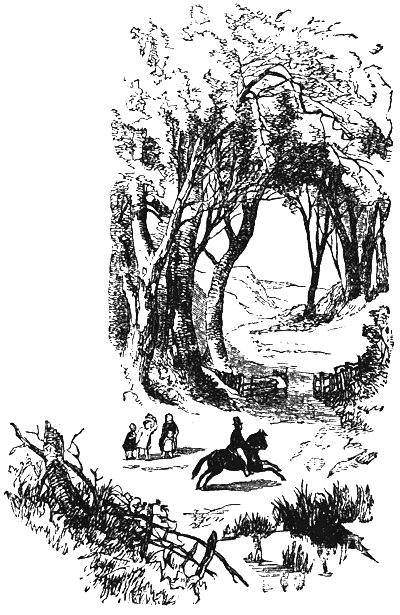
125The grove selected for the picnic was at a place
called “The Falls,” about a mile from the village, in
a southwesterly direction. At this point the river
becomes a miniature cataract, the current being narrowed,
and the descent quite abrupt. The bed of
the stream is rocky, and the waters, as they dance
and tumble along their course, seem full of the spirit
of frolic. There are fine groves on each bank,
extending almost into the water.
The party reached the picnic ground in good order.
The horses were removed from the wagons and carriages,
and hitched in shady places, on the skirts of the
woods. The young people were informed that they
would have two hours to ramble about and amuse
themselves, while their parents were looking after the
provisions, arranging the tables, and gossiping with
their acquaintances. Clinton, Whistler and Annie,
soon fell in with Ella and her two cousins, and the
six concluded to take a walk together in the woods.
“What a charming place this is for a picnic!”
exclaimed Ella; “we haven’t anything that will compare
with it around Boston,—have we, Willie?”
“No, I never saw such groves as these around
126Boston, although we have some pretty good places for
picnics,” replied Whistler.
“Your brother Oscar used to like to come over
here,” said Clinton, addressing Ella; “he has rambled
all over these woods many a time.”
“And so has Jerry; they used to come over here
together, gunning,” added Emily.
“Do you know that we expect Oscar home again
pretty soon?” inquired Ella, addressing Clinton in a
low tone.
“Yes, Willie told me,” he replied.
“He is going to live with our Aunt Page, in Vermont;
we think it will be a real good place for him,”
added Ella.
“I’m glad of it, and I hope he will do well,” said
Clinton.
“He says he means to,” replied Ella; “he wrote
mother a beautiful letter, just before I left home. I
wish you could read it; it doesn’t seem like him,
at all.”
“I wish I could see him once more. Perhaps I
shall, when I go to Boston next month,” said Clinton.
The boy of whom they were speaking was Ella’s
127oldest brother. He was at this time about fifteen
years old. He had been a wayward boy, and had
caused the family much trouble and sorrow. He had
been disobedient and disrespectful to his parents, and
rough and domineering towards the other children.
He chose for his associates boys who were, to say the
least, no better than himself, and fell into indolent
habits, neglecting his studies at school, and shirking, as
far as he could, the various little services which he was
expected to perform at home. At length his misconduct
became so troublesome, that it was thought best to
remove him from his city associates and temptations.
Accordingly, he went to reside with his uncle in Brookdale,
where he spent several months. This, however,
did not reform him; but, instead of correcting his evil
habits, he exerted a bad influence on his new acquaintances.
This was especially true of his cousin Jerry,
who was sadly contaminated by his example; and
even Clinton, with all his good habits and principles,
did not wholly escape the moral contagion. But at
length his career in that place was brought to a close
by an act that entitled him to a cell in the county
prison, and his father was obliged to take him home,
128to save him from the consequences of his crime. He
then made a short voyage to sea; but, not fancying
that mode of life, he again became a loiterer about the
streets of Boston, fell into bad company, was arrested
for stealing, and, after a public trial, was sent to the
Reform School; and there he remained at the time
this conversation took place.[1]
The two hours allotted to the young folks for sports
and rambles were improved in various ways. Some
strolled through the woods and fields, in quest of flowers
or berries; some sailed chip boats on the river, or
waded in its clear waters, or tried to catch imaginary
fish with worms impaled upon pin hooks; some amused
themselves with a swing which had been suspended
from the limb of a lofty oak; others played “I spy!”
“hide and seek,” “tag,” and similar games; and others,
reclining on the grass under the trees, talked and
sang, and watched the movements of those around
them. Clinton and Whistler, who felt some responsibility
for a portion of the entertainment that was to be
provided, did not remain long with the Prestons, but
129hunted up the boys who were to take part in the
declamations, and assisted in making the necessary
preparations for this part of the exercises.
At length the clear notes of a horn rang through the
woods for several minutes. This was the signal for
the company to assemble, and it was promptly obeyed.
The “Log Cabin,” as it was called, was the place of
gathering. This was a long, low, and rude structure,
the walls being of logs, laid one upon another, and the
roof thatched with bark. There were several square
holes in the sides, which let in the light, and an opening
at one end, which served as a door. A pole was
fastened to the gable over the door, from which floated
an American flag. This log house was erected for the
accommodation of picnic parties, by the young men of
the neighborhood, several years previous.
The inside of the log house was as rude as the
exterior. The end opposite the entrance had a raised
platform, but the rest of the building had no floor
except the native turf. On each side there was a
rough bench, the length of the cabin, which furnished
the only seats for the company. The interior was
prettily decorated with hemlock and spruce boughs,
130which were arranged in the form of an alcove and canopy,
on the platform, producing a very pleasing effect.
When the people had all assembled in this forest
hall, the pastor commenced the exercises by supplicating
the divine blessing upon their festivities. He also
addressed the company in a familiar manner, and then
called upon the children for a song, which was given
in a spirited style. After one or two speeches, and
another song, the declamatory exercises were introduced
by Clinton, who gave an extract from one of
Webster’s orations, in a creditable manner. Several
misses and boys then recited poems, or declaimed
pieces, Whistler being one of the number. Last of
all came the following original dialogue, the joint production
of Clinton and Whistler, which we feel bound
to copy in full:
Scene—The platform of a school-room.—Characters—Thomas
Trotter, a large boy, with a “big
voice,” and Samuel Sly, a small boy, whose vocal
organ is pitched on a high key.
[Thomas enters, and makes his bow to the audience,
followed by Samuel, who goes through the same ceremony,
a little in his rear.]
131Tom [turning partially round.]—What do you
want here?
Sam.—I want to speak my piece, to be sure.
Tom.—Well, you will please to wait until I get
through; it’s my turn now.
Sam.—No, ’tain’t your turn, either, my learned
friend; excuse me for contradicting, but if I don’t stick
out for my rights, nobody else will. My turn came
before that fellow’s who said “his voice was still for
war;” but I couldn’t think how my speech began, then,
and he got the start of me.
Tom.—Very well; if you were not ready when
your turn came, that’s your fault, and not mine. Go
to your seat, and don’t bother me any more.
Sam.—Well, that’s cool, I declare,—as cool as a
load of ice in February. Can’t you ask some other
favor, Mr. Trotter?
Tom.—Yes; hold your tongue.
Sam.—Can’t do that; I’m bound to get off my
speech, first. You see it’s running over, like a bottle
of beer, and I can’t keep it in. So here goes:
“My name is Norval; on the Grampian Hills.
My father feeds—”
Tom [interrupting him, commences his piece in a
loud tone.]—“Friends, Romans, countrymen!”
Sam.—Greeks, Irishmen and fellow-sojers!
Tom.—“Lend me your ears.”
Sam.—Don’t you do it; he’s got ears enough of
his own.
132Tom.—“I come to bury Cæsar, not to praise him.”
Sam [mimicking his gestures.]—I come to speak
my piece, and I’ll do it, Cæsar or no Cæsar. “My
name is Norval—”
Tom [advancing towards him in a threatening
attitude.]—Sam Sly, if you don’t stop your fooling I’ll put you
off the stage.
Sam [retreating.]—Don’t, don’t you touch me,
Tom; you’ll joggle my piece all out of me again.
Tom.—Well, then, keep still until I get through.
[Turns to the audience.]
“Friends, Romans, countrymen! lend me your ears;
I come to bury Cæsar, not to praise him.”
Sam.—I say, Tommy, what are you bla-a-a-a-r-ting
about; have you lost your calf?
Tom.—“The evil that men do lives after them,
The good is oft interred with their bones;
So let it be with Cæsar.”
[He is again brought to a stand by Sam, who is
standing behind him, mimicking his gestures in a ludicrous
manner.]
Now, Sam, I tell you to stop your monkey shines;
if you don’t, I’ll make you!
Sam.—You stop spouting about Cæsar, then, and
let me have my say. You needn’t think you can
cheat me out of my rights because you wear higher
heeled shoes than I do.
Tom.—I can tell you one thing, sir,—nothing but
your size saves you from a good flogging.
133Sam.—Well, that is a queer coincidence, for I can tell
you that nothing but your size saves you from a good dose
of Solomon’s grand panacea. [To the audience.] I don’t know what
can be done with such a long-legged fellow,—he’s too big to be whipped,
and he isn’t big enough to behave himself. Now, all keep still, and let
me begin again: “My name is Norval—”
Tom.—“I come to bury Cæsar—”
Sam.—I thought you’d buried him once, good
deeds, bones and all; how many more times are you
going to do it?
Tom.—Sam, I’m a peaceable fellow; but, if you go
much further, I won’t be responsible for the consequences.
Sam.—I’m for piece, too; but it’s my piece, and
not your long rigmarole about Cæsar, that I go in for.
As I said before, “My name is—”
Tom.—“The noble Brutus
Hath told you Cæsar was ambitious;
If it were so, it were a grievous fault,
And grievously hath Cæsar answered it.”
Sam [in a loud whisper.]—I say, Tom, did you
know you had got a hole in your unwhisperables?
Tom.—“Here, under leave of Brutus, and the rest.
(For Brutus is an honorable man,—
So are they all, all honorable men,)
Come I to speak in Cæsar’s funeral.”
Sam.—This isn’t Cæsar’s funeral,—it’s the exhibition
of the Spankertown Academy, and it’s my
134turn to officiate, so get out with Cæsar,—“My name
is Nor—”
Tom.—“He was my friend, faithful and just to me;
But Brutus says he was ambitious;
And Brutus is an honorable man.”
Sam.—Brutus be hanged; who cares for what he
said? Come, you’ve sputtered enough; now give me
a chance to say something. “My name is—”
Tom.—Come, Sammy, don’t interrupt me again,
that’s a clever fellow. Let me finish my piece, and
then you shall have the whole platform to yourself.
Sam.—You’re very kind, Mr. Trotter,—altogether
too kind! Your generosity reminds me of an Irish
gentleman, who couldn’t live peaceably with his wife,
and so they agreed to divide the house between them.
“Biddy,” says he, “ye’ll jist be after taking the outside
of the house, and I’ll kape the inside.”
Tom [to the audience.]—Ladies and gentlemen,
you see it is useless for me to attempt to proceed, and
I trust you will excuse me from performing my part.
[Bows, and withdraws.]
Sam.—Yes, I hope you will excuse him, ladies and
gentlemen. The fact is, he means well enough; but,
between you and me, he doesn’t know a wheelwright
from a right wheel. I’m sorry to say, his education
has been sadly neglected, as you all perceive. He
hasn’t enjoyed the advantages that I have for learning
good manners. And, then, did you ever hear such a
ridiculous spouter! He might make a very decent
135town crier, or auctioneer, or something of that sort,—but,
to think of Tommy Trotter pretending to be an
orator, and delivering a funeral oration over Cæsar!
O my! it’s enough to make a cat laugh! And, now,
ladies and gentlemen, as the interruption has ceased, I
will proceed with my part:
“My name is Norval; on the Grampian Hills
My father feeds his flocks——”
And—and—and—[aside, to a boy near him]—what is it?—[to the
audience]—“feeds his flocks”—and—and—and—there! I’ll be blowed if I
haven’t got dead stuck, a’ready! Just as I expected, that lubber that
came to bury Cæsar has bullied all the ideas out of my head! [Beats
an inglorious retreat, with his hands over his face.]
How the hearts of the young authors beat, as, concealed
from the audience, behind the spruce boughs on
the stage, they watched the progress of the piece, and
trembled lest, after all their pains, it should prove a
failure! But their anxiety was needless. The lads
who took the parts acquitted themselves admirably,
and the whole assembly seemed to join heartily in the
applause which followed its conclusion.
After a few more addresses from gentlemen present,
the assembly was dismissed for one hour. The older
136people scattered themselves over the grounds, in little
groups, while the children, pleased with the successful
issue of their part in the entertainment, made the
woods ring with their merry voices, as they bounded
through the grove. Clinton and Whistler received
many congratulations for the success of their dialogue
and the excellence of their speaking. Among those
whose commendation was most hearty, was young Mr.
Walker, whom they had not seen, till now, since the
memorable morning when his passion so completely
overmastered him. The sight of him stirred up the
sense of injury which was still rankling in Clinton’s
heart, and he tried to avoid him. Mr. Walker, however,
was now as calm as a summer’s day, and seemed
to have entirely forgotten the character of that interview.
Familiarly slapping the boy on the back, he
said:
“Clinty, they say you composed that dialogue; is
that a fact?”
“Willie and I wrote it, together,” replied Clinton.
“Well, it was a capital hit; every body says so.
Your speaking was good, too; you’ve covered yourselves
with glory, both of you,” said Mr. Walker.
137The boys, somewhat abashed by praise from such a
source, looked confused, and made no reply.
“By the way,” continued Mr. Walker, putting a
hand on the shoulder of each of the boys, and drawing
them aside from other groups that were near, “you
mustn’t think anything of what I said the other day.
I was a little excited, you know, and I suppose I said
rather more than I ought to. I have been sorry for it
ever since, and I don’t want you to think I meant
it all.”
“We can see, now, that we did wrong,” said Whistler,
perceiving that his cousin was at a loss what to
say; “but, the fact is, we didn’t think much about it at
the time. We didn’t mean any harm; that’s all the
excuse we can give.”
“No, we didn’t mean any harm, and we both felt
bad enough when we found how Dick cheated us,”
added Clinton.
“Well, we won’t say anything more about that,”
remarked Mr. Walker; “it can’t be helped, now, and
I rather think we shall catch Dick, after all. If we
do, he will have to sweat, that’s certain. He won’t
138get off with less than three or four years in the state’s
prison.”
Mr. Walker passed along to other groups, but his
few words to the boys had changed their feelings
towards him very materially. Their resentment had
melted away before his apology, and they felt relieved
from a heavy burden of censure. Still, it must not be
supposed that all traces of that outburst of passion
were thus easily removed. No apology can sink so
deep into the heart as an angry word or an unjust
reproach. The scar remains after the wound is
healed.
Another blast from the horn rang through the
woods and summoned the people to the feast, which
had been spread upon a long table under the trees,
near the cabin. There was a bountiful supply of provisions,
which had been contributed by the various
families; and the company, standing around the tables,
demolished the substantials and delicacies in a way
that evinced the sharpness of their appetites and the
excellence of the repast.
The dinner was followed by several speeches, stories,
anecdotes and songs, and then the people dispersed, to
139amuse themselves in their own way. Clinton proposed
a blueberry party; and his parents, Whistler,
Annie, the Preston children, and several others, entered
into the arrangement. A short walk through the
woods, by a path well known to Clinton, brought them
to several acres of cleared land, which was literally
covered with blueberries, of a large size, and in full
perfection. To the regret of all, they had no vessels
to fill; but they picked as many as they could eat, and
each broke off a few branches from the well-laden
bushes, to carry back to the grove, as specimens of the
generous yield of the blueberry pasture.
No hour was set for the breaking up of the picnic;
but, as the sun dropped down towards the west, one
load after another started for home, those who lived
most distant being generally the first to leave. Mr.
Davenport and his family withdrew at an early hour,
as they not only had a long ride before them, but had
many things to attend to after they got home. The
tongues of the young folks ran glibly enough as they
jogged along through the solitary roads, and all the
scenes and enjoyments of the day passed in vivid
review before them. The sixth and last mile of their
140homeward journey was half completed before they
showed any signs of having “talked themselves out;”
and then the conversation suddenly came to a stand,
and they rode in silence for several minutes. Clinton,
who had talked more than any of the others,
seemed all at once absorbed in his own thoughts. He
was thinking of the dialogue, and was about to ask his
father something about it, when it occurred to him that
he had already said full enough on that subject, and
would perhaps be laughed at if he alluded to it again.
After a few moments’ silence, however, he got the
better of his modesty, and again broached the all but
threadbare topic.
“Father,” he said, “there is one thing I don’t exactly
understand. You didn’t like our first dialogue because
the characters behaved so bad. Now, I don’t see why
you didn’t object to this other piece, for the same
reason. Tom and Sam didn’t come to blows, to be
sure, but they quarrelled bad enough.”
“I wonder that you did not think of that, sooner,”
said Mr. Davenport.
“I did; I told Willie, before you read it, that you
would object to it on that account; but, as you didn’t
141find any fault with it, I thought I wouldn’t,” replied
Clinton.
“Until you were sure you should not have to write
another dialogue?” suggested his father, with a smile.
“O, we couldn’t have done that, any way,” said
Clinton.
“Well,” continued his father, “I think I can clear
myself of all suspicions of inconsistency. And, in the
first place, you must remember that I did not say it
was best to exclude all exhibitions of bad temper or
character from a book or a dialogue. There are some
faults that may be very properly exhibited in this
way. But there are certain gross forms of evil which
it is not wise to portray too minutely. For instance,
it would be painful to see the sins of murder, or
drunkenness, or lewdness, or profaneness, or fighting,
acted out in a dialogue; and, besides, the effect would
be immoral. But, if you want to show off the folly of
vanity, pertness, ill manners, jealousy, ignorance, or
any similar fault, by giving an example, I have no
objection to it, if it is only done judiciously. Now, in
regard to your dialogue, Tom behaved as well as
almost any boy would under the same circumstances.
142Sam was the rogue; and he, I take it, was only a
harmless personification of a pert, self-conceited, but
witty young blockhead, who, in the sequel, gets abundantly
punished for his impudence. Isn’t that the
character you intended to portray?”
“Yes, sir, I suppose it is,” replied Clinton.
“And do you see, now, why I didn’t object to the
dialogue?”
“Yes, sir,” replied Clinton.
They had now reached their home, and Mr. Davenport
took care of the horse, while the boys went after
the cows and oxen.
CHAPTER IX. THE MIDNIGHT ATTACK.
143
WHISTLER’S wounded finger continued to heal
rapidly, and it now occasioned him but little
trouble. He did not use his left hand much, however;
and one day he was a good deal surprised, and a trifle
alarmed, on discovering that the arm itself had become
much smaller than the other. He at once showed it
to his aunt, who relieved his apprehensions by assuring
him that its shrunken appearance was owing to its
not being used. She also improved the opportunity
to give him a few hints on the importance of exercise
to bodily health.
“If you should keep your arm motionless for a long
time,” she said, “it would finally wither and become
useless. So it is with our whole bodies,—they suffer,
and fall away, if they do not get exercised enough.
144The reason that Clinton is stronger and stouter than
you is, that his body has been exercised more than
yours. He was quite slender when he was a little
child. And it is precisely the same with our minds.
If we want to increase any of our faculties, we must
make a good use of them, and they will be sure to
grow. But, if we don’t exercise them, they will fall
away, just as your arm has done.”
One morning, a few days after the picnic, there was
a great commotion on the premises, occasioned by the
discovery that some murderous marauder had visited
the yard in the night, and taken the lives of a score of
Clinton’s hens and chickens. A brood of young chickens,
which slept in a barrel laid upon its side, apart
from the other fowls, were all murdered, together with
their mother; while in the hen-house the ground
under the roosts was strewn with the bodies of the
slaughtered. Clinton rushed into the house in a high
state of excitement, on making the discovery, and the
whole family hastened to see the bloody spectacle.
Many were the exclamations of sorrow and pity, as
they gazed upon the bodies of plump, matronly hens,
and exemplary pullets, and feeble, infantile chickens,
145now stiffened in death, their plumage ruffled and
stained with blood. Several of the fowls, however,
were missing, having evidently been either devoured
or carried off. Among these was one of the lords of the
poultry-yard, who, perhaps, had attempted to defend
his family from the midnight assassin, and had been
carried off bodily, as a trophy of victory. The survivors
were silent and melancholy, and the shadow of
a great calamity seemed to have settled upon them.
The remaining rooster, to be sure, was so ungracious
as to crow lustily over the bodies of his murdered
household, in the presence of all the family. Whistler
charitably suggested that this was a song of triumph
for his own escape; but Clinton, who knew the jealous
rogue better than his cousin did, thought it was quite
as likely that he was exulting over the tragic downfall
of his rival. Perhaps, however, with the bravado
natural to his race, he affected an indifference and
stoicism which he did not feel, and crowed, as boys
sometimes whistle in a grave-yard, merely to “keep
his courage up.”
After the first outburst of regret and pity which the
spectacle called forth from all present, their curiosity
146was thoroughly awakened to ascertain what animal
had committed this cruel outrage upon a happy and
peaceful family. After a careful examination of the
premises, no track or trace of the creature could be
found. All was mystery. There was nothing but the
slaughtered victims upon which to found a speculation,
and these told no tales against their murderer. Clinton
was the first to hazard a guess in regard to the
assassin.
“It must have been either a fox or a wild-cat,” he
said; “don’t you think so, father?”
“If I were going to guess, I should say it was a
skunk,” replied his father.
“O, no, father,—a skunk wouldn’t have killed so
many of the fowls, would it?” said Clinton, who was
unwilling to admit that so common and despised an
animal had done the mischief. “Besides,” he added,
“we have skunks around here all the time, and why
didn’t they ever do such a thing before?”
“If I remember right, they have done just such
things before,” replied his father.
“Well, it was a long time ago, before I owned the
fowls,” said Clinton.
147“It isn’t many months since Mr. White caught a
skunk in the act of killing his fowls,” added Mr.
Davenport.
“But they have never disturbed our fowls since I
owned them, and that is over five years,” suggested
Clinton.
“And there is a good reason for that; you have
always kept your fowls well secured against wild
animals, until this summer,” replied his father.
This was true. Clinton was at first very particular
to shut up the poultry at night, so that no animal
could get at them; but their exemption from attack
for several years had gradually allayed all fears on
this score, and of late he had not properly secured his
charge from the midnight attacks of their natural
enemies.
“Well,” said Clinton, “I don’t believe it was
a skunk; I think it was a fox or a wild-cat, or
it may have been a ’coon. I mean to borrow Mr.
Preston’s trap, and see if I can’t catch him,
to-night.”
“I’ll give you fifty cents for his skin, if you catch
a ’coon, a wild-cat, or a fox,” said his father, as he
148turned away from the scene to resume his morning
work.
“Agreed; and you shall have it for nothing, if it’s
a skunk,” replied Clinton, with a laugh.
“No, I thank you,—I shan’t accept that offer,”
replied his father.
“Come, Annie, I wouldn’t look at the poor things
any longer,” said Mrs. Davenport, leading her little
daughter away.
“Here, mother,” said Clinton, “what am I to do
with them? Wouldn’t some of those large ones be
good to eat?”
“They may be good enough, for all I know; but I
should not like to eat anything that was killed in that
way,” replied his mother. “Besides, they are hardly
fat enough to eat well. You had better bury them in
the garden; I don’t think they are good for anything
else.”
“I will do it right away, then,” said Clinton; and
he and Whistler procured shovels, and began to dig
the holes.
“I should like to see a skunk,” said Whistler; “do
they show themselves around here very often?”
149“Yes, I see them occasionally,” replied Clinton.
“One moonlight evening, last spring, I had been
away, and when I came home, I saw one sitting on
our door-step; but he walked off as soon as he heard
me, and I didn’t think it best to follow him.”
“They are nasty-looking things, I suppose,” said
Whistler.
“Why, no; there is nothing very bad-looking about
them,” replied Clinton. “Their fur is brown, with
white stripes, and if it wasn’t for their odor, they
would be hunted for their skins. People sometimes
eat skunks when they can’t get anything else, and they
say the meat is very well flavored.”
“What kind of a trap is it you are going to borrow?”
inquired Whistler; “will it kill the animal, or
only make a prisoner of him?”
“It is a steel trap, such as they catch wolves with,”
replied Clinton. “It catches the creature by the leg,
and he can’t get away, unless he leaves his leg
behind.”
“Perhaps you will catch a wolf,” suggested Whistler.
“No, a wolf didn’t do this. He would have eaten
or carried off more of the hens,” replied Clinton.
150“Don’t you suppose the wolves come down here
from the forests, sometimes?” inquired Whistler.
“Yes, I know they do,” replied Clinton. “Last
winter two men were in the woods, about a dozen
miles north of Brookdale, when a deer dashed out from
a thicket, within two rods of them, with a large wolf
close on to his heels. Before they could raise their
rifles the wolf had the deer by the neck; but they fired,
and shot them both dead. I saw both of the animals
over to the Cross Roads. The wolf was over seven
feet long, and he was a savage-looking fellow, I can
assure you. Another man, last winter, was crossing a
pond on skates, when a pack of wolves made after him,
and, in his hurry and fright, he skated into a hole in
the ice, and was drowned.”
“Do the wolves ever come this way in the summer?”
inquired Whistler.
“Yes,” replied Clinton; “there are often great fires
in the woods, in summer, that burn for weeks, and then
the wolves, and bears, and moose, get driven from
their quarters, and sometimes they pay us a visit.
Mr. Oakley, who lives on the Passagamet river, fifteen
miles from here, had ten sheep killed by wolves, about
151a year ago. A part of the flock came round the house,
and looked frightened, and the folks went over to the
pasture where the sheep were kept, to see what the
matter was. They found seven of them dead, and
some of them were torn dreadfully; but three of them
were alive, and were hurt but very little. They only
had a little scratch on the throat, that looked as if it
might have been made with the point of a pin. They
carried these three home, and clipped off the wool
around their wounds, and washed off the blood, and put
on some salve; but they all died in an hour or two.
The wolves poisoned them, or else they were frightened
to death.”
“And you say bears sometimes prowl around here,
too,” said Whistler.
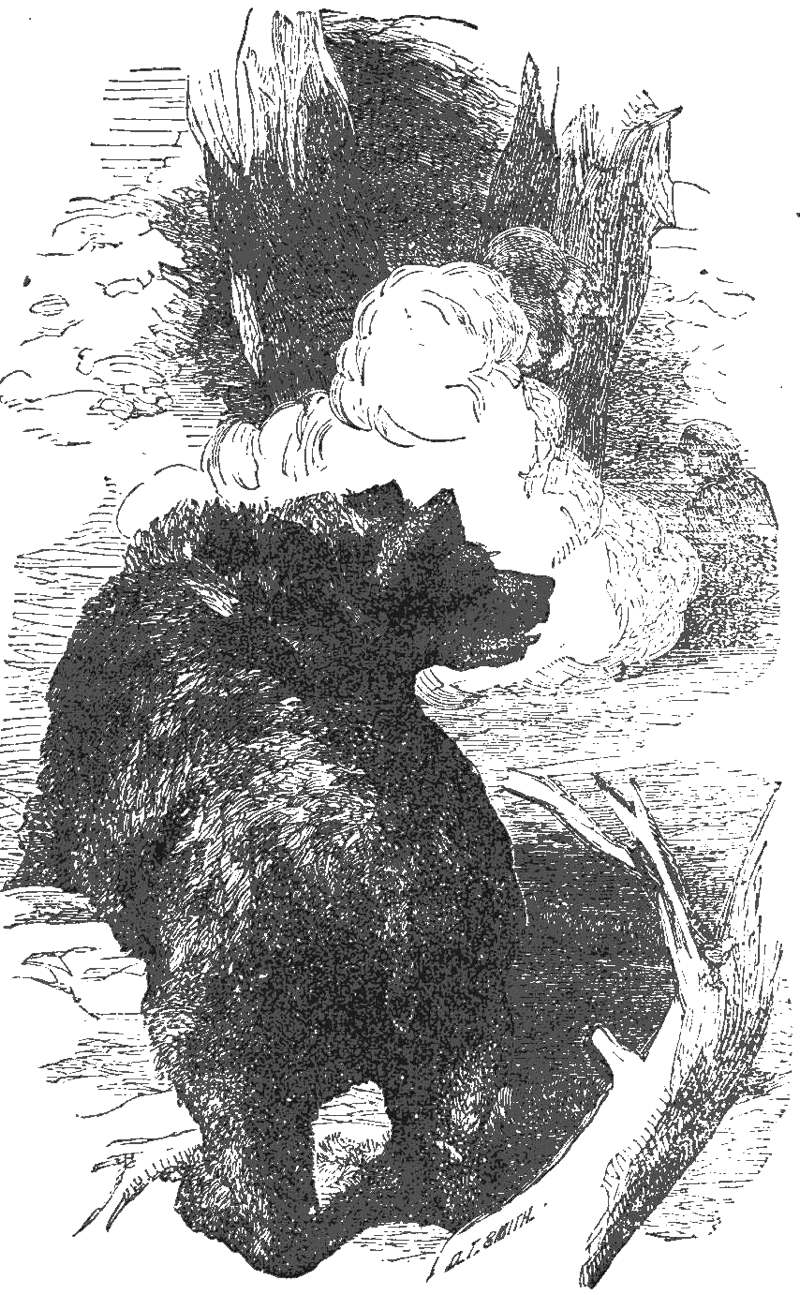
“Yes,” replied Clinton; “four or five years ago, one
was seen over in the woods, where we went the other
day when we saw Dick Sneider. Last winter father
and I rode over to a logging-camp, in a sleigh, and
spent two or three days with the loggers. We had
a capital time. We ate with the men, and slept on
heaps of leaves, in their log huts. They had rousing
fires, burning all night, in the middle of the huts;
152and, instead of chimneys, the smoke went off through
a large hole in the roof. But that isn’t what I was
going to tell you about. We stopped one night at
‘Uncle Tim’s,’ as they call him, about half way
between here and the camp. He lives in a ‘clearing’
in the woods, and there’s no other house for miles
around. He told me a good many stories about wild
beasts, and one of them was about a bear that he killed
last fall. One morning he discovered that some
creature had made great havoc in his cornfield in the
night, and he found the tracks of a bear all over the
lot. He saw, by the tracks, that it was a very large
and heavy animal; and, as he had a bear-trap, he
thought he would try to catch him with it, rather than
have a fight with him. So he baited the trap, and set
it in the cornfield; but the next morning he found it
just as he left it. The bear had walked all around it
two or three times; but he knew too much to go into
it, and he made his supper off of green corn again.
Well, Uncle Tim said his dander was up, then, and he
made up his mind that if the bear got any more of his
corn, he should take some of his bullets with it. So,
in the evening, he took his rifle, and hid himself among
155the trees just by the edge of his clearing, pretty near
the place where the bear’s tracks were. Well, he
waited, and waited, hour after hour, but he couldn’t
hear nor see anything of the bear. It wasn’t very
dark, as there was a moon. His wife and two boys,
and his big dog, were in the house, waiting and watching
as patiently as they could; for Uncle Tim told
them not to show themselves unless he gave a loud
whistle. Well, about one o’clock in the morning, he
thought he heard a slight noise, and, sure enough,
there was the old fellow within a few feet of him, and
looking directly at him. Uncle Tim took good aim,
and then blazed away, with as heavy a charge as his
gun would bear. The ‘varmint’ gave one spring
towards him, and fell dead almost at his feet. He
weighed about five hundred pounds, and I don’t
remember how much oil Uncle Tim got out of him,
but it was a good lot. He got a bounty from the state,
too, for killing him.”
“He must be a brave man,” said Whistler.
“O, these old pioneers don’t mind such things,” said
Clinton; “they soon get used to bears and wolves.
But I saw in a newspaper, the other day, an account
156of a fight a little boy had with a bear, that was really
worth bragging about. He lived near Lake Umbagog,
which is on the line between Maine and New Hampshire,
and I believe he was only nine years old. He
saw a bear in an oatfield, near the house, and he
thought he would pepper him with a few buck shot.
The bear was wounded, and showed fight; so the little
fellow picked up a club, and went at him. The boy’s
mother saw the fight, and she gave the alarm to his
father and an older brother, who were at work near
by; but when the bear saw them coming, he made off
as fast as he could. The family gave chase, but they
were not well armed, and were obliged to let him
escape. Well, a few days after, that same bear was
seen near the same place, with a sheep in his mouth;
and that same little fellow went at him again, with a
club, and made him drop the sheep, and scamper off
into the woods. At another time this bear came to the
house, when the woman was alone. He put his fore
paws on the window sill, and stuck his head and
shoulders into the room, and, after he had looked
around a little, he walked off without touching anything.”
157“That is being a little too neighborly. I shouldn’t
like to live quite so near the bears as that,” said Whistler.
“I should want something more than a club, if I
had got to meet one,” said Clinton.
“But I shouldn’t be afraid to meet a fox, or a wild-cat,
or a ’coon, in the woods,—should you?” added
Whistler.
“I shouldn’t want any better fun than to meet a
’coon or a fox,” replied Clinton; “but if I had got to
tackle a wild-cat, I should want to be pretty well
armed. It isn’t every man that can ‘whip his weight
in wild-cats,’ as they say out west.”
“Why, I had an idea they were a good deal like our
house-cats, only they are not tame,” said Whistler.[2]
“They do look something like a cat,” replied Clinton,
“but they are twice as big, and almost as savage
as tigers. I saw a dead one, once. They have little
short tails, and very strong, ugly-looking jaws. A boy
158that lives at the Cross Roads killed the one I saw.
He was hunting rabbits, about half a mile from the
village, when he saw the head of a strange-looking
animal in a tree right over him. He didn’t know
what it was, but he concluded to fire; and, just as he
did so, the creature sprang right at him. The shot
didn’t seem to hurt him much, but he was in a terrible
rage. The boy dodged him as he leaped from the
tree, and then they had a pitched battle for three or
four minutes. The fellow got some pretty hard
scratches, and had his clothes torn; but he beat the
wild-cat with the breach of his gun until he killed him.
He lugged the body home, and he felt as grand as
any body you ever saw, for a month afterwards. The
wild-cat weighed about twenty-five pounds, and he had
the skin stuffed, and has got it now.”
The slaughtered fowls were now all buried, and the
boys went in to breakfast. In the course of the forenoon,
after Clinton had done his work, he and his
cousin went down to Mr. Preston’s, to get the trap.
The story of the catastrophe awakened the interest
and sympathy of the neighbors, and quite a discussion
ensued as to the nature of the enemy that had done
159the mischief. Mr. Preston said it would not be at all
strange if a wild-cat or fox was prowling around the
neighboring woods, but he thought it quite as probable
that a skunk had killed the fowls. He did not think
it was a raccoon, as, he said, this animal eats only the
heads of the poultry it kills. As Mr. Preston was an
old logger, having spent his winters in the forests for
many years, he was well acquainted with the wild
animals in that quarter, and Clinton placed considerable
confidence in his opinion. Still, he was not quite
satisfied that his chickens had fallen a prey to the
despised skunk, and Mr. Preston accordingly hunted
up his rusty wolf-trap, and gave him some directions
in regard to baiting and setting it.
Ella, who listened to this conversation, seemed
somewhat alarmed to hear that the woods around
Brookdale were ever visited by such strangers; and
when Whistler told her that even wolves and bears
sometimes came down into the neighborhood, she declared
most vehemently that she should not dare to go
out of sight of the house again while she stayed there.
“O, yes, you will; you will come over and see us,”
said Clinton.
160“No, I shan’t; you have wild-cats around your
neighborhood,” she replied.
“But Willie and I will come down with guns, and
escort you up and back again, if you’re afraid,” added
Clinton.
“I hate guns; I should be afraid to go with you, if
you carried them,—boys are so careless with fire-arms,”
replied Ella.
“Then we’ll come without guns,” remarked Willie.
“Yes; and I’m thinking you would run as fast as
I should, if you saw a wild beast coming,” said Ella,
laughing.
“No, I shouldn’t, either; I’d stand my ground as
long as any body would,” replied Whistler, with some
warmth.
“Well, Ella,” said Clinton, “I really wish you
would come over once more, before you and Willie go
home; and Em, and Hatty, too,—I want you all to
come.”
“Well, perhaps we will, after you have caught your
wild-cat,” said Ella, as the boys moved off.
“She is pretty good at quizzing,” said Clinton to
his cousin, as they walked away. “I really hope I
161shall catch something; if I don’t play a joke upon
Ella, then, no matter.”
“If you do, you will be paid off, with interest, I can
promise you that,” replied Whistler; and he related
an instance in which Ella “came up” with a boy who
took the liberty to play a practical joke upon her.
The day was very warm, and the heat of the sun
almost overpowering. Mr. Davenport took a long
“nooning,” as was his custom when the weather was
oppressively hot. Throwing himself upon a settle,
after dinner, in the coolest room he could find, he
sometimes indulged in a nap, but more frequently
employed the hour of rest with a book or newspaper,
or in conversation with his wife or children, or in
thinking over the affairs of the farm. On this occasion,
Clinton brought in the trap, and showed it to
him. After examining it in silence, he inquired:
“How much is your loss, Clinty?—have you figured
it up?”
“No, sir; I haven’t thought anything about that,”
he replied.
“Then it doesn’t trouble you much, I presume,”
said his father.
162“No, sir; I care a good deal more for the poor hens
than I do for the money,” replied Clinton.
“That’s right!” said his father; “you’ve made
considerable profit out of your poultry, and you must
expect to meet with some losses, once in a while.
Losses are inseparable from business; and the wisest
way is to make the best of them when we can’t avoid
them. If a man meets with nothing but prosperity,
he is apt to grow reckless in his management, and
oppressive towards others; or he becomes wholly
absorbed with the world, and forgets that there is a
God or a future life. But adversity, if a man knows
how to profit by it, will correct these faults. I have
met with some pretty serious losses in my day; but I
can see, now, that I am better off than I should have
been if they had never befallen me.”
“Do you think you are better off for being cheated
out of everything you owned, when Mr. Jellison
failed?” inquired Clinton.
“I have no doubt of it, now, although it was a
severe blow to me at the time,” replied his father.
“I was a young man then, and had set my heart too
intently on making money, as though that were the
163great object of life. Perhaps, if I had not met with that
loss, I should have grown up a miser. I have learned
this lesson, on my way through the world: that a
man’s happiness doesn’t depend on the amount of
money he owns. In one sense, in fact, we do not own
anything—we are only stewards. The property is
lent to us for the time, and we are bound to make a
good use of it. It belongs to the world, or, rather, to
God. It was in the world before we came, and it will
remain here after we have gone; and we shall have
to give an account of the use we make of it while
it is in our hands. As I have a claim on all you
own, so there is One who has a claim on whatever I
possess.”
“But I didn’t know you had a claim on my
money,” replied Clinton.
“Have you ever settled for your board, and clothing,
and education, and all the other expenses of your
bringing up?” inquired his father.
“No, sir,” said Clinton.
“Well, your hundred dollars would not go far, if
you undertook to pay those bills,” continued his father.
“More than that, the law of the land gives me a right
164to all your earnings until you are twenty-one years
old; did you know that?”
“No, sir; I never heard of that before,” replied
Clinton.
“It is so,” resumed his father; “but, in return, the
law obliges me to support you, during that time,
unless you run away from me, or refuse to obey me.
And you will find that this dependence upon others
will follow you through life. We never outgrow it,
no matter how old or how rich we become. We are
all of us beholden to others, but most of all to God,
every day of our lives.”
This conversation led Clinton to make an estimate
of his pecuniary loss during the afternoon, and he
found that it amounted to the sum of five dollars and
fifty cents. He showed Whistler his account book,
which was kept in a neat and accurate manner. In
this book he set down all his receipts and expenses on
account of the poultry, and at the close of each year
he “struck a balance,” and ascertained the amount of
his profits. At this time he had one hundred dollars
in a savings bank, on interest, besides about five dollars
in his own hands,—all of which his fowls, and
165the labor of his own hands, had earned him. He also
owned his stock of poultry, which, before the disaster
of the previous night, he valued at about twenty
dollars.
After tea the boys baited the trap, and set it in the
garden, near the hen-house. They skilfully concealed
it under leaves and other litter, leaving only the bait
prominent; and, after watching it from the chamber
window as long as there was light enough to distinguish
anything, they went to bed, to dream of bears,
and wolves, and wild-cats, and to see visions of nondescript
beasts not to be found in any work on natural
history.
CHAPTER X. THE HOMEWARD TRIP.
166
“WELL, Clinty, have you caught your wild-cat?”
inquired Mr. Preston, the morning after the
boys set the trap.
“No, sir; it’s so stormy, I suppose he thought he
would not go out,” replied Clinton.
“Postponed his supper on account of the weather,
eh? He must be a very fastidious fellow,” added Mr.
Davenport.
“Or, perhaps he was afraid he should wear his
welcome out, if he went to the same place two nights
in succession,” suggested Whistler.
“I shan’t give him up yet; I mean to keep the
trap set till I go to Boston,” said Clinton.
The storm, which set in soon after the boys had
fixed the trap, continued, with but slight intervals, for
167nearly two days. It was quite severe, obliging all
the family to keep indoors during its continuance.
Clinton and Whistler found a very pleasant, and not
altogether unprofitable amusement, during this protracted
storm, in constructing a “dissected map” of
the United States, which they designed as a present to
Whistler’s little sister, Ettie. Whistler, who had
been taught to draw maps at school, made a handsome
copy of the map of the United States, on a single
sheet of paper. The first draft included only the
boundaries of the states and territories, the principal
rivers, chains of mountains, lakes, &c. He then cut
apart, with the scissors, the several states and territories.
Clinton, who had been preparing a number of
thin blocks of wood, of a uniform height, now cut them
out into the exact shape of these various sections of
the map; and, meanwhile, Whistler was engaged in
finishing up each state by itself, inserting the principal
towns, coloring the surface, and, finally, pasting the
several sections upon the blocks which Clinton had
made ready. Clinton also made a neat little box
in which to keep it. The whole affair was very well
done; and the boys found that the putting of the little
168blocks properly together, afforded an interesting and
instructive amusement, even to them, familiar as they
were with the geography of the country. To Annie,
who knew little of this study, the game was even
more curious and puzzling.
The storm at length passed away, but only two or
three more days remained for Whistler to spend in
Brookdale; and, as Clinton was to accompany him
home, a good share of their time was occupied in preparing
for the journey, and in talking over their plans.
The trap was inspected early each morning, but it
remained undisturbed; and, although several times
freshly baited, not so much as the track of a creature
was to be seen around it. Clinton at length lost his
faith in its virtues, and returned it to Mr. Preston, the
afternoon before he left for Boston.
Whistler was hardly aware how much he had
become attached to his uncle’s family, until the hour
of separation came. Then the old farm-house seemed
suddenly invested with a new beauty, and he felt himself
drawn towards its inmates by a stronger cord
than ever before. There was but little time, however,
for farewells or last words of counsel. The travellers
169were obliged to be on their way soon after sunrise,
and Mr. Davenport had the horse punctually at the
door, to take them over to the Cross Roads. A few
hasty good-bys, a lingering look behind, and their
long journey was commenced. They stopped at Mr.
Preston’s, and took Ella into their wagon, as she also
was going home.
The stage coach came along soon after they reached
the Cross Roads, and the three young passengers took
their seats within it. For about five hours they were
jolted along over rough roads, and steep hills, and log
bridges, occasionally passing through pretty villages,
or among thrifty farms; but much of the time hemmed
in by forests on either side, or surrounded by miles of
wild land, from which the timber had been removed.
They all were wise enough to take some luncheon
with them, and they found a good use for it by the
time they reached the end of the stage route.
After purchasing their tickets for Boston, the young
travellers found that they had nearly half an hour to
spare before the cars would start. Clinton, who had
never traveled on a railroad but once before, and had
never seen a locomotive except on that occasion, proposed
170to go and see the machine, which was then
receiving its wood and water just outside of the station
house. Before going, however, they picked out their
seats in the train, and left them and their valises in
charge of Ella. The boys then spent some time in
looking at the engine, and watching the movements of
those who had it in charge. After the wood-box and
water-tank of the tender were filled, the machine was
backed to its place at the head of the train. One of
the men now jumped off, and the other began to oil
some of the joints and bearings of the engine.
Although a locomotive was something of a curiosity
to Clinton, it was soon evident that he knew more
about it than many boys of his age, to whom a railroad
train is an every-day sight. His mechanical taste had
led him to read whatever he could find about steam
engines, and, by the help of his father, he had acquired
a pretty accurate idea of the principles involved in
their construction. He was thus able to name and
explain the action of parts of the locomotive of which
even Willie had no definite notion.
The train was fast filling up, and the boys now took
their seats. The signal to start was soon given, the
171engine gave a jerk and a rapid succession of puffs, and
the cars began to glide over their iron course. The
views from the car windows now took up the attention
of Ella and the boys. The solemn forest and the
bustling village,—the thrifty farm and the wild and
rocky pasture,—the rough old hills and the narrow,
winding valley,—the quiet river and the noisy mills
upon its banks,—these were the scenes that passed
before them in a rapid panorama.
They had proceeded fifteen or twenty miles, and
their interest in the outside world was beginning to
flag a little, when the conductor of the train came
along, and, taking a vacant seat by the side of Whistler,
commenced a conversation with a man seated
behind them.
“Reed has got one of his odd fits to-day,” said the
conductor, in a tone which Whistler could not help
overhearing.
“Has he?” inquired the other man.
“Yes; he’s as short as pie-crust,” replied the conductor.
“Well, Reed always was subject to these cross
spells from a boy,” said the other. “We were as
172intimate as two mice in a stocking when we went to
school; but he used to have the sulks terribly then,
once in a while, and wouldn’t speak to any body all
day long. I reckon it has grown upon him ever
since.”
“Yes, I think it has,” said the conductor.
“But Reed is as good-hearted a fellow as ever
lived, after all, and a first-rate engineer,” added the
passenger, laying great stress on the last adjective.
“Yes, he is the best engineer that runs on this
road, by all odds,” said the conductor. “He is always
on hand, and he is cautious and careful almost to a
fault. He is cool, too, and thinks quick when any
accident happens.”
“He understands machinery pretty well, I should
think,” observed the passenger.
“Yes; he knows every bolt and screw in his engine
just as well as you know the way from your house to
your shop,” replied the conductor.
“Well, an engineer’s berth is a pretty responsible
one,—more so than yours. Don’t you think so?”
inquired the passenger.
“Yes; so far as the safety of the train is concerned,
173more depends on him than on the conductor, or any
body else,” replied the other.
“But if every thing goes right, the ‘gentlemanly
conductor’ takes all the glory,” said the passenger,
with a sly chuckle.
“Yes, and he is saddled with all the blame if every
thing doesn’t go right,” retorted the conductor.
“No, it isn’t so; people remember that there is
such a person as the engineer when an accident happens,
and that’s about the only time they do think of
him,” replied the passenger.
“Well, the conductor is held responsible for the
train; but, after all, a great deal depends upon the
engineer, as you say,” said the conductor. “He has
his hands full every moment while the train is in
motion. He must judge of and regulate the speed,
and see that the boiler is kept supplied with water.
At the same time, he must keep his eye on the track,
and see that there are no switches wrong, nor broken
rails, nor men, nor teams, nor other obstructions, in
the way. He must look out for signals of caution,
and keep his machinery well oiled. He must watch
his engine closely, to see that every part works right;
174and if he hears any unusual noise about the machinery,
he must discover the cause of it. When the train
approaches a station, in order to bring it to a stand at
the right spot, he must take into account the speed and
weight of his train, the number of brakemen, the
grade of the road,—whether upward, downward, or
level,—the state of the track,—whether dry, wet, or
icy, &c., &c. Besides all these things, he must be
ready to act instantaneously if any accident happens,
and to do two or three things at the same moment, if
necessary. A man ought to have a pretty good head
to do all this, day after day, and never make a blunder.”
“That’s a fact,” replied the other. “We’re going
at a pretty fair jog, now,” he added, after a moment’s
pause.
“Yes,” said the conductor; “the road is very straight
along here, and we get up an extra speed. I suppose
we are going at the rate of forty miles an hour, now.”
“Did you ever think what the consequences would
be if the engineer should lose the control of the engine
when it is going at full speed?” inquired the passenger.
175“There isn’t much danger of that,” replied the conductor;
“but, still, such things have happened. We
had an engine break its throttle-valve once on this
road, and the only way the engineer could stop it was
by putting out the fire. It ran about three miles
before he could bring it to a stand. If such an accident
should happen near the end of the line, it might
do a good deal of mischief. But the greatest accident
of this kind that ever I saw, happened when I was out
west. I was in a train that was stopping at a dépôt,
when a freight train suddenly came along, and run into
us. Our engineer and firemen saw that a collision
was coming, and jumped from the engine. Well, sir,
the force of the blow uncoupled the locomotive and
tender from the baggage-car, and actually jerked back
the lever, and started the engine under a full pressure
of steam. She shot forward like an arrow, and we
could see her for several minutes flying over the track
at the rate of seventy miles an hour. The furnace had
just been crammed with wood, and there was a full
head of steam on. The distance from Cincinnati was
only fourteen miles, and we knew she would get over
the ground in about twelve minutes if the track was
176clear, and then would come the crash. We listened,
and almost expected to hear it. But, as good luck
would have it, the furnace door flew open, and that
stopped the draught, and the runaway came to a dead
halt just before it reached the city. I call that a pretty
narrow escape.”
“Yes, it was, truly,” remarked the passenger.
The train was now approaching a station, and the
conductor broke off the conversation, to which Whistler
had listened with much interest, and left the car.
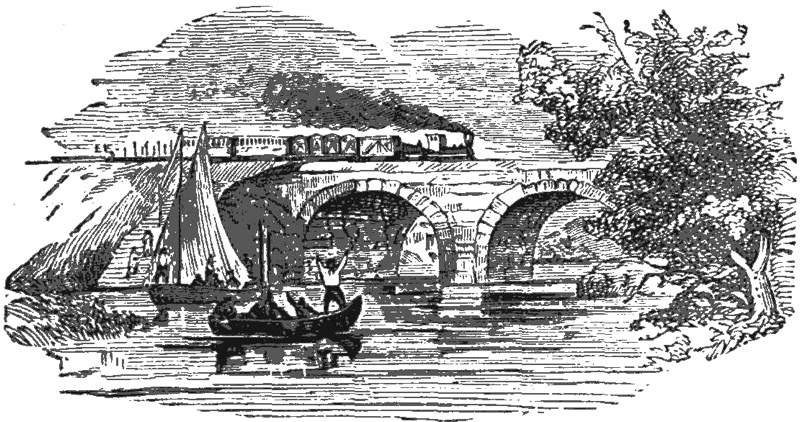
Railroad travelling, after the first hour or two,
usually becomes rather tedious, and the experience of
our young travellers was not materially different from
that of older people. Now and then, however, as they
dashed on, an incident served to enliven the way.
The attention which the train every where attracted,
although it must have been as familiar a sight as the
rising of the sun, accorded well with Clinton’s feelings;
but he was somewhat at a loss to account for the fact
itself. In the villages and at the dépôts people stared
at the engine and cars as intently as if they had
never before seen such a sight. In passing over a
river they were greeted with cheers, the swinging
177of hats, and the elevating of oars, by a party of boys
in a small boat. At one station a little black dog
had the presumption to run a race with the train as it
started up, but he soon gave up the contest. A horse
in a pasture kicked defiance at his iron namesake, with
heels high in the air, and galloped to the remotest
bounds of his enclosure. A flock of sheep in a field
huddled tremblingly together, and then broke the solid
phalanx, and hastily fled, as the train went thundering
by. A brood of chickens snuggled under their mother’s
ample wings; and even that most grave and unimpassioned
of domestic animals, the cow, many of which
they passed, almost invariably looked up with a wondering
178expression of countenance, and seemed more
than half inclined to ask what the fuss was all about.
Such is the homage which man and beast ever pay to
the railroad train, the novelty and wonder of which
are scarcely diminished by our familiarity with it.
It was late in the evening when our young travellers
reached their journey’s end. Ella’s brother,
Ralph, was waiting their arrival at the dépôt, and his
fair young face lit up with joy when he saw his sister
and Whistler descend from the train. As Ella was
encumbered with a trunk, he procured a place for her
and her baggage in a coach, and then walked, with the
other boys, towards the quarter of the city in which
both families resided.
CHAPTER XI. THE CITY HOME.
179
WHEN Clinton awoke the next morning, and looked
around upon the large, high chamber, and the
strange furniture, and caught a glimpse through the
windows of a long row of brick buildings, he could, at
first, hardly tell where he was. Consciousness quickly
returned, however, as he called to mind the long
journey of the day before, and the warm greetings
which he and Whistler received at the end of it. His
cousin, whose bed he shared, was still soundly sleeping,
although the sun’s bright rays had found their
way into the room. People are apt to be more wasteful
of their morning hours in the city than in the
country. Clinton’s curiosity to see how the neighborhood
looked by daylight would not allow him to remain
long in bed. He got up quickly, dressed himself,
180and was peering inquisitively from the windows, when
a loud scratching at the door led him to open it, and
in sprang Bouncer, Whistler’s handsome and intelligent
dog. With one leap he was on the bed, and
in a moment the sleeper was awakened, and engaged
in a lively frolic with his four-footed friend.
“O, you black rogue!” said Whistler, seizing him
by the fore paws; “you’re glad I’ve got home, are
you? Then kiss me, that’s a good fellow. There!
that will do! Yes, he’s glad his master’s got home, so
he is; and he almost flew off the handle last night,
didn’t he? and he couldn’t wait for him to get up this
morning, could he? Well, his master’s glad to see
him, too, so he is. There, sir, you’ve kissed me
enough; now jump down, and let me get up. Go and
kiss him,” pointing to Clinton. “That’s cousin Clinton.
Don’t you know him?”
“You ought to know me, Bouncer, for you sent me
a wag of your tail in a letter last spring,” said Clinton,
alluding to a rough pen and ink sketch of Bouncer’s
tail which Whistler’s father had enclosed in a letter to
Clinton, among sundry little love messages from the
family.
181“O, yes, I remember that!” said Whistler, with a
laugh, as he jumped out of bed. “What did you think
when you saw it? Didn’t you laugh?”
“I rather think we all laughed a little over it,”
replied Clinton. “I had some idea of sending you
back one of our cat’s purs in my letter, but I didn’t
know exactly how to do it.”
“But what did you get up for, and leave me here
asleep? Is that the way to serve a fellow?” inquired
Whistler.
“O, I thought I wouldn’t disturb you,” replied
Clinton. “I wanted to see that splendid view you
told me of when we were on Bald Peak. Do you
remember?”
“Yes; ninety-five millions of miles. But, you see,
it’s all sky-scape; there isn’t much landscape to boast
of,” said Whistler.
“No, I see there isn’t,” replied Clinton, as he
glanced at the interminable brick block, with its row
of low wooden sheds in the rear, all of uniform size
and pattern, and its little bits of open spaces between
the sheds, which served as back yards.
The row of houses, the backs of which bounded the
182prospect from Whistler’s window, was situated on a
street parallel with that on which Mr. Preston lived.
Dwellings and stores are usually built in blocks, or
joined together, in cities and towns, because the land
is too valuable to admit of an open space around each
separate building. Mr. Davenport’s house was a fair
specimen of this style of building. It was not far
from the centre of a block of about twenty houses,
which were very nearly uniform in their external
appearance. It was of brick, and three stories high,
besides the basement and attic. There were two
entrances to each house,—the front door, reached by
four stone steps, and a door opening into a narrow
archway, which led to the back yard. An iron balustrade
extended the entire length of the block, in front
of the second story. Add to this a brick sidewalk,
with a line of young trees near the edge, and a
clean and well-paved street, and you have a tolerably
distinct picture of the outside of Whistler’s home.
Whistler’s chamber was in the third story, on the
side of the house farthest from the street. It was
quite neatly furnished. The floor was carpeted, and
the windows curtained. It contained a bureau, with a
183mirror attached to it, a small dressing-table, and several
chairs, all of which, together with the bedstead,
were painted a light chocolate color, ornamented with
dark stripes. In one corner was a marble wash-basin,
supplied with Cochituate water by means of a pipe,
and furnished with an outlet at the bottom, connecting
with another pipe, to let off the dirty water. There
was a grate in the room, and a marble mantel-piece,
over which hung a large engraved likeness of Washington,
in a rosewood frame. On the side of the
room opposite the bed there was a small book-rack,
which was filled with volumes and pamphlets, many
of which belonged to Whistler. There was a closet
in the room, in which he kept his clothing, and many
of his playthings. The general appearance of the
chamber bore witness to the neat and orderly habits
of its occupant.
The boys had now dressed and washed themselves,
and brushed their hair, and went down stairs, followed
by Bouncer. In the sitting-room they found Mr.
Davenport, in his dressing-gown, so absorbed in his
morning paper that he apparently did not notice their
entrance. Not wishing to disturb him, they soon left
184the room, but had not gone far when he called to
them in a loud and rather authoritative tone:
“Boys! boys! come back!”
They returned, wondering what the matter was,
and Clinton, at least, feeling a little alarmed at such a
stern call. They stood, just inside the door, about a
minute, before Mr. Davenport spoke; and then, lifting
his eyes from the paper, in a very sedate manner, he
said:
“Good morning, boys.”
“Good morning, sir,” replied the boys, in a somewhat
reserved and confused manner.
Another awkward pause followed, during which
Mr. Davenport was engrossed with his paper. Whistler
at length inquired:
“Is that all, father?”
“That is all,—what more would you have?”
replied his father, a twinkle of fun now appearing in
his eyes, and about the corners of his mouth.
They left him to the quiet enjoyment of his joke
and his paper, and went into the dining-room, as the
apartment was called where the meals of the family
were spread. There they found Mrs. Davenport,
185assisting in putting the breakfast upon the table, while
Ettie, Whistler’s little sister, was arranging the chairs.
These, with Margaret, the domestic, constituted the
whole of Mr. Davenport’s family at this time.
The breakfast-bell was rung, and the family gathered
around the table, and soon commenced a lively
conversation, much of which was addressed to Clinton.
“I believe this is your first appearance in Boston,
Clinton,” observed Mr. Davenport.
“Yes, sir, it is,” replied Clinton.
“Well, you will see a great many strange sights, as
you go about the city,” continued his uncle. “Boston
isn’t a London, nor a New York; but it beats Brookdale,
by considerable, in business, wealth and population.
When I first visited Boston, thirty years ago, I
thought it was about the biggest city in the world, and
I can assure you it has grown a trifle since then.
But I’ve got a word of advice to give you, and that
reminds me of it. You don’t want to appear green,
verdant, raw, countryfied, as we city folks say?”
“No, sir,” replied Clinton, in some trepidation at
this startling array of epithets.
“Well, then,” continued his uncle, “you must follow
186these three rules. First, don’t stare at anything;
that means, don’t look at anything as though it were
new or strange. The second rule is, don’t be astonished
at anything. And the third is like unto it,—don’t
admire anything.”
Clinton looked perplexed. Sight-seeing was one of
the principal objects of his visit to the city; and a
pretty kind of sight-seeing that would be, he thought,
if he could not look at anything, nor evince any
surprise or pleasure, for fear of violating the cold proprieties
of city manners. Whistler also shared in his
perplexity; but, believing there was a “catch” somewhere
in his father’s advice, he said:
“Father isn’t in earnest; he doesn’t mean what he
says, I know.”
“Yes, I am in earnest,” replied his father.
“But, how can he see the city, if he mustn’t look at
anything?” inquired Whistler.
“That’s another affair, altogether,” said Mr. Davenport.
“I was telling him how to avoid appearing
green, not how to see the sights. When I first came
to the city myself, I suppose I was grass-green,—fast
color, warranted to wash,—although I didn’t know it
187then. I used to go staring about at every thing and
every body, looking into all the shop windows, reading
all the signs, and seeing more wonders than there
were chimneys in town. This used to provoke my
brother, who had lived in the city a whole year, and
had grown wonderfully genteel in his notions. He
carried himself as stiff as a poker, and every time I
turned my head he would say, ‘Don’t stare about so!
you act like a regular greenhorn!’ At last I got quite
angry with him, and I told him, right up and down,
that I didn’t care if I was green,—it was my favorite
color; I liked it; I gloried in it; I should be just as
green as I pleased, and he needn’t throw it in my face
any more. Now, if you want to see the sights, Clinton,
I don’t know as you can do any better than I did;
but, if you do not want people to suppose that you are
not accustomed to the city, then you can follow the
rules I have given.”
“I want to see things; I don’t care whether people
think I’m from the country, or not,” replied Clinton.
“Very sensibly said, and I am happy to see that
you take after your uncle,” said Mr. Davenport.
“But we city folks are queer people. We get up all
188manner of wonderful clap-traps and contrivances, to
astonish our country cousins, and then, if they look at
them, we laugh, and tell them they’re green. But all
the greenies don’t come from the country, by a good
deal. I’ll warrant you see a specimen from the city,
now and then, down in Brookdale. How was it?—did
the cows chase you, Whistler, or didn’t they appreciate
your verdancy?”
“No, sir, they didn’t chase me; but I suppose it was
because feed was uncommonly good,” replied Whistler.
“Pretty fair,” said his father, who always relished a
joke.
“Do cows ever eat boys, father?” inquired Ettie,
who had soberly listened to the conversation, but
apparently without fully comprehending the drift
of it.
This question, asked with all gravity, and affording
such a fine specimen of the very thing they were talking
about,—city verdancy,—was received with a general
laugh, which sent the tears brimming to Ettie’s
eyes, when her father kindly replied:
“No, darling, the cows don’t eat boys; but they
189sometimes chase them, and toss them in the air with
their horns, when they feel cross.”
“When we went to ride, the other day,” continued
Ettie, “we saw a cow shaking her head at a dog, and
running at him; and the dog kept jumping before her,
and barking right in her face. She wanted to hook
him, didn’t she?”
“Yes,” said her father; “and if the dog hadn’t
been a little too spry for her, she would have sent him
spinning into the air, just as you would toss up your
doll.”
The conversation now changed to other topics,
which we need not follow. It was not without an object
that Mr. Davenport introduced the subject that has just
been alluded to. This object was twofold. First, he
wished to put Whistler on his guard against manifesting
any impatience or unkindness if his cousin, in their
walks about town, should happen to look at things
pretty hard. And then, again, he thought it would be
well enough to hint to Clinton, in a delicate way, that
prolonged and excessive staring at novelties in the
public streets, is regarded as a mark of rusticity by
well-bred people. He knew that Clinton would not
190attempt to follow the rules he gave; neither did he
suppose he would imitate his own example—somewhat
exaggerated, no doubt—and make himself “as
green as he pleased.” Curiosity would forbid the first,
and that regard for the opinions of others which we all
feel, deny it though we may, would prevent the other.
He left it for his nephew’s good sense to find “the
golden mean” between these two extremes.
CHAPTER XII. ROMANCE AND REALITY.
191
CLINTON’S first day in the city was diligently
devoted to sight-seeing, under the direction of
Whistler. As it was Saturday, and the last day of
Whistler’s vacation, they were both naturally anxious
to make the best use of the time. It would be no easy
matter to track them through the crowded and intricate
streets, and mark the weary miles of brick sidewalk
they travelled over, now pausing to look into a gay
shop window, or to gaze at an imposing building; now
sauntering along the water’s edge, amid a forest of
shipping and long ranges of granite warehouses; now
making a pleasant detour to the Common, and resting
themselves under the shadow of its lofty trees; and
now picking their way through the narrow streets of
the poor, with their tipsy rows of weak-jointed buildings,
their plenitude of foreign faces and strange
192brogues, and their astonishing overflow of infantile
humanity, scattered all along the sidewalks, in undress,
half-dress, and almost no dress at all. Nor were these
the only novelties that attracted the notice of Clinton.
The constant succession of strange faces of every conceivable
type, the curious variety in dress and manners,
the novel vehicles and equipages in the streets,—these
and many other things arrested his attention
at every step, and often suggested remarks that seemed
very droll to Whistler.
At length, however, the boys were both forced to
confess that they were very tired; and towards the
middle of the afternoon Clinton concluded that he had
seen enough for one day, and proposed to Whistler to
return home. His feet, unused to the brick and stone
pavement, were now so sore that he walked with difficulty;
and he declared that he felt more fatigued than
he should if he had hoed corn all day. They accordingly
took the shortest route home. Just before they
reached the house, the bell in a church steeple which
they were passing began to toll.
“What is that for—a funeral?” inquired Clinton.
193“No, it’s for a fire, I suppose; they don’t toll the
bells for funerals in Boston,” replied Whistler.
“Is it a fire?—let’s go to it!” exclaimed Clinton,
forgetting, in his excitement, his weary limbs and
tender feet.
“No, I wouldn’t; we’re too tired to run to a fire
now,” said Whistler. “Besides, it’s a great way off;
I believe it’s over to South Boston. Let me count
again.”
The tolling, which had ceased for a minute, was
now resumed, and six loud strokes were given, followed
by another pause.
“Yes, the fire’s in District No. 6; that’s South
Boston,” continued Whistler.
“How far is it from here?” inquired Clinton, who
still felt inclined to go to the fire.
“It can’t be less than a mile, and it may be two, if
it’s in the further end of South Boston,” replied
Whistler.
“Nobody seems to be going to it. Why, I should
think every body would run when the bells ring for
fire,” said Clinton, who was surprised to see how little
notice was taken of the alarm.
194“The firemen run, but other people don’t mind the
alarm, unless they see the light or the smoke,” replied
Whistler.
An engine now came along, making a great noise
as it rattled over the pavements, although there were
no bells upon it, and but little shouting among the
men who had charge of it. It was very gayly painted,
and decorated with highly-polished brass mountings.
There were only about a dozen men at the rope when
the engine first came in sight; but their ranks soon
filled up by the arrival of other members of the company,
and the engine went spinning through the street
at a rapid rate, followed by a swarm of ragged boys.
Clinton was more than half disposed to fall in with
the crowd of urchins; but, perceiving that Willie had
no idea of joining in the race, he prudently concluded
to forego the pleasure.
The boys had now reached the house, and, on
throwing themselves into comfortable seats, began to
realize how tired they were. They found Ettie at
full length upon the floor, engaged in putting together
the dissected map which the boys had made for her.
195Her knowledge of geography was so slight, that the
puzzle was anything but a simple one to her.
“What’s the matter, Sissy?—can’t you put it together
right?” inquired Clinton.
“Yes, I can, almost,” replied Ettie; “but two or
three of these pieces are real ugly,—they won’t go in
any where.”
“Let me see if I can’t help you,” added Clinton,
getting down upon the floor with his little cousin.
“I’d rather find it out myself,” replied Ettie, timidly.
“O, well, then, I won’t meddle with it,” said Clinton.
“You’re just like me; I don’t like to have
folks show me how to do things, when I can find out
myself.”
Clinton could not repress a quiet smile as he
glanced at the map, and witnessed the strange positions
which some of the states had assumed. Illinois
and Mississippi had exchanged places, both apparently
quite unconscious that they had “got into the wrong
pew.” Tennessee had turned half a somerset, and
was standing upon her head. Maine was vainly trying
to fill the space that rightfully belonged to New
196York, while for the last-named state no place had yet
been found.
“What a curious thing that fire-alarm is! Do
you understand how it works, Willie?” inquired
Clinton.
“Yes, I’ve heard it all explained,” replied Whistler.
“In the first place, the city is divided into
seven fire districts. In each of these districts there
are a number of little cast-iron boxes, fastened to the
sides of buildings, such as I showed you on Faneuil
Hall. These are the signal stations. When a fire
breaks out near one of these stations, the watchman,
or the man who keeps the key, goes to the box and
turns the crank in it slowly six times. That sends
the alarm along the wires to the central office, in
Court Square, and the man there knows just where it
came from, and he strikes the number of the district
upon the bells. There are about forty of those signal
boxes, and each has its wire running to the central
office. Then there is another set of wires that lead
from the office to the bells.”
“All the bells in the city strike at the same time,
don’t they?” inquired Clinton.
197“No, there is no need of ringing all the bells,”
replied Whistler. “There are only seventeen bells, I
believe, connected with the alarm, and these all strike
together. The ringing is done by machinery, something
like the striking part of a town clock. It has a
weight, and an electro-magnet; and the power that
sets it in motion comes from the great battery in the
central office. If the fire is put out before all the
engines get there, an engineer goes to the nearest
signal box and telegraphs ‘all out,’ and the man in
the central office gives the signal on the bells, and
then the firemen go home.”
“It’s a complete arrangement, isn’t it? I should
think the firemen would like it. It must save them a
good many steps,” said Clinton.
“It does,” added Whistler. “Before we had this
telegraph there used to be a great many more false
alarms of fire than there are now. Besides, when
there is a fire, it saves them a good many steps in
finding it.”
Mr. Davenport now came in, and, after a few words
with Ettie, who had not yet mastered the secret of the
dissected map, he added, turning to the boys:
198“Well, young gentlemen, have you seen all the
sights, and got home at this time of day?”
“No, sir, we haven’t seen half of them; but we got
pretty tired, and thought we’d been about enough for
one day,” replied Clinton.
“And you looked at everything just as hard as you
pleased, did you?” continued his uncle.
“Yes, sir,” replied Clinton.
“But he didn’t act green at all, father,” added
Whistler.
“My feet got real sore, though,” said Clinton, whose
modesty led him to turn the subject. “I told Willie
I’d rather hoe corn all day than walk about the roads
here,—I mean the streets.”
“Well, I’m about used up, too,” said his uncle.
“I’ve been cudgelling my brains all day over a very
intricate insurance case, and I believe I don’t understand
it now quite so well as I did when I began.
Why, Clinton, hoeing corn is real fun compared with
much of the work that we city folks have to do. If
you were to live here, and earn your living, you would
have to put up with worse things than sore feet.
Many country people seem to think that we have
199nothing to do but to sit in our armchairs, and read the
papers, and discuss the news, and take money; but if
they could exchange work with us a little while, they
would be more contented with their lot forever after.
They work hard and get tired, I know; but we not
only get tired, but sick, too, and worry and fret ourselves
into our graves, while they are in the prime of
life. They work out in the pure air, while we are
stived up in little hot rooms, breathing everything but
the odors of heaven. After all, the country’s the
place to enjoy life. Don’t you think so, Whistler?”
“Yes, sir, the country’s the place for me,” replied
Whistler. “When I’m a man I mean to have a
great farm, and have it stocked with the best horses,
and cows, and sheep, and pigs, and poultry. And
you’ll come and live with me, too; won’t you,
father?”
“Yes, I think I will, if you lump me in with the
pigs, and poultry, and other live stock,” said his father,
with an assumed air of offended dignity.
“No, father, I didn’t lump you with the stock; I
put a period after them, and began a new sentence
with you,” replied Whistler.
200“I think it must have been a very brief period;
however, I’ll take your word for it,” added his father.
“But, speaking of the country, I suspect you will find
playing and working on a farm two very different
things. At any rate, I shall advise you not to invest
your funds very deeply in agricultural improvements,
until you have worked on a farm a year or two as a
hand.”
“But I thought you just said farming was the best
employment for a man,” observed Whistler, in some
perplexity.
“I did say what was equivalent to that,” resumed
his father; “but all men are not fit for farmers. Some
are too lazy; some are too genteel; some don’t know
enough; some know too much, in their own estimation,
and so get their living by their wits; some are too
uneasy to stay long enough in one spot to raise a crop
of six-weeks beans; some haven’t the bodily strength
to work on a farm; and some are too tricky to follow
any honest calling. Then there are others who were
born to be sailors, or mechanics, or students, or political
leaders, or merchants, or doctors, or clergymen, or
lawyers. They have special talents for these or other
201professions, and, of course, they can’t be farmers.
You might as well try to drown a man who was born
to be hung, as try to make a farmer of a man that was
born to ‘plough the sea.’ But the great body of men
do not have these particular talents. They are about
as well fitted for one common employment as for another,
and so they decide on the one that they consider
the most easy, profitable, and genteel; and it is just
here that they oftentimes make their great mistake.
Are you going to sleep over my lecture, Clinton?”
he abruptly added, on observing that his nephew had
partially closed his eyes.
“No, sir, I understood every word,” quickly replied
Clinton, slightly blushing.
“Because, if you were, I thought I should like to
keep you company,” continued Mr. Davenport. “It’s
a rather dry subject, I know; but it will soon be one
of practical importance to you, and Whistler, too.
Have you made up your mind what profession you
should like to follow, Clinton?”
“No, sir,—not exactly,” replied Clinton. “I like
farming very well, but I’ve thought I should rather
be a merchant than anything else.”
202“Why do you think you should like to be a merchant?”
inquired his uncle.
Clinton was somewhat at a loss for an answer; but
at length he replied, with some misgivings:
“Why, it must be fine to own ships and warehouses,
and do a great business, and make lots of money, and
have everything you want, and be looked up to by
every body. Besides, the merchant can have his farm,
too, if he likes.”
“But you have tried farming, and you say you like
that pretty well?” inquired his uncle.
“Yes, sir,” replied Clinton.
“Well,” resumed Mr. Davenport, “let me tell you
one thing. With you, mercantile life is all romance,
just as farming is to your cousin. On the other hand,
farming is real to you, while Whistler has had a
chance to observe something of the dark side of mercantile
and professional life. When you think of
being a merchant, you think only of fine ships, and
great warehouses, and sumptuous dwellings, and the
portly and dignified men who rule on ’change. You
don’t think of the early years of drudgery and poverty
most of these men went through, or of the temptations
203they were exposed to, which, perhaps, overcame a
score of their companions for every one that escaped;
you don’t think how they have risked health, and perhaps
lost it; you don’t think what fierce struggles
they have encountered, what crushing losses they have
met, and what a weight of care rests upon them night
and day; you don’t think it is possible that they will
yet meet with overwhelming reverses, and die in
poverty; and, more than all, you don’t think that
these successful merchants are themselves exceptions
to the great mass of the profession, who were only
moderately successful, if they did not wholly fail. Is
it not so?”
“Yes, sir, I never thought much of the dark side,”
replied Clinton.
“I do not say this to discourage you from being a
merchant,” resumed his uncle. “I would discourage
no boy from entering any honest calling, if he chooses
it, and appears to be fitted to it. I don’t know but that
you have special qualifications for the mercantile profession.
If you have, I would advise you to make
that your business. Otherwise, you had better remain
where you are. At all events, you ought to look at
204your favorite profession on all sides, dark as well as
bright, before you tie yourself down in it for life. To
sum up, as we legal gentlemen say—but we ought
to have the decision reported; have you got a scrap
of paper, Willie?”
“Yes, sir,—here’s a piece.”
“Well, you shall be clerk of the court, and write
down the decision. Take your pencil, and write as I
dictate, commencing each sentence upon a new line.”
Whistler followed his father’s directions, and the
result was the following memoranda:
“All men ought to follow some useful employment.
“Every man ought to choose that employment in
which he can be most useful and successful.
“Agriculture is the primitive and natural employment
of man.
“It is an employment which combines the greatest
number of advantages with the fewest evils and temptations,
and is therefore best fitted to secure the happiness
and good of mankind.
“It is an employment which must ever demand the
hands of the great bulk of the race.
“But the state of human society, and the interests
of the race, render many other professions necessary.
“God gives certain persons special talents for these
205special callings, so that they enter them as if by
instinct.
“Many others are providentially thrown into them,
having no particular choice or inclination in the
matter.
“Others still enter them from choice.
“Those who enter any profession from choice, should
do so deliberately and understandingly, and not suffer
themselves to be misled by a thin veil of romance.
“All employments are honorable, so far as they are
useful in themselves, and are pursued in an honorable
manner.”
Mr. Davenport read the above after Whistler had
taken it down, and then handed it back to him, saying:
“There, Willie, you have a legal opinion, without
fee. You may keep it among your valuables, and
give Clinton a copy, too, if he wants one. You may
not fully understand these principles now, but you will
by-and-by, and they will be of great value to you, if
you follow them.”
CHAPTER XIII. SIGHT-SEEING.
206
“NOW for school, once more!” exclaimed Whistler,
as he threw his well-filled satchel over his back,
fifteen minutes before eight o’clock Monday morning.
“Don’t you feel queerly at the beginning of a term? I
do. I’m glad to go to school again, and yet I feel sort
of bad, too, because the vacation is over. I feel worse
than usual now, because I can’t go round with you.”
“You needn’t think of that; I can find my way
about town alone,” said Clinton.
“You can tell about that better to-night,” replied
Whistler.
“Well, I won’t crow till I get out of the woods, at
any rate,” said Clinton. “But I’m going with you as
far as your schoolhouse,—are you ready?”
“Yes,—come,” replied Whistler.
207
They walked to the schoolhouse, accompanied by
Bouncer, and remained together till the bell summoned
Whistler to his seat, and then Clinton started upon his
first exploration, alone. Turning his face towards the
business section of the city, which was in a northerly
direction from his uncle’s house, and occasionally whistling
to Bouncer, who was still looking wistfully
towards the schoolhouse, he walked leisurely along,
with the air of one who is determined to see everything
that is worth seeing. Bouncer did not think it
worth while to favor him with his company; but Clinton
found plenty of other dogs in his wanderings, of all
sorts and sizes,—quite as many, in fact, as he wished
to see. One of these dogs, which he encountered in a
narrow alley, amused him very much. He was harnessed
into a little cart,
and trotted along quite
briskly with his load.
Two boys accompanied
him, who appeared to
be Irish. One of them
was quite large, and
wore a coat which seemed intended for his father.
208He had a little whip, with which he enforced the
orders he was constantly shouting to the dog. The
other boy was much smaller, and ran behind, pushing
the cart. The load consisted of several bundles, tied
up in handkerchiefs. They contained dirty clothes,
which the boys were collecting for their mother, who
was a washerwoman.
The next object that attracted Clinton’s notice was a
group of busts and images, arranged upon a board,
which a young man carried
upon the top of his head. Clinton
thought it rather strange
that he should carry so heavy
a burden in such a way; but
the images were of plaster, and
hollow, and were much lighter
than they appeared. The man
was an Italian; and whenever
he met a gentleman, or saw a lady at a window, he
would call out, “E-me-ges!—buy any e-me-ges?” in
his most persuasive tone. He was a mild-eyed, dark-complexioned
man, not very neat in his personal
209appearance, and his clothing was a good deal be-patched,
as you will see by the engraving.
In the course of the morning an incident happened
to Clinton which made him smile many a time during
the day, as it came to mind. In passing a shop, in
front of which several birds were hung out in cages,
he noticed that the door of one cage was open, and
that its tenant was on the outside, apparently meditating
a flight. The bird was nearly the size of a
pigeon, but he did not know what it was. Stepping
into the shop, he said:
“One of your birds has got his cage door open, sir,
and is hopping all around outside.”
“I know it,—but he won’t go off,” replied the
man. “We leave the door open purposely, and let
him have the run; he never leaves the premises.”
“O, I didn’t think of that,” stammered Clinton, a
slight blush mantling his cheeks.
“Never mind; I’m just as much obliged to you as
though he had broken out,” added the man. “You
intended to do an act of kindness, and you ought to
have the credit of it. Won’t you walk in and look at
the birds? We’ve got a pretty large collection.”
210Clinton thankfully accepted the invitation, and found
a large room entirely filled with birds, this being the
sole article in which the man dealt. The collection
embraced birds of almost every description, from an
eagle to a Java sparrow. Many of them were very
rare and beautiful. The singing birds seemed to vie
with one another, to see which should make the
loudest noise; and the deafening clatter was by no
means improved by the occasional rough and discordant
note of some unmusical member of the family.
In addition to the living birds, there were also many
stuffed ones, for the owner of the collection was a
taxidermist. A taxidermist is one who is skilled
in preparing and preserving the skins of birds, or
other animals, so as to represent their natural appearance.
After walking an hour or more about the business
portion of the city, examining the sights in a leisurely
way, Clinton suddenly found himself approaching the
beautiful Common, of which Boston is justly proud.
It took him some time to reconcile his mind to its
unexpected location, for it seemed to him that he
ought to be going from it instead of towards it. However,
211there it was, and there was no disputing that.
And he was not very sorry, either, for he began to feel
tired, and there are plenty of seats and acres of soft
grass on the Common. Entering the grounds at the
gate opposite Park-street Church, he threw himself
upon the grass, in the shade of a large tree, on a spot
which commanded a view of the greater part of the
enclosure.
The Common contains forty-eight acres, the surface of
which is agreeably diversified, much of it being broken
into gentle swells. A vast amount of money has been
expended in beautifying it. A tall and handsome iron
fence surrounds it, which is nearly six thousand feet
long, and cost upwards of a hundred thousand dollars.
Nicely gravelled walks, shaded by trees, run around
the enclosure, and cross it in various directions.
These walks are lit by gas, at night. The trees number
nearly two thousand, and comprise eighteen or
twenty varieties, but about half of them are elms.
Scattered over the Common are several cast-iron
hydrants, from which streams of Cochituate water are
always flowing, for the refreshment of the thirsty.
There is also a beautiful pond,—the “Frog Pond” of
212olden times,—which is supplied with one of the finest
fountains on the continent.
Such was the scene spread out before Clinton, as he
sat upon the grass. Add to the picture the scattered
groups of well-dressed people who were threading the
walks or lounging on the seats, the merry children
gambolling upon the grass, and the birds flitting among
the trees, and you have made up a sight well worth
seeing.
As Clinton sat enjoying the scene, a huge column
of water suddenly burst forth from the pond, with a
noise plainly perceptible, even at his distance from it.
It was the fountain. Forgetting everything else, he
ran with all speed towards it, for he had never seen
it; and, as it was allowed to play but seldom, owing to
a scarcity of water at that time, he had hardly dared
to hope that his curiosity would be gratified. His
haste was needless, however, for it kept on playing,
and he had ample leisure to examine and enjoy it. It
sent up a tall jet, which tapered almost to a point,
while a cloud of spray and vapor rose from the base.
The water sparkled gloriously in the sunlight, and the
hues of the rainbow danced among the mists. Clinton
215sat down under a tree, and drank to his fill of the
beautiful scene.
This fountain has a dozen or more different jets.
The highest one rises to the height of ninety-eight
feet, under favorable circumstances, and is fed through
an open pipe three inches in diameter. A pipe six
inches in diameter throws the water about eighty feet
high. Another, with the whole breadth of twelve
inches, reaches but about forty feet. There is a jet
which is set at an angle, designed to play against the
wind. There are also jets which represent a variety
of figures. One is called the “willow,” from its
resemblance to that tree. Another is the “lily,” which
sends out three side jets, representing the petals, and
an upright one in the centre, forming the pointal of the
flower. Another is the “vase,” and very graceful and
picturesque it is. The amount of water consumed by
the fountain when it is in play is almost incredible.
The water rushes out with immense force; and some
of the larger jets, if kept in operation perpetually,
would nearly or quite exhaust the regular daily supply
from Lake Cochituate. Of course the luxury can
216be indulged in only occasionally, and for a few hours
at a time.
As Clinton sat gazing at the fountain, the majestic
column of water began to falter, and almost instantly
lowered its proud crest and disappeared, leaving no
trace of the fountain but the iron pipe through which
it gushed forth. The man who had charge of it had
shut off the water, which is done by means of a stop-cock
near the pond. He soon after appeared, walking
through the pond, towards the fountain. He wore a
pair of high, water-proof boots; and, as there was a
series of stone blocks from the border of the pond to
the fountain, sunk but a few inches under water, for
him to walk upon, he got along very comfortably.
Having removed the mouth-piece of the fountain, he
screwed on another one, and returned. In a few
moments the water burst forth in a new shape. There
were a number of small jets arranged in a circle, each
jet taking an outward direction. The water formed a
graceful curve, as it rounded over towards the lake;
and though it was not so lofty and imposing as the
other jet, it was in some respects more beautiful.
The fountain at length stopped playing, and Clinton,
217after watching a while some boats which boys were
sailing on the pond, started off in quest of new sights.
He first paid a visit to the great elm tree, near the
pond, admired its magnificent proportions, read its
brief and imperfect history, as inscribed on a tablet
inserted in the iron fence which surrounds it, and
mused on the stirring scenes it had looked down upon
during the lapse of two hundred years. While thus
engaged, he came in contact with a quiet, modest-looking
lad, of about his own age, who seemed to be
engaged in the same pursuit as himself—sight-seeing.
A mutual feeling of lonesomeness, or an intuitive perception
of sympathy and congeniality of character, or
some other attractive principle, seemed to draw them
together, at first sight, and they were soon engaged in
conversation. In a short time Clinton had learned
from his new acquaintance that his name was Henry;
that he came from the country, to get a situation as
apprentice, or clerk, but had not yet succeeded; and
that he had two older brothers in Boston, with whom
he was staying.
“Have you been up to the top of the State House?”
218inquired Henry, as Clinton began to look about for
some new object of interest.
“No,” replied Clinton; “have you?”
“Yes, I went up last week with my brother,” said
Henry. “Come, let’s go up now,—I should like to
go again, and I can promise you it’s a splendid
sight.”
“Come on, then,—it’s just where I want to go,”
said Clinton, much pleased that he was to have a companion
in making the toilsome ascent.
So they passed on, through the spacious front yard,
with its many flights of stone steps; paused a moment
to look at the fountains in front of the capitol; paid a
visit to the marble statue of Washington, in the alcove
opening from Doric Hall; inspected such portions of
the building as were open to the public; and then
began their long journey to the lantern which surmounts
the dome. Up, up, up they went, through the
state’s great garret, with its interminable stairs, its
dreary passages, its venerable dust and cobwebs, and
its hot and stifling atmosphere. Now they are in the
great dome, whose huge frame-work encompasses
them on every side, and fills the mind with something
219like awe. And now the light increases—they breathe
easier. They have ascended the last of the one hundred
and seventy steps; they are two hundred and
thirty feet above the level of the sea.
Clinton found that the lantern of the dome, which
looked so small from the street, was in reality a room
of pretty good size. It was a museum of autographs,—every
place where it was possible to write, scratch or
cut a name, having been improved by the hundreds of
thousands who have visited this favorite resort of
strangers. But the inside attractions did not long
detain the boys from the magnificent scene without.
Clinton’s exclamations, as his young companion hurried
him from one window to another, were few and
brief, but by no means tame or inexpressive. There
lay the Common at his feet, looking like a garden-patch
of moderate size. The horses and carriages in
the streets seemed to be but baby toys, and the people
were like ants creeping over the ground. The city
spread itself out on every side, with its long lines of
brick walls and slated roofs, and its innumerable
steeples, towers and cupolas, all compactly wedged
together. Outside of this shapeless mass of brick and
220stone was a line of water, which nearly surrounded the
city. A part of the way it was a narrow ribbon,
crossed by numerous bridges, over some of which railway
trains were slowly crawling, like caterpillars.
Towards the east, however, the shore was fringed with
a forest of masts, and the waters stretched outward
into the great ocean, and the gleaming of white canvas
could be seen, far beyond the green islands that guard
the entrance of the harbor. To the landward were to
be seen cities and villages, hills, fields and forests,
extending for many miles. The boys felt that but two
things were wanting, and these were, a good spy-glass,
and some one, familiar with the ground, to point out
and name the various objects of interest that were
spread before them.
After stopping more than half an hour in the lantern,
Clinton and Henry commenced the descent. It
was nearly noon when they reached the street; and, as
Clinton had a long distance to go, and was not familiar
with the way, he soon parted with his companion,
whose stopping-place lay in another direction, and set
his face towards the South End. He trudged along
carelessly, until he thought he must be in the neighborhood
221of the street where his uncle lived. And now he
tried to find his bearings, but without success. Nothing
looked familiar. He was in a maze. But, as he
always preferred to solve his own difficulties, rather
than have others help him out of them, he determined
that he would make no inquiries so long as there was
a chance of finding his way out. Pretty soon he came
out on an avenue, which he knew must be Washington
Street, from its appearance. Now he felt that he had
got a clew that would enable him to find his uncle’s
house. He walked along for nearly half a mile, but
could not find the street for which he was looking.
He was beginning to feel some misgivings, when he
came in sight of a steeple on which the points of the
compass were indicated, and he discovered that instead
of going south he was actually heading towards the
north. He also recognized the church as the Old
South, and he was, consequently, further from his destination
than when he left the Common. The sun
was so nearly overhead that it did not afford him
much aid in directing his course, and he had therefore
trusted to instinct, which, in the human kind, is not
always a very safe guide.
222Of course Clinton faced about and retraced his
steps. The dinner hour was at hand; and, wisely
concluding that he had experimented enough for one
day in the navigation of unknown streets, he inquired
his way, and at length reached his uncle’s, faint and
weary with his forenoon’s adventures. His account of
his walk from the State House furnished considerable
merriment to the family. Whistler declared that he
was about to go after the city crier, and tell him to cry,
“A child lost, about fourteen years old,” &c., &c.;
while Mr. Davenport, who always had a story ready,
said that Clinton was almost as bad as an old Quaker
he once knew, who used to come to Boston occasionally
with a load of chairs, and who would sometimes
get so bewildered by the hubbub and confusion of the
city, as to go up three or four flights of stairs, into the
attic, to find his way to the street! He also related
the case of a little Irish boy, who landed in Boston
from an emigrant ship, and actually became insane
from bewilderment. The little fellow, who was but
thirteen years old, had no friends here but a brother,
who came over a short time before. Confused by the
strangeness, and, to his eyes, the magnificence of the
223city, which for weeks had been the culminating point
of his anticipations, he wandered about, gazing upon
the novelties by day, and dreaming of them by night,
until he believed himself the inhabitant of a fairy-land,
and could not recognize the brother whose bed he
shared; “for,” said he, “he was dressed so nice, and we
used n’t to be so at home.” Reason soon fled, and for
weeks he by turns babbled like a child and raved like
a madman. He was taken to the lunatic hospital, and
it took several weeks to cure him.
CHAPTER XIV. SCHOOL TRIALS.
224
WHISTLER’S first day at school was not a day of
unalloyed pleasure. It was not without a severe
struggle with his feelings that he met his comrades
and teachers, and took the familiar seat he had so long
occupied. The exciting scenes of the exhibition day,
a few weeks previous, came up vividly in his mind.
The general credit with which he passed through the
examination, the applause with which his declamation
was received, and the praise bestowed upon several
drawings and maps executed by his hand, certainly
were not of themselves unpleasant recollections. But
these happy memories were all embittered by another
thought, which he could not drive from his mind. He
had left the school, at the close of the last term, expecting
to return to it no more. He had presented
himself as a candidate for admission to a school of
225higher grade, and, to his great surprise and mortification,
had been found lacking in some of the necessary
qualifications.
This was the severest blow Whistler ever received.
He went home and gave himself up to his grief. His
vacation was blasted, his visit to Brookdale was spoilt,
and, indeed, it almost seemed to him as if his prospects
for life were ruined. His mother tried to comfort
him, but without much success. When his father
came home, at night, he was informed of the result of
Whistler’s application by Mrs. Davenport. The tea-bell
rang, but Whistler did not appear. The servant
was then sent to his room to call him, and brought
back the reply that he did not want any supper.
After tea, Mr. Davenport went up to his chamber,
and found him lying upon the bed, with his face buried
in a pillow.
“Hallo! what does this mean, Whistler? What’s
the matter with you?” he inquired.
There was no reply, but a sob.
“Come, speak up!—what ails you?”
“I—couldn’t get into the—High School,” sobbed
the poor boy.
226“Couldn’t get into the High School? How happened
that? Some partiality or trickery, I suppose;
they gave you all the hard questions, and the others
the easy ones,—didn’t they?”
“No, sir,” replied Whistler, somewhat reluctantly;
“the questions were printed, and all the candidates
had to answer the whole of them in writing.”
“Ah, that’s the way they manage, is it? Not
much chance for foul play there, I should say. Then
it seems you couldn’t answer the questions.”
“No, sir,—not all of them.”
“Well, whose fault was that?”
“Mine, I suppose;” and the tears started fresh from
Whistler’s eyes.
“I don’t know about that; perhaps no one was to
blame for this failure. I have had some doubts, all
along, about your success; but I thought it best not to
trouble you with them, as I supposed you studied as
hard as you ought to. Was I right in my supposition?”
“I believe I’ve done the best I could,” replied
Whistler.
“If you can say that with a good conscience,” continued
227his father, “then I’m sure I shan’t blame you,
and you ought not to blame yourself; and I think you
can say it, for it agrees with what your teacher told
me. Come, cheer up! and don’t think any more about
it. It will all come out right, by-and-by. You’ll be
admitted next year, and you’ll be able to keep up
with your class better than though you entered now.”
These words of encouragement somewhat revived
Whistler’s feelings, and as nothing more was said in
his presence about the matter, by his parents, the tide
of disappointment and mortification soon began to subside.
His sensitive mind, however, was not wholly
relieved, and, intimate as he shortly after became with
Clinton, he could not impart to his cousin this unhappy
secret. Immediately on his return from his
vacation, in accordance with a plan he had formed, he
asked his father’s permission to enter a private school,
instead of returning to the old one; but the reasons
he gave were not deemed satisfactory, and the request
was not granted. He accordingly reëntered the public
school, and, to his great relief, none of his mates
laughed at him for coming back, or even alluded to
his unsuccessful attempt to get into more select, if not
228better company. But he was very glad when the
first day of the term was over.
Whistler was a diligent scholar; but, although by
no means a dull boy, he did not learn his lessons without
much hard labor. Some branches he acquired
more easily than others. He had a taste for drawing,
and copied maps and even pictures very neatly. He
was also a good reader, and in declamation and composition
he stood among the best in his class. But in
some other branches, particularly spelling and arithmetic,
he was rather backward. Nevertheless, he
was an industrious scholar, and made fair progress in
his studies.
But Whistler was not destined to get through the
first day of the new term without some unpleasant
experiences. It so happened that in his first recitation,
which took place in the afternoon, he “missed”
two questions that were put to him. He felt vexed
and mortified, and, at his second failure, he could not
keep the tears from coming into his eyes. The
teacher, as he recorded the demerits, noticed his
pupil’s emotion, but made no remark. He afterwards
229requested Whistler to step to his desk, when school
was dismissed.
When the school closed for the day, Whistler proceeded
to the place appointed, but not without some
unpleasant apprehensions, arising from the imperfect
lesson referred to. His fears were dispelled, however,
when the teacher, pointing him to a seat, remarked
very pleasantly:
“William, you are a pretty good draughtsman, and
I’ve been thinking that perhaps I could get you to do
a small job for me.”
“I should be happy to,” replied Whistler.
“Do you suppose,” continued the teacher, taking a
couple of pictures from his desk, “that you could
make a large copy, in outline, of each of these figures?”
Whistler looked at the engravings a moment, and
replied, with some hesitation:
“I could copy them better on the same scale they
are there.”
“I know you could,” continued the teacher; “but
that will not answer my purpose. I want them to
illustrate some remarks I wish to make to the school,
230and they must be large enough to be seen across the
school-room. I have no time, just now, to copy them
myself, and it occurred to me that perhaps you would
like to try your hand at it. You will find it somewhat
difficult, I suppose; but it will be a good exercise for
you, even if you should not succeed very well.”
Whistler readily consented to undertake the job,
and his teacher furnished him with some large sheets
of drawing paper, and gave him such directions in
regard to the work as he deemed necessary.
Whistler now hurried home, where he found Clinton,
who was so exhausted by his forenoon’s tramp
that he was glad to remain in the house the rest of the
day. With his characteristic dread of idleness, however,
he was busy at work with his pocket-knife, whittling
out a puzzle for Ettie. It was nearly completed.
It consisted of a thin piece of wood, in which three
holes were cut,—one square, one round, and one triangular.
The holes were all of the same height and
width. The puzzle consisted in shaping a piece of
wood so that it would stop up either of these holes.
To do this, he first made a square block,—a perfect
cube. This, of course, stopped up the square hole.
231He next rounded this into a cylinder, so that it just
fitted the circular hole, while by turning it the right
way, it would still answer to fill up the square one.
He now sharpened one end of this cylinder, until he had
made a perfect triangle, or wedge. This fitted snugly
into the remaining hole, while enough of the original
form of the block remained to fill the other two holes.
As soon as the puzzle was finished, Whistler went
up to his chamber, and began one of the drawings he
had engaged to make. His cousin watched his operations
with interest, but was unable to render him any
assistance. Indeed, this hardly seemed necessary, for
the swelling outline grew quite perceptibly under
Whistler’s pencil; and, although he did not get along
without a frequent recourse to the India-rubber, his
success was quite equal to his own anticipations. He
had drawn maps on both an enlarged and a reduced
scale from the original, but he had never before attempted
to do either with the human figure, which is
far more difficult. He determined to try hard for
success, however; and the somewhat doubtful manner
in which his teacher spoke of his ability to execute the
drawings, seemed rather to stimulate than discourage
232him. This was precisely what the teacher intended
to do. He knew that the task was a difficult one,
though not beyond Whistler’s ability. He knew,
moreover, that if he had told his pupil it was easy,
the latter would scarcely have believed him, and
would, perhaps, have been disheartened by the first
difficulty; whereas, by taking the other course, the
boy’s ambition and spirit were more fully aroused,
and he was prepared for a strong and patient effort.
The next morning, Clinton having expressed some
curiosity to see how a Boston school was managed, he
was invited by his cousin to accompany him as a
visitor, and he concluded to do so. Reaching the
schoolhouse a little before the hour of commencement,
they stood in the yard, watching the movements
of the merry groups around them, when a large, ill-favored
boy cried out:
“There comes that big dunce that’s down in the
fourth class! Let’s poke some fun at him, boys.
What’s his name?—does any body know? No matter,
we’ll call him Donkey,—ha! ha! Let’s give
him that for a nickname! Don’t you call him anything
else,—will you, boys?”
233“Good!—his name shall be Donkey!” said another
boy; and several others seconded the motion, while
one or two began to shout “Donkey! Hallo, Donkey!”
to the unsuspecting butt of their sport.
Whistler, perceiving how matters were tending,
now stepped forward, and said:
“Don’t you do it, boys! It’s too bad to twit a fellow
for what he can’t help. That boy has been sick
all his lifetime, and couldn’t go to school, and that’s
the reason he’s in the lowest class.”
“That’s all gammon!” retorted the boy who proposed
the nickname, and whose name was Nathan
Clapp. “Bill Davenport has a natural sympathy for
dunces,—he doesn’t want much of being one himself.
You know he tried to get into the High School,
the other day, and they wouldn’t take him, and he
had to come back here again. Let him stick up for
Donkey, if he wants to; it’s natural for him to stand
up for his own breed!”
“If I’m a dunce, I should like to know what you
are?” exclaimed Whistler, his eye flashing with anger.
“I wasn’t such a big fool as to try to get into the
High School, at any rate!” replied Nathan.
234“Don’t say anything more to him,—he isn’t worth
noticing,” whispered Clinton in the ear of his cousin;
and the latter wisely heeded the advice, and suppressed
the angry retort which was trembling upon
his lips.
“Can’t say anything more, can you? Well, I think
you had better shut up!” continued the other boy;
and then, turning to the lad in whose behalf Whistler
had interfered, and who had now entered the yard, he
continued, “Hallo, Donkey! how d’ ye do? Got your
lesson, hey? Let’s hear you say your a, b, c’s.
There, Donkey,”—snatching the book from under his
arm, and pointing to a line,—“what letter’s that?
Don’t you know, hey? Can’t you speak, you dunce?
Come, talk up like a little man! nobody will hurt you.
What’s that letter, hey?”
The boy, who was a peaceable and good-natured
fellow, was evidently annoyed by his tormentor; but
he tried to take his jeers in good part, and joined—not
very heartily, it is true—in the laugh that was
raised at his expense. Nathan continued to hector
him in this way for some minutes, when Whistler,
unable longer to repress his indignation, cried out:
235“Don’t mind what he says, David; I’ll warrant
you will rank ahead of him in less than six months.”
“You say that again, and I’ll rap you over the
head!” exclaimed Nathan, drawing himself up in a
menacing attitude before Whistler.
“There’s no need of saying it again; but I’ll stick
to it,” replied Whistler, with firmness.
“Yes, you’d better back out! I knew you daresn’t
say it again!” continued the young bully.
“If you call that a back-out, you’re welcome to all
the comfort you can get out of it,” calmly replied
Whistler.
“If you want to fight, then, come out here!” said
Nathan, doubling up his fists.
“No, I thank you,” replied Whistler; “I don’t
believe in fighting.”
A boy here whispered to Nathan that the principal
was in the schoolhouse, and might overhear him.
His voice, which had been loud and defiant, was suddenly
modulated to a very low tone, as he added:
“You’re a mean, sneaking coward! I’ll leave it to
all of the boys if you aren’t.”
This sudden transition from the loud tone of bravado
236to that of absolute cowardice, was so ludicrous,
that there was a general outburst of laughter among
the boys, in which Whistler himself heartily joined.
They began to challenge each other, in whispers, and
declared that they were not afraid of any body, in the
softest tones. Nathan quickly disappeared around the
corner of the building, but the merriment went on
until the signal was given for school to commence.
Clinton went in with his cousin, and remained
through the forenoon, an interested spectator of the
proceedings. The boys first assembled in a large hall,
where a chapter was read from the Bible, and the
Lord’s Prayer repeated by the whole school. The
several divisions then went to their own rooms, each
with its own teachers, and remained in separate session,
with the exception of the recess, until it was
nearly time for the school to be dismissed. All the
pupils were then assembled in the large hall, and, after
singing two or three verses of a hymn, the principal
observed that he wished to say a few words before
they separated. He then proceeded, somewhat in the
following strain:
“I once knew a boy who was afflicted with a very
237painful disease, almost from his infancy. For years
he was confined to his bed, and it was supposed that
he would never be able to run about like other boys.
He had no father, and his mother was poor, and unable
to provide him with many of those little comforts that
might have made his lot more tolerable. He had a
thirst for knowledge, but could not go to school, and,
indeed, he could not apply himself to books for any
length of time, his eyes were so weak. Still he managed
to learn to read, and was quite patient under his
sufferings.
“When this boy got to be twelve or thirteen years
old, his health improved so much that he was able to
walk about. The first desire he expressed was to go
to school; and as soon as he was well enough, he was
permitted to attend one of the public schools. As he
had enjoyed few opportunities of learning, the teacher
was obliged to place him in a class of smaller children
than himself; but, for all that, he was as intelligent a
boy, and as promising a scholar, as you could find in the
school, all things considered. But he had not been
in the school two days, before one of the large boys,
who was not a remarkably good scholar himself began
238to make him the butt of his ridicule, calling him a
‘dunce’ and a ‘donkey,’ and tried to set the other boys
upon him.”
At this abrupt pause, most of the scholars looked
earnestly, as if impatient for the conclusion of the
story; but a few, who recognized the characters introduced,
turned their faces towards David and Nathan.
After a moment’s delay, the teacher resumed his
narrative:
“There was another boy in that school, who, though
he did not learn his lessons so easily as some children,
was nevertheless a diligent and faithful scholar, and
behind none of his comrades in intelligence. This boy
gallantly interfered in behalf of the new pupil; whereupon
the large boy fell upon him, and began to ridicule
him because he had been an unsuccessful candidate for
another school.”
The teacher again paused, and those of the boys
who were not in the secret began to wonder at the
pointless conclusion of a story that opened so promisingly.
He soon continued:
“I’m not going to call any names,—I shan’t say, as
239David said to Nathan of old, ‘Thou art the man!’
but—”
“It was Nathan who said that to David,” interrupted
one of the older boys.
“I believe you are right,” continued the teacher,
who possibly had not blundered without a purpose;
“but, as I was saying, I shall call no names. I will
merely say that those three boys are members of this
school, and that I have related only what actually happened.
And now, I want to put two or three questions
to the school, and I wish every boy to answer yes or
no. Those of you who think it is fair and honorable
to ridicule a boy for his low standing in school, when
he has been sick all his days, and had no opportunity
to learn, will please to say ‘Aye.’”
There was no response.
“Those,” continued the teacher, “who think it is
mean and dishonorable to do so, will please to say
‘Aye.’”
There was a prompt and universal shout of “Aye!”
“Now, those who think it is fair and honorable
to ridicule a boy, who studies hard and makes good
240progress, because he happened to make a failure once
in his life, may say ‘Aye.’”
All were silent.
“Those who think it base and mean to do so, will
please to say ‘Aye.’”
Again there was a prompt and hearty “Aye!”
“Yes, I think there can be but one side to that question,”
continued the teacher. “A boy who has had no
opportunity to study, ought not to be blamed for his
ignorance; and one who studies diligently, should not
be laughed at if he does not happen to know everything.
These are not dunces. The real dunce is the
scholar who has the ability and the opportunity to
learn, but who will not exercise the one or improve
the other, and so remains ignorant. I can’t blame you
much for laughing at such a boy. He deserves it.
“On the other hand, I do not consider that boy the
most promising who learns his lessons in the shortest
time. Some of you have only to read over a lesson a
few times, and you are ready for recitation; while
others are obliged to work hard over it for an hour or
more before they can master it. Now, if some one
should come in here, and ask me to point out the six
241most promising scholars among you, I do not know
that I should select one of those lads who commit their
lessons to memory with so little effort; but I do know
that the boy who was laughed at because he failed to
get into the High School would be among the six, and
the others would be boys who, like him, appear to
appreciate the value of knowledge, and make a diligent
use of their school privileges.
“I will close,” continued the principal, “by reading
to you a few facts from a magazine I have in my desk,
which go to show that some of the most eminent men
of all ages were remarkable only for dulness in their
youth. Rev. Dr. Channing, at one period of his
youth, says the writer, was considered a dull, plodding
character. At nine years of age, one who afterwards
became a chief justice in this country, was, during a
whole winter, unable to commit to memory the little
poem found in one of our school books, commencing,
“‘You’d scarce expect one of my age,’ &c.
Dr. Scott, the commentator, could not compose a theme
when twelve years old; and even at a later age, Dr.
Clark, after incredible effort, failed to commit to
242memory a poem of a few stanzas only. Wellington, at
the military school, was not brilliant. The teachers of
Linnæus thought he was fit for nothing but a common
mechanic. Sir Isaac Newton ranked very low in
school until the age of twelve. When Samuel Wythe,
the Dublin schoolmaster, attempted to educate Richard
Brinsley Sheridan, he pronounced the boy an ‘incorrigible
dunce.’ The mother of Sheridan fully concurred
in this verdict, and declared him the most stupid of
her sons. Walter Scott had the credit of having the
‘thickest skull in the school,’ though Dr. Blair told the
teacher that many bright rays of future glory shone
through that same ‘thick skull.’ Milton and Swift
were noted for dulness in childhood. The great Isaac
Barrow’s father used to say that, if it pleased God
to take from him any of his children, he hoped it
might be Isaac, as the least promising. Goldsmith
was dull in his youth, and Shakspeare, Gibbon, Davy
and Dryden, do not appear to have exhibited in
their childhood even the common elements of future
success.”
The principal now dismissed the school, and the
boys filed out, in military order, at the touch of a bell
CHAPTER XV. LESSONS IN PHYSIOLOGY.
243
WHISTLER persevered with the drawings which
his teacher had requested him to make; and,
though he was frequently obliged to rub out and
re-draw his lines, he became so much interested in the
work that the idea of being discouraged scarcely
occurred to him. He devoted to it all the time he
could spare out of school, which was not much, now
that he had Clinton to entertain. In two or three
days, however, the drawings were completed; and it
was but the work of an evening to shade the lines with
Indian ink. The next morning the young artist had
the satisfaction of handing them to his teacher, and of
receiving both his thanks and praise for the neat and
faithful manner in which he had executed his commission.
After the opening exercises of the school, while
all the boys were assembled in the large room, the
244principal remarked that he wished to address a few
words to the scholars before they separated to their
several rooms.
“I have noticed,” he said, “a somewhat prevalent
fault in the school, which I wish to correct now, at the
beginning of the term. Some of you, I perceive, do
not know how to sit or stand properly. It is very
important that you all should acquire this art, or rather
habit. If necessary, you had better neglect your grammar
or arithmetic a little, rather than fail of this
accomplishment. As you sit or stand now, you will be
likely to sit or stand as long as you live. Your bodies
are now growing very fast, and they will grow into
the shape which you accustom them to. If it is a bad
shape, it will be difficult to correct it a few years hence.
“The great thing, in sitting, standing and walking,
is erectness. Keep the head up, and the body straight.
Don’t try to hump your backs, nor hang your heads
as though they were too heavy for you. There are
two great objections to the crooked position. One is, it
looks badly; and the other is, it is very injurious
to the body. I consider this subject of so much
importance that I have procured a few drawings to
245illustrate it, which I shall fasten
upon the wall, where you can all
see them several times every day.
The first two that I shall show
you were executed by Master
William Davenport; and I think
you will all admit that they are
very creditable to him. This
drawing”—and here the principal
held up the first design on this
page—“shows the wrong standing
posture. There are not many of you that cut
quite so bad a figure as that when you
stand up to read, but some of you
resemble it a great deal more than
you ought to. Look at it, and see
how ungainly it appears! How unnatural
it is! Now, just compare it
with this boy”—holding up the other
design. “This is the right position.
It is easy, natural, graceful, and favorable
to health. I wish you all to imitate
it.”
246The teacher now wrote “wrong” under the first
drawing, and “right” under the other, and then fastened
them upon the wall. He then held up to the
school a large drawing, represented in the following
engraving, and said
“For this drawing, and the mate to it, which I shall
soon show you, I am indebted to Miss Martin.” (This
lady was one of the assistant teachers.) “It shows the
wrong sitting position, and it is a pretty good likeness
of the posture which many of you get into when you
247are writing and ciphering. Just study that boy’s attitude.
See his head, hanging down as if it were loaded
with lead,—and very likely it is, for he looks like a
dunce! See his cramped and hunched chest, and his
twisted legs! I will label it ‘wrong,’ and fasten it up
here; and as often as you look at it, let it be a
warning to you.
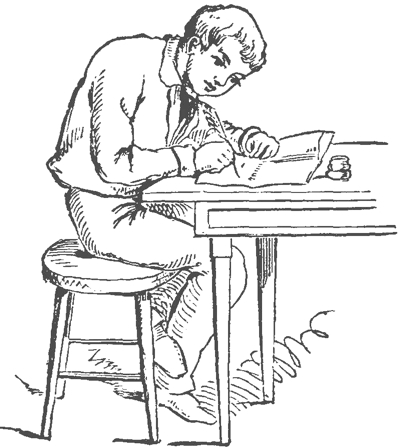
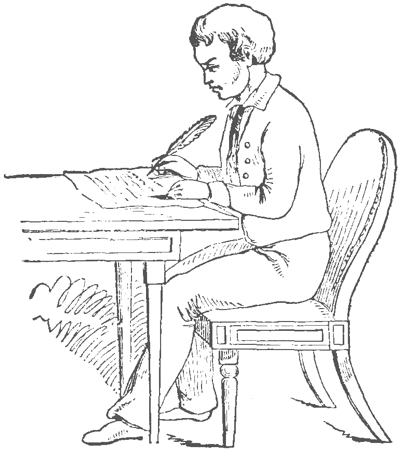
“And here, boys,” continued the principal, exhibiting
the above drawing, “you see the right sitting
position. What an improvement it is upon the other
248position, even if we think only of the looks! But the
effect on the health is far more important than that.
I suppose you all know that the spine, or backbone, is
intended to support the body and keep it erect. It is
one of the most curious contrivances in our bodies. It
is composed of twenty-four small bones, between each
of which there is a piece of cartilage, or gristle, which
we may compare to an India-rubber spring. The
whole makes a strong column, and yet it can be bent
in any direction, and is so elastic or yielding that it
protects the head from jars as completely as the softest
cushion could do it. But the proper position of
this spinal column is the upright one; and it can
never be kept long out of that position without injury.
Look at either of those boys who are in the wrong
position. The spine, you see, must be very crooked.
If they assume that unnatural position often, and
remain in it for a long time, there is danger that
the cartilages or springs in their backbones will
harden where they are compressed, and then they will
always be distorted. Besides, there are certain muscles
in our trunks that sustain the spine. When we
habitually sit or stand in a crooked position, these
249muscles are severely taxed, and finally lose their
strength, and then we become liable to weakness and
disease. Diseases of the spine are very difficult to
cure. People are sometimes confined to their beds for
ten, twenty, or thirty years by such complaints, before
death comes to their relief.
“But the backbone is not the only sufferer from
this bad habit. It crowds the lungs, so that they do
not have room to work. They become contracted; the
chest grows flat and narrow; the stomach and abdomen
are pressed together unnaturally; and, after a while,
you will be unable to take in air enough to give life
and vigor to the blood. Then sores will form in your
lungs; the doctors will tell you that you are in consumption,
and death will begin to knock at your door.
You can easily satisfy yourselves on this point by an
experiment or two. Put yourselves into a crooked
position, and then speak or read aloud a few minutes.
Then do the same thing in an upright position, and see
how much easier it is. Or, you may try to take a full
breath without raising the shoulders, and then do so
giving the shoulders fair play. You will find there is
a right way and a wrong way to breathe, and that you
250cannot breathe right when you are sitting, standing,
or lying in an unnatural position.
“There is one other bad sitting position to which I
wish to call your attention. It arises from not keeping
the arms on the same level, and is generally caused by
sitting at a table or desk that is too high or too low.
In resting one elbow, you throw up the shoulder on
one side, and depress the other, and the spine is thus
made very crooked. You should keep your shoulders
as level as possible. Heads up, chest erect and
straight, and shoulders square and thrown back—that’s
the true position. Now, boys, you may go to
your rooms, and see if you can put this lesson in
practice.”
A few days after this, Whistler received another
physiological lesson, which made a still deeper impression
upon his mind. It happened in this wise. Ettie
had a beautiful kitten, to which she was very much
attached. It was as white as snow, with the exception
of its feet, and a black spot under its neck. Its fur
was very fine, soft and clean. One afternoon, on
returning from school, Whistler found the kitten asleep
in a little apartment which was devoted to Ettie’s
251especial use as a play-room. His sister’s playthings
were scattered over the floor, and among them was a
small box in which she kept many of her valuables,
and which she called her work-box. It was made
of mahogany, and the top slid on in a groove.
Thoughtless of everything but fun, Whistler deposited
kitty in the box, and closed the top, chuckling to
himself as he imagined how Ettie would jump when
she returned to her sports and opened pussy’s
prison.
In the evening Ettie searched the house from cellar
to attic for her kitten, but it did not come to her call.
Besides herself, no one was at home but her father
and the domestic, the rest of the family having gone to
hear the band play upon the Common, this being one
of the evenings in which music was provided for the
public at the city’s expense. Ettie, however, would
give neither her father nor the domestic any peace
until they had joined her in the search; and when,
after thoroughly exploring the premises, outdoors and
in, without avail, they told her she must go to bed
without seeing the kitty, she did not yield to their
wishes without some tears, although assured that the
252little stray-away would doubtless come home in the
morning.
The next morning Ettie was among the first in the
family to arise, and she anxiously resumed her search
for the lost kitten. Whistler heard her from his chamber,
and his intended joke then flashed upon his mind,
almost for the first time since he shut the box upon the
kitten. Hurriedly dressing himself, he went down to
Ettie’s play-room, and found the box just as he left it.
Drawing off the cover, there lay the missing kitten,
cold and stiff in death. It had evidently died of suffocation,
or want of air. The joints of the box were
fitted together with glue, and the top slid on very
snugly, so that it was nearly air-tight.
Whistler felt sad enough at this unexpected issue of
an act of playfulness. His sadness was greatly
increased by the consciousness which flashed upon him
that he was not altogether innocent in the matter. But,
at the same moment, another thought flashed upon his
mind, and that was, that the fate of the kitten need
never be known to any one else. Fortunately he had
said nothing about shutting her up, and it would now
be very easy to dispose of her remains in a private
253manner. He was not sure but that it would be a kindness
to Ettie to leave her in the dark as to the sad and
untimely fate of her four-footed playmate. Then he
thought of an admonition which his father had often
urged upon him from early childhood. It was this:
“When you accidentally do any mischief, always
promptly confess it, for I can forgive your carelessness
much more easily than your attempt at concealment.”
He had been too faithfully trained to this excellent
rule to disregard it now; and he made up his mind
very quickly what course to pursue. Shutting up the
box, and placing it where Ettie could not get at it, he
went to his father’s chamber door, and knocked. Mr.
Davenport was dressing himself, and admitted him.
“Father, I have done some mischief, but I didn’t
mean to,” said Whistler, with some hesitation.
“What now?—some more of your heedlessness?”
inquired his father.
Whistler related his unhappy attempt at a joke, and
its sad sequel.
“Well,” said his father, when he had finished his
confession, “that was very bright in you, I must confess.
Didn’t you know that cats have lungs, and can’t
254live without air? What has become of all the physiology
you have learned at school and at home?
Couldn’t you put enough of it in practice to save that
poor kitten’s life?”
Whistler was silent. He was almost as much astonished
as his father at his own thoughtlessness, for his
parents had taken unusual pains to impress upon his
mind some of the great laws of health, foremost among
which was the necessity of an abundant supply of pure
air. He could explain the uses of the lungs; he could
name the gases of which air is composed; he knew
that a pair of human lungs need a hogshead of fresh
air every hour, to sustain health; and yet it did not
occur to him that a kitten would suffer, and perhaps
die, if shut up in a box but little larger than itself, and
nearly air-tight.
“Well, it can’t be helped now; but be more careful
hereafter,” added Mr. Davenport.
“Had I better tell Sissy the kitten is dead, or would
you say nothing about it to her?” inquired Whistler.
“Yes, go at once and tell her about it, and don’t
keep her in suspense any longer,” replied his father.
Whistler promptly obeyed, breaking the news as
255gently as possible to his little sister; but, in spite of
his precautions, she gave vent to a flood of tears, and
refused to be comforted. Poor kitty had one sincere
mourner.
CHAPTER XVI. THE PRESTON FAMILY.
256
“MOTHER, may I go over to Ralph Preston’s,
this evening, with Clinton?” asked Whistler,
one day, about the middle of September. “Oscar has
got home, and his cousin Marcus has come with him.
I’ve seen them both. We are going to take Clinton
and Oscar by surprise. Oscar doesn’t know that
Clinton is in town, and Clinton doesn’t know that
Oscar is. There’ll be quite a scene, I guess, when
they come together; you know they used to be pretty
intimate, when Oscar lived down to Brookdale.”
Mrs. Davenport readily granted the desired permission;
for, although it was a rule of the house that the
children should never be absent from home after dark
without the consent of one of their parents, the rule
was intended merely to shield them from the moral
257dangers to which the young are exposed in the streets
of towns after nightfall, and not to debar them from
any proper and innocent amusement.
Whistler and Ralph attended the same school, and,
although there was a difference of two or three years
between their ages,—Ralph being the younger,—they
were intimate friends. There were many excellent
traits in Ralph’s character. Whistler was also on
terms of friendship with the other members of the
family—Alice, Ella and George. Alice was a young
lady of seventeen. Ella has already been introduced
to the reader. George, the youngest, was about nine
years old. With Oscar, who was now half way
between fifteen and sixteen, Whistler had never been
on very good terms. Until within a little more than
a year, they had been classmates in school; but the
character of Oscar, at that time, was not such as
Whistler could admire; and, on the other hand, Oscar
seemed, for some reason known best to himself, to
take a dislike to Whistler, which more than once manifested
itself in blows. For all this, however, Whistler
now cherished no feeling of resentment towards his old
enemy. On the contrary, the shame and suffering
258which Oscar had brought upon himself, and the desire
and determination he had expressed to reform, warmly
enlisted Whistler’s sympathies in his behalf.
Marcus Page, Oscar’s cousin, who had come to Boston
with him, was about eighteen years old, and lived
in the small town of Highburg, in Vermont. His
mother had agreed to take Oscar into her family,
where he would be under good influences, and secure
from the evil associations and temptations of the city;
and his release from the State Reform School was conditioned
upon this arrangement. Marcus was to spend
a few day in Boston, and then to return to his home,
with Oscar.
When Mr. Davenport came home to tea that evening,
he brought a letter for Clinton. It was from his
mother, and was the first intelligence he had received
from home since his departure. It contained several
items of intelligence which, to him, were of considerable
importance. Dick Sneider, the supposed incendiary,
had at length been arrested, and after a preliminary
examination, had been committed to jail, to
await a trial by jury. Clinton had been summoned
as a witness against him; but, as the trial could not
259take place for several weeks, he would have an opportunity
to finish his visit before returning. Nor was
Dick the only rogue that had been caught since Clinton
left home. The letter stated that some creature
entered Mr. Preston’s barn, one night, and killed four
geese. A trap was set the next night, and the following
morning it held securely by the paw of the left
fore foot a wild-cat that stood seventeen inches high,
measured three feet in length, and weighed thirty-three
pounds. He was alive, and not in a very
amiable mood, when discovered, but was despatched
by two or three blows with a heavy stick. His skin
had been preserved. “It is the opinion of the folks
here,” continued the letter, “that this was the identical
rascal that made such havoc with your fowls, just
before you left home; but we shall probably never
know for a certainty whether this was so or not.
When we discover a rogue, we are apt to lay upon
him not only his own sins, but many others for which
we can find no owner.”
If Mrs. Davenport entertained any doubt as to the
guilt of the wild-cat in the chicken affair, Clinton did
not. It was as plain to him as day that the feline
260monster was the real culprit. He had suspected as
much from the first, against his father’s doubts and
ridicule; and now that the presence of such a creature
had been demonstrated, he wanted no further proof.
There was somewhat of a chasm between the two
links of the argument, it is true; but although the
reasoning would hardly be sufficient to hang a man,
Clinton deemed it amply conclusive to condemn a
wild-cat. He exulted quite as much over the conquest
of this midnight marauder, as he did over the capture
of the other and greater rogue mentioned in the letter.
After tea, Clinton went over to Mr. Preston’s house
with his cousin. The “surprise,” when Oscar and
Clinton met, was quite as great, on both sides, as had
been anticipated. They were right glad to see each
other face to face once more; and, although Oscar at
first seemed to feel some restraint, the cordial manner
with which his old comrades received him, put him at
his ease again. From regard to his feelings, no
allusion was made to his past career; but future plans
and hopes were discussed quite freely.
“How do you think you shall like living on a
farm?” inquired Clinton, addressing Oscar.
261“O, I’ve made up my mind to like it, whether or
no,” was the reply.
“If you stick to that, you will be contented enough,”
said Marcus.
“You won’t have to work very hard this winter, I
suppose,” added Clinton, who remembered that industry
was not one of Oscar’s virtues, when he knew him
in Brookdale.
“No,—I’m going to the academy till next spring,
if not longer,” replied Oscar.
“Are you?” inquired Clinton.
“And I shouldn’t wonder if I had Cousin Marcus
for a teacher, too,” added Oscar.
“Why, that would be complete!” said Whistler.
“Yes; the trustees want him to be an assistant
teacher this winter, but he hasn’t given them any
answer yet,” continued Oscar.
“I should admire to have you for a teacher, I know
I should,” said Ella. “I should expect you would
show me lots of favors.”
“Perhaps I should,” replied Marcus; “but possibly
they might not be just such favors as you would like.
We had a teacher in our district school, once, who had
262his wife’s brother for one of his pupils. He was a
large boy, and quite a good sort of a fellow, too; but
he got more whippings than any two boys in the
school. I suppose his brother-in-law thought he must
show him some favors.”
“But you wouldn’t serve me in that way?” said
Ella.
“I should hope not,—nor Oscar, either,” replied
Marcus; “but I must tell you what I told Ronald.
He was quite tickled with the idea of my being
teacher; but I told him that if I showed him any partiality,
it would only be in looking after him a little
sharper than I did after the other scholars.”
“Then Ronald is going to the academy this winter?”
inquired Mrs. Preston.
“Yes, ma’am; he is to commence with the next
term,” replied Marcus.
“Ronald,—that’s a queer name!—who is he?”
inquired Whistler.
“He’s a little fellow that has lived with us several
years,” replied Marcus. “He is a French Canadian
by birth; but his parents are dead, and mother took
him out of pity, and has brought him up, so far.”
263“He thinks a great deal of you, doesn’t he?”
inquired Ralph.
“He appears to,” replied Marcus.
“He certainly ought to; your cousin Marcus has
been almost a father to him,” said Mrs. Preston. “He
takes nearly the whole care of him, and has made him
what he is; and I suppose Ronald feels towards him
very much as he would towards a father.”
“You give me more credit than belongs to me,”
interposed Marcus. “If it hadn’t been for mother
and Aunt Fanny, I couldn’t have done anything with
him. He was the queerest little fellow you ever saw
when he first came to us. He was full of all sorts of
pranks, and was as wild and untrained as an Indian
child.”
“Did he talk English?” inquired George.
“Yes, after his fashion,” replied Marcus. “His
parents spoke broken English, but French was their
natural tongue.”
“Does he speak French, too?” inquired Clinton.
“No, he has lost that,” replied Marcus. “When I
began to study French at school, I thought he might
be of some help to me; but I soon found that his
264patois, as they call it, was about as bad as the English
of a raw Irishman. So we thought he might as well
let it go.”
“Does he speak English well now?” asked Whistler.
“O, yes,—very well,” said Marcus.
“What did you think of him, mother? You saw
him this summer, didn’t you?” inquired Oscar.
“Yes, I saw him, and liked him very well,” replied
Mrs. Preston. “He is a bright, intelligent, wide-awake
boy, but a little roguish, I should say.”
“But, mother, he is a good-hearted and well-meaning
boy,” said Alice, who also had visited Highburg
that summer.
“I have no doubt of it,” added Mrs. Preston; “but
for all that he is a little mischievous. I have laughed
a good many times over one scrape he got himself into
while we were there. There are two buildings on the
farm that stand very near together, but do not touch.
There is just about enough space between them for a
cat to walk through. Well, Ronald took it into his
head, one day, to crawl through that narrow space.
So he squeezed himself in, and pretty soon we heard a
265great outcry in that direction. We all ran out to see
what had happened, and there we found the young
rogue, wedged in so closely between the two buildings
that he couldn’t move an inch, and almost frightened
out of his wits. Marcus got ropes and pries, and we
worked over him about an hour before we got him
out; and then he had to leave a good part of his
clothing behind him. I shall never forget how cheap
he looked when he came out of that place—his jacket
in tatters, his clothes covered with mould and dirt, and
his face as red as a beet.”
“He has a faculty for getting himself into such
scrapes,” said Marcus. “Last spring I had some
business at Montpelier, and I took him with me. The
man I wanted to see was an officer of some kind,—a
sheriff, I believe. He wasn’t in when I called at his
place of business, and so I took a newspaper, and sat
down to wait. I didn’t notice what Ronald was about;
but after a few minutes he came to me, with one of his
droll looks, and carrying his hands in a singular manner.
He was handcuffed. I at first thought it was a
good joke, and laughed at it; but I soon found it was
a sorry joke to him, for he couldn’t get the handcuffs
266off. They had spring locks, and fastened themselves,
but could not be opened without a key. Though they
were too large for his wrists, I found I could not slip
them off without endangering his hands. Pretty soon
a man came in, and he told me that Ronald would
have to wear the handcuffs until I could find their
owner, if it was for a week, as no key would unlock
them but the one that was made for them. This
rather put a damper on Ronald; but, fortunately, the
man came in after a little while. Then I thought I
would carry the joke a little farther; so I pointed to
Ronald, and told him I had got a prisoner for him.
He wanted to know what he had done, and I told him
he had put his hands where he ought not to. ‘Ah,
that’s bad!—that’s bad!’ said he; ‘how much did he
steal?’—‘I didn’t steal anything,’ said Ronald; ‘but I
saw these things, and I thought I’d try them on, and
now I can’t get them off.’ The man saw through the
joke, then, and he got the key and took off the handcuffs.”
“Ronald isn’t the first boy who has handcuffed
himself,” said Mr. Preston, looking up from one of
several letters which he had been opening and reading
during the preceding conversation. “Here’s a boy,
267now, who has put himself into worse handcuffs than
Ronald’s, and, what is more, he doesn’t know it; but
any body else can see it plainly enough.”
“Who is he, father?—what has he done?” inquired
Ralph.
“He is a boy who wants a situation in my store,”
replied Mr. Preston. “I put an advertisement in the
papers for a boy, and these letters are all answers to
it. Here is the advertisement; you may read it
aloud, Ralph, and then those who wish may examine
this reply to it.”
Ralph then read as follows:
“Wanted, in a W. I. Goods Store, an active, intelligent
boy, about fourteen years old, who writes a fair hand, is
quick at figures, and whose parents reside in the city. Address,
in handwriting of applicant, ‘W. I. G.,’ at this office.”
The letter to which Mr. Preston alluded was then
handed around, and read by all present, eliciting many
amusing comments. The handwriting was cramped,
awkward, and in some parts scarcely legible; the
spelling was quite original; the sentences were run
into each other with an utter contempt for marks of
punctuation; capital letters were withheld and dispensed
268according to a system not laid down in any of
the books; and the general structure of the composition
indicated an entire ignorance of all rules and
laws of established usage. It read as follows:
“Fall river, sep 14
“Honered sir—i see by the Boston dayly papers
printed in Boston that you want a boy if you do i
think i might answer perhaps i am fifteen old smart
and strong have a good education have ciphered
through adams arithmetic once and took a meddle at
the last righting school——Perhaps you wont Think
so by my righting as i have got a very bad pen i have
had some experience in my unkles grocery and should
staid there if was not so verry dull i think i should like
Boston a great deal Better.
“As for sallary i think 50 ayear besides my
board and cloathes about right the first year i can
come as soon as you want please write to obedient
Servant
John Morrow.”
“Sure enough,” said Mrs. Preston, “that boy has
put on handcuffs,—handcuffs of ignorance! If he tells
the truth, he has had some opportunities of getting an
education; but it is very plain that he did not profit by
them. He has put the handcuffs on, and he will have
to wear them, now.”
269The children insisted upon seeing the letters of the
other applicants, and they were accordingly handed
around, read, and criticised, affording much amusement
to the company. None of them were quite so faulty
as John Morrow’s, though several of them did not do
much credit to the writers. Two or three, however,
were very well expressed, and neatly written. One
of the best read as follows:
“Boston, Sept. 15, 185-.
“Dear Sir: I read your advertisement for a
boy, and think I might answer your purpose. I was
fourteen years old last June, and have just left school,
and come to Boston to earn my living. My parents
live in Dracut; but I have two grown-up brothers in
Boston, with whom I live, and who will look after me.
I have the recommendation of my school teacher, and
several other gentlemen, which I will show you if you
wish. If you will try me, I will endeavor to give
satisfaction. You can find me at No. —, —— Street.
“Yours, respectfully,
“Henry E. Hoyt.”
“Why, Mr. Preston, I know that boy!” exclaimed
Clinton, as soon as his eye rested upon the above signature;
“and I think he’s a good boy, too.”
270“Ah!” said Mr. Preston; “what do you know
about him?”
“I don’t really know much about him,” replied
Clinton; “but I liked his appearance. I got acquainted
with him on the Common, a week or two ago,
and I went up to the top of the State House with him.
He told me he came from Dracut, and lived with his
brothers, and was trying to get a place. This must be
the same boy.”
“Is that all you know about him?” inquired Mr.
Preston, with a smile.
“Yes, sir,” replied Clinton; “but he looked like a
good boy, and his letter reads well, too. Don’t you
think so?”
“Yes,” replied Mr. Preston; “and, as you were so
well impressed by him, I think I will see him, at any
rate, before I engage a boy.”
“And if he gets the place, he must thank you for it,
Clinton,” said Whistler.
“No, it will be owing to his writing such a good
letter,” replied Clinton. “If he had made such a
bungling piece of work as that other boy did, I
wouldn’t have owned him as an acquaintance.”
271Thus the evening passed away in pleasant conversation,
and all seemed sorry when the stroke of the
clock announced the hour at which Whistler and his
cousin were obliged to leave.
CHAPTER XVII. A WATER EXCURSION.
272
THE next Saturday Whistler came home from
school in great haste, at noon, and informed his
mother that several of his young associates were going
to get a sailboat and take a cruise in the harbor,
immediately after dinner, and had invited him to go
with them. Each boy was to pay a small sum for the
use of the boat, the amount of which assessment would
depend upon the number in the party. Whistler was
quite anxious to go with them, and he knew Clinton
would be, also, although he had not been able to find
him since school was dismissed. The day was calm
and pleasant, the boys who were going were of good
character, several of them understood managing a
boat, and they could not help having a good time.
Such was Whistler’s story.
273But his mother was not at all pleased with the
project. She did not consider it safe for a party of
such boys to venture upon the water, without a man
capable of managing the boat. Whistler argued and
pleaded, but could not change her mind. She finally
told him that she should not give her consent to his
going, and wished he would abandon the idea; but
added that, if he was very anxious to go, he might ask
his father’s permission, and if it was granted she
should say nothing more about it.
As Mr. Davenport generally dined down town
when business was pressing, Whistler started at once
for his office. He found his father deeply engaged
with several gentlemen, and some time elapsed before
he could get even a look from him. After a while the
busy lawyer stepped aside, and, telling his son to
“speak quick,” listened to his request. He asked a
question or two about the boys who were going, and,
taking a handful of change from his pocket, gave
Whistler enough to pay for himself and Clinton, and
told him they might go with the party.
Whistler hastened home, and informed his mother
of his success; but she kept her promise, and said
274nothing about the matter, although he tried hard to
draw from her some modification of her judgment.
Soon one of the boys who was getting up the party
called to see whether Whistler was going. For a
moment he was in doubt what reply to make. He
could not consult Clinton, who had not yet returned.
He wanted to go very much, but he did not wish to
set at defiance the known wishes of his mother. He
soon, however, made up his mind what to do. After a
short but severe struggle in his mind, he told the boy
that he should not go. When Clinton came in, and was
informed of the affair, he appeared to be satisfied with
Whistler’s decision, though it was no less a disappointment
to him than to his cousin.
“Well, boys, you have got back in good season
from your excursion,” said Mr. Davenport, when he
came home from his business that afternoon.
“We didn’t go,” replied Whistler.
“Didn’t go!—how happened that?” inquired his
father.
“Mother didn’t want us to go, and so I thought we
had better give it up,” replied Whistler.
“That was a good reason,—a very good reason,”
275said his father. “On the whole, I think your mother
was about right. It isn’t safe for a lot of boys to go
on the water alone; and I was sorry, five minutes
afterwards, that I consented to your going.”
There the matter dropped; but the regard Whistler
had manifested for his mother’s wishes was not forgotten
by either of his parents. It was talked over
when they were alone, and it was determined to
reward him in some way for his self-denying decision.
The next Monday his mother had the pleasure of
informing him that the whole family were going to
sail in the harbor the following Wednesday, which
was his birthday. Mr. Davenport had chartered a
fine yacht[3] for the occasion. Whistler had liberty to
invite the Preston children, and also Marcus, to go
with them; and several other invitations were likewise
to be extended.
Whistler lost no time in spreading the news of this
arrangement among those who were interested. He
learned that Marcus and Oscar had intended to start
for Vermont on the day of the proposed excursion;
276but they were easily persuaded to postpone their
journey for one day, for the sake of joining the party.
Ella and her brothers, Ralph and George, only awaited
their father’s consent to give the invitation a cordial
acceptance. Indeed, so impatient were they, that
Ralph proceeded at once to his father’s store, and
obtained the desired permission. Clinton and Whistler
went with him, and the first-named had the gratification
of meeting his chance acquaintance, Henry
Hoyt, who had that morning entered upon the service
of Mr. Preston. Henry was not a little surprised to
find that there was so close a connection between his
courtesy to a fellow stranger and the success of his
application for a situation.
Wednesday came, and Whistler was fourteen years
old. The accustomed birthday present from his
parents, which had never failed him within his recollection,
was found upon his table when he awoke. It
was a plain but highly-polished rosewood box, filled
with implements and materials for drawing. Everything
that a young artist could desire in the pursuit of
his favorite study was here to be found, neatly secured
in its own place. Whistler was delighted with the
277gift, and assured his parents that they could not possibly
have selected a present that would have pleased
him better.
After breakfast, active preparations were made for
the excursion; and promptly, at the hour appointed,
all of the company invited were assembled upon the
wharf where the yacht lay. The “Echo,” as she was
called, was rigged as a sloop,—that is, she had but one
mast, and a bowsprit. She was of about twenty-five
tons burden, and looked quite small by the side of the
huge ships of ten or twelve hundred tons which surrounded
and overshadowed her. While these leviathans
towered high above the wharves, the modest
Echo sat so low in the water that the party had to go
down a ladder to reach her deck. She was a neat,
trim, and graceful craft, however, and everything
about her was scrupulously clean. A blue pennant
was flying from her masthead.
The party seated themselves in the stern of the
yacht, where they found very good accommodations,
while the skipper and his two men—who constituted
the whole crew—took their positions forward. Having
cast off their lines, they hoisted the jib, and began
278to push out from the wharf. Both the wind and tide
were contrary, and it required some nautical skill to
get out into the stream. Once clear from the wharf,
the first thing they did was to run into a small row-boat,
and the next was to thump against the side of a
large steamboat which lay at the opposite wharf. No
harm was done, however; and, after a few unintelligible
orders from the skipper,—who had now taken
his post at the helm,—they swung clear of every
obstacle, the mainsail was hoisted, and they were
under way.
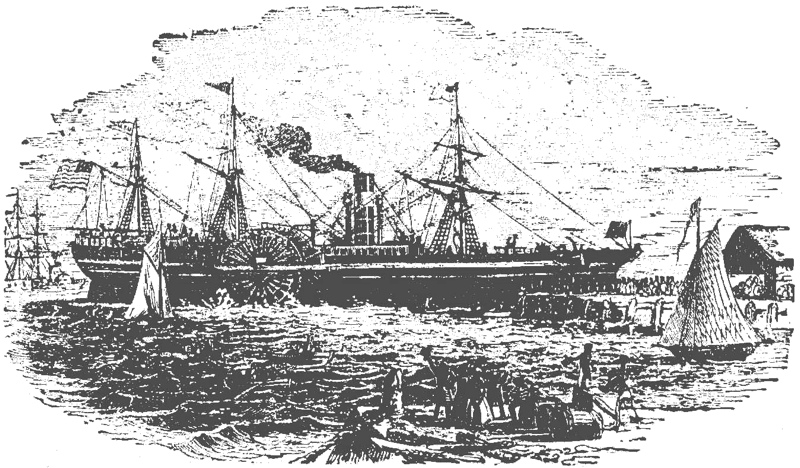
The wind being in an easterly direction, the yacht
was obliged to “beat out,” as it is called; that is,
instead of taking a direct course for the outer harbor,
she had to sail in zigzag lines, approaching very gradually
towards the point to which she was bound. The
first “tack,” as the sailors term the course of a ship
when beating against the wind, took the Echo close to
the shore of East Boston. A large steamship, just
arrived from Europe, was entering her berth; and, at
the request of several of the party, the captain of the
yacht sailed up to within a few yards of her, giving all
on board a fine opportunity to inspect the huge and
281stately leviathan. What an impression of strength
and beauty, of gigantic power and indescribable grace,
did they derive, as they gazed up from their frail and
tiny craft upon the towering walls of this ocean monster!
A crowd was assembled upon the wharf, awaiting
the landing of the passengers; and several small
boats were hovering around, drawn thither, probably,
like the Echo, by curiosity. Altogether, it was a very
lively and interesting scene. After sailing slowly by
the steamship, the Echo was put upon a new tack,
heading towards the opposite side of the stream. In
taking these tacks from one side to the other, considerable
skill was required to steer clear of the numerous
vessels of all sorts that were lying in the course of the
yacht.
“Beautiful!” “charming!” “splendid!” were exclamations
that frequently arose above the general
buzz of conversation, in the stern, as the Echo glided
smoothly over the waters. Nor were these extravagant
terms; for a sail down Boston harbor, on such a
day, and in such a craft, is one of the pleasantest
excursions that can be imagined. But, while some of
the party were enjoying the beautiful views that
282presented themselves, others, and especially the boys,
were engaged in watching their boat, and in examining
its various appointments.
“What queer seats these are! What is the object
of making them in that shape?” inquired Clinton, as
he examined a stool that was shaped somewhat like an
hour-glass, and was made of tin, and painted, with the
name of the yacht inscribed upon it.
“That is a life-preserver, as well as a stool,” replied
Whistler. “If any one should fall overboard, they
would throw him one of these stools, and that would
keep his head above water till they could get him
out.”
“Now, look out for your heads, ladies, if you
please!” said the captain, as he was about to swing the
boom around to the other side of the boat, for the
purpose of changing the tack.
“No matter about the gentlemen’s heads!” said
Whistler; and, suiting the action to the word, he sat
upright until the boom came upon him, and then, dodging
it a little too late, it took his hat from his head,
and, but for a quick movement on his part, would have
sent it whirling into the water.
283“If you had sat still a moment longer, Willie, we
might have had an opportunity to experiment with
one of these life-preservers,” said Marcus.
“I know it,” replied Whistler; “and I’m not going
to stay here and be knocked round in this way!
Come, boys, let’s go down into the cabin.”
Several of the party accepted Whistler’s invitation.
The cabin occupied the middle part of the boat. Of
course it was a rather small apartment; but, for all
that, there was a good deal in it. Every available
inch of room was fully improved. It was only about
five feet high,—not high enough to allow Marcus and
Oscar to stand up straight. A permanent table ran
nearly the whole length, with leaves that dropped
down when not in use. There was a raised edge
around the table, to keep the dishes from sliding off
when the sea is rough. The mast came up through
the table, but was handsomely paneled, and, but for
its decided slant, might have passed for a pillar. A
castor and a basket full of tumblers were hanging over
the table, and benches were placed on each side of it.
The cabin was also fitted up with berths, very much
like the one which Whistler occupied on board the
284steamboat, on his journey to Brookdale. There were
four of them on each side, and they were furnished
with neat white bedding. Under each berth there
was a locker, for stowing away clothing, &c. The
cabin was lighted by the doorway, and by a skylight,
which was raised a little above the level of the deck.
Forward of the cabin, and connected with it by a
door, was the cook-room. It contained a cooking-stove,
with a bright brass railing around the top, to
keep things in their places. The funnel went up
through the deck. A man was kindling a fire, and as
the room seemed too small to hold two at once, the
boys did not go in.
Returning to the deck, the boys found that they
were off Fort Independence (Castle Island), distant a
little more than two miles from the city. The view
was now very fine. The numerous islands of the
harbor began to appear, and glimpses of the ocean
were obtained between their green and sunny slopes.
Several vessels, availing themselves of a favorable
wind, were entering the port in gallant style. Among
them was a noble ship, returning from a distant
voyage. But few of her sails were spread, yet she
285dashed through the waters with such grace and speed
that the boys could not refrain from giving her three
cheers as she passed their boat. The compliment was
promptly returned by the sailors.
The next object of interest that the Echo passed
was the Long Island Light, distant about five miles
from the city. The air was now growing uncomfortably
cool, and the captain brought up from the cabin a
quantity of shawls, hoods, old hats, &c., which he said
he kept expressly for company. They were gratefully
accepted; and the sudden outward transformation
which the party underwent, furnished no little food for
merriment.
At noon, the captain invited the company to take
something to eat. On descending to the cabin, they
found the table spread with a variety of eatables.
There were boiled ham, and tongue, and eggs; pies,
crackers, and bread; sardines, olives, and pickles; hot
coffee and tea, and genuine Cochituate, fresh, not from
the pipes, but from an ice-tank. There is nothing like
snuffing the sea air to give one an appetite; and the
plain, substantial fare disappeared very rapidly from the
table. Before the meal was concluded, however, Ella
286and one or two others left the table rather suddenly.
Oscar, who was more of a sailor than any of the rest,
rallied his sister on her prompt acknowledgment of the
claims of Neptune; but she protested that she did not
feel at all sick. Very possibly she would, though, had
she remained below a little longer. The fresh air
revived her, and the slight nausea she began to
experience in the cabin soon passed away.
The Echo was now seven miles out, but had, in
reality, sailed twenty-five miles in making that distance.
The broad ocean was in full view, studded with sails,
and the sea was much rougher than it was before
dinner. A large steamship was soon discovered,
threading its way out from among the islands. It was
watched with much interest by all, and as it passed
near them they had a good view of it. It proved to
be a screw steamer; that is, instead of paddle-wheels
on the sides, the power was applied to a propeller
under the ship’s keel. She presented a noble and substantial
appearance as she sailed down the harbor,
impelled by an invisible power, and seemed strong
enough to withstand any shock that she might encounter
on the ocean. A clipper ship, outward bound, also
287passed near them, having most of her canvas spread,
and was an object of scarcely less interest than the
steamship.
The yacht was now approaching George’s Island,
where the party had decided to land. This island,
which is the key to the outer harbor, commanding the
open sea, belongs to the United States, and contains
one of the most extensive and costly fortifications in
the country. The fortress, however, is in an unfinished
state. As they drew near to the island, they found
that it was surrounded by a sea wall, composed of
immense blocks of granite. This is necessary, to
prevent the washing away of the island in the furious
storms which sweep over the coast. The winds and
waves have made sad inroads upon the islands in
the harbor, even within the memory of many now
living. It is said that the breakers now roll where
large herds of cattle were pastured seventy-five years
ago.
Having landed at the wharf, the party walked up
towards the fort, which is named after General Warren.
Immense walls of granite, of the purest quality
and smoothest finish, towered above them. On the
288top of the walls were banks of earth, neatly sodded.
The road led them to a substantial stone gateway, which
was open, and they accordingly entered it. They now
found themselves in a narrow passageway, with high
walls on either side. There were many long and narrow
openings in the walls, through which muskets
could be fired, should an enemy succeed in landing,
and try to take the fort. An invading force, hemmed
in by the walls, would receive a dreadful raking from
these loopholes before they could get inside of the
fortress.
On reaching the interior of the fortification they
found themselves in a large area. The captain of the
yacht, who acted as their guide, informed them that
twelve acres were enclosed, and three more were occupied
by the walls. There were several workshops
and a large dwelling-house within the enclosure. As
they were examining the fine specimens of masonry
which the walls presented, a gentleman wearing the
uniform of an army officer came up to them, and politely
offered to show them over the fortress. His
offer was gratefully accepted.
“We will first ascend the parapets, if you please,”
289said the officer, leading the way towards a long flight
of stone steps.
“Work seems to be suspended here,” remarked Mr.
Davenport, as they passed several ox-carts that were
covered with rust.
“Yes, sir,” replied the officer; “the appropriation
is exhausted, and nothing has been done here for
several months.”
“This place will have cost Uncle Sam some money,
when it is finished,” continued Mr. Davenport.
“Something over a million of dollars, probably,”
replied the officer.
“Well, perhaps it will be worth that money, in case
of war,” said Mr. Davenport; “but it strikes me that
fighting is a pretty costly business.”
“O, what a splendid view!” was the general exclamation,
as the party reached the top of the parapet.
“You perceive that the whole harbor is completely
commanded by the fort,” continued the officer. “Here,
within a pistol shot, is the main channel, through which
all large vessels must pass as they enter or leave the
harbor. If an enemy’s ship were to try to pass here,
after the fort is mounted, we could bring from a hundred
290to a hundred and fifty guns to bear upon her, at
the same time, at any point.”
They continued their walk upon the top of the parapet
for some minutes, enjoying the fine view to be had
on every side. It is here that the heaviest guns are
designed to be placed, in the open air. Large square
stones are set for the guns to rest upon, and semi-circular
ones for the gun carriages to traverse. There
is also a wall, behind which the men can hide.
On descending from the parapet, the officer unlocked
a door, and, through a rather gloomy passage, led them
into the interior of the fortress. Here they wandered
for a quarter of an hour through a labyrinth of massive
masonry, gazing with wonder at the solid walls,
the arched stone roof, and the long series of rooms
connected by doors. They found but one gun mounted,
but that served to illustrate the principle on
which the cannon are intended to work. The port-holes
are so shaped that the guns are allowed a wide
range, and yet there is little room for shot to enter
from without. They have an inner and an outer flare,
being narrowest in the centre of the wall. That part
of the carriage farthest from the muzzle has a sideway
291motion, so that the gun may be readily pointed in any
direction required. The fort will mount about three
hundred guns.
Besides the gun-rooms there are a large number
of other apartments, to which the party were introduced.
Some of them are intended for ante-rooms,
into which the soldiers may retire. They have fireplaces,
and will doubtless wear an air of comfort and
cheerfulness when finished and furnished. Other
apartments, designed as parlors for the officers, are
still more expensively finished. There are also kitchens,
sleeping-rooms, magazines, cells for prisoners, &c.
“This must be one of the finest fortresses in the
country,” said Mr. Davenport, as they came out once
more into the open air.
“Yes, sir, it is,” replied the officer. “It is impregnable
from sea; but, if it could be attacked by land, it
might be blown to pieces, after a while. No masonry
is solid enough to be proof against efficient land batteries,—that
was proved at Sebastopol.”
“Well,” said Mr. Davenport, “the worst wish I
have for Uncle Sam is that he may never have occasion
to use this immense fortress.”
292“I heartily join you in that wish, in spite of my
profession,” replied the officer; and he then politely
took leave of them.
Warmly thanking their guide for his attentions, the
party hastened to their boat, and were soon on their
way back. The wind had died away, and their
progress homeward was not very rapid. The skipper
evidently felt somewhat concerned for the credit of his
craft. He declared that she was a swift sailer; but
nothing, he said, could sail without wind, or in the face
of a stiff breeze. His equanimity seemed to be still
more seriously disturbed when a large schooner, with
a great spread of canvas, came up behind him, and
began to gain upon the Echo. He kept a sharp eye
upon the intruder, as he evidently regarded her; and
when she passed the Echo to the windward, instead of
the leeward, he could no longer restrain his disgust,
but remarked to Mr. Davenport, with some warmth:
“A fellow that’ll do that is no gentleman!”
A puzzled look from several of the ladies, who did
not understand the nature of the offence, recalled him
to a sense of his dignity, and he was soon as gallant
and as good-natured as usual. In justice to him, it
293should be remarked that the schooner, by going to the
windward, had taken the wind out of his sails, which
is not considered a very courteous act among sailors.
The party reached the wharf in safety, and all
declared that they never spent a pleasanter day than
in their trip down the harbor.
CHAPTER XVIII. LAST DAY OF THE VISIT.
294
CLINTON remained in Boston about six weeks, or
until the middle of October. During that time he
made himself pretty well acquainted with the city, and
visited all the objects of interest in and around it. At
length the last day of his sight-seeing was over, his
valise was packed, and he sat down with his uncle’s
family for the last time. It was a cool evening, and a
fire in the grate sent out a cheerful warmth. His
uncle sat near the table, reading the evening newspaper.
His aunt was busy with her needle. Whistler
was conning his next morning’s lesson, and Ettie
was showing to kitty the pictures in one of her books,
while Bouncer was asleep upon the mat. Clinton
alone sat idle; but he was not wholly unoccupied.
His thoughts were busy, and a feeling of sadness was
295stealing over him as the hour of his departure drew
near.
After a while Mr. Davenport laid his paper aside,
and Whistler took it up. He glanced over one of its
columns with some care, and then said:
“No news from the Susan yet; you will have to go
home without Jerry, Clinton.”
The Susan was the brig in which Jerry Preston
sailed. She was now expected at Boston; and the
boys had looked daily in the newspapers for the intelligence
of her arrival. Clinton had some hope that
Jerry would get back in season to return with him to
Brookdale; but in this he was disappointed.
“Well, Whistler, what have you learned to-day?”
inquired Mr. Davenport,—a question which he frequently
addressed to his son, in the evening.
“Let me see,” replied Whistler, slowly. “O, I’ve
learned which are the three hardest words to pronounce
in the English language.”
“Ah! what are they?” inquired his father.
“They are, ‘I was mistaken,’” replied Whistler.
“What is there so very hard to pronounce about
them?” inquired his father, with affected simplicity.
296“It isn’t the words that are hard,—it’s the sentiment,”
replied Whistler. “Our teacher told us that
some great man once said those were the three hardest
words to pronounce in the English language. He told
us, besides, of a great general who was defeated in
battle, and who sat down and wrote to the senate: ‘I
have just lost a great battle, and it was entirely my
own fault.’ He said that confession displayed more
greatness than a victory.”
“That is very true,” added Mr. Davenport. “But
have you learned to pronounce the words yourself?
If you have, you have learned something worth
knowing.”
“I don’t know,” replied Whistler, with some hesitation.
“The item of knowledge you have picked up
to-day,” continued his father, “will not be of much
benefit to you, unless you make a practical use of it.
Your teacher, I suppose, wished to teach you the duty
of confessing your errors. That is one of the hardest
things a man ever has to do. It takes a brave man to
confess that he has done wrong, or has embraced
wrong opinions.”
297“I’ve learned another thing to-day,” continued
Whistler; “I’ve learned how much meanness there is
in the world.”
“Ah, you have made an important acquisition!” said
his father. “I’ve lived in the world forty years, and
I haven’t begun to find out all its meanness yet.”
“Well, if I haven’t found it all out, I’ve found
enough,” resumed Whistler. “This was the way it
happened. Two or three boys of our class came to
me, this morning, and wanted me to sign a petition
asking the teacher to give us shorter lessons. About
a dozen boys had signed it, but they wanted me to put
my name before theirs, at the head of the petition,
because I was one of the oldest boys. As soon as I
found what it was for, I told them I didn’t think our
lessons were too long, and I shouldn’t sign it. Then
they all set upon me, and coaxed and flattered as hard
as they could. They said they were so sure that I
would sign it that they had left a place for my name,
and that I should have more influence with the master
than they, &c., &c. And when they found that that
wouldn’t work, then they tried to bully me into it.
Nat Clapp said I needn’t pretend to be a better
298scholar than the rest of them, for I had as hard work
to get my lessons as any body did. Jo Clark said I
wouldn’t sign it because they didn’t consult me about
it before they got it up. Bill Morehead said I didn’t
dare to sign it. I told him I dared to refuse to sign
it, and I thought that was more than some of them
could say. But I can’t tell you half what they said.
I got real provoked at last. I should like to know if
I hadn’t as good a right not to sign that petition as any
of them had to sign it? What business had they to
say my motives were bad, because I didn’t please to
do just as they wanted me to?”
“How much boys are like men!” quietly remarked
his father.
“But you didn’t sign the petition after all, did
you?” inquired Clinton.
“No, that I didn’t,” replied Whistler; “and I was
glad enough of it, too, this afternoon. They couldn’t
get but about a third of the class to sign it, and they
left it on the teacher’s desk this noon. He didn’t say
anything about it till just as school was about to be dismissed
at night. Then he told the scholars that he had
received a petition for shorter lessons from a portion
299of the first class. He said the request was not only
unreasonable, but the petition was disrespectful in
tone, and he considered it insulting. He said most of
the boys who had signed it were the idlest fellows in
the class, and, he supposed, they would like it better
if he would give them no lessons at all. But, he said,
there were one or two names on the petition that he
was surprised to see there. He talked pretty hard to
them, I can tell you. He said every boy that had put
his name to it deserved to be called out and punished;
but he concluded to let them off, this time, with merely
reading their names aloud to the school. So he read
off the list; and if some of the fellows didn’t feel
cheap enough, then I’m no judge, that’s all!”
“Did any body sign it that I know, except Nat?”
inquired Clinton.
“Yes, there was one other boy that you know; but
I shan’t tell you who he is,” replied Whistler.
Clinton did not feel much curiosity in the matter,
and did not press the inquiry. The boy referred to
was Ralph Preston, who had thoughtlessly yielded to
the solicitations of his comrades, and affixed his name
to the petition, without noticing that it was not couched
300in respectful terms. He felt the public reprimand of
the act very keenly; and Whistler, out of friendship
for him, kindly abstained from giving any further
notoriety to his error.
“Well, Clinton,” said Mr. Davenport, after a short
pause, “you’ve explored our city pretty thoroughly,—now
let us have your judgment upon it. What do
you think of it, on the whole?”
“O, I like it very well!” replied Clinton.
“That is rather faint praise,” observed his uncle.
“I like some things very much,” continued Clinton,
“and others I don’t like so well.”
“On the whole, don’t you feel quite willing to go
back to the country?” inquired his aunt.
“I don’t know but I do,” replied Clinton, with some
hesitation.
“I see you haven’t wholly given up the idea of
being a merchant, yet,” remarked his uncle.
“O no, sir, I wasn’t thinking of that!” replied Clinton.
“But I should like to enjoy some of the opportunities
that boys have here,—good schools, and
plenty of books, and lectures, and everything else.”
“These privileges or opportunities are very valuable,
301I know,” added Mr. Davenport; “but, after all,
don’t you know that the making of a man is not in
opportunities, but in himself? If you determine to
be a man, the lack of opportunities will not keep you
back. You will work and struggle till you have overcome
every obstacle. On the other hand, if you
haven’t this strong will within, all the opportunities
in the world won’t make a man of you. Indeed,
there is such a thing as having too much assistance.
If you set out a tree, and keep forever handling it, and
scratching about it, and trying to help it grow, it won’t
come to much. It needs a little wholesome neglect to
teach it to take care of itself. So, if a man wants to
produce a strong, rugged character, he mustn’t go into
a hothouse to do it. Such a thing won’t grow there.
So far as I can judge, Clinton, you are doing very well
with your present opportunities. Make the most of
them, and I think you will get along as well as most
boys in the city, to say the least.”
“But I don’t have much time to study,” added
Clinton.
“Many men have stored their minds with valuable
information,” continued his uncle, “in odd moments
302snatched from their labors. Two of the most learned
men, in many respects, that I ever met with, did this.
One of them is Elihu Burritt, the ‘Learned Blacksmith,’
who acquired more languages at the anvil than
I can remember the names of. The other is Charles
C. Frost, of Brattleboro’, Vermont, who deserves to be
called the ‘Learned Shoemaker.’ I must read you a
short account of Mr. Frost, to show you what can be
done in one hour a day.”
So saying, Mr. Davenport took down a volume from
the bookcase, and read as follows:
“At fourteen years of age, Mr. Frost left school,
and commenced learning the trade of a shoemaker.
He worked as an apprentice in his father’s shop seven
years, when he shortly after became interested in the
business of making and vending shoes, in a neat and
tasteful shoe store, on his own account. He early
evinced a love of mathematical science, and has displayed
talents of no ordinary character in its pursuit.
He says, in a letter which I have received from him:
‘I early imbibed a love of study. I recollect my first
acquisitions were in Arithmetic, and that the results
gave me the highest pleasure. When I excelled other
boys in the school, my progress was attributed by
them to some peculiar mathematical talent. But it
303was not so. I boast of no genius. I attribute my
success uniformly to more study than others gave their
lessons or work, and, perhaps, to a greater love of
study.’ Mr. Frost has found time, not only to become
master of all existing forms of algebraic numbers, but
is also familiarly and thoroughly acquainted with
Geometry, Trigonometry and Astronomy. He is at
home in the Modern Calculus and in the Principia of
Newton, where few of our learned professors venture,
or feel at ease. Indeed, in mathematical science he
has made so great attainments that it is doubtful
whether there can be found ten mathematicians in the
United States who are capable, in case of his own
embarrassment, of lending him any relief. Remember
that we are speaking of a self-taught scholar, and he
no genius. Let me tell you how it was done. He
says: ‘When I went to my trade, at fourteen years of
age, I formed a resolution, which I have kept till now,—extraordinary
preventives only excepted,—that I
would faithfully devote one hour each day to study, in
some useful branch of knowledge.’ Here is the secret
of his success. He is now forty-five years of age, and
is a married man, the father of three children; yet this
one-hour rule accompanies him to this day. ‘The first
book which fell into my hands,’ he says, ‘was Hutton’s
Mathematics, an English work of great celebrity,
a complete mathematical course, which I then commenced,—namely,
at fourteen. I finished it at nineteen,
without an instructor. I then took up those
304studies to which I could apply my knowledge of Mathematics,
as Mechanics and Mathematical Astronomy. I
think I can say that I possess, and have successfully
studied, all the most approved English and American
works on these subjects.’ After this, he commenced
Natural Philosophy and Physical Astronomy. Then
Chemistry, Geology, and Mineralogy, collecting and
arranging a cabinet. ‘Next Natural History,’ he says,
‘engaged my attention, which I followed up with close
observations, gleaning my information from a great
many sources. The works that treat of them at large
are rare and expensive. But I have a considerable
knowledge of Geology, Ornithology, Entomology, and
Conchology.’ Not only this; he has added to his stores
of knowledge the whole science of Botany, one of the
most extensive now pursued, and has made himself
completely master of it. He has made actual extensive
surveys, in his own state, of the trees, shrubs,
herbs, ferns, mosses, lichens, and fungi. Mr. Frost
thinks that he may possess the third best collection of
ferns in the United States. He has also turned his
attention to Meteorology, and devotes much of his time,
as do also Olmstead, Maury, Redfield, Smith, Loomis,
Mitchell, and many others, to acquire a knowledge of
the law of storms, and the movements of the erratic
and extraordinary bodies in the air and heavens. He
has also been driven to the study of Latin, and reads
it with great freedom. He has read and owns most
of the gifted poets, and is, to a considerable extent,
305familiar with History; while his miscellaneous reading
has been very extensive. He says of his books: ‘I
have a library, which I divide into three departments,—scientific,
religious, literary,—comprising the standard
works published in this country, containing five or
six hundred volumes. I have purchased these books,
from time to time, with money saved for the purpose
by some small self-denials.’
“Here, then, we have an account—I assure you it
is wholly reliable—of one, a plain man of forty-five,
who has made the compass, so to speak, of the hill of
science, studying his HOUR a day, when the day’s labor
was done, for more than thirty consecutive years. He
began this one-hour system when he was fourteen
years old. Behold the result! Here is a man with
the cares, business, and responsibilities of life on his
hands, yet a devoted, faithful, successful student; a
man who is a profound scholar, and yet a plain-spoken,
humble, pious, laboring man, residing still in his native
village, far inland, supporting himself by his trade
and daily labor, while he is worthy of a position as a
teacher in one of the best institutions of learning in
the land.”[4]
“There,” resumed Mr. Davenport, closing the book,
“you see what a man can do in only one hour a day,
diligently improved. Don’t you think you might
306manage to devote that amount of time to study,
Clinton?”
“Yes, sir, I suppose I could,” replied Clinton.
“Do you suppose every body could learn as much
as Mr. Frost knows, if they should try as hard?”
inquired Whistler.
“I suppose any man of fair natural powers, who
should study as earnestly and perseveringly as he did,
would be about as successful,” replied Mr. Davenport.
“But, after all, we must aim at something higher than
success. We cannot all be great, or learned, or rich,
or eloquent; but we can all be what is better,—we
can be good men and women. Indeed, without a good
character, all other gifts and acquirements only make
a man the more dangerous. And character, you know,
is formed by little and little. It is the result of a great
multitude of little thoughts, and acts, and emotions, all
spun together into a complete fabric. Did you ever
go into a ropewalk, Clinton?”
“Yes, sir; Willie and I went through the ropewalk
in the Navy Yard,” replied Clinton.
“Well,” resumed his uncle, “the process of making
character is something like making a cable. First,
307there are the little fine fibres of hemp; a great mass
of these, twisted together, become yarn; several yarns
make a strand; three strands make a rope; and three
ropes make a small cable. A fibre of hemp is a very
small and weak affair; but twist enough of them
together, and they will hold the largest ship in the
gale. So the little trifling acts and habits of the child
seem very insignificant; but, by-and-by, when they
308are spun into character, they will become as strong as
cables. Look out now, boys, and see that the little
fibres, and yarns, and strands, are all right; and in
due time the great ropes and cables will appear, and
will hold the anchor fast, when you are overtaken by
the storms of life.
“There, I have spun you out quite a speech; and a
pretty eloquent one, too!—eh, Whistler? Well, the
fact is, I’ve been addressing a jury this afternoon, and
I haven’t had time to shake the kinks of oratory out
of my tongue, yet. Ettie, darling, did my fine speech
put you to sleep? Never mind,—don’t disturb her.
We shall have to follow her example before long, if
we mean to see Clinton off in the morning.”
The family retired at an early hour; and the next
morning Clinton bade them good-by, and set out for
Brookdale.
309New and Popular Series for Boys and Girls.
THE AIMWELL STORIES;
A SERIES OF VOLUMES, ILLUSTRATIVE OF YOUTHFUL CHARACTER,
AND COMBINING INSTRUCTION WITH AMUSEMENT.
BY WALTER AIMWELL,
Author of “The Boy’s Own Guide,” “Boy’s Book of Morals and Manners,” &c.
WITH NUMEROUS ILLUSTRATIONS.
The volumes will contain about 300 pages, 16mo, each, bound in cloth, with gilt
backs. Price 63 cents.
☞ Each volume will be complete and independent of itself, but
the series will be connected together by a partial identity of
characters, localities, &c.
The first four volumes of this series are now ready. They are entitled:
OSCAR; or, the Boy who had his Own Way.
CLINTON; or, Boy-Life in the Country.
ELLA; or, Turning over a New Leaf.
WHISTLER; or, the Manly Boy. (Just Published.)
MARCUS; or, the Boy-Tamer. (In Preparation.)
“One of the best series for the young ever written. Every family of children
ought to have them.”—Chicago Congregational Herald.
“They are written with great skill for the tastes and necessities of children, and
they are written conscientiously, with a moral and Christian effort unobtrusively
operative upon every page.”—Congregationalist.
“A better series of books for children were never written. The author has studied
deeply and accurately the feelings, hopes, and thoughts of youth.”—Boston Mail.
“The boys and girls must be grateful to Master Aimwell. He hits the mark
decidedly. So all of them, within our knowledge, who have read ‘Oscar’ and
‘Clinton,’ pronounce, with one voice, and so they will say after reading ‘Ella.’”—Christian Watchman and Reflector.
“The author of the ‘Aimwell Stories’ has a happy knack at combining amusement
and instruction. Under the guise of a story, he not only teaches a moral lesson,
which is or ought to be a leading object of every tale for children, but he gives
his readers instruction in philosophy, geography, and various other sciences. So
happily are these introduced, however, that the youthful reader must learn in spite
of himself.”—Boston Journal.
“It is the best series of juvenile books with which we are
acquainted.”—Northampton
Gazette.
“We have spoken repeatedly, and with unqualified commendation, of this series of
juvenile volumes. It would be difficult to exaggerate their merits as a source of
amusement and instruction to children. Full of interest in subject-matter,—chaste,
graphic, and beautiful in style,—pure and wholly unexceptionable in moral
tendency,—we know of no works in the city more delightful and valuable as gifts to
children.”—American Patriot.
I.
OSCAR; or, the Boy who had his Own Way. By Walter
Aimwell. With illustrations. 16mo. Cloth, 63 cents.
“So graphic and natural are the incidents of this story, that it must have been
compiled from a real boy-experience.”—N. Y. Home Journal.
“It is a very fine work. The author writes like one who understands the springs
of youthful action.”—Chicago Cong. Herald.
“This is one of the best books for boys we have ever read.”—Boston Transcript.
“Few juvenile books are better designed and executed than this.”—Christian
Freeman.
“It is one of the Aimwell Series, and is from the same pen with
‘Clinton,’ a book for boys which has had few equals of its kind in any
age.”—Norton’s Lit. Gaz.
II.
CLINTON; or, Boy-Life in the Country. By Walter Aimwell.
With illustrations. 16mo. Cloth, 63 cents.
“Well, the boys have read it, and pronounce it ‘first-rate.’ We confirm their
judgment. It enters into the heart of the boy; comprehends his thoughts, his
wishes, and his temptations; mingles in his sports; stimulates him in his studies,
and implants right principles and noble views. It is a safe book, an entertaining
book, and a useful book.”—The Independent, N. Y.
“We attempted to read this book, but the boys got hold of it, and
morning, noon, and night, they kept hold of it, until one, and another,
and another still, had read it through. If their judgment is worth
anything, the book is capital,—one of the very best of its kind.”—N.
Y. Evangelist.
“‘A prime book,’ as we heard a little boy say, who had just got through
with it.”—Youth’s Companion, Boston.
III.
ELLA; or, Turning over a New Leaf. By Walter Aimwell.
With illustrations. 16mo. Cloth, 63 cents.
“It would be difficult to find a child who would ‘skip over’ any portion of this
volume.”—Boston Journal.
“Neatly printed, beautifully illustrated, and most interestingly told. Such
volumes are a public treasure.”—Boston Post.
“A capital little work, written with a good purpose, and well calculated to enforce
the moral lessons of the popular author.”—Ballou’s Pictorial.
“One of the best written, most instructive, and entertaining little stories that has
fallen in our way for some time.”—Boston Traveller.
IV.
WHISTLER; or, the Manly Boy. By Walter Aimwell.
With illustrations. 16mo. Cloth, 63 cents. (Just Published.)
V.
MARCUS; or, the Boy-Tamer. (In Preparation.)
311VALUABLE WORKS FOR THE YOUNG.
YOUNG AMERICANS ABROAD; or, Vacation in Europe:
the Results of a Tour through Great Britain, France, Holland, Belgium,
Germany, and Switzerland. By John Overton Choules, D. D., and
his Pupils. With Elegant Illustrations. 16mo, cloth, 75 cts.
A highly entertaining work, embracing more real information, such as
every one wishes to know about Europe, than any other book of travels
ever published.
Three intelligent lads, who knew how to use their eyes, accompanied
their tutor on a European tour; and, from a carefully-kept journal, they
wrote out, in a series of letters to a favorite companion in study, at
home, their impressions of the most remarkable places en route.
The pencillings are genuine and unaffected, and in all respects form an
interesting and instructive record of travel.—Sartain’s Magazine.
One of the most instructive and delightful books of the age.—Southern
Lit. Gaz.
Boys, here is a book that will suit you exactly. It is a series of
letters from certain boys travelling in Europe to their classmates in
this country. It will improve your knowledge and amuse you during long
winter nights.—Methodist Prot.
It is worth much more than many a larger and more pretentious volume,
for giving a daguerreotype of things abroad.—Congregationalist.
A beautiful book for young people, unlike any thing we have ever
seen.—Ch. Ob.
Most interesting book that can be put into the hands of the
young.—Olive Branch.
The best book of foreign travel for youth to be found in the whole range
of American literature.—Buffalo Morning Express.
THE ISLAND HOME; or, the Young Castaways. By
Christopher Romaunt, Esq. With Elegant Illustrations. 75 cts.
The best and prettiest book for boys that we have lately seen.—Boston Post.
A stirring and unique work. It will interest the juvenile men vastly.—Olive Br.
Delightful narrative of the adventures of six boys who put to sea in an
open boat, and were drifted to a desert island, where they lived in the
manner of Robinson Crusoe.—N.Y. Com.
A book of great interest, and one which will be a treat to any
boy.—Home Circle.
The young will pore over its pages with almost enchanted interest.—Transcript.
A modern Robinson Crusoe story, without the dreary solitude of that
famous hero. It will amuse and instruct the young in no ordinary
degree.—Southern Lit. Gazette.
A story that bids fair to rival the far-famed Robinson Crusoe. We become as much
interested in the Max, Johnny, Arthur, and the rest of the goodly company, as in the
Swiss Family Robinson.—Sartain’s Magazine.
THE AMERICAN STATESMAN; or, Illustrations of the
Life and Character of Daniel Webster, for the Entertainment and
Instruction of American Youth. By the Rev. Joseph Banvard, author
of “Plymouth and the Pilgrims,” “Novelties of the New World,”
“Romance of American History,” etc. With elegant Illustrations. 75c.
☞ A work of great interest, presenting a sketch of the most
striking and important events which occurred in the history of the
distinguished statesman, Daniel Webster, avoiding entirely all points of
a political character; holding up to view, for the admiration and
emulation of American youth, only his commendable traits of character.
It is just such a work as every American patriot would wish his children
to read and reflect upon.
312PLEASANT PAGES FOR YOUNG PEOPLE;
OR, BOOK OF HOME EDUCATION AND ENTERTAINMENT.
By S. Prout Newcombe. With numerous Illustrations. 75c.
☞This work is designed for the pleasure and profit of young
people; and, as the title indicates, intended as an aid to Home
Education. The great variety of subjects presented, consisting of Moral
Lessons, Natural History, History, Travels, Physical Geography, Object
Lessons, Drawing and Perspective, Music, Poetry, etc., and withal, so
skilfully treated as to make truth simple and attractive, renders it an
admirable family book for winter evenings and summer days.
A very excellent book. History, philosophy, science, stories, and
descriptions of games are all mingled together, and he who does not like
the compound must be hard to please.—Post.
Pleasant pages, containing information on a great variety of subjects.
Here we have science and art made plain and captivating. The lessons in
drawing and perspective alone are worth the price of the volume. And
then a thousand questions which the intelligent young mind raises are
here answered.—Parlor Magazine.
This is indeed a home book of endless amusement.—Boston Atlas.
An admirable book of home education. We commend it to families.—Alb.
Spec.
A work admirably adapted to the instruction and amusement of the
young.—Reg.
A pleasant book, full of all sorts of information upon all sorts of
subjects.—Jour.
One of the most delightful works for young people we have ever met with.
Few persons, young or old, could examine its pages without gaining
knowledge of a useful kind. It is one of the most successful
combinations of the pleasant with the useful to be found.—Daily
Advertiser.
A book of not only “pleasant pages,” but of singularly instructive
pages. Even people not so very young might be profited by its
perusal.—South Boston Gazette.
It presents much solid information, and opens before the young new
fields of observation. The youngsters will clap their hands with
joy.—Scientific American.
There is a great deal of valuable information communicated in a very
simple and easy way. While it is full of useful instruction to children,
it is also suggestive to those who are called to conduct their
education.—Puritan Recorder.
We like this book: it is well fitted for the family library. The young
like facts; when these are set forth in a pleasant way, the interest is
greater than fiction ever awakens, unless the fiction is made to appear
like truth.—Godey’s Ladies’ Book.
THE GUIDING STAR; or, The Bible God’s Message. By
Louisa Payson Hopkins. With Frontispiece. 16mo, cloth, 50 cts.
An excellent work to put into the hands of youth. It is written in
conversational style, and opens up most beautifully, and with great
simplicity, the great leading evidences that the Bible contains God’s
message to man. Those seeking after truth will find it worthy of
frequent perusal.—Dr. Sprague, in Albany Spectator.
We cordially commend the work to parents, children, and Sabbath
schools.—Cong.
This volume should be in the hands of every youthful reader, and adult
persons would find it not only interesting, but instructive.—Ch.
Chron.
The popular author of this book has conferred a favor on the public, for
which she deserves something more than thanks.—Ch.
Secretary.
One of the most valuable books for youth that we have seen.—Cong.
Journal.
A book of more than common excellence. How often have we wished that all
the youth of our land might become familiar with its contents.—Ch.
Mirror.
313NATIONAL SERIES OF AMERICAN HISTORIES.
By Rev. Joseph Banvard.
PLYMOUTH AND THE PILGRIMS; or, Incidents of
Adventures in the History of the First Settlers. With Illustrations.
16mo, cloth, 60 cts.
When once taken up it will not be laid down without regret until
finished.—Courier.
An exceedingly interesting volume.—Am. Traveller.
Popular reading, particularly adapted to entertain and instruct youth.—Mercantile
Journal.
Every New Englander, wherever he resides, should own this book.—Scientific Am.
An extremely interesting volume, written in a plain but vigorous style, adapted to
the young, but will be read with interest by the older ones.—Ch. Freeman.
Highly attractive in style and instructive in matter.—N. Y. Com. Adv.
NOVELTIES OF THE NEW WORLD; an Account of
the Adventures and Discoveries of the First Explorers of North America.
With numerous Illustrations. 16mo, cloth, 60 cts.
A series of books which will serve as valuable introductions and
enticements to more extended historical reading.—Am. Traveller.
It has all the interest of a romance.—Portland Transcript.
We have seen the boys bend over these pages, unwilling to leave them,
either for play or sleep; and when finished, inquiring anxiously when
the next would come.—Watchman and Reflector.
Neither too childish for adults, nor yet too difficult of comprehension
for children. They will delight as well as instruct.—Mercantile
Journal.
Interesting scenes and events in the New World are here brought together
and invested with a charm that is irresistible by old as well as
young.—Ch. Intelligencer.
ROMANCE OF AMERICAN HISTORY; or, an Account
of the Settlement of North Carolina and Virginia, embracing the tragic
Incidents connected with the Spanish Settlements, French Colonies, English
Plantation at Jamestown, Captivity of Captain Smith, the Adventures
of Pocahontas, etc. With Illustrations. 60 cents.
All the interest of romance, and the addition of veritable
history.—Puritan Rec.
It is a most pleasing and instructive book.—Home Journal.
Interesting as a novel, and a thousand times more profitable
reading.—Lit. Mes.
Every library should be furnished with this Series of American
Histories.—N. E. Farmer.
Admirably fitted for family reading, and calculated to interest the
young.—Trav.
Attractive series of books founded on the early history
of our country; it will make a most valuable addition to all family
libraries.—Arthur’s Gazette.
No more interesting and instructive reading can be put into the hands of
youth.—Portland Transcript.
The series will embrace the most interesting and important events which
have occurred in the United States since the settlement of the country.
Each volume to be complete in itself; and yet, when all are published,
they will together form a regular
Series of American Histories.
314VALUABLE WORKS FOR THE YOUNG.
BY REV. HARVEY NEWCOMB.
HOW TO BE A MAN; a Book for Boys, containing Useful
Hints on the Formation of Character. Cloth, gilt, 50 cts.
“My design in writing has been to contribute something towards forming
the character of those who are to be our future electors, legislators,
governors, judges, ministers, lawyers, and physicians,—after the best
model. It is intended for boys—or, if you please, for young
gentlemen, in early youth.”—Preface.
“How to be a Man” is an inimitable little volume. We desire that it be
widely circulated. It should be put into the hands of every youth in the
land.—Tenn. Bap.
HOW TO BE A LADY; a Book for Girls, containing Useful
Hints on the Formation of Character. Cloth, gilt, 50 cts.
“Having daughters of his own, and having been many years employed in
writing for the young, he hopes to offer some good advice, in an
entertaining way, for girls or misses, between the ages of eight and
fifteen. His object is, to assist them in forming their characters upon
the best model; that they may become well-bred, intelligent, refined,
and good; and then they will be real ladies, in the highest
sense.”—Preface.
Parents will consult the interests of their daughters, for time and
eternity, in making them acquainted with this attractive and most useful
volume.—N. Y. Evangelist.
The following Notices apply to both the above Volumes.
It would be better for the next generation if every youth would “read,
learn, and inwardly digest” the contents of these volumes.—N. Y.
Commercial.
These volumes contain much matter which is truly valuable.—Mer.
Journal.
They contain wise and important counsels and cautions, adapted to the
young, and made entertaining by the interesting style and illustrations
of the author. They are fine mirrors, in which are reflected the
prominent lineaments of the Christian young gentleman and young
lady. Elegant presents for the young.—American Pulpit.
Newcomb’s books are excellent. We are pleased to commend them.—N. Y.
Obs.
They are books well calculated to do good.—Phil. Ch. Chronicle.
Common-sense, practical hints on the formation of character and habits, and are
adapted to the improvement of youth.—Mothers’ Journal.
ANECDOTES FOR BOYS; Entertaining Anecdotes and
Narratives, illustrative of Principles and Character. 18mo, gilt, 42 cts.
ANECDOTES FOR GIRLS; Entertaining Anecdotes and Narratives,
illustrative of Principles and Character. 18mo, gilt, 42 cts.
Interesting and instructive, without being fictitious. The anecdotes are
many, short, and spirited, with a moral drawn from each, adapted to
every age, condition, and duty of life. We commend them to families and
schools.—Albany Spectator.
Works of great value, for a truth or principle is sooner instilled into
the youthful heart by an anecdote, than in any other way. They are well
selected.—Ev’g Gaz.
Nothing has a greater interest for a youthful mind than a well-told
story, and no medium of conveying moral instructions so attractive or so
successful. The influence is far more powerful when the child is assured
that they are true. We cannot too strongly recommend them to
parents.—Western Continent, Baltimore.
KNOWLEDGE IS POWER: a View of the Productive
Forces of Modern Society, and the Results of Labor, Capital, and
Skill. By Charles Knight. American edition, with Additions, by
David A. Wells, Editor “Annual of Scientific Discovery,” etc.
With numerous Illustrations. 12mo, cloth. $1.25.
This work is eminently entitled to be ranked in that class styled “books
for the people.” The author is one of the most popular writers of the
day. His style is easy and racy, sufficiently polished for the most
refined, while it is peculiarly fitted to captivate plain, unlettered,
but thinking men. It is remarkable for its fullness and variety of
information, and for the felicity and force with which the author
applies his facts to his reasoning. The facts and illustrations are
drawn from almost every branch of skilful industry. It is a work, in
short, which the mechanic and artisan of every description will be sure
to read with a RELISH.
MY SCHOOLS AND SCHOOLMASTERS; or, The Story
of my Education. By Hugh Miller, Author of “Footprints of
the Creator,” etc. 12mo, cloth. $1.25.
“This autobiography is quite worthy of the renowned author. His first
attempts at literature, and his career until he stood forth an
acknowledged power among the philosophers and ecclesiastical leaders of
his native land, are given without egotism, with a power and vivacity
which are truthful and delightsome.”—Presbyterian.
“Hugh Miller is one of the most remarkable men of the age. Having risen
from the humble walks of life, and from the employment of a
stone-cutter, to the highest rank among scientific men, everything
relating to his history possesses an interest which belongs to that of
few living men. The book has all the ease and graphic power which is
characteristic of his writings.”—New York Observer.
“This volume is a book for the ten thousand. It is embellished with an
admirable likeness of Hugh Miller, the stone mason—his coat off and his
sleeves rolled up—with the implements of labor in hand—his form erect,
and his eye bright and piercing. The biography of such a man will
interest every reader. It is a living thing—teaching a lesson of
self-culture of immense value.”—Phila. Christian Obs.
“It is a portion of autobiography exquisitely told. He is a living proof
that a single man may contain within himself something more than all the
books in the world. This is one of the best books we have
read.”—London Corresp. N. Y. Tribune.
“It is a work of rare interest; at times having the fascination of a
romance, and again suggesting the profoundest views of education and of
science. The ex-mason holds a graphic pen; a quiet humor runs through
his pages.”—N. Y. Independent.
“This autobiography is THE book for poor boys, and others who
are struggling with poverty and limited advantages; and perhaps it is
not too much to predict that in a few years it will become one of the
poor man’s classics.”—New Eng. Farmer.
THE HALLIG; or, The Sheepfold in the Waters. A
Tale of Humble Life on the Coast of Schleswig. Translated from the
German of Biernatzski, by Mrs. George P. Marsh. With a Biographical
Sketch of the Author. 12mo, cloth. $1.00.
The author of this work was the grand-son of an exiled Polish nobleman,
His own portrait is understood to be drawn in one of the characters of
the Tale, and indeed the whole work has a substantial foundation in
fact. As a revelation of an entire new phase of human society, it will
strongly remind the reader of Miss Bremer’s tales. In originality and
brilliancy of imagination, it is not inferior to those;—its aim is far
higher. The elegance of Mrs. Marsh’s translation will at once arrest the
attention of every competent judge.
DIARY AND CORRESPONDENCE OF THE LATE AMOS LAWRENCE;
with a brief account of some Incidents in
his Life. Edited by his son, William R. Lawrence, M. D. With
fine steel Portraits of Amos and Abbott Lawrence, an Engraving
of their Birth-place, a Fac-simile page of Mr. Lawrence’s Handwriting.
Octavo, cloth, $1.50. Royal duodecimo edition, $1.00.
This work was first published in an elegant octavo volume, and sold at
the unusually low price of $1.50. At the solicitation of numerous
benevolent individuals who were desirous of circulating the work—so
remarkably adapted to do good, especially to young
men—GRATUITOUSLY, and of giving those of moderate means, of
every class, an opportunity of possessing it, the royal duodecimo, or
“CHEAP EDITION,” was issued, varying from the other edition,
only in a reduction in the SIZE (allowing less margin), and the
THICKNESS of the paper.
Within six months after the first publication of this work,
TWENTY-TWO THOUSAND copies had been sold. It is the memoir of a
Boston merchant, who became distinguished for his great wealth, but more
distinguished for the manner in which he used it. It is the memoir of a
man, who commencing business with only $20, gave away in public and
private charities, DURING HIS LIFETIME, more, probably, than
any other person in America.
“We heard it once said in the pulpit, ‘There is no work of art like a
noble life,’ and for that reason he who has achieved one takes rank with
the great artists, and becomes the world’s property. We are proud of
this book. We are willing to let it go forth to other lands as a
specimen of what America can produce. In the old world, reviewers
have called Barnum THE characteristic American man. We are
willing enough to admit that he is a characteristic American man; he is
ONE fruit of our soil, but Amos Lawrence is another. Let our
country have credit for him also. The good effect which this Life
may have in determining the course of young men to honor and virtue is
incalculable.”—Mrs. Stowe, in N. Y. Independent.
“This book, besides being of a different class from most Biographies,
has another peculiar charm. It shows the inside life of the man. You
have, as it were, a peep behind the curtain, and see Mr. Lawrence as he
went in and out among business men, as he appeared on ’Change, as he
received his friends, as he poured out, ‘with liberal hand and generous
heart,’ his wealth for the benefit of others, as he received the
greetings and salutations of children, and as he appeared in the bosom
of his family, at his own hearth-stone.”—Brunswick Telegraph.
“We are glad to know that our large business houses are purchasing
copies of this work for each of their numerous clerks. As a business
man, Mr. Lawrence was a pattern for the young clerk.”—Boston
Traveller.
“We are thankful for the volume before us. It exhibits a charity noble
and active, while the young merchant was still poor. And above all, it
reveals to us a beautiful cluster of sister graces, a keen sense of
honor, integrity which never knew the shadow of suspicion, candor in the
estimate of character, filial piety, rigid fidelity in every domestic
relation.”—North American Review.
“We are glad that American Biography has been enriched by such a
contribution to its treasures. In all that composes the career of ‘the
good man’ and the practical Christian, we have read few memoirs more
full of instruction, or richer in lessons of wisdom and
virtue.”—National Intelligencer.
“A more beautifully printed volume, or one calculated to do more good,
has not been issued from the press of late years.”—Evening
Gazette.
“This volume has been read with the deepest interest. It will be widely
circulated, will certainly prove a standard work, and be read over and
over again.”—Boston Daily Advertiser.
CHAMBERS’S CYCLOPEDIA OF ENGLISH LITERATURE.
A Selection of the choicest productions of English Authors, from
the earliest to the present time. Connected by a Critical and Biographical
History. Forming two large imperial octavo volumes of 1400 pages,
double column letter-press; with upwards of 300 elegant Illustrations.
Edited by Robert Chambers, embossed cloth, 5,00.
This work embraces about one thousand authors, chronologically
arranged and classed as Poets, Historians, Dramatists, Philosophers,
Metaphysicians, Divines, etc., with choice selections from their
writings, connected by a Biographical, Historical, and Critical
Narrative; thus presenting a complete view of English literature from
the earliest to the present time. Open where you will, you cannot fail
to find matter for profit and delight. The selections are gems—infinite
riches in a little room; “A whole English Library fused down into
one cheap book!”
From W. H. Prescott, Author of “Ferdinand and Isabella.” The
plan of the work is very judicious.... Readers cannot fail to profit
largely by the labors of the critic who has the talent and taste to
separate what is really beautiful and worthy of their study from what is
superfluous.
I concur in the foregoing opinion of Mr. Prescott.—Edward
Everett.
A work indispensable to the library of a student of English
literature.—Wayland.
We hail with peculiar pleasure the appearance of this work.—North Am.
Review.
It has been fitly described as “a whole English library fused down
into one cheap book.” The Boston edition combines neatness with
cheapness.—N. Y. Com. Adv.
☞ The American edition contains additional likenesses of
Shakespeare, Addison, Byron; a full length
portrait of Dr. Johnson, and a beautiful scenic representation
of Oliver Goldsmith and Dr. Johnson. These important
additions, together with superior paper and binding, render the American
far superior to the English edition. The circulation of this work has
been immense, and its sale in this country still continues unabated.
CHAMBERS’S MISCELLANY OF USEFUL AND ENTERTAINING KNOWLEDGE. Edited by
William Chambers. With Elegant Illustrative Engravings. Ten
volumes, 16mo, cloth, 7,00.
This work has been highly recommended by distinguished individuals, as
admirably adapted to Family, Sabbath, and District School Libraries.
It would be difficult to find any miscellany superior or even equal to
it; it richly deserves the epithets “useful and entertaining,” and I
would recommend it very strongly as extremely well adapted to form parts
of a library for the young, or of a social or circulating library in
town or country.—George B. Emerson, Esq., Chairman Boston School
Book Committee.
I am gratified to have an opportunity to be instrumental in circulating
“Chambers’s Miscellany” among the schools for which I am
superintendent.—J. J. Clute, Town. Sup. of Castleton, N.
Y.
I am not acquainted with any similar collection in the English language
that can compare with it for purposes of instruction or amusement. I
should rejoice to see that set of books in every house in our
country.—Rev. John O. Choules, D. D.
The information contained in this work is surprisingly great; and for
the fireside, and the young, particularly, it cannot fail to prove a
most valuable and entertaining companion.—N. Y. Evangelist.
An admirable compilation. It unites the useful and entertaining.—N.
Y. Com.
CHAMBERS’S HOME BOOK AND POCKET MISCELLANY.
Containing a Choice Selection of Interesting and Instructive
Reading for the Old and the Young. Six vols. 16mo, cloth, 3,00.
This work is considered fully equal, if not superior, to either of the
Chambers’s other works in interest, and, like them, contains a vast fund
of valuable information. Following somewhat the plan of the
“Miscellany,” it is admirably adapted to the school or the family
library, furnishing ample variety for every class of readers, both old
and young.
We do not know how it is possible to publish so much good reading matter
at such a low price. We speak a good word for the literary excellence of
the stories in this work; we hope our people will introduce it into all
their families, in order to drive away the miserable flashy-trashy stuff
so often found in the hands of our young people of both
sexes.—Scientific American.
Both an entertaining and instructive work, as it is a very cheap
one.—Puritan Rec.
It cannot but have an extensive circulation.—Albany Express.
Of all the series of cheap books, this promises to be the
best.—Bangor Mercury.
If any person wishes to read for amusement or profit, to kill time or
improve it, get “Chambers’s Home Book.”—Chicago Times.
The Chambers are confessedly the best caterers for popular and useful
reading in the world.—Willis’s Home Journal.
A very entertaining, instructive, and popular work.—N. Y.
Commercial.
The articles are of that attractive sort which suits us in moods of
indolence when we would linger half way between wakefulness and sleep.
They require just thought and activity enough to keep our feet from the
land of Nod, without forcing us to run, walk, or even
stand.—Eclectic, Portland.
It is just the thing to amuse a leisure hour, and at the same time
combines instruction with amusement.—Dover Inquirer.
Messrs. Chambers, of Edinburgh, have become famous wherever the English
language is spoken and read, for their interesting and instructive
publications. They combine instruction with amusement, and
throughout they breathe a spirit of the purest morality.—Chicago
Tribune.
CHAMBERS’S REPOSITORY OF INSTRUCTIVE AND AMUSING PAPERS. With
Illustrations. An entirely New Series, containing Original Articles. p.
260, 16mo, cloth, per vol. 50 cents.
The Messrs. Chambers have recently commenced the publication of this
work, under the title of “Chambers’s Repository of Instructive and
Amusing Tracts,” similar in style, etc., to the “Miscellany,” which
has maintained an enormous circulation of more than eighty thousand
copies in England, and has already reached nearly the same in this
country. Arrangements have been made by the American publishers, to
issue the work simultaneously with the English edition, a volume every
two months, to continue until the whole series is completed. Each volume
complete in itself, and will be sold in sets or single volumes.
☞ Commendatory Letters, Reviews, Notices, &c., of each
of Chambers’s works, sufficient to make a good sized duodecimo volume,
have been received by the publishers, but room here will only allow
giving a specimen of the vast multitude at hand. They are all popular,
and contain valuable instructive and entertaining reading—such as should
be found in every family, school, and college library.
CYCLOPÆDIA OF ANECDOTES OF LITERATURE AND THE FINE ARTS. Containing a
copious and choice selection of Anecdotes of the various forms of
Literature, of the Arts, of Architecture, Engravings, Music, Poetry,
Painting, and Sculpture, and of the most celebrated Literary Characters
and Artists of different Countries and Ages, &c. By Kazlitt
Arvine, A. M., Author of “Cyclopædia of Moral and Religious
Anecdotes.” With illustrations. 725 pages octavo, cloth, 3,00.
This is unquestionably the choicest collection of anecdotes ever
published. It contains three thousand and forty Anecdotes, and
such is the wonderful variety, that it will be found an almost
inexhaustible fund of interest for every class of readers; and to public
speakers, to all classes of literary and scientific men,
to artists, mechanics, and others, a perfect Dictionary,
for reference. There are also more than one hundred and fifty
fine Illustrations.
We know of no work which comprises so much valuable information in a
form so entertaining.—N. Y. Chronicle.
Here is a perfect repository of the most choice and approved specimens
of this species of information. The work is replete with such
entertainment as is adapted to all grades of readers, the most or least
intellectual.—Methodist Quarterly Magazine.
One of the most complete things of the kind ever given to the public.
There is scarcely a paragraph in the whole book which will not interest
some one deeply; for, while men of letters, argument, and art cannot
afford to do without its immense fund of sound maxims, pungent wit, apt
illustrations, and brilliant examples, the merchant, mechanic and
laborer will find it one of the choicest companions of the hours of
relaxation. “Whatever be the mood of one’s mind, and however limited the
time for reading, in the almost endless variety and great brevity of the
articles he can find something to suit his feelings, which he can begin
and end at once. It may also be made the very life of the social circle,
containing pleasant reading for all ages, at all times and
seasons.”—Buffalo Com. Advertiser.
A well spring of entertainment, to be drawn from at any
moment.—Bangor Whig.
A magnificent collection of anecdotes touching literature and the fine
arts.—Albany Spectator.
The most comprehensive collection of anecdotes ever published.—Salem
Gazette.
A publication of which there is little danger of speaking in too
flattering terms; a perfect Thesaurus of rare and curious information,
carefully selected and methodically arranged. A jewel of a book to lie
on one’s table, to snatch up in those brief moments of leisure that
could not be very profitably turned to account by recourse to any
connected work in any department of literature.—Troy Budget.
No family ought to be without it for it is at once cheap, valuable, and
very interesting; containing matter compiled from all kinds of books,
from all quarters of the globe, from all ages of the world, and in
relation to every corporeal matter at all worthy of being remarked or
remembered.—New Jersey Union.
A rich treasury of thought, and wit and learning, illustrating the
characteristics and peculiarities of many of the most distinguished
names in history.—Phil. Chris. Obs.
The range of topics is very wide, relating to nature, religion, science,
and art; furnishing apposite illustrations for the preacher, the orator,
the Sabbath-school teacher, and the instructors of our common schools,
academies, and colleges. It is a valuable work for the fireside,
calculated to please and edify all classes.—Zanesville Ch. Reg.
This is one of the most entertaining works for desultory reading we have
seen. We hardly know of any thing at once so instructive and
amusing.—N. Y. Ch. Intel.
320THE CRUISE OF THE NORTH STAR:
A NARRATIVE OF THE EXCURSION MADE BY MR. VANDERBILT’S PARTY, IN THE
STEAM YACHT, in her Voyage to England, Russia, Denmark, France, Spain,
Italy, Malta, Turkey, Madeira, etc. By Rev. John Overton
Choules, D. D. With elegant Illustrations, and fine Likenesses of
Commodore Vanderbilt and Capt. Eldridge. 12mo, cloth, gilt backs and
sides. $1.50.
The cruise of the North Star was an event of almost national concern, and
was watched with universal interest. This volume is as different from ordinary
books of travel as the cruise of the North Star was different from an ordinary
trip to Europe. We need not bespeak for it many readers.—Providence Jour.
The American people ought to be proud of, and grateful to, Cornelius Vanderbilt.
This man has done more than a dozen presidents to give America a
respected name in Europe. In the person of Cornelius Vanderbilt, American
enterprise told the people of Europe what it could do. The desire to get this
curious narrative was so great that the whole of the first edition went off in two
days!—Star of the West.
Those who remember to have met with a very interesting work, published
some two years ago, entitled “Young Americans Abroad,” will be glad to learn
that here is another book of travels from the same source. Do you say your
shelves are all full of books of travel?—we reply, with Leigh Hunt,—then put
in another shelf, and place this one on it—Methodist Protestant.
The work is one of the most entertaining, and, in its way, vivid, portraitures
of scenes in the Old World, that we have ever seen.—Boston Transcript.
The book is in many respects as novel as the occasion which produced it was
unique and memorable. Both the accomplished author and the publishers deserve
the best thanks for so tasteful a record of a performance which has reflected
so much credit abroad upon American enterprise.—N. Y. Courier & Enquirer.
This work is interesting, not only as a memorial of the North Star, and her
trip to Europe, but also as a record of European travel, narrated in a lively
manner, by a gentleman whose taste and attainments eminently qualify him
for the task.—New York Times.
Never before did a private individual make so magnificent an excursion as
Mr. Vanderbilt. Dr. Choules, who was one of his guests, has given to the world
a charming account of this unique voyage, in a beautifully printed and illustrated
volume. We commend it to our readers as a very entertaining, well-written
book.—Zion’s Herald.
The book will be eagerly perused, as a record of one of the unique occurrences
of the age; is written with a kind of drawing-room, etiquette-like style, is mellow
in sentiment, and is wholly destitute of that straining after the sublime,
and stranding in the “high-falutin,” that characterize the effusions of the tourist
generally.—Chicago Advertiser.
This beautiful volume describes, in a chaste and readable manner, the fortunes
of the widely-known excursion of the princely New York merchant and
his family and guests. From the eclat of the voyage itself, and the pleasant
way of Dr. Choules’ account of it, we think the book is destined to have—what
it deserves—a very large sale.—Congregationalist.
321MY FIRST IMPRESSIONS
OF ENGLAND AND ITS PEOPLE.
By Hugh Miller, author of “Old Red Sandstone,” “Footprints
of the Creator,” etc., with a fine likeness of the author. 12mo, 1,00.
Let not the careless reader imagine, from the title of this book, that
it is a common book of travels, on the contrary, it is a very remarkable
one, both in design, spirit, and execution. The facts recorded, and the
views advanced in this book, are so fresh, vivid, and natural, that we
cannot but commend it as a treasure, both of information and
entertainment.—Willis’s Home Journal.
This is a noble book, worthy of the author of the Footprints of the
Creator and the Old Red Sandstone, because it is seasoned with the same
power of vivid description, the same minuteness of observation, and
soundness of criticism, and the same genial piety. We have read it with
deep interest, and with ardent admiration of the author’s temper and
genius. It is almost impossible to lay the book down, even to attend to
more pressing matters. It is, without compliment or hyperbole, a most
delightful volume.—N. Y. Commercial.
This is a most amusing and instructive book, by a master hand.—Dem.
Rev.
The author of this work proved himself, in the Footprints of the
Creator, one of the most original thinkers and powerful writers of the
age. In the volume before us he adds new laurels to his reputation.
Whoever wishes to understand the character of the present race of
Englishmen, as contradistinguished from past generations; to comprehend
the workings of political, social, and religious agitation in the minds,
not of the nobility or gentry, but of the people, will discover
that, in this volume, he has found a treasure.—Peterson’s
Magazine.
His eyes were open to see, and his ears to hear, every thing; and, as
the result of what he saw and heard in “merrie” England, he has made one
of the most spirited and attractive volumes of travels and observations
that we have met with.—Trav.
Hugh Miller is one of the most agreeable, entertaining, and instructive
writers of the age. We know of no work in England so full of adaptedness
to the age as this. It opens up clearly to view the condition of its
various classes, sheds new light into its social, moral, and religious
history, its geological peculiarities, and draws conclusions of great
value.—Albany Spectator.
The author, one of the most remarkable men of the age, arranged for this
journey into England, expecting to “lodge in humble cottages, and wear a
humble dress, and see what was to be seen by humble men only,—society
without its mask.” Such an observer might be expected to bring to view a
thousand things unknown, or partially known before; and abundantly does
he fulfil this expectation. It is one of the most absorbing books of the
time.—Portland Ch. Mirror.
NEW WORK.
MY SCHOOLS AND SCHOOLMASTERS;
OR THE STORY OF MY EDUCATION.
By Hugh Miller, author of “Footprints of the Creator,”
“Old Red Sandstone,” “First Impressions of England,” etc. 12mo, cl.
This is a personal narrative of a deeply interesting and instructive
character, concerning one of the most remarkable men of the age. No one
who purchases this book will have occasion to regret it, our word for
it!
322A PILGRIMAGE TO EGYPT;
EMBRACING A DIARY OF EXPLORATIONS ON THE NILE,
WITH OBSERVATIONS, illustrative of the Manners, Customs,
and Institutions of the People, and of the present condition of the
Antiquities and Ruins. By J. V. C. Smith, M. D., Editor of the Boston
Medical and Surgical Journal. With numerous elegant Engravings. 1,25.
There is a lifelike interest in the narratives and descriptions of Dr.
Smith’s pen, which takes you along with the traveller, so that when he
closes a chapter you feel that you have reached an inn, where you will
rest for a while; and then, with a refreshed mind, you will be ready to
move on again, in a journey full of fresh and instructive incidents and
explorations.—Ch. Witness.
Every page of the volume is entertaining and instructive, and even those
who are well read in Egyptian manners, customs, and scenery, cannot fail
to find something new.—Mercantile Journal.
This volume is neither a re-hash of guide books, nor a condensed
mensuration of heights and distances from works on Egyptian antiquities.
It contains the daily observations of a most intelligent traveller,
whose descriptions bring to the reader’s eye the scenes he witnessed. We
have read many books on Egypt, some of them full of science and
learning, and some of wit and frolic, but none which furnished so
clear an idea of Egypt as it is,—of its ruins as they now are, and
of its people as they now live and move.—Watchman and Reflector.
One of the most agreeable books of travel which have been published for
a long time.—Daily Advertiser.
It is readable, attractive, and interesting. You seem to be travelling
with him, and seeing the things which he sees.—Bunker Hill
Aurora.
We see what Egypt was; we see what Egypt is; and with prophetic
endowment we see what it is yet to be. It is a charming book, not
written for antiquarians and the learned, but for the million,
and by the million it will be read.—Congregationalist.
Mr. Smith is one of the sprightliest authors in America, and this work
is worthy of his pen. He is particularly happy in presenting the comical
and grotesque side of objects.—Commonwealth.
The reader may be sure of entertainment in such a land, under the
guidance of such an observer as Dr. Smith, and will be surprised, when
he has accompanied him through the tour, at the vivid impression which
he retains of persons, and places, and incidents.—Salem Gazette.
This is really one of the most entertaining books upon Egypt that we
have met with.—Albany Argus.
One of the most complete and perfect books of the kind ever
published.—Diadem.
Of all the books we have read on Egypt, we prefer this. It goes ahead of
Stephens’s. Reader, obtain a copy for yourself.—Trumpet.
The author is a keen observer, and describes what he observes with a
graphic pen. The volume abounds in vivid descriptions of the manners,
customs, and institutions of the people visited, the present condition
of the ancient ruins, accompanied by a large number of
illustrations.—Courier.
SCRIPTURE NATURAL HISTORY; Containing a Descriptive
Account of Quadrupeds, Birds, Fishes, Insects, Reptiles, Serpents,
Plants, Trees, Minerals, Gems, and Precious Stones, mentioned in
the Bible. By William Carpenter, London; with Improvements,
by Rev. Gorham D. Abbott. Illustrated by numerous Engravings.
Also, Sketches of Palestine. 12mo, cloth, 1,00.
323THE CAPTIVE IN PATAGONIA;
OR LIFE AMONG THE GIANTS.
By Benjamin F. Bourne. With Illustrations. 12mo, cloth, 85 cts.
This work, by Captain Bourne,—who was taken captive and retained three
months by the Patagonians,—gives an account of his capture and final
escape; a description of this strange people; their manners, customs,
habits, pursuits; the country, its soil productions, etc., of which
little or nothing has heretofore been known. ☞ A work of
thrilling interest, and of instruction to every class of readers.
Any book, descriptive of a country which is almost like fable land to
the civilized world, must possess great interest; but this work, besides
having this attraction, is written with much vigor and spirit,
and is replete with a variety of interesting facts, descriptive of the
manners, customs, character, etc., of the Patagonians.—Sav. Jour.
A work of thrilling interest, and bids fair to be another Uncle Tom’s
Cabin. Captain Bourne is well known and highly respected in this
community; and the narrative of his strange adventures, startling and
romantic as they may seem, can be relied upon as strictly
true.—Nantucket Eagle.
We have seldom read a work of such intense interest.—N. H.
Sentinel.
This is a narrative of great interest—Phil. Ch. Observer.
We question whether the scenes, trials, hardships, adventures, etc.,
could have been more vividly drawn had they emanated from the pen of an
Irving or a Cooper.—Rutland (Vt.) Herald.
The author is known as a respectable man, and one of high integrity; and
from his own experience has given particulars of the manners, customs,
habits, and pursuits of the natives. It is a thrilling narrative, and as
exciting as Typee.—Newport Merc.
No work of romance can exceed to enchain the mind and awaken
interest.—Cong.
Seldom, if ever, have we perused a work with so intense an interest. No
work of romance can excel it in power to enchant the mind, and awaken a
nervous desire to possess the valuable information which it
communicates.—Amherst Express.
Having begun it one evening, we would not quit until the book had been
finished.—Montpelier Journal.
Uncle Tom may stand aside for the present. Mrs. Stowe may herself, as
well as her readers, listen to the tale of a New Bedford sailor. His
narrative is one that cannot fail to move both to smiles and
tears,—containing touches of the broadest and most genial humor, as well
as passages of simple pathos, which dissolve the soul in sympathy.—B.
H. Aurora.
Possessing all the interest of real adventure, with all the
attractiveness of romance, we do not wonder at its popularity.—Boston
Atlas.
We have never before perused any personal narrative that has interested
us as this one.—Fountain and Journal, Me.
We have scarcely been able to leave its attractive pages. If the reader
wishes to be amused, instructed, delighted, and benefited, he cannot do
better than to procure a copy.—Gardiner Evening Transcript.
THE HISTORY OF BANKING; with a Comprehensive
Account of the Origin, Rise, and Progress of the Banks of England, Ireland,
and Scotland. By William John Lawson. First American
Edition. Revised, with numerous additions. By J. Smith Homans,
Editor of Bankers’ Magazine. 1 vol. octavo, 2,00.
☞ A novel book, yet interesting and instructive; containing
anecdotes of men who have figured largely in the business, cases of
forgeries, counterfeits, detections, trials, etc.
VISITS TO EUROPEAN CELEBRITIES. By William B.
Sprague, D. D. 12mo, cloth. $1.00.
It consists of a series of Personal Sketches, DRAWN FROM LIFE,
of many of the most distinguished men and women of Europe, with whom the
author became acquainted in the course of several European tours. They
are portrayed as the author saw them in their own homes, and under the
most advantageous circumstances. Accompanying the sketches are the
Autographs of each of the personages described. This unique
feature of the work adds in no small degree to its attractions. For the
social circle, for the traveller by railroad and steamboat, for all who
desire to be refreshed and not wearied by reading, the book will prove
to be a most agreeable companion. The public press, of all shades of
opinion, north and south, have given it a most flattering reception.
THE STORY OF THE CAMPAIGN. A Complete Narrative
of the War in Southern Russia. Written in a Tent in the Crimea.
By Major E. Bruce Hamley, author of “Lady Lee’s Widowhood.”
With a new Map, expressly for the work. 12mo. Thick. Printed
paper covers. 37½ cents.
Contents.—The Rendezvous; The Movement to the Crimea; First
Operations in the Crimea; Battle of the Alma; The Battle-field; The
Katcha and the Balbek; The Flank March; Occupation of Balaklava; The
Position before Sebastopol; Commencement of the Siege; Attack on
Balaklava; First Action of Inkerman; Battle of Inkerman; Winter on the
Plains; Circumspective; The Hospitals on the Bosphorus; Exculpatory;
Progress of the Siege; Burial Truce; View of the Works.
It is the only connected and continuous narrative of the War in Europe
that has yet appeared. The author is an officer of rank in the British
army, and has borne an active part in the campaign; he has also won a
brilliant reputation as an author. By his profession of arms, by his
actual participation in the conflict, and by his literary abilities, he
is qualified in a rare degree for the task he has undertaken. The
expectations thus raised will not be disappointed.
TRAGIC SCENES IN THE HISTORY OF MARYLAND
AND THE OLD FRENCH WAR. With an account of various
interesting contemporaneous events which occurred in the early settlement
of America. By Joseph Banvard, A. M. With numerous
elegant Illustrations. 12mo, cloth. 60 cents.
“The volume is one of a series by the same author, and all those who
have purchased its predecessors will be sure to buy the present
work.”—Hartford Press.
“We commend the work to our readers as a capital one for the instruction
as well as the amusement of youth.”—Boston Atlas.
☞ G. & L. would call attention to their extensive list of
publications, embracing valuable works in Theology,
Science, Literature and Art; Text Books for
Schools and Colleges, and Miscellaneous, etc., in large
variety, the productions of some of the ablest writers and most
scientific men of the age, among which will be found those of Chambers,
Hugh Miller, Agassiz, Gould, Guyot, Marcou, Dr. Harris, Dr. Wayland, Dr.
Williams, Dr. Ripley, Dr. Kitto, Dr. Tweedie, Dr. Choules, Dr. Sprague,
Newcomb, Banvard, “Walter Aimwell,” Bungener, Miall, Archdeacon Hare,
and others of like standing and popularity, and to this list they are
constantly adding.
- Transcriber’s Notes:
- Missing or obscured punctuation was silently corrected.
- Typographical errors were silently corrected.
- Inconsistent spelling and hyphenation were made consistent only when a predominant
form was found in this book.