Since the world began the peacock's tail which we call the Malay
Peninsula has swung down from Siam to sweep the Sumatran shore. A
peacock's tail not merely in configuration but in its gorgeousness of
color. Green jungle—a bewildering tangle of trees, shrubs, bushes,
plants, and creepers, hung with ferns and mosses, bound together with
rattans and trailing vines—clothes the mountains and the lowlands, its
verdant riot checked only by the sea. Penetrating the deepest recesses
of the jungle a network of little, dusky, winding rivers, green-blue
because the sky that is reflected in them is filtered through the
interlacing branches. Orchids—death-white, saffron, pink, violet,
purple, crimson—festooned from the higher boughs like incandescent
lights of colored glass. The gilded, cone-shaped towers of Buddhist
temples rising above steep roofs tiled in orange, red, or blue, their
eaves hung with hundreds of tiny bells which tinkle musically in every
breeze. The scarlet splotches of spreading fire-trees against
whitewashed walls. Shaven-headed priests in yellow robes offering
flowers and food to stolid-faced images of brass and clay. Long files
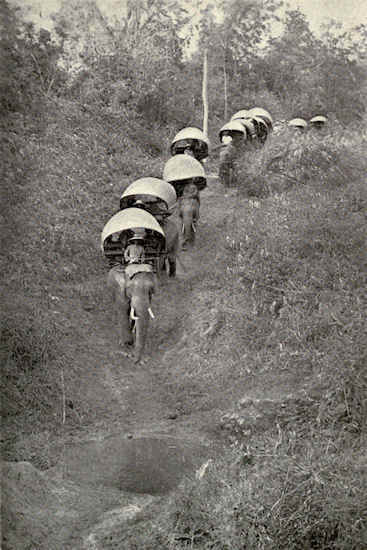
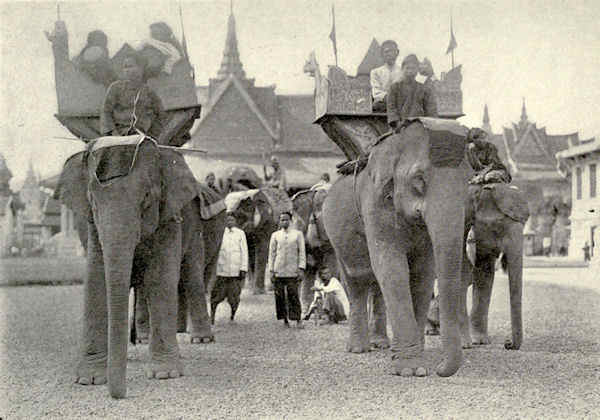
of elephants, bearing men and merchandise beneath their hooded
howdahs, rocking and rolling down the dim and deep-worn forest trails.
Snowy, hump-backed bullocks, driven by naked brown men, splashing
through the shallow water on the rice-fields harnessed to ploughs as
primeval in design as those our Aryan ancestors used. Bronze-brown
women, their lithe figures wrapped in gaily colored cottons, busying
themselves about frail, leaf-thatched dwellings perched high on bamboo
stilts above the river-banks. And, arching over all, a sky as
flawlessly blue as the dome of the Turquoise Mosque in Samarland. Such
is the land that the ancients called the Golden Chersonese but which is
labeled in the geographies of today as Lower Siam and the Malay States.
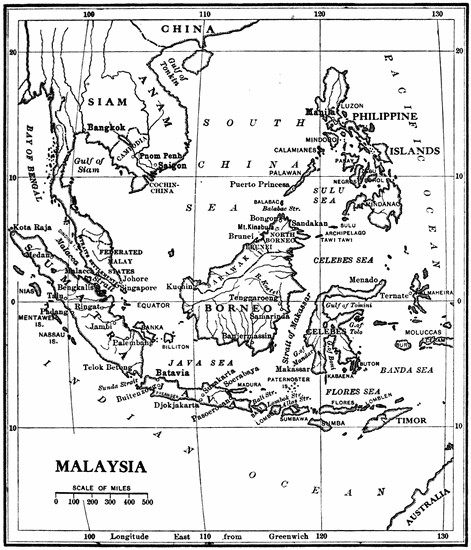
If you will look at the map you will see that Lower Siam extends
half-way down the Malay Peninsula, running across it from coast to
coast and thus forming a barrier between British Burmah and British
Malaya, precisely as German East Africa formerly separated the British
holdings in the northern and southern portions of the Dark Continent.
And, were I to indulge in prophecy, I should say that the day would
come when the fate of German East Africa will overtake Lower Siam.
History has shown, again and again, that the nation, particularly if it
is as small and feeble as Siam, which forms a barrier between two
portions of a powerful and aggressive empire is in anything but an
enviable position.
Politically that portion of the Malay Peninsula which is within the
British sphere is divided into three sections: the colony of the
Straits Settlements, the four Federated Malay States, and the five
non-federated states under British protection. The crown colony of the
Straits Settlements consists of the twenty-seven-mile-long island of
Singapore and the much larger island of Penang; the territory of
Province Wellesley, on the mainland opposite Penang; Malacca, a narrow
coastal strip between Singapore and Penang; and, to the north of it,
the tiny island and insignificant territory known as the Dingdings. By
the acquisition of these small and scattered but strategically
important territories, England obtained control of the Straits of
Malacca, which form the gateway to the China Seas. In 1896, as the
result of a treaty between the British Government and the rajahs of the
native states of Perak, Selangor, Pahang, and Negri Sembilan, these
four states were brought into a confederation under British protection.
Though they are still under the nominal rule of their own rajahs—now
known as sultans—each has a British adviser attached to his court, the
Governor of the Straits Settlements being ex officio the High
Commissioner and administrative head of the confederation. The
non-federated states consist of Kedah, Perlis, Kelantan, and Trengganu,
the rights of suzerainty, protection, administration, and control of
which were transferred by treaty from Siam to Great Britain in 1909,
and the Sultanate of Johore, which occupies the extreme southern end of
the peninsula, opposite Singapore. In the non-federated, as in the
Federated Malay States, British advisers reside at the courts of the
native sultans.
Starting at Johore, which, some Biblical authorities assert, is
identical with the Land of Ophir, and running through the heart of
British Malaya from south to north, is the Federated Malay States
Railway, which has recently been linked up with the Siamese State
Railways, thus making it possible to travel by rail from Singapore to
Bangkok in about four days. Aside from the heat (in the railway
carriages the mercury occasionally climbs to 120), the insects, the
dust, and the swarms of sweating natives who pile into every
compartment regardless of the class designated on their tickets, the
journey is a comfortable one.
That section of the F. M. S. Railways which traverses the Sultanate of
Johore runs through the greatest tiger country in all Asia. The tiger
is to Johore what the elephant is to Siam and the kangaroo to
Australia—a sort of national trademark. Even the postage stamps bear
an engraving of the striped monarch of the jungle. There is no place in
the world, so far as I am aware, save only a zoo, of course, where one
can get a shot at a tiger so quickly and with such minimum of effort.
In this connection I heard a story at the Singapore Club, the truth of
which is vouched for by those with whom I was having tiffin. Shortly
before the war, it seems, an American business man who had amassed a
fortune in the export business, and who was noted even in down-town New
York as a hustler, was returning from a business trip to China. In the
smoking-room of the home ward bound liner, over the highballs and
cigars, he listened to the stories of an Englishman who had been
hunting big game in Asia. The conversation eventually turned to tigers.
"Johore's the place for tigers," the Englishman remarked, pouring
himself another peg of whiskey. "The beggars are as thick as foxes in
Leicestershire. You're jolly well certain of bagging one the first day
out."
"I've always wanted a tiger skin for my smoking room," commented the
American. "Could buy one at a fur shop on the Avenue, of course, but I
want one that I shot myself. Think I'll run over to Johore while we're
at Singapore and get one."
"But I say, my dear fellow," expostulated the Briton, "you really can't
do that, you know. We only stop at Singapore for half a day—get in at
daybreak and leave again at noon. You can't get a tiger in that time."
"There's no such word as 'can't' in my business. Business methods will
bring results in tiger shooting as quickly as in anything else,"
retorted the American, rising and heading for the wireless room.
A few hours later the American's representative in Singapore, a
youngster who had himself been educated in the school of American
business, received a wireless message from the head of his house. It
read: "Arriving Singapore daybreak Thursday. Leaving noon same day.
Wish to shoot tiger in Johore. Make arrangements."
Now the representative in Singapore knew perfectly well that his
promotion, if not his job, depended upon his employer getting a tiger.
And, as the steamer was due in four days, there was no time to spare.
From the director of the Singapore zoo he purchased for considerably
above the market price, a decrepit and somewhat moth-eaten tiger of
advanced years, which he had transported across the straits to Johore,
whence it was conveyed by bullock cart to a spot in the edge of the
jungle, a dozen miles outside the town, where it was turned loose in an
enclosure of wire and bamboo hastily constructed for the purpose.
When the steamer bearing the American magnate dropped anchor in the
harbor, the local representative went aboard with the quarantine
officer. Ten minutes later, thanks to arrangements made in advance, a
launch was bearing him and his chief to the shore, where a motor car
was waiting. It is barely a dozen miles from the wharf at Singapore to
Woodlands, the ferry station opposite Johore, and the driver had orders
to shatter the speed laws. A waiting launch streaked across the two
miles of channel which separates the island from the mainland and drew
up alongside the quay at Johore, where another car was waiting. The
roads are excellent in the sultanate, and thirty minutes of fast
driving brought the two Americans to the zareba, within which the
tiger, guarded by natives, was peacefully breakfasting on a goat.
"He's a real man-eater," whispered the agent, handing his employer a
loaded express rifle. "We only located him yesterday. Lured him with a
goat, you know ... the smell of blood attracts 'em. You'd better put a
bullet in him before he sees us. One just behind the shoulder will do
the business."
The magnate, trembling with excitement for the first time in his busy
life, drew bead on the tawny stripe behind the tiger's shoulder. There
was a shattering roar, the great beast pawed convulsively at the air,
then rolled on its side and lay motionless.
"Good work," the local man commented approvingly. "It's only an hour
and forty minutes since we left the boat a record for tiger shooting, I
fancy. We'll be back at Raffles' for breakfast by nine o'clock and
after that I'll show you round the city. Don't worry about the skin,
sir. The natives'll tend to the skinning and I'll have it on board
before you sail."
Now—so the story goes—after dinner in the magnate's New York home he
takes his guests into the smoking room for cigars and coffee. Spread
before the fireplace is a great orange and black pelt, a trifle faded
it is true, but indubitably the skin of a tiger.
"Yes," the host complacently in reply to his guests' admiring comments,
"a real man-eater. Shot him myself in the Johore jungle. Easy enough to
get a tiger if you use American business methods."
When, upon reaching Singapore, the great seaport at the tip of the
Malay Peninsula which is the gateway to the Malay States and to Siam, I
learned that small but not uncomfortable steamers sail weekly for
Bangkok—a four-day voyage if the monsoon is blowing in the right
direction—or that, by crossing the narrow straits on the ferry to
Johore, we could reach the capital of Siam in about the same time by
the Federated Malay States and Siamese railways, there seemed no valid
excuse for keeping the Negros any longer. So, bidding good-by to
Captain Galvez and his officers, I gave orders that the little vessel,
on which we had cruised upward of six thousand miles, amid some of the
least-known islands in the world, should return to Manila. To leave her
was like breaking home ties, and I confess that when she steamed slowly
out of the harbor, homeward bound, with her Filipino crew lining the
rail and Captain Galvez waving to us from the bridge and the flag at
her taffrail dipping in farewell, I suddenly felt lonely and deserted.
When the people whom I met in Singapore learned that I was
contemplating visiting Siam they attempted to dissuade me. I was warned
that the train service up the peninsula was uncertain, that the
steamers up the gulf were uncomfortable, that the hotel in Bangkok was
impossible, the dirt incredible, the heat unendurable, the climate
unhealthy. And when, desiring to learn whether these indictments were
true, I attempted to obtain reliable information about the country to
which I was going, I found that none was to be had. The latest volume
on Siam which I could find in Singapore bookshops bore an 1886 imprint.
The managers of the two leading hotels in Singapore knew, or professed
to know, nothing about hotel accommodations in Bangkok. Though the
administration of the Federal Malay States Railways generously offered
me the use of a private car over their system, I could obtain no
reliable information as to what connections I could make at the Siamese
frontier or when I would reach Bangkok. And the only guide book on Siam
which I could discover—quite an excellent little volume, by the
way—was published by the Imperial Japanese Railways!
The Siamese are by no means opposed to foreigners visiting their
country, and they would welcome the development of its resources by
foreign capital, but, owing to the insularity, indifference, timidity
and pride which are inherent in the Siamese character, they have taken
no steps to bring their country to the attention of the outside world.
When one notes the energetic advertising campaigns which are being
conducted by the governments of Japan, China, Java, and even
Indo-China, where the visitor is confronted at every turn by
advertisements urging him to "Spend the Week-End at Kamakura," "Go to
the Great Wall," "Don't Miss Boroboedor and Djokjakarta," "Take
Advantage of the Special Fares to the Ruins of Angkor," you wonder why
Siam, which has so much that is novel and picturesque to offer, makes
no effort to swell its revenues by encouraging the tourist industry.
That the royal prince who is the Minister of Communications recently
made a tour of the United States for the purpose of studying American
railway methods suggests, however, that the Land of the White Elephant
is planning to get its share of tourist travel in the future.
I might as well admit frankly that my first impressions of the Siamese
capital were extremely disappointing. I didn't expect to be conveyed to
my hotel atop a white elephant, through streets lined with salaaming
natives, but neither did I expect to make a wild dash through
thoroughfares as crowded with traffic as Fifth Avenue, in a vehicle
which unmistakably owed its paternity to Mr. Henry Ford, or to be
bruskly halted at busy street crossings by the upraised hand of a
helmeted and white-gloved traffic policeman. Nor, upon my arrival at
the hotel—there is only one in Bangkok deserving of the name—did I
expect to find on the breakfast table a breakfast food manufactured in
Battle Creek, or beside my bed an electric fan made in New Britain,
Connecticut, or behind the desk a very wide awake American youth—the
son, I learned later, of one of the American advisers to the Siamese
Government—who eagerly inquired whether I had brought any American
newspapers with me and whether I thought the pennant would be won by
the Giants or the White Sox.
Bangkok, which, with its suburbs, has a population about equal to that
of Boston, is built on the banks of the country's greatest river, the
Menam, some forty miles from its mouth. Though the city has a number of
fine thoroughfares, straight as though laid out with a pencil and
ruler, between them lie labyrinths of dim and evil-smelling bazaars,
their narrow, winding, cobble-paved streets lined on either side by
stalls in which are displayed for sale all the products of the country.
Because of the intense heat these stalls are open in front, so that the
occupants work and eat and sleep in full view of everyone who passes.
The barber shaves the heads of his customers while they squat in the
edge of the roadway. In the licensed gambling houses groups of excited
men and women crowd about gaming tables presided over by greasy,
half-naked Chinese croupiers, and, when they have squandered their
trifling earnings, hasten to the nearest pawnshop with any garment or
article of furniture that is not absolutely indispensable to their
existence in order to obtain a few more coins to hazard and eventually
to lose. As a result of this passion for gambling, the city is full of
pawnshops, some streets containing scarcely anything else. At the far
end of one of the bazaar streets is the largest idol manufactory in
Siam, for the temples whose graceful, tapering towers dot the landscape
are filled with images of Buddha, in all sizes and of all materials
from wood to gold set with jewels, most of them donated by the devout
in order to "make merit" for themselves. As all Buddhists wish to
accumulate as much merit for themselves as possible, in order to be
assured at death of a through ticket to Nirvana, the idol-making
industry is in a flourishing condition.
Pushing their way through the crowded thoroughfares, their raucous
cries rising above the clamor, go the ice cream and curry vendors,
carrying the paraphernalia of their trade slung from bamboo poles
borne upon the shoulders—perambulating cafeterias and soda fountains,
as it were. For a satang—a coin equivalent to about a quarter of a
cent—you can purchase a bowl of rice, while the expenditure of another
satang will provide you with an assortment of savories or relishes,
made from elderly meat, decayed fish, decomposed prawns and other
toothsome ingredients, which you heap upon the rice, together with a
greenish-yellow curry sauce which makes the concoction look as though
it were suffering from a severe attack of jaundice. These relishes are
cooked, or rather re-warmed, by the simple process of suspending them
in a sort of sieve in a pot of boiling water, the same pot and the same
water serving for all customers alike. By this arrangement, the man who
takes his snack at the close of the day has the advantage of receiving
not merely what he orders, but also flavors and even floating remnants
from the dishes ordered by all those who have preceded him. The ice
cream vendors drive a roaring trade in a concoction the basis of which
is finely shaven ice, looking like half-frozen and very dirty slush,
sweetened with sugar and flavored, according to the purchaser's taste
from an array of metal-topped bottles such as barbers use for bay rum
and hair oil. But, being cold and sweet, "Isa-kee," as the Chinese
vendors call it, is as popular among the lower classes in Siam as ice
cream cones are in the United States.
Though the streets of Bangkok are crowded with vehicles of every
description—ramshackle and disreputable rickshaws, the worst to be
found in all the East, drawn by sweating coolies; the boxes of wood and
glass on wheels, called gharries, drawn by decrepit ponies whose
harness is pieced out with rope; creaking bullock carts driven by
Tamils from Southern India; bicycles, ridden by natives whose European
hats and coats are in striking contrast to their bare legs and
brilliant panungs; clanging street cars, as crowded with humanity as
those on Broadway; motors of every size and make, from jitneys to
Rolls-Royces—the bulk of the city's traffic is borne on the great
river and the countless canals which empty into it. Bangkok has been
called, and not ineptly, the Venice of the East, for it is covered with
a net-work of canals, or klongs, which spread out in every direction.
In sampans, houseboats and other craft, moored to the banks of these
canals, dwells the major portion of the city's inhabitants. The city's
water population is complete in itself and perfectly independent of its
neighbors on land, for it has its own shops and dwellings, its own
markets and restaurants, its own theaters, and gambling establishments,
its own priests and police. When you go to Bangkok, I strongly advise
you to hire a sampan and visit the floating portion of the city after
nightfall. The houseboats are open at both ends and you will see many
things that the guidebooks fail to mention.
The Oriental Hotel, the banks, the shipping offices, the business
houses, and all the legations save only the American, are clustered on
or near the river in a low-lying and unattractive quarter of the town.
But follow the long, dingy, squalid highway known as the New Road, a
thoroughfare lined with third-rate Chinese shops and thronged with
rickshaws, carriages, bicycles, motors, street-cars, and Asiatics of
every religion and complexion, and you will come at length into a
portion of the city as different from the mercantile district as
Riverside Drive is from the Bowery. Here you will find broad
boulevards, shaded by rows of splendid tamarinds, lined by charming
villas which peep coyly from the blazing gardens which surround them,
and broken at frequent intervals by little parks in which are fountains
and statuary. There is a great common, green with grass during the
rainy season, known as the Premane Ground, where military reviews are
held and where the royal cremations take place; a favorite spot in the
spring for the kite-flying contests in which Siamese of all classes and
all ages participate. Fronting on the Premane Ground are the not
unimposing stuccoed buildings which house the Ministries of Justice,
Agriculture and War. Not far away is the new Throne Hall, a huge,
ornate structure of white marble, in the modern Italian style, its
great dome faintly reminiscent of the Capitol at Washington. From the
center of the spacious plaza rises a rather fine equestrian statue of
the late king, Chulalungkorn, and, close by, the really charming Dusit
Gardens, beautifully laid out with walks and lagoons and kiosks and a
great variety of tropical flowers and shrubs and trees. But, most
characteristic and colorful of all, a touch of that Oriental splendor
which one looks for in Siam, is the congeries of palaces, offices,
stables, courtyards, gardens, shrines and temples, the whole encircled
by a crenelated, white-washed wall, which is the official residence of
King Rama VI.
There are said to be nearly four hundred Buddhist temples within a
two-mile radius of the royal palace, of which by far the most
interesting and magnificent is the famous Wat Phra Keo, or Temple of
the Emerald Buddha, which is really a royal chapel, being within the
outer circumference of the palace walls. I doubt if any space of
similar size in all the world contains such a bewildering display of
barbaric magnificence, such a riot of form and color, as the walled
enclosure in which this remarkable edifice and its attendant structures
stand. From the center of the marble-paved courtyard rises an enormous,
cone-shaped prachadee, round at the bottom but tapering to a long and
slender spire said to be covered with plates of gold. It certainly
looks like a solid mass of that precious metal, and at daybreak and
nightfall, when it catches the level rays of the sun, it can be seen
from afar, shining and glittering above the gorgeously colored roofs of
the temples and the many-tinted lesser spires which surround it. Close
by the gilded prachadee is the bote or chapel used by the king,
surmounted by a similar spire which is overlaid with sapphire-colored
plates of glass and porcelain, while a little distance away stands the
temple itself, its gilded walls set with mosaics of emerald green.
Flanking the gateways of the temple courtyard are gigantic, grotesque
figures, fully thirty feet in height, carved and colored like the
creatures of a nightmare. They represent demons and are supposed to
guard the approaches to the temple, being so placed that they glare
down ferociously on all who enter the sacred enclosure. Other figures
in marble, bronze, wood and stone, representing dolphins, storks, cows,
camels, monkeys and the various fabulous monsters of the Hindu
mythology, are scattered in apparent confusion about the temple
courtyard, producing an effect as bizarre as it is bewildering. It is
so unreal, so incredibly fantastic, that I felt that I was looking at
the papier-maché setting for a motion picture spectacle, such as
Griffith used to produce, and that the director and the cameraman would
appear shortly and end the illusion.
The interior of the main temple is extremely lofty. The walls and
rafters are of teak and the floor is covered with a matting made of
silver wire. At the far end of this imposing room an enormous,
pyramidal shrine of gold rises almost to the roof, its dazzling
brilliancy somewhat subdued by the semi-obscurity of the interior. Wat
Phra Keo is unique amongst Siamese temples in containing objects of
real value. Everything is genuine and costly, as becomes the gifts of a
king, though it must be admitted that certain of the royal offerings
which are ranged at the foot of the shrine, such as jeweled French
clocks, figurines of Sèvres and Dresden porcelain, and a large marble
statue of a Roman goddess, are of doubtful appropriateness. Ranged on a
table at the back of the altar are seven images of Buddha in pure gold,
the right hand of each pointed upward. On the thumb and fingers of each
hand glitters a king's ransom in rings of sapphires, emeralds and
rubies, while from the center of each palm flashes a rosette of
diamonds. High up toward the rafters, at the apex of the golden
pyramid, in a sort of recess toward which the fingers of the seven
images are pointing, sits an image of Buddha, perhaps twelve inches
high, said to be cut from one enormous emerald—whence the temple's
name. As a matter of fact, it is made of jade and is of incalculable
value. Set in its forehead are three eyes, each an enormous diamond.
The history of this extraordinary idol is lost in the mists of
antiquity. Tradition has it that it fell from heaven into one of the
Laos states, being captured by the Siamese in battle. Since then it has
been repeatedly lost, captured or stolen. Its story, like that of so
many famous jewels, might fittingly be written in blood.
It is the custom in Siam for every man to spend a portion of his life
in a monastery. This rule applies to everyone from the poorest peasant
upward, the king and all the male members of the royal family having at
some period worn the yellow robe of a monk. This curious custom is, no
doubt, an imitation of the so-called Act of Renunciation of Gautama,
the future Buddha, who, at the age of twenty-nine, moved by the
sufferings of humanity, renounced his rights to his father's throne
and, abandoning his wife and child, devoted the remainder of his life
to religion. Just as every American boy is expected to go to school, so
every Siamese youth is expected to enter a monastery, the stern
discipline enforced during this period accounting, I have no doubt, for
the docility which is so noticeable a part of the Siamese character.
While I was in Siam I was the guest one day of the officers' mess of
the crack regiment of the household cavalry. Though my hosts, with few
exceptions, spoke fluent English, though several of them had been
educated at English schools and universities, and though the
conversation over the mess table was of polo and racing and big game
shooting and bridge, I learned to my astonishment that every one of
these debonair young officers, with their worldly manners and their
beautifully cut uniforms, had at one time shaved his head, donned the
yellow robe of a monk, and begged his food from door to door. In view
of the universality of the custom, it is small wonder that Siam has ten
thousand monasteries and that 300,000 of its inhabitants wear the
ocher-colored robe.
The periods of time which men devote to monastic life are not uniform.
Some spend between a month and a year, others their entire lives. Some
enter the monastery in their youth, others in middle age or when old
men. But they all shave their heads and don the coarse yellow robe and
lead practically the same existence. Each morning, carrying their
"begging bowls," they beg their food at the doors of laymen. They come
quietly and stand at the door, and, accepting the offerings, as quietly
depart without expressing thanks for what is given them, the idea being
that they are not begging for their own benefit but in order to evoke a
spirit of charity in the giver. During the dry season it is the custom
of the monks to make long pilgrimages for the purpose of visiting other
monasteries. Each of these itinerant monks is accompanied by a youth
known as a yom, who carries the simple requisites of the journey, the
chief of which is a large umbrella. Traveling in the interior one
frequently meets long files of these yellow-clad pilgrims, with their
attendant yoms, moving in silence along a forest trail. When night
comes the yom opens the large umbrella which he carries, thrusts its
long handle into the ground, and over it drapes a square of cloth, thus
extemporizing a sort of tent under which his master sleeps.
To visit Siam without seeing the royal white elephants would be like
visiting Niagara without seeing the falls. The elephant stables stand
in the heart of the palace enclosure, sandwiched in between the palace
gardens and the Ministry of Foreign Affairs. Each animal—there were
only three in the royal stables at the time of my visit—has a separate
building to itself, within which it stands on a sort of dais, one hind
leg lashed with a rope to a tall, stout post painted scarlet and
surmounted by a gilded crown. Much as I dislike to shatter cherished
illusions, were I to assert that the elephants I saw in the royal
stables were white, I should be convicting myself of color-blindness.
The best that can be said of two of them, is that they were a dirty
gray, about the color of a much-used wash-rag. The third, had it been a
horse, might have been described as a roan, the whole body being a pale
reddish-brown, with a sprinkling of real white hairs on the back. All
three animals were, in reality, albinos, having the light-colored iris
of the eye, the white toe-nails, and the pink skin at the end of the
trunk which distinguish the albino everywhere. As a matter of fact,
"white elephant" is not a correct translation of the Siamese chang
penak, which really means "albino elephant." But most foreigners will
continue, I have no doubt, to use the term made famous by Barnum.
Though the albino elephants are never used nowadays save on occasions
of great ceremony, being regarded by the educated Siamese with the same
amused tolerance with which an Englishman regards the great gilt coach,
drawn by eight cream-colored horses, in which the king goes to open
Parliament, the ordinary elephant is of enormous economic value to the
country, being a combination, as it were, of a motor truck, a portable
derrick, and a freight car. Almost anywhere in the back country, where
the only roads are trails through the jungle, one can see "elephants
a-pilin' teak in the sludgy, squdgy creeks" or being loaded with
merchandise for transport into the far interior. Indeed, the traveler
who wishes to take a short cut from Siam to Burmah can hire an
elephant for the journey almost as easily as he could hire a motor car
in America. It is a novel means of travel, but a little of it goes a
long way. A good working elephant is a valuable piece of property,
being worth in the neighborhood of $2,500., but the prospective
purchaser should remember that the possession of one of these giant
pachyderms entails considerable overhead, or rather, internal expense.
De Wolf Hopper was telling only the literal truth when he sang in
Wang of the tribulations of the peasant who had an elephant on his
hands:
"The elephant ate all night,
The elephant ate all day;
Do what he would to furnish food,
The cry was 'Still more hay!'"
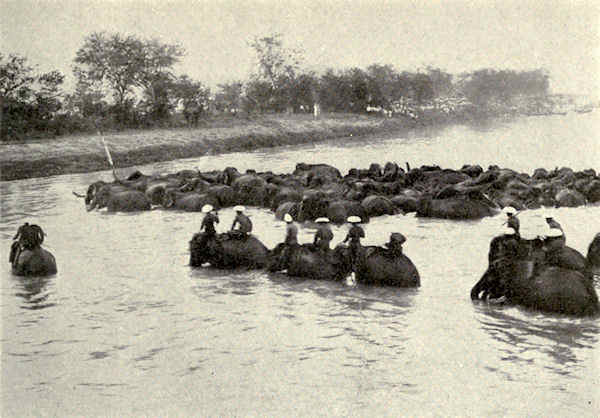
A large herd of wild elephants being driven across a
river
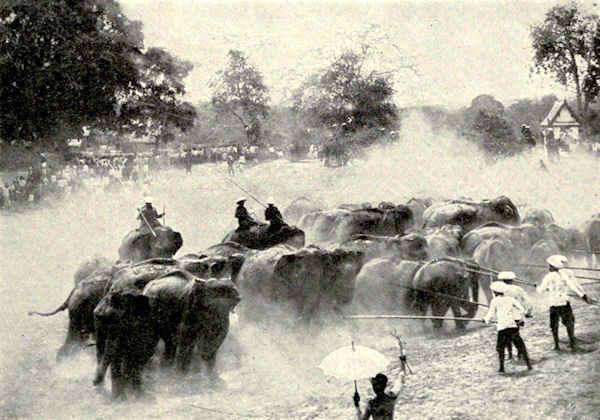
The elephants, herded by domesticated animals, are
driven into the corral
Although, as I have already remarked, sophisticated Siamese regard the
white elephant with amusement tinged with contempt, there is no doubt
that among the bulk of the people the animals are considered as sacred
and are treated with great veneration. Indeed, when Siam was forced to
cede certain of her eastern provinces to France, the treaty contained a
clause providing that any so-called white elephants which might be
captured in the ceded territory should be considered the property of
the King of Siam and delivered to him forthwith. A number of years ago,
a traveling show known as Wilson's English Circus, gave a number of
exhibitions in Bangkok, which were attended by the King, the nobility,
and members of the European colony. When the proprietor saw that the
popular interest in his exhibition was beginning to wear off, he
distributed broadcast handbills announcing that at the next performance
"a genuine white elephant" would take part in the exhibition. Public
curiosity was reawakened and that evening the circus was crowded. After
the usual bareback riding, in which the Siamese were treated to the
sight of European women in pink tights and tulle skirts pirouetting on
the backs of cantering Percherons, two clowns burst into the ring.
"Hey, you!" bawled one of them, "Have you seen the white elephant?"
"Sure, I have," was the response. "The King has a stable full of them."
"Oh, no, he ain't," shouted the first fun-maker. "The King ain't got
any white elephants. His are all gray ones. I'll show you the only
genuine white elephant in the world," whereupon a small elephant, as
snowy as repeated coats of whitewash could make it, ambled into the
ring. Though a suppressed titter ran through the more sophisticated
portion of the audience when it was observed that the ridiculous
looking animal left white marks on everything it touched, it was quite
apparent that the bulk of the spectators resented fun being made of an
animal which they had been taught to consider sacred, certain of the
more devout asserting that the sacrilegious performance would call down
the wrath of Buddha. Their prophecies proved to be well founded, for
the "white" elephant died at sea a few days later—as the result, it
was hinted, of poison put in its food by the Siamese priests and Wilson
himself, who had been suffering from dysentery, died the day after he
landed at Singapore.
Being a young nation, so far as the adoption of Western methods are
concerned, the Siamese are extremely sensitive, being almost
pathetically eager to win the good opinion of the Occidental world.
Thus, upon Siam's entry into the Great War (perhaps you were not aware
that the little kingdom equipped and sent to France an expeditionary
force composed of aviation, ambulance and motor units, thus being the
only independent Asiatic nation whose troops served on European soil)
the king abolished the white elephant upon a red ground which from time
immemorial had been the national standard, substituting for it a
nondescript affair of colored stripes which at first glance appears to
be a compromise between the flags of China and Montenegro. In doing
this, I think that the king made a mistake, for he deprived his country
of a distinctive emblem which was associated with Siam the whole world
over.
Fortune was kind to us in the Siamese capital, for we reached that city
on the eve of a series of royal cremations, the attendant ceremonies
providing enough action and color to satisfy even Hawkinson. It should
be explained that instead of cremating a body immediately, as might be
expected in so torrid a climate, the remains are placed in a large jar
and kept in a temple or in the house of the deceased for a period
determined by the rank of the dead man—the King for twelve months and
so downward. If the relatives are too poor to afford the expenses
incident to cremation, they bury the body, but exhume it for burning
when their financial condition permits. On the day of the cremation,
which is usually fixed by an astrologer, the remains are transferred
from the jar to a wooden coffin and carried with much pomp to the
meru, or place of cremation. When the deceased is of royal or noble
blood the meru is frequently a magnificent structure, sometimes
costing many thousands of dollars, built for the purpose and torn down
when that purpose has been served. The coffin is placed on the pyre,
which is lighted by relatives, the occasion being considered one for
rejoicing rather than mourning. The royal meru, which had been
erected in a small park in the outskirts of the capital at a cost of
one hundred thousand ticals, was a really beautiful structure of true
Siamese architecture, elaborately decorated in scarlet and gold and
draped with hangings of the same colors. Within the meru were three
pyres, concealed by gilt screens, on which were set the coffins
containing the bodies. As there were a number of bodies to be burned,
the ceremonies lasted upward of a week, King Rama going in state each
afternoon to the meru, where he took his place on a throne in an
elaborately decorated pavilion. After brief ceremonies by a large body
of yellow-robed Buddhist priests, the King set fire to the end of a
long fuse, which in turn ignited the three pyres simultaneously, the
ascending clouds of smoke being greeted by the roll of drums and the
crash of saluting cannon.
When I first suggested to friends in Bangkok that I wished to obtain
permission for Hawkinson to take pictures of the cremation, they told
me that it was out of the question.
"But why?" I demanded. "Motion-pictures were taken of the funerals of
the Pope, and of King Edward, and of President Roosevelt, without
anyone dreaming of protesting, so why should there be any objection
here? Nothing in the least disrespectful is intended."
"But this is Siam," my friends replied pessimistically, "and such
things simply aren't done here. No one has ever taken a motion-picture
of a royal cremation."
"It's never too late to begin," I told them.
So I took a rickshaw out to the American Legation and enlisted the
cooperation of our charge d'affaires, Mr. Donald Rodgers, the very
efficient young diplomatist who was representing American interests in
Siam pending the arrival of the new minister.
"I'll do my best to arrange it," Rodgers assured me, "but I'm not
sanguine about meeting with success. The Siamese are fine people,
kindly, hospitable and all that, but they're as conservative as
Bostonians."
Two days later, however, he sent me a letter, signed by the minister of
the royal household, authorizing Hawkinson to take motion-pictures in
the grounds of the meru on the following day prior to the cremation.
I didn't quite like the sound of the last four words, "prior to the
cremation," but I felt that it was not an occasion for quibbling. So
the next day, at the appointed hour—which was two hours ahead of the
time set for the cremation—Hawkinson set out for the meru,
accompanied by his interpreter. He did not return until dinner-time.
"What happened?" I inquired, by way of greeting.
"What didn't happen?" he retorted. "They turned me out just as the
cremation was commencing. When we reached the meru I was met by an
official wearing bright-blue pants, who told me that he had been sent
to assist me in taking the pictures. Well, I got a few shots of the
meru itself, and of the royal pavilion, and of some of the priests
and soldiers, but there wasn't much doing because there wasn't any
action. So I sat down to wait for things to happen. Pretty soon the
troops began to arrive—lancers and a battery of artillery and a
company of the royal body-guard in red coats—and after them came the
guests: officials and dignitaries in all sorts of gorgeous uniforms
covered with decorations. A few minutes later I heard someone say, 'The
King is coming,' so I got the camera ready to begin cranking. Just then
up comes my Siamese chaperone. 'You will have to leave now,' says he.
'Leave? What for?' said I. 'Because the cremation is about to begin,'
he tells me. 'But that's what I've come to take pictures of,' I told
him. 'What did you think that I attended this party for?' 'Oh, no,'
says he, very polite; 'your permission says that you can take pictures
prior to the cremation.' So they showed me the gate."
"Then you didn't get any pictures?" I queried, deep disappointment in
my tone.
"Sure, I got the pictures," was the answer. "Some of them, at any rate.
That's what I went there for, wasn't it?"
"But how did you work it?" I demanded.
"Easy," he replied, lighting a cigarette. "I told the driver to back
his car up against the iron fence which encircles the meru; then I
set up the camera in the tonneau, so that it was above the heads of the
crowd, screwed on the six-inch lens which I use for long-distance
shots, and took the pictures."
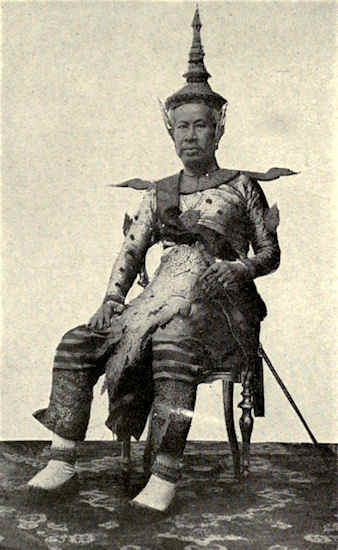
King Sisowath of Cambodia
Though the octogenarian King Sisowath maintains a gorgeous court, he is
permitted only a shadow of power
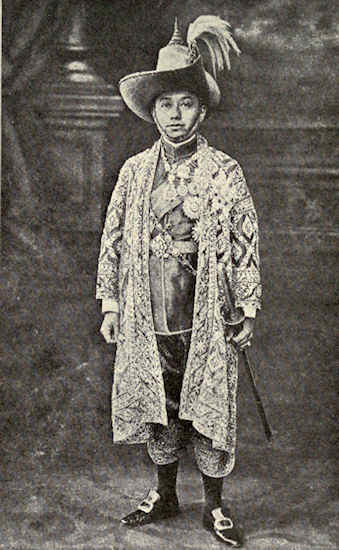
Rama VI, King of Siam
He is in most respects the antithesis of the popular conception of an
Oriental monarch
The present ruler of Siam, King Rama VI, is in most respects the
antithesis of the popular conception of an Oriental monarch. Though
polygamy has been practised among the upper classes in Siam from time
beyond reckoning, he has neither wife nor concubines. Instead of riding
atop a white elephant, in a gilded howdah, or being borne in a
palanquin, as is always the custom of Oriental rulers in fiction, he
shatters the speed laws in a big red Mercedes. For the flaming silks
and flashing jewels which the movies have educated the American public
to believe are habitually worn by Eastern potentates, King Rama
substitutes the uniform of a Siamese general, or, for evening
functions at the palace, the dress coat and knee-breeches of European
courts. He was educated at Oxford and Cambridge and later graduated
from the Royal Military College at Sandhurst, being commissioned an
honorary colonel in the British Army. He is the founder and chief of an
organization patterned after the Boy Scouts and known as the Wild
Tigers, which has hundreds of branches and carries on its rolls the
name of nearly every youth in the kingdom. Each year the organization
holds in Bangkok a grand rally, when thousands of youngsters, together
with many adults from all walks of life, for membership in the corps is
not confined to boys, are reviewed by the sovereign, who appears in the
gorgeous and original uniform, designed by himself, of
commander-in-chief of the Wild Tigers.
In one respect, however, King Rama lives up to the popular conception
of an Oriental ruler: like his father before him, he is generous to the
point of prodigality. This trait was illustrated not long ago, when he
sent eight thousand pounds to the widow of Mr. Westengaard, the
American who was for many years general adviser to the Government of
Siam, accompanied by a message that it was to be used for the education
of her son. This recalls a characteristic little anecdote of the
present ruler's father, the late King Chulalongkorn. The early youth of
the late king and his brothers was spent under the tutelage of an
English governess, who was affectionately addressed by the younger
members of the royal family as "Mem." Upon her return to England she
wrote a book entitled An Englishwoman at the Siamese Court, in which
she depicted her employer, King Mongkut, the father of Chulalongkorn,
in a none too favorable light. Some years later, upon the occasion of
King Chulalongkorn's visit to England, his former governess, now become
an old woman, called upon him.
"Mem," he said, in a course of conversation, "how could you write such
unkind things about my father? He was always very good to you."
"That is true, Majesty," the former governess admitted in some
confusion, "but the publishers wouldn't take the book unless I made it
sensational. And I had to do it because I was in financial
difficulties."
When she had departed the King turned to one of his equerries. "Send
the poor old lady a hundred pounds," he directed. "She meant no harm
and she needs the money."
The chief hobby of the present ruler is, curiously enough, amateur
dramatics, of which his orthodox and conservative ministers do not
wholly approve. In addition to having translated into Siamese a number
of Shakesperian plays, he is the author of several original dramas,
which have been produced at the palace under his personal direction and
in several of which he has himself played the leading parts. As a
result of this predilection for dramatics, he has accumulated an
extensive theatrical wardrobe, to which he is constantly adding. When I
was in Bangkok I had some clothes made by the English tailor who
supplies the court—an excellent tailor, but expensive.
"You'll excuse my taking the liberty, I hope, sir," he said during the
course of a fitting, "but, being as you are an American, perhaps you
could assist me with some information. I've received a very pressing
order for a costume such as is worn by the cowboys in your country,
sir, but, though I've found some pictures in the English illustrated
weeklies, I don't rightly know how to make it."
"A cowboy's costume?" I exclaimed. "In Siam? Who in the name of Heaven
wants it?"
"It's for his Majesty," was the surprising answer. "He's written a play
in which he takes the part of an American cowboy and he's very
particular, sir, that the costume should be quite correct. Seeing as
you come from that country, I thought I'd make so bold, sir, as to ask
if you could give me some suggestions."
It was quite apparent that he believed that when I was at home I
customarily went about in chaps, a flannel shirt and a sombrero, and,
knowing the English mind, I realized that nothing was to be gained by
attempting to disillusionize him.
"Let's see what you've made," I suggested, whereupon he produced an
outfit which appeared to be a compromise between the costume of an
Italian bandit, the uniform of an Australian soldier, and the regalia
of a Spanish bull-fighter. Suppressing my inclination to give way to
laughter, I sketched for the grateful tailor the sort of garments to
which cowpunchers—cowpunchers of the screen, at least—are addicted.
If he followed my directions the King of Siam wore a costume which
would make William S. Hart green with envy.
King Rama's literary efforts have not been confined to playwriting,
however, for his book on the wars of the Polish Succession is one of
the standard authorities on the subject. If you go to Siam expecting to
see an Oriental potentate such as you have read about in novels, His
Majesty, Rama VI, is bound to prove very disappointing.
Colorful ceremonies of old Siam
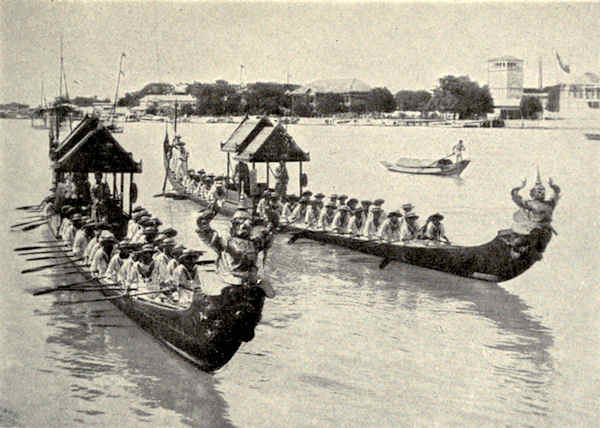
Once each year the King visits the various temples in
and near Bangkok, travelling in the royal barge, a gorgeously decorated
affair rowed by threescore oarsmen
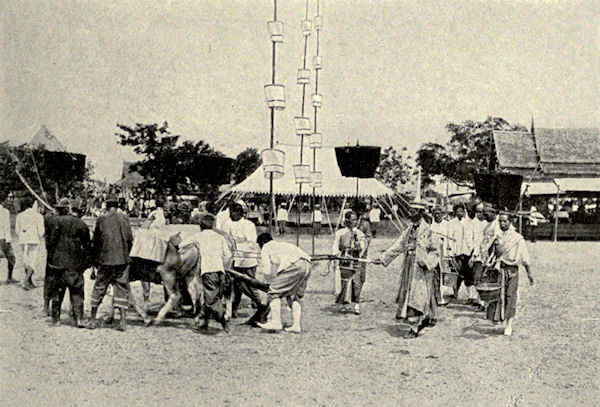
The rice-planting ceremony. The Minister of Agriculture
ploughs a few furrows in a field outside Bangkok, being fallowed by
four young women of the court who scatter rice grains on the freshly
opened soil
But, though the monarch and his court are as up-to-the-minute as the
Twentieth Century Limited, many of the spectacular and colorful
ceremonies of old Siam are still celebrated with all their ancient pomp
and magnificence. For example, each year, at the close of the rainy
season, the King devotes about a fortnight to visiting the various
temples in and near Bangkok. On these occasions he goes in the royal
barge, a gorgeously decorated affair, 150 feet in length, looking not
unlike an enormous Venetian gondola, rowed by three-score oarsmen in
scarlet-and-gold liveries. The King, surrounded by a glittering group
of court officials, sits on a throne at the stern, while attendants
hold over his head golden umbrellas. From the landing place to the
temple he is borne in a sedan chair between rows of prostrate natives
who bow their foreheads to the earth in adoration of this short, stout,
olive-skinned, good-humored looking young man whom nearly ten millions
of people implicitly believe to be the earthly representative of
Buddha.
Another picturesque observance, the Rice-Planting Ceremony, takes place
early in May, when the Minister of Agriculture, as the deputy of the
King, leads a long procession of officials and priests to a field in
the outskirts of the capital, where a pair of white bullocks, yoked to
a gilded plough, are waiting. Surrounded by a throng of functionaries
glittering like Christmas trees, the Minister ploughs a few furrows in
the field, being followed by four young women of the court who scatter
rice grains on the freshly turned soil. Until quite recent years, the
officials taking part in this procession claimed the privilege of
appropriating any articles which caught their fancy in the shops along
the route. But this quaint practise is no longer followed. It was not
popular with the merchants. The Siamese, like all Orientals, place much
reliance on omens, the position of the lower hem of the panung worn
by the Minister of Agriculture on this occasion indicating, it is
confidently believed, the sort of weather to be expected during the
ensuing year. If the edge of the panung comes down to the ankles a
dry season is anticipated, even a drought, perhaps. If, on the
contrary, the garment is pulled up to the knees—a raining-in-London
effect, as it were,—it is freely predicted that the country will
suffer from floods. But if the folds of the silk reach to a point
midway between knee and ankle, then the farmers look forward to a
moderate rainfall and a prosperous season. It is as though the United
States Weather Bureau were to base its forecasts on the height at which
the Secretary of Agriculture wore his trousers.
The panung—a strip of silk or cotton about three yards long is the
national garment of Siam and among the poorer classes constitutes the
only article of clothing. It is admirably adapted to the climate, being
easy to wash and easy to put on: all that is necessary is to wind it
about the waist, pass the ends between the legs, and tuck them into the
girdle, thus producing the effect of a pair of knickerbockers. As both
sexes wear the panung, and likewise wear their hair cut short, it is
somewhat difficult to distinguish between men and women. Siamese women
keep their hair about four or five inches long and brush it straight
back, like American college students, without using any comb or other
ornament, thus giving them a peculiarly boyish appearance. In
explanation of this fashion of wearing the hair there is an interesting
tradition. Once upon a time, it seems, a Siamese walled city was
besieged by Cambodians while the men of the city were fighting
elsewhere and only women and children remained behind. A successful
defense was out of the question. In this emergency, a woman of militant
character—the Sylvia Pankhurst of her time—proposed to her terrified
sisters that they should cut their hair short and appear upon the walls
in men's clothing on the chance of frightening away the Cambodians. The
ruse succeeded, for, while the invaders were hesitating whether to
carry the city by storm, the Siamese warriors returned and put the
enemy to flight. The Siamese prince who told me the story, an officer
who had spent much of his life in Europe, remarked that he understood
that American women were also cutting off their hair.
"True enough," I admitted. "In the younger set bobbed hair is all the
vogue. But they don't cut off their hair, as your women did, to
frighten away the men."
If you will take down the family atlas and turn to the map of Southern
Asia you will see that Siam, with an area about equivalent to that of
Spain, occupies the uncomfortable and precarious position of a fat
walnut clinched firmly between the jaws of a nut-cracker, the jaws
being formed by British Burmah and French Indo-China. And for the past
thirty years those jaws have been slowly but remorselessly closing.
Until 1893 the eastern frontier of Siam was separated from the China
Sea by the narrow strip of Annam, at one point barely thirty miles in
width, which was under French protection. Its western boundary was the
Lu Kiang River, which likewise formed the eastern boundary of the
British possessions in Burmah. On the south the kingdom reached down to
the Grand Lac of Cambodia, while on the north its frontiers were
coterminous with those of the great, rich Chinese province of Yunnan.
Now here was a condition of affairs which was as annoying as it was
intolerable to the land-hungry statesmen of Downing Street and the
Quai d'Orsay. That a small and defenseless Oriental nation should be
permitted to block the colonial expansion of two powerful and
acquisitive European nations was unthinkable.
The first step in the spoilation of the helpless little kingdom was
taken by France in 1893, when, claiming that the Mekong—which the
French were eager to acquire under the impression that it would provide
them with a trade-route into Southern China—formed the true boundary
between Siam and Annam, she demanded that the Siamese evacuate the
great strip of territory to the east of that river. Greatly to the
delight of the French imperialists, the Siamese refused to yield,
whereupon, in accordance with the time-honored rules of the game of
territory grabbing, French gunboats were dispatched to make a naval
demonstration off Bangkok. The forts at the mouth of the Menam fired
upon the gunboats, whereupon the French instituted a blockade of the
Siamese capital and at the same time enormously increased their
demands. England, which had long professed to be a disinterested friend
of the Siamese, shrugged her shoulders whereupon they yielded to the
threat of a French invasion and ceded to France the eastern marches of
the kingdom. Meanwhile the frontier between Siam and the new British
possessions in Burmah had been settled amicably, though, as might have
been expected, in Britain's favor, Siam being shorn of a small strip of
territory on the northwest. In 1904 the French again brought pressure
to bear, their territorial booty on this occasion amounting to some
eight thousand square miles, comprising the Luang Prabang district
lying east of the Mekong and the provinces of Malupré and Barsak.
Seeing that the process of filching territory from the Siamese was as
safe and easy as taking candy from children, the French tried it again
in 1907, this time obtaining the provinces of Battambang, Sisophon and
Siem-Reap, constituting a total of some seven thousand square miles,
thus bringing within French territory the whole of the Grand Lac and
the wonderful ruins of Angkor. In 1909 it was England's turn again,
but, disdaining the crude methods of the French, she informed the
Siamese Government that she was prepared to relinquish her rights to
maintain her own courts in Siam, the Siamese being expected to show
their gratitude for this concession to their national pride by ceding
to England the states of Kelantan, Trengganu and Kedah, in the Malay
Peninsula, with a total area of about fifteen thousand square miles. It
was a costly transaction for the Siamese, but they assented. What else
was there for them to do? When a burly and determined person holds you
up in a dark alley with a revolver and intimates that if you will hand
over your pocketbook he will refrain from hitting you over the head
with a billy, there is nothing to do but accede with the best grace
possible to his demands. In a period of only sixteen years, therefore,
France and England, by methods which, if used in business, would lead
to an investigation by the Grand Jury, succeeded in stripping Siam of
about a third of her territory. The history of Siam during that period
provides a striking illustration of the methods by which European
powers have obtained their colonial empires.
It was the Great War which, by diverting the attention of France and
England, probably saved Siam from complete dismemberment. Now, in
robbing her, they would be robbing an ally and a friend, for in July,
1917, Siam declared war on the Central Powers, despatched an
expeditionary force to France, interned every enemy alien in the
kingdom and confiscated their property, thus ridding France and England
of the last vestige of Teutonic commercial rivalry in southeastern
Asia. The Siamese, moreover, have had a national house-cleaning and
have set their country in thorough order. Their national finances are
now in admirable condition; they have accomplished far-reaching
administrative reforms; they are opening up their territory by the
construction of railway lines in all directions; and they have obtained
the practical abolition of French and British jurisdiction over certain
of their domestic affairs, while a treaty which provides that the
United States shall likewise surrender its extra territorial rights and
permit its citizens to be tried in Siamese courts has recently been
signed.
The future of Siam should be of interest to Americans if for no other
reason than that it is the one remaining independent state of tropical
Asia. Indeed, it is known to its own people as Muang-Thai—the
"Kingdom of the Free." Whether it will remain so only the future can
tell. I should be more sanguine about the continued independence of the
Land of the White Elephant, however, were it not for the colonial
records of its two nearest neighbors, which heretofore, in their
dealings with Asiatic peoples, have usually followed
"The good old rule ... the simple plan,
That they should take who have the power,
And they should keep who can."