E may love a man for himself, and admire his gifts, and
yet differ altogether from his beliefs. We may go fifteen miles out of
twenty with a guide, and turn off our own way the remaining five.
E may love a man for himself, and admire his gifts, and
yet differ altogether from his beliefs. We may go fifteen miles out of
twenty with a guide, and turn off our own way the remaining five.
Surely it cannot be called inconsistency to go the fifteen miles and
break off at the five; to revere the genius of John Ruskin and love his
character, and yet take a stand against him when he directs painting! to
coincide with his abstract theories of art, and oppose his practical
hints! to praise him in the preface and blame him in the pamphlet!
This is a paradox which the student of man may easily comprehend. The
exhibition of vanity, or meanness, or pettiness which last year may have
filled me with just indignation or contempt, this year may be met in my
mind with over-balancing excuses and reasons. I was close upon it when
it loomed up, and it looked a mountain, hiding with its black shadow all
the rest; but my distance of to-day has reduced it to its correct size,
a dirty mud-heap at the foot of the mountain of nobility,—or the wisdom
of the ages has added another year to my growing mind.
Yet I do not regret what I have said, for if we cannot pick the beam
from our own eyes, is it not something that we are able to point out the
mote in the eye of our brother? It is a compliment which we expect him
to return by helping us to clear the more ponderous encumbrances from
our sense of vision.
John Ruskin I regard as a master at whose feet no man, however strong,
need be ashamed to sit: one as nearly the ideal man as we may expect
frail humanity to be—self-sacrificing, devoted, single in the pursuit
of his object; microscopic in his vision (herein lies his fault as a
general teacher—he cannot stand far enough back from his picture),
seeking to the core before he will be satisfied, becoming the disciple
of the man he would criticise, never trusting to a casual glance of the
subject he would describe, going patiently all round it, getting into it
if he can. A word to trust as you might the Spirit of Truth—as far as
he can see it.
He is a bigot, being in deep earnest, as all reformers must be, having
only one right road which they are treading, but (I put my finger on
the weak spot) he has disciples who are too completely satisfied with
him, who, having fallen in love, have become blind, and he has the
weakness to be satisfied with their satisfaction. The gold is pure which
he has refined, the armour is bright which Faith has clasped upon
him—but there is a red rust that will get upon the brightest armour if
the damp breath of adulation be allowed to rest upon its surface, the
arrogant vanity which eats into the soul.
As a philanthropist and moral leader, as a poet and beautiful example,
set up John Ruskin.
If the world could follow it, the shepherds more than the sheep, then
would it be nearer the standard set up by the Founder of Christianity,
further from forms, falsehoods, luxuries. But the world has its own
standards of morality, as he fixes his about art; only, John Ruskin is
sincere: but, alas for the others!
He is wrong from my point of sight as regards painting, therefore I say
so; he is not all gold, but so great is my love of the gold that it
forces me to hate in proportion the clay; but would that I could walk in
his footsteps for all the rest!
I dare say you have all stood at times to look at a street showman
throwing up three balls in the air, and spinning them about from one
hand to the other.
I wish that I could demonstrate this feat, but unfortunately I am not
clever enough, neither have I been able to find any friend who could do
it, else it would have been a great pleasure to me, and I doubt not also
to you, if I could have aided my symbol by introducing to you at this
point the model of some long-haired gentleman, with his symmetrical
person glittering with spangles and bright textures, who, tossing up the
yellow, red, and blue balls, would thus have added amusement to
instruction. However, since I have not this artifice to help me, I must
trust to your memories of such a sight as I go on.
Yellow, red, and blue: these are the three colours that I wish to begin
the game, and with which you are likely also to end it.
The showman pitches up the coloured balls, and as they slowly cross one
another we can trace their course and local tints perfectly, even while
we are soothed with the harmony they produce all together. Red passes
yellow, and an image of orange flashes in front of us, even while we see
both red and yellow quite distinctly apart; red passes blue, and purple
at once dashes between the blue and the red; yellow passes blue, and
green is the result.
Yellow, red, and blue are the primary colours; orange, purple, and green
are the direct mixtures of the primary colours, or secondary tints.
The showman gets animated, and the three balls are sent spinning rapidly
from hand to hand: they seem all to be in the air at once, blending and
dashing about each other until there is no red, or yellow, or blue, no
distinct orange, purple, or green, but a thousand indefinite shafts and
ripples of colour. Is it red, blue, green, orange, purple, yellow, or
gems and sparkles of fire? They are only three, three that are a host,
three that have become brown, grey, black, all sorts of browns, every
description of that subtle and endless grey.
Can the painter do any better than imitate the street showman with the
three colours? Start fair, mix slowly and decidedly, get animated, and
dash along, with his entire heart in his work, some thought in his head,
and his eye steadfastly fixed on nature, and nature only, while his
fingers run over the keyboard to the music she sets before him. He will
not require to trouble himself about much else, for it will all come out
of the mist in very good time, when he has learned the trick of keeping
the three in unity and motion.
The child, when he gets a paint-box, as a rule, begins quite right,
although he does it unconsciously. He will paint his picture-book with a
red face, yellow coat, and blue decorations. Most likely you will find
him disdain all mixtures, except perhaps green, which impresses him as
nice—no doubt from its association with the fields, where he likes to
run about and play.
The savage, with his tattooing and war-paints, does the same exactly,
with the superior significance of his symbols: every twist of the
ornament meaning a grade or a power, every streak a motive or a threat.
His gods are reverenced only as the mementoes or symbols of the unseen
or divine, not because they are stones or sticks, as we so often
misunderstand heathenism.
Old Egypt stands to-day, mighty monument of the grandeur of simplicity:
with its solid works that defy time, its glaring colours that defy
criticism.
Assyria comes after, with her purples, her gold, and her greater
refinements. ‘White, green, and blue hangings, fastened with cords of
fine linen and purple to silver rings and pillars of marble: the beds
were of gold and silver, upon a pavement of red, and blue, and white,
and black marble.’[7]

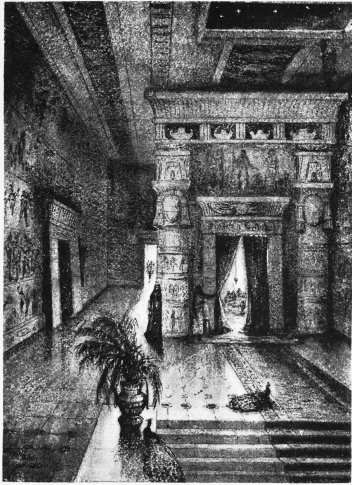
AN ANCIENT EGYPTIAN CORRIDOR
(From a sepia sketch by the Author)
These are ladybird wings that send us fluttering back nearly three
thousand years, to the hanging gardens by the Tigris, the broad walls
and the open streets where the war-chariots jostled and the broad moon
hung like a golden lamp between heaven and earth, and mingled her silver
shafts with the ruddy sparkles of the perfumed torches, as they shivered
and vanished into the darkness of the shadows of the painted boats, down
by the porphyry steps that led from the old palace of the king.
Is it the sound of the instruments we are listening to? the voices of
the singers? the tinkle of the silver ornaments round the ankles of the
dancers? the laughter of the drinking guests of Ahasuerus?—or the
snapping and snarling of the jackals over the few spare bones that the
last caravan for Baghdad has left on that earth-mound by the river at
Mosul?
Egypt stands the queen, with her ageless pyramids and her sphinxes,
because Egypt came up first with her first principles in art and
science, to which, as we gain knowledge and confidence in ourselves, we
must return.
The youth grows out of his pinafores and his first paint-boxes, he gains
a partial knowledge of art, and like us all when only half educated on
our subject, grows arrogant and developes into a very fierce critic.
He also becomes a fine customer to the art-colour merchants, fills his
boxes and palette with every conceivable colour that is made,
particularly the more expensive sort; cadmiums and rose madders are his
delight; he wallows in paint.
He has become so very knowing that where poetry may have been able to
fire his fancy before, only paint can now content him. If pre-Raphaelism
is the fashion, he will lay in a set of sables and pick away at little
threads like a weaver until he is half blind; if it is the low-toned
school he affects, then daylight becomes obnoxious, sunlight abhorrent
to him; he riots in November fogs and dismal rainy weather, grovels in
shapeless symphonies, and the dingy harmonies of the Dutch.
I have tried to like the pre-Raphaelite school, because the man whose
word is considered law beyond dispute has said it is the right thing in
true art. I have seen Holman Hunt’s great picture, the ‘Shadow of the
Cross,’ and could see in it nothing but hard lines and forced symbols as
hard as the lines. In Millais’ picture of ‘Effie Deans’ I saw a fair
young girl with a world of hopeless woe in her face that brought tears
to my eyes. In Hunt’s ‘Boy Christ’ I saw nothing but china-blue eyes and
hard little touches, hair like bits of wire, and all devotion worked out
of it by the multitude of its pitiful details: I saw time and drawing
and infinite work on it, but nothing else. I never saw the original of
the ‘Light of the World,’ but I have seen engravings from it, and
although five hundred greater men than John Ruskin were to write that it
is ‘the most perfect instance of expressional purpose with technical
power which the world has yet produced,’ I would hold to my own
idea—that, if it is painted as the ‘Shadow of the Cross’ is painted, it
is no more than a man dressed in Eastern costume standing at a door with
a lamp in his hand, a few creepers beside him, and all worked to death
with hard little lines, without anything exalted about it or wonderful
in its composition.[8]
There is a world of false humility and gross want of self—assertion in
this weakness of bending down to the opinions of acknowledged
authorities or time-honoured superstitions, particularly in matters to
be seen, as pictures or statuary. The old masters are regarded as
infallible, yet in the exhibition of autotypes from the Queen’s drawings
from old masters, at one time exhibited at the Museum of Science and
Art, Edinburgh, I saw many samples of bad drawing, weak handling,
timidity, slow-dragging invention—all that marked the draughtsmen as
faulty mortals in spite of their great names, and nothing in the whole
collection to prove them any greater, but rather less, than our modern
men, even although it does approach blasphemy to say this.
Speaking of low tones, I must confess to a fondness for this fascinating
affectation. Jozef Israels is more than nice, although I require the
mist which gets into my eyes when I try on a pair of spectacles before I
can see outlines so soft and hazy, and colours so undecided and sombre,
as his are. Corot I cannot see to be the prince of landscape painters,
although the critics did call him so, if the pictures which they were
then lauding to the skies are samples of his princely style, for I could
see nothing more in them than a lot of dirty scrubbing about with his
hog hair—and not too much paint wasted either.
To a certain extent this low-toned school seems to have reason on its
side, for when we compare our scale of colours with the scale of nature,
we find how limited we are, how boundless she is.
White is our only semblance to light, and what a leaden symbol it is
when we regard the brightness of our example!
Black is our deepest dark, and how shallow it is when we try to look
into the depth of the shadows about us!
And so it seems but right that, being so utterly unable to reach the
heights or the depths of what we wish to depict, we ought to send back
and keep down every step or key of our board in the same proportion as
our lights and our darks are—make our picture, in fact, not so much the
imitation as the dim reflection that we see in a window sometimes when
there is a dark cloth hung behind it, or in the camera obscura.
Were I comparing styles, I would say that Turner struck a high note in
his scale, and rippling up lost himself in white.
Rembrandt struck a low key, and went out of sight in his blacks.
The low-toned school strike a faint half-note, and playing falsetto,
lose themselves in dingy obscurity at both ends, never venturing very
high or very low.
All are right from their own standpoint, but the Turner and the
Rembrandt schools are nearest truth, because they look straight at
nature and not on her reflections; and because, as our whites are
already so far below nature’s light, the sooner we strike our nearest
approach, the sooner we shall arrive at our imitation, and vice versâ.
To return, though, to our paint: I would fain ask you to regard all
beauty as so much mixed colour, something in the same way that the
youthful anatomist sees only a lovely dissection in the arm or face that
may be sending some other sentimental youth into poetic fits.
I here quote a little from John Ruskin—a man noble and
self-sacrificing, whom I can admire, not blindly, like a reasonless
lover, but with the qualified reverence of a sensible helpmate. I like
to fall in with the fashion when I can. In writing on colour as the test
of a painter he says:
‘If he can colour, he is a painter, though he can do nothing else....
The man who can see all the greys, and reds, and purples in a peach will
paint the peach rightly round, and rightly altogether; but the man who
has only studied its roundness may not see its purples and greys, and if
he does not, will never get it to look like a peach; so that great power
over colour is always a sign of large art intellect: every other gift
may be erroneously cultivated, but this will guide to all healthy,
natural, and forcible truth. The student may be led into folly by
philosophers’ (the worthy Professor here holds up unconsciously the red
light against his own dangers), ‘and into falsehoods by purists, but he
is always safe when he holds the hand of a colourist.’ (‘Modern
Painters,’ vol. iv. part v. chap. iii.)
The young man is perfectly right to revel in his many colours as long as
he can, to dabble about with them to his heart’s content, send his
shafts of madder and cobalt, terre verte and siennas, and all that he
can range out in battle-order, across his canvas. Time mellows painters
as it does paint, and where the colour offended them in their lavish
youth, in their riper manhood they see, beyond this, many qualities
which they never thought of looking for before.
I think a painter is about the very worst critic we can set before a
picture; perhaps this may serve as some sort of excuse for the faults of
Ruskin. He will be able to dissect the picture, tell you how this part
has been worked, and with what, but he can hardly stand on impartial
ground, the only position for a judge or critic.
If his forte is colour, he must stop dead at this, and because his
sensitive and cultivated taste is offended by some flaw in his
particular hobby and firmly fixed habits, he will get no further, and
see nothing else; just as a sensitive ear will be offended by a jar in
the playing, and lose in the irritation the whole of the composition and
thought.
You say, But a picture ought to be perfect. True; so ought the man who
has painted it, and perhaps would have been had Eve not eaten the apple.
I never saw a perfect action in my life, far less a perfect picture.
And so also with the pre-Raphaelite; he condemns the bold and broad
style, and the rugged painter sees only paltry crotchet work in the
pre-Raphaelite. They are all right, and so of course it stands to reason
that they must be all wrong to each other.[9]
However, to return to our picture on hand. We have gone over it with our
chalk, charcoal, or pencil, and in doing so we must try to be very
particular in drawing it thoroughly. First, we will block in our subject
roughly and slightly, as a sculptor would begin to hack out his stone or
shape his clay. It does not make any difference whether it is a
landscape or a figure we are aiming at; we must begin it first with a
few marks of distance, put it into squares, divide it with straight
lines, measure it with our eye in its broadest sense, box it up, and put
rigidly from us all temptations at this stage to enter into details.
Leave all the fine curves until we are sure that we have room for them
with our square lines; a rough touch for a nose, a mouth, a branch, or a
house, it is all the same, and all that we require for the present; more
will only distract our attention from the duty before us, which is the
exact proportions of the masses, and the position they hold towards each
other.
Second stage—go over it carefully bit by bit, use our mental point,
measure it all again with our eye, compare very minutely this part with
some other part, the breadth of this window or nose with their length,
and the breadth and length of something else; look at the relative
position of two parts, the angles of imaginary lines that you mentally
pass between them, and so on, and so on; in fact, be our own harshest
critics, and leave not the smallest space unmeasured or unthought of,
previous to our filling it in.
Next we go into details, and by degrees walk carefully over our clumsy
outsides, cutting gradually in farther and farther, until we have lost
the square angles without losing the firmness which they have given to
us, and with perfect assurance and ease dash in our beautiful quivers
and curves, not with the harsh, hard, clear lines of a copy-book, but
with the soft, broad, breathing lines of nervous talent.
We are now ready for paint, so we will begin to set our palette. We
start with white, and put it nearest to the thumb-hole, as it is what we
shall use most; next we take the yellows, being nearest the light in
colour—the brightest first, our lemons and chromes, Naples yellows,
ochres, cadmiums, and raw siennas. You will not need the half of these
unless you like. Next follow the reds—vermilion, crimsons, roses, light
and Indian reds, or whatever else you please, in decreasing scale of
brightness to our browns, and our blues, cobalts, ultramarine or
permanent, Prussian, indigo, &c., and so wind up with the darks and
blacks.
You can paint a picture with three colours, and you can use all that are
in the colour list; only have a method and reason for everything you do,
and if a good reason, it will be the proper thing to do. We set our
palette thus, because our tints are thus in harmonious gradations from
us; and also, if by mistake our brush comes into contact with two
colours at once, it will not do so much damage as it otherwise would if
such colours as yellow and blue were placed side by side; both in such a
case would be dirtied past any further service.
In setting your palette, you may use your own discretion, as I have
said, and cram it with all the high-sounding, high-priced range to be
found in the many-leaved colour list-books, but one thing time and
experience alone can teach you—that the greater your art knowledge, the
more limited will be your range of colours and implements. You may begin
with the rainbow, but you will return eventually to your earths; for
what I hold to be the great secret in painting, poetry, and literature
is—simplicity. Fine words, dear colours, only mystify the student and
prove the weakness of the worker.
For brushes, in oils try to acquire the use of hog-hair brushes if you
would make effective and vigorous work; sables and soft brushes are sure
to tempt you, being so much pleasanter to a beginner. But if it is not
miniature, pre-Raphaelite, or tea-tray painting which you aspire to,
keep from them as long as you can. Do not use softeners either, but
rather place your colours firmly, and separately, and purely, so as to
produce the effect you desire by knowledge and skill, and not by
trickery.
Make your lines rather suggestively than literally, and the larger your
brushes the finer your work will be; for if we look at nature we cannot
find lines, or if there seem lines they are formed by many
cross-divisions so minute and filled with gradations that the finest
sable-hair is like rope-work beside them.
We cannot copy the delicacy of nature, for we cannot trace it, therefore
we must content ourselves with attempting to give a little of the effect
and feeling that we from our distance can trace. This is why, from my
point of view, pre-Raphaelitism is a clumsy, abortive imitation of the
upper surface, and not so true a translation of the whole as the
painting of the broad and suggestive worker.
In water-colour we require to use sables for our washes—that is, if it
is water-colour and not opaque painting we are attempting.
Now for the subject. There are two ways of approaching it: one with fear
and trembling, thinking of all the poetry that is in it, or rather the
sham sentiment that we fancy is in ourselves, and would fain make other
people believe to be our own outpourings, while in reality it is the
effect left on our dazzled mind after reading the matchless
cloud-and-water poetry to be found in the pages of ‘Modern Painters’ and
other works by the same author. How fondly we are apt to imagine, as we
quote, that we have seen countless miles of transparent cloud beyond
cloud, vistas opening up as we gaze, and think so it ought to be
painted, as if mortal hand or manufactured paint could do it, while all
the time we are only miserable waiters serving up in a flashy way the
utterly impossible dishes Ruskin has so finely spiced in his own private
kitchen!
Do you think that Turner painted half the beauties Ruskin sees in his
pictures, thought out half the mountains of thought his admirer makes
him think, had a quarter of the intentions the Professor fathers him
with?
No! Turner was a poet, and painted, as Shakespeare wrote, on the spur of
the moment, with the same glorious knack of being able to leave alone
‘happy flukes’, which chance and accident gave them, and this knack,
if not the spirit of genius, is a very good substitute for it.
I do not mean to say that Turner painted from impulse only. I have not
the slightest doubt that he had intentions, and most carefully planned
out all his conceptions, as Shakespeare planned out the fabric, or
bones, of his plays; but the great bits of detail, the compact word, the
chance touch, the sparkle of wit, the sweep of the hog-hair that made
the veins upon the little shell by the sea-shore, the twist of the
palette knife that broke the colours into prismatic ripples on the
rounded wave—all that his admirer writes as forethought I do not
believe. He must have thought on the clouds and waves and sands which he
so often watched, the varying shapes and tints they took, the mixture of
all he had seen sweeping into shore, and thinking of all this while his
deft hand laboured hard to produce the semblance, so it took shape and
grew into being; or else he worked away and tried other methods and
experiments until the results came, and more wondrous results do come
thus by chance than the forced and mechanical labour of mere industry.
We spoil a good deal of good work through overwork. If we could but let
well alone we should not suffer the bitter reflections and heartburn of
a remembered chance cast away. We go on polishing and working, rounding
off this energetic sentence, touching over that harsh brush-mark, until
we have refined all spirit out of our work, and finish it off with a
smooth surface and nothing else.
To quote once more from Ruskin when he is for a moment sensible; he
speaks of the value of finish in the ‘Stones of Venice’ thus: ‘Never
demand an exact finish when it does not lead to a noble end. If you
have the thought of a rough or untaught man, you must have it in a rough
and untaught way; but from an educated man, who can without effort
express his thoughts in an educated way, take the graceful expression
and be thankful, only get the thought and do not silence the peasant
because he cannot speak good grammar, or until you have taught him his
grammar. Grammar and refinement are good things both, only be sure of
the better things first.... Always look for invention first, and after
that for such execution as will help the invention and as the inventor
is capable of, without painful effort, and no more; above all, demand
no refinement of execution where there is no thought, for that is
slaves’ work unredeemed. Rather choose rough work than smooth work, so
that the practical purpose is answered, and never imagine there is
reason to be proud of anything that may be accomplished by patience and
sand-paper!’
We can desire to read nothing broader or finer than this from any man,
for the man must write or paint roughly who cannot do better through his
want of education; but if the thoughts are there, it must be well. The
man also must write and paint roughly, no matter what his education has
been, when his thoughts are quicker and fuller than his power of
execution, and it is better to have the rough work and the full thought
than the finished work and something lost. But, no matter whether it be
science or art that the man is treating, I would reverse the advice
Ruskin gives in his introduction to ‘Proserpina,’ and tell the man to
write it in the language that he and his neighbours are most familiar
with, and not waste his time locking it up in a dead language that only
a few can understand. As to taking a month to each page, if heaven has
gifted him with ideas, he will find this as impossible to do as it will
be for the man or woman who have the spirit of men or women, and not the
essence of fools and apes, to cut the acquaintance who may be in reduced
circumstances, or engaged in honest, therefore holy, labour.
The other way of coming before nature is the tersely realistic, that
regards the changing glories of the sunset or moonrise with a callous,
critical, investigating glance, indulging in no idle visions or fancy
images, but dividing the glories into degrees of colour and gradation.
The school of Shelley sings—
When sunset may breathe
From the lit sea beneath
Its ardours of rest and of love.
This cool hand cuts down all the ardours, and dots them lemon, orange,
chrome, rose madder, vermilion, raw umber, and cobalt.
And yet we must approach nature with a certain amount of awe and
veneration, if we would be painters and not painting-machines. If we
have any sentiment in our composition at all, we can no more gaze upon
the beautiful or grand without a responsive something being stirred
within us than we can hope to eat pork chops the last thing at night and
escape the nightmare.
The dash of the waterfall must produce in us more than the dry
estimate of its sparkling colours, or we are not far removed from the
fern that draggles by its edge. A lovely face or graceful form must
teach us more than carnation and ochre, or we deserve to be the hero of
Campbell’s melancholy poem ‘The Last Man.’ If we do not feel the spirit
of the whole while we watch the form, the colour, and lights and shades,
we are worse off than the shadowless man, for we have pawned our souls
without redeeming that faithful follower.
It may be the spirit and beauty of peachy golden youth, or the spirit
and beauty of gnarled silver age, that we are watching. We see the
lights and the shadows playing about, the greens, the purples, the
browns, the reds, the yellows, the whites, but we feel that there is
more than this. We dissect hair, we see in the dark the rich brown
madder shadows with the purple half-lights and blue gleams, and we know
this makes the raven’s plume from the right standpoint; or the golden
tress, with its mixtures of ochre, green, and red, and we thrill at the
dusky loveliness that is crouching in the silky masses, or the angel
glory that is hovering round the fair, and so we drink in all the poetry
that we must have to refine and gild our realistic common sense before
we can appreciate it enough to paint it.
Once with a friend I watched a glorious sunset, and as I stood setting
my two palettes—one, imagery, where I was spreading out all my mental
stock of jewels, pearls, and opals for the greys, rubies, and
cairngorms, and a great many other precious stones from my castle in
Spain; with the other palette seeking to snatch from the weak little
tubes that intense dun and purple rolling about through the
thunder-drift,—seeking to bring down the waves of variation, the orange
and the gold and the green and burning flames subdivided ten
thousandfold, to my rule of three, seeking to draw down heaven and shut
it inside my paint-box,—I was somewhat amused by hearing my
colour-blind friend murmur pensively, ‘Red-lead and lamp-black.’
That settled the whole conundrum, and I passed on.
How to paint a picture, that is the question. Although imagination ought
to be brought with us when we come to nature, it should be as our own
bicycle under us, and not like our neighbour’s bicycle, riding over us.
We must give the spirit of what we see, and no more; for we shall commit
a hundred errors if we vainly attempt to give the spirit of the oak
while we are painting its bark. Of course we know what the oak has done,
we recall all that we have read of Nelson, Collingwood, and other hearts
of oak who have spilt good blood to prove that ‘Britons never shall be
slaves’; and although, perhaps, it ought to give an oak-tree an air of
all this as it stands before us, yet there it stands before us, full of
knots and wrinkles, with its gnarled limbs flung about it, and its green
moss, silver lichen, and amber and purple darting between; and I take
it, this is what our painter has to get into his head and imitate. We
cannot see past its bark unless it is torn open, and then we may not see
the bark, and we must never think of painting what we cannot see. If, by
the help of our poetic taste, we can convey to the spectator the
sentiment we do see about it, of a hardy, sturdy, rugged sentinel that
has done duty there before our grandfathers were born, which goes on in
the same impassive way while we lie dead in sleep, and may go on ever
the same when perhaps we make up part of the earth and fungus about its
roots, unless God’s swift telegram, the mighty lightning-flash, or man’s
paltry axe, gives it its furlough,—if we can do this, as well as give
an image of the reality, we have done all we can do—made a noble work
and created a poem.
Never mind what anyone else sees in the subject, stick resolutely to
what your own eyes tell you, and you must be right. Say someone tells
you there is a man coming along the road; you think it does look like a
man, but you only see a splash of mixed colours with a certain sweep
about it; put that in, and someone else looking at your picture will
say, ‘You have made a man.’
This is the grand trick of landscape figure painting, for if anyone can
see a single line of detail about your figure more than the tree, or
stone, or hedge beside him, your figure is a failure and should come
out, for it is spoiling the unity of your picture.
So with clouds, water, mountains, trees, everything created above us,
beneath us, about us. My harp has only three strings, and were I to
finger it for a thousand hours, to a thousand different tunes, it would
be with the same variations. What paints sunset, paints sunrise, midday,
moonlight; the same colours that sparkle in the bright patch sparkle in
the deep shadow, and the variations of yellow, red, and blue are as
pronounced and apart in each blade of grass as they are in the white
clouds rolling above it, and as distinct in the dazzling snowdrift as in
the burning sunset skies,—there is not an inch without its variety, but
only a variety of three.
Return as soon as you can to the child with his first paint-box, the
savage in his woods, grand old Egypt that must stand for ever; but bring
back all your knowledge, so that you may know why you painted as you
did when you began. Thus will you learn humility, which is only taught
by true and great wisdom, and the charity that has a hundred eyes.
We should begin our subject as we first see it. As we enter a room, the
first thing that strikes us is the great masses of light and shadows
before us; objects are all divided thus, and so we should paint our
first stage or working. This is the effect we are securing.
Afterwards objects proclaim themselves: they start out of the
masses—chairs, tables, pictures, people. That is our second stage or
working—the broadest fact of the individuals.
Thirdly, we see the details, ornaments, patterns, textures.
Lastly, as we get to look more closely, we see in each shadow a world of
colour, all the sparkles and gems, and the same in every light. This is
our finishing stage, and may be prolonged as far as we like and can go.
With landscape also it is the same. We would paint a tree: the first
thing that strikes us is its general shape—first working. Next its
great divisions of light and shadow, when some masses come out and other
masses go back, also a general idea of its prevailing tone. Second
working—Then, as we work and watch, come indications of branches, the
large limbs first, then the less, and so on, until we lose the lines of
the smallest branches and can only guess where they have gone to.
There are also suggestions of leaves which we know are leaves, although,
as they lie about in all directions, they get mixed up into all sorts of
shapes, and come gradually upon us: and this is the third stage of
working.
If we paint in the leaves as we know they are shaped, we must get a
stiff and unnatural picture, because we are not painting what we see,
but what we think should be there; and if we paint each individual leaf
as we would copy one set before us, or as we see them in Christmas
cards, we must paint in an abortive, unnatural, and exaggerated manner,
because, as our tree is so greatly smaller than the tree before us, if
each leaf was also in proportion less we could not make them out with
the naked eye.
How, then, ought we to do it? Not like a pre-Raphaelite or teatray
painter, but as we see it—broadly and in masses, doing what we can with
our own clumsy fingers and clumsier tools; and since we cannot get all
the details of nature, best leave them alone with true humility as
beyond us, and do what we can, and as nearly in proportion as we can.
To do this use hog-hair brushes, stand well back from your picture, and
try to keep the spectator back also. Tell him, like Salvator Rosa, that
the smell of paint is not good for him, or say he will never be able to
see the landscape if he pushes himself so amongst the branches and
leaves of the tree, or that it is rude to get so close to a lady’s
face—anything, only keep him back the proper distance. If shortsighted,
let him be content with the description of other people about it, and
deplore his own misfortune, for a picture that is painted to be looked
at two inches from the eyes can never be a ‘thing of joy.’
When before nature, it is strictly proper to adhere as closely to facts
as we can, put into our sketch everything that we can see before us, and
even at our closest following up we shall not get in a hundredth part.
True, the student is none the worse for a little fancy to help him out
of the road with any very ungainly object in front of him, but I doubt
if he will find a much better substitute than the objection he wishes
away.
The telegraph-post does its part in the composition of the picture as
conscientiously as the lovely silver birch, and at a place where the
birch would be too much.
We are searching after the picturesque, and stop, caught by something
that is fine, and yet when we dissect it we may find it full of the
objections and faults which we have been taught to reverence. Shall we
alter what nature has done so well, introduce our poor little rules, and
tailorise the picture until it stands reproachless?
Rules! nothing seems to me so forced, so curbing as this word. We ought
not to draw this as it is, because some of the lines are running counter
to what they ought to be. It is a sin against precedent if we put that
wall or fence as it at present stands. Good taste and the example of the
old masters forbid us to put on this colour, to do that. At every turn
we are met by a ticket marked ‘Trespassers will be prosecuted to the
utmost rigour of the law.’ Keep on the beaten track, or else you must
expect to suffer the consequences.
I hate all precedents and rules in art, and my advice would be, ‘Put in
all that looks well in nature, and it will be your own bad work if it
does not look well in your picture.’
As to this veneration for the old masters, were they infallible, were
they more gifted than we are, had they more advantages for learning art
than we have? Yes, one great advantage over us—they had no old masters
to annoy them, only the spirit that God gave them to struggle on with,
as we should also have did the world not bid us bow down and worship
these time-stained old idols. They were great, and so may we become when
we are dust and ashes, and time has deified us and stained our pictures
to the golden duskiness that is fashionable, and tradition has distorted
our sayings and exalted our prolonged labours into sudden flashes of
genius.
It is very good practice to copy some pictures when there is something
in them that we wish to learn, yet cannot see how to do from nature. For
instance, you may learn how to glaze and scumble better from a picture
than from nature, because the glazings and scumblings of nature are too
subtle for us to follow always so directly.
You will also learn how painters of repute managed a certain phase or
effect of colour, subject, or composition. Rubens will liberate you from
many a stiffness, and give you in his own buoyant style the liberty and
joyful colouring you may be deficient in. Vandyke will teach you
refinement and dignity; Tintoretto, richness; Michael Angelo, the
boldness and firmness of handling and drawing, the severity and
squareness needful for majestic grandeur.
Amongst our own men, I quote John Pettie for a strength and richness
that have never been surpassed, bring what master of long-ago you like
to the competition; Orchardson for pure and delicate texture; Sir
Frederick Leighton for finish; Millais for realism in its best sense;
Alma-Tadema for imitation and learning; and a host of other men, both
good and true, who must improve the mind, the eye, and the hand.
Millais has said that an artist ought to begin as he did,
pre-Raphaelite, if only to learn the quality of Job. Nature eventually
must make him, as she has made that great realistic master, broad and
strong, if it is to be, though a whole world of critics were to chorus
against it.
Speaking of critics, I think we may divide them into two classes—the
psychological and the destroying, or vermin, species. The first class
look at a painting or a book as we ought to look at everything—with the
bee spirit, to suck out all the honey there is in it. They are of equal
use to the public and to the worker; for, leaving one to see the errors
that all man’s work has, they lay the good before the other, benefiting
equally themselves in the instruction they have gained. As for the other
class, do they help the work done, or that has to be done? do they add
to the pleasure of the spectator, or instruct the worker by their
pertness or sneers? Do moths add to the value of clothes? does mildew
improve walls? does rust assist the brightness of polished steel? or do
white ants strengthen the rafters they bed in?
True, these are all works of nature and creatures of God. The decay must
be as useful as the life, or it would not be. But what made critics of
this class? From what? For what?
Discreet copying, as I have said, is very good; but there is only one
other practice as pernicious as indiscriminate and constant copying, and
that I will speak of presently.
What is glazing and scumbling?
Scumbling is going over distance with white or grey, rubbing it hard and
dry, so as to obscure the parts that stand too prominently out; it
softens harshnesses, sends back portions, and does its part in aiding
the general harmony of the distance and middle distance.
Glazing is the use of transparent colours with some sort of medium, such
as madders, siennas, browns, to give richness to the depths, lower the
tone in places needful, as foregrounds and such like, that come direct
with all their local hues about them; it brings things forward, as
scumbling sends objects back.
Tone is the cast of your scale of colour, the setting of your key, the
tuning of the pitchfork, to be determined on before you begin your
picture, and remembered all through it; and it is the forgetting of
this at times which stamps the amateur.
Style.—Of course everyone has his own taste to consult in this, and
what you admire you will, consciously or not, imitate, until nature
rectifies it and gives you a style of your own. The artist must
fluctuate among several styles, always following and trying to
understand nature, even while he admires other painters, until at last
the scales fall from his eyes, and he relies only on the powers given
him when he least expected it. A spark of what is to be will show out
here and there until the to be has come.
That is, unless when, in their frantic efforts to be original, painters
hunt heaven and earth for the most startling effect, subject, or
treatment; then they become like French cooks—continually stirring
their minds for new mixtures to catch and astonish the public taste,
spending all their foolish energies in the spicing of old stale
thoughts.
It may be we admire Sam Bough, with his versatile fancy and vigorous
touch; or Lockhart, Macdonald, Fildes, &c., with their strong, healthy
‘go’; or Herdman, Faed, &c., with their sweet touch and poetic minds; or
Sir Noel Paton, with his exquisite drawing, radiant colouring, and
originality of conception; or Waller Paton, with his purple and gold; or
the late lamented Paul Chalmers, who flung everything into the scale
against colour and made it weigh them down; or Harvey, who chose the
moral thought; or Gustave Doré, who revels in the image. I could go on
naming hosts who have styles distinct by power or affectation, for it is
in the style that we show our affectation, as we do it in our walking
and our talking; but I would only say that if you wish to be natural and
great, think very little upon the style you would take, and more upon
the thought you wish to express; be earnest in your work, and by
earnestness you will forget your delivery, and so be both natural and
original. And, after all, what does it matter whether people say we are
like So-and-so or not, if we are doing our very best? We must find the
true peace with honour, and the repose that ever follows honest,
earnest exertions.
It is also good practice to draw with the point, pencil, or pen as
rapidly as possible all that partakes of motion—ships sailing, engines
puffing out the volumes of steam and smoke, clouds, water, waving trees,
and reeds. Fill up your books and scraps of paper with all sorts of
shorthand notes; very likely you will not be able to decipher the wild
scratchings again, but they have done their duty while you were
scribbling them in by fixing something in your mind.
Watch closely as you sketch, and after you get home think it all out and
write down as nearly as possible all about it—the colours you think
should be used for it, the shape of it, the comparative size, and also,
if you can, the poetry and emotions it awoke in you.
Books on painting, as a rule, are only confusing to the mind of the
novice—filled with words difficult to comprehend, and of very little
use when the conundrum is solved. Like recipe and cookery books, they
serve, after you know your subject without them, to warn you against
what they advise, also to advertise the many colours you are to flounder
amongst for a season. But nature is the best recipe-book: her problems
are as easy to unravel, and when read, serve your lifetime.
Sir Joshua Reynolds is very good and sensible on painting, although I
cannot answer for his remarks on pictures.
John Ruskin’s books are entertaining, splendidly and carefully prepared
inside and outside, even to the colour of the morocco and calf-skin; the
language as select and carefully weighed as the shade of the edges, and
the title as maturely considered as the material on which it has to be
printed. It is a great pleasure to handle one of his books, or even to
see one of the backs on our shelves; they are like greyhounds amongst
rough tykes; in fact, I have often felt sorry to open them, the bindings
are such masterpieces of thought.
When opened the pleasure is not diminished, although mystification may
set in at times. We sail smoothly over page after page, soothed with the
harmony, exalted with the poetry, thralled with the exquisite grace,
diction, and finish; we can hardly think of stopping to inquire what it
is all about, it is all so delightful, so ethereal—the work of a great
master of the pen.
Read and moralise, if you will, upon such beautiful touches as this:
‘Morning breaks as I write along those Coniston Fells, and the level
mists, motionless and grey beneath the rose of the moorlands, veil the
lower woods, and the sleeping village, and the long lawns by the
lake—shore.’
This passage is only one of many that remind me of splinters from the
big diamond that was supposed in olden times to flash out of the head of
the toad. Copy it if you can with your brush, for it is very perfect in
its word-painting, and true to mornings I have seen in Cumberland.
But when he tells you how to paint, beware! for here he is a perfect
will-o’-the-wisp, sparkling out with his lovely lights, and luring you
on, now over dry land, now over marsh; giving at times good advice,
following it up by bad; telling you practical truths or ethical
fallacies.
If he was a consistent wrecker, we should get to know his fires and
steer clear of them in time; if he was all theory, we should enjoy him
as we do other poets; but he is like a man who has built a fine house
with chaste design and perfect decoration: it looks all that one can
desire, and has only one fault, but that is a grave one—the rafters and
supports are rotten.
He may be justly praising the old muddy Venetian glass, with its
ever-varied though clumsily-finished designs, as compared with the
sameness of our superior quality and finish; and putting absurdly silly
questions into the mouth of his supposed audience, as if a scavenger who
does his work honestly and comports himself uprightly could not be as
good a gentleman as the aristocrat who paces by him; and making out what
is done for economy, and justly so, to be the result of a false shame,
forgetting the parable of the talents, or the utility of working the one
as well as the five.
He may speak of the sanctity of colour, and go on abusing the coarseness
of Rubens, or the sensuality of Titian and Correggio, to be perhaps
followed up by the information that Titian and Tintoretto, when they
looked at a human being, saw the whole of its nature inside and out, and
painted it so.
He may abuse low tones, and tell us that all which is vile, and deadly,
and evil is sombre in colour, although in the same breath he will admit
that the tiger-skin is rather pretty, and that some bright flowers and
berries are poisonous, and also that there have been lovely women not
quite all honey, past and present.
He is abusing Salvator Rosa, although comparing him with painters of his
time—I don’t know why; or in his own graceful way changing his tune,
and telling us that all good colour is pensive, and that it is blasphemy
to be gay.
He may abuse the past painters of storms and gloom, to turn with
gloating rapture to the tempests and gloom of Turner.
He may remorselessly plunge Teniers into the bottomless abyss for his
degrading subjects, yet praise Turner for his wallowing and grovelling
amongst the litter of Covent Garden; advocating his slanting steeples as
if that were the proper way for steeples to stand, or reviling some one
else for the same thing. How he raves throughout his books on the great
man! and how the great man, like old Samuel Johnson with his Boswell,
must have laughed, when not too much mystified or aggravated, at the
high-flown discoveries of his ardent admirer!
He may tell us that the chief power of Rembrandt was his character
drawing, and that he knew nothing of light and shade; or indulge in such
weak and heartless exhibitions of the fop wit as when he replies to
Constable’s remark about chiaroscuro: ‘The sacrifice was accepted by the
Fates, but the prayer denied. His pictures had nothing else, but they
had not chiaroscuro.’
I think I see this great critic leaning back after polishing off this
pert, unfeeling, and untrue bit of little smartness, with all the
complacence of having written a clever thing; it is on a par with his
dress-coat retort to the Blackwood critic of October, 1843, about the
silver spoon and the orange; on a par with his intolerable remarks on
the pictures of Whistler—who, however, did not improve matters by his
pamphlet.
He may write about the utter meanness and humiliation of the imitators
of woods and marbles, as if a bit of wood or marble was not of as much
importance to the art student and as much a part of nature’s graining as
the bark outside, or the blade of grass that engrossed his microscopic
eye so completely that he could not see the majesty of the Alps above
him. I can grain a little, and I feel as proud of this accomplishment as
I do when I paint a tree or a mountain something like, and never felt
degradation either in one or the other.
He may assume the lofty, and retire to his immaculate shell when asked
his advice on art, disdaining to give an opinion to a people who dare to
tolerate Frith’s ‘Derby Day,’ and live there with his saints and kings,
or come forth with mighty condescension and tell the nations to hurry up
and avail themselves of his priceless services while yet there is time.
I admit all his greatness with true humility, yet I think we must allow
that before he was born good works were done in art, and even after the
lustre of his presence is withdrawn from amongst us I do not despair.
I know it is the fashion to quote Ruskin and Carlyle. I like them
both—Carlyle, because he is cut out of bigger stuff, and, like all
colossal work, rougher in his finish; but it is jarring to hear at every
turn in life, ‘as Ruskin says,’ ‘as Carlyle remarks,’ when Solomon has
said it all before, and perhaps many wise sages before him. God has
given minds to us as well as to Carlyle or Ruskin, and surely it is
better to say in our own way the old truths than recite from books that
other people can read as well as ourselves, if they like, merely to show
how clever, how ethical, or how well read we are. Read as much as you
can, but think out truths for yourselves.
Modesty sometimes compels us to state our authority when we dread to be
called the author of something not our own; also there may be times
when, like the use of a foreign word, it is inevitable—but the less the
better, both for our own selves and our listeners.
It is good at times to do a little wholesome penance, compare our work
with that of others, to try, for instance, how our picture looks in
comparison with some other picture of the same or a similar subject.
Modesty will perhaps point out many faults and shortcomings that we
could not find out in any other way; but the most vicious habit in young
painters is the perpetual running about each other’s studios. To quote
the words of Solomon with a slight alteration, I would say, ‘Put not
your feet too often into your neighbour’s studio, lest individuality be
left outside.’
We see the effects of this practice in many of the pictures around us
every day: all good work in themselves, but with so little difference of
style that the only surprise is, the one name is not at the corner of
the lot.
It is good to exchange ideas at times, but only at times. On the whole,
I am of opinion that originality and individuality are more precious
than good workmanship, but both are best.
It is good to be able to copy a tree, or a stone, or a wall faithfully
and well, bring out all its variations and time-scars with fidelity; but
it is better to paint a moral and a thought, even although it is only
half expressed, for the spectators may fill out of their own mines of
thought all that you have left unsaid, although it is best to be able to
express it to the last letter.
All have different minds, as they have different tastes and habits. Some
are literal, and content with the fairness of the earth; they are poets
and painters of the real. Wordsworth is a realistic poet, Millais a
realistic painter; others are purely imaginative, and paint and write
about visions and the unseen, steadfast and serene dreamers of the
ideal. Shelley and Coleridge are imaginative poets, William Blake and
David Scott imaginative painters. Fancy sways others, and flings them
about, half on earth, half in air; excitement like that of the
footlights or champagne others, such as Byron and Gustave Doré.
All are to be admired, and are admired, and it becomes a question
impossible to answer, which have the five talents and which have the
three.
Imagination seems to me a very sublime quality, without much joy or
mirth in its composition; it does not require images to suggest
creation—‘out of nothing it creates’; yet I dare not say that it is a
quality more to be desired than the merry fancy that builds its domes
and castles out of the clouds, or from the rocks and surroundings draws
images of other creations; neither would I say that there was less of
power or poetry in the mind that keeps strictly to reality and renders
the spirit and the being of all about them. They are all great gifts, to
be honoured one as much as another, but none partaking in that fantastic
unfinish and impotency called Mystery.
Goethe writes:—
Pure intellect and earnest thought
Express themselves with little art.
And I think him right, for, though mystery may be in vogue and
considered fine, I hold to my theory of Egypt, the child, and simplicity
in all things.
It is good at times to yield to the inner promptings, and attempt to
illustrate our thoughts, imaginings, dreams, and embody the images
raised in our minds when we read a story or listen to a description.
The scene rises before us quite distinctly, vague but vivid in its
colouring. We try to seize something special, and the whole vanishes;
that is our first experience, but by practice and perseverance you will
find the characters come to be less shy, and at last range themselves to
method, and stay while you are drawing their arms and legs with
exemplary patience.
It is good to be orthodox when we can in all that we do, to follow out
as far as is consistent with our own sense of manliness the fashions of
the day; but it is not good to enslave ourselves either for fashion,
popularity, or money. If we cannot do our work consistently, let us do
what we can.
If a certain mode of painting is termed proper and ‘good colour,’ or an
affectation of uncertainty or mystery that may look like unfinish, but
in reality requires more work than the apparent finish, and we desire to
please the artists and picture-dealers, and live as it were for the
hour, we may acquire this affectation, if it does not cost too much
thought; that must ever rank above all technicality. But it is a
matter of choice which ought to be studied most—ourselves, the public,
or the professors. When a line can be drawn without offence to either,
it is policy to draw it.
Public opinion is fashion, and not much to be depended upon. What is
abused to-day may be lauded another day. It may be led by one man who
constitutes himself the leader, and he will be followed if enduring
enough to place himself in the front, and brave enough not to be crushed
by the sneering and the growling that must assail him for a time.
Titian’s flesh tints were called chalky by the critics of his day. David
Cox could not please anyone, not even the children; his pictures got
turned out or skied in exhibitions, he was glad to sell a sketch for a
tube of paint; and we have seen what David Cox’s little water-colour
daubs sell at now.
As with painting, so with poetry. Did Milton look the poet to Cromwell
that he is to us? The relations of Robert Burns thought the kindest
action towards him would be to burn his ungodly rubbish.
Is Whistler wrong in his mode of expressing himself? is the natural
question that comes up here. I do not know, although I have seen much of
his work; but it seemed to me all right, only Ruskin says it is wrong,
and I do know that Ruskin is not always right.
But, whether right or wrong—and he will be both, as we all are to our
different critics with their different tastes—the opinion of one man,
or of ten thousand men, can neither make him wrong nor right.
No man ought to buy a name and grumble afterwards if the picture becomes
of less value.
Even such names as Raphael ought to weigh as nothing when before their
pictures. If the thing is bad in Raphael, it is bad in Whistler; if it
is good in Raphael, it could not be bad if it was Whistler.
If a picture is worth 200l. to the man who paid that sum for it, it
can never be worth a farthing less to him afterwards.
If a man buy a coat, a house, a horse, or a picture, he ought to know
why he is buying it; and if it is value in his eyes, it cannot, or
ought not to, be made valueless by all the newspapers or critics in the
world. And if he has no knowledge on the matter, no likings, no
opinions, he ought to depend on some one whom he can trust who has
knowledge, and never alter afterwards; or he ought to spend his money
only on what he has fixed ideas about, or give it away in the cause of
charity, about which we all, as human beings, even the weakest, have
surely some sentiment clinging about us as a forecast of heaven. If he
spends his money only for fashion’s sake, he deserves not only to lose
it, but to lose also the respect of every man of sense and purpose, for
he is a fool incurable.
We cannot all be educated on every subject, but we can all tell what
pleases us, and it is our duty to manhood to say so, and not take the
opinion of others against our feelings. For instance, if we are eating
something nice, is it no longer nice if our neighbour says it is not? or
ought we weakly to take the fashionable dish that we abhor, and pay ever
so much more for it, with our mouth watering after the cheap dish that
we can understand and relish?
Water-colour painting is the use of transparent colours with the ground
or paper serving as our white. The treatment may either be by wash or
stippling and hatching.
Stippling and hatching is the going over our work with dots or crossed
lines. Like engraving, its chief merit is the vast labour it costs, if
that is a merit; yet at times it has to be done where washes fail to
bring the effect.
Opaque or body colour, like fresco painting, is the mixing of Chinese or
zinc white with the colours. A little chemistry should be studied in
this work, as some of the other metals do not agree with zinc.
The farther we keep two systems apart, the better and the purer both
will be, although the effect is the main object, and all other
considerations of less consequence. The more we glaze in water-colour,
the more subtle will be our work; the less we glaze in oil, the more
satisfactory and firmer will be the result. Yet, obey no arbitrary laws;
do whatever brings the conclusion quickest, and it must be legitimate.
If your knife does better than your brush, use it; if your fingers, use
them. Scratch, scrape, rub, cut, polish, shave, do whatever you think
will succeed, and if it does not, try some other experiment until it
does come up to your wishes. If the colour you have put on is not the
one you need, put its complementary tint beside it and change its
character, or dash it over or about it. Have only your object firmly
fixed in your mind, and scruple at nothing in the way of experiment. The
more methods you employ, the nearer you will be to the ever-changing
method of nature.
I have not touched upon half my points, and only touched those I have
gone over. I could go into details about the manner of mixing up the
colours, and how to treat some of the special effects of nature, but
that I have already done.[10] I am tempted to draw a sunset, or a storm,
or a calm, with all their different objects in the background, middle
distance, and foreground, dissect them into paint as I pass down, tell
you what is sitting in the flank of one cloud and the total change of
shadow in the next, also why it is so, and must be so according to this
rule of three.
I should like also to show you the same sportive three nestling in the
sun-kissed breast of the same air-billow; quivering in the blue-grey
haze of the far distance; floating on the glittering ocean, or diving
amongst the deep reflections of the lake; peeping out of the froth and
the heavy curl of the advancing wave; dashed into pieces on the dulsy
sands; darting about the broad masses of the middle distance; playing at
hide-and-seek amongst the branches, leaves, and weeds and rocks of the
foreground.
The three are everywhere, and infinite in their sport—two ever
subordinate and obedient, advising, enhancing, leading; one ever acting
the monarch, yet ever being dethroned and supplanted by one of the two
counsellors, to join the other in obedience and then conspiracy, to leap
up, take the reins, sink down vanquished, and all this for ever and for
ever.
And on Perspective; for although Gainsborough has said that the
painter’s eye is the best guide, we must have rules here, if only that
we may forget them discreetly.
We must draw our horizontal line, and be guided by it; also know where
to fix and keep in mind our points of sight, stand-point, and dots of
distance; be able to place our vanishing lines, know where they are
going, and why they are so going. We must also know where to drift our
shadows, and when to trail them; how long our reflections ought to be,
and why at one time we make them longer than the object, and why at
another time so much shorter. This is all imperative to the art student,
although it may be overdone. The rules are not so hard as some imagine,
and, like painting, are best demonstrated in nature. Sit down to draw
part of a city with two or three streets slanting different directions,
pass lines about from your horizontal line, until you fix on the right
slope, and you have gleaned all that there is to get practically out of
Perspective.
Many a good picture is spoiled by the painter ‘showing off’ his
knowledge in this line, where a little deviation from the stiff law
would have redeemed the whole; just as many a clever speech is often
spoiled by the speaker weighing it down with complex and ornate words.
And on Anatomy; for, although the classic Greeks are supposed to be all
ignorant on this subject, it is no excuse for our ignorance; the science
is now established, and it is our duty to learn it if we would be
perfect draughtsmen of the human body and its exertions.
Gustave Doré, through his great knowledge of anatomy, can take the
liberties he does with his figures, and yet be to a certain extent
natural. Look at his thousands of figures, with their countless twists
and contortions, if you desire to know the ease and power the study of
anatomy gives to a man.
The Greeks had perfect models. Their customs, exercises, abstinence and
games gave them this advantage over us; but times have changed: our
climate, our costumes, our habits are all against us, and without the
knowledge of bones and muscles we should never discern between the
natural and the deformed, and just picture Venus rising from the salt
foam with a corset-curbed waist or the traces of a badly-set joint!
And how should we know what ought to be, and what ought not to be, in
our model, if we are ignorant of his or her construction?
True, the Greek statues are there, to copy and educate our eyes to the
true and lovely; but how are we to know whether the Greek statues are
perfect, if we do not know why that lump starts out when the arm or leg
is planted so? The study of the Greek statues is about as long as the
study of anatomy, and not so satisfactory, but both are best.
And now one word on Exhibitions and Academies.
Exhibitions.—It is good for ourselves to get pictures hung in
exhibitions, independent of the good it does to our pockets, that is,
when we can. Although I think the intelligent public do not pay so much
heed as to whether your name is in the catalogue or not, yet the great
mass who get all their ideas from the morning news, and read all the
criticism as gospel, lay a stress upon it.
But to see your picture alongside of many, is to see many of your
faults; and yet only to a certain extent, for the best pictures for
rooms are not always the pictures that look best in exhibitions. They
may have qualities too original, or striking, or fine for the glare, and
the distance, and the surroundings.
The qualities for exhibition purposes are soberness, not too much
individuality or variety, qualities that dovetail their single part with
other single-part pictures, so as to make a pleasing harmony of the
whole. It is the student’s own choice whether he will, therefore,
sacrifice his idea for a place in the catalogue, or run the chance of
missing that and keeping his ideas.
Of course when he is famous he may do as he likes, and the world will
say all is perfect that his hand touches.
Academies must be good when they foster the art youth, encourage
originality, train his eye and his hand, and keep active his mind to the
true principles of art and the animation of thought; bad if, while they
train the hand, they crush out spirit, originality and thought.
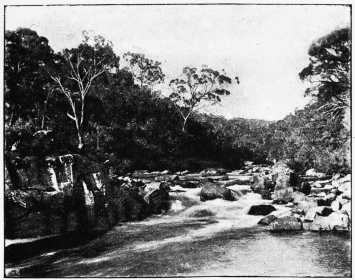
ON THE ESK RIVER, TASMANIA
(From a photograph by Major Aikenhead, Launceston)