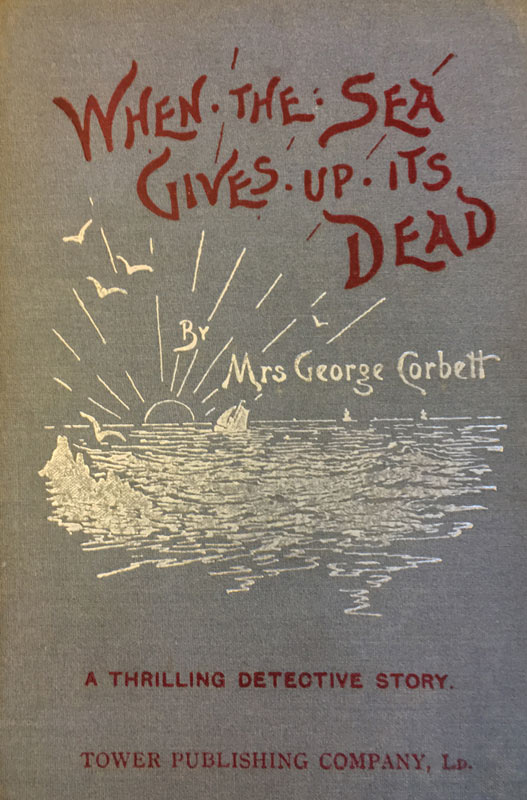
CHAPTER I. “THE DIAMOND ROBBERY.”
WHEN THE SEA GIVES UP
ITS DEAD.
“Confound that upset! I shall be two minutes behind
time—I wish I had walked all the way, instead of trusting
to the supposed extra speed of a ’bus, when the streets
are so slippery that horses cannot keep their feet.”
Thus soliloquised Harley Riddell, ruefully, as he hurriedly
picked his way through the somewhat aggressive conglomeration
of wagons, hansoms, ’buses and fourwheelers,
which threatened to still further belate his
arrival at the
establishment of his employers, Messrs. Stavanger, Stavanger
and Co., diamond merchants, of Hatton Garden.
By dint of an extra spurt from the corner of Holborn
Viaduct, he managed to be less unpunctual than he had
expected; but, somewhat to his surprise, he fancied that
the assistants whom he encountered betrayed signs of suppressed
excitement, which were not at all in keeping with
the usual decorous quietude of Messrs. Stavanger’s aristocratic
establishment. Still more astonished was he to
notice that, whatever the reason for the unusual excitement
may have been, it became intensified by his arrival.
But there was just a tinge of alarm mingled with his astonishment
when he perceived that both the Brothers
Stavanger and Mr. Edward Lyon, who was the “Co.” in
the business, were here before him. As not one of these
gentlemen had ever been known to come to business
before eleven o’clock in the forenoon, Harley may be excused
for thinking it odd that they should all be here on
this particular morning before the city clocks had boomed
ten, and that, furthermore, they should all stand gazing
at him with expressions which suggested suspicion and
anathema.
“Nothing wrong, I hope, sirs?” was Harley’s impulsive
question.
“You are no doubt the best judge of that,” said Mr.
David Stavanger, who, being a vicar’s churchwarden,
systematically cultivated a dignified bearing and an impressive
mode of speech. “Probably the atrocious injury
to which we have been subjected has been exposed to the
light of detection sooner than you bargained for. You
perceive, Mr. Detective,” he continued, turning to a
short, but very well-built man of middle age, who was also
contemplating our hero with unusual interest, “you perceive
the instantaneous working of an evil conscience!
No sooner does this ingrate see us here a few moments
before our usual time than he jumps to the very natural
conclusion that he is at the end of his criminal tether.”
“I beg your pardon,” interrupted the detective, whose
name was John Gay. “Your deductions, Mr. Stavanger,
are possibly more decided than correct. We have yet to
hear what this gentleman has to say for himself, and you
will perhaps let me remind you that it is dangerous to make
statements that we perhaps may be unable to prove.”
“Gentleman, indeed!” exclaimed Mr. David.
“Yes sir, with your permission, gentleman—until we
have proved him otherwise.”
“That will be an easy matter,” put in Hugh Stavanger,
the son of the senior partner. “Everything points to him,
and him alone, as the thief.”
Harley had not noticed Hugh Stavanger’s presence
until he thus unpleasantly made it apparent. He had, in
fact, been stupefied by the extraordinary words and behaviour
of those around him. But at the word “thief”
every fibre of his body thrilled with passion, and he strode
hastily forward to the side of Hugh Stavanger, exclaiming
“Retract that word! or, by Heaven——”
“Ah! he would add violence to his other crimes,” said
Mr. David, hastily sheltering himself behind Mr. Samuel
Stavanger’s more portly person. “Take care, Hugh, my
boy! There is never any knowing how far these desperadoes
will go when they are aroused. Mr. Gay, I
insist upon your duty being done at once.”
By this time Harley was calm again outwardly, but
his calm was as that of the ocean which a deluge of rain
is beating into a surface smoothness which the still heaving
waters below would fain convert into mountainous
breakers.
Thief! Desperado! Was it possible that he was alluded
to? He looked at the faces of those around him, and
read condemnation in them all. Nay, there was at least
one countenance which was impassive, one breast in which
a trace of fairplay seemed to linger. He would appeal to
the detective for an explanation of this horrible mystery.
“Will you,” he began, in a voice whose steadiness and
quietness surprised even himself, “will you tell me what is
the matter? and why I am glared at as if I were a wild
beast?”
“Yes, pray go through the mockery of an explanation,”
cried Mr. David.
“Sir,” replied Mr. Gay, “it is by no means certain that
an explanation would be a mockery in this case.”
“Why, you yourself said everything pointed to this man’s
guilt,” contended Mr. David.
“Very likely,” was the dry reply. “I said that everything
seemed to point to your manager’s guilt. But I
did not say that it proved it. That is another thing, and
slightly out of my province.”
“And meanwhile,” said Harley, “I am still in the dark.”
“There has been a robbery of a serious and extensive
nature, and you are suspected of being the thief,” said the
detective, carefully watching the face of the stricken Harley.
“It is my duty to arrest you in the name of the law,
and I warn you against saying anything that may be construed
against you at the trial.”
“Since when has this tremendous robbery taken place?”
asked Harley. “Everything was secure when I left the
premises last night at seven o’clock.”
“Who was here when you left?” asked Mr. Lyon, taking
part in the conversation for the first time.
“No one, sir. The members of the firm had all left
early. Mr. Hugh, to whom I usually hand the keys, being
also gone, I locked all the cases up, lighted the gas,
padlocked the door, delivered the door-key to the night-watchman,
and took the keys of the safes to Mr. David
Stavanger’s house. I put them into his own hands.”
“That is quite true, so far as the delivery of the keys
goes,” said Mr. David. “What I want to know is this—What
have you done with the stones you abstracted before
you locked the safes?”
“Excuse me once more,” interrupted the detective,
“you will have all necessary questions fully answered at
the preliminary inquiry. Meanwhile Mr. Harley Riddell
must consider himself a prisoner.”
“You will permit me to send a message to my brother?”
“Certainly.”
One of the shopmen, to whom Harley had always been
kind, hurriedly produced a piece of paper and a pencil, and
Harley, in whom surprise at his own calmness was still
the dominant sensation, quickly wrote as follows:—“Dear
Lad, I believe I am under arrest for wholesale robbery.
It would be too absurd to protest my innocence to my
twin soul. Ascertain where I am taken to, and break the
news gently to the dear mother, before it reaches her in
some other way. Tell her that the mystery is bound to
be cleared up soon. As for Annie—God help her and me,
for how can she ally herself to a man who has been under
arrest?—Harley.”
CHAPTER II. FIRM FAITH IS NOT IDLE.
Harley Riddell was duly charged before a magistrate
with having feloniously abstracted gems to the value of
four thousand pounds from the premises of Messrs.
Stavanger, Stavanger, and Co., diamond merchants. After
hearing all the evidence obtainable, the legal luminary
thought it his duty to commit the prisoner to the Assizes,
and during that time Harley was condemned to undergo
the miseries of confinement and mental torture, without
being able to do anything to help himself out of the abyss
of disgrace into which he had been plunged.
But though he was powerless himself, others were working
bravely for him. At first they also worked hopefully,
until it became evident that whoever had concocted the
plot of which he was the victim, had neglected no precaution
against the failure of their plans. Mr. David Stavanger,
the senior partner of the firm, deposed that, influenced by
the invariable steadiness, industry, and ability of the
prisoner, he had been induced to place more trust in him
than he had ever placed in any of the subordinates of the
firm. He had been eight years in the employment of
Messrs. Stavanger, Stavanger, and Co., and had never given
the firm any cause to complain of his conduct until now.
“In fact,” continued Mr. David, “he has so wormed himself
into our confidence that it has been a very easy
matter for him to steal those jewels, and there is no knowing——”
Considerably to Mr. David’s chagrin, however, he was
not permitted to continue his remarks, and his evident
determination to take accused’s guilt for granted was
sharply reprimanded. Fellow employees gave similar
evidence to that of Mr. David, but were all so evidently
convinced of Harley’s innocence, that counsel for the prosecution
no longer felt quite sure of winning the case,
until Mr. Gay produced the most damning evidence that
could be forthcoming against a man accused of theft. He
had, duly armed with a warrant, searched the belongings
of Harley Riddell at his own home, and, inside the lining
of the light topcoat that he had worn the day before the
occurrence of the robbery, the detective had found three of
the missing jewels set as rings, which were identified by
Mr. Hugh Stavanger, who had seen them in their cases
on the 17th of May.
Asked how, if Harley Riddell was the manager, and
consequently of considerable importance in the business,
it came to pass that the full extent of the robbery was
discovered before the arrival of the latter on the scene,
Mr. Hugh Stavanger stated that it was usual for Riddell
to see to the safety of everything at the shop and to
deliver the keys to the senior partner. At nine in the
morning these were fetched by the leading shopman, whose
duty it was to see that all was in readiness to receive
customers at ten o’clock. As Mr. David Stavanger wished
to present his eldest daughter with a birthday gift, Mr.
Hugh had volunteered to fetch several articles of jewellery
for her to choose from, and had, therefore, contrary to his
usual custom, gone to the shop at nine o’clock. He had
himself unlocked the safes, and on comparing the contents
with the inventory which was with them, had at once
seen that a great number of valuable stones were missing,
and had telegraphed to the members of the firm to come
at once. The detective, who was immediately sent for,
could find no evidence that any part of the premises had
been feloniously entered, or that the safes had been
tampered with.
There was much other evidence, some of it of not too
relevant a nature, but all of it conducive to the annihilation
of any hope of acquittal for the prisoner. His defence
was considered feeble, his guilt indisputable, and he was
sentenced to five years’ penal servitude.
Five years’ penal servitude! Is any pen powerful enough
to picture all that it means to a man like Harley Riddell?
One day on the summit of bliss, and the next in the abyss
of degradation and despair! One day revelling in love
and happiness; the next loaded with misery, desperation,
and isolation from all his beloved ones! It is terrible
for those who are guilty of crime. But for those who are
innocent—God help them!
There was a farewell scene between Harley and his
mother, who was passionately indignant at the monstrous
injustice of which one of her twin sons was the victim.
The poor soul, mindful in her misery of Harley’s solicitude
on her behalf, bravely hid her agonising grief under
a show of mingled anger and hopefulness, while for the
first time in all her long years of widowhood she felt resigned
to the fact that the father of her boys no longer
lived to witness the disgrace that had fallen upon his
name. What though the disgrace was unmerited! It
was none the less bitter, and Harley, who knew his mother’s
indomitable nature, felt cheered and hopeful in his turn
when he heard her vow to use every means, whether they
were evidently possible or apparently impossible, to vindicate
his character, and bring the guilt of the robbery home
to the real perpetrators. Hilton Riddell, his twin brother,
cheered him much, too, by his faith in the chances of a
speedy unravelment of the plot of which he was evidently
the victim.
There was also another with whom a parting interview
was permitted, although Harley would almost have preferred
to be spared the anguish of mind which it cost
him. For the presence of winsome Annie Cory, who was
to have been his bride ere long, only brought the more
vividly to his mind the picture of all that cruel fate had
bereft him of.
She, like the true girl she was, vowed to wait for his
release, and to wed none but him. He, being sensitive
and refined, vowed just as positively that nothing but the
most incontrovertible proofs of his innocence would ever
permit him to take advantage of her love.
Mr. Cory was very magnanimous, and he had cordially
approved of the engagement of his only child to a man
whose combined resources only amounted to £400 a
year. For was not he himself wealthy enough to provide
very handsomely for his daughter, and were not the various
qualities of Harley Riddell far beyond riches alone?
Still, although he liked the young fellow, and would,
under happier conditions, have gladly welcomed him as a
son-in-law, he fully endorsed Harley’s protestations to the
effect that only as a man who could stand before the
world unshamed would he ever permit a woman to share
his life. For he would not like his daughter to marry an
ex-convict, whom folks would look askance at, even though
the ex-convict’s friends were all convinced of his innocence
and of the injustice of his punishment.
But he deemed it wise to offer no violent opposition
to Annie’s determination to be true to the man she loved.
He trusted to time to weaken her love, and show her the
folly of allying herself to poverty and disgrace. Meanwhile,
as he really liked Harley, and fully believed in his
innocence, he meant to do all in his power to promote
a certain plan which Hilton had confided to him, whereby
it was hoped to divert the weight of punishment on to the
shoulders that deserved it.
The interview had proved trying to Annie as well as to
Harley, and Mr. Cory was very thankful when he arrived
at his own house with his daughter, who certainly looked
as if she had borne as much as she could.
“Margaret,” he said to his sister, who had been his
housekeeper ever since his wife died, eight years before
the opening of our story, “I believe the child is dead beat,
and I don’t feel too clever myself. Have you anything
in the way of a pick-me-up ready?”
“You shall have some hot milk, with a touch of
brandy in it, in a few minutes. That will do you both
good, and serve to put you off until dinner is ready, which
will be another half hour yet. How did the child bear
it?”
“Very bravely. Vowed eternal fidelity, and all that
sort of thing. But Riddell is too much of a man to take
her at her word, and swears to be nobody’s husband until
he is proved innocent. And quite right, too. In fact, I
hope Annie will get over her infatuation in any case, for
I have no fancy for being pointed at as the father-in-law
of a man who has been in gaol. You see, although we
never for a moment believe that the poor lad had anything
to do with the robbery, and are sure that he is the
victim of a vile plot, it will be difficult to get the world
to think as we do, and, to tell the truth, it’s a deucedly
nasty business all round.”
While Mr. Cory had been speaking, Annie had gone
up to her own room, and Miss Cory had rung her bell in
order to give some directions to a servant before she
followed her niece upstairs.
“Williamson,” she said, “bring two glasses of hot
milk here as quickly as possible.”
She delivered herself of this order very quietly. But
no sooner was the servant’s back turned than she emptied
the vials of her wrath on to her brother’s devoted head.
“John Cory,” she said, drawing her really majestic
figure up to its full height, and speaking with a solemn
deliberation which she only affected on serious occasions.
“I’m ashamed of you! I never expected to see the day
when my father’s son would deliberately contemplate the
desertion and permanent abandonment of a man whose
sole sin is his betrayal by some villain who has cunningly
contrived to divert suspicion from himself to an innocent
man. John Cory, if I could believe that you would do
this vile thing, I would leave your roof for ever.”
“But, my dear girl——”
“Don’t ‘my dear girl’ me! You never do it except
when you want to talk me over, and at fifty-six I’m too old
to swallow gross flattery. Just tell me this—Do you
mean to turn your back on young Riddell now that he is
powerless to help himself, or do you mean to act like a
man?”
“Of course, I mean to do all I can for him.”
“I knew you did. All the same, the bare thought that
you could dream of revoking what you promised just
before the poor lad’s calamity overtook him, made me
feel as if I could shake you. Oh, here’s your milk. Just
put your brandy in yourself and drink it, while I go upstairs
to Annie. Williamson, see that we have dinner
punctually.”
Williamson, having acknowledged her mistress’s order
with due deference, hurried away to expedite matters in
the lower regions, and Miss Margaret Cory lost no more
time in visiting her niece, whom she found sobbing as
though her heart was breaking. At this sight, even Miss
Margaret, stolid though she usually was, found herself
considerably upset. She made a faint attempt to dissuade
Annie from crying, but was convinced that her efforts
were woefully inadequate, and eventually administered
the truest consolation by breaking down herself and
mingling her tears with those of the girl whom she loved
more than any other being on earth.
“There, auntie, I won’t be so foolish again,” said
Annie at last. “But I could not help myself when I
thought of all the horrors poor Harley is doomed to
endure.”
“And no wonder, my dear. But, please God, we’ll put
an end to his misery by freeing him before long.”
“But how can that be? Have you forgotten that he
is sentenced to five years’ imprisonment?”
“No, I have not forgotten. Neither have I forgotten
a speech that his brother Hilton uttered last night. He
said:—‘Heaven helping me, I will leave no stone unturned
to run the author of all this misery to earth. He
may be very cunning, but I defy him to elude my watchfulness,
when once I have set eyes upon him. The
mystery is not so great as it perhaps seems to some. The
onus of criminality rests between very few people, and I
have good reasons for believing that my suspicions are
centring
themselves round the right man. It is but a
question of time, for, if there is a God in Heaven, the
guilty coward who really stole those diamonds shall be
brought to justice!’ Annie, when I heard the fervour
with which those words were uttered, and marked the deliberate
determination of Hilton Riddell’s mien, I shared
his confidence in the future, and resolved to afford him
every facility for achieving his purpose. He will need
money, for without money very little can be done. For
your sake, my darling, I will give all I can to prove your
lover’s innocence.”
“How good you are, auntie!” cried the girl, kissing
her relative affectionately. “You always make me feel
better. This time, besides comforting me, you have
made me a little bit ashamed of myself. Henceforth I
will work, instead of giving way to useless repining. If
there is any part I can take in the unravelment of this
mystery, I will show myself a ready and capable helper.”
“That’s right, dear girl. The police started with the
conviction that Harley Riddell was guilty, and hunted
up no end of facts to prove themselves in the right. We
will start with equally positive convictions in the other
direction, and it will be odds if our labour of love does
not bear the fruit we desire.”
“Oh, auntie! I am all anxiety to begin! Do let me
run down and tell the dad all about it.”
“Not so fast, my dear. If Mrs. Riddell, who has been
terribly prostrated by this blow, is able to bear being
left an hour or two this evening, her son will call here,
by appointment with me, to consult as to what will be
the best plans for us to adopt.”
“You dear old thing! You have been actually working
already!”
“Certainly. The sooner we begin operating, the better
chance we have of being successful, and the sooner we
may hope to see Harley justified and at liberty. In fact,
you need not be surprised if Hilton Riddell has already
made considerable progress. And now, dear, you must
make yourself a little presentable, and I expect you to
partake of a substantial meal, even as I mean to do, for we
must make ourselves strong if we mean to do anything useful.”
The result of Miss Margaret’s tact and management
was that Annie was not nearly so downcast that evening
as her father had feared she would be, and when Hilton
Riddell made his appearance at eight o’clock, he found
every member of the Cory family ready and willing to
second all his endeavours on Harley’s behalf.
“And how did you leave your mother?” asked Miss
Margaret.
“Stronger and better than I could have believed possible,”
was the reply. “She is brave and hopeful, and
firmly believes that I shall succeed in tracing the real
delinquent. One thing troubles me a good deal about
my mother. It may be necessary for me to travel, or
some other contingency may arise which will render it impossible
to be with her much, and I fear that, if left to
herself, she may succumb to her troubles.”
“She shall not be left to herself,” cried Miss Margaret,
emphasising her remarks by a vigorous shake of the handsome
lace lappets which adorned her cap. “She must
come and live here while you are away. That is just
what you would have proposed yourself, isn’t it, John?”
“Certainly, just the very thing,” echoed John, warmly.
“Sorry you got the suggestion out before I did, though.
And now, Mr. Riddell, about your means and employment.
Don’t think me impertinent or intrusive, but——”
“Pray don’t apologise,” said Hilton, hastily. “I will,
as you so kindly take such an interest in us, explain
exactly how we stand. My mother, who is an officer’s
widow, has a life pension, which the vicissitudes in the
career of Harley or myself cannot touch. My employers,
Messrs. Treadonem and Co., have magnanimously given
me my liberty, and have not been afraid to mention their
true reason for discarding the services of the brother of a
convict. My time, therefore, is my own, to use as I
please. Needless to say, it will be used in my brother’s
service. Fortunately, I have a couple of hundred pounds
saved, and Harley, during the last six years, has saved a
few hundreds also. He has some inkling of my intended
course of procedure, and has arranged for me to draw
his money, if I require it. But I hope to run my quarry
to earth without encroaching upon Harley’s savings, for
it will go hard with him at first, especially if he has no
money to fall back upon.”
“His money shall not be touched,” put in Mr. Cory in
a very decided tone. “I have a nice sum available for
unexpected contingencies like the present.”
“And so have I,” answered Miss Margaret.
“You are very kind; I hardly know how to thank you,”
said Hilton, very much moved.
“And how can I help?” inquired Annie, piteously. “I
have no money of my own, but I am anxious to do some
real work, and I am sure you would find me clever and
capable.”
“I should only be too glad of your help,” said Hilton,
with animation in his mien and entreaty in his voice,
“but the only way in which you can help seems too preposterous
to suggest to you.”
“Out with it, man,” cried Mr. Cory; “if it is something
that cannot be undertaken, no harm will be done.”
“Then here you are, sir. It is necessary that I should
gain a little insight into the doings of the family of Mr.
David Stavanger, for I am convinced that either he or
his son knows where the still missing diamonds could be
found. There is an advertisement in to-day’s paper for a
holiday governess to the youngest Miss Stavanger, a girl
of twelve. To-morrow morning I intended going to the
office of Messrs. Bell and White, private inquiry agents,
to ask them to send their principal lady detective, Miss
Dora Bell, to try for the appointment, as a governess has
many means of gaining information concerning what is
going on in a household. Now, if you——”
“Not another word, I will turn detective, and beard
these lions in their own den,” was Annie’s exclamation.
“But how about references? Besides, they would know
your name, perhaps,” objected Mr. Cory.
“You dear innocent,” remarked Miss Margaret, with
the calmness born of superior wisdom; “when one takes
up detective work, one has not to be too squeamish
about ways and means, and you may trust us to devise
some scheme to circumvent these villains. If Annie
can’t get the post, I’ll try to make myself look more youthful,
and make a bid for the appointment.”
Somehow, any lurking objections which Mr. Cory might
have had were all overcome, and when Hilton went home
that night, many arrangements for the future had been
made. Subject to Mrs. Riddell’s own consent, it had
been decided that it would be best for her to live with
Miss Margaret for a while. Mr. Cory, very much to his
own surprise, found himself enrolled as an amateur detective,
liable to be called upon for active service at any time.
Annie, instead of moping at home and giving way to
melancholy, was bent upon yielding efficient help as a
lady detective, and Hilton meant to be guided by the
exigencies of the moment.
The avowed end and aim of all these good people was
to bring the man who was responsible for Harley Riddell’s
imprisonment to justice.
The progress of our story will show how they went
about their new employment, and what were the results of
their endeavours as amateur detectives.
CHAPTER III. “MISS ANNIE CORY IS CONFIDENTIAL.”
A few days after the events narrated in the last chapter,
Miss Margaret Cory was reading aloud from some
manuscript which she had just received by post. Her
audience was small, being composed of two individuals
with whom we are already acquainted—to wit, her brother,
Mr. Cory, and Hilton Riddell, who both listened to her
with curious interest.
You and I too, dear readers, will take the liberty of
hearing what Miss Cory had to say.
“My darling Auntie,” she read, “I am now fairly installed
here, but, would you believe it? there are signs
already that it will be unnecessary for me to remain here
very long. I shall, however, do my utmost to retard my
exit until I have learned all I want to know. Short as
my time here has been, it has already revealed much to
me. Perhaps I had better begin my story at the beginning,
and then you can form your own opinion. I must also be
as lucid and explicit as possible, since upon what I learn
and describe Hilton Riddell’s actions in the near future
are dependent.
“On presenting myself here yesterday morning, according
to arrangement, I was admitted by a middle-aged
servant, who regarded me with what I considered pure
effrontery.
“‘I wish to see Mrs. Stavanger,’ I said.
“‘Very likely,’ was the woman’s answer. ‘But you may
prepare yourself for a long wait first.’
“‘Why? Is she not in?’
“‘Oh yes, she’s in. But she thinks people wouldn’t
believe her to be a swell if she didn’t keep folks waiting
a good bit.’
“‘Perhaps you will be good enough to tell her that I
am here.’
“‘I suppose you are the new governess?’
“‘I am.’
“‘Oh well, you won’t be here long, if you’ve no more
patience than the others. But come inside; you can wait
in the hall.’
“Saying this, the extraordinary specimen of a servant
permitted me to cross the threshold. The cabman had
become impatient, and began to bring my bit of luggage
in at once. It was quite ten minutes before the woman,
who, I learned afterwards, is called Wear, made her reappearance,
and requested me to follow her to the drawing-room.
By this time the cabman had been paid and
had gone away.
“Still smarting under the peculiar treatment of the servant,
it was with some trepidation that I approached the
mistress. She was sitting in an easy chair, and did not
rise to greet me, as I naturally expected she would do.
From this trifling circumstance I instantly deduced the
opinion that Mrs. Stavanger was totally devoid of those
finer instincts which go to make up the being described
by the term ‘lady.’ Subsequent observations have confirmed
me in this opinion. Personal beauty of a strong,
showy type, must at one time have been Mrs. Stavanger’s
to a great degree. She would be handsome yet, but for
the expression of mingled ill-temper and arrogance
which perpetually disfigures her features. She is, I think,
a woman who has, by means of her good looks, secured a
husband whose position in life is much higher
than hers
had been, and she is one of those people of whom it is
expressively said that ‘they cannot carry corn’—in other
words she is a ‘beggar on horseback.’
“She treated me with scant courtesy, even as her waiting
maid had led me to expect. She apparently imagines
that a woman who is compelled to earn her living in any
shape or form is no longer deserving of respect or civility.
Hers is a belief which, unfortunately, has many followers,
but which troubles me very little, and would trouble me
just as little were I really the poor governess I seem to
be, for I do not hold the opinion of unreasonable people
to be important enough to worry about. By the time
this interview was over, I had been given to understand
that my duties would be slightly more onerous than I had
anticipated when being engaged by Mr. Stavanger, who
had spoken of his wife being too nervous to interview
strangers, and of his twelve-year-old daughter as a child
who required very little discipline.
“The latter is a very bright girl, but she is fearfully
spoiled by alternate over-indulgence and fault-finding.
She has led her former governess a pretty dance, by all
accounts, and coolly told me that she always did as she
liked, and that it was no use telling tales of her, as her
mother never believed them, but invariably punished the
governess instead of the refractory pupil.
“‘It’s no use your setting me any lessons,’ she remarked
yesterday afternoon. ‘I shall only work when I like, just
as I have always done.’
“‘Very well,’ I replied coolly, ‘we’ll be idle together.
It’s no use killing oneself to keep oneself, is it?’
“You would have been highly amused if you had seen
Miss Fanny Stavanger’s stare of surprise. She is evidently
not used to being humoured.
“‘I don’t know,’ was her dubious answer to my query.
‘If you take your wages you ought to try to earn them.
That is what mamma always tells the other servants.’
“This wasn’t a palatable speech to hear. But the
stake for which I am playing is too big to allow me to
be daunted by trifles, so I merely told the girl it rested
entirely with her whether I accepted my ‘wages’ from her
parents or not, and that if she refused to learn her lessons
there would be no alternative for me but to refuse.
“‘Perhaps,’ I added, ‘you have been harassed over your
lessons and have not been permitted to learn in your own
way. If you like we will alter all that. You shall study
when you please, and give over the minute you are tired.’
“‘Well, I call you really jolly,’ was Miss Fanny’s rejoinder.
‘Maybe you think me a fool, but if you’ll help
me nicely, you’ll see what a lot I can really do.’
“The little rebel was conquered. This morning she
was quite eager to begin studying with me, and I foresee
little trouble with her in future. Already she begins to
be confidential with me, and has told me something that
will prove valuable. I am, I suppose, not yet quite inured
to my duties as detective, for I felt downright mean
when listening to Fanny, until a picture of my poor, innocent
Harley rose before my mental vision, and my heart
hardened against the wicked people who have ruined him.
“There are several members of this household who
would prove interesting to a student of human nature.
Mr. Stavanger is purse-proud, ostentatiously religious,
hard and uncharitable in his judgment of others; fond
of show, and yet mean in trifles. It needs no very keen
observer to discover that much.
“Of Mrs. Stavanger you will already have formed your
opinion. The eldest daughter is a conglomeration of
both parents, with some of their defects slightly accentuated.
The son I need not describe to you, you saw
him at the trial. But Fanny has told me that of late he
has been very unsteady, and that he and his father have
quarrelled a good deal. My pupil has also much to say
about Wear, the parlour maid.
“‘I never saw anybody change so,’ observed the child.
‘Wear used to be so respectful, until those nasty thieves
got into the shop, and nearly ruined papa and his partners.
Since then she is impertinent all day long, and says such
queer things. I can’t imagine why she isn’t packed off
about her business. But when Ada told her the other day
that she would put up with her impudence no longer, Wear
just laughed in her face, and said that it would take a
cleverer body than Ada to turn her out of this house now.’
“I made no comments to Fanny on this information.
But I feel sure of one thing. Wear has become possessed
of some power over the Stavangers, of which she is making
a very injudicious use, since it would pay her in the end
much better to keep a civil tongue in her head, and merely
to insist upon more liberal wages, instead of showing others
that there is ground for suspicion. When once the source
of her sudden accession of power over the Stavangers is
discovered that power will irrevocably leave her. Coupling
Fanny’s remarks about ‘those nasty thieves’ with our
own previously-formed opinion respecting the actual culprit
in whose place Harley has been condemned and
Wear’s peculiar behaviour, the inference that we are on
the right track is obvious. With God’s help, we shall
yet be able to rescue Harley from his horrible fate. I
wonder if you will think me wicked when I confess that
I long for the time when his betrayers will be suffering
the agony that has been meted out to him. Tell Hilton
to hold himself in readiness for action at any moment,
for I am sure that I am on the eve of further discoveries.”
Three days later another budget from Annie was being
discussed in Mr. Cory’s drawing-room. This time Miss
Cory had an additional listener. Mrs. Riddell had been
persuaded to take up her abode here for an indefinite
period. Her house had been let furnished until such
time as she was likely to require it again. Hilton was also
visiting here at present, and was ready to do anything or
go anywhere to help to prove his brother’s innocence.
The fact that his mother was in such good hands, instead
of being left to mope and grieve in childless loneliness,
heartened him considerably for the work which he was
convinced lay before him.
“Since writing to you last,” read Miss Cory, “I have
made a wonderful discovery. I am quite sure that Hugh
Stavanger, whose evidence was the principal means of
ensuring Harley’s condemnation, is the thief we are in
search of. Last night at twelve o’clock, when all the
household was supposed to be asleep, Mr. Stavanger was
fuming in the dining-room at the belated return home of
his hopeful son, who, I have gathered, has got into the
habit of staying out late at night. At eleven o’clock I
had heard the hall door open, and someone ran upstairs
to Hugh Stavanger’s room, shutting the bedroom door
behind him. The servants, who had not seen the entrance
of Mr. Hugh, but had heard the noisy run up to his room,
concluded that it was he who had come in. Everybody
else being at home, they locked and barred the doors for
the night, and then went to bed. But I, who had resolved
to let nothing escape my notice, if it could be helped,
knew that a little pantomime was being enacted for the
benefit of the unsuspicious servants, for it was Mr.
Stavanger who had come noiselessly downstairs, and had
imitated his son’s manner of entering the house and going
upstairs. The latter was still away from home.
“From this behaviour I drew certain deductions. Mr.
Stavanger wanted to speak privately to his son; he did
not want the servants to witness the time of Hugh’s arrival,
nor the condition in which he arrived; and the matter
about which he desired to speak must be of great importance,
since it required to be discussed unseasonably.
“I determined to be present at the interview.
“To do this, prompt action on my part was necessary,
as I must be on the scene before either of the principal
actors. There are three servants in the house. Wear was
the last of these to go to bed, and the moment she had
passed the landing on to which my room door opened,
I slipped downstairs, and passed quietly into the dining
room, without being heard by anyone. Then I hid myself
behind the window draperies, and awaited events.
“I had not long to wait. Scarcely two minutes had
elapsed ere Mr. Stavanger, slipperless and cautious, came
creeping into the room. Perhaps it was because he was
nervous that he found it necessary to help himself to a big
drink of brandy. Having disposed of this, he stepped
softly into the hall, and, an instant later, I heard him carefully
unfastening the front door. I was very glad that he
did not return to the dining room immediately, as this enabled
me to change my position into a more comfortable
one. I sat down on the floor, leaned my back against
one of the window frames, and readjusted the curtains.
“If there was to be an interview between father and son,
I might expect them in this room, for they were not likely
to be so indiscreet as to carry on a conversation in the hall.
Nor was I mistaken. In about a quarter of an hour I
heard someone ascend the front steps, and Mr. Stavanger,
who had been waiting in the hall until then, opened the
door before his son had time either to ring the bell or to
insert a latch key.
“‘Keep yourself quiet,’ I heard him say in a low tone,
‘and go into the dining room. Make no noise, for your
liberty is in danger.’
“Do you believe that, in cases of emergency, some of
our faculties are strengthened to an enormous extent? I
think that this must be so, and that I, for one, have been
the subject of this phenomenon. Otherwise, how shall
I account for being able to hear Mr. Stavanger’s words so
distinctly? No doubt, the midnight quiet of the house
and neighbourhood had something to do with it. Still,
I shall always think that Providence thus showed its approval
of my endeavours to save Harley Riddell from an
unjust fate.
“Hugh’s answer to his father’s injunction was an ejaculation
of which I did not catch the import. But he was
evidently sufficiently impressed by his manner to be obedient
for once. I heard the door quietly fastened again,
and then the two men came into the room in which I was
playing the eavesdropper. Mr. Stavanger, after turning up
the gas, which he had previously lighted, seated himself,
and requested his son to do the same.
“‘Now then,’ observed the latter, ‘I would like to know
what all this mystery is about, and what you mean by
insinuating that my liberty is in danger.’
“‘Have you no idea?’ questioned Mr. Stavanger.
“‘Not the slightest.’
“‘Think again.’
“‘Why the deuce don’t you out with it? It isn’t likely
that I know just what you are driving at, and if I did, I
am not fool enough to take the initiative.’
“‘Well I will tell you. I have all along suspected that
you yourself were the thief for whom Riddell has been
made the scapegoat. Perhaps it will be as well for me
to tell you that I have from the first been sure of it. This
was what made me so anxious to secure Riddell’s conviction.
I hoped thereby to save our own name from disgrace.
But my efforts are likely to prove futile, because, besides
being a thief, a perjurer, and a scoundrel, you are proving
yourself a fool. You have been spending and gambling
recklessly of late, and people are talking about the amount
of money you are getting through. The gossip about you
has come to Mr. Lyon’s ears, and to-day I endured the
greatest humiliation of my life, for I was told to my face
that I had deliberately sent an innocent man to gaol,
knowing the while that my son was guilty. It was in
vain that I denied this. Mr. Lyon vows that he has proofs
of your guilt, and he has given me his positive orders
to refund the value of the theft and to endorse some story
which he is going to trump up to show that no theft has
been committed, or take the consequences.’
“‘Meaning that he would make me change places with
Riddell! Good God! what shall I do? I can’t give up
the diamonds!’
“‘But you must give them up! Do you think I will
allow you to ruin us all? And simply because you want
money to squander in drinking and gambling hells? Tell
me what you have done with your booty.’
“‘It’s all gone. I realised the diamonds for a quarter
their value, and paid my creditors with it.’
“‘What! you were heavily in debt?’
“‘Yes. I owed hundreds, and the money melted like
wax.’
“‘What have you left?’
“‘About fifty pounds.’
“‘It’s a lie! You cannot have gone through the worth
of all you took.’
“‘I tell you I have.’
“‘I wonder what I have done that I should be cursed
by a son like you! I won’t ruin myself to buy your freedom.
You shall go to gaol like the dog you are.’
“‘And what about the mater and the girls? If you
won’t do it for me, you will perhaps wish you had done it
for their sakes.’
“‘Ah, you have me there! You are not worth stretching
out a saving hand to. But it would be hard to make
them suffer for you.’
“‘Yes, I knew I should bring you to reason. What do
you intend to do in the matter?’
“‘Do you think your equal for shamelessness could be
found anywhere?’
“‘Suppose you stick to business. What is going to be
done?’
“‘Mr. Lyon sails for America to-morrow on very important
business, as you already know. He will not remain there
above a week. In three weeks, therefore, we may expect
him back. Before that time arrives two things must be
done. I must place to the credit of Mr. Lyon and your
uncle Samuel an equivalent for their share of the stolen
property. And you must have left the country before
then, for he has forbidden your entering the shop again,
and will not pledge himself not to denounce you if he sees
you.’
“‘But this is no reason why I should leave England?’
“‘There is another reason.’
“‘What is that?’
“‘Wear knows your secret. She saw the box of diamonds
in your room on the day of the robbery. At first
she did not think about it, but, after hearing of the robbery
she put two and two together, and concluded that the fine
things that were missing were the same which her prying
eyes had seen hidden in the corner of one of your drawers.
I can’t imagine how a man in your position could be fool
enough to leave his drawers unlocked. Anyhow, Wear
fathomed your secret, and tried to find the things again,
but they were gone. Then she came to me, and
threatened exposure unless I gave her fifty pounds to
hold her tongue. This I did, hoping to hear no more
of the matter from her. But she is a woman of such little
sense that she is likely to ruin everything. Not content
with demanding more money from time to time, she is
vilely impertinent to us all, and behaves so very much like a
person who holds us under her thumb, that I shall find
it necessary to make some provision for her further away.
But first, you must clear out of the country, for your conduct
is such as to awaken too much suspicion.’
“‘Does the mater know all?’
“‘No. She knows that Wear holds you in her power
somehow, but doesn’t know the actual facts. I was obliged
to get up a plausible yarn as wide of the real truth as I
could, in order to induce her to keep Wear on, now that
she is so impertinent, until I could get rid of her diplomatically.’
“‘And when must I go?’
“‘To-morrow night, at nine o’clock, a certain Captain
Cochrane will call to escort you to his ship. You must
have everything in readiness to leave with him. But you
will not be able to take any luggage with you, as Wear
must not know you are going away.’
“‘Send Wear out of the way somewhere. Pack her off
to the Crystal Palace for the day.’
“‘It won’t do. Our servants are not used to treats,
and Wear would suspect something in a minute. Besides,
I don’t want anybody except Captain Cochrane to know
that I am cognisant of your departure. It may save a
good deal of awkwardness for me in future.’
“This conversation, as you may easily believe, was listened
to by me with the greatest eagerness, and I was desperately
afraid of missing a word. Here was full proof to
me, of Harley’s innocence. But my knowledge was, I
knew, useless as evidence, since I had no witness but myself
to bring forward. True, there is Wear. But she
may be bought over by the other side. And at present
our task must be the frustration of Hugh Stavanger’s attempt
to escape with the diamonds. For, in spite of his
assertion to the contrary, I believe him to be still in possession
of the greater part of the stolen property. If
he goes away with Captain Cochrane, he will contrive to
take his booty on board with him.
“There is one thing that makes my discoveries incomplete.
Otherwise I would have come home to tell you all
this, never to return here, instead of sitting up all night to
write this. The name of the ship in which Hugh Stavanger
is to sail did not transpire, so Hilton will not be able
to do anything to help until to-morrow night. He must
then watch for the arrival of this captain, and be prepared
to follow him and his intended companion wherever they
may go. It may be necessary to try to obtain a passage
with them. Is there any office on board a ship that Hilton
can take?
“To-morrow night, if I see an opportunity of hearing what
these bad people have to say to each other, I will try to
gain some additional information, for use in case Hilton
fails to get on board with them, or to intercept Hugh Stavanger’s
attempt to escape. Perhaps I may learn something
more during the day. But this meeting is too early
for me to have any prospect of hiding unobserved, for the
rest of the household will all be up and stirring. Even if
I could secrete myself again, I might not be able to escape
detection and reach my own room unobserved, as I have
been able to do this last night.
“The fact is, I feel somewhat unnerved, and am afraid
of betraying myself. In a few hours I must go through
the farce of teaching Fanny, although I feel dead tired
already. I shall not need to feign a headache. Still, if
needs were, I could spend many a night in the work of
love upon which I have entered, and the day will wear
away as others do. Then as soon as I feel that my further presence
here is useless, I will try to slip out unobserved and
exchange experiences with Hilton, if there is time before
the two men leave the house. As you know, I brought
very little luggage with me, and I will put on as many
clothes as possible, leaving the few things I cannot use.
They are not marked, and I could not be traced through
them, especially as I am dyed and painted to look like
somebody else for awhile.”
This was all. Annie left off abruptly. Possibly she
had feared interruption; or had had only time enough to
catch the early morning post. Anyhow, she had done her
part of the investigations well, and had sent a very comprehensive
report.
“Isn’t she a splendid girl?” said Miss Cory, with enthusiasm.
“She is just wonderful,” answered Hilton. “No wonder
my brother loves her so. I wish the world held more like
her.”
“There are heaps of brave and noble girls, my boy, if
you only knew where to look for them. I wish my poor
child was nicely out of that nest of scoundrels.”
To which remark of Mr. Cory’s Mrs. Riddell, wiping
first her eyes and then her spectacles, gave answer—“Mr.
Cory, that girl is too plucky and sensible to get into trouble
through being indiscreet. And as nothing else is likely
to betray her identity, we may rest assured that she will
get away all right. She will have no great distance to
travel, but of course, some one must be on the lookout
for her.”
“I will go with Hilton,” said Mr. Cory; “and we will
be within watching distance of Mr. Stavanger’s house before
half-past eight. Then, everything being arranged
that requires to be arranged beforehand, Hilton will follow
the two men, and find out what ship they are bound for,
while I wait for Annie, and bring her home with me.”
“Her suggestion that, if Hugh Stavanger gets to sea before
the diamonds can be found, as proof of what she says,
I should try to embark on board the same ship, with the
object of recovering the things, or indicating their whereabouts
to the authorities, is a good one. But I have no
experience of sea-life, beyond an occasional excursion
for an hour or two from a sea-side holiday resort. And I
have not the slightest idea of anything I could do to excuse
my presence on board a ship of any sort. The sailors
work above, and the firemen below. But even if I knew
their duties, and could get a job on board, my chances of
finding the diamonds would be small. But I would take
care to keep my man in sight after he left the ship, and it
will take him all his time to baffle me then.”
So said Hilton, and this time it was Miss Cory who made
the suggestions which were ultimately followed.
“You couldn’t go on board directly after the captain to
ask for work. The time would be so unseasonable as
to cause suspicion. But you might perhaps ascertain
casually whether the ship is leaving at once or not. If
it is, then you will have to risk trying to get on board,
in spite of the lateness of the hour. If not, wait till morning,
but keep watch lest there should be an attempt to
slip away earlier than the time mentioned to you. You
have several hours yet before you, and you have more
than one disguise ready. Use one of these, and pack the
others in your box for use in emergencies. Go boldly on
board, and offer to pay for your passage. Comport yourself
as one who has plenty of money, but who has some
reason for preferring to sail in a vessel that is not known
as a passenger ship. The captain will at once jump to
the conclusion that you are in some trouble, and you must
humour his fancy. Hint something about a breach of
promise action, and he will think you quite a hero.”
The last sentence was uttered with a scornful accent
which plainly indicated Miss Cory’s opinion of man’s
peculiar notions of what is honourable in his dealings with
the other sex. But her suggestion “caught on,” and formed
the basis of the tale with which Hilton Riddell was to
hide his real motive in attempting to obtain a passage with
Captain Cochrane. There was of course the possibility
that his application would be refused. In this case, he
would proceed by the quickest route to whichever place
the merchant ship was bound for, and would be on the
spot, ready to meet the diamond thief, and to do his best
to convict him of the possession of some of the stolen
property.
When, at the time agreed upon, Mr. Cory and Hilton
Riddell set off on their mission of love and vengeance,
every detail of their plans had been arranged, Hilton, not
sure when or under what circumstances he would see his
mother again, had bidden her a fond good-bye, and had
left her praying for God’s help in the enterprise which
she hoped would restore her banished son to her.
Meanwhile the Stavangers, father and son, were also
maturing their plans, feeling pretty confident now of
success,
and little dreaming that the avenger was already on
their track.
CHAPTER IV. A SUSPICIOUS DEATH.
Nearly opposite the residence of Mr. Stavanger there
was an untenanted house. The front area was well
planted with trees and shrubs, which afforded capital
shelter to two men who had loitered there for some time.
The men were known to us, being none other than Mr.
Cory and Hilton Riddell. They were getting somewhat
fidgety lest a mistake had been made somewhere. For it
was long past the time appointed for Hugh Stavanger’s
departure with Captain Cochrane, and yet they had seen
neither the one nor the other, although the house had
been strictly watched for two hours.
“He can’t have eluded us by going away earlier than
the time named?” said Hilton, anxiously.
“Oh no,” was the confident reply. “Annie would have
been sure to let us know somehow or other.”
“Unless she is suspected, and is prevented from doing
anything further just now.”
“That is possible. But I doubt it, for she would have
no need or opportunity to watch Mr. Stavanger in any
suspicious way during the day. And even if she had found
it desirable to do so, and had been detected, what could
these people do to her? They could not say: You shall
not go out, because we have been stealing, and don’t want
to be caught. As for locking her up in her room, that would
be hardly practicable. No, since she has not come out to
us I fancy that events are still multiplying indoors, and
that we shall hear all about it soon. Ah—there is somebody
coming out! It is Annie, I expect.”
“No; it is a woman, but it is not Miss Cory.”
“It is a servant, and on an urgent message, for she is
actually running.”
“Hush! she might hear us. Now she has passed us.
Shall I follow her, do you think?”
“No, no, stay here. Look how the lights are flashing
about those upper rooms. The whole house seems to be
in an uproar—and now I can hear a woman screaming.
Good God! they are murdering Annie.”
As he almost shouted this, in his sudden alarm, Mr.
Cory, followed by Hilton, rushed across the road and up
the steps leading to Mr. Stavanger’s house. Someone was
evidently expected, for the door was opened as soon as they
reached it, and a young girl, the housemaid probably,
stood before them with clasped hands and streaming
eyes.
“Oh, sir, are you the doctor?” she exclaimed. “It’s
just awful! Wear has been taken ill all of a sudden, and
she is rolling on the floor and screaming dreadful, with
the agony she’s in. The missis is too frightened to be
beside her. But the governess is with her, and oh dear,
doctor, do be quick!”
“I’m not the doctor,” answered Mr. Cory quickly, “but
I’ll fetch one directly. I was passing and heard the
screams. Come along.”
A moment later both men were hastening for a certain
Doctor Mayne, whom they knew. He lived not far away,
and from him they hoped to be able to hear a few after-details
of the case. Fortunately he was at home, and set
off at once. The doctor whom the servant had gone to
seek had not been in when she arrived at his house, so
Doctor Mayne was admitted to the patient at once. But
the moment he looked at her he judged her case to be
hopeless.
Nor was he mistaken. Poor Wear was, as the housemaid
had said, in mortal agony. An hour later she was dead.
Annie, though she was tired and heartsick, was with her
to the last, rendering what help she could, and wondering
all the while if this terrible event could be the accident
it was supposed to be. For the woman’s death at this
juncture, with Hugh Stavanger’s secret still unbetrayed
by her, was so strangely opportune an occurrence that less
suspicious natures than Annie’s might easily suspect some
of the Stavangers to have had a hand in it.
Wear was known to be rather fond of an occasional
drink of Hollands. On her box in her room was found
a gin bottle, from which she had evidently been drinking.
But the bottle contained no gin, but a deadly poison
sometimes used for disinfecting purposes. How this
happened to be in an unlabelled bottle, and how Wear
happened to mistake it for gin, are mysteries which have
never been elucidated, and never will be now. The dead
woman can reveal neither of these secrets, nor that other
one which was so important to the people in whose house
she died.
It was about eleven o’clock when this event occurred.
Meanwhile our two watchers were in a great state of
anxiety and suspense, which was not lessened when Doctor
Mayne, surprised to see them there still when he left the
house, told them that all was over.
“Some time, Doctor Mayne, I will explain everything to
you. At present my great anxiety is about my daughter.”
“Why, is she ill?”
“No, she is in that house. The woman who had just
died an awful death knew a secret likely to cost young
Stavanger his liberty and to liberate young Riddell, and
the Stavangers were aware that she had them in her
power. My daughter is there. She also knows their
secret. Her life is no safer than Wear’s was. She shall
stay no longer, lest she also be poisoned.”
“You are saying terrible things, Mr. Cory,” said the
doctor, “but your excitement must prove your excuse. The
unfortunate woman certainly died from poison. But there
is nothing in the event to lead to the supposition that anyone
but herself was to blame for the accident. In any
case, it is of a kind to which your daughter could hardly
fall a victim. Even if Wear had been deliberately
poisoned—and I do not for a moment think that is so—a
repetition of the same kind of tragedy would not be
ventured upon by even the most reckless criminals.
The young lady whom I take to be your daughter looked
so ill and upset that I advised her to go to bed at once,
and I know that she agreed to follow my advice.”
“Where is Mr. Stavanger?”
“I do not know. There are no men in the house, I
think, at present, and the women are all considerably cut
up by to-night’s scene. And now, as I have had several
broken nights lately, and am very tired, I will say good-bye.
To-morrow I will talk things over.”
“Now, what do you think it behoves us to do?” asked
Hilton, who was as greatly perplexed and alarmed as
Mr. Cory was. “I cannot understand how it happens that
the Stavangers, senior and junior, and this Captain Cochrane,
of whom Annie spoke, have not turned up.”
“I have it,” said Mr. Cory, after some deliberation.
“There has been some alteration of plans. We left home
perhaps earlier than Annie expected, and there may even
now be a message waiting for us. But here comes a
woman. See how she loiters. One would think she was
as much interested in this house as we are.”
“Why, so she is! It is Miss Cory, I am sure.”
And so it proved. It was Miss Cory indeed, looking
for her brother and friend.
“Whatever brings you here, Margaret?” asked Mr. Cory,
in considerable surprise.
“Come here and you shall know,” she answered. “You
can do nothing more here, and I have much to tell you.
Annie is not coming out to-night. She is all right. Now
listen.”
And as the trio walked homewards, Miss Cory gave them
the following particulars:
“You had not been gone many minutes,” she said,
“when a letter from Annie arrived, saying that she would
come home to-morrow, as her work would then, she
thought, be quite done. She also said that Mrs. Stavanger
had received a telegraphic message during the morning.
It was addressed to her husband, but she had opened
it, as was her usual custom with messages which came to
the house. It simply said ‘Can’t come. Bring H. S. at
8.30 to Millwall Dock. Sail to-morrow.’ Annie understood
the message, which Mrs. Stavanger indiscreetly read
aloud. To the mistress of the house it was not so intelligible.
But she comprehended that it might be important,
and sent the boy who does odd jobs about the house
during the day to the shop with it. It seems to me that
it would take a very clever individual to throw dust into
Annie’s eyes. ‘I am not sure,’ she writes, ‘that it is safe to
neglect watching the house, and yet Hilton at least should
try to keep Hugh Stavanger in sight. What we want to
prove is that he has the diamonds. It is no use, as we
know, to attempt to have him arrested until we have
proof in our possession that will convict him. Of course
we know that he is guilty, and certain other people know
it also. But we may not be able to induce them to give
evidence on our side. Mr. Lyon has the honour of the
firm to support. Mr. Stavanger’s family credit and prosperity
would be entirely ruined by the proof of his son’s
guilt. Wear will stick to the Stavangers if they make a
sufficiently high bid for her silence. We must therefore
place our reliance on the diamonds, which Hugh Stavanger
must have hidden somewhere or other. They will be
our salvation if we can show that they have been seen in
the scoundrel’s possession. I am afraid it is a dangerous
thing to do, but there seems to be nothing for it but to
follow the man to sea. If he does not come home before
eight o’clock, it is hardly likely that the stolen property
is here. If he does come home it might almost be safe
to arrest him on the chance of finding the things on him.
But I dread ruining all by premature action, so implore
you to be cautious. Let father watch here with a detective
if he likes, but let Hilton go at once to Millwall Dock
and keep a sharp look out there. He might perhaps discover
the name of the ship Captain Cochrane is commanding,
and get a passage in her. If he cannot go as
a passenger, he can try, after changing his disguise, to go
as cook or steward. Of course he does not know the work,
but that is a detail that cannot be taken into consideration
when such great issues are at stake.’
“Now what do you think of that?” said Miss Cory,
folding up the letter, which she had stopped to read by
the light of a street lamp.
“I think Annie is a wonderful girl. She seems to think
of everything,” was Hilton’s reply, given in a tone of
great disappointment. “But her excellent advice comes
too late. Our bird has flown, and it will be almost impossible
to discover him to-morrow, since he is sure to
keep dark, and we do not even know the name of the ship
to which he has been taken.”
“Yes, men generally have an idea that women are of
no use,” Miss Cory said, and her voice had such a
triumphant inflection in it that her hearers at once found
themselves heartened again. “But in this case they may
thank their stars that they have got women to help them.”
“We shall only be too glad to thank our stars—the
women themselves,” quoth Hilton. Whereupon Miss
Cory rejoined: “Very prettily said, Mr. Riddell, but you
don’t know yet what you have to thank me for. I know
where young Stavanger is to be found this minute.”
“Really?”
“Yes, really and truly.”
“But how in the world have you managed it?”
“Well, you see, when Annie’s letter arrived, you had
already left home, and for a while I was more than a little
puzzled as to what was best to be done. But there was no
time to spare, and I soon had to come to a decision. Had
I come to fetch either of you to go to Millwall, we should
have been too late, and had I thought of intercepting
either of the Stavangers on the way, my efforts would have
been futile. There was but one course open to me, and I
adopted it without delay. You and I, John, are about the
same size. It being already nightfall, and it being, moreover,
very essential that I should not be noticed much myself,
I took a liberty with your wardrobe that you must
excuse. I haven’t seen much of dock life, as you know,
but I have an idea, which has proved to be correct, that
women, at least respectable women, don’t hang about the
dock gates at night unless they are on the look out for some
particular ship. I am not one to stick at trifles, but I did
not want to be mistaken for somebody who wasn’t respectable,
and I did want to be as unnoticed as possible. So I
just got dressed in one of your suits, put my hair out of
the way—there isn’t much of it—donned a long top-coat
and took an old hat, and set off for Millwall. I took the
Underground, and changed at Mark Lane. At Fenchurch
Street I just caught a train starting for the docks. If I
had had to wait there I should have had a fruitless errand,
for I lost a little time at the other end hunting about the
dock gates, and I was afraid to attract attention to myself
by asking my way. Perhaps you think that I ought to
have known it, as I was down there with you last summer
to look over one of the ships in which you are a shareholder.
But things look very different in the bright sunshine,
when you have a lot of friends with you, all bent
upon pleasure, from what they do at night, when you are
alone and nervous, and fearful alike of being seen yourself
or of failing to see those of whom you are in search.
“I am thankful, however, to say that I overcame all
obstacles, and I was luckier in my mission than I could
have dreamed of, for I had barely got up to the dock
gates, when a cab stopped for a moment to put down two
men, whom I had little difficulty in recognising as Mr.
David Stavanger and his son Hugh. I almost betrayed
myself by trying to get too near them, as they questioned the
watchman, but I suppose they thought themselves quite
safe in that out-of-the-way region, and did not even
trouble themselves to speak low, or to notice who stood near
them.
“‘Do you know where the “Merry Maid” is lying?’
asked Mr. Stavanger.
“‘Yes, sir, she’s lying over there, sir, in that basin;
but she’s not easy to get at. She’s been shifted into the
middle of the dock, sir. She was to have sailed this tide,
but the
bo’sun
was telling my mate, a bit since, that none
of her stores have come aboard, through the steward not
ordering them, and telling the skipper that he had. There’s
been a jolly row, and the steward had to clear in a hurry to-night,
although he had signed articles.’
“‘Then I suppose everybody all around is in a tear about
it?’ put in Hugh Stavanger.
“‘Not a bit of it, sir,’ was the watchman’s reply. ‘Why
should anybody be vexed except the owners? They are
the only losers, having to pay a day’s expenses for nothing.
The men are nearly all ashore, enjoying themselves a bit
longer.’
“‘But how are we to get on board, if the ship is in the
middle of the dock?’
“‘Oh, that’s easily managed, sir, when you know how to
go about it. Hallo, Jim, just show the gents the way on
board the “Merry Maid.”’
“‘Right you are,’ said the individual addressed as Jim.
‘Come along, sirs.’
“The next minute the Stavangers were on their way to
the ship, and I was trudging back to the station, quite
satisfied with the results of my mission, except for one
thing. I had kept a sharp look-out on both father and
son, but could see that they had no luggage whatever with
them. Hugh Stavanger may have the diamonds concealed
about him, or, as he is sure to have some luggage of some
sort to follow him on board in the morning, the property
we want to trace may be sent to him to-morrow. Anyhow,
Hilton here, if he can get on board, will make it his
business to seek it. He knows where to go, and he ought
to start early, as the ship sails about noon. Just to finish
my story—I got home as quickly as I could, and changed
my clothes. Then I thought that, as you had missed
Annie’s letter, you would perhaps hang about here all
night, on the look-out for Captain Cochrane and his
passenger. So I took a cab, and got out in the next street
to the one I expected to find you in—and here I am, dead-tired,
if I may own the truth.”
While Miss Cory had been talking, the trio had been
walking homewards. They hoped to have come across a
belated cab or hansom by the way, but were not fortunate
enough to do so. They were all, therefore, very glad
when they reached home, where warmth, food, and rest
awaited them.
CHAPTER V. AN OLD FRIEND IN A NEW GUISE.
The ss. “Merry Maid” was making capital progress.
She was well-engined, well-manned, her disc was well in
evidence, and wind and weather were all that could be
desired. The captain was in an unusually good humour,
for, in addition to his regular means of making money
over and above his salary, he had an extra good speculation
on hand, in the shape of a young passenger whose supposed
name was Paul Torrens, but whom we have known as
Hugh Stavanger.
Mr. Torrens, as we will also call him for a time, hardly
looked like the typical fugitive from justice, for his face,
as he sat talking to Captain Cochrane, was that of a man
who feels exceedingly well pleased with himself. The two
men were sitting in the cabin of the steamer. Before them
stood bottles and glasses, and the clouded atmosphere of
the apartment gave testimony to the supposition that both
men were ardent votaries of the goddess Nicotine.
“After all, it’s quite jolly to be at sea,” observed Mr.
Torrens. “I expected to feel no end of squeamish.”
To which elegant remark Captain Cochrane replied in
kind: “And you haven’t turned a hair! I am glad of it
too, for I hate to have to do with folk who get sea-sick.
They are such an awful nuisance while ill, and are limp
and unsociable for days sometimes, even after they are
supposed to be over the worst of the visitation. A fellow
who can take his share at the whisky bottle is more to my
taste.”
“Then I ought to suit you?”
“Yes, you do. Perhaps better than you imagine.”
“Indeed? I should like to know what you mean. It’s
something new to be so well appreciated.”
“It doesn’t take much to please me. Kindred tastes
and a well-lined pocket go a long way towards it.”
“But if the owner of the well-lined pocket declines to
part with the rhino?”
“In this case there is something more at stake than mere
rhino, and I think that the present possessor of it will not
dare refuse to go shares with me.”
As Captain Cochrane said this he emphasised his meaning
by such an unmistakably menacing look that Mr. Torrens
shrank together as if struck, and grew pale to the
very lips.
“Of whom and of what are you speaking?” he stammered.
But his whole manner showed that he entertained no doubt
on the subject, and his companion was so sure of his
position that he did not trouble himself to enter into explanations,
but smiled coolly and remarked: “Suppose we
go into my berth to discuss matters more fully? It may save
future trouble if we come to an understanding at once,
and this place is perhaps not quite private enough.”
Without a word of remonstrance or comment, Mr.
Torrens rose and followed the captain into his private
berth. The latter closed the door behind his visitor, and
pointed out a comfortable chair to him.
“Now then, we will talk business, Mr. —— Torrens.
I happen to know that the individual who got potted for
a certain diamond robbery had no more to do with the job
than I had.”
“How do you happen to know that?”
“Well, during the time that elapsed between receiving
a visit from a certain Mr. Stavanger, and the reception of
his son as a passenger on board the “Merry Maid,” I made
a good many inquiries which enlightened me considerably.
I based my inquiries on the circumstance that it was found
desirable to send Mr. Hugh Stavanger out of the country—presumably
for his health, which happens to be very
good. That little yarn about his declining health turning
out to be fiction, I looked around for another reason, since
it is evident that a reason there must be. It was not difficult
to discover that Mr. Hugh Stavanger had of late been
leading a very fast life, and that he had been much more
flush of money since the robbery than was the case before
that event took place. I am not given to being foolishly
charitable in my opinions of others, and I did not think
myself to be far wrong in believing that I knew the source
of his increased income. There was another thing that
convinced me that I was right. There had been no hesitation
in fixing the
guilt
of the robbery upon a man against
whom there had never been a breath of suspicion, and who
had proved himself a valued servant. The rancour with
which such a man was pursued to his doom ought to have
set blear-eyed Justice on the right track. But she has such
a curious knack of toading to wealth and
position
that
a poor devil in the dock stands no chance at all, but may
thank his stars that no more lies are raked up against him.
No doubt Messrs. Stavanger felt it to be necessary to secure
a conviction, since, the affair being apparently settled, the
law’s sagacious bloodhounds could turn their attention to
a less simple case on the face of it. Perhaps they have
not remembered that this Riddell whom they have sent
to penal servitude has friends and relations who may even
now be trying to find evidence against the real thief.”
“And if they are seeking evidence, what has that to do
with me?”
“Everything, my dear sir, since it may result in a
reversal of your positions. But we have beaten about the
bush long enough. It’s time we spoke plainly. You are,
I am quite sure, the man who stole the diamonds, and
swore away another man’s liberty to save your own skin.
There must be a good share of the stolen property in your
possession. In fact, it is in that little leather bag that
you take such care of, that it goes to bed with you at night.
Too much valuable property is good for no man. You will
therefore fetch that bag out of your berth at once. You
will then open it, and spread its contents upon this table,
the door being securely fastened against intruders. I
shall then choose my share of the plunder as a solatium
to my conscience for consenting to associate with a thief.”
“And what if I refuse?”
“Then I shall have you fastened in the remaining spare
berth, without giving you a chance to overhaul your baggage.
I shall then have you taken ashore at Malta, and
formally charged with being an absconded thief; your baggage
will be searched, and you know best whether you can
afford to refuse my offer of complete protection, on condition
that we go shares in the plunder.”
For a few seconds Mr. Torrens did not reply. Then he
resigned himself to the inevitable, and, cursing his ill-luck,
which left him no peace; cursing his father, who had
chosen a scoundrel to convey him out of harm’s way;
cursing the captain because he was an avaricious brute;
cursing anything and everybody but his own vile self, he
proceeded to the berth he had occupied during the time
he had been at sea. Thence he soon after emerged, carrying
the small bag to which Captain Cochrane had referred.
Meanwhile the latter was smiling with satisfaction, and
chuckling at the astuteness which was helping him to enrich
himself so easily. When Mr. Torrens left him for a
moment he felt no uneasiness concerning the diamonds,
for he considered that that worldly-wise young man would
not throw the proof of his guilt through the window in
preference to sharing it with another.
“He is not fool enough to chuck it away, and if he were
so inclined, I am keeping a sharp eye on his berth, and can
stop him if he even tries to open the bag before he brings
it here.”
So murmured the captain, quite unconscious of the fact
that his low-spoken words found an eager listener. Yet
so it was, and to explain how this happened a slight description
of the cabin of the “Merry Maid” is necessary.
It was a square apartment, lighted from a large skylight
in the centre. On either side it was flanked by berths. To
the right, at the foot of the companion, was the steward’s
pantry. Then came the berth allotted to Mr. Torrens,
and those which the officers occupied. Immediately opposite
the passenger’s berth was the captain’s room. On
either side of the latter were built respectively a small berth
for the steward and a bathroom. Another spare berth on
this side completed the accommodation.
The steward was evidently a man with an inquisitive
turn of mind, for during the conversation just recorded he
was kneeling on the top of his bunk, with his ear pressed
close to a small orifice in the partition wall. It was an odd
coincidence that the steward, who had shipped under the
name of “William Trace,” should have a hole at the front
of his berth through which he could survey the cabin
when desirous of doing so. Still more odd was it that the
pantry should also be similarly furnished with means of
observation. To prevent undue notice of his own movements,
Mr. Trace had furnished his peepholes with small
discs of cardboard, with which he covered them when he
required a light in his room. The orifices were so small
and so cleverly placed as to be almost certain to escape
detection, provided the steward was careful.
When we first observe him watching the captain, and
listening to his conversation with Mr. Torrens, his face is
lighted up with joy, and his limbs are shaking with excitement.
“He cannot escape me,” he thinks. “I have run him to
earth, and within ten days he will be denounced. Heaven
grant me patience to keep my counsel until we reach
Malta. Ha! now he returns with his ill-gotten gains, and
that other scoundrel little imagines how he will be punished
for his greed.”
For the next ten minutes Mr. Trace finds connected
thought impossible, but, with his eye put close to the peephole,
is taking a necessarily circumscribed view of the
scene being enacted in the captain’s berth. There is a tempting
display of very beautiful jewellery, and there is considerable
haggling anent its distribution. But the latter is
accomplished at last, and the captain places his share in
his private desk, which he locks very carefully. Mr.
Torrens, wearing a very savage look on his face, crosses
the cabin to his own berth, and fastens the door after him.
As it is still early in the afternoon, he is perhaps thinking
of taking a nap.
The steward is apparently satisfied with his observations
for the present, for he gets down from his post of vantage,
and prepares himself for his afternoon duties. Tea has to
be ready at five o’clock, and, from a purely stewardly point
of view, much time has been wasted, so that it behoves him
to hurry himself now. His beard, which is brown and
bushy, requires some little readjustment, and Captain
Cochrane would be considerably surprised if he could see
how easily removable both beard and wig are.
But we, who already recognise in William Trace our
friend Hilton Riddell, feel no surprise whatever, unless it
be at his temerity in offering himself for a post concerning
the duties of which he knew positively nothing. When, on
attempting to engage a berth as passenger in the “Merry
Maid,” he found his application rejected, he straightway
resolved to change his disguise; and having found that
the ship had not her full complement of men, and could
not sail until morning, he resolved to apply to the mate
to be taken on as steward. The mate, without much
inquiry, gave him the post, and had already repented of
his indiscretion, for a man may have a great deal of
natural aptitude, and yet fail utterly at a post that is quite
strange to him. It was so with William Trace, and he had
already learnt the savour of a seaman’s invective.
It may have hurt his pride a little to hear himself
called a fraud and a duffer, and to have a number of
burning adjectives hurled at his head every day. But, in
view of his recent discoveries, he is inclined to condone
these offences against his self-respect.
Unfortunately for him, he has forgotten to lower the
piece of cardboard with which he is wont to cover the
peephole which overlooks the captain’s berth.
From such simple oversights do tragedies spring.
CHAPTER VI. A MYSTERIOUS DISAPPEARANCE.
Late that evening the steward of the “Merry Maid” was
sitting in his berth, writing.
The accommodation at his disposal was of the most
meagre kind. It included neither desk nor table, for
which, by-the-bye, the tiny place would not have had room
if they had been available. By way of a substitute, however,
his washstand, which was of the sort commonly considered
quite luxurious enough for a seafarer, was fitted
with a deal top, and upon this he had spread the wherewithal
to write a long letter. He sat upon his campstool
and applied himself very diligently to his work, covering
sheet after sheet with minute writing. Actually, he was
writing a very detailed account of all that had transpired
after he left home to enter upon the duties of an amateur
detective. Having made his budget of news as complete
and circumstantial as possible, he folded the papers upon
which he had written into a long, thin roll. Then he
reached out of the drawer under his bunk an empty wine
bottle. He had evidently prepared it for the occasion, for
it was quite clean and dry. Into this receptacle he thrust
his roll of paper. Then he corked the bottle, and wired
the cork firmly down, tying over all a piece of washleather,
in order to prevent the possibility of the entrance of sea-water
into the bottle. His next proceeding was to open the
port, and to lower the bottle through it into the water,
through which the “Merry Maid” was running at the rate
of ten knots an hour—not at all bad for an ordinary ocean
tramp, as the class of vessels to which the “Merry Maid”
belonged is often called.
“There,” he thought, “I feel easier after taking that
precaution. One never knows what may happen, and there
is too much at stake to permit it to depend entirely on my
safety. I wonder what makes me feel so uneasy. I don’t
think I have done anything to betray myself. And yet I
have a strange foreboding of coming ill. Shall I ever see
old England again? Just now I have my doubts. Throwing
that bottle into the sea was the first outcome of the
new feeling of dread which has come over me, and even
if ill comes to me before we reach Malta, there is the chance
of Harley being rescued after all, for the first person who
picks the bottle up will examine and report upon its
contents. I once read of a castaway bottle floating about
two years—sent hither and thither, caught first by one
current, and then by another—before it was finally washed
ashore. God grant that Harley may not have to wait two
years for his deliverance.”
While he was thus musing in a depressed mood that
struck him as uncanny and unaccountable, considering the
information that he had gained, the steward of the “Merry
Maid” prepared himself for bed, for he had to rise early
next morning. Had he but cast his tired eyes up to the
little peephole which overlooked the next berth, he would
have noticed something which would have alarmed him.
The hole being unprotected, the light from his oil lamp
had betrayed him.
The captain had retired for the night, but found sleep
to be in too fitful and fleetsome a mood to benefit him.
The fact that he was richer by at least a thousand pounds
than he was a day or two ago had set his imagination going,
and he was in fancy entering into all sorts of plans for
doubling his capital. Towards one o’clock, he was dozing
off, when a slight noise awoke him. Some people are
easily aroused by any unexpected sound. Captain Cochrane
was one of these people. There is hardly any time
so quiet at sea in a merchant ship as one o’clock in the
morning. All hands not on watch are in bed, and those
who are on watch content themselves with doing their duty.
Supplementary caperings or promenadings are deferred
until a more seasonable time.
This being the case, we can understand how it was that
Captain Cochrane was on the alert at once when the
sound of a splash in the water close to his port fell on his
startled ears. For a moment he lay wondering whether
someone had fallen overboard or not. Then, just as he
came to the conclusion that the splash was hardly loud
enough to account for a cat falling into the water, he
noticed something else that surprised him.
Just opposite his face, as he sat up in his bunk, there
was a small round patch of light. He had no light burning
in his berth. Whence came this illumination of a spot
to which no light for which he could account could penetrate?
He must find out. With Captain Cochrane, to
resolve was usually to do. It did not take him long to
discover William Trace’s secret.
A hole had been deliberately cut in the partition. Such
an act would not be done without a purpose. What was
that purpose? A very cursory inspection, conducted in
the quietest possible manner, convinced the captain that
he had come upon a means of espionage. He himself had
been the object of supervision. It was time to reverse the
situation, and this was accordingly done. The blood of
William Trace would, of a surety, have run cold if he
could have seen the baleful look in the eye which was
now peering down at him as he unconsciously betrayed
his dual identity by divesting himself of the thick wig and
beard, which he found hot and uncomfortable.
Chancing, as he vaulted into his bunk, to glance at his
means of inspecting the next berth, he noticed, to his
horror, that the card-board disc was not in its place. To
repair the omission was the work of a moment. But he
could not so soon recover from the shock which his
blunder had caused him. The sense of foreboding which
had visited him in the earlier part of the night attacked
him with redoubled force, but amid all his doubts of his
own personal safety, inspired by his conviction of the villainous
character of the two men with whom he had to
deal, there rose a sense of thankfulness that Harley’s rescue
no longer depended entirely upon his brother’s personal
safety.
The replacing of the card-board disc prevented Captain
Cochrane from seeing into the steward’s berth. But this
fact did not trouble him. The hole
had
served his purpose,
and he had seen enough to convince him that he
had brought to sea as ship’s steward a man who was neither
more nor less than a spy. A spy, moreover, who had found
it necessary to cloak his identity by an elaborate disguise.
What could be his special motive, and who was the
object of his attentions? The captain felt quite easy as
regarded himself, for he had always been very careful to
avoid adding to his perquisites in so clumsy a manner as
to lead to unpleasant inquiries. His transaction with Mr.
Torrens was the first for which he felt the law might have
a legitimate grip upon him. But as the steward had evidently
been officiating as spy, or detective, whichever he
might like to call himself, before the occurrence of the
little scene just alluded to, it was clear that this was not the
cause of the stranger’s presence on board. His motive
must be anterior to the division of the spoil. Yet that it
had something to do with the flight of Mr. Torrens, and the
abduction of the said spoil, Captain Cochrane felt morally
convinced.
Now, had the pursuit and discovery of a diamond thief
involved no loss or danger to himself, the skipper of the
“Merry Maid” would not have felt very much concern.
But the events of the last few days had materially altered
his notions on the subject. For, whereas he would formerly
have felt it incumbent upon him to lend his aid in the
cause of right and justice, he now felt his own safety involved
in the maintenance of Mr. Torrens’s desire to do
what he liked with what was left of the proceeds of his
venture.
For was he not an accessory after the fact? And had
he not in his own possession a very handsome share of
the plunder? Detection and exposure of Torrens meant
loss, disgrace, and imprisonment for Captain Cochrane.
“Having gone so far,” he said, clenching his teeth, and
looking very grim about the eyes, “I will go on to the
bitter end. I won’t allow any man to foil me, if I can
help it. This William Trace, as he calls himself, came
here at his own risk, and on his head be it if he does not
find his way home again.”
The next morning, or, rather, at eight o’clock the same
morning, there was considerable speculation in the
minds of two of the individuals in the cabin of the “Merry
Maid.” One of them was the steward, who was, to the
best of his ability, attending to the wants of those at the
breakfast table. But though he was keenly observant of
the captain’s manner, there was nothing in it that could
lead him to suppose his secret to have been betrayed. Nay,
the captain was even more forbearing than usual, and had
nothing to say anent the sloppy nature of the dry hash, or
the extraordinary mixture dignified by the name of curried
lobster.
Altogether, breakfast passed over pretty quietly, and Hilton
Riddell, alias William Trace, began to feel more comfortable
in his mind. Further espionage he did not think
necessary to go in for, as he had already learned enough
to prove his case. If only the ship could be made to
accelerate her speed, and arrive quicker at Malta. He
could then disburthen himself of the immense responsibility
which weighed upon him. Meanwhile, the best thing
he could do was to endeavour to give satisfaction as steward,
in order to lead as peaceful a life as possible while on board.
After breakfast, the captain requested Mr. Torrens to
accompany him to the chart-room, as he had something
he wanted to show him there.
“Certainly; any blessed thing for a change,” said the
passenger. “I should feel inclined to blow my brains out
if I had to put up with this stagnation long. How on
earth you fellows stand the monotony, I don’t know.”
“Well, you see,” was the captain’s reply, as the two were
crossing the poop deck together, “we are used to the life,
and, what’s more, we like it. But that is not what I
want to talk to you about just now. I have something to
tell you that will astonish you. Ah! there he goes. Do
you know that fellow? I mean the one who has just
gone along to the galley.”
“Of course I know him. He is the steward.”
“So I thought, until last night, when I witnessed a performance
not intended for my eyes. That fellow, who has
shipped with us as steward, and calls himself William
Trace, is a detective, and he is after you.”
“Good God! how do you know that?”
“He has got a very good outfit in the way of disguise.
That bushy beard of his is false. So is his wig. And I
happen to know that he saw you bring the diamonds out
of your berth into mine. And that reminds me. I want
to have a look into that same berth of yours.”
“For God’s sake, don’t trifle with me. Is what you say
about the steward true?”
“Yes, it’s true enough, curse him.”
“Then I’m lost.”
“I don’t know about that. Anyhow, I don’t mean to
give in, and lose what I got last night, without a struggle.”
“But what can we do if the thing is found out already?”
“There are a good many things which desperate men
can do. But, before we decide anything further, we’ll
go below again, while our enemy is in the galley.”
Suiting the action to the word, the confederates proceeded
to Mr. Torrens’s berth.
“I thought so,” observed the captain; “look here.”
“At what? At that little hole into which you have
thrust your finger?”
“That little hole is one of the traps that has betrayed
you. There is one just like it overlooking my berth.”
“But nobody can see through it.”
“At present, no. Because it is covered on the other
side. Remove the cover, and put an enemy’s eye to the
hole, and where are your secrets? There is no doubt
about it. This fellow has followed you here, and he
has now discovered all he came for. It’s lucky for you
that we went shares last night, for you would have small
chance of getting out of the mess by yourself.”
“Who will this be? Have you any idea?”
“A detective from Scotland Yard, most likely. Employed
by the friends of the man who is in gaol.”
“Riddell has a brother who, in my hearing, swore not
to let the matter drop. My God, what a fool I am! This
is the very man. I wondered what his voice and figure
reminded me of. Now I know. This is Harley Riddell’s
brother himself. He will tell everything when we get
to Malta.”
“We mustn’t
let him.”
“How are we to prevent him?”
“He must never reach Malta. I tell you, I won’t be
baulked of my share of the diamonds, and you have far
more at stake than I have. It often happens that a man
falls overboard.”
For a moment the two villains looked into each other’s
eyes. Then they understood each other, and Hilton
Riddell’s fate was mapped out before that interview ended.
Somehow, the steward’s duties seemed interminable that
day, for the captain had taken it into his head that the
chart-room required a thorough cleaning and overhauling.
“Steward,” he said, “I want you to try what sort of
a job you can make of this place. Our last steward didn’t
half look after things. You can get the engineer’s steward
to help you for an hour. It won’t take you longer than
that.”
The work might be uncongenial to a man of Hilton
Riddell’s tastes and temperament. But it had to be done,
and he was not one to shirk his responsibilities because
they happened to be distasteful. So he occupied himself
up in the chart-room, unconscious of the fact that his berth
was being searched all over. The searchers found enough
to convince them of his real identity. They also made the
discovery that it must have been he who wished to sail
as passenger in the “Merry Maid,” but whom Captain
Cochrane, in obedience to Mr. Stavanger’s request that
he would carry no passenger but Hugh, had declined to
take. There was the long red moustache, and there was
the checked tweed suit worn by the would-be passenger,
whose career was to be so soon ended.
It was singular that the lock of the steward’s door
should have gone wrong, and that when he went to bed that
night he could not turn the key, as was his wont on
retiring. “I must put that right to-morrow,” he thought.
Then, believing himself to be unsuspected, and therefore
in no danger, he went to bed, and, being very tired, soon
dropped into a sound slumber.
At 12 p.m. the chief mate was waiting impatiently for the
second mate to come and relieve him, for he felt as if he
could keep his eyes open no longer. The longest spell off
watch that the mates of a merchant cargo steamer ever have
is four hours. From this four hours must be deducted half
an hour for a wash and a meal, leaving three and a half
hours as the utmost length of time they have for sleep.
As a rule, they no sooner lay their heads upon their pillows
than they fall asleep, and the two men who were scheming
against the steward’s safety meant to take advantage
of this fact. To all appearance they had gone to bed.
In reality, they were never more keenly on the alert, and, in
the absence of both mates, they were tolerably safe, as
they knew how to choose their moment for action. They
waited until they heard the second mate ascend the companion
to relieve his superior. Then they swiftly and
noiselessly entered the steward’s berth, closing the door
after them.
But, careful as their movements had been, they startled
the sleeper, who attempted to spring up in his bunk.
There was a sudden blow, a stifled cry, and a short but
sharp struggle, at the end of which Hilton Riddell lay
passive and lifeless in the hands of his assassins, who had
deemed strangulation the safest way to silence their
victim.
When, about two minutes later, the mate came off
watch, all was quiet in the steward’s berth. But the two
men stood gazing at each other with horror-stricken eyes,
and instinctively turned their backs upon the awful object
which but a few moments ago had been full of life and
strength.
For fully an hour they hardly dared to breathe. Then,
feeling sure that the mate must be sound asleep now,
they set about removing the evidence of their crime. The
captain, who, like his companion, was shoeless for the
occasion, slipped up the companion, to reconnoitre.
“All is safe,” he presently whispered to his fellow-murderer,
who had not dared to remain alone with the
body, but had come out into the cabin. “There is not
a soul about. The folk on the bridge will be looking
in any direction except behind them, where we are. And
even if they tried to look this way, the night is too
dark for them to see anything.”
Soon after this there was lowered, over the side furthest
from the mate’s berth, the remains of what had been the
steward of the “Merry Maid.” The body was lowered so
carefully, too, that not the slightest splash was caused
that could have attracted the attention of an unsuspicious
person.
A while later the “Merry Maid” arrived in Malta. Here
the captain duly reported the sudden and unaccountable
disappearance, of his steward. “The poor fellow was
eccentric,” he said soberly, and with a great show of
sympathy. “He did not drink, but told me that he had
once been in a lunatic asylum. The weather was quite
clear and calm. He must have had an attack of insanity
and jumped overboard. Enemies? Certainly not; he
was a general favourite on board.”
And so it came to pass that a verdict of suicide while
temporarily insane was made to account for the disappearance
of William Trace, and his murderers, poor fools,
imagined themselves safe from detection.
CHAPTER VII. EVIL TIDINGS.
Mrs. Riddell and Miss Cory were sitting in the drawing-room.
Both ladies were occupied less fancifully than ladies
of fiction generally are. They were darning stockings,
and Mrs. Riddell’s spectacles were dimmed with tears,
as she held up a neatly finished piece of work, and sighed
wistfully, “I wonder if poor Harley will live to wear it again.”
“Live to wear it!” was the optimistic rejoinder. “Of
course he will. He’s not particularly ill, though he’s
naturally low-spirited. But he will soon be all right, when
we are able to infuse a little more hope into his mind
than is advisable at present.”
“Do you know, I was sorely tempted to tell him yesterday
of all that is being done for him. It seems so cruel
to leave the poor fellow in misery.”
“But think how much more dreadful his disappointment
will be, if things do not go off so well as we have reason
to expect. Far better wait until we hear from Hilton.
Then we shall, I trust, have something definite to promise
him. Meantime, as you are aware, every effort is being
made to trace Hugh Stavanger’s doings from the time of
the robbery until the time of his flight. Our chain of
evidence, with God’s help, will soon be complete, and
when we have effected his deliverance, we will all do our
best to make up to your poor lad for some of his sufferings.”
“I wish I could feel as you do. But, somehow, as each
day passes, I begin to lose heart more and more, and yesterday,
when I saw my dear boy, looking so ill and miserable,
I thought my heart would have broken.”
“Yes, I knew you would feel it keenly, and wanted
you to stay at home. Perhaps it is as well that you will
not be permitted to see him again—until honour and freedom
are restored to him. Picture how happy we shall
all be then!”
“I will try, dear kind friends, I will try. And what
do I not owe you already! Without you to hearten me
up, when I am tempted to doubt Providence, I should
have fretted myself into my grave before this time. But
don’t you think we should have the telegram which Hilton
promised to send from Malta soon? Shouldn’t it
be here to-day or to-morrow?”
“I suppose it should. Only we must, of course, make
allowances for possible bad weather and other causes
of detention.”
“Yes, yes, I won’t be impatient again.”
Mrs. Riddell, utterly crushed by the suddenness and
severity of her recent troubles, was prone to despondency
and melancholy. It was fortunate for her that she
had found such a firm, cheerful, and hopeful friend as
Miss Cory to cheer her now childless loneliness. Annie,
too, though she took her lover’s fate sadly to heart, was fain
to do her utmost to keep up the health and spirits of both
herself and others.
“There may be important work before me,” she was apt
to say, “and I should feel ashamed of myself if I were
to allow myself to become incapable of doing it.”
So she kept herself fully occupied with healthy employment,
took her food regularly, and held herself in
readiness for action at any moment. On the afternoon
during which the above conversation took place between
Mrs. Riddell and Miss Cory, Annie had been with her
father to see a private detective whom they were employing
to make inquiries concerning Hugh Stavanger. But
although the man gleaned proofs that the individual whose
past he was trying to investigate had spent a great deal
of money lately, he could discover nothing to connect him
with the diamond robbery.
“Never mind,” said Annie bravely, as they were walking
homewards again. “We shall hear from Hilton soon,
and he is not likely to lose sight of Hugh Stavanger, so
that he can be arrested as soon as we are ready with our
proofs. When Mr. Lyon comes home, we will have him
subpœnaed as a witness, whether he likes it or not.”
“I don’t think we can rely upon him,” said Mr. Cory.
“And I do think that we can. I have given him a
good deal of consideration, and have come to the conclusion
that he is a gentleman. From the inquiries we
have made of him, we have learnt nothing that could
lead us to believe him anything but honourable. A few
days ago I thought as you do. Mr. Lyon has no doubt
every desire to shield the honour of his firm. But when
he comes back, I mean to interview him and implore him
to help us to save an innocent man from worse than
death.”
“And surely he cannot refuse so reasonable a prayer.”
“I wonder how he came to suspect Hugh Stavanger,
and how much he really knows.”
“We shall, I hope, discover everything in time—at any
rate, enough to reverse the positions of Harley and young
Stavanger.”
“Poor Harley. How dreadfully ill he looked yesterday!
And yet how brave he tried to be! But hurry up, father,
you know that it is just possible for the ‘Merry Maid’ to
have reached Malta to-day, and a message may even now
be waiting for us.”
There was no cablegram waiting for them, but the quartette
spent the rest of the day without augmented anxiety,
little dreaming of the terrible tidings in store for them.
Late in the evening they were all sitting round the drawing-room
fire, the ladies working while Mr. Cory read extracts
from the “Echo.”
“Great Heavens!” he exclaimed suddenly, as his eye
lighted on a passage which filled him with consternation.
“Surely God himself is working for our enemies.”
His words so startled his companions that at least two
of them were incapable of inquiring the nature of the
new calamity which had evidently befallen them.
“What has happened now?” gasped Miss Cory, her face
pale with consternation.
“Read for yourself,” was the reply, as her brother handed
the paper to her. She took it with trembling fingers,
but gained courage, when she saw, at a glance, that the
news was not what she had feared.
“Don’t be so alarmed, Mrs. Riddell,” she said reassuringly.
“This paragraph does not concern your son.” Then
she read aloud as follows:—
“TERRIBLE COLLISION AT SEA.
“GREAT LOSS OF LIFE.
“The news of a painful disaster has reached us from New
York. The Pioneer liner ‘Cartouche’ reports a collision between
that vessel and the British steamer ‘Gazelle’ on the
31st ultimo. The weather was thick at the time of the
collision, and the foghorn of the ‘Cartouche’ was blowing.
Suddenly a vessel emerged from the fog, and was seen to be
crossing the starboard bow of the ‘Cartouche.’ The latter
was immediately ported, and her engines set full speed
astern. But these efforts could not prevent a collision,
and in a few seconds the ‘Gazelle’ was struck amidships,
going down immediately, with every soul on board. Some
of these were afterwards picked up by the boats of the
‘Cartouche.’ But 28 persons are known to have perished,
among these being three first-class passengers—Mr. Thomas
Ackland, the Lancashire cotton spinner; Mr. Henry
Teasdale, son of the Member for Sheffington; and
Mr. Edward Lyon, junior member of the firm of Stavanger,
Stavanger and Co., diamond merchants, Hatton Garden.”
For awhile there reigned an awestruck silence in the
room.
“There seems no doubt about it,” at last said Mr. Cory.
“No, the information is positive enough,” was his sister’s
response.
“It seems dreadful,” said Annie, with quivering lips
and streaming eyes, “to think of oneself when reading of
such awful catastrophes. The news is sad enough for
anyone to read, but how can we help thinking also how
strangely it affects us? Wear is dead; and now death has
overtaken the only other witness, apart from ourselves,
upon whom we could hope to place any reliance. Surely
God must have forsaken us altogether.”
“Not that, my dear child,” was Mrs. Riddell’s trembling
protest. “We are sorely tried. But I cannot bring
myself to think that He has wholly deserted us. He is
just trying us to the utmost of our strength.”
With this, Mrs. Riddell stooped to kiss Annie. Then,
wishing the others “good-night,” she left them, for she
feared to break down, and thus increase the sorrow of the
others. She also hoped that her Bible, a never-failing
source of comfort, would lend her its tranquillising aid.
Alas, she was soon to experience a trial great enough to
make even her faith falter.
The next morning all four were seated at breakfast,
when a servant brought the morning paper in.
“Quick, father,” said Annie. “Look at the shipping
news and see if there is any account of the ‘Merry Maid’.”
Mr. Cory turned obediently to the part of the paper
named. But he was so long in making any remark that
Annie looked up in surprise, which deepened into terror
when she saw the expression of her father’s face. It was
white and drawn, and big drops of perspiration stood
upon his forehead.
Mutely she asked to see for herself what was the new
trouble sent them. And mutely he handed her the paper.
The reader already knows what she was likely to read
there, and will not care to witness the grief with which
the news of Hilton Riddell’s death was received.
But, great though the grief was, there came a time when
other passions gave it battle.
“My boy has been murdered,” said the heartbroken
mother. “I may lie down, and die. Hilton is dead, and
Harley’s last hope is gone.”
“Hilton has been murdered,” said Annie. “But Harley’s
last hope has not gone. I still count for something,
and I will never rest until I have tracked and denounced
the man to whom we owe all our misery.”
“Hilton has been murdered,” said Mr. Cory. “But
the world is not so very big after all, and I swear that his
murder shall not go unavenged.”
“Yes, there has been murder,” said Miss Cory; “and
everything must be done to punish the fiend who is guilty
of it. I cannot go with you, my place is with our unhappy
friend here. But I can do this much—I can place my
fortune at your disposal. Spend it freely in tracking our
enemy. I will give every penny I have for such a purpose.
Go, and my blessing go with you.”
So far, everything had seemed to work in Hugh Stavanger’s
favour. All those whom he had to fear were swept
from his path. But, if he had heard and seen what passed
at the Corys, he would perhaps have trembled.
And he would have had good cause for trembling. For
Nemesis is not an agreeable foe to follow in one’s wake.
CHAPTER VIII. ON THE TRACK.
A splendid mail steamer, bound for the Orient, was
ploughing its way through the notoriously treacherous
waters of the Bay of Biscay, whose surface to-day was of
the brightest and calmest. There was little to indicate
the horrors of which “The Bay,” as it is called by sailors,
is so often the witness, and most of the passengers were
congregated about the deck, chatting, reading, smoking,
or otherwise doing their best to enjoy the leisure hours at
their disposal.
“So this is the dreaded Bay of Biscay again,” said Mrs.
Colbrook, a stout, good-humoured-looking lady. “I
suppose I am exceptionally lucky, for it has always been
smooth when I crossed it.”
The persons she addressed were Mr. Cory and Miss
Annie Cory, who, however, had thought it advisable to
take their passage under the names of Mr. and Miss Waine.
They were bound upon an important errand, and did not
intend to risk failure by proclaiming their identity too
widely. True, the chances that anyone knowing their
motive in voyaging to Malta would come across them
by the way were so remote as to be almost beyond the need
of consideration. But Mr. Cory was so far cut out for
detective work that he was not likely to fail through lack
of carefulness, and preferred to neglect not the smallest
precaution.
“Yes, Mrs. Colbrook,” he smiled, in reply to that lady’s
remark. “There is little to indicate the mischief that goes
on here sometimes. We may be thankful that we are
favoured with such beautiful weather.”
“That we may! I cannot picture anything more
awful than to be in a ship at sea in a storm so bad that
destruction is almost certain,” said Annie. “It seems to
me to be like no other danger. On land there is always
some loophole of escape if the peril is of a protracted
nature. But on the wide, trackless ocean, with not another
ship in sight, things look almost hopeless from the first.
I have more than once tried to picture the terror and
distress that must reign on board a doomed vessel, but my
mind faints before the awful picture.”
“There I think you are entirely wrong,” remarked Mrs.
Colbrook. “I believe that awful panics on board sinking
ships are of much less frequent occurrence than is generally
imagined.”
“And your reason for that belief?” asked Annie.
“A little experience of my own. I was, a year or two
ago, on board a small steamer bound from the Tyne to
Antwerp. There were only five first-class passengers, all
of them ladies. We had but been at sea about three
hours when a terrific storm arose, which speedily threatened
to sink our ship. The wind howled, the rain poured in
torrents, the lightning flashed, the thunder rolled, the ship
played such a fine game at pitch and toss, that everything
breakable was smashed to atoms, and we seemed to be oftener
standing on our heads than on our heels, or would have
been, if we had been able to stand at all. Soon after the
storm began the steamer’s wooden deck groaned and
creaked awfully, and the timbers, as if afraid that we were
not fully realising the dangers of our position, considerately
gaped in a score of places, so that whether we were in our
bunks, or whether we were in the saloon, it was all the
same—we were so copiously supplied with the elemental
fluid that our clothes and bedding were saturated.
Three of the ladies sat, shivering and miserable,
holding on to the cabin table, and hoping for
the advent of the steward with news of a probable improvement
in the weather. Near them sat the stewardess,
in as helpless a condition as they were. Even if she had
cared to risk an attempt to go on deck, she could not have
done so, as we were battened down, there being some fear
lest the little ship, in her crazy pitchings and rollings,
would ship the cabin full of water and swamp us all.
Cooking and attendance were all postponed for the time
being, ‘for,’ as the stewardess coolly remarked, ‘what was
the use of trying to prepare a meal if you were to be
drowned directly afterwards?’
“Three of the passengers, including myself, were lying
in bunks, so sick and ill that we could do nothing whatever.
I do not know whether I was worse than the others or
not, but it is certain that I was too helpless to lift the
eau-de-Cologne bottle that was lying by my side, although
I longed for the use of some of its contents, thinking that it
might, perhaps, help to remove the deadly faintness by
which I was overpowered. After several hours of this
misery the steward came to us for a minute, but did not
render us any service. Asked by the stewardess what
was thought of the chances of survival by those on deck,
he replied that pretty nearly everybody on deck looked for
the end every minute. Then we were left to our own reflections
again.
“Now this was the time when a panic would have been
the most likely to arise, since it was the moment when we
practically lost all hope. But, strange as it may seem, the
four women at the table sat as quietly as before, and two
of them, who were sisters, calmly wondered how the news
of their death would be received at home. The other
two were crying quietly, and spoke very little. The three
sick ones, beyond an occasional moan of misery, gave no
outward token of having realised their apparently speedily
approaching end, and the only thing that I now longed for
was that the steamer, if she was going to sink, would be
quick about it, so that my misery would be at an end.”
“And you were not drowned after all?” queried Annie,
with a spice of mischief in her voice.
“No, we were not drowned after all—but, look there,
how excited all those people seem to be.”
Mr. Cory and his daughter followed the direction of Mrs.
Colbrook’s eyes, and saw that quite a crowd of people were
gathering on the starboard bow, whence some object of
interest ahead seemed to be engaging their attention. Our
friends soon became members of the curious crowd, and
were saddened by the spectacle pointed out to them. It
was the battered and mastless hull of a derelict ship, floating
on the now smooth waters, and presenting mute
evidence of their whilom relentless
fury.
[A]
Glasses were hurriedly brought into use, and countless
conjectures as to the name, nationality, and experiences of
the wreck were hazarded. Not a sign of life was perceptible
on its deck, and it was all too evident that the
crew no longer found a home in it. As to their fate, who
could say what it had been? Perhaps they had been
saved by some passing vessel. Perhaps they had been
swept into the seething and roaring waters, their last
shrieks rendered inaudible by the war of the elements.
Perhaps, imagining their battered ship to be sinking, they
had succeeded in taking to the boats, and might be even
now floating on this billowy waste, with the pangs of hunger
and thirst gnawing at their vitals, and with “water, water
everywhere, and not a drop to drink.” Perhaps—but why
lose oneself in endless painful conjectures, since a solution
of the questions that puzzle us is out of our power to arrive
at?
To Mr. Cory and Annie the sight was especially painful,
for it brought vividly to their minds poor Hilton’s fate,
and they could not help picturing the last scene of his life
as an awful one. This only strengthened their determination
to avenge his untimely end, and the sad conjectures
with which the fast approaching wreck was greeted were
mingled with a feeling of bitterness at the misery and
suffering which were permitted to run riot upon the earth.
“No,” said Annie, after a lengthened pause in the conversation,
during which she seemed to have divined her
father’s thoughts; “we mustn’t lose faith, after all. Please
God, all will come right yet. Those scoundrels will be
brought to book, and Harley will be proved innocent.
Then we shall all be happy again.”
“Meanwhile, though, Harley is suffering untold misery;
Mrs. Riddell seems to be fretting herself into her grave;
Hilton has met with a violent end; and Providence seems
to be doing its best to help the cause of villainy.”
“Yes, it is difficult to understand. But the cause of the
wicked cannot always prosper, and the tangled skein of
our destiny will unravel itself in time.”
“So I suppose. We can only hope that the thread of
our life doesn’t snap before then. One doesn’t like to feel
as if one were so much the sport of fate, as to be like a
mere cork on the ocean of life, tossed about with as little
ceremony as—as—as that bottle.”
Mr. Cory had found himself somewhat at a loss for a
suitable simile, when his eyes fell on a bottle lightly tossing
on the rippling water.
“I suppose that bottle is carefully corked, or it would
fill with water and sink,” observed Annie, contemplatively.
“Yes, I should imagine it has papers in it,” said her
father, “unless somebody has corked and sealed an empty
bottle for a freak.”
Both speakers knew of the practice of confiding news
concerning sinking or endangered ships to papers sealed
in bottles, and felt a subdued interest in the black little
object bobbing about the water. How their interest
would have been quickened could they have known how
Hilton had employed his last night on board the “Merry
Maid,” and could they have dreamed that this was perhaps
the very bottle whose contents were intended to be instrumental
in proving who was really guilty of the great
diamond robbery, for the perpetration of which Harley
was enduring penal servitude. But so it is. We often
strive for the unattainable, and pass our greatest blessings
by with indifference.
The derelict ship was by this time quite near, and
scores of eager eyes were scanning it, to see if perchance
there was not after all someone left on board. But all
looked as quiet and deserted as when the wreck had been
first sighted, and it was with many a sigh of pity that the
hope of still saving some of the crew was abandoned.
There had been many suggestions from passengers that the
mail boat should slow down, and send some men to board
the derelict. But this proposal was negatived by the
captain, as he did not believe anybody was on board, and
was not justified in losing time for mere curiosity’s sake.
So the great steamer forged ahead, leaving the stranger
in its wake, and it was already well astern, when suddenly
a long, mournful howl was heard, thrilling every soul on
board with a feeling of horror. Once more eyes and
glasses were brought into requisition, and then it was seen
that a large dog, or, rather, the emaciated skeleton of one,
was tottering to and fro on the poop of the dismasted
wreck, and howling forth a pitiful appeal for succour to
the possible saviours whom, in the semi-obliviousness of
exhaustion and starvation, he had failed to see when
nearer.
“You will stop the ship now, won’t you?” cried out a
dozen people at once. But the captain declined to do
any such thing.
“I have my reputation for speed and efficiency to keep
up,” he said. “I have no end of competition to fight
against, and I cannot afford to lose time for a dog’s sake.”
“Oh, how can you be so cruel?” exclaimed a bright,
fair girl, of about Annie’s age. “It will be as bad as
murder if you refuse to save the poor beast. Oh! listen.”
Again that long-drawn howl of despair escaped the distracted
and suffering animal, as he saw that the distance
between himself and an ark of safety was rapidly widening,
and there were others who joined their entreaties once
more to those of Miss Bywater.
But the captain’s resolve was adamantine, and loud
murmurs of disapproval were heard on all sides, while
many of the ladies could not refrain from crying, so powerfully
was their pity and excitement aroused. Mr. Cory’s
face was also twitching with sympathy, and his hands
were clenched angrily, until the conduct of the dog put
an idea into his head upon which he at once based his
action.
Seeing that the steamer was leaving him to certain
death, the brave beast flung himself into the water, determined
upon making an effort to reach the vanishing
asylum. Of course, the feat was hopeless, for, though
he might have been a good swimmer, starvation had reduced
him to such straits, that it was problematical if he
would be able to swim twenty yards.
“Annie, I cannot stand this,” said Mr. Cory, hurriedly.
“You mustn’t be alarmed at what I’m going to do. You
know that few swimmers can beat me, and if I can save
that dog, I mean to do it.”
The next moment he had thrown off his coat and waistcoat,
and before anyone quite realised what he was about
to do, he had dived into the water, and, with swift and powerful
strokes, was making for the struggling dog. Instantly
there was a tremendous commotion, and the cry of “Man
overboard!” resounded from end to end of the mighty
vessel, while orders to reverse the engines and to lower
a boat were issued immediately. What was refused for
the sake of a mere dog, dared not be denied to a man,
and every effort was at once made to overtake the plucky
swimmer, who was swiftly nearing the object he was
striking for. A boat was manned and lowered with
astonishing quickness, and amid the suppressed cries of
some, and the encouraging shouts of others, the rowers
bent to their work, and gave speedy promise of succour.
What a race for life that was! And what a shout went
up from the deck of the ocean racer when Mr. Cory was
seen to reach the dog, which must have been at its last
gasp when he seized it, for it was limp and motionless now.
This was deemed a very fortunate thing by the spectators,
some of whom had feared that the drowning animal’s
struggles might impede the rescuer’s movements. A few
minutes more, and the boat reached the plucky swimmer,
who, together with the dog, was hauled in, amid the
enthusiastic plaudits of the excited onlookers, many of
whom, however, thought that help for the starving animal
had come too late.
But Mr. Cory had no notion of giving up hope, and
clung tenaciously to his prize, although assured that it
was dead. And so it seemed for a time, but there were
plenty of people willing to aid in completing the good
work, and as much pains was bestowed upon the resuscitation
of the insensible brute as if it had been a
human being. When at last the poor thing opened its
eyes, the joy on board the steamer was almost unanimous,
and if the ship’s surgeon had not asserted his rights, it
would have been forthwith killed with kindness, inasmuch
as it would have been plied with food which its stomach
was too weak to take.
Meanwhile, the vessel proceeded on her way, as soon as
the boat was hoisted up, and Mr. Cory went to change
his wet clothes for dry ones. When he came on deck again
some time later he was rejoiced to find that the dog, which
he forthwith christened “Briny,” was making steady progress
towards recovery, and that he was already, after his
own fashion, giving grateful acknowledgment of the attentions
lavished upon him by Annie and the surgeon. He
proved to be a large Newfoundland, and would, no doubt,
soon recover his wonted size, strength, and beauty.
The only person who looked coldly on Mr. Cory after
this exploit was the captain, who could not forgive the
trick that had been played upon him, and who would not
have deemed the lives of twenty dogs a sufficient equivalent
for the loss of time spent in saving them.
Mrs. Colbrook was a middle-aged lady, the wife of an
officer stationed at Malta. She had been in England to
visit a daughter, and to see after a legacy which she had
unexpectedly succeeded to. She and the Corys had fraternised
from the beginning of the voyage, and as time
passed she learned to respect them more and more.
“You are only bound for Malta, at present,” she said
one day. “And you tell me that the business which
takes you there may compel you to leave the place
directly. My husband will be delighted to know you, and
if you will stay with us while you are in Malta you will
confer a favour on us both.”
“You are very kind,” said Mr. Cory, “and it would
certainly be much pleasanter for us than staying in an
hotel. But I could not think of trespassing upon your
hospitality to such an extent without making you acquainted
with the object of our visit to the place.”
“I do not think that at all necessary.”
“But I do, in justice to you. And as I am sure we can
trust you thoroughly, I will at once tell our story to you.
You will be interested in it, and will the better realise
how it is that Annie is at times so sad and preoccupied.
She has had some painful experiences, poor child.”
And forthwith Mr. Cory confided to Mrs. Colbrook the
whole history of the diamond robbery and its disastrous
consequences, and found her henceforth all that he had
expected—sympathetic, kind, discreet, and helpful. To
Annie she was as one of the kindest of mothers, and the
girl found it a great comfort to be able to talk of her
troubles to one who took such a friendly interest in her,
and had such firm faith in the truth of all her statements.
At Malta Major Colbrook met his wife on board the
steamer, and his attention was speedily directed to the
new friends she had made. As soon as he learned
Annie’s story and object he was all eagerness to help her,
and promised to make some inquiries on Mr. Cory’s behalf
respecting the man of whom he was in search.
The day after Malta was reached there was quite a
merry party gathered at the house of Major Colbrook, for
various friends had dropped in to hear Mrs. Colbrook’s
English news, and to congratulate her on her return home.
The Corys, on second thoughts, had preferred to put up
at an hotel, but readily promised to spend all their spare
time with the Colbrooks. They were both feeling somewhat
preoccupied, but did their best to present as cheerful
a front to strangers as possible.
Inquiries promptly made had resulted in the following
information:—The “Merry Maid” had discharged her
cargo of Government stores, and had proceeded to Sicily,
leaving behind a gentleman who had come out from
England as a passenger. This gentleman’s name was
Paul Torrens, and it was believed that he was now in
Spain. Being aware of the facility offered to criminals
by the lack of an extradition treaty between England and
Spain, Mr. Cory was inclined to think the supposition
correct, but felt reluctant to leave Malta without feeling
sure that the man he was tracking had really left the island.
Annie hardly knew what to think. At one time she was
all anxiety to be gone, and the next moment she was
oppressed by an uneasy feeling that to quit Malta at once
would be to diverge from the trail. It will, therefore, be
readily supposed that their thoughts refused to concentrate
themselves on the topics of conversation current in Mrs.
Colbrook’s drawing-room. Annie, at last, considering
that she had done enough homage to conventionality, rose
to leave, asking Mrs. Colbrook to excuse her, as she really
did not feel equal to remaining inactive.
“You won’t be offended if I leave you now?” she pleaded
in a low voice. “I seem to be wasting my time unless I
am making some progress in Harley’s cause, and I am sure
my father, for my sake, is just as eager for progress as I
am.”
“To be sure, dear child,” said Mrs. Colbrook caressingly.
“I can quite enter into your feelings, and would rather
help you than hinder you. So don’t consider me at all,
but go at once if you really feel that you can employ
your time to more purpose.”
Mr. Cory was just as anxious to forego the pleasures
of polite society as Annie was, so the pair took their leave
unobtrusively, and walked towards their hotel. Oddly
enough, however, their thoughts now reverted to a conversation
to which they had but listened inattentively awhile
ago.
“I suppose the Colbrooks and some of their afternoon
callers will be going to see this balloon ascent they
were talking of,” said Mr. Cory, after walking some distance
in apparent deep contemplation of a more serious
subject.
“Really father,” was Annie’s rejoinder, “I should have
been surprised to hear you talking about balloons and
kindred subjects just now, were it not that something
else surprises me still more. While Captain Drummond
was talking so enthusiastically about this wonderful aeronaut,
I did not feel the slightest interest in the subject. In fact,
I didn’t consciously listen to the conversation. And yet,
when you spoke just now, I was actually feeling a desire
to witness the forthcoming ascent. I am not quite sure
that there isn’t something uncanny about it, for I have
often had opportunities of witnessing similar displays,
and haven’t cared to go to them. To-day, when it would
seem to be sheer waste of time, I feel irresistibly impelled
to go and watch the performance of this much-talked-of
balloonist. An absurd fancy, isn’t it?”
“I am not so sure of that, Annie. I can recall many
instances in which I have been unaccountably induced to
act contrary to my original intention, and have been glad
afterwards that I yielded to an apparently freakish impulse
of the moment. Here is a case in point: About
twelve months ago certain shares were being boomed sky-high,
and so much percentage was being derived from them
that I, in common with many other people, decided to share
in the general prosperity. As, perhaps, you know, both your
aunt and I lost a great deal of money through buying
some shares in a big brewery company, which, though
about two millions were foolishly paid for it by the dupes
who formed the limited liability company which took it
over, turned out to be simply an unlimited fraud. The
original proprietors had, by dint of advertisements and
paragraphs, increased the public confidence in their concern
at the very time when it was tottering for support.
It was by way of retrieving our losses in connection with
the brewery shares that I wanted to profit by buying rising
mining shares, and I proceeded to the office of a well-known
stockbroker, in order to negotiate without delay.
I found Mr. —— engaged six deep, and sat down to await
my turn to go into his inner sanctum, but had not been
seated there three minutes when a strange thing happened.
It was as if someone had suddenly whispered to me, saying,
‘Get out of this office while you are still well off. Don’t trust
to this boom.’ I gave myself no time to think, either
one way or the other, but at once took my departure,
saying to the clerk that I would call another time. I have
so far not called to see Mr. ——, and the much-boomed
shares are just worth so much waste paper.”
“Then you don’t think my fancy to see the balloon
ascent an absurd one?”
“By no means. There may be something in it. Anyhow,
we will go. But there is plenty of time to spare.”
“Then what do you say to going first to such shops
as there are, and trying to find out if Hugh Stavanger has
been raising money on any of his plunder?”
“A capital idea! I should not have thought of it.
I’m afraid you will have to depend more upon yourself
than upon me for inspiration. What do you say, Briny?”
Briny was fast getting into condition now, and a great
affection had sprung up between him and his new owners,
who were bent upon always taking him out with them
whenever it was practicable, as he was likely to prove a
good protector. An hour was now devoted to doing as
Annie had suggested, but without getting any idea of
Hugh Stavanger’s present whereabouts. One thing, however,
they did learn. There was one man to whom two
men had offered some diamonds for sale a week ago. The
dealer, not being in a large way of business, had not come
to terms with the strangers.
“To tell the truth,” he said, “they were too avaricious.
One of the men was, I think, a ship’s captain. The other
was a landsman, and I think he must be in the trade, for
he knows as much about precious stones as I do. He
knew the exact value of the things he had to offer me,
and he wouldn’t take the highest offer I was prepared to
make. But he promised to call back again, and as I
think he was very anxious in reality to turn his stones into
cash, I have been expecting him to come and close with
my offer. If, as I gather from your inquiries, the diamonds
have been stolen, I am very glad I did not buy them, for
the affair might have ruined me.”
“And I am very sorry you did not get them,” said Annie,
eagerly. “If he comes back, secure the diamonds at his
price. We will buy them from you, and will give you a
liberal commission for your trouble. The man who has
been here was the principal witness against an innocent
man, who is now in prison. It is our mission to bring
the guilt home to the right party, in the person of the
son of the diamond merchant, who professed to have been
robbed by a Mr. Riddell. If we can prove him to be
possessed of the property, we can prove the innocence of
Mr. Riddell. You will help us, will you not?”
“I will do my best, madam. You will find me discreet
and silent, and I hope to be able to help in the good
work.”
“And, meanwhile, here is a banker’s reference,” said
Mr. Cory. “And you may rely upon finding us profoundly
grateful if you help us to solve this painful mystery.”
“Is the accused gentleman a relative of yours?” asked
the jeweller, hesitatingly, as if afraid that he was taking too
much liberty.
“He is my daughter’s fiancé.”
“Ah, now I understand your earnestness in the matter.
But how about the seafaring man?”
“I expect it is the captain of the ‘Merry Maid,’ the
steamer in which Hugh Stavanger sailed. If he also had
diamonds to dispose of, we may conclude that they are
part of the stolen property, and that it is as important to
find him as it is to find the original thief.”
“He said the ship was sailing next day, so you won’t
find him in Malta.”
“No; but we can follow. But, in any case, don’t let
Stavanger slip through your fingers if he turns up here
again.”
A few more preliminaries were settled with the friendly
jeweller, and then, prior to going to their hotel for dinner,
our amateur detectives went to see the balloon ascent,
which was to take place at six o’clock. There was a
tolerable muster in the enclosure, and considerable local
interest seemed to be shown in the event. The aeronaut
was a man of great experience, and had an assistant in
whom he had every confidence. The conversation with
the jeweller had taken up so much time that our two
friends only arrived a few minutes before the order to
“leave go” was given, and had not seen many of the
preparations. Besides the aeronaut and his assistants,
the car was to contain two passengers, both of whom had
paid ten pounds for the privilege, and neither of whom had
ever been up in a balloon before. Some of the onlookers
were betting upon the results, and there was considerable
diversity of opinion as to where the descent would take
place.
Presently the ropes were let loose, and the ponderous
machine rose rapidly into the air, amid the plaudits of the
assembled crowd. Mr. Cory was looking on quietly,
when his interest became suddenly excited by one of the
objects which bobbed over the edge of the car. He
looked at Annie in astonishment, to note that she also was
gazing breathlessly at the now fast rising balloon.
“We have him at last!” whispered Mr. Cory, joyfully.
“God be thanked, Harley will soon be free!” said
Annie, the tears of joy running down her cheeks.
Perhaps their confidence was rather premature, but it
was easy to comprehend. For they had both recognised
one of the faces looking down at them as that of Hugh
Stavanger.
CHAPTER IX. A BALLOON ADVENTURE.
Mr. Blume, the chief mate of the ss. “Centurion,” was
pacing the bridge in anything but an angelic mood, which
evidenced itself in perpetual growls at everybody with
whom he came into contact. The objects of his displeasure,
seeing no adequate reason for it, were not disposed
to take his fault-finding too meekly, the result being
that the atmosphere on board the “Centurion” was decidedly
unpleasant.
“I’ll bet my bottom dollar that the mate got jilted last
time he was in port,” remarked the second mate to the
third engineer, both being off watch together.
“What makes you think that?”
“Oh, lots of things. He was as jolly as any of us when
we first got in, and was perfectly killing when he went
ashore to see Lottie, as he always has done whenever we
have been in Cardiff. He came back much sooner than
usual, in a vile temper, and hardly ever went ashore again.
Since we left he has been awfully ill-natured, and I am sure
Lottie is at the bottom of it.”
“Perhaps she’s ill.”
“Perhaps she’s fiddlesticks. Much more likely is it
that she’s found another admirer. Lightly come, lightly
go, you know. He’s a very nice fellow when he likes. But
he’s only a mate. And if Lottie can see her way clear to
pick up a skipper as easily as she picked up our mate, I
reckon the poorest man has the least chance.”
“Well, if that’s what’s the matter with him, I’m sorry for
him. I’ve been jilted a time or two myself, and I know
what it feels like. I don’t think I’ll ever look at a woman
again with a view to matrimony.”
“I say, how old are you?”
“Twenty-two. But I’ve had experience enough for forty-two,
and——”
“Now don’t try to kid me any more. What about that
photograph that hangs over your bunk?”
“Oh, that’s my sister Nellie.”
“Does your sister Nellie write on all her photographs—‘To
my darling Jim, from his faithful Dora?’”
“Look here. You have been poking your nose where you
had no business to poke it. What about yourself?”
“My dear fellow, I never saw the woman yet that I
would tie myself to.”
“You pretend you don’t like them?”
“Nothing of the sort; I worship them. But I believe in
variety, and prefer to carry a light heart from one port to
another.”
“How does variety affect your pocket?”
“Very conveniently. I admire only respectable girls,
and they never know me long enough to prove expensive.
Hello, what’s up now?”
As the second mate made this exclamation, he turned
his eyes to what seemed to be an object of speculation to
many on board. It was trailing along the water a considerable
distance ahead, and was as yet somewhat difficult
to distinguish. On the bridge the mate was also
exercising his mind about it.
“I can’t make the thing out,” he said to the man at the
wheel. “It can’t be a boat of any sort; and yet, what else
would you expect to see scudding on the water before the
wind like that? Here, have a look, Greenaway; your
eyes can see further than mine.”
Greenaway did as he was bid, and, after careful observation,
remarked quietly, “It’s a dismasted balloon, sir,
and there are some fellows hanging on to the rigging.”
“A dismasted balloon! What the deuce do you mean?”
“Well, sir, I mean what I say. She’s dismasted. Leastways,
her sail’s flopping about anyhow, and doesn’t help
her a bit. I reckon it’s about time them fellows took to
their boats. If they don’t they’ll soon be exploring Davy
Jones’s locker.”
“I always knew you to be a blamed fool, Greenaway;
but, hang me, if you don’t get worse. What makes you
call the thing a balloon?”
“Why, I reckon I call it a balloon because it is a balloon.
I don’t see that you can have a better reason, sir.
Hello! One of the fellows has tumbled overboard. I
fancy there isn’t much chance for him. By Jove! one of
’em’s jumped down on deck, and hauled him in again.
Are we likely to overtake them? I would like to cheat
old Davy.”
By this time Mr. Blume had seized the glasses, and,
being now much nearer, could see for himself that the
battered and wave-tossed object before him was a balloon
in reality, though how its occupants came to be in such
a plight he could but faintly conjecture.
“Run and tell the skipper,” he cried eagerly. Then,
knowing beforehand what the captain would do, he ordered
the man at the wheel to steer for the distressed aeronauts.
In another minute the captain was on deck, having been
just about ready to sit down to his breakfast. He fully
endorsed the mate’s action, for he was not one to refuse
succour to victims of the elements.
“Stand by to lower a boat,” he shouted, his order being
promptly carried out. When sufficiently near for the purpose
the boat was lowered, and her crew soon had the
satisfaction of rescuing four exhausted men from the
aerial vessel, which, relieved of their weight, slowly rose
into the air, and floated southwards in the direction of
the African coast.
The condition of the rescued men was truly pitiable,
and they were saved none too soon. They had a painful
story of peril to relate as soon as warmth, food, and rest
had done their beneficent work.
“When we made our ascent from Valetta,” said the captain
of the balloon, “the wind was just as I had hoped
for it to be, and the people who saw us ascend had little
conception of what was before us. Some seemed to
imagine that the descent would take place within a few
score yards of the place whence we ascended. But I knew
better, although I little dreamed of the experience really
in store for us. There was not much chance of landing
on shore, and I expected to travel a short distance out to
sea, and to be picked up, after a simple ducking, by a
steamer which I had chartered to follow the balloon. But
shortly after leaving the coast-line we noticed that the
wind had gained strength, and was carrying us southwards
at a rapid rate. Our water anchor was useful for a time,
but unfortunately the rope broke; we lost our anchor;
and the balloon rose several hundred yards.
“Soon, however, a terrific downpour of rain caused us
to descend again, and the balloon was dragged along the
surface of the sea. We were now in a very sorry plight,
for the car was frequently under water, and we had to
cling desperately to the ropes to save ourselves from drowning.
We must all have perished hours ago, but for the
courage of Mr. Calderon, my assistant, who made frequent
dives into the car, and brought up the ballast, one bag at
a time, an expedient which only raised the balloon by
occasional fits and starts. We next threw away the greater
part of our clothing, which was sodden and heavy with
rain and sea-water. Even our money and the only bottle
of spirits we had went overboard, for life itself depended
on our being lightened to the utmost. In this connection
I cannot refrain from animadverting on the conduct of
Mr. Torrens, one of our passengers. He threw his coat
overboard, but declined to part with any more of his
clothes, even though very strongly urged to do so. Once,
numbed with cold and fatigue, he lost his hold of the
rope to which he was clinging, and fell into the sea. He
will never be nearer death than he was at that moment, for,
lightened of his weight, the balloon began to right itself,
and we firmly believe that it would have risen and carried
us to a place of safety, if we could have reconciled ourselves
to abandoning him to his fate.
“The temptation to do so was a terrible one, I assure
you.
“‘If we leave him to drown we shall be saved.’
“‘If we rescue him for the present we shall probably all
be drowned.’
“‘His life is worth less than all ours. Why should we
die to save him?’
“These were the thoughts that assailed us, and of the
three left hanging on to the balloon I am sure that none
but Mr. Calderon would have mustered courage and self-denial
sufficient to go to the rescue of Torrens, who was
drowning fast, he not being able to swim at all.
“We had sighted a great many ships during the night,
but were unable to attract the attention of any of them, as
we had no light. When day dawned things looked more
hopeful, but your help came none too soon, for we were
all about dead beat.”
Such was the story of the captain of the balloon, related
to the captain of the ss. “Centurion,” and afterwards published
in all the principal newspapers of Europe. I may add
that these published accounts were supplemented by the
grateful acknowledgments of the aeronauts for the kindness
and attention shown them by those on board the “Centurion.”
At Alexandria the steamer, which was en route
for Madras, discharged its passengers, who at once proceeded
to arrange for passages elsewhere.
The two professional aeronauts and their Maltese passenger
returned to Valetta, but the gentleman unfavourably
known as Mr. Torrens preferred to disport himself in
fresh fields and pastures new. One of his principal reasons
for not returning to Malta was due to a fright he got when
leaving that place. As he rose in the car, feeling perfectly
secure against pursuit and detection, and elated by
the enjoyment of his novel position, he looked down at
the sea of faces below him, and was startled to recognise
Miss Cory, whom he knew again as the young lady who
was figuring as his sister’s governess when he left home.
Like a flash the truth struck him. “She is shadowing
me,” he thought. “I believe it is the girl whom I heard
was engaged to Riddell. If so, her presence, first in my
father’s house, and then here, bodes me no good, and the
sooner I clear out the better. I hope the machine won’t
be in too big a hurry to drop, so that I shall have a chance
of getting away. It’s lucky I got that belt to carry my
property in. It’s much better than either pockets or a
bag, and I have left nothing at my lodgings that I need
worry about. Hang it, why can’t I be left to enjoy myself
without a lot of meddling fools coming after me?”
“You don’t feel upset, do you?” inquired his fellow-passenger,
noticing that Mr. Torrens had grown somewhat
pale and frightened looking.
“Well, you know, it’s a queer sensation, mounting up
here. Still, I shall be all right in a minute.”
So said he, feeling glad that so natural an explanation
of his confusion was at hand. But he had no intention of
being seen at Valetta again, and when, his balloon adventure
over, he was cast upon his own resources in Alexandria,
he deemed it desirable to think of some other place
to which to proceed. There were certain difficulties in
the way. But these must be promptly overcome. For if,
as he feared, the face he had seen at Valetta was that of
an enemy and pursuer, it behoved him to quit Alexandria
before the landing place of the rescued aeronauts became
too widely known. Unfortunately, all the money he had
with him had been in the pocket of the coat he was compelled
to throw into the sea. His refusal to doff his
waistcoat when urged to do so arose from the fact that
it as well as the belt had some valuable diamonds stitched
into its lining, and he preferred the risk of drowning to the
certainty of poverty.
It was with some reluctance that he found it necessary
to try and negotiate the sale of some of his incriminatory
property. For anything he knew telegrams might have
been exchanged already, and the myrmidons of the law
might even now be on his track. Still he could not
manage without money, so the risk must be run.
He did run the risk, and though his identity was quite
unsuspected by the dealer, he found himself compelled to
accept half the value of the stone he offered for sale, or go
without money. He was naturally a good bargainer, and
it stung him to the quick to feel himself outdone. “But
what can’t be cured must be endured” is an axiom which
sometimes impresses itself painfully upon us all, and as
Mr. Hugh Stavanger, alias Paul Torrens, was no exception
to the general rule, he found animadversion useless.
That evening, after writing a long letter to his father
apprising him of both his present and his intended whereabouts,
he became a passenger on a steamer bound for
Bombay, having booked his passage under the name of
Harry Staley, as he considered “Paul Torrens” to be no
longer a safe appellation.
CHAPTER X. A BRIGHT PAIR.
Letter from Mr. Stavanger to his
Son.
(Written in Cypher.)
“My Dear Boy,—For you are my dear boy still, although
you have of late caused me a great deal of anxiety. You
hardly know how much I endured until I received
your letter from Malta, and even then I was tormented by
a dread of what it might have been found necessary to do.
I allude to the death of the steward, which, to say the
least, was very lucky for us. You wonder how I know this?
I will tell you later on. There is so much to relate that I
must start at the beginning, or I shall get mixed up. First
and foremost, the business is steadily recovering
from the shock given to it by the abstraction
of so much portable property. Secondly, my
brother has not the slightest suspicion that there is any
reason why Harley Riddell should not stay where he is,
and I am beginning to be of his opinion. This belief is
inspired in me by a strange sequence of circumstances, all of
which seem to point to one conclusion. He must really be a
very wicked man, or Providence would not work so persistently
against him as it seems to do. Everything that
could help him and hurt you is almost miraculously
rendered powerless, and everybody whom we had cause to
dread has been promptly removed. How, therefore, can
anyone doubt that Divine vengeance is exacting atonement
for some fearful crime which has not yet been
brought to light? This being so, we are nothing less than
the instruments used by Providence for its own ends, and I
regard what you have done as the involuntary outcome of
an inexplicable and unconscious cerebral influence.
“But now that the aims of Providence are achieved,
I beseech you to assert your own identity and to fight
against any impulse to repeat any one of the dangerous
proceedings of the past few months.
“And now for such news as I have. Perhaps I ought to
have mentioned sooner that your mother and sisters are
quite well. Also that I am in like case both mentally and
bodily, now that I know you to be rid of your enemies. It
would have been an awful Damoclean sword hanging over
us if that inquisitive Wear had not been providentially
removed from our path. Then there was my poor old
friend Mr. Edward Lyon. Did you see in the papers
anything about his sudden death while away on his business
mission to America? I had nothing but esteem for
him. But I must say that I felt immensely relieved when
the news of his death reached us. He had turned unpleasantly
suspicious just before he sailed, and would most
assuredly have begun to make undesirable inquiries on his
return. But heaven has seen fit to remove him to a
better world. That it has at the same time removed one
who might have been the means of proving Riddell not
guilty of the crime for which he suffers is only another
proof to me that he is, as I said before, being made to
expiate some former sin.
“Nor is this by any means all the proof of my theory.
You know Clement Corney? And perhaps you feel uneasy
at the mention of his name. If so, you may set your
fears at rest, for he also is numbered among those who
might have been a witness against you, but is not. A
week ago he came to me with a long tale about what he
knew and about what he suspected. You seem to have
been imprudently confidential with him, and to have
allowed him to pry into your affairs far too much. From
what he told me I judged him to be a very formidable witness
against you and deemed it advisable to accede to his
demands for money, but looked with anything but equanimity
upon the prospect of having to continue supplying
him with money as long as he chose to blackmail me.
I should have been left no choice in the matter, as exposure,
after having gone so far, would mean ruin. But
here Providence once more interposed most strangely. Last
night, on opening my evening paper, I came upon the account
of the inquest on Clement Corney’s body. He had
been jerked from the top step of a ’bus and had broken his
neck.
“This is all very strange and wonderful. But the
strangest thing of all has to be related yet. As you will
see by the postmark of this letter, we have come to St.
Ives for our holiday. We arrived here on Monday, and on
Tuesday I was walking on the beach and wondering how
you were going on when I saw a group of children become
considerably excited. Going up to them I found that one
of them was holding a bottle which had been washed up
by the tide. Seeing that the bottle was carefully sealed,
and appeared to contain papers, I offered the children
a shilling for it. They ran off with the shilling in high
glee, while I secreted the bottle in my dustcoat, and walked
rapidly towards our lodgings with it. I cannot account for
the impulse which prompted these apparently irrelevant
actions, except upon the hypothesis of Providential interference
already mentioned. I do not usually take much
interest in the doings of children, and I am not naturally
of a prying, inquisitive disposition, and yet I was anxious to
open that bottle in the privacy of my own bedroom. And
now mark the result.
“That bottle contained papers giving a detailed account
of all that Hilton Riddell, alias William Trace, had done,
and was doing, to ruin you and liberate his brother. What a
sneak the fellow has been to deceive people, and to do the
tricky things he was doing. No wonder he came to a bad end.
And how vindictive he must have been to write down all
he wrote on the papers that have so wonderfully been put
in my possession. Why, only one half the details would
have reversed the relative positions of his brother and yourself,
if anyone but me had secured that bottle. It seems
miraculous, doesn’t it, that, after tossing about on
the waters of the broad Atlantic, the fragile
receptacle of a deadly secret should have been
guided to the only person who knew how to make a proper
use of it? I broke the bottle, and after reading them
destroyed the papers. And what do you to say to the strange
fact that I, who had never been in St. Ives before, should
chance to be there just when that bottle was washed ashore?
Only picture what a calamity it would have been had anyone
but myself stumbled upon it.
“The whole thing has only served to strengthen the
belief expressed nearer the beginning of this letter, and I no
longer feel the slightest qualms of conscience on his behalf.
Nor do I feel much further uneasiness about you.
Wear is dead. Mr. Lyon is dead. Clement Corney is dead.
The carefully-prepared proofs against you which Hilton
Riddell consigned to the waves have perished in a more
deadly element, and he himself is powerless to do you
further injury unless the sea gives up its dead. All things
taken together, therefore, you may consider yourself perfectly
safe, and I do not think there would be the slightest
risk in your returning to England, and resuming your
duties at the shop. Let me know as soon as possible
whether you intend to do so or not. You will have had
sufficient holiday, and ought to try to make up for all the
worry you have caused me lately.
“One thing puzzles me a little. How did Hilton Riddell
get to know that you were sailing in the ‘Merry Maid,’
and what led him to pitch his suspicions on you? It
couldn’t be all chance, and, but for his timely extinction
things might have been very awkward for you by this time.
“But enough of this subject. You know all there is
to know, and I know as much as I want to know. Nor
do I desire ever to open the subject again.
“You will be interested to hear that Mr. Leonard Claridge
is violently in love with Ada, and is very anxious to marry
her off-hand. I am just as anxious that the marriage
should take place as he is, for it would be a great thing
to have Ada so advantageously settled. She pretends to
turn her nose up at an offer from a grocer. But she is
a very sensible girl, after all, and will reflect that if Mr.
Claridge is a grocer he is not in the retail line, and will
be able to provide her with an establishment quite equal
to her mother’s.
“Fanny is likely to be much more troublesome to us.
She is very passionate and intractable, and nobody seems
able to manage her since the night you left home. That
night was also the one on which Wear came to such a sudden
and tragic end. It was also the night on which that
governess disappeared, who seemed to have such a genius
for managing Fanny. When I returned home, after seeing
you safe on board the ‘Merry Maid,’ the governess had
gone out. It was odd that she never came back, wasn’t it?”
Yes, it was certainly odd. Indeed, it was the one fly
in Mr. Stavanger’s ointment. Just now the fact did not
trouble him, because he was not aware of it.
At one of the principal hotels in Bombay a young man
sat reading the letter from which the above long extract
is given. He would have been fairly good-looking but for
the unpleasant expression which his reckless indulgence
in vicious pleasures and his aggressively selfish temperament
had given him. In height and breadth he somewhat
exceeded the average, but his gait was seen to be clumsy
when he walked, although his proportions were regular
enough. His hands and feet were small and well shaped,
his complexion of a clear, but healthy enough paleness
when he condescended to lead an abstemious life. Just
now it was full of tell-tale pimples. His features were
regular; his teeth well-shaped, but slightly discoloured;
his hair, eyes, and expression all as black as they can be
found anywhere.
Such was Hugh Stavanger, known on the hotel books
as Harry Staley. He had been to the “poste restante” for
his letter, and as his eyes wandered from one page to
another, rapidly deciphering the contents that would have
proved so baffling to anyone not initiated in the business
of Stavanger, Stavanger, and Co., the heavy scowl on his
face gave way to a look of evil triumph, not unmingled
with astonishment.
“Well, of all the lucky accidents, these beat everything,”
he murmured. “To think of all those people being bowled
over like that. But what a caution the governor is, to be
sure, with his talk about wickedness and Providence.
And he really writes as if he believes what he preaches.
There is one thing, though, in which he is quite right.
The sea can’t give up its dead, at any rate not in such a
condition as to be able to speak against me. Hullo!
What’s this? Curse that girl. There is no mistake about
her now. She was a spy when pretending to be governess.
She disappeared from our house the night I sailed.
This means that she found out where I was going to, and
set that scoundrel of a Riddell on my trail. Her next
manœuvre was to follow me out to Malta. These people
evidently know who really took the diamonds. And they
are moving heaven and earth to bring me to book. Ah!
well! They mean to win. So do I, and all the odds are
now in my favour. They may suspect what they like,
but they haven’t a proof left. As the governor says, Providence
is dead against them. We all know that it’s no
use flying in the face of Providence, so my enemies are
foredoomed to disappointment.
“So the governor thinks I had better go home again,
and that I should be quite safe. I don’t exactly agree
with him, and I have an idea that I can work a trick
worth two of that. This interesting young lady, whom I
imagine to be Miss Cory, wants to discover my whereabouts.
I have, very foolishly, been running away from her.
I think I will reverse my tactics. It would be completing
the good offices of Providence if I were to permit my
enemies to overtake me. Nay, I will go further than
that. I will give them indirect information of my whereabouts.
Then, just when they imagine the hour of their
triumph has arrived, I will remove them from my path
with even less compunction than I felt over Hilton Riddell.
“Yes, the hunted shall turn hunter, and whether it is
God or devil that is helping me, I mean to win.”
CHAPTER XI. AN UNEXPECTED ALLY.
Annie trembled violently when she saw Hugh Stavanger
disappearing with the balloon, and for a moment
seemed almost fainting with excitement.
“Courage, my darling,” said her father. “He can hardly
escape us now, for I will at once take steps to have him
arrested as soon as the balloon descends. Now your desire
to see this balloon ascent is partially accounted for.
Oh, here is Major Colbrook. Do you know, sir, the man
of whom we are in search is actually in that balloon?”
“Are you sure?”
“Quite sure. We have taken note of his appearance
too closely to mistake any other man for him. We have
also heard some news about him this afternoon, and have
secured a witness who saw him with the stolen diamonds
in his possession.”
“By jove, you are getting on. I suppose there had
better be no time lost in seeing after his capture as soon
as the balloon descends. But where, in the name of fortune,
is it going to? Why—it’s going right out to sea!”
Others had noticed also that a catastrophe seemed
to be impending, and intense excitement prevailed, which
became augmented when the balloon was lost sight of
altogether. As we know, darkness came on while the
aeronauts were still being whirled away from the steamer
which was to have overtaken them, and they would have
perished but for the opportune arrival of the ss. “Centurion.”
The Corys were dreadfully disappointed at this fresh
freak of fate. To lose their prize when it seemed so
nearly within their grasp was a blow sufficient to shake
their hope of ever being able to help Harley, for everything
worked against them.
“I am afraid your chances of laying your hands on
Stavanger, junior, are gone,” said Major Colbrook, when
he called to see our friends the next morning.
“How so?” inquired Mr. Cory.
“Well, none of the ships that have come in this morning
have sighted the balloon. The probability is that
it has come to grief, and that the men are all drowned
or killed. I am sorry for the other fellows, but sympathy
would be wasted on a scoundrel who would swear another
man’s liberty away for a crime he has committed
himself.”
“Perhaps so. But, if Stavanger has perished, the proofs
of his guilt will have been lost with him, and that will be
a very serious thing for us.”
“But you have a witness in the shape of the jeweller,
who can prove that the diamonds were offered to him
for sale.”
“There you are wrong. Unless we can secure some
of them, we cannot show reasonable proof that these are
the identical diamonds that were stolen.”
“I think, father, that the sooner we look after that
ship-captain the better. You know we were told that
he also had some jewels for sale. As he was in Hugh
Stavanger’s company, I expect he had exacted them as
the price of his silence or his help. If we can find him, it
may turn out that we can do without the diamond merchant’s
son. Our present object must be to expedite
Harley’s liberation. The punishment of the wrong-doers
can follow after.”
“Bravo, Miss Cory. You have hit the nail on the
head,” exclaimed the major. “Look here, we know the
name of the ship, and that she has left Malta. Let’s go
to the harbour-master, and find out where she cleared for.
You may be able to catch her at the next discharging
port. Before you could overtake the ‘Merry Maid’ now
she will be loaded and away. So you must find out somehow
where she is bound for.”
As Major Colbrook’s advice was considered good, it
was acted upon at once, but the result of the inquiries
made was somewhat disappointing. The “Merry Maid”
had gone to Barcelona, and from there to Gibraltar for
orders, and what those orders were would take some little
time to discover.
“Have you the ‘Shipping Gazette’?” inquired the major.
“No, sir; we don’t go in for that much, and I have
no recent copies by me. I’ll tell you what, though; if
it is very important that you should know where the
‘Merry Maid’ is, why don’t you cable to the owners?”
“A very good idea, if I knew where to cable to,” said
Mr. Cory. “But I have not the slightest notion who the
owners are.”
“There I am better informed than you,” put in Annie,
eagerly. “Hilton gave me the name and address of the
owners, and I have them here in my note-book.”
“Capital!” cried the major. “We shall manage it yet.
Now for the address.”
“Messrs. Rose and Gibney, agents, Great Water Street,
London.”
“Good. The next thing is to decide what to say. You
don’t want your own name to figure, I suppose? No? I
thought not. Then you had better cable in my name,
and direct the reply to come to my house.”
After a little delay, the following message was sent to
Messrs. Rose and Gibney:—“At what port, and when, is
‘Merry Maid’ due?”
The answer to this, which had been prepaid, was—“Due
at Cardiff, 4th proximo, from Antwerp, to load for
Port Said.”
“Splendid. That will suit you to a T,” exclaimed the
major. “You can stay here two or three weeks, to give
yourself time to hunt up as much information as possible
about Stavanger. Then, failing success, you can proceed
from here direct to Port Said, and board the ‘Merry Maid’
in the canal. By the time you get to Cardiff, the vessel
might have started on her voyage, so your surest chance
of success lies in waiting for this Captain Cochrane at
his port of destination. And I think you had better take
the authorities into your confidence. They might help
you to find Stavanger.”
It was agreed to follow Major Colbrook’s advice in the
main, but our friends preferred to go on to Port Said
without much more delay.
“Hugh Stavanger probably saw us,” said Annie. “If
so, he will not come back to Malta.”
“Perhaps not, but you have no guarantee that your
supposition as to his having seen you is correct. And you
will surely not leave here till news of some sort respecting
the balloonists arrives.”
“No; it will be better to wait a little while.”
That a little patience was advisable, was proved when
the particulars of the rescue of the balloonists came to
hand. When, however, the Corys learned that Hugh
Stavanger was not returning to Malta, they left the island
for Port Said as soon as it could be managed. But here
they were baffled again, as by the time they landed, the
man whom they sought was already on his way to Bombay,
and no efforts of theirs could discover a trace of him.
“We must remain here now until the ‘Merry Maid’ arrives,”
said Annie. “Meanwhile, it strikes me that we
have been acting very clumsily. To give a different name
to ship captains and hotel proprietors is not enough. We
must disguise ourselves effectually. It is quite possible
that Hugh Stavanger recognised me at Valetta, and that
but for that misfortune he would have been brought to
book by this time. Such a blunder must not be made
again. We have a great stake to play for, and we intend
to win.”
“You are right, Annie. If the fellow suspects us, he
will look out for us, so we must circumvent him by losing
ourselves, as it were.”
The result of the conversation that now ensued between
father and daughter was a complete change in the appearance
of both of them, and those who could recognise
Mr. Cory or his daughter in the elderly clergyman who
was supposed to be the tutor and travelling guide of the
rather delicate-looking young Englishman who accompanied
him would have to be extremely wide-awake. There
was no cessation of watchfulness on the part of the so-called
Rev. Alexander Bootle and Mr. Ernest Fraser. But
very little that was of special interest to them occurred
during their stay in Port Said, and they were very glad
when at last the “Merry Maid” appeared in the port.
Duly armed with the necessary authority, the Rev. Mr. Bootle,
accompanied by an officer of the law, went on
board the steamer the moment it was possible to do so,
his object being the arrest of Captain Cochrane, on the
charge of being accessory after the fact to the great diamond
robbery in Hatton Garden.
Picture his dismay on discovering that Captain Cochrane
had not come out with his ship this time. According
to the account of Mr. Gerard, the new master
of the “Merry Maid,” Mr. Cochrane had had a legacy of
a thousand pounds left him lately, and he had resolved
to take a holiday for the space of a voyage. On the
return of the ship to England, he meant to join it, and
Captain Gerard would then have to subside into his former
position of chief mate.
That evening, conceiving that nothing was to be done
there towards the object they had at heart, Mr. Fraser
and his companion were arranging their luggage, preparatory
to returning to England on the morrow. Both
were downcast—the former particularly so.
“It’s of no use trying to do anything for Harley,” was
Mr. Fraser’s remark. “The way in which we are foiled
at every turn is driving me mad. Surely fate cannot always
work so determinedly against people who are fighting
on the side of right and justice.”
“I don’t know. It’s a queerly mixed-up world. But I
don’t see any cause for being so terribly disheartened. We
may come across Cochrane in England without much
trouble. And it is just possible that Stavanger has gone
back to England, too. He may think himself safe there
now, and events may develop rapidly in our favour while
there.”
At this juncture, a knock was heard at the door, and
a servant entered the room with a note on a salver. The
note was brief, but puzzling.
“The present captain of the ‘Merry Maid’ would like
an interview with the Rev. Mr. Bootle. He thinks that Mr.
Bootle will be greatly benefited thereby.”
“Show the gentleman in,” was the order given as soon
as the note was read, and a moment afterwards a tall,
well-made man entered the room. He was about thirty years
old, originally possessed of fair hair and a concomitant
complexion. Already, however, his hair was of the
sparsest, and of nondescript tint, while exposure to the
weather had invested his face and neck with the ruddiest
of hues. As if to atone for the lack of hair on the top
of his head, he was endowed with a moustache of which
nine men out of ten would have envied him the possession.
The extremely punctilious neatness of his attire would
have led many to set him down as foppishly inclined. But
one look at the keen, piercing grey eyes would have negatived
the supposition that he was of a weak nature.
“Pray be seated, Captain Gerard,” said Mr. Bootle.
“You have business with us, I believe.”
“Well, I think so. To begin with, you don’t seem to
be friendly towards Captain Cochrane.”
“One isn’t usually good chums with the people one wants
to arrest.”
“Precisely so. Now, I am not particularly anxious,
either to do Cochrane an ill turn, or to do you a good
turn without sufficient reason. A short explanation of
my position will show you that I have a strong personal
motive in seeking your further acquaintance. I have been
ten years in the employment of the owners of the ‘Merry
Maid,’ and when two years ago I passed my final exam.,
and got a master’s ticket, I was promised the first vacancy
as captain that offered in the company. Soon after this
the former skipper of the ‘Merry Maid’ died, and I expected
to be appointed to her, but was disgusted to find
myself passed over in favour of a cousin of one of the
owners—Cochrane, forsooth. Now, he is a man with not
half my experience, and is popular with nobody that has
to sail with him; so you may readily believe that I have
not found it easy to swallow humble pie as his subordinate.
At present he is taking a holiday. He says that he has
had a legacy left him. You boarded the ship this morning
with a warrant to arrest him on a charge of being concerned
in a diamond robbery. I have put two and two
together, and have come to the conclusion that the legacy
is a hoax invented to cover his possession of money he
could not otherwise give a good account of. If your suspicions,
and my suspicions, I may add, are proved correct,
Captain Cochrane won’t tread the ‘Merry Maid’s’ deck
again. Failing his return, I am sure to be given permanent
command, and as I consider myself to have a
right to the position, I shall be very glad to give any information
I can that will remove my rival from my path.
I have, you see, been perfectly straightforward and honest
with you. I don’t pretend to disinterested motives, or any
rot about only being anxious to serve the ends of justice.
I want Cochrane out of my way, and for that reason alone
I am ready to co-operate with you against him. If you
care to give me your confidence, we may be able to help
each other.”
Both his hearers had listened eagerly to what Captain
Gerard had to say. Then they nodded to each other,
after mutually questioning the advisability of trusting this
stranger, who might, after all, be a friend of Captain
Cochrane, and might have come to pump them in order
to put the villain on his guard. But, somehow, they were
both inclined to believe what had just been told them,
and renewed hope coursed through their veins at the prospect
of making important discoveries after all.
“I believe what you say,” remarked the Rev. Mr. Bootle,
after a short pause; “and after you have heard all there
is to say on our side, you will, I am sure, be even more
ready than at present to help us.”
Then followed a recapitulation of all the details already
familiar to the reader, and it was as Mr. Bootle had surmised.
Captain Gerard became greatly excited, and vowed
that he would do all he could in the cause of justice, even
if it became imperative to work openly, and thus lose the
favour of his employers, who were Cochrane’s relations.
“And you say that Riddell’s brother sailed as steward
in the ‘Merry Maid’ last voyage? Depend upon it, he
must have betrayed his identity in some way or other.
And I will tell you why I think so. There has been some
whispering aboard the ship about the late steward’s disappearance.
If this steward was the man you say, his disappearance
is no longer mysterious. He was murdered.
And, what’s more, I will try to prove it.”
CHAPTER XII. BAITING THE TRAP.
“You would like to know my reasons for believing
that your friend has met with foul play,” said Captain
Gerard, after the first horror and surprise of his hearers
was over. “Well, here they are. It was only yesterday
that our second mate, who is new to the ship, related a
conversation he had had with the bo’sun. The latter
asserts that on the night that saw the last of the man
supposed to be William Trace, it was so unbearably stuffy
down below that he coiled himself up beside the winch,
between the third and after hatch, and went to sleep there.
He says that it must have been approaching morning, when
he suddenly awoke with a sensation of danger, such as
we all experience at times when our sleep is disturbed.
With his senses all on the alert, he looked about him,
without at first noting anything. Then it struck him that
the sound he had heard was a splash, and a moment after
he saw Messrs. Cochrane and Torrens creeping stealthily
towards the companion, down which they vanished.
Shortly afterwards he fell asleep again, and did not connect
the steward’s disappearance with the splash he had heard,
or with the skipper’s stealthy movements, until he heard
different members of the crew whispering their suspicions
of foul play. Had the weather been bad, or had the
steward been an unsteady man, it might have been supposed
that he had fallen overboard while drunk, as the ship
was not rolling. But the man was as steady as the
weather was fine, and he could not have fallen overboard
without deliberately trying to do so. The inference, therefore,
is in favour of his having been pitched over. You
may not think this much proof of my belief that he was
murdered. But our Chippy stumbled upon a motive, or
what would have struck a keen observer as a good equivalent
for one. He was ordered by the captain to repair
sundry holes which had been made in the wainscoting by
the steward. Since I know who the steward was, I am
sure these holes had been made for purposes of espionage;
that he discovered collusion between Cochrane and the
passenger; that they, in their turn, discovered who he
was, and deliberately negatived his evidence against them
by murdering him. There are also many other corroborative
little incidents to be unearthed, I am sure, and I
promise you that by the time the ‘Merry Maid’ has
finished this voyage, there will have been gathered by me
all the information possible concerning this suspected
murder. Meanwhile, your best course will be to return
to England, and try to secure Cochrane. He lives in
Disraeli Road, Forest Gate, London. Before we separate
I will give you his complete address.”
“Is he married?”
“He has been, but his wife is dead. Since her death
he has placed his son under the care of a sister, and he
makes her house his home also when in port. Only secure
him, and you will learn enough to liberate your friend
from gaol. Cochrane will tell all he can about Stavanger
to screen himself. He is notoriously of a sneakish
disposition. If money is no object, I would suggest that
you cable to somebody in England to see that the fellow
does not give you the slip. And now I guess I had
better be moving, as soon as you have given me an address
that will always find you. We are going on to Bombay
from here. Should I come across Stavanger, you may
bet your bottom dollar that I will ensure his arrest.”
A few weeks after the above conversation, an elderly
gentleman in clerical garb was having a somewhat heated
discussion with a private detective.
“How in the world could you bungle so seriously as
to let the man slip through your fingers? I telegraphed
the importance of his capture to you, warning you always
to keep him in sight. And yet I find, on arriving here
myself, that you have lost all trace of him.”
So said the irate clergyman, to whom the detective
replied—
“My dear sir, when you have lived a little longer, you
will perhaps have a better understanding of the difficulties
of my profession. The man whom I did watch tallied
exactly with the description of the man I was instructed
to watch, and it is not my fault that it turns out to be
the brother-in-law whom I have shadowed. I do not believe
Cochrane has been near the house.”
“Perhaps you are right. But my vexation is none the
less, for, somehow, every effort I have made, so far, has
resulted in nothing but disappointment.”
“Well, it’s a long lane that never has a turning, and
Cochrane is evidently dubious as to his safety and has
chosen to obliterate himself for a while. We may take it
for granted that he won’t join the ‘Merry Maid’ again. Nor
will the share of the stolen diamonds which he was seen
with at Valetta be enough to support him permanently.
I should imagine he will change his name and set up in
some other line of business in London or its vicinity. If
you care to empower me to do so, I will employ one of
my men to investigate, and report the appearance of the
proprietors of new enterprises, preferably those of a quiet,
shady nature.”
“London is such a big place, that we are as likely to
stumble across our man in the street, as to discover him
in the way you suggest. But I suppose it will be as well
to be watchful.”
It was only too true. Once more, when apparently
on the eve of success, our friends had been most bitterly
disappointed by the discovery that their quarry had escaped
them. For a week his whilom home was carefully watched,
but he did not put in an appearance there, and, after awhile,
it was discovered that his relatives were greatly distressed
about him, as he had neither visited them nor acquainted
them with his place of abode for some time past.
All things considered, Harley’s prospects of release
seemed no better than they were at the time of his conviction.
But it was at least a little satisfactory to learn
that his health had so far not suffered quite so much as
had been feared. His mother, too, bore up wonderfully
under all her trials, and expressed her firm faith in the
ultimate restoration of her son’s liberty and reputation.
Hilton’s fate had been a great blow to her at first. Then,
much to the surprise of friends, she declined to believe
that he was really dead, in spite of the evidence that was
forthcoming
to that effect.
“Depend upon it,” she said, “God wouldn’t be so cruel
as to deprive me of both my boys. I shall yet see them
happy and well.”
After a time nobody tried to argue her out of this belief,
for it comforted her, and kept her from sinking into the
despondency that would otherwise have overwhelmed
her. Miss Margaret Cory was, as usual, a comfort and
a consolation to everybody. Mr. Cory was glad to be at
home again, but was as determined as ever to pursue his
investigations further. Annie—quiet, subdued, and sad—was
yet unremittent in her efforts to gain information
likely to be useful. As time wore on, she became more
brave, nay, positively daring, and showed such skill in safely
following up clues that her father no longer felt any uneasiness
about her, even though her absences from home
were often unexpectedly lengthened.
The family had removed to a new house in a neighbourhood
to which they were strange, and none but themselves
knew that she was a daughter of the house, since,
for prudential reasons, she had retained her masculine
clothing, without which it would not have been so easy
for her to penetrate unobserved into all sorts of places.
Of course the case had been put into the hands of an
official detective, who, however, was as much at a standstill
as they were.
One day Annie, whom the servants and neighbours
supposed to be Mr. Edgar Bootle, son of the Rev. Alexander
Bootle, found among the letters on the breakfast table
one bearing the Bombay postmark. She concluded at
once that it was from Captain Gerard, as he had promised
to write on his
arrival
at Bombay.
“Look here, father,” she said eagerly, as the “Rev. Mr.
Bootle” entered the breakfast room, “here is Captain
Gerard’s letter. Open it at once and see what he says.”
The request was promptly obeyed, and what was in the
letter is here transcribed:—
“SS. ‘Merry Maid,’ Bombay.
“Dear Sir,—As per promise, I am losing no time in
affording you such information as is in my power. I find
that the look-out man who was on duty on the night, and
at the time of Mr. Hilton Riddell’s disappearance, is also
convinced that he heard a suspicious splash, but it is
doubtful if either he or the carpenter would care to appear
as witnesses in the event of a new trial, since they are
afraid of being detained, without recompense sufficient,
long enough to cause them to lose their ship. Perhaps,
however, you may be able to make them an offer
good enough to overcome hesitation in this direction.
But I have, nevertheless, some very valuable information
for you. Yesterday, having only been in port
an hour or two, and having finished all business for the
day, I was having a turn on the Apollo Bunda, when whom
should I meet face to face but our late passenger. He
recognised me at once as the former mate of the ‘Merry
Maid,’ but would have passed by without apparent recognition
if I had not buttonholed him, and made this course
impossible. He acknowledged my salutation very stiffly,
and would still have passed on had I not remarked, ‘Look
here, old man, it’s lucky for you we have met; otherwise
you would most certainly be in gaol to-morrow.’
“You should have seen his face. It went as white as
a scared man’s face ever can, and for a moment he looked as
if he was going into a fit. Then he pulled himself together,
and tried to make light of his emotion.
“‘What a queer way you have of talking, Mr. Gerard,’
he said, and I was viciously glad to see what a feeble show
he made of the self-possession he tried to muster. ‘How
on earth could I be entitled to lodgings in
gaol?’
“‘Well, thereby hangs a tale,’ I said. ‘Suppose you come
down with me to a quiet house I know of, where we can
talk unobserved. You have some deadly enemies in
Bombay at this minute, and the sooner you take yourself
away from a public place like this the better.’
“Fifteen minutes later we were sitting, each armed with
a whisky and soda, in the public room of a house which I,
in common with other sea-faring officers, had often frequented
during my numerous voyages to Bombay. Stavanger
was desperately nervous, and was careful to sit
with his back to the general company, while I, having a
good view of all who came in, was able to assure him that,
so far, none of his enemies were present. And then I
exercised a stroke of diplomacy, for which I am sure you
will commend me.
“I have induced him to set off for England, where you
will have no difficulty of capturing him. I set a trap for
him, and he has walked into it beautifully. Briefly, this
is what I did. I told him that at Port Said a middle-aged
gentleman and his daughter, accompanied by an
officer of the law, came on board the ‘Merry Maid’ with a
warrant for the arrest of one Hugh Stavanger, alias Paul
Torrens, on a charge of being the principal person implicated
in a diamond robbery that had taken place some
time ago at Hatton Garden. ‘The young lady,’ I continued,
‘was engaged to be married to a man who has been
convicted of the crime, and she has vowed to unearth
you and haul you up, if she has to follow you all over the
world. She has tracked you from one place to another,
and is quite confident of catching you some time. I
suggested that you were probably in England again. But
neither she nor her father thought this possible.’ ‘Depend
upon it,’ Miss Cory said, ‘the scoundrel will never dare
come to England again, and it would be folly to look for
him there. If he had felt safe there, he would not have
come away, that is true.’ I told Stavanger much more
than this, all tending to make him believe that, after all,
England was the only safe place for him. I enlarged on
the wealth at your disposal, and said that you had several
detectives trying to find him somewhere abroad. Also
that you had found out somehow that he had sailed for
Bombay, that you had immediately decided to follow him
in one of the mail boats, and that you must have reached
Bombay a few days before the ‘Merry Maid’ arrived. I
also professed to have no sympathy with you, and remarked
that if I could lay my hands on a few diamonds
I would only be too glad of the chance. The fellow did
not condescend to chum with me at all when I was only
a mate. Now he seems to repent his error of judgment;
is convinced that I am quite in harmony and sympathy
with him; and is ready to swallow any advice that I
may offer. Here is the result of my advice and manœuvring.
He went back to his hotel with his hat over his
eyes, and his light coat huddled about his neck as much as
possible, I being kind enough to accompany him. Then
he put a few things into his pockets, packed a portmanteau,
paid his hotel bill, and went with me to the
skipper of a boat leaving for England that tide. He is
now a passenger in that boat, which is called the ‘Hornby
Cross,’ and is due in London a month from date. Before
parting from him, I, partially by wheedling, partially by
insistence, got a diamond ring out of him. This ring I
will bring home with me, and, should it prove to be a
part of the stolen property, you will have proof enough
to saddle the robbery on Stavanger, even if he were not
walking right into your clutches. This letter will reach
you a week before the ‘Hornby Cross’ is due, and will give
you time to make the necessary arrangements for capture.
The ‘Hornby Cross’ is owned by Messrs. Ward, Willow,
and Co., Fenchurch Street, and Stavanger’s present alias
is John Morton. A word or two more. The scoundrel
had half a notion for a few minutes of remaining here,
on the chance of being able to ‘stop your gallop,’ as he
called it. In other words, if he can ever get half a chance
he will murder you, as he considers that if the world were
rid of Miss Cory and her father he would be perfectly
safe. I persuaded him that it would be foolish for him
to linger here, and vowed that I could find a safe method
of disposing of you. I am actually to have a hundred
pounds as soon as I can prove Stavanger’s enemies to be
no longer in the land of the living. Nice for you, isn’t it?
But there is no fear of my ever earning that hundred
pounds, nor of him ever employing anyone else to earn it,
since he is sure to be in your power soon.”
CHAPTER XIII. MORE DISAPPOINTMENTS.
The “Hornby Cross,” having accomplished its voyage in
safety, was viewed with considerable interest as it was
being manœuvred into Millwall Dock, whither it had
brought a cargo of grain from India. Among the onlookers
were a few whose attention was the result of curiosity
alone; but the greater part of the small crowd assembled
at the dock gates had business of some sort on board.
There were relatives and friends of the returning seafarers,
eagerly looking out for their own folk, and anxious
to see them again after their long voyage. And there
were numbers of touters for nearly every trade that can
be patronised by seafarers. There was also Mr. Gay, a
detective whom we have met before, talking to an elderly
clergyman and a slim young man, whose clear blue eyes
keenly watched the operations on board the incoming
vessel.
Presently she was near enough to be boarded by the
most venturous spirits in the crowd, and these were soon
clambering about in what seemed a very reckless fashion
to those unused to the sight. Among the first to touch
the “Hornby Cross’s” deck was Mr. Gay, and he at once
made for the captain, who was standing on the bridge,
contentedly watching the operations of the dock pilot,
into whose charge the vessel had been put.
“Good morning, sir,” said Mr. Gay, touching his hat in
greeting. “I am glad to see you safe in port. My name is
Gay. You will have received the note I sent you by the
pilot this morning.”
“Your name is Gay, is it? Well, I guess you won’t feel
like your name for a bit. Your note came too late, sir.”
“The deuce! Do you mean to say that Morton, as he
calls himself, has given us the slip?”
“I do. You see, I would have done my best to help you
if I had had only half a notion who my passenger was.
As I hadn’t, you can’t be surprised at being done.”
“But the man really started from Bombay with you?”
“Yes, he really did. But he didn’t choose to come all
the way with us, and I had no reason for supposing that he
was wanted here. We had to call at Gibraltar for bunker
coals, and Mr. Morton expressed a fancy to remain behind
and explore Spain. I reckon he had funked about coming
to England, and thought the Spaniards would be better
chums with a rogue.”
“My clients will be dreadfully disappointed. Everything
seems to go against them.”
“It seems to me that in this case it is your own stupidity
that has gone against them. You must excuse the remark,
but it expresses what I think.”
“And in what way have I been stupid, may I ask?”
“Well, you might have found out where we were likely
to bunker. The owners would have given you the information.
Then you could have come out to intercept your
man before he had a chance to clear, instead of waiting
here expecting him to walk into the trap set for him. Or
you could have cabled to me to detain him. But, of
course, these little items are things a detective wouldn’t
be likely to think of.”
“I feel quite grateful for your sympathy in my disappointment,
Captain Criddle, but feel it necessary to correct you
in a few particulars. Even though only a detective, I
was struck with the idea that it would be wise to consult
the owners. Their information left only the course
adopted open to me. I was told that you had probably
already taken in bunker coals at Malta, and that you would
not be calling at any other place before your arrival in
England. It is only six days since we learned that Morton,
or, more correctly speaking, Stavanger, was on board your
ship, and either meeting him, or cabling to have him detained
was out of the question. You received instructions
through the pilot at Gravesend, and I fail to see what
further steps could have been taken for the man’s capture,
unless we had been more accurately informed of your proceedings
by your owners.”
“Oh, well, it isn’t their fault, as they knew no different.
But I haven’t time to talk any more, as I have a swarm of
people to see. Good afternoon.”
Thus peremptorily dismissed, Mr. Gay found it necessary
to return to shore without the prize he had hoped to
land with him, and his professional chagrin was mingled
with real sorrow for the bitter disappointment of
his clients. He was not a little angry with
Captain Criddle for his want of sympathy and
his unflattering insinuations. These were, no doubt,
prompted by the reluctance felt by most people to have
anything to do with a criminal case in any shape or form,
and Detective Gay was not far wrong when he suspected
Captain Criddle of being rather pleased than otherwise
that the expected arrest had not taken place on board his
ship.
That the Corys were deeply dismayed is a foregone conclusion,
and that Mr. Cory thought it useless to make
further investigations for a while is not surprising.
“The man won’t have stayed in Gibraltar, that is certain,”
he said. “And if we were to go there, and follow up the
trail, it is doubtful if we could ever track him and secure
his return to England. So long as he chooses to remain
in Spain, so long is he safe. Even if he leaves there I’m
afraid his pursuit would be but a wild goose chase. His predilection
for aliases will make identification difficult, and
he seems to possess some abnormal instinct that cautions
him against coming danger.”
“I think myself, sir,” observed Mr. Gay, “that he won’t
come back to England, at all events, until he has run
through his plunder. Even then he may be quietly
supplied with money by his father, whom we believe to
to be in league with him. If I were you I would not move
in the matter for a while, in order to lull all suspicion of
pursuit. If we can stumble on Captain Cochrane in the
meantime, so much the better. We may be able to prove
Mr. Riddell’s innocence through him.”
“And if we do not stumble on Captain Cochrane?” inquired
Annie, whose assumption of masculine garb made it
more imperative upon her to keep her composure than
would have been the case had she been figuring simply as
Annie Cory.
“In that case it will be difficult to bring conviction to
the minds of judge and jury, if you decide to move for a
fresh inquiry.”
“But the ring which the present captain of the ‘Merry
Maid’ is bringing home with him?”
“That may prove valuable evidence, or it may not, just
as it happens.”
“It is bound to be valuable evidence when it is identified
as part of the stolen property, as it is sure to be.”
“By whom?”
“By whom? Why, by the Stavanger Bros., or by Mr.
Riddell, who inventoried the goods the night they disappeared.”
“Well, I don’t want to dishearten you too much; but I
feel it my duty to show you how difficult the case really is.
No doubt Mr. Riddell could recognise this diamond ring.
But would his word be accepted? He was convicted of
the robbery by overwhelming evidence, which it is now to
his interest to negative by every means in his power. It is,
therefore, natural that he should try to remove the onus
of guilt from his own shoulders to that of another, by swearing
to property traced to that other’s possession. Pray,
don’t be angry! I am not stating a private conviction
that Mr. Riddell would swear falsely, but that a chuckle-headed
judge or jury would be likely to think so. When
a man is once down, the world likes to keep him down.”
“But,” put in Mr. Cory, “there are the Brothers Stavanger,
who would know the ring as well as Mr. Riddell,
presumably better.”
“And how are we to guarantee that they will aid the
ends of justice by identifying that which will help to prove
the son of the one and the nephew of the other to be a thief,
a perjurer, and an absconding vagabond? The reputation of
both the firm and the family depends upon Hugh Stavanger’s
safety. I firmly believe that they have already done some
false swearing in the matter. Is it likely that they will
reverse their former tactics and play into our hands now?”
“I’m afraid you are right. Still, we have several things
to fall back upon that will help us, even if the evidence
of the ring proves valueless.”
“It cannot prove valueless,” said Annie now, with considerable
decision. “Captain Gerard will relate how he
became possessed of it, and there is his letter to us by way
of corroboration of his evidence. The Maltese jeweller
will also help us, if necessary. So, even if we cannot bring
the real culprits up for judgment, we can move for a new
trial, and even if judge and jurors are as addlepated and
obstinate as you would have us to believe, they must see
that the case is much deeper and more complicated than
they supposed. And if it is their natural propensity to
doubt the word of people accused of crime, they will be
as likely to exercise it upon the man now accused. Mr.
Peary, our solicitor, must push things on without delay,
and we will rely upon such evidence as we can produce,
if we can secure a new trial. Meanwhile, there is still
time to do some active work, and a plan I have in my head
may result in the discovery of a clue to Hugh Stavanger’s
whereabouts.”
What that plan was Annie would not disclose, though
pressed upon the point both by her father and the detective.
The latter was very much annoyed at the turn events had
taken, and was by no means sanguine as to the ultimate
results of the investigations that were being pursued on
Harley Riddell’s behalf. But he went away with a higher
admiration of Annie Cory’s pluck than he had ever felt
for that of any woman in his life.
“She is game to the core,” he thought, “and if anybody
can help the poor fellow in gaol, it is his sweetheart,
who, it seems to me, cannot be daunted. She is one in a
million. Most girls would have sat down and fretted,
instead of trying to remedy the evil. Well, good luck to
her, say I. If a girl like that doesn’t deserve to succeed,
nobody does.”
From which remarks it may be gathered that Mr. Gay
was not one of those who, to cover their discomfiture,
would begrudge success to another, because he or she did
not happen to be in the profession.
A few weeks later the “Merry Maid” was safely docked
again, and Annie, accompanied by her father, and still
figuring as Mr. Ernest Fraser, was sitting in the cabin of
the steamer talking to Captain Gerard. They had awaited
his arrival at the dock, being too impatient to stay at home
until he had time to visit them.
His face lengthened considerably as he listened to the
long account of disappointment and failure they had to
give him.
“Well, I’m hanged if ever I knew anything like it,” he
said at last, in a tone of great vexation. “I thought everything
was plain sailing, and never dreamt that Stavanger
would alter his mind about coming on to England. You
can’t touch him in Spain, and for anything we know he
may stick there. I wonder where Cochrane is. He must
have taken the alarm, too.”
“We hope to be able to help the case considerably by
means of the ring you wrote to us about,” observed Mr.
Cory.
“Well, the imp of mischief seems to be at work,” said
the captain, emphasising his vexation by an oath. “Even
the ring will be no use as evidence now. At Malta we
coaled, coming home. There I met an old chum, who,
like myself, was on his first voyage as master. I’m afraid
we both jubilated till we were half seas over. I was
cutting a dash with the diamond ring at the time. My
friend offered to go on board my ship with me. As we
were being rowed to the ship he noticed my ring, and
made some remark about it. I pulled it off to show it to
him. Whether it was his fault or mine I hardly know,
but between us we let the ring drop into the water, with
the result that it is lost beyond recovery.”
CHAPTER XIV. AN ACCOMMODATING POSTMAN.
“Annie, my child, don’t you think you had better give
up this vain chase? You are looking ill and worried.
The case makes no real progress, in spite of all our exertions,
and you are wearing your life away for nothing.”
“For nothing, auntie? Is Harley’s rescue nothing?
I’m ashamed to hear you speak like that. It’s a good
thing Mrs. Riddell has not come downstairs yet. She
would be astonished to find you turning traitor.”
“I have heard some people say, my dear, that you have
a real nasty temper when you like, and I am bound to
admit that they are not far wrong, for your last sentence
was thoroughly ill-natured. As you know, however, I am
quite ready to make allowances, and I repeat that you are
not reaping an equivalent success for all your exertions.”
“And what would you have me do? Leave Harley to
his fate, without another effort to save him?”
“By no means. I am as anxious as ever that he should
be helped. But I think you will work more efficiently if
you take things quietly for a while, and resume operations
after your inactivity has lulled all suspicion.”
“You mean well, auntie; but I should die if I didn’t
work in some way or other for Harley’s benefit. So far
all my efforts have failed, but I don’t mean to give up
hope, for Fate cannot always set her signals dead against
us.”
The above conversation between Miss Cory and her
niece will serve to show that poor Harley Riddell, while
possessing friends who were as firmly convinced of his
innocence as ever, was in danger of having his prospects
jeopardised by the paralysing influence of baffled efforts.
Annie was the only one whom disappointment did not seem
to daunt, and, with her, failure was but a stimulus to renewed
effort. The long-drawn-out agony of her lover’s
unjustified incarceration was ever before her eyes, and she
would have deemed herself guilty of a crime had she
resigned herself to the passive inactivity which to others
seemed the only course left her.
“Are you going out this morning?” questioned Miss
Margaret, as she carefully examined a hole in the damask
tablecloth she was about to darn.
“Yes. I have a little business to transact. Tell father
I won’t be long, for, if I am, I shall have been unexpectedly
detained.”
Presently our heroine, who to the ordinary passer-by
looked a rather handsome young fellow, with short, dark
hair, bright dark blue eyes, and a dark moustache, of a
shape which suited his light form and clearly-cut features
to perfection, was walking down the street in a westerly
direction at a rapid pace.
Half an hour later this same young gentleman was to
be seen talking to an elderly postman, in a neighbourhood
which, for the sake of the aforementioned postman
I had better not indicate too closely. Suffice it to say that
his round embraced the residence of Mr. David Stavanger,
who, with his family, was now back in London.
“Have you anything yet for me?” was the first inquiry
addressed to the postman, an inquiry, moreover, which
pointed to a little previous collusion between the two innocent-looking
individuals.
“I believe I have, at last, sir,” was the answer, “I had
an extra lot of letters this morning, and very near forgot
all about you. In fact, I was just putting three letters
in the letter-box of Number Thirty-nine when I caught
sight of a foreign stamp, and stuck to the letter it was on,
just in time. Is this anything in your line, sir?”
Saying this, the postman handed a letter to “Mr.
Bootle,” which the latter seized with avidity, and examined
eagerly. The scrutiny appeared to more than satisfy him.
He was positively jubilant, for the missive bore a Spanish
postmark, and was in the handwriting which had become
quite familiar to the pseudo governess of Fanny Stavanger.
“I believe this is the very thing I want. Wait a moment
until I open it, so that I may know whether I need your
services any more for the present or not. There! you see
there is no cheque or valuable paper of any description in
this envelope. It is, as I told you, a letter only that I
wished to intercept, and there will be no inquiry about it,
I assure you, as the writer is a fugitive from justice, who
is only too anxious to keep dark. Yes, this tells me all I
want to know. This very night I set off to catch my man,
and here is the ten-pound note I promised you.”
“If you have gold about you it would suit me better,
sir. Ten pounds is a lot for a poor chap like me to have,
and folks might get suspicious if I showed a note for that
amount.”
“Perhaps you don’t feel sure that the note is genuine.
I have no gold with me. But if you object to the bank
note, I will give you a cheque on the National and Provincial
Bank.”
“Oh, it’s all right, sir. I’ll take your word for it. All
the same, if you don’t mind, I’ll follow you till we get to the
bank. Then you can go inside with me, and change it.”
It was evident that the postman distrusted him. But
Mr. Bootle was too delighted with the prize he had obtained
to be very thin-skinned about this stranger’s opinion.
In due time the postman received £10 in gold as payment
for his breach of confidence, and went on his way
rejoicing, wishing for a speedy opportunity of doing
another such profitable day’s work.
As for Mr. Ernest Bootle, he went on his way rejoicing,
too, and feeling not the slightest qualm of conscience at what
he had done, since it was all in the cause of right and
justice. The precious letter was hugged very closely during
the journey home, and then, in the privacy of Mr. Bootle’s
own room, it was re-read.
For the benefit of the reader we will transcribe its contents
here:—
“Lina, Spain.
“My Dear Father,—I am still inclined to stop in this
place for a while. Nobody has the slightest suspicion that
I am not a bonâ fide English agent and that my name is
not Gregory Staines. You still urge me to come home.
I think your advice unwise, for I am sure that girl will
leave no stone unturned to find me, and arrest would be
very distasteful to me. I am very much better as I am.
I live in comfort, have no tiresome business restrictions,
and, so far, have won so much in an English gaming-house
here that it has not been necessary to encroach on the
money I have realised. You need not imagine that I am
careless, or that I am courting recognition. Even if
anyone who knew me was to come here, I am
too well disguised to be identified, and even if identification
were possible, it would be useless, as I am quite safe
in Spanish territory. And I am not staying at an hotel
either, but have taken lodgings in a quiet, respectable
neighbourhood, with a good-looking young English widow,
who seems inclined to be sweet on me. If I find that
she has any money put by I may perhaps marry her, and
settle down here. I don’t care much for swell society,
so, if I can be made comfortable when at home, and I
do not run out of spending money abroad, I shan’t need to
grumble. In any case, I mean to give England a wide
berth while that confounded woman is knocking around.
I wish she would break her neck.”
“No, I won’t break my neck,” said the individual to
whom this pious wish applied. “But I’m hoping, after
all, to stop your gallop, Mr. Stavanger, since you have so
kindly put your new address in this letter; and the good-looking
widow must be cured of her folly, too. I daresay
you do feel yourself tolerably safe, and you are evidently
free from qualms of conscience also. The latter, no doubt,
will make themselves felt when you are brought to book
for your crimes. Then you will, no doubt, be a pattern
of pious repentance, since the gist of repentance, in convicted
criminals, is to be measured by the poignancy of
their regret at being found out. The exceptions to this
rule are the very, very few who voluntarily own their culpability
and surrender themselves to justice. As you are
not likely to prove a voluntary repentant, I must force
your hand. And now for my immediate plans.”
The result of the deliberations in which Mr. Bootle now
indulged will be apparent in a letter which the Rev. Alexander
Bootle, otherwise Mr. Cory, read up to his sister,
and to Mrs. Riddell the same evening. Said letter merely
informed them that Annie was now gone to carry out the
plan at which she had hinted some days ago; that she was
sanguine of success; that she wished her departure from
home kept as quiet as possible; that she had, according
to an understanding between them, drawn as much money
as she thought might be needed for the enterprise she had in
hand; and that they must not feel uneasy if they did not
hear from her for some time, as she did not wish to risk
the failure of her enterprise by allowing even her nearest
and dearest to know of her whereabouts.
“I hope Annie will not plunge into any foolish risks,”
said Miss Margaret, anxiously.
“She is too sensible to do that,” Mrs. Riddell remarked.
“Still, she has courage surpassing that of 99 out of every
100 women, and would think little of what would scare
others.”
“And her very pluck will carry her safely through
dangers that another woman would succumb to. I think
Harley is lucky in having won so devoted a girl. For
she will never relax her efforts, and I begin to be imbued
with her faith in ultimate success.”
“So do I,” added Mr. Cory. “All the same, I wish she
had taken us into her confidence. The child is only
twenty, and has never been entirely thrown on her own
resources before. Suppose she were to fall into the hands
of swindlers, and be robbed of the money she has with her?
All sorts of evils might happen before she could communicate
with us.”
“John, I’m surprised at you. Annie is too much in
earnest, and at the same time too wary, to play into the
hands of the enemy. You don’t like the notion of her
pursuing her investigations alone. After all, it is the best
thing she can do; for you must admit that neither you nor
the detective have been much use in the case.”
“That was due to adverse circumstances, not to our
want of penetration.”
“I am willing to grant that; but I have no doubt that
Annie is actuated by an idea that she is less likely to put
Stavanger on his guard if alone than if accompanied by
anyone else. For my part I have resolved not to be uneasy
about her. Have you heard anything of what the
Stavangers are doing just now?”
“Jogtrotting, as per usual, I suppose, except that the
elder daughter is to be married soon. I am not sure
that it is not to-day.”
“I’m sorry for the man who marries into that family.
But, of course, we have no grounds for warning him. And
now about Harley. It is wonderful how he keeps his
health. Oh, are you going to bed, Mrs. Riddell? Well,
good night. Perhaps all is going to be cleared up soon,
and you must keep your spirits up, for your son’s sake.”
“For the sake of my sons, yes,” said the old lady
tremulously. “And for the sake of the dear girl who has
done so much for them and for me.”
“Strange how the dear old soul clings to that belief in
Hilton’s ultimate recovery,” said Miss Margaret, when she
and her brother were once alone. “Nothing seems to
convince her that he is really dead.”
“We have plenty of proof that he is dead. There is
the word of all the people who voyaged with him in the
‘Merry Maid’ that he disappeared in mid-ocean. And
the length of time that has now elapsed precludes all
possibility of his being alive still.”
“Of course, he must be dead. And our poor friend
will be bound to awaken in time to the bitter truth that the
sea will not give up its dead.”
“If you please,” announced a servant, whose knock had
not been heard by the brother and sister, “a gentleman,
whose name is Captain Gerard, wishes to speak to you.”
“Gerard! Show him in at once. Perhaps he has some
important news for us, Margaret.”
“We’ll hope so. And we shall soon know.”
“Good evening, Mr. Bootle,” said Captain Gerard, advancing
into the room. “You will, perhaps, be surprised
to receive a visit from me so late in the day. But the
truth is I have a bit of news for you that may interest you—I
have seen Captain Cochrane.”
CHAPTER XV. JUST IN TIME.
We will now, with the reader’s permission, retrace our
history to the night on which the captain and passenger
of the “Merry Maid” consigned to the waves the body of
the man whom they firmly believed to have murdered.
The barque “Halcyon,” bound from Lisbon for Callao,
was proceeding quietly on her course and had, up to now,
encountered nothing out of her usual experience. The
captain, contentedly smoking a big cigar, was leaning idly
over the rail and scanning the horizon, on the faint chance
of seeing something that would relieve the monotony of
the scene. It was a fine moonlight night, but now and
again a cloud, carried along a higher strata than that by
which the movements of the “Halcyon” were dominated,
obscured the radiance of the orb of night, and enveloped
sea and sky in a temporary mantle of darkness, rendering
invisible everything but the distant lights of some vessel
crossing the track pursued by the “Halcyon.” Captain
Quaco Pereiro, being of an adventurous disposition, would
have preferred more variety in the scenery. But he was
withal of a philosophical turn of mind, and never fretted
for that which was unobtainable. Being content, therefore,
to accept his somewhat isolated position uncomplainingly,
he was nevertheless prepared to welcome relief
in any form, and followed with considerable interest the
course of a steamer, of which he obtained an occasional
feeble glimpse, and which he concluded, from the track
pursued, to be bound for the Mediterranean. Not that
there was anything special about the steamer to attract
his attention. But it chanced to be the nearest object in
sight, therefore possibly the most profitable to observe.
But nothing occurred on board that he was near enough
to distinguish, and Captain Pereiro, having finished his
cigar, and having bethought himself that it would be as
well to go below for a drink of wine, was raising himself
up from the rail against which he had been leaning, when
his eyes caught sight of a dark object bobbing quietly
about on the waters, offering no resistance beyond that
inert resistance which is inherent in any solid substance.
“H’m! what is that?” he questioned himself. “A log
of wood? Yes—no—ah! Sancta Maria! it is the body
of a man! Holy Mother, preserve us!”
Such a sight always saddened Captain Pereiro, for it
reminded him of what might possibly be his own fate, and
made him pray the more fervently that the beloved wife
and children whom he had left at home might be long ere
they were deprived of their bread winner. Imagining that
it was the body of some shipwrecked sailor that was now
within a boat’s length of him, he was about to turn away
from the painful sight, when his heart gave a startled
bound on hearing a weird cry, as of some human being
in the depths of agony and despair.
“Mother of God!” he cried, crossing himself vigorously,
“what was that?”
Convinced that the cry he had heard did not originate
on board, Captain Pereiro turned his gaze over the side
again in the direction of the weird object which had
already impressed him painfully. With ears and eyes
strained to their utmost tension, he waited for he scarcely
knew what. Would the body float quietly past, with not
a sign of life or vitality about it? Or would his impressions
be realised, and would it turn out that the awful
scream he had heard proceeded from that which he had
shudderingly looked upon as a corpse?
He was not left many seconds to conjecture, for once
more the moonlit air was rent with the desponding shriek
of the dying, and this time all doubt and superstitious
fear were simultaneously removed from his mind. For not
only was it evident whence the cry proceeded, but the
hands of the supposed corpse were thrown up imploringly,
yet feebly, as though by one from whom the vital spark
had nearly fled.
Others had now also both seen and heard what was
going on, and it scarcely needed Captain Pereiro’s sharp
command to back the mainyard in order to induce his
sailors to bring about the end he desired. In an incredibly
short space of time the course of the “Halcyon” was
arrested, a boat was lowered, the drowning man secured,
and preparations for starting again made. As soon as
rescuers and rescued were safely on board, Captain
Pereiro gave the order to brace the mainyard, and speedily,
with well-filled sails, the barque was being steered on her
course once more.
It seemed, however, that the fine fellows had wasted their
energies in a vain cause, for the stranger had relapsed into
total unconsciousness, which was so profound that for a
long time it resisted every benevolent effort to dispel it.
“The fates are against the poor fellow,” murmured the
captain, sorrowfully. “I fear we were too late to help him.
And yet it is a shame to be so cheated after all the
trouble. Pedro, we will have another try, and by the
Virgin, I will renounce—I mean I will be angry with—my
patron saint if he does not help us to succeed in keeping
this man’s soul out of purgatory a while longer.”
Pedro, who, by the way, was the steward of the “Halcyon,”
was already fatigued by the vigorous exertions he
had made. He was, moreover, convinced that the thing
upon which he had been operating no longer contained a
soul, and he felt a horror at the idea of pulling and twisting
a dead body about. But he dared not refuse to do as he
was told, so, invoking the aid of St. Peter as a corollary to
the help St. George had been asked to extend to the captain,
he set bravely to work once more, and soon became as full
of faith and energy as Pereiro himself.
Fortunately for St. George, the captain had no need to
be angry with him, for after a prolonged and fatiguing spell
of rubbing, fomenting, dosing, and artificial respiration,
the stranger’s eyelids began to quiver, and short, gasping
sighs escaped his labouring breast. Thanks to Pereiro’s
clever treatment, he was already partially relieved of the
brine which he had perforce swallowed, but no sooner did
the latter realise that his efforts were being rewarded by success,
than he promptly administered another emetic, which
proved thoroughly effectual, and left the patient gasping
with exhaustion, but on the high road to recovery.
As the reader no doubt guesses, it was Hilton Riddell
who was thus miraculously saved from what appeared to
be certain death. His would-be murderers were so
anxious to avoid observation on their own ship that they
had not noticed the proximity of the barque at right
angles with them, and felt as sure that they had compassed
their desired end, as that they themselves were alive and
well.
Thus they sped on their course, hugging the belief that
they had taken the most effectual means of silencing an
enemy, and feeling secure in the reflection that, as the sea
was not likely to give up its dead, they were not likely to
be confronted with Hilton Riddell again.
Meanwhile the latter was receiving every care and attention
on board the “Halcyon.” Captain Pereiro was greatly
delighted to observe the gradual recovery of the prey he
had rescued from the ocean, all the more so as he had
already convinced himself that Hilton had been the victim
of foul play. The blow on the head had been a
terrible one—so terrible, indeed, that it threatened to kill
him, many symptoms of concussion of the brain showing
themselves. Thus it was weeks before poor Hilton recovered
his wonted vigour, and, under God, it was due to
the unremitting care and attention with which Captain
Pereiro nursed him that he was enabled to evade death.
Pedro, too, being of a generous disposition, grudged no
pains in the preparation of dainties likely to stimulate the
invalid’s for some time languishing appetite. Had Hilton
been their patron saint himself, he could not have been
treated with more care and tenderness, and his returning
consciousness of what he had been saved from invested
them, in turn, with every saint-like attribute.
Short, stout, of stolid feature; black-haired, rough-bearded,
and carelessly shaven; with dark eyes, whose
kindly light was almost obscured by bushy, overhanging
eyebrows; of the swarthiest complexion; with big, coarse
hands, and a rough gait, and with all the eccentricities of
his appearance accentuated by a sublime indifference to the
advantages of becoming attire, Captain Pereiro was not one
to strike the casual observer with enthusiastic admiration.
The steward, Pedro, did not come in a bad second as far
as personal appearance went, except that he was taller,
thinner, and more pronouncedly ungainly. But ask Hilton
Riddell to this day to name the two finest fellows on earth,
and he will at once utter a verdict in favour of the captain
and steward of the Portuguese barque “Halcyon.”
It was at first a source of wonderment to his rescuers
how he had kept afloat so long, until they discovered that
much of his apparent bulk was caused by a life-saving
waistcoat with which he had had the forethought to provide
himself.
“This man is English, and he comes from London.
So much I can make out from his speech, but no more,”
said the captain, when talking things over with the mate of
his ship, who, though not taking an active part in the
nursing of the foundling, yet felt a considerable interest
in his progress towards recovery. “He is a beautiful man,
as beautiful as the fabled gods must have been; but I
burn with curiosity to know how he has been thrown on
to our hands. He has met with foul play, that is sure,
and he has been among people whom he knew to be his
enemies. That is also sure. It is also evident that he was
to some extent prepared for the risk he ran, and that his
enemies were ignorant of the fact. Otherwise he would
not have worn this waistcoat, ready for inflation, under his
shirt, or his enemies, after thinking they had killed him by
the blows on the head, would have removed the wonderful
garment which ensured his floating on the surface of the
water.”
“But,” objected the mate, “he may have been wrecked,
and the wound on his head may have been caused by
a blow from floating wreckage.”
“No, that is not so, for when I took a marlingspike, and
pretended to hit my own head with it, at the same time
pointing to his, he nodded vigorously, as much as to say
that his wound was inflicted purposely. I am sure he has
a strange history, and, for the first time in my life, I wish
I knew how to talk English.”
“If he could talk Portuguese it would do just as well.”
“Yes; but he doesn’t talk Portuguese, so there’s an end
of it. I will go below again now, and see how he is
getting on.”
Captain Pereiro found his patient very much better, and
anxious to know where he was, how he came there, and
whither he was being taken. But his eager questions,
and the captain’s willing answers, only resulted in their
becoming more hopelessly befogged with each other.
Neither could elicit or communicate anything satisfactory.
At last the captain was seized with a bright idea, which
induced him to rush to the chart-room as quickly as his
unwieldy body would let him, leaving Hilton wondering
what was the matter with him. Presently he returned
with a triumphant look on his face, bearing in his hands
a large roll, which he laid carefully on the locker for a
while. Then he assisted Hilton into a sitting position,
piling behind him a pair of sea boots, some oilskins, a
camp stool, and sundry other things, upon which substantial
foundation he arranged various pillows in the
dexterous manner which had become habitual to him.
Having thus made the patient as comfortable as possible,
he produced the roll from the top of the locker and unfolded
what proved to be a large chart.
Hilton smiled his sudden comprehension, and eagerly
bent his eyes upon the chart. The captain, seeing that his
purpose was likely to be understood, pointed first to
Hilton, then to the chart, in effect asking him to give as
much information as he could. Very soon Hilton put his
finger on London and looked at the captain, who nodded
comprehension. Then he slowly traced the course of the
“Merry Maid” on the chart until nearly abreast Lisbon,
when he stopped, feigned to go to sleep; to strike his
head with his eyes shut; to awake struggling in the water;
to withdraw a tube from his waistcoat pocket; and to
inflate by its means a concealed life-saving garment. The
captain thoroughly understood this pantomime, and
clenched his fist in anger at those who had perpetrated
so dastardly a deed. Then, once more pointing questioningly
to the chart, he gave Hilton to understand that he
wished to know whither the “Merry Maid” was bound,
whereupon the remainder of the route to Malta was traced
out for him. After this, being mutely questioned in his
turn, Pereiro made a start at Lisbon, Hilton following his
movements with breathless attention. Stopping near the
spot indicated by the latter, he gave a sharp cry, tossed
his arms as if struggling in the water, made a pantomimic
rescue, and then began to rub himself vigorously, and to
pump his arms up and down to show that artificial respiration
had been resorted to. Hilton squeezed his hands
gratefully, and murmured words of thanks, of which Pereiro
had no difficulty in grasping the import, although they
were uttered in a tongue of which he knew nothing but
that it was English. After this, anxiously watched, he
slowly traced a course which filled Hilton’s heart with dismay,
for he never stopped until he had rounded Cape
Horn, and followed what seemed to his companion to be
an interminable coastline.
Finally, he stopped at Callao, and was astounded to see
that his information was received with every symptom of
distress. For a time, Hilton knew not what to do, for
he felt stunned. To go all that distance, and in a sailing
vessel, too, was equivalent to being dead to friends and
foes alike for many months. Moreover, he was rendered
utterly useless, and could do nothing but fret and worry
at the trouble which would be felt at home on his own
account.
“My mother will wonder why she does not hear from
me. Those scoundrels will forge some plausible tale to
account for my disappearance, and poor Harley will be
doomed to undergo the whole of his horrible sentence
in prison, if, indeed, he lives so long. Between grief for
Harley, and grief for me, my poor mother will fret herself
into the grave. And poor Annie! My God! how
everything is playing into the hands of those villains!
It seems unbelievable—and there is that bottle of papers
I threw overboard, too. Perhaps that will soon disclose
the true state of affairs, and Harley’s liberation may
be effected without any further help from me.”
Could he have foreseen the fate of the papers he had
prepared so carefully, his distress of mind would have
been much greater than it was. Fortunately, this knowledge
was denied him, but he already suffered enough to
cause him to have a relapse, and for some time his condition
gave great anxiety to his nurses.
After many days he was sufficiently convalescent to come
on deck, and after that his physical progress was rapid.
As he recovered his wonted strength and vigour, the
admiration of those around him increased considerably.
Some of them—indeed, all—used as they were to swarthy
skins, and dusky locks, looked upon his smart, upright
physique, his clear, fair skin, just relieved from effeminacy
by being slightly tanned, his finely-cut features, his wavy,
flaxen hair, his expressive grey eyes, and his small hands
and feet, as the perfection of all that was gallant and
beautiful in man. By-and-bye they also began to admire
him for other than his physical qualities. For he was
not disposed to be the idle and ungrateful recipient of
bounty, but lost no opportunity of doing a service to his
deliverers.
Ships are never overmanned. There is always room
for the help of another hand or two. And even then, in
squally weather, it taxes everybody’s energies to keep
pace with the exigencies of the hour. Thus, it often happened
that Hilton proved himself invaluable, and though
Captain Pereiro, with whom he was fast learning to converse
in broken Portuguese, remonstrated with him for
working so hard, he could not renounce any part of the
active life he was now leading. For it served to save him
from the despondency which he could not otherwise have
resisted.
Nevertheless, he counted the months, the weeks, the
days that must elapse ere he could obtain any news of
what was transpiring at home, and every spell of adverse
weather caused him acute anguish, since it lengthened
the time during which he would have to remain inactive.
But as all things come to those that wait, even so did
the last day of his voyage dawn on Hilton Riddell, and
it was with curiously mingled emotions that he once more
found himself ashore. True, it was in a strange country,
among a strange people, and thousands of miles away
from the place in which he was anxious to find himself.
But it was, at any rate, a civilised country, to which
English news might penetrate, and he was not without
a faint hope that he might come across an English paper
containing some account of progress made on Harley’s
behalf. How fallacious this hope was will be apparent
to the reader, but one has to picture oneself in his destitute,
lonely, and desperate condition, to realise to
what mere straws of comfort one can cling for consolation.
The “Halcyon” would be some weeks before it
would be ready to leave Callao, and Captain Pereiro,
who by this time knew a great deal of the Englishman’s
story, very generously urged him to make it his home until
he could get himself transported back to England.
Being without money, and possessing no credit with
anyone here, Hilton took the only course open to him
under the circumstances, unless he had been willing to
seek work, and remain here long enough to save money
for his passage. This he could not do, as he deemed
his speedy presence in England imperative, in Harley’s
interests. He therefore went to the British Consul, and
represented himself as a seafarer, who had been washed
overboard in a squall. His reason for being thus uncommunicative
concerning what really occurred was that he
feared that any report should reach England through the
Consulate, and find its way into the English papers before
he could arrive himself. He was fully alive to the fact
that news of his safety would be gladly welcomed by his
mother and friends. But he also knew that if his enemies
were to suspect him to be in the land of the living, they
would be on their guard, and would, perhaps, succeed
once more in baulking him of the prey he meant to run
to earth, in spite of what appeared to be a malignantly
adverse fate.
“The bitterness of my loss is past,” he said. “My
people already mourn me dead, and my enemies triumph
over my removal from their path. I will awaken neither
the hopes of the one nor the fears of the other until the
right moment for striking arrives. My blow will then be
more deadly and sure, and I shall be able to work with
much more freedom if my continued existence is
unsuspected.”
It was in conformity with this resolution that he gave
fictitious names to the consul, both of himself and the
ship from which he was supposed to have been washed
overboard. Had there been much doubt expressed concerning
the matter, there was the evidence of Captain
Pereiro and his crew to show how he had come aboard the
“Halcyon.” Asked what he wished the consul to do for
him, he replied that he was anxious to reach England as
soon as possible; that, if chance afforded, he would gladly
work his passage home; otherwise, he wished to be shipped
free of charge to himself, on board a London-bound
steamer, this request being in strict accordance with English
usage and custom.
His request was looked upon as reasonable enough, and,
upon the whole, he was well treated. But there was no
vessel in the port that was likely to proceed to England
immediately, and he was forced to submit to a heart-breaking
delay. By this time Pereiro was very much attached
to him, and would fain have persuaded him to
wait until the “Halcyon” had discharged her cargo and
reloaded, in order to return in the barque to Lisbon,
thence to proceed by the quickest route to London.
“One of my sailors has asked me to let him off articles.
He has come across a chance of making money more
quickly than would be the case at sea. You can ship
in his place, earn his pay, and have money to buy some
clothes, and take you home to London. You will also be
more at home with us than on another strange ship. Say
the word, my friend, and make me happy.”
But to this plan Hilton did not feel himself able to
consent. The idea of another long voyage in a sailing
vessel filled him with horror. Yet, as the weeks sped by,
and no better opportunity offered itself, his hopes sank to
zero. At last, when he was feeling thoroughly weary and
despondent, another steamer bearing the English flag steamed
into the harbour. This was the “Lorna Doone.” Both officers
and crew bore evidence of having undergone great
privations, and the story they had to tell was enough to
make anybody’s heart ache. Head winds and heavy seas
had delayed their outward passage, and sickness, in the
shape of yellow fever, had overtaken them at their discharging
port. All in turn had been seriously ill. Some
of their shipmates had never recovered from the grip of
Yellow Jack. Water, provisions, and men were alike
scarce, and the captain, being in dire straits, had found
it necessary to run into Callao for relief, before proceeding
on the return voyage to Liverpool.
In all this Hilton hailed his opportunity. No sooner
was the quarantine flag hauled down, than he boarded the
“Lorna Doone,” and asked to be shipped as an able seaman.
Too sorely pushed to insist upon discharges or
references, the captain gladly engaged him, and in another
day or two the Blue Peter was flying on the foremast
head of his new home.
It was with some regret, and many manifestations of
sorrow, that the parting between Hilton and his demonstrative
benefactors took place. But at last the painful scene
was over; he was fairly installed on board the “Lorna
Doone,” and in a few hours more was being borne to the
goal he was so anxious to reach—England.
CHAPTER XVI. A DETERMINED PURSUIT.
In a certain house, in a certain street, in the town of
Lina, Mrs. Dollman, a very pretty widow, of small attainments
as far as time goes, for she was but 22, was talking
to her sister, who had come to take tea with her. Said
sister’s name was Mrs. Twiley, and she lived at Gibraltar
when at home, her husband being a sergeant-major there.
The late Mr. Dollman had been a lieutenant stationed at
the fortress. He had risen from the ranks by merit alone,
and had nothing to live upon but his pay. When he died,
with startling suddenness, his young wife found herself
rather badly off, her widow’s pension not leaving much
margin for luxuries, after a certain number of necessities
had been purchased.
Of relatives she had none left but the sister who lived
in Gibraltar, and to whom she was much attached. She,
therefore, resolved upon remaining in the vicinity, instead
of going to England, where she knew very few people. A
little kindly co-operation on the part of her late husband’s
friends enabled her to start a boarding-house on a small
scale, with a view to supplementing her meagre income,
and she was considered to be doing very well. Among
her boarders was Hugh Stavanger, who was known here
as Gregory Staines, and who was supposed to be a commission
agent of some sort. Mr. Staines had been rather
profuse in his attentions to his pretty landlady, and Mrs.
Twiley, having heard something about a whispered possible
engagement, deemed it compatible with her position as
sole and serious relative to warn her sister against want of
caution.
“You see, Phœbe,” she said gravely, “you really know
next to nothing about this Mr. Staines. Certainly, he
seems to have plenty of money to go on with, and pays you
regularly. But you want more than that. You want to
feel that his past life will bear investigation, and that he
is really actuated by no mercenary motives in seeking to
marry you.”
“Why, good gracious, Millie! I haven’t a penny saved up,
as you know; and, as for my pension, I shall forfeit that
if I marry again. So how can anybody possibly want to
marry me through mercenary motives?”
“Will often says that with all your native shrewdness,
there are some points on which you are awfully slow, and
I am inclined to agree with him. Do you forget that you
have a very well-furnished house, with every article in it
paid for; that you have a comfortable little business nicely
established; and that you are such a capital little manager
that many an adventurer would jump at the chance of being
kept by you? Now, don’t lose yourself in a temper, for I
don’t mean to insinuate that you couldn’t be loved for yourself,
apart from the material advantages you have to offer.
In fact, I know different, for Archer Pallister thinks and
dreams of nothing but your looks and ways, and I am
sure that if he isn’t downright genuine, there isn’t
a genuine man on earth. Indeed, the woman who
marries him may thank her lucky stars. But
there are all sorts of people knocking around, and Will
says that we ought to be on our guard against Englishmen
dodging about in Spain, unless they can give a very satisfactory
account of themselves. For anything we know,
this Gregory Staines is either an absconding building society
secretary, or a fraudulent poor-rate collector.”
“I think it’s real mean of you to talk like that, Millie.
You ought to know me better than to think I would take
up with an adventurer.”
“I am glad to hear you say so, my dear. Will, too, will
be highly pleased to be told that you are going to give Mr.
Staines the cold shoulder.”
“You are rather premature. I never said so.”
“Not in so many words, perhaps. But you implied it.
You said that you wouldn’t take up with an adventurer.”
“Your conclusion does not follow.”
“Indeed it does, dear, for I firmly believe the man to be
a worthless adventurer.”
“He is a jeweller’s agent, doing a good business.”
“So he says. But haven’t you noticed that he transacts
his business at very unbusiness-like times? He’s out to-day,
but the circumstance is exceptional. He generally
goes to bed about two o’clock, rises late, loafs about the
house for hours, and goes out upon this ostensible business
of his towards evening, when work of his sort is, or ought
to be, over. Besides, how could an agent live by doing
business in Lina alone? Will and I are not the only two
people who have talked him over, and the consensus of
opinion is that he is not to be trusted, and is a man against
whom you ought to be warned.”
“It is very kind of you to talk about my private affairs
to all sorts of people. Be good enough to tell Will that
I’m exceedingly obliged to him.”
“Now, don’t be rusty! You know that Will is as fond of
you as I am, and that nothing would grieve him more than
to think you were unhappy. Oh, look what a pretty girl is
getting out of that conveyance! Why, she is coming here.
I wonder what she wants.”
Phœbe Dollman also forgot her slight illhumour, and
looked with interest upon the tall golden-haired beauty approaching
the door. Presently a card was brought in to
Mrs. Dollman, and the Spanish servant informed her that
a lady wished to speak to her. The name on the card
was Una Stratton, and very speedily Mrs. Dollman was
conversing with the owner of it.
Miss Stratton, it appeared, was a lady artist, who wished
to enrich her portfolio by sketching some Spanish scenes
and people. She had been recommended to Mrs. Dollman’s
boarding-house by a Mr. Smith, who had obtained the address
for her from a friend who had spent a few weeks at
Lina in the early summer.
Mrs. Dollman did not know who could be the especial
gentleman who had been good enough to recommend her
lodgings. But she had had several boarders who were
little more than birds of passage, being en route for other
places, and the gentleman through whom Miss Stratton had
obtained her address might be one of those. Anyhow,
things seemed to be straightforward enough. The young
lady offered to pay for her board in advance, and Mrs.
Dollman, who was quite charmed with the new arrival,
promptly closed with her. Nor did she raise any objections
when Miss Stratton announced that she wished to bring
another boarder with her in the shape of a big Newfoundland
dog, who was even now waiting outside for her.
In a very short time everything was satisfactorily arranged,
and the new boarder installed in comfortable quarters.
“This is my sister, Mrs. Twiley,” said Mrs. Dollman
some time later. “She and her husband are my only relatives,
and whoever knows me, speedily knows them, for
they are good enough to spend a great deal of time with
me.”
“Your sister! You make me feel quite envious. I have
neither sister nor brother, and have often felt rather lonely
in consequence.”
“But you have other relatives?”
“Oh, yes! I have the best father in the world. And my
aunt—God bless her!—has been the most tender and affectionate
of mothers to me.”
“Then, after all, you ought to be happy, in our opinion,
for it has always seemed to us that young people without a
parental home are the most to be commiserated.”
“And yet, with every possible advantage of home and
family, one may be overtaken by troubles beside which the
mere death of a loved one is comparative happiness.”
As the beautiful stranger uttered the last words, her eyes
darkened with grief, and her whole appearance betokened
the most bitter sorrow. Both Millie and Phœbe were
stricken with sudden awe before this brief glimpse of an
anguish which evidently surpassed anything they had ever
dreamed of, and their hearts went out tenderly towards
Miss Stratton. Very quickly, however, the latter regained
control of herself, and five minutes later the sisters were
ready to doubt whether she was not one of the happiest
of mortals.
“Have you any boarders in the house, Mrs. Dollman?”
she inquired presently, while occupied in despatching
the refreshing meal which had been promptly ordered for
her. As she waited for a reply she toyed with her teaspoon,
patted her big dog on the head, and altogether looked so
carelessly unconcerned, that much more suspicious people
than those she had to deal with would have been slow to
fancy that her question was one of vital import to her, or
that she was listening for the reply with every nerve tingling
with anxiety.
“Only four,” was Phœbe’s answer. “We have a Mr.
Everton and his wife. They have been here six months,
and are likely to remain here. Then there are two single
gentlemen, Mr. Grice and Mr. Staines.”
Miss Stratton’s heart leapt at this answer, yet she received
it with apparent indifference, although it relieved her of a
great anxiety. Suppose Mr. Gregory Staines, whose presence
here was really her sole reason for coming to Lina,
had suddenly taken it into his head to seek
fresh quarters! She did not doubt her ability
to trace him again. But each delay that occurred
before running the man to earth prolonged the sufferings of
the man whose liberty she had sworn to secure, and she was
thankful to have found him at last.
Contrary to Phœbe’s expectation, she betrayed not the
slightest further interest in the other lodgers, but conversed
for awhile pleasantly on other topics, inquiring carefully
about the neighbouring scenery under the pretence of being
anxious to take some local views.
“My artistic work is not necessarily bread and butter to
me,” she observed. “But I naturally wish to do as well as
possible while I am here, as they may not be willing to spare
me from home long.”
“I would like to see your sketches, if you don’t mind
showing them to us,” said Millie.
“And you shall see them,” was the answer. “But not this
evening. I suppose my box will be here soon, but by the
time I have unpacked what is necessary, I shall be ready to
go to bed, for I am very tired with travelling.”
And this excuse, although not quite in accordance with
Una Stratton’s ultimate intentions, served to secure her the
privacy she desired for the rest of the evening. She had
casually learned that the other boarders were out, and that
they were not likely to put in an appearance until sometime
later.
“Mr. and Mrs. Everton are spending the day with some
friends in Gibraltar. Mr. Grice never comes in until eight
o’clock, and Mr. Staines’ movements are so uncertain that
we never know whether he will be in to supper or not. We
generally have it soon after eight, and spend the rest of the
evening at cards or music. We shall be very glad of your
company. But are you quite sure that you will like the
room you have chosen? As a rule, ladies do not feel so
safe in a bedroom on the ground floor, and I have a chamber
on the third floor, quite as pretty, if you would prefer it.”
But to this suggestion Una, as we will at present call the
girl in whom the reader has already recognised Annie Cory,
returned a negative answer, saying that she preferred not
to take her dog up and down the stairs. “He always sleeps
in my room,” she added, “and is such a splendid protector
that I could not possibly feel nervous with him near me.
I could not answer for his carefulness with the stair carpets,
and always prefer to keep him to the ground floor.”
This sounded plausible enough, and Millie remarked with
a laugh that it would be a bold burglar who would dare to
invade a room guarded by so powerful an animal.
“I think so too,” said Una. “But he is as gentle as a
lamb, unless bidden to be otherwise, and I am sure you
will like him. Eh, Briny? You are a dear old thing,
aren’t you?”
Briny acknowledged the compliment by a stately wave
of his tail, and by gently inserting his nose in the hand of
his mistress, knowing that she always had a caress to spare
for him.
Soon after Miss Stratton had retired with her dog to her
own room, Millie’s husband came to see his sister-in-law,
and to escort his wife home to their quarters. The new arrival
was liberally discussed and enthusiastically praised. But
Sergeant-Major Twiley was disposed to receive all praises
of the beautiful stranger cum grano salis, and rather hurt
the feelings of his women-folks by offering to go round to
a certain English hotelkeeper to have a look at the London
directory, which served as a sort of guarantee to the bona
fides of would-be creditors. He found nothing, however,
but a substantiation of the new lodger’s statements. The
name and address she had given both tallied with those in
the directory. So Sergeant-Major Twiley was reassured,
and the ladies found their convictions confirmed.
But what would the three of them have thought if they
could have seen what was now going on in the room to
which the supposed Miss Stratton had retired, avowedly
with the object of securing a good night’s rest?
CHAPTER XVII. RUNNING HIM DOWN.
“Now, Briny,” said Miss Stratton, having assured herself
that there was no possibility of her either being overseen
or overheard, “we shall have to be smart lest we startle our
game too soon again. I think that with all his attempts
at disguise it will take him all his time to deceive me. I
wonder what he will think of me when he comes under the
spell of the fascinations I mean to exercise over him? H’m!
Perhaps he is not very susceptible, and won’t be fascinated.
In that case, I mean to work upon another tack. I only
hope that I have studied the art of make-up sufficiently to
prevent me from committing a hopeless blunder. Madame
D’Alterre charged plenty for her instructions, and, so far,
I am doing credit to them.”
As Miss Stratton talked to her dog, she patted and
caressed him, and altogether treated him as if he could understand
every word she said. For his part, he made no
noisy demonstrations of approval, but showed his sympathy
and appreciation in his own dignified way. Then he laid
himself beside the door and watched the transformation
which his mistress soon began to make in her appearance.
Truth to say, the change effected was sufficiently startling
to deceive even the keenest observer, and perhaps Briny
himself would have been at fault if he had not been already
initiated into some of his owner’s curious habits.
In about an hour Miss Stratton was nowhere to be seen,
and in her place stood the young gentleman who has been
introduced to the reader as Mr. Bootle. Enjoining the dog
to remain at his post, Mr. Bootle put the light out, after
placing some matches ready for use. Then he raised the
blind and looked out of the window. Greatly to his delight,
it proved to be a French window, opening into the garden,
which was now dark and deserted, but from which it was
easy to emerge unobserved into a lane which communicated
with the main street. Before leaving the garden, however,
after closing the window, Mr. Bootle reconnoitred a little,
for he had an idea that Mrs. Dollman’s dining-room had
a window which overlooked this part of the premises. The
supposition proved quite correct, and what was equally important
was the fact that the window was not too closely
blinded. As it did not present any points of observation
for the ordinary passer-by, particular care was not deemed
necessary.
Regulating his movements with all possible care, Mr.
Bootle contrived to obtain a good view of the persons
seated round the table, occupied in partaking of supper.
Sergt.-Major Twiley and his wife were there, and there were
two other gentlemen present. The sergeant-major was easy
to distinguish, and it took Mr. Bootle but a very short time
to decide which of the other two men was the one posing
as Mr. Gregory Staines, for one of them was a podgy, red-faced
man, with clear, honest blue eyes, that would certainly
have been very much out of place on his vis-à-vis’s
face.
“There now, Mr. S., I have got a good look at you unobserved,”
was the inward comment of the unseen watcher.
“I must now take measures for keeping you under my notice
without being suspected by you.”
Five minutes later our friend, cigarette in hand, was
promenading carelessly up and down the front street, and
keeping a sharp look-out upon Mrs. Dollman’s door. It
was half-past nine when at last his vigil was rewarded by
the sight he hoped for. Mr. Gregory Staines was bent
upon either business or amusement, and was hurrying ahead
of Mr. Bootle, perfectly unsuspicious of the fact that he
was being followed. Lina is not a very large place, and
it did not take long for either individual to reach the goal
aimed at.
Mr. Bootle, otherwise Annie Cory, felt a slight accession
of nervousness on entering the hotel to which Mr. Staines
hurried as if he were afraid of missing some of the fun
going on inside. But, although Annie found herself entering
upon a totally new phase of life, she sauntered
through the vestibule, and into a large saloon behind
Staines, as if she were quite used to the habits of the
society to which she was now being introduced. Following
the example of her unconscious guide, she seated herself
at a small table, and ordered a drink of brandy. Her reason
for ordering brandy was soon apparent. While keenly
taking note of all that transpired around her, she only
feigned to drink, and after a while, watching her opportunity,
she deftly substituted an empty glass for the one
she was supposed to be using. In this way she fairly accounted
for her presence in the place without appearing
to be an unprofitable customer. Her next proceeding was
to follow Mr. Staines into a side-room, in the centre of
which stood a table, round which were seated some men
playing at cards. The game was being watched by about
a score of onlookers, and it was easy to stand among them
and elude special observation. After about twenty minutes
spent impatiently by Mr. Staines, that gentleman found
someone to play with him, and was forthwith transformed
into a happy man, for his adversary, though not an inexperienced
player, was too excitable to stand the smallest
chance of beating such a combination of skill, coolness,
and knavery as now confronted him. Mr. Staines, although
his luck was almost miraculous, seemed to have
as yet aroused no suspicions of unfair play. Now and
again he lost a trifle, but Mr. Bootle concluded that these
occasional losses were deliberately effected solely for the
purpose of preserving the confidence and stimulating the
gambling propensities of the people whose money the unscrupulous
fellow meant to win.
“I think I will drop it,” said Mr. Staines at last, putting
his winnings into his pocket. “Luck seems all my way
to-night, and I don’t think it fair to go on playing, for I
have no wish to skin anybody out.”
But this show of consideration for others had precisely
the effect anticipated by the speaker. The majority of
his hearers were English, and they did not relish the imputation
of unskilfulness thus adroitly thrown upon them.
“No, sir,” said a tall, military-looking man, whose eyes
were already bright between the excitement of play and
the worship of Bacchus. “It is not good enough to excuse
yourself in that way just when luck is on the point of
turning. I demand my revenge, and these gentlemen will
all agree that I am right, eh?”
There was an immediate chorus of approval from the
onlookers to whom the speaker appealed.
“Yes, yes; give him his revenge,” was the cry. “For
my part,” added a fast young subaltern, “I think it deuced
mean to want to leave off at such a critical time.”
“Nothing of the sort,” shouted a half-tipsy individual,
whose outward appearance gave very little indication of
the nature of his profession or pursuits. “I consider that
Mr. Staines has behaved like a man, and if anybody dares
to say otherwise I’ll knock him down.”
The speaker looked big enough and brawny enough to
imbue his hearers with the belief that he was quite able
to carry out his threat. His utterances were therefore
received with something like the respect they merited by
all but the fast young sub. already mentioned.
“The proof of the pudding is in the eating,” sneered he;
“it will be easy for your friend to prove his fairness by accepting
Captain Gale’s challenge to continue playing, and
if it comes to knocking people down, why, then, two can
play at that game.”
The altercation, although a mere interchange of empty
boasts, struck Mr. Bootle as a very violent scene indeed,
and it was a great relief when Mr. Staines soothingly spoke
to the antagonists, thanking one for his straightforward
championship, and assuring the other that he was ready
either to play or to go home, just as seemed best to those
whose money he had won.
“And,” he added, “if the gentleman who has challenged
me for his revenge doubts my fairness, I am ready to return
him the money I have won, and to forego the pleasure
of a friendly game with him in future.”
“No, no,” was the immediate verdict. “The money was
won in fair play, and Captain Gale only wants his revenge.”
So, presently, the game was resumed with increased zest,
and small bets as to the results were indulged in, while
glasses were emptied and replenished with a beautiful disregard
of the probable effects of their contents upon the
system. Mr. Bootle had made occasional feints of drinking,
but could not help being amused to see how easy it was to
substitute an empty glass for his own, without arousing
the suspicions of those who profited by the change. The
babel
of voices, the frequent oaths, the tobacco-laden atmosphere,
were all antagonistic to Mr. Bootle’s ideas of
comfort. But he, or rather she, would have braved much
greater inconveniences than these, rather than forego the
slightest chance of benefiting Harley.
So far, however, she had not made much progress. Her
object was to scrape a casual acquaintance with Mr. Staines,
from which she hoped to evolve events that would work
in her favour. But the early morning hours arrived before
the opportunity she sought was hers. Gregory Staines
played steadily on—first with one player, and then with
another; first losing, then winning a game, with apparently
commendable impartiality. Perhaps he did not keep
careful note of the money that changed hands with startling
frequency. But there was no lack of keen observers present,
who, perhaps stimulated by the insinuations of the
antagonistic sub., noted the fact that Gregory Staines’ winning
games had almost invariably a greater amount at stake
than the games at which he was the loser.
The latter, slightly carried away by his success, was losing
his habitual caution, and was inclined to play as long as
he could find anyone to play with him. Nor did he observe
the angry scowls with which his triumphs were now
being greeted by two or three of the men whom he had
despoiled of their pocket money, until a warning hand was
laid for a moment on his shoulder, and a voice whispered
in his ear:—“Take care; you have enemies in the room.”
Glancing swiftly round, he saw a slightly-built young fellow
of medium height looking at him meaningly. His
own glance betrayed some nervousness, for he never lost
sight of the possibility of being tracked by the friends
of Harley Riddell. But he was speedily reassured on that
score, and looked upon this young stranger as a new
arrival, who might, possibly, prove profitable to him.
“Enemies?” he inquired, in the same low tone used by
the stranger. “What reason have you for supposing that
I have enemies, either here or elsewhere?”
“Success always provokes enmity. You have been extraordinarily
successful to-night. Losers generally imagine
their losses due to anything but bad play, and I just now
accidentally overheard something that is of importance
to you.”
“Another moment. Wait for me outside, if I am not
asking too great a favour. I will follow you presently.
Then we can discuss this matter more fully.”
Annie was only too thankful to escape from the rank atmosphere,
in which she felt almost choked, although she
successfully managed to hide her discomfort from others.
She was soon pacing about the front of the hotel, which
was a frequent resort of Englishmen, and conducted very
much upon the lines of an English institution of like status.
“Good heavens!” she muttered, “what am I made of
that I can look at this man, and speak to him, without denouncing
him to his face, and tearing from him the pitiful
mask of respectability he still makes a show of wearing?
Had I dreamt of all this a year ago, I could not have
believed myself strong enough to show self-control like this.
Ah! here he comes. I hope it will be easy to cultivate just
the necessary amount of acquaintanceship with him. It
will make my task easier, perhaps.”
Shortly after this, Gregory Staines joined the individual
who sauntered in the same direction, which chanced to be
homewards for both of them, although the former little
dreamed how closely his fate was linked with that of his
companion. An earnest conversation now ensued, during
which Mr. Staines was persuaded that certain words had
been exchanged in the cardroom of the hotel, which promised
anything but safety to him, in the event of his being
caught out alone.
“And why should you interest yourself particularly in
me?” he queried suspiciously, and received for answer,
“Thereby hangs a tale, my dear sir. I have an idea that
you are, like myself, not too squeamish about trifles. Pray
excuse me if I am mistaken. Perhaps I am not such a
good judge of character as I fancy myself.”
“That remains to be seen, Mr. Stranger. Anyhow, I’ll
see you at the same place to-morrow night again.”
“Well, don’t forget to be careful. Those scoundrels
may have lost some of their animosity by to-morrow. Still,
I have had an awkward scrape or two myself, and have
no patience with thin-skinned fools, who have no business
to play unless they can notch a point or two.”
“But that wouldn’t suit us.”
“Perhaps not. Still, a certain gudgeon who is putting
up at Gibraltar just now would be just in our line. I’ll
tell you all about him to-morrow. How far do you go
in this direction?”
They were just opposite Mrs. Dollman’s establishment
as he spoke. But Mr. Bootle did not wish to appear too
familiar with the ways of Mr. Staines at present. So he
duly expressed his surprise on hearing that Mr. Staines was
already at home. Then he bade him good-bye for the
nonce, went round to the garden, and soon reached the
room allotted to Miss Una Stratton, where he received a
warm, but silent welcome from Briny, who had kept
faithful vigil.
CHAPTER XVIII. A WILY SYREN.
When Una Stratton made her appearance next morning
at breakfast she bore no evidence of having been up half
the night, and her brilliant hair, radiant complexion, and
entire get-up provoked the admiration of all who saw her.
Nor did they dream that the lady ever presented herself
in any other guise, or that she had recourse to art in order
to enhance and transform her naturally charming appearance.
Contrary to his usual custom, Gregory Staines was
also present at breakfast, and Miss Stratton’s eyes gleamed
so triumphantly when she observed his amazed admiration
of herself that she deemed it advisable to veil their brightness
by looking down at Briny, who, as was his usual custom
when permitted to do so, was sitting beside his mistress
in his dual capacity of guardian and beloved
protégé.
She had had considerable fear lest Gregory Staines should
see something about her appearance that would lead him
to couple her with either Miss Annie Cory or the pseudo
governess. But as she caught his badly-veiled glances of
approval her heart glowed with satisfaction.
“If one of my plans fails,” she thought, “the other must
succeed. I came here with the deliberate intention of
personating a modified Delilah, and I seem to have hit
upon the type of feminine attractiveness most pleasing in
his eyes. I feel sure now that I can fascinate him. But
I am not quite so sure that I can veil my natural repulsion
to him successfully. It will be just dreadful to feign the
captive syren with a man who possesses my deadly hatred.
But I would do even more than that for Harley.”
As she concluded this reflection Miss Stratton raised her
eyes, as if furtively, to Mr. Staines’s face, and then glanced
down again, apparently in sudden confusion. Her embarrassment
was so well feigned that Mr. Staines experienced
a sudden thrill of satisfaction and flattered vanity.
“Why, I do believe she is struck with me,” he thought,
complacently. “She is a rattling beauty, too, by Jove!
I wonder if she has got any money? If appearances go
for anything, she has. She might prove quite a good catch.
But I must be careful, or the little Dollman may get rusty,
and I don’t want to cook my goose in that quarter yet.”
Mr. and Mrs. Everton had written to say that they
would not come back for another week. Mr. Grice had
had an early breakfast, and was already off to the office in
which he spent most of his days. Mrs. Dollman had some
housekeeping duties to attend to after breakfast was over,
and there was, therefore, a capital opportunity for a tête-à-tête.
Of this opportunity, nothing loth, Mr. Staines
availed himself. Miss Stratton had seated herself on a
chair at a small table standing at the window. This window,
as we already know, overlooked the garden at the
back of the house, and as the young lady, leaning her
arms upon the table, asked his opinion concerning the
identity of first one flower and then another, to all of
which she professed herself a stranger, it seemed the most
natural thing in the world for Gregory Staines to take the
chair facing Miss Stratton, on the other side of the table,
in order to converse with her more naturally and pleasantly.
“Do you love flowers?” he asked, greedily gazing at the
exquisite contour of the face within so short a distance
of him.
“I love everything nice,” was the reply.
“You make me feel envious,” he said.
“Envious? Why, how can that be?” inquired Una,
with a wonderful assumption of ingenuousness.
“Say rather, how can it be otherwise. Perhaps you do
not know what it feels like to be loved by such a being as
yourself. Your very presence is intoxicating.”
“Mr. Staines! Do you forget that we have not known
each other an hour, and you are already paying me compliments?”
“An hour! Is it only an hour since? I suppose it is.
And yet I feel as if I had known you all my life. It seems
almost unaccountable, doesn’t it? There must be some
natural affinity between you and me.”
And Miss Stratton permitted the man to talk on in this
strain of offensive familiarity! Nay more, she encouraged
it, for not only did she smile, apparently well pleased, at
his vapid compliments, but she allowed herself to cast upon
him such a languishing glance as fully excused his belief
that he was exceedingly well pleasing in her sight.
“By Jove! she must be awfully struck!” he thought, gleefully.
“I do believe she is actually making love to me.
I am not particularly inclined to matrimony, but a subrosa
liaison with a beauty like this would vary my life
very pleasantly. I mean to go in for a little fun, and
if this young lady is fool enough to throw herself into my
arms, why—it’s her look out, not mine. I can easily
clear, whenever I want to back out of it.”
After this Mr. Staines would fain have continued talking
to Una. But she, apparently of an impulsive nature,
suddenly announced that she had work to do in her own
room, and would not remain with him any longer. He,
emboldened by her complaisant behaviour, eagerly sought
to detain her awhile longer, and even grasped her right
hand between both his own, as he pleaded for a little more
time with her. As soon as she felt him touch her, Una
turned her face from him, shuddering violently in an
agony of repulsion, and Briny sprang to his feet, growling
in a threatening manner.
“Be quiet, Briny,” said Una; “don’t you know a friend
when you see one?”
Of course, Mr. Staines took the reproof administered
to Briny as a direct compliment to himself. He also mistook
Una’s shudder for a thrill of delight invoked by the
contact between his hand and hers, and congratulated
himself triumphantly upon the easy conquest he had made.
Indeed, so sure of his ground did he feel that he resisted
the girl’s attempt to withdraw her hand, squeezed it tenderly,
and whispered confidentially, “We can have a chat
this afternoon, cannot we, Miss Stratton?”
Miss Stratton’s reply was such a languishing and apparently
love-stricken look that, but for the threatening
attitude of Briny, who evidently did not like him, he would
there and then have attempted to kiss her.
“Will you come out for a walk this afternoon?” he asked.
“It will not do to let these people see too much, I suppose.
I can meet you at the end of the street, and will
show you the sights of the neighbourhood. Say, will you
come?”
“At what time?”
“Will three o’clock suit you?”
“There, I hear the landlady coming. She mustn’t see
you squeezing my hand.”
“By Jove, no. She might be jealous, eh! At three
o’clock, then?”
“Come, Briny, I want you to go out with me. We have
some work to do this morning, and I have an appointment
for three o’clock this afternoon.”
This was all the answer vouchsafed to Mr. Staines, beyond
another bewildering glance as Miss Stratton hurriedly
quitted the room, followed by the faithful Briny. But he
understood its meaning perfectly, and knew that he might
rely upon getting the pleasant walk he had proposed.
“Rather quick work,” he mused, stroking his well-waxed
moustache, and indulging in a smirk of gratified vanity.
“I’ve never gone in for lady-killing much. But it seems
to me that I can have things pretty much my own way with
women, if I like to lay myself out to please them. First
the pretty young widow, and then the beautiful artist. And
I had half a notion of marrying the widow! What a fool
I should have been to-day if I had been already booked!
Good Lord! this girl isn’t fit to leave home by herself.
She’ll be like wax in my hands, and I can clear out when I
get tired of her, unless she proves to have plenty of money,
in which case I shall make it my business to get hold of
it, sooner or later.”
Meanwhile, the subject of his complaisant musings was
in her own room, with the door locked, and was walking
backwards and forwards in an agony of passion such as
would have surprised him, if he could have seen it. She
rubbed her right hand violently with her pocket handkerchief,
and gave vent to short inarticulate cries of fury.
“I thought I could bear it,” she panted, hoarsely, “I
believed I could endure anything for Harley’s sake, and
to bring this perjured thief and murderer to justice. I
have overrated my strength, for the contamination of his
touch has nearly driven me mad. And yet I acted so well
that I really believe that he imagines me to have fallen
hopelessly in love with him! I am sure he also thinks me
infatuated and pliant enough to be a willing tool in his
hands. Upon my word, it doesn’t take much manœuvring
to throw dust in the eyes of a vain man.”
Miss Stratton muttered a good deal more to the same
purpose, and then, having calmed down a little, began to
wash her hands, for she was not satisfied with merely rubbing
off Mr. Staines’ touch. Then, having made sure that
her toilet and disguise were all perfect, she ascertained from
Mrs. Dollman the time at which she would be expected
in to lunch, and, carrying a portfolio with her, went out,
ostensibly to sketch. Her real purpose, however, was to
hunt about until she found a shop in which she could buy
or order a few local sketches, as nearly in the same style
as some English sketches that she had brought with her as
possible. She was fortunate enough to secure just what
she wanted, and at a price, too, which made her wonder
how the artist could possibly make a living at that sort of
work.
Returning to the house, she found that it was near
lunch time, and that Mr. Staines, contrary to his usual
custom, intended to grace the board with his presence.
But he was very cautious in his behaviour, and Mrs. Dollman’s
sharp eyes could not detect more admiration on his
part for the beautiful stranger than was consistent with the
fact that she was a previously unknown new arrival. On
her side Miss Stratton was a pattern of discreetness, and
bestowed nearly all her attention upon the pretty little
mistress of the house.
After lunch was over Mrs. Dollman begged to see Miss
Stratton’s sketches. The portfolio, therefore, was fetched
out, and the little drawings it contained were duly admired.
The local views were not shown yet. They were intended
to account for time that Miss Stratton expected to devote
to other pursuits than sketching, and would not be shown
at all if events developed themselves as quickly as she
hoped. Truth to tell, she was not very clever with pencil
or brush, and such artistic achievements as she was able
to show were due to the “amour propre” of her drawing
master. He, knowing that in nineteen cases out of twenty
it is usual for young ladies to discard their school pursuits
as soon as their education is pronounced complete, thought
it a pity that they should not have something to show their
fond parents for all the money spent upon them, and
made a point of doing their work himself if he found
that his pupils showed no special aptitude for it. In
this way he built himself a fine reputation as an art
teacher, for the vanity of the majority of his pupils forbade
them to betray the fact that they had really had very
little to do with the production of the pictures bearing
their signature. Miss Stratton had not started upon her
present enterprise without having first matured her plans,
and she had even taken the precaution to change the
initials of the little pictures with which she meant to support
her assumption of the role of an artist. But, all
used as she was becoming to the necessity for a certain
amount of deception, she felt very uncomfortable when
listening to the praises lavished upon work to which she
could lay very little claim.
When this little farce was over there was a general adjournment,
and Miss Stratton betook herself to her own room
to prepare for the intended excursion, in the rôle of a complaisant
inamorata, with her mortal enemy. The latter,
after meeting her outside, as per arrangement, did all in
his power to amuse his companion, and was highly pleased
with his afternoon’s entertainment. When he was once
more left alone, at the end of the street leading to Mrs.
Dollman’s house, he was vainer than he had ever been in
his life before, and anticipated not the slightest drawback
to the success of the love affair upon which he had just
entered.
But Miss Stratton’s feelings ran in a different groove.
While apparently quite happy in the company of Mr.
Staines, she was careful not to agree to any scheme of
enjoyment that involved retirement from the public
thoroughfares. While there she felt herself safe, and did
not hesitate to befool Mr. Staines so egregiously that he
already regarded her as his willing prey. She was, however,
by no means quite satisfied with her day’s work so far.
During the course of her conversation she had casually
mentioned her desire to inspect Gibraltar under pleasant
guardianship. But the gentleman showed such a decided
aversion to the idea of visiting that place that the prospect
of luring him there seemed as yet but a remote one.
Now, as her sole object in thus cultivating his society
was to find an opportunity of persuading him to visit the
fortress, in order that she might have his arrest effected
upon English ground, it is not surprising that the prospect
of failure in this direction should cause her some disquietude.
A prolonged flirtation with the scoundrel would
be unendurable. Still, she was determined to give the
game a fair trial, and if it failed, she could but hope that
as “Mr. Bootle” she would be more successful. Briny had
been taken out with her, but could not be persuaded to
show any liking for Mr. Staines.
“I am sorry to be unable to give you my company this
evening, but hope to spend several hours with you to-morrow.
Had I known of your arrival, I would not have
made the appointment to which I am bound to attend to-night.
But we mean to have a jolly big day together to-morrow,
eh?”
Mr. Staines went his way, very well satisfied with the
answer he got, though Miss Stratton’s comment upon his
curious way of preferring his request might not have pleased
him.
“He is sorry to be unable to give me a share of his
company this evening! Rather cool, forsooth, even for a
vain fool like that. I doubt I have acted only too well.
I should have coquetted and played with him, and made
him think that, to please me, it would be necessary to
accede to all my requests. Yet no! The man is too
coarse to be captivated by modesty, and I do not despair
by any means. Poor Harley! It is well for his peace of
mind that he does not know how far I have to stoop to
help him.”
CHAPTER XIX. SERGEANT-MAJOR TWILEY HAS A SURPRISE.
“So you are not playing to-night?”
“No; I have been thinking over something you said to
me last night, and fancy that a confidential conversation
might prove profitable to both of us. Suppose we slip out
and compare notes?”
“I don’t mind. We can easily come back if we wish to
do so.”
The speakers were Gregory Staines and Mr. Bootle, the
latter being the first to open the conversation. As they
walked briskly onwards, he gradually betrayed his real
character to his companion, or, rather, he would have
done so had Mr. Bootle not thoroughly gauged it beforehand.
“How long have you lived in this part of the world,
Mr. Bootle?”
“Only a few weeks. I am not in the habit of staying
too long in places likely to prove unprofitable. I’m a bird
of passage, fond of migrating, in season or out of season.”
“And in what way do you expect to make this place
profitable?”
“H’m! That’s a bit of a secret yet. I don’t believe in
being indiscreet.”
“In other words, you distrust me?”
“You put your question in a somewhat abrupt style.
Still, as you are no doubt aware, there are some ways of
earning a living of which the authorities have a nasty knack
of disapproving. You strike me as just the sort of man
whom I want to get hold of. Yet I have no guarantee
that such is really the case, and I have too much at stake
to risk failure by being unduly confidential.”
“Look here, Mr. Bootle. Say right out what you want
to say. I don’t think you have any real doubts as to my
likelihood of proving just the sort of man you want. If
there is money in the job, and I am to have my share in
it, I’m in with you, provided there isn’t too much risk to be
run; but you need not imagine that I’ll be a mere tool for
anybody. Acting partner on equal terms, if you like, and
I am your man. Now, what do you want me to do?”
“Not much. You are lucky at cards. I would like to
share your luck.”
“I see. You have something in immediate view. Who
is the pigeon to be plucked?”
“A young fellow who is visiting at Gibraltar just now.
He lately succeeded to a fortune that he did not expect,
and is now doing his level best to make ducks and drakes
of it. He is outrageously fond of cards, and loses with the
best grace imaginable. It hurts me to see the way in which he
is enriching all sorts of cads, and I have often wondered
how I could divert a share of this stream of wealth in my
direction. Last night I arrived at a possible solution of
my perplexities. I saw you play. Without hinting that
your methods of playing are not all square and above
board, I must say that I could not help noticing the wonderful
facility with which you were always able to produce
winning cards. Do you think you can be as successful
with anyone?”
“If it is worth my while.”
“Then will you honestly turn over half your winnings to
me, if I introduce this stranger to you?”
“With all my heart! All I stipulate is that you lose no
time over it. How are you going to manage it?”
“Well, the matter does not strike me as very difficult. I
have had a few games with your pigeon. But I am such a
duffer at play that I need never hope to make my fortune
in that line. Suppose I try to persuade him to come to
Lina? You could be on the look out; I would introduce
you; and your own cleverness could do the rest.”
“When shall it be? To-morrow night?”
“That I cannot say. If I were Mr. Danvers’ bosom
friend it might be straightforward sailing. As it is, I am
only a new acquaintance, although I have done my best to
ingratiate myself with him. If I invite him over here it
must be with some special excuse. A little supper party
would do it. You could invite the gentleman who
seemed so partial to you last night to make a fourth, and
I’ll stand exes.”
Mr. Staines seized this plan with avidity, and almost
overwhelmed his informant with questions, all of which related
in some way or other to the supposed habits and
circumstances of the myth which had been invoked solely
in Harley Riddell’s interests. Satisfied eventually that a
very good haul was probably in store for him, he went on
his way rejoicing. Mr. Bootle would not return with him
to the hotel, but pleaded that his only sensible course was
to return to Gibraltar, whence he professed to have come,
in order to endeavour to make an appointment with Mr.
Danvers.
But the reader hardly needs to be told that Gibraltar
saw nothing of Mr. Bootle that evening. On the contrary,
he went straight to the lodgings that he found so comfortable
and convenient. Briny was waiting for him with
his usual watchfulness, and was very glad to find that he
was not doomed to spend the whole evening alone. Instead
of going to bed Mr. Bootle carefully changed his apparel,
and emerged presently from the room attired as Miss Una
Stratton.
“You are in nice time for supper, Miss Stratton,” said
Mrs. Dollman. “I hope your headache has left you.”
“Thank you,” was the reply. “I feel much better now.
Do you mind my bringing Briny into the room with me?
He has had to be very quiet since tea-time.”
“Certainly not. He’s a jolly dog, whom to know is to
like. Eh, Briny? Miss Stratton, let me introduce my
brother-in-law to you. This is Mr. Twiley.”
“Yes, I have already heard of you, Mr. Twiley, and am
pleased to make your acquaintance.”
So said the young lady upon whom the sergeant-major’s
eyes were fixed with unaffected admiration. And when she
said she was pleased to see him she meant it, too. For
she had already been revolving a plot in her mind in
which the sergeant-major played a prominent part, and
her first glance at him convinced her that he was a man
whom she could trust. He was in the very position to
afford her certain aid which she desired, and it was a
great relief to her to find that he was just the sort of man
she had imagined Mrs. Twiley’s husband to be. So she
resolved to lose no time in taking him into her confidence,
as she needed an able coadjutor at once. But even urgent
confidences must be repressed until a seasonable opportunity
for their disclosure occurs, and Miss Stratton began
to fear that her designs were fated to be baulked for the
time being.
At last, however, she saw a fair chance of speaking, for,
supper being over, the dining-room was left to the occupation
of Miss Stratton, Mrs. Dollman, and Sergeant-Major
Twiley. The latter had come over unexpectedly, having
had some commission in the town to execute, and still had
a little time to spare ere he need return to quarters.
“Have you time to sit down here a little while, Mrs.
Dollman?” asked Miss Stratton, not without a slight touch
of nervousness in her voice. “I have something very important
to tell you, and I am anxious that your brother-in-law
should listen to me also. But the door must be
carefully closed, lest we be overheard. You will appreciate
my anxiety on this score when I tell you that life itself
may depend upon our caution. Nay, do not look so
dubious. I have much to confess to you, but my confessions
are not discreditable to myself. At least, I do not
believe it likely that you will think so when I have told
you my story. I am here, not in the character of a fugitive,
but of a pursuer.”
“And whom are you pursuing?” asked the sergeant-major,
his curiosity considerably aroused.
“You know the man very well. He lives in this house.”
“Impossible!”
“Not a bit of it. I have known the man as Hugh
Stavanger, as Paul Torrens, and as Harry Morton, and have
at last, I hope, run him to earth as Gregory Staines.”
“Why, Miss Stratton,” said Mrs. Dollman, with some
excitement, although she obeyed the warning finger held
up, and modulated her voice to a low pitch, “you and he
were the best of friends yesterday, and to-day, also, anyone
seeing you together would have thought you were old
friends.”
“Poor girl! I imagined I had been too careful to have
betrayed any apparent familiarity with Staines,” thought
Miss Stratton; “but ‘to the jealous, trifles light as air
are proofs as strong as Holy Writ.’ It is well I came here
before this poor child’s heart was wounded too sorely. She
is a brave girl, I am sure, and her farcical admiration for
this scoundrel will turn to disgust as soon as she learns
his real character.”
It will be noticed that our heroine spoke of the young
widow as if she herself were the senior of the two. But
wisdom and self-reliance are not always dependant upon
age, and the younger girl’s experience and courage had
given her sounder judgment than is possessed by the
average woman of forty. Aloud she said:—
“Yes, I flatter myself that I have acted my part well
this time. He hates me, fears me, and flees from me as
if I were grim death. And yet he is ready to fall in love
with me.”
“I don’t understand,” said Phœbe Dollman, with a
troubled look in her eyes. “How can he both hate you and
love you?”
“That is easily explained. My real name is Annie Cory,
and my sole objects in life at present are to bring this
scoundrel to book for a series of crimes which he has
committed, and to liberate an innocent man from penal servitude.
Hugh Stavanger—or shall we call him Gregory Staines
for the nonce?—would know me very well if my disguise
were not so perfect. But my natural appearance
falls very short of what you see now, as I will soon show
you, if you will cover that window more securely. I was
watching you through it last night, and he might follow
my example to-night.”
Annie’s hearers were too astonished and mystified to
say much. But they did as she asked them, and attentively
watched the transformation wrought in her appearance.
By-and-bye they saw the girl as we first knew her—dark-haired,
and of brunette complexion.
“You see what a wig can do,” she smiled, “and a
little knowledge in the art of making up. Even my
figure, gait, and voice have been altered in the service of
justice. But you would be most astonished if you saw me
conversing in a familiar manner with Mr. Staines in still
another character—that of a moderately tall, slim young
man, with a lovely dark moustache. Patent cork elevators
are a fine aid to height. But I see you are dreadfully
mystified, so will tell you everything, feeling sure that I
can depend upon you to help me. One word more. I
am not an artist, nor ever will be. But I have plenty of
money at command, and any plan that you may suggest
will not fail through lack of finances.”
For fully half an hour not a sound was heard in
the room, except Annie rapidly relating her history,
and describing the true character of Gregory Staines, and
for fully ten minutes longer the sergeant-major sat with compressed
lips and fiercely-knitted brows, intent upon inventing
a scheme to circumvent the villain.
“I have it,” he exclaimed, at last, bringing his fist
fiercely down upon the table. “You will never succeed
in decoying him into Gibraltar. But we won’t waste time
over him. If he won’t go willingly into the arms of the
English authorities, he must be made to go.”
“And how can that be managed?”
“Easily. He will be rather a big child to deal with,
but I guess he is nearly at the end of his tether—we will
kidnap him.”
CHAPTER XX. A CRITICAL GAME.
The day after the one in which so many confidences
had been bestowed upon Mrs. Dollman and her friends
by Miss Stratton was one of considerable anxiety to the
latter. Poor little Phœbe, although one of the brightest
and nicest women in the world, was a very bad actress,
and she could not for the life of her treat Mr. Staines with
the same cordiality as before, although warned of the
immense importance of self-restraint. Personally, she did
not feel as aggrieved as might have been expected, for her
heart had never been touched, although she had been led
to admire a man who knew very well how to be fascinating
when he pleased. Now she felt extremely disgusted with
herself for having been pleased with the flattery her lodger
had bestowed upon her, and the young fellow of whom her
brother-in-law had spoken as an honest admirer now stood
a good chance of getting his innings.
But, try as she might, she could not help showing something
of the detestation which a knowledge of Gregory
Staines’ real character had awakened in her. As he sat
at her breakfast-table, she pictured poor Harley Riddell
languishing for his crime in prison. And when, after being
out for a few hours, he faced her at the dinner-table, she
conjured Hilton’s spectre behind him, and was seized with
such a trembling that she let the soup-ladle fall back into
the soup-tureen with a crash that cracked the latter, and
a splash that covered the tablecloth and her dress with
the hot liquid. Suspecting the real cause of her emotion,
Miss Stratton, who was sitting near her, pressed her foot
warningly upon hers, and exclaimed solicitously—
“You seem quite shaky to-day, Mrs. Dollman. Are you
not well?”
“Oh, yes, I am quite well, thank you,” replied the little
widow. “But I’m all in a tremble with something or other.
It’s the heat, I think.”
The heat! And it had been found necessary to have
a good fire in the dining-room, as everybody was complaining
of the cold. Miss Stratton felt the moment to be a
critical one. But she did not lose her self-possession,
although she saw the sudden suspicion which leaped into
the eyes of Gregory Staines, who, with knife and fork
slightly raised from his plate, was sitting immovable,
mutely questioning the faces of the blundering Phœbe and
herself.
“Really,” she laughed, “if you go on like this, I shall
swear that you are in love, and that your inamorato has
had the bad taste to transfer his affections elsewhere.
Fancy complaining of the cold one minute, and being all
of a tremble with the heat the next! Those are genuine
love symptoms—I’ve felt them myself.”
As Miss Stratton spoke, with such apparent disregard
of Phœbe’s feelings, she darted an admiring and meaning
look at Gregory Staines, which at once put that gentleman
at his ease again for a little while.
“The little fool has seen that the artist is more in my
line, and is jealous,” he mused. “But what of that? She
can’t harm me, though she may make things deucedly uncomfortable
for me here. Query, will it really pay me to
break with her? That remains to be seen. I’m by no means
sure that Miss Stratton has money that I can secure, or
that it would be as good a prospect to take up with her
as to settle down here, with Phœbe to keep me. I think
I must retain both irons in the fire for a few days longer.
Stratton is so awfully infatuated that she will be only too
glad to condone a flirtation with Phœbe.”
In pursuance of this train of thought, Mr. Staines became
very solicitous about Mrs. Dollman’s state of health,
smiled quite tenderly at her, suggested that she should lie
down to compose her nerves, and offered to take all the
labours of carving off her hands. But it was not in Phœbe’s
nature to restrain her feelings, and when he accidentally
touched her hand in taking the carving-knife from her,
she sprang away from him with such an agony of horror
and repulsion in her face, that he could no longer doubt
her real sentiments towards him, and everyone at the table
could see that there was more beneath the surface than
met the eye. As for Gregory Staines, he was thunderstruck,
although he was able to keep both his actions and
his facial expression under admirable control.
“She has been told something about me,” was his savage
inward comment. “Somebody has betrayed me, and the
little idiot has been made the sharer of a secret that she
cannot keep. Betrayal means enmity, and the presence of
a betrayal argues the near proximity of an enemy. I have
but one enemy whom I need fear, and she has been cleverly
put off the scent. And, yet, who knows? The devil
himself must be in her, for she has followed and traced me
to all sorts of places, and why not here? Good God! I
never thought of it! Surely it can’t be this woman who
has flung herself at my head as if I were the God of Love
in the flesh? But, after all, even if it were, what can she
do to me? She dare not move openly, for no plans for my
arrest can be made effectual on Spanish territory. If she
has really traced me, I am safe for to-day, at all events. I
must meet her with her own weapons, and if I find that
Miss Stratton and my arch-enemy are one and the same,
may the Lord have mercy on her soul!”
The object of his meditations was not slow to observe
that Mr. Staines had suddenly received food for thought,
and was not deceived, even though he kept his countenance
so cleverly.
“I must be careful not to place myself for any length
of time in his power,” she thought. “He is quite capable
of murdering me, if his suspicions of my true identity are
assured, and with me all hope of Harley’s salvation would
die.”
And yet all this bye-play was unnoticed by the other
boarders sitting at the table. Mrs. Dollman was a little
nervous, and Mr. Staines was good-naturedly solicitous on
her behalf. That was all. An hour later the room was
empty of all but Miss Stratton and Mr. Staines, and the
two were outwardly as enamoured of each other as yesterday.
She wished to amuse him, lull his suspicions, and
engage his attention until it was time to meet her in the
evening, in her assumed character of Mr. Bootle. He was
bent upon watching every gesture and movement of hers,
and upon comparing her personality with that of the girl
he suspected her to be.
Thus the afternoon wore away, and tea-time arrived.
Miss Stratton had declined an invitation to have a walk
with Mr. Staines, saying that she preferred a tête-à-tête by
the fireside, and she had found an opportunity to warn
Mrs. Dollman against saying or doing anything that could
ruin the plans which were being matured with a view to
capturing Mr. Staines. He was apparently as complaisant
and love-stricken as ever, and both played at exchanging
confidences which bore very little relation to their actual
experiences. When, shortly before tea-time, Miss Stratton
adjourned to her own room, she imagined that her influence
over the man whom she was befooling was almost as
strong as it was yesterday.
But he was deeper than she gave him credit for being,
and had made an important discovery. While toying with
her hair, and enthusiastically admiring its golden brilliance,
he had satisfied himself that it was an artificial covering
which hid the darker glory which was her natural
heritage. For one brief period our heroine’s life was in
immediate danger, and the reason it was spared then was
because her enemy had promptly resolved to seek an
opportunity likely to be fraught with less danger to himself.
They saw each other at the tea-table awhile later, and
Miss Stratton was looking lovelier than ever—so lovely
that, though he hated her, Gregory Staines felt himself
moved by the wildest admiration of her outward charms,
for her eyes sparkled and her cheeks glowed with the
excitement of her conviction that at last the hour of her
triumph was near at hand. Mrs. Twiley was here again.
She had brought a message from her husband, and fully
understood the importance of the step he contemplated
taking that night. The adventure he proposed was a somewhat
risky one. But she had every confidence in his
courage and discretion, and was, moreover, much more
capable of keeping a secret than her sister. Gregory
Staines watched her narrowly, but could not detect any
embarrassment in her intercourse with him, or any covert
collusion between her and Miss Stratton.
“She knows nothing about me,” he thought, “and she
does not seem to get on very well with the girl who is
masquerading here as an artist. But that sort of thing is
only natural with women. They are always jealous of anyone
prettier than themselves. By heaven, I wish I had
really the chance I fancied I had of winning this superb
creature. Fancy having a gambling-house, with a wife
like that at the head of affairs! Why, there would be
no end of a fortune to be made. But it is useless to think
of it, if she is really Annie Cory. If! Why, there is a
doubt yet, in spite of appearances. I can’t see what her
motive in making love to me can be, after all. What
could she gain by it, so long as I stayed in Spain? It
strikes me that I had better not be too rash. I will watch
and wait. If my suspicions are unfounded, so much the
better. If not, so much the worse—for her!”
Meanwhile, Miss Stratton excused herself to Mrs. Dollman,
and announced her intention of spending the evening
in her room, as she had a great many letters to write. Arrived
there, she found plenty to occupy her for half an
hour. At the end of that time Mrs. Twiley came to her
by prearrangement, and was utterly astonished to watch the
metamorphosis effected in her appearance while she was
there.
“Why, you make me feel inclined to run away again,”
she laughed. “It’s dreadfully compromising to be here
alone with you. Suppose a servant, or one of the other
boarders saw me, the consequences would be awful! My
reputation would be gone, and poor, dear Twiley’s only
consolation would be a divorce. But, seriously, it is
wonderful to think of all you have done and are doing
for the sake of your lover. I hope you will be successful
in all your plans, and some day I expect the pleasure of
seeing Mr. Riddell enjoying liberty and happiness once
more.”
“Thank you so much,” said the lady addressed, who
was, to all appearances, a man again, to wit, Mr. Bootle,
“Whenever that happy day arrives, believe me, I shall
esteem it a sacred duty to bring him to see all who have
helped us in our dark days.”
“In fact, you will come here for your honeymoon.”
“Honeymoon! I dare not think of such happiness while
he is languishing in prison. See, would you like to judge
how he looked only a year ago?”
As she spoke, the girl handed a photograph of a handsome,
smiling young fellow to her visitor, at which the
latter gazed with a mist gathering in her eyes.
“And this,” she was next told, “is the brother who has
been foully murdered.”
It struck Mrs. Twiley that the brother was even a
nobler type of manhood than the unfortunate lover, but she
had too much tact to betray that opinion, though she
looked long and earnestly at the lineaments of one who
was supposed to have come to so sad an end.
Then the whole of the evening’s intended work was
gone over again in detail, not an item being overlooked
that could conduce to either success or failure. Everything
being at length arranged, Mrs. Twiley rejoined her
sister, and “Mr. Bootle” prepared to sally forth on her
evening’s adventures, of which she by no means underestimated
the possible peril. But the courage engendered
by devotion to others transcends all other courage in its
nobility and strength, and not the faintest twinge of fear
assailed our heroine, as, feeling added security in her
capital disguise, she told Briny to remain on guard, and
stepped out of the window into the garden, whence she
presently emerged into the lane, and thence into the open
street.
But what was that dark object creeping in her footsteps,
and dodging nearer and nearer to her? It was no friend,
that is certain, as he would not have slunk out of sight
so promptly every time that there was any likelihood of his
being observed. Had “Mr. Bootle” looked round, he, or
she, if the reader prefers, might possibly have seen a
mortal enemy, armed with a knife, and carefully watching
his opportunity for removing the one whom he feared.
And had Mr. Staines looked round, he would have
noticed a pursuer in his turn, one who disliked him already,
and who would not hesitate to protect “Mr. Bootle”
at the cost of his life. This was the faithful Briny, who,
for once, had disobeyed his owner by following her when
forbidden to do so. His consciousness of wrong-doing
made him linger in the background. But he was none the
less a valuable protector, even though his presence was
unsuspected.
Yet neither of the beings whom he was following looked
round, and neither one nor the other dreamed of danger
behind, so anxious were they to reach the goal that lay
before them.
CHAPTER XXI. “WARE ASSASSIN!”
There was a somewhat obscure and badly-lighted stretch
of road to traverse ere Mr. Bootle could reach his destination,
which was the hotel so much frequented by Gregory
Staines. Very often, especially at certain times of the
day, the place was tolerably well frequented. But it
chanced sometimes that it was comparatively deserted,
and upon this fact Gregory Staines counted for his opportunity
to get rid of his enemy. That that enemy was a
woman was not a deterrent circumstance with him. She
was more dangerous to him than ten ordinary men, by
virtue of her extraordinary perseverance, her devotion to
her lover, her unflinching courage, and the keenness with
which she pursued her self-imposed mission. Therefore,
she must be rendered harmless, and there was but one
way of effecting this desirable result.
“It’s her own fault,” he muttered. “If she will throw
herself into the lion’s jaws, she has none but herself to
blame if he closes his teeth upon her. By Jove, what a
schemer she is! She hesitates at nothing. Fancy making
love to me, in order to bewitch me into acceding to any
request she might make of me. I know now why she
hinted her desire to see Gibraltar in my company. She
wanted to inveigle me into English territory; but that
game’s off, my dear. And then how extraordinarily well
she is got up now! I should never have suspected ‘Mr.
Bootle’s’ bona fides if that little fool of a Dollman had
not roused my suspicions about ‘Miss Stratton.’ Being
suspicious, it was natural that I should watch her, and
that I should listen at her window. But I shall never
forget my amazement at discovering how completely I had
been hoodwinked. Yet I am sure that my previous failure
to penetrate her dual disguise must be attributed to her
superior cleverness, not to my denseness. This makes it
all the more imperative to remove her—and now I see
my chance.”
The next moment he had stealthily sprung forward, and
with arm upraised, was about to plunge a knife into Mr.
Bootle’s back, when there was a sudden rush, and he felt
himself borne to the ground by a heavy mass which threw
itself against him. With a startled cry he flung out his
arms, and made a frantic effort to save himself from falling,
the knife which he meant to have used to such deadly
purpose dropping from his nerveless grasp. But his
struggle was useless, and he lay gasping with terror, while
Briny (for he it was who had thus opportunely come to the
rescue) held him down, and growled murderous things.
Mr. Bootle had turned round as soon as he heard the commotion
behind him, and, recognising Briny, guessed at once
what was the matter.
“The dastard has intended to kill me, or to stun me,
thinking me a fit subject for robbery,” was his first thought.
But presently, on approaching nearer, he recognised his foe,
and realised that his disguise was penetrated. Like lightning,
however, the idea flashed through his brain that even
yet it would be good policy to appear to be unaware of
Gregory Staines’ discovery, and to pretend to be ignorant
of the motive of Briny’s attack upon him.
“Briny! Briny!” he called hurriedly. “Mind what
you are doing. Off! I say. Off at once! This is a
friend!”
Briny, in obedience to the voice which he knew and
loved through every attempt at disguising it, drew himself
off the recumbent figure of the man, who was dreading
lest he should use his fangs, and whom terror was rendering
passive under his weight. But that he relinquished his
prey with great reluctance was quite evident, and he
growled menacingly as Gregory Staines rose to his feet,
with a sickly attempt to endorse his foe’s assumption of
the unreasonableness of Briny’s attack upon him.
“That is a nasty brute to fall foul of,” he said angrily.
“There is no telling what mischief he might have done me,
if you had not been handy. I noticed who was in front
of me, and hurried forward to overtake you, when I was
hurled to the ground without any ceremony. But how do
you happen to be acquainted with this dog? And how
is it that he seems to know you so well?”
“My dear sir, I can easily explain away your mystification
on that score. Briny belongs to a very dear friend
of mine, a Miss Stratton, whose arrival in Lina I have
been expecting for a week. The presence of Briny shows
that my friend is here now, and I shall probably see her
to-morrow.”
Such was Mr. Bootle’s remark, given in a calm and composed
voice, which certainly surprised Staines by the astonishing
nerve it evinced. That the composure of the
voice was somewhat belied by an irrepressible trembling
of the limbs for a few moments was not apparent to the
latter, and he felt all the more savage at his failure to
secure the extermination of so implacable an enemy.
“I wonder what the game is now,” he thought. “It
can’t be that I’m expected to swallow this pretence of being
friendly. There is still some further plotting going on,
and it is deemed necessary to keep me befooled a little
while longer. I think I will play the unsuspecting
chicken. But I’m too clever to be caught.”
Anyone noticing the further progress of this antagonistic
couple towards the hotel would hardly have imagined them
to be either great friends or great enemies. For they
walked, conversing together, fully a yard apart, and each
kept a wary eye upon the other, the dog carefully watching
Mr. Staines’ every movement. Arrived at the hotel,
the pair appeared to be on the same terms as they had
been yesterday, and soon began to discuss the business
which ostensibly brought them both here.
“How about your gambling friend at Gibraltar, Mr.
Bootle?” was the query addressed to him.
“Just as rackety as ever,” he replied. “The money
being squandered like water, and any amount of hawks
hovering round in search of prey.”
“Ourselves included, eh?”
“Yes, ourselves included.”
“And how is the prey to be got at?”
“By following out the plan suggested yesterday evening.
I have seen Mr. Danvers to-day, and he has accepted my
invitation to supper. I had some difficulty in inducing
him to agree to come here. He wanted me to hold the
affair at my rooms in Gibraltar, but I told him that I
had invited a fellow who did not care to show himself on
English territory, and with whose company he would be
delighted.”
“And how do you know that I would not care to go to
Gibraltar?”
“Natural inference, my dear sir. Perhaps I shouldn’t
be too fond of the place myself if my real name was known
there.”
“So you masquerade under an alias?”
“Certainly. Just as you do.”
“Precisely. But I would like to set your mind at rest
on one point. I have not the slightest objection to go
to Gibraltar. So if Mr. Danvers objects to coming here
I will meet him on his own ground. Did you hold out
any other inducement to Mr. Danvers to tempt his presence
at our proposed supper?”
“Yes; I told him that my friend Miss Stratton would be
present, and promised him a great treat, for she is both
clever and handsome.”
“Exceedingly so, Mr. Bootle. Cleverer than most
people would be inclined to believe; but even such abnormal
cleverness as hers over-reaches itself sometimes.”
“Possibly. She isn’t infallible. But after next Friday
her mission in Spain will be ended, and she can then return
to safer quarters.”
For some time after this remark very little was said.
Then Mr. Staines, seeing an acquaintance of his at the other
end of the saloon, asked Mr. Bootle to excuse him for five
minutes, and left him to meditate the progress of affairs
by himself.
“I wonder how much and how little he knows,” the latter
mused. “And I also wonder whether he really swallows
my yarn about the supper. He has discovered who I
really am. Of that I am convinced. But does he also
know that Mr. Bootle and Miss Stratton are one and the
same individual, and that it is a serious strain on my vocal
organs to talk so much in an assumed voice? His professed
willingness to go to Gibraltar does not deceive me.
He knows that the whole story about Mr. Danvers is pure
fiction. Knowing this, he is also convinced that I have an
ulterior motive behind my apparent friendliness. I have
hinted that Miss Stratton has no further business here after
Friday. He imagines me to have some plot on foot,
which will take until Friday to mature, although this is
only Monday. If I am not mistaken, he is now plotting
with that villainous-looking fellow who is with him to get
rid of me before that time, and, were I remaining here, I
might expect another attack upon my life. But after to-night,
my friend, you will be harmless.”
Meanwhile Mr. Staines was rapidly explaining as much
of the situation as suited him to the individual before-mentioned.
“Don’t look round,” he said. “You saw me come in with
the young fellow I have just left. Do you think that he
would prove difficult to tackle from behind?”
“Not if to tackle him were worth one’s while, mister.
Is he in your way?”
“Very much so.”
“What would his removal be worth to you?”
“Twenty pounds. Ten now, and ten on completion of
the job.”
“I think you may depend upon me to conduct the
business satisfactorily. But twenty quid is too little.
Double it and put half down, and I’m your man.”
“Indeed I won’t. The affair wouldn’t be worth all that
to me. The youngster is in my way, but his removal is not
necessary. Twenty pounds it is, or nothing.”
“Very well, then. Nothing it shall be. I want to cut
this and go to America, but I may as well be hard up here
a bit longer as reach America without a penny, and if
you won’t give forty, I won’t take the risk.”
Gregory Staines hated to part with so much money,
for every penny it cost him to preserve his liberty made
him think that his crime had not brought him a life whose
pleasures were equivalent to the penalties exacted from him.
But he reflected that he would never be safe while so determined
an enemy lived, and resolved upon what he deemed
a last sacrifice.
“Very well,” he said at last, “you shall have what you
ask. But mind you don’t hit the wrong man, and watch
the dog. Your best plan will be to wait until you see
us go out together, and then watch your chance. If
necessary, I will help you, for it’s about time this game
was ended.”
A few more arrangements were made, the hired assassin
received half his fee, and Mr. Staines returned to his intended
victim, remarking: “What a nuisance duns are! I
owed that fellow a few shillings, and he had the impudence
to insist upon being paid to-night.”
“That’s the worst of dealing with common people,” said
Mr. Bootle, carelessly. “But we have talked over all preliminaries
about our supper party, and about the pigeon
whom we intend to pluck. On Wednesday night you
must be in good trim, as Danvers is sure to bring a lot of
money with him.”
“And where are you off to now?”
“To my lodgings.”
“Do you mean to take the dog with you?”
“No, I think he had better be sent home. He will be
able to find Miss Stratton, and to-morrow I shall hear
from her. She knows where to write to.”
“I have a better plan than that. Miss Stratton has
come to stay at the house I am in. Come with me, and
see her this evening. It is not yet late.”
This plan was readily agreed to, and the two set out
together, each knowing the other to be plotting his safety,
and each warily watching his companion’s every movement,
the dog being quite as watchful as his companions.
There was also another form carefully gauging his
chances of making the attack by which he hoped to put
another twenty pounds in his pocket. This individual
was so exceedingly anxious not to miss his opportunity,
that he failed to notice sundry dark shadows which haunted
the gloom to the rear of him. Presently, his opportunity
seemed to have come; he sprang noiselessly forward, and
aimed a terrific blow at the dog’s head, while Gregory
Staines gripped Mr. Bootle’s throat at the same moment
to prevent him making an outcry ere the other man could
despatch him.
But, somehow, everything went wrong. The dog eluded
the assassin’s blow, and, with a deep growl, sprang at his
throat, the weight of his onslaught flinging the man to the
ground. Simultaneously, the place seemed full of men,
and ere Gregory Staines had time to realise what was
happening, he had been knocked aside, and overpowered,
to find himself, a few moments later, gagged, and bound
hand and foot, in a vehicle that was rapidly being driven
away from Lina. Beside him sat a stalwart young fellow,
of soldierly bearing, who made it his business to tighten
his bonds and gags, every time that he struggled to free
himself. Opposite him sat Sergeant-Major Twiley and
Mr. Bootle, the former looking triumphant, the latter
tremulously thankful.
“I reckon your gallop’s stopped now, old man,” remarked
the sergeant-major. “You won’t steal many more
diamonds, or murder many more stewards, after this.”
“Thank God that at last I have secured the real thief, and
that Harley will soon be at liberty now,” was Mr. Bootle’s
inward comment.
As for the prisoner, who knew that his fancied safety had
been his ruin, and that his daring pursuer had kidnapped
him, in order to convey him to English territory, where he
would be amenable to the laws of England, he could only
see one horrible object ahead of him—the gallows.
CHAPTER XXII. ANNIE’S RETURN.
Mr. Cory’s residence was in a wonderful state of bustle
and excitement. A telegram had been received from
Annie to the effect that at last she had been successful
in her mission, and that her captive was now on his way
to England, under such efficient surveillance that he was not
likely to escape again. There were endless conjectures
as to how this desirable result had been brought about;
but none of these were permitted to interfere with the
active preparations that were being made, in order to give
a fitting welcome to the girl whose courage and devotion
had been crowned with such happy results. For no one
doubted that now all would progress satisfactorily, and that
such proofs of Harley’s innocence would be forthcoming as
would conduce to his speedy liberation.
There was only one blot on the general jubilation. That
was the loss of Hilton, of which all his friends were convinced
that Hugh Stavanger was the cause. Yet even Mrs.
Riddell, bitterly as she grieved for him, felt thankful to
God to-day. For was not the unmerited disgrace under
which Harley languished a much sorer trial than even
death itself? And had not at least one of her boys a
happy future before him? As for Annie, she had ceased
to look upon her as an ordinary mortal. For, she thought,
no mere girl could have done what she had done, and come
unscathed through her adventures.
“John, you are sure you did not mistake the time, and
that you will not be too late to meet her?” inquired Miss
Margaret anxiously.
“There is ample time, my dear,” was the reply. “And
even if I were too late, the child is well able to dispense
with anybody’s assistance, especially as she has Briny with
her.”
“I wouldn’t be too sure of that. Now that the terrible
strain is nearly over, a reaction may have set in, and the
dear girl may be as helpless as a fashionable doll.”
This reflection quickened Mr. Cory’s movements, with
the result that he was at the station quite an hour before
the time appointed. He found the long wait almost intolerable,
but at last received the reward he sought. Miss
Margaret’s conjecture had not been far wrong. True,
Annie was still quite capable of directing minor affairs,
but the strain imposed by the necessity for daily, nay
hourly, deception, had told upon her, and she looked both
weary and ill. But she soon brightened up under her
father’s radiant welcome. Her return home was in every
respect a joyful one, and the whole of the evening was
spent in interchanging confidences and experiences.
The trio of elderly people listened with the greatest
astonishment to Annie’s account of her adventures in Lina,
and of the mode in which Hugh Stavanger, alias Gregory
Staines, had been kidnapped and conveyed to English
territory. Considerable management and diplomacy had
been required ere it had been possible to overcome certain
difficulties in the way of securing his arrest and transshipment
to England. But at last all was arranged, and the
culprit would be put upon his trial for the suspected murder
of Hilton Riddell.
“And how have matters progressed here?” Annie inquired
at last. “You are all well, and you tell me, Dad,
that Harley feels confident of success. I have been so
fortunate myself that I cannot but hope you have also had
some little gleams of enlightenment.”
“And you are quite right, dear,” exclaimed Miss
Margaret, triumphantly. “There is no end of news to tell
you. To begin with, old Mr. Stavanger——”
“No, that isn’t the beginning of the story,” interrupted
Mr. Cory, smiling.
“Now, John, who is to tell the story—you or I?”
“Oh, you, of course.”
“Then be good enough to let me tell it in my own way.
I shall just start where I did before. Captain Cochrane—”
“Captain Cochrane? What of him, for Heaven’s sake?”
cried Annie, in great excitement.
“Did you ever try to tell anything to more unreasonable
people, Mrs. Riddell? They want to hear all sorts of
news, and yet they take the words out of my mouth.”
So said Miss Margaret, and she did not feel at all sweet
tempered as she said it. But Annie speedily smoothed her
ruffled plumes, and then she continued without interruption:
“Captain Gerard called to see us one evening, and explained
a great deal that had transpired during his last
voyage. As you are already aware, he also said that he
had seen Captain Cochrane in London. You may be sure
that we recommended a vigorous search, and only yesterday
that search ended satisfactorily. Our man was discovered
close to the house in which his sister lives, and
was only captured after a very desperate resistance. Unfortunately
for his future chances of defence, he at once
conjectured the cause of his arrest, and protested that the
passenger of the ‘Merry Maid’ was the only man to
blame for the steward’s disappearance. Even if this were
true, though, he tacitly admitted himself to be an accessory
to crime after the fact, and very plainly showed that he had
regarded himself as liable to arrest on suspicion at any
moment. Probably Hugh Stavanger may try to place the
onus of guilt upon the captain. But, however this part of this
long string of troubles turns out, there will be quite enough
evidence elicited to prove that the diamond merchant’s son
left England with a great deal of the stolen property in
his possession. Our solicitors have already moved for a
new trial, and we have secured several important witnesses,
Captain Gerard having been very helpful to us. His
motives must be regarded as quite disinterested, too, for
he has been promised the permanent command of the
‘Merry Maid,’ Captain Cochrane’s resignation having been
sent in. Your father saw this resignation at the office
of the shipowners, to whom he had explained our whole
story, but as there was no address of his on the document,
it gave us no clue to the man’s present whereabouts. He
just seems to have hidden himself in obscure lodgings,
and to have imagined that our pursuit of him would soon
be abandoned. You are to see Harley to-morrow. He
knows something of what has been going on, as we thought
it cruel to refuse him a gleam of hope, now that things
have progressed so well. I am not sure that he won’t
worship you, when he sees you.”
But this prospect proved so overwhelming to the over-wrought
girl that she burst into a passion of weeping, and
hurried up to her own room. Mrs. Riddell found the
sight of Annie’s emotion unbearable, and also lost her composure,
while Mr. Cory and Miss Margaret looked at each
other in blank dismay.
“I think I must follow Annie upstairs,” said the latter
at last.
“By no means, my dear,” objected Mr. Cory. “A
cry will do the child good. Our presence would only impose
restraint upon her. Depend upon it, she will come
down soon, all the better for giving way for once. God
knows she must have had nerves of iron lately, and it was
high time that her work was done. She has borne up
splendidly, but to have continued the strain under which
she has lived since Harley was committed would have killed
her.”
And Mr. Cory was quite right. The girl had borne as
much as she could. But she came back presently, quite
composed, and ready to talk things over quietly. Mrs.
Riddell had gone to bed, but, even after supper was over,
Annie proved herself an insatiable listener.
“How is the Stavanger family going on?” she asked.
“Well,” her father answered. “I rather think that Mr.
David Stavanger must have become aware of his son’s
guilt, and that the effort to hide it is preying upon his mind.
I hear that he has dissolved partnership with his brother,
and has realised his share of the business. His eldest
daughter is married, and he has gone with his wife and
younger daughter to live at Boulogne. It has been an
object with me to keep him in sight, as I thought it possible
that his son might join him. The dissolution of partnership
and the removal seem to have been very suddenly
taken steps indeed, and my private inquiry agent
told me that they were the result of a quarrel with Mr.
Samuel Stavanger. If this is true, perhaps the latter suspects
his nephew’s guilt.”
“Whether he does or not is immaterial to us, father.
We can prove all that is necessary without him.”
“Yes; but we could not be sure of that until lately.
The capture of both the culprits was hardly to be hoped
for. Come in!”
In response to this permission, a servant entered to say
that Mr. Jenkins wished to see Mr. Cory. Mr. Jenkins,
feeling sure of a welcome, followed the servant into the
room, and was speedily communicating some important
information to his three hearers.
“Annie,” said Mr. Cory, as soon as the servant had closed
the door behind her, “this is the agent who has been working
for us at Boulogne. Perhaps he has some fresh discoveries
to report.”
“You are right, sir,” said Jenkins, ensconcing
himself comfortably on the seat pointed out to him, and
basking in the warmth of the comfortable fire. “Mr.
Stavanger had hardly reached Boulogne, when he developed
symptoms of serious illness, and both doctor and
nurses were speedily in requisition. Mrs. Stavanger
pleaded indisposition on her own account, and declined to
immure herself in a sick room. Hence her husband was
entirely given up to strangers, for the little girl was of no
use as a nurse. One of the women who has been engaged
for this office is an Englishwoman, and she has proved
singularly amenable to pecuniary persuasions. In a conversation
which I secured with her yesterday, she gave me
some extraordinary information. Mr. Stavanger’s ailment,
it appears, is brain fever, and his whole thoughts are
centred upon various events connected with, and subsequent
to, the diamond robbery. He raves incessantly of
his son, and of all the trouble he has brought upon him.
These ravings I have tried to arrange in their chronological
order, and, always premising that they are not the
mere phantoms of a diseased brain, I conclude them to
reveal the following facts: Mr. Stavanger became convinced
of his son’s guilt, some time not long before Mr.
Riddell’s committal. Certain indiscretions on the part of
Hugh Stavanger caused others beside his father to learn
of his guilt. One of these others was a servant named
Wear, who at once proceeded to blackmail the family on
the strength of her knowledge. This woman died very
suddenly, and Mr. Stavanger has been haunted by a
belief that his son compassed her death. You, I know,
had an idea that the old gentleman himself had a hand in
the affair. But whatever may be attributed to the son,
I feel sure that the father was not to blame in this respect.
Yet he was quite prepared to go to great lengths to shield
his scapegrace son, and knowing him to be a thief, and
suspecting him to be a murderer, he aided his escape from
England in the ss. ‘Merry Maid.’ While staying at St.
Ives, several weeks after this, he had an extraordinary
find in the shape of a sealed bottle, containing papers.
These papers appear to have been written and signed by
Mr. Hilton Riddell, on board the ‘Merry Maid,’ before
being sealed in the bottle and thrown into the sea. Their
purport was a complete description of all that had taken
place on board the vessel since it had sailed from London,
and they evidently contained proof enough of Hugh
Stavanger’s guilt. If such a bottle was really cast into the
sea, it was a very strange chance that threw it into the
hands of the only man besides those denounced in it who
could have a great personal interest in suppressing and
destroying its contents.”
“Extraordinary!” exclaimed Mr. Cory. “Why, it
would have saved months of work and suspense for us. But—I
am afraid it reveals only too truly what has been the
fate of poor Hilton! He had penetrated the secrets of
the villains, and felt that his life was not safe. They must
in their turn have suspected him, and Stavanger and Cochrane
had deemed it necessary to their safety to remove him.
Oh, the scoundrels! But the poor lad shall be amply
avenged!” Annie, too, was excited and indignant. So
was Miss Margaret. But they forbore all interruptions,
and Mr. Jenkins concluded his narrative in his own way.
“But little remains to be added,” he said. “This Mr.
Stavanger seems to be an odd mixture of bigotry, hypocrisy,
and blind devotion to his disreputable son. He talks quite
jubilantly about the opportune deaths of Mr. Edward
Lyon, and of a man by whom he himself was being blackmailed
because of the fellow’s knowledge of Hugh Stavanger’s
guilt. Then his ravings are to the effect that
Harley Riddell must have really done something to make
himself accused of God, since Providence is visibly fighting
against him. He also seems to be aware of many of
your abortive attempts to entrap his son, and the poor soul
triumphs over you in his delirium. Here is the last of his
speeches that have been reported to me. ‘Yes, you may
search the world over, but you will not discover Hugh.
He is only the chosen instrument of Providence, used to
bring his deserts to a villain who has committed some great
and undiscovered crime. That villain’s brother’s would
have betrayed Hugh, and what became of him—Bah!
Neither he nor you can prove aught against my son—unless
the sea gives up its dead!’”
CHAPTER XXIII. and Last. JUBILATE.
The Court was crowded in every part. For the trial of
Hugh Stavanger and Captain Cochrane upon various indictments
had aroused immense public interest, and countless
rumours were afloat respecting the wonderful acumen,
devotion, and heroism of Miss Annie Cory. She was inundated
with applications for interviews, and greatly as
she disliked much of the questioning to which she was
subjected, she submitted to it with the best grace she
could muster, for Harley’s sake. Soon she found herself
a popular idol. Her sayings and doings were recorded
in every paper in the land that could obtain authentic
information on the subject, and some of the more obscure
journals that were endowed with smart editors determined to
rescue them from their obscurity, published racy accounts of
fictitious interviews with her, which were so extraordinarily
full of favourable criticism that none but her enemies
could have taken serious exception to them. She was
photographed so often that at last she rebelled, and
vowed that she would never enter a photographer’s studio
again. She figured as Miss Una Stratton, as Miss Cory, and
as Mr. Bootle, her various presentments being so totally
different that curiosity to see her rose to its highest pitch,
and caused her every movement to be watched with the
keenest interest. Briny, too, came in for his share of
attention. For had it not transpired that his mistress in
all probability owed her life to him? And that he was a
cordially beloved member of the Cory family? Through
the publication of his history a curious thing came to pass.
One day an elderly gentleman sought an interview with
Mr. Cory. Briny was in the hall when he arrived, and welcomed
him with the wildest demonstrations of affection.
It transpired that Briny’s original name had been Neptune;
that his master’s name was Woodstock; that the
latter had been ordered by his doctors to do a little sea-voyaging;
and that after going out to America, he had
engaged a return passage for himself and his dog on
board a timber-laden vessel bound for England, and not
likely to make such a rapid passage as a steamer, his
object being to spend a few weeks over the voyage.
“But things did not work quite so satisfactorily as had
been expected,” he continued. “Bad weather overtook us,
after various incidents that I will not inflict upon you, and
the day arrived when it was deemed necessary to take to
the boats. I had the misfortune to receive a blow on the
head that rendered me insensible for a time, and when
I came round, I found, to my great grief, that my faithful
friend Neptune had been left on board the wreck to perish
in miserable solitude. I believe I was very violent in my
denunciations of the inhumanity that could thus desert
him. But even my partiality was at last convinced that,
the boats being overcrowded already, there could have
been no room found for a large dog, except at the risk of
all our lives. As it was, one boat swamped and drowned
its occupants. When, quite recently, I read of your brave
action in saving the life of a deserted dog, I felt sure it
must be dear old Neptune.”
“But you won’t take him away from us?” pleaded Miss
Margaret, anxiously.
“My dear madam,” quoth Mr. Woodstock, “do you take
me for a heathen?”
But—will the disclosure be premature?—she was subsequently
induced to take him “for better, for worse,” and
the pair are as happy and jolly as people who have been
half a century in finding their affinity ought to be.
Annie had had an interview—nay, two interviews, with
her lover, and had the satisfaction of leaving him more
hopeful each time. Of course his love and gratitude
knew no bounds, but we will spare the reader all his
extravagant testimonials to his lady love’s perfections,
or his bitter denunciations of those who had brought
about the necessity for her exceptional exertions.
“I think we may almost venture to pity them now,” said
Annie, gently. “They have been very wicked, and all
their schemes have to some extent been successful. But
their downfall has come at last. They cannot escape conviction,
and this knowledge must in itself be a very bitter
punishment for them. Your liberation is now only a mere
matter of form, and all England is in sympathy with you,
even before the trial which is to decide whether you and
Hugh Stavanger are to change places or not.”
“Our solicitor told me that Mr. Stavanger was supposed
to be dying. Have you heard how he is?”
“He is recovering; but will never be the same man
again. They say that his illness has changed him in
many respects, and that he has vowed never to look upon
his son again.”
“I suppose he is a man of extreme views. Probably his
present aversion to his son is more the result of the disgrace
which it is no longer in his power to avert, than of
a suddenly aroused conviction that his son has sinned
against law and morality, or that, by swearing against me,
he has helped to make me that son’s scapegoat. I don’t
believe in after-discovery repentances. All the same, I
believe he is to be pitied, and I shall bear no animosity.”
“That is well spoken, Harley! The punishment of our
enemies rests now with the law, and personal enmity may
well die out. If only poor Hilton were alive there would
be such complete happiness in store for us that our hearts
need have no room for enmity.”
Nevertheless, on the day of the trial Annie watched
the progress of events with the keenest anxiety, and her
distress of mind worried her friends considerably. Suppose
her hopes were destined to be blighted, after all?
Suppose the evidence at command should not prove
enough, even yet, to bring about a reversal of the sentence
which had weighed upon Harley for months? It was no
wonder that she looked anxious, or that she was oblivious
of everything but the actual progress of the trial. She
was well supported by friends, who lavished every attention
upon her that could be spared from the dear, sweet-faced
old lady, to whom this day was of such awful moment.
They had all tried to persuade Mrs. Riddell to
remain at home, fearing that the excitement might be too
much for her.
Their persuasions were most kindly meant. But the
firmness with which they were resisted convinced them
that they were also ill-judged. One of Mrs. Riddell’s sons
was to have his fate decided that day—either as a free man,
or as a confirmed felon. And two men were to be arraigned
for depriving her of her other son. It would be
dreadful to look upon that son’s murderers. But it would
be intolerable anguish to remain at home in ignorance of
what was being done.
Captain Cochrane and Hugh Stavanger both looked
round with a feeble assumption of confidence when they
were brought into the dock. But there were very few
sympathetic looks to be seen on the sea of faces at which
they gazed, and their eyes soon sought the ground, the one
scowling angrily, and the other looking abjectly miserable.
No expense had been spared that could help to prove
Harley innocent of the diamond robbery, even the Maltese
jeweller being to the fore. Harley Riddell himself was
strongly cross-examined, and his worn, haggard appearance
caused his fond mother and faithful sweetheart some additional
sorrow. But as the trial progressed, excitement
lent a colour to his cheeks and a brightness to his eyes
which showed his friends how soon he would recover his
former vigour when free, and proved to strangers how
handsome he was likely to appear when happy.
The prisoners were on their trial, the one for the
diamond-robbery, and the other for being accessory after
the fact. On the morrow they were to take their trial
for the suspected murder of Hilton Riddell. Somehow,
however, the proofs which had been deemed so overwhelming
by Harley’s friends, did not appear as if they
were going to be sufficient to compass the conviction of
Hugh Stavanger for the robbery. There was plenty of
proof that he had had a great many diamonds in his possession,
and his evident desire to evade observation argued
guilt on his part. But there was no one who could or
would prove that the jewels in Hugh Stavanger’s possession
were the jewels that had been stolen. Both his
father and his uncle had suddenly disappeared, and their
evidence was unavailable. This disappearance confirmed
everybody’s moral conviction that Hugh Stavanger was
guilty.
But moral conviction is not proof, and without proof
no man may be judged. Accused’s counsel began to be
very hopeful. Presumably everything would have turned
upon Hilton Riddell’s evidence, and, curiously enough,
the lack of evidence was likely not merely to fail in
proving Stavanger’s guilt, but to be the actual means of
proving his innocence. It was fully explained why he had
joined the “Merry Maid.” But although he might have
gained important evidence, he had not returned with it,
and was, therefore, useless as a witness. It being impossible
to prove that Mr. Hilton Riddell was possessed of any
information likely to be detrimental to Mr. Hugh Stavanger
or to Captain Cochrane, it naturally followed that a
motive for his supposed murder was wanting. Given no
motive, only absolute proof that the men had been seen
to commit the murder would be sufficient to secure their
committal upon the capital charge, and though all the
world felt morally convinced of their guilt, the men had
capital counsel who knew, none better, how to make
black look like white, and whose professional reputation
was staked upon the winning of such a desperate looking
case.
There was also a certain judge on the bench with whom
the words “justice” and “moral conviction” became obsolete
terms as soon as he entered upon the study of “law.”
He also prided himself upon his ability to enforce the
dictates of law in all their naked severity, in spite of all
the clamourings of public opinion. Nay, public opinion was
his especial bugbear, and his
judicial
eye always rested with
particular disfavour upon anyone unfortunate enough to
be deemed a popular favourite. He had read all about
Annie’s adventures, and had at once dubbed her in his
own mind an unwomanly schemer. He didn’t like unwomanly
women. They set a bad example to others.
Therefore an example must be made of them, and they
must be shown that the dictum of one of her Majesty’s
judges cannot be lightly upset. Poor man! He was but
human, and he could hardly be expected to view with
favour an attempt to upset the judgment he had himself
given when Harley Riddell was tried for the diamond
robbery. Do not mistake me, dear reader, our noble
judge would sacrifice his own private feelings if law bade
him do so. But law must be paramount, and if law was
ever doubtful, it must always consider itself opposed to
sentimentalism and unwarranted interference.
Thus it happened that, by the enforcement of this enactment
or of that, all the cherished proofs of Harley’s
innocence and Hugh Stavanger’s guilt were ruthlessly torn
to shreds, and more than one heart was turning sick with
disappointment, when a strange commotion was heard
among the crowd of people at the entrance of the court.
There were loud cries of “Silence in Court.” But these
cries were unheeded. Indeed, the commotion waxed
louder and became momentarily more irrepressible, as
a man pushed his way through the crowd, while his name
flew before him.
It was Hilton Riddell!
Hilton Riddell was that day a name to conjure with, and
even the judge himself permitted his mind to entertain
emotions that were not strictly of a legal tendency. But
how describe the joy and delight of the mother who had
pictured him lying dead at the bottom of the sea? Of the
brother who thought that for his sake he had perished?
Of the friends who now saw light ahead for Harley? Or
the dismay of the two scoundrels who, though they were
freed from the weight of bloodguiltiness, yet saw condemnation
in store for them as the result of the evidence
of this man, who had been given up by the sea for their
undoing?
All this happened some time ago. And our friends may
be supposed to have settled down to the freedom and
joy which is theirs. But even yet they cannot think
calmly of the events of that wonderful day when blind
justice seemed to be balancing her scales against them
again, and when Hilton’s opportune return wrought the
condemnation of villainy, and re-united every member of
a now happy family. Hugh Stavanger has ample time now
in which to contemplate the fate he so ruthlessly inflicted
upon another. And Captain Cochrane often laments the
day that cupidity stole such a sorry march upon him.
Miss Una Stratton and Mr. Ernest Bootle have been
relegated to the phantoms of the past, and even Miss
Annie Cory has been merged into Mrs. Harley Riddell.
Her husband has quite recovered his former health and
good looks, though he is perhaps of a more serious disposition
than of yore. He does not care to lead an idle
life, but is at the head of a lucrative business established
for him by his father-in-law. Needless to say, the said
father-in-law did not care to be parted from his daughter,
and the three live very happily together.
Hilton Riddell makes his mother’s heart happy by his
devotion to her, and she has no fear that the day will
come when he will crave for the exclusive society of a companion
of his own years. He also has embarked in a line
of business which ensures him freedom from pecuniary
anxiety.
Mr. and Mrs. Woodstock live next door to the
house in which Mr. and Mrs. Harley Riddell and Mr.
Cory reside, and it is questionable which of the homes
Briny claims as his own.
Mr. and Mrs. Twiley, and Mrs. Dollman (on her marriage
to a worthy young friend of the sergeant-major) received
some very handsome presents from the Corys, and
Hilton Riddell is not likely to forget all he owes to a
certain worthy Captain Quaco Pereiro and his steward.
THE END.
Transcriber’s Note
The Contents was added by the transcriber.
Punctuation has been standardised. Hyphenation and spelling have
been retained as published in the original book except as follows:
- Page 1
further belate his arrivel changed to
further belate his arrival
- Page 13
my suspicions are centreing changed to
my suspicions are centring
- Page 20
is much higher that hers changed to
is much higher than hers
- Page 34
pretty confident now of suc cess changed to
pretty confident now of success
- Page 43
but the bo’sen was telling changed to
but the bo’sun was telling
- Page 48
in fixing the guitl changed to
in fixing the guilt
- Page 48
hole has served his purpose changed to
hole had served his purpose
- Page 57
toading to wealth and positon changed to
toading to wealth and position
- Page 61
We musn’t let him changed to
We mustn’t let him
- Page 123
evidence that was forthcomng changed to
evidence that was forthcoming
- Page 124
to write on his arrrival changed to
to write on his arrival
- Page 125
entitled to lodgings in goal changed to
entitled to lodgings in gaol
- Page 170
The Babel of voices changed to
The babel of voices
- Page 174
guardian and beloved portégé changed to
guardian and beloved protégé
- Page 225
his judical eye changed to
his judicial eye