WHEN THE MOVIES WERE YOUNG — CHAPTER I ELEVEN EAST FOURTEENTH STREET
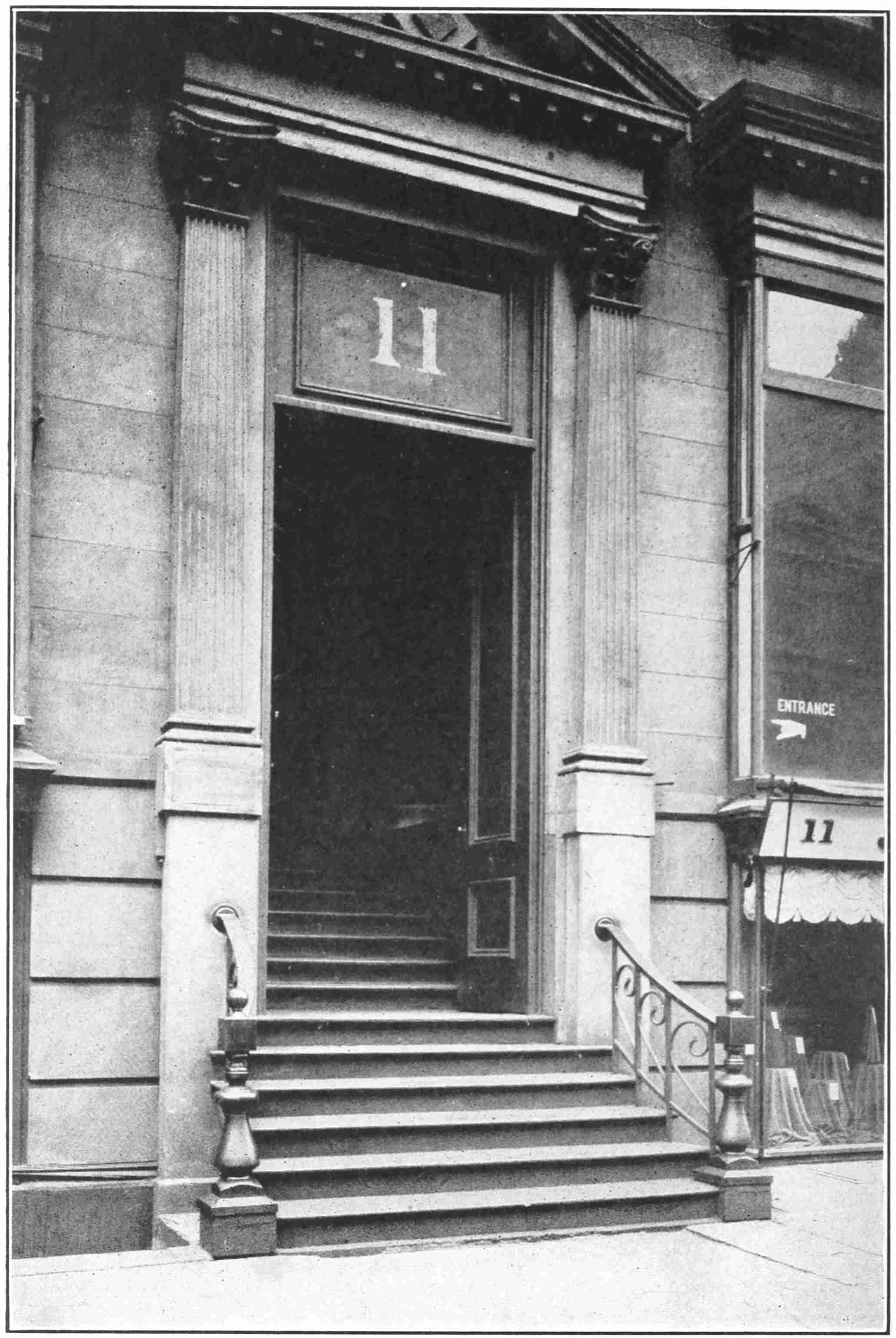
Just off Union Square, New York City, there is a stately
old brownstone house on which future generations some
day may place a tablet to commemorate the place where
David W. Griffith and Mary Pickford were first associated
with moving pictures.
Here has dwelt romance of many colors. A bird of
brilliant plumage, so the story goes, first lived in this broad-spreading
five-story old brownstone that still stands on
Fourteenth Street between Fifth Avenue and Broadway,
vibrant with life and the ambitions and endeavors of its
present occupants.
Although brownstone Manhattan had seen the end of
peaceful Dutch ways and the beginning of the present
scrambling in the great school of human activity, the first
resident of 11 East Fourteenth Street paid no heed—went
his independent way. No short-waisted, long and narrow-skirted
black frock-coat for him, but a bright blue affair,
gold braided and gold buttoned. He was said to be the last
man in old Manhattan to put powder in his hair.
As he grew older, they say his style of dressing became
more fantastic, further and further back he went in fashion’s
page, until in his last days knickerbockers with fancy
buckles adorned his shrinking limbs, and the powdered hair
became a periwig. He became known as “The Last Leaf.”
A bachelor, he could indulge in what hobbies he liked.
He got much out of life. He had a cool cellar built for the
claret, and a sun room for the Madeira. In his impressive
reception room he gathered his cronies, opened up his claret
and Madeira, the while he matched his game-cocks, and the
bets were high. Even when the master became very old
and ill, and was alone in his mansion with his faithful old
servant, Scipio, there were still the rooster fights. But now
they were held upstairs in the master’s bedroom. Scipio
was allowed to bet a quarter against the old man’s twenty-dollar
note, and no matter how high the stakes piled, or
who won, the pot in these last days always went to Scipio.
And so “The Last Leaf” lived and died.
Then in due time the old brownstone became the home
of another picturesque character, Colonel Rush C. Hawkins
of the Hawkins Zouaves of the Civil War.
Dignified days, when the family learned the world’s
news from Frank Leslie’s Illustrated Paper and the New
York Tribune, and had Peter Goelet and Moses Taylor for
millionaire neighbors. For their entertainment they went
to Laura Keene’s New Theatre, saw Joe Jefferson, and
Lotta; went to the Academy of Music, heard Patti and
Clara Louise Kellogg; heard Emma Abbott in concert; and
rode on horseback up Fifth Avenue to the Park.
Of an evening, in the spacious ballroom whose doors
have since opened to Mary Pickford, D. W. Griffith, and
Mack Sennett, the youths, maidens and young matrons
in the soft, flickering light of the astral lamp and snowy
candle, danced the modest cotillon and stately quadrille, the
while the elders played whist. Bounteous supper—champagne,
perhaps gin and tansy.
But keenly attuned ears, when they paused to listen, could
already hear off in the distance the first faint roll of the
drums in the march of progress. “Little Old New York”
was growing up and getting to be a big city. And so the
Knickerbockers and other aristocracy must leave their
brownstone dwellings for quieter districts further uptown.
Business was slowly encroaching on their life’s peaceful
way.
* * * * *
Another day and another generation. Gone the green
lawns, enclosed by iron fences where modest cows and showy
peacocks mingled, friendly. Gone the harpsichord, the
candle, the lamp, to give way to the piano and the gas-lamp.
Close up against each other the buildings now nestle
round Union Square and on into Fourteenth Street. The
horse-drawn street car rattles back and forth where No. 11
stands with some remaining dignity of the old days. On
the large glass window—for No. 11’s original charming exterior
has already yielded to the changes necessitated by
trade—is to be read “Steck Piano Company.”
In the lovely old ballroom where valiant gentlemen and
languishing ladies once danced to soft and lilting strains
of music, under the candles’ glow, and where “The Last
Leaf” entertained his stalwart cronies with cock fighting,
the Steck Piano Company now gives concerts and recitals.
The old house has “tenants.” And as tenants come and
go, the Steck Piano Company tarries but a while, and then
moves on.
A lease for the piano company’s quarters in No. 11 is
drawn up for another firm for $5,000 per year. In place
of the Steck Piano Company on the large window is to
be read—“American Mutoscope and Biograph Company.”
However, the name of the new tenant signified nothing
whatever to the real estate firm adjacent to No. 11
that had made the new lease. It was understood that
Mutoscope pictures to be shown in Penny Arcades were
being made, and there was no particular interest in the
matter. The “Biograph” part of the name had little significance,
if any, until in the passage of time a young actor
from Louisville, called Griffith, came to labor where labor
had been little known and to wonder about the queer new
job he had somewhat reluctantly fallen heir to.
The gentlemen of the real estate firm did some wondering
too. Up to this time, the peace of their quarters had
been disturbed only by the occasional lady-like afternoon
concert of the Steck Piano Company. The few preceding
directors of the American Mutoscope and Biograph Company
had done their work quietly and unemotionally.
Now, whatever was going on in what was once “The
Last Leaf’s” gay and elegant drawing-room, and why did
such shocking language drift through to disturb the conservative
transactions in real estate!
“Say, what’s the matter with you—you’re dying you
know—you’ve been shot and you’re dying! Well, that’s
better, something like it! You, here, you’ve done the shooting,
you’re the murderer, naturally you’re a bit perturbed, you’ve
lots to think about—yourself for one thing! You’re not
surrendering at the nearest police station, no, you’re beating
it, beating it, you understand. Now we’ll try it again—That’s
better, something like it! Now we’ll take it. All
right, everybody! Shoot!”
The neighborhood certainly was changing. The language!
The people! Where once distinguished callers in ones and
twos had come once and twice a week—now in mobs they
were crossing the once sacred threshold every day.
It was in the spring of 1908 that David W. Griffith came
to preside at 11 East Fourteenth. Here it was he took up
the daily grind, struggled, dreamed, saw old ambitions die,
suffered humiliation, achieved, and in four short years was
well started on the road to become world famous as the
greatest director of the motion picture.
For movies, yes, movies were being made where once
“The Last Leaf” had entertained in the grand old manner.
That was what the inscription, “American Mutoscope and
Biograph Company,” had meant.
But movies did not desecrate the dignity of 11 East
Fourteenth Street. The dignity of achievement had begun.
The old beauty of the place was fast disappearing. The
magnificent old chandelier had given place to banks of mercury
vapor tubes. There were no soft carpets for the tired
actors’ feet. The ex-drawing-room and ex-concert hall were
now full and overflowing with actors, and life’s little
comedies and tragedies were being play-acted where once
they had been lived.
Fourteenth Street, New York, has been called “the
nursery of genius.” Many artists struggled there in cheap
little studios, began to feel their wings, could not stand
success, moved to studio apartments uptown, and met defeat.
But 11 East Fourteenth Street still harbors the artist;
the building is full of them. Evelyn Longman, who was
there when “old Biograph” was, is still there. On other
doors are other names—Ruotolo, Oberhardt, John S. Gelert,
sculptor; Lester, studio; The Waller Studios; Ye Studio of
Frederic Ehrlich.
In the old projection room are now stacked books and
plays of the Edgar S. Werner Company, and in the dear
old studio, which is just the same to-day as the day we
left it, except that the mercury tubes have been taken out,
and a north window cut, presides a sculptor by the name
of A. Stirling Calder, who has painted the old door blue
and hung a huge brass knocker on it.
Now, when I made up my mind to write this record of
those early days of the movies, I knew that I must go
down once again to see the old workshop, where for
four years David W. Griffith wielded the scepter, until
swelled with success and new-gained wealth the Biograph
Company pulled up stakes and flitted to its new large
modern and expensive studio up in the Bronx at East 175th
Street.
So down I went to beg Mr. Calder to let me look over
the old place and take a picture of it.
My heart was going pit-a-pat out there in the old hallway
while I awaited an answer to my knock. “Please,”
I pleaded, “I want so much to take a photograph of the
studio just as it is. I’m writing a little book about our
pioneering days here; it won’t take a minute. May I,
please?”
Emotion was quite overwhelming me as the memories
of the years crowded on me, memories of young and happy
days untouched with the sadness that years must inevitably
bring even though they bring what is considered “success.”
Twelve years had gone their way since I had passed through
those studio doors and here I was again, all a-flutter with
anticipation and choky with the half-dreamy memories of
events long past.
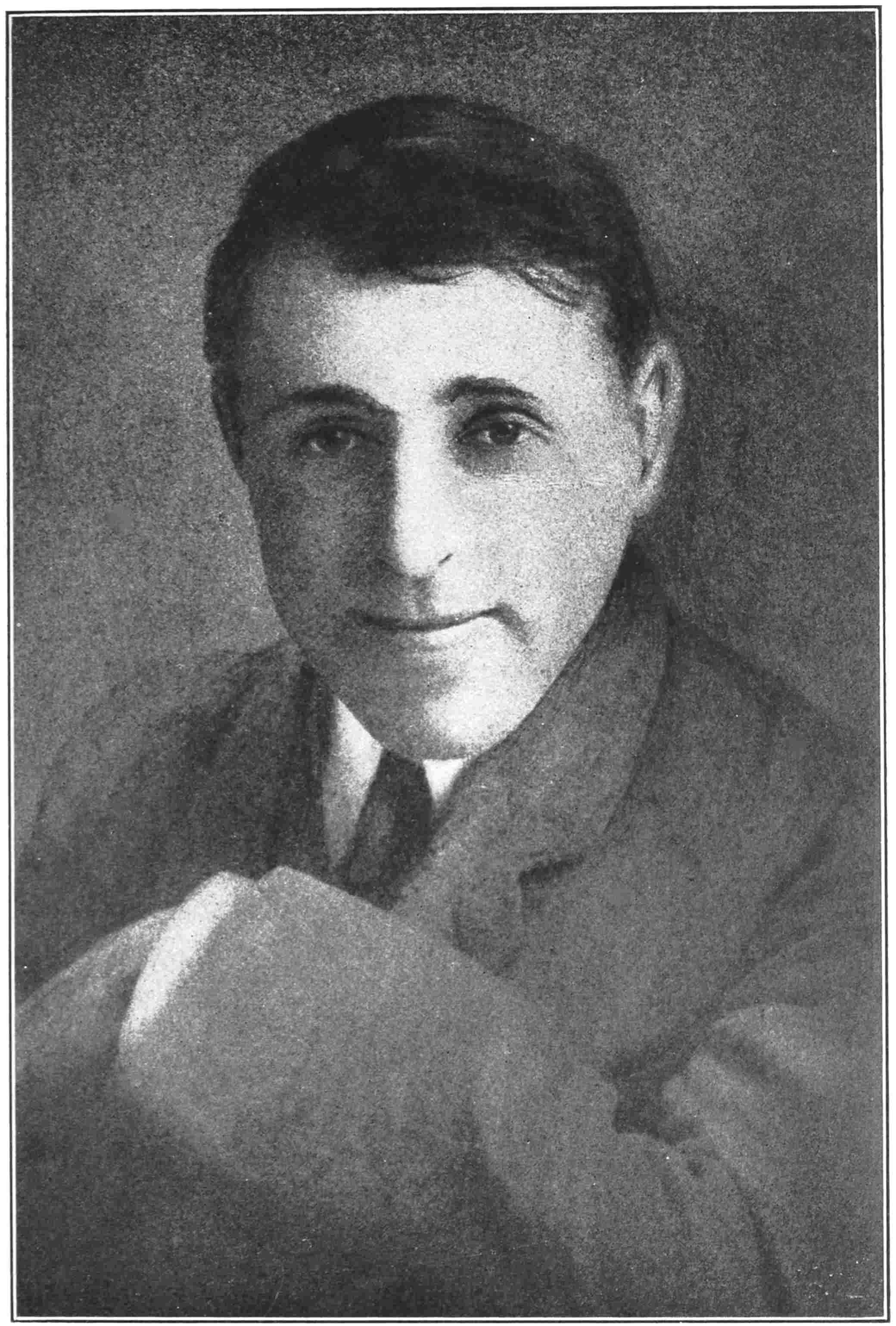
“Lawrence” Griffith.
(See p. 12)
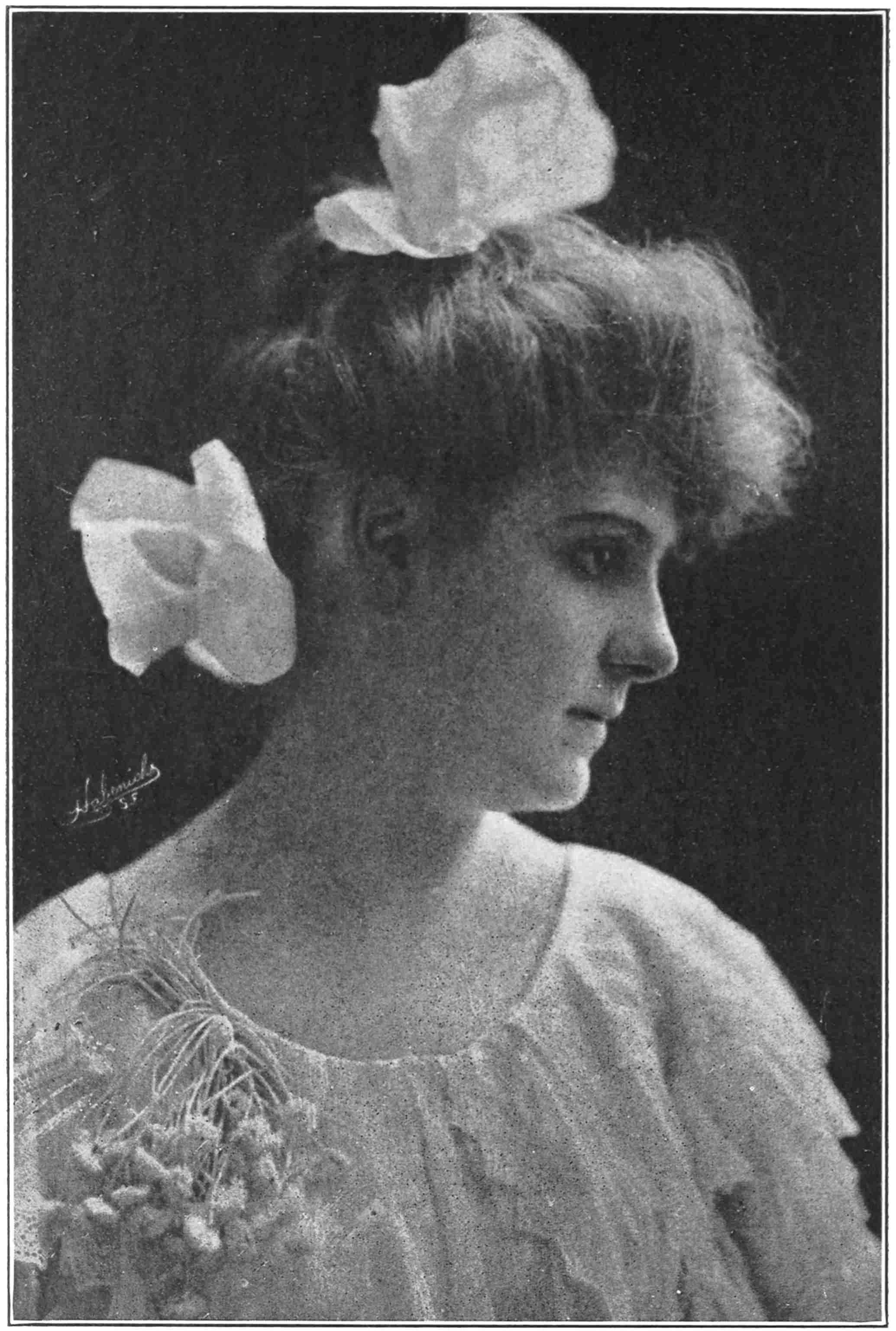
Linda Arvidson (Mrs. David W. Griffith), as leading ingénue with Florence
Roberts in stock in San Francisco.
(See p. 15)
But don’t be tempted to announce your arrival if you have ever been connected with a moving picture, for Mr.
Calder has scarcely heard of them and when I insisted he
must have, he said, with much condescension, “Oh, yes, I
remember, Mr. Griffith did a Chinese picture; it was rather
good but too sentimental.” And he refused to let me take
a picture of the studio for he “could not afford to lend
his work and his studio to problematical publicity of which
he had not the slightest proof.”
I felt sorry Mr. Calder had come to reside in our movie
nursery at 11 East Fourteenth Street, for we were such
good fellows, happy and interested in our work, cordial
and pleasant to one another.
The change made me sad!
CHAPTER II ENDINGS AND BEGINNINGS
But now to go back to the beginning.
It was a night in the summer of 1904 in my dear and
fascinating old San Francisco, before the life we all knew
and loved had been broken in two, never to be mended, by
the disaster of the great fire and earthquake. At the old
Alcazar Theatre the now historic stock company was producing
Mr. Hall Caine’s drama “The Christian.”
In the first act the fishermaidens made merry in the
village square.
Unknown to family or friends, and with little pride in
my humble beginning, I mingled as one of the fishergirls.
Three dollars and fifty cents a week was the salary Fred
Belasco (David’s brother) paid me for my bit of Hall
Caine interpretation, so I, for one, had no need to be horrified
some four years later when I was paid three dollars
a day for playing the same fishermaiden in support of
Mary Pickford, who, under Mr. Griffith’s direction, was
making Glory Quayle into a screen heroine.
Here at the old Alcazar were wonderful people I could
worship. There was Oza Waldrop, and John Craig, and
Mary Young, Eleanor Gordon, Frances Starr, and Frank
Bacon. Kindly, sweet Frank Bacon whose big success,
years later, as Lightnin’ Bill Jones, in his own play
“Lightnin’,” made not the slightest change in his simple,
unpretentious soul. Mr. Bacon had written a play called
“In the Hills of California.” It was to be produced for
a week’s run at Ye Liberty Theatre, Oakland, California,
and I was to play the ingénue.
One little experience added to another little experience
fortified me with sufficient courage to call on managers of
visiting Eastern road companies who traveled short of
“maids,” “special guests at the ball,” and “spectators at
the races.” New York was already beckoning, and without
funds for a railroad ticket the only way to get there was
to join a company traveling that way.
A summing up of previous experiences showed a recital
at Sherman and Clay Hall and two weeks on tour in Richard
Walton Tully’s University of California’s Junior farce
“James Wobberts, Freshman.”
In the company were Mr. Tully and his then wife,
Eleanor Gates, the author; Emil Kreuske, for some years
now “Bill Nigh,” the motion picture director; Milton
Schwartz, who took to law and now practices in Hollywood;
Dick Tully and his wife Olive Vail. Elmer Harris of the
original college company did not go. Elmer is now partner
to Frank E. Woods along with Thompson Buchanan in
Mr. Wood’s new producing company.
The recital at Sherman and Clay Hall on Sutter Street
was a most ambitious effort. My job-hunting pal, Harriet
Quimby, a girl I had met prowling about the theatres, concluded
we were getting nowhere and time was fleeting. So
we hit on a plan to give a recital in San Francisco’s Carnegie
Hall, and invite the dramatic critics hoping they would
come and give us good notices.
The Homer Henley Quartette which we engaged would
charge twenty dollars. The rent of the hall was twenty.
We should have had in hand forty dollars, and between
us we didn’t own forty cents.
Harriet Quimby knew Arnold Genthe, and, appreciating
her rare beauty, Mr. Genthe said he would make her photos
for window display for nothing. Oscar Mauer did the
same for me, gratis. Rugs and furniture we borrowed, and
the costumes by advertising in the program, we rented
cheaply.
We understood only this much of politics: Jimmy
Phelan, our Mayor (afterwards Senator James H. Phelan)
was a very wealthy man, charitably disposed, and one day
we summoned up sufficient courage to tell him our trouble.
Most attentively and respectfully he heard us, and without
a moment’s hesitation gave us the twenty.
So we gave the recital. We sold enough tickets to pay
the Homer Henleys, but not enough to pay the debt to Mr.
Phelan. He’s never been paid these many years though I’ve
thought of doing it often, and will do it some day.
However, the critics came and they gave us good notices,
but the recital didn’t seem to put much of a dent in our
careers. Harriet Quimby soon achieved New York via
The Sunset Magazine. In New York she “caught on,”
and became dramatic critic on Leslie’s Weekly.
The honor of being the first woman in America to
receive an aviator’s license became hers, as also that of
being the first woman to pilot a monoplane across the English
Channel. That was in the spring of 1912, a few months
before her death while flying over Boston Harbor.
* * * * *
Mission Street, near Third, was in that unique section
called South-of-the-Slot. The character of the
community was such, that to reside there, or even to
admit of knowing residents there meant complete loss of
social prestige. Mission Street, which was once the old
road that led over blue and yellow lupin-covered hills out
to the Mission Dolores of the Spanish Fathers, and was
later the place where the elegantly costumed descendants
of the forty-niners who had struck pay dirt (and kept it)
strolled, held, at the time of which I speak, no reminder
of its departed glory except the great romantic old Grand
Opera House, which, amid second-hand stores, pawn-shops,
cheap restaurants, and saloons, languished in lonely
grandeur.
Once in my young life Richard Mansfield played there;
Henry Irving and Ellen Terry gave a week of Shakespearean
repertoire; Weber and Fields came from New York
for the first time and gave their show, but failed. San
Franciscans thought that Kolb and Dill, Barney Bernard,
and Georgie O’Ramey, who held forth nightly at Fischer’s
Music Hall, were just as good.
At the time of the earthquake a grand opera company
headed by Caruso was singing there. Between traveling
luminaries, lesser lights glimmered on the historic old stage.
And for a long time, when the theatre was called Morosco’s
Grand Opera House, ten, twenty, and thirty blood-and-thunder
melodrama held the boards.
At this stage in its career, and hardly one year before
the great disaster, a young actor who called himself
Lawrence Griffith was heading toward the Coast in a show
called “Miss Petticoats.” Katherine Osterman was the
star. The company stranded in San Francisco.
Melbourne MacDowell, in the last remnants of the faded
glory cast upon him by Fanny Davenport, was about to
tread the sacred stage of the old Grand Opera House, putting
on a repertoire of the Sudermann and Sardou dramas.
Frank Bacon, always my kind adviser, suggested I
should try my luck with this aggregation. So I trotted
merrily down, wandered through dark alleyways, terribly
thrilled, for Henry Irving had come this same way and
I was walking where once he had walked.
I was to appear as a boy servant in “Fedora.” I remember
only one scene. It was in a sort of court room with
a civil officer sitting high and mighty and calm and unperturbed
on a high stool behind a high desk. I entered the
room and timidly approached the desk. A deep stern voice
that seemed to rise from some dark depths shouted at me,
“At what hour did your master leave Blu Bla?”
I shivered and shook and finally stammered out the
answer, and was mighty glad when the scene was over.
Heavens! Who was this person, anyhow?
His name, I soon learned, was Griffith—Lawrence
Griffith—I never could abide that “Lawrence”! Though,
as it turned out afterward, our married life might have
been dull without that Christian name as a perpetual resource
for argument.
Afterward, to my great joy, Mr. Griffith confided to
me that he had taken the name “Lawrence” only for the
stage. His real name was “David,” “David Wark,” but
he was going to keep that name dark until he was a big
success in the world, and famous. And as yet he didn’t
know, although he seemed very lackadaisical about it, I
thought, whether he’d be great as an actor, stage director,
grand opera star, poet, playwright, or novelist.
I wasn’t the only one who thought he might have become
a great singer. Once a New York critic reviewing
a première of one of David Griffith’s motion pictures, said:
“The most interesting feature of Mr. Griffith’s openings
is to hear his wonderful voice.”
“Lawrence” condescended to a little conversation now
and then. He was quite encouraging at times. Said I had
wonderful eyes for the stage and if I ever went to New
York and got in right, I’d get jobs “on my eyes.” (Sounded
very funny—getting a job “on one’s eyes.”) Advised me
never to get married if I expected to stay on the stage.
Told me about the big New York actors: Leslie Carter, who
had just been doing DuBarry; and David Belasco, and what
a wonderful producer he was; and dainty Maude Adams;
and brilliant Mrs. Fiske; and Charles Frohman; and
Richard Mansfield in “Monsieur Beaucaire”; and Broadway;
and Mrs. Fernandez’s wonderful agency; and how
John Drew got his first wonderful job through her agency
at one hundred and twenty-five dollars a week!
I was eager to learn more of the big theatrical world
three thousand miles away. I invited Mr. Griffith out home
to lunch one day. A new world soon opened up for me—the
South. The first Southerner I’d ever met was Mr.
Griffith. I had known of the South only from my school
history; but the one I had studied didn’t tell of Colonel
Jacob Wark Griffith, David’s father, who fought under
Stonewall Jackson in the Civil War, and was called
“Thunder Jake” because of his roaring voice. He owned
lots of negroes, gambled, and loved Shakespeare. There
was big “Sister Mattie” who taught her little brother his
lessons and who, out on the little front stoop, just before
bedtime, did her best to answer all the questions the inquisitive
boy would ask about the stars and other wonders.
This was all very different from being daughter to a
Norseman who had settled out on San Francisco’s seven
hills in the winds and fogs.
The South began to loom up as a land of romance.
CHAPTER III CLIMACTERIC—AN EARTHQUAKE AND A MARRIAGE
When the Melbourne MacDowell repertory season
closed, the stranded actors of the “Miss Petticoats”
Company were again on the loose. While San Francisco
supported two good stock companies, the Alcazar presenting
high-class drama and the Central given over to melodrama,
their rosters had been completed for the season and they
offered rather lean pickings. But Lawrence Griffith worked
them both to the best of his persuasive powers.
Early fall came with workless weeks, and finally, to
conserve his shrinking treasury, our young actor who had
been domiciled in the old Windsor Hotel, a most moderately
priced place on Market and Fourth Streets, had to bunk
in with Carlton, the stage carpenter of the MacDowell
show, in a single-bedded single room. Mr. Carlton was on
a social and mental plane with the actor, but his financial
status was decidedly superior.
The doubling-up arrangement soon grew rather irksome.
What with idle days, a flattened purse, and isolation from
theatrical activities, gloom and discouragement enveloped
young Griffith, although he never seemed to worry.
He had a trunk full of manuscripts—one-act plays, long
plays, and short stories and poems! To my unsophisticated
soul it was all very wonderful. What a cruel, unappreciative
world, to permit works of genius to languish lonely
amid stage wardrobe and wigs and greasy make-up!
On pleasant days when the winds were quiet and the
fogs hung no nearer than Tamalpais across the Gate, we
would hie ourselves to the Ocean Beach, where, fortified
with note-book and pencil the actor-poet would dictate new
poems and stories.
One day young Lawrence brought along a one-act play
called “In Washington’s Time.” The act had been headlined
over the Keith Circuit. It had never played in San
Francisco. He wondered if he could do anything with it.
* * * * *
It was approaching the hop-picking season. The
stranded young actor’s funds were reaching bottom. Something
must be done.
In California, in those days, quite nice people picked
hops. Mother and father, young folks, and the children,
went. Being the dry season, they’d live in the open; pick
hops by day, and at night dance and sing.
Lawrence Griffith decided it would be a healthful, a
colorful, and a more remunerative experience than picking
up theatrical odd jobs, to join the hop pickers up Ukiah
way. So for a few weeks he picked hops and mingled
with thrifty, plain people and operatic Italians who drank
“dago red” and sang the sextette from “Lucia” while they
picked their portion. Here he saved money and got
atmosphere for a play. Sent me a box of sweet-smelling
hops from the fields, too!
A brief engagement as leading ingénue with Florence
Roberts had cheered me in the interval, even though Fred
Belasco made me feel utterly unworthy of my thirty-five
dollar salary. “My God,” said he when I presented my
first week’s voucher, “they don’t give a damn what they
do with my money.”
However, Mr. Griffith soon returned to San Francisco.
He hoped to do something with his playlet. Martin Beck,
the vaudeville magnate, who was then manager of the Orpheum
Theatre and booked acts over the Orpheum Circuit,
said to let him see a rehearsal.
Such excitement! I was to play a little Colonial girl
and appear at our own Orpheum Theatre in an act that
had played New York, Boston, Philadelphia, Chicago, and
other awesome cities. Mr. Beck booked for the week and
gave us a good salary, but could not offer enough consecutive
bookings to make a road tour pay, so that was that.
In the meantime Oliver Morosco had opened his beautiful
Majestic Theatre in upper Market Street, with “In
the Palace of the King.” The New York company lacking
a blind Inez, I got the part, and the dramatic critic, Ashton
Stevens, gave me a great notice. In the next week’s bill,
“Captain Barrington,” I played a scene which brought me
a paragraph from Mr. Stevens captioned “An Actress with
more than Looks.” On the strength of this notice Mr.
Morosco sent me to play ingénues at his Burbank Theatre
in Los Angeles, at twenty-five dollars per week.
Barney Bernard was stepping out just now. He wanted
to see what he could do away from the musical skits of
Kolb and Dill. So he found a play called “The Financier.”
“Lawrence” Griffith had a little job in it. The hardest part
of the job was to smoke a cigar in a scene—it nearly made
him ill. But he had a good season, six weeks with salary
paid.
That over, came a call to Los Angeles to portray the
Indian, Alessandro, in a dramatization of Helen Hunt Jackson’s
famous novel “Ramona.”
It was pleasant for us to see each other. We went
out to San Gabriel Mission together. Mr. Griffith afterwards
used the Mission as the setting for a short story—a
romantic satire which he called “From Morning Until
Night.” His brief engagement over, “Lawrence” went back
to San Francisco, and my Morosco season ending shortly
afterward, I followed suit.
In San Francisco, Nance O’Neill was being billed. She
was returning from her Australian triumphs in Ibsen,
Sardou, and Sudermann. The company, with McKee Rankin
as manager and leading man, included John Glendenning,
father of Ernest; Clara T. Bracy, sister of Lydia
Thompson of British Blonde Burlesque and Black Crook
fame; Paul Scardon from the Australian Varieties and now
husband of a famous cinema star, Betty Blythe; and Jane
Marbury.
Mr. Griffith, hoping for a chance to return East with
the company, applied for a job and was offered “bits” which
he accepted. Then one day, Mr. Rankin being ill, Lawrence
Griffith stepped into the part of the Father in “Magda.”
Miss O’Neill thought so well of his performance and the
notices he received that she offered him leading parts for
the balance of the season.
When in the early spring of 1906, the company departed
from San Francisco, it left me with my interest in life
decidedly diminished—but Lawrence Griffith had promised
to return, and when he came back things would be different.
So, while the O’Neill company was working close to
Minneapolis, I was “resting.” I “rested” until eighteen
minutes to five on the morning of April 18th, when something
happened.
“Earthquake?”
“I don’t know, but I think we had better get up,” suggested
my sister.
* * * * *
I sent Lawrence a long telegram about what had happened
to us, but he received it by post. And then about
a week later I received a letter from Milwaukee telling me
that Miss O’Neill and the company were giving a benefit
for desolate San Francisco, and that I had better come on
and meet him in Boston where the company was booked for
a six weeks’ engagement.
So to Fillmore Street I went to beg for a railroad ticket
to Boston, gratis. There was a long line of people waiting.
I took my place at the end of the line. In time I reached
the man at the desk.
“Where to?”
“Boston.”
“What is your occupation?”
“Actress.”
I thought it unwise to confide my matrimonial objective.
No further questions, however. I was given a yard of
ticket and on May 9th I boarded a refugee train at the
Oakland mole, all dressed up in Red Cross clothes that
fitted me nowhere.
But I had a lovely lunch, put up by neighbors, some
fried chicken, and two small bottles of California claret.
In another box, their stems stuck in raw potatoes, some
orange blossoms off a tree that stood close to our tent.
Ah, dear old town, good-bye!
Every night I cried myself to sleep.
Thus I went to meet my bridegroom.
* * * * *
Boston!
Everything a bustle! People, and people, and people!
Laughing, happy, chattering people who didn’t seem to
know and apparently didn’t care what had happened to us
out there by the bleak Pacific. I was so annoyed at them.
Their life was still normal. Though I knew they had helped
bounteously, I was annoyed.
But here He comes! And we jumped into a cab—with
a license, but no ring. In the unusual excitement that had
been forgotten, so we had to turn back in the narrow street
and find a jeweler. Then we drove to Old North Church,
where Paul Revere had hung out his lantern on his famous
ride (which Mr. Griffith has since filmed in “America”),
and our names were soon written in the register.
* * * * *
The end of June, and New York! Just blowing up for
a thunderstorm. I had never heard real thunder, nor seen
lightning, nor been wet by a summer rain. What horrible
weather! The wind blew a gale, driving papers and dust
in thick swirling clouds. Of all the miserable introductions
to the city of my dreams and ambitions, New York City
could hardly have offered me a more miserable one!
We lived in style for a few days at the Hotel Navarre
on Seventh Avenue and Thirty-ninth Street, and then
looked for a “sublet” for the summer. I’d never heard of
a “sublet” before.
We ferreted around and found a ducky little place,
so cheap—twenty-five dollars a month—on West Fifty-sixth
Street, overlooking the athletic grounds of the Y. M.
C. A., where I was tremendously amused watching the fat
men all wrapped up in sweaters doing their ten times around
without stopping—for reducing purposes.
But we had little time to waste in such observations.
A job must be had for the fall. In a few weeks we signed
with the Rev. Thomas Dixon (fresh from his successful
“Clansman”); my husband as leading man and I as general
understudy, in “The One Woman.” Rehearsals were to
be called in about two months.
To honeymoon, or not to honeymoon—to work or not
to work. Work it was, and David started on a play.
And he worked. He walked the floor while dictating
and I took it down on the second-hand typewriter I had
purchased somewhere on Amsterdam Avenue for twenty
dollars. The only other investment of the summer had
been at Filene’s in Boston where I left my Red Cross
sartorial contributions and emerged in clothes that had a
more personal relation to me.
They were happy days. The burdens were shared
equally. My husband was a splendid cook; modestly said,
so was I. He loved to cook, singing negro songs the while,
and whatever he did, whether cooking or writing or washing
the dishes, he did it with the same earnestness and
cheerfulness. Felt his responsibilities too, and had a sort
of mournful envy of those who had established themselves.
Harriet Quimby was now writing a weekly article for
Leslie’s, and summering gratis at the old Oriental Hotel
at Manhattan Beach as payment for publicizing the social
activities of the place. Beach-bound one day, she called
at our modest ménage, beautifully dressed, with wealthy
guests in their expensive car. As the car drove off, Mr.
Griffith gazing sadly below from our window five flights
up, as sadly said “She’s a success.”
The play came along fine, owing much to our experiences
in California. One act was located in the hop fields, and
there were Mexican songs that Mr. Griffith had first heard
rendered by native Mexicans who sang in “Ramona.” Another
act was in a famous old café in San Francisco, The
Poodle Dog. It was christened “A Fool and a Girl.” The
fool was an innocent youth from Kentucky, but the girl,
being from San Francisco, was more piquant.
We’d been signed for the fall, and we felt we’d done
pretty well by the first summer. I’d learned to relish the
funny little black raspberries and not to be afraid of
thunderstorms—they were not so uncertain as earthquakes.
And now rehearsals are called for Mr. Dixon’s “The
One Woman.” They lasted some weeks before we took
to the road and opened in Norfolk, Virginia, where we
drew our first salaries, seventy-five for him and thirty-five
for her. Nice, it was, and we hoped it would be a long
season.
CHAPTER IV YOUNG AMBITIONS AND A FEW JOLTS
But it wasn’t.
After two months on the road we received our two
weeks’ notice. For half Mr. Griffith’s salary, Mr. Dixon
had engaged another leading man, who, he felt, would adequately
serve the cause. So, sad at heart and not so wealthy,
we returned to the merry little whirl of life in the theatrical
metropolis of the U. S. A. We had one asset—the play.
Good thing we had not frivoled away those precious summer
weeks in seeking cooling breezes by Coney’s coral
strand!
Late that fall my husband played a small part in a
production of “Salome” at the Astor Theatre under Edward
Ellsner’s direction. Mr. Ellsner was looking for a play
for Pauline Frederick. Mr. Griffith suggested his play and
Mr. Ellsner was sufficiently interested to arrange for a
reading for Miss Frederick and her mother. They liked it;
so did Mr. Ellsner; and so the play was sent on to Mr.
James K. Hackett, Miss Frederick’s manager at that time.
* * * * *
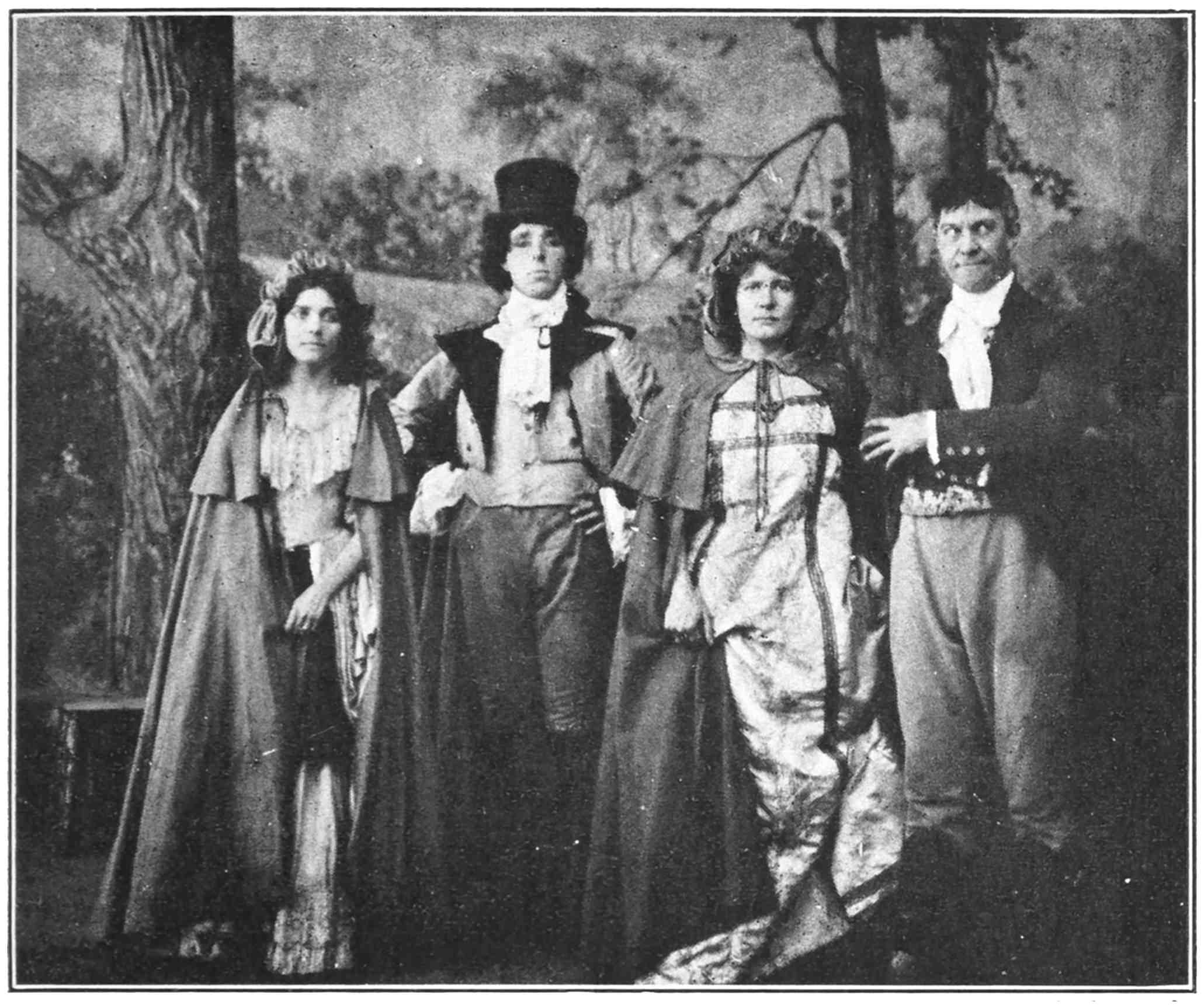
Linda Arvidson (Mrs. Griffith), David W. Griffith and Harry Salter, in
“When Knights were Bold,” Biograph’s version of “When Knighthood was
in Flower.”
(See p. 34)
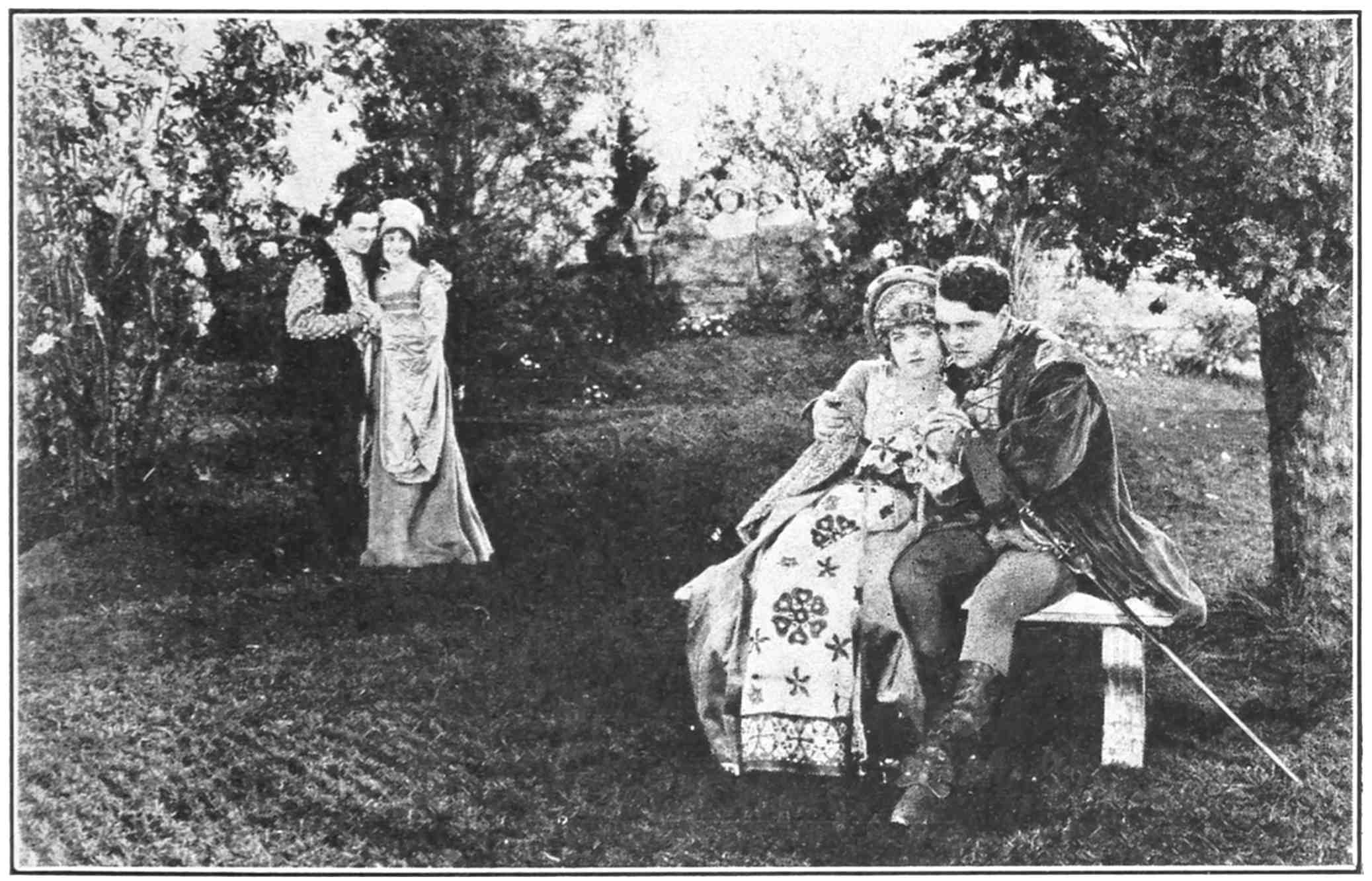
Marion Davies, Forrest Stanley, Ruth Shepley and Ernest Glendenning, in
Cosmopolitan’s production of “When Knighthood was in Flower.”
(See p. 34)
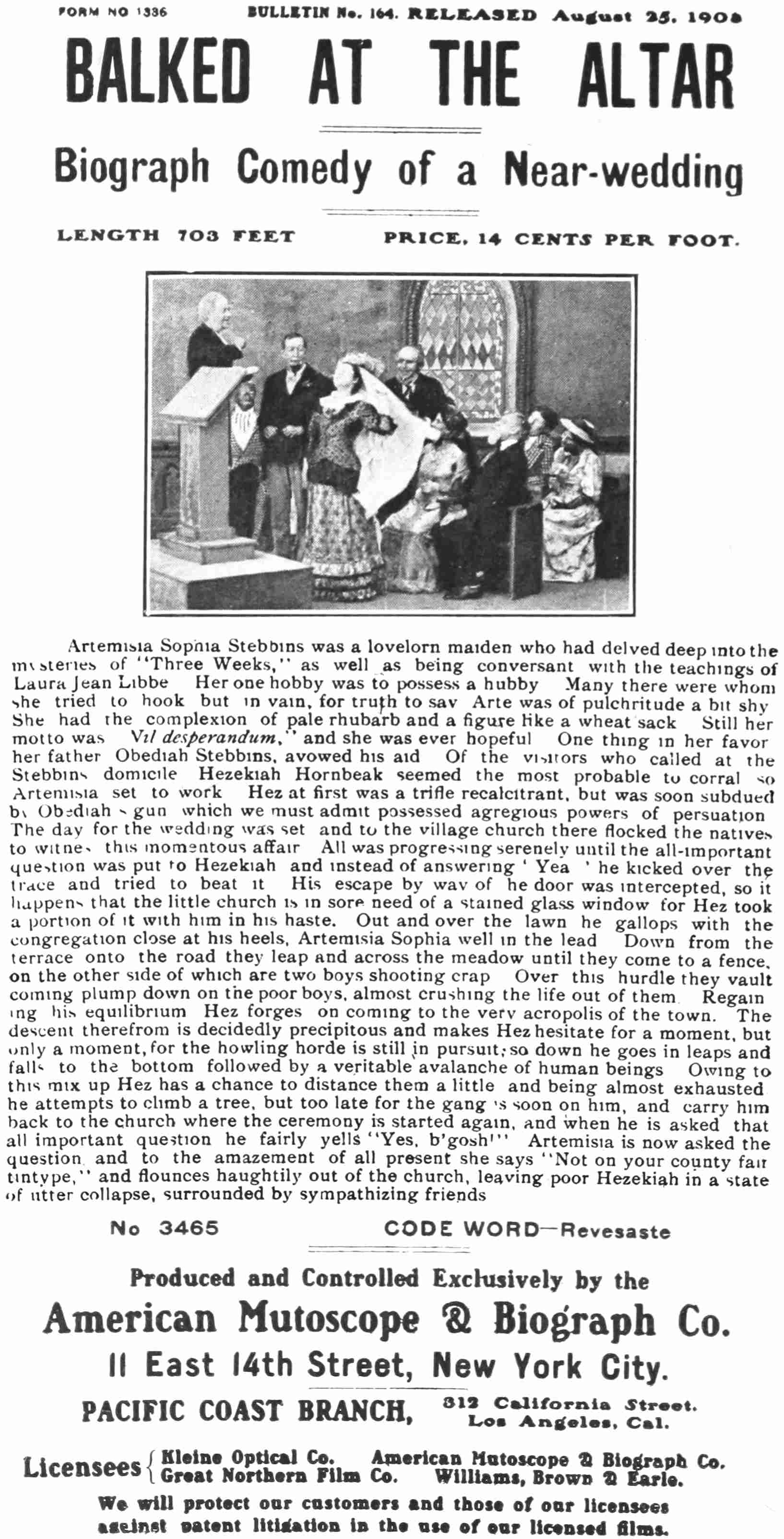
Advertising Bulletin for “Balked at the Altar,” with Harry
Salter, Mabel Stoughton, Mack Sennett, George Gebhardt
and Linda Griffith. The release of all Biograph movies was
similarly announced.
(See p. 40)
It was Christmas eve—our first. Three thousand miles
from home, lonesome, broke.
In the busy marts of dramatic commerce poor little “D”
was dashing hither and yon with his first-born. Even on
this day before Christmas he was on the job. The festive
holiday meal I had prepared was quite ready. There were
some things to be grateful for: each other, the comfortable
two rooms, and the typewriter. The hamburger steak was
all set, the gravy made, and the potatoes with their jackets
on, à la California camp style, were a-steaming. The little
five-cent baker’s pie was warming in the oven and the pint
bottle of beer was cooling in the snow on the window ledge.
And some one all mine was coming.
We sat down to dinner. Couldn’t put the plates on the
table right side up these days, it seemed. Had no recollection
of having turned my plate over. Turned it right side
up again.
I wished people wouldn’t be silly. I supposed this was
a verse about Christmas. But why the mystery? Wonderingly,
I opened the folded slip of paper. Funny looking
poetry. Funny look on D’s face. What was this anyhow?
Looked like an old-fashioned rent receipt. But it didn’t
say “Received from ——.” It said “Pay to ——,” “Pay
to the order of David W. Griffith seven hundred dollars,”
and it was signed “James K. Hackett.”
“Oh no, you haven’t sold the play!”
Yes, it was sold; the check represented a little advance
royalty. And were the play a success we would receive
a stipulated percentage of the weekly gross. (I’ve forgotten
the scale.)
Oh, kind and generous Mr. Hackett!
Isn’t it funny how calm one can be in the big moments
of life? But I couldn’t grasp it. Christmas eve and all!
An honest-to-God check on an honest-to-God bank for
seven hundred whole dollars. Was there that much money
in the whole world?
Now came wonderful days—no financial worry and no
job-hunting. True, we realized the seven hundred would
not last indefinitely. But to accept a job and not be in New
York when rehearsals for the play were called, was an
idea not to be entertained. So, to feel right about the
interim of inactivity, David wrote yards of poetry and
several short stories. And John A. Sleicher of Leslie’s
Weekly paid the princely sum of six dollars for a poem
called “The Wild Duck.”
A bunch of stuff was sent off to McClure’s, which Mr.
McClure said appealed to him very much—though not
enough for publication. He’d like to see more of Mr.
Griffith’s work.
And the Cosmopolitan, then under Perriton Maxwell’s
editorship, bought “From Morning Until Night” for
seventy-five dollars. Things were looking up.
* * * * *
In Norfolk, Va., a Centennial was to be held in celebration
of the landing on Southern soil of the first of the
F. F. V.’s, and a play commemorating the event had been
written around Captain John Smith and Pocahontas. Mr.
Griffith accepted a part in it. The six weeks’ engagement
would help out until the rehearsals of his own play were
called. But Pocahontas’s financial aid must have been somewhat
stingy according to the letter my husband wrote me
in New York. We had felt we couldn’t afford my railroad
fare to Norfolk and my maintenance there. It was our
first separation.
And this the letter:
Dear Linda,
I am sending you a little $3 for carfare. I would send more but
I couldn’t get anything advanced, so I only send you this much.
I’ll get my salary, or part of it, rather, Monday, so I’ll send you
more then and also tell you what I think we should do. I would
like to go to Miss —— if we could get it for $6 a week, or
$25 a month but I don’t like to pay $7.50, that’s too strong if we
can do cheaper. Of course, if we can’t we can’t and that’s all
there is to it. Let me know as soon as you get this money as
I am only sending it wrapped up as I don’t want you to have to
cash so small a check as $3, so that’s why I am sending it this
way.
I bet you I get some good things out of this world for her
yet, just watch me and see....
Her husband,
David
Pocahontas flivvered out in three weeks. But as Shakespeare
says, “Sweet are the uses of adversity.” While Mr.
Griffith was away, I found time to make myself a new
dress. In a reckless moment I had paid a dollar deposit
on some green silk dress material at Macy’s, which at a
later and wealthier moment I had redeemed. So now I
rented a sewing machine and sewed like mad to get the
dress done, for I could afford only one dollar-and-a-half
weekly rental on the old Wheeler and Wilson.
By the time “A Fool and A Girl” was to open in Washington,
D. C., there was just enough cold cash left for
railroad fare there. Klaw and Erlanger produced the play
under Mr. Duane’s direction, and Mr. Hackett came on to
rehearsals in Washington. Fannie Ward and Jack Deane
played the leading parts. Here they met and their romance
began, and according to latest accounts it is still thriving.
Alison Skipworth of “The Torch Bearers” and other successes,
was a member of the cast.
The notices were not the best nor the worst. They
are interesting to-day, for they show how time has ambled
apace since October, 1907. Said Hector Fuller, the critic:
It may be said that the dramatist wanted to show where his
hero’s feet strayed; and where he found the girl he was afterwards
to make his wife, but if one wants to tell the old, old and
beautiful story of redemption of either man or woman through
love, it is not necessary to portray the gutters from which they
are redeemed....
One week in Washington and one in Baltimore saw on
its jolly way to the storehouse the wicked Bull Pup Café
and the Hop Fields, etc.
And so back to New York.
In the Sixth Avenue “L” with our little suitcases, we
sat, a picture of woe and misery. In the Sixth Avenue
“L,” for not even a dollar was to be wasted on a taxi. But
when the door to our own two rooms was closed, and,
alone together, we faced our wrecked hopes, it wasn’t so
awful. Familiar objects seemed to try and comfort us.
After all, it was a little home, and better than a park bench;
and the Century Dictionary—of which some day we would
be complete owners, maybe—and the Underwood, all our
own—spoke to us reassuringly.
I do not recall that any job materialized that winter,
but something must have happened to sustain us. Perhaps
the belated receipt of those few hundred dollars of mine
that were on deposit at the German Savings Bank at the
time of the Disaster in San Francisco.
To offset what might have been a non-productive winter,
Mr. Griffith wrote “War,” a pretentious affair of the
American Revolution, which Henry Miller would have produced
had it been less expensive. “War” had meant a lot
of work. For weeks previous to the writing, we had repaired
daily to the Astor Library where we copied soldiers’
diaries and letters and read histories of the period until
sufficiently imbued with the spirit of 1776. “War” is still
in the manuscript stage with the exception of the Valley
Forge bits which came to life in Mr. Griffith’s film
“America”; for Mr. Griffith turned to the spectacle very
early in his career, though he little dreamed then of the
medium in which he was to record the great drama of the
American Revolution.
* * * * *
We met Perriton Maxwell again. Extended and accepted
dinner invitations. Our dinner was a near-tragedy.
Before the banquet had advanced to the salad stage, I had
to take my little gold bracelet to a neighboring “Uncle.”
The antique furniture necessitated placards which my husband
posted conspicuously. For instance, on the sofa—“Do
not sit here; the springs are weak.” On a decrepit
gate-legged table—“Don’t lean; the legs are loose.”
At the Maxwells’ dinner our host gathered several
young literati who he thought might become interested in
Mr. Griffith and his literary efforts. Vivian M. Moses,
then editor of Good Housekeeping and now Publicity
Manager for The Fox Films, was one, as was Jules E.
Goodman, the playwright. But a “litry” career for Mr.
Griffith seemed foredoomed. A poem now and then, and
an occasional story sold, was too fragile sustenance for
permanency. Some sort of steady job would have to be
found, and the “litry” come in as a side-line.
David Griffith was ready for any line of activity that
would bring in money, so that he could write plays. He always
had some idea in his inventive mind, such as non-puncturable
tires, or harnessing the ocean waves. In the mornings, on waking,
he would lie in bed and work out plots for dramas, scene
bits, or even mechanical ideas. After an hour of apparent
semi-consciousness, his head motionless on the pillow, he
would greet the day with “I hate to see her die in the third
act”; or, “I wonder if that meat dish could be canned!”
meaning, could a dish he had invented and cooked—a triumph
of culinary art—be made a commercial proposition
as a tinned food, like Armour’s or Van Camp’s beans and
corned beef.
Pretty good field of activity, canned eats, and might
have made David W. Griffith more money than canned
drama!
CHAPTER V THE MOVIES TEMPT
Winter passed. Spring came.
On the Rialto’s hard pavements, day in and day out,
Mr. Griffith, his ear to the ground, was wearing out good
shoe leather. But nothing like a job materialized, until,
meeting up with an old acquaintance, Max Davidson, he
heard about moving pictures. Since youthful days in a
Louisville stock company these two had not met. And the
simple confidences they exchanged this day brought results
that were most significant, not only to David Griffith, but
to millions of unsuspecting people the world over.
Mr. Davidson had been going down to a place on 11
East Fourteenth Street and doing some kind of weird acting
before a camera—little plays, he explained, of which
a camera took pictures.
“You’ve heard of moving pictures, haven’t you?”
“Why, I don’t know; suppose I have, but I’ve never
seen one. Why?”
“I work in them during the summer; make five dollars
some days when I play a leading part, but usually it’s three.
Keeps you going, and you get time to call on managers
too. Now you could write the little stories for the pictures.
They pay fifteen dollars sometimes for good ones. Don’t
feel offended at the suggestion. It’s not half bad, really.
We spend lots of days working out in the country. Lately
we’ve been doing pictures where they use horses, and it’s
just like getting paid for enjoying a nice horseback ride.
Anybody can ride well enough for the pictures. Just manage
to stay on the horse, that’s all.”
“Ye gods,” said the tempted one, “some of my friends
might see me. Then I would be done for. Where do they
show these pictures? I’ll go see one first.”
“Oh, nobody’ll ever see you—don’t worry about that.”
“Well, that does make it different. I’ll think it over.
Where’s the place, you said?”
“Eleven East Fourteenth Street.”
“Thanks awfully. I’ll look in—so long.”
* * * * *
The elder Mr. McCutcheon was the director when David
applied for a job at the American Mutoscope and Biograph
Company and got it.
There were no preliminaries. He was told to go
“below” and put on a little make-up. So he went “below”—to
the dressing-room, but he didn’t put on a “little
make-up.” He took a great deal of trouble with it although
it was largely experimental, being very different from the
conventional stage make-up. The only instruction he was
given was to leave off the “red” which would photograph
black, thus putting hollows in his cheeks. And he didn’t
need hollows in his cheeks.
When he came up to the studio floor—his dressing and
make-up finished—the director, and the actors especially,
looked at him as though he were not quite in his right mind.
“Poor boob,” they thought, to take such trouble with a
“make-up” for a moving picture, a moving picture that
no one who counted for anything would ever see.
After a short rehearsal, an explanation of “foreground”
and instructions about keeping “inside the lines” and “outside
the lines,” the camera opened up, ground away for
about twenty feet, and the ordeal was over.
When work was finished for the day, Mr. McCutcheon
paid his new actor five dollars and told him to call on the
morrow. So the next morning there was an early start to
the studio. They were to work outside, and there were
to be horses!
I shall never forget the sadly amused expression my
husband brought home with him, the evening of that second
day. Nor his comments: “It’s not so bad, you know, five
dollars for simply riding a horse in the wilds of Fort Lee
on a cool spring day. I think it wouldn’t be a bad idea
for you to go down and see what you can do. Don’t tell
them who you are, I mean, don’t tell them you’re my wife.
I think it is better business not to.”
So a few days later, I dolled up for a visit to the studio.
After I had waited an hour or so, Mr. McCutcheon turned
to me and said, “All right, just put a little make-up on;
this isn’t very important.” There was no coaching for the
acting; only one thing mattered, and that was, not to appear
as though hunting frantically for the lines on the floor that
marked your stage, while the scenes were being taken.
Mr. Griffith and I “listened in” on all the stories and
experiences the actors at the studio had to tell. We would
have all the information we could get on the subject of
moving pictures, those tawdry and cheap moving pictures,
the existence of which we had hitherto been aware of only
through the lurid posters in front of the motion picture
places—those terrible moving picture places where we
wouldn’t be caught dead. But we could find use for as
many of those little “fives” as might come our way.
Humiliating as the work was, no one took the interest
in it that David Griffith did, or worked as hard. This Mr.
McCutcheon must have divined right off, for he used him
quite regularly and bought whatever stories he wrote.
Only a few days were needed to get a line on the place.
It was a conglomerate mess of people that hung about the
studio. Among the flotsam and jetsam appeared occasionally
a few real actors and actresses. They would work a
few days and disappear. They had found a job on the stage
again. The better they were, the quicker they got out.
A motion picture surely was something not to be taken
seriously.
Those running the place were not a bit annoyed by this
attitude. The thing to do was to drop in at about nine
in the morning, hang around a while, see if there was
anything for you, and if not, to beat it up town quick, to
the agents. If you were engaged for a part in a picture
and had to see a theatrical agent at eleven and told Mr.
McCutcheon so, he would genially say, “That’s O. K. I’ll
fix it so you can get off.” You were much more desirable
if you made such requests. It meant theatrical agents were
seeking you for the legitimate drama, so you must be good!
Would it be better to affiliate with only one studio or
take them all in? There was Edison, way out in the Bronx;
Vitagraph in the wilds of Flatbush; Kalem, like Biograph,
was conveniently in town; Lubin was in Philadelphia, and
Essanay in Chicago. Melies was out West. It would be
much nicer, of course, if one could get in “right” at the
Biograph.
Some of the actors did the rounds. Ambitious Florence
Auer did and so became identified with a different line of
parts at each studio. At Biograph, character comedy; at
Vitagraph, Shakespeare—for “King Lear” and “Richard
the Third” with Thomas H. Ince in attendance, were
screened as long ago as this; at Edison, religious drama.
There she rode the biblical jackass.
The Kalem studio was in the loft of a building on
West Twenty-third Street. You took the elevator to where
it didn’t run any further and then you climbed a ladder up
to a place where furniture and household goods were stored.
Bob Vignola could be seen here dusting off a clear place
for the camera and another place where the actors could
be seated the while they waited until Sidney Olcott, the
director, got on the day’s job.
Sidney Olcott was an experienced man in the movies
even in those early days, for had he not played a star part
in the old Biograph in the spring of 1904? As the Village
Cut-up in the movie of the same name we read this about
him in the old Biograph bulletin:
Every country cross-corners has its “Cut-up,” the real devilish
young man who has been to the “city” at some stage of his career,
and having spent thirty cents looking at the Mutoscope, or a
dollar on the Bowery at Coney, thinks he is the real thing. The
most common evidence of his mental unbalance is the playing of
practical jokes, which are usually very disagreeable to the
victim....
In a few years Mr. Olcott had evolved from the “village
cut-up” at Biograph to director at Kalem.
Here he engaged Miss Auer for society parts and adventuresses.
Stopped her on the Rialto one day. “I know
you are an actress,” said Mr. Olcott, “and that beautiful
gray silk dress you have on would photograph so wonderfully,
I’ll give you ten dollars if you’ll wear it in a scene—it’s
a society part.” For a dress that was gray, and silk
too, was a most valuable property and a rare specimen of
wardrobe in the movies in those days.
It came as pleasant news that a tabloid version of
“When Knighthood Was in Flower” to be called “When
Knights Were Bold” was to be screened at Biograph. There
were four, or perhaps five, persons in the cast of this
première “Knighthood” picture. My husband was one; so
was I. The picture commemorates our only joint movie
appearance.
I recall only one scene in this movie, a back-drop picturing
landscape, with a prop tree, a wooden bench, and
a few mangy grass mats, but there was one other set
representing an inn. I never saw the picture and couldn’t
tell much about it from the few scenes in which I played.
A one-reeler, of course—nine hundred and five feet.
Now whether the cost of Biograph pictures was then being
figured at a dollar a foot, I do not know. But that was
the dizzy average a very short time later. Anyhow, our
“Flowering Knighthood” was cheap enough compared with
what Mr. Hearst spent thirteen years later on his Cosmopolitan
production, which cost him $1,221,491.20, and was
completed in the remarkably short time of one hundred sixty
working days.
Mr. Hearst’s “Knighthood” had a remarkable cast of
eighteen principal characters representing the biggest names
in the theatrical and motion picture world, and the supporting
company counted three thousand extra persons and
thirty-three horses.
Miss Marion Davies as Princess Mary Tudor was assisted
by Lyn Harding, the English actor-manager; Pedro
De Cordoba, Arthur Forrest (the original Petronius of
“Quo Vadis”), Theresa Maxwell Conover, Ernest Glendenning,
(of “Little Old New York”), Ruth Shepley (star
of “Adam and Eva”), Johnny Dooley, (celebrated eccentric
dancer), George Nash, Gustav von Seyfertitz (for years
director and star of the old Irving Place Theatre), Macy
Harlam, Arthur Donaldson, Mortimer Snow, William
Morris (of “Maytime” fame).
A few other names of world-famous people must be
mentioned in connection with this picture, for Joseph Urban
was the man of the “sets”; Gidding & Company made the
gowns; Sir Joseph Duveen and P. W. French & Company
supplied Gothic draperies; and Cartier, antique jewelry.
There were only two old movie pioneers connected with
the production: Flora Finch, who back in old Vitagraph
days co-starred with John Bunny and after his death held
her place alone as an eccentric comedienne; and the director,
Robert G. Vignola, who back in the days of our “Knighthood”
was the young chap who dusted off the benches and
furniture in the old Kalem loft.
But Robert Vignola, who came of humble Italian
parentage, had a brain in his young head, and was ambitious.
Realizing the limitations of Albany, his home town, he had
set out for New York and landed a job in a motion picture
studio. Young Vignola represented at the Kalem organization,
in the early days, what Bobbie Harron did at
Biograph. But the Biograph, from ranking the last in
quality of picture production, grew to occupy first place,
while Kalem continued on a rather more even way. But
Bob Vignola didn’t, as the years have shown.
Indeed, many big names have appeared in movies called
“When Knighthood Was in Flower,” but David Griffith’s
is not the biggest, nor was it the first, for before the end
of the year 1902, in Marienbad, Germany, a film thirty-one
feet long was produced and given the title “When Knighthood
Was in Flower.” The descriptive line in the Biograph
catalogue of 1902 (for it was a Biograph production)
reads:
Emperor William of Germany and noblemen of the Order of
St. John. The Emperor is the last in the procession.
So you see the Ex-Kaiser beat them all to it, even D.
W. Griffith and W. R. Hearst, though I’ll say that Mr.
Hearst’s is the best of the “Flowering Knighthoods” to date,
and will probably continue so. The story has now been
done often enough to be allowed a rest.
But it was Mr. Griffith’s big dream, very early in his
movie career, along in 1911, to screen some day a great
and wonderful movie of the Charles Major play that
launched Julia Marlowe on her brilliant career. And in
this play which he had decided could be produced nowhere
but in England, no less a person than E. H. Sothern was
to appear as Charles Brandon, and she who is writing this
was to be Mary Tudor.
Dreams and dreams we had long ago, but this was one
of the best dreams that did not come true.
CHAPTER VI MOVIE ACTING DAYS—AND AN “IF”
We called him “Old Man McCutcheon,” the genial,
generous person who at this time directed the movies
at the American Mutoscope and Biograph Company. Why
“Old Man” I do not know, unless it was because he was
slightly portly and the father of about eight children, the
oldest being Wallace—“Wally” to his intimates. Wally
was quite “some pumpkins” around the studio—father’s
right-hand-man—and then, too, he was a Broadway actor.
It was then the general idea of movie directors to use
their families in the pictures. As money was the only thing
to be had out of the movies those days, why not get as
much as possible while the getting was good? The McCutcheon
kids had just finished working in a Christmas
picture, receiving, besides pay checks, the tree and the toys
when the picture was finished. So the first bit of gossip
wafted about was that the McCutcheons had a pretty good
thing of it altogether.
In February, 1908, Wallace McCutcheon was closing
an engagement in Augustus Thomas’s play, “The Ranger.”
Appearing in “The Ranger” with young Mr. McCutcheon,
were Robert Vignola, John Adolfi, Eddie Dillon, and Florence
Auer.
A school picture called “The Snow-man” was to be made
which called for eight children—another job for the little
McCutcheons. Grown-up Wally, and mother, were to work
too, mother to see that the youngsters were properly dressed
and made up.
A tall, slight young woman was needed for the schoolmistress
and Eddie Dillon, whom Wally had inveigled to
the studio, suggested Florence Auer.
The story takes place outside the schoolhouse and a
“furious blizzard” is raging, although I would say there
was nothing prophetic of the blizzard that raged in D. W.
Griffith’s famous movie “Way Down East,” even though
events were so shaping themselves that had Mr. McCutcheon
held off a few weeks with his snow story, Mr. Griffith
would have arrived in time to offer suggestions. And he
would have had something to say, had he been so privileged,
for “The Snow-man’s” raging “blizzard” was made up of
generous quantities of sawdust!
The legs, arms, torso, and head of the Snow-man were
fashioned of fluffy, white cotton, each a separate part, and
were hidden under the drifts of sawdust, to be found later
by the children who came to romp in the snow and make
a snow-man. The places where the Snow-man’s fragments
were buried were marked so that the children could easily
find them. One youngster pretends to mold of sawdust an imaginary
leg, but in reality is hunting the buried finished one, on
locating which, she surreptitiously pulls it from beneath the
sawdust. In this way, finally, all the parts of the Snow-man
are dug out of the sawdust snow, and put together, revealing
a beautiful Snow-man.
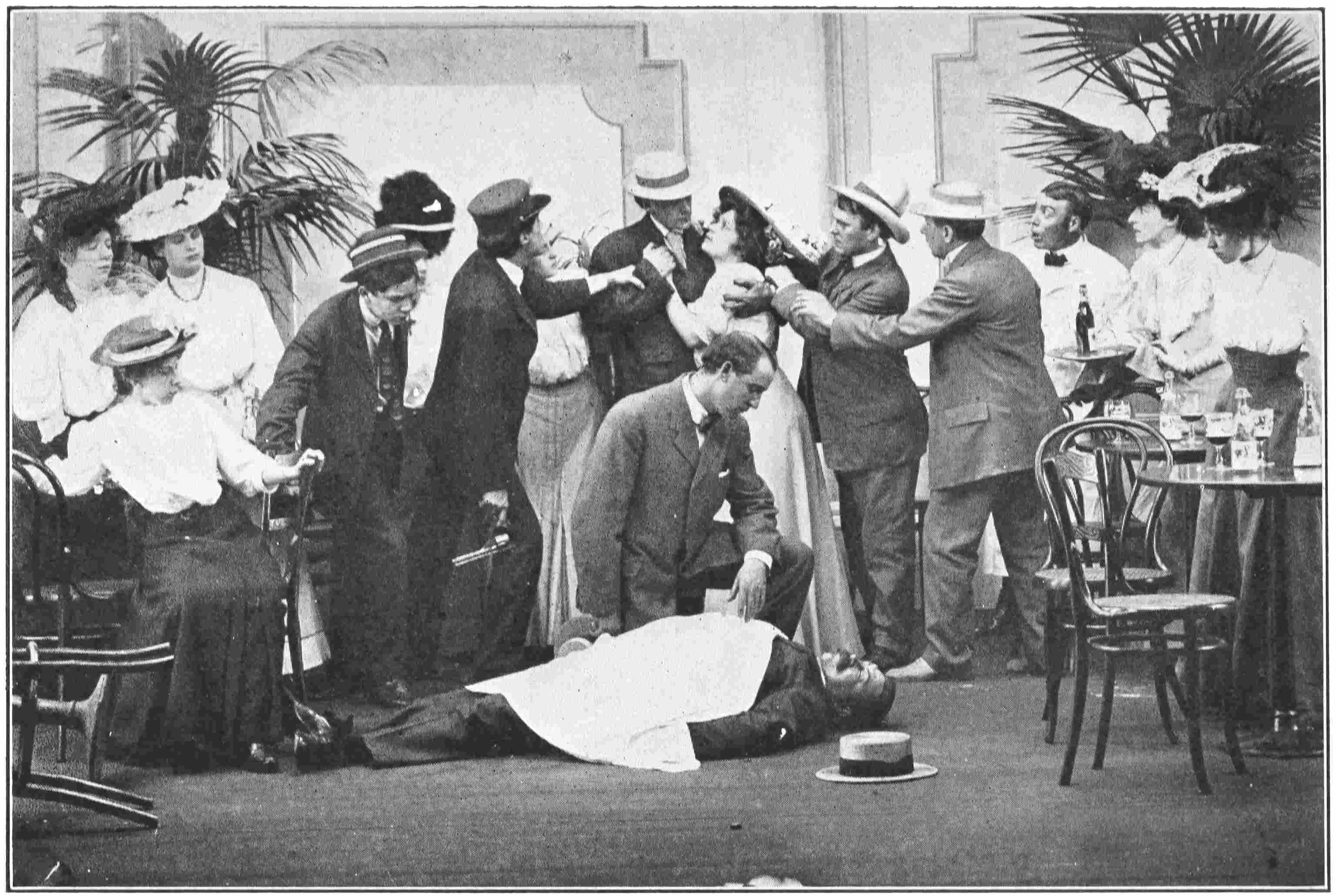
Biograph Mutoscope of the murder of Stanford White by Harry Thaw on Madison Square Garden roof,
made shortly after the tragedy.
(See p. 69)
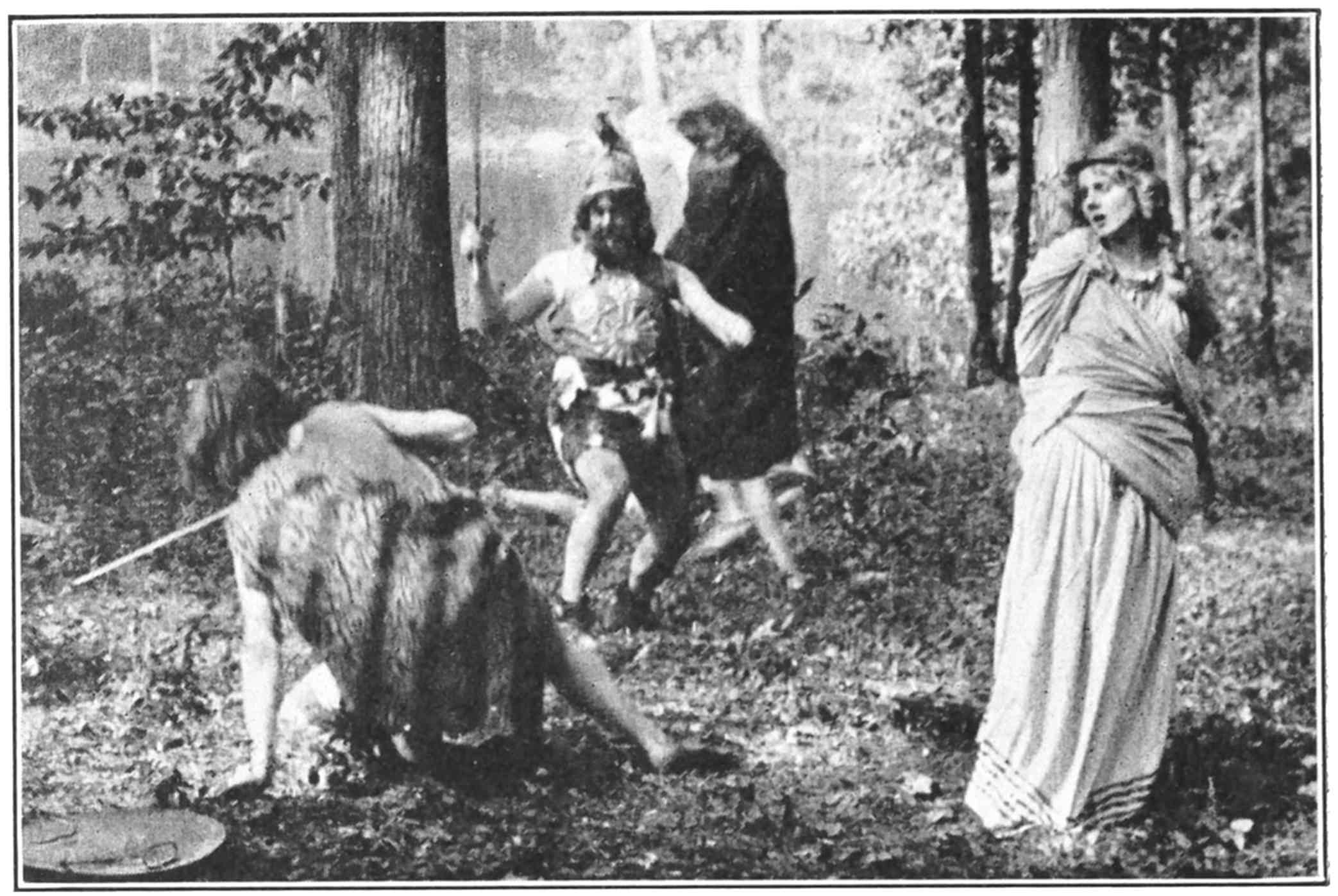
The first Biograph Girl, Florence Lawrence, in “The Barbarian,” otherwise
known as “Ingomar, the Barbarian.” Filmed at the home of Ernest
Thompson Seton at Cos Cob, Conn.
(See p. 59)
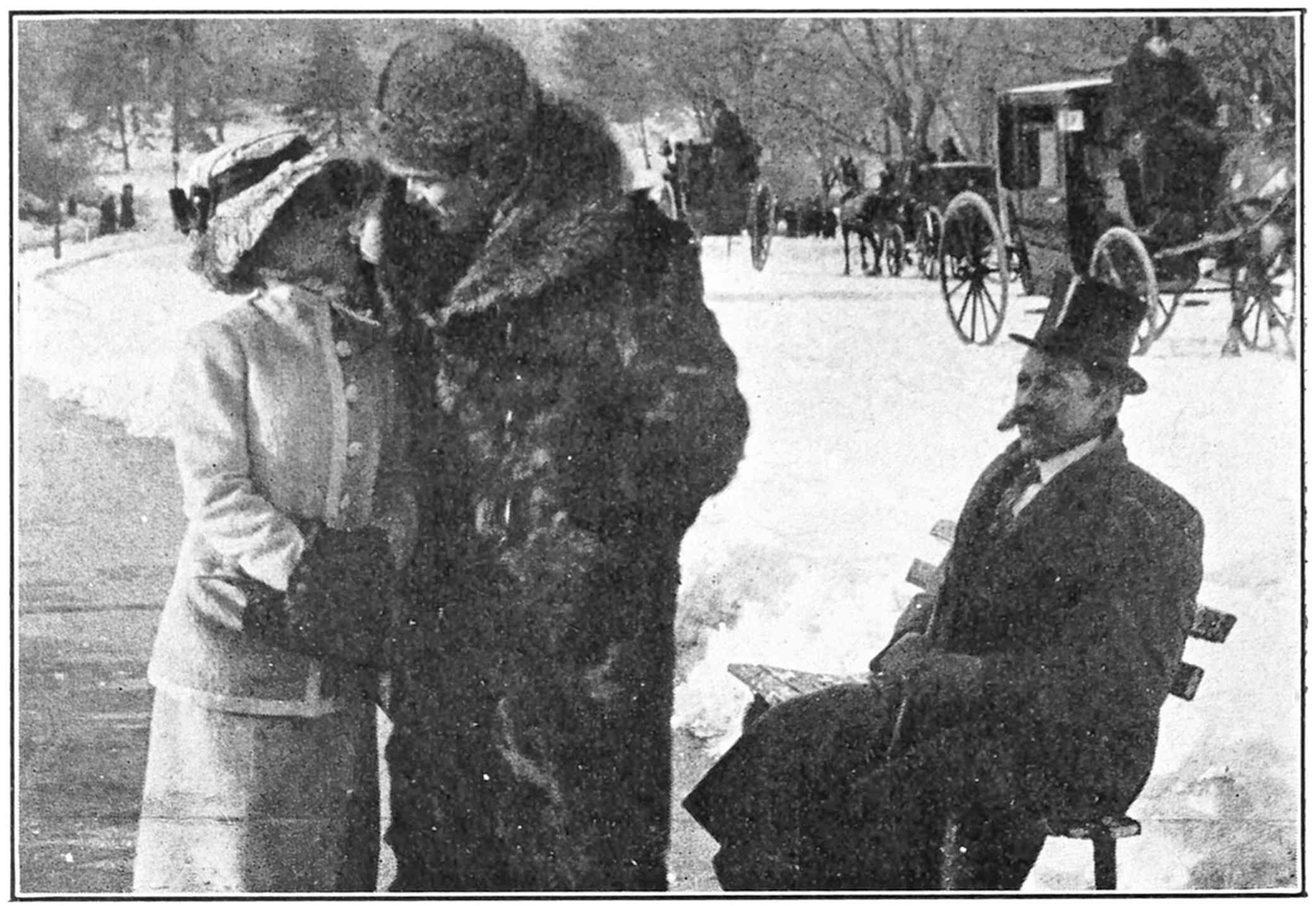
From “The Politician’s Love Story.” Left to right: Linda A. Griffith,
Arthur Johnson, Mack Sennett. A beautiful sleet had covered the trees
and foliage of Central Park and this scenario was hurriedly gotten up so
as to photograph a wonderful winter fairyland.
(See p. 80)
Then the Good Fairy of the Snows who all this time
has been dreaming in the silver crescent of the moon, looking
for all the world like the charming lady of the Cascarets
ads, is given a tip that the children have finished their
Snow-man. So it is time for her to wake up and come
out of the moon. From her stellar heights, by means of
a clumsy iron apparatus, she is lowered to earth. Sadly
crude it all was, but it thrilled the fans of the day, nevertheless.
With her magic wand the Good Fairy touches the
Snow-man and he comes to life. Predatory Pete now comes
along, sees Mr. Snow-man, and feeling rather jolly from
the consumption of bottled goods, he puts his pipe in the
Snow-man’s mouth, and when he sees the Snow-man calmly
puff it, in great fright he rushes off the scene, dropping his
bottle, the contents of which the Snow-man drains. In
the resultant intoxication the Snow-man finds his way into
the schoolhouse. Finding the schoolhouse too warm, he
throws the stove out of the window. Then he throws himself
out of the window and lies down in the snow to “sleep
it off.”
When the children return the following morning, the
Snow-man, who is still sleeping, frightens them almost into
convulsions. Then the picture really got started—the
“chase” began. Sufficiently primitive it was, to have been
the first “chase”; but it wasn’t—for almost at the movie’s
inception the chase was a part of them. This Snow-man
chase takes place in front of a stationary back-drop, that
pictures a snowdrift. The actors standing off-stage ready
for the excitement, come on through the sawdust snow,
kicking it up in clouds, eating it, choking on it, hair, eyes,
and throat getting full of it. Back and forth against this
one “drop,” the actors chase. On one run across, a prop
tree would be set up. Then as the actors were supposed
to have run some hundred yards at least, on the next time
across, the prop tree would be taken away and a big papier
maché rock put in its place. That scene being photographed,
the rock would give way to a telegraph pole, and so on
until half a dozen chases had been staged before the one
“drop.”
* * * * *
Thus far advanced, artistically and otherwise, was the
motion picture this spring of 1908 when “Lawrence”
Griffith found himself astride a horse, taking the air in the
wide stretches of Coytesville, New Jersey, and getting five
dollars to boot. Also found himself so exhilarated, mentally
and otherwise, that in the evening he turned author, not
of poorly paid poems, but of the more profitable movies.
Wrote a number which he sold for fifteen dollars each,
a very decent price considering that this sort of authorship
meant a spot-cash transaction.
The first little cinema drama of which he was the author
and which was immediately put into the works was “Old
Isaacs, the Pawnbroker.” Very bitter in feeling against the
Amalgamated Association of Charities was this story of a
kind-hearted Hebraic money-lender.
On May 6th, with “Lawrence” Griffith the star, was
released “The Music Master,” but not David Belasco’s.
Then came “Ostler Joe” of Mrs. James Brown Potter fame,
scenario-ized by Mr. Griffith. He also played the part of
the priest in the scene where the child dies. In early July
came “At The Crossroads of Life” and “The Stage
Rustler.”
Biograph’s sole advertising campaign at this time consisted
of illustrated bulletins—single sheets six to ten
inches, carrying a two by three inch “cut” from the film
and descriptive matter averaging about three hundred and
fifty words. They were gotten up in florid style by a
doughty Irishman by the name of Lee Dougherty who was
the “man in the front office.” He was what is now known
as “advertising manager,” but the publicity part of his job
not taking all his time, he also gave scripts the “once over”
and still had moments for a friendly chat with the waiting
actor.
Although every day was not a busy day at the Biograph
for David Griffith, he felt the best policy would be to keep
in close touch with whatever was going on there. So he did
that, but he also looked in at other studios during any lull
in activities. Looked in up at Edison and was engaged
for a leading part in quite a thriller, “The Eagle’s Nest.”
Lovely studio, the Edison, but not so much chance to get
in right, David felt—it was too well organized. Looked
in at Kalem too, but Frank J. Marion, who was the presiding
chief there, could not be bothered. Entirely too many of
these down-on-their-luck actors taking up his time.
There were whispers about that Lubin in Philadelphia
needed a director. So David wrote them a letter telling
of all his varied experiences, which brought an answer with
an offer of sixty dollars a week for directing and a request
that he run over to Philadelphia for an interview.
Now one had to look like something when on that sort
of errand bent. I had to get our little man all dressed up.
Could afford only a new shirt and tie. This, with polished
boots and suit freshly pressed, would have to do. But, even
so, he looked quite radiant as he set forth for the Pennsylvania
Station to catch his Every-hour-on-the-hour.
But nothing came of it. Lubin decided not to put on
another director or make a change—whichever it was. The
husband of Mrs. Mary Carr, the Mrs. Carr of William
Fox’s “Over the Hill” fame, continued there, directing the
movies which he himself wrote. After dinner each night
he would roll back the table-cloth, reach for pad and pencil,
and work out a story for his next movie.
Back to the dingy “A. B.” for us. Strange, even from
the beginning we felt a sort of at-home feeling there. The
casualness of the place made a strong appeal. What would
happen if some one really got on the job down there some
day?
And so it came about shortly after “The Snow-man”
that the elder Mr. McCutcheon fell ill, and his son Wallace
took over his job. He directed “When Knights Were
Bold”; directed Mr. Griffith in several pictures. But Wally
was not ambitious to make the movies his life job. He soon
made a successful début in musical comedy. Some years
later he married Pearl White, the popular movie star.
It began to look as though there soon might be a new
director about the place. And there was. There were
several.
No offer of theatrical jobs came to disrupt the even
tenor of the first two months at Biograph. It was too late
for winter productions and too early for summer stock, so
there was nothing to worry about, until with the first hint
of summer in the air, my husband received an offer to go
to Peake’s Island, Maine, and play villains in a summer
stock company there.
Forty per, the salary would be, sometimes more and
sometimes less than our combined earnings at the studio.
To go or not to go? Summer stock might last the summer
and might not. Three months was the most to expect. The
Biograph might do as much for us.
How trivial it all sounds now! Ah, but believe me, it
was nothing to be taken lightly then. For a decision that
affects one’s very bread and butter, when bread and butter
has been so uncertain, one doesn’t make without heart
searchings and long councils of war.
So we argued, in a friendly way. Said he: “If I turn
this job down, and appear to be so busy, they soon won’t
send for me at all. Of course, if this movie thing is going
to last and amount to anything, if anybody could tell you
anything about it, we could afford to take chances. In one
way it is very nice. You can stay in New York, and if
I can find time to write too—fine! But you know you can’t
go on forever and not tell your friends and relatives how
you are earning your living.”
Then said she: “How long is Peake’s Island going to
last? What’s sure about summer stock? What does Peake’s
Island mean to David Belasco or Charles Frohman? We’ve
got this little flat here, with our very own twenty dollars’
worth of second-hand furniture, and the rent’s so low—twenty.
You don’t know what’s going to happen down
at the Biograph, you might get to direct some day. Let’s
stick the summer out anyhow, and when fall comes and
productions open up again, we’ll see, huh?”
So we put Peake’s Island behind us.
Now it is as sure as shooting, if “Lawrence” Griffith
had accepted the offer to play stock that summer he never
would have become the David W. Griffith of the movies.
Had he stepped out then, some one else surely would have
stepped in and filled his little place; and the chances are he
would never have gone back to those queer movies.
Of course, now we know that even in so short a time
this movie business had gotten under his skin. David
Griffith had tasted blood—cinema blood. And the call to
stay, that was heard and obeyed when Peake’s Island
threatened to disrupt the scheme of things, was the same
sort of call that made those other pioneers trek across the
plains with their prairie schooners in the days of forty-nine.
With Peake’s Island settled, we hoped there would be no
more theatrical temptations, for we wanted to take further
chances with the movies.
CHAPTER VII D. W. GRIFFITH DIRECTS HIS FIRST MOVIE
Considering the chaotic condition of things in the
studio as a result of Mr. McCutcheon’s illness, it was
a propitious time to take heed and get on to the tricks of
this movie business. To David Griffith the direction was
insufferably careless, the acting the same, and in the lingering
bitterness over his play’s failure he gritted his teeth
and decided that if he ever got a chance he certainly could
direct these dinky movies.
The studio was so without a head these days that even
Henry Norton Marvin, our vice-president and general
manager, occasionally helped out in the directing. He had
directed a mutoscope called “A Studio Party” in which my
husband and I had made a joint appearance.
With the place now “runnin’ wild,” Mr. Marvin
wondered whom he’d better take a chance on next.
He put the odds on Mr. Stanner E. V. Taylor.
In the studio, one day shortly after my initiation, Mr.
Taylor approached me and asked if I could play a lead in
a melodrama he was to direct. A lead in a melodrama—with
a brief stage career that had been confined to winsome
ingénues! But I bravely said, “Oh, yes, yes, indeed I can.”
What I suffered! I had a husband who beat and deserted
me; I had to appear against him in court, and I
fainted and did a beautiful fall on the court-room floor.
After my acquittal I took my two babies and deposited them
on a wealthy doorstep; wandered off to the New Jersey
Palisades; took a flying leap and landed a mass of broken
bones at the bottom of the cliff.
Selected for the fall was a beautiful smooth boulder
which had a sheer drop on the side the camera did not get
of possibly some fifteen feet to a ledge about six feet wide,
from which ledge, to the bottom of the Palisades, was a
precipitous descent of some hundred feet.
There were so many rehearsals of this scene of self-destruction
that the rock acquired a fine polish as “mother”
slipped and slid about. That the camera man’s assistant
might try the stunt for at least the initial attempts at getting
the focus, never occurred to a soul. But a suggestion was
made that if “mother” removed her shoes she might not
slide off so easily. Which she did for the remaining rehearsals.
Then finally as the sun sank behind the Palisades,
“mother” in her last emotional moments, sank behind the
boulder.
On that picture I made twenty-eight dollars; oh, what
a lot of money! The most to date. If pictures kept up
like that! And the whole twenty-eight was mine, all mine,
and I invested it at Hackett, Carhart on Broadway and
Thirteenth in a spring outfit—suit, shoes, hat, oh, everything.
The picture—the only one Mr. Taylor directed—lacked
continuity. Upstairs in his executive office, Mr. Henry
Norton Marvin was walking the floor and wondering what
about it. Why couldn’t they get somewhere with these
movies? Another man fallen down on the job. Genial
Arthur Marvin, H. N.’s brother, and Billy Bitzer’s assistant
at the camera, was being catechized as to whether he had
noticed any promising material about the studio.
“Well,” drawled the genial Arthur, “I don’t know.
They’re a funny lot, these actors, but there’s one young
man, there’s one actor seems to have ideas. You might try
him.”
“You think he might get by, eh?”
“Well, I don’t think you’d lose much by trying him.”
“What’s his name? I’ll send for him.”
“Griffith. Lawrence Griffith.”
* * * * *
Later that day a cadaverous-looking young man was
closeted with the vice-president in the vice-president’s dignified
quarters.
“My brother tells me you appear to be rather interested
in the pictures, Mr. Griffith; how would you like to direct
one?”
Mr. Griffith rose from his chair, took three steps to
the window, and gazed out into space.
“Think you’d like to try it, Mr. Griffith?”
No response—only more gazing into space.
“We’ll make it as easy as we can for you, Mr. Griffith,
if you decide you’d like to try.”
More gazing into space. And finally this: “I appreciate
your confidence in me, Mr. Marvin, but there is just
this to it. I’ve had rather rough sledding the last few years
and you see I’m married; I have responsibilities and I cannot
afford to take chances; I think they rather like me
around here as an actor. Now if I take this picture-directing
over and fall down, then you see I’ll be out my acting
job, and you know I wouldn’t like that; I don’t want to
lose my job as an actor down here.”
“Otherwise you’d be willing to direct a picture for us?”
“Oh, yes, indeed I would.”
“Then if I promise that if you fall down as a director,
you can have your acting job back, you will put on a moving
picture for us?”
“Yes, then I’d be willing.”
* * * * *
It was called “The Adventures of Dolly.”
Gossip around the studio had it that the story was a
“lemon.” Preceding directors at the studio had sidestepped
it. Dolly, in the course of the story, is nailed into a barrel
by the gypsies who steal her; the barrel secreted in the
gypsy wagon; the horses start off at breakneck speed; the
barrel falls off the wagon, rolls into the stream, floats over
a waterfall, shoots the rapids, and finally emerges into a
quiet pool where some boys, fishing, haul it ashore, hear
the child’s cries, open the barrel, and rescue Dolly.
Not a very simple job for an amateur. But David
Griffith wasn’t worried. He could go back to acting were
the picture no good. Mr. Arthur Marvin was assigned as
camera man. There were needed for the cast: Dolly, her
mother and father, the gypsy man, the gypsy man’s wife,
and two small boys.
Upstairs in the tiny projection room pictures were being
run for Mr. Griffith’s enlightenment. He was seeing what
Biograph movies looked like. Saw some of old man
McCutcheon’s, and some of Wally McCutcheon’s, and
Stanner E. V. Taylor’s one and only.
That evening he said to me: “You’ll play the lead in
my first picture—not because you’re my wife—but because
you’re a good actress.”
“Oh, did you see Mr. Taylor’s picture?”
“Yes.”
“How was it?”
“Not bad, but it don’t hang together. Good acting;
you’re good, quite surprised me. No one I can use for
a husband though. I must have some one who looks like a
‘husband’—who looks as though he owned more than a
cigarette. I heard around the studio that they were going
to hand me a bunch of lemons for actors.”
So, dashing madly here and there for a father for little
Dolly, Mr. Griffith saw coming down Broadway a young
man of smiling countenance—just the man—his very ideal.
Of course, he must be an actor. There was no time for
hesitation.
“Pardon me, but would you care to act in a moving
picture? I am going to direct a moving picture, and I have
a part that suits you exactly.”
“Moving pictures, did you say? Picture acting? I am
sure I don’t know what you are talking about. I don’t know
anything about picture acting.”
“You don’t need to know—just meet me at the Grand
Central Depot at nine o’clock to-morrow morning.”
And so Arthur Johnson became a movie actor.
To my mind no personality has since flickered upon the
screen with quite the charm, lovableness, and magnetic
humor that were his. He never acquired affectations, which
made him a rare person indeed, considering the tremendous
popularity that became his and the world of affectation in
which he lived.
For the gypsy man Mr. Griffith selected Charles Inslee,
an excellent actor whom he had known on the Coast. Mr.
Inslee was a temperamental sort, but Mr. Griffith knew how
to handle him. So with Mrs. Gebhardt for the gypsy wife,
Mr. Griffith completed his cast without using a single one
of the “lemons” that were to have been wished upon him;
and as there were only outdoor sets in “The Adventures”
he did not have any of the “lemons” around to make comments.
Even the business of the barrel proved to be no insurmountable
difficulty. Yards and yards of piano-wire were
attached, which, manipulated from the shore, kept the
barrel somewhat in focus. The one perturbed person was
our camera man, who even though middle-aged and heavy,
time and time again had to jump about, in and out of the
stream, grabbing tripod and clumsy camera, trying to keep
up with the floating barrel.
We went to Sound Beach, Connecticut, to take “The
Adventures.”
It was a lovely place, I thought. The Black-eyed Susans
were all a-bloom, and everywhere was green grass although
it was nearly midsummer. We spent almost a week working
on “The Adventures,” for the mechanical scenes took
time, and—joy!—between us we were making ten dollars
a day as long as the picture lasted.
And then who could tell!
* * * * *
“If the photography is there, the picture will be all
right; if it looks as good on the negative as it looked while
we were taking it, it ought to get by,” opined the director.
From out of the secrecy of the dark room came Arthur
Marvin, nonchalantly swinging a short strip of film.
“How is it?”
“Looks pretty good, nice and sharp.”
“Think it’s all right?”
“Yeh, think it is.”
Hopeful hours interspersed with anxious moments
crowded the succeeding days. By the time the picture was
developed, printed, and titled, we were well-nigh emotionally
exhausted. What would they say upstairs? What would
they say?
* * * * *
In the darkened little projection room they sat.
On the screen was being shown “The Adventures of
Dolly.”
No sound but the buzz and whir of the projection
machine. The seven hundred and thirteen feet of the “Adventures”
were reeled off. Silence. Then Mr. Marvin
spoke:
“That’s it—that’s something like it—at last!”
Afterwards, upstairs in the executive offices, Mr. Marvin
and Mr. Dougherty talked it over, and they concluded that
if the next picture were half as good, Lawrence Griffith
was the man they wanted.
The next picture really turned out better.
The world’s première of “The Adventures of Dolly”
was held at Keith and Proctor’s Theatre, Union Square,
July 14, 1908.
What a day it was at the studio! However did we
work, thinking of what the night held. But as the longest
day ends, so did this one. No time to get home and pretty-up
for the party. With what meager facilities the porcelain
basin and make-up shelf in the dressing-room offered, we
managed; rubbed off the grease paint and slapped on some
powder; gave the hair a pat and a twist; at Silsbee’s on
Sixth Avenue and Fourteenth Street, we picked up nourishment;
and then we beat it to Union Square.
A world’s première indeed—a tremendously important
night to so many people who didn’t know it. No taxis—not
one private car drew up at the curb. The house filled
up from passers-by—frequenters of Union Square—lured
by a ten-cent entertainment. These were the people to be
pleased—they who had paid out their little nickels and
dimes. So when they sat through Dolly’s seven hundred
feet, interested, and not a snore was to be heard, we concluded
we’d had a successful opening night.
The contract was drawn for one year. It called for
forty-five dollars per week with a royalty of a mill a foot
on all film sold. Mr. Marvin thought it rather foolish to
accept so small a salary and assured my husband the percentage
would amount to nothing whatever right off. But
David was willing—rather more than willing—to gamble
on himself. And he gambled rather well this time. For,
the first year his royalty check went from practically nothing
to four and five hundred dollars a month—before the end
of the year.
Wonderful it was—too good to be true. Although, had
he known then that for evermore, through weeks and months
and years, it was to be movies, movies, nothing but movies,
David Griffith would probably then and there have chucked
the job, or, keeping it, would have wept bitter, bitter tears.
CHAPTER VIII DIGGING IN
“Well, we’re in the movies—we’re working in the
moving pictures.”
“Moving pictures? You’re working in moving pictures?
What do you mean, you’re working in moving pictures?”
“We’re working at a place—they call it a studio—acting
in little plays—dramas, and comedies—a camera takes pictures
while we act, and the pictures are shown in those
five- and ten-cent theatres that are all around the town,
mostly on Third and Ninth Avenues and Fourteenth Street—such
high-class neighborhoods.”
“Those dreadful places? I wouldn’t be seen going into
one of them.”
Yes, that was the attitude in those dark and dismal days
when David signed that contract with the Biograph Company.
For one year now, those movies so covered with
slime and so degraded would have to come first in his
thoughts and affections. That was only fair to the job.
But only one who had loved the theatre as he had, and
had dreamed as he had of achieving success therein, could
know what heartaches this strange new affiliation was to
bring to him. Times came, agonizing days, when he would
have given his life to be able to chuck the job. Mornings
when on arising he would gaze long, long moments out
the window, apparently seeing nothing—then the barely
audible remark, “I think I’ll ’phone and say I cannot come.”
On such days he dragged heavy, leaden feet to 11 East
Fourteenth Street.
And there was an evening when, returning home after
a drab day at the studio, and finding his modest ménage
festive with ferns and wild flowers, he became so annoyed
that with one swoop he gathered up nature and roughly
jammed her into the waste paper basket. A visiting relative
who’d helped gather the flowers worried so over the
strange procedure that I had to explain—“It’s those pictures;
you know they’re just the fringe of acting.”
The emotions that would sweep over us at times! How
our pride was hurt! How lacking in delicacy people could
be! With what a patronizing air the successful and prosperous
actor-friend would burst into the studio! Mr. Griffith
would say, “Well, how about it? If you’re hanging around
this summer, how would you like to work with me a bit?”
Polite and evasive the reply, “Well, you see, I’m awfully
busy just now, have several offers and—well—when I’m
signed up I’ll drop around again.” But we, in the know,
understood that all the King’s horses and all the King’s
men could not induce such to join our little band of movie
actors. We were always conscious of the fact that we were
in this messy business because everything else had failed—because
nobody had seemed to want us, and we just hadn’t
been able to hang on any longer.
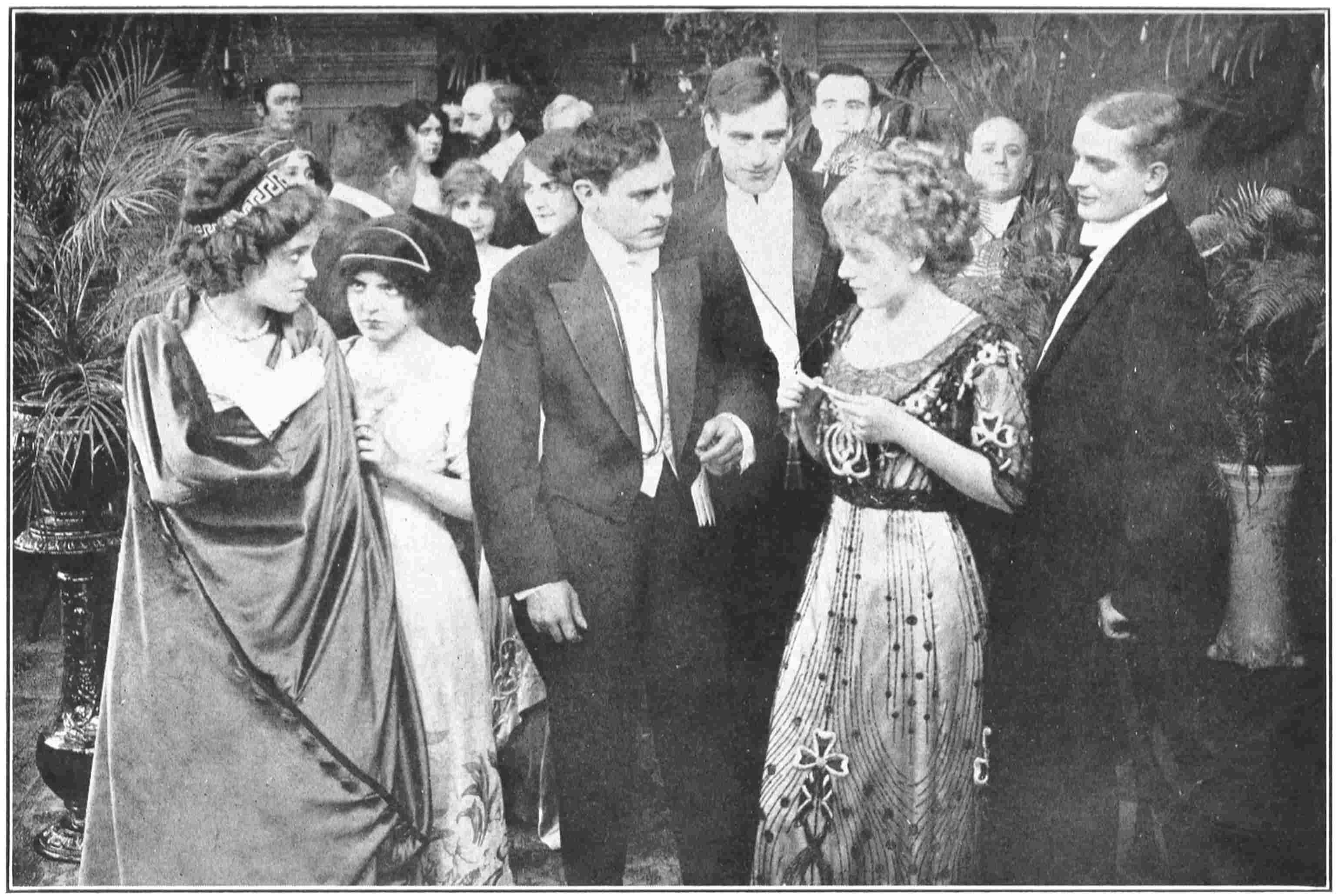
Jeanie Macpherson, Marion Sunshine, Edwin August, Alfred Paget, Blanche Sweet and Charles West in a
scene from “From Out the Shadow.” The brilliant social world of early movie days.
(See p. 71)
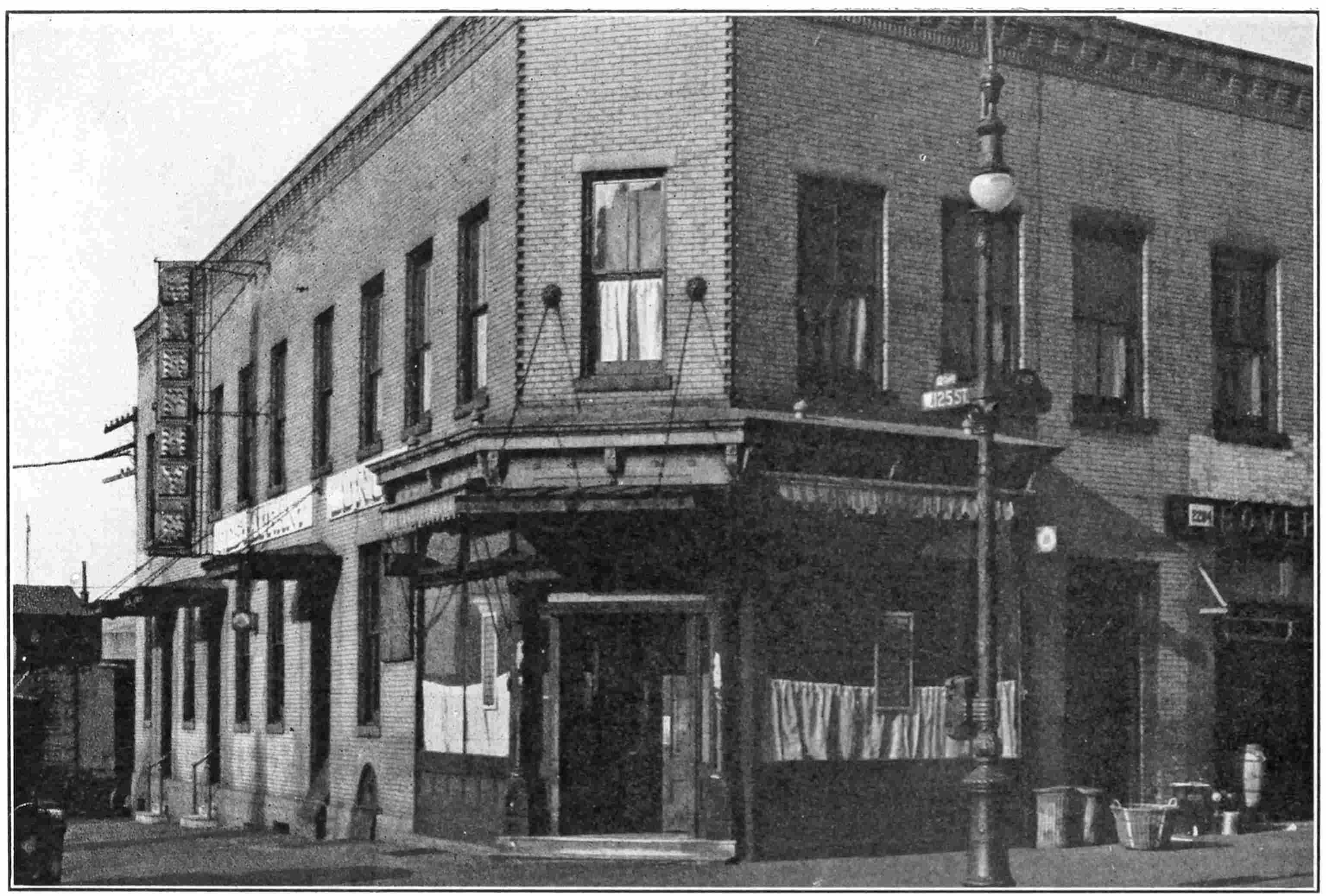
“Murphy’s,” where members of Biograph’s original stock company consumed hearty breakfasts when Jersey
bound.
(See p. 83)
But David buckled to the job like a true sport. It was
his job and he would dignify it. The leaden mornings came
to be quite the exception to the rule. Many days were
greeted with bright and merry song. And so, firm and
unshakeable in our determination to do the most with what
we had, we dismissed the silly sensitive business and set to
work.
What we had to work with was this: a little studio where
interior scenes were taken, and exteriors also, for there
was little money for traveling expenses—Fort Lee, Greenwich,
and the Atlantic Highlands comprised our early
geographical horizon. A few actors, a willing and clever
camera man, a stage carpenter, and a scenic artist, comprised
the working force. Funny studio! Interesting old workshop!
“The Last Leaf’s” ballroom!
The outer doors of the building opened into a broad
hall from which on the left as one entered, a door gave into
Mr. Dougherty’s office; on the right was another door—the
entrance to the bookkeeping department. An old colonial
stairway on this same side led up to the projection room
and other offices. The spacious hall of the main floor ended
with double doors opening into the studio.
There, first to meet the eye—unless one stumbled on it
before seeing it—for it completely blocked the entrance—was
a heavy rolling platform on which the camera, poised
atop of its tripod, was set. So if the studio doors chanced
to invite you during the taking of a scene, you would have
to remain put in the few feet of space between the platform
and the doors until the scene was finished. Usually there
would be some one to keep you company in your little niche.
It was an easy matter in those days to get into the
studio. No cards of announcement were needed—no office
boy insulted you, no humiliation of waiting, as to-day. A
ring of the bell and in you’d go, and Bobbie Harron would
greet you if he chanced to be near by. Otherwise, any one
of the actors would pass you the glad word.
On an ordinary kitchen chair a bit to one side of the
camera, Mr. Griffith usually sat when directing. The actors
when not working lingered about, either standing or enjoying
the few other kitchen chairs. During rehearsals actors
sat all over the camera stand—it was at least six feet square—and
as the actors were a rather chummy lot, the close
and informal intimacy disturbed them not the least.
A “scene” was set back center, just allowing passage
room. What little light came through the few windows
was soon blocked by dusty old scenery. On the side spaces of
the room and on the small gallery above, the carpenters
made scenery and the scene painters painted it—scenery,
paint pots, and actors were all huddled together in one
friendly chaos. We always had to be mindful of our costumes.
To the smell of fresh paint and the noise of the
carpenters’ hammers, we rehearsed our first crude little
movies and in due time many an old literary classic.
Rolls of old carpet and bundles of canvas had to be
climbed over in wending one’s way about. To the right
of the camera a stairway led to the basement where there
were three small dressing-rooms; and no matter how many
actors were working in a picture those three dark little
closets had to take care of them all. The developing or
“dark” room adjoined the last dressing-room, and all
opened into a cavernous cellar where the stage properties
were kept. Here at the foot of the stairs and always in
every one’s way, the large wardrobe baskets would be deposited.
And what a scramble for something that would
half-way fit us when the costumes arrived!
We ate our lunches in the dingy basement, usually
seated on the wardrobe baskets. Squatted there, tailor-fashion,
on their strong covers, we made out pretty well.
On days when we had numbers of extra people, our lunch
boy, little Bobbie Harron, would arrange boards on wooden
horses, and spread a white cloth, banquet fashion. Especially
effective this, when doing society drama, and there
would be grand dames, financiers, and magnates, to grace
the festive board.
In a back corner of the studio reposed a small, oak,
roll-top desk, which the new director graced in the early
morning hours when getting things in shape, and again
in the evening when he made out the actors’ pay checks.
When the welcome words came from the dark room, “All
right, everybody; strike!” the actors rushed to the roll-top,
and clamored for vouchers—we received our “pay” daily.
Then the actor rushed his “make-up” off, dressed, passed
to the bookkeeper’s window in the outer office, presented
his voucher, and Herman Bruenner gave him his money.
And then to eat, and put away a dollar towards the week’s
rent, and to see a movie for ten cents!
A little group of serious actors soon began to report
daily for work. As yet no one had a regular salary except
the director and camera man. “Principal part” actors received
five and “extras” three dollars.
In August this first year Mr. Griffith began turning
out two releases a week, usually one long picture, eight
to eleven hundred feet, and one short picture, four to five
hundred feet. The actors who played the principal parts
in these pictures were Eddie Dillon, Harry Salter, Charles
Inslee, Frank Gebhardt, Arthur Johnson, Wilfred Lucas,
George Nichols, John Compson, Owen Moore, Mack Sennett,
Herbert Pryor, David Miles, Herbert Yost, Tony
O’Sullivan, and Daddy Butler. Of the women Marion
Leonard, Florence Lawrence, and myself played most of
the leading parts, while Mabel Stoughton, Florence Auer,
Ruth Hart, Jeanie Macpherson, Flora Finch, Anita Hendry,
Dorothy West, Eleanor Kershaw (Mrs. Tom Ince), and
Violet Mersereau helped out occasionally. Gladys Egan,
Adele DeGarde, and Johnny Tansy played the important
child parts.
Though I speak of playing “principal parts,” no one
had much chance to get puffed up, for an actor having
finished three days of importance usually found himself on
the fourth day playing “atmosphere,” the while he decorated
the back drop. But no one minded. They were a good-natured
lot of troupers and most of them were sincerely
concerned in what they were doing. David had a happy
way of working. He invited confidence and asked and took
suggestions from any one sufficiently interested to make
them. His enthusiasm became quite infectious.
In the beginning Marion Leonard and I alternated playing
“leads.” She played the worldly woman, the adventuress,
and the melodramatic parts, while I did the sympathetic,
the wronged wife, the too-trusting maid, waiting,
always waiting, for the lover who never came back. But
mostly I died.
Our director, already on the lookout for a new type,
heard of a clever girl out at the Vitagraph, who rode a
horse like a western cowboy and who had had good movie
training under Mr. Rainous. He wanted to see her on
the screen before an audience. Set up in a store on Amsterdam
Avenue and 160th Street was a little motion picture
place. It had a rough wooden floor, common kitchen chairs,
and the reels unwound to the tin-panny shriek of a pianola.
After some watchful waiting, the stand outside the theatre—the
sort of thing sandwich men carry—finally announced
“The Dispatch Bearer,” a Vitagraph with Florence Lawrence.
So, living near by, after dinner one night we rushed
over to see it.
It was a good picture. Mr. Griffith concluded he would
like to work with Mr. Rainous for a while and learn about
the movies. For one could easily see that besides having
ability Florence Lawrence had had excellent direction.
Well, David stole little Florrie, he did. With Harry
Salter as support in his nefarious errand, he called on Miss
Lawrence and her mother, and offered the Vitagraph girl
twenty-five dollars a week, regular. She had been receiving
fifteen at Vitagraph playing leading parts, sewing costumes,
and mending scenery canvas. She was quite overcome with
Mr. Griffith’s spectacular offer, readily accepted, and by
way of celebrating her new prosperity, she drew forth from
under the bed in the little boarding-house room, her trombone—or
was it a violin?—and played several selections.
As a child, Miss Lawrence, managed by her mother, and
starred as “Baby Flo, the child wonder-whistler” had toured
the country, playing even the “tanks.”
Immediately she joined the Biograph, Florence Lawrence
was given a grand rush. But she never minded work. The
movies were as the breath of life to her. When she wasn’t
working in a picture, she was in some movie theatre seeing
a picture. After the hardest day, she was never too tired
to see the new release and if work ran into the night hours,
between scenes she’d wipe off the make-up and slip out to
a movie show.
Her pictures became tremendously popular, and soon
all over the country Miss Lawrence was known as “The
Biograph Girl.” It was some years before the company
allowed the names of actors to be given out, hence “Biograph
Girl” was the only intelligent appellation. After
Miss Lawrence left Biograph, Mary Pickford fell heir to
the title.
Miss Lawrence’s early releases show her versatility.
Two every week for a time: “Betrayed by a Handprint,”
“The Girl and the Outlaw,” “Behind the Scenes,” “The
Heart of Oyama,” “Concealing a Burglar,” “Romance of
a Jewess,” “The Planter’s Wife,” “The Vaquero’s Vow,”
“The Call of the Wild,” “The Zulu’s Heart,” “The Song
of the Shirt,” “Taming of the Shrew,” “The Ingrate,” “A
Woman’s Way.”
Like Mary Pickford, Miss Lawrence was an awfully
good sport about doing stunts. One day a scene was being
filmed with Miss Lawrence thrown tummy-wise across a
horse’s saddled back. As the horse dashed down the roadway
he came so close to the camera that we who were
watching breathlessly, for one moment closed our eyes, for
Miss Lawrence’s blond head just missed the camera by a
few inches.
Rainy August days forced us to work in the studio.
Mr. Griffith had read a story by Jack London called “Just
Meat.” He changed the name to “For Love of Gold” and
let it go at that. We had no fear of lawsuits from fractious
authors those days.
The story was about two thieves, who returned home
with the latest spoils, get suspicious of each other and each,
unknown to the other, poisons the other’s coffee and both
die. The big scenes which were at the table when the
men become distrustful of each other could be told only
through facial expression. “Ah,” puzzled Mr. Director,
“how can I show what these two men are thinking? I
must have the camera closer to the actors—that’s what I
must do—and having only two actors in these scenes, I
can.”
Up to this time, every scene had been a long shot—that
is, the floor—the carpet—the greensward—showed
yards in front of the actors’ feet. But Mr. Griffith knew
he couldn’t show nine feet of floor and at the same time
register expression. So to his camera man he said: “Now
don’t get excited, but listen. I’m going to move the camera
up, I’m going to show very little floor, but I’m going to
show a large, full-length figure; just get in the actors’ feet—get
the toes—one foot of foreground will do.
“Well, we’ve never done anything like that—how do
you think that’s going to look?—a table with a man on each
side filling up the whole screen, nearly.”
“We’ll do it—we’ll never get anywhere if we don’t begin
to try new things.”
The burglars were screened so big that every wicked
thought each entertained was plainly revealed. Everybody
came to like the idea afterwards, especially the actors.
Along in November, Mr. Griffith began work on a series
of domestic comedies—the “Jones Pictures.” Florence
Lawrence played Mrs. Jones, and John Compson, Mr. Jones.
Their movie marital début was in “A Smoked Husband.”
The Jones movies were probably the first to achieve success
as a series.
CHAPTER IX FIRST PUBLICITY AND EARLY SCENARIOS
In Biograph’s story, quite a few who stuck to the ship
in these first days are big names in the movies to-day.
In the town of Erie, Pa., in the early nineteen hundreds
flourished a little newspaper, on the staff of which was
Frank Woods. Besides reporting “news,” Frank Woods
sold advertising. Erie, Pa., not long satisfying his ambitions,
Mr. Woods set out for the journalistic marts of New
York City, and shortly after found himself selling advertising
for the New York Dramatic Mirror. The idea of
getting ads from the picture people came to him when he
noticed that pictures were not mentioned in the Dramatic
Mirror. Writers on the paper were told that any reference
to the movies would be promptly blue-penciled.
Mr. Woods figured that if he could interest the movie
people he might get ads from them and the Dramatic Mirror
wouldn’t mind that. But the picture people turned deaf
ears. Why pay money for an ad in a paper that was all
too ready to crush them? Besides, the Mirror didn’t circulate
among the exhibitors and those interested in the
movies. The movie people would stick to the more friendly
Billboard—thank you kindly—it could have their ads.
Another idea came to Frank Woods. How about pictures
being reviewed? He put the plan before Lee
Dougherty, for Lee was always genial and had time to
listen. Lee said: “Fine, give us real serious reviews—tell
us where we are wrong—but don’t expect an ad for your
effort.”
The result of this conversation was that three reviews
appeared in the New York Dramatic Mirror, June, 1908.
On a rear end page captioned “The Spectator,” Frank E.
Woods dissertated through some columns on the merits
and demerits of the movies, and thus became their first real
critic. We were very grateful for the few paragraphs. It
meant recognition—the beginning. How gladly we parted
with our ten cents weekly to see what “Spec” had to say
about us.
But Mr. Woods didn’t get an ad from the Biograph.
So he had another heart-to-heart talk with Mr. Dougherty,
and Doc said: “Never mind, keep it up—but as I told you,
the reviews aren’t going to influence us about ads.”
But in August the Company came across and bought
a quarter-page ad for the Biograph movies.
The active mind of Frank Woods was not going to
stop with critical comments on moving pictures. His new
duties necessitated his seeing pictures; and, looking them
over and analyzing them for his reviews, he said to himself;
“Oh, they’re terrible—I could do better myself—such
stories!” So he wrote three “suggestions”—that’s all they
were—and that’s what they were then called. With great
aplomb, he took them to Mr. Dougherty, and to his amazement
Mr. Dougherty turned the whole three down. Sorry,
but he didn’t think them up to scratch. But Mr. Woods
would not be fazed by a turn-down like that. He wrote
three more “suggestions.”
The studio had a sort of nominal supervisor, a Mr.
Wake, whose job was to O. K. little expenditures in the
studio and to pass on the purchase of scenarios. One day,
not long after our A. B. affiliation, just as I was entering
the main foyer, Mr. Griffith coming from the projection
room seemed more than usually light-hearted. So I said,
“You’re feeling good—picture nice?”
“Oh, yes, all right, but”—this in a whisper—“Wake’s
been fired.”
I wondered how I could wait all that day, until evening,
to hear what had happened. But I did, and learned that
Mr. Wake with Biograph money had purchased silk stockings
for Mutoscope girls, and then had given the girls the
stockings for their own.
However, during a temporary absence from the studio
before Mr. Wake’s dismissal, Frank Woods came down
with three more suggestions which were shown to Mr.
Griffith direct. He bought the whole bunch, three at fifteen
dollars apiece, nine five-dollar bills, forty-five dollars.
Around the Dramatic Mirror offices Mr. Woods was
already jocularly being called “M. P. Woods.” And this
day that he disposed of his three “suggestions,” Moving
Picture Woods with much bravado entered the Mirror’s
office, went over to the desk, brushed aside some papers,
cleared a place on the counter, and in a row laid his nine
five-dollar bills.
In the office at the time were George Terwilliger (how
many scenarios he afterwards wrote), Al Trahern (Al continued
with his stock companies and featuring his wife
Jessie Mae Hall), and Jake Gerhardt, now in the business
end of the movies. The trio looked—and gasped—and
looked—and in unison spoke:
“Where did you get all that?”
“Moving Pictures!”
“Moving Pictures? For heaven’s sake, tell us about it.”
“How did you do it?” queried George Terwilliger.
“Forty-five dollars for three stories, good Lord, and they
gave you the money right off, like that.”
So Mr. Woods told his little story, and as the conversation
ended, George Terwilliger reached for paper and pencil,
for five-dollar bills were beckoning from every direction.
Maybe he could put it over, too. He did—he sold lots and
lots of “suggestions.” Frank Woods wrote thirty movies
for Biograph.
Frank Woods now set about to criticise the pictures with
the same seriousness with which he would have criticised
the theatre. He bought books about Indians and let the
producers know there was a difference between the Hopi
and the Apache and the Navajo. With a critical eye, he
picked out errors and wrote of them frankly, and his influence
in the betterment of the movies has been a bigger one
than is generally known outside the movie world. Mr.
Woods is really responsible for research. And Mr.
Dougherty gives him credit for turning in the first “continuity.”
The picture that has that honor is a version of
Tennyson’s “Enoch Arden,” called “After Many Years.”
Scenarios that reached the Biograph offices, due to lack
of organization, were sometimes weeks in reaching the
proper department, but Mr. Griffith got first chance at
“After Many Years.” Both he and Mr. Dougherty thought
it pretty good stuff, but the obvious emotional acting that
had prevailed somewhere in every picture so far, was here
entirely lacking. Quiet suppressed emotion only, this one
had. But Doc said he’d eat the positive if it wouldn’t make
a good picture. So it was purchased.
But “After Many Years,” although it had no “action,”
and some of us sat in the projection room at its first showing
with heavy hearts, proved to write more history than
any picture ever filmed and it brought an entirely new technique
to the making of films.
It was the first movie without a chase. That was something,
for those days, a movie without a chase was not a
movie. How could a movie be made without a chase? How
could there be suspense? How action? “After Many
Years” was also the first picture to have a dramatic close-up—the
first picture to have a cut-back. When Mr. Griffith
suggested a scene showing Annie Lee waiting for her husband’s
return to be followed by a scene of Enoch cast away
on a desert island, it was altogether too distracting. “How
can you tell a story jumping about like that? The people
won’t know what it’s about.”
“Well,” said Mr. Griffith, “doesn’t Dickens write that
way?”
“Yes, but that’s Dickens; that’s novel writing; that’s
different.”
“Oh, not so much, these are picture stories: not so different.”
So he went his lonely way and did it; did “After Many
Years” contrary to all the old established rules of the game.
The Biograph Company was very much worried—the picture
was so unusual—how could it succeed?
It was the first picture to be recognized by foreign
markets. When one recalls the high class of moving pictures
that Pathé and Gaumont were then putting out, such
as “The Assassination of the Duc de Guise,” this foreign
recognition meant something.
“After Many Years” made a change in the studio. All
“suggestions” now came directly to Mr. Dougherty’s office.
He selected the doubtful ones and the sure bets and with
Mr. Griffith read them over the second time. They threshed
out their differences in friendly argument. So Lee Dougherty
became the first scenario editor.
And of the sad letters and grateful ones his editing
jobs brought him, this letter from a newspaper man on a
Dayton, Ohio, paper, now dead, he prizes most highly:
L. E. Dougherty, Editor,
Kinemacolor Company,
Los Angeles, Calif.
Dear Sir:
Excuse me, but I can’t help it. When I cashed the $25 check
for “Too Much Susette,” the scenario of mine which you accepted,
I took $5 of the money and put it on “Just Red” who won at
Louisville at the juicy price of 30 to 1. I hope the film will bring
your company as much luck as the script has brought me.
Yours very truly,
George Groeber.
“Doc” was Mr. Griffith’s friendly appellation for “the
man in the front office,” Lee Dougherty. It was going
some for Mr. Griffith to give any one a nickname. He never
was a “hail fellow well met.” It was Mr. So-and-so from
Mr. Griffith and to Mr. Griffith with very few exceptions.
Never once during all the Biograph years did he ever publicly
call even his own wife by any other name than “Miss
Arvidson.” Only in general conversation about the movies,
and in his absence, was he familiarly referred to as “Griff,”
or “D. W.,” or the “Governor.”
Mr. Dougherty was the one man at 11 East Fourteenth
Street before the Griffith régime who had more than a
speaking acquaintance with the movies. In the summer of
1896 as stage manager of the old Boston Museum, he installed
there the first projection machine of American
manufacture, the Eidoloscope. When the season at the
Boston Museum was over, Mr. Dougherty, who had become
quite fascinated with this new idea in entertainment, went
to New York City. The Biograph Company along about
1897 had just finished a moving picture of Pope Leo XIII
taken at the Vatican. Pictures of the late Pope Benedict
XV were announced as the first pictures made of a Pope,
“approved by His Holiness.” While they may be the first
approved ones, Captain Varges of the International News
Reel, who claims the honor, brought the third motion picture
camera into the Vatican grounds. The second film—Pope
Pius X in the Vatican, and gardens, and the Eucharistic
Congress, was released in 1912.
Well, anyhow, Mr. Dougherty took a set of Biograph’s
Pope Leo XIII pictures to exhibit in the towns and cities
of New Jersey and Pennsylvania on the old Biograph projection
machine—one vastly superior to the Eidoloscope.
The company exhibiting the picture consisted of an operator
on the machine and Mr. Dougherty who lectured. And
when he began his little talk (there was no titling or printed
matter in the picture), the small boys in the gallery would
yell “spit it out, we want to see the picture.” Numbers
of motion picture directors to-day might well heed the sentiments
of those small boys.
From exhibiting Pope Leo XIII’s picture, Mr. Dougherty
became stage director of One Minute Comedies for
the Biograph which at this time had a stage on the roof
of a building at 841 Broadway. And sometimes in the
midst of a scene the weather would pick up scenery and
props and deposit them in Broadway. So came about experiments
with electric lights, satisfactory results first being
obtained with the Jeffries-Sharkey prize fight.
The One Minute Comedies finally were given up, but
the Mutoscopes, being Biograph’s biggest source of revenue,
were continued. The Mutoscopes were brief film playlets
that were viewed in the penny-in-the-slot machines.
One day, before Mutoscopes ended, my husband asked
me to run over to Wanamaker’s with him and help choose
some pretty undies for the Mutoscope girls—photographically
effective stuff—so we selected some very elegant
heavy black silk embroidered stockings and embroidered
pink Italian silk vests and knickers—last-word lingeries for
that time.
I felt rather ill about it. “Oh dear,” I thought, “this
is some business, but I’ll be brave, I will, even though I
die.” Well, the parcel being wrapped, David took it and
then handed it to me, and I thought, “Why should I carry
the bundle?” So we reached Fourteenth Street. David
started to the left without his parcel; I was continuing up
Broadway, so handed it to him. But the lingerie wasn’t
for Mutoscopes at all—but for me—just a little surprise.
So then with a light and happy heart, I took my way home
to admire my beautiful present.
After the Biograph had engaged David, Mr. Dougherty
did not want them to make any more Mutoscopes. Mr.
Griffith directed possibly six. In order to influence Biograph
to cut out the Mutoscopes, Doc got very cocky, and he
said to Mr. Kennedy and Mr. Marvin, “You wait, you’ll
see pictures on Broadway some day, like you do plays.”
But they gave him the laugh. “Yes,” Doc added, “and
they will accord them the same dignified attention that John
Drew receives.” They laughed some more at this, and said,
“Pictures will always be a mountebank form of amusement.”
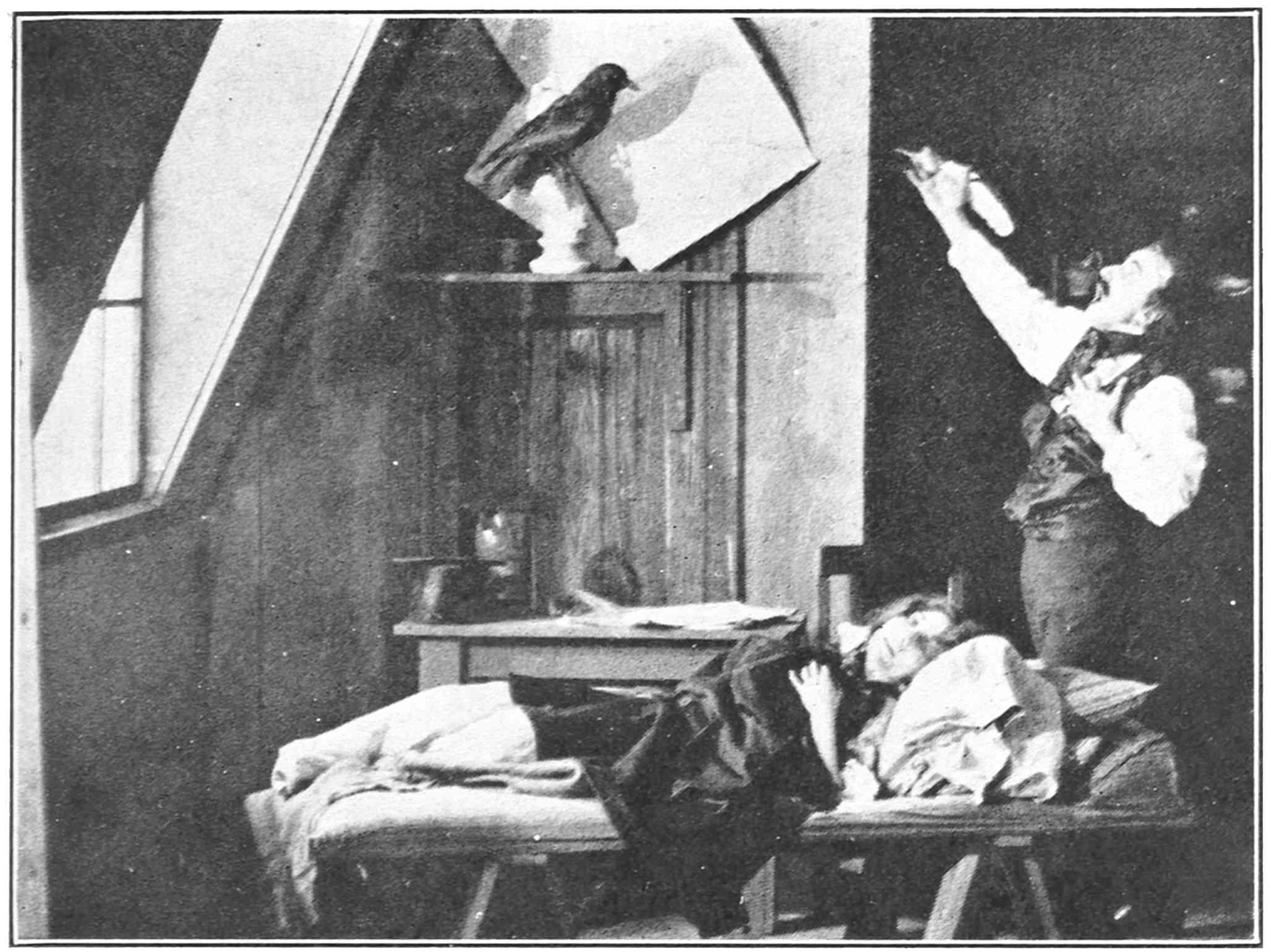
From “Edgar Allan Poe,” with Barry O’Moore (Herbert Yost) and Linda
Griffith.
(See p. 90)
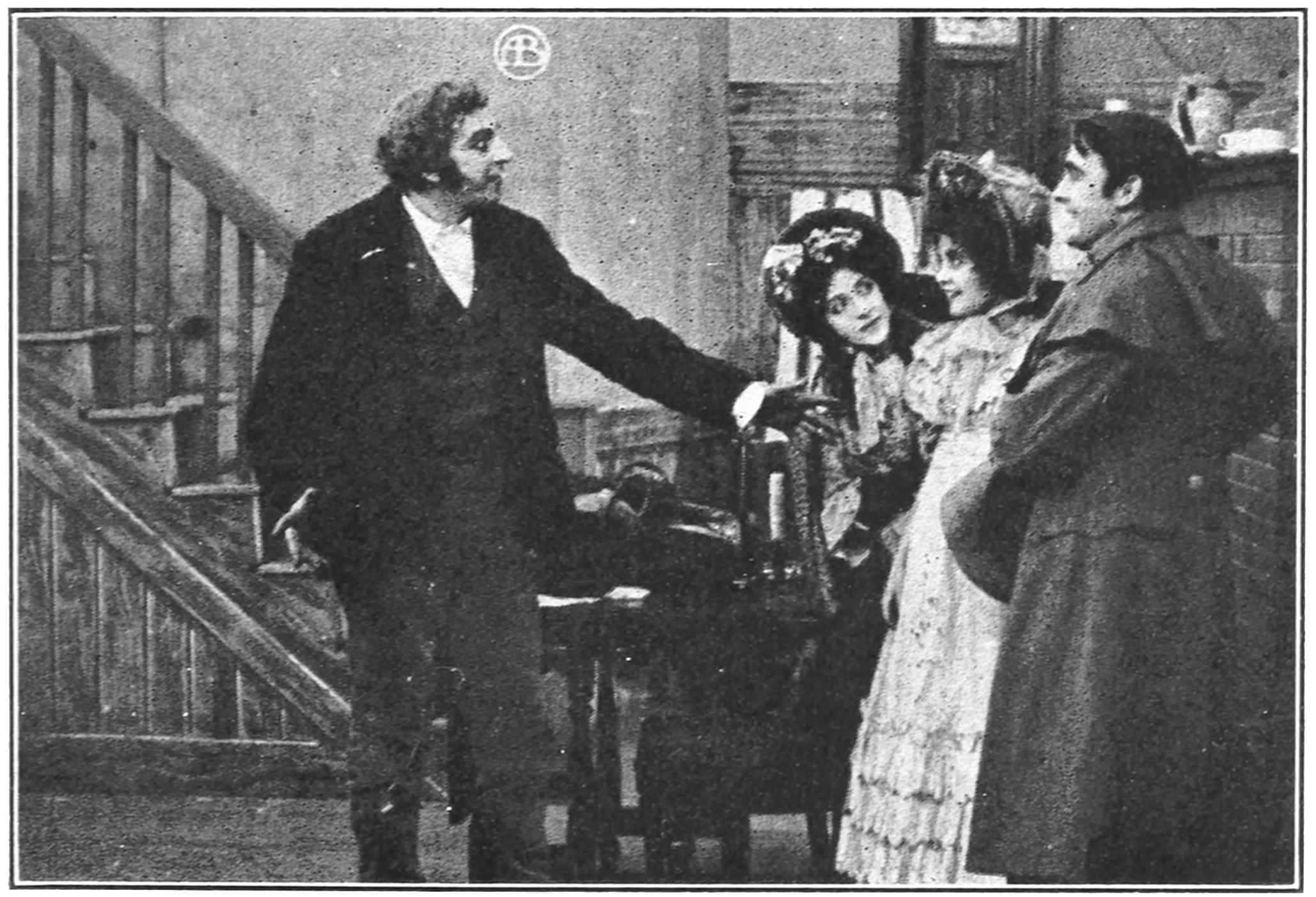
Herbert Pryor, Linda Griffith, Violet Mersereau and Owen Moore in “The
Cricket on the Hearth.”
(See p. 92)
But Doc’s prophesy came true.
And David did no more Mutoscopes.
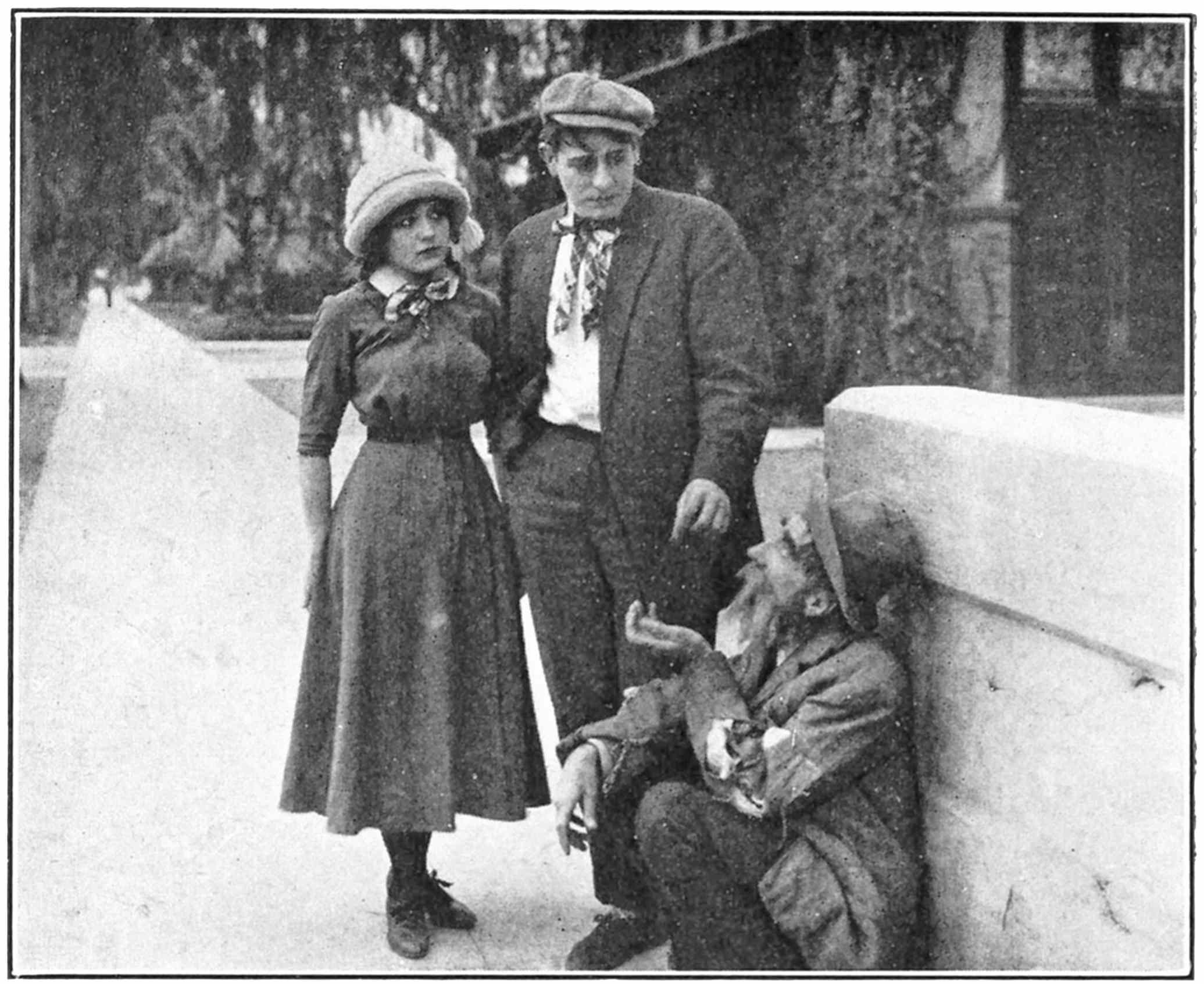
“Little Mary,” portraying the type of heroine that won her a legion of
admirers.
(See p. 104)
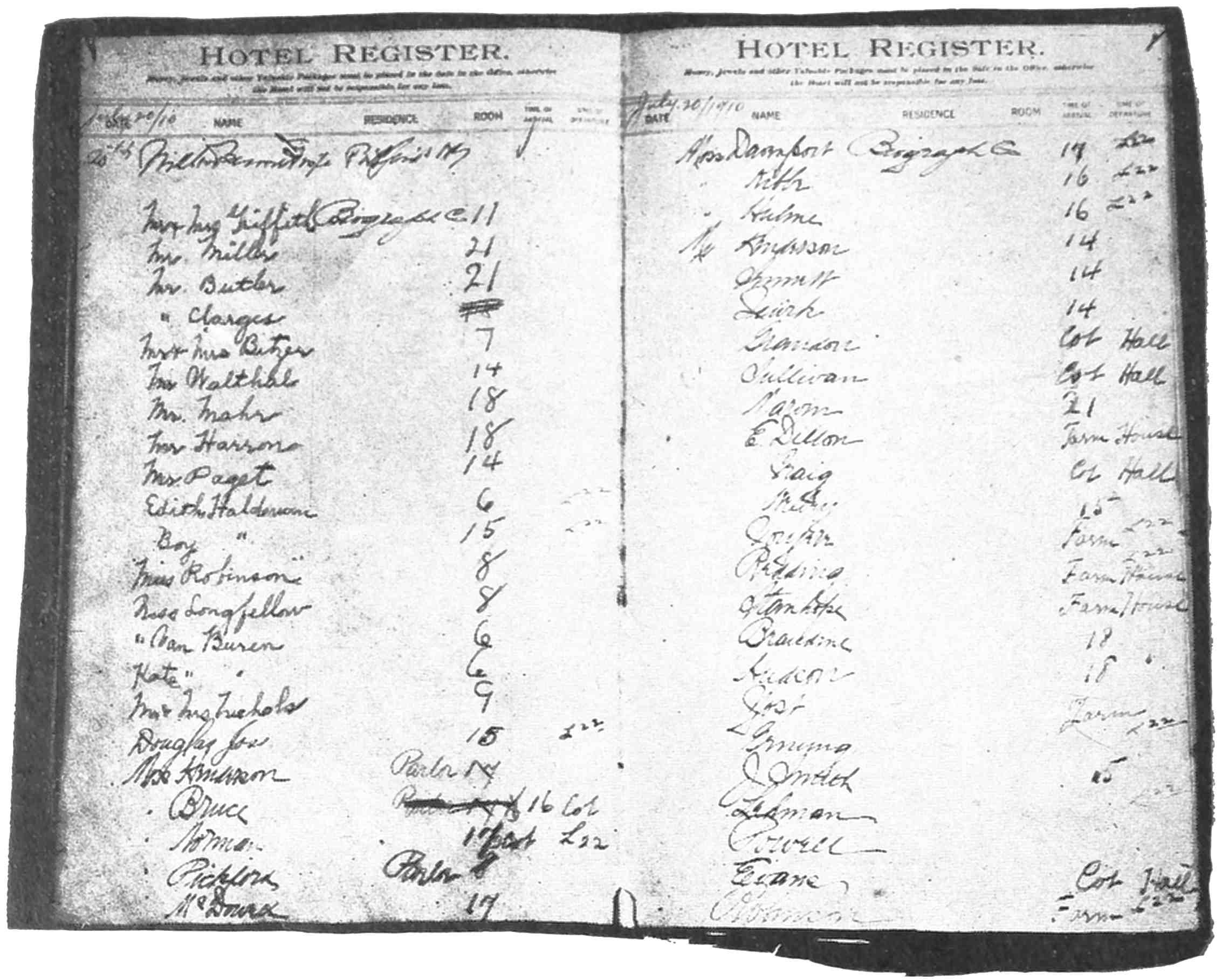
Register of Caudebec Inn at Cuddebackville.
(See p. 119)
CHAPTER X WARDROBE—AND A FEW PERSONALITIES
The “Jones” pictures became very popular. Many persons
well known in the movies to-day, played “bits”
in them. Jeanie Macpherson, author of “The Ten Commandments”
was “principal guest” in “Mr. Jones at the
Ball.” Miss Macpherson, who for many years has been and
still is chief scenario writer and assistant to Cecil B. DeMille,
got her first movie job on the strength of a pale blue crepe-de-chine
evening gown.
How funny we were when we moved in the world of
brilliant men and beautiful women only we, who represented
them, knew. Dress suits of all vintages appeared. Any one
with “clothes” had a wonderful open sesame. A young chap
whom we dubbed “the shoe clerk”—who never played a
thing but “atmosphere”—got many a pay-check on the
strength of his neat, tan, covert cloth spring overcoat—the
only spring overcoat that ever honored the studio. (An
actor could get along in the spring with his winter suit and
no overcoat!)
Clothes soon became a desperate matter, so Biograph
consented to spend fifty dollars for wearing apparel for the
women. Harry Salter and I were entrusted with the funds
and told to hunt bargains. We needed negligees, dinner
dresses, ball gowns, and semi-tailored effects. The clothes
were to be bought in sizes to fit, as well as could be, the
three principal women.
In that day, on Sixth Avenue in the Twenties, were
numbers of shops dealing in second-hand clothing, and Mr.
Salter and I wandered among them and finally at a little
place called “Simone,” we closed a deal. We got a good
batch of stuff for the fifty—at least a dozen pieces—bizarre
effects for the sophisticated lady, dignified accoutrements
for the conventional matron, and simple softness for young
innocence.
How those garments worked! I have forgotten many,
but one—a brown silk and velvet affair—I never can forget.
It was the first to be grabbed off the hook—it was
forever doing duty. For it was unfailing in its effect.
Arrayed in the brown silk and velvet, there could be no
doubt as to one’s moral status—the maiden lady it made
obviously pure; the wife, faithful; the mother, self-sacrificing.
Deciding, impromptu, to elaborate on a social affair,
Mr. Griffith would call out: “I can use you in this scene,
Miss Bierman, if you can find a dress to fit you.” The tall,
lean actresses, and the short ones found that difficult, and
thus, unfortunately, often lost a day’s work. Spotting a
new piece of millinery in the studio, our director would thus
approach the wearer: “I have no part for you, Miss Hart,
but I can use your hat. I’ll give you five dollars if you
will let Miss Pickford wear your hat for this picture.” Two
days of work would pay for your hat, so you were glad
to sit around while the leading lady sported your new headpiece.
You received more on a loan of your clothes, sometimes,
than you did on a loan of yourself. Clothes got five
dollars always, but laughter and merry-making upstage went
for three.
Jeanie Macpherson had recently returned from Europe
with clothes the like of which had never been seen at
Biograph. From the chorus of “Hello People” at the
Casino Theatre little Jeanie entered the movies and even
though she had a snub nose and did not photograph well,
what could Mr. Griffith do but use her?
Jeanie proved to be a good trouper; she was conscientious
and ambitious. Though only extras and bits came
her way, David encouraged her. She was rather frail, and
one time after remaining ill some days when on a picture
up in the country, Mr. Griffith thought he should give her
good advice. So he told her to live on a farm for some
months, and drink milk and get strong, there being no
future without health; he certainly could not use her in
parts were she to faint on him thus. But Jeanie confided
she’d have to overcome fainting without “months on a
farm”—that luxury she couldn’t afford.
Since Biograph Miss Macpherson has carried on in every
department of picture making except the acting. She early
took stock of herself and recognized that her future would
not be in the ranks of the movie stars. Just where it would
be she did not then know—nor did any one else.
On a day in this slightly remote period Jesse Lasky
and Cecil DeMille were lunching at Rector’s in New York—music,
luscious tidbits, and Mr. Lasky casually remarking:
“Let’s go into the moving picture business.”
“All right, let’s,” answered Mr. DeMille with not the
slightest hesitation.
Mr. Lasky, thus encouraged, suggested more “Let’s,”
to each of which Mr. DeMille as promptly agreed “Let’s.”
Along came brother-in-law Sam Goldfish, married to
Blanche Lasky, sister to Jesse. Mr. Goldfish (now
Goldwyn) was in the glove business up in Gloversville, New
York, and he was very grouchy this day because the Government
had taken the duty off gloves, and he was eager to
listen in on this new idea of Mr. Lasky’s.
By the time that lunch was finished this is what had
happened: Mr. Goldfish had put up $5,000, Mr. Lasky
$5,000, and Arthur Friend $5,000, and with the $15,000
Cecil DeMille was to go out to California to make movies.
He begged his brother William to put up $5,000 and become
a partner but William said: “No, one of us had better be
conservative and keep the home fires burning.” So when
William later went into the movies, he went to work for
his brother Cecil, and he has been doing so up to this time.
Mr. Cecil DeMille became Director General of the new
Jesse Lasky Pictures, and Mr. Oscar Apfel, General Manager.
Out on Vine Street, Hollywood, Mr. DeMille took
over a stable, and began to make movies. It was a crude
equipment, but the company fell heir to some beer kegs
from which they viewed their first picture “The Squaw
Man” released sometime in 1913. The stable is still a part
of the Hollywood Famous Players-Lasky modern studio,
but the beer kegs have vanished.
Pictures kept on radiating from the stable with quite
gratifying success. In time along came Jeanie Macpherson
intent on an interview with Mr. C. B. DeMille. Jeanie
now knew so much about the movies and C. B. so little,
he just naturally felt the Lord had sent her. Miss Macpherson’s
presentation of ideas always got over to Cecil.
So Jeanie signed up with the new firm on that rather long
ago day and now she gets one thousand a week, I understand,
for writing Mr. DeMille’s big pictures.
We must go back now and rescue Jeanie from Mr.
Jones’s Ball, for in “Mrs. Jones Entertains,” she has duties
to perform. In that picture she was not “principal guest”
but the “maid.” Flora Finch was a guest. Miss Finch in
another Jones movie becomes a book agent soliciting Mr.
Jones in his office. In “Mr. Jones has a Card Party,” Mack
Sennett appears as one of husband’s rummies, and in yet
another “Jones,” Owen Moore, first husband of Mary Pickford,
is seen as “atmosphere” escorting a lady from a smart
café. So chameleon-like were our social relations in the
“Jones Comedy Series.”
A Flora Finch tidbit here comes to light. Though fifteen
years have elapsed, they have not dimmed the memory
of the one hundred and eighty-five feet of “Those Awful
Hats.” The exhibitor was told: “It will make a splendid
subject to start a show with instead of the customary slides.”
The “set” represented the interior of a moving picture
theatre. The company was audience. Miss Finch was also
“audience,” only arriving late she had a separate entrance.
Miss Finch wore an enormous hat. When she was seated,
no one at the back or side of her could see a thing. But
out of the unseen ceiling, soon there dropped an enormous
pair of iron claws (supposedly iron) that closed tightly
on the hat and head of the shrieking Miss Finch, lifting her
bodily out of her seat and holding her suspended aloft in
the studio heaven.
How many times that scene was rehearsed and taken!
It grew so late and we were all so sleepy that we stopped
counting. But pay for overtime evolved from this picture.
The members of the stock company that had grown up
worked on a guaranty of so many days a week. Now
with so much night work our director felt that the actors
not on “guaranties” should be recompensed and it was
ruled that after 7 P.M. they would receive three extra dollars.
So when 6 P.M. would arrive with yet another scene
to be taken, the non-guaranty actors became very cheery.
More money loomed, and more sandwiches, pie, coffee, or
milk, on the company. Frequently those not on the guaranteed
list made more than those on it, which peeved the
favored ones.
Along about now Mr. Herbert Yost contributed some
artistic bits. Once he was Edgar Allan Poe and he wrote
“The Raven” while his sick wife, poor little Virginia, died.
We were a bit afraid of being too classic. The public might
not understand—we must go slowly yet awhile, but not all
our days.
Mr. Yost was one actor who used a different name for
his picture work. He called himself “Barry O’Moore” in
the movies. Not that he felt the movies beneath him, but
he was nervous about the future reaction. He showed good
foresight. For as soon as the big theatrical producers got
wind of the fact that their actors were working in moving
picture studios, they decided to put a crimp in the idea.
The Charles Frohman office issued an edict that any actor
who worked in moving pictures could not work for them.
But the edict was shortly revoked. Even so long ago had
the power of the little motion picture begun to be felt.
CHAPTER XI MACK SENNETT GETS STARTED
One of our regular “extra” people was Mack Sennett.
He quietly dubbed along like the rest, only he
grouched. He never approved whole-heartedly of anything
we did, nor how we did it, nor who did it. There was
something wrong about all of us—even Mary Pickford!
Said the coming King of Comedy productions: “I don’t
see what they’re all so crazy about her for—I think she’s
affected.” Florence Lawrence didn’t suit him either—“she
talks baby-talk.” And to Sennett “baby-talk” was the limit!
Of myself he said: “Sometimes she talks to you and sometimes
she doesn’t.” Good-looking Frank Grandin he called
“Inflated Grandin.”
But beneath all this discontent was the feeling that he
wasn’t being given a fair chance; which, along with a
smoldering ambition, was the reason for the grouch.
When work was over, Sennett would hang around the
studio watching for the opportune moment when his director
would leave. Mr. Griffith often walked home wanting
to get a bit of fresh air. This Sennett had discovered.
So in front of the studio or at the corner of Broadway
and Fourteenth Street he’d pull off the “accidental” meeting.
Then for twenty-three blocks he would have the boss all
to himself and wholly at his mercy. Twenty-three blocks
of uninterrupted conversation. “Well now, what do you
really think about these moving pictures? What do you
think there is in them? Do you think they are going to
last? What’s in them for the actor? What do you think
of my chances?”
To all of which Mr. Griffith would reply: “Well, not
much for the actor, if you’re thinking of staying. The
only thing is to become a director. I can’t see that there’s
anything much for the actor as far as the future is concerned.”
Mr. Sennett had come to the movies via the chorus of
musical comedy. It also was understood he had had a
previous career as a trainer for lightweight boxers. If
there was one person in the studio that never would be
heard from—well, we figured that person would be Mack
Sennett. He played policemen mostly—and what future
for a movie policeman? His other supernumerary part was
a French dude. But he was very serious about his policeman
and his French dude. From persistent study of Max
Linder—the popular Pathé comique of this day—and adoption
of his style of boulevardier dressing, spats, boutonnière,
and cane, Mr. Sennett evolved a French type that for an
Irishman wasn’t so bad. But even so, to all of us, it
seemed hopeless. Why did he take so much pains?
He got by pretty well when any social flair was unnecessary;
when Mary Pickford and I played peasants, tenement
ladies, and washwomen, Mack occasionally loved, honored,
and cherished us in the guise of a laborer or peddler. He
had a muscle-bound way about him in these serious rôles—perhaps
he was made self-conscious by the sudden prominence.
But Mary and I never minded. The extra girls,
however, made an awful fuss when they had to work in
a comedy with Sennett, for he clowned so. They would
rather not work than work with Sennett. How peeved
they’d get! “Oh, dear,” they’d howl, “do I have to work
with Sennett?”
Now ’tis said he is worth five millions!
In “Father Gets in the Game,” an early release, Sennett
is seen as the gay Parisian papa, the Linder influence plainly
in evidence.
Mr. Griffith was more than willing, if he could find a
good story with a leading comedy part suitable to Mr. Sennett,
to let him have his fling. Finally, one such came along—quite
legitimate, with plenty of action, called “The Curtain
Pole”—venturesome for a comedy, for it was apparent
it would exceed the five-hundred-foot limit. It took seven
hundred and sixty-five feet of film to put the story over.
Released in February, 1909, it created quite a sensation.
The natives of Fort Lee, where “The Curtain Pole”
was taken, were all worked up over it. Carpenters had
been sent over a few days in advance, to erect, in a clearing
in the wooded part of Fort Lee, stalls for fruits, vegetables,
and other foodstuffs. The wreckage of these booths by
M. Sennett in the guise of M. Dupont was to be the big
climax of the picture. The “set” when finished was of
such ambitious proportions—and for a comedy, mind you—that
we were all terribly excited, and we concluded that
while it had taken Mr. Sennett a long time and much coaxing
to get himself “starred,” it was no slouch of a part
he had eventually obtained for himself.
I know I was all stirred up, for I was a market woman
giving the green cabbages the thrifty stare, when the cab
with the curtain pole sticking out four or five feet either
side, entered the market-place. M. Dupont, fortified with
a couple of absinthe frappés, was trying to manipulate the
pole with sufficient abandon to effect the general destruction
of the booths. He succeeded very well, for before I had
paid for my cabbage something hit me and I was knocked
not only flat but considerably out, and left genuinely unconscious
in the center of the stage. While I was satisfied he
should have them, I wasn’t so keen just then about Mack
Sennett’s starring ventures. But he gave a classic and noble
performance, albeit a hard-working one.
One other picture was released this same year with
Mack Sennett in a prominent part—“The Politician’s Love
Story.”
New York’s Central Park awoke one February morning
to find her leafless trees and brush all a-glisten with a sleet
that made them look like fantastic crystal branches. When
the actors reported at the studio that morning, they found
Mr. Griffith in consultation with himself. He did not want
to waste that fairyland just a few blocks away.
A hurried look through pigeon-holed scripts unearthed
no winter story. “Well,” announced our director, “make
up everybody, straight make-up. Bobby, pack up the one
top hat, the one fur coat and cap, I’ll call a couple of taxis,
and on the way we’ll change this summer story into a winter
one.”
So was evolved “The Politician’s Love Story” in which
were scenes where lovers strolled all wrapped up in each
other and cuddled down on tucked-away benches. Well,
lovers can cuddle in winter as well as summer, and we were
crazy to get the silver thaw in the picture; and we got it,
though we nearly froze. But we had luxurious taxis to
sit in when not needed, and afterwards we were taken to
the Casino to thaw out, and were fed hot coffee and sandwiches
in little private rooms.
“The Curtain Pole” and “The Politician’s Love Story”
started the grumbling young Mack Sennett on the road to
fame and fortune. Like the grouchy poker player who
kicks himself into financial recuperation, Mack Sennett
grouched himself into success.
CHAPTER XII ON LOCATION—EXPERIENCES PLEASANT AND OTHERWISE
Before the first winter drove us indoors there had
been screened a number of Mexican and Indian pictures.
There was one thriller, “The Greaser’s Gauntlet,”
in which Wilfred Lucas, recruited from Kirke La Shelle’s
“Heir to the Hoorah” played the daring, handsome, and
righteous José. And Wilfred Lucas, by the way, was the
first real g-r-a-n-d actor, democratic enough to work in our
movies. That had happened through friendship for Mr.
Griffith. They had been in a production together.
For a mountain fastness of arid Mexico, we journeyed
not far from Edgewater, New Jersey. No need to go
further. Up the Hudson along the Palisades was sufficiently
Mexico-ish for our needs. There were many choice boulders
for abductors to hide behind and lonely roads for hold-ups.
New Jersey near by was a fruitful land for movie landscape;
it didn’t take long to get there, and transportation
was cheap. Small wonder Fort Lee shortly grew to be
the popular studio town it did.
In those days, movie conveyance for both actors and
cargo was a bit crude. We had no automobiles. When
Jersey-bound, we’d dash from wherever we lived to the
nearest subway, never dreaming of spending fifty cents on
a taxi. We left our subway at the 125th Street station.
Down the escalator, three steps at a bound, we flew, and
took up another hike to the ferry building. And while we
hiked this stretch we wondered—for so far we had come
breakfastless—if we would have time for some nourishment
before the 8:45 boat.
A block this side of the ferry building was “Murphy’s,”
a nice clean saloon with a family restaurant in the back,
where members of the company often gathered for an early
morning bite. We stuffed ourselves until the clock told
us to be getting to our little ferry-boat. Who knew when
or where we might eat again that day?
“Ham,” Mr. Murphy’s best waiter, took care of us. As
the hungry breakfasters grew in number and regularity Mr.
Murphy became inquisitive. Mr. Murphy was right, we
didn’t work on the railroad and we didn’t drive trucks. So,
who, inquired Mr. Murphy of Ham, might these strange
people be who ate so much and were so jolly in the early
morning?
And Ham answered, “Them is moving picture people.”
And Mr. Murphy replied, “Well, give them the best and
lots of it.”
We needed “the best and lots of it.” We needed regular
longshoremen’s meals. Outdoor picture work with its long
hours meant physical endurance in equal measure with
artistic outpourings.
Ham is still in Mr. Murphy’s service, but his job has
grown rather dull with the years. No more picture people
to start the day off bright and snappy. Now he only turns
on the tap to draw a glass of Mr. Volstead’s less than half
of one per cent.
“But I want to ask you something,” said Ham as I
started to leave.
“Yes?”
“Would you tell me”—hushed and awed the tone—“did
Mary Pickford ever come in here?”
“Oh, yes, Ham, she came sometimes.”
“I told the boss so, I told him Mary Pickford had come
here with them picture people.”
Whether Mary had or hadn’t, I didn’t remember, but
I couldn’t deny Ham that little bit of romance to cheer
along his colorless to-days.
Ham’s breakfast disposed of, we would rush to the
ferry, seek our nook in the boat, and enjoy a short laze
before reaching the Jersey side. At one of the little inns
along the Hudson we rented a couple of rooms where we
made up and dressed. Soon would appear old man Brown
and his son, each driving a two-seated buggy. And according
to what scenes we were slated for, we would be told
to pile in, and off we would be driven to “location.”
“Old Man Brown” was a garrulous, good-natured Irishman
who regaled us with tales of prominent persons who,
in his younger days, had been his patrons. How proud he
was to tell of Lillian Russell’s weekly visit to her daughter
Dorothy who was attending a convent school up the
Hudson!
Speaking of “Old Man Brown” brings to mind
“Hughie.” Hughie’s job was to drive the express wagon
which transported costumes, properties, cameras, and
tripods. In the studio, on the night preceding a day in
the country, each actor packed his costume and make-up
box and got it ready for Hughie. For sometimes in the
early morning darkness of 4 A. M. Hughie would have to
whip up his horses in front of 11 East Fourteenth Street
so as to be on the spot in Jersey when the actors arrived
via their speedier locomotion.
Arrived on location, Johnny Mahr and Bobbie Harron
would climb the wagon, get out the costumes, and bring
them to the actor. And if your particular bundle did not
arrive in double-quick time and you were in the first or
second scene, out you dashed and did a mad scramble on
to the wagon where you frantically searched. Suppose it
had been left behind!
Hughie had a tough time of it trucking by two horsepower
when winter came along. So I was very happy some
few years later, when calling on Mr. Hugh Ford at the
Famous Players’ old studio in West Fifty-sixth Street, N. Y.,
now torn down, to find Hughie there with a comfortable
job “on the door.”
* * * * *
David Griffith was always overly fastidious about “location.”
His feeling for charming landscapes and his use
of them in the movies was a significant factor in the success
of his early pictures. So we had a “location” woman,
Gene Gauntier, who dug up “locations” and wrote scenarios
for the princely wage of twenty-five dollars weekly. Miss
Gauntier will be eternally remembered as the discoverer of
Shadyside. Shades of Shadyside! with never a tree, a spot
of green grass, or a clinging vine; only sand, rocks, and
quarries from which the baked heat oozed unmercifully.
Miss Gauntier’s aptitude along the location line, however,
did not satisfy her soaring ambition, so she left Biograph
for Kalem. Under Sidney Olcott’s direction, she played
Mary in his important production “From the Manger to
the Cross,” and was the heroine of some charming Irish
stories he produced in Ireland.
* * * * *
“The Redman and the Child” was the second picture
Biograph’s new director produced, and his first Indian picture.
Charles Inslee was the big-hearted Indian chief in
the story and little Johnny Tansy played the child. The
picture made little Johnny famous. He had as much honor
as the movies of those days could give a child. Jackie
Coogan was the lucky kid to arrive in the world when he
did.
When the New Theatre (now the Century), sponsoring
high-class uncommercial drama opened, Johnny Tansy was
the child wonder of the company. Here he fell under the
observant eye of George Foster Platt and became his protégé.
And so our Johnny was lost to the movies.
We went to Little Falls, New Jersey, for “The Redman
and the Child,” which, at the time, was claimed to be “the
very acme of photographic art.” I’ll say we worked over
that Passaic River. Mr. Griffith made it yield its utmost.
As there was so little money for anything pretentious in
the way of a studio set, we became a bit intoxicated with
the rivers, flowers, fields, and rocks that a munificent nature
spread before us, asking no price.
My memories of working outdoors that first summer
are not so pleasant. We thought we were going to get
cool, fresh air in the country, but the muggy atmosphere
that hung over the Hudson on humid August days didn’t
thrill us much. I could have survived the day better in
the studio with the breeze from our one electric fan.
On Jersey days, work finished, back to our little Inn in
a mad rush to remove make-up, dress, and catch the next
ferry. Our toilet was often no more than a lick and a
promise with finishing touches added as we journeyed ferrywards
along the river road in old man Brown’s buggy.
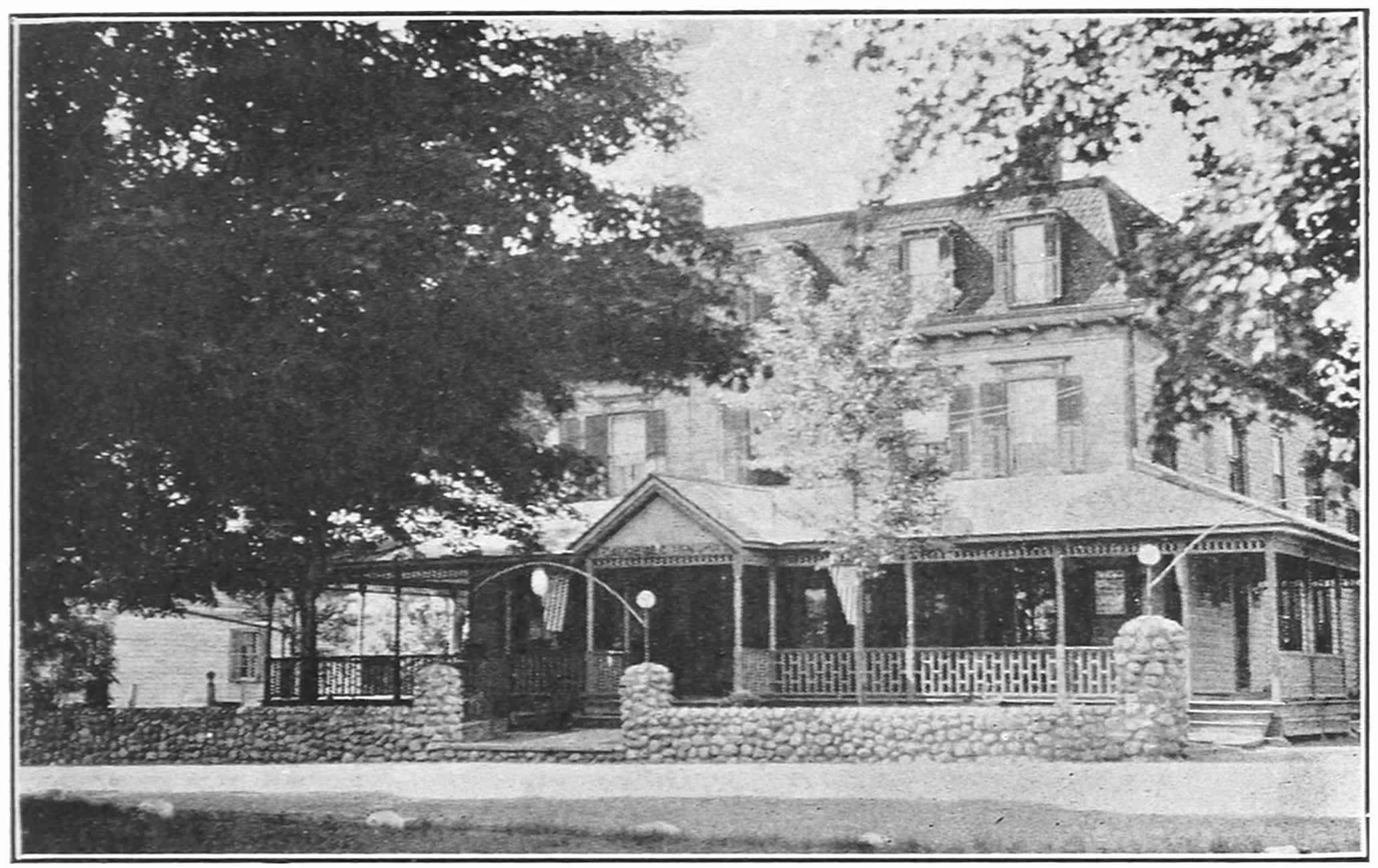
Caudebec Inn at Cuddebackville.
(See p. 119)
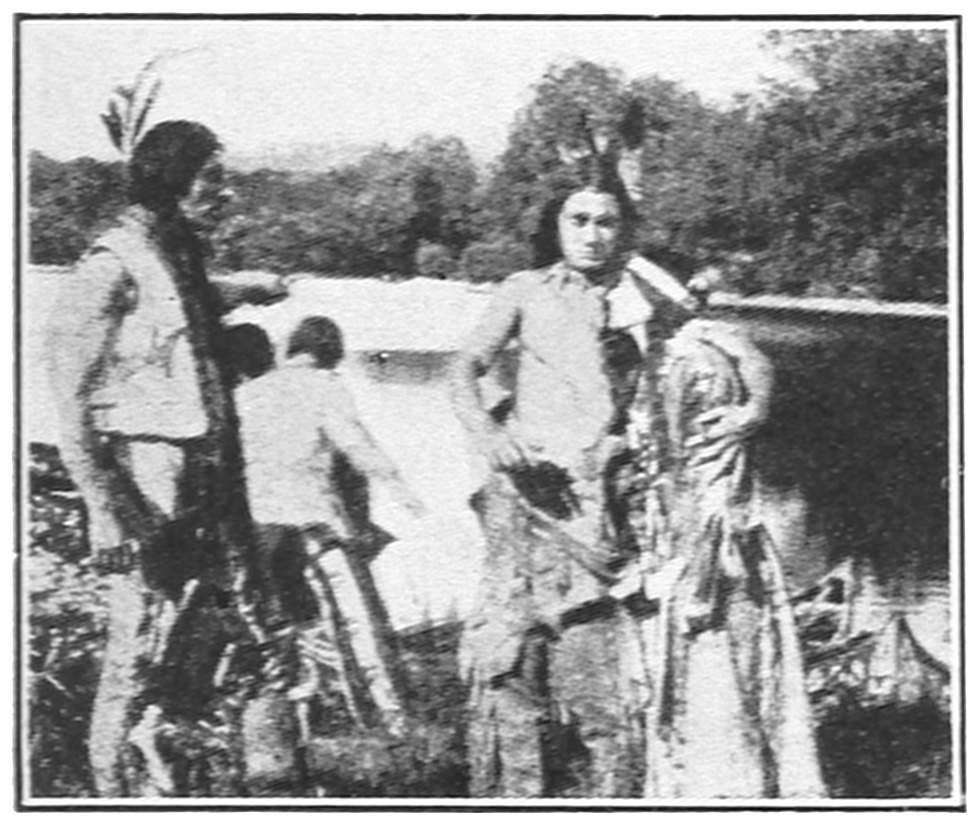
From “The Mended Lute,” made
at Cuddebackville, with Florence
Lawrence, Owen Moore and Jim
Kirkwood.
(See p. 116)
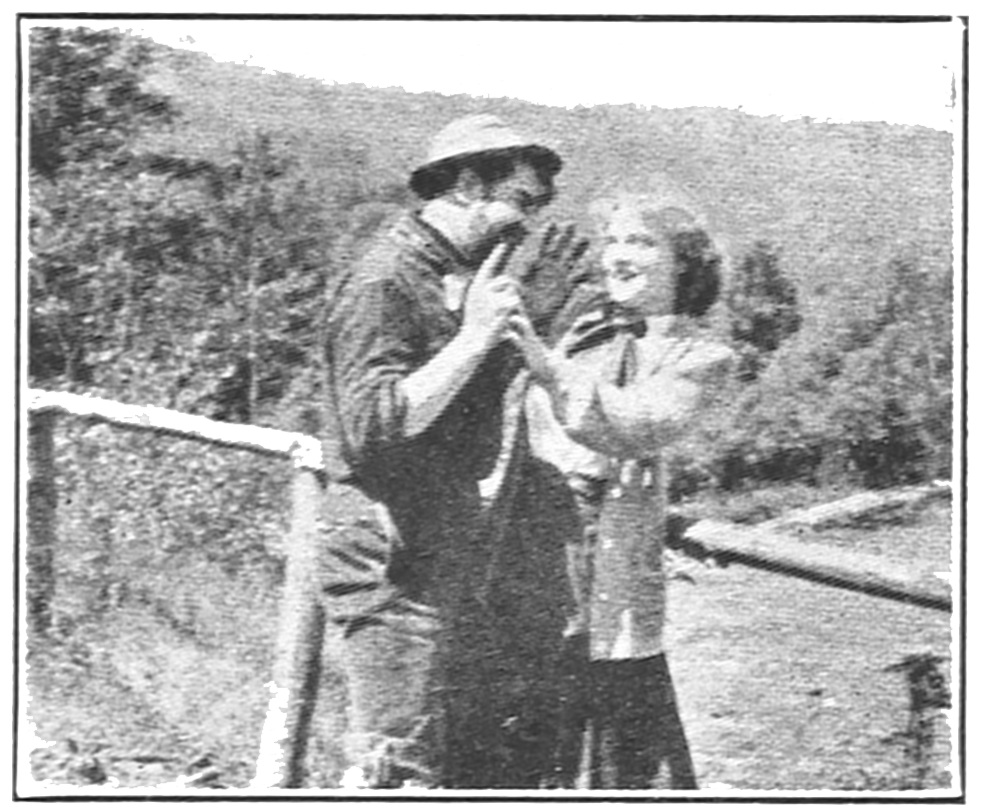
Frank Powell, Mr. Griffith’s first
$10-a-day actor, with Marion
Leonard in “Fools of Fate,” made
at Cuddebackville.
(See p. 108)
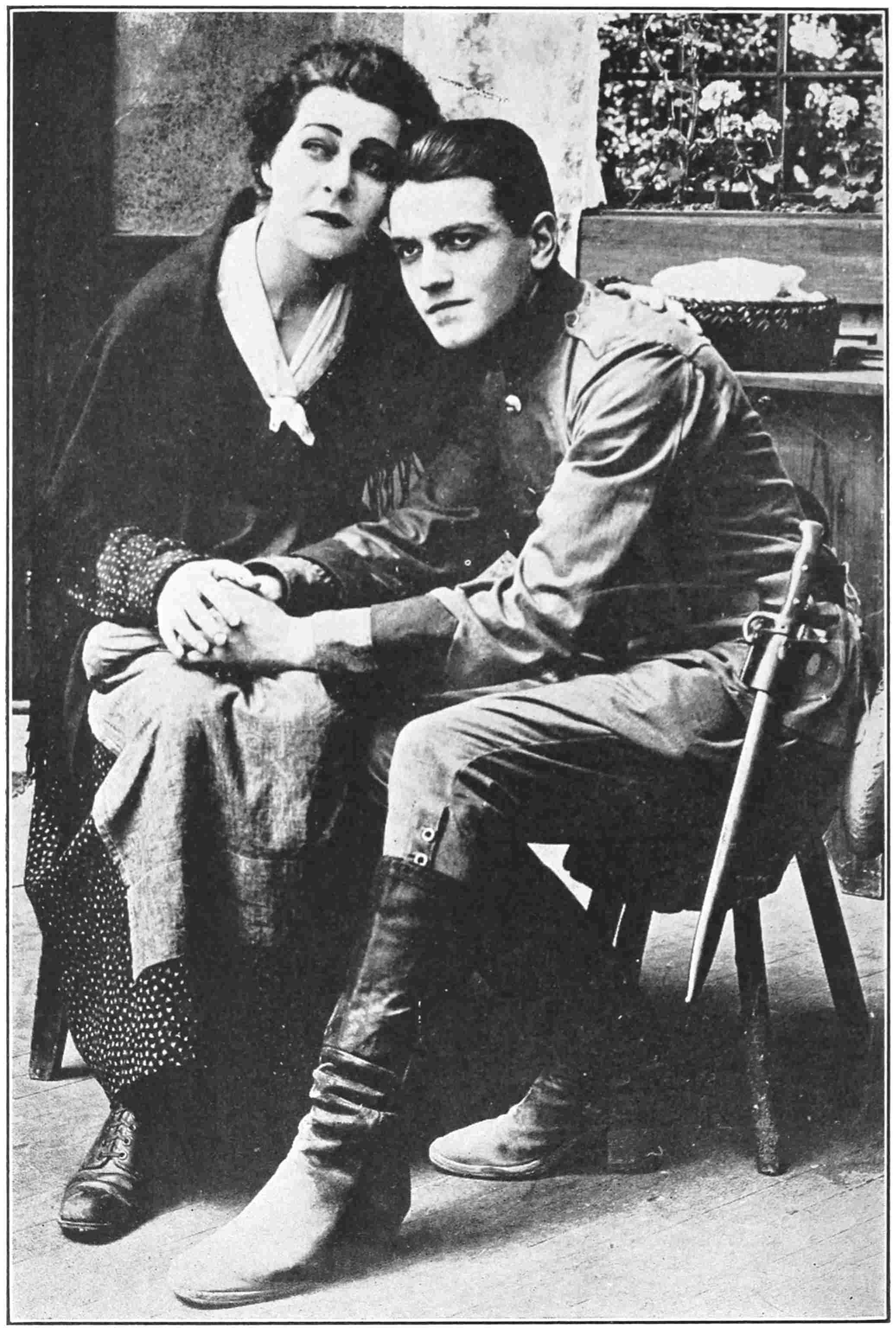
Richard Barthelmess as Arno, the youngest son, with Nazimova in “War
Brides,” a Herbert Brennon production. The part that put Dicky over.
(See p. 136)
Were we ever going anywhere but Fort Lee and Edgewater
and Shadyside? I do believe that first summer I
was made love to on every rock and boulder for twenty
miles up and down the Hudson.
Well, we did branch out a bit. We did a picture in
Greenwich, Connecticut. Driving to the station, our picture
day finished, we passed a magnificent property, hemmed in
by high fences and protected with beautiful iron gates.
Signs read “Private Property. Keep Out.” We heeded
them not. In our nervous excitement (we were not calm
about this deed of valor) we kept away from the residence
proper, and drove to the outbuildings and the Superintendent’s
office. Told him we’d been working in the country
near by and would appreciate it much if we could come
on the morrow and take some scenes; slipped him a twenty,
and that did the trick.
There was nothing we had missed driving around Millbank,
which, we learned later, was the home of Mrs. A. A.
Anderson, the well-known philanthropist who passed away
some few years ago. So on the morrow, bright and early,
we dropped anchor there, made up in one of the barns,
and were rehearsing nicely, being very quiet and circumspect,
when down the pathway coming directly toward us,
with blood in her eye, marched the irate Mrs. Anderson.
Trembling and weak-kneed we looked about us. Could we
be hearing aright? Was she really saying those dreadful
things to us? Weakly we protested our innocence. Vain
our explanation. And so we folded our tents and meekly
and shamefacedly slunk away.
Before the summer was over we went to Seagate and
Atlantic Highlands. It wasn’t very pleasant at Atlantic
Highlands, for here we encountered the summer boarder.
As they had nothing better to do, they would see what we
were going to do. We were generally being lovers, of
course, and strolling in pairs beneath a sunshade until we
reached the foreground, where we were to make a graceful
flop onto the sandy beach and play our parts beneath the
flirtatious parasol. Before we were ready to take the scene
we had to put ropes up to keep back the uninvited audience
which giggled and tee-heed and commented loudly throughout.
We felt like monkeys in a zoo—as if we’d gone back
to the day when the populace jeered the old strolling players
of Stratford town.
Mr. Griffith got badly annoyed when we had such experiences.
His job worried him, the nasty publicity of
doing our work in the street, like ditch diggers. So he had
to pick on some one and I was handy. How could I stand
for it? Why was I willing to endure it? He had to, of
course. So thinking to frighten me and make me a good
girl who’d stay home, he said: “Something has occurred to
me; it’s probable this business might get kind of public—some
day, you know, you may get in the subway and have
all the people stare at you while they whisper to each other,
‘That’s that girl we saw in the movie the other night.’ And
how would you like that?”
One saving grace the Highlands had for us. We could
get a swim sometimes. And we discovered Galilee, a fishing
village about twenty miles down the coast, the locale of
that first version of Enoch Arden—“After Many Years.”
But when winter came, though we lost the spectators
we acquired other discomforts. Our make-up would be
frozen, and the dreary, cold, damp rooms in the country
hotels made us shivery and miserable. We’d hurriedly climb
into our costumes, drag on our coats, and then light our
little alcohol stove or candle to get the make-up sufficiently
smeary. When made up, out into the cold, crisp day. One
of the men would have a camp-fire going where we’d huddle
between scenes and keep limber enough to act. Then when
ready for the scene Billy Bitzer would have to light the little
lamp that he attached to the camera on cold days to warm
the film so it wouldn’t be streaked with “lightning.” While
that was going on we stood at attention, ready to do our
bit when the film was.
We weren’t so keen on playing leads on such days as
those, for when you are half frozen it isn’t so easy to look
as if you were calmly dying of joy, for which emotional
state the script might be asking. What we liked best in
the winter was to follow Mack Sennett in the chases which
he always led, and which he made so much of, later, when
he became the big man in Keystone films. The chase
warmed us up, for Mack Sennett led us on some merry
jaunts, over stone walls, down gulleys, a-top of fences—whatever
looked good and hard to do.
Somehow we found it difficult to be always working
with the weather. Though we watched carefully it seemed
there always were “summer” stories to be finished, almost
up to snow time; and “winter” stories in the works when
June roses were in bud. Pink swiss on a bleak November
day ’neath the leafless maple didn’t feel so good; nor did
velvet and fur and heavy wool in the studio in humid
August.
But such were the things that happened. We accepted
them with a good grace.
CHAPTER XIII AT THE STUDIO
This story must now take itself indoors. We are terribly
excited over Tolstoy’s “Resurrection.” So even
though it be May, we must to the studio where the carpenters
and scene painters are fixing us a Siberia.
As the days went by we produced many works of
literary masters—Dickens, Scott, Shakespeare, Bret Harte,
O. Henry, and Frank Norris. We never bothered about
“rights” for the little one-reel versions of five-act plays and
eight hundred page novels. Authors and publishers were
quite unaware of our existence.
Arthur Johnson, Owen Moore, and Florence Lawrence
played the leading parts in our “free adaptation of Leo
Tolstoy’s Powerful Novel.” And it so happened that just
as Prince Demetri was ready to don his fur robes, and the
poor exiles their woolen slips, for the trudge over the snow-clad
steppes, a nice hot spell came our way, and we must
have been the hottest Russians that ever endured Siberia.
Owen Moore got so querulous with the heat—he was
playing one of those handsome, cruel officers who poke
bayonets at the innocent and well-behaved exiles—that he
nearly killed us throwing tables and heavy furniture at us.
I objected to the realism. We were all a bit peevish, what
with the unseasonable heat and the last moment discovery
that the costumer had sent our wrapper-like dresses in sizes
miles too large.
The scene being set and rehearsals finished, there were
left just the few moments while the property man added
the finishing touches to the salt and flour snow (we had
graduated from sawdust), to make the costumes wearable.
So another girl and I grabbed the lot and rushed into a
little Polish tailor shop in the basement next door and
borrowed the Polish tailor’s sewing machines so that we
could put in the necessary hems and pleats. Zip went the
sewing machines—there was no time to lose—for we could
not afford two days of Russian exiles at three dollars per
day.
Nine o’clock was the morning hour of bustle and busyness
at 11 East Fourteenth Street. But the actors in their
eagerness to work were on the job long before nine sometimes.
They straggled along from all directions. They even
came by the horse-drawn surface car whose obliging and
curious conductors stopped directly in front of No. 11.
And so curious became one conductor that he was not
able to stand the strain, and he quit his job of jerking
Bessie’s reins, and got himself a job as “extra.” Although
the conductor’s identity was never fully established, we had
strong suspicions that it was Henry Lehrman, an extra who
had managed in a very short time to get himself called
Pathé, which was good for an Austrian.
“Actors”—graduates from various trades and professions
of uncertain standing, and actors without acting jobs,
lounged all over the place, from the street steps where they
basked on mild, sunny days, into the shady hall where they
kept cool on hot days; and had they made acquaintance
with studio life, they could be found in the privacy of the
men’s one dressing-room shooting craps—the pastime during
the waiting hours.
An especially busy hour 9 A.M. when we were to start
on a new picture. What kind of a picture was it to be?
The air was full of expectancy. Who would be cast for
the leads? How keen we were to work! How we hoped
for a good part—then for any kind of a part—then for
only a chance to rehearse a part. In their eagerness to get
a good part in a movie, the actors behaved like hungry
chickens being fed nice, yellow corn, knocking and trampling
each other in their mad scramble for the best bits.
This Mr. Griffith did enjoy. He would draw his chair
up center, and leisurely, and in a rather teasing way, look
the company over. And when you were being looked at
you thought, “Ah, it’s going to be me.” But in a few
minutes some one else would be looked at. “No, it was
going to be he.” A long look at Owen, a long look at
Charlie, a long look at Arthur, and then the director would
speak: “Arthur, I’ll try you first.” One by one, in the
same way the company would be picked. There would be
a few rough rehearsals; some one wouldn’t suit; the chief
would decide the part was more in Owen’s line. Such
nervousness until we got all set!
Indeed, we put forth our best efforts. There was too
much competition and no one had a cinch on a line of
good parts. When we did “The Cricket on the Hearth,”
Mr. Griffith rehearsed all his women in the part of Dot,
Marion Leonard, Florence Lawrence, Violet Merserau, and
then he was nice to me. Miss Merserau, however, portrayed
May Plummer—making her movie début. Herbert Pryor
played John Perrybingle, and Owen Moore, Edward
Plummer.
Sometimes after rehearsing a story all day our director
would chuck it as “no good” and begin on another. He
never used a script and he rehearsed in sequence the scenes
of every story until each scene dovetailed smoothly, and the
acting was O. K. He worked out his story using his actors
as chessmen. He knew what he wanted and the camera
never began to grind until every little detail satisfied him.
There was some incentive for an actor to do his best.
More was asked of us than to be just a “type,” and the
women couldn’t get by with just “pretty looks.” We worked
hard, but we liked it. With equal grace we all played leads
one day and decorated the back drop the next. On a day
when there would be no work whatever for you, you’d
reluctantly depart. Sometimes Mr. Griffith almost had to
drive the non-working actors out of the studio. The place
was small and he needed room.
Sometimes when rehearsing a picture he liked a lot,
it would be as late as 3 P.M. before a fainting, lunchless
lot of actors would hear those welcome words, “All right,
everybody, get your lunches and make up.” Then Bobbie
Harron would circulate the Childs’ menu card and the
thirty-cent allotment would be checked off. Roast beef or
a ham-and-egg sandwich, pie, tea, coffee, or milk usually
nourished us. And it was a funny thing, that no matter
how rich one was, or how one might have longed for something
different, even might have been ill and needed something
special, none of us ever dreamed of spending a nickel
of his own.
While the actors ate and made up, and the carpenters
were getting the set ready, Mr. Griffith, accompanied by
three or four or five or six actors not on the working list
that afternoon, would depart for a restaurant near by. But
no woman was ever invited to these parties. This social
arrangement obtained only on days when a new picture was
to be got under way. David Griffith was a generous host, but
he always got a good return on his investment. For while
being strengthened on luscious steak, steins of Pilsener, and
fluffy German pancakes all done up in gobs of melted butter,
lemon juice, and powdered sugar, ideas would sprout, and
comments and suggestions come freely from the Knights
of Lüchow’s Round Table, and when the party was over
they returned to the studio all happy, and the director ready
for a big day’s work.
But the other actors, now made up and costumed but
fed only on sandwiches, were wearing expressions of envy
and reproach which made the returning jolly dogs feel a
trifle uncomfortable.
“Well, let’s get busy around here—wasting a hell of a
lot of time—six o’clock already—have to work all night
now—now come on, we’ll run through it—show me what
you can do—Bitzer, where do you want them? Come in
and watch this, Doc.” Mr. Griffith was back on the job
all right.
One such rehearsal usually sufficed. Then Johnny Mahr
with his five-foot board would get the focus and mark
little chalk crosses on the floor, usually four, two for the
foreground and two for the background. Then Johnny
would hammer a nail into each cross and with his ball of
twine, tying it from nail to nail, enclose the set. Now
a rehearsal for “lines.” And when Bitzer would say it
was O. K. and Doc beamed his round Irish smile, we would
take the picture, and God help the actor who looked at the
camera or at the director when he was shouting instructions
while the scene was being photographed.
The old ways of doing were being revolutionized day
by day with the introduction of the close-up, switchback,
light effects, and screen acting that could be recognized
as a portrayal of human conduct. Exhibitors soon began
clamoring for A. B. pictures, not only for the U. S. A. but
for foreign countries as well; and as Mr. Griffith had a
commission on every foot of film sold, it was an easy matter
for us to judge our ever-increasing popularity.
The Biograph Company readily acknowledged its young
director’s achievements, and the other companies soon took
cognizance of a new and keen competitor. The first
metropolitan showings began a rivalry with the other companies.
Once in the race, we were there to win—and we
did. Biograph pictures came to mean something just a
little different from what had been. There was a sure
artistic touch to them; the fine shadings were there that
mark the line between talent and genius.
David Griffith had found his place; found it long before
he knew it. In ways, it was a congenial berth. Mr. Marvin,
once he saw how the wind blew, seldom came into the studio.
He was willing to let the new producer work things out
his own way. An occasional conference there was, necessarily—a
friendly chat as to how things were coming along.
Mr. Marvin was tall and dark, quite a handsome man—so
approachable. The actors felt quite at ease with him.
Had he not been one of us? Had he not directed even
Mr. Griffith in a penny-in-the-slot movie? Years later I
recalled the incident to Mr. Marvin. He had forgotten it
completely, but with a hearty laugh said: “No did I really?
Well, God forgive me.”
“God forgive us all,” I answered.
Liking Mr. Marvin as we did, we did not quite understand
or approve the sudden, unexpected intrusion of Mr.
J. J. Kennedy, one day.
“Oh, our president? Why, do you suppose,” the
anxious actors queried, “he’s become suddenly so interested?”
What could poor movie actors be expected to know
of politics and high finance? Everything had been so
pleasant, we couldn’t understand it. We were rather awed
by Mr. Kennedy at first. Red-headed, pugnacious Irish
Jeremiah—why, he never gave an actor a smile or the
faintest recognition, and feeling ourselves such poor worms,
as a result, we became nothing less than Sphinxes whenever
his rare but awe-inspiring presence graced the studio.
But we soon learned that “fighting J. J.” was of some
importance in this movie business. And other things about
him we learned: that he was a big man in the world of
engineering—a millionaire who lived in a lovely brownstone
in Brooklyn. We soon discovered he was human, too.
It seemed Mr. Kennedy had had his affairs all settled
to retire from the world of business activities, when, in the
critical days resulting from the 1907 panic, he stepped into
the breach and saved from impending disaster the American
Mutoscope and Biograph Company.
The little A. M. and B. Co. would have been terribly
surprised had she been told that she was to become the
organization that would develop some of the greatest of
motion picture directors and stars—the Augustin Daly stock
company of the movies. For while there is never the grind
of its preposterous old camera to be heard in the length
of the land to-day, while for years (at the time of writing
this, nearly ten) all its wheels of activity have been silent,
“The Old Biograph” remains as the most romantic memory,
the most vital force in the early history of the American
motion picture.
The association with these two scholarly gentlemen
Messrs. Kennedy and Marvin, unusual then as to-day in the
picture business, helped to soften the crudities of the work,
and tone down the apparent rough edges of our job. So
considerate of our tender feelings were both Mr. Marvin
and Mr. Kennedy, that when either desired to visit or bring
interested friends into the studio, they would ask Mr.
Griffith for a propitious moment, and then stand off in the
background as though apologizing for the intrusion.
Mr. Griffith, but not by way of retaliation, had reason
to make intrusions on his bosses. He went pleading the
cause of better screen stories. For that was the ticklish
point—to raise our artistic standard—not to depart too
rapidly from the accepted—and to keep our product commercial.
David Griffith began feeling his wings. He dared to
consider a production of Browning’s “Pippa Passes.” If
just once he could do something radical to make the indifferent
legitimate actors, critics, writers, and a better class
of public take cognizance of us! So there resulted long
discussions with the Biograph executives as to the advisability
of Browning in moving pictures, and after much
persuasion consent was eventually granted.
There was no question in our minds as to whether
“Pippa Passes” would be an artistic success. Had this
classic writer fashioned his famous poem directly for the
movies he couldn’t have turned out a better screen subject.
But might not the bare idea of the high-brow Robert scare
away the moving picture public?
In those days there were several kinds of motion picture
publics. In sections of New York City, there was the dirty,
dark little store, a sheet at one end and the projection
machine at the other. It took courage to sit through a
show in such a place, for one seldom escaped without some
weary soul finding a shoulder the while he indulged in forty
winks. Besides this there were the better-known Keith and
Proctor Theatres on Fourteenth Street, Twenty-third, and
125th Street, the Fourteenth Street Theatre, and the old
Academy of Music.
In the smaller American cities, the motion picture public
was of middle-class homey folks who washed their own
supper dishes in a hurry so as to see the new movie, and
to meet their neighbors who, like themselves, dashed hatless
to the nickelodeon, dragging along with them the children
and the dog.
Things like this happened, when dinner hour was approaching,
and mother was anxiously awaiting her child:
the neighborhood policeman would casually saunter over to
the picture house, poke his head in at the door, spy the
wanted child, tap her little shoulder, gently reproving:
“Jennie, your mother wants you”—whereupon Jennie would
reluctantly tear herself away so that the family could all
sit down together to their pot-roast and noodles.
Yes, Browning would need courage.
“Pippa Passes” being ever in Mr. Griffith’s mind these
days, he scanned each new face in the studio as he mulled
over the needed characters. The cast would be the best
possible one he could get together.
CHAPTER XIV MARY PICKFORD HAPPENS ALONG
It was a bright May morning in 1909. When I came
off the scene, I noticed a little girl sitting quietly in a
corner near the door. She looked about fourteen. I afterwards
learned she was nearing seventeen. She wore a plain
navy-blue serge suit, a blue-and-white striped lawn shirtwaist,
a rolled brim Tuscan straw sailor hat with a dark
blue ribbon bow. About her face, so fresh, so pretty, and
so gentle, bobbed a dozen or more short golden curls—such
perfect little curls as I had never seen.
A timid applicant usually hugged the background. Bold
ones would press forward to the camera and stand there,
obtruding themselves, in the hope that the director would
see them, like their look, and engage them for a day’s work.
But Mary Pickford tucked herself away in a niche,
while she quietly gave us “the once over.” The boss’s eagle
eye had been roving her way at intervals, the while he
directed, for here was something “different”—a maid so
fair and an actress to boot! Pausing a moment in his work,
he came over to me and said, “Don’t you think she would
be good for Pippa?”
“Ideal,” I answered.
Before we closed shop that day, he had Mary make up—gave
her a violin, and told her to walk across the stage
while playing it so that Billy Bitzer could make a test.
Before she left the studio that day, every actor there
had a “line” on Mary. In the dressing-room, the word went
around:
“There’s a cute kid outside; have you seen her?”
“No, where is she?”
“She’s been sitting out there in a corner by herself.”
“Guess I’ll take a look.”
“She’s cute all right; they’re taking a test.”
Something was impending. There was excitement and
expectancy in the air. America’s Sweetheart was soon to
make her first screen appearance.
The test was O. K. and Mary was told to come to the
studio on the morrow. David promised her five dollars a
day for her first picture, and were her work good, he’d talk
business with her. That satisfied Mary.
As “Giannina,” the pretty daughter of Taddeo Ferrari,
in “The Violin Maker of Cremona” Mary Pickford made
her motion picture début. She was ideally suited to the
part, and had good support from David Miles as the cripple
Filippo.
The studio bunch was all agog over the picture and the
new girl, long before the quiet word was passed to the
regulars a few days later: “Projection room, they’re going
to run ‘The Violin Maker.’” After the showing, Mr.
Griffith had a serious conversation with Mary and offered
her twenty-five dollars a week for three days’ work. This
Mary accepted. She felt she might stay through the
summer.
Her second picture was “The Lonely Villa,” the brain
child of Mack Sennett, gleaned from a newspaper—good
old-fashioned melodrama. Mary played a child of twelve
with two younger sisters and a mother. They were nice
people, and wealthy. Miss Leonard, playing the mother,
would be beautifully arrayed in the brown-silk-and-velvet.
But what could be done for Mary? She had no clothes fit
for the wealthy little aristocrat she was to portray and
there was nothing in the meager stock wardrobe for her.
“Oh, she’s so pretty,” I said to my husband, “can’t we dress
her up? She’ll just be darling in the right kind of clothes.”
So he parted with twenty dollars from the cash register and
trusted me to dispose of it at Best’s—then on Twenty-third
Street—for a proper wardrobe. Off I went on my joyful
errand, and brought back to the studio a smart pale blue
linen frock, blue silk stockings to match, and nifty patent
leather pumps. What a dainty little miss she looked, her
fluffy curls a-bobbing, when she had donned the new
pretties!
During the dreary waits between scenes, there being no
private dressing-rooms, actors would be falling all over each
other, and they could find seclusion only by digging themselves
in behind old and unused scenery. Owen Moore was
especially apt in hiding himself. He had an unfriendly way
of disappearing. None of the herd instinct in him. At
times we had quite a job locating him. Cruising along the
back drop of a Coney Island Police Court, or perhaps a
section of the Chinese wall, we’d innocently stumble upon
him. But we didn’t need to hunt him the day that Mary
Pickford was all dressed up in Best & Company’s best.
That day he never left the camera stand, and his face was
all one generous Irish smile. (How little we know when
our troubles are going to begin!)
Following “The Lonely Villa” came “The Way of Man”
and then a series of comedies in which Mary was teamed
with Billy Quirk, “Sweet and Twenty,” “They Would
Elope,” “His Wife’s Visitors.”
Though Mary Pickford affiliated with the movies for
twenty-five dollars weekly with the understanding that she
would work three days a week and play “parts” only, she
was a good sport and would come in as an “extra” in a
scene if we needed her. So occasionally in a courtroom
scene, or a church wedding where the camera was set up
to get the congregation or spectators from the rear, Mary
could attend with perfect safety as the Pickford curls, from
the back of her head, would never have been recognized by
the most enthusiastic fan of that day. Mr. Griffith would
not have his “Mary” a “super.”
Considering the stellar position she has held for years,
and her present-day affluence, many movie fans may think
that Mary Pickford was kissed by the fairies when she was
born. Not so. Life’s hard realities—the understanding
of her little family’s struggles to make both ends meet when
she was even as young as Jackie Coogan at the time of his
first appearance with Charlie Chaplin in “The Kid”—that
was her fairy’s kiss—that and her mother’s great love for
her.
Of course, such idolatry as Mrs. Smith gave her first-born
might have made of her a simpering silly, or worse.
But Gladys Smith (as Mary Pickford was born) was pretty—and
she had talent and brains. So what wonder if Mother
Smith often sat all through the night at her child’s bedside,
not wanting to sleep, but only to worship her beautiful
daughter?
Mary told me her story in our early intimate days together
in the movies. With her little gang she was playing
in the streets of Toronto where she was born, perhaps playing
“bean bag”—she was indeed young enough for that.
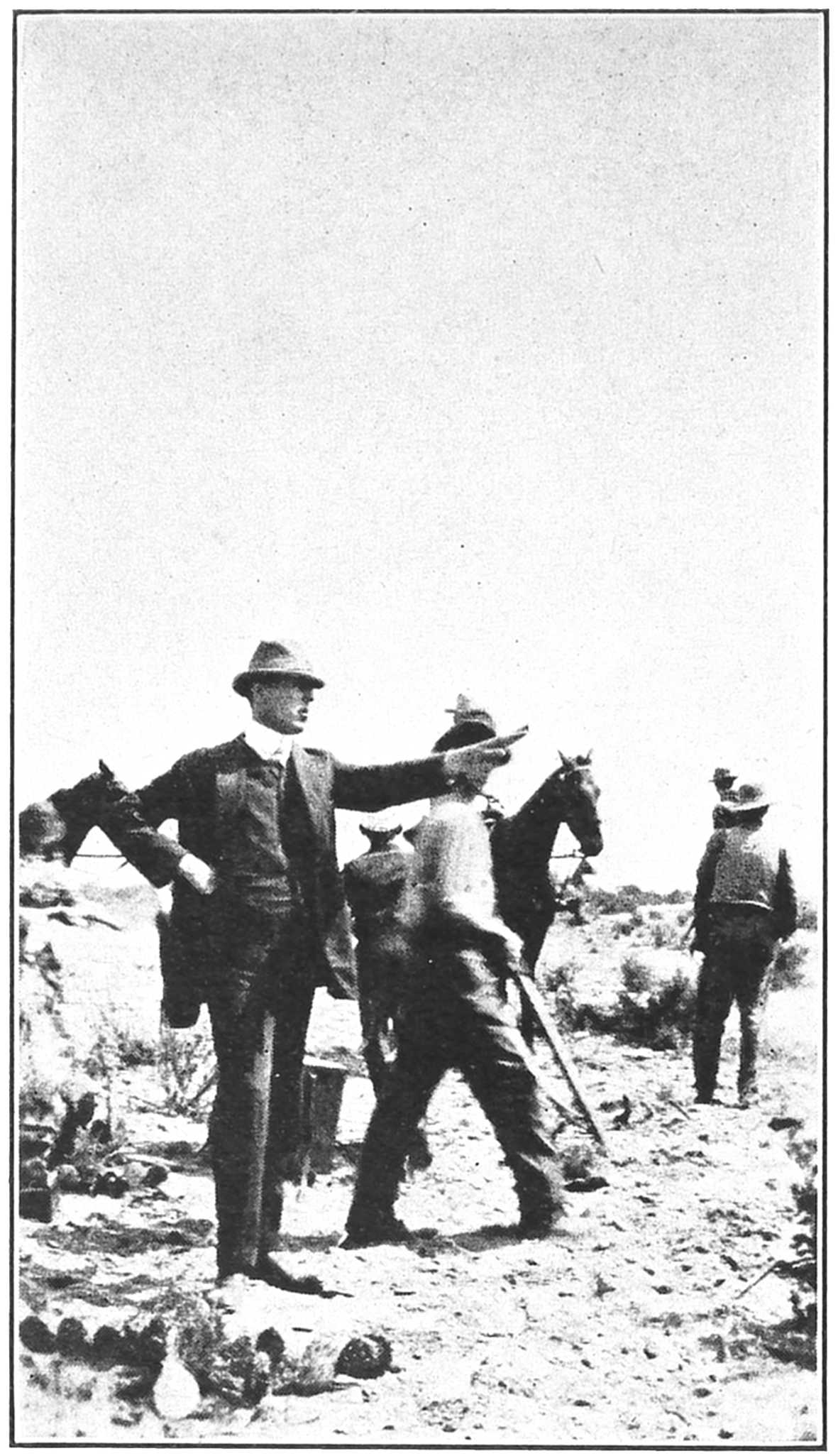
From “Wark” to “work,” with only the
difference of a vowel.
(See p. 185)
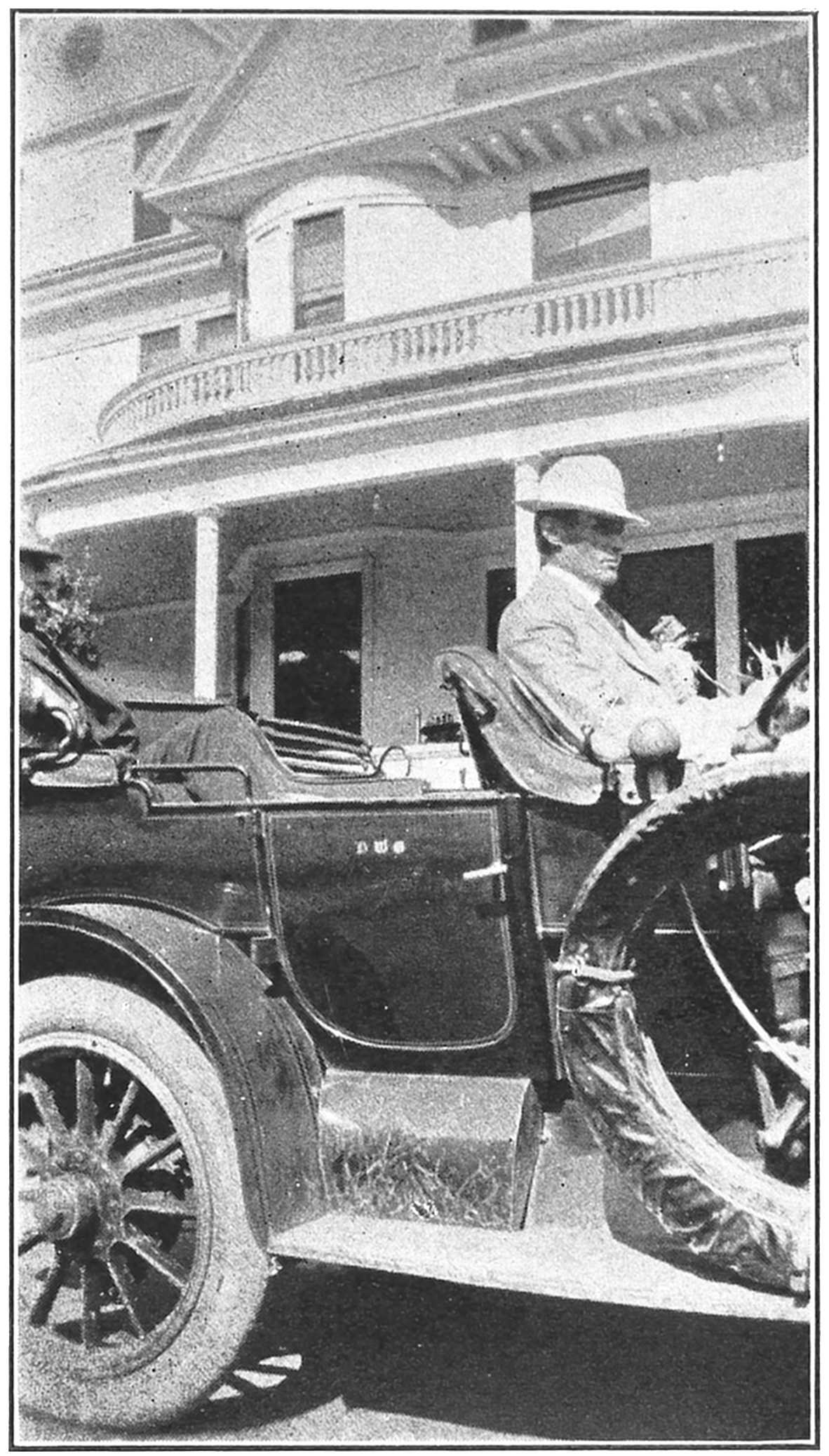
Biograph’s one automobile (note D. W. G.
on door), in front of Old Redonda Hotel.
(See p. 185)
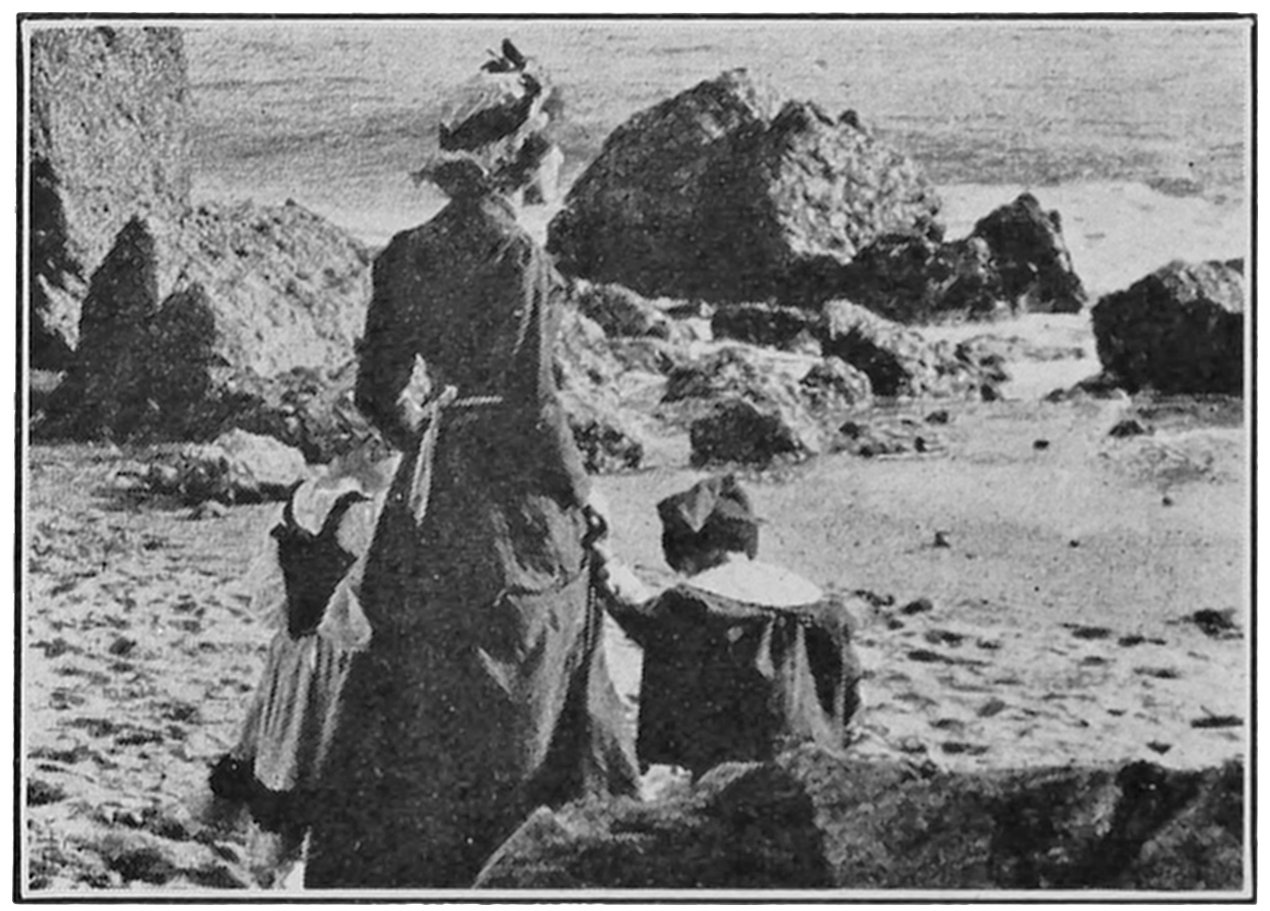
Annie Lee. From “Enoch Arden,” the first
two-reel picture.
(See p. 195)
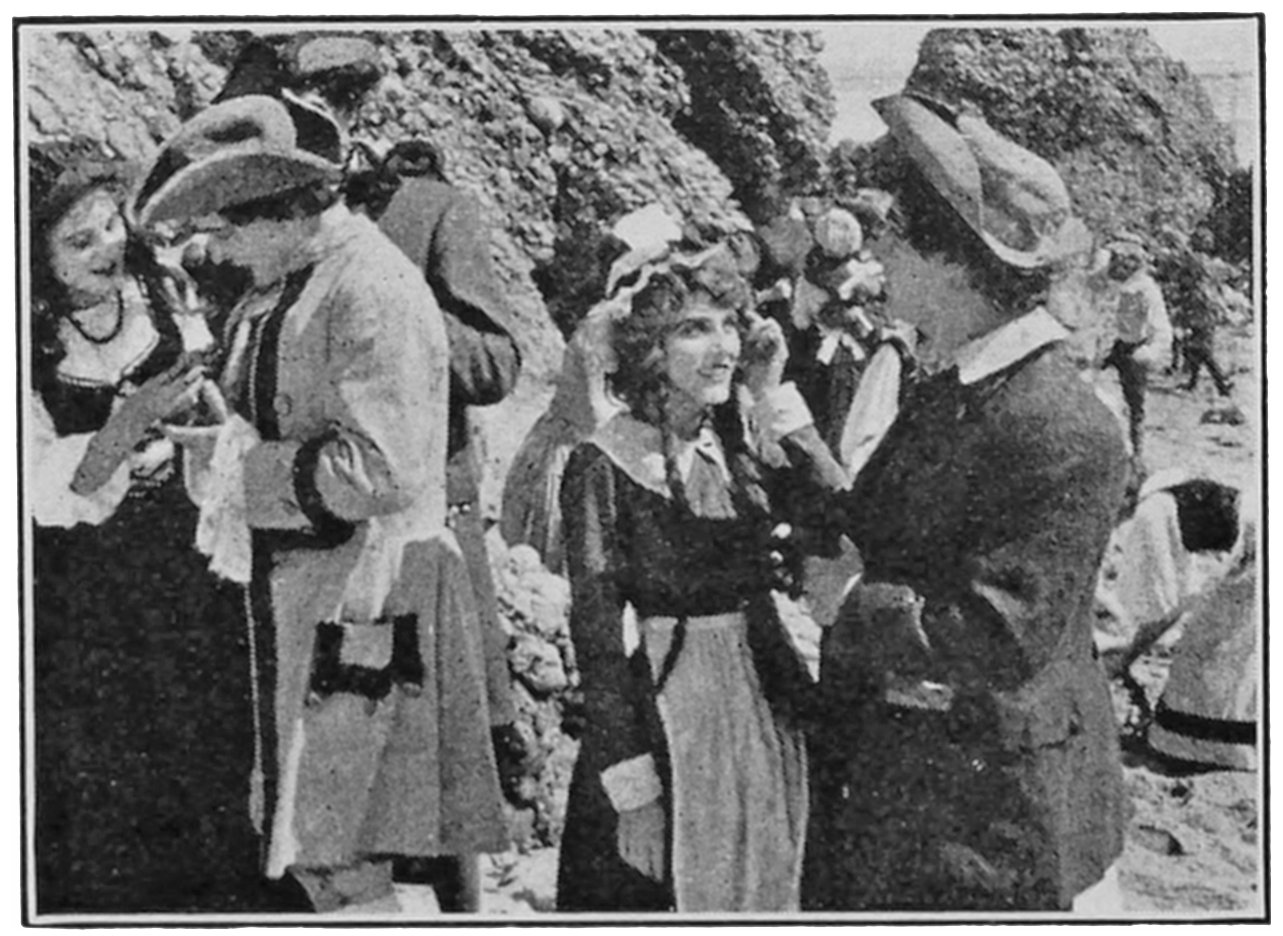
Jeanie Macpherson, Frank Grandin, Linda
Griffith and Wilfred Lucas, in “Enoch Arden.”
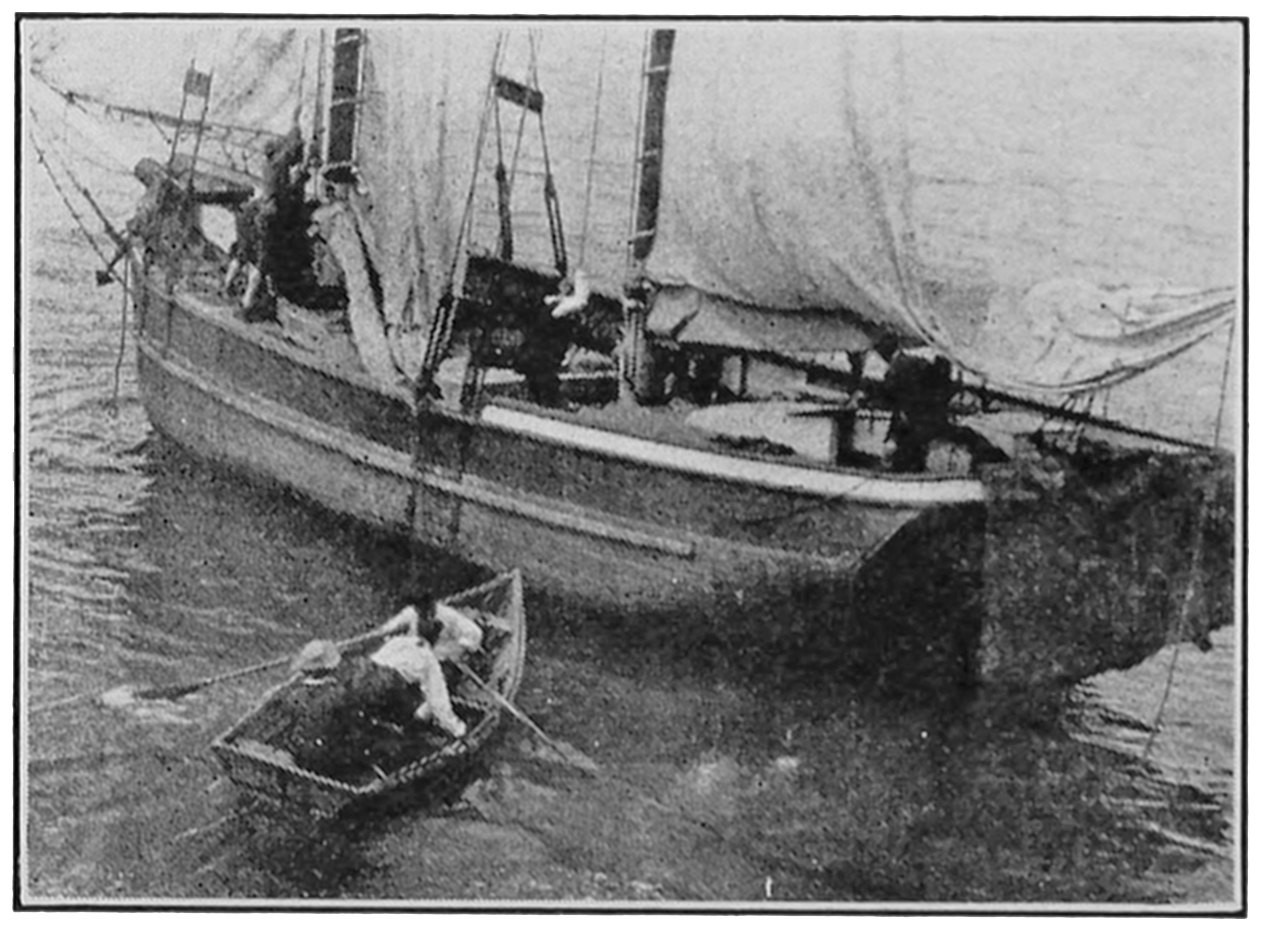
The vessel that was towed from San Pedro.
From “Enoch Arden.”
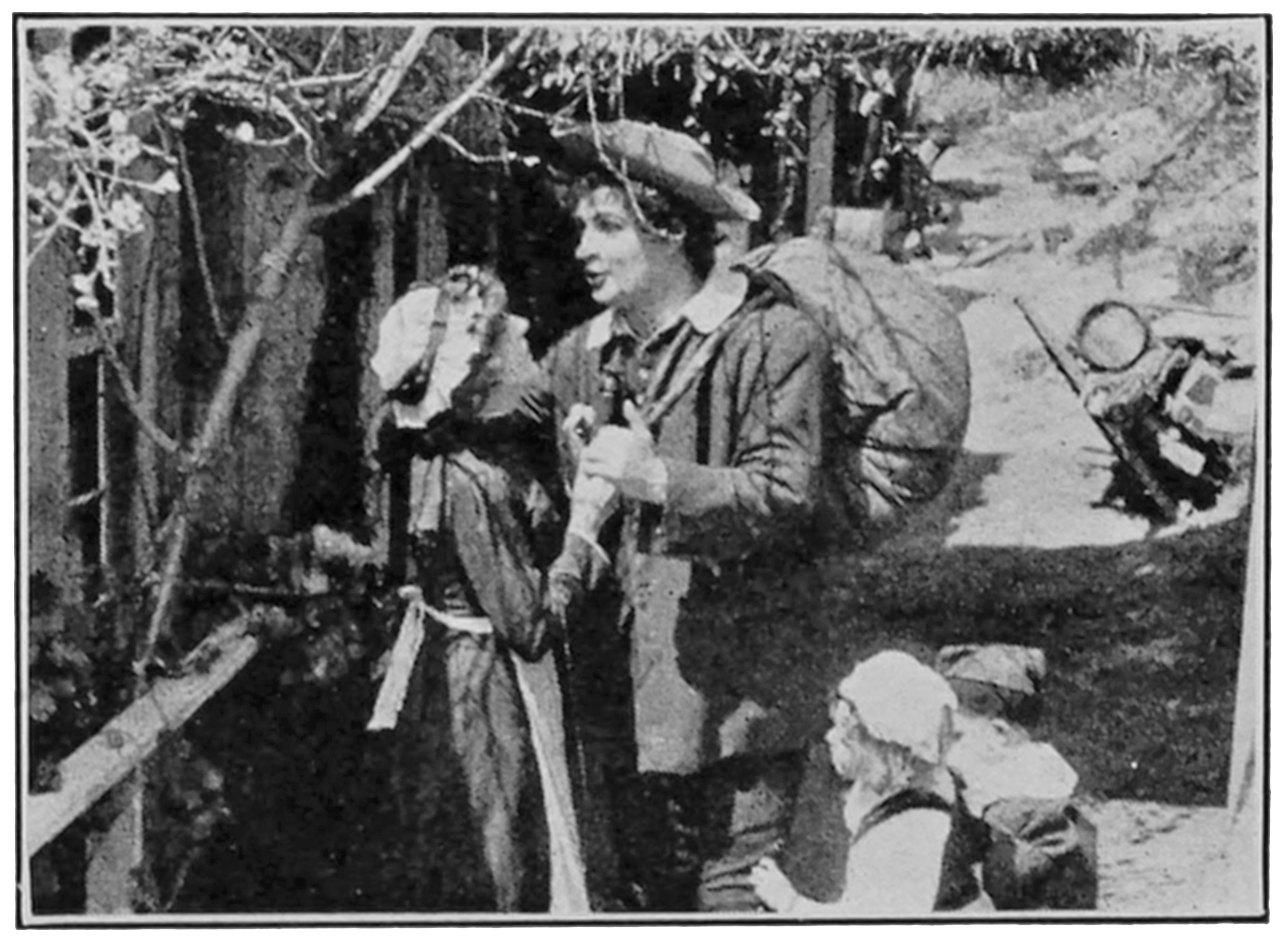
The Norwegian’s shack, the scene of Enoch’s
departure. From “Enoch Arden.”
In frock coat and silk hat an advance agent was looking
over the prospects for business in the town, and at the same
time looking for a few kids needed in his show. His eye
caught pretty little Gladys Smith. Would Mama let her
play at the opera house?
“Let’s ask Mama.”
Mama, the young Mrs. Smith, consented. Seeing that,
a very few years afterwards, through an accident on the
St. Lawrence River boat on which her husband worked,
Mama was suddenly left a young widow with three tiny
youngsters to support, her consent that day proved to be
one of those things just meant to be.
With the Valentine Stock Company in her home town
when only five, Mary played her first part, Cissy in “The
Silver King.” In 1902, Mary was already a “star,” playing
Jessie in “The Fatal Wedding.” The season of 1904 found
Gladys Smith, then twelve years old, playing leading parts,
such as Dolly in “The Child Wife,” a play written by
Charles Taylor, first husband to Laurette and the father
of her two children. The following season Gladys Smith
created the part of Freckles in “The Gypsy Girl,” written
by Hal Reid, father of the popular and much loved Wallace
Reid. Gladys Smith’s salary was then forty dollars per
week and she sent her mother, who was living in Brooklyn,
fifteen dollars weekly for her support. In 1906 the Smith
family toured with Chauncey Olcott in “Edmund Burke.”
But it was as the little boy Patsy Poor in “New York Life”
that Mary’s chance came for better things.
David Belasco had told Gladys he would give her a
hearing. And so the day came when on the dark and empty
Stage of the Republic Theatre, a chair her only “support,”
Gladys did Patsy’s death scene for Mr. Belasco and he
thought so well of it that she was engaged for Charlotte
Walker’s younger sister Betty in “The Warrens of Virginia.”
So “The Warrens of Virginia” with Gladys Smith, rechristened
by Mr. Belasco “Mary Pickford” (a family
name) came and went. The magic wand of Belasco had
touched Mary, but magic wands mean little when one needs
to eat. “The Warrens of Virginia” finished its run, and
Mary, her seventeen years resting heavily upon her, was
confronted with the long idle summer and the nearly depleted
family exchequer. So arrived the day in the late
spring, when from the weary round of agencies and with
faint hope of signing early for next season little Mary
wandered to the old Biograph studio at 11 East Fourteenth
Street.
Such a freshly sweet and pretty little thing she was,
that her chances of not being engaged were meagre. Since
that day when she first cast her lot with the movies—that
day in June, 1909, when the Pickford releases so inauspiciously
started, they have continued with only one interruption.
That was in January, 1913, when in David Belasco’s
production of “The Good Little Devil,” she co-starred with
Ernest Truex. What an exciting day at the studio it was
when it was discovered that Mr. Belasco was up in the
projection room seeing some of Mary’s pictures!
Mary’s return to the legitimate was a clever move. It
made for publicity and afterward served her, despite the
shortness of the engagement, as a qualification for becoming
an Adolph Zukor-Famous Player.
Mr. Zukor established his “Famous Players” through
the production of “Queen Elizabeth,” the first feature picture
with a famous player, the player being no less a personage
than the divine Sara Bernhardt. This was in 1912.
So when Mary Pickford became a Famous Player, it caused
considerable comment. However, she has become the most
famous of all the Famous Players engaged by Mr. Zukor.
And as for Famous Players, long before Adolph Zukor’s
day, they had been appearing before a movie camera. As
far back as 1903 Joseph Jefferson played in his famous
“Rip Van Winkle” for the American Mutoscope and Biograph
Company. And Sara Bernhardt appeared as Camille,
in the Eclair Company’s two-reel production of the Dumas
play in 1911.
Mary Pickford did not reach the peak of fame and
affluence without her “ifs.” When the first fall came, and
little Mary had not connected up with a legitimate job,
she said to me one day: “Miss Arvidson, we have just
fifty dollars in the bank for all of us, and I’m worried to
death. I want to get back on the stage. Of course, the
pictures are regular, but if I had enough put away, I’d get
out.”
Another day: “If I stay in the movies I know I will
just be ruined for the stage—the acting is so different—and
I never use my voice. Do you think it will hurt me
if I stay in the pictures any longer?”
“Well, Mary,” I answered, “I cannot advise you. We
all just have to take our chances.”
Good fortune it was for the movies, for her family
and for her, that she stayed. In the beginning she encountered
practically no competition. Not until dainty
Marguerite Clark left the field of the legitimate in 1913
and appeared in her first charming photoplay “Wildflower”
did Miss Pickford ever need to bother her little head over
anything as improbable as a legitimate competitor in a field
where she had reigned as queen undisputed and unchallenged.
It is often asked whether Mary Pickford is a good
business woman. My opinion is that she’s a very good
business woman. And I am told that she had a head for
business as far back as the days of Patsy Poor. She must
have an understudy and no one but sister Lottie was going
to be that understudy. Lottie stayed the season even though
no emergency where she could have officiated, presented
itself.
I know Mary brought a business head with her to Biograph.
Mr. Griffith had told her if she’d be a good sport
about doing what little unpleasant stunts the stories might
call for, he would raise her salary. The first came in “They
Would Elope,” some two months after her initiation.
The scene called for the overturning of the canoe in
which the elopers were escaping down the muddy Passaic.
Not a second did Mary demur, but obediently flopped into
the river. The scene over, wet and dirty, the boys fished
her out and rushed her, wrapped in a warm blanket, to the
waiting automobile.
It was the last scene of the day—we reserved the nasty
ones for the finish. Mary’s place in the car was between
my husband and myself. Hardly were we comfortably
settled, hardly had the chauffeur time to put the car in
“high,” before Mary with all the evidence of her good
sportsmanship so plainly visible, naïvely looked up into her
director’s face and sweetly reminded him of his promise.
She got her raise. And I got the shock of my young life.
That pretty little thing with yellow curls thinking of money
like that!
Later, when Carl Laemmle had bucked the General Film
Company with the organization of his independent company,
the “Imp,” he enticed Mary away from the Biograph
by an offer of twenty-five dollars a week over her then one
hundred weekly salary. Mary was still under legal age,
so Owen Moore, to whom Mary had been secretly married,
had to sign the contract. He with several other “Biographers”
had gone over to the “Imp.” Mrs. Smith with
Lottie and Jack still clung to the Biograph. Mid anguished
tears Mrs. Smith showed me the contract, and in a broken
voice said: “What’s to become of Mary at that awful ‘Imp’
with no one to direct her? How could she have been influenced
to leave Mr. Griffith for only twenty-five dollars extra
and not even consult her mother? What good will the
twenty-five dollars do with her career ruined?”
But the break did not hurt Mary. It helped her. She
soon sued the “Imp,” claiming that her artistic career was
being ruined as she was being forced to act with carpenters.
That was the story according to the dailies. Shortly afterward
she was back at Biograph with another twenty-five
dollar weekly advance in her salary.
CHAPTER XV ACQUIRING ACTORS AND STYLE
Through conflicting emotions and varying decisions
and an ever-increasing interest and faith in the new
work, Biograph’s first movie actors stuck. With Mary
Pickford pictures winning favor, David Griffith became
ambitious for new talent, and as the right sort didn’t come
seeking, he decided to go seeking. He’d dash out of the
studio while the carpenters were putting up a new set, jump
into a taxi, call at the different dramatic agencies, and ask
had they any actors who might like to work in moving
pictures at ten dollars a day!
At one of these agencies—Paul Scott’s—he arrived just
as a good-looking manly sort of chap was about to leave.
“That’s the type I want.”
Mr. Scott replied, “Well, I’ll introduce you.”
Mr. Griffith lost no time in telling the personable Frank
Powell about the movies, and offering the new salary,
secured his services.
With his fair bride, Eleanor Hicks, who had been playing
“leads” with Ellen Terry, while he stage managed, Mr.
Powell had just returned from England. But Miss Terry
and London triumphs were now of the past, and Mr. Powell
was glad enough to end the tiresome hunt for a job, and
his temporary money worries by becoming the first actor
to be engaged by Mr. Griffith at the fancy price of ten
dollars a day. Mr. Powell was well worth the ten for he
had good presence, clean-cut features, and wore good
clothes. He became our leading aristocrat, specializing in
brokers, bankers, and doctors—the cultured professional
man. David soon saw that he could take over little responsibilities
and relieve him of many irksome details not concerned
with the dramatic end. So he became the first assistant,
and then a director of comedies—the first—under
Mr. Griffith’s supervision.
In time he went with William Fox as director. He
discovered the screen’s first famous vamp, Theda Bara.
Against Mr. Fox’s protests—for Mr. Fox wanted a well-known
movie player—Frank Powell selected the unknown
Theda from among the extras to play Mr. Kipling’s famous
lady in “A Fool There Was,” because she was a strange-looking
person who wore queer earrings and dresses made
of odd tapestry cloths. The picture made William Fox
his first big money in the movies, and established his place
in the motion picture world.
“His Duty” was Frank Powell’s first picture. In the
cast were Owen Moore and Kate Bruce. “The Cardinal’s
Conspiracy”—the name we gave to “Richelieu”—marked
Mr. Powell’s first important screen characterization. It
was taken at Greenwich, Connecticut, on Commodore Benedict’s
magnificent estate, Indian Harbor. Soon came “The
Broken Locket” which had a nice part for Kate Bruce.
Fortunate “Brucie,” as her confrères call her! She
seems never to have had to hunt a job since that long ago
day when D. W. Griffith picked her as a member of the old
Biograph Stock Company. Little bits or big parts mattered
nothing to “Brucie” as long as she was working with us.
David hunted movie recruits not only at the dramatic
agencies, but also at the Lambs and Players Clubs of New
York City. It was at the Lambs he found James Kirkwood,
and determined right off to get him down to the studio.
He had to be subtle. He never knew what mighty indignation
might be hurled at him for simply suggesting “movie
acting” to a legitimate actor. But Jim Kirkwood made
good his promise to come, and no effort was spared to make
the visit both pleasant and impressive.
I always thought we were a rather well-behaved lot—there
was rather strict discipline maintained at all times.
But on this occasion we old troupers were told to “sit
pretty,” to be quiet and stay in the dressing-room if there
were no scenes being taken in which we were working, and
if we were called upon to work, to please just “work” and
not be sociable. Our director seemed to be somewhat
ashamed of his faithful old crew. So the studio remained
hushed and awed—a solemn dignity pervaded it. In the
dressing-room, those who didn’t know what was going on
said, “Why are you all so quiet?”
“Oh, don’t you know?” we sang in unison. “There’s a
Broadway actor out there, from the Henry Miller Company.”
“Oh, you don’t say so!”
The effect was funniest on Mack Sennett. He wore a
satirical smile that spoke volumes. For he had divined that
these “up-stage” new actors were to get more than five
per day; besides, he was getting few enough parts as things
were, now where would he be?
“Lord Jim” was certainly treated with great deference.
He was shown several scenes “in the taking,” and then
escorted upstairs to see some of Mary Pickford’s pictures.
The Cook’s tour over, Mr. Kirkwood agreed to appear in
the movies.
A slow, easy manner had Jim Kirkwood, which with
underlying strength made for good screen technique. Early
June was the time of his first release, “The Message,” in
which picture as David Williams he portrayed the honest,
big-hearted farmer. Mr. Kirkwood, the diamond-in-the-rough
type, was honest and big-hearted through all his
movie career. He was the heroic Indian, as in “Comata,
the Sioux”; the brave fisherman as in “Lines of White
on a Sullen Sea”—the latter one of Stanner E. V. Taylor’s
early classic efforts which was taken in the little fishing
village of Galilee in October, 1909.
Harriet Quimby, now established as a journalist, came
down to visit. Thought it would be good fun to act in a
scene, so she played a village fishermaiden and thus qualified
as a picture actress for her other more thrilling performance
two years later. I was with her that time, on the flying
field at Dover, where Bleriot had landed on the very first
Channel crossing, and where she was to “take off” for
France. Gaumont took a five-hundred-foot picture of the
flight, titling it “The English Channel Flown by a Lady
Aviator for the First Time.”
The day Harriet Quimby flew the English Channel
brought sad news to the world, for that appalling disaster—the
sinking of the Titanic—occurred. It also brought a
personal sadness to the Biograph, for Mr. Marvin’s youngest
son, who was returning from his honeymoon, was lost.
Before the happy couple had sailed, a moving picture of the
wedding had been taken in the studio.
It was not long after his initiation that Mr. Kirkwood
brought a fellow Lamb, Mr. Walthall, to the studio. He
had been one of the three “bad men” with Mr. Kirkwood
in “The Great Divide,” which play had just finished its New
York run.
Mr. Griffith, an Italian costume picture on the ways,
was snooping around for an actor who not only could look
but also act an Italian troubadour. When he met Henry
Walthall of the dark, curly hair, the brown eyes, the graceful
carriage, he rested content. “The Sealed Room” was
the name of the screened emotion that put Mr. Walthall
over in the movies. Wally’s acting proved to be the most
convincing of its type so far. He was very handsome in
his silk and velvet, and gold trappings, with a bejeweled
chain around his neck, and a most adorable little mustache.
It was foreordained that the Civil War should have a
hearing very soon. There was Kentucky, David Griffith’s
birth state, calling, and there in our midst was the ideal
southerner, Henry Walthall. And so after a few weeks
the first “Stirring Episode of the Civil War”—a little movie
named “In Old Kentucky”—was rushed along. In the picture
were Mary Pickford, Owen Moore, Kate Bruce, and
many lesser lights. It was a long time back that Mr.
Walthall started on his career of “Little Colonels.” He
portrayed many before he climaxed them with his great
“Little Colonel” in “The Birth of a Nation!”
A remarkable trio—Frank Powell, Jim Kirkwood, and
Henry Walthall—such distinct types. Though they all
owned well-tailored dress suits, Frank Powell’s was featured
most often. Henry Walthall, suggestive of romance, had
fewer opportunities; and rugged Jim Kirkwood only occasionally
was permitted to don his own soup-and-fish and
look distingué.
With the acquisition of the ten-dollar-a-day actor, we
seemed to acquire a new dignity. No doubt about recruits
fresh from Broadway lending tone—although the original
five-per-day actors, who were still getting the same old five,
looked with varying feelings of resentment and delight at
their entrance. We old ones figured that for all our faithfulness
and hard work, we might have been raised right
off to ten dollars, too. But at least there was hope in that
ten per—the proposition looked better now with salaries
going up, and actors coming to stay, and willing to forego
the dazzling footlights and the sweet applause of the
audience.
Having reached ten-dollars-a-day, it didn’t take so long
to climb to twenty—undreamed extravagance—but good
advertising along the Rialto and at the Lambs Club.
“Twenty dollars a day? It listens well—the movies must
have financial standing, anyway,” the legitimate concluded.
Occasionally, Frank Craven, since famous as the author
of many successful Broadway plays, came down and
watched pictures being made. While he personally didn’t
care about the movies, through him Jack Standing came
down and jobbed at twenty per. Through friendship for
Mr. and Mrs. Frank Powell, with whom he had acted in
Ellen Terry’s company, David Powell entered the fold for
twenty per. Even though money tempted, the high-class
actor came more readily through friendship for some one
already “in” than as a cold business proposition. Our movie
money was talking just the same.
But hard as it was to get men, it was much harder to
get women. They would not leave that “drammer” (how
they loved it!) to work in a dingy studio with no footlights,
no admiring audience to applaud them, and no pretty
make-ups.
Only occasionally did I accompany my husband on a
tour of the dramatic agencies, for our manner to each other
was still a most unmarried one. I’d wait in the taxi while
he went up to the different offices to see if he could entice
some fair feminine. But, after each visit, back he’d plump
into the taxi so distressed, “I can get men, but I cannot
get women; they simply won’t come.”
Well, if he couldn’t lure ladies from the agencies, he’d
grab them off the street. With Austin Webb, an actor
friend who has since left the stage for promotion of oil
and skyscrapers, he was strolling along Broadway one day
when a little black-haired girl passed by accompanied by
her mother.
“Now that’s the kind of girl I’m looking for,” said Mr.
Griffith.
Mr. Webb answered: “Well, why not speak to her?
She’s an actress, you can bet your hat on that.”
But the movie director having a certain position to maintain,
and not wanting to be misunderstood, hesitated. Mr.
Webb volunteered, stepped up to and asked the girl would
she like to work in a moving picture. Prompt her reply,
“Oh, I’d love to, I just love pictures.” The “girl” was
Marion Sunshine of the then vaudeville team of Sunshine
and Tempest. She was quite a famous personality to be
in Biograph movies at this time.
Now Austin Webb, who during David Griffith’s movie
acting days had loaned him his own grand wardrobe, was
one who might have become a big movie star. David implored
him to try it, but he was skeptical. It took sporting
blood to plunge moviewards in the crude days of our beginnings.
Who could tell which way the thing would flop?
CHAPTER XVI CUDDEBACKVILLE
I was not one of the select few who made the first trip
to Cuddebackville, New York. I had been slated for
a visit to my husband’s folks in Louisville, Kentucky, and
while there this alluring adventure was slipped over on me.
A new picture was being started out at Greenwich, Connecticut,
at Commodore Benedict’s, the day I was leaving,
and as I was taking a late train, I was invited out on a
farewell visit, as it were.
The picture was “The Golden Supper,” taken from
Tennyson’s “Lover’s Tale.” I arrived just in time for
the Princess’s royal funeral. Down the majestic stairway
of the Commodore’s palatial home, the cortège took its way,
escorting on a flower-bedecked stretcher, in all her pallid
beauty, the earthly remains of the dead little princess.
Now in the movies, if anywhere, a princess must be
beautiful. I knew not who was playing this fair royal
child until the actors put the bier down, and the princess
sat up, when I was quite dumbfounded to see our own
little Dorothy West come to life.
Dorothy had done nicely times before as a little child
of the ghetto and as frail Italian maids of the peasant class,
and now here she was a full-fledged princess. So, in my
amazement, I said to my husband, for it was a sincere,
impersonal interest in the matter that I felt: “Is Dorothy
West playing the Princess? Aren’t you taking a chance?”
With great assurance he answered, “Oh, with the photography
we now have, I can make them all beautiful.”
Next day, as the lovely Shenandoah Valley spread out
before me, I kept hearing those startling words, “Oh, with
the photography we now have, I can make them all beautiful.”
“The Mended Lute” was perhaps the first picture produced
with the inspiring background of Cuddebackville
scenery. Florence Lawrence, Owen Moore, and Jim Kirkwood
the leading actors. David wrote me to Louisville
on his return to New York:
Dear Linda:
Well, I am back in New York. Got back at twelve o’clock last
night.... I have accounts to make out for eight days, imagine
that job, can you?
Haven’t had my talk with Mr. Kennedy as yet, as I have been
away, but expect to on Tuesday or Wednesday as soon as I can
see him. Lost six pounds up in the country, hard work, if you
please....
And then I want to go back to that place again and take you
this time because it’s very fine up there. I am saving a great
automobile ride for you—if I stay....
“If I stay”—always that “if.” A year had now rolled
by and in August Mr. Griffith would sign his second contract—if
he stayed.
The hegira to Cuddebackville had been undertaken to
show Biograph officials what could be done by just forgetting
the old stamping grounds adjacent to Fort Lee.
Contract-signing time approaching, Mr. Griffith wanted to
splurge. A number of scripts had collected that called for
wild mountainous country, among them “The Mended Lute.”
Mr. Kennedy and our secretary, Mr. R. H. Hammer; Mr.
Griffith and his photographer, Mr. Bitzer, sitting in conference
had decided upon a place up in the Orange Mountains
called Cuddebackville. It had scenic possibilities,
housing facilities, and lacked summer boarders. Through
an engineering job—the construction of a dam at one end
of the old D. L. and W. Canal, on whose placid waters in
days gone by the elder Vanderbilt had towed coal to New
York—Mr. Kennedy had become acquainted with Cuddebackville.
Unsuspecting sleepy little village, with your one small
inn, your general store, and your few stray farms! How
famous on the map of movie locations you were to become!
How famous in many lands your soft, green mountains,
your gently purling streams, your fields of corn!
“The Mended Lute” would be Mr. Griffith’s catch-penny.
The beauties he had crowded in the little one-reeler
should suffice to bowl over any unsuspecting President. So
this “Cuddebackville Special,” along with several others
that had collected awaiting Mr. Kennedy’s pleasure, was
projected for the authorities. And David signed up for
another year at an increase in salary and a doubling of his
percentage. And he could go to Cuddebackville whenever
he so desired.
Of course, the next time she went, and she had that
“great automobile ride” that he was saving for her.
Joy, but didn’t they become delirious, the actors slated
for a Cuddebackville week. A week in the mountains in
August, with no hotel bill, and pay checks every day! Few
there were so ultra modern that they would take no joy
in the bleating of the lambs but would prefer their city
third floor back.
Much preparation for such a week. We had to see
that our best blouse was back from the laundry and our
dotted swiss in order for evening, our costumes right, and
grease-paint complete, for any of us might be asked to
double up for Indians before the week was over.
It was a five-hour trip—a pretty one along the Hudson
to West Point—then through the Orange Mountains. Our
journey ended at a little station set in a valley sweet with
tasseled corn and blossoming white buckwheat. In the distance—mountains;
near by—beckoning roads lined with
maples. It was the longest stop that an Ontario and Western
train had ever made at Cuddebackville. Such excitement
and such a jam on the little platform! No chance
to slink in unnoticed as on the first unpretentious visit.
“Were we sure it was the right place?” the conductor
kept asking.
“Oh, yes, quite so.”
Damned if he could make it out. For we didn’t look
like farmers come to settle in the country; nor like fishermen
come to cast for trout in the Neversink—we had nothing
with us that resembled expensive fishing rods and boots;
nor did we look like a strange religious sect come to worship
in our own way. No, nor might we have been one of a
lost tribe of Cuddebacks who after years of vain searching
had at last discovered the remote little spot where the first
Monsieur Caudebec had pitched his tent so far from his
own dear France. As the train steamed on its way, from
the rear platform the conductor was still gazing, and I
thought he threw us a rather dirty look.
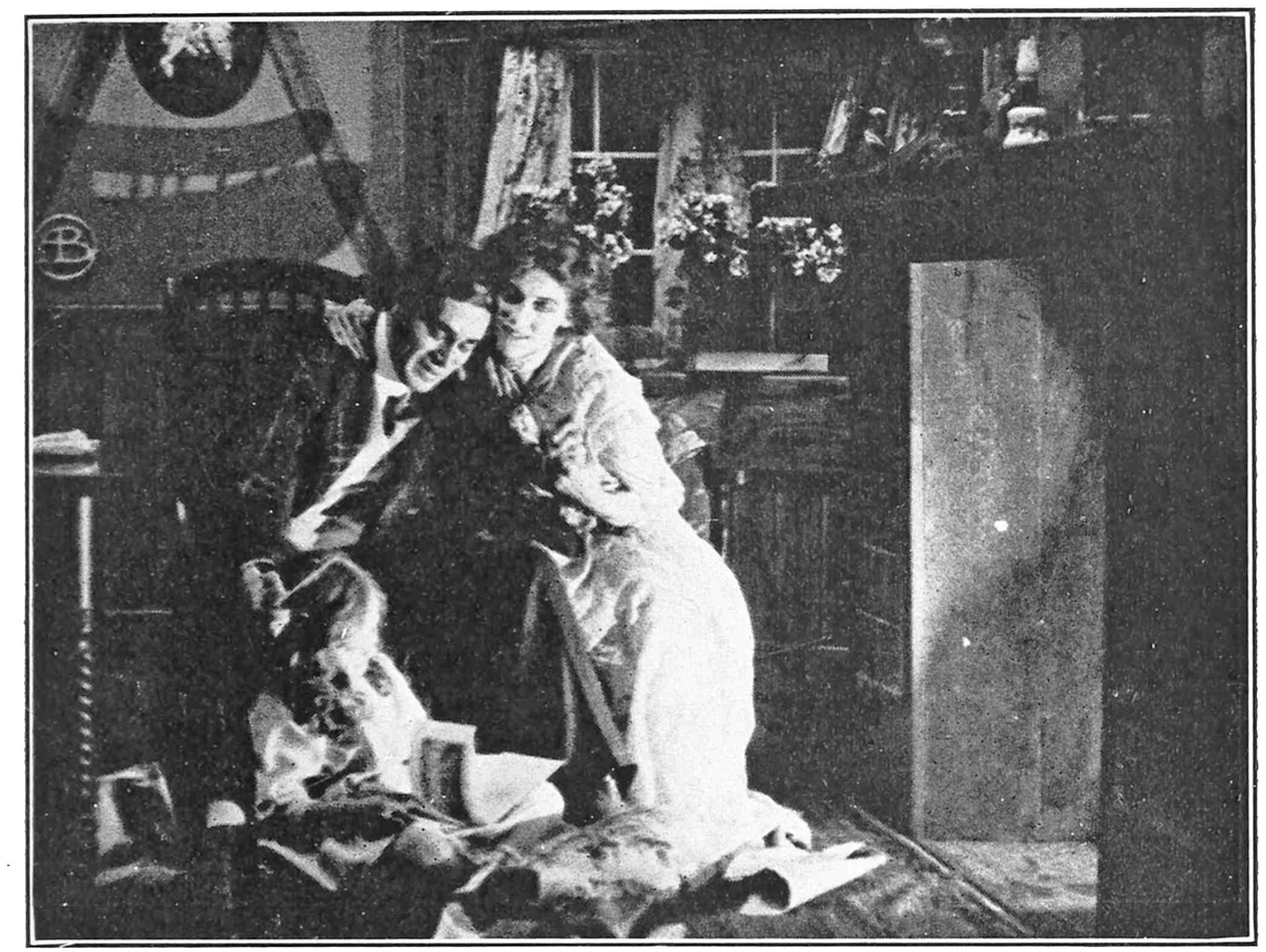
The most artistic fireside glow of the early days. From “The Drunkard’s
Reformation,” with Linda Griffith, Arthur Johnson and Adele De Garde.
(See p. 128)
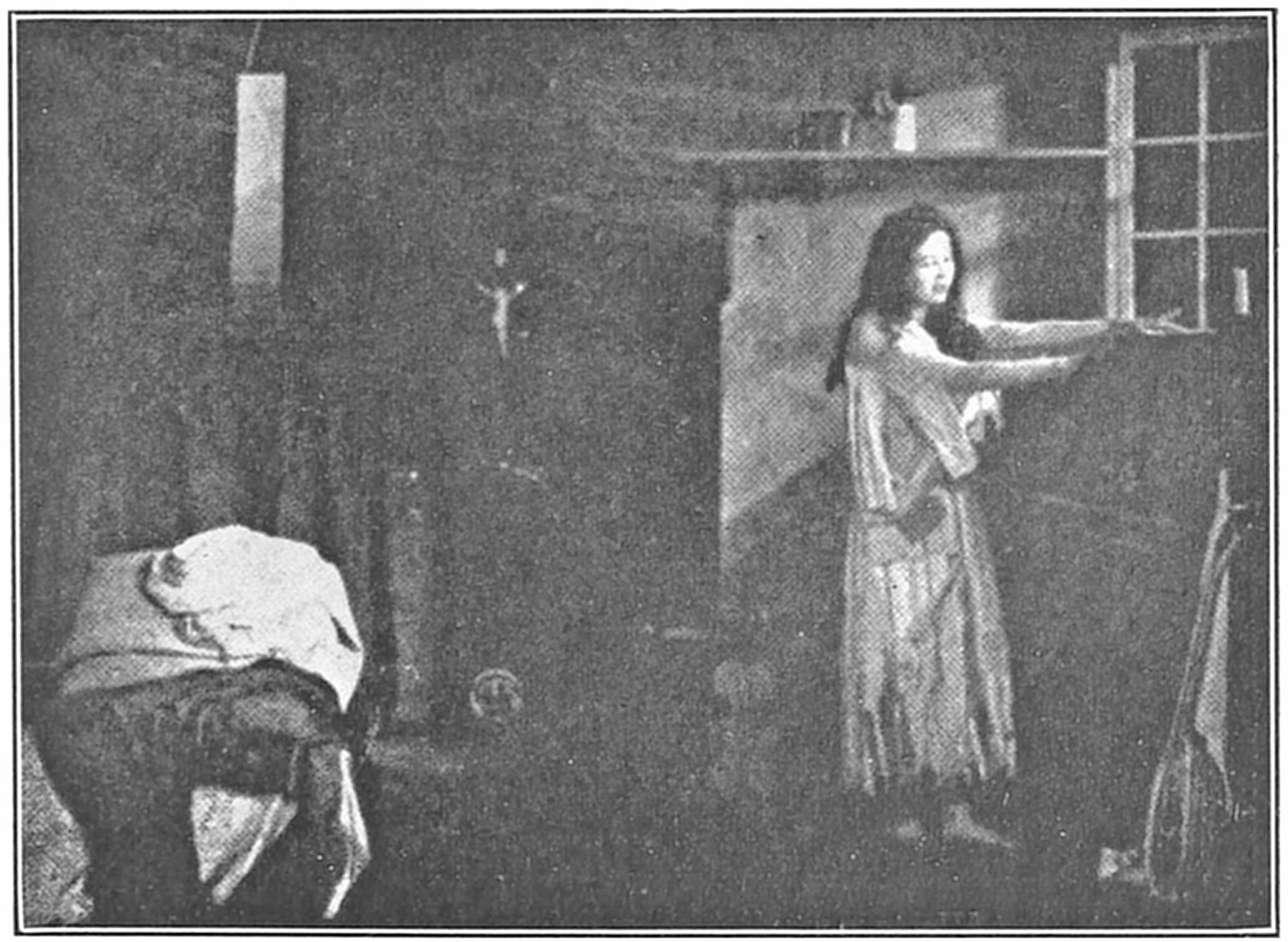
The famous “light effect.” From “Pippa Passes,” with Gertrude Robinson.
(See p. 97)
An express wagon was waiting for our load of stuff—big
wads of canvas for the teepees, cameras, and costume
baskets. A man in a red automobile was also waiting—Mr.
Predmore, who owned Caudebec Inn where we were
to stop. Mr. Griffith and Mr. Bitzer and a few other of
the important personages took their places in the automobile—the
second in the county—the “Red Devil” we afterwards
called it. The actors straggled along.
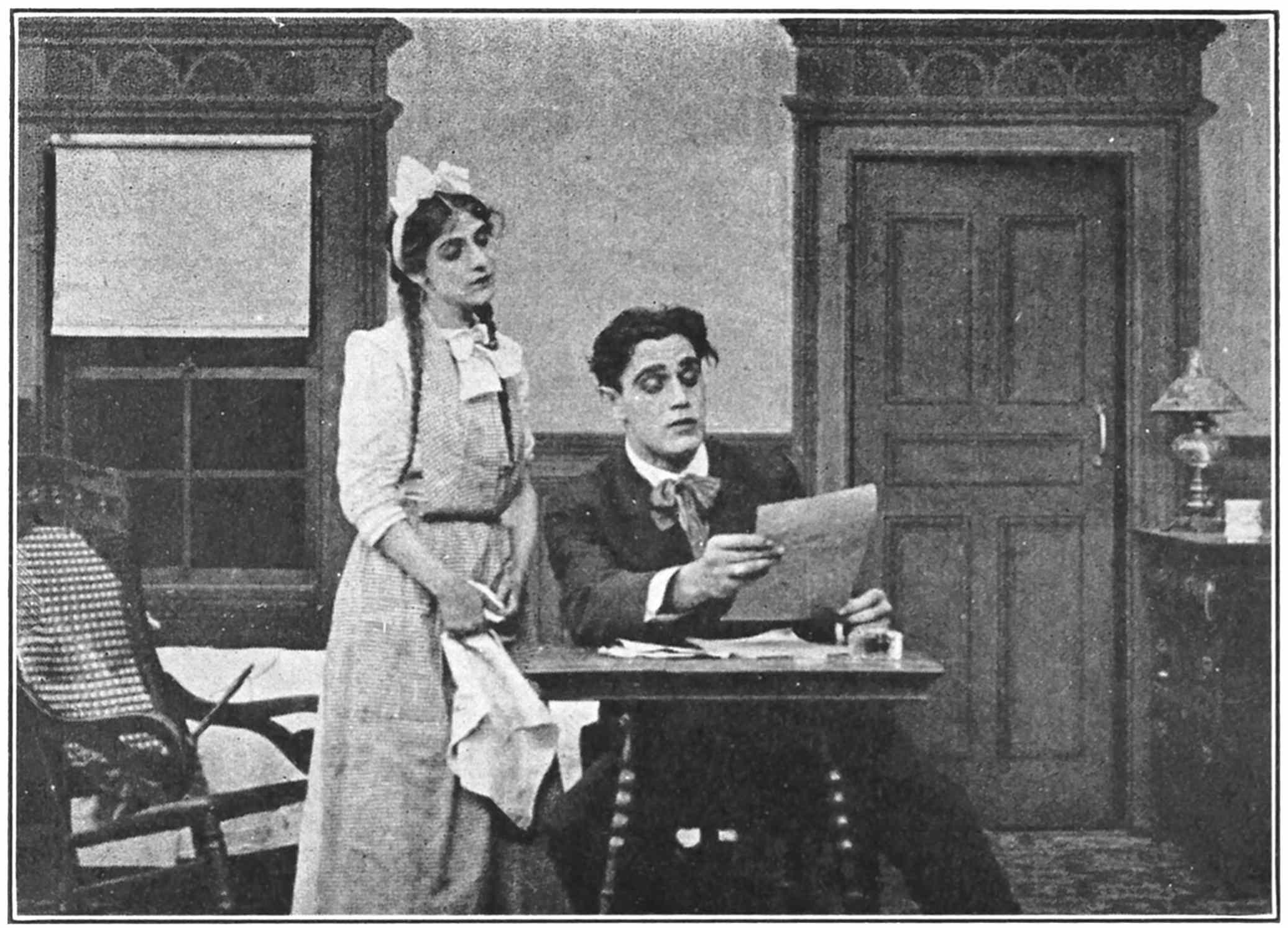
From “The Mills of the Gods,” with Linda Griffith and Arthur Johnson.
(See p. 49)
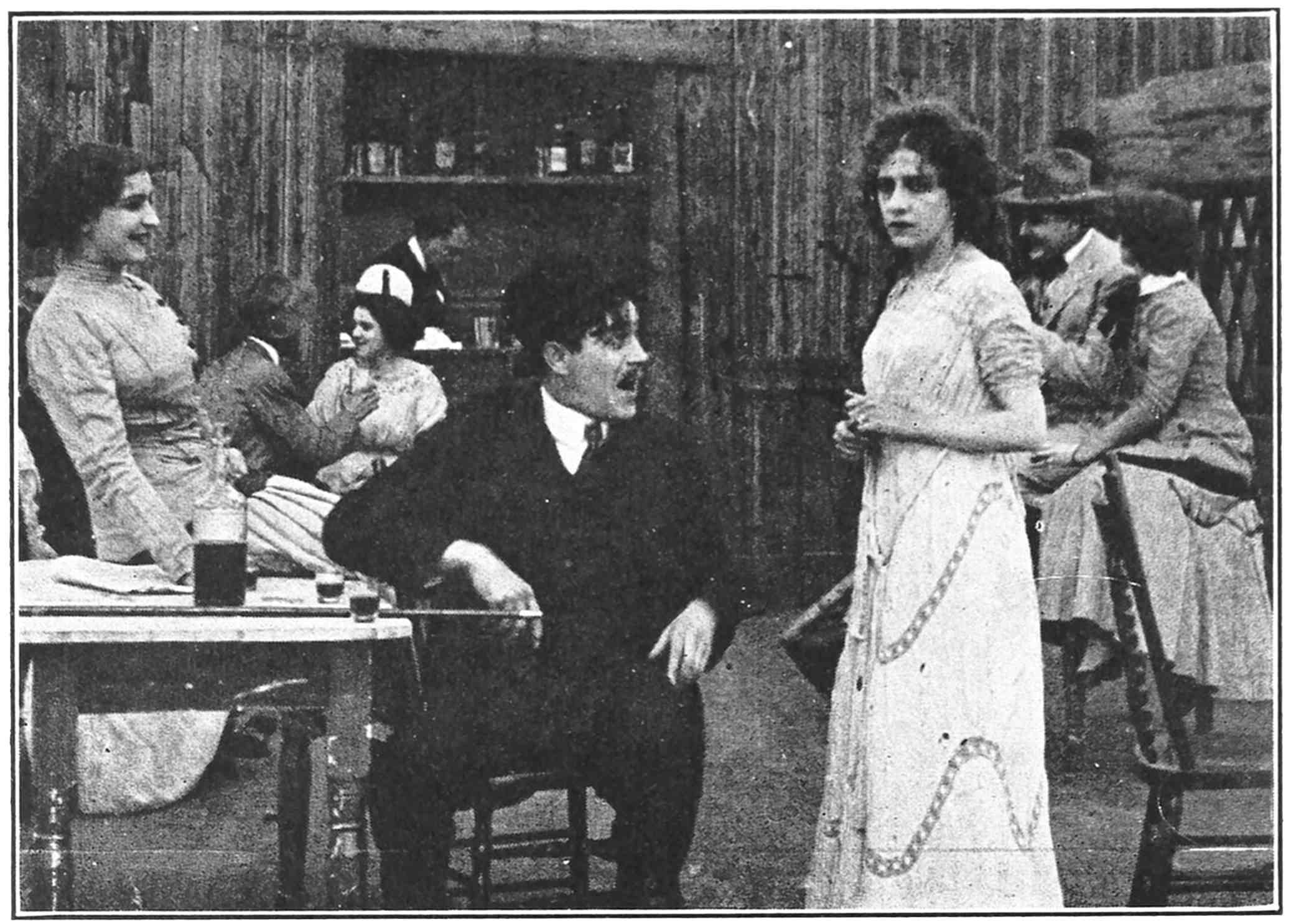
Biograph’s first Western studio. Scene from “The Converts,” with Linda
Griffith, Arthur Johnson and Marion Leonard.
(See p. 150)
Caudebec Inn was no towering edifice—just a comfy
place three stories high, with one bathroom, a tiny parlor,
rag-rugged, and a generously sized dining-room whose
cheerful windows looked upon apple orchards. It was neat
and spotlessly clean. On two sides were broad piazzas.
The inn faced the basin at the head of the old D. L. and
W. Canal, and the canal took its pretty way alongside for
a mile or more until it spilled itself over a busted dam
(Mr. Kennedy’s I opined—it was the only one about), making
lovely rapids which later we used in many a thriller.
It was extremely fortunate that we were the only guests.
We filled the place. Such a thing as an actor having a
room to himself, let alone a bed, was as yet unheard of
in those vagrant days. Mr. Powell doubled and sometimes
tripled them. Some actors got awfully Ritzy, resenting
especially the tripling, and at night would sneak downstairs
hoping to find a nice vacant hammock on the porch. But
that had all been looked into. The hammock would be
occupied by some lucky devil whose snores were being gently
wafted on the soft summer breezes. Three in a bed, two
in a cot, or two in a hammock—the stringy old-fashioned
kind of hammock—which would offer the better comfort?
Immediately after lunch, the boss and Billy Bitzer, with
Mr. Predmore at the wheel, would depart in “The Red
Devil” on a location hunt. The carpenters must get right
to work on their stockade. The actors were soon busy
digging out costumes and grease paint boxes, and getting
made up and costumed; for as soon as the chief returned,
he would want to grab a couple of scenes if the light still
held. The making up was not a quiet process. As the
actors acquired brown grease paint and leather trappings,
animal skins and tomahawks—what a pow-wow!
When the Cuddeback farmer first met the Biograph
Indian, “Gad,” thought he, “what was the world coming
to anyhow? Moving picture people? Smart folks to have
found their Cuddebackville. Who’d have believed it? New
York City actors riding up and down their roads, and
stopping off to do wicked stage acting right in front of their
best apple tree.”
“Hey there, Hiram, how’ll five bucks suit you?”
Hiram was a bit deaf.
“No? Ten? All right, here she is.”
Hiram we won completely. He hoped we’d come often.
And the Big Farmer’s “help” were with us heart and soul.
We sometimes used them for “extras” and paid them five
dollars. Back to the farm at five per week after that? No,
they’d wait and loaf until the “picture people” came again.
The picture people nearly demoralized the farming business
in Cuddebackville and environs—got the labor situation in
a terrible mess.
* * * * *
There was need for a stone house in “1776” or “The
Hessian Renegades,” and for “Leather Stocking”—a
genuine pre-revolutionary stone house. Three saddle horses
were also needed. For the moment we were stumped.
Toward late afternoon when the light began to fail us,
we would utilize the time hunting the morrow’s locations.
This fading hour found Billy Bitzer, David, and myself
(myself still in Janice Meredith costume and curls of
“1776”) enjoying the physical luxury of the “Red Devil,”
but mentally disturbed over the stone house and horses.
We happened to turn into a pretty road; we spied a beautiful
gateway and beyond the gateway, grassy slopes and wonderful
trees and pools of quiet water.
“Let’s stop here a minute,” said Mr. Griffith. “Whose
place is this?”
“I’d never go in there, if I were you,” answered Mr.
Predmore. “That place belongs to Mr. Goddefroy, he’s
the wealthiest man around here; won’t have an automobile
on his place and is down on anybody who rides in one;
has fine stables and the automobiles are just beginning to
interfere with his horseback rides. I don’t know just how
he’d receive you. Anyhow I can’t drive you in in this car
of mine.” So we parked outside in the roadway.
“We’ve got to work in here, that’s all there is to it,”
said David, looking about. But where did anybody live?
The road wound up and up. Sheep nibbling on the velvet
grass were mixed in with a few prize pigs taking their
siestas beneath beautiful copper beeches. “Certainly is some
place,” he continued. We had sauntered up the gravel road
quite to the hilltop before we saw coming towards us across
the lawn, a bright-eyed, pink-cheeked woman in simple
gingham dress. She greeted us pleasantly. The situation
was explained and the lady replied, “Well, that is very
interesting, and as far as I am concerned you are quite
welcome to take some pictures here, but you must ask the
boss first.”
Over by his stables we found the “Boss.”
“We’d like to take some pictures, please, on your beautiful
place.” Stone houses and horses we had quite forgotten
for the moment in the wealth of moving picture
backgrounds the estate provided. “We’re stopping up at
the Inn for a week—doing some Fenimore Cooper stories,
and we are looking primarily for a stone house and some
horses.”
“Have you seen the old stone house down below?”
“Stone house?” I repeated to myself; then to be sure,
whispered to Bitzer, “Did he say a stone house?”
Bitzer replied, “Yes, he said a stone house.” Mr.
Griffith managed to pull himself together, but his answer
came rather halting, “Why, why, no.”
“Come along and I’ll show you. Maybe you can use it.”
Weak-kneed and still struggling for breath we trailed
along—and when we saw it—
Just built for us was the old stone house that had been
on the place so long that no one knew when it had been
built. But we hesitated. “We’ll have to bring horses, because
the party leaves on horseback, and that would mess
up your place too much.”
“Oh, yes, I forgot, you haven’t your horses yet. I
wonder if some of ours would do,” said Mrs. Goddefroy,
who was none other than the gingham-clad lady.
Back to the stable we went, emotionally upset by now,
but trying to appear calm. We’d been quite reconciled to
take a stab at it with the rough work-horses of the Cuddebackville
farmer; had thought to groom them up a bit and
let it go at that. But here were gentlemen’s horses. Yes,
gentlemen’s horses, but neither Miss Leonard nor myself
rode, and these spirited prancing creatures of the Goddefroy
stables filled us with alarm. I would look for something
“gentle,” and not too young and peppy, but with the
characteristics of good breeding and training.
And that is how “Mother” and I met.
“Mother” is one of the treasured memories of my
motion picture life. What a gentle old mother she was!
healthy, so lazy, and so safe. How relieved I was—how
at ease on her broad back. “Mother” ambled on the scene
and “Mother” ambled off; she ate the grasses and the
flowers on the canal bank; she was not a bit concerned over
having her picture taken. I have always felt the credit was
wholly hers that my uncle, my sister, and I made our journey
safely until the bad Indians surprised us going through
the woods.
* * * * *
It was lots of fun being invited on these location-hunting
expeditions. An automobile ride was luxury. These
were the first and we were getting them for nothing. No,
the picture business was not so bad after all.
Back at the Inn the Indians would be changing from
leather fringes and feathered head dresses to their bathing
suits. And when the location party returned, they’d have
reached the green slopes of the Big Basin where, soap in
hand, they would be sudsing off the brown bolamenia from
legs and arms before the plunge into the cool waters of
the Big Basin—a rinse and a swim “to onct.”
The girls who “did” Indians had the privacy of the
one bathroom for their cleaning up. So they were usually
“pretty” again, lounging in the hammocks or enjoying the
porch rockers; a few would be over in the spring house
freshening up on healthful spring water; a few at the
General Store buying picture post-cards.
And then came dinner and in ones, twos, and threes,
the company strolled in—a hungry lot. Frail little Mrs.
Predmore wondered would she ever get the actors fed up.
It took her the week usually, she afterwards confided. When
the cook would let her, she’d go into the kitchen and make
us lemon meringue pies. The actors were always hoping
the cook would leave, or get sick, or die, so Mrs. Predmore
could cook all the dinner.
Sometimes we were very merry at dinner. When
Arthur Johnson would arrive bowing himself gallantly in,
in a manner bred of youthful days as a Shakespearean
actor with the Owen Dramatic Company, loud and hearty
applause would greet him, which he’d accept with all the
smiling, gracious salaams of the old-time ten, twenty, and
thirty tragedian.
* * * * *
Evening at Cuddebackville!
The biggest thrill would be an automobile ride to Middletown,
nine miles away. If Mr. Predmore weren’t busy
after dinner, he’d take us. It was a joyful ride over the
mountains to Middletown, quite the most priceless fun of
an evening. Every one was eager for it except the little
groups of twos, who, sentimentally inclined, were paddling
a canoe out on the basin or down the canal. There would
be Mary Pickford and Owen Moore, and James Kirkwood
and Gertrude Robinson, and Stanner E. V. Taylor and
Marion Leonard, experiencing tense moments in the silence
broken only by the drip, drip of the paddle beneath the
mellow moon. Romance got well under way at Cuddebackville.
The evening divertisements became more complex as
we became better acquainted. “Wally” Walthall, Arthur
Johnson, and Mack Sennett became our principal parlor
entertainers. “Wally” rendered old southern ditties as only
a true southern gentleman from Alabama could.
Arthur Johnson and Mack Sennett did good team-work;
they were our Van and Schenck. Arthur, who presided at
the piano, had a sentimental turn; he liked “The Little Grey
Home in the West” kind of song, but the future producer
of movie comedies was not so sentimentally disposed. As
long as harmony reigned in the camp of Johnson and Sennett,
there were tuneful evenings for the musically inclined.
But every now and then Sennett would get miffed about
something and never a do-re-mi would be got out of him,
and when Arthur’s nerves could stand the strain no longer,
he’d burst forth to the assemblage, “I wouldn’t mind if he’d
fuss with me, but this silence thing gets my goat.”
Those who cared not for the Song Festival could join
Jeanie Macpherson who, out in the dining-room, would be
supervising stunts in the world of black magic. Here Tony
O’Sullivan could always be found. He told hair-raising
ghost stories and wound up the evening’s fun by personally
conducting a tour through the cemetery. The cemetery lay
just beyond the apple orchard, and along the canal bank
to the back of the Inn.
Now were the moon bright, the touring party might
get a glint of lovers paddling by. Arrived back at the Inn,
they might greet the “Red Devil” returning with a small
exclusive party from the Goddefroys—Mr. Griffith and Miss
Arvidson, Mr. Powell and Miss Hicks.
There was just one little touch of sin. Secluded in an
outbuilding some of the boys played craps, sometimes losing
all their salary before they got it. One of the men finally
brought this wicked state of affairs to Mr. Griffith’s attention,
and there were no more crap games.
* * * * *
In front of Caudebec Inn the “Red Devil” is snorting
and getting impatient to be started on her way to the station,
for the actors are strolling down the road ahead of her.
Mr. Griffith and Mr. Predmore are just finishing the final
“settling up” of the board bill. Little Mrs. Predmore looking
tinier than ever—she seemed to shrivel during our
strenuous weeks—is gratefully sighing as she bids us farewell.
She was glad to see us come, and she was glad to
see us go.
* * * * *
Meanwhile, out in Hollywood, the Japs are still raising
carnations, and a few bungalow apartment houses are just
beginning to sprout on the Boulevard; but otherwise the
foothills continue their, as yet, undisturbed sleep beneath the
California sunshine.
CHAPTER XVII “PIPPA PASSES” FILMED
There was a frictional feeling in our return to prosaic
studio life after the glorious freedom of the country.
But the new “projections”—the pictures that had been
printed and assembled in our absence—would take the edge
off and cheer us up some; we were all a-thrill about seeing
the first run of the pictures we had taken in the country;
and we were eager about the picture we were to do next.
During our absence we would have missed seeing not
only our own releases but those of the other companies,
which, our day’s work finished, we used to try to catch
up on. Mondays and Thursdays had come to be release
days for Biograph pictures. Then at some theatres, came
whole evenings devoted to them. On these occasions exhibitors
would put a stand outside saying “Biograph Night.”
After the first showing it was a difficult job to locate a
picture. From Tenth Avenue to Avenue A, we’d roam,
and no matter how hot, stuffy, or dirty the place might be,
we’d make the grade in time.
“Pippa Passes,” which was to make or unmake us, was
all this time hanging fire. Mr. Griffith was getting an all
star cast intact. The newly recruited James Kirkwood and
Henry Walthall gave us two good men who, with Owen
Moore and Arthur Johnson, were all the actors needed.
For the women, there were Marion Leonard, Gertrude
Robinson, and myself. And little Mary Pickford whom
our director had engaged with Pippa in mind (?). When
the day came to shoot Browning for the first time, it was
winsome Gertrude Robinson with black curls and dark blue
eyes who was chosen for the rôle of the spiritual Pippa.
David thought Mary had grown a bit plump; she no longer
filled his mental image of the type.
When at last we started on “Pippa Passes,” things went
off with a bang. Each of the four themes—Morn, Noon,
Evening, Night—would be followed by a flash of Pippa
singing her little song.
It was “Morn” that intrigued. To show “daybreak”
in Pippa’s little room would mean trying out a new light
effect. The only light effect so far experimented with
had been the “fireside glow.” The opportunity to try a
different kind so interested Mr. Griffith that before he began
to “shoot” Pippa, he had a scheme all worked out.
He figured on cutting a little rectangular place in the
back wall of Pippa’s room, about three feet by one, and
arranging a sliding board to fit the aperture much like the
cover of a box sliding in and out of grooves. The board
was to be gradually lowered and beams of light from a
powerful Kleig shining through would thus appear as the
first rays of the rising sun striking the wall of the room.
Other lights stationed outside Pippa’s window would give
the effect of soft morning light. Then the lights full up,
the mercury tubes a-sizzling, the room fully lighted, the
back wall would have become a regular back wall again,
with no little hole in it.
All this was explained to the camera men Billy Bitzer
and Arthur Marvin, for the whole technical staff was in
attendance on the production of this one thousand foot
feature—one thousand feet being the length of our features
at this time. Bitzer didn’t think much of the idea, but
Arthur Marvin, who had seen his chief’s radical ideas
worked out successfully before, was less inclined to skepticism.
But response, on the whole, was rather snippy.
While David would have preferred a heartier appreciation,
he would not be deterred, and he spoke in rather plain
words: “Well, come on, let’s do it anyhow; I don’t give
a damn what anybody thinks about it.”
Pippa is asleep in her little bed. The dawn is coming—a
tense moment—for Pippa must wake, sit up in her little
bed, rise, cross to the window, and greet the dawn in perfect
harmony with the mechanical force operating the sliding
board and the Kleigs. All was manipulated in perfect
tempo.
The skeptical studio bunch remained stubborn until the
first projection of the picture upstairs. At first the comments
came in hushed and awed tones, and then when the
showing was over, the little experiment in light effects was
greeted with uncontrolled enthusiasm.
“Pippa Passes” was released on October 4, 1909, a day
of great anxiety. We felt pretty sure it was good stuff,
but we were wholly unprepared for what was to happen.
On the morning of October 10th, while we were scanning
the news items in the columns of the New York Times, the
while we imbibed our breakfast coffee, our unbelieving eyes
were greeted with a column headlined thus:
BROWNING NOW GIVEN IN MOVING PICTURES
“Pippa Passes” the Latest Play
Without Words to be Seen
In the Nickelodeons
THE CLASSICS DRAWN UPON
Even Biblical Stories Portrayed For
Critical Audiences—Improvement
Due to Board of Censors
It was all too much—much too much. The newspapers
were writing about us. A conservative New York daily
was taking us seriously. It seemed incredible, but there it
was before our eyes. It looked wonderful! Oh, so wonderful
we nearly wept. Suddenly everything was changed.
Now we could begin to lift up our heads, and perhaps invite
our lit’ry friends to our movies!
This is what the New York Times man had to say:
“Pippa Passes” is being given in the nickelodeons and Browning
is being presented to the average motion picture audiences,
who have received it with applause and are asking for more.
This achievement is the present nearest-Boston record of the
reformed motion picture play producing, but from all accounts
there seems to be no reason why one may not expect to see soon
the intellectual aristocracy of the nickelodeon demanding Kant’s
Prolegomena to Metaphysics with the “Kritik of Pure Reason”
for a curtain raiser.
Since popular opinion has been expressing itself through the
Board of Censors of the People’s Institute, such material as “The
Odyssey,” the Old Testament, Tolstoy, George Eliot, De Maupassant
and Hugo has been drawn upon to furnish the films, in place
of the sensational blood-and-thunder variety which brought down
public indignation upon the manufacturers six months ago.
Browning, however, seems to be the most rarefied dramatic stuff
up to date.
As for Pippa without words, the first films show the sunlight
waking Pippa for her holiday with light and shade effects like
those obtained by the Secessionist Photographers.
Then Pippa goes on her way dancing and singing. The quarreling
family hears her, and forgets its dissension. The taproom
brawlers cease their carouse and so on, with the pictures alternately
showing Pippa on her way, and then the effect of her
“passing” on the various groups in the Browning poem. The contrast
between the tired business man at a roof garden and the
sweatshop worker applauding Pippa is certainly striking. That
this demand for the classics is genuine is indicated by the fact
that the adventurous producers who inaugurated these expensive
departures from cheap melodrama are being overwhelmed by
offers from renting agents. Not only the nickelodeons of New
York but those of many less pretentious cities and towns are demanding
Browning and the other “high-brow” effects.
There certainly was a decided change in the general
attitude toward us after this wonderful publicity. Directly
we had ’phone calls from friends saying they would like
to go to the movies with us; and they would just love to
come down to the studio and watch a picture being made.
Even our one erudite friend, a Greek scholar, inquired
where he could see “Pippa Passes.” As the picture was
shown for only one night, we thought it might be rather
nice to invite the dead-language person and his wife to the
studio. They came and found it intensely interesting: met
Mary Pickford and thought her “sweet.”
Besides the Greek professor, another friend, one of the
big men of the Old Guard—an old newspaper man, and
president and editor of Leslie’s Weekly and Judge at this
time—began making inquiries.
The night the Ritz-Carlton Hotel in New York City
opened, David thought it wouldn’t be a bad idea to splurge
a bit and invite Mr. Sleicher to dinner, he being the editor
who had paid him six dollars for his poem, “The Wild
Duck.” He’d surely think we had come a long pace ahead
in the movies, dining at the Ritz, and doing it so casual-like.
Talk there was at the dinner about newspapers and
magazines, and then we got around to the movies, and the
money they were making. Mr. Sleicher said: “Well, there’s
more money in them than in my business, but I like my
business better. Now in my game, twenty-four hours or
even less, after a thing happens you can see a picture of it
and read about it in the paper, and you can’t do that in
your movies.” (I understand that even before the time
of this dinner, events of special interest occasionally found
their way to the screen on the day they happened. In London,
in 1906, the Urbanora people showed the boat race
between Cambridge and Harvard Universities on the evening
of the day they were held, but we did not know about
that.)
Mr. Griffith was not going to be outdone; so, with much
bravado, for he was quite convinced of its truth, he said:
“Well, we are not doing it now, but the time will come
when the day’s news events will be regularly pictured on
the screen with the same speed the ambitious young reporter
gets his scoop on the front page of his newspaper. We’ll
have all the daily news told in moving pictures the same
as it is told in words on the printed page. Now, I’m willing
to bet you.”
But John Sleicher was skeptical. Had he not been, he
would then and there have invested some of his pennies
in the movies. He regretted the opportunity many times
afterward, for while the prediction has not been fulfilled
exactly, the News Reel of to-day gives promise that it will
be. However, Mr. Sleicher lived to enjoy the News Reel
quite as much as he did his newspaper, and that meant a
great deal for him.
These little happenings were encouraging. Intelligent
persons on the outside were taking interest. So again we’d
buck up and go at the movie job with renewed vigor.
For a time we lived in the clouds—our habitat a mountain
peak. But that couldn’t last. No kind of mountain
peak existence could. We should have known. Even after
all the encouragement, down off our peak we’d slip into the
deep dark valley again.
We tried to keep an unswerving faith, but who could
have visioned the great things that were to come? Doubts
still persisted. Yes, even after the Browning triumph, longings
came over us to return to former ambitions. They
had not been buried so deeply after all. We’d see a fine
play and get the blue devils. In this mood my husband
would do the rounds of the movie houses and chancing upon
a lot of bad pictures, come back utterly discouraged.
“They can’t last. I give them a few years. Where’s
my play? Since I went into these movies I haven’t had
a minute to look at a thing I ever wrote. And I went into
them because I thought surely I’d get time to write or do
something with what I had.” (Monetary needs so soon
forgotten!) “Well, anyhow, nobody’s going to know I
ever did this sort of thing when I’m a famous playwright.
Nobody’s ever going to know that David W. Griffith, the
playwright, was once the Lawrence Griffith of the movies.”
So “Lawrence” continued on the next Biograph contract.
The two names would get all balled up sometimes
and I’d get peeved and say: “Why don’t you use your right
name? I think you’re so silly.”
But David remained obdurate until he signed his third
Biograph contract.
CHAPTER XVIII GETTING ON
One thing was sure—the pictures were making money.
The percentage told that story. What a thrill we got at
the first peek at the royalty check each month. Made us
nervous. Where were we headed? Sometimes we almost
wished that financially we were not succeeding so well, for
then we would have quitted the movies. But wouldn’t that
have been a crazy thing to do? A year of fifty-two working
weeks? At the rate we were going, we could keep at it
for three years, and quit with twelve thousand in the bank,
then David could write plays and realize his youthful
ambition.
We lived simply. When the royalty check before the
end of the second year amounted to nine hundred and a
thousand a month, we still maintained a thirty-five-dollar-a-month
apartment. Never dreamed of getting stylish. No
time for it. So each month there was a nice little roll to bank,
and it was put right into the Bowery Savings Bank. The
only trouble with a savings bank was they wouldn’t accept
more than three thousand dollars, so we secured a list of
them and I went the rounds depositing honest movie money
with a rapidity quite unbelievable.
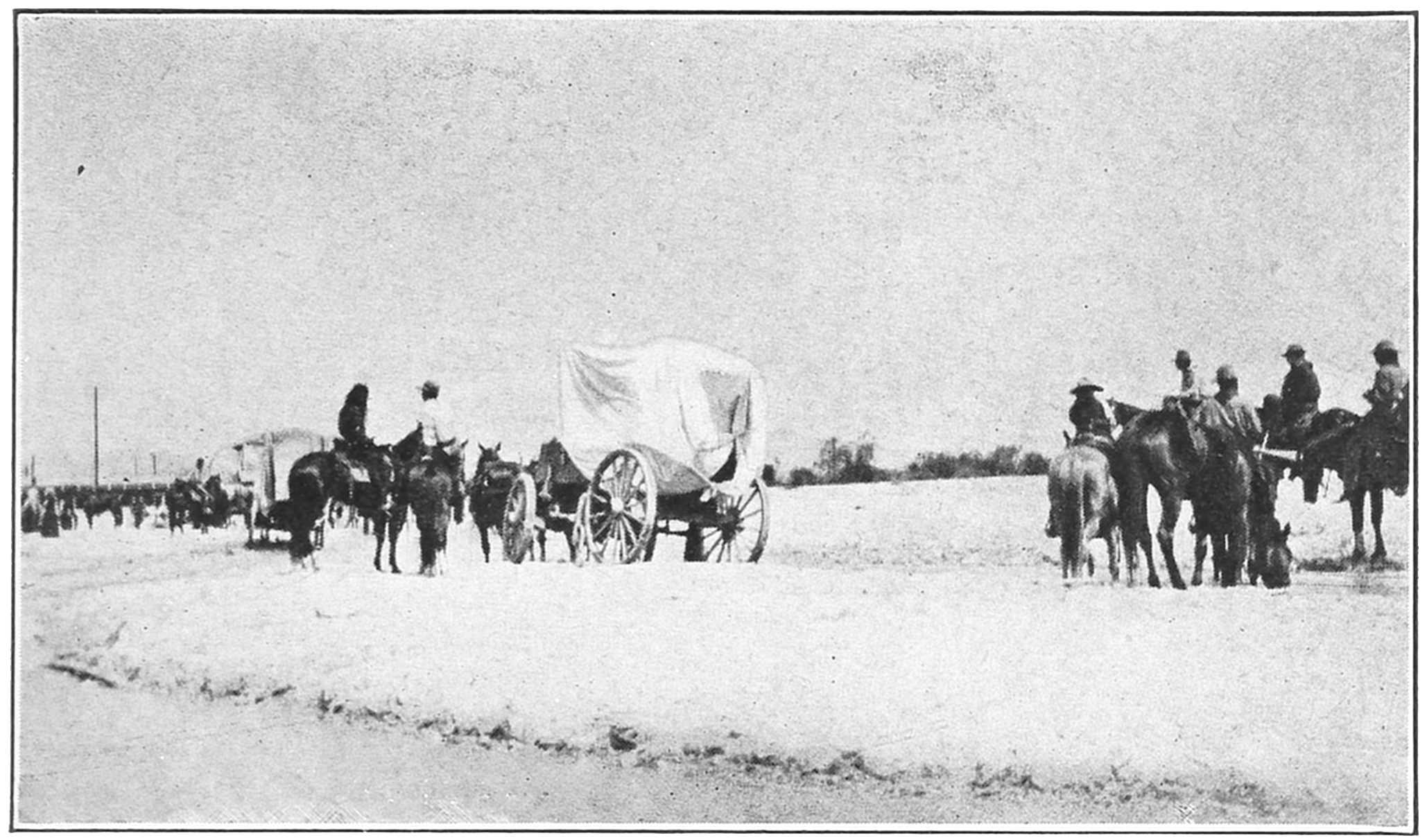
A desert caravan of the early days.
(See p. 197)
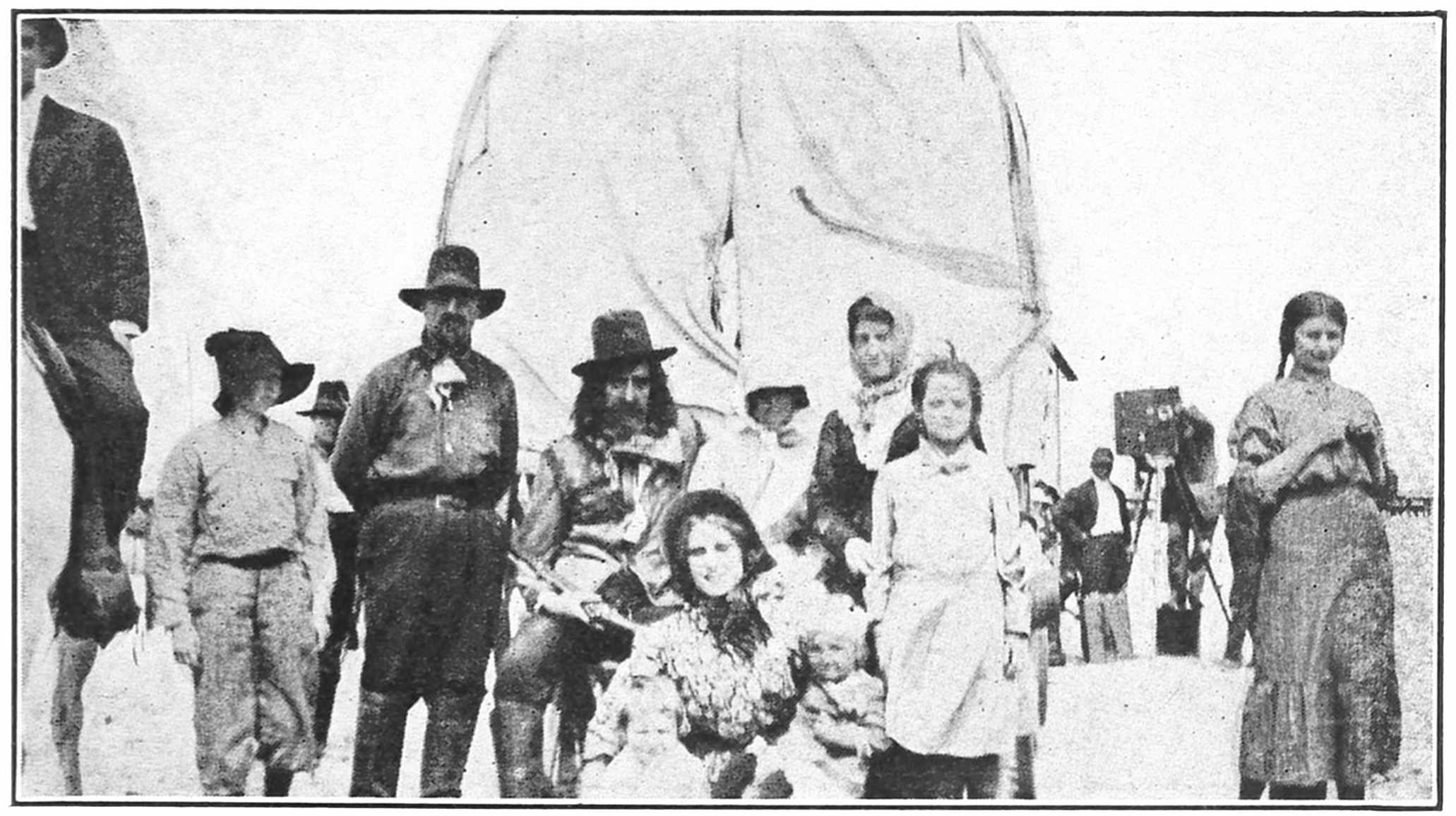
From “The Last Drop of Water,” one of the first two-reelers, produced in
San Fernando desert, with Jeanie Macpherson (seated, front row).
(See p. 197)
The Griffiths were not the only thrifty ones. When
Mary Pickford was getting one hundred a week, her mother
wept because she wouldn’t buy pretty clothes. At Mount
Beacon this happened. One of the perky little ingénue-ish
extra girls appeared in a frock decidedly not home-made.
You could count on it that it had come either from Macy’s
or Siegel-Cooper’s Eighteenth Street store, and that it had
cost a whole week’s wages. Not much escaped Ma Smith’s
eagle eye, and so she wailed: “I wish Mary would buy
clothes like the other girls.” But Mary, the same simple,
unaffected Mary that a year since had said “thank you”
for her twenty-five, was quite contented to continue wearing
the clothes her mama made her, and at that a few would do.
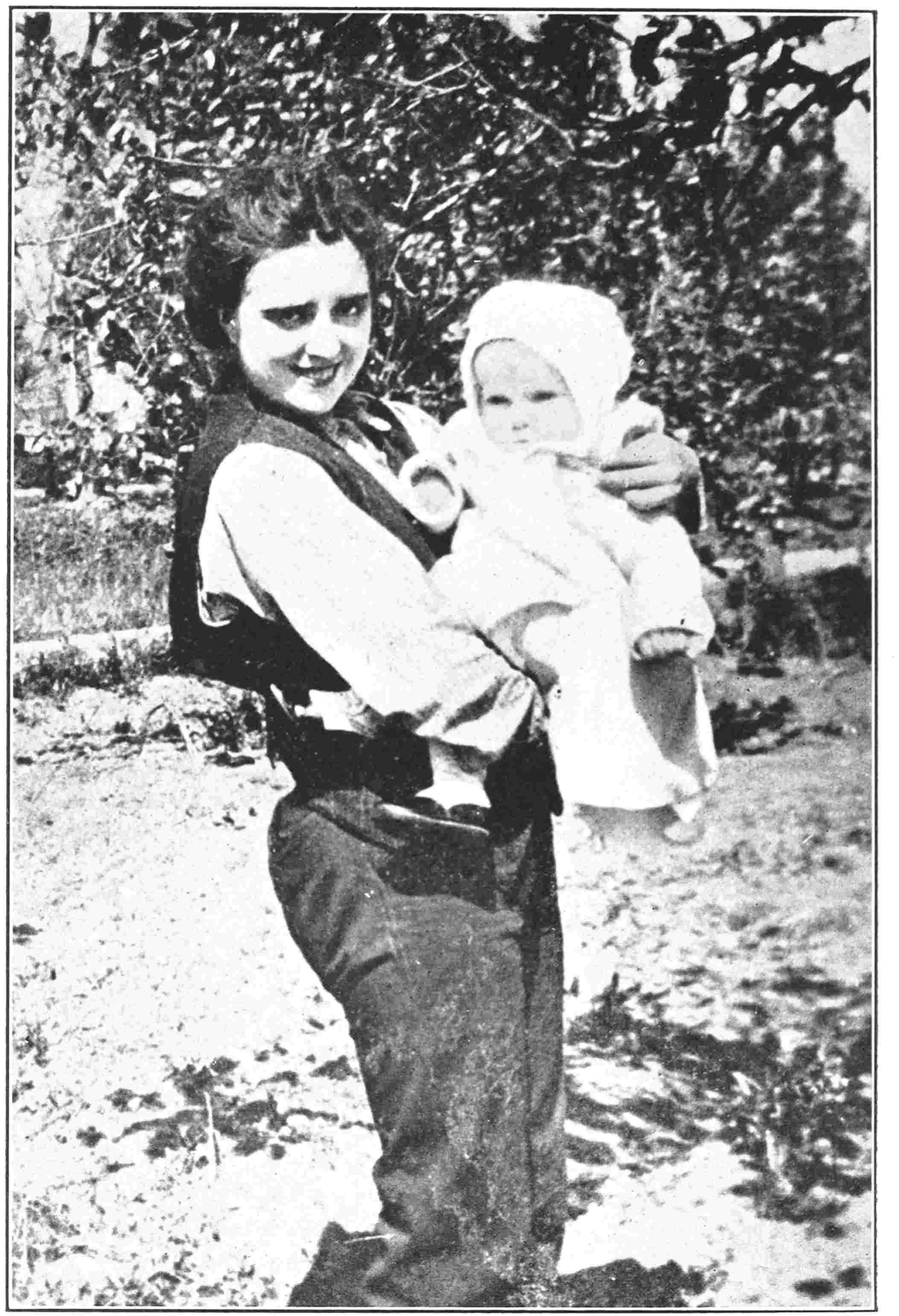
Mabel Normand with Lee Dougherty, Jr., “off duty.”
(See p. 204)
A few years after this time I met Mary in Macy’s one
summer day and hardly recognized her. She had grown
thin and had acquired style. I admired her smart costume
and said: “Nice suit, Mary, I’m looking for one. Mind
telling me where you found it?” But Mary, with a note
of boredom, so unlike the Mary I’d known, answered: “Oh,
my aunt brought me six from Paris.”
“Mary, you haven’t forgotten how we used to strike
bargains with the salesman at Hearn’s on Fourteenth Street,
have you?”
“Oh,” said Mary, quickly coming back to earth and
proving greatness but a dream, “wasn’t it fun? Let’s go
over to the Astor and have tea.”
Across from Macy’s, Mary’s first bus was parked and
young brother Jack was chauffing. When we hopped into
the car, we found a very disgruntled youth who, having
waited longer than he thought he ought to have, gave me
a stony stare and never spoke a word. As far as young
Jack Smith was concerned, I’d never been on earth before.
We wondered about Mack Sennett. Would he ever buy
a girl an ice cream soda? Marion Leonard said it would
be his birthday if he ever did. But the day arrived when
Mack Sennett did open up. He bought a seventy-five-dollar
diamond necklace for Mabel Normand, and then after some
misunderstanding between himself and Mabel, proving he
had a head for business, he offered it to different members
of the company for eighty-five dollars.
Spike Robinson, who used to box with Mr. Griffith and
who now boxes with Douglas Fairbanks, looms up as the
one generous member of the company, being willing always
to buy the girls ice cream sodas or lemonade or sarsaparilla—the
refreshments of our age of innocence.
* * * * *
The fall of 1909 brought to the studio a number of
new women who proved valuable additions to our company.
Stephanie Longfellow, who was a bona fide niece of the
poet Henry, was one of them. Her first pictures were
released in August. They were “The Better Way” and
“A Strange Meeting.” Miss Longfellow was quite a different
type from her predecessors and her work was delightful.
She was a refreshing personality with unusual mental
attainments. “She’s a lady,” said the director. Some ten
years ago Miss Longfellow retired to domestic life via a
happy marriage outside the profession.
Handsome Mrs. Grace Henderson became our grande
dame of quality, breezing in from past glories of “Peter
Pan” (having played Peter’s Mother) and of the famous
old Daly Stock Company.
Another grande dame of appearance distinguished,
drawing modest pay checks occasionally, and with a
cultural family background most unusual for a stage mother,
was Caroline Harris. Miss Harris, otherwise Mrs. Barthelmess,
and mother of ten-year-old Dicky Barthelmess, was
one stage mother not supported by her child. Only when
home on a vacation from military school did Dicky work
in a picture. He made his début with Mrs. Tom Ince, and
his little heart was quite broken when he discovered his
only scene had been cut out.
Miss Harris’s first stage appearance had been with Benjamin
Chapin playing Mrs. Lincoln in “Lincoln at the
White House,” afterwards called “Honest Abe.” Her first
part in the movies was in De Maupassant’s “The Necklace,”
in which Rose King played the lead. Miss Harris had
learned of the Biograph through a girl who jobbed at the
studio, Helen Ormsby, the daughter of a Brooklyn newspaper
man.
Mabel Trunelle had a rather crowded hour at the Biograph.
She had had considerable experience at the Edison
studio and was well equipped in movie technique. She had
come on recommendation of her husband, Herbert Pryor,
and she succeeded, even though a wife—which was unusual,
for wives of the good actors were not popular around the
studio. If an actor wanted to keep on the right side of
the director, he left his wife at home; that meant a sacrifice
often enough, for there were times without number when
women were needed and a wife could have been used and
the five dollars kept in the family, but the majority preferred
not to risk it. Dell Henderson and George Nichols
succeeded quite well with this “wife” business, but they
seem to have been the only ones besides Mr. Pryor.
Florence Barker, a good trouper who had had stock
experience in Los Angeles, her home town, now happened
along to enjoy popularity, and to become Frank Powell’s
leading woman. Through her Eleanor Kershaw, sister to
Willette, and wife to the late Thomas H. Ince, happened
to come to the Biograph.
Quite the most pathetic figure at the studio was Eleanor
Kershaw Ince. In deep mourning for her mother who
had just been killed in an accident, and all alone, with a
tiny baby at home, she put in brave hours for her little five-dollar
bills. When six o’clock came and her work was not
finished, how she fretted about her little one. That baby,
Tom Ince’s eldest child “Billy,” is now a husky lad and he
probably doesn’t know how we all worried over him then.
Miss Kershaw played sad little persons such as the maid
in “The Course of True Love,” flower girls, and match
girls, in wispy clothes, on cold November days, offering
their wares on the streets of Coytesville and Fort Lee.
There was the blond and lily-like Blanche Sweet, an
undeveloped child too young to play sweethearts and wives,
but a good type for the more insignificant parts, such as
maids and daughters. David wanted to use her this first
winter in a picture called “Choosing a Husband,” so he
tried her out, but finding her so utterly unemotional, he dismissed
her saying, “Oh, she’s terrible.” Then he tried Miss
Barker and had her play the part. But he directed
Miss Sweet in her first picture, “All on Account of a
Cold.”
Mr. Powell liked Miss Sweet’s work, and so did Doc,
and so Mr. Powell used her in the first picture he directed,
“All on Account of the Milk.” Mr. Powell was rehearsing
in the basement of No. 11 while Mr. Griffith was doing the
same upstairs. Mary Pickford played the daughter and
Blanche Sweet, the maid, and in the picture they change
places.
On the back porch of a little farmhouse a rendezvous
takes place with the milkman. It was bitterly cold, and
even though the girls wore woolen dresses under their cotton
aprons, they looked like frozen turnips. The scenes being
of tense love, the girls were supposed to be divinely rapturous
and to show no discomfort—not even know it was
winter. But the breathing was a different matter, for as
young Blanche uttered endearing words to her lover, a
white cloud issued from her mouth. Now that would look
dreadful on the screen. So in the nervousness of the situation
Mr. Powell yelled at her, “Stop talking, just look at
him, this is supposed to be summer.” She obeyed, when
from her delicate nostrils came a similar white line of
frosted breath at which the director, now wholly beside himself,
yelled, “Stop breathing, what kind of a picture do you
think this will be, anyhow.” So little Blanche proceeded
to strangle for a few moments while we secured a few feet
of summer.
In “The Day After”—four hundred and sixty feet of
a New Year’s party picture, showing what a youngster she
was, Blanche Sweet played Cupid.
Kate Bruce had become the leading character woman.
Little Christie Miller, frail, white, and bent, played the
kindly old men, while Vernon Clarges interpreted the more
pompous, distinguished elderly ones. Daddy Butler was
mostly just a nice kind papa, and George Nichols played
a diversified range of parts—monks, rugged Westerners,
and such. George Nichols had been a member of the old
Alcazar and Central Theatres in San Francisco, where Mr.
Griffith in his stranded actor days had worked.
Of the children, little Gladys Egan did remarkable work
playing many dramatic leading parts. Her performance in
“The Broken Doll” should be recorded here. Adele de
Garde was another nine-year-old child wonder. These
children were not comiques. They were tragediennes and
how they could tear a passion to tatters! The Wolff children
sufficed well in infantile rôles. Their mother kept a
dramatic agency for children.
Boys were little in demand, and as Mary Pickford
usually had her family handy, we came to use little Jack—he
was at this time nine years old. He created quite a stir about
the old A. B. He even managed to make himself the topic
of conversation at lunch time and other off-duty hours.
“Had he a future like sister Mary?” We were even then
ready to grant Mary a future.
Lottie was discussed too, but in a more casual way.
No one was especially interested in Lottie. Mary was very
hesitant in bringing her to the studio; she confided that
Lottie was not pretty and she didn’t think she’d be good
in the movies. She was the tomboy of the family and she
loved nothing better than to play baseball with the boys,
and when later she did become a Biograph player she had
her innings at many a game.
For a year and a half that had winged its way, my
husband and I had kept our secret well, although a something
was looming that might make us spill it. There had
been nervous moments. Only three people at the studio
knew the facts of the case, Wilfred Lucas, Paul Scardon,
and Harry Salter. But Wilfred Lucas, whose hospitality
we’d frequently enjoyed, never betrayed us.
Nor did Paul Scardon. I don’t remember Mr. Scardon
doing any work of consequence at the Biograph, but he
eventually connected up with the Vitagraph, becoming one
of its directors. He discovered Betty Blythe, developed her
from an unknown extra girl to a leading woman of
prominence. After the death of his first wife, he married
her. Miss Blythe has been a big star for some years now
and while Mr. Scardon has not been directing her, he
travels with her to distant enchanting lands, to Egypt, the
Riviera, and such places where Miss Blythe has been working
on big feature pictures. It was under William Fox’s
banner that Miss Blythe first came into prominence. The
picture was “The Queen of Sheba.”
Lucas and Scardon were friends of ours before our
marriage, but Harry Salter was the only person about the
studio in whom David had confided. And I wasn’t told
a thing about it. Helping to purloin Florence Lawrence
from the Vitagraph, Mr. Salter had just naturally fallen
in love with her and they had been secretly married, and
no one knew it but Mr. Griffith. A fellow-feeling probably
had made David a bit confidential—an unusual thing for
him. It was one day, on a little launch going to Navesink.
My husband was in the front of the boat, his back to us.
Harry and Florence and I were seated aft. We were
quietly enjoying the ride, not a word being spoken, when
Harry Salter, pointing to a hole in the heel of David’s
stocking, at the same time turned to me and with a knowing
smile said, “Miss Arvidson, look!”
The something that was looming that would make us
reveal our well-concealed secret, was a trip to California to
escape the bad eastern weather of January, February and
March.
Now I did not intend to spend three nights on the Santa
Fé Limited in a Lower Eight, or an Upper Three, when
there was the luxury of a drawing-room at hand. Nor
was it my husband’s wish either. I felt I had earned every
little five-per-day I’d had from the Biograph and had
minded my own business sufficiently well to share comfort
with the director. Yes, I would take my place as that most
unwelcome person—the director’s wife. So when the tickets
were being made up, Mr. Hammer was brought into the
secret, but he just couldn’t believe it. But Mr. Dougherty
said: “Well, that is bringing coal to Newcastle.” Nobody
could understand what he meant by this, but that is what
he said.
CHAPTER XIX TO THE WEST COAST
After shivering through one Eastern winter, trying to
get the necessary outdoor scenes for our pictures, we
concluded that it would be to our advantage to pack up
the wardrobe, the cameras, and other paraphernalia, get a
little organization together, and with a portmanteau of
Western scripts hie ourselves to the city of Los Angeles.
We weren’t the first to go there. Selig already had a
studio there. Frank Boggs had brought a little company
of Selig players to Los Angeles in the early days of 1908.
The next company that reached the coast was that of the
New York Motion Picture Patents Corporation, making
the Bison brand of pictures. They had arrived in Los
Angeles about Thanksgiving, 1909—seventeen players under
the command of Fred Balshofer.
Kalem was taking pictures in Los Angeles, too. I felt
very much annoyed one night, shortly before we left New
York, to see a Kalem picture with Carlyle Blackwell and
Alice Joyce having a petting party in Westlake Park.
How we did buzz around, those last weeks in New
York! Mr. Powell’s company worked nights to keep up
the two one-thousand-foot releases per week.
News was already being broadcast that it was quite
O.K. down at the Biograph if you got in right—that they
were doing good things and were going to send a company
to California for the winter, which would mean a regular
salary for the time away.
And so arrived Mr. Dell Henderson, who became leading
man for the night company at five per night. The demands
for physical beauty that he had to fulfil certainly should
have earned more than the ordinary five. He had to be
so handsome that his jealous wife prevails upon thugs to
waylay him and scar for life his manly beauty so that the
admiring women will let him alone.
This movie, “The Love of Lady Irma,” was one of the
first pictures Mr. Powell directed. Florence Barker, who
became the leading woman for the No. 2 California Comedy
Company, played Lady Irma, the jealous wife. She had
joined the company in December, her first picture being
“The Dancing Girl of Butte,” in which she was cast with
Owen Moore and Mack Sennett.
It was in these days that Eleanor Kershaw did her bit;
also Dorothy West and Ruth Hart. Miss Hart, now Mrs.
Victor Moore and the mother of two children, played the
sweet domestic wife, a rôle Mr. Griffith felt she was a
good exponent of, and which she has successfully continued
in her private life.
Frank Grandin appears in his first leading part, playing
The Duke in “The Duke’s Plan”; and our atmospheric
genial Englishman, Charles Craig, affiliated the same month,
playing opposite Mary Pickford in “The Englishman and
the Girl.”
The studio was now a busy place. A Civil War picture
had to be rushed through before we could get away. Mr.
Powell was busy engaging actors for it and had just completed
his cast of principals when he bumped into an actor
friend, Tommy Ince. It seems Mr. Ince at the moment
was “broke.” Apologetically, Mr. Powell said he couldn’t
offer anything much, but if Mr. Ince didn’t mind coming
in as an “extra” he would give him ten dollars for the day.
This quite overcame Tom Ince and he stammered forth,
“Glory be”—or words to that effect—“I’d be glad to get
five.” Only one part did Tom Ince play with Biograph
and that was in “The New Lid” with Lucille Lee Stewart,
Ralph Ince’s wife and sister of Anita Stewart.
I happened to call on Eleanor Hicks Powell one evening
in the summer of 1912 when our only Biograph baby, Baden
Powell, had reached the creeping age. During the evening
Mr. and Mrs. Tom Ince dropped in. Of course, we talked
“movies.” Mr. Ince was worrying about an offer he’d had
to go to California as manager and leading director of the
101 Ranch, Kaybee Company, for one hundred and twenty-five
dollars per week, as I remember. He offered me forty
dollars to go out as leading woman, but I couldn’t see the
Indians. Mr. Ince couldn’t see them either—but it was the
best offer that had come his way.
Mr. Ince made a great success out of the 101 Ranch,
but having ambitions to do the “high-class,” he moved on
in quest of it. Took to developing stars like Charles Ray,
Enid Markey, and Dorothy Dalton; became one of the Triangle
outfit with David Griffith and Mack Sennett; exploited
dramatic stars like George Beban, Billie Burke, and Enid
Bennett; did “Civilization”—but after “The Birth of a
Nation.”
* * * * *
Who was to go to California and who wasn’t? Ah,
that was the question! Some husbands didn’t care to leave
their wives, and as they couldn’t afford to take them, they
were out. Some didn’t mind the separation. Some of the
women had ties; if not husbands, mothers; and the California
salary would not be big enough to keep up two homes.
Some didn’t want to leave New York; and some who should
have known they didn’t have a ghost of a chance wept sad
and plentiful tears whenever the director looked their way.
One of these was Jeanie Macpherson. Jeanie didn’t go
along this first time.
A few days after Christmas was the time of the first
hegira to the land of the eucalyptus and the pepper tree.
It was a big day.
We were going to Los Angeles to take moving pictures,
and Hollywood didn’t mean a thing. Pasadena the company
knew about. Like Palm Beach, it was where millionaires
sojourned for two months during the Eastern winter.
San Gabriel Mission they’d seen photos of, and counted on
using it in pictures. They understood there were many
beaches accessible by trolley; and residential districts like
West Adams; even Figueroa, the home of Los Angeles’s
first millionaires, was a fine avenue then; and Westlake and
Eastlake Parks which were quite in town. But they didn’t
know Edendale from the Old Soldiers’ Home at Sawtelle.
San Pedro? Yes, that was where the steamers arrived
from San Francisco. San Fernando? Well, yes, there was
a Mission there too, but it was rather far away, and right
in the heart of a parched and cactus-covered desert. Mt.
Lowe was easy—there was the incline railway to help us
to the top.
Four luxurious days on luxurious trains before we
would sight the palms and poinsettias that were gaily beckoning
to us across the distances.
Let us away!
The company departed via the Black Diamond Express
on the Lehigh Valley, which route meant ferry to Jersey
City. A late arrival in Chicago allowed just comfortable
time to make the California Limited leaving at 8 P.M.
The company was luxurious for but three days.
It was only Mr. R. H. Hammer, my husband, and myself
who had been allotted four full days of elegance. We
de luxe’d out of New York via the Twentieth Century
Limited. I had come into my own.
Mr. Powell was in charge of the company and so he
checked them off on arrival at the ferry—Marion Leonard,
Florence Barker, Mary Pickford, Dorothy West, Kate
Bruce, the women; George Nichols, Henry Walthall, Billy
Quirk, Frank Grandin, Charlie West, Mack Sennett, Dell
Henderson, Arthur Johnson, Daddy Butler, Christie Miller,
Tony O’Sullivan, and Alfred Paget, the men. There were
three wives who were actresses also, Eleanor Hicks,
Florence Lee (Mrs. Dell Henderson), and Mrs. George
Nichols. And there were two camera men, Billy Bitzer
and Arthur Marvin; a scenic artist, Eddie Shelter; a carpenter
or two, and two property boys, Bobbie Harron and
Johnny Mahr.
No theatrical job had come along for Mary Pickford,
and the few summer months she had intended spending in
“the pictures” would lengthen into a full year now that
she had decided to go with us to California. Her salary
was still small: it was about forty dollars a week at this
time.
Frank Powell had a busy hour at the Ferry Building
although Mr. Griffith was there also to see that all the
company got on board. He had not anticipated too smooth
an exit. Nor did he get it, even though he had taken well
into account his temperamentalists. And sure enough,
Arthur Johnson and Charlie West arrived breathless and
hatless, fresh from an all-night party, just as the last gong
rang.
And while David was nervously awaiting them and
while dear relatives were weeping their fond farewells, the
Pickford family chose the opportune moment to put on a
little play of their own.
Ma Smith, it seems, had made up her mind that a last
minute hold-up might succeed in forcing Mr. Griffith to
raise Mary’s salary—I’m not sure whether it was five or
ten dollars a week. So they held a little pow-wow on the
subject, right on the dock, in the midst of all the excitement;
and Jack began to cry because he wasn’t going along
with his big sister; and Owen Moore between saying sad
good-byes to Mary, hoped the boss might relent and give
him the ten extra he had held out for, for Los Angeles.
For, much as Owen loved Mary and Mary loved Owen,
he let a few dollars part them for the glorious season out
in California.
Well, anyhow, little Jack’s tears and Mother Smith’s
talk and pretty Mary’s gentle but persistent implorations
did not get her the ten dollars extra. David had something
up his sleeve he knew would calm the Smith family, and
make them listen to reason, and he delivered it with a firm
finality.
“Now I’ve got little Gertie Robinson all ready to come
on at a moment’s notice. Mary goes without the five (or
ten) or not at all.”
Mary went. Then Jack began to bawl. It was a terrible
family parting. So Mr. Griffith compromised and
said he’d take Jack and give him three checks a week,
fifteen dollars. The company paid his fare, of course, for
we had extra tickets and plenty of room for one small boy
in the coaches at our disposal.
It was a pleasant trip, especially for those who had not
been to California before. Some found card games so
engrossing that they never took a peek at the scenery.
Some, especially Mary and Dorothy West, oh’d and ah’d
so that Arthur Johnson, thinking the enthusiasm a bit overdone,
began kidding the scenery lovers. “Oh, lookit,
lookit,” Arthur would exclaim when the gushing was at its
height.
The “Biograph Special” we were. We had rare service
on the train. We had every attention from the dining-car
steward. Had we not been allowed three dollars per day
for meals on the train? And didn’t we spend it? For the
invigorating air breathed from the observation platform
gave us healthy appetites.
At San Bernardino (perhaps the custom still survives,
I don’t know, for now when I go to Los Angeles, I go via
the Overland Limited to San Francisco instead) we each
received a dainty bouquet of pretty, fragrant carnations.
Flowers for nothing! We could hardly believe our eyes.
At last we were there! Mr. Hammer gallantly suggested,
although it was afternoon, that the women of the
company go to a hotel at the Biograph’s expense, until they
located permanent quarters. So the ladies were registered
at the Alexandria, then but lately opened, and shining and
grand it was. Although they made but a short stay there,
they attracted considerable attention. One day Mary Pickford
stepped out of the Alexandria’s elevator just as
William Randolph Hearst was entering. Seeing Mary, he
said, “I wonder who that pretty girl is.” And one night at
dinner, between sips of his ale, indicating our table which
was but one removed from his, Mr. Hearst wondered some
more as to who the people were.
The players were quite overcome at the company’s
hospitality. It was quite different from traveling with a
theatrical road show where you had to pay for sleepers and
meals, and where you might be dumped out at a railroad
station at any hour of the cold gray dawn, with a Miners’
Convention occupying every bed and couch in the town, and
be left entirely to your own resources.
I may be wrong, but I think Mr. Grey of the office force
(but not the Mr. Grey of the present Griffith organization;
it was years before his movie affiliation, and the Biograph’s
Mr. Grey has been dead some years now) went out to
California ahead of the company to make banking arrangements
and look around for a location for the studio.
On Grand Avenue and Washington Street, hardly ten
minutes by trolley from Broadway and Fifth, and seven
by motor from our hotel, mixed in with a lumber yard
and a baseball park, was a nice vacant lot. It was surrounded
by a board fence six feet or so in height, high
enough to prevent passers-by from looking in on us. Just
an ordinary dirt lot, it was. In the corners and along the
fence-edges the coarse-bladed grass, the kind that grows
only in California, had already sprouted, and otherwise it
looked just like a small boy’s happy baseball ground. It
was selected for the studio.
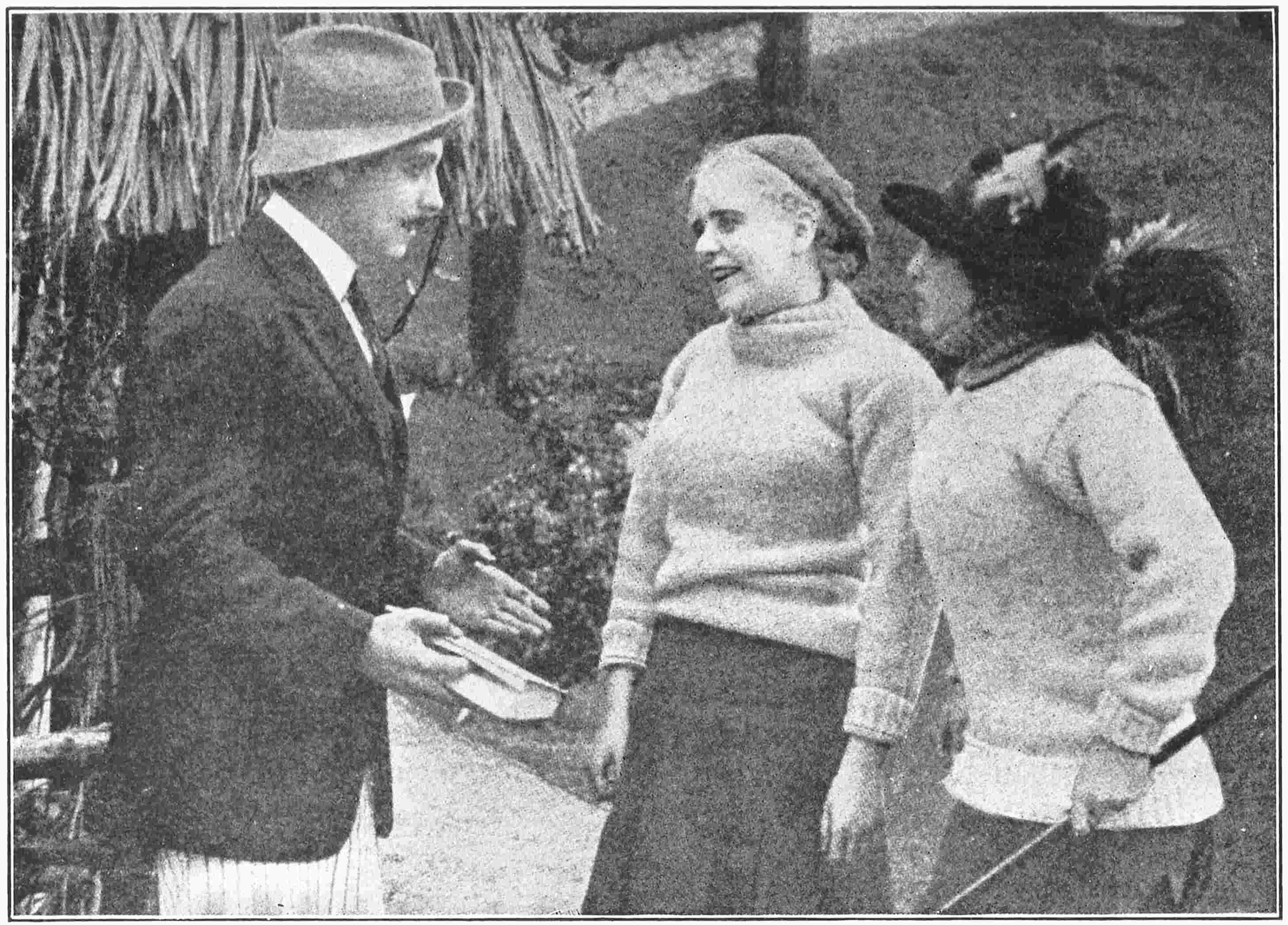
Joe Graybill, Blanche Sweet and Vivian Prescott, in “How She Triumphed.”
(See p. 184)
A stage had to be rigged up where we could take “interiors,”
for while we intended doing most of our work
“on location,” there would have to be a place where we
could lay a carpet and place pieces of furniture about for
parlor, bedroom—but not bath. As yet modesty had deterred
us from entering that sanctum of tiles, porcelain,
cold cream, and rose-water jars. Mr. C. B. DeMille was
as yet a bit away in the offing, and Milady’s ablutions and
Milord’s Gilette were still matters of a private nature—to
the movies.
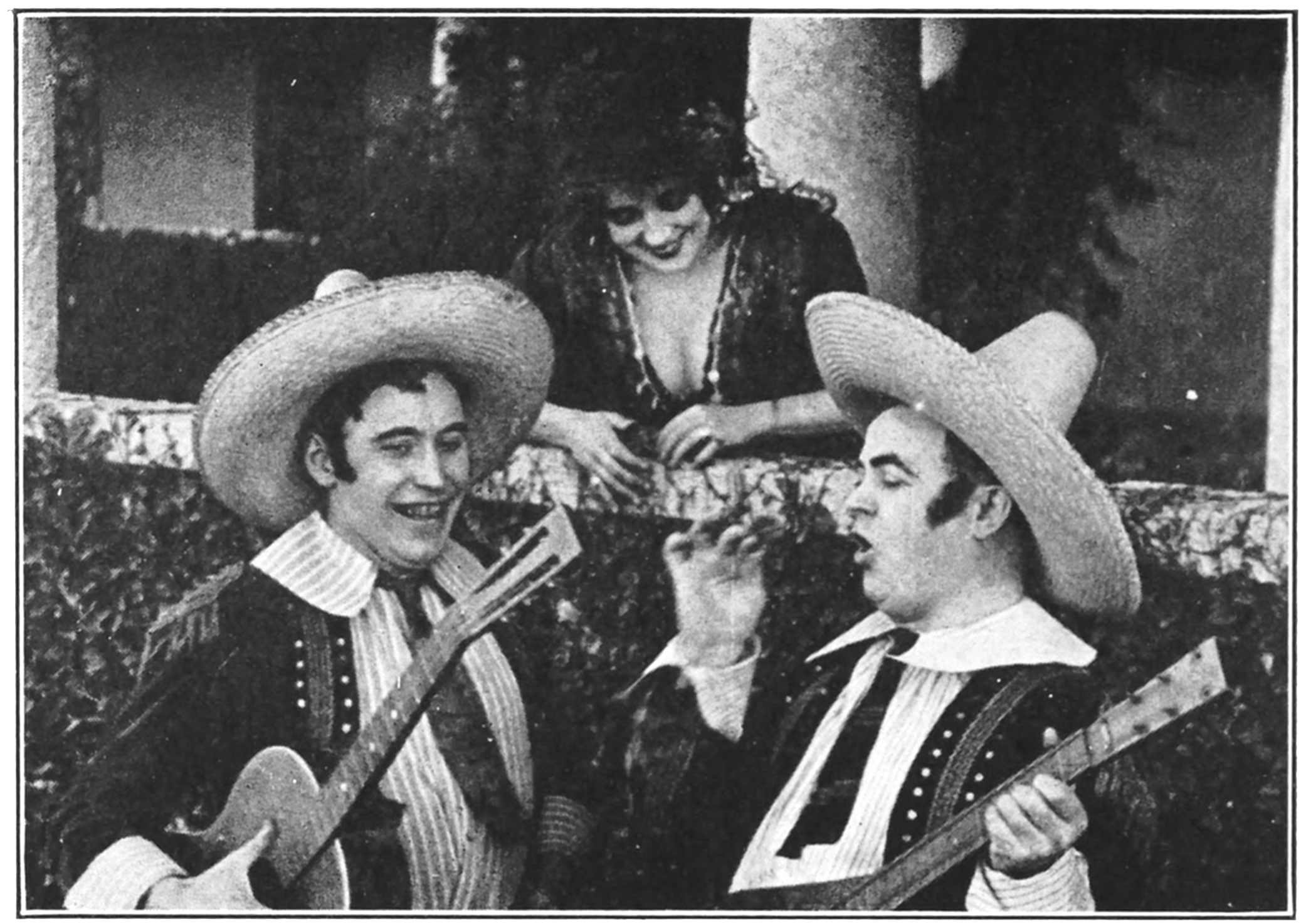
Mack Sennett, Mabel Normand and Fred Mace, in a “Keystone Comedy.”
(See p. 204)
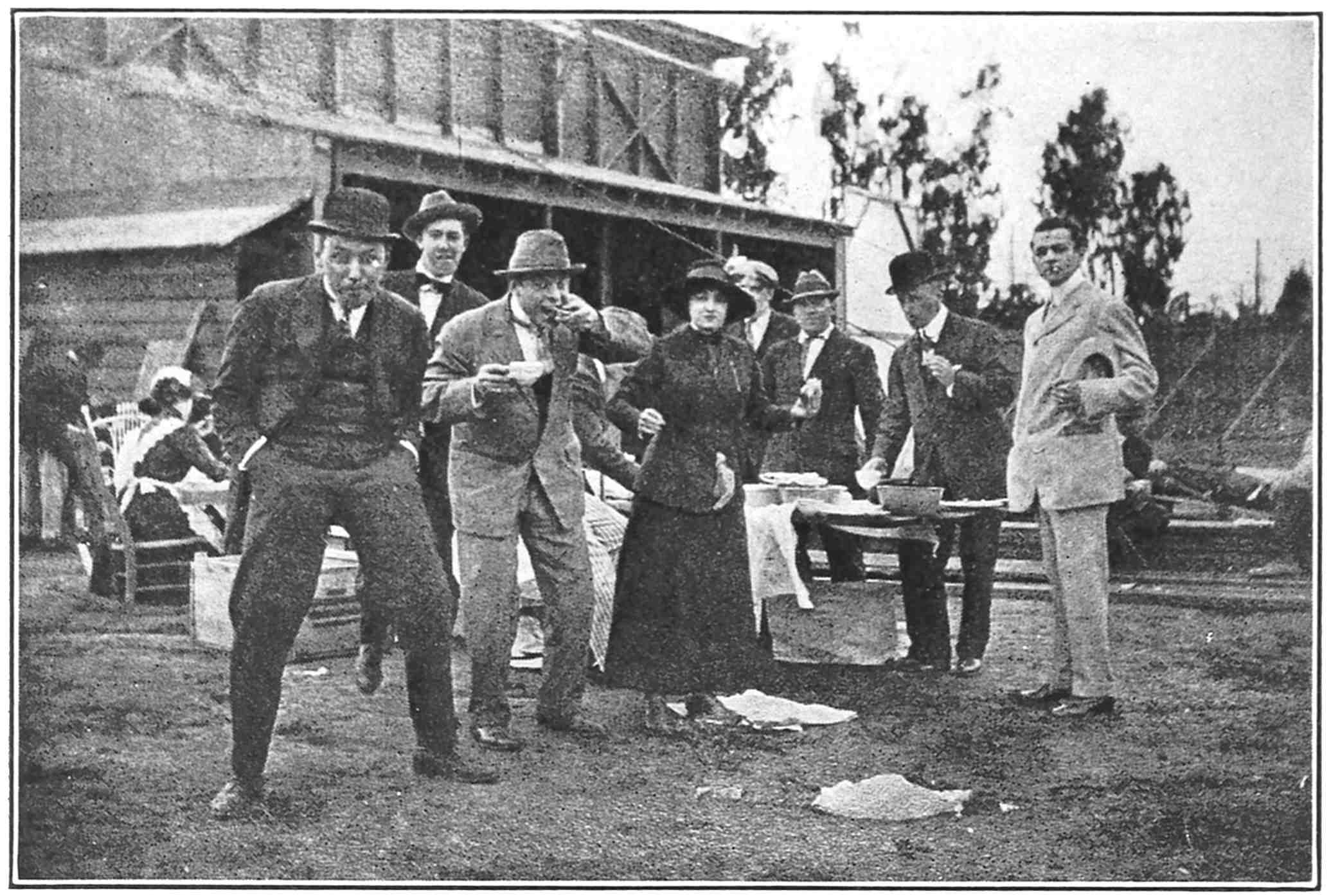
Lunch on the “lot,” Biograph’s “last word” studio, the second year. Left
to right: Mack Sennett, William Beaudine, Eddie Dillon, Vivian Prescott.
(See p. 202)
A load of wood was ordered from our neighbor, and
the carpenters set about to fix up a stage and some dressing-rooms:
we couldn’t dress and make up in our hotels, that
was sure, nor could we do so in the open spaces of our
“lot.”
Our stage, erected in the center of the lot, was merely
a wooden floor raised a few feet off the ground and about
fifty feet square, of rough splintery wood, and when we
“did” Western bar-rooms—au naturel—it was just the
thing.
Two small adjoining dressing-rooms for the men soon
came into being; then similar ones for the women. They
looked like tiny bath-houses as they faced each other across
the lot. They sufficed, however. There were no quarrels
as to where the star should dress. When there were extras,
they dressed in relays, and sometimes a tent was put up.
Telegraph poles ran alongside the studio and after our
business became known in the neighborhood, and especially
on days when we were portraying strenuous drama and got
noisy, up these poles the small boys would clamber and have
a big time watching the proceedings and throwing us
friendly salutations which didn’t always help along the
“action.”
* * * * *
A place had to be found where our camera men could
develop the film and we could see the results of our work,
for when a picture left Los Angeles it must be complete
and ready for release, so down on Spring Street and Second,
a loft was rented for a few dollars a month. It was a
roomy, though dingy, barn of a place, but it served our
purpose well. A tiny dark room was boarded off and fixed
up for the developing, and a place set apart for the printing.
The huge wheels on which the prints were dried stood
boldly apart in the room. There was a little desk for cutting
and splicing. At the head of the room furthest from
the windows a screen was set, and a sort of low partition
about midway the length of the loft hemmed in the projection
room.
When things had settled into a routine, and on rainy
days, we rehearsed and worked out scenarios up in our loft.
We also had the costumes delivered there. The loft was
always accessible, and we spent many evenings seeing projections
and getting our things together for an early morning
start.
Across the street from the loft was a famous old eating
place, Hoffman’s, where my husband and I dined when we
returned late or too weary to dress for the more pretentious
hotel dining-room. It was a bit expensive for some of the
company, but convenient to our headquarters was one of
those market places, indigenous to Los Angeles, where
violets and hams commingled on neighborly counters, that
served good and inexpensive food on a long white enameled
table where guests sat only on one side, on high, spindly
stools. It was patronized generously by the actors for
breakfast and lunch, when we were working in the downtown
studio. Here Mary Pickford and brother Jack and
Dorothy West were regular patrons.
While the studio was being put in shape, the members
of the company had been scooting about looking for suitable
places to live. Salaries were not so large, but that economy
had to be practiced, even with the fourteen dollars a week
expense money allowed every member of the company.
Mary Pickford had brother Jack to look after, and she
decided that if she clubbed in with some of the girls and
they all found a place together it would be cheaper, and
also not so lonely for her. So Mary, with Jack, and two
of the young girls—Dorothy West and Effie Johnson—thirty-dollar-a-weekers,
found shelter in a rooming house
called “The Lille.” It was on South Olive and Fifth Streets,
but it is there no more. The four had rooms here for three
and a half per week per person.
But the quartette didn’t stay long at “The Lille”—decided
they needed hotel conveniences. So they scurried
about and located finally for the winter at the New Broadway
Hotel on North Broadway and Second Streets. Here
they lived in comfort, if not in style, with two rooms and
a connecting bath, for five fifty per week per person.
When we got going, Mr. Griffith was rather glad Jack
Smith was along, for with the two companies working we
found we could use a small boy quite often. So Jack earned
his fifteen a week regularly that first California winter.
The men of the company were all devoted to little Jack.
He would sit around nights watching them play poker,
sometimes until 3 A.M.; he didn’t want to be forever at the
movies with his big sister. Mary allowed Jack fifty cents
a night for his dinner; he’d connect up somewhere or other
with his pals, in any event with his big brother Dell Henderson,
and they would make a night of it.
We were to be no proud owners of an automobile, but
rented one by the hour at four dollars for car and chauffeur.
The director and his camera man and persons playing leads
would travel by motor to location while the others would
trolley. As Los Angeles had, even then, the most wonderful
system of trolleys in the world, there were few places, no
matter how remote, that could not be reached by electric
car.
Sunday came to be a big day for the automobile, for
on that day we scouted for the week’s locations—that is,
after David had made out his weekly expenses, his Sunday
morning job.
Here is a sample, recorded in almost illegible pen-and-ink
longhand:
| Luncheon (30 actors) |
$ 7.50 |
| Carfare (30 actors, location both ways) |
15.00 |
| Automobile (so many hours $4. per) |
100.00 |
| Locations (gratuities for using people’s places) |
20.00 |
| Incidentals |
17.00 |
| Extras (not actors, not incidentals either) |
11.00 |
Those sufficiently interested may add.
CHAPTER XX IN CALIFORNIA AND ON THE JOB
We would not have been true to the traditions of the
Golden State had we not used a Mission in our first
picture. We meant to do our very best right off and send
back a knock-out.
So to San Gabriel we went to get the lovely old Mission
atmosphere in a picture called “Threads of Destiny.”
We spread ourselves; we took the Mission front, back
and sideways, inside and out; we used the worn old stairway,
shaded by a fragrant pepper tree, that led to the choir
loft: we even planted lilies—or rather, Mary Pickford as
Myrtle, the orphan girl of San Gabriel, planted lilies—along
the adobe wall of the old cemetery where slept baptized
Indians and Mexicans.
It was pleasant sprawling about in the lazy sunshine.
We who were “atmosphere” wandered about the cemetery,
reading the old tombstones, and had the priest guide us
through the Mission showing us its three-hundred-year-old
treasures. And across the way we visited the curio shop
where we bought pretty post-cards and ate tamales, real
Mexican tamales.
We would experiment on this Mission picture. We
wanted a dim, religious light, and here it was, and we
wanted to get it on the screen as it looked to us, the real
thing. One little window let in an afternoon slant of soft
sunshine that fell directly upon the pulpit where Christie
Miller, playing an old priest, was to stand and bless the
congregation. If we could light up Christie, the devout
worshipers could be mere shadows and it would look fine—just
what we wanted. Billy Bitzer would “get” it if it
could be got, that we knew. So while Billy was tuning up
his camera, Bobby Harron came and gathered in the congregation
from the curio shop and cemetery, and we quietly
took our places in the chapel and did our atmospheric bit.
We did pray—we prayed that it would be a good effect.
We rather held our breath at the picture’s first showing
until his tricky scene was flashed on the screen. Then we
relaxed; it was all there!
Spanish California was not to be neglected this trip,
and our next picture, a romance of the Spanish dominion,
called “In Old California” is historical as the first Biograph
to be taken in Hollywood. The Hollywood Inn was at this
time the only exclusive winter resort between the city and
the ocean. We needed rooms where we could make up and
dress, and Mr. Anderson, the genial young proprietor, welcomed
us cordially.
Marion Leonard was playing the beautiful Spanish
señorita in this movie and Frank Grandin the handsome
young lover who afterwards became the governor of California.
As we came out of the hotel in our make up and
Spanish finery and quietly drove off into the foothills,
guests were lolling on the broad front porch. With a start
they came to. Whatever in the world was happening! “Did
you see those people? What is it? What’s going on? Let’s
get our motor and follow them and see,” said they.
We had selected what we thought a remote and secluded
spot in the foothills, but soon in ones and twos and threes
the guests appeared. For a time they seemed well-behaved
spectators; they kept quiet and in the background. But
Miss Leonard’s dramatic scenes proved too much for them.
They resented the love-making and began making derogatory
comments about movie actors, and one “lady” becoming
particularly incensed, shouted loudly, “Well, I wouldn’t
dress up like a fool like that woman and act like her, no,
not for all the money in the world.” That off her chest,
she turned on her heel, and left us flat.
Paul de Longpré, the famous flower artist, lived only
a few blocks from the Inn on Hollywood Boulevard. Many
years ago he had left his native France and built a lovely
château in the broad stretches of young Hollywood. In his
gardens he had planted every variety of rose. A tangled
profusion of them covered even the walls of his house. We
offered fifty dollars a day for the use of the gardens. M.
de Longpré went us one better. He offered to let us work
if we’d buy a corner lot for three hundred dollars. But
what could we do with a corner lot? We had no idea we
would work six days and pay the three hundred dollars just
in rental. But that we did. What we didn’t do, was, take
title to the corner lot. Had we done so we would have laid
a foundation for fortune.
I recall M. de Longpré as the first person we met on
location in California who seemed to appreciate that we
were at least striving for something in an art line. To him
we were not mere buffoons as we were to the ladies of the
Hollywood Inn.
“Love Among the Roses” we aptly called the picture
in which Marion Leonard played a great lady residing in
the Kingdom of Never-never Land.
Monsieur de Longpré’s lovely house and gardens—a
show place for tourists some twelve years ago—has long
since been cut up into building lots on which have been
erected rows of California bungalows. For when motion
picture studios began to spring up like mushrooms in this
quiet residential district, actors had to be domiciled and
the boulevard was no longer desirable as a restful home
locality. Also, the financial return on property thus manipulated
was not to be lightly regarded. The town council
voted a memorial to the kindly French artist. So Hollywood
has a de Longpré Avenue.
The day we lunched at the Hollywood Inn marked an
event for Hollywood. Few motion picture actors had desecrated
the Inn’s conservative grounds until that day. A few
years later only motion picture actors lived there, and they
live there now, though the old-maid régime is coming along
rapidly. Aside from the movie intrusion, Mr. Anderson
foresaw the changes that were to come. In due time he
built the now famous Beverly Hills Hotel. But the movie
actor, who has now achieved a social and financial standing
that equals that of other professions, he still has with him.
* * * * *
Goodness gracious, how could we ever get all the scenic
beauty on the screen! It was too distracting, what with
Missions, desert, mountains, ocean, beaches, cliffs, and
flowers. We wanted to send enough of it back in our
pictures to ensure our coming again next winter.
We had a scenario that called for a wealthy gentleman’s
winter home. We hied ourselves out to Pasadena, to
Orange Grove Avenue, Hillside Avenue, Busch’s sunken
gardens, Doheny’s, and other famous show places. We
found a place with gardens and pergolas, just the thing.
Asked permission to use the house and grounds, from very
charming ladies wintering within, possibly a bit bored, for
they seemed delighted with the idea.
It was not the custom in those days to explain the nature
of the story for which one desired a place; and the ladies
being so keen on seeing moving pictures being made, the
matter ended right there. The scenario which had been
selected for our pioneer work in Pasadena was called “Gold
is Not All.”
The day came to start work on the picture. We were
all packed up in our motor car outside the Alexandria Hotel
getting an early start, for the earlier we got to work, the
fewer the days we would need to trespass on the borrowed
property.
“Gold is Not All” was a story of contrasts. There were
very wealthy people in it and very poor people. And the
poor faction was so poor that mother, little mother, had
to take in washing to help out, which washing she returned
to the rich people’s houses.
Like many other fallacies that have become identified
with motion picture characterization, rich people are invariably
represented as being unkind, selfish, penurious, and
immoral—oh, always immoral. And the poor are loving,
kind, true, surfeited with virtue. The poor mother idolized
her children, worked and slaved for them; father always
loved mother, never strayed from home. But the rich man,
drat him, ah, he had sweethearts galore, he was dishonest
on the stock market, he put marble dust in the sugar, his
wife was something merely to be exploited, and his children
were always “poor little rich boys and girls.”
So we were primed for action and quite ready to make
our wealthy gentleman sojourning in his winter mansion
an utter rake, a miserable specimen of the middle-aged
debauchee who treated cruelly a long-suffering wife. But
the little poor families were such models of all the virtues,
they hadn’t missed one; and their days were full of happiness.
The hostess of this charming home with some friends
watched our performances. There was no limit to their
hospitality. They brought out tables and a tea-service and
they loaned us their “bestest” butler—there was a lawn party
in the story. When the picture was finished, Mr. Griffith
invited the owner and his family and their friends to the
studio to see the picture.
The projection over, we noticed a strange lack of enthusiasm;
and then Monsieur took Mr. Griffith aside and
asked him if it would be absolutely necessary for him to
release the picture.
“Really,” said the gentleman, “we are a very happy
family, my wife and I and the children, we like each other
a lot. All my friends have been told about the picture and
they’ll watch for it—and I just don’t like it, that’s all. You
know a person can have money and still be a respectable
citizen in the community.”
And that was that. But we learned something.
And here comes little Jack Pickford in his first leading
part, a comedy directed by Frank Powell, and called “The
Kid.” It was full of impish pranks of the small boy who
does not want his lonely daddy to bring him home a new
mama, but he comes across in time and soon is all for her.
Two more pictures, “The Converts,” and “The Way of
the World,” finished us at San Gabriel. Both were Christian
preachments, having repentant Magdalenes as heroines,
and were admirably suited for portrayal against the Mission’s
mellow walls.
Sleepy old San Gabriel, where dwelt, that first winter,
but a handful of Mexicans and where no sound but the
mocking bird was heard until the jangling trolley arrived
and unloaded its cackling tourists!
Mission atmosphere got under the skin; so we determined
on San Fernando for “Over Silent Paths,” an
American Desert story of a lone miner and his daughter
who had come by prairie-schooner from their far-away
Eastern home.
San Fernando Mission was twenty-two miles from Los
Angeles, with inadequate train service, and the dirt road,
after the first winter rains had swelled the “rivers” and
washed away the bridges, was often impassable by motor.
The desertion and the desecration of the picturesque
place was complete. For more than two hundred years the
hot sun and winter rain had beat upon the Mission’s adobe
walls. It boasted no curio shop, no lunch room, not even
a priest to guard it. A few Japs were living in the one
habitable room—they mended bicycles. We were as free
to move in as were the swallows so thickly perched on the
chapel rafters. An occasional tourist with his kodak had
been the only visitor until we came. Then all was changed.
It was in San Fernando that we first met up with the
typical California rancher. This man, whose name I recall
as “Boroff” had been one of the first settlers in the valley.
On a “location hunt” we had spied Mr. Boroff’s interesting-looking
place with its flowers and its cows, and had decided
to pay our respects and see if we could get the ranch for
a picture, sometime. One of the “hands” brought Mr.
Boroff to us. Rangy and rugged, oh, what health-in-the-cheeks
he had! He swung us about the place and then
suddenly we found ourselves in a huge barn drinking tall
glasses of the most wonderful buttermilk.
“Do you know,” said Mr. Boroff, downing his, “I drink
a quart of whiskey every day to pass the time away, and
a gallon of buttermilk so I’ll live long.”
* * * * *
Squatted one afternoon on the edge of the roadway in
front of the Mission, I began idly scratching up the baked
dirt with an old Mexican stiletto we were using in a picture.
A few inches below the surface I noticed funny little round
things that did not seem to be rocks. I picked up a few,
broke off pieces of dry dirt, cleaned the small particles on
my Mexican shawl, and found them to be old Indian beads,
all colors, blue, red, and yellow. Through the leisure hours
of that day I dug beads until I had an interesting little string
of them. The Indians from whose decorated leather trappings
the beads had fallen had been sleeping many years
in the old cemetery back of the Mission.
Now there are grass and flower beds growing over my
little burial place of the beads, for the Mission has been
restored; but even were it not so, the movie actress of to-day
would surely rather lounge contentedly in her limousine
than squat on old Mother Earth, digging up Indian beads.
* * * * *
The third and last of the Missions we visited was
romantic San Juan Capistrano, seventy miles south of Los
Angeles, nestling in the foothills some three miles from the
Pacific.
Our scenario man, Mr. Taylor, had prepared a Spanish
story of the padre days, and this lovely rambling Mission
with its adjacent olive ranches, live-oak groves, silvery aliso
trees, and cliffs along the seashore, was to afford stacks of
local color.
Our one automobile deposited its quota—Mr. Griffith
and party—in San Juan Capistrano in the late afternoon.
The evening train brought the rest of the actors.
There was one little Inn, the Mendelssohn—now fixed
up and boasting all modern conveniences; then merely an
airy wooden structure evidently built under the prevailing
delusion that southern California has a tropical climate.
There was a tiny office; the only parlor, the proprietor’s
personal one, which he was kind enough to let us use. He
had a stove and it felt mighty good to get warmed up nights
before turning in.
The bedrooms were upstairs. To reach them you had
to go out in the yard, the back-yard, climb the rickety stairs
to the porch, on to which each little bedroom by means of
its own little door, opened. The bare-floored bedrooms were
just large enough to hold a creaky double bed, wash-bowl
and pitcher, and a chair.
We must see the Mission before dinner. The idea of
dinner didn’t thrill us much, and the thought of going to
bed thrilled us less. But why expect the beauty of old
things and modern comfort too? The thought of seeing
old San Juan in the dim light of early evening should have
sufficed.
Beautiful old ruin! The peace and the silence! We
might have been in the Sahara.
Every member of the company was to work in this
picture. There were no more than ten little bedrooms in
the hotel. Actors slept everywhere, two and three in a
bed; even the parlor had to be fixed up with cots. Miss
Leonard and others of the women had been domiciled in
a neighborly Spanish house—the only other available decent
quarters.
Dell Henderson, who had put himself wise to the arrangement
of sleeping partners, had copped little Jack
Pickford as his bedfellow. Dell was one of our very
largest actors and Jack being about as big as a peanut, Dell
had figured that with the little fellow by his side he might
be able to catch forty winks during the night.
Few of us managed to get unbroken winks. Between
the creaking of one’s own bed and the snores from other
rooms down the line (the walls were like paper) and the
footsteps on the shaking porch, of actors going from room
to room looking for something better than what had been
allotted them, it was a restful night! All through it, at
intervals, Charlie Craig kept calling to his bedfellow, “Don’t
squash me—don’t squash me.” But the most disgruntled of
all was Sennett. To every room he came calling “Hey,
how many in this bed? Who’s in there? Got three in my
bed; I can’t sleep three in a bed.” But responses were few
and faint, and from Dell Henderson’s room came only
silence. So after waiting in vain for help in his difficulty,
and thoroughly disgusted, Mack returned to what must have
been very chummy quarters.
There had been engaged for this picture a bunch of cowboys,
rough-riders, headed by Bill Carroll, for we were to pull
some thrillers in the way of horse stuff. The riders with
their horses were leaving Los Angeles on the midnight train,
due to reach Capistrano at 2 A.M.
It was all so weird and spooky that midnight had arrived
before I had summoned sufficient courage to let myself
go to sleep. No sooner had I dozed off than out of the
black and the silence came a terrific roar, yells, and loud
laughter, and pistol shots going zip, zip, zip.
These hot-headed Mexicans! Things happened here,
and something dreadful was going to happen right now.
I heard horses; and soon horses and riders galloped madly
into the back-yard, right to the foot of our stairs, it seemed.
But it was only our cowboys who had arrived, feeling
good, and full of the joy of life. Old Colonel Roosevelt
knew all about this sort of thing, and would have appreciated
the celebration. No thought had been given the boys’
slumber places, and so after a look around they docilely
crawled up into the barn and were soon asleep in the sweet-smelling
hay.
“The Two Brothers,” the picture we were to do, told
the story of the good and bad brother. Good brother marries
the pretty señorita in the Mission chapel.
An experienced and cultured gentleman was the French
priest in charge of this Mission. He was most obliging
and told us we could use whatever we liked of the wedding
ceremonial symbols, which we did, but which we shouldn’t
have done on this particular day of days—Good Friday.
The wedding was some spread. There were Spanish
ladies in gay satins and mantillas, and Spanish gentlemen in
velvets and gold lace, and priest and acolytes carrying the
sacred emblems. They paraded all over the Mission grounds.
Then the camera was set up to get the chapel entrance.
While all was going happily, without warning, from out
the turquoise blue sky, right at the feet of the blushing bride
and the happy groom, fell the stuffed figure of a man!
Right in the foreground the figure landed, and, of course,
it completely ruined our beautiful scene.
On Good Friday in these Spanish-Mexican towns of
California a ceremonial called “burning Judas” used to take
place (and may still, for all I know). Old carts and wheels
and pieces of junk in the village are gathered in a heap
outside the Mission grounds, and old suits of clothes are
stuffed with straw, making effigies of Judas. The villagers
set fire to this lot of rubbish and to the Judases as well,
and the evil they have brought during the year is supposed
to disappear in the smoke from their burning bodies. The
handsomest Judas, however, is saved from the conflagration
for a more ignominous finish. A healthy young bull is
secured and to his formidable horns this Judas is strapped.
Then the bull is turned loose, so annoyed by this monstrous
thing on his horns that he madly cavorts until Judas’s clothes
are torn to shreds and his straw insides are spilled all over
the place, and he is done for, completely.
Now while we had been rehearsing and taking the wedding
scenes, the sacristan, a little old man to whom life
meant tending the Mission and ringing the bells at the appointed
hour, had been covertly taking us in, and when he
saw our gay though holy processional start into the very
sanctum of the Mission on Good Friday, his soul revolted.
No, that he would not stand for!
Something even worse than riding the bull’s horns could
happen to Judas; and that was to be thrown at movie actors.
So the sacristan picked the prize Judas, and at the climactic
scene he dropped him on us, and then broadcasting a roar
of Mexican oaths he went on his way, his soul relieved and
his heart rejoicing.
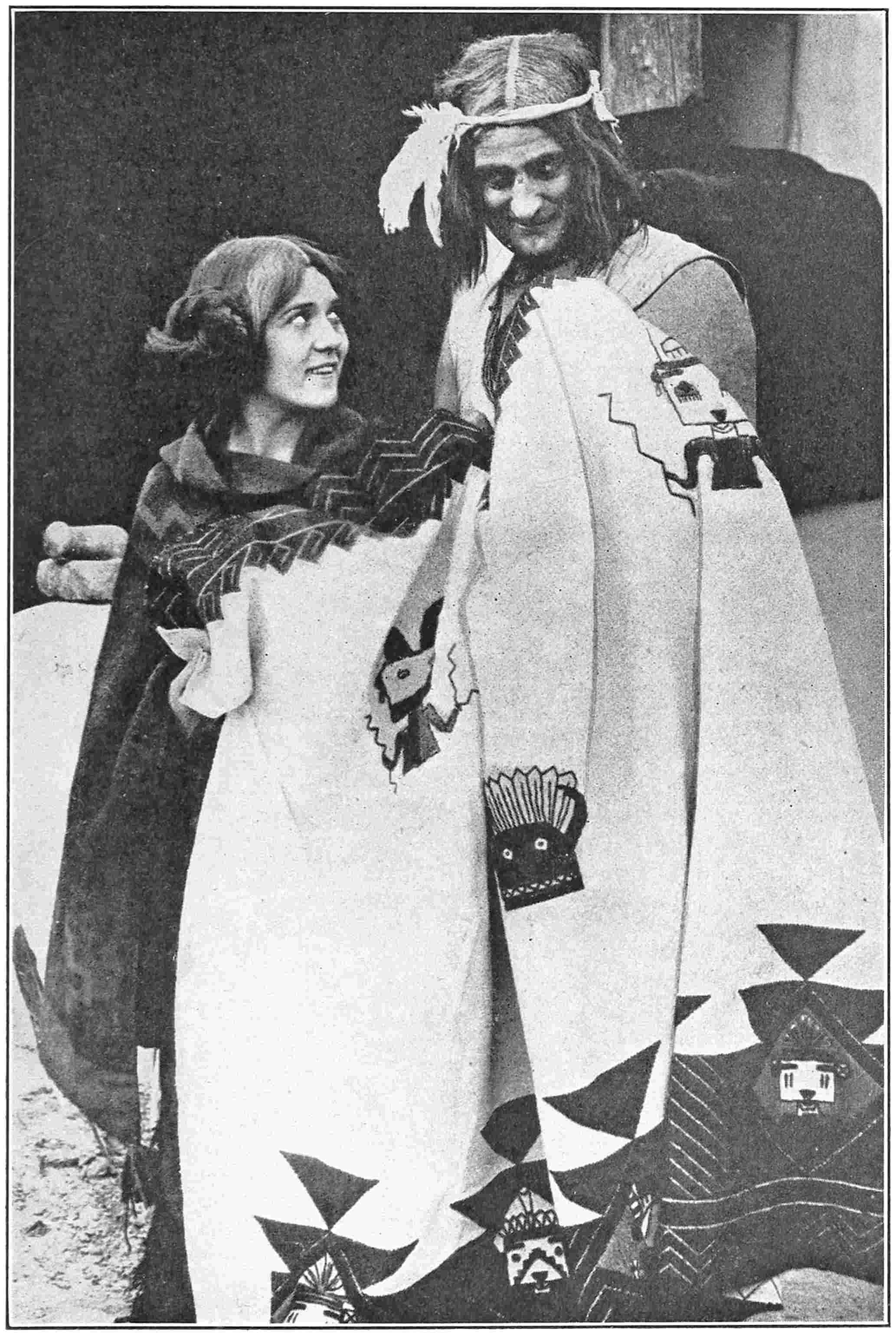
Mary Pickford as a picturesque Indian, before “curls” and “Mary” had
become synonymous terms.
(See p. 168)
But we felt differently. There was no telling now what
these San Juan hot-heads might do to us. But the seeming
lack of reverence of our procession was explained to the
little sacristan by the understanding priest.
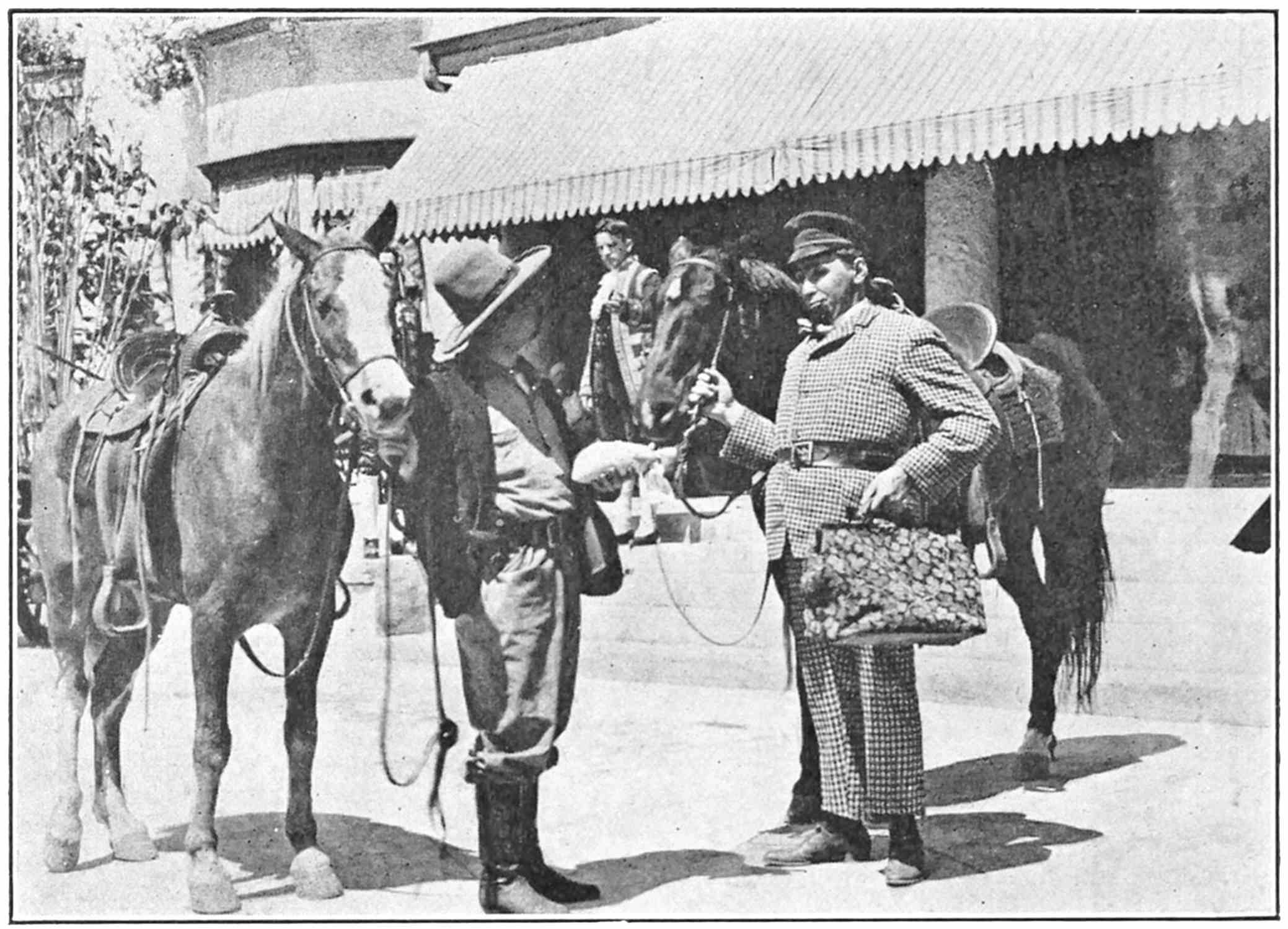
The Hollywood Inn, the setting for “The Dutch Gold Mine,” with Mack
Sennett and Eddie Dillon. The players were thrilled at being received in
such a hostelry, and the guests amazed at seeing picture actors.
(See p. 158)
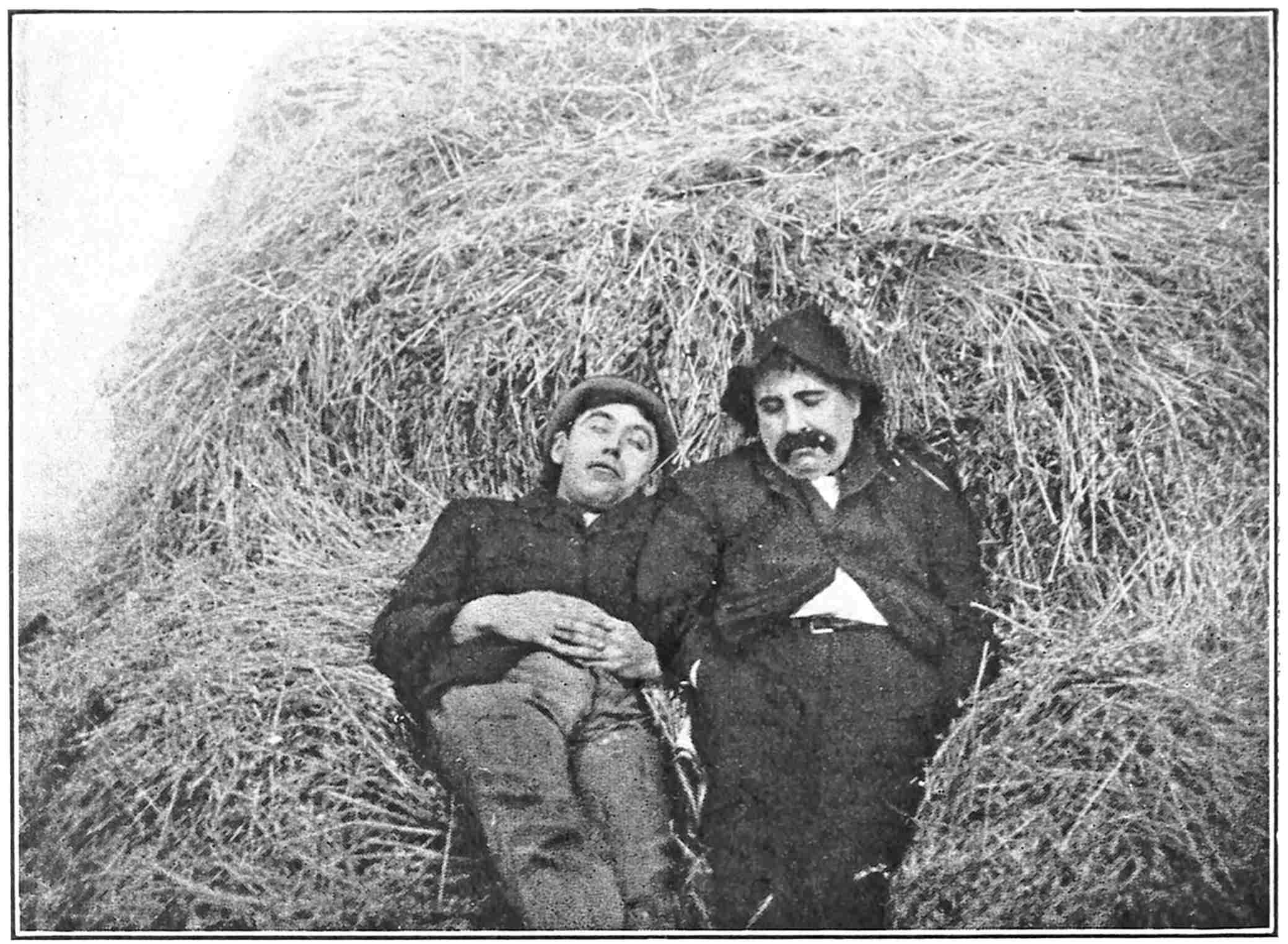
From “Comrades,” the first picture directed by Mack Sennett, with Mack
Sennett and Dell Henderson.
(See p. 204)
The next day we did the abduction. We took ourselves
miles from the Mission. We chose a treacherous-looking
road along the ocean cliffs. In a ramshackle buggy the
bride and groom were speeding on their honeymoon, but
bad brother and his band of outlaws were hot on the trail
to steal the bride. Our cowboys bringing up the rear were
cavorting on their horses; the horses were rearing on their
hind legs; and the director was yelling, “A dollar for a
fall, boys, a dollar for a fall!” The boys fell, on all sides
they fell; they swung off their horses, and they climbed
back on, and they spilled themselves in the dust, their horses
riding on without them. Some of the boys made ten and
some twenty dollars that day, just for “falls.” And not one
was even scratched.
The next day was Easter Sunday, and our work being
finished, in the gray dawn we folded our tents and silently
slunk away.
But the curse of Judas was upon us. When the picture
was projected, all was fine—scenic effects beautiful—and
photography superb, until—we came to the wedding procession!
Judas, to our surprise, was nowhere to be seen; he had
fallen out of focus evidently, but the effect of his anathema
was all there. The scene was so streaked with “lightning”
we could not use it. At San Gabriel we retook it later, but
it never seemed the same to us.
* * * * *
Sierra Madre was another of our choice locations this
first trip. Here were wonderful mountains with fascinating
trails and canyons deep and long. From Sierra Madre,
Mount Wilson was climbed, by foot or donkey, for no magnificent
motor road then led to its five-thousand-and-something-foot
summit.
At the quarter-mile house we did “The Gold-seekers,”
a story of California in the days of ’49, with Henry
Walthall striking pay dirt in the west fork of the San
Gabriel canyon.
Mary Pickford did one of her Indians here, “A Romance
of the Western Hills.” David thought Mary had a good
face for Indians on account of her high cheek bones, and
usually cast her for the red-skinned maid or young squaw.
A smear of brown grease paint over her fair face and a
wig of coarse straight black hair made a picturesque little
Indian girl of “our Mary.”
Curls and Mary Pickford were not yet synonymous.
She played, besides Indians, many character parts with her
hair smacked straight back; and she “did” young wives
with her hair in a “bun” on the top of her head to make
her look tall and married. When Mary wore curls, it meant
an hour of labor at night. The curls necessitated three distinct
kinds of “curlers,” the ones for the wave on top, others
for the long curls, and little curlers for the shorter hair
around the face. I often thought Mary Pickford earned
her slim salary those days for the time and effort she spent
on her hair alone.
It was an unhappy Mary on that first trip to Los
Angeles, Owen Moore having passed up his little sweetheart
on account of the weekly ten dollars he thought Mr. Griffith
should have added to his salary. The day’s work over,
came her lonesome hour. On the long rides home from
location, cuddled up in her seat in the car, she dreamed of
home and dear ones. And one day passing the eastbound
Santa Fé Limited, out of a deep sad sigh the words escaped,
“God bless all the trains going East and speed the one we
go on”—the Irish in her speaking.
An urge to do “Ramona” in a motion picture possessed
Mr. Griffith all the while we were in California, for the
picturesque settings of Helen Hunt Jackson’s deep-motived
romance were so close at hand. Several conferences had
been held on the subject in New York, before we left. But
in order to make a screen adaptation of this story of the
white man’s injustice to the Indian, arrangements would
have to be made with the publishers, Little, Brown & Company.
They asked one hundred dollars for the motion picture
rights and the Biograph Company came across like
good sports and paid it, and “Ramona” went on record. It
was conceded to be the most expensive picture put out by
any manufacturer up to that time.
To Camulos, Ventura County, seventy miles from Los
Angeles, we traveled to do this production of “Ramona.” For
Camulos was one of the five homes accredited to the real
Ramona that Mrs. Jackson picked for her fictional one.
She picked well.
What a wealth of atmosphere of beautiful old Spain,
Camulos’s far-famed adobe offered! Scenes of sheep-shearing;
scenes in the little flower-covered outdoor chapel where
Ramona’s family and their faithful Indian servants worshiped;
love scenes at Ramona’s iron-barred window; scenes
of heartache on the bleak mountain top but a few miles
distant where Alessandro and Ramona bury their little baby,
dead from the white man’s persecutions; and finally the
wedding scene of Ramona and Felipe amid the oranges and
roses and grass pinks of the patio. Even bells that were
cast in old Spain rang silently on the screen. The Biograph
Company brought out a special folder with cuts and descriptive
matter. The picture was Mr. Griffith’s most artistic
creation to date.
Nor did we neglect the oil fields, for oil had its romance.
So at Olinda, that tremendous field, we “took” plungers
innumerable and expensive oil spilling out of huge barrels
into little lakes, all black and smooth and shiny. The picture,
called “Unexpected Help,” had Arthur Johnson and
little Gladys Egan as star actors. One other oil picture we
did, “A Rich Revenge,” a comedy of the California oil
fields, with Mary Pickford and Billy Quirk.
We had located a picturesque oil field. A crabbed-looking
man in dirty blue jeans seemed the only person about.
We asked him would there be any objection to our working,
and he gruffly answered in the negative.
So we “set up,” and got our scenes; and, work finished,
looked about for our man, wishing to thank him. Feeling
sorry for him, we went one better and tendered him a
twenty-dollar gold piece. When he saw that money, he
began to curse us so hard that we were glad when we hit
the highway.
At the garage in the village we made inquiries and were
enlightened. The man of the dirty blue jeans was none
other than the millionaire owner of the oil well, an oil well
that was gushing one fair fortune per day. And though
he refused our money as though it were poison, three times
a week that man walked to Santa Ana, ten miles distant,
where he could buy a ten-cent pie for five cents.
Still more atmosphere we recorded in a picture called
“As It Is In Life”—the famous old pigeon farm located
near the dry bed of the San Gabriel River. Shortly after
the time of our picture, the winter storms washed away this
landmark and we were glad then that we had so struggled
with the thousands of fluttering pigeons that just wouldn’t
be still and feed when we wanted them to, and insisted upon
being good, quiet little pigeons when we wished them to
loop the loop.
It seems we paid little attention to sea stories. Perhaps
because we had our own Atlantic waiting for us back home,
and we had done sea stories. We produced only one, “The
Unchanging Sea,” suggested by Charles Kingsley’s poem,
“The Three Fishers.”
Charlie Ogle, who had worked in a few old Biographs
but had been signed up with Edison before Mr. Griffith had
a chance to get him, said to me one day out at the Lasky
lot last winter—1924:
“What was that wonderful sea picture you played in?
My, that was a picture, and you did beautiful work. I’ll
never forget it.”
“You couldn’t remember a sea picture I played in, Mr.
Ogle. Heavens, that was so long ago you must mean some
one else.”
“No, I don’t, and I remember it very well. What was
the name?”
“Enoch Arden?”
“No.”
“Fisher Folk?”
“No, now what was that picture?”
And at that moment we were interrupted in our game
of guess as Leatrice Joy, whom we had been watching, came
off the scene to revive from the heavy smoke of a café fire,
before doing it over again.
“I’ve got it—‘The Unchanging Sea.’”
“That’s it, that’s the one. I’ll never forget that picture.”
“As I remember, it was considered quite a masterpiece.”
The fishing village of Santa Monica was the locale of
this story. At this time there was but a handful of little
shacks beyond the pier, places rented for almost nothing by
poor, health-seeking Easteners. No pretentious Ince studio
as yet meandered along the cliffs some nine miles beyond.
The road ran through wild country on to Jack Rabbit Lodge
where a squatter had a shack that tourists visited occasionally
and for twenty-five cents were shown an old Indian
burial ground.
The only fellow movie actors we met this first winter
in Los Angeles were two members of the Kalem Company,
beautiful Alice Joyce and handsome Carlyle Blackwell, who
often on fine mornings trotted their horses over Santa
Monica’s wet sands.
Occasionally, we met Nat Goodwin, who had cantered
all the way from his home in Venice-by-the-Sea.
CHAPTER XXI BACK HOME AGAIN
Now we must pack up our troubles in our little black
bag and go home. They must be lonesome for us
at 11 East Fourteenth, for the studio has been dark and
silent in our absence. Mr. Dougherty especially will be glad
to see us. And others—the jobless actors. For things were
coming along now so that Mr. Griffith didn’t have to dig
so hard for new talent.
Much talk there’ll be about the pictures we did—how
the public is receiving them—which ones are most popular—how
worthwhile the trip was—how economical we were—and
how hard we worked.
When once again we had donned our working harness,
how stuffy and cramped the studio seemed! Four months
in the open had ruined us; four months with only a white
sheet suspended above our heads when we did “interiors”
on our lot and the sun was too strong. We felt now like
toadstools in a dark cellar, with neither sun nor fresh air.
There was so much to keep Mr. Griffith busy—cutting
and titling of pictures, and conferences upstairs. But the
blossoming pink and white apple orchards must be heeded,
so we deserted a few days, hied ourselves to New Jersey’s
old stone houses and fruit trees and friendly hens, and did
a picture “In the Season of Buds.”
Dorothy West played a leading part in “A Child of
the Ghetto,” in which was featured more Eastern atmosphere—the
old oaken bucket.
For a time we stayed indoors. We acquired a new actor,
Joseph Graybill, and a few old ones returned, Vernon
Clarges and Mrs. Grace Henderson, Jim Kirkwood and Gertrude
Robinson. They now played leading parts. The
public must not get fed up with the same old faces—Mr.
Griffith always saw to that—so it was “go easy” on the
California actors for a while.
The feeling of the old actors towards the new ones,
this spring, was largely a jealous one. “Gee, Griff likes
him all right, what are we going to do about it?” said
Charlie West and Arthur Johnson when Joe Graybill was
having his first rehearsals and the director was beaming with
satisfaction and so happy that he was singing lusty arias
from “Rigoletto.”
“We’ll fix him,” they decided.
So this day Charlie and Arthur returned from lunch
with a small brown bottle containing spiritous liquor, with
which they would ply Joe Graybill surreptitiously in the
men’s dressing-room in the hope that they might incapacitate
him. But Joe drank up, rehearsed, and Mr. Griffith’s
smile only grew broader. Better than ever was the rehearsal.
So Charles went out for another little brown
bottle and Joe disposed of it, and rehearsed—better still.
Another bottle, another rehearsal—better than ever—until
in a blaze of glory the scene was taken and Joe Graybill
stood upon the topmost rung of the ladder, leaving Charles
and Arthur gazing sadly upward.
There was another reason why Mr. Griffith welcomed
new faces. He had a way of not letting an actor get all
worked up about himself. When that seemed imminent,
new talent would suddenly appear on the scene to play
“leads” for two or three weeks so that the importance of
the regular could simmer down a bit.
Now that they had developed an affection for their
movie jobs, the actors didn’t like this so well. They’d come
down to the studio, sit around and watch, get nervous, and
after drawing three or four weeks’ salary without working
(things had come along apace), they wouldn’t know what
to make of it. They’d carry on something awful. They’d
moan: “When am I going to work? I don’t like this loafing—I
wonder if Griffith doesn’t like me any more—I’d like
to know if he wants me to quit and this is his way of getting
me to make the overture.” Finally, Eddie August, after
suffering three weeks of idleness, on pay, got very brave
and told Mr. Griffith he wished he’d fire him or else, for
God’s sake, use him. Mr. August was quite relieved to have
Mr. Griffith’s explanation that in his case he was merely
trying out new people, and didn’t want him to quit at all,
would be very glad to have him stay.
When the Black-eyed Susans had reached full bloom,
we went back to Greenwich, Connecticut, and did a picture
called “What the Daisy Said,” with Mary Pickford and
Gertrude Robinson. We visited Commodore Benedict’s
place again, and again he brought out boxes of his best
cigars. A good old sport he was.
To the Civil War again, in the same old New Jersey
setting, with Dorothy West playing the heroine in “The
House with the Closed Shutters.” In her coward brother’s
clothes she takes his place on the battlefield, breaks through
the lines, delivers a message, and is shot as she returns.
And, forever after, inside the darkened rooms of the House
with the Closed Shutters the brother pays through bitter
years the price of his cowardice.
All our old stamping grounds we revisited this summer.
At the Atlantic Highlands we did two pictures: one, “A
Salutary Lesson,” with Marion Leonard; and the other,
“The Sorrows of the Unfaithful,” with Mary Pickford.
At Paterson, New Jersey, we found a feudal castle. It
belonged to one Mr. Lambert, a silk manufacturer. Here
we did “The Call to Arms” where little Mary donned tights
for the first and only time, playing a page, and looking
picturesque on a medieval horse, but being a very unhappy
Mary for a reason that none of us knew.
How she fussed about those tights—nearly shed tears.
She sat on the lawn all wrapped up in the generous folds
of her velvet cape, and wouldn’t budge until she was called
for her scene, and she talked so strangely. For Owen was
there, and all the other actors were to see her in the tights,
and Mary and Owen had a secret—a secret that made such
a situation quite unbearable. She had confided it only to
“Doc,” but the rest of us had been wondering.
What a miserable, hot, muggy day it was. Tolerable
only sitting on the grassy slopes of the Lambert estate, but
how awful in the rooms of the little frame hotel over by
the railroad tracks where we had made up and where some
of the actors were still awaiting orders as to how they
should dress.
Dell Henderson, who was assisting Mr. Griffith on this
picture, was laboring back and forth from the castle to the
hotel bringing orders to the waiting actors as they were
needed. Sennett was one of the waiting ones, and he was
all humped up in his pet grouch when Dell entered and said,
“Here, Sennett, the boss says for you to don this armor.”
“Armor, in this heat? Armor? I guess I won’t wear
armor.” Then a short pause, “Are you going to wear
armor?”
“Yes, I’m no teacher’s pet,” said Dell, as he gathered
to himself the pieces of his suit of mail and began to climb
into them. So the doubting Mack Sennett could do naught
but imitate him, for no matter how balky his manner, one
word from the boss and he became a good little boy
again.
In August we were once more back in Cuddebackville.
The O. and W.’s conductor was no longer skeptical of our
visits. We brought so many actors sometimes that we not
only filled the little Inn but had to find neighboring farmhouses
in which to park the overflow.
We met all the old Cuddebacks again. We never realized
what a tribe they were until we had to do a scene in
a cemetery, and every grave we picked made trouble for us
with some Cuddeback or other still living. How to get
away with it we didn’t know until we hit upon the idea
of simultaneously enacting a fake but intensely melodramatic
scene down by the General Store. That did the
trick. All the villagers missed their lunch that day and were
unaware of the desecration of their dead.
“Wally” Walthall gave his famous fried chicken luncheon
at the minister’s house. Talent was versatile. We’d
worked through our lunch hour this day, so it was either go
lunchless or beg the privilege of slaughtering some of the
minister’s wife’s tempting spring chickens and cooking them
in her kitchen. That’s how “Wally” had the opportunity to
prove his fried chicken the equal of any Ritz-Carlton’s.
We met up with old Pete again. Although nearly
ninety, he was worrying his faithful spouse into a deep
and dark melancholia. Pete drove the big bus, rigged up
for our use out of one of his old farm wagons. It was
usually filled with “actresses”—wicked females from the
city who wore gay clothes and put paint on their faces.
What a good time old Pete did have once out on the highway!
What a chatter, chatter, chatter he did maintain!
Never had he dreamed of such intimacy with ladies out of
a the-ayter!
But a wife was ever a wife. So no matter how old
and decrepit Pete was, to Mrs. Pete he still had charm,
so why wouldn’t he be alluring to these city girls? Every
night Mrs. Pete was Johnny-on-the-spot, when the bus unloaded
its quota of fair femininity at the Inn, waiting to
lead her errant swain right straight home.
Our friends the Goddefroys still held open house for
us. Dear old Mr. Goddefroy told us of the disquieting
notes that had crept into Cuddebackville’s former tranquil
life, due to our lavish expenditures the first summer—told
Mr. Griffith he was “knocking the place to hell.”
But they still loved us. In a smart little trap they’d
jog over to location bringing buckets of fresh milk and
boxes of apples and pears. Toward late afternoon of a
warm summer day, when working close to their elaborate
“cottage,” the “Boss” would appear with bottles of Bass’s
Ale, and bottles of C-and-C Ginger Ale, both of which he’d
pour over great chunks of ice into a great shining milk
bucket—shandygaff! Was it good? For the simple moving
picture age in which we were living we seemed to get a
good deal out of life.
We enjoyed the other social diversions of the year
before—canoeing, motoring, table-tipping. But one night,
the night on which the Macpherson magicians broke up Mr.
Griffith’s beautiful sleep, nearly saw the end of table-tipping.
Retiring early after a hard day David was awakened
by noisy festivities downstairs, and getting good and mad
about it he rapped a shoe on the floor. The group on occult
demonstration bent, thinking how wonderfully their spooks
were working, instead of quieting down became hilarious.
The morning found them much less optimistic about spirit
rapping.
We did an Irish story of the days when the harp rang
through Tara’s Hall—the famous “Wilful Peggy”—in
which pretty Mary never looked prettier nor acted more
wilfully. But the something that had happened to Mary
since our first visits to Cuddebackville made her a different
Mary now.
One day we were idling over by the Canal bank when,
with the most wistful expression and in the most wistful
tone, Mary spoke, “You know, Mrs. Griffith, I used to think
this canal was the most beautiful place I’d ever seen, and
now it just seems to me like a dirty, muddy stream.”
What had happened to her love’s young dream to so
change the scenery for her?
Early that fall we went to Mount Beacon to do an
Indian picture. The hotel on the mountain top had been
closed, but we dug up the owner and he reopened parts of
the place. At night we slid down the mountainside in the
incline railway car to the village of Fishkill where we dined
and slept at a regular city hotel.
We nearly froze on that mountain top. Playing Indians,
wrapped up in warm Indian blankets, and thus draped picturesquely
on the mountainside, saved us. Mrs. Smith, not
yet Pickford, did an Indian squaw in this picture, which
featured a picturesque character, one Dark Cloud, for years
model to the artist Remington. Dark Cloud was sixty years
old, but had the flexible, straight, slim figure of nineteen.
How beautifully he interpreted the Harvest Festival dance!
There were other actor-Indians on this Mount Beacon
picture, present-day celebrities who were thanking their
stars they were being Indians with woolly blankets to pose
in. There were Henry Walthall and Lily Cahill and Jeanie
Macpherson and Jim Kirkwood and Donald Crisp, among
others.
Donald Crisp had crept quietly into the Biograph fold
as Donald Somebody Else. Occasionally, he authored poems
in The Smart Set—reason for being Donald Somebody Else
in the movies. Of late, Mr. Crisp has rather neglected
poetry for the movies. He gave the screen his greatest acting
performance as Battling Burrows in Mr. Griffith’s
artistic “Broken Blossoms.”
The night that “Way Down East” opened in New York
in 1920 (September 3) Donald was radiant among the
audience saying his farewells, for on the morrow he was
to sail for England to take charge of the Famous Players
studio there, where he put on among other things “Beside
the Bonnie Brier Bush.”
Claire MacDowell and her husband, Charles Mailes,
joined Biograph this season. Stephanie Longfellow returned
to play in more pictures; Alfred Paget began to play small
parts, as did Jeanie Macpherson; also beautiful Florence
LaBadie, who afterwards became a fan favorite through
Thannhouser’s startlingly successful serial “The Million
Dollar Mystery.” As one of the four principals, along
with James Cruze of “The Covered Wagon” fame, Sidney
Bracy and Marguerite Snow, she attracted much attention.
A job as model to Howard Chandler Christie had preceded
her venture into the movies. Her tragic death, the result
of a motor accident, occurred in 1917.
Edwin August came, to look handsome in costume, playing
his first part with Lucy Cotton (recently married to
E. R. Thomas) in “The Fugitive,” taken on Mount Beacon.
Mabel Normand, who had peeked in on us the year before,
returned after a winter spent with Vitagraph.
Mabel, as every one knows, had been responsible for
the lovely magazine covers by James Montgomery Flagg,
and had also been model to Charles Dana Gibson, before
she came to pictures, which had happened through friendship
for Alice Joyce, who had also been a model, but was
now leading lady at the Kalem Company. It was at Kalem,
playing extras, that Mabel Normand began her rather
startling movie career. Dorothy Bernard made a screen
début, as did the other Dorothy who afterward became the
wife of Wallace Reid.
I recall Dorothy Davenport at the Delaware Water Gap
where we took some pictures that fall. She was a modish
little person; she wore brown pin-check ginghams and a
huge brown taffeta bow on the end of a braid of luxurious
brown hair that fluttered down her back. She looked as
though she came direct from Miss Prim’s boarding school
for children of the élite—and so was distinctive for the
movies.
Fair Lily Cahill of the tailored blue serge, plain straw
“dude,” and lady-like veil worked intermittently that summer;
she was always immaculately bloused in “sun-kissed
linen.” Not long after the days of the Water Gap and
Mount Beacon Indian pictures, Miss Cahill became a Broadway
leading woman in support of that long-time matinée
idol, Brandon Tynon, and somewhere along in this period
she married him.
Henry Lehrman, alias Pathé, hung about. How he loved
being a near-actor! How he adored getting fixed up for
a picture! He was satisfied by now that his make-ups were
works of art. From the dressing-room he would emerge
patting his swollen chest, with the laconic remark, “Some
make-up!”
Eddie Dillon returned, to smile his way through more
studio days. He often engaged me in long converse. Eddie
was quite flabbergasted when he learned my matrimonial
status. He need not have been. For in Los Angeles on
Mr. Griffith’s busy evenings he often suggested my taking
in a movie with Eddie. But Eddie never knew about that.
And there was Lloyd Carlton, who went all around the
mulberry bush before he landed in the movies. He first
heard of them in far-off Australia in 1908, when as stage
manager for “Peter Pan” he met a Mr. West, who was
“doing” Australia and the Far East with a “show” that
consisted of ten-and fifteen-foot moving pictures, toting
the films and projection machine and the whole works along
with him. Back on home soil, Mr. Carlton bobbed up at
Biograph where instead of Mr. Frohman’s one hundred
and fifty dollars weekly he cheerfully pocketed five dollars
per day for doing character bits. Followed Thannhouser,
Lubin, and Mr. Fox.
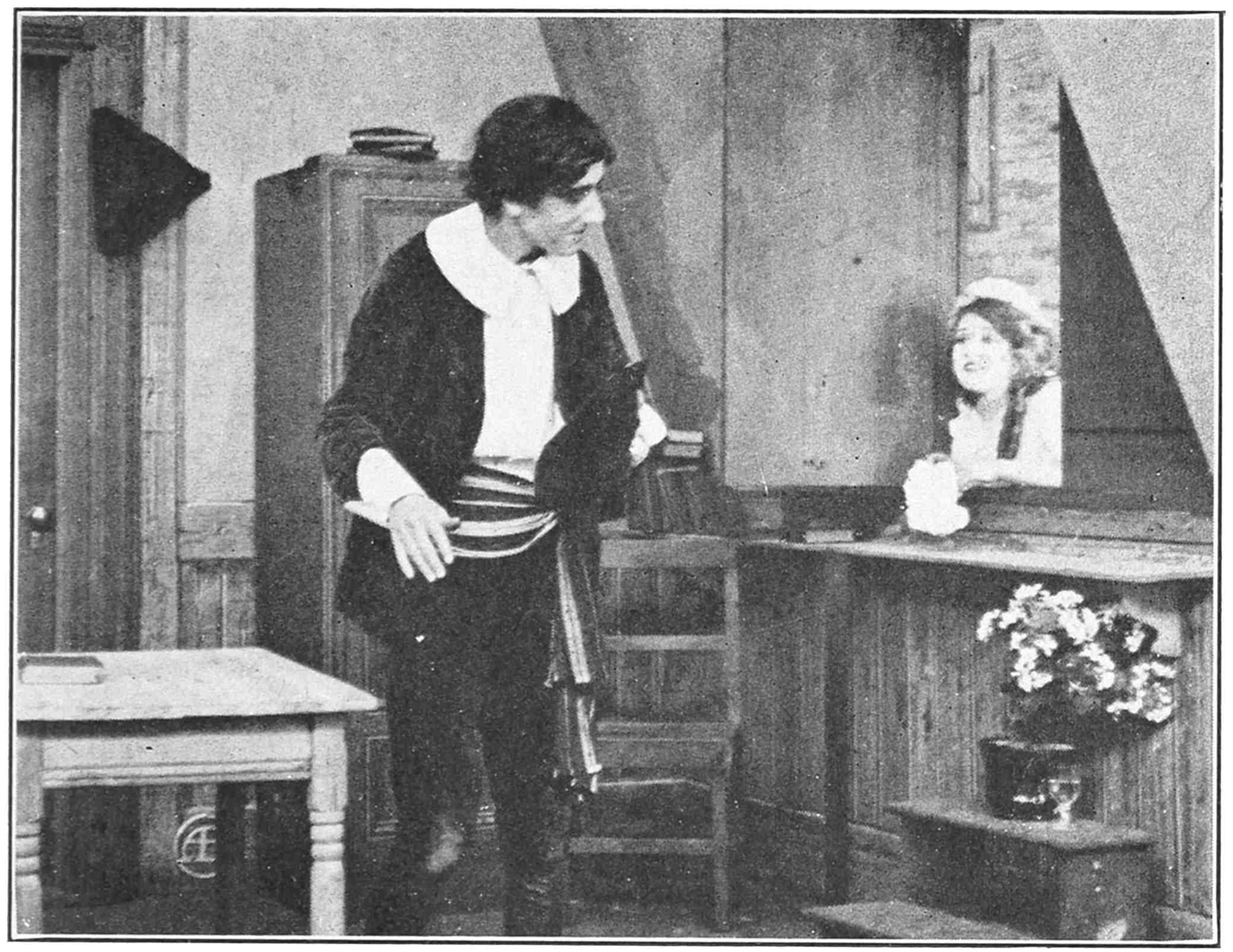
Mary Pickford’s first picture, “The Violin Maker of Cremona,” June 7,
1909. David Miles as the cripple Felippo.
(See p. 100)
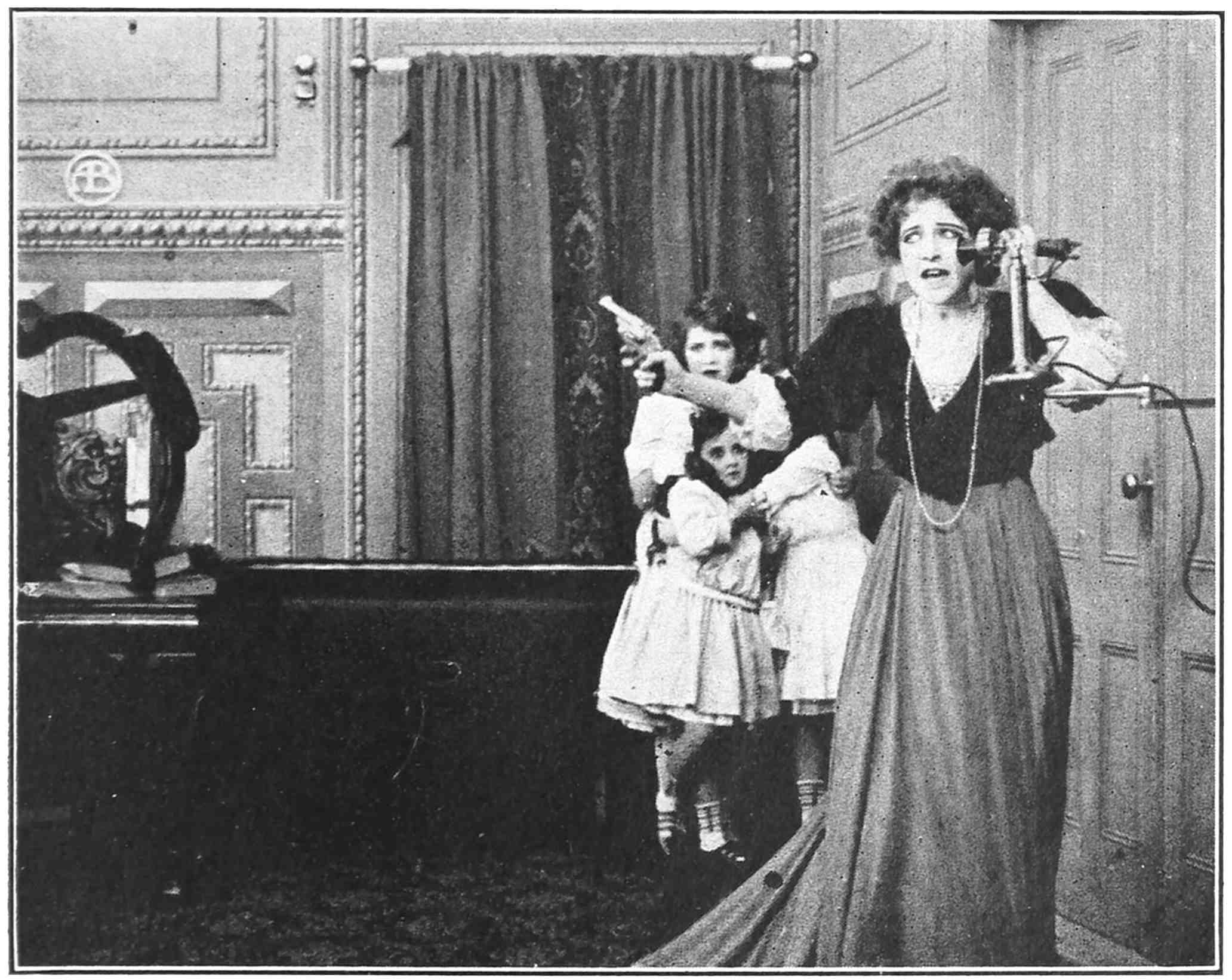
Mary Pickford’s second picture. Mary Pickford, Marion Leonard and
Adele De Garde, in “The Lonely Villa.”
(See p. 100)
Mr. Carlton says he directed the first five-reel picture ever
released—“Through Fire to Fortune”—written by Clay
Greene and released March 2, 1914, by the General Film
Company. Mr. Carlton also says his picture contained the
first night scene. Through crude lighting manipulations
Mr. Carlton secured it in the quarry at Betzwood where
rocks were painted black and properties arranged to
represent the interior of a mine.
* * * * *
And so from near and far, and from diverging avenues
of endeavor, came the new recruits to Biograph; but in
the late fall Mary and Owen, and the Smith family sailed
for Cuba one fine day to produce some “Imp” pictures there.
When safe aboard the steamer, Mary and Owen decided
to brave mother’s tears and anguish. They told her of the
secret marriage.
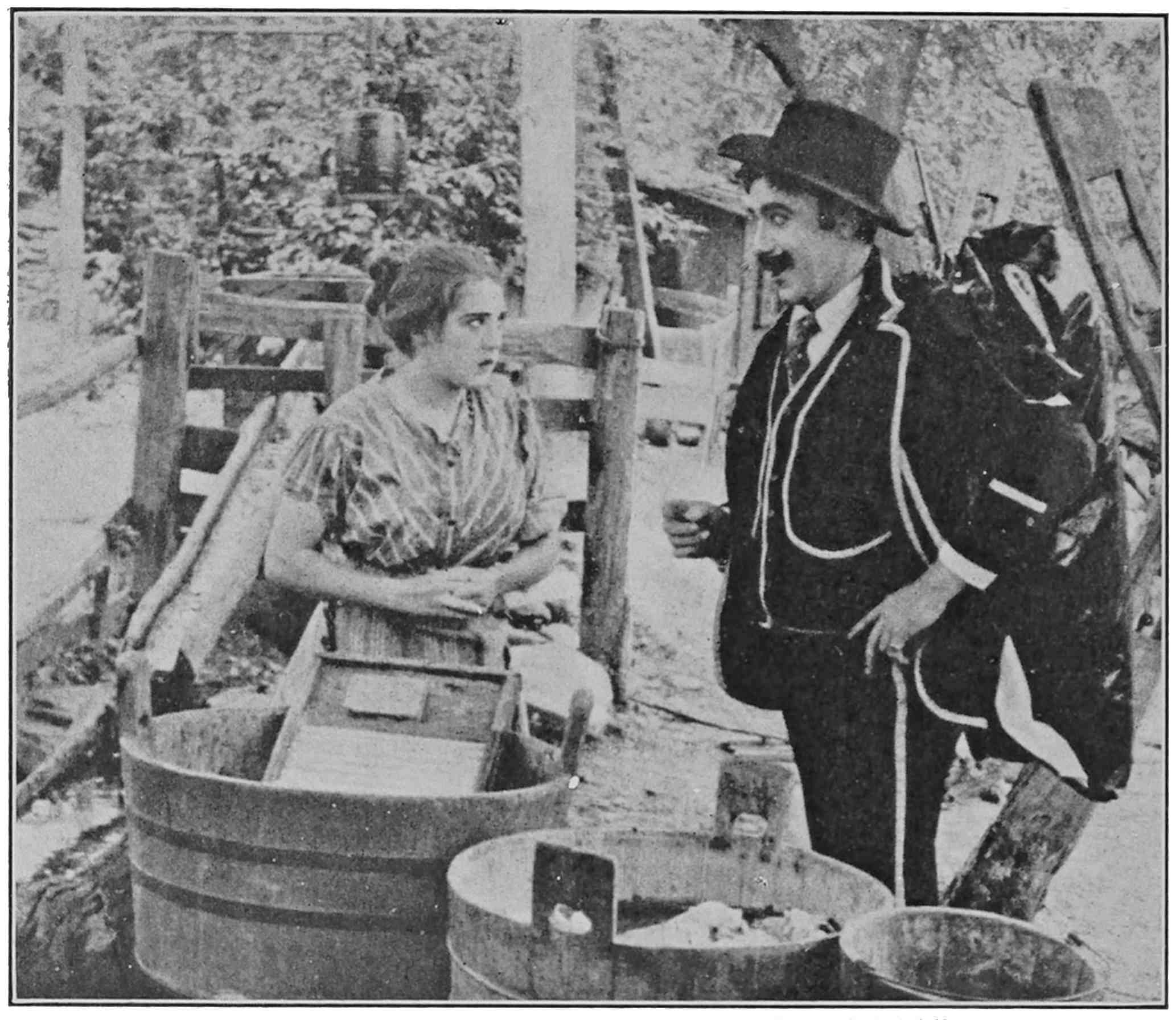
Mary Pickford and Mack Sennett in “An Arcadian Maid,” Aug. 1, 1910.
(See p. 78)
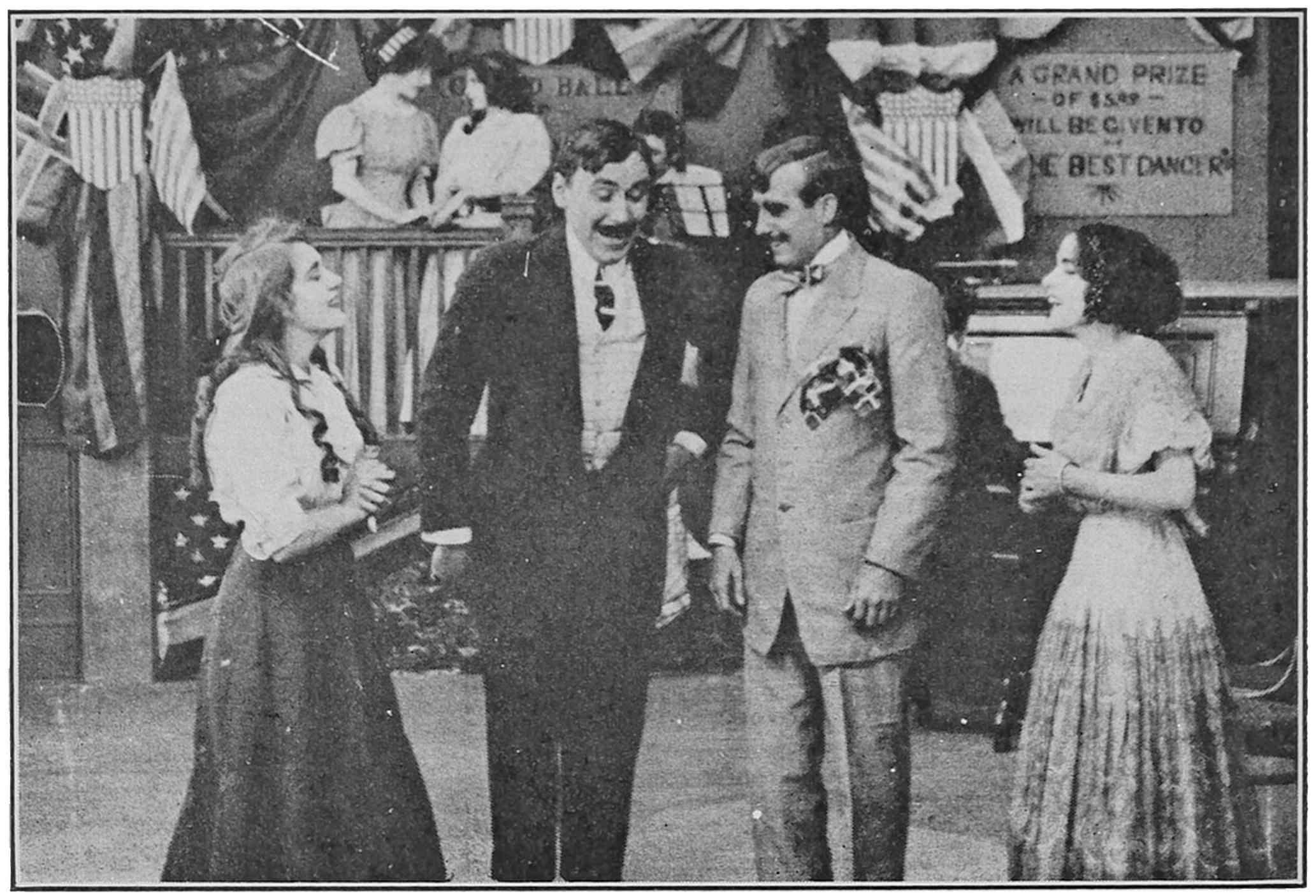
Mary Pickford, Mack Sennett, Joe Graybill and Marion Sunshine, in “The
Italian Barber,” which established Joe Graybill.
(See p. 174)
CHAPTER XXII IT COMES TO PASS
There were no social engagements during these Biograph
years. Our dinner parties, which were concerned
with nourishment mostly, were with our co-workers. As
we never knew when we would be allowed to eat, it was
impossible to dine with friends. There was no time for
anything but work—a good, hard steady grind it was, and
we liked it.
The one, lazy, lenient affair of the week was breakfast
on Sunday morning. From ten to twelve it stretched, and
it was so restful to eat at home and not have to look at
a menu card or talk to a waiter, even though the conversation
would be all about the movies.
“What are people interested in?” said he, one Sunday.
“Well, men like to make money, and women want to
be beautiful.”
“That would make a good movie. Why don’t you
write it?”
“Glad to, if you think it’s any good.”
So she wrote it, the part about the women wanting to
be beautiful, and called it “How She Triumphed,” and in
it Blanche Sweet evolved from an ugly duckling with no
beaux to a very lovely bit of femininity with sighing swains
all around her. In the picture she did calisthenics according
to Walter Camp as one way of getting there.
After the leisurely Sunday morning hours had crept
their way, to the studio David would hie himself to read
scripts with Mr. Dougherty. And Sunday night would
mean a movie show somewhere. And Monday morning it
began all over again.
From “Wark,” to “work,” only the difference of a
vowel, so what an appropriate middle name for David
Griffith! What infinite patience he had. If we got stuck
in the mud when going out to location—we were stuck,
and we’d get out, so why worry? No cursing out of driver
or car or weather; no, “What the ——? Why the ——
couldn’t you have taken another road?” Instead would
suddenly be heard baritone strains of “Samson and
Delilah” or some old plantation negro song while we waited
for horses or another car to pull us out.
And it did happen once when on location perhaps twenty
miles out in the wilds, that the leading man suddenly discovered
he had brought the wrong pair of trousers. Nothing
to do but send back for the right ones. Mr. Griffith
was not indifferent to the time that would be lost, but getting
himself all worked up would not make the picture any
better. He’d sing, perhaps an Irish come-all-you, or, were
he out in the desert, get out the automobile robe and start
a crap game.
Arthur Marvin never ceased to marvel at his chief’s
agility and capacity for hard work. Mr. Marvin had a sort
of leisurely way of working.
Up and down a stubble field Mr. Griffith was tearing
one day—getting a line on a barn, a tree and some old
plows. Arthur was having a few drags on his pipe—the
film boxes being full and everything in readiness to put up
the tripod wherever the director should decide. David’s
long legs kept striding merrily all over the cut harvest field—most
miserable place to walk—Arthur musing as he
looked on. “There goes Griffith, he’ll die working.” In a
few moments Mr. Griffith right-about faced and with not
a symptom of being out of breath said, “Set her up here,
Arthur.”
That winter we lost our genial Arthur Marvin, but
David Griffith is still hitting the stubble field. Well, he
took good care of himself. He did a daily dozen, and he
sparred with our ex-lightweight, Spike Robinson. The bellboys
at the Alexandria Hotel called him “the polar bear”
because he bought a bucket of cracked ice every morning
to make the Los Angeles morning bath more tonic-y.
One could not have better equipment for the trying
experiences of movie work than patience, and a sense of
humor. And the “polar bear” is well equipped with both.
But there were times when even a sense of humor
failed to sustain one. Nothing was funny about the uncertain
mornings when we’d gather at the 125th Street ferry
for the 8:45 boat, having watched weather since daylight
through our bedroom window, only to cross and recross
the Hudson on the same boat, the cumulus clouds we delighted
in for photographic softness having turned to rain
clouds even as we watched from the ferry slip. Back to
the studio then to begin another picture and to work late.
And oh, how we’d grouch!
But when it rained while we were registered at some
expensive place like the Kittatiny at the Delaware Water
Gap, there was need for anxiety, with the actors’ board
bill mounting daily and nothing being accomplished.
Yes, we had worries. But we were getting encouragement
too. The splendid reviews of our pictures in The
Dramatic Mirror helped a lot. The way our pictures were
going over was a joy. With their first announcement on
the screen, what a twitter in the audience! A great old
title page Biograph pictures had. Nothing less than our
National emblem, our good old American eagle, sponsored
them. He certainly looked a fine bird on the screen, his
wings benignly spread, godfathering the Biograph’s little
movie children.
Exhibitors were certainly getting keen about “Biographs”;
the public was too. People were becoming anxious
about the players as well, and commencing to ask all sorts
of questions about them.
Stacks of mail were arriving daily imploring the names of
players, but of this no hint was given the actor. How
surprised I was that time my husband said to me, “You
know we are getting as many as twenty-five letters a day
about Mary Pickford?”
“Why, what do you mean, letters about her?”
“Every picture she plays in brings a bunch of mail asking
her name and other things about her.”
“You’re not kidding?”
“Of course not.”
“Did you tell her?”
“No. I don’t want her asking for a raise in salary.”
Biograph found it a difficult job sticking to their policy
of secrecy. Letters came from fans asking about their
favorites; the pretty girl with the curls—the girl with the
sad eyes—the man with the lovely smile—the funny little
man—and the policeman. What tears of joy Sennett would
have wept had he known!
In bunches the postman soon began to leave the “who”
letters at 11 East Fourteenth Street. “Who played the tall,
thin man in ‘The Tenderfoot’?” “Who played the little
girl in the Colonial dress and curls who danced the minuet
in the rose garden at midnight in ‘Wilful Peggy’?” “Who
was the handsome Indian who did the corn dance on the
mountain top in ‘The Indian Runner’s Romance’?”
Other picture concerns than Biograph had not as yet
made the actor’s name public. But they did give him his
mail when addressed with sufficient clarity. Arthur Mackley,
the famous Sheriff of Essanay, was receiving, those
days, ten letters a day. They came addressed.
The Sheriff
Essanay Company
Chicago
Some boy, the Sheriff, getting ten letters a day!
It remained for English exhibitors first to name the
Biograph players. For Biograph, long after all the other
picture companies had made the actor’s name public, still
refused to come out into the open. Over in London the
fans were appeased with fictitious names for their favorites.
Beautiful names they were, so hero-ish and so villain-ish,
so reminiscent of the old-time, sentimental, maiden-lady
author. I recall but one and a half names of our players.
Dell Henderson was given the beautiful soubriquet of
“Arthur Donaldson” and Blanche Sweet became “Daphne
——” something or other.
But the yearning American youths and maidens continued
to receive the cold, stereotyped reply, “Biograph
gives no names.” The Biograph was not thinking as quickly
as some of its players.
Our friends from Cuddebackville, the Goddefroys, being
in New York one time this summer, Mr. Griffith thought
it would be rather nice to arrange an evening. They were
interested in our California pictures, as they were planning
a trip there. We fixed up the projection room and ran the
better of the Western stuff. Afterward with our guests
and a few of the leading people we repaired to Cavanaugh’s
on West Twenty-third Street.
Busy chatter about the pictures, every one raving over
Mary Pickford’s work in “Ramona,” when Mary, quietly,
but with considerable assurance said, “Some day I am
going to be a great actress and have my name in electric
lights over a theatre.”
I turned pale and felt weak. We all were shocked. Of
course, she never meant the movies, that would have been
plumb crazy. No, she meant the stage, and she was thinking
of going back. The thought of losing Mary made me
very unhappy. But just how had she figured to get her
name in electric lights? What was on her mind, anyway?
This summer of 1910 Mr. Griffith signed his third Biograph
contract. This contract called for a royalty of an
eighth of a cent a foot on all film sold and seventy-five
dollars per week, but the name “Lawrence” which had been
signed on the dotted line the two preceding years, was this
time scratched out and “David” written in.
“David” had gone into the silence and decided that the
movies were now worthy of his hire, and couldn’t dent his
future too badly, no matter what that future might be.
David W. Griffith and Mary Pickford were certainly growing
bold.
CHAPTER XXIII THE FIRST TWO-REELER
Though the licensed picture companies—The General
Film Group—kept a watchful eye on one another, each
had pride in its own trademark and was satisfied with the
little company of actors bringing it recognition.
But the independent companies, now beginning to loom
on the horizon, were looking with envying eyes on the rich
harvest the licensed companies were reaping, and they
figured that all they’d need, to do as well, would be some
of their well-trained actors, especially those of Mr. Griffith’s
quite famous little organization. Surely D. W. Griffith had
less to do with Mary Pickford’s success than Mary Pickford
herself! She it was the public came to see; so they
were out, red-hot for Mary, and offering publicity and more
money. The little war was started.
Actors in the companies that comprised the General Film
Company could not be bargained for except by the Independents.
For instance, if an actor of the Biograph Company
were discovered offering his services to Lubin or Edison
or any of the General Film, that company promptly
reported the matter to Biograph and the ambitious actor
found himself not only turned down by Edison or Lubin
or any other but his nice little Biograph job would be gone
as well. That had happened to Harry Salter and Florence
Lawrence. An actor in one of the General Film group
would have to resign his job before he could open negotiations
with any other company in that group.
* * * * *
We did grind out the work this fall and early winter.
The promise of California again was a big incentive. We
might stay longer and have a new studio, a regular place.
While there was no more excitement pervading the
studio than there had been the year before, a more general
willingness was noticed among the leading people and more
tears and anguish on the part of the beseeching extras.
Jeanie Macpherson sat on the steps leading to the basement
of the studio, and cried, until Mr. Griffith felt remorseful
and took her.
But such conduct hadn’t availed pink-cheeked lanky
“Beau,” the year before, when he was the one property boy
left behind. Then that unhappy youth’s tearful parting shot,
“All I ask, Mr. Griffith, is that some day you take me to
California,” kept intruding and spoiling the complete satisfaction
of our days. Another year Mr. Griffith harkened
to his pleading. For nearly ten years now “Beau” as
William Beaudine has been directing pictures in Los
Angeles.
And so, while some of the old guard would not be with
us, a goodly number would.
To the “Imp” had gone Mary and Owen; and while
Ma fussed terribly about it, there was nothing for her and
Lottie and Jack to do but follow suit.
David Miles and Anita Hendry, his wife, were already
with “Imp”; and they, with King Baggott and George
Loane Tucker, Joe Smiley, Tom Ince, Hayward Mack, and
Isabel Rae, made a fair number of capable people. But
even so, Mary’s “Imp” pictures fell far short of her Biograph
pictures, and she wasn’t very happy and she didn’t
stay so very long.
As a member of the “Imp” Company, the silence and
mystery that had surrounded her when with Biograph instantly
vanished. She now received whole pages of advertising,
for that was how the “Imp” would put the pictures
over. One of her first Independent pictures was “The
Dream” of which a reviewer said: “The picture got over
on account of Miss Pickford. Our feelings were somewhat
sentimental when we saw ‘Our Mary’ as a wife arrayed
in evening gown and dining with swells. In other words,
we have always considered Mary a child. It never occurred
to us she might grow up and be a woman some day.”
Marion Leonard and Stanner E. V. Taylor had taken
their departure. I believe it was Reliance-ward they went,
as did Mr. Walthall, Mr. Kirkwood, and Arthur Johnson.
Arthur had become not so dependable, and Mr. Griffith
being unable to stand the worry of uncertain appearances,
reluctantly parted with his most popular actor, and his first
leading man. He never found any one to take his place
exactly. For even so long ago, before he and Mr. Griffith
parted, ’twas said of Arthur Johnson, “His face is better
known than John Drew’s.”
Mary gone, Mr. Griffith located Blanche Sweet somewhere
on the road and telegraphed an offer of forty dollars
weekly to come with us to California, which Miss Sweet
accepted. He was willing to take a chance on Blanche,
being in need of a girl of her type. If she didn’t work
out right (he hardly expected her to set the world a-fire)
the loss would be small, as he was getting her so cheaply.
Wilfred Lucas also received a telegram; but his tenderly
implored him to come for one hundred and fifty dollars—a
staggering offer—the biggest to date. He also accepted.
Dell Henderson had been commissioned by Mr. Griffith
to dispatch the Lucas-one-hundred-and-fifty-dollar telegram,
and the high salary made him so sore that he promptly told
it everywhere, causing jealous fits to break out all over
the studio.
We had also in our California cast, Claire MacDowell,
Stephanie Longfellow, Florence Barker, Florence LaBadie,
Mabel Normand, Vivian Prescott, and Dorothy West for
the more important parts; Grace Henderson, Kate Toncray,
and Kate Bruce for the character parts; and little Gladys
Egan for important child rôles. And of men—as memory
serves me—there were Frank Powell, Edwin August, Dell
Henderson, Charlie Craig, Mack Sennett, Joe Graybill,
Charlie West, Donald Crisp, Guy Hedlund, Alfred Paget,
Eddie and Jack Dillon, Spike Robinson, Frank Grandin,
Tony O’Sullivan and “Big” Evans, and George Nichols.
And some wives: Mrs. Frank Powell, Mrs. Dell Henderson,
Mrs. George Nichols, and Mrs. Billy Bitzer.
And one baby: Frank Baden Powell.
At Georgia and Girard Streets, Los Angeles, a ten-minute
ride from the center of the city, on a two-and-a-quarter-acre
plot adjoining some car barns, the carpenters
were building our grand studio. An open air studio—no
artificial lighting—we could get all the light effects we
desired from the sun—and could begin to work as early as
8:30 and continue until late in the afternoon. We had not
yet reached the stage where we felt that Mr. Electric Lamp
could compete with the sun.
How joyful we were when we first beheld the new
studio! The stage was of nice smooth boards and seemed
almost big enough for two companies to work at the same
time. The muslin light diffusers were operated on an overhead
trolley system. There was even a telephone on the
stage. The studio was then indeed the last word in modern
equipment.
An elongated one-story building contained the office,
projection room, rehearsal room, for nights and rainy days,
and two large dressing-rooms for the men. In order to
save wear and tear on the women’s clothes, they were given
the two dressing-rooms in the rear of the building which
opened directly onto the stage.
To tell the world how secure our position—how prosperous
financially—at the street entrance to our studio there
now waited through the day one, and often two big, black
seven-passenger touring cars—rented by the month, at six
hundred dollars per. Now between sets in the studio we
could dash out in the car and grab an exterior.
In our dressing-rooms we had make-up tables, mirrors,
lockers, and running water. And oil stoves to keep us warm.
For in the early mornings, before the sun had reached our
room, it was a shivery place. Our cold cream and grease
paints would be quite as stiff as our fingers.
So now, with the new studio, a larger company, and
our knowledge of the surrounding country, there was nothing
to it but that we must get right on the job and do better
and bigger pictures.
* * * * *
With the one exception already noted we had neglected
the sea the year before, and as yet we had attempted nothing
important that had to do with “Ol’ davil Sea,” as Eugene
O’Neil calls it. The sea was trickier than the mountains,
and more expensive if one needed boats and things. But
this year we would go to it right, with a massive production
of Tennyson’s “Enoch Arden”—a second production of the
poem that had written history for us in our screen beginnings.
The first time we had taken most of it in the studio,
with only one or two simple shots of the sea. Now we
would do something g-r-a-n-d. “Enoch Arden” was such
good movie stuff, and Mr. Griffith was wondering how he
could get it all into one thousand feet of film.
An exhibitor in those days would accept eleven hundred
feet of film, but that was the limit. The programs were
arranged only for the thousand-foot picture; a thousand-foot
Biograph being shown Mondays and Thursdays. How
could two thousand feet be shown on Monday and none
on Thursday? Even could the exhibitor have so arranged
it, would the people sit through two thousand feet without
a break?
Well, now, we could do this: we could take the picture
in two reels, each of a thousand feet, show one reel Monday,
the second Thursday, and take a chance on the people becoming
sufficiently interested in the first reel to come back
for the second—the only logical way of working out the
problem. Mr. Griffith fully realized his responsibility.
Again he would chance it.
Santa Monica would be the ideal place for this big
production; so every day for a week—for a whole week
was given to exteriors alone—we motored out to Santa
Monica in the cold early morning.
The place had changed little in the year that had passed.
The row of tiny shacks was now occupied by Japs and Norwegians
who caught and dried fish and fought with each
other at all other times.
One friendly Norwegian loaned his shack as a dressing-room
for the women. We “shot” the same shack for Annie’s
bridal home. The men made up in a stranded horse car
of bygone vintage that had been anchored in the sand. We
sent out an S. O. S. for a sailing vessel of Enoch’s day,
and we heard of one, and had it towed up from San Pedro.
What would we do next?
We did “Enoch Arden” in two reels. Wilfred Lucas
played Enoch; Frank Grandin, Philip; and I played Annie
Lee. Well, Jeanie Macpherson said I had “sea eyes,” whatever
that meant.
Mrs. Grace Henderson kept the Inn to which Enoch
returns; Annie’s and Enoch’s babies grew up to be Florence
LaBadie and Bobbie Harron (one of Bobbie’s first parts),
and Jeanie Macpherson powdered her hair and played nurse
to the little baby that later came to Philip and Annie.
George Nichols departed via the Owl for San Francisco
to get the costumes from Goldstein & Company. There was so
little to be had in costumes in Los Angeles. Mr. Nichols
had also journeyed to San Francisco for costumes for
“Ramona” the year before.
The exhibitors said they would accept “Enoch Arden”
in the two reels, show the first on Monday, and the second
reel Thursday. And so it was first shown. And those
who saw the first reel came back in all eagerness to see
the second half. And that was that.
The picture was so great a success, however, that it
was soon being shown as a unit in picture houses; also in
high schools and clubs, accompanied by a lecturer. And
so “Enoch Arden” wrote another chapter of screen history.
Sustained by its success Mr. Griffith listened to the call
of the desert. With two thousand feet of celluloid to record
a story, he felt he now could do something with prairie
schooners, pioneers, and redskins, and so he answered the
desert call with a big epic of pioneer romance, “The Last
Drop of Water.”
We set up camp in the San Fernando desert—two huge
tents, one for mess, with a cook and assistants who served
chow to the cowboys and extra men. Two rows of tables,
planks set on wooden horses, ran the length of the tent—there
must have been at least fifty cowboys and riders to
be fed hearty meals three times a day. The other tent contained
trunks and wardrobe baskets, and here the boys slept
and made up.
The hotel in the village of San Fernando, three miles
or so from the camp, accommodated the regular members
of the company and all the extra women, to whom the
director, as he dashed off for his camp in the morning, gave
this parting advice, “Girls, stay together when you’re not
busy, for you’re likely to hear some pretty rough stuff if
you don’t.”
Prairie schooners to the number of eight made up our
desert caravan, and there were the horses for the covered
wagons, the United States soldiers, and the Indians; dogs,
chickens, and a cow; for this restless element from a Mississippi
town, making the trek across the land of the buffalo
and the Indian to gather gold nuggets in the hills of California,
brought with them as many familiar touches from
their deserted homes as they reckoned would survive the
trip.
Of course, conflicts with Indians, and the elements, resulted
in a gradual elimination of the home touches and
disintegration of the caravan, but there was a final triumphant
arrival at their destination for the few survivors.
The picture was expensive, but quite worth it; we were
at least headed the right way, in those crude days of our
beginnings. We were dealing in things vital in our American
life, and not one bit interested in close-ups of empty-headed
little ingénues with adenoids, bedroom windows,
manhandling of young girls, fast sets, perfumed bathrooms,
or nude youths heaving their muscles. Sex, as portrayed
in the commercial film of to-day, was noticeable by its absence.
But if, to-day, the production of clean and artistic
pictures does not induce the dear public to part with the
necessary spondulics so that the producer can pay his rent,
buy an occasional meal and a new lining for the old winter
overcoat, then even Mr. Griffith must give the dear public
what it wants. And for the past year or two it has apparently
wanted picturizations daring as near as possible
the most intimate intimacy of the bedroom.
The season closed with another “Covered Wagon”
masterpiece called “Crossing the American Prairies in the
Early Fifties.” The picture was taken at Topango Canyon.
There were hundreds of men and women and cowboys and
a hundred horses from ranches near by, as well as eleven
prairie schooners.
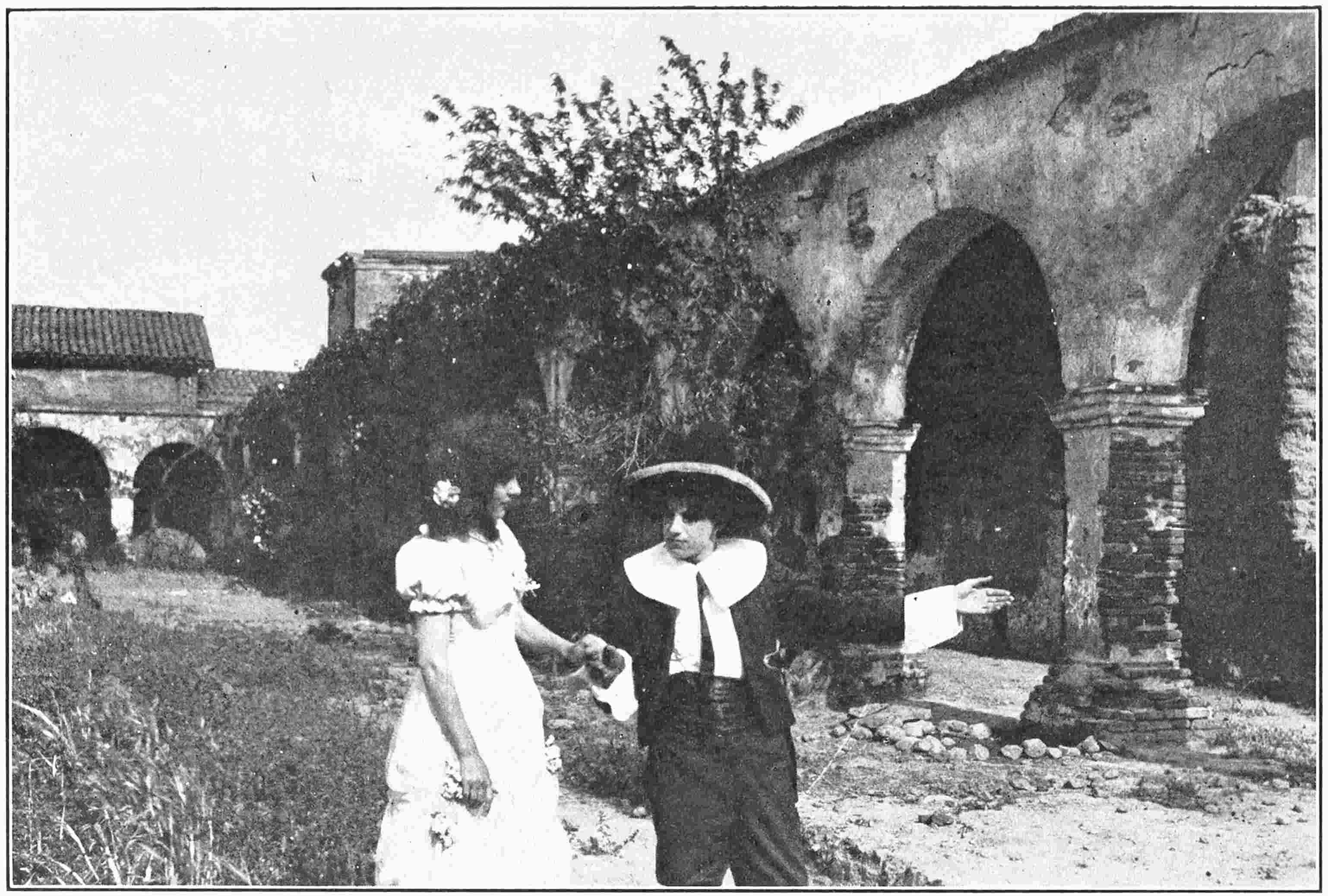
Linda Griffith and Mr. MacKay in “Mission Bells,” a Kinemacolor picture play taken at San Juan
Capistrano.
(See p. 162)
In the picture, guards had been posted at night, but being
tired, they fell asleep, so the Indians pounced upon the
emigrants, slaughtering some and taking some prisoners, to
be burned at the stake. The few survivors who escaped left
numbers of dead pioneers behind. The shifting desert sands
would soon cover the bodies and remove all trace of the
massacre. The dead bodies were represented by the living
bodies of members of the company who had to be buried
deep in the alkali waste; and the getting covered up was
going to be a dirty job for the living corpses. So those
scenes had to be taken last.
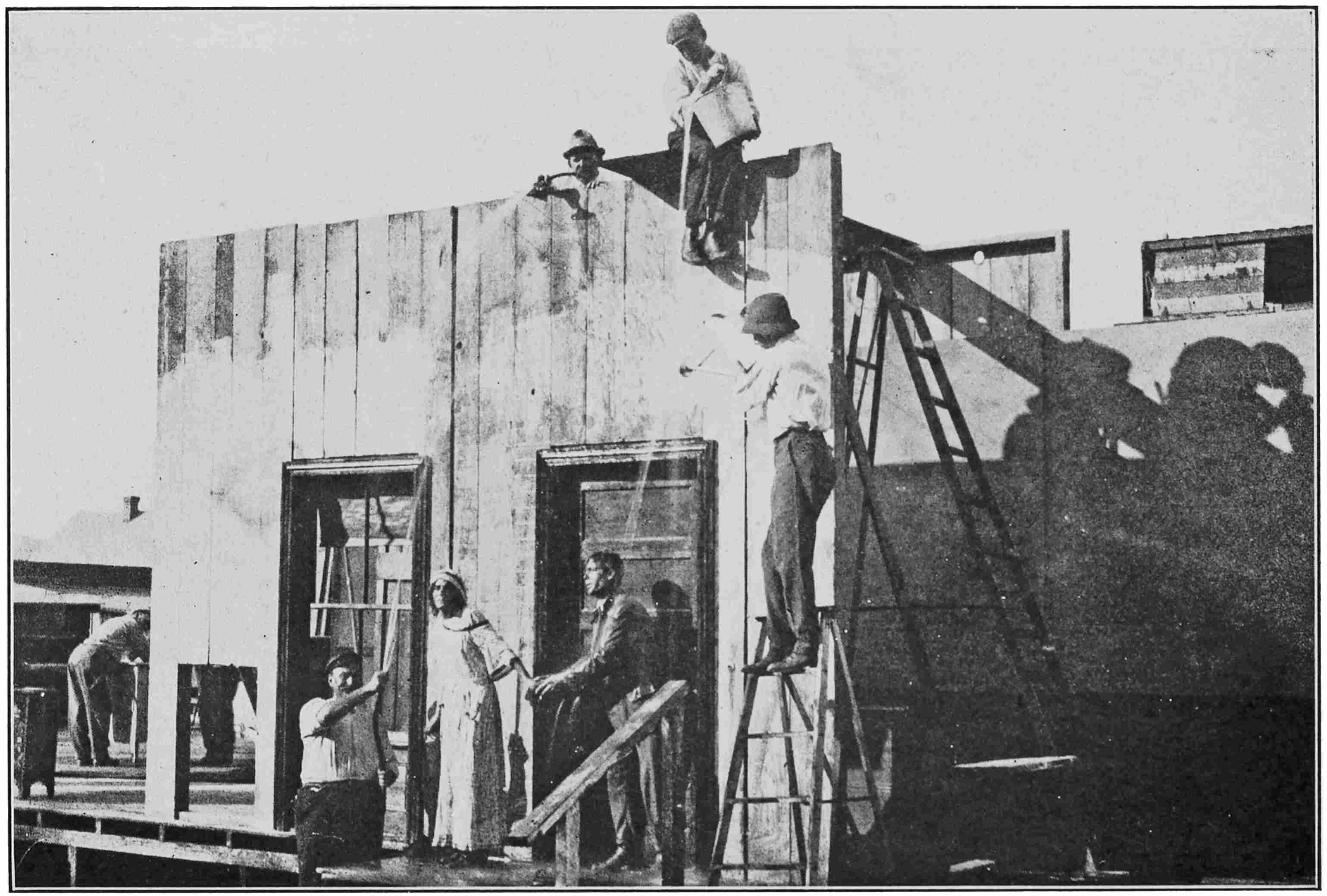
A rain effect of early days at Kinemacolor’s Los Angeles studio, known a year later as the Fine Arts Studio,
where “The Birth of a Nation” and “Intolerance” were filmed. From “The House That Jack Built,” with
Jack Brammall and Linda Griffith.
(See p. 245)
Little grains of sand gently falling upon one from out
the property boys’ cornucopias, while unpleasant, could be
silently endured; but when the property boys got the storm
really started and the sand was being poured upon one thick
and heavy, getting into hair and ears and eyes, no matter
how protective the position one had assumed, there were
heard smothered oaths from the dead people that no wild
cowboy had ever excelled.
Dell Henderson, dying with little old Christie Miller,
was all humped up and writhing in the desert sands. And
while Dell was just about to be featured as the far-famed
gambler of the West in a line of showy parts, and while
he felt that Mr. Griffith had a friendly feeling for him,
his ardor for his movie job was beginning to cool. And
when, after being extricated from his earthy grave, he found
the boss, he lost all restraint.
“Old man,” said Dell to David, “this is too much, I
quit pictures, I’m through.” But the next day when all
bathed and barbered up, he felt differently about it.
But Dell hadn’t had it as rough as the atmospheric
members of the company. Even the wives had been called
upon for atmosphere, and were to make up and dress as
men. They didn’t like the old trousers and the greasy felt
hats that were passed out to them, and they weren’t keen
on being recognized on the screen, in the unflattering
costumes.
So Mr. Griffith compromised: “All right, I’ll put you
in the background and you can sit down.” At that the
women became more amiable and agreed to help out the
perspective. And in the last few hundred feet of the second
reel, they joined the dead emigrants and were covered up
in the whirlwind.
The final scenes were reserved for the days immediately
preceding our departure for the East. As soon as they were
taken, the company would be dismissed to make the necessary
preparations prior to leave-taking. So to their pet establishment
the women beat it to have their hair beautifully
and expensively washed and lemon-rinsed, and were all in
readiness for the California Limited, when a re-take was
announced. Static in the film!
To their burial places once more they were rushed, and
again the boys stood by and again poured the cornucopias
of sand over them, ruining completely the crop of nice clean
heads. Few got a chance at another fashionable shampoo.
The majority had to be contented with just a home wash—or
to take the sand along with them.
CHAPTER XXIV EMBRYO STARS
We fell to the lure of the Bret Harte story this winter.
We advanced to the romances of the hardy Argonauts,
and the “pretty ladies” of the mining towns. What
a wealth of picturesque cinema material the lives of the
rugged forty-niners afforded!
Dell Henderson was featured as the handsome gambler,
Jack Hamlin; and Claire MacDowell as the intriguing lady
of uncertain virtue; Stephanie Longfellow as the rare,
morally excellent wife.
Blanche Sweet was still too much the young girl to
interpret or look the part of Bret Harte’s halo-ized Magdelenes.
Mr. Griffith, as yet unwilling to grant that she
had any soul or feeling in her work, was using her
in “girl” parts. But he changed his opinion with “The
Lonedale Operator.” That was the picture in which he
first recognized ability in Miss Sweet.
The outdoor life of the West had plumped up the fair
Blanche, and Mr. Griffith felt at this stage in her development
she typified, excellently well, buxom youth. Why
wouldn’t Blanche have plumped up when she arrived on
location with a bag of cream puffs nearly every day and
had her grandmother get up at odd hours of the night to
fry her bacon sandwiches? She soon filled out every wrinkle
of the home-made looking tweed suit she had worn on her
arrival in Los Angeles.
* * * * *
Way, way up on the Santa Monica cliffs we built a log
cabin for Blanche Sweet to dwell in, as the heroine of “The
White Rose of the Wilds.”
The location was so remote, the climb so stiff, that once
having made it no one was going down until the day’s work
was over.
It was a heavenly day. Gazing off into the distances
quite sufficed, until, whetted by clean, insistent breezes,
little gnawings in the tummy brought one back to realities.
It took more than dreamy seas and soft blue skies to deter
a hungry actor from expressing himself around lunch time.
And so, in querulous accents soon were wafted on the sage-scented
air such questions as: “Gee, haven’t they sent for
the lunch yet? Gosh, I’m hungry. Hasn’t the car gone?
It’ll take a couple of hours to get food way up here. Hope
they bring us enough—this air—I’m starved.”
Sooner or later lunch would be on the way. The car
had to go for it as far as Venice. It was nearly three o’clock
when the car returned and by that time every one was doggone
hungry.
Mr. Griffith had tipped his two “leads” and Mr. Bitzer
and myself to get off in a little group, for hot juicy steaks
had been ordered for those select few—leading players
must be well nourished—and it was just as well to be as
quiet and unobtrusive about it as possible. For while it
wasn’t exactly fair, sandwiches and coffee was all the lunch
the company usually afforded for the extra people.
Mack Sennett, who always had a most generous appetite,
was wild-eyed by now, for he was just an “extra”
in “The White Rose of the Wilds.” And he was on to the
maneuvers of the “steak” actors and so resentful of the
partiality shown that he finally could contain himself no
longer, and in bitter tones, subdued though audible, he
spoke: “Steaks that way,” with a nod of his head indicating
Griffith and the leading people, “and sandwiches this way”—himself
and the supers. And though Mack sat off on
the side, and from his point of vantage continued to throw
hungry glances, they brought him no steak that day.
This winter it was that Mr. Sennett invested in a “tux”
and went over to the Alexandria Hotel night after night,
where he decorated the lobby’s leather benches in a determined
effort to interest Messrs. Kessel and Bauman. (The
Kay Bee Company.) His watchful waiting got him a job.
* * * * *
“The Battle of Elderberry Gulch” was a famous picture
of those days. The star was a pioneer baby all of whose
relatives had been killed by Indians. During the time the
baby’s folks were being murdered another party of pioneers,
led by Dell Henderson, was dying of thirst near by. With
just enough life left in them to do it, they rescued the baby
from its dead relations, staggered on a few miles, and then
they, too, sank exhausted in the sand and cacti.
Another cornucopia sand-storm blew up.
Kind-hearted Dell Henderson, now sunk to earth, had
protectingly tucked the baby’s head under his coat. But
the tiny baby hand (in the story, and it was good business)
had to be pictured waving above the prostrate figures of
the defunct pioneers, to show she still lived. Otherwise,
she might not have been saved by the second rescuing party,
and saved she had to be for the later chapters of the story.
For though in the end of the story the baby became
the lily-white Blanche Sweet, it was, as matter of fact, a
tiny, lightly colored, colored baby from a Colored Foundling
Home, whom we often used for the photographic value
of its black eyes, and Dell must see to it that the tiny
pickaninny was in no way hurt, even though he had surreptitiously
to wave the baby hand from under his rough
outer garments.
* * * * *
Having succeeded so well at Santa Monica, we decided
to work other beaches this year. We became acquainted
with them all—Redonda, Long Beach, Venice, and Playa
del Rey.
The No. 2 company became especially familiar with the
beaches, for they did numbers of bathing pictures. Frank
Powell was still directing the comedies, with Dell Henderson
and Mack Sennett occasionally trying their hands at it.
It was in these bathing pictures that Mabel Normand
began winning admirers both on the screen and off. Even
Mack Sennett began to take an interest in the beautiful
and reckless Mabel, a slim figure in black tights doing daredevil
dives or lovely graceful ones. Mabel was always
ready for any venturesome aquatic stunt. But her work
was equally daring on land, for she thought nothing of
riding the wildest bucking broncho bareback. It took more
than bucking bronchos to intimidate the dusky-eyed Mabel.
All of this Sennett was noting—clever kid was Mabel—and
if he ever should be a director on his own——!
* * * * *
On the beach by the old Redonda Hotel, which the passing
years had changed from a smart winter resort patronized
by Easterners to a less stylish summer one patronized by
Angelenos, one balmy winter day, some bathing scenes were
being taken. This type of stuff was new to me and I was
all eyes. Working only with the Griffith company, there
were lots of things I didn’t see.
But this day there were two companies working on the
same location, and that was how I first saw Margaret Loveridge,
of lovely Titian hair and fair of face, sporting the
most modern black satin bathing suit, and high-heeled
French slippers. Imagine, right in the seashore sand!
I was interested in this Loveridge girl, for she was
pretty, and had a rather professional air about her.
Sometimes when rehearsing we’d suddenly find ourselves
in need of a little two- or three-year-older, which need
would be supplied by Mr. Griffith or Mr. Powell or Dell
Henderson calling right out at rehearsal: “Who’s got a
kid?” Margaret Loveridge on one such occasion had
replied affirmatively. And so we came to use her small son
occasionally; and when Margaret was working and we
needed the child, and Margaret couldn’t bring it or take
care of it, she’d press her little sister into service.
For Miss Loveridge had also a little sister. And it
was some such situation that led little sister to the movies
and to Redonda at this time.
Little sister was a mite: most pathetic and half-starved
she looked in her wispy clothes, with stockings sort of falling
down over her shoe-tops. No one paid a particle of
attention to the child. But Mr. Griffith popped up from
somewhere and spied her, and gave her a smile. The frail,
appealing look of her struck him. So he said, “How’d you
like to work in a picture?”
“Oh, you’re just fooling—you mean me to work in a
picture?”
“Yes, and I’ll give you five dollars.”
No stage bashfulness in the hanging head, the limp arms,
and the funny hop skip of the feet.
“Oh, you couldn’t give me five dollars.”
“Oh, yes I can.”
“You sure you’re not fooling?”
“No, you come around some time, and you’ll see, I’ll
put you in a scene. What’s your name?”
“Mae Marsh.”
“I’ll remember, and I’ll put you in a movie some day.”
Right about now Dell Henderson was directing a picture
in which Fred Mace was playing the lead and Margaret
Loveridge had a part. It was understood about the
studio that Mr. Mace was quite taken with the charms of
the fair Margaret. Now Margaret couldn’t get out on
location, and she wanted to send a message to Fred Mace,
so she sent little sister, and little sister looked so terrible
to Mr. Mace that he said to her, “Don’t let Griffith see
you or your sister will lose her job.”
When Mace saw Margaret again he said, “Don’t have
your sister come around the studio looking like that.”
And Margaret answered, “Well, I will, for Mr. Griffith
is going to use some children at San Gabriel and she is
going to be one of the children.”
“All right,” answered Mace, “take your chance.”
And at San Gabriel Mae did a little more of the funny
hop skip, and she talked up rather pert to the director,
“You think you’re the King” sort of thing, and he liked it,
and he said to Dell, “The kid can act, she’s great, don’t
you think so?”
Dell answered “yes,” but he didn’t think so. No one
thought so but Mr. Griffith.
A few weeks later when little Mae Marsh came to the
studio carrying a book and the boys made jokes about it,
Dell said to himself, “When she puts that down, I’m a-going
to see.” The book was Tennyson’s poems. The boys knew
when a new actress came with such literature that Mr.
Griffith was already seeing her bringing home the cows, or
portraying some other old-fashioned heroine of the old-fashioned
poets.
* * * * *
As intended, our stay in California this second year
was much longer than the first. The three months lengthened
to five, and it was May when the company returned East.
It did seem a pity to close up the new studio, for it
was the last word in organization. Why, we’d even a
separate department for finances. The money end of things
had grown to such proportions that David could no longer
handle it as he had the first year. And Mr. Dougherty was
along too, in charge of the front office.
* * * * *
With Mabel Normand and Blanche Sweet well started
on their careers, the second winter’s work in California
ended. Another milestone had been passed, the birth of
the two-reeler, which having been tried was not found
wanting.
What otherwise came out of the winter’s work as most
important was Biograph’s acquisition of the little hop-skip
girl, Mae Marsh. She played no parts this season, made
very few appearances even as an insignificant extra girl, and
when the company returned to New York they left little
Mae behind them.
CHAPTER XXV MARKING TIME
The serious students of the motion picture, for they
had arrived, were at this time writing many and
various articles in the trade papers. Epes Winthrop Sargent
was a-saying this:
The Moving Picture World more than advocates the ten cent
theatre. It looks forward to the time when the dollar photoplay
theatre will be an established institution following the advance in
quality of the films. But there will always be five cent theatres
in localities that will not support the ten cent houses and ten
cent houses for those who cannot afford fifty cents or a dollar. It
is the entertainment for the whole family.
And W. Stephen Bush, the reviewer, this, of a Biograph:
“The Battle” is a perfect picture in a splendid frame. I cannot
close without a well-deserved word of praise regarding the
women’s dresses and coiffures of the wartime period. It is in
the elaboration of such details that the master hand often betrays
itself as it does here to the last chignon on the young girls’ heads.
And an unsigned article is headlined:
Will Moving Pictures Save Madison Square Garden?
And the late Louis Reeves Harrison in his “Studio
Saunterings” in The Moving Picture World:
I did not meet the mighty Griffith until after I had had an
opportunity to study some examples of his marvelous work—he
is the greatest of them all when he tries—but I found him to be
keenly alive to the future possibilities of the new art to which
he has so materially contributed.... His productions show
lofty inspirations mixed with a desire to help the world along, a
trend of thought that is poetic, idealistic with a purifying and
revivifying influence upon the audience that can best be excited
through tragedy.
The inquiry department of magazines published replies
of this sort almost every week:
Since the lady is in the Biograph, we premise her name is
Jane Doe. ’Tis the best we can do.
Or this:
No, John Bunny is not dead, report to the contrary notwithstanding.
Miss Turner, Miss Lawrence, Miss Pickford, Miss
Gauntier, and Miss Joyce are all alive, and there have been no
funerals for Messrs. Costello, Delaney, Johnson, Moore, or others.
Or this:
Questions about tall, thin girls two years old are barred. Keep
up to date.
Or this:
All Biograph players are either John or Jane Doe.
So while Biograph players were still nameless, Vitagraph,
Lubin, Kalem, Edison, Essanay, Melies, and Selig
not only gave out players’ names but offered exhibitors
trade photos at twenty cents each, and stereoptican slides
of all players. Ambitious actors were getting out post-cards
with their photos to send the fans.
The flow of Biograph players into the ranks of the Independents
left the Biograph Company temporarily weakened.
So much so that when “His Daughter” was released in the
spring of 1911 a critic said:
The picture has something of the spirit and character of the
old Biograph stock company’s work.
And another speaking for an open market said:
The best argument that I can offer for an open market is the
well-known fact that when Biograph was supreme, a mere sign
of “Biograph to-day” would draw the crowd. Yes, folks would
rather pay a ten cent admission and be satisfied with only two
reels as long as there was a Biograph than to visit the neighbor
house with three reels and four vaudeville acts and no Biograph.
Everybody knows what a magnet was the word “Biograph.”
But other good actors were coming to the front and
the loss of the old ones made but a brief and shallow dent
in the prestige of Biograph. On a June day in 1912 arrived
little Gertrude Bambrick. She came on pretty sister Elsie’s
invitation—just to look. Sister Elsie liked the movies, liked
it at Biograph, but to get Gertrude down to the place had
required considerable coaxing. Gertrude didn’t like the
place when she finally got there. “How terrible,” said she;
“why, they haven’t even chairs, what an awful place!” She
was almost ready to beat it before she had had a good look
around.
A tall, angular man had noticed the pretty little girl,
and he kept passing and repassing before her, giving her
a searching look each time. Then, one time, when directly
in front of her he made an abrupt stop and a significant
beckoning of his right forefinger plainly said, “Youngster,
I would speak with thee.”
But Gertrude paid no attention to the beckoning finger.
She only thought what a funny thing for any one to do. If
the man wanted to speak to her, why didn’t he speak? Sister
Elsie gave her a poke and whispered to her secretly that it
was the “great Griffith” who was beckoning, and when he
beckoned the thing to do was to follow. So, somewhat
in a daze, Gertrude started off and as she did so the actors
and others in the studio cleared a way for her much as
they might for a queen.
Mr. Griffith led the way into the ladies’ dressing-room,
which, when the actresses were out on the stage, was the
only place of privacy in the studio. There his eagle eye
scrutinized the girl some more. Gertrude now figured,
being in the studio and having no business there, she was
in for a call-down, and quick on the defensive she let it
be known she was only visiting her sister—she didn’t want
to work in the pictures—she had a good job as a dancer
in vaudeville with Gertrude Hoffman—dancing was what
she loved most of all, and, well——
“Well, who are you?” asked Gertrude.
“I’m the director down here, I’m Mr. Griffith.”
As far as Gertrude was concerned, Mr. Griffith was
entirely without honor even in a picture studio.
“So you dance,” said he, “and you don’t want to work
in pictures. Well, come down to-morrow anyhow, I want
to make a test of you. And I am going over to-night to
see your show.”
“Well, all right,” said Gertrude with tolerance, “but I
must get on home now. I have to have dinner with my
family.” (If one so young could be bored, Gertrude Bambrick
was just that thing.)
“I’ll send you home in my car,” said Mr. Griffith, which
frightened little Gertrude almost to pieces and which would
have frightened her more had she known that the car was
a gorgeous white Packard lined with red leather. But in
she hopped, nevertheless, and when she arrived home, and
her mother opened the door, and saw a huge touring car
of colors white and red, in the days when any kind of a
touring car was a conspicuous vehicle, mother said,
“Now don’t you ever do that again—come home here in a
car like that for all the neighbors to talk about.” Gertrude
promised she wouldn’t.
That evening she went to her show like a good little
girl and did her bit, and Mr. Griffith and Eddie Dillon sat
out front. To show how much he liked her work, D. W.
Griffith’s big white touring car next morning, entirely unexpected,
drove up again to the Bambrick home. Gertrude
had to forego her morning sleep that day—the neighbors
must not see that rakish motor car outside the house again
any longer than was necessary. “What kind of girls will
the neighbors think I have, anyhow?” said Mrs. Bambrick,
very much annoyed at the insistent person who had sent
the car.
To such extremes Mr. Griffith went to land a new personality—particularly
if that personality was so wholly indifferent
to him and his movies as Miss Gertie was. But
Gertie was pretty and graceful, and pictures were just
arriving at the place where it was thought dancing could
be photographed fairly well and cabaret scenes might be
introduced to liven things up, now that picture production
was advancing toward the spectacle.
The next day little Gertrude had her “test” and sat
around, and looked on, and felt lonesome, until she suddenly
spied an old friend who had been with her in Gertrude
Hoffman’s dancing chorus. Gertrude called out, “Oh, hello,
Sarah.” But Sarah Sweet, since become Blanche Sweet,
only looked blankly at the new girl. Oh, the fear that
gripped at the possibility of a new rival! Mr. Griffith was
“getting it,” and he wasn’t going to stand for it, so emphatically
he spoke, “Blanche, you know Gertie Bambrick,”
at which Blanche capitulated.
“Little Mary” returned to Biograph. From “Imp,” in
the fall of 1911 she had gone over to the Majestic, where
she and Owen put in a brief season. Then back to Biograph
she came, but without Owen. He went to Victor with
Florence Lawrence.
Mary Pickford was now so firmly entrenched that she
had no fear of bringing other little girls to the studio. And
so, on her invitation, one day came a-visiting two sisters,
one, decidedly demure; the other, decidedly not. Things
were quiet in the theatre and Mary saw no reason why,
when they could find a ready use for the money, her little
friends shouldn’t make five dollars now and then as well
as the other extra people.
Mr. Griffith rather liked the kids that Mary had brought—they
were little and slinky. He liked the elder the better
of the two, she was quiet and reserved. Dorothy was too
forward. She even dared call the big director “a hook-nosed
kike,” disregarding completely his pure Welsh descent.
The little Gish sisters looked none too prosperous in
mama’s home-made dresses.
I’ll say for the stage mamas of the little Biograph girls
that they did their bit. Mrs. Smith would sometimes make
her child a new dress overnight, and Mary would walk in
on a bright morning sporting a new pink frock of Hearn’s
best gingham, only to make Gertrude Robinson feel so
orphaned, her mama seemingly the only one who had no
acquaintance with a needle.
Lillian and Dorothy Gish just melted right into the
studio atmosphere without causing a ripple. For quite a
long time they merely extra-ed in and out of the pictures.
Especially Dorothy—Mr. Griffith paid her no attention
whatever, and she cried because he wouldn’t, but he
wouldn’t, so she just kept on crying and trailed along.
But she let out an awful howl when Gertie Bambrick
was put on a guaranty and she wasn’t. Their introduction
to Biograph had happened the very same day. Lillian didn’t
mind so much, as she was still full of stage ambitions. When
the company left for California, Lillian went back to the
stage as a fairy in “The Good Little Devil” with Mary
Pickford. Dorothy paid her own fare to the coast. That
was how popular she was just then.
It was going to be a “big time” for Gertie Bambrick
and Dorothy Gish in Los Angeles, away from home and
mothers. They ducked to the Angelus Hotel to be by themselves,
and not to be bothered by elders and fuss-budgets.
They had an idol they would emulate, and wanted to be
alone where they could practice. The idol was Mabel
Normand. Could they be like Mabel Normand, well, then
they would be satisfied with life. So bright, so merry, so
pretty; oh, could they just become like Mabel! Perhaps
cigarettes would help. They bought a box. And at a
grocery store, they bought—shush—a bottle of gin. Almost
they would have swallowed poison if it would have helped
them to realize their youthful ambition. But their light
had led them only as far as gin, and this they swallowed
as a before-dinner cocktail, a whole teaspoonful which they
drank right out of the teaspoon.
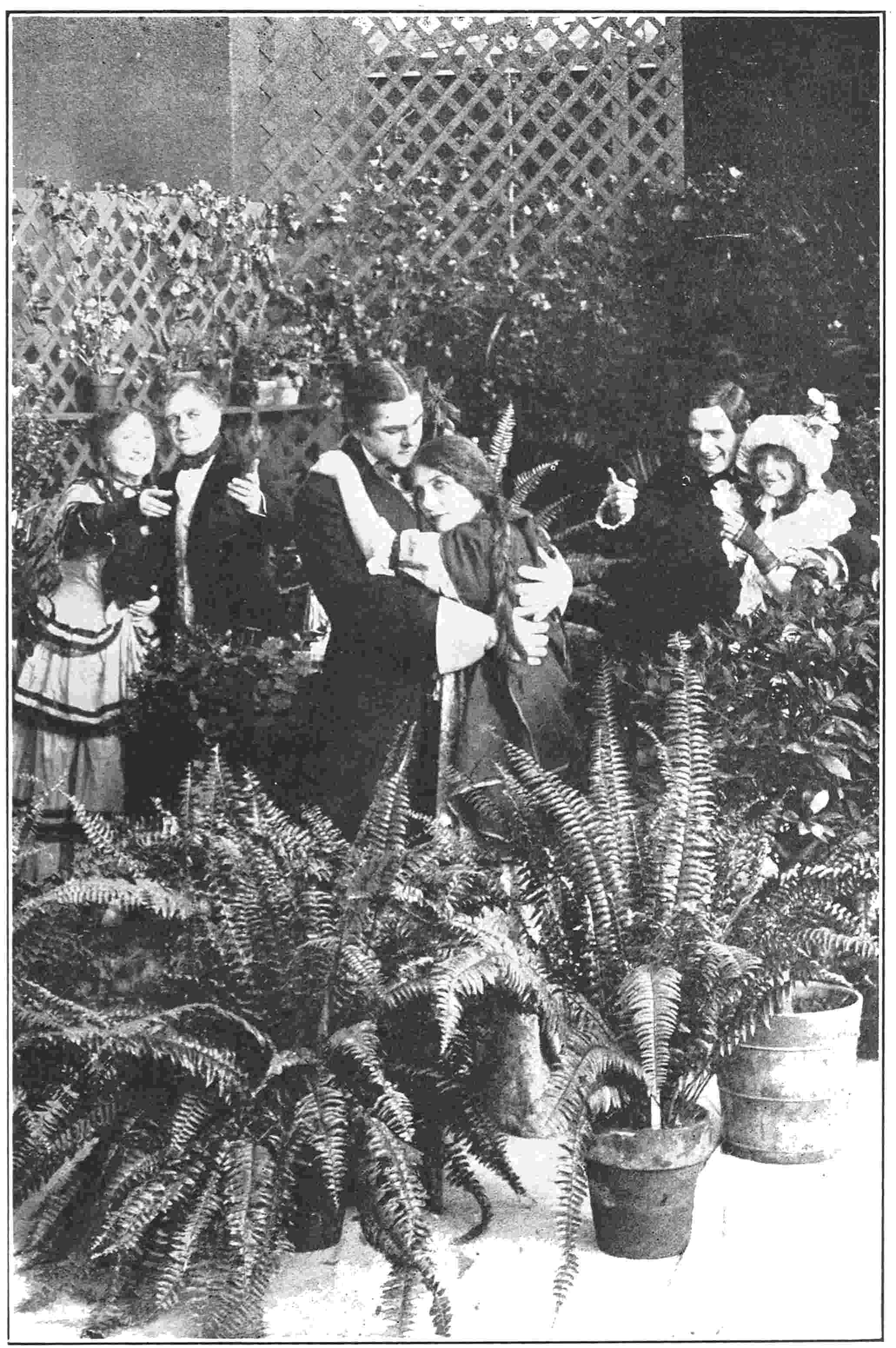
A corner of Biograph’s stylish Bronx studio. A scene from “The Fair
Rebel,” with Clara T. Bracy, Linda Griffith, Charles Perley, Dorothy Gish
and Charles West.
(See p. 225)
Yes, Mabel Normand was the most wonderful girl in
the world, the most beautiful, and the best sport. Others
have thought of Mabel Normand as these two youngsters
did. Daring, reckless, and generous-hearted to a fault, she
was like a frisky young colt that would brook no bridle.
The quiet and seemingly demure little thing is the one who
generally gets away with things.
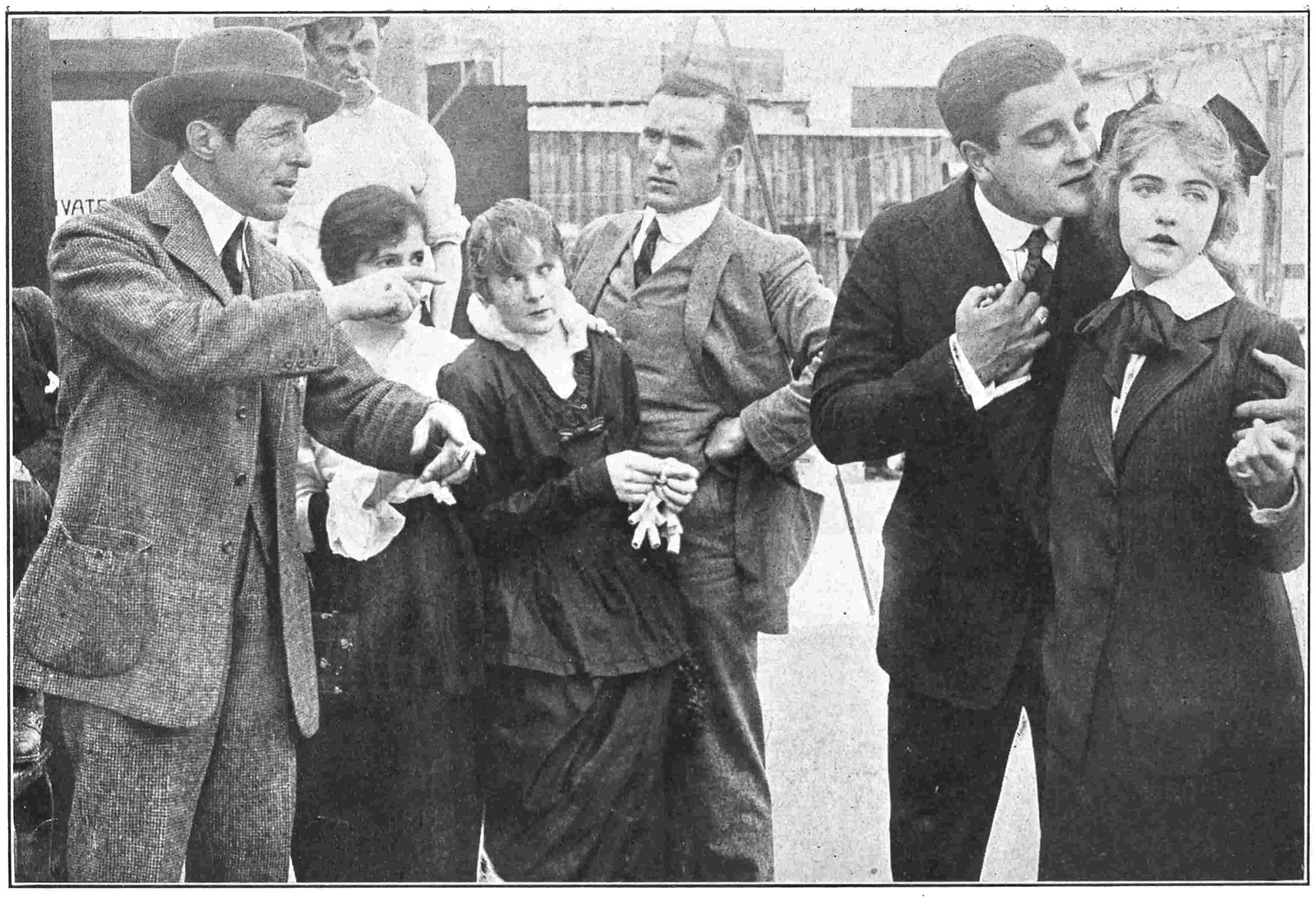
The beginning of the Griffith régime at 4500 Sunset Boulevard. A tense moment in comedy. From left to
right: D. W. Griffith, Teddy Lampson, Mae Marsh, Donald Crisp, W. E. Lawrence and Dorothy Gish.
(See p. 248)
The gay life of Dorothy and Gertrude was short-lived.
Their first night of revelry on Los Angeles’ Gay White Way
was their last. Up in their room, the night of arrival, they
had planned their evening: dinner in the grill, the movies
afterward, the grill again as a finish. They put up their
hair, they slipped their skirts to the hip, the jacket just
covering the lowered waistline, and the lengthened skirt the
legs. So they sallied forth.
Their program was well-nigh fulfilled; they finished with
two-thirds of it. As they were leaving Clune’s big movie
palace they were apprehended by two men, David Griffith
and Dell Henderson, who, having been out scouting for
the youngsters all evening, were just beginning to get
seriously worried over their disappearance.
Mr. Griffith had made Mr. and Mrs. Henderson responsible
for the girls, and at his suggestion they had already
found an apartment for them, not only in the same house
with themselves but on the same floor, and—adjoining. All
the fun was gone out of life. This arrangement would be
worse than boarding school.
But it got worse still. Sister Lillian, at Mary Pickford’s
suggestion, decided she’d return to the movies, and
so she and mother came on to Los Angeles. That meant
Dorothy and Gertrude would be transferred to Mother
Gish’s care, where their bubbling spirits and love of noisy
innocent fun would be frowned upon by the non-approving
eyes of the more sober elder sister.
Things became more complicated when Marshall Neilan
began paying ardent attentions to little Gertrude. Marshall
had fallen in love with Gertrude from seeing her on the
screen, and he told Allan Dwan with whom he had worked
at the American Film Company in Santa Barbara that he
was going to marry the cute little kid.
* * * * *
In the fall of 1912 the funny little hop-skip girl had
arrived on the scene in New York. When he got back to
the City, Mr. Griffith had found need for her, and he fussed;
and finally Mr. Hammer told him to send for her. Two
tickets were accordingly rushed west to Los Angeles, one
for Mae and one for Mae’s mama. In due time two members
of the Marsh family arrived. The day they reached
the East the company was working outside at some place
with a meaningful name like “Millville,” where we took
small country-town stuff. The two Marshes were so excited
when they got off the train in New York and dashed to the
studio at 11 East Fourteenth Street and found the company
working outdoors that they departed immediately for “Millville.”
They must get right on location. So to “location”
they hied. And when they had fluttered on to the scene,
and Mr. Griffith looked up and saw his Mae, and not his
Mae’s mama, but the fair Margaret, Mae’s sister, he was
pretty mad about it.
Margaret Loveridge, as soon as sister Mae’s star began
to rise in the movie heavens, changed her name to “Marguerite
Marsh”; but to her intimates she became “Lovey
Marsh.”
Little Mae Marsh back on the job, did a lot of extra
work before she got a part. Mr. Griffith worked hard with
her, especially when a scene called for a sudden transition
from tranquillity to terrible alarm. But a bright idea came to
him. He had noticed in battle scenes that young Mae
became terribly frightened; so when he didn’t have war’s
aid to get the needed expression of fright, without her
knowledge he would have a double-barreled shotgun popped
off a few feet from her head, and the resultant exhibition
of fear would quite satisfy the exacting director.
Mae Marsh’s first hit was in “Sands O’ Dee,” a part
that Mary Pickford had been scheduled to play, and
there was quite a to-do over the change in cast. But
it was the epochal “Man’s Genesis” that brought her well
to the front, as it did also Bobby Harron. In the parts of
Lilly White and Weakhands their great possibilities were
discerned, with no shadow of doubt.
“Man’s Genesis” was produced under the title “Primitive
Man,” and Mr. Griffith and Mr. Dougherty had an awful
time because Doc said he couldn’t see the title and he
couldn’t see the story as a serious one—as a comedy, yes!
But Mr. Griffith was determined it should be a serious story;
and he did it as such, although he changed the animal skin
clothing of the actors to clothes made of grasses. For if
the picture were to show the accidental discovery of man’s
first weapon, then the animal skins would have had to
be torn off the animal’s body by hand, and that was a bit
impossible. So Mae and Bobby dressed in grasses knotted
into a sort of fabric.
“Man’s Genesis” wrote another chapter in picture history.
It was taken seriously by the public, as was meant,
and every picture company started right off on a movie
having some version of the beginning of man. For Mr.
Griffith it was the biggest thing he had yet done, and one
of the most daring steps so far made in picture production.
Again, against great opposition David had put it over,
not only on his studio associates, but on the entire motion
picture world. Besides “Man’s Genesis,” our most talked
of picture of the winter—our biggest spectacle—was “The
Massacre.”
It was taken at San Fernando. There were engaged
for it several hundred cavalry men and twice as many
Indians. A city of tents, as well as the two large ones,
similar to the ones of the year before, was built outside
the borders of the town.
There was so much preparation, due to the magnitude
of the production, that the secrecy usually attending a Biograph
picture did not hold in this case, and the village of
San Fernando, two miles away from the place of the picture,
declared a holiday.
The townspeople having found out just when the raid
on the Indian village and the slaughter of the men and
women of the tribe was to take place, closed up shop and
school, and swarmed out to within a safe distance of the
riding and shooting incidental to Custer’s Last Fight, and
spent the day in the enjoyment of new thrills.
There was a two weeks’ fight over a sub-title in “The
Massacre”—the scrappers Mr. Griffith and Mr. Dougherty.
David never used a script, and a sub-title never was
written until he was convinced that one was necessary to
elucidate a situation. A picture finished, at its first running
we would watch for places where the meaning seemed not
sufficiently clear; where we doubted if the audience would
“get” it. And in such a place in the film, a title would
be inserted. So “The Massacre” finished, and being projected,
this scene was reached:
Horses with riders dashing madly down the foreground,
the enemy in pursuit, then the riders dismounting and using
the horses as a barricade, shooting over them.
Here arose the disagreement about the sub-title. Mr.
Griffith wanted to insert a caption “Dismounting for
Defense.” Mr. Dougherty said, “The audience will know
that is what they are doing.” But Mr. Griffith was not so
sure about it, so he said: “Now I think, I’d just like to have
the title; they may not know what I am trying to show.”
“Yes, they will,” said Doc.
Even Mr. Kennedy was swept into the debate. As the
argument continued his morning greeting became, “Well,
are you still at it, you Kilkenny cats?”
The title went in. How it would improve some pictures
in these days to have two weeks of conversation over a
sub-title. How a good old row with the whole force would
perk things up for some directors, for too many of them,
poor things, have had their pictures yes-ed to death by the
fulsome praise of their assistants; the “yes-sirs” who,
grouped in friendly intimacy about their director, have only
one answer when he says: “Do you like that scene?”
“Oh, yes, sir, the scene is wonderful.”
“Do you like that title?”
“Oh, yes, sir, the title is great.”
But that is how the “yes-sirs” hold their jobs!
* * * * *
Before the year 1912 ended, Lionel Barrymore had been
acquired. His plunge movie-ward was inauspicious.
“Who’s the new man?”
“That’s John Barrymore’s brother.”
“Never heard of him—is he an actor?”
“No, he’s an artist, just back from Paris, been studying
painting,” answered the wise guys.
* * * * *
On the return trip east this winter, a stop-over was
made at Albuquerque to secure legitimate backgrounds for
some Hopi Indian pictures. One, especially atmospheric,
was “A Pueblo Legend” with Mary Pickford.
CHAPTER XXVI THE OLD DAYS END
It was being hinted in the spring of 1913 that Biograph
was having a change of heart about the secrecy regarding
their players, and that they might end it. Contrary to
the policy of other companies, their scheme was not to give
the popular players the first publicity, but the directors and
camera men. D. W. Griffith would thus head the honor
list—his name to become identified with a certain class of
strong and highly artistic drama; Dell Henderson next—farce
comedies; Tony O’Sullivan—melodrama; Billy Bitzer—photography;
lastly—the actors.
The Biograph had always held to the policy that they
were an “institution,” and as such, the value of their pictures
did not depend on an individual. Sufficient that it was a
“Biograph.” Apparently, they now felt they had reached
a place so firmly fixed in public esteem through the fine
quality of their pictures, that giving credit to individuals
could not in any way react on them.
So D. W. Griffith became the first Biograph star. Biograph’s
policy he afterwards took to himself. He is still
the “star” of his productions. His actors continue as “leading
people” as long as they stay with him. And when they
go on to bigger money and names in bigger type with other
companies and under other directors, some succeed and some
do not. Mary Pickford was one who did.
In the picture world, especially abroad, big things were
now happening. “Quo Vadis,” a great spectacle, splendidly
acted, had been produced in Italy by the Societa Italiana
Cines, in three acts of four reels. It came to America and
had a run in a Broadway theatre.
From France, this same time, April, 1913, the steamer
La Touraine arrived in America bringing “Les Misérables”
in four sections and twelve reels.
“The Miracle,” which Morris Gest presented in the year
of 1924 in the Century Theatre, New York, as a pantomime,
had been filmed by Joseph Mencher and was shown at the
Park Theatre, New York, in February, 1913. It was a
“filmed pantomime” (not a moving picture drama), based
on the Wordless Mystery Play which, under the direction
of Max Reinhardt, had had a wonderful run at the Olympic,
London.
A reviewer said of it:
What was seen and heard last night only went to emphasize
that the moving picture under certain conditions, conditions like
those that prevailed last night, may be capable of providing entertainment
to be taken seriously by audiences which have never seen
the inside of an electric theatre.
Eugene Sue’s “Wandering Jew” came over, the work
of the Roma Film Company.
In our own country, Helen Gardner in her own productions
was appearing as Cleopatra and like characters.
The Vitagraph started on a trip around the world with
Clara Kimball Young to do a picture in each country visited,
but that rather fell by the wayside; Miss Young, however,
had somewhat contented herself with having charming
“still” photos taken in costume in each country on their
route; when the company reached Paris, Vitagraph cabled
for the actors to come home.
Kalem had already made some beautiful pictures in Ireland,
and in Egypt had made “From the Manger to the
Cross,” under Sidney Olcott.
Vitagraph answered an inquiry as to when they made
“Macbeth” by saying they “made it so long ago they wanted
to forget it in these days (1913) of high art production.”
Keystone Comedies were coming along, directed by
Mack Sennett, featuring the two famous detectives, Mack
Sennett and Fred Mace. In these comedies Mabel
Normand began to daredevil. Henry Lehrman joined
Sennett.
Hal Reid, Wally Reid’s father, was directing Reliance
pictures.
“Traffic in Souls,” written by Walter McNamara and
directed by George Loane Tucker, opened at Weber’s
Theatre, Twenty-ninth Street and Broadway, at twenty-five
cents the seat. People clamored for admission, with
thousands turned away.
So Biograph, concluding to get into the march of things,
ordered posters for twelve of their players whose names
they would make public.
“David Belasco Griffith” became Mr. Griffith’s nom-de-moving-pictures.
It was a time of tremendous ambitions
to him. In California, during that winter, was filmed his
“masterpiece”—“Mother Love”—seven hundred feet over
one reel. Mr. Griffith refused to have it the conventional
length, refused to finish it in a stated time, refused
to consider expense, introducing a lavish cabaret scene, costing
eighteen hundred dollars exclusive of salaries. Miss
Bambrick arranged the dances and coached the dancers.
Mr. Griffith said of it, “If it serves no other use, it will
teach café managers in the interior how to run a café.”
There was also “Oil and Water” in which Blanche Sweet
surprised both exhibitors and fans by her splendid work in
an unfamiliar rôle. It was strange that the one woman
in whom Mr. Griffith had seen the least promise came to
play the most important rôles in his Biograph pictures.
Strange also that Mary Pickford, who had played in so
many more pictures than any of his stars, and was by far
the most popular of them all, never played in a big Griffith
picture.
Before the end of the season, much curiosity was abroad
as to what David Griffith was up to. Way out to the wilds
of Chatsworth he was beating it day by day—this remote
spot having been chosen to represent the Plains of Bethulia.
For the story told in a book of the Apocrypha of Judith
and Holofernes was the big thing Mr. Griffith was doing,
and being so secretive about it, he had aroused everybody’s
curiosity.
Blanche Sweet played the lead in this picture—“Judith
of Bethulia”—Mr. Griffith’s most pretentious movie so far,
and his “Old Biograph” swan song. Henry Walthall and
the late Alfred Paget were the male leads.
How hard and how patiently the director worked with
the temperamental Miss Sweet. For hours one day he had
been trying to get some feeling, some warmth out of her,
until the utter lack of response got his goat. So with bended
knee he went after the fair lady and he gently but firmly
kicked her off the stage—just politely kneed her off. Then,
as was his wont, he burst forth in song, apparently oblivious
of the situation.
It was now Blanche’s turn to worry. She backed up
on to the stage and over to her discouraged director. He
escaped her—stretching his arms and singing louder than
ever he took large strides away from her. Finally, the penitent
reached him, and on her bended knees begged: “Please,
Mr. Griffith, please take me back.” When he thought she
had begged hard enough he took her back, and he got
results for the rest of that day.
“Judith,” owing to expensive sets, cost thirty-two thousand
dollars, but that was not advertised as a point of
interest in the picture. Much excitement prevailed over
“Judith,” D. W. Griffith’s first four-reeler. It was shown
to financiers. Wall Street was to be brought into intimate
conversation.
The old days and the old ways of 11 East Fourteenth
Street, how brief they had been! Those vital Biograph days
under the Griffith régime, how soon to pass! For when,
late in the winter of 1912, the company left for the West
coast studio, they said good-bye to the nursery, and to the intimate
days and the pleasant hours of their movie youth.
The big new studio up in the Bronx was now finished,
with two huge stages—one artificially lighted, and one a
daylight studio. There was every modern convenience but
an elevator. Of course, one director couldn’t utilize so much
studio; so while Mr. Griffith was still in California and
without saying anything to him about it, the Biograph made
a combine with Klaw & Erlanger by which all the K. & E.
plays were to be turned over for Biograph production in
three-, four-, and five-reel pictures.
Mr. Griffith didn’t fancy the idea; he felt also that
Biograph might have consulted him before closing the deal.
There was nothing to interest David in supervising other
directors’ movies or in giving them the “once over” in the
projection room. After watching the other fellow’s picture
for a while, even though he’d be considering it very good
work, he’d yawn and declare, “Well, it’s a hell of a way to
earn a living.” But that slant never occurred to him when
watching his own pictures.
But a growing restlessness was noticeable; threats to
leave were in the air; rumors floated all about.
However, he lingered through the summer, a busy one,
as in those introductory months the new studio had to be
got thoroughly into a moving and functioning affair.
Among the many to whom it gave opportunities was
Marshall Neilan. For his years young Mr. Neilan hadn’t
missed much. At the age of fourteen he had run away
from Los Angeles, his home, to Buffalo. There he washed
cars for a living—which he probably didn’t mind much, for
it enabled him to satisfy somewhat his fascination for
mechanics. Then, back in Los Angeles once more, he got
a job as chauffeur for a kindly person, a Colonel Peyton,
who also sent him to the Harvard school in Los Angeles.
From chauffing to the movies was then but a natural
step. For Marshall, a nice-looking Irish boy with Irish
affability, soon had a “stand” at the Van Nuys hotel, which
was a wonderful way to meet the movie people. Alice Joyce
it was who enveigled him. She kept asking him, “Why
don’t you come on in?” It was just like an invitation to
go swimming. So he took the plunge via Kalem, but not
until after he had become manager of the Simplex Automobile
Company in Los Angeles.
When the Biograph Company returned East after that
winter in which young Neilan had met his heart’s desire,
he wrote to New York to ask Mr. Griffith for a job. Mr.
Griffith asked Miss Bambrick if it was her wish to have
Marshall come on, but Gertrude wasn’t so anxious. David
had him come just the same.
The K. and E. pictures, especially “Men and Women”
and “Classmates,” gave Marshall Neilan his big chance.
He soon fell into the producing ranks, where recognition
came quickly.
And he married his Gertrude. Marshall Neilan, Jr.,
is now nine years old. But they didn’t live happily forever
after. Many years ago they parted. Just recently Mr.
Neilan married Blanche Sweet.
By fall, with four and five companies working, there
were so many actors that it wasn’t interesting at all any
more. There was Millicent Evans and Georgie O’Ramey,
Louise Vale, Travers Vale, Louise Orth, Jack Mulhal,
Thomas Jefferson, Lionel Barrymore, Franklin Ritchie,
Lily Cahill, Donald Crisp, Dorothy Bernard, Edwin
August, Alan Hale, William Jefferson—oh, slews and slews
of new ones, besides the old guard minus Mary Pickford.
From Chatsworth’s lonely stretches and prehistoric atmosphere
to the spic-and-span-ness, and atmosphere-less
Bronx studio came “Judith of Bethulia” to receive its finishing
touches. “Judith” was about the last of Blanche Sweet
in anything as pretentious directed by Mr. Griffith.
Mae Marsh was coming along and so was Lillian Gish.
Lillian was beginning to step some, and it was interesting
to watch the rather friendly rivalry between the three,
Blanche, and Mae, and Lillian.
Dorothy Gish was still a person of insignificance, but
she was a good sport about it; a likable kid, a bit too perky
to interest the big director, so her talents blushed unnoticed
by Mr. Griffith. In “The Unseen Enemy” the sisters made
their first joint appearance.
Lillian regarded Dorothy with all the superior airs and
graces of her rank. At a rehearsal of “The Wife,” of
Belasco and De Mille fame, in which picture I played the
lead, and Dorothy the ingénue, Lillian was one day an
interested spectator. She was watching intently, for
Dorothy had had so few opportunities, and now was doing
so well, Lillian was unable to contain her surprise, and as
she left the scene she said: “Why, Dorothy is good; she’s
almost as good as I am.”
Many more than myself thought Dorothy was better—for
she was that rare thing, a comedienne, and comediennes
in the movies have been scarcer than hen’s teeth. She
proved what she could do when she got her first real chance
as the bob-haired midinette in “Hearts of the World.”
* * * * *
Four or five companies working on the big stage these
days made things hum like a three-ring circus. From the
dressing-rooms a balcony opened that looked down on the
studio floor, and here Blanche Sweet could often be seen,
her feet poked through the iron rails of the balcony, her
elbows resting on the railing, her chin cupped in the hollow
of her hands, her eyes bulging as she watched every move
the director made. For Blanche was worried. Would
Lillian or Mae be chosen to play in the next big picture?
Mr. Griffith kept all the girls worried. All but Mary
Pickford. She was the only one who dared demand. With
Mother, Mary came up to the new studio to see what she
could put over in the way of a job. She’d now a legitimate
reason for making herself costly. In January, 1913, Miss
Pickford made a second appearance on the dramatic stage
under David Belasco’s wing. On her opening, the papers
said that the success of Miss Pickford as the little blind
princess was so marked that it practically precluded her
return to the screen.
Adolph Zukor had followed up his first Famous Players
picture, the four-reel “Queen Elizabeth” with James K.
Hackett in “The Prisoner of Zenda” and Mrs. Fiske in
“Leah Kleschna.” Astute business man that he was, as
soon as “The Good Little Devil” closed, he secured the play
for the screen with the dramatic company intact and Mary
as a Famous Player.
No, her dramatic success would not preclude her return
to the screen. It would merely fortify her with great assurance
in making her next picture contract. I am told it
happened thus:
Mother and Mary bearded the lion in his den.
“Well, what are you asking now?” queried Mr. Griffith.
“Five hundred a week,” answered Mrs. Smith.
“Can’t see it. Mary’s not worth it to me.”
“Well, we’ve been offered five hundred dollars a week
and we’re going to accept the contract, and you’ll be sorry
some day.”
They could go ahead and accept the contract as far as
Mr. Griffith was concerned. Indulging in his old habit of
walking away while talking, he brought the interview to
an end, calling back to the insistent mother, “Three hundred
dollars is all I’ll give her. Remember, I made her.”
And so the Famous Players secured Mary Pickford for
a series of features, the first of which was “In the Bishop’s
Carriage.”
But whether Mr. Griffith has ever been sorry, nobody
knows but himself.
Kate Bruce, the saintly “Brucie” to so many, pillowed
in her lap or on her shoulder by turns, all the feminine
heads of sufficient importance, and at times, with her arm
about me, it was even “Oh, dear Mrs. Griffith.” But Miss
Bruce was thoughtful, indeed, for her little room often
made night lodging, when we had an early morning call,
for the girl whose home was distant. Dorothy West, who
lived in Staten Island, often accepted Miss Bruce’s hospitality.
For Lillian Gish, “Brucie” had an especially tender
heart. Miss Gish, at this time, affected simple, straight,
dark blue and black dresses. She had long ago reached
the book-carrying stage, being one of Mr. Griffith’s most
ambitious girls. Many times she’d arrive at the studio an
hour or more ahead of time and have Billy Bitzer make
tests of her with different make-ups.
With a tight little hat on her head, and a red rose on
the side of it from which flowed veils and veils, and a
soulful expression in her eyes, Miss Gish was even then,
so long ago, affecting the Madonna.
But reclining in the arms of “Brucie,” purring “Brucie,
do you still love me?”—that was the perfect picture of the
fair Lillian those days. And Brucie’s reply came in honeyed
words, “Oh, you sweet, little innocent golden-haired
darling.” Then turning to the girl sitting next her on the
other side, she’d say, “You know this girl needs to be protected
from the world, she’s so innocent and so young.”
She had a strong maternal complex, had the maidenly Kate
Bruce.
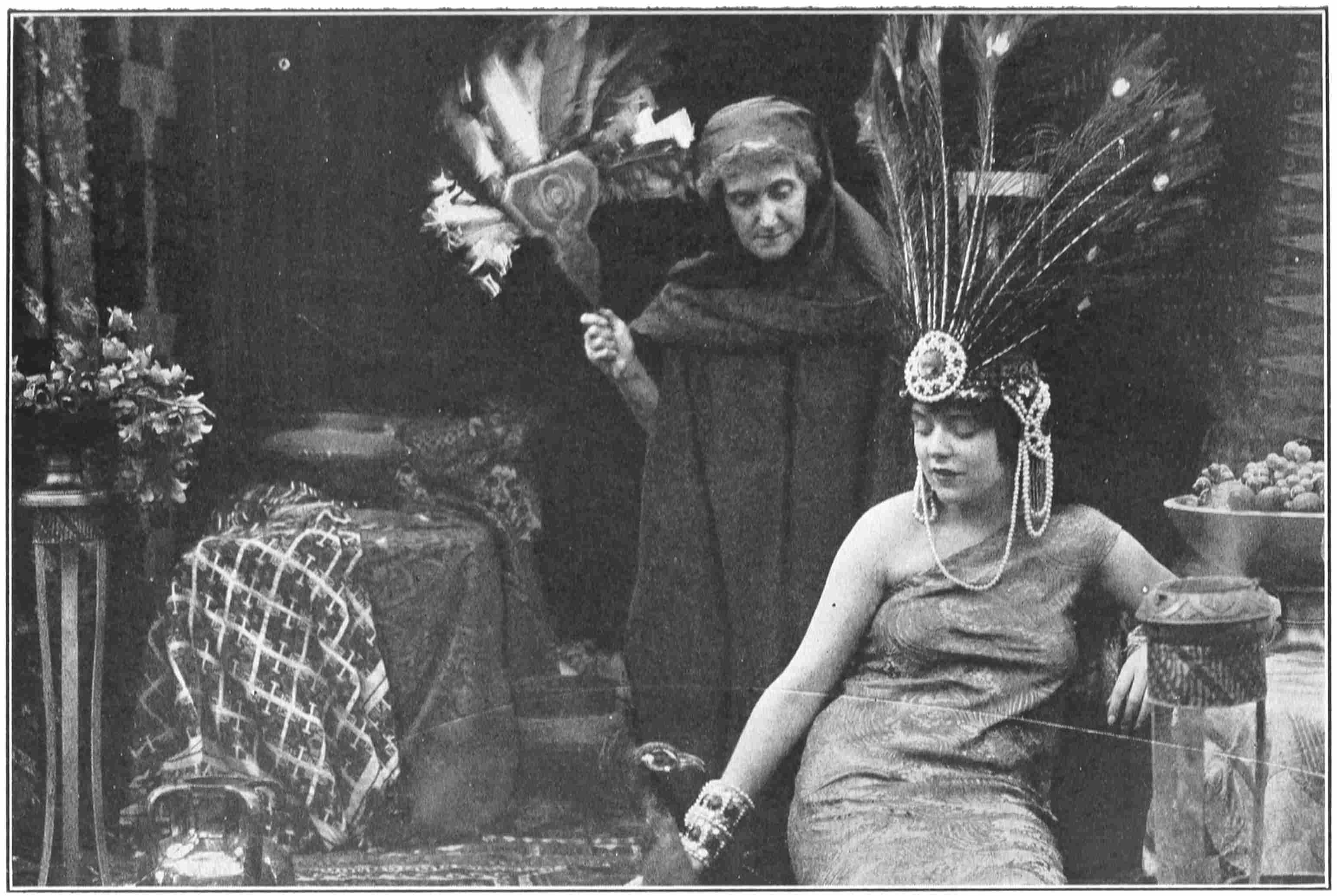
Blanche Sweet and Kate Bruce in “Judith of Bethulia,” the first four reel picture directed by D. W. Griffith.
(See p. 224)
In need of a gown for a picture at this time (the Biograph
was just beginning to spend a little money on clothes
for the women), Miss Gish spied Louise Orth one day
wearing just the very thing her little heart craved.
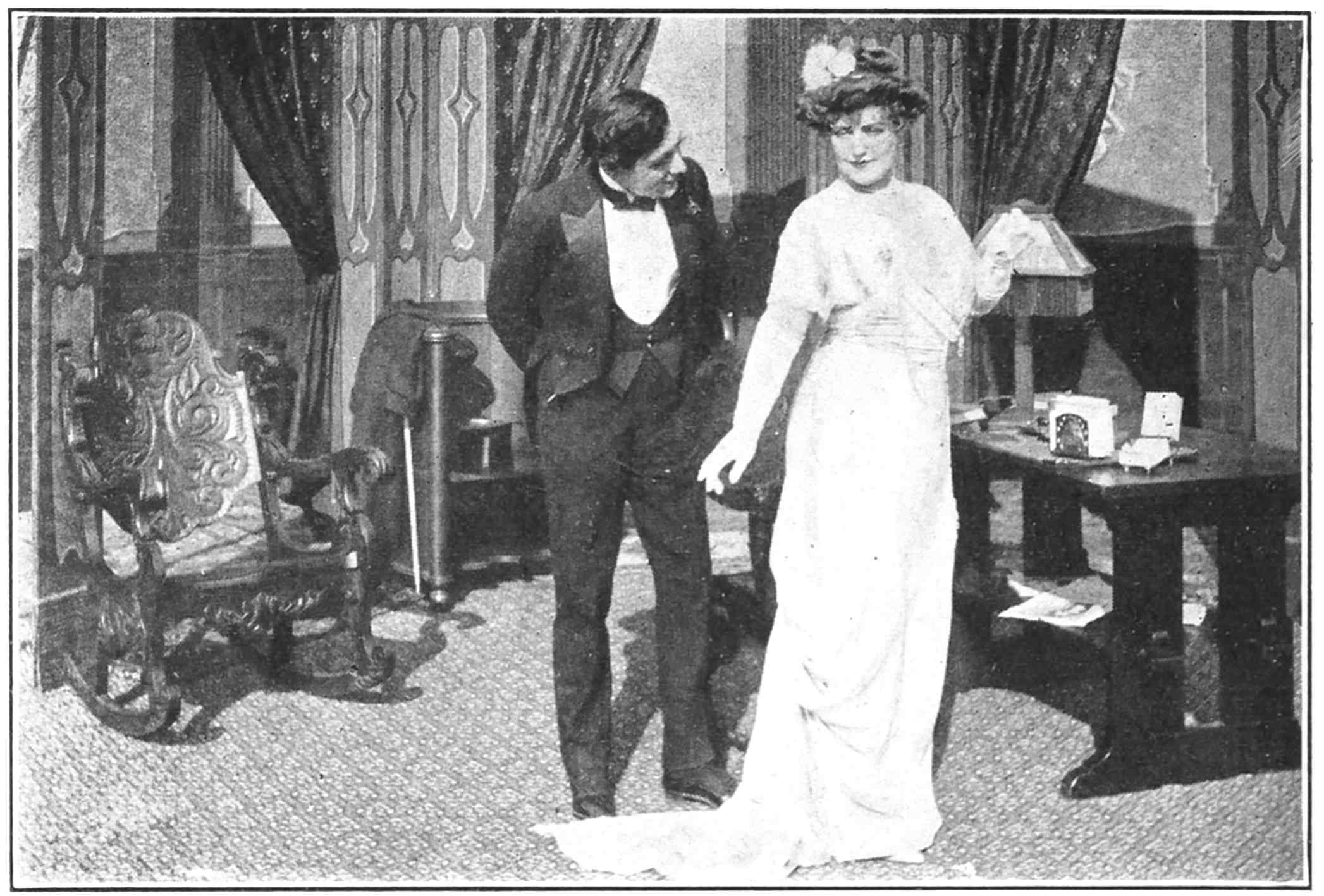
Lillian Russell and Gaston Bell, in a scene illustrative of her beauty
lectures, taken in Kinemacolor. These lectures were a headline act in
vaudeville.
(See p. 247)
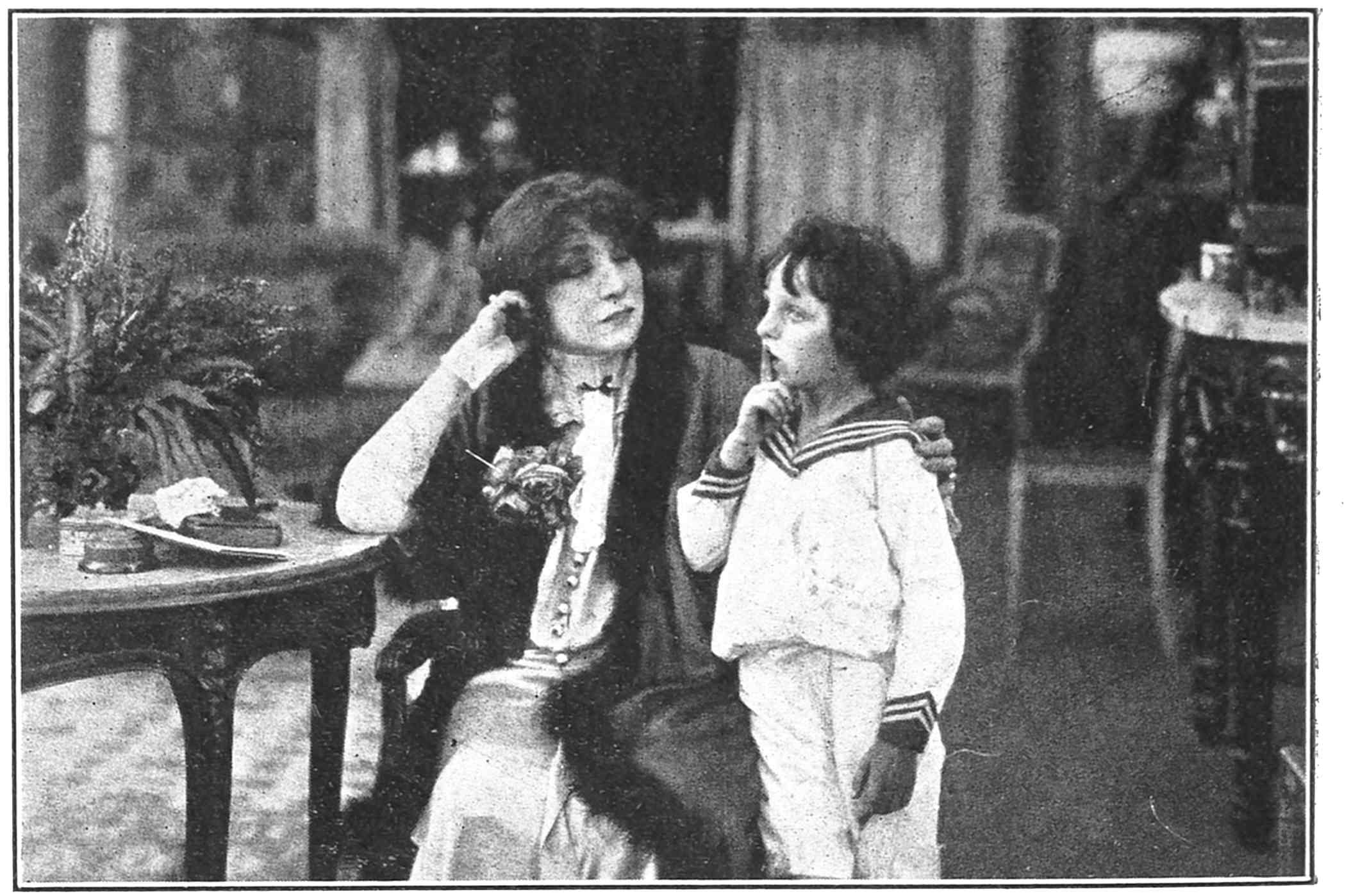
Sarah Bernhardt, the first “Famous Player,” as Jeanne Doré, and little
Jacques.
(See p. 105)
“Oh, what a lovely gown you have on. Where did you
buy that?”
Madame Frances then had a tiny shop on Seventh
Avenue, near the Palace Theatre: Polly Heyman had Bon
Marché gloves on one side and Frances had gowns on the
other. Frances had just made some thousands of dollars’
worth of gowns for Valeska Surratt’s show, “The Red
Rose,” which were so beautiful they won Mme. Frances
prestige and recognition from Al Woods. Miss Orth had
been a member of the Eltinge show for which Mme. Frances
had made the dresses, which is the long story of how Lillian
Gish got her first Frances gown.
The K. & E. pictures were going to be “dressed up,”
and we were being allowed about seventy-five dollars for
gowns. Miss Gish’s selection at Mme. Frances’s was price-tagged
eighty-five dollars; so back to the studio flew Miss
Gish. With as much pep as she had, which wasn’t so much,
she slunk up to her director and coaxingly said:
“Mr. Griffith, I must have that dress, it’s just beautiful;
it’s just what I must have for the part, and it costs eighty-five
dollars.”
“Who in the world ever heard of eighty-five dollars for
a dress?”
“I don’t care—now—I’ve got to have it.”
“Don’t bother me—it’s too expensive—we cannot afford
it.”
Then growing bolder, as she followed him about she
reached for his coat-tail, and twisting it and shaking it she
implored:
“Oh, please, Mr. Griffith, buy me that dress.”
“Will you get away?”
“Well, I won’t play in the picture if you don’t get me
that dress—I’ve got to have it.”
“All right, for heaven’s sake, get the dress—but don’t
bother me.”
Lillian got the dress.
Occasionally, Miss Gish took advantage of a beauty
sleep. On such occasions she seldom arrived before eleven
in the morning. And when she went to a party she played
the rôle of the sphinx, and all evening long never spoke.
But little Mae Marsh made up for her; she chattered incessantly.
Lillian’s dope was to come and go without being noticed.
She appeared one time at a midnight performance of
“Shuffle Along” done up in black veils to the tip of her
nose and a fur collar covering her mouth, with only little
spots of cheek showing. Dorothy, on the other hand, acting
like a real human being, was calling out to her friends,
“Hello there, hello, hello,” but Lillian, passing an old acquaintance,
merely said, “Forgive me for not stopping and
speaking; I don’t want any one to know I am here.” But
as everybody was awfully busy having a good time and
no one seemed to be particularly disturbed by Miss Gish’s
hiding away, she finally took her hat off and revealed
herself.
But she came out of her seclusion that time she preached
in answer to the Rev. John Roach Straton at his church
on Fifty-seventh Street. Some one was needed to answer
the Rev. Mr. Straton’s knocks on the theatre and its people.
Lillian came forward, and she so impressed her brother-in-law,
James Rennie, Dorothy’s husband, that he arrived late
at a Sunday rehearsal of a George Cohan show. In perfect
Sunday morning outfit, striped pants and gloves and cane
he burst upon the rehearsal and quite breathlessly spluttered,
“Please forgive me for being late, but I have just
heard my sister-in-law preach a sermon, and never in my
life have I heard anything so inspiring in a church. Don’t
go very often. More in Lillian than one suspects.”
Mr. Cohan gave himself time to digest Mr. Rennie’s
outburst, and then went on with the rehearsal.
* * * * *
Inevitable the parting of the ways. Though the last
word as to modern equipment, the new studio merely chilled.
That atmosphere of an old manse that had prevailed at
11 East Fourteenth Street, did not abide in the concrete
and perfect plumbing and office-like dressing rooms at East
175th Street. The last word in motion picture studios
brought Biograph no luck. For as a producing unit, after
a few short years they breathed their last, and quietly passed
out of the picture. When the doors at the old studio closed
on our early struggles, when Biograph left its original
nursery of genius, was the proper time for Mr. Griffith to
have left the company. In the fall, less than a year later,
he did.
CHAPTER XXVII SOMEWHAT DIGRESSIVE
From the old Biograph Stock Company they graduated,
scenario writers as well as actors; and here and there
they went, filling bigger jobs in other companies, as actors,
directors, and scenario editors.
And as manager and head director of the Kinemacolor
Company went David Miles. Directly upon leaving Biograph,
Mr. Miles had spent a short time at the “Imp” with
Mary Pickford and her family, King Baggott, George
Loane Tucker, Gaston Bell, Isabel Rea, and Tom Ince.
Leaving “Imp,” he had gone over to Reliance. While at
Reliance, and in need of a handsome young juvenile, there
came to mind his friend Gaston Bell.
Mr. Bell already was signed up for a ten weeks’ stock
season in Washington, D. C.; with “Caught in the Rain”
by William Collier and Grant Stewart, as the opening bill;
Julia Dean, the leading lady; Mr. Bell’s part that of the
dapper Englishman, the Grant Stewart part. Mr. Miles
suggested that Gaston play the needed juvenile in the Reliance
Company’s movie while rehearsing the opening bill
of his Washington stock season in New York, and promised
a good movie job when the Washington season ended.
Said he’d rush him through at odd hours, so as not to
interfere with rehearsals, and finish with him in time for
the opening.
Well, everything went along fine, and for the last scene
Gaston reported beautifully arrayed in a new spring suit
purchased especially for his stock opening.
Suavely spoke the director, “Now, Gaston, we have
saved this scene for the finish—we must take you out somewhere
and run you over.”
“Take-me-out-and-run-me-over?—in my beautiful new
suit? Oh, no, you can’t.”
But no one heeded Gaston’s distress.
Everybody piled in the automobile—after a couple of
turns it landed on a quiet street. “All out.” The car
emptied—camera was soon set up and Mr. Bell shown the
place where he was to be run over.
These were amateur days in fake auto killings and injuries,
but they did the “running over” to the director’s
satisfaction and Gaston’s, as he escaped with no damage to
his clothes or himself.
But Gaston had reckoned without a thought of static.
How many hours of anguish “static” caused us—static,
those jiggly white lines that sometimes danced and sometimes
rained all over the film. Early next morning his
’phone rang—Mr. Miles on the wire. “Awfully sorry,
Gaston, but we’ll have to take you out and run you over
again because there was static.” So they did it again, and
again was Gaston dismissed as finished. It came close on
to train time: another ’phone—ye gods, static again! He’d
be bumped from juvenility to old age in this one running-over
scene, first thing he knew, and hobble onto the stage
with cane and crutch, which would never do for his precious
little Englishman in “Caught in the Rain.”
Well, they ran him over again. This was Saturday.
The following Sunday the company was to leave for Washington.
Thinking to cinch things, Mr. Miles offered, should
anything be wrong with the scene this last time, to pay Mr.
Bell’s fare to Washington and his expenses if he would
stay in New York over Sunday. “Wildly extravagant, these
picture people,” thought Mr. Bell, as he departed for Washington
with the company.
But no sooner was he nicely settled in his hotel, “static”
and “being run over” quite forgotten, and all set for his
opening—when a long distance came. Mr. Miles on the
wire: “Awfully sorry, Gaston, but there was more static
and we will have to take you out and run you over again.”
And before Gaston had time to recover from the shock,
the movie director and his camera man were right there in
Washington!
“Good night,” said Gaston, despairingly, to himself.
But to Mr. Miles he said, “Now I’ll tell you what you have
to do, you must have another actor handy to go on for me
to-night, for I cannot take any more chances.”
Well, they took the scene another time, ruining neither
Mr. Bell nor his grand new suit, and as this time the scene
was static-less, the day was saved for Gaston. But “never
again” vowed he. And “never again” vowed the director.
David Miles kept good his promise and when Gaston’s
season in Washington closed, he joined Reliance. There
he and George Loane Tucker soon became known as the
“Hall Room Boys.” For in an old brownstone they shared
a third floor back—also a dress suit. And if both boys
happened to be going out into society the same night, whoever
arrived home first and got himself washed up and
brushed up first, had the option on that one tuxedo.
The hall-room days of George Loane Tucker were brief.
“Traffic in Souls,” the white-slave picture that he produced
for Universal, put him over. An unhappy loss to the
motion picture world was Mr. Tucker’s early death; for
that truly great picture, “The Miracle Man,” his tribute to
the world’s motion picture library de luxe, promised a
career of great brilliance.
Mr. Tucker had come rightfully by his great talent, for
his mother, Ethel Tucker, was an actress of note and a
clever stage director also. As leading woman in stock
repertoire at Lathrop’s Grand Dime Theatre of Boston, she
had a tremendous popularity in her time. And long years
afterward, she too went into “the pictures” in Hollywood,
for a very brief period.
Mr. Tucker’s “Miracle Man” brought stardom to its
three leading players, Lon Chaney, Betty Compson, and
Tommy Meighan.
Tommy Meighan’s leap to fame was surprising to both
friends and family. For Tommy had been considered, not
exactly the black sheep of the family, but rather the ne’er-do-well.
During the run of “Get-Rich-Quick Wallingford,”
both being members of the cast, Frances Ring, sister to the
lustrous Blanche of “Rings on My Fingers” and “In the
Good Old Summertime” fame, had married Mr. Meighan,
Tommy becoming through this matrimonial alliance the
least important member of the Ring family of three clever
sisters, Blanche, Frances, and Julie. An obscure little Irishman,
Tommy trailed along, with a voice that might not
have taken him so very far on the dramatic stage.
Like weaving in and out the paper strips of our kindergarten
mats is the story of the Ring sisters and Tommy.
For Los Angeles beckoned, with Blanche headlined at the
Orpheum, Frances in stock, and Tommy playing somewhere
or other.
Blanche and her husband, Charles Winninger, a member
of her company, were invited by Louise Orth for a week-end
out Las Palmas way. The week-end proved very significant
in results; for through their hostess, who was
leading woman at the Elko Studios, a meeting between Mr.
Winninger and Mr. Lehrman was arranged the next week
which led directly to Charlie’s signing on the dotted line
at the fabulous salary of two hundred and fifty dollars
a week—to do comedies. But Charlie’s pale blue eyes did
not register well enough on the screen, and the comedy
note in his characterizations thus being lost, the good job
just naturally petered out.
Then Miss Ring, who had now taken over one of Los
Angeles’s show places, on the Fourth of July gave a party—a
red, white, and blue party at which were gathered more
notables than had as yet ever been brought together at a
social function in Los Angeles. It was Broadway transplanted.
There were David Belasco, Laura Hope Crews,
Charlie Chaplin, Edna Purviance, Julian Eltinge, Geraldine
Farrar, Jesse Lasky, Mr. Goldwyn, Wallace and Mrs. Reid,
Mr. Morris Gest, then representative for Geraldine Farrar
and Raymond Hitchcock, who viewing from the back piazza
the distant lights of Los Angeles was supposed to have said
something when he remarked, “This reminds one of a diamond
bar pin.”
It was an illustrious and patriotic party. Before the
festivities were over, Mr. Gest unwound the maline scarf
from Miss Orth’s neck while Charlie Chaplin sang the
Spring Song, and Mr. Gest danced on the lawn waving the
scarf and crushing the slimy snails that in droves were
slowly creeping up to the house.
The party was illustrious in that it was here voted that
Tommy Meighan would photograph well in pictures, and
Mr. Lasky invited him to the studio and offered him, perhaps,
fifty dollars a week, and he made a hit in his first
picture with Geraldine Farrar and was then given a substantial
raise. At which Blanche, the astounded sister-in-law
said, “And to think that at times I’ve had to support
that Irishman.” There had been enough job uncertainty
to discourage her, so that she had wondered sometimes
whether she would have him on her hands for the rest of
her life. Even after Mr. Tommy Meighan’s advent into
pictures, sister Blanche rather expected, every now and then,
that he would be “canned.”
And so Tommy evolved from a liability into an asset,
and became the idol of innumerable feminine hearts. It
was a colorful paper mat the Ring family wove.
* * * * *
While out at the Elko studio Charlie Winninger, with
all his brilliant and sustaining background, had so disastrously
flopped, at Mack Sennett’s studio another Charlie
was very busy thinking out stunts that would make people
laugh. For the more people laughed, the more dollars could
Charlie Chaplin add to the savings for the rainy day, against
which, if he ever got the chance, he would make himself
fool-proof.
For, so I have been told, Charlie Chaplin had known
rainy days even when a youngster. He was only seven
when, in a music-hall sketch, he made his first theatrical
appearance. Later, he toured for some time through the
United Kingdom as one of the “Eight Lancashire Lads.”
There was an engagement with “Sherlock Holmes,” and
then the association with Fred Karno in “The Mumming
Birds.” To America with Mr. Karno he came, appearing
as Charlot in the now famous “A Night in an English
Music-hall.” When he debarked he was far from being
the richest man on the boat.
The movies claimed him. He was discovered by Mack
Sennett in this way. Mr. Sennett at this time was busy
on the lot out in Los Angeles. He heard of a funny man
in an act called “A Night in an English Music-hall” playing
at Hammerstein’s Victoria Theatre, which used to stand
at Broadway and Forty-second Street, now replaced by the
Rialto Motion Picture House. Mr. Adam Kessel and Mr.
Bauman, the firm for whom Mack Sennett had nightly
warmed the Alexandria’s leather benches in the hope of
landing a job, and for whom he was now producing
comedies, were both in California, and so in September,
1913, a wire was sent to Charles Kessel, brother of Adam,
to go over to Hammerstein’s and get a report on the
comedian about whom Mr. Sennett was so anxious.
Mr. Charles Kessel, the secretary of the company,
heartily approved of the comedian, who was none other than
Charlie Chaplin. He thought so well of him that he sent
a letter asking Chaplin to come in and see him. This Mr.
Chaplin did. Mr. Kessel asked him how’d he like to go
into moving pictures. Mr. Chaplin answered that he had
never given them any thought.
Said Mr. Kessel: “I’ve seen you act and like you, but
you needn’t make any assertions now, nor any answers,
but go out and make inquiries as to Kessel and Bauman
and if you think well enough of them, well then we’ll talk.”
Mr. Chaplin found out that the firm was O. K. So
Mr. Kessel said: “I’ll give you a contract for a year and
gamble with you—I’ll give you the same salary that you’re
getting on the stage.”
“One hundred and fifty dollars,” said Mr. Chaplin
quickly. He really was getting sixty dollars. “All right,”
said Mr. Kessel so quickly that Charles as quickly swallowed
his Adam’s apple, and regretted he hadn’t said more.
“But I don’t think I care to change from the stage to
the pictures.”
“Well, our contracts are for fifty-two weeks, no Sunday
work, no intermissions between pictures; in vaudeville you
get thirty-two weeks and you pay your own traveling expenses.”
Mr. Chaplin said he’d make up his mind and let Mr.
Kessel know.
So in about six weeks a letter came from Mr. Chaplin
from Omaha saying he was ready to start. The contract
was mailed December 19, 1913, and signed January 2, 1914.
“Mabel’s Predicament,” a one-reeler, was Charlie Chaplin’s
first picture. “Dough and Dynamite” the first two-reeler.
Mr. Chaplin’s success was instantaneous. It also
must have been tremendous, for the Keystone Company
(Kessel and Bauman) within five months dared to do a
comedy five reels in length. When the five-reel comedy was
announced, there were many who thought that now surely
the picture people were going cuckoo. No one believed
an audience would stand for a five-reel comedy.
They did. The picture was “Tillie’s Punctured Romance,”
adapted from the Marie Dressier play, “Tillie’s
Nightmare.” Marie Dressier was engaged for the picture
and for fourteen weeks she received the unbelievable salary
of one thousand dollars weekly and fifty per cent of the
picture, which, released in June, 1914, was one of the sensations
of the picture world.
All sorts of offers now began coming to Mr. Chaplin.
Carl Laemmle was one who was keen to get Charlie under
contract; he kept himself informed of Mr. Chaplin’s activities
even to the social side of his life so that he would know
when and where best to set the bait.
Out at Sunset Inn, a place by the ocean where movie
people then made merry, Charlie Chaplin was to be one
of a party. Mr. Laemmle being wised up to it, gave a party
of his own the same night, a most expensive and grand
party. Well, he would have Charlie’s ear for a moment
anyhow, and one never could tell.
The party in full swing, Mr. Laemmle invited Mr.
Chaplin over to his table, and after a few social preliminaries
said, “Let’s talk business; I want you to come
and work for me.” But Mr. Chaplin, always a clever
business man, answered, “I’m enjoying myself—I don’t
want to talk business to-night, I’m on a party.”
Mr. Laemmle was all set to secure the services of the
rising young comedian, so he would not be daunted. Charles
could talk “party,” but he would talk “business”; Mr.
Laemmle offered a little better salary; promised to advertise
Chaplin big, and make him a tremendous star.
But Mr. Chaplin was too clever for Mr. Laemmle. With
a most sweet smile he turned to one of Mr. Laemmle’s
guests, Louise Orth of the corn yellow hair, and said, “Gee,
that’s great music; I like blonds, and I am going to dance
with a blond, may I?”
It was great music, about the first syncopated music
with a saxophone heard in that neck of the woods. There
was a great horn into which the dancers, if they desired
an encore, threw a silver dollar. There needed to be five
particularly anxious dancers to get the expensive orchestra
to repeat an orchestration. The dollars clicked down the
horn into a sort of tin bucket on the floor below, and the
loud jangle of the silver money could be easily heard by
the dancers who would listen attentively for jangle number
five, and then “On with the dance.”
As the music finished for the first dance this night,
the dancers stopped and with much excitement waited for
the click of the silver dollars. Charlie Chaplin was out for
a big time; also he wanted to worry Mr. Laemmle, and, one
thing sure, he was not going to talk business this night.
So he was the first to say, “This dance is worth an encore,”
and he threw a silver dollar into the horn.
It was perhaps the first time Mr. Chaplin had been
known to spend money in public either for food or music,
for every one was so tickled and flattered to have him as
a guest that he never was given a chance to spend money.
So Charlie’s Chaplin’s silver dollar nearly caused a riot on
that dance floor. The guests hooted and screamed and those
who knew him well enough and had been given stray bits
of confidence, called out, “You cannot plant your first
dollar now because you’ve spent it.” And Mr. Chaplin
answered, “Oh, don’t you worry, I planted my first dollar
some time ago.”
Mr. Chaplin could never squander money; memories of
lean days inhibited him from doing that. But he must hold
off Mr. Laemmle; and he was enjoying the dance.
Two other dollars had joined Charlie Chaplin’s first
one, and clicked their way down the yawning chasm of the
brass horn, and then a pause, but just for a second. Grabbing
his blond partner, Mr. Chaplin threw the two needed
dollars into the horn’s hungry maw, and the moaning saxaphone
started off again while Mr. Laemmle looked sadly
on. He never did secure the screen’s greatest funny man.
In six months Charlie Chaplin’s rise to fame and fortune
was phenomenal. Not only had a kind Providence
richly endowed him, but he worked very hard, as genius
usually does. Even back in those days, Mr. Chaplin often
began his day making excursions with the milkman. From
the cold gray morning hours of three and four until seven,
the two would ramble through the poor districts, and while
the milkman would be depositing his bottle of milk, Mr.
Chaplin would hobnob with drunks and derelicts, and in
the later hours, talk with the little children of the slums,
drawing out a story here, getting a new character there,
and making the tragic humorous when finally the story was
given life on the screen. The story of “The Kid” as Mr.
Chaplin and Jackie Coogan told it, was nearer the truth
than any audience ever guessed.
* * * * *
The ups and downs of the movie world!
Mack Sennett all dressed up and grouching on a leather
settee in the hotel lobby, waiting for his prey! He would
not be handed dry, old sandwiches all his days. He was
out for steak, red and juicy. He got there and has stayed
put.
Henry Lehrman patting his inflated chest! He got there,
but stayed put the littlest while.
Charlie Chaplin, who topped them all, working while
others slept, out on excursions with the milkman!
Tommy Meighan of the genial smile and Irish red-bloodedness.
He got a chance, and the ladies liked him.
Nice personality, and good actor, even so.
Not alone in the movies is it easier to get there than
to stay there. Chance sometimes enters into the first, but
to stay there means ears attuned, feet on the ground, and
heaps and heaps of hard work.
CHAPTER XXVIII “THE BIRTH OF A NATION”
Late in the summer of 1912 the Kinemacolor Company
of America, a subsidiary of the English company,
started the production of movies in color at a studio in
Whitestone, Long Island. The year of Kinemacolor’s
endeavor also marks Mr Griffith’s last year with Biograph,
for he went to the Mutual with Harry Aitken while I became
leading woman with the Kinemacolor.
Messrs. Urban and Smith had rather startled the world
with their color pictures of the Coronation of George the
Fifth of England, and the Durbar Imperial at Delhi; and
even though their pictures were a bit fringy, they were
becoming ambitious for honors in color movies along
dramatic lines.
Great things were achieved in America in the movies,
and great things might have been achieved in America in
Kinemacolor, but it was destined otherwise. Kinemacolor
was fated to be but a brief though fruitful interlude in
color-photography in the movies, which, for some seemingly
mysterious reason, is so long in arriving.
Sunshine being imperative for Kinemacolor, southern
California’s staple brand could not be denied, and soon the
company left its studio in Whitestone and repaired to the
modest little town of Hollywood where it took over the
Revier Laboratories at 4500 Sunset Boulevard.
That the place had been used as a studio was not discernible
from the front. It was a pretty corner on which,
some distance apart, stood two simple cottages, Middle
Western in character. They represented office and laboratory.
Dressing-rooms and stages of a crudeness comparable
to the original Biograph studio were at the back.
No fence gave privacy from passers-by, but a high board
fence, decorated with pictures of foxes and the words “Fox
Pictures,” protected the lot in the rear. It was not the
William Fox of to-day who thus sought to advertise his
trademark and his wares. Another Mr. Fox it was of
whom we seem to hear nothing these days.
Here Kinemacolor moved in, with David Miles at its
head, Jack Le Saint director of the No. 2 company, and
our old friend Frank Woods making his movie-directing
début as teacher to the actors of the No. 3 company. For
Mr. Woods having tasted movie blood through his little
Biograph scenarios and his position as chief reviewer of
the movies, had grown anxious to plunge more deeply into
the swiftly moving waters of reel life. So Mr. Miles opened
the way for him. And although Kinemacolor opened up
financially to a salary of only seventy-five dollars a week,
the Woodses made the most of it, for from that humble
beginning in less than ten years they have come to own a
town near Barstow, California. They have named it
“Lenwood.” Charles H. Fleming, who was assistant to
David Miles, afterwards became a director and tastefully
executed a number of pictures.
When the Kinemacolor Company was gathering in what
youth and looks and talent it could afford, Mr. Miles, remembering
a little deed of kindness, recalled Gaston Bell
and took him to Hollywood, and when the much-loved and
generous-souled Lillian Russell came out to do some pictures
in Kinemacolor, Mr. Bell was rewarded by being made
her leading man. Mahlon Hamilton loaned his good looks
to the same films. The Russell pictures were used to illustrate
“Beauty Talks” in an act in which Miss Russell was
headlined on big vaudeville time throughout the United
States.
Mahlon Hamilton and Gaston were the company’s two
best “lookers.” As to “acting,” Mahlon made not a single
pretense. He and the company quite agreed as to his
dramatic ability. To be so perfectly Charles Dana-ish, and
histronic also, was not expected of one man in those days. We
had not reached the Valentino or Neil Hamilton age. Mr.
Mahlon Hamilton, of late, not quite so Gibsonesque, has
become a surprisingly good actor. So do the years take
their toll and yield their little compensations.
The wonderful possibilities of Kinemacolor had not even
been scratched when the American subsidiary was formed,
for the foreign photographers—English, French, and German—who
had “taken” the Coronation and also some picture
plays that were produced in southern France, insisted
that the close-up was impossible in color. But Mr. Miles,
having had Biograph schooling, insisted contrariwise, and
after a long and hard scrap with his photographers, he
succeeded in inducing them to do as he said. The result
proved his contention. The Kinemacolor close-ups were
things of great beauty.
During its short life, Kinemacolor made some impression;
for Dan Frohman after seeing some of the pictures
said that “The Scarlet Letter” was the most artistic movie
he had seen up to that time. Many distinguished visitors
stopped at its Hollywood studio to see the new color pictures.
Madame Tetrazzini, the opera singer, among many others,
was tremendously enthusiastic.
It has been stated in error that the Kinemacolor pictures
were never released. They were very much released,
being shown at the New York Theatre Roof, besides many
other theatres in New York, and contracts for their service
all through the country were made by the Kinemacolor
Company. Things started off with such a bang, we never
did get over the shock of the sudden closing.
It was one exciting year with Kinemacolor, but it ended
suddenly and tragically with the death of the president, Mr.
Brock. While preening our wings for a flight to southern
France, a telegram arrived from the New York office announcing
the finish of picture production in Kinemacolor.
The sudden disruption of the Kinemacolor Company
sent a flock of actors and a few directors scouting for new
jobs. Frank Woods took up with Universal, only to suffer
a six weeks’ nightmare. Being unable to turn out the class
of stuff wanted, and anticipating what was coming, he
resigned, dug up the return half of his Kinemacolor round-trip
ticket, and was not long in New York before he got
busy as a free-lance; and not so long after that a telephone
from D. W. Griffith asked him to become his scenario
writer. With great joy he accepted, filling the position with
Mr. Dougherty, who was now back at Biograph after a
short spasm with Kinemacolor.
Right away Mr. Woods and Mr. Griffith got busy on
“Judith of Bethulia,” for having produced such a classic,
Mr. Griffith wanted some special titling for it. He turned
it over to Frank Woods, who phrased the captions in the
style of language of the day—the first time that was done.
However, it proved too much of a strain for the exhibitors,
for they afterward fixed the titles up to suit themselves in
good old New Yorkese.
Mr. Griffith’s connection with the Mutual Film organization
and his association with H. E. Aitken resulted in
the production of such eventful and popular pictures as
“The Tell-Tale Heart,” “Home, Sweet Home,” “The
Escape,” “The Avenging Conscience,” and “The Battle of
the Sexes.” The Clara Morris home out on Riverdale Road
served as a studio until the 29 Union Square Place was
acquired.
Billy Bitzer, D. W.’s photographer, went with him in
his new affiliation, as also did Frank Woods and Christy
Cabanne. As Mr. Griffith’s work with the Mutual became
organized, one by one he took over his old actors, but he
left them working with Biograph until he could put them
directly into a picture. So they trailed along; Henry
Walthall, Blanche Sweet, James Kirkwood, Mae Marsh,
Lillian and Dorothy Gish, Eddie Dillon, and many others.
After a short time at the Mutual studio, Mr. Griffith
and his company went to California. At the old Kinemacolor
lot they encamped, the Mutual having taken over that
studio. The carpenters got busy right away, and soon little
one-story wooden buildings crowded to the sidewalk’s edge,
and the place began to look like a factory. The sprinkling
can that had given sustenance to red geraniums and calla
lilies was needed no more.
* * * * *
Now before the Kinemacolor Company had started work
at Whitestone they had held a contract with George H.
Brennan and Tom Dixon for the production in color of
Tom Dixon’s “The Clansman.” The idea was that the
dramatic company touring through the Southern States in
“The Clansman” would play their same parts before the
camera. In these Southern towns all the Southern atmosphere
would be free for the asking. Houses, streets,
even cotton plantations would not be too remote to use
in the picture. And there was a marvelous scheme for
interiors. That was to drag the “drops” and “props” and
the pretty parlor furniture out into the open, where with
the assistance of some sort of floor and God’s sunshine,
there would be nothing to hinder work on the picture version
of the play.
But the marvelous scheme didn’t work as well as was
expected; and eventually the managers decided that trying
to take a movie on a fly-by-night tour of a theatrical company
was not possible, so the company laid off to take it
properly. They halted for six weeks and notwithstanding
the sum of twenty-five thousand dollars was spent, it was
a poor picture and was never even put together. Although
Tom Dixon’s sensational story of the South turned out
such a botch, it was to lead to a very big thing in the near
future.
Frank Woods, after several others had tried, had written
the continuity of this version of “The Clansman,” and
had received all of two hundred dollars for the job. That
the picturizing of his scenario had proved such a flivver
did not lessen his faith in “The Clansman’s” possibilities.
Mr. Griffith was doing some tall thinking. His day
of one- and two-reelers having passed, and the multiple-reel
Mutual features having met with such success, he felt
it was about time he started something new. So, one day,
he said to Frank Woods: “I want to make a big picture.
What’ll I make?” With his Kinemacolor experience still
fresh in mind Mr. Woods suggested “The Clansman.”
With the Dixon story and the play Mr. Griffith was quite
familiar as he had heard from his friend Austin Webb, who
had played the part of the mulatto Silas Lynch, about all
the exciting times attending the performance of the play—the
riots and all—and more he had heard from Claire MacDowell,
who was also in the show, and more still from Mr.
Dixon himself.
So David Griffith said to Frank Woods: “I think there’s
something to that. Now you call Mr. Dixon up, make an
appointment to see him, and you talk it over, but say nothing
about my being the same actor who worked for him once.”
So the meeting was arranged; the hour of the appointment
approached; and as Mr. Woods was leaving on his
important mission Mr. Griffith gave final parting instructions,
“Now remember, don’t mention I’m the actor that
once worked for him, for he would not have confidence
in me.”
So while Tom Dixon nibbled his lunch of crackers, nuts,
and milk, Mr. Woods, without revealing his little secret,
unfolded the mighty plan, “We are going to sell Wall Street
and get the biggest man in the business.”
“Who?”
“D. W. Griffith.”
“Oh, yes, I’ve heard a lot about him—he used to work
for me.”
Mr. Dixon was greatly interested and evinced no hesitation
whatever in entrusting his sensational story of the
South to his one-time seventy-five dollars a week actor.
He’d already taken one sporting chance on it, why not
another? Yes, Mr. Griffith could have his “Clansman” for
his big picture.
H. E. Aitken, who had formed the Mutual Film Company,
had had on his Executive Committee Felix Kahn,
brother of Otto Kahn, and Crawford Livingston. They
had built the Rialto and Rivoli Theatres. The Herculean
task of financing the “big picture,” Mr. Aitken presented
to Mr. Kahn, and he genially had agreed to provide the
necessary cash—the monetary end was all beautifully settled—when
the World War entered the arena and Mr.
Kahn felt he could not go on. So Mr. Aitken had to finance
the picture himself. He financed it to the extent of sixty
thousand dollars, which was what “The Birth of A Nation”
cost to produce. With legal fees and exploitation, it came
to all of one hundred and ten thousand dollars. Mr. Felix
Kahn and Mr. Crawford Livingston afterwards offered to
help out with fifteen thousand dollars but there were fifteen
directors on the executive committee of the Mutual Film,
and they over-ruled the fifteen thousand dollars tender,
leaving Mr. Aitken as sole financier.
Mr. Dixon received two thousand five hundred dollars
cash and twenty-five per cent of the profits. He wanted
more cash—wasn’t so interested in the profits just then.
But afterwards he had no regrets. For it happened sometimes
in later days, when the picture had started out to
gather in its millions, that Mr. Dixon casually opening a
drawer in his desk, would be greeted by a whopping big
check—his interest in “The Birth of A Nation,” and one of
these times, happening unexpectedly on one such check, he
said, “I’m ashamed to take it”—a sentiment that should
have done his soul good.
Well, Mr. Dixon is one who should have got rich on
“The Birth of A Nation,” but the one whose genius was
responsible for the unparalleled success of the epoch-making
picture says he fared like most inventors and didn’t get so
rich. However, it probably didn’t make Mr. Griffith so
very unhappy, for so far he has seemingly got more satisfaction
out of the art of picture making than out of the
dollars the pictures bring.
Had the Epoch Company not sold State Rights on the
picture when they did, Tom Dixon’s interest would have
been fabulous. But as the State Rights’ privilege was not
for life, only for a term of years, now soon expiring, or
perhaps expired now, and as up to date the picture has
brought in fifteen million dollars, it seems as though there’s
nothing much to be unhappy about for any of those concerned.
One of the State Rights buyers who took a sporting
chance on the picture was Louis B. Mayer, who had begun
his movie career with a nickelodeon in some place like East
or South Boston, borrowing his chairs from an undertaker
when they weren’t being used for a funeral. Mr. Mayer
managed to scrape together enough money to buy the State
Rights for New England and he cleaned up a small fortune
on the deal after the owners had figured they had skimmed
all the cream off Boston and other New England cities.
* * * * *
Oh, well, what’s money anyway? A little while and
we all will rest in good old mother earth, and if we’re lucky
perhaps pink and white daisies may nod in the soft spring
breezes overhead. Or we may be grand and have a
mausoleum, or a shining shaft of stone, or a huge boulder
to mark our spot, or perhaps we may just rest in a neat
little urn—a handful of ashes.
And what then of the fêted days of Mary and Doug?
Of the peals of laughter that rocked a Charlie Chaplin
audience? Of the suspenseful rescue of a persecuted
Griffith heroine on the ice-blocked river? Of the storm-tossed
career of Mabel Normand?
Of the magic city of Hollywood? And the Hollywooders?
Of the exotic and hectic life of the beautiful
stars? Of the saner careers of the domestically happy?
Who was greatest? Who produced the best pictures? Who
was the most popular? Who made the most money?
All this will be told of in books reposing on dusty
library shelves. Possibly a name alone will be left to whisper
to posterity of their endeavor, or tinned celluloid reels
shown maybe on special occasions, only to be greeted by
roars of laughter—even scenes of tender death-bed partings—so
old-fashioned will the technique be.
But David Wark Griffith’s record may yet perhaps
shine with the steady bright light of his courage, of his
patient laboring day by day, of his consecration to his work;
and of his faithful love for his calling, once thought so
lowly.
* * * * *
And so eventually “The Birth of A Nation” was
finished. At the Liberty Theatre in West Forty-second
Street, New York—1915 was the time—it had its première—one
wholly novel for a moving picture—for it was the
first time a movie was presented bedecked in the same
fashion as the more luxurious drama, and shown at two
dollars per seat. It was not the first picture to be given
in a legitimate theatre, however, for Mr. Aitken had
previously booked at the Cort Theatre “The Escape,” the
picture made from the Paul Armstrong play of the same
name.
At this first public projection of “The Birth of A
Nation,” an audience sat spellbound for three hours. The
picture was pronounced the sensation of the season. From
critics, ministers, and historians came a flood of testimonials,
treatises, and letters on the new art and artists of
the cinema.
“The Birth of A Nation” remains unique in picture
production. It probably never will be laid absolutely to
rest, as it pictures so dramatically the greatest tragedy in
the history of America, showing the stuff its citizens were
made of and the reason why this nation has become such
a great and wonderful country.
Through the success of “The Birth of A Nation” the
two-dollar movie was born. But here let there be no misunderstanding:
the two-dollar-a-seat innovation in the
movies was H. E. Aitken’s idea. He was opposed in it
by both Mr. Griffith and Mr. Dixon, Mr. Dixon becoming
so alarmed that he type-wrote a twelve-page argument
against it. However, Mr. Aitken persisted and the result
proved him right. The public will pay if they think your
show is worth it.
Through the success of “The Birth of A Nation,” the
sole habitat of the movies was no longer Eighth Avenue,
Sixth Avenue, Avenue A and Fourteenth Street; the movies
had reached Broadway to stay. D. W. Griffith had achieved
that, and had he stopped right there he would have done
his bit in the magical development of the motion picture.
For though “Bagdad Carpets” fly, and “Ten Commandments”
preach, and “Covered Wagons” trek—miles and
miles of movies unreel, and some of them awfully fine, they
must all acknowledge that the narrow trail that led to their
highway was blazed by Mr. Griffith.
Whoever might have had a dream that the degraded
little movie would blossom into magnificence, now was beginning
to see that dream come true. The two-dollar movie
was launched; tickets were obtainable at the box office for
what future dates one pleased; there were surroundings
that made the wearing of an evening dress look quite inconspicuous;
serious criticism and sober attention were to be
had from the high-minded—these were the first stages of
the dream’s fulfillment.
But little we then dreamed that to-day’s picture world
was to be like an Arabian Night’s tale! Kings and Queens
and Presidents interested! A University proposed for the
study of the motion picture alone! James M. Barrie consenting
to “Peter Pan” in the movies and selecting the
Peter himself!—Any one who had made such suggestions
then would have been put where he could have harmed no
one!
The wildest flights of fancy hardly visioned a salary
of one thousand dollars a day for an actor. But it came,
as every one now knows, and with the approach of dizzy
salaries departed the simple happinesses and contentment, and
the fun of the old days, when thirty or fifty dollars weekly
looked like a small fortune.
We had to grow up. It was so written. I, for one,
am glad I served my novitiate in a day when we could afford
to be good fellows, and our hearts were young enough and
happy enough to enjoy the gypsying way of things.
THE END