Chariton Sanitarium, August 23, 1907.
Dear little Daughter,—You don’t know how
nice it is to be able to write a letter all by one’s self.
Dictating a letter to your home people is like eating
by proxy.
I am getting better every day. Am sleeping without
opiates, and am actually hungry for my meals.
Those trying periods of faintness appear far less
often, and my temperature is so normal that I am
losing prestige with the nurses. It won’t be long now
until I shall be home again.
I feel guilty every minute I stay away. Those
cheery letters of yours tell only the funny side of
housekeeping, but I know that there is another side,
too, and that inexperience and hot weather and hard
work are a serious combination. It is too big a load
for one pair of shoulders. I was sorry to hear that
the Duchess had gone; she promised so well that I
felt relieved about my motherless children and my
wifeless husband. I hope you will be able to get Mr.
Hopkins’s daughter. If not, you had better go to the
boarding-house for dinner and supper during the hot
weather.
How is David? I think of him so often these torrid
days. If his hay fever is bad, he ought to be sent
nearer the lake. Watch him carefully, dear, won’t
you?
There is little for me to write you. No news is sanitarium
news, and I see no one but my doctor and
nurse and a few people whose illness is the most interesting
thing about them. I live on your letters,—the
dear, funny letters that you must steal time from
recreation to write. I read scraps of them to the doctor
and a few friends I have made here, and they
never fail to ask me daily if I have “heard from the
clever daughter.” The cleverness I knew all about,
long ago, but I am finding out new things every day
about the sweetness and usefulness of that same
daughter. Try to save yourself all you can, dearie.
Why, oh, why, when you were choosing, didn’t you
select a mother that didn’t “prostrate”?
Kiss the babes for me, and tell your father that I
can’t and won’t stay away much longer. Much love
from
Mother.
Barbara read the letter aloud to Gassy on
one of the hottest of the August days. Then
she drew the little sister into her arms and
kissed her,—a long-drawn kiss in which was
expressed relief and joy and gratitude. Gassy
understood, and nestled close with a happy
little croon.
“Won’t it be nice to have her back, Barbara?”
she whispered. “It’s been awful
lonesome without her! If it hadn’t been
for you, I couldn’t have stood it.” Then,
ashamed of her unwonted show of affection,
she drew herself out of her sister’s lap, saying
in her stiff little voice, which had been
heard less frequently of late, “It’s too hot
to kiss!”
“There’s another letter, too,” said Barbara;
“I don’t know whether I’d better open it or
not. It’s addressed to mother, but I think it
is from Aunt Sarah.”
Gassy made a grimace. “Better open it,
then. It won’t hold any good news.”
“I’m afraid I must; Aunt Sarah doesn’t
know that mother is away from home. I hope
it isn’t descriptive of any more family broils.
If it is, I shan’t forward it.”
“Prob’ly she’s going to make us a visit,”
said Gassy.
A horrible foreboding of what Gassy’s prediction
would mean swept over Barbara. It
was succeeded by a still more horrible sensation
as she read the letter:—
My dear Niece,—I am about to start for the shore
on my annual trip, and intend to stop and see you on
the way. I leave here Thursday, and expect to arrive
in Auburn some time Friday. I intended to let you
know before, but I have been very busy attending
to my wardrobe, and have neglected less important
things. You never make much fuss over me when I
come, so I knew I could break the monotony of the
long trip east without inconveniencing you.
Your last letter said you were not very well. Of
course I regret to hear that, but you cannot expect
me to express sympathy for what is obviously your
own fault. New Thought stands ready to help you,
and until you are willing to accept its teachings,
you cannot hope to have peace of either mind or
body. I shall do my best to convince you of this
when I come.
I understand that Barbara is with you. I am anxious
to see that college life, of which I never approved,
has improved her. I shall telegraph you later when
to meet me.
Your affectionate aunt,
Sarah T. Bossall.
P.S.—I neglected to say that I shall bring Edward’s
boys with me.
Barbara laid down the sheet of paper, and
sat looking at it with troubled eyes.
“What’s the matter?” asked Gassy.
“She’s coming, to-morrow!” groaned Barbara;
“and she’s going to bring those awful
grandchildren of hers. That means that one
of us will have to give up a room, and sleep
in the attic. And to-morrow is sweeping-day,
and not a thing baked in the house, and father
away, and David half-sick, and only me to
do the cooking for nine people! And Mrs.
Clemens can’t take us to board; father asked
her before he left.”
Gassy looked equally disconsolate. “I just
hate those Bossall boys,” she said; “they
fight all the time, and grab the best pieces,
and call you red-head, and brag about living
in the city. Archie’s the biggest cry-baby I
ever saw, and Nelson’s an awful liar, and that
Freddy hasn’t even sense enough to keep his
stockings up; they’re always in rolls about
his ankles.”
Barbara listened unhearingly. “Aunt Sarah
always expects to be ‘entertained.’ And she’s
so particular that I just dread to have her
come inside the house. During this hot
weather I’ve been letting things go a little,
and I know she’ll comment on the way they
look. It doesn’t seem as though I could
do any more work than I have been doing!
What shall I do, Gassy?”
“We might go out and see the Vegetable
Man’s daughter,” suggested Gassy, flattered
at being taken into consultation.
“I think that’s the only thing left,” agreed
Barbara; “ask Sam to harness Maud S., and
I’ll put on my hat while you’re gone. You
may go with me, if you want to.”
Grassy looked wistful. “I s’pose if I stayed,
I could pare the potatoes for you,” she said
hesitatingly.
“You dear little chicken, you,” said Barbara.
“Never mind the potatoes; we can fix
them together when we come back. I’d rather
have you with me, now.”
Maud S. jogged slowly along the road that
led to the Vegetable Man’s. It was a winding
road that twisted its way uphill like a yellow
shaving curl. Midsummer lay heavy on the
farm-lands stretching away on either side.
The corn-fields gleamed yellow in the sunshine,
the locusts filled the air with their incessant
drone, and goldenrod and wild asters,
covered with a veil of dust, flaunted in every
corner of the rail-fences. Barbara loved those
rail-fences, built in the days when time was
the farmer’s chief asset, and now rapidly giving
way to the ugly, prosaic barbed-wire that
is so symbolic of the present age of commercialism.
Something of this thought she
expressed to Gassy.
“It keeps the cows out of the corn, though,”
was the small sister’s response.
Barbara mused over the words as she urged
on Maud S. They, too, were characteristic of
this Western country, the new world that was
so busy at money-making that it had no time
to think of beauty; the world that lived alone
to keep the cows out of the corn. She loved
the long, rich stretches of rolling prairie lands;
she was proud of the miles of waving yellow
corn-fields; at college she had felt a tender
sort of thrill every time she claimed ownership
with the middle West. But planted in
that same prairie land, like a stalk of corn,
herself, her beauty-loving soul revolted at its
materialism, and pride in its productiveness
seemed a sort of vulgar greed. The beautiful
middle West was peopled by men with souls
so dead, that to keep the cows out of the corn
was their ambition in life. Live-stock and
grain bounded their existence on four sides.
Was it possible that people could grow so
deaf to the voice of loveliness that a midsummer
day could fail to speak of beauty to them?
The strident clatter of a harvesting-machine
seemed to assent to the question.
At the top of the hill, Maud S. stopped for
a rest. And looking down from the summit,
Barbara was answered. Into the hazy, blue
distance stretched the corn-fields, so far away
that the tasseled tops became but an indistinct,
waving sea. Eyes could not see where the
sea ended and the hills began; the two met,
blended, melted into each other; every sign
of industry was a part of the wonderful landscape,
and utilitarianism became beauty itself.
At the third curl of the shaving stood the
Vegetable Man’s large red barn. Back of it,
and hidden from the road, stood his small
white house.
“I should think his wife would rather live in
the stable,” said Gassy, as the two girls went
up the narrow walk with the grass growing
untidily through the broken planks.
Leander Hopkins himself answered their
knock at the door, and to him Barbara explained
her errand.
“Wal, I dunno. She’s got steady company
now, and her mind seems to be set on him.
She’d like to do it fer yer ma, though, I’m
sure. Ye’d best ast her.”
He led the way through an uncarpeted hall
into the kitchen, where a tired-faced woman
and a slatternly girl were at work. Barbara
cast a quick look at the latter, and her heart
sank. The Vegetable Man’s daughter was
thirty-odd years old. She was thin and sallow
and stupid-looking. Her eyes were crossed,
and a pair of large glasses, apparently worn
to hide the defect, succeeded only in making
it more prominent. She listened to Barbara’s
recital with little show of interest.
“I dunno,” she said finally, “as there’s any
need I should work out.”
Again Barbara offered inducements.
“Do you let your girls have company?”
asked the Vegetable Man’s daughter, with a
simper.
“Oh, yes, certainly,” answered Barbara.
“Steady company, I mean,” said the girl.
“If they prefer that kind,” said Barbara,
smiling in spite of herself.
“And all their evenings?”
“Yes,” replied Barbara.
“And Sunday afternoons to supper?”
Barbara hesitated. “Yes,” she agreed,
finally.
“Well, I dunno,” said the girl. The tired-faced
woman put in a word:—
“You might go and help her out a bit,
Libbie. Then you could buy those white shoes
you’ve been wanting.”
“Well, maybe,” assented the girl. “When
do you want me?”
“Right now,” said Barbara.
Ten minutes later, Mr. Hopkins accompanied
the three girls to the gate, lending his
presence while Barbara untied the horse and
cramped the buggy. “Good-by, Libbie,” he
said; “write us frequent, and don’t work too
hard. Give my regards to yer pa, Miss Barb’ry.
I ain’t never forgot the time he pulled
me out of noomonia. There ain’t nothing too
big fer me to do fer him; tell him to come
out some time, and pick gooseberries.”
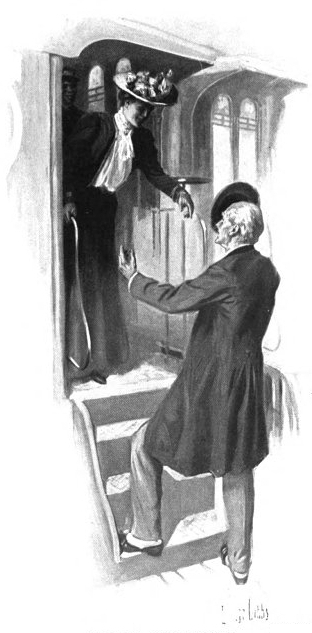
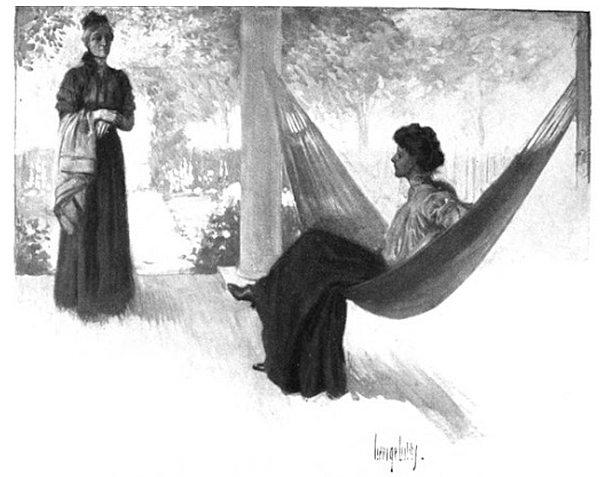
Great-Aunt Sarah reached Auburn the next
day. No telegram had heralded the hour of
her coming, and consequently there was no
one at the station to meet her on arrival. At
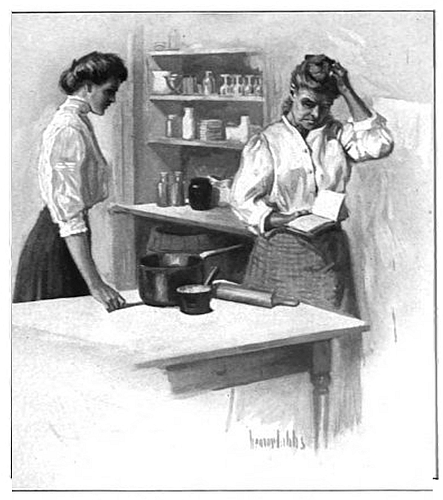
noon on Friday, while Barbara was convincing
the Vegetable Man’s daughter that steak
should be broiled instead of fried, a carriage
rolled up to the door. Peanuts Barker, still in
Banker Willowby’s top hat, deposited a trunk
on the front walk, and a stout lady, with two
methodical puffs of shiny black hair in under
her bonnet, and three small boys dismounted.
At the sound of the wheels there was a general
scattering of the clan. Gassy, whose hatred
for Aunt Sarah was general, and for the boys
specific, retired to the coal-cellar, David hurried
to put his dear books out of reach of
marauding hands, and Jack meanly abandoned
the scene of action for an upstairs window.
Barbara and the Kid were the only
members of the family to greet the guests.
“How do you do, my dears?” said Aunt
Sarah, majestically. “I was surprised to find
no one at the station when I arrived. I am not
accustomed to the care of my own baggage.
Barbara, how sallow you are! Don’t set my
trunk down there, sir; my fee to you includes
payment for carrying it upstairs. Archie, let
the dressing-case alone; I don’t want to have
to speak to you about it again! I suppose
I am to have the east room, as usual. I hope
the morning light won’t wake me up at day-break.”
“The same old Great Sahara!” whispered
Jack, appearing in the hall to shoulder the
luggage. “Age cannot wither, or custom stale
her infinite arrive-ity. If I should hear that
voice in the heart of the Hartz Mountains, I
should say, ’Tis she! ’Tis she!”
It was true that the three years that had
passed since aunt and niece had met had done
little to change Aunt Sarah. At the table that
noon, Barbara, who had sacrificed her vegetarian
theories to the comfort of her visitors,
hospitably inquired about the result:—
“How is your steak, Aunt Sarah?”
Mrs. Bossall plied her knife vigorously for
a moment, then replied to her niece’s question
with a single word:—
“Tough!”
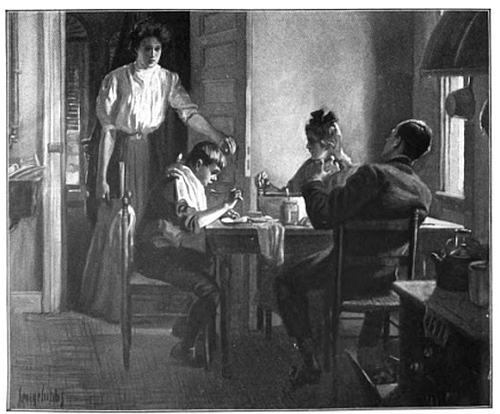
Barbara’s housekeeping, Jack’s idleness,
Gassy’s disposition, David’s dreaminess, and
the Kid’s table-manners were all criticised
with impartiality. Even the Vegetable Man’s
daughter was not spared.
“If that girl were working for me, she
wouldn’t sit up with her young man until half-past
ten o’clock,” she announced, on the second
morning after her arrival.
She commented on the hardness of her bed,
the crack in her window, the quality of her
food; Barbara’s theories, the doctor’s weakness
for charity cases, the lack of economy in the
household, and the extravagance of sanitarium
life, all came in for her condemnation.
Barbara’s temper was held by a single airy
thread, that threatened daily to snap, and was
kept in place only by exertion of much will-power,
and the comforting thought that Aunt
Sarah’s visit could not last forever.
“Edward’s children” had inherited some of
the most striking of their grandmother’s characteristics.
Moreover, added to her aggressiveness
and her domineering qualities, they possessed
a fertility of resource and an ingenuity
for mischief that filled the Kid with envy, Barbara
with horror, and Jack with amusement.
“They have imbibed some of their beloved
grandmother’s theories,” said Jack to Barbara,
on the third day of the visit. “Talk about the
‘New Thought’! Those kids have more new
and original thoughts in ten seconds than her
whole sect has in ten years. What idea do
you suppose they conceived this morning? I
came up the back walk in time to see a bundle
of white linen dangling in the air at the barn
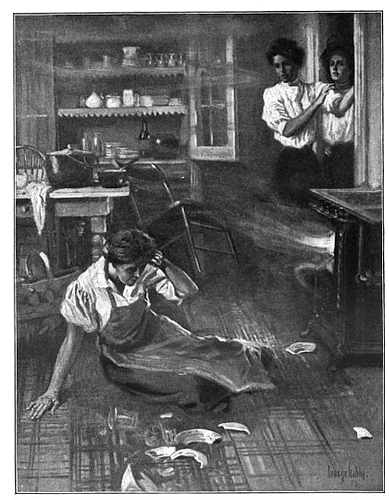
window. Those little fiends were up in the loft
working the hay pulley, and hanging from
the rope below was the youngest Wemott
baby, the hook of the rope caught through
the band of its little apron. There was only
a button between that infant and eternity
when I rescued it.”
“They are the worst children I ever saw,”
said Barbara. “Cecilia is hard to manage, but
she is as nothing compared with the Bossall
boys. You can’t appeal to their better natures,
for there is nothing there to appeal to. And
as for punishing them, I don’t believe that they
are afraid of anything in this whole world.”
“Except Gassy,” suggested Jack.
“Yes, they seem to hold her in wholesome
respect I can’t understand the cause of their
consideration for her, unless it is fear. Cecilia
isn’t mighty in the flesh, but her tongue is a
power.”
The reason for this respect came to light
the next day. It was fear: but fear of something
besides Gassy’s tongue. Before daylight,
Aunt Sarah creaked her way up the
attic stairs to the little, hot room in which
Barbara had slept since the arrival of the
guests. Aunt Sarah was addicted to black
silk nightgowns, and the long, dark robe, a
lighted candle, and curling-pins, rolled so
tightly that they lifted her eyebrows, gave her
a decidedly Lady Macbethian appearance.
“Are you awake, Barbara?” she inquired,
in an angry stage whisper.
By that time Barbara could truthfully answer
that she was. “What is it?” she asked.
“I’m sorry to disturb you,” said Aunt
Sarah, in a voice that betokened anything but
regret. “But I am in such a state of mind that
even New Thought fails to calm me. I was
never so insulted in my life as by the treatment
that has been accorded me and mine
while in my own niece’s home.”
“What do you mean, Aunt Sarah?” cried
Barbara, now thoroughly aroused.
“I mean just this: Cecilia has been according
Edward’s children a system of torture
that has nearly robbed them of their sanity.”
Even in her worry and bewilderment, a
wicked thought, reflecting upon the present
mental condition of Edward’s children flashed
through Barbara’s mind. But she checked the
desire to give utterance to it.
Aunt Sarah set down the candle, and faced
Barbara severely. “I was aroused from sleep
a few moments ago by a noise in the next
room,” she said. “It sounded like a scream
from Archie, and I sat up in bed and listened.
I heard a deep voice in the children’s room,
saying, ‘I am the Holy Ghost,’ and other
irreverent things which I cannot, at this moment,
recall. I knew that no burglar would stop
for that announcement, so I quietly opened the
door and looked in. A figure in a sheet was
standing between the two beds, with arms
outstretched over the two boys.”
“What!” exclaimed Barbara.
“It was Cecilia, of course,” continued Aunt
Sarah. “The dear little lads were speechless
with fright and horror, and that bad child was
claiming to be the Holy Ghost, and threatening
all sorts of terrible things to them if they
tore David’s books again. I sent her back to
bed at once, and tried to reassure the boys,
but they were in a sad state of terror. They
tell me that this has gone on from night to
night. They know, of course, that it is Cecilia,
but they are timid by nature, and they have
been in a pitiable frame of mind. I have noticed,
ever since our arrival, that they have
been slightly unmanageable, and this explains
it all; New Thought cannot work against a
supernatural fear. Now, the question is, what
are you going to do with Gassy?”
Wicked Barbara suppressed a chuckle as
she debated. “Well, I think I’ll let her sleep
till morning, Aunt Sarah,” she said aloud,
soberly. “Then I’ll see what I can do with
her. It was very wrong of her, of course,
and I’m sorry that you and the boys have
been put to so much distress. It isn’t like
Cecilia to be cruel.”
“It is exactly what I should expect of her,”
was the sharp reply. “Cecilia I like the least
of any of my niece’s children. She is naturally
an inhuman sort of child, without the slightest
trace of affection for any one; and then she
has always been allowed to have her own way,
until she is most unmanageable. Elizabeth
and your father have spoiled all of their children,
but the result is most obvious in Cecilia.
She ought to be severely dealt with for a trick
of this kind. Reverence, if not simple humanity,
should have deterred her. But none of
you children seem to have any reverence for
anything. I think I shall speak to Cecilia,
myself, this morning.”
“Oh, please don’t, Aunt Sarah,” exclaimed
Barbara, impulsively. “You know how sensitive
Cecilia is, and how hard to handle!
I think that if I talk to her first, I can make
her sorry for frightening the boys. But she
doesn’t li—”
Aunt Sarah took up her candle with as
much dignity as it is possible to assume in curling-pins.
“I understand that Cecilia doesn’t
like me,” she said stiffly, “and I assure you
that the feeling is mutual. I shall not speak
to her, of course, if you prefer that I shall hold
no communication with her. But I shall write
your mother a full account of the whole affair
as soon as I leave, which will be this morning,
if possible. I must say, Barbara, that I never
expected that you would condone wrongdoing,
even in your own household. I shall
telephone for an expressman to take my trunk
to the station at ten this morning. If there was
ever a home and a family where New Thought
is needed, this is the one!”
Aunt Sarah was as good as her word. During
the entire breakfast hour, she deigned not
so much as a glance at her guilty great-niece.
Upon her departure, she ostentatiously kissed
every other member of the family, including
Jack, who presented a cheek gingerly for the
salute. Barbara accompanied her to the station,
but she was not to be mollified, and
the farewell was enlivened only by Edward’s
boys, whose parting act was to open a coop
of chickens in the Auburn baggage-room, and
give the fowls their freedom. Barbara, as well
as the station-master, heaved a sigh of relief
as her relatives boarded the train.
Upon her return to the disorderly home,
the big sister sought out the little one. It was
hard to find fault with the punishment that had
been meted out to Edward’s boys, but it must
be done. Barbara took the small girl on her lap.
“Why did you do it, Chicken?” she asked.
Gassy’s lips set in a decided line. “Because
they deserved it,” she said. “I ain’t one bit
sorry, Barbara Grafton, not one single bit!
Those are the meanest, sneakiest boys that
ever lived! They didn’t dare torment Jack,—he
was too big; they were afraid of me because
I could beat them running. So they took it
all out on David and the Kid, ’specially David.
He ain’t strong enough to fight, and, besides,
he’s too gentle; and they knew it, and took
advantage of it all the time. First they used
to hit him, and tease him, but he’d never answer
back,—just look at them kind of sad
and slow, like Mary, Queen of Scots, on the
scaffold. And that spoiled all their fun; the
scratch-back kind are the only ones who are
ever really teased, you know.”
Barbara put this bit of philosophy away for
future reference.
“But after awhile,” the child continued,
“they found out that it hurt him lots worse
to meddle with his books, so they did that,
just to worry him. You know how he loves
that King Arthur book of his! Yesterday they
cut out every single picture in it with their
jackknives,—just hacked it all up! You can’t
hurt those boys,—they’re too tough; but
they’re awful ’fraid-cats, and you can scare
’em easy. So I just put on a sheet, and went
in and warned ’em that they dasn’t touch
David’s books again. He cries every time
they do, and that makes his hay fever worse.”
“But, dear,” Barbara said quietly, “it
wasn’t nice to do it. They were in your own
house, you know—”
“We didn’t invite them,” interrupted
Gassy.
“And, besides, you must never scare people.
It’s a very dangerous thing to do. If they had
been frightened into brain fever, you would
never forgive yourself. And one thing more,
dear, I don’t like your calling yourself the
Holy Ghost.”
“That was because my sheet was torn.
The hole-y ghost, you know.”
“I know, but it isn’t a reverent thing to
say.”
“But, Barbara, it doesn’t seem wicked to
me to say that. I never could even imagine
the Holy Ghost. It just seems like words, and
nothing else. Every time I go to church they
talk about the Holy Ghost, and the Spirit,
and the Life Infinite, and I can’t understand
’em. Even Jehovah sounds awful big and far
off. But when they say Jesus,—Baby Jesus,
I mean, or Little Boy Jesus, or Man Jesus,—that
is easy and sweet. I always like best to
think of Him that way; not like a God, so far
off, and with so many things to manage, that
it’s hard to believe that He cares, but like
a man, that made mistakes, and had to try
over again.”
“Yes,” said Barbara, understandingly.
“I like to think,” went on Gassy, “that He
did just the same things that we do, and loved
the same things, and wanted the same things.
It wouldn’t help me any to have Him be glad
to die and go up in a chariot of fire, with
people hollering, like Elijah did. But it does
help me to know that He wanted to live, just
like I do, and cried about leaving everything,
at first, and then was big and brave enough
to stand it. You know I wouldn’t be irreverent
about Him, Barbara!”
“No, and it would hurt you to have any one
else irreverent about Him. And that is why I
don’t like to have you say what you did about
the Holy Ghost; you may hurt some one else.”
“Well, I won’t do it again; that is, I won’t
be irreverent,” promised Gassy. “But about
scaring them, Barbara Grafton, you mustn’t
try to make me be sorry about that, for I’d be
telling a lie if I said I was. They deserved it,
and there wasn’t any other way of making
them let David alone. I’m glad I frightened
some of the bad out of them.”
And with this Barbara was forced to be
satisfied.
The path was straightened for Barbara after
the departure of her guests. The Vegetable
Man’s daughter was incompetent, but she was
good-natured and cheerful. Her shrill soprano
voice rose at all hours of the day in the request
to be waltzed around again, Willie,
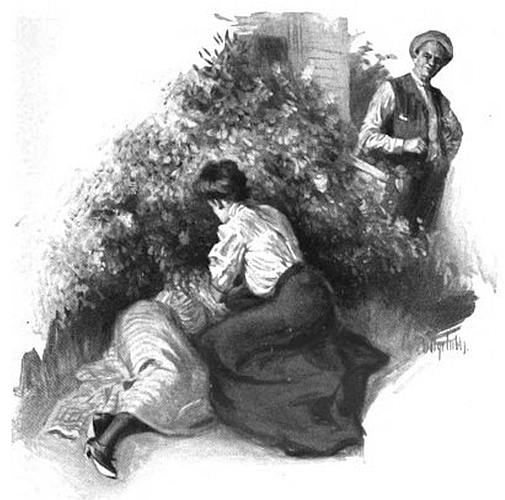
around, and around, and around. Her “Steady
Company” made regular calls at the kitchen
every evening that he was off his run, and sat
on the back porch, with his feet on the railing
and his pipe in his mouth, scarcely uttering
a word during the call. The Vegetable Man’s
daughter proved to be a fluent conversationalist,
and judging from the scraps of sound that
floated around to the front porch, now and
then, the evening visits seemed to consist of
monologue, sandwiched in between a kiss of
greeting and one of parting. Promptly at half-past
ten the Steady Company would withdraw,
and the Vegetable Man’s daughter would
renew her request to be waltzed around again,
Willie, all the way up the back stairs.
Perhaps it was the thought of her absent
lover that prevented her success as a cook, for
it was certain that the day after one of his
calls the bread was apt to be unsalted, the
napkins forgotten, and the milk left to sour.
But she was strong and willing, patient with
Barbara’s theories, and fond of the children.
Something of the old-time comfort returned
to the house, and Barbara found time to mingle
with the young people of Auburn, and to
enjoy the first youthful companionship she
had had since her return from college. On
some of these occasions she met Susan, who
greeted her with a stiff smile, in which wistfulness
was scarcely hidden. There was nothing
of regret in Barbara’s cool nod. Susan was
not as necessary to her as she was to Susan,
and in the popularity which came to her as
readily with the young people at home as at
school, she easily forgot the quiet girl on the
outskirts of the jolly crowd.
Gayeties began to thicken upon the approach
of school-days, and Barbara took active
part in all of them. In the relief about her
mother’s condition, all serious thoughts took
wing, and Barbara played the butterfly with
light heart. “The Infinite of the Ego” lay untouched
in a pigeon-hole of her desk, and she
felt no inclination to write anything heavier
than the semi-weekly letters that merrily told
the life at home to her mother. The taste of
play-time was very sweet after the hard summer;
and tennis and boating and driving filled
the days of early autumn to the brim.
But the recess was of short duration. Barbara,
coming in from an afternoon tea, was
met in the hall by the Vegetable Man’s daughter.
“I’ve something to tell you, Miss Barbara,”
she said.
“What is it, Libbie? Are we out of eggs?
I remembered, after I had gone, that I had
forgotten to order more.”
“No’m, it ain’t eggs; it’s me. We eloped
this afternoon.”
“What!”
“Yes’m; me and my Steady Company. He
got off his run this afternoon, and we thought
we might as well do it now and be done
with it.”
“So you’re married?”
“Yes’m; we went to the justice’s office.
They said it was the prettiest wedding that
had been there in a month. I wore my white
shoes, and I flush up so when I get excited.”
“But how did you elope? Didn’t your family
ever know that you were going to be
married?”
“Oh, yes, they knew that for two months
already, but we didn’t say nothing to them
about this. We wanted a piece in the paper
about it, and they always write it up when a
couple elope. So we told the justice we was
running away, and we wanted it wrote up,
and he said he’d see to it. Besides, we didn’t
have time to let ’em know, out home; we just
decided it ourselves this afternoon.”
“Well, I hope you’ll be happy, Libbie,”
Barbara recovered herself enough to say. “I
suppose this means that I shall lose you?”
“Yes’m. I’m just back for my clothes.
We’re going out to his mother’s to-night.
She’s got the harvesters at her house this
week, and will want me to come out and help
her cook for them. After that, we’re going to
housekeeping in town.”
“Aren’t you going to have any wedding-trip?”
“We had it already. We took the trolley-car
out to the cemetery after the wedding, and set
there two good hours, till it was time to come
in and get supper. I knew you wouldn’t get
home in time. I’m sorry to leave you this way,
without warning, Miss Barbara, but it can’t
be helped. That’s what an elopement is.”
Barbara’s pretty reception gown was laid
aside for a shirt-waist and skirt and a kitchen
apron. And as she and Gassy “cleared up”
the dishes, the Vegetable Man’s daughter
and her Steady Company passed away in a
cloud of romance and tobacco smoke.