“Where’ve you been?” demanded the factory
umpire instantly.
“I’ve been asleep in the tent,” responded
Connie, smiling.
“How long?” continued his questioner.
“’Bout an hour and a half!”
“Have you been out of bounds?” broke in
Professor Souter.
“No, sir. I’ve never been over a few hundred
yards from this spot.”
“Then you must have disguised yourself,”
suggested the third umpire.
“No, sir—I did not. Ever’thing has been
fair an’ square.”
“Then I think it’s up to you to tell us how
you passed through this crowd without anyone
seeing you,” exclaimed Mr. Chase of the table
factory skeptically.
“I didn’t go through the crowd,” laughed
Connie provokingly. “I went under it.”
“Alexander!” exclaimed Mr. Conyers,
“make a report to the committee at once of
where you have been.”
“Very simple,” began Connie. “As we
planned, the boys covered me with a heap of cut
thistles only a few hundred yards up the road,
around the bend. We did it because I calculated
all the fellows chasing us would start out
on the run and not look around very much just
next to the camp.”
“I looked in that pile of thistles,” protested
Carrots Compton. “You wasn’t so smart.”
“You were too late,” went on Connie.
“You see, I was the first one hid, and I had
almost a half hour leeway. It was pretty hot
and prickly under the thistles, and I didn’t
know if I could stand it. Then while I was
movin’ around tryin’ to make a sort of nest,
all of a sudden I felt a kind of draft. It was so
strong I knew I was near a hole of some kind—and
that’s what I was. Just back of where
I was lyin’ there was a cave-in in the ground.
Some one had laid a few rails acrost it, and
then the thistles was piled on there—to keep
the stock out, I guess.”
“I seen that hole,” interrupted Carrots.
“There wasn’t nothin’ in it but some rails an’
weeds.”
“That was later,” laughed Connie. “The
hole was a break in the big three-foot cement
tile. When I felt the wind suckin’ in there I
knew it was empty, and I could see it was dry.
I knew it ran right along the road by the camp
an’ ended by the river bank. I took a chance
and dropped down into it. Then to make it
look as if no one could have done it, I pulled in
the rails an’ thistles an’ started for the river.”
“In the ditch tile?” asked Mr. Trevor
alarmed.
“Sure!” answered Connie. “It was dark
for a long time, and there was things there—something
like a water rat I reckon it was, kept
runnin’ ahead o’ me. An’ I think there was a
snake or two—judgin’ by the sounds—but
it didn’t bother me. I could see daylight after
a long crawl, an’ then I felt better, ’cause it
got cooler. Once some one looked in the open
end o’ the drain, but I laid flat an’ still. An’
when I got to the river there wasn’t anyone in
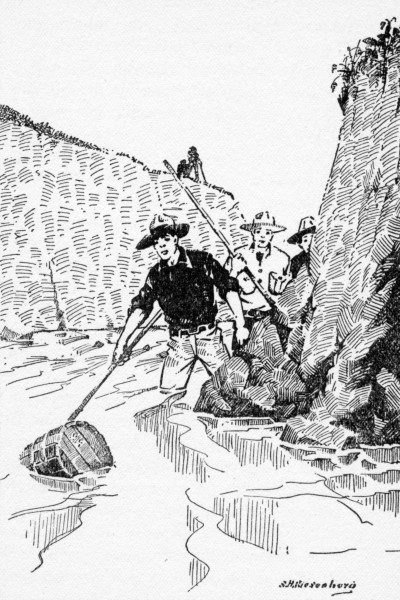
sight. I crawled out an’ snook along under
the high bank about twenty-five feet an’
crawled up into the tent from the back. So’s
to be sure no one would look in an’ see me I
crawled under some bedclothes an’ then I went
to sleep. That’s all.”
Mr. Chase attempted, for a moment, to make
a point that Art, Connie and Colly Craighead
had gone out of bounds by crossing the river
line. But the umpires rejected his contention
as the conditions clearly specified “beyond the
river” and not “in it or on it.” When the
list was checked up, all names and numbers
were found to agree with the umpires’ list and
the Coyotes were officially credited with having
found eight of the ten Wolf “hide outs.”
Then followed the luncheon hour. Every
shady tree seemed to have its group of picnickers
busy with fried chicken, jelly cake, potato
salad, pickles and like refreshments. The
Coyotes were guests of the Wolves at a special
spread. Everyone ate hurriedly, for the real
struggle was yet to come. The Wolves knew
what they had to do to win and, figuratively,
they pawed the ground eager for the start.
Sharp at one o’clock the ten Coyotes marched
out on the road with the committee. At one
thirty the straining Wolves were turned loose.
But, to the surprise of the spectators, the
Wolves trotted down the road only beyond the
crowd. There they came to a stop and each
scout could be seen attaching a large white flag
to his staff—all except Art Trevor and Willie
Bonner who did not even carry staffs. Then,
Leader Conyers was observed to take from his
pocket a roll of paper and trace his finger over
it as if giving certain directions.
This done, Connie and seven other boys
separated and spreading out like the sticks of
a fan, took to their heels. There was an advance
to right and left over fences, several
scouts started straight down the road, and two
boys set out up and down the river. Art and
Willie Bonner waited until their mates had begun
to disappear and then they turned and ran
back to the camp.
The astonished spectators gazed at them
without comment. The two Wolves silently
trotted into the camp and then toward the
bridge in the rear. It was not until the bridge
began to rattle under the feet of Art and Bonner
that curiosity found words. At that point
the factory umpire called:
“Here, you fellows! You’re going out of
bounds!”
But the running scouts proceeded without a
pause.
“You’re wrong,” explained Professor Souter.
“The pursuers can go where they please.
It’s the ‘hide outs’ only who must keep within
the district.”
To confirm this, a fact well understood by
Art and his companions, the rules were examined
and Professor Souter was found to be
right.
“I hope they ain’t givin’ up,” laughed the
factory owner. “A real sport sticks, win or
lose.”
“I think they’ll be back,” spoke up Mr.
Trevor, who seemed to be the only person not
mystified. “Meanwhile,” he added addressing
the hundreds present, “I have been told
by the Wolves that you need expect no bulletins
from the field until the enemy has been
located.”
Between the wonder over the apparent retreat
of two of the Wolves, and some disappointment
over this news—which made it
plain that they must have a system and meant
to give all their time to the search instead of
running in to report each man found—the
crowd gradually melted away among the trees.
A few minutes after two o’clock a man lying
in the grass suddenly sprang up with a shout
and wildly waving arms. As he plunged toward
the open, dusty road a wave of picnickers
joined him.
“An aeroplane!” rose in a chorus. “A
flyin’ machine!”
High above the road leading back to town,
a brown expanse of canvas was gliding through
the air toward the iron bridge as swiftly and
steadily as a hawk with its eye fixed on a field
mouse below. The whirr of two glistening propellers
ran before the object. On its lower
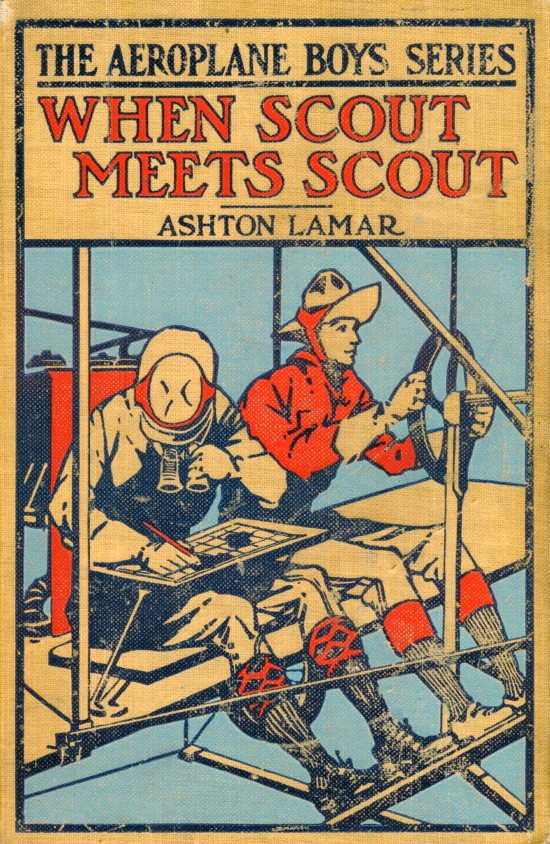
frame sat two boys. One of them with a small
object in his lap, was holding a pair of field
glasses on the gaping crowd. The other, with
his hands upon the levers, was holding the
machine on a course directly over the road.
“It’s Trevor and that circus boy!” yelled
some one. And almost before the crowd could
get on the road, Willie Bonner’s resurrected
aeroplane slid over the camp and, with an upward
dart, was beyond the gaping crowd.
“Nothin’ doin’!” yelled an excited man,
Mr. Chase. “They can’t put that over on our
boys. This ain’t a circus. The rules say:
‘No outside help.’ That’s outside help. Rule
’em out.”
The umpires, puzzled, looked at each other.
Then adherents of the two patrols crowded
about the committee, shouting, protesting or
denying charges. Bonner had banked and
headed his aeroplane down the river and was
out of sight before a decision was reached.
But in the end, even the Coyotes’ umpire had
to agree that the use of the aeroplane was
within the rules, as it belonged to the Wolves
and was operated by them.
Those in the camp who first saw the aeroplane
shooting across the river, at once connected
it with the two boys who had disappeared
in that direction. But the concealed
Coyotes had no such suggestion to help them
in identifying the occupants of the aeroplane.
This was as the Wolves had hoped and expected.
“Now,” began Bonner as the aeroplane
headed down the river, “get ready. I’ll cover
every foot of the district. Watch your chart
and use your glasses. I reckon those who are
inside of anything’ll pop out to see what’s
doin’.”
“It’s a cinch,” chuckled Art. “They ain’t
one of ’em knows about the machine. Just keep
high enough so they can’t make out our faces,
an’ I’ll do the rest with the glasses.”
“An’ them we miss, the other boys ought
to get.”
The first results amply proved that the boys’
theory was a good one. Near the County Fair
road, in the southwest corner of the district,
a small, scum-covered cow pond stood in a low
pasture. Art, using his glass, made out a Wolf
running from the pond, which he had evidently
examined with no result. As Art kept his glass
on the opaque green pool, the aeroplane made
a circling sweep. When it was about to pass
over the water, a slime-coated boy, dripping
water and mud, scrambled up out of the center
of the pond, his face upturned, his eyes staring
and his mouth open.
“Number nine,” exclaimed Art. After another
squint with the glass he added jubilantly:
“Joe Andrews. He just had his nose out.”
While the aeroplane swung to the end of
the district, Art jotted the name and number
on his chart. Bonner’s machine was not a varnished,
silk-winged aeroplane. The new white
linen sections on the old, soiled and oily planes
were even grotesque. But it was built on scientific
principles, light and stout, carried a
four-cylinder, twenty horse power motor that
was working as well as it did before the accident
at the circus. The principal expense in
the rebuilding of the flying machine had been
the cost of a new magneto. Other needed material
had been secured in Scottsville.
“Now,” suggested the jubilant young aviator,
“we’ll take a turn about the whole district
and look wherever it seems unlikely anyone
would hide.”
The circuit required less than twelve minutes,
and the aeroplane passed the camp again.
Not a Coyote was seen but the Wolves were
picked out, scattered here and there, by their
white staff flags. Turning westward at the
camp road, the aeroplane headed directly
across the “hide out” district. Art kept his
glass busy, but no Coyote head rewarded him.
“That looks like about the last place anyone
would hide,” suggested Art pointing directly
ahead. “Let’s try it.”
He referred to a broad wheat field which
spread over the top of a low hill. The crop
had been cut and threshed, and a large part of
the field had been newly plowed. The plowed
part covered the crest of the rolling field and
was apparently devoid of all life except blackbirds.
A white-flagged Wolf could be seen in
the distance cutting across a corner of the
plowed slope.
The aeroplane pilot gripped his levers anew
and the machine rolled upward on the air billows,
while Art’s nerves tingled with the joy
of the chase.
“Make a swing and come back!” he suddenly
exclaimed. “There’s something in a
furrow. It’s one of ’em!”
Without looking, Bonner made a wide swing
and turned over the brow of the rise.
“It is!” almost shouted Art. “It’s one
of ’em! But he’s on his side. I can’t make
out his number. You couldn’t see him twenty
yards away.” He turned and twisted to keep
his glasses on the half buried figure. “He
saw us. He’s on. He ain’t moved an inch.
Try again.”
Twice more the sputtering aeroplane circled
over the lifeless looking figure, each time flying
lower.
“I’m sure it’s Nick Apthorp,” whispered
Art, “but I can’t get his number.”
“Well,” replied Bonner, “we’d better give
some one the tip.”
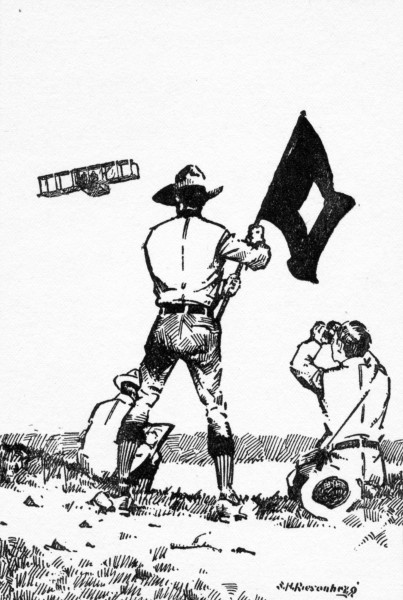
Three white staffs were in sight. Bonner
headed the dipping aeroplane toward the nearest
one. When it was seen that the aeroplane
spies had caught the watching Wolf’s eye, Art
waved his hat. The Wolf with the flag, Colly
Craighead, responded by dipping his pennant
and then, as the hawk-like aeroplane banked
again and mounted skyward over the higher
field, Colly set out on a dead run.
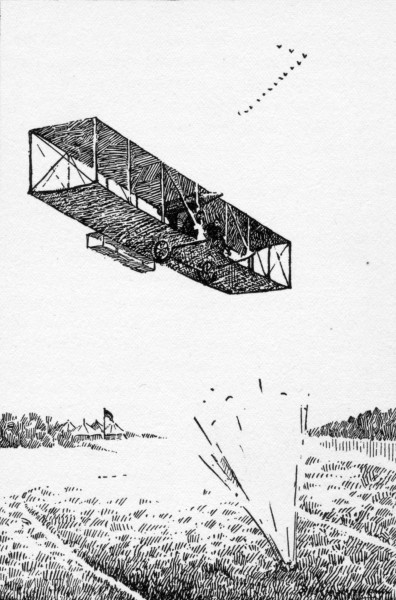
When the motionless figure came in sight
again Art crouched low in his seat. Directly
above the silent figure Art’s arm shot out and
a small bag dropped swiftly to the plowed
ground beneath. A cloud of white arose and,
ten feet from the concealed Coyote, the rich
black soil glared out in a spot of snow white
flour.
“He sees it,” shouted Art. “Colly’s got
his measure all right. I guess we’ve nailed
two hard ones, anyway.”
Just at this moment young Bonner noticed
that the oil gauge was empty. With a reassuring
word to allay Art’s fears he made a sharp
bank and glide for the hard and smooth Phillipstown
road. While the two boys were bending
low over the engine, about five minutes
later a call sounded from an apple orchard
about a hundred yards away.
“Hey there!” yelled a voice. “Is the
show free?”
Art whirled to see a boy standing in an old
cider barrel and just about to spring out.
“Sure,” yelled Art. “Always free to our
friends.”
At the sound of Art’s voice the struggling
boy turned his glance upward again and then
thrust his body back into the tight-fitting
barrel.
“Who was it?” asked Bonner still busy
with the engine.
“Mart Clare, number three,” chuckled Art
as he made another note on his chart. “Betrayed
by his curiosity.”
Mart apparently did not realize that he was
out of the running, for he kept to his stuffy
hiding place while the feed pipe was readjusted
and the two spies had made a new ascent. It
was then three o’clock.
“It’s time to round up,” announced Bonner.
“The boys’ll be lookin’ for us.”
Again the stout little airship began to circle
the “hide out” territory. With his field
glasses Art could make out white flags in all directions.
Carrying out a prearranged plan,
Bonner headed the aeroplane from one sentinel-like
Wolf to the next one. As the first one
was passed he reversed his staff and held its
head on the ground. A look of disappointment
passed over the face of each boy in the aeroplane
and Art made a check on the chart in
his lap. It was Sammy Addington’s report—a
blank.
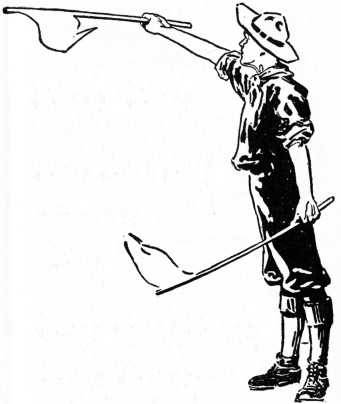
The next Wolf the aeroplane picked up held
his staff out like a semaphore and then moved
it up and down four times.
“That’s better!” exclaimed Art. “I wonder
who number four is.”
Flitting over the fields, forests and roads beneath,
the “Scouts of the Air” were soon signalled
by Colly Craighead who confirmed his
discovery of the Coyote in the hill furrow by
eight movements of his flag. Then, in turn,
came a Wolf who they saw was Davy Cooke,
who announced he had seen number two; Paul
Corbett reported number four sighted and then
while Art was busy checking this information,
Bonner caught an extra message of one flash.
“I wonder if he means he saw number five,
or number four and number one!” exclaimed
Art, in doubt what to put down. “We already
have number four.”
The next searcher to communicate with the
aeroplane answered this; Phil Abercrombie
flashed five times.
“Great!” shouted the aviator. “Only one
blank so far. There’s Connie,” he added.
“Bully for you, old man! He’s got number
ten. That ought to be lucky.”
For some minutes no other Wolves could be
made out. Bonner took another flight south
and returned to find two white flags coming
out into the main road from a lane. They
were some distance away and Art was not sure
but that they were among those who had already
reported. As he trained his glasses on them
they waved, “six” and “seven.” There was
a quick check of his list by Art and then, with a
yell of victory he tore loose the bow of a string
beneath his seat, and the bright blue Wolf
Patrol pennant dropped fluttering into the
wind.
Every Wolf Scout within sight of the flag
knew what it meant. At the first sight of the
banner the Wolf call came from far and near.
Eight widely scattered Wolf Scouts threshed
the air with white pennants, and at twenty minutes
after three o’clock, like the closing sticks
of a fan, the Wolf searchers—led by the fluttering
flag on the aeroplane above—were converging
on the distant camp.
There was no quibble about the victory.
When the Coyote Scouts reached camp, Hank
Milleson was quick to shake the winners by the
hand. “We got our trimmin’s,” he exclaimed
with a laugh. “But we got ’em fair an’
square. I reckon a few brains are as good as
a bunch o’ muscle.”
“No hard feelin’s?” smiled Connie.
“Not on your life,” answered Hank. “You
deserve it, an’ we got to hand it to you—even
if we did lose our hundred dollars. Mebbe it’s
worth that to find out a thing or two.”
“Cut out the hot air,” broke in Art with
a grin. “We got a lot to do yet. We got
somethin’ up our sleeve for you kids yet if
you’re with us.”
“Ain’t goin’ to rub it in, are you?” asked
Hank with mock seriousness.
“Listen,” explained Art with the eagerness
of long pent-up enthusiasm. “You know the
big meadow up at Cloverdale?”
The Coyotes nodded their heads.
“Well, we got the shape of a big man-o’-war
marked out with whitewash, out in the middle
of it. Bonner’s goin’ to take the flyin’ machine
right up there an’ we’re goin’ to have a new
game.”
Blank looks showed on every face.
“We’re goin’ to throw bombs o’ paper bags
full o’ flour at a big target on the man-o’-war—”
“Who?” came in chorus. “From the aeroplane?”
“Ever’ one of us! Coyotes an’ Wolves!
We’re goin’ to draw lots. Ever’ kid gets a ride
on the aeroplane an’ three trials.”
While every Coyote stood open-mouthed—lost
in the wild wave of joy that so suddenly
engulfed him—Mr. Trevor stepped forward.
“And when it’s too dark to throw any more
bombs, the Cloverdale Farm invites every scout
here to a last contest of the day—a test to see
if each of you can eat a whole smothered
chicken and a quart of ice cream.”
“Boys,” exclaimed Hank Milleson when he
finally regained some composure, “there ain’t
but one thing to it: Three cheers for the Boy
Scouts of the Air!”
These had not yet died away when Carrots
Compton added:
“An’ the Aeroplane Spy!”
As Carrots gave Art Trevor a big boy-slap
on the back, the table-factory owner turned and
walked to his automobile with a snort of disgust.
The
Boy Scouts
of the Air Books
By GORDON STUART
Are stirring stories of adventure
in which real boys, clean-cut
and wide-awake, do the
things other wide-awake boys
like to read about.
Four titles,
per volume,
60 cents
- THE BOY SCOUTS OF THE AIR AT EAGLE CAMP
- THE BOY SCOUTS OF THE AIR AT GREENWOOD SCHOOL
- THE BOY SCOUTS OF THE AIR IN INDIAN LAND
- THE BOY SCOUTS OF THE AIR IN NORTHERN WILDS
Splendid Illustrations by Norman Hall
Publishers The Reilly & Britton Co. Chicago
The
Boys’
Big
Game
Series
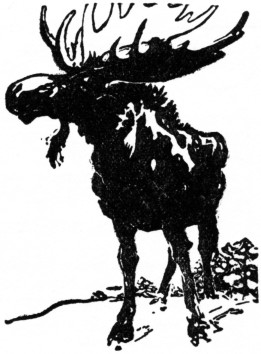
THE GIANT MOOSE. The monarch of the big Northwest; a story told
over camp fires in the reek of cedar smoke and the silence of the barrens.
THE WHITE TIGER OF NEPAL. The weird story of the man-killer
of the foothills. Tinged with the mysticism of India, dramatic and stirring.
THE BLIND LION OF THE CONGO. A story of the least
known part of the earth and its most feared beast. A gripping tale of the
land of the white pigmies.
THE KING BEAR OF KADIAK ISLAND. A tale of the
bully of the Frozen North and his mysterious guardian. A game-and-man-story
that makes a good boy-story.
The topnotch of production in boys’ books. Remarkable
covers and four-color jackets. Illustrations and
cover designs by Dan Sayre Grosbeck.
Price, 60 cents each
The REILLY & BRITTON CO.
PUBLISHERS, CHICAGO
Transcriber’s Notes:
Except for the frontispiece, illustrations have been moved to
follow the text that they illustrate, so the page number of the
illustration may not match the page number in the List of
Illustrations.
Punctuation and spelling inaccuracies were silently corrected.
Archaic and variable spelling has been preserved.
Variations in hyphenation and compound words have been preserved.
The price list for the Scout uniforms on p. 142 does not equal
the total listed. Total retained as printed.