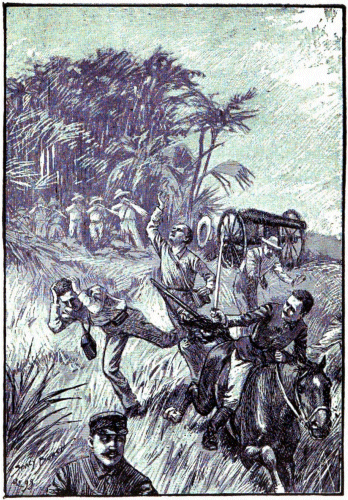
CAST INTO A SANTIAGO DUNGEON.
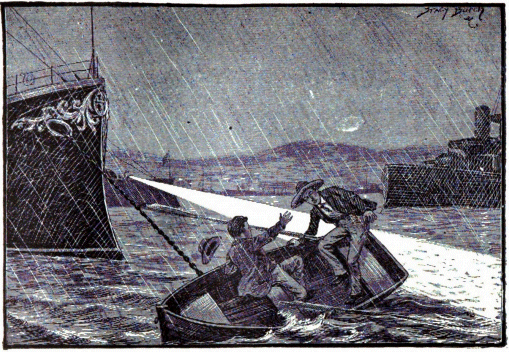
“Those fellows evidently mean business,”
whispered Mr. Raymond, as an angry discussion
drifted down to us. “Is it possible they
got wind that we are on board?”
“Let us hope not,” shuddered my father.
“Hist! they are coming down into the cabin!”
After this we remained as quiet as mice,
hardly daring to breathe. We heard loud talking,
partly in Spanish and a few words in very
bad English. “I know they are here,” growled
one Spaniard. “We shall make a large hunt,
capitan.”
“If you insist, I cannot help myself,” answered
Captain Brownley. “But it is a most
unusual proceeding.”
At this the Spaniard muttered something in
his own language. He began to hunt in one direction,
while his followers hunted in another.
Soon two of the men came to the pantry and
forced the door. We tried to escape observation,
but could not manage it, and were ordered
forth at the point of several long pistols.
“Ha! as I suspected! All Americanos!”
muttered the Spanish commander of the revenue
cutter. “A fine haul! A fine haul, indeed!”
Then turning to his second in command he
issued orders that some irons be brought on
board. At the same time a dozen Spanish marines
from the cutter were formed in line, with
loaded carbines, to cover the crew of the Rosemary.
“I place all of you under arrest,” said the
Spanish captain. “You”—pointing to my
father, Burnham, Mr. Raymond, and myself—“as
spies; and you and your men”—this to
Captain Brownley—“as enemies of Spain, assisting
these spies to escape.”
In vain Captain Brownley tried to argue the
matter. The Spanish commander would not
listen to a word. “The Yankee pigs have declared
war on us!” he burst out at last. “Now
let them take care of themselves.”
“Then war is really declared?” came from
several of us simultaneously.
“Yes, war has been declared. More than
that, we have already whipped the Yankee pigs
who dared to attack our noble ships in the Philippines,”
said the Spaniard bombastically.
But, as all American boys know, the Spaniard
was mistaken. The American squadron under
Commodore, afterward Admiral, George Dewey,
was not defeated. Instead, it gained a most
glorious victory, some of the particulars of
which will be related in a volume to follow this,
of which more later.
The news was staggering, and while we talked
it over among ourselves, each of us was handcuffed,
I being linked to Mr. Raymond, while
my father was linked to Burnham. Captain
Brownley and his first mate were also handcuffed,
and the sailors were told to obey the
Spanish captain’s orders or run the risk of being
shot down.
The announcement that a naval battle had
been fought in the Philippines seemed to worry
Mr. Raymond a good deal. “I wonder if
Oliver knows anything of this?” he half muttered.
“Oliver, who is he?” I asked.
“Oliver is my son,” answered the merchant.
“He took a trip to China a year ago, and from
there went to Manila, the principal city of the
Philippines. I haven’t heard of him for a number
of months now. He is perhaps a year older
than you.”
“I never heard much of the Philippines,” I
answered. “I know they are a good way off—somewhere
between Australia, the Hawaiian
Islands, and China. Do they belong to Spain?”
“Yes, but she is having as much trouble to
hold them as she is having to hold Cuba.”
We were now ordered to keep silent, and
compelled to march from the cabin of the Rosemary
to the deck of the Spanish vessel. Here
we were made to stand in a line, our weapons
having previously been taken from us. The
course of the sailing vessel had been eastward
toward Cape Maysi, but now both craft were
headed westward.
“I’ll wager we are bound for Santiago,” murmured
Burnham, who stood beside me, and he
was right, for in a little over an hour the narrow
entrance to Santiago Bay came into view, with
Morro Castle, a famous old fortress, standing
high upon the rocks to the right.
The bay is several miles long, and Santiago
stands well in on the northeast shore. The
land-locked harbor was alive with vessels, but
not one of them floated the familiar Stars and
Stripes of our own country.
“There is where we made our way across the
bay when first Alano Guerez and I escaped from
Santiago,” I whispered. “I am afraid I’ll not
get another such chance now.”
Soon one of the numerous docks in front of
the city was reached, and we were marched
ashore. The news of our capture had spread,
and a large crowd of curiosity-seekers gathered,
to jeer and pass all sorts of unpleasant remarks.
The city was now under stricter Spanish rule
than ever before, and as we marched from the
dock to the city prison not another American
was to be seen.
At the prison a brief examination was held.
When it was learned that my father was present,
I was thrust aside and told that he could speak
for me. Yet he was allowed to say but little.
The authorities were certain that he, Burnham,
and Mr. Raymond were spies, and the four of us
were sentenced to confinement in another prison
several squares away—a low, dingy pile of stone,
every opening of which was heavily barred and
grated.
Within this prison came the hardest parting
of all. I was separated from my father, and,
when I remonstrated, received a sharp blow on
my shoulder from a jailer’s sword. Mr. Raymond
and I were paired off as before, and conducted
through a long stone passage-way and
down a dirty flight of steps. Sunshine and fresh
air were left behind, and the way was lit up by a
smoky kerosene lamp. We were taken to a
dungeon cell several feet below the sidewalk and
locked in, and then our jailer left us.
I was too overcome to speak when we were
left alone. Mr. Raymond strained his eyes and
peered around at the four bare walls, the bare
ceiling overhead, and the stone flooring with its
water pitcher and heap of musty straw in one
corner.
“This is awful!” he murmured. “Mark,
how long do you think you can stand living in
this place?”
“No longer than I have to!” I cried. “I’ll
get out just as fast as ever I can.”
“If we ever do get out!” he concluded significantly.
The remainder of the day passed slowly. For
supper the jailer brought us some stale bread
and some more water, no fresher than that
already in the pitcher. That night I did not
sleep a wink.
I expected that another examination would
be held the next day, or, at the latest, within a
week; but I was doomed to disappointment.
No one but the jailer came near us, and he only
to bring us our bread and water and occasionally
a stew of ill-flavored meat and potatoes,
reeking with garlic. Of this both of us tried
bits of the potatoes, and sometimes mouthfuls
of the meat, but it was all we could do to choke
them down.
“How long is this to last?” I asked Mr. Raymond
one day, as both of us walked up
and down the narrow cell like two caged animals.
“God alone knows, Mark,” he answered.
“If there is no change soon I shall go mad!”
“It is inhuman!” I went on. “A Christian
would not treat a dog like this.”
“They are very bitter against us Americans,
Mark. Now the United States have declared
war against them, they must realize that Cuban
freedom is assured.”
Another week went on, and then we were
taken up into the prison yard. Here I saw my
father,—thin, pale, and sick,—but I was not permitted
to converse with him. We were placed
in two rows with a hundred other prisoners, and
inspected by General Toral, the military governor
of Santiago and surrounding territory.
After the inspection we went back to our various
dungeon cells; and many weary weeks of
close confinement followed.
One day a curious booming reached our ears,
coming from we knew not where. I heard it
quite plainly, and called Mr. Raymond’s attention
to it.
“It is the discharging of cannon,” he said.
“And it is not a salute either,” he added, as the
booming became more rapid and violent.
It was not until long afterward that I learned
the truth, that a fleet of Spanish warships commanded
by Admiral Cervera had been “bottled
up” in Santiago Bay by our own warships
under Admiral Sampson and Commodore
Schley, and that the Yankee gunners were now
trying what they could do in the way of bombarding
Morro Castle and the ships which lay
hidden from them behind the mountains at the
harbor’s entrance.
The booming of cannon kept up for several
hours and then died away gradually, but a few
days later the bombardment was continued.
We now felt certain that a battle of some sort
was on, and Mr. Raymond questioned the jailer.
“The Yankee pigs will be well whipped,”
growled the fellow, and that was all we could get
out of him.
Again the days lengthened into weeks, and
nothing of importance happened—to us. But
in the outside world great events were taking
place. The entrance to Santiago Bay was
being blockaded by the vessels under Sampson’s
command, and an army of invasion was gathering
at Tampa, Fla., to land on the southeastern
coast of Cuba and attack Santiago from the rear.
The army of invasion, under command of General
Shafter, was sixteen thousand strong, and
left Tampa in between thirty and forty transports.
A landing of the army was effected at Baiquiri
and other points, and here General Shafter
consulted with General Garcia, and it was decided
that about three thousand Cuban troops
should co-operate with the United States forces.
Among the Cuban troops was the company commanded
by Alano’s father; and my chum, let me
add right here, was in the fight from start to
finish.
The Spanish authorities now saw what the
Americans were up to, and without delay Santiago
was fortified from end to end. Every
road leading from the city was barricaded with
logs and earthworks, and barriers of barbed wire
were strung in various directions. Thousands
of Spanish troops had been gathered in the
vicinity, and these were hurried to San Juan
Hill, El Caney, and other points of vantage just
outside of Santiago proper.
As the American forces advanced closer and
closer to the city Admiral Cervera became anxious
for the safety of his fleet. He knew that if
Santiago was captured there would be nothing
left for him to do but to try to escape from the
bay, and that would mean to go forth and fight
the American warships stationed on the blockade
beyond Morro Castle.
One day the jailer came in evidently much depressed.
We had expected the usual stew that
day, but got only a chunk of dry bread. “And
you are lucky to get even so much,” said the
Spaniard, as he hurried out.
“Something has gone wrong,” remarked Mr.
Raymond, as he translated the fellow’s words to
me. “I begin to believe that Santiago is suffering
some sort of an attack.”
He had hardly spoken when the dull booming
of cannon broke once more on our ears. It
was a strange sound, and I threw myself down
on our straw bed to listen.
I was half in a doze,—dreaming of my school
days at Broxville,—when suddenly came an
awful crash that to me sounded like the crack of
doom, and the dungeon was filled with pieces of
stone, dirt, and cement, and a thick smoke that
all but choked us. Mr. Raymond was hurled
flat on top of me, and for the space of several
seconds neither of us could speak or move.