Our mother’s story should be sung rather than said, so much has music to
do with it. My earliest recollection of my mother is of her standing by
the piano in the great dining-room, dressed in black velvet, with her
beautiful neck and arms bare, and singing to us. Her voice was a very
rare and perfect one, we have since learned; we knew then only that we
did not care to hear any one else sing when we might hear her. The time
for singing was at twilight, when the dancing was over, and we gathered
breathless and exhausted about the piano for the last and greatest
treat. Then the beautiful voice would break out, and flood the room with
melody, and fill our childish hearts with almost painful rapture. Our
mother knew all the songs in the world,—that was our firm belief.
Certainly we never found an end to her repertory.
There were German student songs, which she had learned from her brother
when he came back from Heidelberg,—merry, jovial ditties, with choruses
of “Juvevallera!” and “Za hi! Za he! Za ho-o-o-o-o-oh!” in which we
joined with boundless enthusiasm. There were gay little French songs,
all ripple and sparkle and trill; and soft, melting Italian serenades
and barcaroles, which we thought must be like the notes of the
nightingale. And when we called to have our favorites repeated again and
again, she would sing them over and over with never failing patience;
and not one of us ever guessed, as we listened with all our souls, that
the cunning mother was giving us a French lesson, or a German or Italian
lesson, as the case might be, and that what was learned in that way
would never be forgotten all our lives long.
Besides the foreign songs, there were many songs of our mother’s own
making, which we were never weary of hearing. Sometimes
she composed a melody for some old ballad, but more often the words and
music both were hers. Where were such nonsense-songs as hers?
“Little old dog sits under the chair,
Twenty-five grasshoppers snarled in his hair.
Little old dog’s beginning to snore,
Mother forbids him to do so no more.”
Or again,—
“Hush, my darling, don’t you cry!
Your sweetheart will come by and by.
When he comes, he’ll come in green,—
That’s a sign that you’re his queen.
“Hush, my darling, don’t you cry!
Your sweetheart will come by and by.
When he comes, he’ll come in blue,—
That’s a sign that he’ll be true.”
And so on through all the colors of the rainbow, till finally
expectation was wrought up to the highest pitch by the concluding lines:
“When he comes, he’ll come in gray,—
That’s a sign he’ll come to-day!”
Then it was a pleasant thing that each child could have his or her own
particular song merely for the asking. Laura well remembers her
good-night song, which was sung to the very prettiest tune in the world:
“Sleep, my little child,
So gentle, sweet, and mild!
The little lamb has gone to rest,
The little bird is in its nest,”—
“Put in the donkey!” cried Laura, at this point of the first singing.
“Please put in the donkey!” So the mother went on,—
“The little donkey in the stable
Sleeps as sound as he is able;
All things now their rest pursue,
You are sleepy too.”
It was with this song sounding softly in her ears, and with the
beautiful hand, like soft warm ivory, stroking her hair, that Laura used
to fall asleep. Do you not envy the child?
Maud’s songs were perhaps the loveliest of all, though they could not be
dearer than my donkey-song. Here is one of them:—
“Baby with the hat and plume,
And the scarlet cloak so fine,
Come where thou hast rest and room,
Little baby mine!
“Whence those eyes so crystal clear?
Whence those curls, so silky soft?
Thou art Mother’s darling dear,
I have told thee oft.
“I have told thee many times,
And repeat it yet again,
Wreathing thee about with rhymes
Like a flowery chain,—
“Rhymes that sever and unite
As the blossom fetters do,
As the mother’s weary night
Happy days renew.”
Perhaps some of my readers may already know the lovely verses called
“Baby’s Shoes.”
“Little feet, pretty feet,
Feet of fairy Maud,—
Fair and fleet, trim and neat,
Carry her abroad!
“Be as wings, tiny things,
To my butterfly;
In the flowers, hours on hours,
Let my darling lie.
“Shine ye must, in the dust,
Twinkle as she runs,
Threading a necklace gay,
Through the summer suns.
“Stringing days, borrowing phrase,
Weaving wondrous plots,
With her eyes blue and wise
As forget-me-nots
. . . . . . . . . .
“Cinderel, grown a belle,
Coming from her ball,
Frightened much, let just such
A tiny slipper fall.
“If men knew as I do
Half thy sweets, my own,
They’d not delay another day,—
I should be alone.
“Come and go, friend and foe,
Fairy Prince most fine!
Take your gear otherwhere!
Maud is only mine.”
But it was not all singing, of course. Our mother read to us a great
deal too, and told us stories, from the Trojan War down to “Puss in
Boots.” It was under her care, I think, that we used to look over the
“Shakspere book.” This was a huge folio, bound in rusty-brown leather,
and containing the famous Boydell prints illustrating the plays of
Shakspere. The frontispiece represented Shakspere nursed by Tragedy and
Comedy,—the prettiest, chubbiest of babies, seated on the ground with
his little toes curled up under him, while a lovely, laughing lady bent
down to whisper in his ear; and another one, grave but no less
beautiful, gazed earnestly upon him. Then came the “Tempest,”—oh, most
lovely! The first picture showed Ariel dancing along the “yellow sands,”
while Prospero waved him on with a commanding gesture; in the second,
Miranda, all white and lovely, was coming out of the darksome cavern,
and smiling with tender compassion on Ferdinand, who was trying to lift
an impossible log. Then there was the delicious terror of the “Macbeth”
pictures, with the witches and Banquo’s ghost. But soon our mother would
turn the page and show us the exquisite figure of Puck, sitting on a
toadstool, and make us shout with laughter over Nick Bottom and his
rustic mates. From these magic pages we learned to hate Richard III.
duly, and to love the little princes, whom Northcote’s lovely picture
showed in white-satin doublet and hose, embracing each other, while the
wicked uncle glowered at them from behind; and we wept over the second
picture, where they lay asleep, unconscious of the fierce faces bending
over them. Yes, we loved the “Shakspere book” very much.
Sometimes our mother would give us a party,—and that was sure to be a
delightful affair, with charades or magic lantern or something of the
kind. Here is an account of one such party, written by our mother
herself in a letter to her sister, which lies before me:—
“My guests arrived in omnibus loads at four o’clock. My notes to
parents concluded with the following P. S.: ‘Return omnibus
provided, with insurance against plum-cake and other accidents.’ A
donkey carriage afforded great amusement out of doors, together
with swing, bowling-alley, and the Great Junk. [I have not
mentioned the Junk yet, but you shall hear of it in good time.]
While all this was going on, the H.’s, J. S., and I prepared a
theatrical exhibition, of which I had made a hasty outline. It was
the story of ‘Blue Beard.’ We had curtains which drew back and
forth, and regular footlights. You can’t think how good it was!
There were four scenes. My antique cabinet was the ‘Blue Beard’
cabinet; we yelled in delightful chorus when the door was opened,
and the children stretched their necks to the last degree to see
the horrible sight. The curtain closed upon a fainting-fit, done by
four women. In the third scene we were scrubbing the fatal key,
when I cried out, ‘Try the mustang liniment! It’s the liniment
for us, for you know we must hang if we don’t succeed!’ This,
which was made on the spur of the moment, overcame the whole
audience with laughter, and I myself shook so that I had to go down
into the tub in which we were scrubbing the key. Well, to make a
long story short, our play was very successful, and immediately
afterward came supper. There were four long tables for the
children; twenty sat at each. Ice-cream, cake, blancmange, and
delicious sugar-plums, also oranges, etc., were served up ‘in
style.’ We had our supper a little later. Three omnibus-loads went
from my door; the last—the grown people—at nine o’clock.”
In another letter to the same dear sister, our mother says:—
“I have written a play for our doll theatre, and performed it
yesterday afternoon with great success. It occupied nearly an hour.
I had alternately to grunt and squeak the parts, while Chev played
the puppets. [Chev was the name by which she always called our
father; it was an abbreviation of Chevalier, for he was always to
her the ‘knight without reproach or fear.’] The effect was really
extremely good. The spectators were in a dark room, and the little
theatre, lighted by a lamp from the top, looked very pretty.”
This may have been the play of “Beauty and the Beast,” of which the
manuscript is unhappily lost. I can recall but one passage:
“But he thought on ‘Beauty’s’ flower,
And he popped into a bower,
And he plucked the fairest rose
That grew beneath his nose.”
I remember the theatre well, and the puppets. They were quite unearthly
in their beauty,—all except the “Beast,” a strange, fur-covered
monstrosity. The “Prince” was gilded in a most enchanting manner, and
his mustache curled with an expression of royal pride. I have seen no
other prince like him.
All this was at Green Peace; but many as are the associations with her
beloved presence there, it is at the Valley that I most constantly
picture our mother. She loved the Valley more than any other place on
earth, I think; so it is always pleasant to fancy her there. Study
formed always an important part of her life. It was her delight and
recreation, when wearied with household cares, to plunge into German
metaphysics, or into the works of the Latin poets, whom she greatly
loved. She has told, in one of her own poems, how she used to sit under
the apple-trees with her favorite poet,—
“Here amid shadows, lovingly embracing,
Dropt from above by apple-trees unfruitful,
With a chance scholar, caught and held to help me,
Read I in Horace,” etc.
But I do not think she had great need of the “chance scholar.” I
remember the book well,—two great brown volumes, morocco-bound, with
“Horatius Ed. Orelli” on the back. We naturally supposed this to be the
writer’s entire name; and to this day, ‘Quintus Horatius Flaccus’
(though I have nothing to say against its authenticity) does not seem to
me as real a name as “Horatius Ed. Orelli.”
Our mother’s books,—alas that we should have been so familiar with the
outside of them, and have known so little of the inside! There was
Tacitus, who was high-shouldered and pleasant to handle, being bound in
smooth brown calf. There was Kant, who could not spell his own name (we
thought it ought to begin with a C!). There was Spinoza, whom we fancied
a hunchback, with a long, thin, vibrating nose. (“What’s in a name?” A
great deal, dear Juliet, I assure you.) Fichte had a sneezing sort of
face, with the nose all “squinnied up,” as we used to say; and as for
Hilpert, who wrote the great German dictionary, there can be no
reasonable doubt that he was a cripple and went on crutches, though I
have no authority to give for the fact beyond the resemblance of his
name to the Scotch verb “hirple,” meaning “to hobble.”
Very, very much our mother loved her books. Yet how quickly were they
laid aside when any head was bumped, any knee scratched, any finger cut!
When we tumbled down and hurt ourselves, our father always cried, “Jump
up and take another!” and that was very good for us; but our mother’s
kiss made it easier to jump up.
Horace could be brought out under the apple-trees; even Kant and Spinoza
sometimes came there, though I doubt whether they enjoyed the fresh air.
But our mother had other work besides study, and many of her most
precious hours were spent each day at the little black table in her own
room, where papers lay heaped like snowdrifts. Here she wrote the
beautiful poems, the brilliant essays, the earnest and thoughtful
addresses, which have given pleasure and help and comfort to so many
people throughout the length and breadth of the land. Many of her words
have become household sayings which we could not spare; but there is one
poem which every child knows, at whose opening line every heart, from
youth to age, must thrill,—“The Battle Hymn of the Republic.” Thirty
years have passed since this noble poem was written. It came in that
first year of the war, like the sound of a silver trumpet, like the
flash of a lifted sword; and all men felt that this was the word for
which they had been waiting. You shall hear, in our mother’s own words,
how it came to be written:—
“In the late autumn of the year 1861 I visited the national capital
in company with my husband Dr. Howe, and a party of friends, among
whom were Governor and Mrs. Andrew, Mr. and Mrs. E. P. Whipple, and
my dear pastor Rev. James Freeman Clarke.
“The journey was one of vivid, even romantic interest. We were
about to see the grim Demon of War face to face; and long before we
reached the city his presence made itself felt in the blaze of
fires along the road where sat or stood our pickets, guarding the
road on which we travelled.
“One day we drove out to attend a review of troops, appointed to
take place some distance from the city. In the carriage with me
were James Freeman Clarke and Mr. and Mrs. Whipple. The day was
fine, and everything promised well; but a sudden surprise on the
part of the enemy interrupted the proceedings before they were well
begun. A small body of our men had been surrounded and cut off from
their companions; reinforcements were sent to their assistance, and
the expected pageant was necessarily given up. The troops who were
to have taken part in it were ordered back to their quarters, and
we also turned our horses’ heads homeward.
“For a long distance the foot-soldiers nearly filled the road. They
were before and behind, and we were obliged to drive very slowly.
We presently began to sing some of the well-known songs of the war,
and among them—
‘John Brown’s body lies a-mouldering in the grave.’
This seemed to please the soldiers, who cried, ‘Good for you!’ and
themselves took up the strain. Mr. Clarke said to me, ‘You ought to
write some new words to that tune.’ I replied that I had often
wished to do so.
“In spite of the excitement of the day I went to bed and slept as
usual, but awoke next morning in the gray of the early dawn, and to
my astonishment found that the wished-for lines were arranging
themselves in my brain. I lay quite still until the last verse had
completed itself in my thoughts, then hastily rose, saying to
myself, ‘I shall lose this if I don’t write it down immediately.’ I
searched for a sheet of paper and an old stump of a pen which I had
had the night before, and began to scrawl the lines almost without
looking, as I had learned to do by often scratching down verses in
the darkened room where my little children were sleeping. Having
completed this, I lay down again and fell asleep, but not without
feeling that something of importance had happened to me.
“The poem was published soon after this time in the Atlantic
Monthly. It first came prominently into notice when Chaplain
McCabe, newly released from Libby Prison, gave a lecture in
Washington, and in the course of it told how he and his
fellow-prisoners, having somehow become possessed of a copy of the
‘Battle Hymn,’ sang it with a will in their prison, on receiving
surreptitious tidings of a Union victory.”
Our mother’s genius might soar as high as heaven on the wings of such a
song as this; but we always considered that she was tied to our little
string, and we never doubted (alas!) our perfect right to pull her down
to earth whenever a matter of importance—such as a doll’s funeral or a
sick kitten—was at hand.
To her our confidences were made, for she had a rare understanding of
the child-mind. We were always sure that Mamma knew “just how it was.”
To her did Julia, at the age of five, or it may have been six, impart
the first utterances of her infant Muse. “Mamma,” said the child,
trembling with delight and awe, “I have made a poem, and set it to
music!” Of course our mother was deeply interested, and begged to hear
the composition; whereupon, encouraged by her voice and smile, Julia
sang as follows:—

I had a lit-tle boy;
He died when he was young.

As soon as he was dead,
He walked upon his tongue!
Our mother’s ear for music was exquisitely fine,—so fine, that when she
was in her own room, and a child practising below-stairs played a false
note, she would open her door and cry, “B flat, clear! not B natural!”
This being; so, it was grievous to her when one day, during her precious
study hour, Harry came and chanted outside her door:
“Hong-kong! hong-kong! hong-kong!”
“Harry!” she cried, “do stop that dreadful noise!” But when the little
lad showed a piteous face, and said reproachfully, “Why, Mamma, I was
singing to you!” who so ready as our mother to listen to the funny song
and thank the child for it?
When ten-year-old Laura wrote, in a certain precious little volume bound
in Scotch plaid, “Whence these longings after the infinite?” (I cannot
remember any more!) be sure that if any eyes were suffered to rest upon
the sacred lines they were those kind, clear, understanding gray eyes of
our mother.
Through all and round all, like a laughing river, flowed the current of
her wit and fun. No child could be sad in her company. If we were cold,
there was a merry bout of “fisticuffs” to warm us; if we were too warm,
there was a song or story while we sat still and “cooled off.” We all
had nicknames, our own names being often too sober to suit her laughing
mood. We were “Petotty,” “Jehu,” “Wolly,” and “Bunks of Bunktown.”
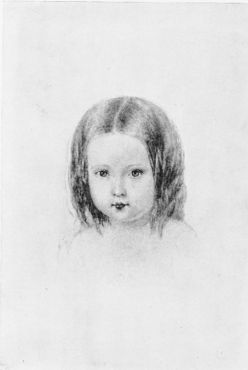
On one occasion our mother’s presence of mind saved the life of the
child Laura, then a baby of two years old. We were all staying at the
Institution for some reason, and the nursery was in the fourth story of
the lofty building. One day our mother came into the room, and to her
horror saw little Laura rolling about on the broad window-sill, the
window being wide open; only a few inches space between her and the
edge, and then—the street, fifty feet below! The nurse was, I know not
where,—anywhere save where she ought to have been. Our mother stepped
quickly and quietly back out of sight, and called gently, “Laura! come
here, dear! Come to me! I have something to show you.” A moment’s
agonized pause,—and then she heard the little feet patter on the floor,
and in another instant held the child clasped in her arms. If she had
screamed, or rushed forward, the child would have started, and probably
would have fallen and been dashed to pieces.
It was very strange to us to find other children holding their revels
without their father and mother. “Papa and Mamma” were always the life
and soul of ours.
Our mother’s letters to her sister are delightful, and abound in
allusions to the children. In one of them she playfully upbraids her
sister for want of attention to the needs of the baby of the day, in
what she calls “Family Trochaics”:—
“Send along that other pink shoe
You have been so long in knitting!
Are you not ashamed to think that
Wool was paid for at Miss Carman’s
With explicit understanding
You should knit it for my baby?
And that baby’s now a-barefoot,
While your own, no doubt, has choice of
Pink, blue, yellow—every color,
For its little drawn-up toe-toes,
For its toe-toes, small as green peas,
Counted daily by the mother,
To be sure that none is missing!”
Our mother could find amusement in almost anything. Even a winter day of
pouring rain, which made other housewives groan and shake their heads at
thought of the washing, could draw from her the following lines:—
THE RAINY DAY.
(After Longfellow.)
The morn was dark, the weather low,
The household fed by gaslight show,—
When from the street a shriek arose:
The milkman, bellowing through his nose,
Expluvior!
The butcher came, a walking flood,
Drenching the kitchen where he stood:
“Deucalion is your name, I pray?”
“Moses!” he choked, and slid away.
Expluvior!
The neighbor had a coach and pair
To struggle out and take the air;
Slip-slop, the loose galoshes went;
I watched his paddling with content.
Expluvior!
A wretch came floundering up the ice
(The rain had washed it smooth and nice),
Two ribs stove in above his head,
As, turning inside out, he said,
Expluvior!
No doubt, alas! we often imposed upon the tenderness of this dear
mother. She was always absent-minded, and of this quality advantage was
sometimes taken. One day, when guests were dining with her, Harry came
and asked if he might do something that happened to be against the
rules. “No, dear,” said our mother, and went on with the conversation.
In a few moments Harry was at her elbow again with the same question,
and received the same answer. This was repeated an indefinite number of
times; at length our mother awoke suddenly to the absurdity of it, and,
turning to the child, said: “Harry, what do you mean by asking me this
question over and over again, when I have said ‘no’ each time?”
“Because,” was the reply, “Flossy said that if I asked often enough, you
might say ‘yes!’”
I am glad to say that our mother did not “say yes” on this occasion.
But, on the other hand, Maud was not whipped for taking the cherries,
when she needed a whipping sorely. The story is this: it was in the
silent days of her babyhood, for Maud did not speak a single word till
she was two years and a half old; then she said, one day, “Look at that
little dog!” and after that talked as well as any child. But if she did
not speak in those baby days, she thought a great deal. One day she
thought she wanted some wild cherries from the little tree by the
stone-wall, down behind the corn-crib at the Valley. So she took them,
such being her disposition. Our mother, coming upon the child thus,
forbade her strictly to touch the cherries, showing her at the same time
a little switch, and saying: “If you eat any more cherries, I shall have
to whip you with this switch!” She went into the house, and forgot the
incident. But presently Maud appeared, with a bunch of cherries in one
hand and the switch in the other. Fixing her great blue eyes on our
mother with earnest meaning, she put the cherries in her mouth, and then
held out the switch. Alas! and our mother—did—not—whip her! I mention
this merely to show that our mother was (and, indeed, is) mortal. But
Maud was the baby, and the prettiest thing in the world, and had a way
with her that was very hard to resist.
It was worth while to have measles and things of that sort, not because
one had stewed prunes and cream-toast—oh, no!—but because our mother
sat by us, and sang “Lord Thomas and Fair Elinor,” or some mystic
ballad.
The walks with her are never to be forgotten,—twilight walks round the
hill behind the house, with the wonderful sunset deepening over the bay,
turning all the world to gold and jewels; or through the Valley itself,
the lovely wild glen, with its waterfall and its murmuring stream, and
the solemn Norway firs, with their warning fingers. The stream was clear
as crystal, its rocky banks fringed with jewel-weed and rushes; the
level sward was smooth and green as emerald. By the waterfall stood an
old mill, whose black walls looked down on a deep brown pool, into which
the foaming cascade fell with a musical, rushing sound. I have described
the Valley very fully elsewhere,[2] but cannot resist dwelling on its
beauty again in connection with our mother,—who loved so to wander
through it, or to sit with her work under the huge ash-tree in the
middle, where
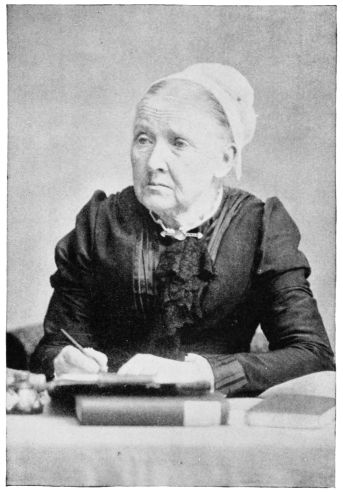
Julia Ward Howe.
(From a recent photograph.)
our father had placed seats and a rustic table. Here, and in the lovely,
lonely fields, as we walked, our mother talked with us, and we might
share the rich treasures of her thought.
“And oh the words that fell from her mouth
Were words of wonder and words of truth!”
One such word, dropped in the course of conversation as the maiden in
the fairy-story dropped diamonds and pearls, comes now to my mind, and I
shall write it here because it is good to think of and to say over to
one’s self:—
“I gave my son a palace
And a kingdom to control,—
The palace of his body,
The kingdom of his soul.”
In the Valley, too, many famous parties and picnics were given. The
latter are to be remembered with especial delight. A picnic with our
mother and one without her are two very different things. I never knew
that a picnic could be dull till I grew up and went to one where that
brilliant, gracious presence was lacking. The games we played, the
songs we sang, the garlands of oak and maple leaves that we wove,
listening to the gay talk if we were little, joining in it when we were
older; the simple feast, and then the improvised charades or tableaux,
always merry, often graceful and lovely!—ah, these are things to
remember!
Our mother’s hospitality was boundless. She loved to fill the little
house to overflowing in summer days, when every one was glad to get out
into the fresh, green country. Often the beds were all filled, and we
children had to take to sofas and cots: once, I remember, Harry slept on
a mattress laid on top of the piano, there being no other vacant spot.
Sometimes strangers as well as friends shared this kindly hospitality. I
well remember one wild stormy night, when two men knocked at the door
and begged for a night’s lodging. They were walking to the town, they
said, five miles distant, but had been overtaken by the storm. The
people at the farm-house near by had refused to take them in; there was
no other shelter near. Our mother hesitated a moment. Our father was
away; the old coachman slept in the barn, at some distance from the
house; she was alone with the children and the two maids, and Julia was
ill with a fever. These men might be vagabonds, or worse. Should she let
them in? Then, perhaps, she may have heard, amid the howling of the
storm, a voice which she has followed all her life, saying, “I was a
stranger, and ye took me in!” She bade the men enter, in God’s name, and
gave them food, and then led them to an upper bedroom, cautioning them
to tread softly as they passed the door of the sick child’s room.
Well, that is all. Nothing happened. The men proved to be quiet,
respectable persons, who departed, thankful, the next morning.
The music of our mother’s life is still sounding on, noble, helpful, and
beautiful. Many people may still look into her serene face, and hear her
silver voice; and no one will look or hear without being the better for
it. I cannot close this chapter better than with some of her own
words,—a poem which I wish every child, and every grown person too,
who reads this might learn by heart.
“I sent a child of mine to-day:
I hope you used him well.”
“Now, Lord, no visitor of yours
Has waited at my bell.
“The children of the millionaire
Run up and down our street;
I glory in their well-combed hair,
Their dress and trim complete.
“But yours would in a chariot come
With thoroughbreds so gay,
And little merry maids and men
To cheer him on his way.”
“Stood, then, no child before your door?”
The Lord, persistent, said.
“Only a ragged beggar-boy,
With rough and frowzy head.
“The dirt was crusted on his skin,
His muddy feet were bare;
The cook gave victuals from within:
I cursed his coming there.”
What sorrow, silvered with a smile,
Glides o’er the face divine?
What tenderest whisper thrills rebuke?
“The beggar-boy was mine!”


