OUSIN BURWELL CARTER fell in love with our handsome, amiable Boston
governess, Miss Davidson, and married her when I was ten years of age.
She comforted my mother for her loss by sending for her younger sister,
who was even prettier than herself, and had such winsome ways that Mr.
John Morton, Cousin Frank's bachelor brother, married her at the end of
her first session in our school-room.
My father looked quizzically grave when the two sisters recommended a
Miss Bradnor of Springfield, Massachusetts, as a person who was sure to
please our parents and to bring us on finely in our studies.
"Is she pretty and marriageable?" he asked. "My business, nowadays,
seems to be providing the eligible bachelors of Powhatan with wives. It
is pleasant enough from one standpoint, and that is the young men's. But
my children must be educated."
Both young matrons assured him, earnestly, that Miss Bradnor was "a
predestined old maid—a man-hater, in fact—and was likely to remain a
fixture in our school-room as long as we needed her." When she arrived I
was surprised to see a prim, quiet little personage who looked too
gentle to hate any one. She fitted easily into her place in our family
and soon proved herself the prize we had been promised, being a born
instructor, and loving her profession. She awoke my mind as nobody else
had done. I fancied that I could feel it stretch, and grow, and get
hungry while she taught me. The more it was fed, the hungrier it grew,
and the more eagerly it stretched itself. I studied Comstock's Natural
Philosophy with Miss Bradnor, and Vose's Astronomy, and Lyell's
Elements of Geology, Bancroft's History of the United States, and
Watts on the Mind, and began French and Latin. It was such a busy,
happy year that I was actually sorry when vacation began.
I was sorrier yet when a letter was received from Miss Bradnor, saying
that she "had been betrothed for ten years to an exemplary gentleman who
now claimed the fulfilment of her pledge. Before the letter could reach
us she would (D. V.) have become Mrs. Calvin Chapin. She hoped the
unforeseen reversal of her plans for the ensuing year would not occasion
serious inconvenience to her dear and respected friends, Mr. and Mrs.
Burwell."
"It takes the prim sort to give us such surprises!" exclaimed my mother.
"It takes all sorts and conditions of women, I think!" rejoined my
father, dryly. "I foresee that the Richmond plan will have to be carried
out, after all. Governesses are kittle cattle, at the best. And we have
had three of the very best."
As may be supposed, I was consumed by curiosity to know what "the
Richmond plan" could be. The city I had never yet seen had been made
tenfold more interesting to me within a year by the removal of the Frank
Mortons to that place. Cousin Frank had gone into the Commission
business there with an uncle who had no son to succeed him in the firm.
But, although I pricked up my ears smartly at my father's unguarded
remark, I had to smother my excitement as best I could, and study
patience—surely the hardest lesson ever set for the young. When older
people were talking with one another, it was esteemed an impertinence in
children to interrupt them by questions.
"If it were best for you to understand what we were saying, we would
take pains to explain it to you," my mother would say when we broke this
one of her rules. And, still oftener, "Little girls should trust their
fathers and mothers to tell them at the right time all that they ought
to know."
The right time in this instance was one moonlight September night, soon
after Mary 'Liza and I had gone to bed. My mother had a habit of coming
up to our room, and sitting down by the bed in the dark, or without
other light than the moon, to have a little talk with us. "To give us a
good appetite for our dreams," she would say in her merry way. We dearly
enjoyed these visits, especially on Sunday nights, when we told her what
we had been reading and thinking that day, and repeated the hymns we
loved best.
This was on Monday night, and she began by telling us that Miss Judy
Curran was coming the next day, to make our fall and winter frocks, and
that there would be a pretty busy time with us all for the rest of the
month, as we were going to school in Richmond, the fifth day of October.
"Your father and I do not believe in boarding-schools," she continued.
"We think that God gives our children to us to be brought up and
educated, as far as possible, by us, their parents, and not to be made
over to hirelings at the very time when they are most easily led right
or wrong. There are, however, excellent reasons why you should begin now
to know more of the world than you can learn in a quiet country
neighborhood such as this. We are thankful to be able to give you the
advantages of a city school, without depriving you of good
home-training. You are to live with your Cousin Molly Belle, and be
day-scholars in Mrs. Nunham's seminary."
Even Mary 'Liza gave a little jump under the sheet at the astounding
news, while I leaped clean out of bed, and danced around the room in my
night-gown, clapping my hands and uttering small shrieks of ecstasy.
"Hurrah! hurrah! goody! goody! mother! it is like a fairy tale!"
I was somewhat abashed, and decidedly ashamed of my transport when the
blessèd mother said gently, after a little sigh:—
"Of course I shall miss my daughters sadly, but I hope what we are doing
is for their good. If I were less sure of this, I could not part with
them."
From the hour in which her first-born baby was laid in her arms, until
she closed her eyes in the sleep from which our wild weeping could not
awaken her, her ever-present thought was the children's best good.
Nothing that could secure that was self-denial on her part.
I have come to Richmond to write this chapter. From my window I look
down upon the pavement trodden by my feet twice a day for ten months out
of twelve, during four school years. The house in which I sojourn
belongs to a younger brother of him who figures in my story as "Bud." It
occupies the site of the large, yellow frame building in which Mrs.
Nunham taught her "young ladies," more than forty years ago.
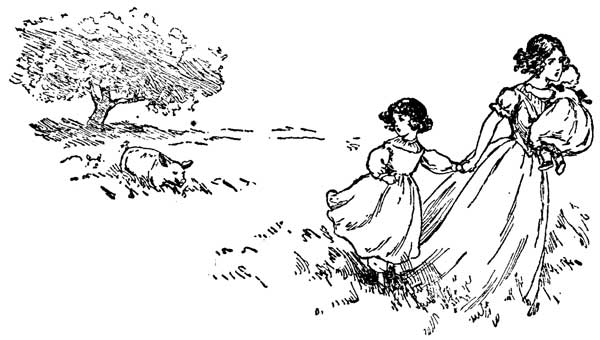
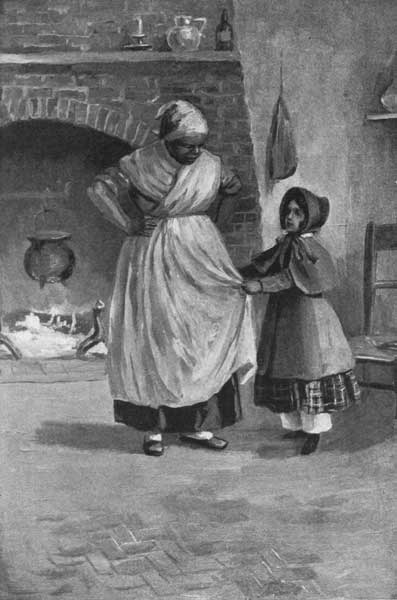
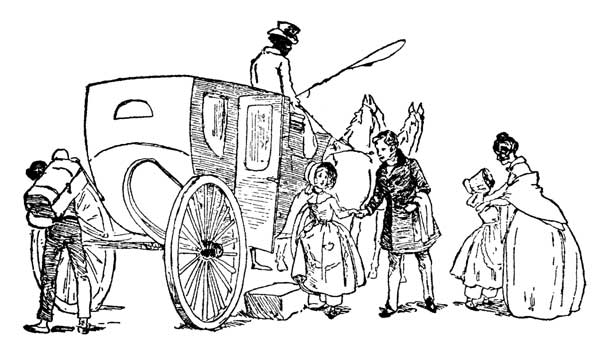
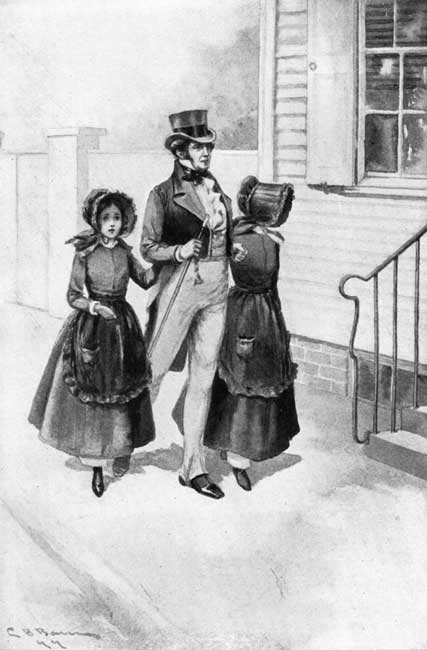 How I Came To Town.
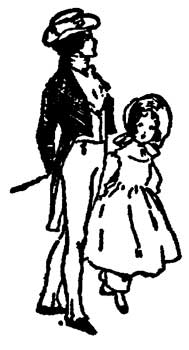
"My father walked between Mary 'Liza and myself, each of us holding to
one of his arms, as gentlemen and ladies walked."
How I Came To Town.
"My father walked between Mary 'Liza and myself, each of us holding to
one of his arms, as gentlemen and ladies walked."
I smile, as fancy reconstructs the group that turned the corner into
this street, a block away, on the fifth of October of that memorable
year in the forties. My father walked between Mary 'Liza and myself,
each of us holding to one of his arms, as gentlemen and ladies in the
country walked together then. He was a well-built, clear-eyed,
clean-lived, upright gentleman, whom God had made and whom the world had
not spoiled. My cousin and I were dressed exactly alike. Into every
detail of daily life my mother carried her principle of treating the
orphan as her own child. Our country-made frocks were of dark-green
merino, becoming to my blond companion, and anything but becoming to my
sun-browned skin. Over the frocks were neat black silk aprons with
pockets. White linen-cambric frills, hemstitched by hand, and carefully
crimped, were at our throats and wrists, and sunbonnets upon our heads,
or rather, "slatted" hoods that could be folded at pleasure. These were
of dark-green silk, to match the merinos, and ribbon of the same color
was quilled around the capes, crowns, and brims. Our silk gloves were
also dark green, and my mother had knit them herself.
Every item of our school costume was prescribed by her before we left
home. I comprehend now, why the water stood in Cousin Molly Belle's
eyes, while dancing lights played under the water, when we presented
ourselves at breakfast-time, dressed for the important first day in the
Seminary. I appreciate, furthermore, as it was not possible I should
then, the tact and delicacy with which she gradually modified our
everyday and Sunday attire into something more in accordance with that
of our school-fellows.
As we found out for ourselves, before the day was over, we were little
girls in the midst of young ladies, so far as dress and carriage went.
We were imbued with the idea—gathered from the talk of friends and
acquaintances, and our much reading of English story-books—that we were
to be "polished" by our city associations. It was a shock and a
down-topple of our expectations to be thrown, without preparation, into
the society of girls whose manners were very little, if at all, more
refined than those of the quartette who with us constituted Miss
Davidson's home school. We were even more confounded at the discovery
that our home-education had so rooted and grounded us in the rudiments
of learning that we were classed, after the preliminary examination,
with girls older than we by four and five years. The circumstance did
not make us popular with our comrades.
As if my cheeks had tingled under the assault but to-day, I recall the
exclamation of a girl of fifteen who sat next to me while the
examination in history was held. Her father was a distinguished citizen
of Richmond, and her mother a leader in fashionable society.
"Lord, child! how smart you think yourself, to be sure!" she said aloud,
turning squarely about to look into my face.
I had answered as quietly and briefly as I could, the questions put to
me, and tried politely not to look scandalized at her flippant
failures.
"I'm sure I don't know!" "Never heard of him!" "If I ever knew, I've
forgotten all about it!"—were, to my notion, a disgrace, and her cool
effrontery would have been severely rebuked by our governess, and have
met with still sterner judgment from my mother.
At recess this offensive young person headed a coterie that surrounded
us, criticised our clothes, and catechised us as to our home, our
family, and our mode of home living. Among other choice bon mots from
the Honorable Member's daughter was the inquiry—"if we got the pattern
of our wagon-cover hoods from Mrs. Noah?"
I told Cousin Molly Belle that night, that "the whole pack were
ill-bred, rude, and unbearable."
She agreed heartily with two of my epithets, and took me up on the
third:—
"Nothing is 'unbearable,' Namesake, except the thought of our own folly
or sin. Still, this is a part of the discipline of life I would spare
you, if I could. Endure hardness as a good soldier, and shame their want
of breeding by the perfection of yours. An unmannerly schoolgirl is the
cruellest of tormentors, and"—with a ring of her voice and a snap of
her eyes that were refreshing and characteristic—"I should like to have
the handling of that crew for an hour or two!"
I snuggled up close to her, already measurably consoled, and ready as
usual, with one of the speeches that stamped me as "old-fashioned."
"We are like two wild pigeons, tied by the foot, in a yard full of
peacocks. I would rather be a pigeon than a peacock. But pecks and
struts and screamings are not agreeable, for all that."
Nor was it agreeable to be the only girls in our class-room who were not
invited to a party given the middle of November, by one of the nicest of
our new acquaintances. She had been quite friendly with us, and the very
day the invitations were sent out, laid a sprig of citronaloes silently
on my lap, during a French lesson. The smile that went with the scented
leaves was sweeter still, and made my heart and face glow. When we were
getting our wraps and bonnets in the cloak-room, at the close of the
afternoon session, I edged nearer and nearer to her, pretending to hunt
for my overshoes, meaning to say a word of thanks as soon as the group
about her thinned. I got so near to her that I caught what she was
saying in a low voice to her intimates:—
"I just hated not to invite the Burwells, but they do look so
countryfied! like little old women cut short after they were made. And I
don't believe either of them has a party dress to her name. They would
be a pair of sights in a roomful of well-dressed people."
I slipped away with a barbed arrow in my self-love, and a hard,
resentful pain at my heart, on my mother's account. Fierce tears scalded
the inside of my eyelids as I recalled her weeks of loving preparation
for our school life, the thousand of stitches set by her dear hands,
the gentle smile of satisfaction with which she had surveyed our
finished wardrobe. When I was in my own room at Cousin Molly's, I hugged
and kissed and cried over the slatted hood, vowing vengefully to study
so hard, and to rise so fast in my classes, and to acquit myself so
nobly in the sight of my teachers, as to compel the admiration of the
proud who rose up against me, and who compassed me about like bees.
David's "cussing psalms" came readily and forcibly to my help in the
hour of bitter humiliation.
If my wrath was unhallowed, it wrought the peaceable fruits of
righteousness. The barb had gone too deep to be uncovered even to Cousin
Molly Belle, but the hurt made a student of me. Giving up all thought of
popularity and polish, I devoted myself to my school work with assiduity
that threatened injury to my health before the half-term was over. But
for my best and most clear-sighted of cousins I might have become a
misanthropic invalid.
On the very day of the now hateful party, she took us for a long
drive,—the whole length of Main Street, the sidewalks of which were
thronged with promenaders and shoppers. She stopped the carriage—a
handsome equipage, with a smart coachman and two spanking grays—at
Samanni's and bought us a whole pound, apiece, of delicious candy, and
treated us to Albemarle pippins to take home with us, and ice-cream
eaten on the spot. Next, we went to Drinker and Morris's, the
fashionable bookstore, and she told us to pick out, each for herself,
the books we would like best to have. Mary 'Liza chose The School-girl
in France, and I, The Scottish Chiefs. (I have it to this day.) We
finished our excursion by a visit to St. John's Church and
burying-ground. Cousin Molly Belle's grandfather had heard Patrick
Henry's "Liberty or Death" speech, and she made the scene very plain to
us as we strolled along the dim aisles, streaked with flaming bars of
sunset, striking through the western window upon the very spot where the
great orator had stood.
By the time I had finished my supper, and was settled before the fire
with my book, the memories of my jaunt making glad my whole being, I had
clean forgotten party and slight, and did not care a fig—for that one
night—if I was countryfied and had not a party dress to my name. The
real things were mine,—home-loves and the world of books and
imagination,—possessions which the scorning of those who were at ease,
and the contempt of the proud could not molest or take away.
I was reading The Scottish Chiefs for the second time,—out of school,
of course,—and studying with might and main, when something came to
pass that altered the tone of my mates, converted oppressors into
champions, and made a moderate heroine of me.
There were sixteen of us in the senior Geography Class, I being the
youngest. The practice of "turning down" for incorrect answers to
questions was common at that date, even in Young Ladies' Seminaries.
When the class was formed, we were seated according to age, but thanks
to my governesses' drill, I had mounted steadily until I was now but one
from the top—or, as we put it, was "next to head." The topmost place
had been held for over a month by Mary Morgan, a slovenly and indolent
girl of sixteen, who wrote poetry and had a great deal of old blue blood
in her veins, as she was fond of informing all who had the patience to
listen to her. Her recitations in most of her classes were so imperfect
that everybody was surprised at her keeping an honorable place in any
until the whisper went around that she smuggled "help-papers" into the
class with her.
I am told that the use of "ponies," and much less reputable aids to
perfect recitation in school and in college, is not considered
dishonorable among the youth of the present age. Unmannerly and cruel as
the girls in our seminary appeared to me, they had a certain sense of
honor, a respect for truth and fair-dealing that bespoke better things
than their surface-conduct indicated. When it was certainly known that
Mary Morgan carried into the recitation-room notes of the lesson,
written upon bits of paper, and tucked up her sleeve, or hidden in the
folds of her dress, popular indignation arose to a bubbling boil. A
tale-bearer would have been drummed out of school, and not a lisp of the
shameful truth was carried to the teacher, the second Miss Nunham, who
was near-sighted and unsuspicious. The geography lesson was the most
exciting event of the day,—a prize-ring, in which the two at the head
of the class were chief actors. When a question reached Mary Morgan, the
class held its breath for a time. When she answered with glib accuracy,
the breath exhaled in chagrin audible to all but the teacher. Out of
class I was noticed, cheered, and commended, and exhorted to hold on in
the course of truth and uprightness—encouragement corresponding to the
rubbing down and bracing bestowed by his guardians upon the pugilist.
And still the geography questions went around, and Mary Morgan was head
and I next to head.
At last, on the fifteenth of December, came the tug of war in the shape
of a review of the exercises of the last month, and Mary Morgan was
armed for the fray by half a dozen long slips of paper covered with
characters in very black ink. Presuming upon the teacher's short-sighted
eyes, and nerved by a sense of the gravity of the situation, she boldly
laid the papers upon the bench between her and myself, and consulted
them from time to time, with coolness that would have been heroic had it
not been impudent. The recitation was half over, when the girl who sat
next below me "made a long arm" behind my back, and abstracted one of
the abhorrent slips without the knowledge of the owner. She perceived
the loss as the questions were again nearing her, gave one frightened
glance at the floor on all sides of her, colored violently; made a
desperate rally of memory and courage when the question reached her,
answered so wildly that the teacher gave her a second trial, and, in
pity for her distress, still a third.
Such a simple question as it was! I can never forget it. "What large
island lies south of Hindostan?"
Nor can I forget the pale dismay of the face turned to me as the teacher
said, reluctantly,—"Next."
I had never liked the girl; latterly, I had despised her and regarded
her as my enemy. I did not analyze the revulsion of feeling that made me
hesitate while one could have counted ten, before saying in a low,
constrained voice,—"Ceylon!"
The deposed pupil sank to the middle of the class before the recitation
was over, much to the bewilderment of the single-minded teacher. By the
morrow she was at the bottom of the line and so far across the outer
confines of Coventry that she never got back. That was our way of
looking at "cribs" half a century ago.
It is not ten years since I met the banished scholar in a metropolitan
reception-room, and a few minutes afterward, another old schoolfellow,
who said in one and the same breath, "Do you know that Mary Morgan is
here?" and, "I suppose it is uncharitable, but I can never forget that
she used to cheat in her recitations at Mrs. Nunham's."
We went home "for Christmas." My father sent the carriage for us. The
roomy family coach he never allowed to get shabby. The "squabs," i.e.
padded inner curtains to exclude the cold in winter, were in, and there
were thick shawls and a pillow apiece and two footstoves for our comfort
in the thirty-mile drive, and upon the front seat, gorgeous in a new
shawl of many and daring colors, her snowy turban wound about head and
ears, was Mam' Chloe, the comfortablest thing there. Hamilcar, the
carriage-driver, (we did not say "coachman") had on his Christmas suit,
including a shaggy overcoat for which his master had given him an order
upon a Richmond tailor, and was spruce exceedingly. To ensure our
perfect safety and respectability we had an outrider in the shape of
Mr. James Ireton, a young fellow-countryman, who was returning from a
business trip to town.
The boxes under the seats—an old-fashioned convenience, capable of
containing a gentleman's entire wardrobe and half of a lady's—were
brimful of Christmas gifts and "goodies," and parcels stuffed with the
same wedged Mam' Chloe in the exact middle of the front seat. A big
hair-trunk was strapped upon the rack behind, and a box packed by Cousin
Molly Belle was between Hamilcar's feet.
It began to snow before we had left the city a mile behind us, but that
made things all the merrier. How we chuckled with laughter as the fast
flakes stuck upon Mr. Ireton's hat and overcoat and leggings, until he
looked like a polar bear but for his face that got redder as the rest of
his body whitened, until, with his shining teeth and powdered hair, he
made us think of Santa Claus. When we let down the carriage-window to
tell him so, he drew a pipe from his pocket, got behind the carriage to
screen it from the wind while he was lighting it, and rode up again
alongside of us, puffing away at it to carry out the likeness.
We set out at nine o'clock, and at one o'clock stopped at Flat Rock, a
well-known house of entertainment, for an early dinner and a generous
feed for the horses. The roads were heavy with winter mud, red and
sticky. It looked like strawberry ice-cream as the wheels and hoofs
churned it up with the snow. Mam' Chloe laughed until her fat sides
quaked when I said that. How good she was to us that day! how good
everybody was! and how good it was to be just what I was, and where I
was—off on a royal spree in the splendidest snowstorm I had ever seen,
and Home and Christmas at the end of the journey.
Darkness fell by four o'clock, and, but for the whiteness of the earth,
we would not have been able to see the trees on the side of the road
when we came in sight of the house. Not a shutter had been closed, and
every window was aglow with fire and lamplight, golden and pink through
the snowy veil shifting and swaying between them and our happy eyes.
When, for me, Life's little day—full, rich, and blessèd, for all that
storm and wreck and blight have, once and again, befallen me, as was
God's will, and therefore, for my eternal good—when, for me, Life's
little day darkens to its outgoing, may the lights of the Home that
changes not, save from glory to glory, shine out for me through night
and chill with such loving welcome as gleamed in those ruddy windows!
By Margaret Sidney
IN ORDER OF PUBLICATION
Five Little Peppers and How they Grew. Cloth, 12mo, illustrated, $1.50,
postpaid.
This was an instantaneous success; it has become a genuine child
classic.
Five Little Peppers Midway. Cloth, 12mo, illustrated, $1.50, postpaid.
"A perfect Cheeryble of a book."—Boston Herald.
Five Little Peppers Grown Up. Cloth, 12mo, illustrated, $1.50, postpaid.
This shows the Five Little Peppers as "grown up," with all the struggles
and successes of young manhood and womanhood.
Phronsie Pepper. Cloth, 12mo, illustrated, $1.50, postpaid.
It is the story of Phronsie, the youngest and dearest of all the
Peppers.
The Stories Polly Pepper Told. Cloth, 12mo. Illustrated by Jessie
McDermott and Etheldred B. Barry. $1.50, postpaid.
Wherever there exists a child or a "grown-up," there will be a welcome
for these charming and delightful "Stories Polly Pepper Told."
The Adventures of Joel Pepper. Cloth, 12mo. Illustrated by Sears
Gallagher. $1.50, postpaid.
As bright and just as certain to be a child's favorite as the others in
the famous series. Harum-scarum "Joey" is lovable.
Five Little Peppers Abroad. Cloth, 12mo. Illustrated by Fanny Y. Cory.
$1.50, postpaid.
The "Peppers Abroad" adds another most delightful book to this famous
series.
Five Little Peppers at School. Cloth, 12mo. Illustrated by Hermann
Heyer. $1.50, postpaid.
Of all the fascinating adventures and experiences of the "Peppers," none
will surpass those contained in this volume.
Five Little Peppers and Their Friends. Illustrated by Eugenie M.
Wireman. Cloth, 12mo, $1.50, postpaid.
The newest of the stories of the children's favorites—the Pepper boys
and girls.
LOTHROP PUBLISHING COMPANY, BOSTON
By EDITH REBECCA BOLSTER
Small 4to. Six illustrations by Hermann Heyer. Pictorial cover in color.
Price, $1.00.
"Ethel in Fairyland," by Edith R. Bolster, is a delightful little
allegory. A child falls asleep and dreams that she has a number of
adventures in a wood, where she meets various people personifying the
moral qualities, like bad temper, unkindness, and envy, and learns a
good lesson from them to tell her mother when she awakes the next
morning. The book is written in a way to please both mothers and
children.
By FLORENCE PELTIER
Small 4to. Four illustrations by Genjiro Yeto. Pictorial cover in color.
Price, $1.00.
"A Japanese Garland," by Florence Peltier, is one of the most charming
books for young people published of late. It tells of a Japanese lad,
adopted by an American, who has a number of American boys and girls as
friends, to whom he tells a series of folk-lore tales associated with
the flowers of Japan. The meetings to hear the stories occur at the
different houses of the children, and there is always some sort of
entertainment at the end of the narration, to furnish variety and life.
By means of this story-frame much interesting information about Japanese
customs and superstitions, also social life, is conveyed, while the
picturesque stories hold the attention. The book is appropriately
illustrated by G. Yeto, the noted Japanese artist.
Lothrop Publishing Company, Boston
By CHARLES BATTELL LOOMIS
Author of "Just Rhymes," "The Four Masted Cat Boat," and "Yankee
Enchantments." 12mo. Four illustrations. Price, $1.25.
"A Partnership in Magic," by Charles B. Loomis, the widely known
humorist, is an extremely original and clever juvenile, Mr. Loomis's
first piece of long fiction. It has a fairy-tale motive in an entirely
realistic setting. A country boy, who has a marvellous power of plucking
fruit from the bare branches of any tree, goes to New York, and with a
friend starts in the fruit business, and makes a large sum of money in a
couple of weeks of their partnership. There is a cruel stepfather, and
his adventures in New York in search of the boy, together with the many
city scenes in connection with the hero's experiences, make it a highly
amusing and graphic story. It is written in Mr. Loomis's peculiar vein
of quiet, but effective fun.
Lothrop Publishing Company, Boston
By EDWARD S. VAN ZILE
Author of "With Sword and Crucifix," etc. Four illustrations by I. B.
Hazelton. 12 mo. Pictorial cover in color. Price, $1.25.
"Defending the Bank," by Edward S. Van Zile, is a most amusing and
interesting detective story for boys and girls, in which a couple of
bright boys and girls appoint themselves amateur detectives and are able
to run down a couple of bank robbers who are planning to rob the bank of
which the father of one of the boys is president. This is at once an
exciting and wholesome tale, of which the scene is laid in Troy, N. Y.,
the former home of the author. It will be widely welcomed.
By EUSTACE L. WILLIAMS
Author of "The Substitute Quarterback." 12mo. Four illustrations by I.
B. Hazelton. Pictorial cover in color. Price, $1.25.
"The Mutineers" is a rattling boys' story by Mr. Eustace L. Williams of
the Louisville Courier-Journal. It gives a picture of life in a large
boarding-school, where a certain set of boys control the athletics, and
shows how their unjust power was broken by the hero of the tale, who
forms a rival baseball nine and manages to defeat his opponents, thus
bringing a better state of things in the school socially and as to
sports. The story is full of lively action, and deals with baseball and
general athletic interests in a large school in a manner which shows
that the author is thoroughly acquainted with and sympathetic to his
subject.
Lothrop Publishing Company, Boston
By M. E. WALLER
Illustrated by H. Burgess, 12mo, blue cloth, illustrated cover, $1.25
This is a right royal, good juvenile story. It has the narrative of the
development of a waif of New York streets in the simple and wholesome
life of a Vermont farmer neighborhood. The lad, Miffins, is taken into
the household of Jacob Foss, a farmer. The story tells of the
transformation wrought in Miffins's character. It is a story of heart
power; and with its study of the evolution of a street gamin into a
useful little citizen, and with its graphic descriptions of Vermont
country life in summer and winter, it makes a book of unusual power and
interest.
Lothrop Publishing Company—Boston
A Romance of the American Revolution
By MARGARET SIDNEY. One volume, 12mo, illustrated by F. T. Merrill,
$1.50
A delightful Revolutionary romance of life, love and adventure in old
Concord. The author lived for fifteen years in the home of Hawthorne, in
Concord, and knows the interesting town thoroughly.
Debby Parlin, the heroine, lived in a little house on the Lexington
Road, still standing, and was surrounded by all the stir and excitement
of the months of preparation and the days of action at the beginning of
our struggle for freedom.
By "PANSY" (Mrs. G. R. Alden) and MRS. C. M. LIVINGSTON. 12mo, cloth,
illustrated by Charlotte Harding, $1.50
This story of Wayne Pierson and how he evaded or met the tests of
misunderstanding, environment, false position, opportunity and
self-pride; how he lost his father and found him again, almost lost his
home and found it again, almost lost himself and found alike his
manhood, his conscience and his heart is told us in Pansy's best vein,
ably supplemented by Mrs. Livingston's collaboration.
By NINA RHOADES
Author of "Only Dollie," "Little Girl Next Door," "Winifred's Neighbors"
Illustrated by Bertha G. Davidson Large 12mo Cloth 300 pages $1.00
Little Winifred Hamilton, the child heroine of this book, lives in the
second of the four stories of a New York apartment-house. On the top
floor are two very interesting children—Betty, a little older than
Winifred, who is ten, and Jack, a brave little cripple, who is a year
younger. The widowed mother, proud and distant until won over by the
kindness of good friends, shows unmistakably that something very
different from poverty and loneliness has been familiar to her, which
fact is also very evident from the character and breeding of her
children. In the end comes a glad reunion, and good fortune for crippled
Jack, and Winifred's kind little heart has indirectly caused great
happiness to many others. This is the strongest story Miss Rhoades has
yet given us, excellent as have been her others.
By NINA RHOADES
Author of "The Little Girl Next Door," "Winifred's Neighbors," "The
Children On The Top Floor"
New Cover Design Illustrated Square 12mo Cloth $1.00
This is a brightly written story of a girl of twelve, who, when the
mystery of her birth is solved, like Cinderella, passes from drudgery to
better circumstances. There is nothing strained or unnatural at any
point. All descriptions or portrayals of character are life-like, and
the book has an indescribable appealing quality which wins sympathy and
secures success.
"It is delightful reading at all times."—Cedar Rapids (Ia.)
Republican.
"The author has written with admirable restraint, and has exhibited
in her character-drawing a keen observance of real
life."—Philadelphia Press.
"It is well written, the story runs smoothly, the idea is good, and
it is handled with ability."—Chicago Journal.
For sale by all booksellers, or sent postpaid on receipt of price by
the publishers.
LEE & SHEPARD, Publishers, Boston
By EDNA A. FOSTER
Editor Children's Page "Youth's Companion"
Illustrated by MARY AVER 12mo Cloth Price, $1.00
"It is an interesting study of the development of an uncommon little
girl. She is thoroughly natural, and the situations in which she is
placed are seldom strained. She has no mother, and circumstances place
her in the care of an older girl who also has no mother. How one child
may be trained while another may be only taught, is made very clear. It
is an attractive little story quite worth the reading."—The
Universalist Leader, Boston.
"It is a book which girls from eight to eighteen will read with interest
and which careful guardians and mothers will be glad to have them
read."—Times, Chattanooga, Tenn.
"We would strongly advise all mothers of growing boys and girls to
hasten to procure a copy of this delightful book for the home
library—and, above all, to make a point of reading it carefully
themselves before turning it over to the juveniles."—Designer, New
York, N. Y.
"It is a truthful and discerning study of a gifted child, and should be
read by all who have children under their care. It is probably the best
new girl's book of the year."—Springfield (Mass.) Republican.
"The book is excellent, whether viewed as a story for the children, or
as a suggestive study for those who have to do with the education of
children."—Zion's Herald, Boston.
"The story may be commended as first-rate in construction, and with a
happy style of teaching moral lessons."—Chicago Journal.
For sale by all booksellers, or sent postpaid on receipt of price by
the publishers.
LEE & SHEPARD, Publishers, Boston
Her Strange Experiences and Adventures in Indian Land
BY ANNIE M. BARNES
Illustrated by Frank T. Merrill 12mo Cloth with gold and colors 300
pages Price $1.25
One of the very best books with which to satisfy a young reader's
natural desire for an "Indian story" is this one of little Betty Blew
and what she saw and experienced when her family removed from
Dorchester, Mass., two hundred years ago, to their home on the Ashley
River above Charleston, South Carolina. Although Betty is but a small
maid she is so wise and true that she charms all, and there are a number
of characters who will interest boys as well as girls, and old as well
as young.
There are many Indians who figure most importantly in many exciting
scenes, but the book, though a splendid "Indian story," is far more than
that. It is an unusually entertaining tale of the making of a portion of
our country, with plenty of information as well as incident to commend
it, and the account of a delightful family life in the brave old times.
It is good to notice that this story is to be the first of a colonial
series, which will surely be a favorite with children and their parents.
Mr. Merrill's illustrations are of unusual excellence, even for that
gifted artist, and the binding is rich and beautiful.
For sale by all booksellers, or sent prepaid on receipt of price by the
publishers
LEE AND SHEPARD BOSTON
BY NINA RHOADES
Author of "Only Dollie" and "The Little Girl Next Door" Illustrated by
Bertha G. Davidson Large 12mo Cloth $1.00
"The Little Girl Next Door" has been more persistently re-ordered than
almost any other children's book of last season, and Miss Rhoades's new
story deserves equal popularity. Little Winifred's efforts to find some
children of whom she reads in a book lead to the acquaintance of a
neighbor of the same name, and this acquaintance proves of the greatest
importance to Winifred's own family. Through it all she is just such a
little girl as other girls ought to know, and the story will hold the
interest of all ages.
BY NINA RHOADES
Author of "Only Dollie" Illustrated by Bertha G. Davidson Large 12mo
Cloth $1.00
A delightful story of true and genuine friendship between an impulsive
little girl in a fine New York home and a little blind girl in an
apartment next door. The little girl's determination to cultivate the
acquaintance, begun out of the window during a rainy day, triumphs over
the barriers of caste, and the little blind girl proves to be in every
way a worthy companion. Later a mystery of birth is cleared up, and the
little blind girl proves to be of gentle birth as well as of gentle
manners.
BY NINA RHOADES
Square 12mo Cloth Illustrated by Bertha Davidson $1.00
This is a brightly written story of a girl of twelve, who when the
mystery of her birth is solved, like Cinderella, passes from drudgery to
better circumstances. There is nothing strained or unnatural at any
point. All descriptions or portrayals of character are life-like, and
the book has an indescribable appealing quality which wins sympathy and
secures success.
LEE AND SHEPARD PUBLISHERS
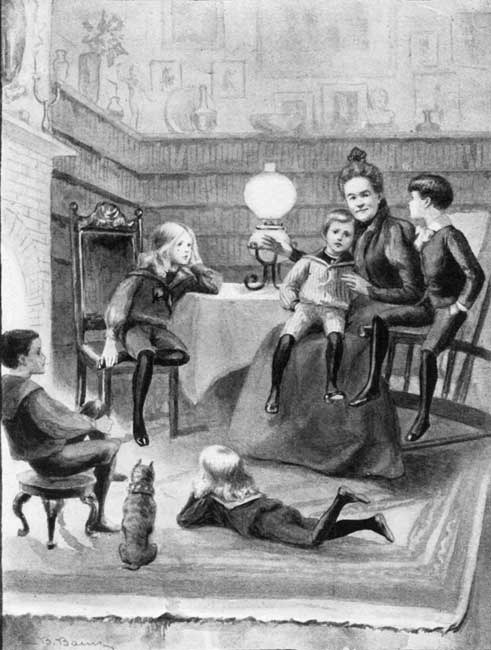 The Story Telling.
"'I like, best of all, to hear about what happened when Grandmamma was
new,' said Fritz."—See page 7.
The Story Telling.
"'I like, best of all, to hear about what happened when Grandmamma was
new,' said Fritz."—See page 7.