She had guessed the truth first, but they knew it, all of them, in a few days more. They knew that Ruel Saxon’s feet were set on the downward path to the valley from which there is no return.
They did not send for Stella. She had her work, and there were enough in the home to do all that could be done for him. Still there was little pain, a growing weakness, and the mind wandering more and more often, but always peacefully, and oftenest over the years that lay far, far behind him. Of Esther he seemed almost to have lost knowledge. He called her Lucia constantly now, and liked no one so much at his bedside.
And she kept her place, with no regret for any employment she might have had in its stead. There came a letter from Mr. Philip Hadley, with messages for her grandfather, and though the latter but half understood as she read them, he seemed touched and pleased. The young man had learned, through a call on Stella, of the old gentleman’s illness and the consequent delay in the carrying out of Esther’s plan, and he wrote, earnestly hoping it might not be for long, with kindest expressions of sympathy for his aged friend.
And then there came another, but this Esther did not read aloud. The reading to herself alone left a troubled look in her eyes as she laid it down. It seemed that Mr. Hadley’s plans had suffered change, too. His father was not bearing the Boston November well, and California for the winter was the doctor’s prescription. He must go with them, the young man wrote, to see his father and mother well settled, but it would be only for a few weeks, and by the time he returned surely Esther herself would be in Boston. “I confess,” he added, “that anxious as I am to do what I can for my father, I could hardly bear it to be away from Boston if you were here now.”
They objected to her sitting up with her grandfather that night on the ground that she was not looking as well as usual, but Esther protested. It was her turn, she pleaded. She had had the promise of staying with him till midnight, and indeed, she was perfectly able. So they let her have her way, and left her alone with him in the dear, familiar room, with the lamp burning low on the table, and everything ready to her hand. She could call the others in a moment if she needed them. He had been easier than usual during the day, sleeping most of the time, and again at moments seeming so like himself that, in spite of them all, she could not believe he was going away soon. Why should he? Life was sweet to him still, and his body, till now, had seemed strong and active. What was that length of years which people named with a shake of the head as they mentioned his illness? It was not years that counted in making men old. It was labor and loss and heartache. The labor was joy to one who loved it as he did, the simple labor of the fields, and of friendly service among his fellows. And of loss and heartache there could be none to sap the springs of life for one whose cheerful faith laid hold of the eternities like his. It was not time, surely it was not time yet, for the silver cord to be loosed which bound Ruel Saxon to his work and his friends.
So she said to herself with the easy hopefulness of youth, as she watched the old man lying there with his face on the pillow. He grew more restless as the hours went on. Memory, while all the other faculties lay sleeping, seemed to bestir itself with unwonted vigor. Hymns, quaint and long-forgotten in the churches, rolled one after another from his lips, and Psalms, so many and with such unhesitating sureness, that the girl listened marvelling, and wondered if he knew them all.
Then there came a change in his voice, and his tone grew more appealing. It was not recitation now, it was exhortation. He seemed to be warning sinners, pleading with fellow-Christians. Ah, she caught the meaning. He thought he was in prayer-meeting again, and the zeal of the place had eaten him up with its old delight and fervor. She smiled, remembering that last meeting, and bent her head closer to catch the words.
A strain of tenderness crept through them now. Solemnly and very slowly he repeated, “Behold, I lay in Zion for a foundation a stone, a tried stone, a precious corner-stone, a sure foundation.” He paused for a moment, then, in a voice that was low but strangely clear, went on, “Oh, my friends, do you mark the word? That precious stone, that head of the corner, is a tried stone, tried through all the years and proven sure. Tried”—he lingered on the word with unspeakable earnestness—“by whom? By Abraham, by Moses, and by all the prophets, men who heard the voice of God and followed where it led them; tried by Peter, by James, and John, men who saw his face in the face of his Son, and leaned upon his breast and loved him; tried by all the host of martyrs, who laid down their lives for his sake, counting it gain for the joy that was set before them; tried by”—the voice sank almost to a whisper, and the names of old neighbors and friends fell lovingly one after another, the names of fellow-farers with him in the journey of life who had passed to their rest before him. Listening intently, the girl knew them at the last for some of her own kindred, as he murmured softly, “by Caleb Saxon, by Joel and Mary, by Rachel my wife,” and then, after longer pause, with his eyes opening wide and a tremor of unutterable joy and humility in the low glad murmur, “tried—by—me.”
A smile flitted over his face, and the eyelids dropped. She thought he was asleep, and moved noiselessly away lest even her breathing should disturb him. It was almost an hour later, and the watch on the table told her it was time for his medicine, when she went again to his side.
“Grandfather,” she said, bending over him; but he did not stir. She laid her hand on his, and the chill struck to her heart. She started back, and for a moment stood in her place, almost as white and motionless as he. Then, with a cry, she flew out of the room, calling to the others to come, the others who, with all their haste, could never again in the old way catch word or look of his.
For he was gone. With that last word, the spirit so bright and eager—ah, yes! so impatient at moments, so prone to the hasty word, so open to the little vanities, but sound at the core, and steadfast to bear its part in sun and storm as any oak on the hills—had stolen away. It was of himself he had spoken last. They mused on it a little as she told them; but they knew it was of himself as the humble, the rich recipient of grace unspeakable, and in that great gladness had passed on to the Giver.
They bent around him weeping, the older women, but Esther was too stunned for tears. She had been alone with Death and had caught no hint of his presence. She had never guessed that he could come and go as stealthily as this. There was nothing more that she could do, and they sent her away, not letting her reproach herself that she had not known. “It was not strange,” they said; and Aunt Elsie added, steadying her voice for the girl’s sake, “It was better so; the kindest way it could have come.”
It was a wonderful night. The first snow of the season had fallen while the old man lay dying, and now the moon shone out with a still, white glory, in which all the world lay new and clean. In the orchard beyond her window some boughs of trees, cut by the saw of the pruner and not yet gathered from the ground, lay glistening like great branches of coral; and the old stone wall had been builded anew, touched with masonry of silver. Strange how every detail of the scene swept in upon the girl, as she stood there looking out upon it, wide-eyed and silent!
It was a picture in which her thoughts would frame themselves again and again in the years that were coming, when the solemn moods of life should bring her face to face with the things of the soul. And in that clearness and stillness, things which had puzzled her grew plain, and she knew her own heart as she had not known it before. She could not have explained how it came; but before that great reality of death, the unrealities of life slipped noiselessly away. The things which had been of the surface fell off, and the needs, the loves, that were deepest only were left. To have seen them once in that clear light was to know them for what they were, and she could not afterward forget.
They sent word to Stella in the morning, and late that night Tom brought her from the station. She had not loved her grandfather as Esther had—she had not so enjoyed his companionship; but the knowledge that he was gone brought tears and genuine sorrow.
“Dear old grandfather!” she said, looking down at the still face. “How we shall miss him! It won’t seem like home with him gone.” And then she drew her mother away to talk over the details of the event that was coming. There must be no flowers about his coffin, only one long beautiful sheaf of wheat; and she would have no crape on the door, only a branch of evergreen from the woods he had planted, with a sprig of myrtle.
It was at the church that the last services were held. The rooms at the old house could not have contained the throng that gathered to do him honor. He had been a diligent attendant at funerals himself, and had been frankly in favor of extended remarks on the character of the deceased, even though the custom put the preacher to sore straits sometimes, when the virtues of the departed were not too many or luminous.
Indeed, he had been known to excuse the preacher under such circumstances for blinking the facts a little. At least he had called the attention of captious critics to that funeral lament of David’s, in which he distinctly alluded to a very persistent persecutor of his as “lovely and pleasant,”—language which, to tell the truth, had really seemed to Ruel Saxon a little excessive, and had led him to wonder at times what the generous psalmist would have done if he had not been able to couple Saul’s name with Jonathan’s.
There was no lack of words at his own funeral, words spoken with impressive earnestness and warmth, and it was a tribute to the wide regard in which Ruel Saxon was held that not only the minister of his own church, but others from towns around, begged the privilege of a part in the service.
“He would have liked it if he had been there; it was a funeral after his own heart,” Stella said, talking it over that evening with Esther. She drew a long soft sigh, and added, “I declare I can’t realize yet that it was actually grandfather himself. He was trying sometimes, but never tiresome; and life will lose part of its spice here at home, with him gone out of it.”
Esther did not reply. Somehow she could not talk about things which were close to her heart in the cool way Stella could. After a little silence the latter said: “You’ll go to Boston with me, of course, when I go back. I shall stay at home long enough to get things settled for mother, and there’ll be no need of either of us staying after that.”
“Stella,” said Esther, speaking very quietly, “I suppose you’ll think it’s strange, but I’ve decided not to go to Boston.” The other started, and she went on hurriedly, “I should like to be with you, and I know there’d be a great deal to enjoy, but grandfather’s dying has changed everything for the present, and honestly, there’s nothing I want now so much as to be at home.”
For a minute Stella seemed too much surprised to speak. Then she said, with a peculiar look at her cousin, “There’s somebody besides me who’ll be dreadfully disappointed if you don’t come.”
Esther returned the look without flinching, though her color rose a little. “If you mean Mr. Hadley,” she said, “I should be very sorry to think he’d care much, and truly I don’t think he would; at least not after the very first. I shall write to him. I must; for he sent such kind messages to grandfather, and he’d want to know how it all was at the last. I think he’ll understand how I feel. I can’t quite explain it, but it’s home and the home people I want. There’s nothing here now that I care for as I care for them.”
Stella’s eyes were on the floor, and she did not raise them as she said, after a long pause, “I don’t quite make you out, Esther, but you are an awfully nice girl. I wish it wasn’t so far between here and Indiana.”
“I shall never think it’s far after this,” said Esther, giving her cousin’s hand a little squeeze. And then she added cheerfully, “Don’t you think it would be nice to give Mr. Hadley one of grandfather’s old books? There are some of them, you know, that are really very curious, and he’s so fond of those rare old things. I’ll tell him that you’ve taken one for him; I believe it would please him.”
She had more misgiving as to how Aunt Katharine would receive the news of her changed intention, but not from her either did she meet any entreaties. The old woman seemed strangely broken by her brother’s death. It was she beyond all others who had been stricken. An apathy which was wholly new had settled upon her, and was only shaken off at moments when she talked of him.
“I thought he’d outlive me by years,” she said to Esther. “I always twitted him with thinking that he was so much smarter than the rest of us; but he was, and I used to think, as he did, that he might live to see his hundred years. I don’t know why he shouldn’t have had ’em.” And then she added, with a quaver in her voice: “I wish I’d spoke up when he said what he did the day I came in. I’ve riled him too, sometimes, when I needn’t, but it took me so by surprise that I couldn’t answer then. All I could think of was that he was going to die.” She drew a long sigh, and ended, “You must do as you think best, child, about going home. I don’t blame you any for changing your plans.”
She went back to her own house the day after the funeral, in spite of Aunt Elsie’s entreaty that she should stay. “It’s good of you, Elsie,” she said, with a shake of her head, “and I guess I could live with you as easy as I could with anybody; but I should miss him more here than I should anywhere else, and I’d rather be in my own place.”
They let her go, but Aunt Elsie said the last word with affectionate earnestness, as she passed out at the door: “Don’t be sick or in any kind of trouble without letting us know. I’ll do for you there just as willingly as here if you should happen to need me.”
Three days later Esther was gone too. She took a silent farewell of her grandfather’s room, looked long from the windows at the hills she had come to love so much and stepped out of the family circle like a daughter of the house whose place no one else would ever quite fill. Stella went with her to the depot, and their hands unclasped reluctantly when the last moment came. There were thoughts which neither whispered to the other, and they wondered as they looked in each other’s eyes whether the time would ever come when they could fully tell them, but Esther understood best what the silence held.
It was that other day over again when she came home to her own, but the welcome lacked something of the boisterous gladness which had greeted Kate, and the mother’s smile was full of tears as she clasped the girl in her arms. No one, not even Mrs. Northmore, understood exactly why she had given up the Boston plan. The grandfather’s going away, in the fullness of his ripe old age, hardly seemed a reason why she should relinquish pleasures which had looked so bright, and an opportunity which had meant so much to her. However, they were all most heartily glad to have her at home again, especially Kate, and the latter felt a little foolish, remembering that morning at Aunt Katharine’s, when it appeared from Esther’s report that the old woman had not objected at all to her giving up the engagement which she had believed to be planned with such deep and deadly designs. Really, it seemed that she had lashed herself up to that affair and been disagreeable on quite gratuitous grounds. She admitted it, to herself, with her usual frankness, and thanked her stars, in a strictly private manner, that no one but Aunt Katharine and herself knew it, save Tom.
To Mrs. Northmore, watching Esther thoughtfully by the steady light of mother-love, it seemed that the girl had found real value in the summer. She seemed somehow older, looking at things more quietly, and with a leisure from herself which, in spite of her ready sympathy for others, had too often been wanting in the past. It was an aid against the restlessness which might have come when a sudden vacancy in one of the Rushmore schools brought her at Christmas an unexpected offer of the position. She accepted it with her mother’s quick consent, doing good work and enjoying it, as well as the pay that came with it. Indeed, as she carried home her check at the end of each month, she was impressed more than ever with the soundness of certain views of Aunt Katharine’s on the moral value of earning and owning. She wrote to the latter repeatedly, and once Aunt Katharine replied; but she was not fond of her pen, and the letter, though affectionate, was brief.
There were longer letters from Stella, letters of the chatty, personal sort, with a generous sprinkling of family news. Mr. Hadley was calling often. If he had sustained any disappointment that the cousins were not in Boston together, he was apparently consoling himself with the company of the one who was left. They were going to art lectures and symphony concerts together, and the married sister had called.
“It’s precisely what ought to happen,” Esther said to herself more than once; and the smile in her eyes as she said it suggested that there was no vagueness in her mind as to what the happening should be. Sometimes when the smile was gone a wistful look came in its place, but if she had any regrets or longings of her own, she told them to no one.
The spring vacation in the schools came with the Easter, early that year. Esther laid plans valiantly at the outset for work to be accomplished in the space between terms, but she had grown thoroughly tired of her needle on the afternoon of the second day, when her father announced suddenly that he was going to drive out to the farm. There were matters connected with the spring planting to be talked over with Jake Erlock.
“What do you say to my going with you?” she exclaimed, dropping her work. “It’s ever so long since I went out there, and I feel just like it.”
There was nothing Dr. Northmore enjoyed more than having one of his daughters with him when he took a long drive. “That’s a capital idea,” he said. “Get your things on quick.”
Spring was coming along the track of the wide straight road by which they took their way to the pretty uplands which were the doctor’s pride and care.
Here and there broad fields of wheat were already showing a tender green from the springing of the grain which had lain all winter under frost and snow, and between them new-ploughed fields sent up a pleasant smell, the wholesome smell of the kindly earth turning itself again to the sun and the rain.
The little gray house, set back from the road, wore its old shy look, and the occupant, who greeted them as they drove up to the door, seemed like one who, in his solitary wintering, might have sat asleep on his hearth, coming out half timidly now to greet the warmth and stir of the world. He lost his air of uncertainty as he saw his callers, and welcomed them to his kitchen, which was orderly as ever, setting chairs for them about his fire with a bustling hospitality. Esther did not keep her place long. A few kindly inquiries, a polite listening to his report of the winter, and then she left the two men together, and slipped away for a stroll by herself through the orchard and along the edge of the field where the threshing had gone on so blithely in the summer past.
The straw-stack was there to remind of it still, not fair and golden now, but gray and weather-beaten from the winter storms. It had grown smaller with the passing months, and a great hollow had been worn in its side by the browsing cattle. On the soft matted floor of this inner shelter lay two calves, one with its pretty, fawn-like head resting on the dark red neck of the other. They turned soft wondering eyes to the girl as she looked in upon them, and a sitting hen, so near the color of the straw that at first she did not see her, ruffled warningly from her nest in the side.
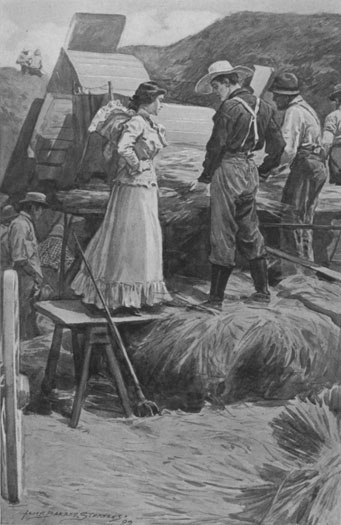
She did not disturb them in their quiet retreat, but sat down for a little while in the warm friendliness beside their open door, and thought half-dreamily of that day that was gone. What a bustle of work had filled the place! She could see the puffing engine sending up its quick black breath against the sky, and the great crimson machine, like a chariot, at its back, with Morton Elwell at the front, a charioteer holding the car of plenty on its way, amid a score of sunburnt outriders. How confident he had looked as he stood there in his workman’s dress, bare-armed and bare-throated, how strong and steady!
She smiled at her own fancy. And then the rest of the picture faded, leaving the one figure alone; but it was not at the threshing she saw him now, it was at home, at school, on the playground, and everywhere her comrade, her champion, her friend. Had he been something more in those old days, and was he still? Ah, if she could be sure of that! The letters had lost the old boyish freedom in these last months. She had complained once that Morton Elwell took too much for granted. He was taking nothing now.
Her father’s voice calling from the house roused her at last from her revery, and they were off again for home. He was thinking too busily of his summer plans to talk, and she, wrapped in her own thoughts, was glad of the silence. But she broke it suddenly as they drew near the substantial brick house which belonged to the Elwells, almost at the end of the ride.
“Suppose you let me out here, father,” she said. “I haven’t been in to see Mrs. Elwell for weeks, and I’ve been thinking all the afternoon how good she was to us last summer at the threshing. I want to go in and thank her for it over again. I’ll come home by myself in a little while.”
She hesitated a moment whether or not to go in by the back way in the old familiar fashion, then, for some reason, walked to the front door and rang the bell. The mistress herself opened it, her hands a little floury, and a clean gingham apron over her afternoon dress.
“Well, upon my word!” she exclaimed, starting at the sight of her caller. “If we weren’t talking about you, Esther Northmore, this blessed minute! Come in, come in. Who do you think is here?”
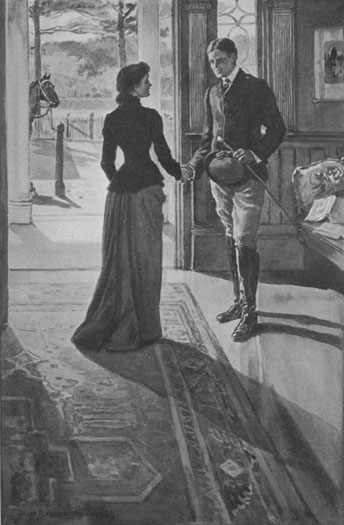
She had not time to guess. She had not time to speak the name which rose with wondering incredulity to her lips when the owner of it himself came hurrying through the hall to meet her.
“You!” she cried, fairly springing to meet Morton Elwell. “Why, how does this happen?”
“It’s vacation for me too,” he said, beaming at her in the most radiant manner. “And—yes, I’ll own it. It was a genuine fit of homesickness that brought me. I’ve been struggling with it all winter, but it was simply too much for me when there actually came a halt in the school work. I had to come. There was no other way.”
“Think of it,” said Mrs. Elwell, who looked so happy that there was almost a halo round her head; “think of his taking that journey and coming home for a week’s vacation, when he could hardly afford a day off for us all last summer.”
“It does seem as if I’d grown to be something of a spendthrift, doesn’t it?” said the young man. “But you can’t hold yourself down all the time. You have to break loose now and then. And let me tell you,”—they had reached the sitting room now, and he was sitting between them, looking from one to the other like a happy child—“let me tell you that I’ve taken the Lisper scholarship, and that means my tuition all the rest of my course. Don’t you think I could afford to give myself a glimpse of home when I wanted it so desperately?”
They cried, “Oh!” in concert, Mrs. Elwell, whose ideas were a little vague in regard to scholarships, prolonging hers as if to cover the comments she ought to make, and Esther adding, with the color sweeping over her face, “Why, that is splendid, perfectly splendid! I can’t tell you how glad I am.”
“And won’t you have to work your way any more?” asked Mrs. Elwell, when she could get her breath.
“Oh, yes. I shall have to turn an honest penny for myself now and then,” said her nephew, smiling. “Tuition doesn’t cover all the expenses by a good deal, but it’s a big help. Why, I feel quite like a nabob.”
The name, with its sudden reminder of the one to whom Tom Saxon had mockingly given it in the summer, made Esther laugh. Morton Elwell, with his brown hands and common suit of clothes, did not look the character in the least.
“Well, I’m glad you are not a nabob,” she said, meeting his eyes, and then demurely dropping her own. “Please don’t go on to be one so fast that we can’t keep up with you. There are some of us that like the old ways and have to go slow.”
His face kindled, and he was on the point of saying something, when his aunt spoke. “Now you children just make yourselves at home,” she said, rising, “and I’ll go on and get the supper. I was just fixing to make some biscuits when you came, Esther. You’ll stay to supper, of course.”
“Oh, I must go home in a minute,” said the girl. For the first time in her life she felt a sudden timidity in the thought of a tête-à-tête with Morton Elwell. “Mother’ll expect me.”
“Now what makes you talk like that?” said Mrs. Elwell, in an injured tone. “Doesn’t she know where you are? Of course she won’t expect you. She knows I wouldn’t let you go home before supper. Why, you never used to do that way, and it’s ever so long since you were here.”
The logic was unanswerable, and Esther settled back in the chair from which she had half risen. “She’ll stay, Aunt Jenny,” said Morton, and he added, smiling at Esther, “weren’t you just saying that some of us liked the old ways?”
She took refuge in them swiftly when they were left alone. He must tell her all about himself, about college, what he had done to gain that scholarship, and what else he had done. She was all sympathy, all interest, with all the old responsiveness in her face, and he yielded himself to the warmth and joy of it as one yields to spring sunshine after the cold. She grew easier after the first, and presently there was no chance for embarrassment nor for confidences left; for the senior Elwell, with Morton’s young cousins, came into the room, and then the talk grew general, though with Morton still at the centre, as was the newcomer’s right, and indeed his necessity with Esther leading him on.
She was at her best—winsome, adroit, and determined if there was family pride in this uncle of his, it should bestir itself now. She had grown even prettier than she used to be, her manners even more charming, the young man said to himself, and the bounding happiness in her heart might well have made it true. For there had been a moment, just that moment before the others came into the room, when she had caught sure knowledge of the thing she had longed to know.
He had been telling her of an oratorical contest in which he had borne a part, and, with a sudden tenderness in his voice, had said, “I wished a hundred times, while I was preparing my speech, that I could go over it with you. Do you remember how you always used to let me orate to you when I had anything on hand for the rhetoricals? It must have been an awful bore, but somehow I never felt as if I could go on the stage without your help.”
“And you see you didn’t need it after all,” she said, looking away. “You won the medal without me.”
“Oh, but it wasn’t without you,” he said, leaning toward her and speaking low, “for I was thinking all the time what you would say if I won.”
Ah, he could not have said a word like that if some other girl had stolen her place away!
The talk was over at last, and the supper too, the good substantial supper which was always spread at the Elwells’. She could go now. There was no formality to insist that having eaten she must stay still longer, and she wanted Morton to herself. She was quite ready for it now, and he would go home with her of course.
They had come back, with all the new meaning of it for each, to the old frankness and freedom, and yet as they took the familiar path across the fields, in the gathering dusk, it was not easy to speak the thought that filled both their hearts. They talked for a little while of indifferent things—of the lengthening days, of the buds swelling on the willows, of the new buildings rising on a neighbor’s place. Then, all at once the moon, the friendly moon, so kind in all its wanderings to the needs of lovers, rose up in the sky. It was a new moon, and they saw it at the same moment over their right shoulders.
“We must wish a wish, as we used to when we were children,” said Esther, gayly.
There could never be another moment like this. He stood suddenly still, and his eyes looked into hers. “Esther,” he said, “it seems to me I have only one wish in the world, it is so much dearer than all the others. If I could know, if I could surely know—” and then he stopped. That swelling at his throat which had choked him once before mastered his voice again, not from fear now, but hope.
She waited an instant, then, as her hand slipped into his, whispered, “Do you mean me, Mort? Oh, do you mean me?”
It had never taken any one so long to cross that field as it did those two to cross the little space that was left. There was no bar to speech now, and there was so much to say! He said to her presently, with a note of perplexity in his voice, “Esther, I have never understood why you gave up going to Boston this winter. You certainly wanted very much to go at first.”
“Things changed after grandfather died,” she said. She hesitated a moment, then took refuge in the formula she had used so often to the others, but with a clause she had not whispered before, as she added, “Somehow I knew there was nothing I really wanted except to come home—and have you come too.”
He murmured something rapturous. But he was not quite satisfied yet. After a little he said, “Esther, do you remember telling me once that if you had half a chance you’d live a different life from the common workaday sort; you’d have culture, and leisure, and travel, and all those things? You did have a chance, didn’t you?”
She flushed. “No one offered it to me,” she said. “Perhaps no one ever would. At any rate—” her voice sounded nervous but happy—“if ’twas ‘half a chance,’ I ran away from the other half. I didn’t want anything but you, Mort. I shall have whatever you have, and that’s enough.”
He threw back his head and drew a long breath. “Oh, I mean to do so much for you,” he said. “It seems to me I can accomplish anything now.”
There was the murmur of excited talking in the sitting room at the Northmores’ when they opened the door at last. “Well, of all the strange things she ever did, I call that the strangest,” the doctor was saying in the tone of one grappling with a mystery.
The two young people looked at each other wondering. Then Esther said, in a merry whisper, “He doesn’t mean me. He’ll think I’ve done the most sensible thing in the world.”
They walked toward the room, and the next moment Kate was in the hall to meet them. She was quite pale, and an unusual excitement showed in her manner. Even the sight of Morton Elwell seemed hardly to divert her preoccupation. “We heard you had come, and I’m so glad,” she said. Then, turning to her sister, she exclaimed: “Esther, the strangest thing you ever knew has happened. Aunt Katharine is dead. Mother got a letter just now.”
“Dead!” repeated Esther. It did not cross her mind to wonder why they thought this thing so strange. The fact itself filled her with a great and sudden sadness. “Poor dear Aunt Katharine!” she said, and in the light of what the last hour had brought to herself the thought of all the brave old heart had missed, and how stanchly she had borne it, filled her with a new love and pity. “How did it happen?”
“She died suddenly,” said Kate. “Aunt Elsie wrote about it. But it isn’t that. It’s her will! Oh, you can’t think how she’s left her money. It seems as if she couldn’t have meant it.”
An unmistakable alarm leaped into Esther Northmore’s eyes, and she turned suddenly to Morton Elwell. “We were great friends,” she whispered, in a low hurried tone, “but nothing, nothing could make any difference now.”
Low as the words were spoken, Kate caught them. “Oh, you darlings! you darlings!” she cried, throwing an arm round the neck of each. Then, between laughing and crying, she said hysterically, “But it isn’t you, Esther, that she’s left her money to. It’s me! Think of it, me!”
“You!” ejaculated Esther, dropping with a sudden limpness against Morton’s shoulder. “Did she think—”
Kate pulled her toward the door. The preponderating note in her voice was laughter now. “Come and hear what she thinks.”
Even Esther could not wait for the details of the letter after this. Aunt Katharine had gone suddenly, as she always hoped she might, but her will, which she had directed to be read at once upon her decease, was a far greater surprise to her relatives. After giving careful directions for her funeral, she had made her bequests. The document had been drawn up before her brother’s death (by date in the early fall), and her farm, which joined his, had been left to him, as a permanent part of the Saxon homestead. To certain persons, who had been in a way dependent on her kindness, she had left small sums, among them Solomon Ridgeway, to be used for his support and comfort, “at such times as he may see fit to be absent from his present residence.” (So ran the wording.) To a certain charitable institution she had left five thousand dollars. To Esther Northmore, with her love, some personal belongings, and these, as the girl recognized with a throb at her heart, were those which she had valued most, and then followed this singular passage.
“As to the bulk of my property, it has sometimes crossed my mind that could I know some young woman intelligently devoted to the securing of those rights which I believe must be accorded to women before the conditions of society can become true and sane, and willing for the sake of these, and for the sake of her own independence, to refrain from marriage, that I would make such young woman my heir. Circumstances have, however, led me to doubt the probability of finding such a one, as well as the expediency of the measure. I, therefore, being in my right mind and of disposing memory, do give and bequeath the residue of my property, valued at thirty-five thousand dollars, to my grandniece and namesake, Katharine Saxon Northmore, who, I believe, has will enough of her own to pursue whatever courses she may see fit, in spite of any man who might be bold enough to marry her. And to the gift I add this request, that she will take the trouble to look candidly into those views which I have maintained. I am confident that her sister Esther will not misstate them.”
A minute of dead silence followed the reading. Then the doctor burst forth again: “The idea of leaving a legacy to anybody with a dig like that! Why couldn’t she have been civil about it if she wanted to do it? Perhaps her notion was to scare the young men off and keep Kate single after all.”
But Morton Elwell burst out laughing. “Not a bit of it,” he said. “A fellow who didn’t think he was mighty lucky to get Kate on any terms wouldn’t deserve to have her, and the old lady knew it. Kate, I call this glorious!” and he caught her and whirled her around the room at a rate which left them both breathless.
“I’ll tell you what ’tis, father,” she began, with a gasp, when they had fairly stopped. “I don’t intend to have the name without the game, and I mean to begin to use that money as I please, right away. We’ll pay off that mortgage that has bothered you so, the very first thing.”
“Nonsense,” said the doctor; but she went on:—
“And maybe, when I get through the rest of my schooling, I’ll take a course in medicine. I always thought I should like to be a doctor. Don’t you think ‘Northmore and Northmore’ would look well over your office?”
“Nonsense,” he said again, this time more sternly. But he had been known to say “nonsense” before to some plans which his girls carried out.
And after a while—“How far do thirty-five thousand dollars go? I might do something handsome by Mort and Esther,” she added, sending a sly look at the two young people.
Their sudden blushes told the rest of the story.
“Well, well!” said the doctor, laying down the paper, “how things are heaping up to-night!” He sent a glance at his wife, and the look in her eyes made his own grow moist. “My dear,” he said, “this is a pretty good world of ours, after all. I don’t pretend to understand what the cranks are driving at, but I rather think there are some of the old ways that’ll keep it sweet yet.”
W. A. Wilde Company, Publishers.
A REVOLUTIONARY MAID, A Story of the Middle Period of the War for Independence. By Amy E. Blanchard. 321 pp. Cloth, $1.50.
The stirring times in and around New York following the pulling down of the statue of George the Third by the famous “Liberty Boys,” brings to the surface the patriotism of the young heroine of the story. This act of the New York patriots obliged Kitty De Witt to decide whether she would be a Tory or a Revolutionary maid, and a patriot good and true she became. Her many and various experiences are very interestingly pictured, making this a happy companion book to “A Girl of ’76.”
THE GOLDEN TALISMAN. By H. Phelps Whitmarsh. 300 pp. Cloth, $1.50.
The narrative is based upon the adventures of a young Persian noble, who, being forced to leave his own country, leads an army against the mysterious mountain kingdom of Katfirias. Though defeated and taken prisoner by the enemy, the hero’s talisman saves his life and, later, leads him into kingly favor.
A valuable fund of information regarding the various plants, woods, and animals which furnish the world with perfume is happily interwoven into the story.
WHEAT AND HUCKLEBERRIES; Dr. Northmore’s Daughters. By Charlotte M. Vaile. 336 pp. Cloth, $1.50.
Mrs. Vaile has drawn the characters for her new book from the Middle West. But as the two girls spent their summer at their grandfather’s in New England, a capital groundwork is furnished for giving the local color of both sections of the country. The story is bright and spirited and the two girls are sure to find their place among the favorite characters in fiction. All those who have read the Orcutt stories will welcome this new book by Mrs. Vaile.
WITH PERRY ON LAKE ERIE, A Tale of 1812. By James Otis. 307 pp. Cloth, $1.50.
The story carries the reader from March until October of 1813, being laid on Lake Erie, detailing the work of the gallant Perry, who at the time of his famous naval victory was but twenty-seven years of age. From the time the keels of the vessels which became famous were laid until the victory was won which made Perry’s name imperishable, the reader is kept in close touch with all that concerned Perry, and not only the main facts but the minor details of the story are historically correct.
Just the kind of historical story that young people—boys especially—are intensely interested in.
BARBARA’S HERITAGE or, Young Americans Among the Old Italian Masters. By D. L. Hoyt. 325 pp. Cloth, $1.50.
We welcome a book from the pen of Miss Hoyt, whose foreign travel and study has made possible an exceedingly interesting story, into which has been interwoven much instructive and valuable information.
With a desire to broaden the education of her son and daughter by the opportunities afforded in foreign travel, an American mother takes them to Italy, and the author in a very happy strain has given us their many experiences. Replete with numerous illustrations and half-tones, it makes a handsome and attractive volume.
W. A. Wilde Company, Boston and Chicago.
W. A. Wilde Company, Publishers.
THE QUEEN’S RANGERS. By Charles Ledyard, Norton. 352 pp. Cloth, $1.50.
The thrilling period during the last years of our struggle for independence forms the groundwork for Colonel Norton’s latest work.
The intense patriotism which prompted our young men to do and dare anything for their country is shown in the exploits of the three young heroes.
By enlisting for a time beneath His Majesty’s flag they were able to give much valuable information to the colonial cause.
With historical truth the author in this, his latest book, has happily coupled an exceedingly interesting and instructive story.
THE ROMANCE OF CONQUEST. The Story of American Expansion through Arms and Diplomacy. By William E. Griffis. 312 pp. Cloth, $1.50.
In concise form it is the story of American expansion from the birth of the nation to the present day.
The reader will find details of every war. Anecdote enlivens the story from July 4, 1776, down to the days of Dewey, Sampson, and Schley, and of Miles, Merritt, Shatter, and Otis. It is a book as full of rapid movement as a novel.
WHEN BOSTON BRAVED THE KING. A Story of Tea-Party Times. By W. E. Barton, D. D. 314 pp. Cloth, $1.50.
One of the most absorbing stories of the Colonial-Revolutionary period published. The author is perfectly at home with his subject, and the story will be one of the popular books of the year.
“Though largely a story of boys and for boys, it has the liveliest interest for all classes of readers, and makes a strong addition to Dr. Barton’s already notable series of historical tales.”—Christian Endeavor World.
“It is a pleasure to read and to recommend such a book as this. In fact, we must say at the very beginning, that Dr. Barton is becoming one of the most skilful and enjoyable of American story-tellers.”—Boston Journal.
CADET STANDISH OF THE ST. LOUIS. A Story of Our Naval Campaign in Cuban Waters. By William Drysdale. 352 pp. Cloth, $1.50.
A strong, stirring story of brave deeds bravely done. A vivid picture of one of the most interesting and eventful periods of the late Spanish War.
“It is what the boys are likely to call ‘a rattling good story.’”—Cleveland Plain Dealer.
“Mr. Drysdale has drawn an effective picture of the recent war with Spain in his new book. The story is full of dash and fire without being too sensational.”—Congregationalist.
A DAUGHTER OF THE WEST. The Story of an American Princess. By Evelyn Raymond. 347 pp. Cloth, $1.50.
Interesting, wholesome, and admirable in every way is Mrs. Raymond’s latest story for girls. Descriptions of California life are one of the fascinations of the book.
“A well-written story of Western life and adventure, which has for its heroine a brave, high-minded girl.”—Chronicle Telegraph, Pittsburg.
“Laid among the broad valleys and lofty mountains of California every chapter is crowded full of most interesting experiences.”—Christian Endeavor World.
W. A. Wilde Company, Boston and Chicago.
W. A. Wilde Company, Publishers.
WAR OF THE REVOLUTION SERIES.
By Everett T. Tomlinson.
THREE COLONIAL BOYS. A Story of the Times of ’76. 368 pp. Cloth, $1.50.
It is a story of three boys who were drawn into the events of the times, is patriotic, exciting, clean, and healthful, and instructs without appearing to. The heroes are manly boys, and no objectionable language or character is introduced. The lessons of courage and patriotism especially will be appreciated in this day.—Boston Transcript.
THREE YOUNG CONTINENTALS. A Story of the American Revolution. 364 pp. Cloth, $1.50.
This story is historically true. It is the best kind of a story either for boys or girls, and is an attractive method of teaching history.—Journal of Education, Boston.
WASHINGTON’S YOUNG AIDES. A Story of the New Jersey Campaign, 1776-1777. 391 pp. Cloth, $1.50.
The book has enough history and description to give value to the story which ought to captivate enterprising boys.—Quarterly Book Review.
The historical details of the story are taken from old records. These include accounts of the life on the prison ships and prison houses of New York, the raids of the pine robbers, the tempting of the Hessians, the end of Fagan and his band, etc.—Publisher’s Weekly.
Few boys’ stories of this class show so close a study of history combined with such genial story-telling power.—The Outlook.
TWO YOUNG PATRIOTS. A Story of Burgoyne’s Invasion. 366 pp. Cloth, $1.50.
The crucial campaign in the American struggle for independence came in the summer of 1777, when Gen. John Burgoyne marched from Canada to cut the rebellious colonies asunder and join another British army which was to proceed up the valley of the Hudson. The American forces were brave, hard fighters, and they worried and harassed the British and finally defeated them. The history of this campaign is one of great interest and is well brought out in the part which the “two young patriots” look in the events which led up to the surrender of General Burgoyne and his army.
The set of four volumes in a box, $6.00.
SUCCESS. By Orison Swett Marden. Author of “Pushing to the Front,” “Architects of Fate,” etc. 317 pp. Cloth, $1.25.
It is doubtful whether any success books for the young have appeared in modern times which are so thoroughly packed from lid to lid with stimulating, uplifting, and inspiring material as the self-help books written by Orison Swett Marden. There is not a dry paragraph nor a single line of useless moralizing in any of his books.
To stimulate, inspire, and guide is the mission of his latest book, “Success,” and helpfulness is its keynote. Its object is to spur the perplexed youth to act the Columbus to his own undiscovered possibilities; to urge him not to wait for great opportunities, but to seize common occasions and make them great, for he cannot tell when fate may take his measure for a higher place.
W. A. Wilde Company, Boston and Chicago.
W. A. Wilde Company, Publishers.
BRAIN AND BRAWN SERIES.
By William Drysdale.
THE YOUNG REPORTER. A Story of Printing House Square. 300 pp. Cloth, $1.50.
I commend the book unreservedly.—Golden Rule.
“The Young Reporter” is a rattling book for boys.—New York Recorder.
The best boys’ book I ever read.—Mr. Phillips, Critic for New York Times.
THE FAST MAIL. A Story of a Train Boy. 328 pp. Cloth, $1.50.
“The Fast Mail” is one of the very best American books for boys brought out this season. Perhaps there could be no better confirmation of this assertion than the fact that the little sons of the present writer have greedily devoured the contents of the volume, and are anxious to know how soon they are to get a sequel.—The Art Amateur, New York.
THE BEACH PATROL. A Story of the Life-Saving Service. 318 pp. Cloth, $1.50.
The style of narrative is excellent, the lesson inculcated of the best, and, above all, the boys and girls are real.—New York Times.
A book of adventure and daring, which should delight as well as stimulate to higher ideals of life every boy who is so happy as to possess it.—Examiner.
It is a strong book for boys and young men.—Buffalo Commercial.
THE YOUNG SUPERCARGO. A Story of the Merchant Marine. 352 pp. Cloth, $1.50.
Kit Silburn is a real “Brain and Brawn” boy, full of sense and grit and sound good qualities. Determined to make his way in life, and with no influential friends to give him a start, he does a deal of hard work between the evening when he first meets the stanch Captain Griffith, and the proud day when he becomes purser of a great ocean steamship. His sea adventures are mostly on shore; but whether he is cleaning the cabin of the North Cape or landing cargo in Yucatan, or hurrying the spongers and fruitmen of Nassau, or exploring London, or sight seeing with a disguised prince in Marseilles, he is always the same busy, thoroughgoing, manly Kit. Whether or not he has a father alive is a question of deep interest throughout the story; but that he has a loving and loyal sister is plain from the start.
The set of four volumes in a box, $6.00.
SERAPH, THE LITTLE VIOLINISTE. By Mrs. C. V. Jamieson. 300 pp. Cloth, $1.50.
The scene of the story is the French quarter of New Orleans, and charming bits of local color add to its attractiveness.—The Boston Journal.
Perhaps the most charming story she has ever written is that which describes Seraph, the little violiniste.—Transcript, Boston.
W. A. Wilde Company, Boston and Chicago.
W. A. Wilde Company, Publishers.
TRAVEL-ADVENTURE SERIES.
IN WILD AFRICA. Adventures of Two Boys in the Sahara Desert, etc. By Thos. W. Knox. 325 pp. Cloth, $1.50.
A story of absorbing interest.—Boston Journal.
Our young people will pronounce it unusually good.—Albany Argus.
Col. Knox has struck a popular note in his latest volume.—Springfield Republican.
THE LAND OF THE KANGAROO. By Thos. W. Knox. Adventures of Two Boys in the Great Island Continent. 318 pp. Cloth, $1.50.
His descriptions of the natural history and botany of the country are very interesting.—Detroit Free Press.
The actual truthfulness of the book needs no gloss to add to its absorbing interest.—The Book Buyer, New York.
OVER THE ANDES; or, Our Boys in New South America. By Hezekiah Butterworth. 368 pp. Cloth, $1.50.
No writer of the present century has done more and better service than Hezekiah Butterworth in the production of helpful literature for the young. In this volume he writes, in his own fascinating way, of a country too little known by American readers.—Christian Work.
Mr. Butterworth is careful of his historic facts, and then he charmingly interweaves his quaint stories, legends, and patriotic adventures as few writers can.—Chicago Inter-Ocean.
The subject is an inspiring one, and Mr. Butterworth has done full justice to the high ideals which have inspired the men of South America.—Religious Telescope.
LOST IN NICARAGUA; or, The Lands of the Great Canal. By Hezekiah Butterworth. 295 pp. Cloth, $1.50.
The book pictures the wonderful land of Nicaragua and continues the story of the travelers whose adventures in South America are related in “Over the Andes.” In this companion book to “Over the Andes,” one of the boy travelers who goes into the Nicaraguan forests in search of a quetzal, or the royal bird of the Aztecs, falls into an ancient idol cave, and is rescued in a remarkable way by an old Mosquito Indian. The narrative is told in such a way as to give the ancient legends of Guatemala, the story of the chieftain, Nicaragua, the history of the Central American Republics, and the natural history of the wonderlands of the ocelot, the conger, parrots, and monkeys.
Since the voyage of the Oregon, of 13,000 miles to reach Key West the American people have seen what would be the value of the Nicaragua Canal. The book gives the history of the projects for the canal, and facts about Central America, and a part of it was written in Costa Rica. It enters a new field.
The set of four volumes in a box, $6.00.
QUARTERDECK AND FOK’SLE. By Molly Elliott Seawell. 272 pp. Cloth, $1.25.
Miss Seawell has done a notable work for the young people of our country in her excellent stories of naval exploits. They are of the kind that causes the reader, no matter whether young or old, to thrill with pride and patriotism at the deeds of daring of the heroes of our navy.
W. A. Wilde Company, Boston and Chicago.
W. A. Wilde Company, Publishers.
FIGHTING FOR THE FLAG SERIES.
By Chas. Ledyard Norton.
JACK BENSON’S LOG; or, Afloat with the Flag in ’61. 281 pp. Cloth, $1.25.
An unusually interesting historical story, and one that will arouse the loyal impulses of every American boy and girl. The story is distinctly superior to anything ever attempted along this line before.—The Independent.
A story that will arouse the loyal impulses of every American boy and girl.—The Press.
A MEDAL OF HONOR MAN; or, Cruising Among Blockade Runners. 280 pp. Cloth, $1.25.
A bright, breezy sequel to “Jack Benson’s Log.” The book has unusual literary excellence.—The Book Buyer, New York.
A stirring story for boys.—The Journal, Indianapolis.
MIDSHIPMAN JACK. 290 pp. Cloth, $1.25.
Jack is a delightful hero, and the author has made his experiences and adventures seem very real.—Congregationalist.
It is true historically and full of exciting war scenes and adventures.—Outlook.
A stirring story of naval service in the Confederate waters during the late war.—Presbyterian.
The set of three volumes in a box, $3.75.
A GIRL OF ’76. By Amy E. Blanchard. 331 pp. Cloth, $1.50.
“A girl of ’76” lays its scene in and around Boston where the principal events of the early period of the Revolution were enacted. Elizabeth Hall, the heroine, is the daughter of a patriot who is active in the defense of his country. The story opens with a scene in Charlestown, where Elizabeth Hall and her parents live. The emptying of the tea in Boston Harbor is the means of giving the little girl her first strong impression as to the seriousness of her father’s opinions, and causes a quarrel between herself and her schoolmate and playfellow, Amos Dwight.
A SOLDIER OF THE LEGION. By Chas. Ledyard. Norton. 300 pp. Cloth, $1.50.
Two boys, a Carolinian and a Virginian, born a few years apart during the last half of the eighteenth century, afford the groundwork for the incidents of this tale.
The younger of the two was William Henry Harrison, sometime President of the United States, and the elder, his companion and faithful attendant through life, was Carolinus Bassett, Sergeant the old First Infantry, and in an irregular sort of a way Captain of Virginian Horse. He it is who tells the story a few years after President Harrison’s death, his granddaughter acting as critic and amanuensis.
The story has to do with the early days of the Republic, when the great, wild, unknown West was beset by dangers on every hand, and the Government at Washington was at its wits’ end to provide ways and means to meet the perplexing problems of national existence.
W. A. Wilde Company, Boston and Chicago.