DEAR COUSINS:
FOR weeks and months we had been reading every scrap of information we
could find about the wonderful Fair which was to be given in San
Francisco, the city of our dreams.
We had not even imagined that we could go to it, because mother could
not come until later, and then school would be in session, so when
father said that we might come with him we were more than thankful.
Mother looked a little doubtful, but father said, “Nonsense, it is no
trick at all for me to take them.” Madame World has sent us an
invitation to her Fair and we could not think of refusing. So we came at
once.
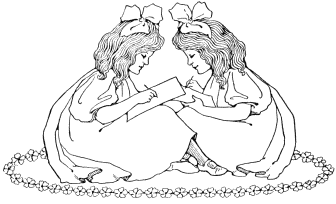
We have been so wishing that you could be here with us that father has
suggested that we write you a letter every day, and tell you about some
of the things that we see.
We think it is a good plan, and we shall try to make the letters as full
of interest as possible, in the hope that we may show you something of
it, and at the same time fix it in our own memories.
First, then, this Wonder City by the Sea is a real city, even though it
does, as we heard a lady remark today, look like a poet’s dream.
It has a bank, and a postoffice, a hospital, a fire department, a hotel,
a street car, houses for the different families of the world to live in,
and in fact about everything which any city needs.
The buildings and statuary are made of a kind of cement, called
artificial travertine, tinted to look like terra cotta.
Real travertine is a pure carbonate of lime formed from dripping water
which bears a lime deposit, and is found in Rome, where it is much used
in building and for statuary. The imitation travertine was discovered by
Mr. Paul Denneville of New York, and we have to thank him for the fact
that after all day at the Fair our eyes are not in the least tired; it
is due to the fact that the material is easily tinted, that Mr. Jules
Guerin who composed the color scheme of the whole Fair was able to carry
out his ideas.
You will remember that Mr. Guerin is the man
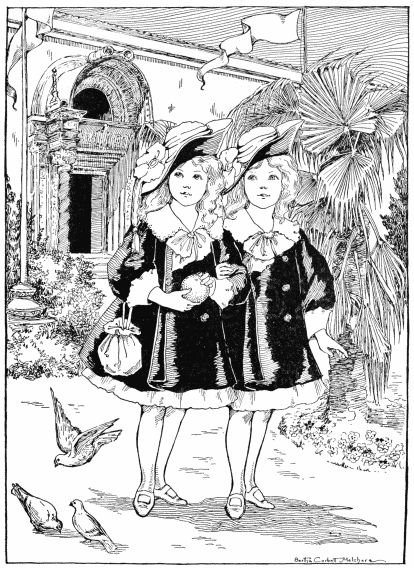 Madame World has sent us an invitation to her Fair and we
could not think of refusing. So we came at once.
Madame World has sent us an invitation to her Fair and we
could not think of refusing. So we came at once.
who makes the color pictures which we have so much admired in the
“Century Magazine.”
The roofs are covered with artificial tiles, and the contrast between
the pinkish walls and the red of the roofs makes a picture which will
never be forgotten.
It seems a pity that the city cannot remain, but it is not built for
permanency, father says, but is like a beautiful dream, which seems so
real that the memory stays always, and that its influence will color our
whole lives, and make each one of us better for having seen it.
And when we got our first glimpse of the Tower! We couldn’t even say
“Oh!” We just looked at each other, and then back at the Fair city, just
to make sure we were not dreaming.
There was the beautiful Tower of Jewels, smiling and twinkling its
shining eyes at us, and saying, “Come in, children; come in, and walk
under my beautiful blue arches, and through my magic courts, and my
sheltered gardens, and be happy, and love each other and all the
children of the world. Peace I offer you, and Plenty, and Harmony, and
Beauty. Here you are safe, and here you are welcome. Come in, my
children.”
So in we went. The sun was shining, the blue waters of the bay were
sparkling, bands were playing, the red and yellow flags were flying in
the sweet salt breezes, and the lovely white pigeons were cooing; and
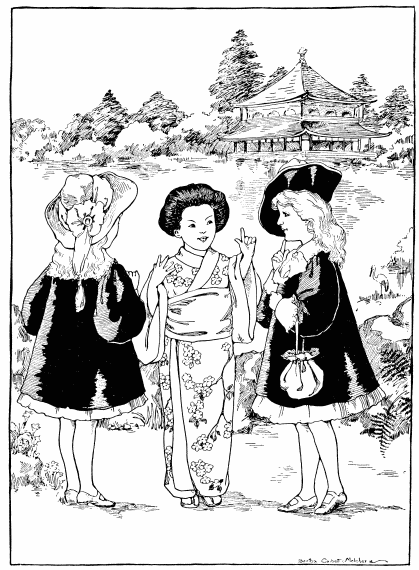
best of all, little white people, and little brown people, and little
yellow people were here and there and everywhere, all happy and smiling
and glad that they had come.
We will tell you about the Tower. It is Madame World’s expression of joy
and satisfaction that the Canal is finished, and it is really the key to
the whole Fair. Mr. Thomas Hastings of New York designed it. It is four
hundred and forty-three feet in height, and the arch, which is the
gateway to the Fair, is sixty feet wide and one hundred and ten feet
high.
On the pedestals are figures of men who have made the world what it is
today. There are fifty thousand jewels on the Tower, of five
colors—canary, amethyst, ruby, aquamarine, and white. These were made
in Austria, of a peculiar kind of sand which produces a very hard glass,
called Sumatra stone, and which takes a high polish. The jewels were cut
exactly like precious stones, and are called Nova Gems.
These were set in bands of metal, and suspended from hooks, each jewel
with a tiny mirror back of it.
When the winds move the jewels, they catch the light, and sparkle like
real gems.
At night under the illumination of the searchlights the Tower is even
more beautiful than in the sunshine.
We are glad that we are going to have the memory of the Tower to take
away with us.
Your loving cousins,
JANE AND ELLEN.