By Jack Bell
Columbus, Ohio, Citizen, January 6, 1945
WITH THE U. S. FOURTH ARMORED DIVISION, Belgium—The road to Bastogne
is paved with bad intentions—enemy and friendly tanks which slugged
it out during the dramatic drive up from the south to relieve the
101st Airborne Division and its complement of tanks.
Other battles are in progress as generals feint and parry with armies
across the frozen wastes. But the soldiers have their pets, and every
man of the Fourth Armored Division has the battle of Bastogne heading
the “Hit Parade.”
Bastogne caught the public fancy. We shot 20,000 troops in to save it.
Every soldier overseas knew of the encirclement which shut them off,
the days of fog which shut off air power for four days. The entire
Allied Expeditionary Force had one question: “What about
Bastogne.”
I was with the powerful and confident “Fourth Armored” the day its
tanks and armored infantry rolled off the line of departure toward
Bastogne. Snow fell gently. Mud was deep, but day after day they
forded and bridged streams, mopping up the steadily stiffening German
opposition. Each night they paused, then fought on.
“For if we get only 2,000 yards we’re that much nearer the men in
Bastogne,” was the expression of Lt. Col. Delk Oden, Elgin, Tex.,
tank battalion commander.
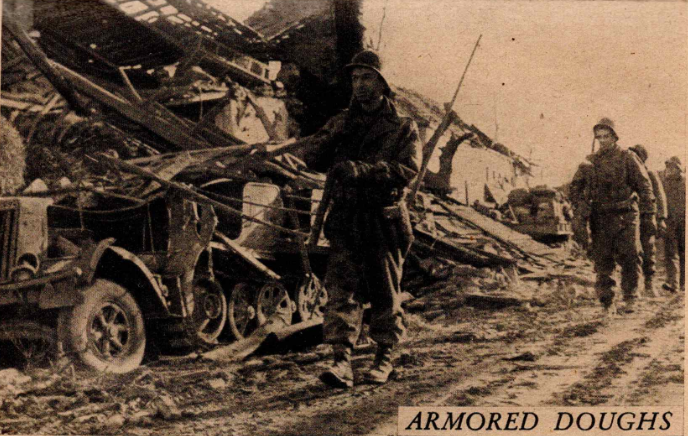
At last they met in pitched battle. South of Bastogne in the villages
of Chaumont and Assenois, dozens of tanks along the streets and in the
field are mute evidence of the mighty struggle that preceded the entry
into Bastogne, leaving both armies weaker when it was over.
Then one evening at 4 o’clock, Lt. Charles Boggess, Jr., Greenville,
Ill., up in the hatch of a tank, said: “You all know we’ve got to
get to those men in the town. All you’ve got to do is keep em
rollin’ and follow me. It won’t be any picnic but we’ll make
it.”
He buttoned down the hatch, roared away and the others followed. They
rumbled through wrecks of tanks in Assenois, through a terrific
barrage from American guns, a daring maneuver that paid fat dividends
for the artillery kept the Germans in holes and 400 prisoners were
taken by the infantry which followed.
Up the road Lt. Boggess and the tanks rolled. The smoke in Assenois
caused a slight break in the column after four had rounded a turn. The
others stopped to check the route. The pause gave the Jerries time to
toss Teller mines onto the road. A halftrack hit one. Captain Bill
Dwight, Grand Forks, Michigan, leaped from a tank and threw the mines
off the road and the rescue party rolled on.
They went full speed, with every machine gun spraying the roadside and
the woods every foot of the way, turning the quiet dusk into mad
warfare. Germans were running everywhere, usually away from the
blazing guns.
Lt. Boggess met outposts of besieged Americans outside of the city,
but the men were not quite convinced that his tanks were friendly. It
had been a long time since they had seen friendly troops. Nor was the
lieutenant sure that he had met friends, or Germans in American
uniforms, which they have been wearing wholesale since taking American
prisoners.
But both soon were convinced, and the siege ended.
That is, it ended after a fashion. The infantry followed the tanks,
mopping up both sides of the road. Trucks of food and shells and
ambulances dashed into town.
The world was joyous, excepting Germany and Japan that the Fourth had
fought through and everybody said, “Bastogne is saved; thank God.”
At which time the “Fourth Armored” men dug in for what they knew
would be a grim battle to keep the breach open. But, they’re old
hands at this business of war and went to work. Hardly had they had
time to set up their defenses before giant Tiger tanks rolled down
from north of Bastogne. Our pilots came through the clouds to bomb the
Tigers. We 30 lost tank destroyers, but wrecked the Tigers. A flock of
light tanks shot 30,000 rounds into the woods in five minutes, and the
Jerries lay dead by the hundreds. Infantrymen crawled through the snow
to hit the tanks, and—
Yes, the Germans swarmed into them so furiously at times that they had
to withdraw. But they never ran. Day and night they fought on,
unheeded because the world which had been so concerned and had heard
that Bastogne had been saved—and forgot it.
They’re having birthday celebrations just now, with fingers on
triggers—just one year overseas and six months in combat. They were
in the Normandy breakthrough and cut off the Brittany peninsula. One
combat team liberated Nantes, and Orleans. They drove to the Seine and
took the bridgehead at Troyes. They crossed the Marne three times,
forced the withdrawal of the Germans from Nancy on the Moselle, and
went on across the Saar. And when the Bastogne situation grew
desperate, the Fourth Armored was rushed up to spearhead the corps
drive to save it.
It is one of our Army’s good, tough outfits, the type that has made
General George S. Patton, Jr., famous. Its skipper (then) Major
General Hugh Gaffey, was Patton’s chief of staff until he came here.
What a swath they have cut in Jerry’s army: thousands of prisoners,
thousands killed and wounded, 450 tanks, 250 artillery pieces and
1,600 other vehicles since their landing in France.
And as this is written they await further attacks by the increasing
German power, in the war’s biggest winter battle.
By Collie Small
GERMANY, BY WIRELESS. It had been a fitful night filled with the
thunder of big guns and the rumble of German traffic moving along the
river road, but now the noise had died away. The tankers sat waiting
for the fog to lift, so they could move across the last 1,000 yards to
where the Rhine swept around the big bend from Coblenz.
Then the explosions came—dull, muffled booms that rolled up from the
river and shouldered their way through the filmy mists hanging over
the orchards and gently rolling fields. Hidden in the fog, the slender
Crown Prince Wilhelm Bridge disintegrated with a roar as the center
span collapsed into the river. German soldiers and vehicles catapulted
from the bridge in a tangled shower of horses, carts and men. A
machine pistol spoke sharply in short sentences, then stopped. The
tanks moved.
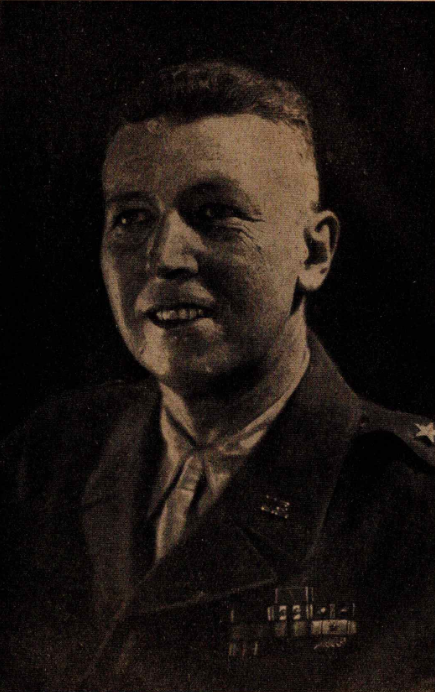
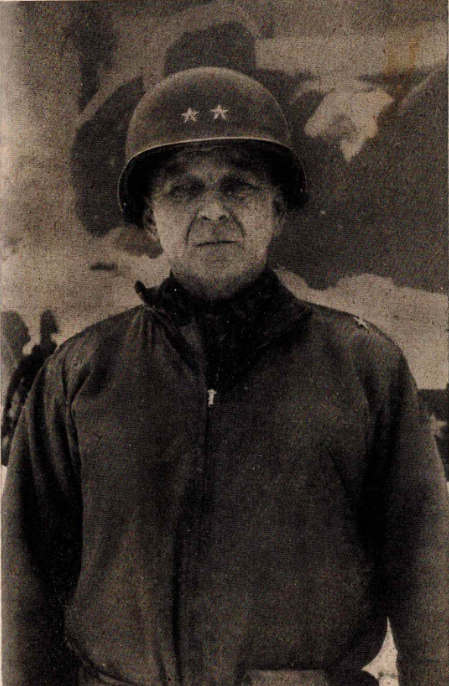
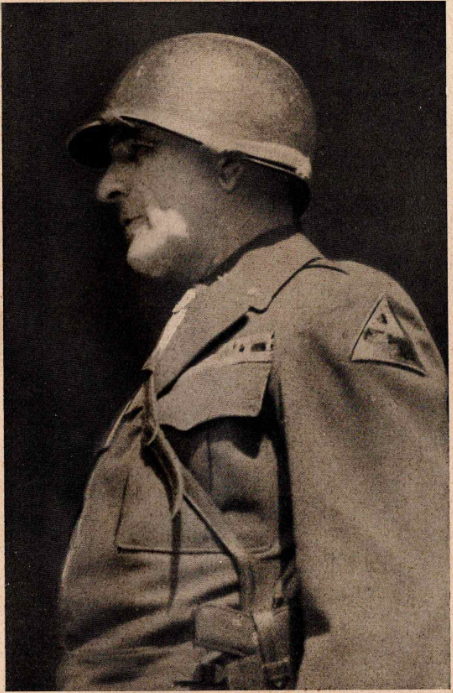
Major General Hugh J. Gaffey
Division Commander
3 December 1944-21 March 1945
At the river front, they swung right and crunched over the broken
bodies and smashed vehicles strewn along the tree-lined highway. They
lumbered into Urmitz, moved through streets still heavy with the
pungent smell of battle smoke, than followed the road out to where the
ragged stump of the bridge stood in a maze of twisted railroad tracks
and girders hanging down into the river. There the column halted and
the fabulous colonel who commanded the tanks turned to the equally
fabulous major who commanded the armored infantry, and said, “Hell,
this is the Rhine, and we’re just sitting here looking at it. Let’s
go spit in it.”
They had come a long way. July, 1944, was hot and the dust swirled
across the beach in stifling clouds when the fledgling 4th Armored
Division’s shiny new white-starred tanks rolled up through the surf
and started down the road to Ste. Mere Eglise on the shattered
Normandy coast.
That was the first mile. The first prisoner was a gangling, bedraggled
SS deserter who shuffled across a marsh to give himself up to the
curious tankers. At Coutances, burly Maj. Gen. John S. Wood, who then
commanded the division, strode into the town during a heavy artillery
barrage and personally captured a German soldier.
Avranches was next. Pvt. “Red” Whitson, of Indianapolis, sat at a
curve in the road, playing his machine gun like a garden hose until
two dozen vehicles were burning fiercely and four dozen German bodies
sprawled in the road where a plunging mass of maddened horses tried to
wrench free from their traces. They left Whitson in Avranches, slumped
over his smoking gun.
Then the division broke through the German defenses with a tremendous
rush and sealed off the Brittany Peninsula. The mass of armor wheeled
east on the right flank of Patton’s 3rd Army and started a sweeping
right hook that carried clear across the face of France. In five days,
three German infantry divisions and four regiments from other
divisions were swept under the avalanche of clattering tanks. The
swift spearheads smashed fifty-four miles to Rennes, Breton capital,
hacking away at vital enemy communication lines. They sped seventy
miles to Vannes. One combat command struck toward Lorient on the
Brittany coast. Another drove eighty miles to the cathedral city of
Nantes. There has never been anything like it.
The 4th Armored Division became a shifting island of armor in a sea of
milling German troops. The tanks moved so fast that fuel and
ammunition had to be flown to them from England. They ran off their
maps and had to have new ones rushed from England by plane and dropped
to the columns on the road. On August fourteenth, they raced 153 miles
to St. Calais, refueled and within six hours were rolling again,
toward the city of Orleans on the Loire. Combat Command A attacked
Orleans early the next morning, took it by two-fifteen in the
afternoon and turned it over to the 35th Infantry Division. On the
same day, Combat Command B left the Lorient sector and sprinted
eastward 264 miles in thirty-four hours, finally halting at Prunay.
In a little more than seven weeks, the 4th Armored spearhead hurtled
from Normandy to the Moselle River, rolling up some 1,500 speedometer
miles. They threw a pincers around beautiful Nancy and in a roaring
fifteen-day battle knocked out 281 German tanks. It was on the Moselle
that Sgt. Constant Klinga, of Brooklyn, made his classic observation,
“They got us surrounded again, the poor devils.”
It was near Nancy that Captain James H. Fields, of Fort Worth, Texas,
an armored infantry platoon leader, took fifty-five men up the
bloodiest hill in Lorraine. Enemy tanks crawled up the other side of
the hill and rolled down at the doughboys in their foxholes. The
German tanks loomed over the desperate infantrymen and fired
point-blank into the foxholes with their big 88’s. The doughboys
fought wildly, but, one by one, the foxholes went silent. Shrapnel
ripped into Field’s face and filled his mouth with jagged steel
splinters and bone fragments from his shattered jaw. The young captain
jammed a compress into his mouth, held another over his gaping cheek,
and continued to fire with his left hand. He directed the shrinking
platoon with hand signals and penciled notes passed from one foxhole
to another. When he staggered down the hill twenty-four hours later
with thirteen dazed survivors, they carried him away to a field
hospital and awarded him the Congressional Medal of Honor.
Then the division plunged into the Saar. A cavalry troop stormed
Gosselming and captured, intact, the bridge across the Saar River,
after which they mopped up the village and took, among other
prisoners, the German demolition crew charged with blowing up the
bridge. They were sitting quietly in a local beer parlor when the
cavalry jeeps burst into the town.
At Domfessel, the enemy road blocks were strong and well defended. So
the leading Sherman charged out of an orchard and bulled its way
between two houses, tearing down the walls on both sides of the narrow
opening. The other tanks churned over the rubble in single file and
then fanned out into the town to complete the capture.
They were still slugging away in the Saar against bitter German
resistance when Patton called for Gaffey. The 4th Armored swung away
from the enemy and raced north over the black-topped roads on the
famous “Fire-Call Run” to besieged Bastogne under stern, aloof
Maj. Gen. Hugh J. Gaffey, of Austin, Texas, successor in December to
General Wood, and since promoted to corps commander. The tanks rammed
their way into Bastogne and left the battered 5th German Paratroop
Division reeling helplessly in its wake, 65 per cent of its strength
smashed. The siege was lifted.
The tanks drove on through Bastogne. Lt. Robert Pearson, of Highland
Park, Michigan, peered down from the cockpit of his tiny Cub
artillery-observation plane and spotted tank movements on the edge of
a woods. Pearson and his flimsy puddle jumper came down through a
storm of small-arms fire to seventy-five feet to make sure the tanks
were German. Then he swept away, marked the spot on a map and dropped
it to the American tankers on the ground.
Under Lt. John Kingsley, of Dunkirk, New York, six Shermans slipped
into ambush, only the tops of their round turrets showing above the
thick foliage. The Panthers poked their long-nosed 88’s into the
open and started moving across an open field. The big guns on the
Shermans roared. The first German tank burst into flames, but the rest
kept coming until eleven had strayed out to their death. Kingsley
leaned on his turret and gazed wonderingly across the field at the
eleven smoking tanks. “If the German who commands that tank company
isn’t dead,” he said, “I hope they promote him to battalion
commander. We could use more like him.”
The tanks were still attacking when orders came to disengage. In one
of its most ticklish operations, the entire division eased away from
the enemy at night, blacked out all its markings and quietly moved
southward into position east of Luxembourg, where German armor was
massing for an expected counterattack. The 4th Armored waited
patiently, but in vain. The counterattack never came.
Patton, ringmaster for this most potent collection of armor, long had
dreamed of fighting on the Rhine. At a press conference when the 3rd
Army was still grinding slowly ahead against subborn opposition in
Eastern France, the “Old Man” suddenly rose from his chair, strode
stiff-leggedly across the room and drew the curtains back from his map
while newspapermen crowded around. He waited until the room was quiet.
Then he pointed to the thin blue line that marked the storied river
and nodded his head slowly, as if in anticipation of some great and
deep satisfaction yet to come. “That will be the day, gentlemen,”
he said. “That will be the day.”
A wet snow was falling at seven-thirty in the morning when the first
light tank of Combat Command B clattered across the bridge over the
Kyll River near Metterich, under diminutive, bespectacled Brig. Gen.
(now Major General) Holmes E. Dager, of Union, New Jersey. The
objective was the Rhine, sixty-six miles away through the rugged
Schnee Eifel and across the undulating middle-Rhine plain. The night
before, Colonel Creighton Abrams, of Agawam, Mass., deceptively
pink-cheeked commander of the 37th Tank Battalion and a living legend
among tankers, told his men, “The board of directors has met. We
jump off at seven-thirty, and it’s ’Katy, bar the door.”
Fortified with a week’s rations, in case they outran their
food-supply trains, Combat Command B moved up through the bridgehead
which was established on the east bank of the Kyll by the veteran 5th
Infantry Division. Combat Command A was to parallel Combat Command B
to the north. The orders were simple; “Get to the Rhine.” Abrams
didn’t even bother to ask what lay between his tanks and the
objective. “If I plotted German divisions on my map,” he said,
I’d be too frightened to move.”
Five hundred yards out of its bridgehead, Combat Command A bogged down
hopelessly in the mud. Its route was hastily altered and Combat
Command A was ordered to fall in behind Combat Command B. They tried
to break Combat Command A away again, but the mud was too heavy on the
alternate roads available. So the 4th Armored Division, Combat Command
B leading, rolled along one narrow road, strung out along a sector
sixty-six miles long and twenty-five feet wide.
The spearhead slashed into the surprised Germans from the south
instead of from the west, the direction from which the enemy expected
the attack. For the first nine miles the tanks moved parallel to the
German lines, drawing fire from both the West and the east, but
rolling up the enemy flank as they went. Then they turned east and the
rat chase was on.
Nimble light tanks and heavy assault guns led the way over the narrow,
twisting roads through the pine-clad hills of the Schnee Eifel.
Halftracks and other vehicles became mired and the tanks had to tow
them a part of the way. The snow turned to rain at Badem and the enemy
attacked with tanks. Four of them were knocked out in a brisk duel on
the road and Combat Command B pushed on past the burning hulks.
Abrams raced up and down the column in his jeep or jumped into the
turret of his Sherman, pleading with his men, swearing at them,
encouraging them. It was he who kept them going when it looked as
though they might bog down. Once the irrepressible young colonel
knocked General Dager’s helmet off with a blast from his big gun
when the general got too close to the muzzle. The cherub-faced demon
was never still. He ran the gamut of vocal expression from stevedore
to senator and back. He often used an obscene battle cry that crackled
out of radios the length of the column like the snap of a whip. At
other times he just said quietly, when things were sticky, “All
right, boys. Let’s get a helpin’.”
When the tanks couldn’t do it, the armored infantrymen climbed down
off the tanks and did it. Major Harold Cohen, a hearty shirt maker
from Spartanburg, South Carolina—whose postwar plans are whimsical
enough to include shirts with pockets in their tails—commanded the
10th Armored Infantry Battalion attached to Combat Command B. With
complete faith that the particular tank crew with whom they rode was
the greatest tank crew in the world, the doughboys rode outside the
same tanks every day, clinging to the slippery Shermans by means of
special handles the tankers had welded on for them. Nothing short of
death could make a doughhoy change tanks. When Cohen told Abrams how
proud his men were of the tankers, Abrams said, “Cohen, my boys are
fine. But they never forget they’re fighting with a nice thick wall
of armor plate wrapped around them. The OD shirts on your boys don’t
quite match it.”
It was like that all the way. Even the light tanks did more than they
were supposed to do. Once they knocked out two massive German Tigers
by slipping around to the rear of the enemy tanks while assault guns
laid down a thick white phosphorous smoke screen. The little tanks
darted in through the smoke and, like blow darts, shot 37-mm. shells
into the unprotected engine boxes in the Tigers’ sterns.
Casualties were astonishingly light, but some never saw the river. A
youthful jeep driver died in Abrams’ arms at a crossroad after
driving his jeep, at sixty miles an hour, back from an enemy village
two miles away. His jeep rolled to a stop and Abrams gently lifted him
out, his throat streaming blood from a half-dozen machinegun bullet
holes. A young platoon leader in a light tank company had his hand
torn off by a bazooka shell that went through the turret in which he
was standing. He looked incredulously at his hand lying on the floor
of the turret. Then he leaped from the tank and with his one remaining
hand he killed the German kneeling by the side of the road. The
tankers said, “He didn’t have to do that, you know.”
The long armored snake wound through the steep-sided canyons, through
the neat German villages where bed sheets and pillowcases fluttered
from the upper stories in token of surrender, while poker-faced men
and women watched the procession from behind lace curtains. The white
flags drooped from slender white spear-tipped rods. Those were the
rods the Nazis had distributed for the party flags that flapped in the
streets in better days.
The tanks stopped that night. They counted 1,200 prisoners streaming
hack toward the rear in ragged gray columns. While they waited for the
supply trains to come up, the tankers brewed coffee on little stoves
inside the tanks and passed hot cups out to the doughboys on the wet
ground. It was snowing again in the morning when the tanks moved out.
They gathered speed and raced through Daun, Darscheit and Ulmen,
faster than the Germans could warn the towns. In Ulmen, a tank rolled
up to the railroad station to cut the telegraph wires. A fat fraulein
was waiting on the platform for her train, and almost fainted with
fright when she saw the Americans. Inside the station, the telegraph
key chattered: “Such and such train has just left Coblenz.” A
tanker listened amusedly, then smashed the key with a rifle butt and
cut the wires.
Near Putzborn, the tanks had already gone through when a supply train
was ambushed. The column halted and engaged in a brisk skirmish with
the Germans in the hills. After the battle, while the tanks were still
parked on the road, a German staff car suddenly appeared, speeding
straight toward the column. The driver had told the German general
that the tanks were American, but the general, out inspecting his
“forward positions,” had said, “They can’t be. They must be
ours.” He was fifteen yards away when he discovered his mistake and
the car ground to a stop.
Hawk-faced Lt. Gen. Ernst George Edwin Graf von Rothkirch und Trach,
Prussian commander of the 53rd German Corps, looked around dazedly at
the Americans and the muzzles of their guns pointed at his stomach.
Lt. Bernard Liese, tank-company commander from Pittsburgh,
nonchalantly leaned up against his Sherman and waited while the
general walked over to him.
“Where do you think you are going?” Liege asked.
The Teuton looked around again. Then, with a rueful smile, he said,
“It looks like I’m going to the American rear.”
“That’s a good guess,” Liese said.
They took the general away in a jeep. Near Weidenbach, a tire went
flat. While the driver and escorting Lt. Alfred Maul, of Milwaukee,
worked over the tire, artillery fire began falling near by.
Maul and the driver moved into a ditch for protection, and Maul said
to Von Rothkirch, “That’s yours, isn‘t it?”
The German smiled sadly, “Don’t worry, son,” he said. “There
isn’t much left.”
The column thrust deeper. Startled enemy artillery units, accustomed
to being far behind the lines, were overrun before their brand-new
guns had time to fire their first shot in combat. Bewildered prisoners
came walking in from every conceivable type of unit, including the
226th Snow-shovel Company and the 40th Woodchopping Command. Two
sailors from the merchant marine were amazed to discover themselves
prisoners of an American armored division. A German officer was taken
as he leisurely strolled around a town arranging billets for his men,
who had come to defend the place.
At Mulheim, however, the aged Burgemeister stood defiantly on the
steps of the town hall and challenged the tanks with a pistol. He
fired until the gun was empty, than turned and ran into the building.
Infantrymen chased him through the building. The spry old gentleman
dodged nimbly from room to room, finally skipping out the back door.
The doughboys finally caught the winded Burgemeister two back yards
away. Puffing mightily, he surrendered.
At Kehrig, an antiaircraft regiment opened fire on the column with
20-mm. flak guns. Abrams ordered the hatches buttoned up, and the
armored mass rolled forward, crushing men and guns alike. On the
outskirts of the town, one tank was hit by an antitank gun and another
by a bazooka as they nosed over the brow of a hill. Abrams sent out a
distress call for “The Mad Russian,” a division character.
Alexis Sommaripa rolled up to the head of the column in his light tank
with a special loud-speaker. For weeks, the Millwood, Virginia,
evangelist had practiced a speech designed to induce Germans to
surrender peacefully. He also had spent considerable time practicing
in a tank, driving it through people’s back yards and testing the
various guns on assorted haystacks and manure piles.
Abrams had asked him, “Why all the practice with a tank? I thought
you used psychology.”
Sommaripa looked a little guilty. “Well, to tell you the truth,
colonel, sometimes this baloney doesn’t work.”
Actually Sommaripa’s spiel had proved highly successful. At Kehrig,
however, he didn’t quite make it. Sommaripa cleared his throat and
edged his little tank up to the outskirts of the town, where a
fanatical German lieutenant and fifty infantrymen were making a
determined effort to block the tanks. “Come on out!” Sommaripa
boomed out of the loudspeaker. “Civilians, stay in your houses! The
Fourth Armored Division is prepared to destroy your town if you do not
surrender! Do not expect to fire your last shell and then surrender!
Surrender now—or else!”
The tanks waited for five minutes. Then, when there was no answer,
they backed off and division artillery moved into position. They
drenched the town with incendiaries and high-explosive shells until it
was blazing. Then the tanks swept over the hill in a wave of armor and
plunged into the burning town. The German lieutenant, who had fired
his last shell in defiance of the warning, stepped out to surrender.
Unfortunately, he met with a serious accident.
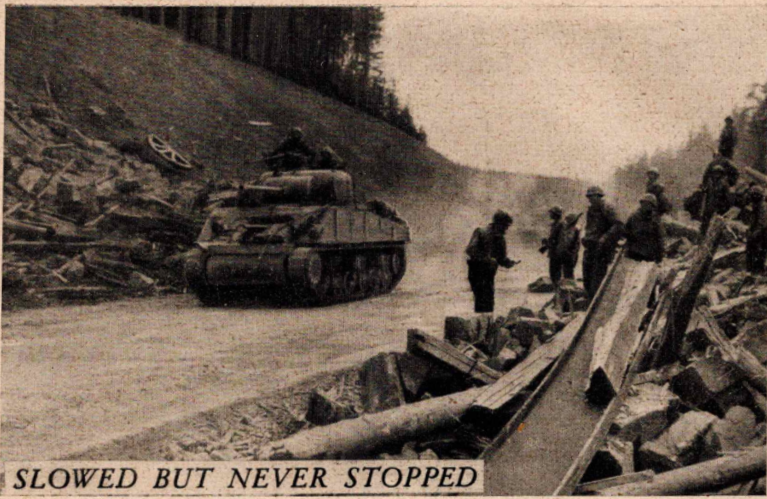
The tanks moved on. Now the traffic on the narrow road was slowing
their progress. Once division headquarters told the tankers either to
get everything except combat vehicles off the roads or else to get
staff officers out to direct traffic. More German equipment was being
destroyed every day on the dash to the Rhine than any single day
during the sweep across France, and at night the tanks and bulldozers
had to push the smashed enemy equipment off the road to permit the
jeeps and trucks to get through the tangle.
They had nearly reached the river when a Cub plane hovering over the
road reported that a German column was moving along a road near
Coblenz. “The column is two thousand yards from your rear tank,”
the pilot called.
Abrams switched on his radio and called to Lieutenant Liese.
“There’s a column of Jerry vehicles two thousand yards up the
road,” Abrams said.
“Shall I ambush them?” Liese asked.
“Hell, no!” Abrams shouted. “They’re going the same direction
you are! Catch ’em!”
Liese’s Shermans lumbered out ahead of the main column at full
speed. The Cub pilot, watching from the air, called down a
play-by-play account.
“They’re only fifteen hundred yards from you now,” he radioed.
“Go faster. Faster... Now they’re only a thousand yards from
you.” He was silent for a moment while the tanks raced ahead after
their quarry. Then he called again. “They’re around the next
curve. Go get ’em.”
There was another moment of silence while the straining Shermans
hammered down the road. Then Liese broke in excitedly, “I see ’em!
I see ’em! What’ll I do?”
Abrams jumped up and down in his turret. He screamed into his
transmitter, “Slaughter ’em! Slaughter the so-and-so’s!”
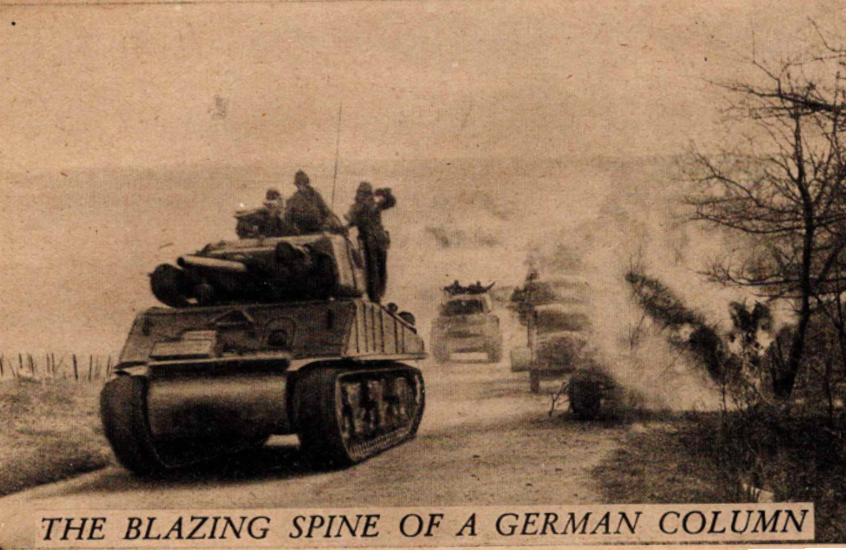
Liese’s tanks ran right up the back of the surprised enemy column,
big guns and machine guns spraying the road. Startled Germans toppled
from their vehicles into the road. Trucks exploded into flame.
Writhing horses thrashed about on the pavement. The rampaging Shermans
reached the head of the column and turned around. Then they raced back
the length of the column a second time, destroying all that was left
or living. Then it was all over and the tankers slowed down and
stopped.
Young Liese, as famed for his inability to read a map as for his
ability to fight, looked out of his turret at the countryside and
scratched his head. He called Abrams on his radio, “Where am I,
colonel?”
“How do I know where you are?” Abrams snapped. “All I know is
that you’re at least five miles past the place you were supposed to
turn, and you better get back here before you get more lost than you
are already.”
They first saw the Rhine at 3:45 in the afternoon when Combat Command
B moved into Kettig, overlooking the wide river. Abrams had spread his
tanks out in a skirmish line between the town and the river. The 8th
Tank Battalion, under Lt. Col. Albin Irzyk, of Salem, Massachusetts,
attached to Combat Command A, fanned out in front of Malheim and
Karlich.
All that night fleeing German columns streamed toward the Crown Prince
Wilhelm Bridge at Urmitz, last link with the east bank. The Shermans
unlimbered their big guns. A steady procession of high explosive and
incendiary shells hurtled across the 1,000 yards to the river road,
raking the German columns. Wreckage jammed the road, and flames
silhouetted the carnage. At 1:30 in the morning, the tanks stopped
firing and called for the divisional artillery. Every fifteen minutes
until 6:30, a salvo of artillery shells whistled over the tankers’
heads and dropped along the road where the Germans were still
struggling to move through the debris.
An eerie silence settled over the fog-shrouded fields. Then the
explosions came. While the fleeing German foot soldiers frantically
stampeded to get across the river before the bridge was demolished, SS
troopers on the far bank poured streams of small-arms fire into them
in an effort to drive them back from the double-tracked railroad
bridge, on which planks had been laid for the vehicles. Dozens of
Germans were killed or wounded by the SS men. The others, stunned by
the spectacle, turned wearily away from the river and began walking
back up the road toward battered Urmitz.
The tanks moved across the fields to the river road, swung through the
town and picked their way slowly through the smoking wreckage.
In the destroyed column they counted, among other items, three tanks,
thirty-six 88’s, twenty-two 75’s, ten 105’s, 137 trucks,
thirty‑eight staff cars and twenty-five half-tracks.
The tanks stopped where the fields and orchards slope down to the
Rhine’s edge, then rise sharply in steep gray bluffs on the other
side. Abrams picked up his radio transmitter and held it close to his
mouth. “We are on our objective,” he said.
* * *
General George S. Patton’s invincible 4th Armored Division, pride of
the 3d Army, tonight is leading a breakthrough east of the Rhine into
the heart of Germany.
The 4th Armored Division, which registered a 27-mile gain before noon,
sent back an appeal for transportation for thousands of prisoners
taken. The American tank men were going too fast to bother with them.