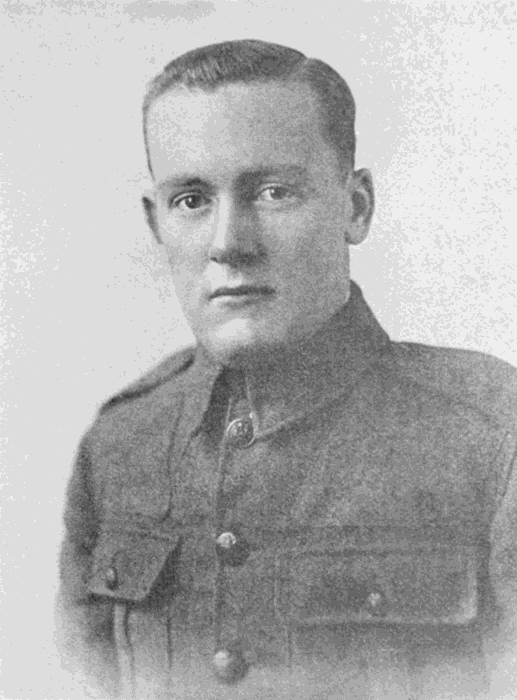
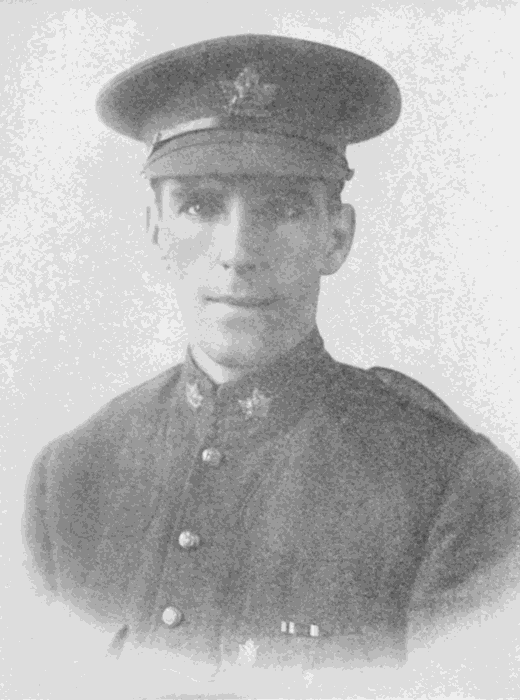
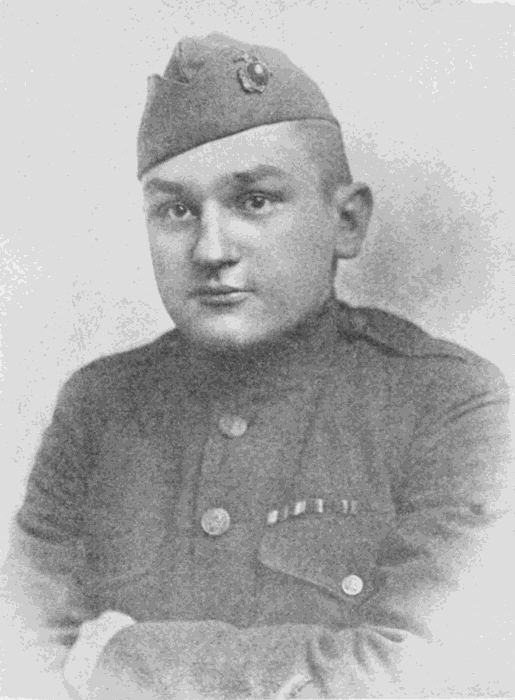
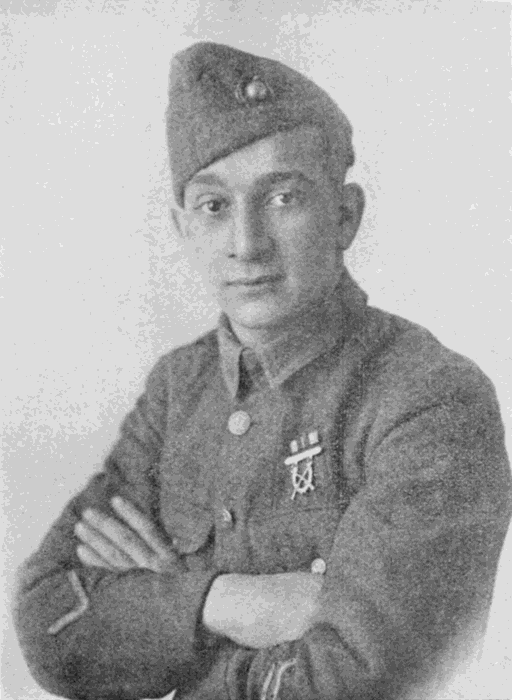
BY LANCE CORPORAL EDMUND HALL, 2ND SCOTTISH RIFLES,
B.E.F.
AFTER being in the army eleven years and with one year to go to
finish my time as a regular soldier of the British Army, for which
period I had signed on, I was beginning to think that I would be
unfortunate enough to finish my soldiering without seeing active
service, but after all I was not to be disappointed and I saw more
active service than ever I bargained for.
At the time Great Britain declared war on Germany I was stationed
with the British garrison at Malta, an island fortress in the
Mediterranean Sea, where in peace time a garrison is kept consisting
of five regiments of infantry and several batteries of artillery. On
the 4th of August we received orders to proceed from barracks to take
up positions in the land entrenchments and redoubts, as an attack was
expected from part of the German fleet, the Goeben and
Breslau at the time being somewhere in the vicinity.
The attack which we expected did not materialize, as the German
ships ran for cover to the Golden Horn and Constantinople, and were
afforded shelter by the Turks. In this respect they were as fortunate
as their sister ships who had the protection of the Kiel Canal. We
were now waiting for the territorial battalions which were to relieve
us so that we could take our place on the western front and fight
with the regulars who were stemming the German tide in Flanders. On
the 17th of September our relief arrived, and the ships which brought
them to Malta took us to England, and we were camped for a time at
Winchester while our division was being mobilized. This division,
the 8th, was made up of regulars from foreign service and included
regiments from Gibraltar, Egypt, India, and our own from Malta. The
average service of the men of the Scottish Rifles was seven years and
we were in the best of training, having just finished maneuvers. It
was this training, excellent shooting and individual initiative which
earned for us the praise of the Germans, who said that every British
regular was a trained non-commissioned officer. We landed in France on
the 5th of November, 1914, and entrained for the railhead nearest the
Neuve Eglise and Massines front. This front at the time was being
taken over from the French and we relieved one of their regiments
in the front line of trenches. At this time of the campaign, trench
warfare was just beginning, as the fighting previously at Mons,
Marne and the Aisne was a retreat or an advance and was mostly field
warfare. The Germans having failed in their terrific drive for the
Channel Ports during the first battle of Ypres, where the flower of
the Prussian Guard had been destroyed by our 7th Division, decided to
dig themselves in and to wait for the spring before opening another
offensive on a large scale. Consequently, when we relieved the French
the trenches were little better than ditches, and we had not even
sandbagged parapets erected or barbed wire entanglements thrown out
in front. It was the surprise of my life when our platoon officer
informed us that the particular part of the ditch which we were in
was a trench, and was to be our home for the next few days. A local
attack from the Germans was expected at any time, as they were anxious
to get command of the Messines Ridge, ground which they coveted for
observation purposes. The French had warned us to be particularly on
the lookout this night, and advised us not to post extra sentries,
and it was very fortunate that we heeded their warning, because about
two hours after the sentries shouted from the listening posts that
the Germans were coming. The company commander gave us instructions not
to fire until he blew the whistle, and this he did as soon as he could
see the gray mass of figures advancing across No Man's Land in the
weird light of a misty moon. The Germans received a very warm welcome
from our particular part of the "Contemptible Little Army," and must
have also had a rude awakening when we opened up with rapid fire with
our Lee-Enfield rifles. They evidently thought the French were in front
of them, until they heard our fire, but as they heard the rapid fire
of the Lee-Enfields on previous occasions, it didn't take them long
to know that the hated British were on the spot. "The Britishers' Mad
Minute," was the name the Germans gave our rapid fire when they first
experienced it at Mons, because they were astonished that infantry
could average thirty rounds a minute per man. This speed could not be
equaled by any other army at the time, the French being equipped with
the Lebel rifle, which did not have a clip loading action, and the
Germans, who relied more on their machine gun fire to break up infantry
attacks, were amateurs in comparison to our army, where rifles were
concerned.
The Germans were mowed down before they reached us, and although
they made two further attacks during the night, we had not the
opportunity to use the bayonet, the Germans being all killed or wounded
before reaching our trench or ditch. The Germans gave up the attempt
for the Messines Ridge and during the terrible winter campaign of 1914
and 1915 we did trench duty, three days in the front line and then
three days in the reserve.
This awful monotonous life under the worst climatic conditions and
living in a sea of mud was only brightened by one incident during the
rest of the winter. The Germans hung up Chinese lanterns on Christmas
Eve and sang carols, and both sides refrained from firing. During
Christmas day some of the bolder spirits of the German regiment
opposite stood up on the parapet, and as none of our men would fire on
them, an unofficial armistice was therefore on. Our men did likewise,
and not a shot was fired, both sides believing in the old saying,
"Peace and good will to all men on Christmas Day." This was the only
time throughout the war that such an incident happened, as we received
strict instructions not to fraternize with the enemy on account of
their despicable and treacherous acts in bringing machine guns up under
cover of stretcher bearers on several occasions when armistices were
allowed to bury the dead shortly before Christmas.
When spring arrived, we were on tiptoe with excitement for the
coming offensive, as we were fed up with the trenches and mud and
wanted to get the Germans in the open.
The first offensive of the year 1915 was made by the British at
Neuve Chapelle on March 10th, and several divisions, including our
own, were massed in the vicinity a few days beforehand. Batteries of
artillery to the number of five hundred guns were masked and hidden
until they opened up for the preliminary bombardment. The Germans had
no inkling of the coming attack, and the surprise it caused was a
nasty knock to their boasted secret service and civilian spies, who
were placed throughout Flanders years before the war, and who posed as
Belgian and French farmers. They devised many schemes for informing
the enemy what was happening, and on previous occasions they had been
able to supply the Germans with accurate information by their windmill
and other tricks. This time they were fooled, and when the bombardment
commenced at 6.30 A.M. the Germans were at
breakfast, according to the statements which the prisoners made when
they were captured.
We had taken our positions in the front line
trenches the night before and had erected trench climbing ladders for
jumping over the parapets.
At 7 A.M. we went "Over the Top" in the
first offensive our army made since trench warfare first began after
the battle of the Aisne the previous October. At this time I was acting
as company stretcher bearer, and therefore had to follow the company as
they advanced across No Man's Land.
Although we had a large number of guns, we were very deficient in
heavy artillery and howitzers, the majority being 18 pounder field guns
and which proved a failure as a means to blast away the barbed wire and
parapets of the German trenches and redoubts.
On part of the line where we attacked, the barbed wire was not
destroyed and consequently we were held up and suffered terrible losses
from machine gun fire. At last, some of our men broke through the wire
by breaching it with wire clippers and then jumping in the trenches
bayoneted German after German, from traverse to traverse until they
were all accounted for in that part of the line.
Our losses were appalling during the few minutes it took to cut the
wire, our casualties totaling over 750 men out of the thousand engaged.
A young subaltern was the only officer who got through the engagement,
the colonel, major, adjutant and company commanders all being killed
while leading the attack.
Our officers had all been in the army for a number of years and were
excellent soldiers. We could ill afford to lose such men, as there
were none who could fill their places, and we noticed a remarkable
difference when the reinforcements arrived, the new officers being
hastily trained and the ink stains not yet off their fingers.
The remnants of the battalion reached the German third line of
trenches and there waited for reinforcements. For two days I carried
the stretcher without a rest until at last I collapsed under the strain
and had to rest for a few hours. How many men I carried I do not know,
and the last few hours seemed like a dream, broken with the cries of
the wounded.
My clothes were saturated with the blood of the men I bandaged and
carried, and when I was finally relieved, I had to get a new suit from
the quartermaster stores.
On the first night of the offensive, the Germans made a counter
attack in a vain endeavor to recapture the redoubt, and the line of
trenches called Port Arthur. During the attack, I was in the front line
attending to wounded men who needed attention, and so I had a good
view of the Germans as they were advancing.
They advanced, as was their custom, in close order, or mass
formation. Our reinforcements, who had come up just after dark, had
brought several machine guns, so we were quite prepared to give the
Germans a fight to a finish. Our officers, knowing that the Germans
could not break through our wire under the terrific hail of lead we
would send over, gave strict orders not to fire until the Germans were
up to the entanglements. Thus, at that short range, the slaughter would
be much greater, and fewer Germans would reach back to their own lines
during their consequent retreat.
There was not enough room on the parquet or firing platform for all
our men, and the unlucky ones who were left standing at the bottom of
the trench dragged some of the men on the parquets, so that they could
get a few rounds off, and so settle "old scores" with "Fritz." Under
the rapid fire of our machine guns and rifles the Germans were mowed
down almost to a man, very few of even their swiftest runners making a
home run.
I was in the trenches at Neuve Chapelle for a few more
days until the remnants of our battalion were taken to the
rear to be re-formed when the drafts arrived. After six
days' rest we were again on trench duty, and this continued until May
9th, when our division was moved to Fromelles to participate in the
offensive on that sector.
During the first part of this offensive our battalion acted as
supports to the London Rifles, whose objective was the German third
line of trenches. When this objective was reached we received the order
to advance in open formation. German machine guns opened up fire on us
as we advanced, and men were soon dropping like flies.
My chum, who was carrying the other end of the stretcher, was
riddled with machine gun bullets. It so happened that he was caught
by the group shots from one gun. It was lucky for me that the German
machine gunner was grouping his shots, and not using the traverse
system, or I would have been hit also.
I was then left to carry the stretcher alone, and while advancing
further saw our new colonel fall wounded, so I rushed to his
assistance. The bone of his leg was smashed by a bullet, and as I went
up to him he ordered me away, and told me to take cover or I would be
killed, as the bullets by this time were flying around in hundreds.
I walked a few paces and returned for another attempt to bandage
him, but he again ordered me to take cover, so I said to him, "Well, if
you don't want help, there are plenty around who do." This officer was
Colonel Vandeleur, who was captured during the retreat of Mons, while
in command of the Cheshire Regiment.
He escaped from the German prison camp, owing to the fact that he
could speak the German language like a native, and when he reached
London by way of Holland, he was granted an audience with the King, as
he was the first Britisher to escape from Germany. After having a rest,
he was again sent to France, and took command of our battalion.
Having lost my chum, I had to work single-handed, and this meant
carrying wounded on my back. We remained at Fromelles for three days
and were under bombardment all the time, the Germans being heavily
supplied with "Heavies" and a plentiful supply of "Jack Johnsons" and
"Coal Boxes."
Our attack at Fromelles was not as successful as we had
anticipated, owing to insufficient artillery support, and we were
at a disadvantage during the year 1915 on account of the shortage
in heavy artillery. The Germans, who had prepared for so many years
beforehand, were plentifully supplied with all kinds of artillery
from 77 M. to 17-inch Skoda howitzers and for every shell we fired they
fired ten.
Shortly after the Fromelles affair, I was wounded while in the front
line, and remained in the hospital for three months. When I returned to
the battalion, they were doing trench duty at Fleurbaix, and with only
two minor engagements I suffered the agonies of trench warfare once
more, this time for several months, including the winter of 1915 and
1916.
On the first of July, 1916, an offensive on the Somme was started
and our division was now in the thick of it. This was a change from the
previous engagements, as our munition and armament factories in Britain
had been working at top pressure for months and we had ample supplies
of guns and ammunition and could give "Fritz" shell for shell.
I had left the stretcher bearers and during the Somme offensive
I was fighting in the ranks and went "Over the Top," this time with
rifle and bayonet. After severe fighting, we took Friecourt, our
first objective, and after entering the village the prisoners were
collected, and I was detailed to escort prisoners to the cages, and
to remain as one of the sentries until relieved. One of the prisoners
who could speak English asked me if the men of our regiment were
sailors, because at this time we wore the Scotch Balmoral Blach hats,
and he evidently mistook them for sailors' hats, as they are not
unlike the headgear of the British Navy, and it must have been the
first time he had seen them, as most of the Scottish troops were the
Glengarrys.
I quickly informed him that we were the famous Scottish Rifles, the
old 90th of Foot who had made a reputation in previous wars, and who
intended to keep up the reputation made by knocking Hell out of the
Germans on every possible occasion. He was different than the rest
of the prisoners, the majority of them being morose and sullen, so I
kept up a conversation with him, and it was interesting at the time to
listen to a German prisoner who could speak English, and who wished to
tell me of the things that had happened to him. He had been a steward
on one of the Hamburg-American Line boats plying between Germany and
New York, and he had learned to speak English by talking to passengers.
He said that he was glad to be captured, and for this information I
handed him a few cigarettes.
Shortly after, I was again sent back to the front line, and during
the next two weeks we advanced twenty miles, capturing Combles
and other towns.
The battle of the Somme was the biggest offensive during 1916.
Considerable ground was retaken, and thousands of Germans captured. We
were sent to the Bethune front, which was at the time a quiet sector
in comparison to the Somme, and there we did trench duty for six weeks
before being returned once again to the Somme.
On the 23rd of October we again attacked and gained more ground.
By this time the Somme battlefield was a land of shell-holes and mud.
The hardships we had to undergo were terrible. The bombardments never
ceased, and sometimes it increased to drum fire. For the next few
months we remained on this front, this being my third winter in the
trenches, I was beginning to be "fed up" with the whole thing.
I had had one seven days' leave to England at the end of 1915, and
in November, 1916, I was granted one month's furlough on account of
having completed my term as a time serving man.
The Conscription Act coming into force kept me on for the duration
of the war, but in consideration of my long service, having completed
my thirteenth year, as stipulated on my attestation, this special
leave was granted. What a relief it was to know that for the next
four weeks I would not hear the shells or stumble along in the mud up
to my knees, and, sometimes, up to the waist.
How my mouth watered when I realized that I would get a change of
diet from the everlasting bully beef and biscuits, commonly known as
"hard tack." How pleasant to know that the "cooties" would soon be off
me and a new change of clothing on my back. One can only appreciate
good food and clean clothes after months of horror experienced by
eating bully and biscuits and being tormented by "cooties," or, as we
called them, "Wee Scunners."
During the month's furlough I spent in London, I had the time of my
life, but as all good days have to end at some time or other, I was
soon back in the trenches, and to make things worse, we were on the
Somme.
Christmas day I again spent in the trenches, but this time there was
no fraternizing, both sides being very bitter and for any of us to show
a head above the parapet meant death from a German sniper.
We could never forget the Zeppelin raids, the sinking of the
Lusitania, and the despicable treachery of the enemy on every
occasion, wherever they got a chance. The Germans proved
themselves worse than the lowest savages, and Lord Kitchener said that
they were worse than the Dervishes of the Soudan, the fanatics of the
desert. Never will a British soldier forget the incident where British
soldiers were burned alive, by the orders of Prince Rupprecht of
Bavaria, and the crucifying of the Canadians at Ypres.
In the spring of 1917 the Germans retreated to a new line of
defense, and for three weeks we advanced under cover of the night,
throwing out patrols, to try and get in touch with the Germans. This
was a welcome change, as there was no firing, and as we were on the
move it was less monotonous than being in the trenches. The Germans
had destroyed everything in their retreat, farm houses being blown up,
orchards cut down, cross roads destroyed, and every trick, the Germans
who are past masters in this kind of thing, knew so well how to do. The
countryside was laid waste, and I saw hundreds of dead men who had been
left behind by the Germans, unburied, and left to rot; most of them
had been mangled by shell-fire and it was sights such as these that
make men think of the terrible folly of war, and why such things should
be.
We have one consolation, and that is, the men of the Allies who were
killed did not die in vain, as the objects for which we entered the
war have been achieved and the wrongs will be righted.
At last we got in touch with the Germans and dug ourselves in,
and then we had another spell of trench duty, until taken away from
the Somme and moved up to Belgium to participate in the Paschendale
offensive in June, 1917. Of all the fronts I was ever on, Paschendale
was the worst. The front included the Ypres salient where fighting had
been going on almost incessantly from October, 1914. Neither side made
much progress, and during these three years the ground had changed
hands many times and was mostly shell-holes. In fact, for miles it was
difficult to find a few square yards untouched by shells, and I think
that more men were killed in the Ypres salient than any other place
of its size in the world. It was impossible to build trenches on this
front, and the system of defense was to fortify shell-holes with sand
bags, two or three men to a shell-hole. I was in one advance which
we made under cover of the biggest barrage thrown over at that time,
and when our objective was reached, we manned the shell-holes until
relieved.
In September, 1917, I was sent to a bombing school, and
went through a course which I passed, and was then qualified
to act as a bombing instructor when I arrived back to the
battalion. The course lasted one month, and in that time I learned all
there was to know about bombs, especially the deadly Mills bomb, with
its three and a half to five seconds time fuse. I found bombing more
interesting than any other kind of warfare I had yet taken up, and the
fact that it was possible to kill or wound a number of Germans with one
well-aimed bomb greatly appealed to me. When I returned to the line my
rifle was placed as second favorite, the bombs always holding first
place in my estimation.
When I arrived back to the battalion, they were at Ploegstreet, or
"Plug-street," as we called it, and this front being rather quick,
we had a picnic, in comparison to some of the previous places. The
trenches at Ploegstreet were well constructed, and fairly dry, and were
always considered the best on the British front.
The Germans were 1,300 yards away and a small river ran between
their lines and ours. Owing to the great distance between the lines,
patrols were always out at night, so as to prevent a surprise attack.
Our patrols consisted of a non-commissioned officer and two men, but
sometimes a fighting patrol of ten men with a Lewis gun were sent
out.
As the Germans always had patrols out as well, this was a ticklish
business, as it was quite common for the patrols to meet and then
there would be a little dirty work. On these occasions I always had
a good supply of bombs, and one night when near a bridge of planks,
which crossed the river, I heard the creaking and knew that a German
patrol was crossing. The night being pitch dark, made it impossible
for me to see them, so I whispered to the two privates to creep back
to the bushes, which were a few yards away, and there we would wait
for them. This we did in a few seconds. I could hear the German patrol
walking through the grass toward us, and when I judged they were about
twenty-five yards away I quickly removed the safety pin from the bomb
and threw it in their direction.
By the time the first one burst, I had the pin removed from another
one, and as the place was lit up by the flash of the bomb, I had a good
view of the German fighting patrol, and so consequently the second bomb
which I threw fell in the middle of them, as they were beating it for
the bridge, and evidently some of them were hit, as they squealed like
most Germans do when wounded. Knowing that the survivors would open
fire in our direction as soon as they were over the bridge, we ran
for cover to a bunch of trees, and there lay down for a few minutes
until the firing had died down.
Telling my two chums to remain under cover until I returned, I
crawled back to see if the Germans had returned for any of their
wounded. Carefully maneuvering, I could hear the low moans of a wounded
German, so I went to see what damage I had done. One German was dead
and the other who was moaning was severely wounded in the legs, several
pieces of the bomb hitting him in different places.
Seeing that he needed immediate assistance, and wishing to get
him back to our lines for information purposes, I crawled back to
my chums and told them to come back with me to the wounded German.
When we reached him I told one of them to go down to the bridge and
watch in case the Germans would return. The first thing I did was to
kick the German's rifle out of the way, in case he wanted to use it
when our backs were turned, and then proceeded to bandage his wounds.
Then walking down to the bridge, I told my chum that everything was
ready to carry the prisoner back, and after stumbling and carrying
him for over a thousand yards, we reached our lines, and then
handed him over to the stretcher bearers, who took him to the dressing
station.
After a few weeks at Ploegstreet, we were again shifted to
Passchendale, and as the winter was now on, things were much worse
than on our previous visit. The first time we went to the front line
we experienced on this occasion something new. Previously, in the
trenches, we always had ration parties go back to the rear at night for
supplies, and always received rations daily and a lot of rum in the
morning.
The shell-fire being so bad made it too costly at Passchendale to
send men back every night, so before we went up the line, we were
served with three days' rations and a gasoline can full of water. In
addition to this, every man had to carry 250 rounds of ammunition,
several bombs, gas mask, trench coat and waterproof sheet, rifle,
bayonet and grubber, sand bags, trench helmet and a shovel. I shall
never forget the six miles march up to the front line with all the
equipment. The shovel which I had tied to the middle of my back kept
banging against my legs, and I was always scared of losing my can of
water. Several men, while crossing the duck-boards fell off, and went
up to their necks in mud, and if curses would have killed the Kaiser,
he would have died that night.
At last we reached the front line and relieved the Devons, who had
been up there three days—three days in a shell-hole, half full
of water, bully beef, biscuits and cold water, tainted with gasoline
for our rations, shell-fire continuously and occasionally a cloud of
gas.
I do not think it possible for a person who has never experienced it
to have the slightest imagination what suffering and torture we had to
undergo on the Passchendale front. Many a wounded man, while staggering
back over the duck-board, slipped off and was drowned, not having the
strength to pull himself out of the mud.
Fatigue parties were working every night to keep the duck-board
paths in repair, as shells were continuously hitting them, and every
hit meant a few duck-boards smashed to splinters. The dump where
new supplies of duck-boards were kept was five miles from the front
line, and if new ones were required it meant a five-mile hike with a
duck-board on our shoulders, and a five-mile hike back. We lost thirty
men out of a fatigue party one night by shell-fire, and the casualties
were so heavy that there was a continuous stream of motor ambulances
along the roads in the rear.
This was my fourth winter in the trenches, and the constant strain
was beginning to tell on me, and I fell sick with pneumonia and
developed trench feet. This time I was sent to England, and when I came
out of the hospital I obtained convalescent leave to see my people, who
were living in Winnipeg, Canada.
My health not improving, I was discharged from the army in May,
1918, after having served fifteen years as a regular soldier and was
three years and two months in France.