Two men were standing in front of the Empire
Theatre on Broadway, at the outer edge of the
sidewalk, amiably discussing themselves in the
first person singular. It was late in September
and somewhat early in the day for actors
to be abroad, a circumstance which invites
speculation. Attention to their conversation,
which was marked by the habitual humility,
would have convinced the listener (who is always
welcome) that both had enjoyed a successful
season on the road, although closing
somewhat prematurely on account of miserable
booking, and that both had received splendid
“notices” in every town visited.
These two loiterers serve a single purpose in
this tale—they draw your attention to the principal
character, to the person who plays the
title rôle, so to speak, and then, having done so,
sink back into an oblivion from which it is quite
unnecessary to retrieve them.
The younger of the two players was in the
2
act of lighting a cigarette, considerately tendered
by the older, when his gaze fell upon the
figure of the approaching hero. He hesitated
for a moment, squinting his eyes reflectively
as if to make sure of both vision and memory
before committing himself to the declaration
that was to follow.
“See that fellow there? The little chap with
his hands in his pockets?”
The other permitted a vague, indifferent
glance to enter the throng of pedestrians,
plainly showing that he did not see the person
indicated. (Please note this proof of the person’s
qualifications as a hero.)
“The fellow in front of Browne’s,” added
the first speaker, so eagerly that his friend tried
once more and succeeded.
“What of him?” he demanded, unimpressed.
“That is What’s-His-Name, Nellie Duluth’s
husband.”
The friend’s stare was prolonged and incredulous.
“That?”
“Yes. That’s the fair Nellie’s anchor.
Isn’t he a wonder?”
3
The object of these remarks passed slowly
in front of them and soon was lost in the crowd.
Now that we know who he is we will say thank
you to the obliging Thespian and be off up
Broadway in his wake, not precisely in the capacity
of spies and eavesdroppers, but as acquaintances
who would know him better.
He was not an imposing figure. You would
not have looked twice at him. You could not
have remembered looking once at him, for that
matter. He was the type of man who ambles
through life without being noticed, even by
those amiably inclined persons who make it
their business to see everything that is going
on, no matter how trivial it is.
Somewhere in this wide and unfeeling world
the husband of Nellie Duluth had an identity
of his own, but New York was not the place.
Back in the little Western town from which he
came he had a name and a personality all his
own, but it was a far cry from Broadway and
its environments. For a matter of four or five
years he had been known simply as “Er—What’s-His-Name? Nellie Duluth’s husband!”
You have known men of his stripe, I am sure;
men who never get anywhere for the good and
4
sufficient reason that it isn’t necessary. Men
who stand still. Men who do not even shine
by reflected glory. Men whose names you cannot
remember. It might be Smith or Brown or
Jones, or any of the names you can’t forget
if you try, and yet it always escapes you. You
know the sort I mean.
Nellie Duluth’s husband was a smallish young
man, nice-looking, even kind-looking, with an
habitual expression of inquiry in his face, just
as if he never quite got used to seeing or being
seen. The most expert tailor haberdasher
could not have provided him with apparel that
really belonged to him. Not that he was awkward
or ill-favoured in the matter of figure,
but that he lacked individuality. He always
seemed to be a long way from home.
Sometimes you were sure that he affected a
slight, straw-coloured moustache; then, a moment
afterward, if you turned your back, you
were not quite sure about it. As a matter of
fact, he did possess such an adornment. The
trouble came in remembering it. Then, again,
his eyes were babyish blue and unseasoned; he
was always looking into shop windows, getting
accustomed to the sights. Trolley cars and
5
automobiles were never-decreasing novelties to
him, if you were to judge by the startled way
in which he gazed at them. His respect for the
crossing policeman, his courtesy to the street-car
conductor, his timidity in the presence of
the corner newsboy, were only surpassed by his
deference to the waiter in the cheap restaurants
he affected.
But, ah! You should have seen him in that
little Western town! He was a “devil of a
fellow” out there! He knew the policemen by
their first names and had no respect for them;
street-car conductors were hail-fellows well met,
and the newsboys wore spectacles and said
“Yes, sir,” to him. As for the waiters, he
knew them all by their Christian name, which
usually was Annie or Mamie or Katie.
On Broadway he was quite another person.
He knew his Broadway from one end to the
other—that is to say, he knew that side of the
“Great White Way” which stares you in the
face and rebukes you for staring back—the
outside of Broadway. He had been on and off
Broadway for a matter of five years and yet
he had never recovered from the habit of turning
out for every pedestrian he met, giving the
6
other man the right of way instead of holding
to his own half of it, sometimes stepping in
puddles of water to do so and not infrequently
being edged off the curbstone by an accumulation
of the unexpected.
Once in a while during his peregrinations
some one recognised him and bowed in a hesitating
manner, as if trying to place him, and
at such times he responded with a beaming
smile and a half-carried-out impulse to stop for
a bit of a chat, but always with a subsequent
acceleration of speed on discovering that the
other fellow seemed to be in a hurry. They
doubtless knew him for Miss Duluth’s husband,
but for the life of them they couldn’t call him
by name. Every one understood that Nellie
possessed a real name, but no one thought to
ask what it was.
Moreover, Nellie had a small daughter whose
name was Phoebe. She unquestionably was a
collaboration, but every one who knew the child
spoke of her as that “darling little girl of Nellie’s.”
The only man in New York who appeared
to know Nellie’s husband by name was
the postman, and he got it second-hand.
At the stage door of the theatre he was known
7
as Miss Duluth’s husband, to the stage hands
and the members of the chorus he was What’s-His-Name,
to the principals he was “old chap,”
to Nellie herself he was Harvey, to Phoebe he
was “daddy,” to the press agent he was nameless—he
didn’t exist.
You could see Nellie in big red letters on all
the billboards. She was inevitable. Her face
smiled at you from every nook and corner—and
it was a pretty face, too—and
you had to get your tickets of the scalpers if
you wanted to see her in person any night in
the week, Sundays excepted. Hats, parasols,
perfumes, and face powders were named after
her. It was Nellie here and Nellie there and
Nellie everywhere. The town was mad about
her. It goes without saying that her husband
was not the only man in love with her.
As Harvey—let me see—oh, never mind—What’s-His-Name—ambled
up Broadway on
the morning of his introduction into this homely
narrative he was smiled at most bewitchingly
by his wife—from a hundred windows—for
Nellie’s smile was never left out of the lithographs
(he never missed seeing one of them,
you may be sure)—but it never occurred to him
8
to resent the fact that she was smiling in the
same inviting way to every other man who
looked.
He ambled on. At Forty-second Street he
turned to the right, peering at the curtained
windows of the Knickerbocker with a sort of
fearful longing in his mild blue eyes, and kept
on his way toward the Grand Central Station.
Although he had been riding in and out of the
city on a certain suburban train for nearly two
years and a half, he always heaved a sigh of
relief when the gate-tender told him he was
taking the right train for Tarrytown. Once in
a great while, on matinée days, he came to town
to luncheon with Nellie before the performance.
On Sundays she journeyed to Tarrytown to see
him and Phoebe. In that way they saw quite a
bit of each other. This day, however, he was
taking an earlier train out, and he was secretly
agitated over the possibility of getting the
wrong one. Nellie had sent word to the theatre
that she had a headache and could not have
luncheon with him.
He was not to come up to her apartment. If
he had known a human being in all New York
with whom he could have had luncheon, he would
9
have stayed in town and perhaps gone to a
theatre. But, alas, there was no one! Once
he had asked a low comedian, a former member
of Nellie’s company, but at the time out of
a job and correspondingly meek, to luncheon
with him at Rector’s. At parting he had the
satisfaction of lending the player eleven dollars.
He hoped it would mean a long and pleasant
acquaintance and a chance to let the world
see something of him. But the low comedian
fell unexpectedly into a “part” and did not
remember Nellie’s husband the next time he
met him. He forgot something else as well.
Harvey’s memory was not so short. He never
forgot it. It rankled.
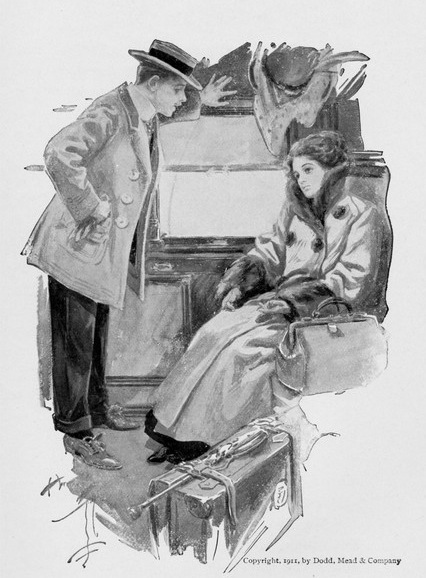
He bought a noon extra and found a seat in
the train. Then he sat up very straight to let
people see that they were riding in the same
car with the great Nellie Duluth’s husband.
Lucky dog! Every one was saying that about
him, he was sure. But every one else had a
noon extra, worse luck!
After a while he sagged down into the seat
and allowed his baby-blue eyes to fall into a
brown study. In his mind’s eye he was seeing
a thousand miles beyond the western bank of
10
the Hudson, far off into the quiet streets of a
town that scarcely had heard the name of Nellie
Duluth and yet knew him by name and fame,
even to the remotest nook of it.
They were good old days, sweet old days,
those days when he was courting her—when
she was one among many and he the only one.
Days when he could serve customers in his
shirt-sleeves and address each one familiarly.
Every one was kind. If he had a toothache,
they sympathised with him and advised him to
have it pulled and all that sort of thing. In
New York (he ground his teeth, proving that
he retained them) no one cared whether he lived
or died. He hated New York. He would have
been friendly to New York—cheerfully, gladly—if
New York had been willing to meet him
halfway. It was friendly to Nellie; why
couldn’t it be friendly to him? He was her
husband. Why, confound it all, out in Blakeville,
where they came from, he was somebody
while she was merely “that girl of Ted Barkley’s.”
He had drawn soda water for her a
hundred times and she had paid him in pennies!
Only five years ago. Sometimes she had
the soda water charged; that is to say, she had
11
it put on her mother’s bill. Ted couldn’t get
credit anywhere in town.
And now look at her! She was getting six
hundred dollars a week and spurned soda water
as if it were poison.
His chin dropped lower. The dreamy look
deepened.
“Doggone it,” he mused for the hundredth
time, “I could have been a partner in the
store by this time if I’d stuck to Mr. Davis.”
He was thinking of Davis’ drug store, in
Main Street, and the striped blazer he wore
while tending the soda fount in the summer
time. A red and yellow affair, that blazer was.
Before the “pharmacy law” went into effect
he was permitted to put up prescriptions while
Mr. Davis was at meals. Afterward he was restricted
to patent medicines, perfumes, soaps,
toilet articles, cigars, razor strops, and all such,
besides soda water in season. Moreover, when
circuses came to town the reserved-seat sale
was conducted in Davis’ drug store. He always
had passes without asking for them.
Yes, he might have been a partner by this
time. He drew a lot of trade to the store. Mr.
12
Davis could not have afforded to let him go
elsewhere.
Five years ago! It seemed ages. He was
twenty-three when he left Blakeville. Wasted
ages! Somehow he liked the ready-made garments
he used to buy at the Emporium much
better than those he wore nowadays—fashionable
duds from Fifth Avenue at six times the
price. He used to be busy from seven A.M. till
ten P.M., and he was happy. Nowadays he had
nothing to do but get up and shave and take
Phoebe for walks, eat, read the papers, tell
stories to Phoebe, and go to bed. To be sure,
the food was good and plentiful, the bed was
soft, and the cottage more attractive than anything
Blakeville could boast of; Phoebe was a
joy and Nellie a jewel, but—heigh-ho! he might
have been a partner in Davis’ drug store if
he’d stayed in the old town.
The man in the seat behind was speaking to
him. He came out of his reverie with a glad
rush. It was so unusual for any one to take
the initiative that he was more than ready to
respond.
“I see the Giants lost again yesterday,” said
the volunteer conversationalist.
13
“Yes. Six to four,” said our hero, brightly,
turning in his seat. He always read the baseball
news. He could tell you the batting average
of every player in the big leagues for ten
years back.
“Lot of bone-heads,” said the other sourly.
At first glance our friend thought he looked
like an actor and his heart sank. But perhaps
he might be a travelling salesman. He liked
them. In either event, the stranger’s estimate
of the New York ball team pleased him. He
rejoiced in every defeat it sustained, particularly
at the hands of the Chicagos.
“Not in it with the Cubs,” he announced,
blitheness in his manner. Here was a man after
his own heart.
But the stranger glared at him. “The
Cubs?” he said, his voice hardening, his manner
turning aggressive.
“They make the Giants look like two-spots,”
went on our friend, recklessly.
The stranger looked him over pityingly and
then ended the conversation by deliberately hiding
himself behind his newspaper. Our hero
opened his lips to add further comment, but
something in the way the paper crackled caused
14
him to close them and turn back to his bitter
survey of the Hudson. And the confounded
fellow had invited his confidence, too!
He got down at Tarrytown and started up
the hill. The station-master pointed him out to
a friend.
“She keeps him up here in a cottage to take
care of the baby. Away from the temptations
of the city,” said the agent, with a broad wink.
“I didn’t know she was married,” said his
friend, who lived in Yonkers.
“Well, she is.”
Mr.—(I declare, his name escapes me, so I
will call him by his Christian name, Harvey)—Harvey,
utterly oblivious to the pitying scrutiny
of the two men, moved slowly up the road,
homeward bound. He stopped in the middle of
the sidewalk to light a “Sweet Cap,” threw
back his unimposing shoulders, and accelerated
his gait a trifle in deference to his position as
the master of a celebrity.
It was his habit to take a rather roundabout
way up to the little cottage on the hill. The
15
route led him past a certain drug store and a
grocer’s where he was on speaking terms with
the clerks. They knew him. He did the marketing,
but the account was in Miss Duluth’s
name. A livery stable, too, was on the line of
progress. He occasionally stopped in to engage
a pony phaeton for a drive in the afternoon
with Phoebe.
To-day he passed these places by. Every one
seemed to be busy. He could see that at a
glance. So there wasn’t any use stopping.
That was what he got for coming home from
town in the middle of the day. He nodded to
several acquaintances—passing acquaintances
in both senses of the word. They turned to look
after him, half-smiles on their lips.
One woman said to another, “I wonder if
he’s really married to her?”
“If he wasn’t, he’d be living in the city with
her,” was the complete rejoinder.
“He seems such a quiet little man, so utterly
unlike what a husband of hers ought to be.
He’s from the far West—near Chicago, I believe.
I never can remember his name. Can
you?”
“I’ve never heard it.”
16
“It’s not an uncommon name.”
“Why doesn’t he call himself Mr. Duluth?”
“My husband says actresses are not supposed
to have husbands. If they have them,
they keep them in the background.”
“That’s true. I know I am always surprised
when I see that they’re trying to get divorces.”
Harvey was never so far in the background
as when he appeared in the foreground. One
seldom took notice of him unless he was out of
sight, or at least out of hearing.
He was not effeminate; he was not the
puerile, shiftless creature the foregoing sentences
may have led you to suspect. He was
simply a weakling in the strong grasp of circumstance.
He could not help himself; to save
his life, he could not be anything but Nellie
Duluth’s husband.
Not a bad-looking chap, as men of his stamp
go. Not much of a spine, perhaps, and a little
saggy about the shoulders; all in all, rather a
common type. He kept his thin moustache
twisted, but inconsistently neglected to shave
for several days—that kind of a man. His
trousers, no matter how well made, were always
in need of pressing and his coat was
17
wrinkled from too much sitting on the small of
his back. His shirts, collars, and neckties were
clean and always “dressy.” Nellie saw to that.
Besides he always had gone in for gay colours
when it came to ties and socks. His watch-fob
was a thing of weight and pre-eminence. It
was of the bell-clapper type. In the summer
time he wore suspenders with his belt, and in
the winter time he wore a belt with his suspenders.
Of late he affected patent-leather
shoes with red or green tops; he walked as if
he despised the size of them.
Arriving at the snug little cottage, he was
brought face to face with one of the common
tragedies of a housekeeper’s life. The cook and
the nursemaid, who also acted as waitress and
chambermaid, had indulged in one of their controversies
during his absence, and the former
had departed, vowing she would never return.
Here it was luncheon time and no one to get
it! He knew that Bridget would be back before
dinner time—she always did come back—but
in the meantime what were they to do?
There wasn’t a thing in the house.
He found himself wishing he had stayed in
the city for luncheon.
18
Annie’s story was a long one, but he gathered
from it that Bridget was wholly to blame
for the row. Annie was very positive as to
that.
“Have we any eggs?” asked the dismayed
master.
“Eggs? How should I know, sir?” demanded
Annie. “It’s Bridget’s place to know
what’s in the pantry, not mine. The Lord
knows I have enough to do without looking
after her work.”
“Excuse me,” said he, apologetically. He
hesitated for a moment and then came to a
decision. “I guess I’d better go and see what
we’ve got. If we’ve got eggs, I can fry ’em.
Bridget will be back this evening.”
“I’m not so sure of that,” said Annie, belligerently.
“I told her this was the last time,
the very last.”
“I’ll bet you a quarter she comes back,” said
he, brightly.
“Gee! What a sport you are!” scoffed
Annie.
He flushed. “Will you please set the table?”
“It’s set.”
“Oh!”
19
“I’ll help you make the toast, if you’d like,”
said she, a sudden feeling of pity for him coming
into her niggardly soul.
“Thanks,” he said, briskly. “And the tea,
too?”
“I think we’d better have coffee,” said she,
asserting a preference for the housemaid’s
joy.
“Just as you say,” he acquiesced, hastily.
“Where is Phoebe?”
“Next door with the Butler kids—children,
I mean. Maybe they’ll ask her to stay to lunch.”
He gave her a surprise. “Go over and tell
her to come home. I don’t want her staying to
luncheon with those damned Butlers.”
She stared, open-mouthed. “I’m sure, sir,
they’re quite as good as—as we are. What
have you got against ’em?”
He could not tell her that Butler, who worked
in a bank, never took the trouble to notice
him except when Nellie was out to spend
Sunday.
“Never mind. Go and get Phoebe.”
He made a dash for the kitchen, and when
the exasperated Annie returned a few minutes
later with Phoebe—rebellious Phoebe, who at
20
that particular moment hated her father—he
was in his shirt-sleeves and aproned, breaking
eggs over a skillet on the gas stove. His face
was very red, as if considerable exertion had
been required.
Phoebe was pouting when she came in, but
the sight of her father caused her to set up
a shriek of glee.
“What fun, daddy!” she cried. “Now we’ll
never need Bridget again. I don’t like her.
You will be our cook, won’t you?”
Annie’s sarcastic laugh annoyed him.
“I used to do all the cooking when the Owl
Club went camping,” he announced, entirely for
Annie’s benefit.
“In Blakeville?” asked Annie, with a grin.
“Yes, in Blakeville,” he exploded, almost
dropping the cigarette from his lips into the
skillet. His blue eyes flashed ominously.
Annie, unused to the turning of the worm,
caught her breath.
Suddenly obsessed by the idea that he was
master in his own house, he began strutting
about the kitchen, taking mental note of the
things that needed attention, with a view to reproving
Bridget when she came back to the
21
fold. He burnt his fingers trying to straighten
the stovepipe, smelt of the dish-cloths to see if
they were greasy, rattled the pans and bethought
himself of the eggs just in the nick of
time. In some haste and embarrassment he removed
the skillet from the fire just as Annie
came out of the pantry with the bread and the
coffee can.
“Where’s the platter?” he demanded, holding
the skillet at arm’s length. “They’re
fried.”
“They’ll be stone cold,” said she, “waiting
for the coffee to boil. You ain’t got any water
boiling.”
“I thought, perhaps, we’d better have milk,”
he said, gathering his wits.
To his surprise—and to her own, for that
matter—she said, “Very good, sir,” and repaired
to the icebox for the dairy bottles. He
was still holding the skillet when she returned.
She was painfully red in the face.
Phoebe eyed the subsequent preparations for
the meal with an increasing look of sullenness
in her quaint little face. She was rather a
pretty child. You would say of her, if you saw
her in the street, “What a sweet child!” just
22
as you would say it about the next one you
met.
Her father, taking note of her manner,
paused in the act of removing his apron.
“What’s the matter, darling?”
“Can’t I go over to Mrs. Butler’s for luncheon?”
she complained. “They’re going to
have chicken.”
“So are we,” said he, pointing to the
eggs.
“I want to go,” said Phoebe, stubbornly.
He coloured. “Don’t you want to stay home
and eat what daddy has cooked?” he asked,
rather plaintively.
“I want to go.”
He could only resort to bribery. “And daddy’ll
take you down to see the nickel show as
soon as we’ve finished,” he offered. The child’s
face brightened.
Here Annie interposed.
“She can’t go to see them nickel shows; Miss
Duluth won’t stand for it. She’s give me strict
orders.”
“I’ll take good care of her––” began
Phoebe’s father.
“Miss Duluth’s afraid of diphtheria and
23
scarlet fever,” said Annie, resolutely, as she
poured out a glass of milk for him.
“Not likely to be any diphtheria this time
of year,” he began again, spurred by the kick
Phoebe planted on his kneecap.
“Well, orders is orders. What Miss Duluth
says goes.”
“Ah, come now, Annie––”
“Say, do you want her to ketch scarlet fever
and die?” demanded the nurse, putting the
bottle down and glaring at him with a look of
mixed commiseration and scorn.
“Good Heavens, no!” he ejaculated. The
very thought of it brought a gush of cold water
to his mouth.
“Well, take her to see it if you must, but
don’t blame me. She’s your kid,” said Annie,
meanly, with victory assured.
“Make her say ‘Yes,’” urged Phoebe, in a
loud whisper.
He hedged. “Do you want to have the scarlet
fever?” he asked, dismally.
“Yes,” said Phoebe. “And measles, too.”
The sound of heavy footsteps on the back
porch put an end to the matter for the time
being. Even Phoebe was diverted.
24
Bridget had come back. A little ahead of her
usual schedule, too, which was food for apprehension.
Usually she took the whole day off
when she left “for good and all.” Never before
in the history of her connection with Miss
Duluth’s menage had she returned so promptly.
Involuntarily the master of the house glanced
out of the window to see if a rain had blown
up. The sun was shining brightly. It wasn’t
the weather.
The banging of the outer door to the kitchen
caused him to jump ever so slightly and to cast
a glance of inquiry at Annie, who altered her
original course and moved toward the sitting-room
door. In the kitchen a perfectly innocent
skillet crashed into the sink with a vigour that
was more than ominous.
A moment later Bridget appeared in the
door. She wore her best hat and gloves and
the dress she always went to mass in. The
light of battle was in her eye.
“We—we thought we wouldn’t wait, Bridget,”
said Mr.—er—What’s-His-Name, quickly.
“You never come back till six or seven, you
know, so––”
“Who’s been monkeyin’ wid my kitchen?”
25
demanded Bridget. She started to unbutton
one of her gloves and the movement was so
abrupt and so suggestive that he got up from
his chair in such a hurry that he overturned it.
“Somebody had to get lunch,” he began.
“I wasn’t sp’akin’ to you,” said Bridget,
glaring past him at Annie.
He gulped suddenly. For the second time
that day his eyes blazed. Things seemed to be
dancing before them.
“Well, I’m speaking to you!” he shouted,
banging the table with his clenched fist.
“What!” squealed Bridget, staggering back
in astonishment.
He remembered Phoebe.
“You’d better run over to the Butlers’,
Phoebe, and have lunch,” he said, his voice
trembling in spite of himself. “Run along
lively now.”
Bridget was still staring at him like one
bereft of her senses when Phoebe scrambled
down from her chair and raced out of the room.
He turned upon the cook.
“What do you mean by coming in here and
speaking to me in that manner?” he demanded,
shrilly.
26
“Great God above!” gasped Bridget weakly.
She dropped her glove. Her eyes were blinking.
“And why weren’t you here to get lunch?”
he continued, ruthlessly. “What do we pay
you for?”
Bridget forgot her animosity toward Annie.
“What do yez think o’ that?” she muttered,
addressing the nursemaid.
“Get back to the kitchen,” ordered he.
Cook had recovered herself by this time. Her
broad face lost its stare and a deep scowl, with
fiery red background, spread over her features.
She imposed her huge figure a step or two
farther into the room.
“Phat’s that?” she demanded.
She weighed one hundred and ninety and was
nearly six feet tall. He was barely five feet
five and could not have tipped the beam at one
hundred and twenty-five without his winter suit
and overcoat. He moved back a corresponding
step or two.
“Don’t argue,” he said, hurriedly.
“Argue?” she snorted. “Phy, ye little
shrimp, who are you to be talkin’ back to me?
For two cents I’d––”
27
“You are discharged!” he cried, hastily
putting a chair in her path—but wisely retaining
a grip on it.
She threw back her head and laughed, loudly,
insultingly. Her broad hands, now gloveless
and as red as broiled lobsters, found resting-places
on her hips. He allowed his gaze to take
them in with one hurried, sweeping glance.
They were as big and as menacing as a prizefighter’s.
“We’ll discuss it when you’re sober,” he
made haste to say, trying to wink amiably.
“So help me Mike, I haven’t touched
a––” she began, but caught herself in time.
“So yez discharge me, do yez?” she shouted.
“I understood you had quit, anyway.”
“Well, me fine little man, I’ll see yez further
before I’ll quit now. I came back this minute
to give notice, but I wouldn’t do it now for
twenty-five dollars.”
“You don’t have to give notice. You’re discharged.
Good-bye.” He started for the
sitting-room.
She slapped the dining-table with one of her
big hands. The dishes bounced into the air,
and so did he.
28
“I’ll give this much notice to yez,” she
roared, “and ye’ll bear it in mind as long as
yez stay in the same house wid me. I don’t
take no orders from the likes of you. I was
employed by Miss Duluth. I cook for her, I get
me pay from her, and I’ll not be fired by anybody
but her. Do yez get that? I’d as soon
take orders from the kid as from you, ye little
pinhead. Who are yez anyhow? Ye’re nobody.
Begorry, I don’t even know yer name.
Discharge me! Phy, phy, ye couldn’t discharge
a firecracker. What’s that?”
“I—I didn’t say anything,” he gasped.
“Ye’d better not.”
“I shall speak to—to Miss Duluth about
this,” he muttered, very red in the face.
“Do!” she advised, sarcastically. “She’ll
tell yez to mind yer own business, the same as
I do. The idee! Talkin’ about firing me! Fer
the love av Mike, Annie, what do yez think av
the nerve? Phy Miss Duluth kapes him on the
place I can’t fer the life av me see. She’s that
tinder-hearted she––”
But he had bolted through the door, slamming
it after him. As he reached the bottom
of the stairs leading to his bedroom the
29
door opened again and Annie called out to
him:—
“Are you through lunch, sir?”
He was halfway up the steps before he could
frame an answer. Tears of rage and humiliation
were in his baby-blue eyes.
“Tell her to go to the devil,” he sputtered.
As he disappeared at the bend in the stairs
he distinctly heard Annie say:—
“I can see myself doing it—not.”
For an hour he paced the floor of his little
bed-chamber, fuming and swearing to himself
in a mild, impotent fashion—and in some dread
of the door. Such words and sentences as these
fell from his lips:—“Nobody!” “Keeps me
on the place!” “Because she’s tender-hearted!”
“I will fire her!” “Can’t talk
back to me!” “Damned Irisher!” And so on
and so forth until he quite wore himself out.
Then he sat down at the window and let the
far-away look slip back into his troubled blue
eyes. They began to smart, but he did not
blink them.
Phoebe found him there at four when she
came in for her nap. He promised to play croquet
with her.
30
Dinner was served promptly that evening,
and it was the best dinner Bridget had cooked
in a month.
“That little talk of mine did some good,”
said he to himself, as he selected a toothpick
and went in to read “Nicholas Nickleby” till
bedtime. “They can’t fool with me.”
He was reading Dickens. His wife had given
him a complete set for Christmas. To keep him
occupied, she said.
31
CHAPTER II — MISS NELLIE DULUTH
Nellie Duluth had an apartment up near the
Park, the upper end of the Park, in fact, and
to the east of it. She went up there, she said,
so that she could be as near as possible to her
husband and daughter. Besides, she hated taking
the train at the Grand Central on Sundays.
She always went to One Hundred and Twenty-fifth
Street in her electric brougham. It didn’t
seem so far to Tarrytown from One Hundred
and Twenty-fifth. In making her calculations
Nellie always went through the process of subtracting
forty-two from one-twenty-five, seldom
correctly. She had no difficulty in taking the
two from the five, but it wasn’t so simple when
it came to taking four from two with one to
carry over. It was the one that confused her.
For the life of her she couldn’t see what became
of it. Figures of that sort were not in
her line.
Nellie’s career had been meteoric. She literally
32
had leaped from the chorus into the rôle
of principal comédienne—one of those pranks
of fortune that cannot be explained or denied.
She was one of the “Jack-in-the-Box” girls in
a big New York production. On the opening
night, when the lid of her box flew open and
she was projected into plain view, she lost her
bearings and missed the tiny platform in coming
down. To save herself from an ignominious
tumble almost to the footlights she hopped off
the edge of her box, where she had been “teetering”
helplessly, and did a brief but exceedingly
graceful little “toe spin,” hopping back
into the box an instant later with all the agility
of a scared rabbit. She expected “notice”
from the stage manager for her inexcusable
slip.
But the spectators liked it. They thought it
was in the play. She was so pretty, so
sprightly, so graceful, and so astoundingly
modest that they wanted more of her. After
the performance no fewer than a dozen men
asked the producer why he didn’t give that little
girl with the black hair more of a chance.
The next night she was commanded to repeat
the trick. Then they permitted her to do it
33
over in the “encore.” Before the end of a
fortnight she was doing a dance with the
comedian, exchanging lines with him. Then a
little individual song-and-dance specialty was
introduced. At the close of the engagement on
Broadway she announced that she would not
sign for the next season unless given a “ripping”
part and the promise to be featured.
That was three years ago. Now she was the
feature in the big, musical comedy success, “Up
in the Air” and had New York at her feet.
The critics admitted that she saved the
“piece” in spite of composer and librettist.
Some one is always doing that very thing for
the poor wretches, Heaven pity them.
Nellie was not only pretty and sprightly, but
as clever as they make them. She never drew
the short straw. She had a brain that was quite
as active as her feet. It was not a very big
brain; for that matter, her feet were tiny. She
had the good sense to realise that her brain
would last longer than her feet, so she got as
much for them as she could while the applause
lasted. She drove shrewd bargains with the
managers and shrewder ones with Wall Street
admirers, who experienced a slim sense of gratification
34
in being able to give her tips on the
market, with the assurance that they would see
to it that she didn’t lose.
She put her money into diamonds as fast as
she got it. Some one in the profession had told
her that diamonds were safer than banks or
railroad bonds. She could get her interest by
looking at them and she could always sell them
for what she paid for them.
The card on the door of her cosey apartment
bore the name, “Miss Nellie Duluth.”
There was absolutely nothing inside or outside
the flat to lead one to suspect that there
was a Mr. Duluth. A husband was the remotest
figure in her household. When the management
concluded to put her name in the play-bill,
after the memorable Jack-in-the-Box leap,
she was requested to drop her married name,
because it would not look well in print.
“Where were you born?” the manager had
asked.
“Duluth.”
“Take Duluth for luck,” said he, and Duluth
it was. She changed the baptismal name
Ella to Nellie. At home in Blakeville she had
been called Eller or Ell.
35
Her apartment was an attractive one. Her
housemaid was a treasure. She was English
and her name was Rachel. Nellie’s personal
maid and dresser was French. Her name was
Rebecca. When Miss Duluth and Rebecca left
the apartment to go to the theatre in the former’s
electric brougham, Rachel put the place
in order. So enormous was the task that she
barely had it finished when her mistress returned,
tired and sleepy, to litter it all up again
with petticoats, stockings, roses, orchids, lobster
shells, and cigarette stubs. More often
than otherwise Nellie brought home girls from
the theatre to spend the night with her. Poor
things, they were chorus girls, just as she had
been, and they had so far to go. Besides, they
served as excuses for declining unwelcome invitations
to supper. Be that as it may, Rachel
had to clean up after them, finding their puffs,
rats, and switches in the morning and the telephone
number at their lodgings in the middle
of the night. She had her instructions to say
that such young ladies were spending the night
with Miss Duluth.
“If you don’t believe it, call up Miss Duluth’s
number in the telephone book,” she always
36
concluded, as if the statement needed
verification.
Nellie had not been in Tarrytown for a matter
of three weeks; what with rehearsals, revisions,
consultations, and suppers, she just
couldn’t get around to it. The next day after
Harvey’s inglorious stand before Bridget she
received a letter from him setting forth the
whole affair in a peculiarly vivid light. He said
that something would have to be done about
Bridget and advised her to come out on the
earliest day possible to talk it over with him.
He confessed to a hesitancy about discharging
the cook, recalling the trouble she had experienced
in getting her away from a neighbour in
the first place. But Bridget was drinking and
quarrelling with Annie and using strong language
in the presence of Phoebe. He would
have discharged her long ago if it hadn’t been
for the fear of worrying her during rehearsals
and all that. She wasn’t to be bothered with
trifling household squabbles at such an important
time as this. No, sir! Not if he could
help it. But, just the same, he thought she’d
better come out and talk it over before Bridget
took it into her head to poison some one.
37
“I really, truly must go up to Tarrytown
next Sunday,” said Nellie to the select company
supping in her apartment after the performance
that night. “Harvey’s going to discharge
the cook.”
“Who is Harvey?” inquired the big blond
man who sat beside her.
“My teenty-weenty hubby,” said she, airily.
There were two other men besides the big
blond in the party, and the wife of one of them—a
balance wheel.
The big blond man stared at his hostess. He
expected her to laugh at her own joke, but she
did not. The others were discussing the relative
merits of the Packard and Peerless cars.
He waited a moment and then leaned closer to
Nellie’s ear.
“Are you in earnest?” he asked, in low
tones.
“About what, Mr. Fairfax?”
“Hubby. Have you got one?”
“Of course I have. Had him for six years.
Why?”
He swallowed hard. A wave of red crept
up over his jowl and to the very roots of his
hair.
38
“I’ve known you for over a month, Nellie,”
he said, a hard light in his fishy grey eyes, “and
you’ve never mentioned this husband of yours.
What’s the game?”
“It’s a guessing game,” she said, coolly.
“You might guess what I’m wearing this little
plain gold ring on my left hand for. It’s
there where everybody can see it, isn’t it? You
just didn’t take the trouble to look, Mr. Fairfax.
Women don’t wear wedding rings for a
joke, let me tell you that.”
“I never noticed it,” he said, huskily. “The
truth is, it never entered my head to think you
could be a married woman.”
“Thought I was divorced, eh?”
“Well, divorces are not uncommon, you
know. You girls seem to get rid of husbands
quite as easily as you pick them up.”
“Lord bless you,” said Nellie, in no way offended,
“I have never done anything to give
Harvey cause for divorce, and I’m sure he’s
never done the tiniest thing out of the way.
He never treats me cruelly, he never beats
me, he doesn’t get tight and break things up,
and he never looks at other women. He’s the
nicest little husband ever.”
39
She instructed Rachel to fill up Mr. Fairfax’s
glass and pass the ripe olives. He was watching
her, an odd expression in his eyes. A big,
smooth-faced man of fifty was he, fat from
high living, self-indulgence, and indolence, immaculately
dressed to the tips of his toes.
“Speaking of divorce,” she went on, without
looking at him, “your wife didn’t have
much trouble getting hers, I’ve heard.”
It was a daring thing to say, but Nellie was
from the West, where courage and freshness
of vision are regarded as the antithesis of tact
and diplomacy. Tact calls for tact. The diplomatist
is powerless if you begin shooting at
him. Nellie did not work this out for herself;
she merely wanted to put him in a corner where
he would have to stand and get it over with.
Fairfax was disconcerted. He showed it. No
one ever presumed to discuss the matter with
him. It was a very tender subject. His eyes
wavered.
“I like your cheek,” he growled.
“Don’t you like to talk about it?” she inquired,
innocently.
“No,” he replied, curtly. “It’s nobody’s
business, Miss Duluth.”
40
“My, how touchy!” She shivered prettily.
“I feel as if some one had thrown a pail of ice
water over me.”
“We were speaking of your—this husband
of yours,” he said, quietly. “Why have you
never mentioned him to me? Is it quite fair?”
“It just slipped my mind,” she said, in the
most casual way. “Besides, I thought you
knew. My little girl is four—or is it five?”
“Where do you keep them?”
“I’ve got ’em in storage up at Tarrytown.
That’s the Sleepy Hollow neighbourhood, isn’t
it? I guess that’s why Harvey likes it so well.”
“What is his business?”
She looked up quickly. “What is that to
you, Mr. Fairfax?”
“Nothing. I am in no way interested in
Mr. Duluth.”
“His name isn’t Duluth,” she flashed, hotly.
“If you are not interested in him, let’s drop the
subject.”
“I retract what I said. I am always interested
in curiosities. What’s he like?”
“Well, he’s like a gentleman, if you are
really interested in curiosities,” she said.
He laughed. “By Jove, you’ve got a ready
41
wit, my dear.” He looked at her reflectively,
speculatively. “It’s rather a facer to have you
turn out to be a married woman.”
“Don’t you like married women?”
“Some of ’em,” he answered, coolly. “But
I don’t like to think of you as married.”
“Pooh!” she said, and there was a world of
meaning in the way she said it.
“Don’t you know that it means a great deal
to me?” he demanded, leaning closer and
speaking in a lowered voice, tense and eager.
“Pooh!” she repeated.
He flushed again. “I cannot bear the
thought of you belonging––”
She interrupted him quickly. “I wouldn’t
say it, if I were you.”
“But I must say it. I’m in love with you,
Nellie, and you know it. Every drop of blood
in my veins is crying out for you, and has
been––”
Her face had clouded. “I’ve asked you not
to say such things to me.”
He stared in amazement. “You are dreaming!
I’ve never uttered a word of this sort to
you. What are you thinking of? This is the
first time I’ve said––”
42
Nellie was dismayed. It was the first time
he had spoken to her in that way. She stammered
something about “general principles,”
but he was regarding her so fixedly that
her attempt at dissembling was most unconvincing.
“Or perhaps,” said he, almost savagely, but
guardedly, “you are confusing me with some
one else.”
This was broad enough to demand instant
resentment. She took refuge in the opportunity.
“Do you mean to insult me, Mr. Fairfax?”
she demanded, coldly, drawing back in her
chair.
He laughed harshly.
“Is there any one else?” he asked, gripping
one of her small hands in his great fist.
She jerked the hand away. “I don’t like
that, Mr. Fairfax. Please remember it. Don’t
ever do it again. You have no right to ask such
questions of me, either.”
“I’m a fool to have asked,” he said, gruffly.
“You’d be a fool to answer. We’ll let it go
at that. So that’s your wedding ring, eh? Odd
that I shouldn’t have noticed it before.”
43
She was angry with herself, so she vented the
displeasure on him.
“You never took much notice of your wife’s
wedding ring, if tales are true.”
“Please, Miss Duluth, I––”
“Oh, I read all about the case,” she ran on.
“You must have hated the notoriety. I suppose
most of the things she charged you with
were lies.”
He pulled his collar away from his throat.
“Is it too hot in the room?” she inquired,
innocently.
His grin was a sickly one. “Do you always
make it so hot?” he asked. “This is my first
visit to your little paradise, you must remember.
Don’t make it too hot for me.”
“It isn’t paradise when it gets too hot,” was
her safe comment.
Fairfax’s wife had divorced him a year or
two before. The referee was not long in deciding
the case in her favour. As they were leaving
Chambers, Fairfax’s lawyer had said to his
client:—“Well, we’ve saved everything but
honour.” And Fairfax had replied:—“You
would have saved that, too, if I had given you
a free rein.” From which it may be inferred
44
that Fairfax was something of a man despite
his lawyer.
He was one of those typical New Yorkers who
were Pittsburgers or Kansas Citians in the last
incarnation—which dated back eight or ten
years, at the most, and which doesn’t make any
difference on Broadway—with more money
than he was used to and a measureless capacity
for spending. His wife had married him when
money was an object to him. When he got all
the money he wanted he went to New York and
began a process of elevating the theatre by lending
his presence to the stage door. The stage
declined to be elevated without the aid of an
automobile, so he also lent that, and went soaring.
His wife further elevated the stage by
getting a divorce from him.
“This is my first time here,” he went on,
“but it isn’t to be the last, I hope. What good
taste you have, Nellie! It’s a corking little
nest.”
“I just can’t go out to Tarrytown every
night,” she explained. “I must have a place
in town.”
“By the way,” he said, more at ease than
he had been, “you spoke of going to Tarrytown
45
on Sunday. Let me take you out in the
motor. I’d like to see this husband chap of
yours and the little girl, if––”
“Nay, nay,” she said, shaking her head. “I
never mix my public affairs with my private
ones. You are a public affair, if there ever
was one. No, little Nellie will go out on the
choo-choos.” She laughed suddenly, as if
struck by a funny thought. Then, very seriously,
she said:—“I don’t know what Harvey
would do to you if he caught you with
me.”
He stiffened. “Jealous, eh?”
“Wildly!”
“A fire-eater?”
“He’s a perfect devil,” said Nellie, with the
straightest face imaginable.
Fairfax smiled in a superior sort of way,
flecked the ashes from his cigarette, and leaned
back in his chair the better to contemplate the
charming creature at his side. He thoroughly
approved of jealous husbands. The fellow who
isn’t jealous, he argued, is the hardest to trifle
with.
“I suppose you adore him,” he said, with a
thinly veiled sneer.
46
“‘He’s the idol of me ’art,’” she sang, in
gentle mimicry.
“Lucky dog,” he whispered, leering upon
her. “And how trustful he is, leaving you here
in town to face temptation alone while he hibernates
in Tarrytown.”
“He trusts me,” she flashed.
“I am the original ‘trust buster,’” he
laughed.
Nellie arose abruptly. She stretched her
arms and yawned. The trio opposite gave over
disputing about automobiles, and both men
looked at their watches.
“Go home,” said Nellie. “I’m tired.
We’ve got a rehearsal to-morrow.”
No one took offence. They understood her
ways.
Fairfax gave her his light topcoat to hold
while he slipped into it. She was vaguely surprised
that he did not seek to employ the old
trick of slipping an arm about her during the
act. Somehow she felt a little bit more of
respect for him.
“Don’t forget to-morrow night,” he said,
softly, at the door. “Just the four of us, you
know. I’ll come back for you after the play.”
47
“Remember, it has to be in the main restaurant,”
she warned him. “I like to see the
people.”
He smiled. “Just as you like.”
She laughed to herself while Rebecca was
preparing her for bed, tickled by the thought
of the “fire-eating” Harvey. In bed, however,
with the lights out, she found that sleep would
not come as readily as she had expected. Instead
her mind was vividly awake and full of
reflections. She was thinking of the two in
Tarrytown asleep for hours and snugly complacent.
Her thoughts suddenly leaped back to
the old days in Blakeville when she was the
Town Marshal’s daughter and he the all-important
dispenser of soft drinks at Davis’. How
she had hung on his every word, quip, or jest!
How she had looked forward to the nights when
he was to call! How she hated the other girls
who divided with her the attentions of this
popular young beau! And how different everything
was now in these days of affluence and
adulation! She caught herself counting how
many days it had been since she had seen her
husband, the one-time hero of her dreams.
What a home-body he was! What a change
48
there was in him! In the old Blakeville days
he was the liveliest chap in town. He was never
passive for more than a minute at a stretch.
Going, gadding, frivolling, flirting—that was
the old Harvey. And now look at him!
Those old days were far, far away, so far
that she was amazed that she was able to recall
them. She had sung in the church choir and
at all of the local entertainments. The praise
of the Blakeville Patriot was as sweet incense
to her, the placid applause of the mothers’
meetings more riotous than anything she could
imagine in these days when audiences stamped
and clapped and whistled till people in the
streets outside the theatre stopped and envied
those who were inside.
And then the days of actual courtship; she
tried to recall how and when they began. She
married Harvey in the little church on the hill.
Everybody in town was there. She could close
her eyes now and see Harvey in the new checked
suit he had ordered from Chicago especially for
the occasion, a splendid innovation that caused
more than one Lotharial eye to gleam with
envy.
Then came the awakening. The popular
49
drug clerk, for all his show of prosperity and
progress, had not saved a cent in all his years
of labour, nor was there any likelihood of his
salary ever being large enough to supply the
wants of two persons. They went to live with
his mother, and it was not long before he was
wearing the checked suit for “everyday use”
as well as for Sunday.
She was stagestruck. For that matter, so
was he. They were members of the town dramatic
club and always had important parts in
the plays. An instructor came from Chicago to
drill the “members of the cast,” as they were
designated by the committee in charge. It was
this instructor who advised Nellie to go to Chicago
for a course in the school he represented.
He assured her she would have no difficulty in
getting on the stage.
Harvey procured a position in a confectioner’s
establishment in State Street and she
went to work for a photographer, taking her
lessons in dancing, singing, and elocution at
odd hours. She was pretty, graceful, possessed
of a lovely figure not above the medium height;
dark-haired and vivacious after a fashion of
her own. As her pleased husband used to say,
50
she “got a job on the stage before you could
say Jack Robinson.” He tried to get into the
chorus with her, but the management said,
“No husbands need apply.”
That was the beginning of her stage career,
such a few years ago that she was amazed when
she counted back. It seemed like ten years,
not five.
She soared; he dropped, and, as there was no
occasion for rousing himself, according to the
point of view established by both of them, he
settled back into his natural groove and never
got beyond his soda-fountain days in retrospect.
The next night after the little supper at Nellie’s
a most astonishing thing happened. A
smallish man with baby-blue eyes appeared at
the box-office window, gave his name, and asked
for a couple of good seats in Miss Duluth’s
name. The ticket-seller had him repeat the
name and then gruffly told him to see the company
manager.
“I’m Miss Duluth’s husband,” said the
smallish man, shrinking. The tall, flashily
good-looking man at his elbow straightened up
and looked at him with a doubtful expression
in his eyes. He was Mr. Butler, Harvey’s
51
next-door neighbour in Tarrytown. “You
must be new here.”
“Been here two years,” said the ticket-seller,
glaring at him. “See the manager.”
“Where is he?”
“At his hotel, I suppose. Please move up.
You’re holding the line back.”
At that moment the company’s press representative
sauntered by. Nellie’s husband, very
red in the face and humiliated, hailed him, and
in three minutes was being conducted to a seat
in the nineteenth row, three removed from the
aisle, followed by his Tarrytown neighbour,
on whose face there was a frozen look of
disgust.
“We’ll go back after the second act,” said
Harvey, struggling with his hat, which wouldn’t
go in the rack sideways. “I’ll arrange everything
then.”
“Rotten seats,” said Mr. Butler, who had
expected the front row or a box.
“The scenery is always better from the back
of the house,” explained his host, uncomfortably.
“Damn the scenery!” said Mr. Butler. “I
never look at it.”
52
“Wait till you see the setting in the second––”
began Harvey, with forced enthusiasm,
when the lights went down and the curtain
was whisked upward, revealing a score of
pretty girls representing merry peasants, in
costumes that cost a hundred dollars apiece,
and glittering with diamond rings.
Mr. Butler glowered through the act. He
couldn’t see a thing, he swore.
“I should think the husband of the star could
get the best seats in the house,” he said when
the act was half-over, showing where his
thoughts were.
“That press agent hates me,” said Harvey,
showing where his had been.
“Hates you? In God’s name, why?”
“I’ve had to call him down a couple of
times,” said Harvey, confidentially. “Good
and hard, too.”
“I suppose that’s why he makes you take a
back seat,” said Butler, sarcastically.
“Well, what can a fellow do?” complained
the other. “If I could have seen Mr.—”
A man sitting behind tapped him on the
shoulder.
“Will you be good enough to stop talking
53
while the curtain’s up?” he requested, in a
state of subdued belligerency.
Harvey subsided without even so much as a
glance to see what the fellow was like.
After the act Butler suggested a drink, which
was declined.
“I don’t drink,” explained Harvey.
His companion snorted. “I’d like to know
what kind of a supper we’re going to have if
you don’t drink. Be a sport!”
“Oh, don’t you worry about that,” said Harvey.
“Ginger ale livens me up as much as
anything. I used to simply pour the liquor
down me. I had to give it up. It was getting
the best of me. You should have seen the way
I was carrying on out there in Blakeville before––”
“Well, come out and watch me take a
drink,” interrupted Butler, wearily. “It may
brace you up.”
Harvey looked helplessly at the three ladies
over whom they would have to climb in order
to reach the aisle and shook his head.
“We’re going out after the next act. Let’s
wait till then.”
“Give me my seat check,” said Butler,
54
shortly. “I’m going out.” Receiving the
check, he trampled his way out, leaving Harvey
to ruminate alone.
The joint presence of these two gentlemen of
Tarrytown in the city requires an explanation.
You may remember that Nellie’s husband resented
Butler’s habit of ignoring him. Well,
there had come a time when Butler had thought
it advisable to get down from his high horse.
His wife had gone to Cleveland to visit her
mother for a week or two. It was a capital
time for him to get better acquainted with Miss
Duluth, to whom he had been in the habit of
merely doffing his hat in passing.
The morning of his wife’s departure, which
was no more than eight hours prior to their
appearance at the box office, he made it a point
to hail Harvey in a most jovial manner as he
stood on his side porch, suggesting that he come
over and see the playroom he had fixed up for
his children and Phoebe.
“We ought to be more neighbourly,” he said,
as he shook hands with Harvey at the steps.
Later on, as they smoked in the library, he
mentioned the fact that he had not had the
pleasure of seeing Miss Duluth in the new piece.
55
Harvey was exalted. When any one was so
friendly as all this to him he quite lost his head
in the clouds.
“We’ll go in and see it together,” said he,
“and have a bit of supper afterward.”
“That’s very good of you,” said Butler, who
was gaining his point.
“When does Mrs. Butler return?” asked
Harvey.
Butler was startled. “Week or ten days.”
“Well, just as soon as she’s back we’ll have
a little family party––”
His neighbour shook his head. “My wife’s
in mourning,” he said, nervously.
“In mourning?” said Harvey, who remembered
her best in rainbow colours.
“Yes. Her father.”
“Dead?”
“Certainly,” said Butler, a trifle bewildered.
He coughed and changed the current of conversation.
It was not at all necessary to say
that his wife’s father had been dead eleven
years. “I thought something of going in to
the theatre to-night,” he went on. “Just to
kill time. It will be very lonely for me, now
that my dear wife’s away.”
56
Harvey fell into the trap. “By jinks!” he
exclaimed, “what’s the matter with me going
in, too? I haven’t been in town at night for six
weeks or more.”
Butler’s black eyes gleamed.
“Excellent! We’ll see a good play, have a
bite to eat, and no one will know what gay dogs
we are.” He laughed and slapped Harvey on
the back.
“I’ll get seats for Nellie’s show if you’d like
to see it,” said Harvey, just as enthusiastically,
except that he slapped the arm of the chair and
peeled his knuckle on a knob he hadn’t seen.
“Great!”
“And say, I’d like you to know my wife better,
Mr. Butler. If you don’t object I’ll ask
her to go out with us after the show for something
to eat.”
“Permit me to remind you, Mr.—Mr.—er––”
“Call me Harvey,” said the owner of the
name.
“––to remind you that this is my party. I
will play host and be honoured if your wife will
condescend to join me—and you—at any hour
and place she chooses.”
57
“You are most kind,” said Harvey, who had
been mentally calculating the three one-dollar
bills in his pocket.
And that is how they came to be in the theatre
that night.
The curtain was up when Butler returned.
He had had a drink.
“Did you send a note back to your wife?”
he asked as he sat down.
“What for?”
“To tell her we are here,” hissed the other.
“No, I didn’t,” said Harvey, calmly. “I
want to surprise her.”
Butler said something under his breath and
was so mad during the remainder of the act
that everybody on the stage seemed to be
dressed in red.
Miss Duluth did not have to make a change
of costume between the second and third acts.
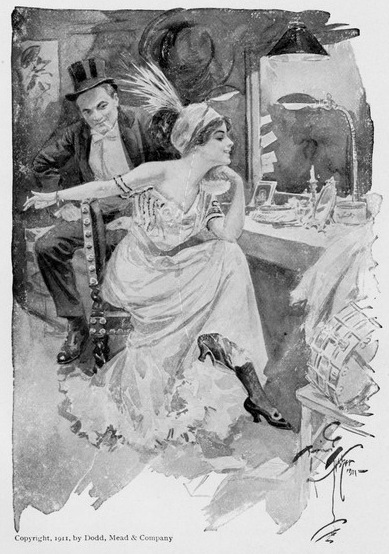
It was then that she received visitors in her
dressing-room. She had a sandwich and a
glass of milk at that time, but was perfectly
willing to send across the alley for bottled beer
if her callers cared to take anything so commonplace
as that.
She was sitting in her room, quite alone, with
58
her feet cocked upon a trunk, nibbling a sandwich
and thinking of the supper Fairfax was
to give later on in the evening, when the manager
of the company came tapping at her door.
People had got in the habit of walking in upon
her so unexpectedly that she issued an order
for every one to knock and then made the injunction
secure by slipping the bolt. Rebecca
went to the door.
“Mr. Fairfax is here, mademoiselle,” she
announced a moment later. “Mr. Ripton has
brought him back and he wants to come in.”
Except for the word “mademoiselle” Rebecca
spoke perfect English.
Nellie took one foot down and then, thinking
quickly, put it up again. It wouldn’t hurt Fairfax,
she argued, to encounter a little opposition.
“Tell Ripton I’m expecting some one else,”
she said, at random. “If Mr. Fairfax wants
to wait in the wings, I’ll see him there.”
But she had not the slightest inkling of what
was in store for her in the shape of visitors.
At that very moment Harvey and his friend
were at the stage door, the former engaged in
an attempt at familiarity with the smileless
attendant.
59
“Hello, Bob; how goes it?” said he, strutting
up to the door.
Bob’s bulk blocked the passage.
“Who d’you want to see?” he demanded,
gruffly.
“Who d’you suppose?” asked Harvey,
gaily.
“Don’t get fresh,” snapped the door man,
making as if to slam the iron door in his face.
Suddenly he recognised the applicant. “Oh,
it’s you, is it?”
“You must be going blind, Bobby,” said
Harvey, in a fine effort at geniality. “I’m taking
a friend in to show him how it’s done. My
friend, Mr. Butler, Bob.”
Mr. Butler stepped on Harvey’s toes and said
something under his breath.
“Is Miss Duluth expecting you, Mr.—er—Mr.—Is
she?” asked old Bob.
“No. I’m going to surprise her.”
Bob looked over his shoulder hastily.
“If I was you,” he said, “I’d send my card
in. She’s—she’s nervous and a shock might
upset her.”
“She hasn’t got a nerve in her body,”
said Harvey. “Come on, Butler. Mind you
60
don’t fall over the braces or get hit by the
scenery.”
They climbed a couple of steps and were in
the midst of a small, bustling army of scene
shifters and property men. Old Bob scratched
his head and muttered something about “surprises.”
Three times Harvey tried to lead the way
across the stage. Each time they were turned
back by perspiring, evil-minded stage hands
who rushed at them with towering, toppling
canvases. Once Harvey nearly sat down when
an unobserving hand jerked a strip of carpet
from under his feet. A grand staircase almost
crushed Mr. Butler on its way into place, and
some one who seemed to be in authority shouted
to him as he dodged:—
“Don’t knock that pe-des-tal over, you pie
face!”
At last they got safely over, and Harvey
boldly walked up to the star’s dressing-room.
“We’re all right now,” he said to Butler,
with a perceptible quaver in his voice. “Just
you wait while I go in and tell her I am
here.”
Butler squeezed himself into a narrow place,
61
where he seemed safe from death, mopped his
brow, and looked like a lost soul.
Two men, sitting off to the left, saw Harvey
try the locked door and then pound rather imperatively.
“Good Lord!” exclaimed one of them, staring.
“It’s—it’s—er—What’s-His-Name, Nellie’s
husband! Well, of all the infernal––”
“That?” gasped Fairfax.
“What in thunder is he doing here this
time o’ night! Great Scott, he’ll spoil everything,”
groaned Ripton, the manager.
Harvey pounded again with no response.
Nellie was sitting inside, mentally picturing
the eagerness that caused Fairfax to come
a-pounding like that. She had decided not to
answer.
Ripton called a stage hand.
“Tell him that Nellie isn’t seeing anybody
to-night,” he whispered. “Do it quick. Get
him out of here.”
“Shall I throw him out, sir?” demanded
the man, with a wry face. “Poor little
chap!”
“Just tell him that Nellie will see him for a
few minutes after the play.” Then, as the man
62
moved away:—“They’ve got no business
having husbands, Mr. Fairfax. Damned
nuisances.”
Fairfax had his hand to his lips. He was
thinking of Nellie’s “perfect devil.”
“I fancy he doesn’t cut much of a figure in
her life,” said he, in a tone of relief.
In the meantime the stage hand had accosted
Harvey, who had been joined by the anxious
Mr. Butler.
“Miss Duluth ain’t seeing any one to-night,
sir,” he said. “She gave strict orders. No
one, sir.”
Harvey’s blue eyes were like delft saucers.
“She’ll see me,” he said. “I’m her husband,
you know.”
“I know that, sir. But the order goes, just
the same.”
“Is she ill?”
“Yes, sir. Very ill,” said the man, quickly.
Butler was gnawing his moustache.
“Rubbish!” he said, sharply. “Come away,
you. She’s got a visitor in there. Can’t you
see the lay of the land?”
The little husband turned cold, then hot.
“A—a man visitor?”
63
“Certainly,” snapped the aggrieved Mr.
Butler. “What else?”
Without another word, Harvey brushed past
the stage hand and began rattling the door violently.
“Nellie!” he shouted, his lips close to the
paint.
In a second the door flew open and the astonished
actress stood there staring at him as
if he were a ghost. He pushed the door wide
open and strode into the dressing-room, Nellie
falling back before him. The room was empty
save for the dismayed Rebecca.
“There!” he exclaimed, turning to address
Butler in the doorway, but Butler was not
there. The stage hand had got in his way.
“Wha—what, in the name of Heaven, are
you doing here, Harvey?” gasped Nellie.
“How are you, Nell? Nothing serious, I
hope.”
“Serious?” she murmured, swallowing hard,
her wits in the wind.
“Ain’t you ill?”
“Never was better in my life,” she cried,
seeing what she thought was light. “Who
brought you to town with such a tale as that?
64
I’m fine. You’ve been fooled. If I were you,
I’d take the first train out and try to find out
who––”
“It’s all right, Butler,” he called out.
“Come right in. Hello! Where are you?”
He stepped to the door and looked out. Mr.
Butler was being conducted toward the stage
door by the burly stage hand. He was trying
to expostulate. “Hi! What you doing?”
shouted Harvey, darting after them. “Let my
friend alone!”
Up came Ripton in haste.
“O’Brien, what do you mean? Take your
hand off that gentleman’s shoulder at once. He
is a friend of Mr.—Mr.—ahem! A terrible mistake,
sir.”
Then followed a moment of explanation,
apology, and introduction, after which Harvey
fairly dragged his exasperated friend back to
Nellie’s room.
She was still standing in the middle of the
room trying to collect her wits.
“You remember Mr. Butler, deary,” panted
Harvey, waving his hand. Nellie gasped in the
affirmative.
At that instant Fairfax’s big frame appeared
65
in the door. He was grinning amiably. She
glared at him helplessly for a moment.
“Won’t you introduce me to your husband?”
he said, suavely.
Nellie found her tongue and the little man
shook hands with the big one.
“Glad to meet you,” said Harvey.
“I am glad to see you,” said Fairfax,
warmly.
“My friend Butler,” introduced Harvey.
Mr. Butler was standing very stiff and pallid,
with one knee propped against a chair.
There was a glaze over his eyes. Fairfax
grinned broadly.
“Oh, Butler and I are old acquaintances,”
said he. “Wife out of town, Butler?”
“Sure,” said Harvey, before Butler could
reply. “And we’re in town to see the sights.
Eh, Butler?”
Butler muttered something that sounded uncommonly
like “confounded ass,” and began
fanning himself with his derby hat and gloves
and walking-stick, all of which happened to be
in the same hand.
“We’re going to take Nellie—I mean Miss
Duluth—out for supper after the play,” went
66
on Harvey, glibly. “We’ll be waiting for you,
dearie. Mr. Butler is doing the honours. By
the way, Butler, I think it would be nicer if
Nellie could suggest an odd lady for us. We
ought to have four. Do you know of any one,
Nell? By George, we’ve got to have a pretty
one, though. We insist on that, eh, Butler?”
He jabbed Butler in the ribs and winked.
“Don’t do that!” said the unhappy Mr.
Butler, dropping his stick. It rolled under a
table and he seized the opportunity thus providentially
presented. He went down after it
and was lost to view for a considerable length,
of time, hiding himself as the ostrich does when
it buries its head in the sand and imagines it is
completely out of sight.
Nellie’s wits were returning. She was
obliged to do some rapid and clever thinking.
Fairfax was watching her with a sardonic smile
on his lips. Ripton, the manager, peered over
his shoulder and winked violently.
“Oh, Harvey dear,” she cried, plaintively,
“how disappointed I am. I have had strict orders
from the doctor to go straight home to bed
after every performance. I really can’t go with
you and Mr. Butler to-night. I wish you had
.gn +1
telephoned or something. I could have told
you.”
67
Harvey looked distressed. “What does the
doctor say it is?”
Fairfax was sitting on a trunk, a satisfied smile on his lips
“My heart,” she said, solemnly.
“Don’t you think you could go out for a—just
a sandwich and a bottle of beer?” he
pleaded, feeling that he had wantonly betrayed
his friendly neighbour.
“Couldn’t think of it,” she said. “The
nurse will be here at eleven. I’ll just have to
go home. He insists on absolute quiet for me
and I’m on a dreadful diet.” A bright thought
struck her. “Do you know, I have to keep my
door locked so as not to be startled by––”
The sharp, insistent voice of the callboy
broke in on her flow of excuses.
“There! I’ll have to go on in a second. The
curtain’s going up. Good-night, gentlemen.
Good-night, Harvey dear. Give me a kiss.”
She pecked at his cheek with her carmine
lips.
“Just half an hour at some quiet little restaurant,”
he was saying when she fled past him
toward the stage.
“Sorry, dear,” she called, then stopped to
68
speak to Mr. Butler. “Thank you so much,
Mr. Butler. Won’t you repeat the invitation
some time later on? So good of you to bring
Harvey in. Bring Mrs. Butler in some night,
and if I’m better we will have a jolly little
spree, just the four of us. Will you do
it?”
She beamed on him. Butler bowed very low
and said:—
“It will give me great pleasure, Miss Duluth.”
“Good-night, then.”
“Good-night.”
When she returned to her dressing-room later
on, she found Fairfax there, sitting on a trunk,
a satisfied smile on his lips. She left the door
open.
Mr. Ripton conducted the two men across to
the stage door, leading them through the narrow
space back of the big drop. Chorus girls
threw kisses at Harvey; they all knew him. He
winked blandly at Butler, who was staring
straight before him.
“A great life, eh?” said Harvey, meaning
that which surrounded them. They were in the
alley outside the stage door.
69
“I’m going to catch the ten-twenty,” said
Butler, jamming his hat down firmly.
“Ain’t you going to see the last act?” demanded
the other, dismayed.
Butler lifted his right hand to heaven, and,
shaking it the better to express the intensity
of his declaration, remarked:—
“I hope somebody will kick me all over town
if I’m ever caught being such a damned fool
as this again. I honestly hope it! I’ve been
made ridiculous—a blithering fool! Why, you—you––”
He paused in his rage, a sudden
wave of pity assailing him. “By George, I
can’t help feeling sorry for you! Good-night.”
Harvey hurried after him.
“I guess I’ll take it, too. That gets us out
at eleven-thirty. We can get a bite to eat in
the station, I guess.”
He had to almost trot to keep pace with Butler
crossing to the Grand Central. Seated side
by side in the train, and after he had recovered
his breath a bit, he said:—
“Confound it, I forgot to ask Nellie if it
will be wise for her to come out on Sunday. The
heart’s a mighty bad thing, Butler.”
“It certainly is,” said Butler, with unction.
70
At the station in Tarrytown he said “Good-night”
very gruffly and hurried off to jump
into the only cab at the platform. He had heard
all about Blakeville and the wild life Harvey
had led there, and he was mad enough to fight.
“Good-night, Mr. Butler,” said Harvey, as
the hack drove off.
He walked up the hill.
71
CHAPTER III — MR. FAIRFAX
He found the nursemaid up and waiting for
him. Phoebe had a “dreadful throat” and a
high temperature. It had come on very suddenly,
it seems, and if Annie’s memory served
her right it was just the way diphtheria began.
The little girl had been thrashing about in the
bed and whimpering for “daddy” since eight
o’clock. His heart sank like lead, to a far
deeper level than it had dropped with the base
desertion of Butler. Filled with remorse, he
ran upstairs without taking off his hat or overcoat.
The feeling of resentment toward Butler
was lost in this new, overpowering sense of
dread; the discovery of his own lamentable unfitness
for “high life” expeditions faded into
nothingness in the face of this possible catastrophe.
What if Phoebe were to die? He would
be to blame. He remembered feeling that he
should not have left her that evening. It had
been a premonition, and this was to be the price
of his folly.
72
At three in the morning he went over to
rouse the doctor, all the time thinking that, even
if he were capable of forgiving himself for
Phoebe’s death, Nellie would always hold him
responsible. The doctor refused to come before
eight o’clock, and slammed the door in the disturber’s
face.
“If she dies,” he said to himself over and
over again as he trudged homeward, “I’ll kill
that beast of a doctor. I’ll tear his heart out.”
The doctor did not come till nine-thirty. They
never do. He at once said it was a bad attack
of tonsilitis, and began treatment on the stomach.
He took a culture and said he would let
Mr.—Mr. What’s-His-Name know whether
there was anything diphtheritic. In the meantime,
“Take good care of her.”
Saturday morning a loving note came from
Nellie, deploring the fact that she couldn’t come
out on Sunday after all. The doctor said she
must save her strength. She instructed Harvey
to dismiss Bridget and get another cook
at once. But Harvey’s heart had melted toward
Bridget. The big Irishwoman was the
soul of kindness now that her employer was in
distress.
73
About nine o’clock that morning a man came
up and tacked a placard on the door and informed
the household that it was in quarantine.
Harvey went out and looked at the card.
Then he slunk back into Phoebe’s room and sat
down, very white and scared.
“Do you think she’ll die?” he asked
of the doctor when that gentleman called
soon afterward. He was shivering like a
leaf.
“Not necessarily,” said the man of medicine,
calmly. “Diphtheria isn’t what it used
to be.”
“If she dies I’ll jump in the river,” said
the little father, bleakly.
“Nonsense!” said the doctor. “Can you
swim?” he added, whimsically.
“No,” said Harvey, his face lighting up.
The doctor patted him on the back. “Brace
up, sir. Has the child a mother?”
Harvey stared at him. “Of course,” he said.
“Don’t you know whose child you are ’tending?”
“I confess I—er—I––”
“She is the daughter of Nellie Duluth.”
“Oh!” fell from the doctor’s lips. “And
74
you—you are Miss Duluth’s husband? I didn’t
quite connect the names.”
“Well, I’m her husband, name or no
name,” explained the other. “I suppose
I ought to send for her. She ought to
know.”
“Are you—er—separated?”
“Not at all,” said Harvey. “I maintain two
establishments, that’s all. One here, one in the
city.”
“Oh, I see,” said the doctor, who didn’t in
the least see. “Of course, she would be subject
to quarantine rules if she came here, Mr.—Mr.—ahem!”
“They couldn’t get along without her at the
theatre,” groaned the husband.
“I’d suggest waiting a day or two. Believe
me, my dear sir, the child will pull through. I
will do all that can be done, sir. Rest easy.”
His manner was quite different, now that he
knew the importance of his patient. He readjusted
his glasses and cleared his throat. “I
hope to have the pleasure of seeing Mrs.—er—your
wife, sir.”
“She has a regular physician in town,” said
Harvey, politely.
75
For two weeks he nursed Phoebe, day and
night, announcing to the doctor in the beginning
that his early training made him quite
capable. There were moments when he thought
she was dying, but they passed so quickly that
his faith in the physician’s assurances rose
above his fears. Acting on the purely unselfish
motive that Nellie would be upset by the news,
he kept the truth from her, and she went on
singing and dancing without so much as a word
to distress her. Two Sundays passed; her own
lamentable illness kept her away from the little
house in Tarrytown.
“If we tell her about Phoebe,” said Harvey
to Bridget and Annie, “she’ll go all to pieces.
Her heart may stop, like as not. Besides, she’d
insist on coming out and taking care of her, and
that would be fatal to the show. She’s never
had diphtheria. She’d be sure to catch it. It
goes very hard with grown people.”
“Have you ever had it, sir?” asked Annie,
anxiously.
“Three times,” said Harvey, who hadn’t
thought of it up to that moment.
When the child was able to sit up he put in
his time reading “David Copperfield” to her.
76
Later on he played “jacks” with her and cut
pictures out of the comic supplements. By the
end of the month he was thinner and more
“peaked,” if anything, than she. Unshaven,
unshorn, unpressed was he, but he was too full
of joy to give heed to his own personal comforts
or requirements.
His mind was beginning to be sorely troubled
over one thing. Now that Phoebe was well and
getting strong he realised that Nellie would be
furious when she found out how ill the child
had been and how she had been deceived. He
considered the advisability of keeping it from
her altogether, swearing every one to secrecy,
but there was the doctor’s bill to be paid. When
it came to paying that Nellie would demand an
explanation. It was utterly impossible for him
to pay it himself. Thinking over his unhappy
position, he declared, with a great amount of
zeal, but no vigour, that he was going to get
a job and be independent once more. More
than that, when he got fairly well established
in his position (he rather leaned toward the
drug or the restaurant business) he would insist
on Nellie giving up her arduous stage work
and settling down to enjoy a life of comfort
77
and ease—even luxury, if things went as he
meant them to go.
One afternoon late in October, when the scarlet
leaves were blowing across his little front
yard and the screens had been taken from the
windows, a big green automobile stopped at his
gate and a tall man got out and came briskly
up the walk. Harvey was sitting in the
library helping Phoebe with her ABC’s when
he caught sight of the visitor crossing the
porch.
“Gentleman to see you,” said Annie, a moment
later.
“Is it the butcher’s man? I declare, I must
get in and attend to that little account. Tell
him I’ll be in, Annie.”
“It ain’t the butcher. It’s a swell.”
Harvey got up, felt of the four days’ growth
of beard on his chin, and pondered.
“Did he give his name?”
“Mr. Fairfax, he said.”
He remembered Fairfax. His hand ran over
his chin once more.
“Tell him to come in. I’ll be down in fifteen
minutes.”
He went upstairs on the jump and got his
78
razor out. He was nervous. Only that morning
he had written to Nellie telling her of
Phoebe’s expensive illness and of her joyous
recovery. The doctor’s bill was ninety dollars.
He cut himself in three places.
Fairfax was sitting near the window talking
with Phoebe when he clattered downstairs ten
minutes later, deploring the cuts but pleased
with himself for having broken all records at
shaving. The big New Yorker had a way with
him; he could interest children as well as their
mothers and grown sisters. Phoebe was telling
him about “Jack the Giant Killer” when
her father popped into the room.
“Phoebe!” he cried, stopping short in
horror.
Fairfax arose languidly.
“How do you do, Mr.—ah—ahem! The little
girl has been playing hostess. The fifteen
minutes have flown.”
“Ten minutes by my watch,” said Harvey,
promptly. “Phoebe, dear, where did you get
that awful dress—and, oh, my! those dirty
hands? Where’s Annie? Annie’s the nurse,
Mr. Fairfax. Run right away and tell her to
change that dress and wash your hands. How
79
do you do, Mr. Fairfax? Glad to see you. How
are you?”
He advanced to shake the big man’s hand.
Fairfax towered over him.
“I was afraid you would not remember me,”
said Fairfax.
“Run along, Phoebe. She’s been very ill,
you see. We don’t make life any harder for
her than we have to. Washing gets on a
child’s nerves, don’t you think? It used to
on mine, I know. Of course I remember
you. Won’t you sit down? Annie! Oh,
Annie!”
He called into the stair hallway and Annie
appeared from the dining-room.
“Ann—Oh, here you are! How many times
must I tell you to put a clean dress on Phoebe
every day? What are her dresses for, I’d like
to know?” He winked violently at Annie from
the security of the portière, which he held at
arm’s length as a shield. Annie arose to the
occasion and winked back.
“May I put on my Sunday dress?” cried
Phoebe, gleefully.
“Only one of ’em,” said he, in haste. “Annie
will pick out one for you.”
80
Considerably bewildered, Phoebe was led
away by the nurse.
“She’s a pretty child,” said Fairfax. If
his manner was a trifle strained Harvey failed
to make note of it. “Looks like her mother.”
“I’m glad you think so,” said the father, radiantly.
“I’d hate to have her look like me.”
Fairfax looked him over and suppressed a
smile.
“She is quite happy here with you, I suppose,”
he said, taking a chair.
“Yes, sir-ree.”
“Does she never long to be with her
mother?”
“Well, you see,” said Harvey, apologising for
Nellie, “she doesn’t see much of Miss—of her
mother these days. I guess she’s got kind of
used to being with me. Kids are funny things,
you know.”
“She seems to have all the comforts and
necessities of life,” said the big man, looking
about him with an affectation of approval.
“Everything that I can afford, sir,” said
Harvey, blandly.
“Have you ever thought of putting her in
a nice school for––”
81
“She enters kindergarten before the holidays,”
interrupted the father.
“I mean a—er—sort of boarding school,”
put in the big man, uneasily. “Where she could
be brought up under proper influences, polished
up, so to speak. You know what I mean. Miss
Duluth has often spoken of such an arrangement.
In fact, her heart seems to be set on
it.”
“You mean she—she wants to send her away
to school?” asked Harvey, blankly.
“It is a very common and excellent practice
nowadays,” said the other, lamely.
The little man was staring at him, his blue
eyes full of dismay.
“Why—why, I don’t believe I’d like that,”
he said, grasping the arms of his chair with
tense fingers. “She’s doing all right here. It’s
healthy here, and I am sure the schools are
good enough. Nellie has never said anything
to me about boarding school. Why—why, Mr.
Fairfax, Phoebe’s only five—not quite that, and
I—I think it would be cruel to put her off among
strangers. When she’s fifteen or sixteen,
maybe, but not now. Nellie don’t mean that,
I’m sure.”
82
“There is a splendid school for little girls
up in Montreal—a sort of convent, you know.
They get the best of training, moral, spiritual,
and physical. It is an ideal life for a child.
Nellie has been thinking a great deal of sending
her there. In fact, she has practically decided
to––”
Harvey came to his feet slowly, dizzily.
“I can’t believe it. She wouldn’t send the
poor little thing up there all alone; no, sir! I—I
wouldn’t let her do it.” He was pacing the
floor. His forehead was moist.
“Miss Duluth appreciates one condition that
you don’t seem able to grasp,” said Fairfax,
bluntly. “She wants to keep the child as far
removed from stage life and its environments
as possible. She wants her to have every advantage,
every opportunity to grow up entirely
out of reach of the—er—influences which now
threaten to surround her.”
Harvey stopped in front of him. “Is this
what you came out here for, Mr. Fairfax? Did
Nellie tell you to do this?”
“I will be perfectly frank with you. She
asked me to come out and talk it over with
you.”
83
“Why didn’t she come herself?”
“She evidently was afraid that you would
overrule her in the matter.”
“I never overruled her in my life,” cried
Harvey. “She isn’t afraid of me. There’s
something else.”
“I can only say, sir, that she intends to put
the child in the convent before Christmas. She
goes on the road after the holidays,” said Fairfax,
setting his huge jaw.
Harvey sat down suddenly, limp as a rag.
His mouth filled with water—a cold, sickening
moisture that rendered him speechless for a
moment. He swallowed painfully. His eyes
swept the little room as if in search of something
to prove that this was the place for
Phoebe—this quiet, happy little cottage of
theirs.
“Before Christmas?” he murmured.
“See here, Mr.—ah—Mr., here is the situation
in a nutshell:—Nellie doesn’t see why she
should be keeping up two establishments. It’s
expensive. The child will be comfortable and
happy in the convent and this house will be off
her hands. She––”
“Why don’t she give up her flat in town?”
84
demanded Harvey, miserably. “That’s where
the money goes.”
“She expects to give it up the first of the
year,” said Fairfax. “The road tour lasts till
May. She is going to Europe for the summer.”
“To Europe?” gasped Harvey, feeling the
floor sink under his feet.
He did not think to inquire what was to become
of him in the new arrangement.
“She needs a sea voyage, travel—a long
vacation, in fact. It is fully decided. So, you
see, the convent is the place for Phoebe.”
“But where do I come in?” cried the unhappy
father. “Does she think for a minute
that I will put my child in a convent so that
we may be free to go to Europe and do things
like that? No, sir! Dammit, I won’t go to
Europe and leave Phoebe in a––”
Fairfax was getting tired of the argument.
Moreover, he was uncomfortable and decidedly
impatient to have it over with. He cut in rather
harshly on the other’s lamentations.
“If you think she’s going to take you to
Europe, you’re very much mistaken. Why,
man, have you no pride? Can’t you understand
85
what a damned useless bit of dead weight
you are, hanging to her neck?”
It was out at last. Harvey sat there staring
at him, very still; such a pathetic figure that it
seemed like rank cowardice to strike again. And
yet Fairfax, now that he had begun, was eager
to go on striking this helpless, inoffensive creature
with all the frenzy of the brutal victor who
stamps out the life of his vanquished foe.
“She supports you. You haven’t earned a
dollar in four years. I have it from her, and
from others. It is commonly understood that
you won’t work, you won’t do a stroke toward
supporting the child. You are a leech, a barnacle,
a—a—well, a loafer. If you had a drop
of real man’s blood in you, you’d get out and
earn enough to buy clothes for yourself, at least,
and the money for a hair cut or a shoe shine. She
has been too good to you, my little man. You
can’t blame her for getting tired of it. The
great wonder is that she has stood for it so
long.”
Words struggled from Harvey’s pallid lips.
“But she loves me,” he said. “It’s all understood
between us. I gave her the start in
life. She will tell you so. I––”
86
“You never did a thing for her in your life,”
broke in the big man, harshly. He was consumed
by an ungovernable hatred for this little
man who was the husband of the woman he
coveted.
“I’ve always wanted to get a job. She
wouldn’t let me,” protested Harvey, a red spot
coming into each of his cheeks. “I don’t want
to take the money she earns. I never have
wanted to. But she says my place is here at
home, with Phoebe. Somebody’s got to look
after the child. We’ve talked it over a––”
“I don’t want to hear about it,” snapped
Fairfax, hitting the arm of his chair with his
fist. “You’re no good, that’s all there is to
it. You are a joke, a laughing stock. Do you
suppose that she can possibly love a man like
you? A woman wants a man about her, not
the caricature of one.”
“I intend to get a job as soon as––” began
Harvey, as if he had not heard a word his visitor
was saying.
“Now, see here,” exclaimed Fairfax, coming
to his feet. “I’m a man of few words. I
came out here to make you a proposition. It is
between you and me, and no one need be the
87
wiser. I’m not such a fool as to intrust a thing
of this kind to an outsider. Is there any likelihood
of any one hearing us?”
Nellie’s husband shrank lower into his chair
and shook his head. He seemed to have lost
the power of speech. Fairfax drew a chair up
closer, however, and lowered his voice.
“You’ve got a price. Men of your type always
have. I told Nellie I would see you to-day.
I’ll be plain with you. She’s tired of
you, of this miserable attachment. You are impossible.
That’s settled. We won’t go into
that. Now I’m here, man to man, to find out
how much you will take and agree to a separation.”
Harvey stiffened. He thought for a moment
that his heart had stopped beating.
“I don’t believe I understand,” he muttered.
“Don’t you understand the word ‘separation’?”
“Agree to a separation from what? Great
God, you don’t mean a separation from
Phoebe?”
“Don’t be a fool! Use your brain, if you’ve
got one.”
“Do—you—mean—Nellie?” fell slowly,
88
painfully from the dry lips of the little man
in the Morris chair.
“Certainly.”
“Does she want to—to leave me?” The
tears started in his big blue eyes. He blinked
violently.
“It has come to that. She can’t go on as
she has been going. It’s ridiculous. You are
anxious to go back to Blakeville, she says.
Well, that’s where you belong. Somebody’s
drug store out there you’d like to own, I believe.
Now, I am prepared to see that you get
that drug store and a matter of ten or twenty
thousand dollars besides. Money means nothing
to me. All you have to do is to make no
answer to the charges she will bring––”
Harvey leaped to his feet with a cry of abject
pain.
“Did she send you here to say this to me?”
he cried, shrilly, his figure shaking with suppressed
fury.
“No,” said Fairfax, involuntarily drawing
back. “This is between you and me. She
doesn’t know––”
“Then, damn you!” shrieked Harvey, shaking
his fist in the big man’s face, “what do you
89
mean by coming here like this? What do you
think I am? Get out of here! I’m a joke, am
I? Well, I’ll show you and her and everybody
else that I’m a hell of a joke, let me tell you
that! I was good enough for her once. I won
her away from every fellow in Blakeville. I
can do it again. I’ll show you, you big bluffer!
Now, get out! Don’t you ever come here again,
and—don’t you ever go near my wife again!”
Fairfax had arisen. He was smiling, despite
his astonishment.
“I fancy you will find you can’t go so far
as that,” he sneered.
“Get out, or I’ll throw you out!”
“Better think it over. Twenty-five thousand
and no questions asked. Take a day or two
to think––”
With a shriek of rage Harvey threw himself
at the big man, striking out with all his might.
Taken by surprise, Fairfax fell away before
the attack, which, though seemingly impotent,
was as fierce as that of a wildcat.
The New Yorker was in no danger. He
warded off the blows with ease, all the time imploring
the infuriated Harvey to be sensible, to
be calm. But with a heroism born of shame
90
and despair the little man swung his arms like
windmills, clawing, scratching, until the air
seemed full of them. Fairfax’s huge head was
out of reach. In his blind fury Harvey did not
take that into account. He struck at it with
all the power in his thin little arms, always
falling so far short that the efforts were
ludicrous.
Fairfax began to look about in alarm. The
noise of the conflict was sure to attract the attention
of the servants. He began backing toward
the doorway. Suddenly Harvey changed
his fruitless tactics. He drove the toe of his
shoe squarely against the shinbone of the big
man. With a roar of rage Fairfax hurled himself
upon the panting foe.
“I’ll smash your head, you little devil,” he
roared, and struck out viciously with one of his
huge fists.
The blow landed squarely on Harvey’s eye.
He fell in a heap several feet away. Half-dazed,
he tried to get to his feet. The big man,
all the brute in him aroused, sprang forward
and drove another savage blow into the bleak,
white face of the little one. Again he struck.
Then he lifted Harvey bodily from the floor and
91
held him up against the wall, his big hand on
his throat.
“How do you like it?” he snarled, slapping
the helpless, half-conscious man in the face with
his open hand—loud, stinging blows that almost
knocked the head off the shoulders. “Will
you agree to my proposition now?”
From Harvey’s broken lips oozed a strangled—
“No!”
Fairfax struck again and then let him slide
to the floor.
“You damned little coward!” he grated.
“To kick a man like that!”
He rushed from the room, grabbed his hat
and coat in the hall, and was out of the house
like a whirlwind.
The whir of a motor came vaguely, indistinctly
to Harvey’s ears. He was lying close
to the window. As if in a dream he lifted himself
feebly to his knees and looked out of the
window, not knowing exactly what he did nor
why he did it.
A big green car was leaving his front gate.
He was a long time in recalling who came up
in it.
92
His breath was coming slowly. He tried to
speak, but a strange, unnatural wheeze came
from his lips. A fit of coughing followed. At
last he got upon his feet, steadying himself
against the window casing. For a long time
he stood there, working it all out in his dizzy,
thumping brain.
He put his hand to his lips and then stared
dully at the stains that covered it when he took
it away. Then it all came back to him with
a rush. Like a guilty, hunted thing he slunk
upstairs to his room, carefully avoiding the
room in which Phoebe was being bedecked in
her Sunday frock. Her high, shrill voice came
to his ears. He was weeping bitterly, sobbing
like a whipped child.
He almost fainted when he first peered into
the mirror on his bureau. His eyes were beginning
to puff out like great knobs, his face
and shirt front were saturated with his own
plucky blood. Plucky! The word occurred to
him as he looked. Yes, he had been plucky. He
didn’t know it was in him to be so plucky. A
sort of pride in himself arose to offset the pain
and mortification. Yes, he had defended his
honour and Nellie’s. She should hear of it!
93
He would tell her what he had done and how
Fairfax had struck him down with a chair.
She would then deny to him that she had said
those awful things about him. She would be
proud of him!
Carefully he washed his hands and face.
With trembling fingers he applied court-plaster
to his lips, acting with speed because his eyes
were closing. Some one had told him that raw
beefsteak was good for black eyes. He wondered
if bacon would do as well. There was no
beefsteak in the house.
His legs faltered as he made his way to the
back stairs. Bridget was coming up. She
started back with a howl.
“Come here, Bridget,” he whispered. “Into
my room. Be quick!” He retreated. He would
employ her aid and swear her to secrecy. The
Irish know a great deal about fighting, he
reflected.
“In the name av Hivvin, sor, what has happened
to yez?” whispered Bridget, aghast in
the doorway.
“Come in and I’ll tell you,” said he, with a
groan.
Presently a childish voice came clamouring
94
at the locked door. He heard it as from afar.
Bridget paused in her ministrations. He had
just said:—
“I will take boxing lessons and physical culture
of your brother, Bridget. You think he
can build me up? I know I’m a bit run down.
No exercise, you know. Still, I believe I would
have thrashed him to a frazzle if I hadn’t stumbled.
That was when he kicked me here. I got
this falling against the table.”
“Yis, sor,” said Bridget, dutifully.
In response to the pounding on the door, he
called out, bravely:—
“You can’t come in now, Phoebe. Papa has
hurt himself a little bit. I’ll come out soon.”
“I got my Sunday dress on, daddy,” cried
the childish voice. “And I’m all spruced up.
Has the nice gentleman gone away?”
His head sank into his hands.
“Yes, dearie, he’s gone,” he replied, in
muffled tones.
95
CHAPTER IV — LUNCHEON
For several days, he moped about the house,
not even venturing upon the porch, his face a
sight to behold. His spirits were lower than
they had been in all his life. The unmerciful
beating he had sustained at the hands of Fairfax
was not the sole cause of his depression.
As the consequences of that pummelling subsided,
the conditions which led up to it forced
themselves upon him with such horrifying immensity
that he fairly staggered under them.
It slowly dawned on him that there was something
very sinister in Fairfax’s visit, something
terrible. Nellie’s protracted stay in
town, her strange neglect of Phoebe, to say
nothing of himself, the presence of Fairfax in
her dressing-room that night, and a great many
circumstances which came plainly to mind, now
that he considered them worth while noticing,
all went a long way toward justifying Fairfax
in coming to him with the base proposition that
had resulted so seriously to his countenance.
96
Nellie was tired of him! He did not belong
to her world. That was the sum and substance
of it. As he dropped out of her world, some
one else quite naturally rose to fill the void.
That person was Fairfax. The big man had
said that she wanted a separation, she wanted
to provide a safe haven for Phoebe. The inference
was plain. She wanted to get rid of
him in order to marry Fairfax. Fairfax had
been honest enough to confess that he was acting
on his own initiative in proposing the bribe,
but there must have been something behind
it all.
He had spoken of “charges.” What charge
could Nellie bring against him? He was two
days in arriving at the only one—failure to
provide. Yes, that was it. “Failure to provide.”
How he hated the words. How he despised
men who did not provide for their wives.
He had never thought of himself in that light
before. But it was true, all true. And Nellie
was slipping away from him as the result. Not
only Nellie but Phoebe. She would be taken
from him.
“I don’t drink,” he argued with himself,
“and I’ve never treated her cruelly. Other
97
women don’t interest me. I never swear at her.
I’ve never beaten her. I’ve always loved her.
So it must be that I’m ‘no good,’ just as that
scoundrel says. ‘No good!’ Why, she knows
better than that. There never was a fellow who
worked harder than I did for Mr. Davis. I
drew trade to his store. Anybody in Blakeville
will swear to that. Haven’t I tried my best to
get a job in the same shows with her? Wasn’t
I the best comedian they had in the dramatic
club? I’ve never had the chance to show what
I could do, and Nellie knows it. But I’ll show
them all! I’ll make that big brute wish he’d
never been born. I’ll—I’ll assert myself. He
shan’t take her away from me.”
His resolutions soared to great heights, only
to succumb to chilly blasts that sent them shrivelled
back to the lowest depths. What could he
do against a man who had all the money that
Fairfax possessed? What could he offer for
Nellie, now that some one else had put a stupendous
price on her? He remembered reading
about an oil painting that originally sold
for five hundred francs and afterward brought
forty thousand dollars. Somehow he likened
Nellie to a picture, with the reservation that he
98
didn’t believe any painting on earth was worth
forty thousand dollars. If there was such a
thing, he had never seen it.
Then he began to think of poor Nellie cast
helpless among the tempters. She was like a
child among voracious beasts of prey. No wonder
she felt hard toward him! He was to blame,
terribly to blame. In the highest, most exalted
state of remorse he wept, not once but often.
His poor little Nellie!
In one of these strange ever-growing flights
of combined self-reproach and self-exaltation
he so vividly imagined himself as a rescuer,
as an able-bodied defender against all the ills
and evils that beset her, that the fancy took the
shape of positive determination. He made up
his mind to take her off the stage, back to
Blakeville, and to an environment so sweet and
pure that her life would be one long season
of joy and happiness.
With the growth of this resolution he began
to plan his own personal rehabilitation. First
of all, he would let his face recover its natural
shape; then he would cultivate muscle and
brawn at the emporium of Professor Flaherty;
moreover, he would devote considerable attention
99
to his own personal appearance and to the
habits of the “men about town.” He would
fight the tempters with their own weapons—the
corkscrew, the lobster pick, the knife and
fork, and the nut-splitter!
He did not emerge from the house for five
days. By that time he was fairly presentable.
It was Annie’s day out, so he took Phoebe
for a little walk. As for Phoebe, she never
passed a certain door upstairs without kicking
at it with first one, then the other of her tiny
feet, in revenge for the way it had hurt her
father by remaining open so that he could bump
into it on that bloody, terrifying day. She
sent little darts of exquisite pain through him
by constantly alluding to the real devastator as
“that nice Mr. Fairy-fax.” It was her pleasure
to regard him as a great big fairy who had
promised her in secret that she would some
day be like Cinderella and have all the
riches the slipper showered upon that poor
little lady.
As they were returning home after a stroll
through a rather remote street, they came upon
Mr. Butler, who was down on his knees fixing
something or other about his automobile. Harvey
100
thought it a good opportunity to start his
crusade against New York City.
“Hello,” he said, halting. Butler looked up.
He was mad as a wet hen to begin with.
“Hello,” he snarled, resuming his work.
“I’ve been thinking about that little––”
“Get out of the light, will you?”
Harvey moved over, dragging Phoebe after
him.
“That little scheme of ours to dine together
in town some night. You remember we talked
about it––”
“No, I don’t,” snapped Butler.
“We might lunch together early next week.
I know a nice little place on Seventh Avenue
where you get fine spaghetti. We––”
“I’m booked for a whole month of luncheons,”
said Butler, sitting back on his heels to
stare at this impossible person. “Can’t join
you.”
“Some other time, then,” said Harvey, waving
his hand genially. “Your wife home yet?”
Butler got upon his feet.
“Say,” said he, aggressively, “do you know
she’s heard about that idiotic trip of mine to
town that night? Fairfax told everybody, and
101
somebody’s wife told Mrs. Butler. It got me
in a devil of a mess.”
“You don’t say so!”
“Yes, I do say so. Next time you catch
me—But, what’s the use?” He turned to his
work with an expressive shrug of his shoulders.
“I’ll have my wife explain everything to
Mrs. Butler the first time she comes out,” said
Harvey, more bravely than he felt. He could
not help wondering when Nellie would come out.
“It isn’t necessary,” Butler made haste to
assure him.
Harvey was silent for a moment.
“Fixing your automobile?” he asked, unwilling
to give it up without another effort.
“What do you suppose I’m doing?”
“It’s wonderful how fast one of these little
one-seated cars can go,” mused Harvey.
“Cheap, too; ain’t they?”
Butler faced him again, malice in his glance.
“It’s not in it with that big green car your
wife uses,” he said, distinctly.
“Big green––” began Harvey, blankly.
Then he understood. He swallowed hard,
straightened Phoebe’s hat with infinite care and
gentleness, and looking over Butler’s head,
102
managed to say, quite calmly:—“It used to be
blue. We’ve had it painted. Come along,
Phoebe, Mr. Butler’s busy. We mustn’t bother
him. So long, Butler.”
“So long,” said Mr. Butler, suddenly intent
upon finding something in the tool-box.
The pair moved on. Out of the corner of
his eye Butler watched them turn the corner
below.
“Poor little guy!” he said to the monkey
wrench.
The big green car! All the way home that
juggernaut green car ran through, over, and
around him. He could see nothing else, think
of nothing else. A big green car!
That evening he got from Bridget the address
of her brother, Professor Flaherty, the
physical trainer and body builder.
In the morning he examined himself in the
mirror, a fever of restlessness and impatience
afflicting him with the desire to be once more
presentable to the world. He had been encouraged
by the fact that Butler had offered no
comment on the black rims around his eyes.
They must be disappearing.
With his chin in his hands he sat across the
103
room staring at his reflection in the glass, a
gloomy, desolate figure.
“It wouldn’t be wise to apply for a job until
these eyes are all right again,” he was saying
to himself, bitterly. “Nobody would hire
a man with a pair of black eyes and a busted
lip—especially a druggist. I’ll simply have to
wait a few days longer. Heigh-ho! To-morrow’s
Sunday again. I—I wonder if Nellie
will be out to see us.”
But Nellie did not come out. She journeyed
far and fast in a big green car, but it was in
another direction.
Thursday of the next week witnessed the
sallying forth of Harvey What’s-His-Name,
moved to energy by a long dormant and mournfully
acquired ambition. The delay had been
irksome.
Nellie’s check for the month’s expenses had
arrived in the mail that morning. He folded
it carefully and put it away in his pocketbook,
firmly resolved not to present it at the bank.
He intended to return it to her with the announcement
that he had secured a position and
hereafter would do the providing.
Spick and span in his best checked suit, his
104
hat tilted airily over one ear, he stepped briskly
down the street. You wouldn’t have known
him, I am sure, with his walking-stick in one
hand, his light spring overcoat over the other
arm. A freshly cleaned pair of grey gloves,
smelling of gasoline, covered his hands. On
the lapel of his coat loomed a splendid yellow
chrysanthemum. Regular football weather, he
had said.
The first drug store he came to he entered
with an air of confidence. No, the proprietor
said, he didn’t need an assistant. He went on
to the next. The same polite answer, with the
additional information, in response to a suggestion
by the applicant, that the soda-water
season was over. Undaunted, he stopped in
at the restaurant in the block below. The proprietor
of the place looked so sullen and forbidding
that Harvey lost his courage and instead
of asking outright for a position as manager
he asked for a cup of coffee and a couple
of fried eggs. As the result of this extra and
quite superfluous breakfast he applied for the
job.
The man looked him over scornfully.
“I’m the manager and the whole works combined,”
105
he said. “I need a dish-washer, come
to think of it. Four a week and board. You
can go to work to-day if––”
But Harvey stalked out, swinging his cane
manfully.
“Well, God knows I’ve tried hard enough,”
he said to himself, resignedly, as he headed for
the railway station. It was still six minutes of
train time. “I’ll write to Mr. Davis out in
Blakeville this evening. He told me that my
place would always be open to me.”
It was nearly one o’clock when he appeared
at Nellie’s apartment. Rachel admitted him.
He hung his hat and coat on the rack, deposited
his cane in the corner, and sauntered coolly
into the little sitting-room, the maid looking
on in no little wonder and uneasiness.
“Where’s my wife?” he asked, taking up
the morning paper from the centre table and
preparing to make himself at home in the big
armchair.
“She’s out to lunch, sir.”
He laid the paper down.
“Where?”
Rachel mentioned a prominent downtown
café affected by the profession.
106
“Will you have lunch here, sir?” she inquired.
“No,” said he, determinedly. “Thank you
just the same. I’m lunching downtown. I—I
thought perhaps she’d like to join me.”
Rachel rang for the elevator and he departed,
amiably doffing his hat to her as he
dropped to the floor below.
At one of the popular corner tables in the
big café a party of men and women were seated,
seven or eight in all. Nellie Duluth had her
back toward the other tables in the room. It
was a bit of modesty that she always affected.
She did not like being stared at. Besides,
she could hold her audience to the very end,
so to speak, for all in the place knew she
was there and were willing to wait until she
condescended to face them in the process of
departure.
It was a very gay party, comprising a grand-opera
soprano and a tenor of world-wide reputation,
as well as three or four very well-known
New Yorkers. Manifestly, it was Fairfax’s
luncheon. The crowd at this table was observed
by all the neck-craners in the place.
Every one was telling every one else what
107
every one knew:—“That’s Nellie Duluth over
there.”
As the place began to clear out and tables
were being abandoned here and there, a small
man in a checked suit appeared in the doorway.
An attendant took his hat and coat away from
him while he was gazing with kaleidoscopic
instability of vision upon the gay scene before
him. He had left his walking-stick in a street
car, a circumstance which delayed him a long
time, for, on missing it, he waited at a corner
in the hope of recognising the motorman on
his return trip up Madison Avenue.
The head-waiter was bowing before him and
murmuring, “How many, sir?”
“How many what?” mumbled Harvey, with
a start.
“In your party?” asked the man, not half
so politely and with a degree of distance in his
attitude. It did not look profitable.
“Oh! Only one, sir. Just a sandwich and
a cup of coffee, I think.”
There was a little table away over in the
corner sandwiched between the doors of entrance
and egress for laden waiters and ’bus
boys. Toward this a hastily summoned second
108
or third assistant conducted the newcomer.
Twice during the process of traversing this illimitable
space Harvey bumped against chairs
occupied by merry persons who suddenly became
crabbed and asked him who the devil he
was stumbling over.
A blonde, flushed woman who sat opposite
Nellie at the table in the corner caught sight of
him as he passed. She stared hard for a moment
and then allowed a queer expression to
come into her eyes.
“For Heaven’s sake!” she exclaimed, with
considerable force.
“What’s the matter? Your husband?” demanded
Nellie Duluth, with a laugh.
“No,” she said, staring harder. “Why, I
can’t be mistaken. Yes, as I live, it’s Mr.—Mr.
What’s-His-Name, your husband, Nellie.”
“Don’t turn ’round, Nellie,” whispered
Fairfax, who sat beside her.
“I don’t believe it!” cried Nellie, readily.
“It isn’t possible for Harvey to be here.
Where is he?” she demanded in the same
breath, looking over her shoulder.
Harvey was getting out of the way of a ’bus
boy and a stack of chinaware and in the way
109
of a waiter with a tray of peach Melbas when
she espied him.
“For the land’s sake!” she gasped, going
clear back to Blakeville for the expression. “I
don’t dare look, Carrie. Tell me, has he got
a—a fairy with him? Break it gently.”
“Fairy?” sneered Fairfax, suddenly uncomfortable.
“Why, he’s lost in the wood.
He’s alone on a desert isle. What the deuce is
he doing here?”
Harvey gave his order to the disdainful
waiter and then settled back in his chair for
the first deliberate look around the room in
quest of his wife.
Their eyes met. She had turned halfway
round in her chair and was looking at him with
wide-open, unbelieving eyes. He felt himself
suddenly tied hand and foot to the chair. Now
that he had found her he could do no more than
stare at her in utter bewilderment. He had
come tilting at windmills.
The flush deepened in her cheek as she
turned her attention to the dessert that had just
been set down before her. She was very quiet,
in marked contrast to her mood of the moment
before.
110
Fairfax made a remark which set the others
to laughing. She did not smile, but toyed nervously
with the dessert fork. Under cover of
the laughter he leaned over and whispered, an
anxious, troubled note in his voice:—
“I’ll call the head waiter and have him put
out before he does anything crazy.”
“Put out?” she repeated. “Why, what do
you think he’d try to do?”
“He’s got an ugly look in his eye. I tell you,
he’ll create a scene. That’s what he’s here for.
You remember what happened––”
She laughed shrilly. “He won’t shoot any
one,” she said in his ear. “Harvey create a
scene! Oh, that’s rich!”
“He hasn’t forgotten the thrashing I gave
him. He has been brooding over it, Nellie.”
Fairfax was livid about the eyes.
“Well, I respect him for trying to thrash
you, even though he got the worst of it.” She
looked again in Harvey’s direction. He was
still staring steadily at her. “He’s all alone
over there and he’s miserable. I can’t stand
it. I’m going over to sit with him.”
As she arose Fairfax reached out and grasped
her arm.
111
“Don’t be a fool,” he said, in dismay.
“I won’t,” she replied, sweetly. “Trust
me. So long, people. I’m going over to have
coffee with my husband.”
If the occupants of the big café were surprised
to see Nellie Duluth make her way over
to the table and sit down with the queer little
person in checks, not so Harvey. He arose to
greet her and would have kissed her if she had
not restrained him. He was gratified, overjoyed,
but not surprised.
“Hello!” she said, sharply, to cover the inward
disquiet that possessed her. She was
looking intently into his eyes as if searching
for something she dreaded.
“Hello!” was his response. He was still a
trifle dazed.
She sat down opposite him. Before she could
think of anything further to say the head
waiter rushed up to inquire if Miss Duluth and
her friend wouldn’t prefer a table at one of the
windows.
“No, this will do,” she said, thankful for the
interruption.
“We are doing very nicely,” said Harvey,
rather pompously, adding in a loud voice of
112
authority:—“Tell that fellow to hustle my
luncheon along, will you?” Then, turning to
Nellie, he said:—“You don’t look as though
you’d ever been sick a day in your life, Nellie.”
She laughed uncomfortably. “How are you,
Harvey? And Phoebe?”
“Fine. Never better. Why don’t you come
out and see us occasionally?”
“May I order a cup of black coffee?” she
asked, ignoring the question. She was sorely
puzzled.
“Have a big one,” he urged, signalling a
waiter.
Her curiosity conquered. “What in
Heaven’s name brought you here, Harvey?”
He told her of the word Rachel had given
him. Nellie made a mental note of the intention
to speak plainly to Rachel.
“Who are your friends?” he asked. Just
then he caught a glimpse of Fairfax’s face. He
turned very cold.
“Mr. Fairfax is giving a luncheon for two
of the grand-opera people,” she explained.
He forced his courage. “I don’t want you
to have anything more to do with that man,”
he said. “He’s a scoundrel.”
113
“Now, don’t be silly,” she cried. “What
train are you going out on?”
“I don’t know. Maybe I’ll stay in. I’ll go
up to your flat, I guess, for a couple of days.
Phoebe’s all right. She’s over the diphtheria
now––”
“Diphtheria?” gasped Nellie, wide-eyed,
overlooking his other declaration, which, by the
way, was of small moment.
“Almost died, poor kiddie.”
She flared up in an instant. “Why wasn’t
I told? What were you thinking of, you little
fool?”
“If you had taken the trouble to come out to
Tarrytown, you could have found out for yourself,”
he retorted, coolly. “Now, see here,
Nellie, I’ve come in to see you and to have a
very plain talk with you. So just hold your
horses. Don’t fly off the handle. I am the
head of this family and I’m going to boss it
from this time on.”
“You––” she began, in a furious little
shriek, her eyes blazing. She caught herself up
in time. Two or three people nearby looked up
at the sound of her raised voice. She lowered
it to a shrill, intense half-whisper. “What do
114
you mean by coming here in this way? Everybody
is laughing at me. You make me ridiculous.
I won’t stand for it; do you hear?”
He was colder if possible than before, but he
was resolute.
“We’ve got to have an understanding, the
sooner the better,” he said, quietly.
“Yes, you’re right,” she repeated; “the
sooner the better.”
“We can’t talk here,” he said, suddenly conscious
that the eyes of many were upon them.
“Go over and ask that infernal sneak to excuse
you, and we’ll go up to the flat.”
“I’m going motoring this aft––”
“You do as I tell you!” said he, in a strange
voice.
“Why, Harvey––” she stammered, catching
her breath.
“When you’ve had your coffee,” he added.
She sipped her coffee in silence, in wonder,
in bitter resentment. He munched the club
sandwich and sucked the coffee through his
thin moustache with a vehemence that grated
on her nerves terribly.
“I’ve had all I want,” she said, suddenly
putting the little cup down with a crash.
115
“Then go over and tell ’em you’ve got to go
home.”
She crossed the room, red-faced and angry.
He watched her as she made an announcement
to the party, saw them laugh uproariously, and
smiled in triumph over the evidence of annoyance
on the part of Fairfax. Nellie was whispering
something close to the big man’s ear,
and he was shaking his head vigorously. Then
she waved her hand to the party and started
away. Fairfax arose to follow her. As he did
so, Harvey came to his feet and advanced. The
big man stopped short, with a look of actual
alarm in his eyes, and went back to his seat,
hastily motioning to the head waiter.
Five minutes later Miss Duluth emerged from
the café, followed by the little man in the
checked suit.
An attendant blew his whistle and called out
down the line of waiting motors:—
“Mr. Fairfax’s car up!”
“Get me a taxi,” ordered Nellie, hastily.
The man betrayed his surprise. She was
obliged to repeat the order.
“What does a taxi to—to our place cost?”
demanded Harvey, feeling in his pocket.
116
“Never mind,” she snapped. “I’ll pay for
it.”
“No, you won’t,” he asserted. “I raised
seventeen dollars yesterday on the watch
mother gave me. It’s my own money, Nellie,
remember that.”
Rachel was plainly amazed when the couple
walked into the apartment. The two at once
resumed the conversation they had carried on
so vigorously in the taxicab on the way up
from downtown. Nellie did not remove her
hat, sharply commanding Rachel to leave the
room.
“No,” she said, “she simply has to go to
the convent. She’ll be safe there, no matter
how things turn out for you and me, Harve,
I insist on that.”
“Things are going to turn out all right for
us, Nellie,” he protested, a plaintive note in
his voice. It was easily to be seen which had
been the dominating force in the ride home.
“Now, you’ve got to be reasonable, Harve,”
she said, firmly. “We can’t go on as we have
been going. Something’s just got to happen.”
“Well, doggone it, haven’t I said that I’ll
agree to your trip to Europe? I won’t put a
117
stop to that. I see your point clearly. The
managers think it wise for you to do a bit of
studying abroad. I can see that. I’m not going
to be mean. Three months’ hard work
over there will get you into grand-opera sure.
But that has nothing to do with Phoebe. She
can go to Blakeville with me, and then when
you come back next fall I’ll have a job here in
New York and we’ll––”
“Don’t talk foolishness,” she blurted out.
“You’ve said that three or four times. First
you wanted me to go back to Blakeville to live.
You insisted on it. What do you think I am?
Why, I wouldn’t go back to Blakeville if Heaven
was suddenly discovered to be located there instead
of up in the sky. That’s settled. No
Blakeville for me. Or Phoebe either. Do you
suppose I’m going to have that child grow up
like—like”—she changed the word and continued—“like
a yap?”
“All I ask is that you will give me a chance
to show what I can do,” he said, earnestly.
“You can do that just as well with Phoebe
in the convent, as I’ve said before.”
“She’s as much my child as she is yours,”
he proclaimed, stoutly.
118
“Then you ought to be willing to do the
sensible thing by her.”
“Why, good Lord, Nell, she’s only five,” he
groaned. “She’ll die of homesickness.”
“Nonsense! She’ll forget both of us in a
month and be happy.”
“She won’t forget me!” he exclaimed.
“Well, I’ve said my say,” she announced,
pacing the floor. “Suppose we agree to disagree.
Well, isn’t it better to have her out of
the mess?”
“I won’t give her up, derned if I do!”
“Say, don’t you know if it comes to a question
of law, the Court will give her to me?”
“I’m not trying to take her away from you.”
“You’re trying to ruin my career.”
“Fairfax has put all this into your head,
Nellie, dear. He’s a low-down rascal.”
“He’s my friend, and a good one, too. I
don’t believe he offered you that money to
agree to a separation.”
“Darn it all, you can still see the scar on
my lip. That ought to prove something. If
I hadn’t stumbled, I’d have knocked him silly.
As it was, he kicked me in the face when I was
down.”
119
“He told me you assaulted him without
cause.”
“He lied.”
“Well, that’s neither here nor there. I’m
sorry you were beaten up so badly. It wasn’t
right, I’ll admit. He said you were plucky,
Harve. I couldn’t believe him at first.”
His face brightened.
“You give me a chance and I’ll show you
how plucky I am!” he cried. “Come on now,
Nellie, let’s make a fresh start.”
She was silent for a long time. At heart she
was fair and honest. She had lost her love
and respect for the little man, but, after all,
was that altogether his fault? She was sorry
for him.
“Well, I’ll think it over,” she said, at last.
“I’ll write to Mr. Davis to-night!” he cried,
encouraged.
“All right. I hope he’ll give you a job,”
said she, also brightening, but for an entirely
different reason.
“You’ll give up this awful thing of—of separating;
won’t you?”
“I’ll promise one thing, Harvey,” said she,
suddenly sincere. “I won’t do anything until
120
I come back from the road. That’s fair, isn’t
it? And I’ll tell you what else I’ll do. I will
let Phoebe stay with you in Tarrytown until
the end of the tour—in May.”
“But I’m going to Blakeville,” he protested.
“No,” said she, firmly, “I won’t agree to
that. Either you stay in Tarrytown or she goes
to the convent.”
“I can’t get work in Tarrytown.”
“You can tell Mr. Davis you will come out
to Blakeville in time for the opening of the
soda-water season. I’ll do the work for the
family till then. That’s all I’ll consent to.
I’ll ask for a legal separation if you don’t agree
to that.”
“I—I’ll think it over,” he said, feebly; “I’ll
stay here with you for a couple of days,
and––”
“You will do nothing of the sort!” she
cried. “Do you suppose I’m going to spoil
my chances for a separation, if I want to apply,
by letting you live in the same house with
me? Why, that would be wasting the two
months already gone.”
He did not comprehend, and he was afraid
to ask for an explanation. The term “failure
121
to provide” was the only one he could get
through his head; “desertion” was out of the
question. His brow was wet with the sweat of
a losing conflict. He saw that he would have
to accept her ultimatum and trust to luck to
provide a way out of the difficulty. Time would
justify him, he was confident. In the meantime,
he would ease his conscience by returning
the check, knowing full well that it would not
be accepted. He would then take it, of course,
with reservations. Every dollar was to be paid
back when he obtained a satisfactory position.
He determined, however, to extract a promise
from her before giving in.
“I will consent, Nellie, on the condition that
you stop seeing this fellow Fairfax and riding
around in his big green car. I won’t stand for
that.”
Nellie smiled, more to herself than to him.
She had Fairfax in the meshes. He was safe.
The man was madly in love with her. The instant
she was freed from Harvey he stood ready
to become her husband—Fairfax, with all his
money and all his power.
And that is precisely what she was aiming
at. She could afford to smile, but somehow she
122
was coming to feel that this little man who was
now her husband had it in him, after all, to
put up a fierce and desperate fight for his own.
If he were pushed to the wall he would fight
back like a wildcat, and well she knew that
there would be disagreeable features in the
fray.
“If you are going to talk like that I’ll never
speak to you again,” she said, banishing the
smile. “Don’t you trust me?”
“Sure,” he said, and he meant it. “That’s
not the point.”
“See here, Harve,” she said, abruptly putting
her hands on his shoulders and looking
squarely into his eyes, “I want you to believe
me when I say that I am a—a—well, a good
woman.”
“I believe it,” he said, solemnly. Then, as
an after-thought, “and I want to say the same
thing for myself.”
“I’ve never doubted you,” said she, fervently.
“Now, go home and let things stand
as they are. Write to Mr. Davis to-night.”
“I will. I say, won’t you give me a kiss?”
She hesitated, still calculating.
“Yes, if you promise not to tell anybody,”
123
she said, with mock solemnity. As she expected,
he took it seriously.
“Do you suppose I go ’round telling people
I’ve kissed my wife?”
Then she gave him a peck on the cheek and
let it go as a kiss.
“When will you be out to see us?”
“Soon, I hope,” she said, quickly. “Now
go, Harve, I’m going to lie down and rest.
Kiss Phoebe for me.”
He got to the door. She was fairly pushing
him.
“I feel better,” he said, taking a long
breath.
“So do I,” said she.
He paused for a moment to frown in some
perplexity.
“Say, Nell, I left my cane in a street car
coming down. Do you think it would be worth
while to advertise for it?”
124
CHAPTER V — CHRISTMAS
The weeks went slowly by and Christmas came
to the little house in Tarrytown. He had become
resigned but not reconciled to Nellie’s
continued and rather persistent absence, regarding
it as the sinister proclamation of her
intention to carry out the plan for separation
in spite of all that he could do to avert the catastrophe.
His devotion to Phoebe was more
intense than ever; it had reached the stage
of being pathetic.
True to his word, he wrote to Mr. Davis, who
in time responded, saying that he could give
him a place at the soda fountain in May, but
that the wages would of necessity be quite
small, owing to the fact that the Greeks had
invaded Blakeville with the corner fruit stands
and soft-drink fountains. He could promise
him eight dollars a week, or ten dollars if he
would undertake to come to the store at six
a.m. and sweep up, a task now performed by
125
the proprietor himself, who found himself approaching
an age and a state of health that
craved a feast of luxury and ease hitherto
untasted.
Harvey was in considerable doubt as to his
ability to live on ten dollars a week and support
Phoebe, as well as to begin the task of
reimbursing Nellie for her years of sacrifice.
Still, it was better than nothing at all, so he
accepted Mr. Davis’ ten-dollar-a-week offer and
sat back to wait for the coming of the first of
May.
In the meantime he would give Nellie some
return for her money by doing the work now
performed by Annie—or, more advisedly
speaking, a portion of it. He would conduct
Phoebe to the kindergarten and call for her at
the close of sessions, besides dressing her in
the morning, sewing on buttons for her, undressing
her at night, and all such jobs as that,
with the result that Annie came down a dollar
a week in her wages and took an extra afternoon
out. In this way he figured he could save
Nellie at least thirty dollars. He also did the
janitor’s work about the place and looked after
the furnace, creating a salvage of three dollars
126
and a half a month. Moreover, instead of buying
a new winter suit and replacing his shabby
ulster with one more comely and presentable,
he decided to wear his fall suit until January
and then change off to his old blue serge spring
suit, which still seemed far from shiny, so far as
he could see.
And so it was that Nellie’s monthly check for
$150 did very nicely.
Any morning at half-past eight, except Sunday,
you could have seen him going down the
street with Phoebe at his side, her hand in his,
bound for the kindergarten. He carried her
little lunch basket and whistled merrily when
not engaged in telling her about Santa Claus.
She startled him one day by asking:—
“Are you going to be Santy this year, daddy,
or is mamma?”
He looked down at the rich little fur coat
and muff Nellie had outfitted her with, at the
expensive hat and the silk muffler, and sighed.
“If you ask questions, Santy won’t come at
all,” he said, darkly. “He’s a mighty cranky
old chap, Santy is.”
He did not take up physical culture with Professor
Flaherty, partly on account of the expense,
127
partly because he found that belabouring
cannel coal and shaking down the furnace
was more developing than he had expected.
Raking the autumn leaves out of the front yard
also was harder than he had any idea it would
be. He was rather glad it was not the season
for the lawn mower.
Down in his heart he hoped that Nellie would
come out for Christmas, but he knew there was
no chance of it. She would have two performances
on that day. He refrained from telling
Phoebe until the very last minute that her
mother would not be out for the holiday. He
hadn’t the heart to do it.
He broke the news then by telling the child
that her mother was snowbound and couldn’t
get there. An opportune fall of snow the
day before Christmas gave him the inspiration.
He set up the little Christmas tree in the
back parlour, assisted by Bridget and Annie,
after Phoebe had gone to bed on Christmas
Eve. She had urged him to read to her about
Tiny Tim, but he put her off with the announcement
that Santa was likely to be around early
on account of the fine sleighing, and if he saw
128
that she wasn’t asleep in bed he might skip the
house entirely.
The expressman, in delivering several boxes
from town that afternoon, had said to his
helper:—
“That little fellow that came to the door was
Nellie Duluth’s husband, Mr.—Mr.––Say,
look on the last page there and see what his
name is. He’s a cheap skate. A dime! Wot
do you think of that?” He held up the dime
Harvey had given him and squinted at it as
if it were almost too small to be seen with the
naked eye.
Nellie sent “loads” of presents to Phoebe—toys,
books, candies, fruits, pretty dresses, a
velvet coat, a tiny pair of opera glasses, strings
of beads, bracelets, rings—dozens of things calculated
to set a child mad with delight. There
were pocketbooks, handkerchiefs, squirrel stoles
and muffs for each of the servants, a box of
cigars for the postman, another for the milkman,
and a five-dollar bill for the janitor.
There was nothing for Harvey.
He looked for a long time at the envelope
containing the five-dollar bill, an odd little smile
creeping into his eyes. He was the janitor, he
129
remembered. After a moment of indecision he
slipped the bill into another envelope, which he
marked “Charity” and laid aside until morning
brought the mendicant who, with bare
fingers and frosted lips, always came to
play his mournful clarionet in front of the
house.
Surreptitiously he searched the two big boxes
carefully, inwardly hoping that she had not
forgotten—nay, ignored—him. But there was
nothing there, not even a Christmas card! It
was the first Christmas she had....
The postman brought a small box addressed
to Phoebe. The handwriting was strange, but
he thought nothing of it. He thought it was
nice of Butler to remember his little one and
lamented the fact that he had not bought something
for the little Butlers, of whom there were
seven. He tied a red ribbon around the sealed
package and hung it on the tree.
After it was all over he went upstairs and
tried to read “Dombey & Son.” But a mist
came over his blue eyes and his vision carried
him far beyond the printed page. He was not
thinking of Nellie, but of his old mother, who
had never forgotten to send him a Christmas
130
present. Ah, if she were alive he would not be
wondering to-night why Santa Claus had
passed him by.
He rubbed his eyes with his knuckles, closed
“Dombey & Son” for the night, and went to
bed, turning his thoughts to the row of tiny
stockings that hung from the mantelpiece
downstairs—for Phoebe had put to use all that
she could find—and then let them drift on
through space to an apartment near Central
Park, where Kris Kringle had delivered during
the day a little packet containing the brooch
he had purchased for his wife out of the money
he had preserved from the sale of his watch
some weeks before.
He was glad he had sent Nellie a present.
Bright and early the next morning he was up
to have a final look at the tree before Phoebe
came down. A blizzard was blowing furiously;
the windows were frosted; the house was cheerless.
He built the fires in the grates and sat
about with his shoulders hunched up till the
merry crackle of the coals put warmth into his
veins. The furnace! He thought of it in time,
and hurried to the basement to replenish the
fires. They were out. He had forgotten them
131
the night before. Bridget found him there
later on, trying to start the kindling in the
two furnaces.
“I clean forgot ’em last night,” he said,
sheepishly.
“I don’t wonder, sor,” said Bridget, quite
genially for a cold morning. “Do you be after
going upstairs this minute, sor. I’ll have them
roaring in two shakes av a lamb’s tail. Mebby
there’s good news for yez up there. Annie’s
at the front door this minute, taking a telegram
from the messenger bye, sor. Merry Christmas
to ye, sor.”
“Merry Christmas, Bridget!” cried he,
gaily. His heart had leaped at the news she
brought. A telegram from Nellie! Hurrah!
He rushed upstairs without brushing the coal
dust from his hands.
The boy was waiting for his tip. Harvey
gave him a quarter and wished him a merry
Christmas.
“A miserable day to be out,” said he, undecided
whether to ask the half-frozen lad to stay
and have a bite of breakfast or to let him go
out into the weather.
“It’s nothin’ when you gets used to it,” said
132
the blue-capped philosopher, and took his
departure.
“But it’s the getting used to it,” said Harvey
to Annie as she handed him the message.
He tore open the envelope. She saw the light
die out of his eyes.
The message was from Ripton, the manager,
and read:—
“Please send Phoebe in with the nurse to see the matinée to-day.”
The invitation was explicit enough. He was
not wanted.
If he had a secret inclination to ignore the
command altogether, it was frustrated by his
own short-sightedness. He gulped, and then
read the despatch aloud for the benefit of the
maid. When it was too late he wished he had
not done so.
Annie beamed. “Oh, sir, I’ve always wanted
to see Miss Duluth act. I will take good care
of Phoebe.”
He considered it beneath his dignity to invite
her into a conspiracy against the child, so
he gloomily announced that he would go in with
them on the one-o’clock train and stay to bring
them out.
133
The Christmas tree was a great success.
Phoebe was in raptures. He quite forgot his
own disappointment in watching her joyous
antics. As the distributor of the presents that
hung on the gaily trimmed and dazzling cedar,
he came at last to the little package from Butler.
It contained a beautiful gold chain, at the
end of which hung suspended a small diamond-studded
slipper—blue enamel, fairly covered
with rose diamonds.
Phoebe screamed with delight. Her father’s
face was a study.
“Why, they are diamonds!” he murmured.
“Surely Butler wouldn’t be giving presents
like this.” A card fluttered to the floor. He
picked it up and read:—“A slipper for my little
Cinderella. Keep it and it will bring good
luck.”
There was no name, but he knew who had
sent it. With a cry of rage he snatched the
dainty trinket from her hand and threw it
on the floor, raising his foot to stamp it
out of shape with his heel. His first vicious
attempt missed the slipper altogether, and
before he could repeat it the child was on the
floor clutching it in her fingers, whimpering
134
strangely. The servants looked on in astonishment.
He drew back, mumbling something under
his breath. In a moment he regained control
of himself.
“It—it isn’t meant for you, darling,” he
said, hoarsely. “Santy left it here by mistake.
We will send it back to him. It belongs
to some other poor little girl.”
“But I am Cinderella!” she cried. “Mr.
Fairy-fax said so. He told Santy to bring it
to me. Please, daddy—please!”
He removed it gently from her fingers and
dropped it into his pocket. His face was very
white.
“Santy isn’t that kind of a man,” he said,
without rhyme or reason. “Now, don’t cry,
dearie. Here’s another present from mamma.
See!”
Later in the morning, after she had quite
forgotten the slipper, he put it back in the box,
wrapped it carefully, and addressed the package
to L. Z. Fairfax, in New York City, without
explanation or comment.
Phoebe
Before the morning was half over he was
playing with Phoebe and her toys quite as
135
childishly and gleefully as she, his heart in
the fun she was having, his mind almost wholly
cleared of the bitterness and rancour that so
recently had filled it to overflowing.
The three of them floundered through the
snowdrifts to the station, laughing and shouting
with a merriment that proved infectious.
The long-obscured sun came out and caught the
disease, for he smiled broadly, and the wind
gave over snarling and smirked with an amiability
that must have surprised the shivering
horses standing desolate in front of certain
places wherein their owners partook of Christmas
cheer that was warm.
Harvey took Phoebe and the nurse to the
theatre in a cab. He went up to the box-office
window and asked for the two tickets. The
seller was most agreeable. He handed out the
little envelope with the words:—
“A packed house to-day, Mr.—Mr.—er—ah,
and—sold out for to-night. Here you are,
with Miss Duluth’s compliments—the best
seats in the house. And here is a note for—er—yes,
for the nurse.”
Annie read the note. It was from Nellie,
instructing her to bring Phoebe to her dressing-room
136
after the performance, where they
would have supper later on.
Harvey saw them pass in to the warm theatre
and then slowly wandered out to the bleak,
wind-swept street. There was nothing for him
to do; nowhere that he could go to seek cheerful
companions. For an hour or more he wandered
up and down Broadway, his shoulders
hunched up, his mittened hands to his ears, water
running from his nose and eyes, his face
the colour of the setting sun. Half-frozen, he
at last ventured into a certain café, a place
where he had lunched no fewer than half-a-dozen
times, and where he thought his identity
might have remained with the clerk at the cigar
stand.
There were men at the tables, smoking and
chatting hilariously. At one of them sat
three men, two of whom were actors he
had met. Summoning his courage, he approached
them with a well-assumed air of
nonchalance.
“Merry Christmas,” was his greeting. The
trio looked at him with no sign of recognition.
“How are you. Mr. Brackley? How are you,
Joe?”
137
The two actors shook hands with him without
much enthusiasm, certainly without interest.
Light dawned on one of them. “Oh,” said
he, cheerlessly, “how are you? I couldn’t
place you at first.” He did not offer to introduce
him to the stranger, but proceeded to
enlighten the other players. “It’s—oh, you
know—Nellie Duluth’s husband.”
The other fellow nodded and resumed his
conversation with the third man. At the
same time the speaker leaned forward to
devote his attention to the tale in hand,
utterly ignoring the little man, who stood
with his hand on the back of the vacant
chair.
Harvey waited for a few moments. “What
will you have to drink?” he asked, shyly dropping
into the chair. They stared at him and
shook their heads.
“That seat’s engaged,” said the one called
“Joe,” gruffly.
Harvey got up instantly. “Oh,” he said, in
a hesitating manner. They went on with their
conversation as if he were not there. After
a moment he moved away, his ears burning, his
138
soul filled with mortification and shame. In a
sort of daze he approached the cigar stand and
asked for a box of cigarettes.
“What kind?” demanded the clerk, laying
down his newspaper.
Harvey smiled engagingly. “Oh, the kind
I usually get!” he said, feeling sure that the
fellow remembered him and the quality he
smoked.
“What’s that?” snapped the clerk, scowling.
The purchaser hastily mentioned a certain
kind of cigarette, paid for it after the box had
been tossed at him, and walked away. Fixed
in his determination to stay in the place until
he was well thawed out, he took a seat at a
little table near the stairway and ordered a
hot lemonade.
He was conscious of a certain amount of attention
from the tables adjacent to the trio he
had accosted. Several loud guffaws came to
his ears as he sipped the boiling drink. Taking
an unusually copious swallow, he coughed and
spluttered as the liquid scalded his tongue and
palate. The tears rushed to his eyes. From
past experience he knew that his tongue would
139
be sore for at least a week. He had such a
tender tongue, Nellie said.
For half an hour he sat there dreaming and
brooding. It was much better than tramping
the streets. A clock on the opposite wall pointed
to four o’clock. The matinée would be over at
a quarter to five. Presently he looked again.
It was five minutes past four. Really it wasn’t
so bad waiting after all; not half so bad as
he had thought it would be.
Some one tapped him on the shoulder. He
looked up with a start. The manager of the
place stood at his elbow.
“This isn’t a railway station, young feller,”
he said, harshly. “You’ll have to move on.
These tables are for customers.”
“But I’ve bought––”
“Now, don’t argue about it. You heard
what I said. Move along.”
The man’s tone was peremptory. Poor
Harvey looked around as if in search of a
single benevolent face, and then, without a word
of protest, arose and moved quickly toward the
door. His eyes were fixed in a glassy stare on
the dancing, elusive doorway. He wondered if
he could reach it before he sank through the
140
floor. Somehow he had the horrible feeling
that just as he opened it to go out some one
would kick him from behind. He could almost
feel the impact of the boot and involuntarily
accelerated his speed as he opened the door to
pass into the biting air of the now darkening
street.
“I hate this damned town,” said he to himself
over and over again as he flung himself
against the gale that almost blew him off his
feet. When he stopped to take his bearings,
he was far above Longacre Square and still going
in the wrong direction. He was befuddled.
A policeman told him in hoarse, muffled tones
to go back ten blocks or so if he wanted to find
the theatre where Nellie Duluth was playing.
A clock in an apothecary’s shop urged him
to hurry. When he came to the theatre, the
newsboys were waiting for the audience to appear.
He was surrounded by a mob of boys
and men shouting the extras.
“Is the show out?” he asked one of them.
“No, sir!” shouted the boy, eagerly.
“Shall I call up your automobile, mister!”
“No, thank you,” said Harvey through his
chattering teeth. For a moment he felt distinctly
141
proud and important. So shrewd a
judge of humanity as a New York “newsy”
had taken him to be a man of parts. For
awhile he had been distressed by the fear, almost
the conviction, that he was regarded by
all New York as a “jay.”
Belying his suddenly acquired air of importance,
he hunched himself up against the
side of the building, partly sheltered from the
wind, and waited for the crowd to pour forth.
With the appearance of the first of those home-goers
he would repair to the stage door, and,
once behind the scenes, was quite certain that
he would receive an invitation from Nellie to
join the gay little family supper party in her
dressing-room.
When the time came, however, he approached
the doorman with considerable trepidation.
He had a presentiment that there would
be “no admittance.” Sure enough, the grizzled
doorman, poking his head out, gruffly informed
him that no one was allowed “back”
without an order from the manager. Harvey
explained who he was, taking it for granted
that the man did not know him with his coat-collar
turned up.
142
“I know you, all right,” said the man, not
unkindly. “I’d like to let you in, but—you
see––” He coughed and looked about rather
helplessly, avoiding the pleading look in the
visitor’s eyes.
“It’s all right,” Nellie’s husband assured
him, but an arm barred the way.
“I’ve got strict orders not to admit you,”
blurted out the doorman, hating himself.
“Not to admit me!” said Harvey, slowly.
“I’m sorry, sir. Orders is orders.”
“But my little girl is there.”
“Yes, sir, I understand. The orders are for
you, sir, not for the kid.” Struck by the look
in the little man’s eyes he hastened to say,
“Maybe if you saw Mr. Ripton out front and
sent a note in to Miss Duluth, she’d change her
mind and––”
“Good Lord!” fell from Harvey’s lips as he
abruptly turned away to look for a spot where
he could hide himself from every one.
Two hours later, from his position at the
mouth of the alley, he saw a man come out of
the stage door and blow a whistle thrice. He
was almost perishing with cold; he was sure
that his ears were frozen. A sharp snap at the
143
top of each of them and a subsequent warmth
urged him to press quantities of snow against
them, obeying the old rule that like cures like.
From the kitchens of a big restaurant came the
odours of cooking foodstuffs. He was hungry
on this Merry Christmas night, but he would
not leave his post. He had promised to wait
for Phoebe and take her out home with him in
the train.
With the three blasts of the whistle he stirred
his numb feet and edged nearer to the stage
door. A big limousine came rumbling up the
alley from behind, almost running him down.
The fur-coated chauffeur called him unspeakable
names as he passed him with the
emergency brakes released.
Before he could reach the entrance, the door
flew open and a small figure in fur coat and a
well known white hat was bundled into the machine
by a burly stage hand. A moment later
Annie clambered in, the door was slammed and
the machine started ahead.
He shouted as he ran, but his cry was not
heard. As the car careened down the narrow
lane, throwing snow in all directions, he
dropped into a dejected, beaten walk. Slowly
144
he made his way in the trail of the big car—it
was too dark for him to detect the colour, but
he felt it was green—and came at last to the
mouth of the alley, desolate, bewildered, hurt
beyond all understanding.
For an instant he steadied himself against
the icy wall of a building, trying to make up
his mind what to do next. Suddenly it occurred
to him that if he ran hard and fast he
could catch the train—the seven-thirty—and secure
a bit of triumph in spite of circumstances.
He went racing up the street toward Sixth
Avenue, dodging head-lowered pedestrians with
the skill of an Indian, and managed to reach
Forty-second Street without mishap or delay.
Above the library he was stopped by a policeman,
into whose arms he went full tilt, almost
bowling him over. The impact dazed him. He
saw many stars on the officer’s breast. As he
looked they dwindled into one bright and
shining planet and a savage voice was bellowing:—
“Hold still or I’ll bat you over the head!”
“I’m—I’m trying to make the seven-thirty,”
he panted, wincing under the grip on his
arm.
145
“We’ll see about that,” growled the policeman.
“For Heaven’s sake, Mr. Policeman, I
haven’t done anything. Honest, I’m in a
hurry. My little girl’s on that train. We live
in Tarrytown. She’ll cry her eyes out if
I––”
“What was you running for?”
“For it,” said Harvey, at the end of a deep
breath.
“It’s only seven-five now,” said the officer,
suspiciously.
“Well, it’s the seven-ten I want, then,” said
Harvey, hastily.
“I guess I’ll hold you here and see if anybody
comes chasin’ up after you. Not a word,
now. Close your trap.”
As no one came up to accuse the prisoner of
murder, theft, or intoxication, the intelligent
policeman released him at the expiration of
fifteen minutes. A crowd had collected despite
the cold. Harvey was always to remember that
crowd of curious people; he never ceased wondering
where they came from and why they
were content to stand there shivering in the
zero weather when there were stoves and steam
146
radiators everywhere to be found. To add to
his humiliation at least a dozen men and boys,
not satisfied with the free show as far as it
had gone, pursued him to the very gates in the
concourse.
“Darned loafers!” said Harvey, hotly, but
under his breath, as he showed his ticket and his
teeth at the same time. Then he rushed for
the last coach and swung on as it moved out.
Now, if I were inclined to be facetious or untruthful
I might easily add to his troubles by
saying that he got the wrong train, or something
of the sort, but it is not my purpose to be
harder on him than I have to be.
It was the right train, and, better still, Annie
and Phoebe were in the very last seat of the
very last coach. With a vast sigh he dropped
into a vacant seat ahead of them and began
fanning himself with his hat, to the utter amazement
of onlookers, who had been disturbed by
his turbulent entrance.
The newspaper Annie was reading fell from
her hands.
“My goodness, sir! Where did you come
from?” she managed to inquire.
“I’ve been—dining—at—Sherry’s,” he
147
wheezed. “Annie, will you look and see if my
ears are frozen?”
“They are, sir. Good gracious!”
He realised that he had been indiscreet.
“I—I sat in a draught,” he hastened to explain.
“Did you have a nice time, Phoebe?”
The child was sleepy. “No,” she said, almost
sullenly. His heart gave a bound.
“Mamma wouldn’t let me eat anything. She
said I’d get fat.”
“You had quite enough to eat, Phoebe,” said
Annie.
“I didn’t,” said Phoebe.
“Never mind,” said her father, “I’ll take
you to Sherry’s some day.”
“When, daddy?” she cried, wide awake at
once. “I like to go to places with you.”
He faltered. “Some day after mamma has
gone off on the road. We’ll be terribly gay,
while she’s away, see if we ain’t.”
Annie picked up the paper and handed it to
him.
“Miss Duluth ain’t going on the road, sir,”
she said. “It’s in the paper.”
He read the amazing news. Annie, suddenly
voluble, gave it to him by word of mouth while
148
he read. It was all there, she said, to prove
what she was telling him. “Just as if I
couldn’t read!” said Harvey, as he began the
article all over again after perusing the first
few lines in a perfectly blank state of mind.
“Yes, sir, the doctor says she can’t stand it
on the road. She’s got nervous prosperity and
she’s got to have a long rest. That Miss Brown
is going to take her place in the play after this
week and Miss Duluth is going away out West
to live for awhile to get strong again. She––What
is the name of the town, Phoebe?”
“Reno,” said Phoebe, promptly.
“But the name of the town isn’t in the paper,
sir,” Annie informed him. “It’s a place
where people with complications go to get rid
of them, Miss Nellie says. The show won’t be
any good without her, sir. I wouldn’t give two
cents to see it.”
He sagged down in the seat, a cold perspiration
starting out all over his body.
“When does she go—out there!” he asked,
as in a dream.
“First of next week. She goes to Chicago
with the company and then right on out to—to—er—to––”
149
“Reno,” said he, lifelessly.
“Yes, sir.”
He did not know how long afterward it was
that he heard Phoebe saying to him, her tired
voice barely audible above the clacking of the
wheels:—
“I want a drink of water, daddy.”
His voice seemed to come back to him from
some far-away place. He blinked his eyes several
times and said, very wanly:—
“You mustn’t drink water, dearie. It will
make you fat.”
150
CHAPTER VI — THE REVOLVER
He waited until the middle of the week for
some sign from her; none coming, he decided
to go once more to her apartment before it was
too late. The many letters he wrote to her during
the first days after learning of her change
of plans were never sent. He destroyed them.
A sense of shame, a certain element of pride,
held them back. Still, he argued with no little
degree of justice, there were many things to be
decided before she took the long journey—and
the short step she was so plainly contemplating.
It was no more than right that he should
make one last and determined effort to save her
from the fate she was so blindly courting. It
was due her. She was his wife. He had promised
to cherish and protect her. If she would
not listen to the appeal, at least he would have
done his bounden duty.
There was an ever present, ugly fear, too,
that she meant, by some hook or crook, to rob
him of Phoebe.
151
“And she’s as much mine as hers,” he declared
to himself a thousand times or more.
Behind everything, yet in plain view, lay his
own estimate of himself—the naked truth—he
was “no good!” He had come to the point
of believing it of himself. He was not a success;
he was quite the other thing. But, granting
that, he was young and entitled to another
chance. He could work into a partnership with
Mr. Davis if given the time.
Letting the midweek matinée slip by, he made
the plunge on a Thursday. She was to leave
New York on Sunday morning; that much he
knew from the daily newspapers, which teemed
with Nellie’s breakdown and its lamentable consequences.
It would be at least a year, the
papers said, before she could resume her career
on the stage. He searched the columns daily
for his own name, always expecting to see himself
in type little less conspicuous than that accorded
to her, and stigmatised as a brute, an
inebriate, a loafer. It was all the same to him—brute,
soak, or loafer. But even under these
extraordinary conditions he was as completely
blanketed by obscurity as if he never had been
in existence.
152
Sometimes he wondered whether she could
get a divorce without according him a name.
He had read of fellow creatures meeting death
“at the hand of a person (or of persons) unknown.”
Could a divorce complaint be worded
in such non-committal terms? Then there was
that time-honoured shroud of private identity,
the multitudinous John Doe. Could she have
the heart to bring proceedings against him as
John Doe? He wondered.
If he were to shoot himself, so that she might
have her freedom without going to all the
trouble of a divorce or the annoyance of a term
of residence in Reno, would she put his name
on a tombstone? He wondered.
A strange, a most unusual thing happened to
him just before he left the house to go to the
depot. He was never quite able to account for
the impulse which sent him upstairs rather
obliquely to search through a trunk for a revolver,
purchased a couple of years before,
following the report that housebreakers were
abroad in Tarrytown, and which he had
promptly locked away in his trunk for fear that
Phoebe might get hold of it.
He rummaged about in the trunk, finally unearthing
153
the weapon. He slipped it into his
overcoat pocket with a furtive glance over his
shoulder. He chuckled as he went down the
stairs. It was a funny thing for him to do,
locking the revolver in the trunk that way.
What burglar so obliging as to tarry while he
went through all the preliminaries incident to
destruction under the circumstances? Yes, it
was stupid of him.
He did not consider the prospect of being arrested
for carrying concealed weapons until he
was halfway to the city, and then he broke into
a mild perspiration. From that moment he
eyed every man with suspicion. He had heard
of “plain clothes men.” They were the very
worst kind. “They take you unawares so,”
said he to himself, with which he moved closer
to the wall of the car, the more effectually to
conceal the weapon. It wouldn’t do to be
caught going about with a revolver in one’s
pocket. That would be the very worst thing
that could happen. It would mean “the
Island” or some other such place, for he could
not have paid a fine.
It occurred to him, therefore, that it would
be wiser to get down at One Hundred and Tenth
154
street and walk over to Nellie’s. The policemen
were not so thick nor so bothersome up there,
he figured, and it was a rather expensive article
he was carrying; one never got them back from
the police, even if the fine were paid.
Footsore, weary, and chilled to the bone, he
at length came to the apartment building
wherein dwelt Nellie Duluth. In these last few
weeks he had developed a habit of thinking of
her as Nellie Duluth, a person quite separate
and detached from himself. He had come to
regard himself as so far removed from Nellie
Duluth that it was quite impossible for him to
think of her as Mrs.—Mrs.—he had to rack his
brain for the name, the connection was so
remote.
He had walked miles—many devious and
lengthening miles—before finally coming to the
end of his journey. Once he came near asking
a policeman to direct him to Eighty-ninth
Street, but the sudden recollection of the thing
he carried stopped him in time. That and the
discovery of a sign on a post which frostily informed
him that he was then in the very street
he sought.
It should go without the saying that he hesitated
155
a long time before entering the building.
Perhaps it would be better after all to write to
her. Somewhat sensibly he argued that a letter
would reach her, while it was more than
likely he would fall short of a similar achievement.
She couldn’t deny Uncle Sam, but she
could slam the door in her husband’s face.
Yes, he concluded, a letter was the thing. Having
come to this half-hearted decision, he proceeded
to argue himself out of it. Suppose that
she received the letter, did it follow that she
would reply to it? He might enclose a stamp
and all that sort of thing, but he knew Nellie;
she wouldn’t answer a letter—at least, not that
kind of letter. She would laugh at it, and perhaps
show it to her friends, who also would be
vastly amused. He remembered some of them
as he saw them in the café that day; they were
given to uproarious laughter. No, he concluded,
a letter was not the thing. He must see
her. He must have it out with her, face to face.
So he went up in the elevator to the eleventh
floor, which was the top one, got out and walked
down to the sixth, where she lived. Her name
was on the door plate. He read it three or four
times before resolutely pressing the electric
156
button. Then he looked over his shoulder
quickly, impelled by the queer feeling that some
one was behind him, towering like a dark,
threatening shadow. A rough hand seemed
ready to close upon his shoulder to drag him
back and down. But no one was there. He
was alone in the little hall. And yet something
was there. He could feel it, though he could
not see it; something sinister that caused him
to shiver. His tense fingers relaxed their grip
on the revolver. Strangely the vague thing
that disturbed him departed in a flash and he
felt himself alone once more. It was very odd,
thought he.
Rachel came to the door. She started back
in surprise, aye, alarm, when she saw the little
man in the big ulster. A look of consternation
sprang into her black eyes.
He opened his lips to put the natural question,
but paused with the words unuttered.
The sound of voices in revelry came to his ears
from the interior of the apartment, remote but
very insistent. Men’s voices and women’s
voices raised in merriment. His gaze swept
the exposed portion of the hall. Packing boxes
stood against the wall, piled high. The odour
157
of camphor came out and smote his sense of
smell.
Rachel was speaking. Her voice was peculiarly
hushed and the words came quickly, jerkily
from her lips.
“Miss Duluth is engaged, sir. I’m sorry she
will not be able to see you.”
He stared uncertainly at her and beyond her.
“So she’s packing her things,” he murmured,
more to himself than to the servant.
Rachel was silent. He saw the door closing in
his face. A curious sense of power, of authority,
came over him. “Hold on,” he said
sharply, putting his foot against the door.
“You go and tell her I want to see her. It’s
important—very important!”
“She has given orders, sir, not to let
you––”
“Well, I’m giving a few orders myself, and
I won’t stand for any back talk, do you hear?
Who is the master of this place, tell me that?”
He thumped his breast with his knuckles.
“Step lively, now. Tell her I’m here.”
He pushed his way past her and walked into
what he called the “parlour,” but what was to
Nellie the “living-room.” Here he found
158
numerous boxes, crates, and parcels, all prepared
for shipment or storage. Quite coolly
he examined the tag on a large crate. The
word “Reno” smote him. As he cringed he
smiled a sickly smile without being conscious
of the act. “Wait a minute,” he called to
Rachel, who was edging in an affrighted manner
toward the lower end of the hall and the
dining-room. “What is she doing?”
Rachel’s face brightened. He was going to
be amenable to reason.
“It’s a farewell luncheon, sir. She simply
can’t be disturbed. I’ll tell her you were here.”
“You don’t need to tell her anything,” said
he, briskly. The sight of those crates and boxes
had made another man of him. “I’ll announce
myself. She won’t––”
“You’d better not!” cried Rachel, distractedly.
“There are some men here. They will
throw you out of the apartment. They’re big
enough, Mr.—Mr.––”
He grinned. His fingers took a new grip on
the revolver.
“Napoleon wasn’t as big as I am,” he said,
much to Rachel’s distress. It sounded very
mad to her. “Size isn’t everything.”
159
“For Heaven’s sake, sir, please don’t––”
“They seem to be having a gay old time,”
said he, as a particularly wild burst of laughter
came from the dining-room. He hesitated.
“Who is out there?”
Rachel was cunning. “I don’t know the
names, sir. They’re—they’re strangers to
me.”
At that instant the voice of Fairfax came to
his ears, loudly proclaiming a health to the invalid
who was going to Reno. Harvey stood
there in the hall, listening to the toast. He
heard it to the end, and the applause that followed.
If he were to accept the diagnosis of
the speaker, Nellie was repairing to Reno to be
cured of an affliction that had its inception
seven years before, a common malady, but not
fatal if taken in time. The germ, or, more
properly speaking, the parasite, unlike most
bacteria, possessed but two legs, and so on and
so forth.
The laughter was just dying away when Harvey—who
recognised himself as the pestiferous
germ alluded to—strode into the room, followed
by the white-faced Rachel.
“Who was it, Rachel?” called out Nellie,
160
from behind the enormous centrepiece of roses
which obstructed her view of the unwelcome visitor.
The little man in the ulster piped up,
shrilly:—
“She don’t know my name, but I guess you
do, if you’ll think real hard.”
There were ten at the table, flushed with wine
and the exertion of hilarity. Twenty eyes were
focussed on the queer, insignificant little man
in the doorway. If they had not been capable
of focussing them on anything a moment before,
they acquired the power to do so now.
Nellie, staring blankly, arose. She wet her
lips twice before speaking.
“Who let you in here?” she cried, shrilly.
One of the men pushed back his chair and
came to his feet a bit unsteadily.
“What the deuce is it, Nellie?” he hiccoughed.
Nellie had her wits about her. She was very
pale, but she was calm. Instinctively she felt
that trouble—even tragedy—was confronting
her; the thing she had feared all along without
admitting it even to herself.
“Sit down, Dick,” she commanded. “Don’t
161
get excited, any of you. It’s all right. My
husband, that’s all.”
The man at her right was Fairfax. He was
gaping at Harvey with horror in his face. He,
too, had been expecting something like this.
Involuntarily he shifted his body so that the
woman on the other side, a huge creature, was
partially between him and the little man in the
door.
“Get him out of here!” he exclaimed.
“He’s just damned fool enough to do something
desperate if we––”
“You shut up!” barked Harvey, in a sudden
access of fury. “Not a word out of you,
you big bully.”
“Get him out!” gasped Fairfax, holding his
arm over his face. “What did I tell you?
He’s crazy! Grab him, Smith! Hurry up!”
“Grab him yourself!” retorted Smith, in
some haste. “He’s not gunning for me.”
What there was to be afraid of in the appearance
of the little ulstered man who stood there
with his hands in his pockets I cannot for the
life of me tell, but there was no doubt as to the
consternation he produced in the midst of this
erstwhile jovial crowd. An abrupt demand of
162
courtesy urged him to raise his hand to doff
his hat in the presence of ladies. Twenty terrified
eyes watched the movement as if ten lives
hung on the result thereof. Half of the guests
were standing, the other half too petrified to
move. A husband is a thing to strike terror
to the heart, believe me, no matter how trivial
he may be, especially an unexpected husband.
“Go away, Harvey!” cried Nellie, placing
Fairfax between herself and the intruder.
“Don’t do that!” growled the big man,
sharply. “Do you suppose I want him shooting
holes through me in order to get at you?”
“Is he going to shoot?” wailed one of the
women, dropping the wineglass she had been
holding poised near her lips all this time. The
tinkle of broken glass and the douche of champagne
passed unnoticed. “For God’s sake,
let me get out of here!”
“Keep your seats, ladies and gents,” said
Harvey, hastily, beginning to show signs of confusion.
“I just dropped in to see Nellie for
a few minutes. Don’t let me disturb you. She
can step into the parlour, I guess. They’ll excuse
you, Nellie.”
“I’ll do nothing of the sort,” snapped Nellie,
163
noting the change in him. “Go away or I’ll
have a policeman called.”
He grinned. “Well, if you do, he’ll catch
me with the goods,” he said, mysteriously.
“The goods?” repeated Nellie.
“Do you want to see it?” he asked, fixing her
with his eyes. As he started to withdraw his
hand from his overcoat pocket, a general cry of
alarm went up and there was a sudden shifting
of positions.
“Don’t do that!” roared two or three of the
men in a breath.
“Keep that thing in your pocket!” commanded
Fairfax, huskily, without removing his
gaze from the arm that controlled the hidden
hand.
Harvey gloated. He waved the hand that
held his hat. “Don’t be alarmed, ladies,” he
said. “You are quite safe. I can hit a silver
dollar at twenty paces, so there’s no chance of
anything going wild.”
“For God’s sake!” gasped Fairfax. Suddenly
he disappeared beneath the edge of the
table. His knees struck the floor with a resounding
thump.
“Get away from me!” shrieked the corpulent
164
lady, kicking at him as she fled the
danger spot.
Harvey stooped and peered under the table
at his enemy, a broad grin on his face. Fairfax
took it for a grin of malevolence.
“Peek-a-boo!” called Harvey.
“Don’t shoot! For the love of Heaven,
don’t shoot!” yelled Fairfax. Then to the men
who were edging away in quest of safety behind
the sideboard, china closet, and serving
table:—“Why don’t you grab him, you
idiots?”
Harvey suddenly realised the danger of his
position. He straightened up and jerked the
revolver from his pocket, brandishing it in full
view of them all.
“Keep back!” he shouted—a most unnecessary
command.
Those who could not crowd behind the sideboard
made a rush for the butler’s pantry.
Feminine shrieks and masculine howls filled the
air. Chairs were overturned in the wild rush
for safety. No less than three well-dressed
women were crawling on their hands and knees
toward the only means of exit from the room.
“Telephone for the police!” yelled Fairfax,
165
backing away on all-fours, suggesting a crawfish.
“Stay where you are!” cried Harvey, now
thoroughly alarmed by the turn of affairs.
They stopped as if petrified. The three men
who were wedged in the pantry door gave over
struggling for the right of precedence and
turned to face the peril.
Once more he brandished the weapon, and
once more there were shrieks and groans, this
time in a higher key.
Nellie alone stood her ground. She was
desperate. Death was staring her in the face,
and she was staring back as if fascinated.
“Harvey! Harvey!” she cried, through
bloodless lips. “Don’t do it! Think of
Phoebe! Think of your child!”
Rachel was stealing down the hall. The little
Napoleon suddenly realised her purpose and
thwarted it.
“Come back here!” he shouted. The
trembling maid could not obey for a very excellent
reason. She dropped to the floor as if
shot, and, failing in the effort to crawl under
a low hall-seat, remained there, prostrate and
motionless.
166
He then addressed himself to Nellie, first cocking
the pistol in a most cold-blooded manner.
Paying no heed to the commands and exhortations
of the men, or the whines of the women,
he announced:—
“That’s just what I’ve come here to ask
you to do, Nellie; think of Phoebe. Will you
promise me to––”
“I’ll promise nothing!” cried Nellie, exasperated.
She was beginning to feel ridiculous,
which was much worse than feeling terrified.
“You can’t bluff me, Harvey, not for a
minute.”
“I’m not trying to bluff you,” he protested.
“I’m simply asking you to think. You can
think, can’t you? If you can’t think here with
all this noise going on, come into the parlour.
We can talk it all over quietly and—why, great
Scott, I don’t want to kill anybody!” Noting
an abrupt change in the attitude of the men,
who found some encouragement in his manner,
he added hastily, “Unless I have to, of course.
Here, you! Don’t get up!” The command
was addressed to Fairfax. “I’d kind of like to
take a shot at you, just for fun.”
“Harvey,” said his wife, quite calmly, “if
167
you don’t put that thing in your pocket and go
away I will have you locked up as sure as I’m
standing here.”
“I ask you once more to come into the parlour
and talk it over with me,” said he, wavering.
“And I refuse,” she cried, furiously.
“Go and have it out with him, Nellie,”
groaned Fairfax, lifting his head above the edge
of the table, only to lower it instantly as Harvey’s
hand wabbled unsteadily in a sort of attempt
to draw a bead on him.
“Well, why don’t you shoot?” demanded
Nellie, curtly.
“No! No!” roared Fairfax.
“No! No!” shrieked the women.
“For two cents I would,” stammered Harvey,
quite carried away by the renewed turmoil.
“You would do anything for two cents,” said
Nellie, sarcastically.
“I’d shoot myself for two cents,” he wailed,
dismally. “I’m no use, anyway. I’d be better
off dead.”
“For God’s sake let him do it, Nellie,”
hissed Fairfax. “That’s the thing; the very
thing.”
168
Poor Harvey suddenly came to a full realisation
of the position he was in. He had not
counted on all this. Now he was in for it, and
there was no way out of it. A vast sense of
shame and humiliation mastered him. Everything
before him turned gray and bleak, and
then a hideous red.
He had not meant to do a single thing he had
already done. Events had shaped themselves
for him. He was surprised, dumfounded,
overwhelmed. The only thought that now ran
through his addled brain was that he simply had
to do something. He couldn’t stand there forever,
like a fool, waving a pistol. In a minute
or two they would all be laughing at him. It
was ghastly. The wave of self-pity, of self-commiseration
submerged him completely.
Why, oh why, had he got himself into this dreadful
pickle? He had merely come to talk it over
with Nellie, that and nothing more. And now,
see what he was in for!
“By jingo,” he gasped, in the depth of
despair, “I’ll do it! I’ll make you sorry, Nellie;
you’ll be sorry when you see me lying here
all shot to pieces. I’ve been a good husband to
you. I don’t deserve to die like this, but––”
169
His watery blue eyes took in the horrified expressions
on the faces of his hearers. An innate
sense of delicacy arose within him. “I’ll
do it in the hall.”
“Be careful of the rug,” cried Nellie, gayly,
not for an instant believing that he would carry
out the threat.
“Shall I do it here?” he asked, feebly.
“No!” shrieked the women, putting their
fingers in their ears.
“By all means!” cried Fairfax, with a loud
laugh of positive relief.
To his own as well as to their amazement,
Harvey turned the muzzle of the pistol toward
his face. It wabbled aimlessly. Even at such
short range he had the feeling that he would
miss altogether and looked over his shoulder
to see if there was a picture or anything else on
the wall that might be damaged by the stray
bullet. Then he inserted the muzzle in his
mouth.
Stupefaction held his audience. Not a hand
was lifted, not a breath was drawn. For half a
second his finger clung to the trigger without
pressing it. Then he lowered the weapon.
“I guess I better go out in the hall, where
170
the elevator is,” he said. “Don’t follow me.
Stay where you are. You needn’t worry.”
“I’ll bet you ten dollars you don’t do it,”
said Fairfax, loudly, as he came to his feet.
“I don’t want your dirty money, blast you,”
exclaimed Harvey, without thinking. “Good-by,
Nellie. Be good to Phoebe. Tell ’em out
in Blakeville that I—oh, tell ’em anything you
like. I don’t give a rap!”
He turned and went shambling down the hall,
his back very stiff, his ears very red.
It was necessary to step over Rachel’s prostrate
form. He got one foot across, when she,
crazed with fear, emitted a piercing shriek and
arose so abruptly that he was caught unawares.
What with the start the shriek gave him and
the uprising of a supposedly inanimate mass,
his personal equilibrium was put to the severest
test. Indeed, he quite lost it, going first into
the air with all the sprawl of a bronco buster,
and then landing solidly on his left ear where
there wasn’t a shred of rug to ease the impact.
In a twinkling, however, he was on his feet,
apologising to Rachel. But she was crawling
away as fast as her hands and knees would
carry her. From the dining-room came violent
171
shouts, the hated word “police” dominating
the clamour.
He slid through the door and closed it after
him. A moment later he was plunging down
the steps, disdaining the elevator, which, however
fast it may have been, could not have been
swift enough for him in his present mood. The
police! They would be clanging up to the building
in a jiffy, and then what? To the station
house!
Half-way down he paused to reflect. Voices
above came howling down the shaft, urging the
elevator man to stop him, to hold him, to do all
manner of things to him. He felt himself
trapped.
So he sat down on an upper step, leaned back
against the marble wall, closed his eyes tightly,
and jammed the muzzle of the revolver against
the pit of his stomach.
“I hate to do it,” he groaned, and then pulled
the trigger.
The hammer fell with a sharp click. He
opened his eyes. If it didn’t hurt any more
than that he could do it with them open. Why
not? In a frenzy to have it over with he pulled
again and was gratified to find that the second
172
bullet was not a whit more painful than the
first. Then he thought of the ugly spectacle he
would present if he confined the mutilation to
the abdominal region. People would shudder
and say, “how horrible he looks!” So he considerately
aimed the third one at his right eye.
Even as he pulled the trigger, and the hammer
fell with the usual click, his vision centred
on the black little hole in the end of the barrel.
Breathlessly he waited for the bullet to emerge.
Then, all of a sudden, he recalled that there had
been no explosion. The fact had escaped him
during the throes of a far from disagreeable
death. He put his hand to his stomach. In a
dumb sort of wonder he first examined his
fingers, and, finding no gore, proceeded to a
rather careful inspection of the weapon.
Then he leaned back and dizzily tried to remember
when he had taken the cartridges out
of the thing.
“Thank the Lord,” he said, quite devoutly.
“I thought I was a goner, sure. Now, when
did I take ’em out?”
The elevator shot past him, going upward.
He paid no attention to it.
It all came back to him in a flash. He remembered
173
that he had never loaded it at all.
A loaded pistol is a very dangerous thing to
have about the house. The little box of cartridges
that came with the weapon was safely
locked away at the bottom of the trunk,
wrapped in a thick suit of underwear for protection
against concussion.
Even as he congratulated himself on his remarkable
foresight the elevator, filled with excited
men, rushed past him on the way down.
He heard them saying that a dangerous lunatic
was at large and that he ought to be––But
he couldn’t hear the rest of it, the car being so
far below him.
“By jingo!” he exclaimed, leaping to his
feet in consternation. “They’ll get me now.
What a blamed fool I was!”
Scared out of his wits, he dashed up the
steps, three at a jump, and, before he knew it,
ran plump into the midst of the women who
were huddled at Nellie’s landing, waiting for
the shots and the death yells from below. They
scattered like sheep, too frightened to scream,
and he plunged through the open door into the
apartment.
“Where are you, Nellie?” he bawled.
174
“Hide me! Don’t let ’em get me. Nellie!
Oh, Nellie!”
The shout would have raised the dead. Nellie
was at the telephone. She dropped the receiver
and came toward him.
“Aren’t you ashamed of yourself!” she
squealed, clutching his arm. “What an awful
spectacle you’ve made of yourself—and me!
You blithering little idiot. I––”
“Where can I hide?” he whispered, hopping
up and down in his eagerness. “Hurry up!
Under a bed or—anywhere. Good gracious,
Nellie, they’ll get me sure!”
She slammed the door.
“I ought to let them take you and lock you
up,” she said, facing him. The abject terror
in his eyes went straight to her heart. “Oh,
you poor thing!” she cried, in swift compassion.
“You—you wouldn’t hurt a fly.
You couldn’t. Come along! Quick! I’ll do
this much for you, just this once. Never
again! You can get down the back steps
into the alley if you hurry. Then beat it
for home. And never let me see your face
again.”
Three minutes later he was scuttling down
175
the alley as fast as his eager legs could carry
him.
Nellie was holding the front door against the
thunderous assault of a half dozen men, giving
him time to escape. All the while she was
thinking of the depositions she could take from
the witnesses to his deliberate attempt to kill
her. He had made it very easy for her.
176
CHAPTER VII — THE LAWYER
He was dismally confident that he would be arrested
and thrown into jail on Friday. It was
always an unlucky day for him. The fact that
Nellie had aided and abetted in his undignified
flight down the slippery back steps did not in
the least minimise the peril that still hung like
a cloud over his wretched head. Of course, he
understood: she was sorry for him. It was the
impulse of the moment. When she had had
time to think it all over and to listen to the
advice of Fairfax and the others, she would
certainly swear out a warrant.
As a measure of precaution he had slyly
tossed the revolver from a car window somewhere
north of Spuyten Duyvil, and, later on
at home, stealthily disposed of the box of cartridges.
All evening long he sat huddled up by the fireplace,
listening with all ears for the ominous
sound of constabulary thumpings at the front
door. The fierce wind shrieked around the
177
corners of the house, rattling the shutters and
banging the kitchen gate, but he heard nothing,
for his own heart made such a din in response
to the successive bursts of noise that all else
seemed still by comparison.
His efforts to amuse the perplexed Phoebe
were pitiful. The child took him to task for
countless lapses of memory in his recital of
oft-told and familiar fairy tales.
But no one came that night. And Friday,
too, dragged itself out of existence without a
sign from Nellie or the dreaded officers of the
law. You may be sure he did not poke his nose
outside the door all that day. Somehow he was
beginning to relish the thought that she would
be gone on Sunday, gone forever, perhaps. He
loved her, of course, but distance at this particular
time was not likely to affect the enchantment.
In fact, he was quite sure he would worship
her a great deal more comfortably if she
were beyond the border of the State.
The thought of punishment quite overshadowed
a previous dread as to how he was
going to provide for Phoebe and himself up to
the time of assuming the job in Davis’ drug
store. He had long since come to the conclusion
178
that if Nellie persisted in carrying out her
plan to divorce him he could not conscientiously
accept help from her, nor could he expect to
retain custody of the child unless by his own
efforts he made suitable provision for her. His
one great hope in the face of this particular difficulty
had rested on the outcome of the visit to
her apartment, the miserable result of which we
know. Not only had he upset all of his fondest
calculations, but he had heaped unthinkable
ruin in the place he had set aside for them.
There was nothing consoling in the situation,
no matter how he looked at it. More than once
he regretted the emptiness of that confounded
cylinder. If there had been a single bullet
in the thing his troubles would now be over.
Pleasing retrospect! But not for all the money
in the world would he again subject himself to
a similar risk.
It made him shudder to even think of it. It
was hard enough for him to realise that he had
had the monumental courage to try it on that
never to be forgotten occasion. As a matter of
fact, he was rather proud of it, which wouldn’t
have been at all possible if he had succeeded in
the cowardly attempt.
179
Suppose, thought he with a qualm—suppose
there had been a bullet! It was now Saturday.
His funeral would be held on Saturday. By
Saturday night he would be in a grave—a lonesome,
desolate grave. Nellie would have seen
to that, so that she could get away on Sunday.
Ugh! It was most unpleasant!
The day advanced. His spirits were rising.
If nothing happened between then and midnight
he was reasonably secure from arrest.
But in the middle of the day the blow
fell. Not the expected blow, but one that
stunned him and left him more miserable
than anything else in the world could have
done.
There came a polite knock at the door.
Annie admitted a pleasant-faced, rather ceremonious
young man, who said he had business
of the utmost importance to transact with Mr.—Mr.—He
glanced at a paper which he drew
from his pocket, and supplying the name asked
if the gentleman was in.
Harvey was tiptoeing toward the dining-room,
with Phoebe at his heels, when the
stranger entered the library.
“Pardon me,” called the young man, with
180
what seemed to Harvey unnecessary haste and
emphasis. “Just a moment, please!”
Harvey stopped, chilled to the marrow.
“It was all a joke,” he said, quickly. “Just
a little joke of mine. Ha! Ha!” It was a
sepulchral laugh.
“I am John Buckley, from the offices of
Barnes & Canby, representing Miss Duluth,
your wife, I believe? It isn’t a pleasant duty I
have to perform Mr.—Mr—er—but, of course,
you understand we are acting in the interests
of our client and if we can get together on
this––”
“Can’t you come some other day?” stammered
Harvey, holding Phoebe’s hand very
tightly in his. “I’m—I’m not well to-day.
We—we are waiting now for the health officer
to—to see whether it’s smallpox or just a rash
of––”
The pleasant young gentleman laughed.
“All the more necessary why we should
settle the question at once. If it is smallpox
the child would be quarantined with you—that
would be unfortunate. You don’t appear to
have a rash, however.”
“It hasn’t got up to my face yet,” explained
181
Harvey, feebly. “You ought to see my body.
It’s––”
“I’ve had it,” announced the young man,
glibly; “so I’m immune.” He winked.
“What do you want?” demanded Harvey,
bracing himself for the worst. “Out with it.
Let’s see your star.”
“Oh, I’m not a cop. I’m a lawyer.”
The other swallowed noisily.
“A lawyer?”
“We represent Miss Duluth. I’ll get down
to tacks right away, if you’ll permit me to sit
down.” He took a chair.
“Tacks?” queried Harvey, a retrospective
grin appearing on his lips. “Gee! I wish I’d
thought to put a couple––But, excuse me, I
can’t talk without my lawyer being present.”
The visitor stared. “You—do you mean to
say you have retained counsel?”
“The best in New York,” lied Harvey.
Buckley gave a sigh of relief. He knew a lie
when he heard one.
“I’d suggest that you send the little girl out
of the room. We can talk better if we are
alone.”
After Phoebe’s reluctant departure, the visitor
182
bluntly asked Harvey which he preferred,
State’s prison or an amicable adjustment without
dishonour.
“Neither,” said Harvey, moistening his lips.
Thereupon Mr. Buckley calmly announced
that his client, Miss Duluth, was willing to
forego the pleasure of putting him behind the
bars on condition that he surrendered at once
the person of their child—their joint child, he
put it, so that Harvey might not be unnecessarily
confused—to be reared, educated, and
sustained by her, without let or hindrance, from
that time forward, so on and so forth; a bewildering
rigmarole that meant nothing to the
stupefied father, who only knew that they
wanted to take his child away from him.
“Moreover,” said Mr. Buckley, “our client
has succeeded in cancelling the lease on this
cottage and has authorised the owner to take
possession on the first of the month—next
Wednesday, that is. Monday morning, bright
and early, the packers and movers will be here
to take all of her effects away. Tuesday night,
we hope, the house will be quite empty and
ready to be boarded up. Of course, Mr.—Mr.—er—,
you will see to it that whatever
183
trifling effects you may have about the place
are removed by that time. After that, naturally,
little Miss Phoebe will be homeless unless
provision is made for her by—er—by the court.
We hope to convince you that it will be better
for her if the question is not referred to a court
of justice. Your own good sense will point the
alternative. Do I make myself quite clear to
you?”
“No,” said Harvey, helplessly.
“Well, I’ll be a little more explicit,” said
the lawyer, grimly. “A warrant will be issued
for your arrest before two o’clock to-day if you
do not grasp my meaning before that hour. It
is twelve-ten now. Do you think you can catch
the idea in an hour and fifty minutes?”
Harvey was thoughtful. “What is the
smallest sentence they can give me if I—if I
stand trial?”
“That depends,” said Mr. Buckley, slightly
taken aback, but without submitting an explanation.
“You don’t want to bring disgrace
on the child by being branded as a jailbird, do
you?”
“Nellie won’t have the heart to put me in
jail,” groaned the unhappy little man. “She—she
184
just can’t do it. She knows I’d die for
her. She––”
“But she isn’t the State of New York,” explained
her counsel, briskly. “The State
hasn’t anything in the shape of a heart. Now,
I’m here to settle the matter without a contest,
if that’s possible. If you want to fight, all
right. You know just what you’ll get. Besides,
isn’t it perfectly clear to you that Miss
Duluth doesn’t want to put you in jail? That’s
her idea, pure and simple. I don’t mind confessing
that our firm insisted for a long time on
giving you up to the authorities, but she
wouldn’t have it that way. She wants her
little girl, that’s all. Isn’t that perfectly
fair?”
“She’s—she’s going to give up the house?”
murmured Harvey, passing his hand over his
eyes.
“Certainly.”
“It’s a mighty inconvenient time for us to—to
look for another place––”
“That’s just what I’ve been saying to you,”
urged Buckley. “The Weather Bureau says
we’ll have zero weather for a month or two. I
shudder to think of that poor child out in––”
185
“Oh, Lord!” came almost in a wail from the
lips of Phoebe’s father. He covered his face
with his hands. Mr. Buckley, unseen, smiled
triumphantly.
At four o’clock Phoebe, with all her childish
penates, was driven to the station by Mr. Buckley,
who, it would appear, had come prepared
for the emergency. Before leaving he gave
the two servants a month’s wages and a two
weeks’ notice dating from the 18th of December
and left with Harvey sufficient money to
pay up all the outstanding bills of the last
month—with a little left over.
We draw a curtain on the parting that took
place in the little library just before the cab
drove away.
Phoebe was going to Reno.
Long, long after the departure her father
lifted his half-closed blue eyes from the coals in
the grate and discovered that the room was ice-cold.
He understood the habits of astute theatrical
managers so well by this time that he did not
have to be told that the company would journey
to Chicago by one of the slow trains. The
186
comfort and convenience of the player is seldom
considered by the manager, who, as a rule,
when there is time to spare, transports his production
by the least expensive way. Harvey
knew that Nellie and the “Up in the Air” company
would pass through Tarrytown on the
pokiest day train leaving New York over the
Central. There was, of course, the possibility
that the affluent Nellie might take the eighteen-hour
train, but it was somewhat remote.
Sunday morning found him at the Tarrytown
station, awaiting the arrival or the passing of
the train bearing the loved ones who were casting
him off. He was there early, bundled in
his ulster, an old Blakeville cap pulled down
over his ears, a limp cigarette between his lips.
A few of the station employés knew him and
passed the time of day.
“Going in rather early, ain’t you, Mr.—Mr.—”
remarked the station master, clapping
his hands to generate warmth.
“No,” said Harvey, leaving the inquirer in
the dark as to whether he referred to a condition
or a purpose.
A couple of hours and a dozen trains went by.
Harvey, having exhausted his supply of cigarettes,
187
effected the loan of one from the ticket
agent.
“Waiting for some one, sir?” asked that
worthy. “Or are you just down to see the
cars go by?”
“What time does the Chicago train go
through?” asked Harvey.
“Any particular one?”
“No; I’m not particular.”
“There’s one at eleven-forty.”
“I’m much obliged.”
He was panic-stricken when the train at last
appeared and gave unmistakable signs of stopping
at Tarrytown. Moved by an inexplicable
impulse, he darted behind a pile of trunks. His
dearest hope had been that Phoebe might be
on the lookout for him as the cars whizzed
through, and that she would waft a final kiss to
him. But it was going to stop! He hadn’t
counted on that. It was most embarrassing.
From his hiding place he watched the long
line of sleepers roll by, slower and slower, until
with a wheeze they came to a full stop. His
eager eyes took in every window that passed.
There was no sign of Phoebe. Somewhat emboldened,
188
he ventured forth from shelter and
strolled along the platform for a more deliberate
scrutiny of the windows.
The feeling of disappointment was intense.
He had never known loneliness so great as this
which came to him now. The droop to his
shoulders became a little more pronounced as he
turned dejectedly to re-enter the waiting-room.
The train began to move out as he neared the
corner of the building. The last coach crept
by. He watched it dully.
A shrill cry caught his ear. His eyes, suddenly
alert, focussed themselves on the observation
platform of the private car as it picked up
speed and began the diminishing process.
Braced against the garish brass bars that enclosed
the little platform was Phoebe, in her
white fur coat and hood, her mittened fingers
clutching the rail, above which her rosy face
appeared as the result of eager tiptoeing. The
excellent Rachel stood behind the child, cold
and unsmiling.
“Hello, daddy!” screamed Phoebe, managing
to toss him a kiss, just as he had hoped and
expected.
The response cracked in his throat. It was
189
a miserable croak that he sent back, but he blew
her a dozen kisses.
“Good-bye, daddy!” came the shrill adieu,
barely audible above the clatter of the receding
train.
He stood quite still until the last coach vanished
up the track. The tears on his cheeks
were frozen.
Some one was speaking to him.
“Ain’t you going West with ’em, Mr.—, Mr.—?” queried the baggage master.
Harvey gazed at him dumbly for a moment
or two. Then he lifted his chin.
“I—I’ve got to wait over a few days to see
to the packing and storing of my household effects,”
he said, briskly. Then he trudged up
the hill.
Sure enough, the packers appeared “bright
and early” Monday morning, just as Buckley
had said they would. By nine o’clock the house
was upside down and by noon it was full of excelsior,
tar paper, and crating materials. The
rasp of the saw and the bang of the hammer
resounded throughout the little cottage. Burly
men dragged helpless and unresisting articles
of furniture about as if they had a personal
190
grudge against each separate piece, and
pounded them, and drove nails into them, and
mutilated them, and scratched them, and splintered
them, and after they were completely conquered
marked their pine board coffins with the
name “Nellie Duluth,” after which they were
ready for the fireproof graveyard in Harlem.
Dazed and unsteady, Harvey watched the
proceedings with the air of one who superintends.
He gave a few instructions, offered one
or two suggestions—principally as to the state
of the weather—and was on the jump all day
long to keep out of the way of the energetic
workmen. He had seen Marceline at the Hippodrome
on one memorable occasion. Somehow
he reminded himself of the futile but
nimble clown, who was always in the way and
whose good intentions invariably were attended
by disaster.
The foreman of the gang, doubtless with a
shrewd purpose in mind, opened half the windows
in the house, thus forcing his men to work
fast and furiously or freeze. Harvey almost
perished in the icy draughts. He shut the
front door fifty times or more, and was beginning
to sniffle and sneeze when Bridget took
191
pity on him and invited him into the kitchen.
He hugged the cook stove for several hours,
mutely watching the two servants through the
open door of their joint bedroom off the kitchen
while they stuffed their meagre belongings into
a couple of trunks.
At last it occurred to him that it would be
well to go upstairs and pack his own trunk before
the workmen got to asking questions. He
carried his set of Dickens upstairs, not without
interrogation, and stored the volumes away at
the bottom of his trunk. So few were his individual
belongings that he was hard put to fill
the trays compactly enough to prevent the shifting
of the contents. When the job was done
he locked the trunk, tied a rope around it and
then sat down upon it to think. Had he left
anything out? He remembered something. He
untied the knots, unlocked the trunk, shifted
half of the contents and put in his fishing tackle
and an onyx clock Nellie had given him for
Christmas two years before.
Later on he repeated the operation and made
room for a hand saw, an auger, a plane, and a
hatchet; also a smoking-jacket she had given
him, and a lot of paper dolls Phoebe had left
192
behind. (Late that night, after the lights were
out, he remembered the framed motto, “God
Bless Our Home,” which his dear old mother
had worked for him in yarns of variegated hues
while they were honeymooning in Blakeville.
The home was very cold and still, and the floor
was strewn with nails, but he got out of bed
and put the treasure in the top tray of the
trunk.)
Along about four in the afternoon he experienced
a sensation of uneasiness—even alarm.
It began to look as if the workmen would have
the entire job completed by nightfall. In considerable
trepidation he accosted the foreman.
“If it’s just the same to you I’d rather you
wouldn’t pack the beds until to-morrow—that
is, of course, if you are coming back to-morrow.”
“Maybe we’ll get around to ’em and maybe
we won’t,” said the foreman, carelessly.
“We’ve got to pack the kitchen things to-morrow
and the china.”
“You see, it’s this way,” said Harvey.
“I’ve got to sleep somewhere!”
“I see,” said the foreman, and went on with
his work, leaving Harvey in doubt.
193
“Have a cigar?” he asked, after a doleful
pause. The man took it and looked at it
keenly.
“I’ll smoke it after a while,” he said.
“Do the best you can about the bed in the
back room upstairs,” said Harvey, engagingly.
An express wagon came at five o’clock and
removed the servants’ trunks. A few minutes
later the two domestics, be-hatted and cloaked,
came up to say good-bye to him.
“You’re not leaving to-day?” he cried,
aghast.
“If it’s just the same to you, sor,” said
Bridget. “We’ve both got places beginnin’
to-morry.”
“But who’ll cook my––”
“Niver you worry about that, sor; I’ve left
a dozen av eggs, some bacon, rolls, and––”
“All right. Good-bye,” broke in the master,
turning away.
“Good luck, sor,” said Bridget, amiably.
Then they went away.
His dismal reflections were broken by the
foreman, who found him in the kitchen.
“We’ll be back early in the morning and
clean up everything. The van will be here at
194
ten. Is everything here to go to the warehouse?
I notice some things that look as though they
might belong to you personally.”
There were a few pieces of furniture and
bric-à-brac that Harvey could claim as his own.
He stared gloomily at the floor for a long
time, thinking. Of what use were they to him
now? And where was he to put them in case
he claimed them?
“I guess you’d better store everything,” he
said, dejectedly. “They—they all go together.”
“The—your trunk, sir; how about that?”
“If you think you’ve got room for it, I––”
“Sure we have.”
“Take it, too. I’m going to pack what
clothes I need in a suitcase. So much easier to
carry than a trunk.” He was unconsciously
funny, and did not understand the well-meant
guffaw of the foreman.
It was a dreary, desolate night that he spent
in the topsy-turvy cottage. He was quite alone
except for the queer shapes and shadows that
haunted him. When he was downstairs he
could hear strange whisperings above; when he
was upstairs the mutterings were below.
195
Things stirred and creaked that had never
shown signs of animation before. The coals
in the fireplace spat with a malignant fury, as
if blown upon by evil spirits lurking in the
chimney until he went to bed so that they
might come forth to revel in the gloom. The
howl of the wind had a different note, a wail
that seemed to come from a child in pain; forbidding
sounds came up from the empty cellar;
always there was something that stood directly
behind him, ready to lay on a ghostly hand. He
crouched in the chair, feeling never so small,
never so impotent as now. The chair was partially
wrapped for crating. Every time he
moved there was a crackle of paper that
sounded like the rattle of thunder before the
final ear-splitting crash. As still as a mouse
he sat and listened for new sounds, more sinister
than those that had gone before; and, like
the mouse, he jumped with each recurring
sound.
Towering crates seemed on the verge of
toppling over upon him, boxes and barrels appeared
to draw closer together to present a
barrier against any means of escape; cords
and ropes wriggled with life as he stared at
196
them, serpentine things that kept on creeping
toward him, never away.
Oh, for the sound of Phoebe’s voice!
“Quoth the raven, nevermore!” That
sombre sentence haunted him. He tried to
close his ears against it, but to no purpose. It
crept up from some inward lurking place in his
being, crooning a hundred cadences in spite of
all that he could do to change the order of his
thoughts.
Far in the night he dashed fearfully up to
his dismantled bedroom, a flickering candle in
his hand. He had gone about the place to see
that all of the doors and windows were fastened.
Removing his shoes and his coat, he
hurriedly crawled in between the blankets and
blew out the light. Sleep would not come. He
was sobbing. He got up twice and lighted the
candle, once to put away the motto, again to
take out of the trunk the cabinet size photograph
of himself and Nellie and the baby, taken when
the latter was three years old. Hugging this to
his breast, he started back to bed.
A sudden thought staggered him. For a
long time he stood in the middle of the room,
shivering as he debated the great question this
197
thought presented. At last, with a shudder,
he urged his reluctant feet to carry him across
the room to the single gas jet. Closing his eyes
he turned on the gas full force and then leaped
into the bed, holding the portrait to his heart.
Then he waited for the end of everything.
When he opened his eyes broad daylight was
streaming in upon him. Some one was pounding
on the door downstairs. He leaped out of
bed and began to pull on his shoes.
Suddenly it occurred to him that by all rights
he should be lying there stiff and cold, suffocated
by the escaping gas. He sniffed the
air. There was no odour of gas. With a gasp
of alarm he rushed over and turned off the stopcock,
a cold perspiration coming out all over
him.
“Gee, I hope I’m in time!” he groaned
aloud. “I don’t want to die. I—I—it’s different
in the daytime. The darkness did it.
I hope I’m––” Then, considerably puzzled,
he interrupted himself to turn the thing on
again. He stood on his toes to smell the tip.
“By jingo, I remember now, that fellow turned
it off in the meter yesterday. Oh, Lord; what
a close call I’ve had!”
198
He was so full of glee when he opened the
door to admit the packers that they neglected,
in their astonishment, to growl at him for
keeping them standing in the cold for fifteen
or twenty minutes.
“Thought maybe you’d gone and done it,”
said the foreman. “Took poison or turned on
the gas, or something. You was mighty blue
yesterday, Mr.—Mr. Duluth.”
With the arrival of the van he set off to pay
the bills due the tradespeople in town, returning
before noon with all the receipts, and something
like $20 left over. The world did not
look so dark and dreary to him now. In his
mind’s eye he saw himself rehabilitated in the
sight of the scoffers, prospering ere long to
such an extent that not only would he be able
to reclaim Phoebe, but even Nellie might be
persuaded to throw herself on his neck and beg
for reinstatement in his good graces. With
men like Harvey the ill wind never blows long
or steadily; it blows the hardest under cover of
night. The sunshine takes the keen, bitter
edge off it, and it becomes a balmy zephyr.
Already he was planning the readjustment
of his fortunes.
199
At length the van was loaded. His suitcase
sat on the front porch, puny and pathetic. The
owner of the house was there, superintending
the boarding up of the windows and doors.
Harvey stood in the middle of the walk, looking
on with a strange yearning in his heart. All
of his worldly possessions reposed in that
humble bag, save the cotton umbrella that he
carried in his hand. A cotton umbrella, with
the mercury down to zero!
“Well, I’m sorry you’re leaving,” said the
owner, pocketing the keys as he came up to the
little man. “Can I give you a lift in my cutter
down to the station?”
“If it isn’t too much bother,” said Harvey,
blinking his eyes very rapidly.
“You’re going to the city, I suppose.”
“The city?”
“New York.”
“Oh,” said Harvey, wide-eyed and thoughtful,
“I—I thought you meant Blakeville. I’m
going out there for a visit with my Uncle Peter.
He’s the leading photographer in Blakeville.
My mother’s brother. No, I’m not going to
New York. Not on your life!”
All the way to the station he was figuring
200
on how far the twenty dollars would go toward
paying his fare to Blakeville. How far could
he ride on the cars, and how far would he have
to walk? And what would his crabbed old
uncle say to an extended visit in case he got
to Blakeville without accident?
He bought some cigarettes at the newsstand
and sat down to wait for the first train to turn
up, westward bound.
201
CHAPTER VIII — BLAKEVILLE
If by any chance you should happen to stop
off in the sleepy town of Blakeville, somewhere
west of Chicago, you would be directed at once
to the St. Nicholas Hotel, not only the leading
hostelry of the city, but—to quote the advertisement
in the local newspaper—the principal
hotel in that Congressional district. After
you had been conducted to the room with a
bath—for I am sure you would insist on having
it if it were not already occupied, which
wouldn’t be likely—you would cross over to
the window and look out upon Main Street.
Directly across the way you would observe a
show window in which huge bottles filled with
red, yellow, and blue fluids predominated. The
sign above the door would tell you that it was
a drug store, if you needed anything more illuminating
than the three big bottles.
“Davis’ drug store,” you would say to your
wife, if she happened to be with you, and if
you have been at all interested in the history
202
of Mr.—Mr.—Now, what is his name?—you
would doubtless add, “It seems to me I have
heard of the place before.” And then you
would stare hard to see if you could catch a
glimpse of the soda-water dispenser, whose
base of operations was just inside the door to
the left, a marble structure that glistened with
white and silver, and created within you at
once a longing for sarsaparilla or vanilla and
the delicious after effect of stinging gases coming
up through the nostrils, not infrequently
accompanied by tears of exquisite pain—a
pungent pain, if you please.
At the rush periods of the day you could not
possibly have seen him for the crowd of thirsty
people who obstructed the view. Everybody
in town flocked to Davis’ for their chocolate
sundaes and cherry phosphates. Was not
Harvey behind the counter once more? With
all the new-fangled concoctions from gay New
York, besides a few novelties from Paris, and
a wonderful assortment of what might well
have been called prestidigitatorial achievements!
He had a new way of juggling an egg phosphate
that was worth going miles to see, and
203
as for the manner in which he sprinkled nutmeg
over the surface—well! no Delsartian
movement ever was so full of grace.
Yes, he was back at the old place in Davis’.
For a year and a half he had been there. So
prosperous was his first summer behind the
“soda counter” that the owner of the place
agreed with him that the fountain could be
kept running all winter, producing hot chocolate,
beef tea, and all that sort of thing. Just
to keep the customers from getting out of the
habit, argued Harvey in support of his plan—and
his job.
You may be interested to learn how he came
back to Blakeville. He was a fortnight getting
there from Tarrytown. His railroad ticket
carried him to Cleveland. From that city he
walked to Chicago, his purpose being to save a
few dollars so that he might ride into Blakeville.
His feet were so sore and swollen when
he finally hobbled into his Uncle Peter’s art
studio, on Main Street, that he couldn’t get his
shoes on for forty-eight hours after once taking
them off. He confessed to a bit of high living
in his time, lugubriously admitting to his uncle
that he feared he had a touch of the gout. He
204
was subject to it, confound it. Beastly thing,
gout. But you can’t live on lobster and terrapin
and champagne without paying the price.
His uncle, a crusty and unimpressionable
bachelor, was not long in getting the truth out
of him. To Harvey’s unbounded surprise the
old photographer sympathised with him. Instead
of kicking him out he took him to his
bosom, so to speak, and commiserated with
him.
“I feel just as sorry for a married man,
Harvey,” said he, “as I do for a half-starved
dog. I’m always going out of my way to feed
some of these cast-off dogs around town, so why
shouldn’t I do the same for a poor devil of a
husband? I’ll make you comfortable until you
get into Davis’, but don’t you ever let on to
these damned women that you’re a failure, or
that you’re strapped, or that that measly little
wife of yours gave you the sack. No, sir! Remember
who you are. You are my nephew. I
won’t say as I’m proud of you, but, by thunder!
I don’t want anybody in Blakeville to know
that I’m ashamed of you. If I feel that way
about you, it’s my own secret and it’s nobody’s
business. So you just put on a bold front and
205
nobody need know. You can be quite sure I
won’t tell on you, to have people saying that
my poor dead sister’s boy wasn’t good enough
for Ell Barkley or any other woman that ever
lived.
“But it’s a lesson to you. Don’t—for God’s
sake, don’t—ever let another one of ’em get her
claws on you! Here’s ten dollars. Go out and
buy some ten-cent cigars at Rumley’s, and
smoke ’em where everybody can see you. Ten-centers,
mind you; not two-fers, the kind I
smoke. And get a new pair of shoes at
Higgs’. And invite me to eat a—an expensive
meal at the St. Nicholas. It can’t cost more’n
a dollar, no matter how much we order, but you
can ask for lobster and terrapin, and raise
thunder because they haven’t got ’em, whatever
they are. Then in a couple of days you
can say you’re going to help me out during the
busy season, soliciting orders for crayon portraits.
I’ll board and lodge you here and give
you four dollars a week to splurge on. The
only thing I ask in return is that you’ll tell people
I’m a smart man for never having married.
That’s all!”
You may be quite sure that Harvey took to
206
the place as a duck takes to water. Inside of a
week after his arrival—or, properly speaking,
his appearance in Blakeville, for you couldn’t
connect the two on account of the gout—he was
the most talked-of, most envied man in the
place. In the cigar stores, poolrooms, and at
the St. Nicholas he was wont to regale
masculine Blakeville with tales of high life in
the Tenderloin that caused them to fairly
shiver from attacks of the imagination, and
subsequently to go home and tell their women
folk what a gay Lothario he was, with the result
that the interest in the erstwhile drug
clerk spread to the other sex with such remarkable
unanimity that no bit of gossip was complete
without him. Every one affected his society,
because every one wanted to hear what
he had to say of the gay world on Manhattan
Island; the life behind the scenes of the great
theatres, the life in the million dollar cafés and
hotels, the life in the homes of fashionable New
Yorkers,—with whom he was on perfectly amiable
terms,—the life in Wall Street. Some of
them wanted to know all about Old Trinity,
others were interested in the literary atmosphere
of Gotham, while others preferred to
207
hear about the fashions. But the great majority
hungered for the details of convivial
escapades—and he saw to it that they were
amply satisfied. Especially were they interested
in stories concerning the genus “broiler.”
Oh, he was really a devil of a fellow.
When the time came for him to begin his
work as a solicitor for crayon portraits his
reputation was such that not only was he able to
gain admittance to every home visited, but he
was allowed to remain and chat as long as he
pleased, sometimes obtaining an order, but always
being invited to call again after the lady
of the house had had time to talk it over with
her husband.
Sometimes he would lie awake in his bed trying
in vain to remember the tales he had told
and wondering if the people really believed him.
Then he was prone to contrast his fiction with
the truth as he knew it, and to blame himself
for not having lived the brightly painted life
when he had the opportunity. He almost
wept when he thought of what he had missed.
His imagination carried him so far that he
cursed his mistaken rectitude and longed for
one lone and indelible reminiscence which he
208
could cherish as a real tribute to that beautiful
thing called vice!
In answer to all questions he announced
that poor Nellie had been advised to go West
for her health. Of the real situation he said
nothing.
No day passed that did not bring with it the
longing for a letter from Nellie or a word from
Phoebe. Down in his heart he was grieving.
He wanted them, both of them. The hope that
Nellie would appeal to him for forgiveness grew
smaller as the days went by, and yet he did not
let it die. His loyal imagination kept it alive,
fed it with daily prayers and endless vistas of
a reconstructed happiness for all of them.
Toward the end of his first summer at Davis’
he was served with the notice that Nellie had
instituted proceedings against him in Reno. It
was in the days of Reno’s early popularity as a
rest cure for those suffering from marital maladies;
impediments and complications were not
so annoying as they appear to be in these latter
times of ours. There was also a legal notice
printed in the Blakeville Patriot.
The shock laid him up for a couple of days.
If his uncle meant to encourage him by maintaining
209
an almost incessant flow of invectives,
he made a dismal failure of it. He couldn’t
convince the heartsick Harvey that Nellie was
“bad rubbish” and that he was lucky to be rid
of her. No amount of cajolery could make him
believe that he was a good deal happier than he
had ever been before in all his life; he wasn’t
happy and he couldn’t be fooled into believing
he was. He was miserable—desperately miserable.
Looking back on his futile attempts to
take his own life, he realised now that he had
missed two golden chances to be supremely
happy. How happy he could be if he were only
dead! He was rather glad, of course, that he
failed with the pistol, because it would have been
such a gory way out of it, but it was very stupid
of him not to have gone out pleasantly—even
immaculately—by the other route.
But it was too late to think of doing it now.
He was under contract with Mrs. Davis, Mr.
Davis having passed on late in the spring, and
he could not desert the widow in the midst of the
busy season. His last commission as a crayon
solicitor had come through Mrs. Davis, two
months after the demise of Blakeville’s leading
apothecary. She ordered a life-size portrait
210
of her husband, to be hung in the store,
and they wept together over the prescription—that
is to say, over the colour of the cravat and
the shade of the sparse thatch that covered the
head of the departed. Mrs. Davis never was to
forget his sympathetic attitude. She never
quite got over explaining the oversight that had
deprived him of the distinction of being one of
the pall-bearers, but she made up for it in a
measure by insisting on opening the soda fountain
at least a month earlier than was customary
the next spring, and in other ways, as you will
see later on.
Just as he was beginning to rise, phœnixlike,
from the ashes of his despond, the Patriot reprinted
the full details of Nellie’s complaint as
they appeared in a New York daily. For a
brief spell he shrivelled up with shame and horror;
he could not look any one in the face. Nellie’s
lawyers had made the astounding, outrageous
charge of infidelity against him!
Infidelity!
He was stunned.
But just as he was on the point of resigning
his position in the store, after six months of
glorious triumph, the business began to pick
211
up so tremendously that he wondered what had
got into people.
His uncle chucked him in the ribs and called
him a gay dog! Men came in and ordered sundaes
who had never tasted one before, and they
all looked at him in a strangely respectful way.
Women smirked and giggled and called him a
naughty fellow, and said they really ought not
to let him wait on them.
All of a sudden it dawned on him that he was
“somebody.” He was a rake!
The New York paper devoted two full columns
to his perfidious behaviour in the Tenderloin.
For the first time in his life he stood in
the limelight. Nellie charged him with other
trifling things, such as failure to provide, desertion,
cruelty; but none of these was sufficiently
blighting to take the edge off the delicious clause
which lifted him into the seventh heaven of a
new found self-esteem! His first impulse had
been to cry out against the diabolical falsehood,
to deny the allegation, to fight the case to the
bitter end. But on second thought he concluded
to maintain a dignified silence, especially as he
came to realise that he now possessed a definite
entity not only in Blakeville, but in the world
212
at large. He was a recognised human being!
People who had never heard of him before were
now saying, “What a jolly scamp he is! What
a scalawag!” Oh, it was good to come into his
own, even though he reached it by a crooked
and heretofore undesirable thoroughfare. Path
was not the word—it was a thoroughfare, lined
by countless staring, admiring fellow creatures,
all of whom pointed him out and called him by
his own name.
Mothers cautioned their daughters, commanding
them to have nothing to do with him, and
then went with them to Davis’ to see that the
commands were obeyed. Fathers held him up
to their sons as a dreadful warning, and then
made it a point to drop in and tell him what they
thought of him with a sly wink that pleased and
never offended him.
He mildly protested against the sensational
charge when questioned about it, saying that
Nellie was mistaken, that her jealousy led her
to believe a lot of things that were not true,
and that he felt dreadfully cut up about the
whole business, as it was likely to create a
wrong impression in New York. Of course, he
went on, no one in Blakeville believed the foolish
213
thing! But in New York—well, they were
likely to believe anything of a fellow there!
He moved in the very centre of a great white
light. Reporters came in every day and asked
him if there was anything new, hoping, of
course, for fresh developments in the great
divorce case. Lawyers dropped in to hint that
they would like to take care of his interests.
But there never was anything new, and his
New York lawyers were perfectly capable of
handling his affairs, particularly as he had decided
to enter no general denial to the charges.
He would let her get her divorce if she wanted it
so badly as all that!
“I’d fight it,” said the editor of the Patriot,
counselling him one afternoon.
“You wouldn’t if you had a child to consider,”
said Harvey, resignedly, quite overlooking
the fact that there were nine growing children
in the editor’s household.
“She’s too young to know anything about
it,” argued the other, earnestly.
Harvey shook his head. “You don’t know
what it is to be a father, Mr. Brinkley. It’s a
terrible responsibility.”
Mr. Brinkley snorted. “I should say it is!”
214
“You’d think of your children if your wife
sued you for divorce and charged you with––”
“I’d want my children to know I was innocent,”
broke in the editor, warmly.
“They wouldn’t believe it if the lawyers got
to cross-examining you,” said Harvey, meaning
well, but making a secret enemy of Mr. Brinkley,
who thought he knew more of a regrettable
visit to Chicago than he pretended.
Late in the fall several important epoch-making
things happened to Harvey. Nellie was
granted a divorce and the custody of the child.
His uncle fell ill and died of pneumonia, and he
found himself the sole heir to a thriving business
and nearly three thousand dollars in bank.
Mrs. Davis blandly proposed matrimony to him,
now that he was free and she nearing the halfway
stage of mourning.
He was somewhat dazed by these swift turns
of the wheel of fate.
His first thought on coming into the fortune
was of Phoebe, and the opportunities it laid
open to him where she was concerned. His
uncle had been dilatory in the matter of dying,
but his nephew did not have it in his kindly
heart to hold it up against the old gentleman.
215
Still, if he had passed on a fortnight earlier, the
decree might have been anticipated by a few
days and Phoebe at least saved for him. Seeing
that the poor old gentleman had to die anyway,
it seemed rather inconsiderate of fate to put it
off so long as it did. As it was, he would have
to make the best of it and institute some sort of
proceedings to get possession of the child for
half of the year at the shortest.
He went so far as to slyly consult an impecunious
lawyer about the matter, with the result
that a long letter was sent to Nellie setting
out the facts and proposing an amicable arrangement
in lieu of more sinister proceedings.
Harvey added a postscript to the lawyer’s
diplomatic rigmarole, conveying a plain hint to
Nellie that, inasmuch as he was now quite well-to-do,
she might fare worse than to come back
to him and begin all over again.
The letter was hardly on its way to Reno,
with instructions to forward, when he began to
experience a deep and growing sense of shame;
it was a pusillanimous trick he was playing on
his poor old woman-hating uncle. Contemplating
a resumption of the conjugal state almost
before the old gentleman was cold in his grave!
216
It was contemptible. In no little dread he wondered
if his uncle would come back to haunt
him. There was, at any rate, no getting away
from the gruesome conviction, ludicrous as it
may seem, that he would be responsible for the
brisk turning over of Uncle Peter, if nothing
more.
On top of this spell of uneasiness came the
surprising proposition of Mrs. Davis. Between
the suspense of not hearing from Nellie and
the dread of offending the dead he was already
in a sharp state of nerves. But when Mrs.
Davis gently confided to him that she needed
a live man to conduct her affairs without being
actuated by a desire to earn a weekly salary he
was completely stupefied.
“I’m afraid I don’t understand, Mrs. Davis,”
he said, beginning to perspire very freely.
They were seated in the parlour of her house
in Brown Street. She had sent for him.
“Of course, Harvey, it is most unseemly of
me to suggest it at the present time, seeing as I
have only been in mourning for three months,
but I thought perhaps you’d feel more settled
like if you knew just what to expect of me.”
“Just what to expect?”
217
“Yes; so’s you could rest easy in your mind.
It would have to be quite a ways off yet, naturally,
so’s people wouldn’t say mean things
about us. They might, you know, considering
the way you carried on with women in New
York. Not for the world would I have ’em say
or even think that anything had been going on
between you and me prior to the time of Mr.
Davis’ death, but—but you know how people
will talk if they get a chance. For that reason I
think we’d better wait until the full period of
mourning is over. That’s only about a year
longer, and it would stop––”
“Are—are you asking me to—to marry you,
Mrs. Davis?” gasped Harvey, clutching the
arms of the chair.
“Well, Harvey,” said she, kindly, “I am
making it easy for you to do it yourself.”
“Holy––” began he, but strangled back the
word “Mike,” remembering that Mrs. Davis, a
devout church member, abhorred anything that
bordered on the profane.
“Holy what?” asked she, rather coyly for a
lady who was not likely to see sixty again unless
reincarnated.
“Matrimony,” he completed, as if inspired.
218
“I know I am a few years older than you,
Harvey, but you are so very much older than I
in point of experience that I must seem a mere
girl to you. We could––”
“Mrs. Davis, I—I can’t do it,” he blurted
out, mopping his brow. “I suppose it means
I’ll lose my job in the store, but, honestly, I
can’t do it. I’m much obliged. It’s awfully
nice of you to––”
“Don’t be too hasty,” said she, composedly.
“As I said in the beginning, I want some one to
conduct the store in Mr. Davis’ place. But I
want that person to be part owner of it. No
hired man, you understand? Now, how would
a new sign over the door look, with your name
right after Davis? Davis &—er—er––Oh,
dear me!”
“I’ll—I’ll buy half of the store,” floundered
he. “I want to buy a half interest.”
“I won’t sell,” said she, flatly. “I’m determined
that the store shall never go out of the
family while I am alive. There’s only one way
for you to get around that, and that’s by becoming
a part of the family.”
“Why—why, Mrs. Davis, I’m only thirty
years old. You surely don’t mean to say
219
you’d—you’d marry a kid like me? Let’s see. My
mother, if she was alive, wouldn’t be as old
as––”
“Never mind!” interrupted she, with considerable
asperity. “We won’t discuss your
mother, if you please. Now, Harvey, don’t be
cruel. I am very fond of you. I will overlook
all those scandalous things you did in New
York. I can and will close my eyes to the
wicked life you led there. I won’t even ask
their names—and that’s more than most women
would promise! I won’t––”
“I can’t do it,” he repeated two or three
times in rapid succession.
“Think it over, Harvey dear,” said she, impressively.
“I’ll buy a half interest if you’ll let me, but
I’ll be doggoned if I’ll marry a stepmother for
Phoebe, not for the whole shebang!”
“Stepmother!” she repeated, shrilly. “I
don’t intend to be a stepmother!”
“Maybe I meant grandmother,” he stammered
in confusion. “I’m so rattled.”
“Nellie has got Phoebe. She’s not yours
any longer. How can I be her stepmother? Answer
that.”
220
“You can’t,” said he, much too promptly.
“Well, promise me one thing, Harvey dear,”
she pleaded; “promise me you’ll take a month
or two to think it over. We couldn’t be married
for a year, in any event, so what’s the sense
of being in such a hurry to settle the matter
definitely?”
Harvey reflected. He found himself in a
very peculiar predicament. He had gone
to her house with the avowed intention of
offering her three thousand dollars and the
studio in exchange for a half interest
in the drug store. Now his long cherished
dream seemed to be turning into a nightmare.
“I will think it over,” he said, at last, in
secret desperation. “But can’t you give me a
year’s option?”
“On me?”
“On the store.”
“Well, am I not the store?”
“No ma’am,” said he, hastily. “I can’t
look at you in that light. I can’t think of you
as a drug store.”
“I am sure I would make you a good and
loving wife, Harvey. If Davis were alive he
221
could tell you how devoted I was to him in all
the––”
“But that’s just the trouble, he isn’t alive!”
cried poor Harvey, at his wits’ end. “Give me
eight months.”
“In the meantime you will up and marry
some one else. Half the girls in town are crazy—no,
I won’t say that,” she made haste to interrupt
herself, suddenly realising the tactlessness
of the remark. “Come up to dinner next
Sunday and we will talk it over again. It is the
best drug store in Blakeville, Harvey; remember
that.”
“I will remember it,” he said, blankly, and
took his departure.
As he passed Simpson’s book store he dashed
in and bought a New York dramatic paper.
Hurriedly looking through the route list of companies,
he found that the “Up in the Air”
company was playing that week in Philadelphia.
Without consulting his attorney he telegraphed
to Nellie:—“Am in trouble. Uncle Peter is
dead. Left me everything. Will you come
back? Harvey.”
The next day he had a wire from Nellie,
charges collect:—“If he left you everything,
222
why don’t you pay for telegrams when you send
them? Nellie.”
He replied:—“I was not sure you were with
the company, that’s why. Shall I come to Philadelphia?
Harvey.”
Her answer:—“Not unless you are looking
for more trouble. Nellie.”
His next:—“There’s a woman here who
wants me to marry her. Won’t you help me?
Harvey.”
Her last:—“There’s a man here who is going
to marry me. Why don’t you marry her?
Naughty! Naughty! Nellie.”
He gave up in despair at this. On Sunday he
allowed Mrs. Davis to bullyrag him into a tentative
engagement. Then he began to droop. He
had done a bit of investigating on his own account
before going up to dine with her. She
had been married to Davis forty-two years and
then he died. If their only daughter had lived
she would be forty-one years of age, and, if
married, would doubtless be the mother of a
daughter who might also in turn be the mother
of a child. Figuring back, he made out that under
these circumstances Mrs. Davis might very
easily have been a great-grandmother. With
223
this appalling thought in mind, he was quite firm
in his determination to reject the old lady’s proposal.
Mrs. Davis taking Nellie’s place!
Pretty, gay, vivacious Nellie! It was too absurd
for words.
But he went home an engaged man, just the
same.
They were to be married in September of the
following year, many months off.
That afternoon he saw a few gray hairs just
above his ears and pulled them out. After that
he looked for them every day. It was amazing
how rapidly they increased despite his efforts
to exterminate them. He began to grow careless
in the matter of dress. His much talked of
checked suits and lavender waistcoats took on
spots and creases; his gaudy neckties became
soiled and frayed; his fancy Newmarket overcoat,
the like of which was only to be seen in
Blakeville when some travelling theatrical
troupe came to town, looked seedy, unbrushed,
and sadly wrinkled. He forgot to shave for
days at a time.
His only excuse to himself was, What’s the
use?
During the holidays, in the midst of a cheerful
224
season of buying presents for Phoebe—and
a bracelet for Nellie—he saw in the Patriot, under
big headlines, the thing that served as the
last straw for his already sagging back. The
announcement was being made in all the metropolitan
newspapers that “Nellie Duluth, the
most popular and the most beautiful of all the
comic opera stars,” was to quit the stage forever
on the first of the year to become the wife
of “the great financier, L. Z. Fairfax, long a
devoted admirer.”
The happy couple were to spend the honeymoon
on the groom’s yacht, sailing in February
for an extended cruise of the Mediterranean
and other “sunny waters of the globe,” primarily
for pleasure but actually in the hope of
restoring Miss Duluth to her normal state of
health. A breakdown, brought on no doubt by
the publicity attending her divorce a few months
earlier, made it absolutely imperative, said the
newspapers, for her to give up the arduous work
of her chosen profession.
Harvey did not send the bracelet to her.
The long winter passed. Spring came and in
its turn gave way to summer. September drew
225
on apace. He went about with an ever increasing
tendency to look at the wall calendar with a
fixed stare when he should have been paying
attention to the congratulations that
came to him from the opposite side of the
counter or showcase. His baby-blue eyes
wore the mournful, distressed look of an
offending dog; his once trim little moustache
drooped over the corners of his mouth; his
shoulders sagged and his feet shuffled as he
walked.
“Harvey,” said Mrs. Davis, not more than a
fortnight before the wedding day, “You look
terribly peaked. You must perk up for the
wedding.”
“I’m going into a decline,” he said, affecting
a slight cough.
“You are going to decline!” she shrilled, in
her high, querulous voice.
“I said ‘into,’ Minerva,” he explained,
dully.
“I do believe I’m getting a bit deaf,” she
said, pronouncing it “deef.”
“It will be mighty tough on you if I should
suddenly go into quick consumption,” said he,
somewhat hopefully.
226
“You mustn’t think of such a thing, dearie,”
she protested.
“No,” said he, letting his shoulders sag
again. “I suppose it’s no use.”
Just a week to the day before the 6th of September—the
one numeral on the calendar he
could see with his eyes closed—he shuffled over
to the tailor’s to try on the new Prince Albert
coat and striped trousers that Mrs. Davis was
giving him for a wedding present. He puffed
weakly at the cigarette that hung from his lips
and stared at the window without the slightest
interest in what was going on outside.
A new train of thought was taking shape in
his brain, as yet rather indefinite and undeveloped,
but quite engaging as a matter for contemplation.
“Do you know how far it is to Reno?”
he asked of the tailor, who paused in the
process of ripping off the collar of the new
coat.
“Couple of thousand miles, I guess. Why?”
“Oh, nothing,” said Harvey, blinking his
eyes curiously. “I just asked.”
“You’re not thinking of going out there, are
you?”
227
“My health isn’t what it ought to be,” said
Harvey, staring westward over the roof of the
church down the street. “If I don’t get better
I may have to go West.”
“Gee, is it as bad as all that?”
Harvey’s lips parted to give utterance to a
vigorous response, but he caught himself up in
time.
“Maybe it won’t amount to anything,” he
said, noncommittally. “I’ve got a little cough,
that’s all.” He coughed obligingly, in the way
of illustration.
“Don’t wait too long,” advised the kindly
tailor. “If you get after it in time it can be
checked, they say, although I don’t believe it.
In the family?”
“Not yet,” said his customer, absently. “A
week from to-day.” A reflection which puzzled
the tailor vastly.
Whatever may have been in Harvey’s mind
at the moment was swept away forever by the
sudden appearance in the shop door of Bobby
Nixon, the “boy” at Davis’.
“Say, Harvey,” bawled the lad, “come on,
quick! Mrs. Davis is over at the store and she’s
red-headed because you’ve been away for
228
more’n an hour. She’s got a telegram from
some’eres and––”
“How should I know?” shouted Bobby.
“But she’s got blood in her eye, you can bet on
that.”
Harvey did not wait for the tailor to strip the
skeleton of the Prince Albert from his back, but
dashed out of the shop in wild haste.
Mrs. Davis was behind the prescription counter.
She had been weeping. At the sight of
him she burst into fresh lamentations.
“Oh, Harvey, I’ve got terrible news for you—just
terrible! But I won’t put up with it! I
won’t have it! It’s abominable! She ought to
be tarred and feathered and––”
Harvey began to tremble.
“Somebody’s doing it for a joke, Mrs.
Davis,” he gulped. “I swear to goodness I
never had a thing to do with a woman in all my
life. Nobody’s got a claim on me, honest
to––”
“What are you talking about, Harvey?” demanded
Mrs. Davis, wide-eyed.
“What does it say?” cried he, pulling himself
229
up with a jerk. “I’m innocent, whatever
it is.”
“It’s from your wife,” said Mrs. Davis,
shaking the envelope in his face. “Read it!
Read the awful thing!”
“From—from Nellie?” he gasped.
“Yes, Eller! Read it!”
“Hold it still! I can’t read it if you jiggle it
around––”
She held the envelope under his nose.
“Do you see who it’s addressed to?” she
grated out. “To me, as your wife. She
thinks I’m already married to you. Read that
name there, Harvey.”
He read the name on the envelope in a sort
of stupefaction. Then she whisked the message
out and handed it to him, plumping herself
down in a chair to fan herself vigorously while
the prescription clerk hastened to renew his
ministrations with the ammonia bottle, a task
that had been set to him some time prior to the
advent of Harvey.
Suddenly Harvey gave a squeal of joy and
instituted a series of hops and bounds that
threatened to create havoc in the narrow, bottle-encircled
space behind the prescription wall.
230
He danced up and down, waving the telegram
on high, the tails of his half-finished wedding
garment doing a mad obbligato to the tune of
his nimble legs.
“Harvey!” shrieked Mrs. Davis, aghast.
“Yi-i-i!” rang out his ear-splitting yell.
Pedestrians half a block away heard it and felt
sorry for Mrs. Wiggs, the unhappy wife of the
town sot, who, it went without saying, must be
on another “toot.”
“Harvey!” cried the poor lady once more.
“She’s going to faint!” shouted the prescription
clerk in consternation.
“Let her! Let her!” whooped Harvey.
“It’s all right, Joe! Let her faint if she wants
to.”
“I’m not going to faint!” exclaimed Mrs.
Davis, struggling to her feet and pushing Joe
away. “Keep quiet, Harvey! Do you want
customers to think you’re crazy? Give me that
telegram. I’ll attend to that. I’ll answer it
mighty quick, let me tell you. Give it to me.”
Harvey sobered almost instantly. His jaw
fell. The look in her face took all the joy out
of his.
“Isn’t—isn’t it great, Minerva?” he murmured,
231
as he allowed her to snatch the message
from his unresisting fingers.
She glared at him. “Great? Why, you
don’t think for a moment that I’ll have the brat
in my house, do you? Great? I don’t see what
you can be thinking of, Harvey. You must be
clean out of your head. I should say it ain’t
great. It’s perfectly outrageous. Where’s the
telegraph office, Joe? I’ll show the dreadful
little wretch that she can’t shunt her child off
on me for support. Not much. Where is it,
Joe? Didn’t you hear what I asked?”
“Yes, ma’am,” acknowledged Joe, blankly.
“You can’t be mean enough—I should say
you don’t mean to tell her we won’t take
Phoebe?” gasped Harvey, blinking rapidly.
“Surely you can’t be so hard-hearted as
all––”
“That will do, Harvey,” said she, sternly.
“Don’t let me hear another word out of you.
The idea! Just as soon as she thinks you’re
safely married to some one who can give that
child a home she up and tries to get rid of her.
The shameless thing! No, sir-ree! She can’t
shuffle her brat off on me. Not if I know what
I’m––”
232
She fell back in alarm. The telegram fluttered
to the floor. Harvey was standing in
front of her, shaking his fist under her nose, his
face contorted by a spasm of fury.
“Don’t you call my little girl a brat,” he
sputtered. “And don’t you dare to call my
wife a shameless thing!”
“Your wife!” she gasped.
He waved his arms like a windmill.
“My widow, if you are going to be so darned
particular about it,” he shouted, inanely.
“Don’t you dare send a telegram saying
Phoebe can’t come and live with her father. I
won’t have it. She’s coming just as fast as I
can get her here. Hurray!”
Mrs. Davis lost all of her sternness. She dissolved
into tears.
“Oh, Harvey dear, do you really and truly
want that child back again?” she sniffled.
“Do I?” he barked. “My God, I should
say I do! And say, I’d give my soul if I
could get Nellie back, too. How do you like
that?”
The poor woman was ready to fall on her
knees to him.
“For Heaven’s sake—for my sake—don’t
233
speak of such a thing. Don’t try to get her
back. Promise me! I’ll let the child come, but—oh!
don’t take Nellie back. It would break
my heart. I just couldn’t have her around, not
if I tried my––”
Harvey stared, open-mouthed. “I didn’t
mean that I’d like to have you take her back,
Minerva. You haven’t anything to do with it.”
She stiffened. “Well, if I haven’t, I’d like
to know who has. It’s my house, isn’t it?”
“Don’t make a scene, Minerva,” he begged,
suddenly aware of the presence of a curious
crowd in the front part of the store. “Go
home and I’ll send the telegram. And say, if
I were you, I’d go out the back way.”
“And just to think, it’s only a week till the
wedding day,” she choked out.
“We can put it off,” he made haste to say.
“I know I shall positively hate that child,”
said she, overlooking his generous offer. “I
will be a real stepmother to her, you mark my
words. You can let her come if you want to,
Harvey, but you mustn’t expect me to treat her
as anything but a—a—an orphan.” She was a
bit mixed in her nouns.
A brilliant idea struck him.
234
“You’d better be nice to her, Mrs. Davis,
if you know what’s good for you. Now, don’t
flare up! You mustn’t forget you’ve broken
the law by opening a telegram not intended
for you.”
“What?”
“It isn’t addressed to you,” he said, examining
the envelope. “Your name is still
Mrs. Davis, isn’t it?”
“Of course it is.”
“Well, then, what in thunder did you open a
telegram addressed to my wife for? That’s my
wife’s name, not yours.”
“But,” she began, vastly perplexed, “but
it was meant for me.”
“How do you know?” he demanded.
Her eyes bulged. “You—you don’t mean
that there is another one, Harvey?”
He winked with grave deliberateness.
“That’s for you to find out.”
He darted through the back door into the
alley, just as she collapsed in the prescriptionist’s
arms. In the telegraph office he read and
re-read the message, his eyes aglow. It was
from Nellie and came from New York, dated
Friday, the first.
235
“Am sending Phoebe to Blakeville next Monday to make her
home with you and Harvey. Letter to-day explains all. Have
Harvey meet her in Chicago Tuesday, four p.m., Lake Shore.”
He scratched his chin reflectively.
“I guess it don’t call for an answer, after
all,” he said as much to himself as to the
operator.
Nellie’s letter came the next afternoon, addressed
to Harvey. In a state of great excitement
he broke the seal and read the poignant
missive with eyes that were glazed with wonder
and—something even more potent.
She began by saying that she supposed he
was happily married, and wished him all the
luck in the world. Then she came abruptly to
the point, as she always did:—“I am in such
poor health that the doctors say I shall have to
go to Arizona at once. I am good for about
six months longer at the outside, they say. Not
half that long if I stay in this climate. Maybe
I’ll get well if I go out there. I’m not very
keen about dying. I hate dead things; don’t
you? Now about Phoebe. She’s been pining
for you all these months. She doesn’t like Mr.
Fairfax, and he’s not very strong for her. To
be perfectly honest, he doesn’t want her about.
She’s not his, and he hasn’t much use for anything
236
or anybody that doesn’t belong to him.
I’ve got so that I can’t stand it, Harvey. The
poor little kiddie is so miserably unhappy, and
I’m not strong enough to get out and work for
her as I used to. I would if I could. I think
Fairfax is sick of the whole thing. He didn’t
count on me going under as I have. He hasn’t
been near me for a month, but he says it’s because
he hates the sight of Phoebe. I wonder.
It wasn’t that way a couple of years ago. But
I’m different now. You wouldn’t know me,
I’m that thin and skinny. I hate the word, but
that’s what I am. The doctors have ordered
me to a little place out in Arizona. I’ve got
to do what they say, and what Fairfax says.
It’s the jumping-off place. So I’m leaving in
a day or two with Rachel. My husband says
he can’t leave his business, but I’m not such
a fool as he thinks. I won’t say anything more
about him, except that he hasn’t the courage
to watch me go down by inches.
“I can’t leave Phoebe with him and I don’t
think it best to have her with me. She ought
to be spared all that. She’s so young, Harvey.
She’d never forget. You love her, and she
adores you. I’m giving her back to you.
237
Don’t—oh, please don’t, ever let her leave
Blakeville! I wish I had never left it, much
as I hate it. I remember your new wife as being
a kind, simple-hearted woman. She will
be good to my little girl, I know, because she
is yours as well. If I could get my health back,
I’d work my heart out trying to support her,
but it’s out of the question. I have nothing to
give her, Harvey, and I simply will not let
Fairfax provide for her. Do you understand?
Or are you as stupid and simple as you always
were? And as tender-hearted?”
There was more, but Harvey’s eyes were so
full of tears he could not read.
He was waiting in the Lake Shore station
when the train pulled in on Tuesday. His legs
were trembling like two reeds in the wind and
his teeth chattered with the chill of a great
excitement. Out of the blur that obscured his
vision bounded a small figure, almost toppling
him over as it clutched his not too stable legs
and shrieked something that must have pleased
him vastly, for he giggled and chortled like one
gone daft with joy.
A soulless guard tapped him on the shoulder
238
and gruffly ordered him to “get off to one side
with the kid,” he was blocking the exit—and
flooding it, he added after a peep at Harvey’s
streaming eyes.
Rachel, tall and sardonic, stood patiently by
until the little man recovered from his
ecstasies.
“I thought you were staying with my—with
Mrs. Fairfax,” he said, gazing at her in amazement.
He was holding Phoebe in his arms, and
she was so heavy that his face was purple from
the exertion.
“You’d better put her down,” said Rachel,
mildly. “She’s not a baby any longer.” With
that she proceeded to pull the child’s skirts
down over the unnecessarily exposed pink legs.
Harvey was not loath to set her down, a bit
abruptly if the truth must be told. “Mrs.
Fairfax is still in the drawing-room, sir. She
doesn’t want to get off until the crowd has
moved out.”
Harvey stared. “She’s—on—the—train?”
“We change for the Santa Fe, which leaves
this evening for the West. I’ll go back to her
now. The way is quite clear, I think. Good-bye,
Phoebe. Be a good––”
He stopped, aghast, petrified
239
“I’m going with you!” cried Harvey,
breathlessly. “Take me to the car.”
Rachel hesitated. “You will be surprised,
sir, when you see her. She’s very frail,
and––”
“Come on! Take me to my wife at once!”
“You forget, sir. She is not your wife
any––”
“Oh, Lordy, Lordy!” fell dismally from his
lips.
“And you have a new wife, I hear. So, if
I were you, I’d avoid a scene if––”
But he was through the gate, dragging
Phoebe after him. Rachel could not keep up
with them. The eager little girl led him to
the right car and he scurried up the steps,
bursting into drawing-room B an instant
later.
Nellie, wrapped in a thick garment, was lying
back in the corner of the seat, her small, white
face with its great dark eyes standing out with
ghastly clearness against the collar of the
ulster that almost enveloped her head.
He stopped, aghast, petrified.
“Oh, Nellie!” he wailed.
She betrayed no surprise. A wan smile
240
transfigured her thin face. With an effort she
extended a small gloved hand. He grasped it
and found there was so little of it that it
seemed lost in his palm. The sweat broke out
on his forehead. He could not speak. This
was Nellie!
Her voice was low and husky.
“Good-bye, Harvey. Be good to Phoebe,
old fellow.”
He choked up and could only nod his head.
“We can get out now, Mrs. Fairfax,” said
Rachel, appearing at the door. “Do you think
you can walk, or shall I call for a––”
“Oh, I can walk,” said Nellie, with a touch
of her old raillery. “I’m not that far gone.
Good-bye, Harvey. Didn’t you hear me? Don’t
stand there watching me like that. It’s bad
enough without––”
He turned on Rachel furiously.
“Where is that damned Fairfax? Why isn’t
he here with her? The dog!”
“Hush, Harvey!”
“He’s mean to mamma,” broke in Phoebe,
in her high treble. “I hate him. And so does
mamma. Don’t you, mamma?”
“Phoebe! Be quiet!”
241
“Where is he?” repeated Harvey, shaking
his finger in Rachel’s face.
“What are you blaming me for?” demanded
the maid, indignantly. “Everybody blames
me for everything. He’s in New York, that’s
where he is. Now, you get out of here!”
She actually shoved him out into the aisle,
where he stood trembling and uncertain, while
she assisted her mistress to her feet and led
her haltingly toward the exit.
Nellie looked back over her shoulder at him,
quite coquettishly. She shook her head at him
in mild derision.
“My, what a fire-eater my little Harvey has
become,” she said. He barely heard the words.
“Your new wife must be scared half out of
her wits all the time.”
He sprang to her side, gently taking her arm
in his hand. She lurched toward him ever so
slightly. He felt the weight of her on his arm
and marvelled that she was so much lighter
than Phoebe.
“I’m not married, Nellie dear!” he cried.
“It’s not to be till Friday. You got the date
wrong. And it won’t be Friday, either. No, sir!
I’m not going to let you go all the way out there
242
alone. I said I’d look out for you when we
were married, and I’m going to. You’ve got a
husband, but what good is he to you? He’s a
brute. Yes, sir; I’m going with you and I
don’t give a cuss who knows it. See here! See
this wad of bills? Well, by jingo, there’s more
than three thousand dollars there. I drew it
out this morning to give to you if you were
hard up. I––”
“Oh, Harvey, what a perfect fool you are!”
she cried, tears in her eyes. “You always were
a fool. Now you are a bigger one than ever.
Go away, please! I can get along all right.
Fairfax is paying for everything. Put that
roll away! Do you want to be held up right
here in the station?”
“And I’ve still got the photograph gallery,”
he went on. “It’s rented and I get $40 a month
out of it. I’ll take care of you, Nellie. I’ll see
you safely out there. Then maybe I’ll have to
come back and marry old Mrs. Davis, God help
me! I hate to think of it, but she’s got her
mind set on it. I don’t believe I can get out of
it. But she’ll have to postpone it, I can tell
you that, whether she likes it or not. Maybe
she’ll call it off when she hears I’ve eloped with
243
another man’s wife. She thinks I’m a perfect
scamp with women, anyway, and this may turn
her dead against me. Gee, I hope it does! Say,
let me go along with you, Nellie; please do.
You and I won’t call it an elopement, but maybe
she will and that would save me. And that
beast of a Fairfax won’t care, so what’s the
harm?”
“No,” said Nellie, looking at him queerly.
“Fairfax won’t care. You can be sure of
that.”
“Then I’m with you, Nellie!” he shouted.
“You are a perfectly dreadful fool, Harvey,”
she said, huskily.