Jimmy McGee and O. D., alias William
G. Preston, made a great contrast as they
plodded up and down hill along the tree-lined
route over which passed in 1914 the stream
of Paris taxicabs that brought French poilus
to the heights of Verdun in time for Papa
Joffre to stop the mad advance of the Prussians.
To the uninitiated, O. D., with his regulation
pack and uniform equipment, would most
likely have been immediately picked for the
better soldier of the two. Jimmy McGee,
habitué of the ragged battle-lines, and showing
the wear and tear of fighting in everything
about him, save his eyes, would have
been dubbed a slouch. Which just goes to
prove how different are the standards of
measurements and worth that obtain at the
front and in the S. O. S. Everything and
everybody at the front is discounted until
nothing but naked realities show. There is
no chance for the superficial to flourish in
the trenches and gun positions.
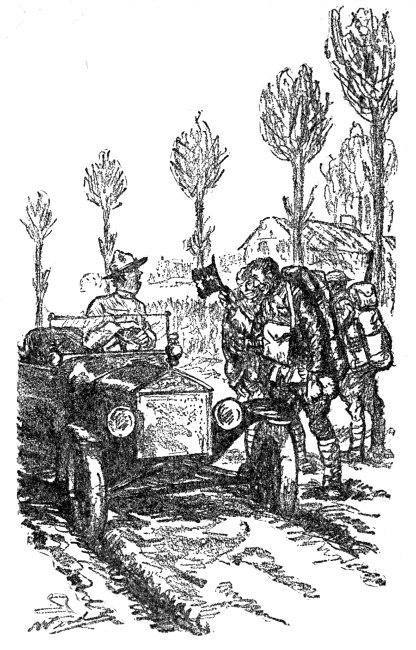
The pair had made about three kilometers
when the sound of an approaching auto
warned Jimmy McGee to take to the bushes.
He lost no time in getting off the road. O. D.
followed him with the statement that he believed
it was a general’s limousine coming.
“Let it come—we don’t need to see it.
Just sit down and look the other way. No
use tryin’ to break our arms with that
salutin’ stuff,” was the reply.
Both men sat down facing the woods.
There was a sound of tires scraping the road,
under pressure of quickly applied brakes. A
door opened and slammed shut.
“What outfit are you men from?” The
question was asked in a heavy, steady voice.
McGee and O. D. stood up and faced about
to find themselves confronted by a major-general.
They saluted. McGee spoke up.
“Twenty-sixth Division, sir.”
“What are you doing straggling along this
road?” asked the general.
“Just returnin’ to our outfits from the
hospital, sir,” lied McGee, with a feeling of
glory.
“All right, men.”
The man with two stars on his shoulders
stepped back into the warmth and luxury of
his chugging motor and was off in a swirl
of dust that nearly choked the two soldiers.
McGee caught himself in the act of reaching
for his old, battle-scarred gas-mask.
“Gee! he was a major-general,” declared
O. D. in an awed voice; “did you see the two
stars on his straps?” gasped the newcomer
to Jimmy’s hunting-grounds.
“Oui, I noticed them all right, but they
didn’t mean nothin’ to me. Generals don’t
count much up there,” pointing in the general
direction of the front. “We see plenty
of other things that’s more interestin’.
Course, you know, I generally salute officers
from brigadier-generals up—that is, when
they see me first; but you get used to havin’
’em around you,” was Jimmy’s rejoinder.
“First time I ever had a general speak to
me,” admitted O. D.
“Hell afire! I’ve had a dozen of ’em talk
to me. Old General Edwards—he’s our boss,
you know, and some boy at that, too—gave
me an awful bawlin’-out one day on a hike
when he caught me ridin’ on the rollin’
kitchen. Then another time he came into my
dug-out one day and told me that the C. O.
had said something good about a fool stunt
I pulled one night when our lines went down
and we kept up communication durin’ the
bombardment and attack. Said he’d cite me,
or somethin’ like that, but I never bothered
to find out much about the business. Believe
me, Edwards is the kind of man this army
needs with a general’s stars on. He gets
right in the old guerre. Some of ’em fight
the war back in towns that the Boches have
agreed not to shell. Say, by the way, ever
see Pershing down in the S. O. S.?” asked
Jimmy, as he got started under way again.
“Yes, once, when some French general
gave him a medal or something. It was quite
a ceremony,” replied his new companion.
“What did he look like? Kinda curious,
as I ain’t seen him yet.”
“Do you mean that you are right at the
front and never see the general?” The question
was crowded with incredulity.
“Been on every front the Americans ever
fought on, except the British lines, and never
seen Pershing yet,” maintained McGee.
“Whee-ew! I thought that he was at the
front all of the time leading the troops,” said
O. D.
“No that Civil War stuff ain’t much in
this guerre. Generals are like the flags and
bands at the time we go over—they ain’t
there, as a rule,” informed the man who knew
about those things.
“Three kilometers to Issoncourt, according
to that mile-stone,” said O. D. after they
had hiked about four more kilos.
“Don’t believe those things. Next one
will say seven kilometers to Issoncourt.
That’s the way they build those things in
this country. You ’ain’t arrived over here
until you get there.”
“Looks like a nice town over yonder.” O.
D. illustrated his words by pointing to the
cluster of red roofs that glared in the afternoon
sunlight.
“Looks—but that’s all. They’re all alike.
At a distance you think these darn French
villages are the cat’s knee-knuckles, so to
speak, but when you get in them it’s the
same old stuff—a bunch of old, moss-covered
buildings standin’ around a church that’s big
enough for an Irish parish in a big New
York City precinct. A gang of cows in the
street; an army of sheep and goats runnin’
in and out of front doors; a few hungry-looking
dogs; beaucoup manure smoking in
front of every door; some old men and
women clatterin’ up and down in those
wooden shoes—and you’ve got the best
French village I ever stayed in. I’d rather
pass the rest of my life in Yulee, Florida,
than spend three months in one of these
places durin’ peace-times. There’s a few
trains pass through Yulee, and you get a
newspaper once in a while; but in these
French dumps the biggest excitement is that
old village crier with his drum and line of
talk that the inhabitants can’t compree, or
a two-year-old newspaper posted up on the
city hall, or Mairie, as they call it. I’m off
’em for life.”
It was only four o’clock when the pair
reached Issoncourt, but already the shades
of oncoming night had started to curtain the
early autumn day with a sort of purple haze
that soon became a regular night mist.
“Guess we’ll camp here for the night,”
was Jimmy’s decision, as he noted the signs
of night coming.
Issoncourt had been attached to the sides
of the main Verdun road, and everything
that the town owned was in plain view from
the middle of the street, or Grande Rue, as
the villagers called the roadway.
“Looks like there might be a chambre in
that house. We’ll reconnoiter a bit for a
place to cushay,” and Jimmy started toward
what he thought was the best-looking house
on the street.
Just as they reached the rough stone steps,
after wading through the usual three feet of
mud, a young colt came tearing through a
barn door and nearly sent O. D. down for
the count. Jimmy tapped at the door.
“Entrez,” called a woman’s voice.
McGee pushed the door in and both men
stepped into the room. It was the same old
stuff to Jimmy. The room was big and contained
two beds that were built into the walls
and canopied over with some kind of red
curtain. A rickety table with a half-emptied
bottle of vin rouge on it stood in the center
of the room. There was the usual number
of chickens passing in and out to the barn.
Several cats lounged about the great open
fireplace that was bare of fire, except for a
few pieces of smoking things that looked
like grape-vines. A dog got up somewhere
in the darkness and shook himself back to
life. The woman who had told them to enter
was not in sight.
Suddenly the sound of wooden shoes rattling
over stones announced the approach of
some one. A woman came in from the barn
carrying an apron full of potatoes and
greens. A small army of chickens followed
at a respectful distance. The woman was of
medium height, kind of pudgy around the
gills and places where a corset should have
been. Her hands were red and big enough
to handle any one-hundred-and-sixty-pound
man. Of course, she wasn’t good-looking or
particularly ugly, just an ordinary peasant
face.
“Que désirez-vous, Messieurs?” (What
will you have, messieurs?)
“Eh—bonjour, madame,” began Jimmy,
unsteadily. “Avey vouse de chambre for
comrade and moi?”
The woman cocked her ear to get the drift.
“Chambre—pour coucher?” she asked.
“Ah, oui, madame,” assured Jimmy, picking
up courage.
The woman dropped her load of potatoes
and greens on the floor, kicked off the wooden
boats, and, telling them to follow her, waddled
into the next and only room in the house.
“Voilà!” (There), she exclaimed, pointing
to a bed that was at least seven feet high.
“Bon—tres-beans, madame,” to the woman.
Then Jimmy turned to O. D.: “We may need
a step-ladder to get in and a pulley to get us
out; but say la guerre. It’s a hundred times
better than a hay-loft.”
“Sure,” said O. D., enthusiastically.
“Madame, monjay ici?” was Jimmy’s next
effort.
“Mais, messieurs, je n’ai rien! Trés-difficile
d’obtenir quoi que ce soit depuis la
guerre! Figuerez-vous, une livre de sucre
pour une personne par mois! Et du pain!
O là là! C’est terrible, vous comprenz?” (Oh,
messieurs, I have very little. Too difficult to
get things since the war started. One pound
of sugar a person for a month, a ration of
bread. It’s terrible, you understand?), answered
the woman, evasively.
“Oui, madame, compree; but comrade, moi,
no monjay. Beaucoup hungry. Beaucoup
fatigue. Compree?” questioned McGee, tapping
his stomach as if it were an empty bag.
“Oui,” answered the madame, solemnly.
“Omelette, pom du tear fritz, trey-bon vous,
serve comrade, moi, s’il vous plate.” Jimmy
did his darnest to tell her what he was thinking.
She understood him after the fashion of
the French people who had been near American
soldiers before. Most of the peasants in
the regions where many American soldiers
were located soon learned to speak their native
French just as brokenly as the Americans.
It was necessary to do so in order that
the likes of Jimmy McGee might compree just
a little bit.
After much puffing and running around,
the woman finally set a table for her hungry
guests. A fifteen-egg omelet, beaucoup
French-fried potatoes, what was left of Jimmy’s
bread, a dish of white cheese, and a tall
bottle of wine awaited the offensive of the
two Americans.
“Ah, madame,” said McGee, licking his
chops, “I’ll say that’s the darb——”
“Qu’est-ce qu’il dit?” (What did you say?)
“Oh, I said its mighty bon—beaucoup monjay,
you compree moi?”
The peasant woman smiled at him as if
she understood, and Jimmy made a dive into
the middle of the big yellow omelet.
“Gee, this is the best feed I’ve sat down
to in a long, long time,” admitted O. D. as he
piled the brown potatoes knee-deep in his
plate. “Wish I could speak French like you
do, I’d be able to keep from starving.”
“Oh, I don’t parley much, just enough to
get along. Course, I never have any time
to study. If we get a chance I’ll teach you
some of the stuff.”
“Thanks. Say, wonder if you could get her
to give me a drink of water. I’ll pass away
with this thirst.”
“Here, take a glass of the vin rouge. It
may be better than the stuff I had in my
canteen,” offered Jimmy.
“No, believe I’d rather have the water,
if you can get it without too much trouble.”
“None t’all. Wait ’till the madame blows
in again; I’ll see what we can do.”
“Madame, avey vous der low?” asked Jimmy,
hoping that she would get his meaning.
“Der low,” repeated the woman, lost for
a moment. “Der low,” again. This time with
great wondering, “Pas compris, monsieur.”
“Cum see, cum saw,” explained McGee,
raising an empty glass to his lips.
“Oh, pardon, monsieur, pardon, oui, tout
de suite.” She hurried over to the wall and
pulled a part of it out, found a cupboard
where nobody else would have ever dreamed
there was one, and drew forth a glass. She
brought the glass to Jimmy and gave it to
him.
“She didn’t get me,” groaned Jimmy.
“Thought I wanted another glass, just like a
Frog.” Then to the woman, “Madame, compree
low, der low, drink, you savvy?” he
floundered deeper.
The woman shook her head while McGee
scanned the room in search of a pump or
something by which he might readily explain
his desire. There was nothing in sight to
help him. He turned again to the waiting
woman.
“Madame, moi comrade—no van rouge—no
pas bon for comrade. Kisskesay, der low,
water, in Fransay?” Jimmy was at the
limit of his resources.
“Never mind, old man, I’ll go without it,”
said O. D., coming to the rescue.
“Der low, der low,” muttered the woman
shaking her head uncomprehendingly and
pronouncing the word just as Jimmy had
done. Suddenly a light flashed across her
stolid features.
“De l’eau, vous dites.” (Water you said.)
“Oui, Oui, madame.”
“Ah, mon Dieu, de l’eau, je comprends,”
and she dashed out of doors with a small
bucket.
“At last she gets it—some battlin’, though.
These doggone French people can’t compree
this water stuff. Maybe if they’d drink more
water the war’d be won faster. But I’m getting
just like ’em—haven’t had any water in
four days myself now. Guess I’ll tank up
to-night.”
Madame returned with the water and immediately
poured it all in a basin, grabbed
some soap and a towel and brought the whole
outfit over to Jimmy.
“Voilà!” she exclaimed as if the guerre was
won.
Jimmy looked at the basin, the soap and
towel. Then he looked long and hard at O. D.
The woman stood fast, regarding them both,
feeling suddenly guilty of having sinned
again.
“Corporal of the guard, relief, post number
one,” shouted Jimmy. “Can you beat that,
wouldn’t it drive a man nuts? I ask for a
drink of water and the woman insists that I
wash. No use, O. D.” Then to the woman,
“Madame, pas wash, cum saw,” and he lifted
the glass to his lips for the second time.
“Quoi? Boire de l’eau? Impossible!!
Buvez donc du vin! quelle race! Eh! mon
Dieu! ils bovvent de l’eau!” (What! you
want water to drink. Impossible. Drink the
red wine. What people—what people! My
God! they drink water), exclaimed the mystified
woman, and she nearly went into fits.
“Oui, madame,” insisted Jimmy, raising
the glass up and down as if to convince her
by that action of the sincerity of his words
and meaning.
“Comme vous voulent, messieurs!” (As
you will then, messieurs), answered madame,
and she went out for more water.
Just as the boys were hitting the cheese
or fromage course as Jimmy insisted on calling
it, the man of the house, or patron, as
madame called him, blew in. He was nothing
more and nothing less than a grizzled old
poilu rigged up in civilian clothes.
“Bon swoir, messieurs,” was his hearty
greeting.
“Bonjour, monsieur,” responded Jimmy,
rising to shake his hand.
“Bonne mangee?” asked the Frenchman,
pointing to the table.
“Oui ... trey-bien,” declared McGee, and
he let out two notches in his belt to prove
that he was well fed.
The old man dragged up a chair and made
believe he was going to roll a cigarette.
Jimmy saw the act and got wise.
“Here, have a regular cigarette,” he said,
extending a pack of Piedmonts to the patron.
“Merci. Merci, monsieur.”
“Take ’em all. I can get more. Suppose
we ain’t too near the front yet for the
Y. M. C. A.”
“Ah, monsieur, vous êtes très?-gentil, très
bon.” (Ah, sir, you are very nice, very kind.)
“Not at all.”
Once the cigarette was lighted, the man of
the house waddled over to the cupboard and
extracted a long dark bottle. He came back
to the table, measured out four glasses of
brownish-looking stuff and handed them
around. He touched his own against every
one else’s and shouted:
“Vive l’Amérique!”
“Vive la France!” shouted Jimmy.
The old cognac went down at a swallow.
Everyone smacked their lips except O. D. He
busied himself brushing away two big tears
that filled his eyes.
“Bon,” grunted the Frenchman.
“Ah, oui,” answered Jimmy, patting his
stomach.
“Mangee,” said the husband. He sat down
with his wife to a meal of soup, with bread
floating around in it, a dish of boiled potatoes,
bread, cheese, and wine.
“Want to show you something, Jimmy,”
said O. D., rising and getting an envelope out
of his blouse. He spread a lot of pictures in
front of Jimmy.
“That’s mother, in her little rose-garden.
This is Mary, always loved flowers, too. See
she’s hiding behind some tall lilies, just so
you can see her face.”
“Gee, I can’t tell the difference between
Mary and the lilies,” interrupted Jimmy, admiringly,
as he looked upon the picture of
Mary’s sweet, girlish face. “Golly! it must
be pippin stuff to have a sister like that.”
“Here’s some more of Mary, taken on the
front stoop and one at the shore when I took
her down there to go swimming one hot day.”
Jimmy was so absorbed looking at Mary’s
pictures that he didn’t hear the madame’s
inquisitive question.
“Fiancée, fiancée?” she asked, pointing
to Mary’s photo.
“No,” answered Jimmy at last, “sister,
compree? Sœur to comrade,” pointing to
O. D., who nodded his head in affirmation.
The snap of Mary taken on the beach fascinated
Jimmy. He decided it should belong
to him. When O. D. was not watching, the
Yank who never let Boche shells or gas worry
him swept the picture under his blouse with
a strange feeling of unrest running through
his body and soul.